Tag Archives: american civil war

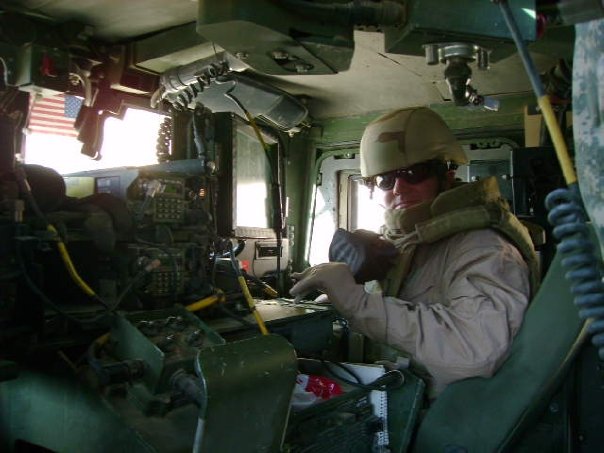
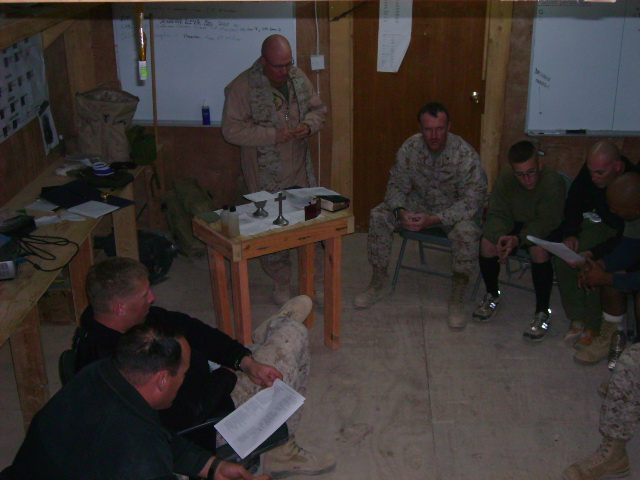
Semper Fidelis! Happy 236th Birthday Marine Corps!

In 1775 a committee of the Continental Congress met at Philadelphia’s Tun Tavern to draft a resolution calling for two battalions of Marines able to fight for independence at sea and on shore.  The resolution was approved on November 10, 1775, officially forming the Continental Marines. The first order of business was to appoint Samuel Nicholas as the Commandant of the newly formed Marines. Robert Mullan the owner and proprietor of the said Tun Tavern became Nicholson’s first captain and recruiter. They began gathering support and were ready for action by early 1776.  They served throughout the War for Independence and like the Navy they were disbanded in April 1783 and reconstituted as the Marine Corps in 1798. The served on the ships of the Navy in the Quasi-war with France, against the Barbary Pirates where a small group of 8 Marines and 500 Arabs under Lieutenant Presley O’Bannon made a march of 500 miles across the Libyan Desert to lay siege Tripoli but only reached Derna. The action is immortalized in the Marine Hymn as well as the design of the Marine Officer’s “Mameluke” Sword. They served in the War of 1812, the Seminole Wars and in the Mexican-American War where in the storming of the on Chapultepec Palace they continued to build and enduring legacy. In the months leading up to the Civil War they played a key role at home and abroad.  In October 1859 Colonel Robert E. Lee led Marines from the Marine Barracks Washington DC to capture John Brown and his followers who had captured the Federal Armory at Harper’s Ferry.

The Corps would serve through the Civil War and on into the age of American Expansion serving in the Spanish American War in the Philippines, Puerto Rico and Cuba where they seized Guantanamo Bay at the battle of Cuzco Wells.  The would serve in China and be a key component of the international force that defended foreign diplomats during the Boxer Revolt as well as the international force that would relieve the diplomatic compound in Peking (Beijing).  In World War One the Marines stopped the German advance at Chateau Thierry and cemented their reputation as an elite fighting force at Belleau Wood where legend has it that the Germans nicknamed them Teufelhunden or Devil Dogs, a name that they Marines have appropriated with great aplomb.

During the inter-war years the Marines were quite active in the Caribbean and Asia and also developed amphibious tactics and doctrine that would be put to use in the Pacific Campaign.  During the war the Marines served in all theaters but won enduring fame at Wake Island, Guadalcanal, Tarawa, Iwo Jima, Okinawa and numerous other battles in the Pacific war. Marine Aviators flew in some the most desperate actions in the war to support the Navy and amphibious operations ashore.

After the war the Truman Administration sought to eliminate the Marine Corps but the Corps was saved by the efforts of Americans across the country and Marine supporters in Congress.  That was a good thing because the Marines were instrumental in keeping the North Koreans from overrunning the South during the Korean War on the Pusan Perimeter, turned the tide at Inchon and helped decimate Communist Chinese forces at the Chosin Reservoir.  After Korea the Marines would serve around the World in the Caribbean and Lebanon and in Vietnam where at Da Nang Keh Sanh, Hue City, Con Thien fighting the North Vietnamese and their Viet Cong allies.  The Marines took the initiative to implement innovative counter insurgency measures such as the Combined Action Platoons which enjoyed tremendous success until they were shut down by the Army high command.  These lessons would serve the Marines well in the new millennium during the Anbar Awakening in Iraq which changed the course of that insurgency and war.

The Marines would again be involved around the World after Vietnam serving in the Cold War, in Lebanon and the First Gulf War which was followed by actions in Somalia, the Balkans and Haiti. After the attacks of September 11th 2001 the Marines were among the first into Afghanistan helping to drive the Taliban from power. In the Iraq Campaign the Marines had a leading role both in the invasion and in the campaign in Al Anbar Province.  After theirwithdraw from Iraq the Marines became a central player in Afghanistan where today they are engaged around Khandehar and in Helmand Province.

The Marines are elite among world military organizations and continue to “fight our nations battles on the air and land and sea.” The Corps under General John LeJeune institutionalized the celebration of the Marine Corps Birthday and their establishment at Tun Tavern. General LeJeune issued this order which is still read at every Marine Corps Birthday Ball or observance:

MARINE CORPS ORDER No. 47 (Series 1921)
HEADQUARTERS
U.S. MARINE CORPS Washington, November 1, 1921

The following will be read to the command on the 10th of November, 1921, and hereafter on the 10th of November of every year. Should the order not be received by the 10th of November, 1921, it will be read upon receipt.

On November 10, 1775, a Corps of Marines was created by a resolution of Continental Congress. Since that date many thousand men have borne the name “Marine”. In memory of them it is fitting that we who are Marines should commemorate the birthday of our corps by calling to mind the glories of its long and illustrious history.

The record of our corps is one which will bear comparison with that of the most famous military organizations in the world’s history. During 90 of the 146 years of its existence the Marine Corps has been in action against the Nation’s foes. From the Battle of Trenton to the Argonne, Marines have won foremost honors in war, and in the long eras of tranquility at home, generation after generation of Marines have grown gray in war in both hemispheres and in every corner of the seven seas, that our country and its citizens might enjoy peace and security.

In every battle and skirmish since the birth of our corps, Marines have acquitted themselves with the greatest distinction, winning new honors on each occasion until the term “Marine” has come to signify all that is highest in military efficiency and soldierly virtue.

This high name of distinction and soldierly repute we who are Marines today have received from those who preceded us in the corps. With it we have also received from them the eternal spirit which has animated our corps from generation to generation and has been the distinguishing mark of the Marines in every age. So long as that spirit continues to flourish Marines will be found equal to every emergency in the future as they have been in the past, and the men of our Nation will regard us as worthy successors to the long line of illustrious men who have served as “Soldiers of the Sea” since the founding of the Corps.

JOHN A. LEJEUNE,
Major General
Commandant

I have had the privilege of serving with the Marines in peace and war and the most memorable Marine Corps Birthday celebrations for me were in Ramadi with the Marine advisors to the Iraqi 7th Division and with the Marine Security Force Company at Guantanamo Bay Cuba. The highlight of my career was serving with the Marines in Iraq and I wear my Iraq Campaign Medal with pride.  The Marines have helped my professional development as an office through the Amphibious Warfare Course, Command and Staff College and the Fleet Marine Force Officer Qualification. I count my Marines as some of my most enduring friends.

Happy Birthday Marines. Thank you for all you do.

Peace

Padre Steve+

1 Comment

Filed under History, Military

The Promise and Peril of Revolutionary Times: A Warning From History

“In a revolution, as in a novel, the most difficult part to invent is the end.” – Alexis de Tocqueville

“They who clamor loudest for freedom are often the ones least likely to be happy in a free society.”  Eric Hoffer – The True Believer

I don’t know about you but it seems that everywhere I look that revolution is in the air.  Revolutionary times can be exciting to watch or even to participate in because all at least initially cater to the hopes of people, the hope of change, freedom, justice and equity are common themes.   As a historian I find it fascinating to observe revolutions and to read about revolutions throughout history.  But I always have a concern about how even the most well intentioned revolts against real or perceived injustice often miscarry and create conditions ripe for civil war, dictatorship and even regional or world war.

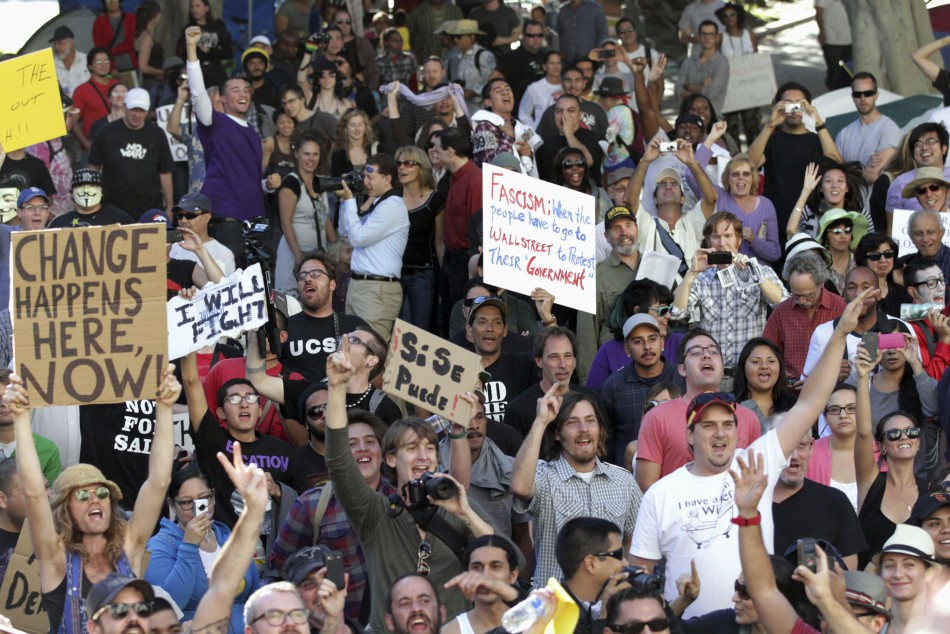
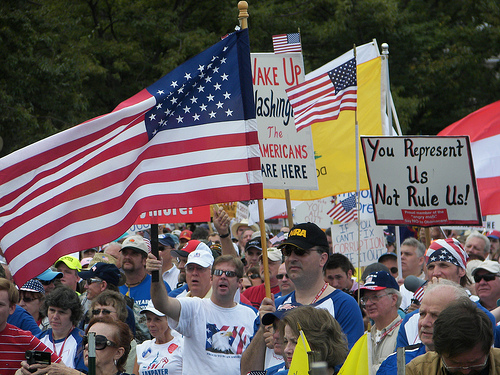
The revolutions sweeping the world today and I include the proto-revolutionary movements of the conservative Tea Party and Occupy Wall Street movements as revolutionary movements are becoming mass movements.  As mass movements they share many things in common even if their ideologies and backers appear to be diametrically opposed.  We now have two diametrically opposed revolutionary movements seeking power in this country and neither side will be satisfied until they achieve it.

Those that dismiss or seek to tame the Tea Party or the Occupy Wall Street movement are foolish. The anger, resentment and the hatred that these movements have for the established order are too great to be easily dismissed.  The politicians that try to channel these movements for their own benefit or party or that attempt to encourage them without actually addressing their grievances will discover too late that lip service and cosmetic change will not be enough.  Peaceful nonviolent protests can turn violent in a moment with very unpredictable results.

In our country there is great dissatisfaction with the status quo on the right and the left which in large part is due to the actions of those in power in government, media, business and even religion to address the concerns of those on both sides of the political abyss.  Likewise it is the same entities that in order to maintain their power have used every opportunity to create enmity among Americans.

Similar events are occurring on the other side of the Atlantic as the crisis in Greece threatens the economic stability and quite possibly the viability of the European Union.  The extremists on the left and right are garnering support that they have not had in decades from people that until the current economic downturn were content with the status quo because they were doing alright.

Even those revolutions that bring positive change tend to bring in some form of social unrest and upheaval to include the maltreatment and sometimes exile of people that did not agree with the revolution.  One only has to take a look at the large numbers of British colonists in the 13 Colonies who were loyal to the British Crown and lost their place in society and many times their homes and livelihoods as they were no longer welcome.  Many fled to Canada, the British West Indies or had to return to England.

Revolutionaries do not take kindly to those that oppose them, especially when they are kinsmen.  Those officers or Federal officials that remained loyal to the Union during the American Civil War that hailed from Southern States often found that they were no longer welcome in their communities and sometimes disowned by their families.  This was the fate of General George Thomas who remained faithful to his oath despite being fromVirginia. His family turned his picture around and refused to have anything to do with him from that point forward even refusing financial assistance from him after the war.

The English Civil Wars of 1641-1653 were some of the most brutal to occur inEuropeand devastated Ireland which lost some 41% of its population and where the lingering scars are still seen today.

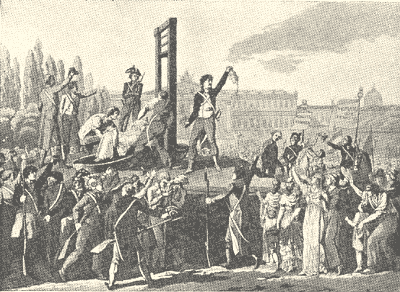
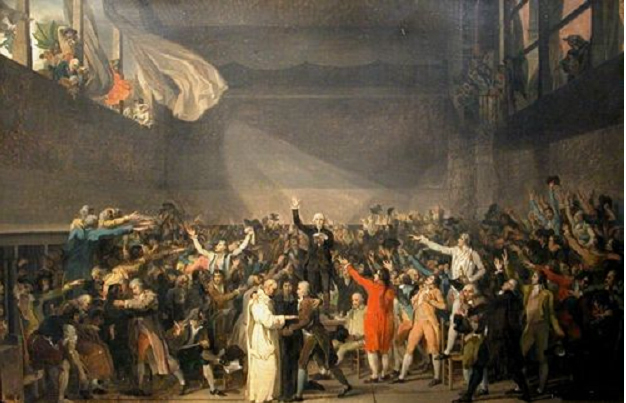
The French Revolution was a bloodletting that shaped France to the present day.  People tend to forget that the root cause of this revolution was a financial crisis brought about by the costs of the Seven Years War with England and the French support of the American Revolution which brought the country into more conflict with England. The antiquated and regressive French tax code put a heavy burden on the middle and lower classes but provided many exemptions to the nobility and the clergy.  When comptroller Jacques Necker proposed ending or reducing those exemptions he was fired.  But the crown was so week that it decided to call the Estates General into session for the first time since 1618 and when the three components of the assembly could not agree on credentials the lower assembly of commoners broke off and formed their own National Assembly and when it appeared that the King was bringing foreign troops to Paris it set off an armed revolt.

The revolution was brutal and unleashed an unprecedented series of wars which engulfed the European continent the West Indies and Egypt.  Eventually a young Army officer named Napoleon Bonaparte did much to secure the new regime’s security by a series of brilliant military victories.  He was so successful that he overthrew the government and became a dictator in 1799 and would proclaim himself Emperor in 1804.  The wars in Europe were devastating and would create a situation where a weakened Spain and Portugal would lose their colonies in Central and South America.

When Napoleon was finally defeated for the last time at Waterloo in 1815 the Congress of Vienna reestablished a conservative order and peace inEurope.  There was a brief revolutionary period in 1848 and the wars that led to the unification of Germany and the defeat of France by Prussia in 1870-71. But for the most part stability reigned until the First World War as European powers focused on using their power in imperialist ways in Africa, the Middle East and Asia.   The war set in motion revolutionary movements that would lead to the overthrow of empires and birth the mass movements of Communism, Fascism and Nazism that would be responsible for some of the most destructive wars and crimes against humanity ever seen by the world.

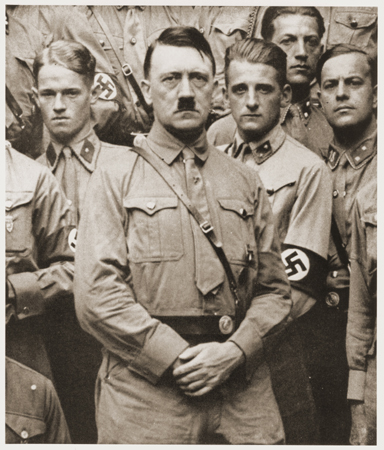
Other revolutions have caused immeasurable suffering, the Cultural Revolution in China, the Iranian revolution, the Bolshevik Revolution in Russia to name a few. The Spartacus revolution in the early days of the Weimar Republic helped doom it and led to the Nazi revolution in Germany. The Nazi revolution was brought about through legal means with the appointment of Adolf Hitler as Chancellor after which his revolutionary policies were put in place.

The revolutions in the Soviet Union and Warsaw pact in aftermath of the Cold War have brought a multiplicity of outcomes, some which appear to have brought forth societies where human rights and individual liberties are respected and others which have become or are in the process of becoming dictatorships.

And so today we live in an age of revolution which is heightened and moves across the globe like a wind fanned wildfire due to the instantaneous nature of the communication and media that we now enjoy.  There is the Arab Spring and the beginnings of revolutionary movements in Europe, Asia and now even North America.  Governments seem impotent to do anything about the conditions that have moved these revolutionary groups to action and have given the ideologues on the left and right respectability that they could have never enjoyed before.  The ideologues make their money by providing a platform for the airing of the grievances of their readers or listeners real and imagined by playing on the need for hope.  The motive of the listener or follower is finding something to believe in a hope and promise, hope around the corner not hope deferred.  Eric Hoffer noted “To have a grievance is to have a purpose in life. It not infrequently happens that those who hunger for hope give their allegiance to him who offers them a grievance.”

The extremists on both sides of the line in the United States have held sway so long that they have turned the extreme into the mainstream inspiring one of the most amazing displays of left-right groupthink that I have ever seen.  I read a lot of conservative and liberal blogs and websites,some which are considered mainstream by their proponents.  I believe that you can tell a lot about movements by what the rank and file write or share.  One thing that I notice is how interchangeable these blogs are and how much they mirror the talking points of their respective echo chambers.  There is little creative though only the endless repetition of talking points. If one ventures a dissenting opinion on one of these sites he or she will find themselves shouted down and demonized and it doesn’t matter if the site is left wing or right wing, religious or secular.  The purity of ideology and necessity of conformity to the group-think ensures that opposing points of view be shouted down.

I first started noticing this when I returned fromIraqin 2008. At that time I was still listening to conservative talk radio on a regular basis and I started noticing that with minor differences all the talk show hosts sounded alike, the same talking points driven home day after day.  Alternative viewpoints even those that differed only slightly from the party line were ridiculed and demonized. That was eye opening to me and I noticed a similar tone emanating from the left.  Both emphasize that they are being oppressed or persecuted and the rank and file believe that they are oppressed and gladly allow themselves to become parts of these mass movements.

It is the real and perceived feelings of oppression or persecution provide these disparate movements their most fervent followers and energy.

One attitude prominently displayed is an absolute hatred and distain of moderation.  Both have an absolute distain of dialogue and neither appear to want a win-win situation to develop simply because to both sides only absolute victory for themselves and destruction of all that that they oppose matters.  It is a nihilistic zero sum game that both sides play.  Both sides are slaves to their doctrine and the vast majorities of the followers of these mass movements are absolutely unaware of this.  Philosopher Eric Hoffer wrote “A doctrine insulates the devout not only against the realities around them but also against their own selves. The fanatical believer is not conscious of his envy, malice, pettiness and dishonesty. There is a wall of words between his consciousness and his real self.”

Revolutionary movements of themselves can be transforming and in the long run quite beneficial but for every one that is such there are many more that in succeeding bring about tyrannies as bad or worse than the ones that they ended.  The evidence of this is widespread.  Much of this is due to a desire not for freedom but for revenge as those that viewed themselves as oppressed or persecuted turn their new found power into a weapon of revenge and retaliation.  Hoffer wrote “It is doubtful if the oppressed ever fight for freedom. They fight for pride and power — power to oppress others. The oppressed want above all to imitate their oppressors; they want to retaliate.”

History shows that in more cases than not that when revolutionaries take power they become oppressors themselves and are perfectly willing to crush dissent by force. They become the conservative faction resistant to change and opposed to dissent.  Hannah Arendt observed that “The most radical revolutionary will become a conservative the day after the revolution.”

Eric Hoffer understood mass movements as few in the last century have.  Hoffer’s book The True Believer (1951) is a study of mass movements and since Hoffer had witnessed the mass movements of the 1920s and 1930s that defined the age, Fascism, Communism and Nazism.  Hoffer notes similarities between political, social and religious mass movements and when it was written in 1951 President Dwight D. Eisenhower praised it.  It is well worth the read.  Hannah Arendt also understood how individuals in mass movements could participate in evil including genocide and think that they were just doing their job and helping society.  Her book Eichmann in Jerusalem: A Report on the Banality of Evil.

Revolutionary times are filled with promise and peril. The wise in Tea Party and the Occupy Wall Street and other movements around the world need to understand that crucial truth.  Movements such as these can be co-opted and driven in ways that those that began them can little anticipate and the leaders of such movements often become victims of the very movement that they helped create.  The names of such instigators that have become victims is too long to list.

As a historian I find the process that we see unfolding as simply fascinating and I cannot predict how this revolutionary era will play out.  I just hope and pray that things don’t get too sporty.

Peace

Padre Steve+

5 Comments

Filed under History, News and current events, Political Commentary

The Oath: Reflections on the Oath of Office and 30 Years of Service

It was a hot and smoggy summer day in Van Nuys California when drove into the parking lot of the old Armory on Van Nuys Boulevard in my 1975 yellow Chevy Monza with a black vinyl top.  It was August 25th 1981.  That night the San Francisco Giants defeated the St. Louis Cardinals by a score of 4-2 and the Baltimore Orioles defeated the Seattle Mariners 6-5 in 12 innings.  In less important news the Voyager II space craft reached its lowest orbit around Saturn.

Getting out of the car I walked into the offices of the Headquarters, 3rd Battalion 144th Field Artillery of the California Army National Guard.  I had in my sweaty hands the paperwork from the Army ROTC detachment at UCLA the “Bruin Battalion” accepting me into the program and allowing me to enlist simultaneously in the National Guard.

I was met by the Headquarters Battery Commander, Captain Jeff Kramer who after my commissioning would allow me to borrow his sword and sword belt to wear at my wedding with my Dress Blue Uniform.  Jeff finished his career as a full Colonel.  He took me to Major Charles Armagost the battalion S-1 who rapidly had a clerk type up my enlistment papers and administered the oath of enlistment below:

I, Padre Steve (I wasn’t one then but it sounds good) do solemnly swear (I don’t affirm because it’s namby pamby) that I will support and defend the Constitution of the United States and the State of California against all enemies, foreign and domestic; that I will bear true faith and allegiance to the same; and that I will obey the orders of the President of the United States (Ronald Reagan) and the Governor of California (Jerry Brown)  and the orders of the officers appointed over me, according to law and regulations. So help me God.

That was the beginning.  I was taken to the supply sergeant who ordered my uniforms which came as a surprise since I had been issued a set by the ROTC detachment.  Of course the ROTC ones were the green permanent press fatigues which I loved and the Guard ordered the then new BDUs which some Navy units still wear. The Army, Marine Corps, Air Force and parts of the Navy having replaced them over the past decade.  My first drill was when the Battalion went to Fort Irwin for a long weekend in early September; I was on the advanced party and was assigned to drive a M151A1 “Jeep” in the convoy from Van Nuys to Fort Irwin.

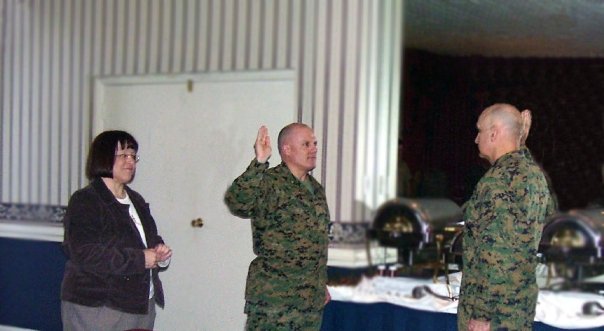
Renewing the Oath on my Promotion to Lieutenant Commander 2006

In June of 1983 I was commissioned as a Second Lieutenant and I took a different oath, an oath of office versus enlistment, I would repeat it again in February 1999 when I was commissioned in the Navy and renew it in 2006 upon my promotion to Lieutenant Commander.

I, Padre Steve, do solemnly swear (again I don’t affirm, namby pamby) that I will support and defend the Constitution of the United States against all enemies, foreign and domestic; that I will bear true faith and allegiance to the same; that I take this obligation freely, without any mental reservation or purpose of evasion; and that I will well and faithfully discharge the duties of the office on which I am about to enter. So help me God.

Since I swore the oath the first time I have served in the Army and Navy, in the Army National Guard of California, Texas and Virginia and the Army Reserves. I have spent about six years assigned to the Marines in my capacity as a Navy Chaplain.  I have served in Europe, Asia and the Middle East, at sea and ashore in war and peace.  I have served as a Company Commander and a Staff Officer before becoming a Chaplain and there is no greater honor than to serve this country.

Iraq 2007

It is hard to believe that it has been 30 years.  I do take the oath of office quite seriously especially the part about defending the Constitution against all enemies foreign and domestic.  Since I have served 30 years I have served five Presidents and seen Congress make some fairy wild changes of direction.  That is the thing about our republic our officers do not make their oath to the President or even the majority party in the House of Representatives or the Senate. National Guard Officers also swear an oath to the Constitution of the State in which they serve but their commissions are cognizant on their Federal recognition and thus they like all other officers are sworn to support and defend the Constitution of the United States above all.

This is a good thing as I have not completely agreed with the actions or policies of each President and Congress that I have served. While I have deeply held political views they have never kept me from serving under administrations that I have disagreed with on major policies.  Officers may have strong political views but those must always be subordinated to our oath to support and defend the Constitution.  General Winfield Scott Hancock said “We are serving one country and not one man.” Hancock was a states rights Democrat who remained in the Union because he did not believe that secession was legal.  He had no political friends in Washington and he served valiantly during and after the war.  When asked about his opinion on what to do when their home state of Virginia seceded from the Union by his friends and fellow officers George Pickett, Lo Armistead and Dick Garnett before the war in California he said “I shall not fight upon the principle of state-rights, but for the Union, whole and undivided.”

This is not the case in much of the world. Many militaries swear allegiance to the ruler, the state, ruling political party or the majority religion.  The officers in many Moslem nations combine their oath with the Bya’ah which includes a personal oath to the King or Sheik and the Islamic statement of faith.

The British military swears an oath to the Queen and her successors:

“I ( name), swear by Almighty God that I will be faithful and bear true allegiance to Her Majesty Queen Elizabeth II, her heirs and successors and that I will as in duty bound honestly and faithfully defend Her Majesty, her heirs and successors in person, crown and dignity against all enemies and will observe and obey all orders of Her Majesty, her heirs and successors and of the generals and officers set over me.”

The Red Army of the Soviet Union swore an oath to “to protect with all his strength the property of the Army and the People and to cherish unto death his People, the Soviet homeland and the government of Workers and Peasants, also to respond at the first call from the government of Workers and Peasants to defend the homeland, the USSR.”

Germany has had a rather perilous history with oaths sworn by the military.  The Imperial Army swore an oath to the Kaiser but when the Kaiser abdicated and the Weimar Constitution was ratified German Officers and Soldiers took this oath: “I swear loyalty to the Reich’s constitution and pledge, that I as a courageous soldier always want to protect the German Nation and its legal institutions, (and) be obedient to the Reichspräsident and to my superiors.”  The history of the Republic shows that many officers and soldiers, especially those that had served under the Kaiser resented this oath.  In 1933 Hitler changed the oath to this  “I swear by God this sacred oath, that I will render unconditional obedience to Adolf Hitler, the Fuehrer of the German Reich and people, Supreme Commander of the Armed Forces, and will be ready as a brave soldier to risk my life at any time for this oath.” The current German military oath states: “I swear to serve loyally the Federal Republic of Germany and to defend bravely the right and the freedom of the German people. So help me God.”

All oaths hold potential dangers but those of theUnited States military officer corps is perhaps the best thought out oath in the world.  The oath is to the Constitution, not a person, political party or religion.  The efficacy of the oath is based on the honor of those that swear to uphold it.  In times of national turmoil it is important for officers and enlisted personnel to ensure that remember that fact.

When a nation is as badly divided as we are at this point in our history there will be divergent views regarding political beliefs in the officer corps.  This has happened before but only one time did it fracture the military and that was during the Civil War.  Many Southern officers in Federal service resigned their commissions and entered the service of their home states as did a number from the North who had family or marriage connections to Southerners.  Those that did so believed that they had a higher allegiance to their states and viewed the Federal government as an oppressor.

My family came from Cabell County Virginia in the far west of the state.  It was one of six Virginia counties to vote to remain in the Union. My family opposed this and sided with the Confederacy.  They owned slaves and sided with their self interests over their neighbors.  I find the talk of secession by some politicians today repulsive and hateful and those that even suggest it should be shunned by every American.

But there were Southern Officers that remained loyal to the Union; the most prominent of which was General George Thomas. Thomas was a highly successful commander who remained in the Army despite having his friends and superiors in the Second U.S. Cavalry Regiment including Albert Sidney Johnston and Robert E. Lee.  He struggled with his decision but kept his oath.  His family was outraged by this and turned his picture against the wall, destroyed his letters, and never spoke to him again.  They also refused his financial help after the war.  He was pro-emancipation and commanded some of the first Black Regiments in battle during the Western campaigns.  Thomas is emblematic of the cost that one can endure in remaining true to his oath.

Politicians, pundits and preachers from both parties will always attempt to peel military personnel, especially officers away from their oath to the Constitution in order to appear strong on defense, more patriotic or ingratiate themselves to them during a time of war.  This is nothing new, George Thomas noticed it after the Civil War and said “I am also afraid that the military arm is becoming more or less infected with politics; let us by all means keep that branch of the public service free from the taint of intrigue and party strife.”

Yes we have problems I this nation, but they are not insurmountable.  A strong and able military that keeps its oath to support and defend the Constitution of the United Statesis necessary to that end; it cannot allow itself to be drawn away from that no matter what our individual political beliefs.  General Winfield Scott Hancock said “The time under our System of Government, when an army becomes political in its character … is about the end of its career.”

I’m proud that I will have a chance to renew that Oath of Office when I am promoted to Commander in the Navy on Thursday.  Technically there is no legal requirement to do this as an officer in continuous service as the promotion is only cognizant on me accepting it and signing the letter of acceptance.  However I do think it important that I renew it publicly to remind me that I serve the people of this country in a time of war and not any political party.

A dear friend, Retired Marine Corps Colonel and former commanding officer will do the honors for me behind home plate at Harbor Park in Norfolk before the Norfolk Tides play the Gwinnett Braves.  We went through many difficult times together and I cannot imagine having anyone else stand with me in reaffirming this sacred oath.

As for the place of the Oath, I could have chosen from several but the Tides and baseball mean a lot to me, after Iraq Harbor Park was one of the few places that I found peace.  When the season ended the team management allowed me to visit and walk the concourse in the off season.  I can’t think of a more fitting place to renew the Oath.

I pray that I will be faithful to the oath and the people that I serve in the coming years.  It is an honor to still remain in the service of this country.  I have served five Presidents and quite possibly will serve under another before I finally end my service. That is a testament to our political system, there have been no purges of the military like in many other nations and the military is not a king maker.  We can be immensely thankful for that.

Those serving in the military come from every walk of life as well as political and religious beliefs.  What sets us apart is that we serve in harm’s way and look out for each other regardless of those beliefs even when they conflict.  I think the rest of the country could learn a lesson from us.

So long as we remain people of good will and commit ourselves to placing the interests of the nation above our own we shall do well.  That is the essence of the Officer’s Oath of Office.

Peace

Padre Steve+

3 Comments

Filed under History, leadership, Military, philosophy, Political Commentary

The Deal is Done and are We? There are Always Results

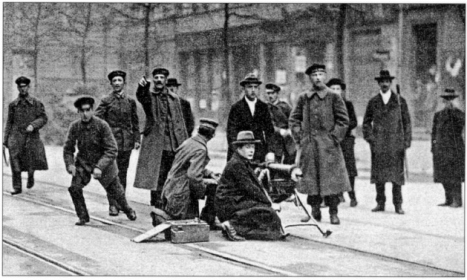
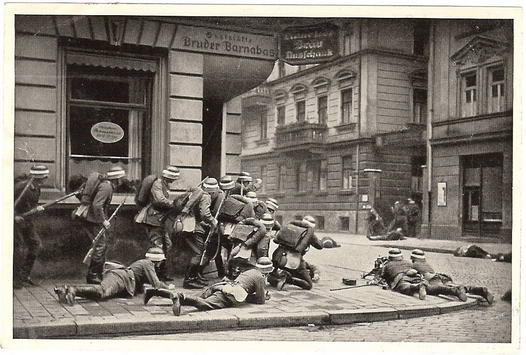
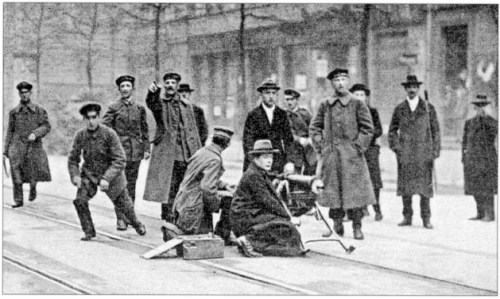
Spartacist revolutionaries and Freikorps in action. Is this our fate? 

“but this momentous question, like a fire bell in the night, awakened and filled me with terror. I considered it at once as the knell of the Union. it is hushed indeed for the moment. but this is a reprieve only, not a final sentence. a geographical line, coinciding with a marked principle, moral and political, once conceived and held up to the angry passions of men, will never be obliterated; and every new irritation will mark it deeper and deeper.” Thomas Jefferson on the Missouri Compromise

I believe that Thomas Jefferson in describing the results of the Missouri Compromise aptly describes the mood of our times and the consequences of politicians that lead us to the dark abyss of hatred and civil war.   There are times that I wish that I was not a historian or theologian for then I could simply be ignorant of the place that our elected leaders are leading us.

Yesterday and today I sat convalescing at home trying to stay off of my injured leg as the final actions were taken in the House and the Senate on the Debt Ceiling Compromise. I felt as if I was watching a national tragedy being marketed as by some as a triumph of cooperation.  I was amazed that talk which was paired with the opponents of the measure in both parties.  I felt that those praising their actions to pass the increase and related budgetary cuts were saying it all for show even as they sharpened their swords for the next battle even as the vast majority of Americans expressed anger and frustration with the behavior of their elected officials.  A Pew Research poll indicated “72 percent of American characterized the recent budget negotiations as “ridiculous, disgusting, stupid, and frustrating.”

But we have no one to blame but ourselves. We voted them all into office and we have encouraged their repugnant behavior with our votes which more often than not were purchased by the fear mongering engaged by each side and our desire to have our special interests and or ideology come out on top. We have been engaged in what conservative columnist Pat Buchanan declared a “culture war” for the past two decades and wars be they cultural, ideological, and economic or military have consequences.  The longer they go on the worse and more violent they become until one side finally loses and the landscape is destroyed. A conservative German newspaper noted “It is this war-like rhetoric that has so poisoned American politics.” The Germans should know something of this.  The “Kulturkrieg” and the violent hatred of their countrymen in the wake of the defeat of the First World War and humiliation of Versailles brought about civil war.  The pursuit of radical ideologies in the following years is what doomed the ill-fatedWeimarRepublicwhen the economic calamity of the Great Depression struck and led to the tragedy of the Nazi takeover and ultimately led to World War Two.

I believe that the actions of all parties in this forced crisis were a disservice to the citizens of this country, the memory of all who have gone before us and done more to damage our standing in the world than I could ever imagine.  It is as if the leaders of the country have forgotten why they are even in Washington.  There is no unity of purpose, only the language of war being used against fellow Americans.  A German newspaper wrote “No one can forget the Civil War atmosphere in which this debt fight has taken place. It weighs on America’s international reputation. From the point of view of financial markets, the dysfunctional nature of Washington is a risk factor that must be calculated for in the future.”

The sad thing is that there is so much work that has to be done and it is more than reducing Federal Government spending. Our industries have been shipped wholesale overseas using the treaties that business has foisted upon their willing accomplices in both parties in the name of “free trade.”  Our unemployment continues to rise and many economic experts believe that we are entering a “double dip” recession which some believe could easily become a depression. The infrastructure of the nation crumbling with the businesses that benefit from them refusing to contribute to their maintenance unless they receive government contracts and money in return.  We are committed to long term ground wars that have sapped the economy and worn out the military which now seem to serve little strategic purpose.   In fact the position of the Army in Afghanistan could be disastrous if Pakistan decides to stop cooperating and not allow us to supply the Army through it.

It is apparent to me that those that can afford it the least and the military will bear the brunt of the cuts that will come and that it will be a long time before this crisis passes.  No one seems to be addressing the major issue of unemployment or economic growth without which there is no recovery.  I heard the President and Senate Majority Leader McConnell repeat what they have said for years but no plans and no action.  As for the military we are worn to a nub, our equipment needs to be replaced and modernized and our troops still deserve the best that we can give them, but even this is on the chopping block, military retirement is called “an expensive entitlement program” by those advocating that the military adopt a private sector pay and benefit plan of little value especially to those that have spent 10 years at war paying with their minds, bodies and spirit fighting wars that the Wall Street bunch has benefited from, the same Wall Street leaders that now call for reductions in military pay and benefits.  It is obscene.

I would like to believe that this is a rough patch that we will get through, but right now with the terrible acrimony present in Washington and all the State Capitols I have a hard time believing that we will.  The President has failed to enunciate any kind of plan or vision and the Tea Party leadership is acting like the Jacobins in Revolutionary France.

I have no idea who will “win” this “culture war” and does it really matter? The result will be a Pyrrhic victory with the winners celebrating on the ruins of the country.  I only know that we all lose.

God help us,

Peace

Padre Steve+

4 Comments

Filed under History, leadership, Military, Political Commentary

The Current American Crisis and Drawing Comparisons from the End of the Imperial Germany

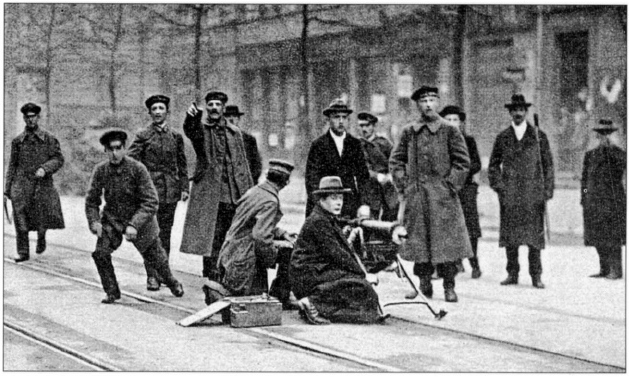
Revolution: Members of the Spartacists Bund in Berlin

Introduction

There are times when great nations face catastrophe. It is something that has befallen every world power at one time or another. Therefore it should not be a surprise if the United States despite the claims of those supporting American Exceptionalism succumbs to some great crisis which fundamentally changes it.  While I do not proclaim the end of the United States it does appear that we are experiencing events which have the potential of reducing our status as a great power and plunge the nation into political and economic chaos.  Some including California Governor Jerry Brown have compared the current state of the country to the division of the country in the American Civil War.

Likewise since there are some leaders of the loud and influential Tea Party movement who openly talk about revolution it is important to know what can happen if there is a political or economic collapse that leads to revolution at home while troops are still in combat. All of this happened in Germany in 1918.  In our current time such a possibility is higher than at any time in American History. Thus I feel we are in a potentially perilous time where long standing institutions are in crisis even while wars rage around the world.

However I do not, for all the vitriol spent believe that our current crisis is comparable to the Civil War except the absolute contempt that the opposing sides hold each other. The Civil War was a war which pitted region against region and our divisions know few geographic boundaries and even the “Red State versus Blue State” divide is deceiving.  It is my belief that what we are experiencing is much more similar to the crisis faced by Imperial Germany at the end of the First World War.  Then Germany was about to concede the loss of the war despite having known enormous battlefield success that lasted until the summer of 1918 when the tide of the war turned irreversibly against them as Allies collapsed and pulled out of the war was coupled with battlefield defeats, economic ruin and massive political and social unrest. The result of the collapse of Imperial Germany was a civil war and the foundation of the ill-fated Weimar Republic which eventually succumbed to the extremism and dictatorship of Adolf Hitler and his National Socialist Party of Germany, the Nazis.

The German Revolution of 1919 and civil war is important for those who study highly developed states when they enter a period of social and political upheaval usually following military defeat that causes the society to question or even overthrow the established order.  The end of Imperial Germany and the establishment of the Weimar Republic on November 9th 1918 is a prime example.   This paper concerns the first years of the Republic, and the dependency of the Majority Socialist leadership to the General Staff and their use of Freikorps to quell revolutionary chaos and avert the establishment of a Soviet State.

Members of the Leftist “People’s Naval Division” occupied the government quarter and terrorized Berlin

This study begins with the establishment of the Republic and concludes with the Kapp Putsch.  This is an era that is seldom referenced by political or military leaders in western states and historians themselves are often divided in their interpretation of the subject.  The study of this period is vital to those who study politically polarized societies which are either war weary or have suffered the shock of military defeat coupled with a government which is blamed for the events.  Thus, it is important to study the relationship of the military to the government and in particular the military’s relationship to politicians who have little connection to or affinity for the military, its traditions and culture and the often adversarial relationship of these politicians to military leadership which often sees them as adversaries.  The period also shows how actions of those who in their antipathy to the military create a climate where the military loathes the civilian leadership and the government.  The results of such conditions can endanger the society as a whole and ultimately usher in periods of great tragedy.  This occurred in Weimar Germany with the result that the military in the later years of the Republic neither the military nor the Majority Socialists could not work together against the Nazi takeover of the state.  However, the first years of the relationship set the tone and foredoomed the Republic.

The Complexity of the Situation

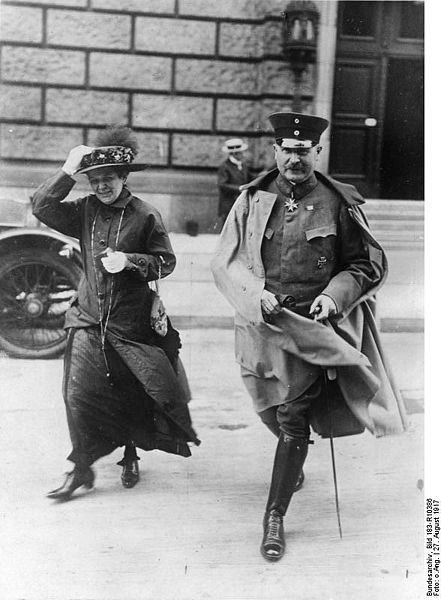
General Wilhelm Groener convinced Kaiser Wilhelm II to abdicate and helped forge an alliance between the Majority Socialists and the Army to head off a Soviet style Revolution

The history of Weimar, particularly that of the military and Freikorps in their relationship to the Republic is complex.  Not only is the relationship between the military and government complex, but the Freikorps themselves, their organization, leadership and political affiliation were not monolithic as is sometimes maintained,[i] nor were the Freikorps the direct ancestors of the Nazi SS/SA organizations despite often similar ideology,[ii] nor can they dismissed by saying that they were composed of “former soldiers and officers ill-disposed to return to civilian life.”[iii] The Freikorps’ association with the Army and Republic is more complex than some historians assert.  Despite the right wing leanings of many of units and fighters and future association of some to the Nazis, the blanket claim that the Freikorps were forerunners of the Nazi movement is not supportable.[iv]

It is true that without Freikorps support in Munich, along with support of the Thule Society, business leaders and others “that the transition of the DAP into the Hitler party could not have taken place.”[v] It is also true that elements of the Freikorps branded too revolutionary and unruly for service in the Army continued as secret societies and affiliated themselves with various right-wing political groups.[vi] Likewise a case can be made that the fierceness of many Freikorps veterans, younger leaders of the Army helped lay the foundation for the brutality of both the Army and Waffen SS as they prosecuted the Second World War.[vii] Yet simply because certain aspects of a subject are true does not make for a broader “truth.”  Heinz Höhne argues the reverse of what some have written in regard to the relationship of the Freikorps and Reichswehr to the Nazis, that in fact the Nazis did not issue from the Freikorps, but rather that many former members of the Freikorps, Imperial Army or the Reichswehr were attracted to the Nazis, particularly to the SS by its “philosophy of “hardness” and its attitude of bellicosity per se, basically unconnected with ideology.”[viii] Others historians state similar views especially those that study the relationship of the Reichswehr leadership to the Freikorps.  Thus the thesis of this paper is that the historiography like the period itself is complex; that the composition, leadership and motivations of the Freikorps were not monolithic, nor were they beloved by the Reichswehr, nor were they the “trailblazers” for the Nazi movement.  The focus of this paper is on the relationship of the Reichswehr and the Freikorps to the Republic to the Kapp Putsch and the dangers of a relationship built on necessity without mutual trust.  Such a relationship is dangerous and can lead to unintended consequences.   This paper will explore the first years of the Weimar Republic and specifically look at several key events that were pivotal in the relationship between the Army and Freikorps and the Majority Socialists.

The Supporting Literature

The literature covering this period includes both well written academic histories and popular works which attempt to present a particular view. Additionally there are biographical works which shed some light on the subject. The Reichswehr and the German Republic 1919-1926 by Harold Gordon Jr. is perhaps the best study of the Freikorps and their relationship to the state and the army.  Gordon’s work is exceptional in documenting the numbers, types, political affiliation, action and ultimate disposition of the Freikorps.  The History of the German General Staff by Walter Goerlitz; The Nemesis of Power: The German Army in Politics 1918-1945 by John Wheeler-Bennett, The Reichswehr and Politics 1918-1933 by F.L. Carsten and The Politics of the Prussian Army: 1640-1945 by Gordon A. Craig are all extremely valuable in exploring the relationship between the military and the Republic.  The best of the general histories of the period, which focus on the National Socialist state are The German Dictatorship by Karl Dietrich Bracher, and Richard Evans’ The Coming of the Third Reich. Richard Watt’s The Kings Depart is one of the best for telling the story of the fall of the Empire and the revolution in Germany.  Watt’s account is well written and documented work and touches on other factors affecting the new republic including Versailles and Allied political actions. The final chapter of Holger Herwig’s The First World War: Germany and Austria-Hungary 1914-1918 gives a good account of the Army’s role in the end of the Empire and beginning of the Republic.  Andreas Dorpalen’s Hindenburg and the Weimar Republic adds an interesting dimension of Hindenburg’s role in the republic’s formation and negotiations between Groener, Noske and Ebert. Steven Ozments’ A Mighty Fortress is superficial in its treatment of the period.  Nigel Jones’ Birth of the Nazis: How the Freikorps Blazed a Trail for Hitler is an interesting and somewhat entertaining but not very well documented tending to “broad brush” in a sensational way the Freikorps having none of the detail or nuance of Gordon, Craig, or Carsten on the Freikorps, nor the depth of Goerlitz or Wheeler-Bennett on the Republic’s relationship with the Army, or the attitude of the Reichswehr leadership to the Freikorps.  William Shirer’s The Rise and Fall of the Third Reich, Gerald Reitlinger’s The SS: Alibi of a Nation 1922-1945 and Heinz Höhne’s The Order of the Death’s Head all add some information which details early Nazi involvement in the period, but are less useful to this early period most of their work focuses on later events.  Of other works, Kenneth Macksey’s Why the Germans Lose at War has an insightful but short chapter dealing with this period and Wolfram Wette’s The Wehrmacht: History, Myth, Reality offers an interesting and at times provocative look at anti-Semitism in the German military in the years following the First World War.  Carlos Caballero Jurado’s The German Freikorps 1918-1923 is a short but very detailed study of those organizations and their actions.  B.H. Liddell-Hart who has a small chapter on General Hans Von Seeckt in The German Generals Talk which though it does not deal with the events in this paper make for interesting commentary on later actions of former Reichswehr officers who served the Nazi state.

A number of biographies touch on actions of German Officers who played key roles in World War Two.[ix] Most auto-biographies gloss over the Weimar period; however Admiral Erich Reader’s memoir Grand Admiral offers the insight of a naval officer with some direct observation of the revolution and the Kapp Putsch.  General Heinz Guderian in Panzer Leader omits his service in the Baltic “Iron Division.”  Field Marshal Albert Kesselring’s memoirs has a brief section covering the period, but one comment is typical attitude toward of many officers throughout its existence:

“My cup of bitterness was full when I saw my devoted work rewarded by a warrant for my arrest for an alleged putsch against the socialist-influenced command of my III Bavarian Army Corps. Notwithstanding the degrading episodes during my imprisonment after 1945, I do not hesitate to describe this as the most humiliating moment of my life.”[x]

One thing that has to be noted about all the memoirs is that each of the writers was writing after the German Defeat and their imprisonment. Many times their words mask other actions and attitudes that are  not mentioned, thus while an important source one also has to have some suspicions when using them even the unintentional errors that come from time as well as the human tendency to have a somewhat selective memory.

Analysis
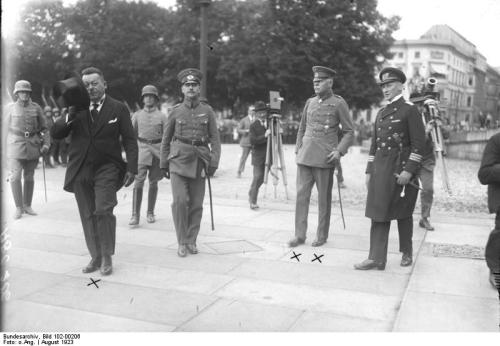
President Friedrich Ebert and his military commanders including General Hans Von Seeckt (2nd from right)

This paper will first examine the formation of the Freikorps by the Army and the Ebert government in response to uprisings by armed groups of leftists and the effectiveness of the Freikorps in putting down the various uprisings.   We will then address the relationship of the Army with the Majority Socialists and then move on to the crisis engendered by the Kapp Putsch.

The relationship of the Republic to the Army was born in the moment of crisis of the abdication of Kaiser Wilhelm II and the armistice discussions with the Allies.  Beset by revolts in key naval bases and mutinies aboard ships of the High Seas Fleet and unrelenting Allied pressure on the German armies in the west the situation continued to deteriorate as the “red flag was flying in all the principle cities, soldiers behind the front were electing soldiers councils Russian fashion.”[xi] Revolutionary and defeatist propaganda spread by the radical left wing of the Independent Socialists and Spartacus League spread through the country and even affected combat units,[xii] while the “Majority Socialists had found out that the militant factions of the Independents had secretly armed themselves out of funds supplied by the Soviet ambassador and adopted the slogan “all or nothing.””[xiii] The situation had deteriorated so badly that Karl Liebknecht, leader of the Spartacus League “was announcing the establishment of a Soviet regime from the steps of the Imperial Palace.”[xiv]

Under these dire conditions, General Wilhelm Groener who had succeeded General Ludendorff as Quartermaster General called an emergency meeting of fifty “of his most senior army commanders.”[xv] In response to his question of whether the troops would follow the Kaiser and oppose the revolts only one answered in the affirmative, and eight responded that “there was no hope of using regular Army units to quell unrest at home.”[xvi] On November 9th Groener went to the Kaiser on behalf of the Supreme Command and in response to a suggestion that the Kaiser lead the Army back and suppress the revolts boldly stated “The Army will march home in peace and under its leaders and commanding generals, but not under the command of Your Majesty, for it stands no longer behind Your Majesty.”[xvii] The Emperor abdicated fleeing to Holland and Friedrich Ebert leader of the Majority Socialists was named Chancellor on November 9th and upon hearing the news, Philipp Scheidemann, without consulting Ebert announced that Ebert was Chancellor and “Long live the great German Republic!”[xviii] The mobs were not placated by the announcement and far left organizations with the Independents “had no intention of letting the revolution stop there.”[xix] In the streets of Berlin soldiers sold their weapons and vehicles officers were attacked by crowds on the streets and whenever “crowds found an Army officer; they tore off his epaulettes and medals.”[xx] Everywhere mutual recrimination was in the air, soldiers “blamed revolutionaries for the betrayal and stab-in-the back while revolutionaries blamed officers for all the costs and losses of the war.”[xxi]

Groener called Ebert promising the Army’s support of the new government in return for the government’s assistance to the Army in the maintenance of discipline and supply.[xxii] He also drafted a letter signed by Hindenburg pledging the Army’s loyalty and telling him that “the destiny of the German people is in your hands….”[xxiii]One source notes: “Thus, in half a dozen sentences over a telephone line a pact was concluded between a defeated army and a tottering semi-revolutionary regime; a pact destined to save both parties from the extreme elements of revolution but, as a result of which the Weimar Republic was doomed at birth.”[xxiv]

The High Command was able to bring the Army home in good order following the armistice but upon arriving most units “melted away like snow under a summer sun,”[xxv] those which remained were often shells of their former selves beset by soldier’s councils and leftist revolutionaries.  To support the government the High Command issued a directive stating that it “put itself as the disposal of the present government led by Ebert without any reservation.”[xxvi] Yet in December delegates of the National Assembly continued to sow resentment in the military by military discipline be placed in the hands of soldiers’ councils, that all badges of rank be removed with all decorations of insignia and honor.[xxvii] Reaction was heated,[xxviii] but despite this Groener, Colonel Walter Reinhardt, the Prussian Minister of War and the Republic’s Defense Minister, Gustav Noske endeavored to find forces to combat the growing revolution and rebellious military units.  The choice was not hard, the Army was of no use, so called “democratic forces” were in most cases both unreliable and ineffective, while only the Freikorps “provided suitable material for the immediate creation of an efficient, combat-ready army.”[xxix] Thus the Freikorps became the instrument of necessity to ensure that the government was not swept away by a Soviet style revolution.

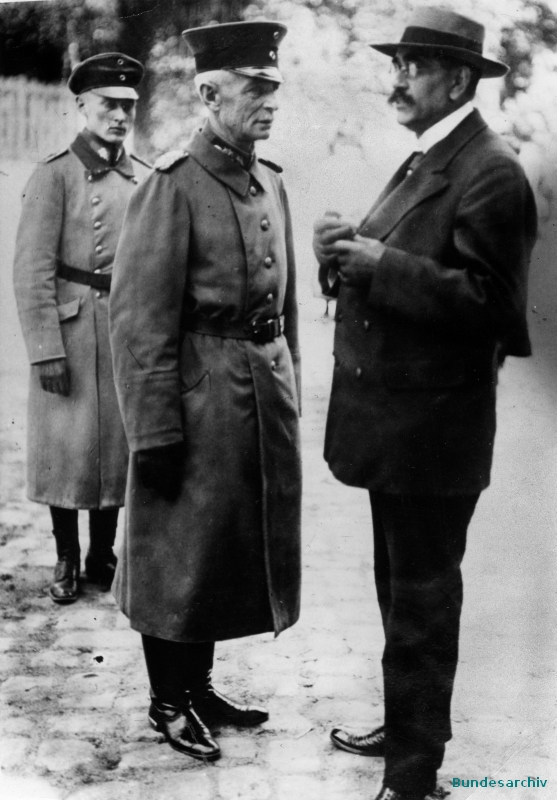
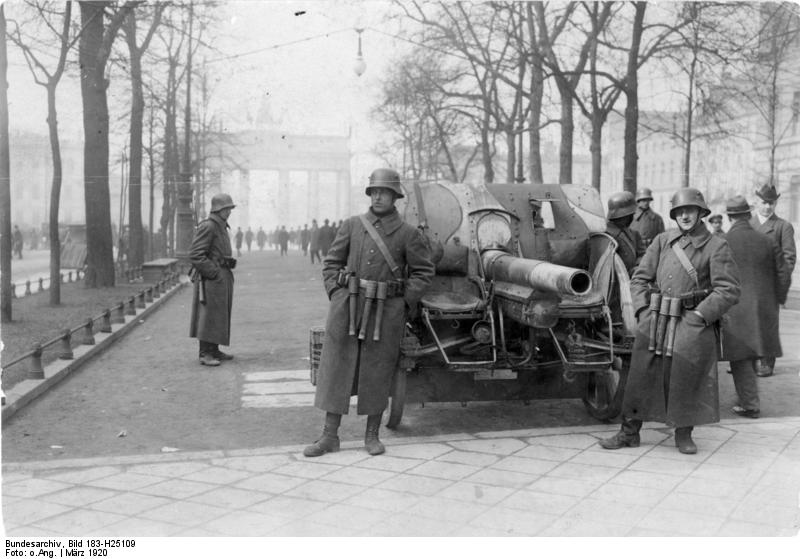
Gustav Noske and General Von Luttwitz. Luttwitz would lead the Reichswehr and Freikorps units that participated in the Kapp Putsch

Gustav Noske, of the Majority Socialist party “saw himself as a patriot, a man of action…who had no time for theories…and was one of the few Socialists that the Supreme Command trusted.”[xxx] He had already distinguished himself by helping to bring under control the sailors revolts in Kiel by forming a loyal “Naval Brigade”[xxxi] and he  “realized that the government must have a dependable military force behind it if it was to survive and rule Germany” and the “old Officer Corps must be the backbone of any such force.”[xxxii] The Army had melted away and units of the workers and soldiers councils were poorly trained, organized and led “”fought against the government as often as for it” and “were of little practical value to either the government or the rebels.”[xxxiii] In the chaos of a Spartacus, now called the German Communist Party uprising and vacuum of political leadership of January 1st 1919 agreed to become defense minister stating “Someone must be the bloodhound, I won’t shirk the responsibility!”[xxxiv]
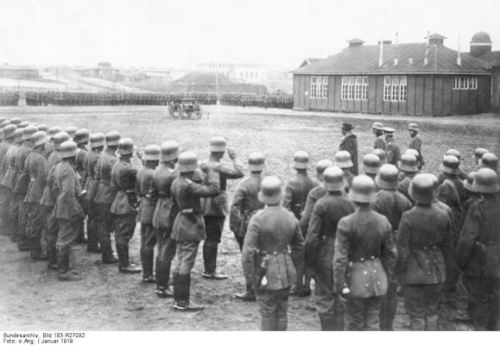
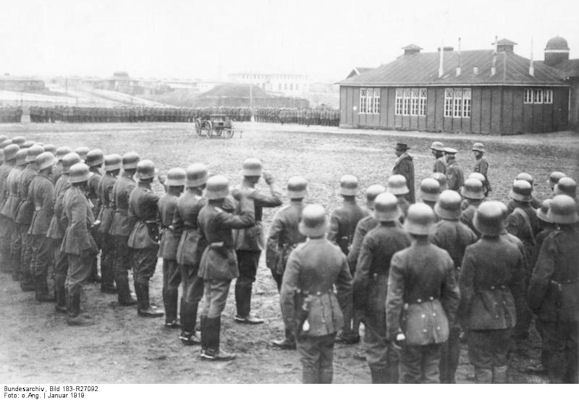
Noske reviewing Freikorps Hulsen. Many of the Freikorps were composed of professional soldiers and brought into the Reichswehr

Noske helped by the High Command helped organize volunteer units led by officers and NCOs composed of reliable veterans.  Freikorps varied in size from divisions to companies and were led by Generals down to Sergeants and even a Private First Class.  Their greatest success was in early 1919 when the Republic was beset by “Red” revolutions in many major cities.  Without the use of the Freikorps by the government it is unlikely that the Republic would have survived.[xxxv] On January 4th Ebert and Noske reviewed the troops of General Maercker’s Freiwillege Landesjaegerkorps and Maercker informed them that every volunteer had pledged loyalty to the government, seeing the discipline and order Noske told Ebert “Don’t worry. Everything going to turn out all right now.”[xxxvi] On January 5th 1919 mobs attacked the Chancellery and the officers of the Socialist Vörwarts newspaper and Noske led the Freikorps[xxxvii] to regain control of the city[xxxviii] and crush the revolt during which “Karl Liebknecht and Rosa Luxemburg were lynched by the officers of the Guards Cavalry Rifle Division.”[xxxix] In March after a period of uneasy calm the Freikorps, now reinforced by the 2nd Naval Brigade, or Ehrhardt Brigade[xl] were called upon to put down the revolt of the “People’s Naval Division.”[xli] Making liberal use of heavy weapons including tanks the Freikorps inflicted heavy losses on the leftists with over 1500 dead and 12,000 wounded in the uprising.[xlii] Other revolts were crushed and the Freikorps reached their zenith in Württemberg where Freikorps led by Lieutenant Hahn, a Social Democrat put down leftist revolts[xliii] and in Bavaria where Independents and Communists had taken the city with their “Bavarian Red Army which numbered nearly 25,000 men[xliv] on April 7th. After failed attempts by the Socialist government to retake Munich, they asked for Berlin’s help.  Violence and massacres of citizens by the various leftist groups inflamed the Freikorps, including the Ehrhardt Brigade and the revolt was crushed by May 2nd.[xlv] Dorpalen calls the Freikorps ruthlessness “completely unwarranted in view of the weakness of the opposing forces” and noted though they broke the leftist powers they deepened the nations’ cleavages”[xlvi] while Macksey writes that “where Freikorps’ brutality stained the pages of history there was invariably a forgoing or simultaneous record of excess by their sworn opponents.”[xlvii]
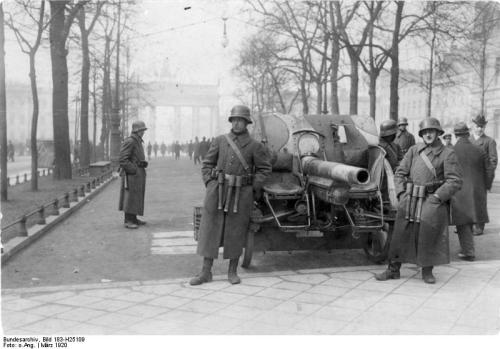
The Erhardt Brigade in Berlin during the Kapp Putsch

The Provisional Reichswehr was established on March 6th 1919 and the High Command began to assemble it from the Freikorps, remaining Army units and Republican defense forces.  Some Freikorps were brought into the new Army in total, but the tumult had not yet ceased.  There was a great distrust between many in the Army, the remaining Freikorps and the Socialists.  The crisis was precipitated by the signing of the Treaty of Versailles, Noske and others threatened resignation over the war guilt clauses, but Groener warned that if the treaty was rejected the Army could not win against the Allies if hostilities were renewed.[xlviii] The treaty imposed harsh limitations on the German Army which many bitterly resented, however, Seeckt, the Chief of Staff of the Army felt that it was “more important to keep the Army in being and preserve the possibility of a military resurrection.”[xlix] Yet the government had lost the support of the Officer Corps and many looked to General Walther von Lüttwitz, the Reichswehr’s senior commander for leadership.[l]

Korvettenkapitan (Lieutenant Commander) Erhardt commander of the 2nd Naval Brigade whose announced demobilization triggered the Kapp Putsch. Erhardt would have to flee after the Nazi takeover. Even revolutionaries become victims as revolutions end

Other right-wing groups and individuals made plans to overthrow the government.  They favored revolt against the government, but “their political aims were hazy.”[li] Seeckt and Reinhardt felt it necessary to demobilize Freikorps who’s ill-discipline and political radicalism was a “danger to the consolidation desired by the army command.”[lii] This movement climaxed with the alliance of Lüttwitz to Wolfgang Kapp and was triggered by the orders disbanding the 2nd and 3rd Naval Brigades in compliance with Versailles and due to their radical views.[liii] In spite of the opposition of his chief of staff Von Lüttwitz began planning a coup to save Germany.[liv] The conspirators showed “little regard for coordination of effort and a quite amazing ability to work at cross purposes.”[lv] On March 12th without consulting Kapp, Lüttwitz and Ehrhardt launched the Putsch and Ehrhardt’s brigade in full battle dress entered Berlin. At this point the Reichswehr command froze; officers refused to condone the putsch but at the same time refused to support Noske and Reinhardt who demanded armed opposition,[lvi] while Navy officers openly supported it.[lvii] Seeckt declared that “Troops do not fire upon troops!” and “When at occurs, then the true catastrophe, which was avoided with so much difficulty on November 9, 1918 will really occur.”[lviii] The coup died amid massive strike by workers and lack of popular support but the damage was done.  Noske resigned, many officers in were discredited[lix] and dismissed including Lüttwitz and Admiral Von Trotha, who openly supported the coup,[lx] though Raeder says that Von Trotha and the Navy staff only” thought of anything of complete loyalty to the government.”[lxi] The relationship which had endured the dire days of the Republic was ended.  The Reichswehr would emerge a lean and highly trained organization and remain a power broker in the Republic but the animosity between the Army and the Socialists that they could not stand together against the Nazis despite a mutual interest in doing so.[lxii]

Conclusion

The end of Weimar and the beginning of a nightmare

The period was a critical and complex and should be studied by anyone living in a state with a powerful military tradition and institutions in crisis.  Unlike popular notions, the Freikorps were diverse and not the seed-bed of the Nazi movement and though many former members would become Nazis.  Several, including Ehrhardt narrowly escaped death at Nazi hands.[lxiii] Freikorps were viewed by Army leadership as an expedient force that could not remain in the service once the Army was functional.

Key lessons include that the military cannot become a “state within a state,” and that both military and civilian leaders must seek to bridge any gulf that separates them in times of crisis.  In Weimar both the military and the Socialists thoroughly distrusted one another with the result that they eventually, despite early success[lxiv] worked against each other in later years.  Actions by both Socialists and the military ultimately subverted the Republic and ensured its demise and Seeckt’s policy of separation from politics “tended toward a renunciation of the soldier’s potential restraining influence on adventurous statesmen.”[lxv] Such is the fateful lesson for today.


[i] Jones, Nigel. The Birth of the Nazis: How the Freikorps Blazed a Trail for Hitler. Constable and Robinson Ltd. London, U.K. 1987 and 2004.  This is Jones assertion and he attempts to make the tie using careers of some individuals who served both in Freikorps and either in the Nazi Party or Military and attitudes common in many Freikorps with similar attitudes found in the Nazi movement.  The 2004 edition of his work includes an introduction by Michael Burleigh echoing his sentiments.

[ii] Evans, Richard J. The Coming of the Third Reich. Penguin Group. London, U.K. and New York, NY. 2003. pp.227-229.  Evans discusses the fact that the Nazis did have a number of Freikorps veterans but at no point makes the connection that the Freikorps are a direct ancestor.

[iii] Ozment, Steven. A Mighty Fortress: A New History of the German People. Harper-Collins Publishers, New York, NY 2004 p.246

[iv] Gordon, Harold J. Jr. The Reichswehr and the German Republic 1919-1926. Princeton University Press, Princeton NJ 1957.  Gordon’s work is perhaps the most detailed study involving the Freikorps and the Reichswehr. He is exceptional in discussing the relationship of both with the various political parties including the Nazis.  He refutes this assertion throughout the book.

[v] Bracher, Karl Dietrich. The German Dictatorship. Translated by Jean Steinberg. Praeger Publications, New York, NY 1970. Originally published as Die Deutsche Diktatur: Enstehung, Struktur, Folgen des Nationalsozialismus. Verlag Kiepenheuer & Witsch, Koln und Berlin. 1969. p.101

[vi] Wheeler-Bennett, John W. The Nemesis of Power: The German Army in Politics 1918-1945. St. Martin’s Press, New York, NY 1954 pp. 91-92

[vii] Shepherd, Ben. War in the Wild East: The German Army and Soviet Partisans. Harvard University Press, Cambridge, MA and London, U.K. 2004. p.28

[viii] Höhne, Heinz. The Order of the Death’s Head: The Story of Hitler’s SS. The Penguin Group, London U.K. and New York, NY 1969. Translated by Richard Barry. Originally Published as Der Ordnung unter dem Totenkopf. Verlag der Spiegel, Hamburg, 1966. p.54.

[ix] These include Macksey’s biographies of Kesselring and Guderian , Richard Giziowski’s The Enigma of General Blaskowitz. Peter Padfield’s Dönitz: the Last Führer, David Fraser’s biography of Field Marshal Rommel Knight’s Cross, Messenger’s work on Von Rundsedt, The Last Prussian, and Höhne’s Canaris: Hitler’s Master Spy all provide brief but interesting views of the actions and attitudes of these officers during the revolution and during the  Weimar period.

[x] Kesselring, Albrecht. The Memoirs of Field Marshal Kesselring with a new introduction by Kenneth Macksey. Greenhill Books, London UK. 1997. Translated from the German by William Kimber Ltd. Originally published as Soldat bis zum letzen Tag. Athenaum, Bonn, Germany 1953 pp.18-19

[xi] Goerlitz, Walter. History of the German General Staff 1657-1945. Translated by Brian Battershaw. Westview Press. Boulder CO and London. 1985 Originally published as Der Deutsche Generalstab, Verlag der Fankfurter Hefte, Frankfurt am Main.  First U.S. publication in 1953 by Preager Publishers. p.200

[xii] Gordon, Harold Jr. The Reichswehr and the German Republic 1919-1926. Princeton University Press, Princeton, NJ 1957 pp.4-5 Gordon recounts the story of an entire replacement train revolting when it reached the front which had to be disarmed by a shock battalion.

[xiii] Watt, Richard M.  The Kings Depart: The Tragedy of Germany: Versailles and the German Revolution. Simon and Schuster, New York, NY 1968. p.186

[xiv] Wheeler-Bennett, John W. The Nemesis of Power: The German Army in Politics 1918-1945. St. Martin’s Press, New York, NY 1954. p.18

[xv] Herwig, Holger H. The First World War: Germany and Austria Hungary 1914-1918. Arnold Press a member of the Hodder-Headline Group, London, UK and New York NY 1997 p.445

[xvi] Ibid. Herwig. p.445

[xvii] Carsten, F.L. The Reichswehr and Politics 1918-1933. Oxford University Press, Oxford, UK 1966 p.6.  It is noted by a number of author’s that Groener did this, to maintain the unity of Germany and prevent its division.

[xviii] Ibid. Watt. p.196  Watt notes Ebert’s reaction as being enraged as the proclamation of the Republic technically “invalidated the existing constitution; Germany was now technically without a government.” (p.197)

[xix] Ibid. Watt. p.197

[xx] Ibid. Watt. p.197

[xxi]Giziowski, Richard. The Enigma of General Blaskowitz Hippocrene Books Inc. New York NY, 1997. p.65

[xxii] Craig, Gordon A. The Politics of the Prussian Army 1640-1945. Oxford University Press, Oxford, UK 1955 pp.347-348.  Craig gives an interesting account noting the Groener’s call to Ebert shows recognition of the legitimacy of the new government and notes that the offer was somewhat conditional.

[xxiii] Dorpalen, Andreas. Hindenburg and the Weimar Republic. Princeton University Press, Princeton, NJ. 1964 p.26

[xxiv] Ibid. Wheeler-Bennett. p.21

[xxv] Ibid. Gordon. p.15

[xxvi] Ibid. Carsten. p.11. This was of critical importance as Carsten later notes that the Army realized that the government could not survive without its support.  Groener was perhaps the officer who most recognized the situation and endeavored to ensure that “the best and the strongest element of the old Prussia, was saved for the new Germany, in spite of the revolution.” (p.12)

[xxvii] Ibid. Carsten. p.18 Carsten produces the bulk of the English translation of these points and notes that the anti-military feeling had become widespread.

[xxviii] Ibid. Giziowski. p.66  Giziowski recounts the speech of Hermann Goering in response to the announcement. This shows how such treatment can breed anger and resentment in a military that feels it has been betrayed after serving its country in a long and difficult war: For four long years we officers did our duty and risked all for the Fatherland. Now we have come home, and how do they treat us? The spit on us and deprive us of what we gloried in wearing. I will tell you that the people are not to blame for such conduct. The people were are comrades…for four long years.  No, the ones who have stirred up the people, who have stabbed this glorious army in the back…. I ask everyone here tonight to cherish a hatred, a deep and abiding hatred, for these swine who have outraged the German people and our traditions.  The day is coming when we will drive them out of our Germany.”

[xxix] Ibid. Gordon. p.15

[xxx] Ibid. Watt. p.168

[xxxi] Ibid. Gordon. pp. 19 and 24.  This was the 1st Marine Brigade, or Brigade Von Roden of which elements would later serve in under the command of other Freikorps such as the Guards Calvary Rifle Division.

[xxxii] Ibid. Gordon. p.14

[xxxiii] Ibid. Gordon. p.18

[xxxiv] Ibid. Watt. p.239

[xxxv] Ibid. Gordon. p.426

[xxxvi] Ibid. Watt. p.247

[xxxvii] Thee forces included the Landesjaegerkorps and Guards Cavalry Rifle division.

[xxxviii] Ibid. Gordon. p.30

[xxxix] Ibid. Wheeler-Bennett. p.36

[xl] This was one of two additional Naval Brigades formed by Noske after the success of Naval Brigade Von Roden.  It was one of the most combat effective but unfortunately violent and radical of the Freikorps, it would as we will see be a key unit in the Kapp Putsch but would not be absorbed into the Reichswehr.

[xli] This unit was not a Navy unit at all but was composed of many who were criminals and other rabble. See Gordon, Carsten and Watt.

[xlii] Jurado, Carlos Caballero. The German Freikorps 1918-23. Illustrated by Ramiro Bujeiro. Osprey Publishing, Oxford, UK 2001 p.12

[xliii] Ibid. Gordon. p.42  His units were known as Security Companies.

[xliv] Ibid. Jurado. p.13

[xlv] Ibid. Gordon. pp.47-49. An estimated 550 people including 200 innocent bystanders were killed in the fighting.

[xlvi] Ibid. Dorpalen. p.29

[xlvii] Macksey, Kenneth. Guderian: Creator of the Blitzkrieg. Stein and Day Publishing, New York, NY 1975 p.45

[xlviii] Ibid. Wheeler-Bennett. pp.57-59

[xlix] Ibid. Goerlitz. p.216

[l] Ibid. Wheeler-Bennett. p.61

[li] Ibid. Carsten. p.74

[lii] Ibid. Carsten. pp.74-75

[liii] Ibid. Carsten. p.76  Another consideration is that Noske, Reinhardt and Seeckt all were seeking to retire Lüttwitz.

[liv] Ibid. Gordon. p.97

[lv] Ibid. Craig. p.376

[lvi] Ibid. Carsten. pp.78-79

[lvii] Höhne, Heinz. Canaris: Hitler’s Master Spy. Cooper Square Press, New York, NY 1979 and 1999. Translated from the German by J. Maxwell Brownjohn, Originally published in Germany by C. Bertelsmann Verlag Gmbh, München. 1976. p. 78.  Canaris also had been suspected of complicity in the murders of Rosa Luxemburg and Karl Liebknecht but was acquitted. (pp.56-71)

[lviii] Ibid. Gordon. pp.114-115

[lix] Among them Maercker who had been such a strong supporter of the Republic in the early days.

[lx] Ibid. Carsten. p.98

[lxi] Raeder, Erich. Grand Admiral. Translated from the German by Henry W. Drexell. United States Naval Institute, Annapolis MD, 1960. Da Capo Press edition published 2001. p.111. This is interesting as almost all histories implicate the Navy High Command of either some complicity or at least agreement with the Putsch participants.

[lxii] The final part in the drama would come when General Kurt Von Schleicher became the last Chancellor before Hitler.  Schleicher had assisted Groener and Noske in the early days of the Republic and often attempted to use the Army’s influence in politics. He was fatally short sighted and was a victim of the SS “night of Long Knives” which was directed against the SA.

[lxiii] Ibid. Jones. p.266  Others such as Gerhard Rossbach had similar experiences.  Korvettenkapitän Löwenfeld of the 3rd Naval Brigade became an Admiral, Wilhelm Canaris , who was implicated in the Kapp Putsch but kept his career would later head the Abwehr and die in a concentration camp.

[lxiv] Ibid. Gordon. p.426  Gordon has a good discussion of this topic in his conclusion.

65 Liddell-Hart, B.H. The German Generals Talk. Published 1948 B.H. Liddell-Hart, Quill Publications, New York, NY. 1979. p.18 Liddell-Hart’s analysis of the results of the Reichswehr’s disconnection from the larger society and political process is remarkable due to current trends in the American military which like the Reichswehr has become somewhat more conservative and disconnected from society, exceptionally technically proficient but not adept in politics or grand-strategy.


Works Cited


Bracher, Karl Dietrich. The German Dictatorship: The Origins, Structure and Effects of National Socialism. Translated from the German by Jean Steinberg with an introduction by Peter Gay.  Praeger Publishers, New York, NY. 1970 Originally published in Germany as Die deutsche Diktator: Entstehung, Struktur, Folgen den Nationalsozialismus by Verlag Kiepenheuer und Witsch. Koln und Berlin.


Carsten, F.L. The Reichswehr and Politics 1918-1933. Oxford University Press, Oxford, UK 1966


Craig, Gordon A. The Politics of the Prussian Army 1640-1945. Oxford University Press, Oxford, UK 1955


Dorpalen, Andreas. Hindenburg and the Weimar Republic. Princeton University Press, Princeton, NJ. 1964


Evans, Richard J. The Coming of the Third Reich. Penguin Books, New York, NY and London, UK. 2003


Giziowski, Richard. The Enigma of General Blaskowitz Hippocrene Books Inc. New York NY, 1997


Goerlitz, Walter. History of the German General Staff 1657-1945. Translated by Brian Battershaw. Westview Press. Boulder CO and London. 1985 Originally published as Der Deutsche Generalstab, Verlag der Fankfurter Hefte, Frankfurt am Main.  First U.S. publication in 1953 by Preager Publishers


Gordon, Harold Jr. The Reichswehr and the German Republic 1919-1926. Princeton University Press, Princeton, NJ 1957


Guderian, Heinz. Panzer Leader. (abridged) Translated from the German by Constantine Fitzgibbon, Ballantine Books, New York 1957


Herwig, Holger H. The First World War: Germany and Austria Hungary 1914-1918. Arnold Press a member of the Hodder-Headline Group, London, UK and New York NY 1997


Höhne, Heinz. Canaris: Hitler’s Master Spy. Cooper Square Press, New York, NY 1979 and 1999. Translated from the German by J. Maxwell Brownjohn, Originally published in Germany by C. Bertelsmann Verlag Gmbh, München. 1976.


Höhne, Heinz. The Order of the Death’s Head: The Story of Hitler’s SS. The Penguin Group, London U.K. and New York, NY 1969. Translated by Richard Barry. Originally Published as Der Ordnung unter dem Totenkopf. Verlag der Spiegel, Hamburg, 1966.


Jones, Nigel. The Birth of the Nazis: How the Freikorps Blazed the Way for Hitler. Constable and Robinson Ltd. London, UK 1987


Jurado, Carlos Caballero. The German Freikorps 1918-23. Illustrated by Ramiro Bujeiro. Osprey Publishing, Oxford, UK 2001


Kesselring, Albrecht. The Memoirs of Field Marshal Kesselring with a new introduction by Kenneth Macksey. Greenhill Books, London UK. 1997. Translated from the German by William Kimber Ltd. Originally published as Soldat bis zum letzen Tag. Athenaum, Bonn, Germany 1953.


Liddell-Hart, B.H. The German Generals Talk. Published 1948 B.H. Liddell-Hart, Quill Publications, New York, NY. 1979


Macksey, Kenneth. Guderian: Creator of the Blitzkrieg. Stein and Day Publishing, New York, NY 1975


Macksey, Kenneth. Kesselring: The German Master Strategist of the Second World War. Greenhill Books, London, UK 2000.


Ozment, Steven. A Mighty Fortress: A New History of the German People. Harper-Collins Publishers, New York, NY 2004


Shepherd, Ben. War in the Wild East: The German Army and Soviet Partisans. Harvard University Press, Cambridge, MA and London, U.K. 2004


Wheeler-Bennett, John W. The Nemesis of Power: The German Army in Politics 1918-1945. St. Martin’s Press, New York, NY 1954


Watt, Richard M.  The Kings Depart: The Tragedy of Germany: Versailles and the German Revolution. Simon and Schuster, New York, NY 1968


Wette, Wolfram. The Wehrmacht: History, Myth, Reality. Harvard University Press, Cambridge, MA and London, UK  2006. Translated from the German by Deborah Lucas Schneider. Originally published as Die Wehrmacht: Feindbilder, Vernichtungskrieg, Legenden. S. Fischer Verlag Gmbh, Frankfurt am Main, Germany 2002

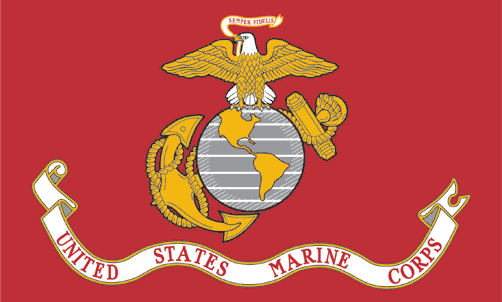


1 Comment

Filed under History, Military, national security, Political Commentary

An Unnecessary Condition of Affairs

“The war… was an unnecessary condition of affairs, and might have been avoided if forbearance and wisdom had been practiced on both sides.” Robert E. Lee

I am always attracted to military leaders with a tragic and honorable history, men who maintain honor and humanity even when the nations that they serve was on the wrong side of history.  There have been such men in almost every war and I admire them even in defeat more than I do those that win victories at all costs and in the process lose their souls. This puts me in a select minority and minorities are not always appreciated we tend to make people uncomfortable just by existing. Since I have been threatened by threatened by Neo-Nazis, called weak, a heretic, apostate and sometimes worse by fellow Christians even being tossed from my former church for now being “too liberal” I am now officially used to this even when it comes from friends Romans and countrymen and the occasional nutty European, Asian or Islamist from abroad.

Today we stand at a political divide not seen since the days leading up to the American Civil War but it didn’t have to come to this had our political and corporate leadership been responsible and acted with wisdom the past 40 years or so. Robert E Lee a man unquestioned integrity was torn by his desire to see the Union preserved and his allegiance to it and his loyalty to his own family and the Commonwealth of Virginia.  Lee is a tragic figure a true man of courage, faith and decency, a man of moderation who maintained a profound respect and love for the United States even while leading the Confederate Army of Northern Virginia.  He had his flaws as well but on the whole he was one of the truly great men in American history. When the war was lost he was an advocate of reconciliation between the deeply divided North and the conquered South.

In an age of bitterness brought about by defeat and the repression of the draconian measures of Reconstruction Lee was a man that understood that as Americans it was necessary to put aside bitterness.  After the defeat he was accosted by a woman professing her hatred of the North. His reply to her would be a good start for all of those today who hate their fellow Americans be they Republicans, Democrats, Libertarians or Tea Partiers on the basis of political ideology and the raw quest for power.  Lee said to this woman “Madam, don’t bring up your sons to detest the United States Government. Recollect that we form one country now. Abandon all these local animosities, and make your sons Americans.”

Unfortunately among certain parts of the electorate the Government of the United States is detested and some even call for revolution if not at the ballot box if need be by violence.  The rhetoric is certainly pointing that direction as conservatives and liberals alike turn up the heat on this witches cauldron that our country has become. Compromise is considered anathema by both sides especially by the Tea Party movement and the fact is that we are at war with ourselves the national fabric is broken even worse than or economic state or moral state.  We may not be shooting at each other yet but unless we see some kind of national decision by all Americans to stop the political fratricide and work together to solve the problems that have been festering for decades it may come to down to bullets and the tragedy will be worse than that of the Civil War because despite the tragedy of it some good did come, the end of slavery and an understanding of being Americans rather than simply New Yorkers or Virginians. Lee writing about the war said “What a cruel thing is war: to separate and destroy families and friends, and mar the purest joys and happiness God has granted us in this world; to fill our hearts with hatred instead of love for our neighbors, and to devastate the fair face of this beautiful world.”

This political fratricide is in large part due to the manner in which our politicians, political parties and even religious institutions are the servants of multinational corporations and financial groups. When everything comes down to it all of these institutions are deeply subservient to the whims of special interests especially multinational corporations and financial institutions.  It is no wonder that leaders as diverse as Thomas Jefferson, Theodore Roosevelt and Napoleon Bonaparte recognized the threat that they pose to nations and in the case of the United States to democracy itself. Jefferson wrote “The end of democracy and the defeat of the American Revolution will occur when government falls into the hands of lending institutions and moneyed incorporations.”

Roosevelt noted quite rightly, much to the chagrin of his fellow Republicans “Behind the ostensible government sits enthroned an invisible government owing no allegiance and acknowledging no responsibility to the people. To destroy this invisible government, to befoul the unholy alliance between corrupt business and corrupt politics is the first task of the statesmanship of today.” While Napoleon cut to the heart of the matter when he wrote “When a government is dependent upon bankers for money, they and not the leaders of the government control the situation, since the hand that gives is above the hand that takes. Money has no motherland; financiers are without patriotism and without decency; their sole object is gain.”

Yet in the midst of our political fratricide there seems to be one special interest group above all which always seems to win even when the people of the country suffer. That group is the multinational corporations and financial institutions.  It doesn’t matter what party is in power they somehow come out with a big fat profit margin and get treatment that regular people could never hope to get. Now since the Supreme Court has ruled that big corporations (and labor too) now have no limits on what they can contribute to political campaigns you can bet your ass that politicians of all ilk’s will be suckling lucrative money milk from the tits of these corporations which will dispense billions of dollars to political campaigns in the coming year and a half leading up to the 2012 election.  We expect this of Republicans and Democrat but rest assured my friends that even Tea Party candidates will line up for their turn in order suckle at this tit to keep their newly acquired offices or gain more in the coming election. Such is the nature of politics in our fair country.

Meanwhile both parties dither about a budget that if they had been doing their jobs would have been completed months ago had Nancy Pelosi bothered to submit a budget for 2011 while Speaker of the House.  Now about three months into the new Congress both parties are posturing on the next year’s budget all the while the government lurches toward a shutdown of unpredictable consequences.

Yes we have to deal with the mess that these same people of both parties aided and abetted by their special interest group supporters have made over years to get us in this mess. Administration after administration and Congress after Congress have kicked this can down the road and now they have kicked it and the country into the ditch. Now something has to be done and Democrats seem loathe to step up to the plate and take political risks  while Republicans, particularly the Tea Party leadership are acting like the Jacobins during the French Revolution even threatening even their own party leadership if they don’t get everything that they want. All seem to ignore the fact that the vast majority of the country just wants both sides to figure the damned thing out and fix the problem for real even if it means personal sacrifice rather than seeing these people pursue the policy of mutually assured destruction.

Why does this seem so personal to me? Let me tell you. When I came back from Iraq after seeing the results of unbridled hatred in that country and having travelled in the Balkans after the Yugoslav Civil War I became frightened when I saw politicians of both parties speaking with the same invective as I saw in those countries. Nothing like seeing the effects of a real live shooting civil war to give one pause when political enemies threaten to cross that same line in this country.  Don’t dismiss this out of hand. For years certain pundits, politicians and preachers on both sides of the political chasm have been dehumanizing their opponents and once people are no longer seen as human it is very easy to resort to violence against them. Just take a look at the ordinary Germans who took part in the extermination of the Jews under the Hitler regime.

Am I forgetting something here? Yes I almost forgot, in 2008 we saw the housing crisis in which the very institutions caused the crisis were bailed out by both President Bush and President Obama with Congress willing and lovingly joining in to approve billions and billions of dollars for them. This included huge amounts of money which went to foreign financial institutions. Meanwhile regular people had their home value and credit slashed even as unemployment skyrocketed and in the following years we have seen the same banks seizing the foreclosed homes in record numbers while millions of others now owe far more on their loans than their homes are worth. It’s a great deal for the banks. Approve loans for people who will have a hard time repaying them, crash the economy have the government bail you out and then take the homes and sell them while still collecting the cash from the unfortunate former owners. Well to quote a great line from the Roman Empire segment of Mel Brooks’ classic comedy History of the World Part One

Leader of Senate: All fellow members of the Roman senate hear me. Shall we continue to build palace after palace for the rich? Or shall we aspire to a more noble purpose and build decent housing for the poor? How does the senate vote?
Entire Senate: F*** THE POOR!

It’s funny how a comedy from the late 1970s offers such remarkable political and social insights for us today. But then Teddy Roosevelt said of the Roman Republic as a warning to us back in 1903 “The death-knell of the republic had rung as soon as the active power became lodged in the hands of those who sought, not to do justice to all citizens, rich and poor alike, but to stand for one special class and for its interests as opposed to the interests of others.”

Well if these present rulers don’t get their act together parts of the government will shut down and your military which is currently involved in four wars, Iraq, Afghanistan, Libya and the nearly forgotten War on Terrorism in lots of places that the media doesn’t mention will not get paid. Ain’t that a hoot?  But mind you as military personnel try to salvage the wars that our politicians have plunged us into we still serve even if we won’t get paid.  Yet when push comes to shove we are cast aside by the political ruling class for their short term political gain.  I remember a quote of Robert E Lee which speaks volumes on this subject. Lee was besieged at Petersburg, his haggard and outnumbered Army deprived of food, ammunition and replacements was dying in the cold mud of the trenches when he went to seek help from the Confederate Congress. After his visit he remarked “I have been up to see the Congress and they do not seem to be able to do anything except to eat peanuts and chew tobacco, while my army is starving.”

Seems that nothing really changes, does it? This unnecessary condition of affairs, and might have been avoided if forbearance and wisdom had been practiced on both sides. When will we ever learn?

God help us all,

Peace

Padre Steve+


3 Comments

Filed under History, laws and legislation, leadership, Military, philosophy, Political Commentary

The Minstrel Boy: The Song of Souls Changed by War

Fr Corby gives absolution to the Irish Brigade at Gettysburg

The Minstrel Boy (Thomas Moore)

The minstrel boy to the war is gone,
In the ranks of death ye will find him;
His father’s sword he hath girded on,
And his wild harp slung behind him;
“Land of Song!” said the warrior bard,
“Tho’ all the world betray thee,
One sword, at least, thy rights shall guard,
One faithful harp shall praise thee!”

The Minstrel fell! But the foeman’s chain
Could not bring his proud soul under;
The harp he lov’d ne’er spoke again,
For he tore its chords asunder;
And said “No chains shall sully thee,
Thou soul of love and bravery!
Thy songs were made for the pure and free
They shall never sound in slavery!”

The Minstrel Boy will return we pray
When we hear the news we all will cheer it,
The minstrel boy will return one day,
Torn perhaps in body, not in spirit.
Then may he play on his harp in peace,
In a world such as heaven intended,
For all the bitterness of man must cease,
And ev’ry battle must be ended.

(Last verse anonymous Civil War)

Three years ago I was in the process of returning home from Iraq spending my last couple of days in country before flying out to Kuwait and then the United States. I was already in a rather melancholy state knowing that the Chaplain incoming higher headquarters had turned off my relief for Al Anbar Province after I had paved the way for him with all of the teams of advisors that I had worked with during my time serving them. My relief a personal friend was diverted to the Army advisors with a different Iraqi Division in the north of the country. I felt that the incoming senior chaplain had betrayed and abandoned the men that I worked so hard to care for. Later I heard that he had disregarded my heavily detailed after action reports and told at least one senior chaplain that he “had heard that I was out there but didn’t know if I had done anything.”

On the Syrian Border with members of a Border Team and Bedouin family

It was at that point that I realized that you could do your job and sacrifice yourself to complete a mission only to have someone with their own agenda do what they could to discredit you.  Where the senior Chaplain that I worked for did all that he could to support my team’s mission and see that we were properly recognized at Multi-National Corps Iraq in Baghdad his successor dismissed our work. It was the first time in my Navy career that I had experienced that.  I think it was the fact that I worked for a non-traditional billet working for an Army led joint command outside the normal Navy-Marine Corps chain was a big part of this. Inter-service rivalries and the distain of those bound by conventional thinking are not new and those that have done such non-conventional work have frequently been treated in a similar manner.

Looking back there are some songs which are particularly meaningful to me after my time in Iraq that send a chill up my spine when I hear them. One of these is the patriotic Irish song The Minstrel Boy written by Thomas Moore while a student in honor of friends killed in the Irish Rebellion of 1798.  The song was very popular among soldiers of Irish descent in the American Civil War as well as soldiers fighting in Irish Regiments in World War One and World War Two.

The song is powerful when you hear it for it speaks of the reality of war, war that changes those, even those that return home are not unchanged by it.  It speaks of the sacrifices required by those that go to war and even the effects on the community, the loss of young people.  The final verse added by an anonymous author during the American Civil War in a sense is a prayer, a prayer of return as well as reconciliation. It has been recorded a number of times including an instrumental during the film Blackhawk Down. Another rendition is in the telvision mini-series Rough Riders about the 1st U.S. Volunteer Cavalry at the Battle of San Juan Hill.

http://www.youtube.com/watch?v=un_AVYB-GI8&feature=player_embedded

My life has been changed and faith challenged. When I went to Iraq I still maintained a sense of idealism.   After Iraq and having to deal with PTSD and a psychological, spiritual and physical breakdown as well as a profound sense of abandonment by some senior chaplains, my former church and even God I am a different person. My faith which had been shattered to the point of being a practical agnostic for nearly two years has returned. I don’t regret that and do believe that it is a good thing. If we are not changed by what God allows or by what life brings I don’t think that we grow. As a Priest I wonder if I could work in the environment that I work without having gone through what I did.

I see many of the “minstrel boys” and girls of our era and having also been to war and come back changed the last lines of the final verse is a prayer that I echo. One of the versions that I particularly like is the one sung in the Star Trek the Next Generation episode “The Wounded.” While it is only the first verse it deals with the lives of two officers whose lives are forever changed by war. http://www.youtube.com/watch?v=RJudJ9S579A

This is dedicated to all those who have served who have gone through the pain of war and return until war shall be no more.

Peace

Padre Steve+

5 Comments

Filed under faith, film, History, iraq,afghanistan, Tour in Iraq, US Navy

The Message of Dr. Martin Luther King Jr. for 2011

“Darkness cannot drive out darkness; only light can do that. Hate cannot drive out hate; only love can do that.”  Dr. Martin Luther King Jr.

Today we worshipped at St. James Episcopal Church, Portsmouth Virginia where I attend when I am at home.  It had been a while since we attended with my assignment at Camp LeJeune and battles with weather and illness during the past month.  However today we made it and it was good as we remembered the life and message of Dr. Martin Luther King Jr.

St. James is the historic African American Episcopal Parish in Portsmouth. Many of the families in the parish trace their Episcopal Church roots back to the days before the Civil War and the years following. As such they were pioneers in the advancement of African Americans serving as educators, doctors and in the military when discrimination in the form of Jim Crow Laws, “separate but equal” schools, churches, hospitals, public restrooms, places in restaurants, public transportation and so many other things that we consider absolutely part of daily life today. Blacks were subject to legalized harassment, literacy tests in order to vote as well as lynching by those well intentioned upstanding members of such groups as the Ku Klux Klan.

The most of the members of St. James are more elderly and veterans of the Civil Rights movement and remember the times when they suffered while fighting for the rights that we so freely take for granted. The newer generation is mixed between their descendants as well as immigrants from Nigeria.  I fell in love with this parish when the pastor Fr John invited me back in 2009 when I was still struggling in the midst of PTSD and a crisis in faith and belief. I owe a lot to Fr. John and the dear people of St. James for the way that they welcomed us and helped in my journey to the rediscovery of faith.

Father Green who was called on short notice due to illness of our pastor’s wife had known Dr King and gave a remembrance of Dr. King’s early ministry going back to meeting him while they were seminary students. Father Green had us join together and link arms as a congregation around the sanctuary as we sang “We Shall Overcome.”

The marking of Dr. King’s birthday this year in the shadow of the deep division and hatred that the country is engulfed in caused me to think about the importance of Dr. King’s message, not only for the cause of Civil Rights for minorities and others who are discriminated against, but the larger message of peace and reconciliation.

Dr. King died by an assassin’s bullet, James Earl Ray, a man who had a history of crime as well as a long established prejudice against African Americans who was a volunteer for the campaign of segregationist Governor George Wallace’s presidential campaign.  The climate of the country in large part was one of prejudice and often hatred of what was represented by Dr. King. However the response of Dr. King to multiple death threats as well as incarceration for breaking laws which were rooted in the evil of segregation and discrimination was that of peace and reconciliation, love over hate which is of the essence of the Christian faith.

Dr King said something that is so applicable to our own deeply divided society where hatred is legitimatized by purveyors of hate.  In the wake of the shooting of Congresswoman Gabrielle Giffords last Saturday there was an epidemic of heated and often hateful rhetoric with conservatives and liberals alike seeking to label a madman as belonging to the other side it became readily apparent to me that unless we lay down the hate that we will destroy each other and the country. Dr. King said this in words that I cannot hope to match.

“Have we not come to such an impasse in the modern world that we must love our enemies – or else? The chain reaction of evil – hate begetting hate, wars producing more wars – must be broken, or else we shall be plunged into the dark abyss of annihilation.”

Peace

Padre Steve+


4 Comments

Filed under christian life, faith, History, laws and legislation, philosophy, Political Commentary

A Time to Heal

Almighty God, who hast given us this good land for our

heritage: We humbly beseech thee that we may always prove

ourselves a people mindful of thy favor and glad to do thy will.

Bless our land with honorable industry, sound learning, and

pure manners.  Save us from violence, discord, and confusion;

from pride and arrogance, and from every evil way. Defend

our liberties, and fashion into one united people the multitudes

brought hither out of many kindreds and tongues. Endue

with the spirit of wisdom those to whom in thy Name we entrust

the authority of government, that there may be justice and

peace at home, and that, through obedience to thy law, we

may show forth thy praise among the nations of the earth.

In the time of prosperity, fill our hearts with thankfulness,

and in the day of trouble, suffer not our trust in thee to fail;

all which we ask through Jesus Christ our Lord.  Amen.


From the Book of Common Prayer


The tragic events of Saturday January 8th 2011 have revealed the best and the worst aspects of our society. From the heroism of individuals and the kindness and prayers offered by many in this time of darkness to blame being spread about by those seeking to demonize their opponents once again.  The tragedy was scarcely hours old when partisans on the left and the right without any real evidence sought to blame the actions of Jared Lee Loughner on those Americans that have become their enemies.

In the midst of a real war against enemies that attacked us we have engaged in a political civil war that is only equaled in hatred, bitterness and rancor by that which consumed the nation in the years preceding the Civil War or in Germany’s Weimar Republic. Led by a new class of take no prisoners’ political pundits and talk show hosts politicians of both major parties have allowed the tenor of political debate in the land to descend to the crassest, hateful and even violent rhetoric imaginable.  Ordinary citizens now see those that disagree with their party or ideology as enemies and not fellow American citizens worthy of their respect and forbearance.  Both sides have had elements resort to physical violence and intimidation at polling places, local party headquarters and political rallies.

Preachers of many faiths and opposing ideologies have allowed their pulpits to become bastions of bombast and do all that they can to ensure that others know that God is on their side and not the other.  By doing this they make a mockery of faith before a watching world and all for the sake of a share in the spoils of hard wrought political victory.  The words of Jesus to “love your enemies and pray for those that persecute you” are lost on such preachers who are no better and perhaps worse than the pundits, talk show hosts and politicians that have done the same. Men and women of faith should know better. It seems they forget the passage of Isaiah quoted by Jesus “Here is my servant, whom I have chosen, my beloved, with whom my soul is well pleased. I will put my Spirit upon him, and he will proclaim justice to the Gentiles. He will not wrangle or cry aloud, nor will anyone hear his voice in the streets. He will not break a bruised reed or quench a smoldering wick until he brings justice to victory. And in his name the Gentiles will hope.”

Quite simply while our military wages a war abroad and police agencies seek to prevent more attacks we have allowed ourselves to declare war on each other.  Without a shred of evidence from the accused as to why he committed this crime we have labeled the other side responsible for the attack of a madman based on hearsay while ignoring the few things that the accused had communicated. This isn’t public debate or political discourse it is civil war.

In fact the verbiage used by the political combatants is that of war. There is a culture war, a war against the family, a war against the elderly, a war against the poor, a war against immigrants, a war against workers, you name it the terminology is there, it is if we are waging a Jihad against each other. People talk of armed revolution, the shedding of blood or military coups and some actually pray prayers for the death of political leaders of whom they disapprove. The difference in 2011 than in 2007 is that the ideologues making these statements are from different parties; now the target of the anger is President Obama rather than President Bush.

What it all comes down to is that it really doesn’t matter if Jared Lee Loughner is a liberal or conservative. We have strong reason to believe that he is mentally ill. But even still his ideas that he espoused on his web posts didn’t occur in a vacuum.  Loughner’s may be mixed up and at times nonsensical but they still come from somewhere because as screwed up as some of his ideas are they occur in saner form on a daily basis.  In our hate filled political and social climate where adversaries don’t measure the impact of their words on the maladjusted or the mentally ill Loughner probably picked up a mixed bag of hatred and make it his own.

On Wednesday night President Obama gave what I thought was the best and most thoughtful speech of his Presidency. He made the speech about the people not him and he brought words of comfort to a hurting community. He mentioned the political climate in passing in these words referring to the hopes and dreams of the youngest victim Christina Green:

“If this tragedy prompts reflection and debate, as it should, let’s make sure it’s worthy of those we have lost. Let’s make sure it’s not on the usual plane of politics and point-scoring and pettiness that drifts away with the next news cycle…. I want us to live up to her expectations.  I want our democracy to be as good as she imagined it.  All of us – we should do everything we can to make sure this country lives up to our children’s expectations.”

The speech was in my view having always admired President Ronald Reagan was “Reaganesque.”  I have not shed a tear during a Presidential speech for a very long time, perhaps dating back to the Challenger speech.  I was touched by the President’s words and have included the link here.
http://www.nowpublic.com/world/barack-obama-tucson-speech-transcript-video-arizona-memorial-2747009.html#ixzz1AxvgVzXg

I think it is fitting that we also remember the closing words of Abraham Lincoln’s Second Inaugural Address given not long before he was assassinated by John Wilkes Booth. Lincoln knew that the great divisions in the country that resulted in the Civil War would not go away with the defeat and dissolution of the Confederacy as they were too deep and in fact in some ways still with us today.  But with words seldom equaled by an American President he said.

“With malice toward none, with charity for all, with firmness in the right as God gives us to see the right, let us strive on to finish the work we are in, to bind up the nation’s wounds, to care for him who shall have borne the battle and for his widow and his orphan, to do all which may achieve and cherish a just and lasting peace among ourselves and with all nations.”

It is time that we choose to work to heal our divisions as Americans, as people of faith and people that believe we have been and still can be that shining city which has been a beacon to freedom loving people of all races, nationalities, creeds and colors. We are better than what has been represented by members of the media, pundits, politicians and yeas preachers.  I hope we can again learn to love and respect one another again even though we may not agree and may we lay down the language of hate and replace it with love.

In the words of this prayer from the Book of Common Prayer:

O God, you made us in your own image and redeemed us

through Jesus your Son: Look with compassion on the whole

human family; take away the arrogance and hatred which

infect our hearts; break down the walls that separate us;

unite us in bonds of love; and work through our struggle and

confusion to accomplish your purposes on earth; that, in

your good time, all nations and races may serve you in

harmony around your heavenly throne; through Jesus Christ

our Lord.  Amen.


Peace

Padre Steve+


2 Comments

Filed under faith, philosophy, Political Commentary

Christmas at the Front 1776-2010

Note: I wrote most of this on Christmas but didn’t finish it until a bit after 1AM on the 26th.

Today as on so many Christmas Days in days gone by military personnel serve on the front lines in wars far away from home and sometimes not far from their homes. Today American and NATO troops engage a resourceful and determined enemy in Afghanistan. To the west Americans support our Iraqi allies in their continued battle to end terrorism in that country while in many corners of the globe others stand watch on land, at sea and in the air. Unfortunately wars continue and until the end of time as we know it there will likely be war without end.

I have done my time in Iraq at Christmas on the Syrian-Iraqi Border with our Marine advisors and their Iraqis.  Since returning home have thought often of those that remain in harm’s way as well as those soldiers, sailors, Marines and airmen, American and from other nations that have spent Christmas on the front lines. Some of these events are absolutely serious while others display some of the “light” moments that occur even in the most terrible of manmade tragedies.

In American history we can look back to 1776, of course we could go back further but 1776 just sounds better. On Christmas of 1776 George Washington took his Continental Army across the Delaware to attack the British garrison at Trenton. Actually it was a bunch of hung over Hessians who after Christmas dinner on the 24th failed to post a guard but it was an American victory. In 1777 Washington and his Army had a rather miserable Christmas at Valley Forge where they spent the winter freezing their asses off and getting drilled into a proper military force by Baron Von Steuben.

While not a battle in the true sense of the word the Cadets at West Point wrote their own Christmas legend in the Eggnog Riot of 1826 when the Cadets in a bit of holiday revelry had a bit too much Eggnog and a fair amount of Whiskey and behaved in a manner frowned upon by the Academy administration. Needless to say that many of the Cadets spent the Christmas chapel services in a hung over state with a fair number eventually being tossed from the Academy for their trouble.

In 1837 the U.S. Army was defeated at the Battle of Lake Okeechobee by the Seminole Nation, not a Merry Christmas at all.  In 1862 the Army of the Potomac and Army of Northern Virginia faced each other across the Rappahannock River after the Battle of Fredericksburg while to the south in Hilton Head South Carolina 40,000 people watched Union troops play baseball some uttering the cry of many later baseball fans “Damn Yankees.” In 1864 the Army of the Potomac and Army of Northern Virginia faced each other again in the miserable trenches of Petersburg while General William Tecumseh Sherman enjoyed Christmas in Savannah Georgia after cutting a swath of destruction from Atlanta to the sea. He presents the city to Lincoln who simply says “nice, but I really wanted Richmond.”

Napoleon had something to celebrate on December 25th 1801 after surviving an assassination attempt on Christmas Eve and 1809 he was celebrating his divorce from Empress Josephine which had occurred on the 21st.

Meanwhile in Europe the 1914 “Christmas Truce” began between British and German troops and threatened to undo all the hard work of those that made the First World War possible.  Thereafter the High Commands of both sides ensured that such frivolity never happened again.

U.S. Soldiers and Anti-Tank Gun at the Battle of the Bulge

World War II brought much suffering in 1941 after Pearl Harbor the Japanese forced the surrender of Hong Kong and its British garrison while two days later the Soviets launched their counterattack at Moscow against Hitler’s Wehrmacht and the British were retaking Benghazi from the Afrika Corps.  A year later the Americans were clearing Guadalcanal of the Japanese and the Red Army was engaged in a climactic battle against the encircled German 6th Army at Stalingrad. At Stalingrad a German Physician named Kurt Reuber who is also a Lutheran minister draws “The Madonna of Stalingrad.”

The drawing which was taken out of Stalingrad by one of the last German officers to be evacuated now hangs in the Kaiser Wilhelm Memorial Church in Berlin. Reuber would draw another in 1943 while in a Soviet POW camp in which he would die in less than a month after that Christmas. Reuber wrote:

“I wondered for a long while what I should paint, and in the end I decided on a Madonna, or mother and child. I have turned my hole in the frozen mud into a studio. The space is too small for me to be able to see the picture properly, so I climb on to a stool and look down at it from above, to get the perspective right. Everything is repeatedly knocked over, and my pencils vanish into the mud. There is nothing to lean my big picture of the Madonna against, except a sloping, home-made table past which I can just manage to squeeze. There are no proper materials and I have used a Russian map for paper. But I wish I could tell you how absorbed I have been painting my Madonna, and how much it means to me.”
“The picture looks like this: the mother’s head and the child’s lean toward each other, and a large cloak enfolds them both. It is intended to symbolize ‘security’ and ‘mother love.’ I remembered the words of St.John: light, life, and love. What more can I add? I wanted to suggest these three things in the homely and common vision of a mother with her child and the security that they represent.”

In 1943 the Marines were battling the Japanese at New Britain while the Red Army was involved in its winter offensive against the Wehrmacht. In 1944 the Russians were advancing in Hungary, the Americans were engaged in a desperate battle with the Germans in the Ardennes with the German 2nd Panzer Division running out of gas 4 miles from the Meuse River and were destroyed by the American 2nd Armored Division. In the Pacific McArthur’s forces were battling the Japanese in the Philippines.

French Chaplain and Soldiers in Indochina

In the years following the Second World War Christmas was celebrated even while armies continued to engage in combat to the death. Christmas of 1950 was celebrated in Korea as the last American forces were withdrawn from the North following the Chinese intervention which the 1st Marine Division chewed up numerous Red Chinese divisions while fighting its way out of the Chosin Reservoir.  In the following years a stalemate along the front brought no end to the war and In French Indo-China the French garrison of Dien Bien Phu celebrated Christmas in primitive fashion unaware that General Giap was already marshalling his forces to cut them off and then destroy them shortly after Easter of 1954.   In 1964 the U.S. commits to the war in Vietnam and for the next 9 years American Soldiers, Marines, Sailors and Airmen will battle the North Vietnamese and Viet Cong with Marines fighting the North at Khe Sanh during Christmas of 1967.

Christmas on the Syrian Border with USMC Advisors

In the years after Vietnam American troops would spend Christmas in the Desert of Saudi Arabia preparing for Operation Desert Storm in 1990, in Somalia the following year and in the Balkans. After September 11th 2001 U.S. Forces spent their first of at least 10 Christmas’s in Afghanistan and in 2003 begin the first for at least 8 Christmas’s in Iraq.

Today Americans serve around the world far away from home fighting the war against Al Qaeda and its confederates and some will die even on this most Holy of Days while for others it will be their last Christmas.

Please keep them and all who serve now as well as those that served in the past, those that remain and those that have died in your prayers.

Peace

Padre Steve+


1 Comment

Filed under faith, History, Military