Tag Archives: american civil war

The Confederate Draft

fig17

Friends of Padre Steve’s World,

Yesterday I posted a section of my Civil War and Gettysburg text with a revised section dealing with conscription and the draft in both the Union and the Confederacy. Today I am posting a further revised and expanded section on the Confederate conscription acts and their effect on the war, as well as resistance to them. I think that you will like it.

Have a great Wednesday,

Peace

Padre Steve+

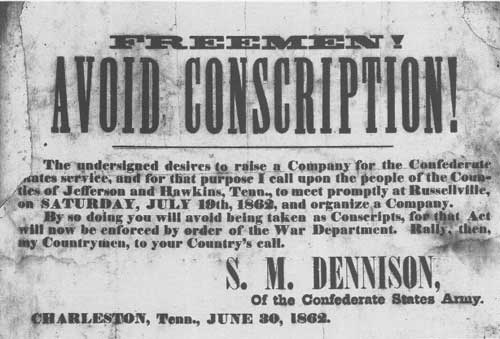
The states which made up the Confederacy went to war with great aplomb in the spring and summer of 1861. The staunch secessionist fire-eaters predicted a quick victory, but they were badly mistaken, and after Bull Run that Union galvanized itself for a long war. A “quick and easy war like the one most staunch secessionists predicted might have required few soldiers to fight it.” [1] But since many of the men who had led their states into secession and war expected that with a few victories that the Federal government would acquiesce to their claims of independence few plans were made for a long war, but even so “the recruiting inducements of 1861 had never adequately filled the ranks or assured that the twelve-month enlistees of 1861 would remain.” [2] As the war dragged on many men became increasingly hesitant to serve, the “enthusiasm and bravado of the war’s early months increasingly gave way to hesitation, reticence, and the discovery that one’s presence was urgently needed someplace other than the battlefield.” [3]

As the war continued into 1862 and the Union continuing to build and deploy armies a sense of gloom built even as the spring flowers bloomed across the Confederacy. A soldier serving with the Stonewall Brigade wrote, “The romance of the thing is entirely worn off… not only with myself but with the whole army.” [4] In the East the army of George McClellan was nearing Richmond and in the West the unexpected “loss of Forts Henry and Donaldson, followed by the failure to redeem the Tennessee River at Shiloh and the fall of New Orleans badly jolted Southern complacency.” [5] Drastic measures were required and the Confederate Congress began to debate a conscription act in order to meet the manpower needs of the Confederate armies, a Confederate General wrote that the Confederacy must embrace a total war, “in which the whole population and the whole production… are to be put on a war footing, where every institution is made auxiliary to war.” [6]  But the nature of the Confederacy itself precluded such a total effort as each state, and each economic interest, be it the planters, or the railroads fought to maintain their independence from edicts coming out of Richmond.

Robert E. Lee who was serving as military advisor to Jefferson Davis recognized that the Confederacy could not survive without conscription and put Major Charles Marshall, of his staff, who had been a lawyer in civilian life, to work “to draw up a bill providing for the conscription of all white males between eighteen and forty-five years of age.” [7] On March 28th 1862 Jefferson Davis proposed a conscription act to the Confederate Congress.

The proposal aroused an uproar throughout the South. Thomas Cobb of Georgia condemned the bill in Congress and proclaimed that it was “caused by the imbecility of the government,” accusing Davis and his toadies” of ignoring him when he warned earlier that something had to be done to lure those volunteers of 1861 into staying in the service.” [8] He condemned the measure of compelling men to serve. Vice President Alexander Stephens objected as he believed that the act “violated most basic principles that had underlain secession and the Confederacy’s creation, including state sovereignty and individual autonomy.” [9]

Davis was being worn out both physically and emotionally by the demands of the war, and by the opposition of the fire-eaters who often referred to him as a despot and tyrant, and wrote to a friend, “When everything is at stake and the united power of the South alone can save us, it is sad to know that such men can deal in such paltry complaints and tax their ingenuity to slander because they are offended in not getting office…. If we can achieve our independence, the office seekers are welcome to the one I hold.” [10] But aided by influential members of the Congress, many of whom had no love for Davis, including Senator Louis Wigfall of Texas, but Wigfall grasped the gravity of the situation and need for fresh manpower. Wigfall was committed “to the military and preoccupied with pushing the war vigorously, he saw a draft as the only way to meet his ends.” [11] Though he was opposed by the most extreme of the state’s rights members, Wigfall forcefully argued for the act, he warned his opponents to “cease child’s play…. The enemy are in some portions of almost every State in the Confederacy…. Virginia is enveloped by them. We need a large army. How are you going to get it?… No man has individual rights, which come into conflict with the welfare of the country.” [12]

On April 16th the Confederate Congress passed the Conscription Act of 1862 which in the process of being passed “was amended and mangled. Provision was made for the election of officers in reenlisted commands, and other useless paraphernalia of bounty and furlough act were loaded on it. The upper age-limit was reduced from forty-five to thirty-five years, and a bill allowing liberal exemption was soon adopted.” [13] In deference to the demands of the state’s-rights advocates for a measure of control of conscription, “enrollment and drafting would be administered by state officials though under Confederate supervision, and drafted men would be assigned to units of their own states. In deference to a historic custom of the militia, persons not liable for service could act as substitutes for those who were liable.” [14]

Even so the act was the first conscription act ever enacted in the history of the United States. The Southern press applauded its intentions but had sharp words regarding its weaknesses, especially after second act, detailing numerous exemptions was passes a few days later. Some soldiers who had been serving since the war began were angry at Congress and one South Carolina soldier asked “if the volunteers are kept for two more years… what was to prevent the lawmakers from keeping them on for ten more years? With conscription, he warned, “all patriotism is dead, and the Confederacy will be dead sooner or later.” [15]

The act stated that “all persons residing in the Confederate States, between the ages of 18 and 35 years, and rightfully subject to military duty, shall be held to be in the military service of the Confederate States, and that a plain and simple method be adopted for their prompt enrollment and organization.” [16] The one-year volunteers had their service extended to three years or to the duration of the war. The existing regiments had forty days to reorganize under the act and hold elections for their officers, in elections which season politicians in the ranks used time tested methods of campaigning, including the distribution and consumption of copious amounts of alcohol on the day when their regiments elected their officers. A private from Alabama wrote, “Passed the whiskey round & opened the polls… & a great many of the men are gloriously tight.” [17]  In some cases the elections meant that good officers were cashiered, and “good fellows” chosen in their places, “but on the whole, the elections wrought less evil than could reasonably be expected.” [18] Even so, the professional core of the Army officers, many West Point graduates, was less than happy, as were some of the best volunteer officers. Brigadier General Wade Hampton, a volunteer who would eventually rise to command the Cavalry Corps of the Army of Northern Virginia following the death of J.E.B. Stuart in 1864 “disapproved of the balloting for officers, explaining, “The best officers are sometimes left out because they are too strict.” Another South Carolina officer noted; “officers who have discharged their duties properly are not popular with their men and those who have allowed the most privileges have been the least efficient and will be elected.” [19] The elections and reorganization of the Army of Northern Virginia resulted in “the replacement of 155 field officers by newly elected men. The “whole effect,” wrote Porter Alexander, “was prejudicial to the discipline of the army.” [20]

In many cases the turnover in company grade officers was much more dramatic, in some cases fifty to seventy-five percent of officers were replaced in the elections, the “18th North Carolina Infantry replaced twenty-seven of forty officers. According to the new regimental commander, “Many of these officers elect were reported “incompetent” by a Board of Examination.” [21] Officers who failed to be reelected had the choice to remain in their units as enlisted personnel, but comparatively few did, often going to newly raised regiments where they were again commissioned and brought their experience along with them.

The act was highly controversial, often resisted, and “many Southerners resisted the draft or assisted evasion by others” [22]  The Confederate Congress issued a large number of class exemptions. The first exemptions were granted to “Confederate and state civil officials, railroad and river workers, telegraph operators, minors, several categories of industrial laborers, hospital personnel, clergymen, apothecaries, and teachers.” [23] The exemptions made sense, “but the categories would see much abuse by those seeking to stay out of uniform.” [24]

Initially the Congress fought off an attempt by planters to grant exemptions to “the owners, agents, or overseers with more than twenty slaves” [25] but a law to this effect was passed in October 1862. The exemption granted by Congress for the “owners or overseers of twenty or more slaves” [26] stirred up a hornet’s nest of resentment across the South. The October law “protected large-scale-slave-owning planters – the very people who had the most stake in this war – from military service, while drafting the small scale slaveowners and nonslaveholders who had the least interest in fighting to defend slavery.” [27] One of Mississippi’s slaveowning senators, James Phelan confidentially advised Davis that “never did a law meet with more universal odium than the exemption of slave-owners…. Its influence on the poor is most calamitous, and has awakened a spirit and elicited a discussion” that would surely produce “the most unfortunate results.” [28]

He was right, though Confederate soldiers would remain in the fight they “turned against what had originally called a crusade for independence. Now it was a “rich man’s war but a poor man’s fight,” the inference being that the wealth classes had provoked the struggle but poor people were the ones who had to fight, bleed, and die.” [29] Lee’s aide, Colonel Charles Marshall who had drafted the original conscription act, said that the “measure’s effect was “very injurious” and “severely commented upon in the army.” [30]

The main effect of the conscription act was “to stimulate volunteering rather than by its actual use” [31] and “directly and indirectly, the Conscription Act from large numbers of men into Lee’s army.” [32]  While the act did help increase the number of soldiers in Confederate service by the end of 1862 conscription was decidedly unpopular among soldiers. A Texas soldier whose unit had been reenlisted wrote that the new draft law “kicked up a fuss for a while, but since they shot about twenty-five men for mutiny whipped & shaved the heads of as many more for the same offense everything has got quiet & goes on as usual.” [33]

Conscripts were often looked down upon in the ranks as many of the old soldiers felt that they lacked the patriotism and honor to volunteer in the first place, and many who did show up were of dubious value. Statics from November 1863 indicated that “more than half of those who reported for conscription were ultimately exempted from duty.” [34] While many of these were for medical reasons, others claimed the exemptions provided for in the law.

Some governors who espoused state’s-rights viewpoint “utilized their state forces to challenge Richmond’s centralized authority, hindering efficient manpower mobilization.” [35] Some, most notably Georgia’s governor Joseph Brown “denounced the draft as “a most dangerous usurpation by Congress of the rights of the States…at war with all principles for which Georgia entered the revolution.” [36]  Governor Brown and a number of other governors, including Zebulon Vance of North Carolina, did more than protest, they fought the law in the courts but when overruled they resisted it by manipulating the many exemption loopholes, especially, especially those that which they could grant to civil servants. Brown “appointed large numbers of eligible Georgia males to fictitious state offices in order to exempt them,” [37] and Brown “insisted that militia officers were included in this category, and proceeded to appoint hundreds of new officers.” [38]  North Carolina and Georgia “accounted for 92 percent of all state officials exempted from the draft” and a “Confederate general sarcastically described a Georgia or North Carolina militia regiment as containing “3 field officers, 4 staff officers, 10 captains, 30 lieutenants, and 1 private with a misery in his bowels.” [39] In South Carolina, “Governor Francis W. Pickens was trying to impose a state draft of his own and attempted to exempt South Carolina draftees from any liability to the Confederate draft.[40]

Due to the problems with the Conscription Act of 1862 and the abuses by the governors it was amended twice in new bills in late 1862 and again in 1864 when Jefferson Davis lobbied Congress to pass the Conscription Act of 1864. This act was designed to correct problems related to exemptions and “severely limited the number of draft exemption categories and expanded military age limits from eighteen to forty-five and seventeen to fifty. The most significant feature of the new act, however, was the vast prerogatives it gave to the President and War Department to control the South’s labor pool.” [41] Despite these problems the Confederacy eventually “mobilized 75 to 80 percent of its available draft age military population.” [42]

While the act was unpopular, it did hold the army together and without it “the Confederacy could not have survived the 1862 campaigns without the veterans, and compelled the states to produce fresh regiments when their nation needed them.” [43] During 1862 the total number of men in the Confederate army “increased from about 325,000 to 450,000. Since about 75,000 men were lost from death or wounds during this period, the net gain was approximately 200,000. Fewer than half of the men were conscripts and substitutes; the remainder were considered volunteers even if their motives for enlisting many not have been unalloyed with patriotism.” [44] The results of the draft in getting men to combat units were still in evidence in the spring of 1864. “An officer of the 45th Georgia maintained that the regiment had come to Virginia with roughly 1,000 men in April 1862, and fell back from Antietam with only 200 left. At the start of the spring campaign, the regiment listed 425 men on its rolls as present.” [45] Despite all of the flaws and the condemnations the various conscription acts of the Confederacy provided the necessary manpower to continue the war.

Notes

[1] Levine, Bruce The Fall of the House of Dixie: The Civil War and the Social Revolution that Transformed the South Random House, New York 2013 p.83

[2] Ibid. Weigley A Great Civil War p.118

[3] Ibid. Levine The Fall of the House of Dixie p.83

[4] Ibid. McPherson. The Battle Cry of Freedom p.429

[5] Ibid. Guelzo Fateful Lightening p.364

[6] Ibid. McPherson. The Battle Cry of Freedom p. 429

[7] Freeman, Douglas Southall, Lee an abridgment by Richard Harwell, Touchstone Books, New York 1997 p.172

[8] Davis, William C. Jefferson Davis: The Man and His Hour Harper Collins Publishers New York 1991 p.453

[9] Ibid. Levine The Fall of the House of Dixie p.84

[10] Foote, Shelby, The Civil War, A Narrative. Volume One: Fort Sumter to Perryville Random House, New York 1963 1958 p.395

[11] Ibid. Davis Jefferson Davis: The Man and His Hour p.453

[12] Ibid. McPherson. The Battle Cry of Freedom p.430

[13] Ibid. Freeman Lee p.172

[14] Ibid. Weigley A Great Civil War p.118

[15] Sears, Stephen W. To the Gates of Richmond: The Peninsula Campaign Houghton Mifflin Company, Boston and New York, 1992 p.52

[16] Ibid. Thomas, The Confederate Nation p.152

[17] Ibid. Sears To the Gates of Richmond+ p.52

[18] Ibid. Freeman Lee pp.172-173

[19] Ibid. Glatthaar General Lee’s Army from Victory to Collapse p.85

[20] Wert, Jeffry D. A Glorious Army: Robert E. Lee’s Triumph 1862-1863 Simon and Schuster, New York and London 2011 p.13

[21] Ibid. Glatthaar General Lee’s Army from Victory to Collapse p.86

[22] Ibid. Thomas, The Confederate Nation p.152

[23] Ibid. McPherson. The Battle Cry of Freedom p. 431

[24] Ibid. Davis Jefferson Davis: The Man and His Hour p.453

[25] Ibid. Guelzo Fateful Lightening p.365

[26] Ibid. Thomas, The Confederate Nation p.154

[27] Ibid. Guelzo Fateful Lightening p.365

[28] Ibid. Levine The Fall of the House of Dixie pp.84-85

[29] Ibid. Robertson Soldiers Blue and Gray p.38

[30] Ibid. Levine The Fall of the House of Dixie p.85

[31] Ibid. McPherson. The Battle Cry of Freedom p. 432

[32] Ibid. Glatthaar General Lee’s Army from Victory to Collapse p.402

[33] Ibid. Robertson Soldiers Blue and Gray p.39

[34] Ibid. Glatthaar General Lee’s Army from Victory to Collapse p.402

[35] Millet, Allan R. and Maslowski, Peter, For the Common Defense: A Military History of the United States The Free Press a Division of Macmillan Inc. New York, 1984 p.166

[36] Ibid. McPherson. The Battle Cry of Freedom p.433

[37] Ibid. Guelzo Fateful Lightening p.364

[38] Ibid. McPherson. The Battle Cry of Freedom p.431

[39] Ibid. McPherson. The Battle Cry of Freedom p.431

[40] Ibid. Guelzo Fateful Lightening p.364

[41] Ibid. Thomas, The Confederate Nation p.261

[42] Ibid. Gallagher The Confederate War p.88

[43] Ibid. Glatthaar General Lee’s Army from Victory to Collapse p.402

[44] Ibid. McPherson. The Battle Cry of Freedom p.432

[45] Ibid. Glatthaar General Lee’s Army from Victory to Collapse p.402
Leave a comment

Filed under civil war, History

From All-Volunteer Forces to Conscription: The Draft in the Civil War

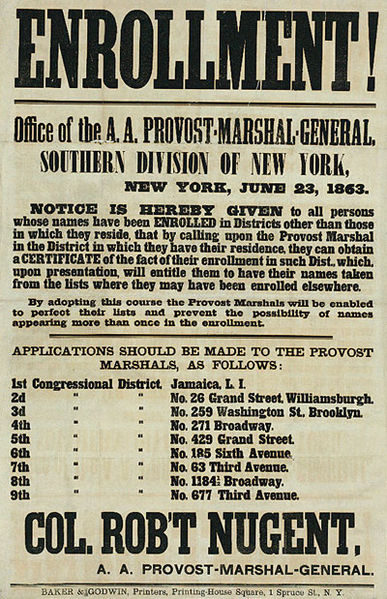
Enrollment-Poster-in-New-York-June-23-1863

Friends of Padre Steve’s World,

Today I am posting another heavily revised section of my Civil War and Gettysburg text, this dealing on the conscription efforts of both sides. It is an inte4resting subject as it brings up many issues that we still face in society, racial and religious prejudice, economic disparity, and social division.  Of course as always I will probably add more to this and revise it again, but you are probably getting used to that. I hope that you enjoy and have a great day.

Peace

Padre Steve+

The Changing Character of the Armies and Society

Gettysburg was the last battle where the original armies, composed of volunteers predominated.  As the war progressed the nature of both armies was changed. Initially both sides sought to fight the war with volunteers. However, the increasingly costly battles which consumed vast numbers of men necessitated new measures to fill the ranks, and this need led to the conscription, or draft of soldiers and the creation of draft laws and bureaus in the South and later the North.

fig17

Confederate Conscription

The in April 1862 Confederate Congress passed the Conscription Act of 1862 which stated that “all persons residing in the Confederate States, between the ages of 18 and 35 years, and rightfully subject to military duty, shall be held to be in the military service of the Confederate States, and that a plain and simple method be adopted for their prompt enrollment and organization.” [1] The act was highly controversial, often resisted and the Confederate Congress issued a large number of class exemptions. Despite the exemptions “many Southerners resisted the draft or assisted evasion by others” [2] The main purpose of the conscription act was “to stimulate volunteering rather than by its actual use” [3] and while it did help increase the number of soldiers in Confederate service by the end of 1862 it was decidedly unpopular among soldiers, chafing at an exemption for “owners or overseers of twenty or more slaves” [4] who referred to the war as a “rich man’s war but a poor man’s fight.” [5]

Some governors who espoused state’s rights viewpoints “utilized their state forces to challenge Richmond’s centralized authority, hindering efficient manpower mobilization.” [6] Some, most notably Georgia’s governor Joseph Brown “denounced the draft as “a most dangerous usurpation by Congress of the rights of the States…at war with all principles for which Georgia entered the revolution.” [7]  Governor Brown and a number of other governors, including Zebulon Vance of North Carolina fought the law in the courts but when overruled resisted it through the many exemption loopholes, especially that which they could grant to civil servants.

In Georgia, Governor Brown “insisted that militia officers were included in this category, and proceeded to appoint hundreds of new officers.” [8] Due to the problems with the Conscription Act of 1862 and the abuses by the governors, Jefferson Davis lobbied Congress to pass the Conscription Act of 1864. This act was designed to correct problems related to exemptions and “severely limited the number of draft exemption categories and expanded military age limits from eighteen to forty-five and seventeen to fifty. The most significant feature of the new act, however, was the vast prerogatives it gave to the President and War Department to control the South’s labor pool.” [9] Despite these problems the Confederacy eventually “mobilized 75 to 80 percent of its available draft age military population.” [10]

recruit poster

The Enrollment Act: The Federal Draft

In the spring of 1863 a manpower crunch began to hit the Union Army as vast numbers of the nine-month militia regiments which were called out by Lincoln in accordance with the Militia Act of May 25th 1792 were to disband. Facing the reality that the all-volunteer system which had sustained the war effort the first two years of the war could no longer meet the need for adequate numbers of soldiers the Congress of the United States passed the “An Act for the enrolling and calling out the National Forces, and for other Purposes,” commonly known as the enrollment act of 1863” on March 3rd 1863. [11] The length of the war and the massive number of causalities were wearing on the population and the Union Army had reached an impasse as in terms of the vast number of men motivated to serve “for patriotic reasons or peer group pressure were already in the army.” Likewise, “War weariness and the grim realities of army life discouraged further volunteering” and “the booming war economy had shrunk the number of unemployed men to the vanishing point.” [12]

The Enrollment Act was controversial. Based on the power of Congress given by the Constitution in Article One, Section Eight, to raise and support armies. It was “the first direct Federal conscription statute in U.S. history, providing the first Federal compulsion upon individuals to enter directly into the military service of the United States, without intermediate employment in the militia systems of the states.” [13] In doing so the act “bypassed the state governments entirely and created a series of federal enrollment boards that would take responsibility for satisfying the federally assigned state quotas.” [14] In effect it was an act the nationalized military service and eventual became the basis for a truly national army which would be supported by state forces embodied in the National Guard as well as a Federal Army Reserve. Though Chief Justice of the Supreme Court Roger Taney believed that act of be unconstitutional it was never challenged during his lifetime, but “the Court eventually upheld the constitutionality of the similar Selective Service Act of May 18th, 1917 in a unanimous decision.” [15] The act made some exemptions, those who were physically or mentally unfit, certain high federal government officials and governors, only sons of dependent widows and infirm parents, or those convicted of a felony.

Like the Confederate legislation, this act was also tremendously unpopular and was ridden with exemptions which were frequently abused. All congressional districts were issued a quota for volunteers. Those districts that were able to fulfill their quotas were not subject to conscription, thus the districts that “could provide sufficient volunteers, or bounties high enough to lure volunteers, would not need to draft anyone, and in the end only seven Northern States would be subject to all four of the draft calls issued under the Enrollment Act.” [16]

The Federal draft was conducted by lottery in each congressional district with each district being assigned a quota to meet by the War Department. Under one third of the men drafted actually were inducted into the army, “more than one-fifth (161,000 of 776,000) “failed to report” and about 300,000 “were exempted for physical or mental disability or because they convinced the inducting officer that they were the sole means of support for a widow, an orphan sibling, a motherless child, or an indigent parent.” [17]

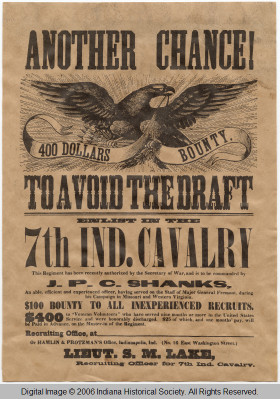
To ensure that the enrollment boards had teeth Congress “authorized a Provost Marshall Bureau in the War Department to enforce conscription.” [18] It was the task of the Provost Marshalls to enroll every male citizen, as well as immigrants who had applied for citizenship between the ages of twenty to forty-five.

There was also a provision in the Federal draft law that allowed well off men to purchase a substitute who they would pay other men to take their place. Some 26,000 men paid for this privilege, including future President Grover Cleveland. Another “50,000 Northerners escaped service by another provision in the Enrollment Act known as “commutation,” which allowed draftees to bay $300 as an exemption fee to escape the draft.” [19] Many people found the notion that the rich could buy their way out of war found the provision repulsive to the point that violence ensued in a number of large cities.  Congress had good intentions in setting the price at $300 because they did not want the price to soar beyond the reach of many draftees, however, this was far more than most of the working poor could afford. Of course well off and influential people could pay for a substitute, but “the working poor, for whom three hundred dollars was a half a year’s wages, were especially outraged, and many saw the exemption as another indicator that the war no longer focused on their interests….” [20] Many were afraid that newly emancipated African Americans would be new competition for their already low paying jobs and that the notion of equality would upset their society and their lives. The financial wall was insurmountable for many, and the fact that many found it repulsive that “in a democracy someone could hire a substitute to take his place, was calculated to provoke the bloodiest sort of response among the poor.” [21]

Fraud was rampant and the boards often had little means to check the documentation of those who filed for exemptions. “Surgeons could be bribed, false affidavits claiming dependent support could be filed, and other kinds of under-the-table influence could be exerted. Some draftees feigned insanity or disease. Others practiced self-mutilation. Some naturalized citizens claimed to be aliens.” [22] All of this seemed to indicate to the poor, and to recent immigrants that the system was unfair. Some soldiers such as Irish-American soldier John England were not against the draft itself, but the inequity of the system. The law, English wrote, “was framed for the benefit of the rich and the disadvantage of the poor. For instance – a rich conscript can commute for$300! Now, it is a fact well known to all that there are some rich animals in the northern cities that can afford to lose $300, as much as some poor people can afford to lose one cent.” [23]

To make matters worse for the Army, many of the substitutes themselves were worthless to the Army, veteran soldiers distrusted them, often with good reason. “Of 186 such men assigned to a Massachusetts regiment, 115 deserted, 6 were discharged for disability, 26 were transferred to the navy, and 1 was killed in action.” Additionally the medically unfit, including men in the final stages of incurable disease were present in large numbers, of “57 recruits for the 6th New York Heavy Artillery, seventeen could not muster. In March of 1864, one-third of the replacements sent to a cavalry divisions were already on the sick list.” [24]

The Union draft law provoked great resentment, not because people were unwilling to serve, but from the way that it was administered, for it “brought the naked power of military government into play on the home front and went much against the national grain.[25] The resentment of the act grew, especially in large cities such as New York was fed by false rumors and lack of understanding as much as fact. The ensuing draft riots “were based upon ignorance, misery, fear, and the inability of one class of men to understand another class; upon the fact that there were “classes of men” in a classless American society.” [26]

New_York_Draft_Riots_-_fighting

The Draft Riots

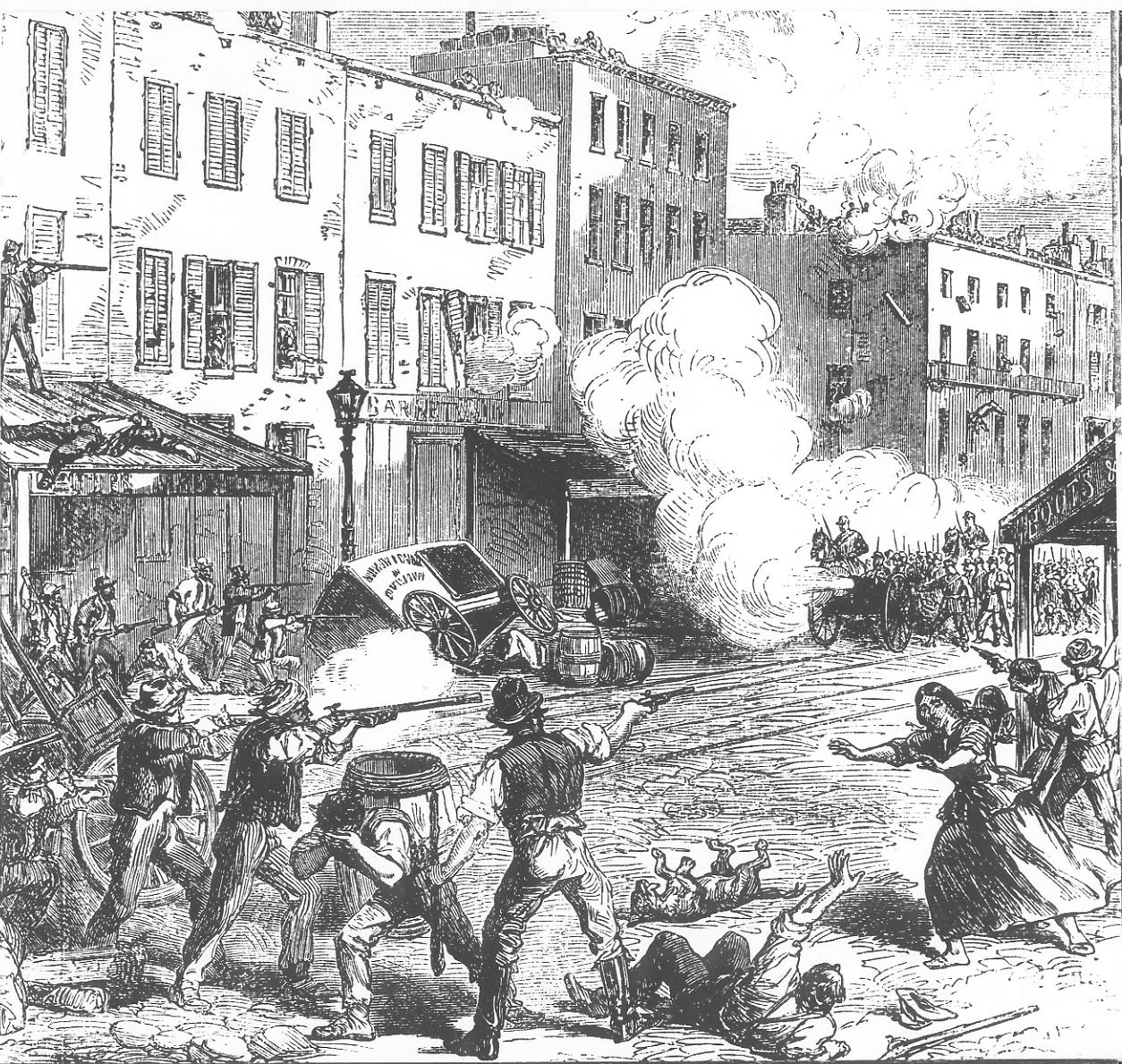
Barely a week after the Battle of Gettysburg, clashes and violence erupted in several cities. The riots became so violent that local police forces were incapable of controlling them. As a result President Lincoln was forced to use Union Soldiers, recently victorious at Gettysburg to end the rioting and violence. New York where protestors involved in a three day riot, many of whom were Irish immigrants urged on by Democratic Tammany Hall politicians, “soon degenerated into violence for its own sake” [27] wrecking the draft office, then seizing the Second Avenue armory while attacking police and soldiers on the streets. Soon “the mob had undisputed control of the city.” [28]

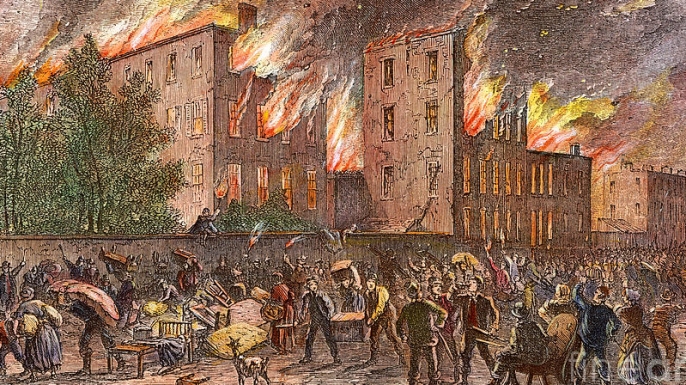
These rioters also took out their anger on blacks, and during their rampage the rioters “had lynched black people and burned the Colored Orphan Asylum.” [29] A witness described the scene:

“The furious, bareheaded & coatless men assembled under our windows & shouted for Jeff Davis!… Towards evening the mob, furious as demons, went yelling over to the Colored-Orphan Asylum in 5th Avenue… & rolling a barrel of kerosene in it, the whole structure was soon ablaze, & is now a smoking ruin. What has become of the 300 innocent orphans I could not learn…. Before this fire was extinguished, or rather burnt out, for the wicked wretches who caused it would not permit the engines to be used, the northern sky was brilliantly illuminated, probably by the burning of the Aged Colored-Women’s Home in 65th Street…. A friend…had seen a poor negro hung an hour or two before. The man in a frenzy, had shot an Irish fireman and they immediately strung up the unhappy African…. A person who called at our house this afternoon saw three of them hanging together.” [30]

hith-drafft-riots-E

Many of the rioters, but certainly not all of them were Irish, especially Catholics, who were also angry at the religious prejudice that the experienced at the hand of many Protestants. Rioters “targeted African-Americans, Republicans, abolitionists, and anyone associated with them…. Policemen and soldiers trying to suppress the riots also became targets, even if these men were Irish-Americans and Catholics.” [31] Many high profile Irish Catholics including Archbishop John Hughes refused to condemn the rioters or even call them by the term, earning the condemnation of the editors of the New York Times who wrote, “If the mob had burned the Catholic Orphan Asylum next door to the Bishop’s Cathedral… somebody besides “the papers” probably would have called them rioters.” [32]

The riots showed that the concept of racial or religious equality was difficult for many Americans, and not just those in the South. Prejudice, against African Americans, immigrants including the Irish, and Roman Catholics still burned in the hearts of many who had just a few years before had supported the Know Nothing Party and movement. Bruce Catton wrote, the “rioters had malignant prejudice, and those rioted against had another prejudice, equally malignant; if the lynchings and the burnings and the pitched battles in city streets meant anything they meant that this notion of equality was going to be hard to live with.” [33]

The violence did not abate until newly arrived veteran Union troops who had just fought at Gettysburg quickly and violently put down the insurrection. These soldiers, fresh from the battlefield and having experienced the loss of so many of their comrades “poured volleys into the ranks of protestors with the same deadly effect they had produced against the rebels at Gettysburg two weeks earlier.” [34] Republican newspapers which supported abolition and emancipation were quick to point out the moral of the riots; “that black men who fought for the Union deserved more respect than white men who fought against it.” [35]

In the end, the Enrollment Act contributed little to the Union war effort. Though it was called conscription it was not really conscription, it was “but a clumsy carrot and stick device to stimulate volunteering. The threat was being drafted and the carrot a bounty for volunteering.” [36] The organization of its machinery was so inefficient and the Act’s intentions so diluted “that the effort netted only 35,883 men – albeit along with $15,686,400 in commutation fees.” [37]

While an additional 74,000 men served as substitutes, the number pales in comparison to the nearly 800,000 who volunteered or reenlisted to serve while the act was in force. Only some six percent of the 2.7 million men who served in the Union Army were directly conscripted. Congress repealed the commutation provision in July 1864 and tightened requirements for exemptions.

The Federal government got into the bounty business as well with a $300 bounty for new enlistment and reenlistment, all paid for by the commutation fees collected by through the enrollment Act. To meet the demand “Bounty brokers” went into business to enlist men into the service, getting the best deal possible while themselves taking part of the profit. Some enterprising recruits “could pyramid local, regional, and national bounties into grants of $1000 or more,” [38] and some even took the chance to change their names, move to another and enlist again to collect more bounty money and many deserted before they ever saw combat. “They were so unreliable that any regiment that had them in large numbers was bound to be decidedly weaker than it would have been without them.” [39]

8th_Ohio_At_Gettysburg

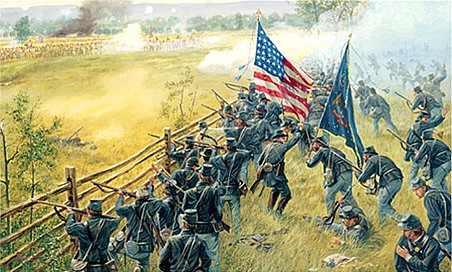
The men who had been fighting since 1861 and 1862 who had served without bounties and had reenlisted anyway; the veterans of Shiloh, Vicksburg, Antietam, Gettysburg and so many other hard fought battles in the West and the East, despised the substitutes and bounty men of 1864, and the poor qualities of such men made the good soldiers look even better. These men were proud of their service, their regiments, and what they had achieved. One soldier from Illinois wrote to his sister: “It is hard for a person to imagine how much a man sacrifices in the way of pleasure and enjoyment by going into the ‘Army,’ but I never think I shall regret being in the ‘Army’ if I get out alive & well.” He did.” [40]

Notes

[1] Ibid. Thomas, The Confederate Nation p.152

[2] Ibid. Thomas, The Confederate Nation p.152

[3] Ibid. McPherson. The Battle Cry of Freedom p. 432

[4] Ibid. Thomas, The Confederate Nation p.154

[5] Ibid. McPherson. The Battle Cry of Freedom p.431

[6] Millet, Allan R. and Maslowski, Peter, For the Common Defense: A Military History of the United States The Free Press a Division of Macmillan Inc. New York, 1984 p.166

[7] Ibid. McPherson. The Battle Cry of Freedom p.433

[8] Ibid. McPherson. The Battle Cry of Freedom p.431

[9] Ibid. Thomas, The Confederate Nation p.261

[10] Ibid. Gallagher The Confederate War p.28

[11] Ibid. Weigley A Great Civil War p.233

[12] Ibid. McPherson. The Battle Cry of Freedom p.600

[13] Ibid. Weigley A Great Civil War pp.233-234

[14] Ibid. Guelzo Fateful Lightening p.459

[15] Ibid. Weigley A Great Civil War p.234

[16] Ibid. Guelzo Fateful Lightening p.459

[17] Ibid. McPherson. The Battle Cry of Freedom p.601

[18] Ibid. McPherson. The Battle Cry of Freedom p.600

[19] Ibid. Guelzo Fateful Lightening p.460

[20] Bruce, Susannah Ural The Harp and the Flag: Irish American Volunteers and the Union Army, 1861-1865 New York University Press, New York and London 2006 p.173

[21] Ibid. Guelzo Fateful Lightening p.460

[22] Ibid. McPherson. The Battle Cry of Freedom p.601

[23] Ibid. Bruce The Harp and the Flag p.173

[24] Ibid. Robertson Soldiers Blue and Gray p.38

[25] Ibid. Foote. The Civil War, A Narrative Volume Two p.635

[26] Catton, Bruce. Never Call Retreat, Pocket Books a division of Simon and Schuster, New York 1965 p.205

[27] Ibid. Foote. The Civil War, A Narrative Volume Two p.636

[28] Ibid. Foote. The Civil War, A Narrative Volume Two p.637

[29] Ibid. McPherson. The Battle Cry of Freedom p.687

[30] Ibid. Guelzo Fateful Lightening p.461

[31] Ibid. Bruce The Harp and the Flag p.180

[32] Ibid. Bruce The Harp and the Flag p.180

[33] Ibid. Catton Never Call Retreat p.205

[34] Ibid. McPherson. The Battle Cry of Freedom p.610

[35] Ibid. McPherson. The Battle Cry of Freedom p.687

[36] Ibid. McPherson. The Battle Cry of Freedom p.605

[37] Ibid. Weigley A Great Civil War p.236

[38] Ibid. McPherson. The Battle Cry of Freedom p.606

[39] Ibid. Robertson Soldiers Blue and Gray p.40

[40] Ibid. Robertson Soldiers Blue and Gray p.40

Leave a comment

Filed under civil war, History

The Context of History, Memory & War

16-2 Gettysburg Staff Ride, May 2016-37

With my Students at Little Round Top

Friends of Padre Steve’s World,

As always I have been doing a lot of reading and of course that has led me to do some more revisions to my Civil War and Gettysburg text. I re-wrote the introduction to the first chapter in order to talk about the nature and role of history in understanding who we are as a people today. The section is part of a chapter that is now over 150 pages long and probably will become a book in its own right. Of course this section, and the rest of the chapter will likely be worked on some more in the coming months but I think that you will like it.

Peace,

Padre Steve+

“No one is so sure of his premises as the man who knows too little.” [1]

Barbara Tuchman

Finite human beings find themselves bound by time and space, we live in the present, but not the present alone, but rather three worlds: one that is, one that was, and one that will be. Ernst Breisach wrote, “In theory we know these three worlds as separate concepts but we experience as inextricably linked and influencing each other in many ways. Every new and important discovery about the past changes how we think about the present and what we expect of the future; on the other hand every change in the conditions of the present and in the expectations of the future revises our perception of the past. In this complex context history is born ostensibly as reflection of the past; a reflection which is never isolated from the present and the future. History deals with human life as it “flows” through time.” [2]

Richard Evans wrote something in the preface to his book The Third Reich in History and Memory that those who study military history often forget. He noted: “Military history, as this volume shows, can be illuminating in itself, but also needs to be situated in a larger economic and cultural context. Wherever we look, at decision making at the top, or at the inventiveness and enterprise of second rank figures, wider contextual factors remained vital.” [3] Thus while this work is an examination of the Gettysburg campaign it is important to understand the various issues that were formative for the men who directed and fought the battle, as well as the vast continuum of often distant and seemingly events that come together at one time in the lives of the participants in any historic event.

One cannot understand the determination the determination of Robert E. Lee to maintain the offensive, the dogged persistence of Joshua Chamberlain or Strong Vincent to hold Little Round Top, what brought John Buford to McPherson’s Ridge, what motivated Daniel Sickles to move Third Corps to the Peach Orchard, and what motivated the men of Pickett’s division to advance to their death on Cemetery Ridge, without understanding the broader perspective of history, as well as how culture, politics, economics, religion, sociology, ideology, experience, and  that shaped these men and their actions.

Likewise in order to understand the context of this battle, or for that matter any battle in any war, one has to understand the events, ever distant events which play a role in the battle. All too often those that delve into military history, or a particular battle see that as separate event, often disconnected from other historical events. But as historian Edward Steers Jr. correctly notes, history “does not exist in a series of isolated events like so many sound bites in a newscast. It is a continuum of seemingly unrelated and distant events that so often come together in one momentous collision of time.” [4] In the case of Gettysburg events like Lincoln’s publication of the Emancipation Proclamation, the failure of Confederate diplomacy to bring France or Great Britain into the war or at least to recognize the Confederacy, the failures of the Confederate armies in the West to maintain their hold on the Mississippi River, all play a crucial role in Robert E. Lee’s ill-advised decision to launch an invasion of Pennsylvania. Additionally, the loss of so many key leaders in the Army of Northern Virginia, especially that of Stonewall Jackson impacts how Lee manages the campaign, and shows up at numerous crucial points in the battle.

Another element that must be connected in order to understand the Battle of Gettysburg is the part that policy, strategy, war aims and operational doctrine played in the campaign of 1863 and how those influenced the decisions of participants before, during and after the campaign. Finally, the Battle of Gettysburg cannot be looked at as a stand-alone event. What happens there as the Confederacy surges to and ebbs back from its “high water mark” influences the rest of the While the war would go on for nearly two more years, the Union victory at Gettysburg coupled with the victory of Grant at Vicksburg ensured that the Confederacy, no matter how hard it tried would not be able to gain its independence through military means.

Maybe even more importantly the story of Gettysburg is its influence today. The American Civil War was America’s greatest crisis. It was a crisis that that “has cast such a shadow over the relations between the North and the South that the nation’s identity and its subsequent history have been considerably influenced by it.” [5]

The Battle of Gettysburg itself is enshrined in American history and myth and is woven deeply into the story of the nation. In this narrative the Battle of Gettysburg is often different ways; in the North viewed as a victory that brings an end to the institution of slavery, and freedom for enslaved African Americans, and preserves the Union. In the South it is often part of the myth of the Noble Confederacy and the Lost Cause where the South was defeated by the Northern superiority in men and war making ability.

Yet in both cases, the truth is not so simple; in fact it is much more complex, and the truth is we are still in the process of learning from and interpreting the historical records of the events that led to the American Civil War, the war itself, and the aftermath. They are all connected and for that matter still influence Americans today more than any other era of our history. In fact James McPherson who is one of the nation’s preeminent scholars on the Civil War and Reconstruction wrote,

“I became convinced that I could not fully understand the issues of my own time unless I learned about their roots in the era of the Civil War: slavery and its abolition; the conflict between North and South; the struggle between state sovereignty and the federal government; the role of the government in social change and resistance to both government and social change. These issues are as salient and controversial today as they were in the 1960s, not to mention the 1860s.” [6]

The prolific American military historian Russel Weigley wrote of how the war, and in particular how the Battle of Gettysburg changed the American Republic.

“The Great Civil War gave birth to a new and different American Republic, whose nature is to be discovered less in the Declaration of Independence than in the Address Delivered at the Dedication of the National Cemetery at Gettysburg. The powerful new Republic shaped by the bayonets of the Union Army of the Civil War wears a badge less benign aspect than the older, original American Republic. But it also carries a larger potential to do good for “the proposition that all men are created equal” both at home and around the world.” [7]

Thus it is important for Americans to learn about the Battle of Gettysburg and the American Civil War, but not solely for its military significance, nor for clear cut answers or solutions. The fact is that “situations in history may resemble contemporary ones, but they are never exactly alike, and it is a foolish person who tries blindly to approach a purely historical solution to a contemporary problem. Wars resemble each other more than they resemble other human activities, but similarities can be exaggerated.” [8]  As Michael Howard warned, “the differences brought about between one war and another by social or technological changes are immense, and an unintelligent study of military history which does not take into account these changes may quite easily be more dangerous than no study at all. Like the statesman, the soldier has to steer between the dangers of repeating the errors of the past because his is ignorant that they have been made, and of remaining bound by theories deduced from past history although changes in conditions have rendered these theories obsolete.” [9] The ideal that we reach for is to understand the Battle of Gettysburg and the American Civil War in context, which includes understanding what led to the war as well as the period of Reconstruction, and the post-Reconstruction era. In doing so we attempt to draw lessons from it without making the mistake of assuming that what we learn and know about them is immutable and thus not subject to change, for the past influences the present, even as the present and future will influence how we view and interpret the past.

Notes

[1] Tuchman, Barbara The March of Folly: From Troy to Vietnam Random House Publish Group, New York 2011 p.319

[2] Breisach, Ernst, Historiography: Ancient, Mediaeval & Modern University of Chicago Press, Chicago and London 1983 and 1994 p.2

[3] Evans, Richard J. The Third Reich in History and Memory Oxford University Press, Oxford and New York 2015 p.ix

[4] Steers, Edward Jr. Blood on the Moon: The Assassination of Abraham Lincoln The University of Kentucky Press, Lexington 2001 p.5

[5] Perman, Michael and Murrell Taylor, Amy editors The Civil War and Reconstruction Documents and Essays Third Edition Wadsworth Cengage Learning Boston MA 2011 p.3

[6] McPherson, James The War that Forged a Nation: Why the Civil War Still Matters Oxford University Press, Oxford and New York 2015 p.4

[7] Weigley, Russell F. A Great Civil War: A Military and Political History 1861-1865 Indiana University Press, Bloomington and Indianapolis 2000 p.xviii

[8] Griess, Thomas E. A Perspective on Military History in A Guide to the Study and Use of Military History edited by John E. Jessup Jr. and Robert Coakley, Center for Military History, United States Army, 1982 p.33

[9] Howard, Michael. The Use and Abuse of Military History  in Journal of the Royal United Service Institution 107 (1962):7

1 Comment

Filed under civil rights, civil war, Gettysburg, History

The Colfax Massacre

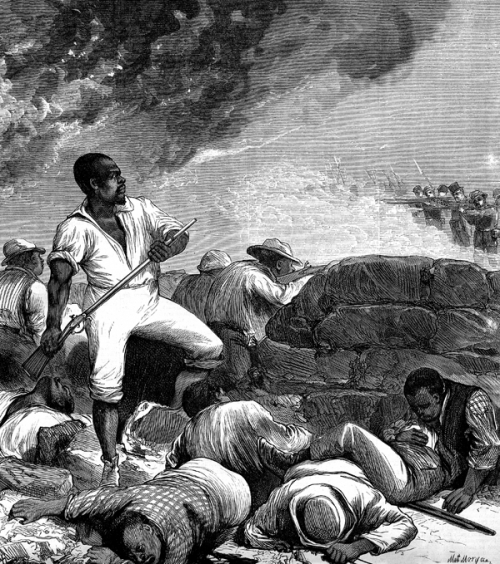
blacks at colfax

Friends of Padre Steve’s World,

Yesterday I posted an article about the surrender at Appomattox and the words, actions and attitudes of four unique Americans in attempting to end a war and reunite a country. Sadly, within months of that action there were men trying to reestablish an old order of tyranny based on White Supremacy. Their actions became bolder and bloodier in the years that followed. One of the most despicable acts of violence was occurred in Colfax Louisiana on the night of April 13th 1873.

This is the story of that massacre which I cover as part of my Civil War and Gettysburg text.

Peace

Padre Steve+

The violence against Southern blacks escalated in the wake of the passage of the Fourteenth and Fifteenth Amendments and with the increasing number of blacks being elected to office in some Southern states during the elections of 1872. In Louisiana a Federal court ruled in favor of Republican Reconstruction candidates following a Democrat campaign to interfere with the vote which included attacks on polling sites and the theft of ballot boxes. As a result the Louisiana Democrats “established a shadow government and organized paramilitary unit known as the White League to intimidate and attack black and white Republicans.” [1]

The White League in Louisiana was particularly brutal in its use of violence. he worst massacre committed by the White League occurred Easter Sunday 1873 when it massacred blacks in Colfax, Louisiana. Colfax was an isolated nondescript hamlet about three hundred fifty miles northwest of New Orleans, it sat on the grounds of a former plantation whose owner, William Calhoun worked with the former slaves who were now freedmen. The town itself “composed of only a few hundred white and black votes” [2] was located in the newly established Grant Parish. The “parish totaled about 4,500, of whom about 2,400 were Negroes living on the lowlands along the east bank of the Red.” [3] Between 1869 and 1873 the town and the parish were the scene of numerous violent incidents and following the 1872 elections, the whites of the parish were out for blood.

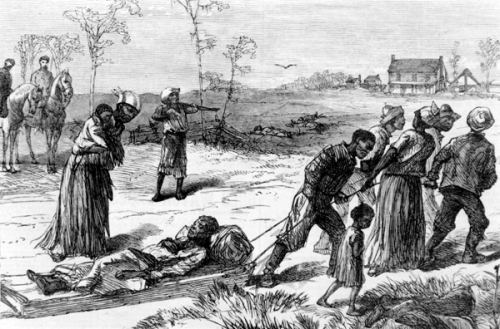
White leaders in Grant Parish “retaliated by unleashing a reign of terror in rural districts, forcing blacks to flee to Colfax for protection.” [4] The blacks of parish fled to the court house seeking protection from a violent white mob following the brutal murder of a black farmer and his family on the outskirts of town. The people, protected by just a few armed black militiamen and citizens deputized by the sheriff took shelter in the courthouse knowing an attack was coming. As the White League force assembled one of its leaders told his men what the day was about. He said, “Boys, this is a struggle for white supremacy….There are one hundred-sixty-five of us to go into Colfax this morning. God only knows who will come out. Those who do will probably be prosecuted for treason, and the punishment for treason is death.” [5] The attack by over 150 heavily armed men of the White League, most of whom were former Confederate soldiers, killed at least seventy-one and possibly as many as three-hundred blacks. Most of the victims were killed as they tried to surrender. The people, protected by just a few armed men were butchered or burned alive by the armed terrorist marauders. It was “the bloodiest peacetime massacre in nineteenth-century America.” [6]

The instigators of the attack claimed that they acted in self-defense. They claimed that “armed Negroes, stirred up by white Radical Republicans, seized the courthouse, throwing out the rightful officeholders: the white judge and sheriff” and they claimed that the blacks had openly proclaimed “their intention to kill all the white men, they boasted they would use white women to breed a new race.” [7] The claims were completely fabricated, after sending veteran former army officers who were serving in the Secret Service to investigate, the U.S. Attorney for Louisiana, J.R. Beckwith sent an urgent telegram to the Attorney General:

“The Democrats (White) of Grant Parish attempted to oust the incumbent parish officers by force and failed, the sheriff protecting the officers with a colored posse. Several days afterward recruits from other parishes, to the number of 300, came to the assistance of the assailants, when they demanded the surrender of the colored people. This was refused. An attack was made and the Negroes were driven into the courthouse. The courthouse was fired and the Negroes slaughtered as they left the burning building, after resistance ceased. Sixty-five Negroes terribly mutilated were found dead near the ruins of the courthouse. Thirty, known to have been taken prisoners, are said to have been shot after the surrender, and thrown into the river. Two of the assailants were wounded. The slaughter is greater than the riot of 1866 in this city. Will send report by mail.” [8]

Nine white men were arrested by Federal authorities in the wake of the massacre and three were “convicted of violating the Enforcement Act of 1871.” [9] white Democrats appealed the convictions and using the best lawyers they could get with nearly unlimited financial backing the appeal reached the Supreme Court.

colfax-the-louisiana-murders--1288

Colfax Blacks recovering their Dead and wounded

The attack, and the court cases which followed, notably United States v. Cruickshank which dealt with the men responsible for the Colfax Massacre led to a “narrowing of Federal law enforcement authority” and were “milestones on the road to a “solid” Democratic South.” [10] The decision of the court in United States v. Cruikshank was particularly perverse in its interpretation of constitutional rights and protections. The court ruled in favor of the terrorists and declared that “the right of the black victims at Colfax to assemble hand not been guaranteed because they were neither petitioning Congress nor protesting a federal law. Assembling for any other cause was not protected.” [11] The Cruikshank decision amounted to a Supreme Court endorsement of violence against blacks, and made it “impossible for the federal government to prosecute crimes against blacks unless they were perpetrated by a state and unless it could prove a racial motive unequivocally.” [12]

Other massacres followed across the South, aimed at both blacks and their white Republican allies. Another White League detachment southwest of Shreveport “forced six white Republicans to resign their office on pain of death – and then brutally murdered them after they had resigned.” [13] The violence, now protected by the courts ensured that neither would last long in the post-Reconstruction South and that the freedom of African Americans in those states would amount to a cruel illusion.

Notes

[1] Ibid. Foner Forever Free p.151

[2] Ibid. Langguth After Lincoln p.312

[3] Ibid. Lane The Day Freedom Died p.42

[4] Ibid. Goldfield America Aflame p.493

[5] Ibid. Lane The Day Freedom Died p.91

[6] Ibid. Goldfield America Aflame p.493

[7] Ibid. Lane The Day Freedom Died p.11

[8] Ibid. Lane The Day Freedom Died p.22

[9] Ibid. Goldfield America Aflame p.494

[10] Ibid. Lane The Day Freedom Died p.251

[11] Ibid. Langguth After Lincoln p.314

[12] Ibid. Goldfield American Aflame p.494

[13] Ibid. McPherson The War that Forged a Nation p. 185

2 Comments

Filed under civil rights, civil war, History, Political Commentary

We Are All Americans: Appomattox at 151

chamberlian gordon appomattox

Joshua Chamberlain Receives the Surrender of John Gordon at Appomattox

Friends of Padre Steve’s World,

I am back from my recent trip and I am posting an article that I recently revised and had intended to post over the weekend, but did not get around to it. I guess that is a good thing. I hope that you enjoy it, and glean from it the lessons that the events that it is based on have helped to teach me.

Peace

Padre Steve+

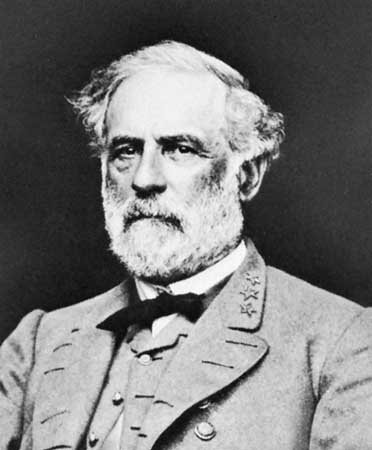
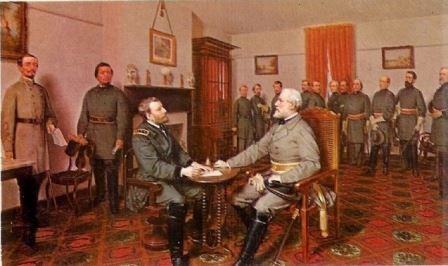
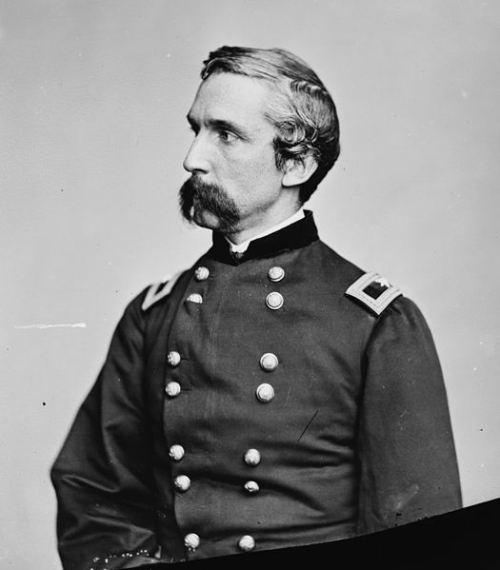
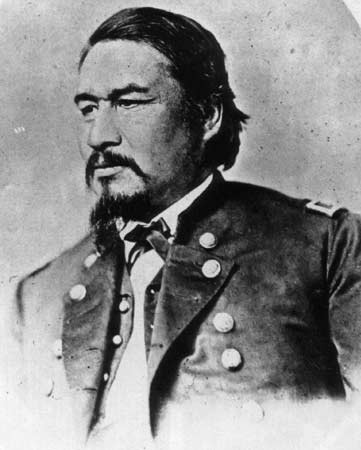
One hundred and fifty years ago on the 9th and 10th of April 1865, four men, Ulysses S Grant, Robert E. Lee, Joshua Lawrence Chamberlain and Ely Parker, taught succeeding generations of Americans the value of mutual respect and reconciliation. The four men, each very different, would do so after a bitter and bloody war that had cost the lives of over 600,000 Americans which had left hundreds of thousands others maimed, shattered or without a place to live, and seen vast swaths of the country ravaged by war and its attendant plagues.

The differences in the men, their upbringing, and their views about life seemed to be insurmountable. The Confederate commander, General Robert E. Lee was the epitome of a Southern aristocrat and career army officer. Lieutenant General Ulysses S. Grant, like Lee was a West Point graduate and veteran of the War with Mexico, but there the similarities ended. Grant was an officer of humble means who had struggled with alcoholism and failed in his civilian life after he left the army, before returning to it as a volunteer when war began. Major General Joshua Lawrence Chamberlain had been a professor of rhetoric and natural and revealed religion from Bowdoin College until 1862 when he volunteered to serve. He was a hero of Little Round Top at the Battle of Gettysburg, who helped exemplify the importance of citizen soldiers in peace and war. Finally there was Colonel Ely Parker, a full-blooded Seneca Indian; a professional engineer by trade, a man who was barred from being an attorney because as a Native American he was never considered a citizen. Although he had been rejected from serving in the army for the same reason, his friend Grant had obtained him a commission and kept him on his staff.

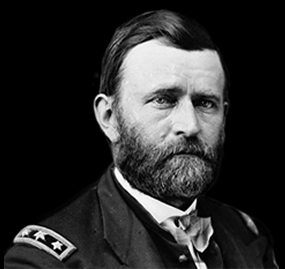
grant 1

Ulysses S. Grant

A few days bef0ore the Confederate line around the fortress of Petersburg was shattered at the battle of Five Forks, and to save the last vestiges of his army Lee attempted to withdraw to the west. Within a few days the once magnificent Army of Northern Virginia was trapped near the town of Appomattox. On the morning of April 9th 1865 Lee replied to an entreaty of Lieutenant General Ulysses S. Grant requesting that he and his Army of Northern Virginia be allowed to surrender. Lee wrote to Grant:

HEADQUARTERS ARMY OF NORTHERN VIRGINIA, APRIL 9, 1865

Lieut. Gen. U.S. GRANT:

I received your note of this morning on the picket-line, whither I had come to meet you and ascertain definitely what terms were embraced in your proposal of yesterday with reference to the surrender of this army. I now ask an interview in accordance with the offer contained in your letter of yesterday for that purpose.

R.E. LEE, General.

The once mighty Army of Northern Virginia, which had won so many victories, and which at its peak numbered nearly 80,000 men, was now a haggard and emaciated, but still proud force of about 15,000 soldiers. For Lee to continue the war now would mean that they would have to face hopeless odds against a vastly superior enemy. Grant recognized this and wrote Lee:

I am equally anxious for peace with yourself, and the whole North entertains the same feeling. The terms upon which peace can be had are well understood. By the South laying down their arms they will hasten that most desirable event, save thousands of human lives, and hundreds of millions of property not yet destroyed. Seriously hoping that all our difficulties may be set-tied without the loss of another life, I subscribe myself, &c.,

Since the high water mark at Gettysburg, Lee’s army had been on the defensive. Lee’s ill-fated offensive into Pennsylvania was one of the two climactic events that sealed the doom of the Confederacy. The other was Grant’s victory at Vicksburg which fell to him a day after Pickett’s Charge, and which cut the Confederacy in half.

ileerob001p1

Robert E. Lee

The bloody defensive struggle lasted through 1864 as Grant bled the Confederates dry during the Overland Campaign, leading to the long siege of Petersburg. Likewise the armies of William Tecumseh Sherman had cut a swath through the Deep South and were moving toward Virginia from the Carolinas.

With each battle following Gettysburg the Army of Northern Virginia became weaker and finally after the nine month long siege of Petersburg ended with a Union victory there was little else to do. On the morning of April 9th a final attempt to break through the Union lines by John Gordon’s division was turned back by vastly superior Union forces.

On April 7th Grant wrote a letter to Lee, which began the process of ending the war in Virginia. He wrote:

General R. E. LEE:

The result of the last week must convince you of the hopelessness of further resistance on the part of the Army of Northern Virginia in this struggle. I feel that it is so, and regard it as my duty to shift from myself the responsibility of any further effusion of blood, by asking of you the surrender of that portion of the C. S. Army known as the Army of Northern Virginia.

U.S. GRANT, Lieutenant-General

Lee was hesitant to surrender knowing Grant’s reputation for insisting on unconditional surrender, terms that Lee could not accept. He replied to Grant:

HEADQUARTERS ARMY OF NORTHERN VIRGINIA, APRIL 7, 1865 Lieut. Gen. U.S. GRANT:

I have received your note of this date. Though not entertaining the opinion you express on the hopelessness of further resistance on the part of the Army of Northern Virginia, I reciprocate your desire to avoid useless effusion of blood, and therefore, before considering your proposition, ask the terms you will offer on condition of its surrender.

R.E. LEE, General.

The correspondence continued over the next day even as the Confederates hoped to fight their way out of the trap that they were in. But now Robert E. Lee, who had through his efforts extended the war for at least six months, knew that he could no longer continue. Even so some of his younger subordinates wanted to continue the fight. When his artillery chief Porter Alexander recommended that the Army be released, “take to the woods and report to their state governors” Lee replied:

“We have simply now to face the fact that the Confederacy has failed. And as Christian men, Gen. Alexander, you & I have no right to think for one moment of our personal feelings or affairs. We must consider only the effect which our action will have upon the country at large.”

Lee continued:

“Already [the country] is demoralized by the four years of war. If I took your advice, the men would be without rations and under no control of their officers. They would be compelled to rob and steal in order to live…. We would bring on a state of affairs it would take the country years to recover from… You young fellows might go bushwhacking, but the only dignified course for me would be to go to General Grant and surrender myself and take the consequences of my acts.”

Alexander was so humbled at Lee’s reply he later wrote “I was so ashamed of having proposed such a foolish and wild cat scheme that I felt like begging him to forget he had ever heard it.” When Alexander saw the gracious terms of the surrender he was particularly impressed with how non-vindictive the terms were, especially in terms of parole and amnesty for the surrendered soldiers.

Abraham Lincoln had already set the tone for the surrender in his Second Inaugural Address given just over a month before the surrender of Lee’s army. Lincoln closed that speech with these words of reconciliation:

“With malice toward none, with charity for all, with firmness in the right as God gives us to see the right, let us strive on to finish the work we are in, to bind up the nation’s wounds, to care for him who shall have borne the battle and for his widow and his orphan, to do all which may achieve and cherish a just and lasting peace among ourselves and with all nations.”

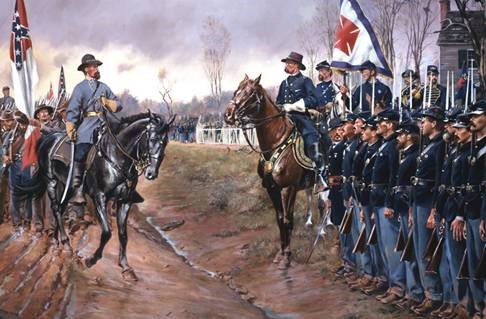
appomattox surrender

Lee met Grant at the house of Wilmer McLean, who had moved to Appomattox in 1861 after his home near Manassas had been used as a Confederate headquarters and was damaged by artillery fire. Lee was dressed in his finest uniform complete with sash, while Grant was dressed in a mud splattered uniform and overcoat only distinguished from his soldiers by the three stars on his should boards. Grant’s dress uniforms were far to the rear in the baggage trains and Grant was afraid that his slovenly appearance would insult Lee, but it did not. It was a friendly meeting, before getting down to business the two reminisced about the Mexican War.

Grant provided his vanquished foe very generous surrender terms:

“In accordance with the substance of my letter to you of the 8th inst., I propose to receive the surrender of the Army of N. Va. on the following terms, to wit: Rolls of all the officers and men to be made in duplicate. One copy to be given to an officer designated by me, the other to be retained by such officer or officers as you may designate. The officers to give their individual paroles not to take up arms against the Government of the United States until properly exchanged, and each company or regimental commander sign a like parole for the men of their commands. The arms, artillery and public property to be parked and stacked, and turned over to the officer appointed by me to receive them. This will not embrace the side-arms of the officers, nor their private horses or baggage. This done, each officer and man will be allowed to return to their homes, not to be disturbed by United States authority so long as they observe their paroles and the laws in force where they may reside.”

When Lee left the building Federal troops began cheering but Grant ordered them to stop. Grant felt a sense of melancholy and wrote “I felt…sad and depressed, at the downfall of a foe who had fought so long and valiantly, and had suffered so much for a cause, though that cause was, I believe, one of the worst for which a people has fought.” He later noted: “The Confederates were now our countrymen, and we did not want to exult over their downfall.”

In the hours before and after the signing of the surrender documents old friends and classmates, separated by four long years of war gathered on the porch or around the house. Grant and others were gracious to their now defeated friends and the bitterness of war began to melt away. Some Union officers offered money to help their Confederate friends get through the coming months. It was an emotional reunion, especially for the former West Point classmates gathered there:

“It had never been in their hearts to hate the classmates they were fighting. Their lives and affections for one another had been indelibly framed and inextricably intertwined in their academy days. No adversity, war, killing, or political estrangement could undo that. Now, meeting together when the guns were quiet, they yearned to know that they would never hear their thunder or be ordered to take up arms against one another again.”

Grant also sent 25,000 rations to the starving Confederate army waiting to surrender. The gesture meant much to the defeated Confederate soldiers who had had little to eat ever since the retreat began.

The surrender itself was accomplished with a recognition that soldiers who have given the full measure of devotion can know when confronting a defeated enemy. Major General Joshua Lawrence Chamberlain, the heroic victor of Little Round Top was directed by Grant to receive the final surrender of the defeated Confederate infantry on the morning of April 12th.

It was a rainy and gloomy morning as the beaten Confederates marched to the surrender grounds. As the initial units under the command of John Gordon passed him, Chamberlain was moved with emotion he ordered his soldiers to salute the defeated enemy for whose cause he had no sympathy, Chamberlain honored the defeated Rebel army by bringing his division to present arms.

John Gordon, who was “riding with heavy spirit and downcast face,” looked up, surveyed the scene, wheeled about on his horse, and “with profound salutation returned the gesture by lowering his saber to the toe of his boot. The Georgian then ordered each following brigade to carry arms as they passed third brigade, “honor answering honor.”

joshua_chamberlain_-_brady-handy

Joshua Lawrence Chamberlain

Chamberlain was not just a soldier, but before the war had been Professor of Natural and Revealed Religions at Bowdoin College, and a student of theology before the war. He could not help to see the significance of the occasion. He understood that some people would criticize him for saluting the surrendered enemy. However, Chamberlain, unlike others, understood the value of reconciliation. Chamberlain was a staunch abolitionist and Unionist who had nearly died on more than one occasion fighting the defeated Confederate Army, and he understood that no true peace could transpire unless the enemies became reconciled to one another.

He noted that his chief reason for doing so:

“The momentous meaning of this occasion impressed me deeply. I resolved to mark it by some token of recognition, which could be no other than a salute of arms. Well aware of the responsibility assumed, and of the criticisms that would follow, as the sequel proved, nothing of that kind could move me in the least. The act could be defended, if needful, by the suggestion that such a salute was not to the cause for which the flag of the Confederacy stood, but to its going down before the flag of the Union. My main reason, however, was one for which I sought no authority nor asked forgiveness. Before us in proud humiliation stood the embodiment of manhood: men whom neither toils and sufferings, nor the fact of death, nor disaster, nor hopelessness could bend from their resolve; standing before us now, thin, worn, and famished, but erect, and with eyes looking level into ours, waking memories that bound us together as no other bond;—was not such manhood to be welcomed back into a Union so tested and assured? Instructions had been given; and when the head of each division column comes opposite our group, our bugle sounds the signal and instantly our whole line from right to left, regiment by regiment in succession, gives the soldier’s salutation, from the “order arms” to the old “carry”—the marching salute. Gordon at the head of the column, riding with heavy spirit and downcast face, catches the sound of shifting arms, looks up, and, taking the meaning, wheels superbly, making with himself and his horse one uplifted figure, with profound salutation as he drops the point of his sword to the boot toe; then facing to his own command, gives word for his successive brigades to pass us with the same position of the manual,—honor answering honor. On our part not a sound of trumpet more, nor roll of drum; not a cheer, nor word nor whisper of vain-glorying, nor motion of man standing again at the order, but an awed stillness rather, and breath-holding, as if it were the passing of the dead!”

The next day Robert E Lee addressed his soldiers for the last time. Lee’s final order to his loyal troops was published the day after the surrender. It was a gracious letter of thanks to men that had served their beloved commander well in the course of the three years since he assumed command of them outside Richmond in 1862.

General Order
No. 9


After four years of arduous service marked by unsurpassed courage and fortitude, the Army of Northern Virginia has been compelled to yield to overwhelming numbers and resources.

I need not tell the survivors of so many hard fought battles, who have remained steadfast to the last, that I have consented to the result from no distrust of them.

But feeling that valour and devotion could accomplish nothing that could compensate for the loss that must have attended the continuance of the contest, I have determined to avoid the useless sacrifice of those whose past services have endeared them to their countrymen.

By the terms of the agreement, officers and men can return to their homes and remain until exchanged. You will take with you the satisfaction that proceeds from the consciousness of duty faithfully performed, and I earnestly pray that a merciful God will extend to you his blessing and protection.

With an unceasing admiration of your constancy and devotion to your Country, and a grateful remembrance of your kind and generous consideration for myself, I bid you an affectionate farewell. — R. E. Lee, General

The surrender was the beginning of the end. Other Confederate forces continued to resist for several weeks, but with the surrender of the Army of Northern Virginia led by the man that nearly all Southerners saw as the embodiment of their nation the war was effectively over.

Lee had fought hard and after the war was still under the charge of treason, but he understood the significance of defeat and the necessity of moving forward as one nation. In August 1865 Lee wrote to the trustees of Washington College of which he was now President:

“I think it is the duty of every citizen, in the present condition of the Country, to do all in his power to aid the restoration of peace and harmony… It is particularly incumbent upon those charged with the instruction of the young to set them an example of submission to authority.

eparker05-966-g

Brigadier General Ely Parker

It is a lesson that all of us in our terribly divided land need to learn regardless of or political affiliation or ideology. After he had signed the surrender document, Lee learned that Grant’s Aide-de-Camp Colonel Ely Parker, was a full-blooded Seneca Indian. He stared at Parker’s dark features and said: “It is good to have one real American here.”

Parker, a man whose people had known the brutality of the white man, a man who was not considered a citizen and would never gain the right to vote, replied, “Sir, we are all Americans.” That afternoon Parker would receive a commission as a Brevet Brigadier General of Volunteers, making him the first Native American to hold that rank in the United States Army. He would later be made a Brigadier General in the Regular Army.

I don’t know what Lee thought of that. His reaction is not recorded and he never wrote about it after the war, but it might have been in some way led to Lee’s letter to the trustees of Washington College. I think with our land so divided, ands that is time again that we learn the lessons so evidenced in the actions and words of Ely Parker, Ulysses Grant, Robert E. Lee and Joshua Chamberlain, for we are all Americans.

Sadly, I think that there is a portion of the American population who will not heed these words and will continue to agitate for policies and laws similar to those that led to the Civil War, and which those the could not reconcile defeat instituted again during the Post-Reconstruction and Jim Crow eras. For me such behavior and attitudes are incompressible, but they are all too real, and all too present in our divided nation.

But I still maintain hope that in spite of everything that divides us, in spite of the intolerance and hatred of some, that we can overcome. I think that the magnanimity of Grant in victory, the humility of Lee in defeat, the graciousness of Chamberlain in honoring the defeated foe, and the stark bluntness of Parker, the Native American, in reminding Lee, that “we are all Americans,” is something that is worth remembering, and yes, even emulating.

Peace

Padre Steve+

Leave a comment

Filed under civil rights, civil war, History, Political Commentary

Glory: The 54th Massachusetts

negro-regiment-54th-ma

Friends of Padre Steve’s World,

“Any negro taken in arms against the Confederacy will immediately be returned to a state of slavery. Any negro taken in Federal uniform will be summarily put to death. Any white officer taken in command of negro troops shall be deemed as inciting servile insurrection and shall likewise be put to death.” Proclamation of the Confederate Congress

A couple of days ago I took the time to watch again, the film Glory about the 54th Massachusetts Volunteer Infantry Regiment, one of the first African American Regiments raised for service in the Civil War. I have seen the movie a number of times, and it never fails to bring tears to my eyes. Of course I have written a number of articles about the 54th and other African American units in the Civil War, the later “Buffalo Soldiers” and African American military pioneers, but I cannot forget the 54th. These were men who volunteered and remained in service knowing that the Confederate Congress had condemned them to death should they ever be captured. They also endured the mocking of some White Union soldiers as well as pay inequity with whites, for doing the same dangerous job as infantrymen.

Over half of the regiment was including their commander, the twenty-six year-old Colonel Robert Gould Shaw were killed in an abortive assault on Battery Wagner outside of Charleston South Carolina on July 18th, 1863. Following the assault, “Sergeant William H Carney staggered back from the fort with wounds in his chest and right arm, but with the regiment’s Stars and Stripes securely in his grasp. “The old flag never touched the ground, boys,” Carney gasped as he collapsed at the first field hospital he could find.” He would be awarded the Medal of Honor for his actions.

Think that it was an insult the Confederates threw Colonel Shaw’s body in a mass grave with his African American soldiers. When Union commanders asked for the return of his body were told “We have buried him with his niggers,” Shaw’s father quelled a northern effort to recover his son’s body with these words: We hold that a soldier’s most appropriate burial-place is on the field where he has fallen.”

When Shaw first went to war he wrote to his mother words that should be in all of our hearts when we fight for the rights of others, especially those who are despised due to their race, color, religion, gender, or sexual orientation: “We fight for men and women whose poetry is not yet written but which will presently be as enviable and as renowned as any.” We also must remember that as we do so, that there will be those who oppose us, and who, if they ever had the chance who condemn us to death for doing so.

Peace

Padre Steve+

Leave a comment

Filed under civil rights, civil war, History

Fort Sumter Pt 1: The First Flash of Gunpowder and Shell

fort-sumter-higher-res

Friends of Padre Steve’s World,

Here is another part one of another two-part installment of my Civil War text. The story follows the implosion of the Democratic Party, the election of Abraham Lincoln, and the secession crisis. It describes who the attack came about and the reactions of people in all parts of the country, as well as the Army to those fateful shots. I hope that you enjoy.

Peace

Padre Steve+

The remaining forts under Federal control in the South were a thorn in the side and a constant reminder to Jefferson Davis of the power of the federal government. As such he attempted to negotiate to obtain the forts, and when that offer was rejected out of hand by both Buchanan and Lincoln he began military preparations to seize them if negotiations failed. His task was complicated in Charleston where the Federal commander, Major Robert Anderson unexpectedly withdrew his entire garrison from the mainland to Fort Sumter in Charleston harbor. The move was prompted by President Buchanan’s dithering on the status of the fort and garrison. Anderson was a Southerner who had decided to remain loyal to the Union, his second in command was Captain Abner Doubleday, a strongly committed abolitionist.

Under the cover of darkness the Union officers withdrew their men from old and weak Fort Moultrie in Charleston to Fort Sumter gaining him instant adulation in the North and condemnation in the South. Buchanan wanted to abandon the fort but “when it appeared that Northern public opinion was solidly behind Anderson, Buchanan changed his mind and attempted to persuade the South Carolinians to accept Anderson’s occupation of Fort Sumter as a legitimate exercise of federal authority.” [1] Jefferson Davis, who had not yet resigned from the Senate awaiting Mississippi’s declaration of secession complained that he “pleaded with Buchanan to give up Sumter and avert impending calamity. Once again the old imbecile refused, after his fashion, which is to say that he muttered to himself, nodded and tilted his head as if in agreement, begged leave to say a prayer, and then did nothing at all. Plainly the reins of state were in feeble hands. Had this lame-duck President withdrawn the troops from Sumter, he might have turned away the threatening of civil war.” [2]But Davis was blind to the political realities in the North that secession and seizure of other Federal installations had brought about. A prominent Northern Democrat wrote that “Anderson’s course of action is universally approved and that if he is recalled or if Sumter is surrendered… Northern sentiment will be unanimous in favor of hanging Buchanan….I am not joking – Never have I known the entire people more unanimous on any question. We are ruined if Anderson is disgraced or Sumter given up.” [3] Congressman Dan Sickles who had been such a friend of the South for so many years, even backing peaceful secession, spoke out against the Southern seizure of federal installations, said that the secessionists had committed “a fatal error” and said “it will never do, sir, for them to protest against coercion, and, at the same moment seize all the arms and arsenals and forts and navy yards, and ships that may, through our forbearance, fall within their power. This is not peaceful secession. These acts, whensoever or whomsoever done, are overt acts of war.” [4]

major anderson

Buchanan made a belated attempt to reinforce and resupply the fort and on January 9th 1861, an unarmed civilian ship, the Star of the West entered Charleston harbor. But the operation was bungled, secrecy was broken and the South Carolinians knew the ship was coming, even as Anderson did not get the message about the relief expedition and permission to fire if the Star of the West was fired upon. As a result when Confederate gunners opened fire on the steamer, Anderson, who had instructions to defend himself and not for an instance such as this, did nothing to intervene. “If he opened fire, the United States and South Carolina would be at war…. Major Anderson hesitated, plainly uncertain, an immense weight of responsibility resting on him….” [5] As a result the Star of the West retreated, leaving the garrison unreinforced. But the secessionists “had overplayed their hand. The South Carolina gunners who fired on the Star of the West had, in effect, invited the Federal government to start the war then and there if it wanted a war….” [6] The firing on the Star of the West further inflamed Northerners. Dan Sickles thundered in the House chambers “the authorities of South Carolina, through their military forces, opened fire upon that defenseless ship, and compelled her to retire and abandon the peaceful and legitimate mission in which she was engaged. Now, sir, that was an act of war, unqualified war.” [7]

The debate continued as Buchanan eased out of office and the new Confederate government of Jefferson Davis took ownership of the situation in Charleston. Buchanan did not want to do anything overt to tip the balance in undecided slave states toward secession and Davis did not want South Carolina to act alone and risk a premature attack on the fort. But as both sides waited the balance of power in Charleston shifted, “as local troops day by day strengthened the ring of batteries confronting Sumter’s garrison.” [8] In incoming Lincoln administration debated what to do with some of the incoming cabinet members counseling withdraw and others resistance to Confederate demands. Lincoln gave serious thought to abandoning the fort but could not bring himself to authorize the action. He understood that if he ordered evacuation, “the credibility of his presidency and the Republican administration would be in pieces before either had scarcely begun.” [9]

Instead the new President sought more information and sent three men “down to Charleston to observe the situation and report on what they saw. The first two, both southern-born, were Illinois law associates, both reported reconciliation impossible…. The third, a high-ranking naval observer who secured and interview with Anderson at the fort, returned to declare a relief expedition was feasible.” [10] He also continued to meet with his cabinet members to decide on the appropriate policy to meet the challenge to federal authority in Charleston. “He met with Francis Blair, who, like his son, Monty, believed passionately that the surrender of Sumter “was virtually a surrender of the Union unless under irresistible force – that compounding with treason was treason to the Govt.” [11] On March 29th Lincoln again met with his cabinet and having weighed all of the options, decided to resupply the fort. His decision was to “not send guns or bullets to Sumter, only food and medicine. He would resupply, but not rearm, it. And he would announce the plan in advance so the South could not regard the effort as an act of hostility by an enemy.” [12] If the attempt succeeded “federal authority in South Carolina had been preserved, and Charleston could do little short of war to change it; if it failed, the failure would be due to Charleston’s decision to open fire, and the onus of beginning a civil war would lie on their hands.” [13]

Even as the Confederate moved even more troops and guns into position around the Sumter, more and more people of influence were growing impatient with the delays in gaining Fort Sumter and feared that if something was not done that in some places there might be a call to return to the Union. Jefferson Davis was under great pressure to act, a newspaper in Mobile Alabama editorialized that “If something is not done pretty soon…the whole country will be so disgusted with the sham of independence that the first chance the people get at a popular election the y will turn the whole movement topsy-turvy.” [14] Likewise, “Southern ardor was chafing at the bit anyway, and failure to meet the challenge threatened to undermine the government and weaken Southern resolve.” [15]

P.G.T._Beauregard

General P.T.G. Beauregard C.S.A.

Knowing from Southern sympathizers still in Washington that a relief expedition was coming, General P.T.G. Beauregard “had already cut off Major Anderson’s purchases in the Charleston market the day before Governor Pickens received Lincoln’s message about the intention to provision Sumter.” [16] Pickens forwarded the message to Davis in Montgomery and Davis was forced to either back down on their threats or fire the first shot of the war, and even worse from a messaging standpoint, “that first shot would be for the immediate purpose of keeping food from hungry men.” [17]

Davis was extremely angry when he went into conference with his cabinet on April 9th upon getting the news of the relief expedition. The debate in the cabinet “ran long and heated. Davis favored proceeding with the bombardment. Charleston’s batteries were ready, and the South Carolinians were more than anxious,” [18] and the majority of the cabinet, with the exception of Robert Toombs concurred. He wrote:

“I summoned the Cabinet and told them that negotiation was now at an end, and that it was time to bombard the fort. Yes, I said, we would now be firing the first shot, but that was not our fault. It was Lincoln who intended war. He and that lying Seward had drawn the sword, and we were responding to them. We were defending our honor.

Toombs, my Secretary of State disagreed. “Sir,” he said to me, “firing at the fort is suicide. It’s unnecessary, it puts us in the wrong, it’s fatal.”

“Sir,” I said, “you are wrong.”

On April tenth, I ordered General Beauregard to demand the evacuation of Fort Sumter, and if refused, to reduce it with his guns.” [19]

Beauregard delivered the ultimatum to Anderson, who rejected it noting that “his sense of honor and obligations to his government prevented him his complying; but in conversation with Beauregard’s aides he remarked that in any event, the garrison would be starved out in a few days.” [20] But the fear of the Confederates that the relief force might actually arrive and succeed in its mission prompted them to open fire on the fort at 4:30 a.m. on the morning of the 12th. The relief force was scattered by a gale and could not resupply Anderson. The bombardment lasted thirty-three hours, and while Anderson’s troops resisted but could not man all of their guns and were short on ammunition and powder. With the fort heavily damaged by over 4,000 hits and interior of the fort on fire, a fire that was threatening the powder magazines, Anderson gave the order to surrender. Beauregard allowed the assembled U.S. Navy ships to evacuate the garrison and as a parting gesture the Confederate General allowed Anderson’s troops to fire a last salute to Old Glory. They hauled down the smoke stained and torn Star Spangled Banner and marched to the ship taking them off the island with their drums beating the tune “Yankee Doodle.” Lincoln realized the importance of what had happened all too well. He noted, “They attacked Sumter. It fell and thus did more service than it otherwise would.” [21]

Notes

[1] Ibid. Guelzo Fateful Lightening p.136

[2] Ibid. Oates The Approaching Fury p.367

[3] Ibid. McPherson The Battle Cry of Freedom pp.265-266

[4] Ibid. Keneally American Scoundrel p.211

[5] Ibid. Catton The Coming Fury pp.180-181

[6] Ibid. Catton The Coming Fury p.184

[7] Ibid. Keneally American Scoundrel pp.211-212

[8] Ibid. Potter The Impending Crisis p.544

[9] Ibid. Guelzo Fateful Lightening p.137

[10] Ibid. Foote The Civil War, A Narrative. Volume One p.46

[11] Ibid. Goodwin Team of Rivals p. 335

[12] Holzer, Harold Lincoln: How Abraham Lincoln Ended Slavery in America Newmarket Press for itbooks an imprint of Harper Collins, New York 2012 p.80

[13] Ibid. Guelzo Fateful Lightening p.137

[14] Ibid. McPherson The Battle Cry of Freedom p.272

[15] Ibid. Catton Two Roads to Sumter p.278

[16] Weigley, Russell F. A Great Civil War: A Military and Political History 1861-1865 Indiana University Press, Bloomington and Indianapolis 2000 pp.20-21

[17] Ibid. Foote The Civil War, A Narrative. Volume One p.47

[18] Ibid. Davis Jefferson Davis p.323

[19] Ibid. Oates The Approaching Fury pp.416-417

[20] Ibid. Weigley A Great Civil War p.21

[21] Ibid. Goldfield America Aflame p.202

1 Comment

Filed under civil war, History, Military, Political Commentary

War and Redemption: Dan Sickles Pt.5

sickles as brigadier

Friends of Padre Steve’s World

I am a historian as well as a chaplain and priest. I do a lot of work with the Battle of Gettysburg and much of my work involves biography as I believe that the one constant in history is people. Technology and many other things may change, but people and human nature are constant, for good and for bad, and frankly I find people fascinating.

One of the most fascinating people of the Battle of Gettysburg is Union Major General Daniel E. Sickles, a man who was one of the most fascinating, salacious, scandalous, and incredible figures ever to grace and disgrace American history.

This is the fifth of a multi-part series taken from my Gettysburg and Civil War text. I hope that you enjoy.

Peace,

Padre Steve+

Dan Sickles completed his term in Congress making few speeches and maintaining a relatively low profile, frequently entering and leaving through side entrances. But as tensions rose and secession fever built, Sickles, the longstanding supporter of Southern states rights, who had declined to run for reelection “briefly transformed himself from outcast to firebrand” [1] when secessionist troops opened fire on the transport Star of the West when that ship attempted to deliver supplies to Fort Sumter. Surprising his Southern colleagues he declared the attack on the ship as “naked, unmitigated war,” and declared:

It will never do, sir, for them [the South] to protest against coercion and, at the same moment, seize all the arms and arsenals and forts and navy-yards and ships… when sovereign states by their own deliberate acts, make war, they must not cry peace… When the flag of the Union is insulted, when the fortified place provided for the common defense are assaulted and seized, when the South abandons its Northern friends for English and French alliances, then the loyal and patriotic population of that imperial city [New York] are unanimous for the Union.” [2]

He declared the assault to an act of war, and predicted that “the men of New York would go in untold thousands anywhere to protect the flag of its country and to maintain its legitimate authority.” [3] Sickles’ speech was electrifying and heartened back to his early career and what might have been, and during the remaining days of his term he continued to speak out in the House against the actions of the South and sponsored legislation to bills to suspend postal service with the South and recover the funds in the United States Mint buildings which had been seized by seceding states. He thundered in the presence of Southern friends still serving in the House, “Surely the chivalrous men of the South would scorn to receive the benefit of our postal laws,… “They cannot intend to remain, like Mahomid’s coffin, between heaven and earth, neither in nor out of the Union, getting all the benefits, and subjecting us to all its burdens.” [4]

Shortly thereafter Dan Sickles left Washington to what many thought would be political and possibly personal oblivion, but they underestimated Sickles. Ambition and the desire for redemption still burned in his heart, and shortly after President Lincoln called for 75,000 volunteers to put down the rebellion, Sickles volunteered to help raise and lead the men of the Empire State into battle to restore the Union. As the future commander of a one of the regiments, the French born journalist, Regis De Trobriand, noted “during the lead-up to Sumter, Dan had been among the conciliatory and moderate, “but when the sword was drawn, he was one of the first to throw away the scabbard.” [5]

sickles-brigade

Taking up the challenge to raise a regiment sickles went to work, and “almost overnight, using flag-waving oratory, organizational skills, and promissory notes, he had his regiment, the 70th New York volunteers well in hand.” [6] Soon his authority was expanded to recruit a brigade, which rapidly filled with volunteers, soon over 3,000 men were under his command, and the new brigade, consisting of the 70th, 71st, 72nd, 73rd and 74th New York Volunteers which Sickles promptly christened the Excelsior Brigade, taking on the Empire State’s motto. However many of the brigade’s volunteers were scorned because of Sickles’ reputation, the brigade’s historian wrote, “no name was too bad for you; one would call you this and another would call you that, and even a person’s own relatives would censure him for joining such a Brigade as that of Daniel E. Sickles.” [7]

Even so, Sickles rapidly captured the hearts of his men. Volunteers were found throughout New York, as well as New Jersey, Ohio, and Pennsylvania, and the men represented the spectrum of White America; men of traditional Anglo-Saxon origin mingled with Irish, Germans, and Dutch. But he was so successful in recruiting that organizers of other regiments, especially in rural New York counties demanded that the Republican governor, Edward Morgan, order Sickles to disband most of the brigade. Believing the action politically motivated, Sickles refused and went directly to Lincoln to get the brigade Federal recognition. At first Lincoln balked at the request, he needed troops but was yet unwilling to get in the way of what he saw as the individual state control of their militias. The result was an impasse as Federal and New York officials argued about the brigade and the status of Sickles himself.

Sickles organizational and leadership skills were tested by the situation, and he went to extraordinary lengths to meet the needs of his soldiers for housing, food and sanitation, “and financed its camp for some time out of his own purse…. At one point he rented a circus tent from P.T. Barnum to house several hundred of his recruits. At another, with several companies or more quartered in a bare hall on lower Broadway, he contracted a cheap bath-house to give fourteen hundred men a shave and shower at ten cents apiece.” [8] To meet the need for cooked meals Sickles’ old friend Captain Wiley “commandeered cooks for the brigade from Delmonico’s, working in inadequate kitchens in side streets, they tried to turn out enough food for the men.” [9] Eventually the brigade was given a campsite on “Staten Island, near Fort Wadsworth, where he and his men could wait until the issue of mustering-in was settled.” [10]

Finally in July of 1861 the Excelsiors were officially mustered in to service as New York Volunteer troops and Sickles commissioned as a Colonel, functioning as the commander of the 70th New York and the de-facto commander of the brigade. Lincoln nominated Sickles for a commission as a Brigadier General of Volunteers but due to pressure from New York officials, still steaming at Sickles for going to Lincoln, and the Senate delated confirmation for months, forcing Lincoln to re-nominate him a second time after which they confirmed him in May 1862, in some measure due to the influence of Sickles former defense attorney, Edwin Stanton who had succeeded Simon Cameron as Secretary of War.

Sickles and his brigade first saw combat at Fair Oaks during the Seven Day’s battle. Sickles acquitted himself well during the fighting, he seemed to be a natural leader of men, who cheered him as he led them into battle. The actions of the Excelsiors and their newly minted Brigadier were praised by the Army commander, George McClellan in a letter to Stanton, “The dashing charge of the Second and Fourth Regiments,…”the cool and steady advance of the Third, occurred under my immediate observation and could not have been surpassed.” [11] A news correspondent attached to the army wrote:

“Gen. Sickles had several narrow escapes; he was always to be found in the thickest of the fight. Had those gifted Senators who refused to confirm his nomination, but witnessed the enthusiasm of his troops when serving under him, and his military qualifications for office, they would do penance until re-elected.” [12]

The success at Fair Oaks was not followed up by McClellan, despite the urging of many officers, including Sickles and Richmond, which many believed could have been taken, remained in Confederate hands. Sickles performance during the Peninsular Campaign won Dan the respect and affection of his soldiers, as well as the respect of his division commander Fighting Joe Hooker. Unlike many other leaders who in their first taste of combat on the Peninsula saw the terrible carnage of battle, the immense numbers of casualties, and the suffering of the troops, Sickles maintained his composure, as others collapsed, “neither the casualties nor the state of the earth daunted Sickles.” [13] Hundreds of his Excelsiors, including his own aid-de-camp were killed or wounded during the campaign, and “the Excelsior Brigade, through steadily reduced by deaths, wounds and illness, had been forged into a body of hard-bitten, battle-wise soldiers educated in the necessities of war and in the tricks of self-preservation.” [14] A member of the brigade wrote, “It is no fable about the men of this Brigade thinking a great deal of the General.” [15]

Following the army’s withdraw from the Peninsula and its return to encampments near Washington D.C. Sickles went back to New York to raise new troops to replace those killed or wounded during the campaign. He also took time to organize efforts to care of the children of the brigade’s soldiers, living and dead who were being taken care of at the Union Home School. Due to this he missed the battles of Second Bull Run and Antietam. His recruiting efforts were successful, even former political enemies were impressed by his service, and his ability to raise and organize troops. His reputation had been so completely rehabilitated by his war service that some of his “old backers in Tammany wanted him to run again for Congress,” [16] but he was opposed by others, like his old friend Sam Butterworth, who had become a “Copperhead,” an anti-war, faction that wanted to end the war and let the South go on its way; “to them, Dan had become a Lincoln man, a crypto-Republican.” [17] the relief of many of his troops he declined the offer to run again. As one of his Chaplains, Joseph Twitchell noted Sickles, “is getting fixed in his new place most successfully and will probably serve himself, as well as the country, better here than in a war of words.” [18]

Sickles-Excelsior-Brigade-Headquarters-City-Hall-Park.-Yorktown

During his recruiting efforts Sickles, now a military, as well as political realist, made many speeches, in which he recognized that conscription was inevitable. Having seen the brutal cost of war and the suffering of his men, Sickles complained of the lack of effort being provided in New York to the war effort. In a speech at the Produce Exchange, he praised the leadership and nerve of President Lincoln, and said, “A man may pass through New York, and unless he is told of it, he would not know that this country is a war…. In God’s name, let the state of New York have it to say hereafter that she furnished her quota for the army without conscription – without resorting to a draft!” [19]

When he returned to the army in November of 1862 his old division commander, Hooker had been promoted to corps command following the relief of George McClellan, and as the senior brigadier was promoted to command of the division. His, division, the Second Division of Third Corps was used in a support role at Fredericksburg and saw little action in that fight and only suffered about 100 casualties. His old friend and defense counsel Thomas Meagher, now commanding the Irish Brigade saw his brigade shattered in the carnage of at Fredericksburg. After Ambrose Burnside who had commanded the army during that fiasco was relieved of command Hooker was appointed by Lincoln as commander of the Army of the Potomac.

One of Hooker’s organizational changes was to establish a Cavalry Corps which was to be commanded by Major General George Stoneman, the commander of Third Corps. This left “Sickles as the corps’ ranking officer.” [20] Sickles was promoted to command the Third Corps by Hooker, who chose Sickles over another volunteer officer, David Birney. Had a professional officer rather than Birney been his competition, “Sickles would have remained division commander.” [21] Sickles was given the corps “on a provisional basis, for his appointment as a major general had not yet been confirmed by the Senate and corps command was definitely a two-star job.” [22] Once again it was political enemies in the Senate, this time Republicans who did not trust the Democrat, who delayed Sickles’ promotion to Major General, but he was finally confirmed on March 9th 1863, with his promotion backdated to November 29th of 1862. “Professionals in the army attributed his rise to his “skill as a political maneuverer.” Few men, however, questioned his personal bravery.” [23]

To be continued…

Notes

[1] Ibid. Hessler Sickles at Gettysburg p.21

[2] Ibid. Hessler Sickles at Gettysburg p.111

[3] Ibid. Keneally American Scoundrel p. 212

[4] Ibid. Keneally American Scoundrel p.214

[5] Ibid. Keneally American Scoundrel p.219

[6] Ibid. Sears Controversies and Commanders p.201

[7] Ibid. Hessler Sickles at Gettysburg p.23

[8] Ibid. Catton Glory Road p. 153

[9] Ibid. Keneally American Scoundrel p.222

[10] Ibid. Keneally American Scoundrel p.222

[11] Ibid. Hessler Sickles at Gettysburg pp.30-31

[12] Ibid. Swanberg Sickles the Incredible p.149

[13] Ibid. Keneally American Scoundrel p.245

[14] Ibid. Swanberg Sickles the Incredible p.153

[15] Ibid. Wert The Sword of Lincoln p.222

[16] Ibid. Hessler Sickles at Gettysburg p.32

[17] Ibid. Keneally American Scoundrel p.245

[18] Ibid. Hessler Sickles at Gettysburg p.32

[19] Ibid. Keneally American Scoundrel p.252

[20] Ibid. Wert The Sword of Lincoln p.223

[21] Ibid. Sears Controversies and Commanders p.206

[22] Ibid. Swanberg Sickles the Incredible p.168

[23] Ibid. Wert The Sword of Lincoln p.223

2 Comments

Filed under civil war, History, leadership, Military

Incredible Scoundrel: Dan Sickles Pt.1

6517740_orig

Friends of Padre Steve’s World

I am a historian as well as a chaplain and priest. I do a lot of work with the Battle of Gettysburg and much of my work involves biography as I believe that the one constant in history is people. Technology and many other things may change, but people and human nature are constant, for good and for bad, and frankly I find people fascinating. In fact from the point of view of history and biography, sinners are much more interesting to write about than saints, but I digress…

One of the most fascinating people of the Battle of Gettysburg is Union Major General Daniel E. Sickles, a man who was one of the most fascinating, salacious, scandalous, and incredible figures ever to grace and disgrace American history. 

This is the first of a three part series taken from my Gettysburg and Civil War text. I hope that you enjoy.

Peace,

Padre Steve+

George Meade had made his dispositions on July 2nd 1863 with care, but there was one notable problem, the commander of III Corps, Major General Dan Sickles did not like the position assigned to his corps on the south end of Cemetery Ridge. But before discussing that it is worth chasing the rabbit so to speak and spend some time on the life of a man referred to by one by one biographer as an American Scoundrel and another as Sickles the Incredible. The interesting thing is that lie most complex characters in history that Dan Sickles was both and, “he might have had more faults than virtues, but everything about him was perfectly genuine.” [1] That is one of the reason that he is so fascinating.

Sickles was certainly a scoundrel and at the same time incredible, charming yet terribly vain and often insincere. “He was quick-witted, willful, brash, and ambitious, with pliable moral principles.” [2] But he was also incredibly brilliant, far sighted, patriotic, and civic minded. He was a political general, “flamboyant, impulsive, and brave, some would wonder about his discipline and military judgement.” [3] His notoriety and unpopularity among the West Point trained professional officers in the Army of the Potomac, as well as his tactical decision to move his corps on the afternoon of July 2nd 1863, and his subsequent political machinations ensured that he would be the only corps commander of that army not commemorated with a monument at Gettysburg.

Dan Sickles was one of the most colorful, controversial, and perhaps the most scandalous officer ever to command a corps in the history of the United States Army. While he lacked professional training he had done a fair amount of study of the military arts in his spare time, and he “made up for his lack of military training by acting on the battlefield with reckless courage, and was much admired for it by his men.” [4]

After having served as a brigade and division commander Sickles was promoted to corps command. “Sickles owed his elevation to corps command to the patronage of his friend Joseph Hooker…. And while man of the West Point officer….regarded Sickles military acumen with the greatest skepticism, many in the volunteer ranks were of a different mind. “Sickles is a great favorite in this corps,” asserted Private John Haley of the 17th Maine. “The men worship him. He is every inch a soldier and looking like a game cock. No one questions his bravery or patriotism.” [5] General Alpheus Williams who commanded a division in the Union Twelfth Corps despised Sickles, and after Chancellorsville Williams wrote “A Sickles’ would beat Napoleon in winning glory not earned,,, He is a hero without a heroic deed! Literally made by scribblers.” [6] Likewise, Sickles, the political general was no favorite of George Gordon Meade.

On July 2nd 1863 Sickles would be responsible for an act that threw George Meade’s defensive plan into chaos, and according to most historians and analysts nearly lost the battle, however, there are some who defend his actions and give him credit for upsetting Lee’s plan of attack. However, the truth lays somewhat in the middle as both observations are correct. Sickles’ decision created a massive controversy in the months following the battle as public hearings in Congress, where Sickles, a former congressman from New York had many friends, as well as enemies, sought a political advantage from a near military disaster.

Sickles was a mercurial, vain and scandal plagued man who “wore notoriety like a cloak” and “whether he was drinking, fighting, wenching or plotting, he was always operating with the throttle wide open.” [7] Sickles was born in New York to George and Susan Marsh Sickles in late 1819, though a number of sources, including Sickles himself cite dates ranging from 1819 through 1825. “There is little reliable information about Sickles’ early days,” [8] and he did not talk much about them, especially after the war, when Gettysburg and the Civil War became his main subjects of conversation. His father, a sixth generation American whose family were early Dutch settlers in Manhattan became wealthy through real estate speculation, “and he passed on to his son a pride in being a congenital Knickerbocker,” charming, witty, and clever, in whom “hardheadedness and impulsiveness were combined.” [9]

The young Sickles was an impetuous child and his father’s wealth ensured that Dan Sickles had “the finest of tutors…. And an unceasing bankroll of funding for lascivious escapades.” [10] To get their son special tutoring to prepare him for college, his parents “arranged for him to live in the scholarly house of the Da Pont family…. It was a household like few others in that hardheaded, mercantile city, at a time when New York had little of the Italian character it would later take on.” [11] The home was a place of learning, culture, and unusual relationships. The head of the house was Lorenzo L. Da Pont, a Professor at Columbia, as well as a practicing attorney. Also living in the home was Da Pont’s father, the ninety-year-old Professor Lorenzo Da Pont, who “had been the librettist for three of Mozart’s operas” [12] and “held the chair of Italian and Columbia University” [13] Additionally, the elder Da Pont’s “adopted daughter Maria and her husband, Antonio Bagioli, a successful composer and music teacher” [14] lived under the same roof.

Maria was only about twenty-years-old when Sickles moved in. By this time she and Bagioli already had a child of their own, a three year old daughter named Teresa, which Sickles would eventually marry. While the elder Da Pont claimed Maria as an adopted daughter, it was “widely believed that she was his “natural child” … from an American liaison conducted when he was near the age of seventy.” [15] This spawned rumors, even at the time of Gettysburg that the young Sickles “and his future mother-in-law had a sexual affair.” [16]

Whether the liaison with Maria Bagioli occurred is a matter of innuendo and conjecture, but it would not be out of character for Sickles, who, to put it mildly, had a wild proclivity for the opposite sex. As a young man he frequented brothels, and as his social and political status increased, he moved from the brothels frequented by the middle class to those which catered to the more socially well to do. One of his affairs was with the a prostitute named Fanny White, a woman who was smart, pretty, and upwardly mobile who ran her own bordello. His affair with Fanny was well publicized, but did not prevent him from being elected to the state legislature in 1847. She and Sickles would continue their relationship for years with her asking nothing more than expensive gifts, and there are inklings that Fanny help to fund Sickles’ early political campaigns. There is also speculation that in 1854 following his marriage, that Fanny spent time with him in London while he was working with James Buchanan and that that he “may have brought Fanny to one of the Queens’s receptions and introducing the prostitute to Her Majesty.” [17] But Fanny eventually moved on to a man older and richer than Sickles. Eventually she retired from her business and married another New York lawyer but died of complications of tuberculosis and possibly syphilis in 1860. Her property at the time of her death was conservatively “estimated at $50,000 to $100,000” [18] a considerable fortune for a woman of her day and age.

While he lived with the Da Pont family, Sickles gained an appreciation for foreign languages, as well as theater and opera. The elder Professor Da Pont was a major part of his academic life and quite possibly in the development of Sickles liberal education and his rather libertine morality. Lorenzo had been a Catholic Priest and theologian in Italy, but like his young American admirer had quite the attraction for women, and was a connoisseur of erotic literature and poetry. His activities resulted in him being expelled from his teaching position in the seminary, after which he became fast friends with a man whose name is synonymous with smooth talking, suave, amorous men, Giacomo Casanova, and in Europe “his affairs with women had been almost as notorious as those of his good friend.” [19] Certainly the elder Lorenzo’s tales “of Casanova, the fabled prince of Priapus, did nothing to quell Dan’s adolescent sexual appetite.” [20]

Noted Civil War and Gettysburg historian Allen Guelzo describes the Sickles in even less flattering terms, “Sickles was from the beginning, a spoiled brat, and he matured from there into a suave, charming, pathological liar, not unlike certain characters in Mozart operas.” [21]

Following the deaths of both the elder and younger Professor Da Pont, Sickles was stricken with grief. At the funeral of the younger Professor Da Pont Sickles “raved and tore up and down the graveyard shrieking,” [22] forcing other mourners to take him away by force. Soon after, Sickles left New York University and began to work in the law office of the very formidable New York lawyer and former U.S. Attorney General, Benjamin F. Butler.

While he was studying for the bar under Butler, he was joined by his father who would also become an attorney. It was under the influence of his father, who was now a wealthy Wall Street investor, and the Democrats of Tammany Hall that the incredibly talented Sickles was groomed for political leadership. Tammany was a rough and tumble world of hardnosed politics, backroom deals, corruption and graft.

He passed the bar in 1843 and soon was making a name for himself in the legal world, and in politics, despite his well-known questionable ethics and morality. His political career began in 1844 when “he wrote a campaign paper for James Polk and became involved in the Tammany Hall political machine.” [23] The ever ambitious Sickles “clambered up the city’s Democratic party ladder, on the way collecting allies and enemies with utter disregard for the consequences, attending the typically unruly Tammany meetings armed with bowie knife and pistol.” [24]

Like many of his fellow New York Democrats he was a proponent of “Manifest Destiny, and the right of the United States to acquire and hold Texas, New Mexico, California, perhaps the isthmus of Central American, and certainly Cuba.” [25] He was also a political ally of many states rights Southern Democrats and “largely opposed anti-slavery legislation.” [26] This was in large part due to the commercial interests of New York, which between banking and commercial shipping interests profited from the South’s slave economy.

He was elected to the New York State legislature in 1847 and his political star continued to rise even as his personal reputation sank among many of his peers. An attorney who knew him described Sickles as “one of the bigger bubbles in the scum of the profession, swollen, and windy, and puffed out with fetid gas.” [27] Sickles rivals any American politician, before or since in his ability to rise even as the slime ran down his body, the term “Teflon” applied to politicians like Presidents Ronald Reagan and Bill Clinton comes to mind when one studies Sickles’ career. New York lawyer and diarist George Templeton Strong wrote, “One might as well try to spoil a rotten egg as to damage Dan’s career.” [28]

But there was no denying that Sickles was a brilliant lawyer, politician, and debater. One observed that Sickles was “a lawyer by intuition – careful in reaching his conclusions, but quick and bold in pushing them.” [29] New York Governor “William Marcy grudgingly said that as a debater Sickles excelled any man of his years, and the astute Henry Raymond declared that as a parliamentary leader he was unsurpassed.” [30] Soon Sickles was a delegate to the 1848 Democratic Convention where he helped nominate Franklin Pierce for his unsuccessful run at the democratic nomination. The convention enabled Sickles to enter the world of national politics making friends with many influential politicians and financiers, including Pierce, the Van Burens, and James Buchanan. On his return to New York he received an appointed as a Major in the New York Militia.

Even as Sickles rose in the tumultuous world of American law and politics, and chased Fanny White he became enamored with the now teenage daughter of Antonio and Maria Bagioli, Miss Teresa Bagioli who though only fifteen was beautiful, wise beyond her years, fluent in French and Italian, devoted to the arts, and entirely besotted by Dan Sickles. Both the parents of Sickles and Teresa opposed the relationship, but both were madly in love, and Teresa was as headstrong as Dan regarding the relationship. Though such a relationship would be considered completely scandalous today, such marriages were not uncommon then, though they were certainly less common in the upper society of New York. Sickles “was enchanted by her” and “courted her with the sensibility of being a friend of her parents and he must have suspected that he loved her with a fated and exclusive love.” [31] When she was just sixteen Teresa quit school and married the thirty-three year-old assemblyman in a civil ceremony officiated by New York Mayor Ambrose Kingsland on September 27th 1852. Six months later, the two were married in the Catholic Church by Archbishop John Hughes, in a “gala and largely attended affair.” [32] Just three months after the church wedding their daughter, Laura, was born. Though there can be no doubt that Sickles loved Teresa, and she him, it did not stop him from other extramarital affairs, nor did it take much away from his political machinations at Tammany Hall.

Following the 1852 Democratic convention where he again supported Franklin Pierce, Sickles hard fighting and influence at in the Wigwam of was rewarded with political plum prize of being appointed “corporation counsel of New York City, a post that paid a flattering salary with extra emoluments and also left room for profitable legal work on the side.” [33] His political and social acumen were again demonstrated as he convinced the state legislature, through personal force of will, to enable the New York City Corporation “to go ahead with creating a great central park,” [34] a park that we now know today as Central Park. He also helped push forward a proposal to create New York’s first mass transportation system, that of horse drawn omnibuses.

Later in the year Sickles was appointed as secretary of the American legation to the Court of St. James n London, headed by former Secretary of State James Buchanan. The position paid a pittance of what Sickles was earning in New York, but he realized that the serving overseas in such a position could not but help him on the national political stage. Though Buchanan and Pierce wanted Sickles, the new Secretary of State, the former New York Governor William Marcy refused to sign Sickles’ commission for the post. Eventually, Pierce prevailed and Sickles got the job.

As their baby, Laura, was still very young and sea travel still quite hazardous, Teresa remained at home, and joined her husband in London the following year. However, when she arrived in London, the teenage wife of Dan Sickles charmed Americans and Britons alike. Aided by her multilingual gifts, which “were rare among American diplomats’ wives,” [35] she became a great success and the unmarried Buchanan appointed her as hostess for the legation. She rapidly became a celebrity due to her stunning beauty and charm, and like he had Fanny, Sickles had Teresa introduced to the Queen. Her celebrity status evoked different responses from those that observed her. “One contemporary described Teresa as an Italian beauty, warm, openhearted, and unselfish. Another described her as being “… without shame or brain and [having] a lust for men.” [36] That “lust for men” coupled with the neglect of her husband may well have been the catalyst for the scandal which overwhelmed them in Dan’s congressional career.

It was during his service in London with Buchanan that Sickles became embroiled in one of the most embarrassing diplomatic incidents in American history. The proponents of Manifest Destiny and American expansion had long desired to take Cuba from Spain through diplomacy, or if needed force. Following a failed attempt by American “Filibusters” to seize the island in 1852 which ended in the execution of fifty Americans, including the son of U.S. Attorney General John Crittenden by Spanish authorities, and in 1854 President Franklin Pierce authorized Buchanan to attempt to negotiate the acquisition of Cuba.

Pierce authorized Buchanan to meet with James Mason, the United States Ambassador to France and Pierre Soule, the United States Ambassador to Spain secretly in order to draft “a statement on the future of Cuba and the proposed role of the United States.” [37] Soule dominated the meeting and the statement, which was in large part drafted by Dan Sickles, was highly inflammatory. Despite this the statement was released to the press in defiance of the order to maintain the strictest secrecy and it resulted in a diplomatic disaster for the Pierce Administration.

The document was prepared by Soule and Sickles and endorsed by Buchanan and Mason was known as the Ostend Manifesto, and it “was one of the most truly American, and at the same time most undiplomatic, documents every devised.” [38] The manifesto prepared by Soule and Sickles proclaimed that “Cuba is as necessary to the North American Republic as any of its present members, and that it belongs naturally to the great family of states of which the Union is the Providential Nursery.” [39] The authors of the manifesto also threatened Spain should the Spanish fail to accede to American demands. The authors declared that if the United States “decided its sovereignty depended on acquiring Cuba, and if Spain would not pass on sovereignty in the island to the United States by peaceful means, including sale, then, “by every law, human and Divine, we shall be justified in wresting it from Spain.” [40]

The Ostend Manifesto “sent shivers through the chancelleries of Europe, provoked hurried conversations between the heads of the French and British admiralties.” [41] European diplomats and leaders reacted harshly to the statement and Secretary of State William Marcy who had previously supported the ideas in the document immediately distance himself and official American policy from it and the authors. Marcy then “forced Soule’s resignation by repudiating the whole thing, but the damage was done.” For months the Pierce administration was on the defensive, and was condemned “as the advocate of a policy of “shame and dishonor,” the supporter of a “buccaneering document,” a “highwayman’s plea.” American diplomacy, said the London Times, was given to “the habitual pursuit of dishonorable object by clandestine means.” [42] The incident ended official and unofficial attempts by Americans to obtain Cuba by legal or extralegal means until the Spanish American War in 1898.

Too be continued…

Notes

[1] Catton, Bruce The Army of the Potomac: Glory Road Doubleday and Company, Garden City New York, 1952 p.151

[2] Wert, Jeffry D. The Sword of Lincoln: The Army of the Potomac Simon and Schuster, New York and London 2005 p.222

[3] Ibid. Coddington The Gettysburg Campaign a Study in Command p.45

[4] Sears, Stephen W. Chancellorsville Houghton Mifflin Co. Boston and New York 1996 p.65

[5] Ibid. Trudeau Gettysburg a Testing of Courage p.110

[6] Ibid. Sears Gettysburg p.35

[7] Ibid. Catton The Army of the Potomac: Glory Road pp.150-151

[8] Hessler, James A. Sickles at Gettysburg Savas Beatie New York and El Dorado Hills CA, 2009, 2010 p.1

[9] Keneally, Thomas American Scoundrel: The Life of the Notorious Civil War General Dan Sickles Anchor Books, a Division of Random House, New York 2003 p.7

[10] Ibid. Guelzo, Gettysburg The Last Invasion p.243

[11] Ibid. Keneally American Scoundrel p.3

[12] Ibid. Hessler Sickles at Gettysburg p.2

[13] Ibid. Keneally American Scoundrel p.3

[14] Ibid. Hessler Sickles at Gettysburg p.3

[15] Ibid. Keneally American Scoundrel p.4

[16] Ibid. Hessler Sickles at Gettysburg p.3

[17] Ibid. Hessler Sickles at Gettysburg p.6

[18] Ibid. Keneally American Scoundrel p.215

[19] Swanberg, W.A. Sickles the Incredible copyright by the author 1958 and 1984 Stan Clark Military Books, Gettysburg PA 1991 p.79

[20] Ibid. Swanberg Sickles the Incredible p.80

[21] Ibid. Guelzo, Gettysburg The Last Invasion p.243

[22] Ibid. Swanberg Sickles the Incredible p.81

[23] Ibid. Hessler Sickles at Gettysburg p.4

[24] Sears, Stephen W. Controversies and Commanders Mariner Books, Houghton-Mifflin Company, Boston and New York 1999 p.198

[25] Ibid. Keneally American Scoundrel p.12

[26] Ibid. Swanberg Sickles the Incredible p.82

[27] Ibid. Wert The Sword of Lincoln p.222

[28] Ibid. Hessler Sickles at Gettysburg p.4

[29] Ibid. Swanberg Sickles the Incredible p.84

[30] Ibid. Swanberg Sickles the Incredible p.84

[31] Ibid. Keneally American Scoundrel p.21

[32] Wilson Robert and Clair, Carl They Also Served: Wives of Civil War Generals Xlibris Corporation 2006 p.98

[33] Ibid. Swanberg Sickles the Incredible p.88

[34] Ibid. Keneally American Scoundrel p.21

[35] Ibid. Keneally American Scoundrel p.39

[36] Ibid. Wilson and Clair They Also Served p.98

[37] Ibid. Keneally American Scoundrel p.44

[38] Pinchon, Edgcumb Dan Sickles: Hero of Gettysburg and “Yankee King of Spain” Doubleday, Doran and Company Inc. Garden City NY 1945 p.48

[39] Ibid. Potter The Impending Crisis p.190

[40] Ibid. Keneally American Scoundrel p.45

[41] Ibid. Pinchon Dan Sickles p.48

[42] Potter, David M. The Impending Crisis: America before the Civil War 1848-1861 completed and edited by Don E. Fehrenbacher Harper Collins Publishers, New York 1976 p.193

2 Comments

Filed under civil war, ethics, History

Pursuing the Truth: New Year 2016

IMG_1915.JPG

Friends of Padre Steve’s World

Marcus Aurelius wrote, “If someone is able to show me that what I think or do is not right, I will happily change, for I seek the truth, by which no one was ever truly harmed. It is the person who continues in his self-deception and ignorance who is harmed.”

Before I say anything else I just want to thank you for taking the time out of your schedule to read, comment and even share what I write. That matters to me and a good number of you have followed my writings for years. So I truly thank you from the bottom of my heart, and if you like what you see please comment and share with others.

As I get older I realize how valuable time is. There are few commodities that truly cannot be replaced or conserved, time is one that is always fleeting. As Dr. Suess said:

“How did it get so late so soon? It’s night before it’s afternoon. December is here before it’s June. My goodness how the time has flewn. How did it get so late so soon?”

That being said I am not a fan of New Year’s resolutions, in fact I generally don’t make any because frankly I think that most are a waste of time. However, I do not think that the pursuit of truth is a waste, and as Benjamin Disraeli noted so wisely; “Time is precious, but truth is more precious than time.”

To that end, as I did last year I am going to endeavor this year to commit myself to continue to seek truth and to speak truth, wherever that takes me. Truth matters to me. In my life I have seen so many lies, especially by political and religious leaders that I trusted that I now devote myself to the pursuit of truth. As Captain Jean Luc Picard told the young Cadet Wesley Crusher in Star Trek the Next Generation episode The First Duty: “the first duty of every Starfleet officer is to the truth, whether it’s scientific truth, historical truth or personnel truth…” 

So, I will continue to write, especially about historical subjects that have an impact today: civil rights and social justice, faith, military issues, PTSD and military health issues, the Middle East conflicts and a number of other topics. Of course I will write about baseball, which is often my refuge when things are too much for me and music. I may do more regarding music as I was asked to do an article for a journal about liturgical music, stress and resiliency.

I will continue to be as transparent as I can about my own struggles with PTSD and faith in the hopes that my journey will help others who struggle like me. In fact this was a major reason that I started this site back in February of 2009.

Expect more writing about the Battle of Gettysburg and the Civil War. I have a feeling that that is going to become a life work, even after I retire from the Navy. The American Civil War is so pertinent to who and what we are as a nation and the more I study it, the people, the issues and the ideologies involved I see many parallels with today; some of which are positively frightening. So expect a lot more about these subjects. In fact the Civil War is one in which debunked myths still hold sway over many, especially among the defenders of the Lost Cause who predominate the Christian Right.

In addition to that I expect to be going back to some of my older research and writing about the social, religious, political, and ideological dynamics of Weimar and Nazi Germany and how similar that are to some things going on now in our own country.

While lies are dangerous the myths can be more so, and the proliferation of lies, half-truths and myth have shriveled the brain cells of those who enjoy the comfort of opinion without the benefit of thought. President John F. Kennedy spoke of this in 1962, and his words are timely, especially when hordes of preachers, pundits and politicians, the Trinity of Evil, do this with abandon:

“The great enemy of truth is very often not the lie–deliberate, contrived and dishonest–but the myth–persistent, persuasive and unrealistic. Too often we hold fast to the clichés of our forebears. We subject all facts to a prefabricated set of interpretations. We enjoy the comfort of opinion without the discomfort of thought.” 

To do this I have to constantly challenge my own thoughts, beliefs, and opinions. So with that resolution I wish you a good day and a Happy New Year. Thank you for reading, sharing, commenting, and encouraging me. Until tomorrow.

Peace

Padre Steve+

2 Comments

Filed under Loose thoughts and musings, philosophy