Tag Archives: battle of gettysburg

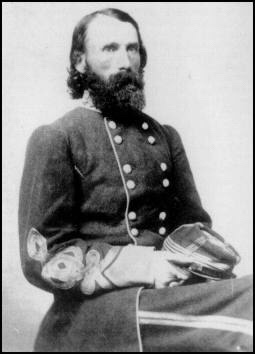
“I Will Live and Die under the Flag of the Union.” John Buford, Hero of Gettysburg

Friends of Padre Steve’s World

As I noted yesterday I am going to be posting about the Battle of Gettysburg for the next few days. All of these articles have appeared on my blog before and are part of my text on the Battle of Gettysburg which my agent is shopping to various publishers. This article is about the Union Cavalry commander, General John Buford who would lead a masterful delaying action against Confederate forces far superior to his small division on July 1st 1863. 

Buford is a fascinating character, played to perfection by Sam Elliott in the movie Gettysburg he was one of the officers whose extraordinary leadership denied Lee a victory at Gettysburg, preserved the Union and led to the defeat of the Confederacy. I hope you enjoy this little piece about a most amazing man. 

Peace

Padre Steve+
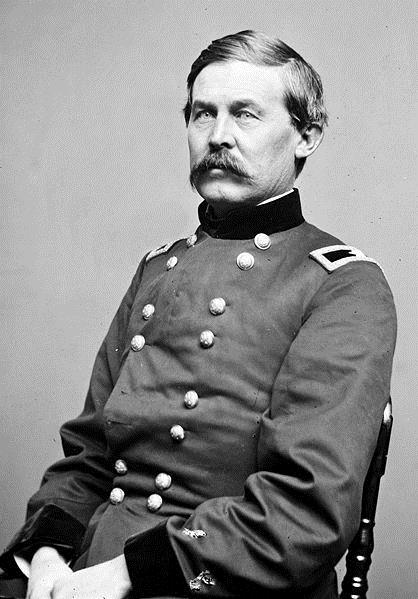
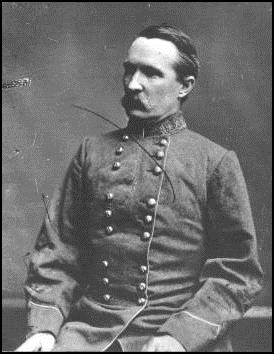
buford

“He was decidedly the best cavalry general we had, and was acknowledged as such in the army, though being no friend to newspaper reporters…In many respects he resembled Reynolds, being rough in the exterior, never looking after his own comfort, untiring on the march and in the supervision of all the militia in his command, quiet and unassuming in his manners.” Colonel Charles Wainwright on Buford (Diary of Battle, p.309)

John Buford was born in Kentucky and came from a family with a long military history of military service, including family members who had fought in the Revolutionary War and War of 1812. In fact according to some the family military pedigree reaches back to England’s War of the Roses.

Buford’s family was well off with a spacious plantation near Versailles on which labored forty-five slaves, and his father also established a stage line which carried “passengers and freight between Frankfort and Lexington.”His father divested himself of his property, selling his home, business and slaves and moved to Stephenson Illinois in 1838. [1] The young Buford developed an interest in military life which was enlivened by his half-brother Napoleon Bonaparte Buford who graduated from West Point in 1827, and his brother would be influential in helping John into West Point, which he entered in 1844.

Buford graduated with the class of 1848 which included the distinguished Union artilleryman John Tidball, and the future Confederate brigadier generals “Grumble Jones and “Maryland” Steuart. Among his best friends was Ambrose Burnside of the class of 1847. He did well academically but his conduct marks kept him from graduating in the top quarter of his class.

Upon graduation he was commissioned as a Brevet Second Lieutenant of Dragoons, however too late to serve in Mexico. Instead he was initially assigned to the First United States Dragoons but less than six months after joining was transferred to the Second Dragoons when he was promoted to full Second Lieutenant.

Instead of going to Mexico Buford “spent most of the 1850s tracking and fighting Indians on the Plains.” [2] During this period, the young dragoon served on the Great Plains against the Sioux, where he distinguished himself at the Battle of Ash Creek and on peacekeeping duty in the bitterly divided State of Kansas and in the Utah War of 1858.

His assignments alternated between field and staff assignments and he gained a great deal of tactical and administrative expertise that would serve him well. This was especially true in the realm of the tactics that he would employ so well at Gettysburg and on other battlefields against Confederate infantry and cavalry during the Civil War. Buford took note of the prevailing tactics of the day which still stressed a rigid adherence to outdated Napoleonic tactics which stressed mounted charges and “little cooperation with units of other arms or in the taking and holding of disputed ground.” [3] While he appreciated the shock value of mounted charges against disorganized troops he had no prejudice against “fighting dismounted when the circumstances of the case called for or seemed to justify it.” [4] Buford’s pre-war experience turned him into a modern soldier who appreciated and employed the rapid advances in weaponry, including the repeating rifle with tremendous effect.

Despite moving to Illinois Buford’s family still held Southern sympathies; his father was a Democrat who had opposed Abraham Lincoln. Buford himself was a political moderate and though he had some sympathy for slave owners:

“he despised lawlessness in any form – especially that directed against federal institutions, which he saw as the bulwark of democracy…..He especially abhorred the outspoken belief of some pro-slavery men that the federal government was their sworn enemy.” [5]

After the election of Abraham Lincoln, the officers of Buford’s regiment split on slavery. His regimental commander, Colonel Philip St. George Cooke, a Virginian and the father-in-law of J.E.B. Stewart announced that he would remain loyal to the Union, others like Beverly Robertson who would command a brigade of cavalry during the Gettysburg campaign resigned their commissions.

For many officers, both those who remained loyal to the Union and those who joined the Confederate cause the decision was often difficult, and many anguished over their decisions as they weighed their allegiance to the Union against their loyalty to home and family. Buford was not one of them.

Since Buford’s family had longstanding ties to Kentucky, the pro-secession governor of Kentucky, Beriah Magoffin offered Buford a commission in that states’ militia. At the time Kentucky was still an “undeclared border slave state” and Buford loyal to his oath refused the governor’s offer. He wrote a brief letter to Magoffin and told his comrades that “I sent him word that I was a Captain in the United States Army and I intend to remain one.” [6]Around the same time the new provisional government of the Confederacy “offered Buford a general officer’s commission, which reached him by mail at Fort Crittenden.” [7] According to Buford’s biographer Edward Longacre “a well-known anecdote has him wadding up the letter while angrily announcing that whatever future had in store he would “live and die under the flag of the Union.” [8]

However Buford’s family’s southern ties, and lack of political support from the few remaining loyal Kentucky legislators initially kept him from field command. Instead he received a promotion to Colonel and an assignment to the Inspector General’s Office, although it was not the field assignment that he desired it was of critical importance to the army in those early days of the war as the Union gathered its strength for the war. Buford was assigned to mustering in, and training the new regiments being organized for war. Traveling about the country he evaluated each unit in regard to “unit dress, deportment and discipline, the quality and quantity of weapons, ammunition, equipment, quarters, animals and transportation; the general health of the unit and medical facilities available to it; and the training progress of officers and men.” [9] Buford was a hard and devastatingly honest trainer and evaluator of the new regiments. He was especially so in dealing with commanding officers as well as field and company officers. Additionally he was a stickler regarding supply officers, those he found to be incompetent or less than honest were cashiered.

Buford performed these duties well but desired command. Eventually he got the chance when the politically well-connected but ill-fated Major General John Pope who “could unreservedly vouch for his loyalty wrangled for him command of a brigade of cavalry.” [10] After Pope’s disastrous defeat at Second Bull Run in August 1862 Buford was wounded in the desperate fighting at Second Manassas and returned to staff duties until January 1863 when he was again given a brigade. However, unlike many of the officers who served under Pope, Buford’s reputation as a leader of cavalry and field commander was increased during that campaign.

Buford was given the titular title of “Chief of Cavalry of the Army of the Potomac” by George McClellan, a title which sounded impressive but involved no command during the Antietam campaign. Following that frustrating task he continued in the same position under his old West Point friend Ambrose Burnside during the Fredericksburg campaign. Buford lost confidence in his old friend and was likely “shocked by his friend’s deadly ineptitude, his dogged insistence on turning defeat into nightmare.” [11]

When Burnside was relieved and Fighting Joe Hooker appointed to command the army, Buford’s star began to rise. While he was passed over by Hooker for command of the newly organized First Cavalry division in favor of Alfred Pleasanton who was eleven days his senior, he received command of the elite Reserve Brigade composed of mostly Regular Army cavalry regiments. When Major General George Stoneman was relieved of command following the Chancellorsville campaign, Pleasanton was again promoted over Buford.

In later years Hooker recognized that Buford “would have been a better man for the position of chief” [12] but in retrospect Buford’s pass over was good fortune for the Army of the Potomac on June 30th and July 1st 1863. Despite being passed over for the Cavalry Corps command, Buford, a consummate professional never faltered or became bitter. Despite the Pleasanton’s interference and “lax intelligence-gathering” [13]   During the Gettysburg campaign he led his brigade well at Brandy Station as it battled J.E.B. Stuart’s troopers, after which he was recommended for promotion and given command of the First Cavalry division of the Cavalry Corps. [14]

Following Brandy Station Buford led his troopers aggressively as they battled Stuart’s troopers along the Blue Ridge at the battles of Aldie, Philmont, Middleburg and Upperville. It was at Upperville while fighting a hard action Confederate Brigadier general “Grumble Jones’s brigade that Buford’s troopers provided Hooker with the first visual evidence that Lee’s infantry was moving north into Maryland and Pennsylvania.

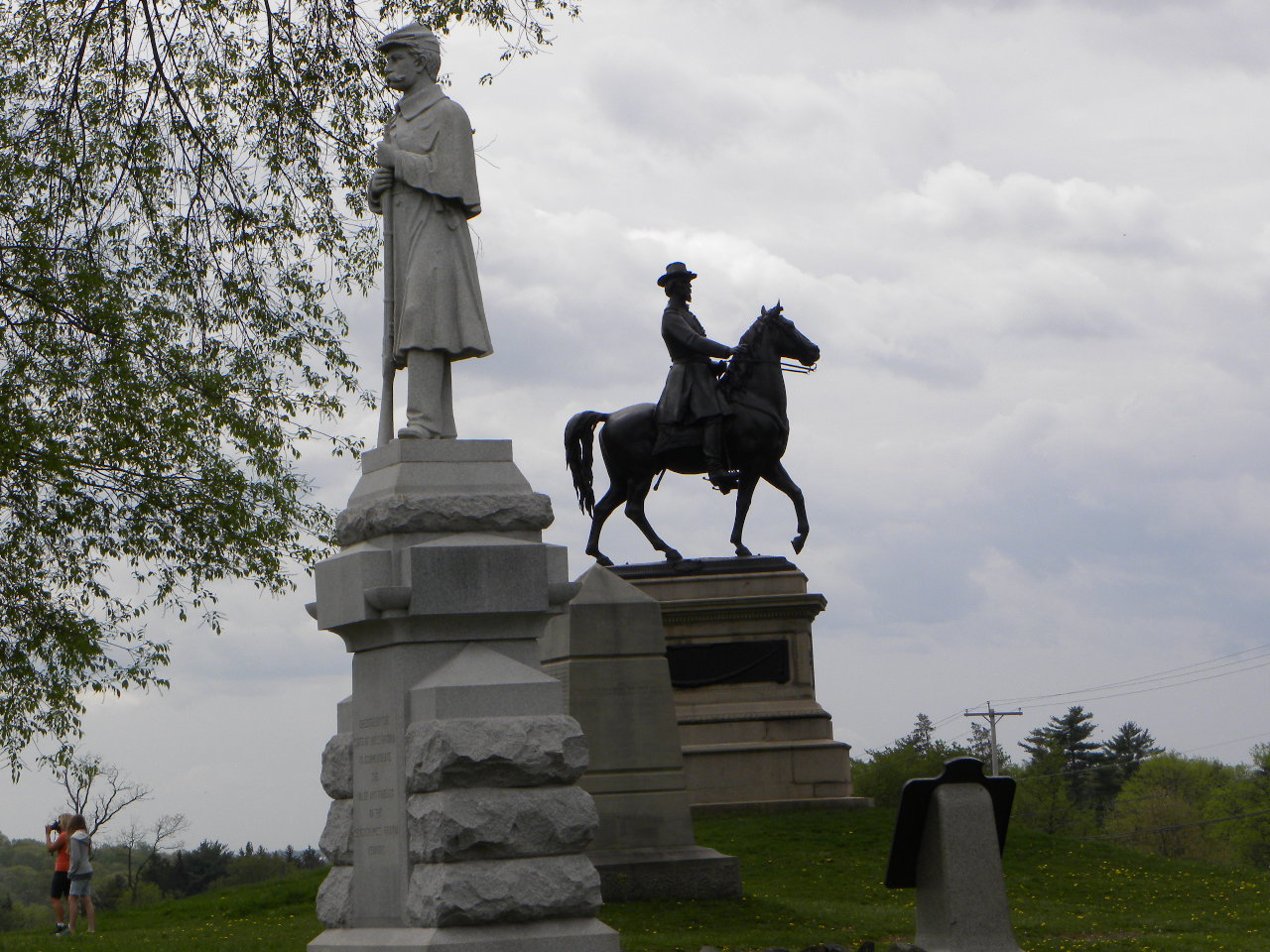
burford reynolds monuments

When Hooker was relieved on the night of June 27th and 28th George Meade gave Buford the chance at semi-independent command without Pleasanton looking over his shoulder. Meade appreciated Pleasanton’s administrative and organizational expertise and took him out of direct field command. Meade had his Cavalry Corps commander “pitch his tent next to his own on almost every leg of the trip to Pennsylvania and rarely let him out of sight or earshot.” [15]

One of Meade’s staff officers, Theodore Lyman gave this description of Buford:

“He is one of the best of the officers…and is a singular looking party. Figurez-vous a compactly built man of middle height, with a tawny mustache and a little, triangular gray eye, whose expression is determined, not to say sinister. His ancient corduroys are tucked into a pair of ordinary cowhide boots, his blue blouse is ornamented with holes; from which one pocket thereof peeps a huge pipe, while the other is fat with a tobacco pouch. Notwithstanding this get-up he is a very soldierly looking man. Hype is of a good natured disposition, but is not to be trifled with.” [16]

When he was ordered to screen the army as it moved into Pennsylvania, Buford was confident about his troopers and their ability and he and his men performed their duties admirably. On June 29th Buford’s men skirmished with two of Harry Heth’s regiments near the town of Fairfield, which Buford promptly reported to Meade and John Reynolds after ascertaining their size and composition.

The Battle of Gettysburg would be the zenith of Buford’s career. His masterful delaying action against Harry Heth’s division on July 1st 1863 enabled John Reynold’s wing of the army to arrive in time to keep the Confederates from taking the town and all of the high ground which would have doomed any union assault against them. Following Gettysburg Buford continued to command his cavalry leading his division in a number of engagements. In early November the worn out cavalryman who had been in so many actions over the past year came down with Typhoid. In hopes that he would recover he was told that he would be appointed to command all the cavalry in the West, however his health continued to decline. He was officially promoted to Major General of Volunteers by President Lincoln, over the objection of Secretary of War Stanton who disliked deathbed promotions. “Upon learning of the honor. Buford is supposed to have whispered, “I wish I could have lived now.” [17] He died later that evening, the last words warning his officers “patrol the roads and halt fugitives at the front.” [18]

John Pope wrote of Buford:

“Buford’s coolness, his fine judgment, and his splendid courage were well known of all men who had to do with him… His quiet dignity, covering a fiery spirit and a military sagacity as far reaching as it was accurate made him…one of the best and most trusted officers in the service.” [19]
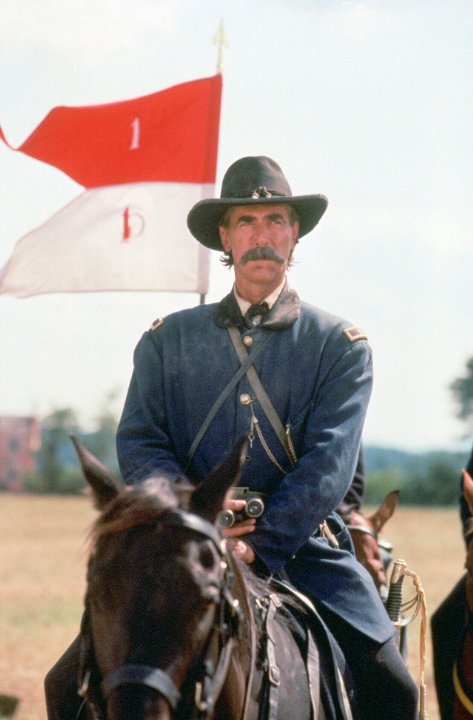
Sam Elliot as Buford

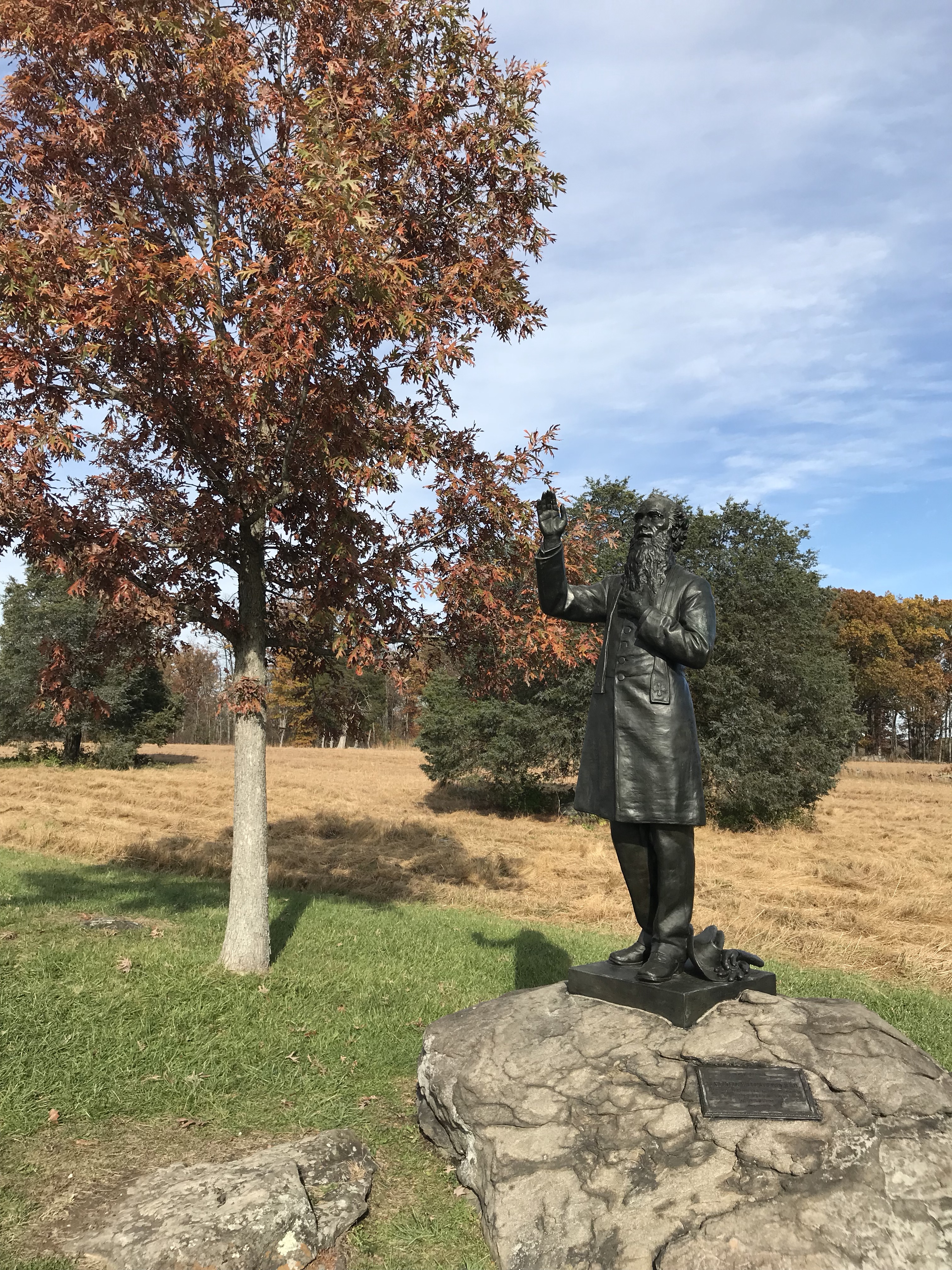
Buford was buried at West Point and he is immortalized in the monument dedicated to him on McPherson’s Ridge at Gettysburg where he with binoculars in hand looks defiantly west in the direction of the advancing Confederates. The monument is surrounded by the gun tubes of four Union 3” Rifles, three of which were part of Lieutenant John Calef’s Battery which he directed on the fateful morning of July 1st 1863. He was portrayed masterfully portrayed by Sam Elliott in the movie Gettysburg.

Notes

[1] Longacre, Edward G. John Buford: A Military Biography Da Capo Press, Perseus Book Group, Cambridge MA p.17

[2] Ibid. Guelzo. Gettysburg: The Last Invasion p.121

[3] Ibid. Longacre John Buford p.36

[4] Ibid. Longacre John Buford p.36

[5] Ibid. Longacre John Buford p.54

[6] Ibid. Guelzo. Gettysburg: The Last Invasion p.121

[7] Ibid. Longacre John Buford p.70

[8] Ibid. Longacre John Buford p.70

[9] Ibid. Longacre John Buford p.78

[10] Ibid. Guelzo. Gettysburg: The Last Invasion p.121

[11] Ibid. Longacre John Buford p.122

[12] Ibid. Coddington The Gettysburg Campaign, A Study in Command p.44

[13] Ibid. Longacre John Buford p.173

[14] Ibid. Coddington The Gettysburg Campaign, A Study in Command p.64

[15] Longacre, Edward G. The Cavalry at Gettysburg: A Tactical Study of Mounted Operations during the Civil War’s Pivotal Campaign, 9 June-14 July 1863 University of Nebraska Press, Lincoln and London 1986 p.168

[16] Girardi, Robert I. The Civil War Generals: Comrades, Peers, Rivals in Their Own Words Zenith Press, MBI Publishing, Minneapolis MN 2013 p.38

[17] Ibid. Longacre John Buford p.245

[18] Ibid. Longacre John Buford p.246

[19] Ibid. Girardi The Civil War General p.38
2 Comments

Filed under Gettysburg, History, leadership, Military, us army

A Spirit of Unbelief: Confederates Before Gettysburg

Lieutenant General A. P. Hill

Friends of Padre Steve’s World,

I’m hoping to take a few days off from writing about current events and spend a few days reposting some of my writings about the Battle of Gettysburg.

Peace,

Padre Steve+

When Robert E. Lee learned of the Army of the Potomac’s presence north of the Potomac River he ordered his widely dispersed army concentrate near Cashtown and Gettysburg. It was a complicated movement that involved at least five major operations: the shift of the bulk of Ewell’s Second Corps from its planned attack on Harrisburg, the redirection of Early’s division east from its position on the Susquehanna to the west, the movement of Hill’s Third Corps from the area around Cashtown to a position east of Gettysburg, Longstreet’s First Corps north to Chambersburg and Cashtown and the cavalry brigades of Beverly Robertson, Grumble Jones and John Imboden which were to join the army in Pennsylvania. The movement “would take at least two days – the 29th and the 30th of June – and perhaps more…the complete its concentration, especially since the rains had “made the roads very muddy,” forcing “the infantry” to march off the roads….” [1]

Lieutenant General A.P. Hill’s Third Corps that was nearest of Lee’s major units to Cashtown and Gettysburg. Major General Harry Heth’s division led the corps and arrived at Cashtown on June 29th. His division was followed by that of Major General Dorsey Pender which arrived on the 30th. Hill ordered his last division under the command of Major General Richard Anderson to remain behind at “Fayetteville until July 1, when he would join the rest at Cashtown.” [2]

Cashtown was important as a road junction and because it “was situated at one of the few gaps in the Pennsylvania Mountains” and because one of the roads emanating from it “snaked eight miles to another community called Gettysburg.” [3] However the order to concentrate the army at Cashtown presented its own problems. First was the matter of forage. There was not enough room for all the units ordered to Cashtown to have adequate areas to forage, as:

“each division would (by the standard required of nineteenth-century armies) require a circle twelve and a half miles around its encampments to forage (for water, firewood, and feed for men and horses); one single regiment could denuded an acre of woodland just for firewood every three days.” [4]

Likewise, because of the limited road network, Cashtown was becoming a choke point which as his units closed in slowed their movement and created massive traffic problems and confusion. Hill ordered Heth’s division to take the lead and advance to Cashtown on the 29th. The units of Hill’s corps had to endure heavy rains on the 29th which slowed their march and Heth halted at Cashtown knowing that the army would concentrate there while Pender’s division moved into the area his division had vacated.

Early in the morning of June 30th Harry Heth decided to undertake a foraging expedition to Gettysburg to “search the town for army supplies (shoes especially), and to return the same day.” [5] It was the first in a series of miscalculations that brought Lee’s army into a general engagement that Lee wished to avoid and it is hard to comprehend in light of Lee’s orders not to precipitate a fight.

However, the expedition had taken a toll on the soldiers, especially in terms of shoes, clothes and equipment. The “long march over the hard macadam roads of the North had played havoc with the scraggly foot coverings of Lee’s men.” [6] After muster on the morning of June 30th Heth ordered Johnston Pettigrew’s “brigade to Gettysburg in search of supplies, especially badly needed shoes, which were badly needed by his the men of his division.” Heth, for a reason he never elaborated on decided that there must be shoes in Gettysburg. Perhaps he did not know that the town had been picked clean by John Gordon’s brigade of Jubal Early’s division just a few days before, but for whatever reason he believed this to be the case.

Hill’s Third Corps had been formed as part of the reorganization of the army following Stonewall Jackson’s death after the Battle of Chancellorsville. Hill had a stellar reputation as a division commander; his “Light Division” had distinguished itself on numerous occasions, especially at Antietam where its timely arrival after a hard forced march from Harper’s Ferry helped save Lee’s army late in the battle. At Chancellorsville Hill briefly succeeded Jackson until he too was wounded.

Hill was recommended for promotion to Lieutenant General and command of the new Third Corps by Lee on May 24th 1863. He was promoted over the heads of both Harvey Hill and Lafayette McLaws. The move displeased Longstreet who considered Lafayette McLaws “better qualified for the job.” Likewise there were others who felt that the command should have gone to Harvey Hill, now commanding the Department of North Carolina who’s “record was as good as that of Stonewall Jackson…but, not being a Virginian, he was not so well advertised.” [7]

Ambrose Powell Hill was slightly built and high strung. “Intense about everything” Hill was “one of the army’s intense disbelievers in slavery.” [8] Hill was an 1847 graduate of West Point and briefly served in Mexico but saw no combat. He spent some time in the Seminole wars but due to frequent bouts of ill-health he spent much of his career in garrison duty along the East Coast. Since he was prone to sickness he was assigned to the office of Coastal Survey, a Navy command from 1855 through 1861. Despite pleas from his superiors and his own opposition to secession and slavery, Hill resigned his commission just before Virginia’s secession.

At the outbreak of the war he “received his commission as colonel, and soon trained one of Johnston’s best regiments in the Valley.” [9] He commanded a brigade under Longstreet on the Peninsula and was promoted to Major General and command of the Light Division in May 1862, leading it with distinction, especially at Antietam where his march from Harper’s Ferry and timely arrival on the afternoon of September 17th saved the army of Northern Virginia from utter and complete destruction. He was plagued by health problems which had even delayed his graduation from West Point, health issues that would arise on the first day at Gettysburg.

Hill’s Third Corps was emblematic of the “makeshift nature of the reorganization of the whole army.” [10] It was composed of three divisions. His best and most experienced division was that of the recently promoted and hard fighting Major General Dorsey Pender. Pender’s division was built around four excellent brigades from Hill’s old “Light Division” one of which Pender had commanded before his promotion. Hill had strongly recommended Pender’s promotion during the reorganization, a proposal which was accepted by Lee. Pender, though a fierce fighter and excellent leader, found command of a division to be a heavy burden. He was “an intelligent, reflective man, deeply religious and guided by a strong sense of duty….” [11]

Hill’s second experienced division was that of Major General Richard Anderson. This division had been transferred from Longstreet’s First Corps during the reorganization. Longstreet resented losing the division to Hill, with who he had previously run afoul and this was yet another issue which failed to endear Hill to Longstreet. [12]

The unassuming Anderson had distinguished himself as a brigade and division commander in Longstreet’s corps, but in “an army of prima donnas, he was a self-effacing man, neither seeking praise for himself nor winning support by bestowing it on others.” [13] At Chancellorsville Anderson fought admirably and Lee wrote that Anderson was “distinguished for the promptness, courage and skill with which he and his division executed every order.” [14] With four seasoned brigades under excellent commanders it was a good addition to the corps, although the transition from Longstreet’s stolid and cautious style of command to Hill’s impetuous style introduced “another incalculable of the reshuffled army.” [15]

Major General Harry Heth’s division was the final infantry division assigned to Third Corps. The division was new and had was cobbled together from two brigades of Hill’s old Light Division and “the two new brigades that Jefferson Davis had forced on an already disrupted army organization.” [16] The organization of this division as well as its leadership would be problematic in the days to come, especially on June 30th and July 1st 1863. The hasty and makeshift organization under leaders who had not served together, many of who were new to command, as well as units which had not fought together spelled trouble.

Harry Heth, like Dorsey Pender was also newly promoted to his grade and the action at Gettysburg would be his first test in division command. Heth was a native Virginian. He came from a family that well connected both socially and politically. He had a social charm had “many friends and bound new acquaintances to him” readily. [17] Heth was a cousin of George Pickett. He was a West Point graduate and classmate of Hill. At West Point Heth had an undistinguished academic career and graduated last in the class of 1847. His career in the ante-bellum army was typical of many officers, he served “credibly in an 1855 fight with Sioux Indians” but his real claim to fame was in authoring the army’s marksmanship manual which was published in 1858. [18]

Major General Harry Heth

Heth’s career with the Confederate army serving in western Virginia was undistinguished but he was a protégé of Robert E. Lee who recommended him as a brigade commander to Jackson before Chancellorsville. Tradition states that of all his generals that Heth was the only one “whom Lee called by his first name.” [19] A.P. Hill when writing Lee about the choice of a successor for the Light Division noted that Heth was “a most excellent officer and gallant soldier” but in the coming campaign “my division under him, will not be half as effective as under Pender.” [20] Douglas Southall Freeman noted that Heth was “doomed to be one of those good soldiers…who consistently have bad luck.” [21]

Heth’s division was composed of two depleted brigades from the Light Division which had taken heavy casualties at Chancellorsville. One brigade, commanded by the hard fighting former regular army officer Brigadier General James Archer. Archer was from Maryland and a graduate of Princeton University who had given up a law practice to join the army. Described as a “little gamecock” who “had no sense of fear” [22] Archer had saved the Confederate line at Fredericksburg leading a desperate counterattack at Prospect Hill. The brigade was composed of four veteran regiments, but was now down to barely 1200 soldiers in the ranks by the time it arrived at Cashtown. However, the brigade which was recruited from Alabama and Tennessee was “well led and had a fine combat reputation.”

But the second brigade was more problematic. This was the Virginia brigade under the command of “the plodding, uninspiring Colonel John Brockenbrough.” [23] Brockenbrough was an “1850 of the Virginia Military Institute and a farmer,” who had “entered the Confederate service as Colonel of the 40th (Virginia) in May 1861.” [24] The brigade had once been considered one of the best in the army had deteriorated in quality following the wounding of its first commander Brigadier General Charles Field. Heth took command of it at Chancellorsville where both he and the brigade performed well. The brigade had taken very heavy casualties and now was reduced to under 1000 effectives. When Heth was promoted the lack of qualified officers left it under the command of its senior colonel, John Brockenbrough.[25] Lee did not consider Brockenbrough “suited for promotion” but “could be counted on to keep together a command sadly reduced in numbers.” [26]

Heth’s  third brigade came from Mississippi and North Carolina and was commanded by the “stuffy and ambitious” [27] Brigadier General Joe Davis.  Davis’s uncle was President Jefferson Davis. Davis served on his uncle’s staff for months during the early part of the war but had no combat experience, never leading as much as a company. [28] One author noted that Davis’s promotion to Brigadier General was  “as unadulterated an instance of nepotism as the record of the Confederacy offers.” [29] Davis’s subordinate commanders were no better; one of them, William Magruder was so incompetent that J.E.B. Stuart suggested that “he have his commission revoked.” In Magruder’s outfit only one of the nine field grade officers in his brigade had military training, and that was because he was a graduate of the Naval Academy, hardly fitting for service in the infantry. [30] This brigade was also a makeshift operation with two veteran regiments including the 11th Mississippi which had “gone through blood and fire together on the Peninsula through Antietam.” [31] After Antietam, these units were then paired with two new regiments and a new politically connected commander and sent to the backwater of North Carolina where they saw no action. The veteran regiments “mistrusted not only their commander, but the reliability of its yet untested units.” [32]

Brigadier General Johnston Pettigrew

Heth’s largest brigade was new to the army. Commanded by the North Carolina academic Brigadier General Johnston Pettigrew it had no combat experience. Pettigrew himself was considered a strong leader. He had been badly wounded at Seven Pines and thinking his wound mortal “he refused to permit his men to leave the ranks to carry him to the rear.” [33] He was captured but later paroled and returned to the army to command a brigade later in the year.

Hill was under the impression that Meade’s army was still miles away, having just come from meeting Lee who assured him that “the enemy are still at Middleburg,” (Maryland) “and have not yet struck their tents.” [34] With that assurance Heth decided to use June 30th to send Pettigrew’s brigade on the foraging expedition to Gettysburg. An officer present noted that Heth instructed Pettigrew “to go to Gettysburg with three of his regiments present…and a number of wagons for the purpose of collecting commissary and quartermaster stores for the use of the army.[35]

However Heth did instruct Pettigrew in no uncertain terms not to “precipitate a fight” should he encounter “organized troops” of the Army of the Potomac. [36] Heth was specific in his report that “It was told to Pettigrew that he might find in the town in possession of a home guard,…but if, contrary to expectations, he should find any organized troops capable of making resistance., or any part of the Army of the Potomac, he should not attack it.” [37]

That in mind anyone with the slightest experience in handling troops has to ask the question as to why Heth would employ “so many men on a long, tiring march, especially as without a cavalry escort he took the risk of sending them into a trap” when his “objects hardly justified” using such a large force. [38] Edwin Coddington is particularly critical of Heth in this regard.

Likewise it has to be asked why the next day in light of Lee’s standing orders not to provoke an engagement that Hill would send two divisions, two thirds of his corps on what was supposedly reconnaissance mission. Some have said that Hill would have had to move to Gettysburg on July 1st anyway due to forage needs of the army, [39] but this is not indicated in any of Hill or Heth’s reports.

As his troops neared Gettysburg Pettigrew observed the Federal cavalry of Buford’s 1st Cavalry Division as they neared the town. He received another report “indicating that drumming could be heard in the distance – which might mean infantry nearby, since generally cavalry generally used only bugles.” [40] He then prudently and in accordance with his orders not to precipitate a fight “elected to withdraw rather than risk battle with a foe of unknown size and composition.” [41] His troops began their retrograde at 11 a.m. leaving Buford’s cavalry to occupy the town at ridges. One Confederate wrote “in coming in contact with the enemy, had quite a little brush, but being under orders not to bring a general engagement fell back, followed by the enemy.” [42]

Upon returning Pettigrew told Hill and Heth that “he was sure that the force occupying Gettysburg was a part of the Army of the Potomac” but Hill and Heth discounted Pettigrew’s report. [43] “Heth did not think highly of such wariness” and “Hill agreed with Heth” [44] Hill believed that nothing was in Gettysburg “except possibly a cavalry vedette.” [45] Hill was not persuaded by Pettigrew or Pettigrew’s aide Lieutenant Louis Young who had previously served under both Hill and Pender. Young reported that the “troops that he saw were veterans rather than Home Guards.” [46] Hill reiterated to both that he did not believe “that any portion of the Army of the Potomac was up” but then according to Young Hill “expressed the hope that it was, as this was the place he wanted it to be.” [47] 

Part of the issue was related to the fact that Pettigrew, though highly intelligent, and who had been an observer of wars in Europe was not a professional soldier. Likewise, since had was new to the Army of the Northern Virginia he was an unknown to both Hill and Heth. As such they dismissed his report. In their casual dismissal of Pettigrew’s report, the West Point Graduates Hill and Heth may have manifested an often typical “distain for citizen soldiers…a professional questioning a talented amateur’s observations” [48]

Pettigrew was “aghast at Hill’s nonchalant attitude” [49] while Young was dismayed and later recalled that “a spirit of unbelief” seemed to cloud the thinking of Hill and Heth. [50] In later years Young wrote that the “blindness in part seems to have come over our commanders, who slow to believe in the presence of an organized army of the enemy, thought that there must be a mistake in the report taken back by General Pettigrew.” [51]

Since neither man believed Pettigrew’s report, Heth asked Hill “whether Hill would have any objection to taking his division to Gettysburg again to get those shoes.” Hill replied “none in the world.” [52] It was to be a fateful decision, a decision that brought about a series of events which in turn led to the greatest battle even fought on the American continent.

Lee’s biographer and apologist Douglas Southall Freeman wrote “On those four words fate hung” [53] and in “that incautious spirit, Hill launched Harry Heth’s division down the Chambersburg Pike and into battle at Gettysburg.” [54]

Notes

[1] Guelzo, Allen C. Gettysburg: The Last Invasion Vintage Books a Division of Random House, New York 2013 p.128

[2] Coddington, Edwin B. The Gettysburg Campaign, A Study in Command A Touchstone Book, Simon and Shuster New York 1968 p.194

[3] Robertson, James I. Jr. General A.P. Hill: The Story of a Confederate Warrior Random House, New York 1987

[4] Ibid. Guelzo, Gettysburg: The Last Invasion p.128

[5] Ibid. Coddington, The Gettysburg Campaign, A Study in Command p. 263

[6] Ibid. Robertson A.P. Hill p.205

[7] Foote, Shelby, The Civil War, A Narrative. Volume Two Fredericksburg to Meridian Random House, New York 1963 p.453

[8] Ibid. Dowdy, Lee and His Men at Gettysburg: The Death of a Nation p.79

[9] Ibid. Freeman Lee’s Lieutenant’s a Study in Command p.109

[10] Ibid. Dowdy, Lee and His Men at Gettysburg: The Death of a Nation p.88

[11] Ibid. Dowdy, Lee and His Men at Gettysburg: The Death of a Nation p.85

[12] Ibid. Dowdy, Lee and His Men at Gettysburg: The Death of a Nation p.86

[13] Ibid. Dowdy, Lee and His Men at Gettysburg: The Death of a Nation p.86

[14] Ibid. Freeman Lee’s Lieutenant’s a Study in Command p.512

[15] Ibid. Dowdy, Lee and His Men at Gettysburg: The Death of a Nation p.86

[16] Ibid. Dowdy, Lee and His Men at Gettysburg: The Death of a Nation p.87

[17] Ibid. Freeman Lee’s Lieutenant’s a Study in Command p.527

[18] Krick, Robert K. Three Confederate Disasters on Oak Ridge: Failures of Brigade Leadership on the First Day of Gettysburg in The First Day at Gettysburg edited by Gallagher, Gary W. Kent State University Press, Kent Ohio 1992 p.96

[19] Ibid. Krick. Three Confederate Disasters on Oak Ridge p.96

[20] Ibid. Freeman Lee’s Lieutenant’s a Study in Command p.527

[21] Ibid. Freeman Lee’s Lieutenant’s a Study in Command p.46

[22] Ibid. Guelzo, Gettysburg: The Last Invasion p.134

[23] Sears, Stephen W. Gettysburg. Houghton Mifflin Co. Boston and New York 2003 p.55

[24] Pfanz Harry W. Gettysburg: The First Day University of North Carolina Press, Chapel Hill and London 2001 p.118

[25] Ibid. Dowdy, Lee and His Men at Gettysburg: The Death of a Nation p.87

[26] Ibid. Freeman Lee’s Lieutenant’s a Study in Command p.529

[27] Ibid. Guelzo, Gettysburg: The Last Invasion p.133

[28] Ibid. Freeman Lee’s Lieutenant’s a Study in Command p.533

[29] Ibid. Krick. Three Confederate Disasters on Oak Ridge p.99

[30] Ibid. Krick. Three Confederate Disasters on Oak Ridge p.101

[31] Ibid. Guelzo, Gettysburg: The Last Invasion p.134

[32] Ibid. Guelzo, Gettysburg: The Last Invasion p.134

[33] Ibid. Freeman Lee’s Lieutenant’s a Study in Command p.136

[34] Ibid. Guelzo, Gettysburg: The Last Invasion p.131

[35] Trudeau, Noah Andre. Gettysburg: A Testing of Courage, Harper Collins Publishers, New York 2002 p.128

[36] Ibid. Sears Gettysburg p.136

[37] Ibid. Trudeau Gettysburg: A Testing of Courage, p.129

[38] Ibid. Coddington, The Gettysburg Campaign, A Study in Command p. 263

[39] Ibid. Guelzo. Gettysburg: The Last Invasion p.131 This argument does have merit based on the considerations Guelzo lists but neither Hill, Heth or Lee make any mention of that need in their post battle reports.

[40] Ibid. Trudeau Gettysburg: A Testing of Courage, p.130

[41] Gallagher, Gary. Confederate Corps Leadership on the First Day at Gettysburg: A.P. Hill and Richard S. Ewell in a Difficult Debut in The First Day at Gettysburg edited by Gallagher, Gary W. Kent State University Press, Kent Ohio 1992 p.42

[42] Ibid. Trudeau Gettysburg: A Testing of Courage, p.135

[43] Ibid. Coddington, The Gettysburg Campaign, A Study in Command pp. 263-264

[44] Foote, Shelby, The Civil War, A Narrative. Volume Two Fredericksburg to Meridian Random House, New York 1963 p.465

[45] Ibid. Pfanz Gettysburg: The First Day p.27

[46] Ibid. Gallagher, Gary. Confederate Corps Leadership on the First Day at Gettysburg p.42

[47] Ibid. Pfanz. Gettysburg: The First Day p.27

[48] Ibid. Gallagher, Gary. Confederate Corps Leadership on the First Day at Gettysburg p.42

[49] Ibid. Guelzo. Gettysburg: The Last Invasion p.131

[50] Ibid. Coddington, The Gettysburg Campaign, A Study in Command p. 264

[51] Ibid Pfanz Gettysburg: The First Day p.27

[52] Ibid. Coddington, The Gettysburg Campaign, A Study in Command p. 264

[53] Ibid. Freeman Lee’s Lieutenant’s a Study in Command p. 563

[54] Ibid. Krick. Three Confederate Disasters on Oak Ridge p.94

5 Comments

Filed under civil war, Gettysburg, History, leadership, Military, us army

Integrity, Truthfulness, Purity, and Singleness of Purpose: Winfield Scott Hancock and what the United States Needs Today

hancock


Friends of Padre Steve’s World,

I visit Gettysburg a lot and I also write about it a lot. When I make those visits I am always humbled and learn something new. I only wish that most Americans and our leaders of both political parties as well as most media types and pundits could grasp what I experience on each visit to the “hallowed ground” of Gettysburg.

Quite honestly I do not think that the vast majority Americans regardless of their party affiliation or ideology  understand, appreciate or value in the slightest the sacrifices of the men who fought and in many cases died to preserve the Union at Gettysburg. Even among those who do I think that the object of their appreciation are the military aspects of the battle often taken in isolation, not the profound strategic dimensions of what this battle as well as the fall of Vicksburg in the west at the same time had on the war.

Nor do I think that they appreciate the massive political, ideological and social effects bought about by those Union victories in ending the war and how those effects redound to us today. This is especially true of the pundits, politicians and preachers, the “Trinity of Evil” as I call them whose shrill voices urge on divisions between our people; including some that call out for violence to maintain their groups social, economic or religious advantages over others. Quite a few even lament the fall of the South and the institution including the washed up rock and roll musician of the political right Ted Nugent who wrote in the Washington Times in July 2012: “I’m beginning to wonder if it would have been best had the South won the Civil War.” More recently when President Trump talked of the moral equivalence of the opposing sides at Charlottesville I was reminded of just how hateful and morally bankrupt such feelings are, I am sure that General Hancock would be appalled that an American President would make that kind of stand.

All of that concerns me as an American and a historian; because I realize how dangerous such historical ignorance and visceral propaganda is in the life of any nation. Thus when I go to Gettysburg, or for that matter any other battlefield of our American Civil War the sacrifices of those men and what they fought to maintain are again imprinted on my heart.

Abraham Lincoln eloquently noted about those soldiers who fought to turn back the Confederate tide at Gettysburg in his Gettysburg Address:

“But, in a larger sense, we can not dedicate — we can not consecrate — we can not hallow — this ground. The brave men, living and dead, who struggled here, have consecrated it, far above our poor power to add or detract. The world will little note, nor long remember what we say here, but it can never forget what they did here. It is for us the living, rather, to be dedicated here to the unfinished work which they who fought here have thus far so nobly advanced. It is rather for us to be here dedicated to the great task remaining before us — that from these honored dead we take increased devotion to that cause for which they gave the last full measure of devotion — that we here highly resolve that these dead shall not have died in vain — that this nation, under God, shall have a new birth of freedom — and that government of the people, by the people, for the people, shall not perish from the earth.”

While I am an idealist I am also a pragmatist. I respect the right of others, even those that disagree with things that I very much believe in and support. Like it or not the keystone of our governmental system is one of compromise. That being said having relatives that fought on both sides of the American Civil War that I am not a sectionalist. Nor am I a person that attempts to use the political system to ensure that others have to follow my religious beliefs or to enrich certain groups. The democracy that is part of our republic’s system of government is not a perfect system by any means. In fact as the great English Prime Minister Winston Churchill noted “democracy was the worst form of government except for all the others.”

Thus I appreciate military men who maintain their oath to the nation in times of great conflict not abandoning it to support causes that they know are wrong because the people of their state, or interest group seek to divide that Union. Winfield Scott Hancock was one of those kind of men, as was George Meade, and John Buford, all of whom played key roles in defeating the Confederates at Gettysburg.

Hancock, who earned the title “Hancock the Superb” was the commander of the Union Second Corps at Gettysburg. Upon the death of John Reynolds early on the first day of battle Hancock was appointed by George Meade as commander of the Federal Left Wing, in effect becoming Meade’s deputy commander for the rest of the battle. He was seriously wounded as Pickett’s Charge came to its bloody end at “the Angle” even as his dear friend Confederate General Lewis Armistead lay mortally wounded a few hundred yards away.

Hancock is an interesting character. He was from Pennsylvania but was a Democrat. He was not a Republican like Lincoln. Hancock was not a political ideologue but was since he was a Democrat he was suspect by leaders in the party establishments of both parties; Republicans for being a Democrat, and Democrats for serving under Lincoln. As such he never was given independent command of an Army but remained the beloved commander of the Union Second Corps.

As the nation split and friends went their separate ways Hancock gave some advice to his best friend, Lewis Armistead and their commander, Brigadier General Albert Sidney Johnston who were preparing to leave the Union in early 1861. In response to the states rights arguments of his friends he made himself clear. He fully believed in the principal of states rights, but he could not compromise his faithfulness to the Union. He told his friends as they departed company on their way to their destinies during the Civil War:

“I shall not fight upon the principle of state-rights, but for the Union, whole and undivided.” 

During the war Hancock served with distinction. At Gettysburg he was influential in determining the choice of the Union defense, in helping to repel the Rebel attacks on July 2nd 1863 and the final repulse of Pickett’s Charge where he was severely wounded and his friend Armistead died. After he recovered from his wounds he continued to lead Second Corps until the end of the war. Ulysses Grant wrote of him:

“Hancock stands the most conspicuous figure of all the general officers who did not exercise a separate command. He commanded a corps longer than any other one, and his name was never mentioned as having committed in battle a blunder for which he was responsible. He was a man of very conspicuous personal appearance…. His genial disposition made him friends, and his personal courage and his presence with his command in the thickest of the fight won for him the confidence of troops serving under him. No matter how hard the fight, the 2d corps always felt that their commander was looking after them.”

After the war Hancock supervised the execution of those convicted of the assassination of Abraham Lincoln. Following that duty he served in various postings in the occupied South and attempted to mitigate some of the actions of those bent on vengeance against African Americans as well as others who tried to exploit the defeated Confederates for political or economic gain. His balanced attempt at justice was not appreciated by many people in the North or the South.

In 1880 Hancock ran for President and lost a narrow election to James A. Garfield. After his unsuccessful campaign he returned to the Army and died at the age of 61 in 1886 at his headquarters from complications from diabetes.

In death was praised by political supporters and opponents alike. Former President Rutherford B. Hayes wrote:

“if when we make up our estimate of a public man, conspicuous both as a soldier and in civil life, we are to think first and chiefly of his manhood, his integrity, his purity, his singleness of purpose, and his unselfish devotion to duty, we can truthfully say of Hancock that he was through and through pure gold.” 

Another political opponent Republican General Francis A. Walker lamented not supporting Hancock in 1880 after the great corruption that engulfed the country during “Gilded Age” of the “Robber Barons” the 1880s. Walker wrote in 1893:

“Although I did not vote for General Hancock, I am strongly disposed to believe that one of the best things the nation has lost in recent years has been the example and the influence of that chivalric, stately, and splendid gentleman in the White House. Perhaps much which both parties now recognize as having been unfortunate and mischievous during the past thirteen years would have been avoided had General Hancock been elected.”

DSCN9741

I have stood by the monument to this fine man on East Cemetery Hill at Gettysburg many times. Each time I am struck by the bravery, courage and integrity of that remarkable man. Regardless of party affiliation I wish that we had more leaders like him today.

Peace

Padre Steve+

1 Comment

Filed under civil war, Gettysburg, History, Military, Political Commentary

Controversy and Glory: Dan Sickles Part Six

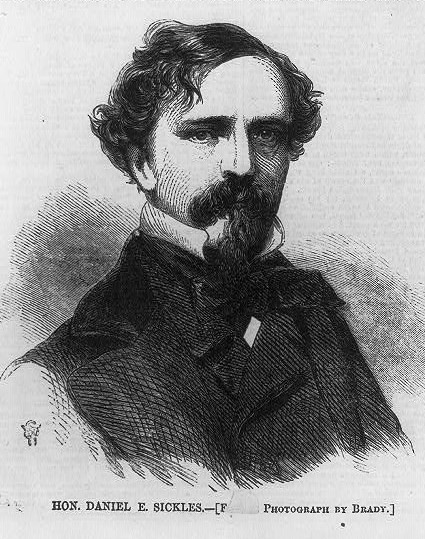
Daniel_Edgar_Sickles

Friends of Padre Steve’s World,

I am taking a break for the past week or so to read and reflect. As such I am re-posting some articles from my Gettysburg text dealing with a man that I consider one of the most fascinating , salacious, scandalous, heroic, and incredible figures ever to grace and disgrace American history, Congressman, and Civil War General Daniel E. Sickles.

I hope that you enjoy,

Peace

Padre Steve+

LongstreetJ_main

Lieutenant General James Longstreet C.S.A.

President John F. Kennedy paraphrased the words of the Roman Emperor Tacitus after the failed Bay of Pigs invasion, Kennedy told a journalist, “victory has 100 fathers and defeat is an orphan.” The problem in doing a proper analysis of Longstreet’s assault is the fact that many of the men involved on both sides made the battle personal, issuing scathing denunciations of one another, fudging the facts to their advantage, and by making the fight political a political football in the South and in the North.

The Confederate attacks had been badly directed and uncoordinated. In the end though McLaws’ and Hood’s divisions had succeeded in thrashing Sickles’ Third Corps in the exposed salient they were unsuccessful at breaking the Federal line. The disjointed nature of their attacks and the lack of active command and control by Lee and Longstreet had much to do with the outcome. Lee’s presence was needed on the south end of the Confederate line, but he left Longstreet to his own devices.

There was much blame to go around on the Confederate side, Longstreet placed much of the blame for the defeat on Lee, which earned him the everlasting enmity of many Confederates. But Lee’s Warhorse also met with criticism, especially for his performance on July 2nd 1863. Some of the most withering came not years later, but in the days following the battle. The harshest came from Lafayette McLaws, his old friend, who had been a favorite of Longstreet. McLaws blamed his corps commander for the defeat, writing his wife, “I think that the attack was unnecessary and the whole plan of battle a very bad one. Genl Longstreet is to blame for not reconnoitering the ground and for persisting in ordering the assault when his errors were discovered. During the engagement he was very excited [,] giving contrary orders to every one, and exceedingly overbearing. I consider him a humbug – a man of small capacity, very obstinate, not at all chivalrous, exceedingly conceited, and totally selfish….” [1]

One of Longstreet’s biographers wrote “Longstreet’s performance during the morning deserves criticism…. Had he attended to the details that were his responsibility and not allowed his disagreement with Lee to affect his judgment and effort, the afternoon assault would have begun sooner, but not several hours earlier.” [2] That historian believes that had Sickles not moved forward that Longstreet’s attack, even if made earlier would have met success, something echoed by Porter Alexander who wrote, “There seems no doubt that Longstreet’s attack on the 2nd been materially sooner, we would have gained a decided victory.” [3]

Casualties were heavy on both sides but the attack had failed and it had failed because of senior leadership of Lee and his corps commanders. Had Lee “duplicated the active role taken by his counterpart, George Meade, the outcome might have been different.” [4] But this too is speculation born of perfect 20/20 hindsight. One of Lee’s biographer’s wrote “Longstreet was disgruntled, Ewell was inept and Hill was unwell.” [5] To make matters worse, throughout the day, Robert E. Lee did not assert himself and even his most devoted biographer Douglas Southall Freeman would write that on July 2nd 1863 “the Army of Northern Virginia was without a commander.” [6]

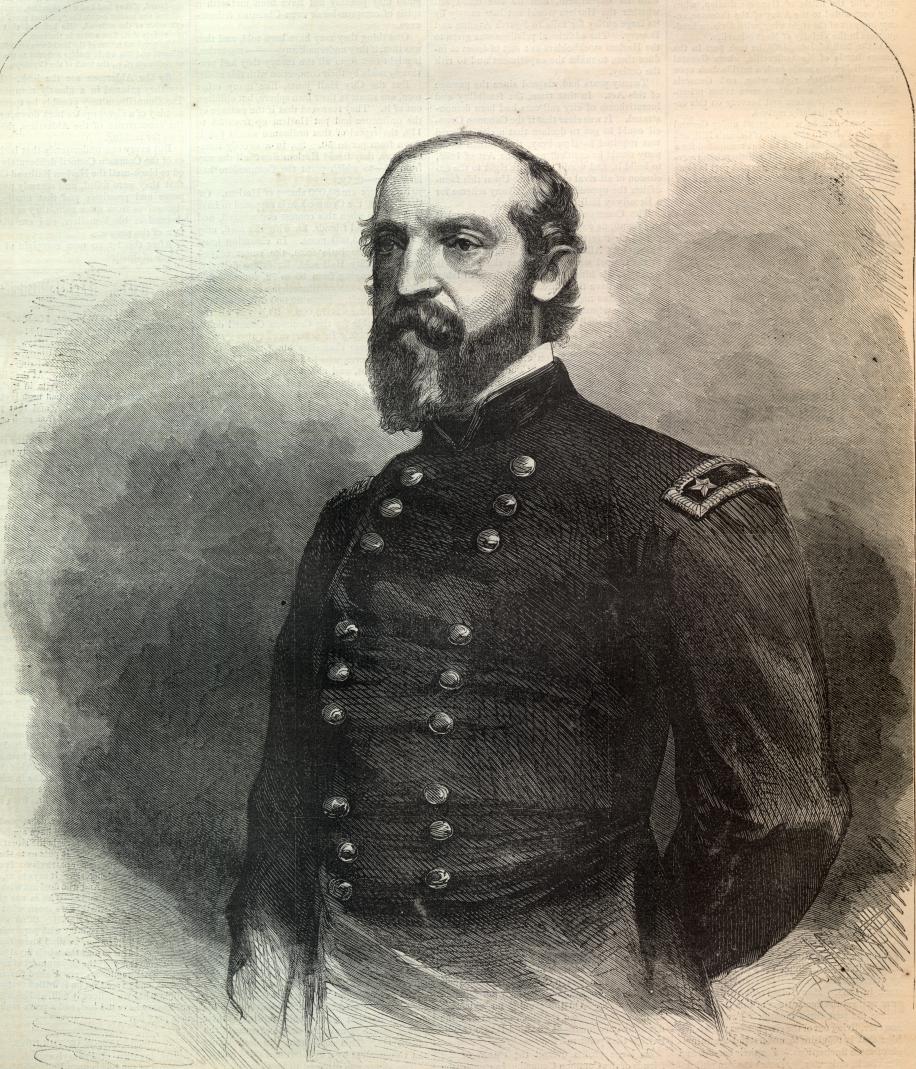
general-george-meade

Major General George Meade U.S. Army

On the Federal side most of the controversy has to do with Sickles’ decision to move the Third Corps forward from Cemetery Hill to the Peach Orchard and so it is appropriate to close this chapter discussing Dan Sickles. The matter has been a long subject of controversy, especially because of the way that Sickles politicized his actions in the press and in the Congressional hearings that followed. Many generals on both sides blundered at Gettysburg.

One can speculate that had Sickles remained in the position dictated by Meade that the Confederate assault might have gone down to an even more disastrous defeat. That being said the line that Sickles would have occupied with his 10,600 troops was long and he could not have held it in great strength, even Little Round Top would have been lightly occupied, and Meade might not have been forced to reexamine his line. It is fully possible that “had Longstreet attacked there with the same headlong fury, it is possible that the Confederates would have broken through not merely into Sickles’ rear, but into the entire Union rear and that disaster would have been the result.” [7] However, Sickles, even though he thought he was justified, was wrong in not informing Meade of the move, and leaving his army commander ignorant of the position of his left.

Sickles action, though an error, was something that could have been rationally addressed by him and Meade long before the Confederate attack began. Had the two men “worked in tandem – that is had the line taken by the Third Corps been shared by the Fifth, and had command matters been resolved and fallback plans established – Longstreet’s troops would have been hard pressed to achieve any of their goals.” [8] One historian put the matter of Sickles’s decision and the subsequent controversies into perspective:

“The entire episode has been clouded since 1863 by issues of politics and personality that hinder unbiased analysis. It is time to put aside such extraneous issues. When Sickles’s scandalous prewar behavior, postwar bombast, and special pleading are discounted and the case is considered solely on its merits, the results of the Third Corps advance speak for themselves. Dan Sickles was not perfect on July 2, 1862, but neither was he the military buffoon so often portray.” [9]

In his after action report Meade criticized Sickles and did so again before the Congressional Committee on the Conduct of the War, that latter in regard to comments made by Sickles and his supporters both to the committee and in the press. Meade not only had to deal with the diversions created by Sickles, he also had the real problem of Abraham Lincoln’s disappointment with his failure to catch and destroy the Army of Northern Virginia before it escaped across the Potomac. Dan Sickles did not have to worry about that, and “he could play the role that politicians play best: critic and second guesser.” [10]With the press on his side the former disgraced Congressman was now a one legged war hero, and Sickles attempted to use his redemption and status of a hero “to have Meade removed from command in disgrace.” [11] Many generals on both sides blundered at Gettysburg. Had Sickles taken the high road after the battle rather than attempting to torpedo the name and reputation of George Meade, his action might have provoked less controversy, and “Dan Sickles the historical figure has paid a permanent price for this, overshadowing the laudable work he did as an early force in establishing the Gettysburg National Memorial Park.” [12]

That was most unfortunate, for it has poisoned the discussion of the battle for over 150 years. Unlike Lee, Meade was constantly leading from the front on this long and brutal afternoon. Meade fought a magnificent defensive battle and recovered from the surprise of Sickles movement even as Sickles and his soldiers fought hard greatly impeded the Confederate plan. Sickles was praised in the press and even by long term enemies such as George Templeton Strong, who wrote, “I suppose Sickles… with his one leg, among our best volunteer officers. His recuperative powers are certainly wonderful. Four years ago he was a ruined man in every sense, a pariah whom to know was discreditable.” [13]

“The whole damned field is my memorial”

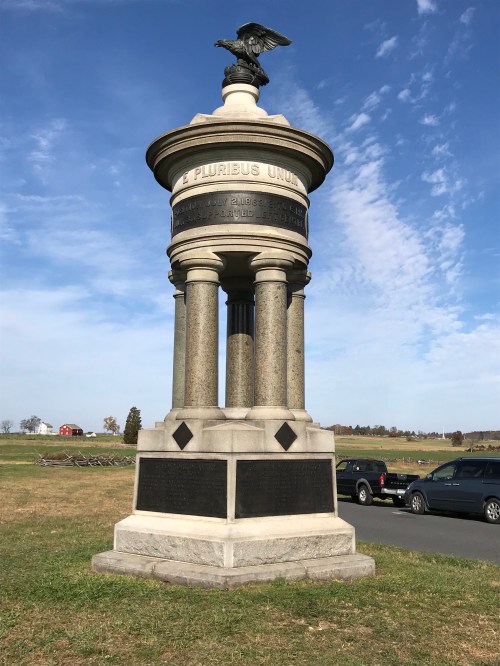
The Excelsior Brigade Monument at Gettysburg

But the continuing controversy which always seemed to swirl around him prevented him from being honored on the battlefield where he lost his leg. Alone of all the Union Corps commanders at Gettysburg Sickles has no memorial on the battlefield. When asked about the lack of a monument, Sickles, in his typical manner is reported to have said that “The whole damned field is my memorial.” [14]Despite the controversy surrounding his life, and those that swirled in the fighting and refighting of the Battle of Gettysburg, in true fashion Dan Sickles went on to further glory and scandal. Ulysses Grant never allowed him to command troops in the field, Sickles commanded the Military Department of South Carolina, the Department of the Carolinas, and the Department of the South, where was a strong proponent of Reconstruction. Teresa died of tuberculosis in 1866

He was retired as a Major General in the Regular Army in 1869 and went on to serve as Minister to Spain where he carried on an affair with the deposed Queen Isabella, a nymphomaniac who long before she ever Sickles had conducted a myriad of high profile affairs. The affair with the former queen was open and offensive to many people, but neither seemed to mind. In a sense they were kindred spirits. A Paris newspaper dubbed the one-legged General “the Yankee King of Spain.” [15]The affair with Isabella eventually burned itself out and Sickles married Senorita Caroline de Creagh, the daughter of a Spanish Minister, who bore him two children. To do this he converted to Roman Catholicism, something that he had never done when Teresa was alive. After his service in Spain was ended Sickles remained in Paris for four years, where he was widely admired and “received the office of Commander of the Legion of Honor.” [16]

Though a Democrat he supported Republican Presidential candidates Ulysses S. Grant and Rutherford Hayes, the latter against a long time Democratic rival from New York. As he got older Gettysburg became an increasing part of his life and in 1892 he ran for Congress in order to spearhead efforts to preserve the battlefield. He was elected and it was in large part due to his efforts that what we now know as the Gettysburg National Military Park exists. In 1893, Sickles met James Longstreet at a Gathering in Gettysburg, and the two men became lifelong friends. Since the war both men had been refighting the battle and the controversies that hung over their decisions that July 2nd like a pall. Longstreet, for his actions on the battlefield, and his decision to become a Republican and serve in the post-war Reconstruction efforts was a pariah in much of the South. That “unpopularity was painful to him, and he was glad to find a sympathetic ally in Sickles. Each of the two generals agreed that the other had moved with blameless skill that day,” [17] and both would defend the other in the succeeding years. As the continuing battle of Gettysburg was fought in the press and in histories written by various participants, Longstreet wrote of Sickles, “I believe it is now conceded that the advanced position at the peach orchard, taken by your Corps and under your orders, saved that battlefield for the Union cause.” [18]

Sickles was awarded the Medal of Honor in 1897, the citation stating, “Displayed most conspicuous gallantry on the field vigorously contesting the advance of the enemy and continuing to encourage his troops after being himself severely wounded.”

Sickles long to outlived George Meade who died in 1872 and all of the other Corps commanders of the Army of the Potomac, not to mention most of his friends and enemies. His father George Sickles died in 1887 leaving Dan an estate of nearly five million dollars. His daughter by Teresa, Laura, whose life had been so scarred by the events of 1859 died alone and estranged from her father. In 1896, disgusted by the nomination of William Jennings Bryant as the Democratic Presidential nominee, the one-legged Sickles went to work with his old Gettysburg comrade, the one-armed Oliver Otis Howard to campaign for the Republican William McKinley. They were quite a pair, the religious Howard, and the libertine Sickles, but they helped McKinley defeat Bryant, and McKinley remained grateful to them until his death by an assassin’s bullet.

In 1913 he attended the fiftieth anniversary ceremonies at Gettysburg where he watched the white haired survivors of Pickett’s Charge hobble across the wide battlefield into the arms of their former opponents on Cemetery Ridge. Helen Longstreet, James Longstreet’s second wife and widow quoted the words of a poet named Horatio King, for the event for a southern newspaper.

I see him on that famous field,

The bravest of the brave,

Where Longstreet’s legions strove to drive

The Third Corps to its grave

The fight was bloody, fierce and long,

And Sickles’ name shall stay

Forever in the hall of fame

As he who saved the day [19]

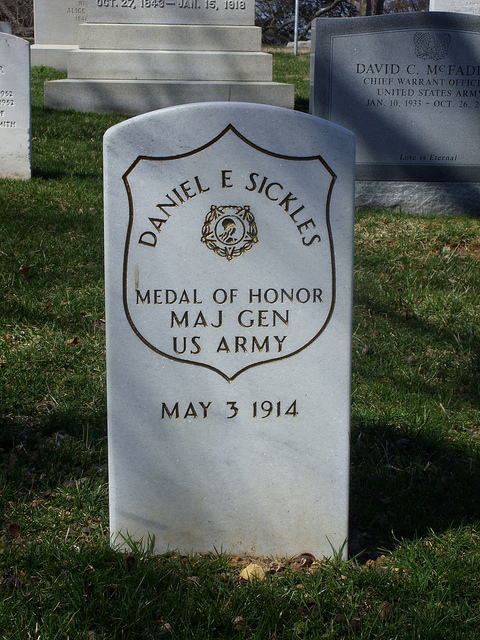
While Helen Longstreet’s claim that Sickles was “forever in the hall of fame” is a tad farfetched, there is no doubt that scoundrel had found redemption. When Sickles died in 1914 at the age of 94, his funeral was held at Saint Patrick’s Cathedral in New York and he was buried at Arlington National Cemetery, with full military honors, his flag-draped casket carried on an artillery caisson accompanied by a rider-less horse and artillery salutes. His funeral, in a military cemetery among other soldiers was “proof that he was no longer an attorney, politician, or even the murderer of Barton Key,” [20] he was a soldier. His tombstone simply reads:

Daniel E. Sickles

Medal of Honor

Maj. Gen. U.S. Army

May 3 1914

sickles grave

The New York Times made a comment that no one, be they an admirer or enemy could deny. “He was a truly adventurous spirit.” [21]

Notes

[1] Ibid. Oeffinger A Soldier’s General p.197

[2] Ibid. Wert General James Longstreet p.279

[3] Ibid. Alexander Fighting for the Confederacy p.278

[4] Ibid. Wert General James Longstreet p.279

[5] Taylor, John M. Duty Faithfully Performed: Robert E Lee and His CriticsBrassey’s, Dulles VA 1999 p.149

[6] Freeman, Douglas S. R.E. Lee volume 3 Charles Scribner’s Sons, New York 1935 p.150

[7] Ibid. Swanberg Sickles the Incredible p.235

[8] Ibid. Trudeau Gettysburg, the Testing of Courage p.421

[9] Robertson, William Glenn The Peach Orchard Revisited: Daniel E. Sickles and the Third Corps on July 2, 1863 in The Second Day at Gettysburg: Essays on Confederate and Union Leadership edited by Gary W. Gallagher, The Kent State University Press, Kent Ohio and London, 1993 p.56

[10] Ibid. Hessler Sickles at Gettysburg p. 244

[11] Ibid. Swanberg Sickles the Incredible p.235

[12] Ibid. Hessler Sickles at Gettysburg p. 401

[13] Ibid. Hessler Sickles at Gettysburg pp.244-245

[14] Ibid. Swanberg Sickles the Incredible p.390

[15] Ibid. Swanberg Sickles the Incredible p.321

[16] Ibid. Keneally American Scoundrel p.339

[17] Ibid. Swanberg Sickles the Incredible p.367

[18] Ibid. Keneally American Scoundrel p.341

[19] Ibid. Keneally American Scoundrel p.353

[20] Ibid. Hessler Sickles at Gettysburg p. 385

[21] Ibid. Swanberg Sickles the Incredible p.390

2 Comments

Filed under civil war, Gettysburg, historic preservation, History, Military

Murder in Lafayette Square, Dan Sickles: Part Two

Friends of Padre Steve’s World,

I am taking a break over the next few to read and reflect I am re-posting some articles from my Gettysburg text dealing with a man that I consider one of the most fascinating , salacious, scandalous, heroic, and incredible figures ever to grace and disgrace American history: Congressman, and Civil War General Daniel E. Sickles.

I hope that you enjoy,

Peace

Padre Steve+

philip-barton-key-granger


Within a year of his assignment Sickles returned to the United States to help prepare the Democratic nomination for his friend Buchanan who had long desired the office, and return to his lucrative post in New York. In the spring of 1856 Sickles began to work on Buchanan’s nomination for the Presidency and while doing so began his own campaign for New York’s Third District’s Congressional seat. Buchanan won the election of 1856 against an opposition divided between the Know Nothing candidacy of former President Millard Fillmore and the candidate of the new Republican Party, John C. Fremont.

In the election of 1856, Sickles carried the district easily. For Sickles it was a triumph, he was “riding a flood tide of political fortune that might carry him far,” [1] and like any wife Teresa too was delighted with the result. Even so, Teresa must have wondered if her husband would mend his ways now that he was on the national spotlight, or if he would continue his extramarital romps around the nation’s capital. Following the election Dan and Teresa moved to Washington D.C. where they took up a fashionable residence, the Stockton Mansion, on Lafayette Square, not far from the White House and Sickles friend, James Buchanan.

Once he was established in Washington Sickles was in his element, politics at its grandest. It was a different style than of politics than Tammany, where brass knuckled force often ruled, but it suited Sickles, who was “a fixer who knew all the tricks of Tammany at its crookedest but who seems not to have taken graft himself. He had his sights fixed on the presidency, and he was making about as much progress in that direction as a Tammany man can,” [2]   until a strange combination of unrequited love, infidelity, the personal betrayal of a friend, and a murder intervened.

HarpersMagazineMrs.Sickles

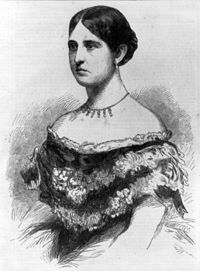
Teresa Sickles

While her husband politicked along the Potomac, the new congressman’s wife was adapting to her life in Washington D.C. The wives were expected to entertain and host parties on a regular basis at their residences, but they also knew their share of loneliness and neglect. Since legislators routinely were “busy with night sessions, committee meetings, and plain nocturnal politicking over whiskey punch, that their wives either accepted other escorts or spent lonely evenings at home with fancywork or a book.” thus it was not surprising that Teresa, “should seek the gayety of the capital in her first year there.” [3] In the absence of their husbands it “was not uncommon for available bachelors to act as escorts for married women when their husbands were unavailable.” [4] Since Dan Sickles was frequently unavailable and since Teresa probably still suspected that Dan was still engaged in extramarital affairs, it is not surprising that the young Mediterranean beauty found comfort in another man.

The years of 1857 and 1858 would be a tumultuous time for the nation as well as the Sickles. Buchanan had been elected because of his stability and moderation in an age of pro and anti-slavery radicalism. However, over the next year his presidency, and his would be overwhelmed by events and Buchanan’s decisions supporting the expansion of slavery. While Sickles was neither a slave owner, nor himself fond of the institution, it was part of life, and many of his friends in Washington D.C. and in Congress were slave holders. Buchanan had schemed before his inauguration with Chief Justice of the Supreme Court Roger Taney in the Dred Scott decision, which was handed down in the days following Buchanan’s inauguration, followed by the fiasco over the Lecompton constitution and the attempted admission of Kansas as a Slave State, an event which split the Democratic party in the 1860 election, ensuring Abraham Lincoln’s defeat of Buchanan’s Lecompton foe in the Senate, Senator Stephen A. Douglas who would have been the prohibitive favorite in the election had the split not occurred.

Likewise, Sickles and his beautiful young wife would become part of one of the most sensational trials of American history, rivaling the Lindbergh kidnapping trial, the trial of O.J. Simpson, the Scopes Monkey Trial, and the Impeachment of President Bill Clinton in its captivation of America. As in London, Teresa became popular and she and Dan were much sought after and their home “became the scene of a gradual number of and entertainments,” [5]and even as Sickles continued his robust politicking and philandering Teresa became the object of another’s affection, the District of Attorney for the District of Columbia, Philip Barton Key, the son Francis Scott key, the writer of the Star Spangled Banner. Interestingly enough it was Sickles who had helped Key the troubled man to be reappointed to his office in early 1857 after Key had helped Sickles overcome legal and financial difficulties to secure Sickles in the Stockton Mansion and the two men developed a warm friendship.

Philip Key was extraordinarily handsome, especially when outfitted in his green and gold militia uniform of the Montgomery Guards, and was considered one of the most desirable men in Washington. An accomplished horsemen he rode about town on his “horse Lucifer – a nobly bred, dapple gray hunter.”[6] When he gained Sickles’ friendship many of his well to do political and society friends became frequent visitors to the Sickles household. After Sickles had helped Key to be reappointed to his office, Key was instrumental in helping make the arrangements for Sickles to rent the Stockton Mansion.

During his first term in office Key was not known for being a particularly good District Attorney and spent much time away from the office complaining about his allegedly poor health. But his health did not keep him away from Washington’s party scene and “One hostess called him “the handsomest man in all Washington… he was a prominent figure at all the principle functions; a graceful dancer, her was a favorite of every hostess of the day.” [7] When he met Teresa, the dashing bachelor took an intense interest in the wife of the man who had helped him retain his job. The two were soon attending many functions together that Sickles, due to his work schedule could seldom attend.

Within weeks Key became a frequent guest at the Sickles home and few were surprised at this, as most observers knew that Sickles was responsible for Key’s reappointment. With Sickles now fully engaged in the dramatic political battles of late 1857, Teresa and Key began to spend much more time together. The two were seen together at the “theater, at teas, at hops. But most of all they went riding together.” [8] The frequency of these visits was noted and became the source of much gossip but Sickles was unaware of it and entertained no suspicions that his new friend was becoming deeply involved with his wife, and that Key had rented a room where the two could intimate.

That was until a young man equally smitten by Teresa had a few drinks with a colleague and the colleague shared the information with a loyal Sickles ally who then told Sickles. Sickles was shocked and called for a meeting with Key, however, after a brief conversation, Key convinced Sickles that there was nothing to the rumors, and Sickles was satisfied.

Though Sickles had been satisfied by the explanation, “despite his own well-publicized moral lapses, Daniel Sickles was a man of intense personal pride who would not countenance the breath of scandal attaching to his wife.” [9] He took the time to warn her to make sure that she was not involved in any other indiscretions, and left the subject. However, Key and Teresa continued to see each other, and “she and Barton thought that they were taking more care, and being less observed by people than they were.” [10] Yet as they pursued one another their affair became increasingly public, and seen by too many people not to go unnoticed. The two were seen together in at the Congressional Cemetery, and frequently at a house at “385 15th Street where he would enter the by the front door – and she the back.” [11] When a mutual friend expressed his concerns, Key shrugged off the warning, and “with the bravado of a proud weakling, he still held his course. And Teresa, ductile, enamored, blindly followed his lead.” [12] Another friend of Key suggested to him that he could be in danger, but Key “bridled and patted the breast of his coat. “I am prepared for any emergency,” he snapped. Key was a crack pistol shot and his friend believed that Key was preparing for a possible confrontation. [13]

Like so many people young spouses who find their needs unfulfilled at home, and who suspect their spouse of infidelity, , “Teresa did not see this love affair as tragic and dangerous. She lived within it as a secret fantasy, as in a virtual and time-consuming experience that lacked any power to inflict damage on other areas of her life.” [14] She became less discreet, Key would signal to her from across the street to confirm their dalliances and despite their insipidly inept attempt to hide the affair it became clear to Sickles’ coachman and household maids that the two were engaged in sexual encounters in the Sickles carriage and in the Stockton Mansion itself.

The situation finally came to a head in February 1859 following Sickles reelection and return to Washington. “Made more reckless than ever by their recent separation, Barton and Teresa now again were seen everywhere together.” [15] The couple were now making clandestine liaisons on a nearly daily basis, and eventually, one of the observers decided to tell Sickles. The anonymous source, using the initials of R.P.G. sent Sickles a letter detailing the affair. Sickles received the letter from a butler on the night of Thursday February 24th as he was leaving the usual dinner party at his house for the traditional hop that followed at the Willard Hotel.

Sickles did not read the letter until after the couple returned home and Teresa had gone to bed. Sickles was stunned and at first did not believe the contents as he placed little stock in anonymous messages. So he had George Wooldridge, a longtime friend and congressional clerk investigate, and on Saturday February 26th Wooldridge confirmed Sickles worst fears. That evening at their home Sickles confronted Teresa about the letter and as he stormed about angrily in their bedroom she confessed, after which Sickles had her write out her confession detailing everything. He may have been desolate and angry, but he was a lawyer, and he got his written proof.

But scandal was the last thing that Sickles wanted, as he had higher aspirations in politics, so he immediately called his friends for counsel and by Sunday morning several, including Wooldridge and Samuel Butterworth were at the Stockton Mansion with Sickles. As always, Sickles’ “first thoughts were for himself, and he melodramatically”[16] exclaimed to Butterworth, “I am a dishonored and ruined man…I cannot look you in the face.” [17]

4P8V9475

Murder

His friends “were profoundly touched by the depth of his feeling, and were convinced that he needed to be saved from a severe derangement of his senses; from lunacy, that is.” [18] his friends attempts to calm him, Sickles was beside himself with anger, and his anger now swirled around his marriage and what he believed was the scandal that would cost hi his career. That afternoon, Key again tempted fate, this time, for the last time. He had been tipped off by an anonymous letter that the affair was public, but he was determined to see Teresa. He made several passes by the house, each time signaling with a handkerchief, until Sickles observed him. Sickles called out to Butterworth “That villain has just passed my house! My God, this is horrible!” [19]

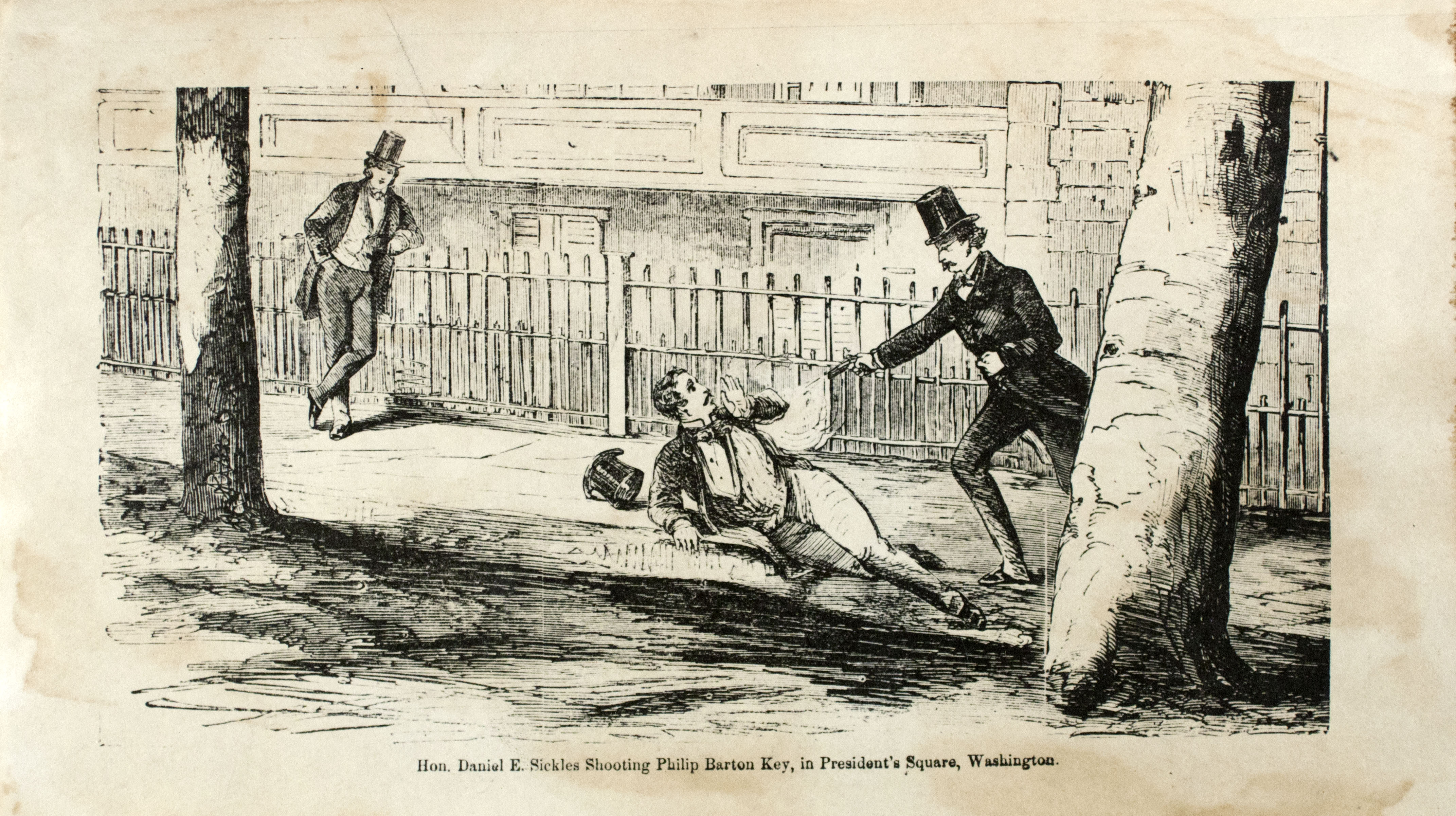
Butterworth left the house first and met Key at the southeast corner of Lafayette Square across from the White House. Allegedly not knowing Sickles intended any harm, Butterworth walked with Key to for a few minutes and then left. The exchange delayed Key and gave Sickles, who had armed himself with a single shot large caliber Derringer, and a muzzle-loading Colt revolver, enough time to catch up with Key near the Club House on Madison on the east side of the square. Sickles was raving but Dan’s fury transcended reality,” [20] as at least a dozen witnesses were nearby as he screamed, “Key, you scoundrel, … you have dishonored my bed – and you must die!” [21] Sickles pulled out the revolver, the first shot from which grazed Key, and the second which misfired. A brief scuffle ensued as Key lunged at his assailant, but Sickles flung him to the ground, and drew the Derringer as Key threw the opera glasses that he viewed Teresa at Dan. A third shot hit Key in the groin and he slumped to the ground screaming “Murder! Murder!… Don’t shoot!” [22]

If there was a chance for Sickles to prove that he acted in self-defense it was now, but he could not control himself. He fired the revolver yet again and it misfired. He placed the weapon in his pocket and drew the Derringer, and fired a shot which hit Key in the Liver. As Key writhed on the ground Sickles tossed the Derringer to the ground and he again drew the Colt. As the stunned witnesses to the attack looked on, Sickles advanced toward the fallen Key and placed the gun at his head and pulled the trigger, but again the weapon misfired. As Sickles attempted to place another cap in the pistol, a number of witnesses began to intervene. One man, “a member of the club, running up, stopped him. Mr. sickles – for God’s sake!” And Butterworth, coming forward, took Dan by the arm. Without a word, they walked away together.” [23] Witnesses took the mortally wounded Key away to the Club, where he expired.

President Buchanan was almost immediately told of the murder by a White House page boy, was aware of the implications of the scandal, Sickles was a friend and political ally with much promise. Buchanan told the boy leave town and gave him a sum of money to facilitate his departure. Soon after Sickles and Butterworth went by carriage “to the home of Attorney General Black, where the Congressman formally surrenders himself to the silver-haired Cabinet member who had regarded him as a protégé.” [24]He declined bail in favor of a speedy trial, was allowed to go home where he told Teresa that he had killed her lover, retrieved some personal items and then went to the District jail, “a foul hole, swarming with vermin, destitute of sewage, bath, water, ventilation, and so inadequate to its purpose that often a dozen or more prisoners were herded into a single narrow cell.” [25] When he arrived he reportedly asked the jailer if they were the best accommodations available, to which the jailer responded “this is the best place you members of Congress have afforded us.” [26] Dejected, but undeterred Sickles sent a message to the public, “In doing what I had to do I have broken the law. Therefore I place myself behind bars. It is for you to set me free.” [27] The stage was now set for the one of the most unbelievable and storied trials in American history.

Notes

[1] Ibid. Swanberg Sickles the Incredible p.4

[2] Ibid. Catton The Army of the Potomac: Glory Road p.151

[3] Ibid. Swanberg Sickles the Incredible p.15

[4] Ibid. Hessler Sickles at Gettysburg p.8

[5] Ibid. Swanberg Sickles the Incredible p.16

[6] Ibid. Pinchon Dan Sickles p.74

[7] Ibid. Hessler Sickles at Gettysburg p.9

[8] ibid. Swanberg Sickles the Incredible p.20

[9] Ibid. Swanberg Sickles the Incredible p.25

[10] Ibid. Keneally American Scoundrel p.92

[11] Ibid. Wilson and Clair They Also Served p.99

[12] Ibid. Pinchon Dan Sickles p.94

[13] Ibid. Swanberg Sickles the Incredible p.44

[14] Ibid. Keneally American Scoundrel p.92

[15] Ibid. Pinchon Dan Sickles p.93

[16] Ibid. Hessler Sickles at Gettysburg p.10

[17] Ibid. Swanberg Sickles the Incredible p.53

[18] Ibid Keneally American Scoundrel p.121

[19] Ibid. Hessler Sickles at Gettysburg p.10

[20] Ibid. Keneally American Scoundrel p.127

[21] Ibid. Swanberg Sickles the Incredible p.54

[22] Ibid. Hessler Sickles at Gettysburg p.11

[23] Ibid. Pinchon Dan Sickles p.112

[24] Ibid. Swanberg Sickles the Incredible p.55

[25] Ibid. Pinchon Dan Sickles p.114

[26] Ibid. Keneally American Scoundrel p.135

[27] Ibid. Swanberg Sickles the Incredible p.114

1 Comment

Filed under civil war, crime, History, laws and legislation

Dan Sickles, the Incredible Scoundrel and Patriot: Part One

Friends of Padre Steve’s World,

I am taking a break over the next week or so to catch up on some reading and reflection, and I am re-posting some articles from my Gettysburg text.  These deal with a man that I consider one of the most fascinating , salacious, scandalous, heroic, and incredible figures ever to grace and disgrace American history, Congressman, and Civil War General Daniel E. Sickles.

I hope that you enjoy,

Peace

Padre Steve+


6517740_orig


George Meade had made his dispositions on July 2nd 1863 with care, but there was one notable problem, the commander of III Corps, Major General Dan Sickles did not like the position assigned to his corps on the south end of Cemetery Ridge. But before discussing that it is worth chasing the rabbit so to speak and spend some time on the life of a man referred to by one by one biographer as an American Scoundrel and another as Sickles the Incredible. The interesting thing is that lie most complex characters in history that Dan Sickles was both and, “he might have had more faults than virtues, but everything about him was perfectly genuine.” [1] That is one of the reason that he is so fascinating.

Sickles was certainly a scoundrel and at the same time incredible, charming yet terribly vain and often insincere. “He was quick-witted, willful, brash, and ambitious, with pliable moral principles.” [2] But he was also incredibly brilliant, far sighted, patriotic, and civic minded. He was a political general, “flamboyant, impulsive, and brave, some would wonder about his discipline and military judgement.” [3] His notoriety and unpopularity among the West Point trained professional officers in the Army of the Potomac, as well as his tactical decision to move his corps on the afternoon of July 2nd 1863, and his subsequent political machinations ensured that he would be the only corps commander of that army not commemorated with a monument at Gettysburg.

Dan Sickles was one of the most colorful, controversial, and perhaps the most scandalous officer ever to command a corps in the history of the United States Army. While he lacked professional training he had done a fair amount of study of the military arts in his spare time, and he “made up for his lack of military training by acting on the battlefield with reckless courage, and was much admired for it by his men.” [4]

After having served as a brigade and division commander Sickles was promoted to corps command. “Sickles owed his elevation to corps command to the patronage of his friend Joseph Hooker…. And while man of the West Point officer….regarded Sickles military acumen with the greatest skepticism, many in the volunteer ranks were of a different mind. “Sickles is a great favorite in this corps,” asserted Private John Haley of the 17th Maine. “The men worship him. He is every inch a soldier and looking like a game cock. No one questions his bravery or patriotism.” [5] General Alpheus Williams who commanded a division in the Union Twelfth Corps despised Sickles, and after Chancellorsville Williams wrote “A Sickles’ would beat Napoleon in winning glory not earned,,, He is a hero without a heroic deed! Literally made by scribblers.” [6] Likewise, Sickles, the political general was no favorite of George Gordon Meade.

On July 2nd 1863 Sickles would be responsible for an act that threw George Meade’s defensive plan into chaos, and according to most historians and analysts nearly lost the battle, however, there are some who defend his actions and give him credit for upsetting Lee’s plan of attack. However, the truth lays somewhat in the middle as both observations are correct. Sickles’ decision created a massive controversy in the months following the battle as public hearings in Congress, where Sickles, a former congressman from New York had many friends, as well as enemies, sought a political advantage from a near military disaster.

Sickles was a mercurial, vain and scandal plagued man who “wore notoriety like a cloak” and “whether he was drinking, fighting, wenching or plotting, he was always operating with the throttle wide open.” [7]Sickles was born in New York to George and Susan Marsh Sickles in late 1819, though a number of sources, including Sickles himself cite dates ranging from 1819 through 1825. “There is little reliable information about Sickles’ early days,” [8] and he did not talk much about them, especially after the war, when Gettysburg and the Civil War became his main subjects of conversation. His father, a sixth generation American whose family were early Dutch settlers in Manhattan became wealthy through real estate speculation, “and he passed on to his son a pride in being a congenital Knickerbocker,” charming, witty, and clever, in whom “hardheadedness and impulsiveness were combined.” [9]

The young Sickles was an impetuous child and his father’s wealth ensured that Dan Sickles had “the finest of tutors…. And an unceasing bankroll of funding for lascivious escapades.” [10] To get their son special tutoring to prepare him for college, his parents “arranged for him to live in the scholarly house of the Da Pont family…. It was a household like few others in that hardheaded, mercantile city, at a time when New York had little of the Italian character it would later take on.”[11]The home was a place of learning, culture, and unusual relationships. The head of the house was Lorenzo L. Da Pont, a Professor at Columbia, as well as a practicing attorney. Also living in the home was Da Pont’s father, the ninety-year-old Professor Lorenzo Da Pont, who “had been the librettist for three of Mozart’s operas” [12] and “held the chair of Italian and Columbia University” [13] Additionally, the elder Da Pont’s “adopted daughter Maria and her husband, Antonio Bagioli, a successful composer and music teacher” [14] lived under the same roof.

Maria was only about twenty-years-old when Sickles moved in. By this time she and Bagioli already had a child of their own, a three year old daughter named Teresa, which Sickles would eventually marry. While the elder Da Pont claimed Maria as an adopted daughter, it was “widely believed that she was his “natural child” … from an American liaison conducted when he was near the age of seventy.” [15] This spawned rumors, even at the time of Gettysburg that the young Sickles “and his future mother-in-law had a sexual affair.” [16]

Whether the liaison with Maria Bagioli occurred is a matter of innuendo and conjecture, but it would not be out of character for Sickles, who, to put it mildly, had a wild proclivity for the opposite sex. As a young man he frequented brothels, and as his social and political status increased, he moved from the brothels frequented by the middle class to those which catered to the more socially well to do. One of his affairs was with the a prostitute named Fanny White, a woman who was smart, pretty, and upwardly mobile who ran her own bordello. His affair with Fanny was well publicized, but did not prevent him from being elected to the state legislature in 1847. She and Sickles would continue their relationship for years with her asking nothing more than expensive gifts, and there are inklings that Fanny help to fund Sickles’ early political campaigns. There is also speculation that in 1854 following his marriage, that Fanny spent time with him in London while he was working with James Buchanan and that that he “may have brought Fanny to one of the Queens’s receptions and introducing the prostitute to Her Majesty.” [17] But Fanny eventually moved on to a man older and richer than Sickles. Eventually she retired from her business and married another New York lawyer but died of complications of tuberculosis and possibly syphilis in 1860. Her property at the time of her death was conservatively “estimated at $50,000 to $100,000”[18] a considerable fortune for a woman of her day and age.

While he lived with the Da Pont family, Sickles gained an appreciation for foreign languages, as well as theater and opera. The elder Professor Da Pont was a major part of his academic life and quite possibly in the development of Sickles liberal education and his rather libertine morality. Lorenzo had been a Catholic Priest and theologian in Italy, but like his young American admirer had quite the attraction for women, and was a connoisseur of erotic literature and poetry. His activities resulted in him being expelled from his teaching position in the seminary, after which he became fast friends with a man whose name is synonymous with smooth talking, suave, amorous men, Giacomo Casanova, and in Europe “his affairs with women had been almost as notorious as those of his good friend.” [19] Certainly the elder Lorenzo’s tales “of Casanova, the fabled prince of Priapus, did nothing to quell Dan’s adolescent sexual appetite.” [20]

Noted Civil War and Gettysburg historian Allen Guelzo describes the Sickles in even less flattering terms, “Sickles was from the beginning, a spoiled brat, and he matured from there into a suave, charming, pathological liar, not unlike certain characters in Mozart operas.”[21]

Following the deaths of both the elder and younger Professor Da Pont, Sickles was stricken with grief. At the funeral of the younger Professor Da Pont Sickles “raved and tore up and down the graveyard shrieking,” [22] forcing other mourners to take him away by force. Soon after, Sickles left New York University and began to work in the law office of the very formidable New York lawyer and former U.S. Attorney General, Benjamin F. Butler.

While he was studying for the bar under Butler, he was joined by his father who would also become an attorney. It was under the influence of his father, who was now a wealthy Wall Street investor, and the Democrats of Tammany Hall that the incredibly talented Sickles was groomed for political leadership. Tammany was a rough and tumble world of hardnosed politics, backroom deals, corruption and graft.

He passed the bar in 1843 and soon was making a name for himself in the legal world, and in politics, despite his well-known questionable ethics and morality. His political career began in 1844 when “he wrote a campaign paper for James Polk and became involved in the Tammany Hall political machine.” [23] The ever ambitious Sickles “clambered up the city’s Democratic party ladder, on the way collecting allies and enemies with utter disregard for the consequences, attending the typically unruly Tammany meetings armed with bowie knife and pistol.” [24]

Like many of his fellow New York Democrats he was a proponent of “Manifest Destiny, and the right of the United States to acquire and hold Texas, New Mexico, California, perhaps the isthmus of Central American, and certainly Cuba.” [25] He was also a political ally of many states rights Southern Democrats and “largely opposed anti-slavery legislation.” [26] This was in large part due to the commercial interests of New York, which between banking and commercial shipping interests profited from the South’s slave economy.

He was elected to the New York State legislature in 1847 and his political star continued to rise even as his personal reputation sank among many of his peers. An attorney who knew him described Sickles as “one of the bigger bubbles in the scum of the profession, swollen, and windy, and puffed out with fetid gas.” [27] Sickles rivals any American politician, before or since in his ability to rise even as the slime ran down his body, the term “Teflon”applied to politicians like Presidents Ronald Reagan and Bill Clinton comes to mind when one studies Sickles’ career. New York lawyer and diarist George Templeton Strong wrote, “One might as well try to spoil a rotten egg as to damage Dan’s career.” [28]

But there was no denying that Sickles was a brilliant lawyer, politician, and debater. One observed that Sickles was “a lawyer by intuition – careful in reaching his conclusions, but quick and bold in pushing them.” [29]New York Governor “William Marcy grudgingly said that as a debater Sickles excelled any man of his years, and the astute Henry Raymond declared that as a parliamentary leader he was unsurpassed.” [30] Soon Sickles was a delegate to the 1848 Democratic Convention where he helped nominate Franklin Pierce for his unsuccessful run at the democratic nomination. The convention enabled Sickles to enter the world of national politics making friends with many influential politicians and financiers, including Pierce, the Van Burens, and James Buchanan. On his return to New York he received an appointed as a Major in the New York Militia.

Even as Sickles rose in the tumultuous world of American law and politics, and chased Fanny White he became enamored with the now teenage daughter of Antonio and Maria Bagioli, Miss Teresa Bagioli who though only fifteen was beautiful, wise beyond her years, fluent in French and Italian, devoted to the arts, and entirely besotted by Dan Sickles. Both the parents of Sickles and Teresa opposed the relationship, but both were madly in love, and Teresa was as headstrong as Dan regarding the relationship. Though such a relationship would be considered completely scandalous today, such marriages were not uncommon then, though they were certainly less common in the upper society of New York. Sickles “was enchanted by her” and “courted her with the sensibility of being a friend of her parents and he must have suspected that he loved her with a fated and exclusive love.” [31] When she was just sixteen Teresa quit school and married the thirty-three year-old assemblyman in a civil ceremony officiated by New York Mayor Ambrose Kingsland on September 27th1852. Six months later, the two were married in the Catholic Church by Archbishop John Hughes, in a “gala and largely attended affair.” [32]Just three months after the church wedding their daughter, Laura, was born. Though there can be no doubt that Sickles loved Teresa, and she him, it did not stop him from other extramarital affairs, nor did it take much away from his political machinations at Tammany Hall.

Following the 1852 Democratic convention where he again supported Franklin Pierce, Sickles hard fighting and influence at in the Wigwam of was rewarded with political plum prize of being appointed “corporation counsel of New York City, a post that paid a flattering salary with extra emoluments and also left room for profitable legal work on the side.” [33] His political and social acumen were again demonstrated as he convinced the state legislature, through personal force of will, to enable the New York City Corporation “to go ahead with creating a great central park,”[34] a park that we now know today as Central Park. He also helped push forward a proposal to create New York’s first mass transportation system, that of horse drawn omnibuses.

Later in the year Sickles was appointed as secretary of the American legation to the Court of St. James n London, headed by former Secretary of State James Buchanan. The position paid a pittance of what Sickles was earning in New York, but he realized that the serving overseas in such a position could not but help him on the national political stage. Though Buchanan and Pierce wanted Sickles, the new Secretary of State, the former New York Governor William Marcy refused to sign Sickles’ commission for the post. Eventually, Pierce prevailed and Sickles got the job.

As their baby, Laura, was still very young and sea travel still quite hazardous, Teresa remained at home, and joined her husband in London the following year. However, when she arrived in London, the teenage wife of Dan Sickles charmed Americans and Britons alike. Aided by her multilingual gifts, which “were rare among American diplomats’ wives,” [35] she became a great success and the unmarried Buchanan appointed her as hostess for the legation. She rapidly became a celebrity due to her stunning beauty and charm, and like he had Fanny, Sickles had Teresa introduced to the Queen. Her celebrity status evoked different responses from those that observed her. “One contemporary described Teresa as an Italian beauty, warm, openhearted, and unselfish. Another described her as being “… without shame or brain and [having] a lust for men.” [36] That “lust for men” coupled with the neglect of her husband may well have been the catalyst for the scandal which overwhelmed them in Dan’s congressional career.

It was during his service in London with Buchanan that Sickles became embroiled in one of the most embarrassing diplomatic incidents in American history. The proponents of Manifest Destiny and American expansion had long desired to take Cuba from Spain through diplomacy, or if needed force. Following a failed attempt by American “Filibusters” to seize the island in 1852 which ended in the execution of fifty Americans, including the son of U.S. Attorney General John Crittenden by Spanish authorities, and in 1854 President Franklin Pierce authorized Buchanan to attempt to negotiate the acquisition of Cuba.

Pierce authorized Buchanan to meet with James Mason, the United States Ambassador to France and Pierre Soule, the United States Ambassador to Spain secretly in order to draft “a statement on the future of Cuba and the proposed role of the United States.” [37] Soule dominated the meeting and the statement, which was in large part drafted by Dan Sickles, was highly inflammatory. Despite this the statement was released to the press in defiance of the order to maintain the strictest secrecy and it resulted in a diplomatic disaster for the Pierce Administration.

The document was prepared by Soule and Sickles and endorsed by Buchanan and Mason was known as the Ostend Manifesto, and it “was one of the most truly American, and at the same time most undiplomatic, documents every devised.” [38] The manifesto prepared by Soule and Sickles proclaimed that “Cuba is as necessary to the North American Republic as any of its present members, and that it belongs naturally to the great family of states of which the Union is the Providential Nursery.” [39] The authors of the manifesto also threatened Spain should the Spanish fail to accede to American demands. The authors declared that if the United States “decided its sovereignty depended on acquiring Cuba, and if Spain would not pass on sovereignty in the island to the United States by peaceful means, including sale, then, “by every law, human and Divine, we shall be justified in wresting it from Spain.” [40]

The Ostend Manifesto “sent shivers through the chancelleries of Europe, provoked hurried conversations between the heads of the French and British admiralties.” [41] European diplomats and leaders reacted harshly to the statement and Secretary of State William Marcy who had previously supported the ideas in the document immediately distance himself and official American policy from it and the authors. Marcy then “forced Soule’s resignation by repudiating the whole thing, but the damage was done.” For months the Pierce administration was on the defensive, and was condemned “as the advocate of a policy of “shame and dishonor,” the supporter of a “buccaneering document,” a “highwayman’s plea.” American diplomacy, said the London Times, was given to “the habitual pursuit of dishonorable object by clandestine means.”[42] The incident ended official and unofficial attempts by Americans to obtain Cuba by legal or extralegal means until the Spanish American War in 1898.

To be continued…

Notes

[1] Catton, Bruce The Army of the Potomac: Glory Road Doubleday and Company, Garden City New York, 1952 p.151

[2] Wert, Jeffry D. The Sword of Lincoln: The Army of the Potomac Simon and Schuster, New York and London 2005 p.222

[3] Ibid. Coddington The Gettysburg Campaign a Study in Command p.45

[4] Sears, Stephen W. Chancellorsville Houghton Mifflin Co. Boston and New York 1996 p.65

[5] Ibid. Trudeau Gettysburg a Testing of Courage p.110

[6] Ibid. Sears Gettysburg p.35

[7] Ibid. Catton The Army of the Potomac: Glory Road pp.150-151

[8] Hessler, James A. Sickles at Gettysburg Savas Beatie New York and El Dorado Hills CA, 2009, 2010 p.1

[9] Keneally, Thomas American Scoundrel: The Life of the Notorious Civil War General Dan Sickles Anchor Books, a Division of Random House, New York 2003 p.7

[10] Ibid. Guelzo, Gettysburg The Last Invasion p.243

[11] Ibid. Keneally American Scoundrel p.3

[12] Ibid. Hessler Sickles at Gettysburg p.2

[13] Ibid. Keneally American Scoundrel p.3

[14] Ibid. Hessler Sickles at Gettysburg p.3

[15] Ibid. Keneally American Scoundrel p.4

[16] Ibid. Hessler Sickles at Gettysburg p.3

[17] Ibid. Hessler Sickles at Gettysburg p.6

[18] Ibid. Keneally American Scoundrel p.215

[19] Swanberg, W.A. Sickles the Incredible copyright by the author 1958 and 1984 Stan Clark Military Books, Gettysburg PA 1991 p.79

[20] Ibid. Swanberg Sickles the Incredible p.80

[21] Ibid. Guelzo, Gettysburg The Last Invasion p.243

[22] Ibid. Swanberg Sickles the Incredible p.81

[23] Ibid. Hessler Sickles at Gettysburg p.4

[24] Sears, Stephen W. Controversies and Commanders Mariner Books, Houghton-Mifflin Company, Boston and New York 1999 p.198

[25] Ibid. Keneally American Scoundrel p.12

[26] Ibid. Swanberg Sickles the Incredible p.82

[27] Ibid. Wert The Sword of Lincoln p.222

[28] Ibid. Hessler Sickles at Gettysburg p.4

[29] Ibid. Swanberg Sickles the Incredible p.84

[30] Ibid. Swanberg Sickles the Incredible p.84

[31] Ibid. Keneally American Scoundrel p.21

[32] Wilson Robert and Clair, Carl They Also Served: Wives of Civil War Generals Xlibris Corporation 2006 p.98

[33] Ibid. Swanberg Sickles the Incredible p.88

[34] Ibid. Keneally American Scoundrel p.21

[35] Ibid. Keneally American Scoundrel p.39

[36] Ibid. Wilson and Clair They Also Served p.98

[37] Ibid. Keneally American Scoundrel p.44

[38] Pinchon, Edgcumb Dan Sickles: Hero of Gettysburg and “Yankee King of Spain” Doubleday, Doran and Company Inc. Garden City NY 1945 p.48

[39] Ibid. Potter The Impending Crisis p.190

[40] Ibid. Keneally American Scoundrel p.45

[41] Ibid. Pinchon Dan Sickles p.48

[42] Potter, David M. The Impending Crisis: America before the Civil War 1848-1861 completed and edited by Don E. Fehrenbacher Harper Collins Publishers, New York 1976 p.193

1 Comment

Filed under civil war, ethics, History, leadership

Recommitting to A New Birth of Freedom: The Gettysburg Address at 154 Years

Friends of Padre Steve’s World,

In November 1863 President Abraham Lincoln travelled to Gettysburg Pennsylvania yards behind the temporary to attend and say a few words at the dedication of the Soldiers Cemetery where the remains of the Union dead who had not been recovered by their families and taken home for burial were being interred by local laborers. When Lincoln arrived the process was barely halfway complete. The ground on West Cemetery Hill was still scarred by the battle that took place barely four and a half months prior, a battle that was the deadliest in United States military history in which the Army of the Potomac under the command of George Gordon Meade defeated Confederate General Robert E. Lee’s storied Army of Northern Virginia.

Lincoln was not the primary speaker, that honor went to Edward Everett, former Secretary of State, Senator, and Representative from Massachusetts. Everett, an academic from Harvard was also a leader in the Greek Revival and the Rural Cemetery movement in the United States. Gettysburg’s Evergreen Cemetery, less than 100 yards behind the temporary structure from which Everett and Lincoln would speak was a legacy of the movement that Everett had helped to begin. Now Everett was the primary orator at the dedication of of this cemetery dedicated to the Union dead, and Lincoln, the President there as more of window dressing.

Everett spoke for nearly two hours providing an impressive narrative of the battle. When he ended his speech, which was not long by the standards of his day it was left to Lincoln to say a few words. Those few words are now part of the lexicon of American secular scripture along with the Declaration of Independence, the Preamble of the United States Constitution, Franklin Delano Roosevelt’s “Four Freedoms” speech, andDr. Martin Luther King’s “I Have a Dream” speech.

His words are the antithesis of what is so often heard in American political discourse today. The fact is that while many Americans give lip service to all of these speeches, we have to admit that there is a significant portion of our population that not only give lip service to their ideas but actually oppose them, instead valuing theocracy, racism, authoritarianism, and militarism more than the ideals that the United States was founded upon. Despite that, they remain something that we must strive to pursue until this nation actually experiences the new birth of Freedom that Lincoln ended up dying to see established.

Lincoln’s words which he penned over a number of days were not long, and while some like Everett himself thought that they eclipsed his own words, many politicians and members of the press thought little of them. However, those words probably encapsulate the ideas of the founders better than any words outside of the Declaration of Independence. I will leave you with those words. So until tomorrow,

Peace,

Padre Steve+

Four score and seven years ago our fathers brought forth on this continent, a new nation, conceived in Liberty, and dedicated to the proposition that all men are created equal.

Now we are engaged in a great civil war, testing whether that nation, or any nation so conceived and so dedicated, can long endure. We are met on a great battle-field of that war. We have come to dedicate a portion of that field, as a final resting place for those who here gave their lives that that nation might live. It is altogether fitting and proper that we should do this.

But, in a larger sense, we can not dedicate — we can not consecrate — we can not hallow — this ground. The brave men, living and dead, who struggled here, have consecrated it, far above our poor power to add or detract. The world will little note, nor long remember what we say here, but it can never forget what they did here. It is for us the living, rather, to be dedicated here to the unfinished work which they who fought here have thus far so nobly advanced. It is rather for us to be here dedicated to the great task remaining before us — that from these honored dead we take increased devotion to that cause for which they gave the last full measure of devotion — that we here highly resolve that these dead shall not have died in vain — that this nation, under God, shall have a new birth of freedom — and that government of the people, by the people, for the people, shall not perish from the earth.

Abraham Lincoln
November 19, 1863

1 Comment

Filed under civil rights, civil war, Gettysburg, History, leadership, Political Commentary

They Too Needed Emancipation: Remembering the Common Confederate Soldiers


Monument to the 11th Mississippi on Seminary Ridge, Gettysburg 

Friends of Padre Steve’s World,

Today I drove home from Gettysburg after walking as an infantryman would have the battlefield in order to better get a feel for what the soldiers of both sides experienced. Over the two days I was there I walked almost 32 miles including walking across some of the most rugged terrain of the battle which gave me a far greater appreciation for the toughness, valor, and courage shown by the men of John Bell Hood and Lafayette McLaws’s divisions of the Confederate First Corps. Most of those men had marched between seven and twenty miles to get to their attack positions in the hot and humid weather of July 2nd 1863. If they even had them their shoes and boots were of relatively poor quality. As I walked seven miles with my hiking books and carrying a modern three day pack with about a 15 pound load I could only imagine the physical duress of those soldiers. To be sure I am 30 to 40 years older than most of those infantrymen, but still they had all marched between 200 to 300 miles before they even arrived at Gettysburg.

The physical stamina required of soldiers at war is something that most people today cannot imagine. Not only have most never served in the military but far fewer have served in combat. I have, but I didn’t have to walk everywhere like these soldiers did, and while I came under enemy fire I never had to charge up a rugged hill under rifle and artillery fire as did the men of Robertson, Benning, and Laws brigades did at Little Round Top on July 2nd 1863, nor did I have to fight outnumbered in an exposed position as did the men of the Union Eleventh Corps north of town on July First 1863.

I have always been able to admire the courage of any soldiers who fight in desperate battles, even those who fight for unjust causes. While I consider my service in Iraq to been the high point of my military career, I have come to see it as an unjust, and illegal war of aggression that under the Nuremberg codes could easily been declared an unjust war of aggression in which our political and military leaders could have been tried and found guilty as were men like Herman Goering, Alfred Jodl, Wilhelm Keitel, and Albert Speer.

Thus while I absolutely condemn the cause that the Confederate soldiers fought for I still admire their battlefield courage and toughness. Likewise I do not glorify their senior leaders including men like Robert E. Lee. I will write about him in a future article, maybe as soon as this week. Since I have the beginning of a draft article I should go back and finish it, but tonight I will only say that Lee was not that great of Commander and his battlefield decisions cost the lives of far too many Southern men, including those he had summarily shot for desertion after the war was irrevocably lost in the Fall and Winter of 1864 and 1865 many of who, having served two to three years in continuous combats were only trying to go home to their families who had lost all when William Tecumseh Sherman’s army cut its way through the heartland of Georgia and the Carolinas. I think that is one of the reasons that I find the monuments to Confederate leaders so despicable, these men cared nothing for the soldiers who sacrificed all in a morally wrong cause. I completely agree with Ulysses S. Grant who wrote of the vast majority of Confederate soldiers:

“The great bulk of the legal voters of the South were men who owned no slaves; their homes were generally in the hills and poor country; their facilities for educating their children, even up to the point of reading and writing, were very limited; their interest in the contest was very meagre–what there was, if they had been capable of seeing it, was with the North; they too needed emancipation.”

Speaking of monuments I write about the Confederate monuments at Gettysburg another time. Compared to the Union monuments they are few, and only two,that of the 11th Mississippi, and the 3rd Arkansas on Seminary Ridge are actually dedicated to specific units, the others are quite generic and convey mixed political and ideological messages which often demean the sacrifice of their soldiers who died on that battlefield. Once again I will defer writing about those messages until later, but as I walked Seminary Ridge and read each one I was stuck with the stories that each monument told.

So anyway, tomorrow begins a short work week for the Veteran’s Day holiday, a day where we honor all who served our country in peace and war. I usually get a bit melancholy over this weekend as I think about my friends and comrades that I served with over the course of my thirty-six year career in the Army and Navy.

So until tomorrow,

Peace,

Padre Steve+

1 Comment

Filed under civil war, History, Military, Political Commentary

Talking About Bad Ground: Walking the Gettysburg Battlefield, Devil’s Den, Little Round Top, the Wheat Field and more…


Friends of Padre Steve’s World,

Yesterday I wrote about my walk around the areas of the Battle of Gettysburg which transpired on the afternoon of July 1st 1863. Today was my crack at doing my best to experience walking the areas of the battlefield that were contested on July 2nd 1863 when Robert E. Lee ordered James Longstreet to assault the Federal left on the basis of Dick Ewell and Jubal Early’s intransigence in ordering a follow up assault on the Federal right, coupled with inaccurate information Lee had about where the end of the Federal line was. The result was the attacks by Longstreet’s divisions which came perilously close to succeeding but which after some of the bloodiest fighting during any three and a half hour period of the war were repulsed by Union troops the Third, Second, and Fifth Corps.


The engagements of that afternoon and evening are etched in our national conscience. Devil’s Den, Little around Top, the Bloody Wheat Field, and the Peach Orchard, not to mention the fights along Rose’s Woods, the Stoney Ridge, Trostle Farm, and Plum Run are each microcosms of the battle, each with heroes, villains, and tactical geniuses and idiots. But my purpose tonight is not to dissect those battles, I am doing that in a text about the Battle of Gettysburg. Instead it is to reflect upon military history and what the men who fought the battle endured.

If you want to understand military history and want to do so without having actually been to war or having taken the time to try to see and walk the ground the soldiers trod firsthand make a critical mistake, especially in campaigns where the soldiers had to walk into combat. As Guy Sager, who endured the Russian Front as an infantryman in the Second World War wrote in his book The Forgotten Soldier:

“Too many people learn about war with no inconvenience to themselves. They read about Verdun or Stalingrad without comprehension, sitting in a comfortable armchair, with their feet beside the fire, preparing to go about their business the next day, as usual…One should read about war standing up, late at night, when one is tired, as I am writing about it now, at dawn, while my asthma attack wears off. And even now, in my sleepless exhaustion, how gentle and easy peace seems!”


Like yesterday I walked. I left my car at my hotel and put on my boots and my three-day pack from Iraq. I ate a biscuit with a little bit of gravy, and had a small cup of coffee at the hotel before I set off. Since the hotel didn’t serve hardtack it was the closest I could get to a Civil War breakfast. From the hotel it is about a two mile walk to get to General Lee’s HQ on Seminary Ridge. Since Longstreet’s advanced elements were about that far back from Lee’s HQ on that morning I thought that it would approximate the march of some of his troops while understanding that some of his Corps had to march far more just to get there before beginning their movement to the south part of the battlefield.

Upon reaching Seminary Ridge I began walking down what would have been the areas occupied by A.P. Hill’s Third Corps that Longstreet’s troops would have passed as they moved south. The distance that they covered was about five miles as the crow flies, but due to bad staff work and coordination most of the men of John Bell Hood and Lafayette McLaws divisions had to go further just to get to their start point for the attack. In the case of Evander Law’s brigade of Hood’s division which had the mission of being the furthest south of the attacking Confederates, they had marched over twenty miles before beginning their attack on Little Round Top. When I reached the area that they did I had only walked about seven and a half miles as opposed to the men of Evander Law’s brigade who had marched over twenty miles to get into their attack positions, but as a mater of fact they were almost all a couple of decades or more younger than me.


When I got to the point of the Confederate attack I walked a path that intersected with the soldiers of Law’s brigade and Robertson’s Texas brigade, both of Hood’s division. Hood had vigorously protested the attack to Longstreet due to the bad ground that his troops would have to traverse to reach their objectives. As I wrote in my draft book on the battle:

Hood was never one to hesitate to attack, but when he saw the situation that faced First Corps, he objected to the attack. “For the first time in his army career Hood suggested a change of orders to his commanding general,” and pleaded with Longstreet to change it. “From his own observations and those of his scouts he concluded that the attack would be futile and result in wanton wage of life.” The fierce Texan “recognized that the battle order, written more than two miles away on mistaken information…did not fit existing conditions.” His objections included the rocky terrain which he believed would break up his battle formations, as well as “the concave character of the enemy’s line from the north end of Cemetery Ridge to Big Round Top would expose his division to a “destructive fire in flank and rear, as well as in front” if his men attacked it obliquely.” He told Longstreet that it was “unwise to attack up the Emmitsburg Road, as ordered” and requested that he be allowed to “turn Round Top and attack the enemy flank and rear.

Meanwhile, the debate between Longstreet and Hood continued as Hood objected and Longstreet reiterated Lee’s insistence on the planned attack. McLaws noted that Hood “found that the enemy were strongly posted on two rocky hills, with artillery and infantry…” and he pleaded for freedom of maneuver. He believed that an attack up the rocky hills was doomed and later noted “it seemed to me that the enemy occupied a position so strong- I may say impregnable – that independently of their flank fire, they could easily repulse our attack by merely throwing or rolling stones down the mountainside as we approached.”


One can look at the ground and one can study it on maps, but until you walk that bad ground, even without doing it while subjected to enemy fire you won’t understand how bad it is. I made my way down a walking path and then tried to move off of it in order to get to Devil’s Den. It was awful, reeds, thrushes, a stream, boulders, and heavy brush prevented me from moving forward. So I went back, followed a trail to Big Round Top and then headed over to Devil’s Den. General Hood was right, the ground to use the words that he spoke to Longstreet after he was wounded “it was the worst ground I ever saw” is not an exaggeration. But the diversion allowed me to find the part of the battle where Brigadier General Elon Farnsworth, after having unsuccessfully resisted orders from Brigadier General Judson Kilpatrick was forced to attack the well dug in Confederate infantry of Lafayette McLaw’s division on July 3rd.


From Devil’s Den I worked my way to Little Round Top. Most of the front slope is inaccessible due to the National Park Service doing a reclamation project, but there is a trail that leads up to it that many of the Confederates would have used. It was steep, and the ground was rugged. By the time I reached the top near the New York Monument I was exhausted. Despite having been in combat and being shot at I cannot imagine how the Confederate soldiers threw themselves up that hill facing small arms and artillery fire at point blank range. Their cause may have been wrong but they were valiant and tough soldiers. The fact that I am 30 to 40 years older than most of them is irrelevant, that ground was a bitch.


After that I went back over to the part of the battlefield occupied by the famous 20th Maine Infantry under the command of Colonel Joshua Chamberlain, and then followed their counter-attack down the hill. From there I went back across the rear slope of Devil’s Den to Houck’s Ridge where heavily outnumbered Union Regulars held their own against Hood and McLaw’s soldiers. From there I went over to the Bloody Wheat Field. Like the Bloody Corn Field at Antietam this was a killing ground which exchanged hands several times during the battle, about 30% of the 20,000 or so soldiers engaged there became casualties. When on looks it the field it is hard to imagine that so many men were killed and wounded in such a short amount of time. Walking across the ground I could not help thinking about the thousands of souls who suffered and died there.


From there I continued through Rose’s Woods and the Stoney Ridge where still more Union and Confederate soldiers fell in desperate fights before walking back west to the Peach Orchard. This was another bloody contest in which General Dan Sickles of the Union Third Corps surprised both the Confederates and his own Commander, General George Meade by moving his corps into an exposed position. The battle there cost many lives and apologists for Sickles, Meade, and the Confederates have used for their own benefit. Sickles is claimed to have nearly lost the battle for the Union, but Longstreet said that his movement and defense of the Peach Orchard was key to the Union victory. Again my purpose in this article is not to take a side in that controversy but to imagine the carnage of the battlefield as well as the bravery of the soldiers on it. It is hard to imagine being a Third Corps Soldier at the Peach Orchard as Confederate artilleryman Porter Alexander’s guns swept their positions, nor being one of McLaw’s infantrymen who were being slaughtered by the experienced Union artillerymen of Third Corps and the Artillery Reserve.


By the time I got to the Peach Orchard I was hungry, thirsty, exhausted, and my feet were hurting. I had a choice. I could simply walk up the Emmitsburg Road and head back to the hotel or I could continue to follow the route of the Confederate advance spearheaded by General Barksdale’s brigade. I went back across Excelsior Field and to the Trostle Farm where Sickles fell wounded, before crossing Plum Run and heading up Cemetery Ridge where the Confederate advance was halted. I then walked back to the hotel via Cemetery Ridge, the Taneytown Road and the Soldiers Cemetery, before making a brief stop on East Cemetery Hill.

Since I was exhausted and darkness and rain were beginning to close in I decided not to do my walk around the Culp’s Hill battlefield. That will have to wait for another time. Since the rain is expected to continue into the morning and I hate getting wet I’ll put off my walk around Culp’s Hill until another time.

Tomorrow I will head home early to help Judy do some work around our house. My friend Bill who met me last night had take care of a business emergency call from one of his customers in the Shenandoah Valley this morning and since it’s just me I figure I can head back home. Lord willing there is always tomorrow right?


But as a closing commentary:

In the past couple of months I have walked nearly 50 miles across two of the nation’s bloodiest battlefields, Antietam and Gettysburg. Honestly I don’t know a lot of people in policy making positions who do things like that. The tragedy of the American Civil War and the nearly three quarters of a million soldiers of both sides who died during it seems to me to have been forgotten or relegated to the realm of myth by too many Americans, including the President and many of his advisers and supporters. If we forget the cost and meaning of the Civil War, the validation of the proposition of the Declaration of Independence that all men are created equal then we do a grave injustice to those who fell in that war, unless we want to support Confederate Vice President Alexander Stephens who said that slavery was the Cornerstone of the Confederate nation. The costs to our nation are too great to let the the lessons of our Civil War be relegated to myth or exploited to reimagine a recreated Confederacy dominating the rest of the country are too great to allow the President, who has called violent neo-Confederates and White Supremacists “very fine people” or to fail to resist theocratic people from imposing their religious beliefs on others as did the Southern clergy who helped break the bonds of the Union beginning in their own denominations in the 1840s.

Since I have now eaten and had a few beers  I will take my 57 year old body to bed and get ready to head home in the morning.

So until tomorrow,

Peace

Padre Steve+

2 Comments

Filed under civil war, Gettysburg, History, Military, Political Commentary

Walking the Good and Bad Ground at Gettysburg


Friends of Padre Steve’s World,

I’m in Gettysburg this weekend getting a chance to do some research and walking areas of the battlefield that I have stopped at but never fully explored on foot. Trust me, there is a difference when you actually walk the ground versus making stops and looking around.


I drove up this morning and thankfully traffic was light and there were no traffic jams at any point along the way which meant I made the trip in just a bit over four hours. When I got here I checked into my hotel, unloaded my stuff and set to work walking the route I had planned out. My hotel is right at the base of East Cemetery Hill where the Union troops rallied on the night of July 1st 1863. I decided that I would walk through the town and up to McPherson’s Ridge where John Buford’s cavalry and John Reynolds’s First Corps fought A.P. Hill’s Third Confederate Corps, before turning north past the unfinished Railroad Cut and Oak Ridge on my way to Oak Hill where Confederate General Robert Rhodes’ division of Dick Ewell’s Second Confederate Corps went into action.


Oak Hill is the site of the Eternal Peace Monument which was dedicated by President Franklin Delano Roosevelt in 1938 as a symbol of reconciliation between the North and South. It bears the words “Peace Eternal in a Nation United”. That was a mere seventy-nine years ago and my heart breaks when I see the same forces at work which tore apart the nation in the years before the Civil War, and sadly they are being stirred up by President Trump who more resembles the incompetence of James Buchanan coupled with the malevolence of Jefferson Davis than Abraham Lincoln, or the loyal opposition of Stephen Douglas.


As I looked out from that high ground I saw the beautiful Pennsylvania countryside still covered in Fall foliage with fields of Sorghum ready for harvest, and cornfields waiting to be plowed over for the next season. Directly in front of me was the ground that two of Rodes’s brigades, those of Alfred Iverson and Edward O’Neal, both incompetent pro-secession political generals sent their units into the attack leading to their slaughter. As I walked into the field where those soldiers fell I felt a certain amount of sadness for them. Yes, most of them made the choice to enlist in the Confederate cause, while others joined out of peer pressure, or others because they were drafted: but none signed up to be slaughtered at the hands of their incompetent commanders. One regiment, the 23rd North Carolina lost 89% of the men it took into battle in barely half an hour of combat. As I walked across that swale in front of Oak Ridge where the men of John Robinson’s division awaited them I was struck by the tragedy of men who went into battle for an unjust and unrighteous cause who fell in such large numbers on July 1st 1863. I wrote in the draft of my yet unpublished Gettysburg book:

When the Confederates got to about fifty yards of Baxter’s troops the commander of the 83rd New York, the Swiss born lieutenant Colonel Joseph A. Moesch shouted: “Up men, and fire.” Moesch rode behind his line cheering his men on, but they needed no urging. In the words of one of one, “The men are no longer human, they are demons; a curse from the living here, a moan from the dying there. ‘Give them — shouts one.’ See them run’ roars another.” The well concealed veterans of Baxter regiments slaughtered them as they had O’Neal’s men just minutes before. “One regiment went down in such a neat row that when its survivors waves shirt tails, or any piece of cloth remotely white, Iverson thought that the whole regiment of live men were surrendering.” As the Confederate attack collapsed some “of the regiments in Robinson’s division changed front again, charged, and captured nearly all the men who were left unhurt in three of Iverson’s regiments.” Official Confederate reports list only 308 missing but that number differs from the Union reports, Robinson reporting 1000 prisoners and three flags and Baxter’s brigade nearly 400. As Robinson’s troops smashed the brigades of O’Neal and Iverson, they were joined by the remnants of Cutler’s brigade which changed its face from west to north to deliver more devastating fire into the Confederates.


From there I went over to Oak Ridge and then made my way to Blocher’s Knoll, now know as Barlow’s Knoll. Once you leave Oak Ridge the ground to the east is flat and relatively devoid of any good defensive positions. The Union Eleventh Corps Commander, Major General Oliver O. Howard sent two of his understrength divisions under the command of Carl Schulz to link up with the right flank of Robinson’s division and extend the Federal line to prevent it from being flanked. Unfortunately, one of the division commanders, Francis Barlow decided to advance his division to Blocher’s Knoll which was a mile in front of where Schurz and Howard intended. Noticing what was going on Schurz ordered the other division under the command of Schimmelpfenning to extend its line to maintain contact with Barlow’s division. But there were not enough troops to fill the gap. The line was barely a skirmish line and with no good defensive ground it could do little to stop a determined Confederate attack. Which was exactly what occurred.


George Doles’s brigade of Rodes division, strongly supported by artillery attacked the thin blue line of Schimmelpfenning’s division just as Gordon and Hays Brigades of Jubal Early’s division enveloped Barlow’s terribly exposed division. The men of Barlow and Schimmelpfennig’s divisions made a spirited and fierce defense before they were overwhelmed and retreated to Gettysburg, some making a fighting retreat, others fleeing the Confederate advance, many were killed, wounded or captured. Barlow lay wounded and was given aid by John Gordon who later became a lifelong friend. Schimmelpfennig was rescued from certain capture by a woman in the town who allowed him to hide in a shed behind her home as the Confederates moved into the town.


The memorials to these forgotten and often slandered soldiers line the road from the Mummasburg Road to Barlow’s Knoll. They did fight hard as A private of the 61st Georgia Infantry of Gordon’s brigade noted that the XI Corps troops “stood firm until we got near them. Then they began to retreat in good order. They were harder to drive than we had known them before….Their officers were cheering their men and behaving like heroes and commanders of ‘the first water’”

The 157th New York, was order to help shore up the line. The regiment advanced and engaged in a furious twenty minute fight, continuing the battle “in Indian fashion” until Schurz ordered them to retreat. The gallant 157th sacrificed itself buying time for others to withdraw and left over 75 percent of its men on the battlefield, when the order came, “less than fifty of the 157th were able to rise out of the wheat and follow.” “So the horrible screaming, hurtling messengers of death flew over us from both sides,” recollected a New York soldier. “In such a storm it seemed a miracle that any were left alive.” Krzyzanowski described the scene as “a portrait of hell.”

When one walks that ground it is impossible how that any unit of similar size or composition could have held against the massive pincer attack of Doles’s brigade and Early’s division on Barlow’s exposed position.


As I walked back into town I could imagine the chaos of the retreating Union troops as well as the victorious Confederates as day turned into evening. The Union troops who escaped made their way to link up with Steinwehr’s division and the Eleventh Corps artillery which had been positioned on Cemetery Hill as well as the survivors of the Union First Corps which had fought the Confederate Third Corps to a standstill before being forced back due to weight of numbers. I finished my walk by going up to Cemetery Hill where with the sun beginning to go down I walked among the graves of the fallen Union soldiers and a monument to John Reynolds who fell on McPherson’s Ridge.

As I noted a couple of months ago when I described my walk at Antietam, there is something immensely valuable about walking these battlefields. First, one gets to experience the elements of weather, distance, and terrain which are helpful in understanding what it was like for the soldiers involved. Second, one can see the battle from the perspective of those soldiers, imagining what it would be like to be deal with being under fire on that ground. One understands what men like John Buford and John Reynolds meant when they said that certain terrain was “good ground.” You don’t understand that until you walk it.


I finished tonight with a friend who met me here going to a number of pubs and walking through the town. While walking I saw a number of the churches that served as field hospitals, including Christ Lutheran. The horror of those hospitals is unimaginable to most of us. I have worked in inner city trauma centers and been in field hospitals in Iraq with our wounded and nothing can really prepare you for the horror of blown up, destroyed, and burned bodies of still living men on a such a massive scale.

But what I have experienced pales in comparison to what occurred at Gettysburg and Antietam, and what will certainly happen if war breaks out on the Korean Peninsula. I have been in the military all my adult life and I dread what I see coming, but since I know that chances are that it will happen I prepare myself and the men and women who serve under me for it. Sadly, most people, even those who have experienced combat in our recent wars are capable of imagining the carnage and horror of the next war. As a historian and a chaplain who has seen combat and a lot of other violent death I can well imagine it and no I don’t sleep well with that knowledge, especially when I see our President rattling sabers so often with seemingly little concern for the men and women that he will be committing to combat. In light of how he has dealt with the deaths of U.S. military personnel since he has been in office, taking no responsibility for any of them, passing the responsibility to military leaders, I tremble at the thought of what his next tweet might bring, but I digress.

Anyway, tomorrow begins another day of exploring parts of the battlefield on foot. Today I walked just over thirteen miles. I think that tomorrow I may well exceed that. I will tell you about that walk tomorrow night.

Peace,

Padre Steve+

1 Comment

Filed under civil war, Gettysburg, History, leadership, Military