Tag Archives: black codes

Rebels and Racism in Gettysburg 


Friends of Padre Steve’s World,

Gettysburg is hallowed ground for all who love this country. It is the site of a defeat which ended any hope for a Confederate military victory, and at which Abraham Lincoln spoke of a new birth of freedom. It is a place that veterans of both sides began to gather both to remember their service and comrades but also to promote reconciliation between the North and the South. 

But it has also become a place in recent years for neo-Confederates to gather, not to remember the new birth of freedom, but to arrogantly defile the site by spewing hate, proclaiming racism, while openly speaking of their hatred of the United States and love of the late Confederacy. Some drive around town and in front of the Soldier’s Cemetery in large and loud pickup trucks, sometimes blaring their horns, while flying large 3′ x 5′ Confederate Battle Flags flying as if to mock the Union soldiers buried there. 

It is also interesting to note that many of these openly racist people are not from the South, nor do they have southern roots. They simply tend to be racist and anti-government and gather around the flag of the Confederacy.  I remember having a beer with a man from upstate New York in a bar a year or so ago who said he was the chaplain for a Confederate reenactment unit (in uniform) and went on to discuss his hatred for the United States, as well as African Americans, and other non-white American citizens. Likewise on another visit an older couple who said they were from Georgia listened to me talk with my students in the Soldier’s Cemetery, and when I was finished with reading the Gettysburg Address, the man made sure that he told me that all people were not created equal. 

But let me be clear, there are also Southerners who love this country very much, who when they come to Gettysburg to remember their fallen ancestors, do so with a reverence which is perfectly in keeping with the desire for reconciliation of the Southern veterans as who returned to Gettysburg in the decades after the war. 

I was walking by one of the gift shops in town and noticed a t-shirt on display. The shirt was adorned with the Confederate Battle Flag and and the words “I will not be reconstructed and I don’t give a damn!” 

To some that may seem like a simple snarky statement. However, when you understand what the phase really means it should leave you cold. In 1866 it became part of the lyrics of a song called Oh, I’m a Good ole Rebel, a song that has been recorded numerous times in the years since it was written. 

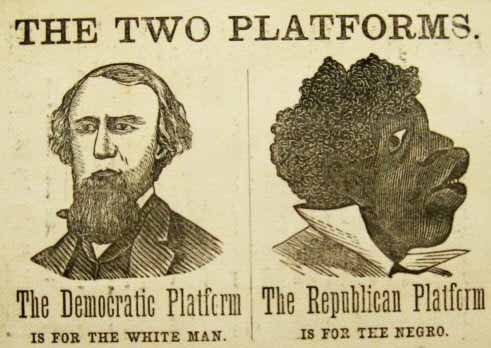
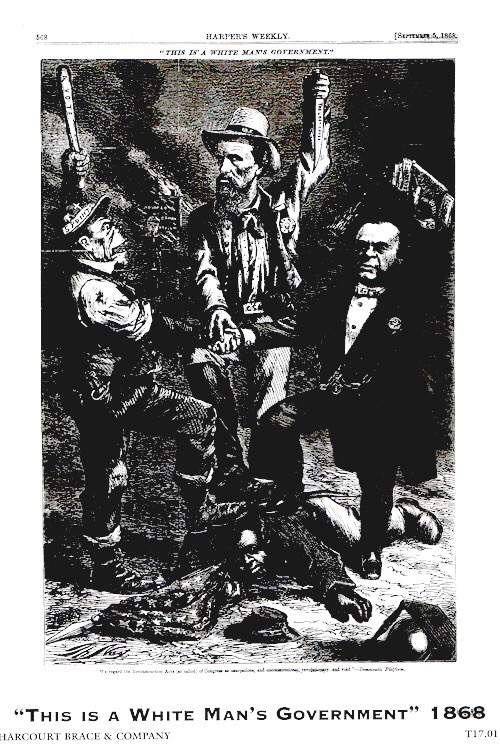
It was a phase used by Southerners after the Civil War who opposed the process of reconstruction, opposed all civil rights for blacks, and pushed for the return of white rule, which they achieved in 1877 when Reconstruction ended. At that point nearly every hard fought for right of African Americans was reversed, suppressed, or made so difficult to use as to be effectively revoked. Those rights would not begin to be restored until 1954 when the Supreme Court issued the Brown v. Board of Education decision which overturned the  Plessy v. Ferguson ruling of 1894. This ruling declared that the segregation laws and Black Codes of the Jim Crow era were unconstitutional. It took another ten years for Congress in the face of heated opposition to pass the Voting Rights Act of 1964 and the Civil Rights Act of 1965. 

But among segregationists those rulings were reviled. Governors fought to keep African Americans from entering segregated public schools and universities, civil rights workers were attacked and sometimes killed, civil rights leaders like Dr. Martin Luther King Jr were assassinated. Alabama governor George Wallace, who in his 1963 governor’s inauguration address proclaimed “segregation now, segregation tomorrow, segregation forever!” ran on a segregationist platform in the 1968 election and won 13.53% of the popular vote. He won Georgia, Alabama, Mississippi, Louisiana, and Arkansas, while collecting 45 electoral votes. Interestingly enough, the demographics of Wallace’s supporters, heavily white male and lesser educated, were very much like those of current GOP nominee Donald Trump. 

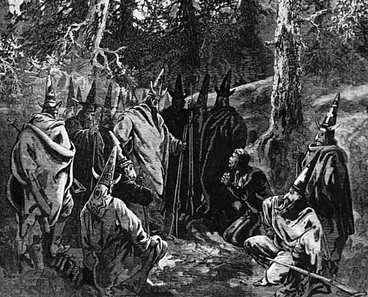
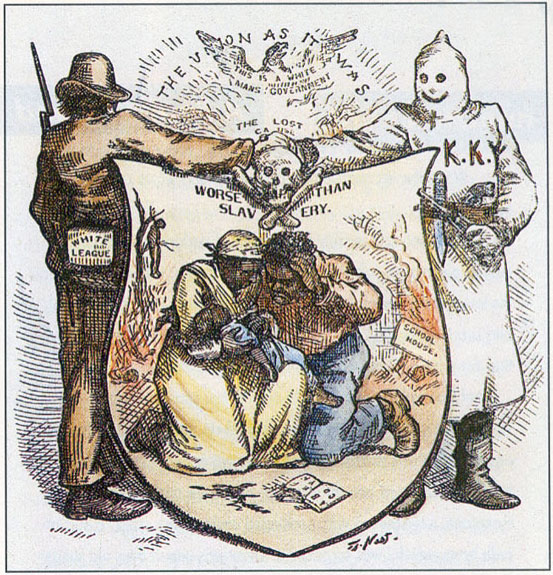
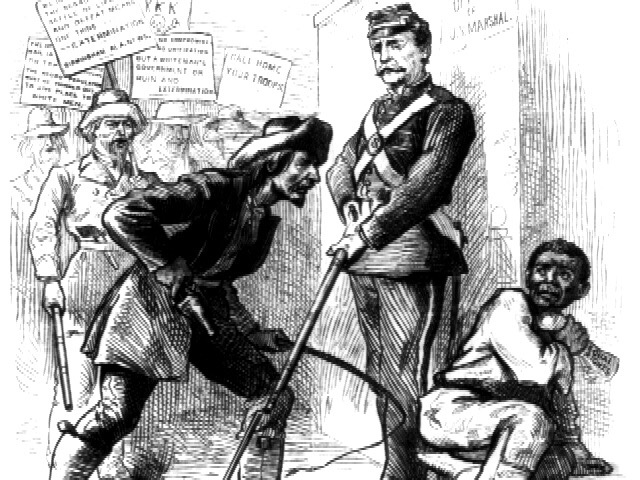
But I digress, yet the fact of the matter is that the open proclamation of the phrase I will not be reconstructed on a shirt displaying the flag of the republic that Confederate Vice President Alexander said, was founded on the superiority of the white race and subordination of the negro as slaves. They are the words of the KKK, the Red Shirts, and the White Leagues who used violence and terrorism to intimidate blacks and any of their white supporters. 

So a a historian I will not attempt to silence those people’s free speech rights, as repugnant as I find them to be. But have to call their words what they are, a call for the return to Jim Crow and worse. They are meant to intimidate people, and I find that message evil, in fact it goes against everything that makes America great. Maybe those who say they will “make America great again” should take heed to the Declaration of Independence, the Bill of Rights, and Lincoln’s Gettysburg Address and realize what really makes America great instead of spewing the hate of those who fought the propositions of life, liberty, and the pursuit of happiness at every turn, even to begin a bloody civil war. 

So until tomorrow have a great Monday.

Peace,

Padre Steve+


2 Comments

Filed under civil rights, Political Commentary

Slavery in a Different Form: The Collapse of Northern Support for Reconstruction

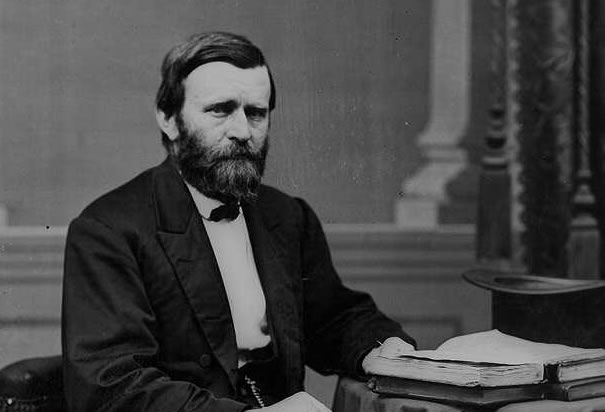
ulysses-s-grant-book

Ulysses Grant

Friends of Padre Steve’s World,

Since I am not doing anything really new this weekend unless something really big happens, here is a part of my Civil War text. Since I have posted a number of articles recently from it dealing with the Reconstruction and Jim Crow eras, I thought that this would be interesting. Have a great weekend.

Peace

Padre Steve+

It is all too easy to simply blame recalcitrant Southerners for the collapse of Reconstruction. However, it is impossible not to explore this without addressing responsibility of many leaders and citizens in the North for the failure of Reconstruction and the return of “White Man’s Rule” to the South. Like today, people faced with economic difficulties sought out scapegoats. When the country entered an economic depression in 1873 it was all too easy for Northern whites, many of who were willing to concede “freedom” to turn on blacks. Racism was still heavily entrenched in the North and for many, economic considerations trumped justice as the North tried to move away from Reconstruction and on to new conquests, including joining European powers in attempts to gain overseas colonies and territories.

As Southern extremists turned the Federal effort at Reconstruction into a violent quagmire that seemed to have no end, many Northerners increasingly turned against the effort and against Blacks themselves. Like so many victorious peoples they did not have the political or moral capacity to remain committed to a cause for which so many had sacrificed and they began to abandon the effort after two short years of congressionally mandated Radical Reconstruction.

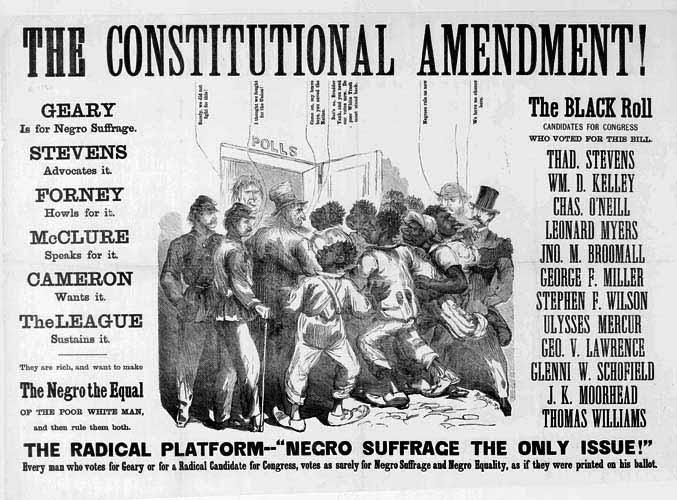
Likewise, the men who had so nobly began the effort to enfranchise African Americans failed to understand the social and political reality of the South. To the average Southerner of the era “political equality automatically led to social equality, which in turn automatically led to race-mixing. It was inevitable and unthinkable. To a people brought up to believe that Negroes were genetically inferior – after all, that was why they were slaves – the mere hint of “mongrelization” was appalling.” [1] This was something that most Northerners, even those committed to the political equality of African Americans could not comprehend, and the ignorance of this fact would be a major reason for the collapse of Northern political and social support for Reconstruction.

Congressman Thaddeus Stevens, one of the most effective leaders of the Radical Republicans died in 1868 in despair that the rights of blacks were being rolled back even as legislation was passed supporting them. A few weeks before his death Stevens told a friend “My life has been a failure…I see little hope for the republic.” [2] The old firebrand asked “to be buried in a segregated cemetery for African American paupers so that “I might illustrate in death the principles which I advocated through a long life, Equality of man before his creator.” [3] Others including Senator Ben Wade, were not returned to office while others including Edwin Stanton, Salmon Chase and Charles Summer all died during Grant’s administration.

While Grant attempted to smash the Ku Klux Klan by military means, both his administration and Congress were of little help. He faced increased opposition from economic conservative Republicans who had little interest in the rights of African Americans and who gave little support to those fighting for equal rights for blacks. The situation was further complicated by the “financial panic which hit the stock market in 1873 produced an economic downturn that soon worsened into a depression, which continued for the rest of the decade.” [4] The result was that Republicans lost their majorities in the House and in many states, even in the North.

It was clear that “1870 Radical Republicanism as a coherent political movement was rapidly disintegrating” [5] and during the early 1870s many of the antislavery activists had left the Republican party either to death or defection, many “no longer felt at home in a party that catered to big business and lacked the resolve to protect black rights.” [6]

In 1872, some former radical Republicans revolted against Grant and the corruption in the Republican Party. Calling themselves “Liberal Republicans” they supported the candidacy of Horace Greeley uniting with Democrats to call for an end to Reconstruction. For many this was not so much because they no longer supported the rights of African Americans, but because for them, like so many, “economic concerns now trumped race relations…. Henry Adams, who shared the views of his father, Charles Francis Adams, remarked that “the day is at hand when corporations far greater than [the] Erie [Railroad]…will ultimately succeed in directing the government itself.” [7] The numbers of Federal troops in the South continued to be reduced to the point where they could offer little or no support to state militia.

The combination of all of these factors, political, racial, economic, and judicial doomed Grant’s continued efforts at Reconstruction by executive means. Despite the hard fought battle to provide all the rights of citizenship and the vote to African Americans racism remained heavily entrenched in all regions of the country. In the North and the South the economic crisis of 1873 caused people to look for scapegoats, and blacks were easy targets. With economics easily trumping the cause of justice, “racism increasingly asserted its hold on northern thought and behavior.” [8] The Northern press and politicians, including former abolitionists increasingly took the side of Southerners, condemning Freedmen as lazy and slothful usurpers of white civilization.

Likewise the growing problem of labor unrest in the North brought about by the economic depression made “many white northerners more sympathetic to white southern complaints about Reconstruction. Racial and class prejudices reinforced one another, as increasing numbers of middle-class northerners identified what they considered the illegitimate demands of workers and farmers in their own society with the alleged misconduct of the former slaves in the South.” [9]

The depression hit Freedmen in the South with a vengeance and unable to pay their bills and mortgages many lost everything. This left them at the mercy of their former white masters who were able to force them into long term employment contacts which for practical purposes reenslaved them. Those whites who were still working for Reconstruction in the South were increasingly marginalized, stigmatized and victimized by a systematized campaign of propaganda which labeled them Carpetbaggers and Scalawags who had gained power through the votes of blacks and who were profiting by looting Southern Whites. In the end Southern intransigence wore out the political will of Northerners to carry on, even that of strongest supporters of emancipation and equality.

Violence now became a means to further politics in the South and carried out in broad daylight and “intended to demoralize black voters and fatally undermine the Republican Party…. They paraded at regular intervals through African American sections of small towns in the rural black majority areas, intimidating the residents and inciting racial confrontations.” [10] These armed bands were highly successful, if they were successful in provoking a racial incident they would then fan out throughout the area to find blacks in order to beat up and kill, hundreds of blacks were killed by them.

During the elections of 1876 the White Liners, Red Shirts, White League and others would be seen in threatening positions near Republican rallies and on Election Day swarmed the polls to keep blacks and Republicans out, even seizing ballot boxes either destroying them or counting the votes for Democrats. The strategy employed by the Democrats and their paramilitary supporters was to use “Lawless and utterly undemocratic means…to secure the desired outcome, which was to win a lawful, democratic election.” [11]

The pressure was too much for most Republicans in the South, and many who did not leave the South “crossed over to the Democratic fold; only a few stood by the helpless mass of Negroes….” [12] Of those in the North who did nothing to confront the resurgence of neo-Confederate mythology and who had worked against equal rights for African Americans during the Reconstruction era, “many embraced racism in the form of imperialism, Social Darwinism and eugenics.” [13]

The elected governor of Mississippi, Republican General Adelbert Ames, who was one of the most able and honest of all the Northerners to hold elected office in the South wrote in 1875 about the power of the paramilitary groups, “The “white liners” have gained their point – they have, by killing and wounding, so intimidated the poor Negroes that they can in all human probability prevail over them at the election. I shall try at once to get troops form the general government. Of course it will be a difficult thing to do.” [14] Ames requested Federal troops “to restore peace and supervise the coming elections” [15] but did not get them due to the subterfuge of Attorney General Edwards Pierrepont.

Grant told Pierrepont, a former Democrat who was critical of Grant’s insistence on the rights of African Americans that he must issue a proclamation for the use of Federal troops if Ames’s local forces could not keep order. He told Pierrepont “the proclamation must be issued; and if it is I shall instruct the commander of the forces to have no child’s play.” [16] Instead, Pierrepont altered Grant’s words and told Ames, “The whole public are tired out with these autumnal outbreaks in the South…and the great majority are now ready to condemn any interference on the part of the government….Preserve the peace by the forces in your own state….” [17] Ames, who had been a strong proponent of emancipation and black suffrage understood that he was being abandoned by Pierrepont and in order to prevent more bloodshed gave up the fight, negotiating a peace with the White League. Sadly, he like Grant realized that most of the country “had never been for Negro civil rights in the first place. Freedom, yes; but that didn’t mean all the privileges of citizenship.”  [18]  Ames’s deal with the Democrats and the White League resulted in blacks being forced from the polls and the Democrats returning to power in the state.  When Ames left the state, the discouraged veteran of so many battles including Gettysburg wrote, “A revolution has taken place – by force of arms – and a race disenfranchised – they are to be returned to a condition of serfdom – an era of second slavery.” [19]

Notes

[1] Ibid. Lord The Past the Would Not Die p.11

[2] Ibid. Langguth, A.J. After Lincoln p.233

[3] Ibid. Guelzo Fateful Lightening p.504

[4] Ibid. Perman Illegitimacy and Insurgency in the Reconstructed South p.458

[5] Ibid. Foner Forever Free p.170

[6] Ibid. Egnal Clash of Extremes p.337

[7] Ibid. Egnal Clash of Extremes p.337

[8] Ibid. Foner Forever Free p.192

[9] Ibid. Foner Forever Free p.191

[10] Ibid. Perman Illegitimacy and Insurgency in the Reconstructed South pp.459-460

[11] Ibid. Perman Illegitimacy and Insurgency in the Reconstructed South p.461

[12] Ibid. Lord The Past the Would Not Die p.15

[13] Loewen, James W. and Sebesta, Edward H. Editors The  Confederate and Neo-Confederate Reader: The “Great Truth” about the “Lost Cause” University Press of Mississippi, Jackson 2010 Amazon Kindle edition location 5258 of 8647

[14] Ames, Adelbert Governor Adelbert Ames deplores Violence in Mississippi, September 1875 in The Civil War and Reconstruction Documents and Essays Third Edition edited by Michael Perman and Amy Murrell Taylor Wadsworth Cengage Learning Boston MA 2011 p.434

[15] Ibid. Lord The Past the Would Not Die p.17

[16] Ibid. Lane The Day Freedom Died p.243

[17] Ibid. McPherson The War that Forged a Nation p. 190

[18] Ibid. Lord The Past that Wouldn’t Die p.17

[19] Watson, Bruce Freedom Summer: The Savage Summer of 1964 that Made Mississippi Burn and Made America a Democracy Viking Press, the Penguin Group New York and London 2010 p.41

Leave a comment

Filed under civil rights, civil war, history

Jim Crow and After

blog-crow-copy

Friends of Padre Steve’s World,

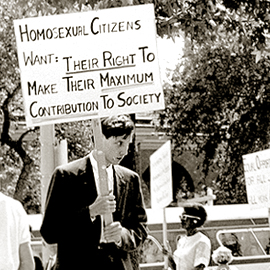
I am taking the day off to be with my wife as she recovers from her procedure and am posting another section of my Civil War text, this dealing with the coming of Jim Crow. It is still a pertinent topic, especially because there are quite a few people in our country today who would like nothing more than to re-establish it and in addition to African Americans include others such as Hispanics, Muslims, and Gays to their list of people that it would be legal to discriminate against. We are already seeing this in a number of Southern States when it comes to laws making it harder from Blacks to vote, especially elderly and poor ones, as well as religiously inspired anti-LGBT laws which are so vague, that they could be used against anyone.

So anyway, have a good day,

Peace,

Padre Steve+

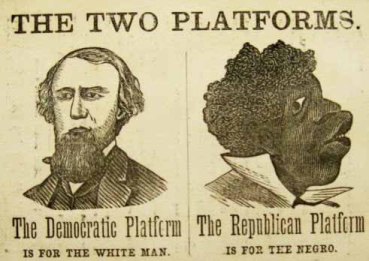
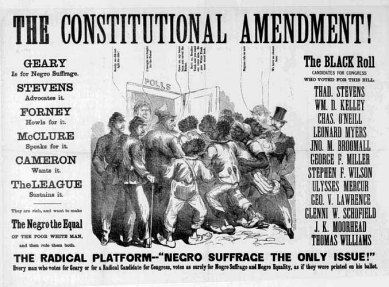
The legislation enacted by Congress to declare African Americans free, the Thirteenth Amendment; to recognize them as citizens, the Fourteenth Amendment; and to give African American men the right to vote, the Fifteenth Amendment were revolutionary documents. However, after Reconstruction ended every state in the South, with the acquiescence of Northern businessmen and politicians worked to roll back those rights and this ensured that the “resurrected South would look a great deal like the Old South, a restored regime of white supremacy, patriarchy, and states’ rights. This political and cultural principles became holy tenants, dissent from which threatened redemption.” [1] The means used to regain this in included state legislation against blacks, violence committed by people associated with racist terrorist groups such as the Ku Klux Klan, and the actions of Federal Courts including the Supreme Court to regulate those rights out of existence.

Newly elected President Rutherford B. Hayes officially ended Reconstruction in 1877 and all Federal troops assigned to enforce it were withdrawn. Despite this, some people in the South attempted to fight for the rights of African Americans, including men like former Confederate Generals James Longstreet, William Mahone and Wade Hampton. Their motives varied and all of them were vilified by their political opponents and by the press. The attacks on Longstreet were particularly vicious and in the Myth of the Lost Cause he is painted as a man worse than Judas Iscariot.

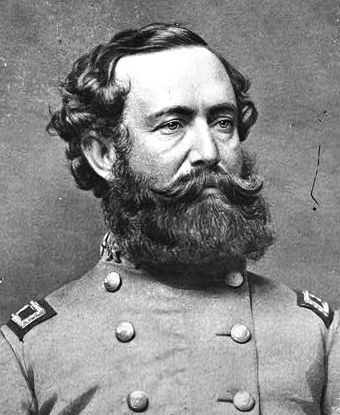
Hampton is perhaps the most contradictory and curious of these men. Hampton was and remained an avowed White Supremacist who used his own money to finance, recruit and lead a regimental sized unit in the Civil War. He was elected as the first post-Reconstruction governor of South Carolina despite the generous help and assistance of the Red Shirts to rig the election by suppressing the black vote, actually campaigned against the black codes. During his term in office Hampton, to the chagrin of white South Carolinians even appointed African Americans to political offices in the state and maintained a regiment of African American state militia in Charleston against strident opposition.

While Hampton remained a white supremacist and used the Red Shirt militia to help in his election as Governor of South Carolina, he disappointed many of his white supremacist supporters. Hampton, despite his past, was also was committed to the upholding the law and “promoting the political rights to which freedmen were entitled to under law, and he consistently strove to protect those rights.” [2] This made Hampton anathema for many South Carolina politicians, including Benjamine Tillman who as governor during the 1890s dismantled policies that Hampton had introduced to allow blacks to political patronage appointments. Once he did that Tillman set out to deprive South Carolina’s blacks of almost every basic civil right, and in 1895 he led “a successful effort to rewrite the South Carolina constitution in such a way as to virtually disenfranchise every black resident of the state.” [3] Longstreet, who had become a Republican, was wounded while leading Louisiana militia in an unsuccessful fight against White Leaguers in New Orleans on September 14th 1873.
voting

The Supreme Court, the Congress and the Presidents rolled back these rights after Reconstruction ended. The Courts were the first to do this and once they had set the precedent were followed by the now Democrat controlled Congress and President Grover Cleveland. In 1883 “the Civil Rights Act of 1875, outlawing discrimination against Negroes using public facilities, was nullified by the Supreme Court, which said: “individual invasion of individual rights is not the subject-matter of the amendment.” The Fourteenth Amendment, it said, was aimed at state action only. No state shall…” [4] Associate Justice Joseph Bradley who had so eviscerated the Enforcement Act again played his hand in overturning a law that he despised on principle. He had written when Grant first signed the act in 1875 “to deprive white people of the right of choosing their own company would be to introduce another kind of slavery…. It can never be endured that the white shall be compelled to lodge and eat and sit with the Negro. The latter can have his freedom and all legal and essential privileges without that. The antipathy of race cannot be crushed and annihilated by legal enactment.” [5] In writing to overturn the Civil Rights Act of 1875 Bradley wrote that such laws were made African Americans a “special favorite of laws” and ignored the fact that in most of the country blacks were indeed not a favorite and were in fact still the subject of discrimination, segregation, political disenfranchisement, systematized violence, murder and lynching.

The actions of the court and alliances between Northern corporations and Southern landowners led to even more discrimination and disenfranchisement for blacks, “From the 1880s onward, the post-Reconstruction white governments grew unwilling to rely just on intimidation at the ballot box and themselves in power, and turned instead to systematic legal disenfranchisement” [6] which furthered the black codes into what we now call the era of Jim Crow.

For years after the Supreme Court’s Cruikshank decision blacks throughout the South attempted to vote despite intense opposition from Southern whites and armed bands of thugs. But with White Democrats now in charge of local government and “in control of the state and local vote-counting apparatus, resistance to black voting increasingly took the form of fraud as well as overt violence and intimidation. Men of color who cast Republican votes often found later that they had been counted for the party of white supremacy.” [7]

101111-national-civil-rights-act-1875.jpg

In 1896 the Supreme Court in the case of Plessy v. Ferguson upheld the black codes and Jim Crow laws. That ruling established the “separate but equal” doctrine and ushered in an era of de jure segregation in almost all arenas of life including education, transportation, entertainment and health care. The limited social equity and privileges enjoyed by blacks, not only in the South, but in the entire nation were erased by the stroke of the judicial pen. The justices ruled on the concept that the Constitution only guaranteed or protected a people’s political rights in the social arena that African-Americans could not interact with whites and assumed their racial inferiority.

Not all on the Court agreed with these rulings. One of them was Associate Justice John Harlan, who was a former slaveholder. Harlan dissented in Court’s decision to overturn the Civil Rights Act of 1875 and also in Plessy v. Ferguson. In the case of the Civil Rights Act ruling Harlan insisted “our Constitution is color blind” [8] and wrote a strongly worded opinion:

“The destinies of two races, in this country are indissolubly linked together, and the interests of both require that the common government of all should not permit the seeds of race hate to be planted under the sanction of law. What can more certainly arouse race hate, what more certainly create and perpetuate a feeling of distrust between these races, than state enactments, which, in fact, proceed on the ground that colored citizens are so inferior and degraded that they cannot be allowed to sit in public coaches occupied by white citizens? That, as all will admit, is the real meaning of such legislation as was enacted in Louisiana.” [9]

As eloquent and as correct as Justice Harlan’s argument was, it was not sufficient to turn the tide of the new Court backed segregation laws. Harlan “was fighting a force greater than the logic of justice; the mood of the Court reflected a new coalition of northern industrialists and southern businessmen-planters.” [10] The “separate but equal” measures approved by the Court majority in Plessy v. Ferguson led to the widespread passage of Jim Crow laws, not only in the South but in other areas of the country. The Jim Crow era took nearly a century to reverse, and “only began to disappear with Brown v. Board of Education in 1954 and the Civil Rights and Voting Rights Acts of 1964 and 1965.” [11]

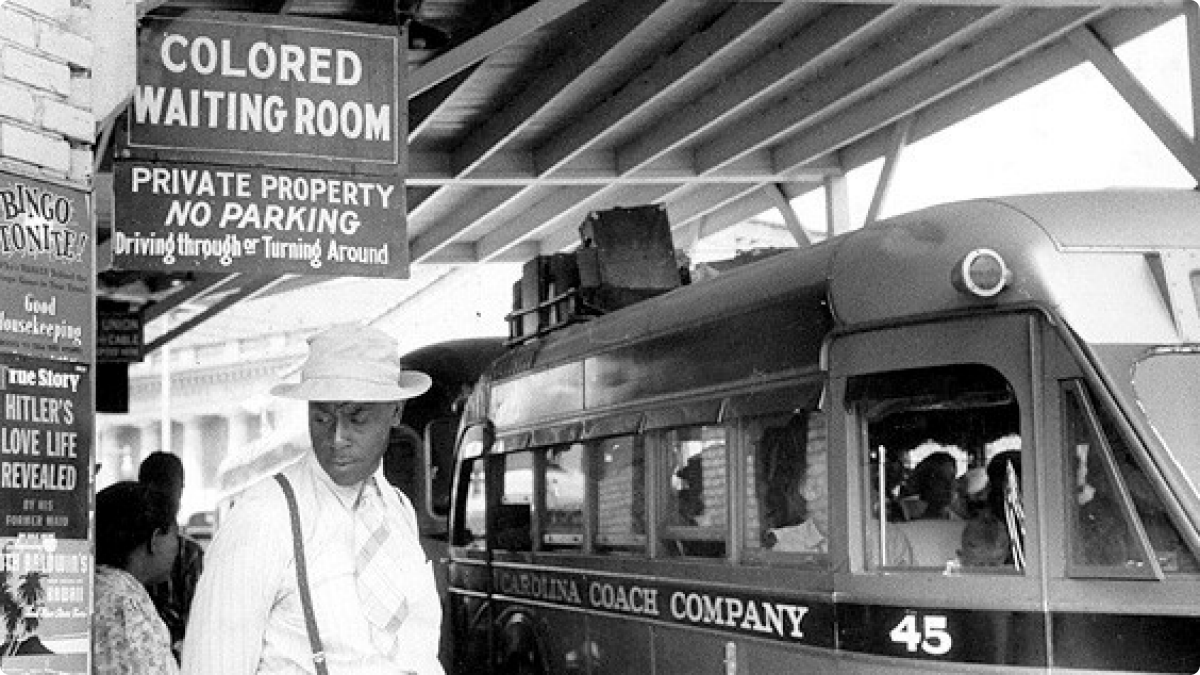
These court decisions and legislation strengthened racism and discrimination against blacks, “effectively excluding blacks from public places, from the right to votes, from good public education, and so forth.” [12] The Plessy ruling was a watershed. Southern legislators, now unencumbered by Federal interference passed “state laws mandating racial segregation in every aspect of life, from schools to hospitals, waiting rooms to toilets, drinking fountains to cemeteries…segregation was part of a complex system of white domination, in which each component – disenfranchisement, unequal economic status, inferior education – reinforced the others.” [13] For decades future courts would cite Plessy and Cruikshank as well as other decisions as precedent in deny rights to blacks. It would not be until 1954 when the Supreme Court overturned Plessy and the “Separate but Equal” Jim Crow laws in Brown v. Board of Education. Brown was a watershed for it deemed that separate schools were “inherently unequal.” The reaction across the South, especially Mississippi was stunned shock, disbelief and anger. “A Mississippi judge bemoaned “black Monday” and across the South “Citizen’s Councils” sprung up to fight the ruling. [14]

Mississippi led the way in disenfranchising black voters through the use of voter qualifications that would eliminate most blacks from the rolls of voters. In 1895 the state legislature passed a measure that would “technically apply to everybody but actually eliminate the Negro without touching the white.” [15] The move was in open defiance of the Fifteenth Amendment and resulted in tens of thousands of black voters being dropped from the rolls, in most cases under 5% of black voters who had been eligible to vote in 1885 remained eligible in 1896. Mississippi was rewarded in 1898 when the Supreme Court in Williams v. Mississippi that “there was no reason to suppose that the state’s new voting qualification were aimed specifically at Negroes.” [16] “In 1900 blacks comprised 62 percent of Mississippi, the highest percentage in the nation. Yet the state had not one black elected official.”  [17]

Violence was used with great effect and between 1880 and 1968 approximately 3,500 people were murdered or lynched throughout the South. This had become a far easier task and far less dangerous for the perpetrators of violence against blacks as Supreme Court “interpreted black people’s other constitutional rights almost out of existence.” [18] Since the court had “limited the federal government’s role in punishing violations of Negro rights” this duty fell to the states, which seldom occurred, and when “those officials refused to act, blacks were left unprotected.”  [19]

The effects of these actions were shown in the number of African Americans in elected office. In 1869 there were two African American United States Senators and twenty black members of the House of Representatives. After Reconstruction ended these numbers dwindled and “the last black left Congress in 1901.” [20]

One of these was the case of United States v. Harris where the federal prosecutors had indicted “twenty members of a Tennessee lynch mob for violating section two of the enforcement Act, which outlawed conspiracies to deprive anyone of “equal protection of the laws.” However the Court struck down section 2 because the “lynching was not a federal matter, the Court said, because the mob consisted only of private individuals.” [21]

Many Southern states, especially Mississippi continued to tighten Jim Crow throughout the first half of the twentieth century. “In 1922 a new Jim Crow law kept up with the times by segregating taxis. In 1930 another new law prohibited “publishing, printing, or circulating any literature in favor of or urging inter-racial marriage or social equality.” [22] Not only were physical barriers being erected, but thought and free speech was now illegal if one supported equal rights.

64982-004-E91C3D02

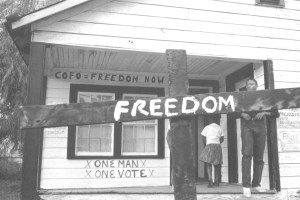
This remained the case until the 1960s when during the Freedom Rides when Mississippi again became a battleground in the Civil Rights movement. In 1961 James Meredith, a veteran of the U.S. Air Force, became the first black to ever be admitted to the University of Mississippi. His admission was fought by the university, Mississippi politicians including U.S. Senator James Eastland, Governor Ross Barnett, numerous congressmen and state representatives, and a populace that threatened violence and even war if the Federal government or courts order them to comply. Governor Barnett spoke for many when he made a statewide television address in September 1961 “We must either submit to the unlawful dictates of the federal government or stand up like men and tell them ‘NEVER!’” [23] He then called for the arrest of any federal officials who attempted to hold a state official for defying federal court orders. Backed by federal court orders to admit Meredith, and by the Brown v. Board of Education ruling, Attorney General Robert F. Kennedy called Barnett on September 24th.

“Governor,” Kennedy observed, “you a part of the United States.”

            “We have been a part of the United States, but I don’t know whether we are or not.”

            Are you getting out of the Union?”

            “It looks like we are being kicked around – like we don’t belong to it.”

            Back to specifics again, Kennedy ended the talk with a typical crisp wrap-up. “My job is to enforce the laws of the United States.” [24]

The resultant conflict nearly came to violence as thousands of Mississippians, whipped into an anti-black and anti-federal government frenzy by their elected leaders, radio, and television and newspaper commentators and supported by the KKK, the John Birch Society and other groups mobilized to fight the “invasion.” Eventually a deal was reached to admit Meredith on September 30th. As Meredith entered the campus he was protected by Federal Marshals and Border Patrol officers, as well as the State Police, which had just a few hours before been deployed to keep Meredith and the federals out. Despite this thousands of people ringed the campus, and the Confederate Battle Flag was raised over the Civil War memorial on campus. The rioters uttered death threats and assaulted anyone who supported Meredith. Members of the press, even southerners, faculty members and civilian supporters were beaten, bricks, stones and bottles thrown, tires of federal vehicles slashed. Finally the marshals themselves were attacked and eight injured, forcing them to deploy tear gas to protect themselves and the State police withdrew.
freedom_cross1

Eventually U.S. Army MPs and mobilized National Guard units were called up and battled Molotov cocktails which were being thrown by the anti-integration protests to relieve the beleaguered marshals and border patrolmen. The troops finally cleared the campus and ended the riot. During the riot 160 marshals were hurt, some 28 of who were wounded by bullets fired by the protestors. The next morning with Meredith admitted to the university a local clergyman saw the Confederate flag still flying and “with firm step, he strode out to the pole, loosened the halyard and lowered the Confederate flag.” [25]

The battle to integrate Ole’ Miss was over. Meredith graduated peacefully in August of 1963 and by then Mississippi abandoned its defiance of Federal authority, but many in the state still protested the admission as well as the later passage of the Civil Rights and Voting Rights Acts. Violence still occurred and even intensified at times as the Civil Rights movement, now led by Dr. Martin Luther King Junior made headway.

In South Carolina, which had fought integration in the courts outgoing Governor Ernest F. Hollings realized that the handwriting was on the wall, and South Carolina was different than Mississippi, its racism was the old aristocratic type, which gave more value to an orderly society. Hollings told the legislature:

“As we meet, South Carolina is running out of courts. If and when every legal remedy has been exhausted, the General Assembly must make clear South Carolina’s choice, a government of laws rather than a government of men. As determined as we are, we of today must realize the lesson of once hundred years ago, and move on for the good of South Carolina and our United States. This should be done with dignity. It must be done with law and order.” [26] When Clemson University admitted its first student later in the year, there was no violence.

More violence would occur in Mississippi and other states during the 1960s. During the Freedom Rides, students and educators came from around the nation to the state to help register blacks to vote in 1964. This brought generations of barely concealed hatred to the surface. Bruce Watson in his book Freedom Summer wrote:

“In Mississippi’s most remote hamlets, small “klaverns” of ruthless men met in secret to discuss the “nigger-communist invasion of Mississippi.” They stockpiled kerosene, shotguns, and dynamite, then singled out targets – niggers, Jews, “nigger-lovers.” One warm April night, their secret burst into flames. In some sixty counties, blazing crosses lit up courthouse lawns, town squares, and open fields. The Klan was rising again in Mississippi. Like “White Knights” as their splinter group was named, the Klan planned a holy war against the “dedicated agents of Satan…determined to destroy Christian civilization.” The Klan would take care of your business, a recruiting poster said. “Get you Bible out and PRAY! You will hear from us.” [27]

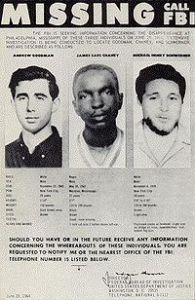
Eventual the violence of these people led to the killings of three of the organizers, Michael Schwerner, James Cheney and Andrew Goldman were killed by a group of Klansmen led by members of the Neshoba County Sheriff’s Department on June 21st 1964. The resultant search for their bodies and the subsequent investigation transfixed the nation and led to the passage of the Civil Rights and Voting Rights Acts of 1964 and 1965.
200px-AndrewGoodman-JamesChaney-MichaelSchwerner

After he left office, Ulysses Grant gave an interviewer a sober assessment of Reconstruction’s failure. Grant concluded that at the end of the war what the South really needed was a benevolent dictatorship until it could be fully reintegrated into the Union. He told the interviewer:

“Military rule would have been just to all… the Negro who wanted freedom, the white man who wanted protection, the Northern man who wanted Union. As state after state showed a willingness to come into the Union, not on their terms but upon ours, I would have admitted them. The trouble about the military rule in the South was that our people did not like it. It was not in accordance with our institutions. I am clear now that it would have been better to suffrage, reconstruction, State governments, for ten year, and held the South in a territorial condition. But we made our scheme, and we must do what we must with it.” [28]

Grant was correct in his analysis. The policies enacted by the North in 1865 that were considered benevolent were seized upon as signs of weakness in the defeated South. The leaders of the South knew that the Republican Party was a coalition and worked to push the fault lines of the Republicans until they broke, and they were successful. The Confederacy may have lost the war in a military and economic sense, but in the “ways that mattered most to white Southerners – socially, politically, and ideologically – the South itself did not.” [29] Grant died in 1885 hailed throughout the nation, but knowing that he was unable to secure the new birth of freedom, that he and his friend Abraham Lincoln and so many others had fought for in the Civil War.

The example of Reconstruction’s failure shows that in order to secure peace that military victory must be accompanied by the political will to ensure that the avowed goals of that victory are secured after the war in ensuring a just peace. In retrospect, a harsh peace and a long period of nation building may have benefited the nation more than botched reconstruction, but as Grant noted “our people did not like it.”

Southerners may have lost the shooting war, but they did not accept the peace and by successfully wearing down the will of the people of the North and exploiting the fissures in varying components of the Republican Party, they succeeded in winning the things most important to them in regard to race relations and White Supremacy.

After the war, White Southerners resorted to all means to reverse their military defeat through political, social, economic and judicial means and “justice was sacrificed for the unjust peace ushered in by “redemption” of the South, a peace marred by Jim Crow, poverty and lynching.” [30] Most Northern leaders, politicians, the media and the clergy failed to appreciate this until it was far too late, and hindered by President Johnson’s opposition failed to win the peace in the South when they had the best chance. They failed to appreciate that even after the shooting is often that “there is a need for further threats, and indeed action, because postwar disorder and even chaos will have to be address, and victorious allies are always likely to squabble over the spoils of victory” [31] as certain was the case in the divided Republican Party of the Reconstruction era. By the time Ulysses S. Grant was elected President many in the North were already tiring of Reconstruction and African Americans and when he resorted to harsh yet effective means of quelling violence and enforcing the laws many, even in his own Republican Party rebelled, ensuring the former Confederates of a political and social victory that took nearly another hundred years to end, if indeed it is truly ended.

Notes

[1] Ibid. Goldfield American Aflame p.403

[2] Longacre, Edward G. Gentleman and Soldier: The Extraordinary Life of General Wade Hampton Rutledge Hill Press, Nashville TN 2003 p.265

[3] Ibid. Longacre Gentleman and Soldier p.274

[4] Ibid. Zinn The Other Civil War p.57

[5] Ibid. Lane The day Freedom Died p.253

[6] Ibid. Guelzo Fateful Lightening p.526

[7] Ibid. Lane The day Freedom Died p.251

[8] Ibid. Zinn The Other Civil War p.58

[9] LaMorte, Michael W. School Law: Cases and Concepts 9th Edition 2008 Allyn and Bacon Inc. 2008 p.300

[10] Zinn, Howard A People’s History of the United States Harper Perennial, New York 1999 pp.204-205

[11] Ibid. Huntington Who are We? p.54

[12] Gonzalez, Justo L. The History of Christianity Volume 2: The Reformation to the Present Day Harper and Row Publishers San Francisco 1985 p.252

[13] Ibid. Foner Forever Free p.208

[14] Ibid. Watson Freedom Summer p.46

[15] Ibid. Lord The Past that Wouldn’t Die p.22

[16] Ibid. Lord The Past that Wouldn’t Die p.23

[17] Ibid. Watson Freedom Summer p.41

[18] Ibid. Lane The day Freedom Died p.253

[19] Ibid. Langguth After Lincoln p.338

[20] Ibid. Zinn A People’s History of the United States p.200

[21] Ibid. Lane The day Freedom Died p.253

[22] Ibid. Lord The Past that Wouldn’t Die p.25

[23] Ibid. Lord The Past that Wouldn’t Die p.139

[24] Ibid. Lord The Past that Wouldn’t Die p.159

[25] Ibid. Lord The Past that Wouldn’t Die p.231

[26] Bass, Jack and Nelson, Jack The Orangeburg Massacre Mercer University Press, Macon and Atlanta 1984, 1996 & 2002 pp.11-12

[27] Ibid. Watson Freedom Summer p.12

[28] Ibid. Lane The day Freedom Died p.254

[29] Ibid. Lane The day Freedom Died p.254

[30] Ibid. McPherson The War that Forged a Nation p. 191

[31] Ibid. Gray Fighting Talk p.14

Leave a comment

Filed under civil rights, History, News and current events, Political Commentary

The Black Codes

IMG_1879

Friends of Padre Steve’s World,

My wife is having a minor procedure today so I am publishing this article from my Civil War and Gettysburg text. It is not new, but has been updated some. Have a great day,

Peace

Padre Steve+

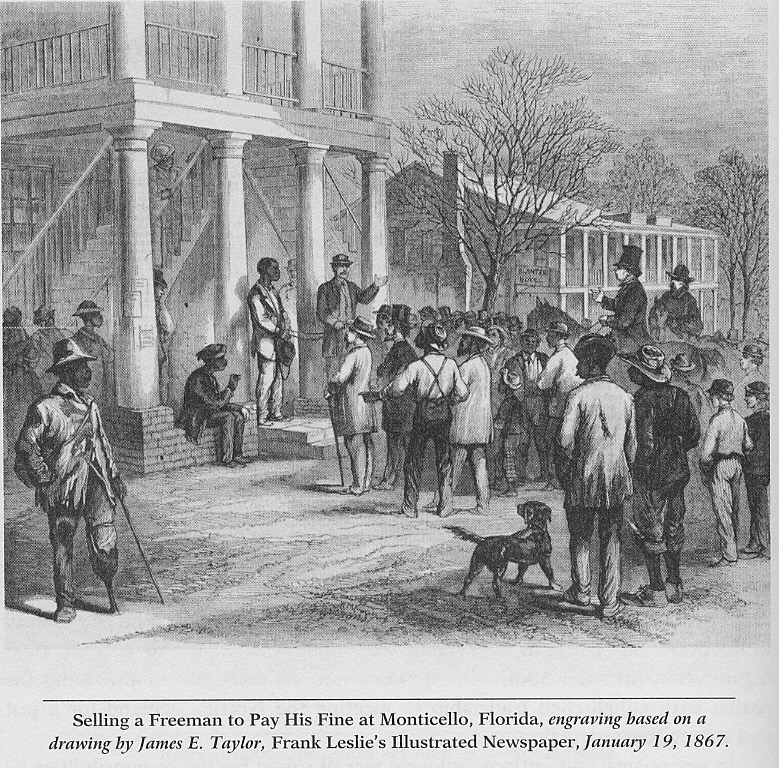
White Southerners including the newly pardoned Confederates enacted black codes that “codified explicit second-class citizenship for freedpeople.” [1] The legislature of Mississippi refused to ratify the Thirteenth Amendment, and did not do so until 1995. One Southerner noted that “Johnson “held up before us the hope of a ‘white man’s government,’ and this led us to set aside negro suffrage…. It was natural that we should yield to our old prejudices.” [2] Former Confederates, including Alexander Stephens the former Vice President of the Confederacy were elected to high office, Stephens to the United States Senate and the aggrieved Republicans in Congress in turn refused to admit the former Confederates. Many Union veterans were incensed by Johnson’s actions, one New York artilleryman noted “I would not pardon the rebels, especially the leaders, until they should kneel in the dust of humiliation and show their deeds that they sincerely repent.” [3] He was not alone, many Northern Veterans who formed the integrated Grand Army of the Republic veterans maintained a patent disregard, if not hatred of what the old South stood for and felt that their efforts in the war had been betrayed by the government.

Johnson’s restoration of property to the former white owners drove tens of thousands of blacks off lands that they had been farming, or left them as laborers for their former slave masters. Johnson countermanded General William Tecumseh Sherman and Secretary of War Edwin Stanton’s Field Order 15 to “divide abandoned and confiscated lands on the Sea Islands and in a portion of the Low Country coast south of Charleston into forty-acre plots for each black family.” [4] As such many freed blacks were now at the mercy of their former white owners for any hope of economic sustenance.

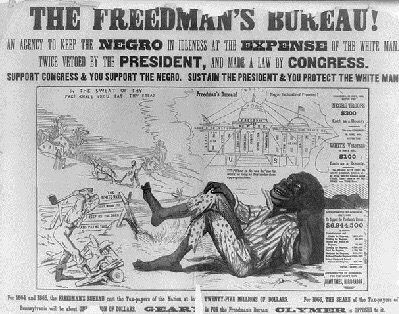
Johnson worked stridently, and often successfully to frustrate the efforts of the Freedmen’s Bureau headed by Major General Oliver Howard to help freed blacks to become landowners and to protect their legal rights. In immediate post-war South states organized all white police forces and state militias composed primarily of Confederate veterans, many still wearing their gray or butternut uniforms. In such a climate blacks had few rights, and officers of the Freedmen’s Bureau lamented the situation. In Georgia one officer wrote that no jury would “convict a white man for killing a freedman,” or “fail to hang” a black man who killed a white in self-defense. Blacks commented another agent, “would be just as well off with no law at all or no Government,” as with the legal system established in the South under Andrew Johnson. “If you call this Freedom,” wrote one black veteran, “what do you call slavery?” [5]

The struggle between Johnson and Congress intensified when the President vetoed the Civil Rights Bill. Congress responded by overriding his veto. Eventually the battle between Johnson and Congress climaxed when Johnson was impeached when he tried to remove Secretary of War Stanton from office. Johnson barely survived the impeachment proceedings and was acquitted by one vote in the Senate in 1868.

The various black codes enacted throughout the South were draconian measures to codify and institutionalize racism and White Supremacy:

“passed labor laws that bound blacks to employers almost as tightly as slavery once bound them to their masters. Other codes established patterns of racial segregation that had been impossible under slavery, barred African Americans from serving on juries or offering testimony in court against whites, made “vagrancy,” “insulting gestures,” and “mischief” offenses by blacks punishable by fines or imprisonment, forbade black-white intermarriage, ad banned ownership by blacks of “fire-arms of any kind, or any ammunition, dirk or bowie-knife.” [6]

Mississippi’s Black Codes were the first of these and among the sections dealt with a change in vagrancy laws, specifically aimed at emancipated blacks and those whites who might associate with them:

“That all freedmen, free Negroes, and mulattoes in this state over the age of eighteen years found on the second Monday in January, 1866, or thereafter, with no lawful employment or business, or found unlawfully assembling themselves together in the day or night time, and all white persons so assembling with freedmen, free Negroes, or mulattoes on terms of equality, or living in adultery with a freedwoman, free Negro, or mulatto, shall be deemed vagrants; and on conviction thereof shall be fined…and imprisoned….”  [7]

The black codes were condoned and supported by President Johnson. While the black codes recognized the bare minimal elements of black freedom, their provisions confirmed the observations of one journalist who wrote “the whites seem wholly unable to comprehend that freedom for the negro means the same thing as freedom for them. They readily admit that the Government has made him free, but appear to believe that the have the right to exercise the old control.” [8] As state after state followed the lead of Mississippi, which was the first state to enact black codes Northern anger grew and some newspapers took the lead in condemn the black codes. “We tell the white men of Mississippi,” exploded the Chicago Tribune on December 1, “ that the men of the North will convert the state of Mississippi into a frog pond before they allow any such laws to disgrace one foot of soil in which the bones of our soldiers sleep and over which the flag of freedom waves.”  [9]

Within weeks of the end of the war, violence against blacks began to break out in different parts of the South and it continued to spread as Johnson and the new Congress battled each other in regard to Reconstruction policy:

“In Memphis, Tennessee, in May of 1866, whites on a rampage of murder killed forty-six Negroes, most of them veterans of the Union army, as well as two white sympathizers. Five Negro women were raped. Ninety homes, twelve schools and four churches were burned. In New Orleans in the summer of 1866, another riot against blacks killed thirty-five Negroes and three whites.” [10]

The hatred of blacks and the violence against them was not limited to adults, children joined in as well. In Natchez Mississippi an incident that showed how deep the antipathy towards blacks was when on a Sunday afternoon, “an elderly freedman protested to a small white boy raiding his turnip patch. The boy shot him dead, and that was that. In Vicksburg the Herald complained that the town’s children were hitting innocent bystanders when using their “nigger shooters.” [11]

Colonel Samuel Thomas, the director of the Freedmen’s Bureau in Mississippi noted the attitudes that he saw in many whites toward the newly emancipated African Americans. He wrote that white public sentiment had not progressed and that whites had not “come to the attitude in which it can conceive of the negro having any rights at all. Men, who are honorable in their dealings with their white neighbors, without feeling a single twinge of honor….And however much they confess that the President’s proclamation broke up the relation of the individual slave to their owners, the still have the ingrained feeling that the black people at large belong to whites at large.” [12] Sadly, the attitude reported by Colonel Thomas not only remained but also grew more violent with each passing month.

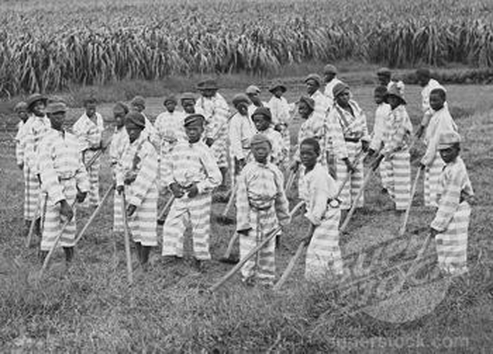
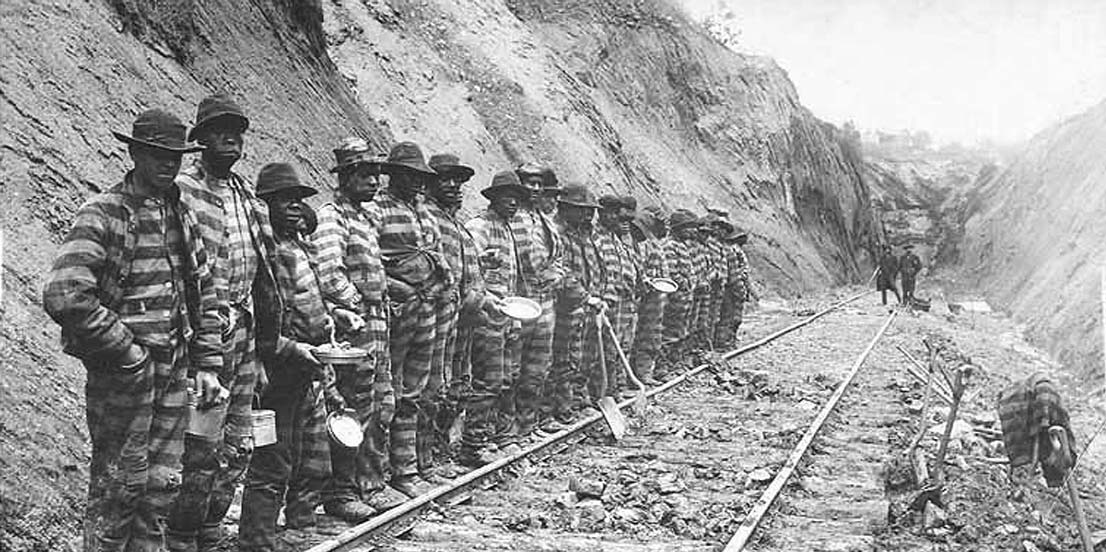
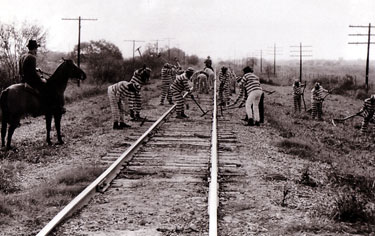
Another lesser-discussed aspect of the Black Codes was their use to return African Americans who had been convicted under the “vagrancy” statutes to a new type of slavery in all but name. The state governments then leased the prisoners to various corporations; railroads, mines and plantations, even former Confederate General and founder of the Ku Klux Klan Nathan Bedford Forrest received his share of prisoners to work his land.

7100338_orig

14-1_Page_43_Image_0001

The practice became a lucrative source of revenue, for not only did the states collect the fees from the companies, but did not have to spend tax dollars to incarcerate, feed or otherwise care for the prisoners. Mortality rates were very high among the prisoners in private custody and the regulations, which stipulated that prisoners would be adequately fed, housed and treated, were not enforced.

By 1877 “every former Confederate state except Virginia had adopted the practice of leasing black prisoners into commercial hands. There were variations among the states, but all shared the same basic formula. Nearly all the penal functions of government were turned over to the companies purchasing convicts. In return for what they paid each state, the companies received absolute control of the prisoners… Company guards were empowered to chain prisoners, shoot those attempting to flee, torture any who wouldn’t submit, and whip the disobedient – naked or clothed – almost without limit. Over eight decades, almost never were there penalties to any acquirer of these slaves for their mistreatment or deeds.” [13]

The profitability of these ventures brought Northern investors, including the owners and shareholders of U.S. Steel into the scheme allowing financial houses and Northern corporations to grow their wealth, as they had during the pre-war days off the backs of slaves. However, the practice was also detrimental to poor Southern Whites who could not compete fairly in the labor market. In 1891 miners of the “Tennessee Coal Company were asked to sign an “iron-clad contract”: pledging no strikes, agreeing to get paid in scrip, and giving up the right to check the weight of the coal they mined (they were paid by weight). They refused to sign and were evicted from their houses. Convicts were brought in to replace them.” [14] The company’s response brought about an insurrection by the miners who took control of the mine and the area around it and freed 500 of the convict-slaves. The leaders were primarily Union Army veterans and members of the Grand Army of the Republic veteran’s organization. The company backed down, but others learned the lesson and began to employ heavily armed Pinkerton agents as well as the state militias to deal with the growing labor movement, not only in the South but also in the North.

Non-convict black laborers as well as poor white “sharecroppers” on the large plantations were forced back into servitude of another manner, where legislatures gave “precedence to a landlord’s claim to his share of the crop over that of the laborer for wages or a merchant for supplies, thus shifting the risk of farming from employer to employee.” Likewise, “a series of court decisions defined the sharecropper not as a partner in agriculture or a renter with a property right in the growing crop, but as a wage laborer possessing “only a right to go on the land to plant, work, and gather the crop.” [15]

The practice did not end until Franklin Delano Roosevelt ordered his Attorney General Francis Biddle to order Federal prosecutors who had for decades looked the other way begin prosecuting individuals and companies involved in this form of slavery. Biddle was the first U.S. Attorney General to admit the fact that “African Americans were not free and to assertively enforce the statutes written to protect them.” [16] Biddle, who later sat as a justice at the Nuremberg trials of major Nazi War Criminals commented during the war “One response of this country to the challenge to the ideals of democracy made by the new ideologies of Fascism and Communism has been a deepened realization of the values of a government based on a belief in the dignity and the rights of man.” [17] Biddle charged the newly formed Civil Rights Division of the Justice Department to shift its focus from organized crime to cases of discrimination and racial abuse. Biddle repudiated the rational that allowed for the practice and wrote that the “law is fixed and established to protect the weak-minded the poor, the miserable” and that the contracts of the states that allowed the practices were “null and void.” [18] It was the beginning of another twenty-year process in which African Americans and their allies in the Civil Rights Movement worked to bring about what Lincoln referred to as “a new birth of freedom.”

Notes

[1] Ibid. McPherson The War that Forged a Nation p. 177

[2] Ibid. Guelzo Fateful Lightening p.491

[3] Jordan, Brian Matthew. Marching Home: Union Veterans and Their Unending Civil War Liveright Publishing Corporation a Division of W.W. Norton and Company Inc. New York and London 2014 p.119

[4] Ibid. Goldfield America Aflame p.411

[5] Ibid. Foner Forever Free p.96

[6] Ibid. Guelzo Fateful Lightening p.491

[7] ____________ Mississippi’s Black Code, November 24-29, 1865 in the Confederate and Neo-Confederate Reader: The “Great Truth” about the “Lost Cause” Loewen, James W. and Sebesta, Edward H. Editors, University Press of Mississippi, Jackson 2010 Amazon Kindle edition location 4505 of 8647

[8] Ibid. Foner Forever Free pp.93-94

[9] Lord, Walter The Past that Would Not Die Harper Collins Publishers, New York 1965 p.12

[10] Ibid. Zinn The Other Civil War p.55

[11] Ibid. Lord The Past that Would Not Die p.8

[12] Ibid. Foner Forever Free p.92

[13] Blackmon, Douglas A. Slavery By another Name: The Re-enslavement of Black Americans from the Civil War to World War II Anchor Books, a Division of Random House, New York 2008 p.56

[14] Ibid. Zinn A People’s History of the United States p.275

[15] Ibid. Foner A Short History of Reconstruction p.250

[16] Ibid. Blackmon Slavery By another Name pp.378-379

[17] Ibid. Blackmon Slavery By another Name p.378

[18] Ibid. Blackmon Slavery By another Name p.379

Leave a comment

Filed under civil rights, History, laws and legislation, Political Commentary

Shades of Confederate Gray

fig25

Major General Patrick Cleburne C.S.A. 

“When the prophet, a complacent fat man,
Arrived at the mountain-top
He cried: “Woe to my knowledge!
I intended to see good white lands
And bad black lands—
But the scene is gray.”

Stephen Crane

Friends of Padre Steve’s World,

If you read my work you know how much I condemn the cause of the Confederacy and the institution of slavery. I also make no bones about the continued use of the symbols of the Confederacy by some who do not use them simply to honor the memory of dead soldiers but rather to further inflame political and racial divides. As a descendant of slave owners and Confederate officers I do understand the tension. THe family patriarch on my paternal side was an unreconstructed Rebel. He was a slave owner who served as a Lieutenant in the Confederate cavalry during the war and refused to sign the loyalty oath to the United States. For this he lost his lands and plantation. There are some who sincerely desire to honor their ancestors, and I think that is honorable, but to stand by an indefensible cause as my ancestors did is another matter to me.

I agree with historian George Santayana who wrote “Loyalty to our ancestors does not include loyalty to their mistakes.” I think we have to be able to deal with that, and I do not only mean for the descendants of slave owners and Confederates. Certainly the descendants of those in the North who cooperated with, enabled and profited from slavery, and then the entire movement to reenslaved freed blacks by other means after the war have nothing to be proud of in this regard. I readily admit that many political, industrial and religious leaders in the North were little better than many Southern leaders (see my articles Accomplices to Tyranny: The North & Reconstruction and Corporate Slavery & the Black Codes ). Both of these articles highlight how Northerners, especially politicians from both political parties and industrialists who took in those injustices committed against blacks. The same people on both sides of the Mason-Dixon Line dis similar things to poor whites who they referred to as “White Trash” as well as Native Americans, women later other immigrants like the Chinese. As we get closer to Labor Day I am going to spend some time on how American workers of all races were treated during that time, but not today.

IMG_1879

Instead I want to talk about shades of gray. As my regular readers know I believe that people are the most important part of history, and that people are seldom fully good or fully evil. In fact most people, saints and sinners alike live lives of some shade of gray. Thus I believe that good people can sometimes support evil causes and otherwise evil people can end up on the right side of history by supporting a good cause. We have other people that we treat as icons who had dark places in their lives, and did things that were not honorable; history is full of them. The problem is that we like to look at people as totally good or totally evil, it’s easier that way.

That is the case when we look at men who fought for the Confederacy and the Union during the Civil War, and since I have spent a lot of time hammering the cause that Confederate soldiers fought to defend, even those who opposed secession and slavery; it is only right that I spend some time talking about the shades of Confederate Gray. To do this we have to be able to put aside the notion that every Confederate was a racist or White Supremacist.

Hill.28135413_std

Lieutenant General A.P. Hill

Those who fought for the Confederacy spanned the spectrum of belief and often fought for reasons other than slavery and some of their stories are tragic. Lieutenant General A.P. Hill opposed slavery before the war and opposed secession but because his state and his family seceded he went south. In 1850 he was on leave from the army and learned of a lynching in his home town of Lynchburg, he wrote “Shame, shame upon you all, good citizens…Virginia must crawl unless you vindicate good order or discipline and hang every son of a bitch connected with this outrage.” Hill was incredibly brave and led his troops honorably throughout the war. Sadly he died in action just days before the end of the war at Petersburg and his widow took no part in any commemorations of the Lost Cause after the war.

Brigadier General Lewis Armistead who led Pickett’s troops to the High Water mark at the Battle of Gettysburg is another tragic figure. He was a widower who lived a life of much sorrow and loneliness and the army was his life; his best friends were in the army. His very best friend, Winfield Scott Hancock and his wife Almira remained with the Union, their parting in California at the beginning of the war is heartrending, and it was Hancock’s troops who inflicted the mortal wound on him.

Major General Patrick Cleburne, called the “Stonewall Jackson of the West” is another. He was an Irish immigrant to Arkansas. He had no slaves, opposed the institution and fought because the people he lived among were his friends. He was the first Confederate to broach the subject of emancipating the slaves, and for this he was ostracized, and not promoted to Lieutenant General and command of a Corps. He died in action at the Battle of Franklin in 1864.

There are others, Lieutenant General James Longstreet who was probably the best corps commander on either side during the war, quickly reconciled, became a Republican and served in various capacities in government after the war. For this, as well as needing a scapegoat for the loss at Gettysburg Longstreet was treated as a modern Judas Iscariot by many in the South, especially among the proponents of the Lost Cause. Major General William “Little Billy” Mahone was another like Longstreet who joined the Republican Party and suffered a fair amount of criticism for his stance.

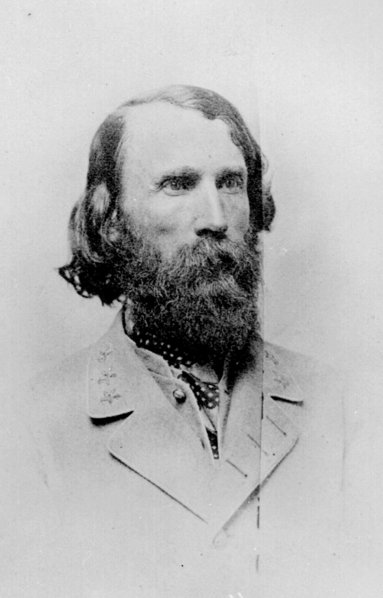
Another more interesting personality was Colonel John S. Mosby, the legendary “Gray Ghost” of Virginia whose “Raiders” caused Union forces much difficulty throughout the war. Mosby is interesting, he did not support slavery, was not a proponent of secession but felt that it was his duty to fight for his state. This was not unusual because in that era most people in all parts of the country, felt much more loyalty to their own state, or even city or county than they did to the national government. He and his troops served honorably and after the war too he supported reconciliation, he became a Republican and a friend and supporter of Ulysses Grant. He was not ashamed of his service and stated after the war, “I am not ashamed of having fought on the side of slavery—a soldier fights for his country—right or wrong—he is not responsible for the political merits of the course he fights in” and that “The South was my country. But he also condemned those in the South who denied that slavery was the cause of the war. All this made him anathema and he had to live the rest of his life outside the south or serving in various overseas diplomatic postings.

There were other shades of gray among Confederates, some like Lieutenant General Jubal Early who was not a slave owner and vehemently opposed secession in the Virginia legislature until the state seceded. When it did he joined the Confederate forces and became one of the fiercest supporters of Confederate independence who ever lived. In fact Early, though pardoned by President Andrew Johnson, never reconciled with the United States and became the leading proponent of the history of the Lost Cause. Early’s Corps Commander Lieutenant General Richard Ewell was more circumspect, he owned and admitted the mistakes he made during the war as a commander, and he fully reconciled to the United States. Before he died Ewell “insisted that nothing disrespectful to the United States Government be inscribed upon his tomb.”

Hampton_inline

Lieutenant General Wade Hampton

Lieutenant General Wade Hampton of South Carolina was one of the richest men in the South if not the country when war came. He supported secession, owned hundreds of slaves, but for a slave owner he was relatively decent in the way he treated his slaves. He fought through the war and returned home to nothing. He became involved in politics, remained very much a White Supremacist, but that being said built bridges to African American political and religious leaders when he ran for governor, even as the terrorist bands of the Red Shirts did all they could to ensure that blacks were harassed, disenfranchised and even killed to keep them from voting. To the surprise of the militants Hampton adopted a moderate course, kept blacks in his cabinet and in state offices, kept a regiment of African American militia in Charleston and opposed the black codes and Jim Crow. For this he was run out office. When he died his last words were “God bless my people, black and white.”

One the other hand there were men like Lieutenant General Nathan Bedford Forrest who helped found the Ku Klux Klan, and even led some of the early violence against blacks, and purchased black prisoners for use on his plantation after the war. However, he evolved on the issue, and left the Klan in 1869 and in 1875 two years before his death began to promote racial harmony. He spoke about that to a group of African Americans, where he received a bouquet of flowers from a black women he was condemned throughout the South. An article in the Charlotte Observer noted “We have infinitely more respect for Longstreet, who fraternizes with negro men on public occasions, with the pay for the treason to his race in his pocket, than with Forrest and Pillow, who equalize with the negro women, with only ‘futures’ in payment.”

There were many Confederate Soldiers who fought and died because they did believe in White Supremacy and hated the North, that too is a fact, and many of those who lived carried on that hate until they died.

birth_of_a_nation-3

There were others who never reconciled and who rewrote history to minimize the importance of slavery and White Supremacy to the Confederate cause, these included Jefferson Davis, his Vice President Alexander Stephens, and Brigadier General Henry Benning of Georgia. All had spearheaded the drive for secession, spoken and wrote forcefully for not only preserving but expanding slavery Stephens said quite clearly in 1861 what the Confederacy was founded upon in his Cornerstone Speech “Our new Government is founded upon exactly the opposite idea; its foundations are laid, its cornerstone rests, upon the great truth that the negro is not equal to the white man; that slavery, subordination to the superior race, is his natural and normal condition.” However, after the war all of them sought to distance themselves from this and change the narrative to Constitutional, economic and political reasons.

KKK-Nast

There were also many Confederate soldiers for whom the war never ended and they did continue it by other means, either as members of any of the various terrorist groups such as the Klan, the Red Shirts, the White League, the White Liners, or any of the related groups who terrorized and killed blacks and their white supporters, be they Northern “Carpetbaggers” or Southern “Scalawags.”

I could go on longer or in more detail on any of these men and probably could write a book about any of them, but I wanted to show that even when a cause is wrong, that we cannot condemn people as groups, and we also have to take into account people’s evolution on issues. The evolution of Wade Hampton and Nathan Bedford Forrest was far different than that of Jubal Early and others who supported the Lost Cause. I wish my family patriarch had been more like Mosby, Hampton, Hill, Ewell, Cleburne, or even Forrest rather than Jubal Early and others who never reconciled and in some cases continued to use violence to oppress others. 

Shades of gray. In history you can’t live with them and you can’t live without them.

Peace

Padre Steve+

3 Comments

Filed under civil rights, civil war, ethics, History, leadership, Political Commentary

Apologists for Genocide: Limbaugh, Barton & Streicher

Manife4

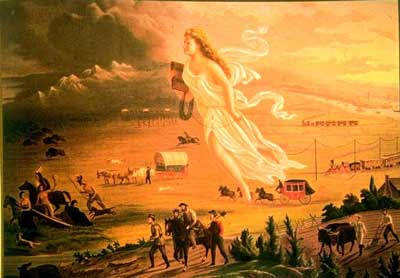
Manifest Destiny and Genocide: Drive Out and Destroy Native Americans

Friends of Padre Steve’s World,

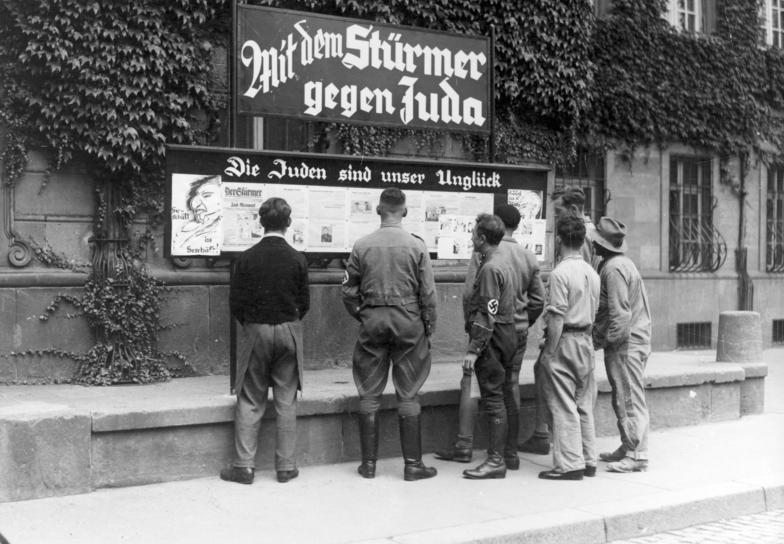
One thing that I find amazing in our world, particularly among many pundits who profess themselves to abide by supposed “Christian Principles” make comments that defy any sense of Christian morality.The sad thing is that these pundits, as well as the preachers and politicians who echo their thoughts are delving into a type of propaganda that is strikingly similar to that used by the notorious Julius Streicher, whose Der Stürmer demonized the Jews in the years before and during the Second World War, and provided many Germans with a worldview from which they went on to annihilate the Jews. When most of these people today talk they are not targeting the Jews, unless they are liberal American Jews, but rather justifying the genocide against Native Americans, making excuses for slavery and proposing laws which are as tyrannical minority groups, gays and women as were the Black codes, Jim Crow and the Nazi Nuremburg Racial Laws. I have written some about that before but think that today would be a good opportunity to directly address the words of some of these individuals.

One of the biggest of these over the past three decades has been Rush Limbaugh Back in 2009 Limbaugh in defending the extermination of American Indians said, “Holocaust? Ninety million Indians? Only four million left? They all have casinos — what’s to complain about?”

If Limbaugh was a lone person making such comments we could blow him off. However there are many like him, professional pundits and politicians but even more concerning are the preachers who make similar statements. I guess the silver lining in the Limbaugh cloud is that he is becoming more and more irrelevant by the day as his show continues to be dropped by radio stations in major markets.

While Limbaugh is deflating there are others rushing to take his place and some of these men and women are quite influential, especially those who flat out claim to be Christians who speak for God, and who often claim that God is speaking to them.

Their ideas penetrate many parts of our society, and not just religious people. They include pastors of some of the most politically influential churches and ministries in the country. Whether the comments are directed against Native Americans as was this particular quote from Limbaugh or African Americans, Mexican Americans, Moslems, Gays and Lesbians, Jews (especially liberals) or political liberals they demonstrate a profound and troubling lack of empathy.

barton

David Barton

David Barton, a fraudulent self-proclaimed “Christian” historian whose work is often to be so error ridden that publishers have to pull his books from the shelves is one of them. Barton, whose highest earned academic degree is a Bachelor’s degree in Religious Education from Oral Roberts University, who has no academic background or training in history at all is frequently referred to as “Dr. Barton,” a title he never repudiates. He served as Vice-Chairman of the Texas Republican Party from 1997-2006 and he has served as an adviser to Newt Gingrich, Michele Bachmann, Kansas Gov. Sam Brownback and Mike Huckabee. Though he is thoroughly discredited he is quite popular among many in the Christian Right and appears frequently on Glenn Beck’s program and is a frequent speaker at major political and religious conferences where he lauded and never challenged.

Like Limbaugh, Barton too has weighed in on genocidal extermination of Native Americans by whites Barton said: “You have to deal, a lot of it, with how the enemy responds. It’s got to be based on what the enemy responds [to,] you cannot reason with certain types of terrorists; and see that’s why we could not get the Indians to the table to negotiate with us on treaties until after we had thoroughly whipped so many tribes …”

If that was not enough Barton justified those comments, he continued his diatribe in much the same manner as the Nazis did when defending their genocide against the Jews.

“People complain about the fact that the American military and buffalo hunters went out and wiped out all the buffalo in the western plains.  Doing that was what brought the Indians to their knees because the Indians lived on those wide western plains where there were very few towns; Indians didn’t go into town to buy supplies, they went to the buffalo herds, that’s where they got their meat, that’s where they got their coats, the hides provided coats, they provided covering for their teepees.

If you don’t have the buffalos, those Indians cannot live on the open western plains without those buffalo and so what happened was the military wiped out the supply line by wiping out the buffalo.  That’s what brought those wars to an end, that’s what brought the Indians to their knees and ended all the western conflict.”

Bryan Fischer of the American Family Association who is one of the primary preachers of hate against a wide range of groups said about the Native Americans: “Many of the tribal reservations today remain mired in poverty and alcoholism because many native [sic] Americans continue to cling to the darkness of indigenous superstition instead of coming into the light of Christianity and assimilating into Christian culture.”

Barton, a chest thumping Evangelical Christian uses the defense that the end justifies the means, a defense used by the Nazis at the various Nuremberg trials, which was excoriated and destroyed. Barton’s defense of the extermination of the Native Americans is akin to what some of the Nuremberg defendants said in their own defense.

But it is not just the extermination of Native Americans that is a concern. Preachers of hate claiming to be speaking for God often show no compassion, empathy or feeling for victims of natural disasters, disease or mass murder. The examples are too numerous to quote from all of them and in the interest of brevity I will just mention a few.

Bryan Fischer who seems to have something to say about everything said after the school shootings in Newtown Connecticut year:

“The question is going to come up, where was God? I though God cared about the little children. God protects the little children. Where was God when all this went down. Here’s the bottom line, God is not going to go where he is not wanted.” 

Likewise he said about the Moslem extremists who carried out the attacks of 9-11-2001: “The jihadist on 9/11 were the agents of God’s wrath in order to get our attention as a people.” I could go through speech after speech, column after column, diatribe after diatribe of men like Limbaugh, Fischer and so many others demonstrate any sense of empathy for those that they condemn. Some of the worst are from ministers like Fischer.  John Hagee who pastors Cornerstone Church, a mega-church in San Antonio with over 20,000 active members said last week on the Trinity Broadcasting Network that the 9-11 attacks were “God’s judgment on America.” In fact any time a natural disaster hits, especially areas with high percentages of poor people and minorities such as New Orleans during Hurricane Katrina these preachers almost line up gleefully to ascribe them to God’s judgment. Franklin Graham said at the time: “This is one wicked city, OK?  It’s known for Mardi Gras, for Satan worship.  It’s known for sex perversion.  It’s known for every type of drugs and alcohol and the orgies and all of these things that go on down there in New Orleans…There’s been a black spiritual cloud over New Orleans for years….” Later on CNN when confronted about the comments by Larry King Graham backtracked saying:  “I would never say that this is God’s judgment on New Orleans or any other place.”

There is no empathy among these people, no real care or concern, and that is of itself evil.

The comments have become all too pervasive and poisonous. The sad thing is that those make these kind of comments really do have no compassion or empathy for people that they have labeled “enemies of God” or “enemies of America.” They honestly believe that they are doing right. Philosopher Eric Hoffer noted:

“The impression somehow prevails that the true believer, particularly the religious individual, is a humble person. The truth is the surrendering and humbling of the self breed pride and arrogance. The true believer is apt to see himself as one of the chosen, the salt of the earth, the light of the world, a prince disguised in meekness, who is destined to inherit the earth and the kingdom of heaven too. He who is not of his faith is evil; he who will not listen will perish.”

Captain Gustave Gilbert an Army Psychologist at Nuremberg wondered about how people could commit the atrocities of the Holocaust.

“In my work with the defendants (at the Nuremberg Trails 1945-1949) I was searching for the nature of evil and I now think I have come close to defining it. A lack of empathy. It’s the one characteristic that connects all the defendants, a genuine incapacity to feel with their fellow men. Evil, I think, is the absence of empathy.” 

I think he is right the more that I read and listen to men like Limbaugh, Hagee, Fischer and their fellow travelers. That lack of empathy was demonstrated in the words of Rudolf Höss the Commandant of Auschwitz. In an interview with Army Psychiatrist Major Leon Goldensohn at Nuremberg Höss said in regard to his crimes and how he had no feeling or empathy for his victims:

“I thought I was doing the right thing,” said Höss. “I was obeying orders, and now, of course, I see that it was unnecessary and wrong. But I don’t know what you mean by being upset about these things because I didn’t personally murder anybody. I was just the director of the extermination program at Auschwitz. It was Hitler who ordered it through Himmler and it was Eichmann who gave me the orders regarding transports.”

hoess

Colm Feore as Rudolf Höss

http://www.youtube.com/watch?v=A0hJqNuRH1A

The fact is that these pundits, preachers and politicians lay the groundwork by which people justify the persecution of others by demonizing and dehumanizing those that they detest. While the men doing the preaching today may never actually commit atrocities their words are laying the groundwork that others will use to justify their actions. The crimes committed by the Nazis had their genus in decades of fierce anti-Semitic campaigns conducted often by the same Unholy Trinity of Pundits, Preachers and Politicians.

streicher

Streicher at Nuremburg

In Nazi Germany one of the Chief media propagandists was Julius Streicher, publisher of the daily “Der Sturmer.” At Nuremberg the prosecution summed up its case against Streicher:

“The defendant Streicher is an accessory to the persecution of the Jews within Germany and in occupied territories which culminated in mass murder of an estimated six million men, women, and children. The propaganda in Der Stürmer and other Streicher publications, for which he had admitted responsibility, was of a character calculated to stir up fanatic fear and hatred of the Jewish people and to incite to murder…Through propaganda designed to incite hatred and fear, defendant Streicher devoted himself, over a period of twenty-five years, to creating the psychological basis essential to carrying through a program of mass murder. This alone would suffice to establish his guilt as an accessory to the criminal program of extermination.”

Worms, Antisemitische Presse, "Stürmerkasten"

When Streicher was cross-examined he was asked if his words in his paper were not preaching race hatred. The prosecutor asked: “And do you think to call them “blood-suckers,” “a nation of blood-suckers and extortioners”-do you think that’s preaching hatred? To this Streicher responded “No, it is not preaching hatred; it is just a statement of facts.”

I have seen what the dehumanization of people does in Iraq. When I was there both Sunni and Shia military officers refused to have Imam’s in their units because they saw how Imams and Mullahs from both factions in the country fanned the flames of hatred against the other and led the country into civil war and threaten to again. The troubling thing is that I am seeing the same thing here from the religious propagandists of the American political right.

However this is not something that some of these “Christian Leaders” understand, they speak, act and write with the same conviction of Julius Streicher, they believe that what they say in not preaching hate, but stating fact. But the fact is that ideas do have consequences and the preachers of hate are responsible for the evil that they incite, they are accessories to any crimes committed by those who embrace their ideology, and some people have actually killed others in cold blood because they believe and follow the words of these preachers of hate. The real fact is that these allegedly Christian propagandists like Barton, Fischer, Rick Wiles, Gary North, John Hagee, James Robison, and so many others are little different than Streicher. The targets of their hate may not be the Jews, but it is still vitriolic hate cloaked under a thin veneer of religion. Eric Hoffer was certainly right about such people.

One of the philosophical leaders of the Dominionist movement Gary North who is closely connected to the power structure of the Tea Party wrote: “The long-term goal of Christians in politics should be to gain exclusive control over the franchise. Those who refuse to submit publicly to the eternal sanctions of God by submitting to His Church’s public marks of the covenant–baptism and holy communion–must be denied citizenship, just as they were in ancient Israel.”

It is little different than the philosophy which drove the Nazi persecution of the Jews. It is interesting to compare North’s writings with the Nuremberg Laws: The Law on German Citizenship stated:  “A citizen of the Reich is that subject only who is of German or kindred blood and who, through his conduct, shows that he is both desirous and fit to serve the German people and Reich faithfully.” and that “A Jew cannot be a citizen of the Reich. He has no right to vote in political affairs and he cannot occupy public office.”

That poisonous message is something that allowed people like Höss do what they did and feel nothing for their victims. They were and are truly men without empathy as are so many on the supposedly “Christian” right.

So, have a nice night and please read up on some of these guy on the Christian Right and the political pundits who like Streicher preach hatred with conviction, and unlike Streicher, do so in the name of God.

Peace

Padre Steve+

2 Comments

Filed under civil rights, History, Political Commentary

Corporate Slavery & the Black Codes

Friends of Padre Steve’s World

A couple of weeks ago I posted a part of my Civil War and Gettysburg Staff Ride text about the Infamous Black Codes which appeared in the South following the Civil War. These codes were oppressive and for all practical purposes sought to return newly freed African Americans to a a state of slavery by another name. These codes were followed by policies which did just that. States leased or sold African American men who had been arrested under the codes to corporations, planters and other businesses, entities which without oversight denied these men, including juveniles every right to life, liberty or the pursuit of happiness. The condition lasted until World War Two, when Franklin Delano Roosevelt ordered his Attorney General to end these practices. 

Personally, every time I read the accounts of White Supremacists who ignore, deny or defend the practices of slave owners before the war, the argument that the war had nothing to do with slavery, and that the era of Jim Crow was not that bad and even helpful to blacks, I get more motivated to expose their lies. The fact is that the Black Codes enacted by Southern States and the rulings of the Supreme Court and the legislation of Congress during and after Reconstruction I get more motivated. This is a new sub-section of the section on the Black Codes in my text. I hope that it if nothing else, helps you look to the facts and not to buy the myths posited by current neo-Confederates and whitewashing of the past by state school boards and the publishers of our textbooks.

Peace

Padre Steve+

14-1_Page_43_Image_0001

Re-enslaved Blacks building a railroad near Asheville North Carolina 

Another lesser-discussed aspect of the Black Codes was their use to return African Americans who had been convicted under the “vagrancy” statutes to a new type of slavery in all but name. The state governments then leased the prisoners to various corporations; railroads, mines and plantations, even former Confederate General and founder of the Ku Klux Klan Nathan Bedford Forrest received his share of prisoners to work his land.

The practice became a lucrative source of revenue, for not only did the states collect the fees from the companies, but did not have to spend tax dollars to incarcerate, feed or otherwise care for the prisoners. Mortality rates were very high among the prisoners in private custody and the regulations, which stipulated that prisoners would be adequately fed, housed and treated, were not enforced.

By 1877 “every former Confederate state except Virginia had adopted the practice of leasing black prisoners into commercial hands. There were variations among the states, but all shared the same basic formula. Nearly all the penal functions of government were turned over to the companies purchasing convicts. In return for what they paid each state, the companies received absolute control of the prisoners… Company guards were empowered to chain prisoners, shoot those attempting to flee, torture any who wouldn’t submit, and whip the disobedient – naked or clothed – almost without limit. Over eight decades, almost never were there penalties to any acquirer of these slaves for their mistreatment or deeds.” [1]

parks_chain_gang

The profitability of these ventures brought Northern investors, including the owners and shareholders of U.S. Steel into the scheme allowing financial houses and Northern corporations to grow their wealth, as they had during the pre-war days off the backs of slaves. However, the practice was also detrimental to poor Southern Whites who could not compete fairly in the labor market. In 1891 miners of the “Tennessee Coal Company were asked to sign an “iron-clad contract”: pledging no strikes, agreeing to get paid in scrip, and giving up the right to check the weight of the coal they mined (they were paid by weight). They refused to sign and were evicted from their houses. Convicts were brought in to replace them.” [2] The company’s response brought about an insurrection by the miners who took control of the mine and the area around it and freed 500 of the convict-slaves. The leaders were primarily Union Army veterans and members of the Grand Army of the Republic veteran’s organization. The company backed down, but others learned the lesson and began to employ heavily armed Pinkerton agents as well as the state militias to deal with the growing labor movement, not only in the South but also in the North.

7100338_orig

Non-convict black laborers as well as poor white “sharecroppers” on the large plantations were forced back into servitude of another manner, where legislatures gave “precedence to a landlord’s claim to his share of the crop over that of the laborer for wages or a merchant for supplies, thus shifting the risk of farming from employer to employee.” Likewise, “a series of court decisions defined the sharecropper not as a partner in agriculture or a renter with a property right in the growing crop, but as a wage laborer possessing “only a right to go on the land to plant, work, and gather the crop.” [3]

The practice did not end until Franklin Delano Roosevelt ordered his Attorney General Francis Biddle to order Federal prosecutors who had for decades looked the other way begin prosecuting individuals and companies involved in this form of slavery. Biddle was the first U.S. Attorney General to admit the fact that “African Americans were not free and to assertively enforce the statutes written to protect them.” [4] Biddle, who later sat as a justice at the Nuremberg trials of major Nazi War Criminals commented during the war “One response of this country to the challenge to the ideals of democracy made by the new ideologies of Fascism and Communism has been a deepened realization of the values of a government based on a belief in the dignity and the rights of man.” [5] Biddle charged the newly formed Civil Rights Division of the Justice Department to shift its focus from organized crime to cases of discrimination and racial abuse. Biddle repudiated the rational that allowed for the practice and wrote that the “law is fixed and established to protect the weak-minded the poor, the miserable” and that the contracts of the states that allowed the practices were “null and void.” [6] It was the beginning of another twenty-year process in which African Americans and their allies in the Civil Rights Movement worked to bring about what Lincoln referred to as “a new birth of freedom.”

Notes

[1] Blackmon, Douglas A. Slavery By another Name: The Re-enslavement of Black Americans from the Civil War to World War II Anchor Books, a Division of Random House, New York 2008 p.56

[2] Ibid. Zinn A People’s History of the United States p.275

[3] Ibid. Foner A Short History of Reconstruction p.250

[4] Ibid. Blackmon Slavery By another Name pp.378-379

[5] Ibid. Blackmon Slavery By another Name p.378

[6] Ibid. Blackmon Slavery By another Name p.379

6 Comments

Filed under civil rights, civil war, History, Political Commentary

The Notorious Black Codes 

  
Friends of Padre Steve’s World

As I work on my Civil War and Gettysburg text I continue to write about truth, and truth can be very uncomfortable. Today is a section of my text that deals with the Black Codes that were enacted in Southern States in the immediate aftermath of the Civil War. They sprang up because Abraham Lincoln’s successor, Andrew Johnson was a unregenerate racist who encouraged such measures.  In the next few days I will be posting more sections of the text dealing with specific aspects of Reconstruction and the more often than not heavily racist opposition to rights of any kind being granted to blacks in the North and the South. 

Sadly, there are people today, people who were expensive suits, walk the halls of Congress, speak in our largest churches and travel in high style accompanied by the media who continue to fight against the rights of not only blacks, but of immigrants, the LGBTQ community, women and Moslems.

Have a great night,

Peace

Padre Steve+

White Southerners including the newly pardoned Confederates enacted black codes that “codified explicit second-class citizenship for freedpeople.” [1] The legislature of Mississippi refused to ratify the Thirteenth Amendment, and did not do so until 1995. One Southerner noted that “Johnson “held up before us the hope of a ‘white man’s government,’ and this led us to set aside negro suffrage…. It was natural that we should yield to our old prejudices.” [2] Former Confederates, including Alexander Stephens the former Vice President of the Confederacy were elected to high office, Stephens to the United States Senate and the aggrieved Republicans in Congress in turn refused to admit the former Confederates. Many Union veterans were incensed by Johnson’s actions, one New York artilleryman noted “I would not pardon the rebels, especially the leaders, until they should kneel in the dust of humiliation and show their deeds that they sincerely repent.” [3] He was not alone, many Northern Veterans who formed the integrated Grand Army of the Republic veterans maintained a patent disregard, if not hatred of what the old South stood for and felt that their efforts in the war had been betrayed by the government.

  
Johnson’s restoration of property to the former white owners drove tens of thousands of blacks off lands that they had been farming, or left them as laborers for their former slave masters. Johnson countermanded General William Tecumseh Sherman and Secretary of War Edwin Stanton’s Field Order 15 to “divide abandoned and confiscated lands on the Sea Islands and in a portion of the Low Country coast south of Charleston into forty-acre plots for each black family.” [4] As such many freed blacks were now at the mercy of their former white owners for any hope of economic sustenance.

  
Johnson worked stridently, and often successfully to frustrate the efforts of the Freedmen’s Bureau headed by Major General Oliver Howard to help freed blacks to become landowners and to protect their legal rights. In immediate post-war South states organized all white police forces and state militias composed primarily of confederate veterans, many still wearing their gray or butternut uniforms. In such a climate blacks had few rights, and officers of the Freedmen’s Bureau lamented the situation. In Georgia one officer wrote that no jury would “convict a white man for killing a freedman,” or “fail to hang” a black man who killed a white in self-defense. Blacks commented another agent, “would be just as well off with no law at all or no Government,” as with the legal system established in the South under Andrew Johnson. “If you call this Freedom,” wrote one black veteran, “what do you call slavery?” [5]

  
The struggle between Johnson Congress intensified when Johnson vetoed the Civil Rights Bill. Congress responded by overriding his veto. Eventually the battle between Johnson and Congress climaxed when Johnson was impeached when he tried to remove Secretary of War Stanton from office. Johnson barely survived the impeachment proceedings and was acquitted by one vote in the Senate in 1868.

The various black codes enacted throughout the South were draconian measures to codify and institutionalize racism and White Supremacy:

“passed labor laws that bound blacks to employers almost as tightly as slavery once bound them to their masters. Other codes established patterns of racial segregation that had been impossible under slavery, barred African Americans from serving on juries or offering testimony in court against whites, made “vagrancy,” “insulting gestures,” and “mischief” offenses by blacks punishable by fines or imprisonment, forbade black-white intermarriage, ad banned ownership by blacks of “fire-arms of any kind, or any ammunition, dirk or bowie-knife.” [6]

The black codes which were condoned and supported by President Johnson recognized minimal elements of black freedom but their provisions confirmed the observations of one journalist who wrote “the whites seem wholly unable to comprehend that freedom for the negro means the same thing as freedom for them. They readily admit that the Government has made him free, but appear to believe that the have the right to exercise the old control.” [7]

Likewise within weeks of the end of the war, violence against blacks began to break out in different parts of the South and it continued to spread as Johnson and Congress battled each other in regard to Reconstruction policy:

“In Memphis, Tennessee, in May of 1866, whites on a rampage of murder killed forty-six Negroes, most of them veterans of the Union army, as well as two white sympathizers. Five Negro women were raped. Ninety homes, twelve schools and four churches were burned. In New Orleans in the summer of 1866, another riot against blacks killed thirty-five Negroes and three whites.” [8]

Colonel Samuel Thomas, the director of the Freedmen’s Bureau in Mississippi noted the attitudes that he saw in many whites toward the newly emancipated African Americans. He wrote that white public sentiment had not progressed and that whites had not “come to the attitude in which it can conceive of the negro having any rights at all. Men, who are honorable in their dealings with their white neighbors, without feeling a single twinge of honor….And however much they confess that the President’s proclamation broke up the relation of the individual slave to their owners, the still have the ingrained feeling that the black people at large belong to whites at large.” [9] Sadly, the attitude reported by Colonel Thomas not only remained but grew more violent with each passing month.

Notes

[1] Ibid. McPherson The War that Forged a Nation p. 177

[2] Ibid. Guelzo Fateful Lightening p.491

[3] Jordan, Brian Matthew. Marching Home: Union Veterans and Their Unending Civil War Liveright Publishing Corporation a Division of W.W. Norton and Company Inc. New York and London 2014 p.119

[4] Ibid. Goldfield America Aflame p.411

[5] Ibid. Foner Forever Free p.96

[6] Ibid. Guelzo Fateful Lightening p.491

[7] Ibid. Foner Forever Free pp.93-94

[8] Ibid. Zinn The Other Civil War p.55

[9] Ibid. Foner Forever Free p.92

1 Comment

Filed under civil rights, civil war, History, Political Commentary

A Great Day for Liberty for All

Mini-Stonewall

Friends of Padre Steve’s World

Today is a good day for freedom. It has been to long coming. The Supreme Court, citing the Fourteenth Amendment ruled in favor of Marriage Equality for Gays Lesbians and others in the LGBTQ community in the case of Obergfell v. Hodges. I am quite happy for my Gay and Lesbian friends  for this.

As historian and who has and continues to study the American Civil War, especially the fight for the abolition of slavery, the emancipation of African Americans and the extension of the the full benefits of citizenship and liberty.

As early as 1854 Lincoln posed the idea that the Declaration of Independence was the standard maxim of free society …constantly spreading and deepening its influence,” ultimately applicable “to peoples of all colors everywhere.” 

The understanding that the liberties enunciated in the Declaration extend to first to African-Americans was made part of the Constitution in the Thirteenth, Fourteenth and Fifteenth Amendments to the Constitution. The precedent of Fourteenth Amendment has been used to grant Suffrage to Women, to end Jim Crow laws, Black Codes and Separate but Equal laws. Today it was correctly used to ensure that all people have the freedom to marry.

The ruling was about liberty, it was about equality, it was about due process, and today the Court’s majority noted:

The history of marriage as a union between two persons of the opposite sex marks the beginning of these cases. To the respond- ents, it would demean a timeless institution if marriage were extend- ed to same-sex couples. But the petitioners, far from seeking to devalue marriage, seek it for themselves because of their respect—and need—for its privileges and responsibilities, as illustrated by the petitioners’ own experiences.

The history of marriage is one of both continuity and change.

Changes, such as the decline of arranged marriages and the abandonment of the law of coverture, have worked deep transformations in the structure of marriage, affecting aspects of marriage once viewed as essential. These new insights have strengthened, not weakened, the institution. Changed understandings of marriage are characteristic of a Nation where new dimensions of freedom become apparent to new generations.

They also added:

The fundamental liberties protected by the Fourteenth Amendment’s Due Process Clause extend to certain personal choices central to individual dignity and autonomy, including intimate choic- es defining personal identity and beliefs.

Most of the opposition to Gay marriage and for that matter to all Gay Rights has been from conservative Christians. Sadly it was conservative Christians who have been in the forefront of denying liberty to people in the country since the beginning of the abolition movement in the 1830s. They labeled fellow evangelicals in the abolition movement as “atheists, infidels, communists, free-lovers, Bible-haters, and anti-Christian levelers.” 

This was not limited to Southern  conservative Christians.

The fact that so many Protestant ministers, intellectuals, and theologians, not only Southerners, but men like “Princeton’s venerable theologian Charles B. Hodge – supported the institution of slavery on biblical grounds, often dismissing abolitionists as liberal progressives who did not take the Bible seriously” leaves a troubling question over those who claim to oppose issues on supposedly Biblical grounds. Such men in the North spoke out for it “in order to protect and promote interests concomitant to slavery, namely biblical traditionalism, and social and theological authority.” [1] The Northern clerical defenders of slavery perceived the spread of abolitionist preaching as a threat, not just to slavery “but also to the very principle of social and ecclesiastical hierarchy.” [2]Alistair McGrath asks a very important question for modern Christians who might be tempted to support a position for the same reasons today, “Might not the same mistakes be made all over again, this time over another issue?” [3]

Throughout American history conservative Christians have often espoused a concept of limited liberty, liberty for the few and the powerful. This happened as I have noted during the fight against emancipation, but also Women’s Suffrage and the various Jim Crow laws and rights for other groups. This is happening again today with anti-Gay Christians attacking the ruling and like those who fought abolition proclaiming in apocalyptic language that Christians will be persecuted and that God will judge the United States for allowing Gays to marry.

However, the fact is that very little will change in the country, most people will move along. Christian conservatives will not be persecuted, religious liberties will not be violated they will be enhanced as churches who allow Gays to marry will be able to extend this rite of their churches to their parishioners and others.

Today, despite the cries of many on the American Religious Right liberty has been protected. as Lincoln said: the declaration’s promise of equality was “a beacon to guide” not only “the whole race of man then living” but “their children and their children’s children, and the countless myriads of generations who should inhabit the earth in other ages.” [4]

Marriage-Equality-104371316011_xlarge

I am happy for my Gay friends who have labored for this for so long enduring hatred, violence and social, political, religious and economic discrimination for so many years.

Have a great night,

Peace

Padre Steve+

[1] Ibid. Daly When Slavery Was Called Freedom p.38

[2] Ibid. Varon Disunion! P.108

[3] Ibid. McGrath Christianity’s Dangerous Idea p.324

[4] Ibid. Goodwin Team of Rivals p. 203

3 Comments

Filed under civil rights, ethics, faith, History, laws and legislation, LGBT issues, News and current events, Political Commentary, Religion

God Bless My People, Black and White: The Complex Life of General Wade Hampton

Hampton_inline

Lieutenant General Wade Hampton, C.S.A.

Friends of Padre Steve’s World 

I will be taking my students to Gettysburg this weekend and likewise I am continuing to periodically intersperse and publish short articles about various commanders at Gettysburg on the site. These all are drawn from my student text and may become a book in their own right.  The reason is I am going to do this is because I have found that readers are often more drawn to the lives of people than they are events. As I have noted before that people matter, even deeply flawed people, and we can learn from them.

Today’s article is about Lieutenant General Hade Hampton who commanded one of J.E.B. Stuart’s cavalry brigades at Gettysburg. Hampton is one of the most fascinating men I think of the entire Civil War period. Before the war he was one of the richest planters and largest owners of slaves in the South and after the war was a stalwart supporter of the rights of African Americans in South Carolina where he served as the first post-Reconstruction governor of that state. He was not a professional soldier but became one of the finest commanders of cavalry on either side during the war. Tomorrow I will be posting a completely revised, expanded and updated chapter of my text on the opening of the Battle of Gettysburg when Major General John Buford’s Cavalry conducted a heroic delaying action against the vastly superior numbers of Confederate Major General Heth’s division as it attempted to advance into Gettysburg on the morning of July 1st 1863. 

I do hope that you enjoy this.

Peace

Padre Steve+

Brigadier General Wade Hampton is one of the fascinating and complex characters in either army who served at Gettysburg. He defies a one dimensional treatment or stereotype. His complexities, contradictions and character make him one of the most interesting men that I have written about during my study of this battle.

Wade Hampton III was born in Charleston, South Carolina in 1828. He one of the richest, if not the richest man in the Confederacy when the war broke out. Hampton inherited his family’s expansive plantation and many slaves and studied law at the College of South Carolina.

As a slave owner, he expressed an aversion for the institution and ensured that his slaves were well cared for by the standards of his day, including medical care. He never condemned slavery or worked for the abolition of a system that had made him and his family quite prosperous. He served in the South Carolina legislature and Senate, where he took an “active and prominent role in the public debate on many issues. He was vocal not only on the perils of reopening the African slave trade but also on whether and how his state should seek redress of wrongs, real and imagined, by the federal government.” [1]

As a state senator, Hampton was pragmatic, and while he defended the South’s economic interests in slavery, Hampton cautioned against the rhetoric of secessionist fire-breathers. His argument was about “the preservation of the South’s political power and her social and economic institutions, now threatened by the short sighted policies of otherwise good and decent men.” [2] He did not wish to do anything that would lead to the destruction of the South, and he felt that the “only viable course was moderation, conciliation, compromise….” [3]

Hampton was a classic rich “Southern moderate He had opposed secession, and the fire eaters repulsed him.” [4] However, when Lincoln called for volunteers Hampton volunteered to serve in a war that he did not want, which would cost him dearly, and change him from a moderate to a vociferous opponent of most Reconstructionist policies.

Volunteering at the age of forty-three, Hampton had no prior military training. However, he had great organizational skill, leadership ability and a tremendous care and compassion for those who served under his command. Using his own money Hampton organized what would now be called a combined arms unit, the Hampton Legion, which comprised eight companies of infantry, four of cavalry and a battery of light artillery. He was careful in the appointment of the Legion’s officers choosing the best he could find.

Hampton rapidly rose to prominence as a respected officer and commander despite his lack of military training or experience. His soldiers fought well and took over command of an infantry brigade on the Peninsula, and was promoted to Brigadier General in May of 1862 and given command of a cavalry brigade serving under J.E.B. Stuart in July. Hampton “became Stuart’s finest subordinate.” [5] The contrast between the two men was remarkable. “Hampton and Stuart forged a professional relationship but not a friendship. They shared an adherence to duty and to the cause. But the contrasts between them in style and personality were undeniable.” [6] Stuart’s flamboyance, love of pageantry, and ambition clashed with Hampton’s simplicity and calm self-assurance. Serving as a brigade, and later division commander, Hampton had “little fondness or respect for Stuart. He regularly criticized Stuart for pampering the Virginia regiments and assigning his South Carolinians to the more arduous tasks.” [7]

During the war he was wounded several times, including at             Gettysburg where he took two saber cuts to the head. Eventually, he took command of the Cavalry Corps after Stuart was killed in action. This was something that Stuart in life would not have abided. When Stuart was scheming to get a promotion to Lieutenant General in another military department, he wrote that if he was to serve elsewhere he did not want Hampton to Command. In a curious post-script to a letter to Custis Lee Stuart wrote:

“Hampton is not the man for such a command, and I know he will not suit Gen’l Lee, nor the particular requirements of such a station. Hampton is a gallant officer, a nice Gentleman, and has done meritorious service, but there you must stop.” [8]

He fought in nearly every cavalry engagement under Stuart and led his own raids deep into Union territory. He fought well, but “hated the war.” In October 1862 he wrote home: “My heart has grown sick of the war, & I long for peace.” [9] Hampton’s Confederate service was unusual, especially for an officer of Lee’s Army of Northern Virginia which favored those who had prior service, especially West Point graduates. As such Hampton was “one of only three civilians to attain the rank of Lieutenant General in Confederate service.” [10] At Petersburg, his son Preston was mortally wounded and died in his arms even as his other son Wade IV was wounded while coming to Preston’s aid. Douglass Southall Freeman wrote of Hampton:

“Untrained in arms and abhorring war, the South Carolina planter had proved himself the peer of any professional soldier commanding within the same bounds and opportunities. He may not have possessed military genius, but he had the nearest approach to it.” [11]

The war that he opposed cost him the life of his brother, one of his sons and his livelihood. “His property destroyed, many of his slaves gone, and deep in debt from which he would never recover, Hampton faced the future with $1.75 in his pocket.” [12] The war changed the former moderate into a man who sought vindication in some ways, but reconciliation with the black population.

Hampton again entered politics and became the first post-Reconstruction Governor of South Carolina when President Rutherford Hayes withdrew the Federal troops which had supported the Reconstructionist governor. Initially he was “hailed as a redeemer by white constituents desperate to throw off the yoke of Reconstruction” [13] yet Hampton stood stalwartly against White Supremacy and White Supremacists. He acted on the belief that whites and African Americans could live, work and prosper together.

During his campaign and during his terms as Governor, Hampton “opposed the South’s imposition of so-called “black codes” which so restricted the freedom of former slaves as virtually to return them to civility.” [14] Unlike many in the post-reconstruction South, Hampton won the thanks of African Americans for condemning whites that would vote for him if they thought that he would “stand between him and the law, or grant him any privileges or immunities that shall not be granted to the colored man.” [15] Over his term, the former slave owner “extended more political benefits to African Americans than any other Democratic governor in the post-war South.” [16]

Hampton came to dominate South Carolina politics for fifteen years. After two terms as Governor, he served as a U.S. Senator until 1891 when a political enemy won the governorship and forced him from the Senate. When he died on April 11th 1902 his final words were “God bless my people, black and white.” [17]

Like so many leaders of so many tumultuous eras, Hampton was complex, contradictory and cannot be easily classified. He was certainly not perfect, but in war and in peace gave of himself to his state and community.

Notes

[1] Ibid. Longacre, Gentleman and Soldier pp.26-27

[2] Ibid. Longacre, Gentleman and Soldier p.28

[3] Ibid. Longacre, Gentleman and Soldier p.28

[4] Goldfield, David. America Aflame: How the Civil War Created a Nation Bloomsbury Press, New York 2011 p.399

[5] Ibid. Wert A Glorious Army p.64

[6] Ibid. Wert Cavalryman of the Lost Cause p.116

[7] Ibid. Glatthaar, General Lee’s Army p.352

[8] Ibid. Wert Cavalryman of the Lost Cause p.333

[9] Ibid. Goldfield, America Aflame p.399

[10] Ibid. Warner Generals in Gray p.123

[11] Ibid. Freeman Lee’s Lieutenants p.770

[12] Ibid. Goldfield, America Aflame p.399

[13] Ibid. Longacre, Gentleman and Soldier p.xv

[14] Ibid. Longacre, Gentleman and Soldier p.265

[15] Ibid. Longacre, Gentleman and Soldier p.265

[16] Ibid. Longacre, Gentleman and Soldier p.xv

[17] Ibid. Longacre, Gentleman and Soldier p.276


Leave a comment

Filed under civil rights, civil war, History, laws and legislation, leadership, Military