Tag Archives: civil rights

Freedom Dies When Men Ignore Justice and then No Longer Recognize It

justice-weeps

Friends of Padre Steve’s World,

Just a short thought today. Yesterday was very tiring, we were dealing with a veterinary emergency with our older Papillon Minnie, and also had Judy’s follow-up appointment for the Endometrial Cancer she was operated on for in 2015. It looks like Minnie will be okay, she is spending the night in a fully staffed veterinary hospital where she will be monitored, medicated, and given IV’s after scaring the hell out of us with what our vet diagnosed as Hemorrhagic Gastroenteritis, and the hospital vet things might have been Pancreatitis. She had showed no signs of being sick when we went to bed last night but when we got up she had vomited multiple times and was crapping bright red blood. As soon as I saw it I scooped her up, called the vet and drove her there. We finally got home after transferring her to the overnight emergency vet about nine-thirty last night. She’s doing better and hopefully she will be home tomorrow.  Of course in the middle of everything we learned that Carrie Fisher had died and as much as I want to reflect on her life I cannot now, other than to say that I admired her greatly, especially for her openness in speaking about her own mental health issues. When I suffered my own PTSD crisis and decided to speak out and be transparent about my struggles, she was a role model.

But, anyway, as a follow-up to what I wrote yesterday I wanted to share this thought, from the late Charles Morgan Jr. I wrote about his comments in regard to what he said after the bombing to the 16th Street Baptist Church in Birmingham Alabama some 52 years ago before and think that they are as pertinent in the age of Trump than they were when he wrote them about the Jim Crow South.

Morgan was a well off young Southern gentleman, a lawyer, and a man with a conscience. He was a defender of the civil liberties of many people during his life, most of which were incredibly unpopular when he made his strand.

Morgan made a comment that really stuck in my brain because it is so true. He said,

“It is not by great acts but by small failures that freedom dies. . . . Justice and liberty die quietly, because men first learn to ignore injustice and then no longer recognize it.”

The truth is that it those small failures; first to turn our backs on justice and to ignore it, and then finally, to fail to even recognize it when justice is being trampled. That is how freedom dies. Sadly, those who most often trample freedoms, usually in the name of God or religion are the last to recognize their complicity in that loss of freedom. Judge Learned Hand spoke these words; “If we are to keep our democracy, there must be one commandment: Thou shalt not ration justice.”

Sadly, there are too many who will do just that, all to often in the name of their God, or their religion. If we ration justice so that only a few; the rich, and the well off are able to afford it, then we will succeed in standing idly by as injustice becomes the norm. I fear that in the coming months and years that justice itself will become a scarce commodity.

As always I admit that I hope that I am wrong, but from all I read from Trump’s supporters in the so-called Christian Right, the Neo-Nazis of the self-proclaimed Alt Right, and the most radical talking heads on radio, the internet, and heads of  right wing political action groups, I fear that we are in for very rough times unless the President-Elect himself makes a stand, because the Republican Congress has shown time after time that they will not do so.

Have a good day,

Peace

Padre Steve+

Leave a comment

Filed under civil rights, History, News and current events, Political Commentary

We Will be Remembered for What We Do and for What We Allow

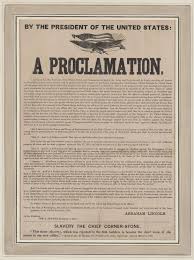
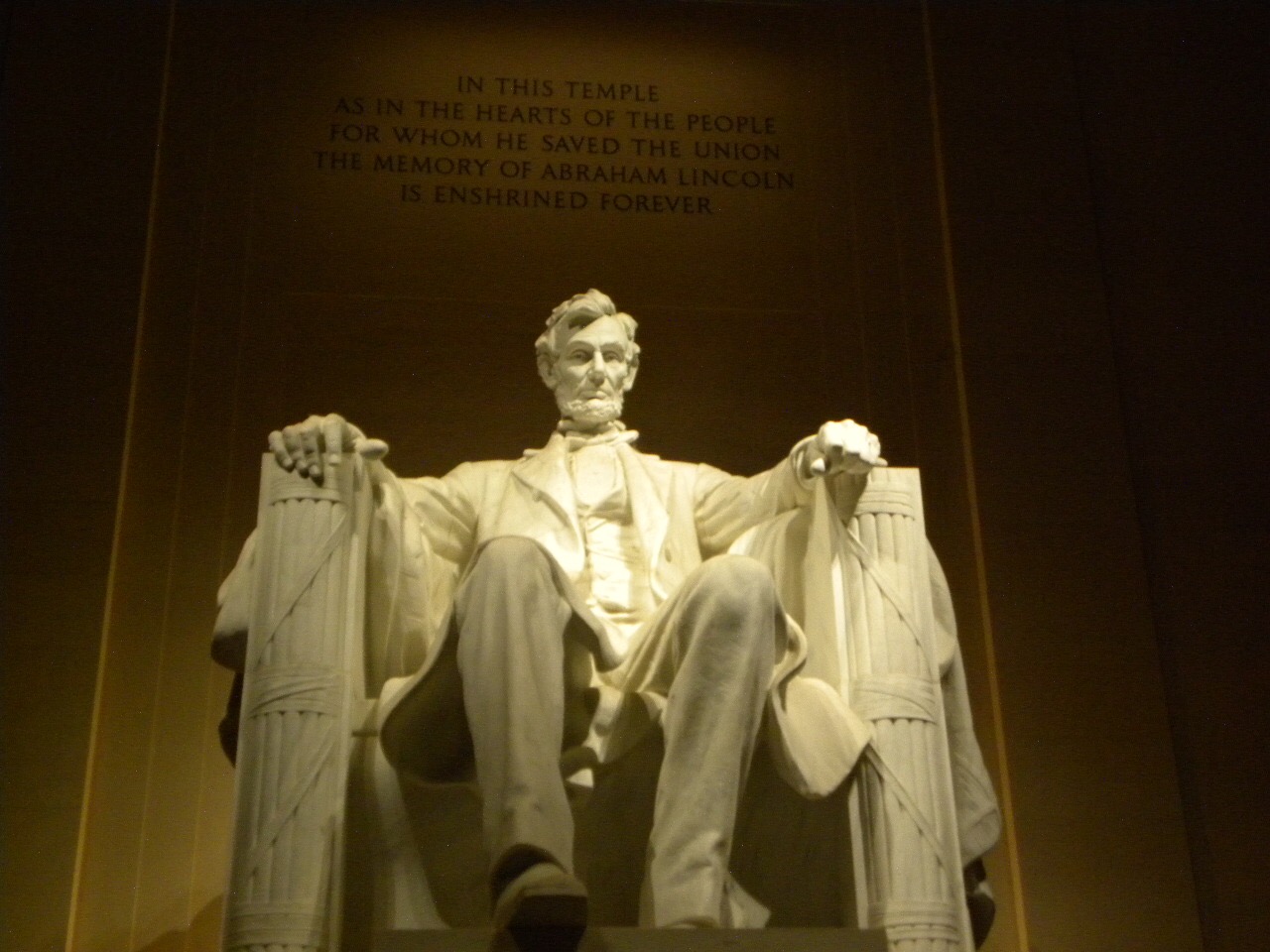
emancipation

Friends of Padre Steve’s World,

Over the past couple of weeks I have been pondering the future and as I have stated numerous times I am hoping Donald Trump will succeed as president and also that he will not follow through on some of the very radical ideas that he proposed during his campaign. I am hoping that he will be guided by reason but I am afraid that many of our civil rights will disappear over the next few years, and that his economic proposals will end up people who voted for him hoping that it would benefit them in terms of their jobs and their future.

In light of that  I have been thinking a lot about the responsibility that all of us have as citizens, not to our political parties or ideology, but to the country and the whole idea of liberty. That may sound like an old fashioned and quaint proposition to people whose life is devoted to ideology, no matter if that is a conservative, liberal, progressive, or even religious one, but it is still something that I think is important.

As usual that thought took me back to Abraham Lincoln and the American Civil War. I as reminded of some remarks that Lincoln made less than two weeks before he signed the Emancipation Proclamation. At the time it was still a controversial proposition, even for many people in the North, as is almost any proposition to expand the boundaries of liberty. The fact is that over the next few years many liberties will probably be rolled back as Trump appoints people to his cabinet who are opposed to almost every expansion of liberty going back to the 14th and 15th Amendments, the Civil Rights and Voting Rights Acts, LGBTQ rights, Women’s Rights, and even the rights of Workers.

In light of these things I am reminded of the words that Lincoln spoke when he signed the Emancipation Proclamation; words which are as pertinent today as when he first spoke them. He said,

“I do not forget the gravity which should characterize a paper addressed to the Congress of the nation by the Chief Magistrate of the nation. Nor do I forget that some of you are my seniors, nor that many of you have more experience than I, in the conduct of public affairs. Yet I trust that in view of the great responsibility resting upon me, you will perceive no want of respect yourselves, in any undue earnestness I may seem to display.

Is it doubted, then, that the plan I propose, if adopted, would shorten the war, and thus lessen its expenditure of money and of blood? Is it doubted that it would restore the national authority and national prosperity, and perpetuate both indefinitely? Is it doubted that we here–Congress and Executive–can secure its adoption? Will not the good people respond to a united, and earnest appeal from us? Can we, can they, by any other means, so certainly, or so speedily, assure these vital objects? We can succeed only by concert. It is not “can any of us imagine better?” but, “can we all do better?” The dogmas of the quiet past, are inadequate to the stormy present. The occasion is piled high with difficulty, and we must rise — with the occasion. As our case is new, so we must think anew, and act anew. We must disenthrall ourselves, and then we shall save our country.

Fellow-citizens, we cannot escape history. We of this Congress and this administration, will be remembered in spite of ourselves. No personal significance, or insignificance, can spare one or another of us. The fiery trial through which we pass, will light us down, in honor or dishonor, to the latest generation. We say we are for the Union. The world will not forget that we say this. We know how to save the Union. The world knows we do know how to save it. We — even we here — hold the power, and bear the responsibility. In giving freedom to the slave, we assure freedom to the free — honorable alike in what we give, and what we preserve. We shall nobly save, or meanly lose, the last best hope of earth. Other means may succeed; this could not fail. The way is plain, peaceful, generous, just — a way which, if followed, the world will forever applaud, and God must forever bless.”

These are words which all of us should ponder over the coming months and years. If we allow civil liberties to be rolled back we will only be harming ourselves and those who follow us. If we as citizens allow such things to happen the responsibility is ours as well, and we will have to answer for it before the bar of history. Our actions, to use the words of Lincoln, will light us down, in honor or dishonor, to the latest generation.” 

Until tomorrow,

Peace

Padre Steve+

1 Comment

Filed under civil rights, civil war, News and current events, Political Commentary

A Grave Responsibility to Remember and Remind: The 71st Anniversary of the Opening of the Nuremberg Trails

Friends of Padre Steve’s World,

Today is the 71st anniversary of the opening of the Nuremberg Trials. I write about this a lot and I know some people, even so-called progressives have told me that they know the Nazis were evil and that they don’t want to hear it, while alleged conservatives vehemently object because they do not believe that such things can happen again.

However that is not the point. The reason I post things like this is because the players in the drama are representative of humanity, and humanity is the one constant in all history. Human beings and their propensity for good as well as evil is what these posts are about, and the fact is that any human being is capable of committing such crimes or turning a blind eye to them, to simply go along with the system and not to make waves. That is part of human nature, we value liberty, but that liberty lies in our hearts, and when it dies there, it dies. As the great American jurist Learned Hand said:

“I often wonder whether we do not rest our hopes too much upon constitutions, upon law and upon courts. These are false hopes, believe me, these are false hopes. Liberty lies in the hearts of men and women; when it dies there, no constitution, no law, no court can save it; no constitution, no law, no court can even do much to help it. The spirit of liberty is the spirit which is not too sure that it is right; the spirit of liberty is the spirit which seeks to understand the minds of other men and women; the spirit of liberty is the spirit which weighs their interests alongside its own without bias.” 

When that spirit of liberty is lost, when that sensitivity to the rights and needs of others trampled, when a desire for revenge and getting even displaces civility and compassion; there is nothing than stop evil, for evil will find ways to justify their evil deeds under the cloak of legality. That is what Germany did in the 1930s and what I believe may happen in the United States and other Western nations as the wave of populism and xenophobic racism sweeps the globe. Robert Jackson said, “The most odious of all oppressions are those which mask as justice.”

That is why it is so important to remember the evil that we as human beings are capable of and not to run roughshod over the rights of those with whom we disagree. Since the election of Donald Trump I have seen many comments of his supporters and the well documented writings and opinions of three of first appointees, Stephen Bannon, Michael Flynn, and Jeff Sessions. All have extensive writings and comments which advocate policies designed to limit freedom and excise whole groups from the United States. His supporters are condemning all forms of protest or opinions that disagree with theirs, and the President Elect jumps to his Twitter account to blast anyone who insults or criticizes him. Nothing in American history is comparable to the thin-skinned inability to tolerate dissent that is happening now.

In our country we have seldom had to fear that the outcome of an election could erase liberty, but it is possible now. Jackson noted, “One’s right to life, liberty, and property depends on the outcome of no election.” But it seems that this election may test that premise, the premise that Jackson so eruditely enunciated:

“The very purpose of a Bill of Rights was to withdraw certain subjects from the vicissitudes of political controversy. One’s right to life, liberty and property, to free speech, a free press, freedom of worship and assembly may not be submitted to vote; they depend on no elections.”

I do fear for what the future holds because of the many statements made by Donald Trump and his supporters during the campaign and even after. While I am willing to give the new President the benefit of the doubt, and hope that he will rise to the occasion, I wonder if that will happen, and for now I wait, and I send up warnings from history.

Until tomorrow,

Peace

Padre Steve+


Leave a comment

Filed under History, laws and legislation, News and current events, Political Commentary

Vigilance is the Price of Voting Rights and Freedom

Print

Friends of Padre Steve’s World,

Last night I published an article about receiving a notice that my absentee ballot as a military voter would not be counted on election night because there was a question about my eligibility to vote in this election.

Now imagine that you are a military voter who has had to vote absentee since 1996 and during that time you changed your party affiliation to the party that is not the majority party in that state, though at one time it was. Now imagine that you had trouble even getting a ballot during the 2012 election cycle because the legislature changed the rules to require a voter to request a ballot for each election, something that was not publicized. Now imagine that you have been reading all kinds of reports of Republican operatives in Red States attempting to disqualify Democratic Party voters or those who might reasonably be suspected of voting Democrat.

Then imagine receiving this notice with your ballot and imagine your reaction.

provisional-ballot-notice

My reaction was to go to Red Alert and Battle Stations. I wrote about it here as well as at the Daily Kos, and then I went into action calling the County Clerk office, the Federal Voter’s Assistance Program, and the West Virginia Secretary of State Office. The Federal Voter’s Assistance program employee who helped me just happened to be a West Virginia native from the county that my paternal grandmother is from contacted the West Virginia Secretary of State Voting Rights section and the matter was cleared up. Both the man at the Federal Voter’s Assistance Program and the lady from the Secretary of State office were very helpful.

The answer from the County Clerk’s Office was that I got the form by mistake and that a computer problem put them behind and in the rush to get the ballots out the provisional ballot form notice was mistakenly put in the packets. While I understand that I am not sure how much I believe it as it seems incomprehensible to me that that form would be put in every packet by hand without someone noticing and asking the simple question “should we be sending this form out?”

I hate to sound a bit paranoid but recent history shows that there are some public employees who will defy the law for their political and social beliefs, as in the case of Kim Davis in Kentucky. Either it this was a case of incredibly gross incompetence which is pretty rare, or it was it was an intentional act of an employee who is now covering their tracks.

I have to ask. What if an employee of the Clerk’s office decided to send them just to Democrats, or Republicans for that matter and then lie and say that everyone got one with no way of proving it as the forms are not serialized. The question should be asked and the situation investigated and if there is wrongdoing then it should be prosecuted. This is an absentee ballot nightmare scenario. While it won’t matter for the Presidential ballot as West Virginia is solidly behind Trump, it does matter in the state and local races.

Now my vote will be counted on election night, at least that is what I am told. So the next step is to make sure that everyone else who got one of these forms knows what happened and that their votes will count. I have contacted the Secretary of State’s Office and asked that they and the Cabell County Clerk Office issue a press release and also individually notify people that their vote will count.  I can imagine that if I was in Iraq or Afghanistan, the Horn of Africa, or on a ship at sea with little way to reach back and find out what is going on that I might just not vote. I can imagine that if I was a student living out of state or an elderly shut in I might just give up on this election. Not everyone is the asshole that I am when it comes to real or potential civil rights and voting rights issues. Many people are simply too nice to rock the boat or the vote.

And then ask the logical follow-up question: “If I didn’t contact Federal and State officials to advise them of this would the situation have been noticed or corrected?” That has to be asked, because accidental or not it would have led to de-facto voter suppression. The Secretary of State office agrees with me and even called me back and they are working on how to work with the county to make sure that people know that this was a mistake.

I do not care what party you are affiliate with, or for that matter who you vote for, but I do ask all of my readers regardless of party affiliation to hold their legislatures, county clerks, and state level secretary of state offices charged with ensuring that elections are free and fair to make sure that no one is disenfranchised. I also contacted the news office of one the local NBC affiliate in Huntington because I am not sure that this will get out to the people that need to know and that if there is a cover-up going on that it will surface without outside scrutiny. I am also going to contact other news outlets.

If a “mistake” like this happened to me it can happen to anybody. The price of maintaining our civil rights and voting rights is unrelenting vigilance.

Until tomorrow, stay alert, and keep democracy alive.

Peace

Padre Steve+

3 Comments

Filed under civil rights, News and current events, Political Commentary

The Rollback and the Response: Jim Crow to Civil Rights

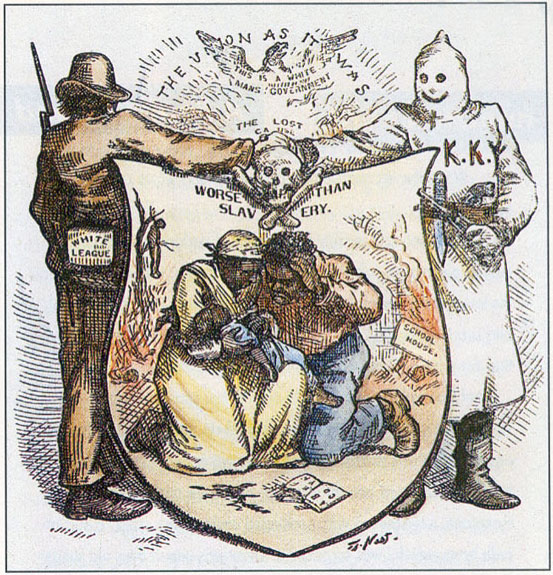
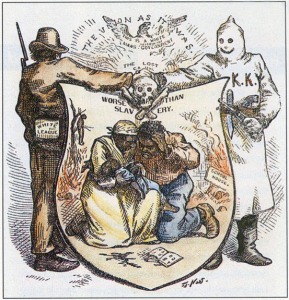
KKK-Nast

Friends of Padre Steve’s World,

Today I have a revised section of my Cicil War text “A Great War in an Age of Revolutionary Change.” I have being doing some final touches on it before I start working on final edits before seeking a publisher. I think it is important and timely in a day when state legislatures throughout the “Old South” are passing laws that seek to restrict voting rights against minorities and the elderly in order to diminish their political power, or to pass legislation designed to discriminate against LGBTQ people based solely on religious dogma. 

In such a world it is important to remember what happened to African Americans after Southern Whites reclaimed power following the collapse of Reconstruction.

Have a great day.

Peace

Padre Steve+

The Supreme Court, Congress, the Presidents as well as state governments systematically rolled back the rights of African Americans after Reconstruction ended. The Courts were the first to do this and once they had set the precedent were followed by the now Democrat controlled Congress and President Grover Cleveland. In 1883 “the Civil Rights Act of 1875, outlawing discrimination against Negroes using public facilities, was nullified by the Supreme Court, which said: “individual invasion of individual rights is not the subject-matter of the amendment.” The Fourteenth Amendment, it said, was aimed at state action only. No state shall…” [1] Associate Justice Joseph Bradley who had so eviscerated the Enforcement Act again played his hand in overturning a law that he despised on principle. He had written when Grant first signed the act in 1875 “to deprive white people of the right of choosing their own company would be to introduce another kind of slavery…. It can never be endured that the white shall be compelled to lodge and eat and sit with the Negro. The latter can have his freedom and all legal and essential privileges without that. The antipathy of race cannot be crushed and annihilated by legal enactment.” [2] In writing to overturn the Civil Rights Act of 1875 Bradley wrote that such laws were made African Americans a “special favorite of laws” and ignored the fact that in most of the country blacks were indeed not a favorite and were in fact still the subject of discrimination, segregation, political disenfranchisement, systematized violence, murder and lynching.

The actions of the court and alliances between Northern corporations and Southern landowners led to even more discrimination and disenfranchisement for blacks, “From the 1880s onward, the post-Reconstruction white governments grew unwilling to rely just on intimidation at the ballot box and themselves in power, and turned instead to systematic legal disenfranchisement” [3] which furthered the black codes into what we now call the era of Jim Crow.

For years after the Supreme Court’s Cruikshank decision blacks throughout the South attempted to vote despite intense opposition from Southern whites and armed bands of thugs. But with White Democrats now in charge of local government and “in control of the state and local vote-counting apparatus, resistance to black voting increasingly took the form of fraud as well as overt violence and intimidation. Men of color who cast Republican votes often found later that they had been counted for the party of white supremacy.” [4]

In 1896 the Supreme Court in the case of Plessy v. Ferguson upheld the black codes and Jim Crow laws. That ruling established the “separate but equal” doctrine and ushered in an era of de jure segregation in almost all arenas of life including education, transportation, entertainment and health care. The limited social equity and privileges enjoyed by blacks, not only in the South, but in the entire nation were erased by the stroke of the judicial pen. The justices ruled on the concept that the Constitution only guaranteed or protected a people’s political rights in the social arena that African-Americans could not interact with whites and assumed their racial inferiority.

Not all on the Court agreed with these rulings. One of them was Associate Justice John Harlan, who was a former slaveholder. Harlan dissented in the Court’s majority decision to overturn the Civil Rights Act of 1875 and also in Plessy v. Ferguson. In the case of the Civil Rights Act ruling Harlan insisted “our Constitution is color blind” [5] and wrote a strongly worded opinion:

“The destinies of two races, in this country are indissolubly linked together, and the interests of both require that the common government of all should not permit the seeds of race hate to be planted under the sanction of law. What can more certainly arouse race hate, what more certainly create and perpetuate a feeling of distrust between these races, than state enactments, which, in fact, proceed on the ground that colored citizens are so inferior and degraded that they cannot be allowed to sit in public coaches occupied by white citizens? That, as all will admit, is the real meaning of such legislation as was enacted in Louisiana.” [6]

As eloquent and as correct as Justice Harlan’s argument was, it was not sufficient to turn the tide of the new Court backed segregation laws. Harlan “was fighting a force greater than the logic of justice; the mood of the Court reflected a new coalition of northern industrialists and southern businessmen-planters.” [7] The “separate but equal” measures approved by the Court majority in Plessy v. Ferguson led to the widespread passage of Jim Crow laws, not only in the South but in other areas of the country. The Jim Crow era took nearly a century to reverse, and “only began to disappear with Brown v. Board of Education in 1954 and the Civil Rights and Voting Rights Acts of 1964 and 1965.” [8]

In order to get around the Fifteenth Amendment state governments in the South employed a strategy of subterfuges to suppress the African American vote. Along with the ever present threats of voter intimidation from armed White Supremacist groups, the states complicated the processes of voter registration and voting in order to make it nearly impossible for blacks to vote and into political oblivion. “Redeemer” governments in the post-Reconstruction South through the use of literary tests and poll taxes, the later which required people to pay in order to vote. The literacy and educational requirements mandated that “perspective registrants to “interpret” a section of the state constitution, and enacted standards which few blacks could fulfill, such as limiting registration to those whose grandfathers had voted.” Of course few blacks could meet the latter requirement as their grandfathers had been slaves and ineligible to vote. The laws were so devious that “when a journalist asked an Alabama lawmaker could pass his state’s understanding” test, the legislator replied, That would depend on entirely on which way he was going to vote.” [9]

These court decisions and legislation strengthened racism and discrimination against blacks, “effectively excluding blacks from public places, from the right to votes, from good public education, and so forth.” [10] The Plessy ruling was a watershed. Southern legislators, now unencumbered by Federal interference passed “state laws mandating racial segregation in every aspect of life, from schools to hospitals, waiting rooms to toilets, drinking fountains to cemeteries…segregation was part of a complex system of white domination, in which each component – disenfranchisement, unequal economic status, inferior education – reinforced the others.” [11]

For decades future courts would cite Plessy and Cruikshank as well as other decisions as precedent in deny rights to blacks. It would not be until 1954 when the Supreme Court overturned Plessy and the “Separate but Equal” Jim Crow laws in Brown v. Board of Education. Brown was a watershed for it deemed that separate schools were “inherently unequal.” The reaction across the South, especially Mississippi was stunned shock, disbelief and anger. “A Mississippi judge bemoaned “black Monday” and across the South “Citizen’s Councils” sprung up to fight the ruling. [12]

Mississippi led the way in disenfranchising black voters through the use of voter qualifications that would eliminate most blacks from the rolls of voters. In 1895 the state legislature passed a measure that would “technically apply to everybody but actually eliminate the Negro without touching the white.” [13] The move was in open defiance of the Fifteenth Amendment and resulted in tens of thousands of black voters being dropped from the rolls, in most cases under 5% of black voters who had been eligible to vote in 1885 remained eligible in 1896. Mississippi was rewarded in 1898 when the Supreme Court in Williams v. Mississippi that “there was no reason to suppose that the state’s new voting qualification were aimed specifically at Negroes.” [14] “In 1900 blacks comprised 62 percent of Mississippi, the highest percentage in the nation. Yet the state had not one black elected official.” [15]

Violence was used with great effect and between 1880 and 1968 approximately 3,500 people were murdered or lynched throughout the South. In 1892 alone 235 blacks were lynched “and throughout the decade, whites lynched an average of 150 southern blacks per year.” [16] This had become a far easier task and far less dangerous for the perpetrators of violence against blacks as Supreme Court “interpreted black people’s other constitutional rights almost out of existence.” [17] Since the court had “limited the federal government’s role in punishing violations of Negro rights” this duty fell to the states, which seldom occurred, and when “those officials refused to act, blacks were left unprotected.” [18]

The effects of these actions were shown in the number of African Americans in elected office. In 1869 there were two African American United States Senators and twenty black members of the House of Representatives. After Reconstruction ended these numbers dwindled and “the last black left Congress in 1901.” [19]

One of these was the case of United States v. Harris where the federal prosecutors had indicted “twenty members of a Tennessee lynch mob for violating section two of the enforcement Act, which outlawed conspiracies to deprive anyone of “equal protection of the laws.” However the Court struck down section 2 because the “lynching was not a federal matter, the Court said, because the mob consisted only of private individuals.” [20]

Many Southern states, especially Mississippi continued to tighten Jim Crow throughout the first half of the twentieth century. “In 1922 a new Jim Crow law kept up with the times by segregating taxis. In 1930 another new law prohibited “publishing, printing, or circulating any literature in favor of or urging inter-racial marriage or social equality.” [21] Not only were physical barriers being erected, but thought and free speech was now illegal if one supported equal rights.
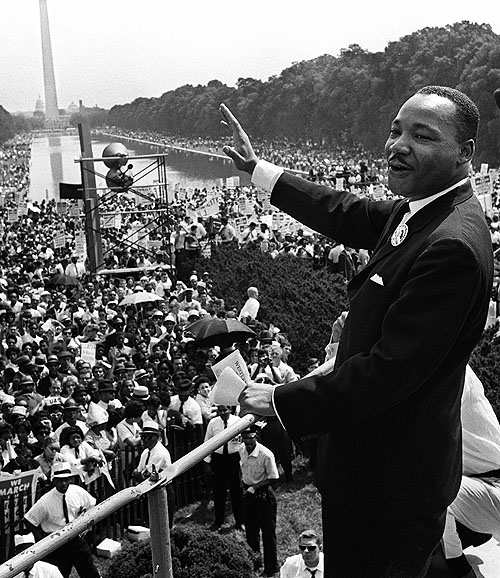
martin-luther-king-jr

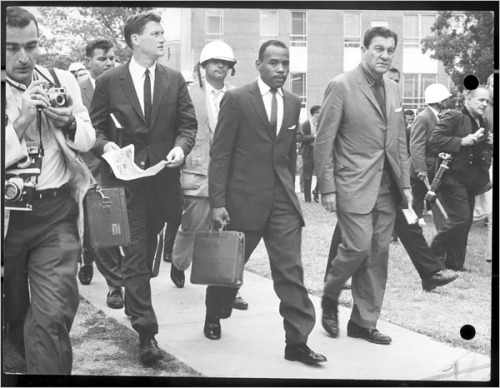
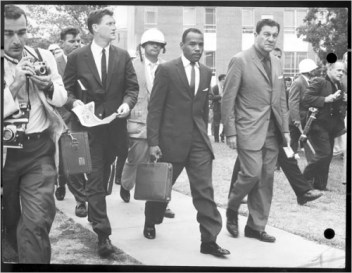
This remained the case until the 1960s when during the Freedom Rides when Mississippi again became a battleground in the Civil Rights movement. In 1961 James Meredith, a veteran of the U.S. Air Force, became the first black to ever be admitted to the University of Mississippi. His admission was fought by the university, Mississippi politicians including U.S. Senator James Eastland, Governor Ross Barnett, numerous congressmen and state representatives, and a populace that threatened violence and even war if the Federal government or courts order them to comply. Governor Barnett spoke for many when he made a statewide television address in September 1961 “We must either submit to the unlawful dictates of the federal government or stand up like men and tell them ‘NEVER!’” [22] He then called for the arrest of any federal officials who attempted to hold a state official for defying federal court orders. Backed by federal court orders to admit Meredith, and by the Brown v. Board of Education ruling, Attorney General Robert F. Kennedy called Barnett on September 24th.

“Governor,” Kennedy observed, “you a part of the United States.”

            “We have been a part of the United States, but I don’t know whether we are or not.”

            Are you getting out of the Union?”

            “It looks like we are being kicked around – like we don’t belong to it.”

            Back to specifics again, Kennedy ended the talk with a typical crisp wrap-up. “My job is to enforce the laws of the United States.” [23]

The resultant conflict nearly came to violence as thousands of Mississippians, whipped into an anti-black and anti-federal government frenzy by their elected leaders, radio, and television and newspaper commentators and supported by the KKK, the John Birch Society and other groups mobilized to fight the “invasion.” Eventually a deal was reached to admit Meredith on September 30th. As Meredith entered the campus he was protected by Federal Marshals and Border Patrol officers, as well as the State Police, which had just a few hours before been deployed to keep Meredith and the federals out. Despite this thousands of people ringed the campus, and the Confederate Battle Flag was raised over the Civil War memorial on campus. The rioters uttered death threats and assaulted anyone who supported Meredith. Members of the press, even southerners, faculty members and civilian supporters were beaten, bricks, stones and bottles thrown, tires of federal vehicles slashed. Finally the marshals themselves were attacked and eight injured, forcing them to deploy tear gas to protect themselves and the State police withdrew.
tumblr_ly9o466dxz1r4tvc5o1_500

James Meredith being escorted to Ole Miss

Eventually U.S. Army MPs and mobilized National Guard units were called up and battled Molotov cocktails that were being thrown by the anti-integration protests to relieve the beleaguered marshals and border patrolmen. The troops finally cleared the campus and ended the riot. During the riot 160 marshals were hurt, some 28 of who were wounded by bullets fired by the protestors. The next morning with Meredith admitted to the university a local clergyman saw the Confederate flag still flying and “with firm step, he strode out to the pole, loosened the halyard and lowered the Confederate flag.” [24]

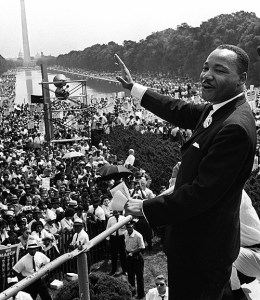
The battle to integrate Ole’ Miss was over. Meredith graduated peacefully in August of 1963 and by then Mississippi abandoned its defiance of Federal authority, but many in the state still protested the admission as well as the later passage of the Civil Rights and Voting Rights Acts. Violence still occurred and even intensified at times as the Civil Rights movement, now led by Dr. Martin Luther King Junior made headway. King wrote in the Letter from a Birmingham Jail:

“One day the South will recognize its real heroes. They will be the James Merediths, with the noble sense of purpose that enables them to face jeering and hostile mobs, and with the agonizing loneliness that characterizes the life of the pioneer. They will be old, oppressed, battered Negro women, symbolized in a seventy two year old woman in Montgomery, Alabama, who rose up with a sense of dignity and with her people decided not to ride segregated buses, and who responded with ungrammatical profundity to one who inquired about her weariness: “My feets is tired, but my soul is at rest.” They will be the young high school and college students, the young ministers of the gospel and a host of their elders, courageously and nonviolently sitting in at lunch counters and willingly going to jail for conscience’ sake. One day the South will know that when these disinherited children of God sat down at lunch counters, they were in reality standing up for what is best in the American dream and for the most sacred values in our Judaeo Christian heritage, thereby bringing our nation back to those great wells of democracy which were dug deep by the founding fathers in their formulation of the Constitution and the Declaration of Independence.” [25]

In South Carolina, which had fought integration in the courts outgoing Governor Ernest F. Hollings read King’s letter and knew that he had been on the wrong side of history. The Democrat Governor realized that the handwriting was on the wall, and that South Carolina was different than Mississippi. Hollings knew that South Carolina’s racism was the old aristocratic type, which gave more value to an orderly society. As such Hollings told the legislature:

“As we meet, South Carolina is running out of courts. If and when every legal remedy has been exhausted, the General Assembly must make clear South Carolina’s choice, a government of laws rather than a government of men. As determined as we are, we of today must realize the lesson of once hundred years ago, and move on for the good of South Carolina and our United States. This should be done with dignity. It must be done with law and order.” [26] When Clemson University admitted its first student later in the year, there was no violence.

Hollings later remembered that for years he had supported and enforced the Jim Crow laws in his state. However, King’s Letter from a Birmingham Jail changed him, it was for him a moment like the Apostle Paul on the Road to Damascus. He admitted, “as governor, for four years, I enforced those Jim Crow laws. I did not understand, I did not appreciate what King had in mind… until he wrote that letter. He opened my eyes and set me free.” [27]

More violence would occur in Mississippi and other states during the 1960s. During the Freedom Rides, students and educators came from around the nation to the state to help register blacks to vote in 1964. This brought generations of barely concealed hatred to the surface. Bruce Watson in his book Freedom Summer wrote:

“In Mississippi’s most remote hamlets, small “klaverns” of ruthless men met in secret to discuss the “nigger-communist invasion of Mississippi.” They stockpiled kerosene, shotguns, and dynamite, then singled out targets – niggers, Jews, “nigger-lovers.” One warm April night, their secret burst into flames. In some sixty counties, blazing crosses lit up courthouse lawns, town squares, and open fields. The Klan was rising again in Mississippi. Like “White Knights” as their splinter group was named, the Klan planned a holy war against the “dedicated agents of Satan…determined to destroy Christian civilization.” The Klan would take care of your business, a recruiting poster said. “Get you Bible out and PRAY! You will hear from us.” [28]

Eventual the violence of these people led to the killings of three of the organizers, Michael Schwerner, James Cheney and Andrew Goldman were killed by a group of Klansmen led by members of the Neshoba County Sheriff’s Department on June 21st 1964. The resultant search for their bodies and the subsequent investigation transfixed the nation and led to the passage of the Civil Rights and Voting Rights Acts of 1964 and 1965.

After he left office, Ulysses Grant gave an interviewer a sober assessment of Reconstruction’s failure. Grant concluded that at the end of the war what the South really needed was a benevolent dictatorship until it could be fully reintegrated into the Union. Instead the South remained defiant and using subterfuge mixed with targeted violence wore down the will northerners to fully pursue and implement Reconstruction. He told the interviewer:

“Military rule would have been just to all… the Negro who wanted freedom, the white man who wanted protection, the Northern man who wanted Union. As state after state showed a willingness to come into the Union, not on their terms but upon ours, I would have admitted them. The trouble about the military rule in the South was that our people did not like it. It was not in accordance with our institutions. I am clear now that it would have been better to suffrage, reconstruction, State governments, for ten year, and held the South in a territorial condition. But we made our scheme, and we must do what we must with it.” [29]

Grant was correct in his analysis. The policies enacted by the North in 1865 that were considered benevolent were seized upon as signs of weakness in the defeated South. The leaders of the South knew that the Republican Party was a coalition and worked to push the fault lines of the Republicans until they broke, and they were successful. The Confederacy may have lost the war in a military and economic sense, but in the “ways that mattered most to white Southerners – socially, politically, and ideologically – the South itself did not.” [30] Grant died in 1885 hailed throughout the nation, but knowing that he was unable to secure the new birth of freedom, that he and his friend Abraham Lincoln and so many others had fought for in the Civil War.

The example of Reconstruction’s failure shows that in order to secure peace that military victory must be accompanied by the political will to ensure that the avowed goals of that victory are secured after the war in ensuring a just peace. In retrospect, a harsh peace and a long period of nation building may have benefited the nation more than botched reconstruction, but as Grant noted “our people did not like it.”

Southerners may have lost the shooting war, but they could not and would not accept the peace. By successfully wearing down the will of the people of the North and exploiting the fissures in varying components of the Republican Party, they succeeded in winning the things most important to them in regard to race relations and White Supremacy.

After the war, White Southerners resorted to all means to reverse their military defeat through political, social, economic and judicial means and “justice was sacrificed for the unjust peace ushered in by “redemption” of the South, a peace marred by Jim Crow, poverty and lynching.” [31] Most Northern leaders, politicians, the media and the clergy failed to appreciate this until it was far too late, and hindered by President Johnson’s opposition failed to win the peace in the South when they had the best chance. They failed to appreciate that even after the shooting is often that “there is a need for further threats, and indeed action, because postwar disorder and even chaos will have to be address, and victorious allies are always likely to squabble over the spoils of victory” [32] as certain was the case in the divided Republican Party of the Reconstruction era. By the time Ulysses S. Grant was elected President many in the North were already tiring of Reconstruction and African Americans and when he resorted to harsh yet effective means of quelling violence and enforcing the laws many, even in his own Republican Party rebelled, ensuring the former Confederates of a political and social victory that took nearly another hundred years to end, if indeed it is truly ended, a proposition that I think is ludicrous as for many the Civil War is not over.

Notes

[1] Ibid. Zinn The Other Civil War p.57

[2] Ibid. Lane The day Freedom Died p.253

[3] Ibid. Guelzo Fateful Lightening p.526

[4] Ibid. Lane The day Freedom Died p.251

[5] Ibid. Zinn The Other Civil War p.58

[6] LaMorte, Michael W. School Law: Cases and Concepts 9th Edition 2008 Allyn and Bacon Inc. 2008 p.300

[7] Ibid. Zinn A People’s History of the United States pp.204-205

[8] Ibid. Huntington Who are We? p.54

[9] Ibid. Goldfield Still Fighting the Civil War: The American South and Southern History p.197

[10] Gonzalez, Justo L. The History of Christianity Volume 2: The Reformation to the Present Day Harper and Row Publishers San Francisco 1985 p.252

[11] Ibid. Foner Forever Free p.208

[12] Ibid. Watson Freedom Summer p.46

[13] Ibid. Lord The Past that Wouldn’t Die p.22

[14] Ibid. Lord The Past that Wouldn’t Die p.23

[15] Ibid. Watson Freedom Summer p.41

[16] Ibid. Goldfield Still Fighting the Civil War: The American South and Southern History, Updated Edition, p.206

[17] Ibid. Lane The day Freedom Died p.253

[18] Ibid. Langguth After Lincoln p.338

[19] Ibid. Zinn A People’s History of the United States p.200

[20] Ibid. Lane The day Freedom Died p.253

[21] Ibid. Lord The Past that Wouldn’t Die p.25

[22] Ibid. Lord The Past that Wouldn’t Die p.139

[23] Ibid. Lord The Past that Wouldn’t Die p.159

[24] Ibid. Lord The Past that Wouldn’t Die p.231

[25] King, Martin Luther Letter from a Birmingham Jail 16 April 1963 Retrieved from https://www.africa.upenn.edu/Articles_Gen/Letter_Birmingham.html 15 September 2016

[26] Bass, Jack and Nelson, Jack The Orangeburg Massacre Mercer University Press, Macon and Atlanta 1984, 1996 & 2002 pp.11-12

[27] Ibid. Goldfield Still Fighting the Civil War: The American South and Southern History, Updated Edition, p.74

[28] Ibid. Watson Freedom Summer p.12

[29] Ibid. Lane The day Freedom Died p.254

[30] Ibid. Lane The day Freedom Died p.254

[31] Ibid. McPherson The War that Forged a Nation p. 191

[32] Ibid. Gray Fighting Talk p.14

2 Comments

Filed under civil rights, civil war, History, Political Commentary

It is By Small Failures that Freedom Dies


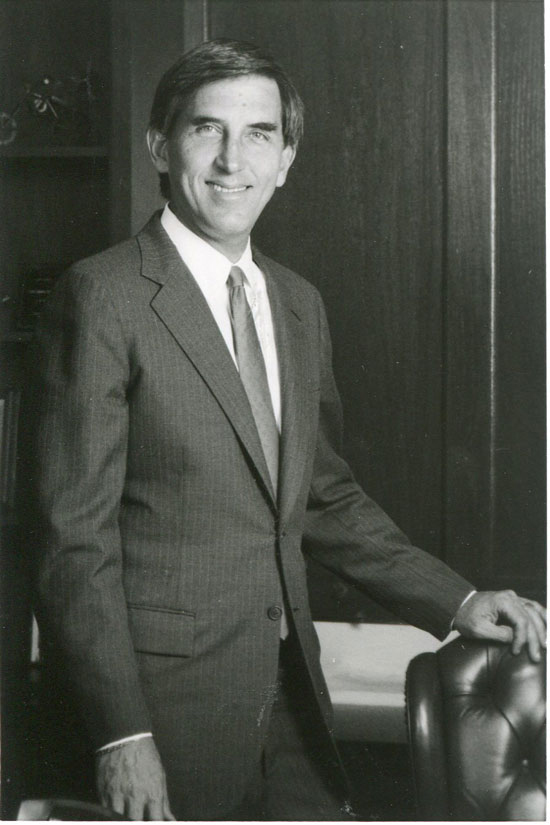
Charles D. Morgan Jr.  Chief Executive Officer  Acxiom Corporation

Charles Morgan Jr.

Friends of Padre Steve’s World,

Just a short thought today as I have been very busy with a new class at the Staff College as well as doing more writing and research on my Civil War and Gettysburg texts, but I wanted to share this thought, from the late Charles Morgan Jr. I wrote about what this amazing man said in regard to what he said after the bombing to the 16th Street Baptist Church in Birmingham Alabama some 53 years ago in previous articles, but I think that this is something that is pertinent as well look to the coming election.

Morgan was a well off young Southern gentleman, a lawyer, and a man with a conscience. He was a defender of the civil liberties of many people during his life, most of which were incredibly unpopular when he made his strand.

Morgan made a comment that really stuck in my brain because it is so true. He said,

“It is not by great acts but by small failures that freedom dies. . . . Justice and liberty die quietly, because men first learn to ignore injustice and then no longer recognize it.”

The truth is that it those small failures; first to turn our backs on justice and to ignore it, and then finally, to fail to even recognize it when justice is being trampled. That is how freedom dies. Sadly, those who most often trample freedoms, usually in the name of God or religion are the last to recognize their complicity in that loss of freedom. Judge Learned Hand spoke these words; “If we are to keep our democracy, there must be one commandment: Thou shalt not ration justice.”

Sadly, there are too many who will do just that, all to often in the name of their God, or their religion, but some in the name of “law and order.” If we ration justice so that only a few; the rich, and the well off are able to afford it, then we will succeed in standing idly by as injustice becomes the norm.

Please ponder that thought. I have some other projects that I am working on for this site, but today I am going with Judy for another follow-up visit with her oncologist and praying as always that there is no recurrence of the Endometrial Cancer that she was operated on last year.

So have a great day,

Peace

Padre Steve+

Leave a comment

Filed under civil rights, History

Jackie Robinson and the Freedom Summer

Jackie Robinson Speaking with the Press

Friends of Padre Steve’s World,

I am still on vacation and will posting some new material have brought an older article out of the vault. I think it is important because it covers a watershed moment in American politics, a moment that started the Republican Party down the path that has culminated today. It is about the Freedom Summer of 1964 and baseball icon and civil rights pioneer Jackie Robinson’s trip to the 1964 Republican National Convention. Though the events happened some fifty-two years ago, they are not ancient history, and the spirit and ideology that characterized them is all to present today, especially in the modern Republican Party. 

So have a great day. 

Peace

Padre Steve+

republican-national-convention-delegates_1964

“A new breed of Republicans had taken over the GOP. As I watched this steamroller operation in San Francisco, I had a better understanding of how it must have felt to be a Jew in Hitler’s Germany.” Jackie Robinson on his observations of the 1964 Republican National Convention

Jackie Robinson was a Republican. So was I for 32 years and for much of that time I considered myself a “conservative” whatever that means, though I thought it meant freedom, limited government and opportunity for all regardless of race, color, religion or any other trait or belief. I also believed and still do in a strong defense, but I can no longer consider myself a man that blesses American intervention in other people’s wars unless there is a clear and present danger to the United States, not simply our so called “interests” which may not be those of the nation at all but of multi-national corporations which were originally American businesses but not only need our military, diplomatic and intelligence resources to increase their profits.

My parents were Kennedy type Democrats, but in the 1970s, torn by the extremism of the 1972 Democratic Convention in Chicago and feeling the hatred of people for those in the military, including a Sunday School teacher who told me that my dad, then serving in Vietnam was “baby killer” I at the age of 12 decided that I would be a Republican. I was a Republican until I returned from Iraq in 2008, fully aware of the lies that took us into that war and seeing the cost both to American servicemen and the people of Iraq.

fsms1

I have been doing a lot of reading lately on a period of history that as a historian I had pretty much skipped over. That is the period of the Civil Rights movement of the early to mid-1960s. I guess I skipped over it because I was more interested in the glory of war and patriotism wrapped in historic myth than in the experiences of fellow citizens who had been killed, abused, tormented and persecuted by people like me simply because of the color of their skin. I had not yet begun to appreciate the concept of justice at home being interconnected to our deepest held principles and how we embody them in our foreign policy.

For many years I echoed the point made by some conservatives that it was the GOP that helped make the Voter’s Rights Act of 1964 and Civil Rights Act of 1965 passed into law. That is true. Most Republicans voted for them, with a notable exception, Barry Goldwater. However, what is also true is that the Republicans that voted for the 1964 act were considered “liberals” and treated shamefully at the 1964 convention, whose delegates voted down a part of the platform that would have supported that act. Of the Democrats that voted against those bills almost all came from the Deep South, a region which within a decade become a Republican stronghold and a key part of the Southern Strategy of every GOP Presidential Candidate since Richard Nixon. A Republican aide at the 1964 convention told a reporter that “the nigger issue was sure to put Goldwater in the White House.” (See Freedom Summer by Bruce Watson p.163)

However as a life long baseball fan there is one thing that I know, that if there had been no Branch Rickey and Jackie Robinson we might not have gotten Rosa Parks or the Reverend Martin Luther King Jr.

$(KGrHqF,!qEF!GdOTlS(BQOjfQWE0w~~60_57

Robinson was appointed as a special delegate to New York Governor Nelson Rockefeller who was running against Goldwater and attended the convention. He had given up his job as a spokesman for and Vice President of the Chock Full O’Nuts Coffee Company to assist Rockefeller’s campaign in 1964.

Robinson knew what it was like to be the “point man” in the integration of baseball and in his career was threatened with physical violence and death on many occasions. Some teammates circulated petitions that they would not play for a team that had a “black” on it. Robinson, encouraged by Rickey persevered and became an icon in baseball, the Civil Rights movement and the history of the United States. However, not even 10 years after his retirement from baseball and 2 years after he was elected to the Hall of Fame he once again discovered just how deep racism still ran in this country. As he attended the convention FBI agents and other Federal authorities attempted to find the bodies of three young Voting Rights staff who were part of the 1964 Freedom Summer campaign in Mississippi. Eventually, later in the summer the bodies of James Chaney, Andrew Goodman and Michael Schwerner would be discovered buried in the base of a dam near Philadelphia Mississippi. Their killers were local law enforcement officers and members of the Ku Klux Klan.

200px-AndrewGoodman-JamesChaney-MichaelSchwerner

Maybe I lived in my own fantasy world. My experience growing up was on the West Coast living in a military family in small towns and big cities. I am proud to be part of the first class that attended high school in my home town when the courts ordered desegregation in our schools. That experience at Edison High School of Stockton California from 1975-78 changed me, as did having a black roommate in college.

However, that being said it took me a long time to realize that things really haven’t changed that much from 1964 in many parts of the country, especially since I have lived most of my adult live in the historic States that comprised the Confederacy. I can say from practical observation and knowledge that racism and other forms of more acceptable prejudice live on in this country. There is not a day that goes by that I do not run into the vestiges of the hate that lived during the Freedom Summer of 1964. It is more subtle in some cases, but other times is so blatant that is sickening. I never expected that I would ever be called a “nigger lover” or “wigger” until I had people make those comments on this website in response to articles that had nothing to do with race relations or civil rights, nor did I expect physical threats from people who call themselves “Christian.” Those were learning experiences that I won’t soon forget.

G21767P

Robinson wrote of his experience at the 1964 Convention:

“I wasn’t altogether caught of guard by the victory of the reactionary forces in the Republican party, but I was appalled by the tactics they used to stifle their liberal opposition. I was a special delegate to the convention through an arrangement made by the Rockefeller office. That convention was one of the most unforgettable and frightening experiences of my life. The hatred I saw was unique to me because it was hatred directed against a white man. It embodied a revulsion for all he stood for, including his enlightened attitude toward black people.

A new breed of Republicans had taken over the GOP. As I watched this steamroller operation in San Francisco, I had a better understanding of how it must have felt to be a Jew in Hitler’s Germany.

The same high-handed methods had been there.

The same belief in the superiority of one religious or racial group over another was here. Liberals who fought so hard and so vainly were afraid not only of what would happen to the GOP but of what would happen to America. The Goldwaterites were afraid – afraid not to hew strictly to the line they had been spoon-fed, afraid to listen to logic and reason if it was not in their script.

I will never forget the fantastic scene of Governor Rockefeller’s ordeal as he endured what must have been three minutes of hysterical abuse and booing which interrupted his fighting statement which the convention managers had managed to delay until the wee hours of the morning. Since the telecast was coming from the West Coast, that meant that many people in other sections of the country, because of the time differential, would be in their beds. I don’t think he has ever stood taller than that night when he refused to be silenced until he had had his say.

It was a terrible hour for the relatively few black delegates who were present. Distinguished in their communities, identified with the cause of Republicanism, an extremely unpopular cause among blacks, they had been served notice that the party they had fought for considered them just another bunch of “niggers”. They had no real standing in the convention, no clout. They were unimportant and ignored. One bigot from one of the Deep South states actually threw acid on a black delegate’s suit jacket and burned it. Another one, from the Alabama delegation where I was standing at the time of the Rockefeller speech, turned on me menacingly while I was shouting “C’mon Rocky” as the governor stood his ground. He started up in his seat as if to come after me. His wife grabbed his arm and pulled him back.

“Turn him loose, lady, turn him loose,” I shouted.

I was ready for him. I wanted him badly, but luckily for him he obeyed his wife…” From Jackie Robinson “I Never Had it Made” Chapter XV On Being Black Among the Republicans

1*HLP1tcduxglV4VtdWHUI0Q

Belva Davis, then a young journalist wrote of her experiences at that convention:

While the Goldwater organization tried to keep its delegates in check on the floor, snarling Goldwater fans in the galleries around us were off the leash. The mood turned unmistakably menacing…

Suddenly Louis and I heard a voice yell, “Hey, look at those two up there!” The accuser pointed us out, and several spectators swarmed beneath us. “Hey niggers!” they yelled. “What the hell are you niggers doing in here?’”

I could feel the hair rising on the back of my neck as I looked into faces turned scarlet and sweaty by heat and hostility. Louis, in suit and tie and perpetually dignified, turned to me and said with all the nonchalance he could muster, “Well, I think that’s enough for today.” Methodically we began wrapping up our equipment into suitcases.

As we began our descent down the ramps of the Cow Palace, a self-appointed posse dangled over the railings, taunting. “Niggers!” “Get out of here, boy!” “You too, nigger bitch!” “Go on, get out!” “I’m gonna kill your ass!”

I stared straight ahead, putting one foot in front of the other like a soldier who would not be deterred from a mission. The throng began tossing garbage at us: wadded up convention programs, mustard-soaked hot dogs, half-eaten Snickers bars. My goal was to appear deceptively serene, mastering the mask of dispassion I had perfected since childhood to steel myself against any insults the outside world hurled my way.

Then a glass soda bottle whizzed within inches of my skull. I heard it whack against the concrete and shatter. I didn’t look back, but I glanced sideways at Louis and felt my lower lip began to quiver. He was determined we would give our tormentors no satisfaction.

“If you start to cry,” he muttered, “I’ll break your leg.” ( Belva Davis “Never in My Wildest Dreams: A Black Woman’s Life in Journalism)

The sad thing is that in many states the new GOP has taken a page out of the past and has been either passing legislation or attempting to pass legislation that makes it harder for Blacks and other minorities to vote. Groups have shown up armed at heavily black polling sites in recent elections and efforts have been made to ensure that minorities cannot vote. They have also challenged the 1964 Voter’s Rights Act in Court and have a friend in Justice Antonine Scalia who called it a “racial entitlement” and violation of State sovereignty.

8399w

The tactics are quite similar to those used in the Deep South prior to 1964 which made it virtually impossible for a Black man or woman to cast a vote, and if they tried even to register to vote did so at the peril of their lives or families. The opponents of integration, voter’s rights and equal rights used some of the same lines used today against those that support these rights. “Communists sympathizers, Socialists, Atheists, Anti-Christian, Anti-American, Anti-Constitution,” you name it the same labels are being applied to those that simply want to be at the table. The sad thing that many of the most vicious users of such untruths are my fellow Christians.

ae-eop-freedom-school_tx700

These are hard things to look at and it is far easier to believe myth than it is to actually seek truth. A few years back I cannot every in a million years having written this article. However the threats to minorities be they racial, religious or even gender have become part an parcel of the new GOP, the GOP that I could not remain a part of when I returned from Iraq.

I guess that I am becoming a Civil Rights advocate, or then, maybe it’s that I’m actually becoming more of a Christian. Branch Rickey said “I may not be able to do something about racism in every field, but I can sure do something about it in baseball.” Oh well, I amy not be able to do something about racism and other prejudice everywhere but I can do it here and wherever I work or preach.

freedom_cross1

Oh well whatever, it really doesn’t matter so long as I can live with myself. Besides, I’ll get labeled anyway so what does it matter? I would rather be in the same camp as someone like Jackie Robinson and Branch Rickey than Antonine Scalia or those that seek to keep people down simply because they are different anyway.

Martin Niemoller once said:

First they came for the , communist
and I didn’t speak out because I wasn’t a communist.

Then they came for the socialists,
and I didn’t speak out because I wasn’t a socialist.

Then they came for the trade unionists,
and I didn’t speak out because I wasn’t a trade unionist.

Then they came for me,
and there was no one left to speak for me.

Friends, it is all too important that we not forget this, even as Donald Trump and many of his supporters who include most of the White Supremacists, Klansmen, and Neo-Nazis in this country offer the same threats against blacks, other minorities, and political moderates and liberals. Make no mistake, what is happening now is nothing more than a resurgence of the hatred and violence that was unleashed against those who fought for civil rights fifty years ago.


Leave a comment

Filed under civil rights, History, Political Commentary

The Dream at 53: Still Laboring for the New Birth of Freedom


Friends of Padre Steve’s World,

Since I am out of town this week I am going to post a short article tonight. Today was the fifty-third anniversary of one of the greatest speeches in American history. It was on this day that Dr. Martin Luther King Jr. spoke at the Lincoln Memorial during the March on Washington for Jobs and Freedom. The speech was powerful, eloquent, and even today when one listnes to Dr. King’s marvelous oratory the effect is electrifying. I was on three years old and living in the Philippines when he spoke them and so it was not until years later that I heard it for the first time.  Every time I watch the films of Dr. King speaking those words I am forced to recall not just his eloquence, but the depth of what he said, and how much is still true today. While I think I am a pretty good writer I would only hope to half as gifted as a speaker as Dr. King. 

https://vimeo.com/2158959
http://www.americanrhetoric.com/speeches/mlkihaveadream.htm 
I did get to speak yesterday at the Morehead Pride Festival and afterwards I was thinking about Dr. King’s message for all people. I do have that dream for all who are oppressed. I was talking to a lot of people before and after and so many told me how many of how they had been ostracized by the church for being Gay but still longed for that sense of spiritual support and acceptance. I began thinking what it would be like if most churches would simply accept people and love them. But many churches and Christians, especially the more conservative types of churches who are so willing to accept people and even bless people like Donald Trump as “God’s choice” for the highest office in the land, treat LGBTQ people as worse than the devil. Why? Because they are gay and according to their interpretation of the Bible that seems to be the only sin God cannot forgive. Less than fifty years ago many people in this country felt the same way about African Americans. But I digress… 

But the fact is that for many people, especially African Americans, other people of color, poor whites, women, religious minorities, as well as LGBTQ people, the promise of this nation is not yet fully realized. Dr. King equated the words of the Declaration of Independence as a promissory note, meant for all people that had been defaulted on by our nation, and how could he not? 

As a historian I know the words of the preamble of the Declaration, as well as the Gettysburg Address are for all purposes are the cornerstone of American Secular Scripture. They define what we can and should be. And yesterday while I was speaking I again realized just how much promise those words have: they are what make us Americans and if we fail to remember them, if we fail to work to ensure that they are the basis of who we are as a people both in word and deed, then we too will default on that promissory note, and the treasury of freedom and justice will be bankrupt; and we have none to blame but ourselves. 

But I have a dream, as Dr. King so eloquently put it “that one day this nation will rise up and live out the true meaning of its creed: “We hold these truths to be self-evident, that all men are created equal.” Far too many people have shed their blood for that sacred proposition for us to abandon it: soldiers, civil rights leaders, men and women, black and white, straight and gay, of every religion and race that have ever longed for the realization of that proposition. Dr. King was one of them, as was Harvey Milk, they and so many others cut down by assassin’s bullets, or murdered, or lynched. So with them in mind we must take heed of the words of Abraham Lincoln, another martyr in the cause of freedom, who reminded those present at the dedication of the Soldier’s Cemetery at Gettysburg, “that is for us the living rather to be dedicated here to the unfinished work that they have thus far so nobly advanced. It is rather for us here to be dedication to the great task remaining before us – that from these honored dead we take increased devotion to the cause for which they gave the last full measure of devotion – that we here highly resolve that these dead shall not have died in vain, that this nation under God shall have a new birth of freedom, and that government of the people, by the people, for the people shall not perish from the earth.” 

So until tomorrow. 

Peace

Padre Steve+ 

Leave a comment

Filed under civil rights, History, Political Commentary

Becoming What We Should Be


Friends of Padre Steve’s World,
Having completed, with the exception of editing and circulating some hard copies of the first volume of my Civil War text A Great War in a Revolutionary Age of Change, I have gone back to work on the second volume of my Civil War text “Mine Eyes Have Seen the Glory” Religious Ideology, Race, and Politics in the Civil War Era. Beginning yesterday I began to go through the approximately 160 pages of text, which had been the second chapter of my Gettysburg Staff Ride text, but like A Great War really needed to be split off and turned into its own separate book. 

Yesterday I went back to figure the natural chapter breaks and to begin some minor editing and creating a bibliography and working table of contents as I prepare to really dig in on it. The good thing is that I have continued to research this section even as I concentrated on work on A Great War and major chapter revisions to the book dealing with the campaign of 1863 and the Battle of Gettysburg. 

As I have done this I become more and more convinced that what I am writing about needs to be told. As I look at responses to the Black Lives Matter movement I am appalled by the willing historical ignorance of much of the country, including white America, which has erased from its collective memory the terrible injustices of slavery, the black codes, Jim Crow, segregation, and violence directed at African Americans over nearly three hundred year period before the Supreme Court stuck down the Jim Crow era segregation laws, and the Congress passed the 1964 Civil Rights Act, and 1965 Voting Rights Act, and less than three years later Dr. Martin Luther King Jr., the champion of peace protest and civil rights was gunned down and assassinated. 

But it is easy for some people to condemn the Black Rights Movement, it is called racist by some, and it is blamed for a host of issues that it is simply exposing and demanding action to solve. Some people respond to criticism of police with the saying that Blue Lives Matter, and I agree that they do, police officers do dangerous work, and with the proliferation of high powered weaponry in the hands of irresponsible and angry people, their lives are always in danger. But that is no reason not to say that Black Lives Matter is wrong in its intent. Some say that All Lives Matter, and I agree with that in principle, but I would challenge the people that flippantly say that in order to dismiss the validity of Black Lives Matter, while doing nothing to work for the rights of people different than themselves, that they need to put their money where their mouth is. 

In the 1850s and 1860s Abraham Lincoln struggled with this in a country that was becoming increasingly diverse due to massive immigration from Ireland and Germany, and in which Congress and the Courts were making decisions which would allow for the expansion of slavery and the definition of African Americans as a subordinate race without any citizenship rights. Lincoln was worried that America was becoming like a plow horse with blinders fastened to the sides of its eyes, capable of seeing only in one direction: ahead of it. He saw Americans as people increasingly interested only with their present and their future, the things still before them, but disinterested with their own historical past, the things already behind them. A condition that is not much different that what we see today. Maybe because I am a historian I am more sensitive to this, but it is concerning. 

Lincoln realized that people had forgotten the heart and soul of America, the secular scripture found in the preamble of the Declaration of Independence. “We hold these truths to be self-evident, that all men are created equal, that they are endowed by their Creator with certain unalienable Rights, that among these are Life, Liberty and the pursuit of Happiness,—That to secure these rights, Governments are instituted among Men…” He realized that for most people of his era the proposition that all men are created equal was in the process of dying. He knew that freedom without equality was no freedom at all, and beginning with the Emancipation Proclamation he began the first step to universalize that proposition. Les than a year later he gave a short speech of under three hundred words at Gettysburg in which he went back to the Declaration noting “Four score and seven years ago our fathers brought forth on this continent, a new nation, conceived in Liberty, and dedicated to the proposition that all men are created equal,” and he called on Americans to renew themselves to that proposition: “It is for us the living, rather, to be dedicated here to the unfinished work which they who fought here have thus far so nobly advanced. It is rather for us to be here dedicated to the great task remaining before us—that from these honored dead we take increased devotion to that cause for which they gave the last full measure of devotion—that we here highly resolve that these dead shall not have died in vain—that this nation, under God, shall have a new birth of freedom—and that government of the people, by the people, for the people, shall not perish from the earth.”

In a book that I just finished on the Gettysburg Address the author noted something that I find quite true. He said: “We should read the Preamble to the Declaration of Independence, and then, the Gettysburg Address. They are, together, our American scriptures. And we should read them aloud, the way they were meant to be. They are words which are most powerful when they are spoken. Their words remain fresh and alive, no matter how many times they are read. All we need to know about what American democracy should be, is found there, among the words of these two ancient manuscripts.”

Now I do not arrogantly claim that we as Americans exemplify those words, or that we even live up to them, but they are something that we need to keep in the forefront of our minds, and strive to achieve if we are to become a better nation. 

I was talking with one of our international officers at the staff college today who has been studying at the Naval War College for the past year before he came to us, and as we talke we agreed that what makes America great is not our military might, nor our economic power, but that proposition of Liberty, the proposition that is so radical that few countries include it in any of their political documents, that proposition, that all men are created equal. It was something that a number of my Korean officers noted at Gettysburg back in May. They all understood something that so many Americans have forgotten. 

So I will continue to read, research, and write, and I am excited about it, especially during this critical time in our nation’s history. I’m sure that in the coming month or two that you will see some of that work appear on this site as I work on Mine Eyes Have Seen the Glory. 

Until tomorrow I wish you peace,

Padre Steve+

Leave a comment

Filed under civil rights, civil war, Gettysburg, History, News and current events, Political Commentary

We Cannot Understand Our Time Without Understanding the Civil War Era

IronBrigade12021001

Friends of Padre Steve’s World,

I am traveling up to Gettysburg to lead a group of Army officers on a Staff Ride. It will be good. I will be doing my initially classes tonight at O’Rourke’s Irish Tavern in Gettysburg with these officers and then conducting the actual staff ride As such I am reposting a further edited section of my Gettysburg and Civil War text. This is the introduction section to what was my first chapter, which has grown so much that it will be its own book soon. I think that these words of introduction are important. I do hope that you enjoy.

Peace

Padre Steve+

Finite human beings find themselves bound by time and space, we live in the present, but not the present alone, but rather three worlds: one that is, one that was, and one that will be. Ernst Breisach wrote, “In theory we know these three worlds as separate concepts but we experience as inextricably linked and influencing each other in many ways. Every new and important discovery about the past changes how we think about the present and what we expect of the future; on the other hand every change in the conditions of the present and in the expectations of the future revises our perception of the past. In this complex context history is born ostensibly as reflection of the past; a reflection which is never isolated from the present and the future. History deals with human life as it “flows” through time.” [1]

Richard Evans wrote something in the preface to his book The Third Reich in History and Memory that those who study military history often forget. He noted: “Military history, as this volume shows, can be illuminating in itself, but also needs to be situated in a larger economic and cultural context. Wherever we look, at decision making at the top, or at the inventiveness and enterprise of second rank figures, wider contextual factors remained vital.” [2] Thus while this work is an examination of the Gettysburg campaign it is important to understand the various issues that were formative for the men who directed and fought the battle, as well as the vast continuum of often distant and seemingly events that come together at one time in the lives of the participants in any historic event.

One cannot understand the determination the determination of Robert E. Lee to maintain the offensive, the dogged persistence of Joshua Chamberlain or Strong Vincent to hold Little Round Top, what brought John Buford to McPherson’s Ridge, what motivated Daniel Sickles to move Third Corps to the Peach Orchard, and what motivated the men of Pickett’s division to advance to their death on Cemetery Ridge, without understanding the broader perspective of history, and how factors outside their direct military training and experience, such as culture, politics, economics, religion, sociology, ideology, life experience, and all of those factors shaped these men and their actions.

Likewise in order to understand the context of this battle, or for that matter any battle in any war, one has to understand the events, ever distant events which play a role in the battle. All too often those that delve into military history, or a particular battle see that as separate event, often disconnected from other historical events. But as historian Edward Steers Jr. correctly notes, history “does not exist in a series of isolated events like so many sound bites in a newscast. It is a continuum of seemingly unrelated and distant events that so often come together in one momentous collision of time.” [3] In the case of Gettysburg events like Lincoln’s publication of the Emancipation Proclamation, the failure of Confederate diplomacy to bring France or Great Britain into the war or at least to recognize the Confederacy, the failures of the Confederate armies in the West to maintain their hold on the Mississippi River, all play a crucial role in Robert E. Lee’s ill-advised decision to launch an invasion of Pennsylvania. Additionally, the loss of so many key leaders in the Army of Northern Virginia, especially that of Stonewall Jackson impacts how Lee manages the campaign, and shows up at numerous crucial points in the battle.

Another element that must be connected in order to understand the Battle of Gettysburg is the part that policy, strategy, war aims and operational doctrine played in the campaign of 1863 and how those influenced the decisions of participants before, during and after the campaign.

Finally, the Battle of Gettysburg cannot be looked at as a stand-alone event. What happens there as the Confederacy surges to and ebbs back from its “high water mark” influences the rest of the While the war would go on for nearly two more years, the Union victory at Gettysburg coupled with the victory of Grant at Vicksburg ensured that the Confederacy, no matter how hard it tried would not be able to gain its independence through military means.

Maybe even more importantly the story of Gettysburg is its influence today. The American Civil War was America’s greatest crisis. It was a crisis that that “has cast such a shadow over the relations between the North and the South that the nation’s identity and its subsequent history have been considerably influenced by it.” [4]

The Battle of Gettysburg itself is enshrined in American history and myth and is woven deeply into the story of the nation. In this narrative the Battle of Gettysburg is often different ways; in the North viewed as a victory that brings an end to the institution of slavery, and freedom for enslaved African Americans, and preserves the Union. In the South it is often part of the myth of the Noble Confederacy and the Lost Cause where the South was defeated by the Northern superiority in men and warmaking ability.

Yet in both cases, the truth is not so simple; in fact it is much more complex, and the truth is we are still in the process of learning from and interpreting the historical records of the events that led to the American Civil War, the war itself, and the aftermath. They are all connected and for that matter still influence Americans today more than any other era of our history. In fact James McPherson who is one of the nation’s preeminent scholars on the Civil War and Reconstruction wrote,

“I became convinced that I could not fully understand the issues of my own time unless I learned about their roots in the era of the Civil War: slavery and its abolition; the conflict between North and South; the struggle between state sovereignty and the federal government; the role of the government in social change and resistance to both government and social change. These issues are as salient and controversial today as they were in the 1960s, not to mention the 1860s.” [5]

The prolific American military historian Russel Weigley wrote of how the war, and in particular how the Battle of Gettysburg changed the American Republic.

“The Great Civil War gave birth to a new and different American Republic, whose nature is to be discovered less in the Declaration of Independence than in the Address Delivered at the Dedication of the National Cemetery at Gettysburg. The powerful new Republic shaped by the bayonets of the Union Army of the Civil War wears a badge less benign aspect than the older, original American Republic. But it also carries a larger potential to do good for “the proposition that all men are created equal” both at home and around the world.” [6]

Thus it is important for Americans to learn about the Battle of Gettysburg and the American Civil War, but not solely for its military significance, nor for clear cut answers or solutions. The fact is that “situations in history may resemble contemporary ones, but they are never exactly alike, and it is a foolish person who tries blindly to approach a purely historical solution to a contemporary problem. Wars resemble each other more than they resemble other human activities, but similarities can be exaggerated.” [7] As Michael Howard warned, “the differences brought about between one war and another by social or technological changes are immense, and an unintelligent study of military history which does not take into account these changes may quite easily be more dangerous than no study at all. Like the statesman, the soldier has to steer between the dangers of repeating the errors of the past because his is ignorant that they have been made, and of remaining bound by theories deduced from past history although changes in conditions have rendered these theories obsolete.” [8] The ideal that we reach for is to understand the Battle of Gettysburg and the American Civil War in context, which includes understanding what led to the war as well as the period of Reconstruction, and the post-Reconstruction era. In doing so we attempt to draw lessons from it without making the mistake of assuming that what we learn and know about them is immutable and thus not subject to change, for the past influences the present, even as the present and future will influence how we view and interpret the past.

Notes

[1] Breisach, Ernst, Historiography: Ancient, Mediaeval & Modern University of Chicago Press, Chicago and London 1983 and 1994 p.2

[2] Evans, Richard J. The Third Reich in History and Memory Oxford University Press, Oxford and New York 2015 p.ix

[3] Steers, Edward Jr. Blood on the Moon: The Assassination of Abraham Lincoln The University of Kentucky Press, Lexington 2001 p.5

[4] Perman, Michael and Murrell Taylor, Amy editors The Civil War and Reconstruction Documents and Essays Third Edition Wadsworth Cengage Learning Boston MA 2011 p.3

[5] McPherson, James The War that Forged a Nation: Why the Civil War Still Matters Oxford University Press, Oxford and New York 2015 p.4

[6] Weigley, Russell F. A Great Civil War: A Military and Political History 1861-1865 Indiana University Press, Bloomington and Indianapolis 2000 p.xviii

[7] Griess, Thomas E. A Perspective on Military History in A Guide to the Study and Use of Military History edited by John E. Jessup Jr. and Robert Coakley, Center for Military History, United States Army, 1982 p.33

[8] Howard, Michael. The Use and Abuse of Military History in Journal of the Royal United Service Institution 107 (1962):7

Leave a comment

Filed under civil war, Gettysburg, History, Military