Tag Archives: civil rights

Liberty Lies in Our Hearts: Kim Davis & Civil Rights

IMG_2667

Friends of Padre Steve’s World

Just a short post today, and I do mean that. Yesterday, I promised a short article and a Facebook friend, a lawyer said, “That was short?” I replied that it was like an “Alan Shore closing.” For those who have not seen Boston Leal and watched James Spader play that character you really need to do so; but I digress…

In Boston Legal Alan Shore once quoted Learned Hand, a Federal Judge and judicial philosopher. He said, “Liberty lies in our hearts, and once it dies there, no constitution can save it.”

In light of my last few articles where I waded into the morass of the case of Kim Davis, the Recalcitrant County Clerk of Rowan County Kentucky, who was stupid enough to trust her money grubbing, politically motivated lawyers from Liberty Counsel and is now sitting in jail on contempt of court charges; I need to clarify a couple of things.

First, I feel bad that Mrs. Davis is being used as a pawn and sitting in jail while her lawyers collect all kinds of donations to support their next cause; and that as soon as they can they will jettison her. That is a fact, because these supposedly Christian legal groups are known for this. They take a case, promise the moon, usually lose and they abandon the person they represent after they have milked the case for every penny they can get. Sadly, other than their fifteen minutes of fame most of the clients get nothing for their efforts. Mrs. Davis is paying the price for that. She is going to be in jail at least a week while her lawyers try to appeal something that there is no precedent to appeal and which has not hope of succeeding. During the time they will make still more money. The truth is to get out of jail Mrs. Davis can find a way to do her job without violating her conscience, or she can resign and allow another to do it. However, when you, like Mrs. Davis, occupy an elected office that pays $80,000 a year in a county where the per capita income is well under $20,000; an office that your mother held for 37 years prior to you taking it less than a year ago; that can be tough.

Second, I cherish the freedoms guaranteed by the Constitution and my philosophy of life, professional and private is guided by the premise found in the Declaration of Independence that “all men are created equal, that they are endowed by their Creator with certain unalienable Rights, that among these are Life, Liberty and the pursuit of Happiness. – That to secure these rights, Governments are instituted among Men….”

That my friends is the essence of civil rights, and for that matter the foundation to protect religious rights of all people as well. Those rights are for all, not just Christians; and it is incumbent on elected and appointed officials of the government to follow the law in order to secure those rights for their fellow citizens. If they cannot they should not hold office. People can believe whatever they want. They can believe in any God, they can believe in any secular philosophy, they can hold any political ideology, they can believe that those who do not believe like them are going to hell or whatever; but when they swear to uphold the laws of the land in a public office where they are required to secure the freedom of others by serving them in accordance with the law; they have to either find a way to reconcile their personal beliefs or resign their office.

In fact I have for over 32 years as a commissioned officer in the United States military have had to do that. If by some chance this lands me in someone’s hell, or if indeed God is that petty, vindictive and capricious as to send me to hell for following the law of the land; then I will deal with that during my eternal vacation on the Lake of Fire. But I will not allow fear of what might happen to me in eternity to interfere with safeguarding the rights of the people in my care. My God is certainly big enough, loving enough, and gracious enough to deal with that; otherwise there would not be explicit commands in the Bible to obey the government.

A final thought and clarification on the rules for commenting on this site:

I welcome comments, especially from people who do not agree with me. I get many comments on my articles from different people and welcome comments, especially from people who do not agree with me. As long as they stay on point and are civil I enjoy them.

I have one man who frequently disagrees with me on my views of the Civil War, Reconstruction and Civil Rights. He is an honest man and pretty intelligent. He keeps his comments in line with the subject of the articles in question. He does not venture into tangents that have little to do with the articles in question. Likewise, even when he strongly disagrees he is polite and respectful. We do not agree on much, but I think that we could be friends and I welcome those kinds of comments.

Then I have other commentators. Sadly, most of these people are conservative Christians. These people seldom deal with the article itself, but decide use this site as their forum to promote or defend their denomination or their theology; most of the time in the most crude, ignorant and condescending manner possible.

As of today, I will not allow the comments of people who do not stay on point with the article, attempt to hijack this site as their forum; or who treat me with contempt. As of today I will simply disapprove those comments. If a person wants to comment they can deal with the article, if not I welcome them to start their own blog where they can spew their ignorance at will. But I will not give such people a forum ever again. I don’t have time and as much as I love bacon and pulled pork barbeque, I refuse to cast my pearls before swine.

So I am off to the Chicago and Earth Wind and Fire concert tonight. Was that short enough?

Have a great day,

Peace

Padre Steve+

11 Comments

Filed under civil rights, faith, News and current events, philosophy, Political Commentary

Kim Davis, Religious Liberty & Civil Rights

150903-kim-davis-mug-535p_2a10fb4a29fd25fb6bf13a4680f1087c.nbcnews-ux-2880-1000

Kim Davis: A Martyr for Tyranny and Intolerance

Friends of Padre Steve’s World

I am just a putting up a quick and hopefully provocative note to end this workweek before I go with Judy to spend some time with friends over a few cold beers. I waded in to the Kim Davis-Gay Marriage controversy knowing that anything that I said would be controversial. Especially when I dared to directly confront the issue and throw the bullshit flag on her, her lawyers, and the political hacks that support her.

She is not a new Rosa Parks, for Rosa only wanted a seat on the bus, not to kick people off of the bus. She is not a new Dr. Martin Luther King Jr. for he only sought to ensure that blacks had unimpeded civil rights and voting rights. In that she is much more like George Wallace, or Governor Ross Barnett who defied a Federal order to allow James Meredith, a black man to attend Ole Miss in 1962. Governor Barnett’s stand led to violence and attacks on Federal Marshals and his supporters wanted nothing less than to reignite the Civil War. If you want to read a great book about that incident read Walter Lord’s classic The Past that Would Not Die. 

Likewise Davis is not like a Jewish victim of the Third Reich, for Hitler’s argument against the Jews was over his view that the Jews were a race; thus even Jews who had converted to Christianity were still considered Jews by Hitler. In fact she was not fired for her race, but for failing to obey a law that she disagreed with, or to fail to serve someone she despised. That is something that the Jews of Germany never got to do. As a historian who spent the majority of his undergraduate and graduate work studying Weimar and the Third Reich, I know a bit more about this than Davis’s hack lawyer Mat Staver, who raised this specter yesterday.

There are all kinds of things that Mrs. Davis is not; and civil rights martyr is not one of them. She is much more like the county clerks of the Jim Crow era who denied civil rights to blacks than she is Rosa Parks, or for that matter, any other real champion of civil rights. She is a champion of her right to discriminate based on her religious beliefs; she is a martyr for the cause of religious tyranny and oppression. For two months she has refused to carry out the law. She has refused to honor people’s civil rights, or even to allow her employees to do that. That is the issue. If a Moslem clerk refused a Christian a marriage license would she or her supporters back them? Of course not; that would be Christian persecution, but when Christians do it to Gays, that is freedom of religion.

I have begun reading a fascinating book by the late Richard Hofstadter, a remarkable historian who studied American politics. The book I am reading is The Paranoid Style in American Politics and Other Essays that he wrote not long after Barry Goldwater’s abortive presidential campaign. In the book Hofstadter wrote concerning that movement words which are incredibly accurate when looking at today’s so-called religious-conservatives, or more correctly called the Christian Right. Goldwater, who Hofstadter critiqued fairly harshly said a number of things that those who claim to be conservatives should pay attention to or doom them and their cause to irrelevance. Sadly Hofstadter died well before Goldwater had his epiphany regarding the Regarding the Christian Right he said:

“There is no position on which people are so immovable as their religious beliefs. There is no more powerful ally one can claim in a debate than Jesus Christ, or God, or Allah, or whatever one calls this supreme being. But like any powerful weapon, the use of God’s name on one’s behalf should be used sparingly. The religious factions that are growing throughout our land are not using their religious clout with wisdom. They are trying to force government leaders into following their position 100 percent. If you disagree with these religious groups on a particular moral issue, they complain, they threaten you with a loss of money or votes or both. I’m frankly sick and tired of the political preachers across this country telling me as a citizen that if I want to be a moral person, I must believe in ‘A,’ ‘B,’ ‘C,’ and ‘D.’ Just who do they think they are? And from where do they presume to claim the right to dictate their moral beliefs to me? And I am even more angry as a legislator who must endure the threats of every religious group who thinks it has some God-granted right to control my vote on every roll call in the Senate. I am warning them today: I will fight them every step of the way if they try to dictate their moral convictions to all Americans in the name of ‘conservatism.’ ” Barry Goldwater 
(1909-1998) US Senator (R-Arizona) Source: Congressional Record, September 16, 1981

Goldwater later explained his understanding of religious tolerance and compromise that was the core of American civil religion versus the intense sectarianism embodied by the Christian Right:

“Being a conservative in America traditionally has meant that one holds a deep, abiding respect for the Constitution.  We conservatives believe sincerely in the integrity of the Constitution.  We treasure the freedoms that document protects… “By maintaining the separation of church and state,” he explained, “the United States has avoided the intolerance which has so divided the rest of the world with religious wars… Can any of us refute the wisdom of Madison and the other framers?  Can anyone look at the carnage in Iran, the bloodshed in Northern Ireland, or the bombs bursting in Lebanon and yet question the dangers of injecting religious issues into the affairs of state?” 

He also said something that is coming true today: “Well, I’ve spent quite a number of years carrying the flag of the ‘Old Conservatism.’  And I can say with conviction that the religious issues of these groups have little or nothing to do with conservative or liberal politics.  The uncompromising position of these groups is a divisive element that could tear apart the very spirit of our representative system, if they gain sufficient strength.” 

Hofstadter wrote about the dualism and lack of ability to compromise embodied by such people:

“As a member of the avant-garde who is capable of perceiving the conspiracy before it is fully obvious to an as yet unaroused public, the paranoid is a militant leader. He does not see social conflict as something to be mediated and compromised, in the manner of the working politician. Since what is at stake is always a conflict between absolute good and absolute evil, what is necessary is not compromise but the will to fight things out to a finish. Since the enemy is thought of as being totally evil and totally unappeasable, he must be totally eliminated–if not from the world, at least from the theatre of operations to which the paranoid directs his attention. This demand for total triumph leads to the formulation of hopelessly unrealistic goals, and since these goals are not even remotely attainable, failure constantly heightens the paranoid’s sense of frustration. Even partial success leaves him with the same feeling of powerlessness with which he began, and this in turn only strengthens his awareness of the vast and terrifying quality of the enemy he opposes.”

Davis and her supporters fit this to a tee. Compromise is hateful to them and victory must be total or it is not satisfying. Compromise and partial success reinforces the powerlessness they feel. That is why today, in the wake of the ruling of a judge appointed by George W. Bush, they are apoplectic because they know that they will soon be yesterday’s news.

I will write more about this soon, and probably re-write some older articles on the subject to reinforce my point. For those who think I am anti-Christian or want to crush religious liberty, instead I want to preserve it for all, not just a few.

So tonight I wish you peace, love, and good craft beer,

Peace,

Padre Steve+

39 Comments

Filed under christian life, civil rights, LGBT issues, News and current events, Political Commentary

The Rebirth of American Nativism: Trump and the Know Nothings

american-patriot

Friends of Padre Steve’s World,

In the past few months we have witnessed a big debate in the Republican Party regarding immigration. This is not a new phenomenon, over the past few decades the debate has come and gone, but it has returned with a vengeance as Donald Trump, the billionaire developer and current GOP frontrunner has made immigration, or rather a virulent anti-immigration platform the centerpiece of his campaign. This has other Republican candidates scrambling to find a position close enough to Trump’s without completely throwing away the vote of immigrants who they will need to win in many states; if they are to have any hope of winning back the presidency in 2016.

But Trump’s position has resonated with parts of the Republican base, and by appealing to their anger and frustration he has built a solid core of support whether he becomes the GOP nominee or runs as a third-party candidate. If one takes the time to read Trump’s speeches and the reactions to them by his supporters it becomes apparent that Trump has tapped into that vast reservoir of nativism that has always been a part of the American body-politic.

knownothing-convent-main

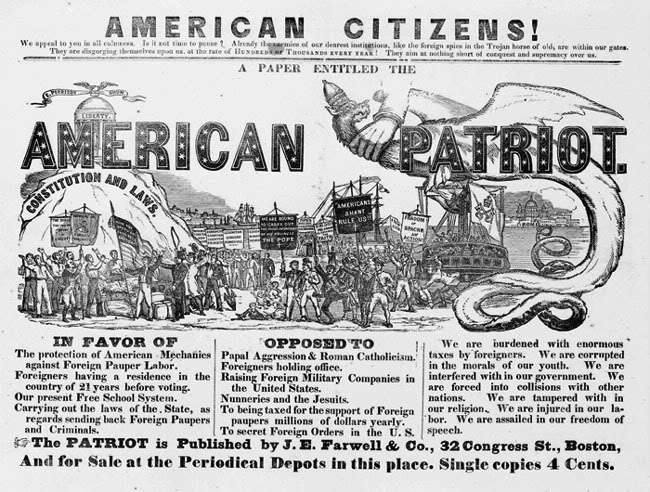
As I said, such attitudes and movements are nothing new. Anti-immigrant movements in the United States go back to our earliest days, ever since the first Irish Catholics showed up in the northeast in the late 1790s and early 1800s. Met with scorn and treated as criminals the Irish Catholics had to work hard to gain any kind of acceptance in Protestant America. But immigrants continued to come, seeking the freedom promised in the Declaration of Independence.

know-nothing_flag

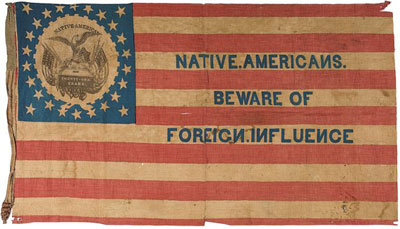
Many White American Protestants viewed Irish, German and other European immigrants to the Unites States in the 1830s, 1840s, and 1850s as interlopers who were attempting to take over the country. The immigrants were regarded as poor, uneducated, uncouth, and immoral, and in the case of Catholic immigrants as representatives and foot soldiers of a hostile government, the Vatican, headed by the Pope and the bishops. Those who opposed immigration formed a movement that was aimed at forbidding immigrants from being granted full rights, especially the rights of citizenship and voting. The fear was pervasive. Many Northern Whites were afraid that immigrants would take their jobs, since like slaves in the South, the new immigrants were a source of cheap labor.

Northern Protestant church leaders and ministers were some of the most vocal anti-immigrant voices and their words were echoed by politicians and in the press. The movement grew and used government action, the courts and violence to oppress the Irish and Germans who were the most frequent targets of their hate. The movement eventually became known as the “Know Nothing” movement.

Know Nothing leaders were not content to simply discuss their agenda in the forum of ideas and political discourse, they often used mob-violence and intimidation to keep Catholics away from the ballot box. Mobs of nativist Know Nothings sometimes numbering in the hundreds or even the thousands attacked immigrants in what they called “Paddy hunts,” Paddy being a slur for the Irish. To combat immigrants who might want to exercise their right to vote, the Know Nothings deployed gangs like the New York’s Bowery Boys and Baltimore’s Plug Uglies. They also deployed their own paramilitary organization to intimidate immigrants on Election Day. This group, known as the Wide Awakes was especially prone to use violence and physical intimidation in pursuit of their goals. The Nativist paramilitaries also provided security for anti-immigrant preachers from angry immigrants who might try to disrupt their “prayer” meetings.

Know Nothing’s and other Nativist organizations, organized mass meetings throughout the country which were attended by thousands of men. The meetings were often led by prominent Protestant ministers who were rich in their use of preaching and prayer to rile up their audiences. The meetings often ended with physical attacks and other violence against German or Irish immigrants and sometimes with the burning of the local Catholic Church. They also provided security for preachers from angry immigrants who might try to disrupt nativist prayer meetings.

The violence was widespread and reached its peak in the mid-1850s.

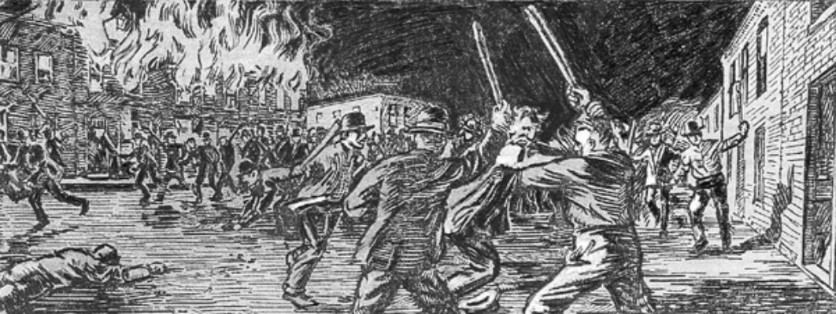
Bloody Monday.jpg.opt836x314o0,0s836x314

Black Monday in Louisville 

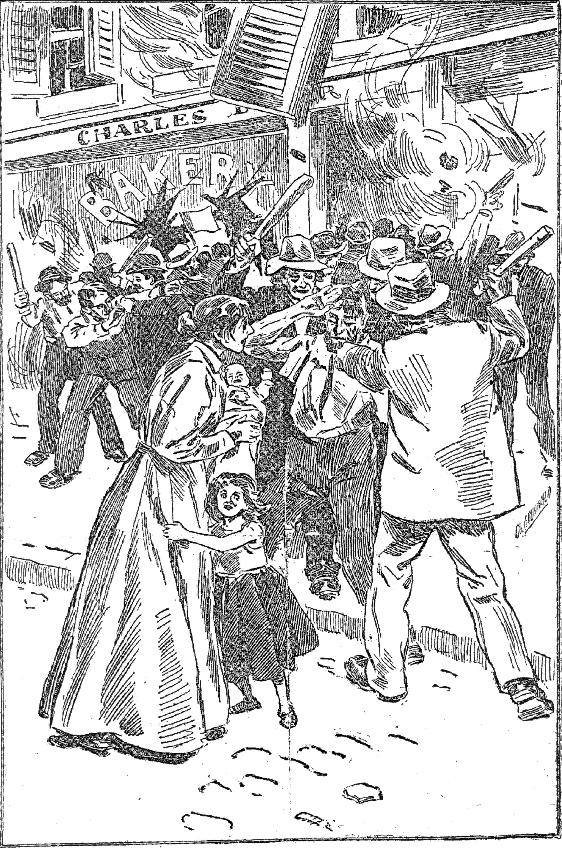
003.jpg.opt562x853o0,0s562x853

Monday, August 6, 1855 was Election Day in Louisville, Kentucky. To prevent German and Irish Catholics from voting, Know Nothing mobs took to the street and launched a violent attack on immigrants as well as their churches and businesses. Known now as “Black Monday” the Nativists burned Armbruster’s Brewery, they rolled cannons to the doors of the St. Martin of Tours Church, the Cathedral of the Assumption and Saint Patrick’s Church, which they then were searched for arms. The private dwellings and the businesses of immigrants were looted. A neighborhood known as “Quinn’s Row” was burned with the inhabitants barricaded inside. At least 22 persons were killed in the violence and many more were injured. In Baltimore the 1856, 1857, and 1858 elections were all marred by violence perpetrated by Nativist mobs. In Maine, Know Nothing followers tarred and feathered a Catholic priest and burned down a Catholic church.

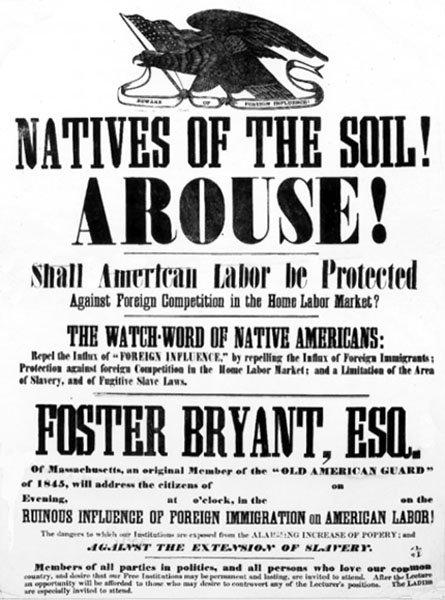
natives

The Know Nothings did not merely seek to disenfranchise immigrants through violence alone, they were more sophisticated than that. They knew that to be successful they had to change the law. Then, as now, a new immigrant had to live in the United States for five years before becoming eligible to become a naturalized of the United States. The Know nothings felt that this was too short of time and their party platform in the 1856 election had this as one of the party planks:

A change in the laws of naturalization, making a continued residence of twenty-one years, of all not heretofore provided for, an indispensable requisite for citizenship hereafter, and excluding all paupers, and persons convicted of crime, from landing upon our shores; but no interference with the vested rights of foreigners.

The rational of the Know Nothings for the 21 year wait was that if a baby born in the United States had to wait until it was 21 years old he could vote, that immigrants were being permitted to “jump the line” and vote sooner than native-born Americans. But really what the Know Nothings wanted to was to destroy the ability of immigrant communities to use the ballot box. In many localities and some states Know Nothing majorities took power. The Massachusetts legislature, which was dominated by Know Nothings, passed a law barring immigrants from voting for two additional years after they became United States citizens.

know-nothing-letter

The 1856 platform Know Nothing Party was synopsized by a Know Nothing supporter:

(1) Repeal of all Naturalization Laws.

(2) None but Americans for office.

(3) A pure American Common School system.

(4) War to the hilt, on political Romanism.

(5) Opposition to the formation of Military Companies, composed of Foreigners.

(6) The advocacy of a sound, healthy and safe Nationality.

(7) Hostility to all Papal influences, when brought to bear against the Republic.

(8) American Constitutions & American sentiments.

(9) More stringent & effective Emigration Laws.

(10) The amplest protection to Protestant Interests.

(11) The doctrines of the revered Washington.

(12) The sending back of all foreign paupers.

(13) Formation of societies to protect American interests.

(14) Eternal enmity to all those who attempt to carry out the principles of a foreign Church or State.

(15) Our Country, our whole Country, and nothing but our Country.

(16) Finally,-American Laws, and American Legislation, and Death to all foreign influences, whether in high places or low

In addition to their violent acts, the use of the courts and political intimidation the Know Nothings waged a culture war against immigrants. Latin mottoes on courthouses were replaced by English translations. Actions were taken to remove immigrants who had become naturalized citizens from public offices and civil service jobs as well as to use the government to persecute Catholic churches. In Philadelphia, all naturalized citizens on the police force were fired, including non-Catholics who has supported Catholic politicians, and in Boston, a special board was set up to investigate the sex lives of nuns and other supposed crimes of the Catholic church.

In the political upheaval of the 1850s Nativists tried to find homes in the different political parties. Some Know Nothings who were abolitionists became part of the new Republican Party, and Abraham Lincoln condemned them in harsh terms. He wrote his friend Joshua Speed about the hypocrisy that they displayed by supposedly being against the oppression of blacks while willing to oppress immigrants:

“I am not a Know-Nothing. That is certain. How could I be? How can any one who abhors the oppression of negroes, be in favor or degrading classes of white people? Our progress in degeneracy appears to me to be pretty rapid. As a nation, we began by declaring that “all men are created equal.” We now practically read it “all men are created equal, except negroes” When the Know-Nothings get control, it will read “all men are created equal, except negroes, and foreigners, and Catholics.” When it comes to this I should prefer emigrating to some country where they make no pretence of loving liberty — to Russia, for instance, where despotism can be taken pure, and without the base alloy of hypocracy [sic].”

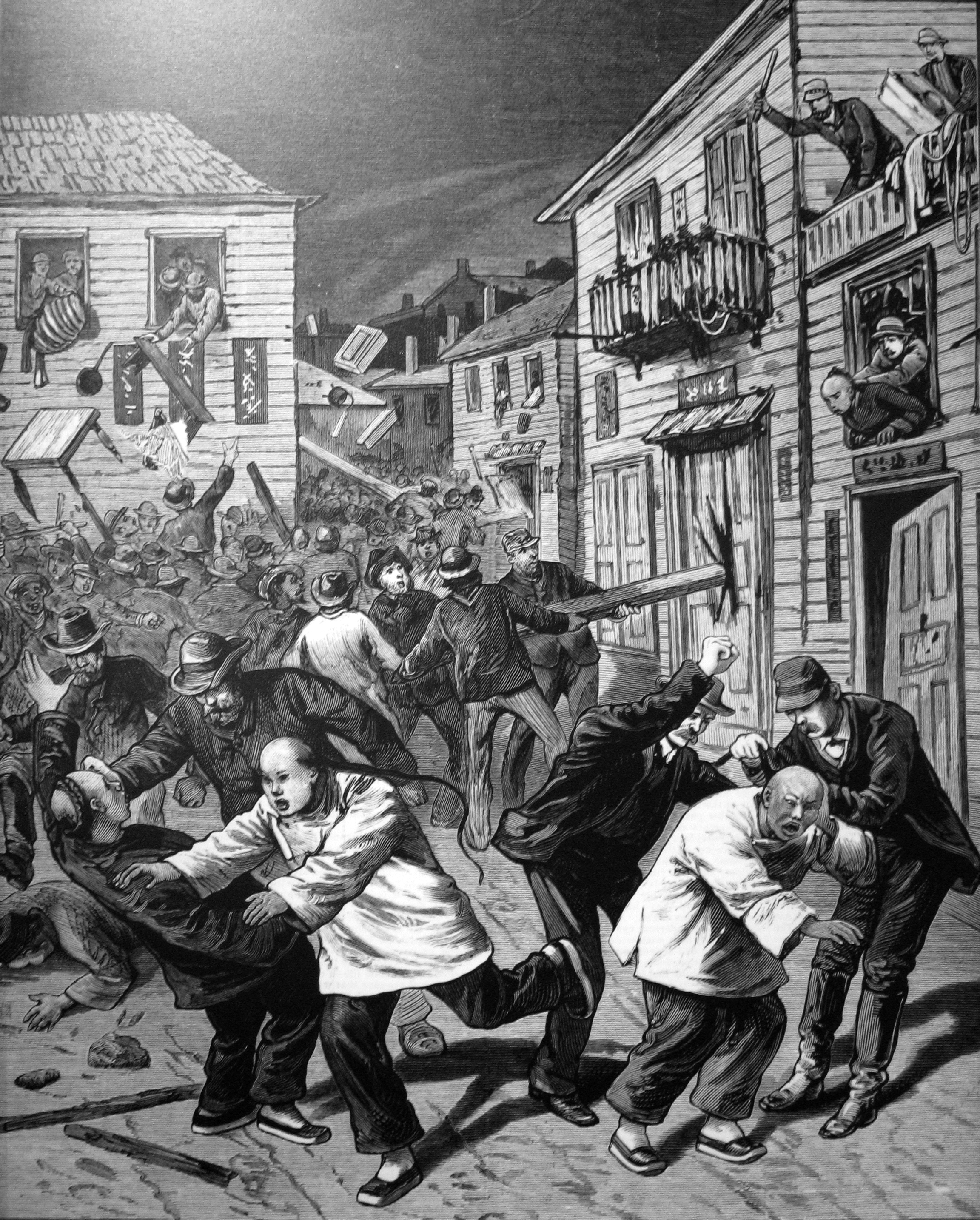
1880_Anti-Chinese_Riot_in_Denver_anagoria

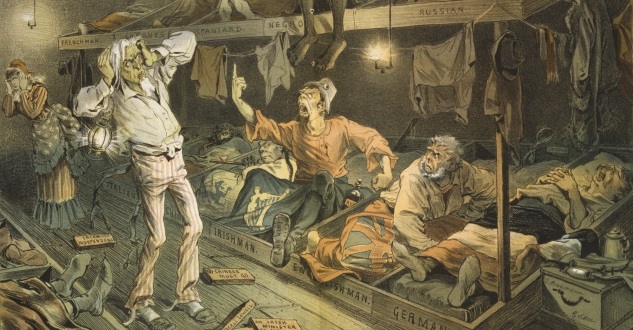
As an organized movement, the Know Nothings died out by the early 1860s, migrating to different parties and causes. In the North many became part of the pro-slavery Copperhead movement, which opposed Lincoln on emancipation and the Thirteenth Amendment. In the post-war South the anti-Catholic parts of the Nativist movement found a home in the Ku Klux Klan and other white terrorist organizations which also used racist and nativist propaganda to perpetuate violence, and disenfranchise emancipated blacks in the decades following the end of the Civil War and the end of Reconstruction. The Nativist and anti-immigrant sentiments have periodically found a home in different parts of the country and the electorate. Violence was used against Chinese, Japanese and Filipino immigrants on the West Coast, against Mexicans in the Southwest, Italians, Slavs, Eastern Europeans and Jews in the Northeast.

9587864_orig

Sadly it seems that it is being turned against others today. I find it strange that there are a host of people, mostly on the political right that are doing their best in their local communities, state legislatures and even Congress to roll back civil liberties for various groups of people. There is a certain amount of xenophobia in regard to immigrants of all types, especially those with darker skin white Americans, but some of the worst is reserved for Arabs and other Middle-Easterners, even Arab Christians who are presumed as all Middle Easterners are to be Moslem terrorists, even those who have been here decades and hold respectable places in their communities.

But immigrants are not alone, there seems to be in some states a systematized attempt to disenfranchise the one group of people that has almost always born the brunt of legal and illegal discrimination, African Americans.

Likewise there have been numerous attempts to roll back the rights of women, especially working women; the use of the legislature by religious conservatives to place limits on the reproductive rights of women, holding them to the standard of a religion that they do not practice. Despite the Supreme Court’s ruling for Marriage Equality in Obergfell v. Hodges there still are numerous attempts to curb any civil rights, including the right to marriage or civil unions of the LGBT community.

As I said, this is nothing new, that hatred and intolerance of some toward anyone who is different than them, who they deem to be a threat is easily exploited by politicians, pundits and preachers, none of whom care for anything but their prosperity, ideology, religion, or cause. While I would not call them a new incarnation of the Know Nothings, I have to notice the similarities in their message and the way that they push their agenda. As for those among them who claim the mantle of Christ and call themselves Christians I am troubled, because I know that when religion is entwined with political movements that are based in repressing or oppressing others that it does not end well. As Brian Cox who played Herman Goering in the television miniseries Nuremberg told the American Army psychologist Captain Gustave Gilbert played by Matt Craven “The segregation laws in your country and the anti-Semitic laws in mine, are they not just a difference of degree?

That difference of degree does matter, and there have been and still could be times when the frustration and anger of people, especially religious people can be whipped into a frenzy of violence and government sanctioned oppression by unscrupulous politicians, preachers and pundits. History is replete with examples of how it can happen. When I think of this I am reminded of the close of Spencer Tracy’s remarks in the movie Judgment at Nuremberg:

But this trial has shown that under a national crisis, ordinary – even able and extraordinary – men can delude themselves into the commission of crimes so vast and heinous that they beggar the imagination. No one who has sat through the trial can ever forget them: men sterilized because of political belief; a mockery made of friendship and faith; the murder of children. How easily it can happen. There are those in our own country too who today speak of the “protection of country” – of ‘survival’. A decision must be made in the life of every nation at the very moment when the grasp of the enemy is at its throat. Then, it seems that the only way to survive is to use the means of the enemy, to rest survival upon what is expedient – to look the other way. Well, the answer to that is ‘survival as what’? A country isn’t a rock. It’s not an extension of one’s self. It’s what it stands for. It’s what it stands for when standing for something is the most difficult! Before the people of the world, let it now be noted that here, in our decision, this is what we stand for: justice, truth, and the value of a single human being.”

Peace

Padre Steve+

9 Comments

Filed under civil rights, History, LGBT issues, News and current events, Political Commentary

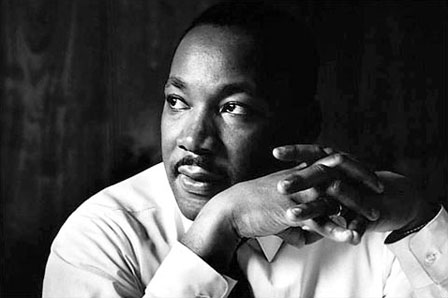
Critical Thinking & Conscience: Learning from Dr. Martin Luther King Jr.

index

Friends of Padre Steve’s World

I have been taking the time to do some reading and reflecting and yesterday I wrote a short piece about reason, critical thinking and the challenge of unreason and anti-intellectualism in our society. As I did that I was reminded of the words of Dr. Martin Luther King Jr. as he addressed issues prevalent in the 1960s; many of which unfortunately are still with us today.

A lot of people today seek to marginalize Dr. King’s life and work by simply relegating him to the pages of history. The attitude of such people seems to be that maybe Dr. King was important in his day, but that we have advanced to the point that we don’t need to see beyond the King of history. Thus we miss so much of what he still teaches us today.

Dr. King was a man of tremendous personal courage. Nearly every day of his public ministry and advocacy for the rights of African Americans and the poor his life was in danger. Of course he, like so many other men who throughout history understood that those that champion the cause of justice and peace must ask hard questions. They must engage in hard thinking. They must challenge their own beliefs as well as those that they come in contact, and they must do so from the least safe place to do so, the place of conscience which commands us to do what is right.

In 1968 Dr. King said something that should make us all look in the mirror and ask who we really are and what we represent. He noted how cowardice, expediency and vanity all vie with conscience. He said:

“On some positions, Cowardice asks the question, “Is it safe?” Expediency asks the question, “Is it politic?” And Vanity comes along and asks the question, “Is it popular?” But Conscience asks the question “Is it right?” And there comes a time when one must take a position that is neither safe, nor politic, nor popular, but he must do it because Conscience tells him it is right.” 

If you look closely at what Dr. King said one can almost see every political, business or religious leader make decisions about things which matter to people, but without facing the demands of conscience.

It would be easy just to say this of our leaders. However, it is also true of most of us, for regardless of our protestations most of us follow the demands of cowardice, expediency or vanity rather than conscience. We do it not because we are bad people, but because we fear the potential negative consequences of doing the right thing, we count the cost and decide we cannot pay it.

Every time we make these decisions not to do the right, but to shrink in cowardice, appeal to the calculation of being politic, or choose to go with what is popular, something in us dies.

Dietrich Bonhoeffer, the German pastor and martyr wrote about the results of such equivocation from prison:

“We have been silent witnesses of evil deeds: we have been drenched by many storms; we have learnt the arts of equivocation and pretense; experience has made us suspicious of others and kept us from being truthful and open; intolerable conflicts have worn us down and even made us cynical. Are we still of any use?”

But to follow the demands of conscience requires us to think, and think critically. Too often we simply do things or support causes because we are comfortable with the ideas, and because we do not want to face inconvenient or uncomfortable ideas. We do not like to be challenged. I think that is why there is such a great appeal to often ignorant loud mouthed politicians, pundits and preachers, the Unholy Trinity, to do our thinking for us. The pundits, preachers and politicians often appeal to the must base human instincts to turn citizens against each other, or to drive up support for their ideology. Such ideas are made more destructive when they appear as “memes” on social media, attached to pictures which are designed to invoke an emotional response of anger, hatred and resentment at person or group being demonized. In following them we can become unthinking fanatics, convinced of our rightness without ever examining what we believe to see if it really true.

This is not thinking when we follow the lead of such people, regardless of their ideology. In doing so we give up our right and responsibility to think for ourselves and ask the hard questions. Eric Hoffer noted how ideology blinds us:

“A doctrine insulates the devout not only against the realities around them but also against their own selves. The fanatical believer is not conscious of his envy, malice, pettiness and dishonesty. There is a wall of words between his consciousness and his real self.”

Dr. King’s words spoken in 1963 are equally true today:

“Rarely do we find men who willingly engage in hard, solid thinking. There is an almost universal quest for easy answers and half-baked solutions. Nothing pains some people more than having to think.”

I hope that we may we find in Dr. King’s words inspiration to be people of character and conscience today. But to do so we must start doing the hard thinking that allows us to follow the demands of conscience and not cowardice. We must do the hard thinking that places justice over popularity and the hard thinking which exposes the emptiness of brazen political calculation embodied in the easy answers and half-baked solutions of the Unholy Trinity. Sadly, I don’t think that most people want to do this type of thinking, our materialistic culture does not value it and as a result we give up our rights as a people to a few oligarchs who throw a few small breaks our way while they expand their control, power and wealth. It’s a bad formula and we all suffer for it. It is time to stop asking if things are safe, politic, or expedient and do the hard work and thinking that conscience demands.

Peace

Padre Steve+

Leave a comment

Filed under civil rights, ethics, History, Political Commentary

Some are More Equal than Others: The Hatred that Will not Die

John_Lewis_t580

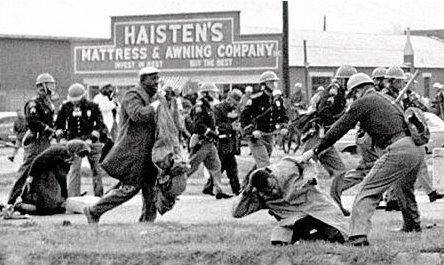
Bloody Sunday

Friends of Padre Steve’s World

I am back from Gettysburg and recuperating from the trip. I took my wife Judy to get the staples removed from her abdomen following her surgery and things are looking really good. She will be monitored and tested regularly every three months for the next two years to ensure that the cancer has not returned but the odds are it will not.

Anyway, while I while I was at Gettysburg something happened that took me aback. It was not anything from any of my students who were absolutely awesome, but it was something else.

I always end the staff ride by taking the students to the National Soldier’s Cemetery. There we talk about terrible human cost of the battle and I introduce them to a number important topics related to the cemetery. I talk about the rural cemetery movement and the Greek revival in America in the 1820s, which is culturally important to us. Then I move on the dedication of the Soldier’s Cemetery. I discuss the layout of the cemetery and how it was designed so that the grave of every soldier is of equal importance and then I read some of the comments of the keynote speaker, Edward Everett. Following this I discuss the writing of the Gettysburg Address, the way Lincoln used it to universalize the Declaration of Independence and then I recite it, and remind my students, especially my American officer students why this is so important to us as we remember our oath of office and our duty.

1880_Anti-Chinese_Riot_in_Denver_anagoria

Violence Against Chinese Immigrants in Denver 1880s

While we were gathering near the spot where Lincoln gave his address, an elderly white couple, which appeared to be in their early eighties, was on a bench where my students gathered. I invited them to stay if they wanted and let them know why we were there. They were very attentive as were my students and when we concluded and my students began to head back to our vans or to their own vehicles for the trip back to Norfolk, the man approached me and asked directions on how to get to the Chambersburg Road which I gladly gave him; and then he said: “You know that when they say that “all men are created equal” that some are more equal than others.”

9587864_orig

I was stunned and attempted to deflect the man’s obvious racist comment with humor, referring to the rivalry of UCLA where I did my Army ROTC training about thirty-three years ago with that of the University of Southern California. The man looked at me and said that he was from Georgia and wished that California would just drop off into the ocean, and then walked away.

I thought to myself: “you corpulent old racist bastard.” I was really tempted to follow him and confront him, but I backed off. I realized based on his age, and that he probably opposed everything about the civil rights movement and supported Jim Crow and that there was nothing that could change his mind. He was old enough that he may have actually taken part in some of the anti-civil rights actions of the 1950s and 1960s. I don’t know, but it is possible.

know-nothing_flag

The Flag of the Know Nothing Party

Sadly, there are a lot of people in this country who believe exactly what that man voiced. Some are racist, and not just towards African Americans but to Latinos, Native Americans, Asians, Arabs and others. There are those who believe that women and gays are not equal. Many of these people are leading politicians at the federal, state and local levels, media personalities and corporate leaders who have significant political and economic clout and if they ever had complete power would overturn or nullify every law that protects the civil rights of those they believe are less than equal, in some extreme case even less than human.

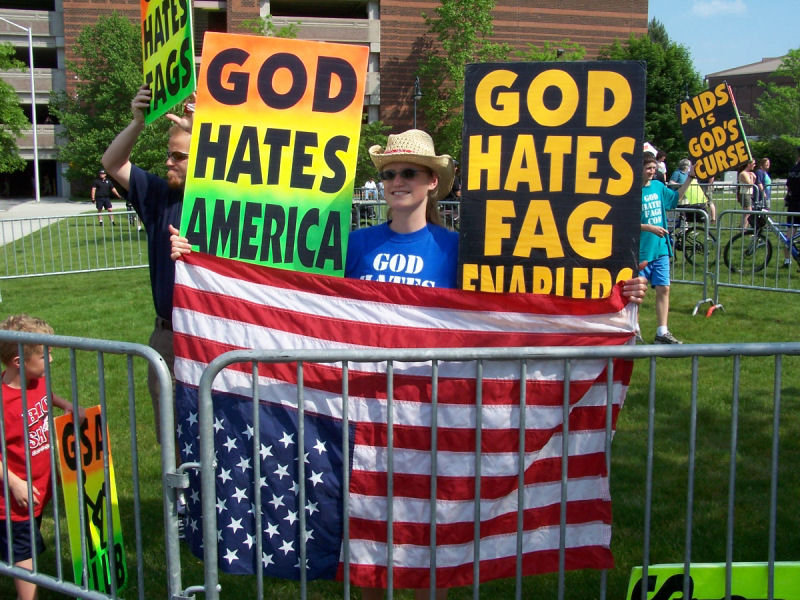
GodHatesFags-TsongasArena043

There are many reasons that people use to justify these attitudes; some pseudo-scientific, some religious, some economic, and many based on a crude Social Darwinism emphasizing the “survival of the fittest.” I heard someone else in a restaurant this weekend say exactly that when they were talking about the poor. Again, lest we want to simply use this to beat on Southerners, this is not simply an attitude confined to the South; it is all over the country, and that was the often the case throughout our American history.

It really does grieve me when I see this. The ghosts of our past intrude on so many parts of our national life, condemning the living to have to relive them in our own time. Historian George Santayana said it so well: “Those who cannot remember the past are condemned to repeat it.”

Have a good night.

Peace

Padre Steve+

2 Comments

Filed under civil rights, Gettysburg, History, Political Commentary

Justice Sacrificed on the Altar of Peace: Rolling Back Freedom after Reconstruction

Friends of Padre Steve’s World

The legislation enacted by Congress to declare African Americans free, the Thirteenth Amendment; to recognize them as citizens, the Fourteenth Amendment; and to give African American men the right to vote, the Fifteenth Amendment were revolutionary documents. However, after Reconstruction ended every state in the South, with the acquiescence of Northern businessmen and politicians worked to roll back those rights. The means included state legislation, violence committed by people associated with racist terrorist groups such as the Ku Klux Klan, and the actions of Federal Courts including the Supreme Court to regulate those rights out of existence.

This is as important to recognize now as it was then, for those who oppose the rights of basic equality never stop doing so. Even today there are politicians, pundits and preachers, those that I refer to as the Trinity of Evil who seek to roll back or even overturn things like the Voting Rights Act of 1964, or who oppose equal rights for women, non-white immigrants and Gays.

So tonight I am posting a section of my Civil War and Gettysburg text dealing with the concerted efforts of men who after the Civil War and Reconstruction did all that they could to put African Americans back in a social and economic condition that was little different than slavery.

Expect more on this tomorrow,

Peace

Padre Steve+

NormanRockwellSouthernJustice-1

Norman Rockwell’s Southern Justice

Reconstruction was officially ended in 1877 by newly elected President Rutherford B. Hayes and all Federal troops assigned to enforce it were withdrawn. Despite this, some people in the South attempted to fight for the rights of African Americans, including men like former Confederate Generals James Longstreet, William Mahone and Wade Hampton. Their motives varied and all were vilified by political opponents and in the press, the attacks on Longstreet were particularly vicious and in the Myth of the Lost Cause he is painted as a man worse than Judas Iscariot. Hampton was elected as the first post-Reconstruction governor of South Carolina in and campaigned against the black codes, and during his term in office even appointed African Americans to political offices in the state and maintained a regiment of African American state militia in Charleston against strident opposition.

While Hampton remained a white supremacist he also was committed to the upholding the law and “promoting the political rights to which freedmen were entitled to under law, and he consistently strove to protect those rights.” [1] This made Hampton anathema for many South Carolina politicians, including Benjamine Tillman who as governor during the 1890s dismantled policies that Hampton had introduced to allow blacks to political patronage appointments. Once he did that Tillman set out to deprive South Carolina’s blacks of almost every basic civil right, and in 1895 he led “a successful effort to rewrite the South Carolina constitution in such a way as to virtually disenfranchise every black resident of the state.” [2] Longstreet, who had become a Republican was wounded while leading Louisiana militia in an unsuccessful fight against White Leaguers in New Orleans on September 14th 1873.

The legislation which helped provide blacks with some measure of freedom was rolled back after Reconstruction ended. In 1883 “the Civil Rights Act of 1875, outlawing discrimination against Negroes using public facilities, was nullified by the Supreme Court, which said: “individual invasion of individual rights is not the subject-matter of the amendment.” The Fourteenth Amendment, it said, was aimed at state action only. No state shall…” [3]

The actions of the court and alliances between Northern corporations and Southern landowners led to even more discrimination and disenfranchisement for blacks, “From the 1880s onward, the post-Reconstruction white governments grew unwilling to rely just on intimidation at the ballot box and themselves in power, and turned instead to systematic legal disenfranchisement” [4] which furthered the black codes into what we now call the era of Jim Crow.

For years after the Supreme Court’s Cruikshank decision blacks throughout the South attempted to vote despite intense opposition from Southern whites and armed bands of thugs. But with White Democrats now in charge of local government and “in control of the state and local vote-counting apparatus, resistance to black voting increasingly took the form of fraud as well as overt violence and intimidation. Men of color who cast Republican votes often found later that they had been counted for the party of white supremacy.” [5]

In 1896 the black codes were upheld by the Supreme Court in the case of Plessy v. Ferguson. That ruling established the “separate but equal” doctrine and ushered in an era of de jure segregation in almost all arenas of life including education, transportation, entertainment and health care. The limited social equity and privileges enjoyed by blacks, not only in the South, but in the entire nation were erased by the stroke of the judicial pen. The justices ruled on the concept that only people’s political rights were protected by the Constitution and that in the social arena that African-Americans could not interact with whites and assumed their racial inferiority.

Not all on the Court agreed with these rulings. One of them was Associate Justice John Harlan, who was a former slaveholder. Harlan dissented in Court’s decision to overturn the Civil Rights Act of 1875 and also in Plessy v. Ferguson. In the case of the Civil Rights Act ruling Harlan insisted that “our Constitution is color blind” [6] and wrote a strongly worded opinion:

“The destinies of two races, in this country are indissolubly linked together, and the interests of both require that the common government of all should not permit the seeds of race hate to be planted under the sanction of law. What can more certainly arouse race hate, what more certainly create and perpetuate a feeling of distrust between these races, than state enactments, which, in fact, proceed on the ground that colored citizens are so inferior and degraded that they cannot be allowed to sit in public coaches occupied by white citizens? That, as all will admit, is the real meaning of such legislation as was enacted in Louisiana.” [7]

The “separate but equal” measures of the Jim Crow era took nearly a century to reverse, and “only began to disappear with Brown v. Board of Education in 1954 and the Civil Rights and Voting Rights Acts of 1964 and 1965.” [8]

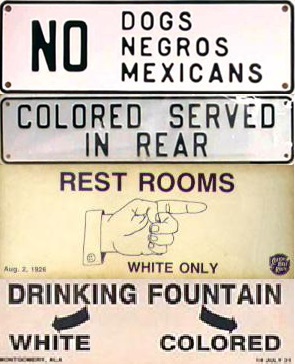
These court decisions and legislation strengthened racism and discrimination against blacks, “effectively excluding blacks from public places, from the right to votes, from good public education, and so forth.” [9] The Plessy ruling was a watershed. Southern legislators, now unencumbered by Federal interference passed “state laws mandating racial segregation in every aspect of life, from schools to hospitals, waiting rooms to toilets, drinking fountains to cemeteries…segregation was part of a complex system of white domination, in which each component – disenfranchisement, unequal economic status, inferior education – reinforced the others.” [10] For decades future courts would cite Plessy and Cruikshank as well as other decisions as precedent in deny rights to blacks. It would not be until 1954 when the Supreme Court overturned Plessy and the “Separate but Equal” Jim Crow laws in Brown v. Board of Education. Brown was a watershed for it deemed that separate schools were “inherently unequal.” The reaction across the South, especially Mississippi was stunned shock, disbelief and anger. “A Mississippi judge bemoaned “black Monday” and across the South “Citizen’s Councils” sprung up to fight the ruling. [11]

Mississippi led the way in disenfranchising black voters through the use of voter qualifications that would eliminate most blacks from the rolls of voters. In 1895 the state legislature passed a measure that would “technically apply to everybody but actually eliminate the Negro without touching the white.” [12] The move was in open defiance of the Fifteenth Amendment and resulted in tens of thousands of black voters being dropped from the rolls, in most cases under 5% of black voters who had been eligible to vote in 1885 remained eligible in 1896. Mississippi was rewarded in 1898 when the Supreme Court in Williams v. Mississippi that “there was no reason to suppose that the state’s new voting qualification were aimed specifically at Negroes.” [13] “In 1900 blacks comprised 62 percent of Mississippi, the highest percentage in the nation. Yet the state had not one black elected official.” [14]

Violence was used with great effect and between 1880 and 1968 approximately 3,500 people were murdered or lynched throughout the South. This had become a far easier task and far less dangerous for the perpetrators of violence against blacks as Supreme Court “interpreted black people’s other constitutional rights almost out of existence.” [15] Since the court had “limited the federal government’s role in punishing violations of Negro rights” this duty fell to the states, which seldom occurred, and when “those officials refused to act, blacks were left unprotected.” [16]

One of these was the case of United States v. Harris where the federal prosecutors had indicted “twenty members of a Tennessee lynch mob for violating section two of the enforcement Act, which outlawed conspiracies to deprive anyone of “equal protection of the laws.” However the Court struck down section 2 because the “lynching was not a federal matter, the Court said, because the mob consisted only of private individuals.” [17]

This remained the case until the 1960s when during the Freedom Rides when Mississippi again became a battleground in the Civil Rights movement. As students and educators came to the state to help register blacks to vote in 1964. This brought generations of barely concealed hatred to the surface. Bruce Watson in his book Freedom Summer wrote:

“In Mississippi’s most remote hamlets, small “klaverns” of ruthless men met in secret to discuss the “nigger-communist invasion of Mississippi.” They stockpiled kerosene, shotguns, and dynamite, then singled out targets – niggers, Jews, “nigger-lovers.” One warm April night, their secret burst into flames. In some sixty counties, blazing crosses lit up courthouse lawns, town squares, and open fields. The Klan was rising again in Mississippi. Like “White Knights” as their splinter group was named, the Klan planned a holy war against the “dedicated agents of Satan…determined to destroy Christian civilization.” The Klan would take care of your business, a recruiting poster said. “Get you Bible out and PRAY! You will hear from us.” [18]

Eventual the violence of these people led to the killings of three of the organizers, Michael Schwerner, James Cheney and Andrew Goldman were killed by a group of Klansmen led by members of the Neshoba County Sheriff’s Department on June 21st 1964. The resultant search for their bodies and the subsequent investigation transfixed the nation and led to the passage of the Civil Rights and Voting Rights Acts in 1964 and 1965.

The example of Reconstruction’s failure shows that in order to secure peace that military victory must be accompanied by the political will to ensure that the avowed goals of that victory are secured after the war in ensuring a just peace. Southerners may have lost the shooting war, but they did not accept the peace. Southerners resorted to all means to reverse their military defeat through political, social, economic and judicial means and “justice was sacrificed for the unjust peace ushered in by “redemption” of the South, a peace marred by Jim Crow, poverty and lynching.” [19] Most Northern leaders failed to appreciate this until it was far too late, and hindered by President Johnson’s opposition failed to win the peace in the South when they had the best chance. They failed to appreciate that even after the shooting is often that “there is a need for further threats, and indeed action, because postwar disorder and even chaos will have to be address, and victorious allies are always likely to squabble over the spoils of victory” [20] as certain was the case in the divided Republican Party of the Reconstruction era.

Notes

[1] Longacre, Edward G. Gentleman and Soldier: The Extraordinary Life of General Wade Hampton Rutledge Hill Press, Nashville TN 2003 p.265

[2] Ibid. Longacre Gentleman and Soldier p.274

[3] Ibid. Zinn The Other Civil War p.57

[4] Ibid. Guelzo Fateful Lightening p.526

[5] Ibid. Lane The day Freedom Died p.251

[6] Ibid. Zinn The Other Civil War p.58

[7] LaMorte, Michael W. School Law: Cases and Concepts 9th Edition 2008 Allyn and Bacon Inc. 2008 p.300

[8] Ibid. Huntington Who are We? p.54

[9] Gonzalez, Justo L. The History of Christianity Volume 2: The Reformation to the Present Day Harper and Row Publishers San Francisco 1985 p.252

[10] Ibid. Foner Forever Free p.208

[11] Ibid. Watson Freedom Summer p.46

[12] Ibid. Lord The Past that Wouldn’t Die p.22

[13] Ibid. Lord The Past that Wouldn’t Die p.23

[14] Ibid. Watson Freedom Summer p.41

[15] Ibid. Lane The day Freedom Died p.253

[16] Ibid. Langguth After Lincoln p.338

[17] Ibid. Lane The day Freedom Died p.253

[18] Ibid. Watson Freedom Summer p.12

[19] Ibid. McPherson The War that Forged a Nation p. 191

[20] Ibid. Gray Fighting Talk p.14

1 Comment

Filed under civil rights, civil war, History, Political Commentary

Yes it Was About Slavery

slavescars

Friends of Padre Steve’s World

I have began to write about racism in regard to the Confederate Flag controversy and what I call the “sanitized history” of organizations such as the Sons of Confederate Veterans which in their revisionist history seek to divorce the actions of Confederate soldiers from the cause for which they fought. As a disclaimer, I could be a member of the Sons of Confederate Veterans based on the service of members of both sides of my family in the Confederate army. Likewise, if I was a real white Supremacist I could boast of my family’s slave owning past in the western part of Virginia, the land now known as West Virginia. Yes, my family were slave owners who fought for the Confederacy. At one time in my young life I was proud of that. but as a historian who is all for “unsanitized” history I have to admit that the sanitized history of the Lost Cause is not history, it is at best a romantic myth, but more correctly a bold faced lie. 

So tonight I post a section of my Civil War and Gettysburg text. I hope that it is both challenging and thought provoking. You can expect a number of posts dealing with this issue in the coming days.

Have a nice and thoughtful night,

Peace

Padre Steve+

If we are to really understand the Civil War we have to understand the ideological clash between Abolitionists in the North, and Southern proponents of slavery. Both the ideologies of the Abolitionists who believed that African Americans were created by God and had the same rights as whites, as well as the arguments of Southern political leaders that blacks were inferior and slavery was a positive good, were buttressed by profoundly religious arguments which were related directly to a divergence in values. These diverging values crept into every aspect of life and as such it was this “conflict of values, rather than a conflict of interests or a conflict of cultures, lay at the root of the sectional schism.” [1]

Slavery was the key issue that permeated all aspects of the Civil War to include the cultural, the economic and the ideological. David M. Potter summed up this understanding of the connection between the ideological, cultural and economic aspects of the conflict and just how the issue of slavery connected all three realms in the American Civil War:

“These three explanations – cultural, economic and ideological – have long been the standard formulas for explaining the sectional conflict. Each has been defended as though it were necessarily incompatible with the other two. But culture, economic interest, and values may all reflect the same fundamental forces at work in a society, in which case each will appear as an aspect of the other. Diversity of culture may produce both diversity of interests and diversity of values. Further, the differences between a slaveholding and a nonslaveholding society would be reflected in all three aspects. Slavery represented an inescapable ethical question which precipitated a sharp conflict of values.” [2]

Sadly this is something that those who study the war from a purely military perspective tend to miss, or even willingly gloss over in order make the war more palatable to their own prejudice tend to “blur the reality that slavery was at the heart of the matter, ignore the baser realities of the brutal fighting, romanticize our own home-grown terrorist organization, the Ku Klux Klan, and distort the consequences of the Civil War that still intrude on our national life.” [3] For many people it is far easier not to deal with the harsh reality that slavery and racism was at the heart of the issue and escape to the bloodless romanticism which even ignores the human cost of the war, approximately 750,000 military dead alone. If we extrapolate the percentage of the population that that 750,000 represents and compared it to today’s census that number would be the equivalent of 7.5 million Americans dead. This is a fact that many Civil War buffs tend to ignore.

The political ends of the Civil War grew out of the growing cultural, economic, ideological and religious differences between the North and South that had been widening since the 1830s. However, slavery was the one issue which helped produce this conflict in values and it was “basic to the cultural divergence of the North and South, because it was inextricably fused into the key elements of southern life – the staple crop of the plantation system, the social and political ascendency of the planter class, the authoritarian system of social control.” [4] Without slavery and the Southern commitment to an economy based on slave labor, the southern economy would have most likely undergone a similar transformation as what happened in the North; thus the economic divergence between North and South would “been less clear cut, and would have not met in such head-on collision.” [5] But slavery was much more than an economic policy for Southerners; it was a key component of their religious, racial and philosophic worldview.

The issue of slavery even divided the ante-bellum United States on what the words freedom and liberty meant. The dispute can be seen in the writings of many before the war, with each side emphasizing their particular understanding of these concepts. In the South, freedom was reserved for those who occupied the positions of economic power; slavery was key to that from not only an economic point of view but as a social philosophy. The concept of human equality, which was so much a part of the Declaration of Independence was downplayed George Fitzhugh, a planter and slave owner in eastern Virginia commented that that concept “is practically impossible, and directly conflicts with all government, all separate property, and all social existence.” [6]

The political philosophy such as Fitzhugh’s, which was quite common, was buttressed by a profound religious belief that it was the South’s God ordained mission to maintain and expand slavery. One Methodist preacher in his justification of slavery wrote, “God as he is infinitely wise, just and holy never could authorize the practice of moral evil. But God has authorized the practice of slavery, not only by bare permission of his providence, but by the express permission of his word.” [7] Buttressed by such scriptural arguments Southerners increasingly felt that they were the only people following God. The Northern abolitionists as well as those who advocated for the concept of human equality and free labor were heretics to be damned. As such the “South’s ideological isolation within an increasingly antislavery world was not a stigma or a source of guilt but a badge of righteousness and a foundation for national identity and pride.” [8]

Speaking of the necessity for slavery, as well as limitations on the equality of human beings no matter what their race or sex, Fitzhugh penned words that explained that human relationships were not to be seen in terms of individual liberty, “but in relations of strict domination and subordination. Successful societies were those whose members acknowledged their places within that hierarchy.” [9]

Fitzhugh was quite caustic when he discussed the real implications of his philosophy:

“We conclude that about nineteen out of twenty individuals have “a natural and inalienable right” to be taken care of and protected, to have guardians, trustees, husbands or masters; in other words they have a natural and inalienable right to be slaves. The one in twenty are clearly born or educated in some way fitted for command and liberty.” [10]

Fitzhugh’s chilling conclusion was summarized in the words “Liberty for the few – slavery in every form, for the mass.” [11]

But many Southerners, including many poor whites, especially the Yeoman farmers who were the backbone of the Southern populace did not see or understand the limitations that were placed on their own liberty by the slavery system and instead saw slavery as the guarantee of their economic freedom. John C. Calhoun said to the Senate in 1848 that “With us, the two great divisions of society are not the rich and poor, but white and black; and all of the former, the poor as well as the rich, belong to the upper class, and are respected and treated as equals.” [12] Calhoun’s racial distinction is important if we are to understand why poor whites would fight and die for a social and economic idea that did not benefit them or their families.

But it was Abraham Lincoln, who cut to the heart of the matter when he noted the difference between his understanding of liberty and that of Calhoun and others in the South who defended slavery and the privileges of the Southern oligarchs:

“We all declare for liberty” but “in using the same word we do not all mean the same thing. With some the word liberty may mean for each man to do as he pleases with himself and the product of his labor; while with others the same word may mean for some men to do as they please with other men and the product of other men’s labor.” [13]

The growing economic disparity between the Slave and Free states became more about the expansion of slavery in federal territories as disunion and war approached; for a number of often competing reasons. These differences, amplified by the issue of slavery led to the substitution of stereotypes of each other and had the “effect of changing men’s attitudes toward the disagreements which are always certain to arise in politics: ordinary, resolvable disputes were converted into questions of principle, involving rigid, unnegotiable dogma.” [14] The Charleston Mercury noted in 1858 “on the subject of slavery…the North and the South…are not only two peoples, but they are rival, hostile peoples.” [15]

This was driven both by the South’s insistence on both maintaining slavery where it was already legal and expanding it into new territories which was set against the vocal abolitionist movement. But Southern exponents of expanding slavery were fighting an even more powerful enemy than the abolitionists, who despite their vocal protests were not yet in a position to influence policy. They were now fighting Northern industrialists who were not as idealistic as the abolitionists who were much more concerned with “economic policy designed to secure Northern domination of Western lands than the initial step in a broad plan to end slavery.” [16]

This competition between the regions not only affected politics, it affected religion and culture. In the South it produced a growing culture of victimhood, which was manifest in the words of Robert Toombs who authored Georgia’s declaration of causes for secession:

“For twenty years past, the Abolitionists and their allies in the Northern states, have been engaged in constant efforts to subvert our institutions, and to excite insurrection and servile war among us…” whose “avowed purpose is to subject our society, subject us, not only to the loss of our property but the destruction of ourselves, our wives and our children, and the dissolution of our homes, our altars, and our firesides.” [17]

As the social, economic, cultural and religious differences between the two regions grew wider and the people of the South became ever more closed off from the North. “More than other Americans, Southerners developed a sectional identity outside the national mainstream. The Southern life style tended to contradict the national norm in ways that life styles of other sections did not.” [18]

The complex relationship of Southern society where “Southern bodies social, economic, intellectual, and political were decidedly commingled” [19] came to embrace the need for slavery and its importance to Southern society. This occurred despite the fact that the system did not benefit poor whites in the South and actually harmed them economically. The Southern: “system of subordination reached out still further to require a certain kind of society, one in which certain questions were not publically discussed. It must give blacks no hope of cultivating dissention among the whites. It must commit non slaveholders to the unquestioning support of racial subordination…. In short, the South became increasingly a closed society, distrustful of isms from outside and unsympathetic to dissenters. Such were the pervasive consequences of giving top priority to the maintenance of a system of racial subordination.” [20]

Southern planters declared war on all critics of their “particular institution” beginning in the 1820s. As Northern abolitionists like William Lloyd Garrison and his newspaper The Liberator grew in its distribution and began to appear in the South various elected officials throughout the South “suppressed antislavery books, newspapers, lectures, and sermons and strove generally to deny critics of bondage access to any public forum.[21] Despite this resistance, abolitionists continued to use the U.S. Mail service to send their literature south provoking even more drastic action from Southern legislators.

In response to the proliferation of abolitionist literature in the South, John C. Calhoun proposed that Congress pass a law to prosecute “any postmaster who would “knowingly receive or put into the mail any pamphlet, newspaper, handbill, or any printed, written, or pictorial representation touching the subject of slavery.” [22] Calhoun was not alone as other members of Congress as well as state legislatures worked to restrict the import of what they considered subversive and dangerous literature.

Beginning in 1836 the House of Representatives, led by Southern members of Congress passed a “gag rule” for its members which “banned all petitions, memorials, resolutions, propositions, or papers related in any way or to any extent whatever to the subject of slavery.” [23] Former President John Quincy Adams challenged the gag-rule in 1842, as did a number of others. The pressure was such that finally in 1844 the House voted to rescind it.

However, Southern politicians were unhappy with this measure and “began to spout demands that the federal government and the Northern states issue assurances that the abolitionists would never be allowed to tamper with what John Calhoun had described as the South’s “peculiar domestic institution.” [24] As tensions grew between the regions, the issue of slavery more than any other issue “transformed political action from a process of accommodation to a mode of combat.” [25]

Around the same time as the gag rule was played out in Congress the Supreme Court had ruled that the Federal government alone “had jurisdiction where escaped slaves were concerned” which resulted in several states enacting “personal liberty laws” to “forbid their own elected officials from those pursuing fugitives.” Southern politicians at the federal and state levels reacted strongly to these moves, which they believed to be an assault on their institutions and their rights to their human property. Virginia legislators said these laws were a “disgusting and revolting exhibition of faithless and unconstitutional legislation.” [26]

The issue of slavery shaped political debate and “structured and polarized many random, unoriented points of conflict on which sectional interest diverged.” [27] As the divide grew leaders and people in both the North and the South began to react to the most distorted images of each other imaginable- “the North to an image of a southern world of lascivious and sadistic slave drivers; the South to the image of a northern world of cunning Yankee traders and radical abolitionists plotting slave insurrections.” [28]

Notes

[1] Potter, David M. The Impending Crisis: America before the Civil War 1848-1861 completed and edited by Don E. Fehrenbacher Harper Collins Publishers, New York 1976 p.41

[2] Ibid. Potter The Impending Crisis p.41

[3] Burns, Ken A Conflict’s Acoustic Shadows in The New York Times Disunion: Modern Historians Revisit and Reconsider the Civil War from Lincoln’s Election to the Emancipation Proclamation Black Dog and Leventhal Publishing, New York 2013 p.102

[4] Ibid. Potter The Impending Crisis p.42

[5] Ibid. Potter The Impending Crisis p.42

[6] Levine, Bruce Half Slave and Half Free: The Roots of the Civil War Revised Edition, Hill and Wang, a division of Farrar, Strauss and Giroux, New York 1992 and 1995 p.140

[7] Daly, John Patrick When Slavery Was Called Freedom: Evangelicalism, Proslavery, and the Causes of the Civil War The University Press of Kentucky, Lexington KY 2002 pp.63-64

[8] Faust, Drew Gilpin The Creation of Confederate Nationalism: Ideology and Identity in the Civil War South Louisiana State University Press, Baton Rouge and London p.61

[9] Ibid. Levin Half Slave and Half Free p.140

[10] Ibid. Levin Half Slave and Half Free p.140

[11] Ibid. Levin Half Slave and Half Free p.141

[12] McPherson, James M. Drawn With the Sword: Reflections on the American Civil War Oxford University Press, Oxford and New York 1996 p.50

[13] Ibid. Levin Half Slave and Half Free p.122

[14] Ibid. Potter The Impending Crisis p.43

[15] Ibid. McPherson Drawn With the Sword p.16

[16] Egnal, Marc Clash of Extremes: The Economic Origins of the Civil War Hill and Wang a division of Farrar, Straus and Giroux New York 2009 p.6

[17] Dew, Charles B. Apostles of Disunion: Southern Secession Commissioners and the Causes of the Civil War University Press of Virginia, Charlottesville and London 2001 p.12

[18] Thomas, Emory The Confederate Nation 1861-1865 Harper Perennial, New York and London 1979 p.5

[19] Ibid. Thomas The Confederate Nation p.5

[20] Ibid. Potter The Impending Crisis pp.457-458

[21] Ibid. Levine Half Slave and Half Free p.166

[22] Ibid. Guelzo Fateful Lightening pp.50-51

[23] Ibid. Levine Half Slave and Half Free pp.169-170

[24] Ibid. Guelzo Fateful Lightening pp.51-52

[25] Ibid. Potter The Impending Crisis p.43

[26] Ibid. Levine Half Slave and Half Free pp.169-170

[27] Ibid. Potter The Impending Crisis p.43

[28] Ibid. Potter The Impending Crisis p.43

5 Comments

Filed under civil rights, civil war, History, Political Commentary

Racism & the Failure of Reconstruction

this-is-a-white-mans-government


Friends of Padre Steve’s World

Some events and attitudes are timeless, one of these is racism. Being white myself, I know that many whites are loath to admit that the scourge of racism still exists, but it does and it runs deep in our history. The more that I work on my Civil War and Gettysburg text, which now appears will morph into at least two and maybe three books when I am done, I find terribly distressing parallels to attitudes and actions of some which mirror the attitudes and actions of our ancestors, Northern and Southern following the Civil War. When the shooting stopped and the South was vanquished, many Southerners continued the war by other means and Northerners, divided after the death of Abraham Lincoln failed to achieve the most important political goal, after the restoration of the Union, that of true freedom for African Americans. Sadly, for some that war is still not over, as was evidenced in the aftermath of the Emanuel A.M.E. Massacre just two weeks ago. Likewise the burnings of six predominantly black churches across the South raises the specter of the racial violence that targeted blacks for a century after the Civil War.

This is another section of my text. I do hope that it challenges you as much as writing it challenged me.

Peace

Padre Steve+


When the war ended the Confederacy was beaten and most people in the South would have agreed to anything that the North presented regarding peace and return to the Union. In a sense Reconstruction was “what the war was about.” [1] Richard Henry Dana, the declared that “a war is over when its purpose is secured. It is a fatal mistake to hold that this war is over because the fighting has ceased. This war is not over…” [2] As Dana, and Clausewitz understood so well that war is a continuation of policy and politics by other means, and the failure of the North to fully grasp this fact led to over a century of subjugation of emancipated African Americans and has fueled a continual racial divide in the United States that is still felt today. Defeated on the battlefield Southerners soon turned to political, psychological and violent means to reverse their losses.

Frederick Douglass understood that simple emancipation was not enough, and that the “war and its outcome demanded racial equality.” [3] Despite the that efforts of many in the North this would not happen during Reconstruction and Douglass knew that the failure to accomplish this would be disastrous, “Whether the tremendous war so heroically fought…shall pass into history a miserable failure…or whether on the other hand, we shall, as the rightful reward of victory over treason have a solid nation, entirely delivered from all contradictions and social antagonisms, must be determined one way or another.” [4]

There was a problem with implementing Reconstruction; when John Wilkes Booth assassinated Abraham Lincoln, the political leaders of the North could not agree on how to do this. The new President, Andrew Johnson was probably the worst possible leader to lead the country in the aftermath of war for all practical purposes Johnson was a Democrat who believed in white supremacy, he had been brought onto the ticket for his efforts to keep Kentucky in the Union and to support Unionist elements in Tennessee. While his selection helped Lincoln in parts of the North and the Border States it was a disaster for the post-war era. Johnson’s approach to reconstruction was very simply to “impose minimal demands on the South. He required only minor concessions from the former Confederates before allowing them to resume their political rights and retain their land. As for freedmen, he seemed to think that the needed no further protection beyond the fact of their emancipation.” [5]

Johnson was “a lonely stubborn man with few confidants, who seemed to develop his policies without consulting anyone, then stuck to them inflexibly in the face of any and all criticism. He lacked Lincoln’s ability to conciliate his foes and his capacity for growth, which was best illustrated by Lincoln’s evolving attitude to black suffrage during the Civil War.” [6] In the months after his unexpected accession to the presidency Johnson demonstrated that he had no understanding of Lincoln’s political goals for the South and the desires of the Republican dominated Congress.

By the summer of 1865 Johnson was already demonstrating “that his sympathies were with the Southern white population and that he believed that their interests should be cared for even at the expense of freedmen.” [7] Johnson’s approach to reconstruction was very simply to “impose minimal demands on the South. He required only minor concessions from the former Confederates before allowing them to resume their political rights and retain their land. As for freedmen, he seemed to think that the needed no further protection beyond the fact of their emancipation.” [8] Johnson gave individual pardons to more than thirteen thousand “high-ranking Confederate civil and military officers and wealthy Southerners.” [9] While doing this he minimized political influence the Southern Unionists who had not supported the Confederacy and ensured that freed slaves were excluded from the political process. He issued a number of orders “appointing interim provisional governors and urging the writing of new state constitutions based upon the voter qualifications in force at the time of secession in 1861 – which meant, in large but invisible letters, no blacks.” [10]

When Frederick Douglass led a delegation of blacks to meet with Johnson in February 1865 Johnson preached that it was impossible to give political freedom to blacks. When Douglass attempted to object Johnson became angry and told Douglass “I do not like to be arraigned by some who can get up handsomely-rounded periods and rhetoric, and talk about abstract ideas of liberty, who never periled life, liberty, or property.” [11] When Douglass took his objections to Johnson’s harangue to a Washington newspaper, Johnson railed against Douglass “I know that d—–d Douglass…he’s just like any other nigger & would sooner cut a white man’s throat than not.” [12]

White Southerners including the newly pardoned Confederates enacted black codes that “codified explicit second-class citizenship for freedpeople.” [13] The legislature of Mississippi refused to ratify the Thirteenth Amendment, and did not do so until 1995. One Southerner noted that “Johnson “held up before us the hope of a ‘white man’s government,’ and this led us to set aside negro suffrage…. It was natural that we should yield to our old prejudices.” [14] Former Confederates, including Alexander Stephens the former Vice President of the Confederacy were elected to high office, Stephens to the United States Senate and the aggrieved Republicans in Congress in turn refused to admit the former Confederates. Many Union veterans were incensed by Johnson’s actions, one New York artilleryman noted “I would not pardon the rebels, especially the leaders, until they should kneel in the dust of humiliation and show their deeds that they sincerely repent.” [15] He was not alone, many Northern Veterans who formed the integrated Grand Army of the Republic veterans maintained a patent disregard, if not hatred of what the old South stood for and felt that their efforts in the war had been betrayed by the government.

Johnson’s restoration of property to the former white owners drove tens of thousands of blacks off lands that they had been farming, or left them as laborers for their former slave masters. Johnson countermanded General William Tecumseh Sherman and Secretary of War Edwin Stanton’s Field Order 15 to “divide abandoned and confiscated lands on the Sea Islands and in a portion of the Low Country coast south of Charleston into forty-acre plots for each black family.” [16] As such many freed blacks were now at the mercy of their former white owners for any hope of economic sustenance. Johnson stridently to frustrate the efforts of the Freedmen’s Bureau headed by Major General Oliver Howard to help freed blacks to become landowners. Johnson vetoed the Civil Rights bill but Congress overrode his veto. Eventually the battled between Johnson and Congress resulted in Johnson’s impeachment and narrow acquittal by one vote in the Senate in 1868.

The various black codes enacted throughout the South:

“passed labor laws that bound blacks to employers almost as tightly as slavery once bound them to their masters. Other codes established patterns of racial segregation that had been impossible under slavery, barred African Americans from serving on juries or offering testimony in court against whites, made “vagrancy,” “insulting gestures,” and “mischief” offenses by blacks punishable by fines or imprisonment, forbade black-white intermarriage, ad banned ownership by blacks of “fire-arms of any kind, or any ammunition, dirk or bowie-knife.” [17]

Likewise within weeks of the end of the violence against blacks began to break out in different parts of the South and it continued to spread as Johnson and Congress battled each other in regard to Reconstruction policy. “In Memphis, Tennessee, in May of 1866, whites on a rampage of murder killed forty-six Negroes, most of them veterans of the Union army, as well as two white sympathizers. Five Negro women were raped. Ninety homes, twelve schools and four churches were burned. In New Orleans in the summer of 1866, another riot against blacks killed thirty-five Negroes and three whites.” [18]

This alienated him from the Republican majority who passed legislation over Johnson’s veto to give black men the right to vote and hold office, and to overturn the white only elections which had propelled so many ex-Confederates into political power. Over Johnson’s opposition congress took power over Reconstruction and “Constitutional amendments were passed, the laws for racial equality were passed, and the black man began to vote and to hold office.” [19] Congress passed measures in 1867 that mandated that the new constitutions written in the South provide for “universal suffrage and for the temporary political disqualification of many ex-Confederates.” [20]   These measures helped elect bi-racial legislatures in the South which for the first time enacted a series of progressive reforms including the creation of public schools. They also ratified the Thirteenth and the Fourteenth Amendments, but these governments, composed of Southern Unionists, Northern Republicans and newly freed blacks were “elicited scorn from the former Confederates and from the South’s political class in general.” [21] Seen as an alien presence by most Southerners the Republican governments in the South faced political and was as violent opposition.

The Fourteenth Amendment was of particular importance for it overturned the Dred Scott decision which denied citizenship to blacks. Johnson opposed the amendment and worked against its passage by campaigning for men who would oppose it in the 1866 elections. His efforts earned him the opposition of former supporters including the influential New York Herald declared that Johnson “forgets that we have passed through a fiery ordeal of a mighty revolution, and the pre-existing order of things is gone and can return no more.” [22]

When passed by Congress the amendment was a watershed which would set Constitutional precedent for future laws to give women the right to votes, end Jim Crow laws, enact the Voting Rights Act of 1965, and most recently to give homosexuals the right to marry. Section one of the amendment read:

“All persons born or naturalized in the United States, and subject to the jurisdiction thereof, are citizens of the United States and of the state wherein they reside. No state shall make or enforce any law which shall abridge the privileges or immunities of citizens of the United States; nor shall any state deprive any person of life, liberty, or property, without due process of law; nor deny to any person within its jurisdiction the equal protection of the laws.” [23]

But these measures provoked even more violence from enraged Southerners who formed a variety of violent racist organizations which turned the violence from sporadic attacks to what amounted to a full-fledged insurgency against the new state governments and African Americans. Organizations like the Ku Klux Klan which engaged in terroristic violence to heavily armed “social clubs” which operated under the aegis of the state Democratic Party leadership in most Southern states. Allegedly organized for self-defense against state militia units composed of freed blacks they named themselves “White Leagues (Louisiana), White Liners or Rifle Clubs (Mississippi), or Red Shirts (South Carolina). They were, in fact, paramilitary organizations that functioned as armed auxiliaries of the Democratic Party in southern states in their drive to “redeem” the South from “black and tan Negro-Carpetbag rule.” [24] These men, mostly Confederate veterans “rode roughshod over the South, terrorizing newly freed slaves, their carpetbagger allies, and anyone who dared to imagine a biracial democracy as the war’s change.” [25] This unrequited violence and hatred set the stage for the continued persecution, murder and violence against blacks and those who supported their efforts to achieve equality in the South for the next century.

Throughout his term in office Johnson appealed to arguments used throughout later American history by “critics of civil rights legislation and affirmative action. He appealed to fiscal conservatism, raised the specter of an immense federal bureaucracy trampling on citizens’ rights, and insisted that self-help, not government handouts, was the path to individual advancement.” [26] While many of his Republican opponents supported these measures, many moderate Republicans could not abandon their support of or and ties to big corporations, and

Ulysses S. Grant succeeded Johnson as President in 1869 but his efforts at Reconstruction were met mostly by failure as well as a weariness on the part of many Northerners to continue to invest any more effort into it. Slowly even proponents of Reconstruction began to retreat from it and Southerners, knowing that they were winning the political battle continued their pressure. Both politically and through the use of terror to demoralize and drive from power anyone who supported it. By 1870 every former Confederate state had been readmitted to the Union, in a sense fulfilling a part Lincoln’s war policy, but at the same time denying what the war was waged for.

Congressman Thaddeus Stevens, one of the most effective leaders of the Radical Republicans died in 1868 in despair that the rights of blacks were being rolled back even as legislation was passed supporting them. The old firebrand asked “to be buried in a segregated cemetery for African American paupers so that “I might illustrate in death the principles which I advocated through a long life, Equality of man before his creator.” [27] Others including Senator Ben Wade, were not returned to office while others including Edwin Stanton, Salmon Chase and Charles Summer all died during Grant’s administration.

While Grant attempted to smash the Ku Klux Klan by military means his administration, heavily made up of economic conservative Republicans who had little interest in the rights of African Americans gave little other support to those fighting for equal rights for blacks. In the end Southern intransigence wore out the political will of Northerners to carry on, even the strongest supporters of equality.

By “1870 Radical Republicanism as a coherent political movement was rapitdl6y disintegrating” [28] and during the early 1870s many of the antislavery activists had left the Republican party either to death or defection, many “no longer felt at home in a party that catered to big business and lacked the resolve to protect black rights.” [29]

In 1872, some former radical Republicans revolted against Grant and the corruption in the Republican Party. Calling themselves “Liberal Republicans” they supported the candidacy of Horace Greeley uniting with Democrats to call for an end to Reconstruction. For many this was not so much because they no longer supported the rights of African Americans, but because for them, like so many, “economic concerns now trumped race relations…. Henry Adams, who shared the views of his father, Charles Francis Adams, remarked that “the day is at hand when corporations far greater than [the] Erie [Railroad]…will ultimately succeed in directing the government itself.” [30] The numbers of Federal troops in the South continued to be reduced to the point where they could offer little or no support to state militia.

Violence now became a means to further politics in the South and carried out in broad daylight and “intended to demoralize black voters and fatally undermine the Republican Party…. They paraded at regular intervals through African American sections of small towns in the rural black majority areas, intimidating the residents and inciting racial confrontations.” [31] These armed bands were highly successful, if they were successful in provoking a racial incident they would then fan out throughout the area to find blacks in order to beat up and kill, hundreds of blacks were killed by them. During the elections of 1876 the White Liners, Red Shirts and others would be seen in threatening positions near Republican rallies and on Election Day swarmed the polls to keep blacks and Republicans out, even seizing ballot boxes. The strategy employed was to use “Lawless and utterly undemocratic means…to secure the desired outcome, which was to win a lawful, democratic election.” [32]

The elected governor of Mississippi, Republican General Adelbert Ames, who was one of the most able and honest of all the Northerners to hold elected office in the South wrote in 1875 about the power of the paramilitary groups, “The “white liners” have gained their point – they have, by killing and wounding, so intimidated the poor Negroes that they can in all human probability prevail over them at the election. I shall try at once to get troops form the general government. Of course it will be a difficult thing to do.” [33] Ames did not get his troops. Grant’s Attorney general wrote “The whole public are tired out with these autumnal outbreaks in the South…and the great majority are now ready to condemn any interference on the part of the government….Preserve the peace by the forces in your own state….” [34] Ames, who had been a strong proponent of emancipation and black suffrage understood that he was being abandoned and in order to prevent more bloodshed gave up the fight. He negotiated a deal with Democrats which resulted in blacks being forced form the polls and the Democrats returning to power in the state.

The White League in Louisiana was particularly brutal and on Easter Sunday massacred blacks in Colfax Louisiana killing at least seventy-one and possibly as many as three-hundred blacks, killing many as they tried to surrender. Another White League detachment southwest of Shreveport “forced six white Republicans to resign their office on pain of death – and then brutally murdered them after they had resigned.” [35]

Reconstruction was officially ended in 1877 by newly elected President Rutherford B. Hayes and all Federal troops assigned to enforce it were withdrawn. Despite this, some people in the South attempted to fight for the rights of African Americans, including men like former Confederate Generals James Longstreet, William Mahone and Wade Hampton. Hampton was elected as the first post-Reconstruction governor of South Carolina in and campaigned against the black codes, and during his term in office even appointed African Americans to political offices in the state and maintained a regiment of African American state militia in Charleston against strident opposition.

While Hampton remained a white supremacist he also was committed to the upholding the law and “promoting the political rights to which freedmen were entitled to under law, and he consistently strove to protect those rights.” [36] This made him anathema to many South Carolina politicians, including Benjamine Tillman who as governor during the 1890s dismantled policies that Hampton had introduced to allow blacks to political patronage appointments. Once he did that Tillman set out to deprive South Carolina’s blacks of almost ever basic civil right, and in 1895 he led “a successful effort to rewrite the South Carolina constitution in such a way as to virtually disenfranchise every black resident of the state.” [37] Longstreet, who had become a Republican was wounded while leading Louisiana militia in an unsuccessful fight against White Leaguers in New Orleans on September 14th 1873.

The legislation which helped provide blacks with some measure of freedom was rolled back after Reconstruction ended. In 1883 “the Civil Rights Act of 1875, outlawing discrimination against Negroes using public facilities, was nullified by the Supreme Court, which said: “individual invasion of individual rights is not the subject-matter of the amendment.” The Fourteenth Amendment, it said, was aimed at state action only. No state shall…” [38]

The actions of the court and alliances between Northern corporations and Southern landowners led to even more discrimination and disenfranchisement for blacks, “From the 1880s onward, the post-Reconstruction white governments grew unwilling to rely just on intimidation at the ballot box and themselves in power, and turned instead to systematic legal disenfranchisement” [39] which furthered the black codes into what we now call the era of Jim Crow.

In 1896 the black codes were upheld by the Supreme Court in the case of Plessy v. Ferguson. That ruling established the “separate but equal” doctrine and ushered in an era of de jure segregation in almost all arenas of life including education, transportation, entertainment and health care. The limited social equity and privileges enjoyed by blacks, not only in the South, but in the entire nation were erased by the stroke of the judicial pen. The justices ruled on the concept that only people’s political rights were protected by the Constitution and that in the social arena that African-Americans could not interact with whites and assumed their racial inferiority.

Associate Justice John Harlan, a former slaveholder who had dissented in Court’s decision to overturn the Civil Rights Act of 1875 insisted “our Constitution is color blind” [40] and wrote in dissent:

“The destinies of two races, in this country are indissolubly linked together, and the interests of both require that the common government of all should not permit the seeds of race hate to be planted under the sanction of law. What can more certainly arouse race hate, what more certainly create and perpetuate a feeling of distrust between these races, than state enactments, which, in fact, proceed on the ground that colored citizens are so inferior and degraded that they cannot be allowed to sit in public coaches occupied by white citizens? That, as all will admit, is the real meaning of such legislation as was enacted in Louisiana.” [41]

These court decisions and legislation strengthened racism and discrimination against blacks, “effectively excluding blacks from public places, from the right to votes, from good public education, and so forth.” [42] The Plessy ruling was followed by “state laws mandating racial segregation in every aspect of life, from schools to hospitals, waiting rooms to toilets, drinking fountains to cemeteries…segregation was part of a complex system of white domination, in which each component – disenfranchisement, unequal economic status, inferior education – reinforced the others.” [43] Violence was used with great effect and between 1880 and 1968 approximately 3,500 people were murdered or lynched throughout the South. The “separate but equal” measures of the Jim Crow era took nearly a century to reverse, and “only began to disappear with Brown v. Board of Education in 1954 and the Civil Rights and Voting Rights Acts of 1964 and 1965.” [44]

The example of Reconstruction’s failure shows that in order to secure peace that military victory must be accompanied by the political will to ensure that the avowed goals of that victory are secured after the war in ensuring a just peace. Southerners may have lost the shooting war, but they did not accept the peace and resorted to all means to reverse their military defeat through political, social, economic and judicial means and “justice was sacrificed for the unjust peace ushered in by “redemption” of the South, a peace marred by Jim Crow, poverty and lynching.” [45] Most Northern leaders failed to appreciate this until far too late, and hindered by President Johnson’s opposition failed to win the peace in the South. They failed to appreciate that even after the shooting is often that “there is a need for further threats, and indeed action, because postwar disorder and even chaos will have to be address, and victorious allies are always likely to squabble over the spoils of victory” [46] as certain was the case in the divided Republican Party of the Reconstruction era.


Notes

[1] Perman, Michael and Murrell Taylor, Amy editors The Civil War and Reconstruction Documents and Essays Third Edition Wadsworth Cengage Learning Boston MA 2011 p.323

[2] Ibid. McPherson The War that Forged a Nation p. 175

[3] Ibid. Goldfield America Aflame p.407

[4] Ibid. Goldfield America Aflame p.407

[5] Ibid. Perman and Taylor The Civil War and Reconstruction Documents and Essays Third Edition p.323

[6] Foner, Eric Forever Free: The Story of Emancipation and Reconstruction Vintage Books a Division of Random House, New York 2005 p.108

[7] Carpenter, John A. Sword and Olive Branch: Oliver Otis Howard Fordham University Press, New York 1999 p.109


[8] Ibid. Perman and Taylor The Civil War and Reconstruction Documents and Essays Third Edition p.323

[9] Ibid. McPherson The War that Forged a Nation p. 177

[10] Ibid. Guelzo Fateful Lightening p.490

[11] Ibid. Guelzo Fateful Lightening p.494

[12] Ibid. Guelzo Fateful Lightening p.494

[13] Ibid. McPherson The War that Forged a Nation p. 177

[14] Ibid. Guelzo Fateful Lightening p.491

[15] Jordan, Brian Matthew. Marching Home: Union Veterans and Their Unending Civil War Liveright Publishing Corporation a Division of W.W. Norton and Company Inc. New York and London 2014 p.119

[16] Ibid. Goldfield America Aflame p.411

[17] Ibid. Guelzo Fateful Lightening p.491

[18] Ibid. Zinn The Other Civil War p.55

[19] Ibid. Zinn The Other Civil War p.54

[20] Ibid. McPherson The War that Forged a Nation p. 178

[21] Perman, Michael Illegitimacy and Insurgency in the Reconstructed South in The Civil War and Reconstruction Documents and Essays Third Edition edited by Michael Perman and Amy Murrell Taylor Wadsworth Cengage Learning Boston MA 2011 p.451

[22] Ibid. Foner Forever Free p.121

[23] _____________ The 14th Amendment to the U.S. Constitution retrieved from https://www.law.cornell.edu/constitution/amendmentxiv 29 June 2015

[24] Ibid. McPherson The War that Forged a Nation p. 178

[25] Ibid. Jordan Marching Home p.118

[26] Ibid. Foner Forever Free p.116

[27] Ibid. Guelzo Fateful Lightening p.504

[28] Ibid. Foner Forever Free p.170

[29] Ibid. Egnal Clash of Extremes p.337

[30] Ibid. Egnal Clash of Extremes p.337

[31] Ibid. Perman Illegitimacy and Insurgency in the Reconstructed South pp.459-460

[32] Ibid. Perman Illegitimacy and Insurgency in the Reconstructed South p.461

[33] Ames, Adelbert Governor Adelbert Ames deplores Violence in Mississippi, September 1875 in The Civil War and Reconstruction Documents and Essays Third Edition edited by Michael Perman and Amy Murrell Taylor Wadsworth Cengage Learning Boston MA 2011 p.434

[34] Ibid. McPherson The War that Forged a Nation p. 190

[35] Ibid. McPherson The War that Forged a Nation p. 185

[36] Longacre, Edward G. Gentleman and Soldier: The Extraordinary Life of General Wade Hampton Rutledge Hill Press, Nashville TN 2003 p.265

[37] Ibid. Longacre Gentleman and Soldier p.274

[38] Ibid. Zinn The Other Civil War p.57

[39] Ibid. Guelzo Fateful Lightening p.526

[40] Ibid. Zinn The Other Civil War p.58

[41] LaMorte, Michael W. School Law: Cases and Concepts 9th Edition 2008 Allyn and Bacon Inc. 2008 p.300

[42] Gonzalez, Justo L. The History of Christianity Volume 2: The Reformation to the Present Day Harper and Row Publishers San Francisco 1985 p.252

[43] Ibid. Foner Forever Free p.208

[44] Ibid. Huntington Who are We? p.54

[45] Ibid. McPherson The War that Forged a Nation p. 191

[46] Ibid. Gray Fighting Talk p.14


2 Comments

Filed under civil rights, civil war, History, laws and legislation, News and current events, Political Commentary

Liberty & Those who Oppose It: the Aftermath of Obergfell v. Hodges

instagram_0428_obergefell-hodges

Friends of Padre Steve’s World,

I rejoiced yesterday when majority of the Supreme Court ruled in favor of marriage equality throughout the country. I believe that this was an important continuation in or understanding of ever expanding liberty found in the Declaration of Independence that Abraham Lincoln said in 1854 was the standard maxim of free society …constantly spreading and deepening its influence,” ultimately applicable “to peoples of all colors everywhere.” 

Thomas Jefferson wrote a letter to Samuel Kercheval in 1816 that we should take to heart when we look at changes in laws that religious traditionalists oppose so vehemently:

“I know also, that laws and institutions must go hand in hand with the progress of the human mind. As that becomes more developed, more enlightened, as new discoveries are made, new truths disclosed, and manners and opinions change with the change of circumstances, institutions must advance also, and keep pace with the times. We might as well require a man to wear still the coat which fitted him when a boy, as civilized society to remain ever under the regimen of their barbarous ancestors.” 

When Justice Anthony Kennedy wrote the majority opinion in the case of Obergfell v. Hodges he made a comment that echoed the words of Thomas Jefferson when he wrote:

Changes, such as the decline of arranged marriages and the abandonment of the law of coverture, have worked deep transformations in the structure of marriage, affecting aspects of marriage once viewed as essential. These new insights have strengthened, not weakened, the institution. Changed understandings of marriage are characteristic of a Nation where new dimensions of freedom become apparent to new generations.

In the aftermath of Obergfell v. Hodges these people are scrambling to carve out exemptions to the law in order to ensure that the prejudices ingrained in their “sincerely held religious belief” can remain. Of course for churches that is not an issue, churches can grant or deny the sacraments or ordinances of their faith to anyone they chose to and this they routinely do. If you desire to get married in a church you must follow the rules for that church, and the clergy of that church are free to deny sacraments, including marriage to anyone. If you are not a Roman Catholic in good standing you are not permitted to receive the Eucharist, you may not be married in the church, and other churches including many Baptists and other “free” churches have similar prohibitions that no court has dared to overturn. This even includes rules that discriminate against women who cannot be ordained clergy. So when I hear pastors screaming that somehow they will be prosecuted or jailed for refusing to marry gays I have to throw the bullshit flag.

Now this may not apply to the “ministers” who set up their own so called marriage chapels where unconnected to any church they operate as for profit businesses. Sometimes courts do find in favor of litigants in civil proceedings when such businesses use their prejudice to deny services to people, especially gays.

While I am a historian and should know better, I am amazed to see many American Christians doing all they can in the name of protecting their Religious Liberty to deny rights to those that they disapprove. I shouldn’t be surprised, Thomas Jefferson wrote of what happens when preachers and priests lead political movements. Jefferson so rightly noted:

“History, I believe, furnishes no example of a priest-ridden people maintaining a free civil government. This marks the lowest grade of ignorance, of which their civil as well as religious leaders will always avail themselves for their own purposes.”

James Madison, who crafted the Bill of Rights, including the First Amendment wrote:

“Who does not see that the same authority which can establish Christianity, in exclusion of all other religions, may establish with the same ease any particular sect of Christians, in exclusion of all other sects?”

Currently this is the case with the Republican Party, a party that I remind you that I belonged for over three decades, beginning with my work for the Ford campaign as a high school student. I left the GOP in 2008 after years of disillusionment, and lies when I returned from Iraq.

Barry Goldwater, a conservative if there ever was one, a man that would be driven out of today’s GOP spoke on the Senate floor in the early 1980s at the beginning of the Reagan Revolution and the commandeering of the party by politically minded preachers like Jerry Falwell, James Robertson, Dr. D. James Kennedy, James Dobson and of course our local Tidewater Taliban Mullah, Pat Robertson. Goldwater so wisely noted:

“Mark my word, if and when these preachers get control of the [Republican] party, and they’re sure trying to do so, it’s going to be a terrible damn problem. Frankly, these people frighten me. Politics and governing demand compromise. But these Christians believe they are acting in the name of God, so they can’t and won’t compromise. I know, I’ve tried to deal with them.”

Well, now the preachers have control of that party. Every declared candidate for the GOP presidential nomination kowtows to these religious leaders and nearly every one of them has come out to announce their opposition to the Supreme Court ruling.

Some are suggesting that thousands of preachers run for office in the GOP in order to foist their agenda on the rest of the population. Right now Conservative Christians for all intents and purposes run many state legislatures. In the ones that they have controlled for the past number of years they have been enacting all sorts of discriminatory laws against those they find offensive, and have attempted to shackle the study of science, history, and roll back voting rights for minorities.

This is particularly true of the conservative Christian, antipathy towards Gays, Lesbians and others in the LGBT community. In the past number of weeks I have seen proposed legislation in several states that would allow people to discriminate against anyone simply based on a sincerely held religious belief.

Other laws passed within the six moths at the state level in Arkansas and West Virginia to nullify any city or county ordinances banning discrimination against gays. In other words, religious zealots in control of state houses are imposing heir beliefs on cities, towns and counties that are more progressive in regard to the treatment of gays.

The irony is that the people who complain about Federal laws which trump state law are doing the same thing that they object to in order to ensure that citizens of their states are treated less than equal.

The target of these laws are gays and the LGBT community, but anyone with half a brain knows that once they are on the books they provide ample room for religious zealots of any kind to discriminate and even persecute those that they despise.

They may start with the gays, but be assured, those who pass these laws will extend them to apply to anyone to whom they believe harms or interferes with their sincerely held religious beliefs. Jefferson also noted “In every country and in every age, the priest has been hostile to liberty. He is always in alliance with the despot, abetting his abuses in return for protection to his own.”

It is something that our founders wisely chose to avoid, not wanting this nation to become like the European nations whose state churches had denied rights, persecuted and killed those that they deemed heretical. While the proponents of these new laws to “protect” religious liberty claim that they are done with no intent to discriminate, there is only one reason to enact them, that to give legal protection to people who want to discriminate. Is this not what is happening throughout the Middle East as Islamic fundamentalists of various sects impose similar laws on Christians as well as others including Moslems of rival sects?

Now just imagine for one moment living in such a society, a society where someone who was not of the right race, or belief did not enjoy the same freedoms of other citizens. Imagine a society where those that started with laws to supposedly defend their religious liberty, or rights then supported other more far reaching laws, laws which deprived those that they demonized and refused to serve of citizenship, freedom of association, freedom of movement, and robbed them of their homes and businesses, banished them to ghettos and eventually exterminated them. While the Nazis primarily went after the Jews, they also went after the gays.

Of course the Nazis did this in the years leading up to World War Two in their actions against loyal German Jews who simply wanted to fit in, and well we Americans, let’s not even go there… but the let’s go there. We have the extermination and the ghettoization of our Native American population, we have the African slave trade and the institution of slavery, we have the human trafficking and exploitation of Chinese workers in the 1800s, the Jim Crow Laws, and yes the incarceration of Japanese Americans in what we called “internment camps” in World War Two.

Now for one minute tell me that those that propose such barbarous laws now to be used against the gays, simply because Christians want to have a law that allows them to discriminate against those they hate and condemn to hell are that much different than those Christians, be they American or German who justified their actions with law based on their deeply and sincerely held religious beliefs? I think not. In fact the whole proposition that we enact such laws flies in the face of the wars that these same people want to send in the ground troops to fight Islamic State over. Heck, the Islamic State is actually acting out the fantasies of the most extreme American Christian anti-gay preachers. They are killing gays, throwing them off the roofs of tall buildings. Sadly, many American Christians so consumed by the hate and paranoia being preached in their churches and by right-wing political groups which pose, as Christian ministries don’t see that their actions are simply a different breed of the same animal. Right now, the difference is just a matter of degree.

I think that is why Thomas Jefferson wrote this very pertinent warning to us who might want to return to the barbarous ways of our ancestors:

“I know also, that laws and institutions must go hand in hand with the progress of the human mind. As that becomes more developed, more enlightened, as new discoveries are made, new truths disclosed, and manners and opinions change with the change of circumstances, institutions must advance also, and keep pace with the times. We might as well require a man to wear still the coat which fitted him when a boy, as civilized society to remain ever under the regimen of their barbarous ancestors.” 

I personally do not want to live under the laws of our barbarous ancestors, and I will fight for the rights of those who are being targeted, primarily the LGBT community, but anyone else, by the lawmakers and supporters of such laws.

That my friends is why I rejoice in the Supreme Court ruling in Obergfell v. Hodges. It is a step to moving forward in liberty and progress and away from barbarism.

So have a great and thoughtful Saturday,

Peace

Padre Steve+

13 Comments

Filed under civil rights, faith, History, laws and legislation, LGBT issues, News and current events, Political Commentary