Tag Archives: compromise of 1850

The Ring-Bolt to the Chain of Our Nation’s Destiny: The Declaration of Independence at 242 Years

The Thirty Three Star Fort Sumter Flag

Friends of Padre Steve’s World,

It is July 4th and the 241st anniversary of the declaration by the leaders of 13 colonies of their independence from Britain and the founding on a new nation. It was a nation founded on a principle of the Enlightenment, the principle that all men are created equal, and as their Declaration of Independence noted that as such are “endowed by their creator with certain unalienable rights, among which are life, liberty, and the pursuit of happiness.” 

Seventy-six years later the darkness of 1852 not long after the passage of the Compromise of 1850 which included an enhanced Fugitive Slave Act, it would be Frederick Douglass, the foremost Black abolitionist leader and himself an escaped slave would speak. The laws dictated that Northerners had to cooperate in the recapture and re-enslavement of blacks residing in their own states, regardless of their own state and local laws. While the Southern majority that crafted these laws always played the part of the aggrieved minority whose “states rights” were being threatened. But the reverse was true, with their majorities in the House and Senate which also included some Northern Congressmen and Senators, an always compliant White House, and a majority on the Supreme Court the Southerners used the threat of secession and civil war to enforce their mandates on the Free States.

On July 5th 1852 Douglass spoke these words these words to people who at the time were refused citizenship and who were enslaved:

“I have said that the Declaration of Independence is the ring-bolt to the chain of your nation’s destiny; so, indeed, I regard it. The principles contained in that instrument are saving principles. Stand by those principles, be true to them on all occasions, in all places, against all foes, and at whatever cost.”

Douglass understood this far better than many Americans in the South or the North. It would take a great and bloody war for most Americans to realize just how important the Declaration was to the destiny of the nation.  It would take far longer for the principle of an ever expanding understanding of liberty that included Blacks who were considered in law and statute as less than fully human.

One of the most notable of the apologists for White Supremacy was George Fitzhugh, a major Southern slaveholder and apologist for not only slavery but the inequality of poor whites and women. Fitzhugh spoke for many when he wrote against the principles of the Declaration:

“We must combat the doctrines of natural liberty and human equality, and the social contract as taught by Locke and the American sages of 1776. Under the spell of Locke and the Enlightenment, Jefferson and other misguided patriots ruined the splendid political edifice they erected by espousing dangerous abstractions – the crazy notions of liberty and equality that they wrote into the Declaration of Independence and the Virginia Bill of Rights. No wonder the abolitionists loved to quote the Declaration of Independence! Its precepts are wholly at war with slavery and equally at war with all government, all subordination, all order. It is full if mendacity and error. Consider its verbose, newborn, false and unmeaning preamble…. There is, finally, no such thing as inalienable rights. Life and liberty are not inalienable…. Jefferson in sum, was the architect of ruin, the inaugurator of anarchy. As his Declaration of Independence Stands, it deserves the appropriate epithets which Major Lee somewhere applies to the thought of Mr. Jefferson, it is “exuberantly false, and absurdly fallacious.

Fitzhugh also wrote:

“We conclude that about nineteen out of twenty individuals have “a natural and inalienable right” to be taken care of and protected, to have guardians, trustees, husbands or masters; in other words they have a natural and inalienable right to be slaves. The one in twenty are clearly born or educated in some way fitted for command and liberty.

A greater contrast of views regarding the Declaration is hard to be found. Abraham Lincoln would say about the contrasting views of liberty at a speech in Baltimore on April 18th 1864:

“The world has never had a good definition of the word liberty, and the American people, just now, are much in want of one. We all declare for liberty; but in using the same word we do not all mean the same thing. With some the word liberty may mean for each man to do as he pleases with himself, and the product of his labor; while with others the same word may mean for some men to do as they please with other men, and the product of other men’s labor. Here are two, not only different, but incompatible things, called by the same name, liberty. And it follows that each of the things is, by the respective parties, called by two different and incompatible names–liberty and tyranny.” 

Unfortunately these starkly contrasting views of liberty are still on display today. The President called Mexican and Central American refugees an “infestation” using a word that would to describe rats, insects or other disease carrying species. Members of his administration, Republican Congressmen and State Representatives, and members of various “conservative” media outlets, including their allies in the Alt-Right use the same language as Fitzhugh to declare for the superiority of the White race, to dehumanize Blacks, Mexicans, Arabs, and various dark skinned Asians and argue that darker skinned people are less than human and not entitled to liberty, equality and justice. A constant barrage of what quite literally amounts to state sponsored propaganda demonizes minorities, women, gays, the media, long term allies and alliances, and any potential political opponent.

Our Republic, its institutions and our freedom hinge on what Douglass called “the rig-bolt to the chains of our nation’s destiny,” and its principles “saving principles.” We must be dedicated to the proposition that “all men are created equal” or submit to tyranny.

The proposition in the Declaration that all men are created equal is essential to understanding or appreciating liberty. If we view others as below us, as even less than human then we cannot say that we believe in liberty. If we decide to limit the right of citizens to speak out because of their color, their national origin, their race, their religion, their gender, or sexual identity then we are not for liberty, we are no better than George Fitzhugh or others, even the Nazis, who enslaved, imprisoned, and exterminated others in the name of their power, and their right.

If our concept of liberty is so limited by our ideology that we cannot accept others having it or being equal to us then we stand against the very proposition that the United States was founded and we should bury the American experiment and stop lying about a proposition that we no longer believe in. The eminent American jurist wrote these words, which for me are like the Declaration, the Preamble of the Constitution, the Gettysburg Address, Lincoln’s Second Inaugural Address, and Dr. Martin Luther King Jr.’s I Have a Dream speech are secular scripture that are sacred to my understanding of being an American, and something that I will never yield. Judge Hand said:

“Liberty lies in the hearts of men and women; when it dies there, no constitution, no law, no court can even do much to help it. The spirit of Liberty is the spirit which is not too sure that it is right; the spirit of Liberty is the spirit which seeks to understand the minds of other men and women; the spirit of Liberty is that which weighs their interests alongside its own without bias.”

With that my friends I wish you a happy Independence Day,

Peace

Padre Steve+

Leave a comment

Filed under civil rights, civil war, History, Loose thoughts and musings, News and current events, Political Commentary

We Hold These Truths to be Self-Evident…

Friends of Padre Steve’s World,

In a few days we as Americans will be celebrating the 241st anniversary of the signing of the Declaration of Independence. As the day approaches I’ll be writing more reflections on what it means even as I intersperse some articles on the Battle of Gettysburg, a victory that helped ensure that the Union would survive and that helped to pave the way for the understanding that the Declaration must be understood in its universal sense. In a day like ours where many localities, states, and even the Federal government appear to be working to limit those rights, often based on the religious beliefs of a powerful, well-funded and militant minority of conservative Christians, this all the more important.

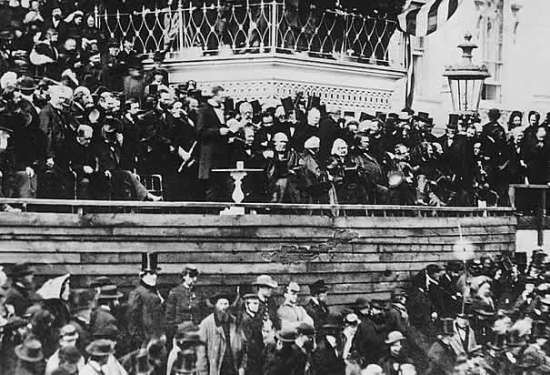
For me it is the truth both of a concept of Liberty which must continuously be advanced or expanded, and the still imperfect embodiment of that concept in the land that it was born. The authors of the declaration wrote, “we hold these truths to be self-evident, that all men are created equal, and that they are endowed by their creator with certain unalienable Rights, that among these are life, Liberty, and the pursuit of happiness…”  Eighty-seven years later while dedicating the Soldier’s Cemetery at Gettysburg noted that the new nation was “conceived in Liberty and dedicated to the proposition that all men are created equal.” 

Lincoln understood from the reality of war, and the statements of European leaders that the whole concept of a country being founded on a proposition like this, not race, not class, not religion, not station in life, was bound to be opposed, and was incredibly fragile. He confronted a rebellion which based itself on the belief that African Americans were less than equal, in fact subhuman and deserving of being enslaved by a superior race. Likewise, there were those in Europe who cheered the rebellion and believed that it proved that such experiments were doomed to failure, a belief that is still widely held, but more often by American elites than others.

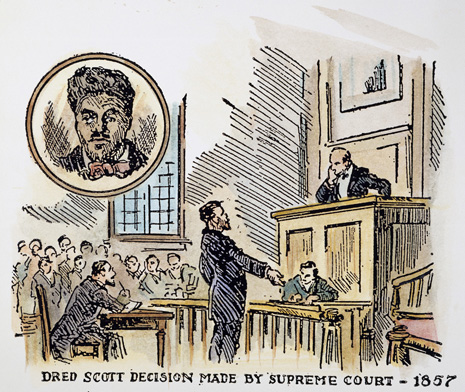
But like it or not, the proposition that all men are created equal, and endowed by their creator with certain unalienable Rights; a concept so imperfectly practiced by the very men who drafted it and those who followed them, still is right. That proposition was universalized as a political philosophy by Abraham Lincoln, is the basis of all hope for humanity. Tyrants, despots, dictators, terrorists, religious zealots of every sect filled with messianic visions, as well as madmen all desire to trample this proposition. Some desire to believe that those rights can simply be maintained by the power of a Constitution, but unless the people who swear to uphold that Constitution are dedicated to the proposition that all men are created equal that very Constitution can be perverted and used to enslave people, as it was by the men who drafted the Kansas-Nebraska Act, the Fugitive Slave Laws, and the Supreme Court decisions in Dred Scott and Plessy v. Ferguson cases ruled that African Americans were less than equal as human beings, and therefore not entitled to the same rights and liberties as were white people. It is the same constitution and laws that were used to deny citizenship and rights to Chinese immigrants until 1942, that were used by the government to interment native born Japanese American citizens in concentration camps during the Second World War, which drove Native Americans off their ancestral homelands, massacred them by the tens of millions, and placed them on reservations without any rights of American citizens until 1924; and which denied suffrage to women until 1919, and denied basic civil rights to LGBTQ people until recently; rights that in many states are still denied by state legislatures. But without equality, freedom is an illusion.

Judge Learned Hand, perhaps the best qualified man ever to not serve on the Supreme Court wrote,

“Liberty lies in the hearts of men and women; when it dies there, no constitution, no law, no court can even do much to help it. The spirit of Liberty is the spirit which is not too sure that it is right; the spirit of Liberty is the spirit which seeks to understand the minds of othe men and women; the spirit of Liberty is that which weighs their interests alongside its own without bias.” 

That is why the proposition in the Declaration which was universalized by Lincoln in the Gettysburg Address is still of the utmost importance. It is why it must be fought for, especially when politicians like Donald Trump and others threaten its very existence, and whose followers see it as only as Liberty for themselves and their interests. That proposition is under duress today, there are millions of followers of Trump and the demagogues who would deny Liberty to others based on race, religion, ethnicity, economic status, gender, or by them being LGBTQ. But, Liberty is a perilous thing, but once that proposition of Liberty dies in our hearts, there is nothing that can save it, no constitution, no law, no court; and those who place their trust in it the demagogues will find that they will eventually lose their Liberty as well.

In 1858 Lincoln spoke in Chicago, and in that speech he linked the common connection of all Americans share, even recent immigrants, through the Declaration. It was an era of intense anti-immigrant passions, the American Party, which sprang from the Know Nothing movement which founded upon extreme hatred of immigrants, and Roman Catholics, and violence against them, had run former President Millard Fillmore for election as at their candidate in 1856 following the collapse of the Whig Party.

In opposition to this party and movement  Lincoln proclaimed that immigrants, “cannot carry themselves back into that glorious epoch and make themselves feel a part of us, but when they look through that old Declaration of Independence, they find those old men say that “we hold these truths to be self evident, that all men are created equal,… That is the father of all moral principle to them, and they have a right to claim it as if they were blood of the blood, and flesh of the flesh of the men who wrote the Declaration, and so they are. That is the electric cord in the Declaration that links the hearts of patriotic and Liberty-loving men together, that will link those patriotic hearts as long as the love of freedom exists in the minds of men throughout the world.” 

Lincoln was absolutely correct, it is that love of freedom, liberty, and equality that echoes in the Declaration, and it is still a revolutionary idea. We hold these truths to be self evident…

As a historian I cannot get away from this. Whether it is in my study of European history, particularly the Weimar Republic and the Nazi takeover, or the American Civil War, especially the times I visit the Soldier’s Cemetery at Gettysburg and talk about the Gettysburg Address with my students. The breadth of my experience, having visited Dachau and Bergen-Belsen, having watched the unadulterated adulation of crowds of Germans chanting Sieg Heil!,  having grown up in this country at the height of the Civil Rights Movement, and having walked so many battlegrounds where American men have died fighting such tyranny makes me all too sensitive to why this proposition is so important.

That is why the quest for the fulfillment of that proposition is something that cannot be given up, it is in the words of Lincoln, “it is for us the living rather to be dedicated here to the unfinished work which they who have fought for have thus far so nobly advanced. That it is for us to be dedicated to the great task remaining before us – that from these honored dead we take increased devotion to that cause for which they gave the last full measure of devotion – that we here highly resolve that these dead should not have died in vain, that this nation under God shall have a new birth of freedom, and that government of the people, by the people, and for the people shall not perish from the earth.” 

For me it is this proposition, the proposition mocked by the elites of Europe, the proposition that any republic founded on such a proposition was doomed to fail, this proposition that says “we hold these truths to be self evident that all men are created equal” is what Independence Day is about. That is why in my remaining service to this country I will rededicate myself to seeing that “new birth of freedom” is fulfilled for every American.

That may seem a pipe dream to some people, and even impossible to others; but it is what far too many of the men and women who served before me gave the last full measure of devotion to duty to bring to fulfillment. Learned Hand was right, if Liberty dies in our hearts, no law, no constitution, no court, can save us.

Have a great Independence Day and please remember it is not about the day off, the picnics, or displays of military might, it is about that proposition; the one that is so easy to forget, the proposition that all men are created equal.

Peace,

Padre Steve+

1 Comment

Filed under civil rights, civil war, Gettysburg, History, laws and legislation, News and current events, Political Commentary

Slavery and National Expansion: the Compromise of 1850 or “The Privilege of Belonging to the Superior Race…” Part 3

thomas-sims-marched-into-slavery-nypl

Enforcing the Fugitive Slave Law in Boston 

Friends of Padre Steve’s World

Today the third installment of a three part series  of my work dealing with American Slavery in the ante-bellum period. These next articles deal with the subject of what happens when laws are made that further restrict the liberty of already despised, or enslaved people. In this case the subject is the Compromise of 1850 and its associated laws such as the Fugitive Slave Act of 1850.

This is an uncomfortable period of history for Americans with either a sense of conscience, or those who believe the racist myths surrounding the “Noble South” and “The Lost Cause.”  I hope that you find them interesting, especially in light of current events in the United States.

Peace,

Padre Steve+

The Fugitive Slave Act of 1850

Robert Toombs of Georgia was an advocate for the expansion of slavery into the lands conquered during the war. Toombs warned his colleagues in Congress “in the presence of the living God, that if you by your legislation you seek to drive us from the territories of California and New Mexico, purchased by the common blood and treasure of the whole people…thereby attempting to fix a national degradation upon half the states of this Confederacy, I am for disunion.”  [1]

The tensions in the aftermath of the war with Mexico escalated over the issue of slavery in the newly conquered territories brought heated calls by some southerners for secession and disunion. To preserve the Union, Henry Clay and Daniel Webster, supported by the new President Millard Fillmore were able to pass the compromise of 1850 solved a number of issues related to the admission of California to the Union and boundary disputes involving Texas and the new territories.  But among the bills that were contained in it was the Fugitive Slave Law, or The Fugitive Slave Act of 1850. The act was the device of Henry Clay which was meant to sweeten the deal for southerners. The law would “give slaveholders broader powers to stop the flow of runaway slaves northward to the free states, and offered a final resolution denying that Congress had any authority to regulate the interstate slave trade.” [2]

fugitive-slave-law

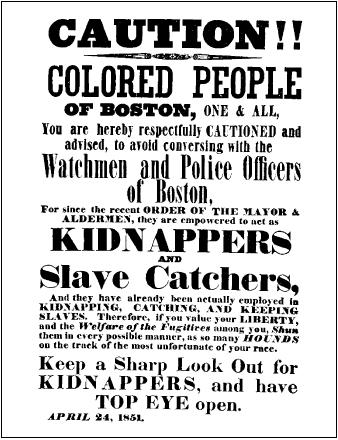
A Warning to Blacks in Boston regarding the Fugitive Slave Law

For all practical purposes the Compromise of 1850 and its associated legislation nationalized the institution of slavery, even in Free States. It did this by forcing all citizens to assist law enforcement in apprehending fugitive slaves. It also voided state laws in Massachusetts, Vermont, Ohio, Connecticut, Pennsylvania and Rhode Island, which barred state officials from aiding in the capture, arrest or imprisonment of fugitive slaves. “Congress’s law had nationalized slavery. No black person was safe on American soil. The old division of free state/slave state had vanished….” [3] If there was any question as to whose “States Rights” the leaders of the South were advocating, it was certainly not those of the states whose laws were voided by the act.

That law required all Federal law enforcement officials, even in non-slave states to arrest fugitive slaves and anyone who assisted them, and threatened law enforcement officials with punishment if they failed to enforce the law. The law stipulated that should “any marshal or deputy marshal refuse to receive such warrant, or other process, when tendered, or to use all proper means diligently to execute the same, he shall, on conviction thereof, be fined in the sum of one thousand dollars.” [4] In effect the law nullified state laws and forced individual citizens and local officials to help escaped slaves regardless of their own convictions, religious views, and state and local laws to the contrary.

Likewise the act compelled citizens in Free states to “aid and assist in the prompt and efficient execution of this law, whenever their services may be required….” [5] Penalties were harsh and financial incentives for compliance attractive.

“Anyone caught providing food and shelter to an escaped slave, assuming northern whites could discern who was a runaway, would be subject to a fine of one thousand dollars and six months in prison. The law also suspended habeas corpus and the right to trial by jury for captured blacks. Judges received a hundred dollars for every slave returned to his or her owner, providing a monetary incentive for jurists to rule in favor of slave catchers.” [6]

The law gave no protection for even black freedmen, who simply because of their race were often seized and returned to slavery. The legislation created a new extra-judicial bureaucratic office to decide the fate of blacks. This was the office of Federal Commissioner and it was purposely designed to favorably adjudicate the claims of slaveholders and their agents, and to avoid the normal Federal Court system. There was good reason for the slave power faction to place this in the law, many Federal courts located in Free States often denied the claims of slave holders, and that could not be permitted if slavery was to not only remain, but to grow with the westward expansion of the nation.

When slave owners or their agents went before these new appointed commissioners, they needed little in the way of proof to take a black back into captivity. The only proof or evidence other than the sworn statement by of the owner with an “affidavit from a slave-state court or by the testimony of white witnesses” [7] that a black was or had been his property was required to return any black to slavery. The affidavit was the only evidence required, even if it was false.

runaway

Since blacks could not testify on their own behalf and were denied legal representation before these commissioners, the act created an onerous extrajudicial process that defied imagination. Likewise, the commissioners had a strong a financial incentive to send blacks back to slavery, unlike normal courts the commissioners received a direct financial reward for returning blacks to slave owners. “If the commissioner decided against the claimant he would receive a fee of five dollars; if in favor ten. This provision, supposedly justified by the paper work needed to remand a fugitive to the South, became notorious among abolitionists as a bribe to commissioners.” [8] It was a system rigged to ensure that African Americans had no chance, and it imposed on the citizens of Free states the legal obligation to participate in a system that many wanted nothing to do with.

Douglass.JPG

Frederick Douglass 

Frederick Douglass wrote about the new law in the most forceful terms:

“By an act of the American Congress…slavery has been nationalized in its most horrible and revolting form. By that act, Mason & Dixon’s line has been obliterated;…and the power to hold, hunt, and sell men, women, and children remains no longer a mere state institution, but is now an institution of the whole United States.” [9]

Douglass was correct as was demonstrated during an incident in Boston in 1854 where an escaped slave named Anthony Burns, who had purchased his freedom, was arrested under the Fugitive Slave Act. The arrest prompted a protest in which, “an urban mob – variously composed of free Negro laborers, radical Unitarian ministers, and others – gathered to free him. They stormed the Federal courthouse, which was surrounded by police and wrapped in protective chains….Amid the melee, one protestor shot and killed a police deputy.” [10] The heated opposition to Burns’ arrest provoked the passions of thousands of Bostonians who protested for his release that caused the Massachusetts governor to deploy two batteries of artillery outside the courthouse to deter any more attacks. When the Federal Fugitive Slave Law commissioner consigned Burns to his Southern owner, the prisoner placed in shackles and was marched down State Street. Tensions were now running extremely high and a “brigade of Massachusetts militia and local police were required to run Burns through a gauntlet and deposit him on the ship that would remand him to Virginia.” [11] Bostonians began to see their city as it was in the early days of the American Revolution, as a place that resisted tyranny. Neither did they did not forget Burns but raised the money to purchase his freedom. William Lloyd Garrison wrote, “the “deed of infamy… demonstrated as nothing else that “only “the military power of the United States” could sustain slavery.” [12] Nevertheless, Boston’s “mercantile elite had vindicated law and order” [13] but in the process they helped move so abolitionists who had been advocates of pacifism and non-violence to physical resistance to the bounty hunting Southerners. “Across the North, prisons were broken into, posses were disrupted, and juries refused to convict.” [14]

Violence between slave hunters and their protectors did break out in September 1851 when “a Maryland slave owner named Edward Gorsuch crossed into Pennsylvania in pursuit of four runaways.” [15] Gorsuch and his armed posse found them in the Quaker town of Christiana, where they were being sheltered by a free black named William Parker and along with about two dozen other black men armed with a collection of farm implements and a few muskets who vowed to resist capture. Several unarmed Quakers intervened and recommended that Gorsuch and his posse leave for their own sake, but Gorsuch told them “I will have my property, or go to hell.” [16] A fight then broke out in which Gorsuch was killed and his son seriously wounded, and the fugitives escaped through the Underground Railroad to Canada.

The Christiana Riot as it is called now became a national story. In the North it was celebrated as an act of resistance while it was decried with threats of secession in the South. President Millard Fillmore sent in troops and arrested a number of Quakers as well as more than thirty black men. “The trial turned into a test between two cultures: Southern versus Northern, slave versus free.”  [17] The men were charged with treason but the trial became a farce as the government’s case came apart. After a deliberation of just fifteen minutes, “the jury acquitted the first defendant, one of the Quakers, the government dropped the remaining indictments and decided not to press other charges.” [18] Southerners were outraged, and one young man whose name is forever linked with infamy never forgot. A teenager named John Wilkes Booth was a childhood friend of Gorsuch’s son Tommy. “The death of Tommy Gorsuch’s father touched the young Booth personally. While he would move on with his life, he would not forget what happened in Christiana.” [19]

The authors of the compromise had not expected such resistance to the laws. On his deathbed Henry Clay, who had worked his entire career to pass compromises in order to preserve the Union, praised the act, of which he wrote “The new fugitive slave law, I believe, kept the South in the Union in ‘fifty and ‘fifty-one. Not only does it deny fugitives trial by jury and the right to testify; it also imposes a fine and imprisonment upon any citizen found guilty of preventing a fugitive’s arrest…” Likewise Clay depreciated the Northern opposition and condemned the attempt to free Anthony Burns, noting “Yes, since the passage of the compromise, the abolitionists and free coloreds of the North have howled in protest and viciously assailed me, and twice in Boston there has been a failure to execute the law, which shocks and astounds me…. But such people belong to the lunatic fringe. The vast majority of Americans, North and South, support our handiwork, the great compromise that pulled the nation back from the brink.” [20] 

While the compromise had “averted a showdown over who would control the new western territories,” [21] it only delayed disunion. In arguing against the compromise South Carolina Senator John C. Calhoun realized that for Southerners it did not do enough to support the peculiar institution and that it would inspire Northern abolitionists to redouble their efforts to abolish slavery. Thus, Calhoun argued not just for the measures secured in the compromise legislation, but for the permanent protection of slavery:

“He understood that slavery stood at the heart of southern society, and that without a mechanism to protect it for all time, the Union’s days were numbered.” Almost prophetically he said “I fix its probable [breakup] within twelve years or three presidential terms…. The probability is it will explode in a presidential election.”  [22]

Of course it was Calhoun and not the authors of the compromise who proved correct. The leap into the abyss of disunion and civil war had only been temporarily avoided. However, none of the supporters anticipated what would occur in just six years when a “train of unexpected consequences would throw an entirely new light on the popular sovereignty doctrine, and both it and the Compromise of 1850 would be wreaked with the stroke of a single judicial pen.” [23]

To be continued…

Notes

[1] Ibid. Guelzo Fateful Lightning pp.62-63

[2] Ibid. Guelzo Fateful Lightning p.68

[3] Ibid. Goldfield  America Aflame p.71

[4] ______________Fugitive Slave Act of 1850 retrieved from the Avalon Project, Yale School of Law http://avalon.law.yale.edu/19th_century/fugitive.asp 11 December 2014

[5] Ibid. Fugitive Slave Act of 1850

[6] Ibid. Goldfield America Aflame p.71

[7] Ibid. McPherson The Battle Cry of Freedom  p.80

[8] Ibid. McPherson The Battle Cry of Freedom p.80

[9] Ibid. Goldfield America Aflame p.72

[10] Goodheart, Adam 1861: The Civil War Awakening Vintage Books a division of Random House, New York 2011 p.42

[11] Ibid. Varon Disunion! The Coming of the American Civil War 1789-1858 p.241

[12] Mayer, Henry All on Fire: William Lloyd Garrison and the Abolition of Slavery W.W. Norton and Company, New York and London 1998 p.442

[13] Ibid. McPherson The Battle Cry of Freedom p.84

[14] Ibid. Guelzo Fateful Lightning p.73

[15] Ibid. Guelzo Fateful Lightning p.73

[16] Ibid. McPherson The Battle Cry of Freedom p.84

[17] Steers, Edward Jr. Blood on the Moon: The Assassination of Abraham Lincoln The University of Kentucky Press, Lexington 2001 p.33

[18] Ibid. McPherson The Battle Cry of Freedom p.85

[19] Ibid. Steers  Blood on the Moon: The Assassination of Abraham Lincoln p.33

[20] Oates, Stephen B. Editor The Approaching Fury: Voices of the Storm, 1820-1861 University of Nebraska Press, Lincoln and London 1997 p.94

[21] Ibid. Guelzo Fateful Lightning p.71

[22] Ibid. Goldfield America Aflame p.64

[23] Ibid. Guelzo Fateful Lightning p.71

4 Comments

Filed under civil rights, civil war, History, Political Commentary

Slavery and National Expansion: the Compromise of 1850 or “The Privilege of Belonging to the Superior Race…” Part 2

slave-sale

Friends of Padre Steve’s World

Today the second of a three installment bit of my work dealing with American Slavery in the ante-bellum period. These next articles deal with the subject of what happens when laws are made that further restrict the liberty of already despised, or enslaved people. In this case the subject is the Compromise of 1850 and its associated laws such as the Fugitive Slave Act of 1850.

This is an uncomfortable period of history for Americans with either a sense of conscience, or those who believe the racist myths surrounding the “Noble South” and “The Lost Cause.”  I hope that you find them interesting, especially in light of current events in the United States.

Peace,

Padre Steve+

Economic Effects of the Compromise of 1850

The interregional slave trade guaranteed slave owners of a source of slaves even if they were cut off from the international trade and it was an immense part of not just the Southern economy but the American economy. Slave owners “hitched their future to slavery; a single cash crop and fresh land,” [1] and refused to take an interest in manufacturing or diversifying their agricultural production outside of King Cotton. Slave prices tripled between 1800 and 1860 making human property one of the most lucrative markets for investment. The price of a “prime male field hand in New Orleans began at around $500 in 1800 and rose as high as $1,800 by the time of the Civil War.” [2] The result was that slave owners and those who benefited from the interregional slave trade had a vested interest in not only seeing slavery preserved, but expanded.

This resulted in two significant trends in the South, first was that slave owners grew significantly richer as the value of the slave population increased. Using even a conservative number of $750 dollars as the value of a single slave in 1860 the amount of value in this human property was significantly more than almost any other investment in the nation.  It was enormous. Steven Deyle notes that:

“It was roughly three times greater than the total amount of all capital invested in manufacturing in the North and in the South combined, three times the amount invested in railroads, and seven times the amount invested in banks. It was about equal to about seven times the value of all currency in circulation in the country three times the value of the entire livestock population, twelve times the value of the entire U.S. cotton crop, and forty-eight times the expenditures of the federal government that year. ….”by 1860, in fact in the slaveowning states alone, slave property had surpassed the assessed value of real estate.” [3]

The rise in slave values and the increasing wealth of slave owners had a depreciating effect on poor southern whites by ensuring that there was no middle class, which “blocked any hope of social advancement for the mass of poor whites, for it was all but impossible for a non-slaveholder to rise in the southern aristocracy.” [4] The impoverishment of southern whites created some worry for those astute enough to take an interest in such matters. “In 1850, about 40 percent of the South’s white farmers owned real estate at all. There was thus, worried the Southern Cultivator in 1856, “a large number at the South who have no legal right or interest in the soil [and] no homes of their own.” The editor of a South Carolina newspaper that year framed the matter in less sympathetic terms: “There is in this State,” he wrote, “as impoverished and ignorant as white population as can be found in any other in the Union.” [5]

Some Southerners recognized the growing issue that the south was falling behind the north in terms of real economic advancement and that slavery was the culprit. Hinton Helper, a non-slave owning North Carolinian who had made his fortune in the California Gold Rush of 1849 and returned home to become disillusioned with what he saw wrote a book that had a major impact in the North among Republican politicians, but which was either banned or restricted in much of the South. That book “The Impending Crisis of the South: How to Meet It (1857) was “a book on the debilitating impact of slavery on the South in general and on southern whites in particular.” [6] Helper’s attack on the slavery system was as devastating as that of any abolitionist, and since he was a southerner the effects of his words helped further anti-slavery sentiment in the North and would be used by the Republican party in an abridged form as a campaign tool that they printed and distributed during the build up to the election n of 1860. Helper wrote that:

“Slavery lies at the root of all the shame, poverty, tyranny and imbecility of the South.” Echoing the free-soil argument Helper maintained that slavery degraded all labor to the level of bond labor. Planters looked down their noses at nonslaveholders and refused to tax themselves to provide a decent school system. “Slavery is hostile to general education…Its very life, is in the ignorance and stolidity of the masses.”  [7]

Many southern leaders saw Helper’s book as a danger and worried that should Helper and others like him speak freely long enough “that they will have an Abolition party in the South, of Southern men.” When that happened, “the contest for slavery will no longer be one between the North and the South. It will be in the South between the people of the South.” [8] That was something that the landed gentry of the slave owning oligarchy could never tolerate for if the non-slave holding whites rejected slavery, the institution would die. Thus, Helper, who was no fan of black people and held many violently racist attitudes, was denounced “as a traitor, a renegade, an apostate, a “dishonest, degraded and disgraced man.” [9]

Men like Helper were an anomaly in the South, other leaders were much more like Jefferson Davis who urged the creation of a “Southern “system,” internal improvements, building factories, even reforming education to eliminate all textbooks at odds with his notion of the blessings of slavery.” [10]

In the years the before the war, the North embraced the Industrial Revolution leading to advances which gave it a marked economic advantage over the South in which through  its “commitment to the use of slave labor inhibited economic diversification and industrialization and strengthened the tyranny of King Cotton.” [11] The population of the North also expanded at a clip that far outpaced the South as European immigrants swelled the population.

The divide was not helped by the various compromises worked out between northern and southern legislators. After the Missouri Compromise Thomas Jefferson wrote these words of warning:

“but this momentous question, like a fire bell in the night, awakened and filled me with terror. I considered it at once as the knell of the Union. It is hushed indeed for the moment, but this is a reprieve only, not a final sentence. A geographical line, coinciding with a marked principle, moral and political, once conceived and held up to the angry passions of men, will never be obliterated; and every new irritation will mark it deeper and deeper.” [12]

The trigger for the increase in tensions that eventually ignited the powder keg was the war with Mexico in which the United States annexed nearly half of Mexico. The new territories were viewed by those who advocated the expansion of slavery as fresh and fertile ground for its spread. Ulysses S Grant, who served in the war, noted the effects of the war with Mexico in his memoirs:

“In taking military possession of Texas after annexation, the army of occupation, under General [Zachary] Taylor, was directed to occupy the disputed territory.  The army did not stop at the Nueces and offer to negotiate for a settlement of the boundary question, but went beyond, apparently in order to force Mexico to initiate war….To us it was an empire and of incalculable value; but it might have been obtained by other means.  The Southern rebellion was largely the outgrowth of the Mexican war.” [13]

To be continued…

Notes 

[1] Ibid. Egnal  Clash of Extremes p.10

[2] Ibid. Deyle The Domestic Slave Trade p.53 Deyle’s numbers come from the 1860 census.

[3] Ibid. Egnal  Clash of Extremes p.54

[4] Ibid. Foner Free Soil, Free Labor, Free Men p.48

[5] Ibid. Levine Half Slave and Half Free p.37

[6] Ibid. Goldfield  America Aflame  p.177

[7] Ibid. McPherson The Battle Cry of Freedom p.199

[8] Ibid. Levine Half Slave and Half Free p.235

[9] Ibid. Potter The Impending Crisis p.397

[10] Davis, William C. Jefferson Davis: The Man and His Hour Harper Collins Publishers New York 1991 p.258

[11] Ibid. Potter The Impending Crisis p.42

[12] Jefferson, Thomas Letter to John Holmes dated April 22nd 1824 retrieved from www.loc.gov/exhibits/jefferson/159.html  24 March 2014

[13] Grant, Ulysses S. Personal Memoirs of U.S. Grant New York 1885 pp.243-245

3 Comments

Filed under civil rights, civil war, History, Political Commentary

Slavery and National Expansion: the Compromise of 1850 or “The Privilege of Belonging to the Superior Race…” Part 1

negroes_and_negro_-slavery

Friends of Padre Steve’s World

Today a continuation of my work dealing with American Slavery in the ante-bellum period. These next articles deal with the subject of what happens when laws are made that further restrict the liberty of already despised, or enslaved people. In this case the subject is the Compromise of 1850 and its associated laws such as the Fugitive Slave Act of 1850.

This is an uncomfortable period of history for Americans with either a sense of conscience, or those who believe the racist myths surrounding the “Noble South” and “The Lost Cause.”  I hope that you find them interesting, especially in light of current events in the United States.

Peace,

Padre Steve+

The Background 

The ante-bellum South was an agrarian society that depended on the free labor provided by slaves. In a socio-political sense the South was an oligarchy that offered no freedom to slaves, openly discriminated against free blacks and provided little hope of social or economic advancement for poor and middle class whites.  However, despite this, even poor whites supported it.  Many Southern Yeoman farmers were willing to tolerate their second class status because they: “feared the fall from independent producer to dependent proletarian, a status he equated with enslavement” [1] more than remaining subservient to planters and plantation owners. In fact, for them slavery was the one institution that kept them above the despised black.

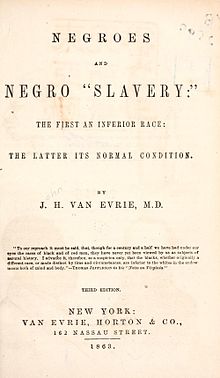
In 1861, Dr. J.H. Van Evrie, promoted the scientific racist of ichthyologist Louis Agassiz in a pamphlet entitled “Negroes and Negro Slavery;” The First an Inferior Race – The Latter, Its Normal Condition” expressed how most Southerners felt about African Americans be they slave or free, and Jefferson Davis hoped that Van Evrie’s arguments would persuade people to adopt the view that racial equality was a fallacy which could not be tolerated, Van Evrie wrote:

“He is not a black white man, or merely a man with a black skin, but a DIFFERENT AND INFERIOR SPECIES OF MAN; – that this difference is radical and total… that so called slavery is neither a “wrong” nor an “evil, but a natural relation based upon the “higher law,” in harmony with the order, progress, and general well-being of the superior one, and absolutely in keeping with the existence of the inferior race.”  [2]

While all Northern states had abolished slavery, or were in the process of gradual abolition in the after independence and the Civil War and had moved to an economic concept of free labor, the South had tied its economy and society to the institution of slavery. The contrast was well said by the members of an Alabama agricultural society, which noted in 1846:

“Our condition is quite different from that of the non-slaveholding section of the United States. With them their only property consists of lands, cattle and planting implements. Their laborers are merely hirelings, while with us our laborers are our property.” [3]

Van Evrie was not the only person making such distinction between the races. Dr. Samuel Cartwright wove the pseudo-science of the day into the narrative of the Bible, noting:

“I have thus hastily and imperfectly noticed some of the more striking anatomical and physiological peculiarities of the Negro race. The question may be asked, Does he belong to the same race as the white man? Is he a son of Adam? Does his particular physical confirmation stand in opposition to the Bible, or does it prove its truth?… Anatomy and physiology have been interrogated, and the response is, that the Ethiopian, or Canaanite, is unfitted for the duties of a free man….” [4]

He also noted:

“The Declaration of Independence, which was drawn up at a time when negroes were scarcely regarded as human beings, “That all men are by nature free and equal,” was only intended to apply to white men…” [5]

Northerners on the other hand, even in states where the last vestiges of slavery held on, nearly universally ascribed to the understanding that there was a dignity to labor and that free labor was essential if people were to have a better life. It undergirded their understanding of human dignity and that “labor was the source of all value.” [6]

That understanding of the intrinsic value of free labor continued to gain ground in the North in the decades preceding the Civil War and found much of its support in the Calvinist theology that predominated in most Protestant Northern denominations. Labor was intrinsic to one’s calling as a Christian and a human being, slave labor, at least in the eyes of many Northerners undercut that idea. Success in one’s calling glorified God and provided earthly evidence that a person was among the elect. For many Northern Christians, “the pursuit of wealth thus became a way of serving God on earth, and labor, which had been imposed on fallen man as a curse, was transmuted into a religious value, a Christian calling.” [7]  Such ideas found their way into Republican political thought even when not directly related to religion.  William Evarts said in 1856 “Labor gentlemen, we of the free States acknowledge to be the source of all of our wealth, of all our progress, of all our dignity and value.” [8] Abraham Lincoln noted that “the free labor system…opens the way for all, and energy and progress, and improvement in condition for all,” [9] and Lincoln also noted something inherent in the economic theory of Adam Smith that Labor is prior to, and independent of capital…in fact, capital is the fruit of labor.” [10]

However, the South by the 1830s had completely wedded itself to slavery and southern advocates of slavery deplored the free-labor movement as wage slavery and extolled the virtue of slavery. James H. Hammond condemned the free-labor movement in his King Cotton speech to the Senate in 1858:

“In all social systems there must be a class to do the menial duties, to perform the drudgery of life…. It constitutes the very mudsill of society….Such a class you must have, or you would not have that other that leads to progress, civilization and refinement….Your whole hireling class of manual laborers and ‘operatives,’ as you call them, are essentially slaves. The difference between us is, that our slaves are hired for life and well compensated…yours are hired by the day, not cared for, and scantily compensated.” [11]

Even so, the fact that the slave barons “were forced at every election to solicit the votes of “ignorant, slovenly, white trash in the country” with “frequent treats that disgrace our elections,” [12] rankled and humiliated many members of the Southern aristocracy. It was a marriage of two disparate parties linked by their membership in a superior race, something that only the continued existence of slavery ensured.

Lincoln extolled the virtues of free-labor, noting his own experiences after his election: “I am not ashamed to confess that twenty five years ago I was a hired laborer, mauling rails, at work on a flat boat – just what might happen to any poor man’s son.”  [13] Other Northerners lauded free-labor as the basis of upward mobility, and the New York Times noted that “Our paupers to-day, thanks to free labor, are our yeomen and merchants of tomorrow.” [14]

slave-coffle2

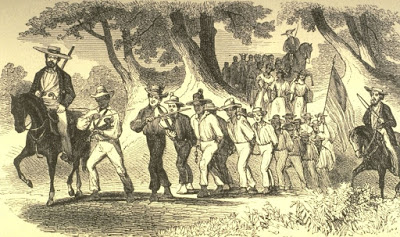
Slave Coffle

But whites in the South held labor in contempt due to the system of slavery, and the divergent views of each side were noted by Thomas Ewing who noted that labor “is held honorable by all on one side of the line because it is the vocation of freedmen – degrading in the eyes of some on the other side because it is the task of slaves.” [15] Of course with labor being the task of African slaves for southerners, the issue was entwined with race, and “Even if slavery was wrong, its wrongs were cancelled out for nonslaveholders by the more monstrous specter of racial equity.”  [16]

Georgia Governor Joseph E. Brown emphasized the threat to whites in that blacks would be their social equals and competitors. The racial component assured poor southern whites that they were superior to blacks and an Alabama lawyer wrote “The privilege of belonging to the superior race and being free was a bond that tied all Southern whites together… and it seemed from a Southern stand-point, to have for its purpose the leveling of all distinctions between the white man and the slave hard by.” [17] But poor white workers who remained in the South “repeatedly complained about having to compete with slaves as well as poorly paid free blacks” [18] leading many to seek a new livelihood in either Free States or the new territories.

For Southern politicians and slaveholders, the expansion of slavery was essential to its continued maintenance in the states where it was already legal. “Because of the need to maintain a balance in the Senate, check unruly slaves, and cultivate fertile soils, many planters and small plantation owners- particularly those living in the southern districts of the cotton states- asserted that their survival depended on new territory.” [19] In those decades “a huge involuntary migration took place. Between 800,000 and 1 million slaves were moved westward….” [20]

The need for slaves caused prices to soar, largely due to the ban on the import of slaves from Africa. This made the interregional trade much more important and linked the upper and lower south as well as the new slave-holding territories into “a regionwide slave market that tied together all of the various slaveowning interests into a common economic concern.” [21] In some older states like Virginia where fewer slaves were required, the exportation of slaves became a major industry:

“male slaves were marched in coffles of forty or fifty, handcuffed to each other in pairs, with a long chain through the handcuffs passing down the column to keep it together, closely guarded by mounted slave traders followed by an equal number of female slaves and their children. Most of them were taken to Wheeling, Virginia, the “busiest slave port” in the United States, and from there they were transported by steamboat to New Orleans, Natchez, and Memphis.” [22]

To be continued…

Notes

[1] Ibid. McPherson Drawn With Sword p.50

[2] Van Evrie, J.H. “Negroes and Negro Slavery;” The First an Inferior Race – The Latter, Its Normal Condition 1861 in The Confederate and Neo-Confederate Reader: The Great Truth about the Lost Cause, Loewen, James W. And Sebesta, Edward H. Editors, University Press of Mississippi, Jackson, 2010 p.75

[3] Ibid. Levine Half Slave and Half Free p.19

[4] Cartwright, Samuel A. Diseases and Peculiarities of the negro Race, 1851 in Loewen, James W and Sebesta, Edward H. The Confederate and Neo-Confederate reader: The Great Truth about the Lost Cause University of Mississippi Press, Jackson 2010 p.66

[5] Ibid. Cartwright Diseases and Peculiarities of the negro Race, 1851 p.70

[6] Foner, Eric Free Soil, Free Labor, Free Men: The Ideology of the Republican Party Before the Civil War Oxford University Press, Oxford and New York 1970 and 1995 p.7

[7] Ibid. Foner Free Soil, Free Labor, Free Men pp.12-13

[8] Ibid. Foner Free Soil, Free Labor, Free Men p.12

[9] Ibid. McPherson The Battle Cry of Freedom: The Civil War Era p.28

[10] Ibid. Foner Free Soil, Free Labor, Free Men p.12

[11] Ibid. McPherson The Battle Cry of Freedom p.196

[12] Ibid. Guelzo Fateful Lightening p.38

[13] Ibid. McPherson The Battle Cry of Freedom p.28

[14] Ibid. Foner Free Soil, Free Labor, Free Men p.16

[15] Ibid. Foner Free Soil, Free Labor, Free Men p.16

[16] Ibid. Guelzo Fateful Lightening p.38

[17] Ibid. Guelzo Fateful Lightening p.39

[18] Ibid. Levine Half Slave and Half Free p.44

[19] Ibid. Egnal  Clash of Extremes pp.125-126

[20] Korda, Michael. Clouds of Glory: The Life and Legend of Robert E. Lee Harper Collins Publishers, New York 2014 p.203

[21] Deyle, Steven The Domestic Slave Trade in Major Problems in the Civil War and Reconstruction Documents and Essays Third Edition edited by Michael Perman and Amy Murrell Taylor Wadsworth Cengage Learning Boston MA 2011 p.53

[22] Ibid. Korda Clouds of Glory: The Life and Legend of Robert E. Lee  p.203

3 Comments

Filed under civil rights, civil war, History, Political Commentary

When Political Parties Implode: “Mr. President I Wish to Remind You that General Jackson is Dead”

lecompton-2

Friends of Padre Steve’s World,

I have been writing about the coming collapse of the Republican Party and have decided to republish some of my writings dealing with what happened to the Whig and Democratic Parties between 1854 and 1860. Today an article about the epic battle between President James Buchanan and Senator Stephen A. Douglas from draft text “Mine Eyes have seen the Glory” Race, Religion, Ideology and Politics in the Civil War Era.

Peace

Padre Steve+

Kansas was politically divided between two competing legislatures, each which claimed to be the voice of the people. The population of Kansas was heavily anti-slavery, in fact slaveholders and their supporters were a minuscule minority in the territory, but they were both load, and often used violence and intimidation to achieve power. As such many citizens felt disenfranchised by the official legislature, which was “a pro-slavery body elected by fraud in 1855.” [1] This body met in the city of Lecompton. In 1857 the Lecompton legislature sensed the opportunity to have Kansas admitted to the Union as a Slave State. To ease the way for this to happen over the will of the majority this legislature elected slavery supporters to be members of a constitutional convention, the goal of which was to draft a constitution which would be submitted to Congress for the admission of the Kansas Territory to the Union as a Slave State.

Free State partisans in Kansas feared that that if they participated in the election that they would be “gerrymandered, and simply counted out by stuffed ballots,” and most decided to sit out of the election. As a result it was “a quiet election, with many proslavery candidates unopposed and only 2,200 out of 9,000 registered voters going to the polls, a large majority of extreme proslavery men won election as delegates to the constitutional convention in September.” [2] But the result of the election was untenable, for “Two thousand voters in a territory with 24,000 eligible for the franchise had elected a body of delegates whom no one seriously regarded as representative of the majority opinion in Kansas.” [3]

The Lecompton legislature passed the proslavery constitution, but it was vetoed by the outgoing governor, John W. Geary. Geary accused “the pro-slavery legislature of attempting to stampede a rush to statehood on pro-slavery terms,” but his veto was overridden. The constitution had several provisions that most of the population found unacceptable. It protected owners of “the 200 slaves in Kansas, banned free blacks from the state, and prohibited any amendments to the constitution for seven years.” [4] In response the pro-Free State legislature in Topeka issued a referendum in which people voted “10,226 votes to 162 votes” [5] against the pro-slavery measures contained in the Lecompton Constitution. The newly appointed governor of the territory, Robert J. Walker opposed the measure and denounced it “as a vile fraud, a bare counterfeit.” [6] Walker demanded a new, fair, referendum, which the newly elected president James Buchanan, also backed. In response many Southerners in Congress “threatened to secede unless the administration fired Walker and backed down on the referendum issue.” [7] The threat of secession by Southerners in support of the radical minority in Lecompton led to chaos in the Democratic Party which controlled the House, the Senate and held the Presidency.

james-buchanan

James Buchanan

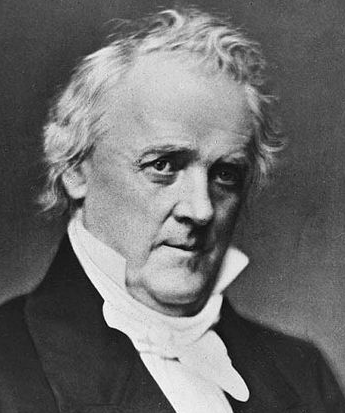
James Buchanan was a pro-slavery Pennsylvania Democrat who had rode into office on the votes of the South. He was now pressured by Southern legislators to change his position on the Lecompton Constitution. Buchanan’s cabinet, which was heavily Southern, and pro-slavery expansion also used its influence to pressure the president into supporting the plan to admit Kansas as a Slave State. In response to the pressure, Buchanan reversed his previous stance in regard to Kansas and endorsed the bill, and he “called on Congress admit Kansas as a slave state with a constitution (drafted by the proslavery territorial government at Lecompton) that was never approved by Kansas voters and obviously opposed by a majority of them.” [8] The decision by Buchanan tossed aside the doctrine of popular sovereignty which had been key to engineering earlier compromises and in response some Northern Democrats opposed Buchanan.

Buchanan’s patently obvious move to placate the slave states and overturn the restrictions on the expansion of slavery contained in the Missouri Compromise, the Compromise of 1850, and the Kansas-Nebraska Act, provoked a new outcry, this time from Northern members of the Democratic Party. Many Northern Democrats were outraged by Buchanan’s flip-flop and the threats of secession emanating from the South if the measure was not approved. Most of the Northern Democrats were willing to accept and even defend slavery where it existed, but they were opposed to the expansion of slavery. His announcement to the House of Representatives “touched off a twelve-hour donnybrook in February 1858” and “about 50 congressmen in various states of inebriation tangled with each other on the House floor… The rumble subsided only when Mississippi congressman William Barksdale tackled an unidentified assailant as the latter snatched his toupee and waved it about like a captured flag. Barksdale finally retrieved his scalp and plopped it on his head wrong side out, the absurdity of the scene giving the combatant’s pause.” [9] Many Northern Democrats felt betrayed by their president’s actions and rose in opposition to the bill that would admit Kansas as a Slave State. Even so Buchanan was a “skilled political infighter swung a remarkable percentage of Northern Democratic members of the House of Representatives, fully 60 percent, behind the Lecompton Constitution,” [10] but he did not contend with the charismatic power of Stephen Douglas in the Senate.

These Democrats were led by the formidable Senator Stephen A. Douglas. Known as the Little Giant Douglas had skillfully crafted the Compromise of 1850 using the principle of popular sovereignty, led these Democrats in their fight against Buchanan’s acceptance and endorsement of Lecompton. Douglas’s previous actions to support the rights of Slave States had made him a hero in much of the South and his stature in both the North and the South made him the frontrunner to win the Democratic nomination for the presidency in 1860.

But Douglas, who had worked so hard to build compromises that would hold the Union together could not countenance the actions and tactics of the Southern members of his party. Douglas was a political realist and not an ideologue. He was very sympathetic to slave holders and was certainly no supporter of emancipation, in fact the Little Giant was an avowed racist. He was completely convinced “of the inferiority of the Negro, and he had a habit of stating it with brutal bluntness, “I do not believe that the Negro is any kin of mine at all…. I believe that this government of ours was founded, and wisely founded upon white basis. It was made by white men, for the benefit of white men and their posterity, to be executed and managed by white men.” [11] But despite his own racist beliefs Douglas understood the danger that the pro-slavery extremists supporting Lecompton were to the Democratic Party and the nation. Douglas understood that if the bill to admit Kansas as a slave state was passed that it would destroy the unity of the Democratic Party and quite possibly the Union itself.

Stephen-Douglas-in-1858

Stephen Douglas

The Illinois Senator found out about the President Buchanan’s new support of the measure when he read the newspaper. He was outraged when he saw the news in the Washington Union that Buchanan had decided to support Lecompton. He was infuriated and the fury showed when he wrote with characteristic honesty:

“This left no doubt were the old bastard stood. “Can you believe his Goddamned arrogance?” I told a friend. “I run the Committee on Territories. He should have consulted me before approving the Lecompton fraud. He’ll pay for that. By God, sir, I made Mr. James Buchanan, and by God, sir, I’ll unmake him.” [12]

As such, the Little Giant threw caution to the wind and stormed to the White House “to confront Buchanan on the “trickery and juggling of the Lecompton constitution.” He warned the president of that his actions in support of the Lecompton party would “destroy the Democratic party in the North,” and we warned that “if Buchanan insisted on going through with it, Douglas swore to oppose him in Congress.” [13]

It was an epic confrontation. Douglas recalled, “The Lecompton constitution, I told Buchannan bluntly, was a blatant fraud on the people of Kansas and the process of democracy, I warned him not to recommend acceptance of it. With his head titled forward in that bizarre habit of his, he said that he intended to endorse the constitution and send it to Congress. “If you do,” I thundered, “I’ll denounce it the moment that it is read.” His face turned red with anger. “I’ll make Lecompton a party test,” he said. “I expect every democratic Senator to support it.” I will not, sir![14]

Angry and offended by the confrontation of Douglas, Buchanan cut the senator off and issued his own threat to Douglas and his political career saying, “I desire you to remember that no Democrat ever yet differed from an administration of his own choice without being crushed….Beware of the fate of Tallmadge and Rives,” two senators who had gone into political oblivion after crossing Andrew Jackson.” The redoubtable Senator from Illinois was undeterred by the President’s threat and fought back, “Douglas riposted: “Mr. President, I wish to remind you that General Jackson is dead, sir.” [15] It was an unprecedented action by a sitting Senator, to confront a President of one’s own party and threaten to oppose him in Congress was simply not done, but now Douglas was doing it, but doing so to his President’s face, and the consequences for him, his party, and the country would be immense.

Following his confrontation with Buchanan, Douglas was even more determined to defeat the Lecompton party and their brazen attempt to admit Kansas as a slave state over the will of the non-slave majority. In a display of righteous anger Douglas did what few politicians would consider doing in our day and age and “took his political life into his own hands and assailed the Lecompton Constitution on the floor of the Senate as a mockery of the popular sovereignty principle.” [16] President Buchanan and his allies in Congress fought back viciously, so much so that the two sides sometimes came into physical confrontation with each other in the chambers of Congress.

When Buchanan’s supporters pushed for Lecompton’s approval and the admission of Kansas as a Slave State, Douglas fired back, warning “You do,” I said, “and it will lead directly to civil war!” I warned the anti-Lecompton Democrats of the North that the President intended to put the knife to the throat of every man who dared to think for himself on this question and carry out principles in good faith. “God forbid,” I said “that I ever surrender my right to differ from a President of the United States for my own choice. I am not a tool of any President!” [17]

Under Douglas the Northern Democrats joined with Republicans for the first time to defeat the admission of Kansas as a Slave State. Douglas recalled the battle:

“After the Christmas recess, the Administration unleashed its heavy horsemen: Davis, Slidell, Hunter, Toombs, and Hammond, all southerners. They damned me as a traitor and demanded that I be stripped of my chairmanship of the Committee on Territories and read out of the Democratic party. Let the fucking bastards threaten, proscribe, and do their worst, I told my followers; it would not cause any honest man to falter. If my course divided the Democratic party, it would not be my fault. We were engaged in a great struggle for principle, I said, and we would defy the Administration to the bitter end.” [18]

Southern Democrats in Congress fought back furiously. As the battle continued their acrimony towards Douglas grew into apocalyptic proportions and their rhetoric against the Little Giant became more heated. According to his opponents Douglas was “at the head of the Black column…stained with the dishonor of treachery without parallel…patent double dealing…detestable heresies…filth of his defiant recreancy…a Dead Cock in the Pit…away with him to the tomb which he is digging for his political corpse.” [19]

But Douglas was undeterred by the threats to his career made by Buchanan, his congressional opponents and the press. He believed that he was in the right, and though he was in agreement with the philosophy of his opponents regarding slavery as an institution to be protected in the South, he realized that appeasing the South was not an option in regard to Lecompton, since that measure undermined the entire concept of popular sovereignty. He wrote:

“My forces in the House fought a brilliant delaying action while I worked to win over wavering Democrats. When we introduced a substitute bill, Buchannan called a dozen congressmen to the White House and exhorted them not to forsake the administration. He was cursing and in tears. He had reason to be: on April first, a coalition of ninety-two Republicans, twenty-two anti-Lecompton Democrats, and six Know-Nothings sent Lecompton down to defeat by passing the substitute bill. This bill provided for a popular vote on the Lecompton constitution and for a new convention if the people rejected that document, as they surely would.” [20]

The substitute bill was passed by the Senate as well and sent back to Kansas for a popular vote. When the Lecompton Constitution was resubmitted to the people of Kansas for a vote, the results of the referendum were devastating to the pro-slave faction, and  “to the hideous embarrassment of Buchanan, the voters of Kansas turned on August 30th and rejected Lecompton by a vote of 11,812 to 1,926.” [21] The ever colorful and blunt Little Giant wroteThe agony is over,” cried one of my aides, “and thank God that the right has triumphed. Poor old Buck! Poor old Buck had just had his face rubbed in shit. By our “indomitable courage, “ as another aide put it, we’d whipped this “powerful and proscriptive” Administration and forced the Black Republicans to support a substitute measure which fully embodied the great principles of the Kansas-Nebraska Act.” [22] The victory of Douglas and his faction over the Buchanan faction in the Lecompton fight “ended a political battle which had convulsed the country and virtually destroyed two administrations, but the full consequences of the prolonged struggle had yet to become evident.” [23]

Pro-slavery Southerners were outraged and Buchanan used every measure that he could to crush the anti-Lecompton Democrats, but he had lost “one of the most vicious struggles in the history of Congress, Southern Democrats had seriously damaged the patience of their Northern counterparts, and Buchanan loyalists in the North were unseated wholesale by upstart Republicans in the 1858 congressional elections.” [24] Buchanan’s Presidency was discredited, his party divided, its majority in congress lost, and the South moving closer to secession. Southerners considered Douglas a traitor and accused him of betraying them. “A South Carolinian lamented that “this defection of Douglas has done more than all else to shake my confidence in Northern men on the slavery issue, for I have long regarded him as one of our safest and most reliable friends.” [25]

Notes

[1] Ibid. Guelzo Fateful Lightning p.81

[2] Ibid. Potter The Impending Crisis p.300

[3] Ibid. Potter The Impending Crisis p.314

[4] Ibid. Guelzo Fateful Lightning p.115

[5] Ibid. Freehling, The Road to Disunion Volume II: Secessionists Triumphant 1854-1861 p.138

[6] Ibid. McPherson The Battle Cry of Freedom p.165

[7] Ibid. McPherson The Battle Cry of Freedom p.164

[8] Ibid. Levine Half Slave and Half Free p.211

[9] Ibid. Goldfield  America Aflame p.144

[10] Ibid. Freehling, The Road to Disunion Volume II: Secessionists Triumphant 1854-1861 p.138

[11] Ibid. Potter The Impending Crisis p.340

[12] Ibid, Oates The Approaching Fury p.208

[13] Ibid. McPherson The Battle Cry of Freedom p.166

[14] Ibid, Oates The Approaching Fury p.208

[15] Ibid. McPherson The Battle Cry of Freedom p.166

[16] Ibid. Guelzo Fateful Lightning p.115

[17] Ibid, Oates The Approaching Fury p.210

[18] Ibid, Oates The Approaching Fury pp.212-213

[19] Ibid. McPherson The Battle Cry of Freedom p.168

[20] Ibid, Oates The Approaching Fury pp.215-216

[21] Ibid. Guelzo Fateful Lightening p.116

[22] Ibid, Oates The Approaching Fury p.216

[23] Ibid. Potter The Impending Crisis p.325

[24] Ibid. Guelzo Fateful Lightening p.116

[25] Ibid. McPherson The Battle Cry of Freedom p.167

1 Comment

Filed under civil war, History, laws and legislation, Political Commentary

When Political Parties Implode: “A Gross Violation of a Sacred Pledge”

whig-split

Friends of Padre Steve’s World,

I have been writing about the coming collapse of the Republican Party and have decided to republish some of my writings dealing with what happened to the Whig and Democratic Parties between 1854 and 1860. Today an article about how that process started from my draft text “Mine Eyes have seen the Glory” Race, Religion, Ideology and Politics in the Civil War Era.

Peace

Padre Steve+

The Compromise of 1850 was followed by another congressional act dealing with the status of the Kansas, Nebraska Territory. Both territories lay north of the line barring slavery set by the Missouri Compromise. While that act had been gutted and for all practical sense made meaningless by the Compromise of 1850, it still remained on the books and applied to the establishment of new territories.

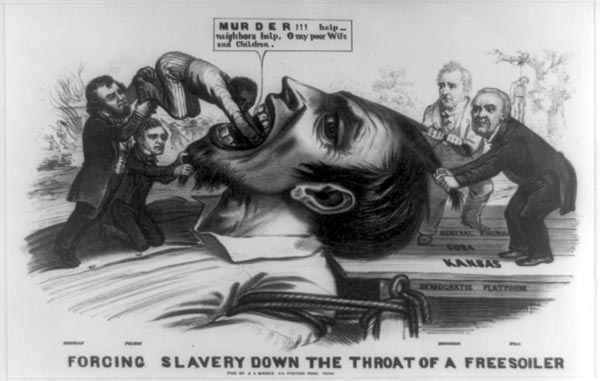
The new legislation was sparked by those who in the interest of Manifest Destiny were committed to organizing the territories of the nation to the Pacific, and in some cases to Central America and Cuba. The man at the heart of this legislation was Democratic Senator Stephen Douglas of Illinois. Douglas saw the need for the organization of the territories and recognized that he needed Southern support for its passage. In response to pressure from Democrat Senators James Mason and Robert M. T. Hunter of Virginia, Andrew Butler of South Carolina and David Atchison of Missouri, Douglas crafted the measure and included an “explicit repeal of the ban on slavery north of 36° 30’.” [1]

The explicit use of this measure in the legislation to organize these territories created a storm in both in Washington D.C. and throughout the country. Northern opponents, including Salmon Chase condemned the bill as being “an atrocious plot” of slave power to “convert free territory” into a “dreary region of despotism, inhabited by masters and slaves.” [2] Chase and his allies published the “Appeal of the Independent Democrats” who “condemned this “gross violation of a sacred pledge” and promised to “call the people to come to the rescue of the country from the domination of slavery.” [3] Chase closed the appeal by warning that “the dearest interests of freedom and the Union are in imminent peril” and called for religious and political organization to defeat the bill.” [4]

Horace Greeley, the publisher of the New York Tribune, transformed his paper into an instrument that he used to fight against the act. In an editorial Greeley charged that the Southern slave owners and politicians were:

“not content within its own proper limits,…it now proposed to invade and overrun the soil of freedom, and to unroll the pall of its darkness over virgin territory whereon slave has never stood. Freedom is to be elbowed out of its own home to make room for the leprous intruder. The free laborer is to be expelled that the slave may be brought in.” [5]

After months of wrangling the bill was passed. Historian William Freehling described it as “the latest and most notorious pro-southern law.” [6] The last hope of those who opposed the bill was a veto by Democrat President Franklin Pierce, However, Pierce buckled to the pressure put on him by the supporters of the bill, including many Northern Democrats who supported businesses, banks, and industries that benefited from slavery. The bill for the approval of the measure by the Southern delegations of both parties was nearly unanimous. However, the bill only passed the House of Representatives only due to the support of forty-two Northern Democrats who decided to support their Southern colleagues and antagonize their own constituents and did not get the majority support of any Northern delegation other than Douglas’s own state of Illinois.

To further humiliate their Northern colleague’s Southern senators blocked a measure passed in the House that would have provided 160 acres of land from public property to new settles in the territories. The Southerners opposed that measure because they believed that the passage of such a law “would prove a most efficient ally for Abolition by encouraging and stimulating the settlement of free farms with Yankees and foreigners pre-committed to resist the participancy of slave owners in the public domain.” [7] In other words, they wanted every incentive for slaveholders to move to the new territories while making it more difficult for people who might oppose slavery to do so.

Frederick Douglass condemned the legislation and understood that the “shame of slavery was not just the South’s, that the whole nation was complicit in it.” [8]  In his 1852 Independence Day address the powerful voice of Freemen and abolitionists everywhere spoke of the hypocrisy that the new laws for bolstering the support and spread of slavery. To do so he condemned them from the words of the Declaration of Independence itself:

“Fellow citizens: Pardon me, and allow me to ask, why I am called upon to speak here today? What have I or those I represent to do with your national independence? Are the great principles of political freedom and natural justice, embodied in that Declaration of Independence, extended to us? And am I, therefore, called upon to bring our humble offering to the national altar, and to confess the benefits, and express devout gratitude for the blessing resulting from independence to us?…

What to the American slave is your Fourth of July? I answer, a day that reveals him to be more than all the days of the year, the gross injustice and cruelty to which he is the constant victim. To him your celebration is a sham; your boasted liberty an unholy license; your national greatness, swelling vanity; your sounds of rejoicing are empty and heartless; your denunciation of tyrants, brass-fronted impudence; your shouts of liberty and equality, hollow mockery; your prayers and hymns, your sermons and thanksgivings, with all your religious parade and solemnity, are to him mere bombast, fraud, deception, impiety, and hypocrisy – a thin veil to cover up the crimes which would disgrace a nation of savages. There is not a nation on earth guilty of practices more shocking and bloody than the people of these United States at this very hour.

Go where you may, search out where you will, roam through all the monarchies and despotisms of the Old World, travel through South America, search out every abuse and when you have found the last, lay your facts by the side of everyday practices of this nation, and you will say with me that, for revolting barbarity and shameless hypocrisy, America reigns without a rival…” [9]

As the pressure mounted, the established political parties began to fray at the as those most committed to perpetuating slavery became more extreme in their views. Thus, the war was preceded by the fracturing of political parties and alliances that had worked for compromise in the previous decades to preserve the Union even at the cost of maintaining slavery. The outrage in the North over the Kansas-Nebraska Act combined with the previous Compromise of 1850 provoked a political and social firestorm.

The result of this increased tension shattered the Whig and the Democratic parties along sectional lines. The Whigs in the south collapsed into insignificance and in the North had disintegrated by 1856. The election of 1854 had shattered the Whigs precarious unity, and the bitter division destroyed the party as a national party. Senator Truman Smith resigned from the Senate in disgust and noted “The Whig party has been killed off by that miserable Nebraska business.” [10]  As a result many Northern Whigs gravitated to new political parties, including the nascent Republican Party, which gained Abraham Lincoln, who like many others left the Whigs.

The Democrats now were split between Northern and Southern factions but managed to keep their outward unity for a few more years. While the Democrats were still nominally a national party the losses in 64 of 88 Northern districts in the 1854 election ensured that the party was now for most part a regional party, a party dominated by its pro-slavery Southern wing. The 1854 election had cost the Democrats seventy-four of one hundred and fifty seven seats in the House. In New England only one of thirteen Democrats retained their seats, and in many other areas of the North. Many Northern Democrats too would find homes in the new Republican Party, including William Seward, Salmon Chase, Thaddeus Stevens and Schuyler Colfax. [11]

The national Whig and Democratic Parties that had dominated American life for decades were collapsing and as they did so, the fabric of the Union itself began to fray. The Whigs and the Democrats were national parties, and as such they were an important part of the bonds that held the country together, in them leaders of the North and the South mingled, became friends and worked together, but slavery destroyed that bond. When they splinted into sectional parties, with the Whigs collapsing and the Democrats splitting into hostile Northern and Southern factions it boded ill for the country at large.

Notes

[1] Ibid. McPherson The Battle Cry of Freedom p.123

[2] Ibid. McPherson The Battle Cry of Freedom p.124

[3] Ibid. Egnal  Clash of Extremes p.208

[4] Ibid. Foner Free Soil, Free Labor, Free Men p.94

[5] Ibid. Goldfield America Aflame p.99

[6] Ibid. Freehling The Road to Disunion Volume One p.559

[7] Ibid. McPherson The Battle Cry of Freedom p.126

[8] Zinn, Howard The Other Civil War: Slavery and Struggle in Civil War America Harper Perennial, Harper and Row, New York 2011 p.20

[9] Ibid. Zinn The Other Civil War pp.20-21

[10] Ibid. McPherson The Battle Cry of Freedom p.125

[11] Ibid. Egnal Clash of Extremes p.215

1 Comment

Filed under civil war, History, Political Commentary

A President’s Day Reflection” Lincoln’s Second Inaugural Address

abraham-lincoln-secondinauguration3

Friends of Padre Steve’s World,

Today is President’s Day and instead of doing much I am simply going to post one of the most poignant and meaningful speeches ever given by a President,  Abraham Lincoln’s Second Inaugural Address.

The address was delivered on March 4th 1865 just over a month before Robert E. Lee’s Army surrendered at Appomattox, and just 41 days before Lincoln died at the hands of John Wilkes Booth. A man who the League of the South, a radical group bent on returning the whole country to their neo-Confederate ways,  honor on April 14th for “executing” Lincoln who they call a criminal tyrant.

Lincoln’s words need to be remembered for what they are, a remarkable statement of reality as well as hope for the future. When he spoke them the war was all but over, but much blood was still being spilt on battlefields across the South. By the time the war, which began in 1861 was over, more than 600,000 Americans would be dead. It was the bloodiest conflict in American History.

To really understand what Lincoln was speaking of one has to remember that just nine years before the Supreme Court had seemed to demolish any hope at all for Blacks in the United States, and not just the enslaved Blacks of the South, in it’s notorious Dred Scott decision. Roger Taney, the Chief Justice writing for the majority, most of whom were Southerners said about Blacks when denying them any form of Constitutional Rights:

“Can a negro, whose ancestors were imported into this country, sold as slaves, become a member of the political community formed and brought into existence by the Constitution of the United States, and as such become entitled to all the rights, and privileges, and immunities, guaranteed by that instrument to the citizen?…It is absolutely certain that the African race were not included under the name of citizens of a state…and that they were not included, and were not intended to be included, under the word “citizens” in the Constitution, and therefore claim none of the rights and privileges which that instrument provides for and secures to citizens of the United States. On the contrary, they were at that time considered as a subordinate and inferior class of beings, who had been subjugated by the dominant race, and, whether emancipated or not, yet remain subject to their authority, and had no rights or privileges but those who held the power and the Government might choose to grant them”

Before that there was the equally noxious Compromise of 1850 which included the Fugitive Slave Act which gave any Southerner claiming his human “property” not only the rights but a legal mechanism to hunt them down in the North and penalize anyone hindering them with weighty fines and jail terms.

One has to look at the words of Confederate Vice President Alexander Stephens in his Cornerstone Speech to understand the truth of what Lincoln spoke on that day in March 1865. Stephens, just four years before had declared in the starkest terms what the war was about and what the Confederacy’s foundation was:

Our new government is founded upon exactly the opposite idea; its foundations are laid, its corner- stone rests upon the great truth, that the negro is not equal to the white man; that slavery — subordination to the superior race — is his natural and normal condition. [Applause.] This, our new government, is the first, in the history of the world, based upon this great physical, philosophical, and moral truth.”

It took four years of bloody war, the first total war waged on American soil to end slavery, sadly within just a few years the Jim Crow laws had regulated Southern Blacks to a status not much better than their previous estate, and again became victims of often state sanctioned violence, discrimination, prejudice and death through lynching.

Southern leaders like Stephens and Jefferson Davis denied that slavery was the cause of the war and the foundation of the Confederacy in their revisionist histories after the war was over. They did so even though the litany of their letters, speeches and laws they supported, damned their words as the bold faced lies that they were. In the mean time many in the South sought to reclaim their pre-war glory in the myth of the Lost Cause which permeated much of the United States in the decades after the war, being glorified by Hollywood in Birth of a Nation, Gone with the Wind, and Walt Disney’s Song of the South. The unconscionable racism and white supremacy promoted by these masterpieces of cinema helped perpetuate racism across the country.

In the North, blacks faced discrimination and prejudice as well. another Supreme Court decision (Plessy v. Ferguson 1896) had legalized segregation and discrimination against Blacks in the form of “Separate but Equal” across the entire United States, something that would remain until a later Supreme Court would overturn Plessy in Brown v. Board of Education in 1954.

Despite all the reverses and the continued fight against the rights of Blacks, as well as women, other minorities and Gays, the struggle continues.

In August 1863, Lincoln was asked to speak at a gathering wrote in support of stronger war efforts and enlistments. Lincoln could not attend and wrote James Conkling a letter to be read on his behalf. That letter addressed those who disagreed with Lincoln on emancipation while still be claiming to be for the Union. Lincoln ended that letter with this:

“Peace does not appear so distant as it did. I hope it will come soon, and come to stay; and so come as to be worth the keeping in all future time. It will then have to be proved that among freemen that there can be no successful appeal from the ballot to to bullet, and that they who take such appeal are sure to lose their case and pay the cost. And there will be some black men who can remember that with silent tongue, and with clenched teeth, and steady eye, and well-poised bayonet, that they will have helped mankind on to this great consummation, while I fear there will be some white ones unable to forget that with malignant heart and deceitful speech they strove to hinder it….” 

Lincoln, unlike many even in the North recognized the heroic nature of African Americans fighting for their rights and how their struggle was beneficial for every American.

Lincoln died too soon, his death was a tragedy for the nation, but today, on President’s Day let us remember the words of the Lincoln’s Second Inaugural Address and the truth that they express. Lincoln’s concluding sentences which began with “With malice toward none, with charity for all…” should be at the heart of our dealings with all people so that we, as Lincoln said so eloquently “may achieve and cherish a just and lasting peace among ourselves and with all nations.”

It is a speech that always encourages me to fight for freedom and truth, even when that truth is less than popular and often uncomfortable. Lincoln’s words still inspire me, because he spoke the truth that many even today do not want to hear:

At this second appearing to take the oath of the Presidential office there is less occasion for an extended address than there was at the first. Then a statement somewhat in detail of a course to be pursued seemed fitting and proper. Now, at the expiration of four years, during which public declarations have been constantly called forth on every point and phase of the great contest which still absorbs the attention and engrosses the energies of the nation, little that is new could be presented. The progress of our arms, upon which all else chiefly depends, is as well known to the public as to myself, and it is, I trust, reasonably satisfactory and encouraging to all. With high hope for the future, no prediction in regard to it is ventured.

On the occasion corresponding to this four years ago all thoughts were anxiously directed to an impending civil war. All dreaded it, all sought to avert it. While the inaugural address was being delivered from this place, devoted altogether to saving the Union without war, insurgent agents were in the city seeking to destroy it without war–seeking to dissolve the Union and divide effects by negotiation. Both parties deprecated war, but one of them would make war rather than let the nation survive, and the other would accept war rather than let it perish, and the war came.

One-eighth of the whole population were colored slaves, not distributed generally over the Union, but localized in the southern part of it. These slaves constituted a peculiar and powerful interest. All knew that this interest was somehow the cause of the war. To strengthen, perpetuate, and extend this interest was the object for which the insurgents would rend the Union even by war, while the Government claimed no right to do more than to restrict the territorial enlargement of it. Neither party expected for the war the magnitude or the duration which it has already attained. Neither anticipated that the cause of the conflict might cease with or even before the conflict itself should cease. Each looked for an easier triumph, and a result less fundamental and astounding. Both read the same Bible and pray to the same God, and each invokes His aid against the other. It may seem strange that any men should dare to ask a just God’s assistance in wringing their bread from the sweat of other men’s faces, but let us judge not, that we be not judged. The prayers of both could not be answered. That of neither has been answered fully. The Almighty has His own purposes. “Woe unto the world because of offenses; for it must needs be that offenses come, but woe to that man by whom the offense cometh.” If we shall suppose that American slavery is one of those offenses which, in the providence of God, must needs come, but which, having continued through His appointed time, He now wills to remove, and that He gives to both North and South this terrible war as the woe due to those by whom the offense came, shall we discern therein any departure from those divine attributes which the believers in a living God always ascribe to Him? Fondly do we hope, fervently do we pray, that this mighty scourge of war may speedily pass away. Yet, if God wills that it continue until all the wealth piled by the bondsman’s two hundred and fifty years of unrequited toil shall be sunk, and until every drop of blood drawn with the lash shall be paid by another drawn with the sword, as was said three thousand years ago, so still it must be said “the judgments of the Lord are true and righteous altogether.”

With malice toward none, with charity for all, with firmness in the right as God gives us to see the right, let us strive on to finish the work we are in, to bind up the nation’s wounds, to care for him who shall have borne the battle and for his widow and his orphan, to do all which may achieve and cherish a just and lasting peace among ourselves and with all nations.

Peace

Padre Steve+

3 Comments

Filed under civil rights, civil war, History, News and current events, Political Commentary

Slavery, Economics & Politics: The Compromise of 1850

Friends of Padre Steve’s World,

I have been sharing parts of my Civil War and Gettysburg Staff Ride text here for some time. We often don’t like to admit it but all to often racism and other forms of prejudice, intolerance and hate line up perfectly with some peoples and groups political and economic agenda. The Compromise of 1850 shows how in American history that confluence of hatred, racism, political power and economic gain  come together to create the perfect storm of oppression. 

We are not alone in this, such has been the case in many other cultures and in many other nations for millennia and continue to be today. 

The lesson of this should be taken to heart as anyone seeks political and economic aggrandizement on the backs of other people and sadly it happens all too often here in the United States and Western Europe. 

I do plan on weighing in on the issue of the Confederate flag either tonight or tomorrow. But until then have a great as well as a thoughtful night.

Peace

Padre Steve+
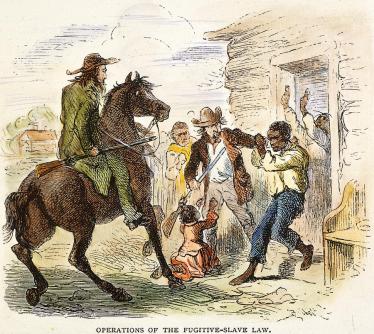
fugitive-slave-act-1850-granger-1

Slavery and National Expansion: The Compromise of 1850

The Ante-Bellum South was an agrarian society that depended on the free labor provided by slaves. In a socio-political sense the South was an oligarchy that offered no freedom to slaves, openly discriminated against free blacks and provided little hope of social or economic advancement for poor and middle class whites. However, despite this, even poor whites supported it. Many Southern Yeoman farmers were willing to tolerate their second class status because they: “feared the fall from independent producer to dependent proletarian, a status he equated with enslavement” [1] more than remaining subservient to planters and plantation owners. In fact, for them slavery was the one institution that kept them above the despised black.

While all Northern states had abolished slavery, or were in the process of gradual abolition in the after independence and the Civil War and had moved to an economic concept of free labor, the South had tied its economy and society to the institution of slavery. The contrast was well said by the members of an Alabama agricultural society, which noted in 1846:

“Our condition is quite different from that of the non-slaveholding section of the United States. With them their only property consists of lands, cattle and planting implements. Their laborers are merely hirelings, while with us our laborers are our property.” [2]

Northerners on the other hand, even in states where the last vestiges of slavery held on, nearly universally ascribed to the understanding that there was a dignity to labor and that free labor was essential if people were to have a better life. It undergirded their understanding of human dignity and that “labor was the source of all value.” [3]

That understanding of the intrinsic value of free labor continued to gain ground in the North in the decades preceding the Civil War and found much of its support in the Calvinist theology that predominated in most Protestant Northern denominations. Labor was intrinsic to one’s calling as a Christian and a human being, slave labor, at least in the eyes of many Northerners undercut that idea. Success in one’s calling glorified God and provided earthly evidence that a person was among the elect. For many Northern Christians, “the pursuit of wealth thus became a way of serving God on earth, and labor, which had been imposed on fallen man as a curse, was transmuted into a religious value, a Christian calling.” [4] Such ideas found their way into Republican political thought even when not directly related to religion. William Evarts said in 1856 “Labor gentlemen, we of the free States acknowledge to be the source of all of our wealth, of all our progress, of all our dignity and value.” [5] Abraham Lincoln noted that “the free labor system…opens the way for all, and energy and progress, and improvement in condition for all,” [6] and noted something inherent in the economic theory of Adam Smith that Labor is prior to, and independent of capital…in fact, capital is the fruit of labor.” [7]

However, the South by the 1830s had completely wedded itself to slavery and southern advocates of slavery deplored the free-labor movement as wage slavery and extolled the virtue of slavery. James H. Hammond condemned the free-labor movement in his King Cotton speech to the Senate in 1858:

“In all social systems there must be a class to do the menial duties, to perform the drudgery of life…. It constitutes the very mudsill of society….Such a class you must have, or you would not have that other that leads to progress, civilization and refinement….Your whole hireling class of manual laborers and ‘operatives,’ as you call them, are essentially slaves. The difference between us is, that our slaves are hired for life and well compensated…yours are hired by the day, not cared for, and scantily compensated.” [8]

Even so, the fact that the slave barons “were forced at every election to solicit the votes of “ignorant, slovenly, white trash in the country” with “frequent treats that disgrace our elections,” [9] rankled and humiliated many members of the Southern aristocracy. It was a marriage of two disparate parties linked by their membership in a superior race, something that only the continued existence of slavery ensured.

Lincoln extolled the virtues of free-labor, noting his own experiences after his election: “I am not ashamed to confess that twenty five years ago I was a hired laborer, mauling rails, at work on a flat boat – just what might happen to any poor man’s son.” [10] Other Northerners lauded free-labor as the basis of upward mobility, and the New York Times noted that “Our paupers to-day, thanks to free labor, are our yeomen and merchants of tomorrow.” [11]

But whites in the South held labor in contempt due to the system of slavery, and the divergent views of each side were noted by Thomas Ewing who noted that labor “is held honorable by all on one side of the line because it is the vocation of freedmen – degrading in the eyes of some on the other side because it is the task of slaves.” [12] Of course with labor being the task of African slaves for southerners, the issue was entwined with race, and “Even if slavery was wrong, its wrongs were cancelled out for nonslaveholders by the more monstrous specter of racial equity.” [13]

Georgia Governor Joseph E. Brown emphasized the threat to whites in that blacks would be their social equals and competitors. The racial component assured poor southern whites that they were superior to blacks and an Alabama lawyer wrote “The privilege of belonging to the superior race and being free was a bond that tied all Southern whites together… and it seemed from a Southern stand-point, to have for its purpose the leveling of all distinctions between the white man and the slave hard by.” [14] But poor white workers who remained in the South “repeatedly complained about having to compete with slaves as well as poorly paid free blacks” [15] leading many to seek a new livelihood in either Free States or the new territories.

For Southern politicians and slaveholders, the expansion of slavery was essential to its continued maintenance in the states where it was already legal. “Because of the need to maintain a balance in the Senate, check unruly slaves, and cultivate fertile soils, many planters and small plantation owners- particularly those living in the southern districts of the cotton states- asserted that their survival depended on new territory.” [16] In those decades “a huge involuntary migration took place. Between 800,000 and 1 million slaves were moved westward….” [17]

The need for slaves caused prices to soar, largely due to the ban on the import of slaves from Africa. This made the interregional trade much more important and linked the upper and lower south as well as the new slave-holding territories into “a regionwide slave market that tied together all of the various slaveowning interests into a common economic concern.” [18] In some older states like Virginia where fewer slaves were required, the exportation of slaves became a major industry:

“male slaves were marched in coffles of forty or fifty, handcuffed to each other in pairs, with a long chain through the handcuffs passing down the column to keep it together, closely guarded by mounted slave traders followed by an equal number of female slaves and their children. Most of them were taken to Wheeling, Virginia, the “busiest slave port” in the United States, and from there they were transported by steamboat to New Orleans, Natchez, and Memphis.” [19]

Economic Effects of the Compromise

The interregional slave trade guaranteed slave owners of a source of slaves even if they were cut off from the international trade and it was an immense part of not just the Southern economy but the American economy. Slave owners “hitched their future to slavery; a single cash crop and fresh land,” [20] and refused to take an interest in manufacturing or diversifying their agricultural production outside of King Cotton. Slave prices tripled between 1800 and 1860 making human property one of the most lucrative markets for investment. The price of a “prime male field hand in New Orleans began at around $500 in 1800 and rose as high as $1,800 by the time of the Civil War.” [21] The result was that slave owners and those who benefitted from the interregional slave trade had a vested interest in not only seeing slavery preserved, but expanded.

This resulted in two significant trends in the South, first was that slave owners grew significantly richer as the value of the slave population increased. Using even a conservative number of $750 dollars as the value of a single slave in 1860 the amount of value in this human property was significantly more than almost any other investment in the nation. It was enormous. Steven Deyle notes that:

“It was roughly three times greater than the total amount of all capital invested in manufacturing in the North and in the South combined, three times the amount invested in railroads, and seven times the amount invested in banks. It was about equal to about seven times the value of all currency in circulation in the country three times the value of the entire livestock population, twelve times the value of the entire U.S. cotton crop, and forty-eight times the expenditures of the federal government that year. ….”by 1860, in fact in the slaveowning states alone, slave property had surpassed the assessed value of real estate.” [22]

The rise in slave values and the increasing wealth of slave owners had a depreciating effect on poor southern whites by ensuring that there was no middle class, which “blocked any hope of social advancement for the mass of poor whites, for it was all but impossible for a non-slaveholder to rise in the southern aristocracy.” [23] The impoverishment of southern whites created some worry for those astute enough to take an interest in such matters. “In 1850, about 40 percent of the South’s white farmers owned real estate at all. There was thus, worried the Southern Cultivator in 1856, “a large number at the South who have no legal right or interest in the soil [and] no homes of their own.” The editor of a South Carolina newspaper that year framed the matter in less sympathetic terms: “There is in this State,” he wrote, “as impoverished and ignorant as white population as can be found in any other in the Union.” [24]

Some Southerners recognized the growing issue that the south was falling behind the north in terms of real economic advancement and that slavery was the culprit. Hinton Helper, a non-slave owning North Carolinian who had made his fortune in the California Gold Rush of 1849 and returned home to become disillusioned with what he saw wrote a book that had a major impact in the North among Republican politicians, but which was either banned or restricted in much of the South. That book “The Impending Crisis of the South: How to Meet It (1857) was “a book on the debilitating impact of slavery on the South in general and on southern whites in particular.” [25] Helper’s attack on the slavery system was as devastating as that of any abolitionist, and since he was a southerner the effects of his words helped further anti-slavery sentiment in the North and would be used by the Republican party in an abridged form as a campaign tool that they printed and distributed during the build up to the election n of 1860. Helper wrote that:

Slavery lies at the root of all the shame, poverty, tyranny and imbecility of the South.” Echoing the free-soil argument Helper maintained that slavery degraded all labor to the level of bond labor. Planters looked down their noses at nonslaveholders and refused to tax themselves to provide a decent school system. “Slavery is hostile to general education…Its very life, is in the ignorance and stolidity of the masses.” [26]

Many southern leaders saw Helper’s book as a danger and worried that should Helper and others like him speak freely long enough “that they will have an Abolition party in the South, of Southern men.” When that happened, “the contest for slavery will no longer be one between the North and the South. It will be in the South between the people of the South.” [27] That was something that the landed gentry of the slave owning oligarchy could never tolerate for if the non-slave holding whites rejected slavery, the institution would die. Thus, Helper, who was no fan of black people and held many violently racist attitudes, was denounced “as a traitor, a renegade, an apostate, a “dishonest, degraded and disgraced man.” [28]

In the years the before the war, the North embraced the Industrial Revolution leading to advances which gave it a marked economic advantage over the South in which through its “commitment to the use of slave labor inhibited economic diversification and industrialization and strengthened the tyranny of King Cotton.” [29] The population of the North also expanded at a clip that far outpaced the South as European immigrants swelled the population.

The divide was not helped by the various compromises worked out between northern and southern legislators. After the Missouri Compromise Thomas Jefferson wrote:

“but this momentous question, like a fire bell in the night, awakened and filled me with terror. I considered it at once as the knell of the Union. It is hushed indeed for the moment, but this is a reprieve only, not a final sentence. A geographical line, coinciding with a marked principle, moral and political, once conceived and held up to the angry passions of men, will never be obliterated; and every new irritation will mark it deeper and deeper.” [30]

The trigger for the increase in tensions was the war with Mexico in which the United States annexed nearly half of Mexico. The new territories were viewed by those who advocated the expansion of slavery as fresh and fertile ground for its spread. Ulysses S Grant, who served in the war, noted the effects of the war with Mexico in his memoirs:

“In taking military possession of Texas after annexation, the army of occupation, under General [Zachary] Taylor, was directed to occupy the disputed territory.  The army did not stop at the Nueces and offer to negotiate for a settlement of the boundary question, but went beyond, apparently in order to force Mexico to initiate war….To us it was an empire and of incalculable value; but it might have been obtained by other means.  The Southern rebellion was largely the outgrowth of the Mexican war.” [31]

Robert Toombs of Georgia was an advocate for the expansion of slavery into the lands conquered during the war. Toombs warned his colleagues in Congress “in the presence of the living God, that if you by your legislation you seek to drive us from the territories of California and New Mexico, purchased by the common blood and treasure of the whole people…thereby attempting to fix a national degradation upon half the states of this Confederacy, I am for disunion.” [32]

The tensions in the aftermath of the war with Mexico escalated over the issue of slavery in the newly conquered territories brought heated calls by some southerners for secession and disunion. To preserve the Union, Henry Clay and Daniel Webster, supported by the new President Millard Fillmore were able to pass the compromise of 1850 solved a number of issues related to the admission of California to the Union and boundary disputes involving Texas and the new territories. But among the bills that were contained in it was the Fugitive Slave Law, or The Fugitive Slave Act of 1850. The act was the device of Henry Clay which was meant to sweeten the deal for southerners. The law would “give slaveholders broader powers to stop the flow of runaway slaves northward to the free states, and offered a final resolution denying that Congress had any authority to regulate the interstate slave trade.” [33]

For all practical purposes the Compromise of 1850 and its associated legislation nationalized the institution of slavery, even in Free States. It did this by forcing all citizens to assist law enforcement in apprehending fugitive slaves. It also voided state laws in Massachusetts, Vermont, Ohio, Connecticut, Pennsylvania and Rhode Island, which barred state officials from aiding in the capture, arrest or imprisonment of fugitive slaves. “Congress’s law had nationalized slavery. No black person was safe on American soil. The old division of free state/slave state had vanished….” [34] If there was any question as to whose “States Rights” the leaders of the South were advocating, it was certainly not those of the states whose laws were voided by the act.

That law required all Federal law enforcement officials, even in non-slave states to arrest fugitive slaves and anyone who assisted them, and threatened law enforcement officials with punishment if they failed to enforce the law. The law stipulated that should “any marshal or deputy marshal refuse to receive such warrant, or other process, when tendered, or to use all proper means diligently to execute the same, he shall, on conviction thereof, be fined in the sum of one thousand dollars.” [35]

Likewise the act compelled citizens in Free states to “aid and assist in the prompt and efficient execution of this law, whenever their services may be required….” [36] Penalties were harsh and financial incentives for compliance attractive.

“Anyone caught providing food and shelter to an escaped slave, assuming northern whites could discern who was a runaway, would be subject to a fine of one thousand dollars and six months in prison. The law also suspended habeas corpus and the right to trial by jury for captured blacks. Judges received a hundred dollars for every slave returned to his or her owner, providing a monetary incentive for jurists to rule in favor of slave catchers.” [37]

The law gave no protection for even black freedmen. The legislation created a new extra-judicial bureaucratic office to decide the fate of blacks. This was the office of Federal Commissioner and it was purposely designed to adjudicate the claims of slaveholders and their agents, and to avoid the normal Federal Court system where often those claims were denied.

When slave owners or their agents went before these commissioners, they needed little in the way of proof to take a black back into captivity. The only proof or evidence other than the sworn statement by of the owner with an “affidavit from a slave-state court or by the testimony of white witnesses” [38] that a black was or had been his property was required to return any black to slavery. Since blacks could not testify on their own behalf and were denied representation the act created an onerous extrajudicial process that defied imagination. Likewise, these commissioners had a strong financial incentive to send blacks back to slavery. “If the commissioner decided against the claimant he would receive a fee of five dollars; if in favor ten. This provision, supposedly justified by the paper work needed to remand a fugitive to the South, became notorious among abolitionists as a bribe to commissioners.” [39] It was a system rigged to ensure that African Americans had no chance, and it imposed on the citizens of free states the legal obligation to participate in a system that many wanted nothing to do with.

Frederick Douglass said:

“By an act of the American Congress…slavery has been nationalized in its most horrible and revolting form. By that act, Mason & Dixon’s line has been obliterated;…and the power to hold, hunt, and sell men, women, and children remains no longer a mere state institution, but is now an institution of the whole United States.” [40]

On his deathbed Henry Clay praised the act, which he wrote “The new fugitive slave law, I believe, kept the South in the Union in ‘fifty and ‘fifty-one. Not only does it deny fugitives trial by jury and the right to testify; it also imposes a fine and imprisonment upon any citizen found guilty of preventing a fugitive’s arrest…” Likewise Clay depreciated the opposition noting “Yes, since the passage of the compromise, the abolitionists and free coloreds of the North have howled in protest and viciously assailed me, and twice in Boston there has been a failure to execute the law, which shocks and astounds me…. But such people belong to the lunatic fringe. The vast majority of Americans, North and South, support our handiwork, the great compromise that pulled the nation back from the brink.” [41]

The compromise had “averted a showdown over who would control the new western territories” [42] but it only delayed disunion. In arguing against the compromise South Carolina Senator John C. Calhoun realized that for Southerners it did not do enough and that it would inspire abolitionists to greater efforts in their cause. He argued for permanent protection of slavery:

“He understood that slavery stood at the heart of southern society, and that without a mechanism to protect it for all time, the Union’s days were numbered.” Almost prophetically he said “I fix its probable [breakup] within twelve years or three presidential terms…. The probability is it will explode in a presidential election.” [43]

Of course it was Calhoun and not the authors of the compromise who proved correct. The leap into the abyss of disunion and civil war had only been temporarily avoided. However, none of the supporters anticipated what would occur in just six years when a “train of unexpected consequences would throw an entirely new light on the popular sovereignty doctrine, and both it and the Compromise of 1850 would be wreaked with the stroke of a single judicial pen.” [44]

Notes

[1] Ibid. McPherson Drawn With Sword p.50

[2] Ibid. Levine Half Slave and Half Free p.19

[3] Foner, Eric Free Soil, Free Labor, Free Men: The Ideology of the Republican Party Before the Civil War Oxford University Press, Oxford and New York 1970 and 1995 p.7

[4] Ibid. Foner Free Soil, Free Labor, Free Men pp.12-13

[5] Ibid. Foner Free Soil, Free Labor, Free Men p.12

[6] McPherson, James. The Battle Cry of Freedom: The Civil War Era Oxford University Press, Oxford and New York 1988 p.28

[7] Ibid. Foner Free Soil, Free Labor, Free Men p.12

[8] Ibid. McPherson The Battle Cry of Freedom p.196

[9] Ibid. Guelzo Fateful Lightening p.38

[10] Ibid. McPherson The Battle Cry of Freedom p.28

[11] Ibid. Foner Free Soil, Free Labor, Free Men p.16

[12] Ibid. Foner Free Soil, Free Labor, Free Men p.16

[13] Ibid. Guelzo Fateful Lightening p.38

[14] Ibid. Guelzo Fateful Lightening p.39

[15] Ibid. Levine Half Slave and Half Free p.44

[16] Ibid. Egnal Clash of Extremes pp.125-126

[17] Korda, Michael. Clouds of Glory: The Life and Legend of Robert E. Lee Harper Collins Publishers, New York 2014 p.203

[18] Deyle, Steven The Domestic Slave Trade in Major Problems in the Civil War and Reconstruction Documents and Essays Third Edition edited by Michael Perman and Amy Murrell Taylor Wadsworth Cengage Learning Boston MA 2011 p.53

[19] Ibid. Korda Clouds of Glory: The Life and Legend of Robert E. Lee p.203

[20] Ibid. Egnal Clash of Extremes p.10

[21] Ibid. Deyle The Domestic Slave Trade p.53 Deyle’s numbers come from the 1860 census.

[22] Ibid. Egnal Clash of Extremes p.54

[23] Ibid. Foner Free Soil, Free Labor, Free Men p.48

[24] Ibid. Levine Half Slave and Half Free p.37

[25] Goldfield, David America Aflame: How the Civil War Created a Nation Bloomsbury Press, New York, London New Delhi and Sidney 2011 p.177

[26] Ibid. McPherson The Battle Cry of Freedom p.199

[27] Ibid. Levine Half Slave and Half Free p.235

[28] Ibid. Potter The Impending Crisis p.397

[29] Ibid. Potter The Impending Crisis p.42

[30] Jefferson, Thomas Letter to John Holmes dated April 22nd 1824 retrieved from http://www.loc.gov/exhibits/jefferson/159.html 24 March 2014

[31] U.S. Grant, Personal Memoirs of U.S. Grant New York 1885 pp.243-245

[32] Ibid. Guelzo Fateful Lightening pp.62-63

[33] Ibid. Guelzo Fateful Lightening p.68

[34] Ibid. Goldfield America Aflame p.71

[35] ______________Fugitive Slave Act of 1850 retrieved from the Avalon Project, Yale School of Law http://avalon.law.yale.edu/19th_century/fugitive.asp 11 December 2014

[36] Ibid. Fugitive Slave Act of 1850

[37] Ibid. Goldfield America Aflame p.71

[38] Ibid. McPherson The Battle Cry of Freedom p.80

[39] Ibid. McPherson The Battle Cry of Freedom p.80

[40] Ibid. Goldfield America Aflame p.72

[41] Ibid. Oates The Approaching Fury p.94

[42] Ibid. Guelzo Fateful Lightening p.71

[43] Ibid. Goldfield America Aflame p.64

[44] Ibid. Guelzo Fateful Lightening p.71

2 Comments

Filed under civil rights, civil war, History, Political Commentary

Dred Scott & Obergfell v. Hodges

ROGER B. TANEY (1777-1864).  Roger Taney, Chief Justice of the U.S. Supreme Court, handing down his decision on the Dred Scott case, 1857. American illustration.

ROGER B. TANEY (1777-1864).
Roger Taney, Chief Justice of the U.S. Supreme Court, handing down his decision on the Dred Scott case, 1857. American illustration.

Friends of Padre Steve’s World

Court decisions on Civil Rights matter and sometime soon we will get the Supreme Court decision on the Case of Obergfell v. Hodges, the case that will determine if Marriage Equity will become the law of the land or not. Such cases are important. As I mentioned yesterday freedom for all matters and I completely agree with he words of Abraham Lincoln in regard to liberty that the words of the Declaration of Independence that “all men are created equal” is a universal standard. That it is the “the standard maxim of free society …constantly spreading and deepening its influence,” ultimately applicable “to peoples of all colors everywhere.” This should be true for all, people including the LGBTQ community. 

Supporters of same-sex marriages gather outside the US Supreme Court waiting for its decision on April 28, 2014 in Washington, DC. The US Supreme Court is hearing arguments on whether gay couples have a constitutional right to wed -- a potentially historic decision that could see same-sex marriage recognized nationwide.  AFP PHOTO / MLADEN ANTONOV        (Photo credit should read MLADEN ANTONOV/AFP/Getty Images)

Supporters of same-sex marriages gather outside the US Supreme Court waiting for its decision on April 28, 2014 in Washington, DC. The US Supreme Court is hearing arguments on whether gay couples have a constitutional right to wed — a potentially historic decision that could see same-sex marriage recognized nationwide. AFP PHOTO / MLADEN ANTONOV (Photo credit should read MLADEN ANTONOV/AFP/Getty Images)

Since it matters so much I am posting a section from my Civil War and Gettysburg Staff Ride text on the Dred Scott decision. If you read it you will find just how chilling and similar the arguments of the Chief Justice of the Supreme Court Roger Taney are to those who oppose Marriage Equity and other rights being extended to Gay people. 

Peace

Padre Steve+

As the 1850s wore on, the divisions over slavery became deeper and voices of moderation retreated. The trigger for the worsening of the division was the political battle regarding the expansion of slavery; even the status of free blacks in the north who were previously slaves, over whom their owners asserted their ownership. Southerners considered the network to help fugitive slaves escape to non-slave states, called the Underground Railroad “an affront to the slaveholders pride” and “anyone who helped a man or woman escape bondage was simply a thief” who had robbed them of their property and livelihood, as an “adult field hand could cost as much as $2000, the equivalent of a substantial house.” [1]

In 1856 the Supreme Court, dominated by southern Democrats ruled in favor of southern views in the Dred Scott decision, one pillar of which gave slavery the right to expand by denying to Congress the power to prohibit slavery in Federal territories. Taney’s ruling in the case insisted that “Neither the Declaration of Independence nor the Constitution had been intended to apply to blacks he said. Blacks were “so far inferior that they had no rights which the white man was bound to respect.” Taney did not stop with this but he declared the Missouri Compromise itself unconstitutional for “Congress had exceeded its authority when it forbade slavery in the territories by such legislation as the Missouri Compromise, for slaves were private property protected by the Constitution.” [2]

The decision was momentous, but the judicial fiat of Taney and his court majority was a disaster for the American people. It solved nothing and further divided the nation:

“In the South, for instance, it encouraged southern rights advocates to believe that their utmost demands were legitimatized by constitutional sanction and, therefore, to stiffen their insistence upon their “rights.” In the North, on the other hand, it strengthened a conviction that an aggressive slavocracy was conspiring to impose slavery upon the nation, and that any effort to reach an accommodation with such aggressors was futile. While strengthening the extremists, it cut the ground from under the moderates.” [3]

The decision in the case is frightening when one looks upon its tenor and implications. The majority opinion which was written by Chief Justice Roger Taney was chilling, not only in its views of race, but the fact that blacks were perpetually property without the rights of citizens. Taney wrote:

“Can a negro, whose ancestors were imported into this country, sold as slaves, become a member of the political community formed and brought into existence by the Constitution of the United States, and as such become entitled to all the rights, and privileges, and immunities, guaranteed by that instrument to the citizen?…It is absolutely certain that the African race were not included under the name of citizens of a state…and that they were not included, and were not intended to be included, under the word “citizens” in the Constitution, and therefore claim none of the rights and privileges which that instrument provides for and secures to citizens of the United States. On the contrary, they were at that time considered as a subordinate and inferior class of beings, who had been subjugated by the dominant race, and, whether emancipated or not, yet remain subject to their authority, and had no rights or privileges but those who held the power and the Government might choose to grant them” [4]

The effect of the ruling on individuals and the states was far reaching. “No territorial government in any federally administered territory had the authority to alter the status of a white citizen’s property, much less to take that property out of a citizen’s hands, without due process of law or as punishment for some crime.” [5] Free slaves were no longer safe, even in Free States, from the possibility of being returned to slavery, because they were considered property. The tens of thousands of free blacks in the South were effectively stripped of citizenship, and became vulnerable to either expulsion or re-enslavement, something that the legislatures in Virginia, North Carolina and Missouri debated in 1858. Likewise the decision cast doubt on the free status of every African American regardless of residence.” [6]

But the decision had been influenced by President-Elect James Buchanan’s secret intervention in the Supreme Court deliberations two weeks before his inauguration. Buchanan hoped by working with the Justices that he would save the Union from breaking apart by appeasing slave owners and catering to their agenda. “The president-elect wanted to know not only when, but if the Court would save the new administration and the Union from the issue of slavery in the territories. Would the judges thankfully declare the explosive subject out of bounds, for everyone who exerted federal power? The shattering question need never bother President Buchanan.” [7] In his inaugural address he attempted to camouflage his intervention and “declared that the Court’s decision, whatever it turned out to be, would settle the slavery issue forever.” [8]

But Buchanan was mistaken. The case made the situation even more volatile as it impaired “the power of Congress- a power which had remained intact to this time- to occupy the middle ground.” [9] Taney’s decision held that Congress “never had the right to limit slavery’s expansion, and that the Missouri Compromise had been null and void on the day of its formulation.” [10]

The Court’s decision “that a free negro was not a citizen and the decision that Congress could not exclude slavery from the territories were intensely repugnant to many people in the free states” [11] and it ignited a firestorm in the north where Republicans now led by Abraham Lincoln, decried the decision and southerners basked in their judicial victory. Southerners were exultant, the Richmond Enquirer wrote that the Court had destroyed “the foundation of the theory upon which their warfare has been waged against the institutions of the South.” [12] Northerners now quite rightly feared that an activist court would rule to deny their states the right to forbid slavery. As early as 1854 Lincoln posed the idea that the Declaration of Independence was the standard maxim of free society …constantly spreading and deepening its influence,” ultimately applicable “to peoples of all colors everywhere.” [13]

After the Dred Scott decision Lincoln warned that the Declaration was being cheapened and diluted, he remained insistent on this point, he noted:

“Our Declaration of Independence was held sacred by all, and thought to include all” Lincoln declared, “but now, to aid in making the bondage of the Negro universal and eternal, it is assaulted, and sneered at, and construed, and hawked at, and torn, till, its framers could ride from their graves, they could not recognize it at all.” [14]

Lincoln attacked the decision noting that Taney “insists at great length that negroes were no part of the people who made, or for whom made, the declaration of Independence or the Constitution.” But as Doris Kearns Goodwin notes “in at least five states, black voters action on the ratification of the Constitution and were among the “We the People” by whom the Constitution was ordained and established.” Lincoln acknowledged that the founders “did not declare all men equal in all respects. They did not mean to say that all were equal in color, size, intellect, moral developments, or social capacity.” But they dis declare all men “equal in ‘certain inalienable rights, among which are life, liberty, and the pursuit of happiness.’…They meant simply to declare the right, so the enforcement of it might follow as circumstances permit.” [15]

Not only that, Lincoln asked the logical question regarding Taney’s judicial activism. Lincoln and other Republican leaders “noted that all slavery needed was one more Dred Scott decision that a state could not bar slavery and the objective of Slave Power to nationalize slavery would be accomplished.” [16] How long would it be, asked Abraham Lincoln, before the Court took the next logical step and ruled explicitly that the:

“Constitution of the United States does not permit a state to exclude slavery from its limits?” How far off was the day when “we shall lie down pleasantly thinking that the people of Missouri are on the verge of making their State free; and shall awake to the reality, instead, that the Supreme Court has made Illinois a slave State?” [17]

Lincoln discussed the ramification of the ruling for blacks, both slave and free:

“to aid in making the bondage of the Negro universal and eternal….All the powers of the earth seem rapidly combining against him. Mammon is after him; ambition follows, and philosophy follows, and the theology of the day is fast joining the cry. They have him in his prison house;…One after another they have closed the heavy doors upon him…and they stand musing as to what invention, in all the dominions of mind and matter, can be produced the impossibility of his escape more complete than it is.” [18]

Frederick Douglass noted that “Judge Taney can do many things…but he cannot…change the essential nature of things – making evil good, and good, evil.” [19]

Lincoln was not wrong in his assessment of the potential effects of the Dred Scott decision on Free States. State courts in free-states made decisions on the basis of Dred Scott that bode ill for blacks and cheered slave owners. In newly admitted California the state supreme court ominously “upheld a slaveowner’s right to retain his property contrary to the state’s constitution.” [20]

A similar decision by a New York Court was being used by slave-states to bring that issue to the Taney Court following Dred Scott. “In 1852 a New York judge upheld the freedom of eight slaves who had left their Virginia owner while in New York City on their way to Texas.” [21] The Dred Scott decision brought that case, Lemon v. The People back to the fore and “Virginia decided to take the case to the highest New York court (which upheld the law in 1860) and would have undoubtedly appealed it to Taney’s Supreme Court had not secession intervened.” [22] Even non-Republican parties such as the democrats could see the writing on the wall. The national publication of the Democratic Party, the Washington Union “announced that the clear implication of the Dred Scott decision was that all state laws prohibiting a citizen from another state, either permanently or temporarily, were unconstitutional.” [23]

Notes

[1] Goodheart, Adam. Moses’ Last Exodus in The New York Times: Disunion, 106 Articles from the New York Times Opinionator: Modern Historians Revisit and Reconsider the Civil War from Lincoln’s Election to the Emancipation Proclamation Edited by Ted Widmer, Black Dog and Leventhal Publishers, New York 2013 p.15

[2] Ibid. Goodwin Team of Rivals p. 189

[3] Ibid. Potter The Impending Crisis p.291

[4] Guelzo Allen C. Fateful Lightening: A New History of the Civil War Era and Reconstruction Oxford University Press, Oxford and New York 2012 p.91

[5] Ibid. Guelzo Fateful Lightening pp.91-92

[6] Ibid. Goldfield America Aflame p.142

[7] Freehling, William. The Road to Disunion Volume II: Secessionists Triumphant 1854-1861 Oxford University Press, Oxford and New York 2007 p.115

[8] Ibid. Freehling, The Road to Disunion Volume II: Secessionists Triumphant 1854-1861 p.109

[9] Ibid. Potter The Impending Crisis p.291

[10] Ibid. Levine Half Slave and Half Free p.210

[11] Ibid. Potter The Impending Crisis p.279

[12] Ibid. Goodwin Team of Rivals p. 190

[13] Ibid. Catton Two Roads to Sumter p.139

[14] Ibid. Guelzo Fateful Lightening p.93

[15] Ibid. Goodwin Team of Rivals p. 190

[16] Gienapp, William The Republican Party and Slave Power in The Civil War and Reconstruction Documents and Essays Third Edition edited by Michael Perman and Amy Murrell Taylor Wadsworth Cengage Learning Boston MA 2011 p.81

[17] Ibid. Levine Half Slave and Half Free p.211

[18] Ibid. Catton Two Roads to Sumter p.139

[19] Ibid. Goodwin Team of Rivals p. 190

[20] Ibid. Gienapp The Republican Party and Slave Power p.81

[21] Ibid. McPherson The Battle Cry of Freedom p.181

[22] Ibid. McPherson The Battle Cry of Freedom p.181

[23] Ibid. Gienapp The Republican Party and Slave Power p.82

1 Comment

Filed under civil rights, History, laws and legislation, LGBT issues, News and current events