Tag Archives: dan sickles

Robert E. Lee and George Meade, a study in Command and Leadership on July 2nd 1863 at Gettysburg


Robert E. Lee 1863

Friends of Padre Steve’s World,

I decided to take this weekend to take some parts of my Gettysburg Staff Ride text to debunk the mythology of the Lost cause that presented Robert E. Lee as one of the greatest, if not the greatest General in American history. I am not the first or the last to do this. Like many people of my generation, almost everything I read about Lee was what a great General and American he was. There was little mention of his active support of slavery, or his sedition and treason against the United States. But that is another story. Tonight we deal with Lee’s incompetence at the tactical and operational levels of war at Gettysburg, his willful ignorance of his own position and what was facing him a little over a mile way.

At the same time it juxtaposes Lee’s hubris with the often underrated and dismissed opposing commander of the Army of the Potomac, Major General George Meade. Lee’s actions are described in the first section, while Meade’s which in an edited form are a vignette in Army Doctrine Publication 5-0, The Operations Process. Unlike Lee, Meade listened to his staff and sought the counsel of his subordinate commanders. Likewise, where Lee never left his headquarters on Seminary Ridge, observing the battle from a distance on 2 July, Meade was in the thick of the action at numerous threatened throughout the battle. Thus, unlike Lee who knew nothing of the real situation on the battlefield and the condition of his Army, and did not want to know it, Meade knew the situation and then that night sought the counsel of his Corps Commanders and Staff.

This is an important point to note when evaluating the Generalship of Robert E. Lee. In every battle except Fredericksburg and Cold Harbor where he was on the defensive and his army well dug in, he always lost a higher percentage of his troops engaged than his Union counterparts, even when he won. If an Army commander knows that he cannot match the overwhelming numerical and firepower advantage of his opponent he has to do everything that he can to husband his soldiers and not to waste their lives in battles that even if won, would not materially alter the course of the war is either incompetent, negligent, or so arrogant in regards to their abilities, that they cannot be regarded as great commanders. To do so is to propagate a murderous myth.

Peace,

Padre Steve+

Part One: Lee


As night fell on July 2nd 1863 General Robert E Lee had already made his decision. Despite the setbacks of the day he was determined to strike the Army of the Potomac yet again. He did not view the events as setback, and though he lacked clarity of how badly many of his units were mauled Lee took no external counsel, to make his decision, his mind was made up and he neither wanted advice or counsel. By now his subordinate commander’s opinions were irrelevant, and to that end on every day of the Battle of Gettysburg he refused any counsel that did not agree with his vision, which had become myopic and disconnected from the reality faced by his rebellious nation and the Army that he led. After two full days of combat in which his forces failed to break the Union defenses, in which The Army of the Potomac’s commanders out-generaled Lee’s commanders time and time again, and every division he threw at the Union defenses suffered 40% casualties on the first two days, including one division commander mortally wounded and three others wounded. Likewise, numerous brigade and regimental commanders had been killed or wounded.

With the exception of A.P. Hill who came and submitted a report to him at dusk on July 2nd, Lee neither required his other two corps commanders, James Longstreet or Richard Ewell to consult with him, nor took any action to visit them. Lee now lived in a bubble, and his very small staff were nothing more than cyphers, there to transmit orders, not to assist in the planning or coordination of his operations.

Despite the massive casualties and being repulsed all along the line, Lee did “not feel that his troops had been defeated” and he felt that “the failure on the second day had been due to a lack of coordination.”1

In his official report of the battle he wrote:

“The result of this day’s operations induced the belief that, with proper concert of action, and with the increased support that the positions gained on the right would enable the artillery to render to the assaulting columns, that we should succeed, and it was ultimately determined to continue the attack…” 2

While Lee’s charge of a “lack of coordination” of the attacks can certainly be substantiated, the fact of the matter was that if there was anyone to blame for his lack of coordination it was him, and  even Lee’s most devoted biographer Douglas Southall Freeman would write that on July 2d “the Army of Northern Virginia was without a commander.” 3 Likewise, Lee’s decision to attack on July 3rd, having not taken counsel of his commanders or assessed the battle-worthiness of the units that he was planning to use his final assault on the Union center was “utterly divorced from reality.” 4 His plan was essentially unchanged from the previous day. Longstreet’s now battered divisions were to renew their assault on the Federal left in coordination with Pickett and two of Hill’s divisions.

In light of Lee’s belief that “a lack of coordination” was responsible for the failures of July 2nd it would have been prudent for him to ensure such coordination happened on the night of July 2nd. “Lee would have done well to have called out his three lieutenants to confer with them and spell out exactly what he wanted. That was not the way he did things however…” 5

Lee knew about the heavy losses among his key leaders but “evidently very little was conveyed to him regarding the condition of the units engaged this day.” 6 This certainly had to be because during the day his only view of the battlefield was from Seminary Ridge through binoculars and because he did not get first hand reports from the commanders involved. Lee was undeterred and according to some who saw Lee that night he seemed confident noting that when Hill reported he shook his and said “It is well, General,…Everything is well.” 7

It was not an opinion that Lee’s subordinates shared. Ewell and his subordinates were told to renew their attack on Cemetery and Culp’s Hill on the night of July 2nd, but “he and his generals believed more than ever that a daylight assault against the ranked guns on Cemetery Hill would be suicidal-Harry Hays said that such an attack would invite “nothing more than slaughter…” 8

LongstreetJ_main
James Longstreet

James Longstreet was now more settled in his opposition to another such frontal attack and shortly after dawn when Lee visited him to deliver the order to attack again argued for a flanking movement around the Federal left. Lee’s order was for Longstreet to “attack again the next morning” according to the “general plan of July 2nd.” 9 Longstreet had not wanted to attack the previous day and when Lee came to him Longstreet again attempted to persuade Lee of his desire to turn the Federal flank. “General, I have had my scouts out all night, and I find that you still have an excellent opportunity to move around to the right of Meade’s army and maneuver him into attacking us.” 10

Lee would have nothing of it. He looked at his “Old Warhorse” and as he had done the previous day insisted: “The enemy is there,” he said, pointing northeast as he spoke, “and I am going to strike him.” 11 Longstreet’s gloom deepened and he wrote that he felt “it was my duty to express my convictions.” He bluntly told Lee:

“General, I have been a soldier all of my life. I have been with soldiers engaged in fights by couples, by squads, companies, regiments, divisions and armies, and should know, as well as any one, what soldiers can do. It is my opinion that no fifteen thousand men ever arranged for battle can take that position.” 12

But Lee was determined to force his will on both his subordinates and the battle. Lee was convinced that the plan could succeed while Longstreet “was certain” that the plan “was misguided and doomed to fail.” 13 Longstreet, now realized that further arguments were in vain recalled that Lee “was impatient of listening, and tired of talking, and nothing was left but to proceed.” 14

Even a consultation with Brigadier General William Wofford whose brigade had help crush Sickle’s III Corps at the Peach Orchard and had nearly gotten to the crest of Cemetery Ridge could not alter Lee’s plan. Wofford had to break off his attack on July 2nd when he realized that there were no units to support him. Lee asked if Wofford could “go there again” to which Wofford replied “No, General I think not.” Lee asked “why not” and Wofford explained: “General, the enemy have had all night to intrench and reinforce. I had been pursuing a broken enemy, and now the situation is very different.” 15

The attack would go forward despite Longstreet’s objections and the often unspoken concerns of others who had the ear of Lee, or who would carry out the attack. Walter Taylor of Lee’s staff wrote to his sister a few days after the attack the “position was impregnable to any such force as ours” while Pickett’s brigadier Richard Garnett remarked “this is a desperate thing to attempt” and Lewis Armistead said “the slaughter will be terrible.” 16

Pickett’s fresh division would lead the attack supported by Johnston Pettigrew commanding the wounded Harry Heth’s division of Hill’s Third Corps and Isaac Trimble commanding two brigades of Pender’s division, Trimble having been given command just minutes prior to the artillery bombardment. 17 On the command side few of the commanders had commanded alongside each other before July 3rd. Trimble had just recovered from wounds had never been with his men. Pettigrew had been given command when Pender was wounded was still new and relatively untested, and Pickett’s three brigadiers and their brigades had never fought together. Two of the divisions had never served under Longstreet. From a command perspective where relationships and trust count as much as strength and numbers the situation was nearly as bad is it could be. Although the Confederates massed close to 170 cannon on Seminary Ridge to support the attack ammunition was in short supply and the Lieutenant Colonel Porter Alexander who had been tasked with coordinating fires only controlled the guns of First Corps.

The assaulting troops would attack with their right flank exposed to deadly enfilade fire from Federal artillery and with the left flank unsupported and exposed to such fires from Union artillery on Cemetery Hill. It was a disaster waiting to happen. Longstreet noted “Never was I so depressed as on that day…” 18

Part Two: Meade
general-george-meade
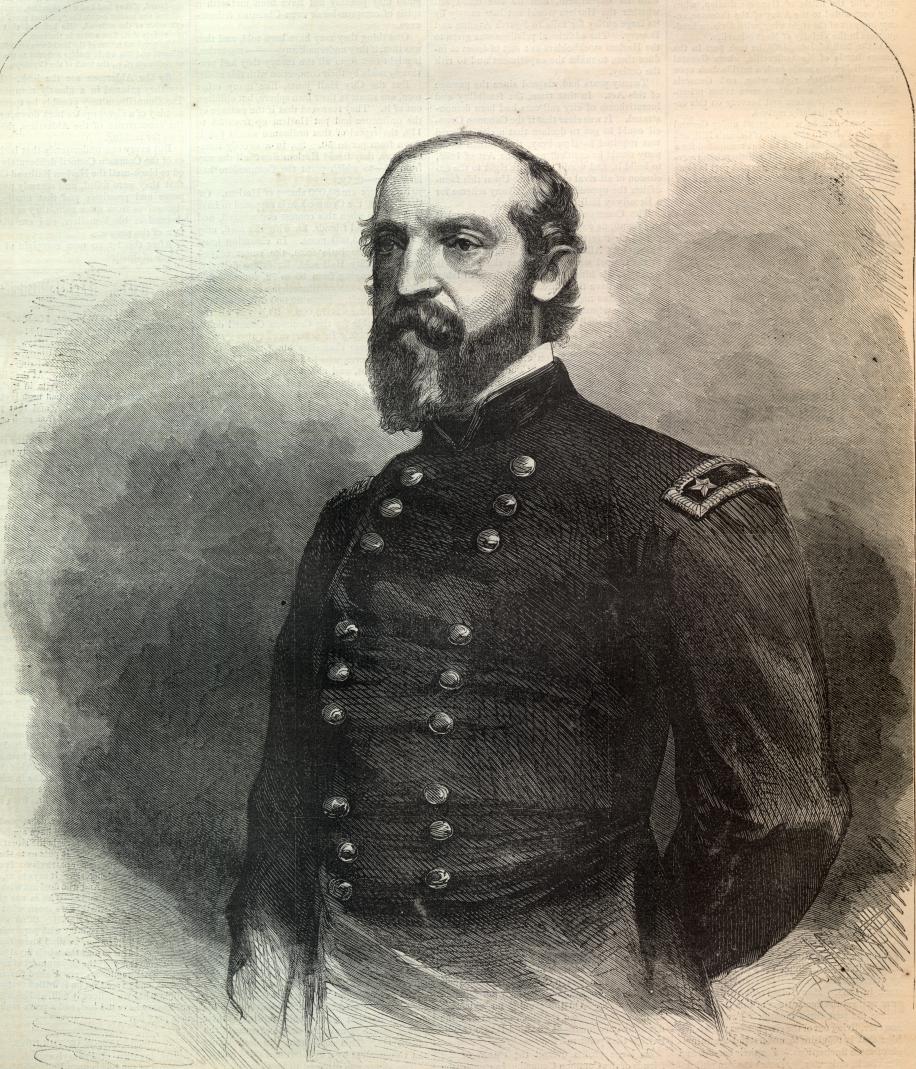
George Gordon Meade

While Lee took no counsel and determined to attack on the night of July 2nd little more than two miles away Major General George Meade took no chances. After sending a message to Henry Halleck at 8 PM Meade called his generals together. Unlike Lee who had observed the battle from a distance Meade had been everywhere on the battlefield during the day and had a good idea what his army had suffered and the damage that he had inflicted on the Army of Northern Virginia. Likewise during the day he had been with the majority of his commanders as opposed to Lee who after issuing orders that morning had remained unengaged, as was noted by the British observer Lieutenant Colonel Arthur Fremantle who wrote that during the “whole time the firing continued, he sent only one message, and only received one report.” 19

Meade wired Halleck that evening: “The enemy attacked me about 4 P.M. this day…and after one of the severest contests of the war was repulsed at all points.” 20 However Meade, realizing that caution was not a vice still needed to better assess the condition of his army, hear his commanders and hear from his intelligence service, ended his message: “I shall remain in my present position to-morrow, but am not prepared to say until better advised of the condition of the army, whether operations will be of an offensive or a defensive character.” 21

As Meade waited for his commanders his caution was apparent. Before the attack on Sickles’ III Corps at the Peach Orchard Meade had asked his Chief of Staff Brigadier General Dan Butterfield to “draw up a contingency plan for withdraw to Pipe Creek.” After the attack on Sickles Alfred Pleasanton said that Meade ordered him to “gather what cavalry I could, and prepare for the retreat of the army.” 22 Some of his commanders who heard of the contingency plan including John Gibbon and John Sedgwick believed that Meade was “thinking of a retreat.” 23. Despite Meade’s  flat assurances to Halleck  his army’s position had been threatened on both flanks, though both were now solidly held, but some of his subordinates believed, maybe through the transference of their own doubts, that Meade “foresaw disaster, and not without cause.” 24

In assessing Meade’s conduct it has to be concluded that while he had determined to remain, that he was smart enough to plan of the worst and to consult his commanders and staff in making his decision. Meade wrote to his wife that evening “for at one time things looked a little blue,…but I managed to get up reinforcements in time to save the day….The most difficult part of my work is acting without correct information on which to predicate action.” 25

Gettysburg_Council_of_War
Meade’s Counsel of War

Meade called Colonel George Sharpe from the Bureau of Military Information to meet with him, Hancock and Slocum at the cottage on the Taneytown Road where he made his headquarters. Sharpe and his aide explained the enemy situation. Sharpe noted “nearly 100 Confederate regiments in action Wednesday and Thursday” and that “not one of those regiments belonged to Pickett.” He then reported with confidence that indicated that “Pickett’s division has just come up and is bivouac.” 26

It was the assurance that Meade needed as his commanders came together. When Sharpe concluded his report Hancock exclaimed “General, we have got them nicked.” 27

About 9 P.M. the generals gathered. Present were Meade, and two of his major staff officers Warren just back from Little Round Top, wounded and tired, and Butterfield his Chief of Staff. Hancock action as a Wing Commander was there with Gibbon now commanding II Corps, Slocum of XII Corps with Williams. John Newton a division commander from VI Corps who had just arrived on the battlefield now commanding I Corps was present along with Oliver Howard of XI Corps, John Sedgwick of VI Corps, George Sykes of V Corps and David Birney, now commanding what was left of the wounded Dan Sickles’ III Corps. Pleasanton was off with the cavalry and Hunt attending to the artillery.

The meeting began and John Gibbon noted that it “was at first very informal and in the shape of a conversation….” 28 The condition of the army was discussed and it was believed that now only about 58,000 troops were available to fight. Birney honestly described the condition of III Corps noting that “his corps was badly chewed up, and that he doubted that it was fit for much more.” 29 Newton who had just arrived was quoted by Gibbon as saying that Gettysburg was “a bad position” and that “Cemetery Hill was no place to fight a battle in.” 20 The remarks sparked a serious discussion with Meade asking the assembled generals “whether our army should remain on that field and continue the battle, or whether we should change to some other position.” 31

The reactions to the question showed that the army commanders still had plenty of fight in the. Meade listened as his generals discussed the matter. Hancock said he was “puzzled about the practicability of retiring.” 32 Newton later noted that he made his observations about the battlefield based on his belief that that Lee might turn the Federal left and impose his army between it and its supplies, as Longstreet However Newton and the other commanders agreed that pulling back “would be a highly dangerous maneuver to attempt in the immediate presence of the enemy.” 33

Finally Butterfield, no friend of Meade and one of the McClellan and Hooker political cabal who Meade had retained when he took command posed three questions to the assembled generals:

“Under existing circumstances, is it advisable for this army to remain in its present position, or retire to another nearer its base of supplies?

It being determined to remain in present position, shall the army attack or wait the attack of the enemy? 

If we wait attack, how long?” 34

Gibbon as the junior officer present said “Correct the position of the army…but do not retreat.” Williams counseled “stay,” as did Birney and Sykes, and Newton, who after briefly arguing the dangers finally agreed. Oliver Howard not only recommended remaining but “even urged an attack if the Confederates stayed their hand.” Hancock who earlier voiced his opinion to Meade that “we have them nicked” added “with a touch of anger, “Let us have no more retreats. The Army of the Potomac has had too many retreats….Let this be our last retreat.” Sedgwick of VI Corps voted “remain” and finally Slocum uttered just three words “stay and fight.” 35

None of Meade’s assembled commanders counseled an immediate attack; all recommended remaining at least another day. When the discussion concluded Meade told his generals “Well gentlemen…the question is settled. We remain here.”36

Some present believed that Meade was looking for a way to retreat to a stronger position, that he had been rattled by the events of the day. Slocum believed that “but for the decision of his corps commanders” that Meade and the Army of the Potomac “would have been in full retreat…on the third of July.” 37 Meade would deny such accusations before Congressional committees the following year as Radical Republicans in Congress sought to have him relieved for political reasons.

Much of the criticism of his command decisions during the battle were made by political partisans associated with the military cabal of Hooker, Butterfield and Sickles as well as Radical Republicans who believed that Meade was a Copperhead. Both Butterfield and Birney accused Meade before the committee of wanting to retreat and “put the worst possible interpretation on Meade’s assumed lack of self-confidence without offering any real evidence to substantiate it.”Edwin Coddington notes “that Meade, other than contemplating a slight withdraw to straighten his lines, wanted no retreat from Gettysburg.” 38

Alpheus Williams of XII Corps, wrote to his daughters on July 6th regarding his beliefs about Meade on the night of July 2nd. “I heard no expression from him which led me to think that he was in favor of withdrawing the army from before Gettysburg.” 39 Likewise the message sent by Meade to Halleck indicates Meade’s own confidence in the upcoming battle of July 3rd. If Meade had some reservations during the day, as he mentioned in the letter to his wife they certainly were gone by the time he received the intelligence report from Sharpe and heard Hancock’s bold assertion that the enemy was “nicked.” 

As the meeting broke up after shortly after midnight and the generals returned to their commands Meade pulled Gibbon aside. Gibbon with II Corps had the Federal center on Cemetery Ridge. Meade told him “If Lee attacks tomorrow, it will be in your front.” Gibbon queried as to why Meade thought this and Meade continued “Because he has made attacks on both our flanks and failed,…and if he concludes to try it again it will be on our center.” Gibbon wrote years later “I expressed the hope that he would, and told General Meade with confidence, that if he did we would defeat him.” 40

If some of his generals and political opponents believed Meade to be a defeatist,  that defeatism was not present in his private correspondence. He wrote to his wife early in the morning of July 3rd displaying a private confidence that speaks volumes: “Dearest love, All well and going on well in the Army. We had a great fight yesterday, the enemy attacking & we completely repulsing them- both armies shattered….Army in fine spirits & every one determined to do or die.” 41

The contrast between Lee’s and Meade’s decision making process is Meade did what Lee should have done, he had been active on the battlefield, he consulted his intelligence service and he consulted his commanders on the options available to him. Lee remained away from the action on July 2nd he failed to consult his commanders. He failed to gain accurate intelligence on the Federal forces facing him and he failed to fully take into account his losses. Meade better demonstrated the principles of what we now call “mission command.” 

Notes

1 Freeman, Douglas Southall, Lee’s Lieutenant’s a Study in Command, One volume abridgement by Stephen W Sears, Scribner, New York 1998 p.558

2 Lee, Robert E, Reports of Robert E Lee, C.S. Army, Commanding Army of Northern Virginia Campaign Report Dated January 20th 1864. Amazon Kindle Edition location 594 of 743 

3 Freeman, Douglas S. R.E. Lee volume 3 Charles Scribner’s Sons, New York 1935 p.150

4 Sears, Stephen W Gettysburg Houghton Mifflin Company, New York 2003 p.349

5 Coddinton, Edwin Gettysburg, A Study in Command Simon and Schuster New York 1968 p.455

6 Trudeau, Noah Andre Gettysburg, A Testing of Courage Harper Collins, New York 2002 p.4117 Ibid p.412

8 Ibid. p.347

9 Ibid. p.430

10 Wert, Jeffry General James Longstreet, the Confederacy’s Most Controversial Soldier A Tuchstone Book, Simon and Schuster, New York 1993 p.283

11 Foote, Shelby The Civil War, A Narrative, Fredericksburg to Meridian Random House, New York 1963 p.529 12 Ibid. Wert p.283

13 Ibid. Sears p.349

14 Guelzo, Allen C. Gettysburg: The Last Invasion Vintage Books, a Division of Random House, New York 2013 p.377

15 Ibid. Foote p.531

16 Ibid. Wert p.287

17 Ibid. Freeman p.589 

18 Ibid. Wert p.290

19 Fremantle, Arthur Three Months in the Southern States, April- June 1863 William Blackwood and Sons, Edinburgh and London 1863 Amazon Kindle edition p.266

20 Sears, Stephen W Gettysburg Houghton Mifflin Company, New York 2003 pp.341-342 

21 Ibid. p.342

22 Guelzo, Allen C. Gettysburg: The Last Invasion Vintage Books, a Division of Random House, New York 2013 p.355

23 Ibid. 

24 Foote, Shelby The Civil War, A Narrative, Fredericksburg to Meridian Random House, New York 1963 p.524

25 Trudeau, Noah Andre Gettysburg, A Testing of Courage Harper Collins, New York 2002 p.413

26 Ibid. Sears p.342

27 Ibid. Trudeau p.413

28 Ibid. Sears p.342

29 Ibid. Trudeau p.415 

30 Ibid. Guelzo p.556

31 Ibid. Guelzo p.556

32 Ibid. Sears p.343

33 Ibid. Sears p.343

34 Ibid. Trudeau p.415

35 Ibid. Guelzo p.556

36 Ibid. Foote p.525

37 Ibid. Guelzo

38 Coddinton, Edwin Gettysburg, A Study in Command Simon and Schuster New York 1968 pp.451-452

39 Ibid. p.452

40 Ibid. Foote p.525 

41 Ibid. Trudeau p.345

Share this:

Loading…

Related

From Strategic Incompetence to Negligence in Conducting a do or Die Offensive: Robert E. Lee’s Lazy and Disastrous Discretionary Orders at Gettysburg, 1 July 1863July 2, 2022In “civil war”

What a Long Strange Trip it’s Been: This Navy Chaplain’s Work Becomes Part of an Army Operational ManualAugust 19, 2018In “civil war”

The Night that Ended the Myth of Robert E. Lee’s “Superior Generalship” George Meade and His Conference of War at GettysburgJuly 14, 2020In “civil war”

Leave a comment

Filed under civil warHistoryleadershipMilitary

Tagged as a.p. hillalpheus williamsbattle of gettysburgcolonel george sharpedaniel butterfielddavid birneydouglas southall freemangeorge meadegeorge pickettgeorge sykeshenry halleckhenry slocumjames longstreetjohn gibbonjohn newtonjohn sedgwickmission commandoliver howardrichard ewellrobert e leewilliam woffordwinfield scott hancock

Leave a Reply 

Advertisements

blob:https://padresteve.wordpress.com/d144114d-70d5-46af-a56a-1fadbff5f042

REPORT THIS AD


Leave a comment

Filed under civil war, Gettysburg, History, leadership, Military, slavery, us army

“Only Two Parties Now” The Aftermath of Fort Sumter

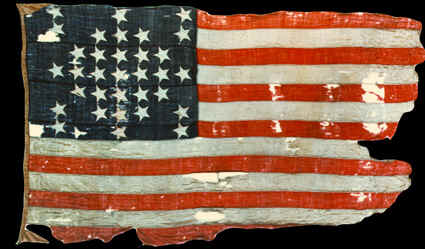
sumterflag

The Flag of Fort Sumter

Friends of Padre Steve’s World,

This is the second of two-part installment from my Civil War text. The story follows the secession crisis and the attack on Fort Sumter. I describes the reactions of people in all parts of the country, as well as the Army to those fateful shots. I find that it is remarkable and ironic that Republican lawmakers in South Carolina have introduced a bill that would allow secession if the Federal Government does anything that these legislators perceive as violating the Second Amendment so close to the date that their predecessors opened fire on Fort Sumter, but that is not the subject of today’s article. 

Peace

Padre Steve+

When the Stars and Stripes came down on April 14th 1861 the North was galvanized as never before, and “the clash at Fort Sumter brought forth an outpouring of support for the Union and President Lincoln.” [1]Abner Doubleday wrote “With the first shot fired against Fort Sumter the whole North became united.” [2] Another observer wrote: “The heather is on fire….I never knew what popular excitement can be… The whole population, men, women, and children, seem to be in the streets with Union favors and flags.” [3] The assault on Fort Sumter help to unify the North in ways not thought possible by Southern politicians who did not believe that Northerners had the mettle to go to war against them. But they were wrong, those shots, which Jefferson Davis ordered had the opposite reaction, for Northerners, even opponents of abolition who were not supporters of Lincoln, slavery in the South was one thing, but the attack on a Federal garrison by massed artillery was another; even Senator Stephen Douglas, Lincoln’s stalwart opponent of so many campaigns went to the White House for a call to national unity. Returning to Chicago he told a huge crowd just a month before his untimely death:

“There are only two sides to the question. Every man must be for the United States or against it. There can be no neutrals in this war, only patriots – or traitors” [4]

For Frederick Douglass the shots marked a new phase in abolition:

“The first flash of rebel gunpowder and shell upon the starving handful of men at Sumter instantly changed the nation’s whole policy. Until then, the ever hopeful North was dreaming of compromise…

I wrote in my newspaper; “On behalf of our enslaved and bleeding brothers and sisters, thank God! The slaveholders themselves have saved the abolition cause from ruin! The government is aroused, the dead North is alive, and its divided people united. Never was a change so sudden, so universal, and so portentous. The whole North from East to West is in arms…” [5]

Douglas died less than a month later, possibly from cirrhosis of the liver, but his impact on the Democrats in the North was immense, “for a year of more his war spirit lived among most Democrats. “Let our enemies perish by the sword,” was the theme of democratic editorials in the spring of 1861. “All squeamish sentimentality should be discarded, and bloody vengeance wreaked upon the heads of the contemptable traitors who have provoked it by their dastardly impertinence and rebellious acts.” [6]

sickles as brigadier

Dan Sickles

One of these Democrats was New York Congressman Dan Sickles. He was one of many men whose outlook toward the South changed when Sumter was fired upon. Sickles had stridently defended Southerners and Southern states rights just months before, so long as they remained in the Union, and he took the actions of his former friends personally. He then became one of the first of men who were known as Union Democrats who followed Lincoln into the war, and despite his lack of ethics in much of his life it was a cause for which he would remain true, during and after the war.

When the soldiers of South Carolina opened fire on Fort Sumter, Sickles, who had said that no troops would cross through New York to invade the South in 1859 proclaimed “the men of New York would go in untold thousands anywhere to protect the flag of their country and to maintain its legitimate authority.” [7] In one of his last congressional speeches Sickles lambasted the South for its threat to the United States as a whole, and condemned the new Confederacy’s policies in spite of Northern attempts to conciliate them, “has been followed by insults to our flag; by the expulsion of the United States troops and authorities from navy yards and forts and arsenals; by measures to control the vast commerce of the Mississippi and its tributaries….” [8] He also condemned the South for its seizure of U.S. funds in the sub-treasuries and mints in the South as well sending envoys to England and France.

Sickles-Excelsior-Brigade-Headquarters-City-Hall-Park.-Yorktown

After the war Sickles, who had lost his leg in the Battle of Gettysburg fighting for the Union, oversaw the early efforts of reconstruction in North Carolina and for ordering the end to the public whippings of blacks by state officials was fired by President Andrew Johnston for supporting voting rights for African Americans. Congress reinstated him but Sickles who had so earnestly supported the South as late as 1860 no longer could stomach such abuse by those men who at one time his political friends and allies. During the election of 1876 Sickles, a lifelong Democrat labeled his party as “the party of treason.” [9] He joined forces with Republicans and helped to prevent the election of New York Democrat Samuel Tilden through shrewd political electioneering in key battleground states.

For Stephen Douglas the attack on Fort Sumter meant the end of his efforts to bring about some kind of reconciliation to reunite the country and restore the Union. When the Little Giant heard the news of the attack and reports of the statements of Confederate leaders he rushed to Lincoln to offer his support. Douglas wrote of the meeting:

“I heartily approve of your proclamation calling up 75,000 militia,” I told him. “Except that I would make it 200,000. You don’t know the dishonest purposes of these southern men as well as I do.” After a review of the strategic situation with the President Douglas continued, “Mr. President,” I said. “Let me speak plainly. I remain unalterably opposed to your Administration on purely its political issues. Yet I’m prepared to sustain you in the exercise of all your constitutional functions to preserve the Union, maintain the government, and defend the capital. A firm policy and prompt action are necessary. The capital of our country is in danger, and must be defended at all hazards, and at any expense of men and money. I speak of the present and future without reference to the past.

He shook my hand, hard. “We need more patriots like you, Douglas,” he said as he walked me to the door.

“I depreciate war,” I said in parting, “but if it must come, I’m with my country and for my country, under all circumstances and in every contingency.” [10]

Douglas then went to his fellow Democrats in Washington and told them: “We must fight for our country and forget all differences. There can be only two parties now – the party of patriots and the party of traitors. We belong to the first.” [11]

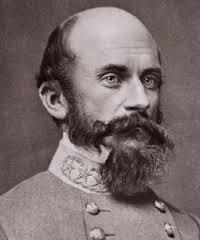
ewell

Richard Ewell

Army officers were conflicted between the Army that they had served, often for many years, the flag that they had fought under, longstanding friendships, and loyalty to their states and families. Richard Ewell who would rise to corps command in the Army of Northern Virginia, described the feelings of many officers in the ante-bellum Army: “Officers generally are very much adverse to any thing like civil war, though some of the younger ones are a bit warlike. The truth is in the army there are no sectional feelings and many from extreme ends of the Union are the most intimate friends.” [12] In California a number of those friends and their families bade tearful farewells as they parted ways. Brigadier General Albert Sidney Johnston and Captains Winfield Scott Hancock and Lewis Armistead gathered one last time. Hancock had already, who had great sympathy for his Southern friends, made his views known had previously announced “I shall fight not upon the principle of state-rights, but for the Union, whole and undivided.” [13] His commander, Johnston, and dear friend Armistead were departing to serve the Confederacy and the parting was painful. Almira Hancock wrote of the final night together in Los Angeles:

“The most crushed was Major Armistead, who with tears, which were contagious, streaming down his face, put his hands upon Mr. Hancock’s shoulders, while looking him steadily in the eye, said, “Hancock, good-bye; you can never know what this has cost me; and I hope God will strike me dead if I am ever induced to leave my native soil, should worse come to worst….” [14]

Colonel Robert E. Lee of Virginia looked askance at secession, but he had made the decision that no matter what he would not lead armies against the South. In fact it was clear when he left Texas to come east where his sentiments lay. He told a friend “If Virginia stands by the old Union, so will I. But if she secedes (though I do believe in secession as a constitutional right, nor that there is sufficient cause for revolution), then I will follow my native State with my sword, and if need be, with my life.” [15]When he returned to Washington D.C. he accepted a promotion to Colonel in the Regular Army less than a month before he was offered command of the Union armies by Abraham Lincoln, a position that he turned down. In his final interview with General Winfield Scott to announce his decision, he admitted that “the struggle had been hard. He did not believe in secession, he said, and if he owned every slave in the South he would free them all to bring peace; but to fight against Virginia was not in him.” [16] When Virginia seceded Lee submitted his resignation from the Army for a cause that he did not really believe was constitutional or necessary, noting in his letter:

“With all my devotion to the Union and feeling of loyalty and duty of an American citizen, I have not been able to make up my mind to raise my hand against my relatives, my children, my home. I have therefore, resigned my commission in the Army, and save in the defense of my native State…I hope I may never be called upon to draw my sword.” [17]

Within days Lee was appointed as a General and commander of the military forces of Virginia. When he arrived at the State House and “before he had much time to ruminate, he found himself being presented with George Washington’s sword, and hailed as a hero in a powerful tribute by the president of the convention.” [18] Even so, Lee’s decision was assailed by much of his Unionist oriented family, and many of them went on to serve the Union with distinction during the war. One relative wrote of Lee’s decision, “I feel no exalted respect for a man who takes part in a movement in which he says he can see nothing but ‘anarchy and ruin’… and yet very utterance scare passed Robt Lees lips… when he starts off with delegates to treat traitors.” [19]

Lee’s future right hand man and chief lieutenant, Thomas Jackson, the soon to be “Stonewall” Jackson was then a professor at the Virginia Military Institute. The often grim and serious Jackson saw the issue of secession as he did all of life through the prism of his Evangelical Protestant Calvinistic faith. For him it disunion was a matter of Divine Providence. When secession came and Jackson heard a minister friend in Lexington lamenting the nation’s troubles he noted:

“Why should Christians be at all disturbed about the dissolution of the Union? It can only come by God’s permission, and only will be permitted, if it is for his people’s good, for does he not say that all things shall work together for the good to them that love God?” [20]

In San Francisco Lieutenant James McPherson of the Corps of Engineers attempted to convince Lieutenant Porter Alexander from going home and joining the cause of the Confederacy. He bluntly spoke the facts of what would happen to the South in coming the war to the future Confederate artillery general:

“The population of the seceding states is only eight million while the North has twenty million. Of your 8 million over 3 million are slaves & may pose a dangerous element. You have no army, no navy, no treasury, no organization & practically none of the manufacturers – the machine shops, coal & iron mines & such things – which are necessary for the support of armies & carrying on war on a large scale.

You are but scattered agricultural communities & will be isolated from the world by blockades.

It is not possible for your cause to succeed in the end…” [21]

But Alexander, like so many Southern officers realized “that a crisis in my life was at hand. But I felt helpless to avert it or even debate the question what I should do. I could not doubt or controvert one of McPherson’s statements or arguments…” [22]

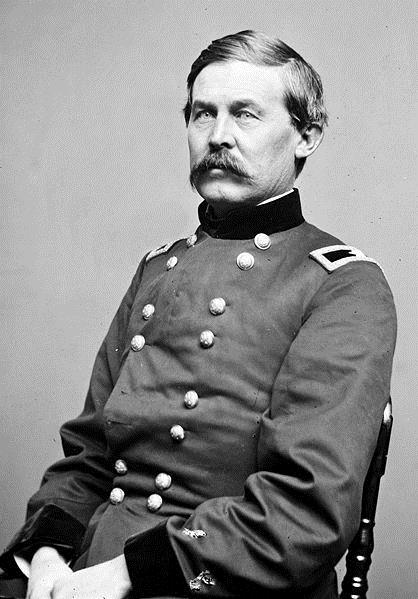
buford

John Buford

However, many Southern born officers serving in the Army did not leave. Close to half of the “Southern West Point graduates on active duty in 1860 held to their posts and remained loyal to the Union.” [23] One was Kentucky’s John Buford who would gain immortal fame at the Battle of Gettysburg. Since Buford’s family had longstanding ties to Kentucky, the pro-secession governor of Kentucky, Beriah Magoffin offered Buford a commission in that states’ militia. At the time Kentucky was still an “undeclared border slave state” and Buford loyal to his oath refused the governor’s offer. He wrote a brief letter to Magoffin and told his comrades that “I sent him word that I was a Captain in the United States Army and I intend to remain one.” [24] Around the same time the new provisional government of the Confederacy “offered Buford a general officer’s commission, which reached him by mail at Fort Crittenden.” [25] According to Buford’s biographer Edward Longacre “a well-known anecdote has him wadding up the letter while angrily announcing that whatever future had in store he would “live and die under the flag of the Union.” [26] A starker contrast could not be drawn.

Close to forty-percent of the Virginians serving on active-duty in the army remained faithful to the Union, including the Commander of the Army, General Winfield Scott and Robert E. Lee’s friend George Thomas and both were ostracized in the Old Dominion. “Thomas’s family never again communicated with him except to ask him to change his name. A young Virginian just out of West Point, acknowledged that by retaining his commission he had been shunned by all of his Southern associates; yet he still derided those who would hold their obligations so lightly as to abandon the nation when it most needed them.” [27]

But throughout the South, most people were less than circumspect and openly rejoiced at the surrender of Fort Sumter. In Richmond the night following the surrender “bonfires and fireworks of every description were illuminating in every direction- the whole city was a scene of joy owing to [the] surrender of Fort Sumter” – and Virginia wasn’t even part of the Confederacy.” [28] John Gordon, the future Confederate General was leading his Georgia volunteers to the new Confederate capital and “found the line of march an unbroken celebration: fires lighted the hilltops; fife-and-drum corps shrilled and thumped; cannons exploded their welcome.” [29]

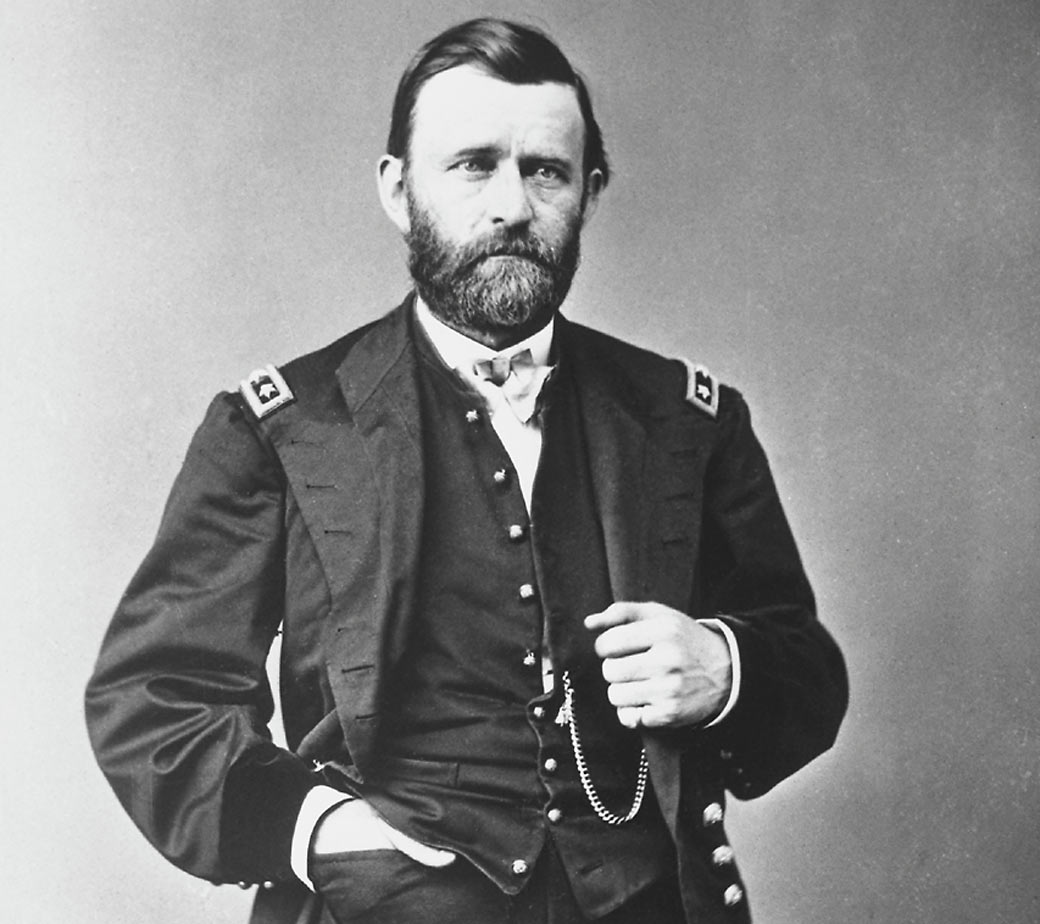
poor--ulysses-s-grant-president-1040cs021412

Ulysses Grant

Far to the north in Bangor Maine a little known professor at Bowdin College named Joshua Lawrence Chamberlain read the news “could not abide the thought of a divided nation; the Founding Fathers “did not vote themselves into a people; they recognized and declared that they were a people” whose bonds out not to be severed by political, social, or economic grievances.” [30] The professor “was seized with anger that “the flag of the Nation had been insulted” and “the integrity and existence of the people of the United States had been assailed in open and bitter war.” [31] In Illinois, a former struggling former Regular Army officer and veteran of the War with Mexico, Ulysses S. Grant whose in-laws were sympathetic to the Southern cause who had volunteered to lead a regiment of Illinois volunteers, wrote “Whatever may have been my opinions before, I have but one sentiment now. That is to have a Government, and laws and a flag and they all must be sustained….There are but two parties now, Traitors and Patriots and I want hereafter to be ranked with the latter.” [32]

1st_7th_Reg_Departs

Even in cities that had often leaned toward the South like Cincinnati, people rushed to proclaim their patriotism and support of the Union. George Ticknor told an English friend “The whole population, men, women, and children, seem to be in the streets with Union favours and flags…. Civil war is freely accepted everywhere… by all, anarchy being the obvious, and perhaps the only alternative.” Pacifists who had rejected violence, even in support of righteous causes, turned bellicose. Ralph Waldo Emerson enthused, “Sometimes gunpowder smells good.” [33] As the Sixth Massachusetts Volunteer Infantry marched through the streets of New York on their way to Washington were greeted with cheers from thousands of New Yorkers. The New York Times reported the event:

“Flags were displayed at all the hotels on the route, and waving handkerchiefs from the balconies and windows signified the warm greetings of the fair sex to the brave Bay State soldiers. Opposite the New York Hotel a gray-haired old man mounted a stoop and addressing the soldiers and people, said that he had fought under the Stars and Stripes in the War of 1812 against a foreign power, and now that the flag was spit upon by those who should be its defenders. He closed his remarks by a “God bless our flag,” and left the crowd with tears streaming down his wrinkled cheeks.” [34]

The Rubicon had been crossed and there was now no going back for either side. Poet Walt Whitman wrote:

War! An arm’d race is advancing! The welcome for battle, no turning away;

War! Be it weeks, months, or years, an arm’d race is advancing to welcome it.” [35]

Notes

[1] Ibid. Cooper We Have the War Upon Us p.270

[2] Doubleday, Abner From Moultrie to Sumter in Battles and Leaders of the Civil War Volume I Edited by Robert Underwood Johnson and Clarence Clough Buel Castle, Secaucus NJ p.48

[3] Ibid. McPherson The Battle Cry of Freedom p.274

[4] Ibid. McPherson The Battle Cry of Freedom p.274

[5] Ibid. Oates The Approaching Fury p.423

[6] Ibid. McPherson The Battle Cry of Freedom pp.274-275

[7] Ibid. Keneally American Scoundrel p.212

[8] Ibid. Keneally American Scoundrel p.214

[9] Ibid. Goldfield America Aflame p.525

[10] Ibid. Oates The Approaching Fury pp.421-422

[11] Ibid. Oates The Approaching Fury p.422

[12] Pfanz, Donald. Richard S. Ewell: A Soldier’s Life University of North Carolina Press, Chapel Hill and London 1998 p.120

[13] Jordan, David M. Winfield Scott Hancock: A Soldier’s Life Indiana University Press, Bloomington and Indianapolis 1988 p.33

[14] Hancock, Almira Reminiscences of Winfield Scott Hancock Charles L Webster and Company, New York 1887 pp.69-70

[15] Thomas, Emory Robert E. Lee W.W. Norton and Company, New York and London 1995 p.187

[16] Ibid. Catton The Coming Fury p.335

[17] Ibid. Thomas The Confederate Nation p.85

[18] Pryor, Elizabeth Brown. Reading the Man: A Portrait of Robert E. Lee Through His Private Letters Penguin Books, New York and London 2007 p.295

[19] Ibid. Pryor Reading the Man p.295

[20] Ibid. Rable God’s Almost Chosen Peoples p.38

[21] Alexander, Edward Porter. Fighting for the Confederacy: The Personal Recollections of General Edward Porter Alexander edited by Gary Gallagher University of North Carolina Press, Chapel Hill 1989 p.24

[22] Ibid. Alexander Fighting for the Confederacy p.25

[23] Huntington, Samuel P. The Soldier and the State: The Theory and Politics of Civil-Military Relations, The Belknap Press of Harvard University Press, Cambridge MA and London 1957

[24] Ibid. Guelzo. Gettysburg: The Last Invasion p.121

[25] Longacre, Edward G. John Buford: A Military Biography Da Capo Press, Perseus Book Group, Cambridge MA p.70

[26] Ibid. Longacre John Buford p.70

[27] Pryor, Elizabeth Brown. Reading the Man: A Portrait of Robert E. Lee Through His Private Letters Penguin Books, New York and London 2007 p.292

[28] Ibid. Guelzo Fateful Lightening p.140

[29] Smith, Jean Edward. Grant Simon and Schuster, New York and London 2001 p.99

[30] Longacre, Edward G. Joshua Chamberlain: The Soldier and the ManCombined Publishing Conshohocken PA 1999 pp.49-50

[31] Ibid. Guelzo. Gettysburg: The Last Invasion p.139

[32] Ibid. Smith Grant p.103

[33] Ibid. Goldfield America Aflame p.205

[34] Holzer, Harold and Symonds, Craig L. Editors, The New York Times Complete Civil War 1861-1865 Black Dog and Leventhal Publishers, New York 2010 p.75

[35] Ibid. Goldfield America Aflame p.205

Leave a comment

Filed under civil war, History, Military, Political Commentary

The Pariah: Dan Sickles Part Four

Friends of Padre Steve’s World,

I am taking a break over the next few days to do some reading and reflection. Thus I am re-posting some articles from my Gettysburg text dealing with a man that I consider one of the most fascinating , salacious, scandalous, heroic, and incredible figures ever to grace and disgrace American history, Congressman, and Civil War General Daniel E. Sickles.

I hope that you enjoy,

Peace

Padre Steve+

dan-sickle-teresa-key


After a brief absence, Sickles returned to Congress and to Teresa, who was now even a worse social pariah than her husband. After the murder and for the duration of the trial, Teresa remained at one of the family homes in the New York countryside under the care of her parents. She followed the trial and occasionally wrote to Dan in jail, and over time he began to write back. Teresa was thrilled with the verdict and she honestly believed that the marriage and her reputation could be rehabilitated, and that she could be restored to a normal wife. The normal family values system of the time would have now involved Sickles divorcing his tarnished wife. That would have been “the predictable and conservative course.” [1] But despite his own continuing excursions into infidelity and his rage over hers, Sickles still loved her, and could not fathom divorcing her. His father George and Teresa’s father Antonio “were stricken with the same delusion as Teresa – that reconciliation would be tolerated by society.” [2]

Had the recently celebrated Congressman done divorced Teresa, his political career, while crippled, might have resumed its previous upward trajectory. But the ever unpredictable Dan Sickles “shocked everyone by forgiving Teresa and resuming their former relationship.” [3]

It was a characteristic of the time, and in some place even today in that maintained the belief that an adulterous wife knew no forgiveness, and Sickles “put himself beyond the pale by the simple act of forgiving his wife and restoring her to his bosom.” [4] Murder could be forgiven, a man’s indiscretions as well, but forgiving an adulterous women, especially a wife and mother was unforgivable. All the better people had already assigned the appropriate scarlet letter to the fallen woman, and they were shocked into paroxysms of moral outrage when Sickles apparently forgave her transgression.” [5] Sickles action was totally “out of kilter with an age that neatly divided women into “saintly mothers,” “pure virgins,” and “fallen women.” [6] Frankly the action was shocking to New York and Washington society, and both Dan and Teresa paid the price, but the price paid by Teresa would be greater, and ultimately contribute to her death, a death that occurred far too early.

Sickles was flailed in the papers, the New York Dispatch noted “His warmest personal and political friends bitterly denounce his course.” While the Sunday Courier wrote, “His political aspirations, his career in life, once so full of encouraging brightness, and his business prospects, have all been blasted by this act.” [7]

The Sunday Mercury put their condemnation published a biting bit of poetry lampooning both Dan and Teresa:

Hail matchless pair! United once again, In newborn bliss forget your bygone pain…

What the world may say, “with hands all red Yon bridegroom steals to a dishonored bed”

And friends, estranged, exclaim on every side: “Behold! Adultery couched with Homicide! [8]

Even long time friends were like James Topham Brady who had defended him at his trial were livid. Interestingly enough it was Sickles old foe Horace Greeley who “flew in the face of convention by commending Sickles for his forgiveness.” [9] But Greeley was an exception, and in the face of the critics sent a letter to the New York Herald in which he fired a broadside:

“Referring to the forgiveness which my sense of duty and my feelings impelled me to extend to an earring and repentant wife… I am prepared to defend what I have done before the only tribunal I recognize as having the slightest claim to jurisdiction over the subject – my own conscience and the bar of Heaven. I am not aware of any statute or code of morals which makes it infamous to forgive a woman… And I cannot allow even all the world combined to dictate to me the repudiation of my wife, when I think it right to forgive her and restore her to my confidence and protection. If I have ever failed to comprehend the utterly desolate position of an offending though penitent woman – the hopeless future, with its dark possibilities of danger, to which she is proscribed as an outcast – I can now see plainly in the in the almost universal howl of denunciation with which she is followed to my threshold…” [10]

Dan Sickles the sinner had struck back at his Pharisaical accusers with the aplomb of Christ himself, who had forgiven the adulteress woman, but it did little to change public perception. Teresa would always be the adulteress, abandoned by friends and scorned by society at large. Dan, who even with the scandal of the Key murder behind him and who would have been forgiven had he denounced and divorced his wife, was now a pariah, even among his peers and colleagues. Mary Boykin Chesnut, wife of a renowned senator, and prolific diarist from South Carolina “sat in the House gallery one day and saw Sickles deliberately, and totally ostracized. He was sitting all alone, like Catiline, every other member careful not to come near him – “left to himself as if he had the smallpox.” [11] When Chesnut asked a friend why he was shunned, the friend noted that the murder of Key “was all right… It was because he condoned his wife’s profligacy and took her back… Unsavory subject.” [12]

But for Teresa it was worse. She was “socially exiled, shunned even by humble neighbors, compelled to keep the house by day or face the sneers and hoots of such street trash as recognized her, cut off from her cherished riding and walking, coped up with a loving but over emotional mother, a penurious, egocentric father, Teresa, torn between grief for the dead, contrition for the living, began to fail…” [13] Despite his defense of her and officially taking her back, he spent little time with her and she never again accompanied him in any of his assignments, in the military, or after the war. But his policy of leaving her behind was not due to cruelty or neglect, as Dan and Teresa were “merely accepting an accomplished social fact, knowing Teresa would forever be an outcast and forever be an outcast and would be exposed to endless snubs and torment were she be so rash as to essay a new entrance into society.” [14] In his own way Dan loved her, but neither could change the attitude of a society where Puritanical morality still reigned, and the granddaughter of Giacomo Casanova’s friend could never be forgiven, and whose relationship with her husband would always be haunted by the ghost of Barton Key. Nothing could change that, and soon Teresa lost the will to live though she was not even twenty-five years old. “Sleepless, she took refuge in opiates….She sank slowly from frailty to invalidism.” [15] She contracted tuberculosis, and though she attempted to maintain her household she suffered from severe depression, and again took up her family’s Catholic faith. Catholic rosaries, missals, holy cards, and other items filled her bedroom. Eventually, she died unexpectedly in January of 1867, with most people thinking that she would yet recover. She was only thirty-one years old. Dan, now serving as military governor in South Carolina was stunned. Her pallbearers include James Topham Brady, and four U.S. Army generals including Sickles former comrade Alfred Pleasanton and his Gettysburg aide Henry Tremain. In death she finally found a measure of public sympathy, the funeral Mass was attended by many mourners, and as Sickles and his now teenage daughter Laura followed Teresa’s casket out of the church, “His feelings now broke forth and he wept, and the large congregation rushed tumultuously from the building after him, testifying to the hold he held on their hearts, and the extent to which they shared his affliction.” [16] In light of the prevailing morality of the day can wonder if most of the mourners had more sympathy for Sickles than his now dead wife. Unlike the adulteress of the Gospels, Teresa Sickles had no one to

Notes

[1] Ibid. Sears Controversies and Commanders p.200

[2] Ibid. Keneally American Scoundrel p.202

[3] Ibid. Wilson and Clair They Also Served p.100

[4] Ibid. Catton Glory Road p.152

[5] Ibid. Sears Controversies and Commanders p.200

[6] Ibid. Pinchon Dan Sickles p.136

[7] Ibid. Swanberg Sickles the Incredible p.72

[8] Ibid. Keneally American Scoundrel p.203

[9] Ibid. Swanberg Sickles the Incredible p.73

[10] Ibid. Swanberg Sickles the Incredible p.74

[11] Ibid. Catton Glory Road p. 152 Catiline was a counsel of Ancient Rome is best known for two attempts to overthrow the Roman Republic in 62 BC. His plot was exposed before the Senate by Cicero and he is famously depicted in Cesare Macari’s painting sitting alone in with his head down as Cicero denounces him before the Senate.

[12] Ibid. Hessler Sickles at Gettysburg p.20

[13] Ibid. Pinchon Dan Sickles p.136

[14] Ibid. Swanberg Sickles the Incredible p.282

[15] Ibid. Pinchon Dan Sickles p.137

[16] Ibid. Keneally American Scoundrel p.329

Leave a comment

Filed under civil war, crime, History, marriage and relationships

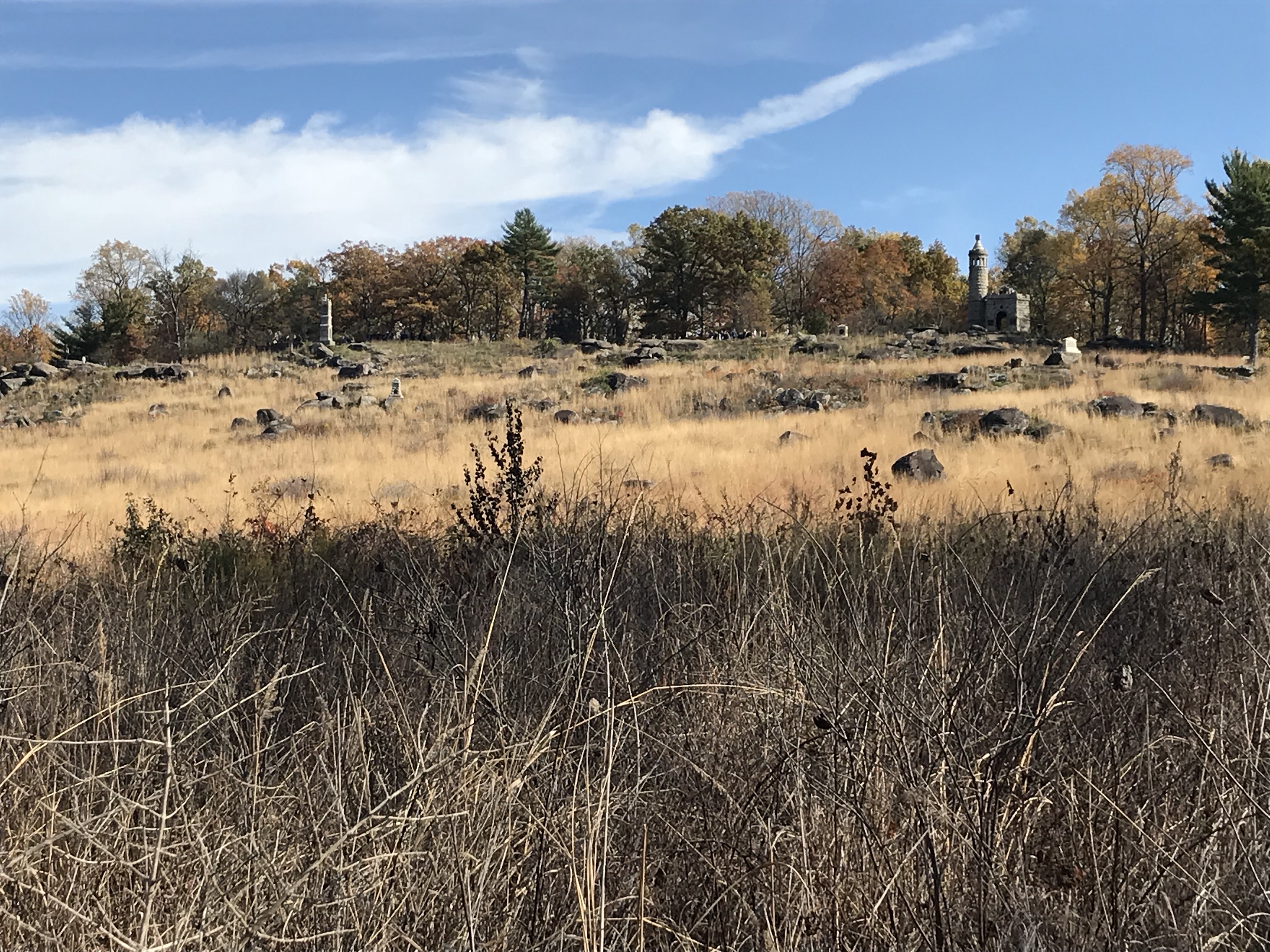
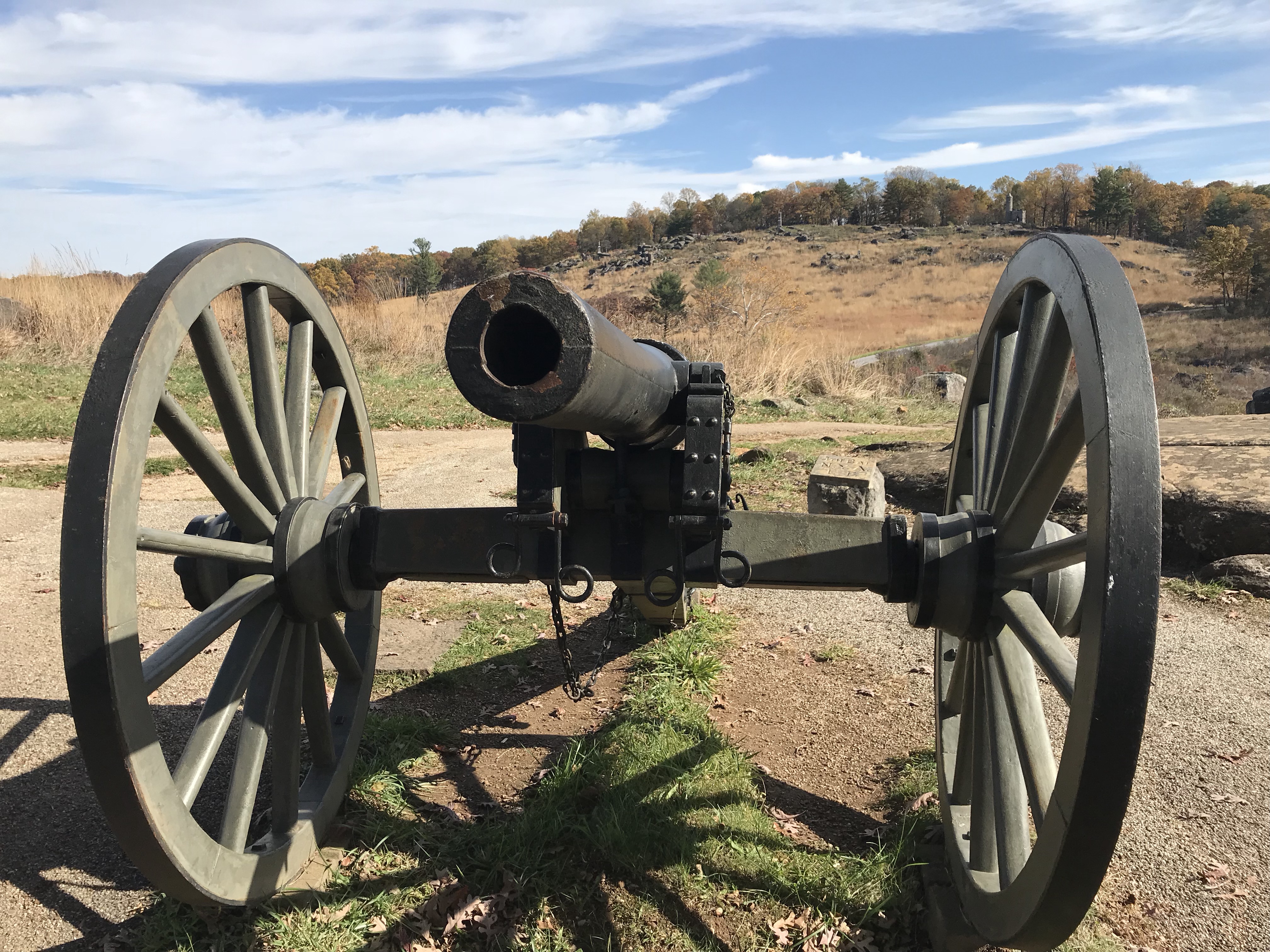
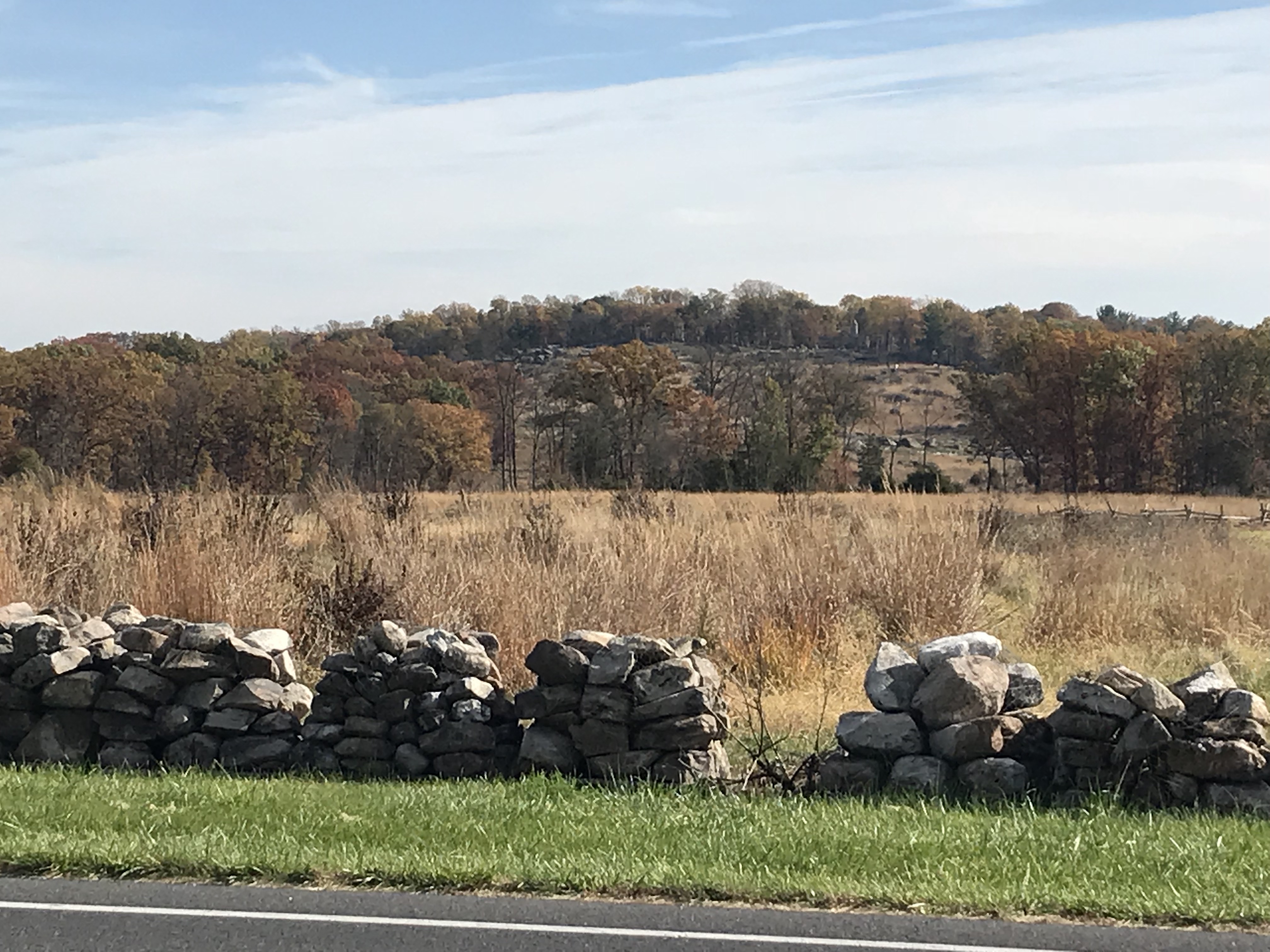
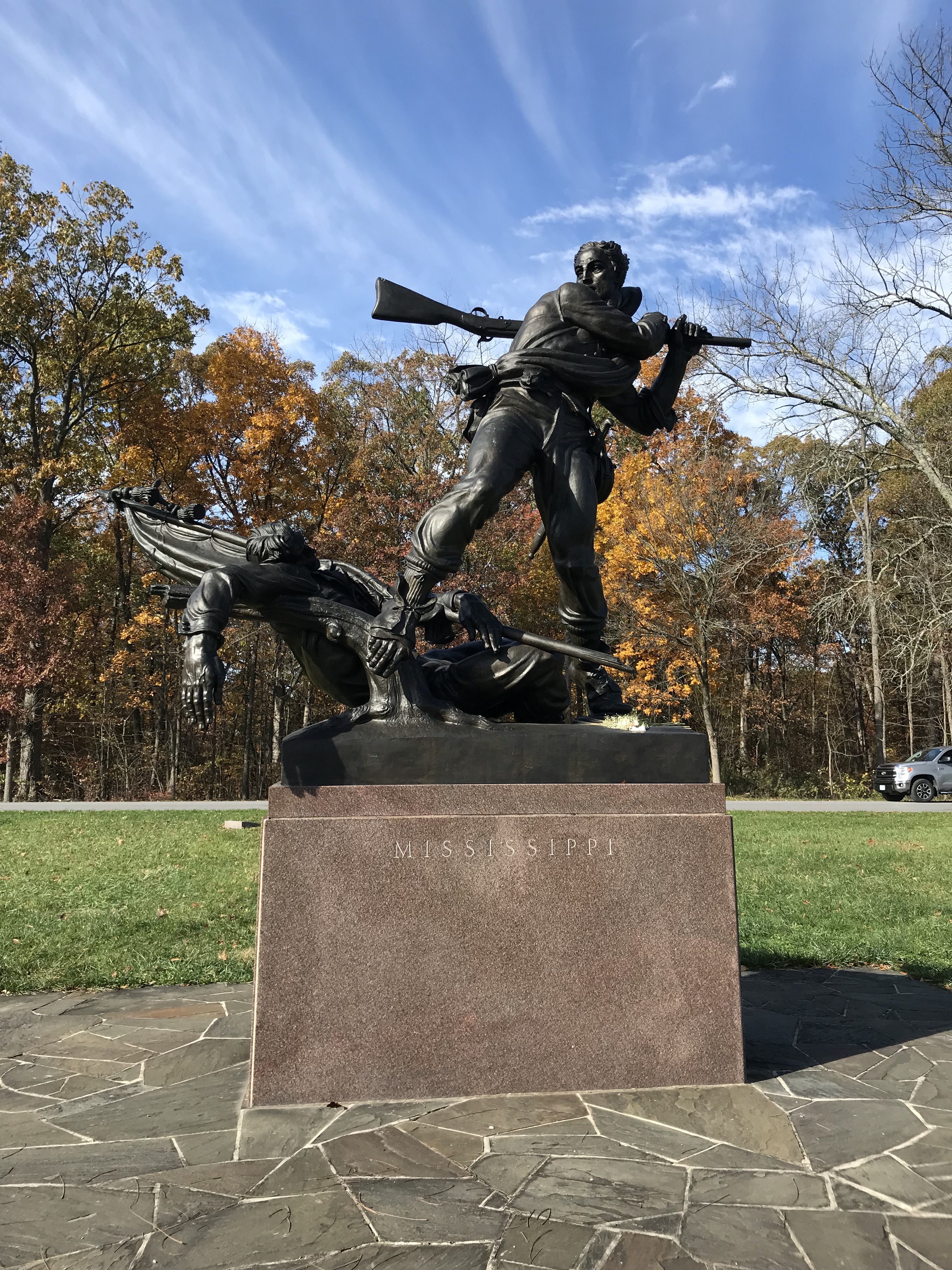
Talking About Bad Ground: Walking the Gettysburg Battlefield, Devil’s Den, Little Round Top, the Wheat Field and more…


Friends of Padre Steve’s World,

Yesterday I wrote about my walk around the areas of the Battle of Gettysburg which transpired on the afternoon of July 1st 1863. Today was my crack at doing my best to experience walking the areas of the battlefield that were contested on July 2nd 1863 when Robert E. Lee ordered James Longstreet to assault the Federal left on the basis of Dick Ewell and Jubal Early’s intransigence in ordering a follow up assault on the Federal right, coupled with inaccurate information Lee had about where the end of the Federal line was. The result was the attacks by Longstreet’s divisions which came perilously close to succeeding but which after some of the bloodiest fighting during any three and a half hour period of the war were repulsed by Union troops the Third, Second, and Fifth Corps.


The engagements of that afternoon and evening are etched in our national conscience. Devil’s Den, Little around Top, the Bloody Wheat Field, and the Peach Orchard, not to mention the fights along Rose’s Woods, the Stoney Ridge, Trostle Farm, and Plum Run are each microcosms of the battle, each with heroes, villains, and tactical geniuses and idiots. But my purpose tonight is not to dissect those battles, I am doing that in a text about the Battle of Gettysburg. Instead it is to reflect upon military history and what the men who fought the battle endured.

If you want to understand military history and want to do so without having actually been to war or having taken the time to try to see and walk the ground the soldiers trod firsthand make a critical mistake, especially in campaigns where the soldiers had to walk into combat. As Guy Sager, who endured the Russian Front as an infantryman in the Second World War wrote in his book The Forgotten Soldier:

“Too many people learn about war with no inconvenience to themselves. They read about Verdun or Stalingrad without comprehension, sitting in a comfortable armchair, with their feet beside the fire, preparing to go about their business the next day, as usual…One should read about war standing up, late at night, when one is tired, as I am writing about it now, at dawn, while my asthma attack wears off. And even now, in my sleepless exhaustion, how gentle and easy peace seems!”


Like yesterday I walked. I left my car at my hotel and put on my boots and my three-day pack from Iraq. I ate a biscuit with a little bit of gravy, and had a small cup of coffee at the hotel before I set off. Since the hotel didn’t serve hardtack it was the closest I could get to a Civil War breakfast. From the hotel it is about a two mile walk to get to General Lee’s HQ on Seminary Ridge. Since Longstreet’s advanced elements were about that far back from Lee’s HQ on that morning I thought that it would approximate the march of some of his troops while understanding that some of his Corps had to march far more just to get there before beginning their movement to the south part of the battlefield.

Upon reaching Seminary Ridge I began walking down what would have been the areas occupied by A.P. Hill’s Third Corps that Longstreet’s troops would have passed as they moved south. The distance that they covered was about five miles as the crow flies, but due to bad staff work and coordination most of the men of John Bell Hood and Lafayette McLaws divisions had to go further just to get to their start point for the attack. In the case of Evander Law’s brigade of Hood’s division which had the mission of being the furthest south of the attacking Confederates, they had marched over twenty miles before beginning their attack on Little Round Top. When I reached the area that they did I had only walked about seven and a half miles as opposed to the men of Evander Law’s brigade who had marched over twenty miles to get into their attack positions, but as a mater of fact they were almost all a couple of decades or more younger than me.


When I got to the point of the Confederate attack I walked a path that intersected with the soldiers of Law’s brigade and Robertson’s Texas brigade, both of Hood’s division. Hood had vigorously protested the attack to Longstreet due to the bad ground that his troops would have to traverse to reach their objectives. As I wrote in my draft book on the battle:

Hood was never one to hesitate to attack, but when he saw the situation that faced First Corps, he objected to the attack. “For the first time in his army career Hood suggested a change of orders to his commanding general,” and pleaded with Longstreet to change it. “From his own observations and those of his scouts he concluded that the attack would be futile and result in wanton wage of life.” The fierce Texan “recognized that the battle order, written more than two miles away on mistaken information…did not fit existing conditions.” His objections included the rocky terrain which he believed would break up his battle formations, as well as “the concave character of the enemy’s line from the north end of Cemetery Ridge to Big Round Top would expose his division to a “destructive fire in flank and rear, as well as in front” if his men attacked it obliquely.” He told Longstreet that it was “unwise to attack up the Emmitsburg Road, as ordered” and requested that he be allowed to “turn Round Top and attack the enemy flank and rear.

Meanwhile, the debate between Longstreet and Hood continued as Hood objected and Longstreet reiterated Lee’s insistence on the planned attack. McLaws noted that Hood “found that the enemy were strongly posted on two rocky hills, with artillery and infantry…” and he pleaded for freedom of maneuver. He believed that an attack up the rocky hills was doomed and later noted “it seemed to me that the enemy occupied a position so strong- I may say impregnable – that independently of their flank fire, they could easily repulse our attack by merely throwing or rolling stones down the mountainside as we approached.”


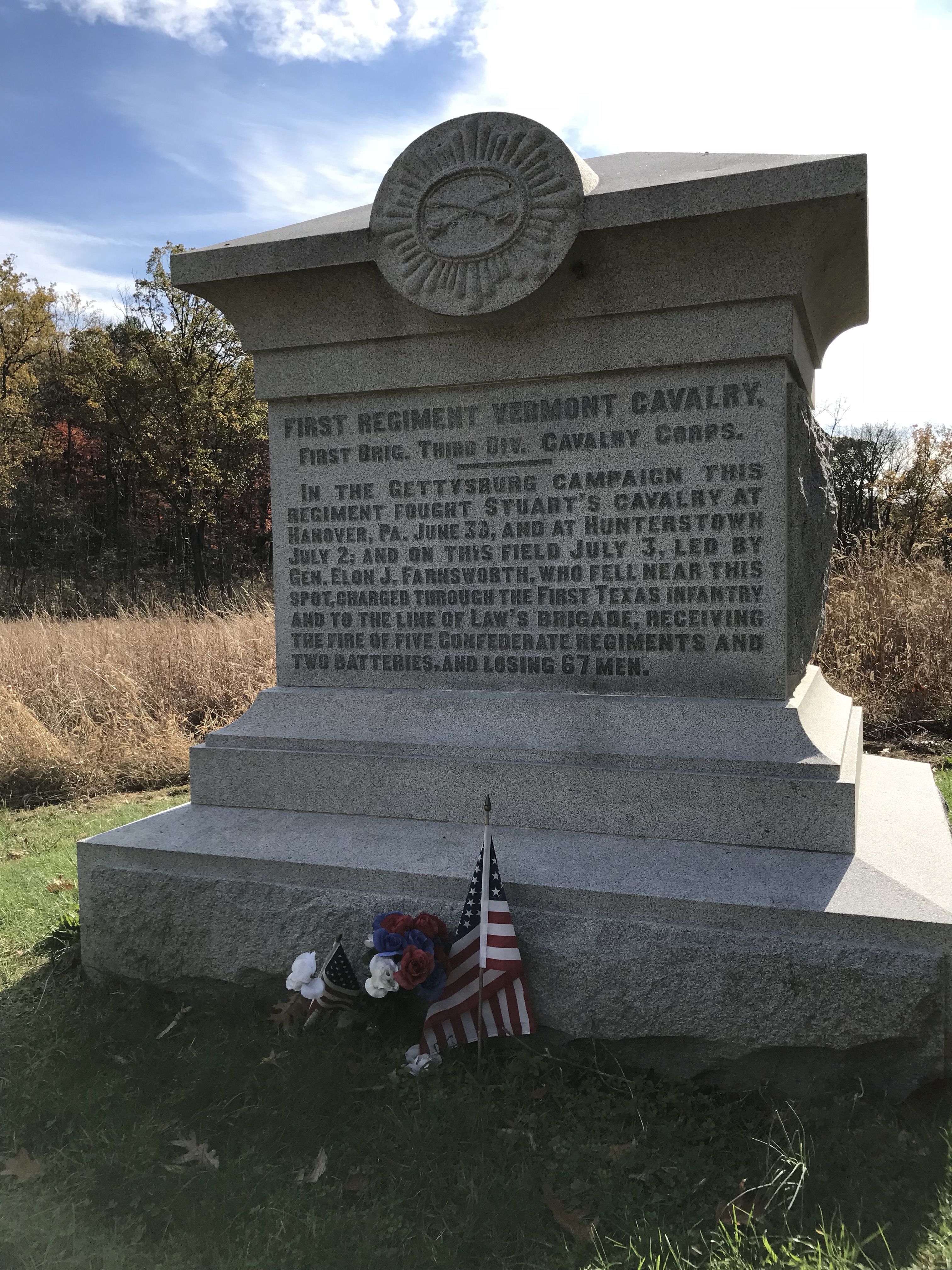
One can look at the ground and one can study it on maps, but until you walk that bad ground, even without doing it while subjected to enemy fire you won’t understand how bad it is. I made my way down a walking path and then tried to move off of it in order to get to Devil’s Den. It was awful, reeds, thrushes, a stream, boulders, and heavy brush prevented me from moving forward. So I went back, followed a trail to Big Round Top and then headed over to Devil’s Den. General Hood was right, the ground to use the words that he spoke to Longstreet after he was wounded “it was the worst ground I ever saw” is not an exaggeration. But the diversion allowed me to find the part of the battle where Brigadier General Elon Farnsworth, after having unsuccessfully resisted orders from Brigadier General Judson Kilpatrick was forced to attack the well dug in Confederate infantry of Lafayette McLaw’s division on July 3rd.


From Devil’s Den I worked my way to Little Round Top. Most of the front slope is inaccessible due to the National Park Service doing a reclamation project, but there is a trail that leads up to it that many of the Confederates would have used. It was steep, and the ground was rugged. By the time I reached the top near the New York Monument I was exhausted. Despite having been in combat and being shot at I cannot imagine how the Confederate soldiers threw themselves up that hill facing small arms and artillery fire at point blank range. Their cause may have been wrong but they were valiant and tough soldiers. The fact that I am 30 to 40 years older than most of them is irrelevant, that ground was a bitch.


After that I went back over to the part of the battlefield occupied by the famous 20th Maine Infantry under the command of Colonel Joshua Chamberlain, and then followed their counter-attack down the hill. From there I went back across the rear slope of Devil’s Den to Houck’s Ridge where heavily outnumbered Union Regulars held their own against Hood and McLaw’s soldiers. From there I went over to the Bloody Wheat Field. Like the Bloody Corn Field at Antietam this was a killing ground which exchanged hands several times during the battle, about 30% of the 20,000 or so soldiers engaged there became casualties. When on looks it the field it is hard to imagine that so many men were killed and wounded in such a short amount of time. Walking across the ground I could not help thinking about the thousands of souls who suffered and died there.


From there I continued through Rose’s Woods and the Stoney Ridge where still more Union and Confederate soldiers fell in desperate fights before walking back west to the Peach Orchard. This was another bloody contest in which General Dan Sickles of the Union Third Corps surprised both the Confederates and his own Commander, General George Meade by moving his corps into an exposed position. The battle there cost many lives and apologists for Sickles, Meade, and the Confederates have used for their own benefit. Sickles is claimed to have nearly lost the battle for the Union, but Longstreet said that his movement and defense of the Peach Orchard was key to the Union victory. Again my purpose in this article is not to take a side in that controversy but to imagine the carnage of the battlefield as well as the bravery of the soldiers on it. It is hard to imagine being a Third Corps Soldier at the Peach Orchard as Confederate artilleryman Porter Alexander’s guns swept their positions, nor being one of McLaw’s infantrymen who were being slaughtered by the experienced Union artillerymen of Third Corps and the Artillery Reserve.


By the time I got to the Peach Orchard I was hungry, thirsty, exhausted, and my feet were hurting. I had a choice. I could simply walk up the Emmitsburg Road and head back to the hotel or I could continue to follow the route of the Confederate advance spearheaded by General Barksdale’s brigade. I went back across Excelsior Field and to the Trostle Farm where Sickles fell wounded, before crossing Plum Run and heading up Cemetery Ridge where the Confederate advance was halted. I then walked back to the hotel via Cemetery Ridge, the Taneytown Road and the Soldiers Cemetery, before making a brief stop on East Cemetery Hill.

Since I was exhausted and darkness and rain were beginning to close in I decided not to do my walk around the Culp’s Hill battlefield. That will have to wait for another time. Since the rain is expected to continue into the morning and I hate getting wet I’ll put off my walk around Culp’s Hill until another time.

Tomorrow I will head home early to help Judy do some work around our house. My friend Bill who met me last night had take care of a business emergency call from one of his customers in the Shenandoah Valley this morning and since it’s just me I figure I can head back home. Lord willing there is always tomorrow right?


But as a closing commentary:

In the past couple of months I have walked nearly 50 miles across two of the nation’s bloodiest battlefields, Antietam and Gettysburg. Honestly I don’t know a lot of people in policy making positions who do things like that. The tragedy of the American Civil War and the nearly three quarters of a million soldiers of both sides who died during it seems to me to have been forgotten or relegated to the realm of myth by too many Americans, including the President and many of his advisers and supporters. If we forget the cost and meaning of the Civil War, the validation of the proposition of the Declaration of Independence that all men are created equal then we do a grave injustice to those who fell in that war, unless we want to support Confederate Vice President Alexander Stephens who said that slavery was the Cornerstone of the Confederate nation. The costs to our nation are too great to let the the lessons of our Civil War be relegated to myth or exploited to reimagine a recreated Confederacy dominating the rest of the country are too great to allow the President, who has called violent neo-Confederates and White Supremacists “very fine people” or to fail to resist theocratic people from imposing their religious beliefs on others as did the Southern clergy who helped break the bonds of the Union beginning in their own denominations in the 1840s.

Since I have now eaten and had a few beers  I will take my 57 year old body to bed and get ready to head home in the morning.

So until tomorrow,

Peace

Padre Steve+

2 Comments

Filed under civil war, Gettysburg, History, Military, Political Commentary

Dan Sickles Part Four: The Pariah

Friends of Padre Steve’s World,

I am taking a break over this Thanksgiving weekend and am re-posting some articles from my Gettysburg text dealing with a man that I consider one of the most fascinating , salacious, scandalous, heroic, and incredible figures ever to grace and disgrace American history, Congressman, and Civil War General Daniel E. Sickles.

I hope that you enjoy,

Peace

Padre Steve+

dan-sickle-teresa-key


After a brief absence, Sickles returned to Congress and to Teresa, who was now even a worse social pariah than her husband. After the murder and for the duration of the trial, Teresa remained at one of the family homes in the New York countryside under the care of her parents. She followed the trial and occasionally wrote to Dan in jail, and over time he began to write back. Teresa was thrilled with the verdict and she honestly believed that the marriage and her reputation could be rehabilitated, and that she could be restored to a normal wife. The normal family values system of the time would have now involved Sickles divorcing his tarnished wife. That would have been “the predictable and conservative course.” [1] But despite his own continuing excursions into infidelity and his rage over hers, Sickles still loved her, and could not fathom divorcing her. His father George and Teresa’s father Antonio “were stricken with the same delusion as Teresa – that reconciliation would be tolerated by society.” [2]

Had the recently celebrated Congressman done divorced Teresa, his political career, while crippled, might have resumed its previous upward trajectory. But the ever unpredictable Dan Sickles “shocked everyone by forgiving Teresa and resuming their former relationship.” [3]

It was a characteristic of the time, and in some place even today in that maintained the belief that an adulterous wife knew no forgiveness, and Sickles “put himself beyond the pale by the simple act of forgiving his wife and restoring her to his bosom.” [4] Murder could be forgiven, a man’s indiscretions as well, but forgiving an adulterous women, especially a wife and mother was unforgivable. All the better people had already assigned the appropriate scarlet letter to the fallen woman, and they were shocked into paroxysms of moral outrage when Sickles apparently forgave her transgression.” [5] Sickles action was totally “out of kilter with an age that neatly divided women into “saintly mothers,” “pure virgins,” and “fallen women.” [6] Frankly the action was shocking to New York and Washington society, and both Dan and Teresa paid the price, but the price paid by Teresa would be greater, and ultimately contribute to her death, a death that occurred far too early.

Sickles was flailed in the papers, the New York Dispatch noted “His warmest personal and political friends bitterly denounce his course.” While the Sunday Courier wrote, “His political aspirations, his career in life, once so full of encouraging brightness, and his business prospects, have all been blasted by this act.” [7]

The Sunday Mercury put their condemnation published a biting bit of poetry lampooning both Dan and Teresa:

Hail matchless pair! United once again, In newborn bliss forget your bygone pain…

What the world may say, “with hands all red Yon bridegroom steals to a dishonored bed”

And friends, estranged, exclaim on every side: “Behold! Adultery couched with Homicide! [8]

Even long time friends were like James Topham Brady who had defended him at his trial were livid. Interestingly enough it was Sickles old foe Horace Greeley who “flew in the face of convention by commending Sickles for his forgiveness.” [9] But Greeley was an exception, and in the face of the critics sent a letter to the New York Herald in which he fired a broadside:

“Referring to the forgiveness which my sense of duty and my feelings impelled me to extend to an earring and repentant wife… I am prepared to defend what I have done before the only tribunal I recognize as having the slightest claim to jurisdiction over the subject – my own conscience and the bar of Heaven. I am not aware of any statute or code of morals which makes it infamous to forgive a woman… And I cannot allow even all the world combined to dictate to me the repudiation of my wife, when I think it right to forgive her and restore her to my confidence and protection. If I have ever failed to comprehend the utterly desolate position of an offending though penitent woman – the hopeless future, with its dark possibilities of danger, to which she is proscribed as an outcast – I can now see plainly in the in the almost universal howl of denunciation with which she is followed to my threshold…” [10]

Dan Sickles the sinner had struck back at his Pharisaical accusers with the aplomb of Christ himself, who had forgiven the adulteress woman, but it did little to change public perception. Teresa would always be the adulteress, abandoned by friends and scorned by society at large. Dan, who even with the scandal of the Key murder behind him and who would have been forgiven had he denounced and divorced his wife, was now a pariah, even among his peers and colleagues. Mary Boykin Chesnut, wife of a renowned senator, and prolific diarist from South Carolina “sat in the House gallery one day and saw Sickles deliberately, and totally ostracized. He was sitting all alone, like Catiline, every other member careful not to come near him – “left to himself as if he had the smallpox.” [11] When Chesnut asked a friend why he was shunned, the friend noted that the murder of Key “was all right… It was because he condoned his wife’s profligacy and took her back… Unsavory subject.” [12]

But for Teresa it was worse. She was “socially exiled, shunned even by humble neighbors, compelled to keep the house by day or face the sneers and hoots of such street trash as recognized her, cut off from her cherished riding and walking, coped up with a loving but over emotional mother, a penurious, egocentric father, Teresa, torn between grief for the dead, contrition for the living, began to fail…” [13] Despite his defense of her and officially taking her back, he spent little time with her and she never again accompanied him in any of his assignments, in the military, or after the war. But his policy of leaving her behind was not due to cruelty or neglect, as Dan and Teresa were “merely accepting an accomplished social fact, knowing Teresa would forever be an outcast and forever be an outcast and would be exposed to endless snubs and torment were she be so rash as to essay a new entrance into society.” [14] In his own way Dan loved her, but neither could change the attitude of a society where Puritanical morality still reigned, and the granddaughter of Giacomo Casanova’s friend could never be forgiven, and whose relationship with her husband would always be haunted by the ghost of Barton Key. Nothing could change that, and soon Teresa lost the will to live though she was not even twenty-five years old. “Sleepless, she took refuge in opiates….She sank slowly from frailty to invalidism.” [15] She contracted tuberculosis, and though she attempted to maintain her household she suffered from severe depression, and again took up her family’s Catholic faith. Catholic rosaries, missals, holy cards, and other items filled her bedroom. Eventually, she died unexpectedly in January of 1867, with most people thinking that she would yet recover. She was only thirty-one years old. Dan, now serving as military governor in South Carolina was stunned. Her pallbearers include James Topham Brady, and four U.S. Army generals including Sickles former comrade Alfred Pleasanton and his Gettysburg aide Henry Tremain. In death she finally found a measure of public sympathy, the funeral Mass was attended by many mourners, and as Sickles and his now teenage daughter Laura followed Teresa’s casket out of the church, “His feelings now broke forth and he wept, and the large congregation rushed tumultuously from the building after him, testifying to the hold he held on their hearts, and the extent to which they shared his affliction.” [16] In light of the prevailing morality of the day can wonder if most of the mourners had more sympathy for Sickles than his now dead wife. Unlike the adulteress of the Gospels, Teresa Sickles had no one to

Notes

[1] Ibid. Sears Controversies and Commanders p.200

[2] Ibid. Keneally American Scoundrel p.202

[3] Ibid. Wilson and Clair They Also Served p.100

[4] Ibid. Catton Glory Road p.152

[5] Ibid. Sears Controversies and Commanders p.200

[6] Ibid. Pinchon Dan Sickles p.136

[7] Ibid. Swanberg Sickles the Incredible p.72

[8] Ibid. Keneally American Scoundrel p.203

[9] Ibid. Swanberg Sickles the Incredible p.73

[10] Ibid. Swanberg Sickles the Incredible p.74

[11] Ibid. Catton Glory Road p. 152 Catiline was a counsel of Ancient Rome is best known for two attempts to overthrow the Roman Republic in 62 BC. His plot was exposed before the Senate by Cicero and he is famously depicted in Cesare Macari’s painting sitting alone in with his head down as Cicero denounces him before the Senate.

[12] Ibid. Hessler Sickles at Gettysburg p.20

[13] Ibid. Pinchon Dan Sickles p.136

[14] Ibid. Swanberg Sickles the Incredible p.282

[15] Ibid. Pinchon Dan Sickles p.137

[16] Ibid. Keneally American Scoundrel p.329

Leave a comment

Filed under crime, culture, History, marriage and relationships

Fort Sumter Pt 2: Only Two Parties Now

sumterflag

The Flag of Fort Sumter

Friends of Padre Steve’s World,

Here is part two of another two-part installment of my Civil War text. The story follows the implosion of the Democratic Party, the election of Abraham Lincoln, and the secession crisis. It describes who the attack came about and the reactions of people in all parts of the country, as well as the Army to those fateful shots. I hope that you enjoy.

Peace

Padre Steve+

When the Stars and Stripes came down on April 14th 1861 the North was galvanized as never before, and “the clash at Fort Sumter brought forth an outpouring of support for the Union and President Lincoln.” [1] Abner Doubleday wrote “With the first shot fired against Fort Sumter the whole North became united.” [2] Another observer wrote: “The heather is on fire….I never knew what popular excitement can be… The whole population, men, women, and children, seem to be in the streets with Union favors and flags.” [3] The assault on Fort Sumter help to unify the North in ways not thought possible by Southern politicians who did not believe that Northerners had the mettle to go to war against them. But they were wrong, those shots, which Jefferson Davis ordered had the opposite reaction, for Northerners, even opponents of abolition who were not supporters of Lincoln, slavery in the South was one thing, but the attack on a Federal garrison by massed artillery was another; even Senator Stephen Douglas, Lincoln’s stalwart opponent of so many campaigns went to the White House for a call to national unity. Returning to Chicago he told a huge crowd just a month before his untimely death:

“There are only two sides to the question. Every man must be for the United States or against it. There can be no neutrals in this war, only patriots – or traitors” [4]

For Frederick Douglass the shots marked a new phase in abolition:

“The first flash of rebel gunpowder and shell upon the starving handful of men at Sumter instantly changed the nation’s whole policy. Until then, the ever hopeful North was dreaming of compromise…

I wrote in my newspaper; “On behalf of our enslaved and bleeding brothers and sisters, thank God! The slaveholders themselves have saved the abolition cause from ruin! The government is aroused, the dead North is alive, and its divided people united. Never was a change so sudden, so universal, and so portentous. The whole North from East to West is in arms…” [5]

Douglas died less than a month later, possibly from cirrhosis of the liver, but his impact on the Democrats in the North was immense, “for a year of more his war spirit lived among most Democrats. “Let our enemies perish by the sword,” was the theme of democratic editorials in the spring of 1861. “All squeamish sentimentality should be discarded, and bloody vengeance wreaked upon the heads of the contemptable traitors who have provoked it by their dastardly impertinence and rebellious acts.” [6]

sickles as brigadier

Dan Sickles

One of these Democrats was New York Congressman Dan Sickles. He was one of many men whose outlook toward the South changed when Sumter was fired upon. Sickles had stridently defended Southerners and Southern states rights just months before, so long as they remained in the Union, and he took the actions of his former friends personally. He then became one of the first of men who were known as Union Democrats who followed Lincoln into the war, and despite his lack of ethics in much of his life it was a cause for which he would remain true, during and after the war.

When the soldiers of South Carolina opened fire on Fort Sumter, Sickles, who had said that no troops would cross through New York to invade the South in 1859 proclaimed “the men of New York would go in untold thousands anywhere to protect the flag of their country and to maintain its legitimate authority.” [7] In one of his last congressional speeches Sickles lambasted the South for its threat to the United States as a whole, and condemned the new Confederacy’s policies in spite of Northern attempts to conciliate them, “has been followed by insults to our flag; by the expulsion of the United States troops and authorities from navy yards and forts and arsenals; by measures to control the vast commerce of the Mississippi and its tributaries….” [8] He also condemned the South for its seizure of U.S. funds in the sub-treasuries and mints in the South as well sending envoys to England and France.

Sickles-Excelsior-Brigade-Headquarters-City-Hall-Park.-Yorktown

After the war Sickles, who had lost his leg in the Battle of Gettysburg fighting for the Union, oversaw the early efforts of reconstruction in North Carolina and for ordering the end to the public whippings of blacks by state officials was fired by President Andrew Johnston for supporting voting rights for African Americans. Congress reinstated him but Sickles who had so earnestly supported the South as late as 1860 no longer could stomach such abuse by those men who at one time his political friends and allies. During the election of 1876 Sickles, a lifelong Democrat labeled his party as “the party of treason.” [9] He joined forces with Republicans and helped to prevent the election of New York Democrat Samuel Tilden through shrewd political electioneering in key battleground states.

For Stephen Douglas the attack on Fort Sumter meant the end of his efforts to bring about some kind of reconciliation to reunite the country and restore the Union. When the Little Giant heard the news of the attack and reports of the statements of Confederate leaders he rushed to Lincoln to offer his support. Douglas wrote of the meeting:

“I heartily approve of your proclamation calling up 75,000 militia,” I told him. “Except that I would make it 200,000. You don’t know the dishonest purposes of these southern men as well as I do.” After a review of the strategic situation with the President Douglas continued, “Mr. President,” I said. “Let me speak plainly. I remain unalterably opposed to your Administration on purely its political issues. Yet I’m prepared to sustain you in the exercise of all your constitutional functions to preserve the Union, maintain the government, and defend the capital. A firm policy and prompt action are necessary. The capital of our country is in danger, and must be defended at all hazards, and at any expense of men and money. I speak of the present and future without reference to the past.

He shook my hand, hard. “We need more patriots like you, Douglas,” he said as he walked me to the door.

“I depreciate war,” I said in parting, “but if it must come, I’m with my country and for my country, under all circumstances and in every contingency.” [10]

Douglas then went to his fellow Democrats in Washington and told them: “We must fight for our country and forget all differences. There can be only two parties now – the party of patriots and the party of traitors. We belong to the first.” [11]

ewell

Richard Ewell

Army officers were conflicted between the Army that they had served, often for many years, the flag that they had fought under, longstanding friendships, and loyalty to their states and families. Richard Ewell who would rise to corps command in the Army of Northern Virginia, described the feelings of many officers in the ante-bellum Army: “Officers generally are very much adverse to any thing like civil war, though some of the younger ones are a bit warlike. The truth is in the army there are no sectional feelings and many from extreme ends of the Union are the most intimate friends.” [12] In California a number of those friends and their families bade tearful farewells as they parted ways. Brigadier General Albert Sidney Johnston and Captains Winfield Scott Hancock and Lewis Armistead gathered one last time. Hancock had already, who had great sympathy for his Southern friends, made his views known had previously announced “I shall fight not upon the principle of state-rights, but for the Union, whole and undivided.” [13] His commander, Johnston, and dear friend Armistead were departing to serve the Confederacy and the parting was painful. Almira Hancock wrote of the final night together in Los Angeles:

“The most crushed was Major Armistead, who with tears, which were contagious, streaming down his face, put his hands upon Mr. Hancock’s shoulders, while looking him steadily in the eye, said, “Hancock, good-bye; you can never know what this has cost me; and I hope God will strike me dead if I am ever induced to leave my native soil, should worse come to worst….” [14]

Colonel Robert E. Lee of Virginia looked askance at secession, but he had made the decision that no matter what he would not lead armies against the South. In fact it was clear when he left Texas to come east where his sentiments lay. He told a friend “If Virginia stands by the old Union, so will I. But if she secedes (though I do believe in secession as a constitutional right, nor that there is sufficient cause for revolution), then I will follow my native State with my sword, and if need be, with my life.” [15] When he returned to Washington D.C. he accepted a promotion to Colonel in the Regular Army less than a month before he was offered command of the Union armies by Abraham Lincoln, a position that he turned down. In his final interview with General Winfield Scott to announce his decision, he admitted that “the struggle had been hard. He did not believe in secession, he said, and if he owned every slave in the South he would free them all to bring peace; but to fight against Virginia was not in him.” [16] When Virginia seceded Lee submitted his resignation from the Army for a cause that he did not really believe was constitutional or necessary, noting in his letter:

“With all my devotion to the Union and feeling of loyalty and duty of an American citizen, I have not been able to make up my mind to raise my hand against my relatives, my children, my home. I have therefore, resigned my commission in the Army, and save in the defense of my native State…I hope I may never be called upon to draw my sword.” [17]

Within days Lee was appointed as a General and commander of the military forces of Virginia. When he arrived at the State House and “before he had much time to ruminate, he found himself being presented with George Washington’s sword, and hailed as a hero in a powerful tribute by the president of the convention.” [18] Even so, Lee’s decision was assailed by much of his Unionist oriented family, and many of them went on to serve the Union with distinction during the war. One relative wrote of Lee’s decision, “I feel no exalted respect for a man who takes part in a movement in which he says he can see nothing but ‘anarchy and ruin’… and yet very utterance scare passed Robt Lees lips… when he starts off with delegates to treat traitors.” [19]

Lee’s future right hand man and chief lieutenant, Thomas Jackson, the soon to be “Stonewall” Jackson was then a professor at the Virginia Military Institute. The often grim and serious Jackson saw the issue of secession as he did all of life through the prism of his Evangelical Protestant Calvinistic faith. For him it disunion was a matter of Divine Providence. When secession came and Jackson heard a minister friend in Lexington lamenting the nation’s troubles he noted:

“Why should Christians be at all disturbed about the dissolution of the Union? It can only come by God’s permission, and only will be permitted, if it is for his people’s good, for does he not say that all things shall work together for the good to them that love God?” [20]

In San Francisco Lieutenant James McPherson of the Corps of Engineers attempted to convince Lieutenant Porter Alexander from going home and joining the cause of the Confederacy. He bluntly spoke the facts of what would happen to the South in coming the war to the future Confederate artillery general:

“The population of the seceding states is only eight million while the North has twenty million. Of your 8 million over 3 million are slaves & may pose a dangerous element. You have no army, no navy, no treasury, no organization & practically none of the manufacturers – the machine shops, coal & iron mines & such things – which are necessary for the support of armies & carrying on war on a large scale.

You are but scattered agricultural communities & will be isolated from the world by blockades.

It is not possible for your cause to succeed in the end…” [21]

But Alexander, like so many Southern officers realized “that a crisis in my life was at hand. But I felt helpless to avert it or even debate the question what I should do. I could not doubt or controvert one of McPherson’s statements or arguments…” [22]

buford

John Buford

However, many Southern born officers serving in the Army did not leave. Close to half of the “Southern West Point graduates on active duty in 1860 held to their posts and remained loyal to the Union.” [23] One was Kentucky’s John Buford who would gain immortal fame at the Battle of Gettysburg. Since Buford’s family had longstanding ties to Kentucky, the pro-secession governor of Kentucky, Beriah Magoffin offered Buford a commission in that states’ militia. At the time Kentucky was still an “undeclared border slave state” and Buford loyal to his oath refused the governor’s offer. He wrote a brief letter to Magoffin and told his comrades that “I sent him word that I was a Captain in the United States Army and I intend to remain one.” [24] Around the same time the new provisional government of the Confederacy “offered Buford a general officer’s commission, which reached him by mail at Fort Crittenden.” [25] According to Buford’s biographer Edward Longacre “a well-known anecdote has him wadding up the letter while angrily announcing that whatever future had in store he would “live and die under the flag of the Union.” [26] A starker contrast could not be drawn.

Close to forty-percent of the Virginians serving on active-duty in the army remained faithful to the Union, including the Commander of the Army, General Winfield Scott and Robert E. Lee’s friend George Thomas and both were ostracized in the Old Dominion. “Thomas’s family never again communicated with him except to ask him to change his name. A young Virginian just out of West Point, acknowledged that by retaining his commission he had been shunned by all of his Southern associates; yet he still derided those who would hold their obligations so lightly as to abandon the nation when it most needed them.” [27]

But throughout the South, most people were less than circumspect and openly rejoiced at the surrender of Fort Sumter. In Richmond the night following the surrender “bonfires and fireworks of every description were illuminating in every direction- the whole city was a scene of joy owing to [the] surrender of Fort Sumter” – and Virginia wasn’t even part of the Confederacy.” [28] John Gordon, the future Confederate General was leading his Georgia volunteers to the new Confederate capital and “found the line of march an unbroken celebration: fires lighted the hilltops; fife-and-drum corps shrilled and thumped; cannons exploded their welcome.” [29]

poor--ulysses-s-grant-president-1040cs021412

Ulysses Grant

Far to the north in Bangor Maine a little known professor at Bowdin College named Joshua Lawrence Chamberlain read the news “could not abide the thought of a divided nation; the Founding Fathers “did not vote themselves into a people; they recognized and declared that they were a people” whose bonds out not to be severed by political, social, or economic grievances.” [30] The professor “was seized with anger that “the flag of the Nation had been insulted” and “the integrity and existence of the people of the United States had been assailed in open and bitter war.” [31] In Illinois, a former struggling former Regular Army officer and veteran of the War with Mexico, Ulysses S. Grant whose in-laws were sympathetic to the Southern cause who had volunteered to lead a regiment of Illinois volunteers, wrote “Whatever may have been my opinions before, I have but one sentiment now. That is to have a Government, and laws and a flag and they all must be sustained….There are but two parties now, Traitors and Patriots and I want hereafter to be ranked with the latter.” [32]

1st_7th_Reg_Departs

Even in cities that had often leaned toward the South like Cincinnati, people rushed to proclaim their patriotism and support of the Union. George Ticknor told an English friend “The whole population, men, women, and children, seem to be in the streets with Union favours and flags…. Civil war is freely accepted everywhere… by all, anarchy being the obvious, and perhaps the only alternative.” Pacifists who had rejected violence, even in support of righteous causes, turned bellicose. Ralph Waldo Emerson enthused, “Sometimes gunpowder smells good.” [33] As the Sixth Massachusetts Volunteer Infantry marched through the streets of New York on their way to Washington were greeted with cheers from thousands of New Yorkers. The New York Times reported the event:

“Flags were displayed at all the hotels on the route, and waving handkerchiefs from the balconies and windows signified the warm greetings of the fair sex to the brave Bay State soldiers. Opposite the New York Hotel a gray-haired old man mounted a stoop and addressing the soldiers and people, said that he had fought under the Stars and Stripes in the War of 1812 against a foreign power, and now that the flag was spit upon by those who should be its defenders. He closed his remarks by a “God bless our flag,” and left the crowd with tears streaming down his wrinkled cheeks.” [34]

The Rubicon had been crossed and there was now no going back for either side. Poet Walt Whitman wrote:

War! An arm’d race is advancing! The welcome for battle, no turning away;

War! Be it weeks, months, or years, an arm’d race is advancing to welcome it.” [35]

Notes

[1] Ibid. Cooper We Have the War Upon Us p.270

[2] Doubleday, Abner From Moultrie to Sumter in Battles and Leaders of the Civil War Volume I Edited by Robert Underwood Johnson and Clarence Clough Buel Castle, Secaucus NJ p.48

[3] Ibid. McPherson The Battle Cry of Freedom p.274

[4] Ibid. McPherson The Battle Cry of Freedom p.274

[5] Ibid. Oates The Approaching Fury p.423

[6] Ibid. McPherson The Battle Cry of Freedom pp.274-275

[7] Ibid. Keneally American Scoundrel p.212

[8] Ibid. Keneally American Scoundrel p.214

[9] Ibid. Goldfield America Aflame p.525

[10] Ibid. Oates The Approaching Fury pp.421-422

[11] Ibid. Oates The Approaching Fury p.422

[12] Pfanz, Donald. Richard S. Ewell: A Soldier’s Life University of North Carolina Press, Chapel Hill and London 1998 p.120

[13] Jordan, David M. Winfield Scott Hancock: A Soldier’s Life Indiana University Press, Bloomington and Indianapolis 1988 p.33

[14] Hancock, Almira Reminiscences of Winfield Scott Hancock Charles L Webster and Company, New York 1887 pp.69-70

[15] Thomas, Emory Robert E. Lee W.W. Norton and Company, New York and London 1995 p.187

[16] Ibid. Catton The Coming Fury p.335

[17] Ibid. Thomas The Confederate Nation p.85

[18] Pryor, Elizabeth Brown. Reading the Man: A Portrait of Robert E. Lee Through His Private Letters Penguin Books, New York and London 2007 p.295

[19] Ibid. Pryor Reading the Man p.295

[20] Ibid. Rable God’s Almost Chosen Peoples p.38

[21] Alexander, Edward Porter. Fighting for the Confederacy: The Personal Recollections of General Edward Porter Alexander edited by Gary Gallagher University of North Carolina Press, Chapel Hill 1989 p.24

[22] Ibid. Alexander Fighting for the Confederacy p.25

[23] Huntington, Samuel P. The Soldier and the State: The Theory and Politics of Civil-Military Relations, The Belknap Press of Harvard University Press, Cambridge MA and London 1957

[24] Ibid. Guelzo. Gettysburg: The Last Invasion p.121

[25] Longacre, Edward G. John Buford: A Military Biography Da Capo Press, Perseus Book Group, Cambridge MA p.70

[26] Ibid. Longacre John Buford p.70

[27] Pryor, Elizabeth Brown. Reading the Man: A Portrait of Robert E. Lee Through His Private Letters Penguin Books, New York and London 2007 p.292

[28] Ibid. Guelzo Fateful Lightening p.140

[29] Smith, Jean Edward. Grant Simon and Schuster, New York and London 2001 p.99

[30] Longacre, Edward G. Joshua Chamberlain: The Soldier and the Man Combined Publishing Conshohocken PA 1999 pp.49-50

[31] Ibid. Guelzo. Gettysburg: The Last Invasion p.139

[32] Ibid. Smith Grant p.103

[33] Ibid. Goldfield America Aflame p.205

[34] Holzer, Harold and Symonds, Craig L. Editors, The New York Times Complete Civil War 1861-1865 Black Dog and Leventhal Publishers, New York 2010 p.75

[35] Ibid. Goldfield America Aflame p.205

2 Comments

Filed under civil war, History, Military, Political Commentary

A Grand Sight to Witness: July 2nd at Gettysburg Pt. 2

sickles peach orchard

Friends of Padre Steve’s World

For those that have followed my writing for some time you know that I teach military history and ethics at the Joint Forces Staff College. One of the great joys that I have is leading the Gettysburg Staff Ride, which is an optional event for students that want to participate. When I took the position here I took some of my older writings on Gettysburg and put them into a student study guide and text. That was two years ago. Then the text was about 70 pages long. It is now about 925 pages long and eventually I hope to get it published. When and if that happens I expect it to become two, and possibly three books.

This is the second of a series of articles that I will be posting potions of a chapter that I have rewritten about the critical battles on the south side of the battlefield on July 2nd 1863, the battle for Devil’s Den, the Wheatfield, the Peach Orchard, and the final repulse on Cemetery Ridge.

As you read this don’t just look at the events, but look at the people, and their reaction to the what they encountered on the battlefield, for that understanding of people is where we come to understand history.

So even if you are not a Civil War buff, or even a history buff, take the time to look at the people, their actions, and the things that made them who they were, and influenced what they did. History is about people.

So please enjoy,

Peace

Padre Steve+

sickles as brigadier

The Problem of Dan Sickles and Third Corps

In the early morning hours of July 2nd 1863, George Meade had instructed Dan Sickles’ Third Corps “to go into position on the left of the Second corps [so] that his right was to connect with the left of the Second Corps, [and] he was going to prolong the line of that corps occupying the position that general Geary held the night before,” [1] that is the area of South Cemetery Ridge and Little Round Top. However during the night and early morning hours Sickles had not done so. However, Sickles was not comfortable with the position of his corps, especially in relation to the high ground that lay in front of him.

All morning he had been lobbying Meade, through Meade son and Aide-de-Camp Captain George Meade, the Artillery Reserve Commander Henry Hunt, Warren and even Meade himself to adjust the line held by his corps to no avail. Sickles had posted some of Birney’s division to the west of Plum Run near the Peach Orchard as pickets. His left, which should have rested on Little Round Top was located at Devil’s Den while Berdan’s Sharpshooters pushed further west as a skirmish line along with a few regiments of Birney’s division and a few squadrons of cavalry.

Sickles ordered Berdan to lead about one hundred of his sharpshooters into the woods west of the Warfield farm where they engaged part of Cadmus Wilcox’s brigade and noticed “three columns in motion in the rear of the wood, changing direction… by the right flank.” [2] The troops were those of Hood and McLaws divisions moving to their start positions from which they would assault the federal left. Berdan reported the Confederate troop movements to Sickles. Additionally, Sickles was also concerned because John Buford’s Cavalry division which has been deployed on the Federal left, had just “been pulled to the rear to be refitted, but not replaced. The horsemen had been supplying him with vital information about rebel dispositions; with mobile reconnaissance now gone, Sickles felt naked and vulnerable.” [3] He believed that it was absolutely vital that he move troops onto the Peach Orchard, and to a hill known as Stony Hill, Houck’s Ridge, and another known by local children by the sinister name of Devil’s Den.

Sickles decided to voice his concerns to Meade and sent his aide de camp, Major Henry Tremain, to report those concerns at Meade’s headquarters. Tremain explained the positions of the Third Corps, as well as the skirmishers, and reminded Meade “that there were no troops on the left of Third Corps, and told him that Sickles had sent General Graham to bring up the two brigades left at Emmitsburg.” [4] Apparently Meade was not concerned and paid little attention to Sickles concerns. Later in the morning Sickles had Tremain take him to Meade’s headquarters where Sickles complained about the position. He noted that “the Ridge dipped slightly just before meeting Little Round Top,” [5] and that there was higher ground in front. Sickles “spoke of his concerns, the poor position assigned to his corps, the advantages of holding the high ground at the Peach Orchard, and his fear of an assault from his front.” [6] Meade seemed unconcerned and Sickles pressed Meade to see the ground for himself. Meade curtly refused to do so, so Sickles asked if “Meade would at least send his chief engineer, Gouverneur K. Warren? The answer was even more curt: no” [7]

Meade was most concerned about another Confederate assault on his right, and paid little attention to the concerns of the political general. Sickles also asked the army commander “if he was authorized to post his corps in a manner he “should deem the most suitable.” Meade replied, “Certainly, within the limits of the general instructions I have given you; any ground within those limits you choose to occupy I leave to you.” [8] Finally after some discussion Sickles was able to convince Meade to send his artillery chief, Henry Hunt to come with him to examine potential artillery positions for his corps. Had Meade not been so concerned about his right he might have paid more attention to the reports of the Signal Corps station on Little Round Top which as early as noon were reporting the Confederate troop movements being reported by Sickles and Berdan. Scoffing at Sickles Meade allegedly said, “Generals are all apt to look for the attack to be made where they are.” [9]

Hunt accompanied Sickles back to his corps and made a reconnaissance of the ground that Sickles was determined to hold. While Hunt believed that it had some advantages that those advantages were cancelled out by several factors, including the fact that the position would be a salient exposed to enemy attacks from multiple sides, and that the Third Corps “was not strong enough with only two divisions instead of the three possessed by most corps) to hold the new line and also connect Hancock’s flank in the north.”[10] Though Hunt sympathized with Sickles predicament, and recognized the inadequacies along the southern sector of Cemetery Ridge near Little Round Top, he would not authorize the insistent Knickerbocker to advance. He “suggested that Sickles talk further with headquarters, and he now advised Meade to examine the position for himself.” [11] Hunt then left Sickles in order to check on his other artillery dispositions along Cemetery Ridge.

Sickles, who lived with the vision of being ordered off of Hazel Grove by Hooker at Chancellorsville and who had seen what had happened to Howard’s Eleventh Corps when it had its flank rolled up by Jackson, now felt that history was about to repeat itself. Though his requests to Meade and Hunt had been met with a “no,” and while Hunt’s answer might have been more ambiguous, but the answer was still no, unless Meade changed his mind. That did not happen. Hunt made his report to Meade and told Meade that “the proposed line [by Sickles] was a good one in itself; that it offered favorable positions for artillery, but that its relations to other lines were such that I could not advise it, and suggested that he examine it himself before ordering occupation.” [12]

With Hunt gone, and Sickles having heard what he wanted to hear from Meade and the artillery chief, Sickles acted on his own. Sickles was determined not to be victimized a second time by Robert E. Lee and “he was not going to let his men suffer the fate of the Eleventh Corps.” [13] As he continued to get reports from Berdan’s skirmishers of the Confederate build up just to the west of the Peach Orchard, he “took it to mean that the Peach Orchard line that he coveted was about to be occupied by the enemy. At 2:00 P.M., without authorization from Meade, without even informing Meade, he ordered Third Corps forward.” [14]

It was an act of brazen insubordination, but typical of him, and while historians still debate what Sickles did, his action was not entirely without justification. Some of this is directly attributed to George Meade, whose apparent lack of empathy for Sickles’ plight as the commander on the scene, and for “the situation on his front, and so Sickles had taken the bit in his teeth and abandoned the position ordered by General Meade for one that he believed better. He defended his decision and action afterward – aggressively, if not always credibly and honorably – until his dying day, half a century later.” [15] Sickles later wrote: “Impossible to wait any longer without giving the enemy serious advantages in his attack, I advanced my line toward the highest ground to my front, occupying the Emmitsburg Road at the very point where Longstreet hoped to cross it unopposed.” [16] But Sickles, while he certainly believed that he was making the correct move, did not see the second, third, and fourth order effects of his decision on the Union defensive plan. Admittedly, had Meade paid more attention to Sickles’ pleas earlier in the day and not been consumed with concern for the Federal right, the situation might not have come to this. But like in any real world situation the clash between Sickles and Meade was not simply a matter of a disagreement in tactics, but of a profound distrust for one another. Meade, the professional, had little regard for and loathed Sickles the political general, while Sickles, ever the politician, believed that Meade was doing what he could to set him up for failure, and “that Meade had deliberately left him alone in the path of a Confederate landslide, with no cavalry screen and no supports within easy distance.” [17] Some of Sickles’ officers in Third Corps saw the situation in a similar manner. Lieutenant Colonel Rafferty “argued that no attention was paid to Sickles’ concerns and “General Sickles has one sterling quality of a good soldier, – he was equal to an emergency; and left as he was now to the exercise of his own judgement, he was prompt to act.” [18]

About mid-afternoon Sickles advanced Third Corps forward in a “mile long line of battle with waving flags and rumbling batteries rolling west into the afternoon sunlight.” [19] It was a magnificent sight that was inspiring to watch, and perplexing to other commanders Frank Haskell, wrote, “It was magnificent to see those ten or twelve thousand men – the were good men- with their batteries and some squadrons of cavalry upon the left flank, all in battle order in several lines with flags streaming, sweep steadily down the slope, across the valley, and up the next ascent towards their destined position! From our position we could see it all.” [20] Others were equally impressed with the sight that they beheld.

“The eye beheld” wrote an officer of Carr’s brigade, “battery and brigade extended from point to point,” full of “moving columns and gay banners.” It was “a grand sight to witness this little corps of two divisions gallantly move on the advance,” and despite what was taking place on what was after all a battlefield, it all “appeared to be a peaceful review….” [21]

Another wrote, “The sun shone brilliantly on their waving colors, and flashed in scintillating rays from their burnished arms, as with well aligned ranks and even steps they moved proudly across the field. Away to the right, along cemetery Ridge, the soldiers of the Second Corps, leaving their coffee and their cards, where they gazed with soldierly pride and quickened pulse on the stirring scene.” [22] As the troops advanced “the fifteen-piece brass band of the 114th Pennsylvania (Collis’ Zouaves) thumped away to mark the time.” [23] Chaplain Joseph Twitchell who had been with the Excelsior Brigade from the beginning wrote, “with a firm step with colors flying the bravest men in the army marched in the open field. It was a splendid sight.” [24] The sight inspired the men, and it was remember by witnesses long after other memories had faded into time.

Sickles advance confused John Gibbon, who watched in amazement from his vantage point on Cemetery Ridge “commanding Hancock’s Second Division on Cemetery Ridge, looked out in amazement and wondered if a general order to advance upon the enemy had somehow missed him.” [25] Gibbon’s Corps commander Winfield Scott Hancock saw it too and wrote: “I recollect looking on and admiring the spectacle, but I did not know the object of it.” He “quietly” remarked to his staff, “Gentlemen, that is a splendid advance” and “beautiful to look at.” But he could not imagine that Meade had sanction this parade, and he predicted that “those troops will be coming back again very soon.” [26]

The movement to the Peach Orchard placed the Third Corps nearly a mile in front of his previous position, and opened up a significant gap between his corps and Hancock’s Second Corps. Sickles was now attempting to hold a new line that was nearly twice as long as the position that Meade had designated. By advancing Sickles had “put his corps out of alignment with the rest of the army and exposed his flanks.” [27] The line Meade had prosed was essentially a straight line, only about 1,600 yards long with its left flank anchored on Little Round Top and its right tied in to the line of Second Corps on Cemetery Ridge. It was a manageable front for a small corps of less than 11,000 soldiers. The new front which Sickles occupied was some 2,700 yards long and he did not have enough men to fill it out, or extend it to Little Round Top. Instead he had to anchor his left flank on Devil’s Den, some 500 yards to the front of Little Round Top. Sickles “wanted to hold the road and the peach-orchard hill and to bend the rest of the line back to the Round Tops, and he did not have enough men for it.” [28] The line Sickles created formed a salient, which protruded toward the Confederate line, and it “would be dangerously exposed to attack from two directions – the west and the south simultaneously.” [29] Humphrey’s Second Division aligned itself on the Emmitsburg road facing west and northwest, while “Birney’s division crammed the little orchard with men and guns and extended its line back to the southeast.” [30]

He placed Humphrey’s division along the Emmitsburg Road and extended Birney’s division through the Peach Orchard, a wheat field down to Devil’s Den where Birney ran out of troops. Birney had barley 5,000 soldiers to hold the ground assigned, which stretching in an irregular pattern from the east side of the Peach Orchard, down the Stoney Hill, to Houck’s Ridge and Devil’s Den, “Charles Graham’s brigade on the right, at the Orchard, Regis de Trobriand’s in the center, and Hobart Ward’s on the right…. At the literal end of the line – the extreme left of the Army of the Potomac – was Captain James E. Smith’s New York 5th Independent Battery, posted on Houck’s Ridge overlooking devil’s Den.” [31] The position on the ridge was so tight that Smith could only deploy four of his six guns on it and was forced to place the other two in the Plum Run Valley, later known as the “Valley of Death,” between Devil’s Den and Little Round Top. Despite his good intentions, Sickles had formed an exposed and vulnerable salient which was too thinly manned for its length. It was open to attack on three sides, had little depth, no reserves and no place to fall back to as an alternate position.[32]

While Sickles was deploying his Corps, George Meade called for a conference of his corps commanders at the Leister House. Unable to see Sickles movement as his headquarters was behind and below the crest of Cemetery Ridge, Meade was consulting with various staff members and sending messages to Washington regarding his plans. As such Meade was one of the last to find out about Sickles’ advance.

When John Sedgwick’s Sixth Corps arrived Meade sent a message to Halleck informing him “The Sixth Corps is just coming in, very much worn out. I have…awaited the attack of the enemy, I having a strong position for the defensive…. He has been moving on both my flanks apparently. Expecting battle, I have ordered my trains to the rear.” [33] With Sedgwick now on the field, Meade called for a meeting of his corps commanders, sending a circular to each. Sickles received his copy and asked “to be excused, stating that the enemy was in great force on his front and preparing to attack.” [34] Meade refused to let Sickles off the hook and ordered his recalcitrant general to report to the Leister house.

Before Sickles arrived, Gouverneur Warren told Meade that Sickles’ corps was not in position, and the army commander’s volcanic tempter erupted just as Sickles rode up. An engineering officer at the headquarters wrote, “I never saw General Meade so angry if I may call it.” When Meade saw Sickles he ordered him to “retire his line to the position he had been instructed to take.” [35] Meade told Sickles to get back to Third Corps immediately, Sickles recalled that “General Meade met me just outside the headquarters and excused me from dismounting”…. He said that I should return at once and that he would follow soon.” [36] Meade soon followed after he instructed General Sykes of Fifth Corps to shift it “from its reserve position toward the left with all speed, “and hold it at all hazards.” [37] Riding with Warren, the two men saw the empty positions on Cemetery Ridge where Third Corps should have been and saw where Sickles had placed them in front of the line. Warren, most familiar with the section of the line, noted that Third Corps “was very badly disposed on that part of the field,” [38] commented to Meade, “Here is where our line should be,” and “Meade replied grimly, “it is too late now.” [39] Meade later explained, that he was, “wholly unprepared to find it [Sickles’ corps] advanced beyond the line of Second Corps. It’s lines were over a mile and a half out to the front, to the Emmitsburg Road, entirely disconnected with the rest of the army, and beyond supporting distance.” [40]

Meade had been surprised by his subordinate’s unauthorized move, and his “staff served him poorly with respect to the Third corps activities,” [41] the at times crotchety Pennsylvanian did not lose his composure. While Meade went forward to meet Sickles, he sent Warren to check what was happening at Little Round Top and authorized Warren to attend to it and would help save the exposed left flank of the army when he discovered that Little Round Top was undefended.

About the time that Meade arrived at the Peach Orchard, Sickles corps was about to be hit by the full fury and power of Hood’s and McLaws’ divisions of Longstreet’s First Corps. The Confederate infantry was supported by Porter Alexander who had situated 46 well placed artillery pieces in a perfect position to open fire on Birney and Humphrey’s Third Corps divisions in the Peach Orchard Salient. [42]

When he confronted Sickles in the Peach Orchard, George Meade was visibly perturbed. Looking at Sickles’ dispositions, Meade informed the New Yorker, “General I am afraid that you are too far out” [43] as he attempted to control his temper. Sickles disagreed and said that “if supported, the line could be held; and in my judgement it was the best one.” [44] with support he could hold the position because it was higher ground than what he had previously occupied. Meade then pointed out the obvious stating “General Sickles this is in some respects higher ground than that to the rear, but there is still higher in front of you…” [45] As the conversation progressed Meade told Sickles that “this is neutral ground, our guns command it as well as the enemy’s. The reason you cannot hold it applies to them.” [46]

Sickles now offered to withdraw, and reportedly told Meade, “General, I have received no orders. I have made these dispositions to the best of my judgement. Of course I shall be happy to modify them according to your views.” [47] But as he did so the Confederate cannonade began signaling the beginning of Longstreet’s attack. Meade told Sickles “I wish to God you could,” said Meade, “but the enemy won’t let you.” [48] Another account states that Meade told Sickles “You cannot hold this position but the enemy will not let you get away without a fight, & it may begin at any time now.” [49] Meade later wrote about the encounter, “Having found Major-General Sickles, I was explaining to him that he was too far in advance, and discussing with him the propriety of withdrawing, when the enemy opened fire on him with several batteries in his front and on his flank, and immediately brought forward columns of infantry and made a most vigorous assault.” [50] For Sickles and Meade their exchange in the Peach Orchard on the afternoon of July 2nd 1863 would develop into an acrimonious lifelong feud, with both men and their supporters bending the truth, and sometimes repeating outright lies to defend their actions before Congress, and in the press.

Since John Sedgwick’s powerful Sixth Corps had just arrived Meade ordered it into reserve to replace Sykes’ Fifth Corps which he had ordered, along with division of Winfield Scott Hancock’s Second Corps to support Sickles’ Third Corps around the Peach Orchard and Wheat Field. Meade told Sickles, “I will send you the Firth Corps, and you may send for support from the Second Corps.” [51] Meade, acting decisively then told Sickles “if you need more artillery call on the reserve!” [52] Henry Hunt heard the conversation and immediately went to work to get as many guns as possible up to support Sickles. It was an action that very likely saved the day, example of Meade taking control of a bad situation, albeit one that he might have prevented by paying more attention to Sickles, but, even so, preventing it from becoming even worse. General Tyler, commander of the Artillery Reserve, “had already sent up the first two batteries Hunt had ordered; now, on his own initiative, the Reserve commander dispatched McGilvery’s First Volunteer Brigade to the scene; Hunt met it on the road and was extremely relieved by its presence.” [53] The guns that Hunt and Tyler had rushed to the front were about to be put to good use in the impending fight.

To be continued…

Notes

[1] Ibid. Trudeau Gettysburg a Testing of Courage p.294

[2] Ibid. Guelzo, Gettysburg The Last Invasion p.246

[3] Longacre, Edward G. The Man Behind the Guns: A Military Biography of General Henry J. Hunt, Chief of Artillery, Army of the Potomac Da Capo Press, Perseus Book Group, Cambridge MA 2003 p.163

[4] Ibid. Pfanz The Second Day at Gettysburg p.90

[5] Ibid. Cleaves Meade of Gettysburg p.145

[6] Ibid. Pfanz The Second Day at Gettysburg p.93

[7] Ibid. Guelzo, Gettysburg The Last Invasion p.247

[8] Ibid. Sears Gettysburg p.250

[9] Ibid. Guelzo, Gettysburg The Last Invasion p.247

[10] Ibid. Longacre The Man Behind the Guns p.162

[11] Ibid. Cleaves Meade of Gettysburg p.146

[12] Ibid. Hessler Sickles at Gettysburg p.120

[13] Ibid. Coddington The Gettysburg Campaign a Study in Command p.45

[14] Ibid. Sears Gettysburg p.252

[15] Ibid. Pfanz The Second Day at Gettysburg p.103

[16] Ibid. Keneally American Scoundrel p.279

[17] Ibid. Guelzo, Gettysburg The Last Invasion p.246

[18] Ibid. Hessler Sickles at Gettysburg p.132

[19] Ibid. Catton Glory Road p.288

[20] Oates, William C. and Haskell, Frank A. Gettysburg: The Confederate and Union Views of the Most Decisive Battle of the War in One Volume Bantam Books edition, New York 1992, originally published in 1905 p.168

[21] Ibid. Guelzo, Gettysburg The Last Invasion pp.250-251

[22] Ibid. Pfanz The Second Day at Gettysburg p.145

[23] Ibid. Guelzo, Gettysburg The Last Invasion p.250

[24] Ibid. Pfanz The Second Day at Gettysburg p.145

[25] Ibid. Catton Glory Road p.288

[26] Ibid. Guelzo, Gettysburg The Last Invasion p.251

[27] Ibid. Coddington The Gettysburg Campaign a Study in Command p.355

[28] Ibid. Catton Glory Road p.288

[29] Ibid. Hessler Sickles at Gettysburg p.117

[30] Ibid. Catton Glory Road p.288

[31] Ibid. Sears Gettysburg p.265

[32] Ibid. Foote The Civil War, A Narrative: Fredericksburg to Meridian p.496

[33] Ibid. Cleaves Meade of Gettysburg p.147

[34] Ibid. Pfanz The Second Day at Gettysburg p.139

[35] Ibid. Sears Gettysburg p.263

[36] Ibid. Trudeau Gettysburg: A Testing of Courage p.319

[37] Ibid. Sears Gettysburg p.263

[38] Ibid. Jordan Happiness is not My Companion p.90

[39] Ibid. Trudeau Gettysburg: A Testing of Courage p.320

[40] Ibid. Hessler Sickles at Gettysburg p.146

[41] Ibid. Pfanz The Second Day at Gettysburg p.141

[42] Ibid. Catton Glory Road p.289

[43] Ibid. Foote The Civil War, A Narrative: Fredericksburg to Meridian p.496

[44] Ibid. Trudeau Gettysburg: A Testing of Courage p.325

[45] Schultz, Duane The Most Glorious Fourth: Vicksburg and Gettysburg July 4th 1863. W.W. Norton and Company New York and London, 2002 p.251

[46] Ibid. Sears Gettysburg p.263

[47] Ibid. Pfanz The Second Day at Gettysburg p.143

[48] Ibid. Sears Gettysburg p.263

[49] Ibid. Trudeau Gettysburg: A Testing of Courage p.326

[50] Ibid. Hessler Sickles at Gettysburg pp.146-148

[51] Ibid. Guelzo, Gettysburg The Last Invasion p.252

[52] Ibid. Foote The Civil War, A Narrative: Fredericksburg to Meridian p.497

[53] Ibid. Longacre The Man Behind the Guns pp.163-164

1 Comment

Filed under civil war, Gettysburg, History, Military

The Pariah: Dan Sickles Pt.4

dan-sickle-teresa-key

Friends of Padre Steve’s World

I am a historian as well as a chaplain and priest. I do a lot of work with the Battle of Gettysburg and much of my work involves biography as I believe that the one constant in history is people. Technology and many other things may change, but people and human nature are constant, for good and for bad, and frankly I find people fascinating.

One of the most fascinating people of the Battle of Gettysburg is Union Major General Daniel E. Sickles, a man who was one of the most fascinating, salacious, scandalous, and incredible figures ever to grace and disgrace American history.

This is the fourth of a multi-part series taken from my Gettysburg and Civil War text. I hope that you enjoy.

Peace,

Padre Steve+

After a brief absence, Sickles returned to Congress and to Teresa, who was now even a worse social pariah than her husband. After the murder and for the duration of the trial, Teresa remained at one of the family homes in the New York countryside under the care of her parents. She followed the trial and occasionally wrote to Dan in jail, and over time he began to write back. Teresa was thrilled with the verdict and she honestly believed that the marriage and her reputation could be rehabilitated, and that she could be restored to a normal wife. The normal family values system of the time would have now involved Sickles divorcing his tarnished wife. That would have been “the predictable and conservative course.” [1] But despite his own continuing excursions into infidelity and his rage over hers, Sickles still loved her, and could not fathom divorcing her. His father George and Teresa’s father Antonio “were stricken with the same delusion as Teresa – that reconciliation would be tolerated by society.” [2]

Had the recently celebrated Congressman done divorced Teresa, his political career, while crippled, might have resumed its previous upward trajectory. But the ever unpredictable Dan Sickles “shocked everyone by forgiving Teresa and resuming their former relationship.” [3]

It was a characteristic of the time, and in some place even today in that maintained the belief that an adulterous wife knew no forgiveness, and Sickles “put himself beyond the pale by the simple act of forgiving his wife and restoring her to his bosom.” [4] Murder could be forgiven, a man’s indiscretions as well, but forgiving an adulterous women, especially a wife and mother was unforgivable. All the better people had already assigned the appropriate scarlet letter to the fallen woman, and they were shocked into paroxysms of moral outrage when Sickles apparently forgave her transgression.” [5] Sickles action was totally “out of kilter with an age that neatly divided women into “saintly mothers,” “pure virgins,” and “fallen women.” [6] Frankly the action was shocking to New York and Washington society, and both Dan and Teresa paid the price, but the price paid by Teresa would be greater, and ultimately contribute to her death, a death that occurred far too early.

Sickles was flailed in the papers, the New York Dispatch noted “His warmest personal and political friends bitterly denounce his course.” While the Sunday Courier wrote, “His political aspirations, his career in life, once so full of encouraging brightness, and his business prospects, have all been blasted by this act.” [7]

The Sunday Mercury put their condemnation published a biting bit of poetry lampooning both Dan and Teresa:

Hail matchless pair! United once again, In newborn bliss forget your bygone pain…

What the world may say, “with hands all red Yon bridegroom steals to a dishonored bed”

And friends, estranged, exclaim on every side: “Behold! Adultery couched with Homicide! [8]

Even long time friends were like James Topham Brady who had defended him at his trial were livid. Interestingly enough it was Sickles old foe Horace Greeley who “flew in the face of convention by commending Sickles for his forgiveness.” [9] But Greeley was an exception, and in the face of the critics sent a letter to the New York Herald in which he fired a broadside:

“Referring to the forgiveness which my sense of duty and my feelings impelled me to extend to an earring and repentant wife… I am prepared to defend what I have done before the only tribunal I recognize as having the slightest claim to jurisdiction over the subject – my own conscience and the bar of Heaven. I am not aware of any statute or code of morals which makes it infamous to forgive a woman… And I cannot allow even all the world combined to dictate to me the repudiation of my wife, when I think it right to forgive her and restore her to my confidence and protection. If I have ever failed to comprehend the utterly desolate position of an offending though penitent woman – the hopeless future, with its dark possibilities of danger, to which she is proscribed as an outcast – I can now see plainly in the in the almost universal howl of denunciation with which she is followed to my threshold…” [10]

Dan Sickles the sinner had struck back at his Pharisaical accusers with the aplomb of Christ himself, who had forgiven the adulteress woman, but it did little to change public perception. Teresa would always be the adulteress, abandoned by friends and scorned by society at large. Dan, who even with the scandal of the Key murder behind him and who would have been forgiven had he denounced and divorced his wife, was now a pariah, even among his peers and colleagues. Mary Boykin Chesnut, wife of a renowned senator, and prolific diarist from South Carolina “sat in the House gallery one day and saw Sickles deliberately, and totally ostracized. He was sitting all alone, like Catiline, every other member careful not to come near him – “left to himself as if he had the smallpox.” [11] When Chesnut asked a friend why he was shunned, the friend noted that the murder of Key “was all right… It was because he condoned his wife’s profligacy and took her back… Unsavory subject.” [12]

But for Teresa it was worse. She was “socially exiled, shunned even by humble neighbors, compelled to keep the house by day or face the sneers and hoots of such street trash as recognized her, cut off from her cherished riding and walking, coped up with a loving but over emotional mother, a penurious, egocentric father, Teresa, torn between grief for the dead, contrition for the living, began to fail…” [13] Despite his defense of her and officially taking her back, he spent little time with her and she never again accompanied him in any of his assignments, in the military, or after the war. But his policy of leaving her behind was not due to cruelty or neglect, as Dan and Teresa were “merely accepting an accomplished social fact, knowing Teresa would forever be an outcast and forever be an outcast and would be exposed to endless snubs and torment were she be so rash as to essay a new entrance into society.” [14] In his own way Dan loved her, but neither could change the attitude of a society where Puritanical morality still reigned, and the granddaughter of Giacomo Casanova’s friend could never be forgiven, and whose relationship with her husband would always be haunted by the ghost of Barton Key. Nothing could change that, and soon Teresa lost the will to live though she was not even twenty-five years old. “Sleepless, she took refuge in opiates….She sank slowly from frailty to invalidism.” [15] She contracted tuberculosis, and though she attempted to maintain her household she suffered from severe depression, and again took up her family’s Catholic faith. Catholic rosaries, missals, holy cards, and other items filled her bedroom. Eventually, she died unexpectedly in January of 1867, with most people thinking that she would yet recover. She was only thirty-one years old. Dan, now serving as military governor in South Carolina was stunned. Her pallbearers include James Topham Brady, and four U.S. Army generals including Sickles former comrade Alfred Pleasanton and his Gettysburg aide Henry Tremain. In death she finally found a measure of public sympathy, the funeral Mass was attended by many mourners, and as Sickles and his now teenage daughter Laura followed Teresa’s casket out of the church, “His feelings now broke forth and he wept, and the large congregation rushed tumultuously from the building after him, testifying to the hold he held on their hearts, and the extent to which they shared his affliction.” [16] In light of the prevailing morality of the day can wonder if most of the mourners had more sympathy for Sickles than his now dead wife. Unlike the adulteress of the Gospels, Teresa Sickles had no one to 

Notes

[1] Ibid. Sears Controversies and Commanders p.200

[2] Ibid. Keneally American Scoundrel p.202

[3] Ibid. Wilson and Clair They Also Served p.100

[4] Ibid. Catton Glory Road p.152

[5] Ibid. Sears Controversies and Commanders p.200

[6] Ibid. Pinchon Dan Sickles p.136

[7] Ibid. Swanberg Sickles the Incredible p.72

[8] Ibid. Keneally American Scoundrel p.203

[9] Ibid. Swanberg Sickles the Incredible p.73

[10] Ibid. Swanberg Sickles the Incredible p.74

[11] Ibid. Catton Glory Road p. 152 Catiline was a counsel of Ancient Rome is best known for two attempts to overthrow the Roman Republic in 62 BC. His plot was exposed before the Senate by Cicero and he is famously depicted in Cesare Macari’s painting sitting alone in with his head down as Cicero denounces him before the Senate.

[12] Ibid. Hessler Sickles at Gettysburg p.20

[13] Ibid. Pinchon Dan Sickles p.136

[14] Ibid. Swanberg Sickles the Incredible p.282

[15] Ibid. Pinchon Dan Sickles p.137

[16] Ibid. Keneally American Scoundrel p.329

3 Comments

Filed under civil war, crime, History