Tag Archives: declaration of independence

An Exponential Increase in People Killed or Infected by COVID-19


Erring on the Side of Caution 

Friends of Padre Steve’s World,

In early January a dread came over me when I first read about the novel Coronavirus in China, and the head that the first case in the U.S. had been diagnosed in Washington State. I knew then that things would get much worse before they ever got better. But for fear of being labeled a fear monger or crazy person. At that time the threat was being downplayed except by intelligence agencies whose warnings we not heeded.

I guess it was in the fall of 2008 when I had a troubling dream. In it saw our city’s Town Center, still being built up, completely empty, shops and restaurants closed, construction sites abandoned, and trash blowing through the streets. That was in the 2008 crash with the H1N1 flu pandemic just beginning. I chalked them up to my horrible depression and PTSD, and tried to downplay them, and we did recover. But now it seems that that dream, was a portent of what is going on today. I certainly do not claim to be a prophet, nor a son of the Prophet, but now the restaurants and most shops there are closed. Construction projects appear to look like they are being prepared to shut down. Now I feel like I am living in that nightmarish dream as the novel Coronavirus 19 sweeps the world and the United States. The virus is exploding at an exponential rate and the worst is yet to come, not just the infections and deaths, but the complete disruption, and maybe collapse of an old order not seen since the end of the First World War.

Barbara Tuchman wrote something most relevant to the Trump Administration’s response to the COVID 19 threat, decades before it ever happened. However, she was writing about the men who brought Europe to destruction in 1914 and continued to work to destabilize new democracies, and even in the midst of a worldwide pandemic seek to protect their interests above all, including that of their nations and people. Tuchman wrote:

“Wooden-headedness, the source of self-deception, is a factor that plays a remarkably large role in government. It consists in assessing a situation in terms of preconceived fixed notions while ignoring or rejecting any contrary signs. It is acting according to wish while not allowing oneself to be deflected by the facts.” 

If nothing else that is an indictment of our President, and his enablers in his party, cabinet, Congress, propaganda network, and his devoted cultists who could not tell the truth from a lie if you told them a pie shell filled with shit was an award winning chocolate pie. But on to the current situation and a bit of background.

On December 31st the Chinese Government reported the first death from nouveau Coronavirus 19, or COVID 19. By the end of January there were over 12,000 cases and 259 deaths. The first infected American arrived from China in the middle of January. When I saw that, I knew without immediate intervention by the Federal Government that the spread of the virus would eventually be exponential and devastating, not just in the illnesses and deaths, but to the worldwide economy, and eventually war. If we look at the history of the 1920s-1930s the First World War was followed by economic, political, and the 1918-1919 Spanish Flu pandemic. Of course there were the civil wars and unstable governments caused by icily wars between the extremists of the Bolshevik and Fascist extremes, both seeking to destroy the political center to gain power, the brief economic upsurge brought about in the 1920s, the the Wall Street Crash of 1928 that brought about a worldwide economic depression, and a Second World War.

But now we have the Coronavirus which is sweeping across the world at a now breathtaking pace. It is growing at an exponential rate, and it seems that all the king’s horses, and all the king’s men will find it hard to put it together again.

When the COVIS-19 pandemic hit our shoes,  the American Government led by the Trump Administration paid little attention to it or downplayed its significance. It did that until the bottom began falling out of the stock markets, bond markets, and the oil market, the latter was not completely due to due to Coronavirus but the productions and price oil war between Saudi Arabia and Russia.

The Trump Administration finally labeled the situation a health emergency at the end of January, but did nothing to prepare.  Belatedly, it began to organize a response led by Vice President Pence at the end of February, but even sill the President in his speeches and tweets continued to downplay the situation as members of his political, religious, and media cult amplified his message, until a week ago.

The day I wrote my first article about Coronavirus, March 8th,  there had been almost 110,000 cases and nearly 3800 deaths. That was an increase of 98,000 cases and over 3500 deaths in just 38 daysI wrote me second article on it ten days later. By that time were nearly 198,500 cases and just shy of 8,000 deaths, 7,987 to be exact.

So in ten days there were around 100,000 new cases, and close to 4200 new deaths. As of that evening there were a total of 218,721 cases, of which 125,392 were currently active. 93,329 are closed, meaning either recovery or death. Of the closed cases, 8,983 or 10% had died. This means there were over 20,000 new cases and almost 1,000 deaths in a single night. Italy was hit hardest in the past day, over 4,200 new cases and 475 deaths.  In other European countries the numbers are spiking, and are about a week or two behind Italy in the progression of the disease.

We are now 15 days since my first article and five after my second. Since my last post the numbers have grown exponentially at a rate far faster than even last week. As of this moment in time there are 338,724 total cases of which 225,034 are active. Of the closed cases 14,687 are dead, and 99,003 have recovered. That is a 13% death rate. Since yesterday the number of cases went up by 32,440 with 1631 new deaths. See https://www.worldometers.info/coronavirus/

The sad thing, that even where local, state or provincial, and national governments have taken steps to mitigate the the spread of the virus, only the most draconian measures have succeeded in flattening the infection and death curve. South Korea is not far behind, but more to proactive testing, and mitigation efforts. But the United States remains far behind in testing, the availability of test kits, and haphazard quarantine and social distancing and isolation measures, primarily because the Trump Administration has refused to take the leadership, and responsibility to ensure that states get the resources they need when they need them, while failing to provide  overarching policy guidance rather than by shifting blame to experts, journalists, and truth tellers, and of course China by labeling it by the xenophobic and racist term, the China Virus instead of its actual name.

Likewise the President has proclaimed that he is a wartime President but refuses to treat this as a war. He has correctly called it an unseen enemy but has refused to do the things that a real wartime President would to to stop the losses and win the war. He still, dithers, obfuscates, and blames. Instead of saying “the Buck stops here” as Harry Truman did, he passes the responsibility and deflects the blame to everyone but himself, because he claims no responsibility for anything, and makes himself the victim of others, even former allies, friends, and appointees. He is Captain Queeg on steroids, but in defense of the fictional Queeg, he had been exposed to arduous combat duties before he took command of the USS Caine. Queeg cracked under pressure and his officers failed to help him. That is not the case with President Trump, he got rid of the apolitical professionals and surrounded himself with yes men and his family. Queeg should have been so lucky.

Tomorrows numbers will be worse, and the Trump Administration ignored warnings about COVID 19 by intelligence experts as early as January. Until the stock, bond, and oil markets began to collapse at the beginning of March, they did nothing, except deny, deflect, and minimize what would happen. Once the economy began to crash the Administration began to take actions, most not really effective in stopping the spread of the virus, but actions. Sadly, the President could give a serious and even Presidential Statement, and then go back to undercut everything he said with his Un constrained Tweets.

Bank of America has already stated that the United States is now in a recession. Other economists say that we are headed for an economic depression. Depressions are not good, not just for the economy, but for national security, in the midst of the Great Depression, Japan invade Manchuria in 1931, and China in 1936. Italy attack and conquered Ethiopia in 1935-1936, even as Hitler’s Germany began a startling number of bloodless conquests in the 1930s , without much reaction from from democracies mired in economic crisis and political divisions were unable to respond.

We have now reached that kind of watershed in our time. This will get far worse, in so many ways before it gets better. So until this is over, please err on the sid e of caution. Don’t take unnecessary risks, knowing that asymptotic carriers of the virus can spread it without you knowing it, and demand that our elected leaders at all levels of government take real actions to slow and eventually stop the advance of the virus, take action to help all of our population, but especially the millions losing their jobs in the service industries, And the small business and restaurant chains that are being forced to close due to the virus. This is a time for bold actions, not to bail out the corporate elites and oligarchs, but to help our citizens and the companies that they work for survive.

For me this isn’t about politics or the latest money, but for the survival of us as a people and nation who still hold to the belief of the Founders in the Declaration “We hold these truths to be self-evident, that all men are created equal, that they are endowed by their Creator with certain unalienable Rights, that among these are Life, Liberty and the pursuit of Happiness.” 

So until tomorrow,

Peace,

Padre Steve+

4 Comments

Filed under civil rights, culture, Diseases Epidemics and Pandemics, Foreign Policy, History, laws and legislation, leadership, national security, nazi germany, News and current events, Political Commentary

“You Can Take Our Lives and Freedom, but You Cannot Take Our Honor” Life is Not a Cabaret

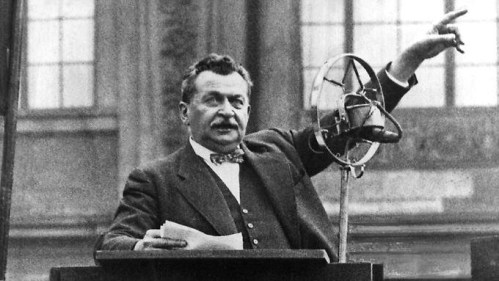
Otto Wels

Friends of Padre Steve’s World,

Today I am going to address something of critical importance today, even though it occurred over 87 years ago, which in the scope of history is not that long, despite the fact that the average American, regardless of their political beliefs and ideology are ignorant of past events, even those of just a few years ago. Thus, when one discusses events of 20, 40, 60, 80, or 100 years ago, one typically receives blank stares, or appeals to historical myths and fabrications that they learned in school, church, or from the media, both news and entertainment. As a historian it drives me crazy, our society, including our political, business, and media elites, has become a new generation of Know Nothings, of whom none other than the President and cult like followers supply some of the worst, but certainly not the only examples.

in 1932 the Communist Party of Germany KPD, refused to ally itself with the Social Democratic Party, SDP because they viewed the Socialists as sell-outs who refused to embrace a Soviet State in 1918 and 1919. At that time they called themselves Independent Socialists, but though a minority unleashed a left wing reign of terror that pushed German Conservatives further to the extreme right, and left the Social Democrats working with the German Army to try to hold the center. In the end, it was the extreme right that finally won a thirteen year struggle to overthrow the Weimar Republic, and after abortive coup attempts, including the Kapp Putsch in Berlin, which was crushed by a nationwide strike of labor groups, and the Nazi led Bier Hall Putsch, which was crushed due to the duplicity of Hitler’s coerced allies, and the refusal of Munich’s police to withdraw in the face of the Nazi advance at Odeonsplatz.

However, the Nazis learned from their failures at violent revolution, and instead, despite being outlawed for a number of years, worked within the democratic model to slowly gain regional, and eventually a national following. By 1932 the Nazi Party, as well as the KPD were at the height of their support. The traditional conservative German right was divided and its leaders thought they could control the Nazi movement. The left was divided between the moderate SPD and the militant KPD. An alliance of the two left parties in 1932 and 1933 would have created a parliamentary majority and stopped the Nazi movement in its tracks, but the KPD, which had split from the SPD in 1919 hated the SPD more than they did the Nazis, even though the Nazis were an existential threat to the German left. 

As a historian I think that this is one of the of the most relevant examples as the United States and other democratic nations lurch toward legally elected right wing authoritarian governments.

A few months after he gained power, Hitler’s Nazi majority Reichstag passed the Enabling Act, or by its full title Gesetz zur Behebung der Not von Volk und Reich (“Law to Remedy the Distress of People and Reich”). The came on the heels of the Reichstag Fire Decree and had tremendous repercussions for the German Republic and in effect made Hitler and his administration a dictatorship. The legislative branch, the Reichstag was limited to nothing more than a rubber stamp for the executive, as was the judicial branch, the Reichsrat. It supposedly protected the rights of the President, the Reichstag, and judiciary, but it made Hitler the the sole decider of domestic and social laws, as well as all foreign policy decisions.

The law stated:

The Reichstag has enacted the following law, which is hereby proclaimed with the assent of the Reichsrat, it having been established that the requirements for a constitutional amendment have been fulfilled:

Article One

In addition to the procedure prescribed by the constitution, laws of the Reich may also be enacted by the government of the Reich. This includes the laws referred to by Articles 85 Paragraph 2 and Article 87 of the constitution. (Article 85 and 87 dealt with the budgetary process and allocation of funds for advertisement.)

Article Two

Laws enacted by the government of the Reich may deviate from the constitution as long as they do not affect the institutions of the Reichstag and the Reichsrat. The rights of the President remain unaffected.

Article Three:

Laws enacted by the Reich government shall be issued by the Chancellor and announced in the Reich Gazette. They shall take effect on the day following the announcement, unless they prescribe a different date. Articles 68 to 77 of the Constitution do not apply to laws enacted by the Reich government. (These Articles dealt with the legislative process in which the Reichstag, Government, Reichsrat, and President all had specific responsibilities which limited the power of the government to rush laws into force without due process and deliberation, and if needed the approval of the electorate)

Article Four

Treaties of the Reich with foreign states, which relate to matters of Reich legislation, shall for the duration of the validity of these laws not require the consent of the legislative authorities. The Reich government shall enact the legislation necessary to implement these agreements. (This removed the requirement of the Reichstag to approve treaties)

Article Five

This law enters into force on the day of its proclamation. It expires on April 1, 1937; it expires furthermore if the present Reich government is replaced by another.

When the legislation was introduced the debate was muted. While the Communist Party was yet to be banned, deputies of the Communist Party could not attend the session, many had already been arrested and many more were in hiding or had fled the country. Hermann Goering adjusted the rules for a quorum in order to compensate for the lack of members in attendance. Deputies of the Social Democratic Party were also terrorized, hounded, and some arrested, but 94 attended, outnumbered they did not buckle under the Nazi threats, which included the chamber being ringed by armed members of the SA and SS.

The non-Nazi Protestant based conservative parties provided no resistance, but the Catholic Center Party was torn by concerns that the legislation could limit the rights of the Catholic Church. However, they had been outmaneuvered by Hitler who had already negotiated a Concordant with the Vatican. The result was to ensure that the Catholic Center Party would vote for the measure, which passed with a mere 94 deputies opposing it, all members of the Social Democratic Party.

The only member of the Reichstag to speak against the measure was the head of the Social Democrats, Otto Wels. In defiance of Hitler, Goering, the Nazi Deputies, and the threatening SA and SS men uttered words that every resistor in every country threatened by authoritarian leaders who despise the rule of law and the Constitutions that they used to gain power need to hear and proclaim, because the truth can never be silenced:

“You can take our lives and our freedom, but you cannot take our honour. We are defenseless but not honourless.”

Shortly after the Enabling Act, every non-Nazi Conservative party voluntarily dissolved, their organizations, youth, and veterans organizations being absorbed into the SA or Hitlerjugend. Many rank and file KPD members readily embraced the Nazis, even if their leaders were killed, jailed, or exiled. That was not the case with the SPD. Because of their stance and the courage of Otto Wels, they became the most hated and persecuted German political parties.

Otto Wels died as an exile in France. Many Social Democrats were placed in Concentration Camps and died, likewise some Communists. The Catholic Center Party would find itself betrayed, and many of its leaders would be killed, jailed, or placed in Concentration Camps, and Hitler would persecute opposition members of the Catholic Church as if no Concordat had ever been negotiated. A few members of the Protestant conservative parties, would join the German resistance, and some would be jailed, placed in Concentration Camps, or after the failed Military Coup of July 20th 1944, would be executed for their resistance, but they were a distinct minority, and few had any misgivings as long as it looked like Germany would win the war.

But eventually the Nazis would be driven from power. Their descendants today, whether in Germany, the United States, or other countries must be confronted at all costs. Democracy, and the American Constitutional Democracy, based on the principles of the Declaration of Independence, which recognizes that all men are created equal, and the Constitution of the United States which was the first to checks and balances between the Executive, Legislative, and Judicial branches of government, must be upheld. The Executive Branch, cannot, regardless of which party is in power be allowed to overthrow that democracy.

We have reached a point in the history of the United States where the Executive Branch, over a period of decades has assumed the powers of dictatorship as the Legislative branch over the corresponding time has surrendered its prerogatives and powers, while the judicial branch had become the domain of politically appointed judges and justices. Donald Trump and the GOP Senate Majority Leader, Mitch McConnell, have been the leaders of that, but should by some chance Bernie win, I have no doubt that some of his supporters secure his power by similar means. Yesterday, the President declared himself to be the Chief Law Enforcement Official in the country, in effect above all law. The Founders attempted to ensure that would not happen by placing Congress above the Executive Branch in the Constitution, but they assumed that no Chief Executive would do such a thing.

One does not know what will happen next, especially after the Senate acquitted the President in his impeachment trial, and the President’s subsequent retribution on those whose did not support him completely, or obeyed their oaths of office.

However, it is my opinion, that anyone who truly values the primary principles of the Declaration and the Constitution, and not just be a compliant tool of any political leader, must ne willing to take a stand; like the one Otto Wels made when confronted with a dictatorship in the making. Even if the President unleashes the power of the police and his own heavily armed supporters against opponents, we must remember like Otto Wels, they can “take our lives and freedom, but they cannot take our honor…”

This is something that anyone committed to the principles of the Declaration and Constitution must take seriously over the next eight and a half months leading to the next Presidential election. If we fail, the effects will be felt for at least a generation, and the institutions of our government will be transformed in ways that the founders could only imagine in their worst dreams.

Democrats and Never Trump conservatives must keep this in mind. Nothing is guaranteed right now, it is quite possible that Trump and his cult like supporters in Congress, before the election, or if he is re-elected, with their now majority in the courts could enact something like the Enabling Act if we are not careful. We must be careful to watch for the major terrorist attack, or war that could lead to the implementation of already legislated laws, such as the Patriot Act, or executive orders that give near dictatorial powers to the executive, and which would, if they occurred, be supported by a majority of Americans.

Historian Timothy Snyder wrote:

”The mistake is to assume that rulers who came to power through institutions cannot change or destroy those very institutions—even when that is exactly what they have announced that they will do.”

Trump has said he would do that and his supporters are committed to what he says, but until now most Americans have refused to believe him, and them. Sadly, most still don’t. After all, once one ceases to resist what more is there to do, just go to the Cabaret.

As Joel Gray, the Master of Ceremonies in the musical and film Cabartet sang:

Where are your troubles now?
Forgotten? I told you so!
We have no troubles here
Here, life is beautiful.
The girls are beautiful.
Even the orchestra is beautiful.

Yes, ignore everything and immerse yourself in our entertainment and sports culture, as if nothing else matters. What does freedom matter if you have no troubles?

So until tomorrow.

Peace,

Padre Steve+

2 Comments

Filed under ethics, film, germany, History, labor, laws and legislation, leadership, movies, nazi germany, News and current events, Political Commentary, racism, terrorism, US Presidents

Justice Delayed is Justice Denied: Dr. Martin Luther King Jr’s Letter From A Birmingham Jail in the Age of Trump

primary-source-mlk-birmingham-jail-497fe198

Friends of Padre Steve’s World,

Recently I posted an article that mentioned Dr. Martin Luther King Jr.’s Letter from a Birmingham Jail. 

I included the link to the letter in my article, but I realize that most people, unlike me we not follow a link to get to the original source of the information supplied.

For those that don’t understand, my position as a Priest, if I am actually to be faithful to my vows requires that I be faithful to the Gospel. Sometimes that vow requires stating things that some in denial of their own faith would condemn as partisan politics. But this is not partisan, it echoes both the Christian and American propositions that all men are created equal.

With that in mind here is the full text of King’s letter. It is worthy of your full consideration and contemplation, and for that reason I make no editorial comments, although last year I did find Vice President Mike Pence’s comparison of President Trump to Dr. King abhorrent, insulting, and damnable.

On Monday the 20th of January, we as a nation remembered Dr. King. Many politicians offered their laudatory, yet hollow words of praise for a man whose legacy they work to destroy through legislation at the local, state, and federal level. Such words, especially when they come from men and women who beat their chest and pray loudly in the public square to demonstrate their Christian Faith, is damnable.

Likewise, it matters as we watch leaders of the Senate surrender to Donald Trump in his impeachment trial and see the Chief Justice of the Supreme Court ist silently as his legal team commits outright perjury, saying nothing and doing nothing. The question now is, will the nation founded on the bedrock of the Declaration of Independence, and the rule of law of the Constitution, including the Thirteenth, Fourteenth, Fifteenth, and Nineteenth Amendments as well as the Voting Rights Act of 1964, the Civil Rights Act of 1965, and every law increasing the rights of ordinary citizens, racial and religious minorities, women, and LGBTQ people, survive the Trump Presidency?

To make matters even more dangerous, thousands of alleged “Second Amendment” activists, many heavily armed with military grade assault weapons, massive amounts of ammunition, and wearing military and police grade protective gear marched protesting relatively minor changes to Virginia’s gun rights laws. Many of their words were aimed at threatening their opponents, and included in the mob of self proclaimed militiamen, were members of White Supremacy groups, including the KKK, Neo-Confederates, and Neo-Nazis. Since Dr. King was gunned down in cold blood by a White Supremacist, James Earl Ray, the participation of those groups in the march causes me to wonder why they stole a day commemorating an ambassador of peace, with their need for massive amounts of firearms. Debate still swirls around the contention that Ray had assistance from others, including people in the Federal Government, but I don’t consider myself knowledgeable to comment reliably on that.

Thus, it is fitting to read Dr. King’s unedited words from a letter from a Birmingham jail. Sadly, they are as applicable today as when he penned them. I can only hope, and pray that we survive all of this.

Peace,

Padre Steve+

16 April 1963

My Dear Fellow Clergymen:

While confined here in the Birmingham city jail, I came across your recent statement calling my present activities “unwise and untimely.” Seldom do I pause to answer criticism of my work and ideas. If I sought to answer all the criticisms that cross my desk, my secretaries would have little time for anything other than such correspondence in the course of the day, and I would have no time for constructive work. But since I feel that you are men of genuine good will and that your criticisms are sincerely set forth, I want to try to answer your statement in what I hope will be patient and reasonable terms.

I think I should indicate why I am here in Birmingham, since you have been influenced by the view which argues against “outsiders coming in.” I have the honor of serving as president of the Southern Christian Leadership Conference, an organization operating in every southern state, with headquarters in Atlanta, Georgia. We have some eighty five affiliated organizations across the South, and one of them is the Alabama Christian Movement for Human Rights. Frequently we share staff, educational and financial resources with our affiliates. Several months ago the affiliate here in Birmingham asked us to be on call to engage in a nonviolent direct action program if such were deemed necessary. We readily consented, and when the hour came we lived up to our promise. So I, along with several members of my staff, am here because I was invited here. I am here because I have organizational ties here.

But more basically, I am in Birmingham because injustice is here. Just as the prophets of the eighth century B.C. left their villages and carried their “thus saith the Lord” far beyond the boundaries of their home towns, and just as the Apostle Paul left his village of Tarsus and carried the gospel of Jesus Christ to the far corners of the Greco Roman world, so am I compelled to carry the gospel of freedom beyond my own home town. Like Paul, I must constantly respond to the Macedonian call for aid.

Moreover, I am cognizant of the interrelatedness of all communities and states. I cannot sit idly by in Atlanta and not be concerned about what happens in Birmingham. Injustice anywhere is a threat to justice everywhere. We are caught in an inescapable network of mutuality, tied in a single garment of destiny. Whatever affects one directly, affects all indirectly. Never again can we afford to live with the narrow, provincial “outside agitator” idea. Anyone who lives inside the United States can never be considered an outsider anywhere within its bounds.

You deplore the demonstrations taking place in Birmingham. But your statement, I am sorry to say, fails to express a similar concern for the conditions that brought about the demonstrations. I am sure that none of you would want to rest content with the superficial kind of social analysis that deals merely with effects and does not grapple with underlying causes. It is unfortunate that demonstrations are taking place in Birmingham, but it is even more unfortunate that the city’s white power structure left the Negro community with no alternative.

In any nonviolent campaign there are four basic steps: collection of the facts to determine whether injustices exist; negotiation; self purification; and direct action. We have gone through all these steps in Birmingham. There can be no gainsaying the fact that racial injustice engulfs this community. Birmingham is probably the most thoroughly segregated city in the United States. Its ugly record of brutality is widely known. Negroes have experienced grossly unjust treatment in the courts. There have been more unsolved bombings of Negro homes and churches in Birmingham than in any other city in the nation. These are the hard, brutal facts of the case. On the basis of these conditions, Negro leaders sought to negotiate with the city fathers. But the latter consistently refused to engage in good faith negotiation.

Then, last September, came the opportunity to talk with leaders of Birmingham’s economic community. In the course of the negotiations, certain promises were made by the merchants–for example, to remove the stores’ humiliating racial signs. On the basis of these promises, the Reverend Fred Shuttlesworth and the leaders of the Alabama Christian Movement for Human Rights agreed to a moratorium on all demonstrations. As the weeks and months went by, we realized that we were the victims of a broken promise. A few signs, briefly removed, returned; the others remained. As in so many past experiences, our hopes had been blasted, and the shadow of deep disappointment settled upon us. We had no alternative except to prepare for direct action, whereby we would present our very bodies as a means of laying our case before the conscience of the local and the national community. Mindful of the difficulties involved, we decided to undertake a process of self purification. We began a series of workshops on nonviolence, and we repeatedly asked ourselves: “Are you able to accept blows without retaliating?” “Are you able to endure the ordeal of jail?” We decided to schedule our direct action program for the Easter season, realizing that except for Christmas, this is the main shopping period of the year. Knowing that a strong economic-withdrawal program would be the by product of direct action, we felt that this would be the best time to bring pressure to bear on the merchants for the needed change.

Then it occurred to us that Birmingham’s mayoral election was coming up in March, and we speedily decided to postpone action until after election day. When we discovered that the Commissioner of Public Safety, Eugene “Bull” Connor, had piled up enough votes to be in the run off, we decided again to postpone action until the day after the run off so that the demonstrations could not be used to cloud the issues. Like many others, we waited to see Mr. Connor defeated, and to this end we endured postponement after postponement. Having aided in this community need, we felt that our direct action program could be delayed no longer.

You may well ask: “Why direct action? Why sit ins, marches and so forth? Isn’t negotiation a better path?” You are quite right in calling for negotiation. Indeed, this is the very purpose of direct action. Nonviolent direct action seeks to create such a crisis and foster such a tension that a community which has constantly refused to negotiate is forced to confront the issue. It seeks so to dramatize the issue that it can no longer be ignored. My citing the creation of tension as part of the work of the nonviolent resister may sound rather shocking. But I must confess that I am not afraid of the word “tension.” I have earnestly opposed violent tension, but there is a type of constructive, nonviolent tension which is necessary for growth. Just as Socrates felt that it was necessary to create a tension in the mind so that individuals could rise from the bondage of myths and half truths to the unfettered realm of creative analysis and objective appraisal, so must we see the need for nonviolent gadflies to create the kind of tension in society that will help men rise from the dark depths of prejudice and racism to the majestic heights of understanding and brotherhood. The purpose of our direct action program is to create a situation so crisis packed that it will inevitably open the door to negotiation. I therefore concur with you in your call for negotiation. Too long has our beloved Southland been bogged down in a tragic effort to live in monologue rather than dialogue.

One of the basic points in your statement is that the action that I and my associates have taken in Birmingham is untimely. Some have asked: “Why didn’t you give the new city administration time to act?” The only answer that I can give to this query is that the new Birmingham administration must be prodded about as much as the outgoing one, before it will act. We are sadly mistaken if we feel that the election of Albert Boutwell as mayor will bring the millennium to Birmingham. While Mr. Boutwell is a much more gentle person than Mr. Connor, they are both segregationists, dedicated to maintenance of the status quo. I have hope that Mr. Boutwell will be reasonable enough to see the futility of massive resistance to desegregation. But he will not see this without pressure from devotees of civil rights. My friends, I must say to you that we have not made a single gain in civil rights without determined legal and nonviolent pressure. Lamentably, it is an historical fact that privileged groups seldom give up their privileges voluntarily. Individuals may see the moral light and voluntarily give up their unjust posture; but, as Reinhold Niebuhr has reminded us, groups tend to be more immoral than individuals.

We know through painful experience that freedom is never voluntarily given by the oppressor; it must be demanded by the oppressed. Frankly, I have yet to engage in a direct action campaign that was “well timed” in the view of those who have not suffered unduly from the disease of segregation. For years now I have heard the word “Wait!” It rings in the ear of every Negro with piercing familiarity. This “Wait” has almost always meant “Never.” We must come to see, with one of our distinguished jurists, that “justice too long delayed is justice denied.”

We have waited for more than 340 years for our constitutional and God given rights. The nations of Asia and Africa are moving with jetlike speed toward gaining political independence, but we still creep at horse and buggy pace toward gaining a cup of coffee at a lunch counter. Perhaps it is easy for those who have never felt the stinging darts of segregation to say, “Wait.” But when you have seen vicious mobs lynch your mothers and fathers at will and drown your sisters and brothers at whim; when you have seen hate filled policemen curse, kick and even kill your black brothers and sisters; when you see the vast majority of your twenty million Negro brothers smothering in an airtight cage of poverty in the midst of an affluent society; when you suddenly find your tongue twisted and your speech stammering as you seek to explain to your six year old daughter why she can’t go to the public amusement park that has just been advertised on television, and see tears welling up in her eyes when she is told that Funtown is closed to colored children, and see ominous clouds of inferiority beginning to form in her little mental sky, and see her beginning to distort her personality by developing an unconscious bitterness toward white people; when you have to concoct an answer for a five year old son who is asking: “Daddy, why do white people treat colored people so mean?”; when you take a cross county drive and find it necessary to sleep night after night in the uncomfortable corners of your automobile because no motel will accept you; when you are humiliated day in and day out by nagging signs reading “white” and “colored”; when your first name becomes “nigger,” your middle name becomes “boy” (however old you are) and your last name becomes “John,” and your wife and mother are never given the respected title “Mrs.”; when you are harried by day and haunted by night by the fact that you are a Negro, living constantly at tiptoe stance, never quite knowing what to expect next, and are plagued with inner fears and outer resentments; when you are forever fighting a degenerating sense of “nobodiness”–then you will understand why we find it difficult to wait. There comes a time when the cup of endurance runs over, and men are no longer willing to be plunged into the abyss of despair. I hope, sirs, you can understand our legitimate and unavoidable impatience. You express a great deal of anxiety over our willingness to break laws. This is certainly a legitimate concern. Since we so diligently urge people to obey the Supreme Court’s decision of 1954 outlawing segregation in the public schools, at first glance it may seem rather paradoxical for us consciously to break laws. One may well ask: “How can you advocate breaking some laws and obeying others?” The answer lies in the fact that there are two types of laws: just and unjust. I would be the first to advocate obeying just laws. One has not only a legal but a moral responsibility to obey just laws. Conversely, one has a moral responsibility to disobey unjust laws. I would agree with St. Augustine that “an unjust law is no law at all.”

Now, what is the difference between the two? How does one determine whether a law is just or unjust? A just law is a man made code that squares with the moral law or the law of God. An unjust law is a code that is out of harmony with the moral law. To put it in the terms of St. Thomas Aquinas: An unjust law is a human law that is not rooted in eternal law and natural law. Any law that uplifts human personality is just. Any law that degrades human personality is unjust. All segregation statutes are unjust because segregation distorts the soul and damages the personality. It gives the segregator a false sense of superiority and the segregated a false sense of inferiority. Segregation, to use the terminology of the Jewish philosopher Martin Buber, substitutes an “I it” relationship for an “I thou” relationship and ends up relegating persons to the status of things. Hence segregation is not only politically, economically and sociologically unsound, it is morally wrong and sinful. Paul Tillich has said that sin is separation. Is not segregation an existential expression of man’s tragic separation, his awful estrangement, his terrible sinfulness? Thus it is that I can urge men to obey the 1954 decision of the Supreme Court, for it is morally right; and I can urge them to disobey segregation ordinances, for they are morally wrong.

Let us consider a more concrete example of just and unjust laws. An unjust law is a code that a numerical or power majority group compels a minority group to obey but does not make binding on itself. This is difference made legal. By the same token, a just law is a code that a majority compels a minority to follow and that it is willing to follow itself. This is sameness made legal. Let me give another explanation. A law is unjust if it is inflicted on a minority that, as a result of being denied the right to vote, had no part in enacting or devising the law. Who can say that the legislature of Alabama which set up that state’s segregation laws was democratically elected? Throughout Alabama all sorts of devious methods are used to prevent Negroes from becoming registered voters, and there are some counties in which, even though Negroes constitute a majority of the population, not a single Negro is registered. Can any law enacted under such circumstances be considered democratically structured?

Sometimes a law is just on its face and unjust in its application. For instance, I have been arrested on a charge of parading without a permit. Now, there is nothing wrong in having an ordinance which requires a permit for a parade. But such an ordinance becomes unjust when it is used to maintain segregation and to deny citizens the First-Amendment privilege of peaceful assembly and protest.

I hope you are able to see the distinction I am trying to point out. In no sense do I advocate evading or defying the law, as would the rabid segregationist. That would lead to anarchy. One who breaks an unjust law must do so openly, lovingly, and with a willingness to accept the penalty. I submit that an individual who breaks a law that conscience tells him is unjust, and who willingly accepts the penalty of imprisonment in order to arouse the conscience of the community over its injustice, is in reality expressing the highest respect for law.

Of course, there is nothing new about this kind of civil disobedience. It was evidenced sublimely in the refusal of Shadrach, Meshach and Abednego to obey the laws of Nebuchadnezzar, on the ground that a higher moral law was at stake. It was practiced superbly by the early Christians, who were willing to face hungry lions and the excruciating pain of chopping blocks rather than submit to certain unjust laws of the Roman Empire. To a degree, academic freedom is a reality today because Socrates practiced civil disobedience. In our own nation, the Boston Tea Party represented a massive act of civil disobedience.

We should never forget that everything Adolf Hitler did in Germany was “legal” and everything the Hungarian freedom fighters did in Hungary was “illegal.” It was “illegal” to aid and comfort a Jew in Hitler’s Germany. Even so, I am sure that, had I lived in Germany at the time, I would have aided and comforted my Jewish brothers. If today I lived in a Communist country where certain principles dear to the Christian faith are suppressed, I would openly advocate disobeying that country’s antireligious laws.

I must make two honest confessions to you, my Christian and Jewish brothers. First, I must confess that over the past few years I have been gravely disappointed with the white moderate. I have almost reached the regrettable conclusion that the Negro’s great stumbling block in his stride toward freedom is not the White Citizen’s Counciler or the Ku Klux Klanner, but the white moderate, who is more devoted to “order” than to justice; who prefers a negative peace which is the absence of tension to a positive peace which is the presence of justice; who constantly says: “I agree with you in the goal you seek, but I cannot agree with your methods of direct action”; who paternalistically believes he can set the timetable for another man’s freedom; who lives by a mythical concept of time and who constantly advises the Negro to wait for a “more convenient season.” Shallow understanding from people of good will is more frustrating than absolute misunderstanding from people of ill will. Lukewarm acceptance is much more bewildering than outright rejection.

I had hoped that the white moderate would understand that law and order exist for the purpose of establishing justice and that when they fail in this purpose they become the dangerously structured dams that block the flow of social progress. I had hoped that the white moderate would understand that the present tension in the South is a necessary phase of the transition from an obnoxious negative peace, in which the Negro passively accepted his unjust plight, to a substantive and positive peace, in which all men will respect the dignity and worth of human personality. Actually, we who engage in nonviolent direct action are not the creators of tension. We merely bring to the surface the hidden tension that is already alive. We bring it out in the open, where it can be seen and dealt with. Like a boil that can never be cured so long as it is covered up but must be opened with all its ugliness to the natural medicines of air and light, injustice must be exposed, with all the tension its exposure creates, to the light of human conscience and the air of national opinion before it can be cured.

In your statement you assert that our actions, even though peaceful, must be condemned because they precipitate violence. But is this a logical assertion? Isn’t this like condemning a robbed man because his possession of money precipitated the evil act of robbery? Isn’t this like condemning Socrates because his unswerving commitment to truth and his philosophical inquiries precipitated the act by the misguided populace in which they made him drink hemlock? Isn’t this like condemning Jesus because his unique God consciousness and never ceasing devotion to God’s will precipitated the evil act of crucifixion? We must come to see that, as the federal courts have consistently affirmed, it is wrong to urge an individual to cease his efforts to gain his basic constitutional rights because the quest may precipitate violence. Society must protect the robbed and punish the robber. I had also hoped that the white moderate would reject the myth concerning time in relation to the struggle for freedom. I have just received a letter from a white brother in Texas. He writes: “All Christians know that the colored people will receive equal rights eventually, but it is possible that you are in too great a religious hurry. It has taken Christianity almost two thousand years to accomplish what it has. The teachings of Christ take time to come to earth.” Such an attitude stems from a tragic misconception of time, from the strangely irrational notion that there is something in the very flow of time that will inevitably cure all ills. Actually, time itself is neutral; it can be used either destructively or constructively. More and more I feel that the people of ill will have used time much more effectively than have the people of good will. We will have to repent in this generation not merely for the hateful words and actions of the bad people but for the appalling silence of the good people. Human progress never rolls in on wheels of inevitability; it comes through the tireless efforts of men willing to be co workers with God, and without this hard work, time itself becomes an ally of the forces of social stagnation. We must use time creatively, in the knowledge that the time is always ripe to do right. Now is the time to make real the promise of democracy and transform our pending national elegy into a creative psalm of brotherhood. Now is the time to lift our national policy from the quicksand of racial injustice to the solid rock of human dignity.

You speak of our activity in Birmingham as extreme. At first I was rather disappointed that fellow clergymen would see my nonviolent efforts as those of an extremist. I began thinking about the fact that I stand in the middle of two opposing forces in the Negro community. One is a force of complacency, made up in part of Negroes who, as a result of long years of oppression, are so drained of self respect and a sense of “somebodiness” that they have adjusted to segregation; and in part of a few middle-class Negroes who, because of a degree of academic and economic security and because in some ways they profit by segregation, have become insensitive to the problems of the masses. The other force is one of bitterness and hatred, and it comes perilously close to advocating violence. It is expressed in the various black nationalist groups that are springing up across the nation, the largest and best known being Elijah Muhammad’s Muslim movement. Nourished by the Negro’s frustration over the continued existence of racial discrimination, this movement is made up of people who have lost faith in America, who have absolutely repudiated Christianity, and who have concluded that the white man is an incorrigible “devil.”

I have tried to stand between these two forces, saying that we need emulate neither the “do nothingism” of the complacent nor the hatred and despair of the black nationalist. For there is the more excellent way of love and nonviolent protest. I am grateful to God that, through the influence of the Negro church, the way of nonviolence became an integral part of our struggle. If this philosophy had not emerged, by now many streets of the South would, I am convinced, be flowing with blood. And I am further convinced that if our white brothers dismiss as “rabble rousers” and “outside agitators” those of us who employ nonviolent direct action, and if they refuse to support our nonviolent efforts, millions of Negroes will, out of frustration and despair, seek solace and security in black nationalist ideologies–a development that would inevitably lead to a frightening racial nightmare.

Oppressed people cannot remain oppressed forever. The yearning for freedom eventually manifests itself, and that is what has happened to the American Negro. Something within has reminded him of his birthright of freedom, and something without has reminded him that it can be gained. Consciously or unconsciously, he has been caught up by the Zeitgeist, and with his black brothers of Africa and his brown and yellow brothers of Asia, South America and the Caribbean, the United States Negro is moving with a sense of great urgency toward the promised land of racial justice. If one recognizes this vital urge that has engulfed the Negro community, one should readily understand why public demonstrations are taking place. The Negro has many pent up resentments and latent frustrations, and he must release them. So let him march; let him make prayer pilgrimages to the city hall; let him go on freedom rides -and try to understand why he must do so. If his repressed emotions are not released in nonviolent ways, they will seek expression through violence; this is not a threat but a fact of history. So I have not said to my people: “Get rid of your discontent.” Rather, I have tried to say that this normal and healthy discontent can be channeled into the creative outlet of nonviolent direct action. And now this approach is being termed extremist. But though I was initially disappointed at being categorized as an extremist, as I continued to think about the matter I gradually gained a measure of satisfaction from the label. Was not Jesus an extremist for love: “Love your enemies, bless them that curse you, do good to them that hate you, and pray for them which despitefully use you, and persecute you.” Was not Amos an extremist for justice: “Let justice roll down like waters and righteousness like an ever flowing stream.” Was not Paul an extremist for the Christian gospel: “I bear in my body the marks of the Lord Jesus.” Was not Martin Luther an extremist: “Here I stand; I cannot do otherwise, so help me God.” And John Bunyan: “I will stay in jail to the end of my days before I make a butchery of my conscience.” And Abraham Lincoln: “This nation cannot survive half slave and half free.” And Thomas Jefferson: “We hold these truths to be self evident, that all men are created equal . . .” So the question is not whether we will be extremists, but what kind of extremists we will be. Will we be extremists for hate or for love? Will we be extremists for the preservation of injustice or for the extension of justice? In that dramatic scene on Calvary’s hill three men were crucified. We must never forget that all three were crucified for the same crime–the crime of extremism. Two were extremists for immorality, and thus fell below their environment. The other, Jesus Christ, was an extremist for love, truth and goodness, and thereby rose above his environment. Perhaps the South, the nation and the world are in dire need of creative extremists.

I had hoped that the white moderate would see this need. Perhaps I was too optimistic; perhaps I expected too much. I suppose I should have realized that few members of the oppressor race can understand the deep groans and passionate yearnings of the oppressed race, and still fewer have the vision to see that injustice must be rooted out by strong, persistent and determined action. I am thankful, however, that some of our white brothers in the South have grasped the meaning of this social revolution and committed themselves to it. They are still all too few in quantity, but they are big in quality. Some -such as Ralph McGill, Lillian Smith, Harry Golden, James McBride Dabbs, Ann Braden and Sarah Patton Boyle–have written about our struggle in eloquent and prophetic terms. Others have marched with us down nameless streets of the South. They have languished in filthy, roach infested jails, suffering the abuse and brutality of policemen who view them as “dirty nigger-lovers.” Unlike so many of their moderate brothers and sisters, they have recognized the urgency of the moment and sensed the need for powerful “action” antidotes to combat the disease of segregation. Let me take note of my other major disappointment. I have been so greatly disappointed with the white church and its leadership. Of course, there are some notable exceptions. I am not unmindful of the fact that each of you has taken some significant stands on this issue. I commend you, Reverend Stallings, for your Christian stand on this past Sunday, in welcoming Negroes to your worship service on a nonsegregated basis. I commend the Catholic leaders of this state for integrating Spring Hill College several years ago.

But despite these notable exceptions, I must honestly reiterate that I have been disappointed with the church. I do not say this as one of those negative critics who can always find something wrong with the church. I say this as a minister of the gospel, who loves the church; who was nurtured in its bosom; who has been sustained by its spiritual blessings and who will remain true to it as long as the cord of life shall lengthen.

When I was suddenly catapulted into the leadership of the bus protest in Montgomery, Alabama, a few years ago, I felt we would be supported by the white church. I felt that the white ministers, priests and rabbis of the South would be among our strongest allies. Instead, some have been outright opponents, refusing to understand the freedom movement and misrepresenting its leaders; all too many others have been more cautious than courageous and have remained silent behind the anesthetizing security of stained glass windows.

In spite of my shattered dreams, I came to Birmingham with the hope that the white religious leadership of this community would see the justice of our cause and, with deep moral concern, would serve as the channel through which our just grievances could reach the power structure. I had hoped that each of you would understand. But again I have been disappointed.

I have heard numerous southern religious leaders admonish their worshipers to comply with a desegregation decision because it is the law, but I have longed to hear white ministers declare: “Follow this decree because integration is morally right and because the Negro is your brother.” In the midst of blatant injustices inflicted upon the Negro, I have watched white churchmen stand on the sideline and mouth pious irrelevancies and sanctimonious trivialities. In the midst of a mighty struggle to rid our nation of racial and economic injustice, I have heard many ministers say: “Those are social issues, with which the gospel has no real concern.” And I have watched many churches commit themselves to a completely other worldly religion which makes a strange, un-Biblical distinction between body and soul, between the sacred and the secular.

I have traveled the length and breadth of Alabama, Mississippi and all the other southern states. On sweltering summer days and crisp autumn mornings I have looked at the South’s beautiful churches with their lofty spires pointing heavenward. I have beheld the impressive outlines of her massive religious education buildings. Over and over I have found myself asking: “What kind of people worship here? Who is their God? Where were their voices when the lips of Governor Barnett dripped with words of interposition and nullification? Where were they when Governor Wallace gave a clarion call for defiance and hatred? Where were their voices of support when bruised and weary Negro men and women decided to rise from the dark dungeons of complacency to the bright hills of creative protest?”

Yes, these questions are still in my mind. In deep disappointment I have wept over the laxity of the church. But be assured that my tears have been tears of love. There can be no deep disappointment where there is not deep love. Yes, I love the church. How could I do otherwise? I am in the rather unique position of being the son, the grandson and the great grandson of preachers. Yes, I see the church as the body of Christ. But, oh! How we have blemished and scarred that body through social neglect and through fear of being nonconformists.

There was a time when the church was very powerful–in the time when the early Christians rejoiced at being deemed worthy to suffer for what they believed. In those days the church was not merely a thermometer that recorded the ideas and principles of popular opinion; it was a thermostat that transformed the mores of society. Whenever the early Christians entered a town, the people in power became disturbed and immediately sought to convict the Christians for being “disturbers of the peace” and “outside agitators.”‘ But the Christians pressed on, in the conviction that they were “a colony of heaven,” called to obey God rather than man. Small in number, they were big in commitment. They were too God-intoxicated to be “astronomically intimidated.” By their effort and example they brought an end to such ancient evils as infanticide and gladiatorial contests. Things are different now. So often the contemporary church is a weak, ineffectual voice with an uncertain sound. So often it is an archdefender of the status quo. Far from being disturbed by the presence of the church, the power structure of the average community is consoled by the church’s silent–and often even vocal–sanction of things as they are.

But the judgment of God is upon the church as never before. If today’s church does not recapture the sacrificial spirit of the early church, it will lose its authenticity, forfeit the loyalty of millions, and be dismissed as an irrelevant social club with no meaning for the twentieth century. Every day I meet young people whose disappointment with the church has turned into outright disgust.

Perhaps I have once again been too optimistic. Is organized religion too inextricably bound to the status quo to save our nation and the world? Perhaps I must turn my faith to the inner spiritual church, the church within the church, as the true ekklesia and the hope of the world. But again I am thankful to God that some noble souls from the ranks of organized religion have broken loose from the paralyzing chains of conformity and joined us as active partners in the struggle for freedom. They have left their secure congregations and walked the streets of Albany, Georgia, with us. They have gone down the highways of the South on tortuous rides for freedom. Yes, they have gone to jail with us. Some have been dismissed from their churches, have lost the support of their bishops and fellow ministers. But they have acted in the faith that right defeated is stronger than evil triumphant. Their witness has been the spiritual salt that has preserved the true meaning of the gospel in these troubled times. They have carved a tunnel of hope through the dark mountain of disappointment. I hope the church as a whole will meet the challenge of this decisive hour. But even if the church does not come to the aid of justice, I have no despair about the future. I have no fear about the outcome of our struggle in Birmingham, even if our motives are at present misunderstood. We will reach the goal of freedom in Birmingham and all over the nation, because the goal of America is freedom. Abused and scorned though we may be, our destiny is tied up with America’s destiny. Before the pilgrims landed at Plymouth, we were here. Before the pen of Jefferson etched the majestic words of the Declaration of Independence across the pages of history, we were here. For more than two centuries our forebears labored in this country without wages; they made cotton king; they built the homes of their masters while suffering gross injustice and shameful humiliation -and yet out of a bottomless vitality they continued to thrive and develop. If the inexpressible cruelties of slavery could not stop us, the opposition we now face will surely fail. We will win our freedom because the sacred heritage of our nation and the eternal will of God are embodied in our echoing demands. Before closing I feel impelled to mention one other point in your statement that has troubled me profoundly. You warmly commended the Birmingham police force for keeping “order” and “preventing violence.” I doubt that you would have so warmly commended the police force if you had seen its dogs sinking their teeth into unarmed, nonviolent Negroes. I doubt that you would so quickly commend the policemen if you were to observe their ugly and inhumane treatment of Negroes here in the city jail; if you were to watch them push and curse old Negro women and young Negro girls; if you were to see them slap and kick old Negro men and young boys; if you were to observe them, as they did on two occasions, refuse to give us food because we wanted to sing our grace together. I cannot join you in your praise of the Birmingham police department.

It is true that the police have exercised a degree of discipline in handling the demonstrators. In this sense they have conducted themselves rather “nonviolently” in public. But for what purpose? To preserve the evil system of segregation. Over the past few years I have consistently preached that nonviolence demands that the means we use must be as pure as the ends we seek. I have tried to make clear that it is wrong to use immoral means to attain moral ends. But now I must affirm that it is just as wrong, or perhaps even more so, to use moral means to preserve immoral ends. Perhaps Mr. Connor and his policemen have been rather nonviolent in public, as was Chief Pritchett in Albany, Georgia, but they have used the moral means of nonviolence to maintain the immoral end of racial injustice. As T. S. Eliot has said: “The last temptation is the greatest treason: To do the right deed for the wrong reason.”

I wish you had commended the Negro sit inners and demonstrators of Birmingham for their sublime courage, their willingness to suffer and their amazing discipline in the midst of great provocation. One day the South will recognize its real heroes. They will be the James Merediths, with the noble sense of purpose that enables them to face jeering and hostile mobs, and with the agonizing loneliness that characterizes the life of the pioneer. They will be old, oppressed, battered Negro women, symbolized in a seventy two year old woman in Montgomery, Alabama, who rose up with a sense of dignity and with her people decided not to ride segregated buses, and who responded with ungrammatical profundity to one who inquired about her weariness: “My feets is tired, but my soul is at rest.” They will be the young high school and college students, the young ministers of the gospel and a host of their elders, courageously and nonviolently sitting in at lunch counters and willingly going to jail for conscience’ sake. One day the South will know that when these disinherited children of God sat down at lunch counters, they were in reality standing up for what is best in the American dream and for the most sacred values in our Judaeo Christian heritage, thereby bringing our nation back to those great wells of democracy which were dug deep by the founding fathers in their formulation of the Constitution and the Declaration of Independence.

Never before have I written so long a letter. I’m afraid it is much too long to take your precious time. I can assure you that it would have been much shorter if I had been writing from a comfortable desk, but what else can one do when he is alone in a narrow jail cell, other than write long letters, think long thoughts and pray long prayers?

If I have said anything in this letter that overstates the truth and indicates an unreasonable impatience, I beg you to forgive me. If I have said anything that understates the truth and indicates my having a patience that allows me to settle for anything less than brotherhood, I beg God to forgive me.

I hope this letter finds you strong in the faith. I also hope that circumstances will soon make it possible for me to meet each of you, not as an integrationist or a civil-rights leader but as a fellow clergyman and a Christian brother. Let us all hope that the dark clouds of racial prejudice will soon pass away and the deep fog of misunderstanding will be lifted from our fear drenched communities, and in some not too distant tomorrow the radiant stars of love and brotherhood will shine over our great nation with all their scintillating beauty.

Yours for the cause of Peace and Brotherhood, 

Martin Luther King, Jr.

Leave a comment

Filed under civil rights, ethics, faith, History, laws and legislation, leadership, Political Commentary, racism

“So the Old Life Slipped Away Never to Return Again.. .” The Coming Disorder of 2020


Friends of Padre Steve’s World,

It is not even Christmas and I am beginning to write about the coming year. This was provoked in part by a discussion I had with a dear friend, who also happens to be an Evangelical Christian Trump Cultist. I attempted to talk of basic middle of the road stuff and be honest about history, especially because I was a Republican for 32 years, until I returned from Iraq in 2008 and realized that we had been lied into a war that would have fit three of the four charges leveled against the Nazi War Criminals at Nuremberg.

But there was no convincing my friend of anything, even when attempting to bridge the divide using facts. To him Trump is the greatest President ever, and Obama, the worst. Of course I live in one of the “reddest” areas of Virginia and while I have quite a few liberal or progressive friends here, quite a few of the people who are also long time friends have transformed themselves from traditional conservatives who could be reasoned with to part of the Trump Cult. Such was the case with this person, every response he gave came straight from a Trump tweet, or something off of Fox News, or Rush Limbaugh. But I digress, my friend is not a bad person, he has

Abraham Lincoln noted:

“The best thing about the future is that it comes one day at a time.”

It is good to remember Lincoln’s words in times of turmoil. I do, and they bring me great motivation to work, believe, and fight for justice, truth, and the belief in a spark of goodness in humanity which enables me to believe the words of the Declaration of Independence:

“We hold these truths to be self-evident, that that all men are created equal, that they are endowed by their Creator with certain unalienable Rights, that among these are Life, Liberty and the pursuit of Happiness.”

The fact that those words come from a time of tumult, yet in a time where men were beginning to wrestle with and proclaim principles of the Enlightenment matters much to me, especially in times like we live today, where that principle is being attacked and undermined by the American President.

That being said, I believe that 2019 will be remembered in history as a time great turmoil, upheaval, and probably usher in a new epoch of war, economic, and ecological disaster. We are ending the year with the impeachment proceedings against President Trump, and threats of violence and civil war from his supporters if he is removed from office or loses the 2020 election.

I don’t want to sound like a pessimist, but as a historian I to look at the world through how human beings, governments, and businesses behave in times of crisis. In fact, human beings are the singular constant in history and in crisis human beings don’t always live up to our ideals.

When major powers and international systems of order break down, or collapse for whatever reason, instability, disorder, and primordial hatreds based on nationalism, religion, and racism rise. A vacuum is created, filled by other powers, but not without some element of travail. Edmond Taylor wrote in his classic “The Fall of the Dynasties: The Collapse of the Order, 1905-1922:

“The collapse of the great supranational — or at least supraparochial — authorities and the dissolution of long-accepted Imperial bonds released upon Europe a fearsome flood of conflicting national ambitions, of inflamed minority particularisms, of historic (sometimes almost prehistoric) irredentisms, of irreconcilable social aspirations and of rival political fanaticisms.

The impending collapse of the old order today can be seen in a return to a more isolationist policy by the United States, rising populist, nationalist, and ethnocentric movements in Europe which are threatening the existence of the European Union. Those include Brexit, ethnic nationalism mixed with a bit of Fascism in Hungary, Italy, Poland, and great strains in France and Germany between right and left wing populist movements, but no one has found a way to deal with these Right Wing  populist movements.

The common thread is the center which was the key to so much social progress, democracy, economic growth and stability, scientific advancement, and international security is giving way. In fact it has pretty much disappeared, There are many reasons for this, on the American side going back to the imperialist overreach of the George W. Bush administration, the inconsistent and detached method of the Obama administration towards the Middle East, especially Syria and Iraq, following that, the overtly populist, authoritarian, and isolationist policies of the Trump presidency, and his decidedly inconsistent, often irresponsible, and irreconcilable policies of isolationism on one hand, and militarism on the other.

Now a rejuvenated Russia is rushing to fill the void in the Middle East as well as working to destabilize its neighbors, Europe, and even the United States. The Chinese are attempting to make gains in other areas and to drive the United States out of Asia by using every element of national power: diplomacy, information, military might, and economics, while the United States following the Trump Administration’s withdraw from the Trans Pacific Partnership, and subsequent punishing tariffs that are hurting allies and Americans more than China the United States is now at a decided disadvantage in Asia.

I could go on, and could go into details on the causes of the current situation but they are many. What we are seeing now is the beginning of the collapse of an order that we have known most of our lives. While many people might be uneasy, most don’t view things in terms of history, in many cases because the events that led to the establishment of the current order are too distant and the witnesses to those times are few, and dying off. People today seldom study history, and even worse no longer know people, including family members who remember what happened to remind them of it.

That was quite similar to the situation in 1914. Europe had been at relative peace for a century. With the exception of the French Republic, most of Europe was still ruled by monarchies with rather limited democratic participation, if any. Barbara Tuchman wrote in her book The Proud Tower: A Portrait Of the World Before the War, 1890-1914:

“The proud tower built up through the great age of European civilization was an edifice of grandeur and passion, of riches and beauty and dark cellars. Its inhabitants lived, as compared to a later time, with more self-reliance, more confidence, more hope; greater magnificence, extravagance and elegance; more careless ease, more gaiety, more pleasure in each other’s company and conversation, more injustice and hypocrisy, more misery and want, more sentiment including false sentiment, less sufferance of mediocrity, more dignity in work, more delight in nature, more zest. The Old World had much that has since been lost, whatever may have been gained. Looking back on it from 1915, Emile Verhaeren, the Belgian Socialist poet, dedicated his pages, “With emotion, to the man I used to be.”

I believe that 2020 will the a year of multiple crises and the further erosion, if not collapse of the old order, regardless of what happens with impeachment. What will come I do not know, but I expect that at the minimum it will be unsettling and disruptive, if not catastrophic. That doesn’t mean that I am a pessimist, it means that I study history. Provided that humanity does not find a way to destroy itself, we will recover. It may not be pretty and it certainly will not be the same as it was, but we will recover.

Walter Lord wrote about this his book on American in the early Twentieth Century The Good Years: 1900-1914. In the book he wrote about how things changed for Americans as Europe plunged into war. The effects of the war were soon felt in the United States though it would not enter the war until 1917. Lord wrote:

Economics were only part of the story. Almost overnight, Americans lost a happy, easygoing, confident way of looking at things. Gone was the bright lilt of “When You Wore a Tulip”; already it was the sadly nostalgic, “There’s a Long, Long Trail a-Winding,” or the grimly suggestive, “I Didn’t Raise My Boy to Be a Soldier.” A mounting crescendo of screaming headlines… atrocity stories… U-boat sinkings… charges and counter-charges shocked the nation, jarred its faith, left a residue of doubt and dismay.

Nothing seemed simple any more. Nothing was black and white. Nothing was “right” or “wrong,” the way Theodore Roosevelt used to describe things. And as the simple problems vanished, so did the simple solutions. Trust-busting, direct primaries, arbitration treaties and all the rest. They somehow lost their glamour as exciting panaceas, and nothing took their place. But the problems grew and grew —preparedness… taxes… war… Bolshevism… disillusionment… depression… Fascism… Moscow… fallout… space… more taxes.

So the old life slipped away, never to return again, and wise men sensed it almost at once. Men like Henry White, the immensely urbane diplomat who had served the country so well. “He instinctively felt,” according to his biographer Allan Nevins, “that his world —the world of constant travel, cosmopolitan intercourse, secure comfort and culture —would never be the same again.” The Philadelphia North American felt the same way, but in blunter words: “What does this mean but that our boasted civilization has broken down?”

Perhaps it was just as well. There was much that was wrong with this old way of living —its injustices, its naivete, its waste, its smug self-assurance. Men would come along to fix all that. New laws, controls, regulations, forms filled out in triplicate would keep anybody from getting too much or too little. And swarms of consultants, researchers, special assistants, and executive committees would make sure that great men always said and did the right thing.

There would be great gains. But after all the gains had been counted, it would turn out that something was also lost —a touch of optimism, confidence, exuberance, and hope. The spirit of an era can’t be blocked out and measured, but it is there nonetheless. And in these brief, buoyant years it was a spark that somehow gave extra promise to life. By the light of this spark, men and women saw themselves as heroes shaping the world, rather than victims struggling through it.

Actually, this was nothing unique. People had seen the spark before, would surely do so again. For it can never die as long as men breathe. But sometimes it burns low, leaving men uncertain in the shadows; other times it glows bright, catching the eye with breath-taking visions of the future.

The truth is, even in the midst of crises that the spark that enables people to believe, to hope, and to labor for a better future where the possibilities of peace, justice, freedom, and progress can be realized.

2019 was a very difficult year, a year of change and turbulence, and truthfully it will probably be just the beginning; but unless we find a way to destroy ourselves before the end of the year, it will not be the end, and 2020 may be one of the most important, yet tumultuous years in human history, and I cannot say if it will end well, for the United States, or the world.

Peace,

Padre Steve+

4 Comments

Filed under ethics, faith, History, laws and legislation, leadership, News and current events, Political Commentary

Who is a True Jew, Christian or any other Faith? This is Not a Question Left to Secular Government


Friends of Padre Steve’s World,

One day after he declared war on the United States, Adolf Hitler convened a meeting of high ranking Nazi and government officials. Over 50 were in attendance but no official roll was kept, however the following were known to have been present based on their own diaries or recollections: Hitler, Heinrich Himmler, Martin Bormann, Hans Frank, Philipp Bouhler, and Joseph Goebbels.

Goebbels recorded the following in his diary:

Regarding the Jewish Question, the Führer has decided to make a clean sweep. He prophesied to the Jews that, if they yet again brought about a world war, they would experience their own annihilation. That was not just a phrase. The world war is here, and the annihilation of the Jews must be the necessary consequence.”

Goebbels and the other participants knew that Hitler had already “prophesied” the annihilation of Europe’s Jews as early as January 30th 1939 when he said:

If the world of international financial Jewry, both in and outside of Europe, should succeed in plunging the Nations into another world war, the result will not be the Bolshevization of the world and thus a victory for Judaism. The result will be the extermination of the Jewish race in Europe

Thus Hitler’s “clean sweep” was no idle threat. Jews in Germany had been already been stripped of citizenship and had been declared an alien race by the Nuremberg Laws. Close to half had already left Germany and Austria had already emigrated after being robbed of nearly every earthly possess they had. Those who remain were doomed, as were the Jews of nations the Nazis conquered who did not even have the smallest of rights remaining to German Jews, as well as people of mixed Jewish-Gentile origins, who depending on their degree of Jewishness had more or less protection depending if they were a first or second degree Mischlinge as defined by the Nuremberg Laws on Race.

Before the Nuremberg Laws Jewishness had been defined as a religion. Afterward, it became a term denoting race, and even non-religious Jews, or Jews who had converted to Christianity were still considered Jews by merit of race. Until yesterday Jewishness was defined as a religion in the United States, then under the guise of protecting Jews on college campuses, President Trump defined Jewishness as a race and nationality, and defined anti-semitism to include opposition to the political and foreign policy actions of another nation, Israel.

I have two problems with the executive order. The first, and most important is defining Judaism as a race or nationality. That definition has been used by anti-Semites since day one. Considering the President’s overt statements about Neo-Nazis and anti-Semitic White Supremacists as being “very good people”, his own characterizations of Jews before he was President, and his unremitting support of the anti-Semitic regimes in Saudi Arabia and Turkey leads me to believe that his executive order is a ruse to deceive Jews about his true intentions and establish a legal basis for future persecution. One cannot forget that many of his supporters are anti-Semitic and racist White Nationalists and Neo-Nazis, and that these groups publicly state that they are emboldened by his support.

Likewise, my second objection is that most of the Evangelical Christian Trump supporters who lend their support to Israel only tend to on their theology. For the Jews their theology means that two-thirds of Jews living will be killed and the final third will convert to receive Jesus as their Messiah.

Now please, before I get condemned to hell, I fully support the existence of a democratic State of Israel, and the rights of American Jews to the utmost. That means not defining Jews as a nationality or race as the Nazis did. Trump’s executive order is a ruse, ultimately it will be used against them, probably by White Supremacists and Neo-Nazis should Trump get a second term. Judaism is a religion, not a race, and the dangers of classifying Jewishness as a racial or national group are extremely dangerous.

Let us start with the question of who is a Jew? The Nazis tried to define that in their Nuremberg Laws. Those debates, which endured until the Wannsee Conference of January 1942 defined which people were full Jews, mixed-Jews (Mischlinge) of the First or Second degree based on their grandparents religion.

In the United States we have Orthodox, Conservative, and Reformed Jews, as well as Christians who consider themselves Messianic Jews, and other subsets of people who believe themselves to be true Jews, regardless of their actual ethnicity. In such a case the question of “who is a Jew” matters. This was a question brought up at the Wannsee Conference where Adolf Eichmann in discussing the number of Jews to be exterminated noted that there were many nations where Judaism was not defined racially, and therefore the numbers of Jews might be far higher than Nazi estimates.

Personally, I prefer the understanding that one’s religion has nothing to do with their ethnicity or nationality. That is the basis of the First Amendment to the Constitution. It is the due to brilliance of the Founders that they understood this, and made it part of the Bill of Rights, now President Trump, who is supposedly supporting the Jews is setting them up for future slaughter, as well as curtailing every American’s freedom of speech.

We live in dangerous times, and as for me, I will always speak the truth. In this case it is complicated by the politics of Trump and the Christian Right, who hope to politicize who is a Jew and who is not, something which is best left to real Jewish Rabbis, not Gentiles, even those who fashion themselves as true Jews. No secular law can determine who is and who is nor a Jew, or a Christian, or a Muslim, or a Buddhist, a Hindu, or any other religious group. Civil, not theocratic law derives its essence from the proposition so well enunciated in the Declaration of Independence, that all men are created equal…. This is a proposition of the enlightenment, not any religion, including Christianity with the exception of dissenters such as Roger Williams or John Leland adhere to, for the true believers of most religions the truth is you are either for us or against us.

John Leland the great Virginia Baptist and promoter or religious rights for all in the new United States wrote:

“Is conformity of sentiments in matters of religion essential to the happiness of civil government? Not at all. Government has no more to do with the religious opinions of men than it has with the principles of mathematics. Let every man speak freely without fear–maintain the principles that he believes–worship according to his own faith, either one God, three Gods, no God, or twenty Gods; and let government protect him in so doing, i.e., see that he meets with no personal abuse or loss of property for his religious opinions. Instead of discouraging him with proscriptions, fines, confiscation or death, let him be encouraged, as a free man, to bring forth his arguments and maintain his points with all boldness; then if his doctrine is false it will be confuted, and if it is true (though ever so novel) let others credit it. When every man has this liberty what can he wish for more? A liberal man asks for nothing more of government.”

Now, with American Jews considered also citizens of a foreign country, what will that do? The first consideration is that of the Nazis, they could not be citizens of the Third Reich. Likewise, since they were no longer German citizens and belonged to no state they were decimated, and other Jews, throughout Europe were deprived of all rights and slaughtered during the Holocaust. You can be a perpetrator, victim, or bystander to what happens next.

Historian Yehuda Bauer wrote:

“Thou shalt not be a victim, thou shalt not be a perpetrator, but, above all, thou shalt not be a bystander.”

So if  you think Trump’s executive order is a good thing for Jews, or the First Amendment protections of free speech for all Americans, you are being deceived.
So I will leave you with that for tonight.

Peace,

Padre Steve+


8 Comments

Filed under civil war, ethics, faith, History, Political Commentary

A New Birth of Freedom and its True Meaning: The Gettysburg Address


Friends of Padre Steve’s World,

The weekend before Donald Trump was elected President I was at Gettysburg with my students from the Staff College. We finished our staff ride at the Soldier’s Cemetery where Abraham Lincoln gave the Gettysburg Address. My practice as always was to close the staff ride by reading his address. I always get a bit choked up when I read it because I realize just how important what he said was then, and still is today. That Sunday it was as if I saw the Confederate hordes advancing upon Cemetery Ridge and the fate of the country hanging in the balance.

I had already seen the assaults on our Republic and Constitution by Donald Trump and his supporters, and that particular day I was full of dread. I knew that if Trump won, and his supporters on the Alt-Right have their way, our system of government will be destroyed, the civil liberties that the men who died at Gettysburg to establish, would be curtailed or even rolled back. I feared, and it turns out quite rightly, that if Trump won, that civil rights would be threatened or rolled back, that White Nationalists would be emboldened, and racist violence and anti-Semitic attacks would increase exponentially. I would have preferred to be wrong, but I was right. Now we are in the midst of impeachment proceedings

In November of 1863 Abraham Lincoln was sick when when he traveled by train from Washington DC to Gettysburg. When Lincoln delivered the address, he was suffering from what was mostly likely a mild form of Smallpox. Thus the tenor, simplicity and philosophical depth of his address are even more remarkable. It is a speech given in the manner of Winston Churchill’s “Blood sweat toil and tears” address to Parliament upon his appointment as Prime Minister in May, 1940. Likewise it echoes the Transcendentalist understanding of the Declaration of Independence as a “test for all other things.”

Many people in the United States and Europe did not agree with Lincoln’s restatement of the founding premise of the Declaration of Independence. Opponents argued that no nation found on such principles could long survive. The more reactionary European subscribers of Romanticism ridiculed the “idea that a nation could be founded on a proposition….and they were not reluctant to point to the Civil War as proof that attempting to build a government around something as bloodless and logical as a proposition was futile.” [1]

As late as 1848, the absolute monarchies of Europe had fought against and put down with force revolutionary movements attempting to imitate the American experiment. Many of the revolutionaries from Germany, Poland, and other nations fled to the United States, where 15 years later, clad in the Blue of the United States Army fought to preserve that experiment on the battlefields of the American Civil War, including Gettysburg.

But Lincoln disagreed with the conservative reactionaries of Europe, or the American Slave owning aristocracy. He believed that Americans would fight to defend that proposition. He believed that the “sacrifices of Gettysburg, Shiloh, Murfreesboro, Chancellorsville, and a hundred other places demonstrated otherwise, that men would die rather than to lose hold of that proposition. Reflecting on that dedication, the living should themselves experience a new birth of freedom, a determination- and he drove his point home with a deliberate evocation of the great Whig orator Daniel Webster- “that government of the people, by the people, for the people, shall not perish from the earth.” [2]

The Unitarian pastor, abolitionist, and leading Transcendentalist thinker, Theodore Parker wrote:

“Our national ideal out-travels our experience, and all experience. We began our national career by setting all history at defiance – for that said, “A republic on a large scale cannot exist.” Our progress since that has shown that we were right in refusing to be limited by the past. The practical ideas of the nation are transcendent, not empirical. Human history could not justify the Declaration of Independence and its large statements of the new idea: the nation went beyond human history and appealed to human nature.” [3]

Lincoln’s address echoes the thought of historian George Bancroft, who wrote of the Declaration:

“The bill of rights which it promulgates is of rights that are older than human institutions, and spring from the eternal justice…. The heart of Jefferson in writing the Declaration, and of Congress in adopting it, beat for all humanity; the assertion of right was made for the entire world of mankind and all coming generations, without any exceptions whatsoever.” [4]

Theodore Parker’s words also prefigured an idea that Lincoln used in his address. Parker, like Lincoln believed that: “the American Revolution, with American history since, is an attempt to prove by experience this transcendental proposition, to organize the transcendental idea of politics. The ideal demands for its organization a democracy- a government of all, for all, and by all…” [5]

Following a train trip to Gettysburg and an overnight stay, Lincoln delivered these immortal words on that November afternoon:

Four score and seven years ago our fathers brought forth on this continent, a new nation, conceived in Liberty, and dedicated to the proposition that all men are created equal.

Now we are engaged in a great civil war, testing whether that nation, or any nation so conceived and so dedicated, can long endure. We are met on a great battle-field of that war. We have come to dedicate a portion of that field, as a final resting place for those who here gave their lives that that nation might live. It is altogether fitting and proper that we should do this.

But, in a larger sense, we cannot dedicate — we can not consecrate — we can not hallow — this ground. The brave men, living and dead, who struggled here, have consecrated it, far above our poor power to add or detract. The world will little note, nor long remember what we say here, but it can never forget what they did here. It is for us the living, rather, to be dedicated here to the unfinished work which they who fought here have thus far so nobly advanced. It is rather for us to be here dedicated to the great task remaining before us — that from these honored dead we take increased devotion to that cause for which they gave the last full measure of devotion — that we here highly resolve that these dead shall not have died in vain — that this nation, under God, shall have a new birth of freedom — and that government of the people, by the people, for the people, shall not perish from the earth.[6]

In a time where many are wearied by the foibles and follies of our politicians, especially a man as singularity ill-equipped and ill-tempered as Donald Trump, Lincoln’s words still matter. Since Trump’s election he, and his supporters, many of whom are White Nationalists, and authoritarians have moved on many fronts to curtail civil rights and re-establish White rule in a way unseen since secession, and Jim Crow. So far our institutions have held, but there is no guarantee that they will. In such an environment, one has to wonder if our very form of government can survive.

But it is important that they do, and despite our weariness, we need to continue to fight for those ideals, even when the world seems to be closing in around us as it must have seemed following Lee’s initial success on the first day of battle at Gettysburg.

Dr. Allen Guelzo, Professor of Civil War Studies at Gettysburg College wrote in the New York Times:

“The genius of the address thus lay not in its language or in its brevity (virtues though these were), but in the new birth it gave to those who had become discouraged and wearied by democracy’s follies, and in the reminder that democracy’s survival rested ultimately in the hands of citizens who saw something in democracy worth dying for. We could use that reminder again today.” [7]

Dr. Guelzo is quite correct. Many people in this country and around the world are having grave doubts about our democracy. I wonder myself, but I am an optimist, and despite my doubts, I have to believe that we will eventually recover.

Admittedly, that is an act of faith based on our historical resiliency, and ability to overcome the stupidity of politicians, pundits and preacher, including the hate filled message of Donald Trump and his White Supremacist supporters, especially supposedly “conservative ” Christians. That doesn’t mean that I am not afraid for our future, or that despite my belief that our institutions will hold. Historian, Timothy Snyder correctly noted:

“The European history of the twentieth century shows us that societies can break, democracies can fall, ethics can collapse, and ordinary men can find themselves standing over death pits with guns in their hands. It would serve us well today to understand why.”

The amazing thing during the Civil War was that in spite of everything, the Union survived. Lincoln was a big part of that. His steady leadership and unfailing resolve help see the Republic through manifold disasters.

But, it was the men who left lives of comfort and security to defend the sacred principles of the Declaration, like Joshua Chamberlain, and many others who brought about that victory. Throughout the war, even to the end Southern political leaders failed to understand that Union men would fight and die for an ideal, something greater than themselves, the preservation of the Union and the freedom of an enslaved race. For those men that volunteered to serve, the war was not about personal gain, loot or land, it was about something greater. It was about freedom, and when we finally realize this fact, and take up the cause that they fought and died for, then maybe, just maybe, we can contemplate the real meaning of “that cause for which they gave the last full measure of devotion.d. [8]

Now, I for one do not think that we are currently living up to the ideals enunciated by Lincoln on that day at Gettysburg. I can understand the cynicism disillusionment of Americans, as well as those around the world who have for over 200 years looked to us and our system as a “city set on a hill.” That being said, when I read these words and walk the hallowed ground of Gettysburg, I am again a believer. I believe that we can realize the ideal, even in our lifetime should we decide to again believe in that proposition and be willing to fight, or even die for it. Of course, it is quite possible that we will not measure up to the example set by Lincoln and the men who fought for the Union at Gettysburg. If we don’t, The blame will be upon all of us.

So, have a great day and please stop to think about how important Lincoln’s words remain as we wait to see what the next day of Trump’s America brings. This is important because Trump and his supporters respect tyrants like King George III, as his supporters like Attorney General William Barr have said that the Colonialists revolted against the Parliament, not the King. To make that argument one has to ignore the Declaration of Independence in its entirety and declare that Trump is King, and that his word is law.

That cannot be allowed to happen, and I will be damned if I allow that happen without speaking out.

Until tomorrow,

Peace

Padre Steve+

Notes

[1] Ibid. Guelzo. Fateful Lightening p.409

[2] Ibid. Guelzo. Fateful Lightening p.408

[3] Ibid. Wills. Lincoln at Gettysburg p.110

[4] Ibid. Wills. Lincoln at Gettysburg p.105

[5] Ibid. Wills. Lincoln at Gettysburg p.105

[6] Lincoln, Abraham The Gettysburg Address the Bliss Copy retrieved from http://www.abrahamlincolnonline.org/lincoln/speeches/gettysburg.htm

[7] Guelzo, Allen C. Lincoln’s Sound Bite: Have Faith in DemocracyNew York Time Opinionator, November 17th 2013 retrieved from http://opinionator.blogs.nytimes.com/2013/11/17/lincolns-sound-bite-have-faith-in-democracy/?_php=true&_type=blogs&_r=0 July 18th 2014

[8] Ibid. McPherson This Hallowed Ground p.13

Leave a comment

Filed under civil rights, civil war, History, Military, Political Commentary

Of Demagogues and Tyrants: The Declaration, the Constitution, and the Current President


Friends of Padre Steve’s World,

In the Declaration of Independence these words stand out. “A Prince whose character is thus marked by every act which may define a Tyrant, is unfit to be the ruler of a free people.”

I cannot think of an American President who these were more pertinent to, then  Donald Trump. He is the man who Alexander Hamilton warned us in his words and in the Federalist Papers.

“Of those men who have overturned the liberties of republics, the greatest number have begun their career by paying an obsequious court to the people, commencing demagogues and ending tyrants.”

From the beginning of his campaign in 2015 the President has been nothing more than a demagogue, charlatan, and compulsive liar. Additionally, he has shown contempt for the Constitution, the laws, and the institutions of this country in such a myriad of ways it is hard to list them all here; but they include domestic, and foreign affairs which certainly Hamilton and the other Founders believed would eventually happen in our land.

This is all exploding on us now. Those who warned us were derided by Trump’s loyal Army conservative Evangelical Christian supporters, members of White Supremacist groups, and Neo-Nazis; as well as the unofficial, yet official State Propaganda television network, Fox News, and hundreds of right wing television and radio pastors, and other propaganda pundits, many with dubious records of personal and legal conduct.

We are living in a dangerous time. Based on his long history of unfaithfulness to wives, children, employees, investors, and contractors it would be foolish to believe that this President would be faithful to the oath that he took when he was inaugurated as President in 2017.

I am tired and will sign off for the night and continue my series on the Battle of Leyte Gulf tomorrow since I got ahead of myself last night.
So until tomorrow,

Peace,

Padre Steve+

2 Comments

Filed under civil rights, ethics, faith, Foreign Policy, History, laws and legislation, leadership, natural disasters, News and current events, Political Commentary

“If not us, then who? If not now, then when?” Remembering Dr. Martin Luther King’s “I Have a Dream” Speech

Friends of Padre Steve’s World,

August 28th is the anniversary of Dr. Martin Luther King Jr’s I Have a Dream Speech. It is a speech and message that we cannot forget or continue to fight for if we want to see the promise of our founders fulfilled in spite of the power of those who prefer the rule of political and financial oligarchs, or simple dictatorship to our Republic and the democratic ideals of those imperfect, yet inspired men.

Dr. Martin Luther King Jr. has always been one of my heroes. This time of year I always ponder the importance of his life and work for civil rights, and I wonder what might have been had this man of peace not been cut down in cold blood at the young age of 39 by James Earl Ray on April 4th 1968. He was an amazing and courageous man whose memory should not be let to one day a year.

Tonight I am happy to report that I had a number of good visits with doctors and that the exchange of the face mask for my BIPAP machine allowed me to sleep for the first time in a week. I saw my new sleep doctor and neurologist today and in that visit, which lasted more than an hour I learned a lot and felt better about my condition. I won’t go into details now, but will in the future because it deals with a host of issues that those suffering from PTSD, TBI, and other neurological, psychological, physical, and spiritual conditions contend with on a daily basis. But, I digress, that was an update and not really a part of this article.

We live in a world where a minority of voters elected a man as President who through his words and actions demonstrates daily that he cares not for anything that Dr.King stood for. Thus, we have to ensure, though our words and actions that it is not allowed to die. Doing that may involve a high cost as the President-Elect is not known for playing nice with his opponents and now that he will have the police power of the state and a compliant Congress at his back you can expect that opponents will be harassed, intimidated, and maybe worse.

Dr. King was a man of courage, a man of honor, a man of conviction. But he came of age in a time when many people were willing to maintain the status quo and play things safe, like many clergy, even African-American clergy. Many pastors of the era, remained quiet about the conditions of segregation, and the racism of the day. Their lack of action did not mean they were bad people, they just understood that if they spoke up, their lives, and the lives of their families and congregations could be in danger. As such many pastors just hoped to see things slowly improve, without rocking the boat, and without endangering themselves or their families. They had seen what happened to blacks who spoke up or confronted the evil, lynching’s, cross burnings, threats and murder. They had contented themselves with just trying to get along. At the beginning of the movement, many pastors did not support or gave only lukewarm support to Dr. King, Andrew Young, Fred Shuttlesworth, and Ralph Abernathy going into that critical year of 1963.

lossless-page1-560px-Rosa_Parks_(detail).tiff

King did not start out to become a Civil Rights leader. However, he was inspired to actively join the movement through the example of Rosa Parks, who defiance of the law for blacks to sit “in the back of the bus” in 1955. He led the Montgomery Bus Boycott which lasted for 385 days. The reaction among segregationists to King and his protest was against violent. King’s house was bombed, and his life threatened. But he refused to stand down.

King’s leadership of the boycott brought the young pastor to national prominence. However, by 1963 much of the Civil Rights movement and the African American community was despairing of the lack of progress. Many people had become disenchanted with King, not considering him bold enough despite his rhetorical abilities.

But in April 1963, working with other Civil Rights leaders in Birmingham Alabama King relit the fires of the movement. Montgomery Police Chief “Bull” Conner used his police force to violently attack the demonstrators. Conner ordered his men to unleash their police dogs on the protestors, and used high pressure water cannon against them, including women, children and the elderly. The violent reaction to the protests shocked much of America and the world.

King was arrested and in the Birmingham jail composed one of his most famous works, the Letter from the Birmingham Jail. The letter was a social, political and theological masterpiece. It was some of his harshest criticism was of white liberals, as well as black moderates:

“I have almost reached the regrettable conclusion that the Negro’s great stumbling block in his stride toward freedom is not the White Citizen’s Councilor or the Ku Klux Klanner, but the white moderate, who is more devoted to “order” than to justice; who prefers a negative peace which is the absence of tension to a positive peace which is the presence of justice; who constantly says: “I agree with you in the goal you seek, but I cannot agree with your methods of direct action”; who paternalistically believes he can set the timetable for another man’s freedom; who lives by a mythical concept of time and who constantly advises the Negro to wait for a “more convenient season”

King continued his activism until his assassination. In August 1963 he led the March on Washington for Jobs and Freedom, where before a crowd of an estimated 200,000-300,000 he gave his I Have a Dream Speech.

http://www.americanrhetoric.com/speeches/mlkihaveadream.htm

The crescendo of the speech was remarkable and is perhaps one of the most remembered speeches in American history.

Let us not wallow in the valley of despair, I say to you today, my friends.

And so even though we face the difficulties of today and tomorrow, I still have a dream. It is a dream deeply rooted in the American dream.

I have a dream that one day this nation will rise up and live out the true meaning of its creed: “We hold these truths to be self-evident, that all men are created equal.”

I have a dream that one day on the red hills of Georgia, the sons of former slaves and the sons of former slave owners will be able to sit down together at the table of brotherhood.

I have a dream that one day even the state of Mississippi, a state sweltering with the heat of injustice, sweltering with the heat of oppression, will be transformed into an oasis of freedom and justice.

I have a dream that my four little children will one day live in a nation where they will not be judged by the color of their skin but by the content of their character.

I have a dream today!

I have a dream that one day, down in Alabama, with its vicious racists, with its governor having his lips dripping with the words of “interposition” and “nullification” — one day right there in Alabama little black boys and black girls will be able to join hands with little white boys and white girls as sisters and brothers.

I have a dream today!

I have a dream that one day every valley shall be exalted, and every hill and mountain shall be made low, the rough places will be made plain, and the crooked places will be made straight; “and the glory of the Lord shall be revealed and all flesh shall see it together.”2

This is our hope, and this is the faith that I go back to the South with.

With this faith, we will be able to hew out of the mountain of despair a stone of hope. With this faith, we will be able to transform the jangling discords of our nation into a beautiful symphony of brotherhood. With this faith, we will be able to work together, to pray together, to struggle together, to go to jail together, to stand up for freedom together, knowing that we will be free one day.

And this will be the day — this will be the day when all of God’s children will be able to sing with new meaning:

My country ’tis of thee, sweet land of liberty, of thee I sing.

Land where my fathers died, land of the Pilgrim’s pride,

From every mountainside, let freedom ring!

And if America is to be a great nation, this must become true.

And so let freedom ring from the prodigious hilltops of New Hampshire.

Let freedom ring from the mighty mountains of New York.

Let freedom ring from the heightening Alleghenies of Pennsylvania.

Let freedom ring from the snow-capped Rockies of Colorado.

Let freedom ring from the curvaceous slopes of California.

But not only that:

Let freedom ring from Stone Mountain of Georgia.

Let freedom ring from Lookout Mountain of Tennessee.

Let freedom ring from every hill and molehill of Mississippi.

From every mountainside, let freedom ring.

And when this happens, and when we allow freedom ring, when we let it ring from every village and every hamlet, from every state and every city, we will be able to speed up that day when all of God’s children, black men and white men, Jews and Gentiles, Protestants and Catholics, will be able to join hands and sing in the words of the old Negro spiritual:

                Free at last! Free at last!

                Thank God Almighty, we are free at last!

King knew the dangers and the risks of appealing to a strategy of non-violence based on love of his enemies. King spoke to the world when he accepted the Nobel Peace Prize in 1964:

“Here and there an individual or group dares to love, and rises to the majestic heights of moral maturity. So in a real sense this is a great time to be alive. Therefore, I am not yet discouraged about the future. Granted that the easygoing optimism of yesterday is impossible. Granted that those who pioneer in the struggle for peace and freedom will still face uncomfortable jail terms, painful threats of death; they will still be battered by the storms of persecution, leading them to the nagging feeling that they can no longer bear such a heavy burden, and the temptation of wanting to retreat to a more quiet and serene life. Granted that we face a world crisis which leaves us standing so often amid the surging murmur of life’s restless sea. But every crisis has both its dangers and its opportunities. It can spell either salvation or doom. In a dark confused world the kingdom of God may yet reign in the hearts of men.”  http://www.nobelprize.org/nobel_prizes/peace/laureates/1964/king-lecture.html 

Dr. King understood how easy hatred could consume people and movements and urged  people not to follow the course of hate, he wrote:

“Returning hate for hate multiplies hate, adding deeper darkness to a night already devoid of stars. Darkness cannot drive out darkness; only light can do that. Hate cannot drive out hate; only love can do that. Hate multiplies hate, violence multiplies violence, and toughness multiplies toughness in a descending spiral of destruction.”

The day before his assassination in Memphis, Dr. King still recognized what he might face. His “I have been to the Mountaintop” speech http://www.americanrhetoric.com/speeches/mlkivebeentothemountaintop.htm recounted many of the things that he had encountered, including an assassination attempt in 1958 which had come close to killing him. It was an amazing speech and one wonders if having lived under threat so long that he almost had a premonition of his death the next day.

And then I got into Memphis. And some began to say the threats, or talk about the threats that were out. What would happen to me from some of our sick white brothers?

Well, I don’t know what will happen now. We’ve got some difficult days ahead. But it really doesn’t matter with me now, because I’ve been to the mountaintop.

And I don’t mind.

Like anybody, I would like to live a long life. Longevity has its place. But I’m not concerned about that now. I just want to do God’s will. And He’s allowed me to go up to the mountain. And I’ve looked over. And I’ve seen the Promised Land. I may not get there with you. But I want you to know tonight, that we, as a people, will get to the promised land!

Dr. King’s dream is not dead and we who live today cannot allow it to die. There is still much work to see justice done for all Americans as well as those suffering from violence, persecution, discrimination and poverty around the world.

It is 2019. It has been 57 years since Dr. King sat in the Birmingham jail. Sadly, there are some who long for a return to the day of Jim Crow. In some states there have been and there are ongoing attempts to return it by stealth, especially through restrictions on voting that predominantly impact African Americans and the poor. Racism is not dead, nor are so many other “isms.” As Dr. King told us, “Now is the time to make real the promises of democracy,” and “It would be fatal for the nation to overlook the urgency of the moment.”

Dr. King and many of the leaders of the Civil Rights Movement have passed on. Likewise, many people today are complacent about the injustices present in our society, injustices experienced by many people. We need a generation of new men and women with hearts like Dr. King’s, who will be the conscience of the nation and confront these injustices.

Birmingham_campaign_dogs

Likewise we cannot ghettoize Dr. King’s accomplishments as being something that only helped African Americans. They have helped all of us. Dr. King’s courage in standing for Constitutional Amendments that many of his opponents despised, the 13th, 14th, 15th and 19th Amendments, as well as the Civil Rights Act and Voting Rights Acts is of fundamental importance to all Americans, even those that think they don’t matter.

President Ulysses Grant was absolutely correct when he pointed out the plight of white Southerners in the ante-bellum South. They were people so bound to the slavery system and their place in it that they could not see how badly it hurt them so long as they had a group, in this case African American slaves who were below them. Grant wrote:

“The great bulk of the legal voters of the South were men who owned no slaves; their homes were generally in the hills and poor country; their facilities for educating their children, even up to the point of reading and writing, were very limited; their interest in the contest was very meagre–what there was, if they had been capable of seeing it, was with the North; they too needed emancipation. Under the old regime they were looked down upon by those who controlled all the affairs in the interest of slave-owners, as poor white trash who were allowed the ballot so long as they cast it according to direction.”

That my friends is descriptive of how President Trump and the Republican Congress view those who put them in office. Trump supporters do not seem to realize that they will be hurt the most by the incoming administration and congresses policies. They too need emancipation and deliverance, thus we have to remain strong, for they too are our brothers and sisters.

Representative John Lewis, one of the original Freedom Riders was beaten numerous times during those protests. When leading the march across the Pettus Bridge in Selma, Lewis had his skull fractured by a State Trooper when he stopped to pray.  Lewis’s words call us to action today:

“If not us, then who? If not now, then when?” 

Representative Lewis is still speaking out, and enduring the attacks of President Trump, and we must join him. We cannot let Dr. King’s dream die. It would be fatal to our country and the promise of the Declaration of Independence if we did, and we would only have ourselves to blame.

Peace

Padre Steve+

4 Comments

Filed under civil rights, ethics, faith, History, laws and legislation, leadership, News and current events, Political Commentary, racism, White nationalism

“Don’t Believe Him Anymore, He’s Telling the Truth: the Paradox Of Trump’s Lies and Racist Words and Actions

Friends of Padre Steve’s World,

Over the weekend in a series of tweets targeting female Democratic Party members of Congress, President Trump rekindled the subject of his racist and White Nationalist views, which he began the very day that he announced his candidacy for President. In his tweets he challenged their citizenship and told them that they should go home and fix the countries they came from. His tone was similar to when he referred to other countries as shit hole countries. The next day he doubled down on it and so did many of his Congressional, right wing media, and members of his White, Evangelical Christian base.

Likewise, over his first two and a half years the President has told over 8,000 direct lies or distortions of the truth, and regularly charges his critics with lying, fake news, or even treason. Back in 2015 I said that I believed that he was a racist, and I compared his words to those of the racist Know Nothings Of the 1830s to 1860s in a blog article back then.

Those words cost me friends, but I think that the President’s every tweet, word, and policy, as well as his actions have proven me right; from his announcement, to Charlottesville, to his immigration policies, to his “shit hole countries” remarks, to his tweets over the weekend, and remarks Monday. They were all bloody red meat which his followers swallowed hook line and sinker, especially White Evangelical Protestants who form a large part of his base.

The President’s racism is not not a new thing. In the 1990s when five black youths were falsely accused, charged and later acquitted of raping a woman jogger in New York’s Central Park, Trump took out newspaper adds urging their conviction and the use of the death penalty. One of his earliest ventures in the New York Real Estate market was in 1973  in which the Justice Department showed that he discriminated against minorities applying to live in his apartments. Trump settled out of court.

The President’s past anti-Semitic comments wreaked of Nazi comments in the Third Reich. His continued words and policies against non-White Christian immigrants before he was elected and since his election show all the evidence that he is an out and out racist. I would like to believe that such could not be true, but every action of his demonstrates it. The old saying that if it walks like a duck, swims like a duck, and quacks like a duck is most appropriate when dealing with the words, actions, tweets, and policies of this President, his administration, and his Party. Every day I see Republicans tweeting, writing, or saying that this is all President Obama’s fault, which is absolute bullshit.

If you asked me what the President could do to change my mind I would answer the following:

Stop lying. However, this is not possible because he honestly believes everything he says. He lies so much that he cannot tell truth from a lie. Most people understand when they are lying, even when they lie to protect someone from harm, but Trump cannot tell the difference. It’s habitual, and pathological, and his Party, supporters, and media accomplices let it happen. He was all in on the birther  conspiracy theories about President Obama, Hell, even the leaders of the Democrat controlled House of Representatives, and their so-called moderates struggle with accusing him of being a racist.

Second, the President could stop dividing Americans based on race or disagreement with his racial policies. He could easily stop his racist rants on Twitter or at his rallies if he did not personally believe them and revel in the adoration of his followers who pick up his chants.

As a historian it almost feels like the things I studied about the anti-immigrant Know Nothings, the ante-Bellum Slave Power South, Jim Crow, the treatment of almost every ethnic group which has ever arrived in the United States, to include the Irish, Germans, Italians, Poles, other Eastern Europeans, Arabs, Jews, Asians, including the internment of Japanese American citizens in World War Two, the treatment of others including Cubans, Haitians, and others fleeing political persecution or natural disasters. Please let’s not forget what how we treated the inhabitants of the country we took over in regard to Native Americans, Mexicans, and even the French.

Sure, we do have our better angels, but the history Of the United States demonstrates a clear, consistent, and unending history or racism, hatred of immigrants, especially those of darker skin, or non-Christian religions. Sadly, that racism is rising exponentially, in both extremist groups and in the mainstream of the GOP and White America. I can hardly believe what I am seeing. It reminds me of the very racist tenor of the busing debate in my home town back in 1974-75.

As far as the lying, I am reminded of the words of Adolf Hitler’s Finance Minister, Count Lutz Schwerin von Krosigk noted: “He wasn’t honest with his most intimate confidants…. In my opinion, he was so thoroughly untruthful that he could no longer recognize the difference between truth and lies. 

This very evening at one of his rallies Trump supporters began to chant “Send her back” in relation to U.S. Congresswoman Ilhan Omar, Democrat from Minnesota, a naturalized citizen whose parents fled war torn Somalia in the early 1990s. It sounded like a Nazi rally. Trust me, I have watched and listened to plenty of Nazi propaganda and seen just how the President uses the same type of language and gestures to goad his supporters into such behavior.

So my friends I will leave you with that to ponder. I think that the quote fits, and if he is not turned out of office that he will destroy the laws and institutions that made this country great.

And finally, this I hate to say, if after all of this someone still supports the President, they are most likely racist, and White Nationalist. Trump appeals not to the better angels of our nature, but the demonic nature, that which despises that Sacred Secular Scripture Of the Declaration “we hold these truths to be self-evident, that all men are created equal, and endowed by their creator with certain unalienable rights…” 

White Nationalists and Know Nothings hate those words and seek to limit them to themselves, as it appears that the President does. I don’t know them man, but his words and actions, past and current lead me to believe that there is no other answer to the paradox of Donald Trump.

So until tomorrow,

Peace,

Padre Steve+


4 Comments

Filed under civil war, ethics, faith, History, laws and legislation, leadership, News and current events, Political Commentary

The Bloodiest Battle on American Soil: The Human Cost at Gettysburg

gburg dead2

Friends of Padre Steve’s World

This week I have been posting about Gettysburg, Independence Day, and a commentary on the toxic nationalism of President Trump’s hijacking of Independence Day. We have been visiting with friends and I have been catching up on my reading. I completed Ian Kershaw’s “To Hell and Back: Europe 1914-1949; I’m about halfway through Geoff Megargee’s “Inside Hitler’s High Command”; and I am about two thirds of the way through with Danielle Allen’s “Our Declaration: A Reading Of the Declaration of Independence In Defense of Equality.” They are all worth the read in an age where much of our citizenry lacks a basic understanding of the principles of the Declaration and worships at the altar of brute military and economic force, thinking that somehow those are the guarantors of freedom and liberty. They are not. Kershaw’s book shows the cost of toxic nationalism and ideologies that destroyed Europe in two World Wars, Megargee’s shows the cost of militarism and militaries  that become compliant with authoritarian leaders. 

So tonight I repost a final article from my Gettysburg text. It deals with the human cost of that battle. 

I am a career military officer who suffers from PTSD, TBI and other afflictions after serving in Iraq’s Al Anbar Province in 2007-2008.  I have seen firsthand the terrible effects of war. I am also a historian and I  have served as Assistant Professor at a major military staff college which helps educate senior military officers from this country and other countries. In that capacity I taught ethics as well as led the Gettysburg Staff ride, or study of the Battle of Gettysburg. When teaching I always attempted to deal with the human cost of war.

Gettysburg was the most costly battle ever fought on the American continent. Around 50,000 men were killed or wounded there in three days of battle. William Tecumseh Sherman noted that “war is hell.” I agree, there is nothing romantic about it. The effects of war last generations and though we have been at war for the last seventeen and a half years, war itself is an abstract concept to most Americans. It is fought by professionals and only experienced by most Americans on the news, movies or most the banal manner, video games; thus the cost in human terms is not fully appreciated, and nor can it be, we are far too insulated from it. Over the past forty plus years our politicians have insulated the public from war, and in doing so they have ensured that we remain in perpetual war which benefits no one. That is a big reason why I write so much about it, not to glorify or romanticize it, but to try in some war to help make it real  to my readers. This is a another draft chapter from my Gettysburg text. 

Peace

Padre Steve+

Walt Whitman Wrote:

“Ashes of soldiers South or North, As I muse retrospective murmuring a chant in thought, The war resumes, again to my sense your shapes, And again the advance of the armies. Noiseless as mists and vapors, From their graves in the trenches ascending, From cemeteries all through Virginia and Tennessee, From every point of the compass out of the countless graves, In wafted clouds, in myriads large, or squads of twos or threes or single ones they come, And silently gather round me…”

Too often we look at distant battles and campaigns in terms of strategy, operations, tactics, leadership and the weaponry employed. Likewise we might become more analytical and look at the impact of the battle or campaign in the context of the war it was fought, or in the manner in which the tactics or weapons used revolutionized warfare. Sometimes in our more reflective moments we might look at individual bravery or sacrifice, often missing in our analysis is the cost in flesh and blood.

Admittedly the subject is somewhat macabre. But with the reality being that very few people in the United States, Canada or Western Europe have experienced the terrible brutality of war it is something that we should carefully consider any time the nation commits itself to war. By we, I mean all citizens, including the many soldiers, sailors and airmen who never see the personally see people they kill, or walk among the devastation caused by the highly advanced, precision weapons that they employ from a great distance, sometimes thousands of miles. In some parts of our military we have men and women who have the mission of targeting and killing enemies and then walking home to their families, but in the Civil War killing in combat “remained essentially intimate; soldiers were able to see each other’s faces and to know whom they had killed.” [1]

While the words of William Tecumseh Sherman that “War is Hell” are as true as when he spoke them; the tragic fact is that for most people war is an abstract concept, antiseptic and unreal; except for the occasional beheading of a hostage by Islamic militants or the videos shot by the perpetrators of crimes against humanity on the internet. Thus the cost of war and its attendant cost in lives, treasure and to the environment are not real to most people in the West.

We use words to describe the business of war which dehumanize the enemy, and we describe their deaths in words more palatable to us. Dave Grossman, the army infantry officer who has spent his post military life writing about the psychology of war and killing wrote:

“Even the language of men at war is the full denial of the enormity of what they have done. Most solders do not “kill,” instead the enemy was knocked over, wasted, greased, taken out, and mopped up. The enemy is hosed, zapped, probed, and fired on. The enemy’s humanity is denied, and he becomes a strange beast called a Jap, Reb, Yank, dink, slant, or slope. Even the weapons of war receive benign names- Puff the Magic Dragon, Walleye, TOW, Fat Boy, Thin Man- and the killing weapon of the individual soldier becomes a piece or a hog, and a bullet becomes a round.” [2]

We can now add the terms Haji and Raghead to Grossman’s list of dehumanizing terms for our opponents from our most recent wars in Iraq and Afghanistan.

The words of Guy Sager in his classic work The Forgotten Soldier about World War Two on the Eastern front is lost on many that study war:

“Too many people learn about war with no inconvenience to themselves. They read about Verdun or Stalingrad without comprehension, sitting in a comfortable armchair, with their feet beside the fire, preparing to go about their business the next day, as usual…One should read about war standing up, late at night, when one is tired, as I am writing about it now, at dawn, while my asthma attack wears off. And even now, in my sleepless exhaustion, how gentle and easy peace seems!” [3]

In an age where so few have served in the military and even few have seen combat in some way shape or form many who study war are comfortable experts who learn about war with no inconvenience to themselves. When I hear men and women, the pundits, politicians and preachers, that Trinity of Evil who constantly exhort governments and peoples to go to war for causes, places or conflicts that they have little understanding of from the comfort of their living rooms or television studios I grow weary. I fully comprehend the words of Otto Von Bismarck who said: “Anyone who has ever looked into the glazed eyes of a soldier dying on the battlefield will think hard before starting a war.” [4]

As a historian who also is a military chaplain who has seen war I struggle with what Sager said. Thus when I read military history, study and write about particular battles or engagements, or conduct staff rides as like the Gettysburg trip that we are embarking on, the human cost is always present in my mind. The fact that I still suffer the effects of PTSD including night terrors and chronic insomnia keeps what I do in good focus, and prevents me from being a comfortable expert.

Thus, it is my view, to conduct a staff ride, to walk the battlefield; especially in somewhat uncomfortable weather is a good thing. It connects us more in at least a small way to the men that fought there, died there, or brought home wounds that changed them forever.

To walk a battlefield where tens of thousands of men were killed and wounded is for me a visit to hallowed ground. I have felt that at Waterloo, Verdun, Arnhem, Normandy, the Bulge, the West Wall, the Shuri Line on Okinawa, Antietam, Chancellorsville, Stone’s River, and of course the battlefield which I have visited more than any in my life, Gettysburg. There are times when I walk these fields that I am overcome with emotion. This I think is a good thing, for as an American who has family ties to the Civil War, Gettysburg in particular is hallowed ground.

In doing this I try to be dispassionate in how I teach and while dealing with big issues that my students will face as Joint Staff Officers. Some of them will become Flag or General Officers, with the responsibility of advising our nation’s leaders as well planning and conducting the military operations on which the lives of thousands or maybe hundreds of thousands of people depend. Thus I do feel a certain responsibility to teach not only the strategy and other important military aspects of this campaign, but also the cost in human lives and ethical considerations. I take this work seriously because it forces us to remember what war is about and its nature, which Clausewitz wrote is “a paradoxical trinity-composed of primordial violence, hatred and enmity…” [5]which William Tecumseh Sherman so rightly understood without the euphemisms that we so frequently use to describe it: “War is cruelty, and you cannot refine it….”

As the sun set on the evening of July 3rd 1863 the battered Army of Northern Virginia and the battered but victorious Army of the Potomac tended their wounds, buried their dead and prepared for what might happen next. On that afternoon it was as if “the doors of Hell had shut” and the next day, the Glorious 4th of July “The heavens opened, and a thunderstorm of biblical proprotions drenched the battlefield, soaking dead, wounded and able-bodied men equally.” [6]

Following the disastrous attack aimed at the Union center, Lee and his surviving commanders prepared for an expected Union counter attack. However, George Meade, the commander of the Army of the Potomac who had correctly anticipated Lee’s assault decided not to gamble on a counter attack, though it was tempting. He knew too well the tenacity and skill of the Confederate commanders and soldiers on the defense and did not want to risk a setback that might give Lee another chance, thus “the two sides stared at each other, each waiting for the other to resume the fighting, neither did.” [7]

As the Confederate army retreated and Meade’s army pursued another army remained at Gettysburg, “an army of the wounded, some 20,350 in number, a third of them Confederate….” Just 106 surgeons were spared from the Army of the Potomac and “the comparatively few overburdened surgeons and attendants now on duty still labored every day to the point of exhaustion.” [8] These overworked men were aided by local volunteers as well as members of the U.S. Sanitary Commission, the Christian Commission and the Sisters of Charity. These men and women “brought organization to the hospitals, relief to the medical staffs and the local volunteers, and immense comfort to the wounded, whether blue or butternut.” [9]

The dead and wounded littered the battlefield and the sights and smells were ghastly:

“Wherever men gazed, they saw dead bodies. A New Yorker thought they “lay as thick as the stones that is on father’s farm.” A stench smothered the field, moving John Geary to tell his wife, “My very clothes smell of death.” A Regular Army veteran exclaimed, “I have seen many a big battle, most of the big ones of the war, and I never saw the like.” [10] A resident of Gettysburg walked up to Little Round top and wrote of what she observed from the peak of that rocky hill:

“surrounded by the wrecks of battle, we gazed upon the valley of death beneath. The view there spread out before us was terrible to contemplate! It was an awful spectacle! Dead soldiers, bloated horses, shattered cannon and caissons, thousands of small arms. In fact everything belonging to army equipments was there in one confused and indescribable mass.” [11]

At Joseph Sherfy’s farm, scene of some of the heaviest fighting on the second day, his barn “which had been used as a field hospital, was left a burnt ruin, with “crisped and blackened limbs, heads and other portions of bodies” clearly visible.” [12] When the rains came, the wounded suffered terribly. Many of the field aid stations were set up next to the creeks that crisscrossed the battlefield, and those streams quickly flooded as torrents of rain water caused them to overflow their banks. “A New Jersey soldier watched in horror as the flood waters washed over and carried away badly wounded men unable to move to safety….” [13]

Oliver Howard took his escort to do a reconnaissance of the town on July 4th, one of the cavalry troopers described the scene:

“The battle field was the Awfulest sight I ever saw…The woods in front of our men the trees were riddled with Cannon ball and bullets evry limb shot off 20 feet high. Some say the Rebel dead lay six deep in the grave yard where we lay. Nearly every grave stone was shattered by shots and everything was torn to pieces. I went through the town on the 4th of July with the General. The streets were covered with dead. Evry frame house were riddled with balls the brick ones dented thick where shot had hit.” [14]

Field hospitals were often little more than butcher shops where arms and legs were amputated by overworked surgeons and attendants while those with abdominal wounds that could not be easily repaired were made as comfortable as possible. Triage was simple. If a casualty was thought to have a reasonable chance at survival he was treated, if not they were set aside in little groups and allowed to die as peacefully as possible. Churches were requisition for use of the surgeons. A volunteer nurse noted: “Every pew was full; some sitting, some lying, some leaning on others. They cut off the legs and arms and threw them out the windows. Every morning the dead were laid on the platform in a sheet or blanket and carried away.” [15]

Chaplains were usually found with the doctors, caring for the physical as well as the spiritual needs of the wounded. Protestant chaplains might ensure that their soldiers “knew Jesus” and Catholics administered the Last Rites, often working together across denominational lines to care for their soldiers.

A Union chaplain described the ministry in the field hospitals and aid stations:

“Some of the surgeons were posted well up toward the front to give first aid. More of them were in the large field hospitals of division in more secure places at the rear. The chaplain might be at either place or at both by turns. Some made a point of watching for any wounded man who might be straggling back, who perhaps could be helped up into the saddle and ride back to the hospital. When the demand for help became urgent the chaplains were nurses. As the rows of wounded men grew longer, chaplains went from man to man to see what could be done to relieve their pain, perhaps to take a message or letter. All day into the night this work would continue. A drink of water, a loosened bandage on a swollen limb, a question answered, a surgeon summoned, a whispered word of comfort marked their course. Each night at sundown the men who died during the day were buried, with a short prayer, side by side in a common grave, each in his uniform with canvas wrapped around his face and a strip of paper giving his name and regiment in a bottle buttoned under his blouse.” [16]

The war would challenge the theology of the clergy who served as chaplains on both sides, as “individuals found themselves in a new and different moral universe, one in which unimaginable destruction had become a daily experience. Where could God belong in such a world? How could a benevolent deity countenance such cruelty and suffering? Doubt threatened to overpower faith….” [17] That sense of bewilderment is not lacking today among those of faith who return from war.

Some men, clergy and laity alike would attempt to find a theological meaning to the suffering. Many would do so in the theology of John Calvin which emphasized the Providence and foreknowledge of God. That theological frame of reference, of the results of battles and the death or wounding of men in war and the attendant suffering was found in the will, or providence of God was quite common among men of both sides who grew up during the Second Great Awakening, as it is today; and for some it was carried to fatalistic extremes. However, others like Colonel William Oates of the 15th Alabama, who considered himself a believing Christian, wrote that he believed God:

“endowed men with the power of acting for themselves and with responsibility for their acts. When we went to war it was a matter of business, of difference of opinion among men about their temporal affairs. God had nothing to do with it. He never diverted a bullet from one man, or caused it to hit another, nor directed who should fall or who should escape, nor how the battle should terminate. If I believed in such intervention of Providence I would be a fatalist….”[18]

The carnage around the battlefield was horrifying to most observers. Corporal Horatio Chapman of the 20th Connecticut Volunteers wrote about the sight on Cemetery Ridge on the night of July 3rd following the repulse of Pickett’s Charge:

But in front of our breastworks, where the confederates were massed in large numbers, the sight was truly awful and appalling. The shells from our batteries had told with fearful and terrible effect upon them and the dead in some places were piled upon each other, and the groans and moans of the wounded were truly saddening to hear. Some were just alive and gasping, but unconscious. Others were mortally wounded and were conscious of the fact that they could not live long; and there were others wounded, how bad they could not tell, whether mortal or otherwise, and so it was they would linger on some longer and some for a shorter time-without the sight or consolation of wife, mother, sister or friend. I saw a letter sticking out of the breast pocket of one of the confederate dead, a young man apparently about twenty-four. Curiosity prompted me to read it. It was from his young wife away down in the state of Louisiana. She was hoping and longing that this cruel war would end and he could come home, and she says, “Our little boy gets into my lap and says, `Now, Mama, I will give you a kiss for Papa.’ But oh how I wish you could come home and kiss me for yourself.” But this is only one in a thousand. But such is war and we are getting used to it and can look on scenes of war, carnage and suffering with but very little feeling and without a shudder.” [19]

Colonel William Oates of the 15th Alabama whose brave troopers assaulted Little Round Top on July 2nd wrote:

“My dead and wounded were nearly as great in number as those still on duty. They literally covered the ground. The blood stood in puddles in some places on the rocks; the ground was soaked with the blood of as brave men as ever fell on the red field of battle.” [20]

Another Confederate soldier described the scene west of the town on July 4th:

“The sights and smells that assailed us were simply indescribable-corpses swollen to twice their size, asunder with the pressure of gases and vapors…The odors were nauseating, and so deadly that in a short time we all sickened and were lying with our mouths close to the ground, most of us vomiting profusely.” [21]

The burial of the dead was too much for the soldier’s alone to accomplish. “Civilians joined the burial of the dead out of both sympathy and necessity. Fifty Confederates lay on George Rose’s fields; seventy-nine North Carolinians had fallen on a perfect line on John Forney’s farm.” [22]

Those tending the wounded recalled how many of the wounded selflessly asked medical personnel to tend others more badly wounded than themselves; a volunteer nurse wrote her sister: “More Christian fortitude was never witnessed than they exhibit, always say-‘Help my neighbor first, he is worse.’” [23] The Confederate wounded were the lowest priority for the badly overwhelmed Union surgeons and Lee had not done much to help, leaving just a few surgeons and attendants to care for the Confederates left on the battlefield. The Confederate wounded housed in the classrooms of Pennsylvania College were left in dire straits:

“All the rooms, halls and hallways were occupied with the poor deluded sons of the South,” and “the moans prayers, and shrieks of the wounded and dying were everywhere.” Between 500 and 700 wounded Confederates were jammed in with “five of our surgeons” and “no nurses, no medicines no kinds of food proper for men in our condition….” [24]

Across the battlefield the wounded were being treated in a variety of makeshift aid stations and field hospitals:

“Sergeant Major David E. Johnson of the Seventh Virginia was taken to the Myers house after the bombardment, suffering from a shrapnel wound to his left side and arm. “The shed in which I was placed,” he recalled, “was filled with the wounded and dying….I spoke to no one, and no one to me, never closed my eyes to sleep; the surgeons close by being engaged in removing the limbs of those nearby to be amputated….I heard nothing but the cries of the wounded and the groans of the dying, the agonies of General Kemper, who lay nearby, frequently being heard.” [25]

The suffering was not confined to the hospitals; John Imboden commanding the cavalry brigade protecting the Confederate wounded being transported home and supply trains described the horror of that movement:

“Scarcely one in a hundred had received adequate surgical aid, owning to the demands on the hard working surgeons from still far worse cases tat had to be left behind. Many of the wounded in the wagons had been without food for thirty-six hours. Their torn and bloody clothing, matted and hardened, was rasping the tender, inflamed, and still oozing wounds….From nearly every wagon as the teams trotted on, urged by whip and shout came such cries and shrieks as these:

“My God! Why can’t I die?” “My God! Will no one have mercy and kill me?” “Stop! Oh! For God’s sake stop for just one minute; take me out and leave me to die on the roadside.” “I am dying! I am dying! My poor wife, my dear children, what will become of you?” [26]

Eventually, by July 22nd with most of the wounded evacuated a proper general hospital was set up east of the town and the remaining wounded taken there. That hospital, named Camp Letterman grew into “a hundred –acre village of cots and tents, with its own morgue and cemetery, and served more than 3,000 wounded before it was finally closed in November.” [27]

As for the families of the dead, many never found out the details of their loved one’s deaths, which caused their losses to be “in some sense unreal and thus “unrealized,” as the bereaved described them, recognizing the inhibition of mourning that such uncertainty imposed.” [28] Much was because of how overwhelmed the field hospital staffs were, and how inadequate their records of treatment and the dispositions of bodies were sketchy at best. “Reports from field hospitals were riddled with errors and omissions, often lacked dates, and were frequently illegible, “written with the faintest lead pencil.” [29]

Among the killed and wounded were the great and the small. John Reynolds who died on day one, Winfield Scott Hancock, the valiant commander of the Union II Corps was severely wounded during Pickett’s Charge. Dan Sickles, the commander of Third Corps who had nearly brought disaster on the Federal lines by advancing to the Peach Orchard on July 2nd had his leg amputated after being grazed by a cannon ball at the Trostle Farm. Sickles, who survived the wound and the war, would visit the leg, which had carefully ordered his surgeons to preserve. The leg is now displayed at the National Museum of Health and Medicine in Washington D.C.

The Army of the Potomac lost a large number of brigade and regimental commanders including Strong Vincent, the young and gallant brigade commander who helped save Little Round Top; George Willard who brought redemption to his Harper’s Ferry brigade on Cemetery Ridge stopping Barksdale’s charge on July 2nd; Colonel Augustus Van Horne Ellis who before being killed at Devil’s Den told his staff “the men must see us today;” and the young Elon Farnsworth, who had been promoted from Captain to Brigadier General just days before his death in a senseless ordered by his division commander Judson “Kill Cavalry” Kilpatrick, against Hood and McLaws dug in divisions as the battle ended.

The Confederates suffered grievous losses. Divisional commanders like Dorsey Pender and Johnston Pettigrew were mortally wounded, John Bell Hood was severely wounded, Isaac Trimble, wounded and captured while Harry Heth was wounded. Casualties were even higher for commanders and the brigade and regiment level, the list included excellent commanders such as Paul Semmes and William Barksdale, while Wade Hampton, Stuart’s best brigade commander was seriously wounded and would be out of action for months. The toll of brigade and regimental commanders who were killed or wounded was fearful. “At the regimental level approximately 150 colonels, lieutenant colonels and majors had been killed, wounded or captured. Of that number nineteen colonels had been slain, the most in any single battle in which the army had been engaged. Captains now led regiments.”[30]

In Picket’s division alone all three brigade commanders, Kemper, Armistead and Garnett were killed or wounded while twenty-six of forty Field Grade officers were casualties. Forty-six percent (78 of 171) of the regiments of the Army of Northern Virginia suffered casualties at the command level. The Confederate casualties, especially among the best leaders were irreplaceable and Lee’s Army never recovered from the loss of seasoned leaders who were already in short supply.

For some like Private Wesley Culp of the 2nd Virginia it was a final trip home. Culp had grown up in Gettysburg and had taken a job in Virginia prior to the war. In 1861 he enlisted to serve among his friends and neighbors. He was killed on the morning of July 3rd on Culp’s Hill on the very property owned by his uncle where he grew up and had learned to hunt.

One witness, Frank Haskell looked in at a field hospital in the Union II Corps area and wrote:

“The Surgeons with coats off and sleeves rolled up…are about their work,… “and their faces and clothes are spattered with blood; and though they look weary and tired, their work goes systematically and steadily on- how much and how long they have worked, the piles of legs, arms, feet, hands, fingers…partially tell.” [31]

All told between 46,000 and 51,000 Americans were killed or wounded during the three days of Gettysburg. Busey and Martin’s Regimental Strengths and Losses at Gettysburg list the following casualty figures, other accounts list higher numbers, some as many as 53,000. One also has to remember that many of the missing soldiers were killed in action, but their bodies were simply never found.

                           Killed               wounded         missing         total

Union                    3,155                14,531             5,369           23,055

Confederate         4,708                12,693             5,830            23,231

Total                     7,863               27,224            11,199          46,286

To provide a reference point we need to remember that in 8 years of war in Iraq the United States suffered fewer casualties than during the three days of Gettysburg. It was the bloodiest single battle in American history, and it was a battle between brothers not against foreign enemies. To put it another perspective, even at the lowest estimates “the “army of Northern Virginia suffered something comparable to two sinkings of the Titanic, the 2001 attacks on the World Trade Center and the Pentagon, ten repetitions of the Great Blizzard of 1888, and two Pearl Harbors.” [32]Robert E Lee testified to Congress following the war “the war… was an unnecessary condition of affairs, and might have been avoided if forbearance and wisdom had been practiced on both sides.” [33]  Lee’s “Old Warhorse” James Longstreet asked “Why do men fight who were born to be brothers?” [34]

The carnage and death witnessed by survivors of Gettysburg and the other battles of the war changed Civil War soldiers as much as war has before or after. James Garfield, who served as a general in the Union army and went on to become President of the United States noted: “at the sight of these dead men whom other men killed, something went out of him, the habit of a lifetime, that never came back again: the sense of the sacredness of life and the impossibility of destroying it.” [35]

Others, like veterans of today had trouble adjusting to life after the war. “Civil War veterans had trouble finding employment and were accused of being drug addicts. Our word “hobo” supposedly comes from homeless Civil War veterans- called “hoe boys” – who roamed the lanes of rural America with hoes on their shoulders, looking for work.” [36] Following the war, during the turmoil of Reconstruction and the massive social change brought about by the industrialization of society and rise of “industrial feudalism” numerous veterans organizations were founded, for those that belonged to them they were “one of the principle refuges for old soldiers who had fought for a very different world than the one they found around them.” The Grand Army of the Republic was the most prominent of these organizations. “In more than 7,000 GAR posts across the United States, former soldiers could immerse themselves in a bath of sentimental memory; there, they established a ritualized camp geography, rekindled devotion to emancipation and preached the glories of manly independence.” [37]

At the end of the war, Joshua Chamberlain, the hero of Little Round Top who was well acquainted with the carnage of war suffered immensely. His wounds never healed fully, and he struggled to climb out of “an emotional abyss” in the years after the war. Part was caused by his wounds which included wounds to his sexual organs, shattering his sexuality and caused his marriage to deteriorate. He wrote his wife about the “widening gulf between them, one created at least in part by his physical limitations: “There is not much left in me to love. I feel that all too well.” [38]

Gouverneur Warren, who had helped save the Union at Little Round Top wrote to his wife while on Engineering duty after the war: He wrote in 1866 “Indeed the past year…was one of great despondency for me…I somehow don’t wonder that persons often remark how seldom I laugh, but it is really seldom that I do.” He wrote again in 1867 “I wish I did not dream that much. They make me sometimes dread to go to sleep. Scenes from the war, are so constantly recalled, with bitter feelings I wish to never experience again. Lies, vanity, treachery, and carnage.” [39]

The killing at Gettysburg and so many other battles “produced transformations that were not readily reversible; the living into the dead, most obviously, but the survivors into different men as well, men required to deny, to numb basic human feelings at costs they may have paid for decades after the war ended, as we know twentieth and twenty-first-century soldiers from Vietnam to Iraq continue to do; men who like James Garfield, were never quite the same again after seeing fields of slaughtered bodies destroyed by me just like themselves.” [40]

Joshua Chamberlain asked the most difficult questions when viewing the devastation around Petersburg in the final days of the war:

“…men made in the image of God, marred by the hand of man, and must we say in the name of God? And where is the reckoning for such things? And who is answerable? One might almost shrink from the sound of his own voice, which had launched into the palpitating air words of order–do we call it?–fraught with such ruin. Was it God’s command that we heard, or His forgiveness that we must forever implore?” [41]

Notes

Chamberlain’s questions should always be in our minds as we send young men and women to war. 

Notes

[1] Faust, Drew Gilpin, This Republic of Suffering: Death and the American Civil War Vintage Books, a division of Random House, New York 2008 p.41

[2] Grossman, Dave On Killing: The Psychological Costs of Learning to Kill in War and Society. Back Bay Books, Little, Brown and Company New York 1995, 1996 p.92

[3] Sager, Guy The Forgotten Soldier originally published as Le Soldat Oublie Editions Robert Laffont 1967, Translation Harper and Row Inc 1971, Brasey’s Washington D.C 2000 p.223

[4] Bismarck, Otto von Speech, August 1867

[5] Clausewitz, Carl von. On War Indexed edition, edited and translated by Michael Howard and Peter Paret, Princeton University Press, Princeton NJ 1976 p.89

[6] Wittenberg, Eric J, Petruzzi, David and Nugent, Michael F. One Continuous Fight: The Retreat from Gettysburg and the Pursuit of Lee’s Army of Northern Virginia July 4-14 1863 Savas Beatie LLC New York NY and El Dorado Hills CA 2008,2001 p.27

[7] Ibid. Wittenberg One Continuous Fight p.28

[8] Sears, Stephen W Gettysburg Houghton Mifflin Co. Boston and New York 2003 p.508

[9] Ibid. Sears Gettysburg p.510

[10] Wert, Jeffry D. The Sword of Lincoln: The Army of the Potomac Simon and Schuster, New York and London 2005 p.303

[11] Schultz, Duane The Most Glorious Fourth: Vicksburg and Gettysburg July 4th 1863. W.W. Norton and Company New York and London, 2002 p.357

[12] Faust This Republic of Suffering p.81

[13] Ibid. Wittenberg One Continuous Fight p.30

[14] Ibid. Wittenberg One Continuous Fight pp.32-33

[15] Ibid. Sears Gettysburg. p.508

[16] Brinsfield, John W. et. al. Editor, Faith in the Fight: Civil War Chaplains Stackpole Books, Mechanicsburg PA 2003 pp.121-122

[17] Ibid. Faust. This Republic of Suffering p.267

[18] Oates, Willam C. and Haskell, Frank AGettysburg: The Confederate and Union Views of the Most Decisive Battle of the War in One Volume Bantam Books edition, New York 1992, originally published in 1905 p.138

[19] Chapman, Horatio Civil War Diary of a Forty-niner pp.22-24 Retrieved from http://www.dbappdev.com/vpp/ct20/hdc/HDC630703.htm 8 April 2014

[20] Oates, William C. Southern Historical Papers, April 6th, 1878 retrieved from http://www.brotherswar.com/Civil_War_Quotes_4h.htm 18 July 2014

[21] _________ What Happened to Gettysburg’s Confederate Dead? The Blog of Gettysburg National Military Park, retrieved from http://npsgnmp.wordpress.com/2012/07/26/what-happened-to-gettysburgs-confederate-dead/ 18 July 2014

[22] Ibid. Faust. This Republic of Suffering p.81

[23] Catton, Bruce The Army of the Potomac: Glory Road Doubleday and Company, Garden City New York, 1952 p.333

[24] Guelzo, Allen C. Gettysburg: The Last Invasion Vintage Books a Division of Random House, New York 2013 p.469

[25] Brown, Kent Masterson Retreat from Gettysburg: Lee, Logistics and the Gettysburg Campaign University of North Carolina Press, Chapel Hill and London, 2005 p.56

[26] Imboden, John D. The Confederate Retreat from Gettysburg in Battles and Leaders of the Civil War Volume III, The Tide Shifts. Edited by Robert Underwood Johnson and Clarence Clough Buel Castle, Secaucus NJ p.424

[27] Ibid. Guelzo Gettysburg: The Last Invasion pp.469-470

[28] Ibid. Faust. This Republic of Suffering p.267

[29] Ibid. Faust. This Republic of Suffering p.113

[30] Wert, Jeffry D. A Glorious Army: Robert E. Lee’s Triumph 1862-1863 Simon and Schuster, New York and London 2011 Ibid. Guelzo Gettysburg: The Last Invasion p.444

[31] Sears, Stephen W. Gettysburg Mariner Books, Houghton Mifflin Company Boston, New York 2004 p.466

[32]

[33] Flood, Charles Bracelen, Lee: The Last Years Houghton Books, New York 1981 p.124

[34] Longstreet, James in New York Times, July 24, 1885, retrieved from the Longstreet Society http://www.longstreetsociety.org/Longstreet_Quotes.html18 July 2014

[35] Ibid. Faust. This Republic of Suffering p.55

[36] Shay, Jonathan Odysseus in America: Combat Trauma and the Trials of Homecoming Scribner, New York and London 2002 p.155

[37] Guelzo Allen C. Fateful Lightening: A New History of the Civil War Era and Reconstruction Oxford University Press, Oxford and New York 2012 p.523

[38] Longacre, Edward Joshua Chamberlain: The Soldier and the ManCombined Publishing Conshohocken PA 1999 p.259

[39] Jordan, David M. Happiness is Not My Companion: The Life of G.K. Warren Indiana University Press, Bloomington Indiana 2001 pp.248-249

[40] Ibid. Faust. This Republic of Suffering p.60

[41] Chamberlain, Joshua Lawrence, The Passing of the Armies: An Account of the Final Campaign of the Army of the Potomac, Based on the Personal Reminisces of the Fifth Corps G.P Putnam’s Son’s 1915, Bantam Books, New York 1993 Amazon Kindle Edition p.41

Leave a comment

Filed under civil war, ethics, Gettysburg, History, leadership, Military, News and current events, Political Commentary, us army