Tag Archives: gettysburg

Thoughts on Being Passed Over for Promotion 


Friends of Padre Steve’s World,

Yesterday was a tough day. I failed to select for promotion to Captain for the second time. It wasn’t so much not being selected for promotion as I neither expected it or wanted it, but it was a reminder to me of the many painful experiences that I have had with senior leaders in both the Army and Navy Chaplain Corps in my 25 years of service as a chaplain. But that being said I was warned. When I was a young Medical Service Corps Captain in the Army I felt the call to go to seminary to become a chaplain. As I got close to leaving active duty, my brigade executive officer pulled me aside. He told me: “Steve, if you think that the Army Medical Department is political and cutthroat, we can’t hold a candle the the Chaplain Corps.” 

Sadly, Lieutenant Colonel Wigger was all too correct. Much of the senior leadership in all of the military chaplain corps, as well as Federal, State, and hospital chaplaincies are as toxic as Zyclon-B. Of course they are not alone, many leaders in church hierarchies are just as bad if not worse. Maybe there is something in humanity that makes some people when given authority in both the temporal as well as spiritual realms exhibit the worst aspects of human nature. 

I have always said that I would never be that way and I have always tried to best to value and care for the chaplains, as well as enlisted personnel who have worked for me. Honestly I think that I’ve done pretty good in that, and I hope that when they remember me that they don’t have the visceral reaction I have at the thought of some of the chaplains and other clergy who have used, abused, and then thrown me under the bus, especially in the depths of my post-Iraq experience with PTSD, mild TBI and moral injury. 

I am not bitter about not getting promoted, but I still bear much animus to those who have used, abused, and then did not care for my spiritual or emotional needs when I needed them. Betrayal is a big part of moral injury and I really do not think that we ever fully recover from that. People, especially Christians say that we should forgive those who have committed acts that have harmed us. I am a priest and I do understand that necessity to forgive, but when one has been harmed over the course of many years it is difficult to do. Actually, until today yesterday I thought that I was pretty much over those feelings and that the wounds had pretty much healed. I was wrong, I have a long way to go. 

After I found out that I hadn’t been selected I took a long walk. I was on my way to Gettysburg and I was dropping my wife and our dogs off with good friends before departing this morning. My walk took me through about five miles of woods along the banks of the Potomac River, including the place that JEB Stuart and his Confederate cavalry forded it during the Gettysburg campaign. That walk in the quiet as well as a conversation with a senior chaplain who has been there for me got me to a better place. When I got back both Minnie and Izzy did what they could to comfort me. Good dogs, they act like nurses. 

I am grateful for the career that I have had. I have been very lucky and very blessed. While there have been some that have gone out of their way to hurt me, or just didn’t give a damn about the way their words and actions impacted me or others, I have been lucky to have some who have done whatever they can to help me and in some cases protected me from myself. Their care, mentoring, and practical, observable love means more to me than anything. I was able to let a number of them know that last night. 

I also know a lot of other fine chaplains and ministers who have been screwed worse by varies chaplain systems or churches than I ever was. Good men and women who deserved far better. I will land on my feet. Some of them are dead, a couple by their own hand because of how they were treated and abandoned when they needed help. I have friends, a wife who loves me and three great Papillons. I am not alone. 

Likewise, had I gotten the operational assignments that I wanted when I was selected for Commander, I never would have gotten my orders to the Staff College. That assignment has opened doors for life after the Navy that I would never have had. I now get to be an academic and hopefully I’ll have my first Civil War era book published in a year or so, and that is when the fun will really begin, so I have nothing to bitch about, but I still hurt. Some say that God has a plan, but honestly I don’t know who true that is, but even so I’m hurting but okay and I’d rather have Judy, my dogs, and my friends than some pie in the sky theology. 

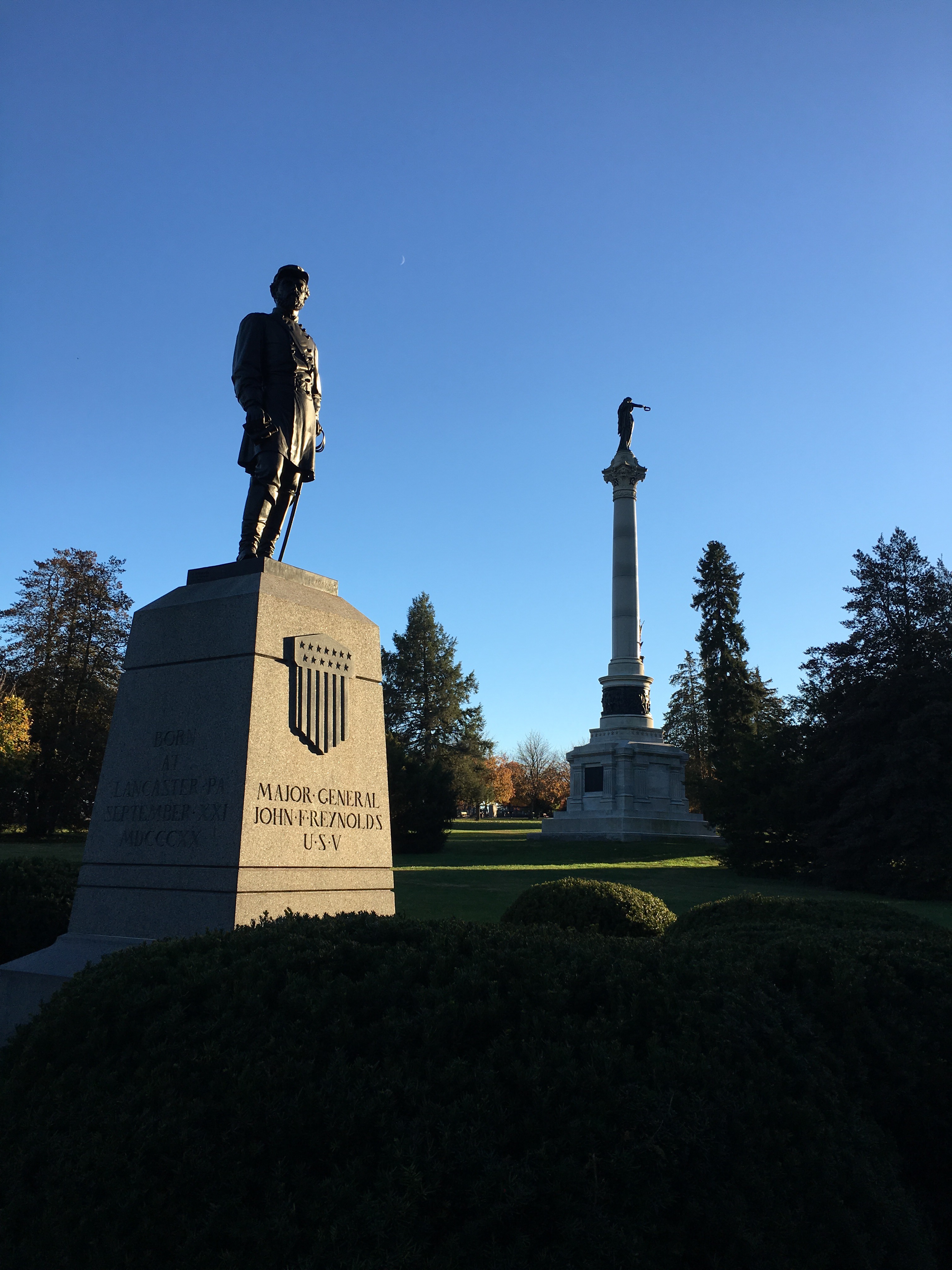
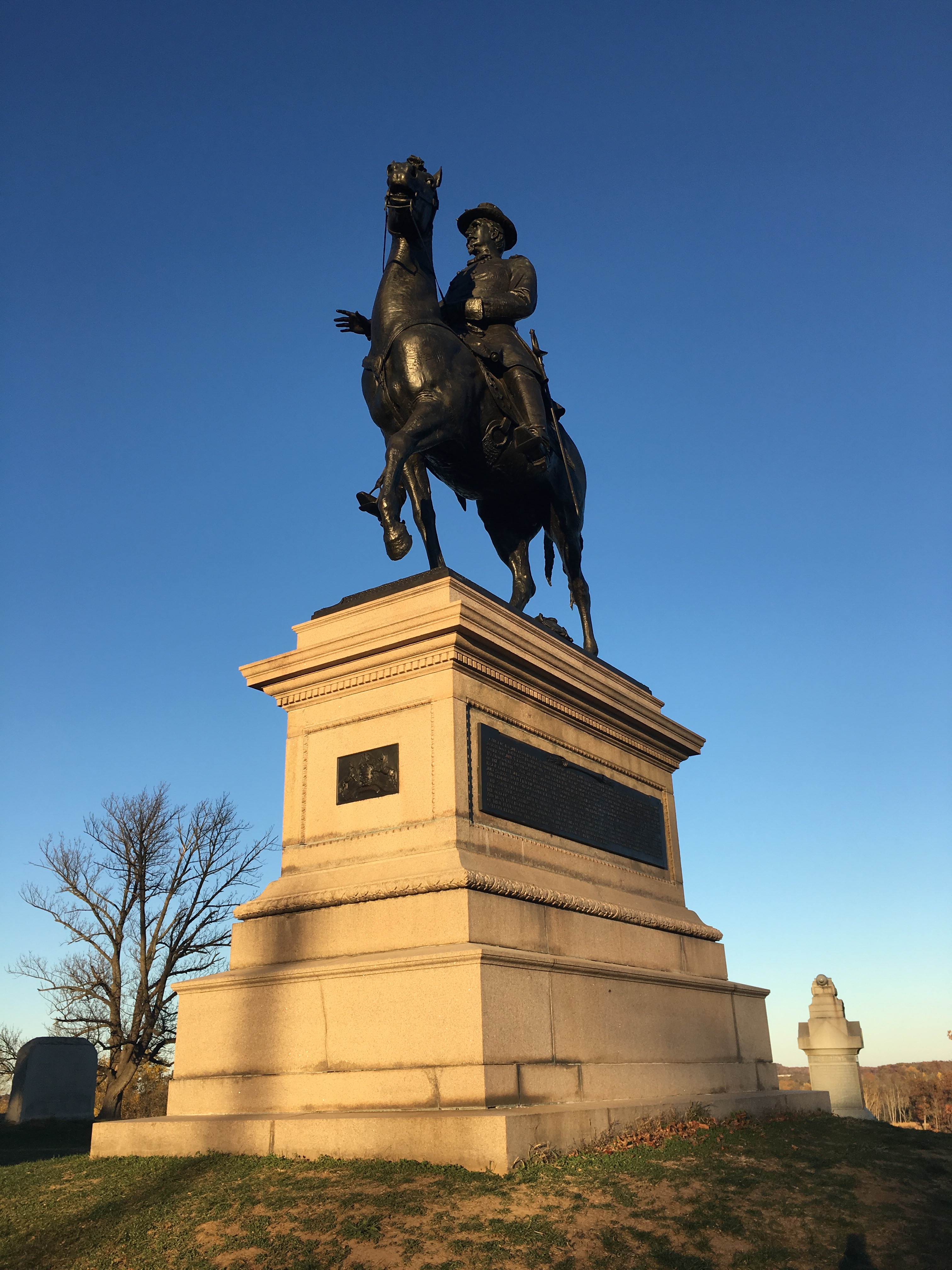
So today I will be going up to Gettysburg early. I’ll arrive well in advance of my students and today my plan is to walk the battlefield from McPherson’s Ridge, to Herbst Woods, and on to Seminary Ridge where I also hope to visit the museum now located in the old seminary building. This is important to do because one never fully appreciates what happened in a certain spot until they have walked the ground. Likewise, there are many markers at Gettysburg that have a lot of meaning that most people never see because they are too busy driving around to see the high points like Little Round Top, the Angle and High Water Mark, and the Virginia And Pennsylvania memorials. 

As I do so I will remember the heroes of the Union side who held their ground, and the men who were not recognized for their actions, and in some cases, like Abner Doubleday, after having done well and fighting heroically were relieved of duty simply because some above them didn’t like them, and acted on false reports. I think that will be a healthy experience for me. Later, I will meet my students for dinner and discuss the strategic and operational aspects of the campaign that connect with what they are learning in regard to planning at the Staff College. 

So anyway, I know that there is a lot of other stuff going on in the world. I’ve seen bit and pieces about the GOP Health Care repeal but have not had time to read anything. Maybe I’ll get to it later in the weekend or early next week as it’s not going to go away. 

I’ll post something small from Gettysburg the next two days. So until tomorrow,

Peace

Padre Steve+

8 Comments

Filed under christian life, faith, Gettysburg, Loose thoughts and musings, Military, PTSD

Gettysburg and the Era of Trump

Friends of Padre Steve’s World,

I’ll be traveling to Gettysburg this weekend to lead another Staff Ride and as I listened to President Trump’s remarks about the Civil War and on altering the American Constitution to fit his needs for his success this week that I was incredulous. I cannot believe that we have a President who is such an ignoramus about history and the Constitution.

I guess that is why that is even more important that I keep making these trips and conducting these Staff Rides. When I think of the deluge of the President’s executive orders, as well as various State and Federal legislative and executive actions which are for all intents making many Americans second class citizens or worse, I am reminded of Abraham Lincoln’s words well before the Civil War. Lincoln, speaking of the anti-Black, and anti-immigrant sentiment that was rife throughout the country said:

“As a nation, we began by declaring that ‘all men are created equal.’ We now practically read it ‘all men are created equal, except negroes.’ When the Know-Nothings get control, it will read ‘all men are created equal, except negroes, and foreigners, and Catholics.’ When it comes to this I should prefer emigrating to some country where they make no pretense of loving liberty – to Russia, for instance, where despotism can be taken pure, and without the base alloy of hypocrisy.”

damned before Sadly, despite all the blood shed and the sacrifices made by slaves, free Blacks, abolitionists, Union Soldiers, civil rights advocates and others it seems that the President and his supporters are fully intent on rolling back Constitutional protections for many people in this country. In fact the President this week declared that the Constitution and our system of government were “archaic,” and suggested that they needed to be changed. Many of his supporters who for decades have claimed to be defending the Constitution seem to have no problem with with what he says, showing that their words are mere hyperbole and cover to prevent others from enjoying the same liberties that they have; be they African Americans, Hispanics, LGBTQ, Women, Native Americans, Muslims, and immigrants deemed less than worthy.

As for me I will be damned before I stop speaking out against such measures. These are not the measures of preserving liberty, but are the kind of despotism that allowed Southern Slave owners to call slavery “freedom.”

So I will go to Gettysburg this weekend and as always I will take my students to the Soldier’s Cemetery where we will talk about the Gettysburg Address and the meaning of it and our Constitution, at a place where Lincoln said that we highly resolve that these dead shall not have died in vain — that this nation, under God, shall have a new birth of freedom — and that government of the people, by the people, for the people, shall not perish from the earth.

Until tomorrow,

Peace

Padre Steve+

1 Comment

Filed under civil rights, civil war, Gettysburg, History, Political Commentary

The Ghosts of Gettysburg Gather Around Me

img_0578

Friends of Padre Steve’s World,

I am at Gettysburg this weekend so I am just posting just a short meditation and some words written by Walt Whitman. 

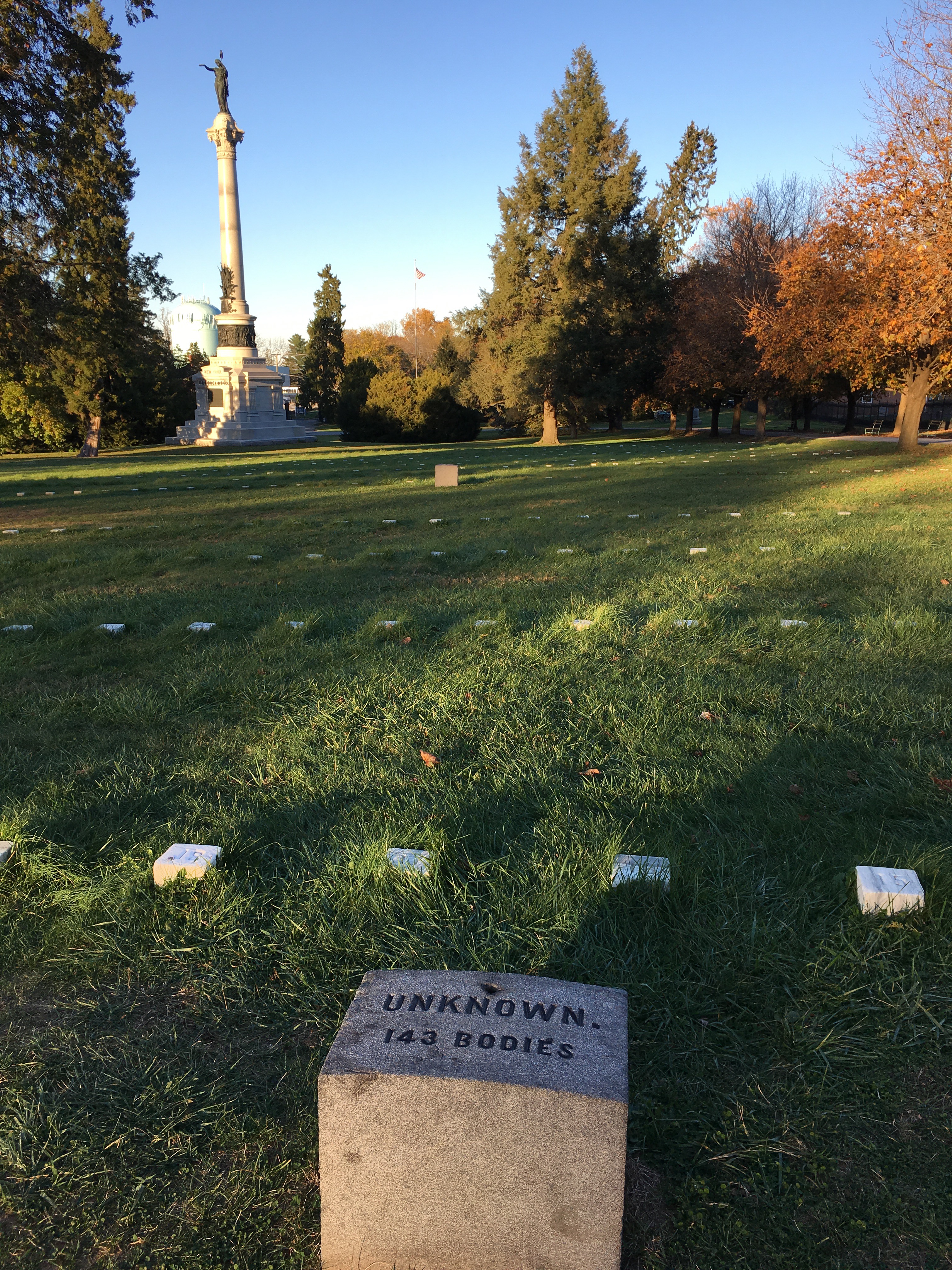
Yesterday afternoon I wandered around the Soldier’s Cemetery as well as East Cemetery Hill. It was a beautiful evening with the fall foliage in full display under a a blue sky with the sun setting in the west. As I walked about the graves of the 3577 Union Soldiers buried here, over half who are unknowns, I felt such powerful presence and was reminded of the importance of what they did here. There are sections where of the cemetery where unknown soldiers are buried, rank upon rank, with only a small marble marker with a number to identify them.

Each was a son, maybe a husband, father, or brother, or a friend, and most certainly, a comrade in arms. Each has a name, even if we don’t know it; and all of them, and many more gave the last full measure of devotion to duty to preserve this country against an enemy. But unlike other enemies, the soldiers that these men battled were from of an enemy that has raised itself up from within the country; men, no matter how good they might have been, took up arms against the United States. These included men who took up arms and fought against friends who they had served alongside in peace and war.

While men of my family fought for the Confederacy I cannot succumb to the lie that their cause was just. Thus when I stand among the ranks of these fallen Union men I honor their memory in ways I cannot fully do for their opponents in Confederate gray. Do not get me wrong, I weep for those who fought and died on both sides of the American Civil War, and each soldier needs to be remembered, even those who fought for a cause that was evil, the cause of slavery. As a military man myself I cannot walk these battlefields and not have a sense of compassion and even empathy for the Southerners who died here, even while rightly condemning the government and the cause that sent them to their deaths.

Walt Whitman wrote the poem Ashes of Dead Soldeirs after the war was over. Whitman knew the terrible cost borne by soldiers as he volunteered to help the wounded in Federal hospitals during the war. His words speak to me. 

When I come here I can sense their presence, the great and the small, John Reynolds, Lewis Armistead, Paddy O’Rorke, Dick Garnett, Alonzo Cushing, and Stong Vincent. The men of the Iron Brigade and the Irish Brigade, Dan Sickles’s Excelsior Brigade, Augustus Van Horne Ellis’s 124th New York “Orange Blossoms,”the men of George Pickett’s doomed division, the 1st Minnesota, the 20th Maine, and so many more. 

Whitman penned these words:

 “Ashes of soldiers South or North,
As I muse retrospective murmuring a chant in thought,
The war resumes, again to my sense your shapes,
And again the advance of the armies.
Noiseless as mists and vapors,
From their graves in the trenches ascending,
From cemeteries all through Virginia and Tennessee,
From every point of the compass out of the countless graves,
In wafted clouds, in myriads large, or squads of twos or threes or
single ones they come,
And silently gather round me…”

From Walt Whitman- Ashes of Dead Soldiers

Peace,

Padre Steve+ 

Leave a comment

Filed under civil war, Gettysburg, History

Rebels and Racism in Gettysburg 


Friends of Padre Steve’s World,

Gettysburg is hallowed ground for all who love this country. It is the site of a defeat which ended any hope for a Confederate military victory, and at which Abraham Lincoln spoke of a new birth of freedom. It is a place that veterans of both sides began to gather both to remember their service and comrades but also to promote reconciliation between the North and the South. 

But it has also become a place in recent years for neo-Confederates to gather, not to remember the new birth of freedom, but to arrogantly defile the site by spewing hate, proclaiming racism, while openly speaking of their hatred of the United States and love of the late Confederacy. Some drive around town and in front of the Soldier’s Cemetery in large and loud pickup trucks, sometimes blaring their horns, while flying large 3′ x 5′ Confederate Battle Flags flying as if to mock the Union soldiers buried there. 

It is also interesting to note that many of these openly racist people are not from the South, nor do they have southern roots. They simply tend to be racist and anti-government and gather around the flag of the Confederacy.  I remember having a beer with a man from upstate New York in a bar a year or so ago who said he was the chaplain for a Confederate reenactment unit (in uniform) and went on to discuss his hatred for the United States, as well as African Americans, and other non-white American citizens. Likewise on another visit an older couple who said they were from Georgia listened to me talk with my students in the Soldier’s Cemetery, and when I was finished with reading the Gettysburg Address, the man made sure that he told me that all people were not created equal. 

But let me be clear, there are also Southerners who love this country very much, who when they come to Gettysburg to remember their fallen ancestors, do so with a reverence which is perfectly in keeping with the desire for reconciliation of the Southern veterans as who returned to Gettysburg in the decades after the war. 

I was walking by one of the gift shops in town and noticed a t-shirt on display. The shirt was adorned with the Confederate Battle Flag and and the words “I will not be reconstructed and I don’t give a damn!” 

To some that may seem like a simple snarky statement. However, when you understand what the phase really means it should leave you cold. In 1866 it became part of the lyrics of a song called Oh, I’m a Good ole Rebel, a song that has been recorded numerous times in the years since it was written. 

It was a phase used by Southerners after the Civil War who opposed the process of reconstruction, opposed all civil rights for blacks, and pushed for the return of white rule, which they achieved in 1877 when Reconstruction ended. At that point nearly every hard fought for right of African Americans was reversed, suppressed, or made so difficult to use as to be effectively revoked. Those rights would not begin to be restored until 1954 when the Supreme Court issued the Brown v. Board of Education decision which overturned the  Plessy v. Ferguson ruling of 1894. This ruling declared that the segregation laws and Black Codes of the Jim Crow era were unconstitutional. It took another ten years for Congress in the face of heated opposition to pass the Voting Rights Act of 1964 and the Civil Rights Act of 1965. 

But among segregationists those rulings were reviled. Governors fought to keep African Americans from entering segregated public schools and universities, civil rights workers were attacked and sometimes killed, civil rights leaders like Dr. Martin Luther King Jr were assassinated. Alabama governor George Wallace, who in his 1963 governor’s inauguration address proclaimed “segregation now, segregation tomorrow, segregation forever!” ran on a segregationist platform in the 1968 election and won 13.53% of the popular vote. He won Georgia, Alabama, Mississippi, Louisiana, and Arkansas, while collecting 45 electoral votes. Interestingly enough, the demographics of Wallace’s supporters, heavily white male and lesser educated, were very much like those of current GOP nominee Donald Trump. 

But I digress, yet the fact of the matter is that the open proclamation of the phrase I will not be reconstructed on a shirt displaying the flag of the republic that Confederate Vice President Alexander said, was founded on the superiority of the white race and subordination of the negro as slaves. They are the words of the KKK, the Red Shirts, and the White Leagues who used violence and terrorism to intimidate blacks and any of their white supporters. 

So a a historian I will not attempt to silence those people’s free speech rights, as repugnant as I find them to be. But have to call their words what they are, a call for the return to Jim Crow and worse. They are meant to intimidate people, and I find that message evil, in fact it goes against everything that makes America great. Maybe those who say they will “make America great again” should take heed to the Declaration of Independence, the Bill of Rights, and Lincoln’s Gettysburg Address and realize what really makes America great instead of spewing the hate of those who fought the propositions of life, liberty, and the pursuit of happiness at every turn, even to begin a bloody civil war. 

So until tomorrow have a great Monday.

Peace,

Padre Steve+


2 Comments

Filed under civil rights, Political Commentary

Gettysburg and Ghosts


Friends of Padre Steve’s World,

I am back up at Gettysburg with another class. After a night of eating, teaching, and drinking some fine craft beer, I am back in my room at the 1863 Inn of Gettysburg. 

The hotel sits at the base of East Cemetery Hill where the right wing of Harry Hay’s brigade, the Louisiana Tigers, made their attack on the night of July 2nd 1863. The attack ended in failure and the Federal Troops held their ground and drove the Louisiana troops back. 

Since the hotel opened in the 1960s there have been many reports of paranormal activity. Usually the people are awakened by what appear to be Confederate soldiers near their beds.

So when I booked the rooms for the class I asked the manager to put me in one of the rooms where such activity has been reported. Now, after my night out with our students I am ensconced in my room and hoping that tonight or tomorrow that I might encounter one of these reported spirits. If I only had the gear of the various ghost hunters it would be really cool, but I don’t, so oh well. I guess if I do see one I will be okay, so long as I don’t go throwing myself out of bed and break another bone in my face.

Until tomorrow,

Peace

Padre Steve+

Leave a comment

Filed under Gettysburg, Loose thoughts and musings

A Busy Hump Day Musings…


Friends of Padre Steve’s World,

Today I am going to be teaching in my Ethics class at the Staff College and getting ready to take another group of students to Gettysburg this weekend. 

Over the past few days I have been working hard on the draft text that will become my second book, Mine Eyes have seen the Glory: Race, Religion, Ideology, and Politics in the Civil War Era. Likewise, I have been trying to take a rest from the barrage of political vitriol on the Internet and other media, except to take a few minutes to listen to my favorite living former President, a man who I never voted for, Bill Clinton as he shared about his relationship with Hillary. I enjoyed the speech. 

But part of why I have been trying to take a break from social media politics, is because over the past week I have managed to piss off friends and followers who are supporters of both Donald Trump and Bernie Sanders by making my opinions known. Truthfully, I value friendships more than having to have people agree with my political beliefs. The fact is that my views are almost certain to be in opposition to people on the extreme Right, or Left of the political spectrum. 

But that being said, while I respect my friends opinions and I try never to do things to drive wedges that would destroy relationships and never go to their social media sites to attack their candidates or positions, my opinions also matter. I also have the right to freedom of speech, the same right that I have defended for all citizens for over thirty years, but I digress… 

But anyway. I will be busy today, and because of that I am going to take it easy. I expect to write something about the Democratic National convention in the next couple of days, and I certainly post an article or two about Gettysburg and my coming trip there. 

So have a great day.

Peace

Padre Steve+

Leave a comment

Filed under Loose thoughts and musings

Celebrating an Achievement 


Friends of Padre Steve’s World,

Things have been very busy, I have been putting the finishing touches on the draft of what used to be the first chapter of my Gettysburg Staff Ride text. The chapter grew to be about 260 pages, far more than a chapter should be. For at least six months I have been planning on splitting it off into its own book, and yes it is a book; but I did not get around to it, instead I kept working on it. 

So about two weeks ago I made the decision to turn all this work into a book. So I spent my time the last two weeks, day and night, at work and at home working on getting it exactly the way I want it to be. I still need to go back and re-read it a number of times to catch mistakes that might have slipped through, as well as re-checking my sources, but when I finished it up this afternoon and sent the draft to m students I was elated. I will have some other people look at it to see if they think I need to do anything differently, but I am pretty sure that this is at least the 90% solution before seeking a publisher. 

One thing I had been stuck on was an appropriate title. For the longest time I was stuck with the rather boring Foundations of the First Modern War. It is accurate in some ways,nut it never really got me. But while working on turning this into a book was just how revolutionary the Civil War really was, and just how many times I had written about the revolutionary nature of the entire era, not just the war. So today I came up with the title: A Great War in a Revolutionary Age of Change. I think that it works as the text deals with change, military, political, social, economic, informational, and diplomatic. In fact if you want to understand who we are as Americans you have to understand the Civil War era. Of course this book is just a small part of understanding it, and I am indebted to so many historians who have worked to unravel, sorting fact from fiction, truth from myth. For so many of these men and women this has been a life’s work, and many of them have been accused of being “revisionists”  especially those who contradicted the myths of the Lost Cause and the Noble South  which were for two many decades the accepted “history”  of the Civil War era. Like them I have taken my share of heat from unrepentant secessionists and Lost Causers, and I don’t care so long as what I write is as truthful and unbiased as possible. 

Over the past couple of weeks I have taken the time to turn the massive chapter into a book. I was able to divide it up into an introduction and twelve chapters in which I try to connect the dots between the development of the Army and developments in society in the years before the war, during the war, and following the war during Reconstruction, Jim Crow, and the Civil Rights movement. I explore the continuum of history and war, war in an age of change, and the context of war. Then I move to talk about how war is more than fighting, and the development of American military culture and theory. Then I shift to technology how technology matters, building armies from scratch, the changing character of armies and society, looking at the effect of conscription on Northern and Southern society. Then I move to the social change regarding Emancipation and Black soldiers, and the beginnings of the Women’s Rights movement, before I move back to discussing how technology pioneered before and during the Civil War set the stage for many things we know today. Then I think I go on to discuss a topic that many people fail to remember, the importance of what happens when the fighting stops, before finishing up talking about the timeless importance of this era today, and how so often we fail to learn the lessons of war. 

Tomorrow I will begin taking my second chapter, another book in its own right and separate it from the bulk of the text that deals with the strategic situation at the beginning of 1863, the Gettysburg campaign, and the Battle of Gettysburg. My regular readers have seen much of this develop from a very embryonic form in 2012 to what it is becoming now, over 1100 pages of text. There is still more work to be done and I am totally motivated to push forward and complete the rest of this work before I move on to other things that I want to write about, some topics that I have written about on this site. 

But tonight is a time to rest and watch the MLB All-Star Game, one of my favorite mid-summer things to do, an event that takes me back to childhood when things were so much simpler. I’ll write about that tomorrow before I move on to other subjects. 

Have a great night,

Peace,

Padre Steve+

2 Comments

Filed under civil rights, civil war, History

Reading, Writing, and Brexit 


Friends of Padre Steve’s World,

Today I am posting a short thought since I have been very busy at work this week with a new class on deck at the Staff College, and continuing to do more research and writing on my Civil War and Gettysburg text. Within the context of my research and writing I am going to be posting some new material this weekend, but I have not decided if it will be in portions of the updated text or in short articles dealing with selected ideas and topics. 

Before those are posted I probably will be posting something on the results of the British referendum to remain in or leave the European Union. Since what happens in the United Kingdom and Europe matters a great deal to the United States and the world, in both economic and security matters it is important. Likewise, since I have a good number of friends in the U.K., as well as the fact that my ancestry is predominantly Irish, Scottish, and English I have a personal interest. 

While I can understand the reasons that many people, especially in England as opposed to Scotland and Northern Ireland are voting to leave the E.U., I do fear that a vote to leave the European Union could lead to the breakup of the United Kingdom, something that I think would be bad for all concerned, for as history shows, the breakup of nations, states, and political unions seldom brings about more liberty or stability. There are a few exceptions to this, but again, they are exceptions. But whatever the result of the referendum, it will be historic and it will not end the debate. 

So, I will finish my beer and get ready to go to bed. Until tomorrow, have a good night and a better day. 

Peace,

Padre Steve+

1 Comment

Filed under Foreign Policy, Gettysburg, Loose thoughts and musings, News and current events, Political Commentary

Teaching at Gettysburg 


Friends of Padre Steve’s World

I spent last night eating, drinking, and teaching at Gettysburg in preparation for he Staff Ride which begins this morning. My audience is the senior staff of an U.S. Army recruiting battalion based out of Ohio. 

It was an interesting setting to teach, sitting on the patio with absolutely beautiful weather, enjoying good food and beer and then getting to teach. They are a different type of audience than the men and women that I teach at the Staff College, and with the exception of the battalion commander who is a graduate of our program, the officers are younger and junior to my students and we also have senior non-commissioned officers, the Command Sergeant Major and the First Sergeants. they are whoever, all very smart, articulate and represent the best of America. All have served in combat or in combat theaters, and all have met with the frustration of not achieving anything like victory. 

I find this very important, because the vast majority of military personnel, including officers attend the level of education that I get to teach at the staff college, and for me to be able to do this with such a group helps create an interest, not just in a particular battle, but the important link between national strategy, military strategy, and the operational art. One thing that I spent a good amount of time on last night in the prepetory lecture was just that. The biggest reason the the North won the Civil War and that the South lost was that in the North under Lincoln, that military operations were linked with the policy of the government after the Emancipation Proclamation; whereas in the South there never was a coherent national strategy, and even great operational level commanders like Robert E. Lee were unable to translate battlefield success into victory. 

As Clausewitz emphasized, war is an instrument of policy, and if it does not serve policy, or if policy makers fail to develop and enunciate a true national strategy, military efforts will ultimately fail. This has been a hallmark of post Col War American thinking. Ideology and buzzwords are not policy, nor are they strategy, and the military is only one component of national power, and unlike diplomacy, economic power, and information, it is a blunt instrument, and if military efforts cannot be translated into the political object and bring about a positive political effect, no amount of battlefield brilliance will bring about success. Policy makers and soldiers must remain in constant dialogue in order to ensure that the link between strategy and policy is strong. This was something that Lincoln, as well as his military subordinates Ulysses Grant and William Tecumseh Sherman learned, and practiced during the war, and it was something that Lincoln’s successor, Andrew Johnson failed to understand after the war, thus forieting all that had been won on the battlefields. Thus as English historian and military theorist Colon Gray notes that “war is about peace” and “more pointedly, that the making of peace is likely to be more difficult than the waging of war. It is a common, and somewhat understandable, error to assume that if one takes care of the fighting in an efficient manner, and the enemy is duly humbled, somehow that the subsequent peace will all but take care of itself.”  I guess that is one reason that I find the American Civil War and the subsequent Reconstruction period to be so pertinent today for but policy makers and military leaders. But I digress…

Even so this promises to be a great weekend, and even more interesting, I will be conducting the final part of which includes walking the ground of Pickett’s Charge, and spending time at the Soldier’s Cemetery where Abraham Lincoln delivered the Gettysburg Addess on Sunday, the 33rd anniversary of my being commissioned as an Army officer in 1983. Since then I have served in peace and war in both the Army and the Navy. In fact I have been in the Navy now almost as long as I served in the Army, almost 17 1/2 years. 

Anyway, I hope to post anther reflection tomorrow, though it may be later in the evening when I actually get it done. 

Until then, have a great day.

Peace,

Padre Steve+

Leave a comment

Filed under civil war, Gettysburg, leadership, Military

We Cannot Understand Our Time Without Understanding the Civil War Era

IronBrigade12021001

Friends of Padre Steve’s World,

I am traveling up to Gettysburg to lead a group of Army officers on a Staff Ride. It will be good. I will be doing my initially classes tonight at O’Rourke’s Irish Tavern in Gettysburg with these officers and then conducting the actual staff ride As such I am reposting a further edited section of my Gettysburg and Civil War text. This is the introduction section to what was my first chapter, which has grown so much that it will be its own book soon. I think that these words of introduction are important. I do hope that you enjoy.

Peace

Padre Steve+

Finite human beings find themselves bound by time and space, we live in the present, but not the present alone, but rather three worlds: one that is, one that was, and one that will be. Ernst Breisach wrote, “In theory we know these three worlds as separate concepts but we experience as inextricably linked and influencing each other in many ways. Every new and important discovery about the past changes how we think about the present and what we expect of the future; on the other hand every change in the conditions of the present and in the expectations of the future revises our perception of the past. In this complex context history is born ostensibly as reflection of the past; a reflection which is never isolated from the present and the future. History deals with human life as it “flows” through time.” [1]

Richard Evans wrote something in the preface to his book The Third Reich in History and Memory that those who study military history often forget. He noted: “Military history, as this volume shows, can be illuminating in itself, but also needs to be situated in a larger economic and cultural context. Wherever we look, at decision making at the top, or at the inventiveness and enterprise of second rank figures, wider contextual factors remained vital.” [2] Thus while this work is an examination of the Gettysburg campaign it is important to understand the various issues that were formative for the men who directed and fought the battle, as well as the vast continuum of often distant and seemingly events that come together at one time in the lives of the participants in any historic event.

One cannot understand the determination the determination of Robert E. Lee to maintain the offensive, the dogged persistence of Joshua Chamberlain or Strong Vincent to hold Little Round Top, what brought John Buford to McPherson’s Ridge, what motivated Daniel Sickles to move Third Corps to the Peach Orchard, and what motivated the men of Pickett’s division to advance to their death on Cemetery Ridge, without understanding the broader perspective of history, and how factors outside their direct military training and experience, such as culture, politics, economics, religion, sociology, ideology, life experience, and all of those factors shaped these men and their actions.

Likewise in order to understand the context of this battle, or for that matter any battle in any war, one has to understand the events, ever distant events which play a role in the battle. All too often those that delve into military history, or a particular battle see that as separate event, often disconnected from other historical events. But as historian Edward Steers Jr. correctly notes, history “does not exist in a series of isolated events like so many sound bites in a newscast. It is a continuum of seemingly unrelated and distant events that so often come together in one momentous collision of time.” [3] In the case of Gettysburg events like Lincoln’s publication of the Emancipation Proclamation, the failure of Confederate diplomacy to bring France or Great Britain into the war or at least to recognize the Confederacy, the failures of the Confederate armies in the West to maintain their hold on the Mississippi River, all play a crucial role in Robert E. Lee’s ill-advised decision to launch an invasion of Pennsylvania. Additionally, the loss of so many key leaders in the Army of Northern Virginia, especially that of Stonewall Jackson impacts how Lee manages the campaign, and shows up at numerous crucial points in the battle.

Another element that must be connected in order to understand the Battle of Gettysburg is the part that policy, strategy, war aims and operational doctrine played in the campaign of 1863 and how those influenced the decisions of participants before, during and after the campaign.

Finally, the Battle of Gettysburg cannot be looked at as a stand-alone event. What happens there as the Confederacy surges to and ebbs back from its “high water mark” influences the rest of the While the war would go on for nearly two more years, the Union victory at Gettysburg coupled with the victory of Grant at Vicksburg ensured that the Confederacy, no matter how hard it tried would not be able to gain its independence through military means.

Maybe even more importantly the story of Gettysburg is its influence today. The American Civil War was America’s greatest crisis. It was a crisis that that “has cast such a shadow over the relations between the North and the South that the nation’s identity and its subsequent history have been considerably influenced by it.” [4]

The Battle of Gettysburg itself is enshrined in American history and myth and is woven deeply into the story of the nation. In this narrative the Battle of Gettysburg is often different ways; in the North viewed as a victory that brings an end to the institution of slavery, and freedom for enslaved African Americans, and preserves the Union. In the South it is often part of the myth of the Noble Confederacy and the Lost Cause where the South was defeated by the Northern superiority in men and warmaking ability.

Yet in both cases, the truth is not so simple; in fact it is much more complex, and the truth is we are still in the process of learning from and interpreting the historical records of the events that led to the American Civil War, the war itself, and the aftermath. They are all connected and for that matter still influence Americans today more than any other era of our history. In fact James McPherson who is one of the nation’s preeminent scholars on the Civil War and Reconstruction wrote,

“I became convinced that I could not fully understand the issues of my own time unless I learned about their roots in the era of the Civil War: slavery and its abolition; the conflict between North and South; the struggle between state sovereignty and the federal government; the role of the government in social change and resistance to both government and social change. These issues are as salient and controversial today as they were in the 1960s, not to mention the 1860s.” [5]

The prolific American military historian Russel Weigley wrote of how the war, and in particular how the Battle of Gettysburg changed the American Republic.

“The Great Civil War gave birth to a new and different American Republic, whose nature is to be discovered less in the Declaration of Independence than in the Address Delivered at the Dedication of the National Cemetery at Gettysburg. The powerful new Republic shaped by the bayonets of the Union Army of the Civil War wears a badge less benign aspect than the older, original American Republic. But it also carries a larger potential to do good for “the proposition that all men are created equal” both at home and around the world.” [6]

Thus it is important for Americans to learn about the Battle of Gettysburg and the American Civil War, but not solely for its military significance, nor for clear cut answers or solutions. The fact is that “situations in history may resemble contemporary ones, but they are never exactly alike, and it is a foolish person who tries blindly to approach a purely historical solution to a contemporary problem. Wars resemble each other more than they resemble other human activities, but similarities can be exaggerated.” [7] As Michael Howard warned, “the differences brought about between one war and another by social or technological changes are immense, and an unintelligent study of military history which does not take into account these changes may quite easily be more dangerous than no study at all. Like the statesman, the soldier has to steer between the dangers of repeating the errors of the past because his is ignorant that they have been made, and of remaining bound by theories deduced from past history although changes in conditions have rendered these theories obsolete.” [8] The ideal that we reach for is to understand the Battle of Gettysburg and the American Civil War in context, which includes understanding what led to the war as well as the period of Reconstruction, and the post-Reconstruction era. In doing so we attempt to draw lessons from it without making the mistake of assuming that what we learn and know about them is immutable and thus not subject to change, for the past influences the present, even as the present and future will influence how we view and interpret the past.

Notes

[1] Breisach, Ernst, Historiography: Ancient, Mediaeval & Modern University of Chicago Press, Chicago and London 1983 and 1994 p.2

[2] Evans, Richard J. The Third Reich in History and Memory Oxford University Press, Oxford and New York 2015 p.ix

[3] Steers, Edward Jr. Blood on the Moon: The Assassination of Abraham Lincoln The University of Kentucky Press, Lexington 2001 p.5

[4] Perman, Michael and Murrell Taylor, Amy editors The Civil War and Reconstruction Documents and Essays Third Edition Wadsworth Cengage Learning Boston MA 2011 p.3

[5] McPherson, James The War that Forged a Nation: Why the Civil War Still Matters Oxford University Press, Oxford and New York 2015 p.4

[6] Weigley, Russell F. A Great Civil War: A Military and Political History 1861-1865 Indiana University Press, Bloomington and Indianapolis 2000 p.xviii

[7] Griess, Thomas E. A Perspective on Military History in A Guide to the Study and Use of Military History edited by John E. Jessup Jr. and Robert Coakley, Center for Military History, United States Army, 1982 p.33

[8] Howard, Michael. The Use and Abuse of Military History in Journal of the Royal United Service Institution 107 (1962):7

Leave a comment

Filed under civil war, Gettysburg, History, Military