Tag Archives: iraq

Why History Matters: The Disastrous Effects of Long Insurgency Campaigns on the Nations that Wage them and the Armies that Fight Them

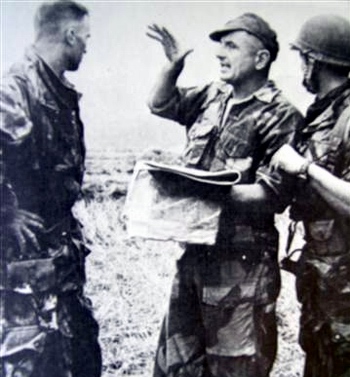
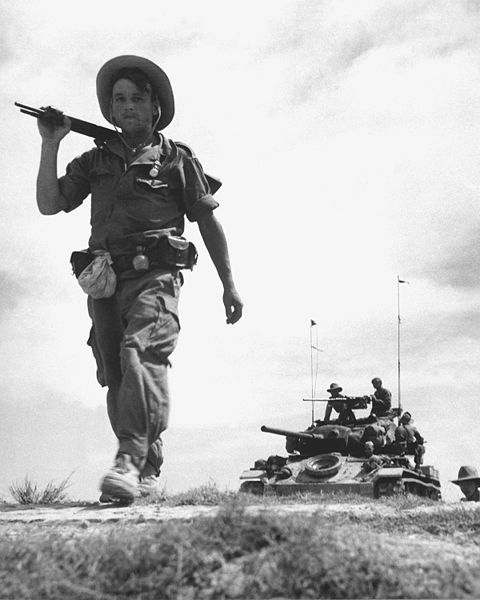
French Mobile Group in Indochina

“Any future defense secretary who advises the president to again send a big American land army into Asia or into the Middle East or Africa should ‘have his head examined,’ as General [Douglas] MacArthur so delicately put it.” Secretary of Defense Robert Gates

The effects of the wars Indo-China, Algeria and Vietnam on the French and American military organizations internally and in relationship to their nations piqued my interest in 2005. The wars in Iraq and Afghanistan forced me to start asking the question of what short and long term effect that these wars might have on the U.S. military. As such I wondered what historical precedent that there was for the question. My interest was furthered by my deployment with Marine and Army advisors to Iraqi Army and Security forces in 2007-2008. My search led to the French experiences in Indo-China and Algeria and the American experience in Vietnam. Recently with the Iraq war winding down and ongoing war in Afghanistan which has gone from apparent victory to mounting concern that we are losing the war in Afghanistan as Taliban and Al Qaida have regained momentum amid widespread corruption by the Afghan government and weakness of NATO forces.
The counterinsurgency campaigns conducted by the French and American militaries in Vietnam and Algeria had deep and long lasting effects on them as did the Soviet war in Afghanistan. The effects included developments in organization and tactics, relationship of the military to the government and people, and sociological changes. The effects were tumultuous and often corrosive. The French Army in Algeria revolted against the government. The US Army, scarred by Vietnam went through a crisis of leadership and confidence which eventually resulted in end of the draft and formation the all volunteer military. The Soviet not only lost their war but they saw their country collapse and the military with it. The effects of the Iraq and Afghanistan wars are yet unknown but could result in similar situations to the militaries and governments involved.

French Surrender at Dien Bien Phu

There is a wealth of data regarding these wars. There are several types of materials. The accounts of soldiers, diplomats and reporters who experienced these events contained in memoirs and diaries. The best include David Hackworth’s About Face and Steel My Soldiers Hearts; and General Harold Moore’s We Were Soldiers Once… and Young. French works include Jules Roy’s The Battle of Dien Bien Phu and General Paul Aussaresses’ The Battle of the Casbah. There are innumerable popular accounts written by NCOs and junior officers. These accounts may contain a wealth of information, but are limited by a number of factors. First, the authors, veterans of the wars, only saw part of the overall picture and first-hand experience in war can skew a writer’s objectivity. Those who have been through the trauma of war interpret war through their own experience. Physical and psychological wounds can have a major impact on the interpretation of these writers as can their experience and political ideology. Finally few of these writers are trained historians. Despite this they can be a valuable resource for the historian.
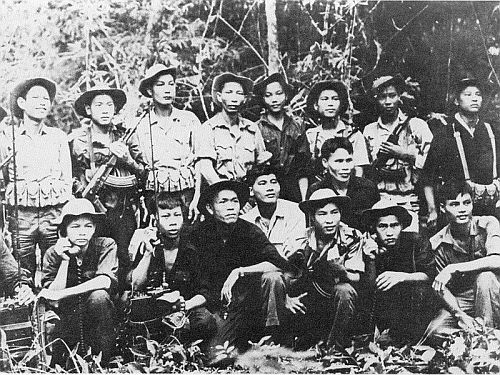
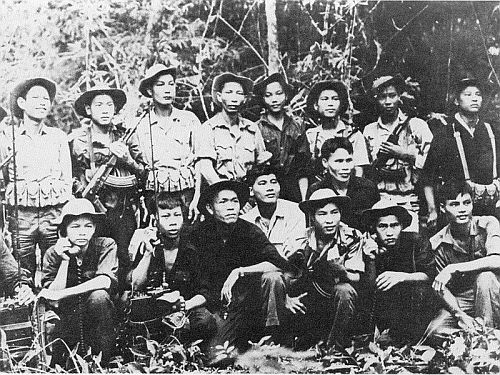
Viet Minh Main Force Soldiers

Another source is found in the official histories written by the military forces involved in the wars. Often these incorporate unit histories and individual narratives and analyze specific battles and the wider campaigns, but do little in regard to broader conditions that affected operations. While a good source, many are not as critical of their institutions as they should be.

Histories by trained historians and journalists provide another view. The most insightful of the journalist accounts include Bernard Fall’ Street Without Joy and The Siege of Dien Bien Phu: Hell in a Very Small Place. A limitation of all of these is that they are often heavily influenced by the political and societal events. This means that earlier accounts are more likely to be reactive and judgmental versus critical and balanced. Later accounts have the benefit of access to the opposing side and documents not available to earlier writers. Alistair Horn in A Savage War of Peace provides one of the most informative and balanced accounts of the war in Algeria. Martin Winslow does the same regarding Dien Bien Phu in The Last Valley.

Foreign Legion in Algeria

Another source is the writings of participants who critically examine their participation in the wars. Many of these, French and American provide insights into the minds of leaders who are reflective and critically examine what happened to their military institutions in these wars. The best of these is French Colonel David Galula whose books Pacification in Algeria 1956-1958 and Counterinsurgency Warfare: Theory and Practice provide first-hand accounts of the subject combined with critical reflection. Galula’s works have been important to John Nagl, General David Petreus and others who helped write the U.S. Army and Marine Corps Counterinsurgency manual. Andrew Krepinevich in The Army and Vietnam provides a critical analysis of the U.S. Army in Vietnam. Other sources, both online and print, such as RAND, provide excellent analysis of selected topics within the scope of this essay, especially COIN.

Battles in the Streets of Algiers

The ability to dispassionately and critically examine and evaluate these sources over a period of several years was and integrate them with my own experience has been a critical to me. It has changed the way that I look at sources, and caused me to be much more aware of bias, the limitations of sources and the need to have a multiplicity of sources and points of view and to be suspicious of contemporary reports and accounts of the war in Afghanistan regardless of the source.

The conflicts in French Indo-China, Algeria and Vietnam had major effects on the French and American military institutions. These effects can be classified in a number of ways. First, the manner in which each military waged war, including tactics employed and use and development of weapons systems was changed. The use of airpower, especially helicopters and use of riverine forces provided an added dimension of battlefield mobility but did not bring victory. As John Shy and Thomas Collier noted regarding the French in Indo-China: “French mobility and firepower could take them almost anywhere in Vietnam, but they could not stay, and could show only wasted resources and time for their efforts.”[1]
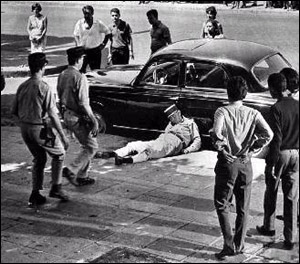
Assassination and Terrorism in Algiers

The use of intelligence and psychological warfare, including the use of torture became common practice in both the French and American armies. The wars had an effect on the institutional culture of these armed services; neither completely embraced the idea of counterinsurgency and for the most part fought conventionally. Galula notes how the “legacy of conventional thinking” slowed the implementation of proper counterinsurgency tactics even after most commanders learned that “the population was the objective.”[2] Krepinevich notes that “any changes that might have come about through the service’s experience in Vietnam were effectively short-circuited by Army goals and policies.”[3] Finally the wars had a chilling effect on the relationship between the both militaries and the state, veterans from each nation often felt betrayed or disconnected from their country and people. Unfortunately instances of all of these have occurred or can be seen in the current wars in Iraq and Afghanistan.

US Army in Vietnam

The French Army had the misfortune of fighting two major insurgencies back to back. The French military was handicapped even before it went into these wars. The Army came out of World War II defeated by the Germans, divided by loyalties to Vichy or one of the Free French factions. They were humiliated by the Japanese in Indo-China, while in Algeria France’s crushing defeat was devastating. “Muslim minds, particularly sensitive to prestige and baraka, the humiliation made a deep impression.”[4] French society was as divided as the Army; the economy in shambles, the government weak and divided. The Viet-Minh had prepared well making use of time and training to get ready for war. “Once full-scale hostilities broke out, the French, for budgetary and political reasons could not immediately make the large scale effort to contain the rebellion in the confines of small-scale warfare.”[5]

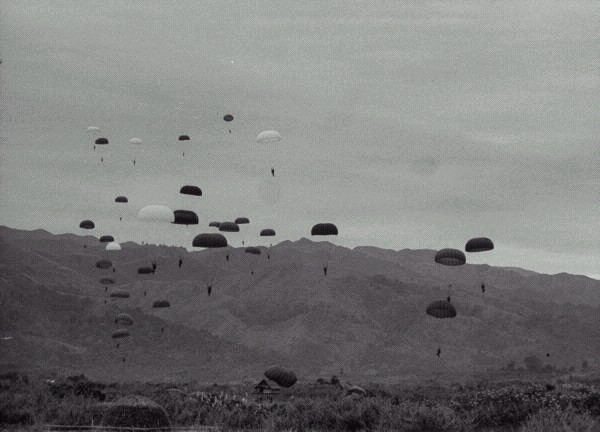
Paras of the 1st Colonial Parachute Regiment jump in Algeria

In both Indo-China and Algeria the French attempted to fight the budding insurgencies in a conventional manner. This was particularly disastrous in Indo-China when on a number of occasions battalion and regimental combat team sized elements were annihilated by Viet-Minh regulars. Between October 1st and 17th 1950 every French garrison along the Chinese border was over-run. The French lost over 6000 troops and enough equipment to outfit “a whole additional Viet-Minh division.” It was their worst colonial defeat since Montcalm at Quebec.[6] In Algeria when the fight began in earnest France’s “ponderous ponderous N.A.T.O forces found themselves at an impossible disadvantage,”[7] unable to have any influence off the main roads.

Marcel Bigard: One of the most effective French commanders in Indochina and Algeria

In Vietnam the French did not absorb the lessons of fighting a well established insurgent force. French forces hoped to draw the Viet-Minh main forces into battles of attrition where their superior firepower could be brought to bear. Such was the case at Na San in December 1952 where the French established an “Air ground base” deep in Viet-Minh territory to draw Giap’s forces into open battle. This worked, but just barely. General Giap, short of artillery and not planning on a long battle frittered away his troops in mass charges. However, the French, because of Na Son assumed they had found the key to victory. In their embrace of the “air ground base concept, French staff officers were following an intellectual tradition that had long been prone to seduction by elegant theories.”[8] The result was the disaster at Dien Bien Phu the following year. The destruction of the elite Group-mobile 100 near Pleiku in 1954 was the coup de grace. In Indo-China the French made limited use of helicopters, used paratroops widely, and developed riverine forces. One thing they were critically short of was significant tactical air support.[9]
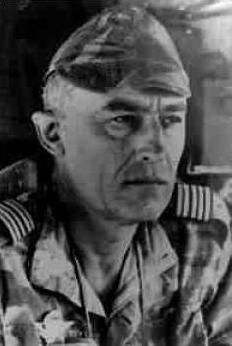
Roger Trinquier helped develop tactics in Indochina which helped turn the tide in Algeria, until the French Government ended the war leaving their soldiers to feel betrayed

The most inventive French creation in Indochina was the GCMA/GMI forces composed of mountain tribesmen led by French NCOs and Junior Officers. They were designed to provide “permanent guerilla groups rooted in remote areas” to harass and interdict Viet-Minh forces.[10] Trinquier noted that at the time of the Dien Bien Phu defeat that these forces had reached over 20,000 trained and equipped maquis in the Upper Region of Tonkin and Laos. These forces achieved their greatest success retaking Lao Cai and Lai Chau May 1954 as Dien Bien Phu fell.[11] Trinquier stated that “the sudden cessation of hostilities prevented us from exploiting our opportunities in depth.”[12] The GMI units and their French leaders were abandoned fighting on for years after the defeat. One account noted a French NCO two years after the defeat cursing an aircraft patrolling the border “for not dropping them ammunition so they could die like men.”[13] In the end the French left Indo-China and Giap remarked to Jules Roy in 1963 “If you were defeated, you were defeated by yourselves.”[14]
Algeria was different being part of Metropolitan France; there the French had support of European settlers, the pieds-noir. Many French soldiers had come directly from Indo-China. There French made better adaptations to local conditions, and realized that they had to win the population and isolate the insurgents from it and outside support. As Galula said, victory is the destruction of the insurgent’s political and military structures, plus “the permanent isolation from the population, not forced upon the population, but by and with the population.”[15] The lessons learned by the French in both Algerian and Indo-China were lost upon the Americans.
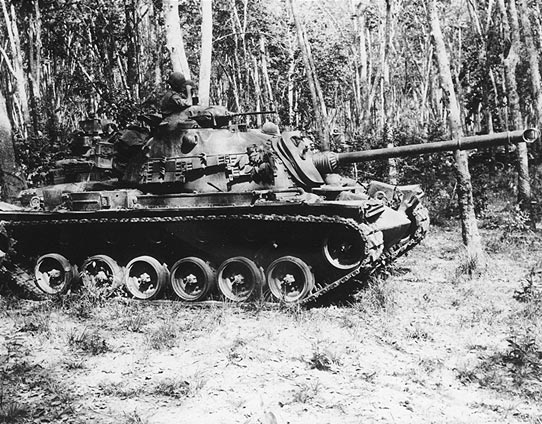
US Armored Cavalry in Vietnam

The United States military, especially the Army approached the Vietnam War with a conventional mindset, referred to as the “Army concept.” [16] It not only approached the war in this manner, but it trained and organized the South Vietnamese forces, ARVN into the American model. Americans re-organized ARVN into divisions “based upon the U.S. divisional force structure.”[17] Due to the imposition of an American template and organizational structure upon it, ARVN was not structured appropriately for the threat that it faced.”[18] The results were as to be expected. Large numbers of American troops poured in taking the lead against the North Vietnamese and Viet Cong . The American method of counterinsurgency was costly. It was “almost a purely military approach”[19] which ignored political and social realities on the ground. Instead of focusing on protecting the Vietnamese people and denying the Communists a safe haven the Army in particular believed that massive firepower was the best means to be “utilized by the Army to achieve the desired end of the attrition strategy-the body count.”[20] In the end the American defeat was a “failure of understanding and imagination.”[21] The one shining success was the Marine Corps experimentation with “Combined Action Program” platoons which lived in the villages with militia for long periods of time. This program produced great results “in eliminating local guerillas”[22] but was killed by the Army.
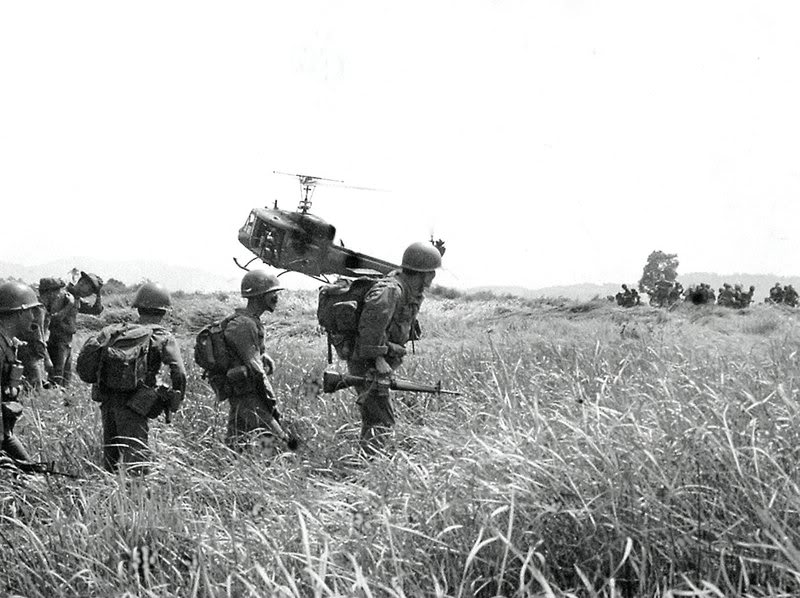
US and ARVN Soldiers in Joint Operation

These wars tore the heart out French and American armies. For the French the defeats inflicted a terrible toll. In Indo-China many French career soldiers felt that the government’s “lack of interest in the fate of both thousands of missing French prisoners and loyal North Vietnamese…as dishonorable.”[23] Divisions arose between those who served and those who remained in France or Germany and created bitter enmity between soldiers. France would endure a military coup which involved many who had fought in Vietnam and Algeria. Having militarily won that war, were turned into what Jean Lartenguy called The Centurions had been turned into liars.”[24] They were forced to abandon those who they had fought for and following the mutiny, tried, imprisoned, exiled or disgraced. Colonial troops who remained loyal to France were left without homes in their “independent” nations. They saw Dien Bien Phu as the defining moment. “They responded with that terrible cry of pain which pretends to free a man from his sworn duty, and promises such chaos to come: ‘Nous sommes trahis!’-‘We are betrayed.’”[25]

War Protests in the United States 

The U.S. Army left Vietnam and returned to a country deeply divided by the war. Vietnam veterans remained ostracized by the society until the 1980s. As Harold Moore recounts “in our time battles were forgotten, our sacrifices were discounted, and both our sanity and suitability for life in polite American society were publically questioned.” [26] The Army endured a massive reorganization that resulted in the formation of the All-Volunteer force, which would redeem itself and emerge from the ashes in the Gulf War.

Taliban in Afghanistan

The Americans would not learn the lessons of revolutionary warfare and counterinsurgency until forced to do so in Iraq in 2004-2007. These lessons however were not applied to Afghanistan and the Taliban which seemed to have been defeated have regained the initiative, policy is being debated amid discord in the west and there are reports of American and NATO forces becoming discouraged by the course of the war and concern that their efforts will be in vain. This is a dangerous situation to be in and if we learn from anything from our own history as well as that of foreign military forces in Afghanistan we need to be very careful in implementing strategy to get whatever we do right.
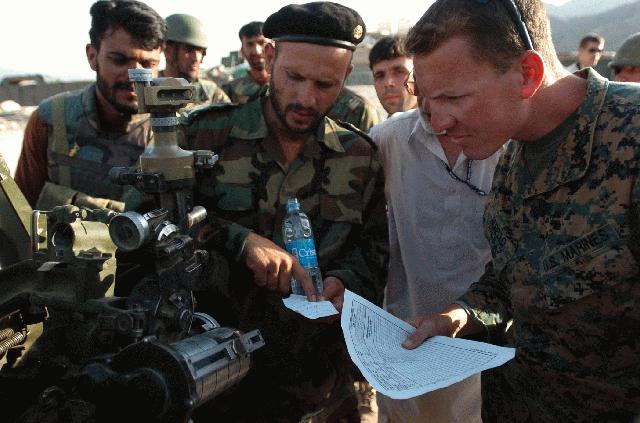
US Advisers with Afghanistan National Army Troops

The greatest success of the war was finally killing the leader of Al Qaeda, Osama Bin Laden at his Pakistani hide-out. That did not occur in Afghanistan and was the result of smart work by the CIA and other American intelligence services and the superb conduct of the mission by Navy SEAL Team Six. It was not the product of our costly counter-insurgency and nation building campaign in Afghanistan. There are many professional think tank “experts” that now urge continuing the Afghan mission indefinitely despite its massive cost and questionable strategic value. The costs of the war which are over 2 billion dollars a week are staggering with little to be shown from the hundreds of billions already spent in Afghanistan, much of which is spent on projects where corrupt Afghan government officials and tribal leaders are the only ones to benefit. Likewise the long term health of the military is imperiled. The money that should go to modernizing the force and replacing equipment worn out by war as well as the enormous costs in lives and the continuing care needed by military personnel wounding in body, mind and spirit remaining on active duty and those in the Veteran’s Administration system are imperiled.
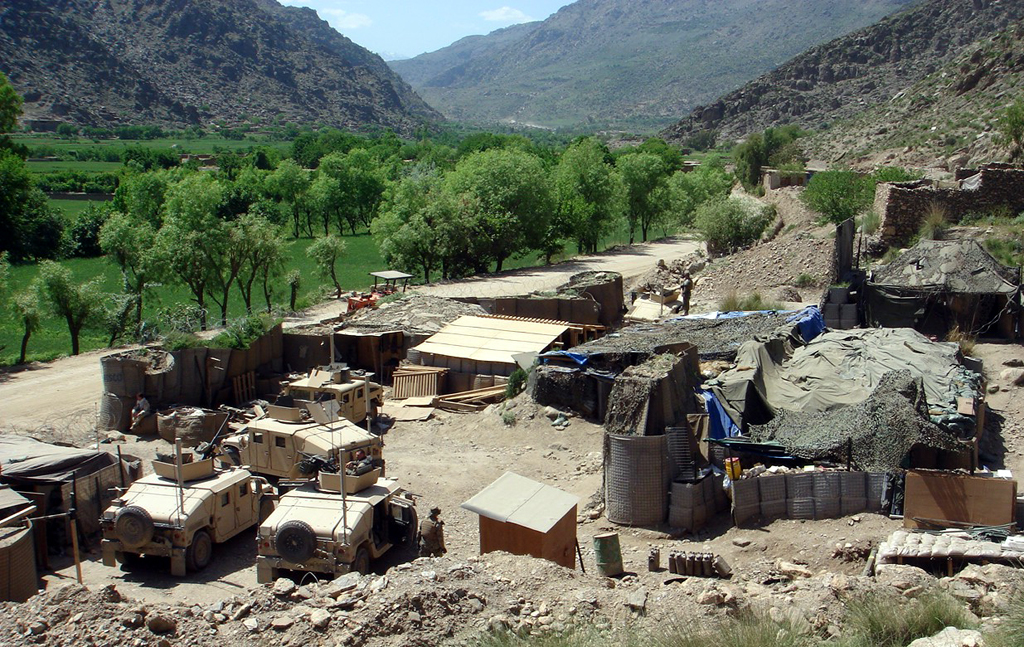
Remote Training Team Base in Afghanistan

The effects of the wars in French Indochina, Algeria and Vietnam on the French and American military establishments were long lasting and often tragic. The acceptance of torture as a means to an end sullied even the hardest French officers. Men like Galula and Marcel Bigeard refused to countenance it, while others like Paul Aussaresses never recanted. Americans would repeat the tactic at Abu Ghraib rallying the Iraqis against them and nearly losing the war because of it.
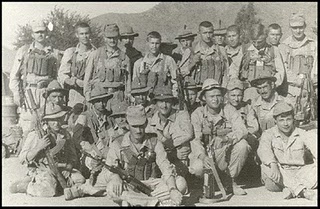
Soviet Paratroops in Afghanistan

For the Americans, the effects of Vietnam continued at home. Race riots tore at the force while drug addictions and criminal activities were rampant. Many incompetent leaders who had “ticket punched” their careers kept their jobs and highly successful leaders who became whistle blowers like Hackworth were scorned by the Army institution. The years following Vietnam were a severe test of the US Military and took years for the military to recover. Likewise it took years before either the French or American veterans again felt a part of their countries. They ended up going to war, and when it was over; feeling abandoned, their deepest bonds were to their comrades who had fought by their side.

Osama Bin Laden leading Mujaheddin in 1984 

If this is not enough we have the experiences of the Soviet Union, the British Empire and others that have attempted to rule Afghanistan as plumb lines to gauge our effectiveness. Others have tried and failed miserably at this. The Soviets learned the hard way and found that Afghanistan was one of the major reasons for the collapse of the Soviet Union. Reading the history of Soviet operations in Afghanistan is frighteningly like reading the history of our campaign.
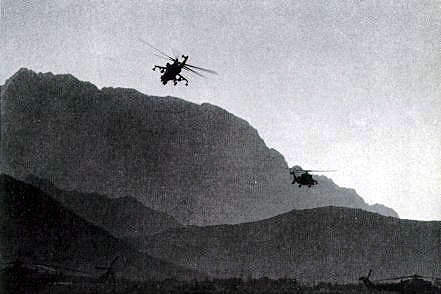
Two Soviet Mi-24 “Hind” attack helicopters flying in an Afghan Valley

The Soviets invaded Afghanistan in 1979 they used their 40th Army which initially was composed of “two motorized rifle divisions, an airborne division, an air assault brigade and separate motorized rifle regiments.”[27] These forces totaled about 52,000 troops and were “considered sufficient to guarantee the viability of Afghanistan.”[28] The 40th Army was a standard Cold War Soviet Combined Arms Army designed for high tempo conventional operations. It was not designed for nor trained in counterinsurgency operations or what the Soviets and Russians class as “anti-guerilla operations.” It was poorly suited to mountain and dessert combat and at the beginning “not only had no practical skills in the conduct of counter-guerilla warfare, they also did not have a single well-developed theoretical manual, regulation or tactical guideline for fighting such a war.”[29]
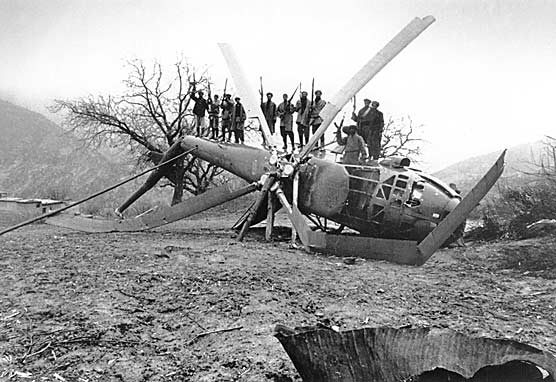
Downed Soviet Mi-4 “Hound” with Mujaheddin 

The Soviets did not expect to be involved in combat operations and the Afghan population reacted to their presence with resistance which spread across the country both against their own government which they viewed as a puppet of the Soviets but also against the Soviet Forces. As time went on the Soviets attempted to use raids and large scale operations to attempt to bring Mujahidin forces to battle, however the insurgents were very skillful and the Soviets attempted to increase the training of their forces as well as their numbers. By 1986 the numbers on the ground had increased to 108,000 personnel in four divisions, five separate brigades, four separate regiments and six separate battalions.[30] In the nearly 10 years of operations over a half million Soviet soldiers and support personnel served in Afghanistan. Tours for enlisted personnel who were primarily conscripts served 12-18 months in country and officers 2 years. Few returned for subsequent tours meaning that the 40th Army had few personnel very familiar with the country, its people and the challenges faced by Soviet forces. According to official sources the 40th Army suffered 13,833 killed in action or died of wounds, 49,985 wounded and 311 missing in action a figured of 1 in 8 Soviet Soldiers being casualties. 14.3 percent of the casualties were officers.[31] Of course the official figure is doubted many believing the number killed in action or died of wounds to be closer to 26,000.[32]
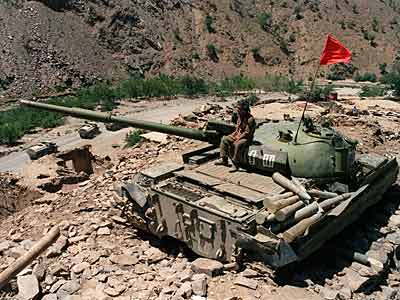
Soviet T-62 Tank guarding a convoy in a mountain pass

Like their American and French counterparts the Soviet veterans have experienced the unhealed wounds of war and a country that does not understand their experiences. The stigma of war wounds and PTSD haunt many Soviet veterans and were compounded by the collapse of the Soviet Union and Warsaw Pact in 1989. They returned home, lost their country and were by and large abandoned by their countrymen. A good number of these men and women travel to one of 5 centers across the country where according to one of the veterans come to for “social and psychological help.” He said that “The best thing about this place is that it provides us with a chance to share our Afghan memories with comrades who understand what we are talking about.” That camaraderie of being able to share their experiences with others that understand is helping some to return to something akin to “normal” life. They are joined by the soldiers that have experienced similar things in Chechnya. Russian veterans of the Afghan War are still so closely linked to it that they refer to themselves as “Afghans.”

Soviet Mi-8 “Hip” Helicopters in Afghanistan preparing for a mission

The Soviet Forces supported the Army of the Democratic Republic of Afghanistan which numbered at their peak on average between 120,000-150,000 soldiers.[33] The Afghan forces, then as now were at the mercy of tribal, familial and communist party affiliations. Over 70 percent of the DRA was conscripted, desertions averaged 1,500 to 2,000 soldiers a month and units were usually optimistically 25-40 percent under their TO&E strength.[34]Limitations on training and leadership meant that typically DRA units could not conduct large scale missions without Soviet help. As such most of the fighting was done by Soviet formations.
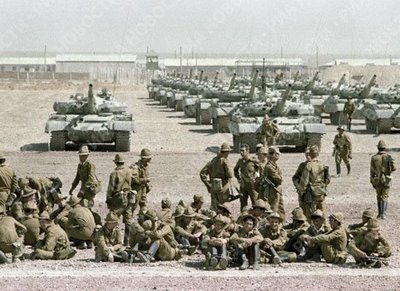
Soviet Troops preparing to leave Afghanistan

Many of these problems have plagued the United States and ISAF throughout the first 9 years of the current Afghan War. As former Afghanistan Commander General Stanley McChrystal noted in his assessment “ISAF is a conventional force that is poorly configured for COIN, inexperienced in local languages and culture, and struggling with the challenges inherent to coalition warfare. These intrinsic disadvantages are exacerbated by our current culture and how we operate.”[35]

We should have learned. A retired Red Army Colonel who served in Afghanistan from 1986-1988 who learned the Dari language in order to negotiate with the Afghan Mujahedeen warned what will happen when the Americans and NATO leave the country and the mistake that we made in entering Afghanistan. Frants Klinsevich now a member of the Russian Parliament comment to reporters at a wreath laying ceremony at a veteran’s convention that “they (NATO and the United States) are 100 percent repeating the same mistake we made by entering into a war in that country” and that “As soon as the Americans and Europeans leave, the Taliban will crack down on everything.” Klinsevich noted that he understood the American desire to tame Afghanistan but that “the problem of radical Islam will not be solved there, its violence cannot be solved. It is simply unsolvable.” He said that he wished that the United States had consulted the Russians about Afghanistan saying “they should have invited Russian specialists, involved Russia, really studied how they could use Russia. But unfortunately Americans think they know everything.” The former Russian commander understands far more that the majority of American policy makers on this subject. [36]

The fact is that we are hamstrung by the ongoing wars which limit our ability to respond to rapidly changing situations. We are in a similar situation to the Germans in 1942 and 1943 overcommitted, overstretched and lacking true strategic depth to respond to unanticipated situations as are now occurring across the Middle East. In 1942 and 1943 the Germans were always just short of the forces that would have turned the tide. Like the Germans our economy is laboring on the verge of collapse and we have to honestly answer the question “What is the strategic value in continuing to wage war in Afghanistan in the way that we are doing?”

What are the lessons to be learned from these campaigns as well as from the various accounts? Andrew Krepinevich prophetically noted that the failure to learn the lessons of Vietnam “represents a very dangerous mixture that in the end may see the Army again attempting to fight a conventional war against a very unconventional opponent.”[37] Obviously, there are lessons to be learned, especially in understanding the nature of revolutionary war as well as the culture and history of our opponents. The U.S. has made some improvement in this regard but there is still much to be learned, especially since after the war the Army was “erecting barriers to avoid fighting another Vietnam War.”[38] From these wars we learn that nations and incompetent governments who mismanage wars can alienate themselves from the soldiers that they send to fight, with serious consequences. As far as historiography we learn that certain historical fallacies are evident when one reads the accounts critically and recognize the bias and limitations of the various sources.

The fact is that we have learned little about such wars and are paying a terrible price for it. The debate now is should we continue the war as it is with minor withdraws of troops or begin a rapid exit in order to preserve and rebuild our force and to reduce the cost of these operations. But that debate and decision are well above my pay grade. But then maybe we need to remember what Field Marshall Gerd Von Rundstedt told his staff in September of 1944 when asked how to recover from the disastrous collapse of the German front following the Allied breakout from Normandy and dash across France. “Make peace you fools.” http://www.youtube.com/watch?v=ch56NAL1C-I

Peace
Padre Steve+
________________________________________
[1] Shy, John and Collier, Thomas W. “Revolutionary War” in Makers of Modern Strategy from Machiavelli to the Nuclear Age,” Peter Paret editor. Princeton University Press, Princeton N.J. 1986 p.849
[2] Galula, David. Counterinsurgency in Algeria: 1956-1958. RAND Corporation, Santa Monica, CA. 2006. First published by RAND in 1963. p.244
[3] Krepinevich, Andrew F. “The Army and Vietnam,” The Johns Hopkins University Press, Baltimore and London, 1986 p.213
[4] Horn, Alistair. “A Savage War of Peace: Algeria 1954-1962,” a New York Review Book published by the New York Review of Books, New York, 1977, 1987, 1996, and 2006 p 41
[5] Fall, Bernard B. “Street Without Joy: The French Debacle in Indochina.”Stackpole Books, Mechanicsburg PA, 2005, originally published by Stackpole Publications 1961 p.27
[6] Ibid. p.33
[7] Horn. p.100.
[8] Windrow, Martin. “The Last Valley: Dien Bien Phu and the French Defeat in Vietnam,” Da Capo Press, Novato, CA 2006, originally published by Weidenfeld and Nicholson, London 2004 p.63
[9] Fall, Bernard B. “The Siege of Dien Bien Phu: Hell in a Very Small Place.” Da Capo Press, New York an unabridged reprint of the 1st Edition reprinted in arrangement with Harper and Row Publishers, New York. 1967 pp. 456-457 Fall discusses in depth the lack of French Air support and the antecedents that led to the shortage following World War II.
[10] Pottier, Philippe(2005)’Articles: GCMA/GMI: A French Experience in Counterinsurgency during the French Indochina War’, Small Wars & Insurgencies,16:2,125 — 146http://dx.doi.org/10.1080/09592310500079874
[11] Simpson, Howard K. “Dien Bien Phu: The Epic Battle America Forgot,”Potomac Books Inc. Washington DC 2005, originally published by Brassey’s Inc. 1994 pp. 170-171
[12] Trinquier, Roger. “Modern Warfare: A French View of Counterinsurgency,” translated from the French by Daniel Lee with an Introduction by Bernard B. Fall. Praeger Security International, Westport CT and London. 1964 and 2006. Originally published under the title “La Guerre Moderne” by Editions Table Ronde. p.87
[13] Windrow. p.652.
[14] Roy, Jules. “The Battle of Dien Bien Phu” Carrol and Graf Publishers, New York 1984. Translated from the French by Robert Baldrick. English translation copyright 1965 by Harper and Row Publishers, New York. p.xxx
[15] Galula, David. “Counterinsurgency Warfare: Theory and Practice.”Praeger Security International, Westport CT 1964 and 2006 p. 54
[16] Krepinevich. p.213
[17] Ibid. p.24
[18] Nagl, John A. “Learning to East Soup with a Knife: Counterinsurgency Lessons from Malaya and Vietnam,” University of Chicago Press, Chicago and London, 2005 p.138
[19] Shy. p.856
[20] Krepinevich. p.202
[21] Spector, Ronald H. “After Tet: The Bloodiest Year in Vietnam,” Vintage Press, a division of Random House, New York, 1993 p.314
[22] Millett, Allan R. and Maslowski, Peter. “For the Common Defense: A Military History of the United States of America.” The Free Press, a division of Macmillian, Inc. New York, 1984 p.555
[23] Windrow. p.655
[24] Ibid. p.657
[25] Ibid.
[26] Moore, Harold G and Galloway, Joseph L. “We were Soldiers Once…and Young: Ia Drang: The Battle that Changed Vietnam,” Harper Collins Publishers, New York NY 1992 p. xx
[27] The Russian General Staff. The Soviet Afghan War: How a Superpower Fought and Lost” translated and edited by Lester A. Grau and Michael A. Gress, University Press of Kansas, Lawrence KS 2002 p.17.
[28] Ibid. p.18
[29] Ibid. p.43
[30] Ibid. p.28
[31] Ibid. p.309
[32] Ibid. p.xix
[33] Ibid. p.48
[34] Ibid. pp.48-51
[35] McChrystal, Stanley. “Commander’s Initial Assessment Commander International Security Assistance Force Afghanistan” dated 30 August 2009 pp. 1-2
[36] “Russian veteran warns of Afghan violence.” Reuters 16 May 2011. Edited by Paul Tait and Daniel Magnowski obtained 11 June 2011 at http://www.trust.org/alertnet/news/interview-russian-veteran-warns-of-unsolvable-afghan-violence/
[37] Krepinevich. p.275
[38] Ibid. p.274

3 Comments

Filed under Foreign Policy, History, iraq,afghanistan, middle east, Military, Political Commentary, vietnam, world war two in europe

No Time to Be Bitter: Padre Steve takes a Lesson from Buck O’Neil

Where does bitterness take you?

To a broken heart?

To an early grave?

When I die

I want to die from natural causes

Not from hate

Eating me up from the inside

Buck O’Neil


I was browsing the internet the other day searching for information on  the life of a person that I am interested in and came across a number of internet sites which indirectly referenced the man but were filled with more bitterness, anger and hatred than I could ever imagine being harbored in the heart of a single person.  They came from the far right and far left but the far right crowd seemed more angry bitter and then I had remembered them being, admittedly this website was extreme even by the standards of Der Stürmer  especially in the overtly racist overtones of the site and that the woman that runs it claims to be Jewish and “mad.” I presume that the site owner was referring to mental illness because only a deranged person could be so bitter, hateful and vengeful and all in the name of righteousness.   I was amazed just how far this woman went but instead of being put off I was morbidly drawn into her site reading article after article as if I had come upon a horrible accident involving Lady Gaga and Sarah Palin.  I finally got away, put down my laptop computer and resumed reading Buck O’Neil’s America on my Kindle.

The sites that I had visited when looking for a totally unrelated subject were filled with such hatred and bitterness that I was stunned. Anyone who reads this site knows that I am certainly not naïve and fully aware of the evil that lurks in the hearts of men, and I include women in that somewhat exclusivist comment.  I began to realize that although I get angry at injustice I don’t have time to be bitter even at things that have been said about me or done to me.

I have seen the cost of bitterness in lives of people around me and in lives of people dying horrible deaths eaten up by the bitterness in their hearts.  I realized a long time ago that even if I was angry and even right in what I knew I could not remain bitter. When I came home from Iraq and was emotionally torn by things that were happening to me as well as the terribly bitter invective of the 2008 elections I knew that I could not live that way.  I had allowed such anger and bitterness to be part of me for a number of years after 9-11 that it consumed me at times, some directed toward those that directed those attacks but an even more vengeful attitude toward political liberals in the United States and Europe.  For a time I lost my sense of moderation and ability to see people as people that God loved and cared about.

Iraq changed that and since I have written about that time and time again I will simply say that when I came back from Iraq I could no longer bear the anger and bitterness of those that hated their fellow Americans as much or worse than those that attacked us.  It made no sense and I knew that I had changed.  I no longer had the time or energy to be so angry that I was bitter.  I was done. I stopped reading and listening to those that promoted such attitudes from the left or the right. Even then I had my moments especially as I battled all the components of PTSD, depression and a loss of faith that left me for all practical reasons an agnostic.  As faith, hope and stability began to return to my life those moments have become far less frequent and for that I am most grateful.

I am now inspired by those that overcame great obstacles of hatred, racial, gender, economic or religious prejudice and many of those stories come from baseball. One of those is the story of Buck O’Neil the great player and manager of the Negro leagues who never played in the Majors and was denied the chance to manage at the Major League level, instead serving as a coach and scout for various Major League teams.  In spite of having endured prejudice, discrimination and all that went with being an African American man, even a talented and successful one.

Yet O’Neil was one of those people that found good in everything and everyone.  He was one of those unique individuals that rises above hatred and does not become infected by it.  Such people seem to be a rarity but thankfully there are others like him and they reside in all corners of our land, they are of every race, religion, ethnic group, gender, sexual orientation and even political affiliation.  They would give the shirt off their back to help others and somehow in spite of things that they have experienced and the painfully nasty tone set by so many politicians, pundits, media types and terribly nasty and bitter people like the lady I referenced above, they still see the good in others and refuse to live lives infected by hatred, prejudice and discrimination regardless of the source.

However I ran into a number of people in the past couple of days that I could not believe. A few years back I started a Facebook page for those in my graduating class at Edison High School in Stockton California.  The title was Edison High School 1975-1978 and its description plainly said that it was for Edison High School in Stockton California.  I thought that was pretty straight forward I set up the page and forgot about it, which I often do because of my Mad Cow symptoms which is what I call my continuing PTSD symptoms, mild cognitive and speech cognition deficits that have affected me since Iraq.

So I forgot about the page, I don’t know how many people are even on it and I start getting nasty and condescending messages on Facebook from a bunch of people from New Jersey for God sakes.  These people were all over me like stink on shit and for what reason?  That I didn’t specify in the title that it was California and not New Jersey. It was in the description for goodness sake; all these people had to do was read. Instead they were all telling me that I needed to change things, tell all of the New Jersey people that this was a California page and remove them from the page. I’m sorry I don’t have time for that and if people can’t bother to read details or even see that the mascot logo was a Viking and not their school’s mascot.  According to the most vocal of these people there were like 29 people that can’t bother to read. So I changed the title to say it was Edison High School Stockton California and put a blurb to the New Jersey people that it was California and not New Jersey. Even that wasn’t good enough and so I passed it by, made a comment that people should read something before signing up for it and left the conversation. If I had stayed I would have started losing any sense of peace.

The I realized that people that do this are probably mad at the world in general, they feel cheated or lied to, they are bitter and need to take it out on someone.  So I took a deep breath, re-read some of Buck O’Neil’s story and thanked God for him. I knew at that moment that I was on the right track. As much as an irritant these people were I could not be angry at them or let it fester.  They must have things going on in their lives that I cannot understand which contribute to them needing to come after me when the obvious solution was simply to remove themselves from the site and tell their friends that they made a mistake.

Whatever, it doesn’t matter because I haven’t got time to be bitter and I don’t want anger and bitterness to eat me from the inside out and take me to an early grave. Maybe someday those that thrive on hatred, division and the promotion of enmity will figure out life and let go.  But as Master Yoda said to Luke “Strong is the power of the dark side” and “Fear is the path to the dark side. Fear leads to anger. Anger leads to hate. Hate leads to suffering.”  I have seen enough of suffering and don’t want to contribute to the climate of hate and discontent that pervades our country.  I think Jesus even talked about not living in anger and bitterness and preached forgiveness even from the Cross. Funny how we have such a hard time living that way.

I have too many friends who have experienced the hatred of others and been wounded deeply by the words and actions perpetrated against them. Some have endured these patiently and others have turned to the same tactics and attitudes that they have been the victims of, perpetuating the cycle. Some things never change; the victims often in time become the persecutors.

Does this make this moderate a liberal and will the label stick?

It most probably does, but what the hell?

Peace

Padre Steve+

7 Comments

Filed under Baseball, christian life, faith, History, philosophy, Political Commentary, PTSD, Religion

A Quiet Remembrance: The Fall of Dien Bien Phu May 7th 1954

French Prisoners

On May 7th in Hanoi a small remembrance was held to mark the fall of Dien Bien Phu and honor the victor, 101 year old General Vo Nguyen Giap at his home.  It was one of the few remembrances held anywhere marking that battle which was one of the watersheds of the 20th Century. A half a world away in Houston Texas a small group of French veterans, expatriates and historians laid a wreath at the Vietnam War Memorial.  In Paris an ever shrinking number of French survivors gather each year on May 7th at 1815 hours for a religious service at the Church of Saint Louis des Invalides to remember the dead and missing of the French Expeditionary Corps lost in Indochina.  This battle is nearly forgotten by time even though it and the war that it symbolized is probably the one that we need to learn from before Afghanistan becomes our Indochina.

French Major Marcel Bigeard at Dien Bien Phu. A revered leader he died in 2010

On May 8th 1954 the last of the French garrison of Dien Bien Phu surrendered to the Viet Minh following the surrender of the main garrison the previous day.  It was the end of the ill-fated Operation Castor in which the French had planned to lure the Viet Minh Regulars into open battle and use superior firepower to decimate them.  The strategy which had been used once on a smaller scale the previous year at Na Son would prove to be the Göttdammerung of French colonial rule in Indochina.

French Paras landing at Dien Bien Phu

The French had thought they had come up with a template based on Na Son in how to engage and destroy the Viet Minh which had in the years between 1945 and 1954 had turned an insurgent force into a strong Army capable of taking on large French forces.  As a result the French decided that they would attempt to draw Giap’s Army into open combat where their superiority in heavy weaponry and in the air could be used to destroy the Viet Minh. The plan was called the “Air-land base.”  It involved having strong forces in a defensible position deep behind enemy lines supplied by air.  At Na Son the plan worked as the French were on high ground and had superiority in artillery and air forces.  They were also were blessed by General Giap using human wave assaults which made the Viet Minh troops fodder for the French defenders.  Even still Na Son was a near run thing for the French and had almost no effect on Viet Minh operations elsewhere in Indochina while tying down a almost a full division of troops and a large portion of French air power. They inflicted heavy losses on the Viet Minh but did not destroy them.

The French command assumed that they had found a way to defeat the Viet Minh.  They decided to repeat the strategy used at Na-Son at the remote the remote town of Dien Bien Phu near the Laotian border.  The French desired to use Dien Bien Phu as a base from which they could conduct offensive operations against the Viet Minh and to draw Giap’s forces into a conventional fight that they thought they could win.  Unfortunately the French chose badly. Dien Bien Phu lay in a marshy valley surrounded by mountains which were covered in dense nearly impassible jungle.  It was a poor location to conduct offensive operations from and a worse place to defend.

Viet Minh Main Force Regulars

The French elected to go light on artillery and due to the terrain it had to be deployed in nearly open conditions with neither cover not concealment.  Unlike Na Son the Dien Bien Phu air head was at the far end of the range of French aircraft, especially relatively weak tactical air assets.  French logistics needs were far greater than the French Air Force and American contractors could supply.  The French strong points in the valley were exposed and not mutually supporting and as such Giap and the Viet Minh were able to close with and attack each strong point in time overwhelming each after valiant French resistance.  The terrain was so poor that French units were incapable of any meaningful offensive operations against the Viet Minh.  As such they could only dig in and wait for battle.  Even so many positions were not adequately fortified and the artillery was exposed. The French garrison was a good force.  It was comprised of airborne units, the Foreign Legion, Colonial Paratroops (Marines), North Africans from Tunisia and Algeria as well as Vietnamese troops.  Many of the officers including Lieutenant Colonel Langlais and Major Bigeard commander of the 6th Colonial Parachute Battalion were among the best leaders in the French Army. Others who served in Indo-China including David Galula and Jacques Trinquier would write books which would help Americans in Iraq.  Unfortunately the French High Command badly underestimated the capabilities and wherewithal of the Giap and his divisions.

Giap rapidly concentrated his forces and built excellent logistics support.  He placed his artillery in well concealed and fortified positions which could use direct fire on French positions. Giap also had more and heavier artillery than the French believed him to have.  Additionally he brought in a large number of anti-aircraft batteries whose positions enabled the Viet Minh to take a heavy toll among French Aircraft.  Giap also did not throw his men away in human assaults.  Instead he used his Sappers (combat engineers) to build protective trenches leading up to the very wire of French defensive positions.  In time these trenches came to resemble a spider web.

Without belaboring this post the French fought hard as did the Viet Minh.  Many French positions were overwhelmed by accurate artillery and well planned attacks.  The French hoped for U.S. air intervention, even the possibility of using nuclear weapons against the Viet Minh.  They were turned down.  Relief forces were unable to get through.  The garrison died, despite the bravery of the Paratroops and Legionaries.  The French garrison was let down by their high command and their government and lost the battle due to inadequate logistics and air power.  The survivors endured a forced march of nearly 400 miles by foot to POW camps in which many died.  Many were subjected to torture and group discipline.  Few French caved to the Viet Minh interrogations but some would come away with the belief that one had to use such means to fight the revolutionaries.  French and their Algerian comrades would apply these lessons against each other within a year of their release.  French soldiers and officers were shipped from Indo-China to Algeria to wage another protracted counterinsurgency.  Militarily they had all but won the war when their government pulled out. French troops, especially the Legionaries and Paratroops felt betrayed by their nation, much like many Vietnam Vets felt about the United States government after that war.  I find today that both our government and people are caring for our returning troops in a far better manner than the past.  Even still the veterans of Iraq and Afghanistan share almost a spiritual link to our American and French brothers in arms who fought at Dien Bien Phu, the Street Without Joy and places like Khe Sanh, Hue City, the Ia Drang and the Mekong.

The lessons of the French at Dien Bien Phu and in Indo-China were not learned by the United States as it entered Vietnam.  In fact the US Army made a conscious effort to ignore the advice of those that they called “losers.”  It was an arrogance for which we paid dearly in that war.

Despite our efforts in Afghanistan and the valiant sacrifices of our Marines and Soldiers we seem to have difficulty learning the lessons of the Vietnam Wars.  Old habits die hard, counterinsurgency done right isn’t sexy and there are no easy formulas to make it work.  What works in one country may not work in another as we are found when we tried to emulate our counterinsurgency success in Iraq in Afghanistan.  Despite a lot of institutional resistance from traditionally minded Army officers we were able to apply the lessons of counterinsurgency in Iraq and work with Iraqis to make that country more secure than it was before we took this type of warfare seriously.  Despite its continued problems Iraq is doing better and will likely do well in the long run as it recovers from the damage caused by the war.  They have known civilization since antiquity and are a proud people.  Someday I hope to take up the invitation of Iraqi friends to go back as they say as a tourist.

I am concerned about Afghanistan, despite the killing of Osama Bin Laden in neighboring Pakistan because it seems that the Taliban spring offensive is off to a good start.  U.S. and NATO Forces in Khandehar and Helmand Province have been placed on a higher alert and confined to their bases following a major assault on the Afghan provincial government installations in Khandehar.  The Taliban and other Afghan insurgents are only concerned with Afghanistan and even though Bin Laden is dead the deepening rift between the United States and Pakistan will likely ensure that they will enjoy military, personnel, financial support from many in Pakistan including the Intelligence agency in the remote and ungovernable northwest territories of that country which are a safe haven much like Communist China was for the Viet Minh.

Will there be a situation where an isolated NATO garrison is overrun by Taliban forces as French forces were in Indochina?  An isolated outpost was nearly overrun at Wanat in July of 2008 and at two isolated outposts near the Pakistani border in October 2009.  One would hope not, but we cannot underestimate the Afghans and their ability to adapt to NATO tactics and weapons.   Their predecessors successfully drove out the Soviets, the British, the Persians and the Greeks.  Dien Bien Phu is a warning from history not to leave troops in places where their exposure leaves them vulnerable.

But even more Dien Bien Phu serves to remind us that in such wars it is not always the highly trained and organized Western forces that win.  These are local wars and once the momentum shifts to the insurgent they are difficult to turn around.  In a sense the French were trying to do what we are trying to do now in taking the fight to the enemy.  It turned out badly for them and it could turn out badly for us.  I hope that we don’t forget.

Peace

Padre Steve+

2 Comments

Filed under History, iraq,afghanistan, Military, vietnam

The Disdain of American Business for Military Personnel and their Benefits

“What are you going to trade off — a rich entitlements program, or boots and bullets for the troops?” Richard Spencer Defense Business Review Board (quoted in the Navy Times 2 May 2011 print and internet edition)

The Federal Government is looking for ways to slash funding any way that it can. In light of the seriousness of the nation’s financial crisis previously sacrosanct areas are probably going to be cut.  Military pay and pension portion of the Defense Department budget continues to increase. For the active force due to inflation and medical care costs are the culprits and due to the fact that the pesky retirees just aren’t dying off fast enough.  Obviously something needs to be done otherwise we won’t be able to afford the “bullets” or rather the weapons systems that we use to fight our wars with.

But for a man who has made his money on Wall Street using other people’s money including government bailouts every time our financial, banking and real estate industries due their best to destroy the economy to call military retirement a “rich entitlements program” is simply obscene. If there is anything that has broken the back of the military budgets it is a series of wars that won’t end that somehow make contractors and defense industries rich.  Every day they find new ways to overbill the military for weapons systems that they cannot field on time, or are such money pits that the Defense Department tries to cancel them while our fiscally minded Congress makes the military buy them anyway.

Billions of dollars have been paid to defense contractors that employ a wide scope of companies many foreign owned to provide basic services at overseas bases such as food, transportation and even security supposedly because they can do it more efficiently than the military. The truth is that over the past 20 years the military personnel that would have performed these missions were cut from the force so much so that when we went into Iraq we didn’t have the forces to do all that was needed. Yes we could slap the snot out of the Iraqi or any other military that got in our way but we couldn’t sustain the force without employing and enriching companies like Halliburton, Kellogg Brown and Root (KBR) and dare I say Blackwater.  Additionally our defense contractors have ensured that nearly major weapons system produced in the past 20 years is plagued with problems and cannot be produced on time, are horribly over budget and due to their cost cannot be produced in the numbers needed by the military.  Then there are some projects that are so Rube Goldbergish that the technology needed to make them work isn’t attainable so compromises are made just to keep the programs alive.  Money is spent and weapons are produced that never meet the hype of their supporters in Congress, the defense industries and the army of lobbyists which I think number more than the actual Army. Then there are the weapons systems that are not only money pits but also never are deployed.  Congress and successive Presidential Administrations have made these countries wealthy while killing the defense budget and adding to the massive Federal Debt, which before the wars was actually shrinking, God bless you Bill Clinton.

But now we have a crisis and it is not the corporate welfare queens of the defense industry or the contracting vampires like Halliburton who will feel the pinch it is those who serve.  Yes my friends rather than these blood suckers it is the Soldier, Sailor, Marine or Airman who since 1990 have been deployed who if more that any generation of our military for a great length of time than any force in the history of our country. Count the places Panama, Desert Storm, Lebanon, Somalia, Haiti, Iraq, Afghanistan, Bosnia, Kosovo just to name a few. Then through in things like Operation Southern Watch, no-fly zones, humanitarian missions around the world that we have conducted over the same period.  By the way since these things are expensive and there is not enough money we are told to “work smarter not harder” and “leverage our synergies” so we can cut the force and still do the mission.  We look where that got us. We decided the get involved in massive ground combat operations without the manpower to do them effectively resulting in longer campaigns costing more lives and more money that the wise “smarter synergy” people ever estimated.

And now we have one of these barons of modern American-Global Capitalism which if I can remind you are the same people that have created the financial crises that enveloped the world that had to be bailed out by the taxpayer.  By the way most of these barons of business received exorbitant and obscene bonuses sometimes with the taxpayer’s bail-out money, the very people who brought the house financial house down now call military retirement a “rich entitlements program” while embracing tax cuts for themselves.

Well doesn’t that beat all? Is there anyone but me that has a problem with this? But let’s look at some facts.

Let’s see.  If someone retires at 20 years they get 50% of their high-three or basically the average of their last three years pay, not 50% of their highest pay but the last three years of pay. That was changed back in the late 1970s to save money by pretending to say that you got 50% of your base pay but really a bit less. If you serve 30 years you get 75% of you high three, of course by then you better be set for retirement because most military personnel with skills that are not directly transferrable to the civilian world will not be hired by anyone because they are too old. Mind you the retirement percentage is just from the base pay of the individual, not the housing allowance or other pays that you get for deployments or hazardous duty.  Likewise all those little perks from active duty disappear like state tax breaks for being in the military and by the way the health care costs they go up too. Military retirement is taxable and the Feds, the States and local taxing authorities are quite good at making sure they get their “fare share” of something that they never earned.

Speaking of healthcare what really interesting is that military personnel also pay into Social Security and Medicare. In fact when we are 65 our TRICARE health insurance is supposed to be secondary to Medicare or other insurance that we might have.  Since most of us currently serving are under 55 year old cut off that Congressman Paul Ryan has proposed in ending Medicare we lose that too.  So much for Medical Care unless a veteran is qualified to receive treatment in a Veteran’s Administration hospital.  But those hospitals face an increasing number of patients and a decreasing budget.  Who knows maybe they just give us the Soylent Green option.

Look out if Congressman Ryan and his band have their way as Social Security will go by the wayside too.  That is really a good deal isn’t it? Spend 20-30 years getting busted up for your country and put your family through hell as you constantly deploy to combat zones or on regular operational deployments or training exercises and then get told that the benefits that you worked hard to get are simply a “rich entitlement.” Then to top it all off find out all the money that you have paid into other people’s retirement and health care won’t be there for you.

But let’s take a look at why some of the cost of these “entitlements” is rising. It’s the wars stupid. A lot of money is now being paid to combat-wounded veterans that are medically retired from the service.  No one begrudges them this and I certainly don’t because they have paid their pound of flesh for it. They deserve it and most go through a lot of shit in the medical board and with the Veteran’s Administration to get that.  However, if you add up the tens of thousands of these pensions provided to these men and women that might have only served one or two tours it is a lot of money. This is an increase because in normal times many would have left the military without retirement benefits after they were done with their enlistments. Then there is the cost of paying the survivor pensions to the wives, husbands, children or parents of those that gave the last full measure and died while on active duty.

Some entitlement program huh? An entitlement program that often involves multiple tours in combat zones, separation from family, injuries that build-up simply because we are expected to stay physically active in physically and emotionally environments that wear people down.  Yet Mr. Spencer who served as a Marine Corps Aviator from 1976-1981 a period when we were not at war has the nerve to call this a “rich entitlement program.”  However a one term Congressman gets a retirement and benefits for life. We grind it out for 20 or more years and get told that we are leaches in so many words. Mr. Spencer didn’t use that word but that is exactly what he meant.  In the great World War Two film The Caine Mutiny LT Barney Greenwald played by Jose Ferrer chastised the members of the Caine’s Wardroom following the acquittal of the Executive Officer on the charge of mutiny.

“You know something… When I was studying law, and Mr. Keefer here was writing his stories, and you, Willie, were tearing up the playing fields of dear old Princeton, who was standing guard over this fat, dumb, happy country of ours, eh? Not us. Oh, no, we knew you couldn’t make any money in the service. So who did the dirty work for us? Queeg did! And a lot of other guys. Tough, sharp guys who didn’t crack up like Queeg.”

I don’t want to question the honor of Mr. Spencer but I will. Wait maybe I really want to question his honor so what the hell here it goes. According to his bio on the DOD website Mr. Spencer graduated from private college with a business degree in the middle of a really nasty economy. Gerald Ford was President and since the Vietnam War was over and a strong anti-war feeling lingered there was not much chance of seeing action.  So Mr. Spencer took his business degree and went in the Marines, not the grunts but as a Naval Aviator.   As soon as he finished his obligation and the Reagan boom began he left the service. After all he knew that you couldn’t make any money in the military.  I enlisted in 1981 and when I was commissioned as an Army officer in 1983 I had a base pay of $900.00 a month.  I didn’t do it for the money I did it because of what had happened in Iran and the Soviet moves all over the world.  Back then there was no GI Bill and limited tuition assistance or money for college when you got out of the service. I was not alone there were thousands maybe even hundreds of thousands that joined for similar reasons despite the low pay and benefits. We did it out of good old fashioned patriotism.

I resent the term “Entitlement program.” It is pejorative. It is a wonderful big business and fiscal conservative code word for “unearned and undeserving welfare program.”  Now there are programs that could legitimate targets of such a pejorative term especially corporate welfare but for Mr. Spencer and others of his ilk to lump the retirement pay of career military men and women is reprehensible.

How many military personnel and their families lose money every few years due to moving costs, changing the kid’s schools having spouse have to quit work to move to new locations? Let me see, almost all of us who serve a full career that’s who. But to Mr. Spencer we are the welfare queens and leaches. Again those are my words not his even though that is exactly what Mr. Spencer meant. We who serve and go into harm’s way so Mr. Spencer’s cronies on Wall Street can make the big bucks are the problem.  When a military officer fails his or her career is over and he or she suffers scorn, when the executives that Mr. Spencer rubs shoulders with destroy a company or defraud the public they get big bonuses multi-million dollar buyouts and move on to new hunting grounds.

So now we are on the chopping block. All the services are shedding personnel even as the mission demands have not gone down in order to save money.  In the Navy as we speak there are boards being held at almost every rank to send people home, including junior enlisted personnel.

It is a shame that we have come to this. A nation at war for 10 years and engaged all over the world in war and peacekeeping operations the 10 years prior to this using a smaller force percentage wise than we have had than at any time since the 1920s and 1930s.  Less than 1% closer to half a percent of Americans currently serve in the active or reserve components of the military and many have served one or more combat tours.  Meanwhile nearly 90% of people military age cannot meet entry standards to join.

This, my friends makes military personnel an easy target for bean counters. We don’t have a lot of votes and if people like Mr. Spencer and some in Congress have their way we will be thrown under the budget bus. They will throw us into wars that are unwinnable because we don’t have the resources to successfully prosecute them or the strategy and goals don’t match the forces that are there to accomplish them.  Meanwhile the defense industries and the big war contractors like Halliburton will continue to make money hand over fist. The late Marine Corps Major General Smedley Butler was absolutely correct when he said “War is a racket. It is the only one international in scope. It is the only one in which the profits are reckoned in dollars and the losses in lives.” 

In the past month another 50 or so American military personnel have died in Afghanistan nine in the latest attack on advisors to the Afghan Air Force just this week. The total losses in Iraq and Afghanistan combined are now over 6000 dead and almost 43,000 wounded not counting those suffering from mild to moderate Traumatic Brain Injury and the tens of thousands of others that suffer from PTSD.  Of course this does not count those that have died on their return to the United States due to suicide risky behaviors caused by their experience in combat.  Neither do the numbers count those that succumbed to their wounds after their return to civilian life or in the Veteran’s Administration system.  God knows how many of these uncounted casualties of war there are but remember this is just another “entitlement program” according to Mr. Spencer.

Meanwhile as Rome burns the Legions continue to serve while the world that the politicians, diplomats and business leaders put together falls apart. Wars and crises abounding into which they will gladly send us. The Middle East is threatening to explode and Mr. Spencer and those like him would call us parasites leaches and welfare queens, again my words not theirs even though that is exactly what they mean and call the benefits that we have sacrificed for over 20 or more years of service a “rich entitlement program.”

In fact as this drumbeat from the business leaders advising the Pentagon continues people will begin to believe it. Already polls are showing the American people think that the military budget needs to be slashed in order to pay for their entitlements.  We know that the defense industry, the lobbyists and the contracting Giants will suffer the least in this, as always it will be the men and women that have volunteered to do the job that no one else wants to do that will feel the brunt of the cuts.

We have been at war for 10 years with an 11 year lead up to it. In a sense we have been at war or heavily engaged in peacekeeping, humanitarian or actual war for 20 years. Your Soldiers, Sailors, Marines and Airmen are remarkable. In spite of an unending war, deployments that never seem to end and being forgotten by a population more caught up in the problems of Lindsey Lohan and Charlie Sheen, their own financial worries or trying to demonize their political opponents in our perpetual election cycle. Even so they serve selflessly and with distinction.  They don’t deserve to have their retirement called a “rich entitlement program.”

When I see the son’s of the wealthy that inhabit Wall Street and other financial centers say this I become incensed.  Many were born into wealth and all make themselves wealthy on other people’s money usually while exporting the industrial base of the United States overseas because they say that American workers are overpaid. Many simply see the military as the government arm which guards their overseas operations but really hold us in contempt and for the past 40 years have thrown the servicemen and women of the country under the bus if there is a possibility of them having to pay more taxes.

To read about such comments from businessmen and politicians I am reminded of a quote of General John Buford played by Sam Elliott from the movie Gettysburg:

“Meade will finally attack… Straight up the hillside, out in the open, in that gorgeous field of fire. We will charge valiantly, and be butchered, valiantly! And afterwards men in tall hats and gold watch fobs will thump their chest and say what a brave charge it was…I’ve never seen anything as brutally clear as this.”

Yes we will continue to serve and many will continue to die as the vampires of Wall Street consider those of us who serve as leaches and characterize military retirement programs as a “rich entitlement program.” They will thump their chests and say how much they support the troops but such words will only come from their marketing departments hoping to gain the military market share.

The attitude of Mr. Spencer and those like him needs to be confronted and challenged at every turn or they will dishonor those that serve so selflessly.  We need more men like Smedley Butler.

Peace

Padre Steve+

11 Comments

Filed under Foreign Policy, History, leadership, Military, national security, Political Commentary

A Quiet Alleluia: Padre Steve Celebrates Easter 2011

“Ministry means the ongoing attempt to put one’s own search for God, with all the moments of pain and joy, despair and hope, at the disposal of those who want to join this search but do not know how.”  — Henri J.M. Nouwen

Those readers and friends that have walked with me over the past two years on this site as well as those that walked with me before I ever put pen to my thoughts know how much I have struggled with God and faith since my return from Iraq. Easter has been difficult during that time as was Christmas.  My journey has been marked by many doubts. Today was different. Today we observed a quiet Easter out at the Island Hermitage marked by solitude and community.

The day was quiet and uneventful. I have been writing of late on the Easter story as told by Longinus the Centurion who Church tradition accords the honor of being the Centurion who remarked at the foot of the cross “truly this man was the son of God.”  The Centurions of the Bible have always been models for me as a Christian because they were career military men who served a far flung empire and at in least one part of their careers served in an unpopular occupation of a subjugated land with a proud and unbroken populace.  In their case it was Judea of the First Century and mine was Iraq. The story of Longinus as he is known to Church tradition is one that has fascinated me, a gentile officer of an occupying army discovers God at the scene of a brutal execution which he himself supervised. The story has helped me as I imagined what it must have been like for a Roman Centurion serving in a troubled land ruled by a cabal of corrupt politicians representing Rome, the family of Herod and the powerful institution of the Jewish Temple leadership composed of the High Priest, the ruling Sanhedrin and various religious parties. Likewise the lad featured an undying insurgency dedicated to overthrowing the Romans and what some considered the corrupt administration of the High Priest who they believed to be a collaborator with the Roman occupiers. These were the Zealots.  I was fascinated by the story and the story led me to a deeper appreciation of the Easter story.

We had contemplated going to Camp LeJeune to Mass at the Base Chapel. My friend Father Jose is a wonderful pastor and serves as the base Catholic Chaplain. While it would have been nice to see him celebrate the liturgy it meant that we would do so as strangers in a large community of faith.  Judy and I still both struggle with large gatherings especially where we know very few people and decided that we would celebrate Eucharist together. We were joined in this by my land lady Sharon.  It was a quiet but joyful expression of faith and community where each of us has at times suffered under sometimes cold and unfeeling Church institutions and leaders.

I used the story of Longinus as my homily telling the story in story form rather than as a theological treatise or sermon.  After the homily we confessed the faith of the Nicene Creed, prayed for the church and the world especially the outcast and persecuted and celebrated the Eucharist around my small pine dining room table, which is actually in my living room which doubles a my bedroom. The Island Hermitage is not a mansion.

Later in the day Judy and I would take our little dog Molly on a walk through a park not far from here. The park is a woodland and wetland area on the Bogue Sound side of the island. To walk in those peaceful woods hearing, seeing and listening to the sights and sounds of nature was wonderful. Molly especially loved it as she hunted for some of the deer that she had seen a few days before while walking near the hermitage.  Following that we drove the 2 ½ miles to lands end with Molly’s ears and fur flapping in the breeze as she stood on Judy’s lap with her head and shoulders hanging out the door.  The evening was also quiet as I finished the Easter installment of the Longinus story and Judy made a number of bracelets from her seemingly unending supply of bracelet stuff.

About an hour ago I took Molly on a walk to do her nightly constitutional and as we walked in the dark I looked up into the clear night sky to see thousands of stars.  In 2008 I walked home from church on Christmas Eve looking up into the cold winter night sky wondering if God even existed.  Tonight I looked at the sky and uttered a simple thank you for the resurrection. I know that I believe again. The belief that became real again in 2009 during my “Christmas Miracle” while on duty at the Naval Medical Center is now a quiet and real part of my life and ministry, especially to those who have lost their faith or struggle with faith. It is a quiet alleluia that is now a part of my life again. It is not the same as what I had before and certainly some critics including some in my old denomination have labeled me a liberal, a heretic and even an apostate mostly because I do not agree with their political agenda or narrow and often undemocratic understanding of the Gospel and its social ramifications.  I suppose that should bother me but it no longer does. My skin has become more resistant to such critics and while such criticism from people that I counted as friends still stings in general I am much more resilient to it, obviously the Holy Spirit’s work in the life of this miscreant priest.

Yet I remain a Christian and an Old Catholic and treasure the gift that God has given us in Christ.  The ministry that I have now is different but it is founded upon that faith that people like Longinus discovered that first Easter and I can only say “I believe alleluia!”

Peace

Padre Steve+

3 Comments

Filed under christian life, faith, Pastoral Care, Religion

Changes of Plans: It’s what you learn after you know it all that counts

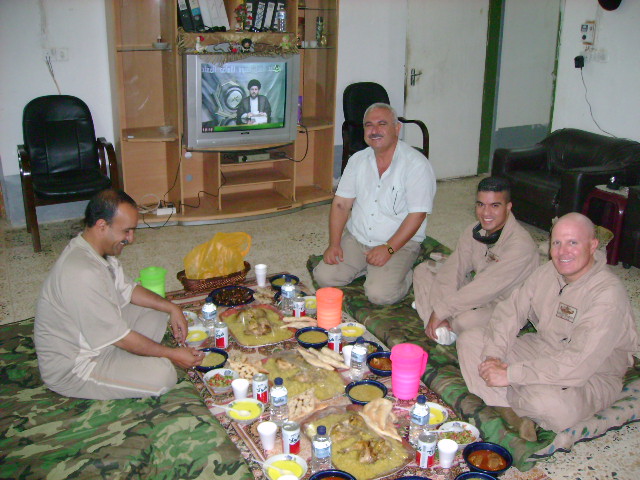
Dinner as a Guest of Brigadier General Sabah of 7th Iraqi Division

Today I was planning on traveling about an hour from here up to Kinston to see the Kinston Indians play the Winston-Salem Dash. That did not happen as I was called out of the “bullpen” so to speak to see a lady in our ICU.  I got the word as I was celebrating Mass and when I was done went to the hospital to make the visit which was delightful. The lady was one of those indefatigable people that despite a serious medical condition exuded grace, confidence and life and who up to the day she came to us was taking care of people worse off than her, taking them to the store, the doctor, preparing meals and making quilts for young mothers. The visit lasted about an hour with her doing most of the talking as if I was a neighbor who had dropped by for a chat.  We prayed and she shared a couple of poems that were actually touching.  I do pray that the specialist that we send her to will be able to correct the problems that brought her to us as we need as many people like her as we can get.

So anyway with my well laid plans disrupted I have been doing some thinking and if you know me that can be a dangerous thing because I never know exactly what the muse will inspire.  It began early even before I got out of bed when I saw a Facebook chat message from an Army Chaplain of my denomination serving with an infantry unit in Afghanistan.  He asked if I had read a story in the Christian Science Monitor about an Army National Guard Chaplain who had been convicted of fraudulently awards for valor including the Bronze Star with the “V” device for valor, the Purple Heart and the Ranger Tab denoting his completion of the arduous Ranger School.  He added those awards to his recorded after Operation Desert Storm where he served as a clerk and saw no action and he carried the charade on into the time where he was commissioned as a Chaplain.

http://www.csmonitor.com/USA/Military/2011/0403/Did-a-chaplain-s-fake-Purple-Heart-erase-good-deeds

He was tripped up after he returned from a tour in Afghanistan and was tried and convicted under the provisions of the Stolen Valor Act.  If he wasn’t a Chaplain it would have been bad enough.  However as a Chaplain his falsification discredited all the good work that he did in Afghanistan. What really did him in with his former soldiers was lying about his experiences to them point of wearing fraudulent awards for valor. His deception has caused many of the soldiers that he counseled to be angry and wonder if he was lying about other things.  When a Chaplain loses his or her credibility for an integrity issue it undermines their ministry, damages relationships with the people that they serve as well as their colleagues.  Their actions if married also negatively impact their families who suffer for their actions. The man in question received an Other Than Honorable Discharge which means that he receives none of the benefits that he would have received as a veteran including retirement. He is now getting help but the damage is done.

He certainly is not the first Chaplain to fall and won’t be the last.  I have spent a decent amount of my career being a “relief pitcher” for line officers and chaplains who have been relieved of their duties and been assigned to try to help rehabilitate others who have merely messed up without committing any crimes.  I have been fortunate in my long career to have men that have looked after me and protected me when I screwed up, sometimes with great aplomb.  My screw ups always seemed to be to being cocky and sometimes arrogant thinking that I was the greatest thing since micro-brewed beer.

When I was commissioned as a Second Lieutenant in the US Army back in 1983 I knew that I was quite possibly the smartest new Lieutenant in the Army.  I graduated from my Medical Service Corps Officer Basic Course fairly high in my class without really trying too hard, had a pretty easy time at the Junior Officer Maintenance Course.   However, real life has a tendency to take the smartest of the book smart people and kick their ass.  Sometimes it takes a while but young guys in the military who think they know more than old dudes who have served on all kinds of places and been to combat tend to blow themselves up and hopefully there will be someone to save their sorry ass.

When I got to Germany I can say that there were a number of occasions where as a young officer I had my ass handed to me, even when I was right.  I’m not going to go into ugly details but it suffices to say that a good number of those times I got what I deserved because I was arrogant and not nearly as smart as I thought I was.  I was like a rookie pitcher thinking that my stuff was unhittable and finding out that guys who had played in the show for a long time had seen it all before.  It was in Germany that I found that while I had good stuff that I wasn’t savvy enough to know when to change my stuff up or when to take the hint not to keep pushing my luck.  I was kind of like the young pitcher Ebby Clavin “Nuke” LaLoosh in Bull Durham in wanting to do what I wanted to do and it got me in trouble.  One of my favorite scenes in the movie has this dialogue.

Crash calls for a curve ball, Ebby shakes off the pitch twice]
Crash Davis: [stands up] Hey! HEY!
[walks to meet Ebby at the mound]
Crash Davis: Why are you shaking me off?
Ebby Calvin LaLoosh:
[Gets in Crash’s face] I want to give him the heat and announce my presence with authority!
Crash Davis: Announce your f***ing presence with authority? This guy is a first ball, fast ball hitter!
Ebby Calvin LaLoosh: Well he hasn’t seen my heat!
Crash Davis:
[pauses] Allright meat, show him your heat.
[Walks back towards the box]
Crash Davis: [to the batter] Fast ball. [Ebby throws a fastball which is hit out of the park and Crash comes to the mound]
Ebby Calvin LaLoosh: You told him didn’t you?
Crash Davis: Yup.

That was me as a young officer.  You would think that I would have learned, but after I became an Army Chaplain I did the same damned thing.  Now admittedly it was not in the units that I served in, but my hotheadedness still got me in trouble especially when I decided to challenge older Chaplains who had been around a long longer than me and who were a lot more savvy than me.  I had no idea how cunning and brutal some chaplains could be despite having good warning from my XO and Brigade commander at the Academy of Health Sciences, Lieutenant Colonel Jim Wigger before I left active duty for seminary.  Colonel Wigger pulled me aside one day shortly before I left active duty and said “Steve, I know that you think that the Medical Service Corps can be political and vicious, we can’t hold a candle to the Chaplain Corps.”   He was right and I would have been wise to listen to him.  There are some Chaplains that have no problem taking down or destroying a young chaplain sometimes for good reasons but sometimes for less than noble reasons. Anyone that has served as an Active Duty Chaplain probably knows about or has experienced such an encounter up close and personal.  I got whacked pretty hard a number of times as a young Army Chaplain, but was fortunate that people who knew me and saw potential in me gave me some top cover and protection.  Not everyone gets this.  Chaplain Rich Whaley did this for me at the Chaplain school on a number of occasions even the time that I got thrown out of the Chaplain Officer Advanced Course. That was not one of my finer moments; I left the school like former Atlanta Braves Manager Bobby Cox would when he got tossed from games.

While Rich was not quite like Crash Davis he knew how to handle me when I got stupid. There is another scene in Bull Durham where Ebby ignored Crash and paid the price.  

[Mechanized bull noises in background after ball hits the Bull over the Right Field wall]
Crash Davis: Well, he really hit the shit outta that one, didn’t he?
[laughs]
Ebby Calvin LaLoosh: [softly, infuriated] I held it like an egg.
Crash Davis: Yeah, and he scrambled the son of a bitch. Look at that, he hit the f***ing bull! Guy gets a free steak!
[laughs]
Crash Davis: You having fun yet?
Ebby Calvin LaLoosh
: Oh, yeah. Havin’ a blast.
Crash Davis: Good.
[pause]
Ebby Calvin LaLoosh: God, that sucker teed off on that like he knew I was gonna throw a fastball!
Crash Davis: He did know.
Ebby Calvin LaLoosh: How?
Crash Davis: I told him.

Thankfully by the time I had spent 17 ½ years in the Army I had pretty much learned my lessons.  By the time I got to the Navy I had pretty much discovered when and under what circumstances that I could push things without crossing the line.  I had learned the hard way in the Army.  I finally learned that I didn’t know nearly as much as I thought I did.  In fact when I went to the Navy I came in at a lower rank that my Army rank and took no constructive credit to try to get promoted sooner.  A lot of people have asked me why I did this but I went in with no time in grade to make sure that I got the experience that I needed on the Navy and Marine side. By doing this I took the time to learn the nuances that make the work of a chaplain different in the Sea Services than in the Army.  While there are similarities that are common to all Chaplains even the similarities are often different depending on the service and even the type of unit you serve in or platform that you serve aboard.  These different similarities can kill you if you think that you’re smarter than everyone else.

Christmas at COP South

I’m now coming up to 26 years of commissioned service and soon to 28 total years of service.  I’m now a lot more like Crash Davis than Ebby Calvin “Nuke” LaLoosh.  Now I try to make sure the young chaplains and other Sailors, Marines or Soldiers don’t get themselves in unnecessary trouble by assuming that they know more than they do.  I know from bitter experience the price that any service member and especially Chaplains can pay for screwing up. I had some OERs in the Army that were less than stellar when seniors tried to torpedo me.  Thankfully like baseball statistics they don’t follow you when you get traded to or sign with a team in another league mid season. They are there for posterity but you get a clean start in the new service.  I am blessed because my Navy and Marine Corps stats are far better than my Army stats.

The Chaplain in question now suffers the ignominy of being put out of the service for his actions.  From the article it seemed that he had a need to appear more than he was failing to realize that there is honor in simply serving be it as a clerk or a Chaplain.  Military awards tell a story about a person, those that earn them for valor or for wounds suffered should have earned them. I see many young men and women that wear Purple Hearts and awards for valor in combat. While I have many awards and service medals, even for service in a combat zone I cannot dishonor the brave men and women that have paid with their lives by wearing something that I didn’t earn and find it hard to fathom others doing this.

Receiving the Defense Meritorious Service Medal on my way out of Iraq from Colonel David Abramowitz Chief of Staff Iraq Assistance Group on 31 January 2008. RP2 Nelson Lebron my assistant is to the right

There are other ways that chaplains can get in trouble and I have seen them all I think. Moral issues, alcohol and drug abuse, adultery, misappropriating or even stealing government funds and doing things in combat zones that cross the line such as actually engaging the enemy.  There was a Chaplain back during Operation Iraqi Freedom that displayed photos of him in combat carrying an M-16 and I have heard of others in previous wars that have crossed that line. That last offense violates the U.S. interpretation of the Geneva and Hague Conventions and the consequences are greater than the individual chaplain as a Chaplain that does such surrenders his status as a non-combatant and exposes himself to potential war crimes charges. Likewise in the current war with much media coverage and an enemy that would exploit such actions to incite further violence and embarrass the United States it would be criminal for a Chaplain to take part as a combatant. It would harm the war effort, make him a potential target and endanger all other chaplains in the combat zone.

Chaplains are already a high priority target for Al Qaeda as our capture would be of great propaganda value. I had a number of Iraqi officers express their admiration for my service and care for American and Iraqi soldiers and the fact that they recognized that I was in constant danger and was unarmed.  I felt that it was high praise. Chaplains don’t need to be anything except what they are, servants of God and servants of the men and women that they serve. Being recognized with awards and promotion is cool but at the same time if that becomes the focus then we have somehow forgotten why we are in uniform and probably shouldn’t be.

Anyway, my mission now is to help the young guys and gals along and hopefully keep them from stepping on the land mines that I stepped on in my career.  I also know and am very aware that even as smart as I think that I am that I don’t know nearly as much as I did when I entered the military.  It’s like Earl Weaver said “It’s what you learn after you know it all that counts.”

Peace,

Padre Steve+


1 Comment

Filed under Baseball, christian life, iraq,afghanistan, leadership, Military, Pastoral Care

An Unnecessary Condition of Affairs

“The war… was an unnecessary condition of affairs, and might have been avoided if forbearance and wisdom had been practiced on both sides.” Robert E. Lee

I am always attracted to military leaders with a tragic and honorable history, men who maintain honor and humanity even when the nations that they serve was on the wrong side of history.  There have been such men in almost every war and I admire them even in defeat more than I do those that win victories at all costs and in the process lose their souls. This puts me in a select minority and minorities are not always appreciated we tend to make people uncomfortable just by existing. Since I have been threatened by threatened by Neo-Nazis, called weak, a heretic, apostate and sometimes worse by fellow Christians even being tossed from my former church for now being “too liberal” I am now officially used to this even when it comes from friends Romans and countrymen and the occasional nutty European, Asian or Islamist from abroad.

Today we stand at a political divide not seen since the days leading up to the American Civil War but it didn’t have to come to this had our political and corporate leadership been responsible and acted with wisdom the past 40 years or so. Robert E Lee a man unquestioned integrity was torn by his desire to see the Union preserved and his allegiance to it and his loyalty to his own family and the Commonwealth of Virginia.  Lee is a tragic figure a true man of courage, faith and decency, a man of moderation who maintained a profound respect and love for the United States even while leading the Confederate Army of Northern Virginia.  He had his flaws as well but on the whole he was one of the truly great men in American history. When the war was lost he was an advocate of reconciliation between the deeply divided North and the conquered South.

In an age of bitterness brought about by defeat and the repression of the draconian measures of Reconstruction Lee was a man that understood that as Americans it was necessary to put aside bitterness.  After the defeat he was accosted by a woman professing her hatred of the North. His reply to her would be a good start for all of those today who hate their fellow Americans be they Republicans, Democrats, Libertarians or Tea Partiers on the basis of political ideology and the raw quest for power.  Lee said to this woman “Madam, don’t bring up your sons to detest the United States Government. Recollect that we form one country now. Abandon all these local animosities, and make your sons Americans.”

Unfortunately among certain parts of the electorate the Government of the United States is detested and some even call for revolution if not at the ballot box if need be by violence.  The rhetoric is certainly pointing that direction as conservatives and liberals alike turn up the heat on this witches cauldron that our country has become. Compromise is considered anathema by both sides especially by the Tea Party movement and the fact is that we are at war with ourselves the national fabric is broken even worse than or economic state or moral state.  We may not be shooting at each other yet but unless we see some kind of national decision by all Americans to stop the political fratricide and work together to solve the problems that have been festering for decades it may come to down to bullets and the tragedy will be worse than that of the Civil War because despite the tragedy of it some good did come, the end of slavery and an understanding of being Americans rather than simply New Yorkers or Virginians. Lee writing about the war said “What a cruel thing is war: to separate and destroy families and friends, and mar the purest joys and happiness God has granted us in this world; to fill our hearts with hatred instead of love for our neighbors, and to devastate the fair face of this beautiful world.”

This political fratricide is in large part due to the manner in which our politicians, political parties and even religious institutions are the servants of multinational corporations and financial groups. When everything comes down to it all of these institutions are deeply subservient to the whims of special interests especially multinational corporations and financial institutions.  It is no wonder that leaders as diverse as Thomas Jefferson, Theodore Roosevelt and Napoleon Bonaparte recognized the threat that they pose to nations and in the case of the United States to democracy itself. Jefferson wrote “The end of democracy and the defeat of the American Revolution will occur when government falls into the hands of lending institutions and moneyed incorporations.”

Roosevelt noted quite rightly, much to the chagrin of his fellow Republicans “Behind the ostensible government sits enthroned an invisible government owing no allegiance and acknowledging no responsibility to the people. To destroy this invisible government, to befoul the unholy alliance between corrupt business and corrupt politics is the first task of the statesmanship of today.” While Napoleon cut to the heart of the matter when he wrote “When a government is dependent upon bankers for money, they and not the leaders of the government control the situation, since the hand that gives is above the hand that takes. Money has no motherland; financiers are without patriotism and without decency; their sole object is gain.”

Yet in the midst of our political fratricide there seems to be one special interest group above all which always seems to win even when the people of the country suffer. That group is the multinational corporations and financial institutions.  It doesn’t matter what party is in power they somehow come out with a big fat profit margin and get treatment that regular people could never hope to get. Now since the Supreme Court has ruled that big corporations (and labor too) now have no limits on what they can contribute to political campaigns you can bet your ass that politicians of all ilk’s will be suckling lucrative money milk from the tits of these corporations which will dispense billions of dollars to political campaigns in the coming year and a half leading up to the 2012 election.  We expect this of Republicans and Democrat but rest assured my friends that even Tea Party candidates will line up for their turn in order suckle at this tit to keep their newly acquired offices or gain more in the coming election. Such is the nature of politics in our fair country.

Meanwhile both parties dither about a budget that if they had been doing their jobs would have been completed months ago had Nancy Pelosi bothered to submit a budget for 2011 while Speaker of the House.  Now about three months into the new Congress both parties are posturing on the next year’s budget all the while the government lurches toward a shutdown of unpredictable consequences.

Yes we have to deal with the mess that these same people of both parties aided and abetted by their special interest group supporters have made over years to get us in this mess. Administration after administration and Congress after Congress have kicked this can down the road and now they have kicked it and the country into the ditch. Now something has to be done and Democrats seem loathe to step up to the plate and take political risks  while Republicans, particularly the Tea Party leadership are acting like the Jacobins during the French Revolution even threatening even their own party leadership if they don’t get everything that they want. All seem to ignore the fact that the vast majority of the country just wants both sides to figure the damned thing out and fix the problem for real even if it means personal sacrifice rather than seeing these people pursue the policy of mutually assured destruction.

Why does this seem so personal to me? Let me tell you. When I came back from Iraq after seeing the results of unbridled hatred in that country and having travelled in the Balkans after the Yugoslav Civil War I became frightened when I saw politicians of both parties speaking with the same invective as I saw in those countries. Nothing like seeing the effects of a real live shooting civil war to give one pause when political enemies threaten to cross that same line in this country.  Don’t dismiss this out of hand. For years certain pundits, politicians and preachers on both sides of the political chasm have been dehumanizing their opponents and once people are no longer seen as human it is very easy to resort to violence against them. Just take a look at the ordinary Germans who took part in the extermination of the Jews under the Hitler regime.

Am I forgetting something here? Yes I almost forgot, in 2008 we saw the housing crisis in which the very institutions caused the crisis were bailed out by both President Bush and President Obama with Congress willing and lovingly joining in to approve billions and billions of dollars for them. This included huge amounts of money which went to foreign financial institutions. Meanwhile regular people had their home value and credit slashed even as unemployment skyrocketed and in the following years we have seen the same banks seizing the foreclosed homes in record numbers while millions of others now owe far more on their loans than their homes are worth. It’s a great deal for the banks. Approve loans for people who will have a hard time repaying them, crash the economy have the government bail you out and then take the homes and sell them while still collecting the cash from the unfortunate former owners. Well to quote a great line from the Roman Empire segment of Mel Brooks’ classic comedy History of the World Part One

Leader of Senate: All fellow members of the Roman senate hear me. Shall we continue to build palace after palace for the rich? Or shall we aspire to a more noble purpose and build decent housing for the poor? How does the senate vote?
Entire Senate: F*** THE POOR!

It’s funny how a comedy from the late 1970s offers such remarkable political and social insights for us today. But then Teddy Roosevelt said of the Roman Republic as a warning to us back in 1903 “The death-knell of the republic had rung as soon as the active power became lodged in the hands of those who sought, not to do justice to all citizens, rich and poor alike, but to stand for one special class and for its interests as opposed to the interests of others.”

Well if these present rulers don’t get their act together parts of the government will shut down and your military which is currently involved in four wars, Iraq, Afghanistan, Libya and the nearly forgotten War on Terrorism in lots of places that the media doesn’t mention will not get paid. Ain’t that a hoot?  But mind you as military personnel try to salvage the wars that our politicians have plunged us into we still serve even if we won’t get paid.  Yet when push comes to shove we are cast aside by the political ruling class for their short term political gain.  I remember a quote of Robert E Lee which speaks volumes on this subject. Lee was besieged at Petersburg, his haggard and outnumbered Army deprived of food, ammunition and replacements was dying in the cold mud of the trenches when he went to seek help from the Confederate Congress. After his visit he remarked “I have been up to see the Congress and they do not seem to be able to do anything except to eat peanuts and chew tobacco, while my army is starving.”

Seems that nothing really changes, does it? This unnecessary condition of affairs, and might have been avoided if forbearance and wisdom had been practiced on both sides. When will we ever learn?

God help us all,

Peace

Padre Steve+


3 Comments

Filed under History, laws and legislation, leadership, Military, philosophy, Political Commentary

Padre Steve’s Primer on the Muddle East

“When you are up to your arse in alligators it is hard to remember that your mission is to drain the swamp.” Old British Colonial Saying

During the dark days of World War Two when Field Marshal Erwin Rommel was making fools of a series of British commanders in North Africa people including senior British military and government leaders sometimes referred to the theater of operations as “the Muddle East.” Some things never seem to change. The Muddle East today is quite frankly speaking in a real muddled state if there ever was one with world leaders and regional leaders muddling about as if they were the New York Mets.

A large part of the muddle goes back to the fall of the Ottoman Empire at the close of the First World War when the victorious Allied Powers redrew the map of the Middle East and made alliances with various local tribal sheiks who many times were crowned king over other tribes who didn’t necessarily want them as king. This along with heavy handed European military actions such as the British using poison gas dropped from aircraft in Iraq and a real lack of effort to better the lives of the newly “liberated” peoples of the region was just the start. Add to the cesspool a bunch of oil presided over by major oil companies, the anti-colonial movements that flourished in the years after World War Two when the French, British and Italians had to divest themselves of their Middle Eastern holdings. The French had to fight a real war in Algeria but finally withdrew leaving Algeria’s new rulers to goof up the country and oppress their people for decades to come.  In the coming years many of these newly independent nations found that life still sucked so in a number of countries military officers overthrew the despised monarchs promising reforms but oppressing their people while blaming all their problems on the Israelis.  They got their asses kicked by the Israelis in a series of wars which did a number of things that made the Middle East Muddle even worse.

First it ensured that Palestinian Arabs ended up under Israeli rule and were used with great aplomb by the Middle Eastern despots to prop up support for their regimes while doing nothing to help the Palestinians other than to put them in camps in Lebanon.  Even when the Egyptians made a peace deal with Israel most of the Arab World ostracized them.  Then in 1979 the Shah of Iran was sent packing by a bunch of Mullahs and in 1981 Saddam Hussein’s Iraq attacked Iran in one of the bloodier wars of the late 20th Century which finally ended in 1988. Of course the United States was pissed at the Mullahs so Saddam became our favorite Arab despot for a while.  Add to the mix the Soviet Union and the United States arming their favorite Arab dictators who were given carte blanche to continue oppressing their people so long as it didn’t interfere with their support of either party or the oil supply. Finally the Soviets went Tango Uniform in 1989 not long after being forced out of Afghanistan by the U.S. supplied, Pakistani supported and Saudi Arabian fundamentalist financed Mujahedeen.

With the Soviets Tango Uniform and the Warsaw Pact nations trying to get into NATO the United States was now the uncontested Numero Uno country in the world Saddam presumed upon his late supporters and invaded Kuwait, albeit after thinking that the U.S. Ambassador to Iraq said that we wouldn’t mind. Well he was wrong we did mind and got a lot of countries from NATO and including a bunch of Arab countries like Egypt, Syria and Saudi Arabia to get on board on a mission to get Saddam’s troops out of Kuwait. It was a kick ass mission and since the United Nations didn’t authorize removing Saddam and because President George H.W. Bush was smart enough to not to drive on Baghdad to kick him out preferring the depot we knew to a quagmire despite Saddam’s crimes against his own people who thought we would help them.  So we stationed ground and air forces around the Gulf to keep Saddam and Iran in check and even put them in Saudi Arabia which a large number of radicals such as Osama Bin Laden equated to letting the Devil play in Allah’s Holy Sandbox.  So Osama went and set up a base with the Medieval bunch of Pashtun known as the Taliban in Afghanistan stirred up a bunch of shit killing Americans and blowing up stuff including the World Trade Center in 1993, the Khobar Towers barracks complex in 1996, the USS Cole in 2000 and then 2001 another attack on the World Trade Center which took down the towers with hijacked aircraft and also struck the Pentagon triggered an American response against Bin Laden and his Taliban hosts.  The United States then invaded in Iraq in 2003 and succeeded in taking out Saddam but also succeeded in alienating a good many Iraqis who greeted us with open arms because we goofed up the occupation and pissed a lot of them off by dissolving the Army, Police and Civil Service and letting thugs and opportunists take over. Unfortunately since we didn’t go in with enough troops to secure all the Iraqi bases, their weapons depots and actually take control of surrendering Iraqi units these newly unemployed and dishonored people launched an insurgency bolstered by Al Qaeda and other foreign fighters even as Sunni and Shi’a Moslems began to settle scores with each other. Insurgency and civil war, two great tastes that go great together, but what the heck right?

Of course it took years to get control of the situation on the ground and thankfully the United States forces in Iraq were helped when the Sunni Moslems in Al Anbar Province realized that these foreign fighters were a worse enemy than the United States and switched sides. This turned the tables in Iraq and the insurgency was brought under control and an elected government managed to start to get their stuff together and allow us to begin withdrawing from Iraq. Of course the focus on Iraq gave the Taliban a chance to regroup as the Afghani Government proved itself corrupt, incompetent and not to give a shit about the Afghani people. So the Taliban who had been hated made a comeback and made our lives much harder so that now almost 10 years into the fight we are having a really hard time.  Well enough about us there was plenty more going on in the Muddle East besides the Iraq and Afghanistan wars.

Let’s see….there was the law of unintended consequences in that by taking Saddam Down and weakening Iraq we took away Iran’s natural enemy and the key to the balance of power in the region. Iran was strengthened and began a nuclear program that everyone with half a brain knows in intended for military use and expanded its influence in Lebanon where the Iranian backed Hezbollah took power last year.  Now Hezbollah which actually has an experienced military force and probably owns 40,000 or so rockets and missiles a good number of which can hit deep in Israel seems to be ready for war especially because they fought the Israelis to a stalemate in 2008, the first time an Arab military ever did that.

Then was the effect that the wars in those countries made things harder for us in many other friendly Arab nations.  Of course there is the problem of a nuclear armed Pakistan which is about as stable as a Japanese nuclear reactor after getting hit by a tsunami and plays both sides of the street in the war on terror.  The Palestinians and Israelis continued their love affair and since Fatah which ran Palestinian Authority was so corrupt and gooned up a more militant group, Hamas took power in the Gaza strip. Hamas is a pretty bloodthirsty lot too but not the same level of threat as Hezbollah to the Israelis.  Of course the Israelis have done little to help the situation by their often heavy handed treatment of Palestinians and Israeli Arabs.

The witches’ cauldron of the Muddle East is getting even more muddled on a daily basis as young Arabs throughout the Muddle East are rising up against their despotic rulers and it doesn’t seem that any are safe, those allied with the United States and the West as well as those that have been a thorn in the side of the United States and the West. It just seems that despots and tyrants are no longer in vogue. The uprisings began in Iran after a disputed election where reformers were cheated of power and the revolt crushed by the Revolutionary Guard and other thugs of the Iranian regime. But then in December 2010 the people of Tunisia rose up and overthrew their President for Life Ben Ali in a peaceful uprising followed shortly after by the Egyptians who tossed out long term President and U.S. ally Hosni Mubarak.

This brought about spontaneous uprisings all over the Middle East with Libya and the long time pain in the ass Muammar Gaddafi being the current center of the action. However Yemen and Bahrain both are in trouble, Algeria, Jordan and Syria have or are experiencing demonstrations which look to be revolts in the making and even Saudi Arabia is trying to head off a potential popular uprising.

Yes my friends this is a mess and almost everybody that is anybody in the military and economic power houses of the world doesn’t have their handprints all over at least some part of this mess. All of these own some of the blame for what is going on, both the rulers of the nations in the region as well as world powers who all try to influence the nations and peoples for their own diplomatic, intelligence, military or economic gain. Almost no one is unsoiled by their involvement in the Muddle East over the past 90 years or so and so in a way all of world powers, as well as the despots who ran these countries are to blame.

The region is more volatile than at any time in recent history and events there could easily ignite a regional war with worldwide implications.  That is why the region has been called the Muddle East for decades.  We all hope and pray for the best and that somehow all of this will bring about a peaceful and democratic “Arab Spring” but there are better than even odds that things get way worse before they get better. There are just too many wild cards in this deck and the swamp is full of hungry alligators.

May God help us all and bring about peaceful change, or as my Iraqi friends simply say “Inshallah, God willing.”

Peace

Padre Steve+

4 Comments

Filed under Foreign Policy, History, middle east, national security

Notes on a Trip to Houston

I have been travelling this week to a Chaplain and Clergy conference of my church, the Apostolic Catholic Orthodox Church in Houston Texas. It has been a really interesting trip. Just a few notes to make as I sit in the back of a cab on the way out to Houston Intercontinental Airport and in the terminal while awaiting my flight.

I am not a big fan of flying anymore and find commercial air in the United States to be a bit more nerve wracking than flying military air in Iraq. There I was treated well and not as a criminal when trying to get aboard an aircraft. I think that the Patriot Act and the TSA has determined that we are all guilty until proven innocent because we wither choose to fly or due to business, even on military orders have to fly. After my criticisms of both the TSA and the Patriot Act last year I was shocked that I have not been put on the no-fly list or selected to have my junk fondled.

In a surprise I found that the agents for U.S. Air were much more polite and helpful than in years past both at Norfolk and Houston. At Norfolk an agent figured out that I was military by my trusty desert tan Blackhawk backpack which has accompanied me almost everywhere since I went to Iraq back in 2007 and made sure that I or you being the taxpayer were not charged for my baggage. The flight crews were also friendly and the check-in personnel at Houston were also polite and helpful and did the same as Norfolk regarding my baggage.

While still having to go through the screening procedure the TSA personnel were better than many that I have encountered and I was not forced to have my junk fondled or go through the super high intensity x-ray machine. Unlike many TSA checkpoints that I have been through I had the agent that checked my ID and boarding pass was polite and called me by my military rank.  This may not seem like a big deal except that I have been accosted in uniform at some TSA checkpoints and forced to remove insignia qualification badges and ribbons despite having my ID and orders in hand while people that were obviously foreign and wearing Middle Eastern garb were permitted through without so much as batting an eyelash.  Thus when I am treated politely by TSA I do think that it is a big deal. That takes nothing away from my beliefs that the Patriot Act and the TSA act as though people are guilty until proven innocent and are egregious violations of the Constitution and the Civil Rights of Americans.

While on flight from Charlotte to Houston I sat next to a man about my age. I noticed that he had a Bible and throughout the flight seemed very engrossed in it and when he looked up appeared as if his gaze was far away. I noticed that he was reading 2nd Corinthians chapter 5 and I mentioned that my one of my favorite sections of the Bible was there. He ask which and I pointed out verses 17-21 about those in Christ being new creations and that God was reconciling the World through Christ counting people’s since not against them and that we were Christ’s ambassadors.  He struck up a bit of a conversation with me and mentioned that he was a minister on the staff of Thomas Road Baptist Church in Lynchburg Virginia and that he was on his way to Texas because his father had just died after a battle with Cancer and that he would be doing his funeral. I had been writing “A Ballgame with St. Pete” and remembering my own father’s death last summer so I gave him my condolences and shared just a bit about losing my dad and how I could not do the funeral because of the emotion involved.  It was nice to be there for someone going through this as the trip to bury a loved one can be one of the loneliest times of one’s life.

The conference was wonderful and in the time together we had many hours of productive discussion of church business, developments in the professional pastoral care world and care for each other. I found that I fit in well and felt an instant kinship with my fellow clergy which in my case for the first time in church included ordained women. My previous church had a male only clergy. I found how much I appreciate the Old Catholic ethos of being a refuge, a place of healing and a place of openness which upholds the teachings of the first seven councils of the Ancient Church and strives for thru ecumenical Catholicity.  Bishop Diana Dale our Presiding Bishop is a gem and I felt kinship with the people that I met. I miss the friends that I served with in the Charismatic Episcopal Church for over 14 years I know that I am in the right place.

After our last formal business session on Saturday we went to get to the San Jacinto Battlefield and while some went to the Memorial to the Texas Independence Memorial some of us went over to the USS Texas to see this last example of the Dreadnought era battleships. I have wanted to see the Texas for many years and have written about her on this site. It was interesting to note despite the fact that she was commissioned 98 years ago that much is still the same in current Navy ships. Yes things were a lot more primitive but at the same time much was the same.  It was really a nice expedition with Robert one of my fellow Priests from Maryland and Gale our senior Deacon who comes from Iowa.

After the trip we went out to a Mexican restaurant named Ninfa’s where the Fajita was invented. One thing about that trip was when we were told that our table was ready. The restaurant was very busy and we waited in the bar. When we were called we were led in and on our right a man, obviously military was giving thanks for the meal with his family. They were holding hands and he had a very loud and clear voice and I heard this little bit. “Father I thank you for being home with my family and that I have returned safe from Afghanistan, please bring a swift end to this war….” That was all that I heard but it was enough to get me to pause and realize that it was my prayer too.  I think that some people wrongly believe that those that serve in the professional military are warmongers when in fact I know that many have no illusions about this war and after 10 years many, especially the regular career professionals in the officer and senior NCO ranks feel the same way.  It was a poignant moment.  We know that the current war will go on and most of us are convinced that the situation around the world is going to cause us to be embroiled in even more conflicts.

I think there was one other significant thing about this trip. I was able to control my anxiety and did not have any PTSD meltdowns in any of the terminals or crowded situations. Not to say that I was entirely comfortable or without anxiety but that unlike many of the trips that I have made since returning from Iraq I did not suffer any panic attacks.

This morning we had an ordination service for a new Deacon which was really nicely done with the traditional Ordination of a Deacon Liturgy and Mass. After that was done I had to make a quick change to catch a cab back to the airport.  I look forward to being home for a bit before Judy comes with me to help me settle in to my new island hermitage on Tuesday.

Peace

Padre Steve+


2 Comments

Filed under christian life, faith, PTSD

A Ball Game with Saint Pete: The confluence of Baseball and Faith

This is a re-written version of an article that I wrote last year and is part of my “Meeting Jesus and the Team at 7-11” series.  The original; was written shortly after my dad died last summer. Today I revised it while traveling to a Church clergy and Chaplain conference in Houston. Peace, Padre Steve+

A week after I met Jesus and the team at 7-11 I found out that I was selected to be promoted to the rank of Commander in the Navy Chaplain Corps.  While still in amazed wonderment about that meeting and what happened on the team’s road trip to Dyersville Iowa to play at the Field of Dreams I was caught up in the excitement of knowing that I was among 20 chaplains selected for promotion for the next fiscal year.  That night I went to worship at the Church of Baseball Harbor Park Parish despite being very tired from three busy overnight duty shifts over the preceding eight days at the hospital that I served at as a Chaplain.

The previous night had gone long as I had to deal with a number of serious situations.  We had young Petty Officer First Class named Kenneth die of cancer. Kenneth was one of those rare people with no guile. While he served in the Navy he was also an outstanding basketball player and played on the All-Navy Basketball team. He died after a struggle with cancer that had ravaged his formerly massive body, that of a basketball power forward until he looked like a concentration Camp victim at the end of the Second World War. The time with this young man and his family was filled with grace as three Chaplains as well as a number of hospital staff that had gotten to know them over the preceding three months gathered at their apartment outside the hospital gate where he had gone home to die.  It was his desire to spend a few days at home with family before dying and one of the last things that he was able to do was watch game seven of the NBA Championship game between the Lakers and the Celtics. The three Chaplains, a Roman Catholic, a Pentecostal and me a miscreant Old Catholic type all prayed at the bedside and stayed with the family and his body during the holy silence that pervaded the living room.

Later I would spend time with the family of an eighteen month old boy that had drowned and been resuscitated by EMS in down but was certain to die in the next day or two.  Then I did some follow up with a dear lady that was in the end stages of heart and kidney failure in our ICU. I’d known Corrie a sixty-five year old Filipina and her family over the past couple of years as she struggled to live, but today was different. Nothing more could be done. I was with her and the doctors as they discussed her condition and when she calmly let people know that if her heart stopped again not to try to bring her back. We talked and prayed afterward and she had asked if I would come up to help her write down her story.  Well that had not worked out but I did get to her bedside late making the sincerest of apologies and letting her know what had happened. Corrie was also one of those dear saints, a devout Catholic that loved God and her neighbors, she was concerned for the families of the other patients and not so concerned about herself. She had faith and was confident that Jesus would have her in heaven because as she said it was his grace and mercy that had allowed her to know him.  I listened to her, sang with her, prayed with her and chatted for almost an hour and a half before going to check on the parents of the little boy and my Pediatric ICU staff before trundling off to the Duty Chaplain Bunk room for a few hours of fitful sleep.  I thought of the people that I had dealt with during the day and how each in their own way had touched my life and saying a brief prayer I laid my head on the bricklike pillows and body down on the devil’s mattress, or the mattress from Hell fell asleep.

After going home I received the call from Derek our deputy chaplain at the hospital to congratulate me on my selection. I was thrilled and that evening I went to the Church of Baseball, Harbor Park Parish to see the Tides play the Lehigh Valley Iron Pigs, the AAA affiliate of the Philadelphia Phillies.  It was a terribly hot and muggy night but the game was exciting and as is my custom I took a lot of pictures for my website as I try to write about every Tides game, hoping that someday when I grew up that I might be a baseball writer.  I guess that I am one now except no-one is paying me for it but such is life. As I moved about I spent some time with my buddies, Elliott, Chip and Art the Ushers and each time that I moved up or down from the home plate area where I reside down the first base or third base line to get shots from different angles I would visit with them, talking baseball, life and receiving their congratulations on my selection for promotion.  To them I am the irrepressible Padre Steve and we have a wonderful time together at each home game.

That night was like any night at the Church of Baseball until I noticed a burly man in a Yankees hat with a beard and pony tail coming down the stairs toward section 102. He was showing his ticket to Elliott the Usher, also know by some as Elliott the Enforcer he also has charge over section 100, the VIP section shared by scouts, players, families of team members and visiting VIPs.  That section is carefully monitored by the aforementioned “Enforcer” and the man, wearing a faded Yankees Jersey from what appeared to be from the 1930s with the number “3” on the back and a pair of large brown cargo shorts with sandals on his feet walked toward Elliott showing his ticket.

I recognized the man and since I was on the move anyway from the third base side toward first I went up to them.  Having met the man the previous week at 7-11 and knowing that he and the team loved baseball I had wondered of they might make their way back to Hampton Roads.

“Elliott, you gonna let a Yankee fan into section 100?” I smiled as I asked the question. Elliott and Pete both looked over at me, Elliott is about my height but Pete towered over us at a good 6 foot 3 inches outweighing each up us by at least a hundred pounds. Pete smiled.

“Steve from 7-11 right?”  Pete asked as he recognized me with Elliott looking on.

“That’s me” I cheerily answered. I liked Pete, there was something genuinely fun about him a blue collar guy that in addition to going and spreading the Good News also liked to be around regular people and have some fun, after all he had spend his early years as a fisherman and like any sailor was a little rough hewn in his manner.

Elliott looked at us and asked Pete “You know this guy?” to which Pete responded “I sure the heck do, he’s one of our people, you know a baseball fan and Padre to boot.”

“So where do you know each other from?” I asked.

Elliott looked at Pete and Pete looked at me before Elliott answered. “I met Pete up at Fenway back in ’76 when the Red Sox went to the World Series.”

“Yeh, I was in town to see the Yankees play those bums and happened to sit by Elliott, for a Sox fan he’s a pretty good guy and unlike most of those weenies at Fenway he actually understands the game.”

“No kidding?”

“No kidding Padre, that’s how we met, just goes to show that if you really love the game even Red Sox and Yankees fans can sit together in peace, right Pete?”

“You know it Elliott, you know it.”

“So Pete where you sitting?”

“Section 100; row C on the end down there behind the radar gun.”

“Cool I’m right across the aisle in section 102 row B to your right, would you like to go down there with me? How’d you get section 100?”

“Dude, the boss has connections, when I asked him if I could go back and visit this ballpark when we were done in Dyersville he called Dave.”

“Dave? You mean Dave Rosenfield?” Dave is the long time General Manager of the Tides and I chat with him whenever I get the chance.

“Heck yeh Padre, the Boss knows all the GMs, talks to them often, even the minor league GMs. He likes to put in his two shekels with them in discussing prospects; you know that the boss keeps a keen eye on these players don’t you?”

“Well, I figured so, like he does the rest of us right?”

“It’s kind of like that but this is something that the Boss has a passion for, he died to save the world and the world does include baseball, does it not?”

“Well, that’s true, but even though I found out last week that the Boss and you guys liked baseball I didn’t know it was this serious.”

“Padre, this is baseball, it is serious and the Boss takes it seriously, even more serious than Selig, the Grand-Poobah of Major League Baseball.”

“He takes the game serious or Selig serious?” I smiled as I said this triggering a smile back as he replied removing his cap and wiping his brow of the sweat that the hot and humid Tidewater weather causes the human body to produce in mass quantities when not inside an air conditioned building, which Harbor Park, open to the elements as a baseball field should be is not. As he put his cap back on he quipped back to me “the game Padre, Selig he just humors, lets him think that he is in charge, there are times that he thinks about resurrecting A. Bartlett Giamatti.” Pete paused for a second looked up at the press box and continued “but whenever he talks about it he says that he doesn’t want the Dispensationalists to think that the Tribulation has started, the boss seems to think that it would not be helpful even if Giamatti would be better for the game than the Grand-Poobah Bud.”

“I guess that that would cause a bit of a stir if he did that can you imagine all the headlines on ESPN, the in depth interviews and of course the talk show circuit Pete?” I continued not giving Pete a chance to answer “It would be freaking amazing, could you see Giamatti being interviewed on Larry King Live and see if Larry asks him if he will lift the lifetime ban on Pete Rose? Or even better brings up the Congressional hearings on steroids in Baseball?”

“Yep Padre it would be a spectacle and would cause more problems than it would solve, hell Congress would probably want an investigation of how Giamatti came back from the dead and the liberals and conservatives would have hearings that would drag on endlessly and make themselves the center of attention every time a camera was in the room, thank God that Herod and Pilate didn’t have C-Span or the 24 hour news cycle.”

“And people would pretty much ignore the God thing in the story…” said Elliott.

“Well not really except that the Bosses’ involvement in raising someone like Giamatti from the dead so many years after he passed away, God rest his soul, like anything that the boss does would be used by politicians to advance their agenda and dare I say preachers to further their “ministries” or make money by selling books, audio CDs and DVDs that miss the point entirely.” Pete took off his hat and wiped his brow again “sure is hot and miserable in this place, makes me miss the Med, you know that Israel has pretty good weather, a bit dry and hot in the summer but no humidity.”

“I know, I’m originally from California and we had hot weather in the summer but no humidity.”

“Now California, that’s an interesting place, I love the West Coast road trips and that new stadium that the Giants play in that is great.”

“I like it too, it’s so much nicer than Candlestick.”

“Don’t get me going about Candlestick young man. Went out there once in July to see the Giants play the Mets in a double header….I think that it was in the mid-1970s, so guy named Halicki threw a no-hitter.

I looked a Pete funny. “Halicki’s no hitter?”

“Yeah, you heard of it?”

“Pete, I’ve been a Giants fan since I was a kid and I was there for that game.”

“No kidding?”

“No really dad took my me and my brother, it was cold as hell out there but it was so cool to actually see a no-hitter in person.”

“Ain’t that a hoot. Sure is a small universe partner.”

“That it is Pete that it is.”

“So what do you think of the new ballpark? I love the food there, did you have the garlic fries?”

“Yeh, it was the first place that I ever had them, Gordon Biersch has a stand there.”

“Those sure were good; I think when we got back in the bus for trip down to L.A. the next morning we all still smelled like garlic.”

“So Pete, you want something to eat or drink?” I asked figuring that it was a good chance to see what the big Yankees fan liked.

“Sure Padre, what have they got?”

“They don’t have the garlic fries but they have some pretty good chow, want to go up and look around?” Elliott looked at us and said to Pete “You’re not leaving already are you?”

“Hey Elliott, you know me would I leave a game before it was over?”

“Well you didn’t get here on time.”

“Elliott you know that’s not fair, I drove in from Iowa and that doggone Hampton Roads Bridge tunnel is for the birds, if I was the boss I would have Moses come in, part the waters and lay down another tunnel like with four lanes in each direction.”

“Now that would be nice, do you think that he could do something with the Downtown too?” I asked as Pete and Elliott chuckled.

“Hey, Padre, let’s go up and get something to munch on, I’m hungry.”

“Sure Pete, what would you like?”

“What have they got?”

“Heck Pete about anything, well anything, they even have a real restaurant down in the Right Field corner.”

“So what do you like?”

“I don’t mind a Tides dog with chili and a beer.”

“Tides dog?”

“Yeah, just a grilled hot dog with chili sauce, of course they have the all-beef Jumbo Dog, but it’s a bit heavy for me.”

“So any of this Kosher?”

“Are you kidding, this is a ball Park Pete.”

“True, but one can hope.”

“Besides, Pete didn’t you get the vision from Jesus that all food was cool even if it wasn’t Kosher?”

“I know Padre but you gotta remember my background, I still fall into the old habits sometimes.”

“I know, even after Jesus told you that all things were clean old dour Paul had to correct you when you were hanging out with some Greeks.”

Pete looked down and shook his head once again wiping his brow, “I wish Luke hadn’t put that down in Acts, not really fair to me, but Luke was Paul’s man. Now it’s not like Paul didn’t have his faults too, ran off Barnabas and John Mark on one of his trips, but to his credit Luke put that down too” Pete wiped his brow again and continued “I guess that you could say that he was the first “fair and balanced” reporter.”

“Yeah, church politics and the writing of history huh?”

“You know it even then, but old Paul and I did patch things up when he got to Rome.”

We walked down the concourse to the far concession stand down the third base line where my buddy Gerry from Gordon Biersch works with his volunteer organization.

“Hey Gerry!”

“Hey Steve, how are you doing?” said Gerry who is about the same height and build as Pete.

“Gerry, I’d like you to meet Pete, he’s from out of town.”

“Really, where from?” asked Gerry.

“Oh here and there, right now travel around with my boss doing good stuff and getting in some baseball wherever we go.”

“Cool, so Pete are you a Yankee’s fan? I love the jersey”

“Pretty cool, huh? Babe Ruth’s number”

“Yeah, got it special, so what team do you root for?”

Gerry shook his head and gave a slight chuckle “well I’m a Reds and Indians fan, from Ohio.”

“So the Big Red Machine huh? They have a pretty team this year, lots of young talent and they are willing games in the last inning and the last a bat like something I’ve never seen” replied Pete “and I’ve been around quite a while.” Pete paused took a deep breath and continued. “I think that they have a a real shot at making the playoffs and taking the N.L. Central this year.”

“It’s been too long Pete, I’ve been around quite a while and I haven’t seen them play this well in a while.”

“I think some of the sports reporters and columnists are going to eat Cardinal on this one.” said Pete.

Gerry laughed out loud and blurted out “You mean crow don’t you?”

“Nope, Cardinal, like in St. Louis type.”

“That’s funny, what can I get for you guys?”

“A couple of Tides dogs with chili, right Pete?”

“Can I have a big order of fries too?”

“Sure Pete” replied a very cheerful Gerry since you’re from out of town they’re on me.” Gerry pulled his wallet out and told the cashier that he was getting the fries as I handed over the money for the Tides Dogs.

“Anything to drink Steve?”

“Gerry you know that I don’t drink the beer from this stand.”

“That’s true; we just have the Bud and Bud Lite here, you going across the way to get a Yuengling?”

“Is that good?” asked Pete. Before I could answer Gerry said “a lot better than what I have here.”

“It’s not Gordon Biersch but it’s alright” I replied. “Besides, Budweiser is like the wine that they were serving at Cana until the Boss dropped by.”

“That bad huh?” replied Pete as Gerry chimed in “you’re too much sometimes Steve, you talk to Pete like he was there or something” as I simply chucked, and said “Yeah, something like that.”

A lady brought our hot dogs to us and we went and got our beer from the kiosk opposite Gerry’s stand and we began to walk down to our seats once again greeting Elliott on the way down.

“Hey Padre, these are nice seats, you have to pay through the nose and have connections big time for seats like this at Yankee Stadium and the boss won’t cover that, he thinks it’s a bit extravagant and wouldn’t look good on the organization.”

“So he’s not a big fan of high prices that keep regular folks from getting great seats?”

“No, he’s like to see everyone get a chance to sit behind home plate in a big park like that at least once” as he looked at his ticket and sat down across the aisle from me.

“So Pete, so why do you keep calling me Padre? You can call me Steve.” I said as I took my first drink of my Yuengling Lager. Pete picked up his cup and said “cheers Padre” and lifted the cup to his lips drinking the amber lager. “Not bad, we didn’t have much beer back in the day, Judea and the Mediterranean was more of a wine place. There was some beer back then but it wasn’t that good, it took the Monks working for the organization in Germany to get it right” as he took another drink from the cup and wiped beer from his beard “nice beer, I’ll have to tell the boss about it.” Pete paused for a second and went on “good choice Padre.”

“There you go again you can call me Steve, I don’t mind Padre but if you let me call you Pete and not Pope Pete why don’t you just call me Steve?”

Pete looked and me and smiled. “Padre, that’s what you are, it’s who you are, remember that whole Sacrament of Holy Orders thing?”

I kind of felt silly, I like being called Padre, beats the heck out of “the Reverend” or something like that but still having Saint Peter, the first Pope call me that was kind of humbling especially when he had no objection to being called Pete.  “I know that you’re right Pete, but still, you were like the first Pope you really outrank me.”

“Padre, I never paid any attention to “rank” as you call it when I was Pope. Back then it was not really a career or longevity enhancing job, no palace, no red shoes, even though Ben’s aren’t made by Prada like some people say and none of the big hats and stuff like that. If it was up to me the hats that clergy wear would be more practical, I like baseball hats, Matthew kind of likes a Fedora and a couple of the other guys like hats like that Indiana Jones character when the are not travelling as part of the team.”

“Really?” I asked quizzically.

“Oh yeah, back in those days we didn’t have much in the way of vestments and heck I wasn’t in charge of very much, a few priests and deacons and “parishes” if you could call them that pretty much house churches or places in the catacombs where we could celebrate a simple Eucharist and hope that the Roman police wouldn’t show up.  Heck we didn’t even cause anyone any trouble, just no one liked us. Romans called us “atheists” if you can believe that and guys that used to be friends in Judea had no problem turning us over to them whenever they could. Nope, being the Pope was not what it is now, no Popemobile or anything.”

“No Popemobile, that’s just wrong, not even a chariot?” I asked with a bit of humor in my voice.

Pete didn’t catch my attempt at humor and narrowing his eyes blurted out “are you kidding? We didn’t have didilly squat.” He paused and looked at me. “You know it actually offends me how the Church can surround a leader, any leader in that kind of in that sort of opulence, and to think that they named Saint Peter’s after me. Do I look like I would even hang around in a place like that? Judas might have liked it but I’d rather they named a ballpark after me.”

“Well it could be worse.”

“How?” Pete gave me a curious glance.

“We’ll it could be like the studio that the Terrible Blond Network uses, the one that looks like an ecclesiastic French brothel.”

“Oh Padre, don’t get me going on that subject, those people really piss off the boss, and to think of all the money they bilk out of folks.  He took another drink of his beer “not bad stuff and the dog is pretty good too for ballpark food.”

“Glad that you like it.”

“Thanks, you know there Padre I don’t think I would want to be Pope now, my successor Benedict has his hands full mainly because they try to run the place like a massive government all those bureaucrats and clergy functioning as diplomats and everything but being priests, and it’s not just the Roman part of the church. It’s like you said, those guys on TV talking about being happy healthy and wealthy as the crux of the Christian life haven’t got a clue.  Same with the folks that try to get away from the excesses of the prosperity Gospel heretics so much that they throw out the baby with the baptismal waters.”

Pete paused and I broke in. “Pretty messed up, if you ask me.”

Pete continued. “Yeh, it’s messed up all right but the Church has been messing up for 2000 years, I messed up pretty bad at times too.” He took another gulp of his beer and continued. “Nowdays though, it’s like 2000 years of getting stupid have really made an impact. Some of these churches seem to be afraid of even looking Christian, like that whole Willow Creek bunch, they don’t want to offend people, and then the stadium sized churches that seat more people than Harbor Park, and others that spend so much on things that look nice but really aren’t needed. I don’t think that any of them have a clue, no sense of decorum or real understanding of what the Boss was talking about.”

“You almost sound like Andrew Greeley.” I chuckled.

“I think that Padre Andrew has done a lot of good, he makes that Blackie Ryan fellow believable and the kind of priest that you would want to be around. I like his Bishop Blackie mysteries, always fun to read, and a lot about the grace of God in them too.”

“I know, they helped me get through Iraq and the past couple of years when I pretty much was an agnostic.”

“That suck Padre, people don’t like to admit how hard it is to believe sometimes. I remember back after the Boss got crucified. My world crashed around me. If he had waited longer than three days to get himself resurrected I might have completely lost my faith. I’m not surprised that you did but at least you are on the way back.”

“Thanks Pete, I hope so.”

“You know Padre, back in the day we had very little but did try to keep a sense of decorum and sense that Jesus was with us because he said that he was with us in the breaking of the bread.  I’ll tell you what it shocked the heck out of me when he started talking to us about “eating his flesh,” that my friend chased a lot of the hangers on away.  I don’t know why people that call themselves by the Bosses’ name have to make things so hard, and I’m not even talking dogma and doctrine just living the Christian life, you know that thing that the Boss said about the top two commandments, love God and love your neighbor.  For us that was mind blowing because a lot of the really religious folks in our day were all about rules that made life hard for regular people, just like today and you can be sure that the Sadducees and Pharisees wouldn’t be having a non-Kosher Tides dog and beer with you a Gentile military officer, no way” a brief pause and he continued “no offense intended.” He stopped and looked at me and I replied “none taken my friend.”

You remember the movie Bull Durham Padre?”

“Of course Pete, I watch it at least two or three times a year, it’s almost a religious thing.”

“You know where the manager gets mad at the players and said “It’s a simple game, you catch the ball, throw the ball and hit the ball?”

“Who wouldn’t?”

“Anyway, that’s a lot like the Christian life, it’s really not that difficult but we can make such a mess of it.”

Somehow the ball game seemed like it was background noise, Pete was really wrapped up in what he was saying and I knew that he meant every word. He smiled at me and continued.

“Of course Padre there are all of those churches that are more interested in promoting certain social agendas from all over the political spectrum than focusing on the top two commandments. They make themselves look like pawns of the politicians rather than the Bosses’ Church.  I tell you Padre there are times that the Boss really does get frustrated with what some of his people do in his name; I think that’s why he spends so much time at ball parks now.” Pete paused for a moment, took another gulp of his beer, wiped his beard and looked at me as he took a deep breath and sighed looking out at the diamond where left hander Troy Patton was pitching well for the Tides and the Lehigh Valley Iron Pigs were imploding defensively as the Tides hitters were pounding out hit after hit.

“The Tides, an Orioles farm team huh?”

“Yep, that they are Pete.”

“Well I tell you the O’s are having problems but as a Yankees fan I’m kind of glad because when they get well they will be a pain in the ass to the Yankees, all they need is a first rate manager to get the kids to pull things together and to get that owner of theirs, Angelos is it, to spend some money to get some solid all star caliber veterans to build around and to help nurture these guys along. They do have the young talent, just need the leadership to make it happen, they need another Earl Weaver type of manager to do the job.”

“I’d like to see Bobby Valentine or Buck Showalter.”

“I don’t think Valentine is the man, but if the O’s can get Showalter things will change in a hurry.”

“I hope that they get someone like that, anything’s got to be better than the leadership that they have had for so long.”

It was amazing to me how Pete went from what he viewed as the problems of the modern church back to baseball so quickly and I realized that he needed this.

About this time Tides outfielder Jeff Salazar smashed a pitch over the right field wall bringing the crow to its feet including Pete who was applauding loudly and as Salazar crossed the plate looked at me and said “high five” before his massive hand slapped my pip squeak hand causing it to sting just a bit. As the crowd continued to cheer Pete reached in his pocket and pulled out a cell phone and looking at me said “just a second, it’s the Boss.”  He put the flip phone to his ear and I tried to listen in just a bit. “Yeah Skip, its Pete, what do you need?” I could not hear what was being said on the other end of the phone just Pete’s responses which were punctuated by his head nodding up and down and words like “yes, okay and sure.”  I still have no idea what they were talking about but it looked serious. Pete then said “I’ll get on it Skip, take care, later.”

Pete looked at me. “The Boss sends his congratulations on getting selected to promotion. You know that he really liked the military people that he met, the professional soldiers like the Centurion and that it was a military guy, Cornelius the Centurion and his family that was the first Gentile family that I got to spend some time with, they were really great folks.”

“Wow, that’s pretty cool coming from the Boss himself.” I said.

“The Boss also told me to tell you not to let it go to your head and to make sure that you keep it real.”

“I think that I can do that Pete, after all I wasn’t always a Priest or Chaplain, just a Navy Chief’s kid that has been in the military for a long time.”

Pete looked at me and by the look on his face I knew that he was not done talking. “Padre, the Boss wanted me to let you know that he cares for your dad and for you not to worry about him.”

“Why should I worry, he’s got Alzheimer’s now and doesn’t know me but he’s been medically stable for a good amount of time and last time I talked to my mom she said that he didn’t look too bad the last time that she visited him.” I looked at Pete as he was finishing his beer.

“The Boss just told me to let you know that he loves your dad and cares about him.” The look in his eye was far away. “I remember my dad, a fisherman like me, he was already gone by the time the Boss came into my life, and he just passed away in his sleep one night after a long night and day on the boats on the Sea of Galilee.”

“Sounds like you miss your dad.”

“I do Padre, but I tell you what, we’ll have to do this again. The boss told me that he needs me to come up and see him up in D.C. it seems that he wants some of the team to meet him there conduct some business and take in a National’s game, sure hope that he gets us tickets to see Strasburg.”

“That would be cool, think that I can come?”

“No not this time Padre, but I’ll talk to the Boss for you to join us somewhere on the road, or maybe even back in time. Besides you’re going to have a lot to do soon.”

Pete got up from his seat and patted me on the back. “Take care Padre, be safe on your way home.”

“Pete you take care too.” Pete turned and began to walk up the steps where he shook Elliott’s hand before he left.  Shortly after Pete left I went to Elliott and Elliott said to me. “Padre you have some interesting friends, you have some interesting friends.”

“I know my friend, funny how you knew Pete too.”

“What can I say?” replied Elliott as Pete got to the concourse, shook hands with Dave, said a few words and headed out of the ball park.

“Seems like Pete knows a lot of people huh?” I said as I looked back at Elliott.

“He gets around there Padre, he gets around.”


5 Comments

Filed under Baseball, Batlimore Orioles, christian life, faith, norfolk tides, Religion