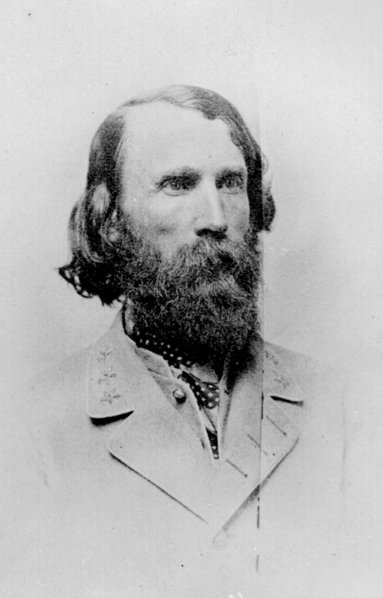
Tag Archives: james archer

Gettysburg Day One: John Reynolds’ Finest Hour

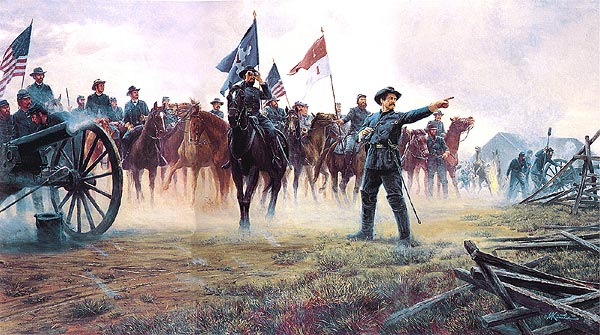
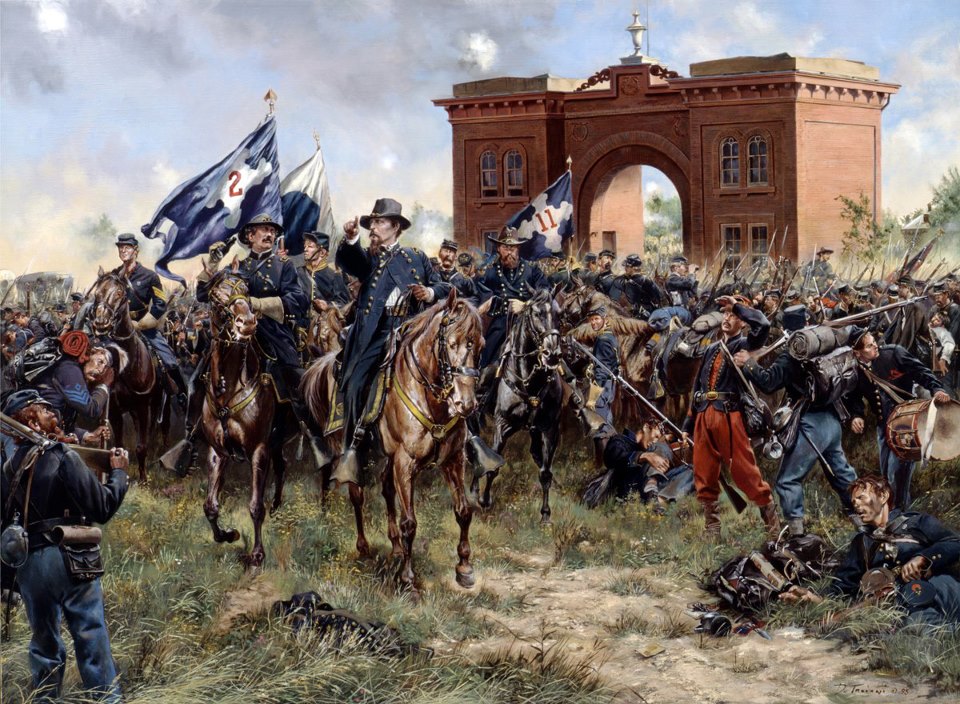
z_maritato_ironbrigadeforward1

While A.P. Hill and Harry Heth ignored warnings and launched their troops towards Gettysburg, Buford believing an engagement was in the offing sought out good ground to give battle and hold back the enemy until the army could arrive. This he found on the ridges west of Gettysburg. The choice of ground is always important and in this battle was paramount to the success of the Army of the Potomac. Buford alerted Major General John Reynolds and the cavalry corps commander Alfred Pleasanton to the location of the approaching Confederates on the night of June 30th. However, Buford’s warning, and that of the intelligence bureau came too late for Reynolds or Meade to take action on them that evening, nor give Meade “to dictate the choice of giving or accepting battle.” [1]

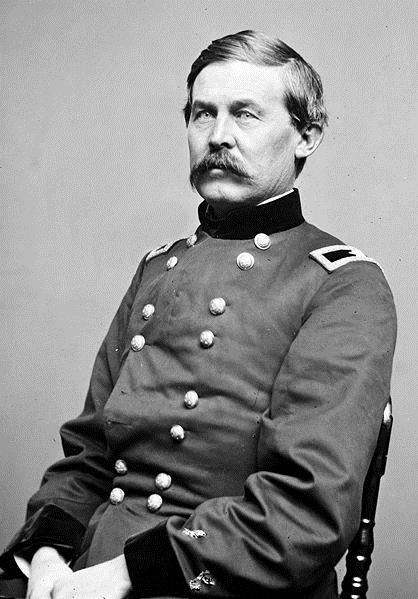
The Army of the Potomac had the good fortune of having Reynolds in this key position on the morning of July 1st 1863. John Reynolds was one of the finest commanders on either side during the Civil War. He graduated from West Point in 1841 and served in the artillery. He fought during the war with Mexico serving in Braxton Bragg’s battery winning fame and two brevet promotions for bravery, [2] to Captain at Monterrey and Major at Buena Vista. Following the war he remained in the army. He served in field and coastal batteries and like John Buford had “participated in the Utah Expedition.” [3] In 1860 he was appointed as Commandant of the Corps of Cadets at West Point and served there until June of 1861 when he was appointed as Lieutenant Colonel of the 14th U.S. Infantry regiment. [4]
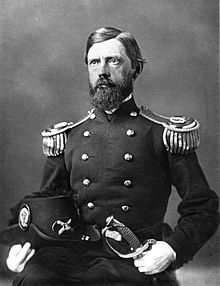
220px-GenJFRenyolds

However, he was soon promoted to Brigadier General and he commanded a brigade of Pennsylvania volunteers during the Peninsula Campaign. He was captured on June 28th as McClellan began his withdraw from the gates of Richmond but was released in a prisoner exchange on August 15th 1862. [5] He returned to command a division at Second Bull Run where his division held firm as much of the army retreated, but missed the battle of Antietam as he was called to “the fruitless and frustrating task of trying to organize Pennsylvania’s militia” [6] by Governor Curtain. He commanded I Corps at Fredericksburg and again at Chancellorsville and was reportedly offered command of the Army of the Potomac by Lincoln, something that he recounted to his artillery chief Colonel Wainwright that he “refused it because he would have been under the same constraints as Burnside and Hooker.” [7]

The Army of the Potomac’s senior leadership had been the source of much political consternation during 1862 and 1863 for Abraham Lincoln. It was split among Lincoln’s supporters and detractors, Radical Republican abolitionists and moderate Democrats some of its leaders including McClellan, Hooker and Sickles had their own aspirations for the presidency. However, Reynolds was of a different character than some of his fellow commanders. He was a moderate Pennsylvania Democrat and no supporter of Lincoln, once comparing him to a “baboon.” But he “was also a serious unbending professional, who unlike McClellan, actually lived by the principle of “obedience to the powers that be.” [8] “Universally respected” in the army “for his high character and sterling generalship” [9] it was noted that unlike others Reynolds had a policy of holding back “stoutly aloof from all personal or partisan quarrels, and keeping guardedly free from any of the heart-burnings and jealousies that did so much to cripple the usefulness and endanger the reputation of many gallant officers.” [10]

On the night of June 30th Reynolds was awash in reports, some of them conflicting and without Meade’s course of action for the next day “concluded that Lee’s army was close by and in force.” [11] He spent the night at his headquarters “studying the military situation with Howard and keeping in touch with army headquarters.” [12] Howard noted Reynolds anxiety and “Howard received the impression that Reynolds was depressed.” [13] After Howard’s departure Reynolds took the opportunity to get a few hours of fitful sleet before arising again at 4 a.m. on July 1st.

When morning came, Reynolds was awakened by his aide Major William Riddle with Meade’s order to “advance the First and Eleventh Corps to Gettysburg.” [14] Reynolds studied the order and though he expected no battle that morning, expecting “only moving up to be in supporting distance to Buford” [15] took the reasonable precautions that Confederate commanders had not done.

Though Reynolds was not expecting a fight he organized his march in a manner that ensured if one did happen that he was fully prepared. They were precautionary measures that any prudent commander knowing that strong enemy forces were nearby would take. Reynolds certainly took to heart the words of Napoleon who said “A General should say to himself many times a day: If the hostile army were to make its appearance in front, on my right, or on my left, what should I do?” [16] It was a question that A.P. Hill and Harry Heth seemed not to consider on that warm and muggy July morning, where Heth was committing Lee’s army to battle on his own authority, Reynolds was about to do the same, but unlike Heth, he “had at least been delegated the authority for making such a decision.” [17]

Reynolds “wanted all the fighting troops to be up front, so he instructed Howard not to intermingle his supply wagons with his infantry. Similar instructions had been given to Abner Doubleday; to ensure that the First Corps wagons would wait until the Eleventh Corps foot soldiers had passed.” [18] Likewise, instead operating in the normal fashion of rotating units on the march, Reynolds opted to save time. Since the First Division under the command of James Wadsworth was further advanced than other I Corps divisions, Reynolds instructed it to move first. In doing so he countermanded the order of the acting corps commander Doubleday telling Wadsworth that Doubleday’s order “was a mistake and that I should move on directly.” [19] He went forward with Wadsworth’s division and ordered Doubleday to “assemble the artillery and the remainder of the corps, and join him as soon as possible.” [20] He ordered Howard’s XI Corps to follow and Sickles’ III Corps to come up through Emmitsburg. [21] Reynolds’ intention according to Doubleday was “to fight the enemy as soon as I could meet him.” [22]

Reynolds rode forward with some of his staff into the town as the infantry of I Corps and XI Corps moved advanced. In the town they were met by “a fleeing, badly frightened civilian, who gasped out the news that the cavalry was in a fight.” [23] When he came to the Lutheran Seminary he came across Buford. It was a defining moment of the Civil War, a moment that shaped the battle to come. It has been recounted many times and immortalized on screen in the movie Gettysburg, a time “when the entire battle would come down to a matter of minutes getting one place to another.” [24]
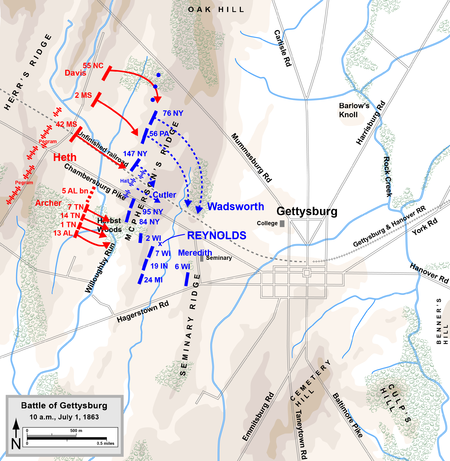
450px-Gettysburg_Day1_1000

When Buford saw Reynolds infantry advancing he remarked “now we can hold this place.” [25] Reynolds greeted Buford, who was in the cupola of the seminary calling out “What’s the matter John?” to which Buford replied “The devil’s to pay” before coming down to discuss the matter with Reynolds. [26] Buford explained the situation noting that “I have come upon some regiments of infantry…they are in the woods…and I am unable to dislodge them.” [27]

Reynolds needed no other convincing. He asked Buford if he could hold and quickly sent off a number of messages. One officer wrote: “The Genl ordered Genl Buford to hold the enemy in check as long as possible, to keep them from getting into town and at the same time sent orders to Genl Sickles…& Genl Howard to come as fast as possible.” [28] He also sent a message to Meade stating: “The enemy are advancing in strong force. I [Reynolds] fear they will get to the heights beyond the own before I can. I will fight them inch by inch, and if driven into the town, I will barricade the streets and hold them back as long as possible.” [29] He directed Major Weld to take it to Meade with all haste “with the greatest speed I could, no matter if I killed my horse.” [30]

After dictating his instructions Reynolds then did what no senior Confederate commander did, he rode back and took personal charge of the movements of his troops to hurry them forward. Unlike Heth, he had taken note of the ground and recognized from Buford’s reports that “the Confederates were marching only on that single road and thus would not be able to push their forces to the front any faster than Reynolds could reach the battlefield with his First Corps divisions.” [31]

Reynolds, recognizing that time was of the essence if his forces were to hold the ground west of the town selected a shortcut around the town for I Corps. Those forces were directed across the fields near the Condori farm toward the back side of Seminary Ridge, with Reynolds’ staff helping to remove fences to speed the advance. [32] It was not an easy advance as the troops had to move across the farm fields at an oblique and have to “double-quick for a mile and a quarter in the thick humidity just to reach the seminary.” [33]

As troops arrived Reynolds directed them into position. He directed the artillery of Captain James Hall’s 2nd Maine Battery to McPherson’s Ridge instructing Hall “I desire you to damage their artillery to the greatest possible extent, and to keep their fire from our infantry until they are deployed….” [34] The leading infantry of I Corps was James Wadsworth’s understrength division containing just two brigades, its losses from Chancellorsville not being made good and as the result of the loss of regiments discharged because their enlistments had expired.

However these units were “good ones,” composed of hardened combat veterans. Brigadier General Zylander Cutler led his brigade of New Yorkers and Pennsylvanians up first followed by the six foot seven inch tall Quaker, Brigadier General Solomon Meredith’s “Iron Brigade” of westerners following in their distinctive black hats. Reynolds directed Cutler’s brigade north of the Cashtown Pike and “called the Iron Brigade into action on the south side” [35] Reynolds directed Wadsworth to take change on the north side of the road while he looked after the left. [36] It is also believed by some writers that he directed Oliver Howard to prepare Cemetery Hill as a fallback position [37] however; there is more evidence that points to Howard selecting the site himself. [38]

Cutler’s brigade moved north and engaged Davis’ men near the railroad cut, with Davis’ troops initially having the upper hand, inflicting massive casualties Cutler’s regiments. But in a fierce engagement Cutler’s men pushed the unsupported Confederates back into the Railroad Cut where they slaughtered many of those unfortunate soldiers, taking over 200 prisoners and a battle flag. [39]

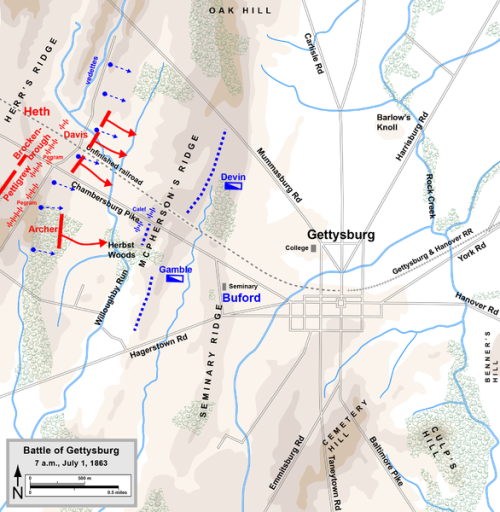
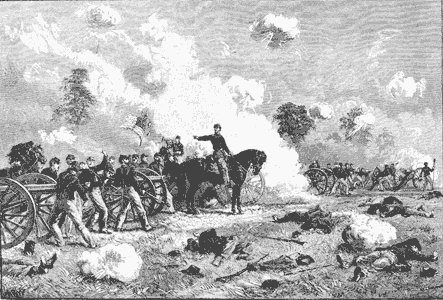
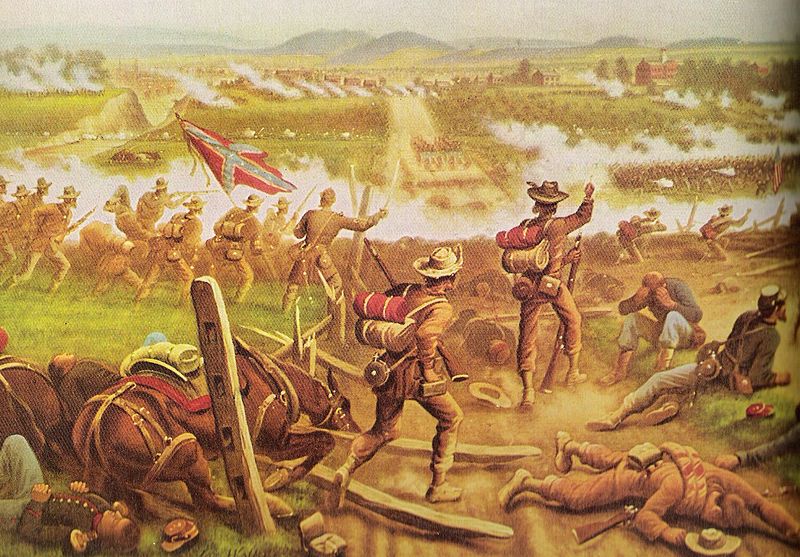
The Iron Brigade, brought forward by Doubleday hit Archer’s brigade in the front at Herbst Woods on McPherson’s Ridge. As the unit went into action Doubleday “urged the men…to hold it all hazards.” He recalled that the troops, “full of enthusiasm and the memory of their past achievements they said to me proudly, “If we can’t hold it, where will you find men who can?” The effect was dramatic as the Iron Brigade overwhelmed that unit, whose soldiers now realized they were facing “the first team.” Members of the Iron Brigade recalling the voices of Confederate soldiers exclaiming “Here are those damned black-hat fellers again…’Taint no militia-that’s the Army of the Potomac.” [40] As they attempted to withdraw they piled up at a fence near Willoughby Run and were hit in the flank by “a Michigan regiment that had worked its way around through the woods to the south.” [41]

Coddington writes “It was a bad moment for the Army of Northern Virginia, and Archer gained the unenviable distinction of being the first of its general officers to be captured after Lee took command.” [42] As the 2nd Wisconsin advanced into the woods Reynolds urged them forward: “Forward men, for God’s sake and drive those fellows out of those woods….” [43] As he looked around toward the seminary to see the progress of reinforcements Reynolds was struck in the back of the neck by a bullet and fell dead with Doubleday taking command of the First Corps to the west of the town.

death_of_reynolds_gettysburg

Reynolds was dead, but the series of command decisions reached by Reynolds under the pressure of a meeting engagement “where neither side held an immediate advantage” [44] were critical to the army. Though shaken by his loss the Union troops fought on at McPherson and Seminary Ridge until the assault of Ewell on their left and the arrival of Pender’s fresh division forced them from their positions.

The contrast between Reynolds and his opponents was marked. Hill was ten miles away from the action, Heth too far to the rear of his troops to direct their advance when they ran into trouble. However, Reynolds “hurried to the front, where he was able to inspirit the defense and throw troops into the decisive zone.” [45] At every point John Reynolds showed himself superior to his opponents as he directed the battle and reacted to circumstances. He paid with his life but his sacrifice was not in vain. Harry Hunt noted: “…by his promptitude and gallantry he had determined the decisive field of the war, and he opened brilliantly a battle which required three days of hard fighting to close with a victory.” [46]

 Notes

[1] Sears, Stephen W. Gettysburg. Houghton Mifflin Co. Boston and New York 2003 p. 159

[2] Pfanz Harry W. Gettysburg: The First Day University of North Carolina Press, Chapel Hill and London 2001pp.47-48

[3] Ibid. Pfanz Gettysburg: The First Day p.48

[4] Ibid. Pfanz Gettysburg: The First Day p.48

[5] Foote, Shelby, The Civil War, A Narrative. Volume One Fort Sumter to Perryville Random House, New York 1958 p.493

[6] Ibid. Pfanz Gettysburg: The First Day p.48

[7] Ibid. Sears, Gettysburg. p. 40-42


[8] Guelzo, Allen C. Gettysburg: The Last Invasion Vintage Books a Division of Random House, New York 2013 pp.29-30

[9] Ibid. Sears, Gettysburg. p. 34

[10] Ibid. Guelzo, Gettysburg: The Last Invasion p.30

[11] Ibid. Pfanz Gettysburg: The First Day p.48

[12] Coddington, Edwin B. The Gettysburg Campaign: A Study in Command, A Touchstone Book, Simon and Schuster New York, 1968 p.261

[13] Ibid. Pfanz Gettysburg: The First Day p.48

[14] Ibid. Coddington The Gettysburg Campaign: A Study in Command, p.261

[15] Ibid. Sears, Gettysburg. p. 158

[16] Napoleon Bonaparte, Military Maxims of Napoleon in Roots of Strategy: The Five Greatest Military Classics of All Time edited by Phillips, Thomas R Stackpole Books Mechanicsburg PA 1985 p.410

[17] Ibid. Sears, Gettysburg. p. 165

[18] Tredeau, Noah Andre. Gettysburg: A Testing of Courage, Harper Collins Publishers, New York 2002 p.159

[19] Ibid. Tredeau, Gettysburg: A Testing of Courage p.156

[20] Ibid. Guelzo, Gettysburg: The Last Invasion p.142

[21] Ibid. Sears, Gettysburg. p. 158

[22] Ibid. Tredeau, Gettysburg: A Testing of Courage p.156

[23] Ibid. Sears, Gettysburg. p. 165

[24] Ibid. Guelzo, Gettysburg: The Last Invasion p.142

[25] Ibid. Guelzo, Gettysburg: The Last Invasion p.142

[26] Ibid. Sears, Gettysburg. p. 172

[27] Ibid. Guelzo, Gettysburg: The Last Invasion p.143

[28] Ibid. Tredeau, Gettysburg: A Testing of Courage p.172-173

[29] Schultz, Duane The Most Glorious Fourth: Vicksburg and Gettysburg July 4th 1863. W.W. Norton and Company New York and London, 2002 p.202

[30] Ibid. Tredeau, Gettysburg: A Testing of Courage p.173

[31] Ibid. Sears, Gettysburg. p. 166

[32] Ibid. Pfanz Gettysburg: The First Day p.75

[33] Ibid. Guelzo, Gettysburg: The Last Invasion p.145

[34] Gottfried, Bradley The Artillery of Gettysburg Cumberland House Publishing, Nashville TN 2008 pp.28-29

[35] Catton, Bruce The Army of the Potomac: Glory Road Doubleday and Company, Garden City New York, 1952 p.271

[36] Ibid. Pfanz Gettysburg: The First Day pp.75-76

[37] Ibid. Pfanz Gettysburg: The First Day p.76

[38] Green, A. Wilson. From Chancellorsville to Gettysburg: O. O. Howard and Eleventh Corps Leadership in The First Day at Gettysburg edited by Gallagher, Gary W. Kent State University Press, Kent Ohio 1992 p. 70

[39] Ibid. Guelzo, Gettysburg: The Last Invasion p.153

[40] Ibid. Catton The Army of the Potomac: Glory Road p.273

[41] Foote, Shelby, The Civil War, A Narrative. Volume Two Fredericksburg to Meridian Random House, New York 1963 pp.470-471

[42] Ibid. Coddington The Gettysburg Campaign: A Study in Command, p.271

[43] Ibid. Coddington The Gettysburg Campaign: A Study in Command, p.271

[44] Ibid. Sears, Gettysburg. p. 168

[45] Krick, Robert K. Three Confederate Disasters on Oak Ridge: Failures of Brigade Leadership on the First Day of Gettysburg in The First Day at Gettysburg edited by Gallagher, Gary W. Kent State University Press, Kent Ohio 1992 p.113

[46] Hunt, Henry. The First Day at Gettysburg in Battles and Leaders of the Civil War Volume III, The Tide Shifts. Edited by Robert Underwood Johnson and Clarence Clough Buel Castle, Secaucus NJ
1 Comment

Filed under civil war, History, leadership, Military

Gettysburg Day One: Inexperience and Hubris Meets Calculating Experience; Harry Heth Blunders into Battle against John Buford

burford june 30th

Despite the warnings of Johnston Pettigrew, Major General Harry Heth with the approval and blessing of his corps commander Lieutenant General A.P. Hill arose on the morning of July 1st 1863 and formed his division for its march to Gettysburg. But it was an inauspicious start to a very bad day for Heth and his division. Somehow orders had not gotten to his units to begin the advance at 5 a.m. and “there was haste to the early morning’s preparations that caught some off guard” even regimental commanders. [1]

During the night Of June 30th 1863 the actions of A.P. Hill show a commander who confused and uncertain. The confidence that he and Heth showed in rejecting Pettigrew and Young’s reports of Federal troops in Gettysburg left “most, if not all the commanding officers in Hill’s corps…unprepared for what happened.” [2] Lieutenant Lewis Young wrote “I doubt if any of the commanders of brigades, except General Pettigrew, believed that we were marching to battle, a weakness on their part which rendered them unprepared for what was about to happen.” [3]

Hill sent a message to Ewell of Second Corps telling that officer that “I intended to advance the next morning and discover what was in my front” [4] and sent word of Pettigrew’s discovery of Union cavalry to Lee’s headquarters, but his warning apparently gave Lee little cause for concern. Porter Alexander noted that on the night of June 30th that he visited Lee’s headquarters and found conversation to be “unusually careless & jolly. Certainly there was no premonition that the next morning was to open a great battle of the campaign.” [5] Hill also sent a courier to Anderson instructing him to bring up his division on Jul 1st and instructed Heth that “Pender’s division also would be ordered through Cashtown as a reserve to be available if Heth ran into serious trouble.” [6]

Since a reconnaissance is normally conducted by small elements, the fact that Hill committed his two divisions present to such a mission demonstrated his confusion of both the nature of what he might face and to the intentions of Robert E. Lee. One has to remember that Lee, like his corps commanders was operating blind, in part due to Stuart’s absence but also due to the poor employment of the cavalry that should have been available to them. Hill and Heth had no idea what they faced at Gettysburg and disregarded the warnings of his own people. Thus it is hard to believe that Hill did not expect the possibility of action. Likewise it is distinctly possible that Heth, despite his orders “may have had more on his mind than shoes and information when he made his advance towards Gettysburg.” [7]

Several critics have made this point, among them Major John Mosby the Confederate cavalry leader and guerrilla fighter who wrote: “Hill and Heth in their reports, to save themselves from censure, call the first day’s action a reconnaissance; this is all an afterthought….They wanted to conceal their responsibility for the defeat.” [8] A more contemporary writer, Jennings Wise noted that Hill’s orders “were specific not to bring on an action, but his thirst for battle was unquenchable, and…he rushed on, and…took the control of the situation out of the hands of his commander-in-chief.” [9] Heth in later years made an unsubstantiated claim that “A courier came from Gen. Lee, with a dispatch ordering me to get those shoes even if I encountered some resistance.” [10] That appears unlikely as Mosby noted that no one ordered Hill to advance and Lee “would never have sanctioned it.” [11] Neither Lee or any of his staff collaborate Heth’s claim and the judicious Porter Alexander who had been in Lee’s headquarters the night of June 30th wrote that “Hill’s movement to Gettysburg was made on his own accord, and with knowledge that he would find the enemy’s cavalry in possession.” [12]

The advance to contact was marred by Heth’s inexperience compounded by the illness of A.P. Hill who on the morning of July 1st had “awakened feeling very ill, too sick to mount his horse…although no diagnosis was made, he was probably suffering from overstrained nerves.” [13] Hill’s absence left Heth, an inexperienced division commander “without any sage counsel” [14] and Heth began to commit a series of costly errors. Heth understood from Hill that his mission was a job that normally would be assigned to cavalry: “to ascertain what force was at Gettysburg, and if he found infantry opposed to him, to report the fact immediately, without forcing an engagement.” [15]

Heth advanced without the caution of a commander who had been told that enemy forces were likely opposing him. Even though he disbelieved the reports some amount of judicious caution should have been indicated. Instead, for reasons unknown Heth had his men advance as if they were conducting a routine movement. He led his advance with his assigned artillery battalion commanded by Major William Pegram. He followed with Archer’s veteran but depleted brigade and Davis’s inexperienced brigade. To compound Davis’s situation that commander led his movement with his new and untested regiments the 42nd Mississippi and 55th North Carolina leaving his veteran regiments the 2nd and 11th Mississippi in the rear guarding army stores. [16] It was a curious order of march for it left Johnston’s Pettigrew’s brigade behind both Archer and Davis’s brigades despite the fact that it was closer to Gettysburg than any other brigade and had recent eyes on contact with the enemy and knew the ground and what was ahead of them. Pettigrew’s brigade was followed by Colonel John Brockenbrough’s Virginia brigade. It is hard to know why Heth did this but one can speculate that it might have been because of Pettigrew’s insistence of the type of Federal forces in their front the previous day which caused Heth to do this.

buford and staff

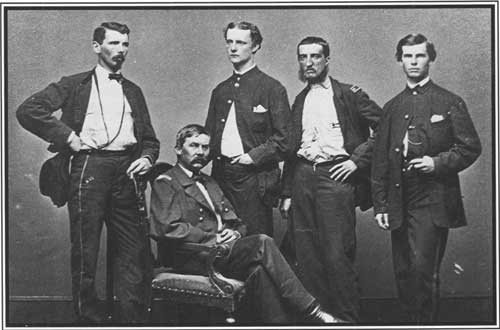
Buford and His Staff

As Heth’s troops advanced to Marsh Creek they encountered the cavalry videttes or pickets of the 8th Illinois Cavalry posted on the high ground just east of the creek. [17] The discovery of these forces was unanticipated by the Confederates leading the column. One of Pegram’s gunners recalled: “We moved forward leisurely smoking and chatting as we rode along, not dreaming of the proximity of the enemy.” [18] Most assumed that the movement “was simply one more part of the army’s concentration of forces” and Brockenbrough told the commander of the 55th Virginia that “we might meet some of Ewell’s command or Stuarts.” [19] Pettigrew had attempted to warn Archer prior to the march of the topography of the area and “a certain road which the Yankees might use to hit his flank, and the dangers of McPherson’s Ridge. Archer listened, believed not, marched on unprepared…” [20] Heth, who should have better anticipated the situation based on Pettigrew’s reports of the previous day demonstrated why one author called him “an intellectual lightweight.” [21] Heth told an officer from the Army of the Potomac after the war “I did not know any of your people were north of the Potomac.” [22]

If Heth was inexperienced and knew little of the Federal forces arrayed before him and what forces were moving towards Gettysburg, his opponent, Brigadier General John Buford was his opposite in nearly every respect. Buford was born in Kentucky and came from a long line of family who had fought in both the Revolutionary War and War of 1812. He was an 1848 graduate of West Point who was commissioned in the Dragoons but too late to serve in Mexico. Instead he served on the Great Plains against the Sioux and on peacekeeping duty in the bitterly divided State if Kansas. Later he served in the Utah War in 1858. His family held Southern sympathies; his father was a Democrat who had opposed Abraham Lincoln.

buford

At the beginning of the war, the governor of Kentucky offered Buford a commission in that states’ militia. At the time Kentucky was still an “undeclared border slave state” and Buford loyal to his oath refused and wrote later “I sent him word that I was a Captain in the United States Army and I intend to remain one.” [23] However his southern ties kept him from field command until the politically well connected by ill-fated, Major General John Pope “could unreservedly vouch for his loyalty wrangled for him command of a brigade of cavalry.” [24] After Pope’s defeat at Second Bull Run in August 1862 Buford returned to staff duties until January 1863 when he was again given a brigade.

Buford was passed over by Hooker for command of the new cavalry corps in favor of Alfred Pleasanton who was eleven days his senior when Hooker reorganized the army before Chancellorsville. In later years Hooker agreed that Buford “would have been a better man for the position of chief” [25] for the Cavalry Corps, but in retrospect Buford’s passover for corps command was good fortune for the Army of the Potomac on June 30th and July 1st 1863. Despite being passed over, Buford a consummate professional, fought well at Brandy Station for which he was recommended for promotion and command of his division. [26]

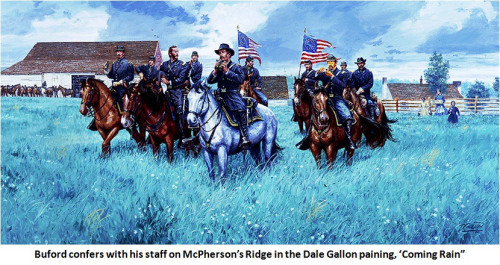
On the night of June 30th Buford prepared for battle. Unlike Hill and Heth he understood exactly what he was facing. He met with “reliable men” most likely from the Bureau of Military Intelligence operated by David McConaughy as to the composition of Lee’s forces. [27] Buford knew his business; he took the time to reconnoiter the ridges west of Gettysburg and posted videttes as far was as Marsh Creek. He deployed one brigade under Colonel Thomas Devin to the north and west of the town, Colonel William Gamble’s brigade was deployed to the west, its main line being on McPherson’s ridge. Buford planned “a defense in depth, fighting his men dismounted, using the series of ridgelines west of Gettysburg to hamper and delay the Rebel infantry he was certain would come “booming along” the Chambersburg Pike in the morning.” [28]

Noting that the ground was favorable to defense and giving battle Buford sent messages to Reynolds as to the situation. He warned Reynolds that “A.P. Hill’s corps is massed just back of Cashtown, about 9 miles from this place.” He also noted the location of Confederate pickets only four miles west of Gettysburg.” [29] Devin’s troops also identified elements of Ewell’s corps north of the town. Buford had accurately informed his superiors of what was before him, information that they needed for the day of battle.

gburg delaying action

According to his signals officer, Buford spent the night “anxious, more so than I ever saw him” [30] He discussed the situation with Devin who did not believe that the Confederates would move on Gettysburg in the morning. Devin thought if there were any threats that “he could handle anything that could come up in the next 24 hours.” [31] Buford rejected Devin’s argument and told him “No you won’t…. They will attack you in the morning and they will come booming – skirmishers three deep. You will have to fight like the devil to hold your own.” [32]

Reynolds, seeing the importance of the position elected to fight. He “ordered Buford to hold onto it to the last” believing that if Buford could “buy enough time, he might get his infantry into line “before the enemy should seize the point.” [33]

As Archer and Davis’s troops advanced in the early hours of July 1st their march was uneventful until they reached Marsh Creek. There they encountered the men of the 8th Illinois, one of whom, Lieutenant Marcellus Jones, took a carbine from one of his sergeants saying “Hold on George, give me the honor of opening this ball” and at about 7:30 a.m. Jones fired the first shot of the battle of Gettysburg. [34]

Heth had wanted to advance in column as long as possible “but the Yankee cavalry’s stiff resistance had ended that hope.” [35] Heth rode forward and ordered Archer and Davis’s troops to advance skirmishers with the support of Pegram’s artillery. This slowed the Confederate advance considerably. Heth wrote in his after action report that “it became evident that there were infantry, cavalry and artillery in and around the town.” [36] But instead of “feeling out the enemy” as directed by Hill, Heth “ordered Archer and Davis “to move forward and occupy the town.” [37] A chaplain in Brockenbrough’s brigade reported that one of Heth’s aide’s came up and reported “General Heth is ordered to move on Gettysburg, and fight or not as he wishes.” The chaplain heard one of the officers near him say “We must fight them; no division general will turn back with such orders.” [38]

The fight that Harry Heth and A.P. Hill had been directed not to precipitate was now on. Heth’s inexperience more than matched by the cunning and brilliant Buford, whose troopers now fought a masterful delaying action which enabled Reynolds to come up.
Notes

[1] Tredeau, Noah Andre. Gettysburg: A Testing of Courage, Harper Collins Publishers, New York 2002 p.153

[2] Coddinton, Edwin B. The Gettysburg Campaign, A Study in Command A Touchstone Book, Simon and Shuster New York 1968 p.264

[3] Pfanz Harry W. Gettysburg: The First Day University of North Carolina Press, Chapel Hill and London 2001 p.51

[4] Gallagher, Gary. Confederate Corps Leadership on the First Day at Gettysburg: A.P. Hill and Richard S. Ewell in a Difficult Debut in The First Day at Gettysburg edited by Gallagher, Gary W. Kent State University Press, Kent Ohio 1992 p.44

[5] Ibid. Coddington The Gettysburg Campaign, A Study in Command p.264

[6] Dowdy, Clifford. Lee and His Men at Gettysburg: The Death of a Nation Skyhorse Publishing, New York 1986, originally published as Death of a Nation Knopf, New York 1958 pp. 92

[7] Ibid. Coddington The Gettysburg Campaign, A Study in Command p.274

[8] Ibid. Gallagher Confederate Corps Leadership on the First Day at Gettysburg p.32

[9] Ibid. Gallagher Confederate Corps Leadership on the First Day at Gettysburg p.32

[10] Ibid. Tredeau Gettysburg: A Testing of Courage, p.153

[11] Ibid. Gallagher Confederate Corps Leadership on the First Day at Gettysburg p.32

[12] Alexander, Edward Porter Military Memoirs of a Confederate: A Critical Narrative 1907 republished 2013 by Pickle Partners Publishing, Amazon Kindle Edition location 7342 of 12968

[13] Dowdy.Lee and His Men at Gettysburg: The Death of a Nation pp.91-92

[14] Ibid. Tredeau Gettysburg: A Testing of Courage, p.153

[15] Guelzo, Allen C. Gettysburg: The Last Invasion Vintage Books a Division of Random House, New York 2013 p.131

[16] Ibid. Tredeau Gettysburg: A Testing of Courage, p.156

[17] Pfanz. Gettysburg: The First Day p.53

[18] Sears, Stephen W. Gettysburg. Houghton Mifflin Co. Boston and New York 2003 p. 162

[19] Ibid. Guelzo. Gettysburg: The Last Invasion p.134

[20] Ibid. Coddington The Gettysburg Campaign, A Study in Command p.264

[21] Ibid. Guelzo. Gettysburg: The Last Invasion p.134

[22] Ibid. Sears Gettysburg p. 162

[23] Ibid. Guelzo. Gettysburg: The Last Invasion p.121

[24] Ibid. Guelzo. Gettysburg: The Last Invasion p.121

[25] Ibid. Coddington The Gettysburg Campaign, A Study in Command p.44

[26] Ibid. Coddington The Gettysburg Campaign, A Study in Command p.64

[27] Ibid. Tredeau Gettysburg: A Testing of Courage, p.141

[28] Ibid. Sears Gettysburg p. 157

[29] Ibid. Guelzo. Gettysburg: The Last Invasion p.122

[30] Ibid. Sears Gettysburg p. 157

[31] Catton, Bruce The Army of the Potomac: Glory Road Doubleday and Company, Garden City New York, 1952 p.266

[32] Ibid. Guelzo. Gettysburg: The Last Invasion p.123

[33] Ibid. Guelzo. Gettysburg: The Last Invasion pp.122-123

[34] Pfanz. Gettysburg: The First Day p.53

[35] Ibid. Sears Gettysburg p. 163

[36] Luvaas, Jay and Nelson Harold W editors. The U.S. Army War College Guide to the Battle of Gettysburg South Mountain Press, Carlisle PA 1986 p.7

[37] Ibid. Sears Gettysburg p. 165

[38] Ibid. Tredeau Gettysburg: A Testing of Courage, p.163

Leave a comment

Filed under civil war, History, leadership, Military

“A Spirit of Unbelief”: A.P. Hill, Harry Heth and the Prelude to the Battle of Gettysburg

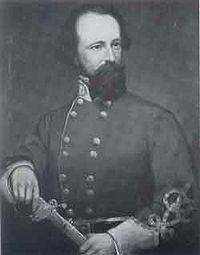
Hill.28135413_stdLieutenant General A.P. Hill

Note: One of the most important things to understand about the Battle of Gettysburg or for that matter any battle or campaign is leadership as well as organizational structure and climate of command. The study of A.P. Hill’s Third Corps is important to understanding how the battle unfolds and what happens at Gettysburg particularly on July 1st. In our understanding “Successful mission command demands that subordinate leaders at all echelons exercise disciplined initiative, acting aggressively and independently to accomplish the mission. Essential to mission command is the thorough knowledge and understanding of the commander’s intent at every level of command.”

While the leaders at Gettysburg on both sides would be unaware of our present definition they certainly would have been acquainted with the maxims of Napoleon, who many studied under Dennis Hart Mahan at the West Point. Napoleon noted: “What are the conditions that make for the superiority of an army? Its internal organization, military habits in officers and men, the confidence of each in themselves; that is to say, bravery, patience, and all that is contained in the idea of moral means.”

Likewise in a maxim that has direct application to the Confederate campaign in Pennsylvania Napoleon noted “To operate upon lines remote from each other and without communications between them, is a fault which ordinarily occasions a second. The detached column has orders only for the first day. Its operations for the second day depend on what has happened to the main body. Thus according to circumstances, the column wastes its time in waiting for orders or it acts at random….” [1]

I have spent more time in this chapter developing the issues of organization, leadership, climate of command and relationships between leaders because of their importance to the campaign. From these students should be able to draw lessons that would be applicable to leadership, organization and campaigning at the operational level of war.

As the Army of Northern Virginia began to concentrate near Cashtown after the reports that the Army of the Potomac was in Maryland it was Lieutenant General A.P. Hill’s Third Corps that was nearest to Gettysburg. Major General Harry Heth’s division led the corps and arrived on June 29th followed by Major General Dorsey Pender’s division on the 30th. Hill ordered his last division under the command of Major General Richard Anderson to remain behind and join the corps on July 1st. [2]

On the 30th Harry Heth sent Johnston Pettigrew’s Brigade to Gettysburg to “search the town for army supplies (shoes especially), and to return the same day.” [3] It was the first in a series of miscalculations that brought Lee’s army into a general engagement that he wished to avoid.

The Confederate Third Corps commanded by Lieutenant General Ambrose Powell (A.P.) Hill had been formed as part of the reorganization of the army following Stonewall Jackson’s death after the Battle of Chancellorsville. Hill had a stellar reputation as a division commander; his “Light Division” had distinguished itself on numerous occasions, especially at Antietam where its timely arrival after a hard forced march from Harper’s Ferry helped save Lee’s army late in the battle. At Chancellorsville Hill briefly succeeded Jackson until he too was wounded.

But that being said Hill was no stranger to controversy, beginning with a clash with James Longstreet during the Seven Days battles in which time Longstreet placed Hill under arrest and Hill challenged Longstreet to a duel. Lee quickly reassigned Hill to Jackson’s command as Jackson was operating in a semi-independent assignment. [4] Hill was in an intractable controversy with Stonewall Jackson for nearly a year until Jackson succumbed to his wounds. Jackson at one point during the invasion of Maryland prior to Antietam had Hill placed under arrest for the number of stragglers that he observed in Hill’s hard marching division as well as other errors that Jackson believed Hill had made. The dispute continued and the animosity deepened between the two men and in January 1863 Hill asked Lee for a trial by courts-martial on charges preferred against him by Jackson. Lee refused this and wrote to Hill: “Upon examining the charges in question, I am of the opinion that the interests of the service do not require that they be tried, and therefore, returned them to General Jackson with an indorsement to that effect….” [5] Just before Chancellorsville Jackson wrote to Lee “I respectfully request that Genl. Hill be relieved of duty in my Corps.” This time Lee simply ignored the request and though the two generals remained at loggerheads they also remained at their commands at Chancellorsville. [6]

Hill was recommended for promotion to Lieutenant General and command of the new Third Corps by Lee on May 24th and was promoted over the heads of Harvey Hill and Lafayette McLaws. The move displeased Longstreet who considered McLaws “better qualified for the job” and but who felt that the command should have gone to Harvey Hill whose “record was as good as that of Stonewall Jackson…but, not being a Virginian, he was not so well advertised.” [7]

Hill was slightly built and high strung. “Intense about everything” Hill was “one of the army’s intense disbelievers in slavery.” [8] Hill was an 1847 graduate of West Point and briefly served in Mexico but saw no combat. He spent some time in the Seminole wars and in garrison duty along the East Coast, spending 1855-1860 in the Coastal Survey and resigned his commission before Virginia’s secession. At the outbreak of the war he “received his commission as colonel, and soon trained one of Johnston’s best regiments in the Valley.” [9] He commanded a brigade under Longstreet on the Peninsula and was promoted to Major General and command of a division in May 1862. He was plagued by health problems which had even delayed his graduation from West Point, health issues that would arise on the first day at Gettysburg.

Hill’s Third Corps was emblematic of the “makeshift nature of the reorganization of the whole army.” [10] It was composed of three divisions; the most experienced being that of the recently promoted and hard fighting Major General Dorsey Pender. Pender’s division, was built around four excellent brigades from Hill’s old “Light Division” one of which Pender had commanded before his promotion. Hill strongly recommended Pender’s promotion which was accepted by Lee. Pender found the command to be a heavy burden. He was “an intelligent, reflective man, deeply religious and guided by a strong sense of duty….” [11]

Hill’s second experienced division was that of Major General Richard Anderson, transferred from Longstreet’s First Corps, something else which failed to endear Hill to Longstreet. [12] The unassuming Anderson had distinguished himself as a brigade and division commander in Longstreet’s corps, but in “an army of prima donnas, he was a self-effacing man, neither seeking praise for himself nor winning support by bestowing it on others.” [13] At Chancellorsville he fought admirably and Lee wrote that Anderson was “distinguished for the promptness, courage and skill with which he and his division executed every order.” [14] With four seasoned brigades under excellent commanders it was a good addition to the corps, although the transition from Longstreet’s stolid and cautious style of command to Hill’s impetuous style introduced “another incalculable of the reshuffled army.” [15]

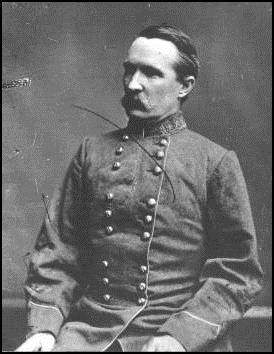
heth

Major General Harry Heth

Major General Harry Heth’s division was the final infantry division assigned to the corps. This division was recently formed from two brigades of Hill’s old Light Division and “the two new brigades that Jefferson Davis had forced on an already disrupted army organization.” [16] The organization of this division as well as its leadership would be problematic in the days to come, especially on June 30th and July 1st 1863.

Heth like Pender was also newly promoted to his grade and the action at Gettysburg would be his first test in division command. Heth was a native Virginian, well connected politically who through his social charm had “many friends and bound new acquaintances to him” readily. [17] Heth was a West Point graduate who had an undistinguished academic career graduating last in the class of 1847. His career in the ante-bellum army was typical of many officers, he served “credibly in an 1855 fight with Sioux Indians” but his real claim to fame was in authoring the army’s marksmanship manual which was published in 1858. [18]

Heth’s career with the Confederate army serving in western Virginia was undistinguished but he was a protégé of Robert E. Lee who recommended him as a brigade commander to Jackson before Chancellorsville. Tradition states that of all his generals that Heth was the only one “whom Lee called by his first name.” [19] A.P. Hill when writing Lee about the choice of a successor for the Light Division noted that Heth was “a most excellent officer and gallant soldier” but in the coming campaign “my division under him, will not be half as effective as under Pender.” [20] Douglas Southall Freeman noted that Heth was “doomed to be one of those good soldiers…who consistently have bad luck.” [21]

Heth’s division was composed of two depleted brigades from the Light Division which had taken heavy casualties at Chancellorsville. The brigade commanded by James Archer from Alabama and Mississippi was “well led and had a fine combat reputation.” But the second brigade was more problematic. A Virginia brigade it had once been considered one of the best in the army had deteriorated in quality following the wounding of its first commander Brigadier General Charles Field. Heth took command of it at Chancellorsville and both he and the brigade performed well, but when Heth was promoted the lack of qualified officers left it under the command of its senior colonel, John Brockenbrough. [22] His third brigade came from Mississippi and North Carolina and was commanded by Brigadier General Joe Davis whose uncle was President Jefferson Davis. Davis had served on his uncle’s staff for months and had no combat experience. [23] One author noted that Davis’s promotion to Brigadier General “as unadulterated an instance of nepotism as the record of the Confederacy offers.” [24] His subordinate commanders were no better, one William Magruder was so bad that J.E.B. Stuart suggested that “he have his commission revoked” and only one of the nine field grade officers in his brigade had military training, and that from the Naval Academy. [25]

pettigrew

Brigadier General Johnston Pettigrew

Heth’s largest brigade was new to the army. Commanded by the North Carolina academic Johnston Pettigrew it had no combat experience though Pettigrew was considered a strong leader, badly wounded at Seven Pines and thinking his wound mortal “he refused to permit his men to leave the ranks to carry him to the rear” [26] and was captured but later paroled and returned to the army later in the year.

Hill was under the impression that Meade’s army was still miles away, having just come from meeting Lee who assured him that “the enemy are still at Middleburg,” (Maryland) “and have not yet struck their tents.” [27] With that assurance Heth decided to use June 30th to send Pettigrew’s brigade on the foraging expedition to Gettysburg. An officer present noted that Heth instructed Pettigrew “to go to Gettysburg with three of his regiments present…and a number of wagons for the purpose of collecting commissary and quartermaster stores for the use of the army.” [28]

However Heth did instruct Pettigrew in no uncertain terms not to “precipitate a fight” should he encounter “organized troops” of the Army of the Potomac. [29] Heth was specific in his report that “It was told to Pettigrew that he might find in the town in possession of a home guard,…but if, contrary to expectations, he should find any organized troops capable of making resistance., or any part of the Army of the Potomac, he should not attack it.” [30]

That in mind one has to ask the question as to why Heth would employ “so many men on a long, tiring march, especially as without a cavalry escort he took the risk of sending them into a trap” when his “objects hardly justified” using such a large force. [31] Likewise it has to be asked why the next day in light of Lee’s standing orders not to provoke an engagement that Hill would send two divisions, two thirds of his corps on a reconnaissance mission. Some have said that Hill would have had to move to Gettysburg on July 1st anyway due to forage needs of the army, [32] but this is not indicated in any of Hill or Heth’s reports.

As his troops neared Gettysburg Pettigrew observed the Federal cavalry of Buford’s 1st Cavalry Division as they neared the town. He received another report “indicating that drumming could be heard in the distance – which might mean infantry nearby, since generally cavalry generally used only bugles.” [33] He then prudently and in accordance with his orders not to precipitate a fight “elected to withdraw rather than risk battle with a foe of unknown size and composition.” [34] His troops began their retrograde at 11 a.m. leaving Buford’s cavalry to occupy the town at ridges. On Confederate wrote “in coming in contact with the enemy, had quite a little brush, but being under orders not to bring a general engagement fell back, followed by the enemy.” [35]

Upon returning Pettigrew told Hill and Heth that “he was sure that the force occupying Gettysburg was a part of the Army of the Potomac” but Hill and Heth discounted Pettigrew’s report. [36] “Heth did not think highly of such wariness” and “Hill agreed with Heth” [37] Hill believed that nothing was in Gettysburg “except possibly a cavalry vidette.” [38] Hill was not persuaded by Pettigrew or Pettigrew’s aide Lieutenant Louis Young who had previously served under Hill and Pender who reported that the “troops that he saw were veterans rather than Home Guards.” [39] Hill reiterated that he did not believe “that any portion of the Army of the Potomac was up” but then according to Young Hill “expressed the hope that it was, as this was the place he wanted it to be.” [40] The West Point Graduates Hill and Heth may have manifested an often typical “distain for citizen soldiers…a professional questioning a talented amateur’s observations” [41] If so it was a distain that would cost the Confederacy dearly in the days to come.

Pettigrew was “aghast at Hill’s nonchalant attitude” [42] and Young was dismayed and later recalled that “a spirit of unbelief” seemed to cloud their thinking. [43] In later years he wrote “blindness in part seems to have come over our commanders, who slow to believe in the presence of an organized army of the enemy, thought that there must be a mistake in the report taken back by General Pettigrew.” [44]

Heth then asked Hill since neither believed Pettigrew’s report “whether Hill would have any objection to taking his division to Gettysburg again to get those shoes. Hill replied “none in the world.” [45] Douglas Southall Freeman wrote “On those four words fate hung” [46] and then, in “that incautious spirit, Hill launched Harry Heth’s division down the Chambersburg Pike and into battle at Gettysburg.” [47]

Notes

[1] Napoleon Bonaparte, Military Maxims of Napoleon in Roots of Strategy: The Five Greatest Military Classics of All Time edited by Phillips, Thomas R Stackpole Books Mechanicsburg PA 1985 p.410

[2] Coddinton, Edwin B. The Gettysburg Campaign, A Study in Command A Touchstone Book, Simon and Shuster New York 1968 p.194

[3] Ibid. Coddinton, The Gettysburg Campaign, A Study in Command p. 263

[4] Dowdy, Clifford. Lee and His Men at Gettysburg: The Death of a Nation Skyhorse Publishing, New York 1986, originally published as Death of a NationKnopf, New York 1958 p.81

[5] Freeman, Douglas Southall, Lee’s Lieutenant’s a Study in Command, One volume abridgement by Stephen W Sears, Scribner, New York 1998 p.460

[6] Sears, Stephen W. Chancellorsville A Mariner Book, Houghton and Mifflin Company, Boston and New York 1996 p.51

[7] Foote, Shelby, The Civil War, A Narrative. Volume Two Fredericksburg to Meridian Random House, New York 1963 p.453

[8] Ibid. Dowdy, Lee and His Men at Gettysburg: The Death of a Nation p.79

[9] Ibid. Freeman Lee’s Lieutenant’s a Study in Command p.109

[10] Ibid. Dowdy, Lee and His Men at Gettysburg: The Death of a Nation p.88

[11] Ibid. Dowdy, Lee and His Men at Gettysburg: The Death of a Nation p.85

[12] Ibid. Dowdy, Lee and His Men at Gettysburg: The Death of a Nation p.86

[13] Ibid. Dowdy, Lee and His Men at Gettysburg: The Death of a Nation p.86

[14] Ibid. Freeman Lee’s Lieutenant’s a Study in Command p.512

[15] Ibid. Dowdy, Lee and His Men at Gettysburg: The Death of a Nation p.86

[16] Ibid. Dowdy, Lee and His Men at Gettysburg: The Death of a Nation p.87

[17] Ibid. Freeman Lee’s Lieutenant’s a Study in Command p.527

[18] Krick, Robert K. Three Confederate Disasters on Oak Ridge: Failures of Brigade Leadership on the First Day of Gettysburg in The First Day at Gettysburg edited by Gallagher, Gary W. Kent State University Press, Kent Ohio 1992 p.96

[19] Ibid. Krick. Three Confederate Disasters on Oak Ridge p.96

[20] Ibid. Freeman Lee’s Lieutenant’s a Study in Command p.527

[21] Ibid. Freeman Lee’s Lieutenant’s a Study in Command p.46

[22] Ibid. Dowdy, Lee and His Men at Gettysburg: The Death of a Nation p.87

[23] Ibid. Freeman Lee’s Lieutenant’s a Study in Command p.533

[24] Ibid. Krick. Three Confederate Disasters on Oak Ridge p.99

[25] Ibid. Krick. Three Confederate Disasters on Oak Ridge p.101

[26] Ibid. Freeman Lee’s Lieutenant’s a Study in Command p.136

[27] Guelzo, Allen C. Gettysburg: The Last Invasion Vintage Books a Division of Random House, New York 2013 p.131

[28] Tredeau, Noah Andre. Gettysburg: A Testing of Courage, Harper Collins Publishers, New York 2002 p.128

[29] Sears, Stephen W. Gettysburg. Houghton Mifflin Co. Boston and New York 2003 p.136

[30] Ibid. Tredeau Gettysburg: A Testing of Courage, p.129

[31] Ibid. Coddinton,. The Gettysburg Campaign, A Study in Command p. 263

[32] Ibid. Guelzo. Gettysburg: The Last Invasion p.131 This argument does have merit based on the considerations Guelzo lists but neither Hill, Heth or Lee make any mention of that need in their post battle reports.

[33] Ibid. Tredeau Gettysburg: A Testing of Courage, p.130

[34] Gallagher, Gary. Confederate Corps Leadership on the First Day at Gettysburg: A.P. Hill and Richard S. Ewell in a Difficult Debut in The First Day at Gettysburg edited by Gallagher, Gary W. Kent State University Press, Kent Ohio 1992 p.42

[35] Ibid. Tredeau Gettysburg: A Testing of Courage, p.135

[36] Ibid. Coddinton, The Gettysburg Campaign, A Study in Command pp. 263-264

[37] Foote, Shelby, The Civil War, A Narrative. Volume Two Fredericksburg to Meridian Random House, New York 1963 p.465

[38] Pfanz Harry W. Gettysburg: The First Day University of North Carolina Press, Chapel Hill and London 2001 p.27

[39] Ibid. Gallagher, Gary. Confederate Corps Leadership on the First Day at Gettysburg p.42

[40] Ibid. Pfanz. Gettysburg: The First Day p.27

[41] Ibid. Gallagher, Gary. Confederate Corps Leadership on the First Day at Gettysburg p.42

[42] Ibid. Guelzo. Gettysburg: The Last Invasion p.131

[43] Ibid. Coddinton, The Gettysburg Campaign, A Study in Command p. 264

[44] Ibid Pfanz Gettysburg: The First Day p.27

[45] Ibid. Coddinton, The Gettysburg Campaign, A Study in Command p. 264

[46] Ibid. Freeman Lee’s Lieutenant’s a Study in Command p. 563

[47] Ibid. Krick. Three Confederate Disasters on Oak Ridge p.94

1 Comment

Filed under civil war, History, leadership, Military

Lee Blunders into Battle: Day One at Gettysburg

Railroad_CutBetween Heth’s Divsion and I Corps at the Railroad Cut-Dale Gallon

The Army of Northern Virginia commanded by Robert E Lee was now deep in Union territory and nearly blind to the location of the Federal Army of the Potomac. On the 30th advanced units of Dick Ewell’s Second Corps had gone nearly as far as Harrisburg while most of the Army was on the road around Chambersburg. J.E.B. Stuart and his cavalry was far away encumbered by a large captured Federal wagon train around Hanover and not in position to report on Union troop movements.

As reports from the spy Harrison came to Longstreet he reported them to Lee. Lee was surprised but quickly began to concentrate the Army around Cashtown. As the rest of the army gathered General A.P. Hill sent Johnston Pettigrew’s Brigade of Harry Heth’s Division to Gettysburg on the 30th. Pettigrew observed the Federal cavalry of Buford’s 1st Cavalry Division as they took up positions on Seminary Ridge. Since it was late he declined to engage and reported the Federal concentration to Hill, believing it to be nothing more than militia and cavalry.

427_2Buford Defending McPherson’s Ridge Mort Kunstler

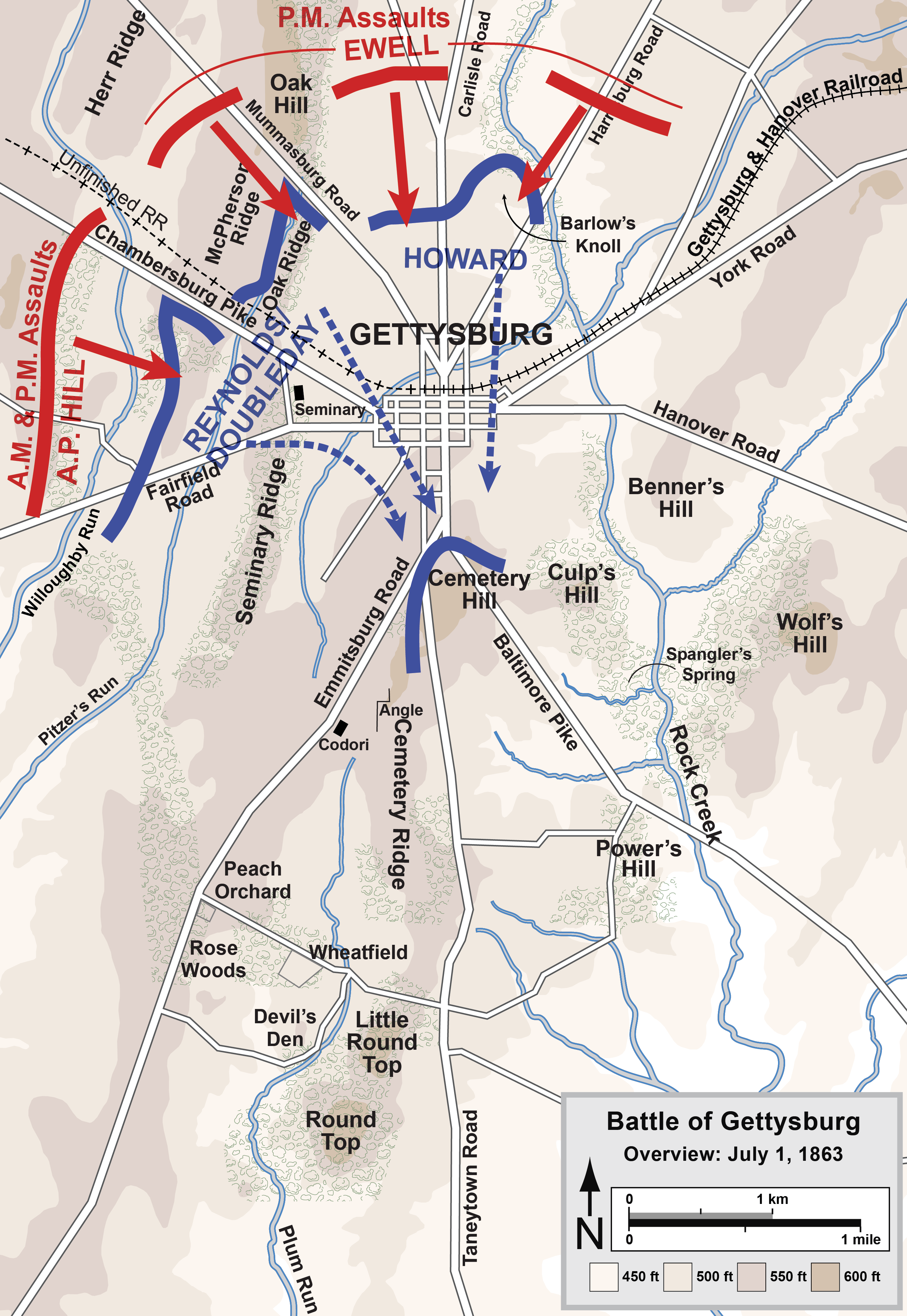
On the morning of July 1st Hill ordered Harry Heth’s to advance his division to Gettysburg without the benefit of cavalry support or reconnaissance. Hill believed that the troops reported by Pettigrew could be nothing more than local militia. As they advanced the leading brigades under Brigadier General James Archer and Joseph Davis met Federal forces. Heth first became embroiled in a fight with Buford’s cavalry, which forced him to deploy and held up his advance along McPherson’s and Herr’s Ridge. Lee’s “laxness with respect to reconnaissance and his lack of control of Hill’s movements caused him to stumble into battle.” For the master of so many battlefields it was an inauspicious beginning.

Heth had been surprised and then suffered heavy casualties when lead elements of the Federal 1st Corps under the command of Major General John Reynolds arrived. In the ensuing fight both Archer’s and Davis’ brigades were mauled with Archer being captured and Davis wounded. As the fight continued the Federal XI Corps under Oliver Howard arrived, extended the Right of the Federal line and emplaced troops on the hills to the east of the town. Unfortunately Howard’s dispositions were faulty and the choice of his First Division commander Barlow to advance to an exposed area of high ground proved to be nearly disastrous to the Federal position.

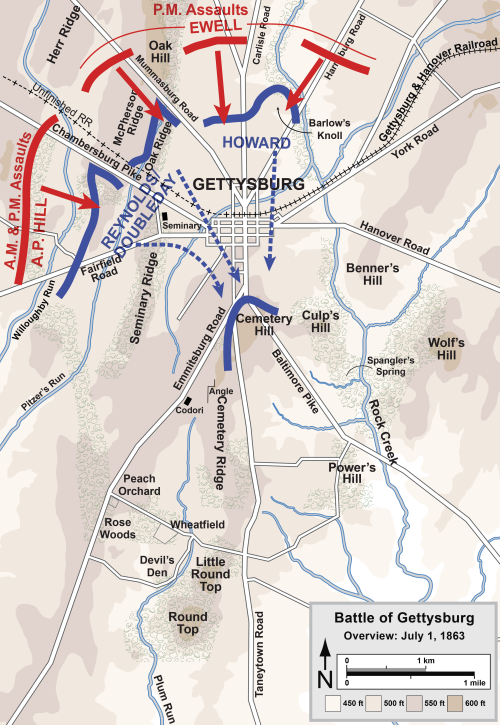
gettysburg_battle_map_of day1Gettysburg Day One (Map by Hal Jespersen, http://www.posix.com/Com)

Lee was surprised by the engagement and though he chastised Heth for getting involved but committed his army to the attack the Federals. Reynolds was killed early in the engagement but the fight was bitter, the Iron Brigade exacted a fearful toll on Archer and Davis’s brigades.

The attack by Heth was helped immensely when the lead elements of Ewell’s 2nd Corps in the form of Robert Rodes’ division arrived. Rodes’ division hit the right flank of the I Corps where it joined XI Corps and was joined by part of Jubal Early’s Division to his right. They overwhelmed the division of Francis Barlow who was wounded and captured, as well as other elements of XI Corps which was deployed on bad ground for defense.

The attack was well conceived but poorly executed, in part due to the failures of some of the subordinate brigade commanders. However, the attack threw the Federal line into confusion and the Federals shifted to meet the attack. Heth sought and got permission from Lee to renew his attack and the combination forced the Federal troops to withdraw through Gettysburg and up to Cemetery Ridge, where two brigade’s of Steinwehr’s division and the tough survivors of the Iron Brigade were already in place.

800px-First_day_at_gettysburgPender’s Division Goes into Action

In making the attack Lee acted against his own directions to his commanders. Though he only had a fraction of his army on the field and was unaware of the strength and location of the bulk of the Federal Army, Lee committed himself to a general engagement. In the process he placed his army at a disadvantage. Unless he could break the Federal line and take Cemetery Hill he would leave the Army of the Potomac with the high ground and with the ability to fight on interior lines, while his forces would be spread out over a long arcing line.

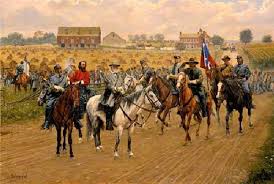
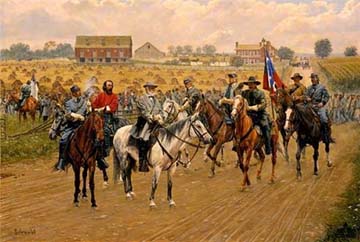
leeindexLee with A.P. Hill and Heth Bradley Schmehl

Ewell’s arrival was fortuitous because it temporarily tilted the balance to Lee, but the advantage was short lived, once again due to a vague order from Lee. This time it was an order to Ewell and like many things about Lee’s conduct of the battle this too is shrouded in controversy.

Lee’s report describes the order:

“General Ewell was, therefore, instructed to carry the hill occupied by the enemy, if he found it practicable, but to avoid a general engagement until the arrival of the other divisions of the army…”

But Lee had already committed himself to a general engagement in pursuing the attack during the afternoon. Although it appeared that Federal forces in turmoil as Reynold’s was dead and elements of XI Corps in retreat the situation was serious but the Confederates were not in a perfect or even completely advantageous position. Howard was able to rally his troops on Cemetery Hill taking advantage of his earlier deployment of Steinwehr’s division. Abner Doubleday who had succeeded Reynold’s brought his tropes back to reinforce the line as well as occupy Culp’s Hill to the right.

bogbayardwilkesonwebAbner Doubleday directs his troops on Day One

When Meade learned of Reynold’s death he dispatched Winfield Scott Hancock of II Corps to take command of all Federal Forces. Though he was junior to Howard, Hancock was able to work out a command arrangement with Howard and take command. Howard had to his credit Federal command position was strengthened.

Hancock doncemeteryhilljuly1_zps512a40faHancock Arrives on the Battlefield

Hancock was authorized by Meade to select where the Army would make its stand. Hancock told Howard “But I think this is the strongest position by nature upon which to fight a battle that I have ever saw…and if it meets your approbation I will select this as the battlefield.” Howard agreed and both men set off to rectify their lines.

Despite their success Ewell and his Corps were disorganized and not in a good position to take advantage of their earlier success. Likewise he was limited in the forces that he had available to continue the attack. Both his and A.P. Hill’s Corps only had two of their divisions in the field. Hill reported that his divisions “were exhausted by some six hours of hard fighting (and that) prudence led me to be content with what had been gained, and not push forward troops exhausted and necessarily disordered, probably to encounter fresh troops of the enemy.” Ewell reported that “all the troops with me were jaded by twelve hours’ marching and fighting.” Lee’s report of the battle indicated that the four divisions involved were “already weakened and exhausted by a long and bloody struggle.”

As such a night assault would have been exceptionally risky. Ewell would have only had the tired and disorganized survivors of four brigades at his disposal with no support from A.P. Hill on his right.

Early's_Charge_on_East_Cemetery_Hill

Ewell has often been criticized by the defenders of Lee and the legend of the Lost Cause for his failure to press the attack on Cemetery Ridge or Culp’s Hill. Critics cite that Federal forces were still disorganized and he could have easily attacked and driven the Federal Forces form the hills. Much is made of the protests of Major General Isaac Trimble as well as General John Gordon who were with Ewell. However as Edwin Coddington noted that these men concentrated their efforts on Ewell’s action to determine what went wrong at Gettysburg. In large part this was due to their inability to criticize Lee. Trimble’s account made its way into Michael Shaara’s classic novel of Gettysburg, the Killer Angels and were acted with conviction by Morgan Shepperd in the film adaptation of the book Gettysburg. Coddington correctly observed that “they forgot, however, the exact circumstances that kept the move from being “practicable” at the time.”

Rodes after battle report supported Ewell’s decision. He wrote before “the completion of his defeat before the town the enemy had begun to establish a line of battle on the heights back of the town, and by the time my line was in condition to renew the attack, he displayed quite a formidable line of infantry and artillery immediately in my front, extending smartly to my right, and as far as I could see to my left in front of Early.” Unfortunately for historians Rodes was killed in action at the Third Battle of Winchester in September 1864.

The Army of Northern Virginia came very close to sweeping Federal forces from the field on July 1st in spite of Lee’s lack of planning and clear commanders intent. But close was not enough. His forces which were committed in a piecemeal manner were unable to follow up their initial success. His orders to Ewell, to take the high ground “if practicable” were correctly interpreted by Ewell. Thus Federal corps under the command of Howard and Hancock were able to regroup, dig in and be reinforced by the rest of the Army on good ground of their choosing with interior lines.

Whether Lee intended to engage the Army of the Potomac at Gettysburg so early in the campaign is debated. His multiple and contradictory strategic aims left his commanders acting much on their own. His lack of clear commander’s intent to his subordinate commanders created confusion on the battlefield and paved the way to many controversies in the years following the war as Southerners sought to explain the failure of the Lost Cause, for which Lee could not be blamed.

Much of the controversy comes from Lee’s own correspondence which indicates that he might have not fully understood his own intentions. Some correspondence indicates that Lee desired to avoid a general engagement as long as possible while other accounts indicate that he wanted an early and decisive engagement. The controversy was stoked after the war by Lee’s supporters, particular his aides Taylor and Marshal and generals Gordon and Trimble, men like Longstreet and were castigated by Lee’s defenders for suggesting that Lee made mistakes on the battlefield.

Lee’s actual misunderstanding of his situation can be seen in the account of Isaac Trimble, traveling with Lee at the beginning of the invasion of Pennsylvania. He wrote:

“We have again outmaneuvered the enemy, who even now does not know where we are or what our designs are. Our whole army will be in Pennsylvania day after tomorrow, leaving the enemy far behind and obliged to follow by forced marches. I hope with these advantages to accomplish some single result and to end the war, if Providence favors us.”

The vagueness of Lee’s instructions to his commanders led to many mistakes and much confusion during the battle. Many of these men were occupying command positions under him for the first time and were unfamiliar with his command style. Where Stonewall Jackson might have understood Lee’s intent, even where Lee issued vague or contradictory orders, many others including Hill and Ewell did not. Lee did not change his command style to accommodate his new commanders.

That lack of flexibility and inability to clearly communicate Lee’s intent to his commanders and failure to exercise control over them proved fatal to his aims in the campaign. Stephen Sears scathing analysis of Lee’s command at Gettysburg perhaps says it the best. “In the final analysis, it was Robert E. Lee’s inability to manage his generals that went to the heart of the failed campaign.”

The vagueness of Lee’s intent was demonstrated throughout the campaign and was made worse by the fog of war. Day one ended with a significant tactical victory for Lee’s army but without a decisive result which would be compounded into a strategic defeat by Lee’s subsequent decisions on the 2nd and 3rd of July.

Peace,

Padre Steve+

2 Comments

Filed under civil war, History, leadership, Military

Gettysburg at 150 Day One: Lee Blunders into Battle

800px-First_day_at_gettysburg

Pender’s Brigade on Day One

The Army of Northern Virginia commanded by Robert E Lee was now deep in Union territory and nearly blind to the location of the Federal Army of the Potomac. On the 30th advanced units of Dick Ewell’s Second Corps had gone nearly as far as Harrisburg while most of the Army was on the road around Chambersburg and Cashtown. Lee’s Cavalry Division under the command of J.E.B. Stuart was far away engaging Union Cavalry around Hanover and not in position to report on Union troop movements. General A.P. Hill sent Johnston Pettigrew’s Brigade of Harry Heth’s Division to Gettysburg on the 30th but Pettigrew observing the Federal cavalry of Buford’s 1st Cavalry Division take up positions on Seminary Ridge declined to engage and reported the Federal concentration to Hill.

As reports from the spy Harrison came to Lee and Longstreet Lee began to concentrate the Army around Cashtown. However the morning of July Hill ordered Harry Heth’s division to move on Gettysburg without the benefit of cavalry support or reconnaissance believing that the troops reported by Pettigrew could be nothing more than local militia. His leading brigades under Brigadier General James Archer and Joseph Davis took heavy casualties and soon Heth became embroiled in a fight with Buford’s cavalry and lead elements of the Federal 1st Corps under the command of Major General John Reynolds.

Gettysburg_Battle_Map_Day1

Gettysburg Day One (Map by Hal Jespersen, http://www.posix.com/Com)

Lee was surprised by the engagement and though he chastised Heth for getting involved committed his army to the attack. Reynolds was killed early in the engagement but the fight was bitter, the Iron Brigade exacted a fearful toll on Archer and Davis’s brigades. The attack by Hill’s 3rd Corps was helped immensely when elements of Ewell’s 2nd Corps arrived on the right flank of the Federal XI Corps, forcing the Federal troops to withdraw through Gettysburg and up to Cemetery Ridge. Ewell’s arrival was fortuitous because it tilted the balance to Lee, but the advantage was short lived.

z_schmehl_leedeliberates

Lee Deliberates Heth’s Advance – Gettysburg by Bradley Schmehl

 Ewell failed to press the attack on Cemetery Ridge or Culp’s Hill while Federal forces were still disorganized, despite the repeated entreaties of Major General Isaac Trimble who was with him. The delay would be fatal to Lee’s intentions as Lee decided to give battle at Gettysburg, ignoring General Longstreet’s plea to disengage take up a favorable position between Gettysburg and Washington DC and force the Army of the Potomac to attack.

doncemeteryhilljuly1_zps512a40fa

Don Troiani’s Painting of Hancock taking Command on Cemetery Hill on Day One

The Army of Northern Virginia came very close to sweeping Federal forces from the field on July 1st in spite of Lee’s lack of planning and clear commanders intent. That much is clear. His orders to Ewell, to take the high ground “if practicable” we interpreted by Ewell in a manner that he determined not to be practicable, so the advanced Federal corps under the command of Major General Winfield Scott Hancock were able to regroup, dig in and be reinforced by the rest of the Army.

Whether Lee intended to engage the Army of the Potomac at Gettysburg so early in a campaign where his multiple and contradictory strategic aims and lack of clear commander’s intent to his subordinate commanders created confusion is debated. Much of the controversy comes from Lee’s own correspondence which indicates that he might have not fully understood his own intentions. Some correspondence indicates that Lee desired to avoid a general engagement as long as possible while other accounts indicate that he wanted an early and decisive engagement. The controversy was stoked after the war by Lee’s supporters, particular his aides Taylor and Marshal, and Longstreet’s supporters.

Isaac Trimble, traveling with Lee at the beginning of the invasion of Pennsylvania recored that Lee told him:

“We have again outmaneuvered the enemy, who even now does not know where we are or what our designs are. Our whole army will be in Pennsylvania day after tomorrow, leaving the enemy far behind and obliged to follow by forced marches. I hope with these advantages to accomplish some single result and to end the war, if Providence favors us.” (Glenn Tucker, High Tide at Gettysburg (Indianapolis: The Bobbs-Merrill Co.: 1958), p. 24.)

The vagueness of Lee’s instructions to his commanders, many of whom were occupying command positions under him for the first time and were unfamiliar with his command style led to confusion. Where Stonewall Jackson might have understood Lee’s intent, even where Lee issued vague or contradictory orders, many others including Hill and Ewell did not. Lee did not change his command style to accommodate his new commanders and that lack of flexibility on Lee’s part proved fatal to his aims in the campaign.

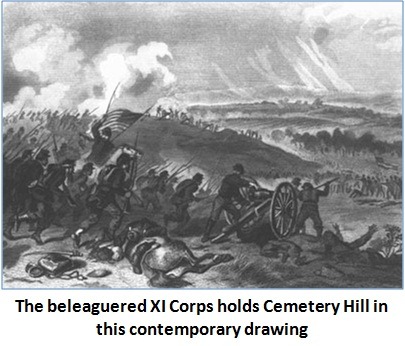
xi-corps-holds-cemetery-hill

The vagueness of Lee’s intent was demonstrated throughout the campaign and was made worse by the fog of war. Day one ended with a significant tactical victory for Lee’s army but without a decisive result which would be compounded into a strategic defeat by Lee’s subsequent decisions on the 2nd and 3rd of July.

Until tomorrow,

Peace

Padre Steve+

Leave a comment

Filed under civil war, History, Military