Tag Archives: mark twain

When Generosity is Viewed as Oppression

gettysburgpickettscharge

Friends of Padre Steve’s World

I decided to weigh in last week about the Recalcitrant County Clerk of Rowan County Kentucky, Mrs. Kim Davis who now sits in jail on a contempt of court citation while her supposedly Christian lawyers make appeals and gather money for their next case. Sadly they will throw Mrs. Davis to the curb when she no longer is profitable, but that is modern American Christianity. No wonder people are fleeing the church, and why most non-believers have such a negative view of Christianity. That, my friends, as unpalatable as it may sound is the truth, and the numbers bear it out.

Now my endeavor wrought several articles, all of which were based in fact, reason, and a dispassionate attempt to wade through the morass of what was happening. I expected some negative comments from conservative Christians but hoped, maybe beyond hope that most would actually take the time to read, think through and consider what I said; but that was a forlorn hope. What passes for conservative Christianity in this country is little different than what passes for fundamentalist Islam in the Middle East; the followers of both major in the minors of their religion and fail to follow the basic tenants of their belief. Most, given the chance and government sanction would kill any who they deem heretics.

That is why I totally agree with Mark Twain, who said, “Concentration of power in a political machine is bad; and an Established Church is only a political machine; it was invented for that; it is nursed, cradled, preserved for that; it is an enemy to human liberty, and does no good which it could not better do in a split-up and scattered condition.”

That, at least to my conservative religious readers may seem like heresy; but it is true. It does not matter what the religion is, or whom they call “God,” when it becomes an Established Church and political machine, as are the heavy hitting politicians, pundits and preachers supporting Mrs. Davis, it is an evil that must be confronted by any person of conscience.

A couple of days ago I posted a new policy regarding comments. It was met by the scorn, hatred, and derision of a number of supposedly Christian people. The fact is I don’t have to allow abusive people to try to hijack my site for their purposes.

I tried to be nice. I tried to be polite, and I tried my best to understanding and to listen to them. That got me nowhere with these people. Instead they played the aggrieved victims of my “intolerance.”

So here is the deal. I am not even going to allow such comments on my site, comments, which though masked in the gentle words of faith, are hateful and intolerant, nor am I going to respond to them. I tried. I tried reason, I allowed the comments, I attempted dialogue; but such is not respected or appreciated by these “true believers” and it is a waste of my time and effort to attempt this. Even Jesus told his disciples to shake the dust off of their sandals when they encountered such people. It is sad that the current so-called disciples of Jesus in this country don’t understand this important distinction.

The thing is that while these people claim the mantle of God and desire the power of the state in order to impose their beliefs on others, they do so from the aspect of weakness because they want power but have lost it.

Eric Hoffer wrote, “It has often been said that power corrupts. But it is perhaps equally important to realize that weakness, too, corrupts. Power corrupts the few, while weakness corrupts the many. Hatred, malice, rudeness, intolerance, and suspicion are the faults of weakness. The resentment of the weak does not spring from any injustice done to them but from their sense of inadequacy and impotence. We cannot win the weak by sharing our wealth with them. They feel our generosity as oppression.”

I have been generous. I have been kind, and I have been gracious in allowing such people a venue. That generosity was scorned because of their sense of inadequacy and impotence. I cannot fix that and I have a life, I don’t need to waste the time I have responding to such people. Jesus didn’t. Why should I?

Have a great day and take care,

Peace

Padre Steve+

9 Comments

Filed under christian life, faith, philosophy, Political Commentary, Religion

Faith, Power & Politics: The Death of Good Religion

184062576_1_blog_main_horizontal

Friends of Padre Steve’s World,

Today I just want to share a few subversive thoughts on American Christianity and established religion. I am not talking about organized religion, because we Americans have little in the way of organization to our religion except when it comes to wanting to be in charge of the country, as many on the Christian Right advocate today.

Mark Twain wrote in his classic novel, A Connecticut Yankee in King Arthur’s Court:

“Concentration of power in a political machine is bad; and an Established Church is only a political machine; it was invented for that; it is nursed, cradled, preserved for that; it is an enemy to human liberty, and does no good which it could not better do in a split-up and scattered condition.”

On a more individual level, Atticus Finch, the hero of the book and film To Kill a Mockingbird said, “Sometimes the Bible in the hand of one man is worse than a whisky bottle in the hand of (another)… There are just some kind of men who – who’re so busy worrying about the next world they’ve never learned to live in this one, and you can look down the street and see the results.” In fact I’ll bet most of us know someone just like Atticus described; I know that I do, plenty of them.

I, and probably you, like to believe that religion is a benign or positive influence in the world. As much as I want to believe the positive aspects I have to admit based on the historical and sociological evidence that this is not so, especially during unsettled times of great change. We live in such an era and when it comes to identity, God is the ultimate trump card.

It seems to me that most fanatical individuals and groups on earth, of course not all are tied to religions, whether it is the Islamic State and Al Qaeda, Boko Haram, Hezbollah, Orthodox Jews, radical Hindus and Buddhists, as well as militant Christians. Who can forget that the Holocaust, the African Slave Trade, and even the Rwandan Genocide were predominantly the work of Christians, but I digress… Of course all of these groups have different goals, but their thought and philosophy are quite similar.

Robert Heinlein wrote: “Almost any sect, cult, or religion will legislate its creed into law if it acquires the political power to do so.” Heinlein, author of the classic Starship Troopers was absolutely correct. Just look at any place in any time where any religion, sect or cult has gained control of a government. They are not loving, they are not forgiving and they use the police power of the state to persecute any individual or group that is judged to be in error, or even worse has the gall to question their authority.

Since the Christian groups tend to thrive in the West, they only speak in terms of violence, most, with the exception of Russian Orthodox Christians, do not have a government to translate those words into action, which it does against Evangelical Protestants, Roman Catholics, Moslems, Jews, and every religious group’s favorite enemies, Gays and women.

Many American Christians, especially conservative Catholics and some Evangelical and Charismatic Protestants seem for a long for the day when they can assume control of a theocratic government, and a day where they can sit at the side of the rich and oppress the poor, the alien and the outcast. The amount of public support given to Vlad Putin by conservative Christian leaders in this country is amazing, and some publically state that they would want someone like Vlad the topless male magazine model for a leader.

But this is nothing new. Many American Christians have practiced that type of Christianity for close to two hundred years. In fact American Christianity is little changed since the day Frederick Douglass wrote, “The Christianity of America is a Christianity, of whose votaries it may be as truly said, as it was of the ancient scribes and Pharisees, ‘They bind heavy burdens, and grievous to be borne, and lay them on men’s shoulders, but they themselves will not move them with one of their fingers… “The man who wields the blood-clotted cowskin during the week fills the pulpit on Sunday, and claims to be a minister of the meek and lowly Jesus. The man who robs me of my earnings at the end of each week meets me as a class- leader on Sunday morning, to show me the way of life, and the path of salvation. He who sells my sister, for purposes of prostitution, stands forth as the pious advocate of purity. He who proclaims it a religious duty to read the Bible denies me the right of learning to read the name of the God who made me. He who is the religious advocate of marriage robs whole millions of its sacred influence, and leaves them to the ravages of wholesale pollution. The warm defender of the sacredness of the family relation is the same that scatters whole families,— sundering husbands and wives, parents and children, sisters and brothers,—leaving the hut vacant, and the hearth desolate. We see the thief preaching against theft, and the adulterer against adultery. We have men sold to build churches, women sold to support the gospel, and babes sold to purchase Bibles for the poor heathen! all for the glory of God and the good of souls! … The dealer gives his blood-stained gold to support the pulpit, and the pulpit, in return, covers his infernal business with the garb of Christianity. Here we have religion and robbery the allies of each other—devils dressed in angels’ robes, and hell presenting the semblance of paradise.””

The remarks of Douglass are as pertinent today as he first penned them in relationship to American white acceptance and support of slavery, and while much of his writing was directed against slaveholders and others who profited off of that system, he directed much of his writing against Northern Christians who offered support to that system.

Many American Christians are no different than other religious people, Christian, Moslem, Jewish, Hindu, and in some cases Buddhists as well as countless other religions history. Religions which have more often sworn alliance to governments, rulers, military and economic power to increase their power than to embody the essence of their founders’ teachings. Most of the time this is due to the need of people for an identity that is bigger and more powerful than what they believe they are on their own and sadly this often results in a sometimes unconscious but more often very conscious belief that they are part of an elect that in this life and the next should rule over unbelievers and others.

This is very important to understand, and Samuel Huntington wrote about it in his book The Clash of Civilizations:

“People do not live by reason alone. They cannot calculate and act rationally in pursuit of their self-interest until they define their self. Interest politics presupposes identity. In times of rapid social change established identities dissolve, the self must be redefined, and new identities created. For people facing the need to determine Who am I? Where do I belong? Religion provides compelling answers….In this process people rediscover or create new historical identities. Whatever universalist goals they may have, religions give people identity by positing a basic distinction between believers and non-believers, between a superior in-group and a different and inferior out-group.”

Huntington was right, you see the true believers, those who follow their religion without question and believe that it is superior to all others also believe that their religion entitles them to be atop the food chain, others who don’t believe like them be damned, if not in this life, the next. That is the certitude of the true believer, especially the religious one. Secular or atheistic fanatics could care less about the next life, for this life is all that they have. But the religious “true believers” are not only interested in destroying someone in this life, but ensuring that in the next that they suffer for eternity, unless they believe in the annihilation of the soul after death, which really spoils the whole Dante’s Inferno perspective of the damned in the afterlife.

The great American philosopher Eric Hoffer wrote:

“The impression somehow prevails that the true believer, particularly the religious individual, is a humble person. The truth is the surrendering and humbling of the self bred pride and arrogance. The true believer is apt to see himself as one of the chosen, the salt of the earth, the light of the world, a prince disguised in meekness, who is destined to inherit the earth and the kingdom of heaven too. He who is not of his faith is evil; he who will not listen will perish.”

That is why they, the religious true believers of any faith are capable of such great evil, and why such people can murder innocents in the most brutal manner simply because they do not believe correctly.

Please do not get me wrong. I am a Christian, a priest, a historian and a theologian, but I also know just how insidious those who hold their religion over those of others can be. While I hold faith dear, I know that it can be abused for the claim of some to have God as their final authority is a sort of trump card with which they are able to justify the most obscene and evil acts against others.

One of my heroes of religious liberty is John Leland, a Baptist whose passionate defense of religious freedom prevented Virginia from re-establishing a state church after the American Revolution and whose influence was key in the decision of Madison and Jefferson to amend the Constitution with the Bill of Rights, particularly the First Amendment. In fact, late in life, well after his success in working with Madison and Jefferson Leland wrote:

“The liberty I contend for is more than toleration. The very idea of toleration is despicable; it supposes that some have a pre-eminence above the rest to grant indulgence; whereas all should be equally free, Jews, Turks [Muslims], Pagans and Christians. Test oaths and established creeds should be avoided as the worst of evils.”

Like Leland, I contend for more than tolerance and I contend for acceptance. But that acceptance ends when any person or group is willing to use their religion to enslave, murder, or otherwise dominate other people in the name of their God, not just in this life, but in the next. This is especially true of those who use the police power of the state to enforce their beliefs and hatred on others.  I will do whatever I can to expose them for what they are, regardless of the “faith” they supposedly represent.

I guess that is why I am even more frightened of religious true believers than non-religious true believers. While the non-religious true believer may sacrifice everything for the sake of power and control in this life, and may in fact commit the most heinous crimes against humanity, their hatred is bounded in space and time to this earth. The religious true believer is not content with that; his enemies must be damned and punished not only in this life, but for eternity, without hope of salvation.

That is why I believe that such people are so dangerous; for their hatred is unbounded by time, or space, it lasts for eternity; which I think is a very, very, long time.

With that I wish you a good day.

Peace

Padre Steve+

1 Comment

Filed under christian life, faith, History, Political Commentary, Religion

God’s Will?

battleofgettysburg-devils-den

Friends of Padre Steve’s World,

The late Father Andrew Greeley wrote, “We are born with two incurable diseases, life, from which we die, and hope, which says maybe death isn’t the end.”

With Judy recovering from her surgery and things looking much more positive than a few weeks ago I have been doing some reflecting. One thing that really impressed me was how Judy handled this from beginning to end. She was concerned and worried much of the time, of course, when you get diagnosed with Cancer you should be worried, because you never know what course the disease will take, and what might even happen during surgery or subsequent treatments. I know people who thought that they were on the way to recovery who died unexpectedly due to an adverse reaction to chemotherapy.

That being said Judy never asked “why me?” nor did she attribute this to “God’s will” or try to rationalize it by saying that “God was testing her faith” or any of this other quasi-providential but really fatalistic bullshit. Her reaction to this mirrored much of what I believed when I returned from Iraq when there were times that I easily could have been injured, wounded or even killed in incidents that were all too similar to others who were injured, killed or wounded. Of course here I am referring to visible physical wounds, not the Post Traumatic Stress and Traumatic Brain Injury that has so messed with my mind. Like Judy I never asked “why me?’ of attributed what happened to me to being “God’s will” or the “providence of God.”

I tend to agree with Confederate Colonel William Oates whose 15th Alabama fought so bravely and unsuccessfully against Joshua Chamberlain and the 20th Maine at Little Round Top on July 2nd 1863 at Gettysburg. After the war, Oates, who was a Christian, reflected about God’s role in the battle and noted that he believed that God, “endowed men with the power of acting for themselves and with responsibility for their acts. When we went to war it was a matter of business, of difference of opinion among men about their temporal affairs. God had nothing to do with it. He never diverted a bullet from one man, or caused it to hit another, nor directed who should fall or who should escape, nor how the battle should terminate. If I believed in such intervention of Providence I would be a fatalist….”

I apply that to all of life, I do not believe that God intentionally afflicts people with disease, or directs events so they are killed. I don’t believe that it is God’s will for people to suffer from terrible diseases or directs bullets, speeding cars or other things which kill young men and women, children or other innocents.

I know that from the beginning of time that people have attributed things that they cannot endure to God, the Devil, or in some cultures gods and devils, or even to attribute such things as God’s punishment for the “sins” of individuals and even their descendants. I know that helps some people, sometimes I think even some of the writers of scripture to frame suffering; as a whole people need to credit or blame someone for terrible things that happen.

I cringe when I hear people say that they are suffering because it is God’s will, or that God is testing them, or I see something that a terrible natural disaster that kills thousands of people is an “act of God.” To be truthful I cannot believe that God is so cruel and capricious to be in that kind of business, and if indeed God is really that way I would rather be an atheist than go to seek a heaven ruled by such a being. And yes, I know that as a Christian that this puts me in a minority. I simply believe that as Jesus so wisely noted that “the rain falls on the just and the unjust alike,” in other words that it is called life, or the human condition, and all of us have to deal with it. To be somewhat crude I believe that shit happens and we have to deal with it.

I cannot imagine a God who wills, plans, and condones genocide, slavery,Infanticide, wars of aggression waged in his name, and every imaginable form of suffering known to humanity. I cannot image a God who so so earnestly believe inflicts such grievous suffering on his children. If we were to apply the standards of justice that we apply to human fathers who abuse or kill their children to God we would do ourselves good and we would probably lock him away for consecutive life terms, but our human need for explaining this prevents us from asking hard questions to the God that we claim to believe. Mark Twain wrote: “The best minds will tell you that when a man has begotten a child he is morally bound to tenderly care for it, protect it from hurt, shield it from disease, clothe it, feed it, bear with its waywardness, lay no hand upon it save in kindness and for its own good, and never in any case inflict upon it a wanton cruelty. God’s treatment of his earthly children, every day and every night, is the exact opposite of all that, yet those best minds warmly justify these crimes, condone them, excuse them, and indignantly refuse to regard them as crimes at all, when he commits them. Your country and mine is an interesting one, but there is nothing there that is half so interesting as the human mind.”

That being said I do live in hope, which is a part of my faith, a faith which is in things that I cannot understand nor can I prove. In this I do believe that God somehow gives people, even people that religious people call “non-believers” a grace to deal with tragedy, illness, suffering and death. I have to believe that because I have often seen non-Christians endure suffering and tragedy with a grace that many Christians, intent on finding a biblical or theological reason for such events do not display. When I think of this I am reminded of Jesus’s remarks about the Centurion who asked him to heal his servant and when Jesus offers to come tells Jesus that he is not worthy for Jesus to come under his roof, but to only speak the word and his servant should be healed (Matthew 8:5-13). The interesting thing about the passage is that the word used for servant is a Greek word for servant which only occurs once in the New Testament, the word Pais. In ancient Greek literature the term denotes a homosexual relationship, that of a man with his houseboy. In other words, Jesus healed a Roman, gentile, pagan Centurion’s homosexual lover, and had the nerve to say that he had “not seen such faith in Israel.” Since the writer of Matthew used the word Pais instead of the word doulos for servant it had to be deliberate and he had to know what he was doing, but I digress…

While I do not believe that God directs or permits death and suffering, I do believe that God is not absent in suffering that people endure, that God “Emmanuel” is with us, all of us; that God suffers with us, for that is the message of Jesus, the crucified one. I also believe that God who is with us, weeps with us as well as rejoices with us. That may not be a good answer for some who want to prove that God is behind everything, nor for those who do not believe in God at all.

I’m sure that some will consider what I wrote today as blasphemy, but then I have to agree with Mark Twain who wrote, “Blasphemy? No, it is not blasphemy. If God is as vast as that, he is above blasphemy; if He is as little as that, He is beneath it.”

Have a great night,

Peace

Padre Steve+

2 Comments

Filed under christian life, faith, Religion

The Presence of Molly


wherewegoingdad

“Dogs are our link to paradise. They don’t know evil or jealousy or discontent. To sit with a dog on a hillside on a glorious afternoon is to be back in Eden, where doing nothing was not boring–it was peace.”  Milan Kundera

Molly Fur is still with me. Though we had to have her put down Monday I have felt her presence, especially as I drive too and from work. You see Molly was my constant companion and that wonderful furry baby spent innumerable hours traveling with me in North Carolina and on what seemed were our endless treks between Emerald Isle and Virginia Beach.

Molly loved riding with me and it did not matter how long or short the the trip was she had developed her own rituals for the rides. She would take a drink from her water dish before leaving the house, ensure that she had peed before hopping into the car and then take her place either in the front seat next to me of the back seat, centered so she could look over my shoulder. She was a comforting presence on those long trips and she savored every moment of them, especially when we would stop at a drive through for lunch and she would get her “Molly Burger.” When we got to our destination she was always happy, if coming home to Virginia she would joyfully run to Judy at the front door, and if heading back to Emerald Isle demand that I walk her to the beach, all the while hunting for deer.

I have never seen a dog savor life as much as Molly and thus I am not surprised that I still feel her presence in the car. Yesterday was funny because I thought I saw her shadow in the seat next to me and I reached over to pet her. She wasn’t there, but I could feel her spirit. That may sound weird to some of you, even religious people who believe in an afterlife, but somehow exclude everything but we contemptible human beings from it. I think that one of my favorite passages in the Bible is the one in Romans chapter eight which talks about the creation awaits its redemption, even groans for its redemption, and having heard Molly groan I know that this means dogs and other furry friends too. Personally I don’t give a flying fuck if any supposedly Christian leader condemns me as a heretic, for believing this.  But as Mark Twain said: “The dog is a gentleman; I hope to go to his heaven not man’s.”  Since I am already stoking the fires of Hell that according to some await me let me echo the words of Will Rogers who said “If there are no dogs in Heaven, then when I die I want to go where they went,”   even as I totally agree with the late curmudgeon Andy Rooney  who said “The average dog is a nicer person than the average person.”   I can feel the flames heating up, can’t you?

So, since I have already been condemned as a heretic to Hell even by some Christian “friends”  who have had the nerve to do so on social media, this matters not.  For I know that Molly is with me any time I get in my car. She is now like a guardian angel and I can feel her presence and frankly I would rather have her spiritual presence and the presence of my Papillon Pack of Minnie Scule and Izzy Bella around me than most people. A friend of mine noted that I have to start training up Izzy in “the way of the dog” not to replace Molly, but to be my next guardian angel. Thankfully, the little girl is already working on that.

So until tomorrow, thank you for all of your thoughts, prayers and love.

I wish you all the greatest love and joy possible. 

Peace

Padre Steve+

6 Comments

Filed under christian life, dogs, faith

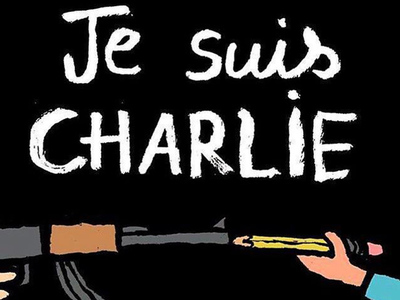
Je Suis Charlie: An Attack on Freedom

je-suis-charlie

Edgar Johnson wrote  that “A satirist is never certain whether he/she will be acclaimed or punished.” Today 10 extraordinary and acclaimed satirists were punished by Islamic extremists who killed them for their alleged offenses against Mohammed.

This morning I looked at my iPhone Twitter feed and noticed that there had been an attack on  the offices of the French satire paper Charlie Hebdo. When I got to work and logged on to my computer I saw the awful news that a dozen people were dead, many more wounded. As I watched the video reports of the attack on the BBC News live stream I was horrified, but not surprised. I just wondered when, where and to whom this would happen. While the attackers appear to be radicalized Moslems, claiming links to Al Qaeda, and with the Islamic State claiming credit for the attack, the fact is that free speech is under assault around the world with journalists, writers and even bloggers being threatened and sometimes like today killed in the most brutal manner.

Sometimes the threats come from Moslem and other religious extremists, and the fact is that in addition to Moslems radical Christians, Hindus and Jews have have threatened, assaulted or killed those they oppose. Other radical non-religious entities do the same. Likewise many governments use open and secretive means to silence dissenting writers.

The fact is that speaking the truth to power, making comments that some find offensive, or the timeless art of political and religious satire is dangerous. I have been threatened a number of times on this site, mostly by White Supremacists and Neo-Nazi types, but occasionally a less than gruntled Christians or Moslems.  I’ve gotten used to it, though on one occasion in 2010 I had to report one person who made very specific threats against me and my family to the FBI.

However, the attack on the people who made up the staff of Charlie Hebdo was very troubling. While the paper made satire of Islamic extremists, it also took on the Catholic Church, Orthodox Jews, as well as made mincemeat of the the French political landscape and political leaders, right wing and left wing, which means that those that they became the enemies of a lot of powerful people who do not like to be criticized.

mohammed-cartoons-charlie-hebdo-muhammed-cartoons-2012-2

The fact is that satire is meant to shake things up and on occasion offend those in power. It does so through wit and humor, sometimes even crude and offensive humor. That is what makes it so effective. Some of the greatest American social and political commentators included Mark Twain and Will Rogers, who used satire many times and quite often offended many people, especially political, religious and business leaders or organizations.

That kind of satire as Harry Shearer, who does the voices for a number of characters on The Simpsons and maintains his own satire program noted that because satirists have the job of needling those in power that they often have no one to defend them.

Shearer noted:

With Charlie Hebdo, “you really have a clean case here,” Shearer said. “This is a magazine, a group of humans who exist not to sell hardware and software on the side. This is a group of humans who exist mainly if not exclusively to put out a satirical magazine that is not basically commercial; it’s a satirical enterprise that happens to exist in a commercial market. The sad fact is there is no one else to defend them. Satirists are reliant ultimately on the very establishment they mock. That’s the great irony of their situation.”

Those killed included some of the most talented and gifted cartoon satirists in the world, some of whom had been living under death threats for years.

20150110_eup505

The dead included Stéphane Charbonnier, the editor and best known cartoonist, nine other staff including other noted cartoonists and writers and two policemen.

1348081765_074872_1348081855_noticia_normal

Stéphane Charbonnier

Today, anyone who values liberty, and freedom of speech, expression and association knows the reality that if you offend the wrong people that you could be killed. It really doesn’t matter who or what you criticize, the fact is that there are people who for whatever reason, be it an offense against their God, their ideology or political beliefs, that some people cannot take criticism. 

I did find it interesting that Bill Donohue of the Catholic League blamed Charbonnier and his staff for insulting the prophet. I found that interesting coming from a man who simply debases and demeans his opponents while condemning them to hell, and who has made plenty of inflammatory statements about Islam and Moslems. Donohue, the champion of intolerance condemned not the intolerance of the killers, but the “intolerance” of those who were murdered. I am sure that in the next few days there will be many right wing Christian preachers and pundits who say similar things.

But also one has to look at this attack in a strategic context. If the attackers are members of Al Qaeda or ISIL they chose their victims carefully in order to provoke a response against innocent Moslems that will provoke even more violence. Such people are evil.

The fact is that I don’t have to like satire, sometimes I am offended by some of the things that I see, read or hear, but good satire makes me think, that is it’s brilliance. As G.K. Chesterton said “A man is angry at a libel because it is false, but at a satire because it is true.”

So in the tradition of defending the freedom of speech, the press and association, #Je Suis Charlie.

Peace

Padre Steve+

2 Comments

Filed under civil rights, faith, News and current events, Political Commentary

Mine Eyes Have Seen The Glory: Religion, Ideology & the Civil War Part 1

Friends of Padre Steve’s World

This is part one of a very long chapter in my Gettysburg Staff Ride Text. The chapter is different because instead of simply studying the battle my students also get some very detailed history about the ideological components of war that helped make the American Civil War not only a definitive event in our history; but a war of utmost brutality in which religion drove people and leaders on both sides to advocate not just defeating their opponent, but exterminating them.

But the study of this religious and ideological war is timeless, for it helps us to understand the ideology of current rivals and opponents, some of whom we are in engaged in battle and others who we spar with by other means, nations, tribes and peoples whose world view, and response to the United States and the West, is dictated by their religion. 

Yet for those more interested in current American political and social issues the period is very instructive, for the religious, ideological and political arguments used by Evangelical Christians in the ante-bellum period, as well as many of the attitudes displayed by Christians in the North and the South are still on display in our current political and social debates. 

I will be posting the next two parts over the next two days. 

Peace

Padre Steve+

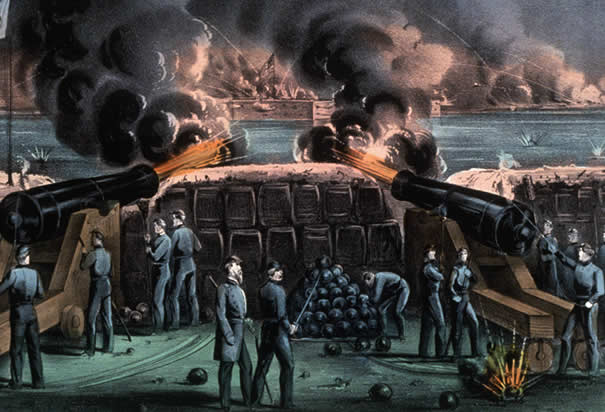
illustration-fort-sumter

“At length on 12th April, the tension could no longer bear the strain. Contrary to instructions, in the morning twilight, and when none could see clearly what the historic day portended, the Confederates in Charleston bombarded Fort Sumter, and the thunder of their guns announced that the argument of a generation should be decided by the ordeal of war. A war, not between two antagonistic political parties, but a struggle to the death between two societies, each championing a different civilization…” 1

War cannot be separated from Ideology, Politics or Religion One can never separate war and the means by which it is fought from its political ends. According to Clausewitz war is an extension or continuation of politics. Of course Clausewitz understood the term politics or policy in the light of the concept of a “World View” or to use the German term Weltungschauung. The term is not limited to doctrine or party politics, but it encompasses the world view of a people or culture. The world view is oft used by the political, media and religious leadership of countries and can be quite instrumental in the decision by a people to go to war; who they war against, their reasons for going to war, the means by which they fight the war, and the end state that they envision. This concept includes racial, religious, cultural, economic and social dimensions of a world view.

One of the problems that modern Americans and Western Europeans have is that we tend to look at the world, particularly in terms of politics and policy, be it foreign or domestic, through a prism from which we cannot see the forest for the trees. We look at individual components of issues such as economic factors, military capabilities, existing political systems, diplomatic considerations and the way societies get information in isolation from each other. We dissect them, we analyze them, and we do a very good job in examining and evaluating each individual component; but we often do this without understanding the world view and ideological factors that link how a particular people, nation or party understand these components of policy.

Likewise policy makers tend to take any information they receive and interpret it through their own world view. This is true even if they have no idea what their world-view is or how they came to it. Most often a world view is absorbed over years. Barbara Tuchman wrote that “When information is relayed to policy-makers, they respond in terms of what is already inside their heads and consequently make policy less to fit the facts than to fit the notions and intentions formed out of the mental baggage that has accumulated in their minds since childhood.” 2

Policy makers often fail to see just how interconnected the most primal elements of the human experience are to the world view of others as well as their own.

Because of this many policy makers, be they military or civilian do not understand how critical the understanding of world view to designing effective polices. Likewise many fail to see how the world view of others influences their application of economic, political, diplomatic and military power as well as the use and dissemination of information in their nation or culture. This is true no matter which religion or sect is involved, even if a people or nation is decidedly secular, and at least outwardly non-religious.

Perhaps this is because we do not want to admit that our Western culture itself is very much a product of primal religious beliefs which informed politics, philosophy, ethics, law, economics, views of race, and even the arts for nearly two millennia. Perhaps it is because we are justifiably appalled and maybe even embarrassed at the excesses and brutality of our ancestors in using religion to incite the faithful to war; to use race and religion justification to subjugate or exterminate peoples that they found to be less than human; or to punish and conquer heretics.

The United States Military made a belated attempt to address ideology, culture and religion in terms of counter-insurgency doctrine when it published the U.S. Army/Marine Counterinsurgency Manual. The discussion of these issues is limited to two pages that specifically deal with various extreme Moslem groups that use that religion as a pillar of their ideology, strategy and operations. But the analysis in the counterinsurgency manual of is limited because its focus is very general and focused at a tactical level.

Likewise the analysis of world view, ideology and religion in the counterinsurgency manual is done in a manner of “us versus them” and though it encourages leaders to attempt to understand the cultural differences there is little in it to help leaders to understand who to do this. Commendably the manual discusses how terrorist and insurgent groups use ideology, frequently based on religion to create a narrative. The narrative often involves a significant amount of myth presented as history, such as how Al Qaida and ISIL using the Caliphate as a religious and political ideal to strive to achieve, because for many Moslems “produces a positive image of the golden age of Islamic civilization.” 3 However, we frequently cannot see how Americans have used, and in some cases continue to the Puritan understanding of a city set on a hill which undergirded Manifest Destiny, the extermination of Native Americans, the War with Mexico, the romanticism of the ante-bellum South and later the Lost Cause.

Policy makers and military leaders must realize that if they want to understand how culture and religious ideology drive others to conquer, subjugate and terrorize in the name of God, they first have to understand how our ancestors did the same thing. It is only when they do that that they can understand that this behavior and use of ideology for such ends is much more universal and easier to understand.

If one wants to see how the use of this compulsion to conquer in the name of God in American by a national leader one needs to go no farther than to examine the process whereby President McKinley, himself a veteran of the Civil War, decided to annex the Philippine in 1898 following the defeat of the Spanish. That war against the Filipinos that we had helped liberate from Spanish rule saw some of the most bloodthirsty tactics employed in fighting the Filipino insurgents, who merely wanted independence. It was a stain on our national honor which of which Mark Twain wrote: “There must be two Americas: one that sets the captive free, and one that takes a once-captive’s new freedom away from him, and picks a quarrel with him with nothing to found it on; then kills him to get his land. . .


A Doubtlessly sincere McKinley sought counsel from God about whether he should annex the the Philippines or not.

“He went down on his knees, according to his own account, and “prayed to Almighty God for light and guidance.” He was accordingly guided to conclude “that there was nothing left to do for us but to take them all, and to educate the Filipinos. And uplift and civilize and Christianize them, by God’s grace to do the very best we could by them, as our fellowmen for whom Christ died.” 4

On the positive side the counterinsurgency manual does mention how “Ideology provides a prism, including a vocabulary and analytical categories, through which followers perceive their situation.” 5 But again it does so at a micro-level and the lessons of it are not applied at the higher levels of strategic thinking and policy.

Thus when faced with cultures for which religion provides the adhesive which binds each of these elements, such as the Islamic State or ISIL we attempt to deal with each element separately, as if they have no connection to each other. But that is where we err, for even if the religious cause or belief has little grounding in fact, science or logic, and may be the result of a cultures attempting to seize upon mythology to build a new reality, it is, in the words of Reggie Jackson the “straw that stirs the drink” and to ignore or minimize it is to doom our efforts to combat its proponents.

Perhaps that is because we do not like to look at ourselves and our own history in the mirror. Perhaps it is because we are uncomfortable with the fact that the face that we see in the mirror is face too similar to those we oppose who are perfectly willing to commit genocide in the name of their God, than we want to admit. Whether this is because we are now predominantly secularist in the way that we do life, or because we are embarrassed by the religiously motivated actions of our forefathers, the result is strikingly and tragically similar.

Clausewitz was a product of classic German Liberalism. He understood the effects of the moral and spiritual concerns inherent in policy, and it flows from his pen, as where he wrote “that the aim of policy is to unify and reconcile all aspects of internal administration as well as of spiritual values, and whatever else the moral philosopher may care to add.” 6 Clausewitz understood that when the motivation behind politics becomes more extreme and powerful; when the politics becomes more than a simple disagreement about isolated policy issues; when the ideology that lays behind the politics, especially ideology rooted in religion evokes primal hatred between peoples, war can come close to reaching the abstract concept of absolute or total war.

Clausewitz wrote:

“The more powerful and inspiring the motives for war, the more they affect the belligerent nations and the fiercer the tensions that precede the outbreak, the closer will war approach its abstract concept, the more important will be the destruction of the enemy, the more closely will the military and the political objects of war coincide, and the more military and less political will war appear to be….” 7

The American Civil War was the first modern war based on the advancement of technology and the changing character of war. But it was also a modern war which reached back to the most primal urges of the people involved, including the primal expressions of religious justification for their actions that both sides accepted as normal.

The American Civil War was caused by the clash of radically different ideologies, ideologies which championed two very different views of civilization, government, economics and the rights of people. However, these different world views were based based upon a common religious understanding:

“whatever their differences over such matters as slavery and political preaching, both sides read their Bibles in remarkably similar ways Ministers had long seen the American republic as a new Israel, and Confederate preachers viewed the southern nation in roughly the same light. The relentless, often careless application of biblical typologies to national problems, the ransacking of scripture for parallels between ancient and modern events produced a nationalistic theology at once bizarre, inspiring and dangerous. Favorite scripture passages offered meaning and hope to a people in the darkest hours and, at the same time, justified remorseless bloodshed.” 8

This understanding manifested itself in each side’s appeal to their Puritan ancestor’s concept of a “city set on a hill,” a mantle that each side claimed to be the legitimate heir. Though they seem radically different, they are actually two sides of the same religious-ideological coin.

The American Civil War was a religious and ideological war. “Like the total wars of the twentieth century, it was preceded by years of violent propaganda, which long before the war had obliterated all sense of moderation, and had awakened in the contending parties the primitive spirit of tribal fanaticism.” 9 It was preceded by the fracturing of political parties and alliances which had worked for compromise in the previous decades to preserve the Union even at the cost of maintaining slavery.

Far from being irrational as some have posited, the actions and behavior of politicians in both the North and the South was completely rational based on their conflicting ideologies and views of their opponents. The “South’s fears of territorial and economic strangulation and the North’s fears of a “slave power” conspiracy are anything but irrational, and only someone who refuses to think through the evidence available to Americans in the 1850s would find either of them at all illogical.” 10

Understanding How Religiously Based Ideology influences Policy, Politics and War Samuel Huntington wrote:

“Blood, language, religion, way of life were what the Greeks had in common and what distinguished them from the Persians and other non-Greeks. Of all the objective elements which define civilizations, however, the most important is usually religion, as the Athenians emphasized. To a very large degree, the major civilizations in human history have been closely identified with the world’s great religions; and who share ethnicity and language but differ in religion may slaughter each other…” 11

The very realistic fears of both sides brought about clash of extremes in politics which defied efforts at compromise and was already resulting in violent and bloody conflicts between ideologues in Kansas, Missouri and Kentucky years before the firing on Fort Sumter. For both sides their views became a moral cause that in the minds of many became an article of their religious faith, and “Religious faith itself became a key part of the war’s unfolding story for countless Americans….” 12 British theorist and military historian J.F.C. Fuller wrote of the religious undergirding of the war:

“As a moral issue, the dispute acquired a religious significance, state rights becoming wrapped up in a politico-mysticism, which defying definition, could be argued for ever without any hope of a final conclusion being reached.” 13

That is why it impossible to simply examine the military campaigns and battles of the Civil War in isolation from the politics, polices, the competing philosophies and the underlying theology which were the worldview that undergirded the arguments of both sides. Those competing philosophies and world views, undergirded by a pervasive nationalistic understanding of religion not only helped to cause on the war but made the war a total war.

Some might wonder where this fits in a text that is about a specific campaign and battle in a war, but for those entrusted with planning national defense and conducting military campaign the understanding of why wars are fought, in particular the ideological causes of war matter in ways that military planners, commanders and even elected political leadership often overlook. Colin Gray notes: “Wars are not free floating events, sufficient unto themselves as objects for study and understanding. Instead, they are entirely the product of their contexts.” 14

Studying the context of the American Civil War is very important in understanding not just it, but also civil wars in other nations which are currently raging. The study of these contexts brings an American or Western historical perspective to those wars, not so much in trying to place a western template over non-western conflicts; but a human perspective from our own past from which we can gain insight into how the people, even people who share a common language, religion and history, can war against each other in the most brutal of fashions. Again I refer to Colin Gray who noted “Policy and strategy will be influenced by the cultural preferences bequeathed by a community’s interpretation of its history as well as by its geopolitical-geostrategic context.” 15

For American and other Western political and military policy makers this is particularly important in Iraq where so many Americans have fought, and in the related civil war in Syria which has brought about the emergence of the Islamic State of Iraq and the Levant.

Likewise in our Western tradition we can see how radical ideology, based on race was central to Hitler’s conduct of war, especially in the East during the Second World War. Hitler’s ideology permeated German military campaigns and administration of the areas conquered by his armies. No branch of the German military, police or civil administration in occupied Poland or Russia was exempt guiltless in the crimes committed by the Nazi regime. It is a chilling warning of the consequences awaiting any nation that allows it to become caught up in hate-filled political, racial or even religious ideologies which dehumanizes opponents and of the tragedy that awaits them and the world. In Germany the internal and external checks that govern the moral behavior of the nation and individuals failed. Caught up in the Nazi system, the Germans, especially the police and military abandoned the norms of international law, morality and decency, banally committing crimes which still reverberate today and which are seen in the ethnic cleansing actions in the former Yugoslavia and other European nations.

Thus the study of the American Civil War, from the cultural, economic, social and religious differences which divided the nation helps us in understanding war. But even more importantly we have to understand the ideological clash between Abolitionists in the North, and Southern proponents of slavery. Both the ideologies of the Abolitionists who believed that African Americans were created by God and had the same rights as whites, as well as the Southern arguments that blacks were inferior and slavery was a positive good, were buttressed by profoundly religious arguments related directly to a divergence in values. It was in this “conflict of values, rather than a conflict of interests or a conflict of cultures, lay at the root of the sectional schism.” 16

Understanding this component of our own nation’s history helps us to understand how those same factors influence the politics, policies, the primal passions and hatreds of people in other parts of the world. Thus they are helpful for us to understand when we as a nation involve ourselves in the affairs of other peoples whose conflicts are rooted in religiously motivated ideology and differences in values, such as in the current Sunni-Shia conflict raging in various guises throughout the Middle East where culture, ideology and economic motivations of the groups involved cannot be separated. We may want to neatly separate economic, strategic, military and geopolitical factors from religious or ideological factors assuming that each exists in some sort of hermetically sealed environment. But to think this is a fallacy of the greatest magnitude. As we have learned too late in the century in our Middle East muddling, it is impossible to separate geopolitical, strategic, military and economic issues from ideological issues rooted in distinctly religious world views, world views that dictate a nation, people or culture’s understanding of the world.

David M. Potter summed up this understanding of the connection between the ideological, cultural and economic aspects and how the issue of slavery connected all three realms in the American Civil War:

“These three explanations – cultural, economic and ideological – have long been the standard formulas for explaining the sectional conflict. Each has been defended as though it were necessarily incompatible with the other two. But culture, economic interest, and values may all reflect the same fundamental forces at work in a society, in which case each will appear as an aspect of the other. Diversity of culture may produce both diversity of interests and diversity of values. Further, the differences between a slaveholding and a nonslaveholding society would be reflected in all three aspects. Slavery represented an inescapable ethical question which precipitated a sharp conflict of values.” 17
o-SLAVERY-facebook


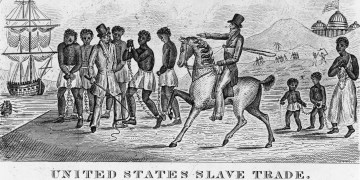
The Impact of Slavery on the Growing Divide between North and South

The political ends of the Civil War came out of the growing cultural, economic, ideological and religious differences between the North and South that had been widening since the 1830s. However, slavery was the one issue which helped produce this conflict in values and it was “basic to the cultural divergence of the North and South, because it was inextricably fused into the key elements of southern life – the staple crop of the plantation system, the social and political ascendency of the planter class, the authoritarian system of social control.” 18 Without slavery and the southern commitment to an economy based on slave labor, the southern economy would have most likely undergone a similar transformation as what happened in the North; thus the economic divergence between North and South would “been less clear cut, and would have not met in such head-on collision.” 19 But slavery was much more than an economic policy for Southerners; it was a key component of their religious, racial and philosophic world view.

The issue of slavery even divided the ante-Bellum United States on what the words freedom and liberty meant, the dispute can be seen in the writings of many before the war, with each side emphasizing their particular understanding of these concepts. Many Southerners, including poor whites saw slavery as the guarantee of their economic freedom. John C. Calhoun said to the Senate in 1848 that “With us, the two great divisions of society are not the rich and poor, but white and black; and all of the former, the poor as well as the rich, belong to the upper class, and are respected and treated as equals.” 20

But it was Abraham Lincoln who cut to the heart of the matter when he noted that “We all declare for liberty” but:

“in using the same word we do not all mean the same thing. With some the word liberty may mean for each man to do as he pleases with himself and the product of his labor; while with others the same word may mean for some men to do as they please with other men and the product of other men’s labor.” 21

The growing economic disparity between the Slave and Free states became more about the expansion of slavery in federal territories as disunion and war approached; for a number of often competing reasons. These differences were amplified by the issue of slavery led to the substitution of stereotypes of each other and had the “effect of changing men’s attitudes toward the disagreements which are always certain to arise in politics: ordinary, resolvable disputes were converted into questions of principle, involving rigid, unnegotiable dogma.” 22 The editor of the Charleston Mercury noted in 1858 that “on the subject of slavery…the North and the South…are not only two peoples, but they are rival, hostile peoples.” 23

This was driven both by the South’s insistence on both maintaining slavery where it was already legal and expanding it into new territories which was set against the vocal abolitionist movement. They were also fighting an even more powerful enemy, Northern industrialists who were not so idealistic, and much more concerned with “economic policy designed to secure Northern domination of Western lands than the initial step in a broad plan to end slavery.” 24 This completion between the regions not only affected politics, it affected religion and culture In the South it produced a growing culture of victimhood which is manifest in the words of Robert Toombs who authored Georgia’s declaration of causes for secession:

“For twenty years past, the Abolitionists and their allies in the Northern states, have been engaged in constant efforts to subvert our institutions, and to excite insurrection and servile war among us…” whose “avowed purpose is to subject our society, subject us, not only to the loss of our property but the destruction of ourselves, our wives and our children, and the dissolution of our homes, our altars, and our firesides.” 25

As the differences grew and tensions rose the South became ever more closed off from the North. “More than other Americans, Southerners developed a sectional identity outside the national mainstream. The Southern life style tended to contradict the national norm in ways that life styles of other sections did not.” 26

The complex relationship of Southern society where the “Southern bodies social, economic, intellectual, and political were decidedly commingled” 27 and politics of the South came more to embrace the need for slavery and its importance, even to poor whites in the South who it did not benefit and actually harmed economically: “the system of subordination reached out still further to require a certain kind of society, one in which certain questions were not publically discussed. It must give blacks no hope of cultivating dissention among the whites. It must commit non slaveholders to the unquestioning support of racial subordination….In short, the South became increasingly a closed society, distrustful of isms from outside and unsympathetic to dissenters. Such were the pervasive consequences of giving top priority to the maintenance of a system of racial subordination.” 28
4.0.4


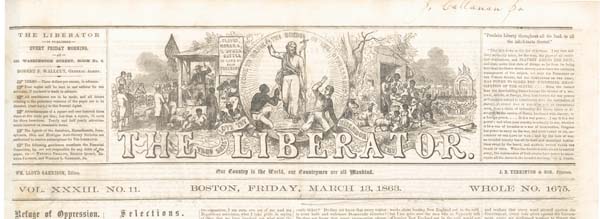
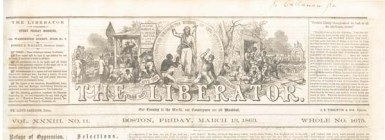
Southern planters declared war on all critics of their “particular institution” beginning in the 1820s. As Northern abolitionists like William Lloyd Garrison and his newspaper The Liberator grew in its distribution and began to appear in the South various elected officials throughout the South “suppressed antislavery books, newspapers, lectures, and sermons and strove generally to deny critics of bondage access to any public forum.” 29

In response to the proliferation of abolitionist literature in the South, John C. Calhoun proposed that Congress pass a law to prosecute “any postmaster who would “knowingly receive or put into the mail any pamphlet, newspaper, handbill, or any printed, written, or pictorial representation touching the subject of slavery.” 30 Calhoun was not alone as other members of Congress as well as state legislatures worked to restrict the import of what they considered subversive and dangerous literature.

Beginning in 1836 the House of Representatives passed a “gag rule” for its members which “banned all petitions, memorials, resolutions, propositions, or papers related in any way or to any extent whatever to the subject of slavery.” 31 This was challenged by former President John Quincy Adams in 1842 as well as by others so that in 1844 the House voted to rescind it. However Southern politicians “began to spout demands that the federal government and the Northern states issue assurances that the abolitionists would never be allowed to tamper with what John Calhoun had described as the South’s “peculiar domestic institution.” 32 The issue of slavery more than any other “transformed political action from a process of accommodation to a mode of combat.” 33

Around the same time as the gag rule was played out in Congress the Supreme Court had ruled that the Federal government alone “had jurisdiction where escaped slaves were concerned” which resulted in several states enacting “personal liberty laws” to “forbid their own elected officials from those pursuing fugitives.” Southern politicians at the federal and state levels reacted strongly to these moves which they believed to be an assault on their institutions and their rights to their human property. Virginia legislators protested that these laws were a “disgusting and revolting exhibition of faithless and unconstitutional legislation.” 34

The issue of slavery shaped political debate and “structured and polarized many random, unoriented points of conflict on which sectional interest diverged.” 35 As the divide grew leaders and people in both the North and the South began to react to the most distorted images of each other imaginable- “the North to an image of a southern world of lascivious and sadistic slave drivers; the South to the image of a northern world of cunning Yankee traders and radical abolitionists plotting slave insurrections.” 36
Edmund-Ruffin

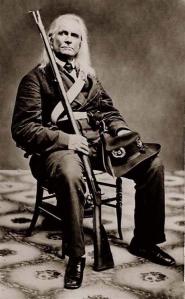
The Slaveholder Ideology Personified: Edmund Ruffin

Among the people most enraged by Northern opposition to slavery was Edmund Ruffin. Ruffin was a very successful farm paper editor, plantation owner and ardent old line secessionist from Virginia. In 1860 the then 67 year old Ruffin helped change the world forever when, according to popular legend he pulled the lanyard which fired the first shot at Fort Sumter. While he was there and probably was given the honor of firing the first shot from his battery; other guns from other emplacements may have fired first. 37

Ruffin was a radical ideologue, he had been passionately arguing for secession and Southern independence for fifteen years. Ruffin “perceived the planter civilization of the South in peril; the source of the peril was “Yankee” and union with “Yankees.” Thus he preached revolution, Ruffin was a rebel with a cause, a secular prophet…” 38 He was a type of man who understood reality far better than some of the more moderate oligarchs that populated the Southern political and social elite. While in the years leading up to the war these men, including John Calhoun attempted to secure the continued existence and spread of slavery within the Union through the Congress and the courts, as early as 1850, Ruffin recognized that in order for slavery to survive the slaveholding South would have to secede from the Union. Ruffin and other radical secessionists believed that there could be no compromise with the north. In 1850 he and James Hammond attempted to use a meeting in Nashville to “secure Cooperative State Secession” and wrote to Hammond, against those who sought to use the meeting to preserve the Union, “If the Convention does not open the way to dissolution…I hope it shall never meet.” 39 He believed that in order to maintain the institution of slavery the slave holding states that those states had to be independent from the North.

Ruffin’s views were not unique to him, the formed the basis of how most slave owners and supporters felt about slavery’s economic benefits, Ruffin wrote:

“Still, even this worst and least profitable kind of slavery (the subjection of equals and men of the same race with their masters) served as the foundation and the essential first cause of all the civilization and refinement, and improvement of arts and learning, that distinguished the oldest nations. Except where the special Providence and care of God may have interposed to guard a particular family and its descendants, there was nothing but the existence of slavery to prevent any race or society in a state of nature from sinking into the rudest barbarism. And no people could ever have been raised from that low condition without the aid and operation of slavery, either by some individuals of the community being enslaved, by conquest and subjugation, in some form, to a foreign and more enlightened people.”40

a2a9c088d75423b7f457b194d7c9ea9a

Slavery and National Expansion: The Compromise of 1850

The Ante-Bellum South was an agrarian society which depended on the free labor provided by slaves and in a socio-political sense it was an oligarchy that offered no freedom to slaves, openly discriminated against free blacks and provided little hope of social or economic advancement for poor and middle class whites, but it was maintained because in many cases the Southern Yeoman farmer “feared the fall from independent producer to dependent proletarian, a status he equated with enslavement.” 41 But northerners often driven by religious understandings of human rights founded in the concept of a higher law over a period of a few decades abolished slavery in the years after the United States had gained independence.

However, the South had tied its economy and society to the institution of slavery, and was not content to see it remain just in the original states of the Old South.

The expansion of slavery was essential to its continued maintenance in the states where it was already legal. “Because of the need to maintain a balance in the Senate, check unruly slaves, and cultivate fertile soils, many planters and small plantation owners- particularly those living in the southern districts of the cotton states- asserted that their survival depended on new territory.” 42 In those decades “a huge involuntary migration took place. Between 800,000 and 1 million slaves were moved westward….” 43

slavescars

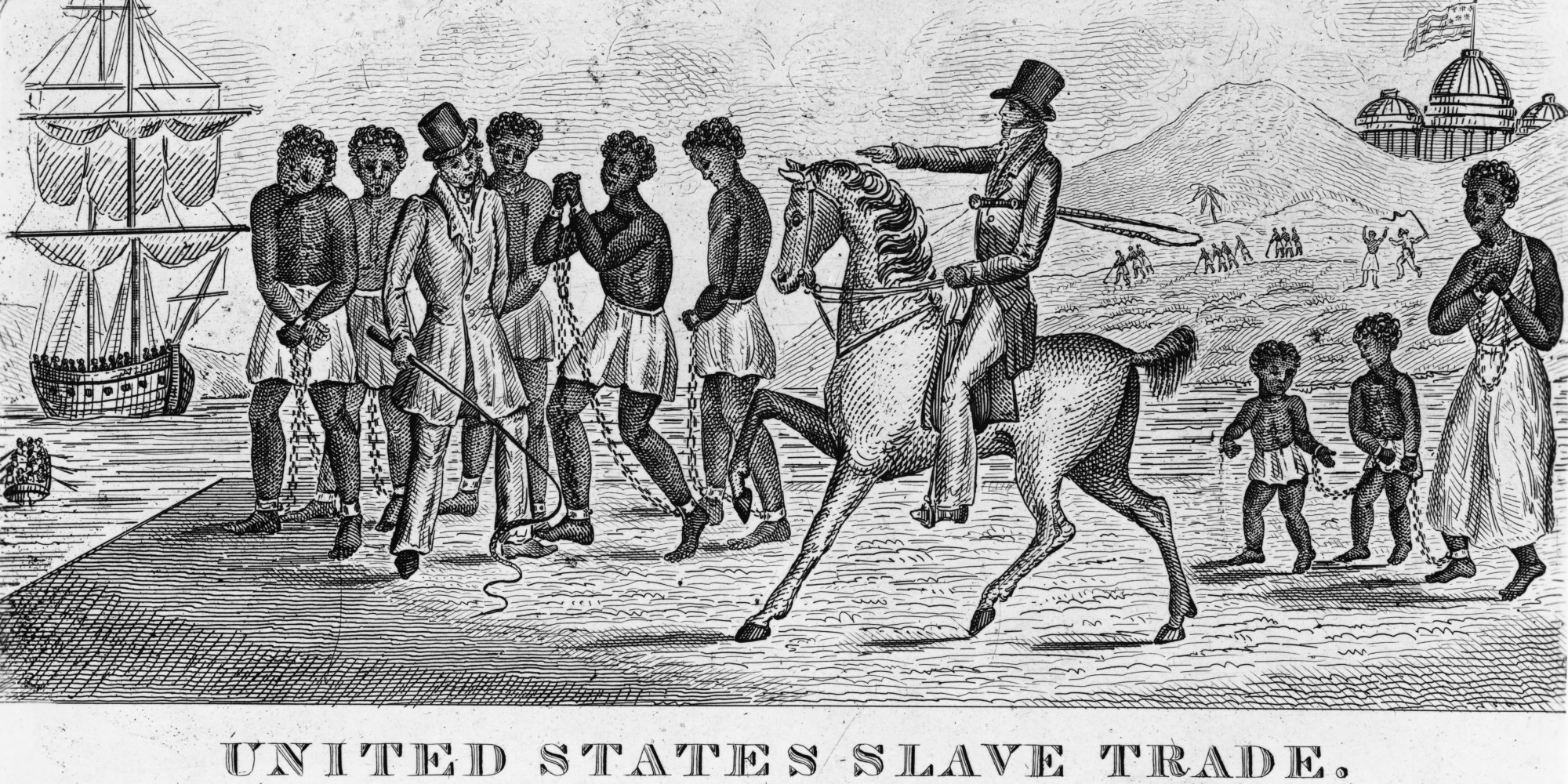
The need for slaves caused prices to soar. In some older states like Virginia where fewer slaves were required the exportation of slaves became a major industry:

“male slaves were marched in coffles of forty or fifty, handcuffed to each other in pairs, with a long chain through the handcuffs passing down the column to keep it together, closely guarded by mounted slave traders followed by an equal number of female slaves and their children. Most of them were taken to Wheeling, Virginia, the “busiest slave port” in the United States, and from there they were transported by steamboat to New Orleans, Natchez, and Memphis.” 44

In the years the before the war, the North embraced the Industrial Revolution leading to advances which gave it a marked economic advantage over the South in which through its “commitment to the use of slave labor inhibited economic diversification and industrialization and strengthened the tyranny of King Cotton.” 45 The population of the North also expanded at a clip that far outpaced the South as European immigrants swelled the population.

The divide was not helped by the various compromises worked out between northern and southern legislators. After the Missouri Compromise Thomas Jefferson wrote:

“but this momentous question, like a fire bell in the night, awakened and filled me with terror. I considered it at once as the knell of the Union. It is hushed indeed for the moment, but this is a reprieve only, not a final sentence. A geographical line, coinciding with a marked principle, moral and political, once conceived and held up to the angry passions of men, will never be obliterated; and every new irritation will mark it deeper and deeper.” 46

The trigger for the increase in tensions was the war with Mexico in which the United States annexed nearly half of Mexico.

The new territories were viewed by those who advocated the expansion of slavery as fresh and fertile ground for its spread. Ulysses S Grant, who served in the war, noted the effects of the war with Mexico in his memoirs:

“In taking military possession of Texas after annexation, the army of occupation, under General [Zachary] Taylor, was directed to occupy the disputed territory.  The army did not stop at the Nueces and offer to negotiate for a settlement of the boundary question, but went beyond, apparently in order to force Mexico to initiate war….To us it was an empire and of incalculable value; but it might have been obtained by other means.  The Southern rebellion was largely the outgrowth of the Mexican war.”47

Robert Toombs of Georgia was an advocate for the expansion of slavery into the lands conquered during the war. Toombs warned his colleagues in Congress “in the presence of the living God, that if you by your legislation you seek to drive us from the territories of California and New Mexico, purchased by the common blood and treasure of the whole people…thereby attempting to fix a national degradation upon half the states of this Confederacy, I am for disunion.” 48

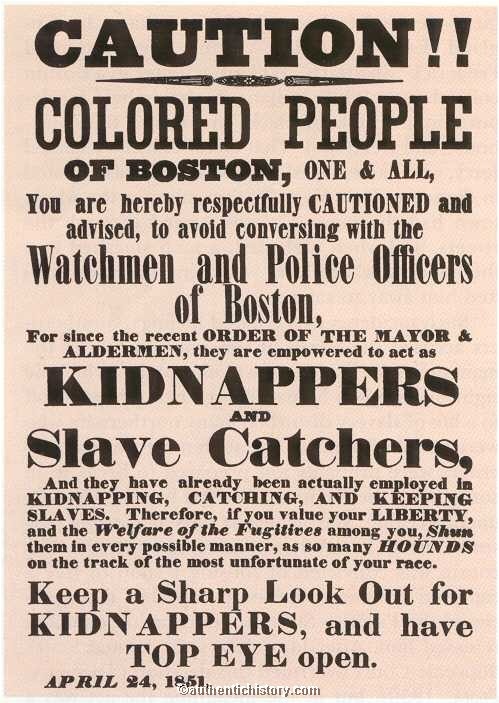
The tensions in the aftermath of the war with Mexico escalated over the issue of slavery in the newly conquered territories brought heated calls by some southerners for secession and disunion. To preserve the Union, Henry Clay and Daniel Webster, supported by the new President Millard Fillmore were able to pass the compromise of 1850 solved a number of issues related to the admission of California to the Union and boundary disputes involving Texas and the new territories. But among the bills that were contained in it was the Fugitive Slave Law, or The Fugitive Slave Act of 1850. The act was the devise of Henry Clay which was meant to sweeten the deal for southerners. The law would “give slaveholders broader powers to stop the flow of runaway slaves northward to the free states, and offered a final resolution denying that Congress had any authority to regulate the interstate slave trade.” 49 which for all practical purposes nationalized the institution of slavery, even in Free states by forcing all citizens to assist law enforcement in apprehending fugitive slaves and voided state laws in Massachusetts, Vermont, Ohio, Connecticut, Pennsylvania and Rhode Island which barred state officials from aiding in the capture, arrest or imprisonment of fugitive slaves. “Congress’s law had nationalized slavery. No black person was safe on American soil. The old division of free state/slave state had vanished….” 50

fugitive-slave-act-1850-granger-1

That law required all Federal law enforcement officials, even in non-slave states to arrest fugitive slaves and anyone who assisted them, and threatened law enforcement officials with punishment if they failed to enforce the law. The law stipulated that should “any marshal or deputy marshal refuse to receive such warrant, or other process, when tendered, or to use all proper means diligently to execute the same, he shall, on conviction thereof, be fined in the sum of one thousand dollars.” 51

Likewise the act compelled citizens in Free states to “aid and assist in the prompt and efficient execution of this law, whenever their services may be required….” 52 Penalties were harsh and financial incentives for compliance attractive.

“Anyone caught providing food and shelter to an escaped slave, assuming northern whites could discern who was a runaway, would be subject to a fine of one thousand dollars and six months in prison. The law also suspended habeas corpus and the right to trial by jury for captured blacks. Judges received a hundred dollars for every slave returned to his or her owner, providing a monetary incentive for jurists to rule in favor of slave catchers.” 53

The law gave no protection for even black freedmen. No proof or evidence other than the sworn statement of the owner that a black was or had been his property was required to return any black to slavery. Frederick Douglass said:

“By an act of the American Congress…slavery has been nationalized in its most horrible and revolting form. By that act, Mason & Dixon’s line has been obliterated;…and the power to hold, hunt, and sell men, women, and children remains no longer a mere state institution, but is now an institution of the whole United States.” 54

On his deathbed Henry Clay praised the act, which he wrote “The new fugitive slave law, I believe, kept the South in the Union in ‘fifty and ‘fifty-one. Not only does it deny fugitives trial by jury and the right to testify; it also imposes a fine and imprisonment upon any citizen found guilty of preventing a fugitive’s arrest…” Likewise Clay depreciated the opposition noting “Yes, since the passage of the compromise, the abolitionists and free coloreds of the North have howled in protest and viciously assailed me, and twice in Boston there has been a failure to execute the law, which shocks and astounds me…. But such people belong to the lunatic fringe. The vast majority of Americans, North and South, support our handiwork, the great compromise that pulled the nation back from the brink.” 55

To be continued tomorrow….

Notes 

1 Fuller, J.F.C. The Conduct of War 1789-1961 Da Capo Press, New York 1992. Originally published by Rutgers University Press, New Brunswick N.J p.98

2 Tuchman, Barbara W. Practicing History Alfred A. Knopf, New Your 1981 p.289

3 ___________ U.S. Army/ Marine Counterinsurgency Field Manual FM 3-24 MCWP 3-33.5 15 December 2006 with and forward by General David A Petreus and General James Amos, Konecky and Konecky, Old Saybrook CT 2007 p.26

4 Ibid. Tuchman Practicing History p.289

5 Ibid. U.S. Army/ Marine Counterinsurgency Field Manual p.27

6 Clausewitz, Carl von On War Indexed edition, edited and translated by Michael Howard and Peter Paret, Princeton University Press, Princeton NJ 1976 p.606

7 Ibid. Clausewitz On War pp.87-88

8 Rable, George C. God’s Almost Chosen Peoples: A Religious History of the American Civil War University of North Carolina Press, Chapel Hill 2010 p.4

9 Ibid. Fuller The Conduct of War 1789-1961 p.99

10 Guelzo Allen C. Fateful Lightening: A New History of the Civil War Era and Reconstruction Oxford University Press, Oxford and New York 2012 p.95

11 Huntington, Samuel P. The Clash of Civilizations and the Remaking of the World Order Touchstone Books, New York 1997 p.42

12 Ibid. Rable God’s Almost Chosen Peoples p.5

13 Fuller, J.F.C. Decisive Battles of the U.S.A. 1776-1918 University of Nebraska Press, Lincoln 2007 copyright 1942 The Royal Society for the Prevention of Cruelty to Animals p.174

14 Gray, Colin S. Fighting Talk: Forty Maxims on War, Peace, and Strategy Potomac Books, Dulles VA 2009 p.3

15 Ibid. Gray Fighting Talk p.25

16 Potter, David M. The Impending Crisis: America before the Civil War 1848-1861 completed and edited by Don E. Fehrenbacher Harper Collins Publishers, New York 1976 p.41

17 Ibid. Potter The Impending Crisis p.41

18 Ibid. Potter The Impending Crisis p.42

19 Ibid. Potter The Impending Crisis p.42

20 McPherson, James M. Drawn With the Sword: Reflections on the American Civil War Oxford University Press, Oxford and New York 1996 p.50

21 Levine, Bruce Half Slave and Half Free: The Roots of the Civil War Revised Edition, Hill and Wang, a division of Farrar, Strauss and Giroux, New York 1992 and 1995 p.122

22 Ibid. Potter The Impending Crisis p.43

23 Ibid. McPherson Drawn With the Sword p.16

24 Egnal, Marc Clash of Extremes: The Economic Origins of the Civil War Hill and Wang a division of Farrar, Straus and Giroux New York 2009 p.6

25 Dew, Charles B. Apostles of Disunion: Southern Secession Commissioners and the Causes of the Civil War University Press of Virginia, Charlottesville and London 2001 p.12

26 Thomas, Emory The Confederate Nation 1861-1865 Harper Perennial, New York and London 1979 p.5

27 Ibid. Thomas The Confederate Nation p.5

28 Ibid. Potter The Impending Crisis pp.457-458

29 Ibid. Levine Half Slave and Half Free p.166

30 Ibid. Guelzo Fateful Lightening pp.50-51

31 Ibid. Levine Half Slave and Half Free pp.169-170

32 Ibid. Guelzo Fateful Lightening pp.51-52

33 Ibid. Potter The Impending Crisis p.43

34 Ibid. Levine Half Slave and Half Free pp.169-170

35 Ibid. Potter The Impending Crisis p.43

36 Ibid. Potter The Impending Crisis p.43

37 Catton, Bruce The Coming Fury Phoenix Press, London 1961 pp.314-315

38 Ibid. Thomas The Confederate Nation p.1

39 Freehling, William W. The Road to Disunion Volume One: Secessionists at Bay Oxford University Press, Oxford and New York 1990 p.481

40 Ruffin, Edmund The Political Economy of Slavery in McKitrick, Eric L. ed. Slavery Defended: The Views of the Old South. Englewood Cliffs, NJ: Prentice Hall/Spectrum Books, 1963.Retrieved from http://www.pbs.org/wgbh/americanexperience/features/primary-resources/lincolns-political-economy/ 24 March 2014

41 Ibid. McPherson Drawn With the Sword p.50

42 Ibid. Egnal Clash of Extremes pp.125-126

43 Korda, Michael. Clouds of Glory: The Life and Legend of Robert E. Lee Harper Collins Publishers, New York 2014 p.203

44 Ibid. Korda Clouds of Glory: The Life and Legend of Robert E. Lee p.203

45 Ibid. Potter The Impending Crisis p.42

46 Jefferson, Thomas Letter to John Holmes dated April 22nd 1824 retrieved from http://www.loc.gov/exhibits/jefferson/159.html 24 March 2014

47 U.S. Grant, Personal Memoirs of U.S. Grant New York 1885 pp.243-245

48 Ibid. Guelzo Fateful Lightening pp.62-63

49 Ibid. Guelzo Fateful Lightening p.68

50 Goldfield, David America Aflame: How the Civil War Created a Nation Bloomsbury Press, New York, London New Delhi and Sidney 2011 p.71

51 ______________Fugitive Slave of Act 1850 retrieved from the Avalon Project, Yale School of Law http://avalon.law.yale.edu/19th_century/fugitive.asp 11 December 2014

52 Ibid. Fugitive Slave Act of 1850

53 Ibid. Goldfield America Aflame p.71

54 Ibid. Goldfield America Aflame p.72

55 Ibid. Oates The Approaching Fury p.94

3 Comments

Filed under civil rights, civil war, faith, History, laws and legislation, Religion

Happy Thanksgiving!

toss1

bloomcountythanksgivingpanels34

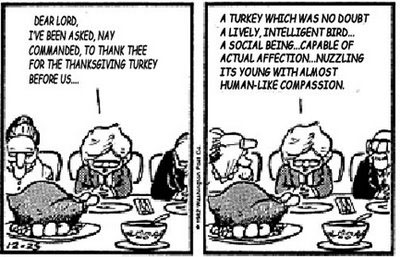
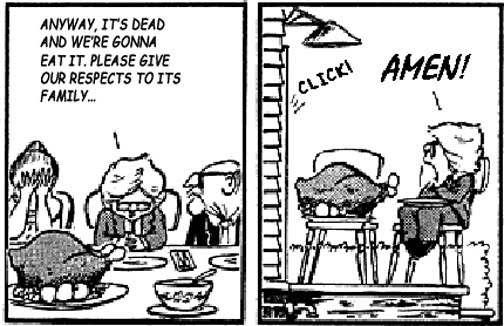
I want to wish everyone a very Happy Thanksgiving. I do hope that we all can find something to be thankful for this year. Surprisingly despite how shitty much of the year has been I am surprisingly thankful and I actually believe that this is a good thing.

Now please don’t get me wrong. There have been a lot of good things that have occurred this year that I both am thankful for and rejoice in. That being said there is a lot of this year that I would not want to experience again and if I never do again I will even be more thankful, to to God, to my fellow human beings or even to Darwin but I digress.

I want to say that I am thankful for family and friends, my wonderful and often long-suffering wife Judy, and my two four legged babies, Molly and Minnie.

But when I think about the origins of holiday that we in the United States call “Thanksgiving” I am often troubled because it celebrates the beginnings of a campaign by our proud forefathers to exterminate the people that lived here before us, often in the “name of Jesus” beginning with the members of the same tribes who welcomed them, helped them and did not send them back because they were undocumented Pilgrims. Men who not many years later went on  to accuse innocent women of being witches and and persecuting other white guys and gals like the Quakers and the Baptists because they didn’t follow the Puritan way in an pure enough way.

2e211be3edbfca651d6838dac3d50e87656471fa

A Good “Old Fashioned Thanksgiving”

Now personally I like the idea of a yearly celebration of Thanksgiving, whether we give thanks to God, our families, friends, neighbors, our broker, our bookie, or whoever is playing the Dallas Cowboys is this year. I just think that giving thanks is good.

Mark Twain described the holiday in wonderful terms even before it became a complete orgy of gluttony and watching big grown men crush other big grown men in football games. Not that there is anything wrong with that, but the ever pithy and observant Twain said of Thanksgiving Day:

“Thanksgiving Day, a function which originated in New England two or three centuries ago when those people recognized that they really had something to be thankful for — annually, not oftener — if they had succeeded in exterminating their neighbors, the Indians, during the previous twelve months instead of getting exterminated by their neighbors, the Indians. Thanksgiving Day became a habit, for the reason that in the course of time, as the years drifted on, it was perceived that the exterminating had ceased to be mutual and was all on the white man’s side, consequently on the Lord’s side; hence it was proper to thank the Lord for it and extend the usual annual compliments.”

But really. I am so thankful to you, all of my readers. Those that subscribe to this site, those who follow me on Twitter or Facebook and the many others who like our Pilgrim ancestors got lost on the way somewhere else and found this site. You cannot believe just how thankful I am for all of you, especially those who sent words of support and encouragement when I was really doing bad. So thank all of you. Your time is valuable and I appreciate your taking to read what I post here.

So anyway, sometime tomorrow, or rather later today after I go to bed and get back up, and then  after I awake from my turkey, pie and beer induced coma I hope to post another note.

Have a great Thanksgiving!

Peace and Blessings

Padre Steve+


Leave a comment

Filed under christian life, Loose thoughts and musings, philosophy

Who Are the Real Savages? A Review of “The Lost Tribe of Coney Island by Claire Prentice

IMG_0501

Mark Twain once wrote that “There are many humorous things in the world; among them the white man’s notion that he is less savage than other savages.”

Throughout the history many races, peoples and civilizations have labored under the belief that they are superior to races that they have conquered or “liberated” and then placed on display for their own amusement. The Persians, Greeks, Egyptians, Romans, Chinese, Japanese and a host of European powers have done such things, as have we Americans. Sadly, in many cases the motives are evil, but sometimes there are shades of gray where one civilization, or certain representatives of it act in a manner of benevolent paternalism, while at the same time seeking to profit off of their superior place in life, whether they believe it is a mandate from God or the right of being biologically superior through the evolutionary process, and sometime a bit of both.

Award winning journalist Claire Prentice writes in her new book The Lost Tribe of Coney Island: Headhunters, Luna Park, and the Man Who Pulled Off the Spectacle of the Century (New Harvest, Houghton Mifflin Company, Boston and New York October 2014) of the story of American physician, soldier, treasure seeker, colonial administrator and showman Dr. Truman Knight Hunt and his exploitation of a group of forty-nine members of the Igorrote tribe who it brought to the United States in 1905.

Prentice’s telling of this story is a highly readable yet sobering account of the morality, economics, racism, colonialism and belief in the superiority of the white man above the “non-Christian savage” of that time. Her ability to weave the complex humanity of Hunt, a man who went to the Philippines out of a sense of patriotism, stayed in search of fortune, put his life on the line for the healthcare of the Igorrote, gained their trust, became a colonial administrator and then, seeking profit attempted to use the people who trusted him for his own gain after seeing another American reap the spoils of creating a human zoo of Igorrote and other Filipino tribesmen at the 1904 World’s Fair in St. Louis.

The story of how Hunt initially pulled this off amid the controversy evoked by the American war and occupation of the Philippines following the expulsion of the Spanish in 1898 is well told by Prentice. She is able to weave a story of complex motives, competing business interests to exploit people for the profit and entertainment of others into a highly readable tale.

The little known fact is that after evicting the Spanish from the Philippines the United States turned on the Filipino people and leaders who had helped us during the military campaign against the Spanish. The result was the 1899-1902 Philippine War, a brutal counter-insurgency campaign that was successfully concluded in a military sense, unlike most of the other counter-insurgency campaigns of he twentieth century, including Iraq and Afghanistan. The aftermath was a colonial administration of the new American Philippine Territory which only ended when the Japanese invaded the Philippines in 1941, after the liberation of the Philippines and following the Second World War, that country was finally granted its independence.

Hunt brought these forty-nine people to Luna Park on Coney Island, Hunt’s Igorrotes were basically, as other supposedly “savage” peoples had been before housed in what was little more than human zoo, for the amusement of Americans and the profit of Hunt and his partners. Prentice traces the roots of Hunt’s quest, the culture and history of the Igorrotes, and the greed, duplicity and the government quest that eventually brought Hunt to Justice and ended this spectacle.


IMG_0502.JPG


If Hunt had abided by his deal with the Igorrote to allow them to be paid and to keep money they made from the sale of various items, the situation might have gone on without incident, but Hunt lied to his charges, he kept them in padlocked cages or “villages,” sometimes going days without food, Hunt attempted to keep their money from them claiming that he was “ordered by the government to do so.” Eventually, the man hired by Hunt as his interpreter turned evidence against him, and the charade fell apart. Confronted by a government agent, Hunt’s Igorrote contradicted Hunt’s claim that the were happy and wanted to remain a part of his show, which he moved from Coney Island, to Chicago and on to Milwaukee.

Hunt was finally arrested for embezzlement in 1906, his faithful Igorrote interpreter Julio had filed the complaint with federal authorities. Hunt had without over ten-thousand dollars from his Igorrote tribesmen. A judge allowed most of the Igorrote to return to be released from their “contract” with Hunt while some remained to testify against him. Despite the overwhelming evidence against him a judge in Memphis declared a mistrial and despite attempts by the investigator to bring Hunt to justice, Hunt eluded it and with the great cost of the investigation, trial, the care of the Igorrote, and the massive and controversial costs of administering the Philippines, the government eventually dropped the case. Hunt lived what seemed to be an accursed life, continuing his less than honest living selling sham cures to diseases and leading a bigamous life after his release from jail.  Misfortune followed misfortune and Hunt died, ten years later and was buried in an unmarked grave in Cedar Rapids Iowa.

Despite the end of the relationship with Truman Hunt, other Igorrote remained on display and toured the United States and world for a number of years, though they appear to have fared better than those who Hunt defrauded and mistreated.

The story told by Prentice is remarkable because it shows us that despite the mythology of supposedly beneficent American masters, that American colonialism and profiting by what we would now call human trafficking was not as benevolent. It makes one wonder just who the real savages are, but then it appears that Mark Twain was right.

IMG_0508

This is an outstanding and well written account by Prentice that humanizes a forgotten and shameful part of our American colonial past.

Peace

Padre Steve+


3 Comments

Filed under books and literature, History, Loose thoughts and musings

Padre Steve Shrugged: My Frustration with the Christian Subculture

barmherzigkeit

“If Christ were here now there is one thing he would not be – a Christian.” Mark Twain

Padre Steve is shrugging a lot today, so please excuse this but I have to say it. Sometimes I just want to scream when I see people and institutions claiming to be Christian when they exhibit none of the Christian graces or marks of the Christian faith.

I am constantly amazed by the self serving and self-righteous hatred shown by many of my allegedly Christian brothers and sisters towards that they do not approve.  This is especially true of how they treat the LGBT community, who only want to get equal rights under the law. Of course my brothers and sisters who want to legislate the LGBT community out of existence. Some American Christians promote laws in Africa to send gays to prison or even worse sentence them to death. They do this with gusto, all while claiming with absolute certitude their interpretations of the Bible. While they condemn gays they ignore all the other Old Testament laws that prescribe similar harsh sentences, such as death for the very things that they do. The fact that supposedly Christian leaders such as Scott Lively and others are attempting to pass laws in the United States and other countries, especially in Africa to openly persecute and even execute gays is abhorrent.

To use the power of the State to enforce one’s religious beliefs on others is exactly what the founders of our country attempted to negate in our Constitution and Bill of Rights. Thomas Jefferson writing to Alexander Humbolt in 1813 correctly noted: “History, I believe, furnishes no example of a priest-ridden people maintaining a free civil government. This marks the lowest grade of ignorance of which their civil as well as religious leaders will always avail themselves for their own purposes.”  

Thus I shrug my shoulders and wonder which Bible they are reading, and I am a Priest, with a sound Biblical and theological education. Thus to those without that it really has to be confusing. But I am also a historian, ethicist and occasionally a stand up philosopher and I can spot theological and historical bullshit when I see it and smell it. Unfortunately many leaders of the American “Christian Right” are full of it and it stinks to low Hell.

I shrug my shoulders in wonder of the ignorance I see displayed by my Christian bothers and sisters, some of whom certainly regard me as an apostate or heretic for criticizing their political-religious crusades.  But then I remember that the Bible they read is the one that excuses all the sins that they approve of, but condemns the sins of those that they don’t like. I think that the translation they cite is the Damn Everyone Else to Hell But Me Version of the Bible. But wait, you say that that there is no such translation? Well it may not be in print but it is certainly written on their hearts, like it is on the hearts of all true believers, but I digress. The great American philosopher Eric Hoffer wrote: “A doctrine insulates the devout not only against the realities around them but also against their own selves. The fanatical believer is not conscious of his envy, malice, pettiness and dishonesty. There is a wall of words between his consciousness and his real self.”

Likewise I get frustrated by my Christian brothers and sisters who routinely tell those suffering from Cancer or other painful or terminal conditions that they need to read a book or listen to a sermon by some Christian that is obviously more spiritual and better than the rest of us. Instead of coming alongside of those suffering they spout empty words, just like Job’s friends.

So I shrug because I remember that the command of Jesus to Christians is to bear one another’s burdens, not preach at those that are suffering.

But that being said I shrug my shoulders in amazement when I see those same Christian brothers and sisters embracing the abject and atheistic Social Darwinism of Ayn Rand and her Objectivist Philosophy. This has now been “baptized” by many leaders of the Christian Right as “Biblical” or “Christian.”

I also shrug when I see men who are paid millions of dollars a year to stir up hate and discontent by criticizing those that they do not approve throw tantrums and compare themselves to Jesus. Fox News Pundit Bill O’Reilly whined last week and did just that, saying that “even Jesus had haters.” Sorry Bill, but there is no comparison. You and those like you are hacks paid to stir shit up and keep people enraged so they keep watching your program. Unlike you, Jesus showed love and compassion to those that condemned him and didn’t get a penny for it.

I am a Christian, but I hate to say that the more I look around the more I see Christians who make me wonder about the God that they claim to represent. If I was not a believer I would have to admit that I see nothing redeeming in what I see and that have to wonder why I would want to believe in a God who according to the Christian Right is capricious, vindictive, petty, unloving, unethical and unjust. A “God” who is nothing like the one who according to Paul the Apostle:

“who, though he was in the form of God, did not regard equality with God as something to be exploited, but emptied himself, taking the form of a slave, being born in human likeness. And being found in human form, he humbled himself and became obedient to the point of death—even death on a cross.” (Phil 2:6-8 NRSV)

Thus I shrug. I cannot fathom the absurd depths of ignorance and hatred that is so routinely and even unthinkingly a part of the lives of some of my fellow Christians.

If the fact that I say this pisses people off, I have to say that I no longer care.  I cannot pretend as I can no longer live in the cloud cuckoo land of conservative American Christianity.

shakethefinger

So anyway. I had to get it out. I know that there will be some people who take offense to most of what I said and that is fine with me. But it has to be said if Christianity is to survive in the West. If Christians do not throw aside the mantle of power, privilege and priority that it assumed under Constantine, the mantle of the imperial church and return to being Christians, the Christian faith will not survive. And yes, that includes all of those massive auditoriums built by narcissistic mega-church pastors and the congregations that worship them.

People are fleeing what we call Christianity in the United States. They are fleeing churches in ever growing numbers and all the statistics, surveys and polls confirm this. More and more people are identifying themselves as not having a particular religious belief. Likewise more and more are openly admitting to being atheists or agnostics.  The numbers and percentages of unbelievers are growing at exponential rates. They are known as “the Nones” or those with no religious preference. As a military chaplain I have seen this trend growing for the past 25 years and it is only getting worse, and truthfully I cannot blame them. And who can blame the “nones” for turning their backs on Christianity? If I was not already a Christian there is little that convince me to become one today, not because of Jesus, but because of how Christians treat others. So that being said I will still love and care for all of my “nones” and be there for them.

blm121011

Christians have forgotten the reality of the Gospel. The world will not know us by our correct doctrine, nor will it know us by how well we observe the law, nor will it know us by any other thing but this: “By this everyone will know that you are my disciples, if you have love for one another.”

The fact is that if I wasn’t already a Christian there is nothing in the witness of most American Churches and Christians, especially Evangelicals and conservative Catholics that would ever bring me to faith in Jesus.  I totally agree with author Ann Rice who back in 2010 said:

“For those who care, and I understand if you don’t: Today I quit being a Christian. I’m out. I remain committed to Christ as always but not to being ‘Christian’ or to being part of Christianity. It’s simply impossible for me to ‘belong’ to this quarrelsome, hostile, disputatious, and deservedly infamous group. For ten years, I’ve tried. I’ve failed. I’m an outsider. My conscience will allow nothing else.”

The sad thing is, that before Iraq and my PTSD crash and crisis of faith that left me a practical agnostic for nearly two years that I used to be just like many of people that I am calling out today. Maybe I was a bit more nuanced theologically and better able to say cruel things without making them sound too cruel, but truthfully some of the things that I said and believed at one time were not much different than what my more crass brothers and sisters do today. For that I am sorry.

cropped-historyoftheworldpart1-still2cr.jpg

Okay, I have said it. I have gotten it off my chest for now, though I am sure that some time in the next number of months or year that I will pop my cork again. But what can I say?

So for tonight and until tomorrow,

Peace

Padre Steve+

Leave a comment

Filed under christian life, faith, ministry, philosophy, Religion

Padre Steve’s World at Five Years: Writing My Way to Freedom as a Passionate Moderate

1622612_10152232336042059_727365308_n

“If you want to be a writer, you have to write every day… You don’t go to a well once but daily. You don’t skip a child’s breakfast or forget to wake up in the morning…” Walter Moseley

Friends of Padre Steve’s World. Five years ago I began to write on Padre Steve’s World…Musings of Passionate Moderate.

The name was chosen for a number of reasons. Padre Steve’s World hearkened back to one of my favorite Saturday Night Live skits and later films, Wayne’s World. The idea of musings is fairly self explanatory, these are, regardless of the subject my musings, inspired by whatever muse inhabits me. Finally the idea of a “Passionate Moderate” hearkened back to my days in seminary. Passionate and moderate are not terms that one generally links together, in fact when I was in seminary the term moderate was a term of distain used by some Christian Conservatives and Fundamentalists to vilify those that did not match their definition of a conservative. I chose the two ideas because to many people, on the right and the left cannot imagine a “Moderate” being passionate.

403194_10150592726767059_1694849983_n

However that moderation does not mean that I do not have strong ideas, beliefs and convictions, even when I can see truth in what others who do not agree with me have to say. Over the past five years my identity has become more established. I am a moderate, but in some ways I am a progressive liberal, in others a conservative. Regardless of where I fall in the religious, social and political continuum I am passionate about what I believe, I do seek the truth, but at the same time I attempt to maintain a moderate view that allows me to hear what others say and believe with an open heart.

66676_10151588314727059_1328768518_n

Padre Steve’s World began as a place to share my struggles with faith, PTSD and its effects on my life and coming home from war changed. It was something that was born out of pain, but also born out of love, love for writing, love for truth, love for justice and love of knowledge.

599056_10151549893822059_1921818584_n

As I began to write my life was coming apart, and writing became a place where could express my inner angst, find community and begin to heal. Engaging my creative muse enabled me to share those things that it was hard to do anywhere else. Many times those were the hardest things to say, the hardest things to put down in pen and ink, the things that were the secrets of my heart. Sometimes, just trying to write them was gut wrenching and filled my eyes with tears. But as I wrote, I discovered myself, discovered people for whom what I wrote resinated, and others that Stephen King said something that finds an echo in my life and heart:

“The most important things are the hardest to say. They are the things you get ashamed of, because words diminish them — words shrink things that seemed limitless when they were in your head to no more than living size when they’re brought out. But it’s more than that, isn’t it? The most important things lie too close to wherever your secret heart is buried, like landmarks to a treasure your enemies would love to steal away. And you may make revelations that cost you dearly only to have people look at you in a funny way, not understanding what you’ve said at all, or why you thought it was so important that you almost cried while you were saying it. That’s the worst, I think. When the secret stays locked within not for want of a teller but for want of an understanding ear.”

That being said when I began much of what I wrote about was either dealing with my struggles or about things I knew a lot about. Those subjects included history, military subjects, theology and the Christian life and baseball. As I began to expand my writings the topics broadened to include political commentary, music, civil rights and the role of religion in public life.

n671902058_1153828_4309

When I did this I decided not to shy away from controversial topics and to risk the rejection of some. The consequences of this his became quite real in September of 2010 when I was told to leave a church that I had served for 14 years as a Priest. Since then I still write about topics that are controversial, though I do try my best to be fair when I do so.

bloom-county-the-label-stuck

Mark Twain advised writers to “write what they know.” Fortunately for me that was not hard, I know a lot about a lot of subjects. That is not a boast, but merely a recognition that between a lot of academic study, a lot of reading and a lot of life experience I have a pretty good repository of knowledge, including a lot of odd knowledge. That would make me a Keeper Of Odd Knowledge, or KOOK. I can live with that too.

971505_10151793473982059_531695883_n

That being said I am not one to think that I know it all, I follow the advice of the late manager of the Baltimore Orioles, Earl Weaver that “It’s what you learn after you know it all that counts.” Since PTSD and the Moral Injury that I had suffered in Iraq was kicking my ass when I began to write, and I was finding that I really didn’t know much of anything that I thought I knew about life I did take this advice to heart.

Stephen King noted that “If you want to be a writer, you must do two things above all others: read a lot and write a lot.”  The fact is I have always been an avid reader, mostly of history, military history and theory, church history, theology, biography and other more academic writings from the social and political sciences. I do not read a lot of fiction, however that being said there are some books as well as book series that I like. I love fiction that deals with history, as well as mysteries and science fiction, the latter because both lure me into the realm of possibility and mystery, subjects that fascinate me.

321466_10151445269932059_173643368_n

The fact that I read a lot inspires me to write on a wide variety of subjects. Likewise the more I write the more I become conscious of life as well as a desire to seek out truth, and when I write, whether it is something to do with history, faith, baseball or even my occasional forays into fiction and fantasy. As I do this it makes me appreciate the other writers even more, because I no longer see them just in light of what they write, but how they struggle with the same things I struggle with, I can appreciate the truth and beauty in what they write, and it decreases my sense of isolation, which since Iraq has often been crushing. I can agree with Annie Lamott wrote:

“Becoming a writer is about becoming conscious. When you’re conscious and writing from a place of insight and simplicity and real caring about the truth, you have the ability to throw the lights on for your reader. He or she will recognize his or her life and truth in what you say, in the pictures you have painted, and this decreases the terrible sense of isolation that we have all had too much of.”

I read all the time and I try to write every day, if I cannot do that I feel that I have missed out on something. If I do not write it is almost if I have missed breathing. My mind is constantly musing on things to write about and sometimes it is only the fact that I have a day job that keeps me from writing even more than I do. Like Hedley Lamarr (Harvey Korman) in Blazing Saddles I have to admit that “My mind is aglow with whirling, transient nodes of thought careening through a cosmic vapor of invention.” But I digress…

Admittedly I do write a lot and I do try to write every day. Not counting what I do for work, academic pursuits or teaching I have posted over 1700 articles on this website since I started it in February 2009. If I ever take the time to organize and edit what I have on this site there is probably enough for several books.

530402_10151878451172059_1439813480_n

For me writing has been part of my quest for healing, the discovery of truth and the desire to be part f a community of people that is bigger than me, or anything that I can do on my own.  It really is about life, and if as some would think that I am a fool for doing this, then that is their loss. I don’t mind being considered a fool in this quest. Ray Bradbury, author of Fahrenheit 451 wrote:

“If you want to write, if you want to create, you must be the most sublime fool that God ever turned out and sent rambling. You must write every single day of your life. You must read dreadful dumb books and glorious books, and let them wrestle in beautiful fights inside your head, vulgar one moment, brilliant the next. You must lurk in libraries and climb the stacks like ladders to sniff books like perfumes and wear books like hats upon your crazy heads.”

I can agree with Bradbury’s thoughts on this. I do not know what the future holds. If I were God I would live to be one hundred years old and be active reading, writing, thinking and interacting with others who seek truth.

994899_10151847060517059_47934649_n

So tonight I wish the writers, artists and thinkers who read this the best. To close I provide you the benediction of Bradbury:

“I wish you a wrestling match with your Creative Muse that will last a lifetime. I wish craziness and foolishness and madness upon you. May you live with hysteria, and out of it make fine stories — science fiction or otherwise. Which finally means, may you be in love every day for the next 20,000 days. And out of that love, remake a world.”

Peace

Padre Steve+


1 Comment

Filed under faith, Loose thoughts and musings