Tag Archives: nato

War, Remembrance and Healing: A Chaplain, Officer and Historian Makes His Way Home

The first version of this post was written in the spring of 2008 when I was doing a lot of soul searching and reflecting after Iraq. It was originally run in my church’s online news service.  I post it now with some updates that have been brought about by new ways that I am rediscovering God and because of the current situation in Afghanistan which has become worse in the past year. As I read news releases about casualties and attacks on NATO forces and Afghan civilians, especially those in small outposts or serving as advisers and trainers I am reminded of my time in Iraq.  Please don’t forget those who serve in Iraq and Afghanistan, or those who have served in prior wars. Especially keep in your prayers and help assist those who have returned injured in mind, body or spirit and those who made the supreme sacrifice.

874Leaving a Bedouin Camp 1 mile from Syria

I have been doing a lot of reflecting on ministry and history over the past since returning from Iraq. Since I’ve been back about a year and a half I can say that I have changed as a result of my service there.  Change can be scary but in my case it has been both necessary and probably good.  Ministry, theology and history have been part of my life for many years; they have taken on a new dimension after serving in Iraq. When I first wrote this piece not long after returning I was in pretty bad shape but in the months since I have been attempting to integrate my theological and academic disciplines with my military, life and faith experience since my return. I’m not done yet by any means, but things are getting better, not quite like Chief Inspector Dreyfus in The Pink Panther Strikes Again “Every day in every way I’m getting better and better…Kill Clouseau!” but a slowly getting better with some occasional bumps in the road.

One of the things that I have wrestled with is my faith, and returning from war changes a man.  Before I went to Iraq I thought that I had things pretty much together.  When I came home and fell apart it also affected my faith, doing little things became difficult and the effects were exaggerated by my isolation.  In a sense it was my Saint John of the Cross Dark night of the Soul experience.  I felt that God had abandoned me, people would come to me with their crisis of faith and I had to dig deep to stay with them, but in doing so I became acutely aware of the fact that I shared this with them. I couldn’t hide behind my collar or the cross on my uniform as the crisis was an interruption which drove me out of my comfort zone and forced me to deal with the world that the people I minister among deal with every day.
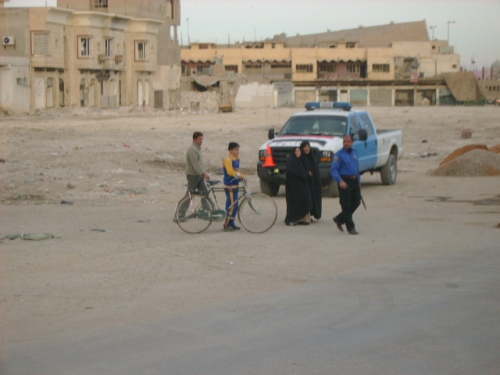
291Iraqi Police in Ramadi Escorting Civilians Across the War Zone of Route Michigan

There are those who believe that all forms of ministry are basically the same and that lessons learned are universally applicable and that somehow all ministries are proclamation oriented.  Unfortunately that is not the case and one of the places that this is true is the Military Chaplain ministry.  This mibnistry is much different than parish or para-church ministries and even different than other institutional ministries such as Police, Fire, Industrial or civilian health care chaplaincy.   It is different in that it is more incarnation versus proclamation. We not only minster to our people but we live among them.  We live the experience of those that we serve, especially in the uncertainly of war and deployments.  Chaplains live in a world where we are fully military officers and fully ministers of our own church or faith tradition. As a chaplain I never lose my calling of being a priest, but I am a priest in uniform, a military professional and go where our nations send me to serve the Sailors, Marines, Soldiers and Airmen who I live among be that overseas, or in the States.

142Always a Priest Eucharist with Advisers in the Far West of Al Anbar

There is always a tension in the military chaplain ministry. This is  especially true when the wars that we are sent to are unpopular at home and seem to drag on without the benefit of a nice clear victory such as VE or VJ Day in World War II or the homecoming after Desert Shield and Desert Storm. There are those that oppose the military chaplaincy on theological or philosophic grounds, usually some manner of absolutist understanding of ministry, church-state relations or social justice considerations.  My purpose is here not to defend military chaplain institutions against such criticism but rather to share the world and tension that military chaplains live in when our nation is engaged in unpopular which some consider unjust or illegal wars.

training team baseIsolated Base Camp for Advisers in Afghanistan

A lot of people have no “ethical” or “moral” qualms about wars that are easy to pigeonhole as just wars, especially if we win quickly and easily.  It is my belief that when things go well and we have easy victories that it is easy for religious people, especially more conservative Christians to give the credit to the Lord for the “victory.”  Unfortunately such “Credit” is given without them ever understanding or sometimes even caring about the human cost of war.   Likewise it is easy for others to give the credit to superior strategy, weaponry or tactics to the point of denying the possibility that God’s involvement.  Conversely and maybe even perversely I have heard some say that God has blessed the use of weapons or tactics that violate principles of fighting a “just war” especially that of proportionality. Such is the case in almost every war and Americans since World War Two have loved the technology of war seeing it as a way to easy and “bloodless” victory. In such an environment ministry can take on an almost “cheer-leading” dimension. It is hard to get around it, because it is a heady experience to be on a winning Army in a popular cause but I do think that many chaplains have a less “cheerleading” approach than many in conservative churches. The challenge for chaplains in such an environment is to keep our ministry of reconciliation in focus. To do so we must care for the least, the lost and the lonely and never forget the victims of war, especially the innocent and the vanquished, as well as our own wounded, killed and their families.

237Iraqi Kids in Al Anbar Province, a couple of months before they could not venture outside because of insurgent attacks, children are never winners in war

We are now seeing the conflict in Iraq winding down and what until this year had been “the good war” in Afghanistan go bad and support for it decline.  Strategy is being debated as how to best “win” the war in Afghanistan even as the United States withdraws from Iraq. The task of chaplains in the current war, and similar wars fought by other nations is different and really doesn’t allow for them to indulge themselves in “cheerleading.” In fact chaplains can themselves through isolation, lack of experience and fear can become more reflective and less “cheerleader” oriented the longer the war goes on without sign of appreciable progress, much less victory.  They feel the onslaught of their soldiers doubts, fears as well as the loss of friends and the chapel congregation through being killed or wounded in action. This  can take a terrible toll even for the most resilient of chaplain. In these wars, sometimes called counter-insurgency operations, revolutionary wars, guerilla wars or peace keeping operations, there is no easily discernible victory. These types of wars can drag on and on, sometimes with no end in sight. Since they are fought by volunteers and professionals, much of the population acts as if there is no war since it does often not affect them, while others oppose the war, all of which can affect the chaplain.

dien_bien_phu paras landingFrench Paratroops Landing at Dien Bien Phu

Chaplains volunteer to go with and place themselves in harms way to care for God’s people in the combat zone or far away from home. While they do this there are supporters of war as well as detractors who have no earthly clue about war or life in the military other then what they see in the media or experienced in peacetime or the cold war. Some supporters often seem more interested in political points of victory for their particular political party than for the welfare of those that are sent to fight the wars. This has been the case in about every war fought by the US since World War II. It is not a new phenomenon. Only the cast members change with the particular war.

legion indo-chinaForeign Legion Troops in Indochina

In order to somehow make sense of going on we cannot simply think of what is politically expedient for either those who support or want to expand the war, or others who want it ended now, both of which have consequences many of which are bad.  I think that we have to look at history and not just to American history to find answers, not simply answers to how to win or end the war but answers to the consequences that either course of action posits. Thus I think that we can find parallels in other militaries. I think particularly of the French professional soldiers, the paratroops, Colonials (Marines) and Foreign Legion who bore the brunt of the fighting in Indo-China. These men, not all of who were French were placed in a difficult situation by their government and alienated from their own people. In particular I think of the Chaplains, all Catholic priests save one Protestant, at the Battle of Dien Bien Phu, the epic defeat of the French forces that sealed the end of their rule in Vietnam. The Chaplains there went in with the Legion and Paras. They endured all that their soldiers went through while ministering the Sacraments and helping to alleviate the suffering of the wounded and dying. Their service is mentioned in nearly every account of the battle. During the campaign which lasted 6 months from November 1953 to May 1954 these men observed most of the major feasts from Advent through the first few weeks of Easter with their soldiers in what one author called “Hell in a Very Small Place.”
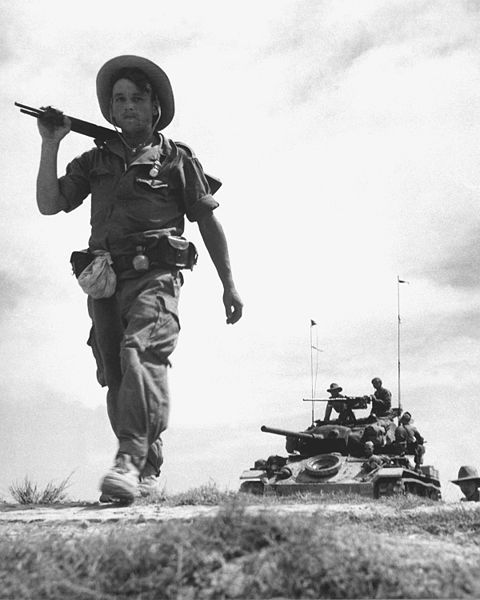
french troops indochinaFrench Troops on the March in Indochina

One author describes Easter 1954: “In all Christendom, in Hanoi Cathedral as in the churches of Europe the first hallelujahs were being sung. At Dienbeinphu, where the men went to confession and communion in little groups, Chaplain Trinquant, who was celebrating Mass in a shelter near the hospital, uttered that cry of liturgical joy with a heart steeped in sadness; it was not victory that was approaching but death.” A battalion commander went to another priest and told him “we are heading toward disaster.” (The Battle of Dienbeinphu, Jules Roy, Carroll and Graf Publishers, New York, 1984 p.239) This can be a terrible burden for the Padre who cares for such men.  Ministry in such places is truly an incarnational experience because there is no place to hide and the chaplain is as vulnerable as his flock.  It is the ministry that places us “in the valley of the shadow of death” where as the Psalmist says we are “to fear no evil for you are with us.” It is the ministry of Good Friday where to all appearances seems that God has abandoned the field and evil has won.

VIETNAM DIEN BIEN PHUFrench Surrender at Dien Bien Phu

Of course one can find examples in American military history such as Bataan, Corregidor, and certain battles of the Korean War to understand that our ministry can bear fruit even in tragic defeat. At Khe Sahn in our Vietnam War we almost experienced a defeat on the order of Dien Bien Phu. It was the tenacity of the Marines and tremendous air-support that kept our forces from being overrun.

legion algeriaLegionaries in Algeria, many French Troops Went from one War in Indochina to another in Algeria only to have the De Gaulle Government throw the Military Victory Away and Cause a Crisis

You probably wonder where I am going with this, back when I first drafted this year and a half ago I wondered too. But here is where I think I am going. We live in difficult of times at home and in Afghanistan.  It home we are mired in an economic crisis clouded by deep political division.  In Afghanistan we are engaged in a hard fight where units we are taking casualties and the mission is being debated.  Sometimes to those deployed and those who returned that their sacrifice is not fully appreciated by a nation absorbed with its own issues.  This of course is not universally true as there a people of all political viewpoints who care for the welfare and attempt to ensure that those who serve are not abandoned as those men who served in Vietnam.  I think that part of the feeling comes from the presentation of the war by the media which tends to focus only on the negative outcomes and not positive things that our soldiers accomplish. That can be discouraging to the men and women on the ground.  One of the most difficult things for me upon my return was to see the bitterness a division in the American people and political establishments and becoming quite depressed about it.   I stopped watching the perpetual news cycle and listening to talk radio.  The hatred, ignorance and crassness of it all was disheartening and I refuse to take any part in something that is so hate filled, power driven and unredemptive.
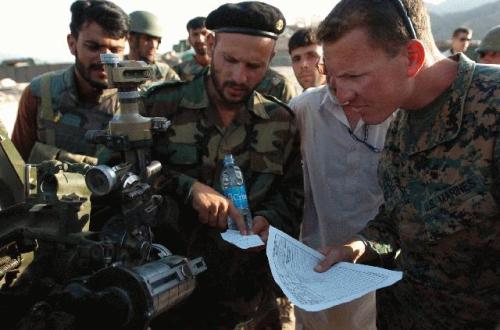
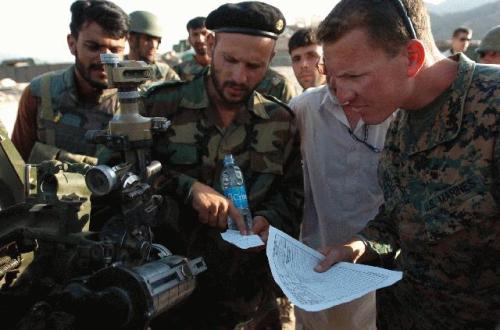
traiining team with afghan armyUSMC Training Team With Afghan Troops

For the French the events and sacrifices of their soldiers during Easter 1954 was page five news in a nation that was more focused on the coming summer. This is very similar to our circumstances today because it often seems that own people are more concerned about economic considerations and the latest in entertainment news than what is going on in Iraq or Afghanistan. The French soldiers in Indo-china were professionals and volunteers, much like our own troops today. Their institutional culture and experience of war was not truly appreciated by their own people.  Nor was it fully appreciated by their government which sent them into a war against an opponent that would sacrifice anything and take as many years as needed to secure their aim.  At the same time their own countrymen were unwilling to make the sacrifices needed to win and in fact had already given up their cause as lost. The sacrifice of French soldiers would be lost on their own people and their experience ignored by the United States when we sent major combat formations to Vietnam in the 1960s. In a way the French professional soldiers of that era have as well as British colonial troops before them have more in common with our force than the citizen soldier heroes of the “Greatest Generation.” Most of the “Greatest Generation” was citizen soldiers who did their service in an epic war and then went home to build a better country as civilians. We are now a professional military fighting unpopular wars and that makes our service just a bit different than those who went before us.  I related to the French troops who fought in Indochina and Algeria as well as our own Vietnam Vets than I do to others.  These is a kinship among us that goes beyond nationality, politics or age.

This is the world in which military chaplains’ minister.  It is a world of volunteers who serve with the highest ideals, men and women who enlist knowing that they will be deployed and quite likely end up in a combat zone. We go where we are sent, even when it is unpopular. It is here that we make our mark; it is here that we serve our Soldiers, Sailors, Marines and Airmen. Our duty is to bring God’s grace, mercy and reconciliation to men and women, and their families who may not see it anywhere else. It is a ministry of reconciliation by the means of incarnation. Many times those outside the military do not understand this. It is a different world full of contradictions and ambiguity.  Such situations even impact the families of those who serve.

When my dad was serving in Vietnam in 1972 I had a Sunday school teacher tell me that he was a “Baby Killer.” It was a Catholic Priest and Navy Chaplain who showed me and my family the love of God when others didn’t. As the country builds to the 2010 mid-term Congressional elections I anticipate that people from all parts of the political spectrum will offer criticism or support to our troops or the war in order to bolster their election chances which do not always coincide with what is in the best interest of the troops or the mission. Chaplains cannot be concerned about the politics nor even the policy as our duty is to be there as Priests, Ministers, Rabbis and Imams for those that we serve. We cannot afford to allow ourselves to be discouraged in caring for our men and women and their families because of all the strife in the body politic.  In addition we must continue on because most churches and other religious communities, even those supportive of our troops really don’t understand the nature of our service or the culture that we represent. We live in a culture where the military professional is in a distinct minority group upholding values of honor, courage, sacrifice and duty which may be foreign or archaic to many Americans, or for those countries with troops and chaplains in Afghanistan or Iraq. We are called to that ministry in victory and if it happens someday, defeat. In such circumstances we must always remain faithful to God as well as to those that we serve.

For those interested in the French campaign in Indo-China it has much to teach us. Good books on the subject include The Last Valley by Martin Windrow, Hell in a Very Small Place by Bernard Fall; The Battle of Dienbeinphu by Jules Roy; and The Battle of Dien Bien Phu- The Battle America Forgot by Howard Simpson. For a history of the whole campaign, read Street Without Joy by Bernard Fall. I always find Fall’s work poignant, he served as a member of the French Resistance in the Second World War and soldier later and then became a journalist covering the Nurnberg Trials and both the French and American wars in Vietnam and was killed by what was then known as a “booby-trap” while covering a platoon of U.S. Marines.

There is a picture that has become quite meaningful to me called the Madonna of Stalingrad. It was drawn by a German chaplain-physician named Kurt Reuber at Stalingrad at Christmas 1942 during that siege. He drew it for the wounded in his field aid station, for most of whom it would be their last Christmas. The priest would die in Soviet captivity and the picture was given to one of the last officers to be evacuated from the doomed garrison. It was drawn on the back of a Soviet map and now hangs in the Kaiser Wilhelm Memorial Church in Berlin where it is displayed with the Cross of Nails from Coventry Cathedral as a symbol of reconciliation. I have had it with me since before I went to Iraq. The words around it say: “Christmas in the Cauldron 1942, Fortress Stalingrad, Light, Life, Love.” I am always touched by it, and it is symbolic of God’s care even in the midst of the worst of war’s suffering and tragedy.

Madonna of StalingradMadonna of Stalingrad

So as you can see I have done a lot of reflecting over the past year and a half. It has been a spiritual journey, an intellectual and academic journey and a personal journey of slowly healing and recovery.  I have gone through some changes in the process which have not been easy, but certainly have deepened my faith even as I struggled and made me much more appreciative of life, love and peace.

I write in order to wrestle with what I have mentioned here, and I try to write something every night. I can full agree with Father Henri Nouwen in his book Beyond the Mirror as to the purpose that writing serves me in my journey.

“These many interruptions calling me ‘beyond’ compelled me to write. First of all, simply because writing seemed to be the only way for me not to lose heart to in the frightening and often devastating interruptions and to hold onto my innermost self while moving from known to unknown places. Writing helped me to remain somewhat focused amid the turmoil and discern the small guiding voice of God’s Spirit in the midst of the cacophony of distracting voices.  But there is a second motivation. Somehow I believed that writing was the one way tom let something of lasting value emerge from the pains and fears of my little, quickly passing life.  Each time life required me to take a new step into unknown spiritual territory, I felt a deep, inner urge to tell my story to others- perhaps as a need for companionship but maybe, too, out of an awareness that my deepest vocation is to be a witness of the glimpses of God I have been allowed to catch.”

pub2Slowly Getting Better

I am healing though it has been at times painful, but faith is returning and I can say that though it has not been easy it has been worth it.  I do hope that what little I do in my work and in my writing will be of help to those who struggle and those who recognize their own need for reconciliation, healing who need to hope again no matter who they are and what their circumstance.

Peace,

Padre Steve+

2 Comments

Filed under Loose thoughts and musings

Unequal Allies: Lessons from The German’s and Their Allies on the Eastern Front for Today

patton with french tankPatton with French Renault F1 Tank in WWI

One of the problems that any coalition of unequal partners as is the case in Afghanistan is the role of the lesser partners, their capabilities and limitations imposed on them by their own governments.  When NATO joined the US led effort in Afghanistan a number of NATO allies contributed troops to the effort.  The same was true of the “coalition of the willing” in Iraq.  While obviously the US appreciated and continues to appreciate the efforts of its allies in both theaters the unique problems associated with coalition warfare are often not appreciated until the strengths and weaknesses of each junior partner in the coalition are shown to include the effect of each nation’s choice of units sent, logistics capability and rules of engagement.  Thus when some Americans are critical of the contribution of some allies, or the limitations imposed by their governments they should remember that in the First World War the United States was dependant on France and Britain for the majority of the Artillery, all of the tanks and aircraft as well as instructors and training facilities for the rapidly recruited American Expeditionary Force.

RickenbackerUS Ace Eddie Rickenbacker with French Supplied Nieuport 28
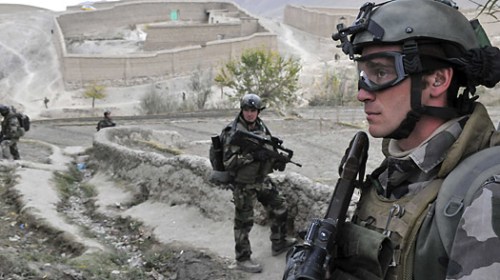
Every nation works within its own national interests and domestic political situation as well as its military capabilities. Unfortunately many people do not look at history to see how a coalition of a major power allied with a number of minor powers each with their own limitations as well as motivations for entering the war execute that war after the initial plan is foiled.  This is something that has happened in Afghanistan after the initial success disappeared with the corrupt and ineffective Afghan government, the resurgent Taliban and the resiliency of Al Qaida in their bases in the remote border areas of Afghanistan and Pakistan.

nato_france_a_0403French Troops in Afghanistan: The French, British and Canadians have the most Robust Rules of Engagement of Non US NATO Forces (Time Magazine Photo)
One of the best places to find such an example is the German relationship with their allies on the Eastern Front.  The question of the German dominated European Axis alliance in the Second World War is one of the more neglected subjects of World War Two II. In most accounts of the war, the relationship of the Germans to their coalition is minimal.  This includes the works of B.H. Liddell-Hart, Williamson Murray, Chester Wilmot and David M Glantz.   Italy usually receives some attention in the context of the campaign in North Africa and Mediterranean.  Hungary, Romania and Finland receive scant attention from anyone except as to how their armies were overrun during the Stalingrad campaign. Popular German memoirs provide little substantive help. Field Marshal Albert Kesselring’s memoirs and Erwin Rommel’s papers give some views of the Italian efforts in North Africa and the Mediterranean and Erich Manstein gives a limited amount of attention to the Italians, Finns, Hungarians and Rumanians in Russia.

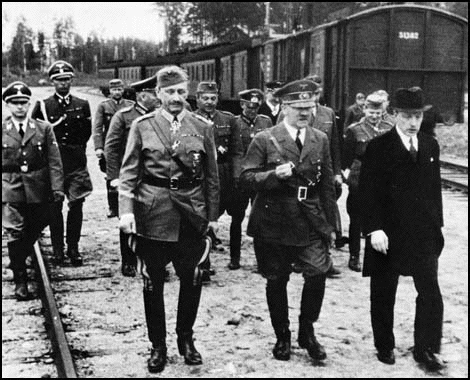
Finland-HitlerConflicting War Aims: Hitler with Finland’s Field Marshal Von Mannerheim
In his essay The Dysfunctional Coalition Robert Di Nardo examines the relationship of Germany to her allies on the Eastern Front where the Germans due to their own limitations were forced into a coalition war with weak allies of uncertain reliability. This is a subject that Di Nardo expanded on in his book Germany and the Axis Powers: from Coalition to Collapse (University of Kansas Press, 2005).  Di Nardo believes that there are important lessons to be learned from the failure of Germany and its coalition. Unfortunately we in the west are more often than not content to judge coalitions by the success of the Allies in the Second World War.  Di Nardo’s work on the subject is something that the United States must learn from as it works with coalitions whose members have significant military weaknesses often magnified by the domestic political climates in their own country. The situation, especially in Afghanistan places he United States in a similar position to Germany in relation to the current wars on terror and campaigns in Iraq and Afghanistan.

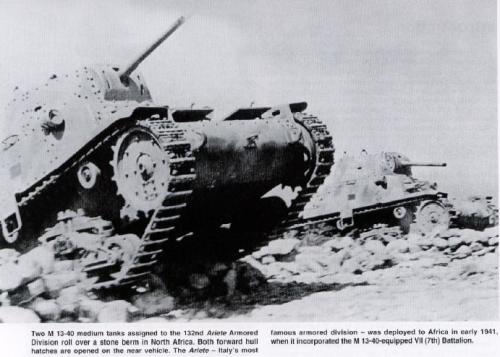
m 13-40 tankItalian M 13-40 tanks were the mainstays of Italian Armored Units, Slow, Undergunned and Poorly Armored they were No Match for Soviet T-34s

Di Nardo asserts “the way in which Germany conducted coalition warfare was reflective of the manner in which Hitler and the German military looked at the world, as well as the war in general.”  Germany often displayed a haughtiness toward its allies and even knowing their weaknesses was both unable and often unwilling to do much to strengthen them for the fight against the Soviet Union.  Di Nardo believes that the German attitudes were “a significant factor that contributed to the ultimate defeat of Nazi Germany.” (p.712)  In the essay Di Nardo notes the few successes of the coalition. In particular he looks at the German work with Rumanian air defense around the Ploesti oil refineries and the German-Finnish Winter Warfare School.  Apart from these instances he characterizes Axis coalition warfare on the eastern front as “poor” with “failures at every level.” (p.713)

italian troops stalino

Di Nardo analyzes the problems with language barriers, the wide differences of modernity of the armies and levels of technology and training of the coalition partners many of which are common to the war in Afghanistan. Germany’s failure to become the “arsenal of Fascism” which the United States became “the Arsenal of Democracy” for its allies hindered the Germans in their relationship to their poorly equipped allies.  Likewise, the lack of understanding of all the partners regarding the “relationship between national objectives, strategy and the morale of soldiers of officers and soldiers alike”(p.713) was a major obstacle.

finnish at gun

Di Nardo provides a good description of the German liaison detachments allotted to the coalition armies.  These teams functioned as advisors to their allies as well as liaisons between the German army and the allies. These teams dealt with language, tactical communications weaknesses and often displayed the generally haughty attitude that the Germans displayed to their partners. There is an excellent illustration of this in dealing with the failure of XLVIII Panzer Corps at Stalingrad when the German Liaison to the Romanian 1st Panzer Division was wounded.  At the operational and strategic levels Di Nardo describes the German policies and attitudes toward their allies as “imperialist.” (p.718)

He examines the wide gap in transportation capabilities of the various armies and the failure of the Germans to better provide for the needs of their partners in contrast to the United States assistance to her allies.   Germany provided obsolete captured Czech and French weapons and vehicles to her allies.  They refused to supply the Romanians and Hungary with the plans to build German tank and aircraft in Romanian and Hungarian industrial concerns capable of their manufacture. (pp.718-719) Di Nardo notes how this lack of modern equipment impacted the allies operations against the Red Army and their defeat at the hands of the Soviets.  Although Di Nardo alludes to how even elite German formations had substandard equipment he does not explain principle reason for this.   This was due to the fact that the Germans did not go to a “total war” footing in regard to industrial production until Albert Speer took over as Armaments Minister in 1943.

spanish blue divsion

The number of troops contributed by the German Allies was substantial. Hungary began Barbarossa with two corps, including its Mobile Corps and in 1942 supplied their 2nd Army which was composed of 1 Armored and 9 Infantry Divisions. 2nd Army was crushed by the Soviet offensive against Stalingrad. The Italians began with an expeditionary corps of 2 Semi-Motorized and 1 Light Infantry Divisions. In early 1943 they added 4 Infantry and 3 Alpine Divisions and a number of other smaller formations. This force became the 8th Army. It fought well during the advance toward Stalingrad but spread out over a wide front with little armored or air support was decimated by the Soviet offense against the city.  The remnants were no longer battle worthy and were evacuated to Italy.  Most of the Finnish Army was engaged in the war but after September 1939 made no major offensive contribution to the war. In 1944 following a major Soviet offensive which forced them to withdraw from the territory that they had captured in 1941 the Finnish government sued for peace. The Russians occupied a number of border provinces and islands and Finland was obliged to expel German Forces.  This resulted in the “Lapland War” between the Finns and the Germans with the Germans adopting a scorched earth policy as they withdrew from the country. The quality of the Finnish forces was generally higher than that of Germany’s other Allies.

romanian r35Obsolete French Built Romanian R-35 Light Tank
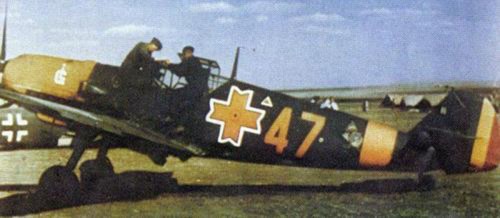
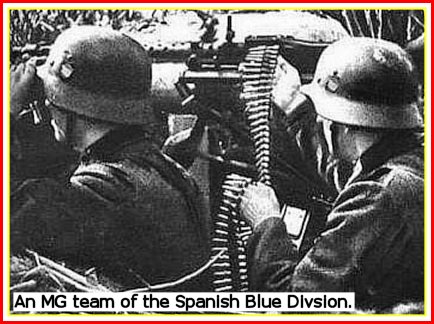
The Romanians contributed 19 divisions organized into 3 Armies to Barbarossa. They were limited by their equipment and logistics. The 3rd and 4th Romanian Armies were shattered at Stalingrad forcing a major reorganization as they continued the war.  In August 1944 with the Soviets pressing their border King Michael led a coup to overthrow the Fascist dictatorship of Antonescu. The Germans elected to fight and the Romanians changed sides and joined the Russian advance to the end of the war with their 1st Army taking part in the Prague offensive. Another contributor of troops was Franco’s Spain although it was a neutral country. Spain provided a division of volunteers which became the famous “Spanish Blue Division” or the 250th Infantry Division. It was outfitted as a German unit and received additional training from the Germans before it went into action. The division fought near Leningrad and was engaged in many tough fights.  A Spanish “Blue” Fighter squadron allotted to and equipped by the Luftwaffe also distinguished itself. In October 1943 Spain under allied pressure withdrew the division from the front although many soldiers volunteered to remain and fight on as smaller units attached to German formations. One volunteer company became part of the 11th SS Panzergrenadier Division Nordland at Berlin.  One thing that probably was a factor in the Spanish effectiveness as well as commitment to to German cause was their genuine loathing of the Soviets following the Spanish Civil War.

The final part of Di Nardo’s essay deals with the strategic goals and conflicts among the Axis coalition which were never worked out.  Examples of this include how the Finns never signed a formal alliance with Germany and how their national strategy did not allow them to deeper into the Soviet Union instead settling on recovering territory lost to the Soviets in 1939 with a few minor gains.  There was also the problem that the Romanians and Hungarians distrusted each other so much that they could not work together over their own territorial disputes.  The Italians joined the campaign late and their 8th Army participated in the German advance toward Stalingrad protecting the German flank.  While the Italians provided their own equipment including armor and aircraft they and their weapons were woefully suited for the war that they faced on the Eastern Front.  Di Nardo finishes his essay noting morale problems in the Hungarian, Italian and Romanian armies, the lack of understanding and general lack of motivation for the campaign.

Romanian_Me109-px800Romanian ME-109 E4, The Romanian Air Force Was One of the Axis Success Stories
This article is well sourced. Di Nardo uses histories, archival sources, operational orders and analysis by the various armies as well as interviews with participants. Of particular note is that he goes to sources of the coalition partners and not just German sources.  This allows him to be far more nuanced and detailed in his discussion as opposed to others who simply ignore the contributions of the Axis partners.  His footnotes provide added detail and provide and lend support to his arguments.

The importance of this essay is twofold.  First it provides a look at the relationship of German to her coalition partners on the Eastern Front.  This is important from a historic standpoint simply because it is such a neglected topic in most histories of the period and gives added depth to the reasons for Germany’s defeat.  One has to ask the “what if questions” in regard to had the Germans better treated, equipped and recognized their allies’ contributions to the war effort.

The second and probably more important for Afghanistan is that it provides lessons to any nation which has to engage in coalition warfare.  In particular it has lessons for the United States which has found itself as the senior and vastly superior partner in a war which has multiple coalition partners in several theaters of operations.  Each coalition partner has certain military strengths and weaknesses in relationship to the United States, national interests, geo-political and economic relationships with competitors to the United States and internal political realities which impact their cooperation in the war.  As such the United States cannot allow itself to be cast in the role of a haughty imperialistic senior partner as did Germany.  The US instead must cultivate an attitude of assistance, respect and trust among its partners to assure their full cooperation and assistance in relation to U.S. goals in the war. This is particularly important now was it appears that the Afghan war is reaching a point where the deteriorating situation on the ground could invite the early withdraw of allies and necessitate either the addition of more US troops or a strategic withdraw which would be for all intents and purposes a defeat for the US and NATO. The consequences would not be good and while the Taliban may be able to be contained they undoubtedly would invite Al Qaida back and provide them with a sanctuary just as Pakistan has stepped up its efforts on the border.

Leave a comment

Filed under History, iraq,afghanistan, world war two in europe

Stalingrad

Note: This post is another of my papers from my MA in History course that I have reworked some for this site.  The focus is on how the Germans and Russians fought the Stalingrad campaign. In  particular in the way the governments and military’s of both nations planned and executed strategy during the course of the campaign adjusted to the situation and how the campaign ended.  I conclude with a potential modern application for the US and NATO in Afghanistan.

Stalingrad: Primary or Secondary Objective

operation blau map

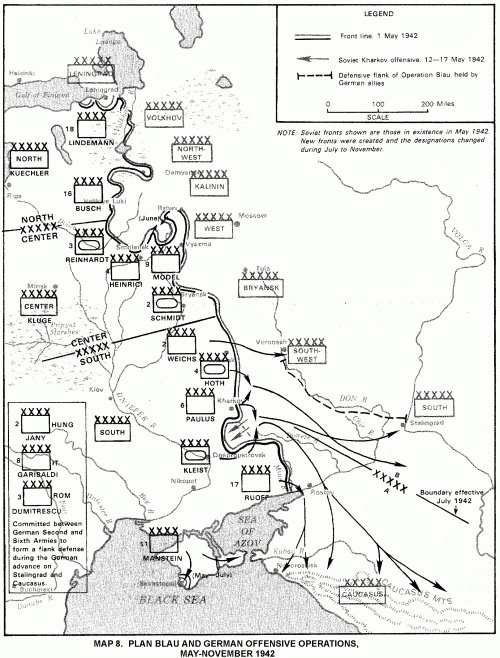
Following the Soviet winter offensive and the near disaster in front of Moscow the German High Command was faced with the strategic decision of what to do in the 1942 campaign.  Several options were considered and it was decided to seize the Caucasus oilfields and capture or neutralize the city of Stalingrad on the Volga.  However, the High Command was divided on the actual objective of the campaign.  OKH under the guidance of General Halder assumed that Stalingrad was the objective and the advance into the Caucasus was a blocking effort.[i] Hitler and OKW planned to capture the Caucasus oil fields and capture or neutralize Stalingrad to secure the left flank.[ii] Both OKH and OKW considered Stalingrad significant but “German commanders initially regarded it as a weigh station en route to the Caucasus oil fields.”[iii] The conflict echoed in the ambiguity of Directive No. 41 which “included the ‘seizure of the oil region of the Caucasus’ in the preamble concerning the general aim of the campaign, yet made no mention of this in the main plan of operations.”[iv] At the planning conference held at Army Group South in early June “Hitler hardly mentioned Stalingrad. As far as his Generals were concerned it was little more than a name on the map. His obsession was with the oil fields of the Caucasus.”[v] Manstein noted that “Hitler’s strategic objectives were governed chiefly by the needs of his war economy….”[vi] Anthony Beevor notes that at this stage of planning “the only interest in Stalingrad was to eliminate the armaments factories there and secure a position on the Volga. The capture of the city was not considered necessary.”[vii] German planners “expected that the Soviets would again accept decisive battle to defend these regions.”[viii]

Bild 169-0894Knocked Out T-34s

In Moscow Stalin and his Generals attempted to guess the direction of the impending German offensive.  “Stalin was convinced that Moscow remained the principle German objective…Most of the Red Army’s strategic reserves…were therefore held in the Moscow region.”[ix] To disrupt the German offensive and to attempt to recover Kharkov three offensives were launched by Red Army forces under the direction of Stavka. The largest of these on Kharkov was defeated between 12-22 May with the loss of most of the armor in southern Russia. This coupled with an equally disastrous defeat of Red Army forces in Crimea by Von Manstein’s 11th Army meant that the Red Army would face the Germans in a severely weakened condition.[x]

Operation Blau: Opening Moves and Divergent Objectives

The German offensive began on 28 June under the command of Field Marshal von Bock. Bock’s command included two separate army groups, Army Group B under General Von Weichs with 2nd Army, 6th Army and 4th Panzer Army operated in the northern part of the operational area. Army Group A was to the south with 17th Army and 1st Panzer Army.[xi] Army Group B provided the main effort and quickly smashed through the defending Soviet armies and by the 20th Hitler believed that “the Russian is finished.”[xii] One reason for the German success in the south was that until July 7th Stalin believed that Moscow was still the primary objective.[xiii] Bock was prevented by Hitler from destroying Soviet formations left behind and was relieved of command by Hitler. He was replaced by Von Weichs which created a difficult command and control problem.  Manstein noted that this created a “grotesque chain of command on the German southern wing” with the result that Army Group A had “no commander of its own whatever” and Army Group B had “no few than seven armies under command including four allied ones.”[xiv]

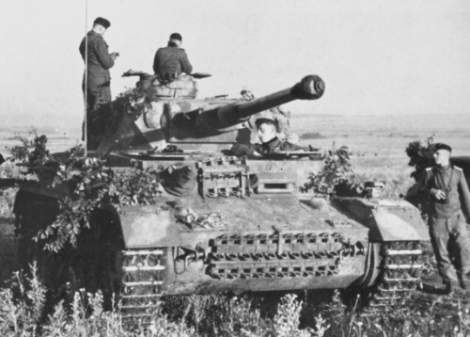
panzer ivfPanzer IV F

This decision proved fateful.  Hitler’s decided to redirect the advance of the 4th Panzer Army to support an early passage of the lower Don, diverting it from its drive on Stalingrad.  Additionally the army groups became independent of each other when Bock was relieved of command.  They were “assigned independent-and diverging-objectives” under the terms of Directive No.45.[xv] This combination of events would have a decisive impact on the campaign.  The decision prevented a quick seizure of Stalingrad by 4th Panzer Army followed by a hand over to 6th Army to establish the “block” as described by Directive No.41.  Kleist noted that he didn’t need 4th Panzer Army’s help to accomplish his objectives and that it could have “taken Stalingrad without a fight at the end of July….”[xvi]

The result was damning. Air support and fuel needed by Army Group A was transferred to 6th Army, denuding Army Group A of the resources that it needed to conclude its conquest of the Caucasus.[xvii] At the same time it denied Army Group B of the Panzer Army that could seize Stalingrad when it was still possible to do so.  Beevor calls Hitler’s decision a disastrous compromise.[xviii] Halder believed the decision underestimated the enemy and was “both ludicrous and dangerous.”[xix]

Focus on Stalingrad

On July 22 as the Wehrmacht ran short on fuel and divisions to commit to the Caucasus, and 6th Army fought for control of Voronezh the Soviets created the Stalingrad Front. Stavka moved an NKVD Division to the city,[xx] and rapidly filled the new front with formations transferred from the Moscow Front.[xxi] Stalin issued Stavka Order 227, better known as “No Step Back” on 28 July. The order mandated that commanders and political officers who retreated would be assigned to Penal battalions[xxii] and armies were to form three to five special units of about 200 men each as a second line “to shoot any man who ran away.”[xxiii] Russian resistance west of the Don slowed the German advance. German commanders were astonished “at the profligacy of Russian commanders with their men’s lives.”[xxiv] Von Kleist compared the stubbornness of Russians in his area to those of the previous year and wrote that they were local troops “who fought more stubbornly because they were fighting to defend their homes.”[xxv] Additionally, Stalin changed commanders frequently in the “vain hope that a ruthless new leader could galvanize resistance and transform the situation.”[xxvi] General Chuikov brought the 64th Army into the Stalingrad Front in mid-July to hold the Germans west of the Don.[xxvii]

Bild 116-168-618German Soldier in Stalingrad

Further weakening the Germans OKW transferred key SS Panzer Divisions and the Grossdeutschland Division to France. Supporting Hungarian, Italian and Romanian allied armies which lacked motorization, modern armor or anti-tank units were unable to fulfill the gaps left by the loss of experienced German divisions and the expectations of Hitler.[xxviii] 6th Army was virtually immobilized for 10 days due to lack of supplies allowing the Russians to establish a defense on the Don Bend.[xxix] To the south the Germans were held up by lack of fuel and increased Soviet resistance including the introduction of a force of 800 bombers.[xxx] Glantz and House note that with the fall of Rostov on July 23rd “Hitler abruptly focused on the industrial and symbolic value of Stalingrad.”[xxxi] Undeterred by warnings from Halder that fresh Russian formations were massing east of the Volga and Quartermaster General, Wagner, who guaranteed that he could supply either the thrust to the Caucasus or Stalingrad but not both.[xxxii] Again frustrated by slow progress Hitler reverted to the original plan for 4th Panzer Army to assist 6th Army at Stalingrad, but the cost in time and fuel were significant to the operation and the question was whether “they could make up for Hitler’s changes in plan.”[xxxiii]

Strategic Implications

soviet infantry attacking

The changes in the German plan had distinct ramifications for both sides.  Von Mellenthin wrote that “the diversion of effort between the Caucasus and Stalingrad ruined our whole campaign.”[xxxiv] The Germans could not secure the Caucasus oil fields which Hitler considered vital to the German war effort.  They advanced deep into the region and captured the Maikop oil fields, though they were almost completely destroyed by the retreating Russians.[xxxv] Army Group A was halted by the Russians along the crests of the Caucasus on August 28th.[xxxvi] This left Hitler deeply “dissatisfied with the situation of Army Group A.”[xxxvii] Kleist and others attributed much of the failure to a lack of fuel[xxxviii] and Blumentritt noted that Mountain divisions that could have made the breakthrough were employed along the Black Sea coast in secondary operations.[xxxix]

Fuel and supply shortages delayed 6th Army’s advance while Hoth’s 4th Panzer Army was needlessly shuttled between Rostov and Stalingrad. By the time it resumed its advance the Russians “had sufficiently recovered to check its advance.”[xl] As 6th Army advanced the “protection of Army Group B’s ever-extending northern flank was taken over by the 3rd Rumanian, the 2nd Hungarian and the newly formed 8th Italian Army.”[xli] The allied armies were neither equipped for the Russian campaign nor well motivated.[xlii] The supply shortage in both army groups was not helped by a logistics bottleneck. All supplies came over a single Dnieper crossing, which Manstein noted, prevented swift movement of troops from one area to another.[xliii]

Von Paulus’ 6th Army now attempted to rush Stalingrad between the 25th and 29th of July, while Hoth milled about on the lower Don.  However, Paulus’s piecemeal commitment of his divisions and failure to concentrate in the face of unexpectedly strong Soviet resistance caused the attacks to fail.  Paulus halted 6th Army on the Don so it could concentrate its forces and build its logistics base,[xliv] and to allow Hoth to come up from the south. This delay allowed the Russians to build up forces west of Stalingrad and reinforce the Stalingrad front and strengthen the defenses of the city,[xlv] and due to the distances involved it was easier for the Russians to reinforce the Stalingrad front.[xlvi] It also allowed the Russians to fill a number of key leadership positions with Generals who would skillfully fight the battle.[xlvii]

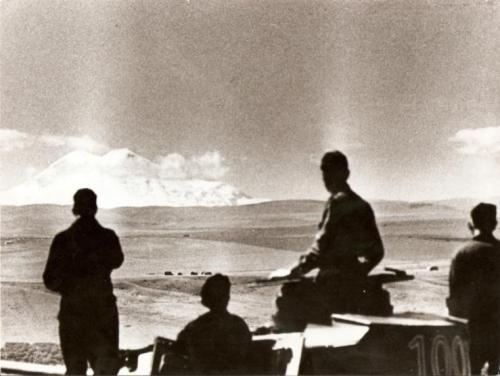
Kelbrus-739x556German Panzer Troops Look Upon the Caucasus Mountains
Hitler now focused on the capture of Stalingrad despite the fact that “as a city Stalingrad was of no strategic importance.”[xlviii] Strategically, its capture would cut Soviet supply lines to the Caucasus,[xlix] but this could be achieved without its capture. The checks in the south “began to give Stalingrad a moral importance-enhanced by its name-which came to outweigh its strategic value.”[l] To Hitler Stalingrad would gain “a mystic significance”[li] and along with Leningrad became “not only military but also psychological objectives.”[lii]

The Germans mounted a frontal assault with 6th Army and elements of 4th Panzer Army despite air reconnaissance that “the Russians are throwing forces from all directions at Stalingrad.[liii] Paulus as the senior General was in charge of the advance, with Hoth subordinated to him, but the attack had to wait until Hoth’s army could fight its way up from the south.[liv] Von Mellenthin comments rightly that “when Stalingrad was not taken on the first rush, it would have been better to mask it….”[lv] It is clear that the German advance had actually reached its culminating point with the failure of the advance into the Caucasus and Paulus’s initial setback on the Don, but it was not yet apparent to many involved.[lvi] The proper course of action would have been to halt and build up the front and create mobile reserve to parry any Russian offensive along northern flank while reinforcing success in the Caucasus. Manstein wrote that “by failing to take appropriate action after his offensive had petered out without achieving anything definite, he [Hitler] paved the way to the tragedy of Stalingrad!”[lvii]

Transfixed by Stalingrad

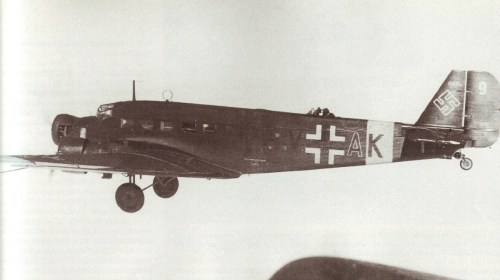
ju-52JU-52: Despite Tremendous Bravery of Luftwaffe Pilots Goering Failed to Keep Stalingrad Supplied
On August 19th Paulus launched a concentric attack against the Russian 62nd and 64th Armies on the Don.  The attack ran into problems, especially in Hoth’s sector.[lviii] Yet, on the 22nd the 14th Panzer Corps “forced a very narrow breach in the Russian perimeter at Vertyachi and fought its way across the northern suburbs of Stalingrad,”[lix] and reached the Volga on the 23rd. That day 4th Air Fleet launched 1600 sorties against the city dropping over 1,000 tons of bombs.[lx] The breakthrough imperiled the Soviet position they had concentrated their strongest forces against Hoth.[lxi] The Germans held air superiority and continued heavy bombing attacks.  During the last days of August 6th Army “moved steadily forward into the suburbs of the city, setting the stage for battle.”[lxii] As the Soviets reacted to Paulus, Hoth achieved a breakthrough in the south which threatened the Russian position.  However 6th Army was unable to disengage its mobile forces to link up with the 4th Panzer Army and another opportunity had been missed.[lxiii]

As 6th Army moved into the city Yeremenko ordered attacks against Hube’s 16th Panzer Division and Soviet resistance increased as more formations arrived the Germans suffered one of their heaviest casualty rates.”[lxiv] Though unsuccessful the counterattacks “managed to deflect Paulus’s reserves at the most critical moment.”[lxv] The Germans remained confident the first week of September as 6th Army and 4th Panzer Army linked up, but Yeremenko saved his forces by withdrawing and avoiding encirclement west of the city, retiring to an improvised line close to the city.[lxvi] On September 12th Chuikov was appointed to command 62nd Army in Stalingrad.  Chuikov understood that there “was only one way to hold on. They had to pay in lives. ‘Time is blood,’ as Chuikov put it later.”[lxvii] Stalin sent Nikita Khrushchev to the front “with orders to inspire the Armies and civilian population to fight to the end.”[lxviii] 13th Guards Rifle Division arrived on the 14th saved the Volga landings but it lost 30% casualties in its first 24 hours of combat.[lxix] An NKVD regiment and other units held the strategically sited Mamaev Kurgan, keeping German guns from controlling the Volga.[lxx] The defenders fought house to house and block by block, Army and NKVD were reinforced by Naval Infantry.  Chuikov conducted the defense with a brutal ferocity, relieving senior commanders who showed a lack of fight and sending many officers to penal units.  Chuikov funneled massed German attacks into “breakwaters” where the panzers and infantry could be separated from each other causing heavy German casualties.[lxxi]

Now the “city became a prestige item, its capture ‘urgently necessary for psychological reasons,’ as Hitler declared on October 2. A week later he declared that Communism must be ‘deprived of its shrine.’”[lxxii] The Germans did continue to gain ground, however slowly and at great cost, especially among their infantry, so much so that companies had to be combined.   Chuikov used his artillery to interdict the Germans from the far side of the Volga and the fight in the city was fought by assault squads with incredible ferocity and the close-quarter combat was dubbed “’Rattenkrieg’ by German soldiers.”[lxxiii] Paulus brought more units into the city and continued to slowly drive the Russians back against the river, by early October Chuikov wondered if he would be able to hold.[lxxiv] By early November Chuikov “was altogether holding only one-tenth of Stalingrad-a few factory buildings and a few miles of river bank.”[lxxv] Paulus expected “to capture the entire city by 10 November,”[lxxvi] despite the fact that many units were fought out. The 6th Army judged that 42% of the battalions of 51st Corps were fought out.[lxxvii] On 9 November Hitler declared “No power on earth will force us out of Stalingrad again!”[lxxviii]

Soviet Counteroffensive: Disaster on the Flanks

On September 24th Hitler relieved Halder for persisting in explaining “what would happen when new Russian reserve armies attacked the over-extended flank that ran out to Stalingrad.”[lxxix] Many in the German side recognized the danger. Blumentritt said “The danger to the long-stretched flank of our advance developed gradually, but it became clear early enough for anyone to perceive it who was not willfully blind.”[lxxx] Warnings were also given by Rumanian Marshall Antonescu and the staff’s of Army Group B and 6th Army[lxxxi] but Hitler was transfixed on Stalingrad.  In doing so the Germans gave up the advantage of uncertainty and once their “aim became obvious…the Russian Command could commit its reserves with assurance.”[lxxxii]

In the midst of Stalin’s concern about Stalingrad Stavka planners never lost sight of their goal to resume large scale offensive operations and destroy at least one German Army Group.[lxxxiii] Unlike Hitler Stalin had begun to trust his Generals and Stavka under the direction of Marshal Vasilevsky produced a concept in September to cut off the “German spearhead at Stalingrad by attacking the weak Rumanian forces on its flanks.”[lxxxiv] At first Stalin “showed little enthusiasm” for the attack, fearing that Stalingrad might be lost, but on 13 September he gave his full backing to the proposal[lxxxv] which Zhukov, Vasilevsky and Vatutin developed into a plan involving two operations, Operation Uranus, to destroy the German and allied forces at Stalingrad, Operation Saturn to destroy all the German forces in the south and a supporting attack to fix German forces in the north, Operation Mars aimed at Army Group Center.[lxxxvi]

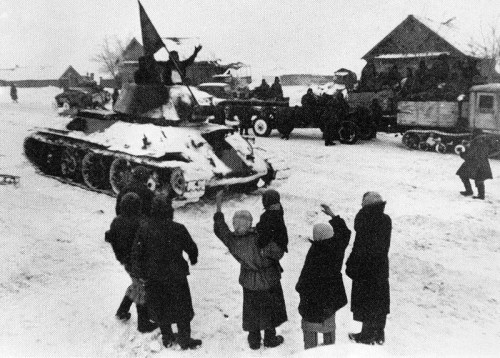
T34_Stalingrad-Offensive-px800Soviet Armor on teh Offensive

To accomplish the destruction of 6th Army and part of 4th Panzer Army the Red Army employed over 60% of the “whole tank strength of the Red Army.”[lxxxvii] Strict secrecy combined with numerous acts of deception was used by the Red Army to disguise the operation.[lxxxviii] The plan involved an attack against 3rd Rumanian Army on the northern flank by 5th Tank Army and two infantry armies with supporting units.[lxxxix] In the south against 4th Rumanian Army and weak element of 4th Panzer Army another force of over 160,000 men including 430 tanks were deployed.[xc] Despite warnings from his Intelligence Officer, Paulus did not expect a deep offensive into his flanks and rear and made no plans to prepare to face the threat.[xci] Other senior officers believed that the attack would take place against Army Group Center.[xcii] Warlimont notes that there was a “deceptive confidence in German Supreme Headquarters.”[xciii]

The storm broke on 19 November as Soviet forces attacked rapidly crushing Rumanian armies in both sectors[xciv] linking up on the 23rd.[xcv] 48th Panzer Corps supporting the Rumanians was weak and had few operational tanks.[xcvi] It attempted a counterattack but was “cut to pieces” in an encounter with 5th Tank Army.[xcvii] A promising attempt by 29th Motorized division against the flank of the southern Russian pincer was halted by the Army Group and the division was ordered to defensive positions south of Stalingrad.[xcviii] German airpower was neutralized by bad weather.[xcix] Paulus continued to do nothing as since the attacks were outside of his area of responsibility and waited for instructions.[c] As a result the 16th and 24th Panzer Divisions which could have assisted matters to the west remained “bogged down in street-fighting in Stalingrad.”[ci] Without support 6th Army units west of Stalingrad were forced back in horrific conditions.  By the 23rd 6th Army was cut off along with one corps of 4th Panzer Army and assorted Rumanian units, over 330,000 men.  This now entrapped force that would require seven rifle armies and much staff attention to eliminate.[cii]

The Death of 6th Army

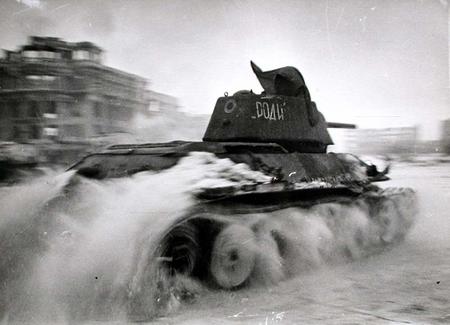
t-34 stalingradT-34 in Stalingrad

Hitler ordered Manstein to form Army Group Don to relieve Stalingrad. Hitler would not countenance a break out and wanted Manstein to break through and relieve 6th Army.[ciii] Hitler refused a request by Paulus on 23 November to move troops to prepare for a possible a break out attempt, assuring him that he would be relieved.[civ] Albert Speer notes that Zeitzler who replaced Halder insisted that the Sixth Army must break out to the west.”[cv] Hitler told Zeitzler that “We should under no circumstances give this up. We won’t get it back once it’s lost.”[cvi] Goering promised the Luftwaffe would be able to meet the re-supply needs of 6th Army by air, even though his Generals knew that it was impossible with the number of transport aircraft available.[cvii] Hitler took Goering at his word and exclaimed “Stalingrad can be held! It is foolish to go on talking any more about a breakout by Sixth Army…”[cviii] and a Führer decree was issued ordering that the front be held at all costs.[cix] Goerlitz states that “Hitler was incapable of conceiving that the 6th Army should do anything but fight where it stood.”[cx] Likewise Manstein had precious few troops with which to counterattack and had to protect the flank of Army Group A deep in the Caucasus. His army group was only corps strength and was spread across a 200 mile front.[cxi] Any relief attempt had to wait for more troops, especially Panzers.  Manstein too believed that the best chance for a breakout had passed and that it was a serious error for Paulus to put the request to withdraw through to Hitler rather than the Army Group or act on his own.[cxii] Many soldiers were optimistic that Hitler would get them out.[cxiii] Other generals like Guderian, Reichenau or Hoeppner might have acted, but Paulus was no rebel.[cxiv]

Madonna of StalingradThe Madonna of Stalingrad

Operation Saturn began on 7 December destroying the Italian 8th Army and forcing the Germans to parry the threat.[cxv] A relief attempt by 57th Panzer Corps under Hoth on 12 December made some headway until a massive Soviet counterattack on 24 December drove it back.[cxvi] This attack was hampered by OKW’s refusal to allocate the 17th Panzer and 16th Motorized divisions to Manstein,[cxvii] and by 6th Army not attacking out to link with the relief force.[cxviii]By 6 January Paulus signaled OKW: Army starving and frozen, have no ammunition and cannot move tanks anymore.”[cxix] On 10 January the Soviets launched Operation Ring to eliminate the pocket and despite all odds German troops fought on. On the 16th Paulus requested that battle worthy units be allowed to break out, but the request was not replied to.[cxx] On the 22nd the last airfield had been overrun and on 31 January Paulus surrendered.[cxxi]

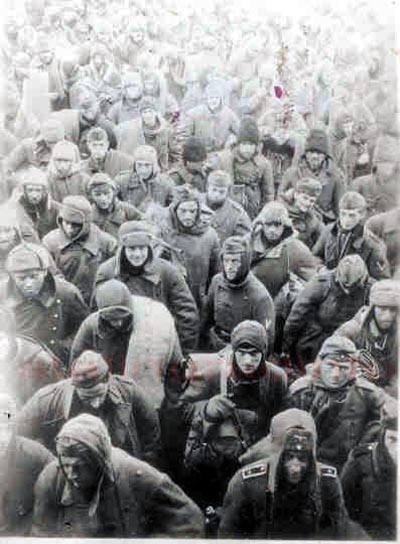
pows stalingradPOWs: Only 5,000 of 90,000 POWs would return
Analysis: What Went Wrong

Stalingrad had strangely drawn the attention of both sides, but the Russians never lost sight of their primary objectives during the campaign. The Germans on the other hand committed numerous unforced errors mostly caused by Hitler or Paulus. After the fall of Stalingrad as the Soviets attempted to follow up their success by attempted to cut off Army Group “A” Manstein was permitted to wage a mobile defense while Von Kleist managed to withdraw with few losses.[cxxii] The superior generalship of Manstein and Von Kleist prevented the wholesale destruction of German forces in southern Russia and Manstein’s counter offensive inflicted a severe defeat on the Soviets. However the German Army had been badly defeated.  The seeds of defeat were laid early, the failure to destroy bypassed Soviet formations in July, the diversion of 4th Panzer Army from Stalingrad, and the divergent objectives of trying to capture the Caucasus and Stalingrad at the same time.  This diluted both offensives ensuring that neither succeeded.  Likewise the failure to recognize the culminating point when it was reached and to adjust operations accordingly was disastrous for the Germans. The failure create a mobile reserve to meet possible Russian counter offensives, and the fixation on Stalingrad took the German focus off of the critical yet weakly held flanks. The hubris of Hitler and OKW to believe that the Russians were incapable of conducting major mobile operations even as Stavka commenced offensive operations on those flanks all contributed to the defeat.  Clark notes these facts but adds that the Germans “were simply attempting too much.”[cxxiii] Soviet numbers allowed them to wear down the Germans even in defeat.[cxxiv] At the same time Stalin gave his commanders a chance to revive the mobile doctrine of deep operations with mechanized and shock armies that he had discredited in the 1930s.[cxxv] All through the campaign Zhukov and other commanders maintained both their nerve even when it appeared that Stalingrad was all but lost. They never lost sight of their goal of destroying major German formations though they failed to entrap Army Group A with 6th Army.

A Modern Application

It is well and good to attempt to remain on the offensive.  The U.S. currently has forces spread thinly over two combat theaters with possibilities that other threats in the same region could flare up.  Like the Germans the U.S. is operating in areas, especially Afghanistan where overland supply lines are vulnerable and where weather can and does affect resupply operations by both ground and air.  The fact that the U.S. is operating with just barely enough forces in areas where others have met disaster calls for a circumspect look at what our enemy’s capabilities really are and not allowing ourselves to be surprised when they do things that have worked for them in the past against the Russians.  While it is unlikely that the U.S. and NATO would face a Stalingrad type situation in Afghanistan it is possible that isolated forces could be overrun as the Afghans reprise tactics used so successfully against the Soviets and as they begin to operate in larger units, concentrate them quickly and with more firepower to catch NATO forces when they are most vulnerable.  It is true that they will not mass large numbers of tanks and artillery as the Soviets did against the Germans, but the principle of speed, concentration at the critical point and surprise can inflict defeats that will turn public sentiment in the U.S. and Europe against further commitments and against the war and force the NATO governments as well as the U.S. to give up the effort.


[i] Clark, Alan. Barbarossa: The Russian-German Conflict:1941-45. Perennial Books, An imprint of Harper Collins Publishers, New York, NY 1965. p.191

[ii] Ibid.

[iii] Glantz, David M. and House, Jonathan. When Titan’s Clashed: How the Red Army Stopped Hitler. The University Press of Kansas, Lawrence KS, 1995. p.111

[iv] Ibid. Clark. p.191

[v] Beevor, Anthony. Stalingrad: The Fateful Siege: 1942-1943. Penguin Books, New York NY 1998. p.69

[vi] Manstein, Erich von. Forward by B.H. Liddle Hart, Introduction by Martin Blumenson. Lost victories: The War Memoirs of Hitler’s Most Brilliant General. Zenith Press, St Paul MN 2004. First Published 1955 as Verlorene Siege, English Translation 1958 by Methuen Company. p.291 This opinion is not isolated, Beevor Quotes Paulus “If we don’t take Maikop and Gronzy…then I must put an end to the war.” (Beevor pp. 69-70)  Halder on the other hand believed that Hitler emphasized that the objective was “the River Volga at Stalingrad. (Clark. p.190)

[vii] Ibid. Beevor. p.70.

[viii] Ibid. Glantz and House. p.106

[ix] Ibid. p.105-106

[x] Ibid. Clark. p.203.  The offensive did impose a delay on the German offensive.

[xi] Ibid. Clark. p.191 Each group also contained allied armies.

[xii] Ibid. p.209.

[xiii] Ibid. Glantz and House. p.119

[xiv] Ibid. Manstein. p.292.

[xv] Ibid. Clark. p.209

[xvi] Ibid. Clark.  p.211

[xvii] Ibid. Glantz and House. p.120. There is a good discussion of the impact of this decision here as 6th Army’s advance was given priority for both air support and fuel.

[xviii] Ibid. Beevor. p.74

[xix] Warlimont, Walter. Inside Hitler’s Headquarters 1939-45. Translated by R.H. Berry, Presido Press, Novato CA, 1964. p.249

[xx] Ibid. Beevor. p.75 This was the 10th NKVD Division and it took control of all local militia, NKVD, and river traffic, and established armored trains and armor training schools.

[xxi] Ibid. Clark. p.212

[xxii] Ibid. Glantz and House. p.121

[xxiii] Ibid. Beevor. p.85

[xxiv] Ibid. p.89

[xxv] Liddell-Hart, B.H. The German Generals Talk. Quill Publishers, New York, NY 1979. Originally published by the author in 1948. p.202

[xxvi] Ibid. Beevor. p.88

[xxvii] Ibid. Beevor. p.90

[xxviii] Ibid. Beevor. p.81

[xxix] Ibid. Glantz and House. p.121

[xxx] Ibid. Liddell-Hart. p.202

[xxxi] Ibid. Glantz and House. p.120

[xxxii] Goerlitz, Walter. History of the German General Staff. Westview Press, Frederick A. Praeger Publisher, Boulder, CO. 1985 p.416

[xxxiii] Ibid. Beevor. pp.95-96.

[xxxiv] Von Mellenthin, F.W. Panzer Battles: A Study of the Employment of Armor in the Second World War. Translated H. Betzler, Edited by L.C.F. Turner. Oklahoma University Press 1956, Ballantine Books, New York, NY. 1971. p.193

[xxxv] Shirer, William L. The Rise and Fall of the Third Reich. A Touchstone Book published by Simon and Schuster, 1981, Copyright 1959 and 1960. p.914

[xxxvi] Ibid. Glantz and House. p.122

[xxxvii] Ibid. Warlimont. p.256

[xxxviii] Ibid. Liddell-Hart. p.203

[xxxix] Ibid. p.204

[xl] Ibid. Shirer. p.914

[xli] Ibid. Goerlitz. p.416

[xlii] Ibid. Goerlitz. p.416

[xliii] Ibid. Manstein. p.293

[xliv] Ibid. Clark. p.214

[xlv] Ibid. Beevor. pp.97-99. The mobilization included military, political, civilian and industrial elements.

[xlvi] Liddell-Hart, B.H. Strategy. A Signet Book, the New American Library, New York, NY. 1974, Originally Published by Faber and Faber Ltd., London. 1954 & 1967. p.250

[xlvii] Ibid. Beevor. p.99.  Two key commanders arrived during this time frame, Colonel General Andrei Yeremenko, who would command the Stalingrad Front  and General Chuikov commander of 64th Army who would conduct the defense of the city.

[xlviii] Carell, Paul Hitler Moves East: 1941-1943. Ballantine Books, New York, NY 1971, German Edition published 1963. p.581

[xlix] Ibid. Shirer.  p.909.

[l] Ibid. Liddell-Hart, Strategy. p.250

[li] Wheeler-Bennett, John W. The Nemesis of Power: The German Army in Politics 1918-1945. St. Martin’s Press, New York, NY 1954.  p.531

[lii] Ibid. Wheeler-Bennett. p.531

[liii] Ibid. Beevor. p.96

[liv] Ibid. Clark. p.216.

[lv] Ibid. Von Mellenthin. P.193

[lvi] See Von Mellinthin pp.193-194.  Von Mellinthin quotes Colonel Dinger, the Operations Officer of 3rd Motorized Division at Stalingrad until a few days before its fall. Dingler noted that the Germans on reaching Stalingrad “had reached the end of their power. Their offensive strength was inadequate to complete the victory, nor could they replace the losses they had suffered.” (p.193) He believed that the facts were sufficient “not only to justify a withdrawal, but compel a retreat.” (p.194)

[lvii] Ibid. Manstein. p.294

[lviii] Ibid. Clark. p.216

[lix] Ibid. Clark. p.217

[lx] Ibid. Beevor. p.107

[lxi] Ibid. Beevor. p.107

[lxii] Ibid. Glantz and House. p.122

[lxiii] Ibid. Carell. P.601

[lxiv] Ibid. Beevor. p.118

[lxv] Ibid. Beevor. p.118

[lxvi] Ibid. Carell. p.602

[lxvii] Ibid. Beevor. p.128

[lxviii] Ibid. Carell. p.603

[lxix] Ibid. Beevor. p.134

[lxx] Ibid. Beevor. pp.136-137

[lxxi] Ibid. Beevor. p.149

[lxxii] Fest, Joachim. Hitler. Translated by Richard and Clara Winston, Harcourt, Brace, Jovanovich Publishers, San Diego, New York, London. 1974. p.661

[lxxiii] Ibid. Beevor. pp. 149-150

[lxxiv] Ibid. Beevor. p.164

[lxxv] Ibid. Carell. p.618

[lxxvi] Ibid. Glantz and House. p.123

[lxxvii] Ibid. Beevor. p.218

[lxxviii] Ibid. Carell. p.623

[lxxix] Ibid. Goerlitz. p.418

[lxxx] Ibid. Liddell-Hart. The German Generals Talk. p.207

[lxxxi] Ibid. Manstein. p292

[lxxxii] Ibid. Liddell-Hart. History of the Second World War. p.258

[lxxxiii] Ibid. Glantz and House. p.129

[lxxxiv] Ibid. Glantz and House. p.130

[lxxxv] Ibid. Beevor. pp.221-222 Glantz and House say that Stalin gave his backing in mid-October but this seems less likely due to the amount of planning and movement of troops involved to begin the operation in November.

[lxxxvi] Ibid. Glantz and House. p.130

[lxxxvii] Ibid. Beevor. p.226

[lxxxviii] Ibid. Glantz and House. p.132

[lxxxix] Ibid. Glantz and House. p.130

[xc] Ibid. Beevor. p.227

[xci] Ibid. Beevor. p.228

[xcii] Ibid. Clark. p.235

[xciii] Ibid. Warlimont. p.274

[xciv] Ibid, Carell. p.627 3rd Rumanian Army lost 75,000 men in three days.

[xcv] Ibid. Clark.pp.247-248

[xcvi] The condition of the few German Panzer Divisions in position to support the flanks was very poor, the 22nd had suffered from a lack of fuel and maintenance and this many of its tanks were inoperative. Most of the armor strength of the 48th Panzer Corps was provided by a Rumanian armored division equipped with obsolete Czech 38t tanks provided by the Germans.

[xcvii] Ibid. Clark. pp.251-252. The designation of 2nd Guards Tank Army by Clark has to be wrong and it is the 5th Tank Army as 2nd Guards Tank was not involved in Operation Uranus.  Carell, Beevor and Glantz properly identify the unit.

[xcviii] Ibid. Carell. p.630

[xcix] Ibid. Beevor. p.244

[c] Ibid. Beevor. p.247

[ci] Ibid. Beevor. p.245

[cii] Ibid. Glantz and House. p.134

[ciii] Ibid. Glantz and House. p.134

[civ] Ibid. Clark. p.256

[cv] Speer, Albert. Inside the Third Reich. Collier Books, a Division of MacMillan Publishers, Inc. New York, NY 1970. p.248

[cvi] Heiber, Helmut and Glantz, David M. Editors. Hitler and His Generals: Military Conferences 1942-1945. Enigma Books, New York, NY 2002-2003.  Originally published as Hitlers Lagebsprechungen: Die Protokollfragmente seiner militärischen Konferenzen 1942-1945. Deutsche Verlags-Anstalt GmbH, Stuttgart, 1962. p.27

[cvii] Ibid. Glantz and House. p.135 Glantz and House note that the amount of aircraft estimated to successfully carry out the re-supply operation in the operational conditions was over 1,000.  The amount needed daily was over 600 tons of which the daily reached only 300 tons only one occasion.

[cviii] Ibid. Speer. p.249

[cix] Ibid. Carell. p.636

[cx] Ibid. Goerlitz. p.426

[cxi] Ibid. Clark. p.252

[cxii] Ibid. Manstein. p.303

[cxiii] Ibid. Beevor. p.276

[cxiv] Ibid. Carell. p.640

[cxv] Ibid. Glantz and House. p.140

[cxvi] Ibid. Glantz and House. p.140

[cxvii] Ibid. Clark. p.264

[cxviii] Ibid. Manstein. p.337

[cxix] Ibid. Beevor. p320

[cxx] Ibid. Beevor. p.365

[cxxi] Of the approximately 330,000 in the pocket about 91,000 surrendered, another 45,000 had been evacuated.  22 German divisions were destroyed.

[cxxii] Ibid. Liddell-Hart. The German Generals Talk. p.211

[cxxiii] Ibid. Clark. p.250

[cxxiv] Ibid. Glantz and House. p.124

[cxxiv] Ibid. Beevor. p.221

Bibliography

Beevor, Anthony. Stalingrad: The Fateful Siege: 1942-1943. Penguin Books, New York NY 1998

Carell, Paul Hitler Moves East: 1941-1943. Ballantine Books, New York, NY 1971, German Edition published 1963.

Clark, Alan. Barbarossa: The Russian-German Conflict:1941-45. Perennial Books, An imprint of Harper Collins Publishers, New York, NY 1965.

Fest, Joachim. Hitler. Translated by Richard and Clara Winston, Harcourt, Brace, Jovanovich Publishers, San Diego, New York, London. 1974

Glantz, David M. and House, Jonathan. When Titan’s Clashed: How the Red Army Stopped Hitler. The University Press of Kansas, Lawrence KS, 1995.

Goerlitz, Walter. History of the German General Staff. Westview Press, Frederick A. Praeger Publisher, Boulder, CO. 1985

Heiber, Helmut and Glantz, David M. Editors. Hitler and His Generals: Military Conferences 1942-1945. Enigma Books, New York, NY 2002-2003.  Originally published as Hitlers Lagebsprechungen: Die Protokollfragmente seiner militärischen Konferenzen 1942-1945. Deutsche Verlags-Anstalt GmbH, Stuttgart, 1962.

Liddell-Hart, B.H. The German Generals Talk. Quill Publishers, New York, NY 1979. Originally Published by the author in 1948.

Liddell-Hart, B.H. Strategy. A Signet Book, the New American Library, New York, NY. 1974, Originally Published by Faber and Faber Ltd., London. 1954 & 1967

Manstein, Erich von. Forward by B.H. Liddle Hart, Introduction by Martin Blumenson. Lost victories: The War Memoirs of Hitler’s Most Brilliant General. Zenith Press, St Paul MN 2004. First Published 1955 as Verlorene Siege, English Translation 1958 by Methuen Company

Shirer, William L. The Rise and Fall of the Third Reich. A Touchstone Book published by Simon and Schuster, 1981, Copyright 1959 and 1960

Speer, Albert. Inside the Third Reich. Collier Books, a Division of MacMillan Publishers, Inc. New York, NY 1970.

Von Mellenthin, F.W. Panzer Battles: A Study of the Employment of Armor in the Second World War. Translated H. Betzler, Edited by L.C.F. Turner. Oklahoma University Press 1956, Ballantine Books, New York, NY. 1971.

Warlimont, Walter. Inside Hitler’s Headquarters 1939-45. Translated by R.H. Berry, Presido Press, Novato CA, 1964.

Wheeler-Bennett, John W. The Nemesis of Power: The German Army in Politics 1918-1945. St. Martin’s Press, New York, NY 1954

Leave a comment

Filed under History, world war two in europe

The most dangerous assignment: 4 More Advisers Die In Afghanistan

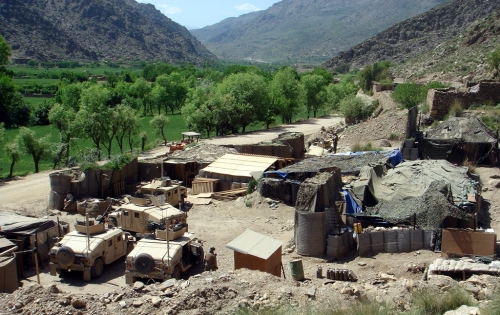
training team baseIsolated Embedded Training Team Base

Once know and relatively unglamorous group of American military men have suffered multiple casualties in a single engagement.  These men belong to are small units that do not have a lot of organic firepower.  They usually operate in remote areas far from immediate assistance if they get in trouble.  When one of these units suffers casualties, especially where they lose 3-5 men in one engagement they might have lost 20-25% of their unit.

On September 8th a team of these men was ambushed while on foot going to an Afghan with Afghan soldiers to meet tribal leaders with the intent of establishing a government presence in a hostile area.  In the ambush four were killed, three U.S. Marines and one U.S. Navy Hospital Corpsman attached to them.  On Tuesday the 8th Gunnery Sgt. Edwin W. Johnson Jr., 31, of Columbus, Ga., 1st Lt. Michael E. Johnson, 25, of Virginia Beach, Va., Staff Sgt. Aaron M. Kenefick, 30, of Roswell, Ga. and Petty Officer 3rd Class James R. Layton, 22, of Riverbank, Calif., were while working as trainers to Afghan soldiers on a mission to search for weapons and then meet village elders under an agreement to establish government authority there.  They were killed in “a complex attack according to a U.S. Military spokesman.  According to McClatchy news service who had a reporter that accompanied the mission, insurgents had set up positions in the village and in the mountains on both sides and apparently attacked as the men neared the village. 1st LT Johnson was wounded and while being attended Navy Hospital Corpsman Third Class James R. Layton when they both came under attack.  Both were killed.  Another Marine told the McClatchy reporter that they’d found the wrappings of bandages and other medical gear strewn around Layton and Johnson.  Eight Afghan troops and police and the Marine commander’s Afghan interpreter also died in the ambush and the subsequent battle that raged from dawn until 2 p.m. around the remote hamlet of Ganjgal in eastern Kunar province, close to the Pakistan border.

traiining team with afghan armyUSMC Advisers with Afghan Counterparts

The McClatchy reporter said: “We walked into a trap, a killing zone of relentless gunfire and rocket barrages from Afghan insurgents hidden in the mountainsides and in a fortress-like village where women and children were replenishing their ammunition.”  The reporter said that “U.S. commanders, citing new rules to avoid civilian casualties, rejected repeated calls to unleash artillery rounds at attackers dug into the slopes and tree lines — despite being told repeatedly that they weren’t near the village.”

The battle must have been intense.  I have been on foot patrols in areas crowded with Iraqis far away from significant support where if an insurgent group had attacked us we would have easily been overwhelmed. This is part of the world of the U.S. Military in the embedded training teams which work closely with Afghan and Iraqi soldiers.  I spent a lot of time with the advisers to Iraqi Army. Border and Port of Entry troops, Police and Highway Patrol spread across the entirety of Al Anbar Province.  These men and women are seldom thought of or mentioned by the press or even the military. . They come from all branches of the military and serve as advisers, trainers and mentors to these nations’ security forces.  The duty is dangerous.  The advisers, be they to the military, police, or civil administrations often work in the most isolated places in these countries and are stationed in small teams with the Iraqis and Afghans that they advise.  They are often far from the “big battalions” that have lots of firepower available and often operate out of larger and more secure bases with air support close at hand. Earlier in the year there were a number of incidents where advisers were killed by renegade soldiers or police, or by infiltrators posing as security personnel.  Two soldiers were working with an Iraqi unit in doing humanitarian work in a village when attacked and killed by someone who had infiltrated the Iraqi security forces.  . On March 27th Navy LT Florence Choe and LTJG Francis Toner IV were killed by an Afghan insurgent posing as an Afghan Army soldier. All of these events triggered anxiety in me as I remembered how many times I was incredibly exposed to danger conducting similar operations.

This incident was especially chilling as I read the reporter’s account of the ambush.  “Dashing from boulder to boulder, diving into trenches and ducking behind stone walls as the insurgents maneuvered to outflank us, we waited more than an hour for U.S. helicopters to arrive, despite earlier assurances that air cover would be five minutes away.”  According to the reporter Marine Maj. Kevin Williams” the commander of the team said: “We are pinned down. We are running low on ammo. We have no air. We’ve lost today, through his translator to his Afghan counterpart, responding to the latter’s repeated demands for helicopters.”  When I read this my mind flashed back to being in the middle of a massive crowd at the border crossing of Waleed on the Iraqi-Jordanian border.  There were about nine of us, of which only 8 were armed as I am not allowed by the U.S. interpretation of the law of war to carry a weapon.  There were thousands of Iraqis and others around us, very few border troops or port-of-entry police anywhere near us.  The port of entry had been the scene of numerous attempts to smuggle weapons, materials, and other supplies, drugs and to Iraq insurgents and Al Qaida.  Very few US troops were stationed there and many of these were dispatched off of the base at any given time.

The advisers are drawn from all services.  They are all Individual Augments that come from both the Active and Reserve components.  They do not deploy with their own units, which means that they go to war with people that they might have trained alongside getting ready for the mission, but otherwise have not served with.  When they come home they go back to their old assignments or new orders and are separated from the men and women that they served alongside for 7 to 15 months.  In other words they are isolated when they return home and go back to places where the majority of personnel, even those who have been “in country” have no earthly idea or appreciation of the conditions that they served in and dangers that they faced.  This happened to me when I returned and I went through an emotional collapse as the PTSD that I did not know I had kicked my ass.  Sights, smells, noises, crowds, airports and in fact almost everything but baseball diamonds caused me to melt down as they all brought the danger back to me. Don’t get me wrong, my tour in Iraq was the highlight of 27 plus years in the military, the part of which I am the most proud.

I have a special place for these men and women.  I served with them in Iraq’s Al Anbar Province as the first Navy Chaplain, and one of the first chaplains of any service to be assigned to cover these teams since Vietnam.  My assistant, RP2 Nelson Lebron and I deployed together from out unit.  I had prepared well.  I had been on the bubble to deploy for months.  My background in military history and past service with both the Army and Marines helped me. Likewise my military and civilian education helped me.  Shortly before we were notified of the deployment I went to the Jordanian Army Peace Operations Training Center course on Iraqi culture, religion and society.  I had served as a chaplain in the trauma department of one of the largest trauma centers in the country.  RP2 Lebron had deployed multiple times to Iraq, Beirut and Afghanistan where he was awarded the Defense Meritorious Service Medal (no small feat for an E-5).  He is also an incredibly gifted boxer, kick boxer and martial artist who has fought on Team USA and holds more title belts than I can count.  He most recently won the Arnold Schwarzenegger Classic. I had served with him before and he knew that his mission was to keep me safe.  I don’t want to sound arrogant, but the Chief of Staff of the Iraq Assistance Group said that we were “the best ministry team he had seen in 28 years in the Army.”

When we went to Al Anbar we were sent out with the Marines and Soldiers advising the 1st and 7th Iraqi Army Divisions, The Iraqi Police, Highway Patrol, the 2nd Border Forces Brigade and Port of Entry Police.  We operated in a area the size of the state of Oregon.  In some cases it would take us 2 days by air and convoy to reach isolated teams on the Syrian border.  When you travel by air in Iraq you are always at the mercy of the weather and aircraft availability. I had the rare privilege as a Lieutenant Commander to be able to arrange all of my own air transportation.  Most people, including people higher ranking than me had to depend on others to do this for them.  We worked with our advisers to get out to them.  We would be out 5-12 days at a time with anywhere from 4 to 7 days between missions.  In our 7 months we traveled over 4500 air miles and 1500 ground miles.  Almost all of our air travel was rotor wing. We flew in CH-46, CH-47 and MH-53s and the MV-22 Osprey.  Our convoys were usually not larger than 3 American HUMMVs and sometimes a few Iraqi vehicles.  Our biggest guns were .50 cal or M240B machine guns.

Dinner with Geneal SabahDinner with General Sabah in Ramadi

Many places we served were in places that had no large forces in position to help us if we got in trouble.  Even on the bases we were isolated.  Our teams were with the Iraqis in almost all cases.  We often ate in Iraqi chow halls and used Iraqi shower trailers.  Our advisers had us meeting their Iraqi counterparts.  We met and dined with Iraqi Generals, had ch’ai (tea) with small groups of Americans and Iraqis and got out with the Bedouins. We were in a number of particularly sensitive and dangerous situations with our advisers; one which I cannot go into great detail involved a senior advisor having to inform a new Iraqi Brigade Commander that a member of his staff was engaged in illegal activities and who had put out contracts to kill the American officer.  The bad Iraqi officer was confronted and relieved in a tense meeting where both Nelson and I were with that Colonel and two other advisors as they made the confrontation in the Iraq C.O.’s office, a confrontation that got quite heated until the Iraqi C.O. shut him up. At one point the cashiered officer appealed to the American “Imam” that he was a faithful Moslem, to whit the American Colonel and I asked him how a person who was living a good Moslem life could steal from his own countrymen and supply his county’s enemies with what they needed.

Waleed trip 006Team at Waleed on the “secure” side of the Port of Entry
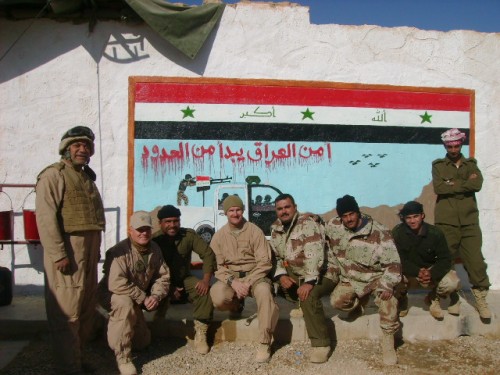
It was an incredible, once in a lifetime tour serving with some of the greatest Americans and Iraqis around. Iraqi soldiers in with our convoys would ask me to bless their trucks with Holy Water like I was doing with the American trucks.  I came to admire many of the professional Iraqi officers that I came to know and pray for the people of Iraq, that God would grant them peace. They are wonderfully hospitable and gracious.  We were often treated to food and tea by Iraqi soldiers, and civilians.  After nearly 30 years of nearly continuous war, dictatorship and terrorism, they deserve peace and security.

Me BTT CO and Iraqi LeadersAdvisers and Iraqi Border Troops near Syria
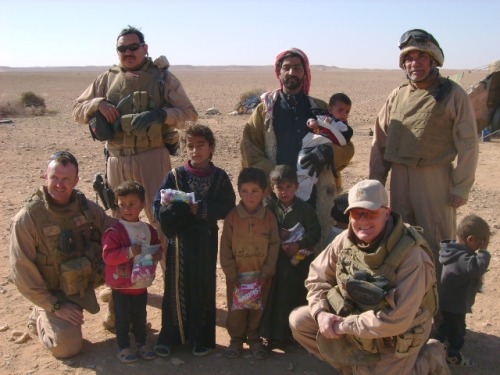
I had one Iraqi operations officer, a Sunni Muslim tell me that he wished that his Army had Christian priests because they would take care of his soldiers and had no political axe to grind. He said that the Army did not trust most Imams or Mullahs because they had compromised themselves during the civil war.  Another officer, a Shia Muslim came to me to thank me for being there to take care of our Marines.  He said that he, an Iraqi Shia Arab, hoped that if they had any problems from the Persians (Iranians), that we would help them.  These is little truth to what is floated that Iraqi and Iranian Shia like each other.  The memories of the past die hard in the Middle East.  When Persia ruled Iraq they treated the Arabs like dirt. Likewise the memories of the Iran-Iraq war are still alive.  Iraqi Arabs, Sunni, Shia and even Christian have little love for the “Persians.”  General Sabah of the 7th Division had us to his quarters for dinner. We had a wonderful and friendly discussion about similarities and differences in Christianity and Islam. We departed friends. The last time I saw him ws in the Ramadi heliport.  He saw me, ran up to me in from of his staff and Americans in the little terminal and gave me a bear hug, telling all that I was his friend. Another Iraqi General told me just before we left to come back as a tourist in 5 years because everything would be better.  I honestly think that he is right.  I hope to go back someday.  It would be a privilege to see my Iraqi friends again.

Me and BTT with Bedouin KidsWith a Bedouin Family

At the same time Afghanistan is a different animal. Iraq was not as easy of place for Al Qaida to work in and the Iraqis have a much more developed national identity which they trace back to the Babylonians and Chaldeans.  They also have adopted a lot of western ways.  Insurgents there once they had lost the confidence of the Iraqis lost traction.  In Afghanistan there is no real collective national identity and the form of Islam is much more severe than almost all Iraqi variants.  The Afghans insurgents have also due to the terrain; climate and inability of invaders to gain the confidence of the population have used the inability of invaders against them as they bring the population back under their control, sometimes quite peacefully.  The Taliban have secure bases on the Pakistani side of the border as did the North Vietnamese and they have the support of much of the population due to the unpopularity and corruption of the Afghan government.  The Taliban have begun to operate in larger better organized units and last year a battalion sized element attempted to overrun a small NATO base.  They did this with the Russians as well.  One troubling comment was reported about something overhead on the Taliban radio: “We will do to you what we did to the Russians,” the insurgent’s leader boasted over the radio, referring to the failure of Soviet troops to capture Ganjgal during the 1979-89 Soviet occupation.”  They also have outlasted or defeated a host of powerful empires.  The war in Afghanistan has much more in common with Vietnam than it does with Iraq. Counter Insurgency techniques learned in Iraq will be helpful but because of the terrain, climate and nature of the opposition will be tougher to execute and in order to have any chance of getting out of Afghanistan having accomplished the mission we will end of taking more casualties, especially in the teams of advisers.  Iraq was different, despite the problems and having to be rebuilt the Iraqi Army has a long history and tradition dating back to the Ottoman Empire, they led the way to westernizing Iraq and helping build an Iraqi identity, this is not the case in Afghanistan.  What happened to this team could easily happen to others and it looks to me like someone set them up to be hit, probably a Taliban sympathizer in the Afghan security forces or government. Afghanistan is much more treacherous than Iraq and in my view will be much more difficult.

What happened at Ganjgal is being investigated and in our area it is front page news as 1st Lt Johnson was from Virginia Beach.  The Taliban want to use events like this to break down the American home front and 8 years after the attacks of 9-11 2001 with that a fading memory they may well do this.  If they do Afghanistan will become Vietnam in the mountains.  We will be forced to withdraw and and the NATO alliance will be severely tested.  A defeat would have wide ranging consequences beginning in Afghanistan as it would fall back into the medieval world of Taliban rule, and would likely spread to Pakistan which which is already under severe strain.  This could threaten the Pakistani nuclear weapons.

Our advisers build bridges between peoples of different history and culture.  They are the unsung heroes of these wars and will likely never get credit for all that they have done.  Operating in isolation they are exposed to more danger that the average unit. They have my highest admiration and I hope that if you know one of these men or women that you will thank them.  I pray that they will all come home safe and be blessed with success.  I would certainly serve with them again at any time and in any place.

Please keep the families of the most recent casualties in your prayers. Peace, Steve+

1 Comment

Filed under iraq,afghanistan, Tour in Iraq

The Uncomfortable Legacy of Colonel General Ludwig Beck

“It is a lack of character and insight, when a soldier in high command sees his duty and mission only in the context of his military orders without realizing that the highest responsibility is to the people of his country.” Ludwig Beck

Bundesarchiv_Bild_183-C13564,_Ludwig_BeckLudwig Beck  Bundesarchiv Foto

This is one of those uncomfortable posts to write partially because I know that some people will take it completely wrong or ascribe meaning to it that I do not intend. I by training am a military historian, probably better at that than I am theology.  One thing that fascinates me in the study of military history is the actions of men in the face of evil and the meetings of such people at the intersections of where military and government policy intersect.  It is a timeless theme. The bulk of my study until the past few years was the German Army, particularly that of the Weimar Republic and the Wehrmacht to include policies, leaders, political attitudes and behavior in war and peace. Thus it makes sense for me to look at Colonel General Ludwig Beck who held the post of Chief of the German General Staff during the early part of the Nazi era.

Ludwig Beck is one of those characters in military history that makes professional military officers uncomfortable.  Beck is not the perfect example of righteousness nor was he always correct in things that he supported.  As an artillery regiment commander he defended the rights of soldiers and officers to be Nazi Party members though he himself was not one.  He, like many military officers was a conservative military officer by nature and became Chief of Staff of the Wehrmacht in 1935 two years after Hitler’s ascension to power.  Taking office Beck was troubled by some Nazi policies but not by the need for Germany to expand to areas that it had once controlled, he opposed the plan to attack Czechoslovakia not because of any love for the Czech state which he desired to be eliminated, but rather it being a war that Germany could not win. He resigned from his position a Chief of Staff in 1938 when he could not persuade the rest of the General Staff to resign in protest over Hitler’s plan which he felt would be disastrous for Germany.  Had the western powers led by Neville Chamberlain not caved at Munich it is likely that the Germans would have suffered badly against the Czech army and fortifications and with the entry of France into the war would have suffered a defeat that would have ended the Hitler regime.  In fact German officers who saw the extent of Czech preparations on the frontier following the Munich deal were greatly relieved that they did not have to fight their way into the Czech state.

After his resignation Beck played a key role in the resistance movement. He was involved in the planning for a number of attempts on Hitler’s life. Yet it was his leadership in the July 20th 1944 attempt on the life of Hitler that ensured his place in history.  With Colonel Klaus Von Stauffenberg and others in the General Staff at the Front and in Germany he acted to avert further destruction in Europe and the certain destruction of Germany.  The plot, Operation Valkyrie was marred by poor execution and failed to kill Hitler of seize power but for a few hours. The planners had left too much to chance and once Hitler had restored communications the coup attempted ended swiftly.  Had the attempt succeeded Beck was in line to become either the leader of Germany or the Head of the Army.  Instead while being interrogated after his capture he took his own life depriving Nazi leaders of the ability to put him up for a public trial at which he would have been humiliated and then executed.  The Kasserne in Sonthofen where the Bundeswehr MP School and Staff School as well as NATO and EU military schools are located is named for him.  It is there, ironically a former Adolf Hitler School that his memory and sacrifice is honored by the nation which emerged from the rubble of World War Two.  He is honored in a small museum and with a plaque recognizing his sacrifice.

492Ludwig Beck Kasserne Sonthofen

The reason that General Beck makes many of us in uniform uncomfortable (and I do include myself) is that he recognized that senior officers, especially those in high command who help set and execute policy cannot isolate themselves in the purely military aspects of the operations.  Instead he believed that officers have a higher duty to the constitution and people and not just the military mission that they have been assigned.  When he realized that he could not stop Hitler’s invasion of Czechoslovakia he resigned and worked in the obscurity of a small and often divided resistance movement against Hitler.  The bulk of the German high command, including many officers idolized in the United States did not recognize the higher duty. Many of these men were consummate professionals who did not support the evil of the Nazi regime and who conducted themselves honorably. Yet they effectively abetted its crimes by not opposing actions of their government that were against international law and morality as well as dangerous from purely a pragmatic military standpoint.

The problem is that military officers in any nation, including ours can face situations such as Beck faced.  A military’s character is demonstrated in how leaders deal with such situations.  Beck recognized the situation early, the bulk of his fellow officers did not recognize a problem until Germany was embroiled in a war that it could no longer win.  Even then most could not mount an opposition to Hitler because they did not want to be considered to be mutineers and violate their oath.  The potential to abet evil when military professionals bury their heads by planning and executing purely military aspects of a campaign is great.  If they ignore questionable policy or even policies that they know that have been judged by the international community to be illegal or immoral, such as torture of prisoners or waging wars of aggression against countries that have not attacked their nation they become complicit in their nations crimes.  This was the case with German Officers who may not have committed any personal crime and even tried to mitigate the evils of the Nazi regime were morally complicit in that evil.

In the United States the military shows its fidelity by remembering our oath to the Constitution and being faithful to it and the people that we serve.  As officers we represent all Americans and not just those of our political party, religious faith or social or economic interests, nor any political leader, faction or interest group within the nation. The Constitution, our military regulations, traditions and the Uniform Code of Military Justice are the standard by which we operate and by which we conduct ourselves and tools that protect us when policies or actions taken by the government or people within it violate those codes or international law.  The UCMJ makes it clear those officers who take part in, plan or a complicit in illegal actions in war are committing crimes.

When a nation become involved in wars which are non-traditional, revolutionary wars or insurgencies that barriers to professional conduct can be broken down. The Mai Lai massacre committed by 2LT William Calley’s platoon with the certain knowledge and maybe even approval of individuals in the chain of command is one example as were the uncontrolled chaos of prisoner abuse and torture at Abu Ghraib.

Times are difficult and we do not know what the future brings.  Stress in societies caused by economic conditions, natural disasters, lawlessness on the streets and divided and ineffective governments sometimes remove the moral restraints of the society and even affect the military.  One sees this in Weimar Germany as well as the 4th Republic in France which had to deal with post World War II economic difficulties, exacerbated by recriminations of political opponents for actions the others did during the war while France was occupied by Germany as well as the wars in Indo-China and Algeria which further divided the nation and the military.

It is in stressful and uncertain times that officers have to be men and women of principle who always uphold the highest traditions of their military as well as be the voice of conscience when governments, political parties, special interests or leaders begin to violate international norms in the conduct of war. Beck was not a perfect officer. He supported some of Hitler’s policies until after his resignation but like much of the resistance believed that the Nazi regime could only end up destroying Germany.  It is important to remember that like Ludwig Beck that officers do not need to sacrifice their honor to be faithful to their oath.

Peace, Steve+

16 Comments

Filed under History, leadership, Military, national security, world war two in europe

Going to War: A Reflection so Far, Memories, PTSD and hopes and fears Past and Present

964

As I have been writing of my experience in Iraq it is amazing to me the amount of emotions that I have experienced.  It is strange to feel like I am back there as I write.  I know that this is necessary but at times it is unnerving especially as I talk to friends who are going through much the same experience that I had coming home and sometimes worse.  I have been in e-mail contact with a friend from a NATO ally who has done a couple of tours in Afghanistan.  I can really feel for him as he is in a smaller military with a lot few resources that the Americans to deal with PTSD and other maladies from this war which seems to drag on without end.  Another friend on the West Coast has been dealing with the ravages of both PTSD and TBI and another Army Chaplain friend who has 2 Bronze Stars to his credit deals with PTSD as well as a very rare and eventually fatal lung and brachia condition.  Friends from my medical center are being deployed, I’ve been told that I am too valuable and needed where I am to deploy.  I do understand that at the same time deep in my heart I want to be with my friends from my ICU as they go to war.

The emotions took a big turn as I actually started writing about being in Iraq, beginning with the C-17 ride in to Baghdad.  In some sense the mirrored what I was going through two years ago.  It kind of came to a head the other night when I wrote about the rocket that went over my head at Camp Victory while waiting for my ride to head to the Camp Liberty heliport.  Then there was the flight to Fallujah and I can remember that flight.  I have never really liked flying in general and ancient helicopters in particular. Thinking that many of the CH-46s that I flew in while in Iraq had been in service in the Vietnam era was none too comforting.  They were almost as old as me.  Marine Helicopters are notorious for hydraulic fluid leaks.  The old joke goes” “How do you know when a Marine helicopter is low on hydraulic fluid?”  “When it stops leaking” is not entirely in jest.  I guess you can say that most of my career flying rotary wing aircraft in the Army and Navy has been just this side of terrifying.  I manage to survive every time but it takes forever to come back down from the anxiety of the preparation for and actual flights themselves it is no wonder that I still have problems sleeping and going on alert any time I hear a helicopter overhead.

Faith at times is an ongoing struggle. While I believe I question God more, especially when I see little kids suffering or read about young men and women killed in action or maimed by combat.  I find that I am less compassionate toward those who have not deployed who make suicide gestures and screw with their friends and families and then blow off help.  It angers me that their narcissism takes time and resources away from people who have been in the shit who need help and have to wait to get help.  I also find that religious people who have trite answers for everything really annoy me, especially those that are constantly talking about “spiritual warfare” when they have no clue about war, suffering and death. They are what Luther called the “theologians of glory” and they have no real answers, just platitudes that work fine until a real crisis comes.  Despite this I believe somehow in the God who is willing to be with me in the middle of the Valley of the Shadow of Death and at the foot of the Cross.

One of the things that tears at me now is the deep division in the United States as the obviously enlightened zealots of the extreme right and left push their agendas so hard that it seems impossible to find and amicable solution.  I wonder if we have entered “Weimar America.”  I guess I can understand how the moderates of the conservatives and socialists in Germany were ground to dust beneath the anvil of the Communists and hammer of the National Socialists in the later years of the Weimar Republic.  I really understand the military men who found both alternatives distasteful and tried in vain to seek the middle ground and maybe restore some sanity to the country.  That article is yet to be written.  I think I will call it “Weimar America?”  What really gets me is that both the right and left have dropped all pretense of civility and are now engaging in physical altercations at political meetings or “town hall” meetings and some have even be brandishing automatic weapons near venues where the President is speaking.  I have seen the results of this type of no-quarter politics in the Balkans and in Iraq.  I wonder what the hell all these demigods on both sides are thinking and if they in their devotion to their alleged “principles” would attempt “to destroy the country in order to save it.”   I have become ashamed of the leadership of both political parties as well as the special interest groups that drive the agendas of both extremes, especially as in the case of some who use the Christian faith to justify their actions.  When I see these people in action my anxiety level often returns to what it was in Iraq and on my return.  I can honestly say that the people on the extremes make me fear for my country.  I feel that they are pushing us to the abyss and that I can’t do a damned thing to stop it.  I’ve matured enough to know it is not simply the fault of one side or the other; as both are at fault and it seems that the most extreme on both sides have actually been wanting this to happen, at least from my viewpoint as a passionate moderate.

I have come to realize that my true countrymen are those that I have served with to defend this country and protect others abroad, especially as the insanity continues to spread.  Though I struggle and have to deal with emotions as if they were brand new every day just as I think that I am getting better I know that I have to keep going.  I owe it to my brothers and sisters from the current war and wars such as Vietnam.  Sometimes I wonder if all of us PTSD afflicted vets are the only sane people in the country. We are a brotherhood.  “We we happy few, we band of brothers.”

brothers

I’m glad that I have friends, especially vets from Iraq, Afghanistan, the Gulf and Vietnam.  Limey and Barney with the Hue City Vets, Ray and Charlie the Vietnam Veteran of America brothers who man the beer stand on the concourse behind home plate, and so many others like my trusty assistant Nelson Lebron who helped keep me safe and sane in Iraq.

In the middle of all of this I grieve for my Vietnam Vet and retired Navy Chief dad who wastes away in a nursing home with end stage Alzheimer’s which according to his doctor should have killed him months ago.

I’d better stop while I’m ahead.  I need to catch myself, maybe have a beer and focus on some baseball for a while before I get ready for work.  I have duty tomorrow and I expect that I will be busy the next couple of days.  I hope when I get off Wednesday afternoon that I will be able to see the Tides play.  I can use the view of the diamond at Harbor Park that helps calm my soul about now. Maybe between no and then I can get in with my buddy Elmer the Shrink.

pub2

Pray for me a sinner,

Peace, Steve+

7 Comments

Filed under alzheimer's disease, Baseball, iraq,afghanistan, Military, Political Commentary, PTSD, Tour in Iraq, vietnam

The Forgotten Cold Warriors

CheckpointCheckpoint Charlie in the Berlin Crisis

Note: As a follow up to this Article I posted “20 Years: The Fall of the Berlin Wall and the End of the Cold War” to this site.  The link to that article is here:

https://padresteve.wordpress.com/2009/11/08/20-years-the-fall-of-the-berlin-wall-and-the-end-of-the-cold-war/

From the Berlin Blockade and until the collapse of the Soviet Union in 1991 American, British, NATO and Asian Allies waged a Cold War against their Soviet and Warsaw Pact Countries, North Korea and at times China and Vietnam.  The war was a world war, fought by the major powers, their alliances and proxies throughout the world.  It was a world of gray areas where soldiers, sailors, airmen as well as Special Forces and intelligence agencies from both sides attempted to gain dominance over the world through political, military, economic, diplomatic and intelligence means and through use of surrogates.  Sometimes the war turned hot as in Korea, Vietnam and for the Soviet Union Afghanistan.

The conflict found its way to almost every corner of the earth and the world lived on edge wondering if the superpowers and their allies would end up in a hot war.  US and NATO Navies played a cat and mouse game with the Red Navy both under the sea and upon the waters.  Sometimes this war turned deadly as US and Red Navy Submarines disappeared and were never heard from again amid circumstances like those of the USS Scorpion that are still debated.  On the high seas US and NATO ships shadowed each other and occasionally played a game of chicken where ships collided attempting to gain advantage as they undertook surveillance missions or shadowed task forces.  Spy ships from both sides plied the seas collecting any type of information on their opponent’s operations.  In the air spy aircraft maintained a ready vigil with US SR-71s and U-2s flying missions over the Soviet Union.  Soviet Bear and Backfire Bombers probed the airspace of the United States and Canada and NATO forces at sea who responded by sending up interceptors.   In the closed confines of the Mediterranean the Navies sparred while a in the Middle East and North Africa both sides sought dominance through treaties with the surrounding nations who moved from Western to Soviet and Soviet to Western orbit as they deemed fit. Ideology and behavior of these client regimes was less important than having them in your camp, creating a surreal world of moral ambiguity in the shadow realm of alliances.

In divided Germany NATO and Warsaw Pact Forces faced off in a tense standoff along the inter-German Border and where millions of troops planned and trained for a hot war on the Fulda Gap and Northern German Plain which would include the use of Nuclear, Biological and Chemical weapons.  West Berlin was an island surrounded by the Olive uniformed Red Army and Field Gray of the German Democratic Republic.  A similar watch was maintained on the Korean DMZ.  In Africa, Asia, South and Central America, the Indian Subcontinent and the Middle East forces of the major powers worked with allies and surrogates to gain advantage.   The Soviets blockaded West Berlin while in response to the placement of Soviet missiles in Cuba the US imposed a naval blockade.  The CIA sponsored a failed attempt by Cuban expatriates to land at the Bay of Pigs.  The Soviets toppled governments and put down revolts in Hungary and Czechoslovakia while maintaining a system of Gulags at home.  Even international sporting events became occasions where each side used propaganda to show itself off to the world as the ideal society.  All of this occurring while the world lived under the constant threat of intentional or unintentional nuclear war.   In  missile silos and aboard Nuclear Ballistic Missile Submarines and manned bombers men stood by to push buttons and turn keys that could have ended the world as we know it.

763px-USS_Yorktown_collisionSoviet Krivak Class Frigate Intentionally Colliding with USS Yorktown CG-48 in the Black Sea 1988

Casualties were taken, even in places where the war was not “hot.”  Soldiers, Sailors, Marines, Airmen and Intelligence Service personnel undertook missions that are still classified the details of which they cannot reveal to this day.  Some suffer from PTSD from their involvement in and guilt over missions that they cannot reveal.  Men from both sides know that the weapons systems that they were involved with killed men on the other side in operations that will never be known.  American Veterans of the Cold War have been ignored by the country.  Russian Veterans have been forgotten as the Soviet Union crashed down on itself.  Countries spanning the globe bear the scars of the “hot” Cold War waged on their soil.  The results of the Cold War are still with us.  The West celbrated the collapse of the Soviet Empire but failed to make the new Russia a full member of the new world causing resentment which still boils today influencing Russian policy toward the West.

I met a man recently in hospital who was one of these veterans.  Tormented by the demons of operations he cannot reveal he suffers from physical and emotional wounds.  He is not alone.  There are many like him.  I do not suffer from my Cold War Service.  I served as a platoon leader, company executive officer and company commander in Germany in the mid-1980s.  If a war had broken out along the Fulda Gap my Chrysler Corporation bailout Dodge M-886 Ambulances with no communications systems adorned with bright red “mobile registration points’ were to be involved with reconstituting units which were expected to take 90% casualties.  We trained for chemical and biological warfare.  The maps used in my NBC defense officer course showed the housing area in which I lived.  We lived in a world of alerts where within two hours we had to be ready to head to war.  A world where Soviet spies operated and recruited Americans and where the German Red Brigade Terrorists bombed housing areas, clubs and even the Main Frankfurt PX, where we were on our way to when Judy felt sick and we had to return home.  Occasionally American Servicemen were murdered by Soviet Agents or Red Brigade Terrorists.  This was life for those stationed in Germany as well as South Korea.

I have been in East Berlin and was surprised as hell to see the Berlin Wall come down.  I have been to the Korean DMZ and the Northeast Gate of Guantanamo Bay Cuba.  I call it the “Commie trifecta.”  Without the Berlin Wall there are only two places where the US faces a Communist state directly.   Yet my time in a “hot” war has been in Iraq, I remember the days of the Cold War from childhood through my early Army career.

Cold War Veterans are the last forgotten Veterans group in the United States or even Russia.  Their sacrifices are not recognized.  The US belatedly issued a Cold war Service certificate for its veterans, but vets have to deal with a system that makes it difficult to even obtain a piece of paper that says “thank you” which gives them no other benefit.  The certificate is available to any person who worked for the Federal Government, including temporary holiday employees of the US Postal Service and does not mention military service. A Cold Service Medal was constantly fought by DOD during the last administration as too costly to support at this time.  The Cold War Service Medal last appeared in the FY 2008 DOD spending bills but was cut.   With the present demands on the military in the current wars and the fact that the cost of any award would come out of DOD’s budget it is unrealistic to expect this any time soon as it would cut into the funds needed to fight this war. At the same time these Veterans have no memorial and no status.  While their war was not “hot” it was world wide, lasted 40 years with many casualties.  Yes I agree it was not a hot war and that many who served in it were not in combat.  At the same time the Cold War veterans helped give the world a chance at a new beginning in 1991, unfortunately that has been squandered by governments around the world including the US government, but that is not the fault of those who stood the watch.  Someday they should be recognized.

Berlin WallMe on the East German Side of the Berlin Wall, November 1986

I have my medals from Iraq, the War on Terror and Korean Defense service.  I do believe that those men who stood the watch and many times paid with their lives or health should be recognized.  Other countries have done so.  I wonder why a few dollars per medal cannot be spent on men and women who served on the front line of freedom for 40 years. At the same time I understand that the costs of any such Medal would be born by DOD which is strapped to fight the ongoing wars.  I don’t think it realistic to have the money spent now, but maybe when the dust finally clears and these conflicts subside someone will take the time to remember these men and women.

The gentleman I saw recently never got a thank-you, never got a parade, and never was able to talk about the things that haunted him.  I wonder just how many more are waiting for the chance to come in from the cold.  If you know one of them, thank them for thier service and if they are one of those suffering from their service take care of them.

Peace, Steve+

Leave a comment

Filed under History, Loose thoughts and musings, Military, national security

Roster Moves: No Game, Series or Season in Baseball or Life Goes Without Them

046Norfolk Tides Manager Gary Allenson making a Slight Adjustment to the Outfield with 1 Out in the 9th Inning
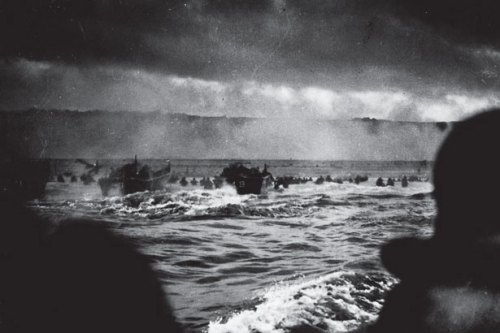
Larry: Who’s this? Who are you?
Crash Davis: I’m the player to be named later.

From Bull Durham

Sometimes I feel like the player to be named later.  I am amazed at the changes on a baseball team’s roster during the course of a season.  At the same time being in the military for almost 28 years I have some understanding of them in daily life.  This season with the Norfolk Tides and my place of work at a Major Naval Medical Center has been a perfect example of how no roster survives intact.

Now this is nothing new, as long as there have been baseball teams and militaries there have been personnel changes.  In baseball as in the military there is constant moves of personnel as people are transferred, promoted, demoted, are injured or retire from either the service or the game.  Sometimes roster moves are part of a natural process as an organization decides how it wants to chart its future. Other times they are dictated by a need that occurs that has not been anticipated such as injuries, trades, transfers, retirements or personnel or budget constraints, either expected or unexpected.

In the Minor Leagues the Minor League affiliates exist to supply their Major League organization with young talent, player development, rehabilitation and depth to meet the demands of a long season.  It is similar in the military where support and training organizations exist to meet the needs of the operating forces.  This is true regardless of military branch of service.   When the Major League Team or the operating forces are stretched, experience losses or suffer setbacks it is common for them to draw upon the support and training organizations to fill the holes and meet the needs of the larger organization.

I have watched this close up in two worlds this year both where I work and where I watch the Tides play ball.  At work this has occurred where due to retirements and transfers our department has lost a lot of people who have not yet been replaced, creating a lot of pressure on those who remain, likewise we are tasked with more missions to support the operating forces.  The same is true of the rest of the Medical Center where many physicians, nurses, corpsmen and other sailors have been deployed to meet the demands of the expanding war in Afghanistan while still supporting other worldwide commitments and our own home town mission.  While this is going on other needs have come up in caring for returning warriors, wounded warriors and their families as well as the rest of the military community that depends on us for their primary and specialized medical care.  I have seen more colleagues and friends than I can count be deployed from what is supposedly a pretty safe “non-deploying” shore billet to support the operating forces, Navy, Marines and Joint or NATO.  I have watched the organization adapt to the call ups by moving people around as well as finding people to fill the void, even if they are only on contract.

Our Norfolk Tides began the season with a very solid roster and within two months the big club, the Baltimore Orioles had called up several pitchers as well as the heart of the batting order, Outfielder Nolan Reimold, Catcher Matt Wieters and Infielder Oscar Salazar.  Meanwhile the Tides lost several players to injuries which forced Manager Gary Allenson and the Orioles organization to fins personnel both within and outside of the organization to fill the gaps created by call ups to the big team and injuries.  To do this they brought up players from AA Bowie, moved players down from Baltimore and found and traded for players outside of the Orioles system.  At first the adjustment was difficult but now the new players and those who were left are coming together to keep the team, at least for now in first place in the International League South.   Yet with every move the organization has to decide how to best utilize the players that it has.  In the case of the Tides this comes down to Manager Gary Allenson and his coaches working together with the rest of the Orioles organization.

Even in the midst of a game there are roster changes, sometimes for pitchers, sometimes hitter and sometimes even for running or defense.  Some of the changes are for injuries, or situational based on statistics of what you have empirical evidence to show that one course of action is better than another.  Thus you have relief pitchers and pinch hitters or runners.  No at bat or even pitch is the same, which is like life, nothing remains the same so you must make the adjustments on every play.

At the personal level changes affects everyone in the organization even if their job in the organization does not change.  At the minimum the changes affect the dynamics of the work environment, the chemistry between teams and the concern for friends who have left the organization with whom we have invested significant amounts of time and emotional energy.  Thus when Oscar Salazar was called up by Baltimore it left a huge hole in the team because Salazar was not only a leading contributor on the field but his tremendously positive attitude off the field in energizing the team and working with younger players.  Individual losses while seemingly statistically insignificant can be magnified by the intangibles of what a person brings to the team.  Some who seem to have all the right stuff may not be missed, while others who maybe don’t have the same talent level as others might be more sorely missed.  Since a team depends on the efforts of everyone, especially in baseball where the game is both immensely individual and absolutely interdependent personnel changes must be weighed carefully in the overall mission of the team or organization.  The Tides are fortunate to be with Baltimore as the organization is not only scouting talent for the O’s but their Minor League affiliates.  I met a Baltimore Scout at a Tides game over the weekend who said they were out seeking hitters for Norfolk due to call ups to the O’s and injuries to members of the Tides.  The larger organization, though a work in progress recognizes that its future lies in its Minor League system.  Thus over the past couple of weeks they have picked up Michael Aubrey from the Cleveland organization and Victor Diaz, a former Tides Outfielder when they were in the Mets organization and who later played in New York, Texas and the Houston organization before playing with the Hanwha Eagles in South Korea before being signed by the Orioles and assisted to the Tides.  A good organization not only looks to the situation they are currently facing u to the future.  A bad organization does not plan for the future but only concentrates on the present.  In the case of the Tides we are prospering under Baltimore but suffered for almost 20 years under the Mets, who have continued to neglect and abuse their farm system, especially their AAA affiliates.  The fans in Buffalo despise the relationship.

On the personal level this also means that individuals can be moved around to meet the needs of the organization.  This does not always make players happy be they ball players or military personnel.  There have been times in my career that I did not like what was happening to me in the organization, not so in the Navy but definitely in hte first part of my Army career. Such unhappiness when left unchecked can lead to blow ups.  The movie Bull Durham has a great example where Crash Davis, played by Kevin Costner complains about his reassignment from an AAA team back to a single A team.

Crash Davis: You don’t want a ballplayer; you want a stable pony.
Skip: Nah.
Crash Davis: Well, my triple-A contract gets bought out so I can hold some flavor-of-the-month’s dick in the bus leagues, is that it? Well, f— this f—ing game!
[pause]
Crash Davis: I quit, all right? I f—ing quit.
[Crash exits the office and stands in the clubhouse for a minute before sticking his head back through the door]
Crash Davis: Who we play tomorrow?
Skip: Winston-Salem. Batting practice at 11:30.

I cannot say that in my Navy career I have ever felt like Crash Davis,  in fact I have even when doing a lot of “relief” work and been moved around sometimes faster than I wanted to be because I was needed to put out a fire. At the same time I have  always been dealt with well.  I have not been sent back down in the organization, but have been moved up or laterally to do different jobs, like I said often on short notice like the time when two different chaplains were fired and I went from one job to the next and ended up nine or ten weeks at 29 Palms prior to a 7 month deployment in two different battalions. Those were stressful, but not bad and the organization treated me well.  Some people don’t have that experience however and roster moves on short notice can be a source of consternation, anger and discord if not handled well by the team manager or the command.

However I did come into the Navy at a lower rank than I left the Army in 1999 just to get back in the show that was the cost of getting back in the game full time, something I am amazed that I got the chance to do and every grateful to the Navy, my Bishop and the Deity Herself.   In my current billet I love what I do and who I do it with, but the organization will be making some changes as we graduate our current residents, gain new residents, gain and lose other personnel and adjust to meet an ever changing and increasing mission.  While we do this we seek to set the standard of professional competency not only in the Navy but the civilian world.  For me this will involve changes, changes that on one level I resist, but on another level completely understand and agree with as the way to help the organization move forward.  Come September those changes will be made.  I can say that I don’t feel like Crash because this involves things that I have always wanted to do but unless I am adaptable will not be able to do, unless the Deity Herself creates a couple extra days to the week and makes every day a 32 hour day.  Thus I will adjust as will the rest of the organization as we collectively work together to ensure that we are taking care of those that God has given us.

So far as the story goes tonight, the one constant in the season is change, teamwork and adjustment to change. As Sparky Anderson once said “If a team is in a positive frame of mind, it will have a good attitude. If it has a good attitude, it will make a commitment to playing the game right. If it plays the game right, it will win—unless, of course, it doesn’t have enough talent to win, and no manager can make goose-liver pate out of goose feathers, so why worry?”  Thankfully, our leadership seems to be rising to the task and and we have the talent, so why worry?

Peace, Steve+

2 Comments

Filed under Baseball, leadership, Loose thoughts and musings, Military, philosophy

D-Day- Courage, Sacrifice and Luck, the Costs of War and Reconciliation

d-day-openerOmaha Beach from a Landing Craft

“Long after our time on this Earth has passed, one word will still bring forth the pride and awe of men and women who will never meet the heroes who sit before us: D-Day.” President Barack Obama at Normandy 2009

“Friends and veterans, what we cannot forget — what we must not forget — is that D-Day was a time and a place where the bravery and selflessness of a few was able to change the course of an entire century,” President Barack Obama at Normandy 2009

“The men of Normandy had faith that what they were doing was right, faith that they fought for all humanity, faith that a just God would grant them mercy on this beachhead, or on the next. It was the deep knowledge — and pray God we have not lost it — that there is a profound moral difference between the use of force for liberation and the use of force for conquest.” President Ronald Reagan at Normandy 1982

Here, in this place where the West held together, let us make a vow to our dead. Let us show them by our actions that we understand what they died for. Let our actions say to them the words for which Matthew Ridgway listened: “I will not fail thee nor forsake thee.” President Ronald Reagan at Normandy 1982

Sixty-five years ago today the liberation of France began on the beaches of Normandy.  Soldiers from 6 Allied Infantry and 3 Airborne Divisions supported by an Armada of over 5000 ships and landing craft and several thousand aircraft braved weather, heavy seas and in places fierce German resistance to gain the foothold on beaches named Omaha, Utah, Gold, Sword and Juno.  Over the next seven weeks the Allied soldiers advanced yard by yard through the hedgerows and villages of Normandy against ferocious German resistance before they were able to break out of the lodgment area and begin the drive across France.  The fighting was bloody, most American, British and Canadian infantry battalions and regiments suffered nearly 100% casualty rates in Normandy.  Replacements were fed in at a cyclic rate to make up the losses even as fresh divisions flowed ashore, but the losses were terrible.  By the time the landings took place, the British having been at war for nearly five years were bled out.  They had little left to replace their losses.  From Normandy on the British were losing combat power at a rate that they could not make up.  For the Americans there was another problem.  The US High command decided to limit the Army to 90 Divisions.  Many of these were committed to the Pacific and Mediterranean theaters.   Likewise, American Infantry units were generally made up of the lowest caliber of recruits, led often by the poorest officers.  Now this is not to criticize veterans, but it is a factor in the campaign.  US Infantry Divisions with the exceptions of those previously blooded in North Africa and Sicily often performed badly in action.  Some, after being manhandled by the Germans had leadership replaced and became excellent combat units.  However, every new division that arrived in France after D-Day always got the worst of their initial engagement against German forces.  While performance suffered there was another problem for the Americans.  With the limitation in number of divisions, they stopped building infantry divisions, upon whom the bulk of the campaign depended and had little in the way of trained infantry replacements to make up heavy losses in Normandy.  By late 1944 during the Battle of the Bulge the American infantry crisis was so bad that 30,000 Air Corps candidates were trained as infantry and soldiers support units such as Ant-Aircraft battalions were used to bolster infantry units.  Had the Germans been able to hold out it is conceivable that the British and Americans would have ground to a halt for lank of infantry in 1945.  In spite of this there was no lack of individual courage among the troops engaged; the courage and sacrifice of all who fought there should not be forgotten.

dday37Soldiers Moving off of Utah

The human toll among the combatants both Allied and German, as well as the local populace was especially traumatic.  While the American, Canadian and British people are keen to remember the sacrifices made by our soldiers we often forget the toll among the French civilian population of Normandy as well as the German soldiers, mostly conscripts, sacrificed by the Nazi regime.  Normandy suffered more than any part of France during the liberation.  In the months leading up to D-Day Allied Air Forces unleashed hell on Normandy to attempt to lessen potential German resistance.  The Allied Naval bombardment added to the carnage ashore and once the campaign began the combined fires of both Allied and German forces devastated the region.  Whole cites such as Caen were destroyed by Allied Air forces and an estimated 30,000 French civilians were killed, 3000 on D-Day alone.  I think it can be said that the blood of the civilians of Normandy was shed for the freedom of all of France.

caen_ruinsThe Ruins of Caen-July 1944

The campaign in Normandy was one of the most viciously contested in western military history.  German forces, especially Paratroops of the 2nd, 3rd, 5th and 6th Fallschirmjager Divisions, German Army Panzer Divisions such as the 2nd, 21st, 116th and Panzer Lehr and those of the Waffen-SS, especially the 1st, 2nd and 12th SS Panzer Divisions held the line against ever increasing Allied forces.  As they sacrificed themselves Hitler refused to commit more forces to Normandy and insisted that his Army contest every meter of ground.  He forbade his commanders to withdraw to more defensible positions along the Seine.   His decisions actually shortened the campaign.  Whatever the crimes of the Hitler Regime and Nazism, which were among the most heinous in history, one can never question the valor, courage and sacrifice of ordinary German soldiers.  For those Americans who lump all Germans who fought in World War II with the evil of the Nazi regime, please do not forget this on fact.  There are those today, even in this country that makes the same charge against Americans who have fought in Iraq and those at home and abroad who have labeled the US as an aggressor nation.  When you judge others, know that the same standard will be applied to you someday.

tiger2falaise16hhGerman Tiger Tank at Falaise

Normandy was a near run thing for the Allies.  First the weather almost delayed it by 2 to 4 weeks.  Had that happened the Germans might have been even better prepared to meet the invasion.  Likewise, the Red Army’s devastating offensive which annihilated Army Group Center in June kept the Germans from transferring additional forces from the Russian Front to Normandy.  On D-Day itself there were a number of times where Lady Luck, or maybe the Deity Herself, saved the Allies from disaster.  Any person who has seen Saving Private Ryan, The Longest Day or Band of Brothers knows a little bit about how close Overlord came to failure.  Allied Airborne units were dispersed throughout the region after they drooped.  Many units were not fully operational for more than a day as they sought to organize themselves and gather their troops.  At Omaha Beach the Americans had not counted on the presence of the first rate German 352nd Infantry Division.  This division, despite being pounded by naval and air forces almost cause General Bradley to withdraw from Omaha.  At Utah the soldiers of the 4th Infantry division escaped a similar mauling by landing on the wrong beach.  Had they landed at the planned beaches they would have ran into the same kind of resistance from well dug in German forces.  At Gold Juno and Sword British forces benefitted from confusion in the German command which kept the 21st Panzer Division from descending on the British forces and quite possibly splitting the British zones.  The Allies benefitted from the absence of Field Marshall Erwin Rommel, Commander of Army Group B who because of the ad weather assumed no invasion was possible and travelled to German to celebrate his wife’s birthday.  Finally, and perhaps most important they benefitted by Hitler’s refusal to immediately commit forces, including his Panzer reserve to defeat the invasion at the beach head.

Bild 101I-587-2253-15German Paratroops or Falsschirmjaeger in Normandy
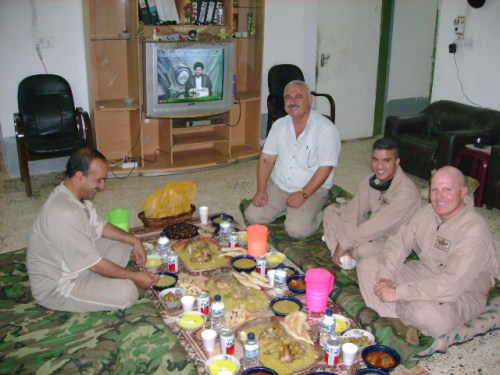
For those who fought in Normandy and those civilians who lived through it the memories are still vivid. Many suffer the effects of PTSD, grief and other wounds, physical, emotional and spiritual.  When one is exposed to the danger and destruction of war, the smell of death, the sight of burned out cities, vehicles and the suffering of the wounded and dying, it makes for a lifetime of often painful memories.

For some of the German, British and American veterans, the struggle in Normandy has given way to long lasting friendships.  Those who fought against each other were soon allies as part of NATO and soldiers of nations which were once bitter enemies serve together in harm’s way in Afghanistan.  The generation that fought at Normandy is rapidly passing away, their numbers ever dwindling they remain a witness to courage, sacrifice and reconciliation.

In the end it is reconciliation and healing that matters. Some scars of war never pass away; some memories are far too painful to release.  Yet we strive to reconcile.  In 2002 while deployed at sea for Operation Enduring Freedom I was an advisor to a boarding team from my ship.  It was our job to make sure that impounded ships which were breaking the UN embargo on Iraq were not in danger of sinking, and that their crews had food, water and medical care.  Since many of these ships remained at anchor for 2- weeks in the heat of the Arabian Gulf, this was important.  The delays imposed by UN rules sometimes meant that the sailors of these ships grew resentful.  It was my job to spend time with the Master’s of these ships to keep things calm and work out any issues that arose.  On one of these ships I met an Iraqi merchant skipper.  The man was well travelled, educated in the U.K. in the 1960s and in his career a frequent visitor to the US. In 1990 he was the senior captain of the Kuwaiti shipping line.  Then Saddam Hussein invaded Kuwait.  As a result of this when Kuwait was liberated he lost his job.  His nation was an international pariah.  Since his life was the sea he took up the only job possible to support his family, what he knew best, captaining ships.  He was most apologetic for the trouble that he and others like him caused us.  We shared much during those visits.   One of his daughters was in medical school and other children in university.  He longed for the day when Iraq would be free.  On our last talk before his ship was released he remarked to me “I hope one day we will meet again.  Maybe someday like the American, British and German soldiers after the war, we can meet in a pub, share a drink and be friends.”  I too pray for that.  Maybe someday we will.  I only hope that he and his family have survived the war and are doing well.

Dinner w BG SabahBeginnings of Reconciliation: Old Enemies, New Friends General Sabah and Me, Ramadi 2007

God bless all those who fought at Normandy and give your peace to all who have served since then. Be with our troops as they serve in Iraq and Afghanistan. Heal the wounds of war and bring your peace to the nations. Amen

Peace, Steve+

3 Comments

Filed under Foreign Policy, History, iraq,afghanistan, Military, PTSD, world war two in europe