Tag Archives: nazi party

The Fever and the Fear

IMG_0493.JPG

http://movieclips.com/FkTn-judgment-at-nuremberg-movie-dr-janning-explains-his-actions/

Friends of Padre Steve’s World 

My wife is going through surgery today and I have been in the hospital waiting room for a while. I’m anxious, as the surgery is a total hysterectomy being done because she was diagnosed with endometrial cancer. While statistics tell us that the surgery should be the cure, there are some cases where the cancer has spread. Though I am well trained as a clinician and have worked many years in hospital intensive care units and other critical care areas, I don’t wait well and as much as I try to focus on the positive there is always the “what if” it is worse than expected which is in the back of my mind. Truthfully, Judy is the control rod in my nuclear reactor. She keeps me from really doing stupid things and if she weren’t around I would probably be like William Shatner’s character in Boston Legal, Denny Crane. Thankfully the surgeon came out a little while ago and told me that things look good, that Judy did fine in surgery. The only thing now is to wait for a few days to find out if pathology declares her free and clear of the cancer. 

So I decided to go back and edit an older post about something that does concern me, the climate of fear and hate that seems to me to be driving much of the political minded preachers, pundits and politicians of the Christian Right. Like so many of my articles this may be uncomfortable for people who are unfamiliar with history, or those who simply believe what the politicians, pundits and preachers tell them. 

So with that in mind, I hope that you have a good day and please, if you pray, please pray for Judy and pray for me, your miscreant Padre,

Peace

Padre Steve+ 

I have written a number of times about the lack of empathy among conservative American Christians. In those articles I drew some comparisons to the German Christians of the 1920s and 1930s who despite the reservations of a few, supported ultra-right wing nationalist parties and later the Nazi Party.

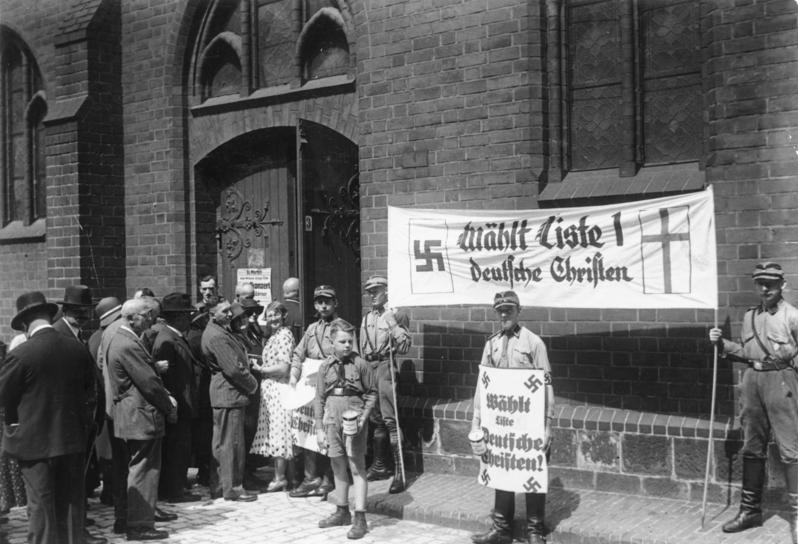
ADN-ZB/Archiv Kirchenwahl am 23.7.1933 in Berlin. Wahl in der Marien Kirche am Neuen Markt. Nazistische Wahlpropaganda unter Maske des Christentums.

ADN-ZB/Archiv
Kirchenwahl am 23.7.1933 in Berlin. Wahl in der Marien Kirche am Neuen Markt. Nazistische Wahlpropaganda unter Maske des Christentums.

Much of the support was brought about by the fear and hate propagated by those who had lost their favored status after the collapse of the Kaiser Reich. There was a lost war, a harsh peace, as well as social and economic chaos. Political radicalism and violence was common in the early years of the Weimar Republic, and many Christians of all denominations became caught up in it. Many Christians were especially fearful of what many believed was the threat of atheistic Socialists and Communists. The brief experiment with democracy was devastated by political battles, the 1919-1920 Weimar Inflation which destroyed the financial security of most Germans, as well as the Stock Market Crash of 1929. The Great Depression made the economic, political and social chaos worse, and this made many people, including many conservative Christians receptive to the “Nazi Gospel.”

I think that conservative American Christians are going the same direction as they get swept up in the climate of fear, hate, distrust and perceived persecution at the hands of liberals, atheists, socialists and their own government. As I have noted in other articles much of this stems not from actual persecution but from the loss of their privileged position as the dominant force in society.

596554178-franz-pfeffer-von-salomon-sa-fuehrer-3 -reichsparteitag-julius-streicher

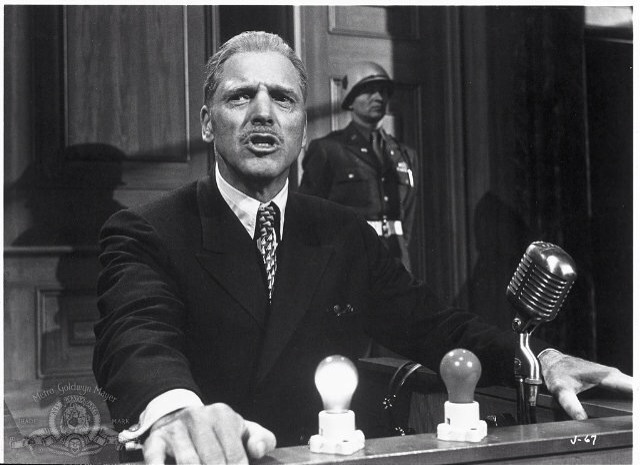
I love the film Judgment at Nuremberg, because I think that it really does reflect how many prominent Germans who should have known better followed Hitler, and reflects how many conservative Christians see the political right as their standard bearers.. In the film Burt Lancaster plays a prominent German legal scholar and jurist named Ernst Janning.

“There was a fever over the land. A fever of disgrace, of indignity, of hunger. We had a democracy, yes, but it was torn by elements within. Above all, there was fear. Fear of today, fear of tomorrow, fear of our neighbors, and fear of ourselves. Only when you understand that – can you understand what Hitler meant to us. Because he said to us: ‘Lift your heads! Be proud to be German! There are devils among us. Communists, Liberals, Jews, Gypsies! Once these devils will be destroyed, your misery will be destroyed.’ It was the old, old story of the sacrificial lamb. What about those of us who knew better? We who knew the words were lies and worse than lies? Why did we sit silent? Why did we take part? Because we loved our country! What difference does it make if a few political extremists lose their rights? What difference does it make if a few racial minorities lose their rights? It is only a passing phase. It is only a stage we are going through. It will be discarded sooner or later. Hitler himself will be discarded… sooner or later. The country is in danger. We will march out of the shadows. We will go forward. Forward is the great password. And history tells how well we succeeded, your honor. We succeeded beyond our wildest dreams. The very elements of hate and power about Hitler that mesmerized Germany, mesmerized the world! We found ourselves with sudden powerful allies. Things that had been denied to us as a democracy were open to us now. The world said ‘go ahead, take it, take it! Take Sudetenland, take the Rhineland – remilitarize it – take all of Austria, take it! And then one day we looked around and found that we were in an even more terrible danger. The ritual began in this courtoom swept over the land like a raging, roaring disease. What was going to be a passing phase had become the way of life. Your honor, I was content to sit silent during this trial. I was content to tend my roses. I was even content to let counsel try to save my name, until I realized that in order to save it, he would have to raise the specter again. You have seen him do it – he has done it here in this courtroom. He has suggested that the Third Reich worked for the benefit of people. He has suggested that we sterilized men for the welfare of the country. He has suggested that perhaps the old Jew did sleep with the sixteen year old girl, after all. Once more it is being done for love of country. It is not easy to tell the truth; but if there is to be any salvation for Germany, we who know our guilt must admit it… whatever the pain and humiliation.”

Hannah Arendt talked about this in her book Eichmann in Jerusalem: A Report on the Banality of Evil, her treatment of the trial of Adolf Eichmann, one of the mid-level Nazi officers who sent millions of people to their deaths. In describing Eichmann and other ordinary people Arendt said:

“The trouble with Eichmann was precisely that so many were like him, and that the many were neither perverted nor sadistic, that they were, and still are, terribly and terrifyingly normal. From the viewpoint of our legal institutions and of our moral standards of judgment, this normality was much more terrifying than all the atrocities put together.”

At the end of the movie Judgment at Nuremberg Spencer Tracy as Presiding Judge Dan Haywood concluded his sentencing remarks with this statement. It is perhaps one of the most powerful statement and something to remember as the Unholy Trinity of Politicians, Pundits and Preachers urge us to hate one another and those different than us. It is something that is especially needed in times of great societal stress as well as real and perceived dangers from without and within.

IMG_2182.JPG

http://www.youtube.com/watch?v=N3BwK51YFgQ

“Janning, to be sure, is a tragic figure. We believe he loathed the evil he did. But compassion for the present torture of his soul must not beget forgetfulness of the torture and the death of millions by the Government of which he was a part. Janning’s record and his fate illuminate the most shattering truth that has emerged from this trial: If he and all of the other defendants had been degraded perverts, if all of the leaders of the Third Reich had been sadistic monsters and maniacs, then these events would have no more moral significance than an earthquake, or any other natural catastrophe.

But this trial has shown that under a national crisis, ordinary – even able and extraordinary – men can delude themselves into the commission of crimes so vast and heinous that they beggar the imagination. No one who has sat through the trial can ever forget them: men sterilized because of political belief; a mockery made of friendship and faith; the murder of children. How easily it can happen. There are those in our own country too who today speak of the “protection of country” – of ‘survival’. A decision must be made in the life of every nation at the very moment when the grasp of the enemy is at its throat. Then, it seems that the only way to survive is to use the means of the enemy, to rest survival upon what is expedient – to look the other way. Well, the answer to that is ‘survival as what’? A country isn’t a rock. It’s not an extension of one’s self. It’s what it stands for. It’s what it stands for when standing for something is the most difficult! Before the people of the world, let it now be noted that here, in our decision, this is what we stand for: justice, truth, and the value of a single human being.”

einsatzgruppen executions

Einsatzgruppen Members finishing off Jewish Women

This is an unsettling subject and people on the political right and left in this country are apt to compare their opponents to those that were tried at Nuremberg and those that led them. This has been an increasingly disturbing trend in the case of hyper-partisan Right Wing and so called Conservative Christians who blatantly demonize those who they hate and urge the use of the police powers of the state to enforce their political-religious agenda. For all intents and purposes they no longer care about “Justice, truth, or the value of a single human being” especially if those human beings are not Christians. That may seem harsh, but sadly it is all too often the truth.

The terrible truth is that it is possible that any parties in any society, including ours, when divided by fear, hate and the desire for power can behave exactly as the industrialists, financiers, doctors, soldiers, jurists, civil servants, pastors and educators who oversaw the heinous crimes committed by the Third Reich.

Again, I am not calling anyone, even the people that I am criticizing today Nazis. I am only trying to show the logical end of the thinking that permeates much of the political right, particularly conservative Christians who are following a path that is destructive to the church and for the world. As Dietrich Bonhoeffer said: “if you board the wrong train, it is no use running along the corridor in the other direction.” By selling their birthright to right wing radical politicians and special interest groups who only seek to exploit them for their own power, conservative Christians, like those in the Weimar Republic have boarded the wrong train, and unless they get off that train they will find that they have no redemptive value in society.

Sadly, I doubt that Sarah Palin, Ted Cruz, Mike Huckabee, Michelle Bachmann, Tony Perkins or any of the myriad of pundits, politicians and preachers driving conservative Christians off the rails will ever understand this. Thinking themselves wise, they became fools. Fools who in their quest for temporal power destroyed more lives and souls than they ever could have imagined.

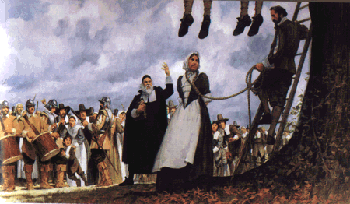
dyer-hanging

Executing Quakers in the Massachusetts Bay Colony 

Unlike Janning, I doubt if any of them have the capacity to reflect upon their words and actions and realize what they did and are doing are morally, ethically and by every measure of humanity are wrong, and are evil masquerading as righteousness, and thus doubly worthy of condemnation, for if they are Christians they should know better. I only hope that the vast number of conservative Christians who have not completely fallen for their hateful propaganda; men and women who have doubts about the message of such leaders are able to discern the truth will pause for just a moment, and like Bonhoeffer and others like him stand for justice, truth, or the value of a single human being.

Those who stood trial at Nuremberg were all people that should have known better, as should we, especially those who claim the name of Christ and presume to be bearing his good news.

Peace

Padre Steve+

Leave a comment

Filed under ethics, faith, film, History, movies, nazi germany, Political Commentary, Religion

Wade Page Nazi Thug versus the Respectable Nazis

Wade Page, the gunman who walked into a Sikh temple in Oak Creek Wisconsin and opened fire killing 6 members of that community was a Nazi thug. A member of the “Hate” music scene Page was a virulent racist and anti-semite. Even some of the bigger Neo-Nazi groups condemned Page’s action. However, that does not mean that they disapproved of what happened, just that the blatantness of Page’s action embarrassed them.

Page and his thuggish brothers are much like the Brownshirts, the Nazi bullies that intimidated anyone who stood in their way prior to the Nazi seizure of power and in its immediate aftermath.  They were useful tools of smarter and more respectable Nazis but often proved an embarrassment to the party. When the Sturmabteilung, the SA Brownshirts became a political liability Hitler and the SS made an alliance to eliminate the SA leadership and sharply reduce that organization’s power in the Third Reich. Men like Heinrich Himmler and Reinhard Heydrich who planned and executed the Holocaust  held such thugs in contempt.

Page has put Neo-Nazi leaders and sympathizers on the spot. While Neo-Nazi and others like them believe and preach White Supremacism, anti-Semitism, and racism they at least publicly distain murder of people at worship. It is very hard for them to defend him to do so would be to expose themselves. However, I wonder if the victims had been Moslems if they would have condemned the action at all.

Despite the brutal nature of Page’s massacre of the Sikhs, his type of White Supremacist or Neo-Nazi is less dangerous to society than the “respectable” Nazis. In the 1920s and 1930s the quiet and “respectable” Nazis remained in the background. The were lawyers, judges, economists, police officials, teachers, engineers and physicians. They mingled with the mainline conservatives, nationalists and even monarchists. They served as civil servants, education or in the private sector and remained in the background. They were the respectable front of National Socialism. Many kept their party membership hidden from colleagues even as Hitler built bridges with industrialists, bankers and brought their party to the forefront of the German political scene.

After the seizure of power they were the men that drafted the Nuremberg Laws and the Enabling Act. They wrote laws on forcible sterilization, they ran the political, economic and bureaucratic organizations that used slave labor to power their economic machine. They sat around a table at Wansee and dictated the Final Solution to the “Jewish problem”  They were the men that engineered the Holocaust. But unlike the Brownshirt “thugs” of the SA they were respectable and tried to keep their hands clean.  Without them Hitler could not have succeeded in gaining absolute power or keeping it.

It is the respectable Nazis who hold back their more virulent ideas for the time that they can use the political system that they despise to gain power and government agencies that they rail against to enforce their agenda. This is exactly what National Socialist Movement leader Brian Culpepper of Tennessee advocates. He said “We insert ourselves into the infrastructure of other established parties due to the bias against us and the difficulty of third parties getting ballot access….” and that “We have people working with the most recent incoming class of freshmen in the House,…And they don’t even know it.”

The Wade Page type of Neo-Nazi or White Supremacist is easy to spot and until they do something heinous like Page did in Oak Creek most of us don’t take them seriously. Covered in racist tattoos and playing in bad bands they hardly seem a credible threat until they are caught committing a serious crime or murder.

However, people that hold similar views but are more subtle in their methods and presentation are much more dangerous. Just as men like Wilhelm Frick, Hans Frank, Wilhelm Stuckart, Ernst Kaltenbrunner and Otto Olhendorf were in the Third Reich these men and women are often well educated, come from good homes and mingle quite well. They lead think tanks, write commentary in national and local publications, websites and even provide commentary on cable news programs. They promote fear and pedal conspiracy theories involving those that they distain, accuse opponents of trying to destroy the country and refer to their opponents as liberals, socialists or communists or in league with radical Islamists. They publicly disavow violence but their ideology is that which those that commit violence use as justification for their acts.

Wade Page is a troubling figure but even more troubling those that hold the same views  and given the right circumstances have the money and political capital to bring them to fruition. One only has to look at the history of the Weimar Republic to see how easily this can happen.

Peace

Padre Steve+

1 Comment

Filed under History, News and current events, Political Commentary

The German Revolution 1919-1922: A Warning from History

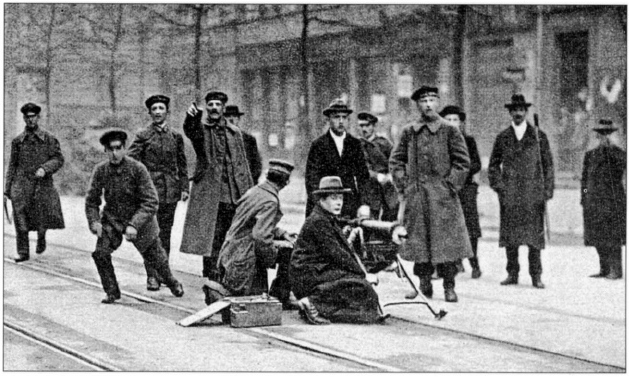
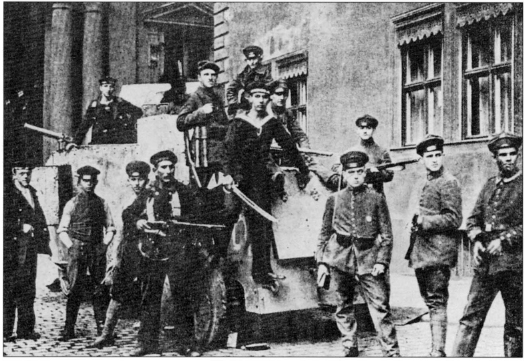
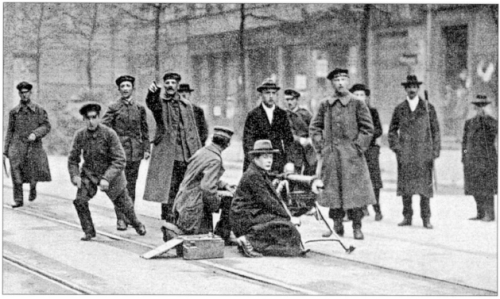
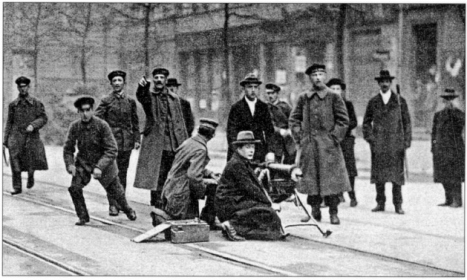
The Spartacus League brought armed mobs onto the streets of the new and fragile Weimar Republic 

In light of the increasing revolutionary rhetoric from both the political right and left, the ongoing demonstrations in many American cities that are part of the Occupy Wall Street Campaign I felt that it was important to remind people of what can happen when a society enters a revolutionary period. When a nation is in turmoil and is besought by political division and ineffective and out of touch government, a massive economic problems, wars that are believed to be lost and veterans that feel abandoned by their government and isolated from their fellow citizens and what some see as massive economic inequities, or lack of respect for their political, social or religious views then it is facing real danger. It is my belief that we need as individuals and as a nation take a step back from the brink. 

Peace, Padre Steve+

The German Revolution of 1919 and civil war is important for those who study highly developed states when they enter a period of social and political upheaval. Often such upheavals occur following military defeats or economic crisis that cause the society to question or even overthrow the established order.  The end of Imperial Germany and the establishment of the WeimarRepublicon November 9th 1918 is a prime example.  Following the declaration of the Republic the Majority Socialists who had assumed power had no military force of any caliber to support it. The Army had melted away following the end of the war and the units which remained were unreliable and heavily infiltrated by Soviet style “workers and soldiers councils.”

Chaos ruled the streets, Communists and Independent Socialists of The situation being chaotic the Majority Socialists under the leadership of Friedrich Ebert joined forces with German General Staff to create a military force capable of bringing order the Germany.  To do this they allowed for the formation of Freikorps to quell revolutionary chaos and avert the establishment of a Soviet State.

The study begins with the establishment of the Republic and concludes with the Kapp Putsch.  This is an era that is seldom referenced by political or military leaders in western states and historians themselves are often divided in their interpretation of the subject.  The study of this period is vital to those who study politically polarized societies which are either war weary or have suffered the shock of military defeat coupled with a government which is blamed for the events.  Thus, it is important to study the relationship of the military to the government and in particular the military’s relationship to politicians who have little connection to or affinity for the military, its traditions and culture and the often adversarial relationship of these politicians to military leadership which often sees them as adversaries.  The period also shows how actions of those who in their antipathy to the military create a climate where the military loathes the civilian leadership and the government.  The results of such conditions can endanger the society as a whole and ultimately usher in periods of great tragedy.  This occurred inWeimarGermanywith the result that the military in the later years of the Republic neither the military nor the Majority Socialists could not work together against the Nazi takeover of the state.  However, the first years of the relationship set the tone and foredoomed the Republic.

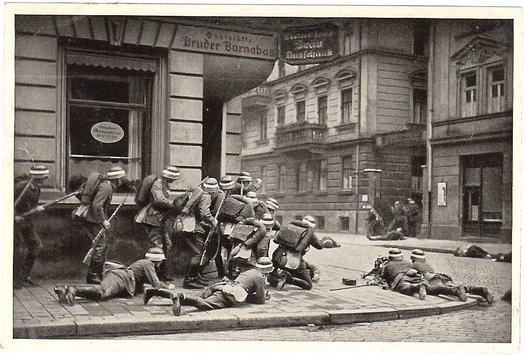
Freikorps troops battle Leftists in the streets

The history of Weimar, particularly that of the military and Freikorps in their relationship to the Republic is complex.  Not only is the relationship between the military and government complex, but the Freikorps themselves, their organization, leadership and political affiliation were not monolithic as is sometimes maintained,[i] nor were the Freikorps the direct ancestors of the Nazi SS/SA organizations despite often similar ideology,[ii] nor can they dismissed by saying that they were composed of “former soldiers and officers ill-disposed to return to civilian life.”[iii] The Freikorps’ association with the Army and Republic is more complex than some historians assert.  Despite the right wing leanings of many of units and fighters and future association of some to the Nazis, the blanket claim that the Freikorps were forerunners of the Nazi movement is not supportable.[iv] It is true that without Freikorps support in Munich, along with support of the Thule Society, business leaders and others “that the transition of the DAP into the Hitler party could not have taken place.”[v] It is also true that elements of the Freikorps branded too revolutionary and unruly for service in the Army continued as secret societies and affiliated themselves with various right-wing political groups.[vi] Likewise a case can be made that the fierceness of many Freikorps veterans, younger leaders of the Army laid the foundation for the brutality of both the Army and Waffen SS as they prosecuted the Second World War.[vii]

Yet simply because certain aspects of a subject are true does not make for a broader “truth.”  Heinz Höhne argues the reverse of what some have written in regard to the relationship of the Freikorps and Reichswehr to the Nazis, that in fact the Nazis did not issue from the Freikorps, but rather that many former members of the Freikorps, Imperial Army or the Reichswehr were attracted to the Nazis, particularly to the SS by its “philosophy of “hardness” and its attitude of bellicosity per se, basically unconnected with ideology.”[viii] Others historians state similar views especially those that study the relationship of the Reichswehr leadership to the Freikorps.  Thus the thesis of this paper is that the historiography like the period itself is complex; that the composition, leadership and motivations of the Freikorps were not monolithic, nor were they beloved by the Reichswehr, nor were they the “trailblazers” for the Nazi movement.  The focus of this article is on the relationship of the Reichswehr and the Freikorps to the Republic to the Kapp Putsch and the dangers of a relationship built on necessity without mutual trust.  Such a relationship is dangerous and can lead to unintended consequences.   This paper will explore the first years of theWeimarRepublic and specifically look at several key events that were pivotal in the relationship between the Army and Freikorps and the Majority Socialists.
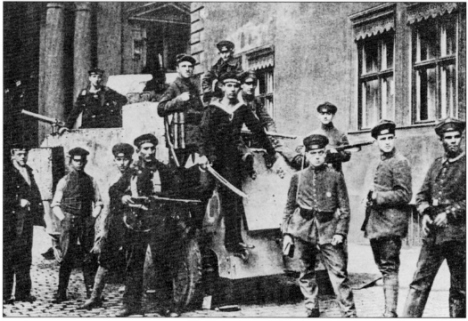
The Leftist “Volksmarine” Division which terrorized Berlin in late 1918 and early 1919 

The literature covering this period ranges from well written and researched academic histories and poorly researched and badly done works which attempt to present particular views of the Freikorps which often border on myth. Additionally there are biographical works which shed some light on the subject. The Reichswehr and the German Republic 1919-1926 by Harold Gordon Jr. is perhaps the best study of the Freikorps and their relationship to the state and the army.  Gordon’s work is exceptional in documenting the numbers, types, political affiliation, action and ultimate disposition of the Freikorps.  Other works which provide exceptional treatment of the relationship between the military and the Republic include The History of the German General Staff by Walter Goerlitz; The Nemesis of Power: The German Army in Politics 1918-1945 by John Wheeler-Bennett, The Reichswehr and Politics 1918-1933 by F.L. Carsten and The Politics of the Prussian Army: 1640-1945 by Gordon A. Craig.

The best of the general histories of the period, which focus on the National Socialist state are The German Dictatorship by Karl Dietrich Bracher, and Richard Evans’ The Coming of the Third Reich. Richard Watt’s The Kings Depart is one of the best for telling the story of the fall of the Empire and the revolution in Germany.  Watt’s account is well written and documented work and touches on other factors affecting the new republic including Versailles and Allied political actions. The final chapter of Holger Herwig’s The First World War: Germany and Austria-Hungary 1914-1918 gives a good account of the Army’s role in the end of the Empire and beginning of the Republic.  Andreas Dorpalen’s Hindenburg and the Weimar Republic adds an interesting dimension of Hindenburg’s role in the republic’s formation and negotiations between Groener, Noske and Ebert while Steven Ozments’ history of Germany A Mighty Fortress is superficial in its treatment of the period.  Nigel Jones’ Birth of the Nazis: How the Freikorps Blazed a Trail for Hitler is an interesting and somewhat entertaining but poorly documented work. Jones tends to “broad brush” the Freikorps in sometime as “sensationalist” manner. His book has none of the detail or nuance of Gordon, Craig, or Carsten on the Freikorps. Nor does Jones have the depth of Goerlitz or Wheeler-Bennett on the Republic’s relationship with the Army, or the attitude of the Reichswehr leadership to the Freikorps.  William Shirer’s The Rise and Fall of the Third Reich, Gerald Reitlinger’s The SS: Alibi of a Nation 1922-1945 and Heinz Höhne’s The Order of the Death’s Head.  All of these works add some information which details Nazi involvement in the early part of theWeimarRepublic but are limited in their coverage of the subject.

Of other works, Kenneth Macksey’s Why the Germans Lose at War has an insightful but short chapter dealing with this period and Wolfram Wette’s The Wehrmacht: History, Myth, Reality offers an interesting and at times provocative look at anti-Semitism in the German military in the years following the First World War.  Carlos Caballero Jurado’s The German Freikorps 1918-1923 is a short but very detailed study of Freikorps organizations and actions.  B.H. Liddell-Hart has a small chapter on General Von Seeckt in The German Generals Talk which hasinteresting commentary on later actions of former Reichswehr officers who served the Nazi state.

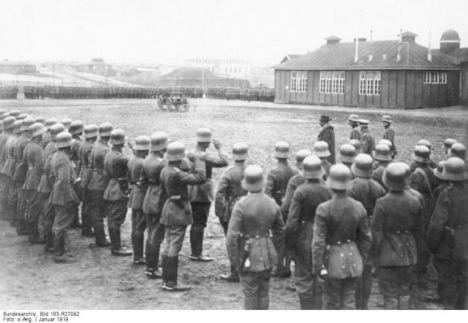
Freikorps Von Hulsen being sworn into the Provisional Reichswehr

A number of biographies touch on actions of German Officers who played key roles in World War Two.[ix] Most auto-biographies gloss over the Weimar period; however Admiral Reader’s memoir Grand Admiral offers the insight of a naval officer with some direct observation of the revolution and the Kapp Putsch.  Guderian in Panzer Leader omits his service in the Baltic “Iron Division.”

The relationship of the Republic to the Army was born in the moment of crisis of the abdication of Kaiser Wilhelm II and the armistice discussions with the Allies.  Beset by revolts in key naval bases and mutinies aboard ships of the High Seas Fleet and unrelenting Allied pressure on the German armies in the west the situation continued to deteriorate as the “red flag was flying in all the principle cities, soldiers behind the front were electing soldiers councils Russian fashion.”[x] Revolutionary and defeatist propaganda spread by the radical left wing of the Independent Socialists and Spartacus League spread through the country and even affected combat units,[xi] while the “Majority Socialists had found out that the militant factions of the Independents had secretly armed themselves out of funds supplied by the Soviet ambassador and adopted the slogan “all or nothing.””[xii] The situation had deteriorated so badly that Karl Liebknecht, leader of the Spartacus League “was announcing the establishment of a Soviet regime from the steps of the Imperial Palace.”[xiii]

Under these dire conditions, General Wilhelm Groener who had succeeded General Ludendorff as Quartermaster General called an emergency meeting of fifty “of his most senior army commanders.”[xiv] In response to his question of whether the troops would follow the Kaiser and oppose the revolts only one answered in the affirmative, and eight responded that “there was no hope of using regular Army units to quell unrest at home.”[xv] On November 9th Groener went to the Kaiser on behalf of the Supreme Command and in response to a suggestion that the Kaiser lead the Army back and suppress the revolts boldly stated “The Army will march home in peace and under its leaders and commanding generals, but not under the command of Your Majesty, for it stands no longer behind Your Majesty.”[xvi] The Emperor abdicated fleeing to Holland and Friedrich Ebert leader of the Majority Socialists was named Chancellor on November 9th.  Upon hearing the news Philipp Scheidemann a leader in the Social Democrats announced that Ebert was Chancellor proclaimed “Long live the great German Republic!”[xvii] It was an ill conceived act as Scheidemann had not consulted Ebert and his act prevented Ebert from working toward an orderly transition of power.

The mobs in the street were not placated by the announcement and the far left organizations aligned with the Independents “had no intention of letting the revolution stop there.”[xviii] In the streets of Berlin soldiers sold their weapons and vehicles officers were attacked by crowds on the streets and whenever “crowds found an Army officer, they tore off his epaulettes and medals.”[xix] Everywhere mutual recrimination was in the air, soldiers “blamed revolutionaries for the betrayal and stab-in-the back while revolutionaries blamed officers for all the costs and losses of the war.”[xx]

Groener called Ebert promising the Army’s support of the new government in return for the government’s assistance to the Army in the maintenance of discipline and supply.[xxi] He also drafted a letter signed by Hindenburg pledging the Army’s loyalty and telling him that “the destiny of the German people is in your hands….”[xxii]One source notes: “Thus, in half a dozen sentences over a telephone line a pact was concluded between a defeated army and a tottering semi-revolutionary regime; a pact destined to save both parties from the extreme elements of revolution but, as a result of which the Weimar Republic was doomed at birth.”[xxiii]

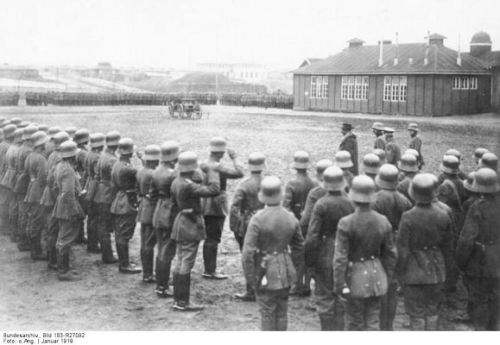
The High Command was able to bring the Army home in good order following the armistice but upon arriving most units “melted away like snow under a summer sun,”[xxiv] those which remained were often shells of their former selves beset by soldier’s councils and leftist revolutionaries.  To support the government the High Command issued a directive stating that it “put itself as the disposal of the present government led by Ebert without any reservation.”[xxv]Yet in December delegates of the National Assembly continued to sow resentment in the military by military discipline be placed in the hands of soldiers’ councils, that all badges of rank be removed with all decorations of insignia and honor.[xxvi] Reaction was heated,[xxvii] but despite this Groener, Colonel Walter Reinhardt, the Prussian Minister of War and the Republic’s Defense Minister, Gustav Noske endeavored to find forces to combat the growing revolution and rebellious military units.  The choice was not hard, the Army was of no use, so called “democratic forces” were in most cases both unreliable and ineffective, while only the Freikorps “provided suitable material for the immediate creation of an efficient, combat-ready army.”[xxviii] Thus the Freikorps became the instrument of necessity to ensure that the government was not swept away by a Soviet style revolution.

Gustav Noske, of the Majority Socialist party “saw himself as a patriot, a man of action…who had no time for theories…and was one of the few Socialists that the Supreme Command trusted.”[xxix] He had already distinguished himself by helping to bring under control the sailors revolts in Kiel by forming a loyal “Naval Brigade”[xxx] and he  “realized that the government must have a dependable military force behind it if it was to survive and rule Germany” and the “old Officer Corps must be the backbone of any such force.”[xxxi] The Army had melted away and units of the workers and soldiers councils were poorly trained, organized and led “”fought against the government as often as for it” and “were of little practical value to either the government or the rebels.”[xxxii] In the chaos of a Spartacus, now called the German Communist Party uprising and vacuum of political leadership of January 1st 1919 agreed to become defense minister stating “Someone must be the bloodhound, I won’t shirk the responsibility!”[xxxiii]

Noske helped by the High Command helped organize volunteer units led by officers and NCOs composed of reliable veterans.  Freikorps varied in size from divisions to companies and were led by Generals down to Sergeants and even a Private First Class.  Their greatest success was in early 1919 when the Republic was beset by “Red” revolutions in many major cities.  Without the use of the Freikorps by the government it is unlikely that the Republic would have survived.[xxxiv] On January 4th Ebert and Noske reviewed the troops of General Maercker’s Freiwillege Landesjaegerkorps and Maercker informed them that every volunteer had pledged loyalty to the government, seeing the discipline and order Noske told Ebert “Don’t worry. Everything is going to turn out all right now.”[xxxv]

On January 5th 1919 the leftist mobs attacked the Chancellery and the officers of the Socialist Vörwarts newspaper. Noske led the Freikorps back into Berlin [xxxvi] to regain control of the city for the government [xxxvii] and crushed the revolt.  Among the casualties were Spartacus leaders Karl Liebknecht and Rosa Luxemburg who were lynched by the officers of the Guards Cavalry Rifle Division.[xxxviii]

In March 1919 after a period of uneasy calm the Freikorps, now reinforced by the 2nd Naval Brigade, or Ehrhardt Brigade[xxxix] were called upon to put down the revolt of the leftist “People’s Naval Division.”[xl] Making liberal use of heavy weapons including tanks the Freikorps inflicted heavy losses on the leftists who lost over 1500 dead and 12,000 wounded in the uprising.[xli] Other revolts were crushed and the Freikorps reached their zenith in Württemberg where Freikorps led by Lieutenant Hahn, a Social Democrat put down leftist revolts[xlii] and in Bavaria where Independents and Communists had taken the city with their “Bavarian Red Army” which numbered nearly 25,000 men[xliii] on April 7th.

After failed attempts by the Socialist led Bavarian government to retake Munich, they asked for Berlin’s help.  Violence and massacres of citizens by the various leftist groups inflamed the Freikorps, including the Ehrhardt Brigade and the revolt was crushed by May 2nd.[xliv] Dorpalen called the Freikorps ruthlessness “completely unwarranted in view of the weakness of the opposing forces” and noted though they broke the leftist powers they deepened the nations’ cleavages”[xlv] while Macksey wrote that “where Freikorps’ brutality stained the pages of history there was invariably a forgoing or simultaneous record of excess by their sworn opponents.”[xlvi]

There was a tension between many in the Reichswehr and those on the German left and this came out in many ways as officers were caught in between various political camps while attempting to conduct their duties. Field Marshal Albert Kesselring recounted with great bitterness his experience:

“My cup of bitterness was full when I saw my devoted work rewarded by a warrant for my arrest for an alleged putsch against the socialist-influenced command of my III Bavarian Army Corps. Notwithstanding the degrading episodes during my imprisonment after 1945, I do not hesitate to describe this as the most humiliating moment of my life.”[xlvii]

The end of the Freikorps era began when the Provisional Reichswehr was established on March 6th 1919. The High Command assembled from Freikorps, remaining Army units and Republican defense forces. There was a great distrust between many in the Army, the remaining Freikorps and the Socialists. When the German delegation to Treaty of Versailles signed the treaty under threat of invasion it provoked a crisis. Noske and others threatened resignation over the war guilt clauses, but Groener warned that if the treaty was rejected the Army could not win against the Allies if hostilities were renewed.[xlviii] The treaty imposed harsh limitations on the German Army which many bitterly resented, however, Seeckt, the Chief of Staff of the Army felt that it was “more important to keep the Army in being and preserve the possibility of a military resurrection.”[xlix] Yet by signing the treaty the government lost the support of many officers who looked to General Walther von Lüttwitz, the Reichswehr’s senior commander, and commander of troops in the Berlin area for leadership.[l]

Revolution from the Right: The Kapp Putsch

Lüttwitz, leaders of certain Freikorps, right-wing groups and individuals made plans to overthrow the government.  They favored revolt against the government, but “their political aims were hazy.”[li] Army leadership recognized the threat posed by disaffected Freikorps and their leaders. Seeckt and Reinhardt felt it necessary to demobilize Freikorps who’s ill-discipline and political radicalism was a “danger to the consolidation desired by the army command.”[lii] The plotters sensed a threat to their plans for a putsch and Lüttwitz found a willing co-conspirator in Wolfgang Kapp, a failed politician.  Lüttwitz took action when the High Command ordered the 2nd and 3rd Naval Brigades be demobilized in compliance with Versailles treaty limitations and their radical views.[liii] Over the opposition of his chief of staff Von Lüttwitz began planning a coup, in his mind, to save Germany.[liv] The key unit in Lüttwitz plan was the 2nd Naval Brigade Commander by Korvettenkapitän (Lieutenant Commander) Ehrhardt.

Lüttwitz and his fellow conspirators showed “little regard for coordination of effort” and demonstrated “a quite amazing ability to work at cross purposes.”[lv] On March 12th without consulting Kapp, Lüttwitz and Ehrhardt launched the Putsch and Ehrhardt’s brigade in full battle dress entered Berlin. At this point the Reichswehr command froze; officers refused to condone the putsch but at the same time refused to support Noske and Reinhardt who demanded armed opposition to the coup,[lvi] while most Navy officers openly supported it.[lvii] Seeckt who did not want to see the army set against itself refused to deploy troops to counter Ehrhardt’s men.  He declared that “Troops do not fire upon troops!” and “When at occurs, then the true catastrophe, which was avoided with so much difficulty on November 9, 1918 will really occur.”[lviii] Despite the lack of support by the army the coup died amid massive strikes by workers and lack of popular support. However the damage done to the Reichswehr’s relationship to the government, especially the more moderate Majority Socialist was severe.

In the wake of the putsch Noske resigned, many officers in were discredited[lix]and dismissed including Lüttwitz and Admiral Von Trotha, head of the Navy, who openly supported the coup.[lx] Admiral Erich Raeder in his memoirs says that Von Trotha and the Navy staff only” thought of anything of complete loyalty to the government.” [lxi]

However the actions of the Navy leadership showed otherwise. The uncomfortable relationship which had endured the dire days of the Republic was ended.  The Reichswehr would emerge a lean and highly trained organization and remain a power broker in the Republic.  However the animosity between the Army and the Socialists was now so great that they could not stand together against the Nazis despite their mutual interest in doing so.[lxii]

Conclusion

The period was a critical and complex and should be studied by anyone living in a state with a powerful military tradition and institutions in crisis.  Unlike popular notions, the Freikorps were diverse and not the seed-bed of the Nazi movement and though many former members would become Nazis.  Several, including Ehrhardt narrowly escaped death at Nazi hands.[lxiii] Freikorps were viewed by Army leadership as an expedient force that could not remain in the service once the Army was functional.

Key lessons include that the military cannot become a “state within a state,” and that both military and civilian leaders must seek to bridge any gulf that separates them in times of crisis.  In Weimarboth the military and the Socialists thoroughly distrusted one another with the result that they eventually, despite early success [lxiv] worked against each other in later years.  Actions by both Socialists and the military ultimately subverted the Republic and ensured its demise and Seeckt’s policy of separation from politics “tended toward a renunciation of the soldier’s potential restraining influence on adventurous statesmen.”[lxv] Such is the fateful lesson for today for those who suggest a military coup to overturn a government that they oppose in much the same manner as those who supported Lüttwitz, Kapp and Ehrhardt.  Such actions only undermine democratic institutions, especially if they are weak and the nation is in crisis.  Often such actions bring about regimes far more dangerous than what they seek to overthrow and compromise the integrity of the military.


[i] Jones, Nigel. The Birth of the Nazis: How the Freikorps Blazed a Trail for Hitler. Constable and Robinson Ltd.London,U.K. 1987 and 2004.  This is Jones assertion and he attempts to make the tie using careers of some individuals who served both in Freikorps and either in the Nazi Party or Military and attitudes common in many Freikorps with similar attitudes found in the Nazi movement.  The 2004 edition of his work includes an introduction by Michael Burleigh echoing his sentiments.

[ii] Evans, Richard J. The Coming of the Third Reich. Penguin Group.London,U.K. andNew York,NY. 2003. pp.227-229.  Evans discusses the fact that the Nazis did have a number of Freikorps veterans but at no point makes the connection that the Freikorps are a direct ancestor.

[iii] Ozment, Steven. A Mighty Fortress: A New History of the German People.Harper-Collins Publishers,New York,NY 2004 p.246

[iv] Gordon, Harold J. Jr. The Reichswehr and the German Republic 1919-1926.Princeton University Press,PrincetonNJ 1957.  Gordon’s work is perhaps the most detailed study involving the Freikorps and the Reichswehr. He is exceptional in discussing the relationship of both with the various political parties including the Nazis.  He refutes this assertion throughout the book.

[v] Bracher, Karl Dietrich. The German Dictatorship. Translated by Jean Steinberg. Praeger Publications, New York, NY 1970. Originally published asDie Deutsche Diktatur: Enstehung, Struktur, Folgen des Nationalsozialismus.Verlag Kiepenheuer & Witsch,Koln undBerlin. 1969. p.101

[vi] Wheeler-Bennett, John W. The Nemesis of Power: The German Army in Politics 1918-1945. St. Martin’s Press,New York,NY 1954 pp. 91-92

[vii] Shepherd, Ben. War in the Wild East: The German Army and Soviet Partisans.HarvardUniversity Press,Cambridge,MA andLondon,U.K. 2004. p.28

[viii] Höhne, Heinz. The Order of the Death’s Head: The Story of Hitler’s SS. The Penguin Group, London U.K. and New York, NY 1969. Translated by Richard Barry. Originally Published as Der Ordnung unter dem Totenkopf.Verlag der Spiegel,Hamburg, 1966. p.54.

[ix] These include Macksey’s biographies of Kesselring and Guderian , Richard Giziowski’s The Enigma of General Blaskowitz. Peter Padfield’s Dönitz: the Last Führer, David Fraser’s biography of Field Marshal Rommel Knight’s Cross, Messenger’s work on Von Rundsedt, The Last Prussian, and Höhne’s Canaris: Hitler’s Master Spy all provide brief but interesting views of the actions and attitudes of these officers during the revolution and during the Weimar period.

[x] Goerlitz, Walter. History of the German General Staff 1657-1945.Translated by Brian Battershaw. Westview Press. Boulder CO and London. 1985 Originally published as Der Deutsche Generalstab, Verlag der Fankfurter Hefte, Frankfurt am Main.  FirstU.S. publication in 1953 by Preager Publishers. p.200

[xi] Gordon, Harold Jr. The Reichswehr and the German Republic 1919-1926.Princeton University Press, Princeton, NJ 1957 pp.4-5 Gordon recounts the story of an entire replacement train revolting when it reached the front which had to be disarmed by a shock battalion.

[xii] Watt, Richard M.  The Kings Depart: The Tragedy of Germany: Versailles and the German Revolution. Simon andSchuster,New York, NY 1968. p.186

[xiii] Wheeler-Bennett, John W. The Nemesis of Power: The German Army in Politics 1918-1945. St. Martin’s Press,New York,NY 1954. p.18

[xiv] Herwig, Holger H. The First World War: Germany and Austria Hungary 1914-1918. Arnold Press a member of the Hodder-Headline Group,London,UK andNew YorkNY 1997 p.445

[xv] Ibid. Herwig. p.445

[xvi] Carsten, F.L. The Reichswehr and Politics 1918-1933. Oxford University Press,Oxford,UK 1966 p.6.  It is noted by a number of author’s that Groener did this, to maintain the unity ofGermany and prevent its division.

[xvii] Ibid. Watt. p.196  Watt notes Ebert’s reaction as being enraged as the proclamation of the Republic technically “invalidated the existing constitution;Germany was now technically without a government.” (p.197)

[xviii] Ibid. Watt. p.197

[xix] Ibid. Watt. p.197

[xx]Giziowski, Richard. The Enigma of General Blaskowitz Hippocrene Books Inc.New YorkNY, 1997. p.65

[xxi] Craig, Gordon A. The Politics of the Prussian Army 1640-1945. Oxford University Press,Oxford,UK 1955 pp.347-348.  Craig gives an interesting account noting the Groener’s call to Ebert shows recognition of the legitimacy of the new government and notes that the offer was somewhat conditional.

[xxii] Dorpalen, Andreas. Hindenburg and the Weimar RepublicPrincetonUniversity Press,Princeton,NJ. 1964 p.26

[xxiii] Ibid. Wheeler-Bennett. p.21

[xxiv] Ibid. Gordon. p.15

[xxv] Ibid. Carsten. p.11. This was of critical importance as Carsten later notes that the Army realized that the government could not survive without its support.  Groener was perhaps the officer who most recognized the situation and endeavored to ensure that “the best and the strongest element of the oldPrussia, was saved for the newGermany, in spite of the revolution.” (p.12)

[xxvi] Ibid. Carsten. p.18 Carsten produces the bulk of the English translation of these points and notes that the anti-military feeling had become widespread.

[xxvii] Ibid. Giziowski. p.66  Giziowski recounts the speech of Hermann Goering in response to the announcement. This shows how such treatment can breed anger and resentment in a military that feels it has been betrayed after serving its country in a long and difficult war: For four long years we officers did our duty and risked all for the Fatherland. Now we have come home, and how do they treat us? The spit on us and deprive us of what we gloried in wearing. I will tell you that the people are not to blame for such conduct. The people were are comrades…for four long years.  No, the ones who have stirred up the people, who have stabbed this glorious army in the back…. I ask everyone here tonight to cherish a hatred, a deep and abiding hatred, for these swine who have outraged the German people and our traditions.  The day is coming when we will drive them out of ourGermany.”

[xxviii] Ibid. Gordon. p.15

[xxix] Ibid. Watt. p.168

[xxx] Ibid. Gordon. pp. 19 and 24.  This was the 1st Marine Brigade, or Brigade Von Roden of which elements would later serve in under the command of other Freikorps such as the Guards Calvary Rifle Division.

[xxxi] Ibid. Gordon. p.14

[xxxii] Ibid. Gordon. p.18

[xxxiii] Ibid. Watt. p.239

[xxxiv] Ibid. Gordon. p.426

[xxxv] Ibid. Watt. p.247

[xxxvi] Thee forces included the Landesjaegerkorps and Guards Cavalry Rifle division.

[xxxvii] Ibid. Gordon. p.30

[xxxviii] Ibid. Wheeler-Bennett. p.36

[xxxix] This was one of two additional Naval Brigades formed by Noske after the success of Naval Brigade Von Roden.  It was one of the most combat effective but unfortunately violent and radical of the Freikorps, it would as we will see be a key unit in the Kapp Putsch but would not be absorbed into the Reichswehr.

[xl] This unit was not a Navy unit at all but was composed of many who were criminals and other rabble. See Gordon, Carsten and Watt.

[xli] Jurado, Carlos Caballero. The German Freikorps 1918-23. Illustrated by Ramiro Bujeiro. Osprey Publishing,Oxford,UK 2001 p.12

[xlii] Ibid. Gordon. p.42  His units were known as Security Companies.

[xliii] Ibid. Jurado. p.13

[xliv] Ibid. Gordon. pp.47-49. An estimated 550 people including 200 innocent bystanders were killed in the fighting.

[xlv] Ibid. Dorpalen. p.29

[xlvi] Macksey, Kenneth. Guderian: Creator of the Blitzkrieg. Stein and Day Publishing,New York,NY 1975 p.45

[xlvii] Kesselring, Albrecht. The Memoirs of Field Marshal Kesselring with a new introduction by Kenneth Macksey. Greenhill Books, London UK. 1997. Translated from the German by William Kimber Ltd. Originally published as Soldat bis zum letzen Tag. Athenaum,Bonn,Germany 1953 pp.18-19

[xlviii] Ibid. Wheeler-Bennett. pp.57-59

[xlix] Ibid. Goerlitz. p.216

[l] Ibid. Wheeler-Bennett. p.61

[li] Ibid. Carsten. p.74

[lii] Ibid. Carsten. pp.74-75

[liii] Ibid. Carsten. p.76  Another consideration is that Noske, Reinhardt and Seeckt all were seeking to retire Lüttwitz.

[liv] Ibid. Gordon. p.97

[lv] Ibid. Craig. p.376

[lvi] Ibid. Carsten. pp.78-79

[lvii] Höhne, Heinz. Canaris: Hitler’s Master Spy. Cooper SquarePress,New York,NY 1979 and 1999. Translated from the German by J. Maxwell Brownjohn, Originally published inGermany by C. Bertelsmann Verlag Gmbh, München. 1976. p. 78.  Canaris also had been suspected of complicity in the murders of Rosa Luxemburg and Karl Liebknecht but was acquitted. (pp.56-71)

[lviii] Ibid. Gordon. pp.114-115

[lix] Among them Maercker who had been such a strong supporter of the Republic in the early days.

[lx] Ibid. Carsten. p.98

[lxi] Raeder, Erich. Grand Admiral. Translated from the German by Henry W. Drexell.United States Naval Institute,AnnapolisMD, 1960. Da Capo Press edition published 2001. p.111. This is interesting as almost all histories implicate the Navy High Command of either some complicity or at least agreement with the Putsch participants.

[lxii] The final part in the drama would come when General Kurt Von Schleicher became the last Chancellor before Hitler.  Schleicher had assisted Groener and Noske in the early days of the Republic and often attempted to use the Army’s influence in politics. He was fatally short sighted and was a victim of the SS “night of Long Knives” which was directed against the SA.

[lxiii] Ibid. Jones. p.266  Others such as Gerhard Rossbach had similar experiences.  Korvettenkapitän Löwenfeld of the 3rd Naval Brigade became an Admiral, Wilhelm Canaris , who was implicated in the Kapp Putsch but kept his career would later head the Abwehr and die in a concentration camp.

[lxiv] Ibid. Gordon. p.426  Gordon has a good discussion of this topic in his conclusion.

65 Liddell-Hart, B.H. The German Generals Talk. Published 1948 B.H. Liddell-Hart, Quill Publications,New York,NY. 1979. p.18 Liddell-Hart’s analysis of the results of the Reichswehr’s disconnection from the larger society and political process is remarkable due to current trends in the American military which like the Reichswehr has become somewhat more conservative and disconnected from society, exceptionally technically proficient but not adept in politics or grand-strategy.

Works Cited

Bracher, Karl Dietrich. The German Dictatorship: The Origins, Structure and Effects of National SocialismTranslated from the German by Jean Steinberg with an introduction by Peter Gay.  Praeger Publishers, New York, NY. 1970 Originally published in Germany as Die deutsche Diktator: Entstehung, Struktur, Folgen den Nationalsozialismus by Verlag Kiepenheuer und Witsch.Koln undBerlin.

Carsten, F.L. The Reichswehr and Politics 1918-1933OxfordUniversity Press,Oxford,UK 1966

Craig, Gordon A. The Politics of the Prussian Army 1640-1945. OxfordUniversity Press,Oxford,UK 1955

Dorpalen, AndreasHindenburg and the Weimar RepublicPrincetonUniversity Press,Princeton,NJ. 1964

Evans, Richard JThe Coming of the Third Reich. Penguin Books,New York,NY andLondon,UK. 2003

Giziowski, RichardThe Enigma of General Blaskowitz. Hippocrene Books Inc.New YorkNY, 1997

Goerlitz, WalterHistory of the German General Staff 1657-1945. Translated by Brian Battershaw. Westview Press. Boulder CO and London. 1985 Originally published as Der Deutsche Generalstab, Verlag der Fankfurter Hefte, Frankfurt am Main.  FirstU.S. publication in 1953 by Preager Publishers

Gordon, Harold Jr. The Reichswehr and the German Republic 1919-1926. PrincetonUniversity Press,Princeton,NJ 1957

Guderian, Heinz. Panzer Leader. (abridged) Translated from the German by Constantine Fitzgibbon, Ballantine Books,New York 1957

Herwig, Holger HThe First World War: Germany and Austria Hungary 1914-1918. Arnold Press a member of the Hodder-Headline Group,London,UK andNew YorkNY 1997

Höhne, HeinzCanaris: Hitler’s Master Spy. Cooper SquarePress,New York,NY 1979 and 1999. Translated from the German by J. Maxwell Brownjohn, Originally published inGermany by C. Bertelsmann Verlag Gmbh, München. 1976.

Höhne, Heinz. The Order of the Death’s Head: The Story of Hitler’s SS. The Penguin Group, London U.K. and New York, NY 1969. Translated by Richard Barry. Originally Published as Der Ordnung unter dem Totenkopf. Verlagder Spiegel,Hamburg, 1966.

Jones, Nigel. The Birth of the Nazis: How the Freikorps Blazed the Way for Hitler. Constable and Robinson Ltd.London,UK 1987

Jurado, Carlos CaballeroThe German Freikorps 1918-23. Illustrated by Ramiro Bujeiro. Osprey Publishing,Oxford,UK 2001

Kesselring, AlbrechtThe Memoirs of Field Marshal Kesselring with a new introduction by Kenneth Macksey. Greenhill Books, London UK. 1997. Translated from the German by William Kimber Ltd. Originally published asSoldat bis zum letzen Tag. Athenaum,Bonn,Germany 1953.

Liddell-Hart, B.H. The German Generals Talk. Published 1948 B.H. Liddell-Hart, Quill Publications,New York,NY. 1979

Macksey, KennethGuderian: Creator of the Blitzkrieg. Stein and Day Publishing,New York,NY 1975

Macksey, KennethKesselring: The German Master Strategist of the Second World War. Greenhill Books,London,UK 2000.

Ozment, Steven. A Mighty Fortress: A New History of the German People.Harper-Collins Publishers,New York,NY 2004

Shepherd, BenWar in the Wild East: The German Army and Soviet Partisans.HarvardUniversity Press,Cambridge,MA andLondon,U.K. 2004

Wheeler-Bennett, John W. The Nemesis of Power: The German Army in Politics 1918-1945. St. Martin’s Press,New York,NY 1954

Watt, Richard M.  The Kings Depart: The Tragedy of Germany: Versailles and the German Revolution. Simon andSchuster,New York, NY 1968

Wette, Wolfram. The Wehrmacht: History, Myth, Reality. Harvard University Press, Cambridge, MA and London, UK  2006. Translated from the German by Deborah Lucas Schneider. Originally published as Die Wehrmacht: Feindbilder, Vernichtungskrieg, Legenden. S. Fischer Verlag Gmbh,Frankfurt am Main,Germany 2002

5 Comments

Filed under History, leadership, Military, national security

The Current American Crisis and Drawing Comparisons from the End of the Imperial Germany

Revolution: Members of the Spartacists Bund in Berlin

Introduction

There are times when great nations face catastrophe. It is something that has befallen every world power at one time or another. Therefore it should not be a surprise if the United States despite the claims of those supporting American Exceptionalism succumbs to some great crisis which fundamentally changes it.  While I do not proclaim the end of the United States it does appear that we are experiencing events which have the potential of reducing our status as a great power and plunge the nation into political and economic chaos.  Some including California Governor Jerry Brown have compared the current state of the country to the division of the country in the American Civil War.

Likewise since there are some leaders of the loud and influential Tea Party movement who openly talk about revolution it is important to know what can happen if there is a political or economic collapse that leads to revolution at home while troops are still in combat. All of this happened in Germany in 1918.  In our current time such a possibility is higher than at any time in American History. Thus I feel we are in a potentially perilous time where long standing institutions are in crisis even while wars rage around the world.

However I do not, for all the vitriol spent believe that our current crisis is comparable to the Civil War except the absolute contempt that the opposing sides hold each other. The Civil War was a war which pitted region against region and our divisions know few geographic boundaries and even the “Red State versus Blue State” divide is deceiving.  It is my belief that what we are experiencing is much more similar to the crisis faced by Imperial Germany at the end of the First World War.  Then Germany was about to concede the loss of the war despite having known enormous battlefield success that lasted until the summer of 1918 when the tide of the war turned irreversibly against them as Allies collapsed and pulled out of the war was coupled with battlefield defeats, economic ruin and massive political and social unrest. The result of the collapse of Imperial Germany was a civil war and the foundation of the ill-fated Weimar Republic which eventually succumbed to the extremism and dictatorship of Adolf Hitler and his National Socialist Party of Germany, the Nazis.

The German Revolution of 1919 and civil war is important for those who study highly developed states when they enter a period of social and political upheaval usually following military defeat that causes the society to question or even overthrow the established order.  The end of Imperial Germany and the establishment of the Weimar Republic on November 9th 1918 is a prime example.   This paper concerns the first years of the Republic, and the dependency of the Majority Socialist leadership to the General Staff and their use of Freikorps to quell revolutionary chaos and avert the establishment of a Soviet State.

Members of the Leftist “People’s Naval Division” occupied the government quarter and terrorized Berlin

This study begins with the establishment of the Republic and concludes with the Kapp Putsch.  This is an era that is seldom referenced by political or military leaders in western states and historians themselves are often divided in their interpretation of the subject.  The study of this period is vital to those who study politically polarized societies which are either war weary or have suffered the shock of military defeat coupled with a government which is blamed for the events.  Thus, it is important to study the relationship of the military to the government and in particular the military’s relationship to politicians who have little connection to or affinity for the military, its traditions and culture and the often adversarial relationship of these politicians to military leadership which often sees them as adversaries.  The period also shows how actions of those who in their antipathy to the military create a climate where the military loathes the civilian leadership and the government.  The results of such conditions can endanger the society as a whole and ultimately usher in periods of great tragedy.  This occurred in Weimar Germany with the result that the military in the later years of the Republic neither the military nor the Majority Socialists could not work together against the Nazi takeover of the state.  However, the first years of the relationship set the tone and foredoomed the Republic.

The Complexity of the Situation

General Wilhelm Groener convinced Kaiser Wilhelm II to abdicate and helped forge an alliance between the Majority Socialists and the Army to head off a Soviet style Revolution

The history of Weimar, particularly that of the military and Freikorps in their relationship to the Republic is complex.  Not only is the relationship between the military and government complex, but the Freikorps themselves, their organization, leadership and political affiliation were not monolithic as is sometimes maintained,[i] nor were the Freikorps the direct ancestors of the Nazi SS/SA organizations despite often similar ideology,[ii] nor can they dismissed by saying that they were composed of “former soldiers and officers ill-disposed to return to civilian life.”[iii] The Freikorps’ association with the Army and Republic is more complex than some historians assert.  Despite the right wing leanings of many of units and fighters and future association of some to the Nazis, the blanket claim that the Freikorps were forerunners of the Nazi movement is not supportable.[iv]

It is true that without Freikorps support in Munich, along with support of the Thule Society, business leaders and others “that the transition of the DAP into the Hitler party could not have taken place.”[v] It is also true that elements of the Freikorps branded too revolutionary and unruly for service in the Army continued as secret societies and affiliated themselves with various right-wing political groups.[vi] Likewise a case can be made that the fierceness of many Freikorps veterans, younger leaders of the Army helped lay the foundation for the brutality of both the Army and Waffen SS as they prosecuted the Second World War.[vii] Yet simply because certain aspects of a subject are true does not make for a broader “truth.”  Heinz Höhne argues the reverse of what some have written in regard to the relationship of the Freikorps and Reichswehr to the Nazis, that in fact the Nazis did not issue from the Freikorps, but rather that many former members of the Freikorps, Imperial Army or the Reichswehr were attracted to the Nazis, particularly to the SS by its “philosophy of “hardness” and its attitude of bellicosity per se, basically unconnected with ideology.”[viii] Others historians state similar views especially those that study the relationship of the Reichswehr leadership to the Freikorps.  Thus the thesis of this paper is that the historiography like the period itself is complex; that the composition, leadership and motivations of the Freikorps were not monolithic, nor were they beloved by the Reichswehr, nor were they the “trailblazers” for the Nazi movement.  The focus of this paper is on the relationship of the Reichswehr and the Freikorps to the Republic to the Kapp Putsch and the dangers of a relationship built on necessity without mutual trust.  Such a relationship is dangerous and can lead to unintended consequences.   This paper will explore the first years of the Weimar Republic and specifically look at several key events that were pivotal in the relationship between the Army and Freikorps and the Majority Socialists.

The Supporting Literature

The literature covering this period includes both well written academic histories and popular works which attempt to present a particular view. Additionally there are biographical works which shed some light on the subject. The Reichswehr and the German Republic 1919-1926 by Harold Gordon Jr. is perhaps the best study of the Freikorps and their relationship to the state and the army.  Gordon’s work is exceptional in documenting the numbers, types, political affiliation, action and ultimate disposition of the Freikorps.  The History of the German General Staff by Walter Goerlitz; The Nemesis of Power: The German Army in Politics 1918-1945 by John Wheeler-Bennett, The Reichswehr and Politics 1918-1933 by F.L. Carsten and The Politics of the Prussian Army: 1640-1945 by Gordon A. Craig are all extremely valuable in exploring the relationship between the military and the Republic.  The best of the general histories of the period, which focus on the National Socialist state are The German Dictatorship by Karl Dietrich Bracher, and Richard Evans’ The Coming of the Third Reich. Richard Watt’s The Kings Depart is one of the best for telling the story of the fall of the Empire and the revolution in Germany.  Watt’s account is well written and documented work and touches on other factors affecting the new republic including Versailles and Allied political actions. The final chapter of Holger Herwig’s The First World War: Germany and Austria-Hungary 1914-1918 gives a good account of the Army’s role in the end of the Empire and beginning of the Republic.  Andreas Dorpalen’s Hindenburg and the Weimar Republic adds an interesting dimension of Hindenburg’s role in the republic’s formation and negotiations between Groener, Noske and Ebert. Steven Ozments’ A Mighty Fortress is superficial in its treatment of the period.  Nigel Jones’ Birth of the Nazis: How the Freikorps Blazed a Trail for Hitler is an interesting and somewhat entertaining but not very well documented tending to “broad brush” in a sensational way the Freikorps having none of the detail or nuance of Gordon, Craig, or Carsten on the Freikorps, nor the depth of Goerlitz or Wheeler-Bennett on the Republic’s relationship with the Army, or the attitude of the Reichswehr leadership to the Freikorps.  William Shirer’s The Rise and Fall of the Third Reich, Gerald Reitlinger’s The SS: Alibi of a Nation 1922-1945 and Heinz Höhne’s The Order of the Death’s Head all add some information which details early Nazi involvement in the period, but are less useful to this early period most of their work focuses on later events.  Of other works, Kenneth Macksey’s Why the Germans Lose at War has an insightful but short chapter dealing with this period and Wolfram Wette’s The Wehrmacht: History, Myth, Reality offers an interesting and at times provocative look at anti-Semitism in the German military in the years following the First World War.  Carlos Caballero Jurado’s The German Freikorps 1918-1923 is a short but very detailed study of those organizations and their actions.  B.H. Liddell-Hart who has a small chapter on General Hans Von Seeckt in The German Generals Talk which though it does not deal with the events in this paper make for interesting commentary on later actions of former Reichswehr officers who served the Nazi state.

A number of biographies touch on actions of German Officers who played key roles in World War Two.[ix] Most auto-biographies gloss over the Weimar period; however Admiral Erich Reader’s memoir Grand Admiral offers the insight of a naval officer with some direct observation of the revolution and the Kapp Putsch.  General Heinz Guderian in Panzer Leader omits his service in the Baltic “Iron Division.”  Field Marshal Albert Kesselring’s memoirs has a brief section covering the period, but one comment is typical attitude toward of many officers throughout its existence:

“My cup of bitterness was full when I saw my devoted work rewarded by a warrant for my arrest for an alleged putsch against the socialist-influenced command of my III Bavarian Army Corps. Notwithstanding the degrading episodes during my imprisonment after 1945, I do not hesitate to describe this as the most humiliating moment of my life.”[x]

One thing that has to be noted about all the memoirs is that each of the writers was writing after the German Defeat and their imprisonment. Many times their words mask other actions and attitudes that are  not mentioned, thus while an important source one also has to have some suspicions when using them even the unintentional errors that come from time as well as the human tendency to have a somewhat selective memory.

Analysis

President Friedrich Ebert and his military commanders including General Hans Von Seeckt (2nd from right)

This paper will first examine the formation of the Freikorps by the Army and the Ebert government in response to uprisings by armed groups of leftists and the effectiveness of the Freikorps in putting down the various uprisings.   We will then address the relationship of the Army with the Majority Socialists and then move on to the crisis engendered by the Kapp Putsch.

The relationship of the Republic to the Army was born in the moment of crisis of the abdication of Kaiser Wilhelm II and the armistice discussions with the Allies.  Beset by revolts in key naval bases and mutinies aboard ships of the High Seas Fleet and unrelenting Allied pressure on the German armies in the west the situation continued to deteriorate as the “red flag was flying in all the principle cities, soldiers behind the front were electing soldiers councils Russian fashion.”[xi] Revolutionary and defeatist propaganda spread by the radical left wing of the Independent Socialists and Spartacus League spread through the country and even affected combat units,[xii] while the “Majority Socialists had found out that the militant factions of the Independents had secretly armed themselves out of funds supplied by the Soviet ambassador and adopted the slogan “all or nothing.””[xiii] The situation had deteriorated so badly that Karl Liebknecht, leader of the Spartacus League “was announcing the establishment of a Soviet regime from the steps of the Imperial Palace.”[xiv]

Under these dire conditions, General Wilhelm Groener who had succeeded General Ludendorff as Quartermaster General called an emergency meeting of fifty “of his most senior army commanders.”[xv] In response to his question of whether the troops would follow the Kaiser and oppose the revolts only one answered in the affirmative, and eight responded that “there was no hope of using regular Army units to quell unrest at home.”[xvi] On November 9th Groener went to the Kaiser on behalf of the Supreme Command and in response to a suggestion that the Kaiser lead the Army back and suppress the revolts boldly stated “The Army will march home in peace and under its leaders and commanding generals, but not under the command of Your Majesty, for it stands no longer behind Your Majesty.”[xvii] The Emperor abdicated fleeing to Holland and Friedrich Ebert leader of the Majority Socialists was named Chancellor on November 9th and upon hearing the news, Philipp Scheidemann, without consulting Ebert announced that Ebert was Chancellor and “Long live the great German Republic!”[xviii] The mobs were not placated by the announcement and far left organizations with the Independents “had no intention of letting the revolution stop there.”[xix] In the streets of Berlin soldiers sold their weapons and vehicles officers were attacked by crowds on the streets and whenever “crowds found an Army officer; they tore off his epaulettes and medals.”[xx] Everywhere mutual recrimination was in the air, soldiers “blamed revolutionaries for the betrayal and stab-in-the back while revolutionaries blamed officers for all the costs and losses of the war.”[xxi]

Groener called Ebert promising the Army’s support of the new government in return for the government’s assistance to the Army in the maintenance of discipline and supply.[xxii] He also drafted a letter signed by Hindenburg pledging the Army’s loyalty and telling him that “the destiny of the German people is in your hands….”[xxiii]One source notes: “Thus, in half a dozen sentences over a telephone line a pact was concluded between a defeated army and a tottering semi-revolutionary regime; a pact destined to save both parties from the extreme elements of revolution but, as a result of which the Weimar Republic was doomed at birth.”[xxiv]

The High Command was able to bring the Army home in good order following the armistice but upon arriving most units “melted away like snow under a summer sun,”[xxv] those which remained were often shells of their former selves beset by soldier’s councils and leftist revolutionaries.  To support the government the High Command issued a directive stating that it “put itself as the disposal of the present government led by Ebert without any reservation.”[xxvi] Yet in December delegates of the National Assembly continued to sow resentment in the military by military discipline be placed in the hands of soldiers’ councils, that all badges of rank be removed with all decorations of insignia and honor.[xxvii] Reaction was heated,[xxviii] but despite this Groener, Colonel Walter Reinhardt, the Prussian Minister of War and the Republic’s Defense Minister, Gustav Noske endeavored to find forces to combat the growing revolution and rebellious military units.  The choice was not hard, the Army was of no use, so called “democratic forces” were in most cases both unreliable and ineffective, while only the Freikorps “provided suitable material for the immediate creation of an efficient, combat-ready army.”[xxix] Thus the Freikorps became the instrument of necessity to ensure that the government was not swept away by a Soviet style revolution.

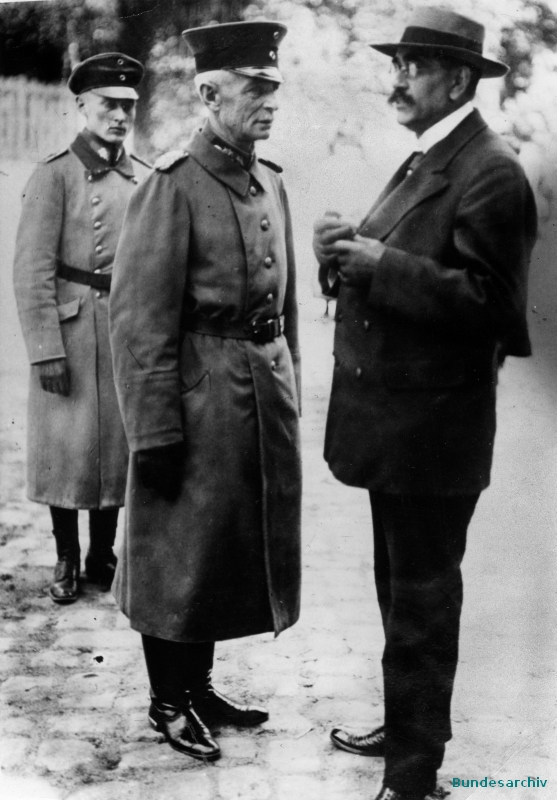
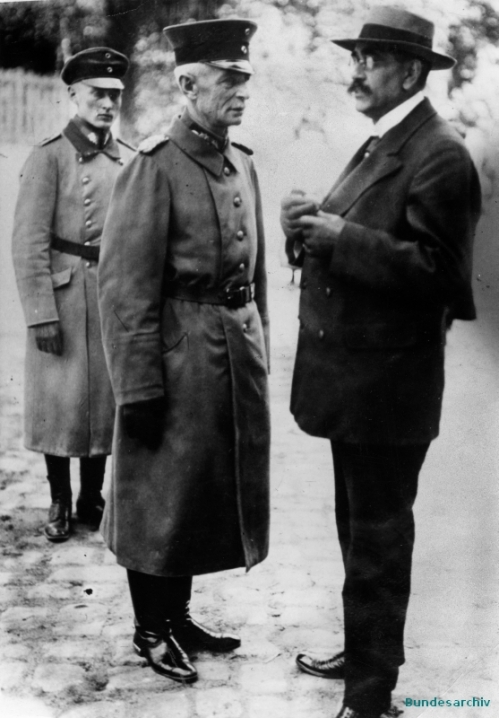
Gustav Noske and General Von Luttwitz. Luttwitz would lead the Reichswehr and Freikorps units that participated in the Kapp Putsch

Gustav Noske, of the Majority Socialist party “saw himself as a patriot, a man of action…who had no time for theories…and was one of the few Socialists that the Supreme Command trusted.”[xxx] He had already distinguished himself by helping to bring under control the sailors revolts in Kiel by forming a loyal “Naval Brigade”[xxxi] and he  “realized that the government must have a dependable military force behind it if it was to survive and rule Germany” and the “old Officer Corps must be the backbone of any such force.”[xxxii] The Army had melted away and units of the workers and soldiers councils were poorly trained, organized and led “”fought against the government as often as for it” and “were of little practical value to either the government or the rebels.”[xxxiii] In the chaos of a Spartacus, now called the German Communist Party uprising and vacuum of political leadership of January 1st 1919 agreed to become defense minister stating “Someone must be the bloodhound, I won’t shirk the responsibility!”[xxxiv]

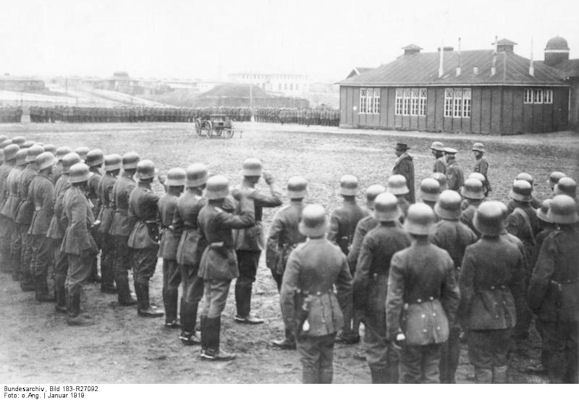
Noske reviewing Freikorps Hulsen. Many of the Freikorps were composed of professional soldiers and brought into the Reichswehr

Noske helped by the High Command helped organize volunteer units led by officers and NCOs composed of reliable veterans.  Freikorps varied in size from divisions to companies and were led by Generals down to Sergeants and even a Private First Class.  Their greatest success was in early 1919 when the Republic was beset by “Red” revolutions in many major cities.  Without the use of the Freikorps by the government it is unlikely that the Republic would have survived.[xxxv] On January 4th Ebert and Noske reviewed the troops of General Maercker’s Freiwillege Landesjaegerkorps and Maercker informed them that every volunteer had pledged loyalty to the government, seeing the discipline and order Noske told Ebert “Don’t worry. Everything going to turn out all right now.”[xxxvi] On January 5th 1919 mobs attacked the Chancellery and the officers of the Socialist Vörwarts newspaper and Noske led the Freikorps[xxxvii] to regain control of the city[xxxviii] and crush the revolt during which “Karl Liebknecht and Rosa Luxemburg were lynched by the officers of the Guards Cavalry Rifle Division.”[xxxix] In March after a period of uneasy calm the Freikorps, now reinforced by the 2nd Naval Brigade, or Ehrhardt Brigade[xl] were called upon to put down the revolt of the “People’s Naval Division.”[xli] Making liberal use of heavy weapons including tanks the Freikorps inflicted heavy losses on the leftists with over 1500 dead and 12,000 wounded in the uprising.[xlii] Other revolts were crushed and the Freikorps reached their zenith in Württemberg where Freikorps led by Lieutenant Hahn, a Social Democrat put down leftist revolts[xliii] and in Bavaria where Independents and Communists had taken the city with their “Bavarian Red Army which numbered nearly 25,000 men[xliv] on April 7th. After failed attempts by the Socialist government to retake Munich, they asked for Berlin’s help.  Violence and massacres of citizens by the various leftist groups inflamed the Freikorps, including the Ehrhardt Brigade and the revolt was crushed by May 2nd.[xlv] Dorpalen calls the Freikorps ruthlessness “completely unwarranted in view of the weakness of the opposing forces” and noted though they broke the leftist powers they deepened the nations’ cleavages”[xlvi] while Macksey writes that “where Freikorps’ brutality stained the pages of history there was invariably a forgoing or simultaneous record of excess by their sworn opponents.”[xlvii]

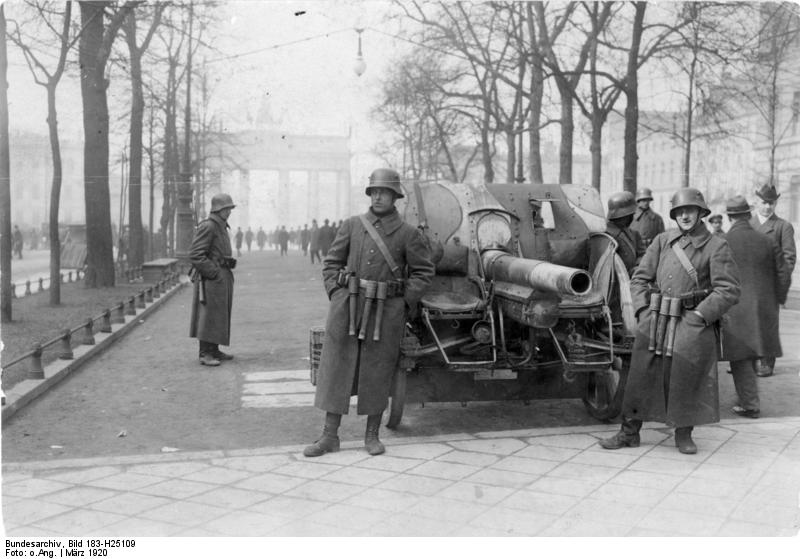
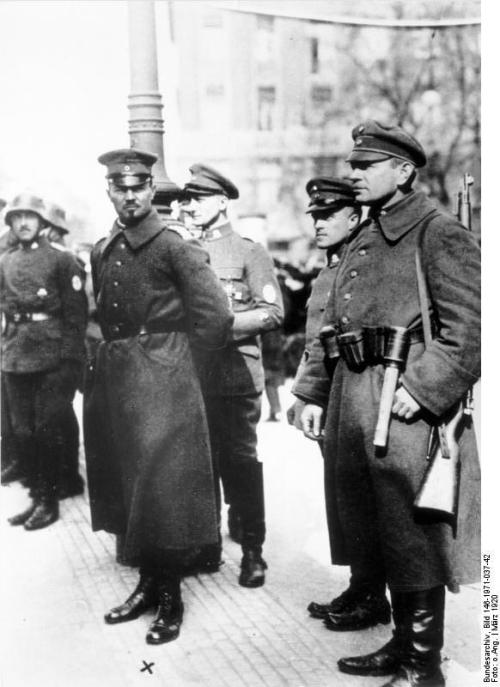
The Erhardt Brigade in Berlin during the Kapp Putsch

The Provisional Reichswehr was established on March 6th 1919 and the High Command began to assemble it from the Freikorps, remaining Army units and Republican defense forces.  Some Freikorps were brought into the new Army in total, but the tumult had not yet ceased.  There was a great distrust between many in the Army, the remaining Freikorps and the Socialists.  The crisis was precipitated by the signing of the Treaty of Versailles, Noske and others threatened resignation over the war guilt clauses, but Groener warned that if the treaty was rejected the Army could not win against the Allies if hostilities were renewed.[xlviii] The treaty imposed harsh limitations on the German Army which many bitterly resented, however, Seeckt, the Chief of Staff of the Army felt that it was “more important to keep the Army in being and preserve the possibility of a military resurrection.”[xlix] Yet the government had lost the support of the Officer Corps and many looked to General Walther von Lüttwitz, the Reichswehr’s senior commander for leadership.[l]

Korvettenkapitan (Lieutenant Commander) Erhardt commander of the 2nd Naval Brigade whose announced demobilization triggered the Kapp Putsch. Erhardt would have to flee after the Nazi takeover. Even revolutionaries become victims as revolutions end

Other right-wing groups and individuals made plans to overthrow the government.  They favored revolt against the government, but “their political aims were hazy.”[li] Seeckt and Reinhardt felt it necessary to demobilize Freikorps who’s ill-discipline and political radicalism was a “danger to the consolidation desired by the army command.”[lii] This movement climaxed with the alliance of Lüttwitz to Wolfgang Kapp and was triggered by the orders disbanding the 2nd and 3rd Naval Brigades in compliance with Versailles and due to their radical views.[liii] In spite of the opposition of his chief of staff Von Lüttwitz began planning a coup to save Germany.[liv] The conspirators showed “little regard for coordination of effort and a quite amazing ability to work at cross purposes.”[lv] On March 12th without consulting Kapp, Lüttwitz and Ehrhardt launched the Putsch and Ehrhardt’s brigade in full battle dress entered Berlin. At this point the Reichswehr command froze; officers refused to condone the putsch but at the same time refused to support Noske and Reinhardt who demanded armed opposition,[lvi] while Navy officers openly supported it.[lvii] Seeckt declared that “Troops do not fire upon troops!” and “When at occurs, then the true catastrophe, which was avoided with so much difficulty on November 9, 1918 will really occur.”[lviii] The coup died amid massive strike by workers and lack of popular support but the damage was done.  Noske resigned, many officers in were discredited[lix] and dismissed including Lüttwitz and Admiral Von Trotha, who openly supported the coup,[lx] though Raeder says that Von Trotha and the Navy staff only” thought of anything of complete loyalty to the government.”[lxi] The relationship which had endured the dire days of the Republic was ended.  The Reichswehr would emerge a lean and highly trained organization and remain a power broker in the Republic but the animosity between the Army and the Socialists that they could not stand together against the Nazis despite a mutual interest in doing so.[lxii]

Conclusion

The end of Weimar and the beginning of a nightmare

The period was a critical and complex and should be studied by anyone living in a state with a powerful military tradition and institutions in crisis.  Unlike popular notions, the Freikorps were diverse and not the seed-bed of the Nazi movement and though many former members would become Nazis.  Several, including Ehrhardt narrowly escaped death at Nazi hands.[lxiii] Freikorps were viewed by Army leadership as an expedient force that could not remain in the service once the Army was functional.

Key lessons include that the military cannot become a “state within a state,” and that both military and civilian leaders must seek to bridge any gulf that separates them in times of crisis.  In Weimar both the military and the Socialists thoroughly distrusted one another with the result that they eventually, despite early success[lxiv] worked against each other in later years.  Actions by both Socialists and the military ultimately subverted the Republic and ensured its demise and Seeckt’s policy of separation from politics “tended toward a renunciation of the soldier’s potential restraining influence on adventurous statesmen.”[lxv] Such is the fateful lesson for today.


[i] Jones, Nigel. The Birth of the Nazis: How the Freikorps Blazed a Trail for Hitler. Constable and Robinson Ltd. London, U.K. 1987 and 2004.  This is Jones assertion and he attempts to make the tie using careers of some individuals who served both in Freikorps and either in the Nazi Party or Military and attitudes common in many Freikorps with similar attitudes found in the Nazi movement.  The 2004 edition of his work includes an introduction by Michael Burleigh echoing his sentiments.

[ii] Evans, Richard J. The Coming of the Third Reich. Penguin Group. London, U.K. and New York, NY. 2003. pp.227-229.  Evans discusses the fact that the Nazis did have a number of Freikorps veterans but at no point makes the connection that the Freikorps are a direct ancestor.

[iii] Ozment, Steven. A Mighty Fortress: A New History of the German People. Harper-Collins Publishers, New York, NY 2004 p.246

[iv] Gordon, Harold J. Jr. The Reichswehr and the German Republic 1919-1926. Princeton University Press, Princeton NJ 1957.  Gordon’s work is perhaps the most detailed study involving the Freikorps and the Reichswehr. He is exceptional in discussing the relationship of both with the various political parties including the Nazis.  He refutes this assertion throughout the book.

[v] Bracher, Karl Dietrich. The German Dictatorship. Translated by Jean Steinberg. Praeger Publications, New York, NY 1970. Originally published as Die Deutsche Diktatur: Enstehung, Struktur, Folgen des Nationalsozialismus. Verlag Kiepenheuer & Witsch, Koln und Berlin. 1969. p.101

[vi] Wheeler-Bennett, John W. The Nemesis of Power: The German Army in Politics 1918-1945. St. Martin’s Press, New York, NY 1954 pp. 91-92

[vii] Shepherd, Ben. War in the Wild East: The German Army and Soviet Partisans. Harvard University Press, Cambridge, MA and London, U.K. 2004. p.28

[viii] Höhne, Heinz. The Order of the Death’s Head: The Story of Hitler’s SS. The Penguin Group, London U.K. and New York, NY 1969. Translated by Richard Barry. Originally Published as Der Ordnung unter dem Totenkopf. Verlag der Spiegel, Hamburg, 1966. p.54.

[ix] These include Macksey’s biographies of Kesselring and Guderian , Richard Giziowski’s The Enigma of General Blaskowitz. Peter Padfield’s Dönitz: the Last Führer, David Fraser’s biography of Field Marshal Rommel Knight’s Cross, Messenger’s work on Von Rundsedt, The Last Prussian, and Höhne’s Canaris: Hitler’s Master Spy all provide brief but interesting views of the actions and attitudes of these officers during the revolution and during the  Weimar period.

[x] Kesselring, Albrecht. The Memoirs of Field Marshal Kesselring with a new introduction by Kenneth Macksey. Greenhill Books, London UK. 1997. Translated from the German by William Kimber Ltd. Originally published as Soldat bis zum letzen Tag. Athenaum, Bonn, Germany 1953 pp.18-19

[xi] Goerlitz, Walter. History of the German General Staff 1657-1945. Translated by Brian Battershaw. Westview Press. Boulder CO and London. 1985 Originally published as Der Deutsche Generalstab, Verlag der Fankfurter Hefte, Frankfurt am Main.  First U.S. publication in 1953 by Preager Publishers. p.200

[xii] Gordon, Harold Jr. The Reichswehr and the German Republic 1919-1926. Princeton University Press, Princeton, NJ 1957 pp.4-5 Gordon recounts the story of an entire replacement train revolting when it reached the front which had to be disarmed by a shock battalion.

[xiii] Watt, Richard M.  The Kings Depart: The Tragedy of Germany: Versailles and the German Revolution. Simon and Schuster, New York, NY 1968. p.186

[xiv] Wheeler-Bennett, John W. The Nemesis of Power: The German Army in Politics 1918-1945. St. Martin’s Press, New York, NY 1954. p.18

[xv] Herwig, Holger H. The First World War: Germany and Austria Hungary 1914-1918. Arnold Press a member of the Hodder-Headline Group, London, UK and New York NY 1997 p.445

[xvi] Ibid. Herwig. p.445

[xvii] Carsten, F.L. The Reichswehr and Politics 1918-1933. Oxford University Press, Oxford, UK 1966 p.6.  It is noted by a number of author’s that Groener did this, to maintain the unity of Germany and prevent its division.

[xviii] Ibid. Watt. p.196  Watt notes Ebert’s reaction as being enraged as the proclamation of the Republic technically “invalidated the existing constitution; Germany was now technically without a government.” (p.197)

[xix] Ibid. Watt. p.197

[xx] Ibid. Watt. p.197

[xxi]Giziowski, Richard. The Enigma of General Blaskowitz Hippocrene Books Inc. New York NY, 1997. p.65

[xxii] Craig, Gordon A. The Politics of the Prussian Army 1640-1945. Oxford University Press, Oxford, UK 1955 pp.347-348.  Craig gives an interesting account noting the Groener’s call to Ebert shows recognition of the legitimacy of the new government and notes that the offer was somewhat conditional.

[xxiii] Dorpalen, Andreas. Hindenburg and the Weimar Republic. Princeton University Press, Princeton, NJ. 1964 p.26

[xxiv] Ibid. Wheeler-Bennett. p.21

[xxv] Ibid. Gordon. p.15

[xxvi] Ibid. Carsten. p.11. This was of critical importance as Carsten later notes that the Army realized that the government could not survive without its support.  Groener was perhaps the officer who most recognized the situation and endeavored to ensure that “the best and the strongest element of the old Prussia, was saved for the new Germany, in spite of the revolution.” (p.12)

[xxvii] Ibid. Carsten. p.18 Carsten produces the bulk of the English translation of these points and notes that the anti-military feeling had become widespread.

[xxviii] Ibid. Giziowski. p.66  Giziowski recounts the speech of Hermann Goering in response to the announcement. This shows how such treatment can breed anger and resentment in a military that feels it has been betrayed after serving its country in a long and difficult war: For four long years we officers did our duty and risked all for the Fatherland. Now we have come home, and how do they treat us? The spit on us and deprive us of what we gloried in wearing. I will tell you that the people are not to blame for such conduct. The people were are comrades…for four long years.  No, the ones who have stirred up the people, who have stabbed this glorious army in the back…. I ask everyone here tonight to cherish a hatred, a deep and abiding hatred, for these swine who have outraged the German people and our traditions.  The day is coming when we will drive them out of our Germany.”

[xxix] Ibid. Gordon. p.15

[xxx] Ibid. Watt. p.168

[xxxi] Ibid. Gordon. pp. 19 and 24.  This was the 1st Marine Brigade, or Brigade Von Roden of which elements would later serve in under the command of other Freikorps such as the Guards Calvary Rifle Division.

[xxxii] Ibid. Gordon. p.14

[xxxiii] Ibid. Gordon. p.18

[xxxiv] Ibid. Watt. p.239

[xxxv] Ibid. Gordon. p.426

[xxxvi] Ibid. Watt. p.247

[xxxvii] Thee forces included the Landesjaegerkorps and Guards Cavalry Rifle division.

[xxxviii] Ibid. Gordon. p.30

[xxxix] Ibid. Wheeler-Bennett. p.36

[xl] This was one of two additional Naval Brigades formed by Noske after the success of Naval Brigade Von Roden.  It was one of the most combat effective but unfortunately violent and radical of the Freikorps, it would as we will see be a key unit in the Kapp Putsch but would not be absorbed into the Reichswehr.

[xli] This unit was not a Navy unit at all but was composed of many who were criminals and other rabble. See Gordon, Carsten and Watt.

[xlii] Jurado, Carlos Caballero. The German Freikorps 1918-23. Illustrated by Ramiro Bujeiro. Osprey Publishing, Oxford, UK 2001 p.12

[xliii] Ibid. Gordon. p.42  His units were known as Security Companies.

[xliv] Ibid. Jurado. p.13

[xlv] Ibid. Gordon. pp.47-49. An estimated 550 people including 200 innocent bystanders were killed in the fighting.

[xlvi] Ibid. Dorpalen. p.29

[xlvii] Macksey, Kenneth. Guderian: Creator of the Blitzkrieg. Stein and Day Publishing, New York, NY 1975 p.45

[xlviii] Ibid. Wheeler-Bennett. pp.57-59

[xlix] Ibid. Goerlitz. p.216

[l] Ibid. Wheeler-Bennett. p.61

[li] Ibid. Carsten. p.74

[lii] Ibid. Carsten. pp.74-75

[liii] Ibid. Carsten. p.76  Another consideration is that Noske, Reinhardt and Seeckt all were seeking to retire Lüttwitz.

[liv] Ibid. Gordon. p.97

[lv] Ibid. Craig. p.376

[lvi] Ibid. Carsten. pp.78-79

[lvii] Höhne, Heinz. Canaris: Hitler’s Master Spy. Cooper Square Press, New York, NY 1979 and 1999. Translated from the German by J. Maxwell Brownjohn, Originally published in Germany by C. Bertelsmann Verlag Gmbh, München. 1976. p. 78.  Canaris also had been suspected of complicity in the murders of Rosa Luxemburg and Karl Liebknecht but was acquitted. (pp.56-71)

[lviii] Ibid. Gordon. pp.114-115

[lix] Among them Maercker who had been such a strong supporter of the Republic in the early days.

[lx] Ibid. Carsten. p.98

[lxi] Raeder, Erich. Grand Admiral. Translated from the German by Henry W. Drexell. United States Naval Institute, Annapolis MD, 1960. Da Capo Press edition published 2001. p.111. This is interesting as almost all histories implicate the Navy High Command of either some complicity or at least agreement with the Putsch participants.

[lxii] The final part in the drama would come when General Kurt Von Schleicher became the last Chancellor before Hitler.  Schleicher had assisted Groener and Noske in the early days of the Republic and often attempted to use the Army’s influence in politics. He was fatally short sighted and was a victim of the SS “night of Long Knives” which was directed against the SA.

[lxiii] Ibid. Jones. p.266  Others such as Gerhard Rossbach had similar experiences.  Korvettenkapitän Löwenfeld of the 3rd Naval Brigade became an Admiral, Wilhelm Canaris , who was implicated in the Kapp Putsch but kept his career would later head the Abwehr and die in a concentration camp.

[lxiv] Ibid. Gordon. p.426  Gordon has a good discussion of this topic in his conclusion.

65 Liddell-Hart, B.H. The German Generals Talk. Published 1948 B.H. Liddell-Hart, Quill Publications, New York, NY. 1979. p.18 Liddell-Hart’s analysis of the results of the Reichswehr’s disconnection from the larger society and political process is remarkable due to current trends in the American military which like the Reichswehr has become somewhat more conservative and disconnected from society, exceptionally technically proficient but not adept in politics or grand-strategy.


Works Cited


Bracher, Karl Dietrich. The German Dictatorship: The Origins, Structure and Effects of National Socialism. Translated from the German by Jean Steinberg with an introduction by Peter Gay.  Praeger Publishers, New York, NY. 1970 Originally published in Germany as Die deutsche Diktator: Entstehung, Struktur, Folgen den Nationalsozialismus by Verlag Kiepenheuer und Witsch. Koln und Berlin.


Carsten, F.L. The Reichswehr and Politics 1918-1933. Oxford University Press, Oxford, UK 1966


Craig, Gordon A. The Politics of the Prussian Army 1640-1945. Oxford University Press, Oxford, UK 1955


Dorpalen, Andreas. Hindenburg and the Weimar Republic. Princeton University Press, Princeton, NJ. 1964


Evans, Richard J. The Coming of the Third Reich. Penguin Books, New York, NY and London, UK. 2003


Giziowski, Richard. The Enigma of General Blaskowitz Hippocrene Books Inc. New York NY, 1997


Goerlitz, Walter. History of the German General Staff 1657-1945. Translated by Brian Battershaw. Westview Press. Boulder CO and London. 1985 Originally published as Der Deutsche Generalstab, Verlag der Fankfurter Hefte, Frankfurt am Main.  First U.S. publication in 1953 by Preager Publishers


Gordon, Harold Jr. The Reichswehr and the German Republic 1919-1926. Princeton University Press, Princeton, NJ 1957


Guderian, Heinz. Panzer Leader. (abridged) Translated from the German by Constantine Fitzgibbon, Ballantine Books, New York 1957


Herwig, Holger H. The First World War: Germany and Austria Hungary 1914-1918. Arnold Press a member of the Hodder-Headline Group, London, UK and New York NY 1997


Höhne, Heinz. Canaris: Hitler’s Master Spy. Cooper Square Press, New York, NY 1979 and 1999. Translated from the German by J. Maxwell Brownjohn, Originally published in Germany by C. Bertelsmann Verlag Gmbh, München. 1976.


Höhne, Heinz. The Order of the Death’s Head: The Story of Hitler’s SS. The Penguin Group, London U.K. and New York, NY 1969. Translated by Richard Barry. Originally Published as Der Ordnung unter dem Totenkopf. Verlag der Spiegel, Hamburg, 1966.


Jones, Nigel. The Birth of the Nazis: How the Freikorps Blazed the Way for Hitler. Constable and Robinson Ltd. London, UK 1987


Jurado, Carlos Caballero. The German Freikorps 1918-23. Illustrated by Ramiro Bujeiro. Osprey Publishing, Oxford, UK 2001


Kesselring, Albrecht. The Memoirs of Field Marshal Kesselring with a new introduction by Kenneth Macksey. Greenhill Books, London UK. 1997. Translated from the German by William Kimber Ltd. Originally published as Soldat bis zum letzen Tag. Athenaum, Bonn, Germany 1953.


Liddell-Hart, B.H. The German Generals Talk. Published 1948 B.H. Liddell-Hart, Quill Publications, New York, NY. 1979


Macksey, Kenneth. Guderian: Creator of the Blitzkrieg. Stein and Day Publishing, New York, NY 1975


Macksey, Kenneth. Kesselring: The German Master Strategist of the Second World War. Greenhill Books, London, UK 2000.


Ozment, Steven. A Mighty Fortress: A New History of the German People. Harper-Collins Publishers, New York, NY 2004


Shepherd, Ben. War in the Wild East: The German Army and Soviet Partisans. Harvard University Press, Cambridge, MA and London, U.K. 2004


Wheeler-Bennett, John W. The Nemesis of Power: The German Army in Politics 1918-1945. St. Martin’s Press, New York, NY 1954


Watt, Richard M.  The Kings Depart: The Tragedy of Germany: Versailles and the German Revolution. Simon and Schuster, New York, NY 1968


Wette, Wolfram. The Wehrmacht: History, Myth, Reality. Harvard University Press, Cambridge, MA and London, UK  2006. Translated from the German by Deborah Lucas Schneider. Originally published as Die Wehrmacht: Feindbilder, Vernichtungskrieg, Legenden. S. Fischer Verlag Gmbh, Frankfurt am Main, Germany 2002


1 Comment

Filed under History, Military, national security, Political Commentary

The War to End All Wars….and a Peace to end all Peace

It was the War to end all war

On the 11th hour of the 11th day of the 11th month the guns fell silent across Western Europe and the war which had killed 16 million soldiers, sailors and civilians and wounded another 21 million more came to an end. It had begun as a conflict in the Balkans which rapidly drew in all of Europe’s major powers.  The central focus of the war was the Western Front where the armies of Germany battled those of Britain, France, Belgium and later the United States.  Battles with names such as the Marne, Passchendaele, the Somme, Verdun, Ypres, Chateau Thierry, Belleau Wood, Vimy Ridge, Cambrai, the Aisne, represented the pinnacle of killing as soldiers battled in the mud of massive trench systems and Generals sacrificing thousands of men in a day for the gain of a few hundred yards of territory throwing them against mountains of barbed wire, landmines, well emplaced machine gun nests and mortars. Massed batteries of artillery tore men to shreds leaving many men so pulverized that they would ever be identified.  Poison gas both choking agents and the long lasting mustard gas added to the hell that was the war in the West.

During the war the war Imperial Russia had fallen to a Communist revolt and surrendered, the Austro-Hungarian Empire fell in October of 1918 and even the Allies had faced near calamity on the home front. In 1917 the French Army mutinied after years of futility with only Marshal Petain the hero of Verdun able to quell it.

The men who drafted the Peace to end all Peace: Clemenceau, Wilson, Lloyd George

Kaiser Wilhelm II had abdicated his throne on November 9th amid a revolution at home which tore the country apart.  The new German Government accepted an armistice in the belief that the Allies would honor President Woodrow Wilson’s 14 Points.  Instead they were subjected to humiliation and starvation as the Allies refused to end their blockade of Germany until the Peace Treaty was signed. Hundreds of thousands more Germans died as a result of starvation and disease as their cities were wracked by violence as order collapsed.  It was the Socialist government which had inherited the country that had to fight the Communists in the streets allying themselves with the Army High Command to form Freikorps from units and individual soldiers under commanders willing to fight.

Soviet style revolution in Germany 1918-1919

In France at the Palace of Versailles the Allies led by the British and French brushed aside Wilson’s attempt at a just peace and placed draconian sanctions on the new German Republic which had no choice but to accept the surrender terms dictated by the Treaty of Versailles. The Army was to be reduced to 100,000 men with no heavy weapons, the Navy to a token force of obsolete ships, the air force disbanded.  Massive war reparations were imposed which were impossible for the Germans to fulfill and which were only paid off this year.  The final ignominy was the fact that the Germans were forced to bear the sole responsibility for the war. The German economy collapsed in the aftermath, France occupied key German industrial areas in the Saar and Ruhr and the nation fell into more disorder as the Deutschmark lost all of its value as hyperinflation made the money worthless.

Freikorps helped restore order when the Army dissolved

Eventually order returned to Germany with a brief period of relative prosperity which lasted until the world-wide Great Depression which through Germany back into chaos. Government after government was formed and dissolved and the last Chancellors of the Republic were forced to rule under the emergency conditions of Article 48 of the Weimar Constitution.  Eventually extremists on the left and the right brought further chaos as the eventually leading President Hindenburg to appoint the Leader of the National Socialist German Workers Party (Nationalsozialistische Deutsche Arbeiterpartei) or NSDAP as Chancellor.  We know the rest of the story. A World War that killed far more than the first 22-25 million military and 62-78 million civilians, a war of extermination on the Eastern Front, the Holocaust, and fearful weapons which ushered in the Atomic and Nuclear age.  Europe was shattered, Britain’s wealth drained and empire unsustainable, France divided and impoverished and other nations in political or economic crisis with the Soviets controlling Eastern Europe behind an Iron Curtain.

Cold War

In Europe and Asia a “Cold War” between the Soviet Communists and the West took the place of the previous war.  The United States would fight wars in Korea and Vietnam while the Soviets would rule with an iron fist in Eastern Europe and at the height of the Cold War invaded Afghanistan.  The wars in Vietnam and Afghanistan caused crisis in both the United States and the Soviet Union and Afghanistan helped mark the end of Soviet power and the end of the Soviet Union.

Around the world colonial empires fell through either revolts of colonized people or the abdication of empire by nations exhausted and economically broken by war. The many of the newly free “nations” were artificial and as a result experienced their own civil, tribal and religious conflicts the effects of which are still felt.  The end of the Cold war brought more change and for a time there was a period of American superiority but wars engulfed the Middle East as Iraq attacked its neighbors and was defeated in the Gulf War.  However the effects of that war were felt as Moslem extremists took power in Afghanistan and others including the Yemeni born Saudi Osama Bin Laden began a campaign of terror to drive the United States out of the Middle East that culminated in the attacks of September 11th 2001 and now the war that seems to have no end.

And it was the War to end all war and a peace that ended all hope of peace….God help us as it is unlikely that this war will end anytime soon for us or our allies even if we withdraw from Afghanistan.  Our enemies are too beholden to their ideology to stop their attacks until they win or are destroyed, the war will continue and God only knows how many soldiers and civilians will die in the coming years over 90 years after the War to end all War ended and the Peace to end all Peace began.

Peace

Padre Steve+


1 Comment

Filed under Foreign Policy, History, iraq,afghanistan, Military, national security, Political Commentary, world war two in europe

The Uneasy Alliance: The Army and Government during the German Revolution and Civil War 1919-1922

Introduction

bundesarchiv_bild_146-1970-051-65_kapp-putsch_berlinThe Kapp Putsch

The German Revolution of 1919 and civil war is important for those who study highly developed states when they enter a period of social and political upheaval. Often such upheavals occur following military defeats or economic crisis that cause the society to question or even overthrow the established order.  The end of Imperial Germany and the establishment of the Weimar Republic on November 9th 1918 is a prime example.  Following the declaration of the Republic the Majority Socialists who had assumed power had no military force of any caliber to support it. The Army had melted away following the end of the war and the units which remained were unreliable and heavily infiltrated by Soviet style “workers and soldiers councils.”

Chaos ruled the streets, Communists and Independent Socialists of The situation being chaotic the Majority Socialists under the leadership of Friedrich Ebert joined forces with German General Staff to create a military force capable of bringing order the Germany.  To do this they allowed for the formation of Freikorps to quell revolutionary chaos and avert the establishment of a Soviet State.

The study begins with the establishment of the Republic and concludes with the Kapp Putsch.  This is an era that is seldom referenced by political or military leaders in western states and historians themselves are often divided in their interpretation of the subject.  The study of this period is vital to those who study politically polarized societies which are either war weary or have suffered the shock of military defeat coupled with a government which is blamed for the events.  Thus, it is important to study the relationship of the military to the government and in particular the military’s relationship to politicians who have little connection to or affinity for the military, its traditions and culture and the often adversarial relationship of these politicians to military leadership which often sees them as adversaries.  The period also shows how actions of those who in their antipathy to the military create a climate where the military loathes the civilian leadership and the government.  The results of such conditions can endanger the society as a whole and ultimately usher in periods of great tragedy.  This occurred in Weimar Germany with the result that the military in the later years of the Republic neither the military nor the Majority Socialists could not work together against the Nazi takeover of the state.  However, the first years of the relationship set the tone and foredoomed the Republic.

spartacistsSpartacists Attempt to Overthrow the Republic

Thesis


The history of Weimar, particularly that of the military and Freikorps in their relationship to the Republic is complex.  Not only is the relationship between the military and government complex, but the Freikorps themselves, their organization, leadership and political affiliation were not monolithic as is sometimes maintained,[i] nor were the Freikorps the direct ancestors of the Nazi SS/SA organizations despite often similar ideology,[ii] nor can they dismissed by saying that they were composed of “former soldiers and officers ill-disposed to return to civilian life.”[iii] The Freikorps’ association with the Army and Republic is more complex than some historians assert.  Despite the right wing leanings of many of units and fighters and future association of some to the Nazis, the blanket claim that the Freikorps were forerunners of the Nazi movement is not supportable.[iv] It is true that without Freikorps support in Munich, along with support of the Thule Society, business leaders and others “that the transition of the DAP into the Hitler party could not have taken place.”[v] It is also true that elements of the Freikorps branded too revolutionary and unruly for service in the Army continued as secret societies and affiliated themselves with various right-wing political groups.[vi] Likewise a case can be made that the fierceness of many Freikorps veterans, younger leaders of the Army helped lay the foundation for the brutality of both the Army and Waffen SS as they prosecuted the Second World War.[vii] Yet simply because certain aspects of a subject are true does not make for a broader “truth.”  Heinz Höhne argues the reverse of what some have written in regard to the relationship of the Freikorps and Reichswehr to the Nazis, that in fact the Nazis did not issue from the Freikorps, but rather that many former members of the Freikorps, Imperial Army or the Reichswehr were attracted to the Nazis, particularly to the SS by its “philosophy of “hardness” and its attitude of bellicosity per se, basically unconnected with ideology.”[viii] Others historians state similar views especially those that study the relationship of the Reichswehr leadership to the Freikorps.  Thus the thesis of this paper is that the historiography like the period itself is complex; that the composition, leadership and motivations of the Freikorps were not monolithic, nor were they beloved by the Reichswehr, nor were they the “trailblazers” for the Nazi movement.  The focus of this article is on the relationship of the Reichswehr and the Freikorps to the Republic to the Kapp Putsch and the dangers of a relationship built on necessity without mutual trust.  Such a relationship is dangerous and can lead to unintended consequences.   This paper will explore the first years of the Weimar Republic and specifically look at several key events that were pivotal in the relationship between the Army and Freikorps and the Majority Socialists.

The Literature

The literature covering this period ranges from well written and researched academic histories and poorly researched and badly done works which attempt to present particular views of the Freikorps which often border on myth. Additionally there are biographical works which shed some light on the subject. The Reichswehr and the German Republic 1919-1926 by Harold Gordon Jr. is perhaps the best study of the Freikorps and their relationship to the state and the army.  Gordon’s work is exceptional in documenting the numbers, types, political affiliation, action and ultimate disposition of the Freikorps.  Other works which provide exceptional treatment of the relationship between the military and the Republic include The History of the German General Staff by Walter Goerlitz; The Nemesis of Power: The German Army in Politics 1918-1945 by John Wheeler-Bennett, The Reichswehr and Politics 1918-1933 by F.L. Carsten and The Politics of the Prussian Army: 1640-1945 by Gordon A. Craig.

The best of the general histories of the period, which focus on the National Socialist state are The German Dictatorship by Karl Dietrich Bracher, and Richard Evans’ The Coming of the Third Reich. Richard Watt’s The Kings Depart is one of the best for telling the story of the fall of the Empire and the revolution in Germany.  Watt’s account is well written and documented work and touches on other factors affecting the new republic including Versailles and Allied political actions. The final chapter of Holger Herwig’s The First World War: Germany and Austria-Hungary 1914-1918 gives a good account of the Army’s role in the end of the Empire and beginning of the Republic.  Andreas Dorpalen’s Hindenburg and the Weimar Republic adds an interesting dimension of Hindenburg’s role in the republic’s formation and negotiations between Groener, Noske and Ebert while Steven Ozments’ history of Germany A Mighty Fortress is superficial in its treatment of the period.  Nigel Jones’ Birth of the Nazis: How the Freikorps Blazed a Trail for Hitler is an interesting and somewhat entertaining but poorly documented work. Jones tends to “broad brush” the Freikorps in sometime as “sensationalist” manner. His book has none of the detail or nuance of Gordon, Craig, or Carsten on the Freikorps. Nor does Jones have the depth of Goerlitz or Wheeler-Bennett on the Republic’s relationship with the Army, or the attitude of the Reichswehr leadership to the Freikorps.  William Shirer’s The Rise and Fall of the Third Reich, Gerald Reitlinger’s The SS: Alibi of a Nation 1922-1945 and Heinz Höhne’s The Order of the Death’s Head all add some information which details Nazi involvement in the early part of the Weimar Republic but are limited in their coverage of the subject.  Of other works, Kenneth Macksey’s Why the Germans Lose at War has an insightful but short chapter dealing with this period and Wolfram Wette’s The Wehrmacht: History, Myth, Reality offers an interesting and at times provocative look at anti-Semitism in the German military in the years following the First World War.  Carlos Caballero Jurado’s The German Freikorps 1918-1923 is a short but very detailed study of Freikorps organizations and actions.  B.H. Liddell-Hart has a small chapter on General Von Seeckt in The German Generals Talk which hasinteresting commentary on later actions of former Reichswehr officers who served the Nazi state.

A number of biographies touch on actions of German Officers who played key roles in World War Two.[ix] Most auto-biographies gloss over the Weimar period; however Admiral Reader’s memoir Grand Admiral offers the insight of a naval officer with some direct observation of the revolution and the Kapp Putsch.  Guderian in Panzer Leader omits his service in the Baltic “Iron Division.”

The Uneasy Alliance: The Majority Socialists, Freikorps and Reichswehr

volksmarine divisionThreats to the Republic: The People’s Naval Division Terrorized Berlin

The relationship of the Republic to the Army was born in the moment of crisis of the abdication of Kaiser Wilhelm II and the armistice discussions with the Allies.  Beset by revolts in key naval bases and mutinies aboard ships of the High Seas Fleet and unrelenting Allied pressure on the German armies in the west the situation continued to deteriorate as the “red flag was flying in all the principle cities, soldiers behind the front were electing soldiers councils Russian fashion.”[x] Revolutionary and defeatist propaganda spread by the radical left wing of the Independent Socialists and Spartacus League spread through the country and even affected combat units,[xi] while the “Majority Socialists had found out that the militant factions of the Independents had secretly armed themselves out of funds supplied by the Soviet ambassador and adopted the slogan “all or nothing.””[xii] The situation had deteriorated so badly that Karl Liebknecht, leader of the Spartacus League “was announcing the establishment of a Soviet regime from the steps of the Imperial Palace.”[xiii]

441px-Bundesarchiv_Bild_183-R10386,_Wilhelm_Groener_mit_FrauGeneral Wilhelm Groener Who Worked with Socialist Leaders Friedrich Ebert and Gustav Noske to Save the Republic against a Soviet Style Revolution

Under these dire conditions, General Wilhelm Groener who had succeeded General Ludendorff as Quartermaster General called an emergency meeting of fifty “of his most senior army commanders.”[xiv] In response to his question of whether the troops would follow the Kaiser and oppose the revolts only one answered in the affirmative, and eight responded that “there was no hope of using regular Army units to quell unrest at home.”[xv] On November 9th Groener went to the Kaiser on behalf of the Supreme Command and in response to a suggestion that the Kaiser lead the Army back and suppress the revolts boldly stated “The Army will march home in peace and under its leaders and commanding generals, but not under the command of Your Majesty, for it stands no longer behind Your Majesty.”[xvi] The Emperor abdicated fleeing to Holland and Friedrich Ebert leader of the Majority Socialists was named Chancellor on November 9th and upon hearing the news, Philipp Scheidemann, without consulting Ebert announced that Ebert was Chancellor and “Long live the great German Republic!”[xvii] The mobs were not placated by the announcement and far left organizations with the Independents “had no intention of letting the revolution stop there.”[xviii] In the streets of Berlin soldiers sold their weapons and vehicles officers were attacked by crowds on the streets and whenever “crowds found an Army officer, they tore off his epaulettes and medals.”[xix] Everywhere mutual recrimination was in the air, soldiers “blamed revolutionaries for the betrayal and stab-in-the back while revolutionaries blamed officers for all the costs and losses of the war.”[xx]

hans von seecktGeneral Hans Von Seeckt Creator of the Reichswehr Believer that it Needed to be Apolitical

Groener called Ebert promising the Army’s support of the new government in return for the government’s assistance to the Army in the maintenance of discipline and supply.[xxi] He also drafted a letter signed by Hindenburg pledging the Army’s loyalty and telling him that “the destiny of the German people is in your hands….”[xxii]One source notes: “Thus, in half a dozen sentences over a telephone line a pact was concluded between a defeated army and a tottering semi-revolutionary regime; a pact destined to save both parties from the extreme elements of revolution but, as a result of which the Weimar Republic was doomed at birth.”[xxiii]

The High Command was able to bring the Army home in good order following the armistice but upon arriving most units “melted away like snow under a summer sun,”[xxiv] those which remained were often shells of their former selves beset by soldier’s councils and leftist revolutionaries.  To support the government the High Command issued a directive stating that it “put itself as the disposal of the present government led by Ebert without any reservation.”[xxv] Yet in December delegates of the National Assembly continued to sow resentment in the military by military discipline be placed in the hands of soldiers’ councils, that all badges of rank be removed with all decorations of insignia and honor.[xxvi] Reaction was heated,[xxvii] but despite this Groener, Colonel Walter Reinhardt, the Prussian Minister of War and the Republic’s Defense Minister, Gustav Noske endeavored to find forces to combat the growing revolution and rebellious military units.  The choice was not hard, the Army was of no use, so called “democratic forces” were in most cases both unreliable and ineffective, while only the Freikorps “provided suitable material for the immediate creation of an efficient, combat-ready army.”[xxviii] Thus the Freikorps became the instrument of necessity to ensure that the government was not swept away by a Soviet style revolution.

freikorps-hulsen-noskeGustav Noske Reviewing Freikorps Hulsen Which was Formed out of Existing Army Units by General von Hulsen

Gustav Noske, of the Majority Socialist party “saw himself as a patriot, a man of action…who had no time for theories…and was one of the few Socialists that the Supreme Command trusted.”[xxix] He had already distinguished himself by helping to bring under control the sailors revolts in Kiel by forming a loyal “Naval Brigade”[xxx] and he  “realized that the government must have a dependable military force behind it if it was to survive and rule Germany” and the “old Officer Corps must be the backbone of any such force.”[xxxi] The Army had melted away and units of the workers and soldiers councils were poorly trained, organized and led “”fought against the government as often as for it” and “were of little practical value to either the government or the rebels.”[xxxii] In the chaos of a Spartacus, now called the German Communist Party uprising and vacuum of political leadership of January 1st 1919 agreed to become defense minister stating “Someone must be the bloodhound, I won’t shirk the responsibility!”[xxxiii]

Bild 183-1989-0718-501Noske with General Von Luttwitz

Noske helped by the High Command helped organize volunteer units led by officers and NCOs composed of reliable veterans.  Freikorps varied in size from divisions to companies and were led by Generals down to Sergeants and even a Private First Class.  Their greatest success was in early 1919 when the Republic was beset by “Red” revolutions in many major cities.  Without the use of the Freikorps by the government it is unlikely that the Republic would have survived.[xxxiv] On January 4th Ebert and Noske reviewed the troops of General Maercker’s Freiwillege Landesjaegerkorps and Maercker informed them that every volunteer had pledged loyalty to the government, seeing the discipline and order Noske told Ebert “Don’t worry. Everything going to turn out all right now.”[xxxv] On January 5th 1919 mobs attacked the Chancellery and the officers of the Socialist Vörwarts newspaper and Noske led the Freikorps[xxxvi] to regain control of the city[xxxvii] and crush the revolt during which “Karl Liebknecht and Rosa Luxemburg were lynched by the officers of the Guards Cavalry Rifle Division.”[xxxviii] In March after a period of uneasy calm the Freikorps, now reinforced by the 2nd Naval Brigade, or Ehrhardt Brigade[xxxix] were called upon to put down the revolt of the “People’s Naval Division.”[xl] Making liberal use of heavy weapons including tanks the Freikorps inflicted heavy losses on the leftists with over 1500 dead and 12,000 wounded in the uprising.[xli] Other revolts were crushed and the Freikorps reached their zenith in Württemberg where Freikorps led by Lieutenant Hahn, a Social Democrat put down leftist revolts[xlii] and in Bavaria where Independents and Communists had taken the city with their “Bavarian Red Army which numbered nearly 25,000 men[xliii] on April 7th. After failed attempts by the Socialist government to retake Munich, they asked for Berlin’s help.  Violence and massacres of citizens by the various leftist groups inflamed the Freikorps, including the Ehrhardt Brigade and the revolt was crushed by May 2nd.[xliv] Dorpalen calls the Freikorps ruthlessness “completely unwarranted in view of the weakness of the opposing forces” and noted though they broke the leftist powers they deepened the nations’ cleavages”[xlv] while Macksey writes that “where Freikorps’ brutality stained the pages of history there was invariably a forgoing or simultaneous record of excess by their sworn opponents.”[xlvi]

Bild 146-1971-037-42Lieutenant Commander Ehrhardt Commander of the 2nd Naval Brigade during the Kapp Putsch, although a Hard Line Conservative Ehrhardt would Suffer under the Nazis

There was a tension between many in the Reichswehr and those on the German left and this came out in many ways as officers were caught in between various political camps while attempting to conduct their duties. Field Marshal Albert Kesselring recounted with great bitterness his experience:

“My cup of bitterness was full when I saw my devoted work rewarded by a warrant for my arrest for an alleged putsch against the socialist-influenced command of my III Bavarian Army Corps. Notwithstanding the degrading episodes during my imprisonment after 1945, I do not hesitate to describe this as the most humiliating moment of my life.”[xlvii]

Bild 102-00206President Friedrich Ebert with Von Seeckt and other Military Leaders

The end of the Freikorps era began when the Provisional Reichswehr was established on March 6th 1919. The High Command assembled from Freikorps, remaining Army units and Republican defense forces. There was a great distrust between many in the Army, the remaining Freikorps and the Socialists. When the German delegation to Treaty of Versailles signed the treaty under threat of invasion it provoked a crisis. Noske and others threatened resignation over the war guilt clauses, but Groener warned that if the treaty was rejected the Army could not win against the Allies if hostilities were renewed.[xlviii] The treaty imposed harsh limitations on the German Army which many bitterly resented, however, Seeckt, the Chief of Staff of the Army felt that it was “more important to keep the Army in being and preserve the possibility of a military resurrection.”[xlix] Yet by signing the treaty the government lost the support of many officers who looked to General Walther von Lüttwitz, the Reichswehr’s senior commander, and commander of troops in the Berlin area for leadership.[l]

Bild 119-2815-20Freikorps Rossbach During the Kapp Putsch. One of the Most Extreme Freikorps it was Demobilized and Broken up a number of its Leaders including Rossbach Found Their Way to the Nazis

Lüttwitz, leaders of certain Freikorps, right-wing groups and individuals made plans to overthrow the government.  They favored revolt against the government, but “their political aims were hazy.”[li] Army leadership recognized the threat posed by disaffected Freikorps and their leaders. Seeckt and Reinhardt felt it necessary to demobilize Freikorps who’s ill-discipline and political radicalism was a “danger to the consolidation desired by the army command.”[lii] The plotters sensed a threat to their plans for a putsch and Lüttwitz found a willing co-conspirator in Wolfgang Kapp, a failed politician.  Lüttwitz took action when the High Command ordered the 2nd and 3rd Naval Brigades be demobilized in compliance with Versailles treaty limitations and their radical views.[liii] Over the opposition of his chief of staff Von Lüttwitz began planning a coup, in his mind, to save Germany.[liv] The key unit in Lüttwitz plan was the 2nd Naval Brigade Commander by Korvettenkapitän (Lieutenant Commander) Ehrhardt.

Bild 183-H25109The Ehrhardt Brigade During the Kapp Putsch

Lüttwitz and his fellow conspirators showed “little regard for coordination of effort” and demonstrated “a quite amazing ability to work at cross purposes.”[lv] On March 12th without consulting Kapp, Lüttwitz and Ehrhardt launched the Putsch and Ehrhardt’s brigade in full battle dress entered Berlin. At this point the Reichswehr command froze; officers refused to condone the putsch but at the same time refused to support Noske and Reinhardt who demanded armed opposition to the coup,[lvi] while most Navy officers openly supported it.[lvii] Seeckt who did not want to see the army set against itself refused to deploy troops to counter Ehrhardt’s men.  He declared that “Troops do not fire upon troops!” and “When at occurs, then the true catastrophe, which was avoided with so much difficulty on November 9, 1918 will really occur.”[lviii] Despite the lack of support by the army the coup died amid massive strikes by workers and lack of popular support. However the damage done to the Reichswehr’s relationship to the government, especially the more moderate Majority Socialist was severe.

von trothaAdmiral Von Trotha head of the Navy was Sacked for Supporting the Putsch

In the wake of the putsch Noske resigned, many officers in were discredited[lix] and dismissed including Lüttwitz and Admiral Von Trotha, head of the Navy, who openly supported the coup.[lx] Admiral Raeder in his memoirs says that Von Trotha and the Navy staff only” thought of anything of complete loyalty to the government”[lxi] however the actions of the Navy leadership showed otherwise. The uncomfortable but relationship which had endured the dire days of the Republic was ended.  The Reichswehr would emerge a lean and highly trained organization and remain a power broker in the Republic but the animosity between the Army and the Socialists that they could not stand together against the Nazis despite a mutual interest in doing so.[lxii]

Conclusion

The period was a critical and complex and should be studied by anyone living in a state with a powerful military tradition and institutions in crisis.  Unlike popular notions, the Freikorps were diverse and not the seed-bed of the Nazi movement and though many former members would become Nazis.  Several, including Ehrhardt narrowly escaped death at Nazi hands.[lxiii] Freikorps were viewed by Army leadership as an expedient force that could not remain in the service once the Army was functional.

Key lessons include that the military cannot become a “state within a state,” and that both military and civilian leaders must seek to bridge any gulf that separates them in times of crisis.  In Weimar both the military and the Socialists thoroughly distrusted one another with the result that they eventually, despite early success[lxiv] worked against each other in later years.  Actions by both Socialists and the military ultimately subverted the Republic and ensured its demise and Seeckt’s policy of separation from politics “tended toward a renunciation of the soldier’s potential restraining influence on adventurous statesmen.”[lxv] Such is the fateful lesson for today for those who suggest a military coup to overturn a government that they oppose in much the same manner as those who supported Lüttwitz, Kapp and Ehrhardt.  Such actions only undermine democratic institutions, especially if they are weak and the nation is in crisis.  Often such actions bring about regimes far more dangerous than what they seek to overthrow and compromise the integrity of the military.


[i] Jones, Nigel. The Birth of the Nazis: How the Freikorps Blazed a Trail for Hitler. Constable and Robinson Ltd. London, U.K. 1987 and 2004.  This is Jones assertion and he attempts to make the tie using careers of some individuals who served both in Freikorps and either in the Nazi Party or Military and attitudes common in many Freikorps with similar attitudes found in the Nazi movement.  The 2004 edition of his work includes an introduction by Michael Burleigh echoing his sentiments.

[ii] Evans, Richard J. The Coming of the Third Reich. Penguin Group. London, U.K. and New York, NY. 2003. pp.227-229.  Evans discusses the fact that the Nazis did have a number of Freikorps veterans but at no point makes the connection that the Freikorps are a direct ancestor.

[iii] Ozment, Steven. A Mighty Fortress: A New History of the German People. Harper-Collins Publishers, New York, NY 2004 p.246

[iv] Gordon, Harold J. Jr. The Reichswehr and the German Republic 1919-1926. Princeton University Press, Princeton NJ 1957.  Gordon’s work is perhaps the most detailed study involving the Freikorps and the Reichswehr. He is exceptional in discussing the relationship of both with the various political parties including the Nazis.  He refutes this assertion throughout the book.

[v] Bracher, Karl Dietrich. The German Dictatorship. Translated by Jean Steinberg. Praeger Publications, New York, NY 1970. Originally published as Die Deutsche Diktatur: Enstehung, Struktur, Folgen des Nationalsozialismus. Verlag Kiepenheuer & Witsch, Koln und Berlin. 1969. p.101

[vi] Wheeler-Bennett, John W. The Nemesis of Power: The German Army in Politics 1918-1945. St. Martin’s Press, New York, NY 1954 pp. 91-92

[vii] Shepherd, Ben. War in the Wild East: The German Army and Soviet Partisans. Harvard University Press, Cambridge, MA and London, U.K. 2004. p.28

[viii] Höhne, Heinz. The Order of the Death’s Head: The Story of Hitler’s SS. The Penguin Group, London U.K. and New York, NY 1969. Translated by Richard Barry. Originally Published as Der Ordnung unter dem Totenkopf. Verlag der Spiegel, Hamburg, 1966. p.54.

[ix] These include Macksey’s biographies of Kesselring and Guderian , Richard Giziowski’s The Enigma of General Blaskowitz. Peter Padfield’s Dönitz: the Last Führer, David Fraser’s biography of Field Marshal Rommel Knight’s Cross, Messenger’s work on Von Rundsedt, The Last Prussian, and Höhne’s Canaris: Hitler’s Master Spy all provide brief but interesting views of the actions and attitudes of these officers during the revolution and during the  Weimar period.

[x] Goerlitz, Walter. History of the German General Staff 1657-1945. Translated by Brian Battershaw. Westview Press. Boulder CO and London. 1985 Originally published as Der Deutsche Generalstab, Verlag der Fankfurter Hefte, Frankfurt am Main.  First U.S. publication in 1953 by Preager Publishers. p.200

[xi] Gordon, Harold Jr. The Reichswehr and the German Republic 1919-1926. Princeton University Press, Princeton, NJ 1957 pp.4-5 Gordon recounts the story of an entire replacement train revolting when it reached the front which had to be disarmed by a shock battalion.

[xii] Watt, Richard M.  The Kings Depart: The Tragedy of Germany: Versailles and the German Revolution. Simon and Schuster, New York, NY 1968. p.186

[xiii] Wheeler-Bennett, John W. The Nemesis of Power: The German Army in Politics 1918-1945. St. Martin’s Press, New York, NY 1954. p.18

[xiv] Herwig, Holger H. The First World War: Germany and Austria Hungary 1914-1918. Arnold Press a member of the Hodder-Headline Group, London, UK and New York NY 1997 p.445

[xv] Ibid. Herwig. p.445

[xvi] Carsten, F.L. The Reichswehr and Politics 1918-1933. Oxford University Press, Oxford, UK 1966 p.6.  It is noted by a number of author’s that Groener did this, to maintain the unity of Germany and prevent its division.

[xvii] Ibid. Watt. p.196  Watt notes Ebert’s reaction as being enraged as the proclamation of the Republic technically “invalidated the existing constitution; Germany was now technically without a government.” (p.197)

[xviii] Ibid. Watt. p.197

[xix] Ibid. Watt. p.197

[xx]Giziowski, Richard. The Enigma of General Blaskowitz Hippocrene Books Inc. New York NY, 1997. p.65

[xxi] Craig, Gordon A. The Politics of the Prussian Army 1640-1945. Oxford University Press, Oxford, UK 1955 pp.347-348.  Craig gives an interesting account noting the Groener’s call to Ebert shows recognition of the legitimacy of the new government and notes that the offer was somewhat conditional.

[xxii] Dorpalen, Andreas. Hindenburg and the Weimar Republic. Princeton University Press, Princeton, NJ. 1964 p.26

[xxiii] Ibid. Wheeler-Bennett. p.21

[xxiv] Ibid. Gordon. p.15

[xxv] Ibid. Carsten. p.11. This was of critical importance as Carsten later notes that the Army realized that the government could not survive without its support.  Groener was perhaps the officer who most recognized the situation and endeavored to ensure that “the best and the strongest element of the old Prussia, was saved for the new Germany, in spite of the revolution.” (p.12)

[xxvi] Ibid. Carsten. p.18 Carsten produces the bulk of the English translation of these points and notes that the anti-military feeling had become widespread.

[xxvii] Ibid. Giziowski. p.66  Giziowski recounts the speech of Hermann Goering in response to the announcement. This shows how such treatment can breed anger and resentment in a military that feels it has been betrayed after serving its country in a long and difficult war: For four long years we officers did our duty and risked all for the Fatherland. Now we have come home, and how do they treat us? The spit on us and deprive us of what we gloried in wearing. I will tell you that the people are not to blame for such conduct. The people were are comrades…for four long years.  No, the ones who have stirred up the people, who have stabbed this glorious army in the back…. I ask everyone here tonight to cherish a hatred, a deep and abiding hatred, for these swine who have outraged the German people and our traditions.  The day is coming when we will drive them out of our Germany.”

[xxviii] Ibid. Gordon. p.15

[xxix] Ibid. Watt. p.168

[xxx] Ibid. Gordon. pp. 19 and 24.  This was the 1st Marine Brigade, or Brigade Von Roden of which elements would later serve in under the command of other Freikorps such as the Guards Calvary Rifle Division.

[xxxi] Ibid. Gordon. p.14

[xxxii] Ibid. Gordon. p.18

[xxxiii] Ibid. Watt. p.239

[xxxiv] Ibid. Gordon. p.426

[xxxv] Ibid. Watt. p.247

[xxxvi] Thee forces included the Landesjaegerkorps and Guards Cavalry Rifle division.

[xxxvii] Ibid. Gordon. p.30

[xxxviii] Ibid. Wheeler-Bennett. p.36

[xxxix] This was one of two additional Naval Brigades formed by Noske after the success of Naval Brigade Von Roden.  It was one of the most combat effective but unfortunately violent and radical of the Freikorps, it would as we will see be a key unit in the Kapp Putsch but would not be absorbed into the Reichswehr.

[xl] This unit was not a Navy unit at all but was composed of many who were criminals and other rabble. See Gordon, Carsten and Watt.

[xli] Jurado, Carlos Caballero. The German Freikorps 1918-23. Illustrated by Ramiro Bujeiro. Osprey Publishing, Oxford, UK 2001 p.12

[xlii] Ibid. Gordon. p.42  His units were known as Security Companies.

[xliii] Ibid. Jurado. p.13

[xliv] Ibid. Gordon. pp.47-49. An estimated 550 people including 200 innocent bystanders were killed in the fighting.

[xlv] Ibid. Dorpalen. p.29

[xlvi] Macksey, Kenneth. Guderian: Creator of the Blitzkrieg. Stein and Day Publishing, New York, NY 1975 p.45

[xlvii] Kesselring, Albrecht. The Memoirs of Field Marshal Kesselring with a new introduction by Kenneth Macksey. Greenhill Books, London UK. 1997. Translated from the German by William Kimber Ltd. Originally published as Soldat bis zum letzen Tag. Athenaum, Bonn, Germany 1953 pp.18-19

[xlviii] Ibid. Wheeler-Bennett. pp.57-59

[xlix] Ibid. Goerlitz. p.216

[l] Ibid. Wheeler-Bennett. p.61

[li] Ibid. Carsten. p.74

[lii] Ibid. Carsten. pp.74-75

[liii] Ibid. Carsten. p.76  Another consideration is that Noske, Reinhardt and Seeckt all were seeking to retire Lüttwitz.

[liv] Ibid. Gordon. p.97

[lv] Ibid. Craig. p.376

[lvi] Ibid. Carsten. pp.78-79

[lvii] Höhne, Heinz. Canaris: Hitler’s Master Spy. Cooper Square Press, New York, NY 1979 and 1999. Translated from the German by J. Maxwell Brownjohn, Originally published in Germany by C. Bertelsmann Verlag Gmbh, München. 1976. p. 78.  Canaris also had been suspected of complicity in the murders of Rosa Luxemburg and Karl Liebknecht but was acquitted. (pp.56-71)

[lviii] Ibid. Gordon. pp.114-115

[lix] Among them Maercker who had been such a strong supporter of the Republic in the early days.

[lx] Ibid. Carsten. p.98

[lxi] Raeder, Erich. Grand Admiral. Translated from the German by Henry W. Drexell. United States Naval Institute, Annapolis MD, 1960. Da Capo Press edition published 2001. p.111. This is interesting as almost all histories implicate the Navy High Command of either some complicity or at least agreement with the Putsch participants.

[lxii] The final part in the drama would come when General Kurt Von Schleicher became the last Chancellor before Hitler.  Schleicher had assisted Groener and Noske in the early days of the Republic and often attempted to use the Army’s influence in politics. He was fatally short sighted and was a victim of the SS “night of Long Knives” which was directed against the SA.

[lxiii] Ibid. Jones. p.266  Others such as Gerhard Rossbach had similar experiences.  Korvettenkapitän Löwenfeld of the 3rd Naval Brigade became an Admiral, Wilhelm Canaris , who was implicated in the Kapp Putsch but kept his career would later head the Abwehr and die in a concentration camp.

[lxiv] Ibid. Gordon. p.426  Gordon has a good discussion of this topic in his conclusion.

65 Liddell-Hart, B.H. The German Generals Talk. Published 1948 B.H. Liddell-Hart, Quill Publications, New York, NY. 1979. p.18 Liddell-Hart’s analysis of the results of the Reichswehr’s disconnection from the larger society and political process is remarkable due to current trends in the American military which like the Reichswehr has become somewhat more conservative and disconnected from society, exceptionally technically proficient but not adept in politics or grand-strategy.

Works Cited

Bracher, Karl Dietrich. The German Dictatorship: The Origins, Structure and Effects of National Socialism. Translated from the German by Jean Steinberg with an introduction by Peter Gay.  Praeger Publishers, New York, NY. 1970 Originally published in Germany as Die deutsche Diktator: Entstehung, Struktur, Folgen den Nationalsozialismus by Verlag Kiepenheuer und Witsch. Koln und Berlin.

Carsten, F.L. The Reichswehr and Politics 1918-1933. Oxford University Press, Oxford, UK 1966

Craig, Gordon A. The Politics of the Prussian Army 1640-1945. Oxford University Press, Oxford, UK 1955

Dorpalen, Andreas. Hindenburg and the Weimar Republic. Princeton University Press, Princeton, NJ. 1964

Evans, Richard J. The Coming of the Third Reich. Penguin Books, New York, NY and London, UK. 2003

Giziowski, Richard. The Enigma of General Blaskowitz Hippocrene Books Inc. New York NY, 1997

Goerlitz, Walter. History of the German General Staff 1657-1945. Translated by Brian Battershaw. Westview Press. Boulder CO and London. 1985 Originally published as Der Deutsche Generalstab, Verlag der Fankfurter Hefte, Frankfurt am Main.  First U.S. publication in 1953 by Preager Publishers

Gordon, Harold Jr. The Reichswehr and the German Republic 1919-1926. Princeton University Press, Princeton, NJ 1957

Guderian, Heinz. Panzer Leader. (abridged) Translated from the German by Constantine Fitzgibbon, Ballantine Books, New York 1957

Herwig, Holger H. The First World War: Germany and Austria Hungary 1914-1918. Arnold Press a member of the Hodder-Headline Group, London, UK and New York NY 1997

Höhne, Heinz. Canaris: Hitler’s Master Spy. Cooper Square Press, New York, NY 1979 and 1999. Translated from the German by J. Maxwell Brownjohn, Originally published in Germany by C. Bertelsmann Verlag Gmbh, München. 1976.

Höhne, Heinz. The Order of the Death’s Head: The Story of Hitler’s SS. The Penguin Group, London U.K. and New York, NY 1969. Translated by Richard Barry. Originally Published as Der Ordnung unter dem Totenkopf. Verlag der Spiegel, Hamburg, 1966.

Jones, Nigel. The Birth of the Nazis: How the Freikorps Blazed the Way for Hitler. Constable and Robinson Ltd. London, UK 1987

Jurado, Carlos Caballero. The German Freikorps 1918-23. Illustrated by Ramiro Bujeiro. Osprey Publishing, Oxford, UK 2001

Kesselring, Albrecht. The Memoirs of Field Marshal Kesselring with a new introduction by Kenneth Macksey. Greenhill Books, London UK. 1997. Translated from the German by William Kimber Ltd. Originally published as Soldat bis zum letzen Tag. Athenaum, Bonn, Germany 1953.

Liddell-Hart, B.H. The German Generals Talk. Published 1948 B.H. Liddell-Hart, Quill Publications, New York, NY. 1979

Macksey, Kenneth. Guderian: Creator of the Blitzkrieg. Stein and Day Publishing, New York, NY 1975

Macksey, Kenneth. Kesselring: The German Master Strategist of the Second World War. Greenhill Books, London, UK 2000.

Ozment, Steven. A Mighty Fortress: A New History of the German People. Harper-Collins Publishers, New York, NY 2004

Shepherd, Ben. War in the Wild East: The German Army and Soviet Partisans. Harvard University Press, Cambridge, MA and London, U.K. 2004

Wheeler-Bennett, John W. The Nemesis of Power: The German Army in Politics 1918-1945. St. Martin’s Press, New York, NY 1954

Watt, Richard M.  The Kings Depart: The Tragedy of Germany: Versailles and the German Revolution. Simon and Schuster, New York, NY 1968

Wette, Wolfram. The Wehrmacht: History, Myth, Reality. Harvard University Press, Cambridge, MA and London, UK  2006. Translated from the German by Deborah Lucas Schneider. Originally published as Die Wehrmacht: Feindbilder, Vernichtungskrieg, Legenden. S. Fischer Verlag Gmbh, Frankfurt am Main, Germany 2002

2 Comments

Filed under History, Military, Political Commentary

Ein Volk Steht Auf: The German Volksturm, Ideology and late war Nazi Strategy

volksturm formationVolksturm Members

One of the more important but little understood parts of the German mobilization to defend the Reich, was the creation of the Volksturm. The Volksturm’s role in Nazi strategy and ideology is often misunderstood more than likely because on the Western Front the Volksturm was not much of a factor.  Of the major chroniclers of the war in Europe only Max Hastings in “Armageddon: The Battle for Germany, 1944-1945” [1] and John Erickson in “The Road to Berlin” [2] devote any attention to the subject.  Others, including B.H. Liddell-Hart’s History of the Second World War,” Chester Wilmont’s “The Struggle for Europe” and Russell Weigley’s “Eisenhower’s Lieutenants” devote no space whatsoever to the Volksturm. This is understandable. The Volksturm was far less effective than Nazi leaders would have hoped in fact militarily it was a failure because of the Nazi Party management of it.  Even German historian Walter Goerlitz’s “History of the German General Staff” devotes only one small passage to the Volksturm.[3] Other German Generals such as Generals Warlimont and Guderian and Field Marshal Kesselring mention the Volksturm but only Guderian goes into any detail about it.[4] Kesselring mentions its “propaganda value” and calls the Volksturm a “fiasco” [5] while limiting his other comments to specific uses of it.  In light of such limited analysis by leading historians David Yelton’s treatment in “Ein Volk Steht Auf”: The German Volksturm and Nazi Strategy, 1944-45 published in The Journal of Military History is highly important.

volksturm trainingVolksturm receiving training on Panzerfaust Anti-Tank Rocket
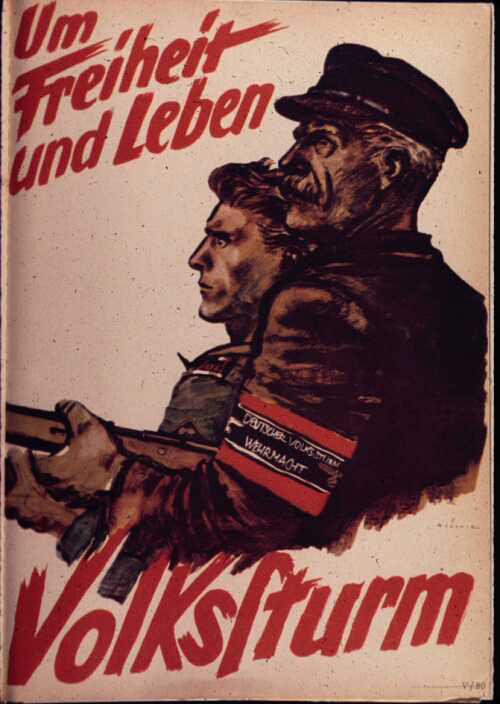
Yelton’s study is more than an analysis of military value and use of the Volksturm. The Volksturm was more than a military organization.  As a military organization it had many grave deficiencies as do all militias in a State where most able bodied men are already in the regular military components.  However, as an arm of the Nazi Party leadership’s defensive strategy to resist the allies, it played a key role.  It was a political militia designed for total war effort to defend the Germany against the advancing Allied armies in conjunction with the “miracle weapons” which were just beginning to be deployed.  Kesselring notes the propaganda value of the Volksturm, but to understand its place in Nazi strategic thinking, one has to look at the entirety of Nazi political, ideological and military thinking at this point in the war, something that Yelton does well.

Yelton makes an important point regarding Gerhard Weinberg’s assertion that most historians have neglected Germany’s late war strategy and that “Nazi Germany is viewed as having no real, coherent strategy” after 1943.[6] Yelton; like Weinberg shows how Nazi leaders believed in a reversal in the course of the war and how they “began implementing a broad and coherent strategy to this end.”[7] He discusses the influence of Nazi ideological preconceptions which impacted strategy[8] and notes the two primary purposes of the Volksturm were to stalemate the war by making the Allies fight for “every foot of German territory and maximize Allied casualties beyond which their morale…could tolerate”  and more importantly from the Nazi viewpoint to “fanaticize the civilian population ….”[9] From this point Yelton goes into a discussion of the beginnings of the Volksturm. He looks first to the mind of General Guderian[10] who advocated forming a militia to be activated when the Soviets threatened German soil. Guderian saw this in military terms. It was to be under Army Wehrkreis or Military District control on the Eastern Front and not civilian control.  It was the subsequent political machinations of Bormann, Himmler and others which expanded it to the entire nation, and placed it in the hands of Nazi Party Gauleiters who often were antagonistic to the Army.[11]

An important point is that the shift in control from the Wehrmacht Wehrkreis to Bormann’s Nazi Party control was related to the basic Nazi understanding of war, the understanding that the war was a “struggle for existence.”[12] Likewise it was a tenant of Nazi faith in racial ideology was since the the “Master Race” was being defeated by lesser races it had to be the result of “treason or sabotage in the officer corps.”[13] Thus many of the Reich’s political leaders believed that “the key to victory lay in generating a fanatical will to resist among all Germans both civilians and military.”[14] Of course this created more problems in terms of logistics and command and control for military commanders wherever the Volksturm was directed by the more paranoid of the Gauleiters.

The goal of the Volksturm was to maximize Allied casualties in the hope that one of the Allied nations would decide that the war was senseless and drop out.  The Nazis believed that this would take place while the new weapons, jet aircraft and new U-Boats wrested control of the air and sea from the Allies and the V weapons, rockets and missiles brought destruction to Britain.  A second goal was to strengthen the political will of the German population.   This goal included the political aspects of how the Party extended its influence over the military.  The Party gained control of the political indoctrination of recruits, the appointment of National Socialist Leadership Officers and increased roles for Gauleiters in preparing defenses at home and in the military chain of command.[15] Yelton’s study provides a detailed analysis of the psychological conditioning of the Volksturm instituted by Bormann including the use of propaganda and that all Volksturm training should “include some form of National Socialist “schooling.”[16] Bormann ensured that the Volksturm was made up of all components of the “racially superior” Nazi Volksgeimenschaft carefully excluding Jews, other “racially inferior” groups, as well as clergymen who might undermine the people with Christian ideas or were politically divisive or unreliable.[17] Yelton concludes by examining how the Nazi leadership attempted to raise the military value of the Volksturm by appointing Nazis who had military experience as officers. They believed that “the racial superiority of the German Volk would ultimately carry the day against their “inferior Jewish-Bolshevik-Slavic” enemies.[18]

volkssturm posterVolksturm Propaganda Poster

Yelton’s essay is important to the historian of the late war period to understand how Nazi ideology influenced the German war effort. Yelton does a commendable job in analyzing the Volksturm and its role in Nazi strategy in late 1944-45. He makes very good use of original sources as well as historic works and documents, including diaries and operations orders of Hitler, Himmler and others, correspondence between Bormann and Gauleiters.  His use of published and unpublished works dealing with the Volksturm and Nazi ideology, particularly letters and diaries serve as an important source of information about how the closely the Nazis linked ideology to the Volksturm..  Yelton’s conclusions that the Volksturm was a key component of what senior Nazis believed to be a coherent strategy to win the war are convincing.  Gerhard Weinberg also posits this view, and it gains credence when one studies other aspects of German racial war theories.

Yelton’s study shows that a more holistic approach to a military history needs to include political, ideological and other factors that lead to the formation of military strategy. In isolation the creation of the Volksturm makes little sense from a purely military point of view and most of the senior officers believed the Volksturm was a waste of manpower and weaponry.   However, if the Volksturm is viewed as part of Nazi political and racial theory it made perfect sense to Nazi leaders.

Thus, political ideologies are something to consider when one believes an opponent’s strategy is senseless or militarily suspect. Simply looking at the military side of the equation often leads to wrong answers about the nature of the conflict.  This has been the case more often than not in many ongoing conflicts today where religious and political ideology is at the center of the opponent’s resistance. It is understanding idea of the people’s war where the population is mobilized to fight the war even if militarily weak and is often related to defending one’s homeland such as the Taliban in Afghanistan or the Vietnamese who successfully opposed French, Japanese, American and Chinese efforts to subdue them.  Thus understanding helps the reader understand how a badly flawed organization can make perfect sense to the leaders employing it.   This is something that we in the Western World of the early 21st Century are not very good at doing and are currently failing at doing in Afghanistan.  The political or the political-religious ideology that drives people to fight for existence matters as much as the military understanding of the enemy’s strengths and weaknesses.  In World War Two Germany had lost most of the capacity to resist effective under the assault of the Allies and the people had become war weary.  Thus the Volksturm were doomed to fail.  However, had Germany been better organized to meet the Allied threat asymmetrically and not been so militarily defeated conventional sense, the effort of the Volksturm might have brought better results.


[1] Hastings, Max. Armageddon: The Battle for Germany 1944-1945. Alfred A. Knopf, New York, NY. 2004. Hastings’ discussion does not go into detail on the formation or organization of the Volksturm itself. He focuses more incidental aspects of training and employment as well as people’s feelings toward. He does make the connection between increasing Nazi fanaticism and the Volksturm. p.160

[2] Erickson, John. The Road to Berlin” Cassell Military Paperbacks, London, 1983.   Erickson’s best contribution is noting how Martin Bormann and the Party Gauleiters controlled the Volksturm and the turf war that Heinrich Himmler waged to ensure that his Waffen-SS formations would not be deprived of manpower by his erstwhile party comrades. p.399

[3] Goerlitz, Walter. History of the German General Staff,” translated by Brian Battershaw, Westview Press, Boulder and London, 1985. Originally published as Die Deutsche Generalstab Verlag der Frankfurter Hefte, Frankfur am Main, 1953. It is interesting to note that Goerlitz attributes the formation of the Volksturm to Himmler, p.483 something repudiated by General Heinz Guderian and Yelton in this reviewed essay.  At the same time it is understandable to see how Goerlitz reaches his conclusion in light of the fact that Himmler had some control as commander of the Replacement Army.

[4] Guderian, Heinz Panzer Leader translated by Constantine Fitzgibbon, Ballantine Books, New York, New York, 1957.  p. 288

[5] Kesselring, Albrecht. The Memoirs of Field-Marshal Kesselring. Greenhill Military Paperbacks, London, 1997. Originally published as Soldat bis zum letzen Tag Anthenum, Bonn, 1953 and translated by William Kimber, London 1953. p.73.  Kesselring’s comments here come in comparison to the British formation of a Home Guard in 1940. In general Kesselring found these types of units to be worthless and personnel, especially older soldiers brought back on duty with regular units.

[6] Yelton, David K. Ein Volk Steht Auf: The German Volksturm and Nazi Strategy 1944-1945 in The Journal of Military History, October 2000, 64, 4. Research Library p.1061.  Although he fits Weinberg’s thesis that the Germans believed that they could still win the war and developed a strategy to do so Weinberg does not mention the Volksturm in his book although it would be easy to extrapolate from his thesis Yelton’s assertion of the Volksturm being a part of that strategy.

[7] Ibid. p.1062.

[8] Ibid. This is important as the understanding of Nazi ideology in many decisions is downplayed by many purely “military” historians.”  However, Michael Geyer in his essay German Strategy, 1914-1945 in Makers of Modern Strategy from Machiavelli to the Nuclear Age, Peter Paret editor, Princeton University Press, 1986 p.582 talks about the rise of political-ideological strategy in Nazi Germany where Hitler “rejected the traditional analysis of military strengths of the opposing sides….” This could be part of the reason of why many military historians fail to distinguish a discernable strategy on the part of the Germans which the Volksturm was a key element. At the same time this ties in with other over arching aspects of the Nazi war effort going to early actions against the Poles and Russians.

[9] Ibid. Yelton. Pp.1063-1064.

[10] Ibid. Yelton. p.1068. The idea was actually that of Guderian’s Chief of Staff’s predecessor General Huesinger in 1943.

[11] Ibid. Yelton pp. 1065-1066. An interesting note to this discussion is Guderian’s comments that “the Party was less interested in the military qualifications than in the political fanaticism of the men that it appointed to fill the responsible posts.” Guderian, Heinz Panzer Leader translated by Constantine Fitzgibbon, Ballantine Books, New York, New York, 1957.  p. 288  Guderian’s comments are particularly relevant because he recognized that the political and ideological components of the organization outweighed the military.

[12] Ibid. Yelton p.1067  General Walter Warlimont notes that General Keitel countersigned the order forming the Volksturm with Bormann and that the order “charged the Party with the formation and leadership of this “last levy.” Warlimont, Walter. Inside Hitler’s Headquarters 1939-45 translated by R.H. Barry. Presidio Press, Novato CA. 1964. Originally published in Germany under the title Im Hauptquarier der Deutschen Wehrmacht 1939-1945 Bernard und Graefe Verlag. p.479  It is interesting to note that as such this was a political and ideological decision versus a purely military one.

[13] Ibid. Yelton p. 1068

[14] Ibid. Yelton p. 1069

[15] Ibid. Yelton. pp. 1071-1072. Guderian noted how the Gauleiters on the Eastern Front would go directly to Bormann when conflict arose with the Wehrmacht. Panzer Leader p. 289

[16] Ibid. Yelton. p. 1075

[17] Ibid. Yelton pp. 1077-1079

[18] Ibid. Yelton. p.1082

Leave a comment

Filed under History, Military, world war two in europe

The Uncomfortable Legacy of Colonel General Ludwig Beck

“It is a lack of character and insight, when a soldier in high command sees his duty and mission only in the context of his military orders without realizing that the highest responsibility is to the people of his country.” Ludwig Beck

Bundesarchiv_Bild_183-C13564,_Ludwig_BeckLudwig Beck  Bundesarchiv Foto

This is one of those uncomfortable posts to write partially because I know that some people will take it completely wrong or ascribe meaning to it that I do not intend. I by training am a military historian, probably better at that than I am theology.  One thing that fascinates me in the study of military history is the actions of men in the face of evil and the meetings of such people at the intersections of where military and government policy intersect.  It is a timeless theme. The bulk of my study until the past few years was the German Army, particularly that of the Weimar Republic and the Wehrmacht to include policies, leaders, political attitudes and behavior in war and peace. Thus it makes sense for me to look at Colonel General Ludwig Beck who held the post of Chief of the German General Staff during the early part of the Nazi era.

Ludwig Beck is one of those characters in military history that makes professional military officers uncomfortable.  Beck is not the perfect example of righteousness nor was he always correct in things that he supported.  As an artillery regiment commander he defended the rights of soldiers and officers to be Nazi Party members though he himself was not one.  He, like many military officers was a conservative military officer by nature and became Chief of Staff of the Wehrmacht in 1935 two years after Hitler’s ascension to power.  Taking office Beck was troubled by some Nazi policies but not by the need for Germany to expand to areas that it had once controlled, he opposed the plan to attack Czechoslovakia not because of any love for the Czech state which he desired to be eliminated, but rather it being a war that Germany could not win. He resigned from his position a Chief of Staff in 1938 when he could not persuade the rest of the General Staff to resign in protest over Hitler’s plan which he felt would be disastrous for Germany.  Had the western powers led by Neville Chamberlain not caved at Munich it is likely that the Germans would have suffered badly against the Czech army and fortifications and with the entry of France into the war would have suffered a defeat that would have ended the Hitler regime.  In fact German officers who saw the extent of Czech preparations on the frontier following the Munich deal were greatly relieved that they did not have to fight their way into the Czech state.

After his resignation Beck played a key role in the resistance movement. He was involved in the planning for a number of attempts on Hitler’s life. Yet it was his leadership in the July 20th 1944 attempt on the life of Hitler that ensured his place in history.  With Colonel Klaus Von Stauffenberg and others in the General Staff at the Front and in Germany he acted to avert further destruction in Europe and the certain destruction of Germany.  The plot, Operation Valkyrie was marred by poor execution and failed to kill Hitler of seize power but for a few hours. The planners had left too much to chance and once Hitler had restored communications the coup attempted ended swiftly.  Had the attempt succeeded Beck was in line to become either the leader of Germany or the Head of the Army.  Instead while being interrogated after his capture he took his own life depriving Nazi leaders of the ability to put him up for a public trial at which he would have been humiliated and then executed.  The Kasserne in Sonthofen where the Bundeswehr MP School and Staff School as well as NATO and EU military schools are located is named for him.  It is there, ironically a former Adolf Hitler School that his memory and sacrifice is honored by the nation which emerged from the rubble of World War Two.  He is honored in a small museum and with a plaque recognizing his sacrifice.

492Ludwig Beck Kasserne Sonthofen

The reason that General Beck makes many of us in uniform uncomfortable (and I do include myself) is that he recognized that senior officers, especially those in high command who help set and execute policy cannot isolate themselves in the purely military aspects of the operations.  Instead he believed that officers have a higher duty to the constitution and people and not just the military mission that they have been assigned.  When he realized that he could not stop Hitler’s invasion of Czechoslovakia he resigned and worked in the obscurity of a small and often divided resistance movement against Hitler.  The bulk of the German high command, including many officers idolized in the United States did not recognize the higher duty. Many of these men were consummate professionals who did not support the evil of the Nazi regime and who conducted themselves honorably. Yet they effectively abetted its crimes by not opposing actions of their government that were against international law and morality as well as dangerous from purely a pragmatic military standpoint.

The problem is that military officers in any nation, including ours can face situations such as Beck faced.  A military’s character is demonstrated in how leaders deal with such situations.  Beck recognized the situation early, the bulk of his fellow officers did not recognize a problem until Germany was embroiled in a war that it could no longer win.  Even then most could not mount an opposition to Hitler because they did not want to be considered to be mutineers and violate their oath.  The potential to abet evil when military professionals bury their heads by planning and executing purely military aspects of a campaign is great.  If they ignore questionable policy or even policies that they know that have been judged by the international community to be illegal or immoral, such as torture of prisoners or waging wars of aggression against countries that have not attacked their nation they become complicit in their nations crimes.  This was the case with German Officers who may not have committed any personal crime and even tried to mitigate the evils of the Nazi regime were morally complicit in that evil.

In the United States the military shows its fidelity by remembering our oath to the Constitution and being faithful to it and the people that we serve.  As officers we represent all Americans and not just those of our political party, religious faith or social or economic interests, nor any political leader, faction or interest group within the nation. The Constitution, our military regulations, traditions and the Uniform Code of Military Justice are the standard by which we operate and by which we conduct ourselves and tools that protect us when policies or actions taken by the government or people within it violate those codes or international law.  The UCMJ makes it clear those officers who take part in, plan or a complicit in illegal actions in war are committing crimes.

When a nation become involved in wars which are non-traditional, revolutionary wars or insurgencies that barriers to professional conduct can be broken down. The Mai Lai massacre committed by 2LT William Calley’s platoon with the certain knowledge and maybe even approval of individuals in the chain of command is one example as were the uncontrolled chaos of prisoner abuse and torture at Abu Ghraib.

Times are difficult and we do not know what the future brings.  Stress in societies caused by economic conditions, natural disasters, lawlessness on the streets and divided and ineffective governments sometimes remove the moral restraints of the society and even affect the military.  One sees this in Weimar Germany as well as the 4th Republic in France which had to deal with post World War II economic difficulties, exacerbated by recriminations of political opponents for actions the others did during the war while France was occupied by Germany as well as the wars in Indo-China and Algeria which further divided the nation and the military.

It is in stressful and uncertain times that officers have to be men and women of principle who always uphold the highest traditions of their military as well as be the voice of conscience when governments, political parties, special interests or leaders begin to violate international norms in the conduct of war. Beck was not a perfect officer. He supported some of Hitler’s policies until after his resignation but like much of the resistance believed that the Nazi regime could only end up destroying Germany.  It is important to remember that like Ludwig Beck that officers do not need to sacrifice their honor to be faithful to their oath.

Peace, Steve+

16 Comments

Filed under History, leadership, Military, national security, world war two in europe