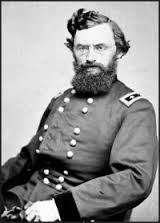
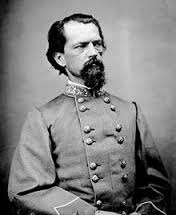
Tag Archives: oliver howard

Obedience to the Powers that Be: John Reynolds

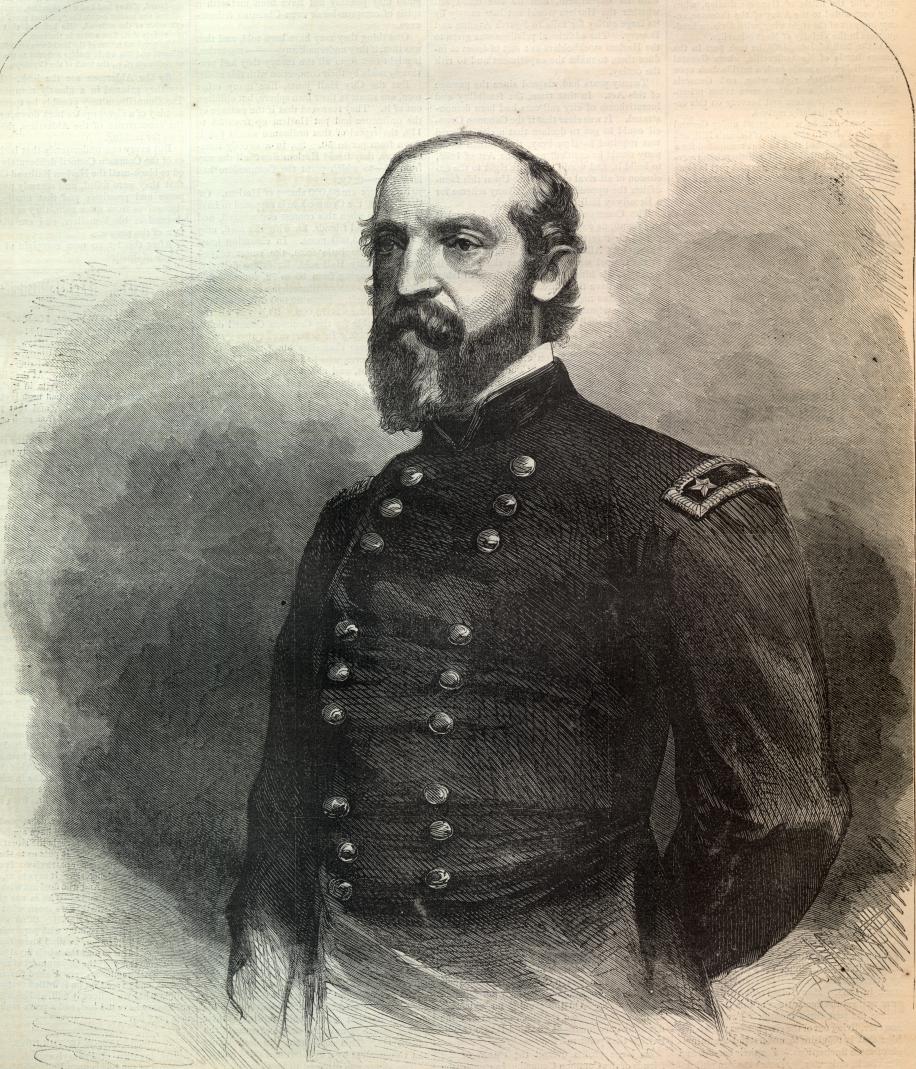
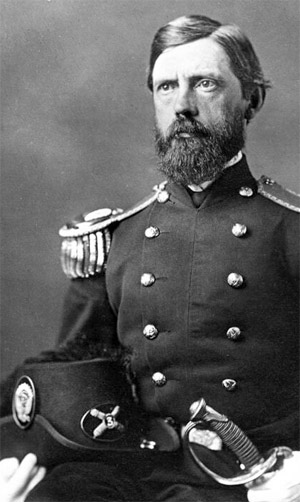
220px-GenJFRenyolds

Friends of Padre Steve’s World

I am continuing to periodically intersperse and publish short articles about various commanders at Gettysburg on the site. These all are drawn from my student text and may become a book in their own right.  The reason is I am going to do this is because I have found that readers are often more drawn to the lives of people than they are events. As I have noted before that people matter, even deeply flawed people, and we can learn from them.

This article deals with Major General John Fulton Reynolds who in large part is responsible for bringing about the Battle of Gettysburg and whose actions on that field in the opening hours of the engagement helped decide the course of the Civil War. This segment does not include the details of that battle, those are reserved for the rest of this chapter which I am currently revising for the student text.

I have come to admire Reynold’s more and more and I hope that in this brief treatment of his life and career leading to Gettysburg that you will be inspired by his single dovotion to the Union and the humanity compassion that he treated the victims of war.

Peace

Padre Steve+

There is much written about the supposed superiority of Robert E. Lee and the generals of the Army of Northern Virginia over those of the Army of the Potomac. Their eventual defeat is often blamed on the Union’s superior manpower and attrition with scant recognition of times where the Union commanders, particularly at Gettysburg out-generaled them. Not only did Harry Heth have the misfortune of battling John Buford and John Reynolds, but division, brigade and regimental leaders who performed their duties magnificently. Despite being greatly outnumbered by the Confederates these men and their soldiers turned back the initial Confederate assaults and shattering Confederate infantry formations.

Likewise if chance plays a role in war, the Army of the Potomac had good fortune smiling upon it that fateful morning of July 1st 1863. Part of that good fortune was having Major General John Fulton Reynolds, one of the finest commanders on either side during the Civil War directing its operations. During the engagement Reynolds, his subordinates and his successor in command Abner Doubleday dealt with the unforeseen elements of this engagement far better than any Confederate General on the battlefield that morning. Reynolds exemplified the indispensable qualities described by Clausewitz regarding commanders who must deal with the role of chance and the unforeseen elements that so often cloud the battlefield:

“first, an intellect that, even in the darkest hour, retains the glimmerings of the inner light which leads to truth; and second, the courage to follow this faint inner light wherever it may lead.” [1]

John Reynolds was a native Pennsylvanian, born in Lancaster to descendants of Irish Protestants. His maternal grandfather, Samuel Moore fought as a Captain in the Continental Line during the American Revolution. Reynold’s father, was a lawyer and moved to Lancaster where he “owned and published the Journal.” The elder Reynolds had served two terms in the Pennsylvania legislature and in the early 1830s was a political ally and friend of Senator and later President James Buchannan for whom “he was attending to local business affairs” in Lancaster. [2] Buchannan helped one of Reynold’s brother William gain an appointment to the Naval Academy and in 1837 obtained the appointment to West Point.

The young Pennsylvanian graduated from West Point in 1841, twenty-sixth in a class of fifty-two and was commissioned as a Brevet Second Lieutenant in the artillery. Among his classmates were the future Union generals Israel Richardson, Don Carlos Buell and Horatio Wright and Confederate generals Richard Garnett and J.M. Jones. Graduating in the class ahead of him was a man who would become a lifelong friend, William Tecumseh Sherman. He graduated at a time of military cutbacks, the Army was about to be reduced from 12,000 to 9,000 the following year. Chances for promotion were so bad, especially from First Lieutenant to Captain, “so unlikely that in a single year 117 officers resigned.” [3] Many of these officers would find their way back to the army but even so, army life did not promise much.

Despite this Reynolds found army life to his liking. He served in Florida during the Seminole War, as well as in Mexico “where he was cited for bravery at Monterey and Buena Vista.” [4] During the campaign in Mexico he served with the army commanded by General Zachary Taylor and in the artillery battery commanded by the future Confederate general, Captain Braxton Bragg. He acquitted himself well and also had compassion for the Mexican soldiers that he fought against. Visiting Mexican wounded who had been left with “little medical care and less food” he gave them money to help with their needs. At Buena Vista a number of senior officers wrote official citations praising the artillery and Reynolds by name. General John Wool wrote

“Without our artillery,” he said, “we could not have maintained our position a single hour,” and also: “…a section of artillery, admirably served by Lieutenant Reynolds, 3rd Arty, played an important part in checking and dispersing the enemy in the rear of our left. They retired before him whenever he approached them.” [5]

Those actions brought him fame and two brevet promotions for bravery, [6] to Captain at Monterrey and Major at Buena Vista. However, Reynolds saw little value in them if the army’s promotion system was not fixed. He wrote his brother Jim “The system is a complete humbug and until it changes I believe it is to be rather more of a distinction to be passed over than to be breveted…that is, amongst us who know facts.” [7]

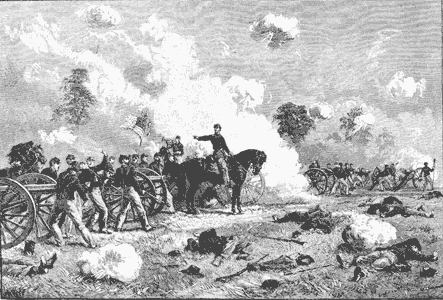
Reynold’s skill as an artilleryman would be used to great effect on the morning of July 1st 1863 on McPherson’s Ridge at Gettysburg. Following the war he remained in the army predominantly with the artillery. He served in field and coastal batteries and like John Buford had “participated in the Utah Expedition.” [8] The Utah expedition is little known and nearly forgotten incidents in United States history which involved the territory of Utah, and it left a bitter taste in the mouths of many of the officers and soldiers who served in it, including John Reynolds.

The Territory of Utah had been created after the Compromise of 1850 and President Millard Fillmore named Mormon leader Brigham Young as Governor. The Mormons settled Utah after having been driven out of Illinois and Missouri as a result of their religious beliefs which included polygamy and well as the political concept Theodemocracy, which had been formulated by Mormon founder Joseph Smith Jr. Theodemocracy was a concept which is a blend of theocracy and republican principles. Though it largely died out after the replacement of Young as Governor it has many similarities with theology, political ideology and goals of the leaders of the current Christian Dominion concepts of the leaders of what is called The New Apostolic Reformation which has gained much power among the leadership of the current Republican Party.

In Illinois Smith had “founded an autonomous community, with its own militia, where Smith was eventually called “King of the Kingdom of God.” [9] Smith believed that it was a necessary step until a true theocracy could be established. Smith had taught his ruling Council of Fifty, which included a few non-Mormons “that in the initial stages of the millennium the council would participate in concert with men of differing religious and political persuasions” and the earth would still have a pluralism of governments and religions in the early part of those thousand years…” [10] Tensions between Smith, the Mormon community and surrounding communities grew and “eventually, an unruly mob lynched the prophet and one of his followers.” [11]

Two years after the territory was formed Young “declared that Smith had a vision, until then kept secret, reinstituting polygamy.” [12] To be fair, Young did not require this of his followers, but the introduction produced a furor among many Americans. The situation with Utah was complicated further by the actions of Congress which in throwing out the Missouri Compromise that Utah and New Mexico “when admitted as a State or States…shall be received into the Union, with or without slavery, as their constitution may prescribe at the time of their admission.” [13]

The combination of a growing theocracy, the introduction of polygamy and the possibility of slavery brought many tensions. The 1856 convention of the new Republican Party condemned “the twin relics of barbarism” – slavery and polygamy.” Midwesterners who joined that part remembered their clashes with the Mormons and “few voters were sympathetic to the Mormons” [14] or their growing power in the Utah Territory. In 1857 this tension led to President James Buchannan to appoint a non-Mormon Governor for the territory which led to conflict between Young’s government and its militias and the United States. Young considered U.S. Troops to be those of a “foreign power” and prepared for war “insisting as strongly on the independence of his people from Washington as the capital insisted on its jurisdiction over the territory.” [15]

Like many officers and Americans in general, Reynolds had negative views of the Latter Day Saints. Some were gained in his introduction to the territory, where he found that as a “gentile” he was treated as an outsider by the Mormon community. His initial bad disposition was only deepened through his interactions with Governor Brigham Young. The most important of these to Reynolds was an attempt to bring to justice the Indians who had massacred a party of army engineers under the command of Captain Gunnison the previous summer. Reynolds for that the Mormon led government, particularly Governor Young had convicted the Indians of manslaughter and sentenced them to prison for manslaughter. This act angered Reynolds. He wrote his sisters:

“They have been since tried by the Mormons and found guilty of manslaughter, tho’ the proof was positive and clear. But their jury was counseled by Brigham Young as to their verdict and perjured themselves. May God have mercy upon them, they would hang two Indians for killing two Mormon boys last summer when there was scarcely any proof at all, but when a Gentile is murdered it is only manslaughter!! I cannot write the truth about these people here – but will sometime later.” [16]

After Utah Reynolds served in Kansas and briefly in the Pacific Northwest. During that time he developed a dislike for radical abolitionists who he believed were responsible for much of the division of the country.

But with tensions growing in 1860 Reynolds was appointed as Commandant of the Corps of Cadets at West Point. During the interregnum of the election of Abraham Lincoln and his inauguration he “hoped for a moderate course that might avoid war.” [17] However, the Confederate seizure of U.S. facilities and siege of Fort Sumter and the tensions building between Southerners and Northerners at the Academy weighed on Reynolds and soon brought about a break with his family’s longtime political ally and benefactor President James Buchannan. Though normally not outspoken about his political beliefs on thing was sure, he valued the Union and as with the Mormons opposed those who sought to undermine it. He wrote his sister Ellie about his feelings for the President at his administration:

“What will history say of us, our Government, and Mr. B’s Administration makes one wish to disown him….”I have said but little, except among ourselves here, on the present difficulties that surround the Government but a more disgraceful plot, on the part of our friend B’s cabinet and the leading politicians of the South, to break up our Government, without cause, has never blackened the pages of history in any nation’s record.” [18]

However, Reynolds’s harshest and most bitter words were reserved for Jefferson Davis who he had served with in Mexico:

“…Who would have believed that when I came here last September and found Mr. Jeff Davis laboring with a Committee of Congress and civilians to re-organize the Academy; our national school! Whose sons, never until the seeds sown by his parricidal hand had filled it with the poisonous weed of secession, had known any other allegiance than the one to the whole country, or worshipped any other flag, than that which has moved our own youthful hopes and aspirations and under which we marched so proudly in our boyish days – who! I dare say, would have believed, that he was brooding over his systematic plans for disorganizing the whole country. The depth of his treachery has not been plumbed yet, but it will be.” [19]

Reynolds served at the Academy until June of 1861 when it graduated its final class before the war began. Departing West Point he was initially appointed as Lieutenant Colonel of the 14th U.S. Infantry regiment. [20] He would have preferred the artillery but wrote that he “could not refuse this promotion offered me under any circumstances, much less at this time, when the Government has a right to my services in any capacity.” [21] How much different was Reynolds than another politically moderate and illustrious soldier, Robert E. Lee, who barely a month after accepting a promotion to full Colonel in the Regular Army resigned his commission to serve his state of Virginia and the Confederacy rather than lead an army “in an invasion of the Southern States” whatever Virginia decided.” [22]

Before Reynolds could take command of the 14th United States, he was promoted to Brigadier General. He commanded a brigade of Pennsylvania volunteers during the Peninsula Campaign and was captured on June 28th after leading his troops successful at Gaines Mill, as McClellan began his withdraw from the gates of Richmond. He spent six weeks in Confederate captivity but was released in a general prisoner exchange on August 15th 1862. [23] Despite being captured Reynolds’s performance during the Seven Days was praised by friend and foe alike and even his Confederate enemies in the city of Fredericksburg petitioned Richmond to release Reynolds who they said:

“when inasmuch as we were prisoners in the hands of General Reynolds we received from him a treatment distinguished by a marked and considerable respect for our opinions and feelings, it becomes us to use our feeble influence in invoking for him, now a prisoner of our Government as kind and as considerate as was extended by him to us. We would therefore hope that he might be placed on parole…” [24]

In doing so they returned to the Army of the Potomac the man who would help decide the fate of the Confederacy barely ten months later.

Reynolds returned to command a division at Second Bull Run where his division held firm as much of the army retreated. Reynolds missed the battle of Antietam as he was called to “the fruitless and frustrating task of trying to organize Pennsylvania’s militia” [25] by Governor Curtin. He returned to the Army of the Potomac and again commanded First Corps at Fredericksburg and again at Chancellorsville.

Reynolds was reportedly offered command of the Army of the Potomac by Lincoln in early June of 1863 but declined it. He went to the White House when he heard that he was under consideration for the post and ensured that he would not get the job by stating the his conditions for taking it. However, he did “urge the president to appoint Meade in Hooker’s place.” [26] He told his artillery chief Colonel Wainwright that he “refused it because he would have been under the same constraints as Burnside and Hooker.” [27] Colonel Wainwright believed that it was in large part due to “Reynolds’s recommendation that General Meade received his appointment.” [28]

The Army of the Potomac’s senior leadership had been the source of much political consternation during 1862 and 1863 for Abraham Lincoln. It was split among Lincoln’s supporters and detractors, Radical Republican abolitionists and moderate Democrats. To complicate matters some of senior leaders of the Army of the Potomac including McClellan, Hooker and Sickles had their own, scarcely hidden aspirations for the presidency.

However, Reynolds was of a different character than the politically connected and conniving commanders who used their position in the army to advance their career. Reynolds was a moderate Pennsylvania Democrat and prior to the war had been no supporter of Lincoln, once comparing him to a “baboon.” That opinion being noted, Reynolds did not allow his political beliefs and opinions to influence the manner in which he upheld his oath to the nation in time of civil war. Lincoln was President and was attempting to hold the Union together against forces that Reynolds found decidedly treacherous. It was a tribute to Reynold’s personal manner of keeping politics out of his command, which allowed him, a moderate Democrat to successfully command a corps whose divisions “were commanded by some of the Army’s most fervent abolitionists – Abner Doubleday, James S. Wadsworth, and John Cleveland Robinson.” [29]

Reynolds was “a serious unbending professional, who unlike McClellan, actually lived by the principle of “obedience to the powers that be.” [30] The Pennsylvanian was “universally respected” in the army “for his high character and sterling generalship” [31] it was noted that unlike others who so quickly interjected themselves into the political turmoil which had embroiled the nation that Reynolds had a policy of holding back. He stood “stoutly aloof from all personal or partisan quarrels, and keeping guardedly free from any of the heart-burnings and jealousies that did so much to cripple the usefulness and endanger the reputation of many gallant officers.” [32]

Oliver Howard noted that unlike many commanders that Reynolds was a commander “who had a steady hand in governing, were generous to a fault, quick to recognize merit, trusted you and sought to gain your confidence, and, as one would anticipate, were the foremost in battle.” [33] George McClellan noted that Reynolds was “remarkably brave and intelligent, an honest, true gentleman.” [34] In his autobiography Howard wrote about Reynolds:

“From soldiers, cadets, and officers, junior and senior, he always secured reverence for his serious character, respect for his ability, care for his uniform discipline, admiration for his fearlessness, and love for his unfailing generosity.” [35]

On the night of June 30th Reynolds was awash in reports, some of them conflicting and even though he was without Meade’s course of action for the next day “concluded that Lee’s army was close by and in force.” [36] He spent the night at his headquarters “studying the military situation with Howard and keeping in touch with army headquarters.” [37] Howard noted Reynolds anxiety and “received the impression that Reynolds was depressed.” [38] After Howard’s departure Reynolds took the opportunity to get a few hours of fitful sleep before arising again at 4 a.m. on July 1st.

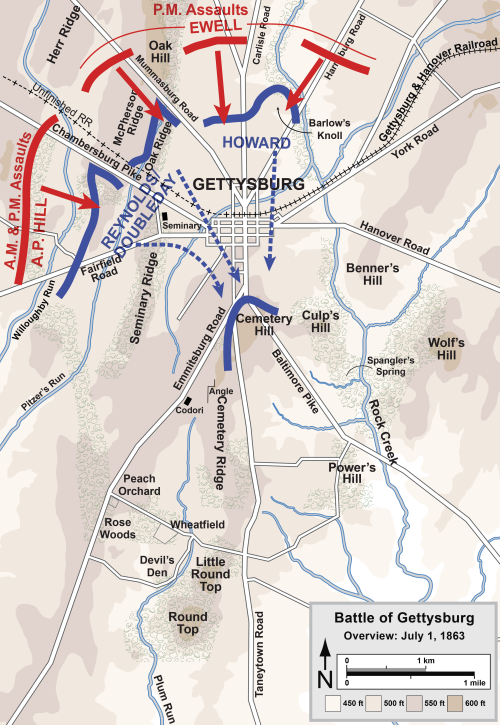
When morning came, Reynolds was awakened by his aide Major William Riddle with Meade’s order to “advance the First and Eleventh Corps to Gettysburg.” [39] Reynolds studied the order and though he expected no battle that morning, expecting “only moving up to be in supporting distance to Buford” [40] took the prudent and reasonable precautions that his Confederate opponents A.P. Hill and Harry Heth refused to take as they prepared to move on Gettysburg.

His troops were in fine spirits that morning even though it had been busy. After a breakfast of hardtack, pork and coffee the troops moved out. An officer of the Iron Brigade noted that the soldiers of that brigade were “all in the highest spirits” while Lieutenant Colonel Rufus Dawes of the “placed the fifes and drums at the head of the Sixth Wisconsin and ordered the colors unfurled” as the proud veterans marched forward into the sound of the raging battle to the tune of “The Campbell’s are Coming.” [41]

Though Reynolds was not expecting a fight he organized his march in a manner that ensured if one did happen that he was fully prepared. The precautionary measures that he took were those that any prudent commander having knowledge that strong enemy forces were nearby would take. Reynolds certainly took to heart the words of Napoleon who said “A General should say to himself many times a day: If the hostile army were to make its appearance in front, on my right, or on my left, what should I do?” [42]

This was a question that A.P. Hill and Harry Heth seemed not to consider on that warm and muggy July morning when Heth was committing Lee’s army to battle on his own authority. Reynolds was also about to commit the Army of the Potomac to battle, but unlike Heth who had no authority to do so, Reynolds “had at least been delegated the authority for making such a decision.” [43] While Meade was unaware of what was transpiring in the hills beyond Gettysburg he implicitly trusted the judgement of Reynolds, and he been with the advanced elements of Reynold’s wing Meade too “probably would have endorsed any decision he made.” [44]

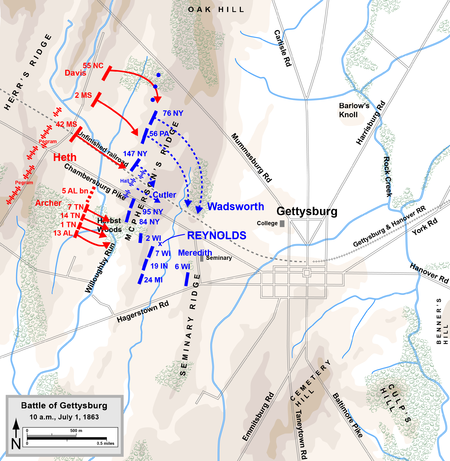
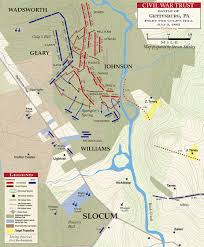
Reynolds placed himself with the lead division, that of Wadsworth, and “had directed Doubleday to bring up the other divisions and guns of the First Corps and had ordered Howard’s Eleventh Corps up from Emmitsburg.” [45] Reynold’s also understood the urgency of the situation and “wanted all the fighting troops to be up front, so he instructed Howard not to intermingle his supply wagons with his infantry. Similar instructions had been given to Abner Doubleday; to ensure that the First Corps wagons would wait until the Eleventh Corps foot soldiers had passed.” [46]

Instead operating in the normal fashion of rotating units on the march, Reynolds opted to save time. Since the First Division under the command of James Wadsworth was further advanced than other I Corps divisions, Reynolds instructed it to move first with Cutler’s brigade in the lead followed by the Iron Brigade under Colonel Solomon Meredith. In doing so he countermanded the order of the acting corps commander Doubleday who had ordered that division to allow the other divisions of First Corps to pass his before advancing. Reynolds told Wadsworth that Doubleday’s order “was a mistake and that I should move on directly.” [47]

He went forward with Wadsworth’s division and gave Doubleday his orders for the coming engagement. Doubleday later recalled that when Reynolds arrived to discuss the situation that Reynolds:

“read to me the various dispatches he had received from Meade and Buford, and told me that he should go at once forward with the leading division – that of Wadsworth – to aid the cavalry. He then instructed me to draw in my pickets, assemble the artillery and the remainder of the corps and join him as soon as possible. Having given me these orders, he rode off at the head of the column, and I never saw him again.” [48]

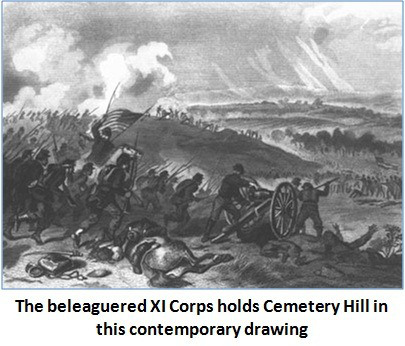
Reynolds ordered Howard’s XI Corps to follow and according to Doubleday directed an aid of Howard to have Howard “bring his corps forward at once and form them on Cemetery Hill as a reserve.” [49] While some writers that he directed Oliver Howard to prepare Cemetery Hill as a fallback position [50] there is more evidence that points to Howard selecting the that commanding hill himself. [51]

Likewise Reynolds ordered Sickles’ III Corps to come up from Emmitsburg where that corps had bivouacked the previous night. [52] Sickles had heard the guns in the distance that morning and sent his senior aide, Major Henry Tremain to find Reynolds. Reynolds told Tremain “Tell General Sickles I think he had better come up” but the order left Sickles in a quandary. He recalled “he spend an anxious hour deciding what to do” [53] for he had “been ordered by Meade to hold his position at Emmitsburg” [54] and Sickles sent another rider to Reynolds and awaited the response of his wing commander instead of immediately advancing to battle on 1 July and it would not be until after 3 P.M. that he would send his lead division to Gettysburg.

Reynolds’ intention according to Doubleday was “to fight the enemy as soon as I could meet him.” [55] Reynolds rode forward with some of his staff into the town as the infantry of I Corps and XI Corps moved advanced. In the town they were met by “a fleeing, badly frightened civilian, who gasped out the news that the cavalry was in a fight.” [56] When he came to the Lutheran Seminary he came across Buford. It was a defining moment of the Civil War, a moment that shaped the battle to come. It has been recounted many times and immortalized on screen in the movie Gettysburg, a time “when the entire battle would come down to a matter of minutes getting one place to another.” [57]

As the rough and tumble Kentuckian, Buford, and Reynolds, the dashing Pennsylvanian, discussed the situation they had to know that odd that they were facing. With close to 32,000 rebels from the four divisions of Hill’s and Ewell’s corps closing in from the west and the north with only about 18,000 men of First Corps, Eleventh Corps and Buford’s cavalry division the odds did not favor them, but unlike other battles that the army of the Potomac faced, this time the army and its commanders were determined not to lose and not to retreat.

Reynolds and Buford committed their eighteen thousand men against Lee’s thirty-two thousand in a meeting engagement that develop into a battle that would decide the outcome of Lee’s invasion. Likewise it was a battle for the very existence of the Union. Abner Doubleday noted the incontestable and eternal significance of the encounter to which Buford and Reynolds were committing the Army of the Potomac:

“The two armies about to contest on the perilous ridges of Gettysburg the possession of the Northern States, and the ultimate triumph of freedom or slavery….” [58]

Notes

[1] Ibid. Clausewitz On War p.102

[2] Nichols, Edward J. Toward Gettysburg: A Biography of John Fulton Reynolds Pennsylvania State University Press, Philadelphia 1958. Reprinted by Old Soldier Books, Gaithersburg MD 1987 p.4

[3] Ibid. Nichols Toward Gettysburg p.13

[4] Tagg, Larry The Generals of Gettysburg: The Leaders of America’s Greatest Battle Da Capo Press Cambridge MA 1998 Amazon Kindle Edition p.10

[5] Ibid. Nichols Toward Gettysburg pp.43-44

[6] Pfanz Harry W. Gettysburg: The First Day University of North Carolina Press, Chapel Hill and London 2001pp.47-48

[7] Ibid. Nichols Toward Gettysburg p.46

[8] Ibid. Pfanz Gettysburg: The First Day p.48

[9] Gonzalez, Justo L. The History of Christianity Volume 2: The Reformation to the Present Day Harper and Row Publishers San Francisco 1985 p.259

[10] Ehat, Andrew” It Seems Like Heaven Began on Earth”: Joseph Smith and the Constitution of the Kingdom of God in BYU Studies Vol 20. No 3 1980) retrieved from https://ojs.lib.byu.edu/spc/index.php/BYUStudies/article/view/5144/4794 20 May 2015 p.258

[11] Ibid. Gonzales p.259

[12] Ibid. Gonzales p.259

[13] Potter, David M. The Impending Crisis: America before the Civil War 1848-1861 completed and edited by Don E. Fehrenbacher Harper Collins Publishers, New York 1976 p.158

[14] Goldfield, David. America Aflame: How the Civil War Created a Nation Bloomsbury Press, New York 2011 p.122

[15] Ibid. Nichols Toward Gettysburg p.58

[16] Ibid. Nichols Toward Gettysburg p.58

[17] Ibid. Nichols Toward Gettysburg p.73

[18] Ibid. Nichols Toward Gettysburg p.73

[19] Ibid. Nichols Toward Gettysburg p.73

[20] Ibid. Pfanz Gettysburg: The First Day p.48

[21] Ibid. Nichols Toward Gettysburg p.75

[22] Korda, Michael. Clouds of Glory: The Life and Legend of Robert E. Lee Harper Collins Publishers, New York 2014 p.228


[23] Foote, Shelby, The Civil War, A Narrative. Volume One Fort Sumter to Perryville Random House, New York 1958 p.493

[24] Ibid. Nichols Toward Gettysburg p.100

[25] Ibid. Pfanz Gettysburg: The First Day p.48

[26] Sears, Stephen W. Controversies and Commanders Mariner Books, Houghton-Mifflin Company, Boston and New York 1999 p.162

[27] Sears, Stephen W. Gettysburg. Houghton Mifflin Co. Boston and New York 2003 pp. 40-42

[28] Nevins. Allan editor. A Diary of Battle: The Personal Journals of Colonel Charles Wainwright 1861-1865 with an introduction by Stephen W. Sears Da Capo Press, New York 1998 p.229

[29] Guelzo, Allen C. Gettysburg: The Last Invasion Vintage Books a Division of Random House, New York 2013 p.30

[30] Ibid. Guelzo Gettysburg: The Last Invasion pp.29-30

[31] Ibid. Sears, Gettysburg. p. 34

[32] Ibid. Guelzo, Gettysburg: The Last Invasion p.30

[33] Howard, Oliver O. Autobiography of Oliver Otis Howard, Major General, U.S. Army Volume 1 The Baker and Taylor Company, New York 1907 Made available by the Internet Achieve through Amazon Kindle location 5908 of 9221

[34] Wert, Jeffry D. The Sword of Lincoln: The Army of the Potomac Simon and Schuster, New York and London 2005 p.101

[35] Ibid. Howard Autobiography of Oliver Otis Howard location 5908 of 9221

[36] Ibid. Pfanz Gettysburg: The First Day p.48

[37] Ibid. Coddington The Gettysburg Campaign: A Study in Command p.261

[38] Ibid. Pfanz Gettysburg: The First Day p.48

[39] Ibid. Coddington The Gettysburg Campaign: A Study in Command, p.261

[40] Ibid. Sears, Gettysburg. p. 158

[41] Nolan, Alan T. The Iron Brigade: A Military History Indiana University Press, Bloomington IN, 1961 and 1994 pp.233-234

[42] Napoleon Bonaparte, Military Maxims of Napoleon in Roots of Strategy: The Five Greatest Military Classics of All Time edited by Phillips, Thomas R Stackpole Books Mechanicsburg PA 1985 p.410

[43] Ibid. Sears, Gettysburg. p. 165

[44] Ibid. Pfanz Gettysburg: The First Day p.49

[45] Ibid. Nolan The Iron Brigade p.233

[46] Trudeau, Noah Andre. Gettysburg: A Testing of Courage, Harper Collins Publishers, New York 2002 p.159

[47] Ibid. Trudeau, Gettysburg: A Testing of Courage p.156

[48] Doubleday, Abner Chancellorsville and Gettysburg: Campaigns of the Civil War VI Charles Scribner’s Sons, Bew York 1882 pp.70-71

[49] Ibid. Doubleday Chancellorsville and Gettysburg p.71

[50] Ibid. Pfanz Gettysburg: The First Day p.76

[51] Green, A. Wilson. From Chancellorsville to Gettysburg: O. O. Howard and Eleventh Corps Leadership in The First Day at Gettysburg edited by Gallagher, Gary W. Kent State University Press, Kent Ohio 1992 p. 70

[52] Ibid. Sears, Gettysburg. p. 158

[53] Keneally, Thomas American Scoundrel: The Life of the Notorious Civil war General Dan Sickles Anchor Books, a Division of Random House, New York 2003 p.275

[54] Swanberg, W.A. Sickles the Incredible Copyright by the author 1958 and 1984 Stan Clark Military Books, Gettysburg PA 1991 p.202

[55] Ibid. Trudeau, Gettysburg: A Testing of Courage p.156

[56] Ibid. Sears, Gettysburg. p. 165

[57] Ibid. Guelzo, Gettysburg: The Last Invasion p.142

[58] Ibid. Doubleday Chancellorsville and Gettysburg p.68


Leave a comment

Filed under civil war, History, leadership, Military

The Knight-Errant of Virginia: J.E.B. Stuart

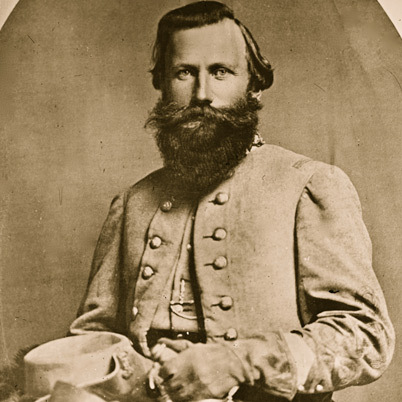
CWP015

Major General J.E.B. Stuart C.S.A.

Friends of Padre Steve’s World

I am continuing to periodically intersperse and publish short articles about various commanders at Gettysburg on the site. These all are drawn from my student text and may become a book in their own right.  The reason is I am going to do this is because I have found that readers are often more drawn to the lives of people than they are events. As I have noted before that people matter, even deeply flawed people, and we can learn from them.

Today’s article is about one of the most famous leaders of the Civil War, Confederate Cavalry commander James Ewell Brown “JEB” Stuart. He too is a complex character; exceptionally vain and self-seeking, capable of being a loyal friend or an implacable foe who confused fame with greatness because he did not have the depth of character to tell them apart. He led his troopers with great abandon to many victories but had little ability to reflect on his own actions which hurt the Confederate cause.

Peace

Padre Steve+

Major General James Ewell Brown Stuart was the son of a former congressman whose family went back five generations in Virginia. Like so many officers, his life is marked by contradictions. Eminently genial and fun-loving, he had a dark side of unbridled ambition and a willingness to use his rank, power and position to crush anyone who got in his way.

He graduated thirteenth in a class of forty-six at West Point in 1854. His classmates and friends included Dorsey Pender and Oliver O. Howard. A fellow cadet, as well as lifelong friend, who would serve under Stuart during the war, Fitzhugh Lee wrote of him:

“His distinguishing characteristics were a strict attention to his military duties, an erect, soldierly bearing, an immediate and almost thankful acceptance of a challenge from any cadet to fight, who might in any way feel himself aggrieved, and a clear, metallic, ringing voice.” [1]

At West Point Stuart was noted for his “lifelong religious devoutness. When he was at West Point he was known as a “Bible Class Man,” [2] and his faith would serve to define his life as much as his well-known vanity. As such, he was a close friend of Oliver O. Howard. The two were poles apart ideologically. Howard was already an abolitionist and opponent of state supremacy and states’ rights; Stuart on the other hand, was a proponent of all. When other Southern cadets “ostracized Howard, Stuart sided with the Maine Yankee. It was a courageous act in that closed society, rooted in his sense of justice and honor.” [3]

That sense of justice and honor carried with it a dark side. While he was genial and warm, he was intensely ambitious, and did not take criticism well. That would come out in his treatment of men like “Grumble” Jones and later Wade Hampton as well as other officers during his service to the Confederacy. One of his officers noted: “Stuart is an ambitious man – he wants those about him who are his friends. This is his first consideration – talent is next….A little flattery & a daring spirit will bring promotion.” [4]

Stuart was commissioned as a Second Lieutenant and assigned to the Mounted Rifles, which Stuart noted was “a corps which my taste, fondness for riding, and my desire to serve my country in some acceptable manner led me to select above all the rest.” [5] Stuart would serve with the Mounted Rifles for about a year before being selected to serve in one of the first Cavalry regiments formed, the First Cavalry at Jefferson Barracks Missouri.

In the pre-war years the young officer developed a solid reputation in the army where he served on the frontier and in “Bleeding Kansas.” In those years Stuart “was already a young officer of great promise, a natural horseman with a reputation for dash and bravery gained in countless clashes with Indians throughout the West, and for steady competence in the pro- and antislavery warfare of Kansas.” [6] However, Stuart was not a political person, while he certainly understood and kept himself apprised of developments he did not appreciate the magnitude of the events. Stuart was consumed with his advancing career and his personal life and “like most Americans, had neither the time nor inclination to understand the magnitude of the sectional conflict that produced civil war.” [7]

In 1859 Stuart was on leave, visiting Washington D.C. and staying with the Lees at Arlington. He was visiting the War Department when news came of John Brown’s raid at Harper’s Ferry. He was given a letter to take to Lee which ordered Lee to take command of troops to suppress the rebellion. Stuart accompanied Lee on the mission and was sent by Lee to present terms of surrender to the raiders, who at the time were still nameless to the Federal authorities. Stuart entered the building and was confronted by Brown whom he had previously met in Kansas. After some fruitless negotiation, Stuart realized that Brown was not about to surrender. At some point, Stuart broke away and motioned for the Marines to move in. “Three minutes after Stuart had given his signal, the affair was over.” [8]

In spite of having seen first-hand the effects of the violence in Kansas and at Harper’s Ferry, when secession came “Stuart was essentially unprepared.” [9] All he could do was to almost liturgically repeat “I go with Virginia” almost as an article of faith. As such, Stuart resigned his commission when Virginia seceded from the Union in April 1861, while his father-in-law, Colonel Philip St. George Cooke remained in Union service. Stuart could be unforgiving and such was the case now. Stuart hated his father-in-law’s decision, so much so that he re-named his son, who had been named for the elder Cooke, “James Ewell Brown Stuart,” which became “J.E.B. Stuart Jr. – Jimmy.” [10]

He commanded the 1st Virginia Cavalry in the Valley and at First Manassas and was promoted to Brigadier General in September 1861. The following month, he was given command of the army’s cavalry brigade and distinguished himself in the eyes of both General Joseph Johnston and Robert E. Lee. Johnston wrote to President Jefferson Davis praising the young brigadier “He is a rare man…wonderfully endowed by nature with the qualities necessary for an officer of light cavalry….If you add to this army a real brigade of cavalry, you can find no better brigadier-general to command it.” [11]

Lee came to share Johnston’s opinion and over the course of his service, Stuart had come to:

“demonstrate a real talent for the most mundane and most essential role cavalry played in this war – reconnaissance and intelligence gathering. No intelligence source surpassed his eye for seeing and evaluating a military landscape or an enemy’s strengths and dispositions.” [12]

This would be something that Lee came to rely and which he would dearly miss at Gettysburg.

Despite his excellence in this “most mundane” task, Stuart developed a flair and passion for the spectacular, which was first demonstrated during the Seven Days, where he took his cavalry on a circuit of McClellan’s army, which not only gathered a significant amount of intelligence, but also unnerved the Army of the Potomac. His raid was “flawlessly executed….” And Stuart “became a hero to his troopers and one of the idols of the public.” [13] Lee wrote that Stuart’s operation “was executed with great address and daring by accomplished officer.” [14] The raid did have its detractors, especially among the infantry and it also revealed something to Stuart that appealed to his own vanity, “that raiding would easily garner headlines in the Richmond papers.” [15]

Stuart Lee’s staff secretary, Colonel Robert Taylor noted that Stuart was “possessing of great powers of endurance, courageous to an exalted degree, of sanguine temperament, prompt to act, always ready for fight – he was the ideal cavalryman.” [16] Stuart also kept a lively headquarters. Taylor remarked “How genial he was! There was no room for “the blues” around his headquarters; the hesitating and desponding found no congenial atmosphere at his camp; good will, jollity, and even hilarity, reigned there.” [17]

Stuart always had his African-American banjo player with him and frequently sang around camp and on campaign. That was not always appreciated by some other officers. Wade Hampton, who in time became Stuart’s right-hand man was not impressed with the atmosphere at Stuart’s headquarters and “was not certain that he could flourish, or even survive, among such people….” [18] Lafayette McLaws wrote home complaining not only about Stuart but others:

“Stuart carries around with him a banjo player and special correspondent. This claptrap is noticed and lauded as a peculiarity of genius, when, in fact, it is nothing more but the act of a buffoon to get attention.” [19]

But Stuart was always aware of his own mortality and there was a serious side to him, often expressed in his faith, which impressed those around him. His West Point classmate and friend, Oliver O. Howard wrote:

“J.E.B. Stuart was cut out for a cavalry leader. In perfect health, but thirty-two years of age, full of vigor and enterprise, with the usual ideas imbibed in Virginia concerning State Supremacy, Christian thought and temperate by habit, no man could ride faster, endure more hardships, make a livelier charge, or be more hearty and cheerful while so engaged. A touch of vanity, which invited the smiles and applause of the fair maidens of Virginia, but added to the zest and ardor of Stuart’s parades and achievements.” [20]

At Chancellorsville Stuart assumed acting command of Jackson’s Second Corps which he led well during the battle, even impressing the infantry, who had long derided Stuart and his cavalry. Leading by example “seemed on fire.” Stuart sang as he led the Stonewall Brigade into action and “the troops joined him, singing while they loaded and fired.” One officer stated “Jeb impressed himself on the infantry.” [21]

Some believed that Stuart should have been appointed to command Second Corps after Jackson’s death, but evidently Lee valued Stuart’s role as a cavalry commander more and despite his accomplishments refused to proffer the command to Stuart. Colonel Rosser told Stuart, who was grieving the loss of his friend Jackson: “On his death bed Jackson said that you should succeed him, and command his corps.” Stuart responded “I would rather know that Jackson said that, than to have the appointment.” [22] One wonders what might have occurred during the Gettysburg campaign if Stuart had commanded Second Corps and left the cavalry to someone like the accomplished and level headed Wade Hampton.

Stuart, is another tragic figure, and that irony was that his tragedy was rooted in his success:

“He eventually became so absorbed in posturing and playing his role that he could not leave the stage or remove his mask….. He confused fame with greatness because he lacked the depth and experience to experience the difference. So consumed was he by his vision of what he ought to be that he never quite came to terms with his humanity – until he lay dying.” [23]

The knight errant of Virginia was mortally wounded less than a year after Gettysburg at the Battle of Yellow Tavern. He died twenty-seven hours after being wounded in the abdomen, suffering for most of it and unable to see his wife Flora one more time as she arrived hours after he died. Upon his death, Hampton was promoted to command what was left of the Cavalry Corps. He was mourned throughout the Confederacy. Even Grumble Jones, who had an acrimonious relationship with Stuart told his adjutant on hearing the news of Stuart’s death “You know I had little love for Stuart, and he had just as little for me; but that is the greatest loss that army has ever sustained except the death of Jackson.” [24]

Notes

[1] Davis, Burke J.E.B. Stuart: The Last Cavalier Random House, New York 1957 p.20

[2] Ibid. Tagg The Generals of Gettysburg p.356

[3] Wert, Jeffry D. Cavalryman of the Lost Cause: A Biography of J.E.B. Stuart Simon and Schuster, New York 2008 p.178

[4] Ibid. Wert Cavalryman of the Lost Cause p.116

[5] Ibid. Davis J.E.B. Stuart p.27

[6] Ibid. Korda Clouds of Glory p.xxv

[7] Thomas, Emory M. Bold Dragoon: The Life of J.E.B. Stuart University of Oklahoma Press, Norman OK 1986 and 1999 p.61

[8] Freeman, Douglas Southall, Lee an abridgment by Richard Harwell, Touchstone Books, New York 1997 p.101

[9] Ibid. Thomas Bold Dragoonp.61

[10] Ibid. Thomas Bold Dragoonp.95

[11] Ibid. Freeman Lee’s Lieutenants p.149

[12] Sears, Stephen W. To the Gates of Richmond: The Peninsula Campaign Houghton Mifflin Company, Boston and New York, 1992 p.167

[13] Ibid. Freeman Lee’s Lieutenants p.158

[14] Ibid. Wert A Glorious Army p.26

[15] Ibid. Guelzo, Gettysburg: The Last Invasion p.54

[16] Taylor, Walter. General Lee: His campaigns in Virginia 1861-1865 With Personal Reminiscences University of Nebraska Press, Lincoln Nebraska and London, 1994 previously published 1906 p.92

[17] Ibid. Taylor General Lee p.92

[18] Longacre, Edward G. Gentleman and Soldier: The Extraordinary Life of General Wade Hampton Rutledge Hill Press, Nashville TN 2003 p.83

[19] Ibid. Davis J.E.B. Stuart p.264

[20] Ibid. Girardi. The Civil War Generals p.255

[21] Ibid. Wert A Glorious Army p.198

[22] Ibid. Davis J.E.B. Stuart p.299

[23] Ibid. Thomas Bold Dragoon pp.299-300

[24] Ibid. Wert Cavalryman of the Lost Cause p.366

1 Comment

Filed under civil war, Gettysburg, History, leadership, Military

Councils of War at Gettysburg: Lee & Meade July 2nd 1863

Friends of Padre Steve’s World

As I noted yesterday I returned from Gettysburg and another Staff Ride, and one of the questions that came up during some of our table talk, as well as on the battlefield was about the command decision process by which Robert E. Lee and George Gordon Meade and their subordinates planned, prepared and debated what to do on the night of July 2nd 1863, following the bloody, but unsuccessful attacks by Hood’s and McLaw’s Divisions at Little Round Top, Devil’s Den, the Wheat Field, Peach Orchard and Plum Run.

To provide that overview in one article I have encapsulated a number of chapters from my Gettysburg text into one article. The contrast between Lee’s decision to attack, his refusal to take counsel of dissenting voices and views of his subordinates stand in stark contrast to those of his opponent, George Gordon Meade, his subordinate commanders and staff. Their decisions shaped the outcome of the battle of Gettysburg, and were decisive in Lee’s defeat, and instrumental in the eventual defeat of the Confederacy, just under 21 months later.

I hope you enjoy,

Peace

Padre Steve+

Lee1

As night fell on July 2nd 1863 General Robert E Lee had already made his decision. Despite the setbacks of the day he was determined to strike the Army of the Potomac yet again. He did not view the events as setback, and though he lacked clarity of how badly many of his units were mauled Lee took no external council to make his decision. With the exception of A.P. Hill who came and submitted a report to him Lee neither required his other two corps commanders, James Longstreet or Richard Ewell to consult with him, nor took any action to visit them.

Lee did “not feel that his troops had been defeated” and he felt that “the failure on the second day had been due to a lack of coordination.”1

In his official report of the battle he wrote:

“The result of this day’s operations induced the belief that, with proper concert of action, and with the increased support that the positions gained on the right would enable the artillery to render to the assaulting columns, that we should succeed, and it was ultimately determined to continue the attack…” 2

While Lee’s charge of a “lack of coordination” of the attacks can certainly be substantiated, the fact of the matter was that if there was anyone to blame for his lack of coordination it was him, and  even Lee’s most devoted biographer Douglas Southall Freeman would write that on July 2d “the Army of Northern Virginia was without a commander.” 3 Lee’s decision to attack on July 3rd, having not taken counsel of his commanders or assessed the battle-worthiness of the units that he was planning to through into his final assault on the Union center was “utterly divorced from reality.” 4 His plan was essentially unchanged from the previous day. Longstreet’s now battered divisions were to renew their assault on the Federal left in coordination with Pickett and two of Hill’s divisions.

In light of Lee’s belief that “a lack of coordination” was responsible for the failures of July 2nd it would have been prudent for him to ensure such coordination happened on the night of July 2nd. “Lee would have done well to have called out his three lieutenants to confer with them and spell out exactly what he wanted. That was not the way he did things however…” 5

Lee knew about the heavy losses among his key leaders but “evidently very little was conveyed to him regarding the condition of the units engaged this day.” 6 This certainly had to be because during the day his only view of the battlefield was from Seminary Ridge through binoculars and because he did not get first hand reports from the commanders involved. Lee was undeterred and according to some who saw Lee that night he seemed confident noting that when Hill reported he shook his and said “It is well, General,…Everything is well.” 7

It was not an opinion that Lee’s subordinates shared. Ewell and his subordinates were told to renew their attack on Cemetery and Culp’s Hill on the night of July 2nd, but “he and his generals believed more than ever that a daylight assault against the ranked guns on Cemetery Hill would be suicidal-Harry Hays said that such an attack would invite “nothing more than slaughter…” 8

LongstreetJ_main

James Longstreet was now more settled in his opposition to another such frontal attack and shortly after dawn when Lee visited him to deliver the order to attack again argued for a flanking movement around the Federal left. Lee’s order was for Longstreet to “attack again the next morning” according to the “general plan of July 2nd.” 9 Longstreet had not wanted to attack the previous day and when Lee came to him Longstreet again attempted to persuade Lee of his desire to turn the Federal flank. “General, I have had my scouts out all night, and I find that you still have an excellent opportunity to move around to the right of Meade’s army and maneuver him into attacking us.” 10

Lee would have nothing of it. He looked at his “Old Warhorse” and as he had done the previous day insisted: “The enemy is there,” he said, pointing northeast as he spoke, “and I am going to strike him.” 11 Longstreet’s gloom deepened and he wrote that he felt “it was my duty to express my convictions.” He bluntly told Lee:

“General, I have been a soldier all of my life. I have been with soldiers engaged in fights by couples, by squads, companies, regiments, divisions and armies, and should know, as well as any one, what soldiers can do. It is my opinion that no fifteen thousand men ever arranged for battle can take that position.” 12

But Lee was determined to force his will on both his subordinates and the battle. Lee was convinced that the plan could succeed while Longstreet “was certain” that the plan “was misguided and doomed to fail.” 13 Longstreet, now realized that further arguments were in vain recalled that Lee “was impatient of listening, and tired of talking, and nothing was left but to proceed.” 14

Even a consultation with Brigadier General William Wofford whose brigade had help crush Sickle’s III Corps at the Peach Orchard and had nearly gotten to the crest of Cemetery Ridge could not alter Lee’s plan. Wofford had to break off his attack on July 2nd when he realized that there were no units to support him. Lee asked if Wofford could “go there again” to which Wofford replied “No, General I think not.” Lee asked “why not” and Wofford explained: “General, the enemy have had all night to intrench and reinforce. I had been pursuing a broken enemy, and now the situation is very different.” 15

The attack would go forward despite Longstreet’s objections and the often unspoken concerns of others who had the ear of Lee, or who would carry out the attack. Walter Taylor of Lee’s staff wrote to his sister a few days after the attack the “position was impregnable to any such force as ours” while Pickett’s brigadier Richard Garnett remarked “this is a desperate thing to attempt” and Lewis Armistead said “the slaughter will be terrible.” 16

Pickett’s fresh division would lead the attack supported by Johnston Pettigrew commanding the wounded Harry Heth’s division of Hill’s Third Corps and Isaac Trimble commanding two brigades of Pender’s division, Trimble having been given command just minutes prior to the artillery bombardment. 17 On the command side few of the commanders had commanded alongside each other before July 3rd. Trimble had just recovered from wounds had never been with his men. Pettigrew had been given command when Pender was wounded was still new and relatively untested, and Pickett’s three brigadiers and their brigades had never fought together. Two of the divisions had never served under Longstreet. From a command perspective where relationships and trust count as much as strength and numbers the situation was nearly as bad is it could be. Although the Confederates massed close to 170 cannon on Seminary Ridge to support the attack ammunition was in short supply and the Lieutenant Colonel Porter Alexander who had been tasked with coordinating fires only controlled the guns of First Corps.

The assaulting troops would attack with their right flank exposed to deadly enfilade fire from Federal artillery and with the left flank unsupported and exposed to such fires from Union artillery on Cemetery Hill. It was a disaster waiting to happen. Longstreet noted “Never was I so depressed as on that day…” 18

general-george-meade

While Lee took no counsel and determined to attack on the night of July 2nd little more than two miles away Major General George Meade took no chances. After sending a message to Henry Halleck at 8 PM Meade called his generals together. Unlike Lee who had observed the battle from a distance Meade had been everywhere on the battlefield during the day and had a good idea what his army had suffered and the damage that he had inflicted on the Army of Northern Virginia. Likewise during the day he had been with the majority of his commanders as opposed to Lee who after issuing orders that morning had remained unengaged, as was noted by the British observer Lieutenant Colonel Arthur Fremantle who wrote that during the “whole time the firing continued, he sent only one message, and only received one report.” 19

Meade wired Halleck that evening: “The enemy attacked me about 4 P.M. this day…and after one of the severest contests of the war was repulsed at all points.” 20 However Meade, realizing that caution was not a vice still needed to better assess the condition of his army, hear his commanders and hear from his intelligence service, ended his message: “I shall remain in my present position to-morrow, but am not prepared to say until better advised of the condition of the army, whether operations will be of an offensive or a defensive character.” 21

As Meade waited for his commanders his caution was apparent. Before the attack on Sickles’ III Corps at the Peach Orchard Meade had asked his Chief of Staff Brigadier General Dan Butterfield to “draw up a contingency plan for withdraw to Pipe Creek.” After the attack on Sickles Alfred Pleasanton said that Meade ordered him to “gather what cavalry I could, and prepare for the retreat of the army.” 22 Some of his commanders who heard of the contingency plan including John Gibbon and John Sedgwick believed that Meade was “thinking of a retreat.” 23. Despite Meade’s  flat assurances to Halleck  his army’s position had been threatened on both flanks, though both were now solidly held, but some of his subordinates believed, maybe through the transference of their own doubts, that Meade “foresaw disaster, and not without cause.” 24

In assessing Meade’s conduct it has to be concluded that while he had determined to remain, that he was smart enough to plan of the worst and to consult his commanders and staff in making his decision. Meade wrote to his wife that evening “for at one time things looked a little blue,…but I managed to get up reinforcements in time to save the day….The most difficult part of my work is acting without correct information on which to predicate action.” 25

Gettysburg_Council_of_War

Meade called Colonel George Sharpe from the Bureau of Military Information to meet with him, Hancock and Slocum at the cottage on the Taneytown Road where he made his headquarters. Sharpe and his aide explained the enemy situation. Sharpe noted “nearly 100 Confederate regiments in action Wednesday and Thursday” and that “not one of those regiments belonged to Pickett.” He then reported with confidence that indicated that “Pickett’s division has just come up and is bivouac.” 26

It was the assurance that Meade needed as his commanders came together. When Sharpe concluded his report Hancock exclaimed “General, we have got them nicked.” 27

About 9 P.M. the generals gathered. Present were Meade, and two of his major staff officers Warren just back from Little Round Top, wounded and tired, and Butterfield his Chief of Staff. Hancock action as a Wing Commander was there with Gibbon now commanding II Corps, Slocum of XII Corps with Williams. John Newton a division commander from VI Corps who had just arrived on the battlefield now commanding I Corps was present along with Oliver Howard of XI Corps, John Sedgwick of VI Corps, George Sykes of V Corps and David Birney, now commanding what was left of the wounded Dan Sickles’ III Corps. Pleasanton was off with the cavalry and Hunt attending to the artillery.

The meeting began and John Gibbon noted that it “was at first very informal and in the shape of a conversation….” 28 The condition of the army was discussed and it was believed that now only about 58,000 troops were available to fight. Birney honestly described the condition of III Corps noting that “his corps was badly chewed up, and that he doubted that it was fit for much more.” 29 Newton who had just arrived was quoted by Gibbon as saying that Gettysburg was “a bad position” and that “Cemetery Hill was no place to fight a battle in.” 20 The remarks sparked a serious discussion with Meade asking the assembled generals “whether our army should remain on that field and continue the battle, or whether we should change to some other position.” 31

The reactions to the question showed that the army commanders still had plenty of fight in the. Meade listened as his generals discussed the matter. Hancock said he was “puzzled about the practicability of retiring.” 32 Newton later noted that he made his observations about the battlefield based on his belief that that Lee might turn the Federal left and impose his army between it and its supplies, as Longstreet However Newton and the other commanders agreed that pulling back “would be a highly dangerous maneuver to attempt in the immediate presence of the enemy.” 33

Finally Butterfield, no friend of Meade and one of the McClellan and Hooker political cabal who Meade had retained when he took command posed three questions to the assembled generals:

“Under existing circumstances, is it advisable for this army to remain in its present position, or retire to another nearer its base of supplies?

It being determined to remain in present position, shall the army attack or wait the attack of the enemy?

If we wait attack, how long?” 34

Gibbon as the junior officer present said “Correct the position of the army…but do not retreat.” Williams counseled “stay,” as did Birney and Sykes, and Newton, who after briefly arguing the dangers finally agreed. Oliver Howard not only recommended remaining but “even urged an attack if the Confederates stayed their hand.” Hancock who earlier voiced his opinion to Meade that “we have them nicked” added “with a touch of anger, “Let us have no more retreats. The Army of the Potomac has had too many retreats….Let this be our last retreat.” Sedgwick of VI Corps voted “remain” and finally Slocum uttered just three words “stay and fight.” 35

None of Meade’s assembled commanders counseled an immediate attack; all recommended remaining at least another day. When the discussion concluded Meade told his generals “Well gentlemen…the question is settled. We remain here.” 36

Some present believed that Meade was looking for a way to retreat to a stronger position, that he had been rattled by the events of the day. Slocum believed that “but for the decision of his corps commanders” that Meade and the Army of the Potomac “would have been in full retreat…on the third of July.” 37 Meade would deny such accusations before Congressional committees the following year as Radical Republicans in Congress sought to have him relieved for political reasons.

Much of the criticism of his command decisions during the battle were made by political partisans associated with the military cabal of Hooker, Butterfield and Sickles as well as Radical Republicans who believed that Meade was a Copperhead. Both Butterfield and Birney accused Meade before the committee of wanting to retreat and “put the worst possible interpretation on Meade’s assumed lack of self-confidence without offering any real evidence to substantiate it.” Edwin Coddington notes “that Meade, other than contemplating a slight withdraw to straighten his lines, wanted no retreat from Gettysburg.” 38

Alpheus Williams of XII Corps, wrote to his daughters on July 6th regarding his beliefs about Meade on the night of July 2nd. “I heard no expression from him which led me to think that he was in favor of withdrawing the army from before Gettysburg.” 39 Likewise the message sent by Meade to Halleck indicates Meade’s own confidence in the upcoming battle of July 3rd. If Meade had some reservations during the day, as he mentioned in the letter to his wife they certainly were gone by the time he received the intelligence report from Sharpe and heard Hancock’s bold assertion that the enemy was “nicked.”

As the meeting broke up after shortly after midnight and the generals returned to their commands Meade pulled Gibbon aside. Gibbon with II Corps had the Federal center on Cemetery Ridge. Meade told him “If Lee attacks tomorrow, it will be in your front.” Gibbon queried as to why Meade thought this and Meade continued “Because he has made attacks on both our flanks and failed,…and if he concludes to try it again it will be on our center.” Gibbon wrote years later “I expressed the hope that he would, and told General Meade with confidence, that if he did we would defeat him.” 40

If some of his generals and political opponents believed Meade to be a defeatist,  that defeatism was not present in his private correspondence. He wrote to his wife early in the morning of July 3rd displaying a private confidence that speaks volumes: “Dearest love, All well and going on well in the Army. We had a great fight yesterday, the enemy attacking & we completely repulsing them- both armies shattered….Army in fine spirits & every one determined to do or die.” 41

The contrast between Lee’s and Meade’s decision making process is Meade did what Lee should have done, he had been active on the battlefield, he consulted his intelligence service and he consulted his commanders on the options available to him. Lee remained away from the action on July 2nd he failed to consult his commanders. He failed to gain accurate intelligence on the Federal forces facing him and he failed to fully take into account his losses. Meade better demonstrated the principles of what we now call “mission command.”

Notes

1 Freeman, Douglas Southall, Lee’s Lieutenant’s a Study in Command, One volume abridgement by Stephen W Sears, Scribner, New York 1998 p.558

2 Lee, Robert E, Reports of Robert E Lee, C.S. Army, Commanding Army of Northern Virginia Campaign Report Dated January 20th 1864. Amazon Kindle Edition location 594 of 743

3 Freeman, Douglas S. R.E. Lee volume 3 Charles Scribner’s Sons, New York 1935 p.150

4 Sears, Stephen W Gettysburg Houghton Mifflin Company, New York 2003 p.349

5 Coddinton, Edwin Gettysburg, A Study in Command Simon and Schuster New York 1968 p.455

6 Trudeau, Noah Andre Gettysburg, A Testing of Courage Harper Collins, New York 2002 p.4117 Ibid p.412

8 Ibid. p.347

9 Ibid. p.430

10 Wert, Jeffry General James Longstreet, the Confederacy’s Most Controversial Soldier A Tuchstone Book, Simon and Schuster, New York 1993 p.283

11 Foote, Shelby The Civil War, A Narrative, Fredericksburg to Meridian Random House, New York 1963 p.529 12 Ibid. Wert p.283

13 Ibid. Sears p.349

14 Guelzo, Allen C. Gettysburg: The Last Invasion Vintage Books, a Division of Random House, New York 2013 p.377

15 Ibid. Foote p.531

16 Ibid. Wert p.287

17 Ibid. Freeman p.589

18 Ibid. Wert p.290

19 Fremantle, Arthur Three Months in the Southern States, April- June 1863 William Blackwood and Sons, Edinburgh and London 1863 Amazon Kindle edition p.266

20 Sears, Stephen W Gettysburg Houghton Mifflin Company, New York 2003 pp.341-342

21 Ibid. p.342

22 Guelzo, Allen C. Gettysburg: The Last Invasion Vintage Books, a Division of Random House, New York 2013 p.355

23 Ibid.

24 Foote, Shelby The Civil War, A Narrative, Fredericksburg to Meridian Random House, New York 1963 p.524

25 Trudeau, Noah Andre Gettysburg, A Testing of Courage Harper Collins, New York 2002 p.413

26 Ibid. Sears p.342

27 Ibid. Trudeau p.413

28 Ibid. Sears p.342

29 Ibid. Trudeau p.415

30 Ibid. Guelzo p.556

31 Ibid. Guelzo p.556

32 Ibid. Sears p.343

33 Ibid. Sears p.343

34 Ibid. Trudeau p.415

35 Ibid. Guelzo p.556

36 Ibid. Foote p.525

37 Ibid. Guelzo

38 Coddinton, Edwin Gettysburg, A Study in Command Simon and Schuster New York 1968 pp.451-452

39 Ibid. p.452

40 Ibid. Foote p.525

41 Ibid. Trudeau p.345


1 Comment

Filed under civil war, History, leadership, Military

The Glory of Fighting The Anticlimactic Cavalry Clashes at Gettysburg

4 R

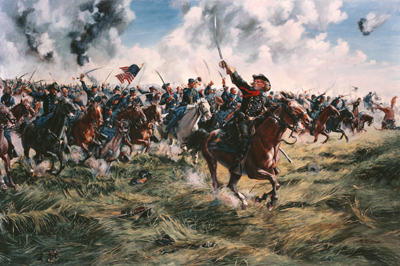
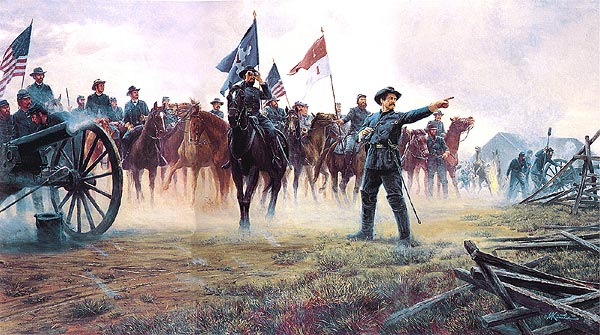
Custer leads his Michigan Cavalry Brigade on July 3rd

On the evening of July 2nd 1863 with the attacks of Longstreet now finished and Ewell’s abortive battle for Culp’s Hill reaching its bloody climax, Major General J.E.B. Stuart finally arrived at Robert E Lee’s headquarters on Seminary Ridge. Stuart and his troopers had been missing from Lee’s army since the evening of June 23rd, causing Lee no end of anxiety as well as depriving Lee of his most trusted source of information regarding enemy movements and intentions.

Stuart’s tired and hungry brigades were at Carlisle where he was endeavoring to take that town from local militia when Stuart leaned the location of Lee’s army. He was directed to “move to Gettysburg. Jeb did not delay compliance. Exhausted troopers mounted their staggering horses,” [1] and began the ride to Gettysburg where much of the army greeted with “joyful shouts” [2] which was a relief to his exhausted troopers. Stuart’s chief of staff Major Henry McClellan wrote: “For eight days and nights the troops had been marching incessantly. On the ninth night they rested within the shelter of the army, and with a grateful sense of relief which words cannot express.” [3]

Stuart rode ahead to Lee’s headquarters where unlike the “joyful” greeting his troops were accorded, he was met with a frosty reception by his beloved commander. Over the eight days of his absence Lee Apparently the meeting between Lee and his Cavalry division commander was short “abrupt and frosty. As soldier-historian Porter Alexander put it, “although Lee said only, ‘Well, General, you are here at last,’ his manner implied rebuke, and it was understood by Stuart.” [4] One account noted that “Lee reddened at the sight of Stuart and raised his arm as if he would strike him.” [5] Lee’s cold greeting stunned Stuart, who “may have been disappointed that no applause greeted his return from his longest raid, which he was to persuade himself was his greatest.” [6] Henry McClellan reported that Stuart “regarded the incident as painful beyond description.” [7]

In his official report of the battle “Lee would allude to Stuart with but a single pejorative sentence: “The movements of the Army preceding the Battle of Gettysburg had been much embarrassed by the absence of the cavalry.” [8]

Stuart left as quickly as he arrived and in his official report he noted that his new orders were to take up a position “on the left wing of the Army of Northern Virginia.” [9] For a man like Stuart whose soldierly skills as a cavalry commander and leader were only matched by his vanity the incident was humiliating, he had failed Robert E Lee.

Stuart devised a plan to put his strong>“entire cavalry force in a position from which he could separate the Union cavalry from the main body of the army and at proper moment swoop down on its rear.” [10] However, there is no supporting evidence to indicate that Lee ever ordered Stuart to conduct an attack, and the suggestion runs counter to how Lee employed his cavalry throughout the war. The idea that Lee intended Stuart “to commit his small cavalry force to an attack on infantry belies every tactical lesson the Civil War afforded.” [11] It was a bad plan and it was now beyond the capabilities of Stuart’s troopers exhausted troopers and their broken mounts, who would face similar numbers of relatively fresh Federal cavalry; which as noted before was now their equal in leadership, training, organization and equipment.

Stuart moved four of his brigades the following morning to the north and east. He hoped to cover his movement from Federal observation but he was discovered by “watchful Union signal officers” who reported “large columns of cavalry moving toward the right of the Union line” [12] The message was relayed by Howard to Brigadier General David Gregg of the Second Cavalry Division who quickly deployed his troopers to meet the emerging threat. Stuart unjustly blamed the discovery of his force on brigades of Hampton and Fitzhugh Lee who he said had “debouched onto open ground and disclosed his presence.” But Stuart himself was also to blame for the discovery as he announced his force’s presence by bringing one cannon from Griffin’s battery of his artillery “to the edge of the woods and fired a number of random shots in different directions, himself giving orders to the gun.” [13] For a veteran officer such as Stuart that decision is inexplicable.

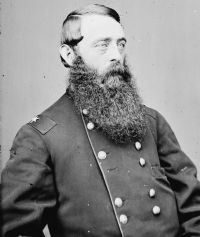
david-gregg

Brigadier General David Gregg

When Gregg received word of Stuart’s approach from Alfred Pleasanton, he was ordered to intercept him and in the process relieve the Michigan Brigade of the newly minted Brigadier General George Custer, which was deployed there so it could rejoin Judson Kilpatrick’s Third Cavalry Division on the extreme Federal left.

However, upon his arrival Gregg realized that he would be outnumbered and that Stuart posed “a serious threat to the Union rear.” [14] Custer indicated that he thought Gregg would soon have a battle and Gregg replied “in that case he would like to have the assistance of his Michigan brigade.” Custer agreed with Gregg and said that he would be “only too happy” to stay.” [15] Without bothering to consult his Cavalry Corps Commander, Major General Pleasanton, Gregg ordered Custer to remain with him and “willingly risked his military career and reputation in his anxiety to protect the Federal rear.” [16]

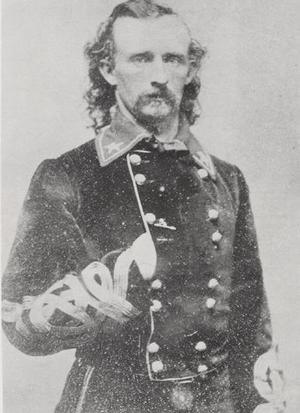
 custer

Brigadier General George Armstrong Custer

Gregg’s action was yet another of the superior judgments executed by a Federal commander during the battle. It was an outstanding example of how Federal commanders on the whole recognized the overall tactical situation and used their judgment to take action when waiting for a superior could prove fatal to the army. In our modern understanding it would be an example of how Mission Command is to work.

The main battle took place after Three P.M. when Pickett and Pettigrew’s divisions were battling for their lives in their ill-fated assault on Cemetery Hill. “For almost an hour, from 12:300 to 1:30, both sides jockeyed for advantage in a long range duel of cavalry, fighting with carbines and artillery.” [17] were a number of charges and counter charges, culminating in a “furious saber-swinging mounted counterattack by Custer and his Michigan cavalry, Custer at their head crying, “Come on, you Wolverines!” [18] As the clash continued “Stuart saw that General Gregg did not intend to allow an assault on Meade’s rear. The enemy was as stoutly determined as they had been at Brandy Station or in the passes in Northern Virginia.” [19] The battle evolved into a “smaller-scale version of the cavalry scrum at Brandy Station a month before.[20]

Though the battle was tactically a draw, Gregg and Custer’s troopers had prevailed, casualties on both sides were well under ten percent, 254 Union and 181 Confederate. But it was a victory for Gregg who had forced Stuart to enter a battle “in which the Confederates gained nothing except the “glory of fighting” [21] and had stopped Stuart from his objective of disrupting the Federal rear and aiding Pickett’s assault. Stuart wrote: “Had the enemy’s main body been dislodged, as was confidently hoped and expected, I was in precisely the right position….” [22]

As the battle to the east of town wound down Brigadier General Judson Kilpatrick ordered a “poorly calculated mounted attack on some of John Bell Hood’s men down by Big Round Top.” [23] Kilpatrick ordered Brigadier General Elon Farnsworth to attack the dug in Confederates. Farnsworth was incredulous and objected saying “No successful charge can be made against the enemy in my front.” [24] When Kilpatrick questioned his courage Farnsworth said “if you order the charge I will lead it, but you must take the responsibility.” [25] Farnsworth told one of his officers “My God Hammond, Kil is going to have a cavalry charge. It is too awful to think of….” [26] Farnsworth’s troopers struck Law’s brigade and the Alabama troops of Colonel William Oates who had been repulsed the day before at Little Round Top. Defending rugged ground and backed by artillery it was Oates’ soldiers turn to enact slaughter on the charging Federals.

farnsworth

Elon Farnsworth

It was a hopeless charge. Farnsworth’s units were surrounded and while many men were able to ride to safety Farnsworth and ten or so of his men were cut off,
and he was wounded at least three times and knocked from his horse. Offered the opportunity to surrender by a Confederate officer he refused and “with an oath he swore he would not do it, and placing his pistol to his own body shot himself through the heart.” [27] Though the assault was going nowhere the now frantic Kilpatrick hurled the last regiment available into the fight screaming at its commander “Why in hell and damnation don’t you move those troops out,” The troopers of the 18th Pennsylvania “went forward and were stopped in their tracks.” [28]

During the battle with Gregg and Custer’s troopers, Stuart displayed little of his normally sharp tactical leadership and took little part in the battle leaving the conduct of it to his subordinates. Though the Federal Horse Artillery was outnumbered Gregg used the two batteries he had far more effectively than Stuart used his. Additionally Gregg had two brigade commanders willing to take the fight to the Confederates, something that had not been common before the Gettysburg campaign. Stuart again claimed victory as he had at Brandy Station, but once more his words were deceptively inaccurate, he had been bested by the Federals once again.

Stuart’s aid Major Henry McClellan wrote of the battle on the Cavalry Field:

“The result of this battle shows that there is no possibility that Stuart could successfully have carried out his intention of attacking the rear of the Federal right flank, for it was sufficiently protected by Gregg’s command. As soon as General Gregg was aware of Stuart’s presence he wisely assumed the aggressive and forced upon Stuart a battle…while Gregg himself performed the paramount flank of protecting the right flank of the Federal Army.” [29]

McClellan’s analysis is both succinct and accurate. As Stuart’s forces retired and Pickett’s shattered command withdrew the Battle of Gettysburg was effectively over.

Peace

Padre Steve+

Notes

[1] Freeman, Douglas Southall, Lee’s Lieutenant’s a Study in Command, One volume abridgement by Stephen W Sears, Scribner, New York 1998 p.586

[2] Guelzo, Allen C. Gettysburg: The Last Invasion Vintage Books a Division of Random House, New York 2013 p.362

[3] McClellan, Henry Brainerd The Life and Campaigns of Major General J.E.B. Stuart Commander of the Cavalry of the Army of Northern Virginia 1885. Digital edition copyright 2011 Strait Gate Publications, Charlotte NC location 6373 of 12283

[4] Sears, Stephen W. Gettysburg A Mariner Book, Houghton Mifflin Company, Boston and New York 2003. pp.257-258

[5] Davis, Burke J.E.B. Stuart: The Last Cavalier Random House, New York 1957 p.334

[6] Ibid. Freeman Lee’s Lieutenants p.586

[7] Ibid. Sears Gettysburg p.258

[8] Taylor, John M. Duty Faithfully Performed: Robert E Lee and his Critics Brassey’s Dulles VA 1999 p.150

[9] Trudeau, Noah Andre. Gettysburg: A Testing of Courage, Harper Collins Books New York 2001 p.316

[10] Coddington, Edwin B. Gettysburg: A Study in Command. A Touchstone Book, Simon and Schuster, New York 1968 p.520

[11] Ibid. Guelzo Gettysburg the Last Invasion p.429

[12] Ibid. Coddington pp.520-521

[13] Ibid. McClellan The Life and Campaigns of Major General J.E.B. Stuart location 6486 of 12283

[14] Ibid. Coddington p. 521

[15] Ibid. Coddington p. 521

[16] Ibid. Coddington p. 521

[17] Ibid. Guelzo Gettysburg the Last Invasion p.430

[18] Ibid. Guelzo Gettysburg the Last Invasion p.430

[19] Ibid. Davis. J.E.B. Stuart p.338

[20] Ibid. Guelzo Gettysburg the Last Invasion p.430

[21] Ibid. Coddington p. 523

[22] Wert, Jeffry D. A Glorious Army: Robert E. Lee’s Triumph 1862-1863 Simon and Schuster, New York and London 2011 p.271

[23] Ibid. Guelzo Gettysburg the Last Invasion p.430

[24] Wert, Jeffery D. Gettysburg Day Three A Touchstone Book, New York 2001 p.277

[25] Ibid. Wert Gettysburg Day Three p.277

[26] Ibid. Sears Gettysburg p.463

[27] Oates, Willam C. and Haskell, Frank A. Gettysburg: The Confederate and Union Views of the Most Decisive Battle of the War in One Volume Bantam Books edition, New York 1992, originally published in 1905 p.122

[28] Ibid. Sears Gettysburg p.463

[29] Ibid. McClellan The Life and Campaigns of Major General J.E.B. Stuart location 6516 of 12283

Leave a comment

Filed under civil war, History, leadership, Military

“Well, We May as Well Fight it out Here” Meade Decides to Fight at Gettysburg

general-george-meade

“General Meade will commit no blunder in my front, and if I commit one he will make haste to take advantage of it.” Robert E Lee June 28th 1863

The choosing of the place to give battle, at any level of war, but particularly at the operational level is always of the utmost importance and has been so from time immemorial. Despite advances in technology terrain and weather are major factors that a commander or staff must consider in terms of their courses of action. Knowing the terrain features as well as the infrastructure such as road networks that they are operating on allows commanders to choose courses of action which accentuate their strengths and expose their opponent’s weaknesses. To understand this is a key part of Course of Action (COA) development, Operational Art and Operational Design as well as analyzing Centers of Gravity, especially in determining decisive points.

While the commanders at Gettysburg did not use such terminology, they did understand the effects of terrain and weather, friction and the importance of occupying “good ground.” Our understanding of these concepts can help us draw from the actions of the commanders at Gettysburg lessons that we can employ today, despite the vast changes in technology and expansion of the battlefield.

As he looked at the dispositions of the Confederate army on June 30th George Gordon Meade “felt he had move his forces in such a way as to challenge the enemy advance while at the same time protecting Washington and Baltimore.” 1 To do this he decided to concentrate the Army of the Potomac along what is known as the Pipe Creek line, a line along Parr’s Ridge just behind Pipe Creek to the south of Meade’s Taneytown headquarters. As an engineer Meade recognized the The decision was made because he realized that his advance had caused Lee’s army to abandon its threatening movement toward Harrisburg and the Susquehanna and was concentrating in the general area of Cashtown, South Mountain and possibly advancing toward Gettysburg.

The Pipe Creek line offered Meade a number of advantages; “it covered his own supply line and blocked the direct route to Baltimore.” 2 The positions of his intrenched army there would be “almost impossible to storm by frontal attack” 3 as well as allow his army to concentrate quickly. By placing himself in that position Meade believed that it would force Lee to attack him on good ground of his own choosing, offer him the chance to attack should Lee divide his forces, or by allowing Lee to exhaust his forage and supplies to withdraw from Pennsylvania without giving battle. Meade’s intention at Pipe Creek was to fight the “kind of battle he was to fight at Gettysburg.” 4

However Meade’s carefully laid plan became a victim of circumstances as events progressed during the evening of June 30th and morning of July 1st. When Reynolds was told by Buford that contact had been made and the Confederates were advancing on Gettysburg he brought I Corps and XI Corps up as quickly as he could and issued orders for III Corps under Sickles to join them at Gettysburg.

About 1130 a.m. Meade received word from John Reynolds’ aide Captain Stephen Weld that Reynolds had engaged the enemy at Gettysburg and had not received Meade’s Pipe Creek circular, which jeopardized his plan. Meade, having not known that Reynolds was not acting on his latest plan had assumed that Reynolds was conducting a temporary holding action at Gettysburg, but at 1 p.m. he was given the message that “Reynolds was dead or severely wounded and that Otis Howard was in command on the field.” 5 At this point Meade wasted no time and appointed Winfield Scott Hancock to go to Gettysburg and take charge of the situation, not trusting Howard’s abilities and instructed him “If you think the ground and position there are a better one to fight under existing circumstances, you will so advise the General, and he will order his troops up.” 6 He placed John Gibbon in command of II Corps and because he was concerned that Lee might cut off the embattled I Corps and XI Corps.

It was at this point that Meade decided to abandon his Pipe Creek plan and even before getting Hancock’s report, issued orders to his Corps commanders. At about 4:30 p.m. Meade ordered Sedgwick and his VI Corps up to Taneytown and put Slocum’s XII Corps and Sykes V Corps on the road to “move up to Gettysburg at once.” 7

Throughout the afternoon Meade kept his wits and “may have restrained a natural impulse to rush to the battleground and take over control of affairs himself.” 8 After the battle some criticized Meade for this, but it was from a perspective of command, and what we now call Mission Command did the right thing. He stayed at his headquarters to better control the movements and communicate with all his forces, which he could not have done had he rushed to the front, and instead “delegated authority to a highly competent subordinate, while he himself stayed close to the center of operations at army headquarters.” 9

Had Meade done what many commanders might have done in his position, and moved to the battle he might not have been able to do the more important job of ensuring the in a moment of crisis that his subordinate commanders received his orders and moved their units where they were needed. In fact any delay of getting the Union forces to Gettysburg could have been fatal to his army and allowed Lee to gain the advantage and possibly defeat his forces in detail. Likewise if Hancock arrived and found that the position could not be held, Meade would still be in position to ensure that the Pipe Creek position could be held.

The man he appointed in his stead, Hancock was someone that was not only capable but someone that “was a man who he knew and could trust,” 10 and who despite being junior to Howard, Slocum and Sickles was able to diplomatically handle the awkwardness of the situation. After Hancock arrived on the field he took in the tactical situation and judged it “the strongest position by nature on which to fight a battle that I ever saw.” 11

Howard objected to Hancock taking charge of the battlefield due to seniority, and although Howard had selected the position, demurred to Howard and said “and if it meets your approbation I will select this as the battlefield.” After Howard concurred Hancock announced “Very well, sir. I select this as the battlefield.” 12 While Howard could make the claim that he actually selected the ground of where to fight by emplacing Steinwehr’s division on the Hill as a reserve and withdrawing the battered remnants of I Corps and XI Corps to it during the afternoon, it was Hancock that “organized the all-round defense of the position.” 13 After consulting with Howard and directing Slocum’s XII Corps to occupy Culp’s Hill Hancock sent his aide Major William Mitchell to tell Meade that the position “could not well be taken.” 14 He had III Corps extend the line down Cemetery Ridge and directed his own II Corps to protect the flank in case Lee attempted to turn the Federal left. Upon Slocum’s arrival Hancock relinquished command and rode to Taneytown to personally brief Meade on the situation.

When Meade received word that from Hancock that he believed that “Gettysburg could maintain itself until dark” he dispatched a message to Hancock and Doubleday “It seems to me that we have so concentrated that a battle at Gettysburg is now forced upon us.” 15 Meade then sent a dispatch to Henry Halleck in Washington: “A.P. Hill and Ewell are certainly concentrating…Longstreet’s whereabouts I do not know. If he is not up tomorrow, I hope with the force I have concentrated to defeat Hill and Ewell; at any rate I see no other course that to hazard a general battle.” 16 He added “Circumstances during the night may alter this decision, of which I will try to advise you.” 17 Upon sending out his final orders directing all units to Gettysburg he had his headquarters strike its tents and equipment and begin to move to Gettysburg, being briefed by Hancock before he set off at 10 p.m.

Meade arrived on the field about midnight to the surreal scene of soldiers of the I Corps and XI Corps encamped on the grounds of the cemetery, many exhausted and asleep having thrown back the last Confederate attacks, and met Slocum, who had taken charge when Hancock went back to brief Meade, as well as Howard, his artillery chief Henry Hunt and chief engineer, Gouverneur Warren, Dan Sickles of III Corps his and by Hancock when that weary general arrived back from Taneytown.

Howard was anxious due to the disaster that had befallen his Corps, but Meade assured him that he was not assigning any blame. He then asked their opinions about the position. Howard declared “I am confident that we can hold this position.” He was joined by Slocum who noted “It is good for defense,” and Sickles added “It is a good place to fight from.”
Meade was satisfied with their conclusions and replied: “I am glad to hear you say so, gentlemen for it is too late to leave it.” 18

Meade then began a thorough inspection of his lines, the placement of his forces and disposition of his artillery, which he directed Hunt “to see that the artillery was properly posted.” 19 An engineer officer made a sketch of the position, and “Meade used to indicate where he wanted to post his troops” 20 and he had copies made and “sent to the corps commanders.” 21 After consulting with Slocum about the position on Culp’s Hill, and the “practicability of attacking the enemy in that quarter.” Slocum indicated that it was excellent for defense but “not favorable for attack,” 22 Warren added his “his doubts about attacking across ground that was sullied and uneven” 23 and Meade gave up the option of taking the offensive there, which he had considered to do when Sedgwick arrived with VI Corps later in the day. He and Warren also directed XII Corps to construct “breastworks and abatis” on the peaks of Culp’s Hill,” 24 a measure that would prove to be of decisive importance on the night of July 2nd and morning of July 3rd. He also moved V Corps into a reserve position behind Cemetery Hill on the Baltimore Pike, and used his command authority to replace Doubleday, who he did not feel able enough to command a Corps, who had been in acting command of I Corps since the death of Reynolds’ with Brigadier General John Newton who commanded a division in Sedgwick’s V Corps, earning himself Doubleday’s undying enmity.
About 3 a.m. still unsure of Lee’s intent Meade wrote Halleck informing him that the army “was in a strong position for the defensive” and though hoped to attack had considered all possibilities, and attempted to prepare for anything, even Lee attempting to move around his flank to interpose himself between Meade and Washington, exactly as Longstreet had recommended to Lee. If that occurred he told Halleck that he would “fall back to my supplies at Westminster….” 25 (the Pipe Creek line).

Meade made his headquarters at the Liester House behind Cemetery Ridge where he continued planning. Meade’s headquarters offered him a central position from which he could easily reach any position on the battlefield and speed communications with his commanders. The position he had taken was strong, with his Corps all occupying good ground and positions being continuously improved and reinforced as more troops arrived. To the north XII Corps occupied a very strong position on Culp’s Hill while I Corps and XI Corps occupied Cemetery Hill. II Corps now occupied the central area of Cemetery Ridge with Sickles III Corps extend that line south toward the Round Tops. V Corps was in reserve and cavalry was posted to cover each flank. Sedgwick’s VI Corps was nearing Gettysburg and expect to arrive in the afternoon after completing a 36 mile forced march from Manchester Maryland. His army occupied interior lines allowing rapid reinforcements to any threatened area. It was as strong as a position as could be imagined.

After sunrise Meade met Carl Schurz, who had so ably helped maintain XI Corps on July 1st and whose troops occupied the northern face of Cemetery Hill. Schurz observed that though Meade “looked careworn and tired, as though he had not slept the night before-probably because he hadn’t” but that “his mind was evidently absorbed by a hard problem. But this simple, cold, serious soldier with his business-like air did inspire confidence….” 26

As Schurz watched Meade survey the Federal defenses he asked how many soldiers Meade expected to have on hand. Meade told him that he expected about 95,000. 27 Meade then told Schurz: “Well, we may fight it out here just as well as anywhere else” and then rode off. 28

During the night of July 1st Meade did what Lee failed to do. Lee failed to control his units or commanders, while Meade maintained control of his units, ensured that his commanders understood his intent and replaced ones that he felt unable to do what was needed. Lee conducted no reconnaissance of any importance, the only attempt sending his staff engineer to look around Little Round Top, a task that he failed in, while Meade and his subordinates made a thorough reconnaissance of their lines and fortified them. Lee, in an almost fatalistic manner did no real contingency planning, leaving things to the elan’ of his troops and the Providence of God, but Meade planned for contingencies that Lee might attempt, even the possibility that Lee might do what Longstreet so strongly advocated.

In the end Meade did almost everything that a commander could do to ensure that his army not only was in position to succeed in the tactical and operational levels, but also through his contact with his superiors linked his operations to larger strategic considerations.

Notes

1 Trudeau, Noah Andre. Gettysburg: A Testing of Courage Harper Collins Publishers, New York 2002 p.118

2 Sears, Stephen W. Gettysburg Houghton Mifflin Co. Boston and New York p.150

3 Coddington, Edwin B. The Gettysburg Campaign: A Study in Command A Touchstone Book, Simon and Schuster, New York 1968 p.239

4 Ibid. Coddington The Gettysburg Campaign p.239

5 Ibid. Sears Gettysburg p.188

6 Huntington, Tom Searching for George Gordon Meade: The Forgotten Victor of Gettysburg Stackpole Books, Mechanicsburg PA 2013 p.154

7 Guelzo, Allen C. Gettysburg: The Last Invasion Vintage Books a Division of Random House, New York 2013 p.159

8 Ibid. Coddington The Gettysburg Campaign p.323 9 Ibid Coddington. The Gettysburg Campaign p.323

10 Ibid. Guelzo Gettysburg: The Last Invasion p.158

11 Jordan, David M. Winfield Scott Hancock: A Soldier’s Life University of Indiana Press, Bloomington and Indianapolis 1988 p.84 

12 Foote, Shelby The Civil War a Narrative: Fredericksburg to Meridian Random House, New York 1963 p.48313 Ibid. Foote The Civil War a Narrative: Fredericksburg to Meridian p.483

14 Ibid. Coddington The Gettysburg Campaign p.321

15 Ibid. Trudeau pp.264-265

16 Ibid. Sears Gettysburg p.241

17 Ibid. Trudeau p.265

18 Ibid. Huntington Searching for George Meade p. 159

19 Hunt, Henry J. The Second Day at Gettysburg in Battles and Leaders of the Civil War, Volume III The Tide Shifts, edited by Robert Underwood Johnson and Clarence Clough Buel, Castle Books Secaucus New Jersey p.293

20 Ibid. Huntington. p.15921 Ibid. Coddington The Gettysburg Campaign p.330

22 Ibid. Foote The Civil War a Narrative: Fredericksburg to Meridian p.494

23 Ibid. Guelzo Gettysburg: The Last Invasion p.228 

24 Ibid. Guelzo Gettysburg: The Last Invasion p.228

25 Ibid. Foote The Civil War a Narrative: Fredericksburg to Meridian p.464

26 Ibid. Huntington Searching for George Meade p.160

27 An overestimate based on unit reports, which included many troops not present for duty, or able to perform their duties. He actually had about 83,000-85,000 on the field during the battle. 

28 Ibid. Huntington Searching for George Meade p.160


1 Comment

Filed under civil war, History, leadership, Military

Gettysburg Day One: John Reynolds’ Finest Hour

z_maritato_ironbrigadeforward1

While A.P. Hill and Harry Heth ignored warnings and launched their troops towards Gettysburg, Buford believing an engagement was in the offing sought out good ground to give battle and hold back the enemy until the army could arrive. This he found on the ridges west of Gettysburg. The choice of ground is always important and in this battle was paramount to the success of the Army of the Potomac. Buford alerted Major General John Reynolds and the cavalry corps commander Alfred Pleasanton to the location of the approaching Confederates on the night of June 30th. However, Buford’s warning, and that of the intelligence bureau came too late for Reynolds or Meade to take action on them that evening, nor give Meade “to dictate the choice of giving or accepting battle.” [1]

The Army of the Potomac had the good fortune of having Reynolds in this key position on the morning of July 1st 1863. John Reynolds was one of the finest commanders on either side during the Civil War. He graduated from West Point in 1841 and served in the artillery. He fought during the war with Mexico serving in Braxton Bragg’s battery winning fame and two brevet promotions for bravery, [2] to Captain at Monterrey and Major at Buena Vista. Following the war he remained in the army. He served in field and coastal batteries and like John Buford had “participated in the Utah Expedition.” [3] In 1860 he was appointed as Commandant of the Corps of Cadets at West Point and served there until June of 1861 when he was appointed as Lieutenant Colonel of the 14th U.S. Infantry regiment. [4]

220px-GenJFRenyolds

However, he was soon promoted to Brigadier General and he commanded a brigade of Pennsylvania volunteers during the Peninsula Campaign. He was captured on June 28th as McClellan began his withdraw from the gates of Richmond but was released in a prisoner exchange on August 15th 1862. [5] He returned to command a division at Second Bull Run where his division held firm as much of the army retreated, but missed the battle of Antietam as he was called to “the fruitless and frustrating task of trying to organize Pennsylvania’s militia” [6] by Governor Curtain. He commanded I Corps at Fredericksburg and again at Chancellorsville and was reportedly offered command of the Army of the Potomac by Lincoln, something that he recounted to his artillery chief Colonel Wainwright that he “refused it because he would have been under the same constraints as Burnside and Hooker.” [7]

The Army of the Potomac’s senior leadership had been the source of much political consternation during 1862 and 1863 for Abraham Lincoln. It was split among Lincoln’s supporters and detractors, Radical Republican abolitionists and moderate Democrats some of its leaders including McClellan, Hooker and Sickles had their own aspirations for the presidency. However, Reynolds was of a different character than some of his fellow commanders. He was a moderate Pennsylvania Democrat and no supporter of Lincoln, once comparing him to a “baboon.” But he “was also a serious unbending professional, who unlike McClellan, actually lived by the principle of “obedience to the powers that be.” [8] “Universally respected” in the army “for his high character and sterling generalship” [9] it was noted that unlike others Reynolds had a policy of holding back “stoutly aloof from all personal or partisan quarrels, and keeping guardedly free from any of the heart-burnings and jealousies that did so much to cripple the usefulness and endanger the reputation of many gallant officers.” [10]

On the night of June 30th Reynolds was awash in reports, some of them conflicting and without Meade’s course of action for the next day “concluded that Lee’s army was close by and in force.” [11] He spent the night at his headquarters “studying the military situation with Howard and keeping in touch with army headquarters.” [12] Howard noted Reynolds anxiety and “Howard received the impression that Reynolds was depressed.” [13] After Howard’s departure Reynolds took the opportunity to get a few hours of fitful sleet before arising again at 4 a.m. on July 1st.

When morning came, Reynolds was awakened by his aide Major William Riddle with Meade’s order to “advance the First and Eleventh Corps to Gettysburg.” [14] Reynolds studied the order and though he expected no battle that morning, expecting “only moving up to be in supporting distance to Buford” [15] took the reasonable precautions that Confederate commanders had not done.

Though Reynolds was not expecting a fight he organized his march in a manner that ensured if one did happen that he was fully prepared. They were precautionary measures that any prudent commander knowing that strong enemy forces were nearby would take. Reynolds certainly took to heart the words of Napoleon who said “A General should say to himself many times a day: If the hostile army were to make its appearance in front, on my right, or on my left, what should I do?” [16] It was a question that A.P. Hill and Harry Heth seemed not to consider on that warm and muggy July morning, where Heth was committing Lee’s army to battle on his own authority, Reynolds was about to do the same, but unlike Heth, he “had at least been delegated the authority for making such a decision.” [17]

Reynolds “wanted all the fighting troops to be up front, so he instructed Howard not to intermingle his supply wagons with his infantry. Similar instructions had been given to Abner Doubleday; to ensure that the First Corps wagons would wait until the Eleventh Corps foot soldiers had passed.” [18] Likewise, instead operating in the normal fashion of rotating units on the march, Reynolds opted to save time. Since the First Division under the command of James Wadsworth was further advanced than other I Corps divisions, Reynolds instructed it to move first. In doing so he countermanded the order of the acting corps commander Doubleday telling Wadsworth that Doubleday’s order “was a mistake and that I should move on directly.” [19] He went forward with Wadsworth’s division and ordered Doubleday to “assemble the artillery and the remainder of the corps, and join him as soon as possible.” [20] He ordered Howard’s XI Corps to follow and Sickles’ III Corps to come up through Emmitsburg. [21] Reynolds’ intention according to Doubleday was “to fight the enemy as soon as I could meet him.” [22]

Reynolds rode forward with some of his staff into the town as the infantry of I Corps and XI Corps moved advanced. In the town they were met by “a fleeing, badly frightened civilian, who gasped out the news that the cavalry was in a fight.” [23] When he came to the Lutheran Seminary he came across Buford. It was a defining moment of the Civil War, a moment that shaped the battle to come. It has been recounted many times and immortalized on screen in the movie Gettysburg, a time “when the entire battle would come down to a matter of minutes getting one place to another.” [24]

450px-Gettysburg_Day1_1000

When Buford saw Reynolds infantry advancing he remarked “now we can hold this place.” [25] Reynolds greeted Buford, who was in the cupola of the seminary calling out “What’s the matter John?” to which Buford replied “The devil’s to pay” before coming down to discuss the matter with Reynolds. [26] Buford explained the situation noting that “I have come upon some regiments of infantry…they are in the woods…and I am unable to dislodge them.” [27]

Reynolds needed no other convincing. He asked Buford if he could hold and quickly sent off a number of messages. One officer wrote: “The Genl ordered Genl Buford to hold the enemy in check as long as possible, to keep them from getting into town and at the same time sent orders to Genl Sickles…& Genl Howard to come as fast as possible.” [28] He also sent a message to Meade stating: “The enemy are advancing in strong force. I [Reynolds] fear they will get to the heights beyond the own before I can. I will fight them inch by inch, and if driven into the town, I will barricade the streets and hold them back as long as possible.” [29] He directed Major Weld to take it to Meade with all haste “with the greatest speed I could, no matter if I killed my horse.” [30]

After dictating his instructions Reynolds then did what no senior Confederate commander did, he rode back and took personal charge of the movements of his troops to hurry them forward. Unlike Heth, he had taken note of the ground and recognized from Buford’s reports that “the Confederates were marching only on that single road and thus would not be able to push their forces to the front any faster than Reynolds could reach the battlefield with his First Corps divisions.” [31]

Reynolds, recognizing that time was of the essence if his forces were to hold the ground west of the town selected a shortcut around the town for I Corps. Those forces were directed across the fields near the Condori farm toward the back side of Seminary Ridge, with Reynolds’ staff helping to remove fences to speed the advance. [32] It was not an easy advance as the troops had to move across the farm fields at an oblique and have to “double-quick for a mile and a quarter in the thick humidity just to reach the seminary.” [33]

As troops arrived Reynolds directed them into position. He directed the artillery of Captain James Hall’s 2nd Maine Battery to McPherson’s Ridge instructing Hall “I desire you to damage their artillery to the greatest possible extent, and to keep their fire from our infantry until they are deployed….” [34] The leading infantry of I Corps was James Wadsworth’s understrength division containing just two brigades, its losses from Chancellorsville not being made good and as the result of the loss of regiments discharged because their enlistments had expired.

However these units were “good ones,” composed of hardened combat veterans. Brigadier General Zylander Cutler led his brigade of New Yorkers and Pennsylvanians up first followed by the six foot seven inch tall Quaker, Brigadier General Solomon Meredith’s “Iron Brigade” of westerners following in their distinctive black hats. Reynolds directed Cutler’s brigade north of the Cashtown Pike and “called the Iron Brigade into action on the south side” [35] Reynolds directed Wadsworth to take change on the north side of the road while he looked after the left. [36] It is also believed by some writers that he directed Oliver Howard to prepare Cemetery Hill as a fallback position [37] however; there is more evidence that points to Howard selecting the site himself. [38]

Cutler’s brigade moved north and engaged Davis’ men near the railroad cut, with Davis’ troops initially having the upper hand, inflicting massive casualties Cutler’s regiments. But in a fierce engagement Cutler’s men pushed the unsupported Confederates back into the Railroad Cut where they slaughtered many of those unfortunate soldiers, taking over 200 prisoners and a battle flag. [39]

The Iron Brigade, brought forward by Doubleday hit Archer’s brigade in the front at Herbst Woods on McPherson’s Ridge. As the unit went into action Doubleday “urged the men…to hold it all hazards.” He recalled that the troops, “full of enthusiasm and the memory of their past achievements they said to me proudly, “If we can’t hold it, where will you find men who can?” The effect was dramatic as the Iron Brigade overwhelmed that unit, whose soldiers now realized they were facing “the first team.” Members of the Iron Brigade recalling the voices of Confederate soldiers exclaiming “Here are those damned black-hat fellers again…’Taint no militia-that’s the Army of the Potomac.” [40] As they attempted to withdraw they piled up at a fence near Willoughby Run and were hit in the flank by “a Michigan regiment that had worked its way around through the woods to the south.” [41]

Coddington writes “It was a bad moment for the Army of Northern Virginia, and Archer gained the unenviable distinction of being the first of its general officers to be captured after Lee took command.” [42] As the 2nd Wisconsin advanced into the woods Reynolds urged them forward: “Forward men, for God’s sake and drive those fellows out of those woods….” [43] As he looked around toward the seminary to see the progress of reinforcements Reynolds was struck in the back of the neck by a bullet and fell dead with Doubleday taking command of the First Corps to the west of the town.

death_of_reynolds_gettysburg

Reynolds was dead, but the series of command decisions reached by Reynolds under the pressure of a meeting engagement “where neither side held an immediate advantage” [44] were critical to the army. Though shaken by his loss the Union troops fought on at McPherson and Seminary Ridge until the assault of Ewell on their left and the arrival of Pender’s fresh division forced them from their positions.

The contrast between Reynolds and his opponents was marked. Hill was ten miles away from the action, Heth too far to the rear of his troops to direct their advance when they ran into trouble. However, Reynolds “hurried to the front, where he was able to inspirit the defense and throw troops into the decisive zone.” [45] At every point John Reynolds showed himself superior to his opponents as he directed the battle and reacted to circumstances. He paid with his life but his sacrifice was not in vain. Harry Hunt noted: “…by his promptitude and gallantry he had determined the decisive field of the war, and he opened brilliantly a battle which required three days of hard fighting to close with a victory.” [46]

 Notes

[1] Sears, Stephen W. Gettysburg. Houghton Mifflin Co. Boston and New York 2003 p. 159

[2] Pfanz Harry W. Gettysburg: The First Day University of North Carolina Press, Chapel Hill and London 2001pp.47-48

[3] Ibid. Pfanz Gettysburg: The First Day p.48

[4] Ibid. Pfanz Gettysburg: The First Day p.48

[5] Foote, Shelby, The Civil War, A Narrative. Volume One Fort Sumter to Perryville Random House, New York 1958 p.493

[6] Ibid. Pfanz Gettysburg: The First Day p.48

[7] Ibid. Sears, Gettysburg. p. 40-42


[8] Guelzo, Allen C. Gettysburg: The Last Invasion Vintage Books a Division of Random House, New York 2013 pp.29-30

[9] Ibid. Sears, Gettysburg. p. 34

[10] Ibid. Guelzo, Gettysburg: The Last Invasion p.30

[11] Ibid. Pfanz Gettysburg: The First Day p.48

[12] Coddington, Edwin B. The Gettysburg Campaign: A Study in Command, A Touchstone Book, Simon and Schuster New York, 1968 p.261

[13] Ibid. Pfanz Gettysburg: The First Day p.48

[14] Ibid. Coddington The Gettysburg Campaign: A Study in Command, p.261

[15] Ibid. Sears, Gettysburg. p. 158

[16] Napoleon Bonaparte, Military Maxims of Napoleon in Roots of Strategy: The Five Greatest Military Classics of All Time edited by Phillips, Thomas R Stackpole Books Mechanicsburg PA 1985 p.410

[17] Ibid. Sears, Gettysburg. p. 165

[18] Tredeau, Noah Andre. Gettysburg: A Testing of Courage, Harper Collins Publishers, New York 2002 p.159

[19] Ibid. Tredeau, Gettysburg: A Testing of Courage p.156

[20] Ibid. Guelzo, Gettysburg: The Last Invasion p.142

[21] Ibid. Sears, Gettysburg. p. 158

[22] Ibid. Tredeau, Gettysburg: A Testing of Courage p.156

[23] Ibid. Sears, Gettysburg. p. 165

[24] Ibid. Guelzo, Gettysburg: The Last Invasion p.142

[25] Ibid. Guelzo, Gettysburg: The Last Invasion p.142

[26] Ibid. Sears, Gettysburg. p. 172

[27] Ibid. Guelzo, Gettysburg: The Last Invasion p.143

[28] Ibid. Tredeau, Gettysburg: A Testing of Courage p.172-173

[29] Schultz, Duane The Most Glorious Fourth: Vicksburg and Gettysburg July 4th 1863. W.W. Norton and Company New York and London, 2002 p.202

[30] Ibid. Tredeau, Gettysburg: A Testing of Courage p.173

[31] Ibid. Sears, Gettysburg. p. 166

[32] Ibid. Pfanz Gettysburg: The First Day p.75

[33] Ibid. Guelzo, Gettysburg: The Last Invasion p.145

[34] Gottfried, Bradley The Artillery of Gettysburg Cumberland House Publishing, Nashville TN 2008 pp.28-29

[35] Catton, Bruce The Army of the Potomac: Glory Road Doubleday and Company, Garden City New York, 1952 p.271

[36] Ibid. Pfanz Gettysburg: The First Day pp.75-76

[37] Ibid. Pfanz Gettysburg: The First Day p.76

[38] Green, A. Wilson. From Chancellorsville to Gettysburg: O. O. Howard and Eleventh Corps Leadership in The First Day at Gettysburg edited by Gallagher, Gary W. Kent State University Press, Kent Ohio 1992 p. 70

[39] Ibid. Guelzo, Gettysburg: The Last Invasion p.153

[40] Ibid. Catton The Army of the Potomac: Glory Road p.273

[41] Foote, Shelby, The Civil War, A Narrative. Volume Two Fredericksburg to Meridian Random House, New York 1963 pp.470-471

[42] Ibid. Coddington The Gettysburg Campaign: A Study in Command, p.271

[43] Ibid. Coddington The Gettysburg Campaign: A Study in Command, p.271

[44] Ibid. Sears, Gettysburg. p. 168

[45] Krick, Robert K. Three Confederate Disasters on Oak Ridge: Failures of Brigade Leadership on the First Day of Gettysburg in The First Day at Gettysburg edited by Gallagher, Gary W. Kent State University Press, Kent Ohio 1992 p.113

[46] Hunt, Henry. The First Day at Gettysburg in Battles and Leaders of the Civil War Volume III, The Tide Shifts. Edited by Robert Underwood Johnson and Clarence Clough Buel Castle, Secaucus NJ

1 Comment

Filed under civil war, History, leadership, Military

Gettysburg Day One: “A Portrait of Hell” The Collapse of Barlow and Schimmelpfennig’s Divisions at Blocher’s Knoll

XI_Coprs_July_1_Gettysburg_Barlows_advance_thumb

Note to readers: This is another of my articles on the battle of Gettysburg.  

Oliver Howard’s XI Corps had a bad reputation in the Army of the Potomac through no fault of its commander. Composed mainly of German immigrants the corps was on the extreme right of the Union line at Chancellorsville with its flank exposed. It was hit unexpectedly by Jackson’s Corps and routed, its soldiers fleeing as Howard and other commanders tried to rally them. The action earned the corps the derisive nickname “the flying Dutchmen.”

As the battle along McPherson’s and Seminary Ridge continued between Hill’s Third Corps and the Union I Corps and Buford’s Cavalry Howard’s Corps deployed to cover I Corps flank. Howard sent two divisions forward under the command of Major General Carl Schurz. The divisions Schurz’s Second division temporarily under the command of Brigadier General Alexander Schimmelpfennig, one of the brigade commanders and the First Division under the command of Brigadier General Francis Barlow were small divisions of just two brigades apiece. Schurz estimated that the two divisions numbered “hardly over 6,000 effective men when going into battle….[1]

schurz

Carl Schurz

Schurz intended to bring these two divisions into line each with one brigade forward and one in reserve. Schimmelpfennig’s brigade was placed at a right angle to the flank of Robinson’s division and it was his intention that Barlow’s division “extend Schimmelpfennig’s front facing north” keeping Ames’ brigade as a reserve in the right rear “in order to use it against a possible flanking movement by the enemy.” [2]

However Barlow did not comply. Barlow was a 29 year old Harvard law graduate and Boston Brahmin was well connected politically with the more radical abolitionists of the Republican Party and had an intense dislike of Democrats. He came from a family well entrenched in Boston society and though he became a competent soldier and was promoted to Brigadier General after Antietam and was convinced to command a division in XI Corps by Howard after Chancellorsville. He soon regretted his decision. Barlow was to use modern terminology somewhat of an elitist and snob. He “disliked the beery and impenetrable Germans in his division as much as he disliked Democrats.” He admitted that he had “always been down on the ‘Dutch’ & I do not abate my contempt now.” [3]

barlow

Francis Barlow

Barlow was the only non-German division commander in XI Corps and he had little regard for Schurz. Instead of following Schurz’s direction he advanced Colonel Leopold Von Gilsa’s small brigade with two sections of artillery to a small knob of high ground known as Blocher’s Knoll. Instead of maintaining Ames’ brigade in reserve and to the right to guard against a flanking attack he deployed it facing slightly northeast on the right of Von Gilsa’s brigade. It was to be a costly error. Schurz noted:

“But I now noticed that Barlow, be it that he had misunderstood my order, or that he was carried away by the ardor of the conflict, had advanced his whole line and lost connection with my third division on the left, and…he had instead of refusing, had pushed forward his right brigade, so that it formed a projecting angle with the rest of the line.” [4]

There are still debates as to why Barlow advanced but one of the most likely explanations is that he saw the unprotected left of Brigadier General George Doles’s brigade of Georgians from Rodes divsion and wanted to strike them in the flank. [5] However this left his own flank exposed to the attack of Brigadier General John Gordon’s brigade of Early’s division.

gordon

John Gordon

Gordon’s troops hit the exposed right flank of Von Gilsa’s brigade and that force rapidly cracked under the fierceness of the Confederate assault. Jones’ artillery battalion “enfiladed its whole line and took it in reverse” [6] supporting Gordon as well as Hays and Avery’s brigades as they advanced. One Confederate recalled “it was a fearful slaughter, the golden wheat fields, a few minutes before in beauty, now gone, and the ground covered with the dead and wounded in blue.” [7]

As Von Gilsa’s brigade collapsed Gordon “focused on the exposed right flank of Ames’s brigade” and Doles fell upon its left and “Ames’s outnumbered troops also collapsed” [8] even as he advanced his brigade to support Von Gilsa’s now fleeing troops. Ames took command of the shattered remnants of the two brigades when Barlow, attempting to rally his troops fell badly wounded. Barlow would be assisted by Gordon who had one of Early’s staff “carried to the shade” of a nearby farmhouse. [9] Barlow recovered and “he and Gordon established a friendship that lasted for the remainder of their lives.” [10]

barlow and gordon

Schurz attempted to recover the situation by extending Schimmelpfennig’s division to the right, and advanced his reserve brigade under Polish born Colonel Wladimir Krzyzanowski to support Barlow counterattacking against Doles’s brigade. However they too were rolled up in the Confederate assault, both of Krzyzanowski’s flanks received enfilading fire and the brigade fell back across the Carlisle Road toward an orchard on the north side of Gettysburg.” [11] During the retreat the 157th New York sacrificed itself leaving over 75 percent of its men on the battlefield. Krzyzanowski described the scene as “a portrait of hell.” [12]

Harry Hays brigade of Louisianans joined the assault on the collapsing Federal right while on the left Schimmelpfennig’s line collapsed and the Prussian joined his troops in retreat. Inside the town he was unhorsed and in order to avoid capture “took refuge in a woodshed, where he remained in hiding the next three days.” [13]

Howard, looking for relief from Major General Slocum’s XII Corps sent the First Brigade of Brigadier General Adolph Von Steinwehr’s division from Cemetery Hill to support the fleeing men of Barlow and Schimmelpfennig’s divsions. The small brigade of about 800 soldiers under the command of Colonel Charles Coster advanced through the town to a brickyard on the outskirts of the town. They were hit hard by Hays and Avery’s brigades of Early’s division; Avery’s which took them in the right flank. Both flanks turned by the advancing Confederates [14] Coster’s brigade too broke under the pressure leaving many prisoners to the Confederates. The commander of the 134th New York exclaimed “I never imagined such a rain of bullets.” [15] Coster survived but resigned from the army a few months later never having filed and official report. [16]

Barlow was acrimonious toward his troops who he had so carelessly exposed to the Confederate onslaught. He wrote “We ought to have held the place easily, for I had my entire force at the very point where the attack was made….But the enemies [sic] skirmishers had hardly attacked us before my men began to run. No fight at all was made.” [17] However this statement is not backed by others on the Union of Confederate side. Henry Hunt wrote that it was “an obstinate and bloody contest” [18] while Gordon wrote:

“The enemy made a most obstinate resistance until the colors of the two lines were separated by a space of less than 50 paces, when his line was broken and driven back, leaving the flank which this line had protected exposed to the fire from my brigade. An effort was made by the enemy to change his front and check our advance, but the effort failed and this line too, was driven back in the greatest confusion with immense loss in killed, wounded and prisoners.” [19]

A private of the 61st Georgia Infantry of Gordon’s brigade wrote the XI Corps troops “stood firm until we got near them. Then they began to retreat in good order. They were harder to drive than we had known them before….Their officers were cheering their men and behaving like heroes and commanders of ‘the first water’” [20]

xi corps

Their right now uncovered by the retreat of the XI Corps the battered I Corps survivors fell back through the town onto Cemetery Ridge.  There they and the remnants Barlow and Schimmelpfennig’s divisions were rallied by Howard and the recently arrived Major General Winfield Scott Hancock around Colonel Orland Smith’s fresh and dug in brigade and a substantial amount of artillery.

[1] Coddington, Edwin B. The Gettysburg Campaign: A Study in Command, A Touchstone Book, Simon and Schuster New York, 1968 p.288

[2] Guelzo, Allen C. Gettysburg: The Last Invasion Vintage Books a Division of Random House, New York 2013 p.181

[3] Ibid. Guelzo. P.181

[4] Green, A. Wilson. From Chancellorsville to Gettysburg: O. O. Howard and Eleventh Corps Leadership in The First Day at Gettysburg edited by Gallagher, Gary W. Kent State University Press, Kent Ohio 1992 p.77

[5] Ibid. Greene p.78

[6] Hunt, Henry The First Day at Gettysburg in Battles and Leaders of the Civil War edited by Bradford, Neil Meridian Press, New York 1989 p.363

[7] Ibid. Greene p.79

[8] Ibid. Greene p.79

[9] Ibid. Guelzo p.188

[10] Dowdy, Clifford. Lee and His Men at Gettysburg: The Death of a Nation Skyhorse Publishing, New York 1986, originally published as Death of a Nation Knopf, New York 1958 p.141

[11] Ibid. Greene p.80

[12] Ibid. Guelzo p.186

[13] Foote, Shelby, The Civil War, A Narrative. Volume Two Fredericksburg to Meridian Random House, New York 1963 p.477

[14] Tredeau, Noah Andre. Gettysburg: A Testing of Courage, Harper Collins Publishers, New York 2002 p.241

[15] Ibid. Trudeau p.241

[16] Ibid. Guelzo p.190

[17] Ibid Greene p.79

[18] Ibid. Hunt The First Day at Gettysburg p.365

[19] Report of Brigadier General J. B. Gordon, CSA, commanding brigade, Early’s Divsision, in Luvaas, Jay and Nelson Harold W editors. The U.S. Army War College Guide to the Battle of Gettysburg South Mountain Press, Carlisle PA 1986 p.45


[20] Ibid. Greene p.79

Leave a comment

Filed under civil war, History, Military

The Forgotten Hero: Brigadier General George Sears Greene at Culp’s Hill: Night of July 2nd and 3rd 1863

220px-George_S._GreeneBrigadier General George Sears Greene

On the night of July 1st 1863 Dick Ewell’s Second Corps of the Army of Northern Virginia and the Army of the Potomac on Cemetery and Culp’s Hill prepared for another day of battle. Despite a significant amount of success Lee’s Army had failed to drive the lead elements of the Army of the Potomac off of Cemetery Hill. As the evening progressed more Federal troops in the form of Henry Slocum’s XII Corps began to take up positions on Cemetery Hill as well as Culp’s Hill which Oliver Howard and Winfield Scott Hancock recognized to be vital to holding the Federal position.

The three brigades of Geary’s division entered the line to the east of Wadsworth’s division of I Corps along the northern and eastern face of Culp’s Hill. Key to the position was the placement of the brigade of Brigadier General George S. Greene one of the oldest, if not the oldest Union officer on the field. Greene’s brigade took a position next to the remnants of the Iron Brigade which had fought so hard along Seminary Ridge earlier in the day.

Greene had been born in 1801 and had graduated from West Point as an artillery officer some six years before Robert E. Lee. He graduated second in his class at West Point in 1823 and after 13 years left the army in 1836 to enter civilian life as an engineer. Greene missed the Mexican War but when the call came for volunteers in 1861 he was appointed to command the 60th New York Volunteer Infantry. Promoted to Brigadier General in 1862 he commanded his brigade and served as an acting division commander at Antietam. He was a descendent of Nathaniel Greene and his son Lieutenant Dana Greene USN was the Executive officer of the USS Monitor at the Battle of Hampton Roads against the CSS Virginia.

culps hill map

As the Federal units on Culp’s Hill took their positions they began to do something that was not yet commonplace in either army. They began to construct field fortifications and breastworks. Working through the night with the ample materials at hand they dug in and linked their positions with each other as well as Brigadier General Thomas Kane’s brigade to Greene’s right. The line of fortifications took advantage of the natural terrain which on its own made the ground good for the defense, but when fortified made it nearly impregnable to assault.

During the day of July second little happened on Ewell’s front. Though he had persuaded General Lee to leave his troops in place Ewell remained mostly inactive on July second with the exception of some skirmishing and a battle between the Stonewall Brigade and Gregg’s division of Federal Cavalry on Brinkerhoff’s Ridge about two and a half miles east of the town.

It would not be until the evening of the 2nd that Ewell’s troops went into action against the now very well entrenched Federal Forces on Cemetery and Culp’s Hill. The assaults began on Cemetery Hill where Jubal Early’s division attacked forces along the north and east section of the hill to be supported by Robert Rodes’ division on the west.

However as with most of the Confederate offensive actions of the battle this too fell apart as Rodes division gave little support to Early’s attack as due to both Rodes’ and Ewell’s indecisiveness Rodes “did not give himself enough time to get his big division into formation for the attack. By the time he had completed the complicated maneuver of wheeling his brigades forty-five degrees to the left and advancing them half a mile to a good place from which to charge up Cemetery Hill the battle was over.” [1]

Though Early achieved some success his division was repulsed and the threat to the Union gun line on Cemetery Hill was ended. One author noted of Early’s attack: Courage and determination could not offset superior numbers and fresh troops. With no help coming and enemy units swarming around them, all those Rebels who were still under some command and control began to fall back.” [2]

Longstreet’s attack on the Federal left forced George Meade to pull troops from his quiet sector along Culp’s Hill in order to reinforce his forces in the Peach Orchard, the Wheat Field and along the southern extension of Cemetery Ridge. According to most accounts Meade directed Slocum to send “at least one division” to the threatened sector which weakened the forces deployed on Culp’s Hill considerably.

However within XII Corps there was much confusion and in addition to William’s division Geary had pulled two of his brigades out of line leaving only George Greene’s brigade to defend Culp’s Hill “guarding nearly half a mile of Twelfth Corps works.”[3] Neither Slocum nor Williams realized the danger and before the units which had left the hill could return Allegheny Johnson’s division of Ewell’s corps which had sat inactive and impatiently awaiting orders to attack all day jumped off.

culp's hill149th New York Volunteer Infantry on Culp’s Hill

The Confederate attack began around Seven PM and continued through the night. Johnson sent some 4,700 men to attack Greene’s 1,300 dug in veterans. “That kind of manpower edge would have likely been decisive elsewhere on the field that day, but against Pop Greene’s providential and well-constructed breastworks the odds leveled out.” [4]Greene’s men fought hard as Greene directed them and requested reinforcements from I Corps and XI Corps who in turn sent units including the Iron Brigade to help. However, the six regiments that arrived had been reduced to fractions of their former strength by the first day’s battle “increased Greene’s force only by about 755 men.” [5]Additionally, Hancock who heard the battle raging “sent two regiments to the relief of Slocum as well.”[6] Greene’s report of the battle noted:

“we were attacked on the whole of our front by a large force few minutes before 7 p.m. The enemy made four distinct charges between 7 and 9.30 p.m., which were effectually resisted. No more than 1,300 were in our lines at any one time. The loss of the enemy greatly exceeds ours.”[7]

As the night wore on Confederate attacks continued and in the darkness other Federal units arrived, including those from XII Corps which had gone earlier in the day. By mid-morning Johnson’s assault was done. His units had suffered severe casualties and his division had been drained of all attacking power by the time Lee needed it on the morning of July 3rd to support Pickett’s attack. “This division, formed by Stonewall Jackson was never the same again. Its glories were in the past.”[8] In the end the Army of the Potomac still held both Cemetery and Culp’s Hill, in large part due to the actions of the old soldier, George Greene who’s foresight to fortify the hill and superb handling of his troops and those who reinforced him kept Johnson’s division from rolling up the Federal right.

Ewell’s troops would play no further role in the battle. In the end his presence around Cemetery and Culp’s Hill diminished the resources that Lee needed to support his other assaults on the second and third day of battle. In effect it left Lee without one third of his forces. The result was the sacrifice of many troops with nothing to show for it. Ultimately Lee is to blame for not bringing Ewell’s forces back to Seminary Ridge where they and their artillery may have had a greater effect on the battle.

greene monumentMonument to General George S Greene on Culp’s Hill

The real hero of Culp’s Hill was Greene. But Greene in many ways is a forgotten hero, he was not given much credit in Meade’s after action report though Slocum attempted to rectify this and Meade made some minor changes to his report. But it was in later years that Greene was began to receive recognition for his actions. James Longstreet gave Greene credit for saving the Union line on the night of July 2nd and said that “there was no better officer in either army” at the dedication of the 3rd Brigade monument on Culp’s Hill in 1888. Greene died in 1899 having been officially retired from the Army in 1893 as a First Lieutenant, his highest rank in the Regular Army. A monument to Greene stands on Culp’s Hill looking east in the direction of Johnson’s assault.

Until tomorrow,

Peace

Padre Steve+


[1] Coddington, Edwin B. The Gettysburg Campaign: A Study in Command, A Touchstone Book, Simon and Schuster Ne5w York, 1968 pp.429-430

[2] Tredeau, Noah Andre. Gettysburg: A Testing of Courage, Harper Collins Publishers, New York 2002 p.409

[3] Pfanz, Harry W. Gettysburg: Cemetery Hill and Culp’s Hill University of North Carolina Press, Chapel Hill NC 1993 p. 204

[4] Sears, Stephen W. Gettysburg. Houghton Mifflin Co. Boston and New York 2003 p.326

[5] Ibid. Coddington p.431

[6] Jordan, David M. Winfield Scott Hancock: A Soldier’s Life Indian University Press, Bloomington and Indianapolis 1988 p.94

[7] Luvaas, Jay and Nelson Harold W. editors. The U.S. Army War College Guide to the Battle of Gettysburg South Mountain Press, Carlisle PA 1986 pp. 159-160

[8] Dowdy, Clifford. Lee and His Men at Gettysburg: The Death of a Nation Skyhorse Publishing, New York 1986, originally published as Death of a Nation Knopf, New York 1958 p.262

5 Comments

Filed under civil war, History, leadership, Military

Lee Blunders into Battle: Day One at Gettysburg

Railroad_CutBetween Heth’s Divsion and I Corps at the Railroad Cut-Dale Gallon

The Army of Northern Virginia commanded by Robert E Lee was now deep in Union territory and nearly blind to the location of the Federal Army of the Potomac. On the 30th advanced units of Dick Ewell’s Second Corps had gone nearly as far as Harrisburg while most of the Army was on the road around Chambersburg. J.E.B. Stuart and his cavalry was far away encumbered by a large captured Federal wagon train around Hanover and not in position to report on Union troop movements.

As reports from the spy Harrison came to Longstreet he reported them to Lee. Lee was surprised but quickly began to concentrate the Army around Cashtown. As the rest of the army gathered General A.P. Hill sent Johnston Pettigrew’s Brigade of Harry Heth’s Division to Gettysburg on the 30th. Pettigrew observed the Federal cavalry of Buford’s 1st Cavalry Division as they took up positions on Seminary Ridge. Since it was late he declined to engage and reported the Federal concentration to Hill, believing it to be nothing more than militia and cavalry.

427_2Buford Defending McPherson’s Ridge Mort Kunstler

On the morning of July 1st Hill ordered Harry Heth’s to advance his division to Gettysburg without the benefit of cavalry support or reconnaissance. Hill believed that the troops reported by Pettigrew could be nothing more than local militia. As they advanced the leading brigades under Brigadier General James Archer and Joseph Davis met Federal forces. Heth first became embroiled in a fight with Buford’s cavalry, which forced him to deploy and held up his advance along McPherson’s and Herr’s Ridge. Lee’s “laxness with respect to reconnaissance and his lack of control of Hill’s movements caused him to stumble into battle.” For the master of so many battlefields it was an inauspicious beginning.

Heth had been surprised and then suffered heavy casualties when lead elements of the Federal 1st Corps under the command of Major General John Reynolds arrived. In the ensuing fight both Archer’s and Davis’ brigades were mauled with Archer being captured and Davis wounded. As the fight continued the Federal XI Corps under Oliver Howard arrived, extended the Right of the Federal line and emplaced troops on the hills to the east of the town. Unfortunately Howard’s dispositions were faulty and the choice of his First Division commander Barlow to advance to an exposed area of high ground proved to be nearly disastrous to the Federal position.

gettysburg_battle_map_of day1Gettysburg Day One (Map by Hal Jespersen, http://www.posix.com/Com)

Lee was surprised by the engagement and though he chastised Heth for getting involved but committed his army to the attack the Federals. Reynolds was killed early in the engagement but the fight was bitter, the Iron Brigade exacted a fearful toll on Archer and Davis’s brigades.

The attack by Heth was helped immensely when the lead elements of Ewell’s 2nd Corps in the form of Robert Rodes’ division arrived. Rodes’ division hit the right flank of the I Corps where it joined XI Corps and was joined by part of Jubal Early’s Division to his right. They overwhelmed the division of Francis Barlow who was wounded and captured, as well as other elements of XI Corps which was deployed on bad ground for defense.

The attack was well conceived but poorly executed, in part due to the failures of some of the subordinate brigade commanders. However, the attack threw the Federal line into confusion and the Federals shifted to meet the attack. Heth sought and got permission from Lee to renew his attack and the combination forced the Federal troops to withdraw through Gettysburg and up to Cemetery Ridge, where two brigade’s of Steinwehr’s division and the tough survivors of the Iron Brigade were already in place.

800px-First_day_at_gettysburgPender’s Division Goes into Action

In making the attack Lee acted against his own directions to his commanders. Though he only had a fraction of his army on the field and was unaware of the strength and location of the bulk of the Federal Army, Lee committed himself to a general engagement. In the process he placed his army at a disadvantage. Unless he could break the Federal line and take Cemetery Hill he would leave the Army of the Potomac with the high ground and with the ability to fight on interior lines, while his forces would be spread out over a long arcing line.

leeindexLee with A.P. Hill and Heth Bradley Schmehl

Ewell’s arrival was fortuitous because it temporarily tilted the balance to Lee, but the advantage was short lived, once again due to a vague order from Lee. This time it was an order to Ewell and like many things about Lee’s conduct of the battle this too is shrouded in controversy.

Lee’s report describes the order:

“General Ewell was, therefore, instructed to carry the hill occupied by the enemy, if he found it practicable, but to avoid a general engagement until the arrival of the other divisions of the army…”

But Lee had already committed himself to a general engagement in pursuing the attack during the afternoon. Although it appeared that Federal forces in turmoil as Reynold’s was dead and elements of XI Corps in retreat the situation was serious but the Confederates were not in a perfect or even completely advantageous position. Howard was able to rally his troops on Cemetery Hill taking advantage of his earlier deployment of Steinwehr’s division. Abner Doubleday who had succeeded Reynold’s brought his tropes back to reinforce the line as well as occupy Culp’s Hill to the right.

bogbayardwilkesonwebAbner Doubleday directs his troops on Day One

When Meade learned of Reynold’s death he dispatched Winfield Scott Hancock of II Corps to take command of all Federal Forces. Though he was junior to Howard, Hancock was able to work out a command arrangement with Howard and take command. Howard had to his credit Federal command position was strengthened.

Hancock doncemeteryhilljuly1_zps512a40faHancock Arrives on the Battlefield

Hancock was authorized by Meade to select where the Army would make its stand. Hancock told Howard “But I think this is the strongest position by nature upon which to fight a battle that I have ever saw…and if it meets your approbation I will select this as the battlefield.” Howard agreed and both men set off to rectify their lines.

Despite their success Ewell and his Corps were disorganized and not in a good position to take advantage of their earlier success. Likewise he was limited in the forces that he had available to continue the attack. Both his and A.P. Hill’s Corps only had two of their divisions in the field. Hill reported that his divisions “were exhausted by some six hours of hard fighting (and that) prudence led me to be content with what had been gained, and not push forward troops exhausted and necessarily disordered, probably to encounter fresh troops of the enemy.” Ewell reported that “all the troops with me were jaded by twelve hours’ marching and fighting.” Lee’s report of the battle indicated that the four divisions involved were “already weakened and exhausted by a long and bloody struggle.”

As such a night assault would have been exceptionally risky. Ewell would have only had the tired and disorganized survivors of four brigades at his disposal with no support from A.P. Hill on his right.

Early's_Charge_on_East_Cemetery_Hill

Ewell has often been criticized by the defenders of Lee and the legend of the Lost Cause for his failure to press the attack on Cemetery Ridge or Culp’s Hill. Critics cite that Federal forces were still disorganized and he could have easily attacked and driven the Federal Forces form the hills. Much is made of the protests of Major General Isaac Trimble as well as General John Gordon who were with Ewell. However as Edwin Coddington noted that these men concentrated their efforts on Ewell’s action to determine what went wrong at Gettysburg. In large part this was due to their inability to criticize Lee. Trimble’s account made its way into Michael Shaara’s classic novel of Gettysburg, the Killer Angels and were acted with conviction by Morgan Shepperd in the film adaptation of the book Gettysburg. Coddington correctly observed that “they forgot, however, the exact circumstances that kept the move from being “practicable” at the time.”

Rodes after battle report supported Ewell’s decision. He wrote before “the completion of his defeat before the town the enemy had begun to establish a line of battle on the heights back of the town, and by the time my line was in condition to renew the attack, he displayed quite a formidable line of infantry and artillery immediately in my front, extending smartly to my right, and as far as I could see to my left in front of Early.” Unfortunately for historians Rodes was killed in action at the Third Battle of Winchester in September 1864.

The Army of Northern Virginia came very close to sweeping Federal forces from the field on July 1st in spite of Lee’s lack of planning and clear commanders intent. But close was not enough. His forces which were committed in a piecemeal manner were unable to follow up their initial success. His orders to Ewell, to take the high ground “if practicable” were correctly interpreted by Ewell. Thus Federal corps under the command of Howard and Hancock were able to regroup, dig in and be reinforced by the rest of the Army on good ground of their choosing with interior lines.

Whether Lee intended to engage the Army of the Potomac at Gettysburg so early in the campaign is debated. His multiple and contradictory strategic aims left his commanders acting much on their own. His lack of clear commander’s intent to his subordinate commanders created confusion on the battlefield and paved the way to many controversies in the years following the war as Southerners sought to explain the failure of the Lost Cause, for which Lee could not be blamed.

Much of the controversy comes from Lee’s own correspondence which indicates that he might have not fully understood his own intentions. Some correspondence indicates that Lee desired to avoid a general engagement as long as possible while other accounts indicate that he wanted an early and decisive engagement. The controversy was stoked after the war by Lee’s supporters, particular his aides Taylor and Marshal and generals Gordon and Trimble, men like Longstreet and were castigated by Lee’s defenders for suggesting that Lee made mistakes on the battlefield.

Lee’s actual misunderstanding of his situation can be seen in the account of Isaac Trimble, traveling with Lee at the beginning of the invasion of Pennsylvania. He wrote:

“We have again outmaneuvered the enemy, who even now does not know where we are or what our designs are. Our whole army will be in Pennsylvania day after tomorrow, leaving the enemy far behind and obliged to follow by forced marches. I hope with these advantages to accomplish some single result and to end the war, if Providence favors us.”

The vagueness of Lee’s instructions to his commanders led to many mistakes and much confusion during the battle. Many of these men were occupying command positions under him for the first time and were unfamiliar with his command style. Where Stonewall Jackson might have understood Lee’s intent, even where Lee issued vague or contradictory orders, many others including Hill and Ewell did not. Lee did not change his command style to accommodate his new commanders.

That lack of flexibility and inability to clearly communicate Lee’s intent to his commanders and failure to exercise control over them proved fatal to his aims in the campaign. Stephen Sears scathing analysis of Lee’s command at Gettysburg perhaps says it the best. “In the final analysis, it was Robert E. Lee’s inability to manage his generals that went to the heart of the failed campaign.”

The vagueness of Lee’s intent was demonstrated throughout the campaign and was made worse by the fog of war. Day one ended with a significant tactical victory for Lee’s army but without a decisive result which would be compounded into a strategic defeat by Lee’s subsequent decisions on the 2nd and 3rd of July.

Peace,

Padre Steve+

2 Comments

Filed under civil war, History, leadership, Military

Gettysburg at 150 Day One: “For God’s Sake Forward!” John Reynolds at Herr’s or McPherson’s Ridge July 1st 1863

z_maritato_ironbrigadeforward

Iron Brigade Forward! Battle of Gettysburg, PA – July 1, 1863 by Mark Maritato

“…by his promptitude and gallantry he had determined the decisive field of the war, and he opened brilliantly a battle which required three days of hard fighting to close with a victory.” Major General Harry Hunt, Chief of Artillery, Army of the Potomac on the actions of Major General John F Reynolds at Gettysburg

Major General John Reynolds was on his home soil. A native of Lancaster Pennsylvania  Reynolds was the senior Corps commander in the Army of the Potomac. Considered by his peers and superiors to be the best commander in the Army he had been given command of a wing of the Army, his own I Corps, Oliver Howard’s XI Corps and John Sedgewick’s III Corps. He also had John Buford’s 1st Cavalry Division under his command.

Early in June Abraham Lincoln had offered command of the Army of the Potomac to Reynolds, however Reynolds’ set a condition which Lincoln in the political climate of the time could not grant, that he would be free from the political interference which had beset previous Army commanders. Both Reynolds’ request and Lincoln’s response are understandable. Lincoln respected Reynolds and when Major General Joseph Hooker was relieved of command of the Army by Lincoln Major General George Meade, commander of V Corps another Pennsylvanian took his place with Reynolds keeping his position.

As the Army of the Potomac reacted to the advance of Robert E  Lee’s Confederate Army of Northern Virginia Hooker pursued and Meade continued the pursuit into Pennsylvania once he took command.

Reynolds’ wing of three Infantry corps and Buford’s Cavalry division acted as the advance elements of the Army. Late in the afternoon of June 30th Buford’s troops observed Johnston Pettigrew’s brigade of Harry Heth’s division near Gettysburg. Pettigrew on detecting Buford’s cavalry refused to engage and Buford made the choice to take the good high ground west of Gettysburg and hold it in order to give Reynolds followed by the rest of the Army time to arrive.

WaudSketch

The Death of Reynolds (Waud)

Reynolds sent messages late in the evening to both Reynolds and the Union Calvary Corps commander, Major General Alfred Pleasanton describing the situation. Reynolds’ units were south of Emmitsburg moving north and on the morning of the 1st of July he brought his troops up as Buford and his cavalry troopers engaged Heth’s division in a delaying action in order to give Reynolds’ units time to get to the good high ground around Gettysburg.

Reynolds rode ahead and briefly met Buford at the Lutheran Seminary where Buford ensured Reynolds that his troopers could hold. With that Reynolds ordered his leading corps, the lead division under the command of Abner Doubleday to advance to the action at the double-quick. He then sent a message to Meade through a staff officer stating “Tell the General that we will hold the heights to the south of the town, and that I will barricade the streets of the town if necessary.”

As his units arrived into an already raging battle Reynolds directed them to key areas of the battlefield. As he directed the “Iron Brigade” into position in Herr’s (McPherson’s) Woods Reynolds exhorted the men forward.“Forward! men, forward! for God’s sake, and drive those fellows out of the woods!” As he said these words he was struck by a bullet in the head and died instantly.

In the immediate confusion following Reynolds’ death the I and XI Corps confusion reigned. It seemed that the Union corps now fighting two Confederate Corps, Hill’s 3rd Corps which they had been fighting since the morning and Ewell’s 2nd Corps which arrived in a flanking position to their north during the afternoon might be routed. The Federal troops, I Corps now under the command of Doubleday and XI under Major General Oliver Howard withdrew through Gettysburg to Cemetery Hill where they were rallied by Reynolds’ old friend Major General Winfield Scott Hancock of II Corps.

Hill’s troops entered the town but did not attempt to take the hill while Ewell passed on an opportunity to take nearby Culp’s Hill which would have dislodged the Federal right flank.

The first day ended with the Army of the Potomac holding the high ground in an easily defensible position on interior lines. Lee’s Army was spread out and the defense mounted by Buford and Reynolds had disrupted Hill’s Corps, causing significant casualties.

Buford is to be given much of the credit for choosing the ground of the battle and fighting a stellar delaying action against superior forces. But had Reynolds not brought his units up in the expeditious manner in which he did and then all of Buford’s efforts might have been in vain. The two men, bound by their professionalism and commitment to duty and their oath helped save the Union on that first day of July 1863.

reynolds

Charles Veil who served as a staff officer under Reynolds wrote the following epitaph stating that Reynolds “was a man who knew not fear or danger was, in a word (he was) one of our very best Generals. Wherever the fight raged the fiercest, there the General was sure to be found, his undaunted courage always inspired men with energy & courage.” 

Peace

Padre Steve+

Leave a comment

Filed under civil war, History, leadership, Military