Tag Archives: president donald trump

McCarthy to Cohn to Trump and Judgment at Nuremberg: Will You Make Your Life Excrement or Tell the Truth?

Friends of Padre Steve’s World,

I have written about the classic film Judgment at Nuremberg many times. I am doing it again because I have been doing a lot of reading about some of the other war crimes trials conducted in post-World War II Germany, and I have been following the abject racism and white nationalism being espoused at the 2020 Republican National Convention, which might was we’ll be called the Trump Party Coronation Celebration, rather than anything that ever related to a political convention staged by any political party in American History.

In fact the GOP has subordinated itself to Trump so much that they did not even bother to publish a party platform, other than pledge their undying and absolute loyalty to the policies and actions of Trump; which change from minute to minute because of his emotional immaturity, need for control and approval, even the approval of bonafide dictators like Russia’s Putin, China’s Xi, North Korea’s Kim, and Turkey’s Erdogan. The list of dictators he admires could go on and on, but I will leave it with them, because honestly such pathetic people bore me, as does Trump. Like them, Trump will lie underneath the dung heap of history whether he wins this election or not, because there is nothing redeeming in his life, character, or actions.

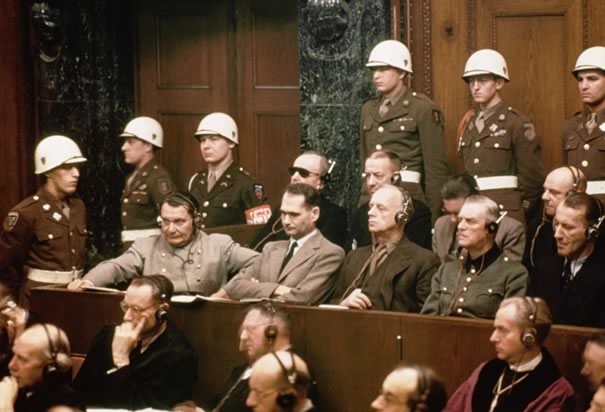
Today I am following my writings about Trump and the 2020 Trump Coronation with another post regarding two of the most riveting monologues in film history, from the great drama, Judgement at Nuremberg, which is unique not simply because it dealt with the trial of the Nazi Judges, but because it took direct aim at the actions of Senator Joe McCarthy, and others who spread fear and terrorized the nation in the name of Blind patriotism and toxic nationalism. That makes it doubly interesting, but to twist the pretzel a bit further, McCarthy’s chief counsel and advisor was Roy Cohn, the future advisor and mentor to President Trump. There can be no greater connection of evil in American Politics, and it sounds like the perfect double play of evil, McCarthy to Cohn to Trump.

McCarthy and Roy Cohn and Trump and Cohn Below
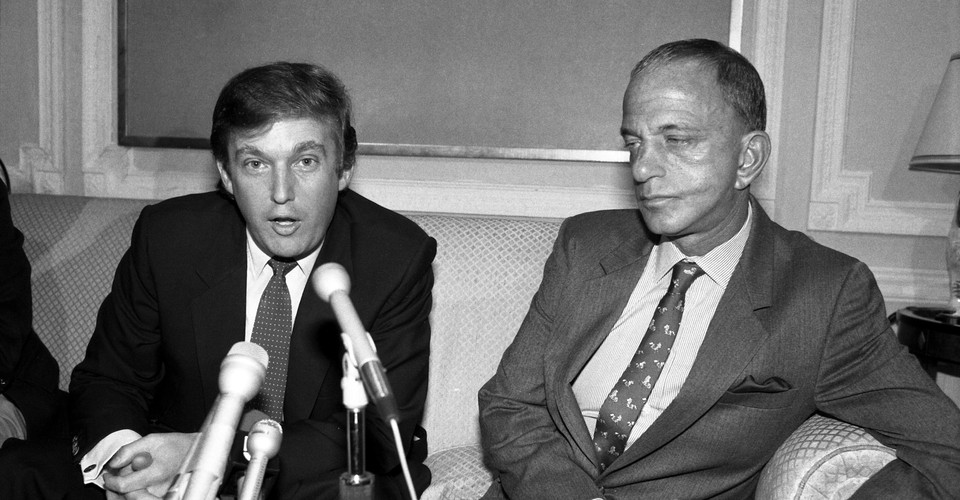
 

McCarthy was directly responsible for the deaths of many and his shameless campaign to destroy the lives and reputations of thousands of loyal and decent Americans of all walks of life. This included men General and Secretary of State George Marshall, who not only helped lead the Allies to victory in the Second World War, but helped engineer the Berlin Airlift and the Marshall Plan to bring Western Europe out of the abyss of war and Naziism.

Sadly, when McCarthy launched his attack on Marshall, Marshall’s friend and colleague of many years, Dwight Eisenhower did not speak up for him for fear of losing Wisconsin in the 1952 election. He won the state handily not needing the support of McCarthy.  However, Eisenhower, instead of making a frontal attack to condemn McCarthy decided to let McCarthy burn himself out. In the following year and a half McCarthy ruined more lives and had the highest approval rating of any politician, in the land, has except Eisenhower. Then, riding high in the polls  McCarthy went after the Army, accusing its leaders of being Communists or supporting Communism. However, the counsel for the Army, Joseph Welch went on the attack and  destroyed McCarthy and his campaign of lies and smears. His classic reply to McCarthy and Cohn was devastating, interrupting Cohen’s diatribe Welch exclaimed “Senator; you’ve done enough. Have you no sense of decency, sir? At long last, have you left no sense of decency?” It was a pivotal moment. Afterward, McCarthy’s polls crashed, the hearing were ended, Cohn resigned as McCarthy’s Counsel and McCarthy was censured by the Senate. He never recovered his previous prominence.  He died at the age of 48 of hepatitis. That being said a significant part of the American political Right Wing still admires McCarthy just as they do Trump. The reason as Welch asked McCarthy and Cohn I ask any defender of Trump: “Have you no sense of decency, sir? At long last have you no sense of decency?” Of course that is a rhetorical question, because anyone who would defend Trump today has surrendered all decency.

So on to Judgment at Nuremberg… 

In this segment of the film, which is a fictionalized version of the Judges Trial, Burt Lancaster plays an accused German Judge and Spencer Tracy plays the role of Chief Judge Dan Heywood who gives his verdict is one of the most telling sequences in cinema regarding what it means to be an American. I used to show it in the first session of my military ethics class at the Staff College and since the majority of my students had never seen the film, it usually left them in silence. So tonight I am just going to leave it with you to watch, read, and contemplate. Ask yourself, who are we, and what do we stand for?

https://www.americanrhetoric.com/MovieSpeeches/moviespeechjudgmentatnuremberg1.html

This is especially true when the President, politicians of the majority party in the legislature, pundits, and politically minded preachers make no bones that they have every intent of persecuting those who are of certain races, religions, or political beliefs that they abhor, often using the most scurrilous charges, and outright lies in order to demonize them, dehumanize them, and  open the door for normal, decent, and even brilliant people to justify government sponsored cruelty and injustice that defies the ideals of the Declaration of Independence, the Gettysburg Address, and the Constitution itself.

Please, watch the videos and read the text. Ponder them your heart, because they speak to something that is not a historical aberration, not just a dramatic film, but something that affects the human condition and is present right here and right now in our own country.

First we deal with Lancaster and his portrayal of Ernst Janning, who in any other time would have been and remained a respected jurist with an international following. At the end of the trial he interrupted his defense attorney played by Maximilian Schell to say:

“There was a fever over the land. A fever of disgrace, of indignity, of hunger. We had a democracy, yes, but it was torn by elements within. Above all, there was fear. Fear of today, fear of tomorrow, fear of our neighbors, and fear of ourselves. Only when you understand that – can you understand what Hitler meant to us. Because he said to us: ‘Lift your heads! Be proud to be German! There are devils among us. Communists, Liberals, Jews, Gypsies! Once these devils will be destroyed, your misery will be destroyed.’ It was the old, old story of the sacrificial lamb. What about those of us who knew better? We who knew the words were lies and worse than lies? Why did we sit silent? Why did we take part? Because we loved our country! What difference does it make if a few political extremists lose their rights? What difference does it make if a few racial minorities lose their rights? It is only a passing phase. It is only a stage we are going through. It will be discarded sooner or later. Hitler himself will be discarded… sooner or later. The country is in danger. We will march out of the shadows. We will go forward. Forward is the great password. And history tells how well we succeeded, your honor. We succeeded beyond our wildest dreams. The very elements of hate and power about Hitler that mesmerized Germany, mesmerized the world! We found ourselves with sudden powerful allies. Things that had been denied to us as a democracy were open to us now. The world said ‘go ahead, take it, take it! Take Sudetenland, take the Rhineland – remilitarize it – take all of Austria, take it! And then one day we looked around and found that we were in an even more terrible danger. The ritual began in this courtoom swept over the land like a raging, roaring disease. What was going to be a passing phase had become the way of life. Your honor, I was content to sit silent during this trial. I was content to tend my roses. I was even content to let counsel try to save my name, until I realized that in order to save it, he would have to raise the specter again. You have seen him do it – he has done it here in this courtroom. He has suggested that the Third Reich worked for the benefit of people. He has suggested that we sterilized men for the welfare of the country. He has suggested that perhaps the old Jew did sleep with the sixteen year old girl, after all. Once more it is being done for love of country. It is not easy to tell the truth; but if there is to be any salvation for Germany, we who know our guilt must admit it… whatever the pain and humiliation.

I had reached my verdict on the Feldenstein case before I ever came into the courtroom. I would have found him guilty, whatever the evidence. It was not a trial at all. It was a sacrificial ritual in which Feldenstein, the Jew, was the helpless victim.

Hans Rolfe: Your Honor, I must interrupt. The defendant is not aware of what he’s saying. He’s not aware of the implications!

Janning: I am aware. I am aware! My counsel would have you believe we were not aware of the concentration camps. Not aware. Where were we? Where were we when Hitler began shrieking his hate in Reichstag? Where were we when our neighbors were being dragged out in the middle of the night to Dachau?! Where were we when every village in Germany has a railroad terminal where cattle cars were filled with children being carried off to their extermination?! Where were we when they cried out in the night to us. Were we deaf? Dumb?! Blind?!!

Hans Rolfe: Your Honor, I must protest!

Janning: My counsel says we were not aware of the extermination of the millions. He would give you the excuse: We were only aware of the extermination of the hundreds. Does that make us any the less guilty? Maybe we didn’t know the details. But if we didn’t know, it was because we didn’t want to know.

Emil Hahn: Traitor! Traitor!

Judge Haywood: Order! Order! Order! Put that man [Hahn] back in his seat and keep him there.

Janning: I am going to tell them the truth. I am going to tell them the truth if the whole world conspires against it. I am going to tell them the truth about their Ministry of Justice. Werner Lammpe, an old man who cries into his Bible now, an old man who profited by the property expropriation of every man he sent to a concentration camp. Friedrich Hofstetter, the “good German” who knew how to take orders, who sent men before him to be sterilized like so many digits. Emil Hahn, the decayed, corrupt bigot, obsessed by the evil within himself. And Ernst Janning, worse than any of them because he knew what they were, and he went along with them.

Ernst Janning, who made his life excrement, because he walked with them.
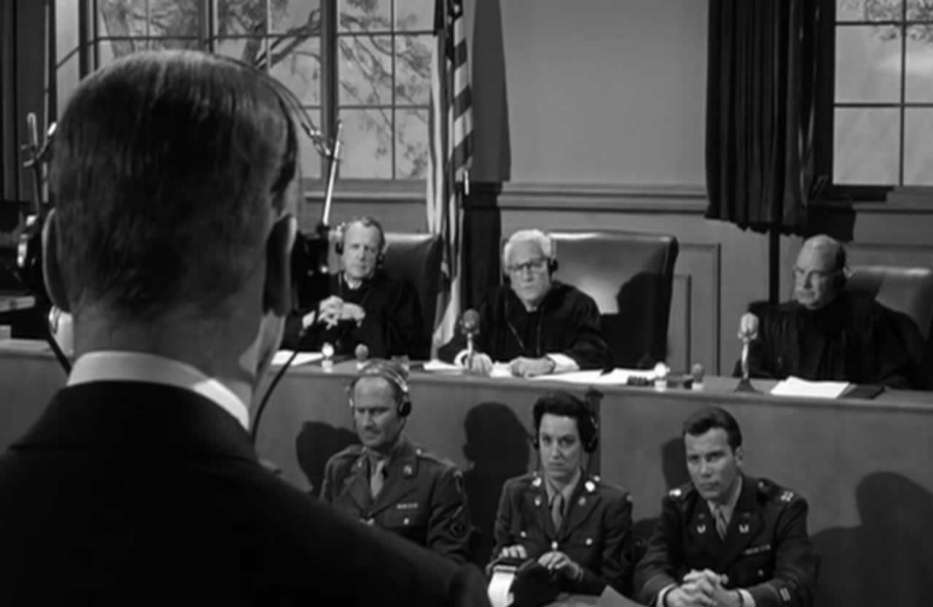
The next is the summation of the trial by Judge Haywood.

https://www.americanrhetoric.com/MovieSpeeches/moviespeechjudgmentatnuremberg3.html

“The trial conducted before this Tribunal began over eight months ago. The record of evidence is more than ten thousand pages long, and final arguments of counsel have been concluded.

Simple murders and atrocities do not constitute the gravamen of the charges in this indictment. Rather, the charge is that of conscious participation in a nationwide, government organized system of cruelty and injustice in violation of every moral and legal principle known to all civilized nations. The Tribunal has carefully studied the record and found therein abundant evidence to support beyond a reasonable doubt the charges against these defendants.

Herr Rolfe, in his very skillful defense, has asserted that there are others who must share the ultimate responsibility for what happened here in Germany. There is truth in this. The real complaining party at the bar in this courtroom is civilization. But the Tribunal does say that the men in the dock are responsible for their actions, men who sat in black robes in judgment on other men, men who took part in the enactment of laws and decrees, the purpose of which was the extermination of humans beings, men who in executive positions actively participated in the enforcement of these laws — illegal even under German law. The principle of criminal law in every civilized society has this in common: Any person who sways another to commit murder, any person who furnishes the lethal weapon for the purpose of the crime, any person who is an accessory to the crime — is guilty.

Herr Rolfe further asserts that the defendant, Janning, was an extraordinary jurist and acted in what he thought was the best interest of this country. There is truth in this also. Janning, to be sure, is a tragic figure. We believe he loathed the evil he did. But compassion for the present torture of his soul must not beget forgetfulness of the torture and the death of millions by the Government of which he was a part. Janning’s record and his fate illuminate the most shattering truth that has emerged from this trial: If he and all of the other defendants had been degraded perverts, if all of the leaders of the Third Reich had been sadistic monsters and maniacs, then these events would have no more moral significance than an earthquake, or any other natural catastrophe. But this trial has shown that under a national crisis, ordinary — even able and extraordinary — men can delude themselves into the commission of crimes so vast and heinous that they beggar the imagination. No one who has sat at through trial can ever forget them: men sterilized because of political belief; a mockery made of friendship and faith; the murder of children. How easily it can happen.

There are those in our own country too who today speak of the “protection of country” — of “survival.” A decision must be made in the life of every nation at the very moment when the grasp of the enemy is at its throat. Then, it seems that the only way to survive is to use the means of the enemy, to rest survival upon what is expedient — to look the other way.

Well, the answer to that is “survival as what?” A country isn’t a rock. It’s not an extension of one’s self. It’s what it stands for. It’s what it stands for when standing for something is the most difficult!

Before the people of the world, let it now be noted that here, in our decision, this is what we stand for: justice, truth, and the value of a single human being.”

Think about it. I hope in the age of the faux patriotism and blind racist nationalism of the Trump Regime that it makes you uncomfortable as hell if you follow him unequivocally, or turn a blind eye to his crimes.

Have a nice night.

Peace,

Padre Steve+

2 Comments

Filed under afghanistan, aircraft, alternative history, alzheimer's disease, anti-semitism, armored fighting vehicles, artillery, authoritarian government, Baseball, baseball, basketball, Batlimore Orioles, beer, books, Loose thoughts and musings

They Thought They Were Free: the Germans 1933-45 and the GOP 2016-2020

they thought they were free

Friends of Padre Steve’s World,

As I Continue to follow the rhetoric coming out of the Trumpublican Party at their their Virtual Nuremberg Rally, am re-posting an article about one of the most important books that was published in the years following the Second World War. That book is Milton Mayer’s They Thought They Were Free. 

It is one of the most powerful books I have ever read was Milton Mayer’s “They Thought They Were Free: The Germans 1933-1945.” Mayer was a visiting professor at the University of Frankfurt in the 1950s and lived in a small Hessian town near the city. The book is about the relationships that he built with ten ordinary citizens in the town and how they lived under Nazism and how most saw little wrong with it in the end.

The book is well worth the read and very timely when one compares the attitudes of the men who became Mayer’s friends and many people in the United States today. The last few chapters of the book are a reflection of the author’s opinions of the future of Germany at the time of his writing and he was mistaken on how the Germans would eventually become a society that embraced democracy and rejected authoritarianism (at the time he felt that it was very possible that democracy would fail in Germany,) they do not take away anything from the heart of the book and its message about how people adjust to authoritarian rule.

One chapter in particular struck me, it was a conversion that Mayer had with a colleague at the University who also reflected what it was like to live in the Third Reich and how in doing so he compromised himself and lost the opportunity to resist when resistance might have changed the course of events as Germany proceeded down the road to dictatorship and destruction. The chapter is particularly painful to read as the man understood that he should have known better but didn’t recognize the warning signs of the gradual nature of how life was changing with each new law or dictate from the Fuhrer.

In reading the chapter I see parallels in American society today. There are the Trump loyalists, many of who openly call for restrictions of liberty and crushing opposition to the President’s policies using extra-constitutional means including violence. I have watched videos and interviews with Trump supporters over the past few years, particularly after Charlottesville, the QANON inspired “Pizzagate,” and following the murder of George Floyd the President gave a speech at the White House Rose Garden and then unleashed Federal Police of multiple agencies and the Washington DC National Guard launch an all out attack on peaceful demonstrators in Lafayette Park and outside Saint John’s Church, following which accompanied by the Attorney General, Secretary of Defense, and Chairman of the Joint Chiefs of Staff marched through the chaos to get a photo op, holding a Bible every which way imaginable until he figured out which way was up. Ever since he was elected some of his followers have openly discussed resorting to violence, killing opponents, and civil war if Trump is removed from office or is defeated in the 2020 election. Sadly, these are not a stand alone video, there are others much like it, as well as blog posts, Twitter and Facebook posts, and other social media platforms. One of Tuesday’s speaker’s Abby Johnson, an anti-abortionist activist has said that Mixed Race children, particularly those that have a Black parent and a White parent are more likely to be criminals than purely White children. That is even worse than how the Nazis viewed mixed race German-Jewish people. And the woman calls herself pro-life. What have we come to?

That being said there are many Trump supporters who through traditions long established in the United States: a distrust of Government authority, the media, academics, supposed leftists and socialists, and finally racial, ethnic, or religious minorities follow him. Sadly for the last 40 years they have been subjected to the incessant drumbeat of those ideologies through right wing talk radio, internet “news” sights and Fox News well meaning and decent people have absorbed race hatred and conspiracy theories, just like regular people in Germany in the late 1920s and early 1930s willingly surrendered their wills to Adolf Hitler and his Nazi Party. 


As I said, many Trump supporters are quite extreme And violent, while others, persuaded by years of right-wing talk radio, politically charged sermons by their pastors, and the daily dose of Fox News now believe everything said by the President even when confronted by facts.

Then there are Trump’s opponents, but many of the opponents were divided and could not get along with each other in order to thwart Trump.  Some of these opponents actually helped Trump into office by circulating the Russian anti-Hillary Clinton conspiracy theories and falsehoods throughout the 2016 campaign. I think things are different now, but one cannot say what the end will be.

While both parties have true believers and fanatics, there is another segment comprised of the people who simply go with the flow because life is too busy and crisis laden to get too deeply enmeshed in the political debate, and many have become so cynical that they see no difference in either side and are much more concerned about making it paycheck to paycheck, and pray to live as the Coronavirus 19 cuts a swath of death through the American population, and the economy crashes with an over 10% unemployment rate and businesses shuttering forever as Trump and the GOP close off help to all but their richest business and banking allies.

Meanwhile Trump’s Virtual Nuremberg Rally continues with it’s complete submission and worship of Trump the Messiah, the one alone can fix everything, even as they state blatantly racist propaganda like the supposedly pro-life (read anti-abortion) 

When his eventually falls, which men like always do, his followers, be they true believers or those who simply followed because it seemed to be better for them will face a reckoning, with the crimes that they either cooperated or allowed by looking the other way.

So I invite you to read this and draw your own conclusions. Have a great day.

Peace

Padre Steve+

Chapter 13: But Then It Was Too Late

“What no one seemed to notice,” said a colleague of mine, a philologist, “was the ever widening gap, after 1933, between the government and the people. Just think how very wide this gap was to begin with, here in Germany. And it became always wider. You know, it doesn’t make people close to their government to be told that this is a people’s government, a true democracy, or to be enrolled in civilian defense, or even to vote. All this has little, really nothing, to do with knowing one is governing.

“What happened here was the gradual habituation of the people, little by little, to being governed by surprise; to receiving decisions deliberated in secret; to believing that the situation was so complicated that the government had to act on information which the people could not understand, or so dangerous that, even if the people could not understand it, it could not be released because of national security. And their sense of identification with Hitler, their trust in him, made it easier to widen this gap and reassured those who would otherwise have worried about it.

“This separation of government from people, this widening of the gap, took place so gradually and so insensibly, each step disguised (perhaps not even intentionally) as a temporary emergency measure or associated with true patriotic allegiance or with real social purposes. And all the crises and reforms (real reforms, too) so occupied the people that they did not see the slow motion underneath, of the whole process of government growing remoter and remoter.

“You will understand me when I say that my Middle High German was my life. It was all I cared about. I was a scholar, a specialist. Then, suddenly, I was plunged into all the new activity, as the university was drawn into the new situation; meetings, conferences, interviews, ceremonies, and, above all, papers to be filled out, reports, bibliographies, lists, questionnaires. And on top of that were the demands in the community, the things in which one had to, was ‘expected to’ participate that had not been there or had not been important before. It was all rigmarole, of course, but it consumed all one’s energies, coming on top of the work one really wanted to do. You can see how easy it was, then, not to think about fundamental things. One had no time.”

“Those,” I said, “are the words of my friend the baker. ‘One had no time to think. There was so much going on.’”

“Your friend the baker was right,” said my colleague. “The dictatorship, and the whole process of its coming into being, was above all diverting. It provided an excuse not to think for people who did not want to think anyway. I do not speak of your ‘little men,’ your baker and so on; I speak of my colleagues and myself, learned men, mind you. Most of us did not want to think about fundamental things and never had. There was no need to. Nazism gave us some dreadful, fundamental things to think about—we were decent people—and kept us so busy with continuous changes and ‘crises’ and so fascinated, yes, fascinated, by the machinations of the ‘national enemies,’ without and within, that we had no time to think about these dreadful things that were growing, little by little, all around us. Unconsciously, I suppose, we were grateful. Who wants to think?

“To live in this process is absolutely not to be able to notice it—please try to believe me—unless one has a much greater degree of political awareness, acuity, than most of us had ever had occasion to develop. Each step was so small, so inconsequential, so well explained or, on occasion, ‘regretted,’ that, unless one were detached from the whole process from the beginning, unless one understood what the whole thing was in principle, what all these ‘little measures’ that no ‘patriotic German’ could resent must some day lead to, one no more saw it developing from day to day than a farmer in his field sees the corn growing. One day it is over his head.

“How is this to be avoided, among ordinary men, even highly educated ordinary men? Frankly, I do not know. I do not see, even now. Many, many times since it all happened I have pondered that pair of great maxims, Principiis obsta and Finem respice—‘Resist the beginnings’ and ‘Consider the end.’ But one must foresee the end in order to resist, or even see, the beginnings. One must foresee the end clearly and certainly and how is this to be done, by ordinary men or even by extraordinary men? Things might have. And everyone counts on that might.

“Your ‘little men,’ your Nazi friends, were not against National Socialism in principle. Men like me, who were, are the greater offenders, not because we knew better (that would be too much to say) but because we sensed better. Pastor Niemöller spoke for the thousands and thousands of men like me when he spoke (too modestly of himself) and said that, when the Nazis attacked the Communists, he was a little uneasy, but, after all, he was not a Communist, and so he did nothing; and then they attacked the Socialists, and he was a little uneasier, but, still, he was not a Socialist, and he did nothing; and then the schools, the press, the Jews, and so on, and he was always uneasier, but still he did nothing. And then they attacked the Church, and he was a Churchman, and he did something—but then it was too late.”

“Yes,” I said.

“You see,” my colleague went on, “one doesn’t see exactly where or how to move. Believe me, this is true. Each act, each occasion, is worse than the last, but only a little worse. You wait for the next and the next. You wait for one great shocking occasion, thinking that others, when such a shock comes, will join with you in resisting somehow. You don’t want to act, or even talk, alone; you don’t want to ‘go out of your way to make trouble.’ Why not?—Well, you are not in the habit of doing it. And it is not just fear, fear of standing alone, that restrains you; it is also genuine uncertainty.

“Uncertainty is a very important factor, and, instead of decreasing as time goes on, it grows. Outside, in the streets, in the general community, ‘everyone’ is happy. One hears no protest, and certainly sees none. You know, in France or Italy there would be slogans against the government painted on walls and fences; in Germany, outside the great cities, perhaps, there is not even this. In the university community, in your own community, you speak privately to your colleagues, some of whom certainly feel as you do; but what do they say? They say, ‘It’s not so bad’ or ‘You’re seeing things’ or ‘You’re an alarmist.’

“And you are an alarmist. You are saying that this must lead to this, and you can’t prove it. These are the beginnings, yes; but how do you know for sure when you don’t know the end, and how do you know, or even surmise, the end? On the one hand, your enemies, the law, the regime, the Party, intimidate you. On the other, your colleagues pooh-pooh you as pessimistic or even neurotic. You are left with your close friends, who are, naturally, people who have always thought as you have.

“But your friends are fewer now. Some have drifted off somewhere or submerged themselves in their work. You no longer see as many as you did at meetings or gatherings. Informal groups become smaller; attendance drops off in little organizations, and the organizations themselves wither. Now, in small gatherings of your oldest friends, you feel that you are talking to yourselves, that you are isolated from the reality of things. This weakens your confidence still further and serves as a further deterrent to—to what? It is clearer all the time that, if you are going to do anything, you must make an occasion to do it, and then you are obviously a troublemaker. So you wait, and you wait.

“But the one great shocking occasion, when tens or hundreds or thousands will join with you, never comes. That’s the difficulty. If the last and worst act of the whole regime had come immediately after the first and smallest, thousands, yes, millions would have been sufficiently shocked—if, let us say, the gassing of the Jews in ’43 had come immediately after the ‘German Firm’ stickers on the windows of non-Jewish shops in ’33. But of course this isn’t the way it happens. In between come all the hundreds of little steps, some of them imperceptible, each of them preparing you not to be shocked by the next. Step C is not so much worse than Step B, and, if you did not make a stand at Step B, why should you at Step C? And so on to Step D.

“And one day, too late, your principles, if you were ever sensible of them, all rush in upon you. The burden of self-deception has grown too heavy, and some minor incident, in my case my little boy, hardly more than a baby, saying ‘Jewish swine,’ collapses it all at once, and you see that everything, everything, has changed and changed completely under your nose. The world you live in—your nation, your people—is not the world you were born in at all. The forms are all there, all untouched, all reassuring, the houses, the shops, the jobs, the mealtimes, the visits, the concerts, the cinema, the holidays. But the spirit, which you never noticed because you made the lifelong mistake of identifying it with the forms, is changed. Now you live in a world of hate and fear, and the people who hate and fear do not even know it themselves; when everyone is transformed, no one is transformed. Now you live in a system which rules without responsibility even to God. The system itself could not have intended this in the beginning, but in order to sustain itself it was compelled to go all the way.

“You have gone almost all the way yourself. Life is a continuing process, a flow, not a succession of acts and events at all. It has flowed to a new level, carrying you with it, without any effort on your part. On this new level you live, you have been living more comfortably every day, with new morals, new principles. You have accepted things you would not have accepted five years ago, a year ago, things that your father, even in Germany, could not have imagined.

“Suddenly it all comes down, all at once. You see what you are, what you have done, or, more accurately, what you haven’t done (for that was all that was required of most of us: that we do nothing). You remember those early meetings of your department in the university when, if one had stood, others would have stood, perhaps, but no one stood. A small matter, a matter of hiring this man or that, and you hired this one rather than that. You remember everything now, and your heart breaks. Too late. You are compromised beyond repair.

“What then? You must then shoot yourself. A few did. Or ‘adjust’ your principles. Many tried, and some, I suppose, succeeded; not I, however. Or learn to live the rest of your life with your shame. This last is the nearest there is, under the circumstances, to heroism: shame. Many Germans became this poor kind of hero, many more, I think, than the world knows or cares to know.”

I said nothing. I thought of nothing to say.

“I can tell you,” my colleague went on, “of a man in Leipzig, a judge. He was not a Nazi, except nominally, but he certainly wasn’t an anti-Nazi. He was just—a judge. In ’42 or ’43, early ’43, I think it was, a Jew was tried before him in a case involving, but only incidentally, relations with an ‘Aryan’ woman. This was ‘race injury,’ something the Party was especially anxious to punish. In the case at bar, however, the judge had the power to convict the man of a ‘nonracial’ offense and send him to an ordinary prison for a very long term, thus saving him from Party ‘processing’ which would have meant concentration camp or, more probably, deportation and death. But the man was innocent of the ‘nonracial’ charge, in the judge’s opinion, and so, as an honorable judge, he acquitted him. Of course, the Party seized the Jew as soon as he left the courtroom.”

“And the judge?”

“Yes, the judge. He could not get the case off his conscience—a case, mind you, in which he had acquitted an innocent man. He thought that he should have convicted him and saved him from the Party, but how could he have convicted an innocent man? The thing preyed on him more and more, and he had to talk about it, first to his family, then to his friends, and then to acquaintances. (That’s how I heard about it.) After the ’44 Putsch they arrested him. After that, I don’t know.”

I said nothing.

“Once the war began,” my colleague continued, “resistance, protest, criticism, complaint, all carried with them a multiplied likelihood of the greatest punishment. Mere lack of enthusiasm, or failure to show it in public, was ‘defeatism.’ You assumed that there were lists of those who would be ‘dealt with’ later, after the victory. Goebbels was very clever here, too. He continually promised a ‘victory orgy’ to ‘take care of’ those who thought that their ‘treasonable attitude’ had escaped notice. And he meant it; that was not just propaganda. And that was enough to put an end to all uncertainty.

“Once the war began, the government could do anything ‘necessary’ to win it; so it was with the ‘final solution of the Jewish problem,’ which the Nazis always talked about but never dared undertake, not even the Nazis, until war and its ‘necessities’ gave them the knowledge that they could get away with it. The people abroad who thought that war against Hitler would help the Jews were wrong. And the people in Germany who, once the war had begun, still thought of complaining, protesting, resisting, were betting on Germany’s losing the war. It was a long bet. Not many made it.”

Copyright notice: Excerpt from pages 166-73 of They Thought They Were Free: The Germans, 1933-45 by Milton Mayer, published by the University of Chicago Press. ©1955, 1966 by the University of Chicago. All rights reserved. This text may be used and shared in accordance with the fair-use provisions of U.S. copyright law, and it may be archived and redistributed in electronic form, provided that this entire notice, including copyright information, is carried and provided that the University of Chicago Press is notified and no fee is charged for access. Archiving, redistribution, or republication of this text on other terms, in any medium, requires the consent of the University of Chicago Press. (Footnotes and other references included in the book may have been removed from this online version of the text.)

4 Comments

Filed under authoritarian government, civil rights, Coronavirus 19 Pandemic, crimes against humanity, culture, ethics, germany, History, holocaust, nazi germany, News and current events, Political Commentary, racism, Religion, war crimes

The Passage of the Nineteenth Amendment: Suffrage Delayed for Political Expediency and Justice Still Denied

Friends of Padre Steve’s World,

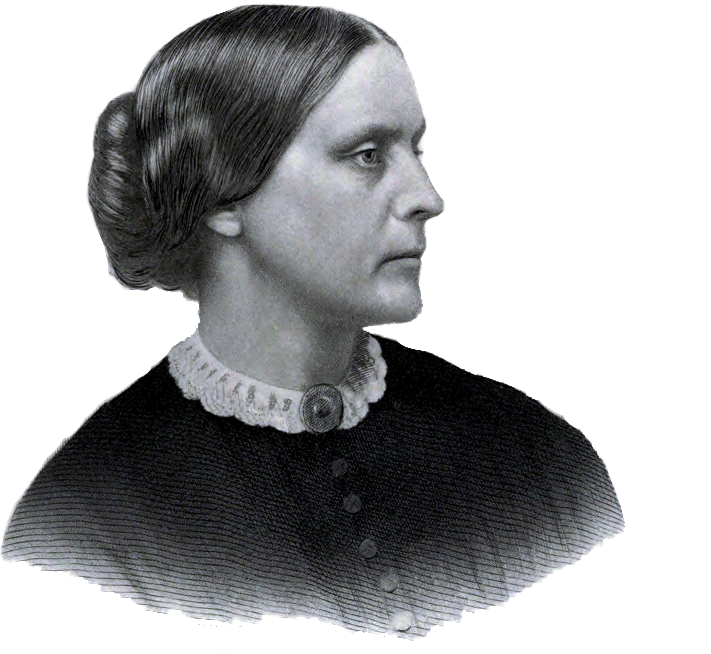
For the last few days I have going back to a part of my book manuscript “A Great Civil War in an Age of Revolutionary Change” in a chapter dealing with women’s rights. This is the conclusion of that series of articles. I found it interesting and ironic that President Trump issued a pardon to Susan B. Anthony this week for the act of trying to vote, something that he is fighting desperately against in the midst of a pandemic. Likewise because she was proud of her “crime” and she didn’t want a pardon.

Until tomorrow,

Peace

Padre Steve+

The struggle for Women’s rights continued after the war, which neither advanced nor reduced the rights of women, but the end of the war marked a change in the relationship with women’s rights advocates and their former allies in Congress. Likewise, the same evangelical churches which many of the women’s rights leaders had begun their crusades “which had been in the forefront of ante-bellum reform upheld the status quo.” [1] This was true of their support for women’s rights, as well as civil rights for blacks, and supported the use of force against strikers.

After laboring alongside abolitionists to abolish slavery and pass the Thirteenth Amendment, women’s rights leaders lobbied to have women’s suffrage linked to that of black suffrage.  Women’s rights leaders asked Congress to include universal suffrage as parts of the Fourteenth, and then the Fifteenth Amendments. However, the Radical Republicans were fearful that including women’s rights in either measure could lead to the rejection of Black citizenship and suffrage for Black males.  The decision was a bitter disappointment to Stanton, Anthony and other Women’s rights leaders, and it would adversely effect the rights of Black Women in the hell of the Jim Crow era, and even today where Black Men are frequently the victims of discrimination and violence, and Black Women still find themselves at the back of the bus when it comes to education, employment opportunities, healthcare, and yes at the ballot box. I do hope that the nomination of Kamala Harris as the Vice Presidential Running mate of Democratic Presidential Nominee Joe Biden will tip the scales toward their victory and hopefully a change for the better in the rights of Blacks, Women, and all minorities. 

Stanton responded to one of the Congressmen who refused to support it by noting that failing to include women in these measures actually hurt the cause of African Americans and would doom Reconstruction because it would exclude black women from suffrage,, “our former champions forsook principle for policy, and in giving women the cold shoulder raised a more deadly opposition to the negro than we had yet encountered, creating an antagonism between him and the element most needed to be propitiate do on his behalf…. But Mr. Smith abandons the principle clearly involved and I trenches himself on policy. He would undoubtedly please the necessity of the ballot for the negro at the south for his protection, and to point to innumerable acts of cruelty he suffers to-day. But all of these things fall as heavily on the women of the black race, yea, far more so, for no man can ever know the damning degradation to which woman is subject in her youth, in helplessness and poverty…. Women everywhere are waking up to their God-given rights, to their true dignity as citizens of a republic, as mothers of the race…” [2] 

Susan B. Anthony was arrested with a number of other women and convicted of trying to vote in the 1872 elections. After her conviction she condemned the resistance of white male politicians to universal suffrage, and of attempts throughout the country to limit and even role back suffrage rights which had been granted to African Americans after the war. After her trial and conviction she proclaimed, “This government is no democracy…. It is an odious aristocracy; a hateful oligarchy of sex” that placed “father, brothers, husbands, sons… over the mother and sisters, of every household.” [3]

Despite the setbacks suffered by women, the cause of women’s rights continued to grow as women asserted themselves in the workplace, in the press, in lobbying for workplace safety, and taking up leadership roles in the labor movement. Likewise the opportunities for women working in Federal Government agencies which had opened during the war continued to grow. “By 1875 the number in Washington had doubled. Federal, State, and local agencies were employing women clerks, bookkeepers, stenographers, and receptionists…. Competition for jobs was keen because wages were higher and workdays shorter than most other lines of work, and it was exciting to live in the nation’s capital.” [4] even so there was a certain amount of insecurity in such work as many Civil Service jobs were dependent on the patronage of elected officials. It was not until the first civil service acts in the 1880s that the danger of job loss from political change was minimized.

In the 1890s educational opportunities for women advanced as women’s colleges and land grant colleges open their doors to women as students, and later professors. Likewise, the establishment of teacher’s colleges and vocational training institutions expanded opportunities for women as the need for teachers and other specialists grew as the nation expanded. The women nurses of the war continued to find employment, and some went to Europe where they let their service to the French and Prussians during the Franco-Prussian War. After the war new nursing schools were opened, and medical colleges that allowed women to attend were established. By the 1890s “more than a dozen medical colleges were co-educational, including those of Syracuse, California, Iowa, and Harvard University.” [5] Medical societies began opening their doors to women as well, but in many cases the walls fell slowly as prejudice against women remained as strong as it ever was.

Even so, none of these efforts went without opposition, and in the face of it the movement itself split into a radical faction headed by Susan B. Anthony “which continued to press for a national constitutional amendment and a moderated wing led by Mary Livermore and Henry Ward Beecher which wanted to limit the campaign to what could be accomplished in state legislatures.” [6]

Sadly, none of the pioneers of women’s rights would live to see the passage and ratification of the Nineteenth Amendment which gave women the right to vote in 1920. The Equal Pay Act, which mandated the equal pay for Federal employees did not pass until 1963, and the ill-fated Equal Rights Amendment which simply stated “That equality of rights under the law shall not be abridged by the United States or by any State on account of sex” was introduced in 1923, but not passed by Congress in 1972,  but was never ratified falling three states short of ratification, mainly due to the opposition of religious conservatives who propagandize diet as a threat to traditional gender roles, citing in particular that the amendment might result in women being subject to the draft.

Even so, in the years following the failure of the amendment, women have continued to advance in the private sector, government, and the military, with women rising to be Chief Executive Officers of Fortune 500 companies, in elected office, as Cabinet Secretaries and on the Supreme Court, and even as four-star Generals and Admirals in the U.S. Military. Today women make up over half of college graduates and nearly half of the work force. To further increase opportunity the Department of Defense decided to open military occupational combat arms specialties previously restricted to men to women in 2015. Even so women can still be legally paid less, and discriminated against based on their gender in many states. Thus the Nineteenth, like the Thirteenth, Fourteenth, and Fifteenth Amendments, the Voting Rights Act of 1964, and the Civil Rights Act of 1965 are yet to be completely fulfilled.

Notes

[1] Ibid. Goldfield America Aflame: How the Civil War Created a Nation p.468

[2] Stanton, Elizabeth Cady, Letter to Congressman Gerrit Smith, from The Revolution 14 January 1869 in The Civil War and Reconstruction: A Documentary Collection edited by William E. Gienapp, W.W. Norton and Company, New York and London. 2001 p.361

[3] Ibid. Goldfield America Aflame: How the Civil War Created a Nation p.468

[4] Ibid. Massey Women in the Civil War pp.340-341

[5] Ibid. Massey Women in the Civil War p.352

[6] Ibid. Guelzo Fateful Lightning p.403

Leave a comment

Filed under civil rights, History, laws and legislation

Harriett Tubman: Warrior, Leader, and Other Women Heroes of the Civil War


Friends of Padre Steve’s World,

Over the past few days I have been going back to the theme of Women’s rights following Centennial of the ratification of the Nineteenth Amendment. This is important because though the Amendment guaranteed the right of suffrage to women, but the reality remained that Black women were still denied the right to vote in the former Confederate South and many other states.  

So today I am posting a section of the portion of my manuscript “A Great Civil War in an Age of Revolutionary Change” dealing with a most amazing woman, Harriet Tubman. The more I read about her the more I stand I awe. This section was originally a lot less detailed that in is now, and as I go into eliding and revising it for publication since “Mine Eyes Have Seen the Glory!” Racism, Religion, Ideology and Politics in the Civil War and Afterward, and their Importance Today,”  I will spend a lot of time working on this section as I edit and revise the manuscript. That being said I think that you will find it interesting, and still relevant in our society.

Harriet Tubman’s image was to be featured on the $20 bill beginning this year, replacing that of Andrew Jackson, but the Trump administration has put this off until at least 2028. I hope that if Trump loses the election to Joe Biden that this will be changed quickly. Regardless, Tubman’s story should not be forgotten. She was a courageous woman whose character, courage, and commitment could match any person alive today. Maybe after I retire I can write an in depth biography of this remarkable woman and American Patriot.

So until tomorrow, I with you peace, health, safety, and the courage to be like 

Peace

Padre Steve+

The innate prejudices of many military and political leaders about the abilities and limitations of women in military service, often caused them to overlook how women could use that prejudice to their advantage, especially as spies. “African American women were generally dismissed as militarily harmless, a miscalculation that Harriet Tubman…used to immense advantage. Tubman, who had escaped from slavery in Maryland twenty years before the war and who had amassed considerable experience venturing into the south to guide runaways to the North undertook spying expeditions for the Federal troops on the South Carolina Sea Islands.” [1] The incredibly brave woman served throughout the war accompanying Union forces and securing vital information even as she worked to set other slaves free. Tubman’s “spying activities included convincing slaves to trust the Union invaders,” [2] many of whom would join the ranks of the newly raised regiments of U.S. Colored Troops.


Tubman had been fighting her personal civil war for over twenty years before the war began. As an escaped slave she returned to the South time and time again as a “conductor” on the Underground Railroad, smuggling escaped slaves out of the South and to freedom. She “successfully returned nineteen more times, bringing out an estimated 300 to 400 people…. She worked with a determination bordering on ruthlessness: if an escaped slave tarried, she pushed him in; if a baby cried she muffled the sound.as she herself said later…. “I was the conductor on the Underground Railroad for eight years, and I can say what most conductors can’t say – I never ran my train off the track and I never lost one passenger.” [3]

In early 1863, Union commanders in South Carolina decided that Tubman would be valuable as a covert operative to lead reconnaissance missions behind Confederate lines and along contested waterways where Confederate personnel had laid torpedoes, what we now know as sea mines, and she organized a small unit of nine men who used small boats to find the torpedoes and warn the captains of Union vessels operating in those streams and rivers.

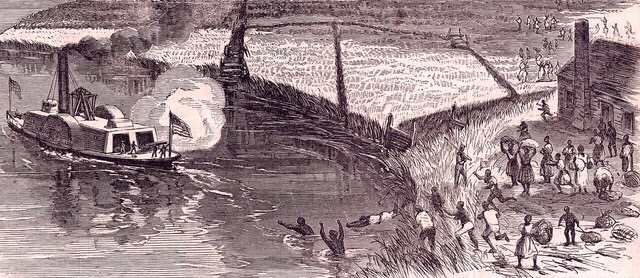
Eventually, Tubman’s actives “evolved into a kind of special forces operation under Colonel James Montgomery. A fervent believer in guerrilla warfare, Montgomery was a veteran of antislavery border fighting in Kansas.” The pair developed some of the most effective operations mounted by irregular and regular forces conducted by the Union in the war. In July 1863, Tubman came up with a plan for a raid, and in it acted as “Montgomery’s second-in-command during a night raid up the Combahee River, near Beaufort, South Carolina. The Union gunboats, carrying some 300 black troops, slipped up the river, eluding torpedoes that Tubman’s men had spotted. Undetected, the raiders swarmed ashore, destroyed a Confederate supply depot, torched homes and warehouses, and rounded up more than 750 rice plantation slaves.” [4]

The Confederate report on the raid unwittingly ended up praising the work of Tubman and the freed slaves of her unit. It noted that the enemy “seems to have been well posted as to the character and capacity of our troops… and seems to have been well guided with persons thoroughly acquainted with the river and country.” Union Brigadier General Rufus Saxton wrote to Secretary of War Stanton praised Tubman’s work, noting, “This is the only military command in American history wherein a woman, black or white, led to raid, and under whose inspiration, it was originated and conducted.” [5]

Tubman continued her work for the duration of the war and after it continued to assist freed slaves and black veterans and continued her work with campaign for women’s suffrage. In 1890 she was awarded a pension for her work as a spy, nurse, and combat leader. The valiant pioneer of abolition, women’s suffrage, and combat in war who was nicknamed “the General” by Frederick Douglass, died in 1913, and was buried with full military honors.

Other women served in various roles caring for the wounded. In the North, “Dorothea Dix organized the Union’s army nurses for four years without pay; Mary Livermore headed the Union’s Sanitary Commission, inspecting army camps and hospitals….Scores of others like Clara Barton, volunteered to be nurses.” [6]All of these women did remarkable service, mostly as volunteers, and many witnessed the carnage of battle close up as the cared for the wounded and the dying which often created ethic concerns for the women nurses:

“Clara Barton described her crisis of conscience when a young man on the verge of death mistook her for his sister May. Unable to bring herself actually to address him as “brother,” she nonetheless kissed his forehead so that, as she explained, “the act had done the falsehood the lips refused to speak.” [7]

The very existence of so many women who served in the ranks during the Civil War, and their “demonstrated competence as combatants, challenge long-held assumptions about gender roles…. From a historical perspective, the women warriors of the Civil War were not just ahead of their time. They were ahead of our time.” [8]

Of the women that served in the ranks during the war, some were discovered, and many of them remained protected by their fellow soldiers. Quite a few of these closeted women soldiers received promotions and even served as NCOs or junior officers. With women now serving in combat or combat support roles in the U.S. Military since Operation Desert Storm in 1991, the stigma and scandal that these cross-dressing women soldiers of the Civil War has faded and as scholars and the public both “continue probing cultural notions of gender and identity, the reemerging evidence that women historically and successfully engaged in combat has met with less intellectual resistance and has taken on new cultural significance.” [9] As the United States military services examine the issues surrounding further moves to integrate the combat arms we also should attempt to more closely examine the service of the brave and often forgotten women who served on both sides of the Civil War.

In addition to these tasked many other women were engaged in the war as “supply organizers, relief workers, pamphleteers all aided the cause, and female journalists covered it. Dorothea Dix and Clara Barton became powerful forces helping soldiers; Anna Carroll provided the propaganda. And the Civil War boasted its own version of Rosie the Riveter, women who did the dangerous work of making munitions at arsenals, many losing their lives in awful accidents.” [10]

Likewise, the war caused many educated women to take much more interest in “political and military issues and led many women to articulate a sharper consciousness of national affairs…. The feminist paper The Mayflower commented that “nearly every letter we receive breathes a spirit of deep feeling on the war question.” The editorial added that among women, “There seems to be little disposition to think, speak, read or write of anything else.” [11] In particular one women, Anna Ella Carroll, the daughter of Thomas King Carroll, a former governor of Maryland, “was interested in political theory and practice and was a profound logical thinker as well as an effective propagandist for the Union.” [12] During the war she was in part responsible for persuading the governor of Maryland to keep the pro-secession legislature from meeting in 1861, defended Lincoln’s suspension of habeas corpus in that state, and is believed to have originated the military strategy in the Tennessee River Campaign, for which she was never given full credit even though there is documentary evidence that many leaders knew of her involvement. A recent biographer concluded that she “was a “tragic victim of reconstruction,” for if a military strategist, she was not given due credit.” [13] In the South it was often the same, the diaries of many educated Southern women show a tremendous interest and discernment of what was happening during the war, and in domestic politics, and frequently expressed their criticism of government and military strategy as the war continued.

                                                             Notes

[1] Ibid. Guelzo Fateful Lightning p.394

[2] Sizer, Lyde Cullen Acting Her Part: Narratives of Union Women Spies in Divided Houses: Gender and the Civil War Oxford University Press, New York and Oxford 1992 p.130

[3] Ibid. Sizer Acting Her Part: Narratives of Union Women Spies  p. 127

[4] Ibid. Central Intelligence Agency, Intelligence in the Civil War location 481 of 991

[5] Ibid. Central Intelligence Agency, Intelligence in the Civil War location 481-482 of 9911

[6] Ibid. Silvey I’ll Pass for Your Comrade p.10

[7] Faust, Drew Gilpin, This Republic of Suffering: Death and the American Civil War Vintage Books, a division of Random House, New York 2008 p.12

[8] Ibid. Blanton and Cook They Fought Like Demons p.208

[9] Ibid. Blanton and Cook They Fought Like Demons p.204

[10] Ibid. Roberts Capital Dames: The Civil War and the Women of Washington 1848-1868 p.3

[11] Attie, Jeanie Warwork and the Crisis of Domesticity in the North in Divided Houses: Gender and the Civil War edited by Catherine Clinton and Nina Silber, Oxford University Press, Oxford and New York 1992 p.253

[12] Ibid. Massey Women in the Civil War p. 168

[13] Ibid. Massey Women in the Civil War p.169

2 Comments

Filed under civil rights, civil war, History, leadership, Military, News and current events, racism, women's rights

The Nineteenth Amendment at a Century: So Much More Left Unaccomplished

Friends of Padre Steve’s World,

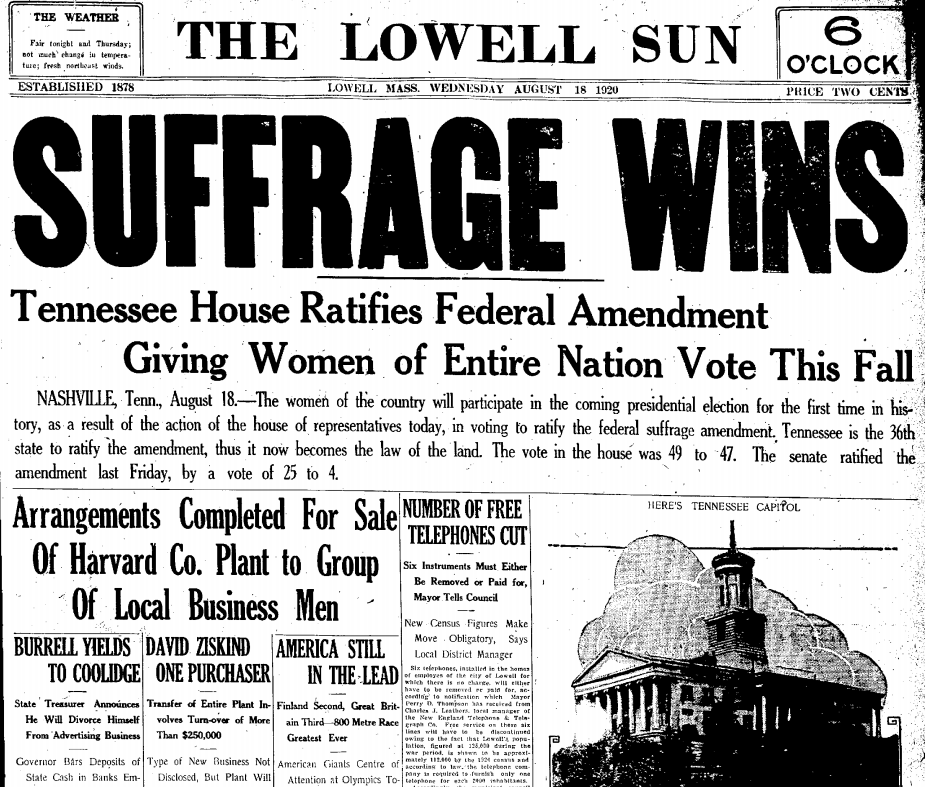
Yesterday was the Centennial Anniversary of the ratification of Nineteenth Amendment to the Constitution which gave women the right to vote. It was a watershed moment brought about through close to eight decades of women fighting for the right to vote and for equality in general.

However, that decision was just a point of a long struggle for equality that  continues today. Despite the gains made since the past century women continue to have few rights than men, and when successful in business, sports, politics, the media, academia, or for that matter almost anything outside the traditional household remain second class citizens in most countries, even the United States, and all too sadly that is due to misogyny and religious prejudices which favor men and no matter how talented, intelligent, and brilliant many women are are consigned to a second place in the workplace, in the church, and almost everywhere else.

Likewise even though the Amendment gave women the right to vote, that right continued to be denied to Black Women in the South and in many other states where Jim Crow and systemic institutional racism ceded the right to vote to white women but prevented Black women the right to vote, just as they had after the repeal of the Civil Rights Act of 1875, and Plessy v. Ferguson which made institutional racism, discrimination, segregation and racially motivated violence the law of the land. 

So, tonight and for the next few nights I think that I am going to repost a series of articles from one of my yet unpublished books which deal with the American Civil War, the Abolition Movement, and the post-War movement for women’s rights.

But I do have to find a certain irony in the President who has made voter suppression and attempting to destroy the confidence in the democratic process, and discredit election results, pardon Suffragette Susan B. Anthony, for the crime of voting, decades before the Nineteenth Amendment was passed, something that she would have never wanted because she held that criminal conviction as a victory, and a mission to give all women the right to vote. The irony is too rich. 

So until tomorrow, 

Peace

Padre Steve+

The abolition movement helped birth the campaign for women’s rights. The Civil War was also revolutionary because it was instrumental in propelling women into positions in American society that they had never before been allowed. Some of this was because many women decided to like those who campaigned for the end of slavery and the rights of African Americans to turn the world upside down. The war allowed the women who served, “in uniform or not, war permitted these women to experiment with a series of role reversals in gender,” [1] and in some cases gender and race. These experiments were the beginning of the struggle for women’s equality and to women serving in the military.

In much of the country and in particular the South women’s rights were the same as granted in English Common Law. Common law held to the more archaic understanding of the Christian Church that women were the property of their husbands, especially in cases of infidelity including during the trial of Dan Sickles for killing Barton Key. But the war “imposed on American society as such social disruption as it did physical destruction. Within that disruption, for one brief and bloody historical moment, an entirely new way of ordering of race and gender within a republican society became possible,” [2]however, in the end it would take another century or more for much of this change to be realized.

Southern culture and law ensured that women had even few rights than the women in the North.  In the North women were making some gains in the workplace and in various professions such as teaching and nursing, and as the industrial revolution modernized the workplace and required more skilled workers, particularly in the textile industries, the availability of work for women who wanted to work outside the home increased. Even uneducated Northern women sought work in the growing number of factories and by 1860 “there were more than 270,000 female operatives, the vast majority being employed in Northern textile, shoe, clothing, printing, and publishing establishments. Over 135,000 worked in New England factories and composed 65 percent of the region’s industrial labor.” [3]  Educated Northern women, while excluded from most professions, found their way into teaching, nursing, non-ordained religious work, and writing. Some found work in Federal government agencies in Washington DC, including “Clara Barton, a successful teacher who had trouble landing a position because she was a women, found work in the Patent Office, where she briefly made the same salary as her male colleagues.” [4]

But in the South women were continued to be held back. This was in large part due to the understanding that the “household was a spatial unit, defined by the property to which the owner not only held legal title over, but over which he exercised exclusive rights.” [5] As such Southern men had nearly unlimited rights and power over what occurred on his property, for “in societies in which landed property comprised the chief means of subsistence…legal title to the land had historically incorporated claims over the persons and labor of those who were dependents on it.” [6] In the South, as opposed to the North comparatively few women entered the Southern labor market, in large part because of the region’s emphasis on agriculture, dependence on slave labor, and a culture that frowned on women working outside the home.  1860 when Northern women were becoming a force to be reckoned with in the labor market, “only 12,000 women worked in factories, 10 percent of the regions wage earners.” [7] The lack of trained and experienced women workers would be a crippling impediment to the Confederate War effort.

For Southern men the stakes of ensuring slavery’s continuation and expansion were high, the culture of the South ante-bellum South was deeply patriarchal and “The possibility that the black man might be empowered like any other was such a threat to the southern social hierarchy that some white southerners were inclined to fear not only for their position as slaveowners but for the entire basis of their claim to patriarchal power. They feared for their power not only over their slaves but over their women as well.[8]

The Gimke Sisters, Abolitionists and Suffragettes 

William Lloyd Garrison and the leaders of the abolitionist movement came into contact with two southern women who had converted to the abolitionist cause; South Carolina cotton heiresses, Sarah and Angelina Grimke. The two women were passionate as well as eloquent and became popular lecturers on the abolitionist speaking circuit. Angelina Grimke was a powerful speaker linked to abolition and women’s rights, she made herself unwelcome in her native Charleston South Carolina “with the publication of An Appeal to the Christian Women of the South. She urged Southern women, many of whom opposed slavery, to speak out, and despite her failure to reach the audience to which she spoke, hers is one of the most significant abolitionist writings.” [9] She proclaimed:

“We cannot push Abolitionism forward with all our might until we take up the stumbling block out of the road…. If we surrender the right to speak in public this year, we must surrender the right to petition next year, and the right to write the year after, and so on. What then can the woman do for the slave, when she herself is under the feet of man and shamed into silence?” [10]

Her sister Sarah was also active in writing, but she focused her attention not just on abolition, but “on the inferior status of both woman and the Negro in The Equality of the Sexes and the Condition of Women.” [11] The Grimke sisters and other women like them brought Garrison and others in the abolitionist movement into contact with the early leaders of the new women’s rights movement. The leaders of the movement, Elizabeth Cady Stanton, Abby Kelley, and Lydia Maria Child were outspoken in their belief that “a campaign to emancipate slaves could not avert its eyes from the need to emancipate American women from social conventions and legal restraints that prevented them, like the slave, from owning property and voting, and kept them altogether subservient to the interests of white males.” [12]

The principals involved in the abolitionist and the women’s movements, those of freedom, emancipation and equality eventually forged a bond between them, and have provided inspiration to others in their quest for political and social equality. For William Lloyd Garrison “the woman question clearly demonstrated how the logic of reform united all good causes and carried them to new ground. If in their endeavors to break the chains of slavery women discovered, as Abby Kelley put it, that “we were manacled ourselves,” the abolitionist principle required a defense of equal rights without regard to race or sex.” [13]

While women and blacks were “being brought together in a dual crusade, often behind the same leaders,” [14] that did not mean that both parties were given equal consideration, even among the supporters of abolition and women’s rights. All to often, women found that their rights were not considered as important by the political leadership fighting for the rights of black men. Few in Congress “responded sympathetically to feminists’ demands. Reconstruction they insisted, was the “Negro’s hour,”  [15] a view shared by Frederick Douglass. Though the economic situation of women began to improve, especially through women being admitted to the Civil Service, much else remained unchanged, women were still second class citizens without the right to vote, with few legal rights, and few opportunities to move up in society apart from her husband.

But change was beginning to occur as women began to have more educational opportunities in the post-war years, and began to find employment opportunities with the expansion of industry. Women’s suffrage was not included in the Fifteenth Amendment, which caused a split between women’s groups and their long-time abolitionist allies who told them “If put on the same level and urged in the same connection, neither will soon be accomplished.” [16]   Even so in some territories women were granted the right to vote in territorial elections, “women were given the vote in Wyoming Territory in 1869. However, Wyoming’s admission as a state twenty years later came only after a heated debate on the women’s suffrage article in the state constitution.” [17]

In the 1800s women in the United States found themselves bound by two major factors, law and culture. English common law and early in the life of the Republic it was determined by John Adams that women should be exclude from political life as they were “unsuited by nature for the businesses of life or the hardy enterprises of war, they had nothing of value to offer the state.” [18] Women had no claim to property, wages, or even their children. Thomas Jefferson had “defined the essence of liberty as independence, which required ownership of productive property. A man dependent on others for a living could never truly be free, nor could a dependent class constitute the basis of republican government. Women, children, and slaves were dependent; that defined them out of the polity of republican freedmen.” [19] This understanding of the rights and citizenship of women persisted as the official law of the nation throughout the ante-bellum era, through and after the Civil War, and up until the passage and ratification of the Nineteenth Amendment.

As such, single women had few rights while married women had even fewer as, married women could not “own property in her own right, make contracts or otherwise conduct business of her own. She was supposed to be modest and submissive. The married woman, in fact, was for all intents and purposes the chattel of her husband.” [20] The reality was stark for women, but especially married women for as one historian noted: “marriage very nearly meant the legal annihilation of a woman…once a woman was married all property and property rights were transferred to her husband, and she was permitted to own nothing in her own name. Married women could not make contracts, could not sue, could not buy or sell, except over their husband’s signatures.” [21] Adult white women were citizens in a constitutional sense, but in the North and South alike their terms “of their citizenship had always been set by the perceived necessities of marriage and its gender asymmetries between man and woman, husband and wife.” [22]

The role of culture and religion was another major constraint on women’s rights during the ante-bellum period and much of this centered on Victorian social and cultural ideals which brought about what can be safely called a “a cult of true womanhood” which “dictated that women always appear demure, submissive, pious, and concerned with the home and family.” [23] In the Victorian ideal, it was the man whose sphere of life was in worldly pursuits, while women were limited to the task of bearing and raising children and maintaining the traditional private domain of hearth and home. This understanding of separate spheres was supported was often supported by the churches, especially those the conservative and evangelical variety.

While this was true in the North it was especially prevalent in the South and promoted by southern evangelical churches. The “explicit goal of southern evangelicalism was to keep the religious role of white women within narrow and carefully policed bounds. Evangelical Southerners clearly designated men as society’s (and women’s) rightful rulers and ultimate authorities. They were, in the 1830 words of Southern writer Virginia Carey, “the anointed lords of creation”; St. Paul’s injunction that wives “submit yourself to your own husbands as to the Lord” provided the text for many a Sunday sermon.” [24]

In matters of sexual behavior there was a pronounced double standard between men and women. If a man was an adulterer it was frowned upon, but not necessarily a condition that would invoke the scorn of the community unless an aggrieved husband took the law into his own hands and killed the adulterer, in which case the murderer could easily be forgiven. However, for the married adulteress, the social damnation was all too real, even from other women, who often believed that there was no excuse for such behavior and that the adulteress “deserved the most stringent fate for her violation of the dictates of virtue.” [25]

A married woman’s position was as close to being a slave as could be, and only the plight of black female slaves was worse, for they were simply chattel. The few free black women mainly stayed unmarried “in order to maintain what few property rights they were entitled to.”  [26] As they also did over blacks, white men ruled over women in all spheres of life. While the eventual emancipation of blacks provided more rights for black men, those did not help many black women as Sojourner Truth, a pioneering African-American abolitionist who spent forty-years as a slave said toward the end of her long life:

“There is a great stir about colored men getting their rights, but not one word about colored women; and if colored men get their rights, and not colored women theirs, you see colored men will be master over the women, and it will be just as bad as it was before. So I am for keeping the thing going while things are still stirring because if we wait till it is still, it will take a great while to get it going again….I suppose I am the only colored woman that goes on to speak for the rights of the colored women. I want to keep the thing stirring, now that the ice is cracked…” [27]

Elizabeth Cady Stanton was among the most vocal of women’s rights advocates. She was the daughter of a leading Federalist lawyer, who served a term in the House of Representatives and on the New York Supreme Court. Her father planted in her the desire to learn, a love for law, and a passion for civil rights which she was able to pursue. Unlike many women of her day, Stanton was able to graduate from the Johnstown Academy and the Troy Female Academy in Troy, New York, before she was married to Henry Brewster Stanton, a journalist, anti-slavery orator and attorney, with who she had seven children.

Stanton believed that a woman’s place in the home was ultimately destructive and “reflected her subordinate position in society and confined her to domestic duties that served to “destroy her confidence in her own powers, lessen her self respect, and to make her willing to lead a dependent and abject life.” [28] Stanton noted how the condition of women of her day was “more fully identified with the slave than man possibly can be… For while the man is born to do whatever he can, for the woman and the negro the is no such privilege.”  [29] It was a key observation and something even today, a state that some politicians, pundits and preachers would like to return women.

Since nearly all of the most “outspoken feminists had been schooled in abolitionist movement” they were “suspect in the South, where society was conservative, patriarchal, and insistence that ladies live in a kind of earthly limbo.”  [30]  Such women posed a threat to the pillars of Southern society. Since the South was now fighting tooth and nail against the abolitionist movement, anything closely connected with that movement, including the women who advocated abolition and women’s rights were shunned and their message rejected and inflammatory and revolutionary. It was not until the crisis caused by the Civil war that Southern women began to seize “the opportunity to lay claim to an increased reciprocity in gender relations.” [31]

But even with the abolition movement there was opposition the women’s rights, the 1839 meeting of the American Anti-Slavery Society witnessed a debate over including women in the membership. Conservative Evangelicals recoiled in disgust, and when the convention voted to allow women into the membership Lewis Tappan “got up a starchy “protest” which condemned the “repugnant” admission of women as an ‘expression of local and sectarian feelings…well suited to the unnecessary reproach and embarrassment to the cause of the enslaved as [it] is at variance with the general usage and sentiments of this and other nations.”[32] In May of 1840 the American Anti-Slavery Society split among religious lines when leading evangelicals led by the Tappan brothers withdrew from it.

senecafalls-womanspeaking

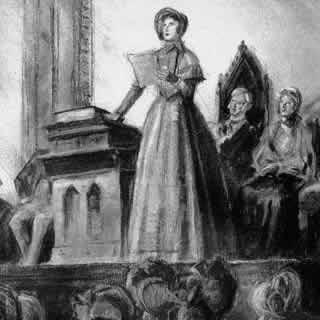
Elizabeth Candy Stanton at the Seneca Conference, 1848

But that neither stopped Garrison from working with women, nor kept Frederick Douglass from embracing them as part of the abolitionist movement. From this rather inauspicious beginning, the women’s rights movement began to infiltrate society, especially in the field of education. In 1848 at Seneca New York there was a convention that launched the modern women’s rights movement. Led by Stanton and Elizabeth Mott the delegates published a “Declaration of Sentiments, modeled on the Declaration of Independence, proclaimed “that all men and women are created equal” and deserved their “inalienable rights” include the right to elective franchise.” [33] The declaration was bold and its denunciation of the place of women in society to be considered revolutionary in character. Part read:

“He has never permitted her to exercise her inalienable right to elective franchise. He has compelled her to submit to laws, in the formation of which she had no voice. He has withheld from her rights which are given to the most ignorant and degraded men – both natives and foreigners… He has made her, if married, in the eye of the law, civilly dead. He has taken from her all right to property, even to the wages that she earns…. After depriving her of all her rights as a married woman, if single, and the owner of property, he has taxed her to support a government which recognizes her only when her property can be made profitable to it. He has monopolized nearly all the profitable employments, and from those she is permitted to follow she receives but a scanty remuneration. He closes against her all the avenues to wealth and distinction which he considers honorable to himself. As a teacher of theology, medicine of the law, she is not known… He has created a false public sentiment by giving the world a different code of morals for men and women, by which moral delinquencies which exclude women from society, are not only tolerated, but deemed of little account in man. He has usurped the prerogative of Jehovah alone, claiming his right to assign for her a sphere of action, when that belongs to her conscience and to her God. He has endeavored, in every way that he could, to destroy her confidence in her own powers, lessen her self-respect, and to make her willing to lead an abject and dependent life.” [34]

The declaration also stated, in words which inflamed many men that: “the history of mankind is a history of repeated injuries and usurpations on the part of man toward woman, having in direct object of an absolute tyranny over her.” [35] In the years following this meeting women took up an even more important place in the abolitionist movement, Abby Kelly Foster returned to head the work and recruited many talented women agents including Sallie Holley, Lucy Stone and Susan B. Anthony who “often made five or six appearances a week”in various abolitionist meetings and in 1850-1851 they were joined by the “black evangelist Sojourner Truth, whom Garrison had met and the Northampton colony in 1843 and for whom he had printed an autobiographical narrative.”[36] These women contributed greatly to the abolitionist cause and would in the years to come be among those who continued to fight not only for the rights of blacks, but the rights of women.

The new women’s rights groups continued to work hand in hand with the abolitionist groups but also began a campaign for the rights of women. In the mid-1850s primarily focused on “obtaining state laws guaranteeing women’s right to control their property and wages, to be legal guardians of their children, and to be paid salaries commensurate with their labors, while a few women advocated for more liberal divorce laws so that they could rid themselves of alcoholic, insane, criminal, or brutal husbands.” [37]These efforts secured some modest gains and by 1861 most states had granted women some type of property rights or had changed their laws to follow the community property principle.

While the movement made modest progress regarding property rights for women in some states, they made little progress in terms of elective franchise and better wages and working conditions. During the ante-bellum period, women who lobbied for such rights were met with open opposition and scorn. The press “frequently denounced and ridiculed the “strong-minded women…” [38] Despite such attitudes women did make some significant advancements, particularly in lay aspects of the church, such as Bible societies, moral reform organizations, as well as the abolition and temperance movements, which had gained prominence during the Second Great Awakening.

During the ante-bellum period women made great progress in education. By 1850 the United States was the only country where “girls went to elementary school and achieved literacy in virtually the same proportion as boys.” [39] Likewise a few women entered higher education, particularly at women’s seminaries, which were for all practical purposes boarding schools that produced teachers and writers, as well as the Oberlin College, which was founded by Christian abolitionists and welcomed students of both genders as well as of any racial minority. During the three decades prior to the war women made some specific gains, but more important “was the development to their talents for organization, cooperation, leadership, and self expression. It was a time of beginnings and not fulfillment, a time when most women realized and accepted the fact that they lived in a man’s world, a time when a few dedicated but belligerent visionaries were frustrated in their attempt to remake the social order “overnight.” [40]

However, the war would help bring about many more opportunities for women. In 1850 a follow on conference to the Seneca conference, the National Women’s Rights Convention denied the right of anyone to dictate what women could do with their lives:

“The right of any portion of the species to decide for another portion, of any individual to decide for another Individual what is not their “proper sphere”; that the proper sphere for all human beings is the largest and highest to which they are able to attain; what this is, can not be ascertained without complete Liberty of choice; women therefore, ought to choose for herself what sphere she will fill, what education she will seek, and what employment she will follow, and will not be bound to accept, in submission, the rights, the education, and the place which man thinks proper to allow her.”  [41]

To be continued…

Notes

[1] Ibid. Guelzo Fateful Lightning  p.395

[2] Ibid. Guelzo Fateful Lightning p.374

[3] Massey, Mary Elizabeth, Women in the Civil War University of Nebraska Press, Lincoln NE 1966 p.5

[4] Roberts, Cokie Capital Dames: The Civil War and the Women of Washington, 1848-1868 Harper Collins Publishers, New York 2015 p.18

[5] McCurry, Stephanie The Politics of Yeoman Households in South Carolina  in  Divided Houses: Gender and the Civil War Oxford University Press, Oxford and New York 1992 p.23

[6] Ibid. McCurry The Politics of Yeoman Households in South Carolina p.23

[7] Ibid. Massey Women in the Civil War p.5

[8] Whites, Leeann The Civil War as a Crisis in Gender in Major Problems in the Civil War and Reconstruction, 3rd Edition Edited by Michael Perlman and Murrell Taylor Wadsworth Centage Learning, Boston 2011 p.16

[9] Ibid. Massy Women in the Civil War p.15

[10] Ibid. Zinn The Other Civil War p.121

[11] Ibid. Massey Women in the Civil War p. 16

[12] Ibid. Guelzo Fateful Lightening pp.49-50

[13] Mayer, Henry All on Fire: William Lloyd Garrison and the Abolition of Slavery  W.W. Norton and Company, New York and London 1998 p.265

[14] Ibid. Massey Women in the Civil War p.16

[15] Ibid. Foner Forever Free p.124

[16] Ibid. Foner Forever Free p.125

[17] Ibid. Massey Women in the Civil War p. 358

[18] Ibid. McCurry Confederate Reckoning p.24

[19] Ibid. McPherson Battle Cry of Freedom p.23

[20] Brant, Nat The Congressman Who Got Away with Murder Syracuse University Press, Syracuse New York 1991 p.67

[21] Ibid. Guelzo Fateful Lightening p.391

[22] Ibid. McCurry Confederate Reckoning p.23

[23] Blanton, DeAnne and Cook, Lauren M. They Fought Like Demons: Women Soldiers in the Civil War Vintage a books, a Division of Random House New York 2002 p.3

[24] Ibid. Levine, Bruce Half Slave and Half Free: The Roots of the Civil War Revised Edition p.114

[25] Ibid. Brant The Congressman Who Got Away with Murder p.141

[26] Ibid. Guelzo Fateful Lightening p.391

[27] Ibid. Zinn The Other Civil War pp.53-54

[28] Ibid. Goldfield America Aflame p.74

[29] Ibid. Guelzo Fateful Lightening p.50

[30] Ibid. Massey Women in the Civil War p. 19

[31] Ibid. Whites The Civil War as a Crisis in Gender p.21

[32] Ibid. Mayer All on Fire p.267

[33] Ibid. McPherson Battle Cry of Freedom p.36

[34] Ibid. Blanton and Cook They Fought Like Demons: Women Soldiers in the Civil Warpp.3-4

[35] Ibid. Guelzo Fateful Lightening p.392

[36] Ibid. Mayer All on Fire p.424

[37] Ibid. Massey Women in the Civil War p.21

[38] Ibid. Massey Women in the Civil War pp.21-22

[39] Ibid. McPherson The Battle Cry of Freedom p.36

[40] Ibid. Massey Women in the Civil War p.23

[41] Ibid. Guelzo Fateful Lightning p.392

Leave a comment

Filed under civil rights, faith, History, News and current events, Political Commentary, racism, Religion, women's rights

The President Who Poisons All He Touches: Donald Trump, the First American Dictator


Friends of Padre Steve’s World,

It has been a bit over three and a half years since President Trump took the oath of office as President of the United States. Over that time his actions have been similar to other leaders of history who have gravitated towards authoritarian rule, and his Party has only emboldened him. Former GOP House Majority Leader John Boehner noted on October 26th of last year: “There is no Republican Party, only the Party of Trump.”

Today I want to share the words of British military theorist and historian B.H. Liddell-Hart and some others of note as to what happens when authoritarian, or authoritarian leaders gain control of a government. His Liddell-Hart’s words, from his short, but profound book Why Don’t We Learn from History are worth the considered read for anyone with an open mind who can, despite the proliferation of propaganda can still see clearly. Liddell-Hart wrote:

They soon begin to rid themselves of their chief helpers, “discovering” that those who brought about the new order have suddenly become traitors to it. Now think of his early supporters who he has ditched, thrown under the bus, or fired them from his cabinet.

They suppress criticism on one pretext or another and punish anyone who mentions facts which, however true, are unfavourable to their policy. Whether it be Russia, COVID19, the Post Office, his deals with Kim Jun Un, and what has happened to every member of his staff, the GOP establishment, or member of Congress who has openly criticized him, including senior Justice Department, State Department, National Security Council Staff, the Military, the Judiciary, and on and on and on.

They enlist religion on their side, if possible, or, if its leaders are not compliant, foster a new kind of religion subservient to their ends. Trump would not be in power without his willful collaborators of the Christian Right who for all intents and purposes have become his Cult.

They spend public money lavishly on material works of a striking kind, in compensation for the freedom of spirit and thought of which they have robbed the public. The President has constructed nothing truly lavish, or of any cultural value, but he has built portions of a very expensive and ineffective border wall.

They manipulate the currency to make the economic position of the state appear better than it is in reality. He first did this with his tax overhaul of 2017 which improved the stock markets, and since the malfeasance of the Treasury Department has been to prop up the markets by purchasing stocks and bonds.

They ultimately make war on some other state as a means of diverting attention from internal conditions and allowing discontent to explode outward. This has not happened yet, but he continues to ratchet up tensions with China, North Korea, and Iran, and in the latter case he brokered a peace deal with two of Iran’s most strident enemies, Israel and the United Arab Emirates, effectively binding the United States to any military actions that they might take against Iran. These is also Venezuela which albeit a failed, and repressive dictatorship, which in Trump’s crosshairs for some time. He or any of the players in these geopolitical regions which resemble a full body dry heave could vomit all over the world, and Trump would us it to do what every authoritarian ruler does when he needs attention drawn away from himself.

They use the rallying cry of patriotism as a means of riveting the chains of their personal authority more firmly on the people. Since his announcement of his candidacy Trump has made the distinction that his supporters are Patriots and those who do not are traitors. He has amped this up every year he has been in office, and his supporters are now showing up armed in the streets as he has used the police power of the state to violently attack those who protest his policies and actions.

They expand the superstructure of the state while undermining its foundations by breeding sycophants at the expense of self-respecting collaborators, by appealing to the popular taste for the grandiose and sensational instead of true values, and by fostering a romantic instead of a realistic view, thus ensuring the ultimate collapse, under their successors if not themselves, of what they have created. The President has expanded and not cut the government, especially in the areas of its police powers, and appointed men and women who are dedicated to protecting him and not the Constitution, laws, or people as heads of agencies.

This political confidence trick, itself a familiar string of tricks, has been repeated all down the ages. Yet it rarely fails to take in a fresh generation. Sadly it has taken in yet another generation, but such is no surprise to anyone who seriously studies history.

But Liddell-Hart wasn’t the only one to warn us of such leaders, those who come to power legally and the work every day to destroy the democratic systems that brought them to power. In fact this was a concern of our founders who in the Declaration of Independence noted:  A Prince whose character is thus marked by every act which may define a Tyrant, is unfit to be the ruler of a free people.”

I cannot think of an American President who these were more pertinent to, then  Donald Trump. He is the man who Alexander Hamilton warned us in his words and in the Federalist Papers: “Of those men who have overturned the liberties of republics, the greatest number have begun their career by paying an obsequious court to the people, commencing demagogues and ending tyrants.”

Yale Historian and Holocaust expert Timothy Snyder warned after Trump was elected in 2016:

”The mistake is to assume that rulers who came to power through institutions cannot change or destroy those very institutions—even when that is exactly what they have announced that they will do.”

That is something I have understood since Trump first announced his candidacy in 2015. Two weeks before his election in 2016 I wrote this:

“As I watched and listened to Donald Trump before and after the third and thankfully final debate of the 2016 Presidential election, I was struck with just how viscous, vulgar, and venomous this man is. I cannot remember anyone in American politics at the national level, Republican or Democrat, or for that matter even Whig, who ever managed to immerse himself so deeply into the amoral, unethical, and undemocratic sewer that Trump has bathed himself, the Republican Party and this nation.

Trump’s toxicity is unparalleled in American politics. Everything and everyone who has ever had anything to do with him is poisoned by his touch. Wives, business partners, contractors, employees, political advisors, and supporters have all been stained by the Mustard Gas that Trump emits on a minute to minute basis. Maybe the most stained are the Evangelical Christian church leaders who have not only endorsed and defended Trump, but  who positively described his character as Christian and said nothing about Trump’s words and actions, which if an opponent had uttered, or had been accused, they would have excoriated with a particularly “Christian” self-righteousness.  Their actions have stained the witness of the church for at least the next generation and it is no wonder that young people are fleeing the church. I specifically use the imagery of Mustard Gas, not just because of its toxicity, but because of its persistence. The battlefields of World War One France and Belgium are still contaminated by it, and the toxic residue still injures people today. 

That my friends is the poisonous and corrosive effect of Donald Trump on this country.  He is a toxic and persistent threat to everyone, even his most devout followers. Race baiting, misogynistic, narcissistic, vulgar, and ignorant, Trump spews his vile venom of conspiracy theories wrapped in fiction, and coated in lies, and buttressed with near pornograpic misogyny in every direction. He has given his supporters in the heavily armed Alt-Right, the neo-Nazis, Klansmen, and White Supremacists the boldness to come out of hiding because he has normalized their hate, something that no Western statesman or politician has done since before the verdicts at Nuremberg. 

I have long felt that Trump reminded me of Nazi leaders, but frankly most of them, while every bit as toxic as Trump were both more intelligent and were better able to cover the darkness of their amoral souls with a modicum of respectability, with the exception of one; the publisher of the infamous newspaper Der Sturmer, and Gauleiter of Nuremberg, Julius Streicher. 

Robert Jackson, the Associate Justice of the Supreme Court who served as the Chief American Prosecutor at Nuremberg referred to Streicher in his summation:

“Streicher, the venomous vulgarian, manufactured and distributed obscene racial libels which incited the populace to accept and assist the progressively savage operations of “race purification.” 

Is that not exactly what Trump has done during his seventeen month campaign to stir up race hatred against Mexicans and Arabs, not to mention Asians and Blacks? Of course it is, which is exactly why the leaders of the Alt-Right claim him as their candidate, the man who in their perverted minds has made them respectable again and ready to assume their place in Trump’s new order. Anti-Semitism and racism runs rampant in the words of his closest collaborators such as the Breitbart News chief Steve Bannon, as well as Alt-Right Neo-Nazi and KKK leaders like David Duke, Richard Spencer, Jared Taylor, and Peter Brimalow. 

My friends, what you see in Trump is what you get. Unlike Hitler and Goering, but much like Streicher, Trump has no capability of maintaining any sort of respectability. He has been stoking the fires of violence by claiming that the election is rigged and pumping up his followers for violence if he loses.”  The link to that article for doubters is here: https://padresteve.com/2016/10/21/the-venomous-vulgarian-donald-trump-and-the-alt-right/

Based on what he says on a daily basis, including admitting that he was deliberately sabotaging the ability of the US Postal Service to ensure that the mail in and absentee ballots are not received in time to be counted for the General Election. If he is successful is an action that will ensure no clear result, confusion, and creating a crisis that our electoral system was not designed to handle and cast doubt on our electoral system that will allow him to win and then proclaim himself President for life.

That might seem cynical but Trump has said “Trump 2024, 2028, 2032” and so on. There is no doubt that his supporters would attempt to overturn the 22nd  Amendment to the Constitution which limits Presidents to two terms in office, including some who have encouraged that.

What President Trump and his appointees are doing is in direct contravention of the Declaration, the Constitution, U.S. Code, the intents of our Founders, and anyone that values liberty for all, not the few.

Judge Learned Hand spoke these words to a citizenship ceremony in which a million and a half people were present in New York’s Central Park, two weeks before D-Day and I think they are most applicable now:

“What do we mean when we say that first of all we seek liberty? I often wonder whether we do not rest our hopes too much upon constitutions, upon laws and upon courts. These are false hopes; believe me, these are false hopes. Liberty lies in the hearts of men and women; when it dies there, no constitution, no law, no court can save it; no constitution, no law, no court can even do much to help it… What is this liberty that must lie in the hearts of men and women? It is not the ruthless, the unbridled will; it is not the freedom to do as one likes. That is the denial of liberty and leads straight to its overthrow. A society in which men recognize no check their freedom soon becomes a society where freedom is the possession of only a savage few — as we have learned to our sorrow.

What then is the spirit of liberty? I cannot define it; I can only tell you my own faith. The spirit of liberty is the spirit which is not too sure that it is right; the spirit of liberty is the spirit which seeks to understand the minds of other men and women; the spirit of liberty is the spirit which weighs their interests alongside its own without bias; the spirit of liberty remembers that not even a sparrow falls to earth unheeded; the spirit of liberty is the spirit of Him who, near two thousand years ago, taught mankind that lesson it has never learned, but has never quite forgotten; that there may be a kingdom where the least shall be heard and considered side by side with the greatest.”

This is what is at stake today. We have a Venomous Vulgarian like Julius Streicher as our President. He is a man so open and unrepentant in his racist, anti-immigrant, and anti-American System of Government statements, tweets, and executive orders that it is glaringly obvious to anyone with eyes to see and ears to hear, except to his Cult who have sworn their eternal allegiance to him. I am not one of them. I am bound by my oath to the Constitution and my vows as a Priest to oppose him at every opportunity. I will obey every legal order, but I will not sacrifice my sacred oath to the Constitution and vows as a Priest in the Holy Catholic Church, to him.

I have both witnessed and experienced what happens to those who merely speak out against his policies based on my oath to the Constitution and my sacred vows as a priest. All that matters to Trump is personal loyalty, which he has neither earned or deserved. He is a draft dodger, he is a serial adulterer, a racist, a serial bankruptcy artist who has left thousands of contractors, employees, and students in the lurch. Likewise he is a serial liar the kind of which has never been seen in history. He makes Hitler and his minions, Stalin and his successors until Gorbachev, Castro, Lenin, Mussolini, Franco, Quisling, Petain and Laval, Putin, the Ayatollahs, Saddam Hussein, Pol Pot, Jefferson Davis and the Lost Cause Cult, and all of the North Korean Kim Family look like pillars of honesty and decency. As an American, it shames me to have to admit this. He makes a mockery of the Christian faith yet his strongest supporters are supposed conservative and evangelical Christians, people who now believe more in the QAon lies than the Gospel.

How can I remain silent? I refuse to be one of his perpetrators, I will fight to ensure that I am not a victim, and most of all I cannot and will not be a bystander and turn my back on his crimes, those already committed and those that he is planning. The German Pastor, theologian, and martyr to Hitler, Dietrich Bonhoeffer wrote:

“We must finally stop appealing to theology to justify our reserved silence about what the state is doing — for that is nothing but fear. ‘Open your mouth for the one who is voiceless’ — for who in the church today still remembers that that is the least of the Bible’s demands in times such as these?”

And I stand by the 22 year old German University student and martyr Sophie Scholl who in writing about Hitler might have well been writing about Trump and his Christian followers:

“Every word that comes from Hitler’s mouth is a lie. When he says peace, he means war, and when he blasphemously uses the name of the Almighty, he means the power of evil, the fallen angel, Satan. His mouth is the foul-smelling maw of Hell, and his might is at bottom accursed…. I ask you, you as a Christian wrestling for the preservation of your greatest treasure, whether you hesitate, whether you incline toward intrigue, calculation, or procrastination in the hope that someone else will raise his arm in your defence? Has God not given you the strength, the will to fight? We must attack evil where it is strongest, and it is strongest in the power of Hitler.”

It is quite obvious to me that most American Christians are either completely supportive of Trump, or too afraid to say anything. Some of us do, and I will finish with the words of yet another German martyr to Hitler, Major General Henning Von Tresckow:

cannot understand how people can still call themselves Christians and not be furious adversaries of Hitler’s regime.”

Tresckow also said:

“It is almost certain that we will fail. But how will future history judge the German people, if not even a handful of men had the courage to put an end to that criminal?”

We have to put an end to the Trump regime at the ballot box, and even that may not cause him give up without a physical fight. His former attorney, Michael Cohen has said exactly that. Trump is destroying the hard work of Americans and our allies to build a better would, and in almost every country, Trump is destroying the image of the United States, like Tresckow said in his time:

“We have to show the world that not all of us are like him. Otherwise, this will always be Hitler’s Germany.”

I say to you, whether it is in the spoken word, the written word, the acts of non-violent protests, and at the ballot box we have to put an end to this before he destroys all of us, even his cult of supporters who he would not hesitate to abandon when he no longer needs them, or he knows his reign of terror is at an end, and blames them for his defeat.

If we are too timid or afraid to stand now, this will be forever Trump’s America. Not the America of our Founders or the reformers and resisters who successful fought for the end of slavery, the citizenship of every native born American, the right to vote for first black men, then all women, then the members of our First Nations, then Japanese and other Asians, overturned Jim Crow, fought for civil rights for all, including LGBTQ citizens who were denied the right to marry, property rights, and civil rights long after almost every other American had them.

We have to win this fight legally at the ballot box.

So until tomorrow,

Peace,

Padre Steve+


13 Comments

Filed under anti-semitism, christian life, civil rights, Coronavirus 19 Pandemic, ethics, euthanasia, faith, History, laws and legislation, leadership, Military, ministry, nazi germany, News and current events, Political Commentary, US Presidents

“Say I Slew Them Not” Genocide, Crimes Against Humanity, and the U.S. Response to COVID19

Friends of Padre Steve’s World,

I have to admit that the amount of ignorance in the defense of evil that I see daily is simply mind blowing. It makes me shake my head. But then I cannot be surprised anymore. Over the weekend I saw a poll in which nine percent of Americans said that holding White Supremacist or Neo-Nazi views and ideology was okay.

Now nine percent doesn’t sound like a big number or anything to worry about until you extrapolate that percentage into the numbers of people who hold that view. Based on the population of the United States that nine percent equals about thirty million individuals. Now I’m sure that many of these patriotic Americans are not card carrying Klansmen or Nazis, but the fact that they would turn a blind eye to the evil of both in the name of some incomprehensible moral equivalence as did President Trump after Charlottesville is quite disturbing. Perhaps it is his example that enables them to be so open about their acceptance of evil.

Yesterday on my Facebook page a friend of a friend commented on an article which discussed new research that indicates that the Nazis in their occupation of the Ukraine killed perhaps a half million more Jews than previously believed. That woman made the comment that there were others, and yes that is true. Had the Nazis won the war tens of millions more of the Jews as well as the Slavs who they referred to as Untermenschen or subhumans would have been killed, either directly or through a policy of intentional starvation. But make no bones about it, from the months that Hitler spent in Landsberg prison for his role in the Beer Hall Putsch of 1923 writing Mein Kampf until the end of the war as the Red Army closed in on his bunker in Berlin, the Jews above all were the object of his personal hatred.

Close to six million Jews and millions of others were killed by the Nazis. Millions of Africans were enslaved in the United States and even after emancipation were by law treated as less than full citizens. Under Jim Crow they were discriminated against at every level of government including states that were neither a part of the Confederacy or not even States when the Civil War was fought, they were impressed as forced labor under the Black Codes and thousands were murdered, often in public by people who brought their children to watch Black men die.

But these people were not just numbers. It’s all to easy to blur them into a mass of dehumanized humanity by talking about the millions, when every single one was a human being, yes, I believe created in the image of God. We have to see their faces and we have to recognize their essential humanity as men and women, children, fathers, mothers, brothers, sisters, husbands and wives, whose lives were in the case of the Jews obliterated as if they never existed, and others like African slaves who were simply property.

I explained that in quite a few fewer words and told her that she shouldn’t challenge me on the subject, which of course she did. So I went into more detail and shot her argument down in flames, to the cheers of other commentators on the post. When you have spent much of your academic life studying a subject it really gets old hearing people make excuse for evil by trying to minimize that evil, especially against the targeted people.

It’s like Confederate apologists saying that the institution of slavery which enslaved millions of Africans was actually worse for White people. Yes it is true that many poor whites benefited little from slavery, but they were not bought and sold as chattel, sold away from their wives and children, whipped, and marched across country in chains to new owners, or yes even killed simply because they were not considered human beings but property.

Sadly, as Dr. Timothy Snyder wrote “The history of the Holocaust is not over. Its precedent is eternal, and its lessons have not yet been learned.”

So there are about 30 million Americans who believe that holding Nazi and White Supremacist beliefs is okay. A few years ago I would believed that the number was lower, but after seven months of living in Trump’s America I believe that it might be even higher than the poll indicated. I only say this based on the postings I see on various social media platforms, news comment pages, the proliferation of websites that cater to these beliefs, and the lack of real condemnation of such individuals by the majority of the GOP Senate and House majorities, and the outright defense of them by other GOP representatives at the Federal and State level. These people have not learned the lessons of the Holocaust, nor American slavery.

Again I don’t believe that the majority of these people are real card carrying Nazis or Klansmen. Most would probably be considered great citizens: they work, they raise families, they go to church, and many would claim that they have “a Black or Jewish friend” so obviously they cannot be racists. But that being said they turn a blind eye to the evil of race hatred and White supremacy, and sometimes join in on social media meme wars where they mock the victims. But no matter what, not condemning the purveyors of White Supremacist or Neo-Nazi ideology, or by using the arguments of moral equivalence to minimize those crimes against humanity makes these people as complicit in the past, present, and future crimes of Naziism as if they were.

They may be ordinary people, as seemingly normal as anyone else, but as Hannah Arendt noted about Adolf Eichmann and other Nazis who advanced the destruction of the Jews was that they were so normal. She wrote:

“The trouble with Eichmann was precisely that so many were like him, and that the many were neither perverted nor sadistic, that they were, and still are, terribly and terrifyingly normal. From the viewpoint of our legal institutions and of our moral standards of judgment, this normality was much more terrifying than all the atrocities put together.”

That my friends is as true as the day she wrote it after Eichmann’s trial, as it is today, and why we must constantly educate people in every forum possible that it is all too easy to become either a perpetrator or evil or a bystander. As Snyder wrote:

“It is less appealing, but morally more urgent, to understand the actions of the perpetrators. The moral danger, after all, is never that one might become a victim but that one might be a perpetrator or a bystander. It is tempting to say that a Nazi murderer is beyond the pale of understanding. …Yet to deny a human being his human character is to render ethics impossible. To yield to this temptation, to find other people inhuman, is to take a step toward, not away from, the Nazi position. To find other people incomprehensible is to abandon the search for understanding, and thus to abandon history.”

Since they were human beings the Nazis were not unique to history. In every era of history human beings have committed atrocities, many in the name of some kind of ethnic, religious, or nationalist ideology of supremacy that held other people to be less than human. That may sound harsh, but it is all too true based on history.

Yehuda Bauer wrote: “The horror of the Holocaust is not that it deviated from human norms; the horror is that it didn’t. What happened may happen again, to others not necessarily Jews, perpetrated by others, not necessarily Germans. We are all possible victims, possible perpetrators, possible bystanders.”

In the movie Judgment at Nuremberg the judge played by Spencer Tracy noted something important about the defendants in the trial. His words need to be heard today as well:

Janning, to be sure, is a tragic figure. We believe he loathed the evil he did. But compassion for the present torture of his soul must not beget forgetfulness of the torture and the death of millions by the Government of which he was a part. Janning’s record and his fate illuminate the most shattering truth that has emerged from this trial: If he and all of the other defendants had been degraded perverts, if all of the leaders of the Third Reich had been sadistic monsters and maniacs, then these events would have no more moral significance than an earthquake, or any other natural catastrophe.

But this trial has shown that under a national crisis, ordinary – even able and extraordinary – men can delude themselves into the commission of crimes so vast and heinous that they beggar the imagination. No one who has sat through the trial can ever forget them: men sterilized because of political belief; a mockery made of friendship and faith; the murder of children. How easily it can happen. There are those in our own country too who today speak of the “protection of country” – of ‘survival’. A decision must be made in the life of every nation at the very moment when the grasp of the enemy is at its throat. Then, it seems that the only way to survive is to use the means of the enemy, to rest survival upon what is expedient – to look the other way. Well, the answer to that is ‘survival as what’? A country isn’t a rock. It’s not an extension of one’s self. It’s what it stands for. It’s what it stands for when standing for something is the most difficult! Before the people of the world, let it now be noted that here, in our decision, this is what we stand for: justice, truth, and the value of a single human being.

We have not learned any of those lessons as Americans and it is being seen in the response of the Trump Administration, Republican Senators and Representatives, as well as many GOP state and local, officials to the Coronavirus 19 pandemic. This pandemic has already claimed the lives of over 170,000 Americans, with roughly two and a half million currently infected, with over 50,000 cases a day, a number that with the reopening of many schools is probably going to increase to 70,000 or more in the next few weeks with a death rate that will increase correspondingly a few weeks later. Despite that the lies of the Coronavirus 19 pandemic deniers, led by President Trump continue to deny and lie, as if the dead were not dead. As Justice Robert Jackson said of the defendants at the Major War Crimes Trial at Nuremberg, the blood of these people is on their hands

“They stand before the record of this trial as bloodstained Gloucester stood by the body of his slain King. He begged of the widow, as they beg of you: “Say I slew them not.” And the Queen replied, “Then say they were not slain. But dead they are ….” If you were to say of these men that they are not guilty, it would be as true to say that there has been no war, there are no slain, there has been no crime.” 


That is exactly what Trump and his racist and pandemic denying cult are guilty of, and they will continue to shed to blood of fellow Americans citizens until, and probably after when he leaves office. And every person they kill through their inaction, lack of empathy, and their willingness to share in the crimes of Trump, is very little different from Germans who said nothing as Hitler’s cult slaughtered the Jews and Millions of others in their dreams of a pure Aryan race, and Lebensraum or living space, even if it meant killing millions of innocent victims. American Army Psychologist Gustave Gilbert wrote in his book:

“In my work with the defendants (at the Nuremberg Trails 1945-1949) I was searching for the nature of evil and I now think I have come close to defining it. A lack of empathy. It’s the one characteristic that connects all the defendants, a genuine incapacity to feel with their fellow men. Evil, I think, is the absence of empathy.”

The people of today who support the policies of Trump, the GOP, and their propagandists who are directly responsible through their words, policies, and lack of responsibility are no different than the supporters of Hitler who carried out the Holocaust and regarded their victims very much As such they are no different than Joseph Stalin who said: “The death of one man is tragic, but the death of thousands is statistic.”

It is high time that we learn that again and that we make up our minds to oppose the ideologies that made the Holocaust,  Slavery and our pathetic and often selfish response to the Coronavirus 19 pandemic possible. As Hannah Arendt observed: “The sad truth is that most evil is done by people who never make up their minds to be good or evil.”  Those who defend the actions, take part in them, or remain bystanders and make excuses for themselves on demonstrate the depths of moral depravity they have sunk to, the depths of their narcissism, and their complete lack of empathy for the victims. In other words just what malignant sociopaths they are.

So until tomorrow,

Peace

Padre Steve+

12 Comments

Filed under anti-semitism, authoritarian government, civil rights, Coronavirus 19 Pandemic, crime, crimes against humanity, healthcare, History, holocaust, Immigration and immigrants, laws and legislation, leadership, nazi germany, News and current events, Political Commentary, racism, Religion, state government agencies, White nationalism, women's rights

The Film that Shocked the World: Nazi Concentration Camps From Nuremberg

Friends of Padre Steve’s World,

Friends of Padre Steve’s World,


Instead of writing much tonight I am posting a video compiled by American and British personnel as they liberated Nazi Concentration Camps in Germany. The images even though shot in black and white are still nearly 75 years after it was shown in the Nuremberg Palace of Justice on 29 November 1945, just a week into the trial the Allied Prosecutors led by Associate U.S. Supreme Court Justice, Robert H. Jackson introduced it into evidence.

The UPI report of the day’s testimony and the film described the scene:

NUREMBERG, Nov. 29, 1945 (UP) – A tense audience at the war crimes trial watched for 52 horror-packed minutes today a 6,000-foot American Army film baring conditions at Nazi concentration camps. The prosecution charged that the camps were an instrument of policy of German leaders, including the 20 men on trial in the courtroom, in their drive for power.

In an almost deathlike silence the defendants, silhouetted in the dark courtroom by fluorescent lamps so that their guards could watch them, stared fascinated, bowed their heads low or mopped their faces as the show proceeded.

One, Hjalmar Schacht, kept his back turned throughout. Another, Polish Overlord Hans Frank, one of the most infamous mass murderers in world history, got sick.

American Sidney S. Alderman had closed the case on the German seizure of Austria, denouncing Reichsmarshal Hermann Goering, Austrian traitor Arthur Seyss-Inquart, Baron Franz von Papen and former Foreign Minister Baron Constantin von Neurath as the arch-plotters – “sly bullies wearing sanctimonious masks to cover their duplicity.”

High spots included a telephone talk in which Goering dictated to Seyss-Inquart a request which Seyss-Inquart was to make that German troops be sent into Austria; a telephone talk in which Adolf Hitler said he would “never, never forget” Benito Mussolini for co-operating and a 41-minute call by Goering to former Foreign Minister Joachim von Ribbentrop, then Ambassador in London, describing how “the birds are twittering here” in Berchtesgaden the day after the German invasion.

Court recessed at 3:15 so the movie screen could be made ready. At 3:35 the lights suddenly went out. At the same instant lights set around the prisoners’ dock rail flashed on to light the defendants. Reinforcements of American M.P.’s filed silently into the room to join the white-helmeted guards around the dock.

American Prosecutor Thomas Dodd rose.

“We will now show what concentration camps mean,” he said. “… the camps were not an end in themselves but an integral part of the Nazi system of government. We intend to prove that each defendant knew of the camps and that the camps were instruments by which the defendants retained power. They used the camps to prepare aggressive war.”

At 3:50 the film started grinding. The 6,000 feet shown were selected from 80,000 feet.

First came Leipzig – shots of bodies, burned to a crisp, of men and women who had tried to flee barracks the Nazis set afire and were mowed down by machine-gun fire.

Goering leaned forward in his seat, staring. Rudolf Hess snapped upright, betraying intelligent interest for the first time since the trial started, and whispered to Goering on his right and Ribbentrop on his left.

The camera eye moved slowly over the heaps of burned bodies. War correspondents had seen them before they were piled up – fingers dug into the earth in agony.

Col. Gen. Alfred Jodi put on dark glasses. Field Marshal Wilhelm Keitel bent stiffly forward.

The film flashed to Hamadar, which the Germans called the shudder house.

Papen lowered his head and covered his face with a handkerchief.

The film went on to Northausen, which the American 3rd Armored and 104th Infantry divisions liberated. It showed 2,500 bodies stacked beside a bombed building.

Schacht, his owl-like glasses reflecting the light in the prisoners’ dock, remained rigidly facing the audience, turned away from the screen.

German civilians, carrying bodies to mass graves under the guns of American troops, passed on the screen.

Grand-Adm. Karl Doenitz leaned heavily over the side of the dock as if he had taken all he could. Keitel took off his glasses, mopped his sweating face and lowered his head.

Next came Buchenwald, one of the worst of all. The film showed German civilians marching past a display of lamp shades, picture frames, plaques and bookmarks made of the skin of murdered men. The wife of the S.S. camp commandant had selected the victims.

Hess still watched, intensified. Julius Streicher stared with a deadpan face. Ribbentrop still had his eyes to the floor.

Then came Mauthausen, notorious Dachau, one of the earliest, greatest and most dreadful, and Belsen, where bodies were piled so high British bulldozers had to push them int o mass graves.

The film ended and the lights went on. For long moments the entire audience sat as if transfixed. Goering did not move his eyes from the screen until court adjourned one minute later. Schacht stood up and his lawyer said that he had nothing to do with the camps – in fact, would tell the court that he spent seven months at Dachau himself.

The film is real, and there was much more like it; in fact the Soviets would show a film from the death camps they liberated just two months later. But for now I will leave you with the film that shocked the world, and forever turned the tide against the Nazi Major War Criminals.

Please don’t believe that such events could happen in any country in the World, including Trump’s America. Please watch all of it, even if it sickens you as it should. Please don’t believe anything Trump says regarding race, ethnicity, religion, political opponents, the free press, and his deliberate falsification or anything that might embarrass him, because in each case he is telling his alternate version of the truth which acquits him and blames his victims.
As of today he has been responsible for decisions that have claimed the lives of over 160,000 American and infected over Five million Americans with the Coronavirus 19 virus and a pandemic that has made a nation with just 4.25% of the Worlds population, which supposedly had the best in medical, scientific and research programs to stop pandemics to the worst for a nation supposedly so well educated, prepared, and ready for a pandemic.

But instead of a President dedicated to telling the truth, backing the facts of science and medicine, we have a man who only speaks for himself and those who will not turn on him. 162,000 dead, and over Five Million infected Americans testify against him

Yet, unlike the President I will tell the truth because I am bound by my oath to the Constitution, and my vows as a priest.

With that I leave you for tonight. I do need get some sleep.

I report, you decide.

Peace,

Padre Steve+

1 Comment

Filed under civil rights, Coronavirus, crimes against humanity, culture, ethics, euthanasia, faith, film, germany, History, holocaust, laws and legislation, leadership, LGBT issues, natural disasters, nazi germany, News and current events, Political Commentary, war crimes, war crimes trials

“Now, I am become Death, the destroyer of worlds.”  Strong Prejudices ill Formed Minds, and Weapons of Mass Destruction Hiroshima at 75 years


Friends of Padre Steve’s World,

Seventy-five  years ago the world changed. A remarkably destructive weapon was introduced in combat, a single bomb that annihilated the city of Hiroshima Japan. The effects were immediate, 70,000 to 100,000 people were killed, tens of thousands of others wounded, many of whom would suffer from the effects of radiation and radiation burns the rest of their lives. Within days a second bomb was dropped on Nagasaki with similar results, and Japan sued for peace. The Second World War was over and a new world was born, a world under the shadow of nuclear weapons.

The anniversary of that event today is something that all of us should ponder with great trepidation as the world seems to lurch towards a day when such a weapon will be used again. The question should not be one of mere military or tactical expediency, but must consider the moral dimension of the use of these weapons as well as the whole concept of total war.

In his book Hiroshima, John Hersey wrote:

“The crux of the matter is whether total war in its present form is justifiable, even when it serves a just purpose. Does it not have material and spiritual evil as its consequences which far exceed whatever good might result? When will our moralists give us an answer to this question?” 

His question is worth considering. It is no wonder that Robert Oppenheimer one of the members of the team that developed the bomb quoted a verse from the Bhagavad-Gita after he witnessed the test explosion “Trinity” on July 16th 1945: “Now, I am become Death, the destroyer of worlds.” 

Up until April of 2017 I spend the last three and a half years teaching the ethics of war to senior military officers at a major U.S. Military Staff College. One of the things that we do in the class is to have the officers do presentations on different historical, or potential ethical problems faced by national policy makers, military commanders and planners. The goal was to have these men and women dig deep and examine the issues, and think about the implications of what they will do when they go back out to serve as commanders, staff officers, advisors to civilian leaders and planners.

Sadly, in the gutting of that institution after I departed the Ethics elective and all other electives were eliminated. They also cut back the number of seminars from 13 to five and limited the students to O-5s and O-6s, with command experience, directly contravening the intentions of the Goldwater-Nichols Act which was designed to prevent repeats of Vietnam, the failed Iran hostage rescue attempt, and the invasion of Grenada. The intent of the legislation was to better coordinate the efforts of the services and inculturation of younger officers to understand the capabilities of their sister services, as well as teach history, strategy, and ethics to rising leaders in the Defense Department, State Department, CIA, DIA, and other agencies charged with our national security.

In each class that I taught, at least one student dealt with the use of the Atomic bombs.  Most were Air Force or Navy officers who have served with nuclear forces. Unlike the depiction in the classic movie Dr. Strangelove or other depictions that show officers in these forces as madmen, the fact is that I was always impressed with the thoughtfulness and introspective nature of these men and women. They sincerely wrestle with the implications of the use of these weapons, and many are critical of the use of them at Hiroshima and Nagasaki. It is comforting to me to know that at least in the U.S. military that there are many who can reflect and do try to look at things not just from a purely military standpoint.

Of course since I know something of human nature  I figure that there are others in our ranks, or in our appointed civilian cabinet officers, and members of Congress who are not so reflective or sensitive to the moral implications of the use of these weapons, among whom is our current President and some of the people he has appointed to cabinet positions.

The fact that President Trump acts on impulse and seems to have no moral compass, strategic sense, or anything apart than what benefits him causes me to shudder, especially when he has to actually confront North Korea on their ICBM and nuclear programs, not to mention the use of weapons of mass destruction by a terrorist group. As Barbara Tuchman wrote: “Strong prejudices and an ill-informed mind are hazardous to government, and when combined with a position of power even more so.” President Trump not only displays strong prejudices, but one of the most ill-informed minds of any American President.

I am no stranger to what these weapons, as well as chemical and biological weapons can do. Thirty-five years ago when I was a young Army Medical Service Corps lieutenant I was trained as a Nuclear, Chemical and Biological Defense Officer. I learned the physical effects of exposure to these weapons, how many Rads of radiation a person could receive before they became sick and died. I learned what radiation exposure does to people at each stage. We trained with maps to chart fallout patterns, and the maps had the cities and towns that we lived in, this was Cold War Germany and yes both NATO and the Warsaw Pact expected that tactical nuclear weapons and chemical weapons would be used and we had to be able to operate in contaminated environments. We operated under the idea of Mutual Assured Destruction or MAD as a deterrent to war. It was chilling and made me realize that the use of these weapons today would be suicidal. When Chernobyl melted down we were in the fallout zone and were given instructions on what we could and could not do in order to minimize any possible exposure to radiation poisoning.

So when it comes to the first use of the Atomic bomb I am quite reflective. As a historian, military officer, chaplain and priest who has been trained on what these weapons can do I have a fairly unique perspective. Honestly, as a historian I can understand the reasons that President Truman ordered its use, and I can understand the objections of some of the bomb’s designers on why it should not be used. I’ve done the math and the estimates of casualties had there been an invasion of the Japanese home islands is in the millions, most of which would have been Japanese civilians. So I admit how conflicted that I am about its first use, but how after that it could continue to be used or produced is part of a moral abyss that I cannot fathom, especially after the Soviets successfully deployed their stolen version of the American bomb. The fact is that both sides built so many of these weapons to target facilities that could easily be destroyed by conventional weapons is mind numbing. Thus instead of building a few hundred, Enough by far to destroy their enemy completely, both sides built tens of thousands.


My inner lawyer can argue either point regarding the first use of the weapon when even its designers were unsure that it would work, is nit the issue. That being said the manner in which it was used at Hiroshima and Nagasaki troubles me. Hiroshima did have military targets, but a big part of the choice was its location, surrounded by hills, which created a bowl that would focus the explosion and maximized its effect. Many of the larger military and industrial targets lay outside the kill zone. The designers and officers on the committee wanted to show the Japanese, as well as the world the destructive power of the weapon. Those who opposed its use hoped that it would convince the leaders of nations that war itself needed to be prevented. These men wrestled with the issue even as they prepared the first bombs for deployment against Japan. The recommendations of the committee can be found here:

http://www.atomicarchive.com/Docs/ManhattanProject/Interim.shtml
Of the 150 scientists who were part of the bomb’s design team only 15% recommended the military use without a demonstration to show the Japanese the destructive power of the bomb and a chance to end the war. The poll of the scientists can be found here:

http://www.atomicarchive.com/Docs/ManhattanProject/Poll.shtml
Leo Szilard wrote a letter to Edward Teller seeking his support in sending a petition to President Truman regarding his opposition to the use of the weapon based on purely moral considerations. Szilard wrote:

“However small the chance might be that our petition may influence the course of events, I personally feel that it would be a matter of importance if a large number of scientists who have worked in this field want clearly and unmistakably on record as to their opposition on moral grounds to the use of these bombs in the present phase of the war.

Many of us are inclined to say that individual Germans share the guilt for the acts which Germany committed during this war because they did not raise their voices in protest against those acts, Their defense that their protest would have been of no avail hardly seems acceptable even though these Germans could not have protested without running risks to life and liberty. We are in a position to raise our voices without incurring any such risks even though we might incur the displeasure of some of those who are at present in charge of controlling the work on “atomic power.”

The entire text of Szilard’s letter can be found here:

http://www.atomicarchive.com/Docs/ManhattanProject/SzilardTeller1.shtml
The two petitions of the scientists to the President are here, the second letter concludes with this recommendation:

“If after the war a situation is allowed to develop in the world which permits rival powers to be in uncontrolled possession of these new means of destruction, the cities of the United States as well as the cities of other nations will be continuous danger of sudden annihilation. All the resources of the United States, moral and material, may have to be mobilized to prevent the advent of such a world situation. Its prevention is at present the solemn responsibility of the United States–singled out by virtue of her lead in the field of atomic power.

The added material strength which this lead gives to the United States brings with it the obligation of restraint and if we were to violate this obligation our moral position would be weakened in the eyes of the world and in our own eyes. It would then be more difficult for us to live up to our responsibility of bringing the unloosened forces of destruction under control.

In view of the foregoing, we, the undersigned, respectfully petition: first, that you exercise your power as Commander-in-Chief to rule that the United States shall not resort to the use of atomic bombs in this war unless the terms which will be imposed upon Japan have been made public in detail and Japan knowing these terms has refused to surrender; second, that in such an event the question whether or not to use atomic bombs be decided by you in the light of the consideration presented in this petition as well as all the other moral responsibilities which are involved.”

http://www.atomicarchive.com/Docs/ManhattanProject/SzilardPetition.shtml

http://www.atomicarchive.com/Docs/ManhattanProject/Petition.shtml

Ralph Bard, Undersecretary of the Navy wrote to Secretary of War Stimson his opinion on July 17th 1945:

“Ever since I have been in touch with this program I have had a feeling that before the bomb is actually used against Japan that Japan should have some preliminary warning for say two or three days in advance of use. The position of the United States as a great humanitarian nation and the fair play attitude of our people generally is responsible in the main for this feeling.”

But Hersey went to Hiroshima, and interviewed the victims. In his 31,000 word article in the New Yorker which was published as his book Hiroshima he wrote words which contradicted the lies of MacArthur’s government and most of the military. He exposed the weapon as something worse than any conventional weapon, and worse than anything ever developed: “…their faces were wholly burned, their eyesockets were hollow, the fluid from their melted eyes had run down their cheeks.” 

Hersey wrote of another survivor:

“He was the only person making his way into the city; he met hundreds and hundreds who were fleeing, and every one of them seemed to be hurt in some way. The eyebrows of some were burned off and skin hung from their faces and hands. Others, because of pain, held their arms up as if carrying something in both hands. Some were vomiting as they walked. Many were naked or in shreds of clothing. On some undressed bodies, the burns had made patterns—of undershirt straps and suspenders and, on the skin of some women (since white repelled the heat from the bomb and dark clothes absorbed it and conducted it to the skin), the shapes of flowers they had had on their kimonos. Many, although injured themselves, supported relatives who were worse off. Almost all had their heads bowed, looked straight ahead, were silent, and showed no expression whatsoever.“ 

Published a year after the bombings of Hiroshima and Nagasaki the article stunned Americans, but did not alter policy.

I think that those who debate the history of this need to look at the entire picture and read the letters, the documents and take into account everything. My hope is that leaders, policy makers, legislators and we the people continue to work to eliminate nuclear weapons. It is true that the nuclear stockpiles of the United States and Russia are significantly smaller than when the Cold War ended, but even so what remain are more than enough to extinguish human life on the planet. Add to these the Chinese, French, British, Indian, Pakistani and the hundreds of undeclared weapons of Israel the fact is that there remains the possibility that they could be used. Likewise there are nuclear programs in other nations, especially North Korea, which has certainly produced weapons and is working on making them useful on their missiles. But the North Koreans are not alone, they could easily be joined by others including Iran and Saudi Arabia. Add to this the possibility of a terrorist group producing or acquiring a weapon the world is still a very dangerous place.

That is the world that we live in and the world in which policy makers, legislators and educated people who care about the world must attempt to make safe. If you asked me I would say outlaw them, but that will never happen. Edward Teller wrote Leon Szilard:

“First of all let me say that I have no hope of clearing my conscience. The things we are working on are so terrible that no amount of protesting or fiddling with politics will save our souls…. Our only hope is in getting the facts of our results before the people. This might help to convince everybody that the next war would be fatal. For this purpose actual combat use might even be the best thing…. But I feel that I should do the wrong thing if I tried to say how to tie the little toe of the ghost to the bottle from which we just helped it to escape…”

We are on the brink again. India and Pakistan are once again girding themselves up for nuclear war over Kashmir. Iran, after having ceased its production of enriched uranium, has resumed it following the Trump Administration voiding the nuclear nonproliferation agreement signed during the Obama administration. Despite its promises to President Trump, North Korea still seems intent on developing nuclear weapons and delivery systems, and it was  reported yesterday that the United Nations believes that the North Koreans have successfully developed miniaturized nuclear warheads that can be mounted in their existing missiles, including ICBMs.

The Russians are developing hypersonic missiles and torpedoes which could deliver nuclear warheads against American targets, and the Chinese are increasing their nuclear capability. of course the threat of nuclear proliferation continues to grow. The United States is now embarked on a plan to modernize its nuclear arsenal and under the Trump administration loosen the restraints on the use of nuclear weapons.

The ghost is out of the bottle, and nothing can ever get it back in. We can only hope and pray that reasonable people prevent any of these weapons from ever being used and that war itself would end. But then, General Of the Army Omar Bradley said in 1948:

“Ours is a world of nuclear giants and ethical infants. We know more about war than we know about peace, more about killing than we know about living. If we continue to develop our technology without wisdom or prudence, our servant may prove to be our executioner.”

I think that, Bradley, the “Soldier’s General” was correct. Too many people just don’t care about life, Ethics, or peace.

So, until tomorrow, I leave you with that less than cheerful thought.

Peace

Padre Steve+

Leave a comment

Filed under crimes against humanity, ethics, History, leadership, Military, national security, News and current events, Political Commentary, US Army Air Corps, world war two in the pacific

When Military Forces Become Criminal Institution’s: The WWII Wehrmacht and the Attempt of Trump to Turn the Military into His Instrument of Terror

Hitler and His Commanders Planning Operation Barbarossa 

Friends of Padre Steve’s World,

Tonight I am continuing on with my series on Supreme Court Justice Robert Jackson’s closing arguments while serving as the Chief American Prosecutor at the Major War Crimes Trials at Nuremberg. These crimes are not without relevance today, thus it is important for us to revisit them, for as I noted yesterday, quoting Yehuda Bauer, the Holocaust did not deviate from human norms.

For me it is a difficult subject, for I served in and supported a war that by any standard of legal and moral judgement would have met the criteria that we prosecuted the Nazis for in 1945. I should have known better because I had studied the Nazi crimes and had been the student of a professor who served as an interrogator and interpreter during the Nuremberg War Crimes Trials. But in the moment of hysteria after the attacks of September 11th 2001 and my belief in the integrity of Secretary of State Colin Powell, I allowed my good sense to be persuaded that an act of aggressive war that resulted in war crimes, and might even include crimes against humanity was perfectly legal.

I went to Iraq in 2007 and 2008. I worked with advisors to Iraqi Army, Border Troops, Police, Port of Entry, and Provincial Reconstruction Teams In Al Anbar Province. I came back from Iraq a very different man. I saw the lies. I came to love and appreciate the Iraqis and what they had suffered under both Saddam Hussein and our invasion and occupation. I can still see the maimed bodies, the destroyed cities and hamlets, the crippled children, as well as the wounded Marines in my mind. I pray and hope that the Iraqis that I served alongside did not become victims of ISIS after I left the country.

I am haunted by it to this day, and I no longer trust the supposedly good intentions of the American government, and in the age of Donald Trump fear for our nation and the world. Since he took office he has attempted to use military units in operations both on the Mexican Border, in Washington D.C., and has pardoned convicted U.S. Army and Navy War Criminals.

After Border Patrol agents, in full combat gear and body armor fired tear gas across across the Mexican border against Mexicans throwing rocks at them,  President Trump said that he authorized U. S. Military personnel to use deadly force against rock throwers. His former Chief of Staff, and now opponent, retired Marine Corps General John Kelly issued a “cabinet order” something never heard of before, allowing U. S. Military personnel to engage refugees believed to be endangering Border Control agents, in what appears to be a direct violation of Posse Comitatus. Add to those issues the use of drone strikes, by the Bush, Obama, and Trump Administrations, both DOD and CIA, against often insignificant targets that that more often than not have many women and children in them, and finally the pardoning of convicted war criminals by President Trump, and firing the only administration who stood in his way, Secretary of the Navy Richard Spencer.

Since then the President attempted to use the Army against peaceful protestors in Lafayette Part outside the White House on 1 June 2020, their use was not authorized by the Secretary of Defense and Chairman of the Joint Chiefs of Staff. However, the President used U.S. Park Police, a mixture of other Federal Police, and D.C. National Guardsmen launched a violent attack on the protestors in order to allow the President unimpeded access to St. John’s Episcopal Church for a disastrous photo-op. But the optics for the military were bad, both Secretary of Defense Mark Esper and General Mark Miley apologized for their presence. Subsequently, they have taken actions following it directly opposing the President’s most racist and pro-Confederate, and White Nationalist words and tweets, while the Commandant of the Marine Corps, Chief of Naval Operations, and other Service Chiefs banned Confederate and other racist symbols on military bases. They also ordered investigations into racial incidents and at least in the case of the Navy have moved to initiate a climate of command that takes the issues of racism, gender bias, sexual assault, religious prejudice and other actions harm anyone serving in the Navy.

But I digress. When I read these accounts my mind is taken back to the subject of war crimes, and based on my expertise and study of the crimes of the Nazis, not to mention the Japanese in the Second World War, I automatically default to those settings.

So, I will stop with my words and go back to those of Robert Jackson at Nuremberg, because they are so pertinent today, and because I have been writing about Justice Jackson and the Major War Crimes Trials at Nuremberg. There will be a time that I write about the subsequent Generals Trial, and the Einsatzgruppen Trial. 

Until tomorrow,

Peace,

Padre Steve+

Immediately after the seizure of power the Nazis went to work to implement these aggressive intentions by preparing for war. They first enlisted German industrialists in a secret rearmament programme. Twenty days after the seizure of power Schacht was host to Hitler, Goering and some twenty leading industrialists. Among them were Krupp von Bohlen of the great Krupp armament works and representatives of I. G. Farben and other Ruhr heavy industries. Hitler and Goering explained their programme to the industrialists, who became so enthusiastic that they set about to raise three million Reichsmarks to strengthen and confirm the Nazi Party in power. Two months later Krupp was working to bring a reorganised association of German industry into agreement with the political aims of the Nazi Government. Krupp later boasted of the success in keeping the German war industries secretly alive and in readiness despite the disarmament clauses of the Versailles Treaty, and recalled the industrialists’ enthusiastic acceptance of “the great intentions of the Fuehrer in the rearmament period of 1933-1939”.

Some two months after Schacht had sponsored his first meeting to gain the support of the industrialists, the Nazis moved to harness industrial labour to their aggressive plans. In April, 1933, Hitler ordered Dr. Ley “to take over the trade unions”, numbering some 6 million members. By Party directive Ley seized the unions, their property and their funds. Union leaders, taken into “protective custody” by the SS and SA, were put into concentration camps. The free labour unions were then replaced by a Nazi organization known as the German Labour Front, with Dr. Ley at its head. It was expanded until it controlled over 23 million members. Collective bargaining was eliminated, the voice of labour could no longer be heard as to working conditions, and the labour contract was prescribed by “trustees of labour” appointed by Hitler. The war purpose of this labour programme was clearly acknowledged by Robert Ley five days after war broke out, when he declared in a speech that:

“We National Socialists have monopolised all resources and all our energies during the past seven years so as to be able to be equipped for the supreme effort of battle.”

The Nazis also proceeded at once to adapt the Government to the needs of war. In April, 1933, the Cabinet formed a Defence Council, the working committee of which met frequently thereafter. In the meeting of 22nd May, 1933, at which defendant Keitel presided, the members were instructed that:

“No document must be lost since otherwise the enemy propaganda would make use of it. Matters communicated orally cannot be proven; they can be denied by us in Geneva.”

In February, 1934 -and, your Honours, dates in this connection are important -with defendant Jodl present, the Council planned a mobilization calendar and mobilization order for some 240,000 industrial plants. Again it was agreed that nothing should be in writing so that “the military purpose may not be traceable”.

Hjalmar Schacht


On 21st May, 1935, the top secret Reich Defence Law was enacted. Defendant Schacht was appointed Plenipotentiary General for War Economy with the task of secretly preparing all economic forces for war and, in the event of mobilization, of financing the war.

Schacht’s secret efforts were supplemented in October, 1936, by the appointment of defendant Goering as Commissioner of the Four-Year Plan, with the duty of putting the entire economy in a state of readiness for war within four years.

A secret programme for the accumulation of the raw materials and foreign credits necessary for extensive rearmament was also set on foot immediately upon seizure of power. In September of 1934, the Minister of Economics was already complaining that:

“The task of stock-piling is being hampered by the lack of foreign currency; the need for secrecy and camouflage also is a retarding influence.”

Foreign currency controls were at once established. Financing was delegated to the wizard Schacht, who conjured up the MEFO bill to serve the dual objectives of tapping the short-term money market for rearmament purposes while concealing the amount of these expenditures.

The spirit of the whole Nazi administration was summed up by Goering at a meeting of the Council of Ministers, which included Schacht, on 27th May, 1936, when he said: “All measures are to be considered from the standpoint of an assured waging of war.” The General Staff, of course, also had to be enlisted in the war plan. Most of the generals, attracted by the prospect of rebuilding their armies, became willing accomplices. The Minister of War von Blomberg and the Chief of Staff General von Fritsch, however, were not cordial to the increasingly belligerent policy of the Hitler regime, and by vicious and obscene plotting they were discredited and removed in January, 1938. Thereupon, Hitler assumed for himself supreme command of the armed forces and the positions of von Blomberg and of von Fritsch were filled by others who became, as Blomberg said of Keitel, “a willing tool in Hitler’s hands for every one of his decisions”. The generals did not confine their participation to merely military matters. They participated in all major diplomatic and political manoeuvres, such as the Obersalzberg meeting where Hitler, flanked by Keitel and other top generals, issued his virtual ultimatum to Schuschnigg.

As early as 5th November, 1937, the plan to attack had begun to take definiteness as to time and victim. In a meeting which included the defendants Raeder, Goering and von Neurath, Hitler stated the cynical objective:

“The question for Germany is where the greatest possible conquest could be made at the lowest possible cost.”

He discussed various plans for the invasion of Austria and Czechoslovakia, indicating clearly that he was thinking of these territories not as ends in themselves, but as means for further conquest. He pointed out that considerable military and political assistance could be afforded by possession of these lands, and discussed the possibility of constituting from them new armies up to a strength of about 12 divisions. The aim he stated boldly and baldly as the acquisition of additional living-space in Europe, and recognized that “The German question can be solved only by way of force.” Six months later, emboldened by the bloodless Austrian conquest, Hitler, in a secret directive to Keitel, stated his “unalterable decision to smash Czechoslovakia by military action in the near future”.

On the same day, Jodl noted in his diary that the Fuehrer had stated his final decision to destroy Czechoslovakia soon and had initiated military preparations all along the line. By April the plan had been perfected to attack Czechoslovakia “with lightning swift action as the result of an ‘incident’”.

All along the line preparations became more definite for a war of expansion, on the assumption that it would result in a world-wide conflict. In September, 1938, Admiral Carls officially commented on a “Draft Study of Naval Warfare against England”:

“There is full agreement with the main theme of the study.

1. If, according to the Fuehrer’s decision, Germany is to acquire a position as a world power, she needs not only sufficient colonial possessions but also secure naval communications and secure access to the ocean.

2. Both requirements can only be fulfilled in opposition to Anglo-French interests and will limit their positions as world powers. It is unlikely that they can be achieved by peaceful means. The decision to make Germany a world power therefore forces upon us the necessity of making the corresponding preparations for war.

3. War against England means at the same time war against the Empire, against France, probably against Russia as well, and a large number of countries overseas; in fact, against one-third to one-half of the whole world.

It can only be justified and have a chance of success if it is prepared economically as well as politically and militarily and waged with the aim of conquering for Germany an outlet to the ocean.”

This Tribunal knows what categorical assurances were given to an alarmed world after the Anschluss, after Munich, after the occupation of Bohemia and Moravia, that German ambitions were realised and that Hitler had “no further territorial demands to make in Europe.” The record of this trial shows that those promises were calculated deceptions and that those high in the bloody brotherhood of Nazidom knew it.

As early as 15th April, 1938, Goering pointed out to Mussolini and Ciano that the possession of those territories would make possible an attack on Poland. Ribbentrop’s Ministry wrote on 26th August, 1938:

“After the liquidation of the Czechoslovakian question, it will be generally assumed that Poland will be next in turn.”

Hitler, after the Polish invasion, boasted that it was the Austrian and Czechoslovakian triumphs by which “the basis for the action against Poland was laid”. Goering suited the act to the purpose and gave immediate instructions to exploit, for the further strengthening of the German war potential, first the Sudetenland, and then the whole Protectorate.

By May of 1939 the Nazi preparations had ripened to the point that Hitler confided to the defendants Goering, Raeder, Keitel, and others, his readiness “to attack Poland at the first suitable opportunity”, even though he recognized that “further successes cannot be attained without the shedding of blood”. The larcenous motives behind this decision he made plain in words that echoed the covetous theme of Mein Kampf:

“Circumstances must be adapted to aims. This is impossible without invasion of foreign States or attacks upon foreign property. Living-space in proportion to the magnitude of the State is the basis of all power -further successes cannot be attained without expanding our living-space in the East ….”

While a credulous world slumbered, snugly blanketed with perfidious assurances of peaceful intentions, the Nazis prepared not as before for a war but now for the war. The defendants Goering, Keitel, Raeder, Frick and Funk, with others, met as the Reich Defence Council in June of 1939. The minutes, authenticated by Goering, are revealing evidence of the way in which each step of Nazi planning dovetailed with every other. These five key defendants, three months before the first panzer unit had knifed into Poland, were laying plans for “employment of the population in wartime”, and had gone so far as to classify industry for priority in labour supply after “five million servicemen had been called up”. They decided upon measures to avoid “confusion when mobilization takes place”, and declared a purpose “to gain and maintain the lead in the decisive initial weeks of war”. They then planned to use in production prisoners of war, criminal prisoners, and concentration camp inmates. They then decided on “compulsory work for women in war time”. They had already passed on applications from 1,172,000 specialist workmen for classification as indispensable, and had approved 727,000 of them. They boasted that orders to workers to report for duty “are ready and tied up in bundles at the labour offices”. And they resolved to increase the industrial manpower supply by bringing into Germany “hundreds of thousands of workers” from the Protectorate to be “housed together in hutments”.

Grand Admiral Erich Raeder

It is the minutes of this significant conclave of many key defendants which disclose how the plan to start the war was coupled with the plan to wage the war through the use of illegal sources of labour to maintain production. Hitler, in announcing his plan to attack Poland, had already foreshadowed the slave labour programme as one of its corollaries when he cryptically pointed out to the defendants Goering, Raeder, Keitel, and others that the Polish population “will be available as a source of labour”. This was part of the plan made good by Frank, who as Governor-General notified Goering, that he would supply “at least one million male and female agricultural and industrial workers to the Reich”, and by Sauckel, whose impressments throughout occupied territory aggregated numbers equal to the total population of some of the smaller nations of Europe.

Colonel General Alfred Jodl 


Here also comes to the surface the link between war labour and concentration camps, a manpower source that was increasingly used and with increasing cruelty. An agreement between Himmler and the Minister of Justice, Thierack, in 1942 provided for “the delivery of anti-social elements from the execution of their sentence to the Reichsfuehrer SS to be worked to death”. An SS directive provided that bedridden prisoners be drafted for work to be performed in bed. The Gestapo ordered 46,000 Jews arrested to increase the “recruitment of manpower into the concentration camps”. One hundred thousand Jews were brought from Hungary to augment the camps’ manpower. On the initiative of the defendant Donitz concentration camp labour was used in the construction of submarines. Concentration camps were thus geared into war production on the one hand, and into the administration of justice and the political aims of the Nazis on the other. The use of prisoner-of-war labour, as then planned in that meeting, also grew with German needs. At a time when every German soldier was needed at the front and forces were not available at home, Russian prisoners of war were forced to man anti-aircraft guns against Allied planes. Field-Marshal Milch reflected the Nazi merriment at this flagrant violation of International Law, saying: “… This is an amusing thing, that the Russians must work the guns.”

Admiral Wilhelm Canaris, Executed on the order of Adolf Hitler 9 April 1945 


The orders for the treatment of Soviet prisoners of war were so ruthless that Admiral Canaris, pointing out that they would “result in arbitrary mistreatments and killing”,  protested to the OKW against them as breaches of International Law. The reply of Keitel was unambiguous. He said:

“The objections arise from the military conception of chivalrous warfare! This is the destruction of an ideology! Therefore I approve and back the measures”.

The Geneva Convention would have been thrown overboard openly, except that Jodl objected because he wanted the benefits of Allied observance of it while it was not being allowed to hamper the Germans in any way.

Field Marshal Wilhelm Keitel

Other crimes in the conduct of warfare were planned with equal thoroughness as a means of ensuring victory of German arms: In October, 1938, almost a year before the start of the war, the large-scale violation of the established rules of warfare was contemplated as a policy, and the Supreme Command circulated a most secret list of devious explanations to be given by the Propaganda Minister in such cases. Even before this time commanders of the armed forces were instructed to employ any methods of warfare so long as they facilitated victory. During the progress of the war the orders increased in savagery. A typical Keitel order, demanding the use of the “most brutal means”, provided that .

“… It is the duty of the troops to use all means without restriction, even against women and children, so long as they ensure success.”

Grand Admiral Karl Donitz

The German naval forces were no more immune from the infection than the land forces. Raeder ordered violations of the accepted rules of warfare wherever necessary to gain strategic successes. Donitz urged his submarine crews not to rescue survivors of torpedoed enemy ships, in order to cripple merchant shipping of the Allied Nations by decimating their crews.

Thus, the WAR CRIMES against Allied forces and the CRIMES AGAINST HUMANITY committed in occupied territories are incontestably part of the programme for making the war because, in the German calculations, they were indispensable to its hope of success.

Similarly, the whole group of pre-war crimes, including the persecutions within Germany, fall into place around the plan for aggressive war like stones in a finely wrought mosaic. Nowhere is the whole catalogue of crimes of Nazi oppression and terrorism within Germany so well integrated with the crime of war as in that strange mixture of wind and wisdom which makes up the testimony of Hermann Goering. In describing the aims of the Nazi programme before the seizure of power, Goering stated that the first question was to achieve and establish a different political structure for Germany, which would enable Germany to object against the Dictate (of Versailles), and to make not only a protest, but an objection of such a nature that it would actually be considered.

With these purposes, Goering, admitted that the plan was made to overthrow the Weimar Republic, to seize power, and to carry out the Nazi programme by whatever means were necessary, whether legal or illegal.

Reichsmarschal Hermann Goering 

From Goering’s cross-examination we learn how necessarily the whole programme of crime followed. Because they considered a strong State necessary to get rid of the Versailles Treaty, they adopted the Fuehrerprinzip. Having seized power, the Nazis thought it necessary to protect it by abolishing parliamentary government, and suppressing all organized opposition from political parties. This was reflected in the philosophy of Goering that the opera was more important than the Reichstag. Even the “opposition of each individual was not tolerated unless it was a matter of unimportance”. To insure the suppression of opposition a secret police force was necessary. In order to eliminate incorrigible opponents, it was necessary to establish concentration camps and to resort to the device of protective custody. Protective custody, Goering, testified, meant that:

“People were arrested arid taken into protective custody who had not yet committed any crime but who could be expected to do so if they remained free.”

The same war purpose was dominant in the persecution of the Jews. In the beginning, fanaticism and political opportunism played a principal part, for anti-Semitism and its allied scapegoat, mythology, were the vehicle on which the Nazis rode to power. It was for this reason that the filthy Streicher and the blasphemous Rosenberg were welcomed at Party rallies and made leaders and officials of the State or Party. But the Nazis soon regarded the Jews as foremost amongst the opposition to the police State with which they schemed to put forward their plans of military aggression. Fear of their pacifism and their opposition to strident nationalism was given as the reason that the Jews had to be driven from the political and economic life of Germany. Accordingly, they were transported like cattle to the concentration camps, where they were utilised as a source of forced labour for war purposes.

At a meeting held on 12th November, 1938, two days after the violent anti-Jewish pogroms instigated by Goebbels and carried out by the Party Leadership Corps and the SA, the programme for the elimination of Jews from the German economy was mapped out by Goering, Funk, Heydrich, Goebbels, and the other top Nazis. The measures adopted included confinement of the Jews in ghettoes, cutting off their food supply, “aryanizing” their shops, and restricting their freedom of movement. Here another purpose behind the Jewish persecutions crept in, for it was the wholesale confiscation of their property which helped to finance German rearmament. Although Schacht’s plan to use foreign money to ransom the entire race within Germany was not adopted, the Jews were stripped to the point where Goering was able to advise the Reich Defence Council that the critical situation of the Reich exchequer, due to rearmament, had been relieved “through the billion Reichsmark fine imposed on Jewry, and through profits accrued to the Reich in the aryanization of Jewish enterprises”.

A glance over the dock will show that, despite quarrels among themselves, each defendant played a part which fitted in with every other, and that all advanced the Common Plan. It contradicts experience that men of such diverse backgrounds and talents should so forward each other’s aims by coincidence. The large and varied role of Goering was half militarist and half gangster. He stuck his pudgy finger in every pie. He used his SA bullies to help bring the gang into power. In order to entrench that power he contrived to have the Reichstag burned, established the Gestapo, and created the concentration camps. He was equally adept at massacring opponents and at framing scandals to get rid of stubborn generals. He built up the Luftwaffe and hurled it at his defenceless neighbours. He was among the foremost in harrying Jews out of the land. By mobilising the total economic resources of Germany he made possible the waging of the war which he had taken a large part in planning. He was, next to Hitler, the man who tied the activities of all the defendants together in a common effort.

The parts played by the other, defendants, although less comprehensive and less spectacular than that of the Reichsmarschall, were nevertheless integral and necessary contributions to the joint undertaking, without any one of which the success of the common enterprise would have been in jeopardy. There are many specific deeds of which these men have been proven guilty. No purpose would be served -nor indeed is time available -to review all the crimes which the evidence has charged against their names. Nevertheless, in viewing the conspiracy as a whole and as an operating mechanism, it may be well to recall briefly the outstanding services which each of the men in the dock rendered to the common cause.

To be continued…

2 Comments

Filed under ethics, germany, History, holocaust, laws and legislation, leadership, Military, national security, nazi germany, Political Commentary, war crimes, war crimes trials, White nationalism, world war two in europe