Tag Archives: rape of nanking

Civilization is Tissue Thin: The Uncomfortable Necessity of Understanding Evil

Friends of Padre Steve’s World,

Fyodor Dostoyevsky wrote, “Nothing is easier than to denounce the evildoer; nothing is more difficult than to understand him.”

I think one of our problems is that we want to believe that evil is simply done be evil people. That is why when we see a Hitler, Stalin, Pol Pot, or the monsters of the so-called Islamic State, we are often strangely comforted. This is often  because we can point to a single person with a wicked ideology and say “they are evil,” all the while forgetting that they are, or were, like us, also human. Aleksandr Solzhenitsyn reminds us of the folly of that type of thinking:

“If only it were all so simple! If only there were evil people somewhere insidiously committing evil deeds, and it were necessary only to separate them from the rest of us and destroy them. But the line dividing good and evil cuts through the heart of every human being. And who is willing to destroy a piece of his own heart?”

A few years ago I took a break from my Gettysburg studies and writing and dusted off an old academic paper dealing with the one of the more uncomfortable aspects of the Nazi Holocaust against the Jews. I did that because I felt that I needed to reexamine the nature of evil in the modern world. Since that time I have gone back, done more study, more writing, and made more visits to locations of Nazi evil. I will be doing more of that in the next few weeks as we go back to Germany for an eighteen day visit.

When I ponder the evil committed by supposedly civilized men and women of Germany, I realize that they are little different than others who share the culture of the West. These people were the products of a culture of learning, and of science. They were part of a culture formed by the Christian tradition, the Renaissance, the Reformation, and the Enlightenment, the age of Reason. As I pondered this I came to remember something said by the late Iris Chang, “civilization is tissue thin.”

Omaha_courthouse_lynching

Lynching in the American South

That series of articles about the Einsatzgruppen dealt with the ordinary men, and the bureaucratic systems that implemented an ideology so twisted and evil that it is unimaginable to most people. In fact even in the Nazi system the majority of the genocide was not committed in the death camps, but up close and personal by men standing over pits with pistols, rifles, and machine guns.

While most people in the United States know a little about the Holocaust, most do not fully comprehend how devilish and insidious the crimes of the Nazis were. More frightening is the fact that in a 2015 survey 46% of people worldwide have never heard of the Holocaust, and of the 54% who are aware of it some 32% think it is a myth or has been greatly exaggerated. The numbers will only get worse as we become farther removed from these events and the survivors, witnesses, and perpetrators die off. The same is true for other genocidal acts.

We typically know about the extermination camps like Auschwitz, but the lesser known dark side of the Holocaust, perhaps the scariest part, is the story of the men of the Einsatzgruppen. The Einsatzgruppen and affiliated units, including those of the Wehrmacht, the Waffen SS, the mobilized battalions of the Order Police, and locally recruited units, rounded up massive numbers of people and killed them up close and personal. In all these units murdered over two million people, about 1.3 million of whom were Jews.

My study of the Holocaust began in college as an undergraduate. My primary professor at California State University at Northridge, Dr. Helmut Haeussler had been an interpreter and interrogator at the Nuremberg trials. I was able to take a number of lecture classes from him a large amount of research and independent study courses in a year of graduate work while finishing my Army ROTC program at UCLA. It was an immersion in the history, sociology, and the psychology of evil, during which I was able to meet and talk with Jewish survivors of the Holocaust.

mass killing einsatzgruppen

Einsatzgruppen and Ordungspolizei in Russia

Since then I have continued to read and study. I lived in Germany for over four years, and made many other visits, during which I went to a number of Concentration Camp sites. I visited the rebuilt synagogue in Worms which had been destroyed during the infamous Kristallnacht, and other museums and Holocaust memorial sites in Germany. I visited the Zeppelin field, the site of Hitler’s massive Nazi Party rallies in Nuremburg, as well as the graveyards which contain the victims of other Nazi crimes, including the Nacht und Nebel or night and fog actions, where people simply disappeared and were murdered by the Gestapo.

For me, those visits were sobering, maybe even more so because I understood exactly what happened in those sites. These are uncomfortable places to visit, and I can understand why many people would not want to visit them, or even study them.

The darkness that they remind us of  is a part of our human condition. Traces of the evil on display in those places is present in every human being. Frankly, most people cannot bear looking into that abyss, for fear that they might be swallowed by it.
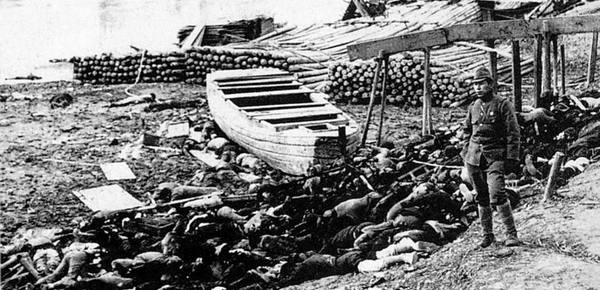
nankino-masakra-1

Nankingnanking_massacre_1

I can understand that and I have to admit that it is hard to do so. I am a historian as well as a clinician with much experience dealing with death and trauma. With my training I do a pretty good job of keeping my emotional distance to maintain objectivity when confronted with evil. However, it is hard for me not to have some emotional reaction when visiting these places, or reading about the events and people, and in writing about them.

Likewise, I am very troubled by the growing lack or awareness or denial of the Holocaust. It is very hard for me not to have a virulent reaction when I see books and websites dedicated to Holocaust denial, or that minimize other well documented genocides, and crimes against humanity.

tzd8ftsn-1390907543

Soviet Mass Killings in Ukraine

My sensitivity to human suffering and the terrible indifference of people in this country to it was greatly increased by my experience of war, and my post-war struggles with PTSD, depression, anxiety, which at points left me very close to committing suicide. A non-chaplain friend, a now retired Navy Command Master Chief Petty Officer that I served with at my last duty station recently remarked that I am a tremendously empathic person, and that I have a large capacity to feel the pain and suffering of others. This capacity for empathy and the ability to feel the suffering of others is part of who I am. It is a good thing, but it makes my work studying and writing about the Holocaust, other genocides, crimes against humanity, and subjects like American slavery, racism, and Jim Crow a sometimes difficult and often very emotionally consuming task. This sometimes leaves me even more sleepless and anxious than normal; especially when I see the indifference of so many people to the suffering of others today.

CambodiaExhibitMassgrave-x1

The Killing Fields

It is that indifference which motivates me to write; because if these events are not recalled and retold, they, like any part of history will be ignored and then forgotten. The statistics bear this out. There are people today, who say that we should stop talking about these events, that they are old news, and they cannot happen again; but history tells us different, and not just the Holocaust, but indeed every genocide. Then there are those who shamelessly use the Holocaust imagery to spread fear among their followers even as they openly demonize minority groups and religions as the Nazis did to the Jews.

I have to agree with Elie Wiesel who said, “Indifference to me, is the epitome of all evil.”

The late Iris Chang, who wrote The Rape of Nanking: The Forgotten Holocaust of World War II wrote something that is pertinent to almost every modern episode of genocide, or other crime against humanity. It is the ability of leaders, be they political, military, or religious to convince people to rationalize actions that they normally would find repulsive.

“After reading several file cabinets’ worth of documents on Japanese war crimes as well as accounts of ancient atrocities from the pantheon of world history, I would have to conclude that Japan’s behavior during World War II was less a product of dangerous people than of a dangerous government, in a vulnerable culture, in dangerous times, able to sell dangerous rationalizations to those whose human instincts told them otherwise.”
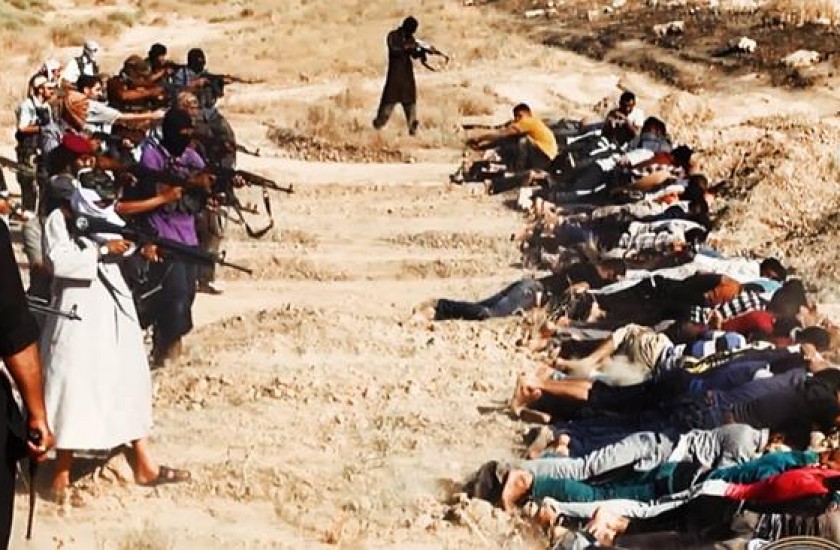
isis3-840x550

The Islamic State

There are many other such events that we could note; the American decimation and genocide committed against native American tribes that spanned close to two centuries, the 1915 Turkish genocide of Armenians, the Rwandan genocide of 1994, the Serbian atrocities in Bosnia and Kosovo, the Chinese Communist “Great Leap Forward,” the actions of the Islamic State in Iraq and Syria, and the more recent but seldom discussed action of the Myanmar government and military against its Rohingya Muslim minority.

                        Rwandan Genocide 

What we call civilization, to use the words of Iris Chang, is tissue thin. That is why we must never forget these terrible events of history, and that part of human nature, and in a sense part of every one of us, that makes them so easy to repeat. That is why we must periodically take the time to remember and reflect on the Holocaust, other genocides and crimes against humanity.

It is even more important now with the rise of fascist, nationalist, and racist regimes around the world. Even in the United States these demons of the past, racism, nationalism, and fascism have come out into the open as those who believe in them have become emboldened by the words of President Trump and members of his administration.

In fact in trying to clean up his inaction after the violence committed by neo-Nazis and KKK sympathizers in Charlottesville the President first equated the Nazis and Klansmen with the people that they attacked and under pressure made a speech condemning the Nazis and Klansmen. According to Bob Woodward, when a Fox News correspondent said that was an admission that he was almost an admission that he was wrong.” The President exploded at Rob Porter, the aide who convinced him to make the speech: “That was the biggest fucking mistake I’ve made,” the President told Porter. “You never make those concessions. You never apologize. I didn’t do anything wrong in the first place. Why look weak?” A few days later the President returned to the subject and again made the argument of moral equivalence.

Coupled with so many of the President’s words and policies directed against Blacks, Mexicans and Central Americans, Arabs, Africans, and others; as well as his attacks on the First Amendment and his praise and defense of cold blooded dictators around the world one has to take it more seriously.

This is not an issue that simply lurks in the past, it is a very real part of the present. Historian Timothy Snyder wrote:

“The European history of the twentieth century shows us that societies can break, democracies can fall, ethics can collapse, and ordinary men can find themselves standing over death pits with guns in their hands. It would serve us well today to understand why.”


Yes, these are terribly uncomfortable subjects, but we cannot allow this generation to allow them to be forgotten, lest they be repeated. That is why that I must continue to write about them and do my best to make sure that they are not forgotten as we cannot afford to let them happen again.

Peace

Padre Steve+

1 Comment

Filed under crime, culture, ethics, History, holocaust, nazi germany, News and current events, Political Commentary

The Rape of Nanking at 80

Friends of Padre Steve’s World,

Eighty years ago Japanese Army troops under the command of Lieutenant General Asaka Yasuhiko launched an attack on the Nationalist Chinese defenders of the city of Nanking. That attack and the subsequent occupation led to one of the most heinous displays of inhumanity and war crimes in modern history. As a single event it ranks as high or higher than any single event directed at one city during the Nazi Holocaust against the Jews.

Not long after I started this blog I wrote an article on the Rape of Nanking. The event which occurred in 1937 was one of the most extensively documented war crimes in modern history. But despite that there are many, especially those of Japanese political right who deny that the event ever occurred and if if atrocities happened in Nanking it was the Chinese government which carried them out. It is amazing that I still get comments from such people on that original article. The critics are war crime deniers who are no better than Holocaust deniers.

Since many of my newer readers might have never seen that article I am re-posting it today.

Have a good day,

Peace

Padre Steve+

The historical controversy regarding the Rape of Nanking in 1937 by the Japanese Army is hotly debated.[1] The massacres occurred in the initial occupation of the city and the two months following in mid December 1937.  The initial reaction to the actions of the Japanese was reported by western journalists and even a German Nazi Party member by the name of John Rabe who assisted in protecting Chinese during the massacre and reported it on his return to Germany. The actions of the Japanese Army shocked many in the west and helped cement the image of the Japanese being a brutal race in the west.

Massacre Victims at Nanking

The controversy’s visibility was raised since the 1997 publication of Iris Chang’s The Rape of Nanking. However, with few exceptions the incident had received little attention by Western historians until Chang’s book was published. The reason for this was  that  China was a sideshow for for the United States and Britain throughout much of the war. When Chiang Kai Shek’s Nationalists were overthrown by the Communists in 1948 the incident disappeared from view in the United States. The  United States government  reacted to the overthrow of Chaing by helping to rebuild Japan and rehabilitate the Japanese while opposing the Chinese Communists.  In fact it was only “after the Cold War was the Rape of Nanking Openly discussed.”[2]

Bodies of Children Killed by the Japanese at Nanking

Chang’s book was instrumental as it brought new attention to the actions of the Japanese Army in the slaughter of Prisoners of War and civilians following the occupation of the city.  Even as Chang’s work was published “revisionist” works began to appear in the 1980s which have either denied the atrocities, sought to minimize numbers killed by Japanese Forces or rationalized the them began to appear in Japan. The revisionists were led by Masaaki Tanaka who had served as an aide to General Matsui Iwane the commander of Japanese forces at Nanking.  Tanaka denied the atrocities outright calling them “fabrications” casting doubt upon numbers in the trial as “propaganda.” He eventually joined in a lawsuit against the Japanese Ministry of Education to remove the words “aggression” and “Nanjing massacre” from textbooks, a lawsuit which was dismissed but was influential to other revisionists and Japanese nationalist politicians and publishers.[3]

Japanese Officer Preparing to Execute Man in Hospital

Most early accounts of the occupation and war crimes have used a number of 200,000 to 300,000 victims based upon the numbers provided during the War Crimes Trials of 1946.[4] Unlike the numbers of victims of the Nazi Holocaust the numbers are less accurate.  Authors who maintain the massacres such as Chang and others such as Japanese military historian Mashario Yamamoto who admits Japanese wrongdoing and excess but challenges the numbers use the same statistical sources to make their arguments.  Chang not only affirms the original numbers but extrapolates that even more may have been killed as a result of the disposal of bodies in the Yangtze River rather than in mass graves away from the city as well as the failure of survivors to report family member deaths to the Chinese authorities.[5] She also notes contemporary Chinese scholars who suggest even higher numbers.

Prince Asaka, Granduncle of Emperor Hirohito Commanded Troops at Nanking

Herbert Bix discussed Japanese knowledge of the atrocities in detail up and down the chain of command including Prince Asaka, granduncle of Emperor Hirohito who commanded troops in Nanking, the military and Foreign Office, and likely even Hirohito himself.[6]

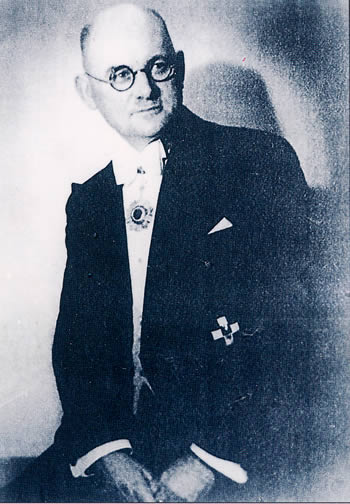
German National and Nazi Party Member John Rabe Protected Chinese at Nanking and Reported His

Experience to the German Government.  He is known as “The Good Man of Nanking”

The publication of German citizen and witness to the massacres John Rabe’s diaries in 2000, The Good Man of Nanking, provided an additional first hand account by a westerner who had the unique perspective of being from Japan’s ally Nazi Germany.  His accounts buttress the arguments of those like Chang who seek to inform the world about the size and scope of Japanese atrocities in Nanking.

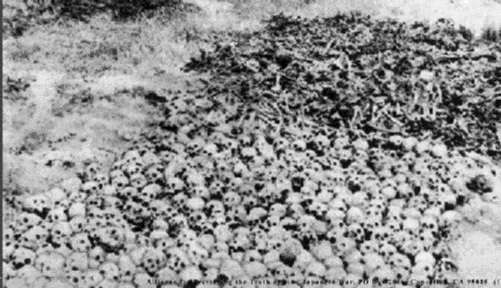
A Field of Skulls at Nanking

Yamamoto who is a military historian by trade and is viewed as a “centrist” in the debate, places the massacres in the context of Japanese military operations beginning with the fall of Shanghai up to the capture of Nanking. Yamamoto criticizes those who deny the massacres but settles on a far lower number of deaths, questioning the numbers used at the War Crimes Trials. He blames some on the Chinese Army[7] and explains many others away in the context of operations to eliminate resistance by Chinese soldiers and police who had remained in the city in civilian clothes. He  claims that  “the Japanese military leadership decided to launch the campaign to hunt down Chinese soldiers in the suburban areas because a substantial number of Chinese soldiers were still hiding in such areas and posing a constant threat to the Japanese.”[8] David Barrett in his review of the Yamamoto’s work notes that Yamamoto believes that “there were numerous atrocities, but no massacre….”[9] Yoshihisa Tak Mastusaka notes that while a centrist Yamamoto’s work’s “emphasis on precedents in the history of warfare reflects an underlying apologist tone that informs much of the book.”[10] Revisionist work also criticizes the trials surrounding Nanking and other Japanese atrocities.  An example of such a work is Tim Maga’s Judgment at Tokyo: The Japanese War Crimes Trials which is critiqued by historian Richard Minear as “having a weak grasp of legal issues” and “factual errors too numerous to list.”[11] Such is a recurrent theme in revisionist scholarship, the attempt to mitigate or minimize the scale of the atrocities, to cast doubt upon sources and motivations of their proponents or sources, to use questionable sources themselves or to attribute them to out of control soldiers, the fog of war and minimize command knowledge as does Yamamoto. Politics is often a key motivating factor behind revisionist work.

Iris Chang Would Later Commit Suicide

Chang would never be the same after researching and writing the Rape of Nanking. Traumatized by what she had learned and burdened by the weight of what she had taken on she killed herself on November 9th 2004.

Iconic Photo of Japanese Acts in China: A Wounded Child at Shanghai Station

“Revisionist” history will almost certainly remain with us, so long as people study the past.  However one has to be careful in labeling a divergent view of a historical subject as necessarily revisionist.  There are occasions when new evidence arises and a “new” or “revisionist” work may actually disprove previous conclusions regarding historic events or persons.  This might occur when what we know about a subject comes from a single or limited number of sources who themselves were limited in what they had available for research and new evidence comes to light. At the same time where numerous sources from diverse points of view attest to the genuineness of an event, the revisionist’s theses should be themselves scrutinized based on evidence presented as well as their political, ideological or racial motivations.  While one does not want to silence voices of opposition to prevailing beliefs one has to be careful in examining their claims, especially when they arise in the context of political or ideological conflicts.

Notes

[1] Bix, Herbert P. Hirohito and the Making of Modern Japan, Harper Collins Publishers, New York, NY 2000. pp.333-334. Bix does a good job explaining the number of victims of the incident drawing on Chinese and Japanese sources.

[2] Kreuter, Gretchen. The Forgotten Holocaust in The Bulletin of Atomic Scientists, March-April 1998 p.66

[3] Fogel, Joshua A. The Nanjing Massacre in History and Historiography, University of California Press, Berkley CA 2000, pp.87-89

[4] Toland, John. The Rising Sun: The Rise and Fall of the Japanese Empire 1936-45. Random House, New York, NY 1970 pp. 50-51. Toland in his brief discussion of the massacres notes both the civilian casualty figures and figures for male citizens of military age who were slaughtered.  Toland also notes the large numbers of women raped by Japanese soldiers.

[5] Chang, Iris. The Rape of Nanking: The Forgotten Holocaust of World War II Penguin Books, New York, NY 1997 pp.102-103. Chang has been criticized by some historians in a number of ways including that she was not a historian, that she compares the atrocities to the Nazi Holocaust and her emotional attachment to the subject which may have been a contributing factor in her 2004 suicide.

[6] Bix. p.336

[7] Yamamoto, Masahiro. The Rape of Nanking: Anatomy of an Atrocity. Praeger Publishers an imprint of the Greenwood Group, Westport, CT 2000. http://site.ebrary.com/lib/apus/docDetail.action?docID=10018001&p00=nanking  p.83

[8] Ibid. p.92.

[9] Barrett, David P.  Review of The Rape of Nanking: Anatomy of an Atrocity by Masashiro Yamamoto Canadian Journal of History/Annales canadiennes d’Histoire XXXVIII, April/Avril 2003 p.170

[10] Mastusaka, Yoshihisa Tak.  Review of The Rape of Nanking: Anatomy of an Atrocity by Masashiro Yamamoto American Historical Review, April 2002 p.525

[11] Minear, Richard. Review of Judgment at Tokyo: The Japanese War Crimes Trials by Tim Mata  American Historical Review. April 2002 p.526

2 Comments

Filed under ethics, History, Loose thoughts and musings, Military, world war two in the pacific

What Does it take to Become a War Criminal? 


Friends of Padre Steve’s World,

Over the past few days I have been writing about the German invasion of the Soviet Union and the fact that senior leaders of the Wehrmacht actively cooperated with the crimes of the Nazi regime against the Jews, Soviet prisoners of war, and Soviet citizens. I have pointed out that Hitler’s ideology of the racial superiority of his Aryan Master Race and the corresponding view that the Jews and Slavs were untermenschen or subhuman justified the most extreme measures that the Nazis used to kill millions of innocent people through extermination, ethnic cleansing, and extermination. 

There was a common myth after the Second World War that the regular German Army, the Wehrmacht, fought an honorable and clean war while the criminal actions of war crimes and genocide were the fault of Hitler, the Nazi Party, and the SS. It was a comforting myth because it allowed a great number of men who agreed with Hitler’s policies, and often assisted in them to maintain a fiction of honor and respectability. While for the most part the German Army in the West fought according to international norms of conduct, it was a different matter on the Easter Front, where following Hitler’s lead the Wehrmacht from its senior officers in down was often at the tip of the spear in enforcing Hitler’s racial and ideological war. 


                                                                                       Field Marshal Wilhelm Keitel 

This came form the top. In addition to the Commissar order, also known as the Criminal Order, Field Marshal Keitel offered this directive to units fighting on the Easter Front:

“In view of the vast size of the conquered territories in the East, the forces available for establishing security in these areas will be sufficient only if instead of punishing resistance by sentencing the guilty in a court of law, the occupying forces spread such terror as is likely, by its mere existence, to crush every will to resist amongst the population.

The commanders concerned, together with all available troops, should be made responsible for maintaining peace within their areas. The commanders must find the means of keeping order within their areas, not by demanding more security forces, but by applying suitable drastic measures.”

                                                                                  Field Marshal Walter Von Reichenau 

Field Marshal Walter Reichenau issued what is something’s known as the Severity Order to his 6th Army which was part of Field Marshal Gerd Von Rundstedt’s Army Group South. Von Rundstedt, who was not a Nazi and who maintained his reputation after the war expressed his “complete agreement” with it and urged other subordinates to issue similar orders. 

“The most important objective of this campaign against the Jewish-Bolshevik system is the complete destruction of its sources of power and the extermination of the Asiatic influence in European civilization. … In this eastern theatre, the soldier is not only a man fighting in accordance with the rules of the art of war, but also the ruthless standard bearer of a national conception. … For this reason the soldier must learn fully to appreciate the necessity for the severe but just retribution that must be meted out to the subhuman species of Jewry…” 

An order was issued by General Erich Von Manstein’s Eleventh Army in November 1941 which stated in part:

“Jewry constitutes the middleman between the enemy in the rear and the remainder of the Red Armed Forces which is still fighting, and the Red leadership. More strongly than in Europe it holds all the key positions in the political leadership and administration, controls commerce and trades, and further forms the nucleus for all unrest and possible uprisings.

The Jewish-Bolshevist system must be exterminated once and for all. Never again must it encroach upon our European living space.

The German soldier has therefore not only the task of crushing the military potential of this system. He comes also as the bearer of a racial concept and as the avenger of all the cruelties’ which have been perpetrated on him and on the German people…

The food situation at home makes it essential that the troops should as far as possible be fed off the land and that furthermore the largest possible stocks should be placed at the disposal of the homeland. Particularly in enemy cities a large part of the population will have to go hungry. Nevertheless nothing which the homeland has sacrificed itself to contribute may, out of a misguided sense of humanity, be given to prisoners or to the population unless they are in the service of the German Wehrmacht.

The soldier must appreciate the necessity for the harsh punishment of Jewry, the spiritual bearer of the Bolshevist terror. This is also necessary in order to nip in the bud all uprisings which are mostly plotted by Jews…

Manstein claimed that he did not remember the order at his trial and that he sought to ensure that his troops did not engage in conduct not fitting of the honor of soldiers. He included the following in the order: “Severest action to be taken: against despotism and self-seeking; against lawlessness and lack of discipline; against every transgression of the honor of a soldier.”

In his defense at Nuremberg Manstien attempted to mitigate the damning words of the order. He explained that “I do want to point out to you that if it says here that the system must be exterminated, then that is extermination of the Bolshevik system, but not the extermination of human beings.” Despite Manstein’s clarification of what he meant in the order it would be hard for soldiers and commanders receiving the order as written could hardly have been expect not to interpret it literally. Likewise his order mentions the intentional starvation of Soviet citizens and harsh invectives against the Jews. 

Like Von Rundstedt, Manstein too would be rehabilitated and for the most part his complicity in Hitler’s racial and ideological war forgotten. 


There are many other examples of German Army commanders at various levels issuing orders similar to Von Reichenau and Von Manstein as well as accounts of Wehrmacht units cooperating with the Einsatzgruppen in various mass extermination actions against the Jews, including the action at Babi Yar. In many cases the cooperation was quite close as evidenced by the report of the commander of Einsatzgruppe C to Berlin on November 3rd 1941:

In a great number of cases, it happened that the support of the Einsatzkommandos was requested by the fighting troops. Advance detachments of the Einsatzgruppe also participated in every large military action. They entered newly captured localities side by side with the fighting troops. Thus, in all cases, the utmost support was given. For example, in this connection, it is worth mentioning the participation in the capture of Zhitomir, where the first tanks entering the city were immediately followed by three cars of Einsatzkommando 4a.

As a result of the successful work of the Einsatzgruppe, the Security Police is also held in high regard, in particular by the HQ of the German Army. The liaison officers stationed in Army HQ are loyally briefed of all military operations, and, besides, they receive the utmost cooperation. The Commander of the 6th Army, Generalfeldmarschall von Richenau, has repeatedly praised the work of the Einsatzkommandos and, accordingly, supported the interests of the SD with his staff.

It is true that in some cases individual Wehrmacht officers refused to cooperate with the Einsatzgruppen in their operational areas, but without the cooperation of the Wehrmacht the extermination campaigns against the Jews and other Soviet citizens could not have been successful. 

                                                                                                 The Rape of Nanking 

One has to ask what it takes for otherwise ordinary and law abiding people to carry out crimes of such magnitude. I do believe that the answer is found in the racial ideology that posits certain races as being less than human. The examples of such belief in action litter human history and are not limited to the Germans of the Nazi era. The disturbing thing as that the men who perpetrated the Nazi crimes against humanity and genocide were not unique. The actions of the Japanese army in China, Korea, and Southeast Asia to include the Rape of Nanking and their Unit 731; the American genocide committed against the Native American tribes and the enslavement of Blacks; the extermination of the Herero in German Southwest Africa, the Rwandan genocide, the mass killings of Bosnians by Bosnian Serbs,  the Armenian genocide committed by the Turks, and far too many more examples show this to be the case. 

I think one of our problems is that we want to believe that evil is simply done be evil people. That is why when we see a Hitler, Stalin, Pol Pot, or the monsters of the so-called Islamic State, we are often strangely comforted. This is often because we can point to a single person with a wicked ideology and say “they are evil,” all the while forgetting that they are, or were, like us, also human. 


There is a scene in the movie Nuremberg in which an American psychologist named Gustave Gilbert questions the commandant of Auschwitz. When he asks the commandant if he felt guilty for the extermination of the Jews in his camp the commandant said “does a rat catcher feel guilty for killing rats.” Thereafter Gilbert confronts Herman Goering pointedly asking the number two Nazi “A rat catcher catching rats”. Is that the kind of thinking it takes to carry out state sanctioned mass murder? Not just blind obedience but also a belief that your victims are not human?” 

Goering replies: Let me ask you this. What was Hiroshima? Was it not your medical experiment? Would Americans have dropped bombs as easily on Germany as it did upon Japan killing as many civilians as possible? I think not. To an American sensibility, a Caucasian child is considerably more human than a Japanese child…. 

What about the negro officers in your own army? Are they not allowed to command troops in combat? Can they sit on the same buses as the whites? The segregation laws in your country and the anti Semitic laws in mine, are they not a difference of degree? 

The tragic thing is that while Gilbert was certainly correct in his question to Goering, Goering was also right. For all that is good about America there is a persistent strain of this kind of thinking which deems other people, especially non-white people as inferior racially, culturally, and intellectually. Over the decades we like to think that we have become better but the underlying attitudes are still present today, sometimes in plain view, but often just under our veneer of civility and good manners, but what maintains that civility is quite fragile. In his history of Auschwitz British historian Laurence Rees wrote:

“human behavior is fragile and unpredictable and often at the mercy of the situation. Every individual still, of course, has a choice as to how to behave, it’s just that for many people the situation is the key determinate in that choice.” The German military officers who took part in the campaign in the East were terrifyingly normal. They were raised in an advanced society, highly cultured, well educated, and raised in the cradle of Protestantism. Yet many of them became willing participants in crimes of their nation that are unimaginable. But the fact is that the character of nations can be as fragile as that if individuals. As Americans we like to think that we are different but our history often belies this, even our military history and this is part of our conundrum. 

Aleksandr Solzhenitsyn wrote of the struggle:

 “If only it were all so simple! If only there were evil people somewhere insidiously committing evil deeds, and it were necessary only to separate them from the rest of us and destroy them. But the line dividing good and evil cuts through the heart of every human being. And who is willing to destroy a piece of his own heart?”

When I taught ethics at the Joint Forces Staff College I challenged my students to deal with these kinds of questions. They are not easy and they require that we look into the darkest reaches of our hearts to see what we will do when we are confronted with choices to obey orders that go against the values of the institution but may reflect the more troubling aspects of our culture. Some of these men and women I am sure understood and will not break under pressure, but I am not so sure about others, and I worry about them in the crisis. The fact is we are only as good as we are in the crisis. Historian Timothy Snyder wrote something that we should not discount when asking the question about how ordinary men become war criminals:

“The European history of the twentieth century shows us that societies can break, democracies can fall, ethics can collapse, and ordinary men can find themselves standing over death pits with guns in their hands. It would serve us well today to understand why.”

This is something that we most ponder because it would not take much in our present day where the old ethnic race hatreds, religious hatreds, and resurgent nationalism are again raising their head not only in our own country, but around the world. I will address this in the recent American context next week. So until tomorrow, when I publish something more personal and unrelated to this subject.

Peace

Padre Steve+
1 Comment

Filed under ethics, History, holocaust, Military, movies, world war two in europe

Battling Holocaust Deniers one Day at a Time

Babi Yar

Friends of Padre Steve’s World,

I have a policy on Holocaust denial on my site. If someone denies the Holocaust or tries to minimize it I delete their post. That might sound somewhat restrictive, but I will not give them the space on my site to posit their race hatred and justification of genocide in any way shape or form. It used to be that I would spar with them, but I realized that by doing so I gave them a sense of acceptability, and when some proceeded to make physical threats against me for opposing their ideas I realized that I couldn’t go down that road anymore.

That being said, every so often I get comments from Holocaust deniers, as well as Japanese deniers of the Rape of Nanking and other Japanese atrocities in Asia during the 1930s and World War II. The Japanese Nanking deniers are almost always Right Wing revisionists and hyper-nationalists who subscribe to the racial theory that the Chinese and other non-Japanese are less than human. But I’ve never had an American take issue with Nanking while almost all of my holocaust deniers are Americans who not only deny the Holocaust, but who subscribe to the most base and repulsive theories of anti-Semitism, and White Supremacy.

I had yet another one of those last week who ripped into me on the Nazi massacre of Ukrainian Jews at Babi Yar, in which over 33,771 Jews were marched out of Kiev and shot on the 29th and 30th of September 1941. There were 29 survivors who managed to escape the death pits by feigning and climbing out after dark. Massacres of more than 100,000 other people, mostly non-Jews continued until November. The number of Jews killed was documented by the Commander of the Sonderkommando 4a of Einsatzgruppe C which conducted the massacre. The Einsatzgruppe men were assisted by troops from two Police Battalions and Waffen SS troops with support from the Wehrmacht.  Both the records of the Einsatzgruppe and the testimony of SS men who took part is damning enough, yet my denier critic had the nerve to say “There was no such massacre – it is just another example of war time atrocity propaganda.”

I since he decided to leave his email address and website I decided to do a little investigation and found that he is full of these zingers and an avid supporter of President Trump. He plays fast and loose with the number of Jews killed in the Holocaust and claims that “It is currently illegal in many European nations to question the official or generally accepted account of the holocaust of European Jewry during the Second World War.” Of course that is not true, in fact in most of Europe the archives are open, the documents assessable, and the evidence undeniable. The problem is that the evidence is so great that any to deny it or attempt to revise it deserves both public ridicule and academic scorn. There are laws against Holocaust denial in many European countries precisely because it was such a horrific chapter in human history that it cannot be minimized or defended.

James Morcan in his book Debunking Holocaust Denial Theories wrote something very true that I am all too aware of: “Unfortunately, the historicity of the Holocaust has been undermined and chipped away at by the exact same sinister forces that created the genocide in the first place: racists, religious bigots and the most paranoid type of conspiracy theorists who, together, are uniting – often unwittingly – to form a new wave of anti-Semitism that will not willingly accept the obvious facts of the past. This chipping away (at the truth) began slowly and insidiously – much like the Holocaust itself – but sadly, and worryingly, it is gathering pace.” 

It is interesting to read through the man’s blog and see that his issue is not about anti-Semitism, as he is exceptionally anti-Semitic, nor is it about the killing of the Jews, just the number. It seems that he, like the other deniers can lessen the number that somehow it becomes more acceptable and over time forgettable. I will not open this site up to Holocaust deniers, but to its affirmers either.

The sad thing for us as a nation is that quite a few Holocaust deniers and affirmers have the ear of the President and people in his administration. This makes the topic all too relevant. As Marc Bloch wrote “we can truly understand the past only if we read it in light of the present.”

Peace

Padre Steve+

6 Comments

Filed under History, holocaust, News and current events, philosophy, Political Commentary

Revisiting the Rape of Nanking

nanking_massacre_1

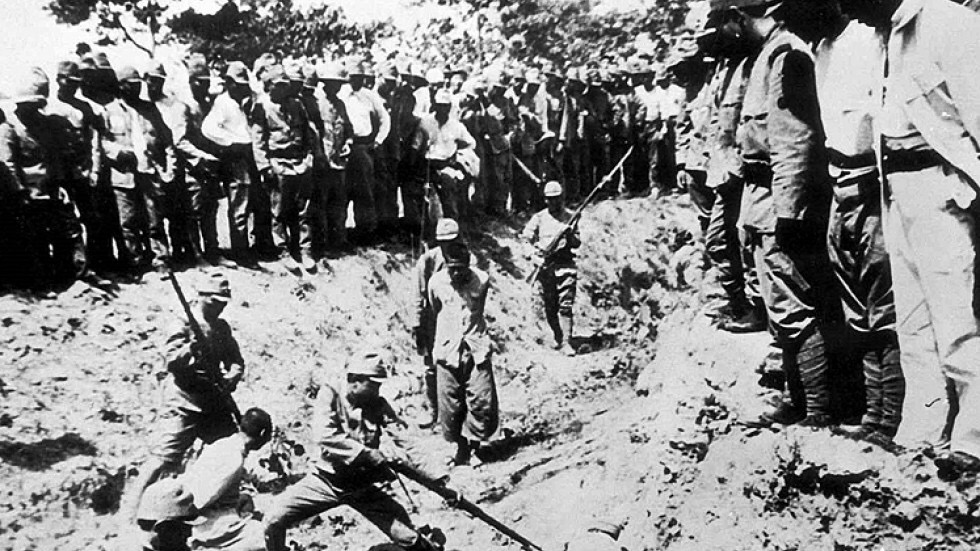
Japanese Soldiers using Chinese Prisoners for Bayonet Practice

Friends of Padre Steve’s World,

Not long after I started this blog I wrote an article on the Rape of Nanking. The event which occurred in 1937 was one of the most extensively documented war crimes in modern history. But despite that there are many, especially those of Japanese political right who deny that the event ever occurred and if if atrocities happened in Nanking it was the Chinese government which carried them out. It is amazing that I still get comments from such people on that original article.

Since many of my newer readers might have never seen that article I am re-posting it today. I am doing some more reading on the subject and will probably revisit it again sometime in the next few months.

Have a good day,

Peace

Padre Steve+
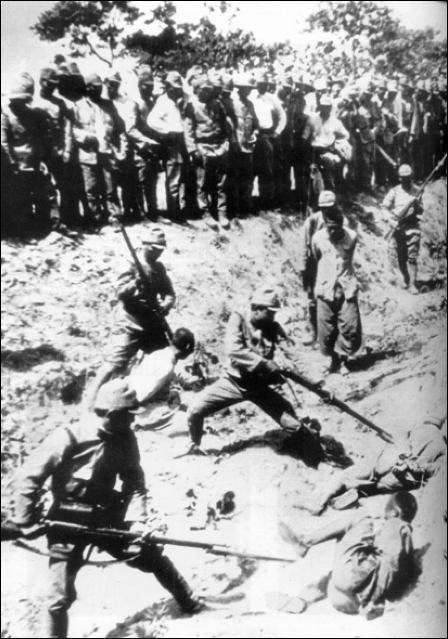
The historical controversy regarding the “rape” of Nanking in 1937 by the Japanese Army is hotly debated.[1] The massacres occurred in the initial occupation of the city and the two months following in mid December 1937.  The initial reaction to the actions of the Japanese was reported by western journalists and even a German Nazi Party member by the name of John Rabe who assisted in protecting Chinese during the massacre and reported it on his return to Germany.The action shocked many in the west and helped cement the image of the Japanese being a brutal race in the west.

Massacre Victims at Nanking

The controversy’s visibility has been raised since the 1997 publication of Iris Chang’s The Rape of Nanking. However, with few exceptions the incident had received little attention by Western historians until Chang’s book was published. The reason for this was  that  China was a sideshow for for the United States and Britain throughout much of the war. When Chiang Kai Shek’s Nationalists were overthrown by the Communists in 1948 the incident disappeared from view in the United States.   The  United States government  reacted to the overthrow of Chaing by helping to rebuild Japan and rehabilitate the Japanese while opposing the Chinese Communists.  In fact it was only “after the Cold War was the Rape of Nanking Openly discussed.”[2]

Bodies of Children Killed by the Japanese at Nanking

Chang’s book was instrumental as it brought new attention to the actions of the Japanese Army in the slaughter of Prisoners of War and civilians following the occupation of the city.  Even as Chang’s work was published “revisionist” works began to appear in the 1980s which have either denied the atrocities, sought to minimize numbers killed by Japanese Forces or rationalized the them began to appear in Japan.  The revisionists were led by Masaaki Tanaka who had served as an aide to General Matsui Iwane the commander of Japanese forces at Nanking.  Tanaka denied the atrocities outright calling them “fabrications” casting doubt upon numbers in the trial as “propaganda.” He eventually joined in a lawsuit against the Japanese Ministry of Education to remove the words “aggression” and “Nanjing massacre” from textbooks, a lawsuit which was dismissed but was influential to other revisionists and Japanese nationalist politicians and publishers.[3]

Japanese Officer Preparing to Execute Man in Hospital

Most early accounts of the occupation and war crimes have used a number of 200,000 to 300,000 victims based upon the numbers provided during the War Crimes Trials of 1946.[4] Unlike the numbers of victims of the Nazi Holocaust the numbers are less accurate.  Authors who maintain the massacres such as Chang and others such as Japanese military historian Mashario Yamamoto who admits Japanese wrongdoing and excess but challenges the numbers use the same statistical sources to make their arguments.  Chang not only affirms the original numbers but extrapolates that even more may have been killed as a result of the disposal of bodies in the Yangtze River rather than in mass graves away from the city as well as the failure of survivors to report family member deaths to the Chinese authorities.[5] She also notes contemporary Chinese scholars who suggest even higher numbers.

Prince Asaka, Granduncle of Emperor Hirohito Commanded Troops at Nanking

Herbert Bix discusses Japanese knowledge of the atrocities in detail up and down the chain of command including Prince Asaka, granduncle of Emperor Hirohito who commanded troops in Nanking, the military and Foreign Office, and likely even Hirohito himself.[6]

German National and Nazi Party Member John Rabe Protected Chinese at Nanking and Reported His Experience to the German Government.  He is known as “The Good Man of Nanking”

The publication of German citizen and witness to the massacres John Rabe’s diaries in 2000, The Good Man of Nanking, provided an additional first hand account by a westerner who had the unique perspective of being from Japan’s ally Nazi Germany.  His accounts buttress the arguments of those like Chang who seek to inform the world about the size and scope of Japanese atrocities in Nanking.

A Field of Skulls at Nanking

Yamamoto who is a military historian by trade and is viewed as a “centrist” in the debate, places the massacres in the context of Japanese military operations beginning with the fall of Shanghai up to the capture of Nanking. Yamamoto criticizes those who deny the massacres but settles on a far lower number of deaths, questioning the numbers used at the War Crimes Trials. He blames some on the Chinese Army[7] and explains many others away in the context of operations to eliminate resistance by Chinese soldiers and police who had remained in the city in civilian clothes. He  claims that  “the Japanese military leadership decided to launch the campaign to hunt down Chinese soldiers in the suburban areas because a substantial number of Chinese soldiers were still hiding in such areas and posing a constant threat to the Japanese.”[8] David Barrett in his review of the Yamamoto’s work notes that Yamamoto believes that “there were numerous atrocities, but no massacre….”[9] Yoshihisa Tak Mastusaka notes that while a centrist Yamamoto’s work’s “emphasis on precedents in the history of warfare reflects an underlying apologist tone that informs much of the book.”[10] Revisionist work also criticizes the trials surrounding Nanking and other Japanese atrocities.  An example of such a work is Tim Maga’s Judgment at Tokyo: The Japanese War Crimes Trials which is critiqued by historian Richard Minear as “having a weak grasp of legal issues” and “factual errors too numerous to list.”[11] Such is a recurrent theme in revisionist scholarship, the attempt to mitigate or minimize the scale of the atrocities, to cast doubt upon sources and motivations of their proponents or sources, to use questionable sources themselves or to attribute them to out of control soldiers, the fog of war and minimize command knowledge as does Yamamoto. Politics is often a key motivating factor behind revisionist work.

Iris Chang Would Later Commit Suicide

Chang would never be the same after researching and writing the Rape of Nanking. Traumatized by what she had learned and burdened by the weight of what she had taken on she killed herself on November 9th 2004.

Iconic Photo of Japanese Acts in China: A Wounded Child at Shanghai Station

“Revisionist” history will almost certainly remain with us, so long as people study the past.  However one has to be careful in labeling a divergent view of a historical subject as necessarily revisionist.  There are occasions when new evidence arises and a “new” or “revisionist” work may actually disprove previous conclusions regarding historic events or persons.  This might occur when what we know about a subject comes from a single or limited number of sources who themselves were limited in what they had available for research and new evidence comes to light. At the same time where numerous sources from diverse points of view attest to the genuineness of an event, the revisionist’s theses should be themselves scrutinized based on evidence presented as well as their political, ideological or racial motivations.  While one does not want to silence voices of opposition to prevailing beliefs one has to be careful in examining their claims, especially when they arise in the context of political or ideological conflicts.

Notes


[1] Bix, Herbert P. Hirohito and the Making of Modern Japan, Harper Collins Publishers, New York, NY 2000. pp.333-334. Bix does a good job explaining the number of victims of the incident drawing on Chinese and Japanese sources.

[2] Kreuter, Gretchen. The Forgotten Holocaust in The Bulletin of Atomic Scientists, March-April 1998 p.66

[3] Fogel, Joshua A. The Nanjing Massacre in History and Historiography, University of California Press, Berkley CA 2000, pp.87-89

[4] Toland, John. The Rising Sun: The Rise and Fall of the Japanese Empire 1936-45. Random House, New York, NY 1970 pp. 50-51. Toland in his brief discussion of the massacres notes both the civilian casualty figures and figures for male citizens of military age who were slaughtered.  Toland also notes the large numbers of women raped by Japanese soldiers.

[5] Chang, Iris. The Rape of Nanking: The Forgotten Holocaust of World War II Penguin Books, New York, NY 1997 pp.102-103. Chang has been criticized by some historians in a number of ways including that she was not a historian, that she compares the atrocities to the Nazi Holocaust and her emotional attachment to the subject which may have been a contributing factor in her 2004 suicide.

[6] Bix. p.336

[7] Yamamoto, Masahiro. The Rape of Nanking: Anatomy of an Atrocity. Praeger Publishers an imprint of the Greenwood Group, Westport, CT 2000. http://site.ebrary.com/lib/apus/docDetail.action?docID=10018001&p00=nanking  p.83

[8] Ibid. p.92.

[9] Barrett, David P.  Review of The Rape of Nanking: Anatomy of an Atrocity by Masashiro Yamamoto Canadian Journal of History/Annales canadiennes d’Histoire XXXVIII, April/Avril 2003 p.170

[10] Mastusaka, Yoshihisa Tak.  Review of The Rape of Nanking: Anatomy of an Atrocity by Masashiro Yamamoto American Historical Review, April 2002 p.525

[11] Minear, Richard. Review of Judgment at Tokyo: The Japanese War Crimes Trials by Tim Mata  American Historical Review. April 2002 p.526

Leave a comment

Filed under History, Military, war crimes, world war two in the pacific

What’s Coming this Week: Massacres and Malevolent Meetings


Friends of Padre Steve’s World,

Just a few housekeeping notes today. I have been busy at work with my ethics class and doing more writing on my various Gettysburg and Civil War texts. Likewise I have been paying attention to things going on in the United States and the world. I will be writing some about the most current events, but I will also be doing some writing about the Rape of Nanking as my article on it has been attracting some attention, especially from Japanese deniers of a well documented war crime and crime against humanity. Truthfully the Japanese deniers are no better than the deniers of the Holocaust, or the defenders of slavery in the American South, or the genocide committed against Native Americans by European colonists and our own American ancestors. 

Likewise I plan on posting some of my newest material from A Great War in an Age of Revolutionary Change as well as re-posting some articles from deep within the vault. I am going to be speaking Saturday at the Morehead Pride celebration and I will post something about that over the weekend too. 


Today was the last day for my current group of students in my ethics elective at the Staff College. As always, after the teaching and student presentations are done I show the film Conspiracy which is a dramatization of the Wansee Conference which set into motion the plan for Hitler’s Final Solution against the Jews. I always find the film chilling and use it to show that even well meaning and basically moral people can come to support, even reluctantly, evil plans. As I always tell my students, the one constant in history are people, and human nature never changes. 

So anyway, until tomorrow. 

Peace,

Padre Steve+ 

Leave a comment

Filed under film, History, holocaust, Loose thoughts and musings, world war two in the pacific

Indifference: the Epitome of All Evil

1483285_10152114931522059_1612934841_n

Friends of Padre Steve’s World,

This week we finished our first class of the year at the Staff College where I teach. In my ethics elective we touched on a number of very difficult subjects, my students gave presentations about the American internment of Japanese Americans in World War Two, the War with Mexico, where the United States according to Ulysses Grant was “one of the most unjust ever waged by a stronger against a weaker nation;” as well as several other deeply uncomfortable subjects which due to our academic non-attribution policy I do not even mention here.

The class was probably the best that I have taught in my two years at the college, the students were amazing, and all showed a tremendous capacity for wrestling with difficult subjects and were capable of deep self-reflection, something that should encourage anyone when they think about the future of our military leadership. Our final class was spend watching a very disconcerting movie called Conspiracy which is about the Wansee Conference which coordinated the Nazi Final Solution against the Jews. It is actually one of the most terrifying movies I have ever seen, mainly because it deals government officials meeting in a very businesslike fashion to condemn millions to death around a conference table while eating the finest food and drink.

Fyodor Dostoyevsky wrote, “Nothing is easier than to denounce the evildoer; nothing is more difficult than to understand him.”

I think one of our problems is that we want to believe that evil is simply done be evil people. That is why when we see a Hitler, Stalin, Pol Pot, or the monsters of the so-called Islamic State, we are often strangely comforted. This is often because we can point to a single person with a wicked ideology and say “they are evil,” all the while forgetting that they are, or were, like us, also human. Aleksandr Solzhenitsyn reminds us of the folly of that type of thinking, “If only it were all so simple! If only there were evil people somewhere insidiously committing evil deeds, and it were necessary only to separate them from the rest of us and destroy them. But the line dividing good and evil cuts through the heart of every human being. And who is willing to destroy a piece of his own heart?”

Last week I took a break from my Gettysburg text and dusted off an old academic paper dealing with the one of the more uncomfortable aspects of the Nazi Holocaust against the Jews. I did that because I felt that I needed to reexamine the nature of evil in the modern world.

When I ponder the evil committed by supposedly civilized men and women of Germany, I realize that they are little different than others who share the culture of the West. These people were the products of a culture of learning, and of science. They were part of a culture formed by the Christian tradition, the Renaissance, the Reformation, and the Enlightenment, the age of Reason. As I pondered this I came to remember something said by the late Iris Chang, “civilization is tissue thin.”

That series of articles about the Einsatzgruppen dealt with the ordinary men, and the bureaucratic systems that implemented an ideology so twisted and evil that it is unimaginable to most people. While most people in the United States know a little about the Holocaust, most do not fully comprehend how devilish and insidious the crimes of the Nazis were. More frightening is the fact that 46% of people worldwide have never heard of the Holocaust, and of the 54% who are aware some 32% think it is a myth or has been greatly exaggerated. The numbers wills only get worse as younger people are far more likely to believe that the Holocaust is a myth or or exaggerated.

We typically know about the extermination camps like Auschwitz, but the lesser known dark side of the Holocaust, perhaps the scariest part, is the story of the men of the Einsatzgruppen. The Einsatzgruppen and affiliated units, including those of the Wehrmacht, the Waffen SS, the mobilized battalions of the Order Police, and locally recruited units, rounded up massive numbers of people and killed them up close and personal. In all these units murdered over two million people, about 1.3 million of whom were Jews.

My study of the Holocaust began in college as an undergraduate. My primary professor at California State University at Northridge, Dr. Helmut Haeussler had been an interpreter and interrogator at the Nuremberg trials. I was able to take a number of lecture classes from him a large amount of research and independent study courses in a year of graduate work while finishing my Army ROTC program at UCLA. It was an immersion in the history, sociology, and the psychology of evil, during which I was able to meet and talk with Jewish survivors of the Holocaust.

Since then I have continued to read and study. I lived in Germany for over four years, and made many other visits, during which I went to a number of Concentration Camp sites. I visited the rebuilt synagogue in Worms which had been destroyed during the infamous Kristallnacht, and other museums and Holocaust memorial sites in Germany. I visited the Zeppelin field, the site of Hitler’s massive Nazi Party rallies in Nuremburg, as well as the graveyards which contain the victims of other Nazi crimes, including the Nacht und Nebel or night and fog actions, where people simply disappeared and were murdered by the Gestapo.

For me, those visits were sobering, maybe even more so because I understood exactly what happened in those sites. These are uncomfortable places to visit, and I can understand why many people would not want to visit them, or even study them.

The darkness that they remind us of is a part of our human condition. The traces of evil that are on display in those places are present in every human being. Frankly, most people cannot bear looking into that abyss, for fear that they might be swallowed by it.

I can understand that and I have to admit that it is hard to do so. I am a historian as well as a clinician with much experience dealing with death and trauma. With my training I do a pretty good job of keeping my emotional distance to maintain objectivity when confronted with evil. However, it is hard for me not to have some emotional reaction when visiting these places, or reading about the events and people, and in writing about them.

Likewise, I am very troubled by the growing lack of awareness about, or even the denial of the Holocaust. It is very hard for me not to have a virulent reaction when I see books and websites dedicated to Holocaust denial, or that minimize other well documented genocides, and crimes against humanity.

My sensitivity to human suffering and the terrible indifference of people in this country to it was greatly increased by my experience of war, and my post-war struggles with PTSD, depression, anxiety, which at points left me very close to committing suicide. A non-chaplain friend, a now retired Navy Command Master Chief Petty Officer that I served with at my last duty station recently remarked that I am a tremendously empathetic person, and that I have a large capacity to feel the pain and suffering of others. This capacity for empathy and the ability to feel the suffering of others is part of who I am. It is a good thing, but it makes my work studying and writing about the Holocaust, other genocides, crimes against humanity, and subjects like American slavery, racism, and Jim Crow a sometimes difficult and often very emotionally consuming task. This sometimes leaves me even more sleepless and anxious than normal; especially when I see the indifference of so many people to the suffering of others today.

It is that indifference which motivates me to write; because if these events are not recalled and retold, they, like any part of history will be ignored and then forgotten. The statistics bear this out. There are people today, who say that we should stop talking about these events, that they are old news, and they cannot happen again; but history tells us different, and not just the Holocaust, but indeed every genocide. Then there are those who shamelessly use the Holocaust imagery to spread fear among their followers even as they openly demonize minority groups and religions as the Nazis did to the Jews.

I have to agree with Elie Wiesel who said, “Indifference to me, is the epitome of all evil.”

The late Iris Chang, who wrote The Rape of Nanking: The Forgotten Holocaust of World War II wrote something that is pertinent to almost every modern episode of genocide, or other crime against humanity. It is the ability of leaders, be they political, military, or religious to convince people to rationalize actions that they normally would find repulsive.

“After reading several file cabinets’ worth of documents on Japanese war crimes as well as accounts of ancient atrocities from the pantheon of world history, I would have to conclude that Japan’s behavior during World War II was less a product of dangerous people than of a dangerous government, in a vulnerable culture, in dangerous times, able to sell dangerous rationalizations to those whose human instincts told them otherwise.”

What we call civilization, to use the words of Iris Chang, is tissue thin; and I believe that the indifference of so many people, especially those of great power and influence to crimes against humanity, to the suffering of people, epitomizes the evil of our day even more than the overt acts of the terrorists and governments committing them. 

That is why we must never forget these terrible events of history, and that part of human nature, and in a sense part of every one of us, that makes them so easy to repeat. That is why we must periodically take the time to remember and reflect on the Holocaust, other genocides and crimes against humanity.

Yes, these are terribly uncomfortable subjects, but we cannot allow this generation to allow them to be forgotten, lest they be repeated. Nor can we allow ourselves to be indifferent to them.

That is why that I must continue to write and teach.

Peace

Padre Steve+
 

2 Comments

Filed under ethics, History, nazi germany, News and current events

Civilization Is Tissue Thin: Holocaust & Genocide as Warning

nanking_massacre_1

The Rape of Nanking

Friends of Padre Steve’s World,

Fyodor Dostoyevsky wrote, “Nothing is easier than to denounce the evildoer; nothing is more difficult than to understand him.”

I think one of our problems is that we want to believe that evil is simply done be evil people. That is why when we see a Hitler, Stalin, Pol Pot, or the monsters of the so-called Islamic State, we are often strangely comforted. This is often  because we can point to a single person with a wicked ideology and say “they are evil,” all the while forgetting that they are, or were, like us, also human. Aleksandr Solzhenitsyn reminds us of the folly of that type of thinking, “If only it were all so simple! If only there were evil people somewhere insidiously committing evil deeds, and it were necessary only to separate them from the rest of us and destroy them. But the line dividing good and evil cuts through the heart of every human being. And who is willing to destroy a piece of his own heart?”

Last week I took a break from my Gettysburg text and dusted off an old academic paper dealing with the one of the more uncomfortable aspects of the Nazi Holocaust against the Jews. I did that because I felt that I needed to reexamine the nature of evil in the modern world. 

When I ponder the evil committed by supposedly civilized men and women of Germany, I realize that they are little different than others who share the culture of the West. These people were the products of a culture of learning, and of science. They were part of a culture formed by the Christian tradition, the Renaissance, the Reformation, and the Enlightenment, the age of Reason. As I pondered this I came to remember something said by the late Iris Chang, “civilization is tissue thin.”

Omaha_courthouse_lynching

Lynching in the American South

That series of articles about the Eunsatzgruppen dealt with the ordinary men, and the bureaucratic systems that implemented an ideology so twisted and evil that it is unimaginable to most people. While most people in the United States know a little about the Holocaust, most do not fully comprehend how devilish and insidious the crimes of the Nazis were. More frightening is the fact that 46% of people worldwide have never heard of the Holocaust, and of the 54% who are aware some 32% think it is a myth or has been greatly exaggerated. The numbers wills only get worse as younger people are far more likely to believe that the Holocaust is a myth or or exaggerated. 

We typically know about the extermination camps like Auschwitz, but the lesser known dark side of the Holocaust, perhaps the scariest part, is the story of the men of the Einsatzgruppen. The Einsatzgruppen and affiliated units, including those of the Wehrmacht, the Waffen SS, the mobilized battalions of the Order Police, and locally recruited units, rounded up massive numbers of people and killed them up close and personal. In all these units murdered over two million people, about 1.3 million of whom were Jews.

My study of the Holocaust began in college as an undergraduate. My primary professor at California State University at Northridge, Dr. Helmut Haeussler had been an interpreter and interrogator at the Nuremberg trials. I was able to take a number of lecture classes from him a large amount of research and independent study courses in a year of graduate work while finishing my Army ROTC program at UCLA. It was an immersion in the history, sociology, and the psychology of evil, during which I was able to meet and talk with Jewish survivors of the Holocaust.

mass killing einsatzgruppen

Einsatzgruppen

Since then I have continued to read and study. I lived in Germany for over four years, and made many other visits, during which I went to a number of Concentration Camp sites. I visited the rebuilt synagogue in Worms which had been destroyed during the infamous Kristallnacht, and other museums and Holocaust memorial sites in Germany. I visited the Zeppelin field, the site of Hitler’s massive Nazi Party rallies in Nuremburg, as well as the graveyards which contain the victims of other Nazi crimes, including the Nacht und Nebel or night and fog actions, where people simply disappeared and were murdered by the Gestapo. 

For me, those visits were sobering, maybe even more so because I understood exactly what happened in those sites. These are uncomfortable places to visit, and I can understand why many people would not want to visit them, or even study them. 

The darkness that they remind us of  is a part of our human condition. Traces of the evil on display in those places is present in every human being. Frankly, most people cannot bear looking into that abyss, for fear that they might be swallowed by it.

nankino-masakra-1

Nanking

I can understand that and I have to admit that it is hard to do so. I am a historian as well as a clinician with much experience dealing with death and trauma. With my training I do a pretty good job of keeping my emotional distance to maintain objectivity when confronted with evil. However, it is hard for me not to have some emotional reaction when visiting these places, or reading about the events and people, and in writing about them. 

Likewise, I am very troubled by the growing lack or awareness or denial of the Holocaust. It is very hard for me not to have a virulent reaction when I see books and websites dedicated to Holocaust denial, or that minimize other well documented genocides, and crimes against humanity.

tzd8ftsn-1390907543

Soviet Genocide in Ukraine

My sensitivity to human suffering and the terrible indifference of people in this country to it was greatly increased by my experience of war, and my post-war struggles with PTSD, depression, anxiety, which at points left me very close to committing suicide. A non-chaplain friend, a now retired Navy Command Master Chief Petty Officer that I served with at my last duty station recently remarked that I am a tremendously empathic person, and that I have a large capacity to feel the pain and suffering of others. This capacity for empathy and the ability to feel the suffering of others is part of who I am. It is a good thing, but it makes my work studying and writing about the Holocaust, other genocides, crimes against humanity, and subjects like American slavery, racism, and Jim Crow a sometimes difficult and often very emotionally consuming task. This sometimes leaves me even more sleepless and anxious than normal; especially when I see the indifference of so many people to the suffering of others today.

CambodiaExhibitMassgrave-x1

The Killing Fields

It is that indifference which motivates me to write; because if these events are not recalled and retold, they, like any part of history will be ignored and then forgotten. The statistics bear this out. There are people today, who say that we should stop talking about these events, that they are old news, and they cannot happen again; but history tells us different, and not just the Holocaust, but indeed every genocide. Then there are those who shamelessly use the Holocaust imagery to spread fear among their followers even as they openly demonize minority groups and religions as the Nazis did to the Jews.

I have to agree with Elie Wiesel who said, “Indifference to me, is the epitome of all evil.”

The late Iris Chang, who wrote The Rape of Nanking: The Forgotten Holocaust of World War II wrote something that is pertinent to almost every modern episode of genocide, or other crime against humanity. It is the ability of leaders, be they political, military, or religious to convince people to rationalize actions that they normally would find repulsive.

“After reading several file cabinets’ worth of documents on Japanese war crimes as well as accounts of ancient atrocities from the pantheon of world history, I would have to conclude that Japan’s behavior during World War II was less a product of dangerous people than of a dangerous government, in a vulnerable culture, in dangerous times, able to sell dangerous rationalizations to those whose human instincts told them otherwise.”

isis3-840x550

The Islamic State

What we call civilization, to use the words of Iris Chang, is tissue thin. That is why we must never forget these terrible events of history, and that part of human nature, and in a sense part of every one of us, that makes them so easy to repeat. That is why we must periodically take the time to remember and reflect on the Holocaust, other genocides and crimes against humanity.

Yes, these are terribly uncomfortable subjects, but we cannot allow this generation to allow them to be forgotten, lest they be repeated. That is why that I must continue to write about them.

Peace

Padre Steve+
5 Comments

Filed under crime, History, Political Commentary

Mass Movements, Devils & Tipping Points

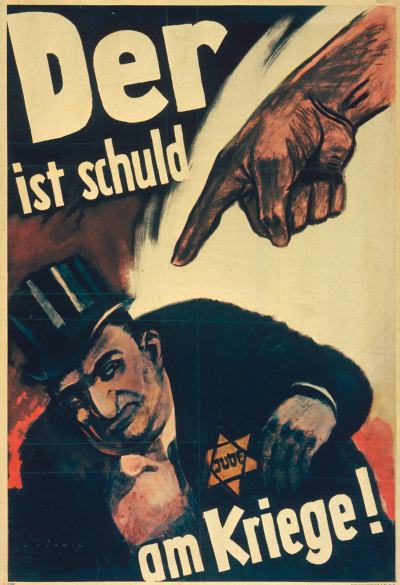
anti-jewish poster

The Nazis made the Jews their “Devil”

Friends of Padre Steve’s World,

The great American philosopher, Eric Hoffer once wrote, “Hatred is the most accessible and comprehensive of all the unifying agents. Mass movements can rise and spread without belief in a god, but never without a belief in a devil.”

Hatred is an amazing emotion. I the day and a half that I have been home from Europe I have been almost overwhelmed by the amount of hatred being posted on social media, blogs, and by supposedly Christian preachers, politicians and pundits. Of course if you want find a politician, pundit and preacher all wrapped into one person look no further than Baptist preacher, conservative media pundit, and former Arkansas Governor Mike Huckabee, but I digress…

It is funny when you even mildly disconnect from this climate for even a week, just how overwhelming returning to this can be, and how easy it would be to respond in kind, because unlike love, hatred is easy to conjure up. It is kind of like what you need to build a fire; fuel, oxygen and heat. To generate hatred on a massive scale all you need is a disaffected populace, a convenient target, and an agent to ignite the mixture.

Shrewd politicians, preachers, and pundits do this well. They demonize the target group or population and then let the hatred of their disaffected followers flow. The leaders need that disaffected and angry base in order to rise to power; such was how Hitler, Stalin, and so many other despots gained power. They took advantage of a climate of fear, and found others to blame. For Hitler it was the Jews; while for Stalin it was various groups like the Ukrainians, or the Poles who were the devil to be feared and destroyed. Timothy Snyder in his book Bloodlands: Europe Between Hitler and Stalin wrote:

“Dead human beings provided retrospective arguments for the rectitude of policy. Hitler and Stalin thus shared a certain politics of tyranny: they brought about catastrophes, blamed the enemy of their choice, and then used the death of millions to make the case that their policies were necessary or desirable. Each of them had a transformative utopia, a group to be blamed when its realization proved impossible, and then a policy of mass murder that could be proclaimed as a kind of ersatz victory.”

Snyder is quite correct, demonizing a people and making them some kind of “other”, “they”, or “them”, is a wonderful way to blame a group of people for the ills of society. It is also a good way to deflect the blame for the corporate failures of societies and governments onto a convenient scapegoat; and to blame others for the personal failures and petty jealousies of the people doing the demonizing. It also allows people to abandon ethics and the simple notion of the Golden Rule an engage in genocide.

Mass movements and their leaders; of which the contemporary “Christian Right” is one, love to use this technique; especially when using it against those of other races or religions. The technique is not at all new, it has been used from antiquity but has become much more dangerous in the modern era with the spread of instant communications technology. History shows us all too clearly how it has happened and how easily it can happen again. Witch hunts, slavery and Jim Crow, the extermination of the Native Americans which inspired Hitler in his campaign of genocide and the Holocaust; the Soviet gulags and ethnic cleansings, the Rape of Nanking, the Chinese Communist “Cultural Revolution” the Rwandan genocide, Srebrenica, the Turkish genocide of the Armenians, and the current crimes against humanity of the so called Islamic State. Sadly, the list can go on and on.

All of these events simply required the elements of a disaffected population, a devil or scapegoat to blame, and a leader or leaders to ignite the volatile mixture; fuel, oxygen and heat. Hoffer was quite correct that “Mass movements can rise and spread without belief in a god, but never without a belief in a devil.” The really successful leaders of such movements understand this. For Hitler it was the Jews and other untermenschen; for American Southerners after the Civil it was the Blacks and their white supporters. For the American “Know Nothings” of the 1840s and 1850s it was immigrants, especially Irish and Germans who were Catholic; for Stalin it was non-Russian ethnic minorities. For the leaders of the Islamic State, it is Jews, Shi’ite Moslems, less than “faithful” Sunnis, Christians and well for that matter anyone who does not line up one hundred percent with them on every issue. The examples are so plentiful to support this fact that it is almost overwhelming.

The problem is that when any society, or government begins to label or stigmatize a race, religion, ethnicity, sexual preference, or political ideology, and then in the process demonize those people to the point that they become less than human we have reached a tipping point. We reach the point where we are just one crisis away from all of those crimes against humanity that we believe that we are no longer capable of doing. But sadly, we human beings are not nearly as evolved as we think and I think that the tipping point in the United States may be far closer than we could ever imagine.

Those that follow my writings on this site know how much I love the various Star Trek television series and movies. There is an episode (The Siege of AR-558) of Star Trek Deep Space Nine where the Ferengi bartender Quark, makes a truly astute observation during a battle for survival at an isolated outpost:

“Let me tell you something about Hew-mons, Nephew. They’re a wonderful, friendly people, as long as their bellies are full and their holosuites are working. But take away their creature comforts, deprive them of food, sleep, sonic showers, put their lives in jeopardy over an extended period of time and those same friendly, intelligent, wonderful people… will become as nasty and as violent as the most bloodthirsty Klingon. You don’t believe me? Look at those faces. Look in their eyes.”

I really do not think that we are too far from some tipping point where the politicians, pundits and preachers; especially those of the political right and the media whores who are more concerned about market share than truth, decide that their “devils” must be exterminated. Of course when they will do they will claim a higher moral, religious, or racial, purpose; or perhaps use the language of Manifest Destiny, the Lost Cause, or the Stab in the Back or some other historical myth that suffices to justify their actions.

In the Star Trek the Next Generation episode entitled The Drumhead Captain Picard has to warn his security officer, Lt Worf about the dangers of rampant paranoia. Worf starts: “Sir, the Federation does have enemies. We must seek them out.”
 

Picard pauses and then notes:

“Oh, yes. That’s how it starts. But the road from legitimate suspicion to rampant paranoia is very much shorter than we think. Something is wrong here, Mister Worf. I don’t like what we have become.”

To claim Picard’s words for myself after being somewhat off the grid in Europe the past week and having come home to the fusillade of hatred being spewed forth, I have to admit that I don’t like what we have become either.

Peace

Padre Steve+
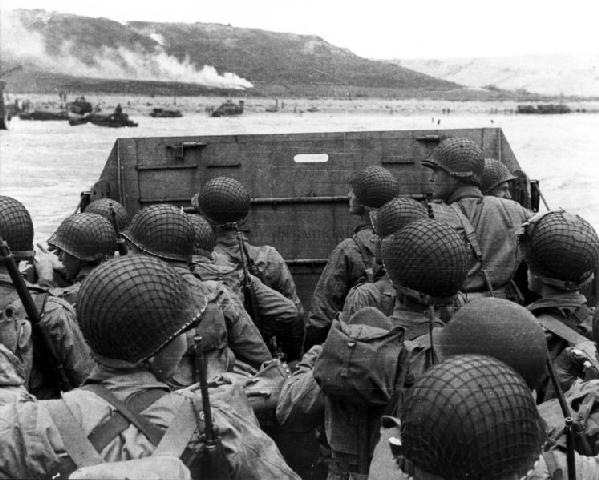
3 Comments

Filed under ethics, faith, History, Political Commentary, Religion

Padre Steve’s Top 25 Articles of 2010, some Statistics and a Big Thank You to My Readers

Well we are coming to the end of the year here at Padre Steve’s World and as if you didn’t know from my baseball posts I am a fanatic about statistics.  Last year I published my “Top 10” in order to just get an idea about what my readers were reading and to kind of point new readers to articles that might interest them.

Before I delve into this I want to say thank you to all those people that take the time to stop by my little realm of cyber space and to those that take the time to leave comments, positive and even negative. You help me out a lot both in what I write and making me look at different angles on the subjects that I write about. Likewise various reads comments and suggestions have inspired and sometimes provoked me into writing articles that I might not have written otherwise. So thank you for taking the time to look at this site. Unlike the talk radio hosts that as us to give them 3 hours a day 5 days a week I just hope that you stop by once in a while and if you like what you see to come by more often and recommended the site to friends.

What is interesting to me is the way that some of these essays have almost taken on lives of their own and become much more popular than I could have ever imagined.  Who knows maybe I can actually work on finding a publisher this year and get some of this into print and maybe just maybe actually make a little money for my efforts.  I’ve been looking at the 700 plus posts that now are on the site and I can see a few book possibilities and if you have suggestions please let me know.

So as far as statistics go Padre Steve’s World is coming up on 2 Million total views and should go over that mark late today or early tomorrow.  Of those views about 1,280,000 have come this year, I won’t get an exact count until the New Year but then who but me is counting anyway? With those numbers I am averaging about 3500 views a day with the highest today being on June 17th when I had 9647 views.  I have had readers from almost every country or territory in the world from the United States to Togo and almost everywhere in between.  I think that is pretty cool and shows how the internet can reach almost all parts of the globe and I hope that the people in far off lands are getting something positive out of what I write.

This year I have posted 377 articles of which 169 had something to do with Baseball and 70 were about the military and of the military articles 18 dealt with various types of warships and a further dealt with history.  Another 21 articles dealt with Iraq or Afghanistan in one way or another ranging from historical, operational and theoretical articles interspersed with essays about the human cost of war.  Now the categories dealing with religion were harder to quantify as I posted them in several different categories with some articles listed in more than one category. Of these 24 articles dealt with faith, 29 with the Christian life, 49 in the general category of Religion and 53 fit into the rather amorphous category of Philosophy. I also listed 20 in the Pastoral Care section.  Again many of these posts overlapped so depending on the subject an article might be listed under several categories.

I have also more interactive this year with my readers in terms of the comment section and comments listed on my Facebook page for different articles. If you want to subscribe to the site or a single post and its comments feel free to do so and if you want to be a Facebook “friend” just tell me that you read the site when you do the request.

So this year I am posting my top 25 essays of 2010 as I think it gives me and you a better grasp on what people find interesting on this site.  I have also written a little bit of what caused me to write about those subjects.

Music of the 1970s and 1980s topped my list with 3 articles in the top 25 coming it at number 1, 5 and 9

1. I Miss the Music of the 70’s and 80’s I wrote this because I am went to High School and College in the 70s and 80s and like anyone my musical tastes and preferences were set back then. This year the essay which includes a lot of links to music videos has had over 46,000 viewers.

My article about the Rape of Nanking got me some hate mail from Japan

2. “Revisionist” History and the Rape of Nanking 1937 This article grew out of a research paper that I did in one of my classes for my Masters Degree in Military History. I found the subject interesting because I remember some of the Holocaust deniers when I was in college and the fact that people try to expunge the reality of such crimes against humanity is something for which that I have little tolerance. I did get a couple of nasty responses from some Japanese deniers regarding this article. Almost 20,000 people read this article this year.

3. Padre Steve’s World: Top 10 articles of 2009 What can I say? A lot of people, a bit of 13,000 have found my site and other articles through this post.

4. Halloween Book Burning Update: Bring the Marshmallows Please! I wrote this just prior to Halloween of 2009 on a lark. It was fun but serious and deals with a little church near Ashville North Carolina that publicized a book and Bible burning.  About 10,500 folks read this one.

5. More about Why I Miss the Music of the 70’s and 80’s Obviously I wrote this because I didn’t get enough 70s and 80s songs in the first time. Evidently a lot of people like this one as well as about 10,500 folks read it in 2010 and like the first edition it is chocked full of links to music videos.

The Einsatzgrüppen were a key component of Hitler’s racial war in the East

6. The Ideological War: How Hitler’s Racial Theories Influenced German Operations in Poland and Russia This article also came out of a lot of study and thought. I was a history major in college and my concentration area was in modern German History particularly Weimar and the Nazi Era. In the following 28 years or so I have continued to study and I wrote this essay for one of my Masters Degree classes.  About 10,300 people have read this one this year.

7. Reformation Day: How Martin Luther and Hans Kung Brought Me to an Anglo-Catholic Perspective, a Book and Bible Burning Reaches Ludicrous Speed and Yankees take Game Three 8-5 I wrote this during the 2009 World Series and it was kind of a catch all article for that day. The primary focus was Reformation Day and my journey to a Catholic faith.  It also included an update about the previously mentioned book and Bible burning and game three of the 2009 World Series between the Yankees and Phillies. About 7300 people looked at this article since January 1st 2010.

Star Trek is a part of my spiritual journey

8. Star Trek, God and Me 1966 to 2009 This article came out of my spiritual journey and kind of wove my faith with Star Trek.  I grew up with the original series but find Star Trek TNG and DS9 to be my favorites and I loved the new movie.  When I wrote the article back in May of 2009 I was still struggling with faith and in the midst of a spiritual crisis. Even though it is a relatively old article on the site that it had almost 6000 views this year which I attribute to the popularity of Star Trek and not this site or me.

9. Padre Steve’s Favorite Love Songs…Happy Valentine’s Day! Once again I write about music in this post with many love songs from the 1970s and 80s as well as a few from other eras. Close to 6,000 folks have looked at this since I wrote it in February and it too has a lot of music video links.

10. Can Anybody Spare a DIME: A Short Primer on Early Axis Success and How the Allies Won the Second World War This I kind of wrote on the spur of the moment as I was thinking about the concept of the DIME, or the Diplomatic, Intelligence, Military and Economic factors of national power and how it relates to war, in this case World War Two. About 4800 people read this and though it is to me a rather innocuous post it attracted the attention of a Neo-Nazi White Supremacist who didn’t like it.  The guy would bother me a number of other times and even threaten my life on one of my Norfolk Tides Baseball posts.  Such is the danger of putting stuff in public but the Neo-Nazis can pound sand.

11. Oh the Pain…Padre Steve’s Kidney Stone Naming Contest In February I got slammed hard by a nasty 7mm Kidney Stone that lodged at the top of the bladder and would move. I was out of action for over a month and as I waited for my surgery to get the nasty thing out I had a naming contest. So far about 4600 people have read this and I guess that it is one of the more humorous posts on this very painful subject on the internet. By the way I named him Adolf.

12. Background to “The Pacific” Part One: The Guadalcanal Campaign and the Beginning of Joint Operations I had originally written this article for my Master’s Degree program. When the HBO series The Pacific came out I re-wrote it and published it. Almost 4600 people have read this article.

The Landings at D-Day have always been a favorite subject of mine and this article was written in a more reflective moment

13. D-Day- Courage, Sacrifice and Luck, the Costs of War and Reconciliation This article was written in a more reflective moment before the 2009 D-Day anniversary. It has retained its popularity with almost 4500 views this year.

14. 20 Years: The Fall of the Berlin Wall and the End of the Cold War I wrote this around the anniversary of the fall of the Berlin Wall. Since we lived in Germany where I was a Platoon Leader, Company XO and Company Commander in the Cold War and having travelled to East Berlin in November 1986 I couldn’t help but write about it. We cried when the wall came down and I have had the chance to travel in the former East Germany on a number of occasions since the fall of the wall. A bit over 3700 people have read this article.

The loss of shipmates and friends like Senior Chief Pam Branum played a big role in my writing since I started Padre Steve’s World

15. Turning Points: The Battle of Midway, Randy Johnson Gets his 300th Win and Chief Branum Gets Her Star This was a catch-all article when I wrote it back in June of 2009. I was thinking about the Battle of Midway, celebrating Randy Johnson getting his 300th career victory and remembering a shipmate and friend Senior Chief Petty Officer Pamela Branum who was posthumously promoted at her memorial service.  A bit over 3600 people had read this article.

16. Memorable Recruiting Slogans and the All Volunteer Force This was a fun article because it took me back to the days when I first enlisted in the Army national Guard in 1981.  About 3600 folks viewed this article this year.

17. Operation “Dachs” My First Foray into the Genre “Alternative History” I wrote this originally for my Master’s Degree when I asked permission of a professor to do an alternative history of the Battle of Kursk.  I write it using actual sources but altering one key fact which changes the story. What sets it apart is that I get to kill off Hitler before the battle presuming that the anti-Hitler plotters bomb had gone off in his aircraft as he returned to Germany following his visit to Army Group Center.  Almost 3600 people read this in 2010.

The Battle of Stalingrad

18. The Anniversary of Disaster: Stalingrad 67 Years Later This was an article that I modified from a paper that I wrote for my Master’s degree.  I find I have sympathy for the struggle of common soldiers in hopeless causes, even when they fight in causes and under leaders that are unjust or even evil as the Nazis were. Just over 3000 people read this article this year.

The role of Jackie Robinson and other African American Baseball Players in helping end segregation and give added support to the Civil Rights Movement led by Dr Martin Luther King and others

19. Jackie Robinson and Dr. Martin Luther King they Changed America I find the Civil Rights movement to be one of the most important parts of American history and Jackie Robinson possibly had as much or more impact in the movement as anyone with the exception of Doctor Martin Luther King Junior. I know a number of former Negro League players and I respect their struggle on the diamond and how they helped integrate America.  Almost 3000 people read this article.

20. Laughing to the Music: The Musical Genius of Mel Brooks Mel Brooks is my favorite filmmaker and I probably know almost every song in his films by heart. Most people don’t know that Brooks wrote almost all the music in his films. Just over 2900 folks have read this article which like my other music articles is full of links to videos of Mel Brook’s music.

The Battleships of Pearl Harbor essay focused on what happened to the great ladies of Pearl Harbor like the USS West Virginia above

21. The Battleships of Pearl Harbor This was the first article about the attack on Pearl Harbor. I looked at the Battleships which were present and what happened to each of them. Almost 2900 people took a look at this article which spawned articles about the ships on the far side of Ford Island and one about all the ships present.

22. Padre Steve’s Decade in Review: Up Down Tryin’ to Get the Feeling Again I wrote this on New Year’s Eve day in 2009. It was kind of a fun but serious look at some of the events of the first decade of the new millennium. Almost 2800 folks read this one.

23. Why Johnny Can’t Read Maps: NCAA Tournament Geography for Dummies and a Solution I wrote this as the 2010 NCAA Basketball Tournament began. I just hit tilt on way that the NCAA names the brackets by geographic areas that have no connection with some of the cities in them. Like when is Seattle in the Southeast? Give me a break. Evidently almost 2600 people agree with me.

24. Mortain to Market-Garden: A Study in How Armies Improvise in Rapidly Changing Situations I wrote this originally for my Master’s degree program a few years back. I thought about it more and took another crack at it for the website. Almost 2500 folks took a look a this article this year.

The French in Indochina and Algeria and how we can learn from their experience especially on how such campaigns affect the men that fight them

25. Lessons for the Afghan War: The Effects of Counterinsurgency Warfare on the French Army in Indo-China and Algeria and the United States Military in Vietnam I have studied insurgencies since before I went to Iraq when I started my Master’s Degree in Military History program.  As I studied it I began to buy all the books that I could on the subject and with my Iraq experience still resonating in me, I wrote about how counter-insurgency campaigns affect the Armies and Soldiers that wage them.

So my friends thank you for your support over the past year. I pray that you have a wonderful New Year and hope that you keep stopping by.

Peace

Padre Steve+
 

1 Comment

Filed under Loose thoughts and musings