Tag Archives: Religion

Telling the Truth is Neither Disloyal nor Treasonous 

db_theodore_roosevelt_rough_rider9

Friends of Padre Steve’s World,

I find it both interesting and troubling to listen to many supporters of President Trump castigate anyone for any criticism offered about the President, sometimes going as far to say that critics are being “unfair,” “disrespectful,”or most disturbing, “disloyal” or “treasonous.” Even the President tweets out those kind of accusations on a whim.

Admittedly some forms of criticism cross boundaries and are personally insulting and disrespectful of the President. In my writings I try, even when being very critical of his policies, words, or actions, to refrain from personal insults that could be considered disrespectful to the President because I am still on active duty.  As my readers know I am a historian as well as an theologian/ethicist and when I do write about the actions of the President and his administration I do so based on careful study and comparison with historical, ethical, or legal precedents. My views are likewise informed by my education and and belief in the principles of the Enlightenment, my belief in human rights as set out in the Preamble of the Declaration of Independence, the U.S. Constitution, and the French Rights of Man and the Citizen, as well as my understanding of the Anglican Christian tradition of “Scripture, Tradition, and Reason” being the foundations of faith.

But it is not disloyal or treasonous to offer criticism of policies, legislative proposals, executive orders, or actions and words of the President or his advisers that could endanger the security of the United States, its citizens, and its alliances, or potentially be unlawful.

Even so I am occasionally criticized for offering historical examples that compare the President and his most ardent supporters in an unfair way, some even calling those disrespectful. I find their double standards and lack of appreciation of irony quite fascinating as most of these people have spent the last eight years or more disparaging and disrespecting President Obama with some of the most racist, vile, contemptible, and false accusations ever made against a sitting President, while at the same time condemning others for simply repeating what the President himself has said.

I found out this week that I had a couple of students criticize some of my teaching at Gettysburg when comparing the anti-immigrant Know Nothings of the 1830s-1850s to current anti-immigrant Trump supporters and some Trump Administration Civil Rights proposals to be a throwback to Jim Crow. That is not insulting nor disrespectful, but simply valid historical criticism, but some Trump supporters are so thin-skinned that they cannot abide any criticism.

Theodore Roosevelt had to defend himself in 1918 from such criticism from the supporters of President Woodrow Wilson. Roosevelt was criticizing the Wilson administration because of how badly he thought they were pursuing the war effort against Germany. For this people were castigating him. People said that newspapers should not print what Roosevelt had to say as well as “He should stand by the President” and “He should be stood before a stone wall and shot.” Roosevelt ended up writing an op-ed in the Kansas City Star in which he noted:

“The President is merely the most important among a large number of public servants. He should be supported or opposed exactly to the degree which is warranted by his good conduct or bad conduct, his efficiency or inefficiency in rendering loyal, able, and disinterested service to the Nation as a whole. Therefore it is absolutely necessary that there should be full liberty to tell the truth about his acts, and this means that it is exactly necessary to blame him when he does wrong as to praise him when he does right. Any other attitude in an American citizen is both base and servile. To announce that there must be no criticism of the President, or that we are to stand by the President, right or wrong, is not only unpatriotic and servile, but is morally treasonable to the American public. Nothing but the truth should be spoken about him or any one else. But it is even more important to tell the truth, pleasant or unpleasant, about him than about any one else.” 

This is exactly how I base any criticism I offer of the President, his policies, words, and actions. I heartily agree with the words of Senator Stephen A. Douglas when he battled President James Buchanan over the pro-slavery attempt to have Kansas admitted to the Union as a Slave State in 1858. Douglas said of his encounter with Buchanan: “God forbid,” I said “that I ever surrender my right to differ from a President of the United States for my own choice. I am not a tool of any President!”

Now there is a difference, I am not a Senator or elected Representative, I am an officer and must carry out the orders of the President. However, if I ever come to believe that I cannot in good conscience carry them out, or if I believe that they are un-Constitutional I will retire from the military in order to allow myself the freedom to speak out more openly. General Ludwig Beck resigned as head of the German Army in 1938 over Hitler’s aggression and his plan to attack Czechoslovakia. He noted:

“It is a lack of character and insight, when a soldier in high command sees his duty and mission only in the context of his military orders without realizing that the highest responsibility is to the people of his country.” 

That is my belief as well. So have a great day,

Peace

Padre Steve+

2 Comments

Filed under ethics, faith, History, Military, Political Commentary

Two Types of Faith: Fiendish Sadistic Cruelty or Mercy and Justice

Witch-scene4

Friends of Padre Steve’s World,

The great Philosopher Alfred North Whitehead once wrote, “Religion carries two sorts of people in two entirely opposite directions: the mild and gentle people it carries towards mercy and justice; the persecuting people it carries into fiendish sadistic cruelty…” 

As I watch the reaction of many people who call themselves Christians in the wake of Donald Trump’s election I find much truth in Whitehead’s words. I feel that what has posed as Christianity in the United States has been revealed as a sham; a way for religious leaders to enrich themselves and gain power even if it means forsaking the Gospel to do so.

Those who follow my writings know how much I struggle with faith and doubt on a daily basis. I believe, but as the man told Jesus when he asked Jesus to heal his child “I believe, help my unbelief.” I no longer believe in the “absolute truths” that I once believed. Of course to some this makes me a heretic or worse. That being said, I have faith in a God I cannot see. I have faith in a God who clothes himself in human weakness and allows himself to be killed based on the trumped up charges of corrupt and fearful religious leaders. Thus I have a problem with Christians or members of other religions try to use the police power of state to enforce their beliefs on others, something that is about to become reality in our country.

I believe, but my doubts are all too real. Frankly I cringe when I hear religious people speaking with absolute certitude about things that they ultimately cannot prove, and that includes the concept of justice, which cannot always be measured in absolutes. Captain Jean Luc Picard (Patrick Stewart) noted in the Star Trek the Next Generation episode Justice: 

“I don’t know how to communicate this, or even if it is possible. But the question of justice has concerned me greatly of late. And I say to any creature who may be listening, there can be no justice so long as laws are absolute. Even life itself is an exercise in exceptions.”

I have found and learned to accept that life as we know it “is an exercise in exceptions.”  We all make them, and the Bible and the history of the church is full of them. So I have a hard time with people who claim an absolute certitude in beliefs that wish to impose on others. Whitehead wrote: “There are no whole truths; all truths are half-truths. It is trying to treat them as whole truths that plays the devil.” Unfortunately many true believers fail to understand that fact and whenever they gain political power use it to enforce their half-truths as if they were absolute truth. This behavior is demonstrated throughout history by people who profess every religious creed in the world.

Proving Whitehead’s words, many true believers frequently wrap themselves in the certitude of their faith assuming that they are the custodians of all truth, not recognizing that they are ignorant of their very ignorance.  The true believers espouse doctrines that are unprovable and then build complex doctrinal systems to prove them, systems that then which must be defended, sometimes to the death; and may whatever God you believe in protect you should you cross them.

Eric Hoffer wrote: “A doctrine insulates the devout not only against the realities around them but also against their own selves. The fanatical believer is not conscious of his envy, malice, pettiness and dishonesty. There is a wall of words between his consciousness and his real self.”

Henri Nouwen wrote, “Theological formation is the gradual and often painful discovery of God’s incomprehensibility. You can be competent in many things, but you cannot be competent in God.”

No one can be competent in God, and that those who claim to be are either hopelessly deluded, or worse, are evil men masquerading as good. Those that speak of absolutes and want to use the Bible or any other religious text as some sort of rule book that they alone can interpret need to ask themselves this question, “When has justice ever been as simple as a rulebook?” 

Sadly too many people, Christians, Moslems, Jews, Hindus, and others apply their own misconceptions and prejudices to their scriptures and use them as a weapon of temporal and divine judgement on all who they oppose. However, as history, life and even our scriptures testify, that none of us can absolutely claim to know the absolutes of God. As Captain Picard noted “life itself is an exercise in exceptions.” 

It takes true wisdom to know when and how to make these exceptions, wisdom based on reason, grace and mercy. Justice, is to apply the law in fairness and equity, knowing that even our best attempts can be misguided. If instead of reason we appeal to emotion, hatred, prejudice or vengeance and clothe them in the language of righteousness, what we call justice can be more evil than any evil it is supposed to correct, no matter what our motivation. Whitehead noted something that people of faith should remember and practice: “Religion will not regain its old power until it can face change in the same spirit as does science. Its principles may be eternal, but the expression of those principles requires continual development.”

The temporal power of the Christians who have thrown away the Gospel to use the election of Donald Trump to to further their temporal agenda of gaining earthly power completely miss the essence of faith, and the concept of justice. They have shown themselves to be little different from the theocrats that they condemn in the Islamic world, but then the mirror can be a difficult thing to look at.

But we see it all too often, religious people and others misusing faith or ideology to condemn those they do not understand or with whom they disagree. When such people gain power they tend to expand that power into the realm of theocratic absolutism and despotism. As Captain Jean Luc Picard noted in the Start Trek Next Generation episode The Drumhead:

“We think we’ve come so far. Torture of heretics, burning of witches it’s all ancient history. Then – before you can blink an eye – suddenly it threatens to start all over again.”

That day is already here and it will become much worse before it gets better, especially since there will be little to restrain them unless the man that they sold their souls to support in order to increase their power turns on them; and that is always a possibility with Donald Trump.

Peace

Padre Steve+

3 Comments

Filed under faith, History, philosophy, Political Commentary, Religion

Why Can’t We Be Friends?

https://www.youtube.com/watch?v=ZX6YR9nBSws%20

Friends of Padre Steve’s World,

It is a good day. I have spent the last couple of days talking about life kinds of things and continue that trend by sharing a few thoughts about friendship, politics, and religion.

I have read a number of articles recently that addressed the growing political divide in the country and one of the commonly cited factors are that a growing number of Americans now pick their friends based on politics, religion, and ideology. That reminded me of Thomas Jefferson who once noted, “I never considered a difference of opinion in politics, in religion, in philosophy, as cause for withdrawing from a friend.”

Sadly, I have lost friends for these very reasons and every one of them saddened me. In most cases I was not the one that broke off the friendship. Now there have been a couple of times where the relationship had grown so toxic that I had to break it off to in order not end up in the position of hating the person, and to protect myself. But those cases have been few and far between. I think that I can count them on one hand.

I have friends that span the political, ideological, religious, ethnic and racial, and even sexual orientation spectrum. Hell, I even count Los Angeles Dodger’s and New York Yankee’s fans among my friends, and that coming from a diehard San Francisco Giant and Baltimore Orioles fan is truly exceptional.

I guess that most of why I am like this is because I loved the diversity that I experienced at Edison High School in Stockton, California, which I went to because of court-ordered desegregation, and close to thirty-five years of military service. In both cases I got to experience the friendship, in many cases lifelong friendships with people whose experience, culture, and backgrounds were very different from mine. This has enriched me as a human being. 

Today, my closest friends are those that I hang out at my local Gordon Biersch Brewery bar, and the local ballpark. They span the spectrum from the most liberal and progressive Bernie supporters to most devoted supporters of Donald Trump, not to mention mainline liberals and conservatives, Libertarians, Greens, as well as Social Conservatives and members of the Christian Right.

The same is true of my social media, both Facebook and Twitter. I do not have to agree with someone to respect them, care about them, and be a friend. I personally don’t understand how anyone can only hang out with people that are like them, frankly that to me sounds boring. I don’t mind exchanging ideas with friends, but I do get put off by ideologues of all beliefs who care nothing for anything but their agenda. I am not adverse to people having strong beliefs, but to impose them as a condition of friendship is beyond me.

My friends know my beliefs. They know that I am liberal, and a proponent of expanding civil rights, and against any law that is written expressly to deny the rights of others purely for the sake of religion. But that being said I don’t need to impose them as a condition of friendship. I gain so much by the multitude of people that are my friends, their real diversity in all things. I cannot imagine doing anything to intentionally lose any of their friendship this political season.

It’s just my opinion, but I think that we would all be better off to try to do the same this year and build bridges. I think instead of condemning people we don’t know just because they are different that we should take the time to get to know them and become friends that we could actually work together, solve our problems, and heal our wounds. 

But then maybe I am too much of a relic of the 1960’s and 1970’s. Maybe, to use the immortal words of John Lennon “I’m just a dreamer, but I’m not the only one. I hope one day you’ll join us, and the world will live as one.” 

So anyway, have a great weekend.

Peace

Padre Steve+


1 Comment

Filed under News and current events, philosophy, Political Commentary

The Straw that Stirs the Drink: The Implications of Resurgent Religion for Strategists and Policy Makers

isis-terrorists

Friends of Padre Steve’s World,

I am being published in the most recent issue of Campaigning: The Journal of the Joint Forces Staff College. The article will be available along with the rest of the journal at the website of the college, but I am posting it here. It is an interesting topic since religion is raising its head in numerous conflicts around the world, and is a very real part of the contemporary American political climate. Note, the pictures are not included in the Campaigning issue.

I hope that you enjoy.

Peace

Padre Steve+

One can never separate war and the means by which it is fought from its political ends. There are, however, many societies whose language and religious ideology shape the leader’s political ends. To borrow the immortal words of legendary baseball slugger Reggie Jackson, religion is often “the straw that stirs the drink.” The fact that religious ideologies influence societies and international relations is not new, but after almost three centuries of decline the twenty-first century promises to begin a new age of religious influence. Samuel Huntington notes, “Western secular models of the state are being challenged and replaced”[1] in many nations as religious influence grows. The indicators of this shift, religious, cultural, and racial, are glaringly obvious in the Middle East but clearly present in Eastern Europe, Russia, the Balkans, India, Latin America, and the United States, and threaten to subvert Western secular models of the state.

According to Clausewitz, war is an extension or continuation of politics. Clausewitz, a product of classic German Liberalism, understood the term politics in light of the German concept Weltanschauung, which translates as “World View.” The term is not limited to a particular doctrine or the ideology of party politics, but it encompasses the worldview of a people or culture and includes religion. Religious leaders, as well as media outlets and politicians, use a world view to influence their populatio. In fact, the world view is often crucial in the decision by a people to go to war, their rationale for going to war, whom they war against, the means for conducting war, and the end state they envision from warring.

image.adapt.960.high

Because Weltanschauung includes all elements of culture, to include race, religion, and economy, as well as sociological and historical factors; religious leaders, as well as media outlets and politicians, use it to manipulate their people. Radical proponents of religious fundamentalism around the world, who reject the pluralities of modernism and science, skillfully “use each new method of communication” [2] to spread their message of fear in a dualistic manner  to influence those most vulnerable to the threat of change.

Modern Americans and Western European policy makers tend to look at the world, and issues of politics and policy in isolation from each other, and especially in isolation from religion. Such an atomistic method ensures that many policy makers cannot see the forest for the trees. This is particularly true when religion is a motivating factor and an ideological component of conflict. Religiously based ideology is a powerful and “often intractable force that can be quite unresponsive to all the instrumentalities of state power, let alone the instrumentalities of foreign policy,” [3] and has been so from the advent of civilization to the present day. Samuel Huntington observed, “To a very large degree, the major civilizations in human history have been closely identified with the world’s great religions; and people who share ethnicity and language but differ in religion may slaughter each other….” [4]

Even among religions that claim to worship the same god beliefs may differ, and that fact underscores Colin Gray’s all important, “contexts of war.” Gray makes the case for seven essential contexts policy makers and military leaders must understand regarding war that “can have strong negative consequences,” [5] if ignored or misunderstood.

Each of the contexts is associated with the manner of social development, and define the essential characteristics of a particular armed conflict. In many areas of the world religion functions as the “central political pillar maintaining the power of [the] ruler—a major pole in determining people’s loyalty—and as a key ingredient in determining a nation’s stability or instability.” [6] Religion and religious values remain instrumental to the ethics and the social norms of a society and dictate how it deals with other nations and peoples, as well as how it conducts war.

Over the course of the last three centuries the emphasis on rational and empirical thought predisposed western strategists and policy makers to exclude religion as a component of analysis. Furthermore, the scientific methodology used by many analysts dictates that they asses individual components of issues in isolation from each other, and often without connection to their opponent’s world view. Experts dissect economic factors, military capabilities, existing political systems, diplomatic considerations, and the ways societies gather information and exhaustively examine and evaluate each individual component. But the problem comes when policymakers fail to understand how world view, ideological factors, history, and religious belief impact how a given opponent will conduct war.

ISIS-MAP

In part, policy makers tend to interpret information through their own worldview. As Gray notes, “Policy and strategy will be influenced by the cultural preferences bequeathed by a community’s unique interpretation of its history as well as by its geopolitical-geostrategic context.” [7] As such, both military and civilian policy makers fail to address the criticality of religion to developing effective strategy. Barbara Tuchman wrote, “When information is relayed to policy-makers, they respond in terms of what is already inside their heads and consequently make policy less to fit the facts than to fit the notions and intentions formed out of the mental baggage that has accumulated in their minds since childhood.” [8] A world view imposes cultural prejudices and blinders on western policy makers and strategists, that predispose them to look for shortcuts, or the most convenient explanations selected from the information they can see. Edward Luttwak wrote:

Enlightenment prejudice has remained amply manifest in the contemporary professional analysis of foreign affairs. Policymakers, diplomats, journalists, and scholars who are ready to overinterpret economic causality, who are apt to dissect social differentiations most finely, and who will minutely categorize political affiliations are still in the habit of disregarding the role of religion, religious institutions, and religious motivations in explaining politics and conflict, and even in reporting their concrete modalities. Equally the role of religious leaders, religious institutions, and religiously motivated lay figures in conflict resolution has also been disregarded – or treated as a marginal phenomenon hardly worth noting. [9]

Unbeknownst to policy makers, their prejudices, the world view blinders they wear, inhibit them from seeing how interconnected the most primal elements of the human experience are to others’ worldviews, even their own. As such, both military and civilian policy makers fail to address the criticality of religion to developing effective strategy.

Many people believed that modern ideas, “such as science, technology, secularism, and humanism would overcome the religious concept of the universe that dominated premodern society.” [10] Contemporary Western strategists and policy makers came to adulthood in a culture that supplanted the importance of religious ideas and need. A global, four-decade resurgence of religious ideals makes adaptation for strategists and planners difficult because of the dramatic shift in essential, unquestioned views. [11] Others’ worldviews, including religious beliefs, often influence the application of economic, political, diplomatic, military power, and the use and dissemination of information. That fact remains true despite the religion or sect involved, and especially in a decidedly secular, or at least outwardly non-religious, nation. Perhaps, by ignorance or a refusal to admit the importance of religious motivations in conflict, strategists and planners fail to realize the western culture arose from primal religious beliefs that informed politics, philosophy, ethics, law, economics, art, racial constructs, and science for nearly 1500 years. Perhaps, that refusal fueled a justified appall or embarrassment of the religious justifications their forbearers used to incite war that subjugated or exterminated peoples.

The United States Military made a belated attempt to address ideology, culture, and religion in terms of counter-insurgency doctrine when it published the U.S. Army/Marine Counterinsurgency Manual. The discussion of these issues is limited to two pages that specifically deal with various extreme Moslem groups that use religion as a pillar of their ideology, strategy, and operations. But the analysis in the counterinsurgency manual is limited because its focus is very general and at a tactical level. While the manual encourages leaders to attempt to understand the cultural differences it contains little to help leaders understand the importance of religion and ideology at the strategic and operational levels.

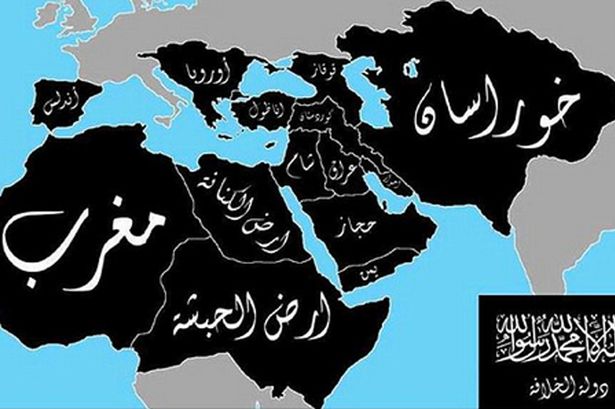
Commendably, the manual discusses how terrorist and insurgent groups use ideology, which is frequently based on religion to create a narrative. The narrative often involves a significant amount of myth presented as history, such as how Al Qaida and ISIL use the Caliphate as a religious and political ideal that for many Moslems, “produces a positive image of the golden age of Islamic civilization.” [12]

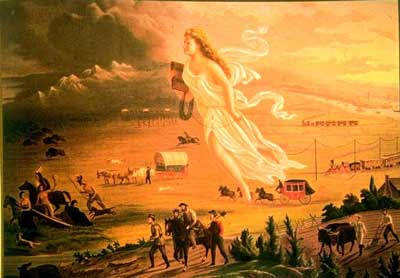
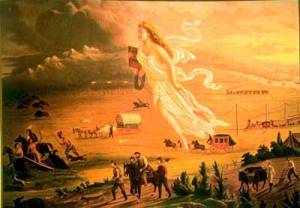
A purely intellectual understanding of how Al Qaida and ISIL use symbolism and imagery limits how strategists and planners can develop methods to counter it. Rather, strategists and planners would benefit from a historical introspection that leads to a personal reflection, aimed at understanding how the theological tools of the Christian religion subjugated peoples and the ramifications today. Protestant Christianity, particularly the Puritan concept of “a city set on a hill” undergirded the American belief in the nation’s Manifest Destiny, which in large part led to the extermination of the Native Americans, the War with Mexico, the romanticism of the ante-bellum American South, the belief that African Americans were sub-human, and that God ordained slavery. The concept persisted after the Civil War in the myth of the Lost Cause, and was exported abroad as the United States belatedly entered the race for overseas colonies.
Manife4

The concept of Manifest Destiny is still an essential element of the idea of American Exceptionalism, which often justifies much of American foreign policy. Former President George W. Bush alluded to this idea in his 2003 State of the Union Address where he said, “that freedom is the right of every person and the future of every nation. The liberty we prize is not America’s gift to the world, it is God’s gift to humanity.” [13] Throughout the Bush presidency, the President’s idea that God undergirded the policy of the United States led to a mismatch of policy ends and the means to accomplish them. Former Israeli Ambassador to the United States and historian Michael Oren wrote:

Not inadvertently did Bush describe the struggle against Islamic terror as a ‘crusade to rid the world of evildoers.’ Along with this religious zeal, however, the president espoused the secular fervor of the neoconservatives…who preached the Middle East’s redemption through democracy. The merging of the sacred and the civic missions in Bush’s mind placed him firmly in the Wilsonian tradition. But the same faith that deflected Wilson from entering hostilities in the Middle East spurred Bush in favor of war. [14]

Only when policy makers and strategists understand that the use of religious ideology to conquer, subjugate, and terrorize in the name of God is universal, does it become easier to defeat those who employ it.

American Presidents often invoke the name of God to justify the compulsion to conquer, such as McKinley did when he decided to annex the Philippines in 1899 following the defeat of the Spanish. The war against the Filipinos used some of the most bloodthirsty tactics employed to fight the Filipino insurgents, who only wanted independence, and stained our own national honor. Mark Twain wrote: “There must be two Americas: one that sets the captive free, and one that takes a once-captive’s new freedom away from him, and picks a quarrel with him with nothing to found it on; then kills him to get his land. . . .” [15]

A doubtlessly sincere McKinley sought counsel from God about whether he should annex the Philippines or not. Barbara Tuchman wrote: “He went down on his knees, according to his own account, and ‘prayed to Almighty God for light and guidance’. He was accordingly guided to conclude “that there was nothing left to do for us but to take them all, and to educate the Filipinos. And uplift and civilize and Christianize them, by God’s grace to do the very best we could by them, as our fellowmen for whom Christ died.” [16]

The counterinsurgency manual does mention how “Ideology provides a prism, including a vocabulary and analytical categories, through which followers perceive their situation.” [17] But again, it does this at a micro-level and the lessons are not applied at the higher levels of strategic thinking and policy. This is often due to the fact that American and other western strategists and policy makers view religion “as a set of theological issues rather than as a profoundly political influence in public life.”[18] Even after nearly a decade and a half of unremitting war against enemies for whom religion is at the center of their politics, policy makers still misread or neglect the importance of religion and religiously based ideology in the political motivations of their opponents. In many cases, the religion of a people is a stronger part of their identity than that of the state. Nations created during the post-colonial era “continue to see religion, clan, ethnicity, and other such factors as the markers of community identity” [19] Despite the advances in communications and technology and the globalization of so many western concepts, the political and religious leaders of Islamic nations view modern western political and social concepts as unwanted intrusions on their ancient cultures, and more importantly, insults to their religion.

kim davis pastor

But, lest American policy makers and strategists see this rise as something completely foreign, a similar phenomenon is occurring in the United States. Despite the fact that a growing number of Americans espouse no-religious preference and, according to multiple studies conducted over a period of two decades, are leaving organized Christianity, adherents of two highly motivated and militant branches of Christianity have grown in strength and political power over the last forty years. The group known as Christian Dominionism advocates Christian domination of all parts of society and culture, and Pre-Millennial Dispensationalists believe in the imminent return of Christ to earth, including the belief that most of the earth’s population will be killed during the Apocalypse. A Pew Research Center survey found that by the year 2050, that 41% of Americans believe that Jesus Christ will return to earth. [20] Leaders, politicians (including major conservative presidential hopefuls), pundits, and preachers often weigh in on public policy, to include military strategy, and claim that God’s law supersedes that of the state. They simultaneously reject secularism while legislating against those they deem enemies, and advocate for a “holy war” against Islam without distinction to Islam’s own divisions and distinctive denominational differences.

may appear irrational American strategists and policy makers, but it is completely rational to those who subscribe to it. The study of history, particularly how the deep roots of religion and faith shape cultural worldviews, as well as the actions of various peoples and nations, helps the policy maker and strategist adapt policy, strategy, and ultimately operational and tactical methods to the context of the conflict at hand. To do this effectively it is important that American strategists not be afraid to examine our own past to see how our ancestors used religion for good as well as for evil. However, the often dark mirror of history can be disconcerting to peer into. People tend to be uncomfortable when the face that they see in the mirror is all too similar to their current enemies, to the point that one might turn away in fear of what they see. The inability to look into the dark mirror of our own history is especially perilous when enemies are perfectly willing to wage war without end unto the destruction of the world in the name of their God, because when you belatedly look back in the mirror, failure will be staring you right in the face.

Notes

[1] Huntington, Samuel P. Who Are We? America’s Great Debate The Free Press, Simon and Schuster Europe, London 2004 p.360

[2] Jacoby, Susan. The Age of American Unreason Revised and Updated Vintage Books, A Division of Random House, New York 2008 p.18

[3] Luttwak, Edward. The Missing Dimension  in Religion: The Missing Dimension of Statecraft  Oxford University Press, Oxford and New York 1994 p.13  

[4] Huntington, Samuel P. The Clash of Civilizations and the Remaking of the World Order Touchstone Books, New York 1997 p.42

[5] Gray, Colin S. Fighting Talk: Forty Maxims on War, Peace, and Strategy Potomac Book, Dulles VA 2009 p.5

[6] Rubin, Barry Religion in International Affairs in Religion: The Missing Dimension of Statecraft  Oxford University Press, Oxford and New York 1994 pp.20-21

[7] Ibid. Gray Fighting Talk p.25

[8] Tuchman, Barbara W. Practicing History Alfred A. Knopf, New Your 1981 p.289

[9] Ibid Luttwak The Missing Dimension pp.9-10

[10] Ibid. Rubin Religion in International Affairs p.21

[11] Ibid. Rubin Religion in International Affairs p.21

[12] ___________ U.S. Army/ Marine Counterinsurgency Field Manual FM 3-24 MCWP 3-33.5 15 December 2006 with and forward by General David A Petraeus and General James Amos, Konecky and Konecky, Old Saybrook CT 2007 p.26

[13] Bush, George W. State of the Union Address Washington D.C. January 28th 2003 retrieved from Presidential Rhetoric.com http://www.presidentialrhetoric.com/speeches/01.28.03.html 10 June 2015

[14] Oren, Michael Power, Faith and Fantasy: America and the Middle East 1776 to the Present W.W. Norton and Company, New York and London 2007 p.584

[15] Twain, Mark To the Person Sitting in Darkness February 1901 Retrieved from The World of 1898: The Spanish American War The Library of Congress http://www.loc.gov/rr/hispanic/1898/twain.html 12 December 2014

[16] Ibid. Tuchman Practicing History p.289

[17] Ibid. U.S. Army/ Marine Counterinsurgency Field Manual p.27

[18] Ibid. Rubin Religion in International Affairs in Religion p.20

[19] Ibid. Rubin Religion in International Affairs p.22

[20] Pew Research Center, U.S. Politics and Policy, http://www.people-press.org/2010/06/22/public-sees-a-future-full-of-promise-and-peril/

8 Comments

Filed under Foreign Policy, History, middle east, national security, News and current events, Religion

For Us or Against Us: The Politics of the Christian Right & the Shutdown

181295102-7322

Friends of Padre Steve’s World,

Once again the United States stands on the verge of another potentially dangerous, and costly government shutdown led by the fanatical religious leaders of a political party. While it appears that a short –term stopgap bill will pass both houses, it will leave the country hanging for the next couple of months with another showdown in December.

Senator Mitch McConnell who the day President Obama took office in 2009 colluded with other GOP leaders to set a policies  to ensure Obama failed as president blamed Democrats for not passing various spending bills offered to by the GOP.  But he failed to note that the authors of the GOP bills, mainly from the Christian Right planted poisoned pills in each of them that ensured Democrat opposition. Truthfully those bills were not offered in good faith and gave Democrats no reason to vote for them. 

When I see this behavior I am reminded of the words of Supreme Court Justice Robert Jackson, who prosecuted the major Nazi War Criminals at Nuremberg; “[I]n our country are evangelists and zealots of many different political, economic and religious persuasions whose fanatical conviction is that all thought is divinely classified into two kinds — that which is their own and that which is false and dangerous.”

The leaders of this unabashedly shameless movement have no problem lying to, or deceiving their followers in order to accomplish their political goals. Sadly, almost all of them come from the supposedly Christian Right, and are determined to destroy the country in order to save it. They use the same kind of tactics used by extremists in other countries throughout history to destroy the political center and turn the government itself into an enemy, until they can take it over and use it for their purposes. Sadly, much of this is coming from a relatively small, but incredibly vocal and politically influential coalition of politically charged conservative Christians. The leaders of this movement have openly stated that their desire is to impose a Christian theocracy on the country, a theocracy where non-Christians, or non-believers of any kind would not have rights as citizens. The have taken up the mantle of the Emperor Constantine, who united the Roman Empire with the Church. George Truett, a great Southern Baptist champion of religious liberty noted:

“Constantine, the Emperor, saw something in the religion of Christ’s people which awakened his interest, and now we see him uniting religion to the state and marching up the marble steps of the Emperor’s palace, with the church robed in purple. Thus and there was begun the most baneful misalliance that ever fettered and cursed a suffering world…. When … Constantine crowned the union of church and state, the church was stamped with the spirit of the Caesars…. The long blighting record of the medieval ages is simply the working out of that idea.”

The late Senator Mark Hatfield, a strong evangelical Christian wrote “As a Christian, there is no other part of the New Right ideology that concerns me more than its self-serving misuse of religious faith. What is at stake here is the very integrity of biblical truth. The New Right, in many cases, is doing nothing less than placing a heretical claim on Christian faith that distorts, confuses, and destroys the opportunity for a biblical understanding of Jesus Christ and of his gospel for millions of people.” 

Since I have written about these supposedly Christian leaders numerous times and quoted them at length I am not going to go back into that; however, I will note the warning of colonial Baptist leader Roger Williams, who founded the Rhode Island Colony after fleeing the Massachusetts Bay Colony over the religious oppression of the Massachusetts Bay Colony, which included killing heretics, conducting witch hunts and trials, and exterminating local Native Americans, especially those who had become Christians.

Williams wanted nothing of this and fled, swimming the Narraganset to reach Rhode Island. He wrote, “An enforced uniformity of religion throughout a nation or civil state, confounds the civil and religious, denies the principles of Christianity and civility, and that Jesus Christ has come in the flesh.”

Another early colonial New England Baptist leader, Isaac Backus wrote, “God has appointed two kinds of government in the world, which are distinct in their nature, and ought never to be confounded together; one of which is called civil, the other ecclesiastical government.”

Both of these men, and those who followed them in the tradition of religious liberty realized the importance of the absolute separation of church and state. Well, the Christian Right now has control of the Republican Party. In their zeal to destroy their political and religious enemies they will also destroy that party. Likewise they will cause great harm to the church and the Christian faith in this country. From Williams and Backus, to John Leland, James Madison and Thomas Jefferson, to George Truett, Robert Jackson, Mark Hatfield and Barry Goldwater; true champions of religious liberty have recognized the danger of what is happening today and fought against it.

But will American Christians be willing to stand against this before liberty is lost, and the Christian faith in this country, destroyed by the fanatics who are leading the charge to shut down the government once again? Sadly, I doubt it. We may yet avoid the shutdown, but until Christians police themselves and the political leaders that they have elected, this will continue until freedom is lost, the country damaged, and the church discredited and destroyed.

The leaders of this movement undermined and destroyed Speaker of the House John Boehner, a conservative pro-life Catholic because he was not extreme enough for them. They are currently working to destroy other conservative Christian leaders in the Republican Party, including Senator McConnell and other conservative Christians who do not completely submit to them. These supposedly Christian leaders who are bringing this about are not conservatives, they are revolutionaries who believe that they are on a mission from God which trumps all else. Barry Goldwater was right about them when he said, the late Senator Barry Goldwater said in 1994, “Mark my word, if and when these preachers get control of the [Republican] party, and they’re sure trying to do so, it’s going to be a terrible damn problem. Frankly, these people frighten me. Politics and governing demand compromise. But these Christians believe they are acting in the name of God, so they can’t and won’t compromise. I know, I’ve tried to deal with them.”

But the leaders of this movement don’t care. In their apocalyptic worldview, it does not matter because they speak for God.  If they cannot win it all then they will leave scorched earth behind. The shutdown of 2013 and their actions this year show us that they would if need be, destroy the country in order to save it. That my friends is a scary thought.

Peace

Padre Steve+

5 Comments

Filed under History, laws and legislation, leadership, Political Commentary, Religion

Faith, Power & Politics: The Death of Good Religion

184062576_1_blog_main_horizontal

Friends of Padre Steve’s World,

Today I just want to share a few subversive thoughts on American Christianity and established religion. I am not talking about organized religion, because we Americans have little in the way of organization to our religion except when it comes to wanting to be in charge of the country, as many on the Christian Right advocate today.

Mark Twain wrote in his classic novel, A Connecticut Yankee in King Arthur’s Court:

“Concentration of power in a political machine is bad; and an Established Church is only a political machine; it was invented for that; it is nursed, cradled, preserved for that; it is an enemy to human liberty, and does no good which it could not better do in a split-up and scattered condition.”

On a more individual level, Atticus Finch, the hero of the book and film To Kill a Mockingbird said, “Sometimes the Bible in the hand of one man is worse than a whisky bottle in the hand of (another)… There are just some kind of men who – who’re so busy worrying about the next world they’ve never learned to live in this one, and you can look down the street and see the results.” In fact I’ll bet most of us know someone just like Atticus described; I know that I do, plenty of them.

I, and probably you, like to believe that religion is a benign or positive influence in the world. As much as I want to believe the positive aspects I have to admit based on the historical and sociological evidence that this is not so, especially during unsettled times of great change. We live in such an era and when it comes to identity, God is the ultimate trump card.

It seems to me that most fanatical individuals and groups on earth, of course not all are tied to religions, whether it is the Islamic State and Al Qaeda, Boko Haram, Hezbollah, Orthodox Jews, radical Hindus and Buddhists, as well as militant Christians. Who can forget that the Holocaust, the African Slave Trade, and even the Rwandan Genocide were predominantly the work of Christians, but I digress… Of course all of these groups have different goals, but their thought and philosophy are quite similar.

Robert Heinlein wrote: “Almost any sect, cult, or religion will legislate its creed into law if it acquires the political power to do so.” Heinlein, author of the classic Starship Troopers was absolutely correct. Just look at any place in any time where any religion, sect or cult has gained control of a government. They are not loving, they are not forgiving and they use the police power of the state to persecute any individual or group that is judged to be in error, or even worse has the gall to question their authority.

Since the Christian groups tend to thrive in the West, they only speak in terms of violence, most, with the exception of Russian Orthodox Christians, do not have a government to translate those words into action, which it does against Evangelical Protestants, Roman Catholics, Moslems, Jews, and every religious group’s favorite enemies, Gays and women.

Many American Christians, especially conservative Catholics and some Evangelical and Charismatic Protestants seem for a long for the day when they can assume control of a theocratic government, and a day where they can sit at the side of the rich and oppress the poor, the alien and the outcast. The amount of public support given to Vlad Putin by conservative Christian leaders in this country is amazing, and some publically state that they would want someone like Vlad the topless male magazine model for a leader.

But this is nothing new. Many American Christians have practiced that type of Christianity for close to two hundred years. In fact American Christianity is little changed since the day Frederick Douglass wrote, “The Christianity of America is a Christianity, of whose votaries it may be as truly said, as it was of the ancient scribes and Pharisees, ‘They bind heavy burdens, and grievous to be borne, and lay them on men’s shoulders, but they themselves will not move them with one of their fingers… “The man who wields the blood-clotted cowskin during the week fills the pulpit on Sunday, and claims to be a minister of the meek and lowly Jesus. The man who robs me of my earnings at the end of each week meets me as a class- leader on Sunday morning, to show me the way of life, and the path of salvation. He who sells my sister, for purposes of prostitution, stands forth as the pious advocate of purity. He who proclaims it a religious duty to read the Bible denies me the right of learning to read the name of the God who made me. He who is the religious advocate of marriage robs whole millions of its sacred influence, and leaves them to the ravages of wholesale pollution. The warm defender of the sacredness of the family relation is the same that scatters whole families,— sundering husbands and wives, parents and children, sisters and brothers,—leaving the hut vacant, and the hearth desolate. We see the thief preaching against theft, and the adulterer against adultery. We have men sold to build churches, women sold to support the gospel, and babes sold to purchase Bibles for the poor heathen! all for the glory of God and the good of souls! … The dealer gives his blood-stained gold to support the pulpit, and the pulpit, in return, covers his infernal business with the garb of Christianity. Here we have religion and robbery the allies of each other—devils dressed in angels’ robes, and hell presenting the semblance of paradise.””

The remarks of Douglass are as pertinent today as he first penned them in relationship to American white acceptance and support of slavery, and while much of his writing was directed against slaveholders and others who profited off of that system, he directed much of his writing against Northern Christians who offered support to that system.

Many American Christians are no different than other religious people, Christian, Moslem, Jewish, Hindu, and in some cases Buddhists as well as countless other religions history. Religions which have more often sworn alliance to governments, rulers, military and economic power to increase their power than to embody the essence of their founders’ teachings. Most of the time this is due to the need of people for an identity that is bigger and more powerful than what they believe they are on their own and sadly this often results in a sometimes unconscious but more often very conscious belief that they are part of an elect that in this life and the next should rule over unbelievers and others.

This is very important to understand, and Samuel Huntington wrote about it in his book The Clash of Civilizations:

“People do not live by reason alone. They cannot calculate and act rationally in pursuit of their self-interest until they define their self. Interest politics presupposes identity. In times of rapid social change established identities dissolve, the self must be redefined, and new identities created. For people facing the need to determine Who am I? Where do I belong? Religion provides compelling answers….In this process people rediscover or create new historical identities. Whatever universalist goals they may have, religions give people identity by positing a basic distinction between believers and non-believers, between a superior in-group and a different and inferior out-group.”

Huntington was right, you see the true believers, those who follow their religion without question and believe that it is superior to all others also believe that their religion entitles them to be atop the food chain, others who don’t believe like them be damned, if not in this life, the next. That is the certitude of the true believer, especially the religious one. Secular or atheistic fanatics could care less about the next life, for this life is all that they have. But the religious “true believers” are not only interested in destroying someone in this life, but ensuring that in the next that they suffer for eternity, unless they believe in the annihilation of the soul after death, which really spoils the whole Dante’s Inferno perspective of the damned in the afterlife.

The great American philosopher Eric Hoffer wrote:

“The impression somehow prevails that the true believer, particularly the religious individual, is a humble person. The truth is the surrendering and humbling of the self bred pride and arrogance. The true believer is apt to see himself as one of the chosen, the salt of the earth, the light of the world, a prince disguised in meekness, who is destined to inherit the earth and the kingdom of heaven too. He who is not of his faith is evil; he who will not listen will perish.”

That is why they, the religious true believers of any faith are capable of such great evil, and why such people can murder innocents in the most brutal manner simply because they do not believe correctly.

Please do not get me wrong. I am a Christian, a priest, a historian and a theologian, but I also know just how insidious those who hold their religion over those of others can be. While I hold faith dear, I know that it can be abused for the claim of some to have God as their final authority is a sort of trump card with which they are able to justify the most obscene and evil acts against others.

One of my heroes of religious liberty is John Leland, a Baptist whose passionate defense of religious freedom prevented Virginia from re-establishing a state church after the American Revolution and whose influence was key in the decision of Madison and Jefferson to amend the Constitution with the Bill of Rights, particularly the First Amendment. In fact, late in life, well after his success in working with Madison and Jefferson Leland wrote:

“The liberty I contend for is more than toleration. The very idea of toleration is despicable; it supposes that some have a pre-eminence above the rest to grant indulgence; whereas all should be equally free, Jews, Turks [Muslims], Pagans and Christians. Test oaths and established creeds should be avoided as the worst of evils.”

Like Leland, I contend for more than tolerance and I contend for acceptance. But that acceptance ends when any person or group is willing to use their religion to enslave, murder, or otherwise dominate other people in the name of their God, not just in this life, but in the next. This is especially true of those who use the police power of the state to enforce their beliefs and hatred on others.  I will do whatever I can to expose them for what they are, regardless of the “faith” they supposedly represent.

I guess that is why I am even more frightened of religious true believers than non-religious true believers. While the non-religious true believer may sacrifice everything for the sake of power and control in this life, and may in fact commit the most heinous crimes against humanity, their hatred is bounded in space and time to this earth. The religious true believer is not content with that; his enemies must be damned and punished not only in this life, but for eternity, without hope of salvation.

That is why I believe that such people are so dangerous; for their hatred is unbounded by time, or space, it lasts for eternity; which I think is a very, very, long time.

With that I wish you a good day.

Peace

Padre Steve+

1 Comment

Filed under christian life, faith, History, Political Commentary, Religion

Friday Interuptions 

 
Friends of Padre Steve’s World

Interruptions are the spice of life. Carl Von Clausewitz talked about war being “the province of chance” and of course that can be a metaphor for life.  Shit happens and even the best laid plans of mice and men get way layer and mangled. Old dead Carl wrote that “chance makes everything more uncertain and interferes with the whole course of events” and that my friends has been my week so far. 

Of course as you know we lost our oldest and best furry child Molly on Monday which hit us hard. There is something else which I cannot say much about right now that is a source of concern for us, and then this morning as I wow working away we lost power at the staff college when a transformer blew. That interrupted work on my latest Gettysburg chapter revision and has forced a retirement ceremony for my friend Commander Lisa Rose to be moved outside. 

Lisa’s retirement ceremony will be special. Lisa is a great nurse who I worked with at Naval Medical Center Portsmouth back in 2008-2010. Back then while I was struggling with faith and life while working 80 to 100 hours a week, mostly in the ICU, Lisa who was Nurse Manager for our Inpatient Oncology Unit would put her arm around me and tell me to go home. Lisa is a tremendous Christian who lives her faith in a real and powerful way. She had to live most of her military life wondering if someone was going to try to get her kicked out of the Navy during the days of Don’t Ask Don’t Tell edict, something that gave a modicum of protection for Gay and Lesbian service members but did not protect them from the witch hunts of those who hate them. As such Lisa was not able to have her wife Karen attend functions that most of us consider routine for families to attend. Today was special because not only is Lisa a friend, but like the rest of us her wife was finally able to be honored like other military spouses who devote so much of their lives to their spouse’s careers. That meant a lot to me and it is an honor to be a part of her ceremony. I’m sure I will shed some tears today. 

After the ceremony I will likely be heading home for the day, unless power comes back. We have already dismissed our students and because to much of what we do is dependent on technology there is almost nothing I can do. 

Since I was bored I got on Facebook and tweaked some preachy preacher’s post on a friend’s page, sending him into a theological rage which has given me much ammo for a future blog post. The guy got so spun up so I tweaked him more and he just didn’t get the irony, or the humor of what I was doing. But sadly that is the base line for religious extremists of any persuasion. They cannot deal with history, humanity, or life, so they spend their lives building theological fortresses that make in impossible for the undesirables to enter and from which the cast aspersions and condemnation on all that disagree with them. But I digress…

So, that said it is time to get suited up and get ready for the ceremony and probably an early beer. As we know, beer is good, and as Oscar Wilde said “work is the curse of the drinking classes.” 

Let the games begin.

Peace

Padre Steve+

3 Comments

Filed under faith, History, Just for fun, Military, Religion

The Winner Takes it All: American Christian Greed

Do you remember that there was a time when Conservative Christian Politicians and preachers actually supported working people and the poor? There was a period where this was true, but with the economic affluence and the political influence that we have enjoyed since the end of the Second World War we have left those days far behind.

I mean really, there was a time when preachers were not just lobbying for tax cuts for the rich in the name of the “Prosperity Gospel” or and extolling the wealthy “job creators” over the people who actually produce or serve products. Late last night I had an interaction on Facebook that was discouraging, wealthy preachers defended the most opulent and extravagant excesses of mega-church pastors. It was disheartening, especially one attacked a man who I went to war with, and who since has endured more trying medical issues than most of us will experience in our lives when he challenged the Episcopal Priest. What I read broke my heart.

Big-church-620x412

My Church History professor at Southwestern Baptist seminary back in 1988 and 1989 Christian attitudes then that is even more appropriate today. He noted that a:

“reason that many Christians are not servants is more honest: it is that we just don’t want to be servants. We live today in a “winner” society. We value the winners, whether it be in sports, business, or wars….The American Dream is success, climbing to the top of the ladder, making it, winning…. In most metro areas, on most weekends, you can go to a conference in some church where a person (for a fee) will tell you how God wants you rich….This obsession with success, money, and power is the American dream carried to its logical conclusion. It is middle-class Americanism, pure and simple. It is more motivated by greed, selfishness, and pride than by Christ. And in the churches, we have bought it. We want to be “at the top”,” not “at the bottom.”…..We coat our Americanism with a thin veneer of Christianity in an attempt to make it more palatable, but God will not have it. Let’s call this version of the American Dream what it is: selfishness, self-righteousness, and sin.” (Young, Doyle L New Life for Your Church Baker Book House, Grand Rapids Michigan 1989 pp.55-56)

I heard Dr. Young speak about this in class. I was a young Army officer, who had just left active duty to go to seminary. We were in the process of a financial meltdown brought about by the Texas oil bust of the late 1980s and my wife’s illness. We were learning what it was like to be poor. We lost almost everything but ourselves and our dogs during that time. We went to churches where the opulence was over the top, where the pastor drove a Porsche, and not a bottom end or used one. We struggled through seminary and made it, with me working two jobs and being in the National Guard. Most of the time we wondered where the money to get the next meal, tank of gas, prescription medicine, tuition payment or books. When I called the TBN prayer line just for prayer during the darkest days I was told be a “prayer warrior” that “it was obvious that I was not in God’s will because otherwise God would be blessing me.” That angered me and hardened my resolve to get through seminary. There were a good number of people who helped us, some because they felt that god wanted them to help us, others just because they  were compassionate souls. This made me very sensitive to social justice and wary of those who get rich off of God’s people.

It wasn’t always this way.

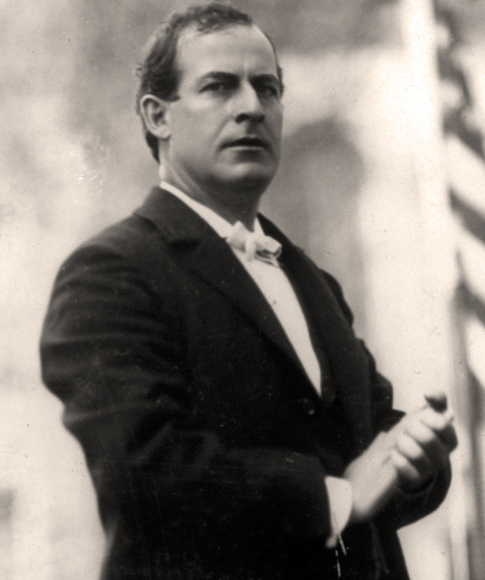
William Jennings Bryan was one of the most influential politicians of his era. He served as Secretary of State under Woodrow Wilson, he was a Senator and three time Presidential Candidate. He was also a very conservative Fundamentalist Christian perhaps most famous, or perhaps infamous now as one of the prosecuting attorneys at the Scopes “Monkey” Trial of 1925. In fact I can find that Bryan’s handling of that case played to the basest religious and social hatred of his day and though “defending” “Biblical” ideas ended up making Christians look but small minded, intolerant and hateful. The movie Inherit the Wind, though a fictional account of that trial show how decent Christians can become consumed with hatred in the name of righteousness, little different than other “sincere believers” that are willing to kill in the name of God.

Whether one agrees on certain points of religious doctrine regarding the creation of the earth or the manner of how God created the earth that he espoused one has to admit that of pre-Great Depression politicians he was quite amazing. This was especially true in how he saw through the Godlessness of unbridled Capitalism.  He saw how workers by were devalued by those who saw them as nothing more than a way to increase their wealth. As an American and a Christian look at the body of work and life of a man. Though I find much fault in Bryan and his supporters in the Scopes Trial, I do not throw out the good things that he did and got right.

I think the apex of Bryan’s political thought is encapsulated in his speech at the Democratic National Convention of 1896, what is now called the Cross of Gold Speech.

When one looks at it now it really is timeless. Bryan saw through the charade that was being played out by politicians and the big money Wall Street types that they represented with great verve. It was a speech that one might have heard come from a prophet in the Old Testament.

I am just going to quote a couple of pertinent sections from the speech to trigger your thoughts, for you will not hear this in the vast majority of conservative Christian churches of all denominations which have been infected with the so called “Prosperity Gospel.”  These churches have thrown their support behind ideas that are nothing more than unvarnished, crude materialism of the worst kind. In fact I believe that it is nothing more than the “baptism” of such thought by Christians are among the biggest reasons for the exodus of people from the churches and the rise of the “Nones,” or those with no religious preference.

Bryan said:

“We say to you that you have made the definition of a business man too limited in its application. The man who is employed for wages is as much a business man as his employer; the attorney in a country town is as much a business man as the corporation counsel in a great metropolis; the merchant at the cross-roads store is as much a business man as the merchant of New York; the farmer who goes forth in the morning and toils all day, who begins in spring and toils all summer, and who by the application of brain and muscle to the natural resources of the country creates wealth, is as much a business man as the man who goes upon the Board of Trade and bets upon the price of grain; the miners who go down a thousand feet into the earth, or climb two thousand feet upon the cliffs, and bring forth from their hiding places the precious metals to be poured into the channels of trade are as much business men as the few financial magnates who, in a back room, corner the money of the world. We come to speak of this broader class of business men.” 

His words are striking in their directness and honesty. They are not only Christian but they are deeply American. He called his Party, which had been as bad as the Republicans during the age of the unregulated Robber Barons who used the Gold Standard to manipulate the markets and eliminate silver as currency to their benefit to be different:

“Upon which side will the Democratic Party fight; upon the side of “the idle holders of idle capital” or upon the side of “the struggling masses”? That is the question which the party must answer first, and then it must be answered by each individual hereafter. The sympathies of the Democratic Party, as shown by the platform, are on the side of the struggling masses, who have ever been the foundation of the Democratic Party.”

He talked about two ideas of government and economics:

“There are two ideas of government. There are those who believe that, if you will only legislate to make the well-to-do prosperous, their prosperity will leak through on those below. The Democratic idea, however, has been that if you legislate to make the masses prosperous, their prosperity will find its way up through every class which rests upon them.”

He concluded his speech with this statement.

“Having behind us the producing masses of this nation and the world, supported by the commercial interests, the laboring interests, and the toilers everywhere, we will answer their demand for a gold standard by saying to them: “You shall not press down upon the brow of labor this crown of thorns; you shall not crucify mankind upon a cross of gold.”

When I hear the Unholy Trinity of Politicians, Pundits and Preachers who extol the virtue of Capital over labor and the worship of wealth as the highest good I wish that there would be some that would remember that the people who actually make things, grow things, fix things and maintain things are not just human capital, but people.

That’s enough for today. Expect some more on this and similar topics soon.

Peace

Padre Steve+

4 Comments

Filed under christian life, economics and financial policy, faith, History, Political Commentary, Religion

“They” The Enemy of “Us”

einsatzgruppen executions

“Hatred is the most accessible and comprehensive of all the unifying agents. Mass movements can rise and spread without belief in a god, but never without a belief in a devil.” Eric Hoffer 

Hatred is an amazing emotion. I was noticing this week in the comments of a number of people on my Facebook page a tremendous amount of hatred against other people. Most of these were directed against Blacks, immigrants, Gays, women and Moslems.

Sadly, as one of those people messaged me it was about “they.” They being the blacks, immigrants, gays, and Moslems. You see “they” is a wonderful term to use to blame a group of people for the ills of society, and I might add for personal failure and petty jealously. You see it is far easier to blame “them” for problems than to take responsibility for treating others decently and maintaining our own humanity.

You see the terms “they” and “them” are terms used not just to divide, but to demonize. Mass movements love them, especially when using them against those of other races or religions. It does not matter if it is an unrequited White American Southern Christian who still to this day regrets losing the Civil War and that that allowed blacks to be granted equity under the law and finding redemption in the myth of the Lost Cause. It does not matter if it is the disappointed and disillusioned German Monarchist seeking to find answers for the loss of the First World War and finding them in the myth of the “Stab in the Back” which ensured that Jews, Socialists and others were blamed for the loss of that war, and finds his answers in the lies of Adolf Hitler. It does not matter if it is the pundits, politicians and preachers of the American political right who constantly blame blacks, gays, women, Moslems and immigrants for problems that they and their policies brought about.

None of this matters, but then it does. It does’t matter to the people who need scapegoats, or who need a “devil” in order to have meaning for themselves and the movements that they find their salvation in. No, not at all. Hoffer was quite correct that “Mass movements can rise and spread without belief in a god, but never without a belief in a devil.” The really successful leaders of such movements understand this. For Hitler it was the Jews and other untermenschen. For American Southerners of the Lost Cause it was the Blacks and their white supporters. For the “Know Nothings” of the 1840s and 1850s it was immigrants, especially Irish and Germans who were Catholic. For the leaders of the Islamic State, it is Jews, Shi’ite Moslems, less than “faithful” Sunnis, Christians and well for that matter anyone who does not line up one hundred percent with them on every issue. The examples are so plentiful to support this fact that it is almost overwhelming.

The problem is that when any of us lump others into the categories of They and Them, and in the process then demonize those people to the point that they become less than human we have reached a tipping point. We reach the point where we are just one crisis away from Jim Crow,  pogroms, ethnic or religious cleansing, and even genocide.

Sadly, we human beings are not nearly as evolved as we think. In the movie Gettysburg Jeff Daniels playing the role of the amazing Colonel Joshua Chamberlain quotes Shakespeare’s Hamlet to an Irishman of the Twentieth Maine:

“What a piece of work is man, in form and movement how express and admirable. In action how like an angel.”

The Irishman, Sergeant Buster Kilrain replied:  “Well, if he’s an angel, all right then. But he damn well must be a killer angel.” 

Sadly that is the case all to often. Those that follow my writings on this site know how much I love the various Star Trek television series and movies. There is an episode (The Siege of AR-558) of Star Trek Deep Space Nine where the Ferengi bartender Quark, makes a truly astute observation during a battle for survival at an isolated outpost :

“Let me tell you something about Hew-mons, Nephew. They’re a wonderful, friendly people, as long as their bellies are full and their holosuites are working. But take away their creature comforts, deprive them of food, sleep, sonic showers, put their lives in jeopardy over an extended period of time and those same friendly, intelligent, wonderful people… will become as nasty and as violent as the most bloodthirsty Klingon. You don’t believe me? Look at those faces. Look in their eyes.”

I don’t think that we are too far from some tipping point where the Trinity of Evil, the politicians, pundits and preachers, especially of the political right and the media whores who are more concerned about market share than truth, decide that their “devils” must be exterminated. Of course when they will do they will claim a higher moral, religious, or racial, purpose; or perhaps use the language of Manifest Destiny, the Lost Cause, or the Stab in the Back or some other historical myth that suffices to justify their actions.

In a Star Trek the Next Generation episode, one called The Drumhead Captain Picard has to warn his security officer, Lt Worf about the dangers of rampant paranoia. Worf starts: “Sir, the Federation does have enemies. We must seek them out.”
 

Picard pauses and then notes:

“Oh, yes. That’s how it starts. But the road from legitimate suspicion to rampant paranoia is very much shorter than we think. Something is wrong here, Mister Worf. I don’t like what we have become.”

To claim Picard’s words for myself I have to admit that I don’t like what we have become either.

Peace

Padre Steve+


7 Comments

Filed under civil rights, civil war, ethics, faith, film, History, News and current events, philosophy, Religion

Mine Eyes Have Seen the Glory: Racism, Slavery and Religion

slavescars

Today my friends another installment of my chapter in my Gettysburg text dealing with religion, racism and ideology as causes of the American Civil War. While many people, especially modern Southern White politicians like to repeat the mantra that we live in a “post-racial”  society where racism no longer exists. I discussed that ridiculous assertion yesterday in my intro to the series so I won’t bother to repeat it now.

the-dred-scott-case-1846-1857-402x618

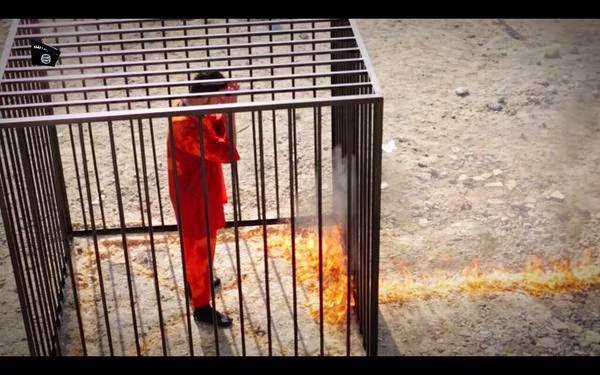
What I will do is discuss how religion has been used and in still being used by “true believers” of many religions to justify all sorts of evil in the name of their God. The latest and most newsworthy of such people are the practitioners of terror in the name of Allah, the Islamic State and Boko Haram in central and west Africa. These groups have brought back the concepts of what we would call public lynching of their enemies, burning them alive, beheading them, enslaving them, and engaging in ethnic and religious cleansing. They are ruthless and are a throwback to times that most of us had hoped had passed into recess of history.

a2a9c088d75423b7f457b194d7c9ea9a

But history has a way of never dying, especially for those who don’t stop believing in their cause. In resp0nse to the acts of ISIL and Boko Haram I have heard numerous American Christian politicians, pundits and preachers claim that Christians have never acted in such a way. I could go through the litany of crimes committed by Christians, Churches and the actions of nations whose state supported churches provided the theological justification for genocide, pogroms, ethnic cleansing, crusades, imperialism, slavery and a host of other crimes against humanity. Instead I am just going to focus on the theological justification of those who defended the institution of slavery, as well as their abolitionists opponents in this posting, because they are really not that too far removed from the actions of ISIL and the words of many supposedly Christian politicians, pundits and preachers in this country today.

020101_isilBurns_jordanian_pilot_alive

Omaha_courthouse_lynching

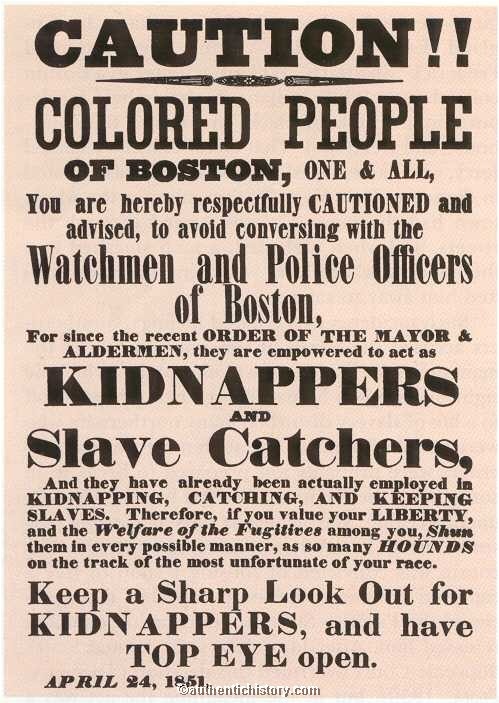
This section begins with the Compromise of 1850, an act which included the Fugitive Slave Act which gave Southern Slaveholders the right to go into any state or territory to reclaim their human property and provided them with a extra-judicial system to support them.  From this it transitions to the theological arguments and proclamations of those supporters of slavery and their opponents. The section ends with a note about a case that Virginia was pushing through the Courts in 1860, just prior to the Civil War, it was a case that they hoped would destroy any remaining legal obstacles to expanding slavery into Free States and territories against the wishes of the citizens of those states. I find it interesting that for people then as well as today the concept of “States Rights” only applies to them and their attempts to deny freedom to others.

Mine Eyes Have Seen the Glory: Religion, Ideology and the Civil War Part 2

Tomorrow I will post the third section of this chapter which begins with Bleeding Kansas, John Brown, the link between church and state in the Confederacy, the election of Lincoln, Emancipation, and the pervasive and poisonous myth of the Lost Cause in the United States.

Racism, as well as other forms of hatred backed by religion is still alive and it is not just in the Middle East and Africa. It is still here, and it is still happening now. It may be a bit more subtle and certainly not as violent as it was in the ante-bellum days, or Post-Reconstruction, but it is here. Like in the Middle East it bides its time until extremists can invent an excuse to resort to violence and terrorism.

Peace

Padre Steve+

1 Comment

Filed under civil rights, civil war, faith, History, iraq,afghanistan, laws and legislation, leadership, Political Commentary, Religion