Tag Archives: slavery

A Cyclorama, a Cornerstone, and a Proposition


Friends of Padre Steve’s World

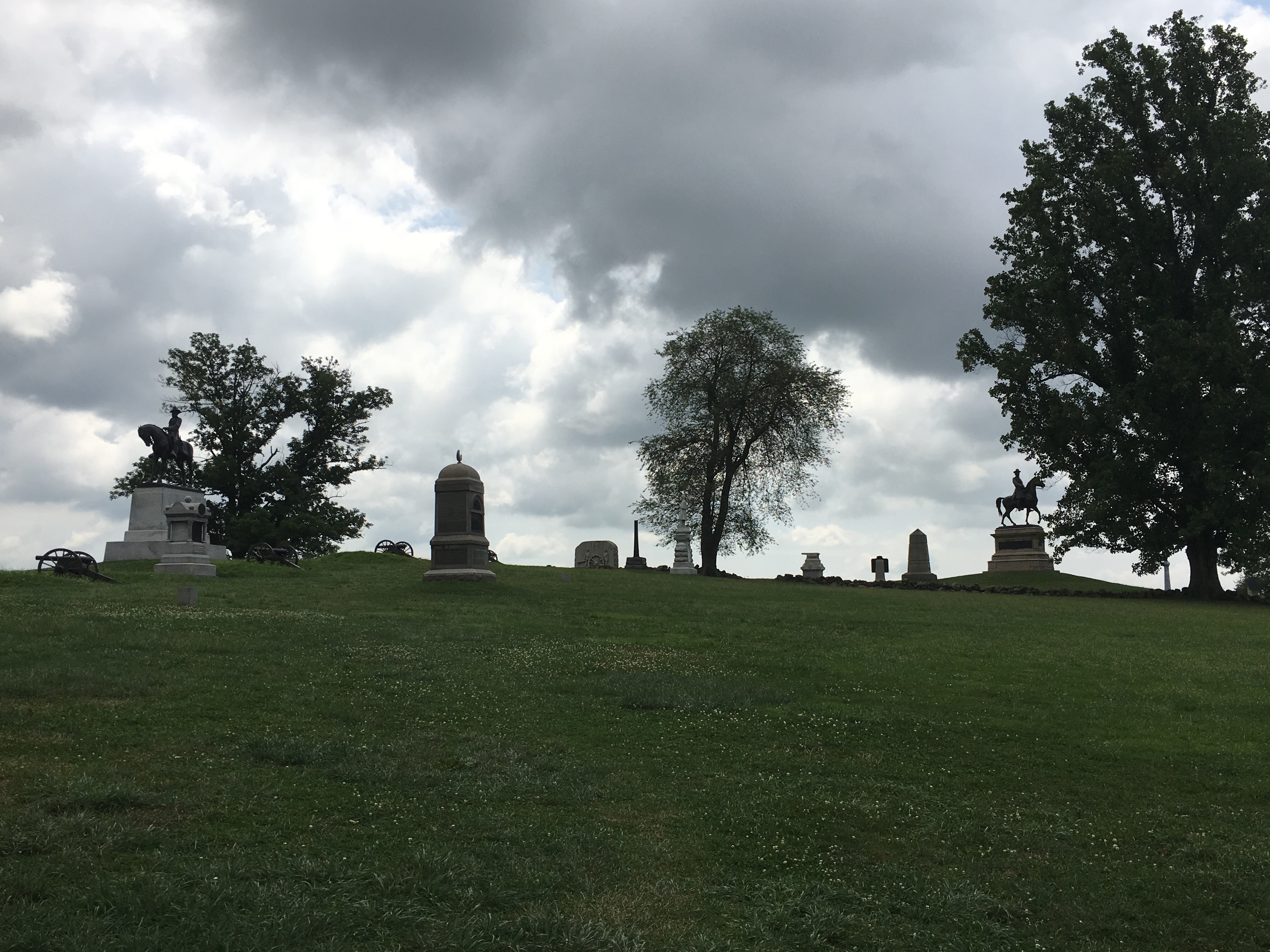
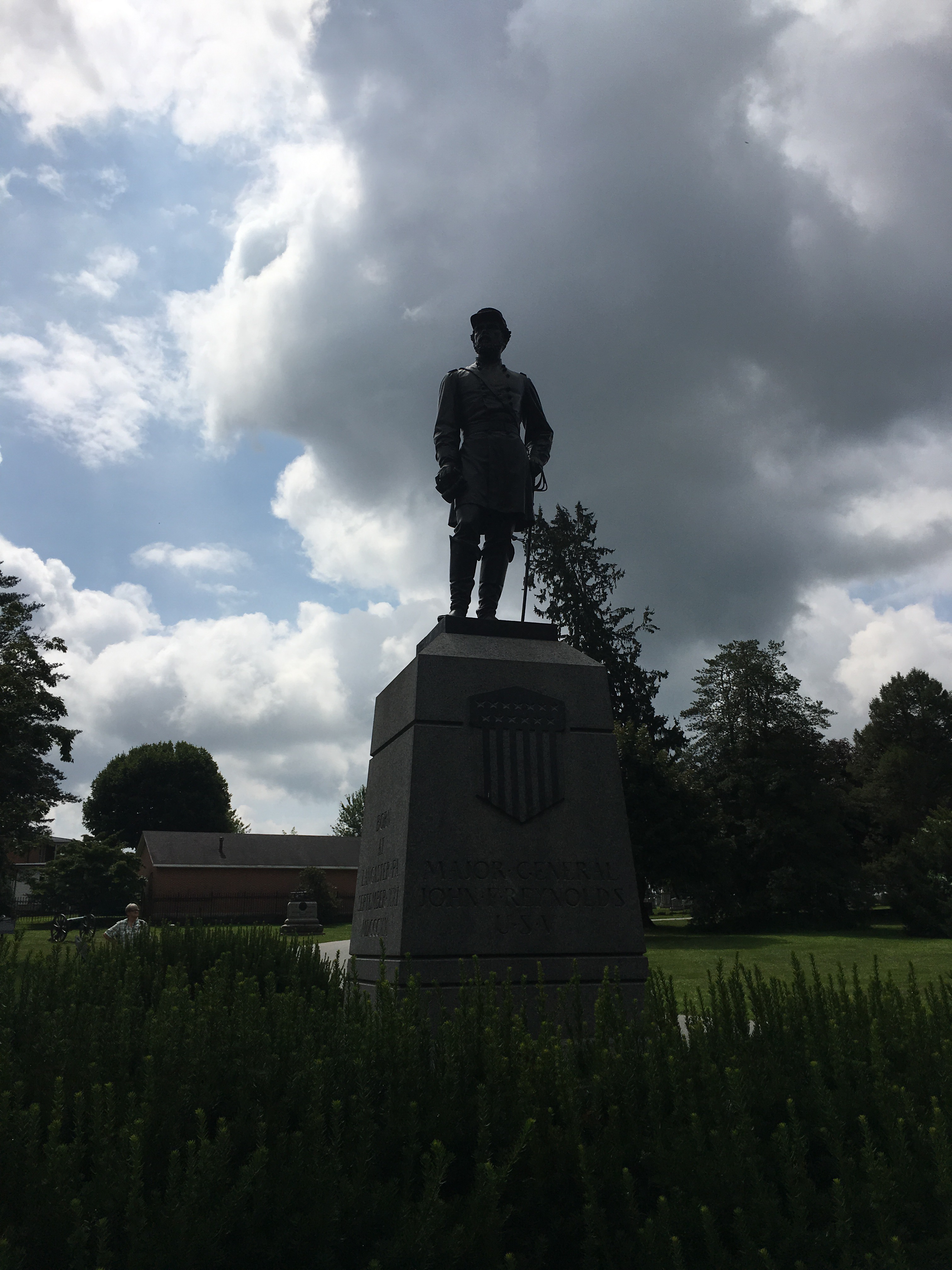
I have been at Gettysburg this weekend and yesterday was spent doing the Staff Ride on the battlefield. Normally we get all of the first two days of the battle done and conclude at Culp’s Hill and East Cemetery Hill before retiring to dinner. Yesterday, the weather got in the way. Thunderstorms came through and while we were able to finish the final assault of the Confederates on Cemetery Ridge, the storms became worse, so I altered the plan. Instead of pushing on and ensuring that my students would be too wet and miserable to learn anything I changed the plan on the fly and took them to the Visitors Center, where we normally begin our Sunday.


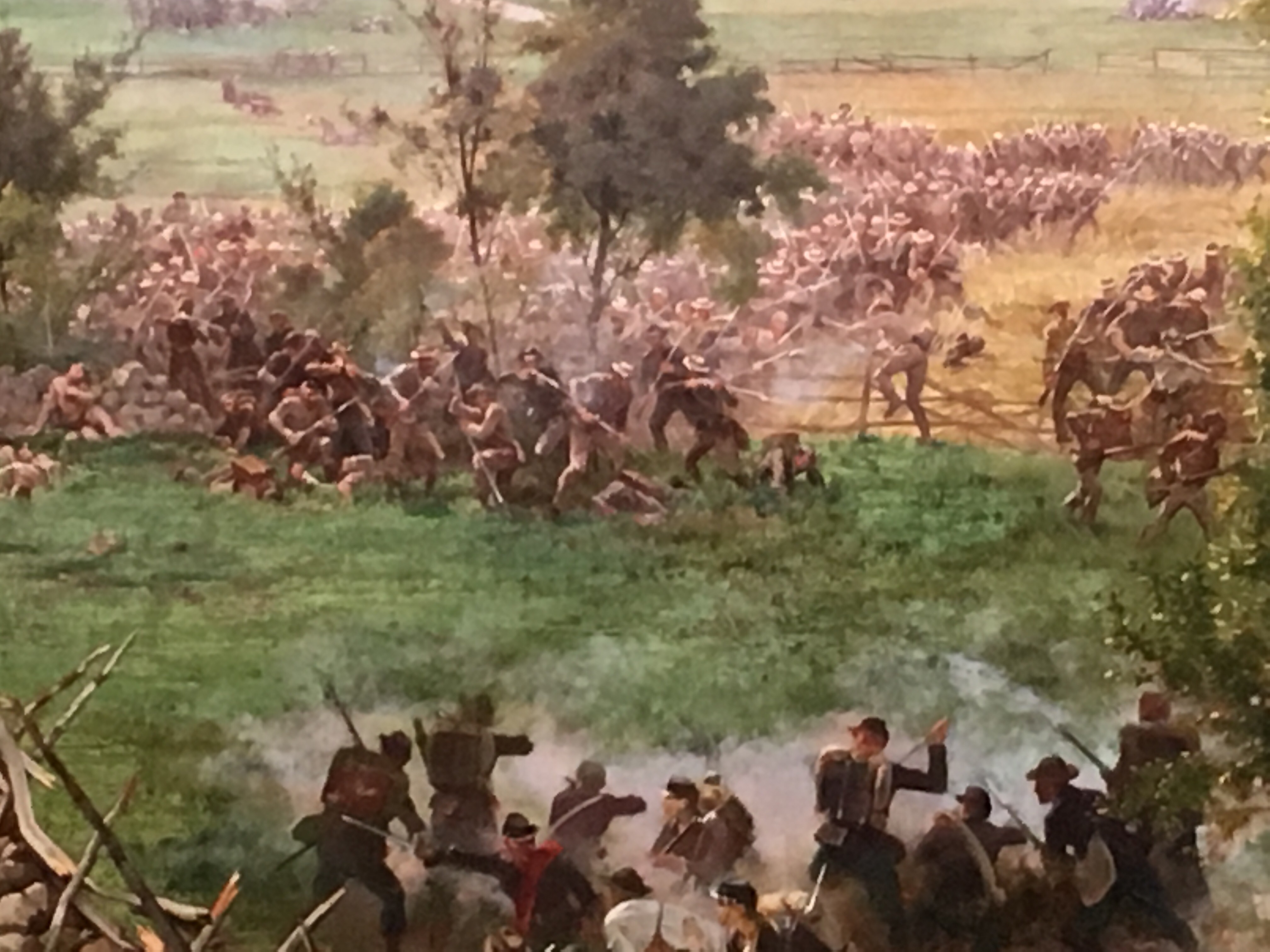
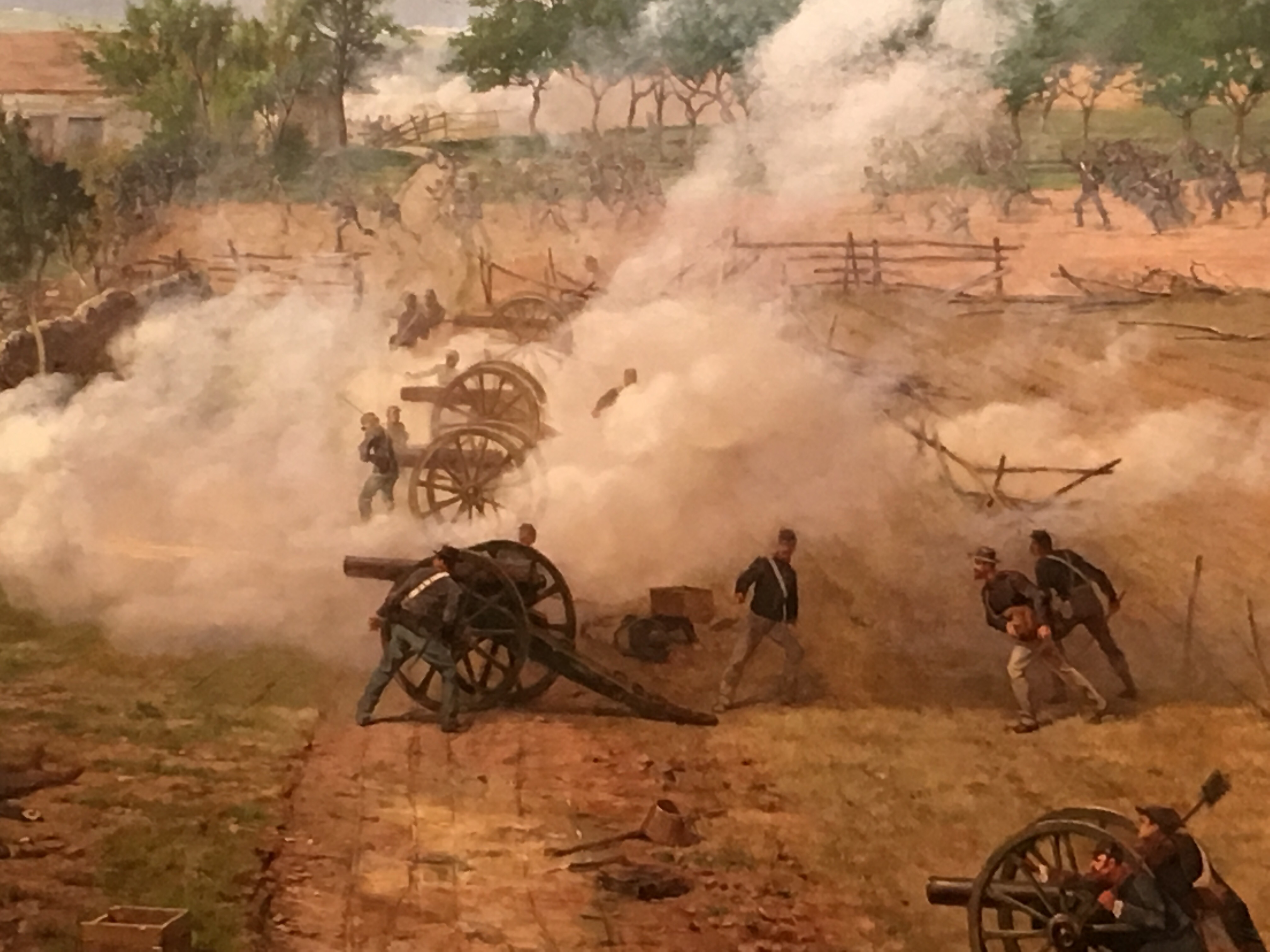
This was a good choice because it also got them more time there than if we had done it today. While there I went the the Cyclorama of Pickett’s Charge, which I had not visited since 1997. The cyclorama is the largest oil and canvas painting in the United States. It give a 360 degree view of the battle. Painted in 1883 by Paul Phillipotaux it is 42 feet high and 377 feet in circumference. It was restored between 2005 and 2008 when it was placed in the new Visitors Center. In all of my trips since then I had not re-visited it. Yesterday I did and it was spectacular, far better than it used to be. 

I also spent time in the museum. One of the displays was a video display of Northern and Southern leaders comments about slavery and abolition in the years leading up to the war and shortly after secession. I stopped and watched and listened, as the words of speeches that I had only read were spoken. One of the statements was that of Confederate Vice President Alexander Stephens in his “Cornerstone Speech” of March 1861. In it Stephens laid out the what he called the “cornerstone” of the Confederacy, that it was a nation conceived on the superiority of the white race, the subordination of the black race, and the error of the founders of the United States in the proposition that “all men are created equal.” 

This was an assertion that Stephens to believed was in error, and he noted that the new Confederacy was “founded on exactly the opposite idea; its foundations are laid, its cornerstone rests, upon the great truth that the negro is not equal to the white man; that slavery, subornation to the superior race, is his natural and normal condition…” 

Now I have read that speech many times and it always sends a tremor of revulsion through me. But yesterday was different. I heard an actor speaking those words, and not only did that tremor of revulsion go through me, but I had an emotional reaction, terms filled my eyes in sadness and anger such as I had not experienced when simply reading the words. To hear a voice utter them was to make them real, because I hear all too similar expressions of the racial superiority of the white race from many supporters of Donald Trump, to included prominent White Supremacists, like David Duke and Pat Buchanan as well as many others including the KKK and bro-Nazis. 

 Likewise, it struck me because many people I know who call themselves conservative Evangelical or Catholic Christians use similar terminology not just to describe their racial superiority, but their religious superiority over others. Hearing those words spoken, reminded me of the fact that those who proclaim them are in fact attacking the very foundation, the very e proposition that the founders stated, and which Abraham Lincoln reiterated and universalized, “the proposition that all men are created equal.” 

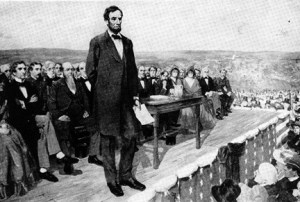
That proposition is at the heart of the Bill of Rights and if we say that this is wrong, and we attempt to marginalize, disenfranchise, and otherwise discriminate against people based on their race, nationality, skim color, religion, gender, or sexual orientation, then we have forgotten the most important part of who we are as Americans. Thankfully, a number of rooms later I entered a room which dealt with the Gettysburg Address. In it there was a display of that text, with the voice of an actor portraying Abraham Lincoln speaking it. I paused, listened and reflected on the difference of Lincoln’s words and those of Stephens. Truthfully, hearing the words of Stephens and Lincoln being spoke felt like how I reacted the differences between the Trump convention, and the Democratic National Convention. 

The fact is that the United States was founded on that simple proposition that all men are created equal. While we haven’t always practiced it, in this country or abroad, it does not take away the power that simple truth to set people free. In this country it has been an at times grueling task to bring freedom to slaves, to women, to other immigrants, and to the LGBTQ community. It has been 240 years and there are still people trying to roll back the rights of those they think are inferior, or who they believe that their religion condemns. That my friends is not an American concept, it a throwback to the old world, a world which only exists in the Cloud-Cukoo land of ideologues.


So today we finished up the Staff Ride going to Culp’s Hill and East Cemetery Hill prior to retracing the route take by Pickett’s troops as they made their ill-fated charge into the center of the Federal line. The last past is particularly powerful as I quote from the words of the soldiers who observed the attack and the human carnage inflicted by the Federal guns and infantry. As much as I despised the cause of those brave soldiers, I cannot help but to admire their courage in making that attack, call it the common humanity and compassion that I feel towards soldiers who are ordered to do the impossible. When we got to the Angle where Lieutenant William Cushing was killed firing his last rounds of canister at the advancing Confederates, and where the Irishmen of the 69th Pennsylvania joined with others to drive the Confedates back, I am equally amazed by the courage of those Union men.


As always we finished up at the Soldier’s Cemetery where we talked about the human cost of war, and the moves on to talk about the importance of the Gettysburg Address, in particular its relationship to the Declaration of Indpendence and that proposition that is the heart and soul of what makes America different than any other country. The proposition that all men are created equal, and that we are not a nation founded on race, ethnicity, or religion, but on a proposition that most of the world envies, and which we ourselves so often neglect out of fear, of others, much to our detriment. 

So I will write more later to post tomorrow. But for now I am yours.

Peace,

Padre Steve+ 

Leave a comment

Filed under civil rights, civil war, Gettysburg, History, News and current events, Political Commentary

Slavery in a Different Form: The Collapse of Northern Support for Reconstruction

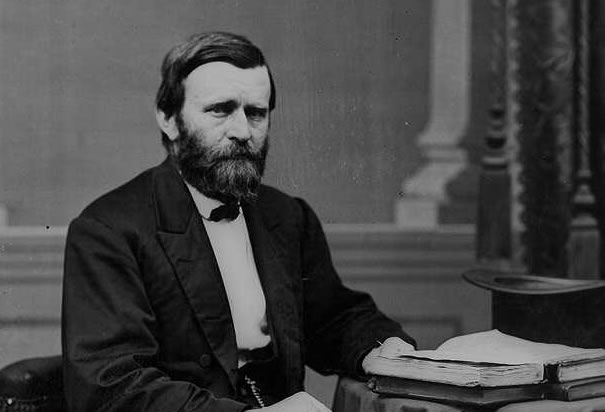
ulysses-s-grant-book

Ulysses Grant

Friends of Padre Steve’s World,

Since I am not doing anything really new this weekend unless something really big happens, here is a part of my Civil War text. Since I have posted a number of articles recently from it dealing with the Reconstruction and Jim Crow eras, I thought that this would be interesting. Have a great weekend.

Peace

Padre Steve+

It is all too easy to simply blame recalcitrant Southerners for the collapse of Reconstruction. However, it is impossible not to explore this without addressing responsibility of many leaders and citizens in the North for the failure of Reconstruction and the return of “White Man’s Rule” to the South. Like today, people faced with economic difficulties sought out scapegoats. When the country entered an economic depression in 1873 it was all too easy for Northern whites, many of who were willing to concede “freedom” to turn on blacks. Racism was still heavily entrenched in the North and for many, economic considerations trumped justice as the North tried to move away from Reconstruction and on to new conquests, including joining European powers in attempts to gain overseas colonies and territories.

As Southern extremists turned the Federal effort at Reconstruction into a violent quagmire that seemed to have no end, many Northerners increasingly turned against the effort and against Blacks themselves. Like so many victorious peoples they did not have the political or moral capacity to remain committed to a cause for which so many had sacrificed and they began to abandon the effort after two short years of congressionally mandated Radical Reconstruction.

Likewise, the men who had so nobly began the effort to enfranchise African Americans failed to understand the social and political reality of the South. To the average Southerner of the era “political equality automatically led to social equality, which in turn automatically led to race-mixing. It was inevitable and unthinkable. To a people brought up to believe that Negroes were genetically inferior – after all, that was why they were slaves – the mere hint of “mongrelization” was appalling.” [1] This was something that most Northerners, even those committed to the political equality of African Americans could not comprehend, and the ignorance of this fact would be a major reason for the collapse of Northern political and social support for Reconstruction.

Congressman Thaddeus Stevens, one of the most effective leaders of the Radical Republicans died in 1868 in despair that the rights of blacks were being rolled back even as legislation was passed supporting them. A few weeks before his death Stevens told a friend “My life has been a failure…I see little hope for the republic.” [2] The old firebrand asked “to be buried in a segregated cemetery for African American paupers so that “I might illustrate in death the principles which I advocated through a long life, Equality of man before his creator.” [3] Others including Senator Ben Wade, were not returned to office while others including Edwin Stanton, Salmon Chase and Charles Summer all died during Grant’s administration.

While Grant attempted to smash the Ku Klux Klan by military means, both his administration and Congress were of little help. He faced increased opposition from economic conservative Republicans who had little interest in the rights of African Americans and who gave little support to those fighting for equal rights for blacks. The situation was further complicated by the “financial panic which hit the stock market in 1873 produced an economic downturn that soon worsened into a depression, which continued for the rest of the decade.” [4] The result was that Republicans lost their majorities in the House and in many states, even in the North.

It was clear that “1870 Radical Republicanism as a coherent political movement was rapidly disintegrating” [5] and during the early 1870s many of the antislavery activists had left the Republican party either to death or defection, many “no longer felt at home in a party that catered to big business and lacked the resolve to protect black rights.” [6]

In 1872, some former radical Republicans revolted against Grant and the corruption in the Republican Party. Calling themselves “Liberal Republicans” they supported the candidacy of Horace Greeley uniting with Democrats to call for an end to Reconstruction. For many this was not so much because they no longer supported the rights of African Americans, but because for them, like so many, “economic concerns now trumped race relations…. Henry Adams, who shared the views of his father, Charles Francis Adams, remarked that “the day is at hand when corporations far greater than [the] Erie [Railroad]…will ultimately succeed in directing the government itself.” [7] The numbers of Federal troops in the South continued to be reduced to the point where they could offer little or no support to state militia.

The combination of all of these factors, political, racial, economic, and judicial doomed Grant’s continued efforts at Reconstruction by executive means. Despite the hard fought battle to provide all the rights of citizenship and the vote to African Americans racism remained heavily entrenched in all regions of the country. In the North and the South the economic crisis of 1873 caused people to look for scapegoats, and blacks were easy targets. With economics easily trumping the cause of justice, “racism increasingly asserted its hold on northern thought and behavior.” [8] The Northern press and politicians, including former abolitionists increasingly took the side of Southerners, condemning Freedmen as lazy and slothful usurpers of white civilization.

Likewise the growing problem of labor unrest in the North brought about by the economic depression made “many white northerners more sympathetic to white southern complaints about Reconstruction. Racial and class prejudices reinforced one another, as increasing numbers of middle-class northerners identified what they considered the illegitimate demands of workers and farmers in their own society with the alleged misconduct of the former slaves in the South.” [9]

The depression hit Freedmen in the South with a vengeance and unable to pay their bills and mortgages many lost everything. This left them at the mercy of their former white masters who were able to force them into long term employment contacts which for practical purposes reenslaved them. Those whites who were still working for Reconstruction in the South were increasingly marginalized, stigmatized and victimized by a systematized campaign of propaganda which labeled them Carpetbaggers and Scalawags who had gained power through the votes of blacks and who were profiting by looting Southern Whites. In the end Southern intransigence wore out the political will of Northerners to carry on, even that of strongest supporters of emancipation and equality.

Violence now became a means to further politics in the South and carried out in broad daylight and “intended to demoralize black voters and fatally undermine the Republican Party…. They paraded at regular intervals through African American sections of small towns in the rural black majority areas, intimidating the residents and inciting racial confrontations.” [10] These armed bands were highly successful, if they were successful in provoking a racial incident they would then fan out throughout the area to find blacks in order to beat up and kill, hundreds of blacks were killed by them.

During the elections of 1876 the White Liners, Red Shirts, White League and others would be seen in threatening positions near Republican rallies and on Election Day swarmed the polls to keep blacks and Republicans out, even seizing ballot boxes either destroying them or counting the votes for Democrats. The strategy employed by the Democrats and their paramilitary supporters was to use “Lawless and utterly undemocratic means…to secure the desired outcome, which was to win a lawful, democratic election.” [11]

The pressure was too much for most Republicans in the South, and many who did not leave the South “crossed over to the Democratic fold; only a few stood by the helpless mass of Negroes….” [12] Of those in the North who did nothing to confront the resurgence of neo-Confederate mythology and who had worked against equal rights for African Americans during the Reconstruction era, “many embraced racism in the form of imperialism, Social Darwinism and eugenics.” [13]

The elected governor of Mississippi, Republican General Adelbert Ames, who was one of the most able and honest of all the Northerners to hold elected office in the South wrote in 1875 about the power of the paramilitary groups, “The “white liners” have gained their point – they have, by killing and wounding, so intimidated the poor Negroes that they can in all human probability prevail over them at the election. I shall try at once to get troops form the general government. Of course it will be a difficult thing to do.” [14] Ames requested Federal troops “to restore peace and supervise the coming elections” [15] but did not get them due to the subterfuge of Attorney General Edwards Pierrepont.

Grant told Pierrepont, a former Democrat who was critical of Grant’s insistence on the rights of African Americans that he must issue a proclamation for the use of Federal troops if Ames’s local forces could not keep order. He told Pierrepont “the proclamation must be issued; and if it is I shall instruct the commander of the forces to have no child’s play.” [16] Instead, Pierrepont altered Grant’s words and told Ames, “The whole public are tired out with these autumnal outbreaks in the South…and the great majority are now ready to condemn any interference on the part of the government….Preserve the peace by the forces in your own state….” [17] Ames, who had been a strong proponent of emancipation and black suffrage understood that he was being abandoned by Pierrepont and in order to prevent more bloodshed gave up the fight, negotiating a peace with the White League. Sadly, he like Grant realized that most of the country “had never been for Negro civil rights in the first place. Freedom, yes; but that didn’t mean all the privileges of citizenship.”  [18]  Ames’s deal with the Democrats and the White League resulted in blacks being forced from the polls and the Democrats returning to power in the state.  When Ames left the state, the discouraged veteran of so many battles including Gettysburg wrote, “A revolution has taken place – by force of arms – and a race disenfranchised – they are to be returned to a condition of serfdom – an era of second slavery.” [19]

Notes

[1] Ibid. Lord The Past the Would Not Die p.11

[2] Ibid. Langguth, A.J. After Lincoln p.233

[3] Ibid. Guelzo Fateful Lightening p.504

[4] Ibid. Perman Illegitimacy and Insurgency in the Reconstructed South p.458

[5] Ibid. Foner Forever Free p.170

[6] Ibid. Egnal Clash of Extremes p.337

[7] Ibid. Egnal Clash of Extremes p.337

[8] Ibid. Foner Forever Free p.192

[9] Ibid. Foner Forever Free p.191

[10] Ibid. Perman Illegitimacy and Insurgency in the Reconstructed South pp.459-460

[11] Ibid. Perman Illegitimacy and Insurgency in the Reconstructed South p.461

[12] Ibid. Lord The Past the Would Not Die p.15

[13] Loewen, James W. and Sebesta, Edward H. Editors The  Confederate and Neo-Confederate Reader: The “Great Truth” about the “Lost Cause” University Press of Mississippi, Jackson 2010 Amazon Kindle edition location 5258 of 8647

[14] Ames, Adelbert Governor Adelbert Ames deplores Violence in Mississippi, September 1875 in The Civil War and Reconstruction Documents and Essays Third Edition edited by Michael Perman and Amy Murrell Taylor Wadsworth Cengage Learning Boston MA 2011 p.434

[15] Ibid. Lord The Past the Would Not Die p.17

[16] Ibid. Lane The Day Freedom Died p.243

[17] Ibid. McPherson The War that Forged a Nation p. 190

[18] Ibid. Lord The Past that Wouldn’t Die p.17

[19] Watson, Bruce Freedom Summer: The Savage Summer of 1964 that Made Mississippi Burn and Made America a Democracy Viking Press, the Penguin Group New York and London 2010 p.41

Leave a comment

Filed under civil rights, civil war, history

When Political Parties Implode: Pt 5: “The Heather is on Fire…” Politics, Religion, and War

revpalmer

Reverend Benjamin Morgan Palmer, Confederate Preacher and Propagandist

Friends of Padre Steve’s World

Over the past six months or so I have alluded to events in the Republican Party that make it appear that it is about to implode. I am a historian, and there is precedent in American history for the collapse of a national political party. This happened before in the 1854 collapse of the Whig Party, the 1912 division in the republican Party, but more importantly during the 1858 through 1860 collapse of the Democratic Party. Now I am not a person to say that history repeats itself. there are similarities and trends, but nothing is ever exactly the same as to why different parties collapse.  

While the issues of each day may be different there are common threads of humanity, hubris and hatred that unite to destroy political parties. I think that this is happening now in the Republican Party, and that it is possible that something similar may occur with the Democratic Party in the coming years. So it is important to look at history whenever possible to see how different political leaders responded in times of intense ideological, economic, social, national, and sectional division.

I decided to add an afterward to the three part series on the disaster that the Democratic Party made for itself and the country between 1858 and 1860. The third part deals with the after effects of results of the democratic Party split in the election of 1860. I followed those articles with one yesterday that dealt secession crisis that enveloped the nation as former Southern Democrats led their states into rebellion against the Union and Northern Democrats joined the anti-secession party in the North. Today is a section that talks about the mood of the country in that time and the impact of religion on the politics of the era. I do plan on doing a bit more work with it but figure that it works fine for the present moment, when religion again is a major part of politics, not only in the United States but elsewhere in the world.

This is a section of one of the chapters of my Civil War and Gettysburg text and I hope that you will find it interesting and thought provoking.

Peace,

Padre Steve+

As no middle ground remained, the nation plunged into war with many leaders in the South and North including those who previously had encouraged conciliation and compromise hardened their positions on secession. In the South men like Alexander Stephens and Judah P. Benjamin joined the secession movement, while in the North the positions of leaders hardened as the Southern states seceded and seized Federal installations including armories, forts, and mints and threatened others. “Northerners greeted secession as a deadly assault upon their own rights, welfare and security. Secession leaders sought not to nullify a single law, but the results of an entire presidential election. Far worse, they intended to shatter a nation that was liberty’s last, best hope. That could not be tolerated.” [1]

But soon only four installations in the new Confederacy remained in Federal hands, “two far away in the Florida Keys; Fort Pickens at Pensacola, Florida; and the most visible, Fort Sumter.” [2] Among them, one, Fort Sumter would sit at the eye of the brewing hurricane of civil war that threatened to hit the nation with unmatched fury.

In the South, Church leaders provided “Ministerial hosannahs to the providential nature of secession, such as Benjamin Palmer’s, contributed vital ideological work to the creation of the Confederacy. Such sermonizing language provided the appearance of a seamless bridge between proslavery and the revolution creating an independent nation.” [3] The South forged ahead to claim the mantle of Christ and God for their side; and given the widely held theological “assumptions about divine sovereignty and God’s role in human history, northerners and southerners anxiously looked for signs of the Lord’s favor.” [4] Of course people on both sides used the events of any given day during the war to interpret what this meant and both were subject to massive shifts as the God of Battles seemed to at times favor the armies of the Confederacy and as the war ground on to favor those of the Union. Tennessee Presbyterian pastor William H. Vernor was blunt in what God’s position on secession and slavery was, “In all contests between nations God espouses the cause of the Righteous and makes it his own….The institution of slavery according to the Bible is right. Therefore in the contest between North and South, he will espouse the cause of the South and make it his own.” [5]

Benjamin Morgan Palmer was one of the most influential preachers in the South, and when he took the pulpit on November 29th 1860 preached one of the most polemic pro-slavery and secession sermons made anywhere in the South. This Thanksgiving Sermon became one of the most influential Confederate propagandists. “Some 50,000 copies of that sermon were printed in pamphlet form and circulated throughout the South. That pamphlet became a most powerful part of Southern propaganda.” [6] The sermon was electrifying in it Palmer thundered against abolitionists, in particular Northern ministers equating them to atheists and radicals of the French Revolution. .

“Last of all, in this great struggle, we defend the cause of God and religion. The abolition spirit is undeniably atheistic. The demon which erected its throne upon the guillotine in the days of Robespierre and Marat, which abolished the Sabbath and worshipped reason in the person of a harlot, yet survives to work other horrors, of which those of the French Revolution are but the type. Among a people so generally religious as the American, a disguise must be worn; but it is the same old threadbare disguise of the advocacy of human rights…. Under this suspicious cry of reform, it demands that every evil shall be corrected, or society become a wreck—the sun must be stricken from the heavens, if a spot is found upon his disk. The Most High, knowing his own power, which is infinite, and his own wisdom, which is unfathomable, can afford to be patient. But these self-constituted reformers must quicken the activity of Jehovah or compel his abdication. In their furious haste, they trample upon obligations sacred as any which can bind the conscience…. Working out the single and false idea which rides them like a nightmare, they dash athwart the spheres, utterly disregarding the delicate mechanism of Providence, which moves on, wheels within wheels, with pivots and balances and springs, which the great Designer alone can control. This spirit of atheism, which knows no God who tolerates evil, no Bible which sanctions law, and no conscience that can be bound by oaths and covenants, has selected us for its victims, and slavery for its issue. Its banner-cry rings out already upon the air—”liberty, equality, fraternity,” which simply interpreted mean bondage, confiscation and massacre. With its tricolor waving in the breeze,—it waits to inaugurate its reign of terror. To the South the high position is assigned of defending, before all nations, the cause of all religion and of all truth. In this trust, we are resisting the power which wars against constitutions and laws and compacts, against Sabbaths and sanctuaries, against the family, the State, and the Church; which blasphemously invades the prerogatives of God, and rebukes the Most High for the errors of his administration; which, if it cannot snatch the reign of empire from his grasp, will lay the universe in ruins at his feet. Is it possible that we shall decline the onset?” [7]

Even as their preachers like Palmer urged secession and linked the cause of the Confederacy and slavery to Divine Providence events continued to move forward. Those who had been hesitant about secession in the South were overcome by events when Fort Sumter was attacked. Edmund Ruffin spoke for many of the ardent secessionists when he proclaimed “The shedding of blood…will serve to change many voters in the hesitating states, from submission or procrastinating ranks, to the zealous for immediate secession.” [8]

But very few of the radical secessionists found their way into uniform or onto the front lines. Then like now, very few of those who clamor for war and vengeance the most, who send the sons of others to die in their wars, take up arms themselves. Confederate General Jubal Early saw the sour irony in this. Early had been a strong Unionist and had fought against secession until the last as a Virginia legislator during the Virginia secession debate. But when he finally accepted secession as a reality, he went to war and never looked back becoming an intractable enemy of the Union. During the war he became one of the most committed Rebels of the Cause and after the war became one of the most powerful voices for the Lost Cause. That being said, the caustic Early was not fond of the proponents of secession and took pleasure as the war went on by taunting: “the identifiable secessionists in gray uniform who came his way, especially when the circumstances were less than amusing….” [9]After the disastrous defeat at the Third Battle of Winchester in 1864, Early looked at his second in command, former Vice President of the United States, failed candidate for President in the 1860 presidential election, and Confederate Major General John C. Breckinridge, who had advocated secession as they retreated amid the “chaos and horror of his army’s rout. Early took the occasion to mock his celebrated subordinate: “Well General, he crowed, “what do you think of the ‘rights of the South’ in the territories now?” [10]

In the North a different sentiment rose as one volunteer soldier from Pennsylvania wrote: “I cannot believe…that “Providence intends to destroy this Nation, the great asylum for all the oppressed of all other nations and build a slave Oligarchy on the ruins thereof.” Another volunteer from Ohio mused “Admit the right of the seceding states to break up the Union at pleasure…and how long before the new confederacies created by the first disruption shall be resolved into smaller fragments and the continent become a vast theater of civil war, military license, anarchy and despotism? Better to settle it at whatever cost and settle it forever.” [11]

As the war began and both sides mobilized for war, the clergymen on both sides of the now divided land now proclaimed a holy war to support their side’s cause, just as they had in the decades leading to the crisis. Palmer, whose sermon had helped propagandize the cause of secession was active in giving Confederate soldiers a religious basis for their fight, “he insisted that the Louisiana Washington Artillery resist the Northern invasion in order to protect the right of self-government. To them he advocated the pursuit of a holy war, a war of true Christian faith against fanaticism.” [12] The religious character of the war was in evidence as “Clergymen and their congregations became caught up in the patriotic fervor…..It would not be entirely fair to say that politics rode roughshod over religion, but Americans exhibited more spiritual hubris than spiritual reflection” [13] as the country went to war with itself. The depth of the religious dimension of the struggle can be seen in the hymn most commonly associated with the Civil War and the United States. This was the immensely popular Battle Hymn of the Republic whose lyricist Julia Ward Howe penned the lines “As he died to make men holy, let us live to make men free! While God is marching on” [14]

Evangelical Churches, evangelistic organizations and tract societies were particularly active in conducting revival meetings and working to convert soldiers, and as “early as 1862, large-scale “conversion seasons” swept through both Union and Confederate troops: the Army of the Cumberland and the Army of Northern Virginia both experienced large-scale revivals of religion during the winter and spring of 1864.” [15] These would be the last of these seasons of revival as the war entered a new and more brutal phase, which not only tested, but also shattered the faith of many soldiers, one Illinois surgeon named “John Hostetter remarked, “The is no God in war. It is merciless, cruel, vindictive, unchristian, savage, relentless. It is all that devils could wish for.” [16]

Not content with efforts to evangelize and convert soldiers there was also an attempt on the part of some Northern Evangelicals to push religion to the forefront of the conflict and to establish the Christian faith as the official religion of the United States. In doing so they sought to correct what they believed was an error in the Constitution. The error that they sought to correct was that God was not mentioned in it. These Evangelicals believed that the Civil War was God’s judgment on the nation because the Founders had left the mention of God out of that document. The group, which called itself the National Reform Association proposed what they called the Bible Amendment in 1863. The amendment would united Evangelical Protestantism with the Republic, forming what they believed would be a truly Christian nation. They met with Lincoln and proposed to modify the opening paragraph of the Constitution to read:

“We the people of the United States, humbly acknowledging Almighty God as the source of all authority and power and civil government, the Lord Jesus Christ as the Ruler among the nations, His revealed will as the supreme law of the land, in order to form a more perfect union.” [17]

While Lincoln brushed off their suggestion and never referred to the United States as a Christian nation, much to the chagrin of many Northern Christians, the Confederacy reveled in its self-described Christian character. The Confederacy had “proudly invoked the name of God in their Constitution. Even late in the war, a South Carolina editor pointed to what he saw as a revealing fact: the Federal Constitution – with no reference to the Almighty – “could have been passed and adopted by Atheists or Hindoes or Mahometans.” [18]

Notes

[1] Ibid. Levine Half Slave and Half Free p.236

[2] Ibid. Cooper We Have the War Upon Us p.192

[3] Ibid. Daly When Slavery Was Called Freedom p.141

[4] Ibid. Rable God’s Almost Chosen Peoples p.74

[5] Ibid. Daly When Slavery Was Called Freedom p.138

[6] Wakelyn, John L. Benjamin Morgan Palmer in Leaders of the American Civil War: A Biographical and Historiographical Dictionary edited by Charles F. Ritter and Jon L. Wakelyn, Greenwood Press, Westport Connecticut 1998 p.309

[7] Palmer, Benjamin M. Thanksgiving Sermon, November, 29, 1860. Retrieved from http://civilwarcauses.org/palmer.htm 9 March 2016

[8] Ibid. McPherson The Battle Cry of Freedom p.273

[9] Ibid. Osborne Jubal p.52

[10] Ibid. Osborne Jubal p.52

[11] Ibid. Levine Half Slave and Half Free pp.253-254

[12] Ibid. Wakelyn Benjamin Morgan Palmer p.309

[13] Ibid. Rable God’s Almost Chosen Peoples p.56

[14] Ibid. Huntington Who Are We? P.77

[15] Ibid. Guelzo Fateful Lightening p.415

[16] Ibid. Guelzo Fateful Lightening p.415

[17] Ibid. Goldfield America Aflame p.360

[18] Ibid. Rable God’s Almost Chosen Peoples pp.337-338

Leave a comment

Filed under civil war, History, Political Commentary

When Political Parties Implode, Pt 4: The Secession Crisis

Friends of Padre Steve’s World

Over the past six months or so I have alluded to events in the Republican Party that make it appear that it is about to implode. I am a historian, and there is precedent in American history for the collapse of a national political party. This happened before in the 1854 collapse of the Whig Party, the 1912 division in the republican Party, but more importantly during the 1858 through 1860 collapse of the Democratic Party. Now I am not a person to say that history repeats itself. there are similarities and trends, but nothing is ever exactly the same as to why different parties collapse.  

While the issues of each day may be different there are common threads of humanity, hubris and hatred that unite to destroy political parties. I think that this is happening now in the Republican Party, and that it is possible that something similar may occur with the Democratic Party in the coming years. So it is important to look at history whenever possible to see how different political leaders responded in times of intense ideological, economic, social, national, and sectional division.

I decided to add an afterward to the three part series on the disaster that the Democratic Party made for itself and the country between 1858 and 1860. The third part deals with the after effects of results of the democratic Party split in the election of 1860. This deals with the secession crisis that enveloped the nation as former Southern Democrats led their states into rebellion against the Union and Northern Democrats joined the anti-secession party in the North.

This is a section of one of the chapters of my Civil War and Gettysburg text and I hope that you will find it interesting and thought provoking.

Peace,

Padre Steve+

disunion_carolina-blog427

After the election Lincoln tried to reassure the South that he would remain true to his campaign promise not to interfere with slavery where it already existed, but he also refused to give in to threats of secession. Despite his belief that anything that he said would be twisted into the exact opposite by Southerners, Lincoln released a statement through Senator Lyman Trumbull in Springfield saying:

“The states will be left in complete control of their affairs and property within their respective limits as they have under any administration. I regard it as extremely fortunate for the peace of the whole country, that this point, upon which the Republicans have been for so long, as so presently misrepresented, is now brought to a practical test, and placed beyond the possibility of doubt. Disunionists per se, are now in hot haste to get out of the Union, precisely because they perceive they cannot, much longer, maintain apprehension among the southern people that in their homes, and firesides, and lives, are to be endangered by the action of the Federal Government.” [1]

On his way to Washington D.C. the President Elect stopped in New York and gave a speech “promising that he would “never of his own volition “consent to the destruction of this Union,” he qualified this promise with “unless it were that to be that thing for which the Union itself was made.” [2] Two days later Lincoln speaking Independence Hall in Philadelphia Lincoln further detailed what he meant in New York, going back to the premise of the Declaration of Independence in which “he asserted that he “never had a feeling politically that did not spring from the sentiments embodied in the Declaration…. I was not the mere matter of separation of the colonies from the mother land; but rather something in that Declaration” that provided “hope for the world for all future time. It was that which gave promise that in due time the weights should be lifted from the shoulders of all men, and that all should have an equal chance.” [3] It was a thought that he would continue to refine in the Emancipation Proclamation Gettysburg Address, the Thirteenth Amendment and in his Second Inaugural Address.

Stephen A. Douglas tried to reassure the Southern leaders as well even as argued against secession. He reminded Southerners how he had fought against Lincoln and the platform of the Republican Party and stated “that the mere election of any man to the Presidency does not furnish just cause for dissolving the Union.” [4] Addressing Southern concerns in a pragmatic way, the Little Giant tried to diffuse Southern fears by reminding them that the answer to their fears lay in the checks and balances laid out in the Constitution and in the ballot box. Douglas’s next words redound to the present day:

“It is apprehended that the policy of Mr. Lincoln and the principles of his party endanger the peace of the slaveholding states. Is that apprehension founded? No, it is not. Mr. Lincoln and his party lack the power, even if they had the disposition, to disturb or impair the rights and institutions of the South. They certainly cannot harm the South under existing laws. Will they have the power to repeal or change these laws, or to enact others? It is well known that they will be a minority in both houses of Congress, with the Supreme Court against them. Hence no bill can pass either house of Congress impairing or disturbing these rights or institutions of the southern people in any manner whatever, unless a portion of southern senators and representatives absent themselves so as to give an abolition majority in consequence of their actions.

In short, the President will be utterly powerless to do evil…. Four years shall soon pass, when the ballot box will furnish a peaceful, legal, and constitutional remedy for the evils and grievances with which the country might be afflicted.” [5]

An attempt in Congress led by President James Buchanan and Senator John J. Crittenden of Kentucky to bring about a constitutional compromise to mollify both sides was considered. A committee of thirteen senators was convened to entertain various compromise propositions, however, most of the suggested compromises were heavily weighted toward Southern interests, though it promised to restore the prohibition of slavery north of the line drawn in the Missouri Compromise.
lincolnearly

Abraham Lincoln

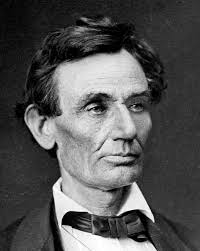
A frustrated Lincoln wrote, “I’ll tell you now what bothered me: the compromises measures introduced in Congress required the Republicans to make all the concessions.” [6] Lincoln warned Crittenden that such proposals would not be acceptable: “Entertain no proposition for a compromise in regard to the extension of slavery…. The instant you do they have us under again…. The tug has to come & better now than later.” [7]

Lincoln had seen how for four decades Southerners had pushed for compromises that only benefited them and the extension of slavery, even at the expense of Northern states rights and he was not about to let it happen again. The President Elect wrote:

“The Crittenden plan, I feared, would put the country back on the high road to a slave empire. Whether it was the revival of the Missouri Compromise line or a popular sovereignty, it was all the same. “Let neither be done,” I warned Republicans in Washington, “and immediately filibustering and extending slavery recommences. Within a year, we shall have to take Cuba as a condition on which the South will stay in the Union. Next it will be Mexico, then Central American. On the territorial question, I am inflexible. On that point hold firm as a chain of steel…” [8]

In the South the efforts of staunch Southern Unionists like Alexander Stephens to discourage secession were dismissed as the movement toward secession became a passion filled revolutionary movement, which acted as a cathartic movement for many Southerners. Like Douglas, Stephens had the greatest faith in the checks and balances provided in the Constitution and he pleaded with his fellow Georgians at the state capital of Milledgeville noting that the checks and balances “would render Lincoln “powerless to do any great mischief,” and he warned that “the dissolution of the Union would endanger this “Eden of the world,” that “instead of becoming gods, we shall become demons, and no distant day commence cutting one another’s throats…” [9] While his speech received favorable coverage in the North and even in London, it was met with little enthusiasm at home.

Influential Southern preachers joined in the push for secession and warned of what they saw as the dire consequences of Lincoln’s election. The Baptist clergyman James Furman expressed the outrage and paranoia of many in the South by warning after Lincoln’s election “If you are tame enough to submit, Abolition preachers will be at hand to consummate the marriage of your daughters to black husbands.” [10] Likewise entire southern denominations began to endorse secession, southern Methodists raised “alarms about a Union dominated by abolitionists as they called on the Lord for deliverance from the northern “Egypt.” The division of Israel and Judah (not to mention the nation’s already fractured churches0 became typologies for the American crisis. Just as southern Methodists had once “seceded from a corrupt church,” a Mississippi politician declared, “We must secede from a corrupt nation.” To drive the point home, Georgia Methodists ministers endorsed disunion by an overwhelming 87-9 vote.” [11]

Despite Lincoln and Douglas’s efforts during and after the election to strike a conciliatory tone, it did not take long before Southern states began to secede from the Union. In light of the profoundly sectional nature of Lincoln’s victory “emboldened many Southern politicians and journalists to insist that they would not be bound by the result.” [12] In his final speech before the Senate, Senator Robert Toombs of Georgia lambasted the “black Republicans” and abolitionists, “We want no negro equality, no negro citizenship, we want no negro race to degrade our own; and as one man [we] would meet you upon the border with the sword in one hand and the torch in the other.” [13] Other Senators, many who would become prominent leaders of the Confederacy made their speeches, some, like that of Jefferson Davis tinged with regret while others like Senator Stephen Mallory, and the future Secretary of the Navy for the Confederacy delivered a fiery broadside against his Northern colleagues, “You cannot conquer us. Imbue your hands in our blood and the rains of a century will not wipe away from them stain, while the coming generation will weep for your wickedness and folly.” [14] As these men finished the left the chambers of Congress where many had served for years many left with tears, while some marked their exit with angry words.

220px-Alexander_Stephens

Alexander Stephens

Stephens, still a Unionist at heart lamented the election even as he prepared to leave the Senate before becoming the vice president of the Confederacy, warned that “revolutions are much easier started than controlled, and the men who begin them [often] …themselves become the victims.” [15] Even so the senator noted “If the policy of Mr. Lincoln and his Republican associates be carried out…no man in Georgia will be more willing or ready than myself to defend our rights, interest, and honor at every hazard and to the last extremity.” [16] But as he resigned his office Stephens replied to a friend’s question, “why must we have civil war?”

“Because there are not virtue and patriotism and sense enough left in the country to avoid it. Mark me, when I repeat that in less than twelve months we shall be in the midst of a bloody war. What will become of us then God only knows.” [17]

But Stephens’ warning fell on deaf ears as passionate secessionist commissioners went throughout the South spreading their message of fear. “Thus fanned, mob spirit ran close enough to the surface to intimidate many moderates – the very temperament that inclines men toward moderation is apt to respond timidly when threatened or abused – and to push others closer to the extremist position.” [18] Such was the case with Southern moderates and Unionists as men like Stephens were swept up in the tumult as their states seceded from the Union. Senator Judah P. Benjamin of Louisiana wrote, “The prudent and conservative men South… were not able to stem the wild torrent of passion which is carrying everything before it…. It is a revolution…of the most intense character…and it can no more be checked by human effort, for the time, than a prairie fire by a gardener’s watering pot.” [19]
disunion_dec20_secession3-blog427

The Palmetto State of South Carolina was the first state to secede. Its senior senator, James Chesnut launched a fusillade against the North in a speech before the state legislature in which he argued that the South could not wait for another election: He thundered:

“Because of the Yankee puritans’ invasive mentality, incendiary documents would flood our region, Southern Republicans would fill our offices. Enemies would control our mails. The resulting upheaval would make “Lincoln’s election…a decree for emancipation. Slavery cannot survive the four years of an administration whose overwhelming influences” will be “brought to bear against it.” To submit now is to guarantee that before 1865, we must “slay the Negro, or ourselves be slain.” [20]

William Tecumseh Sherman was serving as the President the Louisiana State Seminary of Learning and Military Academy, what is now Louisiana State University. Like many men in the ante-bellum era, Sherman had thought little about the slavery issue, though he was very concerned with the preservation of the Union. He thought secession made no sense, especially for the people of the South. When Sherman read the news of South Carolina’s secession it “cut to the depths of his nationalistic soul.” The future general wept, and told his friend David Boyd “Boyd, you people of the South don’t know what you are doing! You think you can tear to pieces this great union without war…. “The North can make a steam-engine, locomotive, or railway car; hardly a yard of cloth or shoes can you make. You are rushing into war with one of the most powerful, ingeniously mechanical and determined people on earth…. You are bound to fail. Only in spirit and determination are you prepared for war.” [21] Sherman, the man who later proclaimed that “War is Hell” proved to be a remarkably accurate seer regarding the fate of the Confederacy.

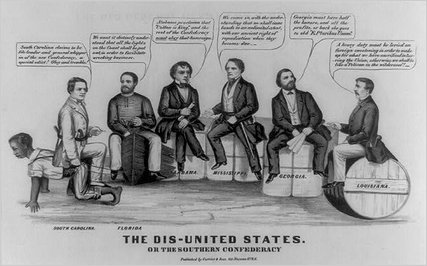
South Carolina was followed by Mississippi, Florida, Alabama, Georgia, Louisiana and Texas. “A belt of seven states from South Carolina to Texas, embracing nearly one-sixth of the country’s population and nearly one-fifth of the national domain, had proclaimed independence and severed its ties with the Union.” [22] Many of the declarations of causes for secession made it quite clear and explicit that slavery, and fear that the institution was threatened by Northern abolitionists was the root cause. The declaration of South Carolina is typical of these and is instructive of the basic root cause of the war:

“all the States north of that line have united in the election of a man to the high office of President of the United States, whose opinions and purposes are hostile to slavery. He is to be entrusted with the administration of the common Government, because he has declared that that “Government cannot endure permanently half slave, half free,” and that the public mind must rest in the belief that slavery is in the course of ultimate extinction.” [23]

Throughout the war slavery loomed large, even though in the beginning of the abolition controversies of the 1830s many northerners “were content to tolerate slavery’s indefinite survival in the South so long as it did not impinge on their own rights and aspirations at home.” [24] Such attitudes were still common in the North during the late 1850s, especially among Democrats.

But it was the continued actions and multiple transgressions of slavery supporters that energized northerners as never before. Their use of the courts to advance their rights and the cause of slavery, by the compromises that had extended slavery to the territories; their use of the courts especially the Dred Scott to allow slaveholders to recover their human property, even in Free States provoked no end of indignation throughout the North, even for those sympathetic to Southern concerns. Those actions demonstrated to Northerners:

“just how fundamental and intractable the differences with Southern political leaders were. Thus educated, most northern voters had decided by 1860 that only an explicitly anti-slavery party could protect their interests.” [25]

The fiery abolitionist and profoundly religious editor of The Liberator, William Lloyd Garrison, used biblical imagery in a rather astute analysis of the behavior of Southern leaders after the election of 1860. He wrote of the Southern response to Lincoln’s election:

“Never had the truth of the ancient proverb “Whom the gods intend to destroy, they first make mad” been more signally illustrated than in the condition of southern slaveholders following Lincoln’s election. They were insane from their fears, their guilty forebodings, their lust for power and rule, hatred of free institutions, their merited consciousness of merited judgments; so that they may be properly classed as the inmates of a lunatic asylum. Their dread of Mr. Lincoln, of his Administration, of the Republican Party, demonstrated their insanity. In vain did Mr. Lincoln tell them, “I do not stand pledged to the abolition of slavery where it already exists.” They raved just as fiercely as though he were another John Brown, armed for southern invasion and universal emancipation! In vain did the Republican party present one point of antagonism to slavery – to wit, no more territorial expansion. In vain did that party exhibit the utmost caution not to give offense to any other direction – and make itself hoarse in uttering professions of loyalty to the Constitution and the Union. The South protested that its designs were infernal, and for them was “sleep no more!” Were these not the signs of a demented people?” [26]

But both sides were blind to their actions and with few exceptions, most leaders, especially in the South badly miscalculated the effects of the election of 1860. The leaders in the North did not realize that the election of Lincoln would mean the secession of one or more Southern states, and Southerners “were not able to see that secession would finally mean war” [27] despite the warnings of Alexander Stephens to the contrary. In fact throughout the South it was believed that there would be no war because “they believed that the Yankees were cowards and would not fight”… “Senator James Chesnut of South Carolina offered to drink all the blood shed as a consequence of secession. It became a common saying in the South during the secession winter that “a lady’s thimble will hold all the blood that will be shed.” [28]

Following their secession the five slave states of the lower South: “appointed commissioners to the other slave states, and instructed them to spread the secessionist message across the entire region. These commissioners often explained in detail why their states were exiting the Union, and they did everything in their power to persuade laggard slave states to join the secessionist cause. From December 1860 to April 1861 they carried the gospel of disunion to the far corners of the South.” [29]

The editors of the Philadelphia Press accused the Southern secessionists of being enemies of democracy and wrote:

“should the Cotton States go out in a body, we shall witness the beginning of an experiment to establish, on this continent, a great slaveholding monarchy. With few exceptions, the leaders of the Disunion cabal are men of the most aristocratic pretensions – men who…easily adopt the habits and titles of the European nobility. South Carolina, which is the head of Secession, is almost a monarchy herself. Her representatives in both branches of Congress, for years past, have acted upon the idea that the people of the free states are servile, and Mr. Hammond, the most candid and straightforward of the set, denounced the laboring white masses of the free States as the mudsills of society …” [30]

The mood of the South in the fall of 1860 was “fearful, uncertain, impatient and volatile, eager to adopt the course that best offered hope of deliverance – which was ideally suited for the immediacy and urgency of the radical secessionists.” [31] Using the political machinery of the Democratic Party in the South which they now possessed, the proponents of secession were far better organized than Southern Unionists who had a difficult time putting up a united front in the face of the radicals.

Slavery and the superiority of the white race over blacks were at the heart of the message brought by these commissioners to the legislatures of the yet undecided states. Former Congressman John McQueen of South Carolina wrote to secessionists in Virginia “We, of South Carolina, hope to greet you in a Southern Confederacy, where white men shall rule our destinies, and from which we may transmit our posterity the rights, privileges and honor left us by our ancestors.” [32] In Texas McQueen told the Texas Convention: “Lincoln was elected by a sectional vote, whose platform was that of the Black Republican part and whose policy was to be the abolition of slavery upon this continent and the elevation of our own slaves to an equality with ourselves and our children.” [33] These Southern secessionists were realists, they knew that the election of 1860 was a watershed in terms of the history of slavery in the United States, emancipation was coming, it might take a decade, it might take twenty-five or even fifty years, but they knew that it was coming, and for them secession was the only logical action left that was “consistent with their ideology.” [34] Many of these men now viewed it as an issue of now or never.

In his First Inaugural Address Lincoln cut to the heart of the division in the country: “One section of our country believes slavery is right and ought to be extended, while the other believes it is wrong and ought not to be extended. This is the only substantial dispute.” [35] Of course he was right, and his Southern opponents agreed. Jefferson Davis wrote: “The great northern party, thus organized, succeeded in electing to the office of the Presidency a man who openly proclaimed his hatred of slavery, who declared that the government could not endure “half slave and half free.” [36]

As the war began, white Southerners of all types and classes rallied to the call of war against the hated Yankee. The common people, the poor yeomen farmers were often the most stalwart defenders of the South. With the Orwellian slogan “Freedom is not possible without slavery” ringing in their ears, they went to war against the Yankees alongside their slave-owning neighbors to “perpetuate and diffuse the very liberty for which Washington bled, and which the heroes of the Revolution achieved.” [37]

Alexander Stephens, the longtime friend of Lincoln who had been a devout Unionist, who had supported Stephen Douglas until the bitter end, and who had strenuously opposed secession in the months leading to the election of 1860 was now the Vice President of the Confederacy. He had been elected Vice President the same day as Jefferson Davis was elected President by the new Confederate Congress and now went through the South speaking about the nature of the new government. Stephens explained the foundations of the Southern state in his Cornerstone Speech of March 21st 1861, the speech echoed what many Southerners had believed for years regarding slavery and the status of Blacks, namely that Blacks were a lesser order of humanity:

Our new government is founded upon exactly the opposite idea; its foundations are laid, its corner- stone rests upon the great truth, that the negro is not equal to the white man; that slavery — subordination to the superior race — is his natural and normal condition. [Applause.] This, our new government, is the first, in the history of the world, based upon this great physical, philosophical, and moral truth.” [38]

Jefferson Davis had issued instructions to cabinet members to downplay slavery as an issue and was infuriated. The new President of the Confederacy wrote: “That speech infuriated me, Oh, what Stephens had said was true, perfectly true, but could anything hurt us more abroad than such impolitic remarks? It was the beginning of a fatal falling out between me and that rebellious and vindictive dwarf, who was hell-bent on forming his own policies and disputing mine with niggardly deviousness.” [39]

The Orwellian definition of slavery as being necessary to liberty and the Confederate leader’s proclamations that they were comparable to the founding fathers was condemned throughout the North. The editors of the New York Evening Post wrote:

“The founders fought to “establish the rights of man… an principles of universal liberty.” The South was rebelling “not in the interest of general humanity, but of a domestic despotism…. Their motto is not liberty, but slavery.” Thomas Jefferson’s Declaration of Independence spoke for “Natural Rights against Established Institutions,” added the New York Tribune, while “Mr. Jeff. Davis’s caricature thereof is made in the interest of an unjust, outgrown, decaying institution against the apprehended encroachments of human rights.” It was, in short, not a revolution for liberty but a counterrevolution “reversing the wheels of progress…. to hurl everything backward into deepest darkness… despotism and oppression.” [40]

Secession3

Virginia’s Ordinance of Secession

Secession commissioners from the first seven Confederate States fanned out to the undecided Slave states to spread the message of secession. One of these men was Henry Benning of Georgia. Benning spoke to the secession convention of Virginia, a state that the new Confederacy deemed all-important to its cause and which it had to have on its side in the coming confrontation with the Union. There the Georgia Supreme Court Justice used the time-honored method of racial fear mongering to sway the men of the Virginia House of Delegates, he thundered:

“If things are allowed to go on as they are, it is certain that slavery is be abolished except in Georgia and the other cotton States, and…ultimately in these States also,” Benning insisted. “By the time the North shall have attained the power, the black race will be a large majority, and we will have black governors, black legislatures, black juries, black everything.” [41]

Not letting up the fiery Georgian told the Virginians that the North would invade the South to end slavery and of the outcome of such an invasion:

“We will be overpowered and our men compelled to wander like vagabonds all over the earth,” he told his audience, “and for our women, the horrors of their state cannot contemplate in imagination.” This then, was “the fate that Abolition will bring upon the white race….We will be exterminated.” [42]

Virginia’s Governor, John Letcher was “a longtime foe of secession and had wanted to bring slavery to an end in Virginia, but once elected to the governorship he adroitly put all that behind him, and rather like [Robert E.] Lee, he went to work with considerable efficiency for two causes in which he did not believe.” [43] One Unionist delegate to the convention wrote of the proceedings, “The scenes witnessed within the wall of that room…have no parallel in the annals of ancient or modern times. On the morning of the 17th, Mr. Wise rose from his seat and drawing a large Virginia horse-pistol from his bosom laid it before him and proceeded to harangue the body in the most violent and denunciatory manner. He concluded by taking his watch from his pocket and, with glaring eyes and bated breath, declared that events were now transpiring which caused a hush to come over his soul.” [44] Those events were a planned seizure of Federal facilities including the arsenal at Harpers Ferry and the Naval Yard at Norfolk. But not all in Virginia were convinced. The strongly Unionist western counties of the state, where few people owned slaves and those who did held very few, voted heavily against secession. The counties withstood the initial shock of secession and would “in a wholly extra-legal way, abetted by Washington – perform its own act of secession, breaking away from Virginia and clinging to the Union as a bob-tailed but finally acceptable new state.” [45]

Former President John Tyler added his voice to the secession cause in Virginia and “personally drafted a document placing the state’s military force under Jefferson Davis’s direct command.” Shortly thereafter he was “elected to the Confederate Congress – becoming the only former President to win office in a foreign country.” [46] However, before he could take office, the former President, now an intractable enemy of the country that he once led, died in Richmond. Shortly thereafter his portrait was removed from its place of honor in the capital.

Tennessee was another state where secession was problematic. Eastern Tennessee was strongly Unionist and the counties “held a convention, denounced the governor and legislature for making the alliance with the Confederacy, and sent a memorial asking that the eastern counties be allowed to form a new state.” [47] The legislature and governor refused this but the area would prove a problem for Jefferson Davis as well as Lincoln who would have liked to help the Tennessee Unionists, but had no military way to do so.

The highly divided border states of Kentucky and Missouri remained in the Union, but became highly partisan battlegrounds between secessionists and Unionists in which insurgents used terrorist methods against their fellow citizens throughout the war. Kentucky’s pro-secession Governor, Beriah Magoffin called the legislature into convention to decide secession “but the legislature, by a vote of 54 to 36 in the lower house, refused to call one and adjourned on February 11 without taking any decisive action.” [48] Losing that vote, he issued a declaration of neutrality which caused both Lincoln and Jefferson Davis to move with caution in the state. Lincoln understood the strategic importance of Kentucky and said “I think to lose Kentucky is nearly the same as to lose the whole game….Kentucky gone, we cannot hold Missouri, nor, as I think, Maryland. These all against us, and the job on our hands is too large for us. We may as well consent to separation at once, including the surrender of this capital.” [49] Lincoln’s use of caution, diplomacy, and when needed the force of the law, courts, and the military paid strategic military and economic dividends for the North as the Ohio River remained under Union control.

Maryland too remained in the Union as Governor Thomas H. Hicks, with the help of federal troops resisted a call in the legislature for a secession vote, even so as Union volunteers marched to Washington in response to Lincoln’s calls for troops some regiments were attacked in Baltimore. The 6th Massachusetts Volunteer Infantry was set upon as a “crowd of southern sympathizers threw bricks and stones and fired into their ranks as they changed trains. They returned the fire, killing twelve citizens and wounding many more, then packed their four dead on ice for shipment north, and came on to Washington, bearing their seventeen wounded on stretchers.” [50]

To Lincoln, the issue of secession as well as territory was “never just about politics. To him it spoke about the nation, even if primarily as a symbol. In his mind the nation must be about freedom, never slavery.” [51] For him the Union was sacred and could not be dissolved for any reason, especially the cause of slavery. In contrast to the secessionists who proclaimed that the states had formed the Federal Government and had the right to dissolve the Union, Lincoln, using the reasoning and arguments of Daniel Webster asserted in his inaugural address that the Union actually predated the Constitution:

“Descending from these general principles, we find the propositions that, in legal contemplation, the Union is perpetual, confirmed by the history of the Union itself. The Union is much older than the Constitution. It was formed, in fact, by the Articles of Association in 1774. It was matured and continued by the Declaration of Independence in 1776. It was further matured, and the faith of all the then thirteen States expressly plighted and engaged that it should be perpetual, by the Articles of Confederation in 1778. And final, in 1787, one of the declared objects for ordaining and establishing the Constitution, was “to form a more perfect Union.” [52]

In early April 1861, a few days before the first shot was fired at Fort Sumter, a New York Times editorial made a proposition that unveiled the reality of the situation now confronting the divided nation, and which so many had for so long refused to face: “If two sections can no longer live together, they can no longer live apart in quiet until it is determined which is master. No two civilizations ever did, or can, come into contact as the North and South threaten to do, without a trial of strength, in which the weaker goes to the wall…. We must remain master of the occasion and the dominant power on this continent.” [53]

Thus, the American ideological war was born; it had taken decades to reach the point of no return. It had taken years of frustration, and attempts at compromise by politicians who attempted to dodge the moral issues inherent in slavery. Time could not heal the wounds caused by slavery as long as “one section of the country regarded it as a blessing, the other as a curse.” [54] Frederick Douglass observed: “Whatever was done or attempted with a view to the support and secularity of slavery on served to fuel the fire, and heated the furnace of [anti-slavery] agitation to a higher degree than had any before attained.” [55]

Notes

[1] Ibid. Oates The Approaching Fury pp.355-356

[2] Ibid. Goodwin Team of Rivals p. 310

[3] Ibid. Goodwin Team of Rivals p. 310

[4] Ibid. Oates The Approaching Fury p.338

[5] Ibid. Oates The Approaching Fury pp.338-339

[6] Ibid. Oates The Approaching Fury p.355

[7] Ibid. Guelzo Fateful Lightening p.134

[8] Ibid. Oates The Approaching Fury pp.354-355

[9] Ibid. Goldfield America Aflame p.184

[10] Ibid. McPherson Drawn With Sword p.50 These words are little different than the words of many conservative Evangelical Christian pastors, pundits and politicians today in relation to the legalization of Gay marriage.

[11] Ibid. Rable God’s Almost Chosen Peoples pp.38-39

[12] Ibid. Holzer Lincoln and the Power of the Press p.256

[13] Ibid. Goodheart 1861 p.77

[14] Ibid. Goodheart 1861 p.77

[15] Ibid. McPherson The Battle Cry of Freedom p.238

[16] Cooper, William J. We Have the War Upon Us: The Onset of the Civil War November 1860-April 1861 Alfred a Knopf, New York 2012 p.75

[17] Ibid. Catton The Coming Fury pp.46-47

[18] Ibid. Catton Two Roads to Sumter pp.250-251

[19] Ibid. McPherson The Battle Cry of Freedom p.237

[20] Ibid. Freehling The Road to Disunion Volume II p.398

[21] O’Connell Robert L. Fierce Patriot: The Tangled Lives of William Tecumseh Sherman Random House, New York 2013 p65

[22] Ibid. Catton Two Roads to Sumter p.248

[23] __________ Declaration of the Immediate Causes Which Induce and Justify the Secession of South Carolina from the Federal Union. Retrieved from The Avalon Project, Yale School of Law http://avalon.law.yale.edu/19th_century/csa_scarsec.asp 24 March 2014

[24] Ibid. Levine Half Slave and Half Free p.251

[25] Ibid. Levine Half Slave and Half Free p.253

[26] Ibid. Oates The Approaching Fury p.342

[27] Ibid. Catton The Coming Fury p.122

[28] Ibid. McPherson The Battle Cry of Freedom p.238

[29] Ibid. Dew Apostles of Disunion p.18

[30] Ibid. Stampp The Causes of the Civil War p.189

[31] Ibid. Catton Two Roads to Sumter p.250

[32] Ibid. Dew Apostles of Disunion p.48

[33] Ibid. Dew Apostles of Disunion p.48

[34] Ibid. Foner Free Soil, Free Labor, Free Men p.145

[35] Lincoln, Abraham First Inaugural Address March 4th 1861 retrieved from www.bartleby.com/124/pres31.html 24 March 2014

[36] Ibid. Oates The Approaching Fury p.429

[37] Ibid. McPherson Drawn With Sword pp.50-51

[38] Cleveland, Henry Alexander H. Stevens, in Public and Private: With Letters and Speeches, before, during and since the War, Philadelphia 1886 pp.717-729 retrieved from http://civilwarcauses.org/corner.htm 24 March 2014

[39] Ibid. Oates The Approaching Fury p.382

[40] Ibid. McPherson The Battle Cry of Freedom p.244

[41] Ibid. Dew Apostles of Disunion p.66

[42] Ibid. Dew Apostles of Disunion p.67

[43] Ibid. Korda Clouds of Glory p.232

[44] Osborne, Charles C. Jubal: The Life and Times of General Jubal A. Earl, CSA Algonquin Books of Chapel Hill, Chapel Hill NC 1992 p.49

[45] Ibid. Catton The Coming Fury p.365

[46] Goodheart, Adam The Ashen Ruin in The New York Times: Disunion, 106 Articles from the New York Times Opinionator: Modern Historians Revisit and Reconsider the Civil War from Lincoln’s Election to the Emancipation Proclamation Edited by Ted Widmer, Black Dog and Leventhal Publishers, New York 2013 p.71

[47] Ibid. Catton The Coming Fury p.365

[48] Ibid. Potter The Impending Crisis p.510

[49] Foote, Shelby, The Civil War, A Narrative. Volume One: Fort Sumter to Perryville Random House, New York 1963 1958 p.53

[50] Ibid. Foote The Civil War, A Narrative. Volume One p.53

[51] Ibid. Cooper We Have the War Upon Us p.80

[52] Ibid. Wills Lincoln at Gettysburg p.130-131

[53] Ibid. Foote The Civil War, A Narrative. Volume One p.43

[54] Ibid. Catton Two Roads to Sumter p.143

[55] Ibid. Levine Half Slave and Half Free p.253

3 Comments

Filed under civil war, History, Political Commentary

More Equal than Others

101111-national-civil-rights-act-1875.jpg

Friends of Padre Steve’s World,

Last year while I was leading my students from the Staff College on our Gettysburg Staff Ride, something remarkable and troubling occurred. I always end the staff ride by taking the students to the National Soldier’s Cemetery. There we talk about terrible human cost of the battle and I introduce them to a number important topics related to the cemetery. I talk about the rural cemetery movement and the Greek revival in America in the 1820s, which is culturally important to us. Then I move on the dedication of the Soldier’s Cemetery. I discuss the layout of the cemetery and how it was designed so that the grave of every soldier is of equal importance and then I read some of the comments of the keynote speaker, Edward Everett. Following this I discuss the writing of the Gettysburg Address, the way Lincoln used it to universalize the Declaration of Independence and then I recite it, and remind my students, especially my American officer students why this is so important to us as we remember our oath of office and our duty.

While we were gathering near the spot where Lincoln gave his address, an elderly white couple, who appeared to be in their early eighties, were sitting on a bench where my students gathered. I invited them to stay if they wanted and let them know why we were there. They were very attentive as were my students and when we concluded and my students began to head back to our vans or to their own vehicles for the trip back to Norfolk, the man approached me and asked directions on how to get to the Chambersburg Road which I gladly gave him; and then he said: “You know that when they say that “all men are created equal” that some are more equal than others.”

I was stunned and attempted to deflect the man’s obvious racist comment with humor, referring to the rivalry of UCLA where I did my Army ROTC training about thirty-three years ago with that of the University of Southern California. The man looked at me and said that he was from Georgia and that he “wished that California would just drop off into the ocean,” and then walked away.

I thought to myself: “you corpulent old racist bastard.” I was really tempted to follow him and confront him, but I backed off. I realized based on his age, and that he probably opposed everything about the civil rights movement and supported Jim Crow and that there was nothing that could change his mind. He was old enough that he may have actually taken part in some of the anti-civil rights actions of the 1950s and 1960s. I don’t know, but it is possible.

But even so his words, his body language, and his facial expressions were troubling. The man was not joking. As I think about many things I hear said during the political campaign stating those same ideas, I am reminded of the words of George Fitzhugh, a Southern planter in eastern Virginia who owned many slaves. Fitzhugh, like many today, argued against the concept of human equality in 1856 he wrote that “the concept of human equality…is practically impossible, and directly conflicts with all government, all separate property, and all social existence.”

Speaking of the necessity for slavery, as well as limitations on the equality of human beings no matter what their race or sex, Fitzhugh penned words that explained that human relationships were not to be seen in terms of individual liberty, “but in relations of strict domination and subordination. Successful societies were those whose members acknowledged their places within that hierarchy.”

Fitzhugh was quite blunt when he discussed the real implications of his philosophy:

“We conclude that about nineteen out of twenty individuals have “a natural and inalienable right” to be taken care of and protected, to have guardians, trustees, husbands or masters; in other words they have a natural and inalienable right to be slaves. The one in twenty are clearly born or educated in some way fitted for command and liberty.”

He concluded his essay with the words, “Liberty for the few – slavery in every form, for the mass.”

Sadly, there are a lot of people in this country who believe exactly what that man voiced. Some are racist, and not just towards African Americans but to Latinos, Native Americans, Asians, Arabs and others, including poor Whites. There are those who believe that women and gays are not equal. Many of these people are leading politicians at the federal, state and local levels, media personalities and corporate leaders who have significant political and economic clout and if they ever had complete power would overturn or nullify every law that protects the civil rights of those they believe are less than equal, in some extreme case even less than human.

There are many reasons that people use to justify these attitudes; some pseudo-scientific, some religious, some economic, and many based on a crude Social Darwinism emphasizing the “survival of the fittest.” I heard someone in a restaurant say exactly that when they were talking about the poor, the poor had no rights, because they were poor. Again, lest we want to simply use this to beat on Southerners, this is not simply an attitude confined to the South; it is all over the country, and that was, and still is often the case throughout our American history.

It really does grieve me when I see this. The ghosts of our past intrude on so many parts of our national life, condemning the living to have to relive them in our own time. Historian George Santayana said it so well: “Those who cannot remember the past are condemned to repeat it.”

Have a good day.

Peace

Padre Steve+

1 Comment

Filed under civil rights, History, LGBT issues, Political Commentary

Again & Again: The Reality of History, Human Nature & Genocide

mass killing einsatzgruppen

Friends of Padre Steve’s World

Some people reading my site the past week or so probably believe that I am obsessed the Holocaust, genocide, and mass murder. I know that the subject is extremely uncomfortable and that most people would rather not be reminded of it, but the further we get from the Holocaust and the further it recedes into memory, the more danger we face of more genocides. 

While these may not involve the Jews, we cannot assume the Jews are completely safe. The fact is that large percentages of people in many countries, and not just Middle Eastern Moslem countries harbor significant anti-Semitic attitudes. The highest percentages of anti-Semetic feeling outside of the Middle East are in Eastern Europe, Central and South America, and parts of Asia, including South Korea, something which suprised me. 

If such events like the Holocaust were limited to history they would simply be a tragic footnote on the road of human progress, but they are not. Sadly, these events continue with startling regularity and most of us bury our heads in the sand of our culture of entertainment and denial. The fact is it is easier that way. Yehuda Bauer a leading scholar of the Holocaust wrote, “Thou shalt not be a victim, thou shalt not be a perpetrator, but, above all, thou shalt not be a bystander.” The tragic thing is that we are not even decent bystanders, we just turn our backs and look the other way.
Paul Theroux wrote, “As for the sanctimony of people who seem blind to the fact that mass murder is still an annual event, look at Cambodia, Rwanda, Darfur, Tibet, Burma and elsewhere-the truer shout is not “Never again” but “Again and again.”

How many times must it happen and how many times will we allow our politicians to label other people, other groups as undesirable, less than human, or unworthy of being our neighbors or even of life itself? When I hear politicians talk groups of people in using very generic and neutral terms like “problem, or question” I get worried. This is the language of exclusion, and of dehumanization. Thus when I hear a very popular presidential candidates as well as the pundits and preachers who support them talking about the “immigrant problem”, the “Mexican problem”, the “Moslem problem”, the “Black problem”, “Gay problem”; the word “problem” being a euphemism to dehumanize the people in question, I know that it can happen again, even in this country. For when they talk about the problem or question, they then begin to seek a solution, another nice and neutral word. In the current climate there are talks of walls, massive deportations, camps, denial of rights, even of citizenship, or even basic human rights like housing, subsistence, and medical care. Christopher Hitchens wrote:

“Die Judenfrage,’ it used to be called, even by Jews. ‘The Jewish Question.’ I find I quite like this interrogative formulation, since the question—as Gertrude Stein once famously if terminally put it—may be more absorbing than the answer. Of course one is flirting with calamity in phrasing things this way, as I learned in school when the Irish question was discussed by some masters as the Irish ‘problem.’ Again, the word ‘solution’ can be as neutral as the words ‘question’ or ‘problem,’ but once one has defined a people or a nation as such, the search for a resolution can become a yearning for the conclusive. Endlösung: the final solution.”

armenian genocide

This is not just an issue of the past, be it foreign countries like Germany, Rwanda, Cambodia, and Armenia. It is not simply an issue that is happening in other nations today, like in the areas controlled by the so-called Islamic State; but it has happened in the United States. We cannot wash our hands of genocide when our ancestors committed it on a massive scale, and when for much of our history we have turned our backs on it in other parts of the world. We have pundits like Rush Limbaugh who famously said, “Holocaust? Ninety million Indians? Only four million left? They all have casinos — what’s to complain about?”

Likewise there is the supposedly Christian “historian” David Barton has justified genocide of Native Americans as necessary for the spread of capitalism and Christian civilization “People complain about the fact that the American military and buffalo hunters went out and wiped out all the buffalo in the western plains. Doing that was what brought the Indians to their knees because the Indians lived on those wide western plains where there were very few towns; Indians didn’t go into town to buy supplies, they went to the buffalo herds, that’s where they got their meat, that’s where they got their coats, the hides provided coats, they provided covering for their teepees. If you don’t have the buffalos, those Indians cannot live on the open western plains without those buffalo and so what happened was the military wiped out the supply line by wiping out the buffalo. That’s what brought those wars to an end, that’s what brought the Indians to their knees and ended all the western conflict.” Of course back in 2011 current presidential candidate Mike Huckabee said that all Americans “should be forced at gunpoint” to listen to Barton.

Hitler himself drew inspiration from the American example. As a child he read German translations of American Western novels, a practice that he maintained even as his Reich collapsed around him.

He told people at dinner regarding his conquest of Russia, “Above all, no remorse on the subject! We are not going to play children’s nurses; we’re absolutely without obligation as far as these people are concerned… There’s only one duty: to Germanize this country by the immigration of Germans, and to look upon the natives as Redskins…. In this business I shall go straight ahead cold bloodedly…. I don’t see why a German who eats a piece of bread should torment himself with the idea that the soil that produces this bread has been won by the sword. When we eat wheat from Canada, we don’t think about the despoiled Indians.”

Other minimize the systematic enslavement of African-Americans, the persecution of Asian immigrants and the later imprisonment of Japanese Americans, all committed by White Americans in the name of economics, security, or prosperity.

I could keep going on but I think that you get the point, which is that it can happen again and we always have to be on guard. It would not take much, in times of crisis, and desperation people, even the best and brightest can delude themselves into the commission of terrible crimes against others. That is the lesson of history, and we should not forget it, lest it happen again.

Peace

Padre Steve+

1 Comment

Filed under ethics, History, News and current events, Political Commentary

When Political Parties Implode: The Battle over the Lecompton Constitution and its Relevance Today

Friends of Padre Steve’s World

I have been watching the implosion of the Republican Party with some concern, not because I am a Republican or support that party, but because I am a historian and understand that the effects of these kinds of crack ups are not just bad for the party concerned, but often for the country, because they reveal deeper social and political issues. As I watch this I am reminded of the crisis and battle regarding the Lecompton Constitution in 1858. Since the article deals with this in some detail I will cut to the bottom line. In 1858 the Democratic Party held majorities in both houses of Congress and the Presidency. It had been aided by the collapse of the Whig Party and the new republican Party was still in its infancy. But extremists Democrats sought to push through a measure to bring Kansas into the Union as a Slave State, though the measure was rife with fraud. It split the Democratic Party and for a time destroyed it as a national party and helped bring about the Civil War. The battle over the Lecompton constitution is an epic event in our history. 

The issues today are not the same by any means, but the rhetoric and the intransigence of the most zealous ideologues is destroying the Republican Party in much the same way other ideologues destroyed the Democratic Party in 1858.  I admit that I could be wrong, but everything that I see happening is pointing to the implosion and possible breakup of the Republican Party. This may be good for Democrats in the short term, but seldom is it good for the country. But whatever your political views are, I do hope that you read this article and think about the implications of it, and of what is happening in our country today.

Peace

Padre Steve+

Stephen-Douglas-in-1858

Senator Stephen Douglas in 1858

Kansas was politically divided between two competing legislatures, each which claimed to be the voice of the people. The population of Kansas was heavily anti-slavery and many citizens felt disenfranchised by the official legislature, which was “a pro-slavery body elected by fraud in 1855.” [1] This body met in the city of Lecompton. In 1857 the Lecompton legislature sensed the opportunity to have Kansas admitted to the Union as a Slave State. It elected slavery supporters as members of a constitutional convention to draft a constitution which would be submitted to Congress for admission to the Union as a Slave State.

Free State partisans feared that that if they participated in the election that they would be “gerrymandered, and simply counted out by stuffed ballots,” and sat out the election. As a result it was “a quiet election, with many proslavery candidates unopposed and only 2,200 out of 9,000 registered voters going to the polls, a large majority of extreme proslavery men won election as delegates to the constitutional convention in September.” [2] But the result of the election was untenable, for “Two thousand voters in a territory with 24,000 eligible for the franchise had elected a body of delegates whom no one seriously regarded as representative of the majority opinion in Kansas.” [3]

The Lecompton legislature passed the proslavery constitution, but it was vetoed by the outgoing governor, John W. Geary. Geary accused “the pro-slavery legislature of attempting to stampede a rush to statehood on pro-slavery terms,” but his veto was overridden. The constitution had several provisions that most of the population found unacceptable. It protected owners of “the 200 slaves in Kansas, banned free blacks from the state, and prohibited any amendments to the constitution for seven years.” [4] The newly appointed governor of the territory, Robert J. Walker opposed the measure and denounced it “as a vile fraud, a bare counterfeit.” [5] Walker demanded a new, fair, referendum, which the newly elected president James Buchanan, also backed. In response many Southerners in Congress “threatened to secede unless the administration fired Walker and backed down on the referendum issue.” [6] The threat of secession by Southerners in support of the radical minority in Lecompton led to chaos in the Democratic Party which controlled the House, the Senate and held the Presidency.

james-buchanan

President James Buchanan

James Buchanan, who had rode into office on the votes of the South was now pressured by Southern legislators to change his position on the Lecompton Constitution. Buchannan’s cabinet, which was heavily Southern, and pro-slavery expansion also used its influence to pressure the president. In response to the pressure, Buchanan reversed his previous stance in regard to Kansas and endorsed the bill. This provoked a new outcry, this time from members of the Democratic Party. Many Northern Democrats were outraged by the reversal and the threats of secession. Most of the Northern Democrats were willing to accept and even defend slavery where it existed, but they were opposed to the expansion of slavery. They felt betrayed by their president’s actions and rose in opposition to the bill that would admit Kansas as a Slave State.

The formidable Stephen A. Douglas, the Little Giant who had so skillfully crafted the Compromise of 1850 using the principle of popular sovereignty, led these Democrats in their fight against Buchanan’s acceptance and endorsement of Lecompton. Douglas’s previous actions to support the rights of Slave States had made him a hero in much of the South and his stature in both the North and the South made him the front runner to win the Democratic nomination for the presidency in 1860.

But Douglas, who had worked so hard to build compromises that would hold the Union together could not countenance the actions and tactics of the Southern members of his party. Douglas was a political realist and not an ideologue. He was very sympathetic to slave holders and no supporter of emancipation, in fact Douglas was a racist, and was convinced “of the inferiority of the Negro, and he had a habit of stating it with brutal bluntness, “I do not believe that the Negro is any kin of mine at all…. I believe that this government of ours was founded, and wisely founded upon white basis. It was made by white men, for the benefit of white men and their posterity, to be executed and managed by white men.” [7] But despite his own beliefs Douglas understood the danger that the pro-slavery extremists supporting Lecompton were to the party, and he knew that if the bill was passed that it would destroy the unity of the Democratic Party and possibly the Union itself.

Douglas was outraged and when he saw the news that in the Washington Union that Buchanan had decided to support Lecompton he wrote:

“This left no doubt were the old bastard stood. “Can you believe his Goddamned arrogance?” I told a friend. “I run the Committee on Territories. He should have consulted me before approving the Lecompton fraud. He’ll pay for that. By God, sir, I made Mr. James Buchanan, and by God, sir, I’ll unmake him.” [8]

As such, the Little Giant threw caution to the wind and stormed to the White House “to confront Buchanan on the “trickery and juggling of the Lecompton constitution.” He warned the president of that his actions in support of the Lecompton party would “destroy the Democratic party in the North,” and we warned that “if Buchanan insisted on going through with it, Douglas swore to oppose him in Congress.” [9]

It was an epic confrontation. Douglas recalled, “The Lecompton constitution, I told Buchanan bluntly, was a blatant fraud on the people of Kansas and the process of democracy, I warned him not to recommend acceptance of it. With his head titled forward in that bizarre habit of his, he said that he intended to endorse the constitution and send it to Congress. “If you do,” I thundered, “I’ll denounce it the moment that it is read.” His face turned red with anger. “I’ll make Lecompton a party test,” he said. “I expect every democratic Senator to support it.” I will not, sir![10] Buchanan then cut Douglas off.

Angry and offended by Douglas Buchanan issued his own threat to Douglas saying, “I desire you to remember that no Democrat ever yet differed from an administration of his own choice without being crushed….Beware of the fate of Tallmadge and Rives,” two senators who had gone into political oblivion after crossing Andrew Jackson.” Douglas was undeterred and fought back, Douglas riposted: “Mr. President, I wish to remind you that General Jackson is dead, sir.” [11] It was an unprecedented action by a sitting Senator, to confront a President of one’s own party and threaten to oppose him in Congress was not done.

Following the confrontation with Buchanan Douglas was even more determined to defeat the Lecompton party. In righteous anger Douglas “took his political life into his own hands and assailed the Lecompton Constitution on the floor of the Senate as a mockery of the popular sovereignty principle.” [12] Buchanan’s allies in Congress fought back, and the two sides sometimes came into physical confrontation with each other in the chambers of Congress. When Buchanan’s supporters pushed for Lecompton’s approval and the admission of Kansas as a Slave State, Douglas fired back, warning “You do,” I said, “and it will lead directly to civil war!” I warned the anti-Lecompton Democrats of the North that the President intended to put the knife to the throat of every man who dared to think for himself on this question and carry out principles in good faith. “God forbid,” I said “that I ever surrender my right to differ from a President of the United States for my own choice. I am not a tool of any President!” [13]

Under Douglas the Northern Democrats joined with Republicans for the first time to defeat the admission of Kansas as a Slave State. Douglas recalled the battle:

“After the Christmas recess, the Administration unleashed its heavy horsemen: Davis, Slidell, Hunter, Toombs, and Hammond, all southerners. They damned me as a traitor and demanded that I be stripped of my chairmanship of the Committee on Territories and read out of the Democratic party. Let the fucking bastards threaten, proscribe, and do their worst, I told my followers; it would not cause any honest man to falter. If my course divided the Democratic party, it would not be my fault. We were engaged in a great struggle for principle, I said, and we would defy the Administration to the bitter end.” [14]

Southern members of Congress fought back and as the battle continued their acrimony towards Douglas grew and their rhetoric against the Little Giant became more heated. He was “at the head of the Black column…stained with the dishonor of treachery without parallel…patent double dealing…detestable heresies…filth of his defiant recreancy…a Dead Cock in the Pit…away with him to the tomb which he is digging for his political corpse.” [15]

But Douglas was undeterred by the threats to his career, he saw that he was in the right, and though he was in agreement with the philosophy of his opponents regarding slavery as an institution he realized that appeasing the South was not an option in regard to Lecompton. He wrote:

“My forces in the House fought a brilliant delaying action while I worked to win over wavering Democrats. When we introduced a substitute bill, Buchanan called a dozen congressmen to the White House and exhorted them not to forsake the administration. He was cursing and in tears. He had reason to be: on April first, a coalition of ninety-two Republicans, twenty-two anti-Lecompton Democrats, and six Know-Nothings sent Lecompton down to defeat by passing the substitute bill. This bill provided for a popular vote on the Lecompton constitution and for a new convention if the people rejected that document, as they surely would.” [16]

The substitute bill was passed by the Senate as well and sent back to Kansas for a popular vote. When the Lecompton Constitution was resubmitted to the people of Kansas, “to the hideous embarrassment of Buchanan, the voters of Kansas turned on August 30th and rejected Lecompton by a vote of 11,812 to 1,926.” [17] Douglas wroteThe agony is over,” cried one of my aides, “and thank God that the right has triumphed. Poor old Buck! Poor old Buck had just had his face rubbed in shit. By our “indomitable courage, “ as another aide put it, we’d whipped this “powerful and proscriptive” Administration and forced the Black Republicans to support a substitute measure which fully embodied the great principles of the Kansas-Nebraska Act.” [18]

Pro-slavery Southerners were outraged and Buchanan used every measure that he could to crush the anti-Lecompton Democrats, but he had lost “one of the most vicious struggles in the history of Congress, Southern Democrats had seriously damaged the patience of their Northern counterparts, and Buchannan loyalists in the North were unseated wholesale by upstart Republicans in the 1858 congressional elections.” [19] Buchanan’s Presidency was discredited, his party divided, its majority in congress lost, and the South moving closer to secession. Southerners considered Douglas a traitor and accused him of betraying them. “A South Carolinian lamented that “this defection of Douglas has done more than all else to shake my confidence in Northern men on the slavery issue, for I have long regarded him as one of our safest and most reliable friends.” [20]

The fight over Lecompton was a watershed. It served to illuminate how “minuscule minorities’ initial concerns ballooned into unmanageable majoritarian crises. The tiny fraction of Missouri slaveholders who lived near the Kansas border, comprising a tinier fraction of the South and a still tinier fraction of the Union, had demanded their chance to protect the southern hinterlands.” [21] The crisis that they provoked drew in the majority of Southern Democrats who came to their aid in Congress and provoked Northerners to condemn the Southern minority, which they believed was disenfranchising the majority in order to expand slavery to new territories.

The issue of Lecompton galvanized the political parties of the North and split the Democratic Party into Northern and Southern factions, dooming it as a national party for the foreseeable future. It was also the first time that a coalition Northern Democrats sided with anti-slavery forces. Through the efforts of “Republicans and anti-Lecompton Douglas Democrats, Congress had barely turned back a gigantic Slave Power Conspiracy to bend white men’s majoritarianism to slavemaster’s dictatorial needs, first in Kansas, then in Congress.” [22]

The political impact of the Lecompton crisis on the Democratic Party was an unmitigated disaster. The party suffered a major election defeat in the 1858 mid-term elections and lost its majorities, and in a sense fulfilling Lincoln’s words “became increasingly a house divided against itself.” [23] Douglas’s courageous opposition to Lecompton would be chief among the 1860 split in the Democratic Party, Southern Democrats turned with a vengeance on the man who had been their favorite in the 1856 democratic primary. This doomed his candidacy for President and ensured the election of Abraham Lincoln and the Republicans, a man that he had defeated for Senate in that critical summer of 1858.

Notes

[1] Ibid. Guelzo Fateful Lightening p.81

[2] Ibid. Potter The Impending Crisis p.300

[3] Ibid. Potter The Impending Crisis p.314

[4] Ibid. Guelzo Fateful Lightening p.115

[5] Ibid. McPherson The Battle Cry of Freedom p.165

[6] Ibid. McPherson The Battle Cry of Freedom p.164

[7] Ibid. Potter The Impending Crisis p.340

[8] Ibid, Oates The Approaching Fury p.208

[9] Ibid. McPherson The Battle Cry of Freedom p.166

[10] Ibid, Oates The Approaching Fury p.208

[11] Ibid. McPherson The Battle Cry of Freedom p.166

[12] Ibid. Guelzo Fateful Lightening p.115

[13] Ibid, Oates The Approaching Fury p.210

[14] Ibid, Oates The Approaching Fury pp.212-213

[15] Ibid. McPherson The Battle Cry of Freedom p.168

[16] Ibid, Oates The Approaching Fury pp.215-216

[17] Ibid. Guelzo Fateful Lightening p.116

[18] Ibid, Oates The Approaching Fury p.216

[19] Ibid. Guelzo Fateful Lightening p.116

[20] Ibid. McPherson The Battle Cry of Freedom p.167

[21] Ibid. Freehling, The Road to Disunion Volume II: Secessionists Triumphant 1854-1861 p.140

[22] Ibid. Freehling, The Road to Disunion Volume II: Secessionists Triumphant 1854-1861 p.142

[23] Fehrenbacher, Don E. Kansas, Republicanism, and the Crisis of the Union in The Civil War and Reconstruction Documents and Essays Third Edition edited by Michael Perman and Amy Murrell Taylor Wadsworth Cengage Learning Boston MA 2011 p.94

7 Comments

Filed under civil rights, civil war, History, laws and legislation, leadership, Political Commentary

Mass Movements, Devils & Tipping Points

anti-jewish poster

The Nazis made the Jews their “Devil”

Friends of Padre Steve’s World,

The great American philosopher, Eric Hoffer once wrote, “Hatred is the most accessible and comprehensive of all the unifying agents. Mass movements can rise and spread without belief in a god, but never without a belief in a devil.”

Hatred is an amazing emotion. I the day and a half that I have been home from Europe I have been almost overwhelmed by the amount of hatred being posted on social media, blogs, and by supposedly Christian preachers, politicians and pundits. Of course if you want find a politician, pundit and preacher all wrapped into one person look no further than Baptist preacher, conservative media pundit, and former Arkansas Governor Mike Huckabee, but I digress…

It is funny when you even mildly disconnect from this climate for even a week, just how overwhelming returning to this can be, and how easy it would be to respond in kind, because unlike love, hatred is easy to conjure up. It is kind of like what you need to build a fire; fuel, oxygen and heat. To generate hatred on a massive scale all you need is a disaffected populace, a convenient target, and an agent to ignite the mixture.

Shrewd politicians, preachers, and pundits do this well. They demonize the target group or population and then let the hatred of their disaffected followers flow. The leaders need that disaffected and angry base in order to rise to power; such was how Hitler, Stalin, and so many other despots gained power. They took advantage of a climate of fear, and found others to blame. For Hitler it was the Jews; while for Stalin it was various groups like the Ukrainians, or the Poles who were the devil to be feared and destroyed. Timothy Snyder in his book Bloodlands: Europe Between Hitler and Stalin wrote:

“Dead human beings provided retrospective arguments for the rectitude of policy. Hitler and Stalin thus shared a certain politics of tyranny: they brought about catastrophes, blamed the enemy of their choice, and then used the death of millions to make the case that their policies were necessary or desirable. Each of them had a transformative utopia, a group to be blamed when its realization proved impossible, and then a policy of mass murder that could be proclaimed as a kind of ersatz victory.”

Snyder is quite correct, demonizing a people and making them some kind of “other”, “they”, or “them”, is a wonderful way to blame a group of people for the ills of society. It is also a good way to deflect the blame for the corporate failures of societies and governments onto a convenient scapegoat; and to blame others for the personal failures and petty jealousies of the people doing the demonizing. It also allows people to abandon ethics and the simple notion of the Golden Rule an engage in genocide.

Mass movements and their leaders; of which the contemporary “Christian Right” is one, love to use this technique; especially when using it against those of other races or religions. The technique is not at all new, it has been used from antiquity but has become much more dangerous in the modern era with the spread of instant communications technology. History shows us all too clearly how it has happened and how easily it can happen again. Witch hunts, slavery and Jim Crow, the extermination of the Native Americans which inspired Hitler in his campaign of genocide and the Holocaust; the Soviet gulags and ethnic cleansings, the Rape of Nanking, the Chinese Communist “Cultural Revolution” the Rwandan genocide, Srebrenica, the Turkish genocide of the Armenians, and the current crimes against humanity of the so called Islamic State. Sadly, the list can go on and on.

All of these events simply required the elements of a disaffected population, a devil or scapegoat to blame, and a leader or leaders to ignite the volatile mixture; fuel, oxygen and heat. Hoffer was quite correct that “Mass movements can rise and spread without belief in a god, but never without a belief in a devil.” The really successful leaders of such movements understand this. For Hitler it was the Jews and other untermenschen; for American Southerners after the Civil it was the Blacks and their white supporters. For the American “Know Nothings” of the 1840s and 1850s it was immigrants, especially Irish and Germans who were Catholic; for Stalin it was non-Russian ethnic minorities. For the leaders of the Islamic State, it is Jews, Shi’ite Moslems, less than “faithful” Sunnis, Christians and well for that matter anyone who does not line up one hundred percent with them on every issue. The examples are so plentiful to support this fact that it is almost overwhelming.

The problem is that when any society, or government begins to label or stigmatize a race, religion, ethnicity, sexual preference, or political ideology, and then in the process demonize those people to the point that they become less than human we have reached a tipping point. We reach the point where we are just one crisis away from all of those crimes against humanity that we believe that we are no longer capable of doing. But sadly, we human beings are not nearly as evolved as we think and I think that the tipping point in the United States may be far closer than we could ever imagine.

Those that follow my writings on this site know how much I love the various Star Trek television series and movies. There is an episode (The Siege of AR-558) of Star Trek Deep Space Nine where the Ferengi bartender Quark, makes a truly astute observation during a battle for survival at an isolated outpost:

“Let me tell you something about Hew-mons, Nephew. They’re a wonderful, friendly people, as long as their bellies are full and their holosuites are working. But take away their creature comforts, deprive them of food, sleep, sonic showers, put their lives in jeopardy over an extended period of time and those same friendly, intelligent, wonderful people… will become as nasty and as violent as the most bloodthirsty Klingon. You don’t believe me? Look at those faces. Look in their eyes.”

I really do not think that we are too far from some tipping point where the politicians, pundits and preachers; especially those of the political right and the media whores who are more concerned about market share than truth, decide that their “devils” must be exterminated. Of course when they will do they will claim a higher moral, religious, or racial, purpose; or perhaps use the language of Manifest Destiny, the Lost Cause, or the Stab in the Back or some other historical myth that suffices to justify their actions.

In the Star Trek the Next Generation episode entitled The Drumhead Captain Picard has to warn his security officer, Lt Worf about the dangers of rampant paranoia. Worf starts: “Sir, the Federation does have enemies. We must seek them out.”
 

Picard pauses and then notes:

“Oh, yes. That’s how it starts. But the road from legitimate suspicion to rampant paranoia is very much shorter than we think. Something is wrong here, Mister Worf. I don’t like what we have become.”

To claim Picard’s words for myself after being somewhat off the grid in Europe the past week and having come home to the fusillade of hatred being spewed forth, I have to admit that I don’t like what we have become either.

Peace

Padre Steve+

3 Comments

Filed under ethics, faith, History, Political Commentary, Religion

The Unfinished Work of the New Birth of Freedom

Friends of Padre Steve’s World

I am on the way back from another Staff Ride with my students to Gettysburg. For me the place is incredibly important, when I go it is not just a trip back into history, it is an intensely spiritual trip, especially when I visit the National Soldier’s Cemetery where Abraham Lincoln delivered the Gettysburg Address. For me, like Lincoln, this is hallowed ground, and a place from which I always recommit myself to the unfinished work of the New Birth of Freedom, a work that has all too often suffered due to those who for whatever reason, be it racial, economic or political are willingly to work against freedom and equality. The message of the address takes us back to those words of the Declaration of Independence, that all men are created equal and endowed with certain unalienable rights; among them life liberty and the pursuit of happiness. 

Sadly these noble words of our founders in the Declaration were not meant for all. They were only applicable to White men and not to African Americans, Native Americans or women. In fact the Constitution was explicit in treating blacks as less than human. For eight-seven years blacks awaited some form of redemption, and that came initially in the Emancipation Proclamation. Six months later Robert E. Lee was defeated at Gettysburg. When the Cemetery was dedicated Lincoln recalled and made the first steps by an American President, all but two of whom before him had been slaveowners to begin to universalize the promise of those words in the Declaration. He talked of a new birth of freedom, and reminded his audience that the mission was not finished and that “It is rather for us to be here dedicated to the great task remaining before us — that from these honored dead we take increased devotion to that cause for which they gave the last full measure of devotion…” 

The following is a chapter of my Gettysburg text which deals with that event and that speech. 

Have a great weekend.

Peace

Padre Steve+

gburg address

I am always humbled when I travel to Gettysburg. It is hard to believe in that now peaceful pastoral setting that over 157,000 Americans, almost 82,000 Union and 75,000 Confederate met in a three day battle. In those three days over 28,000 Confederates and 23,000 Union soldiers were killed, wounded, missing or captured. It was the greatest number of casualties inflicted in one battle on American soil in history.

The places that the battle was fought have become legendary, for they are “hallowed ground” as President Abraham Lincoln so eloquently put it. The places, McPherson’s and Herr’s Ridge, Seminary Ridge, the Railroad Cut, Barlow’s Knoll, Cemetery Hill, Culp’s Hill, The Wheat Field, Devil’s Den, the Peach Orchard, Little Round Top, Cemetery Ridge, the Apse of Trees, the Angle and the High Water Mark are in a sense holy, or hallowed, consecrated by those who struggled there, those who lived and those who gave the last full measure of devotion to their country. When I take my students there I always finish at the Soldier’s Cemetery where Abraham Lincoln delivered the Gettysburg Address.

I think about those men of both sides, fully convinced of the rightness of their cause who fought valiantly in the struggle. That being said when I go there though my family predominantly fought for the Confederacy my heart is drawn to those men who remained loyal to the Union and those who answered the call of Abraham Lincoln to serve in a cause greater than their own interests, the great and the small alike.

Lincoln was a masterful orator who managed to rally the Union and bring hundreds of thousands of men volunteer before Gettysburg. They came for an ideal an ideal which Lincoln’s oratory was probably the most effective at articulating in a way that men would volunteer to suffer hardship, fight and die to bring about. It was well put in the movie Gettysburg where Colonel Joshua Chamberlain, played by Jeff Daniels said:

“This is a different kind of army. If you look at history you’ll see men fight for pay, or women, or some other kind of loot. They fight for land, or because a king makes them, or just because they like killing. But we’re here for something new. This has not happened much, in the history of the world: We are an army out to set other men free. America should be free ground, all of it, from here to the Pacific Ocean. No man has to bow, no man born to royalty. Here we judge you by what you do, not by who your father was. Here you can be something. Here is the place to build a home. But it’s not the land. There’s always more land. It’s the idea that we all have value, you and me. What we’re fighting for, in the end… we’re fighting for each other…” [1]

On November 19th 1863 Lincoln delivered a “few words” at Gettysburg which were in all practical aspects a benediction at the dedication of the battlefield cemetery. Lincoln was the second speaker at the ceremony following former Pennsylvania Congressman Edward Everett who spoke for more than two hours, a typical speech from the period.

Everett was one of the leading orators of his day. Everett was “a scholar and Ivy-League diplomat who could hold mass audiences in thrall. His voice, diction, and gestures were successfully dramatic, and he always performed his carefully written text, no matter how long, from memory.” [2]

The 270 words of Lincoln’s address are perhaps the most important of any speech or document in American history save the Declaration of Independence and the Constitution of the United States, in those words “Lincoln, nevertheless managed to justify the ways of democracy more than anyone, then or now.” [3]

The speech was so powerful that Everett wrote Lincoln the next day:

“Permit me also to express my great admiration of the thoughts expressed by you, with such eloquent simplicity & appropriateness, at the consecration of the Cemetery. I should be glad, if I could flatter myself that I came as near to the central idea of the occasion, in two hours, as you did in two minutes.” [4]

The speech is short, but its eloquence is unmatched. Lincoln wrapped ideas, concepts and ideals that men have written volumes about into a speech so powerful that many have memorized it.

But few realize the context that it must be placed. Though the Union had defeated Lee’s Army at Gettysburg and Grant had taken Vicksburg to cut the Confederacy in half the North was growing war weary. During the fall of 1863 after a series of inconclusive battles in northern Virginia both Lee and Meade’s armies had sent significant numbers of troops to the west, to support operations in eastern Tennessee.

Lee sent Longstreet’s First Corps, which took part in the bloody battle of Chickamauga, which “is a Cherokee word meaning “river of death.” [5] where on September 19th and 20th the Federal Army of the Cumberland under General Rosecrans “were soundly whipped at …and driven back into the strategic point of Chattanooga.” [6] The number of casualties on both sides, over 16,000 Federal and 18,000 Confederate, a “combined total of 34,634 was exceeded only the three day slaughter at Gettysburg and by the week-long series of five battles known collectively as the Seven Days.” [7] Despite the number of casualties it was one of the biggest Confederate victories of the war. A clerk in Richmond wrote “The whole South will be filled again with patriotic fervor, and in the North there will be a corresponding depression.” [8] That changed rapidly when the Union reacted quickly and reversed the strategic situation. One action taken was to deploy Oliver Howard’s XI Corps and Henry Slocum’s XII Corps west, where “they would be commanded by Joe Hooker, who was conveniently at hand and unemployed.” [9]

In the east during the following weeks “Lee and Meade, like two wounded, spent gladiators, sparred listlessly along the Rapidan. It seemed to Northerners that the fruits of Gettysburg had been thrown away.” [10] Lee sensed an opportunity to go back on the offensive against Meade’s weakened army, but his offensive was stopped on October 14th when “the Union Second Corps shattered a reckless attack by A.P. Hill’s corps at Bristoe Station, five miles south of Manassas.[11]

There was a faction in the North, the Copperheads, who were willing even after Gettysburg and Vicksburg to end the war on terms favorable to the Confederacy, even allowing for Confederate independence and the continuation of slavery. They “clamored for negotiations with the Confederacy to restore the Union on the basis of status quo antebellum and, until the closing months of the war charged that as long as the antislavery party remained in power the restoration of the Union could not be achieved.” [12] They believed that the war was a failure and that military action could not be achieved by force of arms.

The leading Copperheads included Clement Vallandigham of Ohio and George W. Woodward of Pennsylvania were typical, both opposed the use of force against Confederate secession; Woodward had written in 1860 that “Slavery was intended as a special blessing to the people of the United States,” that “Secession is not disloyalty” and “I cannot condemn the South for withdrawing….I wish Pennsylvania could go with them.” [13] The efforts of the Copperheads to gain governorships in Ohio and Pennsylvania met defeat in November 1863, as the Union victories at Gettysburg and Vicksburg “undercut their theme of the war’s failure.” [14] Their efforts would persist through the 1864 Presidential election, but instead of preaching the war’s failure they would concentrate on defeating emancipation. The Copperheads, “labeled all Republicans, including Lincoln, as radicals bent upon destroying the Union and undermining the Constitution.” [15]

However, the anti-abolitionist and racist views espoused by the northern Democrat Copperheads had begun to lose their potency in the North after July of 1863 with the onset of “the New York draft riot, which shocked many northerners into a backlash against the consequences of virulent racism” [16] and the sacrifice of the African American 54th Massachusetts Infantry when it assaulted Fort Wagner outside of Charleston South Carolina, which occurred “just after the Democratic rioters in New York had lynched black people and burned the Colored Orphan Asylum. Few Republican newspapers failed to point the moral: black men who fought for the Union deserved more respect than white men who fought against it.” [17]

It is also important to understand how Lincoln’s address at Gettysburg is reflective of the various intellectual and philosophical movements of the time. Even the location of the cemetery and the burial plots within it was significant. A Gettysburg lawyer, David Wills proposed to “Governor Andrew Curtain of Pennsylvania the establishment of a soldiers’ cemetery where the Union dead could be reburied with dignity and honor.” [18] The place was then outside the city, a plot of 17 acres purchased by Wills adjacent to the existing town cemetery on Cemetery Hill. That was significant culturally, for the Gettysburg Cemetery was part of a movement called the Rural Cemetery movement. The movement was part of the Greek revival in the United States and connected with the Transcendentalist movement.

The Rural Cemetery movement was launched at Cambridge’s Mount Auburn Cemetery, and Edward Everett was a key figure in it. Mount Auburn “took Athens’s Kerameikos as its model, since that ancient burial ground existed outside the city proper, near the groves of the Akademy, in what was still countryside.” [19] In his speech at Mount Auburn’s dedication, U.S. Supreme Court Justice Joseph Story noted:

“The Greeks exhausted the resources of their exquisite art in adorning the habitations of the dead. They discouraged internments within the limits of their cities; and consigned their relics to shady groves, in the neighborhood of murmuring streams and merry fountains, close by the favorite resorts of those who were engaged in the study of philosophy and nature, and called them, with the elegant expressiveness of their own beautiful language, cemeteries or “places of repose.” [20]

He further noted:

“Our cemeteries, rightly selected and properly arranged, may be made subservient to some of the highest purposes of religion and human duty. They may preach lessons to which none may refuse to listen and which all that live must hear. Truths may there be felt and taught, in the silence of our meditations, more persuasive and more enduring than ever flowed from human lips.” [21]

Everett in his Gettysburg oration linked what they were doing at the Soldiers’ Cemetery with the Greek tradition:

“It was appointed by law in Athens, that the obsequies of the citizens who fell in battle should be performed at the public expense, and in the most honorable manner. Their bones were carefully gathered up from the funeral pyre where their bodies were consumed, and brought home to the city. There, for three days before the interment, they lay in state, beneath tents of honor, to receive the votive offerings of friends and relatives,–flowers, weapons, precious ornaments, painted vases (wonders of art, which after two thousand years adorn the museums of modern Europe),–the last tributes of surviving affection. Ten coffins of funereal cypress received the honorable deposit, one for each of the tribes of the city, and an eleventh in memory of the unrecognized, but not therefore unhonored, dead, and of those whose remains could not be recovered….” [22]

The layout of the cemetery, and the manner in which the dead were buried was also significant when one considers the messages of both Everett and Lincoln that day. “The cemetery at Gettysburg was arranged so that every grave was of equal importance; William Saunders’s design, like Lincoln’s speech, affirmed that every dead soldier mattered equally regardless of rank or station.” [23] In this place “some 3,577 Union soldiers (half of them unknown) from eighteen states are buried.” [24]

The speeches of Everett and Lincoln are deeply connected with Romanticism, the Greek revival and the Transcendentalist movement in the United States. Both were children of the enlightenment, and Everett, a former President of Harvard was well versed in these subjects and Lincoln, though a politician who appealed to the tenets of the Enlightenment, the Declaration of Independence and the Constitution. Lincoln appealed to the “sacred principles of the laws of nature,” and hailed “the constitution and laws” as “hewn from the solid quarry of sober reason.” For Lincoln, the war was a test of the practical worth of liberalism.” [25]

Everett had been a mentor to some of the leading Transcendentalist thinkers of his era including Ralph Waldo Emmerson who found that the experience of “Everett’s classroom gave him an entirely new direction in life. He wrote:

“Germany had created [literary] criticism in vain for us until 1820, when Edward Everett returned from his five years in Europe, and brought to Cambridge his rich results, which no one was so fitted by natural grace and splendor of his rhetoric to introduce and recommend….The novelty of the learning lost northing in the skill and genius of its interpreter, and the rudest undergraduate found a new morning opening to him in the lecture room at Harvard.” [26]

Everett, who had previously dedicated battlefields at Bunker Hill, as well as Lexington and Concord, was at his best when dedicating battlefields and cemeteries. He spent weeks preparing his speech. Everett had studied the battle and knew it well from official reports and talks with those who fought it. Everett painted a vivid picture of the battle for his audience and connected the sacrifice of those who fought and died to preserve the Union form antiquity and from those who founded the nation. He noted why they had gathered:

“We have assembled, friends, fellow-citizens, at the invitation of the Executive of the great central State of Pennsylvania, seconded by the Governors of seventeen other loyal States of the Union, to pay the last tribute of respect to the brave men who, in the hard-fought battles of the first, second, and third days of July last, laid down their lives for the country on these hillsides and the plains before us, and whose remains have been gathered into the cemetery which we consecrate this day. As my eye ranges over the fields whose sods were so lately moistened by the blood of gallant and loyal men, I feel, as never before, how truly it was said of old that it is sweet and becoming to die for one’s country. I feel, as never before, how justly, from the dawn of history to the present time, men have paid the homage of their gratitude and admiration to the memory of those who nobly sacrifice their lives, that their fellow-men may live in safety and in honor. And if this tribute were ever due, to whom could it be more justly paid than to those whose last resting-place we this day commend to the blessing of Heaven and of men?” [27]

In his narrative Everett aspired to more than mere accuracy. Along “with Bancroft and other romantic historians of his time, he meant to create a tradition that would inspire as well as inform. Like the Attic orators- and dramatists- he knew the power of symbols to create a people’s political identity.” [28]

Lincoln was sick when he delivered the address having what was mostly likely a mild form of Smallpox when he gave the address. Thus the tenor, simplicity and philosophical depth of the address are even more remarkable. It is a speech given in the manner of Winston Churchill’s “Blood sweat toil and tears” address to Parliament upon being appoint Prime Minister in 1940. Likewise it echoes the Transcendentalist understanding of the Declaration of Independence as a “test for all other things.”

Many in the United States and Europe did not agree and argued that no nation found on such principles could long survive. The more reactionary European subscribers of Romanticism ridiculed the “idea that a nation could be founded on a proposition….and they were not reluctant to point to the Civil War as proof that attempting to build a government around something as bloodless and logical as a proposition was futile.” [29]

But Lincoln disagreed. He believed that the “sacrifices of Gettysburg, Shiloh, Murfreesboro, Chancellorsville, and a hundred other places demonstrated otherwise, that men would die rather than to lose hold of that proposition. Reflecting on that dedication, the living should themselves experience a new birth of freedom, a determination- and he drove his point home with a deliberate evocation of the great Whig orator Daniel Webster- “that government of the people, by the people, for the people, shall not perish from the earth.” [30]

The Unitarian pastor and leading Transcendentalist Theodore Parker wrote:

“Our national ideal out-travels our experience, and all experience. We began our national career by setting all history at defiance- for that said, “A republic on a large scale cannot exist.” Our progress since that has shown that we were right in refusing to be limited by the past. The practical ideas of the nation are transcendent, not empirical. Human history could not justify the Declaration of Independence and its large statements of the new idea: the nation went beyond human history and appealed to human nature.” [31]

Likewise Lincoln’s address echoes the thought of George Bancroft who wrote of the Declaration:

“The bill of rights which it promulgates is of rights that are older than human institutions, and spring from the eternal justice…. The heart of Jefferson in writing the Declaration, and of Congress in adopting it, beat for all humanity; the assertion of right was made for the entire world of mankind and all coming generations, without any exceptions whatsoever.” [32]

Parker’s words also prefigured an idea that Lincoln used in his address, that being: The American Revolution, with American history since, is an attempt to prove by experience this transcendental proposition, to organize the transcendental idea of politics. The ideal demands for its organization a democracy- a government of all, for all, and by all…” [33]

Lincoln delivered these words on that November afternoon:

Four score and seven years ago our fathers brought forth on this continent, a new nation, conceived in Liberty, and dedicated to the proposition that all men are created equal.

Now we are engaged in a great civil war, testing whether that nation, or any nation so conceived and so dedicated, can long endure. We are met on a great battle-field of that war. We have come to dedicate a portion of that field, as a final resting place for those who here gave their lives that that nation might live. It is altogether fitting and proper that we should do this.

But, in a larger sense, we cannot dedicate — we can not consecrate — we can not hallow — this ground. The brave men, living and dead, who struggled here, have consecrated it, far above our poor power to add or detract. The world will little note, nor long remember what we say here, but it can never forget what they did here. It is for us the living, rather, to be dedicated here to the unfinished work which they who fought here have thus far so nobly advanced. It is rather for us to be here dedicated to the great task remaining before us — that from these honored dead we take increased devotion to that cause for which they gave the last full measure of devotion — that we here highly resolve that these dead shall not have died in vain — that this nation, under God, shall have a new birth of freedom — and that government of the people, by the people, for the people, shall not perish from the earth.[34]

In a time where many are wearied by the foibles and follies of our politicians, even wondering about our form of government can survive Lincoln’s words matter. Dr. Allen Guelzo, Professor of Civil War Studies at Gettysburg College wrote in the New York Times:

“The genius of the address thus lay not in its language or in its brevity (virtues though these were), but in the new birth it gave to those who had become discouraged and wearied by democracy’s follies, and in the reminder that democracy’s survival rested ultimately in the hands of citizens who saw something in democracy worth dying for. We could use that reminder again today.” [35]

Dr. Guelzo is quite correct. Many people in this country and around the world are having grave doubts about our democracy. I wonder myself, but I am an optimist. I do believe that we will recover because for the life of me I see no nation anywhere else with our resiliency and ability to overcome the stupidity of politicians, pundits and preachers.

The amazing thing was that in spite of everything the Union survived. Lincoln was a big part of that but it was the men who left lives of comfort and security like Joshua Chamberlain and so many others who brought about that victory. Throughout the war, even to the end Southern political leaders failed to understand that Union men would fight and die for an ideal, something greater than themselves, the preservation of the Union and the freedom of an enslaved race. For those men that volunteered to serve, the war was not about personal gain, loot or land, it was about something greater. It was about freedom, and when we realize this fact “then we can contemplate the real meaning of “that cause for which they gave the last full measure of devotion.” [36]

Now I for one do not think that we are currently living up to the ideals enunciated by Lincoln that day at Gettysburg. I can understand the cynicism disillusionment of Americans as well as those around the world who have for over 200 years looked to us and our system as a “city set on a hill.” That being said, when I read these words and walk that hallowed ground I am again a believer. I believe that we can realize the ideal, even in our lifetime should we desire.

Notes

[1] Shaara, Michael. The Killer Angels, Ballantine Books, New York. 1974 p.28

[2] Wills, Garry. Lincoln at Gettysburg: The Words that Remade America Simon and Schuster Paperbacks, New York 1992 p.25

[3] Guelzo Allen C. Fateful Lightening: A New History of the Civil War Era and Reconstruction Oxford University Press, Oxford and New York 2012 p.407

[4] Everett, Edward Letter from Edward Everett to Abraham Lincoln, (Transcription) 20 November 1863 retrieved from http://www.in.gov/judiciary/citc/files/everett-to-lincoln.pdf July 18th 2014

[5] Ibid. Guelzo Fateful Lighteningp.352

[6] Hebert, Walter H. Fighting Joe Hooker University of Nebraska Press, Lincoln and London 1999. Originally published by Bobbs-Merrill, New York 1944

[7] Foote, Shelby, The Civil War, A Narrative. Volume Two Fredericksburg to Meridian Random House, New York 1963 p.758

[8] Ibid. Foote The Civil War, A Narrative. Volume Two p.757

[9] Ibid. Foote The Civil War, A Narrative. Volume Two p.764

[10] Sears, Stephen W. Gettysburg Mariner Books, Houghton Mifflin Company Boston, New York 2004 p.513

[11] McPherson, James M. Tried by War: Abraham Lincoln as Commander in Chief Penguin Books, New York and London 2008 p.200

[12] Harris, William C. With Charity for All: Lincoln and the Restoration of the Union The University Press of Kentucky, Lexington KY 1997 p.7

[13] McPherson, James. The Battle Cry of Freedom: The Civil War Era Oxford University Press, Oxford and New York 1988 p.685

[14] Ibid. McPherson The Battle Cry of Freedom p.685

[15] Ibid. Harris With Charity for All p.7

[16] Ibid. McPherson The Battle Cry of Freedom p.686

[17] Ibid. McPherson The Battle Cry of Freedom p.687

[18] McPherson, James M. This Hallowed Ground Crown Publishers, New York 2003 p.137

[19] Ibid. Wills. Lincoln at Gettysburg p.63

[20] Ibid. Wills. Lincoln at Gettysburg p.64

[21] Ibid. Wills. Lincoln at Gettysburg p.65

[22] Everett, Edward Gettysburg Address retrieved from http://voicesofdemocracy.umd.edu/everett-gettysburg-address-speech-text/ 21 August 2014

[23] Faust, Drew Gilpin, This Republic of Suffering: Death and the American Civil War Vintage Books, a division of Random House, New York 2008 p.100

[24] Ibid. McPherson This Hallowed Ground p.137

[25] Ibid. Guelzo. Fateful Lightening pp.406-407

[26] Ibid. Wills. Lincoln at Gettysburg p.45

[27] Ibid. Everett Gettysburg Address

[28] Ibid. Wills. Lincoln at Gettysburg p.51

[29] Ibid. Guelzo. Fateful Lightening p.409

[30] Ibid. Guelzo. Fateful Lightening p.408

[31] Ibid. Wills. Lincoln at Gettysburg p.110

[32] Ibid. Wills. Lincoln at Gettysburg p.105

[33] Ibid. Wills. Lincoln at Gettysburg p.105

[34] Lincoln, Abraham The Gettysburg Address the Bliss Copy retrieved from http://www.abrahamlincolnonline.org/lincoln/speeches/gettysburg.htm

[35] Guelzo, Allen C. Lincoln’s Sound Bite: Have Faith in Democracy New York Time Opinionator, November 17th 2013 retrieved from http://opinionator.blogs.nytimes.com/2013/11/17/lincolns-sound-bite-have-faith-in-democracy/?_php=true&_type=blogs&_r=0 July 18th 2014

[36] Ibid. McPherson This Hallowed Ground p.138

2 Comments

Filed under civil rights, civil war, History, Political Commentary

Revolutionary Truth Telling & the Discomfort of Thought

IMG_1249

Friends of Padre Steve’s World,

Most of my readers know that in addition to being a Priest and Navy Chaplain that I am a historian and teach both ethics and about Gettysburg as a faculty member at a Staff College. Many of the men and women that I teach will lead our military as commanders, planners and staff officers. As such as I mentioned at beginning of the year my first duty, whether it is in teaching, writing or in ministry is to the truth. In fact I quoted Captain Jean Luc Picard, played by Sir Patrick Stewart in Star Trek the Next Generation: “the first duty of every Starfleet officer is to the truth, whether it’s scientific truth, historical truth or personnel truth…” I am not a Starfleet Officer but as an officer nonetheless I have always believed that the truth matters, but sadly I, like so many of us have turned the other way and not spoken out. But the older I get the more I realize that I cannot be silent about subjects that at one time I turned a blind eye to because they were uncomfortable, unpopular or might hurt my career either in the church or in the military.

I have been writing a lot over the past few months about subjects that many people are controversial and as such many people are uncomfortable with those topics. Whether the issue is civil rights, racism, Gay rights and marriage equality, voting rights, religious freedom and religious intolerance, and even xenophobia, or the connection of symbols such as the Confederate Battle Flag to a heritage that goes to a hatred that extends far beyond the battlefields of the Civil War; I am speaking out. Now I am fully aware of that many of these subjects are controversial. I have been asked in comments on this site and on my various social media accounts, particularly Facebook, why I keep bringing up the uncomfortable past. But I have to, I have a duty to the truth and as Oscar Wilde noted “The truth is rarely pure and never simple.”

The late Howard Zinn, a brilliant historian whose work at one time I discounted, said: “But I suppose the most revolutionary act one can engage in is… to tell the truth.” Who would think that telling the truth could or would be a revolutionary act? However, when one lives in a society where the truth is bent, run over and shredded by politicians, preachers and pundits, what I call the Trinity of Evil; when state school boards whitewash history and force their religious views on children in public schools; where corporations and advertisers use the most crass means to deceive customers; and where established science is not met with denial under the guise of “skepticism;” telling the truth is a revolutionary affair.

The honest truth is that I never expected to be a revolutionary in terms of what so much of society, especially the conservative Christian movement that I spent much of my life in expects. Truthfully, upholding tradition, and for that matter defending myth, is much easier when backed by the certitude of an unbending theology and political is much easier than asking the hard questions. Barbara Tuchman once wrote: “The reality of a question is inevitably more complicated than we would like to suppose.” I guess that is why so many people would rather be content with myth than to ask the really hard questions; be they about history, religion, and science or for that matter anything. One of the must uncomfortable things to admit is that truth is always evolving as we learn more, it is dynamic, not static and to attempt to force people to live by the “truth” of our ancestors is disingenuous, dishonest and denies the reality of the universe that we live. Thomas Jefferson recognized this and wrote:

“I know also, that laws and institutions must go hand in hand with the progress of the human mind. As that becomes more developed, more enlightened, as new discoveries are made, new truths disclosed, and manners and opinions change with the change of circumstances, institutions must advance also, and keep pace with the times. We might as well require a man to wear still the coat which fitted him when a boy, as civilized society to remain ever under the regimen of their barbarous ancestors.” 

So why do I write? I write so that we never forget or push aside the great evils that human beings are capable of committing: The Holocaust, slavery and Jim Crow, the extermination of Native Americans by the millions in the name of God and Manifest Destiny, the enslavement, exploitation, and sometimes the extermination of whole peoples by colonialism; the witch trials, the religious wars of the Reformation, the Inquisition, the Chinese Cultural Revolution, Stalin’s purges, the Tuskegee experiments, the Japanese barbarity in the Rape of Nanking and other places in Asia, the Srebrenica genocide and the Rwandan genocide, just to name a few.

All too often the perpetrators of those events and their descendants as all too willing to last the past lie dormant. But at what cost do we do so? Do we sacrifice justice on the altar of prosperity and peace; do we sacrifice uncomfortable truth in order to remain undisturbed and comforted by myth? Do we condemn our descendants to live under the myths of our ancestors? Would we sacrifice the truth and justice in order to ensure obedience? Howard Zinn correctly observed, “Historically, the most terrible things – war, genocide, and slavery – have resulted not from disobedience, but from obedience.”

President John F Kennedy spoke these words at Yale in 1962: “The great enemy of truth is very often not the lie–deliberate, contrived and dishonest–but the myth–persistent, persuasive and unrealistic. Too often we hold fast to the cliches of our forebears. We subject all facts to a prefabricated set of interpretations. We enjoy the comfort of opinion without the discomfort of thought.”

Personally I would rather ask the questions and confront the past so we might have a better future, because though I am a realist, I also believe in my heart that humanity is capable of overcoming hatred, prejudice and ignorance. The problem is that times get difficult those attitudes can overcome our better nature. As Spencer Tracy’s character in the movie Judgment at Nuremberg said:

“But this trial has shown that under a national crisis, ordinary – even able and extraordinary – men can delude themselves into the commission of crimes so vast and heinous that they beggar the imagination. No one who has sat through the trial can ever forget them: men sterilized because of political belief; a mockery made of friendship and faith; the murder of children. How easily it can happen. There are those in our own country too who today speak of the “protection of country” – of ‘survival’. A decision must be made in the life of every nation at the very moment when the grasp of the enemy is at its throat. Then, it seems that the only way to survive is to use the means of the enemy, to rest survival upon what is expedient – to look the other way. Well, the answer to that is ‘survival as what’? A country isn’t a rock. It’s not an extension of one’s self. It’s what it stands for. It’s what it stands for when standing for something is the most difficult! Before the people of the world, let it now be noted that here, in our decision, this is what we stand for: justice, truth, and the value of a single human being.”

That my friends, is why I write: for justice, truth, and the value of a single human life.

Peace


Padre Steve+

3 Comments

Filed under ethics, faith, film, History, News and current events, philosophy