Tag Archives: winfield scott hancock

The Tragedy of Friends at War: Hancock, Armistead and Garnett at Pickett’s Charge

armistead

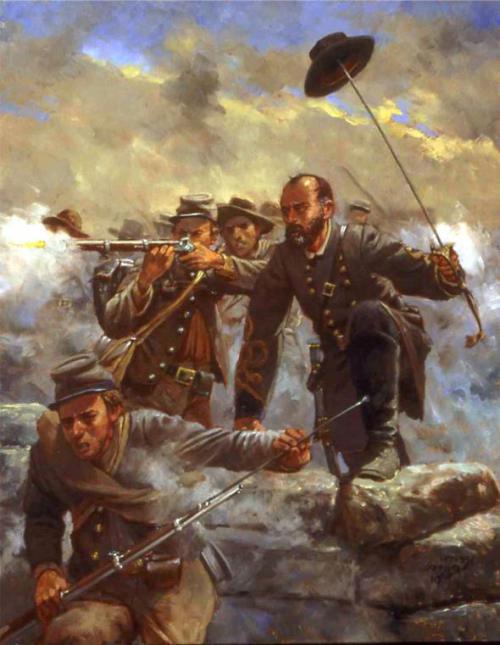
“Armistead at Gettysburg” by Keith Rocco

The bonds of friendship forged by soldiers are some of deepest and long lasting that are formed anywhere.  For American military professionals those bonds are formed in the small rather closed society that is the regular United States military. They are formed in war and peace, and are marked by years of deployments, isolated duty and combat. They are part of a culture that is often quite different than that of civilian society. That is the case now as it was in 1860.

When the Southern States seceded from the Union men who had spent much of their adult lives serving together discovered had to say goodbye and prepare to fight each other. Most did so with a heavy heart even though many had strong convictions about the rightness of their region’s cause. Those who left the army to serve the Confederate states were often torn by doubt and questions of where their loyalty lay. Robert E. Lee was a good example of the conflict that many Southern officers faced. “The Southern professional officer in 1861 was confronted with a cruel choice symbolized by Lee’s anguished pacing at Arlington. On one hand, the Southern officer’s political allegiances drew him to the Confederacy; on the other his professional responsibility drew him to the Union.” [1] They wrestled with their oath of office and the costs of perhaps having to face their dearest friends on future battlefields. Lee’s letter to his sister Ann Marshall, who remained a supporter of the Union, after he resigned from the army he had served for 32 years reflects that anguish, torn between his loyalties Lee wrote “With all my devotion to the Union, and the dear feeling of loyalty and duty of an American citizen, I have not been able to make up my mind to raise my hand against my relatives, my children, my home.” [2] He added: “I know you will blame me…but you must think as kindly of me as you can, and believe that I have endeavored to do what I think right.” [3]

They were different from the mass levies of civilian volunteers who rallied to the flags of the Union and Confederacy in 1861. The volunteers, most of whom did not have the deep and abiding friendships of the professionals were often motivated by ideological, sectional or religious hatred of the other and went to war with great aplomb. However, the professionals for the most part went to war against former comrades with heavy heart, “old army colleagues found themselves wrenched from the normal course of their lives when their states joined the Confederacy.” [4]

The American Civil War has many such tales. Porter Alexander wrote of his final words with his superior James B. McPherson, who later went on to be a highly successful corps commander under Grant and Sherman before being killed outside Atlanta in 1864. McPherson desired that Alexander remain in California as an Engineering officer and warned him about the nature of the coming war and gave him his counsel as a friend:

“Now this is not going to be any 90 day or six months affair as some of the politicians are predicting. Both sides are in deadly earnest & it is long & desperate & fought to the bitter end. ..God only knows what may happen to you individually, but for your cause there can be but one possible result. It must be lost….” [5]

Alexander wrote: “Nothing could exceed the kindness & real affection with which McPherson urged these views on me…. His earnest talk impressed me deeply & made me realize that a crisis in my life was at hand. But I felt helpless to avert it or even to debate the question what I should do. I could not controvert one of McPhersons’ statements or arguments; I could only answer this: “Mac, My people are going to war, & and for their liberty. If I don’t come & bear my part they will believe me a coward…” [6]

One of the most remembered is that of Union General Winfield Scott Hancock and Confederate General Lewis Armistead. It was key story line in Michael Shaara’s Pulitzer Prize winning novel The Killer Angels was immortalized in the movie Gettysburg which is based on Shaara’s novel.

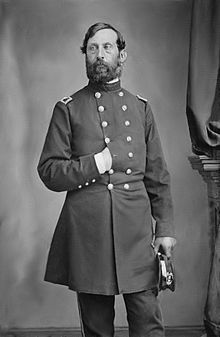
hancock 2

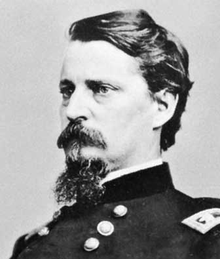
Major General Winfield Scott Hancock USA

Hancock was from Pennsylvania. He was a career soldier and Infantry officer, a graduate of West Point Class of 1844. He served in Mexico and held numerous positions. In 1861 he was stationed in California as a Quartermaster under the command of Colonel (Brevet Brigadier General) Albert Sidney Johnston with the Sixth Infantry Regiment. One of his fellow officers was Captain Lewis Armistead, a twice widowed Virginian who also served as a commander of the New San Diego Garrison under Johnston’s command, and Richard Garnett commanding a company at Fort Yuma. Hancock and his wife Almira became fast friends with the widowed Virginian.

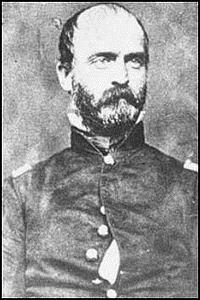
Armistead was a nephew of the officer who defended Fort McHenry from the British in the War of 1812. Armistead had academic and personal difficulties at West Point and “was bounced out, not once but twice.” [7] His troubles included an altercation with Jubal Early in which he broke a plate over Early’s head.  Between his academic difficulties and the fight with Early he resigned from the Academy. However, his father helped him obtain a commission as an Infantry officer in 1839. Armistead’s career from that point on was similar to many other officers of his day. He served with distinction in Mexico, the Great Plains, Kansas, Utah and California.

As the war clouds built and various southern states seceded from the Union numerous officers from the South were torn between their oath, their friendships and their deep loyalty to their home states and families. In the end most Southern officers resigned their commissions, many with mixed feelings and quite often sadness. A large minority, some “40 to 50 per cent of Southern West Point graduates on active duty in 1860 held on to their posts and remained faithful to the Union.” [8] The most prominent of these men were General Winfield Scott and Major General George Thomas, the “Rock of Chickamauga.” Likewise Union Brigadier General John Buford’s family in Kentucky supported the Confederacy.

For those southern officers who remained loyal to the Union to was often at a great personal cost. Thomas’s action cost him his relationship with his immediate family who deemed him to be a traitor. He and others were pilloried and demonized in the basest ways by many in the South. Some Southerners who served the Union were executed when they were captured. George Pickett, who called for his fellow Virginian Thomas’ death ordered 22 North Carolinians who he captured fighting for the Union in Kinston North Carolina to be executed. Pickett was not alone in such sentiments.

armistead2

Brigadier General Lewis Armistead CSA

However, for most it was different. As talk of secession and war heated up officers stationed on the frontier debated the issues and asked each other what they would do if war came. In California Armistead and other officers asked Hancock, who was a Democrat and not openly hostile to the South, advice on what he would do if war came. Hancock’s reply was simple. I shall not fight upon the principle of state-rights, but for the Union, whole and undivided” [9]

The parting came in 1861. When it was apparent that many officers would be resigning and heading home to join their state’s forces the Hancock’s hosted a going away party for their friends. Almira Hancock wrote of the party that “Hearts were filled with sadness over the surrendering of life-long ties.” [10]

Colonel Albert Sidney Johnston’s wife Eliza went to a piano and sang sentimental songs such as Mary of Argyle and the popular Irish song Kathleen Mavourneen. [11] Almira Hancock wrote “Those songs…will ever be remembered by survivors of that mournful gathering.” [12]

“Mavourneen, Mavourneen, my sad tears are falling, to think that from Erin and thee I must part!

It may be for years, and it may be forever, Then why art thou silent, thou voice of my heart?

The parting was especially emotional for Armistead who had been a friend of the Hancock’s for 17 years. They had helped in following the death of both of his wives and children. He was tearful. He put his arm on his friend’s shoulder as he said: “Hancock, good-by; you can never know what this has cost me, and I hope God will strike me dead if I am ever induced to leave my native soil, should worse come to worse.” [13]As he departed Armistead gave a wrapped Bible and Prayer book to Almira Hancock, in case of his death, inscribed were the words “Trust in God and fear nothing.” [14]

Armistead led his brigade during the Peninsula campaign and battles around Richmond and his brigade was decimated in Lee’s failed assault on prepared Federal positions at Malvern Hill. Armistead did not endear himself to many of the volunteer officers who served in the Confederate ranks. One of his Colonels resigned over Armistead’s supposedly harsh treatment to which Armistead replied: “I have felt obliged to speak to him as one military man would to another and as I have passed nearly all my life in camps my manner may not be understood or appreciated by one who has been all his life a civilian.” [15] Armistead’s words can easily be understood by military professionals whose lives have been shaped in a different manner than their civilian counterparts.

At Gettysburg Armistead spoke his fears about the charge to his comrades. One was Brigadier General Dick Garnett, another of Armistead and Hancock’s comrades from the California days on the night of July 2nd. Garnett’s career had paralleled that Armistead, the same age Garnett struggled at West Point in his third year “he failed and withdrew. Taking the same courses again during the next term, he finished fourteenth among his new classmates, then graduated in 1841 standing 29th of fifty-two graduates.” [16]

Armistead and Garnett served together in the Sixth Infantry for most of their careers. They were promoted at similar times, a pattern of promotion that continued into their Confederate service. The next afternoon, the two friends who had served together so long and whose careers were so similar led their brigades of Pickett’s Division across the valley between Seminary Ridge and Cemetery Ridge against their friend and comrade Winfield Scott Hancock’s II Corps which was defending Cemetery Ridge.

Garnett had to lead his brigade on foot, having been injured during the army’s march to Gettysburg. During the engagement Garnett was killed just before reaching the Union lines and Hancock gravely wounded. Armistead, lead the remnants of his decimated brigade to the Stone Wall, near the Copse of Trees. He rallied his troops fearing that some were faltering calling out: “Come on boys, give them the cold steel! Who will follow me?” [17]

His troops breached the Union line and his black hat atop his sword led his troops forward. He reached the now unmanned artillery of Cushing’s battery and called to his remaining men “The day is ours men, come and turn this artillery on them.” [18] It was then that he met more Federal troops who unleashed a volley of musket fire that cut down many of the survivors. Armistead was wounded in the right arm and shoulder and fell near one of the Union artillery pieces, a point now known as “The High Water Mark” of the Confederacy.

armistead memorial

As Armistead lay wounded he was approached by Major Bingham of Hancock’s staff. Bingham, a Mason noticed that Armistead was making a Masonic sign of distress. When Bingham told Armistead of Hancock’s injury Armistead was grieved and told Bingham to “Say to General Hancock for me that I have done him, and you all, an injury, which I shall always regret.” [19]

The meaning of those words is debated, especially by Southerners who cherish the myth of the Lost Cause. However, based on Armistead’s conduct and behavior in the time before he left California, it is not unreasonable to assume that as he lay dying he truly regretted what he had done. Armistead died from infections caused by his wounds which were initially not thought to be life threatening. A Union surgeon described him as: “seriously wounded, completely exhausted, and seemingly broken-spirited.” [20]

Garnett’s body was never found and was probably buried in a mass grave with other Confederate soldiers and was likely taken after the war to his native Virginia “together with thousands of unidentified bodies from Gettysburg, for burial in Richmond’s Hollywood Cemetery.[21] Armistead was buried by a member of the 107th Ohio near the XI Corps field hospital. About a month later a physician from Philadelphia tracked down the soldier and “dug up the “Rough box” containing the body and embalmed poor Armistead’s remains for sale to grieving family members.” [22] Armistead’s family buried the remains in Old Saint Paul’s Cemetery in Baltimore.

Robert Krick wrote: “Death on adjacent bits of blood soaked ground in Adams County, Pennsylvania, yielded a final common thread, that of indignity: Lewis Armistead’s corpse wound up a hostage to petty human greed, while Dick Garnett’s entirely disappeared.” [23]

Hancock’s injuries were severe, but he recovered. He would go on to continued fame and be one of the most admired and respected leaders of the Army during and after the war. He was gracious as a victor and spoke out against reprisals committed against Southerners after the war.

In 1880 Hancock was the Democratic nominee for President. He lost a close election to James Garfield, losing the popular vote by fewer than 40,000 votes. It was an era of great political corruption and Hancock was one of the few major public figures viewed favorably for his integrity. Even his political opponents respected him for his integrity and honesty. Former President Rutherford B Hayes said:

“if when we make up our estimate of a public man, conspicuous both as a soldier and in civil life, we are to think first and chiefly of his manhood, his integrity, his purity, his singleness of purpose, and his unselfish devotion to duty, we can truthfully say of Hancock that he was through and through pure gold.” [24]

A few years after his death Republican General Francis A Walker, lamenting the great corruption of the time said:

“Although I did not vote for General Hancock, I am strongly disposed to believe that one of the best things the nation has lost in recent years has been the example and the influence of that chivalric, stately, and splendid gentleman in the White House. Perhaps much which both parties now recognize as having been unfortunate and mischievous during the past thirteen years would have been avoided had General Hancock been elected.” [25]

The story of Hancock, Armistead and Garnett is one that reminds us of the depth of friendships that many military professionals develop and cherish. It is also a story that reminds us of how hardened ideologues can divide a nation to the point of civil war. It is a story that should give pause to any political or spiritual leader that incites people to war against their neighbor and uses their ideology to slander, demean or even enslave and brutalize their political opponents.

The blood of the approximately 50,000 soldiers that were killed or wounded during the three days of the Battle of Gettysburg is ample reminder of the tragedy of war, especially war that forces the dearest of friends to fight and even kill one another.

Notes

[1] Huntington, Samuel P. The Soldier and the State: The Theory and Politics of Civil-Military Relations, The Belknap Press of Harvard University Press, Cambridge MA and London 1957 p.212

[2] Thomas, Emory Robert E. Lee W.W. Norton and Company, New York and London 1995 p.188

[3] Korda, Michael. Clouds of Glory: The Life and Legend of Robert E. Lee Harper Collins Publishers, New York 2014 pp.230-231

[4] Jordan, David M. Winfield Scott Hancock: A Soldier’s Life Indiana University Press, Bloomington and Indianapolis 1988 p.33

[5] Alexander, Edward Porter. Fighting for the Confederacy: The Personal Recollections of General Edward Porter Alexander edited by Gary Gallagher University of North Carolina Press, Chapel Hill 1989 p.24

[6] Ibid. Alexander . Fighting for the Confederacy p.25

[7] Guelzo, Allen C. Gettysburg: The Last Invasion Vintage Books a Division of Random House, New York 2013 p.379

[8] Ibid. Huntington The Soldier and the State p.213

[9] Ibid. Jordan Winfield Scott Hancockp.33

[10] Ibid. Jordan Winfield Scott Hancockp.34

[11] Ibid. Jordan Winfield Scott Hancock p.34

[12] Ibid. Jordan Winfield Scott Hancock p.34

[13] Ibid. Jordan Winfield Scott Hancock p.34

[14] Krick, Robert K. The Parallel Lives of Two Virginia Soldiers Armistead and Garnett in The Third Day at Gettysburg and Beyond edited by Gary Gallagher, University of North Carolina Press, Chapel Hill and London 1994 p.112

[15] Tagg, Larry The Generals of Gettysburg: The Leaders of America’s Greatest Battle Da Capo Press Cambridge MA 1998 Amazon Kindle Edition p.244


[16] Ibid. Krick Armistead and Garnett p.101

[17] Stewart, George R. Pickett’s Charge: A Micro-History of the Final Attack at Gettysburg, July 3rd 1863Houghton Mifflin Company Boston 1959 pp.216-217

[18] Hess, Earl J. Pickett’s Charge: The Last Attack at Gettysburg University of North Carolina Press, Chapel Hill and London 2001 p.262

[19] Ibid. Stewart Pickett’s Charge pp.254-255

[20] Ibid. Stewart Pickett’s Charge pp.254

[21] Ibid. Krick Armistead and Garnett p.123

[22] Ibid. Krick Armistead and Garnett p.123

[23] Ibid. Krick Armistead and Garnett p.123

[24] Ibid. Jordan Winfield Scott Hancock p.319

[25] Stone, Irving They Also Ran Doubleday, New York 1943 and 1981 pg. 188


2 Comments

Filed under civil war, History, history, Military

“A Glittering Forrest of Bayonets” Pickett’s Charge

picketss-charge

“Danger is part of the friction of war. Without an accurate conception of danger we cannot understand war. That is why I have dealt with it here.” Carl Von Clausewitz [1]

When commanders send their troops into battle to execute the plans of their staff, they cannot forget that as Clausewitz noted that War is the province of danger and that:

“In the dreadful presence of suffering and danger, emotion can easily overwhelm intellectual conviction, and in the psychological fog it is so hard to form clear and complete insights that changes in view become more understandable and excusable….No degree of calm can provide enough protection: new impressions are too powerful, too vivid, and always assault the emotions as well as the intellect.” [2]

To re-engage our understanding of this issue is important, especially in the application of Mission Command where as General Martin Dempsey noted that “Understanding equips decision makers at all levels with the insight and foresight to make effective decisions, to manage the associated risks, and to consider second and subsequent order effects.” [3] The current and recent wars fought by the United States and its NATO and coalition allies have shielded many military professionals from this aspect of war, but it is still present and we should not ignore it. As noted in the 2006 edition of the Armed Forces Officer:

“The same technology that yields unparalleled success on the battlefield can also detach the warrior from the traditional ethos of the profession by insulating him or her from many of the human realities of war.” [4]

“The nature of the warrior leader is driven by the requirements of combat” [5]and courage, both “courage in the face of the danger, and the courage to accept responsibility” [6] are of paramount importance. In an era where the numbers of soldiers that actually experience combat or served in true combat conditions where the element of danger is ever present is shrinking, we can at least gain part of that understanding through the study of history, campaigns and battles and by actually walking the battlefields, and considering the effects of terrain, weather, exhaustion and the imagining danger faced in confronting an enemy on the field of battle. As such the Battle of Gettysburg and the climactic event of Pickett’s Charge on July 3rd is a good place to reimagine the element of danger.

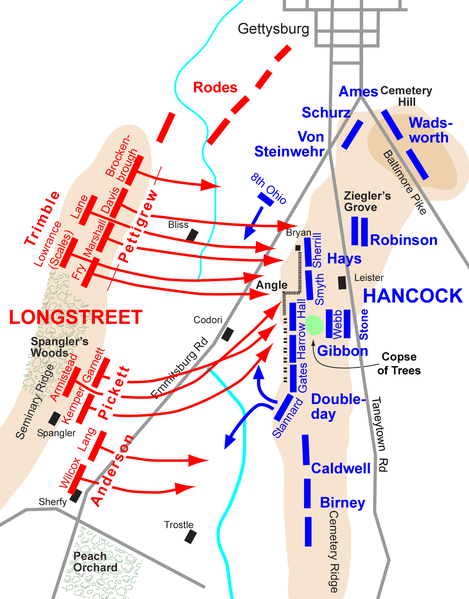
Porter Alexander’s artillery had begun it’s bombardment at 1:07 p.m. and as it did and the Union artillery commenced a deliberate counter-fire the Confederate infantry behind Seminary Ridge began to take a beating. Unlike the Confederate barrage which had mainly sailed over the Union troops on Cemetery Ridge causing few causalities, “a large proportion” of the Union “long shots landed squarely in the ranks of the gray soldiers drawn up to await the order to advance.” [7] Estimates vary but the waiting Confederates lost between 300-500 killed and wounded, the most affected was Kemper’s brigade of Pickett’s division which lost about 250 men, or 15% of its strength. [8] Other units lost significant numbers, with those inflicted on Pettigrew’s brigades further depleting their already sparse numbers.

Composed of Pickett’s fresh division from First Corps, Heth’s battered division now under Pettigrew which had already taken close to 40% casualties. Of the two brigades of Pender’s division now commanded by Trimble, Lane’s which was fresh but Scales brigade, now under command of Colonel William Lowrence had suffered greatly on July 1st; its “casualty rate was 63% and it had lost its commander and no fewer than fifty-five field and company grade officers.” [9] And now, these battered the units began to take casualties from well directed Federal fire. George Stewart wrote: “In most armies, such a battered unit would have been sent to the rear for reorganization, but here it was being selected for a climactic attack!” [10]

“The Confederate losses mounted at an alarming rate. The psychological impact of artillery casualties was great, for the big guns not only killed but mangled bodies, tore them apart, or disintegrated them.” [11] A survivor wrote his wife days later: “If the crash of worlds and all things combustible had been coming in collision with each other, it could not have surpassed it seemingly. To me it was like the “Magazine of Vengeance” blown up.” [12] A soldier of Kemper’s brigade recalled “The atmosphere was rent and broken by the rust and crash of projectiles…The sun, but a few minutes before so brilliant, was now darkened. Through this smoky darkness came the missiles of death…the scene beggars description…Many a fellow thought his time had come…Great big, stout hearted men prayed, loudly too….” [13] Colonel Joseph Mayo of the 3rd Virginia regiment was heavily hit, one of its survivors wrote “when the line rose up to charge…it appeared that as many were left dead and wounded as got up.” [14]

On the opposite ridge Union forces were experiencing the same kind of intense artillery fire. But these effects were minimized due to the prevalent overshooting of the Confederate artillery as well as the poor quality of ammunition. This resulted in few infantry casualties with the worst damage being taken by a few batteries of artillery at the angle. Soldiers behind the lines took the worst beating, but “the routing of these non-combatants was of no military significance,” [15] This did create some problems for the Federals as Meade was forced to abandon their headquarters and the Artillery Reserve was forced to relocate “a little over a half mile to the rear.” [16] The effects of this on operations were minimal as Brigadier General Robert Tyler commanding the Artillery Reserve “posted couriers at the abandoned position, should Hunt want to get in touch with him.” [17]

Despite the fusillade Meade maintained his humor and as some members of his staff tried to find cover on the far side of the little farmhouse quipped:

“Gentlemen, are you trying to find a safe place?…You remind me of the man who drove the oxen team which took ammunition for the heavy guns to the field at Palo Alto. Finding himself in range, he tipped up his cart and hid behind it. Just then General Taylor came along and shouted “You damned fool, don’t you know you are no safer there than anywhere else?” The driver responded, “I don’t suppose I am general, but it kind of feels so.” [18]

Despite the unparalleled bombardment, the likes which not had been seen on the American continent, the Confederate artillery had little actual effect on the charge. The Prussian observer travelling with Lee’s headquarters “dismissed the barrage as a Pulververschwindung,”…a waste of powder. [19] The Federal infantry remained in place and ready to meet the assault, Hunt replaced his damaged batteries and even more importantly Lieutenant Colonel Freeman McGilvery’s massive battery was lying undetected where it could deliver devastating enfilade fire as were Rittenhouse’s batteries on Little Round Top and Osborne’s on Cemetery Hill. These guns, unaffected by the Confederate bombardment were poised to wreak destruction on the men of the three Confederate divisions.

Unlike the Federal Army which had its large pool of artillery battalions in the Artillery Reserve with which to replace batteries that had taken casualties or were running low on ammunition, and “soon the drivers of the caissons found that the heavy fire had exhausted their supply of shot and shell, and the had to go even farther to get it from the reserve train. As a result some of the guns remained mute and their gunners stood helpless during the cannonade and charge, for Alexander had no batteries in reserve to replace them.” [20] The reason for this was that the Confederates had reorganized their artillery before Chancellorsville with all batteries assigned directly to the three infantry corps leaving the army without a reserve, and because Brigadier General William Pendleton had relocated the artillery trains further to the rear without informing Alexander or Longstreet. He had also ordered the eight guns of the Richardson’s artillery away without notifying anyone, guns which Alexander was counting on to support the attack. At about 2:20 p.m. Alexander, knowing that he was running short of ammunition sent a note to Picket and Pettigrew advising them:

“General: If you are to advance at all, you must come at once or we will not be able to support you as we ought. But the enemy’s fire has not slackened and there are still 18 guns firing from the cemetery.” [21]
469px-Picketts-Charge

About twenty minutes later Alexander saw some of the guns along Cemetery Ridge begin to limber up and depart, and noticed a considerable drop off in Federal fire. Now confident that his guns had broken the Federal resistance, at 2:40 sent word to Pickett “For God’s sake come quick or my ammunition will not let me support you.” [22] However, what Alexander did not realize was that to conserve ammunition for the Confederate infantry charge Henry Hunt had ordered those batteries to withdraw and was replacing them with fresh batteries and had ordered an “immediate cessation and preparation for the assault to follow.” [23]

The message reached Pickett and Pickett immediately rode off to confer with Longstreet. Pickett gave the message to Longstreet who read it “and said nothing. Pickett said, “General, shall I advance!” Longstreet, knowing it had to be, but unwilling to give the word, turned his face away. Pickett saluted and said “I am going to move forward, sir” galloped off to his division and immediately put it in motion.” [24]

A few minutes later Longstreet rode to find Alexander. Meeting him at 2:45 and Alexander informed him of the shortage of ammunition, which upset him enough that he “seemed momentarily stunned” [25] by this news Longstreet told Alexander, “Stop Pickett immediately and replenish your ammunition.” [26] But Alexander now had to give Longstreet even worse news telling him “I explained that it would take too long, and the enemy would recover from the effect of our fire was then having, and too that we had, moreover, very little to replenish it with.” [27] Longstreet continued to ride with Alexander and again eyed the Federal positions on Cemetery Ridge with his binoculars and said I don’t want to make this attack,” pausing between sentences as if thinking aloud. “I believe it will fail- I do not know how it can succeed- I would not make it even now, but Gen. Lee has ordered it and expects it.” [28] Alexander, who as a battalion commander now in charge of First Corps artillery was uncomfortable, he later wrote:

“I had the feeling that he was on the verge of stopping the charge, & that with even slight encouragement he would do it. But that very feeling kept me from saying a word, or either assent I would not willingly take any responsibility in so grave a matter & I had almost a morbid fear of causing any loss of time. So I stood by, & looked on, in silence almost embarrassing.” [29]

While Longstreet was still speaking Pickett’s division swept out of the woods to begin the assault, Alexander knew that “the battle was lost if we stopped. Ammunition was too low to try anything else, for we had been fighting for three days. There was a chance, and it was not my part to interfere.” [30]

Despite this Pickett and many of his soldiers were confident of success, and “no officer reflected the men’s confidence better than George Pickett. There was no fatalism in him. Believing that his hour of destiny had come and expecting to take fortune at its flood, he rode down the slop like a knight in a tournament.” [31] Pickett was “an unforgettable man at first sight” [32] Pickett was exceptionally undistinguished in the West Point class of 1846, graduating last in the class, but “fought valiantly in a number of battles” [33] during the Mexican War alongside James Longstreet. Like many he officers he resigned his commission in 1861 and received a colonelcy in the new Confederate army. During the Seven Days battles he commanded a brigade, which was now commanded by Richard Garnett and was wounded at Gaines Mill. Promoted to Major General in the summer of 1862 Pickett received command of the division formerly commanded by David R. Jones. The division was sent to peripheral areas and took no part in the battles of late 1862 or Chancellorsville. Reduced from its five brigade strength due to the insistence of Jefferson Davis to leave forces to protect Richmond the division was built around the brigades of James Kemper, Lewis Armistead and Richard Garnett.

When Pickett’s division as well as those of Pettigrew and Trimble swept out of the wood to begin the attack the last chance to stop it ended. As Pickett’s brigades moved out he encouraged them shouting “Remember Old Virginia!” or to Garnett’s men “Up, men, and to your posts! Don’t forget today that you are from Old Virginia!” [34] But when Garnett asked if there were any final instructions Pickett was told “I advise you to make the best kind of time in crossing the valley; it’s a hell of an ugly looking place over yonder.” [35] Armistead called out to his soldiers, “Men, remember who you are fighting for! Your homes, your firesides, and your sweethearts! Follow Me!” [36]Armistead’s example had a major impact on his brigade, men were inspired, as one later wrote “They saw his determination, and they were resolved to follow their heroic leader until the enemy’s bullets stopped them.” [37] about 500 yards to Pickett’s left Pettigrew exhorted his men “for the honor of the good old North State, forward.” [38]

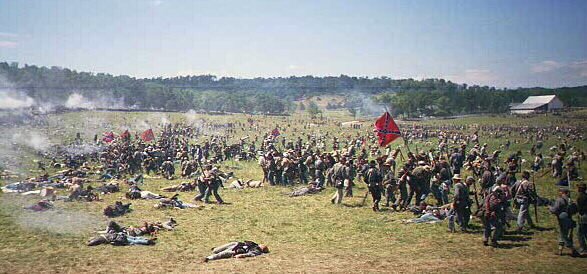
Pickett’s division “showed the full length of its long gray ranks and shining bayonets, as grand as a sight as ever a man looked on.” [39] The sight was impressive on both sides of the line, a Confederate Captain recalling the “glittering forest of bayonets” the two half mile wide formations bearing down “in superb alignment.” [40] even impressing the Federals. Colonel Philippe Regis de Trobriand, a veteran of many battles in Europe and the United States recalled “it was a splendid sight,” [41] and another recalled that the Confederate line ‘gave their line an appearance of being irresistible.” [42]

But the Federals were confident. Having withstood the Confederates for two days and having survived the artillery bombardment the Union men eagerly awaited the advancing Confederates. Directly facing the Confederate advance in the center of the Union line was the division of John Gibbon. The cry went out “Here they come! Here they come! Here comes the infantry!” [43] To the left of Gibbon Alexander Hays called to his men “Now boys look out…now you will see some fun!” [44]

The Confederates faced difficulties as they advanced, and not just from the Union artillery which now was already taking a terrible toll on the advancing Confederates. Stuck by the massed enfilade fire coming from Cemetery Hill and Little Round Top continued their steady grim advance. Carl Schurz from his vantage point on Cemetery Hill recalled:

“Through our field-glasses we could distinctly see the gaps torn in their ranks, the grass dotted with dark spots- their dead and wounded….But the brave rebels promptly filled the gaps from behind or by closing up on their colors, and unasked and unhesitatingly they continued with their onward march.” [45]

Pettigrew’s division was met by fire which enveloped them obliquely from Osborne’s 39 guns on Cemetery Hill. On the left flank a small regiment, the 8th Ohio lay in wait. Seeing an opportunity the commander Lieutenant Colonel Franklin Sawyer deployed his 160 men in a single line, took aim at Brockenbrough’s Virginia brigade some two hundred yards ahead of the Emmitsburg Road, and opened a devastating fire. “Above the boiling clouds the Union men could see a ghastly debris of guns, knapsacks, blanket rolls, severed human heads, and arms and legs and parts of bodies tossed into the air by the impact of the shot.” [46] So sudden and unexpected was this that the Confederates panicked and “fled in confusion…” to the rear where they created more chaos in Trimble’s advancing lines as one observed they “Came tearing through our ranks, which caused many men to break.” [47] The effect on Confederate morale was very important, for “the Army of Northern Virginia was not used to seeing a brigade, even a small one, go streaming off to the rear, with all its flags….Even Pickett’s men sensed that something disastrous had happened on the left….” [48]

In one fell swoop Pettigrew was minus four regiments. Brockenbrough was singularly ineffective in leading his men, he “was a nonentity who did not know how to control his recalcitrant rank and file; nor did he have the presence to impress his subordinate officers and encourage them to do his bidding.” [49] The disaster that had overtaken Brockenbrough’s brigade now threated “another important component of Lee’s plan-the protection so necessary for the left flank of the advancing line had collapsed.

Pettigrew’s division continued its advance after Brockenbrough’s brigade collapsed, but the Confederate left was already beginning to crumble. “Sawyer changed front, putting his men behind a fence, and the regiment began firing into the Confederate flank.” [50] with Davis’s brigade now taking the brunt of the storm of artillery shells from Osborne’s guns. This brigade had suffered terribly at the railroad cut on July 1st, especially in terms of field and company grade officers was virtually leaderless, and “the inexperienced Joe Davis was helpless to control them.” [51] To escape the devastating fire Davis ordered his brigade to advance at the double quick which brought them across the Emmitsburg Road ahead of the rest of the division, where they were confronted by enfilade canister fire from Woodruff’s battery to its left, as well as several regiments of Federal infantry and from the 12th New Jersey directly in their front. A New Jersey soldier recalled “We opened on them and they fell like grain before the reaper, which nearly annihilated them.” [52] Davis noted that the enemy’s fire “commanded our front and left with fatal effect.” [53] Davis saw that further continuing was hopeless and ordered his decimated brigade “to retire to the position originally held.” [54]

Pettigrew’s remain two brigades continued grimly on to the Emmitsburg Road, now completely devoid of support on their left flank. Under converging fire from Hay’s Federal troops the remaining troops of Pettigrew’s command were slaughtered. Hay’s recalled “As soon as the enemy got within range we poured into them and the cannon opened with grape and canister [, and] we mowed them down in heaps.” [55] The combination of shot, shell, canister and massed musket fire “simply erased the North Carolinian’s ranks.” [56] Pettigrew was wounded, Colonel Charles Marshall killed 50 yards from the stone wall and “only remnants of companies and regiments remained unscathed.” [57] Soon the assault of Pettigrew’s division was broken:

“Suddenly Pettigrew’s men passed the limit of human endurance and the lines broke apart and the hillside covered with men running for cover, and the Federal gunners burned the ground with shell and canister. On the field, among the dead and wounded, prostrate men could be seen holding up handkerchiefs in sign of surrender.” [58]

Trimble’s two brigades fared no better. Scales brigade, now under the command of Colonel W. Lee Lowrence “never crossed the Emmitsburg Road but instead took position along it to fire at the enemy on the hill. The soldiers from North Carolina who two days before had marched without flinching into the maw of Wainwright’s cannon on Seminary Ridge could not repeat the performance.” [59] Trimble was severely wounded in the leg and sent a message to Lane to take command of the division. The order written in the third person added a compliment to his troops: “He also directs me to say that if the troops he had the honor to command today for the first time couldn’t take that position, all hell can’t take it.” [60] Lane attempted to rally the troops for one last charge when one of his regimental commanders exploded telling him “My God, General, do you intend rushing your men into such a place unsupported, when the troops on the right are falling back?” [61] Lane looked at the broken remains of Pettigrew’s division retiring from the field and ordered a retreat. Seeing the broken remnants of the command retreating, an aide asked Trimble if the troops should be rallied. Trimble nearly faint from loss of blood replied: “No Charley the best these brave fellows can do is to get out of this,” so “let them get out of this, it’s all over.” [62] The charge was over on the Confederate left.

The concentrated Federal fire was just as effective and deadly on the Confederate right. Kemper’s brigade, on the right of Pickett’s advance was mauled by the artillery of Rittenhouse on Little Round Top, which “tracked their victims with cruel precision of marksmen in a monstrous shooting gallery” and the overs “landed their shots on Garnett’s ranks “with fearful effect.” [63]

As the Confederates advanced Pickett was forced to attempt to shift his division to the left to cover the gap between his and Pettigrew’s division. The move involved a forty-five degree oblique and the fences, which had been discounted by Lee as an obstacle which along the Emmitsburg Road “virtually stopped all forward movement as men climbed over them or crowed through the few openings.” [64] Pickett’s division’s oblique movements to join with Pettigrew’s had presented the flank of his division to McGilvery’s massed battery. The movement itself had been masterful, the execution of it under heavy fire impressive; however it meant the slaughter of his men who were without support on their right flank.

As Pickett’s division advanced into the Plum Run Valley they were met by the artillery of Freeman McGilvery, who wrote that the “execution of the fire must have been terrible, as it was over a level plain, and the effect was plain to be seen. In a few minutes, instead of a well-ordered line of battle, there were broken and confused masses, and fugitives fleeing in every direction.” [65]

Kemper’s brigade which had the furthest to go and the most complicated maneuvering to do under the massed artillery fire suffered more damage. The swale created by Plum Run was a “natural bowling alley for the projectiles fired by Rittenhouse and McGilvery.” [66] was now flanked by Federal infantry as it passed the Condori farm. The Federal troops were those of the Vermont brigade commanded by Brigadier General George Stannard. These troops were nine month volunteers recruited in the fall of 1862 and due to muster our in a few days. They were new to combat, but one of the largest brigades in the army and 13th Vermont “had performed with veteran like precision the day before” [67] leading Hancock to use them to assault the Confederate right. The Vermonters were positioned to pour fire into the Confederate flank, adding to the carnage created by the artillery, and the 13th and 16th Vermont “pivoted ninety degrees to the right and fired a succession of volleys at pistol range on the right of Pickett’s flank.” [68]

Kemper had not expected this, assuming that the Brigades of Wilcox and Perry would be providing support on the flank. As he asked a wounded officer of Garnett’s brigade if his wound was serious, the officer replied that he soon expected to be a prisoner and asked Kemper “Don’t you see those flanking columns the enemy are throwing on our right to sweep the field?” [69] Kemper was stunned but ordered his troops to rush federal guns, but “they were torn to pieces first by the artillery and then by the successive musketry of three and a half brigades of Yankee infantry.” [70] Kemper was fearfully wounded in the groin, no longer capable of command. His brigade was decimated and parts of two regiments had to refuse their line to protect the flank, and those that continued to advance had hardly any strength left with which to succeed, the Confederate left was no for all intents and purposes out of the fight.

Now that fight was left in the hands of Armistead and Garnett’s brigades, and at this moment in the battle, the survivors of those units approached the stone wall and the angle where they outnumbered the Federal defenders, one regiment of which, the 71st Pennsylvania had bolted to the rear.

The survivors of Garnett’s brigade, led by their courageous but injured commander, riding fully exposed to Federal fire on his horse crossed the Emmitsburg Road and pushed forward overwhelming the few Federals remaining at the wall. They reached the outer area of the angle “which had been abandoned by the 71st Pennsylvania” and some of his men “stood on the stones yelling triumphantly at their foes.” [71] Armistead, leap over the wall shouting to his men “Come on boys! Give them the cold steel”…and holding his saber high, still with the black hat balanced on its tip for a guidon, he stepped over the wall yelling as he did so: “Follow me!” [72]

However, their triumph was short lived; the 72nd Pennsylvania was rushed into the gap by the brigade commander Brigadier General Alexander Webb. The climax of the battle was now at hand and “the next few minutes would tell the story, and what that story would be would all depend on whether these blue-coated soldiers really meant it…. Right here there were more Confederates than Federals, and every man was firing in a wild, feverish haste, with smoke settling down thicker and thicker.” [73] The 69th Pennsylvania, an Irish regiment under Colonel Dennis O’Kane stood fast and their fire slaughtered many Confederates. Other Federal regiments poured into the fight, famous veteran regiments the 19th and 20th Massachusetts, the 7th Michigan and the remnants of the 1st Minnesota who had helped stop the final Confederate assault on July 2nd at such fearful cost.

Dick Garnett, still leading his troops “muffled in his dark overcoat, cheered his troops, waving a black hat with a silver cord” [74] when he was shot down, his frightened horse running alone off the battlefield, a symbol of the disaster which had befallen Pickett’s division. Armistead reached Cushing’s guns where he was hit by several bullets and collapsed mortally wounded. “Armistead had been the driving force behind the last effort, there was no one else on hand to take the initiative. Almost as quickly as it had come crashing in, the Rebel tide inside the outer angle ebbed back to the wall.” [75]

For a time the Confederate survivors engaged Webb’s men in a battle at the wall itself in a stubborn contest. A Federal regimental commander wrote “The opposing lines were standing as if rooted, dealing death into each other.” [76] The Federals launched a local counterattack and many Confederates elected to surrender rather than face the prospect of retiring across the battlefield that was still swept by Federal fire.

Webb had performed brilliantly in repulsing the final Confederate charge and “gained for himself an undying reputation. Faced with defeat, he accepted the challenge and held his men together through great personal exertion and a willingness to risk his life.” [77] For his efforts he was belatedly awarded the Medal of Honor.

Webb, like John Buford on July 1st, Strong Vincent, Freeman McGilvery and George Sears Greene on July 2nd, was instrumental in the Union victory. Hancock said of Webb “In every battle and on every important field there is one spot to which every army [officer] would wish to be assigned- the spot upon which centers the fortunes of the field. There was but one such spot at Gettysburg and it fell to the lot of Gen’l Webb to have it and to hold it and for holding it he must receive the credit due him.” [78]

The survivors of Pickett, Pettigrew and Trimble’s shattered divisions began to retreat, Lee did not yet understand that his great assault had been defeated, but Longstreet, who was in a position to observe the horror was. He was approached by Lieutenant Colonel Arthur Fremantle, a British observer from the Coldstream Guards. Fremantle did not realize that the attack had been repulsed, having just seen one of Longstreet’s regiments “advancing through the woods in good order” and unwisely bubbled “I would not have missed this for anything.” [79] Longstreet replied with a sarcastic laugh “The devil you wouldn’t” barked Longstreet. “I would have liked to have missed this very much; we’ve attacked and been repulsed. Look there.” [80] Fremantle looked out and “for the first time I then had a view of the open space between the two positions, and saw it covered with Confederates slowly and sulkily returning towards us in small broken parties, under a heavy fire of artillery.” [81] Henry Owen of the 18th Virginia wrote that the retreating men “without distinction of rank, officers and privates side by side, pushed, poured and rushed in a continuous stream, throwing away guns, blankets, and haversacks as they hurried on in confusion to the rear.” [82]

It was a vision of utter defeat. Pickett, who had seen his division destroyed and had been unable to get it additional support was distraught. An aide noted that Pickett was “greatly affected and to some extent unnerved” [83] by the defeat. “He found Longstreet and poured out his heart in “terrible agony”: “General, I am ruined; my division is gone- it is destroyed.” [84] Lee had come up by now and attempted to comfort Pickett grasping his hand and telling him: “General, your men have done all that they could do, the fault is entirely my own” and instructed him that he “should place his division in the rear of this hill, and be ready to repel the advance of the enemy should they follow up their advantage.” [85] The anguished Pickett replied, “General Lee, I have no division now. Armistead is down, Garnett is down and Kemper is mortally wounded.” [86]

picketts charge1

Pickett’s charge was over, and with it the campaign that Lee had hoped would secure the independence of the Confederacy was effectively over, and the Battle of Gettysburg lost. “Lee’s plan was almost Burnside-like in its simplicity, and it produced a Fredericksburg with the roles reversed.” [87]

It was more than a military defeat, but a political one as well for with it went the slightest hope remaining of foreign intervention. As J.F.C. Fuller wrote “It began as a political move and it had ended in a political fiasco.” [88]


[1] Clausewitz, Carl von. On War Indexed edition, edited and translated by Michael Howard and Peter Paret, Princeton University Press, Princeton NJ 1976 p.114

[2] Ibid. Clausewitz On War p.108

[3] Dempsey, Martin Mission Command White Paper 3 April 2012 p.5 retrieved ( July 2014 from http://www.dtic.mil/doctrine/concepts/white_papers/cjcs_wp_missioncommand.pdf

[4] ___________. The Armed forces OfficerU.S. Department of Defense Publication, Washington DC. January 2006 p.18

[5] Ibid. The Armed Forces Officer p.18

[6] Ibid. Clausewitz On War p.101

[7] Foote, Shelby, The Civil War, A Narrative. Volume Two Fredericksburg to Meridian Random House, New York 1963 p.548

[8] Gottfried, Bradley The Artillery of Gettysburg Cumberland House Publishing, Nashville TN 2008 p.

[9] Sears, Stephen W. Gettysburg. Houghton Mifflin Co. Boston and New York 2003 p.387

[10] Stewart, George R. Pickett’s Charge: A Micro-History of the Final Attack at Gettysburg, July 3rd 1863Houghton Mifflin Company Boston 1959

[11] Hess, Earl J. Picketts Charge: The Last Attack at Gettysburg University of North Carolina Press, Chapel Hill and London 2001 p.153

[12]Wert, Jeffery D. Gettysburg Day Three A Touchstone Book, New York 2001 p.181

[13] Dowdy, Clifford. Lee and His Men at Gettysburg: The Death of a Nation Skyhorse Publishing, New York 1986, originally published as Death of a Nation Knopf, New York 1958 p.294

[14] Ibid. Wert Gettysburg Day Three p.179

[15] Ibid. Stewart Pickett’s Charge p.132

[16] Coddington, Edwin B. The Gettysburg Campaign: A Study in Command, A Touchstone Book, Simon and Schuster New York, 1968 p.496

[17] Ibid. Coddington The Gettysburg Campaign p.496

[18] Huntington, Tom Searching for George Gordon Meade: The Forgotten Victor of GettysburgStackpole Books, Mechanicsburg PA 2013 p.171

[19] Ibid. Hess Pickett’s Charge p.163

[20] Ibid. Coddington The Gettysburg Campaign p.499

[21] Trudeau, Noah Andre. Gettysburg: A Testing of Courage, Harper Collins Publishers, New York 2002 p.459

[22] Ibid. Coddington The Gettysburg Campaign p.500

[23] Hunt, Henry The Third Day at Gettysburg in Battles and Leaders of the Civil Waredited by Bradford, Neil Meridian Press, New York 1989 p.374

[24] Alexander, Edwin Porter. The Great Charge and the Artillery Fighting at Gettysburg, in Battles and Leaders of the Civil Waredited by Bradford, Neil Meridian Press, New York 1989 p.364

[25] Ibid. Coddington The Gettysburg Campaign p.501

[26] Ibid. Alexander The Great Charge and the Artillery Fighting at Gettysburg p.365

[27] Ibid. Alexander The Great Charge and the Artillery Fighting at Gettysburg p.365

[28] Ibid. Trudeau. Gettysburg: A Testing of Courage pp.474-475

[29] Ibid. Alexander The Great Charge and the Artillery Fighting at Gettysburg p.365

[30] Alexander, Edward Porter. Fighting for the Confederacy: The Personal Recollections of General Edward Porter Alexander edited by Gary Gallagher University of North Carolina Press, Chapel Hill 1989 p.261

[31] Ibid. Dowdy Lee and His Men at Gettysburg p.313

[32] Ibid. Wert Gettysburg Day Three p.109

[33] Ibid. Hess Pickett’s Charge p.37

[34] Guelzo, Allen C. Gettysburg: The Last InvasionVintage Books a Division of Random House, New York 2013 p.408

[35] Ibid. Hess Pickett’s Charge p.166

[36] Ibid. Hess Pickett’s Charge p.167

[37] Ibid. Hess Pickett’s Charge p.167

[38] Ibid. Trudeau. Gettysburg: A Testing of Courage p.483

[39] Ibid. Alexander The Great Charge and the Artillery Fighting at Gettysburg p.365

[40] Ibid. Foote The Civil War, A Narrative. Volume Two p.553

[41] Ibid. Guelzo Gettysburg: The Last Invasion p.407

[42] Ibid. Hess Pickett’s Charge p.193

[43] Ibid. Hess Pickett’s Charge p.193

[44] Ibid. Guelzo Gettysburg: The Last Invasion p.411

[45] Ibid. Sears Gettysburg p.422

[46] Catton, Bruce The Army of the Potomac: Glory Road Doubleday and Company, Garden City New York, 1952 p.318

[47] Ibid. Sears Gettysburg p.423

[48] Ibid. Stewart Pickett’s Charge: A Micro-History of the Final Attack at Gettysburg pp.193-194

[49] Ibid. Hess Pickett’s Charge p.187

[50] Ibid. Stewart Pickett’s Charge: A Micro-History of the Final Attack at Gettysburg p.193

[51] Ibid. Dowdy Lee and His Men at Gettysburg p.311

[52] Ibid. Trudeau. Gettysburg: A Testing of Courage p.494

[53] Ibid. Sears Gettysburg p.425

[54] Ibid. Trudeau. Gettysburg: A Testing of Courage p.494

[55] Ibid. Trudeau. Gettysburg: A Testing of Courage p.502

[56] Ibid. Wert Gettysburg Day Three p.216

[57] Ibid. Wert Gettysburg Day Three p.218

[58] Ibid. Catton The Army of the Potomac: Glory Road p.318

[59] Ibid. Trudeau. Gettysburg: A Testing of Courage p.504

[60] Ibid. Stewart Pickett’s Charge: A Micro-History of the Final Attack at Gettysburg pp.238-239

[61] Ibid. Trudeau. Gettysburg: A Testing of Courage p.504

[62] Ibid. Guelzo Gettysburg: The Last Invasion p.425

[63] Ibid. Foote The Civil War, A Narrative. Volume Two p.555

[64] Ibid. Coddington The Gettysburg Campaign p.503

[65] Ibid. Gottfried The Artillery of Gettysburg p.217

[66] Ibid. Hess Pickett’s Charge p.220

[67] Ibid. Coddington The Gettysburg Campaign p.515

[68] Ibid. Coddington The Gettysburg Campaign p.515

[69] Ibid. Trudeau. Gettysburg: A Testing of Courage p.502

[70] Ibid. Sears Gettysburg p.448

[71] Ibid. Trudeau. Gettysburg: A Testing of Courage p.505

[72] Ibid. Foote The Civil War, A Narrative. Volume Two p.562

[73] Ibid. Catton The Army of the Potomac: Glory Road p.319

[74] Ibid. Dowdy Lee and His Men at Gettysburg p.317

[75] Ibid. Trudeau Gettysburg p.508

[76] Ibid. Sears Gettysburg p.451

[77] Ibid. Coddington The Gettysburg Campaign p.528

[78] Ibid. Coddington The Gettysburg Campaign p.528

[79] Fremantle, Arthur Three Months in the Southern States, April- June 1863 William Blackwood and Sons, Edinburgh and London 1863 Amazon Kindle edition p.285

[80] Wert, Jeffry D. General James Longstreet The Confederacy’s Most Controversial Soldier, A Touchstone Book, Simon and Schuster, New York and London 1993 p.292

[81] Ibid. Fremantle Three Months in the Southern States p.287

[82] Ibid. Sears Gettysburg p.456

[83] bid. Hess Pickett’s Charge p.326

[84] Ibid. Guelzo Gettysburg: The Last Invasion p.428

[85] Ibid. Guelzo Gettysburg: The Last Invasion p.428

[86] Ibid. Hess Pickett’s Charge p.326

[87] Millet, Allan R. and Maslowski, Peter, For the Common Defense: A Military History of the United States The Free Press a Division of Macmillan Inc. New York, 1984 p.206

[88] Fuller, J.F.C. Grant and Lee: A Study in Personality and Generalship, Indiana University Press, Bloomington IN 1957 pp.200-201

 

Leave a comment

Filed under civil war, History, leadership, Military

“Well, We May as Well Fight it out Here” Meade Decides to Fight at Gettysburg

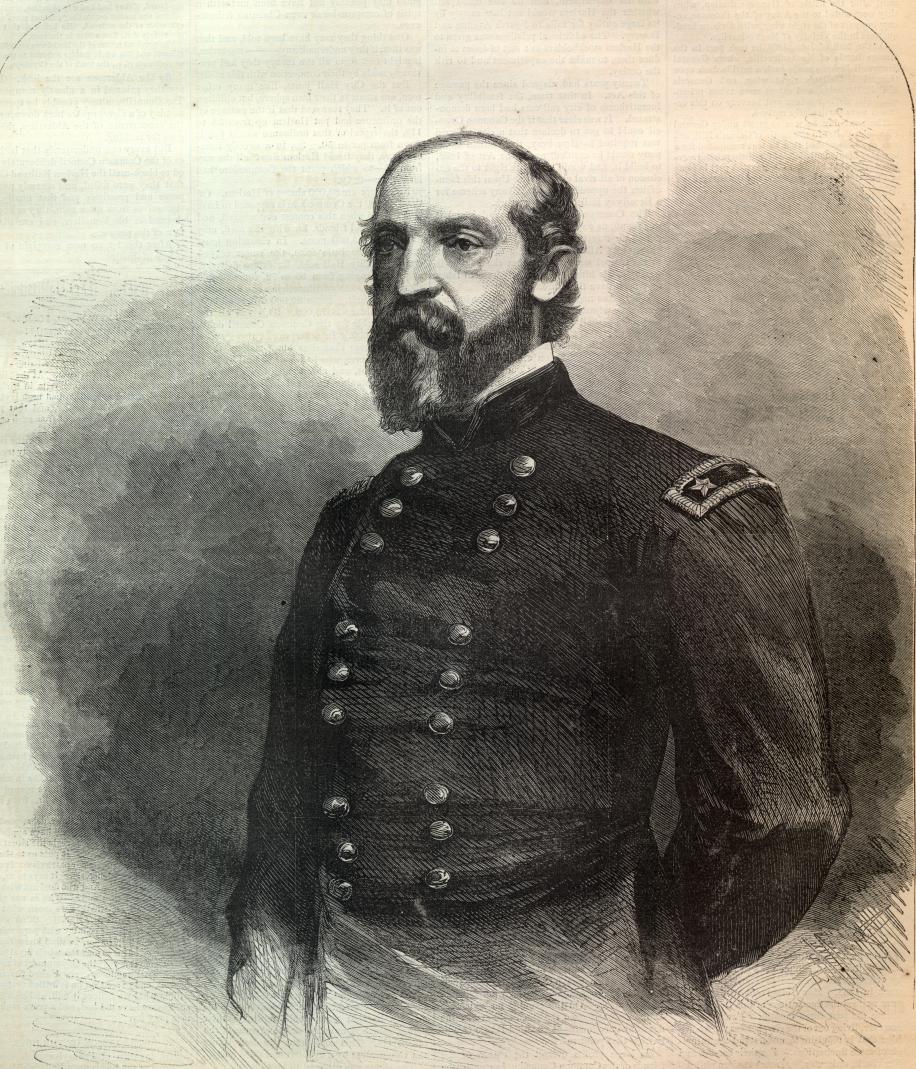
general-george-meade

“General Meade will commit no blunder in my front, and if I commit one he will make haste to take advantage of it.” Robert E Lee June 28th 1863

The choosing of the place to give battle, at any level of war, but particularly at the operational level is always of the utmost importance and has been so from time immemorial. Despite advances in technology terrain and weather are major factors that a commander or staff must consider in terms of their courses of action. Knowing the terrain features as well as the infrastructure such as road networks that they are operating on allows commanders to choose courses of action which accentuate their strengths and expose their opponent’s weaknesses. To understand this is a key part of Course of Action (COA) development, Operational Art and Operational Design as well as analyzing Centers of Gravity, especially in determining decisive points.

While the commanders at Gettysburg did not use such terminology, they did understand the effects of terrain and weather, friction and the importance of occupying “good ground.” Our understanding of these concepts can help us draw from the actions of the commanders at Gettysburg lessons that we can employ today, despite the vast changes in technology and expansion of the battlefield.

As he looked at the dispositions of the Confederate army on June 30th George Gordon Meade “felt he had move his forces in such a way as to challenge the enemy advance while at the same time protecting Washington and Baltimore.” 1 To do this he decided to concentrate the Army of the Potomac along what is known as the Pipe Creek line, a line along Parr’s Ridge just behind Pipe Creek to the south of Meade’s Taneytown headquarters. As an engineer Meade recognized the The decision was made because he realized that his advance had caused Lee’s army to abandon its threatening movement toward Harrisburg and the Susquehanna and was concentrating in the general area of Cashtown, South Mountain and possibly advancing toward Gettysburg.

The Pipe Creek line offered Meade a number of advantages; “it covered his own supply line and blocked the direct route to Baltimore.” 2 The positions of his intrenched army there would be “almost impossible to storm by frontal attack” 3 as well as allow his army to concentrate quickly. By placing himself in that position Meade believed that it would force Lee to attack him on good ground of his own choosing, offer him the chance to attack should Lee divide his forces, or by allowing Lee to exhaust his forage and supplies to withdraw from Pennsylvania without giving battle. Meade’s intention at Pipe Creek was to fight the “kind of battle he was to fight at Gettysburg.” 4

However Meade’s carefully laid plan became a victim of circumstances as events progressed during the evening of June 30th and morning of July 1st. When Reynolds was told by Buford that contact had been made and the Confederates were advancing on Gettysburg he brought I Corps and XI Corps up as quickly as he could and issued orders for III Corps under Sickles to join them at Gettysburg.

About 1130 a.m. Meade received word from John Reynolds’ aide Captain Stephen Weld that Reynolds had engaged the enemy at Gettysburg and had not received Meade’s Pipe Creek circular, which jeopardized his plan. Meade, having not known that Reynolds was not acting on his latest plan had assumed that Reynolds was conducting a temporary holding action at Gettysburg, but at 1 p.m. he was given the message that “Reynolds was dead or severely wounded and that Otis Howard was in command on the field.” 5 At this point Meade wasted no time and appointed Winfield Scott Hancock to go to Gettysburg and take charge of the situation, not trusting Howard’s abilities and instructed him “If you think the ground and position there are a better one to fight under existing circumstances, you will so advise the General, and he will order his troops up.” 6 He placed John Gibbon in command of II Corps and because he was concerned that Lee might cut off the embattled I Corps and XI Corps.

It was at this point that Meade decided to abandon his Pipe Creek plan and even before getting Hancock’s report, issued orders to his Corps commanders. At about 4:30 p.m. Meade ordered Sedgwick and his VI Corps up to Taneytown and put Slocum’s XII Corps and Sykes V Corps on the road to “move up to Gettysburg at once.” 7

Throughout the afternoon Meade kept his wits and “may have restrained a natural impulse to rush to the battleground and take over control of affairs himself.” 8 After the battle some criticized Meade for this, but it was from a perspective of command, and what we now call Mission Command did the right thing. He stayed at his headquarters to better control the movements and communicate with all his forces, which he could not have done had he rushed to the front, and instead “delegated authority to a highly competent subordinate, while he himself stayed close to the center of operations at army headquarters.” 9

Had Meade done what many commanders might have done in his position, and moved to the battle he might not have been able to do the more important job of ensuring the in a moment of crisis that his subordinate commanders received his orders and moved their units where they were needed. In fact any delay of getting the Union forces to Gettysburg could have been fatal to his army and allowed Lee to gain the advantage and possibly defeat his forces in detail. Likewise if Hancock arrived and found that the position could not be held, Meade would still be in position to ensure that the Pipe Creek position could be held.

The man he appointed in his stead, Hancock was someone that was not only capable but someone that “was a man who he knew and could trust,” 10 and who despite being junior to Howard, Slocum and Sickles was able to diplomatically handle the awkwardness of the situation. After Hancock arrived on the field he took in the tactical situation and judged it “the strongest position by nature on which to fight a battle that I ever saw.” 11

Howard objected to Hancock taking charge of the battlefield due to seniority, and although Howard had selected the position, demurred to Howard and said “and if it meets your approbation I will select this as the battlefield.” After Howard concurred Hancock announced “Very well, sir. I select this as the battlefield.” 12 While Howard could make the claim that he actually selected the ground of where to fight by emplacing Steinwehr’s division on the Hill as a reserve and withdrawing the battered remnants of I Corps and XI Corps to it during the afternoon, it was Hancock that “organized the all-round defense of the position.” 13 After consulting with Howard and directing Slocum’s XII Corps to occupy Culp’s Hill Hancock sent his aide Major William Mitchell to tell Meade that the position “could not well be taken.” 14 He had III Corps extend the line down Cemetery Ridge and directed his own II Corps to protect the flank in case Lee attempted to turn the Federal left. Upon Slocum’s arrival Hancock relinquished command and rode to Taneytown to personally brief Meade on the situation.

When Meade received word that from Hancock that he believed that “Gettysburg could maintain itself until dark” he dispatched a message to Hancock and Doubleday “It seems to me that we have so concentrated that a battle at Gettysburg is now forced upon us.” 15 Meade then sent a dispatch to Henry Halleck in Washington: “A.P. Hill and Ewell are certainly concentrating…Longstreet’s whereabouts I do not know. If he is not up tomorrow, I hope with the force I have concentrated to defeat Hill and Ewell; at any rate I see no other course that to hazard a general battle.” 16 He added “Circumstances during the night may alter this decision, of which I will try to advise you.” 17 Upon sending out his final orders directing all units to Gettysburg he had his headquarters strike its tents and equipment and begin to move to Gettysburg, being briefed by Hancock before he set off at 10 p.m.

Meade arrived on the field about midnight to the surreal scene of soldiers of the I Corps and XI Corps encamped on the grounds of the cemetery, many exhausted and asleep having thrown back the last Confederate attacks, and met Slocum, who had taken charge when Hancock went back to brief Meade, as well as Howard, his artillery chief Henry Hunt and chief engineer, Gouverneur Warren, Dan Sickles of III Corps his and by Hancock when that weary general arrived back from Taneytown.

Howard was anxious due to the disaster that had befallen his Corps, but Meade assured him that he was not assigning any blame. He then asked their opinions about the position. Howard declared “I am confident that we can hold this position.” He was joined by Slocum who noted “It is good for defense,” and Sickles added “It is a good place to fight from.”
Meade was satisfied with their conclusions and replied: “I am glad to hear you say so, gentlemen for it is too late to leave it.” 18

Meade then began a thorough inspection of his lines, the placement of his forces and disposition of his artillery, which he directed Hunt “to see that the artillery was properly posted.” 19 An engineer officer made a sketch of the position, and “Meade used to indicate where he wanted to post his troops” 20 and he had copies made and “sent to the corps commanders.” 21 After consulting with Slocum about the position on Culp’s Hill, and the “practicability of attacking the enemy in that quarter.” Slocum indicated that it was excellent for defense but “not favorable for attack,” 22 Warren added his “his doubts about attacking across ground that was sullied and uneven” 23 and Meade gave up the option of taking the offensive there, which he had considered to do when Sedgwick arrived with VI Corps later in the day. He and Warren also directed XII Corps to construct “breastworks and abatis” on the peaks of Culp’s Hill,” 24 a measure that would prove to be of decisive importance on the night of July 2nd and morning of July 3rd. He also moved V Corps into a reserve position behind Cemetery Hill on the Baltimore Pike, and used his command authority to replace Doubleday, who he did not feel able enough to command a Corps, who had been in acting command of I Corps since the death of Reynolds’ with Brigadier General John Newton who commanded a division in Sedgwick’s V Corps, earning himself Doubleday’s undying enmity.
About 3 a.m. still unsure of Lee’s intent Meade wrote Halleck informing him that the army “was in a strong position for the defensive” and though hoped to attack had considered all possibilities, and attempted to prepare for anything, even Lee attempting to move around his flank to interpose himself between Meade and Washington, exactly as Longstreet had recommended to Lee. If that occurred he told Halleck that he would “fall back to my supplies at Westminster….” 25 (the Pipe Creek line).

Meade made his headquarters at the Liester House behind Cemetery Ridge where he continued planning. Meade’s headquarters offered him a central position from which he could easily reach any position on the battlefield and speed communications with his commanders. The position he had taken was strong, with his Corps all occupying good ground and positions being continuously improved and reinforced as more troops arrived. To the north XII Corps occupied a very strong position on Culp’s Hill while I Corps and XI Corps occupied Cemetery Hill. II Corps now occupied the central area of Cemetery Ridge with Sickles III Corps extend that line south toward the Round Tops. V Corps was in reserve and cavalry was posted to cover each flank. Sedgwick’s VI Corps was nearing Gettysburg and expect to arrive in the afternoon after completing a 36 mile forced march from Manchester Maryland. His army occupied interior lines allowing rapid reinforcements to any threatened area. It was as strong as a position as could be imagined.

After sunrise Meade met Carl Schurz, who had so ably helped maintain XI Corps on July 1st and whose troops occupied the northern face of Cemetery Hill. Schurz observed that though Meade “looked careworn and tired, as though he had not slept the night before-probably because he hadn’t” but that “his mind was evidently absorbed by a hard problem. But this simple, cold, serious soldier with his business-like air did inspire confidence….” 26

As Schurz watched Meade survey the Federal defenses he asked how many soldiers Meade expected to have on hand. Meade told him that he expected about 95,000. 27 Meade then told Schurz: “Well, we may fight it out here just as well as anywhere else” and then rode off. 28

During the night of July 1st Meade did what Lee failed to do. Lee failed to control his units or commanders, while Meade maintained control of his units, ensured that his commanders understood his intent and replaced ones that he felt unable to do what was needed. Lee conducted no reconnaissance of any importance, the only attempt sending his staff engineer to look around Little Round Top, a task that he failed in, while Meade and his subordinates made a thorough reconnaissance of their lines and fortified them. Lee, in an almost fatalistic manner did no real contingency planning, leaving things to the elan’ of his troops and the Providence of God, but Meade planned for contingencies that Lee might attempt, even the possibility that Lee might do what Longstreet so strongly advocated.

In the end Meade did almost everything that a commander could do to ensure that his army not only was in position to succeed in the tactical and operational levels, but also through his contact with his superiors linked his operations to larger strategic considerations.

Notes

1 Trudeau, Noah Andre. Gettysburg: A Testing of Courage Harper Collins Publishers, New York 2002 p.118

2 Sears, Stephen W. Gettysburg Houghton Mifflin Co. Boston and New York p.150

3 Coddington, Edwin B. The Gettysburg Campaign: A Study in Command A Touchstone Book, Simon and Schuster, New York 1968 p.239

4 Ibid. Coddington The Gettysburg Campaign p.239

5 Ibid. Sears Gettysburg p.188

6 Huntington, Tom Searching for George Gordon Meade: The Forgotten Victor of Gettysburg Stackpole Books, Mechanicsburg PA 2013 p.154

7 Guelzo, Allen C. Gettysburg: The Last Invasion Vintage Books a Division of Random House, New York 2013 p.159

8 Ibid. Coddington The Gettysburg Campaign p.323 9 Ibid Coddington. The Gettysburg Campaign p.323

10 Ibid. Guelzo Gettysburg: The Last Invasion p.158

11 Jordan, David M. Winfield Scott Hancock: A Soldier’s Life University of Indiana Press, Bloomington and Indianapolis 1988 p.84 

12 Foote, Shelby The Civil War a Narrative: Fredericksburg to Meridian Random House, New York 1963 p.48313 Ibid. Foote The Civil War a Narrative: Fredericksburg to Meridian p.483

14 Ibid. Coddington The Gettysburg Campaign p.321

15 Ibid. Trudeau pp.264-265

16 Ibid. Sears Gettysburg p.241

17 Ibid. Trudeau p.265

18 Ibid. Huntington Searching for George Meade p. 159

19 Hunt, Henry J. The Second Day at Gettysburg in Battles and Leaders of the Civil War, Volume III The Tide Shifts, edited by Robert Underwood Johnson and Clarence Clough Buel, Castle Books Secaucus New Jersey p.293

20 Ibid. Huntington. p.15921 Ibid. Coddington The Gettysburg Campaign p.330

22 Ibid. Foote The Civil War a Narrative: Fredericksburg to Meridian p.494

23 Ibid. Guelzo Gettysburg: The Last Invasion p.228 

24 Ibid. Guelzo Gettysburg: The Last Invasion p.228

25 Ibid. Foote The Civil War a Narrative: Fredericksburg to Meridian p.464

26 Ibid. Huntington Searching for George Meade p.160

27 An overestimate based on unit reports, which included many troops not present for duty, or able to perform their duties. He actually had about 83,000-85,000 on the field during the battle. 

28 Ibid. Huntington Searching for George Meade p.160


1 Comment

Filed under civil war, History, leadership, Military

Gettysburg Day Two: The Complex Character of Gouverneur Warren and Little Round Top

gkwarren

Brigadier General Gouverneur Warren

Throughout this study we have been looking at how leaders at various levels in conduct of campaigns as well as battles make decisions. Likewise we examine the lives and character of those leaders as it applies to their actions at critical points of a battle. In this chapter we will examine three officers whose lives, character and actions at Gettysburg, specifically at Little Round Top exemplify two of the Chairman of the Joint Chiefs of Staff Desired Leader Attributes, “to anticipate and adapt to surprise and uncertainty” and the principle of Mission Command, to “operate on intent through trust, empowerment and understanding.” It is from those perspectives that we will look at this part of the battle, but we would be amiss if we did not address the nearly mythical status to which this action has risen.

The actions of three men at the Battle of Little Round Top; Brigadier General Gouverneur Warren, the Chief Engineer of the Army of the Potomac, Colonel Strong Vincent, commanding Third Brigade, First Division, V Corps and Colonel Joshua Lawrence Chamberlain, commanding the 20th Maine Infantry Regiment of Vincent’s brigade are very important to the outcome of the battle, but also for what they teach us about leadership and the profession of arms. This chapter focuses on Warren, in particular with his work with the Commander of the Army of the Potomac, George Meade and his actions to secure Little Round Top on July 2nd 1863, the next will deal with Chamberlain and Vincent.

The battle at Little Round Top is an iconic part of American History and in particular for the Army, a key element of how leadership has been studied. It has achieved nearly mythical status due to the actions of Colonel Joshua Chamberlain which have been told many times in history, fiction and in film, particularly Michael Shaara’s classic historical novel The Killer Angels and its film adaptation Gettysburg. While these accounts are certainly inspiring and allow us to experience the emotion and near spiritual quality of what Chamberlain writes, there is much more to learn.

That near spiritual quality and mythic status that we accord Gettysburg is important, for in large part it is why we come to the battlefield, and why we study. Chamberlain said it well many years after Gettysburg at the dedication of the Maine Monuments:

“In great deeds, something abides. On great fields, something stays. Forms change and pass; bodies disappear; but spirits linger, to consecrate ground for the vision-place of souls… generations that know us not and that we know not of, heart-drawn to see where and by whom great things were suffered and done for them, shall come to this deathless field, to ponder and dream; and lo! the shadow of a mighty presence shall wrap them in its bosom, and the power of the vision pass into their souls.” [1]

So as we endeavor to look at the actions of these leaders on that fateful day it is important to recognize that we cannot totally separate those actions that helped decide the battle from the mythos that surrounds the story. [2] Likewise, it important to acknowledge that we cannot separate their character and the totality of military leaders lives from their actions on a particular battlefield. Unlike Chamberlain Warren does not engender myth, and that is why he is often overlooked by many casual students and observers of the Battle of Gettysburg.

For the purposes of this study it is important to note that Warren was not a commander during this action, he was, like most senior officers today, a staff officer. Many times students of military history and theory are inclined to dismiss the contributions of staff officers because they do not have the overall responsibility of a battle, or the glamour of the limelight of the commanders that they serve under. However, for military professionals, especially those serving on senior staffs who prepare campaign plans, contingency plans and crisis plans the study of officers like Warren is essential.

The Federal Army at Gettysburg, like its Confederate opponent had a wide variety of officers serving in its ranks. Many of its senior officers were graduates of West Point. Many had served together in Mexico and in the various campaigns against Native American tribes. Those who stayed in the Army during the long “peace” between the Mexican War and the outbreak of the Civil War endured the monotony, boredom and often miserable conditions of isolated army posts, long family separations, as well as low pay, slow promotion and often low social status.[3] In light of such conditions, many resigned their commissions to undertake various professional, business or academic pursuits; in fact Samuel Huntington noted that in the years before the Civil War that “West Point produced more railroad presidents than generals.” [4] However, on the outbreak of the war returned to service whether in the service of the Union, or the Confederate States.

When the war began the Army underwent a massive expansion, which it met through and the call of up militia and raising new units from the various states. In the expansion many officers were appointed who had no prior military service, or if they did it was performed years or even decades before the war. Some of these men were simply patriots who rallied to the flag, others due to a sense of righteousness about their cause, while others were political opportunists or appointees. In the north this was a particular problem as “professional officers were pushed aside and passed over in the Union, the higher commissions going, in the first stages of the war at least to officers called back into service or directly appointed from civilian life, many of them “political” appointees.” [5]

At times the lack of experience, training and sometimes the poor character of these men was tragic. However, many of these men performed as well or better than some of their regular army counterparts at various levels of command. At the same time a good number of Regular Army officers were allowed to assist states in the formation and training of these new units, one of whom was Gouverneur Warren. Gettysburg would provide opportunity for the best and worst of all of these types of officers to succeed or fail. In this chapter we will look at one of the regular officers and two of the volunteer whose lives intersected on July 2nd 1863.

Brigadier General Gouverneur Warren was typical of the many professional officers of the old army. An 1850 graduate of West Point, Warren was a bright student who had absorbed the teachings of his professor, Dennis Hart Mahan as the core of his own military thought, both in his senior year in college and through reinforcement as a faculty member. [6] Warren was commissioned as a Brevet Second Lieutenant and because of his high standing in his class was assigned to Corps of Topographical Engineers. He spent his first seven years in a number of assignments which took him throughout much of the country.

Warren’s work involved exploring and mapping for various enterprises including the project to help tame the Mississippi River, and the exploration of the Great Plains and Black Hills where he developed a sympathy for the various Sioux tribes he encountered noting on completion of his mission in 1858, writing that He had never heard a Sioux chief express an opinion in regard to what was due them in which I do not concur and that many of them view the extinction of their race as an inevitable result of the operation of present causes, and do so with all the feelings of despair with which we should contemplate the extinction of our nationality. [7] Following his years in the west he returned as faculty to West Point where he as an Assistant Professor, shared mathematics instructional duties with Oliver O. Howard and resumed his relationship with his former professor Mahan. [8]

On the outbreak of war Warren was granted leave from his duties at West Point to serve as Lieutenant Colonel of Volunteers in the 5th New York Infantry Regiment, also known as Duryee’s Zouaves. Where Duryee was appointed as a Brigadier General, Warren became its Colonel, serving with it during the Peninsula campaign where he was eventually given command of a provisional brigade and promoted to Brigadier General, serving as a Brigade Commander in at Second Manassas, Antietam and Fredericksburg.

At Chancellorsville he was pulled from his brigade duties by Hooker who employed him with good effect to assist his engineering staff, first with mapping and then building the fortifications that stopped the ferocious Confederate storm on the second day of battle. [9] In less than 48 hours Warren’s troops threw up five miles of the most formidable entrenchments yet constructed under battlefield conditions. [10] Edward Alexander, Longstreet’s artillery officer noted that when the Confederates came upon the fortifications after Hooker’s withdraw that “they were amazed at the strength and completeness of the enemys fortifications. [11] Following the battle Warren was appointed as Chief Engineer of the Army of the Potomac on May 12th 1863 by Hooker. When Hooker was relieved of command and was replaced by Meade on June 28th 1863, he was kept in that position by his fellow engineer Meade rather than being promoted to a division or being assigned as Meade’s Chief of Staff. As this turned out it was a wise choice.

Warren along with Major General Winfield Scott Hancock arrived at Cemetery Hill on the night of July 1st. As Meade organized his defenses he not only depended on his advice about the ground, but “consulted him constantly at headquarters or sent him off on matters of highest importance.” [12] Meade respected Warren and had offered Warren the chance to serve as his Chief of Staff, a position that Warren, like Seth Williams, the Adjutant General declined that offer indicating that he had too much work in their departments to take on the burdens of a new job. [13] Lee appreciated Warren’s calm, absorbed, and earnest manner, his professional skill and sound judgment.[14] These qualities would serve both men and the army well on July 2nd.

When Sickles moved III Corps forward during the afternoon without permission moved his Corps forming a vulnerable salient at the Peach Orchard leaving the southern flank in the air, Meade was aghast. Warren who from his reconnaissance of the previous day and the morning knew the position better than anyone recognized that something was badly awry on Sickles Third Corps front matters there were not all straight. [15] He had sent an officer to discover to investigate Sickles’ front and that officer reported that the section of Cemetery Ridge assigned to III Corps was not occupied. [16]

Meade and Warren discussed the situation and realized that III Corps “could hardly be said to be in position” [17] and knowing VI Corps was now close at hand order V Corps, at the time his only reserve into the position vacated by Sickles. They went forward and seeing the empty spaces Warren told Meade “here is where our line should be” to which Meade replied: “It’s too late now.” [18] Warren, whose familiarity with the whole of the battlefield gave him concern about Sickles’ corps dispositions suggest that Meade send him to the Federal left, “to examine the condition of affairs.” [19]

Meade concurred with his Engineer and in dispatching him he also gave Warren the authority to take charge as needed saying “I wish you would ride over there and if anything serious is going on, attend to it.” [20] Again Meade’s choice of Warren for the task demonstrated the trust that is essential in command. The two officers worked together seamlessly and as Coddington described their relationship that day: “Meade chose him to act as his alter ego in crucial moments of the battle, and Warren rendered services for which Meade and the country were to be eternally grateful.” [21] Warren would not see Meade again “until the attack had spent its force.” [22]

little round top map

Hunt noted that “The duty could not have been in better hands.” [23] When Warren arrived on Little Round Top he found it unoccupied save for a few signal corps soldiers. Warren immediately recognized the tactical value of Little Round Top and noted that it was “the key of the whole position.” [24] Warren saw that the Confederates were massing not more than a mile away and that there were no troops on the hill to stop them. He believed that an area “of woods on the near side of the Emmitsburg Road as “an excellent place for the enemy to form out of sight” [25] which was exactly what Major General John Bell Hood’s division was doing, as Henry Hunt noted “The enemy at the time lay concealed, awaiting signal for the assault…” [26] To test his suspicions Warren sent a messenger to Captain James Smith’s 4th New York artillery battery on Devil’s Den to fire a single shot into the woods. Warren described the situation:

“As the shot went whistling through the air the sound of it reached the enemy’s troops and caused every one to look in the direction of it. This motion revealed to me the glistening gun-barrels and bayonets of the enemy’s line of battle, already formed and far outflanking the position of any of our troops; so that the line of his advance from the right to Little Round Top was unopposed. I have been particular in telling this, as the discovery was intensely thrilling to my feelings, and almost appalling.” [27]

warren lrt

Upon confirming his fears Warren resorted to ruse and action. He order the “signalmen to keep up their wigwag activity, simply as a pretense of alertness, whether they had any real signals to transmit or not…” [28] He also sent messengers to Meade, Sickles and Sykes, the commander of V Corps asking Meade to “Send at least a division to me” [29] instructing the messenger, Lieutenant Randall Mackenzie to tell Meade “that we would at once have to occupy that place very strongly.” [30] Sickles refused on account of how badly stretched his lines were, however George Sykes of V Corps responded sending Captain William Jay to find Barnes commander of his 1st Division. The messenger could not find Barnes, but instead came across the commander of the division’s 3rd Brigade Colonel Strong Vincent. Vincent knew that Barnes was self-medicating his “pre-battle anxieties out of a black commissary quart bottle” and was already “hollow from skull to boots” and demanded “What are your orders? Give me your orders.” [31] Upon learning that Sykes wanted a brigade to proceed to Little Round Top Vincent responded immediately to take the initiative and ordered his four regiments up Little Round Top without waiting for permission. Vincent told Sykes messenger “I will take the responsibility myself of taking my brigade there.” [32]

Meade’s choice of Warren was demonstrated in how Warren continued to act with alacrity and decisiveness throughout the afternoon. “As the Union line began to crumble on Little Round Top, Warren, vested with the authority of Meade’s chief representative, emerged as the right man at the right place at the right time.” [33] Warren did not stop with sending messengers, but seeing the danger building he noted that the northwest face of the hill was still unoccupied and open to attack. Warren forgot “all about a general’s dignity” he “sprinted down the east slope of the hill like a rabbit.” [34] There he found Brigadier General Stephen Weed’s brigade which he had previously commanded. Since he did not see Weed, but he found Colonel Patrick O’Rorke of the 140th New York and ordered him to follow him up the hill, saying “Paddy…give me a regiment.” [35] When O’Rorke said that Weed expected him to be following him Warren took the responsibility telling O’Rorke “Bring them up on the double quick, and don’t stop for aligning. I’ll take responsibility.” [36] O’Rorke followed with his gallant regiment with the rest of the brigade under Weed following. Warren’s actions were fortuitous as the 140th New York and Lieutenant Charles Hazlett’s battery of the 5th Artillery arrived at the crest just in time to repulse the advancing Confederates. In the fight the brigade would take fearful casualties and by the end of the battle, Weed, O’Rorke and Hazlett would all be dead, but with Vincent’s brigade they held on and saved the Union line.[37]

Warren continued to urge on the Federal troops despite being wounded, in the words of a reporter who observed him in “a most gallant and heroic manner, riding with utmost confidence over fields swept by the enemy’s fire, seemingly everywhere present, directing, aiding, and cheering the troops.” [38] Once he was assured that Little Round Top was secure he proceeded to rejoin Meade “near the center of the battlefield where another crisis was at hand.” [39]

Warren distinguished as a Corps commander until he ran afoul of the fiery General Phillip Sheridan in 1865. Sheridan relieved Warren of command of V Corps following the Battle of Five Forks where Sheridan believed that Warren’s Corps had moved too slowly in the attack. The relief was brutal and ruined his career. Warren was a professional soldier and took the relief hard. Unfortunately as a topographic engineer he was an outsider to many in the army and not fully appreciated by Grant or Sheridan who in their haste at Five Forks destroyed his career.

After the war Warren resigned his commission as a Major General of Volunteers and returned to his permanent rank as a Major of Engineers. He served another 17 years doing engineeringduty and was promoted to Lieutenant Colonel in 1879, but his past always haunted him, even his sleep. He wrote his wife while supervising a major bridge construction project over the Mississippi River in 1867: “I wish I did not dream so much. They make me sometimes to dread to go to sleep. Scenes from the war, are so constantly recalled, with bitter feelings I wish never to experience again. Lies, vanity, treachery, and carnage.” [40]

He sought a Court of Inquiry to exonerate himself but this was refused until President Grant left office. The Court eventually exonerated him but he died three months before the results were published. Embittered he directed that he be buried in civilian clothes and without military honors. His funeral was attended by his friends Winfield Scott Hancock and Samuel Crawford, his oldest army friend and mentor Andrew Humphreys was called away before the service due to the sudden illness of his son. [41] The Washington Post noted that Warren “had gone “where neither the malevolence nor the justice of this world can reach him. He had enough of the former; and denial of the latter not only embittered his closing months of his life, but undoubtedly hastened his end.” [42]

Warren’s actions on that hot and muggy July 2nd exemplified the leadership qualities that we as an institution strive for, and from a leadership perspective demonstrate how the Chairman’s Desired Leader Attributes and the principles of Mission Command: “the ability to operate on intent through trust, empowerment and understanding” should work in a relationship between seniors and subordinates. But his life also serves to remind us of the ethics of our profession. Loomis Langdon, who served as the official recorder for the board of inquiry wrote of Warren:

“I had never met General Warren till he came before his Court of Inquiry…I learned to value his good opinion – and while I admired him for his great patience, his wonderful energy, habit of concentration, his vast learning and untiring application, I loved him for his tenderness, gentleness and charity, even to those whom he believed had combined to do him a cruel wrong; and I admired him for his nobleness of character and his courage and unselfish patriotism.” [43]

It is easy for military professionals to become totally focused in our profession, especially the details of planning and process to forget the humanity of those that we serve alongside. Warren is one of those complex figures who are not easy to categorize. His biographer Jordan wrote that:

“Warren was a man with fine intellect, widely read, and of keen sensibilities. He was also an excellent engineer, mapmaker, and scientist. He was a soldier who cared much for the safety and welfare of the men under him, and he was sickened by the appalling carnage of the war in which he took such a prominent part. He was arrogant and proud, and he hesitated hardly at all in putting down those of his colleagues he regarded as inferiors. His mind’s eye took in much beyond what was his immediate concern, but this gift worked against him in the hierarchical realm of military life. Warren was prone to long sieges of depression, and he himself agreed that others found him morose and unsmiling…” [44]

Warren

In reading military history is far too easy to isolate and analyze a commander’s actions in battle and ignore the rest of their lives. I think that this does a great disservice to the men themselves. In time of war gives up something of themselves and sometimes even heroes like Gouverneur Warren are destroyed by the actions of institutions that they serve.

Notes

[1] Chamberlain, Joshua Lawrence. Chamberlain’s Address at the dedication of the Maine Monuments at Gettysburg, October 3rd 1888 retrieved from http://www.joshualawrencechamberlain.com/maineatgettysburg.php 4 June 2014

[2] Note: My use of the terms myth, mythology or mythos should not be considered negative, and the use of the terms does not mean that there is not some degree of fact or truth in them. The definitions of the term mythos are important to understanding my use of the term here, first it denotes a traditional or recurrent narrative theme or plot structure of a story, and secondly a set of beliefs or assumptions about something. (See the Oxford American Dictionary.)

[3] Taylor, John M. Duty Faithfully Performed: Robert E Lee and His CriticsBrassey’s, Dulles VA 1999 pp.37-38.

[4] Huntington, Samuel P. The Soldier and the State: The Theory and Politics of Civil-Military Relations The Belknap Press of Harvard University Press, Cambridge MA and London 1957 p.199

[5] Ibid. Huntington. The Soldier and the State: The Theory and Politics of Civil-Military Relations p.213

[6] Jordan, David M. Happiness is Not My Companion: The Life of G.K. Warren Indiana University Press, Bloomington Indiana 2001 p.6

[7] Ibid. Jordan Happiness is Not My Companion: The Life of G.K. Warren p.30

[8] Ibid. Jordan Happiness is Not My Companion: The Life of G.K. Warren p.33

[9] Sears, Stephen W. ChancellorsvilleHoughton Mifflin Co. Boston and New York 1996 p.372

[10] Hagerman, Edward. The American Civil War and the Origins of Modern Warfare. Midland Book Editions, Indiana University Press. Bloomington IN. 1992 p.91

[11] Alexander, Edward Porter Military Memoirs of a Confederate: A Critical Narrative 1907 republished 2013 by Pickle Partners Publishing, Amazon Kindle Edition location 7007

[12] Coddington, Edwin B. The Gettysburg Campaign: A Study in Command, A Touchstone Book, Simon and Schuster New York, 1968 p.332

[13] Sears, Stephen W. Gettysburg. Houghton Mifflin Co. Boston and New York 2003 pp.129-130

[14] Ibid. Coddington, The Gettysburg Campaign: A Study in Command, p.332

[15] Ibid. Sears Gettysburg p.262

[16] Tredeau, Noah Andre. Gettysburg: A Testing of Courage, Harper Collins Publishers, New York 2002 p.319

[17] Ibid. Tredeau. Gettysburg: A Testing of Courage, p.319

[18] Ibid. Tredeau. Gettysburg: A Testing of Courage, p.320

[19] Ibid. Jordan Happiness is Not My Companion: The Life of G.K. Warren p.90

[20] Ibid. Tredeau. Gettysburg: A Testing of Courage, p.320

[21] Ibid. Coddington, The Gettysburg Campaign: A Study in Command, p.388

[22] Guelzo, Allen C. Gettysburg: The Last Invasion Vintage Books a Division of Random House, New York 2013 p.260

[23] Hunt, Henry. The Second Day at Gettysburg in Battles and Leaders of the Civil War Volume III, The Tide Shifts. Edited by Robert Underwood Johnson and Clarence Clough Buel Castle, Secaucus NJ p. 307

[24] Ibid. Jordan Happiness is Not My Companion: The Life of G.K. Warren p.92

[25] Ibid. Jordan Happiness is Not My Companion: The Life of G.K. Warren p.92

[26] Ibid. Hunt The Second Day at Gettysburg in Battles and Leaders of the Civil War Volume III, The Tide Shifts. p. 307

[27] Pfanz, Harry F. Gettysburg: The Second Day. University of North Carolina Press, Chapel Hill 1987 p.206

[28] Foote, Shelby, The Civil War, A Narrative. Volume Two Fredericksburg to Meridian Random House, New York 1963 p.503

[29] Ibid. Jordan Happiness is Not My Companion: The Life of G.K. Warren p.92

[30] Ibid. Guelzo Gettysburg: The Last Invasion Vintage p.261

[31] Ibid. Guelzo Gettysburg: The Last Invasion Vintage p.262

[32] Longacre, Edward Joshua Chamberlain: The Soldier and the Man Combined Publishing Conshohocken PA 1999 p.127

[33] Ibid. Coddington, The Gettysburg Campaign: A Study in Command, p.395

[34] Swanberg, W.A. Sickles the IncredibleStan Clark Military Books, Gettysburg PA 1957 p.214

[35] Ibid. Jordan Happiness is Not My Companion: The Life of G.K. Warren p.93

[36] Ibid. Foote The Civil War, A Narrative. Volume Two Fredericksburg to Meridian p.504

[37] Ibid. Jordan Happiness is Not My Companion: The Life of G.K. Warren pp. 93-94

[38] Ibid. Coddington, The Gettysburg Campaign: A Study in Command, p.388

[39] Ibid. Coddington, The Gettysburg Campaign: A Study in Command, p.396

[40] Ibid. Jordan Happiness is Not My Companion: The Life of G.K. Warren p.249

[41] Ibid. Jordan Happiness is Not My Companion: The Life of G.K. Warren p.309

[42] Ibid. Jordan Happiness is Not My Companion: The Life of G.K. Warren p.308

[43] Ibid. Jordan Happiness is Not My Companion: The Life of G.K. Warren p.309

[44] Ibid. Jordan Happiness is Not My Companion: The Life of G.K. Warren preface pp.x-xi

3 Comments

Filed under civil war, History, leadership, Military

Gettysburg Day One: “A Portrait of Hell” The Collapse of Barlow and Schimmelpfennig’s Divisions at Blocher’s Knoll

XI_Coprs_July_1_Gettysburg_Barlows_advance_thumb

Note to readers: This is another of my articles on the battle of Gettysburg.  

Oliver Howard’s XI Corps had a bad reputation in the Army of the Potomac through no fault of its commander. Composed mainly of German immigrants the corps was on the extreme right of the Union line at Chancellorsville with its flank exposed. It was hit unexpectedly by Jackson’s Corps and routed, its soldiers fleeing as Howard and other commanders tried to rally them. The action earned the corps the derisive nickname “the flying Dutchmen.”

As the battle along McPherson’s and Seminary Ridge continued between Hill’s Third Corps and the Union I Corps and Buford’s Cavalry Howard’s Corps deployed to cover I Corps flank. Howard sent two divisions forward under the command of Major General Carl Schurz. The divisions Schurz’s Second division temporarily under the command of Brigadier General Alexander Schimmelpfennig, one of the brigade commanders and the First Division under the command of Brigadier General Francis Barlow were small divisions of just two brigades apiece. Schurz estimated that the two divisions numbered “hardly over 6,000 effective men when going into battle….[1]

schurz

Carl Schurz

Schurz intended to bring these two divisions into line each with one brigade forward and one in reserve. Schimmelpfennig’s brigade was placed at a right angle to the flank of Robinson’s division and it was his intention that Barlow’s division “extend Schimmelpfennig’s front facing north” keeping Ames’ brigade as a reserve in the right rear “in order to use it against a possible flanking movement by the enemy.” [2]

However Barlow did not comply. Barlow was a 29 year old Harvard law graduate and Boston Brahmin was well connected politically with the more radical abolitionists of the Republican Party and had an intense dislike of Democrats. He came from a family well entrenched in Boston society and though he became a competent soldier and was promoted to Brigadier General after Antietam and was convinced to command a division in XI Corps by Howard after Chancellorsville. He soon regretted his decision. Barlow was to use modern terminology somewhat of an elitist and snob. He “disliked the beery and impenetrable Germans in his division as much as he disliked Democrats.” He admitted that he had “always been down on the ‘Dutch’ & I do not abate my contempt now.” [3]

barlow

Francis Barlow

Barlow was the only non-German division commander in XI Corps and he had little regard for Schurz. Instead of following Schurz’s direction he advanced Colonel Leopold Von Gilsa’s small brigade with two sections of artillery to a small knob of high ground known as Blocher’s Knoll. Instead of maintaining Ames’ brigade in reserve and to the right to guard against a flanking attack he deployed it facing slightly northeast on the right of Von Gilsa’s brigade. It was to be a costly error. Schurz noted:

“But I now noticed that Barlow, be it that he had misunderstood my order, or that he was carried away by the ardor of the conflict, had advanced his whole line and lost connection with my third division on the left, and…he had instead of refusing, had pushed forward his right brigade, so that it formed a projecting angle with the rest of the line.” [4]

There are still debates as to why Barlow advanced but one of the most likely explanations is that he saw the unprotected left of Brigadier General George Doles’s brigade of Georgians from Rodes divsion and wanted to strike them in the flank. [5] However this left his own flank exposed to the attack of Brigadier General John Gordon’s brigade of Early’s division.

gordon

John Gordon

Gordon’s troops hit the exposed right flank of Von Gilsa’s brigade and that force rapidly cracked under the fierceness of the Confederate assault. Jones’ artillery battalion “enfiladed its whole line and took it in reverse” [6] supporting Gordon as well as Hays and Avery’s brigades as they advanced. One Confederate recalled “it was a fearful slaughter, the golden wheat fields, a few minutes before in beauty, now gone, and the ground covered with the dead and wounded in blue.” [7]

As Von Gilsa’s brigade collapsed Gordon “focused on the exposed right flank of Ames’s brigade” and Doles fell upon its left and “Ames’s outnumbered troops also collapsed” [8] even as he advanced his brigade to support Von Gilsa’s now fleeing troops. Ames took command of the shattered remnants of the two brigades when Barlow, attempting to rally his troops fell badly wounded. Barlow would be assisted by Gordon who had one of Early’s staff “carried to the shade” of a nearby farmhouse. [9] Barlow recovered and “he and Gordon established a friendship that lasted for the remainder of their lives.” [10]

barlow and gordon

Schurz attempted to recover the situation by extending Schimmelpfennig’s division to the right, and advanced his reserve brigade under Polish born Colonel Wladimir Krzyzanowski to support Barlow counterattacking against Doles’s brigade. However they too were rolled up in the Confederate assault, both of Krzyzanowski’s flanks received enfilading fire and the brigade fell back across the Carlisle Road toward an orchard on the north side of Gettysburg.” [11] During the retreat the 157th New York sacrificed itself leaving over 75 percent of its men on the battlefield. Krzyzanowski described the scene as “a portrait of hell.” [12]

Harry Hays brigade of Louisianans joined the assault on the collapsing Federal right while on the left Schimmelpfennig’s line collapsed and the Prussian joined his troops in retreat. Inside the town he was unhorsed and in order to avoid capture “took refuge in a woodshed, where he remained in hiding the next three days.” [13]

Howard, looking for relief from Major General Slocum’s XII Corps sent the First Brigade of Brigadier General Adolph Von Steinwehr’s division from Cemetery Hill to support the fleeing men of Barlow and Schimmelpfennig’s divsions. The small brigade of about 800 soldiers under the command of Colonel Charles Coster advanced through the town to a brickyard on the outskirts of the town. They were hit hard by Hays and Avery’s brigades of Early’s division; Avery’s which took them in the right flank. Both flanks turned by the advancing Confederates [14] Coster’s brigade too broke under the pressure leaving many prisoners to the Confederates. The commander of the 134th New York exclaimed “I never imagined such a rain of bullets.” [15] Coster survived but resigned from the army a few months later never having filed and official report. [16]

Barlow was acrimonious toward his troops who he had so carelessly exposed to the Confederate onslaught. He wrote “We ought to have held the place easily, for I had my entire force at the very point where the attack was made….But the enemies [sic] skirmishers had hardly attacked us before my men began to run. No fight at all was made.” [17] However this statement is not backed by others on the Union of Confederate side. Henry Hunt wrote that it was “an obstinate and bloody contest” [18] while Gordon wrote:

“The enemy made a most obstinate resistance until the colors of the two lines were separated by a space of less than 50 paces, when his line was broken and driven back, leaving the flank which this line had protected exposed to the fire from my brigade. An effort was made by the enemy to change his front and check our advance, but the effort failed and this line too, was driven back in the greatest confusion with immense loss in killed, wounded and prisoners.” [19]

A private of the 61st Georgia Infantry of Gordon’s brigade wrote the XI Corps troops “stood firm until we got near them. Then they began to retreat in good order. They were harder to drive than we had known them before….Their officers were cheering their men and behaving like heroes and commanders of ‘the first water’” [20]

xi corps

Their right now uncovered by the retreat of the XI Corps the battered I Corps survivors fell back through the town onto Cemetery Ridge.  There they and the remnants Barlow and Schimmelpfennig’s divisions were rallied by Howard and the recently arrived Major General Winfield Scott Hancock around Colonel Orland Smith’s fresh and dug in brigade and a substantial amount of artillery.

[1] Coddington, Edwin B. The Gettysburg Campaign: A Study in Command, A Touchstone Book, Simon and Schuster New York, 1968 p.288

[2] Guelzo, Allen C. Gettysburg: The Last Invasion Vintage Books a Division of Random House, New York 2013 p.181

[3] Ibid. Guelzo. P.181

[4] Green, A. Wilson. From Chancellorsville to Gettysburg: O. O. Howard and Eleventh Corps Leadership in The First Day at Gettysburg edited by Gallagher, Gary W. Kent State University Press, Kent Ohio 1992 p.77

[5] Ibid. Greene p.78

[6] Hunt, Henry The First Day at Gettysburg in Battles and Leaders of the Civil War edited by Bradford, Neil Meridian Press, New York 1989 p.363

[7] Ibid. Greene p.79

[8] Ibid. Greene p.79

[9] Ibid. Guelzo p.188

[10] Dowdy, Clifford. Lee and His Men at Gettysburg: The Death of a Nation Skyhorse Publishing, New York 1986, originally published as Death of a Nation Knopf, New York 1958 p.141

[11] Ibid. Greene p.80

[12] Ibid. Guelzo p.186

[13] Foote, Shelby, The Civil War, A Narrative. Volume Two Fredericksburg to Meridian Random House, New York 1963 p.477

[14] Tredeau, Noah Andre. Gettysburg: A Testing of Courage, Harper Collins Publishers, New York 2002 p.241

[15] Ibid. Trudeau p.241

[16] Ibid. Guelzo p.190

[17] Ibid Greene p.79

[18] Ibid. Hunt The First Day at Gettysburg p.365

[19] Report of Brigadier General J. B. Gordon, CSA, commanding brigade, Early’s Divsision, in Luvaas, Jay and Nelson Harold W editors. The U.S. Army War College Guide to the Battle of Gettysburg South Mountain Press, Carlisle PA 1986 p.45


[20] Ibid. Greene p.79

Leave a comment

Filed under civil war, History, Military

“Integrity, Purity Unselfish Devotion to Duty” Reflections on Winfield Scott Hancock after another Gettysburg Staff Ride

hancock

“I shall not fight upon the principle of state-rights, but for the Union, whole and undivided.” Winfield Scott Hancock

I am back home after leading another trip to Gettysburg with a new group of students.

I always come away from Gettysburg with a new appreciation of the sacrifice that was made there by so many Americans. I am always humbled and learn something new. I only wish that most Americans and our leaders of both political parties as well as most media types and pundits could grasp what I experience on each visit to this “hallowed ground.”

Quite honestly I do not think that the vast majority Americans understand, appreciate or value in the slightest the sacrifices of the men who fought and in many cases died to preserve the Union at Gettysburg. Even among those who do I think that the object of their appreciation are the military aspects of the battle often taken in isolation, not the profound strategic dimensions of what this battle as well as the fall of Vicksburg in the west at the same time had on the war.

Nor do they appreciate the massive political, ideological and social effects bought about by those Union victories in ending the war and how those effects redound to us today. This is especially true of the pundits, politicians and preachers, the “Trinity of Evil” as I call them whose shrill voices urge on divisions between our people; including some that call out for violence to maintain their groups social, economic or religious advantages over others. Quite a few even lament the fall of the South and the institution including the washed up rock and roll musician of the political right Ted Nugent who wrote in the Washington Times in July 2012: “I’m beginning to wonder if it would have been best had the South won the Civil War.” 

All of that concerns me as an American and a historian; because I realize how dangerous such historical ignorance and visceral propaganda is in the life of any nation. Thus when I go to Gettysburg, or for that matter any other battlefield of our American Civil War the sacrifices of those men and what they fought to maintain is again imprinted on my heart.

Abraham Lincoln eloquently noted about those soldiers who fought to turn back the Confederate tide at Gettysburg in his Gettysburg Address:

“But, in a larger sense, we can not dedicate — we can not consecrate — we can not hallow — this ground. The brave men, living and dead, who struggled here, have consecrated it, far above our poor power to add or detract. The world will little note, nor long remember what we say here, but it can never forget what they did here. It is for us the living, rather, to be dedicated here to the unfinished work which they who fought here have thus far so nobly advanced. It is rather for us to be here dedicated to the great task remaining before us — that from these honored dead we take increased devotion to that cause for which they gave the last full measure of devotion — that we here highly resolve that these dead shall not have died in vain — that this nation, under God, shall have a new birth of freedom — and that government of the people, by the people, for the people, shall not perish from the earth.”

While I am an idealist I am also a pragmatist. I respect the right of others, even those that disagree with things that I very much believe in and support. Like it or not the keystone of our governmental system is one of compromise. That being said having relatives that fought on both sides of the American Civil War that I am not a sectionalist. Nor am I a person that attempts to use the political system to ensure that others have to follow my religious beliefs or to enrich certain groups. The democracy that is part of our republic’s system of government is not a perfect system by any means. In fact as the great English Prime Minister Winston Churchill noted “democracy was the worst form of government except for all the others.”

Thus I appreciate military men who maintain their oath to the nation in times of great conflict not abandoning it to support causes that they know are wrong because the people of their state, or interest group seek to divide that Union. Winfield Scott Hancock was one of those kind of men, as was George Meade, and John Buford, all of whom played key roles in defeating the Confederates at Gettysburg.

Hancock, who earned the title “Hancock the Superb” was the commander of the Union II Corps at Gettysburg. Upon the death of John Reynolds early on the first day of battle Hancock was appointed by Meade as commander of the Federal Left Wing, in effect becoming Meade’s deputy commander for the rest of the battle. He was seriously wounded as Pickett’s Charge came to its bloody end at “the Angle” and his dear friend Confederate General Lewis Armistead lay mortally wounded a few hundred yards away.

Hancock is an interesting character. He was from Pennsylvania but was a Democrat. He was not a Republican like Lincoln. Hancock was not a political ideologue but was since he was a Democrat he was suspect by some in the party establishments of both parties and never was given independent command.

Hancock gave his advice to Armistead and others who were preparing to leave the Union in early 1861 including Armistead and his commanding officer Brigadier General Albert Sidney Johnston. He made himself clear:

“I shall not fight upon the principle of state-rights, but for the Union, whole and undivided.” 

During the war he served with distinction and Ulysses Grant wrote of him:

“Hancock stands the most conspicuous figure of all the general officers who did not exercise a separate command. He commanded a corps longer than any other one, and his name was never mentioned as having committed in battle a blunder for which he was responsible. He was a man of very conspicuous personal appearance…. His genial disposition made him friends, and his personal courage and his presence with his command in the thickest of the fight won for him the confidence of troops serving under him. No matter how hard the fight, the 2d corps always felt that their commander was looking after them.”

After the war he supervised the execution of those convicted of the assassination of Abraham Lincoln and in various postings in the occupied South attempted to mitigate some of the actions of those bent on vengeance and others who tried to exploit the defeated people of the south for political or economic gain.

Hancock ran for President and lost a narrow election in 1880 to James A. Garfield. After that he returned to the Army and died at the age of 61at his headquarters of complications from diabetes.

He was praised by political opponents. Former President Rutherford B. Hayes wrote:

“if when we make up our estimate of a public man, conspicuous both as a soldier and in civil life, we are to think first and chiefly of his manhood, his integrity, his purity, his singleness of purpose, and his unselfish devotion to duty, we can truthfully say of Hancock that he was through and through pure gold.” 

Another political opponent Republican General Francis A. Walker lamented not supporting Hancock in 1880 after the great corruption that engulfed the country during “Gilded Age” of the “Robber Barons” the 1880s. Walker wrote:

“Although I did not vote for General Hancock, I am strongly disposed to believe that one of the best things the nation has lost in recent years has been the example and the influence of that chivalric, stately, and splendid gentleman in the White House. Perhaps much which both parties now recognize as having been unfortunate and mischievous during the past thirteen years would have been avoided had General Hancock been elected.”

DSCN9741

As I stood at the statue that marks Hancock on Cemetery Hill this weekend I again was struck by the bravery, courage and integrity of that remarkable man.

Peace

Padre Steve+

1 Comment

Filed under civil war, History, Political Commentary

“The Artillery…Must Concur as a Unit” -Henry Hunt and the Union Artillery at Pickett’s Charge

220px-HJHunt

Major General Henry Hunt

Fires are defined as the use of weapon systems to create specific lethal or nonlethal effects on a target. All fires are normally synchronized and integrated to achieve synergistic results.Joint Publication 3-09 Joint Fire Support30 June 2010 p.I-1


Major General Henry Hunt the Chief of Union artillery was the admitted expert of all the artillerymen present at Gettysburg. Prior to the war he had taught artillery theory and tactics at West Point and written the Army’s artillery doctrine. However, he was no mere theoretician. He was an excellent battlefield leader who had a keen eye to assess the tactical situation and effectively employ his batteries. Hunt also understood the change in warfare brought about by small arms, particularly the rifled musket and that artillery had become a support weapon instead of an assault weapon, something that Lee had not yet fully appreciated as we have seen from his use of artillery.

The employment of fires is an important part of military art and to be effective it must be understood and used in concert with maneuver. As George Patton wrote in War as I Knew It Battles are won by fire and by movement. The purpose of the movement is to get the fire in a more advantageous place to play on the enemy. In contrast to Lee and his employment of artillery at Gettysburg which was ineffective in large part because he declined to use maneuver to his advantage, Meade, Hancock, Hunt and the various Union Corps commanders used their artillery to maximum effect taking advantage of their interior lines.

After Hooker’s disastrous experiment at Chancellorsville to decentralize the command and organization of the artillery Hunt was give a free hand to reorganize the artillery of the Army of the Potomac. The changes were sweeping. Batteries were removed from divisions and consolidated into brigades for each corps. Additionally Hunt created an Artillery Reserve of five Brigades totaling 21 batteries which could be employed to support the army at any given point and provided both him and the army commander a flexible and powerful source of firepower. Hunt put his best veteran artillerymen in charge of these brigades, and their deployment was in the hands of Hunt and the corps commanders.[1] At Gettysburg the changes would be of decisive importance.

Hunt had been very active on July 2nd in working with Meade, Hancock and vital in ensuring that Sickles beleaguered command received batteries from the artillery reserve. He was not present at the council of war held that night but was informed of the decision to remain upon his return from his last inspection of his lines and supervision of artillery at Culp’s Hill. In his inspection of the Federal artillery positions he took charge and moved units as needed and coordinated his work with the brigade commanders of each corps ensuring that they understood their part in the next day’s action.

Unlike his Confederate counterpart William Pendleton, Hunt went into battle on July 3rd with very definite ideas of how he was going to employ his artillery and developed a detailed plan of fire support. Hunt’s artillery regulations dictated that in the attackthe artillery is employed to silence the batteries that protect the [enemy] position. In the defense it is better to direct its fire on the advancing troops.[2]

One of his most critical decisions was in relation to the Artillery Reserve to address Meade’s concerns about an attack on the Union center. About 11 A.M. Hunt went to Cemetery Hill where he was able to gain a good view of Confederate preparations. He wrote that Here a magnificent display greeted my eyes. Our whole front for two miles was covered by batteries in line or going into position. Never before had such a sight been witnessed on this continent, and rarely if ever abroad…”[3]Hunt placed twenty batteries of his artillery reserve along Cemetery Ridge and laid out a deadly latticework of crossfire lanes designed to scourge the fields in front of every living thing.[4] Hunt was aided in his efforts by the commander of the Artillery Reserve Brigadier General Robert O. Tyler who was able to increase the number of guns available through repairs and reconditioning.[5]

As Hunt examined the situation before him he had to discern what the Confederate intentions were. He thought there was the possibility that Lee might use them to cover a move of infantry to support Ewell but he dismissed that as he did the possibility of Lee withdrawing his army. Despite the fact that he could not see the deployment of the Confederate infantry massing for the assault Hunt was convinced that the attack would hit the center. In light of his understanding of the how artillery should be employed in the defense he grasped the essence of the situation-that the duty of the artillery was not to combat the opposing ones, but to reserve themselves to smash the infantry assault.[6]

fig59

As such his guns, both of the artillery reserve as well as II Corps deployed on Cemetery Ridge was confronted with an artilleryman’s dream. “He was posted on the high ground…with clear fields of fire. He had 119 guns of high quality massed in battery, with plentiful reserves and sufficient ammunition. He was positioned to catch an infantry attack in a deadly crossfire. His brigade commanders were chosen by him and trained by him….”[1] This total included the guns on Cemetery Hill as well as Cemetery Ridge.

Hunt knew that any Confederate infantry assault on Cemetery Ridge would be preceded by an artillery bombardment and once he was sure that this was the Confederate intent Hunt “immediately set out to ride his lines once again”[2]and went to each of his artillery commanders and instructed them. Another insightful Union officer, Gouverneur Warren felt counter battery fire was doing little goodand from his observation post on Little Round Top, sent a message to Meade, suggesting that the Union batteries cease firing. [3] The message was unnecessary as Hunt was working to ensure this but it showed that insightful officers on the Union side were not adverse to recommending changes in deployments or tactics to meet the conditions of the battlefield.

“I gave instructions to the batteries and to the chiefs of artillery not to fire at small bodies! nor to allow their fire to be drawn without promise of adequate results; to watch the enemy closely, and when he opened to concentrate the fire of their guns on one battery at a time until it was silenced; under all circumstances to fire deliberately, and to husband their ammunition as much as possible.” [4]

Until the Confederate bombardment began at 1:07 P.M. Hunt continued to “check on the condition of his batteries” [5] and was with Hazlett’s former battery of 10 pounder Parrotts on Little Round Top, now commanded by Rittenhouse. When the cannonade began reiterated his orders to Rittenhouse to ensure that he “would not tolerate any yielding to the usual artilleryman’s temptation to fire back and turn things into a useless artillery duel.” [6]and then rode down to Freeman McGilvery’s guns on the south end of Cemetery Ridge.

In the process he observed the performance of his former students commanding the Confederate artillery. He was not impressed by their performance. At Appomattox Hunt, the consummate instructor recounted to Colonel Armistead Lindsey Long of Lee’s staff been his student:

I was not satisfied with the conduct of this cannonade which I heard was under his direction, inasmuch as he had not done justice to his instruction; that his fire, instead of being concentrated on the point of attack, as it ought to have been, or as I expected it would be, was scattered, over the whole field.” [7]

Though Long was not in charge of the Confederate barrage Hunt remembered that his former student’s was amused and replied “I remembered my lessons at the time, and when the fire became so scattered I wondered what you would think about it!” [8]

As a Hunt moved back up the Union gun line he was pleased that his artillerymen were doing as he had told, except for guns of Hancock’s II Corps Artillery commanded by Captain John Hazard. Hancock, confused as to why his guns were not replying to the Confederate barrage berated his artillery Chief and ordered him to open fire. He believed that the moral of an infantryman under an artillery barrage is best maintained by a heavy and vigorous counterbarrage by ones own artillery. [9] It was a classic clash between the points of view of an infantryman and an artillery expert.

Hancock seeing McGilvery’s guns silent rode to that officer to demand that he open fire. McGilvery refused as he was not under Hancock’s command which “brought a red-hot stream of language…profane and blasphemous such as a drunken Ruffian would use.” McGilvery was the wrong officer to attempt such a tactic. The former sea captain told Hancock straight up that “he was not under General Hancock’s orders, and….his orders would result in a most dangerous and irreplaceable waste of ammunition.” [10]

During the barrage Hunt supervised the rotation of batteries off of Cemetery Ridge from the reserve and from the VI Corps artillery brigade. Hunt’s persistence paid off with fresh batteries ready for the Confederate infantry assault.

Many Confederates later assumed that their massive barrage had severely damaged the union batteries and caused significant casualties. There were some areas around Cemetery Hill that the early part of the cannonade had an effect, causing heavy damage to a few batteries. However the damage caused much less than the effort and ammunition expended. The Prussian observer to the Army of Northern Virginia referred to the barrage as a “Pulververschwendung” which can be translated as “a waste of powder.” [11]

As Pickett’s men prepared to advance the essential batteries capable of the crossfire that would slaughter them were unaffected, and the morale of the Union infantry awaiting the assault still high. The infantry brigade at the center of the Confederate maelstrom commanded by brigadier General A. S. Webb only suffered about 50 casualties. The Union counter battery fire caused about 350 casualties among the waiting Confederate infantry, especially among Kemper’s brigade of Pickett’s division. [12]

As Pickett’s, Pettigrew’s and Trimble’s divisions advanced across the mile separating Cemetery and Seminary Ridge the came under fire from the concentrated enfilade and cross fire from batteries of Osborne’s on Cemetery Hill, Rittenhouse on Little Round Top and McGilvery’s powerful brigade of 8 batteries poured a merciless fire into them. “The gun crews manned their pieces and directed them on the advancing gray line in-that most cold blooded of military phrases- “anti-personnel fire.” They were firing bursting shells, some solid shots, and much canister.” [13]

The barrage from the well protected Union artillery was devastating. The storm of hot metal shredded the attacking column, which suffered 50 percent casualties. [14] Fifty percent is a good round number but the Confederate casualties were likely higher. Stewart whose micro-history of focuses solely on Pickett’s Charge in relation to the rest of the battle notes and who examined numerous sources, discounting many “official” reports as inaccurate believes that Pickett’s division suffered 67 percent casualties, Pettigrew 60 percent and Trimble 52 percent. [15]

McGilvery and Hunt had skillfully deployed his brigade behind a rise of high ground that shielded them from view of the Confederates. Pickett’s division was advancing oblique angle past McGivery’s brigade. McGilvery explained “the Rebel battle lines “presented an oblique front to the guns under my command, and by training the whole line of guns obliquely to the right, we had a raking fire through all three of these lines.” [16]As a Florida regiment of Wilcox’s brigade which had come up in support of Pickett passed in front of McGilvery’s brigade an officer found “himself in a bewildering storm of “men falling all around me with brains blown out, arms off, and wounded in every direction.” [17]One of McGilvery’s captains later testified “We had a splendid chance at them…and we made the most of it.” [18]

It was almost all that Hunt had hoped for. [19] But because Hancock had ordered his guns to fire throughout the Confederate cannonade Hazlett’s guns kept silence until the enemy was within canister range. Hunt believed that has his “instructions been followed here, as they were by McGilvery, I do not believe that Pickett’s division would have reached our line. We lost not only the fire of one third of our guns, but the resulting cross fire, which would have doubled its value.” [20]

A few hundred Confederates led by Brigadier General Lewis Armistead survived the blistering fire and broke into the Federal lines at the angle. The subsequent minutes of fierce hand to hand fighting caused heavy casualties in the artillery batteries posted there from Hazlett’s brigade. Hunt noted that of the five II Corps battery commanders there that four were killed or mortally wounded a fifth severely wounded and that four batteries had to be combined in order to form two complete batteries after the battle. [21]

Fresh batteries arrived and opened fired even as masses of Confederates attempted to surrender. One rebel soldier approached Captain Gulian Weir of Battery C, 5th United States Light Artillery out of the maelstrom and asked “Where can I go to get out of this Hellish fire?” [22]But the attack was spent and Pickett’s charge was history, soon “Confederates on both sides of the wall three down their arms and were taken prisoners of war. All those who could do so streamed back to their own lines” [23]

The devastation that Hunt’s well planned artillery defense and it’s execution by most of his commanders sealed the doom of the Robert E Lee’s plan to break the Army of the Potomac. Like Malvern Hill, Fredericksburg and Cold Harbor it showed that a frontal assault on an unshaken enemy led to a costly failure.[24] Hunt’s command of the artillery was an excellent example of mission command applied to fires and the value of well executed planning of fires in the defense.


[1] Sears, Stephen W. Gettysburg  Houghton Mifflin Co. Boston and New York 2003 p.376

[2] Ibid

[3] Jordan, David M. Happiness is Not My Companion: The Life of G.K. Warren Indiana University Press, Bloomington Indiana 2001 p.97

[4] Hunt Henry Report of Brigadier General Henry Hunt, USA, chief of Artillery, Army of the Potomac in Guide to the Battle of Gettysburg edited by Luvaas, Jay and Nelson, Harold W. University Press of Kansas, Lawrence Kansas 1994 p.175

[5] Coddington, Edwin B. The Gettysburg Campaign, A Study in Command A Touchstone Book, Simon and Schuster New York 1968 p.496

[6] Guelzo, Allen C. Gettysburg: The Last Invasion Vintage Books a Division of Random House, New York 2013 p.402

[7] Ibid. Hunt, The Third Day at Gettysburg p.386

[8] Ibid.

[9] Jordan, David M. Winfield Scott Hancock: A Soldier’s LifeIndian University Press, Bloomington and Indianapolis 1988 p.96

[10] Ibid. Guelzo p.404

[11] Ibid. Stewart p.160

[12] Ibid. pp.160-161

[13] Downey, Clifford Lee and his Men at Gettysburg: The Death of a Nation Skyhorse Publishing New York 1958 p.309

[14] Millet, Allan R. and Maslowski, Peter, For the Common Defense: A Military History of the United StatesThe Free Press a Division of Macmillan Inc. New York, 1984 p.206


[15] Ibid. Stewart p.263

[16] Ibid. Sears p.425

[17] Ibid. Guelzo p.415

[18] Ibid. Foote p.555

[19] Ibid. Sears p.424

[20] Ibid, Hunt The Third Day at Gettysburg p.387

[21] Ibid.

[22] Ibid. Trudeau p.510

[23] Ibid. Coddington p.519

[24] Fuller, J.F.C. The Conduct of War 1789-1961 Da Capo Press New York 1992, originally published by Rutgers University Press, Brunswick NJ 1961 p.104


[1] Sears, Stephen W. Gettysburg. Houghton Mifflin Co. Boston and New York 2003 p.32

[2] Foote, Shelby, The Civil War, A Narrative. Volume Two Fredericksburg to Meridian Random House, New York 1963 p.545

[3] Hunt, Henry The Third Day at Gettysburg in Battles and Leaders of the Civil War edited by Bradford, Neil Meridian Press, New York 1989 p.385

[4] Trudeau, Noah Andre. Gettysburg: A Testing of Courage, Harper Collins Publishers, New York 2002 p.486

[5] Ibid. Sears p.375

[6] Stewart, George R. Pickett’s Charge: A Micro-History of the Final Attack at Gettysburg, July 3rd 1863 Houghton Mifflin Company Boston 1959 p.131

1 Comment

Filed under civil war, History, leadership, Military

A Council of War: Meade and his Generals Decide to Stay and Fight at Gettysburg July 2nd 1863

Gettysburg_Council_of_War

“In Mission Command, the commander must understand the problem, envision the end state and visualize the nature and design of the operation…describe the time, space, resources while constantly assessing the process” CJCS Mission Command White Paper, 3 April 2012

While Lee took no counsel and determined to attack on the night of July 2nd little more than two miles away Major General George Meade took no chances. After sending a message to Henry Halleck at 8 PM Meade called his generals together. Unlike Lee who had observed the battle from a distance Meade had been everywhere on the battlefield during the day and had a good idea what his army had suffered and the damage that he had inflicted on the Army of Northern Virginia. Likewise during the day he had been with the majority of his commanders as opposed to Lee who after issuing orders that morning had remained unengaged.

Meade wired Halleck “The enemy attacked me about 4 P.M. this day…and after one of the severest contests of the war was repulsed at all points.” [1] However Meade, realizing that caution was not a vice still needed to assess the condition of his army, hear his commanders and hear from his intelligence service. He ended his message: “I shall remain in my present position to-morrow, but am not prepared to say until better advised of the condition of the army, whether operations will be of an offensive or a defensive character.” [2]

As he waited for his commanders his caution was apparent. Before the attack on Sickles’ III Corps at the Peach Orchard Meade had asked his Chief of Staff Brigadier General Dan Butterfield to “draw up a contingency plan for withdraw to Pipe Creek.” After that attack Alfred Pleasanton said that Meade ordered him to “gather what cavalry I could, and prepare for the retreat of the army.” [3] Some of his commanders who heard of the contingency plan including John Gibbon and John Sedgwick believed that Meade was “thinking of a retreat.”[4]. Despite his flat assurances to Halleck his position was threatened on both flanks and he “foresaw disaster, and not without cause.” [5]

In assessing Meade’s conduct it has to be concluded that while he had determined to remain, that he was smart enough to plan of the worst and to consult his commanders and staff in making his decision. Meade wrote to his wife that evening “for at one time things looked a little blue,…but I managed to get up reinforcements in time to save the day….The most difficult part of my work is acting without correct information on which to predicate action.” [6]

Meade called Colonel George Sharpe from the Bureau of Military Information to meet with him, Hancock and Slocum at the cottage on the Taneytown Road where he made his headquarters. Sharpe and his aide explained the enemy situation. Sharpe noted that “nearly 100 Confederate regiments in action Wednesday and Thursday” and that “not one of those regiments belonged to Pickett.” He then reported with confidence that indicated that “Pickett’s division has just come up and is bivouac.” [7]

It was the assurance that Meade needed as his commanders came together. When Sharpe concluded his report Hancock exclaimed “General, we have got them nicked.” [8]

About 9 P.M. the generals gathered. Present were Meade, and two of his major staff officers Warren just back from Little Round Top, wounded and tired, and Butterfield his Chief of Staff. Hancock action as a Wing Commander was there with Gibbon now commanding II Corps, Slocum of XII Corps with Williams. John Newton a division commander from VI Corps who had just arrived on the battlefield now commanding I Corps was present along with Oliver Howard of XI Corps, John Sedgwick of VI Corps, George Sykes of V Corps and David Birney, now commanding what was left of the wounded Dan Sickles’ III Corps. Pleasanton was off with the cavalry and Hunt attending to the artillery.

The meeting began and. John Gibbon noted that it “was at first very informal and in the shape of a conversation….” [9] The condition of the army was discussed and it was believed that now only about 58,000 troops available to fight. Birney honestly described the condition of III Corps noting that “his corps was badly chewed up, and that he doubted that it was fit for much more.” [10] Newton who had just arrived was quoted by Gibbon as saying that Gettysburg was “a bad position” and that “Cemetery Hill was no place to fight a battle in.” [11] The remarks sparked a serious discussion with Meade asking the assembled generals “whether our army should remain on that field and continue the battle, or whether we should change to some other position.” [12]

The reactions to the question showed that the army commanders still had plenty of fight in the. Meade listened as his generals discussed the matter. Hancock said he was “puzzled about the practicability of retiring.” [13] Newton later noted that he made his observations about the battlefield based on the danger that Lee might turn the Federal left and impose his army between it and its supplies. He and the other commanders agreed that pulling back “would be a highly dangerous maneuver to attempt in the immediate presence of the enemy.” [14]

Finally Butterfield, no friend of Meade and one of the McClellan and Hooker political cabal who Meade had retained when he took command posed three questions to the assembled generals.

“Under existing circumstances, is it advisable for this army to remain in its present position, or retire to another nearer its base of supplies?”

It being determined to remain in present position, shall the army attack or wait the attack of the enemy?

If we wait attack, how long?” [15]

Gibbon as the junior officer present said “Correct the position of the army…but do not retreat.” Williams counselled “stay,” as did Birney and Sykes, and Newton after briefly arguing the dangers finally agreed. Howard not only recommended remaining but “even urged an attack if the Confederates stayed their hand.” Hancock who earlier voiced his opinion to Meade that “we have them nicked” added “with a touch of anger, “Let us have no more retreats. The Army of the Potomac has had too many retreats….Let this be our last retreat.” Sedgwick of VI Corps voted “remain” and finally Slocum uttered just three words “stay and fight.” [16]

None counselled an immediate attack; all recommended remaining at least another day. When the discussion concluded Meade told his generals “Well gentlemen…the question is settled. We remain here.” [17]

Some present believed that Meade was looking for a way to retreat to a stronger position, that he had been rattled by the events of the day. Slocum believed that “but for the decision of his corps commanders” that Meade and the Army of the Potomac “would have been in full retreat…on the third of July.” [18] Meade would deny such accusations before Congressional committees the following year.

Much of the criticism of his command decisions during the battle were made by political partisans associated with the military cabal of Hooker, Butterfield and Sickles as well as Radical Republicans who believed that Meade was a Copperhead. Both Butterfield and Birney accused Meade before the committee of wanting to retreat and “put the worst possible interpretation on Meade’s assumed lack of self-confidence without offering any real evidence to substantiate it.” Edwin Coddington notes “that Meade, other than contemplating a slight withdraw to straighten his lines, wanted no retreat from Gettysburg.” [19]

Alpheus Williams wrote to his daughters on July 6th “I heard no expression from him which led me to think that he was in favor of withdrawing the army from before Gettysburg.” [20] Likewise the message sent by Meade to Halleck indicates a confidence in the upcoming battle of July 3rd. If Meade had some reservations during the day, as he mentioned in the letter to his wife they certainly were gone by the time he received the intelligence report from Sharpe and heard Hancock’s bold assertion that the enemy was “nicked.”

As the meeting broke up after shortly after midnight and the generals returned to their commands Meade pulled Gibbon aside. Gibbon with II Corps held the Federal center on Cemetery Ridge. Meade told him “If Lee attacks tomorrow, it will be in your front.” Gibbon queried as to why Meade thought this and Meade continued “Because he has made attacks on both our flanks and failed,…and if he concludes to try it again it will be on our center.” Gibbon wrote years later “I expressed the hope that he would, and told General Meade with confidence, that if he did we would defeat him.” [21]

If some generals believed Meade to be a defeatist it was not present in his private correspondence. He wrote to his wife early in the morning of July 3rd displaying a private confidence that speaks volumes:

“Dearest love, All well and going on well in the Army. We had a great fight yesterday, the enemy attacking & we completely repulsing them- both armies shattered….Army in fine spirits & every one determined to do or die.” [22]

Meade did what Lee should have done, he had been active on the battlefield, he consulted his intelligence service and he consulted his commanders on the options available to him. Lee remained away from the action on July 2nd he failed to consult his commanders. He failed to gain accurate intelligence on the Federal forces facing him and he failed to fully take into account his losses. Meade better demonstrated the principles of what we now call “mission command.”


[1] [1] Sears, Stephen W Gettysburg Houghton Mifflin Company, New York 2003 pp.341-342

[2] Ibid. p.342

[3] Guelzo, Allen C. Gettysburg: The Last Invasion Vintage Books, a Division of Random House, New York 2013 p.355

[4] Ibid.

[5] Foote, Shelby The Civil War, A Narrative, Fredericksburg to Meridian Random House, New York 1963 p.524

[6] Trudeau, Noah Andre Gettysburg, A Testing of Courage Harper Collins, New York 2002 p.413

[7] Ibid. Sears p.342

[8] Ibid. Trudeau p.413

[9] Ibid. Sears

[10] Ibid. Trudeau p.415

[11] Ibid. Guelzo p.556.

[12] Ibid.

[13] Ibid. Sears p.343

[14] Ibid.

[15] Ibid. Trudeau p.415

[16] Ibid. Guelzo p.556

[17] Ibid. Foote p.525

[18] Ibid. Guelzo

[19] [19] Coddinton, Edwin Gettysburg, A Study in Command Simon and Schuster New York 1968 pp.451-452

[20] Ibid. p.452

[21] Ibid. Foote p.525

[22] Ibid. Trudeau p.345

1 Comment

Filed under civil war, History, leadership, Military

The Forgotten Hero: Brigadier General George Sears Greene at Culp’s Hill: Night of July 2nd and 3rd 1863

220px-George_S._GreeneBrigadier General George Sears Greene

On the night of July 1st 1863 Dick Ewell’s Second Corps of the Army of Northern Virginia and the Army of the Potomac on Cemetery and Culp’s Hill prepared for another day of battle. Despite a significant amount of success Lee’s Army had failed to drive the lead elements of the Army of the Potomac off of Cemetery Hill. As the evening progressed more Federal troops in the form of Henry Slocum’s XII Corps began to take up positions on Cemetery Hill as well as Culp’s Hill which Oliver Howard and Winfield Scott Hancock recognized to be vital to holding the Federal position.

The three brigades of Geary’s division entered the line to the east of Wadsworth’s division of I Corps along the northern and eastern face of Culp’s Hill. Key to the position was the placement of the brigade of Brigadier General George S. Greene one of the oldest, if not the oldest Union officer on the field. Greene’s brigade took a position next to the remnants of the Iron Brigade which had fought so hard along Seminary Ridge earlier in the day.

Greene had been born in 1801 and had graduated from West Point as an artillery officer some six years before Robert E. Lee. He graduated second in his class at West Point in 1823 and after 13 years left the army in 1836 to enter civilian life as an engineer. Greene missed the Mexican War but when the call came for volunteers in 1861 he was appointed to command the 60th New York Volunteer Infantry. Promoted to Brigadier General in 1862 he commanded his brigade and served as an acting division commander at Antietam. He was a descendent of Nathaniel Greene and his son Lieutenant Dana Greene USN was the Executive officer of the USS Monitor at the Battle of Hampton Roads against the CSS Virginia.

culps hill map

As the Federal units on Culp’s Hill took their positions they began to do something that was not yet commonplace in either army. They began to construct field fortifications and breastworks. Working through the night with the ample materials at hand they dug in and linked their positions with each other as well as Brigadier General Thomas Kane’s brigade to Greene’s right. The line of fortifications took advantage of the natural terrain which on its own made the ground good for the defense, but when fortified made it nearly impregnable to assault.

During the day of July second little happened on Ewell’s front. Though he had persuaded General Lee to leave his troops in place Ewell remained mostly inactive on July second with the exception of some skirmishing and a battle between the Stonewall Brigade and Gregg’s division of Federal Cavalry on Brinkerhoff’s Ridge about two and a half miles east of the town.

It would not be until the evening of the 2nd that Ewell’s troops went into action against the now very well entrenched Federal Forces on Cemetery and Culp’s Hill. The assaults began on Cemetery Hill where Jubal Early’s division attacked forces along the north and east section of the hill to be supported by Robert Rodes’ division on the west.

However as with most of the Confederate offensive actions of the battle this too fell apart as Rodes division gave little support to Early’s attack as due to both Rodes’ and Ewell’s indecisiveness Rodes “did not give himself enough time to get his big division into formation for the attack. By the time he had completed the complicated maneuver of wheeling his brigades forty-five degrees to the left and advancing them half a mile to a good place from which to charge up Cemetery Hill the battle was over.” [1]

Though Early achieved some success his division was repulsed and the threat to the Union gun line on Cemetery Hill was ended. One author noted of Early’s attack: Courage and determination could not offset superior numbers and fresh troops. With no help coming and enemy units swarming around them, all those Rebels who were still under some command and control began to fall back.” [2]

Longstreet’s attack on the Federal left forced George Meade to pull troops from his quiet sector along Culp’s Hill in order to reinforce his forces in the Peach Orchard, the Wheat Field and along the southern extension of Cemetery Ridge. According to most accounts Meade directed Slocum to send “at least one division” to the threatened sector which weakened the forces deployed on Culp’s Hill considerably.

However within XII Corps there was much confusion and in addition to William’s division Geary had pulled two of his brigades out of line leaving only George Greene’s brigade to defend Culp’s Hill “guarding nearly half a mile of Twelfth Corps works.”[3] Neither Slocum nor Williams realized the danger and before the units which had left the hill could return Allegheny Johnson’s division of Ewell’s corps which had sat inactive and impatiently awaiting orders to attack all day jumped off.

culp's hill149th New York Volunteer Infantry on Culp’s Hill

The Confederate attack began around Seven PM and continued through the night. Johnson sent some 4,700 men to attack Greene’s 1,300 dug in veterans. “That kind of manpower edge would have likely been decisive elsewhere on the field that day, but against Pop Greene’s providential and well-constructed breastworks the odds leveled out.” [4]Greene’s men fought hard as Greene directed them and requested reinforcements from I Corps and XI Corps who in turn sent units including the Iron Brigade to help. However, the six regiments that arrived had been reduced to fractions of their former strength by the first day’s battle “increased Greene’s force only by about 755 men.” [5]Additionally, Hancock who heard the battle raging “sent two regiments to the relief of Slocum as well.”[6] Greene’s report of the battle noted:

“we were attacked on the whole of our front by a large force few minutes before 7 p.m. The enemy made four distinct charges between 7 and 9.30 p.m., which were effectually resisted. No more than 1,300 were in our lines at any one time. The loss of the enemy greatly exceeds ours.”[7]

As the night wore on Confederate attacks continued and in the darkness other Federal units arrived, including those from XII Corps which had gone earlier in the day. By mid-morning Johnson’s assault was done. His units had suffered severe casualties and his division had been drained of all attacking power by the time Lee needed it on the morning of July 3rd to support Pickett’s attack. “This division, formed by Stonewall Jackson was never the same again. Its glories were in the past.”[8] In the end the Army of the Potomac still held both Cemetery and Culp’s Hill, in large part due to the actions of the old soldier, George Greene who’s foresight to fortify the hill and superb handling of his troops and those who reinforced him kept Johnson’s division from rolling up the Federal right.

Ewell’s troops would play no further role in the battle. In the end his presence around Cemetery and Culp’s Hill diminished the resources that Lee needed to support his other assaults on the second and third day of battle. In effect it left Lee without one third of his forces. The result was the sacrifice of many troops with nothing to show for it. Ultimately Lee is to blame for not bringing Ewell’s forces back to Seminary Ridge where they and their artillery may have had a greater effect on the battle.

greene monumentMonument to General George S Greene on Culp’s Hill

The real hero of Culp’s Hill was Greene. But Greene in many ways is a forgotten hero, he was not given much credit in Meade’s after action report though Slocum attempted to rectify this and Meade made some minor changes to his report. But it was in later years that Greene was began to receive recognition for his actions. James Longstreet gave Greene credit for saving the Union line on the night of July 2nd and said that “there was no better officer in either army” at the dedication of the 3rd Brigade monument on Culp’s Hill in 1888. Greene died in 1899 having been officially retired from the Army in 1893 as a First Lieutenant, his highest rank in the Regular Army. A monument to Greene stands on Culp’s Hill looking east in the direction of Johnson’s assault.

Until tomorrow,

Peace

Padre Steve+


[1] Coddington, Edwin B. The Gettysburg Campaign: A Study in Command, A Touchstone Book, Simon and Schuster Ne5w York, 1968 pp.429-430

[2] Tredeau, Noah Andre. Gettysburg: A Testing of Courage, Harper Collins Publishers, New York 2002 p.409

[3] Pfanz, Harry W. Gettysburg: Cemetery Hill and Culp’s Hill University of North Carolina Press, Chapel Hill NC 1993 p. 204

[4] Sears, Stephen W. Gettysburg. Houghton Mifflin Co. Boston and New York 2003 p.326

[5] Ibid. Coddington p.431

[6] Jordan, David M. Winfield Scott Hancock: A Soldier’s Life Indian University Press, Bloomington and Indianapolis 1988 p.94

[7] Luvaas, Jay and Nelson Harold W. editors. The U.S. Army War College Guide to the Battle of Gettysburg South Mountain Press, Carlisle PA 1986 pp. 159-160

[8] Dowdy, Clifford. Lee and His Men at Gettysburg: The Death of a Nation Skyhorse Publishing, New York 1986, originally published as Death of a Nation Knopf, New York 1958 p.262

5 Comments

Filed under civil war, History, leadership, Military

Gettysburg Day Two: The Peach Orchard, Wheat Field and Devil’s Den

barksdales_charge_lg

“Mission command is the conduct of military operations through decentralized execution based upon mission-type orders. Successful mission command demands that subordinate leaders at all echelons exercise disciplined initiative, acting aggressively and independently to accomplish the mission. Essential to mission command is the thorough knowledge and understanding of the commander’s intent at every level of command.” From the Mission Command White Paper and JP 3-31

As on the first day of battle and throughout the Gettysburg campaign issues of command and control would be of paramount importance. On the second day the glaring deficiencies of Robert E Lee and his corps commanders command and control at Gettysburg would again be brought to the fore while the exemplary command of the Army of the Potomac by George Meade, Winfield Scott Hancock, staff artillery officer Henry Hunt and staff engineer Gouverneur Warren exemplified the best aspects of what we now define as Mission Command.

On the morning of July 2nd the Army of the Potomac was mostly assembled on the high ground from Culp’s Hill to Cemetery Hill and along Cemetery Ridge. In the north XII Corps under the command of Major General Henry Slocum held Culp’s Hill. The battered remnants of I and XI Corps under the command of Oliver Howard and Abner Doubleday held Cemetery Hill while Winfield Scott Hancock’s crack II Corps extended the line down Cemetery Ridge. To II Corps right was Dan Sickles’ III Corps with George Sykes V Corps in Reserve. John Sedgwick’s VI Corps was still enroute, marching up the Baltimore Pike.

It was a solid and well laid out position which commanded the battlefield. Major General Gouverneur Warren the Army’s Staff Engineer Officer who had been sent by Meade to assist Hancock the night of the first wrote his wife that morning: “we are now all in line of battle before the enemy in a position where we cannot be beaten but fear being turned.” (1)

sicklesMajor General Dan Sickles

There was one notable problem, Dan Sickles did not like the position assigned to his corps. His corps which joined the left flank of II Corps was to extend down Cemetery Ridge to Devil’s Den and Little Round Top. All morning he had been lobbying Meade, through Meade son and Aide-de-Camp Captain George Meade, the Artillery Reserve Commander Henry Hunt, Warren and even Meade himself to no avail. Sickles was disturbed because John Buford’s Cavalry division which has been deployed on the Federal left had been moved to the rear by Pleasanton the Cavalry Corps commander and not replaced.

Hunt who had accompanied Sickles back to his corps pointed out that the position was too exposed and too expansive for the number of troops Sickles had in his corps. He advised Sickles not to advance and assured Sickles that he would discuss Sickles’ concerns with Meade. (2)

To remedy the situation he sent out four companies of Sharpshooters supported by the 3rd Maine Infantry to make a reconnaissance. Those troops ran into a large force of advancing Confederate Infantry near Seminary Ridge and withdrew, Colonel Brenden of the Sharpshooters informing Sickles of the Confederate advance.

Sickles now felt that the Union line was about to be turned as it had been at Chancellorsville and without consulting Meade or Hancock took it upon himself to save the situation. It was an act of brazen insubordination, but typical of the mercurial, vain and scandal plagued man who “wore notoriety like a cloak” and “whether he was drinking, fighting, wenching or plotting, he was always operating with the throttle wide open.” (3)

About mid-afternoon Sickles advanced III Corps forward in a “mile long line of battle with waving flags and rumbling batteries rolling west into the afternoon sunlight.” (4) The sight confused other commanders such as John Gibbon commanding a division in II Corps who watched in amazement from his vantage point on Cemetery Ridge. Sickles advanced nearly a mile in front of his previous position opening a gap between III Corps and II Corps. He attempted to hold a new line that was longer and more exposed than the number of troops that he had available. He placed Humphrey’s division along the Emmitsburg Road and extended Birney’s division through the Peach Orchard, a wheat field down to Devil’s Den where he ran out of troops.

gettysburg-peach-orchard

Sickles had formed an exposed and vulnerable salient which was too thinly manned for its length. It was open to attack on three sides, had little depth, no reserves and no place to fall back to as an alternate position. (5) It was also about to be hit by the full fury and power of Hood’s and McLaws’ divisions of Longstreet’s First Corps supported by 46 well placed artillery pieces (6) all about to open fire on Sickles badly deployed corps.

About 3 PM Meade broke from a planned commander’s conference to investigate what had happened to Sickles and III Corps, accompanying Meade was Warren. Warren who was most familiar with that part of the battlefield noted that III Corps was “very badly disposed on that part of the field.”7

Confronting Sickles in the Peach Orchard Meade was visibly perturbed. Meade informed Sickles that “General I am afraid that you are too far out” (8) attempting to control his temper. Sickles disagreed and said with support he could hold the position because it was higher ground than what he had previously occupied. Meade then pointed out the obvious stating “General Sickles this is in some respects higher ground than that to the rear, but there is still higher in front of you…” (9) As the conversation progressed Meade told Sickles that “this is neutral ground, our guns command it as well as the enemy’s. The reason you cannot hold it applies to them.”(10)

Sickles offered to withdraw but as he did so the Confederate cannonade began signaling the beginning of Longstreet’s attack. Meade told Sickles “I wish to God you could [withdraw]…but those people will not permit it.” (11) Another account states that Meade told Sickles “You cannot hold this position but the enemy will not let you get away without a fight.”(12)

Since Sedgwick’s powerful VI Corps had just arrived Meade ordered it into reserve. He then ordered Sykes V Corps from its reserve position and one division of II Corps to support the dangerously exposed III Corps around the Peach Orchard and Wheat Field. He then told Sickles “if you need more artillery call on the reserve!” (13) It was an action that very likely saved the day, another example of Meade taking control of a bad situation preventing it from becoming even worse.

For Lee and Longstreet the morning had been spent disagreeing on a plan to crush Meade. Though his army was operating on exterior lines with his corps having no way to effectively coordinate their actions and still lacking Stuart’s Cavalry, Pickett’s Infantry division and Law’s brigade of Hood’s division Lee insisted that Longstreet and First Corps make a frontal attack on the Union left. Longstreet demurred and tried to convince Lee of turning the Union flank to the south of the Round Tops. Longstreet told Hood “The General is a little nervous this morning; he wishes me to attack; I do not wish to do so without Pickett. I never like to go into battle with one boot off.” (14)

Lee did not believe that such a move could succeed without the assistance of Stuart’s cavalry and Longstreet did not believe that with Pickett’s division that his corps had the combat power to successfully complete the mission. Hood objected to the attack pleading with Longstreet that it was “unwise to attack up the Emmitsburg Road, as ordered” and requested that he be allowed to “turn Round Top and attack the enemy flank and rear.”(15)

HD_hoodJB1Major General John Bell Hood

The debate between Longstreet and Hood continued as Hood objected and Longstreet reiterated Lee’s insistence on the planned attack. Hood pleaded for freedom of maneuver believing that an attack up the rocky hills was doomed and later noted “it seemed to me that the enemy occupied a position so strong- I may say impregnable – that independently of their flank fire, they could easily repulse our attack by merely throwing or rolling stones down the mountainside as we approached.”(16) Despite his objections to the plan Longstreet ordered Hood to attack as Lee planned and after a fourth attempt by Hood to persuade Longstreet to change the plan Longstreet told his subordinate “We must obey the orders of General Lee.” (17)

However in addition to his contention with Lee and Hood Longstreet had to deal with Lee jumping the chain of command. With Longstreet in earshot order McLaws to make an attack on the Peach Orchard and ignored McLaws repeated requests to make a further reconnaissance before launching the attack. By the time Hood and McLaws divisions were in place along with Anderson’s division from Hill’s Third Corps it was nearly four o’clock. The senior commanders of the Army of Northern Virginia had functioned poorly throughout the day but when the attack began it was like a violent storm as Confederate troops fell upon the exposed Federal III Corps.

mclawsMajor General Lafayette McLaws

When the attack was launched McLaws division and the left wing of Hood’s division struck the exposed positions of III Corps. Sickles was severely wounded by a bouncing cannon ball which shattered a leg knocking him out of the fight, Hood too was badly wounded early in the action leaving command of his division to Brigadier General Evander Law, whose brigade had just arrived on the battlefield after a long march from New Guilford in the Cumberland Valley. Though now in command Law continued to command his own brigade in the assault and Robertson took the initiative to bring up the rest of the division. (18)

McLaws and Hood’s soldiers hit Sickles Corps hard shattering it. Despite fierce resistance from the Federal forces Sickles’ corps was forced to retreat. The reinforcements ordered to the sector from V Corps, II Corps and the artillery reserve arrived piecemeal and also sustained heavy casualties but eventually helped to stem the Confederate tide. III Corps was wrecked and effectively out of the battle but the actions of Meade, Hancock, Warren, Gibbon, Sykes and Hunt to respond to Sickles folly kept the Confederates from sweeping the field.

fig33

Law, Robertson’s and Benning’s brigades opened Hood’s attack toward Devil’s Den and Little Round Top.
Fierce fighting ensued at Devil’s Den where the Federal line, occupied by Colonel A. Van Horn Ellis’ 124th New York and 4 guns of Smith’s artillery battery put up a stiff resistance. Ellis’s small regiment numbered but 18 officers and 220 men when it entered the fight but it held off several charges of the Texans and even conducted a counter-attack before being overwhelmed by fresh troop’s from Benning’s brigade. During the fight Ellis mounted his horse noting that “The men must see us today.”(19) Ellis died in the action as did many of his brave soldiers. In the valley between Devil’s Den and the Round Tops the 4th Maine and Smith’s 2 remaining guns fought large numbers of Hood’s troops and as the outnumbered Federals fell back the Texan’s of Robertson’s brigade and Law’s Alabamians surged toward the rocky hill.

Col. Van Horne Ellis, 124th N.Y. InfColonel Augustus Van Horn Ellis

Brigadier General William Barksdale’s Mississippi brigade which had distinguished itself at Fredericksburg stormed the Federal positions breaking through the salient and driving forward. He led his brigade forward though it had suffered significant casualties and was losing cohesion. Barksdale insisted on continuing to the advance and not taking time to reform his lines shouting at one of his regimental commanders “No! Crowd them- we have them on the run. Move your regiments.” (20 )

GeneralBarksdale_zps3678f799willardBarksdale and Willard (below)

As the brigade reached the lower portion of Cemetery Ridge a fresh Federal brigade commanded by Colonel George Willard struck the Mississippians. Willard’s brigade was seeking redemption having been one of the units forced to surrender at Harpers Ferry the previous September. His troops fresh and full of fight fell upon the Mississippians who were spent and disorganized having reached their culminating point. Barksdale continued to urge on his men but was mortally wounded and his troops driven back by the New Yorkers. Willard did not live long to savor the redemption as he was hit by a cannon ball and killed instantly.

The First MinnesotaFirst Minnesota attacks Wilcox’s Brigade

To the north of the salient Anderson’s division of Hill’s corps attacked toward Cemetery Ridge meeting heavy resistance. Cadmus Wilcox’s brigade advanced unsupported up to Cemetery Ridge which due to the dispatch of troops to the Peach Orchard was only lightly defended. When Hancock saw the threat he ordered the 1st Minnesota commanded by Colonel William Covill, all of 262 men to charge the advancing Confederates telling Covill: “Colonel, do you see those colors?…Then take them.” 21 Between 170-178 of the Minnesotans fell in the counter-attack but they succeeded in blunting Wilcox’s attack and Wilcox seeing no help or support withdrew from Cemetery Ridge.

By the evening fresh Federal troops directed by Meade, Hancock and Hunt poured into the sector. By the end of the day despite sustaining massive casualties the Federal Army held its ground in large part thanks to the active role played by Meade, Hancock, Warren and Hunt in anticipating danger and bringing the appropriate forces to bear.

The fighting around the Peach Orchard, the Wheat field and Devil’s Den was confusing as units of both sides became mixed up and cohesion was lost. Both sides sustained heavy casualties but Lee’s Army could ill afford to sustain such heavy losses. By the end of the evening both McLaws and Hood’s divisions were spent having lost almost half of their troops as casualties. Hood was severely wounded early in the fight, and many other Confederate commanders were killed or mortally wounded including the irrepressible Barksdale. Combined with the repulse at Little Round Top the Confederate troops consolidated their positions.

In the end though McLaws’ and Hood’s divisions had succeeded in thrashing Sickles’ exposed salient they were unsuccessful at breaking the Federal line. Casualties were heavy on both sides but the attack had failed and it had failed because because of senior leadership of Lee and his corps commanders. One of Lee’s biographer’s wrote “Longstreet was disgruntled, Ewell was inept and Hill was unwell.” (22) To make matters worse Lee did not assert himself and even his most devoted biographer Douglas Southall Freeman would write that on July 2d “the Army of Northern Virginia was without a commander.” (23)

Until the next installment,

Peace

Padre Steve+

1 Jordan, David M. Happiness is Not My Companion: The Life of G.K. Warren Indiana University Press, Bloomington Indiana 2001 p.89

2 Foote, Shelby The Civil War, A Narrative: Fredericksburg to Meridian. Vintage Books, a Division of Random House, New York 1963 p.495 

3 Catton, Bruce The Army of the Potomac: Glory Road Doubleday and Company, Garden City New York, 1952 pp.150-151

4 Ibid p.288 

5 Ibid. Foote p.496

6 Ibid. p.289

7 Ibid. Jordan p.90 

8 Ibid. Foote p.496

9 Schultz, Duane The Most Glorious Fourth: Vicksburg and Gettysburg July 4th 1863. W.W. Norton and Company New York and London, 2002 p.251

10 Sears, Stephen Gettysburg Houghton Mifflin Company Boston and New York 2004 p.263

11 Ibid. 

12 Ibid. Sears p.263

13 Ibid. Foote p.497

14 Pfanz, Harry W. Gettysburg the Second Day University of North Carolina Press, Charlotte and London, 1987 p.112 

15 Ibid. Foote p.499

16 Ibid. 

17 Ibid.

18 Coddington, Edwin B. The Gettysburg Campaign a Study in Command A Touchstone Book, Simon and Schuster, New York 1968 pp.402-403

19 Ibid. Pfanz p.293

20 Truedeau, Noah Andre Gettysburg a Testing of Courage Perennial Books, Harper Collins Publishers, New York 2002 p.368

21 Ibid. p.393

22 Taylor, John M. Duty Faithfully Performed: Robert E Lee and His Critics Brassey’s, Dulles VA 1999 p.149

23 Freeman, Douglas S. R.E. Lee volume 3 Charles Scribner’s Sons, New York 1935 p.150


1 Comment

Filed under civil war, History, leadership, Military