Monthly Archives: August 2011

Elvis is still Dead and Michelle Bachmann wants to Wish Him a Happy Birthday…I can’t make this Up

Let’s all wish Elvis a Happy….uh maybe not

http://www.youtube.com/watch?v=xTYg2Q-vDJ0

I can’t make up material like this I have a rather substantial article on the committee that is making proposals to gut the current military retirement system but want to take more time before I go final with it.  I have been been thinking about Elvis Presley’s death much of the day today. I remember how I found out that he died; it was on a car radio just outside of Stockton  California. I was with a number of kids from my church youth group with one of the kid’s father driving us out to an end of the summer youth group activity.

When the news broke over the radio, I think that we were listening to either KFRC fromSan Francisco or KJOY in Stockton, both of which were AM Top 40 stations and my friend’s dad pulled over to the side of the road and started crying.  It was strange to me as a 17 tear old to see an adult cry over the death of an entertainer but even though I knew Elvis was important I had no idea at the time just how important he was to those that grew up with him in the 1950s and early 1960s.  When I got home I found that my mom was distraught at his death.  In the years since then I have learned what they were feeling that day.

When you are young you often fail to understand the cultural impact of great musicians, especially the ones just before your generation.  Music plays to our soul and spirit and Elvis with his unique sound and style changed how we listened to music and watched musicians from that time forward.  He had a commanding stage presence that combined a boy next door innocence and hip shaking sexuality which drove his fans wild.

Elvis died at the beginning of a comeback. He had just released an album called Moody Blue and a couple of weeks before he died I won a copy pressed on blue vinyl at a different local radio station’s promotion of the album. I thought that it was amazing.  Unfortunately it disappeared during one of our military moves.

I am amazed when I listen to Elvis at the richness of his voice and the great variety of music that he performed.  When I see old videos of his performances I am equally amazed at his stage presence.

I was thinking about what to write when I read about Bachmann’s latest insertion of foot into mouth.  She played the song Promised Land and then exclaimed “Before we get started, let’s all say happy birthday to Elvis Presley today!” Since Elvis is still dead, unless like in Men in Black he just “went home” to wish him a “happy birthday” is in bad taste, it would be like wishing any other dead person a “happy birthday.”  It shows no class.  However to make matters worse she ignored a person in the audience that shouted “He died today!”  Instead she launched into her campaign talking point speech.  After the speech she corrected herself when talking to reporters and said “As far as we’re concerned, he’s still alive in our hearts.”

But this is just the latest in a series of attacks of foot in the mouth for Bachmann.  When she launched her campaign in June inWaterlooIowashe called it the home of “John Wayne” except it was not the film icon it was the serial killer, John Wayne Gacy.  Earlier in the year she stated that the battles of Lexington and Concord  were in  New Hampshire, but they happened in Massachusetts.  Instead of just admitting the mistake and going on she posted on Facebook “It was my mistake,Massachusetts is where they happened.New Hampshireis where they are still proud of it!” I guess that she doesn’t think that the people of Massachusetts are proud of it.

In January back in Iowa she discussed the issue of slavery and the founding documents of the nation, the Declaration of Independence and the Constitution saying that “the very founders that wrote those documents worked tirelessly until slavery was no more in the United States.” Wrong, a whole bunch of them owned slaves and made sure that people had a right to own slaves in states that allowed them.

Bachmann must be gold for late night comics, personally in all of my years I cannot remember a front running candidate continue to do this and not pay for it in the polls.  If she was a Democrat these gaffes would be played and parodied on talk radio 24 hours a day. Limbaugh would make a mint off of her if she was a Democrat.

This is really a Bizarro World where a leading Presidential candidate wishes Elvis a happy birthday on the anniversary of his death….well at least he’s still alive in our hearts, right?

Anyway, despite Bachmann’s latest goof we pause to remember the King of Rock and Roll who passed away 34 years ago.  Elvis was great and he will be remembered as long as music is part of our lives. May he still rest in peace, but if he’s listening somewhere I hope that he is laughing his ass off because we can’t make this up.

Peace

Padre Steve+

1 Comment

Filed under Just for fun, music, Political Commentary, purely humorous

A Quiet Achievement: Jim Thome Hammers Two Home Runs to join Elite 600 Home Run Club

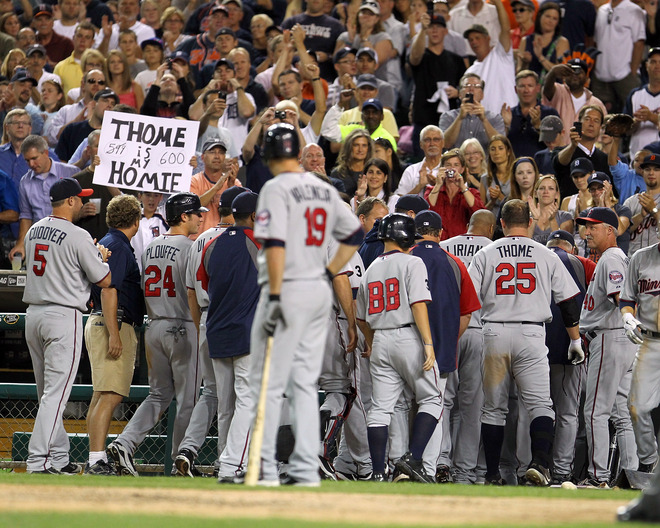
Jim Thome Hits Number 600 (AP Photo)

“Not only is he a great player, but he’s a great individual… I think he was a little apprehensive about passing me up. I said, ‘Jim, I passed a lot of guys up myself along the way. I hope you hit 100 more.'”  Harmon Killebrew on Jim Thome passing him on the home run list with 574 Home Runs in 2010.

There was little build up or fanfare leading up to the Twins and Tigers game tonight. There should have been as one of baseball’s “good guys” did something that only 7 other Major leaguers had ever done, hit 600 home runs.  Maybe it is because he now plays for the Minnesota Twins who are in the midst of one of their worst seasons in recent memory.  Minneapolis is not exactly the center of the sports media universe like New Yorkwhere almost every at bat of Derek Jeter was covered in his quest to reach the 3000 hit mark.  However to me it doesn’t matter. I have been a Jime Thome fan for a long time and while I may be in North Carolina I was watching live when ESPN switched from the Giants-Braves game to the Twins-Tigers game to cover Thome’s at bat in the 7th inning.

A Smile and a Handshake (Getty Images)

Thome came to the plate after hitting home run 599 a two run shot off of Rick Porcello during his previous at bat in the 6th inning.  He was facing Tigers pitcher Daniel Schlereth and with a 2-1 count and two runners on base Thome hit Schlereth’s pitch over the Left Field fence for number 600.  He rounded the bases at Comerica Park in Detroit to a standing ovation given by the Tiger fans as well as his teammates and his family who were also in attendance who also greeted him on the field. On the scoreboard the home team congratulated Thome’s achievement;Detroit does recognize great baseball achievement’s even when it comes at the bat of an opponent.

It was a special moment that all baseball fans should celebrate and that non baseball fans should also take note of because Thome accomplished this huge feat, a feat even great than Jeter reaching 3000 hits Out of the 17,000 plus players that have played in the Majors only 8 have hit 600 or more home runs while 28 players have over 3000 hits.

Thome Honored by Teammates and Opposing Fans

Thome has struggled with injury this year and has not had his best year. He is beginning to show his 40 years the oldest player to reach the 600 mark, the previous being the then 38 year old Sammy Sosa in 2007.  Despite this he was the second fastest player to reach 600 home runs reaching it in at bat 8137 games as opposed to Babe Ruth who by far reached it faster than anyone else needing only 6921 at bats to reach 600 on his way to 714.  In reaching the 600 mark Thome joins Barry Bonds, Hank Aaron, Babe Ruth, Willie Mays, Ken Griffey Jr., Alex Rodriguez and Sammy Sosa in the 600 club.

Thome reached the mark without a lot of fanfare or for that matter controversy. He was never tainted by the steroid controversy and is one of the nicest people in baseball, not hesitating to talk to children that come up to him in public or people that knew him in his early days.  His teammate Michael Cuddyer said “He is the nicest, gentlest, kindest guy you will ever meet … When he walks in a room, everyone watches everything he does. It’s the way he treats people, it’s the way he respects the game….”

His manager Ron Gardenhire said “He’s like Babe Ruth around here…The fans here get all mad at me for not playing him every day.”

Thome is known around the league for his work ethic and will to win.  He worked hard at his craft initially beginning as an outfielder before being converted to Third Base.  Unassuming he once said “I always had to work to be good, because I never was very good. I mean, I always had to work to get where I wanted to be. It was never easy. It still isn’t. It still isn’t.” He is called by some today’s Harmon Killebrew, a complement by any standard of measurement.  I’m sure that Harmon is looking on now cheering and probably telling Saint Pete stories about just how big of an achievement that Thome’s feat is because Thome won’t do it when he meets Saint Pete.

Peace

Padre Steve+

2 Comments

Filed under Baseball, sports and life

Smaller than Life: The Thin Skinned, Petty, Small Minded and Visionless Political Elite and what we can do to Change the Political Culture

“Far better is it to dare mighty things, to win glorious triumphs, even though checkered by failure… than to rank with those poor spirits who neither enjoy nor suffer much, because they live in a gray twilight that knows not victory nor defeat.” Theodore Roosevelt

“When small men attempt great enterprises, they always end by reducing them to the level of their mediocrity.”

“In order to govern, the question is not to follow out a more or less valid theory but to build with whatever materials are at hand. The inevitable must be accepted and turned to advantage.” Napoleon Bonaparte

I have these times when lost in thought I imagine what it was like to have truly great political leaders in this country and inWestern Europe.  It just seems to me that those that we have entrusted with the reigns of government and those that aspire to the highest office in this country are perhaps the most pathetic, small minded, petty thin skilled and visionless that this country has ever produced.  I do not see a great leader such as Washington, Jefferson, Lincoln, Teddy Roosevelt, Franklin Roosevelt or Ronald Reagan in the lot of them.  As for the women that aspire to lead this country I see no Margaret Thatcher or Golda Meir among them.  In fact I don’t even see any truly skilled politicians like Bill Clinton and Richard Nixon out there.

I guess I say this because the whole lot of them seem to spend a lot more time campaigning for office even while in office than they actually spend working with their allies and political adversaries to do the right thing even if it goes against their ideology.  Lord knows that our political philosophy is important, but ideology, especially when it become sacrosanct is more than a philosophy of how our leaders should govern it is a set of shackles that binds them to one course of action, one set of beliefs and to the masters that they are beholden.

Campaigning is actually a lot easier than leading or governing because now days it has very little to do with substance or personal qualifications or achievement it simple means that suck up to people that have money and power better than others.  When politicians do that either by supporting one special interest or another without qualification they fail to honor the oath that they took when they entered office.  When the pledge their fealty to a certain cause or position regardless of its actual merits such as the Left has done with its pet constituencies and the Right is unabashedly doing as Presidential candidates sign pledges committing them to do what certain interest groups dictate they show that they are willing to prostitute themselves and their office to those interest groups.

Since our political class lives in constant campaign mode why should we expect them to actually take a risk and do something for the benefit of the country once they are elected?  They obviously don’t feel any need to otherwise as they would be taking risks to try to build with what we have at hand to save the country even the risk of not being elected or reelected.  The great Israeli Prime Minister Golda Meir said “I can honestly say that I was never affected by the question of the success of an undertaking. If I felt it was the right thing to do, I was for it regardless of the possible outcome.”  That is what our leaders need to be saying and doing now.

It seems that those campaigning for the highest office in the land are spineless crybabies.  Yogi Berra once said “All pitchers are liars or crybabies” well I think we can say that “All politicians are liars or crybabies” and be right on target.  I was amazed when I watched coverage of the great Iowa Imbecile Debate and Straw Poll this weekend and in the weeks leading up to this.  It was like watching a bunch of spoiled children calling each other names and then getting mad and crying when they got asked questions that they don’t want to answer accusing those that ask of asking “gotcha” questions.  When caught in obvious contradictions in regard to their campaign rhetoric and what they really do they lie or make excuses.  I watched the movie The Blues Brothers Elwood (Dan Aykroyd) tells his brother Jake “It wasn’t a lie it was bullshit” and I thought about our politicians in office and on the campaign trail.

They are a humorless lot who when you come right down to it have their every whim catered to and surround themselves with “yes” men and women.  This has to be true because if they had one person of true character and honesty that would have the unmitigated courage to say “What the fuck? Over” we might actually see them dealing with the real issues of our day; war, massive unemployment, a currency crisis decaying infrastructure and educational standards not to even mention the debt. John F. Kennedy said something that resonates today “A nation which has forgotten the quality of courage which in the past has been brought to public life is not as likely to insist upon or regard that quality in its chosen leaders today – and in fact we have forgotten.”

Somehow it seems that none of our current leaders or those running for their party’s nomination to the highest office in the land has the gravitas to stand by their word or the character to lay aside differences to work with their opponents to actually do something positive for once.  I cannot remember the last time that any of our leaders have done this except when they cobble together massive bills which sometimes have sections of questionable Constitutional legality that none have ever read before the President signs them into law. That’s not leadership, which is not wisdom, that is not foresight and that is not vision. That is cowardice masked in legislative accomplishment.  Theodore Roosevelt said “A typical vice of American politics is the avoidance of saying anything real on real issues.”

Unfortunately most of us are more interested in seeing our interests and agendas advanced no matter what we say.  After all we elect these men and women time after time and in our hyper-polarized body politic we would sacrifice the country to get our guys, whoever they are elected.  Ideology, political preservation and even religious dogma substitute for reason and personal courage in our world and we are paying for it.

Unfortunately I have no answers on how to solve this except that as a nation we need to start thinking big again to start actually believing in this country. We need to work together like we haven’t since John F. Kennedy challenged us to put men on the moon in under a decade.  The challenges are for the taking but our leaders have to be men and women of character and courage to take them up and a population willing to commit to “pay any price, bear any burden, meet any hardship, support any friend, oppose any foe to assure the survival and the success of liberty”

I actually think that John F. Kennedy said what we need to be doing now better than almost anyone I can imagine because what he said cuts to the heart of our present political crisis.  “Let us not seek the Republican answer or the Democratic answer, but the right answer. Let us not seek to fix the blame for the past. Let us accept our own responsibility for the future.”

I think that we can turn things around but we will have to stop the current political fratricide in order to do so.  We have to take responsibility for the future even as we clean up the mess that we have made in the past.  If we don’t we are going to suffer even worse consequences than we are experiencing now.  The stakes are great and the question is will we rise to the occasion?

God help us,

Peace,

Padre Steve+

1 Comment

Filed under History, leadership, Political Commentary

New Look…Same Great Content

Today I changed the layout and color of the site background in response to a comment of a reader.  I have been thinking about a redesign for a while and this was not the first reader to mention that the previous black and white background was difficult on the eyes.  Since I want to keep the three column format I was limited on my options but using the same theme I was able to modify it.  Hopefully the new layout will be better.  I was actually surprised to see how well that I liked the new look.  Normally it takes me a couple of days to find something that I like and this time it took all of about 5 minutes.

So anyway I am back in Virginia for the weekend with Judy and Molly.  We head over to Joint Base Little Creek-Fort Story to get my new combination cover with the “scrambled eggs” on it as well as some silver oak leaves for when I get promoted on September 1st.

Since I am still in pain and have to do the crutches for anything more than a trip to the kitchen when I can use a cane we won’t be doing much.  We’ll have to find a DVD and sit back and enjoy.

Before I go here are a couple of thoughts for the journey.

“Capitalization distinguishes the difference between helping your Uncle Jack off a horse, and helping your uncle jack off a horse.”

And to change a Yogi Berra quote about pitchers:

“All politicians are liars or crybabies”

And finally something that Napoleon Bonaparte said that all of our elected leaders and those desiring to be President need to earn and learn fast:

“In order to govern, the question is not to follow out a more or less valid theory but to build with whatever materials are at hand. The inevitable must be accepted and turned to advantage.” 

I see some future articles in these quotes but not one today.

Have a great weekend!

Peace

Padre Steve+

1 Comment

Filed under Loose thoughts and musings

I Think I Feel a Sermon Coming On: Padre Steve Looks at the Corporate Church Leadership Model and Finds it Wanting

“When they had finished breakfast, Jesus said to Simon Peter, ‘Simon son of John, do you love me more than these?’ He said to him, ‘Yes, Lord; you know that I love you.’ Jesus said to him, ‘Feed my lambs.’ A second time he said to him, ‘Simon son of John, do you love me?’ He said to him, ‘Yes, Lord; you know that I love you.’ Jesus said to him, ‘Tend my sheep.’7He said to him the third time, ‘Simon son of John, do you love me?’ Peter felt hurt because he said to him the third time, ‘Do you love me?’ And he said to him, ‘Lord, you know everything; you know that I love you.’ Jesus said to him, ‘Feed my sheep.” John 21: 15-17

“Take care that you do not despise one of these little ones; for, I tell you, in heaven their angels continually see the face of my Father in heaven.” Matthew 18.10

Back when I was doing my Clinical Pastoral Education Residency at Parkland Memorial Hospital I was astounded to hear my pastor make a comment which I think was one of the most heartless that I have ever heard said from a pulpit.  The church was a large and trendy Evangelical-Charismatic Church which I had attended throughout seminary and had ordained my in October 1991.  The Pastor was recounting an incident where one of our members had been critically ill in hospital and had not been visited by him.  After the parishioner was released from hospital he asked the pastor: “How sick do I have to be for you to visit me in the hospital?”  The pastor told us his response: “Sir, you don’t want to b e that sick.”

The congregation laughed at the pastor’s story and he went on to talk about how he and other senior pastors should not be doing that kind of work because it “distracted them from bigger Kingdom tasks.”  You see according to the pastor the care of sick parishioners did not contribute to the “growth” of the church and thus was a “distraction and better left to others.”  The comment struck a raw nerve now that I was dealing with the suffering and death every day of people who had been abandoned by the churches and pastors.  I lost all respect for him as a man and pastor during that sermon.  The words of my Philosophy of Religion Professor at Southwestern Baptist Seminary Dr. Yandall Woodfin said: “You have not done Christian Theology until you have dealt with suffering and death.”  This pastor had stopped doing Christian Theology in order to be an “Apostle” and CEO.  He was “growing” the church and managing programs, but had for the most part stopped caring as in being a pastoral care giver.

Now this pastor is not alone and nor is the issue confined to Evangelical or Charismatic churches. The trend has found its way across the denominational spectrum.  Sometimes this is by design as is the case of the Mega-churches.  Pastors of mega-churches are for all practical purposes CEOs of large organizations and have a multiplicity of specialized staff, but often which do little for pastoral care.  Those that posit themselves as “Apostles” are the worst examples because of the spiritual superiority that they presume they have over those that follow them.

Sometimes it is the intentional adopting of the secular model and sometimes it is by default in cases such as the Roman Catholic Church where a lack of priests forces the closure of small parishes and expansion of large ones.  Here the ever worsening shortage of Priests is forcing the closure of smaller parishes and the increase of large parishes with a corresponding decrease in what Priests can do for their people.   Even very good Priests cannot keep pace with the demand of both Sacramental needs as well as pastoral care.

No matter if it is by design or default the result is similar.  The least, the lost and the lonely those “lambs” that Jesus talks about who need care and feeding are shunted aside.  In one case, that of the Catholic Church it is simply a lack of Priests, Deacons and Sisters to provide this care, although there are many parishes where Priests apart from doing the basic sacramental functions avoid caring for the parishioners.

The other is more troubling issue especially in Evangelical, Charismatic and Dominionist type churches is the focus of the church is on numerical growth and market share, financial growth sustaining numbers, programs and buildings.  This requires that pastors spend their time with members who can supply the vast financial need that those plans require.  I have seen this in numerous congregations across the spectrum, which sometimes as was the case at a church that I attended in Florida results in a financial meltdown and collapse of the congregation, many of whom gave up and went elsewhere when the extent of the scandal became known.  Likewise the ripple effects that this caused in the denomination were like a Tsunami, it was disastrous and the church is still in recovery mode.

Going back to my pastor back when I was in residency I got the feeling that had he been the shepherd in the Parable of the lost sheep (Luke 15) that he would have let it go as hunting for it might have distracted him from the others.

When I was in seminary there were quite a number of my fellow students who chafed about having to take courses on pastoral care.  I remember friends and fellow students complaining that what they needed were more “practical courses” such as “church growth, evangelism and Sunday School program management.”  Course such as Pastoral Care were seen as a bother and distraction.  Not to mention academic courses such as Systematic Theology, Philosophy of Religion and Church History.  One friend talked about his Master of Divinity only having a “shelf-life of 5 years” because what he learned would be outdated.

Well in a way he was right.  His focus was on classes that dealt with programs and methods of church growth, programs and management.   From that perspective his degree would rapidly be obsolescent as soon as the next trend in church growth came along and everyone jettisoned the last method in favor of the new.  With the ubiquity of the Mega-church which unlike the Leisure Suit is not going away anytime soon.  The rise of the “Superstar” Pastors such as Bill Hybels, Joel Osteen and Rick Warren and the proliferation of massive “Ministry Media” conglomerates and stand-alone television ministries are actually dangerous to the vitality and health of the Christian Church in the United States.  They propagate methods which have the sole intent of getting people into church or giving to a ministry and keeping them there, doctrine, worship, sacraments or ordinances, and pastoral care of the least, lost and lonely be damned.  The methods are pragmatic and impersonal.   Numbers and crowds define expertise, credibility and worth. The bigger the church the better the church, it’s that simple.

Unlike others who pick these ministers apart for their theology or business practices my problem with what is happening is what happens to regular people in these large and often very impersonal churches.  It is easy for people to get lost, forgotten and when they are going through difficulty abandoned when the church stops making a conscious effort to do real pastoral care and focus purely on the programs which lend to growth.

Often the substitute for pastoral care is found in the home cell group, or care group or whatever cute name a church can pin on a meeting at a member’s house.  The cell groups have a noble intention.  They attempt to build community in an otherwise very impersonal organization.  There are some really good things that can come out of healthy home groups as well as long lasting friendships.  We have a couple from our time inSan Antoniothat is still a very real part of our lives, they showed us genuine love and care and we remain friends.  Of course this couple had an advantage over most home group leaders; he was a Clinical Social Worker by trade who was heading off to seminary.  Most home groups are not that fortunate.

While some good home or cell group leaders are fit to lead and care there are many unhealthy leaders that are poorly trained and equipped to deal with broken people.  The good group leaders recognize their limitations and try to get help for those who are really hurting.  Those that do not know their limitations end up abusing these dear lambs of God.

Frankly most churches of the corporate leadership model don’t want the hurting people.  They get in the way of the “successful Christian life” that they market.  To many of these leaders sick, depressed or lonely people take too much time, are too needy, or suffer from problems don’t match up with their church theology.  The leader’s attitude usually filters down to the rank and file and the people in the most need of spiritual care are cast aside.

We know this from personal experience as my wife suffered from a number of ailments throughout seminary and we were going through tremendous health and financial difficulties and in some places we felt cast aside and like we did not matter.  We were fortunate that some people did care and we did make it through, however it was not something that I would ever want to repeat.  I have heard similar stories from hundreds of people that I have come across in my life and work over the years.  Another thing some churches do is to either add a “Christian Counseling” program or refer members to “Christian Counseling” services instead of doing pastoral care.  In a sense it is the outsourcing of one of the most vital missions entrusted to a church, the pastoral care of the flock of God.

I don’t care what you call it, but any church which has multiple services of several thousand or a major service of close to 20,000 as occurs at Osteen’s Lakewood Church is no longer focused on caring for people but sustaining their growth and market share.  I remember reading Charisma Magazine back in the mid-1990s when I still read it regularly about a church in North Dallas that has a period of incredible church growth in which it grew from 1,200 members to well over 7,000.  In the article the pastor touted the church programs which drew people to the church.  What the dirty little secret which was not mentioned was that two exits south of this church a Mega-church of some 10,000 members imploded when the Pastor, one Bob Tilton got caught doing some pretty bad stuff.  This church despite its claims of great programs simple picked up about 6,000 of these people because they were close by and a similar type of church.

All of this is dangerous as to its impact on people.  One only has to look at the latest Barna Polls about what is going on in churches to see that these large churches are alienating people even as they grow.  People come, but others either burn out trying to keep pace with the manic pace of programs proliferated by these churches or they get lost in the crowd and forgotten.  I meet a least a person every day who is a displaced Christian, often hurt, lonely and broken, not only by what they have experienced in life, but by the cold emptiness that they feel when a church surrounded by thousands of people who don’t even know their name.  Some churches do recognize that people have issues that need to be addressed and have in-house “Christian Counseling” programs or refer members to “Christian Counseling” services.   I think that there certainly is a place for clinically trained therapists in the life of a church; however this is not really pastoral care, even when they use “Biblical” methods.   In a sense it is the outsourcing by pastors of one of the most vital missions entrusted to a church, the pastoral care of the flock of God to others, in a sense, “hirelings.”  Again my issue is not with the therapists or Christian counselors, but rather pastors who refuse to do pastoral care as part of their ministry.

Ultimately it is people that are important, even those who are not rich, powerful and who have problems that don’t fit nicely into theological boxes or paradigms promoted by church growth experts. It is high time that churches start reclaiming one of the most vital missions given by Jesus to his Disciples, to care for the least, the lost and the lonely. The onus for this falls on pastors who cannot simply outsource one of their primary missions as given by Jesus himself to others.  If pastors do not set the example of being caring pastoral care givers, it will not matter that they are supposedly “empowering” laypeople to do ministry.  Instead it sends another more ominous message, that if it is not important for the pastor, why should it be important to me?  Every member of the church at some time goes through a crisis when their faith, family, health or vocation.  Sometimes these are not isolated events but rather prolonged periods of anguish, as what Saint Johnof the Cross described as “the Dark Night of the Soul” where it seems that God has even abandoned the person.  Unfortunately people in this situation are often abandoned by their church as things fail to improve.  Despairing they become the lost sheep whose shepherd has abandoned.  This is the hardest time for pastoral care, the times where we as pastors are called to stand with someone as Mary the Mother of Jesus did at the Cross, just simply being there though nothing else can be done.

Now do I understand that the demands of running a large church can be sometimes become such that pastors have difficulty making time for pastoral care?  Of course I understand this, at the same time pastors, even those who function primarily as pastor-teacher/CEOs still have the responsibility of caring for people, not simply administering programs and preaching.  Pastors need to set the example of care for people, real people, the regular Joe’s and Jane’s who populate their pews and buy all their spiritual wares even if it is only in small ways, not just the super-givers or the wealthy and powerful.  James’s “right strawly epistle” (Martin Luther’s words) has much to say about favoring the rich and powerful and neglecting the poor and seemingly insignificant people hanging about the peanut galleries of their large “Worship Centers.”  Even if the pastor has limited time he or she must be about the flock, or they will forget what the needs of the flock really are and instead of the People of God, the lambs who Jesus says to care for they will simply be the consumers of a religious message who we have to keep coming back to keep the operation going.

My sermon is over and I do hope that there will be more “amen’s” than calls for burning me as a heretic.

Peace, Steve+

4 Comments

Filed under christian life, faith, leadership, Pastoral Care, Religion

August 2007: My Beginnings in Iraq

I have had a lot of opportunity to reflect today.  I woke up about 0430 in pain from my broken leg.  I was in enough pain to warrant a Vicodin which was the second that I had had since going to bed.  It knocked me out and after making a call to my staff to let them know that I was out of action I woke up aboutnoonto the sound of a MH-53E flying over my place toward the Marine Auxiliary Airfield a few miles from my place.  Vicodin makes my leg feel better but pretty much puts me out of action.

The memories invoked by the sound of the helicopter caused my period of reflection.  I haven’t written about my time in Iraqin a long time.  The memories of my time in Iraqstill evoke intense emotions which sometimes lead me into a depressed funk and can be brought on by many things.  However since I am doing better than the last time that I attempted to write them down I figure that I might as well start over and attempt to complete what I began in 2009.  Today marks the 4th anniversary of my arrival in Fallujah, the next to last stop before we arrived at Taqaddum and began our operations supporting the Marine and Army advisors in Al Anbar Province.

I arrived in Iraq with my assistant, RP1 Nelson Lebron.  We had detached from EOD Group Two in early July and after stops for processing and training in Norfolk, Fort Jackson South Carolina and Kuwait we arrived in Iraq on the 5th of August.  Our first stop was at the headquarters of the Iraq Assistance Group atCampVictory inBaghdad.  We remained there several days getting briefings on our mission and awaiting a flight to Fallujah.  Our last night at Camp Victory was an interesting night where for the first time I was in the line of fire of a hostile rocket which whooshed over my head to explode harmlessly about a kilometer away.

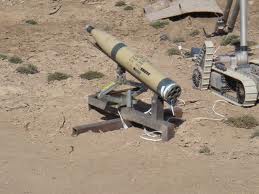
107mm Rocket on improvised launcher

We had a very late flight, about 0200.  Since you normally need to manifest for a flight two hours prior it means that you back up at least a hour before the manifest time.  This particular evening there was not much cooling going on and there was little illumination which meant in most places it was very dark. Especially in troop the billeting areas.  We dragged our gear to the entrance to the billeting area.  Nelson went back to his tent and I plopped my ass down on my bags.  About 2300 I heard and felt a rush over my head.  It was a rocket, probably a 107 mm rocket which is one of the most popular indirect fire weapon used by the insurgents or possibly a 122 mm rocket.  Both are former Soviet systems produced in Iran and supplied to insurgents in Iraq and Afghanistan as well as to Hezbollah in Lebanon.  They are not very accurate but still the fact that a rocket had buzzed me was disconcerting.  A few seconds later I heard an explosion.  I later heard the rocket had continued on and hit an uninhabited area of the camp.  Soon after it went over my head a very young looking soldier came running up to me in his PT gear with an M-16 at the ready.  He shouted “Sir, what was that?”  The young man appeared to be a bit scared to I simply quipped “Only a rocket son didn’t hit us.”  He seemed to relax just a bit and I said “You okay son?” the good thing about being as old as I am that you can get away with calling the young guys “son” because in most cases they I’m old enough to be their father.  I stay in game too much longer and the new kids could be grandchildren.  This young soldier said, “Well sir I’m on the quick reaction force and that sounded close.” In the background to the east machine gun and small arms fire could be heard.  A pair of gunships buzzed us going the general direction of the gunfire.Baghdadwas definitely not a violence free school zone.  I replied to the young soldier. “Son, if I were you I’d report to where you need to go, better grab your helmet and flak.”  The young man looked at me in the dark, assuming I was a Marine officer since I was in myMarineDesertdigital cammies, saluted and said “Yes sir” to which I replied “be safe soldier and God bless, keep up the good work.”  Once again he thanked me and hurried off into the night.

A few minutes later, Nelson who has been in some pretty sporty situations in Afghanistan including once where he took out a knife wielding assailant at a checkpoint in Kabul with his fists, came up to me.  “Hey Chaps, did you hear that rocket? Sounded like a 107.”  I said to him, “Shit brother, it felt like it went right over my head. “  He responded quickly “Boss I think we’re in a war here.”  And I said “sounds like it partner, definitely sounds like it.”  Then he said “Chaps, you wouldn’t believe what I just saw.”  I said “Really, what?”  And he told me the story. “I was over looking for our boy when I needed to go to the head, so I opened one of the port-a johns and when I opened it saw this guy and girl having sex in it, like they didn’t have the door closed and you know how nasty those things are.”  I said “Partner you’ve got to be kidding me” and Nelson said “Chaps I wouldn’t do that to you, those people looked at me like I was stupid when I opened the door and I just said excuse me and closed the door. That place stank sir; I don’t know how they were doing it in there.”  I replied “Partner, I guess after a year of more here some folks will take whatever they can get.” “But, you’d think that they would find some dark spot rather that a port-a-john,” replied a thoroughly disgusted Nelson.  As I laughed at the misfortune of my little buddy, bodyguard and protector I simply said “There’s no accounting for taste my friend, no accounting for taste.”

We sat on our gear and waited, and waited.  The time when we should have been picked up went by and after about 15 minutes of chatter about not being picked up on time, Nelson said. “Boss you want e to go find our ride?”  I responded that I wanted him to as it was so dark that he might not know where to find us. A few vehicles had come and gone but none were our assigned wheels.  Finally after about 45 minutes our ride showed up, Nelson had found him on the other side of the compound in his truck listening to AFN radio.  He had come to the wrong side of the billeting area and was chastising me for not being there.  I said, “Sergeant, I said to meet us over here and I’ll be damned f we have to lug our gear a couple hundred yards to make you happy.”  I paused as he started to interrupt and then cut him off “Sergeant, don’t go there, you’re talking to a field grade officer who wasn’t always a chaplain, you went to the wrong place and you didn’t take the initiative to try to find us. We had to find you so don’t push your luck.”  He replied, almost dejectedly, “Yes sir” and I said, “consider this matter ended, get us to the airfield, we have a flight to catch.”  Nelson and I piled our gear into the back of the truck, got in and rode the airfield.

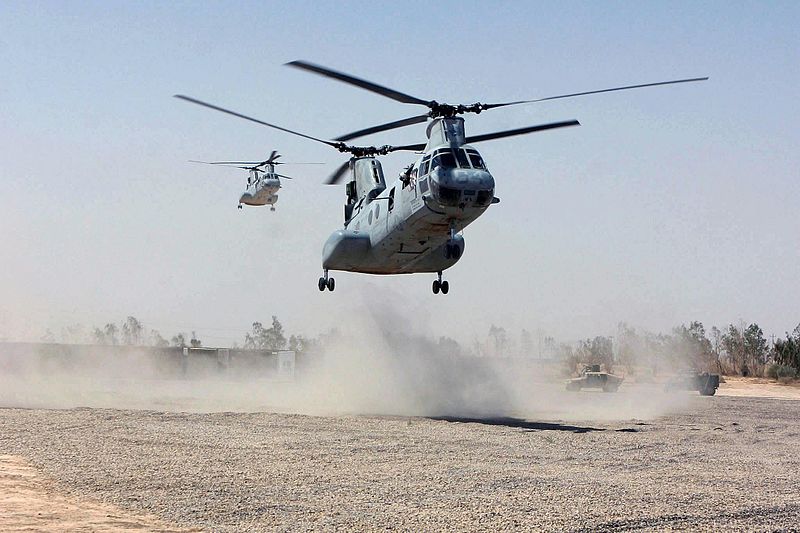
CH-46’s landing

In 2007 the Camp Liberty airfield, which deals exclusively in rotor wing aircraft, was one of the busiest heliports in the world.  Hundreds of flights went through it every day.  They were primarily Army, but a fair amount of Marine aircraft pass through as well.  We were flying Marine air tonight.  When we got to the heliport our chauffer had a difficult time finding a place to park.  Eventually we sort of double parked and Nelson and I and Nelson and I unloaded our gear with a bit of help from our chastened chauffer got up to the manifest desk where we were greeted by a civilian. He took our names and our mission number and then took out a marking pen and wrote it on the back of our hands.  I found that that at each place this was the primary way to identify who was getting off where or if you should even be on the aircraft. I found a seat and then because I couldn’t get comfortable walked outside for a while.  Nelson on the other hand, ground his gear, threw himself upon it pulled his cover over his eyes and took a power nap. He can sleep almost anywhere.

With about 10 minutes to go I woke up Nelson, and I find it amazing how he can wake back up the way he does.  When I take a nap I am useless for about 30 minutes after I wake up as my body tries to figure out what time it is. We both took turns guarding our gear as the other hit the head, once again a darkened port-a-john that stank to low hell.  When done we staged our gear near the lineup point.  Our mission was called and we lined up with about 30 others, a mixture of Marines, Sailors, contractors and a few soldiers.  We geared up, securing helmets, flaks, our packs as well as our massive EOD issue sea-bags.  Nelson helped me with mine as we got ready to walk, once was over my back and the second strapped across my chest, actually going from my chin to just above my knees.  Many of our fellow passengers had very little gear, and one fairly large contractor offered to help me with my gear.  I took him up on it about half of the 100 yards to where our bird had landed.

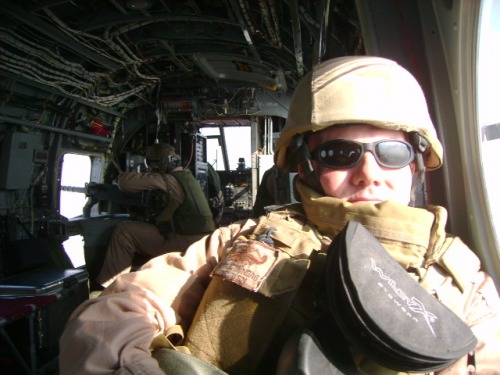
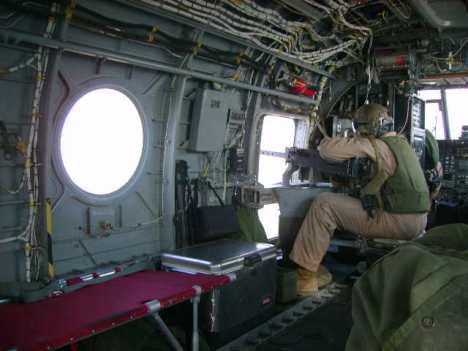
Watching our aircraft come in, a flight of 2 Marine CH-46s which date back toVietnamservice I was amazed at how surreal they looked coming in out of the night, their haze gray fuselages almost having a ghostly appearance as they set down.  Of course we had the bird that was farthest from the line up point and I was really glad for the help of this generous contractor.  As we loaded our bags onto the aircraft, stacking it in the center of the deck with everyone else’s gear, we each took one of the jump seats along the side and strapped ourselves in.  Sweat was pouring off of me and I felt totally winded, no amount of running, pull ups, pushups and crunches had prepared me to lug our heavy and ungainly gear around.  The dimly lit troop compartment was hot and I looked around the aircraft.  I noted the machine gunners in the front doors and the crewman in the back who took a seat with a 240 series machine gun mounted on a swivel.  It reminded me of the films I saw of the inside of World War Two B-17s, except that the flight suits were different.  The crew gave the let the pilots know that we were ready, and I wondered what we were heading into.  Nelson got my attention and gave me a “thumbs up” and I returned it as the lights went out that our flight lifted off.

Banking around to the left the 46 gained altitude and flew back across the camp as it did so I got my first view of Iraq after dark.  As we flew into the city ofBaghdadthere were lights and sometimes lit streets. In a few places I could see the flashing lights of emergency vehicles.  We soon began to descend into the city surrounded by tall buildings, mainly hotels and government buildings and I knew that we were in the “Green Zone.” We sat down on a small landing pad, the dim lights came back on and a couple of passengers got out of our bird which a couple of more boarded the flight. The scene fromCampLibertywas repeated and gear was off and on loaded, passengers boarded and debarked from the flight and the lights went off and the bird lifted off.  Gunners took their positions and chatted on their headsets obviously scanning for threats and assessing what was going on, or they could have been talking about the new video game one of them had bought at the exchange.

Banking left we gained altitude heading east, with Baghdad fading into the night the lights of the communities along the Euphrates came into view as we flew on toward Fallujah.  For me it was a fascinating experience, surreal and a bit of anxiety making but interesting as I thought of the history of the ancient civilizations who had settled here. As a historian I thought about the Assyrians, Babylonians and Persians and the fact that the faith of the Christian Church through Abraham and later the people ofIsraelbegan inIraqwith Abraham’s obedience to the Lord in theLandofUrof the Chaldees.

The flight only took about 16-18 minutes and we flew into Fallujah.  The bird sat down on a large tarmac and the crew motioned us to get up grab our gear and get off of the aircraft.  I was praying desperately that it would not be a long walk to the terminal from the helicopter pad.  As we hauled our gear off the 46 to get to the terminal I was about tapped out.  The 46 had landed about 100 yards from the terminal where our ride waited.  It might as well have been 100 miles.  I loaded one bag on my back and commenced to drag the other.  Nelson was ahead of me and realized that his old Padre was not doing well.  I was about halfway to the terminal when Nelson showed up with a Marine on a John Deere Gator. My gear was loaded aboard the Gator; I gave a hearty thank you to Nelson, the Marine and to the Deity Herself as I dragged my sorry ass to the terminal.

The Fallujah terminal like most terminals at heliports in Iraqwas a plywood building constructed by the Seabees.  It was well lit inside, had air conditioning which I sucked up and a large refrigerator with bottled water stashed in it.  Once inside I took off my helmet as we checked in at the desk.  By now it was about 0245, I had been up since 0530 the previous day, done PT a Camp Victory, had a rocket fly directly above me and dragged 200 pounds of gear more places than I wanted to in 100 degree heat and I was a spent round.  War is a young man’s game and even though I am in good shape for someone my age, the key is that I am in good shape for someone my age, not a young guy.  Sweating profusely I found a liter bottle of water and downed it.  About that time a large African American 1st Class Petty Officer came in the door.  RP1 Donnie Roland was the LPO of the II MEF Forward Chaplain’s office and worked for Mike Langston.

Donnie, who is now retired from the Navy, is a guy that you definitely want on your side.  He hooked us up.  Normally personnel in a transient status in Fallujah are housed in tents with cots in varying degrees of disrepair.  Donnie got us rooms in the VIP quarters, nicknamed by the Marines the “Ramadan Inn.”  The place had once been the haunt of Uday and Qusay Hussein, Saddaam’s sons.  It had a pond in the center of the court yard and was reputedly a place where they would entertain senior members of the Ba’ath Party amid scenes of debauchery.  We were given a small room that had a desk and two small Iraqi beds, both of which had thin concave mattresses which had little support but were a definite step up from a cot.  Sheets, pillows and a blanket were included.  Our gear took up the majority of the room but it didn’t matter.  After a shower I crashed hard.  The bed might have been from a 5 star hotel; all that mattered at 0330 was that I could get to sleep.  RP1 Roland told us that Chaplain Langston said that we should get some sleep and come in when we could.  With outgoing artillery fire going off in the background I laid my worn out body down on the waiting mattress, I thought about the day and it came to me that the rocket that had went over my head could have killed me and a chill went down my tired spine.  Another salvo of artillery lashed out at the enemy, and my mind drifted back to the present.  I was now in Fallujah.  One more stop on the way to my war, Nelson was already asleep; I am amazed at his ability to go from 0-60 and 60-0 so fast.  More artillery fire boomed and as a former forward observer I found outgoing artillery fire to be comforting, amid it’s lullaby I went to sleep.

Peace

Padre Steve

1 Comment

Filed under Loose thoughts and musings

Break a Leg….Oh I Did….

“I told the doctor I broke my leg in two places. He told me to quit going to those places.” Henny Youngman

People in theater wish each other good luck by saying “break a leg” before a performance.  The phrase and variants of it have been used in numerous cultures and even transcended theater.  An example is what German pilots in the First World War would tell each other “Hals- und Beinbruch” or “neck and leg break.”  The term is basically superstition because if you wish someone “good luck” that is actually bad luck.

Two weeks ago tonight while taking pictures on the National Mall in Washington DC I took a fall near the Washington Monument.  I have always wanted good pictures of DC monuments at night and I finally have a camera that takes good pictures at night.  So after dinner with a cousin I had her drop me off at the White House where I started my journey.  I trekked from the White House to the Washington Monument where I took pictures of it and a long distance shot of the Capitol Dome.  I decided to hike toward the World War Two and Lincoln Memorials walking down the gentle incline from the Washington Monument all the while stopping periodically to frame the picture.  I had stopped and lined up a really nice shot of the Lincoln Memorial with the World War II Memorial in the foreground.  I took the picture and turned to my left to take another look at the Washington Monument and as I did so I went crashing down about 2 ½ to 3 feet off of an un-illuminated ledge onto a concrete walkway which rings the monument.  While it is lit near the sides it is not in the center of the Mall.  Since it was pitch black out with no moon I had no warning and could not brace for the fall.

I landed hard on the side of my right leg and felt immediate sharp pain.  I got up brushed myself off, made sure that my camera was okay, priorities you see and gingerly put weight on my leg.  I found that I could put some weight on it and decided to continue my march toward the World War Two and Lincoln Memorials. Since I had to get back to the Georgetown  University campus I figured that it was just as close to head that direction as it was to haul my ass back to Pennsylvania Avenue.  Besides I had to get my pictures and figured that if I couldn’t go any farther I could flag now a cab.  I managed to complete my mission and got back to my room and figured at worst I had bruised a bone or pulled a muscle.

The next morning I got up and I was in pain and amid all of my drug collection I had forgotten the ubiquitous 800 mg. Motrin that military docs and corpsman give out for almost any malady.  I have several bottles and had left all at home or work. Not smart. I was in pain and spent the rest of my conference with my leg up and made sure that I had purchased some Advil doubling up on the dosage to kill the pain. That evening I met a friend for dinner walking as little as possible and finding that beer worked as well as Advil to kill the pain.  Thankfully my friend Pat a Marine Lieutenant Colonel that I had attended Command and Staff College with and spent some time with in Iraq as I was coming into country bought dinner and several pints of Irish Kilkenny ale.  I did feel better.  Beer has wonderful medicinal qualities when used correctly. The next morning I drove back to Virginia and stopped by a local Navy Health Branch Clinic where I was x-rayed, given Vicodin and the aforementioned Motrin and a pair of crutches. Since the base deals with a lot of athletic injuries due to the large number of SEALS, EOD and Riverine forces stationed there the doctor was pretty sure that I had a break of my Fibula but could not confirm it without further tests.  She told me to stay off of it as much as possible, manage the pain and see mi primary care provider in Camp LeJeune.

I did that and after more inconclusive x-rays was scheduled for a Bone Scan and MRI.  I stayed off of the leg which hurt a lot and spent most of the weekend sitting on my bed with my leg elevated while watching baseball games and DVD movies.  I got my MRI yesterday and the Bone Scan today.  When the tech injected the radioactive tracer agent called Technetium MDP (Methylene Diphosphonate) and within seconds the hurting area lit up like an explosion. You know that you have an injury when the technician looks at the monitor and simply says “that’s impressive.”  When the first scans were done I went back to my office and shortly before going up for the final pictures I got an e-mail from the staff radiologist who told me that it I had a non-displaced fracture of the Fibula head near the Tibia Plateau.  There was no ligament damage.  While I was in the Bone scan he came in and discussed what was going one and noted that my knee was obviously banged up from a lot of sports or military injuries but that nothing appeared to him that would require surgery.  The Bone Scan and MRI confirmed the damage the x-rays could not.

My primary care physician then got me an appointment with Orthopedics this afternoon.  I was showed all the films and told that apart from pain management that there was not much else to do since the Fibula is not a weight bearing bone. The Orthopod told me that since my fracture is non-displaced it did not need casting and that a boot would probably make it hurt worse.  He told me that I could as the pain level permits ride my bike and begin to wean myself off of my now ever present crutches.

Now I have about 6 weeks before I can run again and 30 days of light duty.  It could have been worse and I am glad that there is no ligament damage or anything that requires surgery.

That’s the news for now but as Mickey Mantle said: “I always loved the game, but when my legs weren’t hurting it was a lot easier to love.”

Peace

Padre Steve+

2 Comments

Filed under healthcare

Bloody Savo: Disaster at Guadalcanal

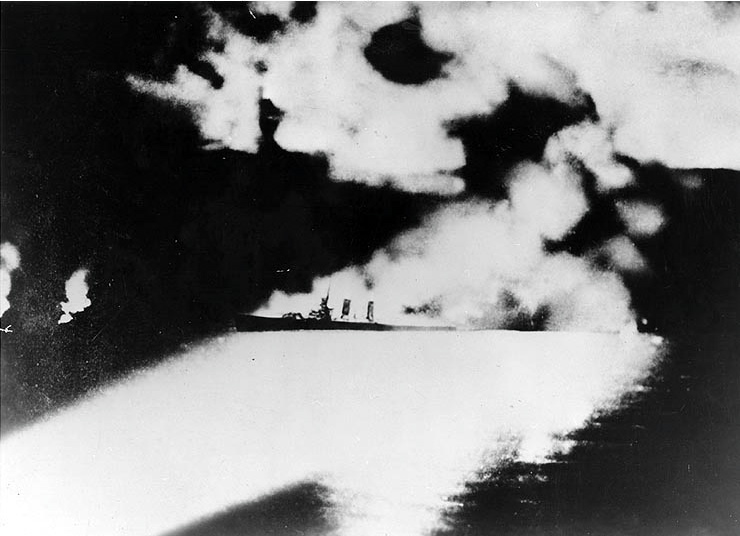
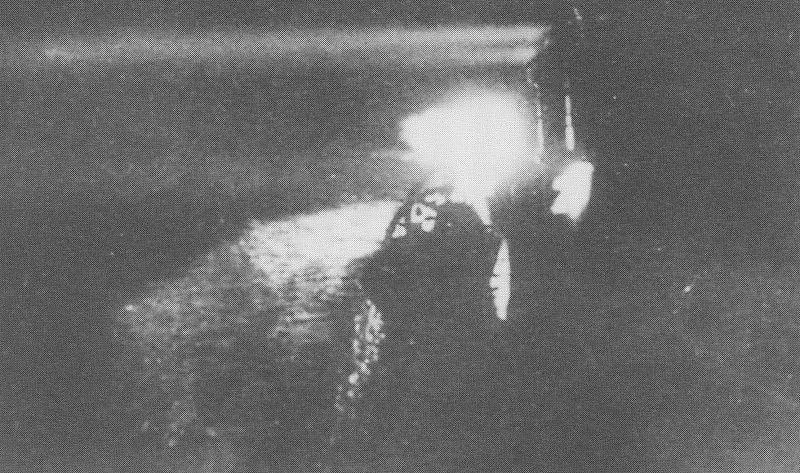
USS Quincy under attack off Savo Island

On August 8th 1942 the U.S. Task Force supporting the invasion of Guadalcanal was tired. The crews of the ships had been in continuous combat operations conducting naval gunfire support missions, fending off numerous Japanese air attacks and guarding against submarine attacks for two days.  The force commanded by Admiral Richmond K. Turner was still unloading materials, equipment and supplies needed by the men of the 1st Marine Division who they had put ashore on the morning of the seventh.

On the afternoon of the eighth Turner was informed by Admiral Frank “Jack” Fletcher that he was pulling his carrier task force out of action. Fletcher alleged that he did not have enough fighter aircraft (79 remaining of an original 98) and as low on fuel.  The carriers had only been in action 36 hours and Fletcher’s reasons for withdraw were flimsy.  Fletcher pulled out and left Turner and his subordinate commanders the responsibility of remaining in the area without air support with the transports still full of badly needed supplies and equipment.

Admiral Gunichi Mikawa

As the American drama played out, the Japanese moved forces into position to strike the Americans.  Admiral Gunichi Mikawa commander of the 8th Fleet and Outer South Seas Force based at Rabaul New Britain quickly assembled a force of 6 heavy cruisers, the 14,000 ton Atago Class Chokai, and the four smaller ships of the Kako Class, the Aoba, Kako, Kinugasa and Furutaka, the light cruisers Yubari and Tenryu and the destroyer Yunagi.   Mikawa raised his flag aboard Chokai and the force sped down “the slot” which ran the length of the of the Solomon’s chain mid day on the seventh.

The Americans had warning of their coming. The first sighting was by B-17s before the Japanese forces had reached Rabaul.  The second was the elderly U.S. Navy submarine S-38 at 2000 on the 7th when they were 550 miles away not far from Rabaul.  This report was discounted because it would not be unusual to find a number of fleet units steaming near a major naval base and fleet headquarters.  The last which should have alerted the allies was a sighting by a Royal Australian Air Force patrol aircraft on the morning of the 8th.  However the pilot did not report the sighting until he returned from his mission returned to his base and had his tea.  The eight hour delay in reporting the information as well as errors in it which reported 2 submarine tenders as part of the force lulled the Allied forces into believing that the Japanese were setting up a seaplane base and posed no threat to the invasion forces. It was a fatal error of reporting and judgment by the pilot.

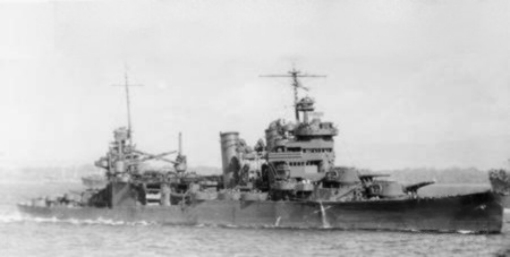
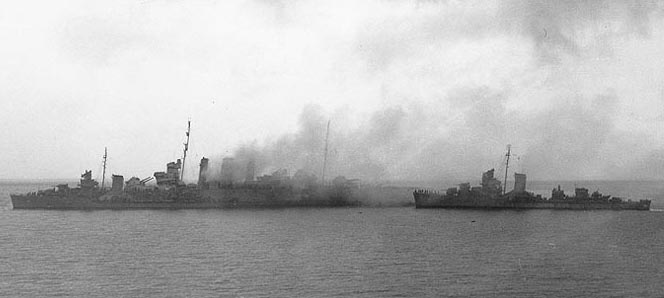
USS Astoria on August 8th off Guadalcanal 

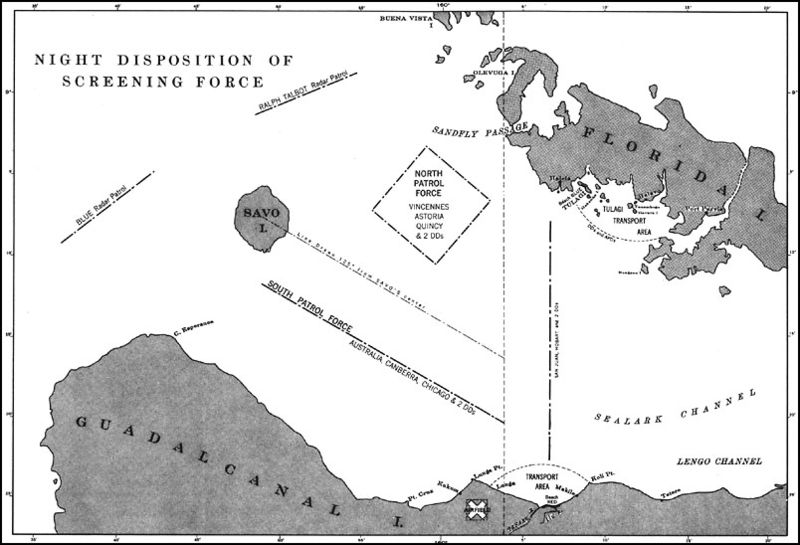
In the absence of good information Turner deployed his support ships to cover the three entrances into what soon would be known as Iron Bottom Sound.  He placed the Anti Aircraft Cruiser USS San Juan and Australian Light Cruiser HMAS Hobart to the east with two destroyers under the command of Rear Admiral Norman Scott. To protect the south west entrance into the sound south of Savo Island Turner placed the Heavy Cruisers USS Chicago, HMAS Australia and HMAS Canberra and two destroyers under the command of Rear Admiral R.A.C. Crutchley RN who in theory commanded the screening force.  To the north of Savo he deployed the Heavy Cruisers USS Vincennes, USS Astoria and USS Quincy and two destroyers under the tactical direction of Captain Frederick Riefkohl aboard Vincennes. To the west of Savo he placed two destroyers to act as picket ships.  Unfortunately these ships radar sets were insufficient and would fail to pick up the approaching enemy.

Allied Dispositions 

During the early evening Turner recalled Crutchley to his flagship for consultations of what to do regarding Fletcher’s retreat.  Crutchley came over in his flagship the Australia denuding the southern force of its commander as well as one of its three heavy cruisers.  He left the commanding officer of Chicago Captain Howard D. Bode in tactical command but Bode did not have his ship take the lead position in the patrol assuming Crutchley would return bymidnight.

Mikawa launched float planes to scout the locations of the American ships and to provide illumination once the battle began.  Some of these aircraft were spotted but no alert measures were taken as many assumed the Japanese to be friendly aircraft.  Many commanding officers were asleep or resting away from the bridge of their ships, lookouts were tired and not expecting the Japanese and Condition Two was set in order to provide some of the tired crews a chance to rest.

Light Cruiser Yubari illuminating American cruisers at Savo Island 

Admiral Mikawa now new the Allied disposition and ordered his ships to battle stations at 0045.  At 004 he sighted and passed astern of USS Blue the southern picket which also failed to detect the Japanese force.  Mikawa assumed that the destroyer might have reported his presence, briefly turned north but turned back to his original course when a lookout allegedly spotted a destroyer to his northeast.  He gave the order to attack at 0132 and promptly spotted the American destroyer USS Jarvis which had been heavily damaged and without radio communications was making her way toAustralia for repair and passed her after some ships fired torpedoes and raced toward the southern force at 26 knots.  With the southern force just a few miles away Mikawa ordered his ships to commence firing at 0136 and at 0138 torpedoes had been launched.

Mikawa’s flagship heavy Cruiser Chokai

Even now the southern force was unaware of Mikawa until at 0143 the destroyer USS Patterson on the far side of the action saw Mikawa’s ships bearing down a mere 5000 yards from the force. Her commander radioed “STRANGE SHIPS ENTERING HARBOR” but the alert came too late.  As Patterson signaled her warning Japanese float planes dropped their illumination flares silhouetting the Chicago and Canberra as the Japanese cruisers opened fire at ranges from 4500 to 9000 yards.  At 0143 Canberra was struck by to torpedoes and 24 shells, mostly 8” from the cruisers. Her Captain was killed and she was mortally wounded.  The Japanese brushed off the attempts of Patterson and the other southern force destroyer the USS Bagley to intervene bypassing them quickly and shifting their fire to Chicago. Chicago was stuck by a torpedo at 0147 and a single hit from a cruiser which caused little damage. Chicago briefly engaged the Yunagi at 0151 which had been sent back to cover the Japanese as they moved north.  With his ship crippled Captain Bode failed to warn the northern force of the Japanese attack.

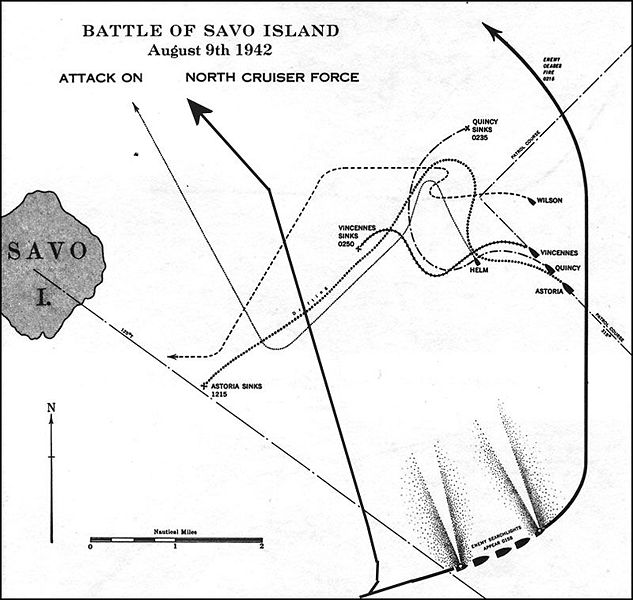
Mikawa’s lookouts spotted the northern group at 0144 and changed course. The maneuver was badly executed and left the Japanese in two columns as they swiftly closed on the Americans.  Mikawa’s flagship Chokai launched torpedoes at 0148 and Astoria the cruiser closest to the Japanese set general quarters at 0145 and at 0150 the Japanese illuminated her with searchlights and opened fire. Astoria under the direction of her gunnery officer returned fire at 0152 ½ just before her Captain came to the bridge unaware of the situation. He ordered a cease fire until he could ascertain who he was firing at assuming the Japanese to be friendly ships.  He delayed 2 minutes and ordered fires commenced at 0154 but the delay was fatal. Astoria had opened fire on the Chokai which then had time to get the range on the American cruiser and hit her with an 8” salvo which caused fires which provided the other Japanese ships an aiming point.

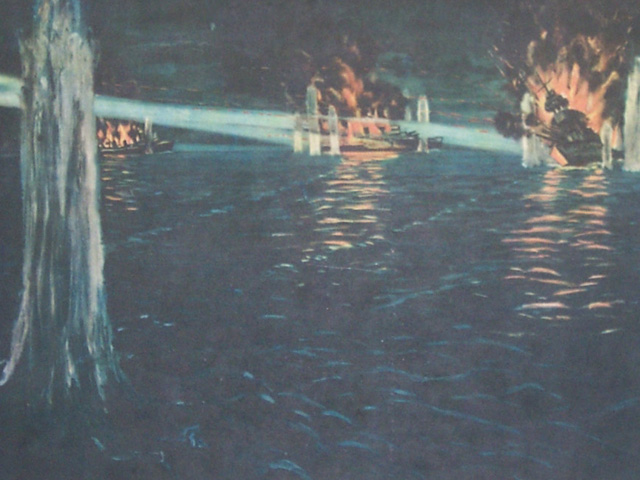
Japanese artist depiction of attack on US Navy Cruisers at Savo Island

Astoria was left burning and heavily damaged barely maintaining headway but attempted to fight on scoring a hit on Chokai’s forward turret even as the Japanese opened up on the next cruiser in line the USS Quincy.  Quincy caught between the two Japanese columns.  Aoba illuminated her with her searchlight and Japanese forces opened fire. The gunnery officer order Quincy to return fire getting two salvos off before her skipper Captain Samuel Moore came to the bridge, briefly ordered a cease fire assuming that he was firing on Americans and turned on his running lights.  Quincy was ripped by salvo after salvo which killed Captain Moore and nearly everyone in the pilothouse just as a torpedo ripped into her engineering spaces turning them into a sealed death trap forcing the engineer to shut down the engines.  Burning like a Roman candle Quincy was doomed she was ordered abandoned and capsized and sank at 0235. However Quincy did not die in vain, at 0205 two of her 8” shells hit Chokai causing enough damage the Admiral’s chart room that Mikawa would order a withdraw at 0220 which spared the now defenseless American transports.

Vincennes the lead ship and flagship was next in the line of death.  Captain Reifkohl order General Quarters sounded not long after the Japanese illuminated the southern group.  At 0150 Vincennes was lit up by the searchlights of three Japanese ships which opened fire on her. Vincennes returned fire at 0153 hitting Kinugasa before she was hit starting fires on her scout planes mounted on their catapults. The Japanese mauled Vincennes, three possibly four torpedoes ripped into her as shells put ever gun out of action. At 0215 she was left burning and sinking by the Japanese who soon withdrew from the action.  Ordered abandoned she sank at 0250.

Canberra being evacuated by the Patterson and Blue

Canberra struggled against the odds but was abandoned and was sent to the bottom by an American torpedo at 0800.  Astoria also struggled for life but the damage was too great and she was abandoned sinking at 1215.  Mikawa withdrew up the sound but on his return the Heavy Cruiser Kako 70 miles from home was sunk by torpedoes from the American submarine S-44 sinking in 5 minutes.

The Americans and Australians lost 4 Heavy Cruisers sunk and one heavily damaged as well as two destroyers damaged.  Killed on the various ships Quincy-389, Vincennes-342, Astoria235, Canberra-85, Ralph Talbot-14, Patterson-10, and Chicago-2.

It was an unmitigated disaster, an allied force destroyed in less than 30 minutes time.  Boards of inquiry were held and Captain Bode hearing that he shouldered much blame killed himself in 1943.

It was a rude awakening to a Navy which had believed that technical advances would give it victory and which was not yet in the words of Admiral King “sufficiently battle minded.”  It was the first of many equally bloody battles in the waters aroundGuadalcanal.

2 Comments

Filed under History, Military, Navy Ships, US Navy, world war two in the pacific

From the Sea: The Absolute Need of a Strong Navy, Merchant Marine, Coast Guard and Viable National Maritime Strategy

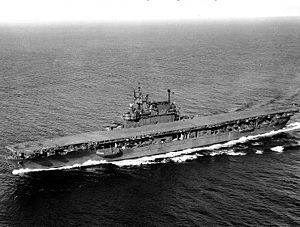
The USS Enterprise CV-6. Ordered in 1933 she was one of the most decorated and battle proven ships ever to fly the flag of the United States

“A good Navy is not a provocation to war. It is the surest guaranty of peace.” Theodore Roosevelt

“A powerful Navy we have always regarded as our proper and natural means of defense; and it has always been of defense that we have thought, never of aggression or of conquest. But who shall tell us now what sort of Navy to build? We shall take leave to be strong upon the seas, in the future as in the past; and there will be no thought of offense or provocation in that. Our ships are our natural bulwarks.” Woodrow Wilson

As the economic crisis continues to envelop the nation there is much talk about the certain reduction in the size and capabilities of the U.S. Military components.  At the present time it seems that politicians of both parties are more interested in the immediate savings that can be derived from cuts.  Regardless of how they are done each service will see force reductions but coming at a time when we are at war those responsible for the cuts must be conscious of the effects on the capabilities that the United States has to defend itself and its interests overseas and to influence world affairs.

The wars in Iraq and Afghanistanhave been ground intensive requiring the strengthening of the Army and Marine Corps to conduct counter insurgency operations. After 9-11 the Navy voluntarily reduced its fleet and personal strength in relatively dramatic fashion intending the savings be used to rebuilt the fleet.  Personnel strength was reduced by nearly 40,000 sailors and many ships were retired well before their anticipated retirement dates.  Unfortunately the Defense Department under then Secretary of Defense Donald Rumsfeld shifted the savings to fund the ground campaigns in Iraq and Afghanistan.  Navy shipbuilding was cut and the Navy failed to help itself by investing much of the service’s budget to the development of three classes of ships and that are over budget, under performing and full of controversy, the Zumwalt Class Destroyers, the Freedom and Independence Class Littoral Combat Ships and the San Antonio Class Landing Ships.

Further cuts are already occurring or envisioned based on the planned cuts in Federal Government programs.  These cuts would reduce the Navy which is now smaller than at any time since the early 1930s following the 1922 Washington Naval Conference which limited the size of the Navies of the signatory countries.  From 1922-1932 the Republican Harding, Coolidge and Hoover administrations not only reduced the force but failed to lay down a single new ship to replace outdated ships and reduced maintenance funds to keep up the ships in service.  Budget cutting gutted the Navy during those years and it was only theRooseveltadministration which realized that a strong Navy was essential to national security began to rebuild the fleet in the 1930s and funded the development of the ships that would win World War Two.  The shipbuilding program had economic benefits as shipyards which had been inactive were able to employ skilled American workers which helped military preparedness, American business and American workers.  The ships that came out of that building program sustained us at the beginning of the war and those designed in the years just before the war served us for decades to come.  Even so the build up byRoosevelt, constrained by the dire economic crisis of the Great Depression could not add ships fast enough to have us fully ready for the Second World War and left us dangerously stretched by the demands of the Japanese advance in the Pacific and the German U-Boat campaign in theAtlantic.  Many good Americans died and the war was decidedly more difficult because of what was done to the Navy in the 1920s by successive short sighted Republican administrations.

The current ship production is at a level not seen in decades and bad surface ship designs and poor workmanship have hurt the Navy.  If the Navy is cut back significantly without a change in mission or corresponding shift in National Security Policy it will degrade the Navy’s ability to respond to emerging threats. Likewise if a coherent shipbuilding program is not undertaken that meets the projected threats American interests can and will be harmed as other nations gain local superiority in critical areas and sea lanes.   While the U.S. Navy currently enjoys a vast superiority over any current or potential adversary there are places that a cunning adversary could hurt American and allied interests simply because we are already spread very thin in regard to the number of ships available and the increasing number of missions and threat areas.

The challenge now is not to give in to the temptation to make indiscriminant cuts until we actually decide on a National Maritime Strategy that is not simply about the Navy but also the Coast Guard and Merchant Marine.  The strategy must include the interrelationship that we have with our allies and other nations and their navies.

The necessity for this goes beyond military preparedness it goes to our economic security since the vast majority of our commerce exports and imports are by sea.  If we take the time to think through a comprehensive maritime strategy it can go a long way to strengthen American industry, labor, commerce as well as national and economic security for us and the world.  A strong Navy, Merchant Marine and Coast Guard are far more important to the United Statesthan large ground forces.

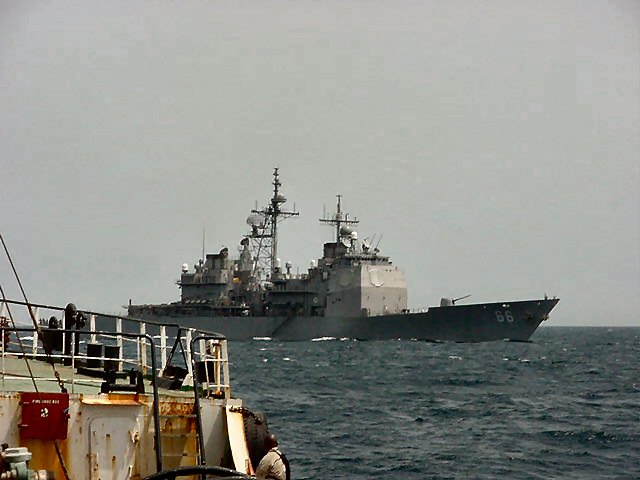
An effective and judicious use of national power: USS Hue City CG-66 passing an impounded Iraqi smuggler in 2002

This is demonstrated in our history as well as that of Great Britain.  When we are strong at sea we are strong, when we commit to long wars of attrition overseas we cause ourselves untold problems. As our first President George Washington said:

“It follows than as certain as that night succeeds the day, that without a decisive naval force we can do nothing definitive, and with it, everything honorable and glorious.”

This is something that our politicians inWashingtonand those that populate the think tanks need to learn.

Peace

Padre Steve+

1 Comment

Filed under national security, Navy Ships, US Navy

Silent Witnesses

“We have been silent witnesses of evil deeds; we have been drenched by many storms; we have learnt the arts of equivocation and pretence; experience has made us suspicious of others and kept us from being truthful and open; intolerable conflicts have worn us down and even made us cynical. Are we still of any use? What we shall need is not geniuses, or cynics, or misanthropes, or clever tacticians, but plain, honest, and straightforward men. Will our inward power of resistance be strong enough, and our honesty with ourselves remorseless enough, for us to find our way back to simplicity and straightforwardness?” — Dietrich Bonhoeffer (Letters and Papers from Prison)

It has been an exhausting summer for most Americans and much of the Western World. We are witnessing events that most of us could not imagine happening.  We are tired of war but seem to be unable to extricate ourselves from the most expensive and least strategically important wars we have undertaken inAfghanistan.  The numbers of killed and wounded continue to mount even as it becomes apparent that there is no way to win the war given that more troops, time and money would have to be employed none of which we have.

Our economy is in terrible shape with sustained high unemployment, a massive debt, decaying infrastructure and little prospects for improvement.  Standard and Poor’s downgraded long term U.S. debt creating even more uncertainly and fear in U.S.and world markets.  Several European Union countries are on the verge of economic collapse threatening the Euro Zone and causing a ripple effect around the world.

We demand that governments do something but seem to ignore the fact that governments control almost nothing because they are in the thrall of the financial industry which really does control what governments can and cannot do. They even dictate how governments should manage their debts as in the case of SP downgrading the United States.  Our founders understood the dangers and the control that bankers have over governments.  Thomas Jefferson noted “I sincerely believe, with you, that banking establishments are more dangerous than standing armies; and that the principle of spending money to be paid by posterity, under the name of funding, is but swindling futurity on a large scale.” His fellow Virginian and drafter of the Bill of Rights James Madison said “History records that the money changers have used every form of abuse, intrigue, deceit, and violent means possible to maintain their control over governments by controlling the money and its issuance.”  Across the Atlantic a leader of a different sort, Napoleon Bonaparte had a similar insight “When a government is dependent upon bankers for money, they and not the leaders of the government control the situation, since the hand that gives is above the hand that takes.”

Catholic philosopher G. K. Chesterton wrote about how the worst vices and passions, selfishness, greed, lust and power were supposed to somehow bring about the best in people.  “It was the mystical dogma of Bentham and Adam Smith and the rest, that some of the worst of human passions would turn out to be all for the best. It was the mysterious doctrine that selfishness would do the work of unselfishness.” 

In the middle of this rapidly worsening situation we see the Unholy Trinity of politicians, pundits and preachers as they pontificate about and blame one another for things that they refuse to take responsibility for and of which they really have little understanding.  Stirred up by them we too have become polarized, angry and distrustfully of our neighbor to the point of hatred.  Conservatives now hate liberals, liberals hate conservatives, the radicals on both sides have pushed their more moderate colleagues into adopting their position because those “moderates” are even more afraid of the ideologues in their own party than they opposition party.

Our government if we can call it that anymore is hopelessly divided and set against each other and none of the most prominent political “leaders” seem to have any morale center or courage of conviction.  They all seem to be Bonhoeffer cynics, misanthropes, or clever tacticians.

Religion is even used a trump card by the right with erstwhile “pastors” blessing the most ungodly adventures, preemptive war, use of weapons of mass destruction, while cozying up to and advocating for the most powerful financial interests.  Some of the more blatant of these “pastors” like C. Peter Wagner advocate a Christian theocracy based on the Seven Mountains theology by which Christians must take dominion over seven key spheres of society which are government, arts and entertainment, media, education, family, religion, and business with business being the most important.  If he was an isolated case it would not be worth commenting on but Wagner and his allies in the Dominionist movement are closely connected to a number of Republican Presidential candidates and one who will likely declare, Texas Governor Rick Perry.

We have witnessed it all and we have to say what we have seen is not working and in fact is an embodiment of evil and anarchy as each group positions itself to gain the most. We have exulted power, vice, avarice and greed as the highest ideals Bonhoeffer said:

“Unless we have the courage to fight for a revival of wholesome reserve between man and man, we shall perish in an anarchy of human values…. Socially it means the renunciation of all place-hunting, a break with the cult of the “star,” an open eye both upwards and downwards, especially in the choice of one’s more intimate friends, and pleasure in private life as well as courage to enter public life. Culturally it means a return from the newspaper and the radio to the book, from feverish activity to unhurried leisure, from dispersion to concentration, from sensationalism to reflection, from virtuosity to art, from snobbery to modesty, from extravagance to moderation.” 

Peace

Padre Steve+

2 Comments

Filed under christian life, faith, History, philosophy, Political Commentary, Religion