Monthly Archives: June 2014

Knight’s Cross with Golden Oak Leaves Swords and Diamonds: Hans-Ulrich Rudel and the Problem of Soldiers Serving Evil Governments

Friends of Padre Steve’s World
Nothing new today. Things have been busy, Eucharist at my chapel and preparing for our incoming class at the Staff College. I am getting ready to head out to the baseball game between the Norfolk Tides and the Indianapolis Indians in a few minutes, when I get home I will be watching the U.S. play Portugal in the World Cup. So with all that in mind I am doing a re-run of what I think is a thought provoking article about military personnel who accomplish great feats in service of an evil state. Some are actually men of very decent temperament who conducted themselves with individual honor despite serving in the militaries of nations whose actions were criminal, or whose ideology was evil. Men like Erwin Rommel, Robert E. Lee and others come to mind. So anyway, enjoy, have a great day and if you get the chance do some thinking about a pertinent topic, for many around the world accuse the United States of some of the crimes that we have placed leaders of nations and military officers on trial, especially in regard to the 2003 invasion of Iraq, a place that I served in 2007-2008.
Peace
Padre Steve+

padresteve's avatarThe Inglorius Padre Steve's World

Colonel Hans-Ulrich Rudel was undoubtably the greatest ground attack pilot that ever lived. His record is unsurpassed by any combat pilot flying ground attack missions. According to official Luftwaffe records he flew 2350 combat missions beginning in June 1941 and ending when he led the remains of his squadron to crash land on the American occupied airfield in Kitzingen on May 8th 1945.

Born in Rosenheim Bavaria in 1916 he joined the Luftwaffe as an officer cadet. Like many of his era Rudel was an ardent Nazi. Despite that and his unrepentant admiration for Adolf Hitler his combat achievements are unmatched.

His early career was inauspicious. He was not regarded well as a pilot and spent the Polish campaign as an observer and did not take part in a combat role during the campaign in the west, the Battle of Britain or Crete in 1940 to May of 1941. Assigned…

View original post 744 more words

Leave a comment

Filed under Loose thoughts and musings

Norman Rockwell’s “Southern Justice” and the Murder of the Mississippi Civil Rights Workers

NormanRockwellSouthernJustice-1Southern Justice- Norman Rockwell 1965

Fifty years ago today, three young men working to register blacks to vote as part of the Freedom Summer in Mississippi were brutally murdered by members of the Ku Klux Klan.

The men, twenty year old Andrew Goodman from New York City, was a progressive activist and Anthropology student at Queens College. Twenty-four year old Mickey Schwerner was a graduate student at Columbia University’s School of Social Work. Both Goodman and Schwerner were Jewish. Twenty-one year old James Chaney was from Meridian Mississippi and was a volunteer with CORE, the Congress of Racial Equity working on voter registration and education with local churches.

On June 21st 1964 the three men were in Philadelphia Mississippi where they were investigating the burning of Mount Zion Methodist Church which had been working with CORE in the town. In the wake of that many black citizens and church members were beaten by whites, and they accused Sheriff’s Deputy Cecil Price of abuse.

FBI_Poster_of_Missing_Civil_Rights_Workers

The three were arrested for an alleged traffic violation, jailed and released that evening without being allowed to make any phone calls. On the way back to Meridian, two carloads of Klan members forced them over, abducted them and killed them. The bodies were not discovered for 44 days. Their disappearance brought national attention and a major investigation to the town. Eventually seven men, including deputy Price were convicted of the murders. The murders and the investigation became the subject of the movie Mississippi Burning.

Rockwell, well known for his portraits of American life and the Civil Rights movement painted “Southern Justice” which is sometimes known as “Murder in Mississippi” in 1965. This was not long after passage of the Voting Rights Act of 1964, which has been under attack in many southern states over the past decade and had a key provision gutted by the Supreme Court last year.

mississipiburning

50 years ago the murders of these three young men brought national attention to the pervasive racism and discrimination in the country. So many murders, lynchings and burnings of homes businesses and that went before had been covered up by the media. I do hope and pray that we never go back to those days, but as laws are passed to limit voting rights in various states I wonder if the clock will be turned back. I don’t thing that it will in the long run, but the sacrifice of so many for those rights should never be forgotten.

In memory of Andrew Goodman, James Chaney and Mickey Schwerner and others of the Freedom Summer and the Civil Rights movement who died or suffered to peacefully bring about change to our society.

Peace

Padre Steve+

1 Comment

Filed under civil rights, History, Political Commentary

Gettysburg: The Connection between Policy, Strategy, and Operational Art

fig-1-5-jp-03a

Friends of Padre Steve’s World

As I have been working to revise my materials form my next Gettysburg Staff Ride I did some revisions to my text that I use with my students. The footnotes did not show up so Monday I will repost the text of this article with them. The article is important even for non-military types who care about the country and are involved in politics or policy, because it shows the linkage between the advantages that a nation with a strong strong and effective central government has over one which adopts what we would call today a Libertarian form of government. In fact I would call the effort of the Confederacy in the Civil War “The Failed Libertarian War.” But that is possibly a subject for an article or maybe even a book, but I digress…

So anyway here is the latest,

Peace

Padre Steve+

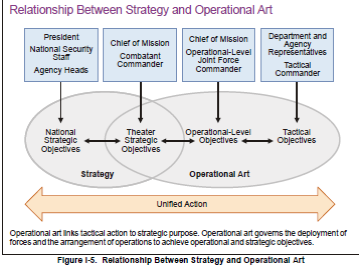
Today we look at the Gettysburg Campaign in terms of how we understand the connection between strategy and operational art. In doing so we have to place it in the context that Lee’s campaign has in relationship to the Confederate command relationships and where it fits in the continuum of unified action as we understand it today.

To do so we have to make the connection between national strategic objectives, theater objectives, operational objective and tactical objectives. We have to explore command and control structures, staff organization and the understand the effect of the Diplomatic, Informational, Economic and Military elements of national power that impact a nation’s ability to wage war.

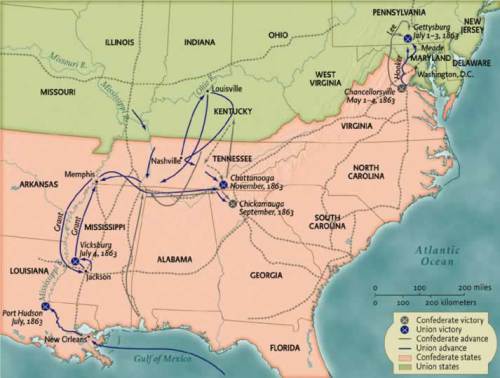
The summer campaign of 1863 in the Civil War gives us the opportunity to do this as we explore the Gettysburg campaign in relation to Vicksburg and the overall strategic situation that both sides faced. This includes the elements that we now associate with the DIME.

While Confederate army units and their commanders generally excelled on the tactical level, and their soldiers endured hardship well, this would not be enough to secure victory. They displayed amazing individual initiative on the battlefield and they won many victories against superior forces, especially in the early part of the war. Even during the final year of the war, Lee’s forces fought skillfully and helped prolong the war. But neither the Confederate government nor the various army commanders were able to translate battlefield success to operational, theater specific or national strategic objectives.

The Confederacy had a twofold problem in its organization for war and how it conducted the war. First it had no organization at the strategic level to direct the war, and it never developed one to coordinate its military, military, diplomatic or economic policies. While Southern strategists understood that they needed to “wear down the ability of the North to wage war” they were consistently hobbled by its own internal political divisions which served to undermine efforts to coordinate the effort to defend the Confederacy. These divisions focused on the opposition of the states’ rights proponents to the central government in Richmond.

The overarching national strategic objective of the Confederacy was to attain independence. The Confederates could not hope to conquer the Union and because of that their “strategic problem was to resist conquest” and to do so they would have to “tire the Federals out, and force them to abandon the war.” Jefferson Davis seems to have understood this early in the war, but political considerations and the temperament of most Southerners and their political leaders frustrated his attempts. Generals like Lee and Joseph E. Johnston “were of the opinion that the more remote frontiers should be abandoned, and that the scattered forces of the Confederacy be concentrated, political reasons overruled their judgment.”

Southern politicians, especially the governors and congressmen demanded that troops “defend every portion of the Confederacy from penetration by “Lincoln’s abolition hordes.” Likewise, most Southerners believed that they “could whip any number of Yankees” and as early as 1861 the Confederate press was advocating an offensive strategy as the Richmond Examiner declared “The idea of waiting for blows rather than inflicting them, is altogether unsuited to the genius of our people….The aggressive policy is the truly defensive one. A column pushed forward into Ohio or Pennsylvania is worth more to us, as a defensive measure, than a whole tier of seacoast batteries from Norfolk to the Rio Grande.”

This combination of wanting to defend everything, which defied Frederick the Great’s classic dictum that “he who defends everything defends nothing” and the persistent employment of the offensive even when it “drained the Confederacy’s manpower and weakened its long term prospects for independence” were key strategic factors in its defeat.

The South did get an earlier start to in mobilizing for war then the Union. Even before the “Confederate Congress authorized an army of 100,000 volunteers for twelve months” on March 6th 1861 the governors of the eleven Confederate States raised units to fight any Federal armies which dared to force them back into the Union. This involved dusting off the old militias which had been allowed to decay in the period between the Mexican War and 1860. Most of these units in the South as well as the North were volunteer companies in which the discipline, equipment and training varied to a significant degree. Most had little in the way of real military training and “many of them spent more time drinking than drilling.” The early Confederate mobilization outstripped the availability of arms and equipment forcing many volunteers to be sent home.

Other than the stated desire for independence and their common hatred of the “Yankee,” there was little in the way of unity within the Confederate States, “the incurable jealousy of the States, especially those not immediately affected by the war, established a dry rot within the Confederacy.” Within the Confederacy, each state viewed itself as an independent nation only loosely bound to the other states and some legislatures enacted laws which actively opposed the central government in Richmond.

The various Confederate states controlled the use of their units and often resisted any effort at centralization of effort. Some kept their best units at home, while others dispatched units to Confederate armies such as Lee’s Army of Northern Virginia. Initially most states limited enlistment periods to one year despite the opposition of Robert E. Lee who helped Jefferson Davis pass the Conscription Act of 1862, a measure that was “heavily watered down by those politicians whose first concern was states’ rights and by those who felt that it would undermine patriotism.” That measure, even in its watered down form was distinctly unpopular, especially with the following declaration of martial law in parts of the Confederacy.

Both measures were brought by realists who understood that for the Confederacy to survive the war effort had to become a total war, with “the whole population and the whole production…put on a war footing.” Such measures provoke more attacks and opposition by their opponents who advocated states’ rights even if it worked against the overall interests of the Confederacy. By the time of Gettysburg if not sooner, “Confederate society began to unravel. The yeomanry and poor white people resented conscription, the tax-in-kind impressment, and other governmental measures than the wealthy. Planters sought to safeguard their property and status to the detriment of national goals.”

This included how state governments responded to the military needs of the Confederacy. Some governors hoarded weapons seized from Federal armories, “retaining these weapons to arm regiments that they kept at home… defend state boarders and guard against potential slave uprisings.” When in response to threats within the Confederacy Jefferson Davis suspended the writ of habeas corpus it resulted in a firestorm of opposition from the states. “Mississippi and Georgia passed flaming resolutions against the act; Louisiana presently did so, too, and North Carolina soon had a law on its books nullifying the action of the central government.” Alexander Stephens, the Confederate Vice President noted that there was “no such thing as a citizen of the United States, but the citizen of a State, and that “the object of quitting the Union, was not to destroy, but to save the principles of the Constitution.”

Likewise as economic conditions worsened and inflation soared in late 1861 the Confederate Congress “in its allotments to the War Department refused to face up to the costs of running the war…it forced the department to scramble in an atmosphere of uncertainty for allotments on a short-run basis.” There was much distrust of any attempt to organize a true central government with any actual authority or power in Richmond. Jefferson Davis may have been President but his country was hamstrung by its own internal divisions, including the often vocal opposition of Stephens for whom states’ rights remained a paramount issue. Stephens, in a statement that defied the understanding that military victory had to be achieved for independence to be won said during the habeas corpus debate “Away with the idea of getting independence first, and looking to liberty afterward.” This, like so many other aspects of the Confederate war effort showed the radical disconnection between legislators, policy makers and the Army and defied any understanding of the importance of government and the unity of effort in pursuing war aims. .

The Confederacy lacked a clear defined command structure to coordinate its war efforts. At the beginning of the war this was true of the Union as well, however, by the Union was much more adept at responding to the needs of the war, this included its military operations, diplomatic efforts and economy. Out of necessity it established a War Department as well as a Department of the Navy in February 1861 and Jefferson Davis, the new President who had served in Mexico and as Secretary of War prior to secession “helped speed southern mobilization in 1861.” However helpful this was initially Davis, who micromanaged Confederate war efforts “eventually led to conflict with some army officers.”

american14_5a

Jefferson Davis was an able man to be sure, but he “totally misunderstood the nature of the war.” Davis was a man given to suspicion and had major personality conflicts with all of his senior commanders save Robert E. Lee. These included Joseph Johnston who he loathed and P.T.G. Beauregard, both of whom he quarreled with on matters of strategy. These conflicts did impact operations, just as did the refusal of various states to support operations or campaigns apart from ones that impacted their state directly.

While Jefferson Davis and his Secretary of War theoretically exercised direction of the war no formal mechanism existed to coordinate the needs of the various military departments or armies. In 1863 Davis, Lee and the Secretary of War, James Seddon were acting as an “informal board which had a say in all major questions of Confederate strategy. Seddon, who had definite ideas of his own about military affairs, was usually but not always a party to Davis’ discussions with Lee…but Davis usually dominated them…. In contrast to the Northern command organization, the South had no general in chief. If anyone fulfilled his functions, it was the President.” It was not until February of 1865 that Lee was named as General in Chief of all armies, and by then the war had been lost.

While Jefferson Davis and his Secretary of War theoretically exercised direction of the war no formal mechanism existed to coordinate the needs of the various military departments or armies. In 1863 Davis, Lee and the Secretary of War, James Seddon were acting as an “informal board which had a say in all major questions of Confederate strategy. Seddon, who had definite ideas of his own about military affairs, was usually but not always a party to Davis’ discussions with Lee…but Davis usually dominated them…. In contrast to the Northern command organization, the South had no general in chief. If anyone fulfilled his functions, it was the President.” It was not until February of 1865 that Lee was named as General in Chief of all armies, and by then the war had been lost.

In effect each Confederate army and military department operated independently, often competing with each other for the troops, supplies and materials needed to fight. They also had to contend with recalcitrant state governments, each loathe to sacrifice anything that might compromise their own independence. Attempts by the authorities in Richmond to centralize some measure of authority were met with resistance by the states. Thus states’ rights were “not only the cause of the war, but also the cause of the Confederate downfall.”

In a country as vast as the Confederacy that lacked the industry, transportation infrastructure, population and economic power of the North this was a hindrance that could not be overcome by the soldierly abilities of its armies alone. An example of the Confederate problem was that “neither the army nor the government exercised any control of the railroads.” The Confederate Subsistence Department, which in theory was responsible for ensuring the supply of food, stores and the logistical needs necessary to maintain armies in the field could not plan with confidence. “Tied to the railroads, unable to build up a reserve; frequently uncertain whether or not their troops were going to be fed from one day to the next, field commanders understandably experienced a general loss of confidence in the Subsistence Department….” Even though the subsistence and even the survival of the army was dependent on the use of railroads, the railroad owners “responded by an assertion of their individual rights. They failed to cooperate….and Government shipments were accorded low priority. In May of 1863 the Confederate Congress finally granted the government broad authority over the railroads, but “Davis hesitated to wield the power. “ It would not be until early 1865 that the Confederacy would “finally take control of the railroads.”

All of these factors had a direct effect on the campaign of 1863. In the west, Confederate commanders were very much left to fend for themselves and to add to their misery failed even to coordinate their activities to meet the threat of Grant and his naval commander, Admiral David Dixon Porter. In the East, Lee having established a close relationship with Jefferson Davis as his military advisor during the first year of the war exercised a disproportionate influence on the overall strategy of the Confederacy because of his relationship with Davis. However, Lee was hesitant to use his influence to supply his army, even when it was suffering. Even though he willingly shared in the plight of his solders, Lee refused “to exert his authority to obtain supplies….” As the army prepared to invade Pennsylvania, “the paltry rationing imposed by Richmond was made worse by a tenuous supply line….”

Lee in theory was simply one of a number of army or department commanders, yet he was responsible for the decision to invade the Union in June of 1863. This decision impacted the entire war effort. The Confederate cabinet “could reject Lee’s proposal as readily as that of any other department commander, Bragg, or Pemberton or Beauregard, for example, each of whom was zealous to protect the interests of the region for which he was responsible…” But this was Lee, “the first soldier of the Confederacy- the first soldier of the world…” Lee’s plan was approved by the cabinet by a vote of five to one. The lone dissenter was Postmaster General John H. Reagan who “believed a fatal mistake had been made…”

Lee in theory was simply one of a number of army or department commanders, yet he was responsible for the decision to invade the Union in June of 1863. This decision impacted the entire war effort. The Confederate cabinet “could reject Lee’s proposal as readily as that of any other department commander, Bragg, or Pemberton or Beauregard, for example, each of whom was zealous to protect the interests of the region for which he was responsible…” But this was Lee, “the first soldier of the Confederacy- the first soldier of the world…” Lee’s plan was approved by the cabinet by a vote of five to one. The lone dissenter was Postmaster General John H. Reagan who “believed a fatal mistake had been made…”

Seddon desired to turn the tide at Vicksburg and proposed sending Longstreet’s Corps to reinforce Johnston to relieve the embattled city and maintain the front on the Mississippi. However, Lee believed that any attempt “to turn the Tide at Vicksburg…put Lee’s army in Virginia at unacceptable risk.”

The lack of any sense of unity in the Confederate hierarchy and lack of a grand strategy was disastrous. The lack of agreement on a grand strategy and the inability of the Confederate States Government and the various state governments to cooperate at any level culminated in the summer of 1863 with the loss of Vicksburg and the failure of Lee’s invasion of Pennsylvania. The Confederate failure in this demonstrates the absolute need for unity of effort and even more a whole of government and whole of nation approach to war.

This can be contrasted with the Union, which though it was slow to understand the nature of the war did have people who, through trial and error developed a cohesive strategy that led to success at the operational level and the tactical level. The genus in Union strategy came from Lieutenant General Winfield Scott who “appreciated the relationship between economic factors and attack.” Scott’s strategic plan was to establish a blockade and form two major armies, “one to move down the Mississippi and cut off the western half of the Confederacy from its eastern half, while the other threatened Richmond and pinned down the main Confederate forces in Virginia.” It was a plan for total war called Anaconda which was mocked in both the Northern and Southern press and it would become the blueprint of Federal success at the war progressed. Scott was the first to recognize that the war would not be short and his plan was the first to “recognize the North’s tremendous advantage in numbers and material, and it was the first to emphasize the importance of the Mississippi Valley in an over-all view of the war.”

Abraham Lincoln had little in the way of military acumen and frequently, until Grant took control of the armies interfered with his senior commanders, often with good reason. However, Lincoln was committed to winning the war and willing to take whatever steps necessary to do so. Fuller describes him as “none other than a dictator” by bypassing Congress and on his own authority declaring a blockade of Southern ports, calling for 75,000 volunteers and suspending habeas corpus.

Likewise Lincoln as well as Congress understood the value and necessity of the railroads and in January 1862 “Congress authorized to take possession of any railroads and place them under military control when the public safety warranted it.” Lincoln formed the Department of Military Railroads the following month and appointed Daniel C McCallum as its director. In May President Lincoln formally took possession of all railroads, but “saw to it that cooperative lines received government aid.”

George McClellan, who Lincoln appointed as commander of the Army of the Potomac in 1862, whatever his many faults as a field commander “possessed a strategic design for winning the war,” understood the necessity of unity of command and successfully built an effective army. Now his design was different than that of Scott, for he desired to “crush the rebels in one campaign” by an overland march to Richmond. While this was unrealistic because of McClellan’s constant overestimation of his enemy and inability to risk a fight when on the Peninsula and at the gates of Richmond, the Union might have at least had a chance should he have defeated the major Confederate forces deployed to defend that city. While that would have been unlikely to win the war in a single stroke it would have been a significant reversal for the Confederacy in 1862.

Logistics was one of the deciding factors of e war, both the Confederate weakness and Union ability to adapt society and government needs to wartime conditions. As a general principle Union leaders, government and business alike understood the changing nature of modern war. This stood in stark contrast to the inefficient and graft ridden Confederate agencies where even those who wanted more effective means to wage war were hindered by politicians, land owners and businessmen who insisted on their rights over the needs of the nation. The Union developed an efficient and well managed War Department where the importance of logistics inter-bureau cooperation became a paramount concern.

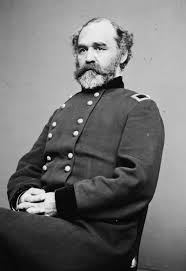
Union industry “geared up up for war production on a scale that would make the Union army the best fed, most lavishly supplied army that have ever existed.” The Quartermaster’s Department under the direction of Quartermaster General Montgomery Meigs was particularly efficient in supplying the needs of a military fighting on exterior lines in multiple theaters of operation. Unlike the Confederate Subsistence Bureau the Federal Quartermaster Bureau supplied almost everything the army could need: “uniforms, overcoats shoes, knapsacks, haversacks, canteens, mess gear, blankets, tents, camp equipage, barracks, horses, mules, forage, harnesses, horseshoes, and portable blacksmith shops, supply wagons, ships when the army could be supplied by water, coal and wood to fuel them, and supply depots for storage and distribution.” The ill-equipped Confederates could only look on with awe, in fact during his absence from Lee J.E.B. Stuart was ecstatic over the capture of “one hundred and twenty five of the best United States model wagons and splendid teams….” likewise one of the reasons that A.P. Hill allowed Harry Heth to send his division the Gettysburg was to find shoes that the Confederate Subsistence Department could not provide for them. Thus one of the reasons for the Battle of Gettysburg is directly linked to the failed logistics system of the Confederacy.

Early in the war the Union logistics effort was beset by some of the same problems that plagued the Confederacy throughout the war. Graft and corruption ran rife until 1862 when “Congress established investigative committees to uncover fraud and passed laws regulating the letting of contracts.” Meigs overhauled the bureau. At the beginning of the war it had only one department, for clothing. He modernized this and added eight new departments, which dealt with “specialized logistical functions such as forage and fuel, barracks and hospitals and wagon transportation.” During the war Meigs managed nearly half the direct costs of the Union war effort,” over 1.5 billion dollars in spending. He has been called by James McPherson as “the unsung hero of northern victory.”

meigs1

The Unsung Union Hero: General Montgomery Meigs 

This had a profound effect on operations. When the Union forces by necessity had to operate in enemy territory they were well supplied whereas whenever Confederate Forces conducted operations in the North or even in supposedly friendly Border States they were forced to subsist off the land. This meant that Confederate operations in the north were no more than what we would call raids, even the large invasions launched by Lee in 1862 and 1863, both which ended in defeat and near disaster.

Because of their poor logistic capabilities Confederate forces had no staying power to keep and hold any ground that they took in enemy territory. This can be contrasted with the Union which when it sent its forces south meant them to stay.

Lee could not fathom this and because he believed that no Federal Army could stand a summer in the Deep South and that Grant would be forced to withdraw. The use of railroads to supply its far flung forces operating in the south as well as its use of maritime transportation along the coast and on inland waterways ensured that Northern armies could always be supplied or if threatened could be withdrawn by ship.

Some senior Union officers also understood the importance of logistics. Henry Halleck was the first true American military theorist. He published the first American work on strategy, Elements of Military Art and Science in 1846. While his is often given short shrift because he was not an effective field commander and had an acerbic personality which rubbed people the wrong way, Halleck was one of the most important individuals in organizing the eventual Union victory. This included matters of strategy, picking effective subordinate commanders and understanding the logistical foundations of strategy.

Weigley wrote of Halleck:

“He sponsored and encouraged the operations of Brigadier General Ulysses. S. Grant and Flag Officer Andrew H. Foote that captured Forts Henry and Donaldson in February 1862 and thereby opened up the Tennessee and Cumberland Rivers for Union penetration deep into the state of Tennessee and toward the strategically important Memphis and Charleston Railroad. Halleck’s insights into the logistical foundations of strategy proved consistently accurate. Throughout the war, he maintained a shrewd eye for logistically viable lines of operation for the Union forces, and he increasingly recognized that one of the most effective weapons of offensive strategy, in an age when battle meant exposure to rifled firepower, was not to aim directly at the enemy armies but at their logistical base.”

Halleck was also instrumental in helping to oust Hooker just before Gettysburg and raise Meade to command the Army of the Potomac. When Lincoln brought Grant east to become General in Chief Halleck took on the new position of Chief of Staff. This was a task that he fulfilled admirably, allowing Grant to remain in the field and ensuring clear communication between Lincoln and Grant as well as relieving “Grant of the burden of personally corresponding with his department commanders.”

By establishing what we now understand as the beginning of a modern command and staff organizational structure the Union was far more able to link its national, theater and operational level objectives with its tactical objectives, even when some of its commanders were not as good as Confederates and blundered into defeats. Above the army, at the administration level Stanton, the Federal Secretary of war organized a War Board and “composed of department heads and chaired by Major General Ethan Allen Hitchcock…as an embryonic American-style general staff.”

In the end during the summer of 1863 it was the Union which was better able to link the ends, ways and means of the strategic direction of the war. This is something that Davis and Lee were unable to do as they struggled with political division, a lack of cooperation from the states, and the lack of any true grand strategy.

Lee’s strategy of the offensive was wrong and compounded the problems faced by the Confederacy. The losses that his army suffered were irreplaceable, not just in terms of overall numbers of soldiers but in terms of his mid-level leaders, his battalion, regiment and brigade commanders who suffered grievous losses and were even more critical to the leadership of his army.

Lee recognized the terrible effects of his officer casualties in a letter to General John Bell Hood on May 21st: “There never were such men in an Army before. But there is the difficulty- proper commanders- where can they be obtained?” His actions at Gettysburg only added to his crisis in keeping his army supplied with competent commanders, as so many were left dead, wounded or captured during the campaign.

Even had Lee won the battle of Gettysburg his casualties in Union territory would have been prohibitive. He would have spent most of his ammunition, incurred serious losses in personnel and horses, and been burdened by not having to care for his wounded and still been deep in Union territory away from his nearest logistics hub. Had Lee won at Gettysburg “his ammunition would have been nearly exhausted in victory, while Federal logistics would have improved as the Army of the Potomac fell back toward the eastern cities.” This would have forced him to withdraw from Pennsylvania even had he been victorious.

It is true that a victory on northern soil might have emboldened the peace party in the North, but even then that could not have an effect on the desired effect on the Lincoln Administration until the election of 1864, still 16 months away. Likewise, in July 1863 such a victory would probably not have triggered foreign recognition or assistance on the part of France or England. “Skilful northern diplomacy prevented an internal conflict from becoming an international war.” Jefferson Davis held on to his fantasy until August 1863, when even he was forced to deal with reality was a vain hope indeed and ended his diplomatic efforts to bring England into the war.

England would not intervene for many reasons and the Confederate government did not fully appreciate the situation of the countries that they hoped would intervene on their behalf:

“its dependence on northern foodstuffs, access to new cotton supplies, turmoil in Europe, fear of what might happen to Canada and to British commerce in a war with the Union, and an unwillingness to side with slavery. The British government also wanted to establish precedents by respecting the blockade, a weapon that it often used.”

Confederate politicians were hindered by a very narrow, parochial view of the world, had little understanding of modern industry, economics and the type of diplomacy employed by Europeans both to strengthen their nations, but also to maintain a balance of power.

As we look at the Gettysburg and Vicksburg campaigns in the summer of 1863 these are important things to consider. The relationship between national strategic objectives, theater objectives, operational objectives and tactical success cannot be minimized. Success on the battlefield alone is almost always insufficient to win a war unless those wins serve a higher operational and strategic purpose, and the costs of battles and campaigns have to be weighed in relation to the strategic benefits that derive from them.

In the end the total failure of the two campaigns destroyed any real hope of Confederate military victory. At Vicksburg the Confederacy lost all of Pemberton’s army, 33,000 men and Lee suffered over 28,000 casualties from an army which had begun the campaign with about 80,000 troops. The losses were irreplaceable.

This essay is certainly not an exhaustive look at the subject, but if we do not consider these factors we cannot really understand the bigger picture of the situation that the two sides faced and how they dealt with them. While the weapons and tactics employed by the sides are obsolete the thought processes and strategic considerations are timeless.

Leave a comment

Filed under civil war, History, leadership, Military, national security

The Long and Winding Road of 31 Years of Commissioned Service

hogansheroeslook

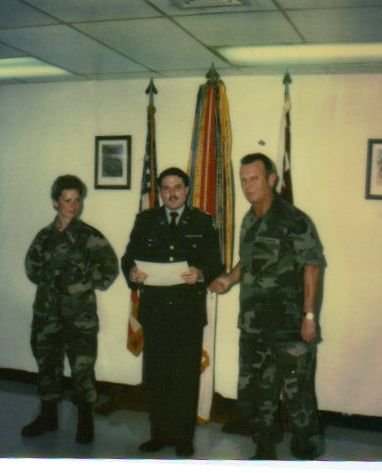
Today marks another milestone in my life and career, at least in terms of longevity. Thirty-one years ago today I was with my soon to be wife Judy, as well as my dad and brother at UCLA where I was being commissioned as a Second Lieutenant in the U.S. Army. Six days later I married Judy who has over the past 31 years seen me go my down the long and winding road of my military career. Truthfully the long and winding road has been to use the words of Jerry Garcia a “long strange trip” and usually not the Yellow Brink Road.

commissioningmeandjudy557thcmdpic2ndplt557motorofficerpromotiontocpt

Let’s see…service as a Medical Service Corps Officer, platoon, leader, company executive officer, maintenance officer, NBC officer, and company commander, and brigade adjutant. Texas Army National Guard, Armor officer, Chaplain Candidate (Staff Specialist Branch) and Chaplain serving with Combat Engineers, and Chaplain in the Virginia National Guard with the Light Infantry. Army Reserve Chaplain, drilling and mobilized to support Bosnia mission, Installation Chaplain at Fort Indiantown Gap Pennsylvania.

checkpointcharliekoreandmzbrabdenburgertornegate

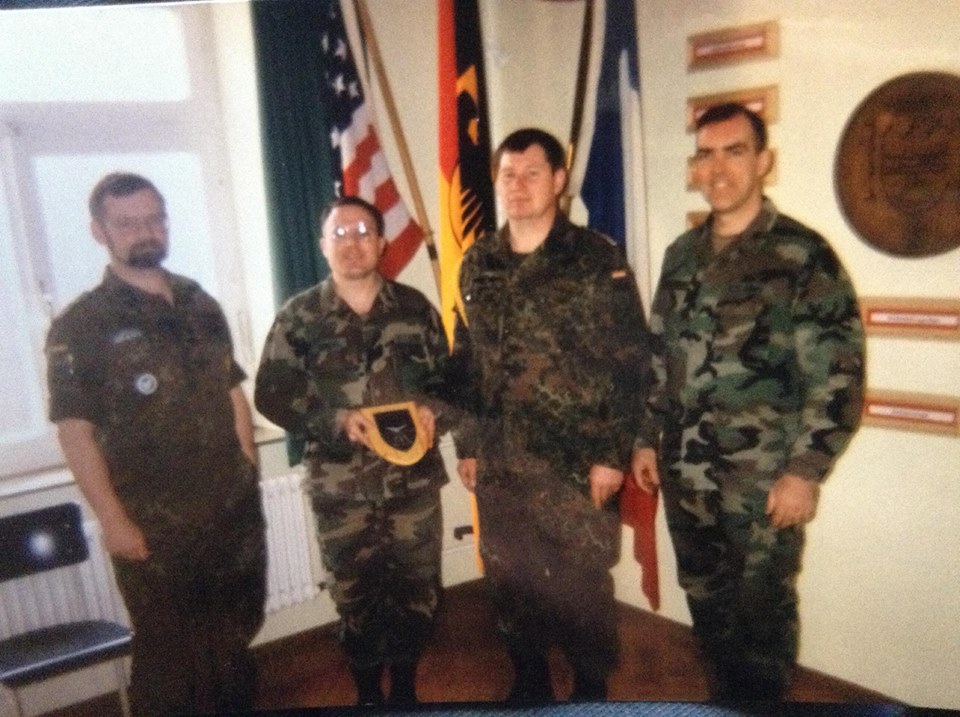
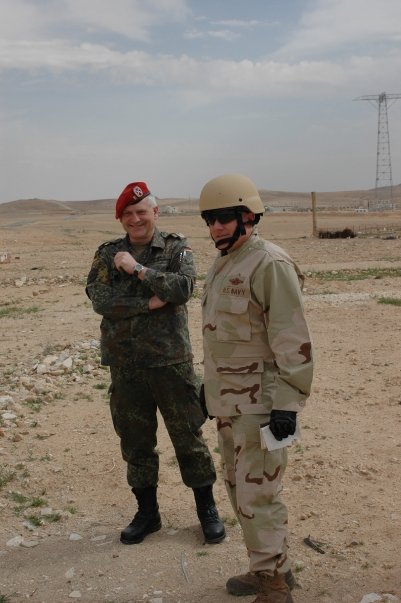
The Army, Cold War Germany, the Fulda Gap and the Berlin Wall, supporting the Bosnia mission, exercises, and active duty for training, even doing an exchange program with the German Bundeswehr.

flakfeuerwurzburg

AHSparadeeasterboardingteamfujibostonhuecityscotland

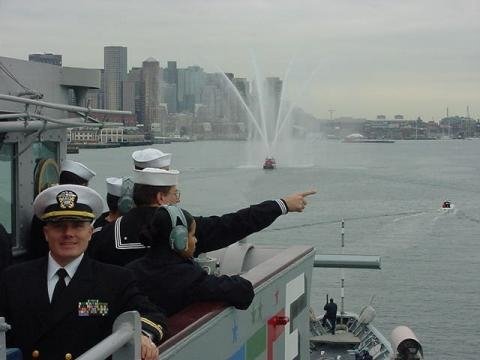
Then the path took a different direction. After 17 1/2 years in the Army Judy was looking forward to the day that I would retire from the reserves and she would have me back. Instead, I took off my rank as an Army Reserve Major and became a Navy Chaplain. Two tours with the Marine Corps, Second Marine Division and Marine Security Forces, Sea Duty on the USS Hue City, a tour with EOD, interspersed with an individual augmentee in Iraq followed by 5 years working in Medical Naval Centers or hospitals and finally serving as Chaplain and doing teaching in military ethics and military history at the Joint Forces Staff College.

jordannellieandmeiraqramadibettertimesdinner-w-bg-sabah1

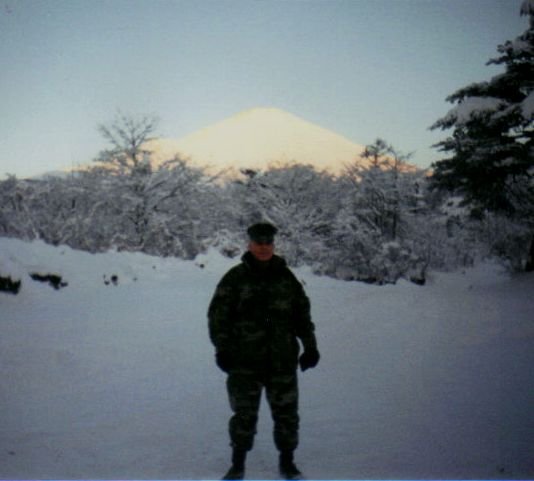
Lots of field exercises and underway periods at sea, travel around the world to support deployed Marines, a Marine Deployment to Okinawa, mainland Japan and Korea including the DMZ. Then along came the 9-11-2001 attacks and war. A deployment to the Horn of Africa, the Gulf of Oman and the Northern Arabian Gulf in support of Operation Enduring Freedom and Operation Southern Watch aboard the Hue City, served as a member of a boarding team making 75 missions to detained Iraqi Oil Smugglers and helping keep peace on those miserable ships. Traveling to Europe, the Middle East, Asia and Guantanamo Bay Cuba with the Marine Security Forces, standing at Gitmo’s Northeast Gate, and completing the “Commie Trifeca” of Cold War German, Korea and Cuba.

easterramadi2boarding teamnellieandme

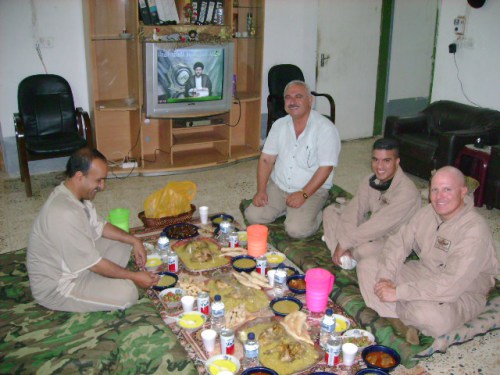
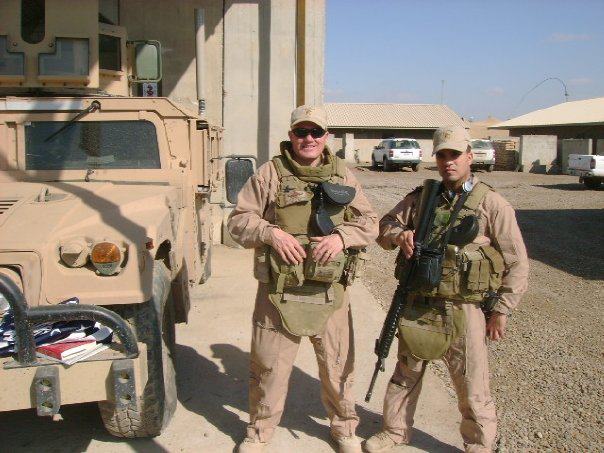
Then there was EOD, serving with some of the most amazing men and women I have ever met, a tour in Iraq with my trusty assistant, bodyguard and friend Nelson Lebron. Of course as any reader of this site knows the time in Iraq changed me forever, the aftereffects of that tour remain with me every day, the battle with PTSD, anxiety, hyper-vigilance, depression and the shattering effect of seeing that my government leaders had lied about the reasons for war and by their actions devastated a country and helped throw a region into chaos. I saw the suffering of Americans as well as Iraqis in Al Anbar Province, death, badly injured Marines, soldiers and Iraqis, poorly treated third world nationals working for Halliburton and other contractors. After coming home dealing with all of my shit while trying to care for others in back to back tours at two different Naval Medical centers or hospitals. The ongoing violence in Iraq and the fact that that unfortunate country and its people are going to suffer more haunts me. I miss Iraq, I would go back not because I love war, but because I care about the Iraqi people.

normandysstaffridestaffride

Now I minister, celebrate Eucharist in my little chapel, care for people and teach. The highlight of my life is leading our institution’s Gettysburg Staff Ride and being able to research, read, ponder, analyze and write about that campaign, the Civil War and relate it to what we teach at our institution.

meandjudyLCDRusmcballgitmojudynellieme

Throughout my career there have been two constants, my long suffering wife Judy who has spent close to ten of the last 17 or 18 years without me and those who I served alongside, many of who I am still in contact with through Facebook. I am amazed at the quality of men and women who have served alongside of me since 1981. The funny thing is that even though I probably still have another five to six years until I finally retire to civilian life, that I am watching men and women who entered the military 10-13 years after me retiring from the military.

antichaps

Thankfully I still love what I do and serve in a great place. To those who have served alongside me all these years in any capacity I thank you. You don’t get to where I am in life without a good deal of help, sage advice from men and women not afraid to speak the truth and without a bit of good luck and fortune and maybe a bit of the grace and mercy of God.

Yes it has been a long strange trip down a long and winding road, but it has been more than I could ever imagine.

Have a great night and thanks for reading,

Peace

Padre Steve+


1 Comment

Filed under Loose thoughts and musings, Military, ministry

The Painful Lessons of Looking in the Mirror of Social Media

Friends of Padre Steve’s World
Nothing new tonight but I was thinking about something I wrote about a year and a half ago about the shameful way that some people demonize and try to destroy others that disagree with them on social media. What triggered this was a comment I got about last night’s article by someone in Texas, I know that because I googled his name and he is the only person in the United States with it, I do love google search, but I digress… Anyway in his comment which was all capitalized, which means that he must not have thought that I would hear him, I don’t hear well but still all caps is kind of rude. The man wrote in response to my journey “YOU CAN’T SERVE TWO MASTERS.” Of course he didn’t elaborate but I assume that he wasn’t insinuating Jesus and the Koch brothers or Ayn Rand. Since I try, often not very successfully to serve Jesus, being that I am a “Mendoza Line” Christian, meaning that my batting average as a Christian is about .200, just enough to keep in the league but not Hall of Fame material. Likewise I serve my country, which I have done for almost 33 years with no end yet in sight. I guess that does mean I serve two masters, but even then I doubt that is what my new buddy Graland from Burleson Texas meant either. I think that he was talking about the Devil, who I probably shook hands with at least once in my life. Anyway, I have had some times on social media where I have behaved pretty badly and thankfully, with rare exceptions I am able to refrain from getting nasty on social media. On those occasions I am reminded of my own faults, and sometimes looking in the mirror of social media isn’t fun. But anyway, I am off to the ball game tonight despite the heat index being near 100 degrees here in Hampton Roads. So have a great night, be safe and thanks for reading and putting up with me.
Peace
Padre Steve+

padresteve's avatarThe Inglorius Padre Steve's World

orange-BloomCounty-morals

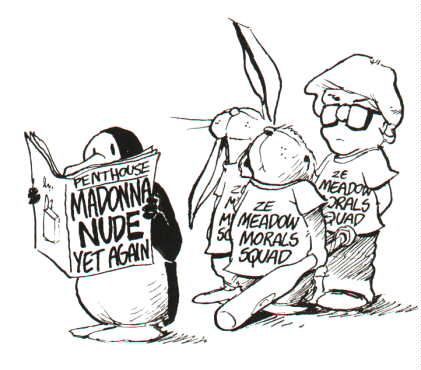
I had an encounter this last weekend on a leading social media site. It was not pleasant and I waited for a couple of days to think, pray and meditate on what happen in the encounter before I decided to write about it.

It occurred on a page which is pretty popular and deals with military issues and the man that runs that page I enjoy very much. He frequently brings up very pertinent issues dealing with military issues, strategy and tactics, foreign policy and national security policy as well as social aspects of current military life.

I got involved in an debate, probably not the best thing to do because the debate had already degenerated into a pretty vicious cesspool of recriminations between pro and anti-gay rights supporters. The subject was the actions of the Officers Wives Club at Fort Bragg North Carolina to initially reject the entry of…

View original post 928 more words

Leave a comment

Filed under Loose thoughts and musings

The Path Less Travelled: Being a “Liberal Moderate” in a Polarized Society

bloom-county-the-label-stuck

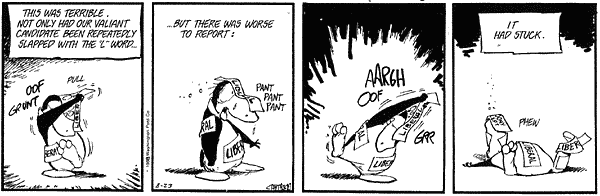
Somewhere along the path from conservatism to moderation I got labeled.

I got labeled with the “L” Word. No, not the “Lesbian” “L” Word which is actually kind of cool, but the other less socially acceptable one, the “Liberal” label.

I remember back in 1981 when I saw my first Lesbian couple walking together at California State University Northridge. I was sitting on the lawn outside of the office that I worked and they walked by. As a typical male I was enthralled by what I saw, but that enthrallment was short lived as when I walked back into the office I heard that my hero, President Ronald Reagan had been shot and that retired Army General, former Nixon aide and now Secretary of State Al Haig was now in charge of the country.

To tell the truth I don’t know how the transformation from Conservative to Moderate (read Liberal) happened. When I was in college I cheered the demise of Jimmy Carter. After college the same was true about Walter Mondale, Mike Dukakis. Al Gore and even John Kerry. I listened to Rush Limbaugh, Sean Hannity and Neil Boortz as much as I could. Not even 7 years ago I was defending “W” against what I thought were unfair assaults from the left. I enjoyed liberal bashing. It was fun and as the people that knew me back then could tell you I was quite good at it and to this day I regret it.

You see a funny thing happened between 2004 and now. I think it was a place called Iraq, where I began to question the unquestionable questions of conservative orthodoxy in a number of forums including both politics and religion. I became a moderate and a passionate one at that. Since “moderate” is a very misunderstood term let me explain. If you are a conservative it means that I am a liberal. Some liberals assume that I am a conservative but on the whole the word moderate is now associated as being liberal and I am okay with that because I believe in freedom, equity and fraternity for everyone, not just people that are like me or believe like me, especially religious types.

I actually think being a moderate is really a tricky thing. Back when I was in seminary during the pre-Fundamentalist takeover of Southwestern Baptist Seminary I remember hearing a big name Fundamentalist preacher say that “middle of the road moderates were only good to be run over.” One of my professors who would be a casualty of the takeover of the seminary said that for many in the Southern Baptist Convention of the time that “Liberal means anyone to the left of me.”

Now I do have to confess, unlike a lot of people when they get older and become more conservative I have become more “liberal” in that I am more accepting of people different than me. I was talking with a dear friend a while back who is proud of his Tea Party affiliation and he mentioned that when he was young that he was a liberal but now older that he was a conservative. I have no problem with that, it is a free county. My friend, who is still a friend despite political differences, maintains his beliefs, but gives me room to differ, something that I return to him. Both of us feel that friendship is more important, and I can count numerous other friends that I have the same kind of relationship with.

BuFor me it is a bit of a conundrum. I have friends who are way to the Left or to the Right of me who I respect and who I care for, we agree to disagree. The fact is that in reality I am a very pragmatic person and I would rather see people work towards compromise and cooperation so that the vast majority of people can prosper in freedom. So I choose to be friends with people far different from one another and who disagree with me. But we are still friends, my issue is not with people of good will, but with people who seek to stand as judge, jury and executioner of those that disagree with them, even former friends.

As far as what I believe…I am a Christian who believes in tolerance, acceptance and equity. I reject the militant triumphalist political version of the Christian faith that is the creed of the religious right, which by the way has nothing to do with any of the historic Creeds of the Christian Church. To put it in a Christian theological perspective I believe in the grace, love and mercy of the the Crucified God and reject the politically charged triumphalism of those who use my faith to oppress others who do not believe the way that they do. That being said I also reject the idea that religion and faith should be excluded from public discourse, only that there is an open exchange of ideas and not the imposition of any faith or lack thereof, on others using the police power of the state. If I want that I will move to Saudi Arabia or Afghanistan or any other country that uses its laws to enforce the majority religion, and suppress the rights of religious minorities or unbelievers or Communist China if I want to live under the tank treads of official state controlled atheism.

After I returned from Iraq I was for all intents and purposes an agnostic, a pretty difficult position to be a priest, but my sense of call and vocation kept me going even when I didn’t know if God still existed or even cared. When faith returned it was different, I believe but at the same time I doubt. This transformation in faith has made me more willing to question as well as accept things that I would not have before Iraq including the role of the church in politics, the treatment and rights of the LGBT community to equity, the rights of Moslems and other religious minorities and probably the cardinal sin of believing that women should be ordained to the priesthood and episcopate. Voicing those things back in 2010 got me thrown out of a church, so I know just how tolerant some of my Christian brothers and sisters can be. In fact there is a recent Pew survey which spelled out just how personal and vindictive the religious, political and cultural divide has become, having been turned on by people I thought to be friends, I know that well. I don’t like it but it is part of life now days in the new cultural-religious “ante-bellum” United States. I could go into other social issues that have a religious component but won’t right now, but I will say that I believe in a theology of liberation for all people. Again if that makes this “moderate” a “liberal” in the eyes of some so be it.

It was funny a couple of months ago I had a retired Navy Chaplain blast me here on this site for calling myself a “moderate.” He labeled me as a liberal. Obviously he had the same definition of moderation as the fundamentalists that said that a moderate was only good to be run over. But I won’t be run over and if that means that some people label me a liberal, so be it. I think there is honor in that, and I would rather be honorable to what I believe than sell out and become a modern Christian Pharisee intent on controlling the lives of others that do not believe like me.

However there are times that I feel that I am pissing into the wind when I watch those that we all have elected to office in Washington DC and our various State Houses behave, especially those of the more radical “conservative” bent, though I know some liberals who are have an equally invective edge. I am probably not alone in this feeling and do hope that the hard liners on both sides of the political spectrum can get their collective crap together before the plunge us into the abyss like the politicians of Weimar Germany did in the late 1920s and early 1930s. We all know how well that turned out.

1622612_10152232336042059_727365308_n

All that being said I am still a moderate, but in today’s social and political climate I am a distinctly liberal one, and for that I will not apologize. If that makes some angry or uncomfortable than I have done my job, as Finley Peter Dunne first remarked, it is my duty “to comfort the afflicted and afflict the comfortable.”

So until tomorrow.

Peace

Padre Steve+

6 Comments

Filed under christian life, civil rights, ethics, faith, philosophy, Political Commentary

The Importance of Citizen Soldiers: Strong Vincent and Joshua Chamberlain at Little Round Top and American Military Sociology

dont give an inch

“As soldier and citizen, today’s armed forces officer is a champion of both the nation’s defense and the principles upon which the nation was founded. Taking an oath to support and defend the Constitution means swearing to uphold the core values that define the essence of American citizenship; the armed forces officer is first and foremost a citizen who has embraced the ideals of the nation—only then can he or she defend those principles with true conviction.” [1]

While the professional Gouverneur Warren through himself into the battle to save Little Round Top, as did many others the story of the battle dictates that we must discuss the actions of two “citizen soldiers” without whom the battle may have been lost, Colonel Strong Vincent and Colonel Joshua Chamberlain. Both are depicted and immortalized in the film Gettysburg which is based on Michael Shaara’s Pulitzer Prize winning novel The Killer Angels. As such their actions are known more than many others that are covered in this account of the Battle of Gettysburg.

Within the U.S. Army the example of Chamberlain at the Battle of Little Round Top has occupied a prominent place in Army leadership manuals including FM 22-100 and its successor FM 6-22, however, that being said even those that learn about Chamberlain from this seldom delve deeper into his character, development as a leader and significance, at Little Round Top, Appomattox and after the war, likewise the examples of both Warren and Vincent which are key to Chamberlain and his regiment even being on the hill are ignored in that publication.

It is important to discuss Vincent and Chamberlain for more than their direct contributions to the battle. Those are widely known and in a sense have become part of the myth that is our understanding of Gettysburg. While discussing those actions it is also necessary to put them into context with the character of both men, the cause that they fought. Likewise it is important to address in this age of the professional all volunteer force the importance of Citizen Soldiers in any kind of democracy or representative republic, a sociological question that military professionals as well as our elected officials and citizenry would do well to revisit.

This is particularly important now as various elected leaders, think tanks, defense contractors and lobbyists are all questioning the economic “liabilities” of the All-Volunteer force as well as the disconnect between the broader military and society at large. This means that there will be efforts to determine how the military will be manned, trained and employed, and if military leaders are ignorant of our history, the vital connection between the military and the citizenry and the contributions of Citizen Soldiers then we will be caught flat footed and unprepared in the coming debates. If that happens those decisions could be made by “bean counters” with little appreciation for what military professionalism and readiness entails, as well as think tanks and lobbyists for the defense industry who have their own motivations for what they do, often more related to their profits, power and influence than national security.

The armies that fought the Civil War for the most part were composed of volunteers who of a myriad of reasons went off to fight that war. Gouverneur Warren is a character whose life and career before and after the Civil War was much more like currently serving regular officers and to some extent the much more professional and hardened by war officer corps of the Reserve Components of each of our Armed Services, in particular the much active and deployed Army National Guard and Army Reserve. The reserve components still do reflect much of the Citizen Soldier tradition but that being said between deployments, other activations and required schooling, those assets are much more on par with their active counterparts than they ever have been in our history.

“American defense policy has traditionally been built upon pluralistic military institutions, most notably a mix force of professionals and citizen soldiers.” [2] Warren represented what until the beginning of the Cold War was the smaller pillar of that pluralistic institution that of the long term professional while Vincent and Chamberlain represented the volunteer citizen soldier who enlisted to meet the crisis.

Until World War II and the advent of the Cold War these dual pillars existed side by side. Following the Second World War along with the small-wars that went along as part of it the world changed, and the wars that occurred, such as Korea and Vietnam “occurred on a scale too small to elicit a sustained, full-fledged national commitment, yet too large for a prewar-style regular army to handle.” [3] Because of this “military requirements thus became a fundamental ingredient of foreign policy, and military men and institutions acquired authority and influence far surpassing that ever previously possessed by military professionals on the American scene.” [4] General Tony Zinni noted that the foreign policy results of this transformation have resulted in the United States becoming “an empire” [5] something that no American living in 1863 could have ever contemplated.

This was part of a revolution in military affairs far more important than the application of technology which brought it about, the Atomic Bomb; it was a revolution in national strategy which fundamentally changed American thinking regarding the use of the military instrument in relationship to diplomacy, and the relationship of the military to society at large. Russell Weigley noted: “To shift the American definition of strategy from the use of combats for the object of wars to the use of military force for the deterrence of war, albeit while still serving the national interests in an active manner, amounted to a revolution in the history of American military policy….” [6]

The policy worked reasonably well until Vietnam and the inequities of the system showed its liabilities and brought about a change from politicians. Lieutenant General Hal Moore wrote of the Vietnam era: “The class of 1965 came out of the old America, a nation that disappeared forever in the smoke that billowed off the jungle battlegrounds where we fought and bled. The country that sent us off to war was not there to welcome us home. It no longer existed.” [7]

The debacle of Vietnam and the societal tidal wave that followed brought about the end of the selective service system, by which the large army needed to fight wars was connected to the society at large and the creation of the All-Volunteer force by President Nixon in 1974. The ethos that every citizen was a soldier was destroyed by Vietnam and even men like General William Westmoreland who warned that “absent “the continuous movement of citizens in and out of the service,…the army could “become a danger to our society-a danger that our forefathers so carefully tried to preclude.” [8]

This cultural shift is something that none of the professional officers of the small ante-bellum army like Warren would have ever imagined much less men like Vincent or Chamberlain who were true citizen-soldiers. Thus for currently serving officers it is important to recognize this key change as it applies to American military strategy as well as the place the military occupies in our society. This makes it important to our study as we examine the actions of Vincent and Chamberlain outside of myth and legend and see the implications that they can have not only on the battlefield but in our relationship to the American citizenry and society. It is to put in in classic terms a return to understanding the relationship between the military and the people so powerfully enunciate in Clausewitz’s Trinity.

While Warren represents the Strong Vincent and Joshua Chamberlain represented that important part of our military tradition that really, except in the case of young men and women that volunteer to serve and leave the military after their obligated service really no longer exists. We no longer have a system that allows, nor do we actively encourage men like Vincent and Chamberlain to leave lucrative civilian employment or academia to serve alongside the professionals in positions of responsibility leading regiments or brigades or serving as senior staff officers unless they are already part of the military in our reserve components.

vincent

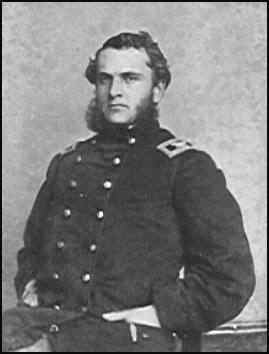
Colonel Strong Vincent was a 26 year old Harvard graduate and lawyer from Erie Pennsylvania. Vincent enlisted and then was appointed as a 1st Lieutenant and Adjutant of the Erie Regiment because of his academic and administrative acumen. He married his wife Elizabeth the same day. Vincent like many young northerners believed in the cause of the Union undivided, and he wrote his wife shortly after after the regiment went to war on the Peninsula:

“Surely the right will prevail. If I live we will rejoice in our country’s success. If I fall, remember you have given your husband to the most righteous cause that ever widowed a woman.”[9]

Vincent was commissioned as a Lieutenant Colonel in the 83rd Pennsylvania September 14th 1861. The young officer learned his trade well and was considered a “strict disciplinarian and master of drill.” [10] That being said one enlisted man remarked that “no officer in the army was more thoughtful and considerate of  the health and comfort of his men.” He assumed command of the regiment when the commander was killed during the Seven Days in June of 1862 where he learned lessons that he would help impart to his fellow officers as well as subordinates, including Chamberlain. Following a bout with a combination of Malaria and Typhoid that almost killed him, he took command of the regiment. He commanded the regiment at Fredericksburg and was promoted to command the 3rd Brigade when its commander was killed at Chancellorsville in May 1863. Vincent was offered the chance to serve as the Judge Advocate General of the Army of the Potomac in the spring of 1863 after spending three months on court-martial duty. But refused the offer in order to remain in the fight commanding troops. [11]

Unlike most other brigade commanders, Vincent was still a Colonel, and he, like many others would in his place hoped that going into action to save Sickles’ command “will either bring me my stars, or finish my career as a soldier.” [12] On July first, Vincent, a native Pennsylvanian came to Hanover and learning that battle had been joined, ordered “the pipes and drums of the 83rd Pennsylvania to play his brigade through the town and ordered the regiments to uncover their flags again….” [13] As the brigade marched through the town Vincent “reverently bared his head” and announced to his adjutant, “What death more glorious can any man desire than to die on the soil of old Pennsylvania fighting for that flag?” [14]

Vincent was known for his personal courage and a soldier of the 83rd Pennsylvania observed “Vincent had a particular penchant for being in the lead….Whenever or wherever his brigade might be in a position to get ahead…, he was sure to be ahead.” [15] That courage and acumen to be in the right place at the right time was in evidence when he led his brigade into battle on July second.

On July 2nd Barnes’ division of V Corps, which Vincent’s brigade was a part was being deployed to the threat posed by the Confederate attack of McLaws’ division on the Peach Orchard and the Wheat Field to reinforce Sickles’ III Corps. While that division marched toward the Peach Orchard, Vincent’s 3rd Brigade was the trail unit. When Gouverneur Warren’s aide, Lieutenant Randall Mackenzie [16] came toward the unit in search of Barnes he came across Vincent and his brigade near the George Weikert house on Cemetery Ridge awaiting further orders. [17] Vincent intercepted him and demanded what his orders were. Upon being told that Sykes’ orders to Barnes were to “send one of his brigades to occupy that hill yonder,” [18] Vincent, defied normal protocol assuming that Barnes was drunk [19] told Mackenzie “I will take responsibility of taking my brigade there.” [20]

It was a fortunate thing for the Union that he did. His quick action to get his brigade, clear orders to his subordinate commanders and skilled analysis of the ground were a decisive factor in the Union forces holding Little Round Top. He ordered Colonel James C. Rice of the 44th New York to lead the brigade up to the hill while he and his aide went forward to scout positions as the brigade moved forward at the double quick “across the field to the road leading up the north shoulder of the hill” with Chamberlain’s 20th Maine in the lead. [21] Looking at the ground which had the valley and Devil’s Den, occupied by the end of Sickles’ line, he chose a position along a spur of the hill running from the northwest to the southeast to place his regiments where they could intercept the Confederate troops of Hood’s division which he could see advancing toward the hill.

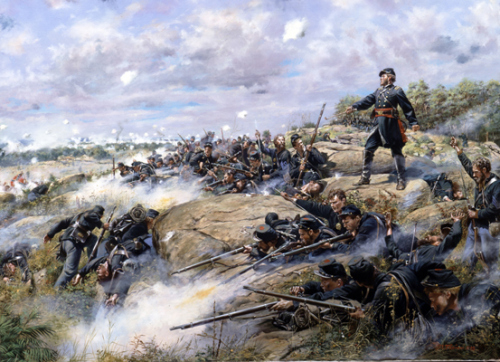
The 16th Michigan, his smallest regiment was placed on the right of the brigade. That section of the line was located on massive boulders that placed it high above the valley below, making it nearly impregnable to frontal attack. He deployed the 83rd Pennsylvania and 44th New York, known as Butterfield’s Twins to their left at the request of Rice who told him “In every battle that we have engaged the Eighty-third and Forty-fourth have fought side by side. I wish that it might be so today.” [22] Those units were deployed below the crest among the large number of boulders; the 83rd was about two-thirds of the way down the way down the slope where it joined the right of the 44th, whose line angled back up the slope to the southeast.

Vincent deployed the 20th Maine on his extreme left of his line, and in fact the extreme end of the Union line. Vincent knew that if this flank was turned and Chamberlain overrun that it would imperil the entire Union position. Vincent came up to Chamberlain who remembered that Vincent said “in an awed, faraway voice. “I place you here….This is the left of the Union line. You understand. You are to hold this ground at all costs.” [23]
chamberlain

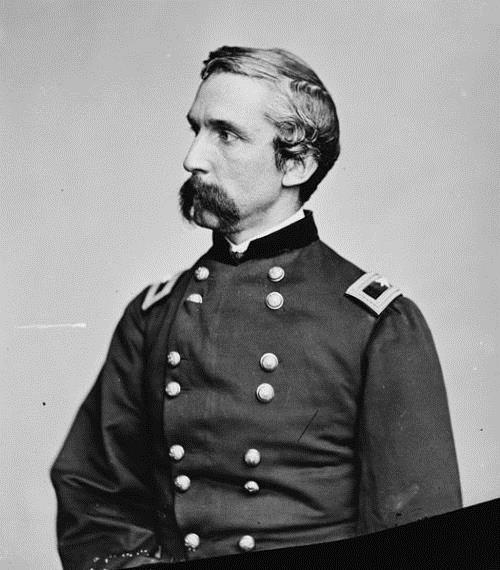
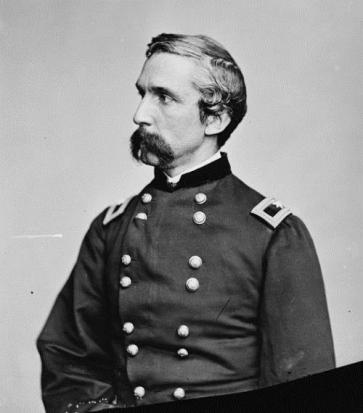
Colonel Joshua Chamberlain was another one of the citizen soldiers whose performance and leadership on Little Round Top saved the Union line that hot July evening. A graduate of Bowdoin College and Bangor Theological Seminary, Chamberlain was fluent in nine languages other than English. He was Professor of Rhetoric at Bowdoin before seeking an appointment in a Maine Regiment without consulting either the college or his family. He was offered command of the 20th Maine but asked to be appointed as a Lieutenant Colonel which he was in August 1862. He fought at Fredericksburg and was named commander of the regiment when Colonel Adelbert Ames, his commander was promoted following Chancellorsville.

Like Vincent, Chamberlain was also a quick student and rapidly adapted to being a soldier, officer and commander of troops in combat. On receiving his orders Chamberlain deployed his small regiment halfway down the southern slope facing the small valley between Little and Big Round Top. As a result of his experience in battle and the tenacity of the Confederate army he became an advocate of the tactics that William Tecumseh Sherman would later employ during his march to the sea in 1864. He wrote his wife before Chancellorsville:

“We must fight them more vindictively, or we shall be foiled at every step.  We must desolate the country as we pass through it, and not leave a trace of a doubtful friend or foe behind us; make them believe that we are in earnest, terribly in earnest; that to break this band in twain is monstrous and impossible; that the life of every man, yea, of every weak woman or child in the entire South, is of no value whatever compared with the integrity of the Union.”

Since Chamberlain’s account is so important I will forgo a discussion of his tactics and instead quote the sections of his after action report that explains his actions. Chamberlain wrote:

“On reaching the field at about 4 p.m. July 2d, Col. Vincent commanding the Brigade, placing me on the left of the Brigade and consequently on the extreme left of our entire line of battle, instructed me that the enemy were expected shortly to make a desperate attempt to turn our left flank, and that the position assigned to me must be held at every hazard.

I established my line on the crest of a small spur of a rocky and wooded hill, and sent out at once a company of skirmishers on my left to guard against surprise on that unprotected flank.

These dispositions were scarcely made when the attack commenced, and the right of the Regt. found itself at once hotly engaged. Almost at the same moment, from a high rock which gave me a full view of the enemy, I perceived a heavy force in rear of their principal line, moving rapidly but stealthily toward our left, with the intention, as I judged, of gaining our rear unperceived. Without betraying our peril to any but one or two officers, I had the right wing move by the left flank, taking intervals of a pace or two, according to the shelter afforded by rocks or trees, extending so as to cover the whole front then engaged; and at the same time moved the left wing to the left and rear, making a large angle at the color, which was now brought to the front where our left had first rested.

This hazardous maneuvre was so admirably executed by my men that our fire was not materially slackened in front, and the enemy gained no advantage there, while the left wing in the meantime had formed a solid and steady line in a direction to meet the expected assault. We were not a moment too soon; for the enemy having gained their desired point of attack came to a front, and rushed forward with an impetuosity which showed their sanguine expectations.

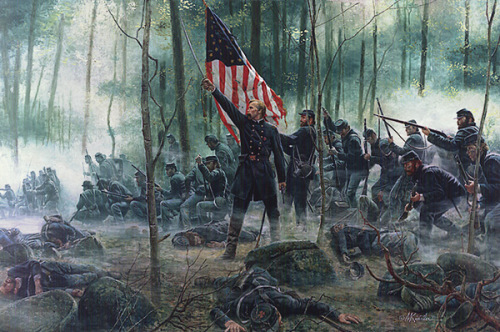
Their astonishment however was evident, when emerging from their cover, they met instead of an unsuspecting flank, a firm and ready front. A strong fire opened at once from both sides, and with great effect, the enemy still advancing until they came within ten paces of our line, where our steady and telling volleys brought them to a stand. From that moment began a struggle fierce and bloody beyond any that I have witnessed, and which lasted in all its fury, a full hour. The two lines met, and broke and mingled in the shock. At times I saw around me more of the enemy than of my own men. The edge of conflict swayed to and fro -now one and now the other party holding the contested ground. Three times our line was forced back, but only to rally and repulse the enemy. As often as the enemy’s line was broken and routed, a new line was unmasked, which advanced with fresh vigor. Our “sixty rounds” were rapidly reduced; I sent several messengers to the rear for ammunition, and also for reinforcements. In the mean time we seized the opportunity of a momentary lull to gather ammunition and more serviceable arms, from the dead and dying on the field. With these we met the enemy’s last and fiercest assault. Their own rifles and their own bullets were turned against them. In the midst of this struggle, our ammunition utterly failed. The enemy were close upon us with a fresh line, pouring on us a terrible fire. Half the left wing already lay on the field. Although I had brought two companies from the right to its support, it was now scarcely more than a skirmish line. The heroic energy of my officers could avail no more. Our gallant line withered and shrunk before the fire it could not repel. It was too evident that we could maintain the defensive no longer. As a last desperate resort, I ordered a charge. The word “fix bayonets” flew from man to man. The click of the steel seemed to give new zeal to all. The men dashed forward with a shout. The two wings came into one line again, and extending to the left, and at the same time wheeling to the right, the whole Regiment described nearly a half circle, the left passing over the space of half a mile, while the right kept within the support of the 83d Penna. thus leaving no chance of escape to the enemy except to climb the steep side of the mountain or to pass by the whole front of the 83d Penna. The enemy’s first line scarcely tried to run-they stood amazed, threw down their loaded arms and surrendered in whole companies. Those in their rear had more time and gave us more trouble. My skirmishing company threw itself upon the enemy’s flank behind a stone wall, and their effective fire added to the enemy’s confusion. In this charge we captured three hundred and sixty eight prisoners, many of them officers, and took three hundred stand of arms. The prisoners were from four different regiments, and admitted that they had attacked with a Brigade.” [24]

Colonel William Oates of the 15th Alabama would give Chamberlain and his regiment the credit for stopping his attack. Oates wrote: “There have never been harder fighters than the Twentieth Maine and their gallant Colonel. His skill and persistency and the great bravery of his men saved Little Round Top and the Army of the Potomac from defeat.” [25]

chamberlain lrt

As with any firsthand account, aspects of Chamberlain’s accounts are contested by others at the scene. Oates notes that he ordered the retreat and that there were not as many prisoners taken, one of Chamberlain’s company commanders disputes the account of the order of the bayonet charge however the fact is that Chamberlain who was outnumbered nearly two to one by the 15th and 47th Alabama regiments “offset this superiority with strength of position, iron determination and better tactics.” [26] Also a factor was the fatigue of the Confederates, these regiments and their parent unit, Law’s brigade of Hood’s division had conducted a grueling 28 mile march to get to the battlefield and were exhausted by the time that they arrived.

Vincent was mortally wounded while leading the defense of the hill. While he was standing on a large boulder with a riding crop ordering the men of the 16th Michigan who were beginning to waiver he cried out “Don’t yield an inch now men or all is lost,[27]he was struck by a bullet which hit him in the groin. As he was being carried from the field to the hospital where he died on July 7th, “This is the fourth or fifth time they have shot at me…and they have hit me at last.” [28]

As Vincent lay dying he was visited by many comrades, visited by Sykes and Barnes he told them “I presume… I have dune my last fighting.” Meade recommended Vincent for posthumous promotion to Brigadier General, but the request was lost.

Two months after his death his wife gave birth to a baby girl. The baby would not live a year and was buried next to him. One wonders what heights of leadership the young colonel might have achieved had he not died at Gettysburg. He was a man who understood the nature of total war, an excellent leader and skilled tactician.

Chamberlain survived the war to great acclaim being wounded three times and receiving the surrender of the Army of Northern Virginia at Appomattox on April 9th 1865.

The examples of these two citizen soldiers demonstrate the importance of this legacy, which is still to some extent carried on by the reserve components of the United States military service. That being said, in the coming years military professionals will have to engage lawmakers and the bureaucracy of the Pentagon as the shape of the future military, especially the land components is debated and decided upon by politicians. Thus, it is of the utmost importance of revisiting the tradition of the citizen soldier and how it can be renewed in the coming years.

Chamberlain’s words about the men that he served alongside like his commanding officer, Strong Vincent are a fitting way to close.

“It is something great and greatening to cherish an ideal; to act in the light of truth that is far-away and far above; to set aside the near advantage, the momentary pleasure; the snatching of seeming good to self; and to act for remoter ends, for higher good, and for interests other than our own.” [29]

Notes

[1] _______. The Armed forces Officer U.S. Department of Defense Publication, Washington DC. January 2006 p.2

[2] Millet, Allan R. and Maslowski, Peter, For the Common Defense: A Military History of the United States The Free Press a Division of Macmillan Inc. New York, 1984 p.xii

[3] Bacevich, Andrew J. Breach of Trust: How Americans Failed their Soldiers and Their Country Metropolitan Books, Henry Holt and Company, New York 2013 Kindle Edition Amazon Edition p.50

[4] Huntington, Samuel P. The Soldier and the State: The Theory and Politics of Civil-Military Relations, The Belknap Press of Harvard University Press, Cambridge MA and London 1957 p.345

[5] Zinni, Tony. The Battle for Peace: A Frontline Vision of America’s Power and Purpose Palgrave McMillian, New York 2006 p.4

[6] Weigley, Russell F. The American Way of War: A History of United States Military History and Policy University of Indiana Press, Bloomington IN, 1973 pp.367-368

[7] Moore, Harold G. and Galloway Joseph L We Were Soldiers Once…And Young Harper Perennial Books, 1992 pp. xix-xx

[8] Ibid. Bacevich Breach of Trust p.58

[9] ________. Erie County Historical Society http://www.eriecountyhistory.org/wp-content/uploads/2008/10/strongvincent.pdfretrieved 9 June 2014

[10] Golay, Michael. To Gettysburg and Beyond: The Parallel Lives of Joshua Lawrence Chamberlain and Edward Porter Alexander Crown Publishers Inc. New York 1994 p.129

[11] Leonardi, Ron Strong Vincent at Gettysburg Barringer-Erie Times News retrieved June 9th 2014 from http://history.goerie.com/2013/06/30/strong-vincent-at-gettysburg/

[12] Guelzo, Allen C. Gettysburg: The Last Invasion Vintage Books a Division of Random House, New York 2013 p.264

[13] Pfanz, Harry F. Gettysburg: The Second Day. University of North Carolina Press, Chapel Hill 1987 p.51

[14] Ibid. Guelzo Gettysburg: The Last Invasion Vintage p.159

[15] Tredeau, Noah Andre. Gettysburg: A Testing of Courage, Harper Collins Publishers, New York 2002 p.305

[16] Some such as Guelzo believe this may have been Captain William Jay of Sykes staff.

[17] Ibid. Tredeau, Gettysburg: A Testing of Courage p.327

[18] Ibid. Guelzo Gettysburg: The Last Invasion Vintage p.262

[19] Ibid. Guelzo Gettysburg: The Last Invasion Vintage p.262

[20] Ibid. Tredeau, Gettysburg: A Testing of Courage p.327

[21] Coddington, Edwin B. The Gettysburg Campaign: A Study in Command, A Touchstone Book, Simon and Schuster New York, 1968 p.389

[22] Ibid. Pfanz, Gettysburg: The Second Day. p.213

[23] Ibid. Golay To Gettysburg and Beyond p.157

[24] Chamberlain, Joshua Lawrence. Official Narrative of Joshua Chamberlain of July 6th 1863, Maine Military Historical Society, Inc., Augusta, Maine, copyright 1989 U.S. Army Combat Studies Institute Reprint, retrieved from http://usacac.army.mil/cac2/cgsc/carl/download/csipubs/chamberlain.pdf June 15th 2014

[25] Oates, Willam C. and Haskell, Frank A. Gettysburg Bantam Books edition, New York 1992, originally published in 1905 p.98

[26] Ibid.Coddington The Gettysburg Campaign: A Study in Command p.393

[27] Ibid. Guelzo Gettysburg: The Last Invasion Vintage p.272

[28] Ibid. Tredeau, Gettysburg: A Testing of Courage p.361

[29] Chamberlain, Joshua Lawrence. Chamberlain’s Address at the dedication of the Maine Monuments at Gettysburg, October 3rd 1888 retrieved from http://www.joshualawrencechamberlain.com/maineatgettysburg.php 4 June 2014

Leave a comment

Filed under civil war, History, leadership, Military, national security

In Memory of My Dad: Aviation Storekeeper Chief Carl Dundas, Husband, Father, Grandfather and Navy Chief 27 July 1935- 23 June 2010

Friends of Padre Steve’s World
Today is Father’s Day and it has been almost 4 years since my dad Carl Dundas, passed away. This is what I wrote about him a few days after his death and memorial service. Thank you dad for all that you gave to me, Jeff, Mom and your grandchildren. Love you and miss you.
Peace
Padre Steve+

padresteve's avatarThe Inglorius Padre Steve's World

Aviation Storekeeper Chief Carlton (Carl) Dundas

My dad passed away last week and today we held his memorial service with full military honors in De Young Shoreline Chapel in Stockton California.  The past couple of days leading up to this have been hectic as we thought of things that we needed to do for the service and it was a team effort to get everything done. My brother had handled the initial tasks immediately following dad’s death early Wednesday morning and when I arrived I helped coordinate the honors with the funeral director, the Navy Chaplain performing the service and the Military honors team leader as well as digging through dad’s briefcase to try to find life insurance policies as well as try to deal with the Social Security Administration on the phone, which if you read my last post you’ll know exactly what I went through dealing with the…

View original post 1,957 more words

Leave a comment

Filed under Loose thoughts and musings

The Results of Ignoring History: The Implosion of Iraq

bettertimes

Better Times: With the Bedouin in December 2007

Inshallah, (إن شاء اللهGod willing… or so say my Iraqi friends.

It is now 2014, over eleven years since the Bush administration launched its ill advised, preemptive and probably war against Saddam Hussein’s Iraq. That war, illegal under any definition of international law which violated most of the components of traditional Just War Theory and condemned by Pope John Paul II was a disaster for the United States and the unfortunate people of Iraq that we are only now beginning to the full negative implications.

For me the past week has been gut-wrenchingly painful as I watched the forces of ISIL/ISIS rampage through Iraq and the demoralized Iraqi military, no longer trusting Prime Minister Maliki throwing down their weapons and running away. I left Iraq over six years years ago. When I left Iraq, I was in Baghdad at the Headquarters of the Iraq Assistance Group, on my way out of country, being awarded a Defense Meritorious Service Medal for my work with our advisors and the Iraqis in Al Anbar. That night was a melancholy night. I was wearing my last serviceable uniform, which I had preserved for the trip home by wearing flight suits and baseball caps with no badges of rank, throughout most of the deployment. Like Lawrence’s donning of the Bedouin robes, my uniform choice, done purely by necessity made me stand out conspicuously among other Americans in country.

I was heading home but didn’t really want to leave, but in the process I left a big part of me in that long suffering country.  I have written much about my experience there and how even today I have a deep regard for the Iraqi people and their hopes for a better future. However, I sense that what Lawrence wrote will be true:

“We had been hopelessly labouring to plough waste lands; to make nationality grow in a place full of the certainty of God… Among the tribes our creed could be only like the desert grass – a beautiful swift seeming of spring; which, after a day’s heat, fell dusty.” 

In 2003 the United States invaded Iraq and made short work of that country’s military. That military, defeated in 1991 and crippled by years of sanctions and bombings was no threat to its neighbors and couldn’t even defend itself against the U.S. and coalition forces.

When we entered the country, many Iraqis of all creeds looked upon the US and coalition forces as liberators, but within a few months the illusion was over. Within weeks of the overthrow of Saddam, the US military personnel and leaders who were working with Iraqi officials, both military and civilian to get the country back on its feet were replaced by the Bush administration.

imperialpast

British Troops enter Baghdad 1919

In their place a new entity, the Coalition Provisional Authority was created and staffed. The first administrator of the entity was retired Army Lieutenant General Jay Garner. He had much experience in Iraq but was sacked quickly by Secretary of Defense Donald Rumsfeld for not conducting an immediate purge of members of the Baathist Party from key positions in the civil service or security forces, or implementing the agenda of the administration, an agenda that only saw Iraq as a stepping stone for future operations against Iran.

After Garner’s dismissal the CPA was led by Ambassador L. Paul Bremer, a man who had no experience in the Arab world, much less in Iraq. Bremer and his staff, most of who had little experience or knowledge of the country created conditions that directly led the the Iraq insurgency, the sacrifice of thousands of American and allied lives and the loss of friendship of the Iraqi people. They also gave a a bloodless strategic victory to Iraq’s traditional enemy and oppressor Iran, which became a dominant regional power without having to worry about their traditional Arab nemesis. It is deeply ironic that because of the terrible policy missteps of the Bush administration that the current crisis is forcing Iran and the United States to consider cooperation with one another to prevent the implosion of Iraq.


T.E. Lawrence wrote of the British incursion into Turkish Mesopotamia in 1915, managed by the British Indian Office:

“By brute force it marched then into Basra. The enemy troops in Irak were nearly all Arabs in the unenviable predicament of having to fight on behalf of their secular oppressors against a people long envisaged as liberators, but who obstinately refused to play the part.”

The actions of the CPA destroyed the plans pragmatists in the Pentagon and State Department to incorporate the existing civil service, police and military forces in the newly free Iraq.  Instead Bremer dissolved the Iraqi military, police and civil service within days of his arrival. Since the military invasion had been accomplished with minimal forces most Iraqi weapon sites, arsenals and bases were looted once their Iraqi guardians were banished and left their posts. The embryonic insurgency was thus provided by Bremer a full arsenal of weapons to use against American forces; many of whom were now mobilized Reservists and National Guardsmen that were neither trained or equipped to fight an insurgency or in urban areas.

It was as if Bremer, the leaders of the Bush administration and their neoconservative allies knew nothing of history. If they did they decided to ignore its lessons, believing that they were smarter than other occupiers. It was an act of unmitigated hubris and arrogance brought about by those who believed that they were above history. Whether it was ignorance of history, or a wanton disregard for it, it and the country we invaded it was immoral, unethical and probably criminal.

vault-von-saddam-statue-fall-itn-640x360-1

The reaction of the Iraqi Arabs to US occupation should have been anticipated. Lawrence wrote in 1920 a letter that could have easily been written in 2004:

“It is not astonishing that their patience has broken down after two years. The Government we have set up is English in fashion, and is conducted in the English language. So it has 450 British executive officers running it, and not a single responsible Mesopotamian. In Turkish days 70 per cent of the executive civil service was local. Our 80,000 troops there are occupied in police duties, not in guarding the frontiers. They are holding down the people.”

The actions of Bremer’s incompetent leadership team led to a tragic insurgency that need not have taken place. The now unnumbered US forces had to fight an insurgency while attempting to re-create an army, security forces and civil service from the wreckage created by Bremer’s mistakes; as well as its own often heavy handed tactics in the months following the invasion.


Nearly 4500 US troops would die and over 30,000 more wounded in the campaign. Hundreds of thousands of Iraqis were killed, wounded or died of disease during the war.  Lawrence wrote about the British administration of Iraq words that could well have been written about Bremer’s Coalition Provisional Authority:

“Meanwhile, our unfortunate troops, Indian and British, under hard conditions of climate and supply, are policing an immense area, paying dearly every day in lives for the willfully wrong policy of the civil administration in Bagdad.”

It took dramatic efforts in blood and treasure to restore the some modicum of security in Iraq, something that was only accomplished when the Sunni tribes of Anbar Province turned against the Al Qaeda backed foreign fighters. The surge under the command of General David Petreus achieved the desired result. It gave the Iraqis a chance to stabilize their government and increase their own security forces, however it can hardly be called a triumph.

Unfortunately many of those that remained in power of the Shia sect refused to share power in meaningful ways with Iraq’s Sunni and Kurds leading to a political crisis. The US military mission ended in December 2011 and since then Iraq security forces and civil authorities, often divided by tribal or sectarian loyalties have struggled to maintain order. The result is that by 2013 that Iraq was again heading toward the abyss of civil war. Most of this has to be laid at the feet of Prime Minister Nouri Al-Maliki who has done everything that he can to break promises made to Sunnis and Kurds, and dishonor the Sunnis who fought to save his government in 2007-2008. Sunni protestors in Anbar and other provinces conducted frequent protests which were met by brute force. Sectarian violence spread, and ISIL/ISIS a move violent and vicious offshoot of Al Qaida gained control of Fallujah and parts of Ramadi. In the north, Mosul and Tikrit have fallen and there are reports that some ISIL/ISIS fighters entered Baghdad this evening. Casualties in Iraq are continuing to mount and a humanitarian crisis is developing as hundreds of thousands of Iraqis flee the violence, feeling threatened by both the fighters and the Maliki government.

iraq-border_2939075c


To the west in Syria a brutal civil war has been going on for three years. Like Iraq it pits Sunni against Shia, as well as Kurd and foreign fighters from a score of nations, some fighting as part of a Free Syria movement, others as part of the Al Qaeda coalition and others beside Syria’s government. Now many of the Iraqi elements of ISIS/ISIL have breached the border with Syria and are attempting to redraw the political map of the Middle East, ravaging the vestiges of the Sykes-Picot agreement.

In 1920 Lawrence wrote of the British intervention and occupation of Iraq:

“The people of England have been led in Mesopotamia into a trap from which it will be hard to escape with dignity and honour. They have been tricked into it by a steady withholding of information. The Bagdad communiqués are belated, insincere, incomplete. Things have been far worse than we have been told, our administration more bloody and inefficient than the public knows. It is a disgrace to our imperial record, and may soon be too inflamed for any ordinary cure. We are to-day not far from a disaster.”

His words have a sadly familiar tone. The US invasion of Iraq did have a different outcome than we imagined, one that is far worse than we bargained for and potentially cataclysmic in its impact.

Sykes-Picot-Map-1024x576


That being said, many if not most Arabs in all of these lands simply desire to live in peace and enjoy some amount of freedom for themselves and future for their children. The Iraqis are on the whole decent and honorable people. One has to remember that the freedom for which many are striving, and dying to attain is for them, not for the United States or any other power.

Lawrence’s words and wisdom concerning the Arabs who rebelled against the Turkish Ottoman Empire are as true today as when he wrote them after the war:

“The Arabs rebelled against the Turks during the war not because the Turk Government was notably bad, but because they wanted independence. They did not risk their lives in battle to change masters, to become British subjects or French citizens, but to win a show of their own.”

That is the case in Iraq and many other Arab countries today. One can only hope that for Iraq, Syria and those countries as that somehow peace will come. I do hope that we will do better in helping them achieve that than we have over the past dozen years of conflict, or than the British or French did almost 100 years ago.

But all of that being said, this situation is going to take at least a generation to settle. There are no easy answers and certainly sending troops in to restore the situation when Maliki and his regime make no attempt to reconcile with their Sunni and Kurdish countrymen, is not the answer. In fact if there is any answer that maintains Iraq as a unified state it has to be brought about by the Iraqis, particularly Maliki, who has shown no inclination to do this since the United States military left in 2011.

It is also very possible that what is happening, as bloody, horrible and painful as it is may be, is what is needed to correct the blunder of Sykes-Picot. Perhaps it should be left to the Arabs to redraw the natural boundaries of their regions, tribes and religions and let the chips fall where they may. In Iraq, the Sunni Sheikhs once the Shi’ite influence is diminished and they have regained some autonomy will drive out and destroy ISIL/ISIS as they did to AQI in 2007-2008.  The ISIL/ISIS fighters will not be welcome once they have achieved their goals.

lawrence12

Lawrence wrote in 1920:

What is required is a tearing up of what we have done, and beginning again on advisory lines. It is no good patching with the present system….We are big enough to admit a fault, and turn a new page: and we ought to do it with a hoot of joy, because it will save us a million pounds a week.

We should listen to him.

As my Iraqi friends say Inshallah, (إن شاء الله) God willing.

Peace

Padre Steve+


1 Comment

Filed under Foreign Policy, History, iraq,afghanistan, middle east, News and current events

Sacrifice, a Broken Heart and No Closure: Thoughts of an Iraq Veteran

400236_10151328400862059_541742014_n-2


Call em up
Dust em off
Let em shine
The ones who hold onto the ones, they had to leave behind
Those that flew, those that fell,
The ones that had to stay,
Beneath a little wooden cross
Oceans away

Elton John “Oceans Away”

For me and from what I am hearing many veterans like me, the last week has been terribly haunting and filled with anxiety regarding the situation in Iraq. I can when needed detach myself from my emotions and compartmentalize them to attempt to provide good analysis of the situation and place it in its historical, diplomatic, military, cultural and religious context. However, the emotions that I feel for Iraq and what is happening there are strong and I will own my sense of grief, loss and brokenness that I feel right now as the ISIL/ISIS fighters drive through Iraq conquering city after city as the Iraqi Army abandons the field. I wish I could say that things will turn around, but I don’t know if that is possible now. That fact troubles me because I love the Iraqis and left part of me in that country. As I have written before, I left my heart in Al Anbar.

During my tour in Iraq I got to see a part of the country and meet people that the average American never met. I got to know Iraqis because I served with our advisors in country, and I got to know some on detained ships in the Arabian Gulf back in 2002. Most are good people, who have hopes and dreams much like any of us. The vast majority are not extremists and relatively secular, regardless of their religious affiliation in comparison to others in the Middle East. They hope for better for their families, their future and in simple for a normal life after over 30 years in various states of war, with us, the Iranians and with themselves. I worry for them, and pray that by some miracle that they are able to get their families out of the country to safety or be able to get to an area of the country where their safety is assured. For some that may be that may be more possible than others. I worry for them because of the reports of how the ISIL/ISIS forces are wantonly executing officers, soldiers and police officials that they capture alongside the road.

I won’t be doing any real analysis today because this essay is more about my feelings about the situation, and I really don’t want to be mixing those with some kind of analysis. What I can say is that I am grieving for all who have been affected by this cruel war, Iraqis and Americans alike. Far too many people died during and after the ill-advised and most likely illegal invasion of that country by the Bush administration in 2003.

I am the kind of person who wanted to believe the best about the reasons the Bush administration took us to war, but as each of those reasons was proved untrue based on the evidence on the ground it was disappointing. However, I volunteered to serve in Iraq in 2006 and finally went in 2007, with a goal of helping in the effort to restore and reunited the country, something that despite everything I believed was a worthwhile goal. It became apparent while I was over there that for many, especially those managing the massive support contracts to U.S. bases were not there for any noble purpose but for their profits. I saw how KBR/Halliburton subsidiaries engaged in what was for all intents and purposes human trafficking as they exploited third country nationals who did the menial work that supported U.S. and coalition forces. I saw the massive destruction in the country, some caused by the U.S. invasion, and some attributable to the civil war that followed.

I felt betrayed by my leadership and I have a fair amount of anger about this, anger toward the Bush administration, the Congress that shirked its duties and allowed this as well as the war profiteers. But I am also angry at the power mongering Iraqi Prime Minister Nouri Al Maliki, whose actions to disenfranchise the Sunnis and others have brought about the current situation, without his idiotic power mania those Sunnis would be fighting against ISIL/ISIS, just as they did against AQI.

Because of this, especially the actions of the war profiteers, I have to agree with Major General Smedley Butler who wrote the classic book War is a Racket and that it is the soldiers that fight the wars and the innocent civilians whose lands, homes and families suffer as a result of it. Butler wrote:

“What is the cost of war? what is the bill? This bill renders a horrible accounting. Newly placed gravestones. Mangled bodies. Shattered minds. Broken hearts and homes. Economic instability. Depression and all of its attendant miseries. Back -breaking taxation for generations and generations. For a great many years as a soldier I had a suspicion that war was a racket; not only until I retired to civilian life did I fully realize it….”

My world has changed. I am not the same person I was that I was when I deployed to Iraq. PTSD, nightmares and terrors and anxiety are still a regular part of my life, as is a certain distance from parts of my life that once were important. When we went to war I didn’t believe that it would end this way. Like Erich Maria Remarque wrote in his classic All Quiet on the Western Front:

“I imagined leave would be different from this. Indeed, it was different a year ago. It is I of course that have changed in the interval. There lies a gulf between that time and today. At that time I still knew nothing about the war, we had been only in quiet sectors. But now I see that I have been crushed without knowing it. I find I do not belong here any more, it is a foreign world.”

imagesCA580JS0

Last night I attended the Elton John concert in Virginia Beach. He shared a song that he and Bernie Taupin wrote in honor of the members of the Greatest Generation on the 70th anniversary of the D-Day landings. The song, Oceans Away is about their sacrifice, and Sir Elton also paid tribute to those who fought and died in World War One as well as those that serve today. When I listened to the song I wondered if people like me will ever be able to go back to the battlefields that we served on.

Anyway, that is all for today. I have a number of writing projects in the works. The link to the song is here: http://www.youtube.com/watch?v=Izma0gpiLBQ

Peace

Padre Steve+

2 Comments

Filed under iraq,afghanistan, middle east, News and current events, PTSD