
Friends of Padre Steve’s World
I am going to periodically interspersing and publishing short articles about various commanders at Gettysburg on the site. These all come from my student text and the reason is I am going to do this is because I have found that readers are often more drawn to the lives of people than they are events. As I have noted before that people matter, even flawed people, and we can learn from them.
Today’s vignette is about major General George Gordon Meade who assumed command of the Army of the Potomac just three days before it went into action against Robert E. Lee’s Army of Northern Virginia at Gettysburg. He was flamboyant, nor particularly inspirational, but he was smart, had tremendous tactical acumen and great physical and moral courage. Sadly he is often overlooked or discounted. This is just a bit about Meade, his life and career leading up to Gettysburg.
Peace
Padre Steve+
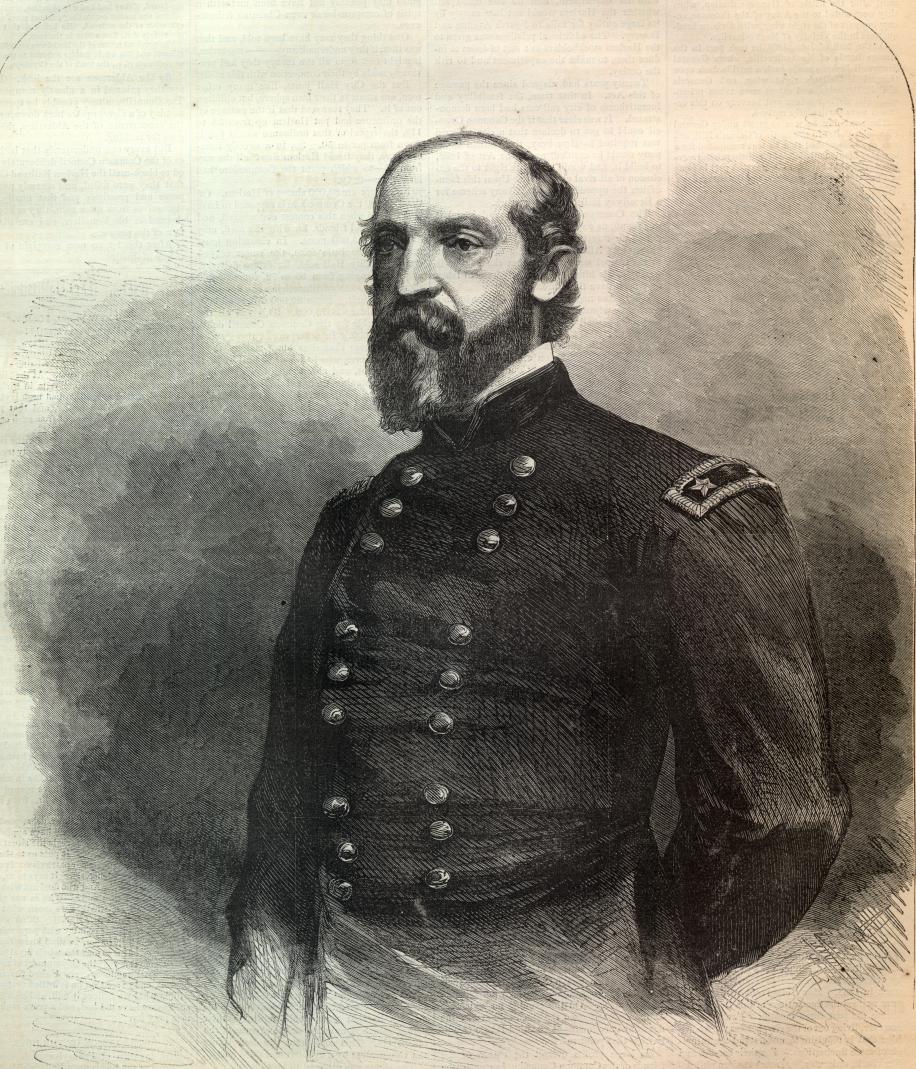
George Gordon Meade was the son of an American merchant who served as the naval agent for the U.S. government in that country until 1817. Meade was born in Cadiz on December 31st 1815 and grew up in Pennsylvania and Maryland. His father had been ruined financially in Spain when supporting the Spanish government by loaning it over $375,000 in the Peninsular War against Napoleon. Meade’s father remained in Spain to try to recover his lost fortune he sent his wife and children back to the United States where the family lived on the margins of poverty. The money should have been reimbursed to him under the terms of the Treaty of Florida “which obligated the American government to assume any Spanish obligations to American citizens.” However “the U.S. government discovered loopholes that it allowed it to dodge all responsibility to an increasingly bitter and disappointed Richard Meade.” [1]
Meade’s father returned to the U.S. and the family moved from Philadelphia to Washington D.C. were Richard Meade, “worn down physically and mentally by his struggles” [2] died in 1828 when George was just 12 years old and attending “a boarding-school at Mount Airy, a few miles from Philadelphia, known as the American Classical and Military Lyceum.” [3] It was here that Meade got his first taste of military discipline as the school was modeled after West Point and in addition to their studies the students participated in military drill.
At the Lyceum, Meade was known for being “an amiable boy, full of life, but rather disposed to avoid the rough-and-tumble frolics of youths his age; quick at his lessons, and popular with both teachers and scholars.” [4] The family ran out of money to keep him at the school and he returned to Baltimore where he was enrolled in the Mount Hope School in Baltimore as his mother sought to gain him an appointment at West Point. At Mount Hope he studied Latin, English composition and mathematics. A certificate from the headmaster of the school obtained by his mother discussed Meade’s academic acumen.
“The knowledge he has gained…is far greater than is usually acquired by young men of his age in a single year. He possesses an uncommon quickness of perception and is, therefore, capable of acquiring knowledge with great rapidity….” [5]
Meade entered West Point in 1831 when he was just sixteen years old after being nominated by Andrew Jackson. The financial condition of his family was mostly responsible for this as “West Point was the one place where the young Meade could obtain a free college education.” [6] At West Point Meade did not excel in his studies, though he was not near the bottom of his class and his performance in some subjects such as military engineering gave no indication of how he would excel later in life. He graduated nineteenth of fifty-six in the class of 1835. Unlike many classes which were crowed with men destined for greatness, there were few notables in this class. Other than Meade there was Lincoln’s Postmaster General Montgomery Blair, Brigadier General Herman Haupt, who directed the transportation system of the Union army in the East during the war and John Pemberton, who as a Confederate general would surrender Vicksburg to Grant.
Meade was commissioned as a Brevet Second Lieutenant and assigned to the artillery and resigned his commission after serving his one year obligation and entered civilian life as a topographic engineer. Such was not an unusual occurrence in the tiny army of that era, as “over the previous two years more than a hundred West Point graduates had left the army.” [7] He found his civilian employment with the Bureau of Topographical Engineers and over the next five years took part in surveying the Texas-Louisiana boundary line, an assignment on the Mississippi River Delta, and the Canadian-United States boundary, an area of perpetual dispute from the time of American independence. It was during his time of civilian work with the Bureau that he met and married his wife Margaret Sergeant Wise, the daughter of Congressman John Sergeant, who had been the running mate of Henry Clay in the 1832 presidential election.
In 1842 Congress passed a measure which limited topographic survey to officers of the Topographic Engineer Corps. For Meade this was a godsend, for with the assistance of Margaret’s brother-in-law Congressman Henry A. Wise of Virginia Meade was reappointed as a Second Lieutenant in the Topographic Engineers on May 19th 1842. He had lost nearly six years of seniority, but “he had fairly earned his rank of Second Lieutenant of Topographic Engineers.” [8] His first assignments included surveying the Aroostook River in Maine and the design and construction of a lighthouse for Brandywine Shoals, Delaware.
In 1845 with a war with Mexico looming due to the annexation of Texas, Lieutenant Meade reported to the headquarters of General Zachary Taylor in Corpus Christi. Here he conducted surveys of the Nueces River and other inland waterways. Meade accompanied Taylor to the disputed border area around between the Nueces and the Rio Grande where some of the first actions of the war took place in 1846. During the war he served in Mexico “principally with Taylor’s army, where he won a brevet for gallantry at Monterrey.” [9] During his time in Texas and Mexico Meade became disgusted with the political machinations that surrounded the war and in a letter home he wrote “the mighty engine of influence, that curse of our country, which forces party politics into everything.” [10]
Meade was transferred to the army of Winfield Scott where he was no longer the senior Topographic Engineer but the junior. He chafed at his inactivity with Scott and complained about it. Major Turnbull, the senior Topographic Engineer told Scott that Meade was “Meade was unexpectedly with the army and that he had quite enough officers without him.” [11] In light of this Scott sent Meade back, where he returned to building lighthouses missing the bulk of the campaign. That assignment was cut short in 1849 when Meade was ordered to Florida “amid an outbreak of violence by the Seminoles.” [12] In Florida he survey a line of forts and upon completion returned to lighthouse work at Brandywine Shoals and then in Key Largo.
When the Army established the Lighthouse Board, Meade was appointed t the Seventh District where he continued his work in Florida. Among the lighthouses that he built was the Sand Key lighthouse at Key West which stands to this day. Meade was still just a First Lieutenant but he was rising in terms of the work that he was doing and was “promoted to superintendent of the Seventh Lighthouse District” [13] and took over the Fourth District as well when its superintendent was transferred to the West Coast. In this work Meade prospered. The most impressive monument to Meade’s work is the 163 foot tall Barnegat Bay Light in New Jersey. Meade was justifiably proud of his accomplishments and after the war noted that “I have always thought my services in the construction of lighthouses, and subsequently on the Lake Survey were of considerable importance.” [14]
In 1856 Meade was promoted to Captain and given charge over the vast Great Lakes survey. In Meade’s words he work involved:
“the delineation of the shores, and bottom of the lakes, bringing to light the hidden dangers; obtaining the evidence and capacity and depth of water in all the harbors and rivers and consequently the most practical mode of improving them; furnishing the evidence of the wants of navigation in reference to lighthouses, beacons and buoys and the proper sites for same.” [15]
Meade had to lobby Congress for funding and expanded the number of officers and personnel involved until by 1860 he had ten teams, some working on land and some aboard ships with a budget which he expanded from $25,000 to $75,000 in three years. It was a remarkable job, but then Meade had matured as an officer and as a leader.
Meade was still involved with this mission when Fort Sumter was attacked. To the consternation of local leaders in Detroit, he and his officers refused to be part of a mass meeting where the locals were insisting the Federal officers publically renew their oaths. This decision was part of Meade’s innate conservatism. Meade felt that doing so without the order of the War Department was not within his prevue.
Meade was not a firebrand, conservative and logical thought that the best course would for both sides to step back and catch their breath. He was “dismayed at the arrogance of the fire-eaters, to whom Southern secession seemed like a simple riot which would be suppressed by the mere appearance of Federal troops.” [16] The decision angered Senator Zach Chandler who had organized the event and Chandler would remain an opponent of Meade throughout the war.
He had never been a political officer and was determined to avoid becoming one, he wrote “as a soldier, holding a commission, it has always been my judgement that duty required that I should disregard all political questions, and obey orders.” [17] Thus he avoided some of the more overtly political displays in Michigan but wrote:
“I have ever held it to be my duty…to uphold and maintain the Constitution and resist the disruption of this Government. With this opinion I hold the other side responsible for this existing condition of affairs.” [18]
He was viewed with suspicion by Radical Republicans as “another politically unreliable McClellan Democrat” and William Lloyd Garrison’s The Liberator noted that his look “reveals a character that never yet efficiently and consistently served a liberal cause.” [19]
He immediately volunteered for field duty, but it his request was not answered due to resistance in the Corps of Topographic Engineers. It was not until after the debacle at Bull Run when he would be appointed a Brigadier General of Volunteers, even as he was preparing to resign his commission to take command of a Michigan Regiment.
Meade was appointed to command a brigade of the Pennsylvania Reserves and saw much action at the head of his brigade on the Peninsula, serving alongside his friend John Reynolds who commanded another brigade in the division. Meade exhibited a coolness under fire that earned the respect of his soldiers and officers. His fearless nature had “resulted in his being wounded twice by bullets almost simultaneously at the Battle of Glendale on the Peninsula” [20] and incurring other wounds and close calls at South Mountain, Antietam and Fredericksburg. In September 1862 he was promoted to command the division and after Fredericksburg he was promoted to command Fifth Corps. His promotions “from brigade commander in the Pennsylvania Reserve Division to corps command had been earned on battlefields.” [21] Serving in almost all of the army’s campaigns in the East Meade “gained increasing distinction as a highly competent and skillful officer. At Fredericksburg his division was the only unit to achieve any kind of success in a battle that otherwise was known as the worst fiasco in the history of the Army of the Potomac.” [22]
Like many of the commanders at Gettysburg Meade’s personality, temperament and character were complex, leading to people who met him or served with him to different conclusions. He possessed little flair for the dramatic or the theatrical. He was quietly religious and modest and “he usually kept aloof and made no effort to make himself popular” especially with reporters and “they exacted a toll for this treatment, and as a result Meade’s reputation suffered from a poor press.” [23]
He did not fit the stereotype of a commanding general of an army, he possessed none of McClellan’s style, Hooker’s dash or Reynold’s handsomeness. Some of his critics in the ranks referred to him as “a damned old goggle-eyed snapping turtle” while others called him “Old Four Eye” based on the glasses that he wore.[24] Meade handled such comments well for he had few delusions about himself, he remarked to an officer “I know they call me a damned old snapping turtle.” [25] As for his physical appearance a reporter noted that Meade “is colorless, being of a ghostly pale,” and “his nose of the antique bend.” [26] Another noted that he looked more like “a learned pundit than a soldier” [27] while his attire did not help, an aide noted “as for clothes, General Meade was nowhere.” Another officer remarked, “it would be rather hard to make him look well dressed.” [28]
Meade was sharp minded and quick tempered, “irritable and touchy in camp, possessed of a famous temper and imperfect means of controlling it.” [29] His temper was rooted in his sense of perfectionism and truthfulness. Theodore Lyman wrote that “I never saw a man in my life who was so characterized by straightforward truthfulness as he is.” [30] But Meade’s often volcanic temper and abject truthfulness were that of a logical man who could not abide “stupidity, negligence or laziness.” [31] Lyman observed “I don’t know any thin old gentleman, with a hooked nose and cold blue eye, who, when he is wrathy, exercises less of Christian charity than my well-beloved Chief!” [32]
Unlike some leaders whose temper led them to make unwise decisions with the lives of their troops, “in matters involving the safety of the army or the lives of thousands of men he exercised self-control and showed great moral courage in his decisions.” [33] At the same time he was a man who if after an angry outburst was full of regret, and as introspective as he was had “a cordial desire, if he had been wrong to make amends.” [34]
He was a man who in the war did not lose his humanity either towards the soldiers that he commanded or the victims of war. He was moved to acts of compassion when he saw suffering women and children whose lives had been upended by war. During the campaign of 1864 Meade:
“happened upon a poorly dressed woman fringed by several crying children – a family which the cavalry had robbed – he pulled out a five-dollar bill and also saw that food was provided for the day’s neediest. “The soft-hearted General…though of his own small children,” Colonel Lyman reflected. “He is a tender hearted man.” [35]
It was this complex man, a modest, conservative perfectionist, prone to volcanic eruptions of temper, but possessing of a strong sense of honesty even in regard to himself, who in the early morning hours of June 28th 1863 would have the fate of the Union thrust upon his shoulders.
Notes
[1] Huntington, Tom Searching for George Gordon Meade: The Forgotten Victor of Gettysburg Stackpole Books, Mechanicsburg PA 2013 p.12
[2] Ibid. Huntington Searching for George Gordon Meade p.12
[3] Meade, George edited by George Gordon Meade The Life and Letters of George Gordon Meade, Major General United States Army Volume I Big Byte Books Amazon Kindle Edition 2014 originally published 1913 location 185 of 7307
[4] Ibid. Huntington Searching for George Gordon Meade p.12
[5] Cleaves, Freeman Meade of Gettysburg University of Oklahoma Press, Norman and London 1960 p.10
[6] Sears, Stephen W. Gettysburg. Houghton Mifflin Co. Boston and New York 2003 p.85
[7] Ibid. Huntington Searching for George Gordon Meade p.13
[8] Ibid. Cleaves Meade of Gettysburg p.18
[9] Pfanz Harry W. Gettysburg: The First Day University of North Carolina Press, Chapel Hill and London 2001 p.43
[10] Ibid. Huntington Searching for George Gordon Meade p.29
[11] Ibid. Cleaves Meade of Gettysburg p.43
[12] Ibid. Huntington Searching for George Gordon Meade p.31
[13] Ibid. Cleaves Meade of Gettysburg p.49
[14] Ibid. Huntington Searching for George Gordon Meade p.32
[15] Ibid. Cleaves Meade of Gettysburg p.50
[16] Ibid. Catton The Army of the Potomac: Glory Roadp.257
[17] Ibid. Huntington Searching for George Gordon Meade p.39
[18] Ibid. Cleaves Meade of Gettysburg p.52
[19] Ibid. Guelzo Gettysburg: The Last Invasion p.88
[20] Tagg, Larry The Generals of Gettysburg: The Leaders of America’s Greatest Battle Da Capo Press Cambridge MA 1998 Amazon Kindle Edition p.2
[21] Ibid. Wert A Glorious Army p.267
[22] Ibid. Coddington The Gettysburg Campaign pp.213-214
[23] Ibid. Coddington The Gettysburg Campaign p.213
[24] Ibid. Guelzo Gettysburg: The Last Invasion p.87
[25] Ibid. Foote The Civil War, A Narrative. Volume Two p.454
[26] Wert, Jeffry D. The Sword of Lincoln: The Army of the Potomac Simon and Schuster, New York and London 2005 p.268
[27] Ibid. Foote The Civil War, A Narrative. Volume Two p.454
[28] Ibid. Wert The Sword of Lincoln p.268
[29] Ibid. Catton The Army of the Potomac: Glory Roadp.257
[30] Ibid. Coddington The Gettysburg Campaign p.211
[31] Ibid. Coddington The Gettysburg Campaign p.211
[32] Ibid Sears. Gettysburg. Pp.125-126
[33] Ibid. Coddington The Gettysburg Campaign p.211
[34] Ibid. Coddington The Gettysburg Campaign p.212
[35] Ibid. Cleaves Meade of Gettysburg p.247










 The Inglorius Padre Steve's World

God’s Going to Get the Church for Its Greed
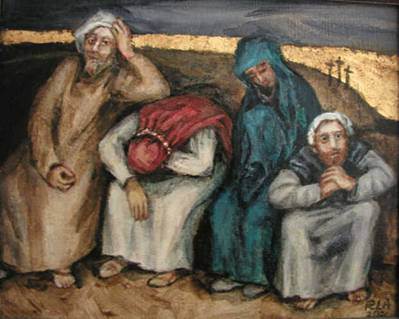
Back when I was in seminary at Southwestern Baptist, before the Fundamentalist takeover of that once proud school, my Church History professor, Dr. Doyle Young made the comment “God’s going to get us for our stained glass windows.” It was in the context of the rich and indolent nature of the American church. This was back in 1988 and 1989, sadly, things have only gotten worse.
In his various lectures Dr. Young was always able to weave church history into contemporary issues. He was really an amazing professor and he understood human nature more than most theologians. As such his lectures always had a profound amount of biography of the men and women who influenced church history. In fact, that biographical narrative is something that I have adopted in my own teaching and writing about history. That biographical emphasis helps keep me grounded and allows me to see that some things never change.
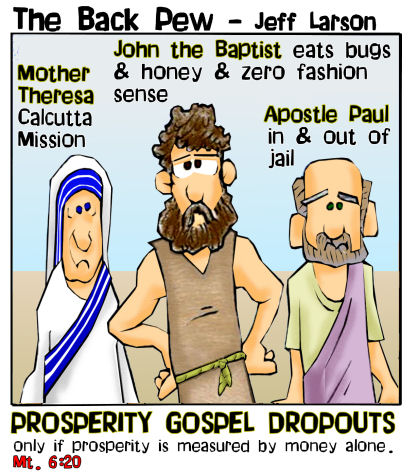
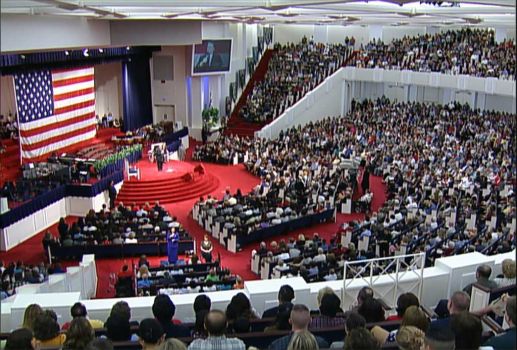
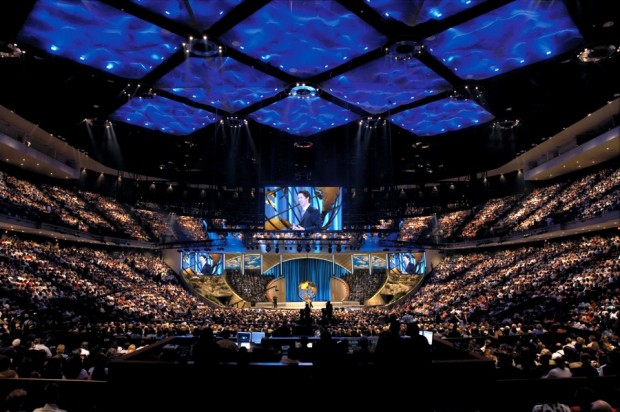
I noticed this again tonight when I posted a meme on Facebook about the televangelist and mega-church “pastor” Joel Osteen purchasing a 10.4 million dollar home. All of a sudden I had two men, one the son of a prominent televangelist that I worked for in the early 1990s, and the other a man who served with me as a Priest in my former denomination and now is a fairly high ranking priest in a diocese of the Episcopal Church open fire on me and defending the opulence of Osteen. When I asked what Jesus would do the televangelist’s son made comments made comments which were almost mocking of Jesus and his death for us. The Episcopal priest continued his defense and finished his post with the comment “cheers!” Frankly I found nothing to cheer about in their comments. When one of the men who served with me at war commented on the post, the Episcopal priest attacked him.
Do I really care what these men think of me? The hell no, not anymore. I invited both of them to drop me as “friends” because frankly I don’t want to be associated with people who make their living off the backs and hard earned money of the tithes and offerings of people who often cannot afford it and then defend the greed and opulence of wealthy minsters. I cannot do that. In fact when I retire from the Navy I will help other ministers and churches but I will not take any salary. I cannot do that, it seems to me that the Gospel which is supposedly freely given to us, should in turn be given.
Does that mean that I think that ministers should not be paid? Not at all. But there is a point, which is different in every church where what a minister makes is too much, and when the money that is sucked into a church or ministry only serves to prop that church or ministry up without helping any of God’s people but the livelihood of the minister.
I have heard so many rationalizations for this by ministers and Christians that it makes my head swim. I just remember reading the notes, letters and phone calls from poor people giving what they could not afford to the televangelist that I worked for in the early 1990s. Thinking about what those people gave and wrote breaks my heart to this day, especially when I see that man on television and radio talking about and actively backing the politicians who do the most to further impoverish the poor and support war without end.
Barry McGuire, the rock and roller who wrote and performed the song Eve of Destruction wrote another song after he became a Christian in the late 1960s called Don’t Blame God (for the Sins of America). Some of words in that song, a song of protest by a new Christian at the American church are even more accurate today.
On every worthless coin
and every dollar bill
you see the words in god we trust
but outta fear we kill
we got million dollar churches
but nobody’s on their knees
we got too many selfish people
just doin what they please
Sadly, because of the lives and actions of such people, many are fleeing the church, even those who grew up in it, the baptized. The fastest growing religious demographic in the country is the Nones those who ascribe to no religion. Many people blame God for the action of such people, but if I understand the message of justice of Jesus, John the Baptist and the prophets I know that it’s not God to blame. Instead it is us, those who claim to represent God while making our living off the backs of the weak and supporting the powerful. The Price Bishops of the Middle Ages would be jealous at how well we American Christians do this.
The song’s chorus would be banned in most churches especially those who have sold their souls for political power and economic wealth:
so don’t blame God for the
sins of america
america is fallen from the ways of the Lord
Don’t blame God for the
sins of america
livin for the dollar, she’ll be dyin’ by the sword
Anyway, this was one of those articles that I had thought about writing for a while and just needed a trigger. I guess I got it.
Peace
Padre Steve+
Share this:
3 Comments
Filed under christian life, faith, Pastoral Care, political commentary, Religion
Tagged as barry mcguire, christian life, church greed, don't blame god, eve of destruction, jesus, joel osteen, mega-churches, prince bishops, prosperity gospel, prosperity preachers