Yearly Archives: 2018

The Revenge of Wun Hung Lo: Never Violate Your Personal Prime Directive

Friends of Padre Steve’s world,

After a really long day Sunday working in the house, ripping up carpet and moving furniture I was tired. We had to sleep in the couches in the living room since the bedroom was in a state of disarray. About midnight I got hungry. I rummaged around the fridge and since there was little else there found a leftover egg roll from the Chinese takeout place that Judy likes and some sweet and sour sauce. I have appropriated the nickname given to a Chinese takeout place in our home town by her late father as my nickname for this place: Wun Hung Lo.

Now, honestly I never eat Chinese food. If i pick up take out for her I walk a couple of doors down to my favorite Mexican restaurant to get me something. My aversion to Chinese food goes way back to my high school graduation banquet when a spider crawled out from the inside of the pot of my Green Tea. At that point I made the decision that if I could see a spider crawling out of my tea that I couldn’t trust what might be in the food that was not so clear.

Judy has always considered that to be a bit extreme but when we lived in Huntington, West Virginia here favorite Chinese place there, the Happy Dragon by the health department because the chicken was actually cat. As I noted, “the cat’s in the ladle with the silver spoon.” Judy’s response was “tastes like chicken.”

Needless to say this phobia of mine was still in place, but since we didn’t have much else to eat having been so busy that we didn’t make a grocery run for over a week, I asked myself, “it’s only an egg roll, what could happen?”

I tell you what happened. About 6:00 A.M. I was dashing to the the great white throne to hurl the offending egg roll remnants and the still recognizable sweet and sour sauce into the pristine basin of my new toilet in our freshly renovated bathroom. I pain for violating my personal Prime Directive. I paid all morning for it until I passed out on the recliner until about 7:30 P.M.

While I was crashing and burning my dear friend Bill Quinn came to the house and finished installing the flooring and in our bedroom. Good friends are rare and the work he did would have taken me twice or three times as long and not looked professional at all.

Anyway. I finally held down some chicken noodle soup about 8:00 P.M. I have been drinking Gatorade and water most of the day. I’m still not feeling very good and I’m going to take the morning off from work before checking in during the afternoon on the way to a doctors appointment on base.

I could write more and certainly in more descriptive language, but I am really tired and it would probably gross you out. So I will schedule this to post just after midnight by which time I hope to be asleep.

However, I tell you the truth. I have learned my lesson at the hands of Wun Hung Lo, and after having looked at common ingredients found in egg rolls I can only say, nevermore.

Until tomorrow,

Peace,

Padre Steve+

1 Comment

Filed under life, Loose thoughts and musings

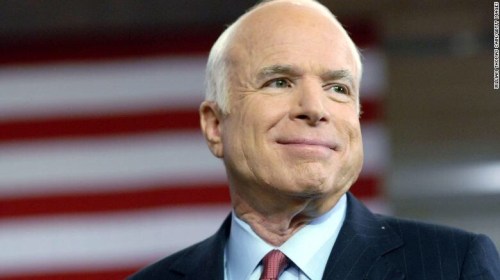
The Capstone of a Life: John McCain’s Parting Words

Friends of Padre Steve’s World,

Last night I didn’t get to sleep until about 4 A.M. I had been up until 1 A.M. working in the house and today I spent about 10 hours ripping out carpet, moving furniture, and working to lay new flooring in our house. My friend who has been doing the really hard stuff that requires skill to make it look good is coming back tomorrow to help finish the job. I I’d the furniture moving and carpet removal. Why anyone would put carpet in a house is beyond me. It is amazing, even with vacuuming and shampooing just how much dirt and crap is in and under the carpet. All I can say is yuck, which coincidentally is the mildest thing that I can say or think about President Trump.

However, that term does not apply to the late Senator John McCain’s message as he decided not to go on a ventilator to try to prolong his life. He knew his time had come and he released this message in which he quoted John Hemingway. McCain’s words were that of a thankful man who knew the ups and downs of life, it’s success and failure, but left life thankful and content.

In life he taught us much in positive and negative examples. He owned his failures but was happy that he had some influence in the life of this nation and the world at this time in history. I think that it is important that Senator McCain was the kind of person who did not reject people if they differed in opinion with him. His selection of President Barack Obama to do a eulogy at his funeral symbolizes that far too scarce ability to be friends with political or ideological adversaries. That used to be a pretty normal state of affairs in our country, but it is almost extinct today.

His words about the end of his life are remarkable and should be read by all. But before I share them I have to note that his last Tweet on Twitter was extending his sympathy to an Army officer and pilot killed in Iraq on his ninth deployment in 16 years of service. I cannot imagine something similar to be President Trump’s final tweet.

However, what I cannot say that there was anything in Senator McCain’s final note that could be described as “yuck.” Instead is was a very personal letter of someone schooled in life who never stopped reading or learning. The Senator from Arizona wrote:

“The world is a fine place and worth the fighting for and I hate very much to leave it … I hate to leave it. But I don’t have a complaint. Not one. It’s been quite a ride. I’ve known great passions, seen amazing wonders, fought in a war, and helped make a peace. I’ve lived very well and I’ve been deprived of all comforts. I’ve been as lonely as a person can be and I‘ve enjoyed the company of heroes. I’ve suffered the deepest despair and experienced the highest exultation. I made a small place for myself in the story of America and the history of my times. What an ingrate I would be to curse the fate that concludes the blessed life I’ve led. I prefer to give thanks for those blessings, and my love to the people who blessed me with theirs. The bell tolls for me. I knew it would. So I tried, as best I could, to stay a ‘part of the main.‘ I hope those who mourn my passing, and even those who don’t, will celebrate as I celebrate a happy life lived in imperfect service to a country made of ideals, whose continued service is the hope of the world. And I wish all of you great adventures, good company, and lives as lucky as mine.” —John McCain

Rest In Peace Senator McCain, for I know that you will.

Peace,

Padre Steve+

1 Comment

Filed under faith, leadership, life, News and current events, philosophy, Political Commentary

“Our Nation Aches for Truth Tellers” Rest In Peace Senator John S. McCain

gettyimages-829707042

Friends of Padre Steve’s World,

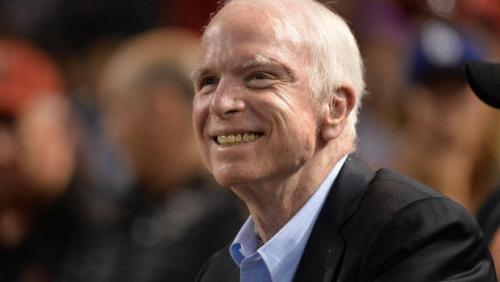
Today the United States and the world lost a voice of honor, decency, and courage. Senator John McCain died today after a gallant yet futile battle with an aggressive brain cancer, the same cancer that took the life of his friend Senator Ted Kennedy a decade ago. Senator Ben Sasse remarked: “Our nation aches for truth-tellers. This man will be greatly missed.”

I have always admired Senator McCain for his military service. This included his courage in one of the most frightening and dreadful things a sailor can experience, a fire at sea; in his case the disastrous fire aboard the USS Forrestal which killed over 150 of his shipmates and left him injured. Then his courage under fire and his indefatigable spirit while a prisoner of the North Vietnamese for five years. As a Senator he hewed his own path, while loyal to his party he did not hesitate to oppose it when its policies went against his sense of honor, dignity, or humanity.

I could go on but it is very late. I have been working in my house all day to get ready for laying more flooring in the morning. In fact I didn’t sit down until One A.M. While I was working Judy told me that Senator McCain had died. A few hours later I have to say that Senator Chuck Schumer, who certainly disagreed with McCain more often than not during their time in the Senate said it best:

“As you go through life, you meet few truly great people. John McCain was one of them. His dedication to his country and the military were unsurpassed, and maybe most of all, he was a truth teller — never afraid to speak truth to power in an era where that has become all too rare. The Senate, the United States, and the world are lesser places without John McCain.”

I will take some time to process his death and what it means. But for tonight I will just remember his remarkable life and hope that we as Americans can again rise to the ideals of our country that he tried hard to embody, even when he acknowledged that he had failed to do.

He was a rare man. I think that his defiance of President Trump was very much like that of Senator Stephen A. Douglas against President James Buchanan in the 1858 confrontation regarding the LeCompton Constitution. Like Douglas, McCain was demonized by the President and his supporters in his Party. But honestly I could hear Senator McCain echoing Douglas’s words against Buchanan and his administration:

“After the Christmas recess, the Administration unleashed its heavy horsemen: Davis, Slidell, Hunter, Toombs, and Hammond, all southerners. They damned me as a traitor and demanded that I be stripped of my chairmanship of the Committee on Territories and read out of the Democratic party. Let the fucking bastards threaten, proscribe, and do their worst, I told my followers; it would not cause any honest man to falter. If my course divided the Democratic party, it would not be my fault. We were engaged in a great struggle for principle, I said, and we would defy the Administration to the bitter end.”

Regardless of whether one agreed or disagreed with Senator McCain on the issues, one could never dispute the fact that he tried to operated and stand on principle, especially over the last two years of his life and career where like Douglas he had to stand on principle against an unprincipled President and his equally unprincipled supporters. I only wish that McCain had lived to see his principles overcome the malevolent machinations of President Trump, his unprincipled administration, and his cult like supporters.

Until tomorrow,

Peace

Padre Steve+

2 Comments

Filed under ethics, History, leadership, Military, News and current events, Political Commentary

U.S. Army Artillery Doctrine and Tactics from the Mexican War to the Wilderness

Friends of Padre Steve’s World,

It has been a very long day. My legs hurt, I broke the big toe on my right foot Thursday afternoon, and between real work and work at home I put on about 7.5 miles on my legs. Thankfully I used Mr. Cane, who came into my life when I broke my tib-fib near the knee back in 2011 was there to help me out. I showed up at command PT dressed out in my PT uniform with Mr. Cane, but it was not the “Cane Mutiny.” Yes, that is a very bad pun, but when your are as tired as I am and in as much pain you really don’t care, but I digress… 

I still am working on my article about the President’s terrible week which seems to get more fascinating by the hour. Maybe after a long day working in the house tomorrow, ripping out nasty old carpet. laying some flooring in closets, and doing a bunch of other stuff I might try to finish it tomorrow, which is actually today because I am still awake and it is after midnight. 

So what the hell, tonight I am reposting a section of my unpublished Civil War book A Great War in a Revolutionary Age of Change. This section continues one that I posted two or three weeks ago dealing with U.S. Army artillery. This particular section deals with the period between 1846 and the summer of 1864. It is as non-partisan as you can get, but I hate to admit that the thought of  M-1857 12 Pound smoothbore “Napoleons” firing at massed Confederate infantry in the open  as they did during Pickett’s Charge does warm my heart. Oh my God it almost gives me a woody, but that isn’t exactly very Christian of me, but as I readily admit I am no saint and pretty much a Mendoza Line Christian. At least I can admit it. 

So have a great day and please get some sleep. 

Peace,

Padre Steve+

fig20

American artillery doctrine subordinated the artillery to the infantry. Doctrine dictated that on the offensive “was for about one-third of the guns to occupy the enemy’s artillery and two-thirds to fire on the infantry and cavalry. Jomini liked the concentrated offensive cannonade where a breach of the line was to be attempted.” [1] But being such a small service, it was difficult for Americans to actually implement Napoleonic practices, or organization as the organization itself “was rooted in pre-Napoleonic practice, operating as uncoordinated batteries.” [2]

American artillerymen of the Mexican War could not match the massive firepower and concentration of Napoleon’s army. Instead it utilized mobile tactics, which gave it “the opportunity to maneuver in open country to support the infantry.” [3] During the war the actions of the highly mobile light batteries proved decisive, as did the spirit of their officers and soldiers. The Americans may not have had the organization of Napoleon, but “the audacious spirit was there.” [4] In a number of engagements American batteries employed the artillery rush, even gaining the admiration of Mahan, a noted exponent of the defensive. Among the leaders of the artillery at the Battle of Buena Vista were Captain Braxton Bragg, and Lieutenants John Reynolds and George Thomas, all of who would go on to fame in the Civil War. During a moment when Mexican forces threatened to overwhelm the American line, Bragg’s battery arrived:

“Without support, Bragg whirled his guns into battery only a few rods from the enemy…. The Mississippi Rifles and Lane’s Hoosiers also double-quicked from the rear of the plateau. From then on it was a storybook finish for the Americans, and artillery made the difference. Seventeen guns swept the Mexicans with grape and canister…. Reynolds, Thomas, and the others stood to the work with their captains until 5 o’clock. Santa Ana was through…” [5]

At Casa Mata outside of Mexico City, Americans found their flank threatened by Mexican cavalry. Captain James Hunter and Lieutenant Henry Hunt observed the situation and “Without awaiting orders they rushed their guns to the threatened sector…  With Duncan directing them, all stood their posts long enough to spray the front ranks of mounted Mexicans with canister, the shotgun effect of which shredded the half-formed attack columns, dissolving all alignment and sending the lancers scrambling rearward in chaos…” [6] As a result these and other similar instances the artillery came out of the war with a sterling reputation and recognition of their gallant spirit. John Gibbon reflected such a spirit when he wrote: “Batteries derive all their value from the courage and skill of the gunners; from their constancy and devotion on difficult marches; from the quickness and capacity of the officers; and especially from the good condition and vigor of the teams, without which nothing can be undertaken.” [7]

At the beginning of the war U.S. Army doctrine recommended placing batteries equally across the line and concentrating them as needed. The last manual on artillery tactics Instruction for Field Artillerypublished in 1859 retained much of its pre-Mexican War content and the doctrine in it provided that artillery was to “be organized at the regiment and brigade level with no reserve.” [8] Nonetheless some artillery officers discussed the possibilities of concentration, Grand Batteries, and the artillery reserve, no changes in organization occurred before the war. However, these discussions were all theoretical, as practical experience of these officers was limited to the small number of weapons employed in the Mexican War, and the “immediate problem was the organization of an unaccustomed mass of artillery.” [9] The Artillerist’s Manual, a highly technical treatise on gunnery was written by Captain John Gibbon in 1859 while he was serving at West Point and used by artillerymen of both sides during the war.  In  Gibbon described the principle object of the artillery was to, “sustain the troops in the attack and defense, to facilitate their movements and to oppose the enemy’s; to destroy his forces as well as the obstacles that protect them; and to keep up the combat until the opportunity for a decisive blow.”  [10]

Since the United States Army traditionally drawn their doctrine from the French this meant going back to the Napoleonic model the foundational unit of which was the battery. The field artillery batteries were classed as either foot artillery or horse artillery. The horse artillery accompanied the cavalry and all gun crews went into battle mounted as cavalrymen. The soldiers of the foot artillery either rode with the guns or walked. The battery was the basic unit for American artillery and at the “start of the war the artillery of both sides was split into self-contained batteries, and each battery allocated to a particular brigade, regiment or even battalion of infantry.” [11]

12 pound napoleon

At the battery level Union artillery was organized by type into six-gun batteries. Confederate artillery units were organized into four or six-gun batteries in which the guns were often of mixed type. This often led to supply problems for Confederate gunners and inconsistent rates of fire and or range. Confederate gunners also had to deal with poor quality power and explosive shells, a condition that only worsened as the war continued. The well-trained Union gunners had better quality ammunition and gunpowder as well as what seemed to the Confederates to have limitless ammunition.

Each gun was manned by a seven-man crew and transported by a team of horses that towed a limber, which transported the cannon and a caisson, which transported the ammunition. The caissons would normally be stocked with four chests of ammunition. For a Napoleon “a standard chest consisted of twelve shot, twelve spherical case, four shells, and four canister rounds for a total of 112 rounds of long range ammunition.” [12] In addition to the ammunition carried in the caissons of each gun, more ammunition was carried in the corps and division supply trains.

As the war progressed the both the Union and Confederate armies reorganized their field artillery. In the North this was a particular problem due to the lack of flexibility and politics in the Army which were prejudiced against large artillery formations, despite the great numbers of batteries and artillerymen now in the army. However the Federal army had good artillerymen. The Regular Army batteries were the foundation of the artillery service. Unlike the infantry units which were overwhelmingly composed of volunteer soldiers, the artillerymen were regulars, many who had served for years in the ante-bellum army.

Since there were few billets for senior artillerymen many artillery officers volunteered or were selected to serve in the infantry to get promoted or to take advantage of their experience and seniority. One of those chose was John Reynolds who promote to Lieutenant Colonel and given orders to form an infantry regiment. Before he could get started in that work he was made a Brigadier General of Volunteers. He wrote: “I would, of course, have preferred the Artillery arm of service, but could not refuse the promotion offered me under any circumstance, much less at this time, when the Government has a right to my services in any capacity.” [13] Other artillerymen who rose to prominence outside of the branch during the war included William Tecumseh Sherman, George Meade, John Gibbon, George Thomas, Ambrose Burnside, and Abner Doubleday, and Confederates Stonewall Jackson, Braxton Bragg, Jubal Early, and A.P. Hill.

However, General Winfield Scott took action to keep a core of experienced artillery officers with the artillery. At Scott’s behest, “the War Department limited the resignations of artillerymen to accept higher rank in infantry regiments, resulting in a core of capable and experienced officers.” [14]  This allowed George McClellan to select two exceptional artillery veterans, William Barry and Harry Hunt to “organize the branch and to oversee training.” [15] McClellan appointed Barry, who had been commissioned in 1836 as the head of his artillery. After the defeat at Bull Run, Barry “prepared as set of guidelines or principles for the artillery service. He prescribed a uniform caliber of guns in each battery, four to six cannon in each battery, and that four batteries – one Regular Army and three volunteer – be attached to each division.” [16]  In this organization, McClellan and Barry “called for the Regular Army battery commander to take charge of those batteries assigned to the division. This was in addition to his responsibilities to his own battery.” The practical effect of this was that “with the exception of the Artillery Reserve, the highest artillery command remained that of a Captain.” [17]

Hunt was responsible for the organization of the Artillery Reserve and the siege train. The Artillery Reserve was given eighteen batteries, about 100 guns or about one-third of the army’s artillery. It would be a source from which to replace and reinforce batteries on the line, but Hunt also understood its tactical employment. He explained:

‘In marches near the enemy it is often desirable to occupy positions with guns for special purposes: the command fords, to cover the throwing and taking up bridges, and for other purposes for which it would be inconvenient and unadvisable to withdraw their batteries from the troops. Hence the necessary reserve of artillery.” [18]

Hunt’s Artillery Reserve would be of great value in the early battles of maneuver. “The primary advantage of the army artillery reserve was the flexibility it gave the commander, making it unnecessary to go through the division or corps commanders. The reserve batteries could be used whenever or wherever needed.” [19] But this would not be in the offense role that Napoleon used his artillery to smash his opponents, for technology and terrain would seldom allow it; but rather in the defense; especially at the battles of Malvern Hill and Gettysburg. However, “Gettysburg was the last battle of the Civil War in which field artillery fire was paramount…” but “By the end of 1863, the tide of war had changed in the eastern theater, with both sides making more use of field fortifications to cover themselves from the murderous fire of the infantry rifle.” [20]

Even so, lack of promotion opportunity for artillerymen was a problem for both sides during the war, and artillerymen who showed great promise were sometimes promoted and sent to other branches of service. A prime example of such a policy was Captain Stephen Weed “who fought his guns brilliantly in the first two years of the war, and a Chancellorsville even commanded the artillery of a whole army corps.” Henry Hunt “singled him out as having a particular flair for handling large masses of cannon, and wanted to see him promoted.” [21] He was promoted to Brigadier General but in the infantry where he would lead a brigade and die helping to defend Little Round Top. In all “twenty-one field-grade artillery officers in the Regular Army became generals in the Volunteers, but only two remained with the artillery branch.” [22]

Both Barry and Hunt sought to rectify this issue. Barry insisted that a “battery of artillery was the equivalent of a battalion of infantry” [23] and pressed for a higher grade structure for the artillery. Colonel Charles Wainwright wrote of their efforts: “Many officers of the regular artillery have long been trying to get a recognition of their arm of the service, doing away with the regiments and making a corps of it, the same as the engineers and ordnance. McClellan and Hunt drew up a plan soon after Antietam, which by Stanton and Halleck, but nothing more has been hear of it.” [24]

However, Barry and Hunt were opposed by War Department insiders. General Lorenzo Thomas, the Adjutant General used law and regulation to prevent promotions in the artillery beyond Captain and as to General Officers as well. Thomas insisted that the battery was equivalent of an infantry company or cavalry troop. He noted “that laws long in force stipulated that only one general officer could be appointed per each for each forty infantry companies or cavalry troops.” [25] He applied this logic to the artillery as well, which meant in the case of the Army of the Potomac which had over sixty batteries that only one general could be appointed. The result could be seen in the organization of the Army of the Potomac at Gettysburg, the artillery component, “which included approximately 8,000 men with 372 pieces – almost the manpower (and certainly the firepower) of a complete army corps. It included only two general officers… then there were three colonels and no other high ranks at all. One army corps had its guns commanded by a lieutenant.” [26] Over time the situation would improve and the artillery given some autonomy within the Army, at Gettysburg Meade gave Hunt command authority to employ the artillery as he deemed necessary, even over the objections of the corps commanders.

General Henry Hunt was probably the most instrumental officer when it came to reorganizing Union artillery organizations in the Army of the Potomac. Following the Battle of Chancellorsville, Hunt prevailed upon the army commander, Joseph Hooker to create “artillery brigades assigned to each corps. This overcame a problem at Chancellorsville, where the batteries of uncommitted divisions had gone unused. The reorganization also made a practical adjustment to the situation where the attrition of divisions was making the corps the basic tactical unit.” [27] In the reorganization the infantry brigades retained their assigned batteries for direct support, but the guns of the divisions were organized into brigades at the corps level. The artillery brigades of the infantry corps had “from four to eight batteries, depending on the size of the corps.” [28] Despite being reflagged as brigades the command structure was not increased. This was often due to the fact “that for much of the war commanding officers persisted in regarding artillery as merely a subsidiary technical branch, an auxiliary which might add a little extra vitality to a firing line if conditions were favourable – but more typically would not.” [29] Dr. Vardell Nesmith noted:

“Resistance within the Army to formalizing tactical organizations for field artillery above the level of the battery was a complex phenomenon. Certainly there was some hesitance on the part of the Army establishment to create new organizations that would come between infantry and cavalry commanders and their fire support assets. Also one cannot discount the institutionalized tendency to keep everyone in their proper place – in other words, to keep a new power group from organizing.” [30]

Organized into brigades the Artillery Reserve became the instrument of the Army commander and served as what we would now call “general support”artillery where they were invaluable to Union army commanders to be available to augment other batteries and to replace batteries which had suffered casualties while on line. The organization of the artillery into brigades, even if they were field expedient organizations did much to increase the effectiveness of the arm. They supplanted “the battery in tactics and to considerable degree in administration. Supply and maintenance were improved, and more efficient employment and promptness and facility of movement resulted. In addition, the concentration of batteries was favorable for instruction, discipline, and firepower. Fewer guns were needed, and in 1864, the number of recommended field pieces per 1,000 men was reduced from 3 to 2.5.” [31]

henryhunt

General Henry Hunt

Hunt lobbied the War Department to provide a staff for each brigade, but since the new units were improvised formations no staffs were created and no promotions authorized for their commanders. Colonel Wainwright proposed a congressional bill to organizer volunteer artillery units into a corps of artillery, but lamented:

“Both Barry and General Hunt while commanding the artillery of this army have frequently complained in their reports of the great want of field officers. Were the light batteries of each state organized as a corps, and provided with field officers in the proportion proposed in the bill referred to above, this want would be provided for. The officers of light batteries also have a claim demanding some such change. No class of officers in our volunteer service stand as high as high as those of our light batteries. I say without hesitation that they are very far superior as a class in all respects to the officers of the infantry or cavalry. Yet for them there is not a chance at this time any chance of promotion above a simple captaincy, except in the few light regiments spoken of. I can point to several cases of captains of light batteries who, from this want of field officers, have for the past year exercised all the authority and borne all the responsibility of a brigadier-general.” [32]

But change did come, however slowly and with great resistance from the War Department bureaucracy, and the artillery service “did succeed in winning some measure of recognition for its independent status and tactics. After Gettysburg the army’s artillery commander was accept as having overriding authority in gunnery matters, with the infantry relegated to a merely consulting role, although in practice the change brought little improvement.” [33] The beginning of this came in August 1863 when George Meade promulgated an order that “defined Hunt’s authority in matters of control of the artillery in the Army of the Potomac. The order “definitely stated that Hunt was empowered to supervise and inspect every battery in the army, and in battle to employ them “under the supervision of the major-general commanding.” [34] The order was important but still did not go far enough to remedy the problem of a lack of field officers in the artillery, a problem that was not completely remedied during the war although Ulysses Grant did allow a limited number of promotions to provide more field grade officers in the artillery service of the Army of the Potomac and other armies under his command in the Eastern Theater. Likewise some additional billets were created in the brigades as brigade commanders “were authorized a staff consisting of an adjutant, quartermaster, commissary officer, ordnance officer (an artillery officer on ordnance duty), medical officer, and artillery inspector, with each staff officer having one or more assistants…” However the staff officers had to be detailed from the batteries, thereby reducing the number of officers present with those units”[35] However, in most cases the brigade commanders remained Captains or First Lieutenants.

In the Western theater there was a trend toward the centralization of the artillery in the various armies depending on the commander and the terrain and the size of the operation. As the war progressed in the west commanders began to group their artillery under brigades, divisions, and finally under the various army corps. At Shiloh Grant concentrated about 50 guns “in the notorious “Hornet’s Nest,” perhaps saving him from defeat.” [36] Artillery tactics shifted away from the offense to the defense and even during offensive operations western commanders were quick to entrench both their infantry and artillery. During the Atlanta campaign and march to the sea William Tecumseh Sherman successfully reduced his artillery complement first to 2 guns per 1,000 men then to 1 per 1,000. [37] This was in large part because he was conducting a campaign of maneuver and was far from his logistics base. Since supplies had to be carried with the army itself with a heavy reliance on forage, Sherman recognized that his army had to be trimmed down. Likewise, “the terrain and concept of operations must have been very important in his decision.” His “rapid, almost unopposed raid through Georgia gave no opportunities for the massing of large batteries in grand manner.” [38] During the campaign Sherman marched without a siege train and reinforced his cavalry division with light artillery batteries.

Notes 

[1] Ibid. Hagerman The American Civil War and the Origins of Modern Warfare p.21

[2] Ibid, Bailey Field Artillery and Firepower p.195

[3] Ibid, Bailey Field Artillery and Firepower p.194

[4] Ibid. Nesmith Stagnation and Change in Military Thought: The Evolution of American Field Artillery Doctrine, 1861-1905 – An Example p.6

[5] Nichols, Edward J. Toward Gettysburg: A Biography of General John Reynolds, The Pennsylvania State University Press 1958, reprinted by Old Soldier Book Gaithersburg MD 1987 p.43

[6] Ibid. Longacre The Man Behind the Guns: A Military Biography of General Henry J. Hunt, Chief of Artillery, Army of the Potomac pp.53-54.

[7] Gibbon, John. Artillerist’s Manual: Compiled from Various Sources and Adapted to the Service of the United States. 1859 retrieved from http://www.artilleryreserve.org/Artillerists%20Mannual.pdf 19 January 2017 pp.345-346

[8] Ibid. Hagerman The American Civil War and the Origins of Modern Warfare p.22

[9] Ibid. Nesmith Stagnation and Change in Military Thought: The Evolution of American Field Artillery Doctrine, 1861-1905 – An Example p.19

[10] Ibid. Gibbon  Artillerist’s Manual: Compiled from Various Sources and Adapted to the Service of the United States. p.343

[11] Ibid. Griffith, Battle Tactics of the Civil War p.165

[12] Gottfried, Bradley The Artillery of Gettysburg Cumberland House Publishing, Nashville TN 2008 p.15

[13] Ibid. Nichols Toward Gettysburg: A Biography of General John Reynoldsp.75

[14] Wert, Jeffry D. The Sword of Lincoln: The Army of the Potomac Simon and Schuster, New York and London 2005 p.39

[15] Ibid. Wert The Sword of Lincoln: The Army of the Potomac p.39

[16] Ibid. Wert The Sword of Lincoln: The Army of the Potomac p.40

[17] Ibid. Nesmith Stagnation and Change in Military Thought: The Evolution of American Field Artillery Doctrine, 1861-1905 – An Example pp.21-22

[18] Ibid. Longacre The Man Behind the Guns: A Military Biography of General Henry J. Hunt, Chief of Artillery, Army of the Potomac p.98

[19] Ibid. McKenny The Organizational History of Field Artillery 1775-2003 p.65

[20] Ibid. McKenny The Organizational History of Field Artillery 1775-2003 p.74

[21] Ibid. Griffith, Battle Tactics of the Civil War p.166

[22] Ibid. McKenny The Organizational History of Field Artillery 1775-2003 p.60

[23] Ibid. Nesmith Stagnation and Change in Military Thought: The Evolution of American Field Artillery Doctrine, 1861-1905 – An Example p.22

[24] Wainwright, Charles S. A Diary of Battle: The Personal Journal of Colonel Charles S. Wainwright 1861-1865 edited by Allan Nevins, Da Capo Press, New York 1998 p.336

[25] Ibid. Longacre The Man Behind the Guns: A Military Biography of General Henry J. Hunt, Chief of Artillery, Army of the Potomac p.100

[26] Ibid. Griffith, Battle Tactics of the Civil War p.166

[27] Ibid. Hagerman The American Civil War and the Origins of Modern Warfare p.94

[28] Ibid. Hagerman The American Civil War and the Origins of Modern Warfare p.94

[29] Ibid. Griffith, Battle Tactics of the Civil War p.166

[30] Ibid. Nesmith Stagnation and Change in Military Thought: The Evolution of American Field Artillery Doctrine, 1861-1905 – An Example pp.22-23

[31] Ibid. McKenny The Organizational History of Field Artillery 1775-2003 p.62

[32] Ibid. Wainwright. A Diary of Battle: The Personal Journal of Colonel Charles S. Wainwright 1861-1865 p.337

[33] Ibid. Griffith, Battle Tactics of the Civil War p.166

[34] Ibid. Longacre The Man Behind the Guns: A Military Biography of General Henry J. Hunt, Chief of Artillery, Army of the Potomac p.181

[35] Ibid. McKenny The Organizational History of Field Artillery 1775-2003 p.61

[36] Ibid, Bailey Field Artillery and Firepower p.198

[37] Ibid. Hagerman The American Civil War and the Origins of Modern Warfare p.284

[38] Ibid. Griffith, Battle Tactics of the Civil War p.178

Leave a comment

Filed under artillery, civil war, Gettysburg, History, leadership, Military, us army

The Black Hole of Sleep and Nightmares: PTSD, Iraq, and my Continuing Struggle

cropped-n671902058_1153794_4301.jpg

Friends of Padre Steve’s World,

Guy Sajer wrote in his book The Forgotten Soldier these words:

“Only happy people have nightmares, from overeating. For those who live a nightmare reality, sleep is a black hole, lost in time, like death.” 

I am exhausted tonight and I will be going to bed early for me. Hopefully I will get some restful sleep. I will be posting this article to post shortly after midnight by which time I hope not only to be in bed but asleep.

Last night was a night of violent nightmares taking me back to my worst fears when I was serving in the badlands of Iraq’s Al Anbar Province in 2007 and 2008 supporting U.S. Advisors to Iraqi Army, Border Forces, Police, Highway Patrol, and Provincial Reconstruction teams.

I do not often write about it because I have been doing better, but I suffer from severe and chronic PTSD related to my experiences at war. The images are seared into my brain and sometimes the memories, and my deepest fears from my time there as an unarmed Chaplain working for the most part with very small groups of Americans and our Iraqis far away from the help of the big battalions if we got into serious trouble. I have written about those experiences and my struggles after my return many times on this blog. Likewise, I have had my story told on the front pages of the Jacksonville Daily News and the Washington Times. A video of my story is on the Department of Defense Real Warriors Campaign website, and is a large part of a chapter of Pulitzer Prize winning War Correspondent David Wood’s book  What Have We Done: The Moral Injury of America’s Longest Wars.  

Since Iraq, my nightmares are very vivid and often involve much physical acting out. The physical acting out is unusual and I have actually injured myself badly enough to require trips to the emergency room after crashing hard throwing myself out of bed combatting imaginary enemies. Likewise, other have been violent and physical enough to wake Judy up.

Last night was one of those nights but very different. In the nightmare I was being attacked by an Iraqi insurgent. Our advisor team had been attacked as we were stopped in the dark to determine if an Improvised Explosive Device had been laid in the road in front of us. This was just a few miles from the Iraq-Syrian border between Al Qaim and COP South, the base of the advisor team which was working with the 3rd Battalion of the 3rd Brigade of the Iraqi 7th Division.

The part about being stopped in the desert in the dark while examining a potential IED actually happened. The attack did not happen but at the time I fully expected something like it to happen. We were sitting ducks on a two lane highway in the middle of the desert. But the attack never happened and we continued to COP South, which would become a part of many of my future missions.

But in my nightmare it happened and as the fighting devolved into close quarters hand to hand combat I found myself grappling an insurgent who was attacking me with a large knife. I managed to roll on top of him and knock the knife from his hand when I was awakened. I was on top of Judy and she was afraid that I was going to strangle her. My hands had not gotten to her throat but she woke me and told me what had happen. I dropped back to my side of the bed in a cold sweat. I could not believe what had happened and that terrifies me. I have set up an appointment prior to my regularly scheduled one with my shrink to talk about this.

Since I my day had been quite good and I have been much more relaxed at work since putting in my retirement papers the event came as a huge surprise. In trying to figure out what triggered it I was at loss until I remembered that I had had dinner last night with a retired Navy EOD Captain who had been my Chief Staff Officer at EOD Group Two and running partner before I went to Iraq. He was sent there not long after me and we met at Camp Victory in Baghdad not long before I left Iraq on the way to Kuwait and home in 2008. We enjoyed a wonderful dinner last night and we did talk about all manner of things including our time in Iraq and those men that we had served alongside.

But to try to explain nightmares is not really helpful. I think that Stephen King said it best:

“Nightmares exist outside of logic, and there’s little fun to be had in explanations; they’re antithetical to the poetry of fear.” 

Yes I can try to logically deduce my nightmares and night terrors, but the poetry of fear as Stephen King so rightly calls it cannot be fully explained. For those of us who deal with the memories of combat, of having been shot at and have seen the human cost of war, the dead, the wounded, the destruction, and the aftermath of war, they are all too real and they never completely leave us.

Christmas on the Syrian border

Over ten years after I returned from Iraq I still find that much of me is still there. In fact, deep down I miss Iraq and the Iraqis that I was honored to know and to serve alongside and I still pray for them and for their future. Maybe someday I will get back.

So until tomorrow, Inshallah, إن شاء الله

Peace

Padre Steve+


1 Comment

Filed under iraq, Military, PTSD, to iraq and back, Tour in Iraq

The Pattern of Despotic Rulers

Image result for liddell hart

B. H. Liddell-Hart

Friends of Padre Steve’s World,

A couple of years ago I read the short but poignant little but by the British military historian B.H. Liddell-Hart entitled Why Don’t We Learn from History. The book was written in not long before his death in 1970 and it is good quite good. It deals with a number of issues, including the conflict between history and propaganda, or when faith, especially religious faith as treated as historic or scientific fact; especially when propaganda or faith is preached as if it were history, if it were truth. But he also contrasted democracy and totalitarianism.

Liddell-Hart was a realist, especially about democracy and totalitarianism. While he admitted the inefficiencies of democracy, he realized that it was far less dangerous than the “stupidity” of totalitarianism. In fact it was important for him to note just how this inefficient system was for freedom. He wrote:

“What is of value in “England” and “America” and worth defending is its tradition of freedom, the guarantee of its vitality. Our civilization, like the Greek, has, for all its blundering way, taught the value of freedom, of criticism of authority, and of harmonising this with order. Anyone who urges a different system, for efficiency’s sake, is betraying the vital tradition.”

There is much to ponder in his book and I will probably write some more of my thoughts on it, but when I read it I was struck by just how much Liddell-Hart in his description of a despot described President Donald Trump through the his campaign and after his election and inauguration.

“We learn from history that self-made despotic rulers follow a standard pattern. In gaining power: They exploit, consciously or unconsciously, a state of popular dissatisfaction with the existing regime or of hostility between different sections of the people. They attack the existing regime violently and combine their appeal to discontent with unlimited promises (which, if successful, they fulfil only to a limited extent). They claim that they want absolute power for only a short time (but “find” subsequently that the time to relinquish it never comes). They excite popular sympathy by presenting the picture of a conspiracy against them and use this as a lever to gain a firmer hold at some crucial stage.” 

Once authoritarian, despotic, or dictatorial leaders gain power through the democratic process they seldom deviate from how they behave when seeking power. Liddell-Hart wrote:

“We learn from history that time does little to alter the psychology of dictatorship. The effect of power on the mind of the man who possesses it, especially when he has gained it by successful aggression, tends to be remarkably similar in every age and in every country.”

So please, take a breathe for a second and think about this in terms of President Trump and his actions during his first two weeks in office. Liddell-Hart noted that once a despot achieves power that their reign is marked by the following types of events:

“On gaining power:  They soon begin to rid themselves of their chief helpers, “discovering” that those who brought about the new order have suddenly become traitors to it. 

They suppress criticism on one pretext or another and punish anyone who mentions facts which, however true, are unfavourable to their policy. They enlist religion on their side, if possible, or, if its leaders are not compliant, foster a new kind of religion subservient to their ends. 

They spend public money lavishly on material works of a striking kind, in compensation for the freedom of spirit and thought of which they have robbed the public. 

They manipulate the currency to make the economic position of the state appear better than it is in reality. 

They ultimately make war on some other state as a means of diverting attention from internal conditions and allowing discontent to explode outward. 

They use the rallying cry of patriotism as a means of riveting the chains of their personal authority more firmly on the people. 

They expand the superstructure of the state while undermining its foundations by breeding sycophants at the expense of self-respecting collaborators, by appealing to the popular taste for the grandiose and sensational instead of true values, and by fostering a romantic instead of a realistic view, thus ensuring the ultimate collapse, under their successors if not themselves, of what they have created. 

This political confidence trick, itself a familiar string of tricks, has been repeated all down the ages. Yet it rarely fails to take in a fresh generation.”

Now pause for a moment. Donald Trump has been in office barely two weeks. Look at how he is behaving. Read his words, examine his actions, and not just during the past two weeks but throughout his business career and his campaign for the presidency. Then, take the time to let Liddell-Hart’s words sink in, hours, days, weeks, or even months. Contemplation and reflection are far better than visceral and emotional reactions.

This is something to think about.

Peace

Padre Steve+

1 Comment

Filed under History, nazi germany, News and current events, Political Commentary

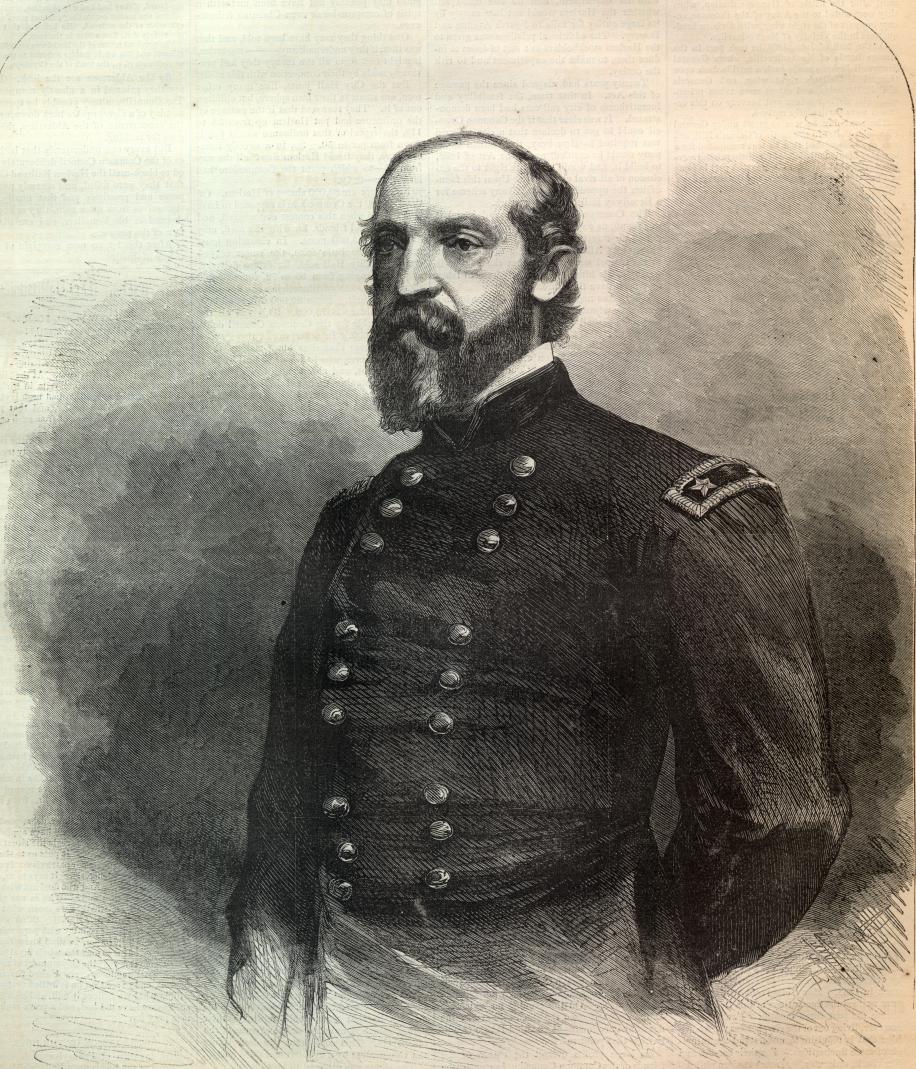
A Man Characterized by Straightforward Truthfulness: Major General George Meade, the Victor of Gettysburg

Friends of Padre Steve’s World,

Today was a long and busy day as tomorrow will be so I am going to re-publish a part of one of my Gettysburg texts about General George Meade. If I get a chance tomorrow I will post my thoughts regarding the conviction of Paul Manafort, the confession of Michael Cohen, and the indictment of Trump ally, Congressman Duncan Hunter Jr. But that is a more than I want to do right now, so it will wait. Who knows there might be more indictments tomorrow or the next day.

This is basically a biographical vignette which I inserted into the campaign narrative to help bring additional light on Meade, a man who because he was neither flamboyant, nor particularly inspirational, but he was smart, had tremendous tactical acumen and great physical and moral courage. He was also able to successfully collaborate with his commanders to defeat Robert E. Lee at Gettysburg. Sadly he is often overlooked or discounted. This is just a bit about Meade, his life and career leading up to Gettysburg.

Peace,

Padre Steve+

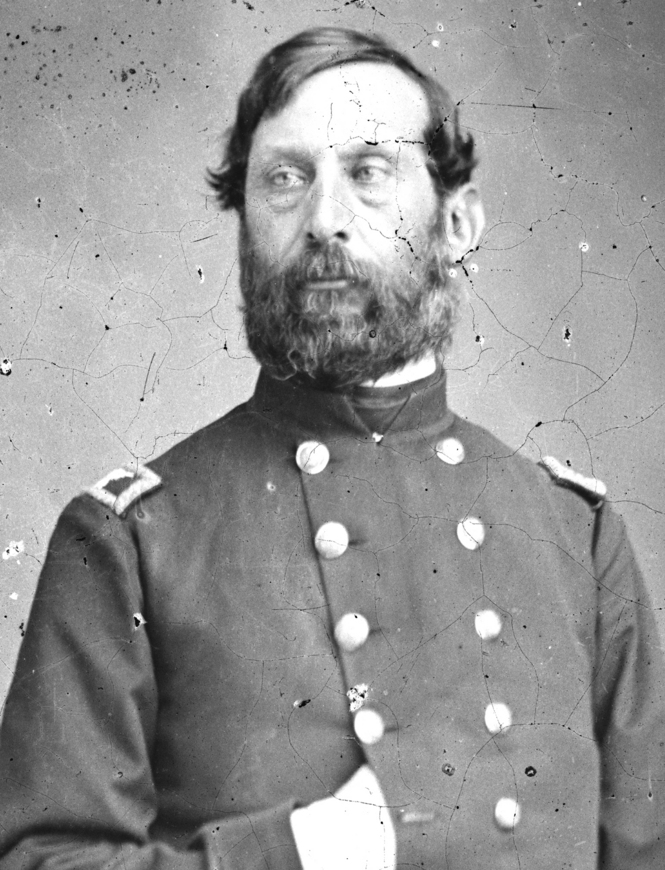
general-george-meade

Major General George Gordon Meade

George Gordon Meade was the son of an American merchant who served as the naval agent for the U.S. government in that country until 1817. Meade was born in Cadiz on December 31st 1815 and grew up in Pennsylvania and Maryland. His father had been ruined financially in Spain when supporting the Spanish government by loaning it over $375,000 in the Peninsular War against Napoleon. Meade’s father remained in Spain to try to recover his lost fortune he sent his wife and children back to the United States where the family lived on the margins of poverty. The money should have been reimbursed to him under the terms of the Treaty of Florida “which obligated the American government to assume any Spanish obligations to American citizens.” However “the U.S. government discovered loopholes that it allowed it to dodge all responsibility to an increasingly bitter and disappointed Richard Meade.” [1]

Meade’s father returned to the U.S. and the family moved from Philadelphia to Washington D.C. were Richard Meade, “worn down physically and mentally by his struggles” [2] died in 1828 when George was just 12 years old and attending “a boarding-school at Mount Airy, a few miles from Philadelphia, known as the American Classical and Military Lyceum.” [3] It was here that Meade got his first taste of military discipline as the school was modeled after West Point and in addition to their studies the students participated in military drill.

At the Lyceum, Meade was known for being “an amiable boy, full of life, but rather disposed to avoid the rough-and-tumble frolics of youths his age; quick at his lessons, and popular with both teachers and scholars.” [4] The family ran out of money to keep him at the school and he returned to Baltimore where he was enrolled in the Mount Hope School in Baltimore as his mother sought to gain him an appointment at West Point. At Mount Hope he studied Latin, English composition and mathematics. A certificate from the headmaster of the school obtained by his mother discussed Meade’s academic acumen.

“The knowledge he has gained…is far greater than is usually acquired by young men of his age in a single year. He possesses an uncommon quickness of perception and is, therefore, capable of acquiring knowledge with great rapidity….” [5]

Meade entered West Point in 1831 when he was just sixteen years old after being nominated by Andrew Jackson. The financial condition of his family was mostly responsible for this as “West Point was the one place where the young Meade could obtain a free college education.” [6] At West Point Meade did not excel in his studies, though he was not near the bottom of his class and his performance in some subjects such as military engineering gave no indication of how he would excel later in life. He graduated nineteenth of fifty-six in the class of 1835. Unlike many classes which were crowed with men destined for greatness, there were few notables in this class. Other than Meade there was Lincoln’s Postmaster General Montgomery Blair, Brigadier General Herman Haupt, who directed the transportation system of the Union army in the East during the war and John Pemberton, who as a Confederate general would surrender Vicksburg to Grant.

Meade was commissioned as a Brevet Second Lieutenant and assigned to the artillery and resigned his commission after serving his one year obligation and entered civilian life as a topographic engineer. Such was not an unusual occurrence in the tiny army of that era, as “over the previous two years more than a hundred West Point graduates had left the army.” [7] He found his civilian employment with the Bureau of Topographical Engineers and over the next five years took part in surveying the Texas-Louisiana boundary line, an assignment on the Mississippi River Delta, and the Canadian-United States boundary, an area of perpetual dispute from the time of American independence. It was during his time of civilian work with the Bureau that he met and married his wife Margaret Sergeant Wise, the daughter of Congressman John Sergeant, who had been the running mate of Henry Clay in the 1832 presidential election.

In 1842 Congress passed a measure which limited topographic survey to officers of the Topographic Engineer Corps. For Meade this was a godsend, for with the assistance of Margaret’s brother-in-law Congressman Henry A. Wise of Virginia Meade was reappointed as a Second Lieutenant in the Topographic Engineers on May 19th 1842. He had lost nearly six years of seniority, but “he had fairly earned his rank of Second Lieutenant of Topographic Engineers.” [8] His first assignments included surveying the Aroostook River in Maine and the design and construction of a lighthouse for Brandywine Shoals, Delaware.

In 1845 with a war with Mexico looming due to the annexation of Texas, Lieutenant Meade reported to the headquarters of General Zachary Taylor in Corpus Christi. Here he conducted surveys of the Nueces River and other inland waterways. Meade accompanied Taylor to the disputed border area around between the Nueces and the Rio Grande where some of the first actions of the war took place in 1846. During the war he served in Mexico “principally with Taylor’s army, where he won a brevet for gallantry at Monterrey.”[9] During his time in Texas and Mexico Meade became disgusted with the political machinations that surrounded the war and in a letter home he wrote “the mighty engine of influence, that curse of our country, which forces party politics into everything.” [10]

Meade was transferred to the army of Winfield Scott where he was no longer the senior Topographic Engineer but the junior. He chafed at his inactivity with Scott and complained about it. Major Turnbull, the senior Topographic Engineer told Scott that Meade was “Meade was unexpectedly with the army and that he had quite enough officers without him.” [11] In light of this Scott sent Meade back, where he returned to building lighthouses missing the bulk of the campaign. That assignment was cut short in 1849 when Meade was ordered to Florida “amid an outbreak of violence by the Seminoles.” [12] In Florida he survey a line of forts and upon completion returned to lighthouse work at Brandywine Shoals and then in Key Largo.

When the Army established the Lighthouse Board, Meade was appointed t the Seventh District where he continued his work in Florida. Among the lighthouses that he built was the Sand Key lighthouse at Key West which stands to this day. Meade was still just a First Lieutenant but he was rising in terms of the work that he was doing and was “promoted to superintendent of the Seventh Lighthouse District” [13] and took over the Fourth District as well when its superintendent was transferred to the West Coast. In this work Meade prospered. The most impressive monument to Meade’s work is the 163 foot tall Barnegat Bay Light in New Jersey. Meade was justifiably proud of his accomplishments and after the war noted that “I have always thought my services in the construction of lighthouses, and subsequently on the Lake Survey were of considerable importance.” [14]

In 1856 Meade was promoted to Captain and given charge over the vast Great Lakes survey. In Meade’s words he work involved:

“the delineation of the shores, and bottom of the lakes, bringing to light the hidden dangers; obtaining the evidence and capacity and depth of water in all the harbors and rivers and consequently the most practical mode of improving them; furnishing the evidence of the wants of navigation in reference to lighthouses, beacons and buoys and the proper sites for same.” [15]

Meade had to lobby Congress for funding and expanded the number of officers and personnel involved until by 1860 he had ten teams, some working on land and some aboard ships with a budget which he expanded from $25,000 to $75,000 in three years. It was a remarkable job, but then Meade had matured as an officer and as a leader.

Meade was still involved with this mission when Fort Sumter was attacked. To the consternation of local leaders in Detroit, he and his officers refused to be part of a mass meeting where the locals were insisting the Federal officers publically renew their oaths. This decision was part of Meade’s innate conservatism. Meade felt that doing so without the order of the War Department was not within his prevue.

Meade was not a firebrand, conservative and logical thought that the best course would for both sides to step back and catch their breath. He was “dismayed at the arrogance of the fire-eaters, to whom Southern secession seemed like a simple riot which would be suppressed by the mere appearance of Federal troops.” [16] The decision angered Senator Zach Chandler who had organized the event and Chandler would remain an opponent of Meade throughout the war.

He had never been a political officer and was determined to avoid becoming one, he wrote “as a soldier, holding a commission, it has always been my judgement that duty required that I should disregard all political questions, and obey orders.” [17] Thus he avoided some of the more overtly political displays in Michigan but wrote:

“I have ever held it to be my duty…to uphold and maintain the Constitution and resist the disruption of this Government. With this opinion I hold the other side responsible for this existing condition of affairs.” [18]

He was viewed with suspicion by Radical Republicans as “another politically unreliable McClellan Democrat” and William Lloyd Garrison’s The Liberator noted that his look “reveals a character that never yet efficiently and consistently served a liberal cause.” [19]

He immediately volunteered for field duty, but it his request was not answered due to resistance in the Corps of Topographic Engineers. It was not until after the debacle at Bull Run when he would be appointed a Brigadier General of Volunteers, even as he was preparing to resign his commission to take command of a Michigan Regiment.

Meade was appointed to command a brigade of the Pennsylvania Reserves and saw much action at the head of his brigade on the Peninsula, serving alongside his friend John Reynolds who commanded another brigade in the division. Meade exhibited a coolness under fire that earned the respect of his soldiers and officers. His fearless nature had “resulted in his being wounded twice by bullets almost simultaneously at the Battle of Glendale on the Peninsula” [20] and incurring other wounds and close calls at South Mountain, Antietam and Fredericksburg. In September 1862 he was promoted to command the division and after Fredericksburg he was promoted to command Fifth Corps. His promotions “from brigade commander in the Pennsylvania Reserve Division to corps command had been earned on battlefields.” [21] Serving in almost all of the army’s campaigns in the East Meade “gained increasing distinction as a highly competent and skillful officer. At Fredericksburg his division was the only unit to achieve any kind of success in a battle that otherwise was known as the worst fiasco in the history of the Army of the Potomac.” [22]

Like many of the commanders at Gettysburg Meade’s personality, temperament and character were complex, leading to people who met him or served with him to different conclusions. He possessed little flair for the dramatic or the theatrical. He was quietly religious and modest and “he usually kept aloof and made no effort to make himself popular” especially with reporters and “they exacted a toll for this treatment, and as a result Meade’s reputation suffered from a poor press.” [23]

He did not fit the stereotype of a commanding general of an army, he possessed none of McClellan’s style, Hooker’s dash or Reynold’s handsomeness. Some of his critics in the ranks referred to him as “a damned old goggle-eyed snapping turtle” while others called him “Old Four Eye” based on the glasses that he wore.[24] Meade handled such comments well for he had few delusions about himself, he remarked to an officer “I know they call me a damned old snapping turtle.” [25] As for his physical appearance a reporter noted that Meade “is colorless, being of a ghostly pale,” and “his nose of the antique bend.” [26] Another noted that he looked more like “a learned pundit than a soldier” [27] while his attire did not help, an aide noted “as for clothes, General Meade was nowhere.” Another officer remarked, “it would be rather hard to make him look well dressed.”[28]

Meade was sharp minded and quick tempered, “irritable and touchy in camp, possessed of a famous temper and imperfect means of controlling it.” [29] His temper was rooted in his sense of perfectionism and truthfulness. Theodore Lyman wrote that “I never saw a man in my life who was so characterized by straightforward truthfulness as he is.” [30] But Meade’s often volcanic temper and abject truthfulness were that of a logical man who could not abide “stupidity, negligence or laziness.” [31]Lyman observed “I don’t know any thin old gentleman, with a hooked nose and cold blue eye, who, when he is wrathy, exercises less of Christian charity than my well-beloved Chief!” [32]

Unlike some leaders whose temper led them to make unwise decisions with the lives of their troops, “in matters involving the safety of the army or the lives of thousands of men he exercised self-control and showed great moral courage in his decisions.” [33] At the same time he was a man who if after an angry outburst was full of regret, and as introspective as he was had “a cordial desire, if he had been wrong to make amends.” [34]

He was a man who in the war did not lose his humanity either towards the soldiers that he commanded or the victims of war. He was moved to acts of compassion when he saw suffering women and children whose lives had been upended by war. During the campaign of 1864 Meade:

“happened upon a poorly dressed woman fringed by several crying children – a family which the cavalry had robbed – he pulled out a five-dollar bill and also saw that food was provided for the day’s neediest. “The soft-hearted General…though of his own small children,” Colonel Lyman reflected. “He is a tender hearted man.”[35]

It was this complex man, a modest, conservative perfectionist, prone to volcanic eruptions of temper, but possessing of a strong sense of honesty even in regard to himself, who in the early morning hours of June 28th 1863 would have the fate of the Union thrust upon his shoulders.

Notes

[1] Huntington, Tom Searching for George Gordon Meade: The Forgotten Victor of Gettysburg Stackpole Books, Mechanicsburg PA 2013 p.12

[2] Ibid. Huntington Searching for George Gordon Meade p.12

[3] Meade, George edited by George Gordon Meade The Life and Letters of George Gordon Meade, Major General United States Army Volume I Big Byte Books Amazon Kindle Edition 2014 originally published 1913 location 185 of 7307

[4] Ibid. Huntington Searching for George Gordon Meade p.12

[5] Cleaves, Freeman Meade of Gettysburg University of Oklahoma Press, Norman and London 1960 p.10

[6] Sears, Stephen W. Gettysburg. Houghton Mifflin Co. Boston and New York 2003 p.85

[7] Ibid. Huntington Searching for George Gordon Meade p.13

[8] Ibid. Cleaves Meade of Gettysburg p.18

[9] Pfanz Harry W. Gettysburg: The First Day University of North Carolina Press, Chapel Hill and London 2001 p.43

[10] Ibid. Huntington Searching for George Gordon Meade p.29

[11] Ibid. Cleaves Meade of Gettysburg p.43

[12] Ibid. Huntington Searching for George Gordon Meade p.31

[13] Ibid. Cleaves Meade of Gettysburg p.49

[14] Ibid. Huntington Searching for George Gordon Meade p.32

[15] Ibid. Cleaves Meade of Gettysburg p.50

[16] Ibid. Catton The Army of the Potomac: Glory Roadp.257

[17] Ibid. Huntington Searching for George Gordon Meade p.39

[18] Ibid. Cleaves Meade of Gettysburg p.52

[19] Ibid. Guelzo Gettysburg: The Last Invasion p.88

[20] Tagg, Larry The Generals of Gettysburg: The Leaders of America’s Greatest Battle Da Capo Press Cambridge MA 1998 Amazon Kindle Edition p.2

[21] Ibid. Wert A Glorious Army p.267

[22] Ibid. Coddington The Gettysburg Campaign pp.213-214

[23] Ibid. Coddington The Gettysburg Campaign p.213

[24] Ibid. Guelzo Gettysburg: The Last Invasion p.87

[25] Ibid. Foote The Civil War, A Narrative. Volume Two p.454

[26] Wert, Jeffry D. The Sword of Lincoln: The Army of the Potomac Simon and Schuster, New York and London 2005 p.268

[27] Ibid. Foote The Civil War, A Narrative. Volume Two p.454

[28] Ibid. Wert The Sword of Lincoln p.268

[29] Ibid. Catton The Army of the Potomac: Glory Roadp.257

[30] Ibid. Coddington The Gettysburg Campaign p.211

[31] Ibid. Coddington The Gettysburg Campaign p.211

[32] Ibid Sears. Gettysburg. Pp.125-126

[33] Ibid. Coddington The Gettysburg Campaign p.211

[34] Ibid. Coddington The Gettysburg Campaign p.212

[35] Ibid. Cleaves Meade of Gettysburg p.247


1 Comment

Filed under civil war, Gettysburg, History, leadership, Military, us army

France 1944: Missed Opportunities from Mortain to Market Garden

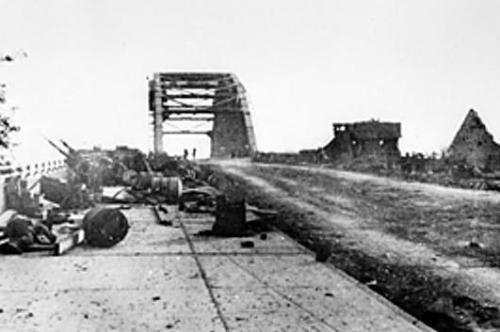
Arnhem Bridge

Friends of Padre Steve’s World,

In 1985 Judy and I visited her cousin and her family in the Netherlands when I was an Army Lieutenant in Germany. Since I was a history major in college and had done a lot of reading and study about Operation Market Garden, which most people associate with the movie Bridge Too Far I decided that on our way back to Germany that we needed to stop by Arnhem and Oosterbeek to visit the battlefield and the British Airborne Museum. It was one of those places that even today evokes poignant memories. When we walked through the British cemetery across from the museum which is in the former British headquarters, the Hartenstein Hotel I saw a grave marker. It read Capt. J.S. (James Strathern) Dundas, 7th KOSB (7th King’s Own Scottish Borderers) of the British 1st Airborne Division. He was the 2IC, or Executive Officer of Company B of that Regiment. He assumed command of the company on the 19th after its commander was reported missing in action. He commanded the company until his death on September 25th 1944 when commanding the rearguard of the battalion as it and the remnants of the 1st Airborne Division evacuated the bridgehead over the Rhine. It was a sobering reminder of the cost of war. 
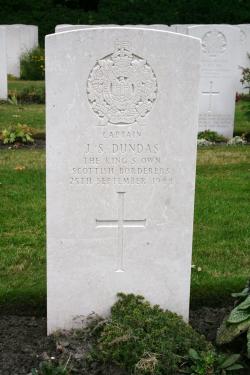
Grave marker of Captain J.S. Dundas at the British Cemetery at Oosterbeek

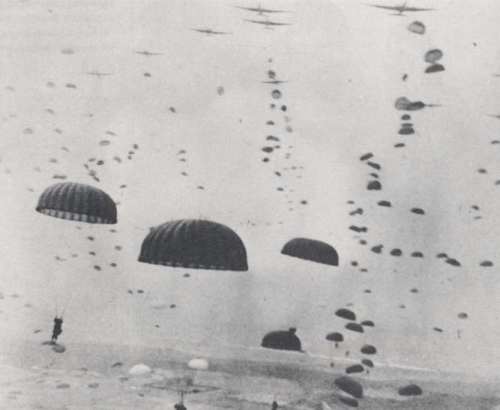
September 17th 2018 will be the 74th anniversary of the Allied attempt to liberate the Netherlands, secure a crossing across the Rhine and plunge into the heart of German industry and war making capacity the Ruhr basin. The plan is better known as Operation “Market-Garden” and was the first major use of Airborne Divisions in a strategic jump versus a tactical or operational mode.  What made this operation different was the distance that the Airborne would be dropped from the front lines and the number of obstacles that the ground troops would have to cross to get to them.  It was a high risk strategic plan to end the war early.  However this operation did not occur in a vacuum and was the product of operational and strategic decisions that the Allies made from the time of the Normandy breakout.  Each decision was made on the fly as the situation rapidly developed from a static slugfest in the hedgerows to the pursuit of a broken enemy.  As the Allies advanced across France decisions had to be made of how the advance would be made which became a major bone of contention between Eisenhower and his subordinates.  To understand how the Allies got to the point of launching Market-Garden one has to look back at the events leading up to it beginning with the Allied decisions made shortly after the breakout.  The actual campaign does not always correlate to popular myths nor does it allow for a uncritical analysis or generalization of the events which made up this part of the campaign in Western Europe.

It is a campaign that teaches us even today that mundane things such as logistics, weather and the failure to recognize moments of opportunity and times for caution matter in a military campaign. The campaign is a reminder that every military campaign has risks and that even crippled enemy can inflict costly defeats on superior forces and regain lost initiative. 


Introduction 

Patton Bradley and Montgomery, Time Magazine Photo

Lieutenant General Omar Bradley’s 12th Army Group breakout from Normandy opened a realm of possibilities for the Allies to defeat the German Army in detail and end the war.  The manner in which the Allies exploited their success and their failure to destroy the German Army in the west in the late summer of 1944 was a key factor in prolonging the war.  Both the Allies and the Germans faced challenges due to the change in the nature of the campaign. For nearly two months they had waged a nearly static war of attrition in the Norman hedgerows.  The breakout changed the dynamic of the campaign to one of maneuver.  In the post-breakout period the Allies had several opportunities to envelope large portions of the German Army in western France, Belgium and southern Holland.  The campaign became one of maneuver and a “commander’s battle” in which it was “the decisions of the generals that determined the manner in which events unfolded in August, their successes and failures which brought about the position that was achieved by September.”[1] Prior to the breakout success in the hedgerows was determined on “the ability of British, American and Canadian units to seize ground from their German opponents on the next ridge, the next hedge, beyond the next road.” [2]The change would expose the weaknesses in the quality of allied generalship and logistics management.  The Allies failure to recognize the ability of the Germans to recover from disaster conspired with key elements in the campaign to end the war by Christmas.[3]

Grenadiers and Tanks of 12th SS Panzer Division (Hitler Jugend) in Normandy

A key decision reached early in the campaign was for Bradley’s XII Army Group to capture Brest and other Brittany ports.  This decision meant that when 3rdArmy exploited the break out the preponderance of its forces went west, the opposite way that the battle was developing.  This deprived the Americans of forces and logistical assets that could have supported the envelopment of the major part of the German Army still engaged in Normandy. Russell Weigley lays the blame for this decision on Bradley.  The dash into Brittany did little to help the Allied logistical problems and diverted much needed troops away from the focal point of the action in Normandy.[4] Hastings criticizes Bradley’s lack of imagination in the initial stages of the breakout in adhering to the original OVERLORD exploitation plan[5] rather than adapting to the situation on the ground. Patton’s biographer Carlo D’Este seconds this opinion and it makes sense from an operational standpoint.[6] Why send significant forces to an area far away from the critical part of the battle for little practical gain?  In the end German forces held out, in some cases to the end of the war, denying the Americans the use of the ports either by just holding out or by demolishing the port facilities.

Mortain: German Counter Attack and the Short Envelopment

The American exploitation of the breakout, notably by elements of Patton’s 3rdArmy pushing east combined with the continued pressure of the British Army Group toward Falaise. The breakout forced forced the Germans into a strategic decision to attempt to restore the front in Normandy or withdraw to the Seine or further east as there was no “defensive position short of the permanent fortifications of the West Wall on Germany’s frontier offered so many defensive strengths as the Normandy line the Americans had just breached and turned.”[7]

With limited options Hitler determined that German forces again needed to ensnare the allies in the hedgerows.[8] There was disagreement between Hitler and Field Marshal von Kluge regarding the offensive while von Kluge opposed it.  Hitler believed that the American breakout gave the Germans a chance to cut off the American forces in Brittany and possibly more believing that “once the coast had been reached at Avranches a beginning should be made with rolling up the entire Allied position in Normandy!”[9]

The German attack named Operation Lüttich was led by XLVII Panzer Corps assisted by elements of 1st SS Panzer Division.  Despite warnings from ULTRA the panzers achieved tactical surprise on the front of the 30th US Division at Mortain on the night of 6-7 August when the Germans attacked without the customary preparatory artillery bombardment.[10] The Germans made initial progress against the 30th Division which had recently taken over positions at Mortain.  However the 2nd Battalion 120th Infantry “Old Hickory” Regiment held key ground which enabled them to call artillery fire and air strikes on German forces attempting to advance on Avranches.[11] The Americans quickly reinforced 30th Division with elements of 2nd Armored Division, 35th Infantry Division and the veteran 4th Infantry Division to hold the line against the weakened German Panzer divisions.  Bradley and other American commanders viewed Lüttich as “an opportunity, not a threat.”[12] Bradley was “not merely confident of withstanding them, but expected to destroy them.”[13] Bradley attempted to lure more Germans into the potential trap by radio transmissions hoping that the Germans to persist in their attacks around Mortain.[14]

American Armor Advancing in Normandy

The German plan included the use of a significant number of aircraft to support the attack.  However this did not happen and German troops were furious at the failure of the Luftwaffe to shield them from Allied air attacks which devastated the Panzers.  The 300 fighters promised by the commander of Luftwaffe forces were engaged by British and American fighters and savaged so badly that no Luftwaffe units made an appearance over Mortain.[15] Despite some local success the German ground forces were turned back by the Americans who did not even halt their eastward movement further imperiling the German forces in Normandy.

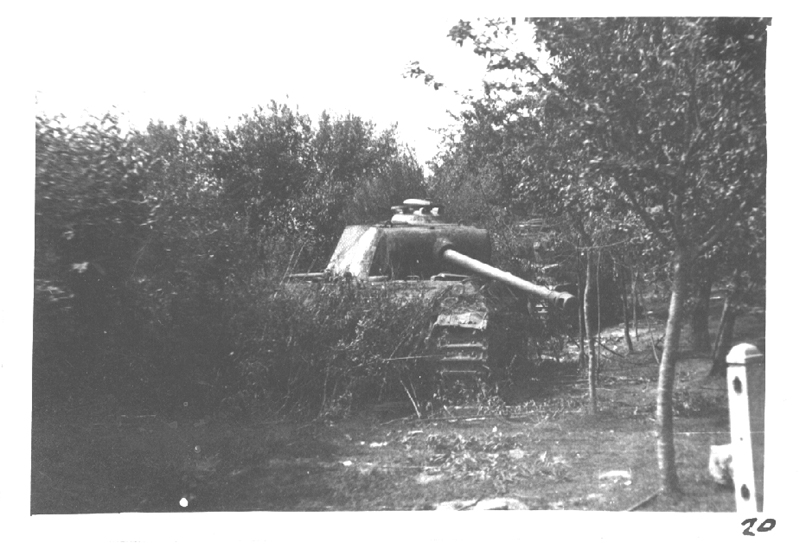
Knocked out Panzer V Panther Tank at Mortain

With the Germans ensnared at Mortain, the 3rd Army driving east and the Canadians advancing on towards Falaise, Bradley suggested a short envelopment in which over 100,000 German troops would be trapped between the Patton’s troops and the Canadians who had opened their TOTALIZE offensive from Caen to Falaise on August 8th.  This modified plans for a deep envelopment by XV Corps of 3rd Army to entrap the Germans against the Seine crossings with an operation that might promise “still surer results.”[16] Speaking to Secretary of the Treasury Henry Mongenthau Bradley said that “he told the Cabinet officer he had “an opportunity that comes to a commander not more than once in a century. We’re about to destroy and entire hostile army.”[17] However the short envelopment was predicated on the Germans continuing their advance, had they as Hastings notes “behaved rationally, recognized the threat of envelopment to their entire front and begun a full-scale retreat east, then Bradley could indeed been accused of losing his armies a great prize.”[18]

The decision to turn the better part of 3rd Army west into Brittany deprived Bradley of forces that could have better accomplished the mission of enveloping the German 7th Army.  General Wood of 4th Armored Division to his dying day “remained embittered over the lost opportunity”[19] lost when his division was turned back into Brittany rather than being allowed to move east toward the Seine.   Weigley points out an even deeper flaw regarding the Brittany decision that was that OVERLORD planners “had not thought anything resembling the Avranches breakout and pursuit without pause to the Seine likely…” Weigley critically stated that it is among the worst forms of generalship that takes counsel of its fears. Yet that was exactly the condition of OVERLORD logistical planning.”[20]

The Falaise Pocket

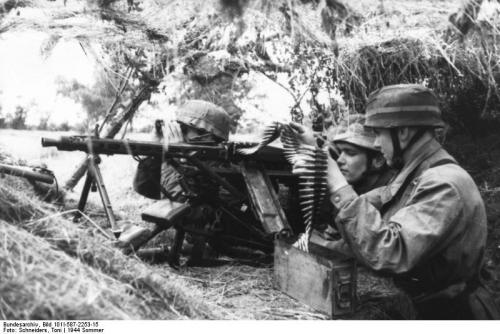
Luftwaffe Fallschirmjaeger in France

The Allies did have a chance to destroy the German 7th Army.  LXVII Panzer Corps and II SS Panzer Corps as well as the remnants of II Parachute Corps and other formations battered in Normandy were attempting to move east from Mortain following the failure to break through.  The remnants of I SS Panzer Corps led by 12 SS Panzer Division Hitlerjügend and various battle groups of other decimated divisions and Army units such as 21st Panzer Division offered determined resistance to the Canadians toward Falaise.  In the south only scattered Kampfgruppen of divisions shattered in Normandy opposed Patton’s forces at Avranches.  These German units, outnumbered and without air support were aided by a fortuitous decision of the commander of the 2nd French Armored Division to move a combat command along a road needed by the American 5thArmored Division.  The delay allowed the Germans to send a battalion into the town which could have “fallen easily a few hours before.”[21]

Grenadiers of the 12th SS at Falaise

At this point the Allies were bedeviled by several failures which prevented the short double envelopment from occurring and allowed the remnants of 7th Army to escape to fight again. The Germans suffered grievous losses in men, material, and especially armored fighting vehicles, artillery and motor transport but more often than not their units retained their cohesion and ability to operate.

Carnage in the Falaise Pocket

The first failure belonged to the Canadians who failed to push the Germans out of Falaise despite overwhelming material and air superiority.  The Canadian attack Operation TOTALIZE was planned by the best of the Canadian generals, Simonds.  The operation began on a promising note but bogged down halfway to Falaise due to a quick counterattack by 12th SS Panzer kampfgruppen. The Canadians were not helped when a misguided bombing attack by “friendly” air units hit them rather than the Germans.  Likewise the inexperience of the Canadian 4th and Polish 1st Armored Divisions showed when they paused to eliminate strong points rather than bypassing them and advancing to disrupt the Germans.  As such they gave the Germans the opportunity to reform their lines.[22] The second failure was that of Montgomery who had refused to adjust army group boundaries with Americans which put more pressure on the Canadians to “renew their drive promptly and vigorously.”[23] Rather than pushing on General Crerar of Canadian 1st Army spent five days “doing what really battlewise generalship could do by regrouping and making diversionary attacks.”[24] It took Crerar over 48 hours to launch a determined attack to close the gap despite the weakness of German forces that opposed him despite the fact that even Montgomery personally called him urging him to “Close the gap between First Canadian Army and 3rd U.S. Army.”[25] General Kurt Meyer of 12th SS faulted the Canadian leadership with a failure to use imaginative planning, and noted that “none of the Canadian attacks showed the genius of a great commander.”[26] American units which Patton had cautiously advanced north of Argentan towards Falaise were recalled after Bradley was unable to convince Montgomery to alter the army-group boundary in light of the new circumstances.[27] Patton recounts that he believed that his units could have “easily entered Falaise and closed the gap” and that the “halt was a great mistake.”[28] Weigley blames Bradley as much for the halt order as much he does Montgomery for “discouraging whatever might have been done to rectify the blunder- even discouraging on August 13th a call from the Supreme Commander to Montgomery about the inter-allied boundary.”[29] Thus through a series of Allied mistakes particularly by senior commanders the first opportunity to envelop the Germans passed into history as a great yet incomplete victory.

Opportunities in South France: Operations ANVIL and DRAGOON

The invasion of South France Operations ANVIL and DRAGOON[30] had been debated by the Allies as early as April 1943.  The British resisted ANVIL from the beginning with Winston Churchill not yielding “his struggle until five days before the eventual D-Day of August 15th.”[31] American planners saw the need for the operation and had never given up on it despite its postponement due to a shortage of amphibious lift at the time of OVERLORD.  Following the invasion the perilous logistic situation created by the lack of operational major ports in Normandy and Brittany caused American planners to “believe that ANVIL was virtually imperative.”[32] Landings in the south offered significant advantages to the logistical needs of the Allies.  The major seaports and naval bases at Marseilles and Toulon were both closer to Germany than Cherbourg.  Both offered major modern port facilities and the south included rail nets that had not suffered significant damage from Allied air attacks. Likewise the presence of a major navigable river, the Rhone, made it possible to move supplies into the heart of France by water.  From a strategic point of view the move into southern France would “help Eisenhower form a front along the whole German border from the North Sea to Switzerland, to stretch the German army as perilously thin as possible for its defense of the Fatherland.”[33] ANVIL also offered the opportunity to bring more trained American divisions into the fight which could not otherwise come ashore in Normandy due to the port and supply problems.[34]

The Allies initially allotted three American divisions of 7th Army and VI Corps as well as units of the French Army based in the Mediterranean to the invasion.  Commanding VI Corps and its three veteran Divisions, the Regular Army 3rdInfantry Division, the “Rock of the Marne”, the 36th “Texas” Division and 45th“Thunderbird” Division of the National Guard was Lieutenant General Lucian Truscott.  Truscott was of the best American Corps commanders. Early in the war he had created the Rangers and had distinguished himself in Italy commanding 3rd Infantry Division.  He followed this by taking over to rescue the unhappy Anzio campaign from utter fiasco.[35] A hard driving officer and prewar friend of Patton Truscott was the ideal commander for the operation.[36]

Truscott’s forces were opposed by the weak and widely scattered German 19thArmy of General Blaskowitz’s Army Group G.  The landings were highly successful and the Americans made rapid progress inflicting heavy casualties and capturing large numbers of Germans with relatively low American casualties.  However in Blaskowitz the Americans faced a skilled commander who managed to extricate the bulk of his forces and form a continuous front with the remnants of Army Group B by mid September.  Hitler had recognized the necessity of this link up but held Blaskowitz in low regard due to his resistance to Nazi policy while Military Governor of Poland in 1939, said to Field Marshall von Rundstedt of Blaskowitz: “If he contrives to do that (i.e. join up 19th Army rapidly with the main body) then I will make him a solemn apology for everything.”[37]

Truscott made the German army his objective. Truscott pushed his units hard but was hampered by his meager forces and his tendency to outrun his supplies.  German delaying actions hampered the American advance and prevented the Americans from utterly destroying the 19th Army.   Despite this the campaign in the south prevented the Allied logistical situation in France from becoming “insurmountable” in the fall of 1944 and “contributed directly and mightily to bringing the bulk of the American Army to grips with the German army in the West, to defeat and destroy it.”[38] Had Truscott had more forces and adequate supplies he may have achieved even more than he did. One can only imagine the “what if” scenarios that could have developed in the West with the application of more force to this option rather than feed the limited number of American divisions into the cauldron of the hedgerow country.

To the Seine and Beyond

With the closing of the Falaise pocket too late to catch most of the German forces the next opportunity for the now postponed “long envelopment” was now staring the Allies in the face.  The Seine beckoned.  Could the Allies prevent the fleeing remnants of the 7th Army and Panzer Group West, soon to be renamed the 5thPanzer Army from escaping across the Seine?   Bradley’s belated decision to restart the drive to the Seine on 14 August was beset with the problem of the logistical sustainment.  The logistics problem was not limited to port facilities.  The Allies had moved well past the eastern edge of the Normandy lodgment area over two weeks before planners anticipated. Fuel to propel the Allied armies forward became a critical consideration. Despite this the Allied high command saw the opportunity to complete the destruction of the German forces fleeing Normandy and Montgomery “anticipated for weeks the possibility of the long envelopment at the Seine.”[39] Adjustments were made on the fly. The plan to pause at the Seine dictated by OVERLORD was discarded in favor of trying to cross it on the run.  XV Corps of 3rd Army had reached Mantes crossing into the British 21st Army Group zone.  Montgomery refused an American offer of trucks to assist the British and Canadians to Mantes to complete the envelopment from the west. However he gave permission for XV Corps to continue its advance into the British zone in the hopes of completing the encirclement of the estimated 75,000 German troops west of the Seine.[40]

American Soldiers Cross the Seine

Yet again the Allied hopes for the encirclement of German forces west of the Seine were dashed.  XIX Corps came up to assist XV Corps in its advance into the German rear on the 24th of August at Elbeuf.  However a scratch Kampfgrüppemade up of elements of eight panzer divisions made a stand that delayed the American forces five days.[41] The British and Canadian forces did not push hard.  The determined resistance of the panzer battle group and the failure of the British and Canadians to push harder enabled Army Group B to evacuate many of its troops, 25,000 vehicles and most of its higher headquarters across the Seine before the Canadians and XIX Corps linked up on 26 August.[42] [43] While the envelopment attempt ran its course the Americans pushed across the Seine. The Americans allowed the French 2nd Armored division to liberate Paris on August 25th and rapidly began to move east in pursuit of the German forces.

Despite horrendous losses in men and material including all but about 100 of the 2300 tanks and assault guns committed to Normandy[44] the German command rapidly organized the survivors into Kampfgrüppen.  These battle groups though hastily organized were well led and usually comprised of hardened veterans skilled in the active defense.  Field Marshall Model “Hitler’s Fireman” took command of Army Group B after Von Kluge committed suicide when returning to Germany after being implicated in the attempt on Hitler’s life.  Hitler gave the western front priority on tank replacements. Likewise reinforcements of newly formed Panzer Brigades flowed into France even as the Americans advanced east fighting not only the Germans but the gasoline shortage.[45] Patton’s army reached the Moselle but by September 2nd its tanks had run dry.  “Third Army received just 25,390 gallons, when its divisions needed at least 450,000 gallons to resume their advance.”[46] Patton continued by scavenging fuel wherever he could get it whether captured German stocks or by various creative means. Patton had his logistics officers divert fuel or send raiding parties into 1st Army’s depots. His agents bartered for fuel at port facilities and depots by offering captured souvenirs to those running those facilities in exchange for gas.[47]

American M-8 Armored Car at the Arch d’Triumph during the Liberation of Paris

The Allied shortage of gasoline, a product of both the lack of ports, damage to the French rail system and the unexpected rate of advance[48] ultimately forced Eisenhower to make the decision to halt Patton’s advance in favor of a push by Montgomery in the north. Now complicating Eisenhower’s situation the Germans Likewise the ability of the Germans to join Army Group B with Army Group G’s 1st and 19th Armies from Army Group G further assisted the German defense.  The German army’s self preservation in late August and early September became known to them as the “Miracle of the West.”[49] A successful envelopment of German forces took place at Mons just south of the Belgium border where 1st Army captured over 25,000 prisoners from units that had escaped from Normandy.[50] Throughout the campaign in France the Allies were beset by logistical problems and sometimes by bad generalship as they attempted to change the campaign plan on the fly.[51]

Antwerp and the Scheldt: Missed Opportunity

While Bradley and Patton’s American units sped across France “advancing faster and further than any Army in history,” Montgomery’s 21st Army Group crossed the Seine and began a drive that rivaled the Americans in speed.  XXX Corps under the recently appointed General Horrocks attacked out of the Seine bridgehead on 29 August.  After overcoming initial stiff resistance from the German Kampfgrüppen defending the area XXX Corps advanced with great speed capturing Brussels and Antwerp by 4 September.  Logistics also tied Montgomery’s hands just as it had Patton in the south.[52] He was forced to immobilize 8th Corps to supply XXX Corps which advanced north as 1st Canadian Army attempted to capture the channel ports.[53]

Canadian Soldiers during the Battle of the Scheldt

The quickness of the advance and erroneous decision making kept the XXX Corps attack from complete success.  This caused serious complications to further operations and which gave the Germans the break that they needed to stabilize the front.  General “Pip” Roberts commander of 11th Armored division which had just liberated Antwerp assumed that the British drive would turn east toward the Ruhr industrial area of Germany. In doing so he failed to capture the crossings over the Albert Canal.[54] Additionally he failed to advance the few miles needed to cut off the German 15th Army on the Scheldt thus missing the opportunity to trap an entire German Army against the sea.  Hastings lays the blame for this not entirely on the Division and Corps Commanders, Roberts and XXX Corps commander Horrocks, but on those responsible for the overall strategy, Eisenhower, Montgomery and Dempsey who should have realized this and especially that Montgomery “might have been expected to see for himself the pivotal importance of the Antwerp approaches.”[55] While the British rested in Antwerp the Germans blew the bridges over the Albert Canal. General Von Zangen of 15th Army took the opportunity to extricate his Army using any vessel available to cross the Scheldt. He occupied the strategic island of Walchern on the Antwerp approaches and placed his troops in position to assist in the defense of Holland and northern Germany.  Due to British inaction and his own creativity Von Zangen evacuated 65,000 troops, 225 guns, 750 vehicles and over 1000 horses across the waterway in 16 days to fight again.[56]

North of the Albert General Kurt Chill in the typical fashion of so many German commanders in a crisis situation took charge and halted the panicked retreat of German forces into Holland. Chill organized personnel from all branches of the German military into something resembling an Army.[57] Likewise Generals Bittrich of II SS Panzer Corps and Harmel of 10th SS Panzer Division salvaged “vehicles abandoned by other groups and weapons from deserted army depots” including 12 brand new howitzers on abandoned train.  The improvisation of the German commanders in these few days would be of decisive importance in the coming days.[58]

While the British paused to regroup in Belgium the Germans took the opportunity to form a new Army, the 1st Parachute Army under the Luftwaffe paratroop expert, General Kurt Student. 1st Parachute Army was hardly an army at all, barely the size of a fully manned allied division.  Made up of battle groups formed around remnants of the elite 6th Parachute regiment, assorted parachute training battalions, Flak units, a hodge-podge of Army Kampfgrüppen, General Chill’s units and divisions evacuated from the Scheldt, Student laid out a defensive line along the Albert Canal.[59] Student expected the British to attack when he was so terribly weak. He could not believe that he was not attacked when his line was most vulnerable to a determined assault that much of the German command believed would cause the front in Belgium to collapse.  The British Guards Armored division slowly advanced from the Albert to the Meuse-Escaut canal but the German defense had assured that any further advance to the north would be on a narrow front with a vulnerable left flank.[60] Von Rundstedt’s new Chief of staff at OB West Siegfried Westphal noted that “the situation was desperate. A major defeat anywhere along the front-which was so full of gaps that it did not deserve that name would lead to catastrophe if the enemy were to fully exploit the opportunities.”[61] Hastings and Weigley both note that the British failure to close the gap were of decisive importance to the coming campaign in Holland.[62]

Arnhem: The Failed Vertical Envelopment

Operation Market Garden, the Largest Airborne Operation in History

The Allies still believed there was the chance to break into Germany in 1944.  Lacking the logistical base to sustain a wide front advance Eisenhower opted to make Montgomery the primary effort. Montgomery planned to utilize the 1stAllied Airborne Army in a bold and “in the context of Anglo-American generalship in France, refreshingly daring”[63] operation.[64] The concept of “vertical envelopment” had been advocated by General Marshall and General H.H. Arnold and throughout the campaign 18 airborne exploitation operations had been planned “each of them cancelled by the rapidity of the advance of the ground forces.”[65] Eisenhower made Montgomery the primary effort on September 10th and Montgomery “immediately detailed planning …for an idea he had already conceived to use the airborne reserve.”[66]

American Paratroops in Holland

The plan was Operation MARKET-GARDEN and to be successful Montgomery’s forces would have to cross 8 water obstacles including 3 major rivers.[67] He had to use one two lane highway bordered by soft Dutch podder, thick woods and drainage ditches that restricted armor and mechanized forces to the road itself.[68] The was for three Allied airborne divisions, the American 82nd and 101st, the British 1st Airborne and the Polish 1st Parachute Brigade to secure the bridges over the waterways between the front and Arnhem 65 miles north of the front.  The goal was to establish a bridgehead over the Rhine for the British Second Army to advance deep into the German heartland.  XXX Corps was to advance up this “corridor of death” and link up with each of the airborne divisions with the goal of breaking the German defense in the west.

British Paras in the ruins of Arnhem

Nearly all the writers agree that had the offensive been launched 7-10 days earlier when the Germans were in complete disarray it might have succeeded in its objective of crossing the Rhine and getting into Germany.  Hastings and Weigley both believe that the axis of the offensive was wrong and that the attack should have been made further south using 21st Army Group and 1st Army to drive to the Rhine.[69] All believe that an attack by Patton’s 3rd Army would not have achieved significant strategic gain as he now faced the bulk of the Wehrmacht’s strength and that there was little of strategic value in the part of Germany he could attack.

German Sturmgeschutz III in Arnhem 

The attack was made on 17 September.   The shortcomings of the plan became rapidly apparent.[70] German resistance in South Holland was much stronger than expected, the Son bridge was demolished by the Germans which created a major delay as bridging equipment had to be found and brought forward.  Due to the presence of battle groups from the 10th SS Panzer Division and other units dug in the city around the bridge the 82nd could not secure the Nijmegen Bridge until XXX Corps arrived.  The 1st Airborne was landed too far away from Arnhem Bridge to secure it in the face of the 9th and 10th SS Panzer Divisions of II SS Panzer Corps.  Due to a shortage of aircraft and refusal of the air transport command to make two drops on the first day the drops took 3 days to get all the airborne units into the fight.  The single road ensured that the spearhead of the XXX Corps advance was limited to a squadron of tanks and supporting infantry on a front two tanks wide.[71] The flanks were weakly held and German units salvaged from the Scheldt attacked the west and units from the Germany proper attacked the 82nd’s lodgment area.  Communications problems in the 1st Airborne Division prevented it from communicating with its own units as well as higher headquarters leaving everyone wondering what was happening.[72] The advance of XXX Corps was often both before Eindhoven and after Nijmegen lacking in urgency.[73] When all was said and done 1st Airborne Division was all but destroyed and had to be evacuated from its bridgehead and the operation ended in failure.[74] Numerous events contributed to the failure of the operation, many of which occurred before it was planned.  The German ability to make an army out of nothing coupled with planning which was based more on assumptions about what the Germans were incapable of doing rather than what was happening on the ground was a major fact. Likewise the British command discounted intelligence reports of Panzers in or near the drop the drop zones.

SS Panzer Grenadiers in Arnhem

The plan itself left much to chance and was built around the assumption that the Germans lacked the ability to stop them, neglecting the restrictions in which the Allied forces would have to execute the plan. If things could go wrong they did, especially in the 1st Airborne area of operations. Critical equipment failed to arrive, communications broke down, 2 of 3 battalions detailed to seize the Arnhem Bridge were stopped by a mixed bag of German forces including Panzers, an SS training battalion and various Army units and only one battalion reached the bridge. The failure to plan for and establish a landing zone on the south side of the Rhine kept them from being able to take the bridge, which became a key factor in the German ability to move troops from Arnhem to Njimegen. General Urquart was trapped in a house by German units which posted themselves around it and the commander of 1st Airborne Brigade was wounded.  The Germans succeeded in over running the drop zones and without communications British Airborne could not let the air transport know that supplies were not getting to them.

Summary

This phase of the French campaign exhibited the best and the worst of Allied generalship. The reasons; generally inexperienced American leadership at this level of warfare and poor leadership by the more experienced British command.  The key failures were logistics management and the strategic focus following the breakout which changed the nature of the planned campaign. The Allies were running at the limit of their capacity, shortages of fuel and other supplies and heavy casualties incurred in Normandy weakened the Allied advance demonstrating von Clausewitz’s understanding of what happens when a offensive reaches its culminating point. The drive into Brittany, the failure at the Falaise gap, the failure to close the door at the Seine, the failure to trap the 15th Army at the Scheldt and its failure to cross the Albert Canal, as well as the Market-Garden fiasco can all be directly attributed to Allied leadership at high levels.  Likewise the extraordinary ability of German commanders to restore seemingly hopeless situations all demonstrated how Clausewitz’s understood “genius” in war.

The campaign from the Normandy to Arnhem was one of spotty performance by the Allies especially in terms of generalship and logistics planning and the ability to improvise.  The Germans suffered from Hitler’s interference, especially at Mortain where he insisted on counterattack versus withdraw. Likewise they suffered from a critical lack of air support.  However German commanders were masters of improvisation taking advantage of Allied errors and confusion to recover the situation time and time again.

Notes

[1] Hastings, Max. Overlord: D-Day and the Battle for Normandy Vintage Books, New York, 1984 p.280

[2] Ibid.

[3] Hastings, Max. Armageddon: The Battle for Germany 1944-1945 Alfred a Knopf, New York, 2004 p.37.  Hastings comments that “British planners threw away it had learned since 1939 about the speed of reaction of Hitler’s army, its brilliance at improvisation, its dogged skill in defense, its readiness always to punish allied mistakes.”

[4] Weigley, Russell F. Eisenhower’s Lieutenants: The Campaign of France and Germany, 1944-1945, Indiana University Press, Bloomington IN, 1981pp.184-186

[5] Ibid. Hastings. Overlord pp.282-283

[6] D’Este,  Carlo. Patton: A Genius for War. Harper Collins Publishers New York, 1995 pp.632-633

[7] Ibid.  p.195

[8] Ibid. Also

[9] Warlimont, Walter. Inside Hitler’s Headquarters 1939-45 Presidio Press, Novato CA 1964 pp.449-450.

[10] Ibid pp.195-196. Weigley notes that Montgomery and most other Allied commanders  had been optimistic in not anticipating the German counter attack despite the ULTRA warnings, while Bradley and Patton were cautious in making troop deployments.

[11] Michael Reynolds in Steel Inferno: The 1st SS Panzer Corps in Normandynotes that the Americans inflicted “astonishing casualties on the northern thrusts of 2nd SS Panzer and remained undefeated when the Germans withdrew 4 days later.”  Reynolds, Michael Steel Inferno: The 1st SS Panzer Corps in NormandyDell Publishing, New York, 1997 p.264

[12] Ibid. Hastings Overlord p.283

[13] Ibid.

[14] Ibid. Weigley p.199.

[15] Carrell, Paul. Invasion! They’re Coming!” Trans. E. Osers, Originally published as Sie Kommen! Gerhard Stalling Verlag 1960, Bantam Books New York, 1964, 5th Printing June 1984. p. 249

[16] Ibid. Weigley p. 199

[17] Ibid. p.200

[18] Ibid. Hastings. Overlord. pp.282-283

[19] Ibid. D’Este. p.631

[20] Ibid. Weigley. p.286  He also points out that the Brittany diversion could have been “worse had it not been for Montgomery’s influence”  p.288

[21] Ibid. p. 202

[22] Ibid. p.204

[23] Ibid.

[24] Ibid.

[25] Reynolds, Michael Steel Inferno: 1st SS Panzer Corps in Normandy Dell Publishing New York, 1997. p.320.

[26] Meyer, Kurt Grenadiers trans. By  Michael Mende and Robert J.  Edwards, J.J. Fedorowicz Publishing, Inc. Winnipeg Manitoba, Canada 2001 p.290.

[27] Ibid. Hastings Overlord pp.288-289.

[28] Patton, George S. War As I Knew It Bantam Books NY  published 1980, originally published by Houghton Mifflin Company 1947. pp.101-102

[29] Ibid. Weigley p.209  Weigley quotes Major Hansen, Bradley’s aide in stating that the Falaise halt orde was “the only decision he has ever questioned.”

[30] DRAGOON was the airborne component of he south France operation.

[31] Ibid. p.218

[32] Ibid.

[33] Ibid.

[34] Ibid.

[35] Ibid. pp.222-224

[36] Patton and Truscott had a clash during the Sicilian campaign over Patton’s push for an amphibious operation accusing him of being “afraid to fight” and threatening to relieve him but then throwing his arm around him and offering him a drink. See D’Este pp.526-528  This incident was made famous in the movie “Patton.”

[37] Giziowski, Richard. The Enigma of General Blaskowitz. Hippocrene Books, New York 1997 p.338

[38] Ibid. Weigley

[39] Ibid. p.241

[40] Ibid.

[41] Ibid. p.243

[42] Ibid. p.246

[43] Hans Von Luck, the commanding a Kampfgrüppe of 21st Panzer Division describes how he and his troops camouflaged his “Schwimmwagen” with bushes to cross the Seine successfully disguising the vehicle to avoid persistant Allied air attacks. VonLuck, Hans Panzer Commander Dell Publishing New York 1989. p.209

[44] Ibid. Weigley. p.255

[45] Weigley, Hastings and D’Este all place a fair amount of blame for the logistical crisis on the commander of the COMMZ, General John C.H. Lee.

[46] Ibid. Hastings, Armageddon p.24

[47] Ibid D’Este pp.647-652

[48] Weigley notes that OVERLORD plans had not envision support American divisions for offensive operations across the Seine until D+120, yet by “D+90, sixteen United States divisions were already 200 kilometers beyond the Seine.” p.268.  Hastings and Weigley also note the waste in the American supply system noting that of “twenty-two million fuel jerrycans shipped to France since D-Day, half had vanished since September.” Hastings. Armageddon p.23.

[49] Ibid. Weigley

[50] Ibid. p.275-276

[51] Both Weigley and Hastings note the logistical problems of the British which not only included the problems that beset the Americans but problems of their own making including poor trucks of numerous makes rather than the standardized American trucks.  Hastings notes that for a time around Antwerp that “Montgomery’s armies were obliged for a time to commandeer thousands of horse-drawn wagons abandoned by the Wehrmacht, to make good its shortage of vehicles for the haulage of supplies.” Hastings. Armageddon p.23

[52] Weigley notes that Montgomery had a fiasco of British logistics in which some “1,400 British three-ton lorries, plus all the replacement engines for this model, had been discovered to have faulty pistons rendering them useless.” p.281.

[53] Ibid. Hastings. Armageddon. p.20

[54] Ryan in A BridgeToo Far quotes the XXX Corps Commander Horrocks who said in his memoirs “My excuse is that my eyes were entirely fixed on the Rhine and everything else seemed of subsidiary importance.” Ryan, Corrnelius. A Bridge Too Far Fawcett Popular Library by Arrangement with Simon and Schuster Publishing, New York, 1974  p.60

[55] Ibid.

[56] Ibid. Hastings p.20.  Weigley on p.293 gives a higher figure of 86,000 troops, 600 artillery pieces, 6,000 vehicles and 6,000 horses.

[57] Ibid. Ryan. p.49

[58] Reynolds, Michael Sons of the Reich Casemate, Havertown PA 2002 p.98

[59] A significant unit that was to plan a key role in the German defense against XXX Corps was Kampfgrüppe Walter formed around the 6th Parachute Regiment and other assorted units.  It is noted in almost every volume devoted to the campaign.

[60] Ibid. Weigley. p.294

[61] Ibid. Ryan. p.52

[62] See Hastings p.22 “The fumbled handling of Antwerp was among the principal causes of Allied failure to break into Germany in 1944.  It was not merely that the port was unavailable for the shipment of supplies; through two months that followed, a large part of Montgomery’s forces had to be employed upon a task that could have been accomplished in days if the necessary energy and “grip” been exercised at the beginning of September, when the enemy was incapable of resistance.”  and Weigley pp.293-294

[63] Ibid. Weigley p.288

[64] Hastings notes that since the Airborne Army had been created that “the apostles of the new art of envelopment from the sky were determined that it should be used.” Armageddon p.35

[65] Ibid. p.289

[66] Ibid.

[67] Ibid. Weigley. p.291

[68] Ibid. p.295

[69] Also see Ryan. p.81 Ryan notes that in the planning General Dempsey because of his doubts about the ability of 2nd Army suggested an attack “seizing the Rhine crossing at Wesel….” as “it would be better, he believed to advance in conjunction with the U.S. First Army northward toward Wesel.”

[70] All the commentators make reference too the misgivings voiced at the final planning conference. Hastings comments on Gavin who believed that “If I get through this one, I will be very lucky.”

[71] Ibid. Weigley. p.295

[72] Hastings comments “It was a scandal-for which in the Russian or German armies some signals officers would have been shot-that the communications of 1stAirborne Division remained almost non-existent from 17 September onwards.Armaggedon p.58

[73] Ibid. p.293

[74] Casualties in 1st Airborne were high, of “the original 10,005 man force only 2,163 troopers, along with 160 Poles and 75 Dorsets, came back across the Rhine. After nine days the division had approximately 1,200 dead and 6,642 missing, wounded or captured.” Ryan p.509.

Bibliography

Carrell, Paul. Invasion! They’re Coming!” Trans. E. Osers, Originally published as Sie Kommen! Gerhard Stalling Verlag 1960, Bantam Books New York, 1964, 5th Printing June 1984

D’Este,  Carlo. Patton: A Genius for War. Harper Collins Publishers New York, 1995

Giziowski, Richard. The Enigma of General Blaskowitz. Hippocrene Books, New York 1997

Hastings, Max. Armageddon: The Battle for Germany 1944-1945 Alfred a Knopf, New York, 2004

Hastings, Max. Overlord: D-Day and the Battle for Normandy Vintage Books, New York, 1984

Meyer, Kurt Grenadiers trans. By  Michael Mende and Robert J.  Edwards, J.J. Fedorowicz Publishing, Inc. Winnipeg Manitoba, Canada 2001

Patton, George S. War As I Knew It Bantam Books NY  published 1980, originally published by Houghton Mifflin Company 1947.

Reynolds, Michael Sons of the Reich Casemate, Havertown PA 2002

Reynolds, Michael Steel Inferno: 1st SS Panzer Corps in Normandy Dell Publishing New York, 1997

Ryan, Corrnelius. A Bridge Too Far Fawcett Popular Library by Arrangement with Simon and Schuster Publishing, New York, 1974

Von Luck, Hans Panzer Commander Dell Publishing New York 1989

Warlimont, Walter. Inside Hitler’s Headquarters 1939-45 Presidio Press, Novato CA 1964

Weigley, Russell F. Eisenhower’s Lieutenants: The Campaign of France and Germany, 1944-1945, Indiana University Press, Bloomington IN, 1981

1 Comment

Filed under History, Military, nazi germany, us army, world war two in europe

Forgiveness Will Not Change the Past, but It Could Change the Future: Dealing with the Aftermath of a Painful Experience

Friends of Padre Steve’s World,
As my regular readers know I went through a decidedly difficult time over the past coupled of months. If you are a new reader or have not read the post in which I wrote about this experience let me explain.
In mid-June I substituted for one of my chaplains so that he could have a weekend off. The preached from Second Corinthians chapter five regarding Christian responsibility towards other people and the creation. I discussed how the Trump Administration’s border policies were in opposition to that. I explained that the words used by the President and administration about darker skinned immigrants and refugees was dehumanizing. That the use of terms such as “animals” and ‘infestations” while labeling them all as “rapists” and “criminals” of the worst kind was little different than what others had done in the past. I used a number of historical examples; including the American experiences dealing with the extermination and forced relocation of native American tribes, slavery, Jim Crow, the incarceration of Japanese Americans in World War II, and the Nazi treatment of Jews and others deemed “subhuman.” I quoted Dietrich Bonhoeffer, Martin Niemöller, Dr. Martin Luther King Jr., and others to emphasize that such treatment and demonization was in complete opposition to the teaching of the Gospel and the Christian tradition.
It was probably one of the most powerful and heartfelt sermons that I have ever preached. One of the chapel members present told one of my staff chaplains that it was like “hearing the voice of God thunder from the pulpit.” 
For that I had a member of the congregation try to have me tried by court martial for conduct unbecoming an officer and contempt towards the President of the United States. The man accused me of many things including comparing the President to Adolf Hitler and law enforcement officers to the Nazis. I did no such thing but that is what I was accused of. I was investigated and had to retain an attorney. The investigation confirmed that I had not done what the man said and exonerated me.
Since then I have tried to work through my feelings and emotions and decide what to do. I talked with a number of people and decided that I would need to address the subject before the congregation at a future point.
So I did that today and am pleased to report that my talk with the congregation regarding went well. I was very nervous and fearful going in to the service and during the half hour or so before the service while sequestered in my office I thought that I was going to throw up. 
 
I talked for a little over 8 minutes and humbly explained what happened without any judgment on the man or the congregation. In fact I confessed my fear about even coming before them. I explained that of all the things in my 37 year career that this was the most difficult, including going to combat, getting shot at and dealing with PTSD. I explained that I never expected anything like that. I explained that I had thought that even if someone disagreed with the sermon that they would come to me as is taught in the words of Christ and the writings of the Apostle Paul and not try to have me punished by attempting to have me punished. 
 
I explained that I had worked through my anger but that I was still hurt and that I did not feel safe with the congregation. I invited anyone that wanted to see me either after the service or make a time with me to talk over coffee, lunch, or a beer at a later time. I discussed forgiveness and remarked that even though I had gotten through the anger and forgave my accuser and those who turned their backs on me after that service that the pain remained and that I did not feel safe or that I was fully able to trust them. I also asked forgiveness for anything that I might have said to offend anyone present. I noted that forgiveness will not change the past but could very well change the future. 
Likewise I explained that during my anger I had considered taking revenge on my accuser by suing him in civilian court for libel and defamation of character. But I realized that if I did so that it would not be helpful to anyone. When I was binge watching The Blacklist over the past few weeks I remembered a comment made by Raymond Reddington. He said: “Revenge isn’t a passion. It’s a disease. It eats at your mind and poisons your soul.” 
When I completed my remarks, I exited the pulpit and handed the service back to my Protestant pastor and waited in my office.
 
The response was good, I don’t think that I could have asked for more. A number of people came to me after the service and were very kind. Two of them were men who in their interviews with the investigating officer refuted all of the accusations against me. The response of the people who came to me was quite touching and very encouraging. 
Since I do not know what the man who made the charges looks like I do not know if he was in attendance today. At the end of my talk I announced my plans to retire and that I may not preach again at this chapel, but that the decision was not final. Those who visited with me all told me that they wanted me to continue to preach the truth, all of them said that it was badly needed in our chapel if it were to survive. One elderly couple said that the congregation was dying. I haven’t decided if I will preach again because I am not there yet, but I haven’t ruled it it. 
As far as forgiveness, I do forgive, but it is a process, but it is impossible to forget. Maybe that is one thing that makes us human. The memories of such experiences will always be a part of us, and just maybe that is a good thing. That may sound strange because so many people say to “forgive and forget” as if that is part of scripture or a Biblical command. In fact that the phrase is not found anywhere in the Bible. I believe that we should forgive but that because we cannot forget we should remember what was done so that we learn from it and are able to move on and do better ourselves.
So for tonight I thank all of my readers for your kind words, thoughts, and prayers over the past two months.
Until tomorrow.
Peace
Padre Steve+

13 Comments

Filed under christian life, faith, life, ministry, Pastoral Care

What a Long Strange Trip it’s Been: This Navy Chaplain’s Work Becomes Part of an Army Operational Manual

Friends of Padre Steve’s World,

I received word yesterday of something that I think is really cool. I was asked by the Army Combined Arms Directorate at Fort Leavenworth for permission to include an adaptation of a portion of my Gettysburg text as a one page vignette for the new edition of Army Doctrine Publication 5-0, The Operations Process. This will be published in January 2019 and gives the Army permission to use it in this as well as other Army and Joint publications for twenty years.

This is kind of a big thing for me. Now it will not generate any royalties, but it will get my work out to a much larger audience than I have ever reached before. The publication of this vignette in the publication may end up in getting my Gettysburg trilogy in print of other publishers and actually published. The trilogy is very different than most accounts of the battle due to its focus on biography as well as overall operational and tactical decision making within the scope of the battle narrative.

You might wonder what difference of a vignette like this in such a publication makes on the readers who in this case are the current and future leaders of the Army. Let me tell you. When I was a new Army Lieutenant in 1983 the Army published FM 22-100, Military Leadership. For a field manual it was one of the best ever written. In it there was a vignette about Colonel Joshua Lawrence Chamberlain at Little Round Top during the Battle of Gettysburg.

The vignette captured my imagination and it was hard to believe that some thirty years later as a Navy Chaplain and historian that I would be leading the Gettysburg Staff Ride at the Joint Forces Staff College. It inspired me to take seriously the human dynamic in war and in history. Anyone who has read this blog for any length of time can attest to how serious I take the human factor whether it be in military history, politics, religion, civil rights, and even baseball.

The new edition of ADP 100-5 will be standard reading for NCOs, as well as junior and senior officers, and operational planners. Because of the Army’s oversize role in producing doctrine for the Joint force it will likely be a part of Marine Corps and Joint planning manuals and courses. For a Navy Chaplain and historian at the end of a 38 year military career which included 17 1/2 years in the Army, National Guard, and Army Reserve this is a big honor. In the words of Jerry Garcia and the Grateful Dead in their classic song Truckin’ “What a long strange trip it’s been.”

The vignette as written will include segments of my text that I published on this blog. According to the Army the vignette will read like this:

Collaboration: Meade’s Council of War

In June 1863, General Robert E. Lee prepared the Army of Northern Virginia for a second invasion of the North. Moving through the Shenandoah Valley and north toward Harrisburg, Lee’s Army made contact with the Army of the Potomac near the town of Gettysburg on July 1, 1863. Day one of the battle saw initial Confederate success. By the afternoon of day two, Major General George Meade (who had just recently assumed command of the Army of the Potomac) had moved the bulk of his force into defensive positions on the high ground south of the city. The battlefield was set.   

Late in the afternoon of July 2, Lee launched heavy assaults on both the Union’s left and right flanks. Fierce fighting raged at Little Round Top, the Wheatfield, Devil’s Den, Culp’s Hill, and Cemetery Hill. Despite heavy losses, the Army of the Potomac held their lines. That evening, Meade reported back to General-in-Chief Henry Halleck, “The enemy attacked me about 4 P.M. this day…and after one of the severest contests of the war was repulsed at all points.” Meade ended his message: “I shall remain in my present position to-morrow, but am not prepared to say until better advised of the condition of the army, whether operations will be of an offensive or a defensive character.” Having essentially made his decision, Meade summoned his corps commanders and chief of intelligence to assess the condition of the army and to hear from his commanders on courses of action for the next day.

The meeting began around 9 P.M. in which Brigadier General John Gibbon noted, “was at first very informal and in the shape of a conversation.” The meeting lasted about two hours as General Meade listened intently to his subordinates’ discussion.  The tradition in such meetings or council of war is a discussion and then a vote by the officers on the course of action. Meade’s Chief of Staff Major General Butterfield posed three questions:

 “Under existing circumstances, is it advisable for this army to remain in its present position, or retire to another nearer its base of supplies?

 It being determined to remain in present position, shall the army attack or wait the attack of the enemy?

 If we wait attack, how long?”

Meade’s commanders responded from junior to senior in rank. All wanted to remain on the field another day, but none favored to attack. When the discussion concluded Meade decided that the question was settled and the troops would remain in position.  The two-hour discussion and vote formed consensus of the commanders and improved their confidence, resulting in the outcome Meade was seeking-to stay and fight.

What I have stressed in my text and teaching about Gettysburg is just how George Gordon Meade actively sought the input and collaboration of his Generals while Confederate General Robert E. Lee did nothing of the sort at Gettysburg. I think that at every level of leadership that Union leaders were much more involved and able to adapt to a rapidly changing situation which any leadership failure could had led to an epic battlefield disaster. George Meade, who had just taken command of the Army of the Potomac on June 28th set the tone for his commanders.

Sadly, among many students of the battle and Civil War history buffs, Meade gets little recognition. But without his leadership and active direction of the battle and trust in his subordinates the battle of Gettysburg might likely become a great defeat for the Union. I do not think that it would have led to a Confederate victory in the war, but it would have complicated the Union War effort.

If you are interested in reading more from the articles used in this vignette please go to the following link on this blog.

“A Council of War: Meade and His Generals Decide to Stay and Fight at Gettysburg July 2nd 1863.” Padre Steve’s World. https://padresteve.com/2014/04/25/a-council-of-war-meade-and-his-generals-decide-to-stay-and-fight-at-gettysburg-july-2nd-1863/

Have a great night,

Peace,

Padre Steve+

2 Comments

Filed under civil war, Gettysburg, History, leadership, life, Loose thoughts and musings, Military, us army