Yearly Archives: 2018

The Justification of Genocide: Race Hatred and the Quest for Living Space

hitler

Introduction

Friends of Padre Steve’s World,

This is the second part of an article that deals with war crimes, genocide and how seemingly normal human beings can become complicit in such crimes. To understands this we must look at some of the intellectual and ideological foundations.

Peace

Padre Steve+

The German war against the Soviet Union was the first truly race-based ideological war in history with the campaign against Poland its precursor. Adolf Hitler’s racial theories and beliefs played a dominant role in Germany’s conduct of the war in the East in both the military campaign and occupation. This has become clearer in recent years as historians have had the opportunity to examine Hitler’s writings, those of senior Nazi officials and military officers and documents which had been unavailable until the end of the Cold War. Understanding the Nazi ideological basis and the underlying cultural prejudice against the Jews and eastern Europeans in general is foundational to understanding Hitler’s conduct of the war and why the destruction of the Jews figured so highly in his calculations. One must also understand the military and police cultures and doctrines that enabled them to cooperate so closely in the conduct of the war.

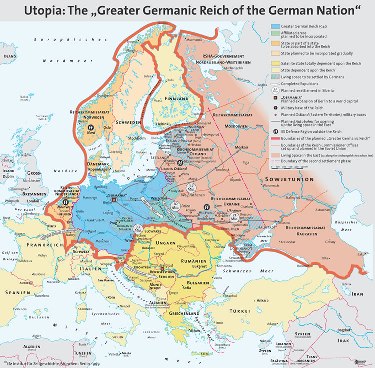
The German war in the east would differ from any previous war. Its underlying basis was ideological. Economic and geopolitical considerations were given importance in relationship to the understanding of the German “Master Race.” Race and Lebensraum was the goal of the State that “concentrates all of its strength on marking out a way of life for our people through the allocation of Lebensraum for the next one hundred years…the goal corresponds equally to the highest national and ethnic requirements.” 1

Hitler believed that Germany was “entitled to more land…because it was the “mother of life” not just some “little nigger nation or another.”” 2 The Germans planned to “clear” the vast majority of the Slavic population and the “settlement of millions of hectares of eastern Lebensraum with German colonists” complimented by a short term exploitation of the land to “secure the food balance of the German Grossraum.” 3 Joachim Fest notes that Hitler called it a “crime” to wage war only for the acquisition of raw materials. Only the issue of living space permitted resort to arms. 4

Following the Peace of Westphalia wars in Europe typically emphasized conquest of territory and natural resources either to expand empires or promote some kind of self-sufficiency. The Thirty Years War, which was ended by the Treaty of Westphalia had a heavy religious component which added to its brutality. However the root of much of this conflict was about increasing the power of emerging nation states led by men not necessarily loyal to their religious brethren. 5

The American and Russian Civil wars had some ideological basis and helped usher in the brutality of total war. Both had major effect in these nations’ development and both were bitterly contested with the winners imposing to various degrees political changes on their vanquished brothers they were civil wars. 6

Adam Tooze sees the Holocaust as the first step of the “last great land grab in the long and bloody history of European colonialism…” 7 This does have merit, Hitler’s desire for Lebensraum or living space was a type of colonialism. However, Tooze’s argument does not take away from the basic premise that Germany’s war in the east was at its heart motivated by ideological factors.
Lebensraum

Lebensraum

German Anti-Semitism and Adolf Hitler

The root of this war was in the mind of Adolf Hitler himself. Hitler was born in Linz Austria during a time when various Pan-German and Ant-Semitic groups, publications and propaganda were widespread. As a young man Hitler moved to Vienna hoping to become an artist, something that he found little commercial success. While struggling to make a living in Vienna he was exposed to a culture far different from the provincial city of his youth, a city that had much culture but was also a meeting ground for the various peoples that populated the Austro- Hungarian Empire, including Slavs and many Jews. While many of the Germanic or Austrian Jews were outwardly little different from their Christian neighbors the Jews from Eastern Europe repulsed Hitler.

This attitude was not unique to German but found its roots in the various anthropologies written by other Europeans as well as Germans regarding the lack of rights of “inferior cultures” as related to their colonial expansion as well as the westward expansion of Americans. Friedrich Ratzel a German anthropologist and a founder of the Pan-German League paired the Jews with “the stunted hunting people of the African interior” into “the class of scattered people with no

land.” 8 Ratzel’s work where he also studied the conquest of the Native American tribes by whites helped form the basis of Hitler’s Understanding of Lebensraum, a concept that he borrowed from Ratzel. Ratzel was originally a zoologist. In his concept of Lebensraum Ratzel “linked the biological theory of life with the geographical theory of space.” Ratzel believed that to “conquer and hold sufficient Lebensraum, others have to be displaced.” Ratzel noted how European settles had taken over land from the Native Americans to take it for themselves. He noted that “the result was an annihilating struggle, the prize for which was the land, the space.” 9

Another German academic and lecturer at the University of Glasgow Alexander Tille, wrote in 1893 that it is “the right of the stronger race to annihilate the lower…when that race does not maintain its ability to resist then it has no right to exist, for anyone who cannot maintain himself must be content to go under.” Tille’s “laws” were easily applied to both primitive peoples as well as to “the economically less successful peoples of Europe.” 10

Hitler’s lack of success, struggle with poverty and resentment of others led him to the writings of the Pan-Germanic and Anti-Semitic movements. His years in Vienna were foundational as he as he absorbed the ideas of these Pan-German, anti-Semitic groups through newspapers like the Deutsches Volksblatt11 In Vienna Hitler began to connect the Jews with Marxism.12 Joachim Fest notes that in Vienna Hitler became obsessed by the fear of the Slavs and Jews, hated the House of Hapsburg, the Social Democratic Party, and “envisioned the end of Germanism.” 13

Hitler’s racial views were amplified after the war in turbulent Weimar Germany where he became a member of the NDSAP, rising rapidly within it, eventually taking over party leadership, reorganizing it so that it “became the instrument of Hitler’s policies.” 14 Following the unsuccessful Beer Hall Putsch of 1923 Hitler wrote Mein Kampf while imprisoned in the Landsberg prison in which he enunciated his views about the Jews, Slavs and Lebensraum. Hitler believed that Imperial Germany had been “hopelessly negligent” in regard to the Jews 15 and that the Jews in conjunction with the Catholic Center Party and Socialists worked together for “maximum damage to Germany.” 16

Likewise he saw the Jews as heading the “main ideological scourges of the nineteenth and twentieth century’s.” 17 It was the ideology of Hitler’s “obsessive anti-Semitism” 18 that drove Nazi Germany’s policy in regard to the Jews and against Jewish-Bolshevism. By the 1920s Hitler had “combined his hatred of the Jews and of the supposedly Jewish dominated Soviet state with existing calls to conquer additional Lebensraum, or living space, in the east.” 19 Hitler wrote: “The fight against Jewish world Bolshevism requires a clear attitude toward Soviet Russia. You cannot drive out the Devil with Beelzebub.” 20 Richard Evans notes that Mein Kampf clearly enunciated that “Hitler considered racial conflict…the essence of history, and the Jews to be the sworn enemy of the German race ….” And that the “Jews were now linked indissolubly in Hitler’s mind with “Bolshevism” and “Marxism.” 21

When Hitler became the dictator of Germany “his ideology and strategy became the ends and means of German foreign policy.” 22 His aims were clear, Hitler remarked to Czech Foreign Minister Chvalkovsky on 21 January 1939: “We are going to destroy the Jews.” 23It was clear that Hitler understood his own role in this effort noting to General Gotthard Heinrici that “he was the first man since Charlemagne to hold unlimited power in his own hand. He did not hold this power in vain, he said, but would know how to use it in the struggle for Germany…” 24

To be continued…

Notes

1 Weinberg, Gerhard L. Ed. Hitler’s Second Book: The Unpublished Sequel to Mein Kampf by Adolph Hitler.  Translated by Krista Smith, Enigma Books, New York, NY 2006. Originally published as Hitlers zweites Buch, Gerhard Weinberg editor, 1961 p. 159

2 Davidowicz, Lucy S. The War Against the Jews 1933-1945 Bantam Books, New York, NY 1986. p.91

3 Tooze, Adam. The Wages of Destruction Penguin Books, New York, NY, 2008. First Published by Allen Lane Books, Penguin Group, London UK, 2006. p.463

4 Fest, Joachim, Hitler. Translated by Richard and Clara Winston. Harcourt Brace Jovanovich Publishers, San Diego,

New York, London, 1974. German Edition by Verlag Ullstein 1973 pp. 607-608

5 Note the actions of Cardinal Richelieu in France who worked to expand French power at the expense of other Catholic nations and the Vatican itself.

6 In the United States the Reconstruction policies produced great resentment in the south with decidedly negative

results for the newly freed slaves which lasted another 100 years, while in the Soviet Union great numbers of “opponents of Socialism” were killed, imprisoned or driven out of the county

7 Ibid. Tooze. The Wages of Destruction p.462

8 Lindqvist, Sven Exterminate All the Brutes: One Man’s Oddessy into the Heart of Darkness and the Origins of European Genocide Translated from the Swedish by Joan Tate, The New Press , New York and London 1992 p.145

9 Ibid. Lindqvist p.154 It is interesting to note that the current American “historian” of the American Religious right

David Barton made the same arguments recently about the American Indians. Barton said: “You have to deal, a lot of it, with how the enemy responds. It’s got to be based on what the enemy responds [to,] you cannot reason with certain types of terrorists; and see that’s why we could not get the Indians to the table to negotiate with us on treaties until after we had thoroughly whipped so many tribes …” “People complain about the fact that the American military and buffalo hunters went out and wiped out all the buffalo in the western plains. Doing that was what brought the Indians to their knees because the Indians lived on those wide western plains where there were very few towns; Indians didn’t go into town to buy supplies, they went to the buffalo herds, that’s where they got their meat, that’s where they got their coats, the hides provided coats, they provided covering for their teepees.

If you don’t have the buffalos, those Indians cannot live on the open western plains without those buffalo and so what happened was the military wiped out the supply line by wiping out the buffalo. That’s what brought those wars to an end, that’s what brought the Indians to their knees and ended all the western conflict.” Retrieved from Barton’s Wallbuilders Live broadcast http://www.wallbuilderslive.com/Historic.asp?cdate=77515 9 May 2014 and text   from   http://www.rightwingwatch.org/content/david-barton-explains-just-war-theory-we-had-destroy-indian-  tribes-until-they-became-civiliz

10 Ibid. Lindqvist p.148

11 Ibid. Davidowicz, The War Against the Jews pp.8-9 12 Ibid. Davidowicz. TheWar Against the Jews p.12 13 Ibid. Fest Hitler. p.47

14 Bracher, Karl Dietrich. The German Dictatorship: The Origins, Structure, and Effects of National Socialism.

Translated by Jean Steinberg, Holt Rinehart and Winston, New York, NY 1979. Originally Published under the title Die Deutsche Diktatur: Entstehung, Struktur,Folgen des Nationalsocialismus. Verlag Kiepenheuer & Witsch. Koln and Berlin, 1969 p.93

15 Weinberg, Gerhard L. Germany Hitler and World War II . Cambridge University Press, New York, NY 1995 p.61

16 Ibid. Weinberg, Hitler’s Second Book p.60

17 Friedlander, Saul Nazi Germany and the Jews 1939-1945: The Years of Extermination. Harper Perennial, New York, NY 2007 p.xviii

18 Ibid. Friedlander, The Years of Extermination p.xvii Friedlander called this anti-Semitism “Redemptive anti- Semitism” in which “Hitler perceived his mission as a kind of crusade to redeem the world by eliminating the Jews.

19 Megargee, Geoffrey P. War of Annihilation: Combat and Genocide on the Eastern Front 1941.Bowman and

Littlefield Publishers Inc. Lanham, Boulder, New York. 2007 p.4

20 Hitler, Adolf Mein Kampf translated by Ralph Manheim. Mariner Books, Houghton Mifflin Company, New York, NY 1999. Houghton Mifflin Company 1943, copyright renewed 1971. Originally published in Germany by Verlag Frz.

Eher Nachf. GmbH 1925. p.662.

21 Evans, Richard J. The Coming of the Third Reich Penguin Books, New York 2004. First published by Allen Lane 2003 p.197

22 Ibid. Davidowicz The War Against the Jews pp. 88-89

23 Rhodes, Richard. Masters of Death: The SS Einsatzgruppen and the Invention of the Holocaust. Vintage Books a division of Random House, New York, NY 2002 p.37

24 Speer, Albert. Inside the Third Reich. Collier Books, a Division of MacMillan Publishers, Inc. New York, NY 1970 p.166

7 Comments

Filed under History, holocaust, nazi germany

Happy Cinco de Mayo: a Sad Day for Emperor Max

Batalla_de_Puebla

The Battle of Puebla

Friends of Padre Steve’s World,

I just wanted to wish all my readers a happy Cinco de Mayo. This holiday, which is not a Federal holiday in Mexico, and which many people assume is has something to do with the Mexican Independence Day, or the sinking of shipment of mayonnaise bound for Mexico by a German U-Boat during the First World War actually celebrates something entirely different. It celebrates the defeat of a French Army by Mexican forces at the Battle of Puebla on May 5th 1862.

Mexico had already been independent for nearly forty years when this took place. The French had led an intervention in Mexico, and members of the conservative Mexican aristocracy asked Archduke Maximilian of Austria to be the emperor of a new Imperial Mexico, and he agreed, but I digress…

Before Maximilian took over, the French first had to conquer the Mexican Republic, something that most Mexicans rather liked. At Puebla the French commander underestimated the Mexican will to resist and ordered an attack on the city which was repulsed with heavy casualties. Since people around the world expected the French to have an easy time of it the victory was stunning, and it inspired the Mexican people to fight on. Now the war went on for some time. Eventually the French succeeded in capturing Mexico City on May 17th 1863 and installed Maximilian as Emperor of Mexico arriving in Veracruz on May 21st1864.

Although they had succeeded the war was not over, President Benito Juarez continued to resist and in 1865, aided by weapons, arms and money from the United States which now that its Civil War was over, was able to supply, issued a series of defeats on French Forces. Emperor Napoleon III of France, who had conjured up this mess now decided that the price of supporting Emperor Maximilian was too high and chose better relations with the United States over the hapless Maximilian and his Mexican forces.

The French withdrew, but Emperor Max chose to fight on and was captured by Republican forces and was tried, and sentenced to death. At his execution he paid the firing squad in gold not to shoot him in the head so his mother could see his face. The remnants of his government surrendered in Mexico City on June 20th 1867, the day after his execution.

Despite Cinco de Mayo not being an official Mexican holiday, we Americans and people in a number of other countries do celebrate it, ostensibly as a day to remember Mexican heritage, but more often as an excuse to party, eat Mexican food, and drink lots of beer, margaritas, and tequila shots.

Since I will be drinking beer and Judy will be drinking margaritas today with friends I wish you well.

Have a great day.

Peace

Padre Steve+

2 Comments

Filed under History, Loose thoughts and musings

Ordinary Men and Genocide: Introduction…

babi yar

Massacre at Babi Yar

Friends of Padre Steve’s World,

Anyone who follows my writing know I write a lot about the Holocaust and the war crimes perpetuated by the Nazi State. I began studying this as an undergraduate and graduate level history student at California State University at Northridge under Dr. Helmut Heussler, who served as a wartime interrogator for the 82nd Airborne Division during the Second World War and then as an interpreter at the Major War Crime trials at Nuremberg.  I studied under him for three years dealing with the end of Imperial Germany, the German Civil War, the Weimar Republic and the Nazi era. He gave me a lot of freedom to explore and research the subject and allowed me to do that research in undergraduate and graduate level independent study projects. I continued that study personally as well as during seminary and my second Master’s Degree in Military History.

Since I read, speak and write German well and can often pass myself off as German in Germany because of my lack of an American accent when speaking the language. I speak German with a blend of a Bavarian and Hessen dialect and that helps when I visit various Holocaust sites, museums, and research centers in Germany. I will be doing some of that again this fall when I make another trip to Munich, Hessen, and Baden-Wurttemberg. Last week I spent five hours at the U.S. Holocaust Museum in Washington D.C. contemplating things that I mostly already knew while exploring details of the Holocaust that made it more real and personal.

As part of my academic work at the Joint Forces Staff College I taught military ethics as related to the Just War Theory. In the class on jus post bellum or justice after war I dealt with the implication of participating in war crimes. It is a serious subject and in the class I attempted to make my students, all relatively senior officers from the United States and allied nations as uncomfortable as possible. I used a number of examples from the major war crimes trials at Nuremberg as well as the Generals Trial and I used the film Conspiracy, which is about the Wannsee Conference where mostly mid-level officers and bureaucrats hashed out the coordination of the Endlosung or Final Solution to what Nazis euphemistically called “the Jewish Question.” 

As I went through previous notes and research to teach my students I felt a tenseness and revulsion for the actions of those that ordered, committed or condoned these crimes; many of whom were like me, professional military officers, historians, and theologians. So I realize how easily it is for normal, rational, and even basically decent people to succumb to either participating in or turning a blind eye to crimes against others, even on a massive scale.  In fact the bigger those crimes are they seem easier for some people to dismiss, because the victims cease be human, and simply a statistic. Sadly, Josef Stalin probably got human nature right when he said “The death of one man is a tragedy. The death of millions is a statistic.” That comment causes great revulsion in my soul, but I have to admit it seems to be the way that many people deal with such great crimes.

September 29th 2017 was the 76th anniversary of the Babi Yar massacre. It was committed by members of the SS Einsatzgruppen C near Kiev shortly after the German Army captured that city. 33,771 Jews were exterminated by the members of Sonderkommando 4b of Einsatzgruppen C as well as members of a number of Ordungspolizei, police battalions supported by the logistics and protection of the German Army. About 10,000 others, mainly Communist Officials and Gypsies were rounded up and killed in the same operation. The victims were stripped of all of their belongings taken to a ravine and shot. It was the second largest killing action by the various Einsatzgruppen in the war. The killings were done up close and personal. The men who conducted the operation either believed that the people that they were killing were sub-human, or did not have the courage to stand up and say no.

These issues are still with us and as I watch the rise of Right Wing and other Fascist movements in Russia, Europe, and the United States I get very concerned. But even more concerning are the large number of people who are content to dismiss their threats and violence, often because while too respectable to utter their words themselves they secretly condone their race hatred. Hannah Arendt made the comment that “The sad truth is that most evil is done by people who never make up their minds to be good or evil.”

Of course these are uncomfortable subjects. When I tell friends of the places that I have visited and studies I have done quite a few openly tell me that they find the subject so uncomfortable hat they could not visit those places. These friends span the political spectrum, just as did the people who said nothing or willingly followed orders to commit genocide in Nazi Germany.

We like to say that the Nazis were different than us or others. To some extent this is true, but the real truth is that most of the Christian Western European countries, and I include the United States have also committed gross crimes against humanity against peoples that we believed were less than human and not afforded human rights or protections. In the movie Judgement at Nuremberg Spencer Tracy makes a comment that should send chills through any of us. He spoke concerning one of the judges on trial, “Janning, to be sure, is a tragic figure. We believe he loathed the evil he did. But compassion for the present torture of his soul must not beget forgetfulness of the torture and the death of millions by the Government of which he was a part. Janning’s record and his fate illuminate the most shattering truth that has emerged from this trial: If he and all of the other defendants had been degraded perverts, if all of the leaders of the Third Reich had been sadistic monsters and maniacs, then these events would have no more moral significance than an earthquake, or any other natural catastrophe.But this trial has shown that under a national crisis, ordinary – even able and extraordinary – men can delude themselves into the commission of crimes so vast and heinous that they beggar the imagination….”

Babi Yar is just one example of how civilized people can get can commit great atrocities in the name of ideology and race, and it does not stand alone. The tragic fact is that it really doesn’t take much to condition people to go commit such crimes; just teach people from childhood that people of certain races or religions are less than human. Then subjugate them to incessant propaganda and then turn them loose using the pretext that they are killing terrorists or insurgents. In the coming days I am posting in small sections an article that I wrote that deals with the ideological as well as military reasons that brought about Babi Yar and so many other atrocities committed by the Nazis during the campaigns in Poland and the Soviet Union.

What happened at Babi Yar is just one example of how civilized people can get can commit great atrocities in the name of ideology and race, and it does not stand alone. The tragic fact is that it really doesn’t take much to condition people to go commit such crimes; just teach people from childhood that people of certain races or religions are less than human. Then subjugate them to incessant propaganda and then turn them loose using the pretext that they are killing terrorists, insurgents, or other enemies of the state. Dr Timothy Snyder wrote:

“The European history of the twentieth century shows us that societies can break, democracies can fall, ethics can collapse, and ordinary men can find themselves standing over death pits with guns in their hands. It would serve us well today to understand why.”

The coming series of articles deal with the ideological as well as military reasons that brought about Babi Yar and so many other atrocities committed by the Nazis during the campaigns in Poland and the Soviet Union. I will probably intersperse other articles as the need arises but there will be five more sections to this series.

So until tomorrow,

Peace

Padre Steve+

1 Comment

Filed under ethics, faith, History, holocaust, Military, nazi germany, News and current events, Political Commentary

My Country Right or Wrong?

29f03605f6b48a52887c2b51a20b5382

Friends of Padre Steve’s World,

Even since I was a child I was an avid reader of history, especially military history and biography. I idolized the men that I read about and many of the things that they said and did, and almost always skewed them into an almost perverse form of patriotism. After the attacks of 9-11-2001 and during the run up to the invasion of Iraq I got into a internet argument with a man who later became the Presiding Bishop of my former denomination. He was and still is a very honorable man.

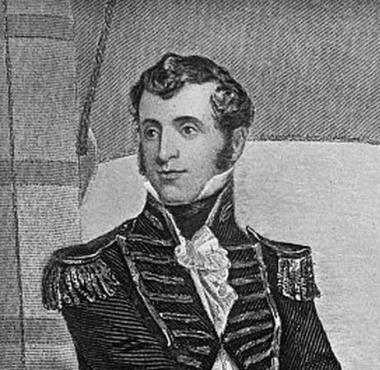
While very conservative theologically he had a strong sense of social justice and having come to adulthood during Vietnam war era he had a certain sense of distrust about military adventurism that I, an officer who at that time had some twenty years of military service did not fully appreciate. I responded to one of his comments with a quote from one of my favorite American Naval heroes, Captain Stephen Decatur who once remarked:

“Our Country! In her intercourse with foreign nations may she always be in the right; but right or wrong, our country!”

decatur 2 sqaure

There is some truth in what Decatur said, but his words should not be used to justify imperialistic nationalism, racism, or militarism. Sadly back then that was exactly how I used it to attempt to shut down the arguments of an honorable man. If he ever reads this I hope that Bishop Craig Bates accepts my heartfelt apology for how I treated him back then.

It took me two combat tours, one at sea where I was a member of a boarding team, and the other in Iraq’s Al Anbar Province, and a lot more military and historical education that I realized how wrong that I was in doing this. Using patriotic quotes to buttress immoral, illegal, unconstitutional, and un-Christian policies is damnable. G. K. Chesterton noted: “‘My country, right or wrong,’ is a thing that no patriot would think of saying. It is like saying, ‘My mother, drunk or sober.’”

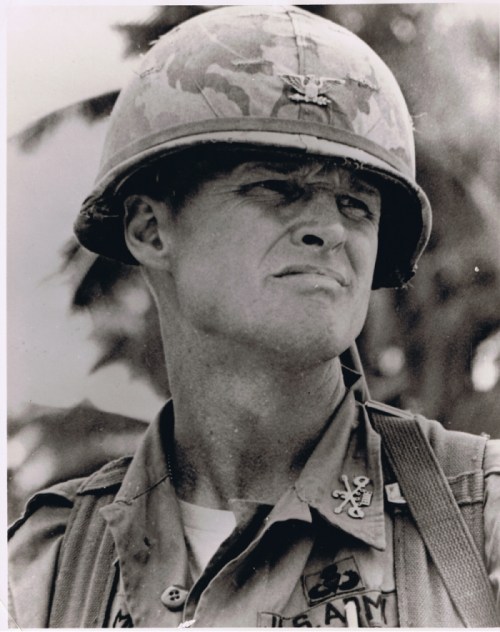
But, I am afraid that my former understanding of patriotism is exactly what many Americans follow today, regardless of their political affiliation or ideology seem to automatically defer to the decisions of the President in launching military strikes. This has been largely true since the end of Second World War until now with the exception of Vietnam. No one wants to be “against the troops” and I am still one of those troops, but opposing nationalism, imperialism, and militarism is not the same as “supporting the troops.” The late Army Lieutenant General Hal Moore, who led his battalion into the Battle of the Ia Drang in 1965 and was memorialized in the film We Were Soldiers told West Point Cadets in 2005:

“The war in Iraq, I said, is not worth the life of even one American soldier. As for Secretary Rumsfeld, I told them, I never thought I would live long enough to see someone chosen to preside over the Pentagon who made Vietnam-era Defense Secretary Robert McNamara look good by comparison. The cadets sat in stunned silence; their professors were astonished. Some of these cadets would be leading young soldiers in combat in a matter of a few months. They deserved a straight answer.

The expensive lessons learned in Vietnam have been forgotten and a new generation of young American soldiers and Marines are paying the price today, following the orders of civilian political leaders as they are sworn to do. The soldiers and those who lead them will never fail to do their duty. They never have in our history. This is their burden. But there is another duty, another burden, that rests squarely on the shoulders of the American people. They should, by their vote, always choose a commander in chief who is wise, well read in history, thoughtful, and slow-exceedingly slow-to draw the sword and send young men and women out to fight and die for their country. We should not choose for so powerful an office someone who merely looks good on a television screen, speaks and thinks in sixty-second sound bites, and is adept at raising money for a campaign.

If we can’t get that part right then there will never be an end to the insanity that is war and the unending suffering that follows in war’s wake-and we must get it right if we are to survive and prosper as free Americans in this land a million Americans gave their lives to protect and defend.”

I remember reading General Moore’s back words then and despite my respect for him I didn’t see their truth, I still believed the lies of Donald Rumsfeld, the Bush Administration, and the Right wing media. I was wrong, and within two and a half years I would discover just how right that he was.

Today, some ten years after I returned from Iraq I find that we now have a President whose historical, ethical, and policy blindness is subjected to his narcissistic and paranoid personality. He is a man who dodged the draft, avoided military service, condemned men and women wounded. killed, or captured in combat as losers while bragging that avoiding sexually transmitted diseases in the 1980s was his Vietnam.

War is a great way to distract from other real concerns, especially if it gives the President, any President, a chance to divert attention from his own malfeasance and criminality. Our Republic is in danger and I do not think that the danger will soon pass. I only wish that it would.

So until tomorrow,

Peace

Padre Steve+


Leave a comment

Filed under ethics, Foreign Policy, History, iraq, leadership, Military, national security, News and current events, Political Commentary, vietnam

A Road Built With Hate and Paved With Indifference: The Path of the Trump Era

photo-jugement-a-nuremberg-judgment-at-nuremberg-1961-1

Friends of Padre Steve’s World,

We returned from a visit with our friends near Washington D.C. and I am a bit tired and want to do some reading before getting ready for bed. While we were there I visited the Holocaust Museum and I also finished reading Dr. Timothy Snyder’s new book The Road to Unfreedom: Russia, Europe, and the United States.  As I mentioned last night I have become very reflective in light of those things and what I see going on in our country today.

Since I am tired I am going to repost a slightly modified article from about a year ago. I think that it is as timely now as when I first wrote it, and I hope that it will resonate with my readers. Historian Ian Kershaw wrote: “The road to Auschwitz was built by hate, but paved with indifference.” I find that comment all too real today when I look at the President, his propagandists, and those who follow him without question even when they know that he is lying to them.

The longer that I live the more that I understand how this happens. Today, as there were in 1930s and 1940s Nazi Germany, there are all too many hate-filled ideologues who desire to destroy or subjugate entire races and ethnic groups, or members of different religions or political ideologies. In the United States they have free reign to do speak and write freely about their goals and for many years we have regarded most of them as fringe characters who had no chance of ever enacting anything that they proposed. Many of these were and continue to be the most vocal supporters of President Trump, and see in him a man who will help them accomplish their desires as no President has done before. One of them, Steve Bannon serves as his chief policy adviser and strategist, and there are no shortage of civil rights opponents and proponents of a police state in his cabinet, including his Attorney General.

The sad thing is despite the myriad of actions taken by the Trump administration, its abuses of power, its probable connections to a hostile power, its attempts to shut down law enforcement probes of the Russia connections, its unabashed attempts to silence the press and all other opponents, and its nearly uncountable number of lies and distortions that it makes on a daily basis; that the vast majority of Congressional Republicans nor his followers seem to care. Don’t get me wrong, there is plenty of opposition, but among his followers and the great number of people in the middle who prefer not to get involved there is little real opposition; moral, religious, ethical, or political to anything that he says or does, mostly because they do not understand how it effects them or their liberties, nor how toxic it is to the nation. It seems to me that they are not only apathetic to the abuses of power, but have no empathy towards the people that they are directed against.

img_0476

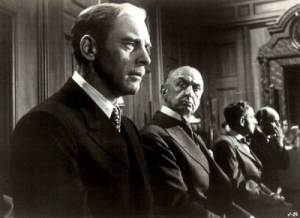
For the Trump supporters this is not a problem. He represents a chance for them to recover their greatness, just as Hitler did for many of his followers in the 1930s, including those who joined the Party late. One of the greatest film monologues that illustrated this phenomenon is that of Burt Lancaster in his portrayal of a Nazi judge who is on trial in the movie Judgment at Nuremberg. His comments remind me so much of what I see among many Trump supporters today:

“There was a fever over the land. A fever of disgrace, of indignity, of hunger. We had a democracy, yes, but it was torn by elements within. Above all, there was fear. Fear of today, fear of tomorrow, fear of our neighbors, and fear of ourselves. Only when you understand that – can you understand what Hitler meant to us. Because he said to us: ‘Lift your heads! Be proud to be German! There are devils among us. Communists, Liberals, Jews, Gypsies! Once these devils will be destroyed, your misery will be destroyed.’ It was the old, old story of the sacrificial lamb. What about those of us who knew better? We who knew the words were lies and worse than lies? Why did we sit silent? Why did we take part? Because we loved our country! What difference does it make if a few political extremists lose their rights? What difference does it make if a few racial minorities lose their rights? It is only a passing phase. It is only a stage we are going through. It will be discarded sooner or later. Hitler himself will be discarded… sooner or later. The country is in danger. We will march out of the shadows. We will go forward. Forward is the great password. And history tells how well we succeeded, your honor. We succeeded beyond our wildest dreams. The very elements of hate and power about Hitler that mesmerized Germany, mesmerized the world! We found ourselves with sudden powerful allies. Things that had been denied to us as a democracy were open to us now. The world said ‘go ahead, take it, take it! Take Sudetenland, take the Rhineland – remilitarize it – take all of Austria, take it! And then one day we looked around and found that we were in an even more terrible danger. The ritual began in this courtoom swept over the land like a raging, roaring disease. What was going to be a passing phase had become the way of life. Your honor, I was content to sit silent during this trial. I was content to tend my roses. I was even content to let counsel try to save my name, until I realized that in order to save it, he would have to raise the specter again. You have seen him do it – he has done it here in this courtroom. He has suggested that the Third Reich worked for the benefit of people. He has suggested that we sterilized men for the welfare of the country. He has suggested that perhaps the old Jew did sleep with the sixteen year old girl, after all. Once more it is being done for love of country. It is not easy to tell the truth; but if there is to be any salvation for Germany, we who know our guilt must admit it… whatever the pain and humiliation.”

While we have not reached the point that the Third Reich did between 1933 and 1938, it would not take much for us to get there. We misjudge ourselves if we belief that such things cannot happen here, as Timothy Snyder wrote: “The European history of the twentieth century shows us that societies can break, democracies can fall, ethics can collapse, and ordinary men can find themselves standing over death pits with guns in their hands. It would serve us well today to understand why.”

Reinhold Niebuhr, the great American theologian noted: “Ultimately evil is done not so much by evil people, but by good people who do not know themselves and who do not probe deeply.”

We should heed their warnings before we cross that precipice and head into the abyss.

Until tomorrow,

Peace

Padre Steve+

1 Comment

Filed under ethics, film, History, holocaust, News and current events, Political Commentary

“But Then It Was Too Late” A Reflection on May 1st 2018

Friends of Padre Steve’s World,

My wife and I took a few days of leave to spend with our friends David and Melissa and to let our three Papillon dogs spend time with their four Pappies. It’s been nice and relaxing. I was able to spend Friday at the Holocaust Museum and on Saturday go with Judy, David and Melissa to George Washington’s Mount Vernon. I also caught up on some reading, finishing Timothy Snyder’s new book The Road to Unfreedom: Russia, Europe, and the United States, which I highly recommend.

I did some other reading and today I took a seven mile walk on the trails along the Potomac River, including a portion that borders the Trump National Country Club. That allowed me to do a lot of thinking without being on social media for a couple of hours. Honestly, even though I tried just to enjoy nature, take pictures of wildlife, and the river, I found myself really wondering if our system of government will survive.

I do like to be hopeful, but that being said I really don’t know if we will. I think that is in part due to how a number of people in the White House and Washington D.C. Press Corps responded to what was admittedly rude and sometimes vulgar, but otherwise truthful performance by comedian Michele Wolf at the annual White House Correspondents Dinner. Her comments may have been in poor taste, but at least they were truthful as compared to how the President, his Press Secretary, and his own host of Right Wing media flacks talk and write about people, including the Press, which they say are not just their enemies, but those of the American people and State.

As I thought about that my mind wander back to Milton Mayer’s book They Thought they Were Free. Mayer was an American Professor of German-Jewish origins who lived and worked in the area of Hessen, northwest of Frankfurt in the late 1940s and 1950s. His book deals with his interactions and friendships with townspeople of various backgrounds after the collapse of the Third Reich. It really is a remarkable book which I think that every American regardless of their political affiliation or ideology should read.

Chapter thirteen of that book contains Mayer’s account of meeting with one of his German academic colleagues at the university where he taught. Tonight I only ask you to read it and reflect upon it and the time in which we live, and then ask yourself what you would do.

As for me I think that ten or fifteen years ago I would have reacted much the same as the Professor in Mayer’s book. But I don’t think I could do that now. Of course there are other things that I am pondering tonight related to this but they are of such a personal nature related to something that was spoken over me when I was ordained as a priest in 1996 that I don’t dare share it here, but it weighs on me in ways that it did not when those words were uttered by the diocesan Archdeacon.

I cannot share those words in print because frankly, today, more than when they were first spoken they frighten me. There are many times now that I wish I could share a conversation with Dietrich Bonhoeffer or Martin Niemoller about how to deal with this. I think I know what they would say but it would comfort me to share it with them.

So until tomorrow I will leave you with Chapter Thirteen of Milton Mayer’s book They Thought They Were Free.

Until tomorrow,

Peace

Padre Steve+

Chapter 13: But Then It Was Too Late

“What no one seemed to notice,” said a colleague of mine, a philologist, “was the ever widening gap, after 1933, between the government and the people. Just think how very wide this gap was to begin with, here in Germany. And it became always wider. You know, it doesn’t make people close to their government to be told that this is a people’s government, a true democracy, or to be enrolled in civilian defense, or even to vote. All this has little, really nothing, to do with knowing one is governing.

“What happened here was the gradual habituation of the people, little by little, to being governed by surprise; to receiving decisions deliberated in secret; to believing that the situation was so complicated that the government had to act on information which the people could not understand, or so dangerous that, even if the people could not understand it, it could not be released because of national security. And their sense of identification with Hitler, their trust in him, made it easier to widen this gap and reassured those who would otherwise have worried about it.

“This separation of government from people, this widening of the gap, took place so gradually and so insensibly, each step disguised (perhaps not even intentionally) as a temporary emergency measure or associated with true patriotic allegiance or with real social purposes. And all the crises and reforms (real reforms, too) so occupied the people that they did not see the slow motion underneath, of the whole process of government growing remoter and remoter.

“You will understand me when I say that my Middle High German was my life. It was all I cared about. I was a scholar, a specialist. Then, suddenly, I was plunged into all the new activity, as the university was drawn into the new situation; meetings, conferences, interviews, ceremonies, and, above all, papers to be filled out, reports, bibliographies, lists, questionnaires. And on top of that were the demands in the community, the things in which one had to, was ‘expected to’ participate that had not been there or had not been important before. It was all rigmarole, of course, but it consumed all one’s energies, coming on top of the work one really wanted to do. You can see how easy it was, then, not to think about fundamental things. One had no time.”

“Those,” I said, “are the words of my friend the baker. ‘One had no time to think. There was so much going on.’”

“Your friend the baker was right,” said my colleague. “The dictatorship, and the whole process of its coming into being, was above all diverting. It provided an excuse not to think for people who did not want to think anyway. I do not speak of your ‘little men,’ your baker and so on; I speak of my colleagues and myself, learned men, mind you. Most of us did not want to think about fundamental things and never had. There was no need to. Nazism gave us some dreadful, fundamental things to think about—we were decent people—and kept us so busy with continuous changes and ‘crises’ and so fascinated, yes, fascinated, by the machinations of the ‘national enemies,’ without and within, that we had no time to think about these dreadful things that were growing, little by little, all around us. Unconsciously, I suppose, we were grateful. Who wants to think?

“To live in this process is absolutely not to be able to notice it—please try to believe me—unless one has a much greater degree of political awareness, acuity, than most of us had ever had occasion to develop. Each step was so small, so inconsequential, so well explained or, on occasion, ‘regretted,’ that, unless one were detached from the whole process from the beginning, unless one understood what the whole thing was in principle, what all these ‘little measures’ that no ‘patriotic German’ could resent must some day lead to, one no more saw it developing from day to day than a farmer in his field sees the corn growing. One day it is over his head.

“How is this to be avoided, among ordinary men, even highly educated ordinary men? Frankly, I do not know. I do not see, even now. Many, many times since it all happened I have pondered that pair of great maxims, Principiis obsta and Finem respice—‘Resist the beginnings’ and ‘Consider the end.’ But one must foresee the end in order to resist, or even see, the beginnings. One must foresee the end clearly and certainly and how is this to be done, by ordinary men or even by extraordinary men? Things might have. And everyone counts on that might.

“Your ‘little men,’ your Nazi friends, were not against National Socialism in principle. Men like me, who were, are the greater offenders, not because we knew better (that would be too much to say) but because we sensed better. Pastor Niemöller spoke for the thousands and thousands of men like me when he spoke (too modestly of himself) and said that, when the Nazis attacked the Communists, he was a little uneasy, but, after all, he was not a Communist, and so he did nothing; and then they attacked the Socialists, and he was a little uneasier, but, still, he was not a Socialist, and he did nothing; and then the schools, the press, the Jews, and so on, and he was always uneasier, but still he did nothing. And then they attacked the Church, and he was a Churchman, and he did something—but then it was too late.”

“Yes,” I said.

“You see,” my colleague went on, “one doesn’t see exactly where or how to move. Believe me, this is true. Each act, each occasion, is worse than the last, but only a little worse. You wait for the next and the next. You wait for one great shocking occasion, thinking that others, when such a shock comes, will join with you in resisting somehow. You don’t want to act, or even talk, alone; you don’t want to ‘go out of your way to make trouble.’ Why not?—Well, you are not in the habit of doing it. And it is not just fear, fear of standing alone, that restrains you; it is also genuine uncertainty.

“Uncertainty is a very important factor, and, instead of decreasing as time goes on, it grows. Outside, in the streets, in the general community, ‘everyone’ is happy. One hears no protest, and certainly sees none. You know, in France or Italy there would be slogans against the government painted on walls and fences; in Germany, outside the great cities, perhaps, there is not even this. In the university community, in your own community, you speak privately to your colleagues, some of whom certainly feel as you do; but what do they say? They say, ‘It’s not so bad’ or ‘You’re seeing things’ or ‘You’re an alarmist.’

“And you are an alarmist. You are saying that this must lead to this, and you can’t prove it. These are the beginnings, yes; but how do you know for sure when you don’t know the end, and how do you know, or even surmise, the end? On the one hand, your enemies, the law, the regime, the Party, intimidate you. On the other, your colleagues pooh-pooh you as pessimistic or even neurotic. You are left with your close friends, who are, naturally, people who have always thought as you have.

“But your friends are fewer now. Some have drifted off somewhere or submerged themselves in their work. You no longer see as many as you did at meetings or gatherings. Informal groups become smaller; attendance drops off in little organizations, and the organizations themselves wither. Now, in small gatherings of your oldest friends, you feel that you are talking to yourselves, that you are isolated from the reality of things. This weakens your confidence still further and serves as a further deterrent to—to what? It is clearer all the time that, if you are going to do anything, you must make an occasion to do it, and then you are obviously a troublemaker. So you wait, and you wait.

“But the one great shocking occasion, when tens or hundreds or thousands will join with you, never comes. That’s the difficulty. If the last and worst act of the whole regime had come immediately after the first and smallest, thousands, yes, millions would have been sufficiently shocked—if, let us say, the gassing of the Jews in ’43 had come immediately after the ‘German Firm’ stickers on the windows of non-Jewish shops in ’33. But of course this isn’t the way it happens. In between come all the hundreds of little steps, some of them imperceptible, each of them preparing you not to be shocked by the next. Step C is not so much worse than Step B, and, if you did not make a stand at Step B, why should you at Step C? And so on to Step D.

“And one day, too late, your principles, if you were ever sensible of them, all rush in upon you. The burden of self-deception has grown too heavy, and some minor incident, in my case my little boy, hardly more than a baby, saying ‘Jewish swine,’ collapses it all at once, and you see that everything, everything, has changed and changed completely under your nose. The world you live in—your nation, your people—is not the world you were born in at all. The forms are all there, all untouched, all reassuring, the houses, the shops, the jobs, the mealtimes, the visits, the concerts, the cinema, the holidays. But the spirit, which you never noticed because you made the lifelong mistake of identifying it with the forms, is changed. Now you live in a world of hate and fear, and the people who hate and fear do not even know it themselves; when everyone is transformed, no one is transformed. Now you live in a system which rules without responsibility even to God. The system itself could not have intended this in the beginning, but in order to sustain itself it was compelled to go all the way.

“You have gone almost all the way yourself. Life is a continuing process, a flow, not a succession of acts and events at all. It has flowed to a new level, carrying you with it, without any effort on your part. On this new level you live, you have been living more comfortably every day, with new morals, new principles. You have accepted things you would not have accepted five years ago, a year ago, things that your father, even in Germany, could not have imagined.

“Suddenly it all comes down, all at once. You see what you are, what you have done, or, more accurately, what you haven’t done (for that was all that was required of most of us: that we do nothing). You remember those early meetings of your department in the university when, if one had stood, others would have stood, perhaps, but no one stood. A small matter, a matter of hiring this man or that, and you hired this one rather than that. You remember everything now, and your heart breaks. Too late. You are compromised beyond repair.

“What then? You must then shoot yourself. A few did. Or ‘adjust’ your principles. Many tried, and some, I suppose, succeeded; not I, however. Or learn to live the rest of your life with your shame. This last is the nearest there is, under the circumstances, to heroism: shame. Many Germans became this poor kind of hero, many more, I think, than the world knows or cares to know.”

I said nothing. I thought of nothing to say.

“I can tell you,” my colleague went on, “of a man in Leipzig, a judge. He was not a Nazi, except nominally, but he certainly wasn’t an anti-Nazi. He was just—a judge. In ’42 or ’43, early ’43, I think it was, a Jew was tried before him in a case involving, but only incidentally, relations with an ‘Aryan’ woman. This was ‘race injury,’ something the Party was especially anxious to punish. In the case at bar, however, the judge had the power to convict the man of a ‘nonracial’ offense and send him to an ordinary prison for a very long term, thus saving him from Party ‘processing’ which would have meant concentration camp or, more probably, deportation and death. But the man was innocent of the ‘nonracial’ charge, in the judge’s opinion, and so, as an honorable judge, he acquitted him. Of course, the Party seized the Jew as soon as he left the courtroom.”

“And the judge?”

“Yes, the judge. He could not get the case off his conscience—a case, mind you, in which he had acquitted an innocent man. He thought that he should have convicted him and saved him from the Party, but how could he have convicted an innocent man? The thing preyed on him more and more, and he had to talk about it, first to his family, then to his friends, and then to acquaintances. (That’s how I heard about it.) After the ’44 Putsch they arrested him. After that, I don’t know.”

I said nothing.

“Once the war began,” my colleague continued, “resistance, protest, criticism, complaint, all carried with them a multiplied likelihood of the greatest punishment. Mere lack of enthusiasm, or failure to show it in public, was ‘defeatism.’ You assumed that there were lists of those who would be ‘dealt with’ later, after the victory. Goebbels was very clever here, too. He continually promised a ‘victory orgy’ to ‘take care of’ those who thought that their ‘treasonable attitude’ had escaped notice. And he meant it; that was not just propaganda. And that was enough to put an end to all uncertainty.

“Once the war began, the government could do anything ‘necessary’ to win it; so it was with the ‘final solution of the Jewish problem,’ which the Nazis always talked about but never dared undertake, not even the Nazis, until war and its ‘necessities’ gave them the knowledge that they could get away with it. The people abroad who thought that war against Hitler would help the Jews were wrong. And the people in Germany who, once the war had begun, still thought of complaining, protesting, resisting, were betting on Germany’s losing the war. It was a long bet. Not many made it.”

Copyright notice: Excerpt from pages 166-73 of They Thought They Were Free: The Germans, 1933-45 by Milton Mayer, published by the University of Chicago Press. ©1955, 1966 by the University of Chicago. All rights reserved. This text may be used and shared in accordance with the fair-use provisions of U.S. copyright law, and it may be archived and redistributed in electronic form, provided that this entire notice, including copyright information, is carried and provided that the University of Chicago Press is notified and no fee is charged for access. Archiving, redistribution, or republication of this text on other terms, in any medium, requires the consent of the University of Chicago Press. (Footnotes and other references included in the book may have been removed from this online version of the text.)

1 Comment

Filed under ethics, faith, History, nazi germany, News and current events, Political Commentary

Forgotten Yet Honored Soldiers: the Legionnaires of Camarón

Friends of Padre Steve’s World,

Today is the 155th anniversary of the sacrifice of the men of the 3rd Company, 1st Battalion Of the French Foreign Legion at Camarón. The war that they were fighting was in an unjust cause launched by Emperor Napoleon III to gain control of Mexico, but that takes nothing away from their heroism, heroism that even their opponents honor today. Seldom are the exploits of the soldiers of an imperialist conquering power honored by those who fought against them, but this is one of those rare exceptions.

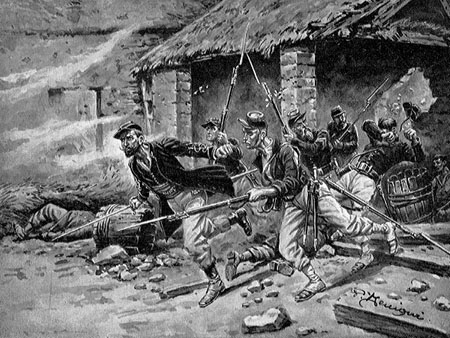
Lieutenant Clement Maudet Leads Surviving Legionnaires in a Final Charge

Almost every Army or nation has a story of a heroic group of soldiers that fight valiantly and often die against enemies of far greater strength and quite often in unjust causes. The United States has the Texan defenders of the Alamo and Custer’s 7th Cavalry at Little Big Horn. The British have a number of such exploits, including that of their soldiers at the Battle of Rourke’s Drift in the Zulu War. The Germans have the nearly 300,000 men of the 6th Army lost at Stalingrad, and the dying Soviet Union had the 9th Company of the Red Army’s 345th Independent Guards Airborne Regiment which conducted a heroic defense against Afghan Mujahideen at Hill 3234 during Operation Magistral in 1989. All of their causes were unjust, but the gallantry and sacrifice of so many of these soldiers was undeniable, even to their opponents.

However, seldom are “the few” honored by friend and foe alike for more than a century after their defeat. Among these few, these gallant few, are the 65 men of the 3rd Company of the 1st Battalion Légion Étrangère (Foreign Legion). These few would battle nearly 2000 Mexican Soldiers at a small Hacienda called Camarón on April 30th 1863 while proving an advance guard escort to a supply convoy which was to relieve French forces besieging Puebla.

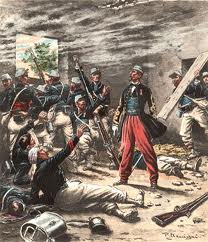
Captain Jean Danjou

The 3rd Company was severely undermanned due to dysentery and when they went into battle 50 Legionnaires and all of the company officers were incapacitated.  The battalion Quartermaster, Captain Danjou took command and was joined by two other officers, Lieutenant Clement Maudet and Lieutenant Jean Villian to lead the remaining 62 Legionnaires on their mission to a tragic destiny.

Beginning their March at 0100 they had marched 15 miles before stopping for breakfast at 0700. While brewing their coffee with the convoy which was now several hours behind schedule, scouts from the company saw a force of several hundred Mexican cavalry approaching.  They fought a battle with the cavalry for several hours before retreating to the Hacienda around the middle of the morning.

The Mexican forces under the command of Colonel Francisco Milan were joined by additional infantry and cavalry and now numbered over 2000 men, 800 cavalrymen and 1200 infantrymen. Milan’s Forces outnumbered the surrounded Legionnaires by a factor of forty to one, but he was neither bloodthirsty or bent on revenge. Colonel Milan realized that the Legionnaires situation was hopeless and offered Danjou the chance to surrender with honor. With his force reduced to under 50 men following the skirmishes Danjou refused. He replied: “We have munitions. We will not surrender.”

The Legionnaires defense held against several assaults but with casualties mounting, ammunition dwindling and without food or water in the scorching heat Danjou rallied his men. He had lost his left hand in Algeria 10 years before and had a wooden hand fashioned.  He went to each Legionnaire offering words of support, a sip of wine and had each man swear on his wooden hand that they would not surrender.  While doing so he was shot and killed about noon.

Lieutenant Villian, the battalion’s much disliked Paymaster who volunteered for the mission took command, and the Legionnaires fought on suffering immensely under the fierce and accurate fire from the veteran Mexican troops. Somehow as happens in battle, the formerly hated officer inspired the Legionnaires to continue the fight until he was shot dead at about 1600 hours. Before he was killed Villian responded to another demand for surrender: “We may die, but never will surrender.”

On his death, Lieutenant Maudet, the last surviving officer took command of the few remaining Legionnaires.

Around 1700 Colonel Milan approached the now burning Hacienda to offer the surviving Legionnaires another chance to surrender. The Mexican Commander looked inside the charnel house and saw Maudet rallying about a dozen Legionnaires amid piles of dead and wounded. Despite the hopeless situation Maude refused Milan’s offer and so Colonel Milan went back to his troops and ordered another assault on the position

With only himself and 5 remaining Legionnaires Maudet surveyed the situation. The Mexican troops were massing for another attack and his troops were down to one round of ammunition each. He and his men loaded their weapons and he ordered a charge into the massed Mexican infantry.  They engaged the Mexicans in hand to hand combat, Maudet and one Legionnaire were killed and four captured. The senior surviving noncommissioned officer, a Corporal Maine, requested that the survivors be treated for their wounds and be allowed to maintain their weapons and escort the remains of Captain Danjou to France.

Acceding to the bloodied Corporal’s request Colonel Milan, who was valiant and honorable officer was overwhelmed with emotion, and said: “What can I refuse to such men? They are devils.” Colonel Milan’s words were very similar to what the German Army called the U.S. Marines at the Battle of Belleau Wood in 1918.

The sacrifice of the Legionnaires enabled the relief convoy to reach the French at Puebla. Emperor Napoleon III ordered the name Camarón embroidered on the Legion’s flag and the battle became legendary in the history of warfare. The Legion came into its own after Camarón.  Danjou’s wooden hand and forearm were recovered from the battlefield and returned to France 2 years following the battle.

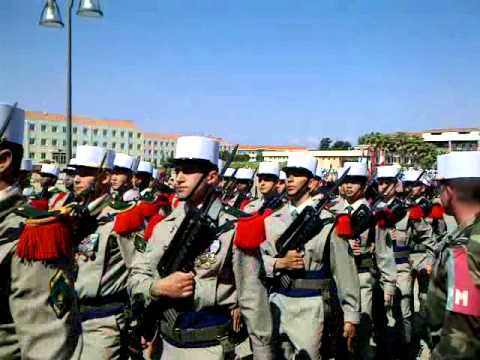
Today Camarón is still marked by the Legion wherever its troops are stationed much as the United States Marine Corps marks their founding.  The wooden hand of Captain Danjou is removed from its case in the museum and paraded with the assembled troops. The officers serve their troops coffee symbolizing the coffee the defenders never drank and the commander of Legion at the headquarters as well as units deployed read the account of the battle. The week before the fall of their besieged redoubt at Dien Bien Phu was overrun the Legionnaires of the 13th Demi-Brigade of the French Foreign Legion remembered the sacrifice of their predecessors at Camarón with their commander, Lieutenant Colonel Lemeunier read the story over the radio to the embattled garrison.

The Mexican Army too will mark the courage of the Legionnaires with a parade, speeches, and visitors including French dignitaries including the French Ambassador, and Foreign Legion veterans today. It is a fitting tribute to the men that fought that day; and it is honor that with good reason the Mexicans do not extend to the soldiers of the United States military who invaded them more than once, massacred their soldiers, and whose government took over 40% of Mexican lands, and still treat Mexican immigrants, documented and undocumented as criminals or potential criminals.

Maybe the Mexicans understand the concept of honor better than us.

Peace

Padre Steve+

Leave a comment

Filed under afghanistan, History, Military

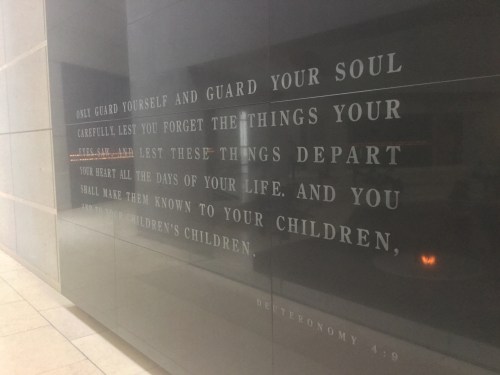
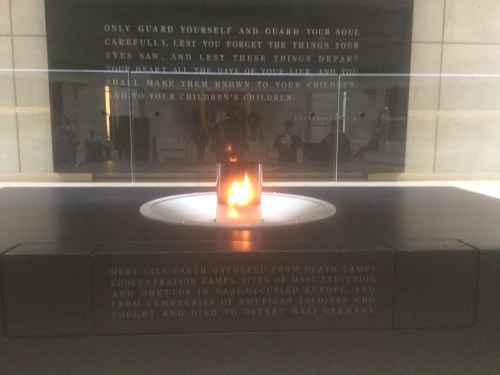
Guard Your Soul Lest You Forget: the Relevance Of the Holocaust Today

Friends of Padre Steve’s World,

I took a few days of leave for the first time in months so that Judy and I could visit friends in the Washington D.C. area. Since Wednesday ended with me being called back in to work to deal with the workplace suicide of a young sailor stationed at one of the units on our base it was needed.

It is nice because the expectations that we have of each other are simply to enjoy the time together without expecting them to entertain us. Judy does crafts with Melissa, all of us talk, sometimes we play card games or watch television or a movies while our seven combined Papillon dogs hang out and play.

So yesterday I drove over to the nearest Metro station and went down to the Holocaust Museum. Since I study the Weimar and Nazi period, the Holocaust and the war crimes trials this was important. In Germany I have been to the Dachau and Bergen-Belsen Concentration Camps, the T4 Euthanasia Program Center at Hadamar, the Palace Of Justice in Nuremberg where the Nuremberg War Crimes Trials (as well as the Nazi era Nuremberg laws) were prosecuted, the Sophie Scholl White Rose Museum, and the Munich Documentation Center for the History of National Socialism; this was important. I will be continuing to visit Holocaust sites in Germany when I go there this Fall, but I finally was able to stake out the time to visit the U.S. Holocaust Museum.

The museum is important and despite having been to places shown in it and knowing more about the Nazi regime and the Holocaust than the vast majority of Americans, I found myself overwhelmed at times as I walked slowly through the exhibits. Many I recognized, knew about, or had been to, but that did not make them any less emotionally difficult to see. But there were others that drove home why this museum is so important in our day and time.

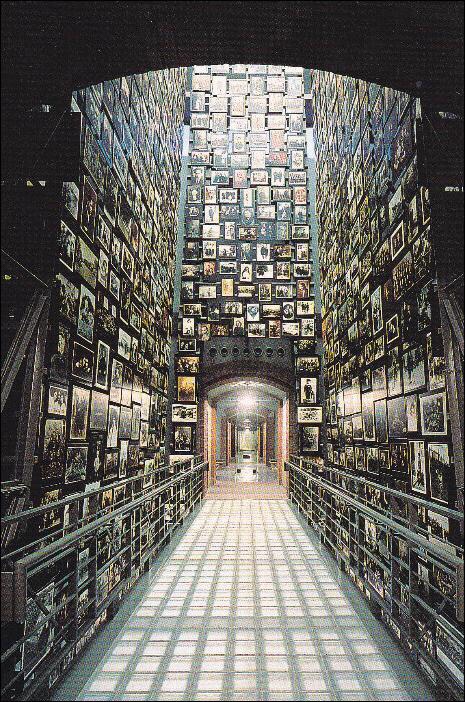
I think that the one that hit me the hardest was the pictorial Tower of Faces from the Polish shtetl of Ejszyszki. That town was home to some 4,000 Jews and the pictures had been taken over the preceding decade by local photographers. They were pictures of everyday family and community life; men, women, children at work, at play, at rest. Worshipping, working, studying, the old and the young, the well off and the poor, the religious and those not as religious at all phase of life captured in photos for eternity. For 3500 of them their lives ended on September 21st 1941 when the Nazis rounded up the Jews at their Synagogues on the eve of Yom Kippur and executed them by firing squad in mass graves at the town’s Christian and Jewish cemeteries. Only 29 of those who survived that day lived through the war. That Jewish community had existed for 900 years and was exterminated in a matter of hours.

I looked at those pictures and I could not get over all of those innocent lives cut short. Each face was the picture of an individual or individuals, families, friends, schoolmates. They were not abstract numbers or statistics but real flesh and blood people like you and me. They had hopes and dreams, but because they were Jews they were exterminated, like nearly six million other Jews who also were real people with hopes and dreams that would be destroyed by the Nazi racial war. Of course the Nazis targeted others, but none with the relentless anti-Semitic racial hatred propagated by Nazi ideology. Thus they condoned and executed by people who would have ordinarily have been considered upstanding and moral citizens. The late Christopher Hitchens wrote:

“We should not at all allow ourselves to forget the millions of non-Jewish citizens of Belarus, Russia, Ukraine, and other Slav territories who were also massacred. But for me the salient fact remains that anti-Semitism was the regnant, essential, organizing principle of all the other National Socialist race theories. It is thus not to be thought of as just one prejudice among many.” 

But then this is not abnormal as the great American theologian and philosopher Reinhold Niebuhr wrote: “Ultimately evil is done not so much by evil people, but by good people who do not know themselves and who do not probe deeply.”

The problem is that what happened during the Holocaust and to the people of the shtetl of Ejszyszki is not just an aberration, it is all too much a part of human nature; even that of people who call themselves Christians like those who exterminated the Jewish people of Ejszyszki. It is not simply an artifact of history that we can ignore. It can happen again and if we are not careful it will happen again. The spirit of the ideology that allowed normal law abiding people to massacre millions of people, either up close and personal like at Ejszyszki or in death factories like Soribor, Treblinka, Belzec, and Auschwitz is still alive today in Russia, Europe, and even in the United States. Of course it exists elsewhere in Asia, Africa, and the Middle East. But I think that it is most frightening when it exists in the nations which claim to be inheritors of Christian civilization or the enlightenment, especially among the people who claim the words of the Declaration of Independence that “all men are created equal, that they are endowed by their Creator with certain unalienable Rights, that among these are Life, Liberty and the Pursuit of Happiness.”

Honesty when I see the President of the United States and his most devoted followers follow the script of the Nazis and other race supremacists I get concerned and I remember the words of historian Yehuda Bauer:

“The horror of the Holocaust is not that it deviated from human norms; the horror is that it didn’t. What happened may happen again, to others not necessarily Jews, perpetrated by others, not necessarily Germans. We are all possible victims, possible perpetrators, possible bystanders.”

As for people who might be neighbors, coworkers or even friends today who for whatever reason either support, dismiss, or ignore the peril of the racial, ideological, and religious animus of the modern authoritarians and anti-Semites I can only recall the words of Yale historian Dr. Timothy Snyder who wrote:

“The European history of the twentieth century shows us that societies can break, democracies can fall, ethics can collapse, and ordinary men can find themselves standing over death pits with guns in their hands. It would serve us well today to understand why.”

Today I truly believe that under President Trump that the United States is just a Reichstag Fire moment from entering a phase of history when not only Trump supporters, but even some Trump opponents would do nothing in a crisis and either become willing participants in tyranny, bystanders to it or victims of it. As I walked through the museum and remembered all of my visits to Holocaust and other sites in Germany I realized again that it can happen again.

When I finished with most of my visit I went to the Hall of Remembrance and sat for a long time in silence, a silence that made me realize again just how easy it would be to happen again and the choices that all of us if it happens in our time will have to make.

I’ll leave you with the warning of Yehuda Bauer:

“Thou shalt not be a victim, thou shalt not be a perpetrator, but, above all, thou shalt not be a bystander.”

Until tomorrow,

Peace

Padre Steve+

1 Comment

Filed under History, holocaust, nazi germany, News and current events, Political Commentary

The Satanic Truth Of Paul Ryan, Ron Johnson & Ayn Rand

Friends of Padre Steve’s World,

When I see political leaders who clothe their politics in a veneer of the Christian faith and claim to be pro-life while in life doing everything that they can to oppose the basic teachings of the Church regarding the worth of people and their rights I get very angry.

Yesterday I read the words of Senator Ron Johnson of Wisconsin who told a group of high school student that food, medical care, and housing were not basic human rights. His reasoning was based on Ayn Rand. Then I read that Atlas Shrugged toting Paul Ryan fired the Catholic Chaplain of the Speaker of the House for praying during a session dealing with the Trump Tax plan:

“As legislation on taxes continues to be debated this week and next, may all members be mindful that the institutions and structures of our great Nation guarantee the opportunities that have allowed some to achieve great success, while others continue to struggle,” the chaplain said. “May their efforts these days guarantee that there are not winners and losers under new tax laws, but benefits balanced and shared by all Americans.”

A week later Father Conroy heard from Speaker Ryan’s office:

“A staffer came down and said, We are upset with this prayer; you are getting too political,” he said. “It suggests to me that there are members who have talked to him about being upset with that prayer.” Shortly after, when he saw Mr. Ryan himself, Father Conroy said that the speaker told him, “Padre, you just got to stay out of politics.”

This wasn’t the supposedly faithful Catholic speaker’s conflict with the Church on its moral teachings. In 2012 the Jesuits at Georgetown handed a chunk of his skinny ass noting that the House Budget proposal went against Catholic moral teaching:

“As the U.S. Conference of Catholic Bishops has wisely noted in several letters to Congress, “A just framework for future budgets cannot rely on disproportionate cuts in essential services to poor persons.” Catholic bishops recently wrote that “the House-passed budget resolution fails to meet these moral criteria.” In short, your budget appears to reflect the values of your favorite philosopher, Ayn Rand, rather than the Gospel of Jesus Christ. Her call to selfishness and her antagonism toward religion are antithetical to the Gospel values of compassion and love.”

But that’s Paul Ryan whose core values reflect those of Ayn Rand who denigrates the key parts of the Christian faith in regards the sacrifice of Christ which she called “monstrous” and any responsibility to others. Regarding Christ she stated to Playboy:

“According to the Christian mythology, [Christ] died on the cross not for his own sins but for the sins of the non-ideal people. In other words, a man of perfect virtue was sacrificed for men who are vicious and who are expected or supposed to accept that sacrifice. If I were a Christian, nothing could make me more indignant than that: the notion of sacrificing the ideal to the non-ideal, or virtue to vice. And it is in the name of that symbol that men are asked to sacrifice themselves for their inferiors. That is precisely how the symbolism is used. That is torture. ”

In regard to the latter the following exchange between Rand and Mike Wallace on 60 Minutes is telling because it cuts to the very heart of Ryan’s Fred with the Church:

Rand: “You love only those who deserve it.”

Wallace: “And then if a man is weak or a woman is weak he is or she is beyond love?”

Rand: “He certainly does not deserve it. He certainly is beyond it . . . he cannot expect the unearned, neither in love or in money, in matter or in spirit.”

Wallace: “There are very few of us in this world, by your standards, who are worthy of love.”

Rand: “Unfortunately yes, very few.”

Ryan, a true Randian Apostle and evangelist told members of The Atlas Club, a group of Rand devotees: “I grew up reading Ayn Rand and it taught me quite a bit about who I am and what my value systems are and what my beliefs are. It’s inspired me so much that it’s required reading in my office for all my interns and my staff.”

Such philosophical schizophrenia is endemic in people like Ryan who on one hand claim to be followers of Christ and faithful Christians while exalting in their lives and social beliefs the atheistic creed of Rand.

The words of Father Conroy were in keeping with not only the Catholic tradition, but a tradition of human and civil rights that has been a hallmark of the American political and religious tradition since the earliest protests of abolitionists against the institution of slavery. But those are not the traditions that Senator Johnson or Speaker Ryan adhere. Instead they are devoted to the perverse ideology of Ayn Rand, which is nothing more than Social Darwinism and the exploitation of the weak for the benefit of the strong. Sadly, that ideology permeates the supposedly “Christian Right” to the point that it has completely overwhelmed anything that could be considered “pro-life” in their theology. Just because you are against abortion doesn’t mean that you are pro-life, especially if you despise those who are already born and condemn them to death.

Dietrich Bonhoeffer who was martyred by the Nazis wrote:

“Christianity stands or falls with its revolutionary protest against violence, arbitrariness and pride of power and with its plea for the weak. Christians are doing too little to make these points clear rather than too much. Christendom adjusts itself far too easily to the worship of power. Christians should give more offense, shock the world far more, than they are doing now. Christian should take a stronger stand in favor of the weak rather than considering first the possible right of the strong.”

The amorality of the current GOP position on life is absurd. According to it you can kill babies overseas when targeting terrorists with drone strikes, you can execute men and women when there is evidence that they might have been innocent; you can use economic sanctions to so cripple poor country’s to kill hundreds of thousands of children because they do not have food, water, or medical care; you can funnel tax revenues to the richest of the rich and deny food, housing, jobs, education, medical care, post natal care, ad infinitum to people but just don’t abort babies and you are the most commendable of men.

That my friends is Paul Ryan and Ron Johnson. They make President Trump for all of his faults loom like a saint when compared to them. Trump makes no apology for what he is. Trump doesn’t hide behind the image of being a Christian. Yes, he will take the prayers and adulation of Christians, and he will definitely take their votes and money, but he doesn’t pretend to be something that he is not. I respect him more than I do them. As terrible as he is there is the possibility that he could actually a conversion experience, but they won’t because they have perverted the faith for a Satanic ideology.

Bonhoeffer noted:

“It is worse for a liar to tell the truth than for a lover of truth to lie…. There is a truth which is of Satan. Its essence is that under the semblance of truth it denies everything that is real. It lives upon hatred of the real world which is created and loved by God.”

What Ryan, Johnson, and their fellow travelers proclaim in thought, word, and deed Satanic truth, and incompatible with the Gospel. What Ryan did with Father Conroy was truly despicable and politically motivated. I expect now that the deed is done that the Right Wing propagandists, maybe even with Russia help begin to attack the life and character of Father Conroy.

Think about that.

Until tomorrow,

Peace

Padre Steve+

Leave a comment

Filed under christian life, ethics, faith, History, holocaust, leadership, Loose thoughts and musings, News and current events, Political Commentary

“Incapable of Feeling Shame” The Moral Bankruptcy of the Trump Administration

trump-cpac-1519415653-article-header

Friends of Padre Steve’s World,

Tonight I have just a short thought for us to ponder. Hannah Arendt wrote: “The chief qualification of a mass leader has become unending infallibility; he can never admit an error.”

This statement is undeniably true. Hitler, Stalin, Mao, Castro, the Ayatollahs, and Pol Pot are just some examples. More troubling is that such personalities are not absent today, Vladimir Putin, Marianne LePen, Recep Erdogan, Rodrigo Duterte, Viktor Orbán our own President Trump display this tendency, and their most devoted followers embrace it as well.

In the case of President Trump, presidential power means never having to say your sorry, or made a mistake. Failures are blamed on others, Congressional leaders, former President’s Obama and Bush, journalists, and even advisors who have outlasted their usefulness, case in point, Michael Flynn, James Comey, Steve Bannon, H. R. McMaster, Reince Priebus, Rex Tillerson, Gary Cohn, Tom Price, Sebastian Gorka, and so many more. Conservative columnist and former Bush Administration staffer Michael Gerson wrote in July of 2017: “The president and his men are incapable of feeling shame about shameful things.”

The inability to admit error is dangerous, but it also points to other potentially severe psychological issues. It is one of the characteristics of a paranoid personality, as well as a narcissistic personality. Richard Hofstadter wrote:

“The idea of the paranoid style as a force in politics would have little contemporary relevance or historical value if it were applied only to men with profoundly disturbed minds. It is the use of paranoid modes of expression by more or less normal people that makes the phenomenon significant.”

Likewise, even if those characteristics do not reach the point of becoming an actual psychological disorder, they can be severe enough to impair sound judgment as a leader, and lead to potentially terrible decisions including criminal acts so vast that they beggar the imagination. History shows us this all too often. These kinds of leaders see the world as a threatening place, full of enemies, real and imagined. Ethics and law are irrelevant to them so long as they win. The destruction of their enemies is of the first importance to such leaders, even when it is detrimental to the nations that they lead, even Hitler turned on Germany at the end of the Second World War because he lost the war and then blamed it on his people.

So until tomorrow,

Peace

Padre Steve+

1 Comment

Filed under ethics, leadership, mental health, national security, News and current events, Political Commentary