Author Archives: padresteve

padresteve's avatar

About padresteve

I'm a Navy Chaplain and Old Catholic Priest

Regulars, Volunteers and Conscripts: Civil War Mobilization

Friends of Padre Steve’s World

A bit of a break from the past few days of confronting the civil rights issues and racism at work in the aftermath of the Emmanuel A.M.E. church massacre. I’m sure that I will be doing more to follow that up in the near future, but it looks like the most prominent symbol of the ideological and sometimes religious hatred that has been at the heart of American racism since the Civil War is beginning to come down, even in the South as people finally begin to face up to the evil for which that flag stood.

This is another part of my Civil War and Gettysburg text on the formation of the armies that fought the Civil War. 

When one thinks of our all-volunteer force today it is hard to imagine forming armies of this size and scope around such small regular forces. The story of how North and South raised their armies, and the stories of the volunteers of the first part of the war is amazing. I hope that you enjoy.

Peace

Padre Steve+

MenBrooklyn


The Secession Crisis, Mobilization, and Volunteer Armies

The American Civil War was the first American war fought by massed armies of mobilized citizens. All previous wars had been fought by small numbers of Regular Army troops supported by various numbers of mobilized State Militia formations or volunteer formations raised for the particular war; “The fighting force of the 1860s was a conglomerate of diverse units, each with its own degree of importance, pride, proficiency, and jealousy. Whether of North or South, an army began as little more than a loosely organized mob actuated by more enthusiasm than by experience. Its composition ran the full gauntlet of humankind.” [1]

In 1860 the Regular Army numbered 16,000 troops at the beginning of the war. These included some 1105 officers, and were organized into “ten regiments of infantry, four of artillery, and five of cavalry (including dragoons and mounted riflemen)” [2] These regiments were broken up into small units and they and their soldiers were scattered about in far flung isolated posts around the country and in the new western territories. The units primarily fought Indians and performed what best could be described as constabulary duties. Others, mostly from artillery units manned the coastal defense fortifications that protected American’s key ports and entrances to key waterways along the eastern seaboard. Even so, after the War with Mexico “three quarters army’s artillery had been scrapped” and most of the army’s artillerymen and their units were “made to serve as infantry or cavalry, thus destroying almost completely their efficacy as artillery.” [3]

The secession crisis and the outbreak of the war fractured the army, particularly the officer corps. The officer corps was heavily Southern and many Northern officers had some sympathy with their Southern brothers in arms. It has to be said that of the men holding positions of high command from 1849 to 1861 that many were Southerners:

“all of the secretaries of war were Southerners, as were the general in chief, two of the three brigadier generals, all but one of the army’s geographical departments on the eve of the Civil War, the authors of the two manuals on infantry tactics, and the artillery manual used at West Point, and the professor who taught tactics and strategy at the military academy.” [4]

Most of the Army remained loyal to the Union, “except for 313 officers who resigned their commissions.” [5] Those who remained loyal to the Union included the General in Chief, Winfield Scott, as well as the professor who had taught so many of those now leaving to serve the Confederacy, Dennis Hart Mahan. However, of the others brigadier generals William Harney, David Twiggs and Joseph E. Johnston, Brevet Brigadier General Albert Sidney Johnston, and the army’s Adjutant General, Colonel Samuel Cooper, and the newly promoted Colonel Robert E. Lee all went south. “Even so, 40 to 50 per cent of the Southern West Point graduates on active duty in 1860 held to their posts and remained loyal to the Union.” [6]

A Political Backlash against West Point and the Officer Corps

The exodus of these officers created a backlash against West Point and the professional officers who remained in service of the Union, especially those who were Democrats and to radical Republicans were soft on slavery. Some Republican members of Congress including Senator Ben Wade of Ohio, “figured that political apostasy had been taught at West Point as well, and he didn’t know which sin was worse – it or treason.” [7] The fact that the leaders of the Union forces defeated at Bull run were West Point graduates added incompetence to the list of the crimes, real and imagined committed by the officers of the Regular Army. When Congress reconvened in 1861 Wade said:

I cannot help thinking…that there is something wrong with this whole institution. I do not believe that in the history of the world you can find so many men who have proved themselves utterly faithless to their oaths, ungrateful to the Government that supported them, guilty of treason and a deliberate intention to overthrow that Government which educated them and given them support, as have emanated from this institution…I believe from the idleness of these military educated gentlemen this great treason was hatched.” [8]

Wade did not mention in his blanket his condemnation of the “traitors” that many “West Pointers from the Southern States – 162 of them – had withstood the pull of birth and kin to remain with the Union.” [9]

Wade’s fellow radical Senator Zachariah Chandler of Michigan urged Congress to dissolve the Military Academy. The academy, he said “has produced more traitors within the last fifty years than all the institutions of learning and education that have existed since Judas Iscariot’s time.” [10] Despite the words and accusations of the radical fire-eaters like Wade and Chandler and other like them, more level headed men prevailed and reminded the nation that there had been many other traitors. Senator James Nesmith of Oregon said: “Treason was hatched and incubated at these very decks around me.” [11]

Politicians and Professionals: Building Volunteer Armies

20110930-poster.png_

Many of the officers who left the army to serve the Confederacy were among the Army’s best and brightest, and many of them later rose to prominence and fame in their service to the Confederacy. In contrast to the officers who remained loyal to the Union, those that many in Congress despised and “pushed aside and passed over” in favor of “officers called back into service or directly appointed from civil life, the “South welcomed its professionals and capitalized on their talents. Sixty-four per cent of the Regular Army officers who went South became generals; less than 30 per cent of those who stayed with the Union achieved that rank.” [12]

The Union had a small Regular Army, which did undergo a significant expansion during the war, and the Confederacy did not even have that. During the war the “Confederacy established a regular army that attained an authorized strength of 15,000” [13] but few men ever enlisted in it. This was in large part due to the same distrust of the central government in Richmond that had been exhibited to Washington before the war.

Thus both sides fell back on the British tradition of calling up volunteers. The British had “invented volunteer system during the Napoleonic Wars, also to save themselves from the expense of permanent expansions of their army, and the United States had taken over the example in the Mexican War…” [14] The volunteer system was different from the militias which were completely under the control of their State and only given to the service of the national government for very limited amounts of time. The volunteers were makeshift organizations operating in a place somewhere between the Regular Army and the State militias and like the British system they saved “Congress the expense of permanently commissioning officers and mustering men into a dramatically expanded Federal service.” [15] As such the volunteer regiments that were raised by the States “were recruited by the states, marched under state-appointed officers carrying their state flag as well as the Stars and Stripes.” [16]

President Lincoln’s call for volunteers appealed “to all loyal citizens to favor, facilitate and aid this effort to maintain the honor, the integrity, and the existence of our Northern Union, and the perpetuity of the popular government; and to redress the wrongs already long enough endured.” [17] The Boston Herald proclaimed “In order to preserve this glorious heritage, vouchsafed to us by the fathers of the Republic, it is essential that every man perform his whole duty in a crisis like the present.” [18] The legislature of the State of Mississippi sated its arguments a bit differently and asserted, “Our position is thoroughly identified with the institution of slavery – the greatest material interest in the world.” Texas explained that it had joined the Union “as a commonwealth holding, maintaining and protecting the institution known as negro slavery – the servitude of the African to the white race within her limits.” [19] A newspaper correspondent wrote:

“All, all of every name and every age to arms! To arms! My father go, my son go, my brother go, your country calls you.” He called out to Southern women as well, “mothers, wives and daughters buckle on the armor of loved ones, the correspondent urged, “bid them with Roman fairness, advance and never return until victory perches on their banner.” [20]

Those who went off to war left their homes and families. Young Rhode Island volunteer Robert Hunt Rhodes wrote that is mother told him “in the spirit worth of a Spartan mother of old said: “My son, other mothers must make sacrifices and why should not I?” [21] The bulk of the soldiers that enlisted on both sides in 1861 were single their median age “was twenty-four. Only one in seven enlistees that first year was eighteen or younger, and fewer than a third were twenty-one or younger.” [22]

Illustrious regiments such as the 1st Minnesota Volunteers, the 20th Maine Volunteers, the 69th New York Volunteer Infantry, and the African American 54th Massachusetts Volunteer Infantry were just a few of the many regiments mustered into Union service under this system. As the war went on and the initial regiments were decimated by losses in combat and to disease, Northern governors “preferred to organize new regiments rather than to replenish old ones whittled down by battle and sickness. Fresh units swelled a state’s contributions, and the provided governors an opportunity to win more political favors by appointing more regimental officers.” [23] This practice produced “an army of shadow units” as “it was up to the regimental commanding officer to keep up a supply of new enlistments from back home for his own regiment, but most commanders could ill afford to detail their precious supply of junior officers for recruiting duty behind the lines.” [24]

Even before secession many Southern states began to prepare for war by building up their militias, both in numbers as well as by sending agents to arms suppliers in the North, as was done by Georgia Governor Joseph E. Brown who “sent an official north to purchase arms, ammunition and accouterments.” [25] After the bombardment of Fort Sumter both sides raced to build up their militaries. Jefferson Davis, the new President of the Confederacy who was a West Point graduate and former Secretary of War called for volunteers. On March 6th 1861 the new Provisional Confederate Congress in Montgomery authorized Davis to “call out the militia for six months and to accept 100,000 twelve-month volunteers.” [26] Within weeks they had passed additional legislation allowing for the calling up of volunteers for six months, twelve months and long-term volunteers up to any length of time. “Virginia’s troops were mustered en masse on July 1, 1861, by which time the state had 41,885 volunteers on its payroll.” [27]

poster

With the legislation in hand Davis rapidly called up over 60,000 troops to the Confederate Cause, and this was before Virginia and North Carolina seceded from the Union. A mixture of former Regular Army officers commanded these men, most of whom occupied the senior leadership positions in the army, volunteer officers, made up the bulk of the Confederate officer corps. “Well over 700 former students at Virginia Military Institute served as officers in the war, most in the Virginia Theater….” [28]Among these men was Robert Rodes who became one of Robert E. Lee’s finest division commanders.

In the North Abraham Lincoln was in a quandary. Congress was out of session, so relying on the Militia Act of 1795 called out 75,000 three-month militiamen to support the Union cause. The legislatures of the Northern States so well that the over-recruited and in this first call up the government “accepted 9,816 men, but governors clamored for the War Department to take still more troops.” [29] Dan Sickles, a rather infamous Democrat politician was one of these men. Sickles had been a Democratic Congressman representing the district of New York City that was in the control of Tammany Hall. In 1859 Sickles stood trial for the murder of Barton Key, the District Attorney for Washington D.C. and the nephew of Francis Scott Key. Key had been conducting an affair with Sickles’ young wife Maria and in a fit of anger Sickles confronted Key, who had been spotted attempting a liaison with Maria and shot him dead near Lafayette Square and the White House. Sickles was acquitted on the basis of temporary insanity becoming the first man in the United States to have that distinction.

The ambitious Sickles, “almost overnight, using flag-waving oratory, organizational skills, and promissory notes, had his regiment, the 70th New York Volunteers, well in hand.” [30] Not content with a regiment and knowing that a brigade would bring him his star as a brigadier general, he quickly the Excelsior Brigade in New York.

Daniel_Edgar_Sickles

Major General Dan Sickles

Within weeks Sickles had raised over 3000 men, a full forty companies and the New York Newspapers praised Sickles’ efforts. But partisan politics was at play. To Governor Edward Morgan, the fact that a Tammany Hall Democrat “was getting too far out ahead in the state’s race to supply manpower to the endangered Union” [31] was embarrassing and the Governor ordered Sickles to “disband all but eight of his forty companies.” [32] The incredulous, yet ambitious Sickles, knowing that Lincoln needed Democratic support to prosecute the war, traveled to Washington where after seeking an audience with the President. Lincoln was hesitant to infringe on any governor’s control of state units, but he was loath to lose the services of any soldiers. Lincoln discussed the matter with Secretary of War Simon Cameron and they ordered that Sickles “keep his men together until they could be inducted by United States officers.” [33] That process took two moths but in July Sickles was able to have the brigade sworn into service as a brigade of United States Volunteers.

For Sickles and most officers, volunteer and regular alike a regiment was a large military formation Likewise, a brigade massive and for most of these men divisions and corps on the scale of those found in Europe were almost unthinkable, but war was changing and this would be the scope of the coming war.

More troops were needed and with Congress out of session, President Lincoln acted “without legal authority…and increased the Regular Army by 22,714 men and the Navy by 18,000 and called for 42,034 three-year volunteers.” [34] On July 4th 1861 Lincoln “asked sanction for his extralegal action and for authority to raise at least another 400,000 three-year volunteers.” [35] Congress approved both of the President’s requests, retroactively, and in fact, “greatly expanded the numbers of volunteer recruitments, up to a million men – nothing more than the 1795 statute authorized either of these follow-up calls, and Lincoln would later have to justify his actions on the admittedly rather vague basis of the “war powers of the government.” [36]

In the North “the war department was staggered by the task of finding competent officers for an already numbering nearly half a million.” [37] There were so few professional officers available to either side that vast numbers of volunteer officers of often dubious character and ability were appointed to command the large number of volunteer regiments and brigades which were being rapidly mustered into service. Within months of the secession crisis the Regular Army of the United States, minus the officers who resigned to serve the Confederacy, “was swamped by a Union war army that reached about 500,000 within four months of the firing on Fort Sumter.” [38]

The Regular Army officers who remained loyal to the Union as well as those who left the army and joined the newly formed Confederacy were joined by a host of volunteer officers. Some of these officers, men like Ulysses Grant, William Tecumseh Sherman, George McClellan, Braxton Bragg, Thomas “Stonewall” Jackson, Jubal Early, and many others had left the army for any number of reasons only to return to the colors of the Union or the Confederacy during the secession crisis or at the outbreak of the war. Some of these men like George Sears Greene and Isaac Trimble Many were West Point graduates who had left the army decades before the war and almost to a man “nearly all of them displayed an old regular’s distrust of any general who had risen by political means.” [39] The hold of West Point and the teachings of Dennis Hart Mahan regarding professionalism had left a lasting imprint on these men.

2nd michigan

Another issue faced by all of the officers now commanding large formations in the Civil War was their inexperience in dealing with such large numbers of troops. When the war began, the officers educated at West Point, as well as others who had been directly appointed had previously only commanded small units. Even regimental commanders such as Joseph Johnston, Albert Sidney Johnston, and Robert E. Lee seldom had more than a few companies of their regiments with them at any given time for any given operation. Likewise, the men who had campaigned and fought in Mexico who had some experience in handling larger formations had for the most part left the service. The senior officers who had served in Mexico and that remained on active duty were handicapped because the Mexican war was still very much a limited Napoleonic War fought with Napoleonic era weapons against a more numerous but poorly equipped and trained enemy.

Other volunteer officers had little or no military experience or training and owed their appointments as officers to their political connections, business acumen or their ability to raise troops. It was not atypical for a volunteer officer to gain his rank and appointment based on the number of that he brought into the army, “if he recruited a regiment he became a colonel, while if he brought in a brigade he was rewarded with the shining star of a brigadier general.” [40] This led to a type of general “appointed for their political influence or – at least in the North with its more heterogeneous population – their leadership of ethnic groups.” [41] Despite the dangers of their inexperience, both Abraham Lincoln and Jefferson Davis had to appoint such men in order to maintain political support for the war.

Some of these men proved disastrous as commanders and their ineptness cost many lives. Henry Wager Halleck, wrote “It seems but little better than murder to give important commands to such men as Banks, Butler, McClernand, Sigel, and Lew Wallace…yet it seems impossible to prevent it.” [42] That being said some of the volunteer politically appointed generals proved to be exceptional learners of the art of war and impressive commanders in the own right.

Among the officers appointed for political considerations by Abraham Lincoln were the prominent Democratic politicians “Benjamin F. Butler, Daniel E. Sickles, John A. McClernand, John A. Logan.” [43] Among those commissioned to enlist immigrant support were Major General Carl Schurz and Brigadier General Alexander Schimmelpfennig who helped mobilize German immigrants to the Union cause. Both men were refugees from the failed revolution of 1848. Likewise, Brigadier General Thomas Francis Meagher, a survivor of the 1848 revolt in Ireland, who had escaped imprisonment in Australia helped to recruit and then commanded the famous Irish Brigade, whose regiments of Irish immigrants marched under the colors of the United States and the Green flag with the Harp of Erin.

corby

The Irish and the German soldiers volunteered in large part because they saw the Union as the hope of their people that had given them refuge from tyranny in Europe. The Irish, under the religious, political and economic thumb of Britain fled to the United States, many the victims of famine. The Irish were not sympathetic as a whole to the plight of slave and many sympathized with the South, their desire to save the Union was greater and they volunteered in overwhelming numbers. One Irish Sergeant wrote his family in Ireland who did not understand why he fought for the Union:

“Destroy this republic and her hopes are blasted If Irland is ever ever [sic] free the means to accomplish it must come from the shore of America…When we are fighting for America we are fighting for the intrest of Irland striking a double blow cutting with a two edged sword For while we strike in defense of the rights of Irishmen here we are striking a blow at Irlands enemy and oppressor England hates this country because of its growing power and greatness She hates it for its republican liberty and she hates it because Irishmen have a home and government here and a voice in the counsels of the nation that is growing stronger every day which bodes no good for her.” [44]

Thus for many Irishmen fighting for the Union had a twofold purpose, seeing the war as Americans as well as Irishmen, they were fighting for Ireland as much as they were fighting for the Union. Some too believed that the war would be a training ground for Irishmen who would someday return home to drive the English from their homeland. Thomas Meagher the commander of the Irish Brigade explained,

“It is a moral certainty that many of our countrymen who enlist in this struggle for the maintenance of the Union will fall in the contest. But, even so; I hold that if only one in ten of us come back when this war is over, the military experience gained by that one will be of more service in the fight for Ireland’s freedom than would that of the entire ten as they are now.” [45]

Many Germans and others were driven from their homeland in the wake of the failed revolutions of 1848. Having been long under autocratic and oligarchic rule in the old country many of the German, Polish and other volunteers who fled after the failed revolutions of 1848 “felt that not only was the safety of the great Republic, the home of their exiled race, at stake, but also the great principle of democracy were at issue with the aristocratic doctrines of monarchism. Should the latter prevail, there was no longer any hope for the struggling nationalities of the Old World.” [46] These immigrant soldiers saw the preservation of the Union in a profoundly universal way, as the last hope of the oppressed everywhere. Eventually the Germans became “the most numerous foreign nationality in the Union armies. Some 200,000 of them wore the blue. The 9th Wisconsin was an all-German regiment. The 46th New York was one of ten Empire State units almost totally German in makeup.” [47]

In the North a parallel system “composed of three kinds of military organizations” developed as calls for “militia, volunteers and an expanded regular army” went out. [48] A number of regular army officers were allowed to command State regiments or brigades formed of State units, but this was the exception rather than the rule. One of these men was John Gibbon who commanded the legendary Iron Brigade at the beginning of its existence through its first year of combat.

In the South too men without little or no military training and experience raised companies and regiments for the Confederate cause. Like Lincoln Jefferson Davis had to satisfy political faction as well as some prominent politicians aspirations for military glory. Thus Davis “named such men as Robert A. Toombs of Georgia and John B. Floyd and Henry A. Wise of Virginia as generals.” [49] These men were not alone; many more politicians would receive appointments from Davis and the Confederate Congress.

Some of these men were gifted in recruiting but were sadly deficient as commanders. Men like John Brockenbrough and Edward O’Neal were capable of raising troops but in combat proved to be so inept that they got their men slaughtered and were removed from the army of Northern Virginia by Robert E. Lee. But others including South Carolina’s Wade Hampton, Georgia’s John Gordon and Virginia’s William “Little Billy” Mahone, none of who had any appreciable military experience proved to be among the best division commanders in Lee’s army. By 1864 Gordon was serving as an acting Corps commander and Hampton had succeeded the legendary J.E.B. Stuart as commander of the Cavalry Corps of the Army of Northern Virginia.

Lower ranking officers in the regiments formed by the states on both sides of the Mason-Dixon Line, were most often elected by their units. During the war, some of these lower ranking officers rapidly progressed up the ranks and rose to command regiments and brigades, mostly due to their natural leadership abilities. That being said the volunteer system in which units elected their officers often to be fraught with problems. “Officers who might be popular as good fellows but who knew neither how to give orders and to get them obeyed nor even what kind of orders to give….At his worst, the volunteer officer could be as fully ignorant and irresponsible as the men he was supposed to command.” [50] Such officers proved to be a source of repeated concern for the professional officers who served alongside them.

John Reynolds, fresh from his assignment as Commandant of Cadets at West Point noted of the Pennsylvania volunteers that he commanded, “They do not any of them, officers or men, seem to have the least idea of the solemn duty they have imposed on themselves in becoming soldiers. Soldiers they are not in any sense of the word.” [51] In time both the Federal and Confederate armies instituted systems of qualifying exams for commissioned officers in order to weed out the worst of the incompetent officers.

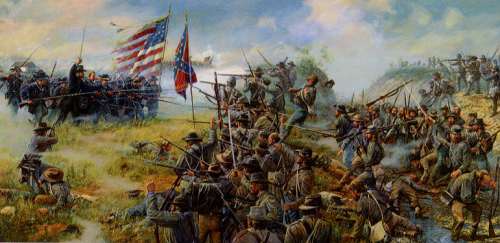
Given the limitations of the volunteer officers who made up the bulk of the men commanding companies, battalions and regiments, “for the average soldier was that drill became his training for the realities of actual battlefield fighting.” This was helpful in getting “large and unwieldy bodies of men to the battlefield itself, but it generally turned out to be useless one the shooting started, especially as units lost cohesion and started to take casualties.” [52] This was much in evidence on the first day of the Battle of Gettysburg when Brigadier General Joseph Davis’s untested brigade got caught in the Railroad Cut and was decimated by Union troops.

These men, the regulars and the volunteers, were now faced with the task of organizing, training and employing large armies made up primarily of militia units and volunteers. Most had little experience commanding such units and their experience with militia and volunteer formations during the Mexican War did not increase the appreciation of Regulars for them or for their leaders. J.F.C Fuller noted that at the beginning of the war “the Federal soldier was semiregular and the Confederate semiguerilla. The one strove after discipline, the other unleashed initiative. In battle the Confederate fought like a berserker, but out of battle he ceased to be a soldier.” [53] Both required certain kinds of leadership and Regular officers serving in both the Union and Confederate armies “embedded with the volunteers to give them some professional stiffening privately regarded them as uncontrollable adolescents who kicked off every back-home restraint the moment they were on campaign.” [54] Over the course of time this did change as the units of both armies learned to be professional soldiers.

At the beginning of the war General George McClellan successful fought the break-up of the Regular United States Army, “which some argued should be split up to train volunteer brigades” [55] as had his predecessor General Winfield Scott. He and Scott helped keep it separate from the militia units organized by the States, “keeping it intact as the nucleus of an expandable army.” [56] This preserved a professional core in a time where the new volunteer units were learning their craft, but McClellan did approve of a measure to have regular officers command some of the new volunteer brigades.

Regular Army units were formed for the duration of the war and were exclusively under the control of the Federal government. While comparatively few in number, they often held the line and kept the Army of the Potomac intact during some early battles where volunteer units collapsed. Volunteer regiments, often officered by regulars or former regulars “remained state-based, and they signed up for two- or three- year periods, after which they returned to civilian life and their evaporated without any further fiscal obligations.” [57] Some of the volunteer regiments were formed from various state militia units, but since few states had effective militia systems, militia units “were usually employed only on emergency rear-echelon duties, to free up the volunteers and regulars.” [58]
railroad_cut

The Confederacy faced a similar situation to the Union, but it did not have a Regular Army and all of its units were raised by the various states. “In early 1861 the Confederate Congress authorized the creation of a provisional army of 100,000 men. To get these troops [the first Confederate Secretary of War Leroy Pope] Walker asked state governors to raise regiments and transfer them to the national army. The War Office provided generals and staff officers and, in theory at least, could employ the troops and their officers in any way it pleased once they mustered the provisional army.” [59] Some states were quite cooperative but others were not and the tension between the central government in Richmond in regard to military policy and some states would continue throughout the war. The quality of these units varied widely, mostly based on the leadership provided by their officers. That being said, many of the regiments mustered into service early in the war proved tough and resilient serving with distinction throughout the war.

Like the Federal forces, Southern units were officered by a collection of professionals from the ante-bellum Army, militia officers, political appointees or anyone with enough money to raise a unit. However command of divisional sized units and above was nearly always reserved to former professional soldiers from the old Army, most being graduates of West Point. At Gettysburg only one officer commanding a division or above in the Army of Northern Virginia was a non-academy graduate. This was the young and dashing Robert Rodes, who was a graduate of VMI. The quality of these officers varied greatly, as some of the old regulars failed miserably in combat and some of the volunteers such as John Gordon were remarkably successful as leaders of troops in combat.

As in the North, Southern militia and home guard units remained to free up the volunteer regiments and brigades fighting with the field armies. However, due to the South was always wrestling with the intense independence of every state government, each of which often held back units from service with the field armies in order to ensure their own states’ defense.

The withholding of troops and manpower by the states hindered Confederate war efforts, even though “the draft had been “eminently successful” in Virginia, North Carolina and South Carolina, but less so in Georgia, Mississippi, Alabama and Florida.[60] In the latter states, especially Georgia some Confederate Governors used militia appointments to protect men from the draft, classifying them as key civil servants in defiance of the needs of Richmond and the field armies for troops to fight the war.

The Changing Character of the Armies and Society: From All-Volunteer to Conscription: The Beginning of the Draft

Gettysburg was the last battle where the original volunteer armies predominated as the nature of both armies was changed by the war. Initially both sides sought to fight the war with volunteers but the increasingly costly battles which consumed vast numbers of men necessitated conscription and the creation of draft laws and bureaus.

The in April 1862 Confederate Congress passed the Conscription Act of 1862 which stated that “all persons residing in the Confederate States, between the ages of 18 and 35 years, and rightfully subject to military duty, shall be held to be in the military service of the Confederate States, and that a plain and simple method be adopted for their prompt enrollment and organization.” [61] The act was highly controversial, often resisted and the Confederate Congress issued a large number of class exemptions. Despite the exemptions “many Southerners resisted the draft or assisted evasion by others” [62] The main purpose of the conscription act was “to stimulate volunteering rather than by its actual use” [63] and while it did help increase the number of soldiers in Confederate service by the end of 1862 it was decidedly unpopular among soldiers, chafing at an exemption for “owners or overseers of twenty or more slaves” [64] who referred to the war as a “rich man’s war but a poor man’s fight.” [65]

Some governors who espoused state’s rights viewpoints “utilized their state forces to challenge Richmond’s centralized authority, hindering efficient manpower mobilization.” [66] Some, most notably Georgia’s governor Joseph Brown “denounced the draft as “a most dangerous usurpation by Congress of the rights of the States…at war with all principles for which Georgia entered the revolution.” [67] Governor Brown and a number of other governors, including Zebulon Vance of North Carolina fought the law in the courts but when overruled resisted it through the many exemption loopholes, especially that which they could grant to civil servants.

In Georgia, Governor Brown “insisted that militia officers were included in this category, and proceeded to appoint hundreds of new officers.” [68] Due to the problems with the Conscription Act of 1862 and the abuses by the governors, Jefferson Davis lobbied Congress to pass the Conscription Act of 1864. This act was designed to correct problems related to exemptions and “severely limited the number of draft exemption categories and expanded military age limits from eighteen to forty-five and seventeen to fifty. The most significant feature of the new act, however, was the vast prerogatives it gave to the President and War Department to control the South’s labor pool.” [69] Despite these problems the Confederacy eventually “mobilized 75 to 80 percent of its available draft age military population.” [70]

The Congress of the United States authorized conscription in 1863 as the Union Army had reached an impasse as in terms of the vast number of men motivated to serve “for patriotic reasons or peer group pressure were already in the army” while “War weariness and the grim realities of army life discouraged further volunteering” and “the booming war economy had shrunk the number of unemployed men to the vanishing point.” [71] Like the Confederate legislation it was also tremendously unpopular and ridden with exemptions and abuses. The Federal draft was conducted by lottery in each congressional district with each district being assigned a quota to meet by the War Department. Under one third of the men drafted actually were inducted into the army, “more than one-fifth (161,000 of 776,000) “failed to report” and about 300,000 “were exempted for physical or mental disability or because they convinced the inducting officer that they were the sole means of support for a widow, an orphan sibling, a motherless child, or an indigent parent.” [72]

There was also a provision in the Federal draft law that allowed well off men to purchase a substitute who they would pay other men to take their place. Some 26,000 men paid for this privilege, including future President Grover Cleveland. Another “50,000 Northerners escaped service by another provision in the Enrollment Act known as “commutation,” which allowed draftees to bay $300 as an exemption fee to escape the draft.” [73] Many people found the notion that the rich could buy their way out of war found the provision repulsive to the point that violence ensued in a number of large cities.

The Union draft law provoked great resentment, not because people were unwilling to serve, but from the way that it was administered, for it “brought the naked power of military government into play on the home front and went much against the national grain.[74] Open clashes and violence erupted in several cities and President Lincoln was forced to use Union Soldiers, recently victorious at Gettysburg to end the rioting and violence taking place in New York where protestors involved in a three day riot, many of whom were Irish immigrants urged on by Democratic Tammany Hall politicians, “soon degenerated into violence for its own sake” [75] wrecking the draft office, seizing the Second Avenue armory, attacking police and soldiers on the streets. Soon “the mob had undisputed control of the city.” [76] These rioters also took out their anger on blacks, and during their rampage the rioters “had lynched black people and burned the Colored Orphan Asylum.” [77] The newly arrived veteran Union troops quickly and violently put down the insurrection and “poured volleys into the ranks of protestors with the same deadly effect they had produced against the rebels at Gettysburg two weeks earlier.” [78] Republican newspapers which supported abolition and emancipation were quick to point out the moral of the riots; “that black men who fought for the Union deserved more respect than white men who fought against it.” [79]

Notes

[1] Ibid. Robertson Soldiers Blue and Gray p.19

[2] Ibid. Guelzo Fateful Lighteningp.141

[3] Ibid. Guelzo Fateful Lightening p.141

[4] McPherson, James M. Drawn With the Sword: Reflections on the American Civil War Oxford University Press, Oxford and New York 1996 pp.17-18

[5] Ibid. Weigley, American Strategy from Its Beginnings through the First World War in Makers of Modern Strategy, from Machiavelli to the Nuclear Age p.419

[6] Ibid. Huntington The Soldier and the State p.213

[7] Ibid Waugh The Class of 1846, p. 513

[8] Ibid Waugh The Class of 1846, pp. 512-513

[9] Ibid Waugh The Class of 1846, p. 513

[10] Ibid Waugh The Class of 1846, p. 513

[11] Ibid Waugh The Class of 1846, p. 513

[12] Ibid. Huntington The Soldier and the State p.213

[13] Millet, Allan R. and Maslowski, Peter For the Common Defense: A Military History of the United States of America, revised and expanded edition The Free Press, New York 1994 p.175

[14] Ibid. Guelzo Fateful Lightening p.143

[15] Ibid. Guelzo Fateful Lightening p.143

[16] Ibid. Guelzo Fateful Lightening p.142

[17] Moe, Richard The Last Full Measure: The Life and Death of the 1st Minnesota Volunteers Minnesota Historical Society Press, St Paul MN 1993 p.13

[18] Ibid. Robertson Soldiers Blue and Gray p.6

[19] Glatthaar, Joseph T. General Lee’s Army from Victory to Collapse The Free Press, Simon and Schuster, New York and London 2008 p.15

[20] McCurry, Stephanie Confederate Reckoning: Power and Politics in the Civil War South Harvard University Press, Cambridge and London 2010 pp. 82-83

[21] Rhodes, Robert Hunt ed. All for the Union: The Civil War Diaries and Letters of Elisha Hunt Rhodes, Vintage Civil War Library, Vintage Books a Division of Random House, New York 1985 p.4

[22] Ibid. Glatthaar General Lee’s Army from Victory to Collapse p.18

[23] Ibid. Robertson Soldiers Blue and Gray p.24

[24] Ibid. Guelzo Fateful Lightening p.263

[25] Ibid. Glatthaar General Lee’s Army from Victory to Collapse p.15

[26] Ibid. Millet and Maslowski For the Common Defensep.165

[27] Sheehan-Dean, Aaron Confederate Enlistment in Civil War Virginia in Major Problems in the Civil War and Reconstruction, Third Edition edited by Michael Perman and Amy Murrell Taylor Wadsworth Cengage Learning Boston MA 2011 p.189

[28] Ibid. Glatthaar General Lee’s Army from Victory to Collapse p.26

[29] Ibid. Millet and Maslowski For the Common Defensep.165

[30] Sears, Stephen W. Controversies and Commanders Mariner Books, Houghton-Mifflin Company, Boston and New York 1999 p.201

[31] Ibid. Sears Controversies and Commanders p.201

[32] Swanberg, W.A. Sickles the Incredible copyright by the author 1958 and 1984 Stan Clark Military Books, Gettysburg PA 1991 p.117

[33] Keneally, Thomas American Scoundrel: The Life of the Notorious Civil War General Dan Sickles Anchor Books a Division of Random House 2003 p.222

[34] Ibid. Millet and Maslowski For the Common Defensep.165

[35] Ibid. Millet and Maslowski For the Common Defensep.165

[36] Ibid. Guelzo Fateful Lightening p.142

[37] Nichols, Edward J. Toward Gettysburg: A Biography of John Fulton Reynolds Pennsylvania State University Press, Philadelphia 1958. Reprinted by Old Soldier Books, Gaithersburg MD 1987 p.78

[38] Ibid. Weigley, American Strategy from Its Beginnings through the First World War in Makers of Modern Strategy, from Machiavelli to the Nuclear Age p.419

[39] Ibid. Sears Controversies and Commanders p.202

[40] Ibid. Swanberg, Sickles the Incredible p.117

[41] Ibid. Millet and Maslowski For the Common Defensep.172

[42] Ibid. McPherson The Battle Cry of Freedom p.328

[43] Ibid. McPherson The Battle Cry of Freedom p.328

[44] Bruce, Susannah Ural The Harp and the Flag: Irish American Volunteers and the Union Army, 1861-1865 New York University Press, New York and London 2006 pp.54-55

[45] Ibid. Bruce The Harp and the Flag p55

[46] Gallagher, Gary W. The Union War Harvard University Press, Cambridge MA and London 2011

[47] Ibid. Robertson Soldiers Blue and Gray p.28

[48] Ibid. Guelzo Fateful Lighteningp.143

[49] Ibid. McPherson The Battle Cry of Freedom p.328

[50] Ibid. Guelzo Fateful Lightening p.245

[51] Ibid. Nichols Toward Gettysburg p.79

[52] Ibid. Guelzo Fateful Lightening p.246

[53] Fuller, J.F.C. Decisive Battles of the U.S.A. 1776-1918 University of Nebraska Press, Lincoln 2007 copyright 1942 The Royal Society for the Prevention of Cruelty to Animals p.182

[54] Guelzo, Allen C. Gettysburg: The Last Invasion Vintage Books a Division of Random House, New York 2013 p.12

[55] Ibid. Hagerman The American Civil War and the Origins of Modern Warfare p.37

[56] Ibid. Hagerman The American Civil War and the Origins of Modern Warfare p.38

[57] Ibid. Guelzo Fateful Lightening p.143

[58] Ibid. Guelzo Fateful Lightening p.143

[59] Thomas, Emory The Confederate Nation 1861-1865 Harper Perennial, New York and London 1979 p.74

[60] Gallagher, Gary W. The Confederate War: How Popular Will, Nationalism and Military Strategy Could not Stave Off Defeat Harvard University Press, Cambridge MA and London 1999 p.34

[61] Ibid. Thomas, The Confederate Nation p.152

[62] Ibid. Thomas, The Confederate Nation p.152

[63] Ibid. McPherson. The Battle Cry of Freedom p. 432

[64] Ibid. Thomas, The Confederate Nation p.154

[65] Ibid. McPherson. The Battle Cry of Freedom p.431

[66] Millet, Allan R. and Maslowski, Peter, For the Common Defense: A Military History of the United States The Free Press a Division of Macmillan Inc. New York, 1984 p.166

[67] Ibid. McPherson. The Battle Cry of Freedom p.433

[68] Ibid. McPherson. The Battle Cry of Freedom p.431

[69] Ibid. Thomas, The Confederate Nation p.261

[70] Ibid. Gallagher The Confederate War p.28

[71] Ibid. McPherson. The Battle Cry of Freedom p.600

[72] Ibid. McPherson. The Battle Cry of Freedom p.601

[73] Ibid. Guelzo Fateful Lightening p.460

[74] Ibid. Foote. The Civil War, A Narrative Volume Two p.635

[75] Ibid. Foote. The Civil War, A Narrative. Volume Two p.636

[76] Ibid. Foote. The Civil War, A Narrative. Volume Two p.637

[77] Ibid. McPherson. The Battle Cry of Freedom p.687

[78] Ibid. McPherson. The Battle Cry of Freedom p.610

[79] Ibid. McPherson. The Battle Cry of Freedom p.687
 

1 Comment

Filed under civil war, History, leadership, Military

Time for It to Come Down

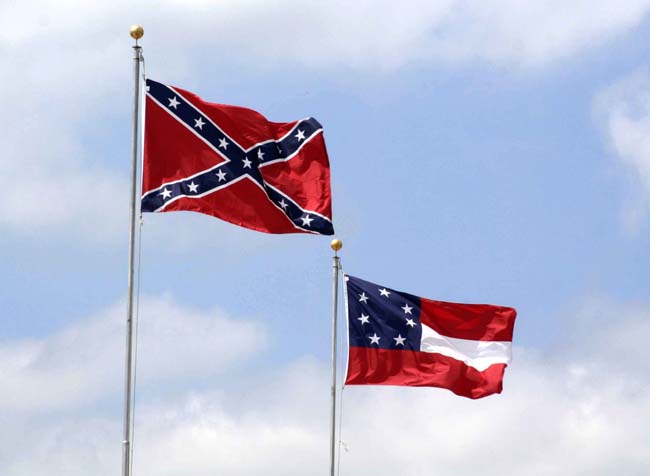
confederate-flag-picture

It has been 150 years since the revolt of the Confederate States of America officially ended. However, the flag of that revolt still flies over on the grounds of the South Carolina capitol, remains part of the state flags of a number of former Confederate states, and is displayed in many fashions by people with various motives. Some belief, even genuinely that in displaying it they are honoring the men who fought under it. For others it is a symbol of continued defiance against a government that they hate, while for others it is a potent symbol of their hatred of African Americans and their earnest longing for a racist past that they believe were the good times.

That flag in its various guises, the Confederate Battle Flag, the Confederate Naval Ensign, or the National Flag of the Confederacy, sometimes called the Stars and Bars is an important part of American history. As such it cannot be completely done away with, it should remain as a part of history and as such confined to museums and things like reenactments of the battles. That being said, it has no place being flown over statehouses and should also be removed from the state flags that still retain it.

That flag is a part of my family’s history. If I wanted to I could join the Son’s of Confederate Veterans in a heartbeat. I have ancestors on both sides of my family who volunteered to serve the Confederacy even as their neighbors were declaring for the Union in what was then the western part of Virginia, what is now West Virginia. They were small time slave owners as well as yeoman farmers and they chose to serve a regime that despised them almost as much as it did the blacks. As members of the 8th Virginia Cavalry they fought until 1865 and following the war, some were reconciled to the Union while others refused to be and continued their revolt in other ways. Only one thing could have caused them to fight for a flag that offered them so little and that was they, like so many Southerners of similar means believed that keeping the black down ensured that they were superior to someone. If that meant enslaving blacks and fighting for a regime that did so, so be it. In fact after the war the patriarch of my paternal side refused to sign the loyalty oath to the United States and lost his family’s lands and plantation in addition to the slaves that he had already lost.

There was a time when I was young and desiring some kind of American military heritage to be proud of took a type of pride in the purely military side of the family, no matter what it was, Revolutionary War, Civil War (North and South), the World Wars as well as the service of my own father in Vietnam. As such I turned a blind eye to the cause that my ancestors who served the South fought and in some cases died to not only defend but to expand, if need be by the overthrow of the Union through force of arms. That cause was slavery, and while so many want to clothe secession and the term “states rights” the one right for which the South seceded was the right to enslave blacks and to expand that institution to non-slave territories, and even force anti-slavery Northerners to cooperate with through laws such as the Fugitive Slave Act of 1850, the Kansas-Nebraska Act and the Dred Scott Decision.

But this is not surprising, the revisionist historians of the Lost Cause triumphed in telling the story of the Civil War where force of arms failed. These people, including some historians managed to shift the focus of the war to the stories of the great soldiers who fought in the war, and to the lie that the war was about “constitutional” issues when in fact the South was winning almost every court and congressional battle regarding slavery in the decade and a half before secession. The South’s over-reaction to the election of Abraham Lincoln, an election that they sabotaged for their cause by splitting their electoral votes between the candidacies of Stephen Douglas and John C. Breckenridge is to this day lost on them.

The fact is that the Confederate Flag in all of its forms is not a symbol of freedom, it is not a symbol of a heritage that any person, even descendants of Southern veterans should take pride in.

Instead it is a symbol of treason. It is the symbol of men who sworn to uphold the Constitution that Senators, Congressmen, military officers, and other Federal officers and officials callously abandoned when their side did not win an election.

It is a flag of a republic which Alexander Stephens its Vice President described in his Cornerstone Speech:

Our new government is founded upon exactly the opposite idea; its foundations are laid, its corner- stone rests upon the great truth, that the negro is not equal to the white man; that slavery — subordination to the superior race — is his natural and normal condition. [Applause.] This, our new government, is the first, in the history of the world, based upon this great physical, philosophical, and moral truth.”

It is the symbol of a rebellion that brought about a war that cost between 650,000 and 750,000 military deaths, many more wounded and billions of dollars of damage to the country.

It is the symbol of men who after they regained control of their states passed innumerable laws to prescribe slavery in all but name through “Black” and “Jim Crow” laws.

It is the symbol of the original American terrorist organization, the Ku Klux Klan that used violence and murder to oppress and kill blacks and their supporters for a hundred years after Appomattox.

It is the symbol that neo-Confederates, White Supremacists, neo-Nazis and other racist and hate-groups rally around.

It has also found a home in some parts of the Tea Party Movement and the current Republican Party.

Some Southerners and others have defended it and fought to keep it flying on various state capitol grounds, war memorials and state parks. It is flown or displayed by individuals over homes and on vehicles, even in states that shed thousands of lives to end the Confederate rebellion.

As for me, a career military officer and descendent of Confederate veterans I find the Confederate flags in all of its forms hateful, divisive and treasonous. When I see it displayed outside of museums and reenactments my blood boils, especially when I see it displayed as a political statement against a government and Constitution that I have committed my life to defend.

I believe that all Americans should oppose its display, especially on the grounds of government facilities. I find it little different in substance than the Swastika banner of the Nazi Party, which became the national flag of Germany. Both flags were the symbols of regimes that were based on the belief in a superior “master race” and which desired to expand their racial views to other lands. While there was a difference that the Nazis believed in exterminating as well as enslaving those that they deemed to be “sub-human” the ultimate goal of the Confederacy was to perpetuate slavery and expand it over a people that they also believed to be sub-human.

Now I do believe that the Confederate flag does have a place, and the proper place for it is in museums and historical reenactments. I think that it also can be legitimately displayed on the graves of men who fought under it. As for the men who died for that flag, despite their cause I have a measure of sympathy as one who has served in war. They were valiant and brave soldiers even if the cause that they served was evil. I agree with Ulysses S. Grant who at Appomattox stopped the cheers of his soldiers noting:

I felt…sad and depressed, at the downfall of a foe who had fought so long and valiantly, and had suffered so much for a cause, though that cause was, I believe, one of the worst for which a people has fought.” He later noted: “The Confederates were now our countrymen, and we did not want to exult over their downfall.”

Apart from that I believe that displays of this flag only serve to show either historical ignorance or to display racist or anti-government attitudes that serve no constructive purpose and which only serve to encourage totalitarian enemies of freedom.

Thankfully, for the first time prominent Republican politicians beginning with Mitt Romney but now including South Carolina Governor Nikki Haley and South Carolina Senator Lindsey Graham are calling for the removal of the flag from the grounds of the South Carolina State Capitol. Others need to as well. It is about time that the Confederate flag, and the racist ideology that it stands for comes down for good.

Peace

Padre Steve+

1 Comment

Filed under civil war, History, News and current events, Political Commentary

Slavery, Economics & Politics: The Compromise of 1850

Friends of Padre Steve’s World,

I have been sharing parts of my Civil War and Gettysburg Staff Ride text here for some time. We often don’t like to admit it but all to often racism and other forms of prejudice, intolerance and hate line up perfectly with some peoples and groups political and economic agenda. The Compromise of 1850 shows how in American history that confluence of hatred, racism, political power and economic gain  come together to create the perfect storm of oppression. 

We are not alone in this, such has been the case in many other cultures and in many other nations for millennia and continue to be today. 

The lesson of this should be taken to heart as anyone seeks political and economic aggrandizement on the backs of other people and sadly it happens all too often here in the United States and Western Europe. 

I do plan on weighing in on the issue of the Confederate flag either tonight or tomorrow. But until then have a great as well as a thoughtful night.

Peace

Padre Steve+

fugitive-slave-act-1850-granger-1

Slavery and National Expansion: The Compromise of 1850

The Ante-Bellum South was an agrarian society that depended on the free labor provided by slaves. In a socio-political sense the South was an oligarchy that offered no freedom to slaves, openly discriminated against free blacks and provided little hope of social or economic advancement for poor and middle class whites. However, despite this, even poor whites supported it. Many Southern Yeoman farmers were willing to tolerate their second class status because they: “feared the fall from independent producer to dependent proletarian, a status he equated with enslavement” [1] more than remaining subservient to planters and plantation owners. In fact, for them slavery was the one institution that kept them above the despised black.

While all Northern states had abolished slavery, or were in the process of gradual abolition in the after independence and the Civil War and had moved to an economic concept of free labor, the South had tied its economy and society to the institution of slavery. The contrast was well said by the members of an Alabama agricultural society, which noted in 1846:

“Our condition is quite different from that of the non-slaveholding section of the United States. With them their only property consists of lands, cattle and planting implements. Their laborers are merely hirelings, while with us our laborers are our property.” [2]

Northerners on the other hand, even in states where the last vestiges of slavery held on, nearly universally ascribed to the understanding that there was a dignity to labor and that free labor was essential if people were to have a better life. It undergirded their understanding of human dignity and that “labor was the source of all value.” [3]

That understanding of the intrinsic value of free labor continued to gain ground in the North in the decades preceding the Civil War and found much of its support in the Calvinist theology that predominated in most Protestant Northern denominations. Labor was intrinsic to one’s calling as a Christian and a human being, slave labor, at least in the eyes of many Northerners undercut that idea. Success in one’s calling glorified God and provided earthly evidence that a person was among the elect. For many Northern Christians, “the pursuit of wealth thus became a way of serving God on earth, and labor, which had been imposed on fallen man as a curse, was transmuted into a religious value, a Christian calling.” [4] Such ideas found their way into Republican political thought even when not directly related to religion. William Evarts said in 1856 “Labor gentlemen, we of the free States acknowledge to be the source of all of our wealth, of all our progress, of all our dignity and value.” [5] Abraham Lincoln noted that “the free labor system…opens the way for all, and energy and progress, and improvement in condition for all,” [6] and noted something inherent in the economic theory of Adam Smith that Labor is prior to, and independent of capital…in fact, capital is the fruit of labor.” [7]

However, the South by the 1830s had completely wedded itself to slavery and southern advocates of slavery deplored the free-labor movement as wage slavery and extolled the virtue of slavery. James H. Hammond condemned the free-labor movement in his King Cotton speech to the Senate in 1858:

“In all social systems there must be a class to do the menial duties, to perform the drudgery of life…. It constitutes the very mudsill of society….Such a class you must have, or you would not have that other that leads to progress, civilization and refinement….Your whole hireling class of manual laborers and ‘operatives,’ as you call them, are essentially slaves. The difference between us is, that our slaves are hired for life and well compensated…yours are hired by the day, not cared for, and scantily compensated.” [8]

Even so, the fact that the slave barons “were forced at every election to solicit the votes of “ignorant, slovenly, white trash in the country” with “frequent treats that disgrace our elections,” [9] rankled and humiliated many members of the Southern aristocracy. It was a marriage of two disparate parties linked by their membership in a superior race, something that only the continued existence of slavery ensured.

Lincoln extolled the virtues of free-labor, noting his own experiences after his election: “I am not ashamed to confess that twenty five years ago I was a hired laborer, mauling rails, at work on a flat boat – just what might happen to any poor man’s son.” [10] Other Northerners lauded free-labor as the basis of upward mobility, and the New York Times noted that “Our paupers to-day, thanks to free labor, are our yeomen and merchants of tomorrow.” [11]

But whites in the South held labor in contempt due to the system of slavery, and the divergent views of each side were noted by Thomas Ewing who noted that labor “is held honorable by all on one side of the line because it is the vocation of freedmen – degrading in the eyes of some on the other side because it is the task of slaves.” [12] Of course with labor being the task of African slaves for southerners, the issue was entwined with race, and “Even if slavery was wrong, its wrongs were cancelled out for nonslaveholders by the more monstrous specter of racial equity.” [13]

Georgia Governor Joseph E. Brown emphasized the threat to whites in that blacks would be their social equals and competitors. The racial component assured poor southern whites that they were superior to blacks and an Alabama lawyer wrote “The privilege of belonging to the superior race and being free was a bond that tied all Southern whites together… and it seemed from a Southern stand-point, to have for its purpose the leveling of all distinctions between the white man and the slave hard by.” [14] But poor white workers who remained in the South “repeatedly complained about having to compete with slaves as well as poorly paid free blacks” [15] leading many to seek a new livelihood in either Free States or the new territories.

For Southern politicians and slaveholders, the expansion of slavery was essential to its continued maintenance in the states where it was already legal. “Because of the need to maintain a balance in the Senate, check unruly slaves, and cultivate fertile soils, many planters and small plantation owners- particularly those living in the southern districts of the cotton states- asserted that their survival depended on new territory.” [16] In those decades “a huge involuntary migration took place. Between 800,000 and 1 million slaves were moved westward….” [17]

The need for slaves caused prices to soar, largely due to the ban on the import of slaves from Africa. This made the interregional trade much more important and linked the upper and lower south as well as the new slave-holding territories into “a regionwide slave market that tied together all of the various slaveowning interests into a common economic concern.” [18] In some older states like Virginia where fewer slaves were required, the exportation of slaves became a major industry:

“male slaves were marched in coffles of forty or fifty, handcuffed to each other in pairs, with a long chain through the handcuffs passing down the column to keep it together, closely guarded by mounted slave traders followed by an equal number of female slaves and their children. Most of them were taken to Wheeling, Virginia, the “busiest slave port” in the United States, and from there they were transported by steamboat to New Orleans, Natchez, and Memphis.” [19]

Economic Effects of the Compromise

The interregional slave trade guaranteed slave owners of a source of slaves even if they were cut off from the international trade and it was an immense part of not just the Southern economy but the American economy. Slave owners “hitched their future to slavery; a single cash crop and fresh land,” [20] and refused to take an interest in manufacturing or diversifying their agricultural production outside of King Cotton. Slave prices tripled between 1800 and 1860 making human property one of the most lucrative markets for investment. The price of a “prime male field hand in New Orleans began at around $500 in 1800 and rose as high as $1,800 by the time of the Civil War.” [21] The result was that slave owners and those who benefitted from the interregional slave trade had a vested interest in not only seeing slavery preserved, but expanded.

This resulted in two significant trends in the South, first was that slave owners grew significantly richer as the value of the slave population increased. Using even a conservative number of $750 dollars as the value of a single slave in 1860 the amount of value in this human property was significantly more than almost any other investment in the nation. It was enormous. Steven Deyle notes that:

“It was roughly three times greater than the total amount of all capital invested in manufacturing in the North and in the South combined, three times the amount invested in railroads, and seven times the amount invested in banks. It was about equal to about seven times the value of all currency in circulation in the country three times the value of the entire livestock population, twelve times the value of the entire U.S. cotton crop, and forty-eight times the expenditures of the federal government that year. ….”by 1860, in fact in the slaveowning states alone, slave property had surpassed the assessed value of real estate.” [22]

The rise in slave values and the increasing wealth of slave owners had a depreciating effect on poor southern whites by ensuring that there was no middle class, which “blocked any hope of social advancement for the mass of poor whites, for it was all but impossible for a non-slaveholder to rise in the southern aristocracy.” [23] The impoverishment of southern whites created some worry for those astute enough to take an interest in such matters. “In 1850, about 40 percent of the South’s white farmers owned real estate at all. There was thus, worried the Southern Cultivator in 1856, “a large number at the South who have no legal right or interest in the soil [and] no homes of their own.” The editor of a South Carolina newspaper that year framed the matter in less sympathetic terms: “There is in this State,” he wrote, “as impoverished and ignorant as white population as can be found in any other in the Union.” [24]

Some Southerners recognized the growing issue that the south was falling behind the north in terms of real economic advancement and that slavery was the culprit. Hinton Helper, a non-slave owning North Carolinian who had made his fortune in the California Gold Rush of 1849 and returned home to become disillusioned with what he saw wrote a book that had a major impact in the North among Republican politicians, but which was either banned or restricted in much of the South. That book “The Impending Crisis of the South: How to Meet It (1857) was “a book on the debilitating impact of slavery on the South in general and on southern whites in particular.” [25] Helper’s attack on the slavery system was as devastating as that of any abolitionist, and since he was a southerner the effects of his words helped further anti-slavery sentiment in the North and would be used by the Republican party in an abridged form as a campaign tool that they printed and distributed during the build up to the election n of 1860. Helper wrote that:

Slavery lies at the root of all the shame, poverty, tyranny and imbecility of the South.” Echoing the free-soil argument Helper maintained that slavery degraded all labor to the level of bond labor. Planters looked down their noses at nonslaveholders and refused to tax themselves to provide a decent school system. “Slavery is hostile to general education…Its very life, is in the ignorance and stolidity of the masses.” [26]

Many southern leaders saw Helper’s book as a danger and worried that should Helper and others like him speak freely long enough “that they will have an Abolition party in the South, of Southern men.” When that happened, “the contest for slavery will no longer be one between the North and the South. It will be in the South between the people of the South.” [27] That was something that the landed gentry of the slave owning oligarchy could never tolerate for if the non-slave holding whites rejected slavery, the institution would die. Thus, Helper, who was no fan of black people and held many violently racist attitudes, was denounced “as a traitor, a renegade, an apostate, a “dishonest, degraded and disgraced man.” [28]

In the years the before the war, the North embraced the Industrial Revolution leading to advances which gave it a marked economic advantage over the South in which through its “commitment to the use of slave labor inhibited economic diversification and industrialization and strengthened the tyranny of King Cotton.” [29] The population of the North also expanded at a clip that far outpaced the South as European immigrants swelled the population.

The divide was not helped by the various compromises worked out between northern and southern legislators. After the Missouri Compromise Thomas Jefferson wrote:

“but this momentous question, like a fire bell in the night, awakened and filled me with terror. I considered it at once as the knell of the Union. It is hushed indeed for the moment, but this is a reprieve only, not a final sentence. A geographical line, coinciding with a marked principle, moral and political, once conceived and held up to the angry passions of men, will never be obliterated; and every new irritation will mark it deeper and deeper.” [30]

The trigger for the increase in tensions was the war with Mexico in which the United States annexed nearly half of Mexico. The new territories were viewed by those who advocated the expansion of slavery as fresh and fertile ground for its spread. Ulysses S Grant, who served in the war, noted the effects of the war with Mexico in his memoirs:

“In taking military possession of Texas after annexation, the army of occupation, under General [Zachary] Taylor, was directed to occupy the disputed territory.  The army did not stop at the Nueces and offer to negotiate for a settlement of the boundary question, but went beyond, apparently in order to force Mexico to initiate war….To us it was an empire and of incalculable value; but it might have been obtained by other means.  The Southern rebellion was largely the outgrowth of the Mexican war.” [31]

Robert Toombs of Georgia was an advocate for the expansion of slavery into the lands conquered during the war. Toombs warned his colleagues in Congress “in the presence of the living God, that if you by your legislation you seek to drive us from the territories of California and New Mexico, purchased by the common blood and treasure of the whole people…thereby attempting to fix a national degradation upon half the states of this Confederacy, I am for disunion.” [32]

The tensions in the aftermath of the war with Mexico escalated over the issue of slavery in the newly conquered territories brought heated calls by some southerners for secession and disunion. To preserve the Union, Henry Clay and Daniel Webster, supported by the new President Millard Fillmore were able to pass the compromise of 1850 solved a number of issues related to the admission of California to the Union and boundary disputes involving Texas and the new territories. But among the bills that were contained in it was the Fugitive Slave Law, or The Fugitive Slave Act of 1850. The act was the device of Henry Clay which was meant to sweeten the deal for southerners. The law would “give slaveholders broader powers to stop the flow of runaway slaves northward to the free states, and offered a final resolution denying that Congress had any authority to regulate the interstate slave trade.” [33]

For all practical purposes the Compromise of 1850 and its associated legislation nationalized the institution of slavery, even in Free States. It did this by forcing all citizens to assist law enforcement in apprehending fugitive slaves. It also voided state laws in Massachusetts, Vermont, Ohio, Connecticut, Pennsylvania and Rhode Island, which barred state officials from aiding in the capture, arrest or imprisonment of fugitive slaves. “Congress’s law had nationalized slavery. No black person was safe on American soil. The old division of free state/slave state had vanished….” [34] If there was any question as to whose “States Rights” the leaders of the South were advocating, it was certainly not those of the states whose laws were voided by the act.

That law required all Federal law enforcement officials, even in non-slave states to arrest fugitive slaves and anyone who assisted them, and threatened law enforcement officials with punishment if they failed to enforce the law. The law stipulated that should “any marshal or deputy marshal refuse to receive such warrant, or other process, when tendered, or to use all proper means diligently to execute the same, he shall, on conviction thereof, be fined in the sum of one thousand dollars.” [35]

Likewise the act compelled citizens in Free states to “aid and assist in the prompt and efficient execution of this law, whenever their services may be required….” [36] Penalties were harsh and financial incentives for compliance attractive.

“Anyone caught providing food and shelter to an escaped slave, assuming northern whites could discern who was a runaway, would be subject to a fine of one thousand dollars and six months in prison. The law also suspended habeas corpus and the right to trial by jury for captured blacks. Judges received a hundred dollars for every slave returned to his or her owner, providing a monetary incentive for jurists to rule in favor of slave catchers.” [37]

The law gave no protection for even black freedmen. The legislation created a new extra-judicial bureaucratic office to decide the fate of blacks. This was the office of Federal Commissioner and it was purposely designed to adjudicate the claims of slaveholders and their agents, and to avoid the normal Federal Court system where often those claims were denied.

When slave owners or their agents went before these commissioners, they needed little in the way of proof to take a black back into captivity. The only proof or evidence other than the sworn statement by of the owner with an “affidavit from a slave-state court or by the testimony of white witnesses” [38] that a black was or had been his property was required to return any black to slavery. Since blacks could not testify on their own behalf and were denied representation the act created an onerous extrajudicial process that defied imagination. Likewise, these commissioners had a strong financial incentive to send blacks back to slavery. “If the commissioner decided against the claimant he would receive a fee of five dollars; if in favor ten. This provision, supposedly justified by the paper work needed to remand a fugitive to the South, became notorious among abolitionists as a bribe to commissioners.” [39] It was a system rigged to ensure that African Americans had no chance, and it imposed on the citizens of free states the legal obligation to participate in a system that many wanted nothing to do with.

Frederick Douglass said:

“By an act of the American Congress…slavery has been nationalized in its most horrible and revolting form. By that act, Mason & Dixon’s line has been obliterated;…and the power to hold, hunt, and sell men, women, and children remains no longer a mere state institution, but is now an institution of the whole United States.” [40]

On his deathbed Henry Clay praised the act, which he wrote “The new fugitive slave law, I believe, kept the South in the Union in ‘fifty and ‘fifty-one. Not only does it deny fugitives trial by jury and the right to testify; it also imposes a fine and imprisonment upon any citizen found guilty of preventing a fugitive’s arrest…” Likewise Clay depreciated the opposition noting “Yes, since the passage of the compromise, the abolitionists and free coloreds of the North have howled in protest and viciously assailed me, and twice in Boston there has been a failure to execute the law, which shocks and astounds me…. But such people belong to the lunatic fringe. The vast majority of Americans, North and South, support our handiwork, the great compromise that pulled the nation back from the brink.” [41]

The compromise had “averted a showdown over who would control the new western territories” [42] but it only delayed disunion. In arguing against the compromise South Carolina Senator John C. Calhoun realized that for Southerners it did not do enough and that it would inspire abolitionists to greater efforts in their cause. He argued for permanent protection of slavery:

“He understood that slavery stood at the heart of southern society, and that without a mechanism to protect it for all time, the Union’s days were numbered.” Almost prophetically he said “I fix its probable [breakup] within twelve years or three presidential terms…. The probability is it will explode in a presidential election.” [43]

Of course it was Calhoun and not the authors of the compromise who proved correct. The leap into the abyss of disunion and civil war had only been temporarily avoided. However, none of the supporters anticipated what would occur in just six years when a “train of unexpected consequences would throw an entirely new light on the popular sovereignty doctrine, and both it and the Compromise of 1850 would be wreaked with the stroke of a single judicial pen.” [44]

Notes

[1] Ibid. McPherson Drawn With Sword p.50

[2] Ibid. Levine Half Slave and Half Free p.19

[3] Foner, Eric Free Soil, Free Labor, Free Men: The Ideology of the Republican Party Before the Civil War Oxford University Press, Oxford and New York 1970 and 1995 p.7

[4] Ibid. Foner Free Soil, Free Labor, Free Men pp.12-13

[5] Ibid. Foner Free Soil, Free Labor, Free Men p.12

[6] McPherson, James. The Battle Cry of Freedom: The Civil War Era Oxford University Press, Oxford and New York 1988 p.28

[7] Ibid. Foner Free Soil, Free Labor, Free Men p.12

[8] Ibid. McPherson The Battle Cry of Freedom p.196

[9] Ibid. Guelzo Fateful Lightening p.38

[10] Ibid. McPherson The Battle Cry of Freedom p.28

[11] Ibid. Foner Free Soil, Free Labor, Free Men p.16

[12] Ibid. Foner Free Soil, Free Labor, Free Men p.16

[13] Ibid. Guelzo Fateful Lightening p.38

[14] Ibid. Guelzo Fateful Lightening p.39

[15] Ibid. Levine Half Slave and Half Free p.44

[16] Ibid. Egnal Clash of Extremes pp.125-126

[17] Korda, Michael. Clouds of Glory: The Life and Legend of Robert E. Lee Harper Collins Publishers, New York 2014 p.203

[18] Deyle, Steven The Domestic Slave Trade in Major Problems in the Civil War and Reconstruction Documents and Essays Third Edition edited by Michael Perman and Amy Murrell Taylor Wadsworth Cengage Learning Boston MA 2011 p.53

[19] Ibid. Korda Clouds of Glory: The Life and Legend of Robert E. Lee p.203

[20] Ibid. Egnal Clash of Extremes p.10

[21] Ibid. Deyle The Domestic Slave Trade p.53 Deyle’s numbers come from the 1860 census.

[22] Ibid. Egnal Clash of Extremes p.54

[23] Ibid. Foner Free Soil, Free Labor, Free Men p.48

[24] Ibid. Levine Half Slave and Half Free p.37

[25] Goldfield, David America Aflame: How the Civil War Created a Nation Bloomsbury Press, New York, London New Delhi and Sidney 2011 p.177

[26] Ibid. McPherson The Battle Cry of Freedom p.199

[27] Ibid. Levine Half Slave and Half Free p.235

[28] Ibid. Potter The Impending Crisis p.397

[29] Ibid. Potter The Impending Crisis p.42

[30] Jefferson, Thomas Letter to John Holmes dated April 22nd 1824 retrieved from http://www.loc.gov/exhibits/jefferson/159.html 24 March 2014

[31] U.S. Grant, Personal Memoirs of U.S. Grant New York 1885 pp.243-245

[32] Ibid. Guelzo Fateful Lightening pp.62-63

[33] Ibid. Guelzo Fateful Lightening p.68

[34] Ibid. Goldfield America Aflame p.71

[35] ______________Fugitive Slave Act of 1850 retrieved from the Avalon Project, Yale School of Law http://avalon.law.yale.edu/19th_century/fugitive.asp 11 December 2014

[36] Ibid. Fugitive Slave Act of 1850

[37] Ibid. Goldfield America Aflame p.71

[38] Ibid. McPherson The Battle Cry of Freedom p.80

[39] Ibid. McPherson The Battle Cry of Freedom p.80

[40] Ibid. Goldfield America Aflame p.72

[41] Ibid. Oates The Approaching Fury p.94

[42] Ibid. Guelzo Fateful Lightening p.71

[43] Ibid. Goldfield America Aflame p.64

[44] Ibid. Guelzo Fateful Lightening p.71

2 Comments

Filed under civil rights, civil war, History, Political Commentary

Freedom for the Few: the Curse of Racism 

Friends of Padre Steve’s World 

I have been posting portions of my Civil War and Gettysburg Staff Ride text and in light of the act of terrorism committed in Charleston last Wednesday and the subsequent controversy surrounding the Confederate Battle Flag flying at full staff on the grounds of the South Carolina State Capitol while both the United States and South Carolina flags flew at half-staff. I do plan on addressing the issue of the Confederate flag in a separate article but so often that flag is flow or displayed by people who proclaim the historical revisionism of the tradition of the Lost Cause. which asserts that the Civil War was about everything but slavery as truth. 

This section of the chapter on religion and ideology is important because it addresses the issue in a forthright manner. It is important to tell the truth about the key issue that brought about the Civil War, and why the display of the Confederate Battle Flag only serves to propagate myth and instill a false sense of pride for a system and a war which cost more American lives than any other. 

If you take the time to read the article you will also notice that a number of the defenses of slavery are being used today to deny voting rights and other civil rights to American citizens by people who honestly believe that freedom is for the few. Many Right Wing pundits, politicians and preachers openly advocate this and even attempt to make voting and other civil functions which all citizens have the right are made more difficult or denied entirely. 

If you are curious as to where these people get their ideology look no further than the ante-bellum South. 

Have a thoughtful and reflective day.

Peace

Padre Steve+

slavescars

The Impact of Slavery on the Growing Divide between North and South

Slavery was the key issue that permeated all aspects of the Civil War to include the cultural, the economic and the ideological. David M. Potter summed up this understanding of the connection between the ideological, cultural and economic aspects of the conflict and just how the issue of slavery connected all three realms in the American Civil War:

“These three explanations – cultural, economic and ideological – have long been the standard formulas for explaining the sectional conflict. Each has been defended as though it were necessarily incompatible with the other two. But culture, economic interest, and values may all reflect the same fundamental forces at work in a society, in which case each will appear as an aspect of the other. Diversity of culture may produce both diversity of interests and diversity of values. Further, the differences between a slaveholding and a nonslaveholding society would be reflected in all three aspects. Slavery represented an inescapable ethical question which precipitated a sharp conflict of values.” [1]

The political ends of the Civil War grew out of the growing cultural, economic, ideological and religious differences between the North and South that had been widening since the 1830s. However, slavery was the one issue which helped produce this conflict in values and it was “basic to the cultural divergence of the North and South, because it was inextricably fused into the key elements of southern life – the staple crop of the plantation system, the social and political ascendency of the planter class, the authoritarian system of social control.” [2] Without slavery and the Southern commitment to an economy based on slave labor, the southern economy would have most likely undergone a similar transformation as what happened in the North; thus the economic divergence between North and South would “been less clear cut, and would have not met in such head-on collision.” [3] But slavery was much more than an economic policy for Southerners; it was a key component of their religious, racial and philosophic worldview.

Freedom for the Few

The issue of slavery even divided the ante-bellum United States on what the words freedom and liberty meant. The dispute can be seen in the writings of many before the war, with each side emphasizing their particular understanding of these concepts. In the South, freedom was reserved for those who occupied the positions of economic power; slavery was key to that from not only an economic point of view but as a social philosophy. The concept of human equality, which was so much a part of the Declaration of Independence was downplayed George Fitzhugh, a planter and slave owner in eastern Virginia commented that that concept “is practically impossible, and directly conflicts with all government, all separate property, and all social existence.” [4]

The political philosophy such as Fitzhugh’s, which was quite common, was buttressed by a profound religious belief that it was the South’s God ordained mission to maintain and expand slavery. One Methodist preacher in his justification of slavery wrote, “God as he is infinitely wise, just and holy never could authorize the practice of moral evil. But God has authorized the practice of slavery, not only by bare permission of his providence, but by the express permission of his word.” [5] Buttressed by such scriptural arguments Southerners increasingly felt that they were the only people following God. The Northern abolitionists as well as those who advocated for the concept of human equality and free labor were heretics to be damned. As such the “South’s ideological isolation within an increasingly antislavery world was not a stigma or a source of guilt but a badge of righteousness and a foundation for national identity and pride.” [6]

Speaking of the necessity for slavery, as well as limitations on the equality of human beings no matter what their race or sex, Fitzhugh penned words that explained that human relationships were not to be seen in terms of individual liberty, “but in relations of strict domination and subordination. Successful societies were those whose members acknowledged their places within that hierarchy.” [7]

Fitzhugh was quite caustic when he discussed the real implications of his philosophy:

“We conclude that about nineteen out of twenty individuals have “a natural and inalienable right” to be taken care of and protected, to have guardians, trustees, husbands or masters; in other words they have a natural and inalienable right to be slaves. The one in twenty are clearly born or educated in some way fitted for command and liberty.” [8]

Fitzhugh’s chilling conclusion was summarized in the words “Liberty for the few – slavery in every form, for the mass.” [9]

But many Southerners, including many poor whites, especially the Yeoman farmers who were the backbone of the Southern populace did not see or understand the limitations that were placed on their own liberty by the slavery system and instead saw slavery as the guarantee of their economic freedom. John C. Calhoun said to the Senate in 1848 that “With us, the two great divisions of society are not the rich and poor, but white and black; and all of the former, the poor as well as the rich, belong to the upper class, and are respected and treated as equals.” [10] Calhoun’s racial distinction is important if we are to understand why poor whites would fight and die for a social and economic idea that did not benefit them or their families.

But it was Abraham Lincoln, who cut to the heart of the matter when he noted the difference between his understanding of liberty and that of Calhoun and others in the South who defended slavery and the privileges of the Southern oligarchs:

“We all declare for liberty” but “in using the same word we do not all mean the same thing. With some the word liberty may mean for each man to do as he pleases with himself and the product of his labor; while with others the same word may mean for some men to do as they please with other men and the product of other men’s labor.” [11]

The growing economic disparity between the Slave and Free states became more about the expansion of slavery in federal territories as disunion and war approached; for a number of often competing reasons. These differences, amplified by the issue of slavery led to the substitution of stereotypes of each other and had the “effect of changing men’s attitudes toward the disagreements which are always certain to arise in politics: ordinary, resolvable disputes were converted into questions of principle, involving rigid, unnegotiable dogma.” [12] The Charleston Mercury noted in 1858 “on the subject of slavery…the North and the South…are not only two peoples, but they are rival, hostile peoples.” [13]

This was driven both by the South’s insistence on both maintaining slavery where it was already legal and expanding it into new territories which was set against the vocal abolitionist movement. But Southern exponents of expanding slavery were fighting an even more powerful enemy than the abolitionists, who despite their vocal protests were not yet in a position to influence policy. They were now fighting Northern industrialists who were not as idealistic as the abolitionists who were much more concerned with “economic policy designed to secure Northern domination of Western lands than the initial step in a broad plan to end slavery.” [14]

This competition between the regions not only affected politics, it affected religion and culture. In the South it produced a growing culture of victimhood, which was manifest in the words of Robert Toombs who authored Georgia’s declaration of causes for secession:

“For twenty years past, the Abolitionists and their allies in the Northern states, have been engaged in constant efforts to subvert our institutions, and to excite insurrection and servile war among us…” whose “avowed purpose is to subject our society, subject us, not only to the loss of our property but the destruction of ourselves, our wives and our children, and the dissolution of our homes, our altars, and our firesides.” [15]

As the social, economic, cultural and religious differences between the two regions grew wider and the people of the South became ever more closed off from the North. “More than other Americans, Southerners developed a sectional identity outside the national mainstream. The Southern life style tended to contradict the national norm in ways that life styles of other sections did not.” [16]

The complex relationship of Southern society where “Southern bodies social, economic, intellectual, and political were decidedly commingled” [17] came to embrace the need for slavery and its importance to Southern society. This occurred despite the fact that the system did not benefit poor whites in the South and actually harmed them economically. The Southern: “system of subordination reached out still further to require a certain kind of society, one in which certain questions were not publically discussed. It must give blacks no hope of cultivating dissention among the whites. It must commit non slaveholders to the unquestioning support of racial subordination…. In short, the South became increasingly a closed society, distrustful of isms from outside and unsympathetic to dissenters. Such were the pervasive consequences of giving top priority to the maintenance of a system of racial subordination.” [18]

Silencing the Critics of Slavery 

Southern planters declared war on all critics of their “particular institution” beginning in the 1820s. As Northern abolitionists like William Lloyd Garrison and his newspaper The Liberator grew in its distribution and began to appear in the South various elected officials throughout the South “suppressed antislavery books, newspapers, lectures, and sermons and strove generally to deny critics of bondage access to any public forum.[19] Despite this resistance, abolitionists continued to use the U.S. Mail service to send their literature south provoking even more drastic action from Southern legislators.

In response to the proliferation of abolitionist literature in the South, John C. Calhoun proposed that Congress pass a law to prosecute “any postmaster who would “knowingly receive or put into the mail any pamphlet, newspaper, handbill, or any printed, written, or pictorial representation touching the subject of slavery.” [20] Calhoun was not alone as other members of Congress as well as state legislatures worked to restrict the import of what they considered subversive and dangerous literature.

Beginning in 1836 the House of Representatives, led by Southern members of Congress passed a “gag rule” for its members which “banned all petitions, memorials, resolutions, propositions, or papers related in any way or to any extent whatever to the subject of slavery.” [21] Former President John Quincy Adams challenged the gag-rule in 1842, as did a number of others. The pressure was such that finally in 1844 the House voted to rescind it.

However, Southern politicians were unhappy with this measure and “began to spout demands that the federal government and the Northern states issue assurances that the abolitionists would never be allowed to tamper with what John Calhoun had described as the South’s “peculiar domestic institution.” [22] As tensions grew between the regions, the issue of slavery more than any other issue “transformed political action from a process of accommodation to a mode of combat.” [23]

Around the same time as the gag rule was played out in Congress the Supreme Court had ruled that the Federal government alone “had jurisdiction where escaped slaves were concerned” which resulted in several states enacting “personal liberty laws” to “forbid their own elected officials from those pursuing fugitives.” Southern politicians at the federal and state levels reacted strongly to these moves, which they believed to be an assault on their institutions and their rights to their human property. Virginia legislators said these laws were a “disgusting and revolting exhibition of faithless and unconstitutional legislation.” [24]

The issue of slavery shaped political debate and “structured and polarized many random, unoriented points of conflict on which sectional interest diverged.” [25] As the divide grew leaders and people in both the North and the South began to react to the most distorted images of each other imaginable- “the North to an image of a southern world of lascivious and sadistic slave drivers; the South to the image of a northern world of cunning Yankee traders and radical abolitionists plotting slave insurrections.[26]

Notes

[1] Ibid. Potter The Impending Crisis p.41

[2] Ibid. Potter The Impending Crisis p.42

[3] Ibid. Potter The Impending Crisis p.42

[4] Levine, Bruce Half Slave and Half Free: The Roots of the Civil War Revised Edition, Hill and Wang, a division of Farrar, Strauss and Giroux, New York 1992 and 1995 p.140

[5] Daly, John Patrick When Slavery Was Called Freedom: Evangelicalism, Proslavery, and the Causes of the Civil War The University Press of Kentucky, Lexington KY 2002 pp.63-64

[6] Faust, Drew Gilpin The Creation of Confederate Nationalism: Ideology and Identity in the Civil War South Louisiana State University Press, Baton Rouge and London p.61

[7] Ibid. Levin Half Slave and Half Free p.140

[8] Ibid. Levin Half Slave and Half Free p.140

[9] Ibid. Levin Half Slave and Half Free p.141

[10] McPherson, James M. Drawn With the Sword: Reflections on the American Civil War Oxford University Press, Oxford and New York 1996 p.50

[11] Ibid. Levin Half Slave and Half Free p.122

[12] Ibid. Potter The Impending Crisis p.43

[13] Ibid. McPherson Drawn With the Sword p.16

[14] Egnal, Marc Clash of Extremes: The Economic Origins of the Civil War Hill and Wang a division of Farrar, Straus and Giroux New York 2009 p.6

[15] Dew, Charles B. Apostles of Disunion: Southern Secession Commissioners and the Causes of the Civil War University Press of Virginia, Charlottesville and London 2001 p.12

[16] Thomas, Emory The Confederate Nation 1861-1865 Harper Perennial, New York and London 1979 p.5

[17] Ibid. Thomas The Confederate Nation p.5

[18] Ibid. Potter The Impending Crisis pp.457-458

[19] Ibid. Levine Half Slave and Half Free p.166

[20] Ibid. Guelzo Fateful Lightening pp.50-51

[21] Ibid. Levine Half Slave and Half Free pp.169-170

[22] Ibid. Guelzo Fateful Lightening pp.51-52

[23] Ibid. Potter The Impending Crisis p.43

[24] Ibid. Levine Half Slave and Half Free pp.169-170

[25] Ibid. Potter The Impending Crisis p.43

[26] Ibid. Potter The Impending Crisis p.43

1 Comment

Filed under civil rights, civil war, History, Political Commentary

Silence and Shame after Charleston

Tea_party_flags.PNG

Friends of Padre Steve’s World

I have been amazed over the past couple of days following the terrorist attack committed by Dylann Roof on the pastor and parishioners of Emmanuel African Methodist Episcopal Church. What has amazed me is the number of prominent Republican politicians, including a number running for president who are in full denial mode about the motivation of this young man. Not only that, anyone now asserting the truth that this was a racially motivated terrorist attack committed by a White Supremacist who evidently wrote a manifesto on a White Supremacist website, who told his victims “You rape our women and you’re taking over our country. And you have to go.” He confessed to the killings and even said that he almost didn’t go through with them because the people were so nice to him.

Even so prominent Republicans, Jeb Bush, Lindsey Graham, Mike Huckabee, Rick Perry and Rick Santorum can’t admit that the motivation was race hatred. It is mind boggling and disgusting. I’m sorry these men are no better than the German citizens and politicians of non-Nazi conservative political parties who turned a blind eye as Nazi thugs harassed and murdered Jews even before the Nazi takeover, who then turned a blind eye as Hitler passed his anti-Semetic laws. They may not have committed the act but their silence makes them complicit in the continuing racism that infects our country. They should be ashamed and they should be shamed by all of us for their silent complicity in the face of evil.

However, by saying this, I am now guilty of the latest attempt to silence those who condemn the abject racism which still exists in this country, white shaming. In fact someone accused me of that last night on a social media site. I had never heard of it, so I had to look it up. I was amazed be because of how disingenuous the argument is. If you are honest and speak up you are yourself racist, and if you are white you are suffering from white guilt syndrome. The people who posit this remind me of Reverend William Leacock of Christ Church New Orleans who said in 1860:

“Our enemies…have “defamed” our characters, “lacerated” our feelings, “invaded “our rights, “stolen” our property, and let “murderers…loose upon us, stimulated by weak or designing or infidel preachers. With “the deepest and blackest malice,” they have “proscribed” us “as unworthy members… of the society of men and accursed before God.” Unless we sink to “craven” beginning that they “not disturb us,…nothing is now left us but secession.”

I’m sorry but we American whites have a lot to be ashamed of in our history; slavery, the extermination of the Native Americans and their subsequent de-facto incarceration on reservations, the war with Mexico where we forced Mexico to cede 40% of its territory to us, the exploitation of the Chinese immigrants who helped build the transcontinental railroad and other projects, the Jim Crow laws, the Tuskegee medical experiments on African Americans, the incarceration of Japanese Americans in our own concentration camps in World War Two, the exploitation of Mexican immigrants who labor illegally for American agribusiness and construction firms doing the work Americans will not do all the while treating them with contempt. 

We don’t even hide it, the use of racist terms of nigger, gook, wetback, chink, jap, slope, flip, rag head, camel-jockey and so many others to describe people racial and ethnic minorities are still prevalent in parts of white society. You see them on social media, blogs, and occasionally some political, pundit, preacher, or celebrity gets outed as a racist when they slip up and say those words. I have had people that I know come up and show me supposed “jokes” and cartoons the content of which is racist bile and they don’t even think twice about it.

I could go on and on and on but I would be beating the dead horse that will not die. But then maybe we need more than a little white shaming, after all our history is full of things that we should be ashamed about.

If this is offensive to anyone I dare say that I am not sorry. As a historian I am committed to the truth, and sometimes the truth is unpopular and it matters. It is my first duty. As Marcus Aurelius said:

“If someone is able to show me that what I think or do is not right, I will happily change, for I seek the truth, by which no one was ever truly harmed. It is the person who continues in his self-deception and ignorance who is harmed.” 

Have a great day,

Peace

Padre Steve+

8 Comments

Filed under civil rights, ethics, History, News and current events, Political Commentary

The Pope’s moral crusade: Climate change is abolitionism of the 21st century.

Friends of Padre Steve’s World

This is the second of the articles written by other bloggers that I am posting today. In fact for me this is very unusual as I can count on one hand the number of articles by others that I have posted here.

Sean Munger is a University Professor and author. I got to know him because he followed me on Twitter and then I found out that he was the brother in law of Reverend Guido who is a friend of my dear friend Chaplain Vince. Yes I know it is a tangled web, but Sean is a brilliant and gifted man and like Mr. Militant Negro he often shares my writings either on Twitter or his own site.

He let me know about this article before he published it because he was referencing some of my work on the abolitionists who toiled for emancipation when it was not popular. Sean makes an interesting point that the encyclical of Pope Francis on Climate Change is very much the same sort of crusade as faced by the abolitionists, and not merely in the American South.

Just like the abolitionists those that labor for a more progressive attitude toward our environment and who point out the real dangers of man made climate change are unpopular. The are opposed by the businesses that profit, by media and lobbyists who deny it, and by religious people who really don’t care because for them the whole concept of caring for the earth is somehow pagan and since the apocalypse is coming soon why bother.

I recommend Sean’s blog as he writes about politics, sociology, culture, religion and literature with great flair.

Again have a great day,

Peace

Padre Steve+

1 Comment

Filed under Loose thoughts and musings

The History Of JUNETEENTH

Friends of Padre Steve’s World,

This is the first of a couple of blogs written by men that I correspond with and who are kind enough to share my work on their sites. Juneteenth is a day that we really need to think about and reflect upon. It is the day that Union soldiers landed in Texas and proclaimed to the people there, black and white that slavery was over. It is important and so often overlooked.

Since Juneteenth came after the terrorist attack on Emmanuel AME Church it is time to remember that racism and race hatred is not dead, nor is the Lost Cause forgotten.

The author of the article, Mr. Militant Negro and his website is amazing, he is truly a Renaisance man of the world who has great insights into life, society, politics, culture, the arts and even good food and drink. If you don’t follow him you should, even if you disagree with him, if nothing else he will challenge you.

Have a great day.

Peace

Padre Steve+

Leave a comment

June 20, 2015 · 15:54

When Ideology Kills Kindness: Dylann Roof at Emmanuel AME

Dylann-Storm-Roof

Dylann Storm Roof has confessed to the terrorist action committed against the people of Emmanuel African Methodist Episcopal Church in Charleston South Carolina. He went to the church with the intent of killing blacks. However, he almost did not do it. According to NBC News:

“Roof, 21, told police he “almost didn’t go through with [the shooting] because everyone was so nice to him,” sources told NBC News’ Craig Melvin. But he ultimately decided to “go through with his mission,” the sources said.”

That cold blooded admission sent chills through my body. It reminded me of the way that many Nazis went through with killing the Jews during the Holocaust. For most of them it was not personal and many knew Jews, some who had even befriended them in their early years. But still, blinded by their ideology and belief that the Jews were less than human and were taking over their county, these men, like Dylann Roof committed atrocities that beggar the imagination.

Yet Dylann Roof killed those nine innocent and defenseless people, most of whom were elderly with cold blooded precision, none of the people he shot survived, that if you do the math is a 100% kill ratio.  He coldly told his victims “You rape our women and you’re taking over our country. And you have to go.”

In writing about the actions of those in the Holocaust, in particular Adolf Eichmann, Hannah Arendt wrote: “it was of great political interest to know how long it takes an average person to overcome his innate repugnance toward crime, and what exactly happens to him once he had reached that point. To this question, the case of Adolf Eichmann supplied an answer that could not have been clearer and more precise.”

For Eichmann this took years, but for Dylann Roof this took one hour of sitting with people who show him kindness before he decided to go through with his mission. Sadly there are other people in this country who harbor the same kind of ideology as Roof and while a minority a lot of their though is seeping into the mainstream through alleged “think tanks” and “new organizations” posing as mainstream but which instead argue for the systematic exclusion of blacks, other racial and religious minorities, women and gays in society. Their spokesmen routinely show up as “experts” or “commentators” on the various cable news channels and talk radio and very seldom are confronted by the hosts of these shows.

The purveyors of this type of ideology play on the fears of people who feel they are “losing their country.” They play on the worst stereotypes to increase that fear and loathing and the result is what happened on an unmatched scale in Germany and for us on Wednesday a large scale. Like the German judge being tried for his part in the Holocaust played by Bert Lancaster such people are swept up in that fear, as Lancaster’s character said:

“There was a fever over the land. A fever of disgrace, of indignity, of hunger. We had a democracy, yes, but it was torn by elements within. Above all, there was fear. Fear of today, fear of tomorrow, fear of our neighbors, and fear of ourselves. Only when you understand that – can you understand what Hitler meant to us. Because he said to us: ‘Lift your heads! Be proud to be German! There are devils among us. Communists, Liberals, Jews, Gypsies! Once these devils will be destroyed, your misery will be destroyed. It was the old, old story of the sacrificial lamb. What about those of us who knew better? We who knew the words were lies and worse than lies? Why did we sit silent? Why did we take part? Because we loved our country! What difference does it make if a few political extremists lose their rights? What difference does it make if a few racial minorities lose their rights? It is only a passing phase. It is only a stage we are going through. It will be discarded sooner or later. Hitler himself will be discarded… sooner or later. The country is in danger. We will march out of the shadows. We will go forward. Forward is the great password. And history tells how well we succeeded, your honor. We succeeded beyond our wildest dreams. The very elements of hate and power about Hitler that mesmerized Germany, mesmerized the world! We found ourselves with sudden powerful allies. Things that had been denied to us as a democracy were open to us now…”

It does not take long before a culture can be poisoned by such ideology and become a place where no person is safe. Dylann Roof is not an isolated case. Craig Stephen Hicks killed three Moslem students who lived in his condominium complex near the University of North Carolina. Wade Michael Page, a Neo-Nazi murdered six people in an attack on a Sikh temple in Oak Creek Wisconsin. Scott Roeder, a militant anti-abortionist walked into a church and gunned down Dr. George Tiller who was a doctor who provided abortions at his clinic. Jim David Atkisson walked into a Unitarian Universalist church in Knoxville Tennessee during a children’s play, he killed two and wounded seven and said that he was motivated by a hatred of liberals. Eric Rudolph committed two bombings to stop abortion, one at the Olympic Park in Atlanta during the 1996 Olympics which killed one person and wounded 111 people, and that other at a Birmingham Alabama abortion clinic in 1998 which killed a police officer and wounded a nurse. Of course the biggest act of terror committed for political reasons by an American was the bombing of the Alfred P. Murrah federal Building in Oklahoma City. In that act Timothy McVeigh killed 168 people and wounded more than 600. That bombing was motivated by his hatred of the U.S. Government.

The problem is that there are many more just like these guys, who for various reasons who given the opportunity would do exactly what Dylann Roof and these other terrorists did when they committed their crimes. Some of these men were motivated to kill based on their supposedly “Christian” beliefs, others not by faith at all but due to their unbending political and ideological hatred of the government, minorities, or political opponents. In the film To Kill a Mockingbird Atticus Finch played by Gregory Peck noted “Sometimes the Bible in the hand of one man is worse than a whisky bottle in the hand of another… There are just some kind of men who – who’re so busy worrying about the next world they’ve never learned to live in this one, and you can look down the street and see the results.”

Likewise, the ideology of hatred, of racial and religious superiority be it Christian or not, even the atheistic nihilism of Timothy McVeigh will claim many more lives, unless we as a society wake up and fight back. It is not enough to pray, we have to speak up and be counted, or this Red White and Blue, supposedly patriotic American non-Islamic terror will become more commonplace.

Peace

Padre Steve+

2 Comments

Filed under civil rights, News and current events, Political Commentary

Call it Terrorism: Massacre at Emmanuel AME

Dylann-Storm-Roof

“You rape our women and you’re taking over our country. And you have to go.” Dylann Storm Roof

Last night a young man who the Charleston Police have identified as Dylann Storm Roof, walked into the historic Emanuel Africa Methodist Episcopal Church in Charleston South Carolina. He sat next to the pastor, Reverend Clementa Pinckney, who also served as a State Senator for an hour before taking out a gun and opening fire as the meeting broke up. According to survivors he stated that he was at the church to kill black people and he did so, killing nine of the 13 people present including Reverend Pinckney. During the attack a survivor noted that he reloaded his gun five times.

usa-charleston-shooting

Reverend Clementa Pinckney

Like many people I am shocked by this but I am not surprised. For decades the mainstream Right Wing media have been chumming the water with enough hatred directed against African Americans, other racial minorities, Moslems and Gays. Such people have been blamed by the Right, and not just the nutty fringe for every evil in our society for so long that it was only a matter of time before an act of terror like the one in this church was committed. Some of those people are already on the air today explaining this away not as an act of racially motivate terrorism, but as another attack on Christians.

However, that was not the case. Yes, these men and women killed by Dylann Roof were Christians, but he killed them because they were black. That is the cold hard fact that no one can get around in this case. He murdered these men and women simply because they were black and they represented a threat to the “White America” that he and other White Supremacists and defend.

The Emanuel African Methodist Episcopal Church is the oldest AME church in the South. Nine people died in a hate crime shooting on June 17, 2015.

The Emanuel African Methodist Episcopal Church is the oldest AME church in the South. Nine people died in a hate crime shooting on June 17, 2015.


Had Roof simply wanted to kill Christians to really make a point he could have gone to any church. There are plenty of the in Charleston, my God it is known as The Holy City because of the vast number of churches. But instead he went to a church which has a long history of standing up for the civil, social and political rights of blacks dating back to 1816. It was the hub of anti-slavery activism and where Denmark Vesey and others plotted a slave revolt which was ruthlessly crushed by South Carolina’s militia. South Carolina’s government burned the church, scattered the congregation and banned blacks from meeting in organized congregations until after South Carolina was liberated by General William Tecumseh Sherman’s Union Army.

We don’t know much about Roof, and I’m sure that we will. However, one thing that I noted was that in one picture Roof was wearing a jacket which had the flag of the old Apartheid South African State and the flag of the also the flag apartheid Rhodesia sewn over the right breast pocket. His car had a decorative Confederate States of America license plate in front. A friend from high school said

“I never heard him say anything, but just he had that kind of Southern pride, I guess some would say. Strong conservative beliefs,” he said. “He made a lot of racist jokes, but you don’t really take them seriously like that. You don’t really think of it like that.” But now, “the things he said were kind of not joking,”

When Roof was captured he appeared to be headed for the Blue Ridge Mountains in Western North Carolina of Eastern Tennessee. Eastern Tennessee, Western North Carolina and Southwestern Virginia are the home of numerous KKK, Neo Nazi and other White Supremacist groups.

article-suspect-0618

So today even on Fox news, that bastion of balance hosts are scrambling to call this anything but racially motivated terrorism called it a crime against Christians which fits into their ideological content more than the truth that this was racially motivate terrorism. However this was the same kind of terrorism as the notorious KKK sponsored Birmingham Church bombing of September 1963, or the burnings and bombings of black churches in the South before and after that.

Mark my word by this evening some of the more prominent Right Wing radio and internet pundits are going to be blaming this on everything but racism and terrorism. Imagine though if the shooter was a Moslem what they would say. They would have been all over the air labeling all Moslems as jihadist’s intent on killing Christians and demanding action against all Moslems based through guilt by association. That my friends is a fact and it is not in dispute.

In the coming days we are going to find out more about this and it will not be pleasant reading. We are going to find a young man whose heart has been poisoned by hate propagated by both mainstream Right Wing media as well as extremist White Supremacist and Neo-Nazi groups.

SixteenthStBaptistBomb05

We want to think that we have progressed, but sadly despite a veneer of progress, there still remains a lot of racism and other hatred that lurk beneath the veneer of the post-racial society. Michael Savage who has one of the most popular right wing radio programs in the country described inner-city children as “ghetto slime,” Ann Coulter said in 2013 “Perhaps, someday, blacks will win the right to be treated like volitional human beings. But not yet.” Rush Limbaugh too many too mention, and sadly there are some who call themselves Christian commentators who say even worse and not just about blacks.

Let us call this crime what it is. Racially motivated terrorism.

Peace,

Padre Steve+

5 Comments

Filed under civil rights, News and current events, Political Commentary

The Bible on Our Side: Southern Religious Support of Slavery

Friends of Padre Steve’s World,

This week I have been relating religion to civil rights through the lens of the slavery, abolition, and the ante-bellum United States and today I will continue that with another section of my Civil War and Gettysburg Staff Ride text. It comes from the same chapter as my past few posts dealing with the role of religion and ideology in the period and its effect on the antagonists before, during and after the war. 

It is a lens through which we can view other topics that divide us today including the continuing battle against racism, Women’s rights and Gay rights. The fact is that we cannot isolate these issues from the understanding that the defense of liberty for all safeguards liberty for all. Sadly, there are a substantial number of Christians in the United States who do not believe that and through the legislative process seek to limit, role back, or completely deny rights to groups that they despise, especially Gays, but also women, and racial and religious minorities. We cannot get around that fact. It is happening with new instances occurring almost every week, and much of these laws are being passed due to the “sincerely held religious beliefs” of Christians to deny other people’s rights based on their interpretation of Biblical texts.

The words of the current politicians, preachers and pundits who fight to limit the rights of others is strikingly similar to those who defended slavery and attacked those who fought against it.   

This is not new, it has happened many times in our history, but the most notorious and injurious to American society was the defense of the institution of Slavery by American Christians, particularly those in the South. This article discusses that defense of slavery which arose in response to the tiny, but vocal number of Christians who helped lead the abolition movement.

Have a great day,

Peace

Padre Steve+

OTCauction

Southern Religious Support of Slavery

“we must go before the nation with the Bible as the text and ‘Thus saith the Lord’ as the answer….we know that on the Bible argument the abolition party will be driven to reveal their true infidel tendencies. The Bible being bound to stand on our side…” Reverend Robert Lewis Dabney on defending slavery and condemning its critics

In light of the threat posed to slavery by the emerging abolitionist movement, slaveholders were forced to shift their defense of slavery away from it being simply a necessary evil to a positive good. The institution of slavery became “in both secular and religious discourse, the central component of the mission God had designed for the South.” [1] Like in the North where theology was at the heart of many abolitionist arguments, in the South theology was used to enshrine and defend the institution of slavery. British Evangelical-Anglican theologian Alister McGrath notes how “the arguments used by the pro-slavery lobby represent a fascinating illustration and condemnation of how the Bible may be used to support a notion by reading the text within a rigid interpretive framework that forces predetermined conclusions to the text.” [2]

Southern religion was a key component of something bigger than itself and played a role in the development of an ideology much more entrenched in the Southern culture than the abolitionist cause did in the North. This was in large part due to the same Second Great Awakening that brought abolitionism to the fore in the North. “Between 1801 when he Great Revival swept the region and 1831 when the slavery debate began, southern evangelicals achieved cultural dominance in the region. Looking back over the first thirty years of the century, they concluded that God had converted and blessed their region.” [3] The Southern ideology which enshrined slavery as a key component of all areas of life was a complete worldview, a system of values, culture, religion and economics, or to use the more modern German term “Weltanschauung.” The Confederate worldview was the Cause. As Emory Thomas wrote in his book The Confederate Nation:

“it was the result of the secular transubstantiation in which the common elements of Southern life became sanctified in the Southern mind. The South’s ideological cause was more than the sum of its parts, more than the material circumstances and conditions from which it sprang. In the Confederate South the cause was ultimately an affair of the viscera….Questions about the Southern way of life became moral questions, and compromises of Southern life style would become concession of virtue and righteousness.” [4]

Despite the dissent of some, the “dominant position in the South was strongly pro-slavery, and the Bible was used to defend this entrenched position.” [5] This was tied to a strongly Calvinistic theology which saw slavery in context with the spread of the evangelical Protestant faith that had swept through the South as slavery spread. For many, if not most Southern ministers “the very spread of evangelical religion and slave labor in the South was a sign of God’s divine favor. Ministers did not focus on defending slavery in the abstract but rather championed Christian slaveholding as it was practiced in the American South. Though conceding that some forms of slavery might be evil, Southern slavery was not.” [6]

The former Governor of South Carolina, John Henry Hammond, led the religiously based counter argument to the abolitionists. Hammond’s arguments included biblical justification of blacks being biologically inferior to whites and slavery being supported in the Old Testament where the “Hebrews often practiced slavery” and in the New testament where “Christ never denounced servitude.” [7] Hammond warned:

“Without white masters’ paternalistic protection, biologically inferior blacks, loving sleep above all and “sensual excitements of all kinds when awake” would first snooze, then wander, then plunder, then murder, then be exterminated and reenslaved.” [8]

Others in the South, including politicians, pundits and preachers were preaching “that slavery was an institution sanction by God, and that even blacks profited from it, for they had been snatched out of pagan and uncivilized Africa and been given the advantages of the gospel.” [9] The basic understanding was that slavery existed because “God had providential purposes for slavery.” [10]

At the heart of the pro-slavery theological arguments was in the conviction of most Southern preachers of human sinfulness. “Many Southern clergymen found divine sanction for racial subordination in the “truth” that blacks were cursed as “Sons of Ham” and justified bondage by citing Biblical examples.” [11] But simply citing scripture to justify the reality of a system of which they reaped the benefit, is just part of the story. The real issue was far greater than that. The theology that justified slavery also, in the minds of many Christians in the north justified what they considered “the hedonistic aspects of the Southern life style.” [12] This was something that abolitionist preachers continually emphasized, criticizing the greed, sloth and lust inherent in the culture of slavery and plantation life, and was an accusation of which Southern slaveholders, especially evangelicals took umbrage, for in their understanding good men could own slaves. Their defense was rooted in their theology. The hyper-individualistic language of Southern evangelicalism gave “new life to the claim that good men could hold slaves. Slaveholding was a traditional mark of success, and a moral defense of slavery was implicit wherever Americans who considered themselves good Christians held slaves.” [13] The hedonism and fundamentalism that existed in the Southern soul, was the “same conservative faith which inspired John Brown to violence in an attempt to abolish slavery…” [14]

Slave owners frequently expressed hostility to independent black churches and conducted violence against them, and “attacks on clandestine prayer meetings were not arbitrary. They reflected the assumption (as one Mississippi slave put it) “that when colored people were praying [by themselves] it was against them.” [15] But some Southern blacks accepted the basic tenets of slave owner-planter sponsored Christianity. Frederick Douglass later wrote “many good, religious colored people who were under the delusion that God required them to submit to slavery and wear their chains with weakness and humility.” [16]

The political and cultural rift began to affect entire church denominations. The heart of the matter went directly to theology, in this case the interpretation of the Bible in American churches. The American Protestant and Evangelical understanding was rooted in the key theological principle of the Protestant Reformation, that of Sola Scripura, which became an intellectual trap for northerners and southerners of various theological stripes. Southerners believed that they held a “special fidelity to the Bible and relations with God. Southerners thought abolitionists either did not understand the Bible or did not know God’s will, and suspected them of perverting both.” [17]The problem was then, as it is now that:

“Americans favored a commonsense understanding of the Bible that ripped passages out of context and applied them to all people at all times. Sola scriptura both set and limited terms for discussing slavery and gave apologists for the institution great advantages. The patriarchs of the Old Testament had owned slaves, Mosaic Law upheld slavery, Jesus had not condemned slavery, and the apostles had advised slaves to obey their masters – these points summed up and closed the case for many southerners and no small number of northerners.” [18]

In the early decades of the nineteenth century there existed a certain confusion and ambivalence to slavery in most denominations. The Presbyterians exemplified this when in 1818 the “General Assembly of the Presbyterian Church, while opposing slavery against the law of God, also went on record as opposing abolition, and deposed a minister for advocating abolition.” [19] There were arguments by some American Christians including some Catholics, Lutherans, Episcopalians and others to offer alternative ways to “interpreting and applying scripture to the slavery question, but none were convincing or influential enough to force debate” [20] out of the hands of literalists.

However the real schisms between the Northern and Southern branches of the major denominations which began to emerge in the mid to late 1830s continued to grow with the actual breakups of the major denominations coming in the 1840s. The first denomination to split were the Methodists. This occurred in 1844 when “the Methodist General Conference condemned the bishop of Georgia for holding slaves, the church split and the following year saw the birth of the Methodist Episcopal Church.” [21] Not all Methodists in the South agreed with this split and a few Methodist abolitionists in the South “broke away from mainline Methodism to form the Free Methodist Church.” [22]

The Baptists were next, when the Foreign Mission Board “refused to commission a candidate who had been recommended by the Georgia Baptist Convention, on the ground that he owned slaves” [23] resulting in the formation of the Southern Baptist Convention. The Baptist split is interesting because until the early 1800s there existed a fairly strong anti-slavery movement in states such as Kentucky, while in 1790 the General Committee of Virginia “adopted a statement calling slavery “a violent deprivation of the rights of nature, and inconsistent with a republican government; and therefore [we] recommend it to our brethren to make use of every legal measure, to extirpate the horrid evil from the land.” [24]

However, in many parts of the Deep South there existed no such sentiment and in South Carolina, noted Baptist preachers including “Richard Furman, Peter Bainbridge, and Edmund Botsford were among the larger slaveholders.” [25] Furman wrote a defense of slavery in 1822 where he made the argument that “the right of holding slaves is clearly established in the Holy Scriptures by precept and example.” [26] After a number of slave uprisings, including the Nat Turner Revolt in Virginia, pro-slavery voices “tended to silence any remaining antislavery voices in the South.” [27]

These voices grew more ever more strident and in 1835 the Charleston Association “adopted a militant defense of slavery, sternly chastising abolitionists as “mistaken philanthropists, and denuded and mischievous fanatics.” [28] Those who met in Augusta Georgia to found the new Southern Baptist Convention indicated that “the division was “painful” but necessary because” our brethren have pressed upon every inch of our privileges and our sacred rights.” [29] Since the Baptist split was brought about by the refusal of the Triennial Convention to appoint slaveholders as foreign missionaries the new convention emphasized the theological nature of their decision:

“Our objects, then, are the extension of the Messiah’s kingdom, and the glory of God. Not disunion with any of his people; not the upholding of any form of civil rights; but God’s glory, and Messiah’s increasing reign; in the promotion of which, we find no necessity for relinquishing any of our civil rights. We will never interfere with what is Caesar’s. We will not compromit what is God’s.” [30]

Of course, to the Baptists who met at Augusta, “what was Caesar’s” was obviously the institution of slavery.

The last denomination to officially split was the Presbyterians in 1861 who, “reflecting the division of the nation, the Southern presbyteries withdrew from the Presbyterian Church and founded their own denomination.” [31] The split in the Presbyterian Church had been obvious for years despite their outward unity. Some Southern pastors and theologians were at the forefront of battling their northern counterparts for the theological high ground that defined just whose side God was on. James Henley Thornwell presented the conflict between northern evangelical abolitionists and southern evangelical defenders of slavery in Manichean terms. He believed that abolitionists attacked religion itself.

“The “parties in the conflict are not merely abolitionists and slaveholders,…They are atheists, socialists, communists, red republicans, Jacobins, on one side, and friends of order and regulated freedom on the other. In one word, the world is the battle ground – Christianity and Atheism as the combatants; and the progress of humanity at stake.” [32]

Robert Lewis Dabney, a southern Presbyterian pastor who later served as Chief of Staff to Stonewall Jackson in the Valley Campaign and at Seven Pines and who remained a defender of slavery long after the war was over wrote that:

“we must go before the nation with the Bible as the text and ‘Thus saith the Lord’ as the answer….we know that on the Bible argument the abolition party will be driven to reveal their true infidel tendencies. The Bible being bound to stand on our side, they have to come out and array themselves against the Bible. And then the whole body of sincere believers at the North will have to array themselves, though unwillingly, on our side. They will prefer the Bible to abolitionism.” [33]

Southern churches and church leaders were among the most enthusiastic voices for disunion and secession. They labeled their Northern critics, even fellow evangelicals in the abolition movement as “atheists, infidels, communists, free-lovers, Bible-haters, and anti-Christian levelers.” [34] The preachers who had called for separation from their own national denominations years before the war now “summoned their congregations to leave the foul Union and then to cleanse their world.” [35] Thomas R.R. Cobb, a Georgia lawyer, an outspoken advocate of slavery and secession who was killed at the Battle of Fredericksburg, wrote proudly that Secession “has been accomplished mainly by the churches.” [36]

The Reverend William Leacock of Christ Church, New Orleans declared in his Thanksgiving sermon:

“Our enemies…have “defamed” our characters, “lacerated” our feelings, “invaded “our rights, “stolen” our property, and let “murderers…loose upon us, stimulated by weak or designing or infidel preachers. With “the deepest and blackest malice,” they have “proscribed” us “as unworthy members… of the society of men and accursed before God.” Unless we sink to “craven” beginning that they “not disturb us,…nothing is now left us but secession.” [37]

The fact that so many Protestant ministers, intellectuals, and theologians, not only Southerners, but men like “Princeton’s venerable theologian Charles B. Hodge – supported the institution of slavery on biblical grounds, often dismissing abolitionists as liberal progressives who did not take the Bible seriously” leaves a troubling question over those who claim to oppose issues on supposedly Biblical grounds. Such men in the North spoke out for it “in order to protect and promote interests concomitant to slavery, namely biblical traditionalism, and social and theological authority.” [38] The Northern clerical defenders of slavery perceived the spread of abolitionist preaching as a threat, not just to slavery “but also to the very principle of social and ecclesiastical hierarchy.” [39] Alistair McGrath asks a very important question for modern Christians who might be tempted to support a position for the same reasons today, “Might not the same mistakes be made all over again, this time over another issue?” [40]

Notes

[1] Gallagher, Gary W. The Confederate War: How Popular Will, Nationalism and Military Strategy Could not Stave Off Defeat Harvard University Press, Cambridge MA and London 1999 p.67

[2] Ibid. McGrath Christianity’s Dangerous Idea p.324

[3] Ibid. Daly When Slavery Was Called Freedom p.69

[4] Thomas, Emory The Confederate Nation 1861-1865 Harper Perennial, New York and London 1979 p.4

[5] Ibid. McGrath Christianity’s Dangerous Idea p.324

[6] Ibid. Varon Disunion! p.109

[7] Ibid. Freehling The Road to Disunion Volume One p.29

[8] Ibid. Freehling The Road to Disunion Volume One p.29

[9] Gonzalez, Justo L. The History of Christianity Volume 2: The Reformation to the Present Day Harper and Row Publishers San Francisco 1985 p.251

[10] Ibid. Daly When Slavery Was Called Freedom p.54

[11] Ibid. Thomas The Confederate Nation p.22

[12] Ibid. Thomas The Confederate Nation p.22

[13] Ibid. Daly When Slavery Was Called Freedom p.30

[14] Ibid. Thomas The Confederate Nation p.22

[15] Ibid. Levine Half Slave and Half Free p.116

[16] Ibid. Levine Half Slave and Half Free p.116

[17] Ibid. Daly When Slavery Was Called Freedom p.60

[18] Ibid. Rable God’s Almost Chosen Peoples p.14

[19] Ibid. Gonzalez The History of Christianity Volume 2 p.251

[20] Ibid. Rable God’s Almost Chosen Peoples p.14

[21] Ibid. Gonzalez The History of Christianity Volume 2 p.251

[22] Ibid. McGrath Christianity’s Dangerous Idea p.324

[23] Ibid. Gonzalez The History of Christianity Volume 2 p.251

[24] Ibid. McBeth The Baptist Heritage p.383

[25] Ibid. McBeth The Baptist Heritage p.384

[26] Ibid. McBeth The Baptist Heritage p.384

[27] Ibid. McBeth The Baptist Heritage p.384

[28] Ibid. McBeth The Baptist Heritage p.384

[29] Shurden, Walter B Not a Silent People: The Controversies that Have Shaped Southern Baptists Broadman Press, Nashville TN 1972 p.58

[30] Ibid. Shurden Not a Silent People p.58

[31] Ibid. Gonzalez The History of Christianity Volume 2 p.251

[32] Ibid. Rable God’s Almost Chosen Peoples p.13

[33] Ibid. Rable God’s Almost Chosen Peoples p.14

[34] Ibid. Daly When Slavery Was Called Freedom p.97

[35] Freehling, William. The Road to Disunion Volume II: Secessionists Triumphant 1854-1861 Oxford University Press, Oxford and New York 2007 p.460

[36] Ibid. Rable God’s Almost Chosen Peoples p.39

[37] Ibid. Freehling The Road to Disunion Volume II p.462

[38] Ibid. Daly When Slavery Was Called Freedom p.38

[39] Ibid. Varon Disunion! P.108

[40] Ibid. McGrath Christianity’s Dangerous Idea p.324

2 Comments

Filed under christian life, civil rights, civil war, faith, History, LGBT issues, News and current events, Political Commentary