Author Archives: padresteve

padresteve's avatar

About padresteve

I'm a Navy Chaplain and Old Catholic Priest

Re-Thinking the Unthinkable: When Trump and His Followers Refuse to Give up Power

img_0476

Friends of Padre Steve’s World,

This is the first article I have written in the wake of the release of the Mueller Report, the actions of Attorney General Barr, and the defiant words of the President and his loyal supporters.

For those that rejoiced in the continued revelations of President Trump’s malfeasance and incompetence hoping that this will soon trigger his removal either by impeachment or the use of the 25th Amendment, including me were wrong.

Back on May 18th Of 2017 I wrote these words on this blog:

“be assured that unless something totally unexpected occurs that this will not end soon, nor well.

Donald Trump is a unique creature in American politics, he has succeeded in establishing himself as the center of a political cult that has taken over the Republican Party. Despite his overall approval ratings consistently being below 40% with terrible numbers pertaining to his basic character and trustworthiness, well over 80% of Republicans in every poll continue to support him. They reject any fact that is contrary to what they believe about their leader, and they tend to support the most unconstitutional aspects of his ill-defined political ideology, which more resembles the Nazi Fuhrerprinzip than anything from the American political tradition. They abhor those who raise objections of any kind based on fact so much that they have gone resorted to repeating what they sometimes refer to as alternative facts or alternative truths.

Guided by an uncompromising propaganda network of talk radio and television hosts as well as internet based organizations they have little loyalty to anyone but the President. This mass movement supported by such propaganda is well described by the great American philosopher Eric Hoffer who wrote:

“All mass movements strive, therefore, to interpose a fact-proof screen between the faithful and the realities of the world. They do this by claiming that the ultimate and absolute truth is already embodied in their doctrine and that there is no truth nor certitude outside it. The facts on which the true believer bases his conclusions must not be derived from his experience or observation but from holy writ.”

This is the world of alternative facts, and the prelude to dictatorship if the trend is allowed to continue. Likewise the true believers, those who follow the President as if he were some sort of Messiah intent on destroying the old order and establishing a new will not stand easily aside. Their support for the President is much deeper than normal political attachment, he is an extension of them who gives voice to their innermost fears, passions, and insecurity. They are defiant in their stand against those that he is against. Historian Timothy Snyder wrote of how the language of their leader and his propaganda works in the minds of the followers:

“Victor Klemperer, a literary scholar of Jewish origin, turned his philological training against Nazi propaganda. He noticed how Hitler’s language rejected legitimate opposition: The people always meant some people and not others (the president uses the word in this way), encounters were always struggles (the president says winning), and any attempt by free people to understand the world in a different way was defamation of the leader (or, as the president puts it, libel).”  

513917024-people-raise-their-arms-as-republican-presidential_1_jpg_CROP_promo-xlarge2

Thus they cannot be convinced by normal argument or fact. Hoffer noted:

“The leader personifies the certitude of the creed and the defiance and grandeur of power. He articulates and justifies the resentment damned up in the souls of the frustrated. He kindles the vision of a breath-taking future so as to justify the sacrifice of a transitory present. He stages a world of make-believe so indispensable for the realization of self-sacrifice and united action.”

Even when everything comes apart around them and their leader collapses they cannot admit that he was deceiving them. At the end of the war a German soldier told Victor Klemperer that “Hitler has never lied, I believe the Fuhrer.” Snyder writes: “The final mode is misplaced faith. It involves the sort of self-deifying claims the president made when he said that “I alone can solve it” or “I am your voice.” When faith descends from heaven to earth in this way, no room remains for the small truths of our individual discernment and experience. What terrified Klemperer was the way that this transition seemed permanent. Once truth had become oracular rather than factual, evidence was irrelevant.”

The man is not normal, he is not stable, and he knows nothing but conflict. His followers believe in him almost as a Messiah figure who cannot be wrong and must be defended to the last and experience has shown us that some of would resort to violence to silence his critics.

Like Hitler and other despots, he and his most loyal followers see this as a fight to the finish which Trump which he must win or be defeated. It is a zero sum conflict, and I do not expect it to end well, even if Trump is eventually removed by impeachment or the 25th Amendment.”

Let us also add losing the 2020 election to that list. With Trump and his followers relentless attacks on Congress, individual political opponents in Congress, presidential candidates, State officials, judges, the FBI and members of the Justice Department, distinguished journalists, entertainers and sports figures, for that matter anyone who speaks the truth or attempts to uphold the law and Constitution; the likelihood that he will not leave office, or will attempt to find a way to secure a permanent way to stay in office. Mind you, there are many ways he could do this, and possibly secure the approval of a majority of Americans.

Many, if not most of his supporters believe that his Presidency is divinely ordained. When people believe that their leaders are backed by God they are capable of great evil. One only has to look to history and the link between religion and political repression to see this.

Timothy Snyder wrote in his book On Tyranny:

“Be calm when the unthinkable arrives. Modern tyranny is terror management. When the terrorist attack comes, remember that authoritarians exploit such events in order to consolidate power. The sudden disaster that requires the end of checks and balances, the dissolution of political parties, the suspension of freedom of expression, the right to a fair trial, and so on, is the oldest trick in the Hitlerian book. DO NOT FALL FOR IT.”

So until tomorrow,

Peace

Padre Steve+

6 Comments

Filed under Loose thoughts and musings, nazi germany, Political Commentary

“They Remain Fresh and Open in the Heart” Moral Wounds, often Hidden but Never Healed

481801_10151367001287059_1003164983_n

Tombstone at the British Cemetery, Habbaniyah Iraq

Friends of Padre Steve’s World,

Stephen King wrote: “Nightmares exist outside of logic, and there’s little fun to be had in explanations; they’re antithetical to the poetry of fear.”

I prefer physical pain and physical injury to moral, emotional, and spiritual injury. I agree with Alexander Dumas who wrote in the Count of Monte Cristo“Moral wounds have this peculiarity – they may be hidden, but they never close; always painful, always ready to bleed when touched, they remain fresh and open in the heart.”

That is how I feel over ten years after returning from Iraq in 2008. No matter how well I am doing there are times when things going on in the present fill me with terror and evoke the ghosts of my past. As much as I want to put my war and other wars in the past I see American political leaders, propagandists, and religious leaders doing all they can to bring about new wars abroad and divide us at home.

n671902058_1153794_4301

I find this deeply unsettling and it causes great anxiety, especially when I try to sleep. On Saturday night I had terrible nightmares of war with superiors trying to force me to commit war crimes. Four times Judy tried to wake me as I screamed and fought and I couldn’t pull myself out of the dreams. Thankfully I did not end up throwing myself out of bed and causing injury as I have done before. Likewise the Papillons, including our youngest boy, Pierre, now know to move to a different part of the bed when I am so unsettled.

Guy Sajer wrote in his book The Forgotten Soldier, “Only happy people have nightmares, from overeating. For those who live a nightmare reality, sleep is a black hole, lost in time, like death.” United States Army General Gouverneur Warren, a hero of many Civil War battles including Gettysburg wrote to his wife after the war “I wish I did not dream so much. They make me sometimes to dread to go to sleep. Scenes from the war, are so constantly recalled, with bitter feelings I wish never to experience again. Lies, vanity, treachery, and carnage.”

In my dreams I remember everything about the war like it was yesterday. The images are vivid: wounded Marines, a wounded Iraqi boy with his father, a rocket flying just a few feet above my head, taking small arms fire in Ramadi on the ground and aboard an Army helicopter which returned fire as we took off from Ramadi, destroyed cities and villages, destitute and terrified people, and refugees.

10665323_10154041610267059_5277331492232210946_n

But those dreams and nightmares blend reality with unreality, real places with imaginary places, places that I’ve been to but are not the same as they are in the real world and they frequently show up. You think that I would be used to them; but no matter how often I have them I never get used to them, and I can’t really explain them, I only try to survive them.

Of course now I am dealing with constant physical pain with my knees, hip, and ankles. This is something relatively new for me, but even so, I can deal with physical pain better than emotional or spiritual pain, and the nightmares and night terrors.

IMG_0543

Ramadi, January 2008

One of my favorite actors, James Spader, plays a character named Raymond Reddington on the television show The Blacklist. During one episode he told another character something quite profound, something that if we actually embrace it can be somewhat comforting. “There is nothing that can take the pain away. But eventually, you will find a way to live with it. There will be nightmares. And every day when you wake up, it will be the first thing you think about. Until one day, it’s the second.”

Anyway, I think that Reddington’s words are true. toward the end of next month I will be getting another sleep study, this one to try to figure out how to mitigate the physical violence in my dreams, even as I deal with constant physical pain. Who knows, maybe the physical pain will dull the emotional or spiritual pain that lies deep in my psyche and inhabits my dreams and nightmares?

But I guess that is just a rhetorical question.

So until tomorrow,

Peace

Padre Steve+

3 Comments

Filed under mental health, PTSD

“So It Goes” Reading, Writing, and MRI Results

Friends of Padre Steve’s World,

Robert Louis Stevenson wrote: ““I kept always two books in my pocket, one to read, one to write in.”

I kind of do that, except ever since I hurt my knees, instead of my pocket I carry them in a replica German WWII medical aid bag. It was either do that or get a Murse, had to hold a bunch of stuff in one hand when walking with a crutch because of bad knees. I got the MRI results back on my right knee today. I had the MRI done late last Monday night. It took almost nine months since I hurt it to get the MRI. Instead I received a round of physical therapy, followed by referral to Sports Medicine for various forms of injection therapy. Cortisone shots, Platelet Rich Plasma, and Gel injections, before the Sports Medicine Doctor said that all my treatments were basically for arthritis and had failed, admitting that something else was going on. “So it goes.”

Since last August I told every doctor that examined me that I knew that I had arthritis in the knee but it had never interfered with my life until I had my fall down the stairs last August. I knee then that I had injured it. The MRI showed much more damage than the arthritis, which was bad, basically forming bone spurs in a knee that had no cartilage left, with other damage. The surgeon who ordered it was the one who did my arthroscopic surgery on my left knee. He explained that about the only surgical option was knee replacement. I kind of figured that months ago. “So it goes.”

So Monday I go back to my aquatic physical therapy and I am doing to start going the local recreation center which has an indoor heated pool with a track in it in order to strengthen myself before any surgery. I see the bone and joint surgeon after physical therapy Monday morning. Hopefully I will get the surgery scheduled to replace the knee. “So it goes.”

But all that is a lead up to my May Reading Rainbow.

Like Robert Louis Stevenson I always carry at least one book to read, and one to write in. The only thing the one I write in is my iPad. I kind of have to, I can barely read my own writing so this is the better option. But as far as my reading has gone I have been reading up a storm over the past month, and am continuing to do more. Over the past couple of months I have read Justice Michael Musmanno’s The Eichmann Kommandos which was about the Einsatzgruppen Trials; John Meacham’s The Soul Of America: The Battle for Our Better Angels; Doris Kearns Godwin’s Leadership In Turbulent Times; Anthony Beevor’s The Battle Of Arnhem: The Deadliest Airborne Operation Of World War II; My Old Professor Helmut Haeussler’s book General Wilhelm Groener and the Imperial German Army; Terrance Petty’s Enemy of the People: The Untold Story Of the Journalists who Opposed Hitler; and Kurt Vonnegut’s Slaughterhouse Five. “So it goes.”

I also re-read Raul Hilberg’s Perpetraters, Victims, Bystanders: The Jewish Catastrophe 1933-1945, and Timothy Snyder’s Black Earth: The Holocaust as History and Warning. I am currently reading Christopher Browning’s Remembering Survival: Inside a Nazi Slave Labor Camp, and Joshua Greene’s Justice at Dachau: The Trials Of an American Prosecutor.

I keep books in my aid bag to read during the waiting times at doctors appointments, waiting in military pharmacies and anywhere else I can find a moment to read, and of course the iPad is there for when the muse strikes. Samuel Johnson noted:

“The greatest part of a writer’s time is spent in reading, in order to write; a man will turn over half a library to make one book.”

So until tomorrow,

Peace,

Padre Steve

1 Comment

Filed under books, books and literature, life, Loose thoughts and musings

“Men Alone are Capable of Every Wickedness” the Reality Of Human Nature and the Holocaust

conspiracy

Friends of Padre Steve’s World,

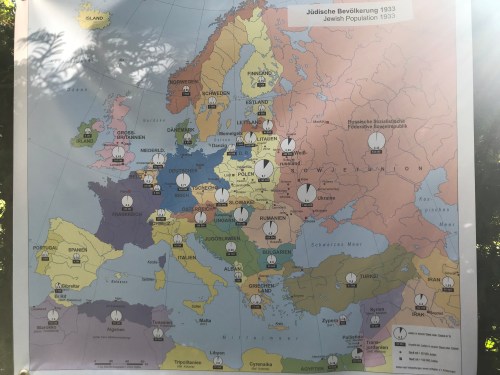
Two weeks ago Saturday was Holocaust Remembrance Day in the United States. I had the honor of speaking about not forgetting the Holocaust at Norfolk’s Temple Israel. When I look at the Holocaust and the men who managed and executed the plan to exterminate the Jews of Europe, I realize the wisdom of the words of Joseph Conrad, who wrote:

“The belief in a supernatural source of evil is not necessary; men alone are quite capable of every wickedness.”

Holocaust survivor and philosopher Primo Levi wrote, “Monsters exist, but they are too few in number to be truly dangerous. More dangerous are the common men, the functionaries ready to believe and to act without asking questions.” 

The truth is that human beings are incredibly capable of committing great evil and wickedness. The Holocaust stands alone, above every other genocide committed in history. Laurence Rees in his book Auschwitz, a New History, ended that book with these words:

We must judge behavior by the context of the times, and judged by the context of mid-twentieth century, sophisticated European culture, Auschwitz and the Nazis’ “Final Solution” represent the lowest act in all history. Through their crime, the Nazis brought into the world an awareness of what educated, technologically advanced human beings can do – as long as they possess a cold heart. Once allowed into the world, knowledge of what they did must not be unlearned. It lies there – ugly, inert, waiting to be discovered by each new generation. A warning for us, and for those who will come after.

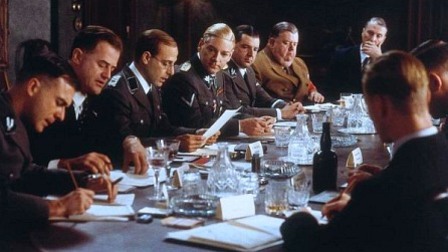
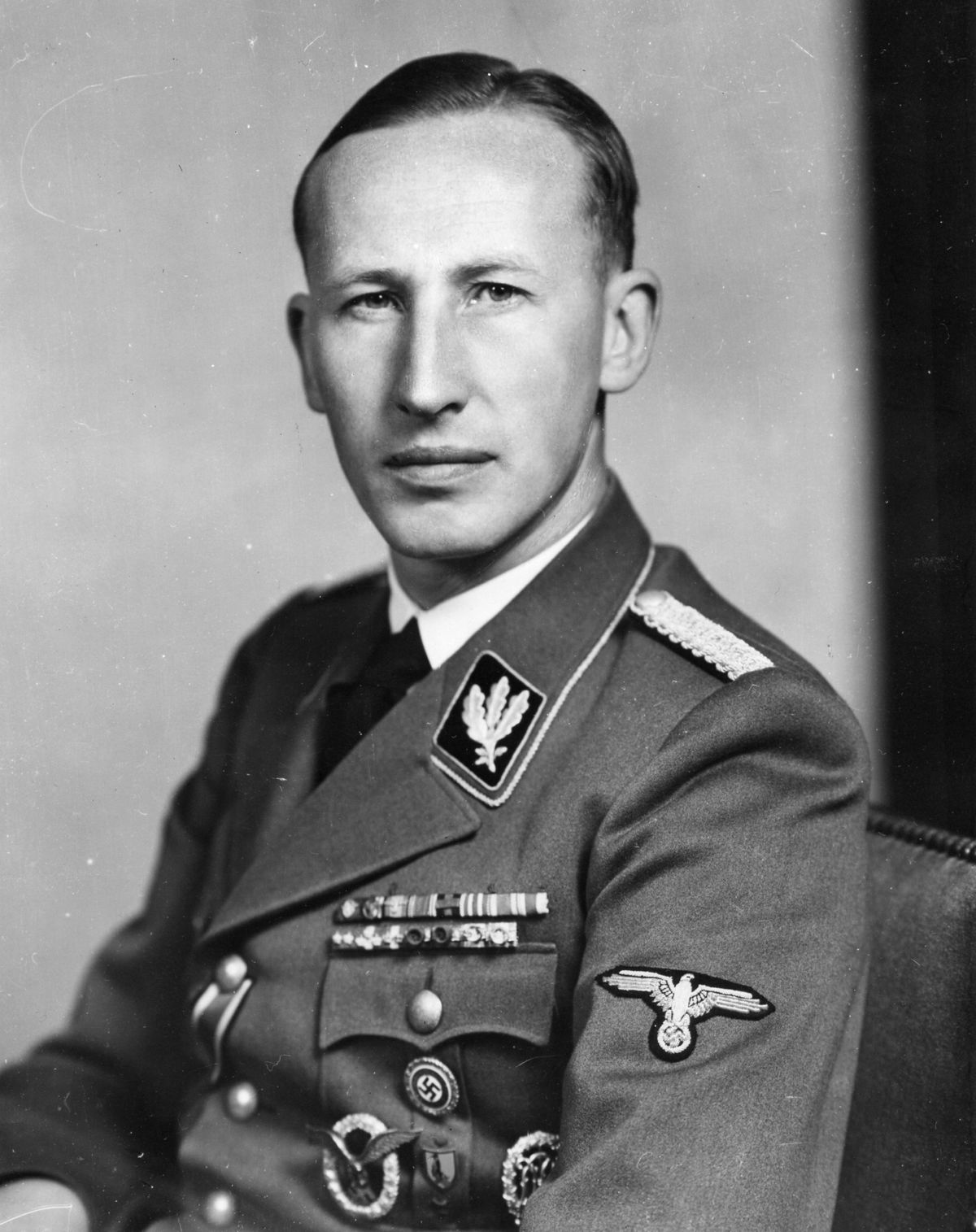
That bring me to tonight’s subject. Seventy-seven years ago a group of 15 relatively common bureaucrats of various German government, police, and party agencies sat around a table and discussed the implementation of what is called the Final Solution, or in German Endlösung. The meeting was chaired by SS Lieutenant General Reinhard Heydrich, who had been charged with the task of solving Germany’s “Jewish Problem” shortly after the German invasion of the Soviet Union. Hermann Goering, the number two man in the Nazi Reich sent Heydrich the following message:

Berlin, July 31st 1941

To: Gruppenfuhrer Heydrich

Supplementing the task assigned to you by the decree of January 24th 1939, to solve the Jewish problem by means of evacuation and emigration in the best possible way by according to present conditions, I hereby charge you to carry out preparations as regards organizational, financial, and material matters for a total solution (Gesamtlosung) of the Jewish question in all the territories of Europe under German occupation.

Where the competency of other organizations touches on this matter, the organizations are to collaborate. 

I charge you further to submit to me as soon as possible a general plan of the administrative material and financial measures necessary for the carrying out the desired final solution (Endlosung) of the Jewish question.”

Goering

1200x-1

Reinhard Heydrich

When Goering wrote Heydrich, who headed the Reichssiecherhiethauptampt (RSHA) or Reich Security Main Office, in July 1941 it seemed that Nazi victory in Europe was all but assured. Goering’s words were businesslike, and his words describing the Jews in terms of a question were euphemism of dehumanization. The late Christopher Hitchens understood how labeling ethnic or religious groups as in terms of questions or problems allowed people to escape the human realities of their solutions.

“Die Judenfrage,’ it used to be called, even by Jews. ‘The Jewish Question.’ I find I quite like this interrogative formulation, since the question—as Gertrude Stein once famously if terminally put it—may be more absorbing than the answer. Of course one is flirting with calamity in phrasing things this way, as I learned in school when the Irish question was discussed by some masters as the Irish ‘problem.’ Again, the word ‘solution’ can be as neutral as the words ‘question’ or ‘problem,’ but once one has defined a people or a nation as such, the search for a resolution can become a yearning for the conclusive. Endlösung: the final solution.”

The early measures taken by Heydrich to rid Germany and annexed Austria had been reasonably successful to rid those areas of their Jews through emigration and evacuation. These were not benign measures, people were forced to leave their homes, businesses, communities, and had most of their belongings taken from them in order to leave the Reich. However with the occupation of most of Europe following the Nazi military success and the looming occupation and subjugation of the Soviet Union the process of giving the Jews a chance to emigrate to lands outside Nazi control had come to an end. In fact the Nazis occupied the countries that may Jews had found refuge. In Heydrich, Goering, most likely acting on the verbal orders of Hitler, had found the man to execute the final solution of the Jewish Problem. Heydrich was the one man who could break through resistance of competing government and party offices and bring them into line.

Less than six months after he received the directive from Goering, on January 20th 1942 Heydrich summoned representatives from various Reich agencies were called for what turned out to be a brief, two hour meeting which decided the fate of the Jews. The meeting was held at an estate located in the suburbs of Berlin, called Wansee. Organized by Heydrich’s deputy Adolph Eichmann, involved Heydrich, Eichmann and 13 mid level representatives from various economic, governmental, justice and police entities.

Order of Heydrich to Martin Luther, Under Secretary of the Foreign Ministry

At the conference Heydrich established his authority through Goering’s directive to overcome the bureaucratic and personal attempts of various attendees to take control of the Final Solution process. Despite objections from some attendees who favored sterilization and the use of Jews in the war armaments industries, Heydrich made it clear that the Final Solution would be a campaign of extermination. He was quite clear:

Estimates of Jews to be Exterminated from Wannsee Documents

“Approximately 11 million Jews will be involved…in large single sex labor columns, Jews fit to work will work their way eastward constructing roads. Doubtless the large majority will be eliminated through natural causes. Any final remnant that survives will doubtlessly consist of the most resistant elements. They will have to be dealt with appropriately, because otherwise by natural selection, they would form the germ cell of a new Jewish revival.”

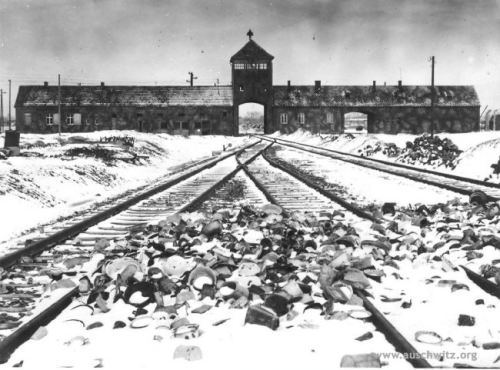
brama_birkenau-2

Auschwitz

The Nazi leadership decided that its race war against the Jews needed to forge ahead. Within days of Wansee the orders went out and SS commanders at various concentration camps began devising more efficient means to exterminate Jews and other “sub-humans.” It was a matter of pride and efficiency for them. As Rudolf Hoess the Commandant of Auschwitz said at Nuremberg “the camp commandant at Treblinka told me that he had liquidated 80,000 in the course of one half year. He was principally concerned with liquidating all the Jews from the Warsaw Ghetto. He used monoxide gas, and I did not think that his methods were very efficient. So when I set up the extermination building at Auschwitz, I used Zyclon B….” Hoess estimated that some 2.5 million people were exterminated at Auschwitz at rates as high as 10,000 a day.

einsatzgruppen-nazi-death-squads-ww2-german-brutal-002_thumb

Einsatzgruppen in Action

Of course before the Endlösung was decided on in Berlin and and the pieces were put into place at Wannsee, the Einsatzgruppen had been at work for over six months in the Soviet Union. Four Einsatzgruppen followed each of the German Army Groups and systematically began to massacre the Jews of every city and village which German soldiers captured. The EinsatzgruppenOrdungspolizei Battalions, Army Security Divisions and locally recruited units in fewer than six months, killed over a million and a half Soviet Jews, and the slaughter would continue unabated until the dying days of the Reich.

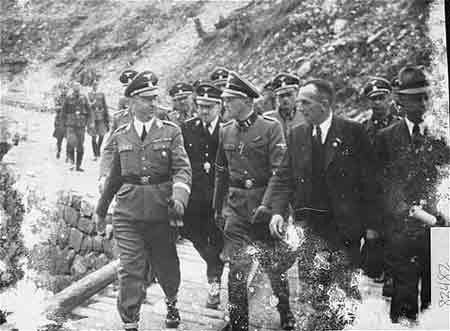
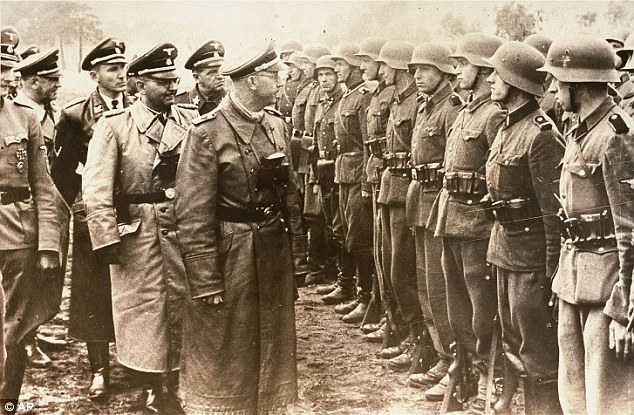
Heinrich Himmler, Heydrich’s friend and superior told a gathering of senior SS leaders:

“I also want to mention a very difficult subject before you here, completely openly. It should be discussed among us, and yet, nevertheless, we will never speak about it in public…I am talking about the “Jewish evacuation” the extermination of the Jewish people.” 

It is One of the things that is easily said. “The Jewish people is being exterminated,” every Party member will tell you, “perfectly clear, it’s part of our plans, we’re eliminating the Jews, exterminating them, ha!, a small matter.” 

But then along they all come, all the decent upright Germans and each has his decent Jew. They all say: the others are all swine, but here is a first class Jew. And none of them has seen it, has endured it. Most of you will know what it means when 100 bodies lie together, or when there are 500 or 1000. And to have seen this through, and –with the exception of human weaknesses– to have remained decent, has made us hard and is a page of glory never mentioned and never to be mentioned….”

himmlervisit

Himmler and his entourage 

Whether the words are those of Goering, Heydrich, Hoess or Himmler, there is a certain businesslike banality to them. But these men, and many others like them orchestrated a campaign of genocide and race hatred unmatched in history. Yes, there have been other genocides, the Turks killing the Armenians during the First World War and the Hutu and Tutsi slaughter in Rwanda but neither they or the politically motivated campaigns of mass slaughter conducted by the Soviets, the Chinese Communists and the Khamer Rouge killing fields can match the systematized extermination campaign waged by the Nazis against the Jews. Today we cannot allow the Holocaust to become just another terrible event in the history of humanity.

The truly terrifying thing about the Nazi perpetrators of the Holocaust to me is that most of the men at Wansee, men that commanded the Concentration camps and the Einsatzgruppen were very ordinary men who simply believed that they were doing their jobs. Very few could be described as psychopathic killers by nature. They were lawyers, doctors, career police officials, businessmen, and bureaucrats who carried out an extermination campaign that killed by their own numbers between 5.5 and 6 million Jews, not to mention others deemed to be subhuman including the handicapped, the mentally ill, homosexuals, and other non-Jewish minorities like the Gypsies not to mention the wide variety of those considered political enemies. But it was the Jews that bore the most tragic fate and it was the Jews who were the object of Hitler’s most bloodthirsty actions.

But without the bureaucrats, the mayors, district leaders, party functionaries, police officers, soldiers, railroad officials, businessmen, and others who helped there could have been no Holocaust. As Laurence Rees wrote:

“human behavior is fragile and unpredictable and often at the mercy of the situation. Every individual still, of course, has a choice as to how to behave, it’s just that for many people the situation is the key determinate in that choice.” 

arbeitmachtfrei

Timothy Snyder correctly observed that “The world is now changing, reviving fears that were familiar in Hitler’s time, and to which Hitler responded. The history of the Holocaust is not over. Its precedent is eternal, and its lessons have not yet been learned.”

That is something that we must never forget lest the would be architects of annihilation of our day; the American President, other politicians, preachers, propagandists, and profiteers, who demonize the Jews, Muslims, dark skinned immigrants, LTBTQ people and other inconvenient elements and prepare people to do evil or ignore it: the ordinary men who just obey orders. Primo Levi who I quoted at the beginning was right, the common me, those that don’t think but simply follow orders or turn their heads and ignore the evil who are the most dangerous.

Milton Mayer wrote in his book They Thought They Were Free about a German colleague during the 1950s that had lived through the Hitler years as an academic. The man tried to explain how changes were so gradual that people like him who should have known better did not take action, if they did at all until it was too late. The man asked Mayer:

“How is this to be avoided, among ordinary men, even highly educated ordinary men? Frankly, I do not know. I do not see, even now. Many, many times since it all happened I have pondered that pair of great maxims, Principiis obsta and Finem respice—‘Resist the beginnings’ and ‘Consider the end.’ But one must foresee the end in order to resist, or even see, the beginnings. One must foresee the end clearly and certainly and how is this to be done, by ordinary men or even by extraordinary men? Things might have. And everyone counts on that might.”

We cannot forget and we must always be vigilant or we too could easily succumb, it’s not that hard. Any of us can be a perpetrator, victim or bystander. Yehuda Bauer wrote these words of warning:

“The horror of the Holocaust is not that it deviated from human norms; the horror is that it didn’t. What happened may happen again, to others not necessarily Jews, perpetrated by others, not necessarily Germans. We are all possible victims, possible perpetrators, possible bystanders.“

Peace

Padre Steve+

3 Comments

Filed under ethics, History, holocaust, nazi germany, News and current events, Political Commentary

“To Be Ignorant of What Occurred Before…” The Willful Ignorance Of History

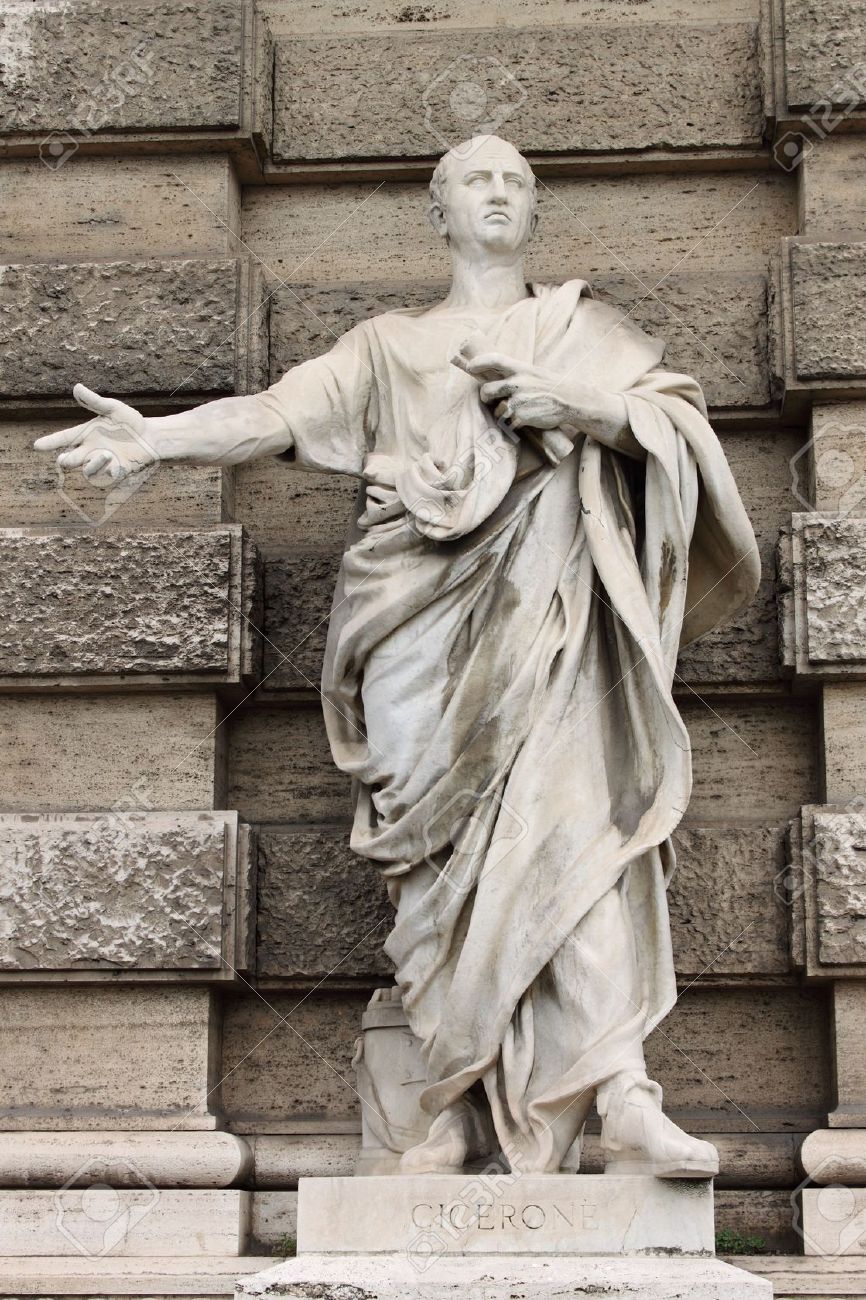
Statue-of-Cicero-Stock-Photo-rome

Friends of Padre Steve’s World,

I have been writing a lot about the Holocaust of late and as I was working on my latest book I came across a quote by British Historian Laurence Rees from his book “Auschwitz, a New History:

“Soon the last survivor and the last perpetrator from Auschwitz will have joined those murdered at the camp. There will be no one on this earth left alive who has a personal experience of the place. When that happens, there is a terrible danger that this history will merge into the distant past and just become one terrible event among many…. But that should not be allowed to happen.

We must judge behavior by the context of the times, and judged by the context of mid-twentieth century, sophisticated European culture, Auschwitz and the Nazis’ “Final Solution” represent the lowest act in all history. Through their crime, the Nazis brought into the world an awareness of what educated, technologically advanced human beings can do – as long as they possess a cold heart. Once allowed into the world, knowledge of what they did must not be unlearned. It lies there – ugly, inert, waiting to be discovered by each new generation. A warning for us, and for those who will come after. (Rees, Auschwitz p.299)

I have been reading about the declining number of students studying history, and the relative ignorance of Americans as a whole as to history, including the gross and willful ignorance of it by the President. As a historian that frightens me.

The great Roman philosopher and political theorist Marcus Tullius Cicero wrote, “History is the witness that testifies to the passing of time; it illumines reality, vitalizes memory, provides guidance in daily life and brings us tidings of antiquities.”

Those who follow my writings here on this site know that I am a historian and that much of what I write, even regarding current events, is framed by history and the stories of those who came before us. That is one of my driving passions, a passion for historical truth, and a passion to ensure that the past is not forgotten.

Cicero is an important figure in history. He resisted the moves toward the dictatorship of the Caesars and would die for his belief in the Republic. As such he inspired the founders of the United States, including Thomas Jefferson and John Adams. Adams wrote of the Roman:

“As all the ages of the world have not produced a greater statesman and philosopher united than Cicero, his authority should have great weight.”

Sadly, it seems that our society, and even our education system is disconnecting itself from history. We have pretty much stopped teaching history in schools, and often what is taught is myth. As such we have become a society that through its ignorance of the past is ever repeating the worst aspects of our history. As a whole we are ignorant of our past, and that ignorance is demonstrated by many of our political, business, journalism, educational, and military leaders on a daily basis.

Cicero wrote “To be ignorant of what occurred before you were born is to remain always a child. For what is the worth of human life, unless it is woven into the life of our ancestors by the records of history?”

Our lives must be woven together with those who came before us, without that sacred connection to the past, we endanger the future, and doom those who follow us. Cicero wrote, “The life of the dead is placed in the memory of the living.” Thus, it is for us the living to remember and never forget those who have gone before. That is why I write.

At some point I will write more on things that Cicero wrote and said, including political and social lessons that are as relevant today as when he wrote them, but as historian George Santayana noted: “Those who do not remember the past are condemned to repeat it.”

I fear that the President and his sycophants in the GOP and his Cult like followers in their ignorance of history and willful disregard for the Constitution and our institutions will end in the kind of political disaster that brought an end to the Roman Republic.

These are perilous times and I am afraid that the lessons of Cicero, Santayana, and Rees have not been learned.

Until tomorrow,

Peace

Padre Steve+

2 Comments

Filed under History, holocaust, News and current events, philosophy, Political Commentary

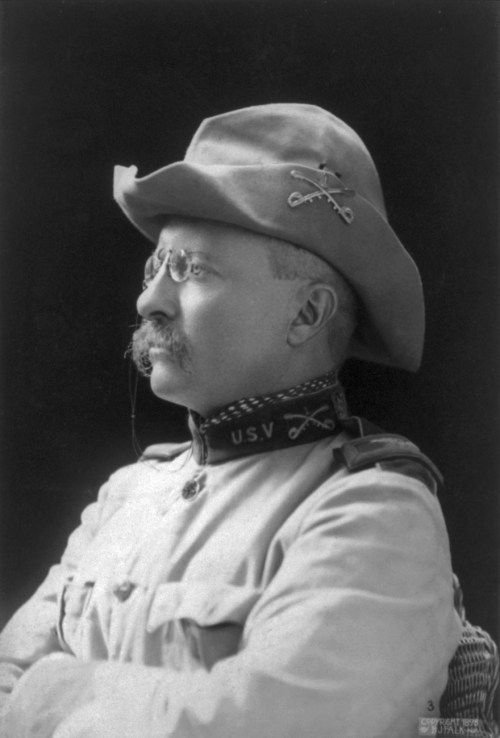
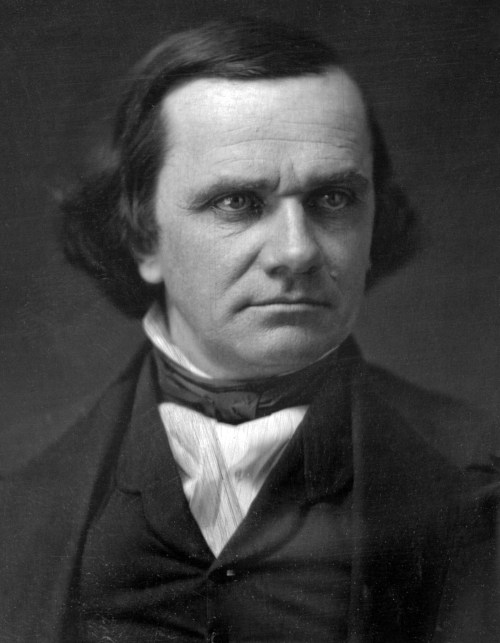
Presidents are Neither Above the Law or Criticism: Wisdom from Theodore Roosevelt and Stephen A. Douglas

Friends of Padre Steve’s World,

I find it both interesting and troubling to listen to many supporters of President Trump castigate anyone for any criticism offered about the President, sometimes going as far to say that critics are being “unfair,” “disrespectful,”or most disturbing, “disloyal” or “treasonous.” Even the President tweets out those kind of accusations on a whim.

Admittedly some forms of criticism cross boundaries and are personally insulting and disrespectful of the President. In my writings I try, even when being very critical of his policies, words, or actions, to refrain from personal insults that could be considered disrespectful to the President because I am still on active duty.  As my readers know I am a historian as well as an theologian/ethicist and when I do write about the actions of the President and his administration I do so based on careful study and comparison with historical, ethical, or legal precedents. My views are likewise informed by my education and and belief in the principles of the Enlightenment, my belief in human rights as set out in the Preamble of the Declaration of Independence, the U.S. Constitution, and the French Rights of Man and the Citizen, as well as my understanding of the Anglican Christian tradition of “Scripture, Tradition, and Reason” being the foundations of faith.

But it is not disloyal or treasonous to offer criticism of policies, legislative proposals, executive orders, or actions and words of the President or his advisers that could endanger the security of the United States, its citizens, and its alliances, or potentially be unlawful.

Even so I am occasionally criticized for offering historical examples that compare the President and his most ardent supporters in an unfair way, some even calling those disrespectful. I find their double standards and lack of appreciation of irony quite fascinating as most of these people have spent the last eight years or more disparaging and disrespecting President Obama with some of the most racist, vile, contemptible, and false accusations ever made against a sitting President, while at the same time condemning others for simply repeating what the President himself has said.

I found out that a couple of years when I had a couple of students criticize some of my teaching at Gettysburg when comparing the anti-immigrant Know Nothings of the 1830s-1850s to current anti-immigrant Trump supporters, and stated that some Trump Administration Civil Rights proposals to be a throwback to Jim Crow. My words then were not insulting nor disrespectful, but simply valid historical criticism; but some Trump supporters are so thin-skinned that they cannot abide any criticism of the President, despite dishing out incredibly racist and disgusting personal comments about President Obama, which were mostly devoid of any non-racially based political or ideological principles.

Last summer I experienced the threat to my career from one of my chapel parishioners who lied about the contents of a sermon and asked my Commander to have me investigated and tried by Court Martial for simply criticizing the actions of the administration on the southern border using Scripture, Tradition, Reason, and History. I did not mention the President but I was accused of comparing him to Hitler and my critic, who never spoke to me and who I still would not recognize wanted me charged with Conduct unbecoming of an officer and disrespect to the President of the United States. About a quarter of the congregation was questioned and I was exonerated, but I have learned the hard way that the President’s supporters will go to any length to silence anything the believe critical,of him.

Unlike President Obama the current President is ensnared in numerous legal, criminal, and Constitutionally backed investigations which range from simply enriching himself as a public official (the emoluments clause) and his family, or more seriously collusion with not only Russian, but Saudi, and other nations to influence his election. The Senate committee investigating the Russian connection said that this actually happened and backed up the evidence submitted by U.S. law enforcement, military, and intelligence agencies concerning this. The Saudi and other Sunni Arab connections were just brought to public light about a year ago. Lord knows how many other governments were involved with Donald Trump Jr., and others to seek to influence the 2016 elections and U.S. foreign policy since then.

Theodore Roosevelt had to defend himself in 1918 from such criticism from the supporters of President Woodrow Wilson. Roosevelt was criticizing the Wilson administration because of how badly he thought they were pursuing the war effort against Germany. For this people were castigating him. People said that newspapers should not print what Roosevelt had to say as well as “He should stand by the President” and “He should be stood before a stone wall and shot.” Roosevelt ended up writing an op-ed in the Kansas City Star in which he noted:

“The President is merely the most important among a large number of public servants. He should be supported or opposed exactly to the degree which is warranted by his good conduct or bad conduct, his efficiency or inefficiency in rendering loyal, able, and disinterested service to the Nation as a whole. Therefore it is absolutely necessary that there should be full liberty to tell the truth about his acts, and this means that it is exactly necessary to blame him when he does wrong as to praise him when he does right. Any other attitude in an American citizen is both base and servile. To announce that there must be no criticism of the President, or that we are to stand by the President, right or wrong, is not only unpatriotic and servile, but is morally treasonable to the American public. Nothing but the truth should be spoken about him or any one else. But it is even more important to tell the truth, pleasant or unpleasant, about him than about any one else.”

Senator Stephen A. Douglas

This is exactly how I base any criticism I offer of the President, his policies, words, and actions. I heartily agree with the words of Senator Stephen A. Douglas when he battled President James Buchanan over the pro-slavery attempt to have Kansas admitted to the Union as a Slave State in 1858. Douglas said of his encounter with Buchanan:

“God forbid,” I said “that I ever surrender my right to differ from a President of the United States for my own choice. I am not a tool of any President!” 

Sadly, there are very few GOP Senators who would have the moral courage to do what Stephen Douglas did in 1858. He did so even though it doomed his chances to be President.

I admire Stephan Douglas but there is a difference. Now there is a difference, I am not a Senator or elected Representative, I am an officer and must carry out the orders of the President. However, if I ever come to believe that I cannot in good conscience carry them out, or if I believe that they are un-Constitutional I will retire from the military in order to allow myself the freedom to speak out more openly. To ‘this point in time I have not to have been forced to Carr out any illegal or unconstitutional orders, and as a Chaplain I have been able to speak my thoughts openly, though I am careful in how I say them at least in order to maintain my respect for the office of the President.

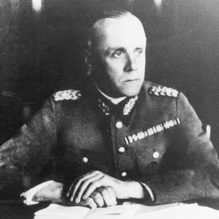
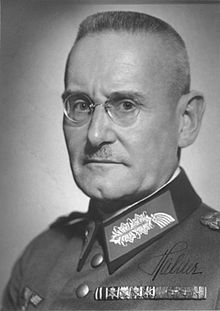
General Ludwig Beck

One of my examples is the German General Ludwig Beck, who resigned as head of the German Army in 1938 over Hitler’s aggression and his plan to attack Czechoslovakia. He wrote something that I hold particularly important in my service at this point in history:

“It is a lack of character and insight, when a soldier in high command sees his duty and mission only in the context of his military orders without realizing that the highest responsibility is to the people of his country.” 

Unlike the current President who sought numerous deferments from entering the military in a time of war: Stephen Douglas put his political career on the line to follow the Constitution, Theodore Roosevelt resigned from his office as Assistant Secretary of the Navy Since to go to war and place himself in harms way, Ludwig Beck would die in the failed attempt to kill Hitler in July 1944. All three men were far more honorable than President Trump, and their words should be heeded by Americans regardless of their political affiliation.

Over the past few weeks the President and his media cohorts have been suggesting unconstitutional and illegal actions against his critics Following the end of the Mueller investigation. His administration members are refusing Congressional subpoenas, and he is hiding behind executive privilege. In a different era his own party members in Congress would hold him to account, but these are different times. The actions of the President and his administration members, supported by the GOP majority in the Senate will likely bring about a Constitutional Crisis that will test the very foundations of the Republic, at the same time he is sending significant military assets to confront an undisclosed threat from Iran, while increasing sanctions on that country, while readying economic tariffs on China. I could go on, but I won’t.

Theodore Roosevelt was absolutely correct. Presidents are not beyond criticism, rebuke, or the law. Any real patriot understands that.

Until tomorrow,

Peace,

Padre Steve+

5 Comments

Filed under History, laws and legislation, leadership, Military, News and current events, Political Commentary

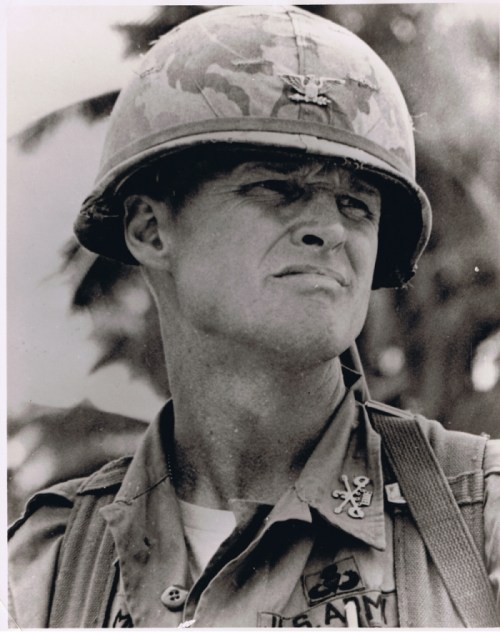
Americans should Always “Choose a President Wise, Well Read in History and Exceedingly Slow to Draw the Sword” Wise Words from the Late General Hal Moore in the Trump Era

29f03605f6b48a52887c2b51a20b5382

LTG Hal Moore as a Colonel in Vietnam

Friends of Padre Steve’s World,

Even since I was a child I was an avid reader of history, especially military history and biography. I idolized the military men that I read about and many of the things that they said and did, and almost always skewed them into an almost perverse form of patriotism. After the attacks of 9-11-2001 and during the run up to the invasion of Iraq I got into a internet argument with a man who later became the Presiding Bishop of my former denomination. He was and still is a very honorable man. He opposed the war on good historical, social, and moral grounds.

While he was very conservative theologically he had a strong sense of social justice and having come to adulthood during Vietnam war era he had a certain sense of distrust about military adventurism that I, an officer who at that time had some twenty years of military service did not fully appreciate. I responded to one of his comments with a quote from one of my favorite American Naval heroes, Captain Stephen Decatur who once remarked:

“Our Country! In her intercourse with foreign nations may she always be in the right; but right or wrong, our country!”

decatur 2 sqaure

There is some truth in what Decatur said, but his words should not be used to justify imperialistic nationalism, racism, or militarism. Sadly back then that was exactly how I used it to attempt to shut down the arguments of an honorable man. If he ever reads this I hope that Bishop Craig Bates accepts my heartfelt apology for how I treated him back then.

It took me two combat tours, one at sea where I was a member of a boarding team, and the other in Iraq’s Al Anbar Province, and a lot more military and historical education that I realized how wrong that I was in doing this. Using patriotic quotes to buttress immoral, illegal, unconstitutional, and un-Christian policies is damnable. G. K. Chesterton noted: “‘My country, right or wrong,’ is a thing that no patriot would think of saying. It is like saying, ‘My mother, drunk or sober.’”

But, I am afraid that my former understanding of patriotism is exactly what many Americans follow today, regardless of their political affiliation or ideology seem to automatically defer to the decisions of the President, no matter what his party in launching military strikes. This has been largely true since the end of Second World War until now with the exception of the latter stages of the Vietnam War when the bankruptcy of American policy became evident.

No one wants to be “against the troops” and I am still one of those troops, but opposing nationalism, imperialism, and militarism is not the same as “supporting the troops.” The late Army Lieutenant General Hal Moore, who led his battalion into the Battle of the Ia Drang in 1965 and was memorialized in the film We Were Soldiers told West Point Cadets in 2005:

“The war in Iraq, I said, is not worth the life of even one American soldier. As for Secretary Rumsfeld, I told them, I never thought I would live long enough to see someone chosen to preside over the Pentagon who made Vietnam-era Defense Secretary Robert McNamara look good by comparison. The cadets sat in stunned silence; their professors were astonished. Some of these cadets would be leading young soldiers in combat in a matter of a few months. They deserved a straight answer.

The expensive lessons learned in Vietnam have been forgotten and a new generation of young American soldiers and Marines are paying the price today, following the orders of civilian political leaders as they are sworn to do. The soldiers and those who lead them will never fail to do their duty. They never have in our history. This is their burden. But there is another duty, another burden, that rests squarely on the shoulders of the American people. They should, by their vote, always choose a commander in chief who is wise, well read in history, thoughtful, and slow-exceedingly slow-to draw the sword and send young men and women out to fight and die for their country. We should not choose for so powerful an office someone who merely looks good on a television screen, speaks and thinks in sixty-second sound bites, and is adept at raising money for a campaign.

If we can’t get that part right then there will never be an end to the insanity that is war and the unending suffering that follows in war’s wake-and we must get it right if we are to survive and prosper as free Americans in this land a million Americans gave their lives to protect and defend.”

I remember reading General Moore’s back words then and despite my respect for him I didn’t see their truth, I still believed the lies of Donald Rumsfeld, the Bush Administration, and the Right wing media. I was wrong, and within two and a half years I would discover just how right that he was.

Today, some eleven years after I returned from Iraq I find that we now have a President whose historical, ethical, and policy blindness is subjected to his narcissistic and paranoid personality. He is a man who dodged the draft, avoided military service, condemned men and women wounded. killed, or captured in combat as losers while bragging that avoiding sexually transmitted diseases in the 1980s was his Vietnam. Even now he is rushing a Carrier Strike Group and heavy bombers to challenge Iran for as of yet undisclosed threats to American interests in the Middle East, as well as suggesting military options to deal with the failing and flailing government of Venezuelan President Maduro.

War is a great way to distract from other real concerns, especially if it gives the President, any President, a chance to divert attention from his own malfeasance and criminality. Our Republic is in danger and I do not think that the danger will soon pass. I only wish that it would. Sadly, Hal Moore passed away in February of 2017. If he were alive today I am sure that he would be sounding the alarm.

So until tomorrow,

Peace

Padre Steve+

Leave a comment

Filed under Foreign Policy, History, leadership, middle east, Military, national security, News and current events

Dien Bien Phu: The Soldiers and the Lessons Forgotten and Unlearned 65 Years Later

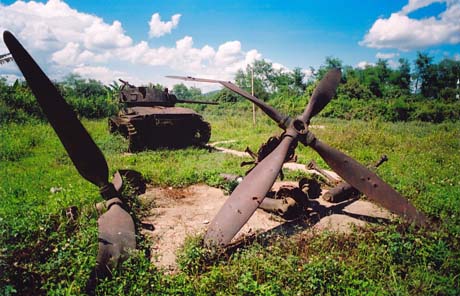
Dien Bien Phu War Remnants

Dien Bien Phu Today

It was an epic battle in a tragic war and most people neither know or care what happened in the valley where a small border post named Dien Bien Phu became synonymous with forgotten sacrifice. This year fewer remembrances are taking place. Some are in Vietnam and others in France. Last year, the French Prime Minister Edouard Philippe laid a wreath at the French Monument at Dien Bien Phu, accompanied by several elderly veterans of the battle. The French veterans were met with kindness by their former opponents.

French Prime Minister Edouard Philippe at Dien Bien Phu’s French Memorial

Diplomat_Sep10059-227x300

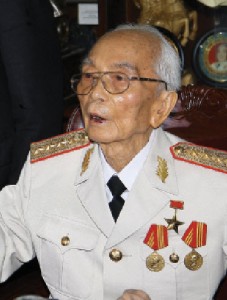
General Vo Nguyen Giap in 2011

Years before, on May 7th 2011 in Hanoi a small remembrance was held to mark the fall of Dien Bien Phu and honor the victor, 101 year old General Vo Nguyen Giap at his home. Giap was the last senior commander on either side at that time, and he died a year and a half later at the age of 102.  That 2011 ceremony was one of the few remembrances held anywhere marking that battle which was one of the watersheds of the 20th Century. A half a world away in Houston Texas a small group of French veterans, expatriates and historians laid a wreath at the Vietnam War Memorial.  In Paris an ever shrinking number of French survivors used to gather each year on May 7th at 1815 hours for a religious service at the Church of Saint Louis des Invalides to remember the dead and missing of the French Expeditionary Corps who were lost in Indochina. A small number of other small ceremonies were held as late as 2014. There appear to be no services to honor their memory this year.

155fdecaef82e8d699102f2c5390203c

Legionnaires of the Second Foreign Legion Parachute Battalion at Dien Bien Phu 

This battle is nearly forgotten by time even though it and the war that it symbolized is probably the one that we need to learn from before Afghanistan becomes our Indochina.

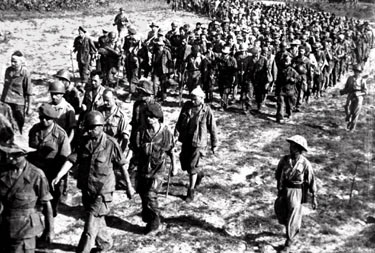
<img src="https://padresteve.com/wp-content/uploads/2013/05/french_surrender_at_dien_bien_phu1.jpg?w=500&quot; class="aligncenter size-full wp-image-11759" data-attachment-id="11759" data-permalink="https://padresteve.com/2013/05/06/remembering-hell-the-fall-of-dien-bien-phu-59-years-gone-by-and-still-forgotten/french-soldiers-surrender-3/&quot; data-orig-file="https://padresteve.com/wp-content/uploads/2013/05/french_surrender_at_dien_bien_phu1.jpg&quot; data-orig-size="375,253" data-comments-opened="1" data-image-meta="{"aperture":"0","credit":"AP","camera":"","caption":"Captured French soldiers are marched through the fields after their surrender at Dien Bien Phu in 1954. More than 10,000 French troops were captured after a 55 day siege . The French defeat ended nearly a century of French occupation of Indochina. (AP Photo\/Vietnam News Agency)","created_timestamp":"0","copyright":"","focal_length":"0","iso":"0","shutter_speed":"0","title":"FRENCH SOLDIERS SURRENDER"}" data-image-title="FRENCH SOLDIERS SURRENDER" data-image-description="

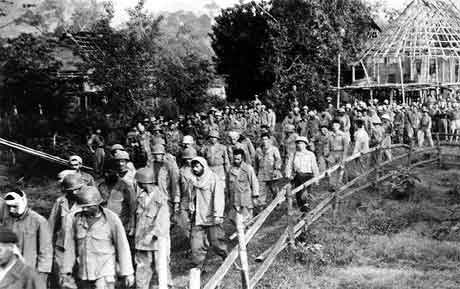
Captured French soldiers are marched through the fields after their surrender at Dien Bien Phu in 1954. More than 10,000 French troops were captured after a 55 day siege . The French defeat ended nearly a century of French occupation of Indochina. (AP Photo/Vietnam News Agency)

” data-medium-file=”https://padresteve.com/wp-content/uploads/2013/05/french_surrender_at_dien_bien_phu1.jpg?w=300&#8243; data-large-file=”https://padresteve.com/wp-content/uploads/2013/05/french_surrender_at_dien_bien_phu1.jpg?w=375&#8243; alt=”FRENCH SOLDIERS SURRENDER” srcset=”https://padresteve.com/wp-content/uploads/2013/05/french_surrender_at_dien_bien_phu1.jpg 375w, https://padresteve.com/wp-content/uploads/2013/05/french_surrender_at_dien_bien_phu1.jpg?w=150 150w, https://padresteve.com/wp-content/uploads/2013/05/french_surrender_at_dien_bien_phu1.jpg?w=300 300w” sizes=”(max-width: 375px) 100vw, 375px” style=”height: auto; max-width: 100%; margin-bottom: 2px; clear: both; display: block; margin-left: auto; margin-right: auto”>

French Prisoners

On May 8th 1954 the French garrison of Dien Bien Phu surrendered to the Viet Minh.  It was the end of the ill-fated Operation Castor in which the French had planned to lure the Viet Minh Regulars into open battle and use superior firepower to decimate them.  The strategy which had been used on a smaller scale the previous year at Na Son.

The French had thought they had come up with a template for victory based on their battle at Na Son in how to engage and destroy the Viet Minh. The plan was called the “Air-land base.”  It involved having strong forces in a defensible position deep behind enemy lines supplied by air.  At Na Son the plan worked as the French were on high ground, had superior artillery and were blessed by General Giap using human wave assaults which made the Viet Minh troops fodder for the French defenders.  Even still Na Son was a near run thing for the French and had almost no effect on Viet Minh operations elsewhere while tying down a light division equivalent and a large portion of French air power.

nlfmainforce

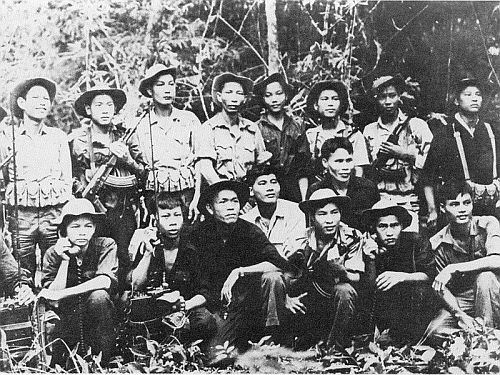
Viet Minh Regulars

The French took away the wrong lesson from Na-Son and repeated it at Dien Bien Phu.  The French desired to use Dien Bien Phu as a base of operations against the Viet Minh.  Unfortunately the French chose badly. Instead of high ground they elected to occupy a marshy valley surrounded by hills covered in dense jungle. They went light on artillery and the air head was at the far end of the range of French aircraft, especially tactical air forces which were in short supply.  To make matters worse, General Navarre, commander of French forces in Indochina was informed that the French government was going to begin peace talks and that he would receive no further reinforcements. Despite this, he elected to continue the operation.

dien-bien-phu

French Paras Drop into Dien Bien Phu

Once on the ground French logistics needs were greater than the French Air Force and American contractors could supply.  French positions at Dien Bien Phu were exposed to an an enemy who held the high ground, had more powerful artillery, and placed in defensive positions that were not mutually supporting. The terrain was so poor that French units were incapable of any meaningful offensive operations against the Viet Minh. As such they could only dig in and wait for battle. Despite this many positions were not adequately fortified and the artillery was in emplaced positions that were easily targeted by Viet Minh artillery and not hardened.

bigeard_instruction_saut

Major Marcel Bigeard 

The French garrison was a good quality military force composed of veteran units. It was comprised of Paras, Foreign Legion, Colonials (Marines), North Africans and Vietnamese troops. Ordinarily in a pitched battle it would have done well, but this was no ordinary battle and their Viet Minh opponents were equally combat hardened, well led and well supplied and fighting for their independence.

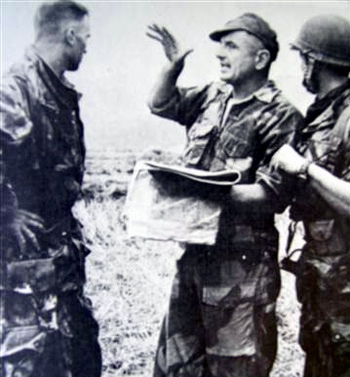
Many of the French officers including Lieutenant Colonel Langlais and Major Marcel Bigeard commander of the 6th Colonial Parachute Battalion were among the best leaders in the French Army. Others who served in Indochina including David Galula and Roger Trinquier would write books and develop counter-insurgency tactics which would help Americans in Iraq. Unfortunately the French High Command badly underestimated the capabilities and wherewithal of the Giap and his divisions.

65193421-small_269244

Viet Minh Supply Column

Giap rapidly concentrated his forces and built excellent logistics support.  He placed his artillery in well concealed and fortified positions which could use direct fire on French positions. Giap also had more and heavier artillery than the French believed him to have.  Additionally he brought in a large number of anti-aircraft batteries whose firepower from well concealed positions enabled the Viet Minh to take a heavy toll among the French aircraft that attempted to supply the base.  Unlike at Na-Son, Giap did not throw his men away in human assaults.  Instead he used his Sappers (combat engineers) to build protective trenches leading up to the very wire of French defensive positions. These trenches provided both concealment and protection from the French. In time these trenches came to resemble a spider web that enveloped the French base.

Without belaboring the point the French fought hard as did the Viet Minh. One after one French positions were overwhelmed by accurate artillery and well planned attacks.  The French hoped for U.S. air intervention, even the possibility of the United States using nuclear weapons against the Viet Minh. They were turned down by a US Government that had grown tired of a war in Korea.

dien bien phu6

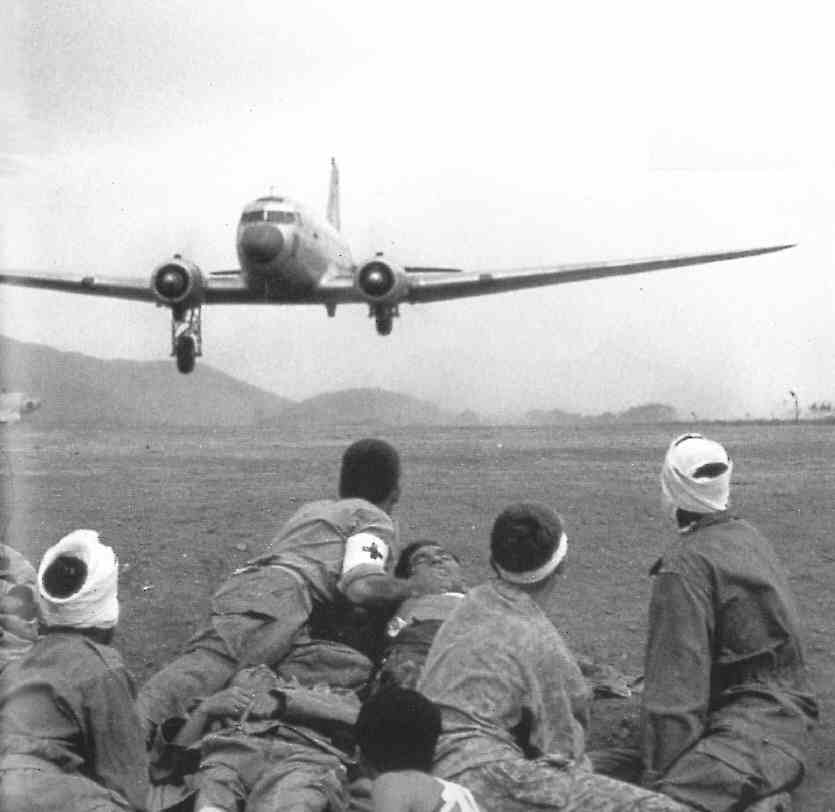
Wounded Awaiting Medivac 

Relief forces were unable to get through and the garrison died, despite the bravery of the Paratroops. Colonials and Legionaries. The French garrison was let down by their high command and their government and lost the battle due to inadequate logistics and air power. The survivors endured a brutal forced march of nearly 400 miles on foot to POW camps in which many died. Many soldiers who survived the hell of Dien Bien Phu were subjected to torture, including a practice that we call “water boarding.” General Georges Catroux who presided over the official inquiry into the debacle at Dien Bien Phu wrote in his memoirs: “It is obvious that there was, on the part of our commanding structure, an excess of confidence in the merit of our troops and in the superiority of our material means.”

Few French troops caved to the Viet Minh interrogations and torture but some would come away with the belief that one had to use such means to fight the revolutionaries.  Some French troops and their Algerian comrades would apply these lessons against each other within a year of their release. French soldiers and officers were shipped directly from Indochina to Algeria to wage another protracted counterinsurgency often against Algerians that they had served alongside in Indochina. The Algerian campaign proved to be even more brutal and it was lost politically before it even began.

dien_bien_phu

The March to Captivity

The wars in Indochina and Algeria tore the heart out of the French Army. The defeats inflicted a terrible toll. In Indochina many French career soldiers felt that the government’s “lack of interest in the fate of both thousands of missing French prisoners and loyal North Vietnamese…as dishonorable.” Divisions arose between those who served and those who remained in France or Germany and created bitter enmity between soldiers. France would endure a military coup which involved many who had fought in Vietnam and Algeria. Having militarily won that war these men called The Centurions by Jean Lartenguy had been turned into liars by their government.  They were forced to abandon those who they had fought for and following the mutiny, tried, imprisoned, exiled or disgraced. Colonial troops who remained loyal to France were left without homes in their now “independent” nations. They saw Dien Bien Phu as the defining moment. “They responded with that terrible cry of pain which pretends to free a man from his sworn duty, and promises such chaos to come: ‘Nous sommes trahis!’-‘We are betrayed.’

The effects of the wars in French Indochina, Algeria and Vietnam on the French military establishment were long lasting and often tragic. The acceptance of torture as a means to an end sullied even the hardest French officers. Men like Galula and Marcel Bigeard refused to countenance it, while others like Paul Aussaresses never recanted.

One of the most heart rending parts of the Dien Bien Phu story for me is that of Easter 1954 which fell just prior to the end for the French:

“In all Christendom, in Hanoi Cathedral as in the churches of Europe the first hallelujahs were being sung. At Dienbeinphu, where the men went to confession and communion in little groups, Chaplain Trinquant, who was celebrating Mass in a shelter near the hospital, uttered that cry of liturgical joy with a heart steeped in sadness; it was not victory that was approaching but death.” A battalion commander went to another priest and told him “we are heading toward disaster.” (The Battle of Dienbeinphu, Jules Roy, Carroll and Graf Publishers, New York, 1984 p.239)

Like many American veterans of Vietnam, many of the survivors of Dien Bien Phu made peace and reconciled with the Vietnamese soldiers who opposed them. While many still regretted losing they respected their Vietnamese opponents and questioned the leadership of their country and army. Colonel Jacques Allaire, who served as a lieutenant in a battalion under the command of MajorMarcel Bigeard reflected to a Vietnamese correspondent in 2014:

“I am now 92 years old and not a single day has gone by since the Dien Bien Phu loss that I haven’t wondered to myself about why the French army lost…Victory was impossible and too far away from us. The aircrafts were not able to give us relief. The French Government changed 19 times in nine years and that messed everything up. General Navarre did not know anything about the battlefield in Vietnam. After the Na San battle, the French commanders thought they could win and decided to attack at Dien Bien Phu, but they were wrong. It was Vietnamese soldiers who owned the hills, because it was their country… I respect my own enemies, who fought hard for national independence…Vietnam Minh soldiers were true soldiers with the will, courage and morality…” 

As a veteran of Iraq whose father served in Vietnam I feel an almost a spiritual link to our American and French brothers in arms who fought at Dien Bien Phu, the Street Without Joy, Algiers and places like Khe Sanh, Hue City, the Ia Drang and the Mekong. When it comes to this time of year I always have a sense of melancholy and dread as I think of the unlearned lessons and future sacrifices that we may be asked to make.

FrenchForeignLegionaireVtNamDOD

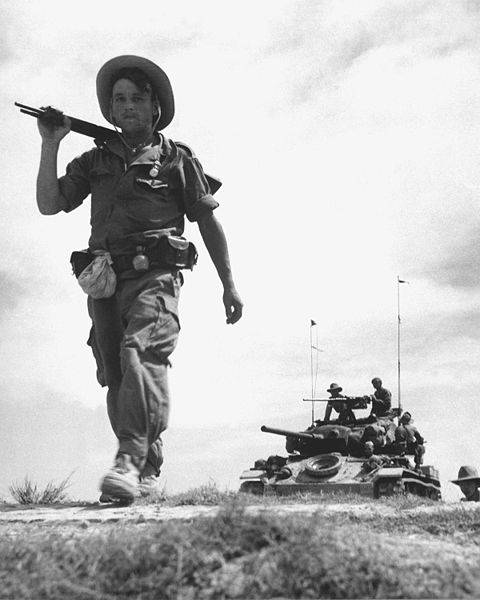
Legionairs on the Street Without Joy

The lessons of the French at Dien Bien Phu and in Indochina were not learned by the United States as it entered Vietnam, Iraq or Afghanistan. Nor were the lessons of Algeria. It was an arrogance for which we paid dearly and I do not think that many in our political, media and pundits or military have entirely learned or that we in the military have completely shaken ourselves. We lost 54,000 dead in Vietnam, nearly 4500 in Iraq and so far over 2400 in Afghanistan, and 20,000 wounded which does not count many of the PTSD or TBI cases. Add the casualties suffered by our NATO allies the number of allied dead is now over 3500. Some 36,000 Afghan National Army soldiers and Police officers have been killed. Afghan civilian deaths are estimated between 100,000 and 400,000, not counting the wounded or those killed in Pakistan. In January 2018 the Pentagon classified data on Afghan military, police, and civilian casualties.

The Afghan debacle has spanned three Presidential administrations so there accountability for it must be shared between Presidents Bush, Obama, and Trump, as well as their administrations, the military, and Congress. President Trump has shifted gears from the time he was a candidate when he pronounced the war “lost” to when addressed it as President on August 21st 2017. In his speech at fort Myer Virginia he said:

“When I became President, I was given a bad and very complex hand, but I fully knew what I was getting into:  big and intricate problems.  But, one way or another, these problems will be solved — I’m a problem solver — and, in the end, we will win.” 

But he also said:

“Someday, after an effective military effort, perhaps it will be possible to have a political settlement that includes elements of the Taliban in Afghanistan, but nobody knows if or when that will ever happen…” 

There are those even as we have been at war for almost 18 years in Afghanistan who advocate even more interventions in places that there is no good potential outcome, only variations on bad. I do not know how the President who calls himself a “problem solver” will define winning, but how many more American Soldiers, Sailors, Marines and Airmen will need die  for a “victory” that we cannot even define?

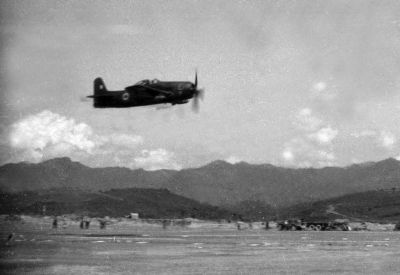
normal_03_56_F8F_decollage_a_DBP_Beriel_ph

French Navy F-8 Bearcat at Dien Bien Phu

Like the French our troops who returned from Vietnam were forgotten.The U.S. Army left Vietnam and returned to a country deeply divided by the war. Vietnam veterans remained ostracized by the society until the 1980s. As Lieutenant General Harold Moore  who commanded the battalion at the Ia Drang immortalized in the film We Were Soldiers recounted “in our time battles were forgotten, our sacrifices were discounted, and both our sanity and suitability for life in polite American society were publicly questioned.”

I think that will be the case for those of us who served in Iraq, Afghanistan, or Syria. Americans love to say they support the troops and are overwhelmingly polite and even kind when they encounter veterans. But that being said even as they do that they don’t are ignorant about our campaigns, battles, and sacrifices; and even worse fail to hold the government regardless of administration accountable for sending American troops into wars that they cannot win. That being said the Trump administration is talking up and ramping up for a possible showdown with Iran.

I guess that is why I identify so much with the men of Dien Bien Phu. The survivors of that battle are now in their nineties and dissolved their Veterans of Dien Bien Phu association in 2014 due to the difficulties most had in traveling.

For those interested in the French campaign in Indochina it has much to teach us. Good books on the subject include The Last Valley by Martin Windrow, Hell in a Very Small Place by Bernard Fall; The Battle of Dien Bien Phu by Jules Roy; and The Battle of Dien Bien Phu – The Battle America Forgot by Howard Simpson. For a history of the whole campaign, read Street Without Joy by Bernard Fall. A novel that has some really good insights into the battle and the French Paras and Legionnaires who fought in Indochina and Algeria is Jean Larteguy’s  The Centurions. 

I always find Fall’s work poignant.  The French journalist served as a member of the French Resistance in the Second World War and soldier later and then became a journalist covering the Nuremberg Trials and both the French and American wars in Vietnam. He was killed on February 21st 1967 near Hue by what was then known as a “booby-trap” and what would now be called an IED while covering a platoon of U.S. Marines.

I do pray that we will learn the lessons before we enter yet another hell somewhere else.

Peace

Padre Steve+

2 Comments

Filed under counterinsurency in afghanistan, Foreign Policy, History, leadership, Military, national security, News and current events, Political Commentary, shipmates and veterans, vietnam

The Battle Of Puebla: Cinco De Mayo, a Great Day for Mexico that Helped the United States

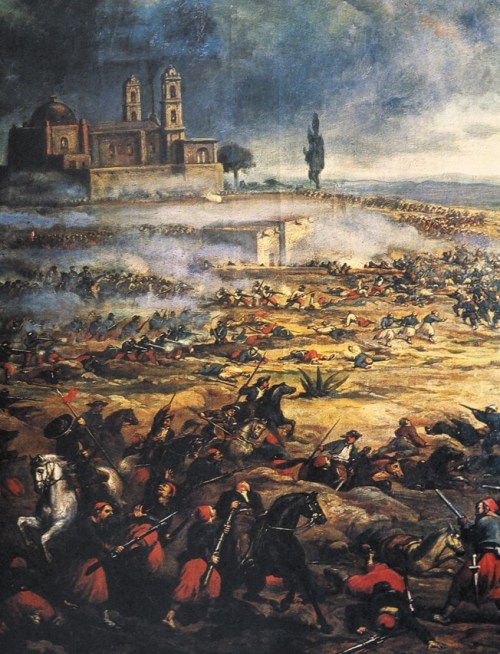
The Battle of Puebla

Friends of Padre Steve’s World,

I just wanted to wish all my readers a happy Cinco de Mayo. This holiday, which is not a Federal holiday in Mexico, and has nothing to due with Mexican Independence Day is very important to both Mexico and the United States. It celebrates the defeat of a French Army by Mexican forces at the Battle of Puebla on May 5th 1862.

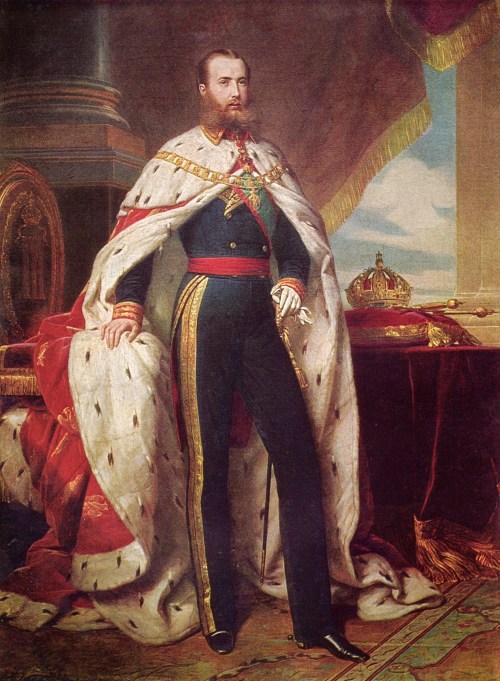
Mexico had already been independent for nearly forty years when this took place. The French had led an intervention in Mexico, and members of the conservative Mexican aristocracy asked Archduke Maximilian of Austria to be the emperor of a new Imperial Mexico, and he agreed, but instead of glory found death.

Before Maximilian took over, the French first had to conquer the Mexican Republic, something that most Mexicans rather liked. At Puebla the French commander, General Charles Latrille de Lorencez underestimated the Mexican will to resist and ordered an attack on the city which was repulsed with heavy casualties. The French made an uphill frontal attack on well motivated and dug in Mexican regulars, back up by whatever militia troops and volunteers could be found. The French discovered what Americans would learn in the Civil War and Europeans would learn in the First World War: frontal charges against dug in troops were often suicidal. After several failed assaults, the Mexican Commander, General Ignacio Zaragoza unleashed his cavalry on the French flanks persuading the French Commander to withdraw.

The battle did not end the war in Mexico, but it helped inspired Mexicans opposed to Maximilian and the Empire to continue the struggle, in which they eventually prevailed. But, in a broader sense, more important to Americans it prevented French Emperor Napoleon III, the nephew of Napoleon faulted his father for the sale of French colonial lands to the United States during the Louisiana Purchase, and hoped to use the chaos of the American Civil War to regain some or all of that territory. As such he was willing to help the Confederacy in order to negate the power of a unified United States.

Had the Mexicans not been victorious at Puebla and captured Mexican City in May of 1862 there was a strong possibility that Napoleon would have recognized the Confederacy and quite possibly convinced the English to do the same. At the time General McClellan was withdrawing from his abortive Peninsular Campaign, and resistance to the war in the North was growing. However, the defeat at Puebla, coupled with the Union capture of New Orleans, followed by the Union defeat of Lee’s invasion of Maryland at Antietam in September, and the announcement of the Preliminary Emancipation Proclamation, and by exceptional Union diplomacy nipped Napoleon’s plans in the bud.

Since people around the world expected the French to have an easy time of it the victory was stunning, and it inspired the Mexican people to fight on. Now the war went on for some time. Eventually, the French succeeded in capturing Mexico City on May 17th 1863 and installed Maximilian as Emperor of Mexico upon his arrival in Veracruz on May 21st 1864.

Emperor Maximilian

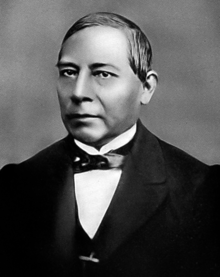
Although the French had had succeeded in installing Maximillian, the war was not over. President Benito Juarez and his Mexican Republic troops continued to resist and in 1865, aided by weapons, arms and money from the United States which now that its Civil War was over, was able to help Mexico, the Mexican Republican Forces issued a series of defeats on French Forces. Emperor Napoleon III of France, who had conjured up this mess now decided that the price of supporting Emperor Maximilian was too high, and belatedly chose better relations with the United States over the hapless Maximilian and his Mexican forces.

President Benito Juarez

The French withdrew, but Emperor Max chose to fight on. He was captured by Republican forces and was tried, and sentenced to death. At his execution he paid the firing squad in gold not to shoot him in the head so his mother could see his face. The remnants of his government surrendered in Mexico City on June 20th 1867, the day after his execution.

Despite Cinco de Mayo not being an official Mexican holiday, we Americans and people in a number of other countries do celebrate it, ostensibly as a day to remember Mexican heritage, but more often as an excuse to party, eat Mexican food, and drink lots of beer, margaritas, and tequila shots.

Have a great day, and viva la Mexico!

Peace

Padre Steve+

Leave a comment

Filed under civil war, History, Loose thoughts and musings, Military, national security

“Commanders Must Make the Sacrifice Of Overcoming their Personal Scruples” the Wehrmacht, Police, and Einsatzgruppen in Russia: 1941-1944

Friends of Padre Steve’s World,

This is another part of my article on the actions of Hitler’s Einsatzgruppen and their campaign of mass murder in Eastern Europe. This section is about the campaign in Russia. It is even more troubling than the previous sections, because in Russia, all pretense of civilization was dropped and even the German Army was heavily engaged in committing some of the grossest and most evil atrocities ever committed by a supposedly civilized and allegedly Christian people.  Likewise, it is important to remember that much of what happened occurred before the decision to implement the Final Solution and the operations of the massive extermination camps such as Auschwitz.

The tragedy is that in so ways that Americans, British, French and the Belgians, as well as the Spanish, not to mention the Russians, Turks, Japanese and so many other have committed genocide. The actions, if they were simply limited to just the Germans of that period could be explained away as a exception, but it is not. That is what makes these heinous crimes so troubling, as the people who committed them were not that different than us, or our own ancestors.

Peace

Padre Steve+
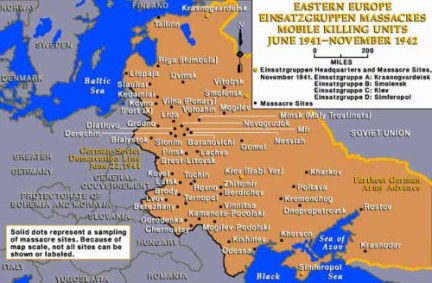
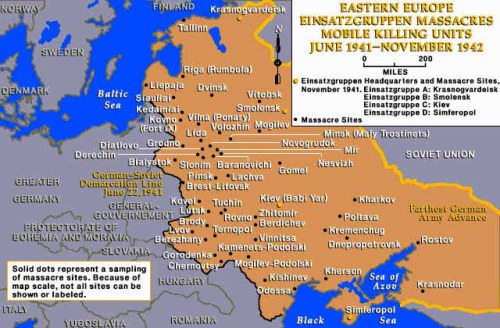
einsattzgruppen map

The Nazi war against Russia was the ultimate test of Hitler’s ideological race war. Planning for the war with the Soviet Union began after the fall of France and during the beginning stages of the Battle of Britain. On 21 July 1940 Hitler made“his intentions plain” to the Army leadership and “von Brauchitsch set his planners to work.” 119 The staff at OKH began preparations for the offensive in the winter of 1940-41 following the Luftwaffe’s failure against Britain and postponement of Operation Sea Lion, the proposed invasion of Great Britain.

Despite the fact that Britain was still in the war and had opened a new front in the Middle East against Italy which required German troops, Hitler decided to open another front and announced his intention to “crush Soviet Russia in a quick campaign which was to begin no later than March 15, 1941, and before the end of the war with England.” 120 Field Marshal Keitel noted the final decision came in “early December 1940” and from then he had “no doubt whatsoever that only some unforeseen circumstance could possibly alter his decision to attack.” 121

The military plan initially focused on the destruction of “the Red Army rather than on any specific terrain or political objective,” 122although the political and geographic objectives would arise in later planning and in the campaign. Hitler stated: “What matters is that Bolshevism must be exterminated. In case of necessity, we shall renew our advance whenever a new center of resistance is formed. Moscow as the center of doctrine must disappear from the earth’s center….” 123

Besides preparations aimed at the destruction of the Red Army and overthrow of the Soviet State, the “war against the Soviet Union was more openly ideological from the start.” 124 Hitler set the stage on March 3rd 1941 by announcing, “the forthcoming campaign is more than a mere armed conflict; it is a collision between two different ideologies…this war will not be ended merely by the defeat of the enemy armed forces” and that “the Jewish-Bolshevist intelligentsia must be eliminated….” 125

ordungspolizie officers

Ordungspolezei Officers

Hitler realized that the task of eliminating the Jews was one that had to be done by his SS men. He noted, that “this is a task so difficult that it cannot be entrusted to the Army.” 126 Reichskommissars, civilian overlords from the Nazi Party would be appointed to administer conquered areas, but since normal civilian powers would be insufficient to eliminate the Bolshevists, Hitler noted that it “might be necessary “to establish organs of the Reichsführer SS alongside the army’s Secret Field Police, even in the operational areas….” 127 The “primary task” of the SS Einsatzgruppen and Police battalions was to liquidate “all Bolshevist leaders or commissars” if possible while still in the operations zones,” 128 yet the orders were vague enough not to offend the sensibilities of Army leaders and did not contain “a syllable that in practice every Jew would be handed over to the extermination machine.” 129

As with almost all German operations which involved cooperation between the Army and the SS, the parties ensured that existing agreements between the agencies, German laws, and army doctrine were followed. On 13 March an agreement was reached between the Army represented by General Wagner and the SS, which stated in part, that “the Reichsführer SS has been given by the Führer special tasks within the operations zone of the Army…to settle the conflict between two opposing political systems.” 130Likewise the agreement dictated that Himmler’s SS units would “act independently and on his own responsibility” while ensuring that “military operations are not affected by measures necessary to carry out his task.” 131
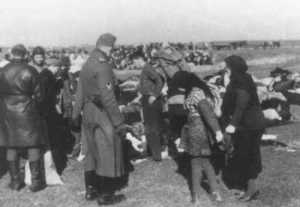
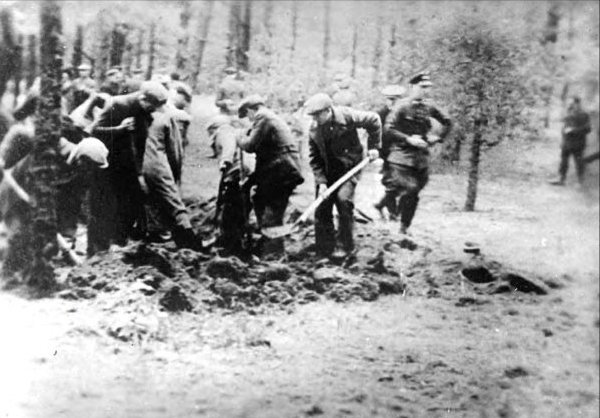
einsatzgruppe troops and victims

Rounding up Jews in Russia

A further instruction was issued by Wagner on 26 March which gave the Army’s agreement for the use of the Einsatzgrüppen in the operations zone. The agreement spelled out the coordinating instructions between the Einsatzgruppen and army authorities in the operational zone and communications zones to the rear. Cooperation between the Army and the SS was based on already existing agreements between the SS and the Army, notably the “principals for co-operation between the State Secret Police and the Field Security organization of the Wehrmacht agreed with the Security branch of the War Ministry on 1 January 1937.” 132

The most significant agreement that the Army reached with the SS was the Commissar Order. This order, sometimes known as the “Criminal Order” was used war as evidence at Nuremberg as against Keitel, Jodl and High Command of the Wehrmacht during the later Generals Trial. The order specified that the Army would cooperated with the SS and kill Soviet Political Commissars attached to the Red Army who were taken prisoner, as “they were not prisoners of war.” Another order specified that “in the event that a German soldier committed against civilians or prisoners, disciplinary action was optional….” 133 The order noted regarding political commissars that “in this struggle consideration and respect for international law with regard to these elements is wrong.” 134 The Army’s “Guidelines for the Conduct of Troops in Russia” issed on May 19, 1941 called for “ruthless and vigorous measures against Bolshevist inciters, saboteurs [and] Jews.” 135
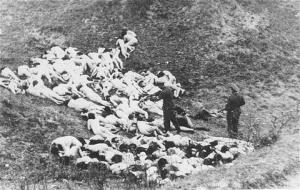
einsatzgruppen executions

Shortly before the Commissar Order was issued, Hitler previewed it to the generals saying that the war in Russia “cannot be conducted in a knightly fashion” and that the war against the Soviet Union would have to be waged with “unprecedented, unmerciful and unrelenting harshness…” 136Hitler told the generals that they would have to “dispense with all of their outdated and traditional ideas about chivalry and the generally accepted rules of warfare: the Bolsheviks had long since dispensed with them.” 137 He explained that he understood that his orders were beyond their comprehension but insisted, “I cannot and will not change my orders and I insist that that they be carried out with unquestioning and unconditional obedience.” 138

General Franz Halder, Chief of the OKH, or the Army High Command took notes on Hitler’s speech. They are chilling to read as none present could have understood them in any other way than Hitler meant:

“Clash of two ideologies. Crushing denunciation of Bolshevism, identified with asocial criminality….We must forget the comradeship between soldiers. A Communist is no comrade before nor after the battle. This is a war of extermination….We do not wage war to preserve the enemy….War against Russia: Extermination of the Bolshevist Commissars and of the Communist intelligentsia….this is no job for military courts. The individual troop commanders must know the issues at stake. They must be leaders in the fight….This war will be very different from war in the West. In the East harshness today means leniency in the future. Commanders must make the sacrifice of overcoming their personal scruples.”139
220px-Bundesarchiv_Bild_146-1970-052-08,_Franz_Halder

Franz Halder

Hitler’s speech was protested by some of the generals according to Von Brauchitsch. 140 Von Brauchitsch refused to protest the order to Hitler but issued an order on his own authority “threatening dire penalties for excesses against civilians and prisoners of war” which he maintained at Nuremberg “was sufficient to nullify the Commissar Order.” 141 Yet during the campaign against the Soviet Union, von Brauchitsch told his commanders to “proceed with the necessary hardness.” 142 Walter Warlimont noted that Field Marshal Fedor von Bock, who would “later emerge as an opponent of the Commissar Order…makes no special comment on the meeting or the restricted conference that followed.”143

At Nuremberg Keitel said that he “stubbornly contested” the clause “relating to the authority of the SS-Reichsführer… in the rearward operational areas.” 144Keitel blamed the Army High Command OKH under Halder, but the order came out with his signature on behalf of Hitler, which was key evidence against him at Nuremberg. Keitel stated that “there was never any possibility of justifying them in retrospect by circumstances obtaining in the Russian campaign.” 145

Some commanders refused to publish the orders and “insisted that the Wehrmacht never implemented such policies…” blaming them instead on the SS. One writer states “such protests were undoubtedly sincere, but in practice German soldiers were far from innocent. The senior professional officers were often out of touch with their subordinates.” 146 The orders were a “license to kill, although not a great departure from German military traditions….” 147 The effect was terrifying, for in a sense the Einsatzgruppen, “could commit ever crime known to God and man, so long as they were a mile or two away from the firing line.” 148 Security Divisions of the Army were “instructed to give material and logistical support to…units of the Einsatzgruppen.” 149 Even worse, other army units in rear areas “could be called on to assist Himmler’s SS police leaders” as the situation dictated, and few commanders refused. 150

For the campaign against the Soviet Union the Heydrich and the SS formed four Einsatzgruppen composed of SD, Waffen-SS and Police troops designated A-D. Einsatzgruppe A was assigned to Army Group North, Einsatzgruppe B to Army Group Center, Einsatzgruppe C to Army Group South and Einsatzgruppe D to the 11th Army.

The Einsatzgruppen were not standardized in manpower or equipment. In size they were battalion equivalents the largest Einsatzgruppe being Einsatzgruppe A in the North with 990 assigned personnel 151while Einsatzgruppe D was the smallest and had only 550 troops assigned. 152 These units had SS, SD or Police commanders. Though these units were not large, they also had the support of nine Ordungspolizei battalions, which were initially assigned to the invasion forces to supplement the operations of the Einsatzgruppen153

The police contingent would grow to be a massive force. By 1943, these Ordnungspolizei battalions would be grouped into regiments and number about 180,000 men assisted by 301,000 local non-German auxiliaries. 154 These units acted in concert with nine Army Security Divisions which handled rear area security. 155
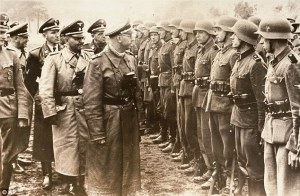
197BF44C00000578-3114663-image-a-59_1433720058260

Himmler was so secretive that he initially did not reveal the intent and planned use of their units to the Einsatzgruppen commanders. Instead he spoke to them of a “heavy task…to “secure and pacify” the Russian area using Sicherheitspolizei and SD methods.” 156 Understanding the effect of these operations, Himmler would state that “in many cases it is considerably easier to lead a company in battle than to command a company responsible to…carry out executions, to deport people…to be always consistent, always uncompromising-that is in many cases far, far harder.” 157

The actions of these units are well documented; the Einsatzgruppen, Police, Army and locally recruited Schutzmannschaft battalions 158 ruthlessly exterminated Jews and others in the operational area. No sooner had an Einsatzgruppe unit entered a city, a “deadly stranglehold” would grip the “Jewish inhabitants claiming thousands and thousands of victims day by day and hour by hour.” 159 

Non-Jewish Russians were encouraged to conduct programs which Heydrich noted “had to be encouraged.” 160 An Einsatzgruppen D report numbered 153 noted: “During period covered by this report 3,176 Jews, 85 Partisans, 12 looters, 122 Communist functionaries shot. Total 79,276.” 161   By the spring of 1942 Einsatzgruppe A had claimed “more than 270,000 victims, the overwhelming majority of whom were Jewish.” 162 The total killed for all groups by early 1942 was 518,388 people, mostly Jews. 163 Germany’s Romanian ally acted against Jews in their operational areas as well. In Odessa, “on 23 October 1941 19,000 Jews were shot near the harbor… probably 200,000 Jews perished either at Romanian hands or after being turned over by the Romanians to the Germans.” 164

To further cloud the ethics and morality, the operations against Jews were often called anti-partisan operations. Himmler referred to Einsatzgruppen as “anti-Partisan formations” 165 while Wehrmacht Security divisions cooperating with the SS “murdered countless Soviet civilians and burned Russian settlements to the ground under the pretext of subduing partisan resistance.” 166 The attitude by 1941-1942 was that “all Jews are partisans and all partisans are Jews.” From 1943, all armed resistance was “banditry” and all Jews irrespective of circumstances were treated as “bandits.”” 167

Walter_von_Reichenau

Walter von Reichenau

General Von Reichenau issued an order in which he stated: 

“The soldier in the Eastern territories is not merely a fighter according to the art of war but also a bearer of a ruthless national ideology and the avenger of the bestialities which had been inflicted upon German and racially related nations. Therefore the soldier must have full understanding for the necessity of a severe but just revenge on subhuman Jewry.” 168

Likewise the distinguished Panzer commander General Herman Hoth issued his own order of 17 November 1941 urging his troops to exact revenge on the Jews and Communists:

“Every trace of active or passive resistance or of any kind of machinations by the Bolshevik – Jewish agitators are [sic] to be immediately and pitilessly rooted out. The necessity of severe measures against elements foreign to people and kind must be understood precisely by the soldiers. These circles are the spiritual pillars of Bolshevism, the tablebearers [priests] of its murder organization, the helpers of the partisans. It consists of the same Jewish class of people which have done so much to harm our Fatherland and by its hostile activity…and anti-culture, which promotes anti-German currents in the whole world and which wants to be the bearer of revenge. Their annihilation is a law of self-preservation. Any soldier criticizing these measures has no memory of the former traitorous activity lasting for years carried on among our own people by Jewish-Marxist elements.” 169

 Piaśnica_digging_of_the_graves

Jews digging their own graves

The commander of the Wehrmacht’s 221st Security Division endeavored to persuade his “subordinate units that the Jews were carriers of Bolshevik contamination and, therefore, the ultimate source of any sabotage or difficulty the division faced.” 170 The extermination of the Jews and partisan war were closely intertwined with the Reich’s economic policies designed to exploit the natural resources of the Russia. This included the “hunger plan” which German authorities seemed to imagine that “millionfold starvation could be induced by requisitioning off all available grain and “shutting off” the cities.” 171
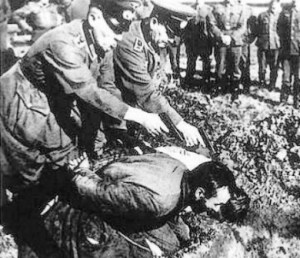
einsatzgruppen-brutal-germans-nazi-death-squads1

Einsatzgruppe men and Ordungspolizei above and below in action

“The European history of the twentieth century shows us that societies can break, democracies can fall, ethics can collapse, and ordinary men can find themselves standing over death pits with guns in their hands. It would serve us well today to understand why.” Timothy Snyder

Einsatzgruppe_A

The Wehrmacht’s complicity in these measures is demonstrated in the order drafted by Warlimont and signed by Keitel on 13 May 1941. That order, the “Decree on Exercising Military Jurisdiction in the Area of Barbarossa and Special Measures by the Troops” made it clear that international conventions regarding the treatment of civilians would not be observed in the Soviet Union. The order, relying on the historic precedent of German military law in regard to partisan activity stated

I “Treatment of crimes committed by enemy civilians”

“1. Until further order the military courts and the courts martial will not be competent for crimes committed by enemy civilians.”

2. Francs-tireurs will be liquidated ruthlessly by the troops in combat or while fleeing. “

3. Also all other attacks by enemy civilians against the armed forces, its members, andauxiliaries will be suppressed on the spot by the troops with the most rigorous methods until the assailants are finished (niederkaempfen)”

4. Where such measures were not taken or at least were not possible, persons suspected of the act will be brought before an officer at once. This officer will decide whether they are to be shot. Against localities from which troops have been attacked in or treacherous manner, collective coercive measures be applied immediately upon the order of an officer of the rank of at least battalion etc., commander, if the circumstances do not permit a quick identification of individual perpetrators.”

II. “Treatment of crimes committed against inhabitants by members of the Wehrmacht and its auxiliaries”

1. With regard to offenses committed against enemy civilians by members of the Wehrmacht or by its auxiliaries prosecution is not obligatory, even where the deed is at the same time a military crime or misdemeanor….” 172

Hitler was quite clear in his intent when he told General Halder that in 1941 that he “intended to level Moscow and Leningrad, to make them uninhabitable, so there would be no need to feed their populations during the winter.” 173Economic officials held life and death power over villages. Those that met agricultural quotas were “likely to be spared annihilation and evacuation…the culmination of this process, during 1943, would be the widespread creation of “dead zones.””174All told during the campaign against the Soviet Union the Germans killed nearly 1.5 million Russian Jews. 175
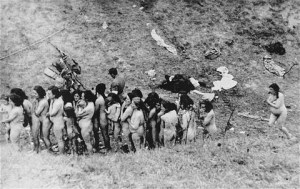
ww2 mizocz1

By 1942, over two million Soviet POW’s had been killed. 600,000 shot outright, 140,000 by the Einsatzkommandos. 176Eventually about 3.3 million Soviet POWs died in German captivity through starvation, disease and exposure, 177are included in a total of over 10 million Red Army Combat deaths. 178 The distinguished German historian Karl Dietrich Bracher wrote, “The reality and irreality of the National Socialism were given their most terrible expression in the extermination of the Jews.” 179
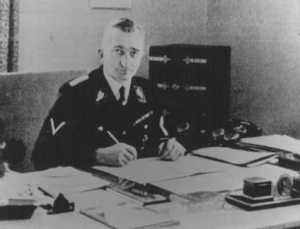
arthur nebe

Arthur Nebe, from Jew killer to anti-Hitler plotter

Himmler and others continued to use euphemistic language to describe their efforts talking in terms of “Jewish resettlement.” 180 Terms such as special actions, special treatment, execution activity, cleansing and resettlement were used in place of the word murder. 181At the same time these operations led to problems in the ranks, one SS trooper observed: “deterioration in morale among his own men who had to be issued increasing rations of vodka to carry out their killing orders.” 182

Even commanders of the Einsatzgruppe were affected. Arthur Nebe would say “I have looked after so many criminals and now I have become one myself.” Nebe became an active participant in the July 20th plot against Hitler 183and a fellow conspirator would describe him as a “shadow of his former self, nerves on edge and depressed.” 184 Erich Bach-Zelewski, who led the SS anti- partisan operations, would suffer a nervous breakdown which included “hallucinations connected to the shootings of Jews” which hospitalized him in 1942. 185 Himmler would state in his Posen speech given in October 1943 that “to have gone through” the elimination of the Jews had “and remained decent, that has made us tough. This is an unwritten, never to be written, glorious page in our history.” 186

While while the Einsatzgruppen, Ordungspolizei battalions, the Wehrmacht Security Divisions, and locally recruited forces continued their Jew Hunts, another even more ghastly plan was being launched against the Jews in Nazi occupied territory. The Endlösung of the Jewish Problem had been set in motion.

To be continued…

Notes

119 Ibid. Megargee. War of Annihilation p.24

120 Ibid. Wheeler-Bennett The Nemesis of Power p.511

121 Ibid. Goerlitz. The Memoirs of Field Marshal Wilhelm Keitel. P.132

122 Glantz, David M. and House, Jonathan. When Titans Clashed: How the Red Army Stopped Hitler. University Press of Kansas, Lawrence, KS. 1995 p.31

123 Trevor-Roper, H.R. Hitler’s Table Talk 1941-1944 with an introduction by Gerhard L Weinberg, Translated byNorman Cameron and R.H. Stevens, Enigma Books, New York, NY 2000. Originally published in Great Britain by Weidenfeld & Nicholoson, London 1953 p.6

124 Ibid. Megargee. War of Annihilation p.10 The campaign against the Soviet Union was to be much more openlyideological as compared to the campaign in Poland.

125 Ibid. Warlimont. Inside Hitler’s Headquarters p.150 126 Ibid. Warlimont. Inside Hitler’s Headquarters p.151

125 Ibid. Warlimont. Inside Hitler’s Headquarters p.150 126 Ibid. Warlimont. Inside Hitler’s Headquarters p.151

127 Ibid. Reitlinger, The SS p.175

128 Ibid. Höhne The Order of the Death’s Head p. 354

129 Ibid. Höhne The Order of the Death’s Head p. 354 Again another deception.

130 Ibid. Warlimont. Inside Hitler’s Headquarters p.153

131 Ibid. Warlimont. Inside Hitler’s Headquarters p.153

132 Ibid. Warlimont. Inside Hitler’s Headquarters pp. 158-159

133 Ibid. Glantz and House. When Titans Clashed p.56

134 Ibid. Davidowicz. The War Against the Jews p.123

135 Ferguson, Niall. The War of the Worlds: Twentieth Century Conflict and the Descent of the West. The Penguin Press, New York, 2006 p.442

136 Ibid. Wheeler-Bennett. Nemesis of Power p.513

137 Ibid. Goerlitz. The Memoirs of Field Marshal Wilhelm Keitel. P.135

138 Ibid. Wheeler-Bennett. Nemesis of Power p.513

139 Hebert, Valerie Genevieve, Hitler’s Generals on Trial: The Last War Crimes Tribunal at Nuremberg University of Kansas Press, Lawrence Kansas 2010 pp.77-78

140 Ibid. Wheeler-Bennett Nemesis of Power p.513 and footnote. He cites the three Army Group commanders, Leeb, Rundstedt and Bock. However Von Rundstedt’s biographer notes that “no evidence exists as to what VonRundstedt’s to this was at the time.” Messenger, Charles, The Last Prussian: A Biography of Field Marshal Gerd Von Rundstedt 1875-1953 Brassey’s (UK) London England 1991. p.134

141 Ibid. Reitlinger, The SS p.176

142 Ibid. Megargee. War of Annihilation p.33

143 Ibid. Warlimont. Inside Hitler’s Headquarters p.162

144 Ibid. Goerlitz. The Memoirs of Field Marshal Keitel p.136

145 Ibid. Goerlitz. The Memoirs of Field Marshal Keitel pp.136-137

146 Ibid. Glantz and House. When Titans Clashed p.56

147 Ibid. Blood. Hitler’s Bandit Hunters p.52

148 Ibid. Reitlinger The SS p. 177

149 Ibid. Shepherd. War in the Wild East p.54

150 Ibid. Reitlinger The SS p. 177

151 Ibid. Rhodes Masters of Death pp.12-13

152 Ibid. Westermann. Hitler’s Police Battalions p.167 153 Ibid. Westermann. Hitler’s Police Battalions p.164 154 Ibid. Blood Hitler’s Bandit Hunters p.141

155 Ibid. Shepherd Wild War in the East p.48. Shepherd notes the deficiencies of these units in terms of organization, manpower and equipment which he calls “far short of the yardstick of military excellence with which the Wehrmacht is so widely associated

156 Ibid. Höhne The Order of the Death’s Head p. 356 Only one of the Einsatzgruppen commanding officers was a

volunteer, Arthur Nebe who was involved in the conspiracy to kill Hitler. It is believed by many that Nebe volunteered to earn the clasp to the Iron Cross to curry favor with Heydrich and that initially “Nebe certainly did not know that “employment in the east” was synonymous with the greatest mass murder in history.

157 Ibid. Bracher. The German Dictatorship p.422

158 Ibid. Blood Hitler’s Bandit Hunters p.55

159 Ibid. Höhne The Order of the Death’s Head p. 360 160 Ibid. Friedlander TheYears of Extermination p.207 161 Ibid. Höhne The Order of the Death’s Head p. 360 162 Ibid. Tooze The Wages of Destruction p.481

163 Ibid. Ferguson. The War of the World p.446

164 Di Nardo, Richard L. Germany and the Axis Powers: From Coalition to Collapse. University Press of Kansas,Lawrence, KS. 2005 p.133 The Hungarians would also engage in ant-Jewish operations. Only the Italian army would not conduct operations against the Jews.

165 Ibid. Höhne The Order of the Death’s Head p. 369

166 Ibid. Wette The Wehrmacht p.127

167 Ibid. Blood. Hitler’s Bandit Hunters p.117

168 Ibid. Hebert p.94

169 Ibid. Hebert pp.94-95

170 Ibid. Shepherd. War in the Wild East pp.90-91

171 Ibid. Tooze The Wages of Destruction p.481

172 Ibid, Hebert p.86

173 Ibid. Magargee. War of Annihilation p.64

174 Ibid. Shepherd. War in the Wild East pp.127-128

175 Ibid. Davidowicz The War Against the Jews from the table on page 403. This included 228,000 from the Baltic republics (90%) 245,000 from White Russia (65%) 900,000 from the Ukraine (60%) and 107,000 from Russia proper

(11%)

176 Ibid. Rhodes. Masters of Death p.241

177 Ibid. Glantz and House When Titans Clashed p.57

178 Ibid. Glantz and House. When Titans Clashed table on p.292

179 Ibid. Bracher. The German Dictatorship p.431

180 Ibid. Bracher. The German Dictatorship p.430

181 Ibid. Höhne The Order of the Death’s Head p. 367

182 Ibid. Rhodes. Masters of Death p.225

183 Ibid. Rhodes Masters of Death p.225

184 Ibid. Höhne The Order of the Death’s Head p. 363 185 Ibid. Höhne The Order of the Death’s Head p. 363 186 Ibid. Bracher. The German Dictatorshipp.423

Leave a comment

Filed under crime, ethics, History, holocaust, leadership, Military, nazi germany, world war two in europe