Category Archives: History

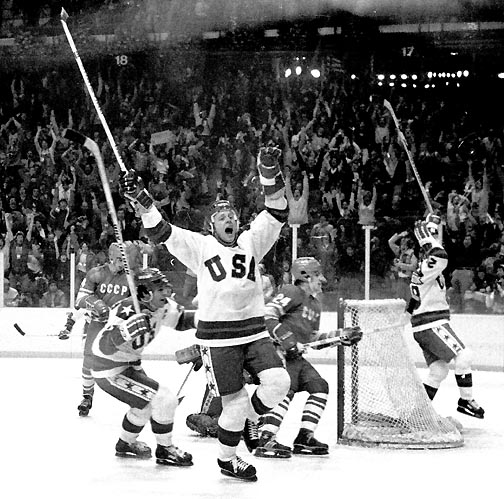
Do You Believe in Miracles? The Miracle on Ice at 40

Friends of Padre Steve‘s World,

We all remember tend to remember where we were and what we were doing when various tragedies happened.  No one living can forget where they were when John or Bobby Kennedy or the Reverend Martin Luther King Junior was assassinated. Likewise few can forget where they were when the Space Shuttle Challenger blew up in 1986, or the events of September 11th 2001.

However, in spite of the fact that good news is not always as memorable as tragedy, there was a sentinel event in my life where a group of unknown US college hockey players accomplished something that has never been forgotten, at least by those alive then. If you were alive then, and had some conscious memories, you probably remember exactly where you were and what you were doing when it took place.  Of course I am speaking about the victory of the US hockey team, Team USA over the Soviet team at the 1980 Winter Olympic Games, in Lake Placid New York.

Forty years ago today I was a 19 year old college sophomore in Stockton, California. I had grown up with hockey. When my dad was stationed in Oak Harbor Washington while serving in the Navy, while I was a child from 1965 through the end of 1969 I grew up with the weekly broadcast of “Hockey Night in Canada” on the Canadian Broadcasting Network.  When we moved to Long Beach my dad would take my brother and me to see Los Angeles Kings games, and then when we moved to Stockton, he would take us to see the California Seals in Oakland.

While in Stockton I played in a youth hockey league for a couple of years, playing defenseman, occasional right wing and for 4 games, a goalie when our goalkeeper was injured.  As a goalkeeper I went 2 for 2 in those four games and can tell you that there is almost nothing as frightening as having a 2 on 1 or one or two man breakaway coming at you full bore.  Goalies are a special breed and I don’t think that I would want that kind of pressure on me to make a living, being through combat and dealing with life and death situations is hard enough. Great goalkeepers, be they in hockey or soccer have my utmost respect.

So hockey to a lesser extent than baseball has been a part of my life for a very long time.  I remember watching my first Winter Olympics when I was in Stockton back in 1972.  Back then Team USA was nothing more than a bunch of American college kids playing teams of Warsaw pact professional all-stars from powerhouse teams such as the Soviet Red Army team.  The Soviets had dominated the international tournaments since 1956, and with the exception of the US Gold Medal team of 1960 had won every Olympic gold medal, and in 1980 were once again expected to win Olympic Gold.

But in 1980 times were tough in the United States. The country was suffering from double digit inflation, 20% interest rates, a gas crisis, economic recession, the residual effects of the Vietnam War, and the humiliation that the Iranians were inflicting on the United States on a daily basis following the seizure of the US Embassy in Tehran by “students” during the seemingly  unending hostage crisis.

The Soviet invasion of Afghanistan was yet another thumb in the eye of the United States.  As the United States prepared to host the Winter Games at Lake Placid New York there was not much to cheer about.  The country was mired in political crisis, as the sitting President Jimmy Carter was continually at odds with his own Democratic Party and appeared weak in dealing with the Soviets, their satellites, and the Iranians.  When he made his “malaise” speech in July 1979 I was in the UK touring as a spotlight tech with a Christian singing group and the reaction by the Brits and other Europeans was ridicule of the President and pity for the United States.  The United States had hit bottom, despite the fact that he was speaking the truth.

When it came to the Olympic hockey tournament, no one expected much from the U.S. national Team, with the exception of head coach Herb Brooks.  Brooks and his collection of college players, a number of whom would later become stars in the NHL, began their time together inauspiciously conducting a 61 game exhibition tour against teams from around the world.  In the final game on February 9th 1980 the Americans faced the Soviets at Madison Square Garden and were handily beaten by a score of 10-3 by the Soviet team.  The Soviets on the other hand had enjoyed nothing but success against NHL teams with Soviet teams going 5-3-1 against their NHL counterparts, the best professional teams in the world. The previous year a Soviet team had shut out an NHL All-Star team 6-0.

When the Olympic completion began the Soviets, as was expected dominated their opponents in the preliminary round going 5-0 and outscoring their opponents 51-10.  The United States surprised everyone tying Sweden 2-2 with a last minute goal and then stunning a highly favored Czech team 7-3 before defeating Norway, Romania, and West Germany to advance to the medal round.

Brooks practiced the team hard as they prepared for the Soviets who they were scheduled to meet in the opening round of the medal competition. A loss for the Americans would force them to play for Bronze and no one expected the Americans to defeat the might Soviet team. Yet when the day came, the Lake Placid Field House was packed with 8500 fans decked out in Red White and Blue, with American flags displayed everywhere. In the area the crowd was spontaneously singing “God Bless America.” But because the Soviets refused to allow a later start time, the game was not televised live nor broadcast live on the radio in the States.

On February 22nd I had finished work making and rolling pizza dough at Shakey’s Pizza in Stockton, went home showered and then got in my car to head over to Judy’s house.  On my way over I was listening to the radio when ABC radio broke in to air final few seconds of the game live, as Al Michaels made the famous call “Eleven seconds, you’ve got ten seconds, the countdown going on right now! Morrow up to Silk. Five seconds left in the game. Do you believe in miracles? YES!”

The Soviets lead 3-2 at the beginning of the Third Period, and with the lead none of the Soviet players believed they could lose, but in the next ten minutes the underdog U.S. team pulled ahead 4-3 powered by goals from Mark Johnson who scored the tying goal, and team Captain Mike Eruzione, who scored what would be the winning goal with exactly ten minutes left to play, in those ten minutes the Soviets launched a powerful attack and did not stop, but they failed to score.  With the stadium afire with the shouts of USA! USA! American Goaltender Jim Craig turned away every shot. Al Michaels, who called the game for ABC later described the scene:

“The Soviets were putting so much pressure on the American team at the end of the game, and it was a one-goal game, the crowd is going absolutely insane, we were on a platform that was shaking, the production truck was going crazy.”

I could not believe what I was hearing and was screaming in the car. As soon as I got to Judy’s I went in and told her and her parents, who actually were not that interested in the game. When the game was televised that evening, I watched it with undivided attention and to this day I cannot forget that night.  The Americans had beaten the vaunted Soviet team 4-3 and would go on to defeat Finland in the Gold medal game 4-2.  The next day they were guests at the White House and after that the team broke up. Thirteen of the players would go on to NHL careers, and Brooks would lead the 2002 Team USA to a Silver in 2002 before being killed in a car crash in 2003.

The Soviet people and their news media were stunned by the loss. The fact that the Soviet Team won Silver by defeating Sweden 9-2, the team had lost its luster. The Team and its players returned home in shame. None of the team returned their silver medals to have their names engraved on them, and the Soviet Union and its state media was stunned. Soviet forward Sergei Makarov recalled in the book “The Boys of Winter” by Wayne Coffey, “Soviet forward Sergei Makarov recalled in the book “The Boys of Winter” by Wayne Coffey, “the politicians almost wanted to kill” the team when it stepped off the plane back in Russia.the team when it stepped off the plane back in Russia. After the loss the KGB kept a close watch On the team whenever it traveled outside the USSR, but Soviet players began to defect to play in the NHL. Likewise, Marakov‘s teammate Valery Vasilyev blamed the Soviet coach for the defeat. After the Soviet Coach, Viktor Tikhonov relieved legendary Soviet goaltender Vladislav Tretiak at the end of the First Period after Mark Johnson scored to make the game a 2-2 tie at the end of the period, some Soviet players felt an unease. “The whole team was not happy when Tikhonov made the switch,” forward Sergei Makarov told Coffey. “It was the worst moment of Vlady’s career. Tikhonov was panicking. He couldn’t control himself. That’s what it was — panic.”

When the game was over Tikhonov, in a rage blamed the main Soviet stars for the loss, including Tretiak for the loss. Tikhonov pointed to the failure of Tretiak, and of the big line of Petrov, Boris Mikhailov and Valery Kharlamov. One by one, Tikhonov jabbed a finger in the faces of those four players, saying: “This is your loss! This is your loss!” On the plane back to the Soviet Union Vasilyev grabbed Tikhonov by the throat and threatened to kill him, but he was pulled away by his teammates.

Later, Vasilyev recalled: “For me, it was a ‘Mirage on Ice,..I still can’t understand how we could have lost to the Americans. I still can’t believe in that – as if it were a dream…I believed then and I still believe that our dismissive attitude to the U.S. team had led to our defeat,” he said. “We simply hadn’t taken them seriously.” 

Soviet Defenseman Slava Fetisov recalled: “Our team played a good game, but the U.S. team put together team speed, they never give up, and they got great support from their fans, I learned a pretty good lesson: Never underestimate your opponent.” Good advice  for anyone in a competitive sport, politics, or war. Alex Ovechkin of the Washington Capitols, Born five years after that game, and now one of the greatest players to ever play in the NHL noted in 2015:

“In Olympics, sometimes you can play great, but just the moment is not on your side, I don’t know what happened there. . . . Maybe they weren’t concentrating. Maybe it was bad luck.”

While the Soviet team remained dominant In international competitions until the break-up of the Soviet Union in 1990, the loss to the unheralded upstarts of Team USA in 1980 was the end of an era.  In the 1989-1990 season six of the 1980 Soviet team players, Helmuts Balderis, Viacheslav Fetisov, Alexei Kasatonov, Vladimir Krutov, Sergei Makarov, and Sergei Starikov were  allowed, to play in the NHL. Today, some 30 years after the fall of the Iron Curtain, many Russian players star in the NHL and remain in the United States even after their careers are over.

Forty years later the triumph of Team USA against all odds on that night is remembered as an event nearly unequaled in sports history as well as contemporary American history. It is considered one of the greatest games in hockey history. The game actually marked a return of pride to the country after a decade of discontent, defeat and discouragement.  That team and its members did something that no one expected in defeating the Soviets and going on to win the Gold medal against the Finns.  No one could have expected the effect on the country either. It was a miracle, a miracle on ice.

I don’t know about you, but I still believe in miracles, even in the age of Trump; and no, what Trump is doing is not miraculous, but rather a film flam show, mastering the media, and the most vile and base emotions of his supporters, while doing all he can to destroy the Constitutional and institutional guardrails against authoritarianism which have protected our country from tyranny for over two centuries. We need another miracle, but this time a hockey game won’t suffice.

Peace,

Padre Steve+

3 Comments

Filed under culture, History, Political Commentary, sports and life

“You Can Take Our Lives and Freedom, but You Cannot Take Our Honor” Life is Not a Cabaret

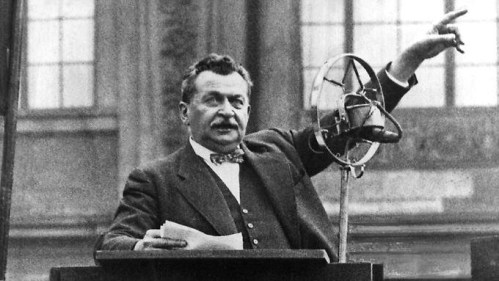
Otto Wels

Friends of Padre Steve’s World,

Today I am going to address something of critical importance today, even though it occurred over 87 years ago, which in the scope of history is not that long, despite the fact that the average American, regardless of their political beliefs and ideology are ignorant of past events, even those of just a few years ago. Thus, when one discusses events of 20, 40, 60, 80, or 100 years ago, one typically receives blank stares, or appeals to historical myths and fabrications that they learned in school, church, or from the media, both news and entertainment. As a historian it drives me crazy, our society, including our political, business, and media elites, has become a new generation of Know Nothings, of whom none other than the President and cult like followers supply some of the worst, but certainly not the only examples.

in 1932 the Communist Party of Germany KPD, refused to ally itself with the Social Democratic Party, SDP because they viewed the Socialists as sell-outs who refused to embrace a Soviet State in 1918 and 1919. At that time they called themselves Independent Socialists, but though a minority unleashed a left wing reign of terror that pushed German Conservatives further to the extreme right, and left the Social Democrats working with the German Army to try to hold the center. In the end, it was the extreme right that finally won a thirteen year struggle to overthrow the Weimar Republic, and after abortive coup attempts, including the Kapp Putsch in Berlin, which was crushed by a nationwide strike of labor groups, and the Nazi led Bier Hall Putsch, which was crushed due to the duplicity of Hitler’s coerced allies, and the refusal of Munich’s police to withdraw in the face of the Nazi advance at Odeonsplatz.

However, the Nazis learned from their failures at violent revolution, and instead, despite being outlawed for a number of years, worked within the democratic model to slowly gain regional, and eventually a national following. By 1932 the Nazi Party, as well as the KPD were at the height of their support. The traditional conservative German right was divided and its leaders thought they could control the Nazi movement. The left was divided between the moderate SPD and the militant KPD. An alliance of the two left parties in 1932 and 1933 would have created a parliamentary majority and stopped the Nazi movement in its tracks, but the KPD, which had split from the SPD in 1919 hated the SPD more than they did the Nazis, even though the Nazis were an existential threat to the German left. 

As a historian I think that this is one of the of the most relevant examples as the United States and other democratic nations lurch toward legally elected right wing authoritarian governments.

A few months after he gained power, Hitler’s Nazi majority Reichstag passed the Enabling Act, or by its full title Gesetz zur Behebung der Not von Volk und Reich (“Law to Remedy the Distress of People and Reich”). The came on the heels of the Reichstag Fire Decree and had tremendous repercussions for the German Republic and in effect made Hitler and his administration a dictatorship. The legislative branch, the Reichstag was limited to nothing more than a rubber stamp for the executive, as was the judicial branch, the Reichsrat. It supposedly protected the rights of the President, the Reichstag, and judiciary, but it made Hitler the the sole decider of domestic and social laws, as well as all foreign policy decisions.

The law stated:

The Reichstag has enacted the following law, which is hereby proclaimed with the assent of the Reichsrat, it having been established that the requirements for a constitutional amendment have been fulfilled:

Article One

In addition to the procedure prescribed by the constitution, laws of the Reich may also be enacted by the government of the Reich. This includes the laws referred to by Articles 85 Paragraph 2 and Article 87 of the constitution. (Article 85 and 87 dealt with the budgetary process and allocation of funds for advertisement.)

Article Two

Laws enacted by the government of the Reich may deviate from the constitution as long as they do not affect the institutions of the Reichstag and the Reichsrat. The rights of the President remain unaffected.

Article Three:

Laws enacted by the Reich government shall be issued by the Chancellor and announced in the Reich Gazette. They shall take effect on the day following the announcement, unless they prescribe a different date. Articles 68 to 77 of the Constitution do not apply to laws enacted by the Reich government. (These Articles dealt with the legislative process in which the Reichstag, Government, Reichsrat, and President all had specific responsibilities which limited the power of the government to rush laws into force without due process and deliberation, and if needed the approval of the electorate)

Article Four

Treaties of the Reich with foreign states, which relate to matters of Reich legislation, shall for the duration of the validity of these laws not require the consent of the legislative authorities. The Reich government shall enact the legislation necessary to implement these agreements. (This removed the requirement of the Reichstag to approve treaties)

Article Five

This law enters into force on the day of its proclamation. It expires on April 1, 1937; it expires furthermore if the present Reich government is replaced by another.

When the legislation was introduced the debate was muted. While the Communist Party was yet to be banned, deputies of the Communist Party could not attend the session, many had already been arrested and many more were in hiding or had fled the country. Hermann Goering adjusted the rules for a quorum in order to compensate for the lack of members in attendance. Deputies of the Social Democratic Party were also terrorized, hounded, and some arrested, but 94 attended, outnumbered they did not buckle under the Nazi threats, which included the chamber being ringed by armed members of the SA and SS.

The non-Nazi Protestant based conservative parties provided no resistance, but the Catholic Center Party was torn by concerns that the legislation could limit the rights of the Catholic Church. However, they had been outmaneuvered by Hitler who had already negotiated a Concordant with the Vatican. The result was to ensure that the Catholic Center Party would vote for the measure, which passed with a mere 94 deputies opposing it, all members of the Social Democratic Party.

The only member of the Reichstag to speak against the measure was the head of the Social Democrats, Otto Wels. In defiance of Hitler, Goering, the Nazi Deputies, and the threatening SA and SS men uttered words that every resistor in every country threatened by authoritarian leaders who despise the rule of law and the Constitutions that they used to gain power need to hear and proclaim, because the truth can never be silenced:

“You can take our lives and our freedom, but you cannot take our honour. We are defenseless but not honourless.”

Shortly after the Enabling Act, every non-Nazi Conservative party voluntarily dissolved, their organizations, youth, and veterans organizations being absorbed into the SA or Hitlerjugend. Many rank and file KPD members readily embraced the Nazis, even if their leaders were killed, jailed, or exiled. That was not the case with the SPD. Because of their stance and the courage of Otto Wels, they became the most hated and persecuted German political parties.

Otto Wels died as an exile in France. Many Social Democrats were placed in Concentration Camps and died, likewise some Communists. The Catholic Center Party would find itself betrayed, and many of its leaders would be killed, jailed, or placed in Concentration Camps, and Hitler would persecute opposition members of the Catholic Church as if no Concordat had ever been negotiated. A few members of the Protestant conservative parties, would join the German resistance, and some would be jailed, placed in Concentration Camps, or after the failed Military Coup of July 20th 1944, would be executed for their resistance, but they were a distinct minority, and few had any misgivings as long as it looked like Germany would win the war.

But eventually the Nazis would be driven from power. Their descendants today, whether in Germany, the United States, or other countries must be confronted at all costs. Democracy, and the American Constitutional Democracy, based on the principles of the Declaration of Independence, which recognizes that all men are created equal, and the Constitution of the United States which was the first to checks and balances between the Executive, Legislative, and Judicial branches of government, must be upheld. The Executive Branch, cannot, regardless of which party is in power be allowed to overthrow that democracy.

We have reached a point in the history of the United States where the Executive Branch, over a period of decades has assumed the powers of dictatorship as the Legislative branch over the corresponding time has surrendered its prerogatives and powers, while the judicial branch had become the domain of politically appointed judges and justices. Donald Trump and the GOP Senate Majority Leader, Mitch McConnell, have been the leaders of that, but should by some chance Bernie win, I have no doubt that some of his supporters secure his power by similar means. Yesterday, the President declared himself to be the Chief Law Enforcement Official in the country, in effect above all law. The Founders attempted to ensure that would not happen by placing Congress above the Executive Branch in the Constitution, but they assumed that no Chief Executive would do such a thing.

One does not know what will happen next, especially after the Senate acquitted the President in his impeachment trial, and the President’s subsequent retribution on those whose did not support him completely, or obeyed their oaths of office.

However, it is my opinion, that anyone who truly values the primary principles of the Declaration and the Constitution, and not just be a compliant tool of any political leader, must ne willing to take a stand; like the one Otto Wels made when confronted with a dictatorship in the making. Even if the President unleashes the power of the police and his own heavily armed supporters against opponents, we must remember like Otto Wels, they can “take our lives and freedom, but they cannot take our honor…”

This is something that anyone committed to the principles of the Declaration and Constitution must take seriously over the next eight and a half months leading to the next Presidential election. If we fail, the effects will be felt for at least a generation, and the institutions of our government will be transformed in ways that the founders could only imagine in their worst dreams.

Democrats and Never Trump conservatives must keep this in mind. Nothing is guaranteed right now, it is quite possible that Trump and his cult like supporters in Congress, before the election, or if he is re-elected, with their now majority in the courts could enact something like the Enabling Act if we are not careful. We must be careful to watch for the major terrorist attack, or war that could lead to the implementation of already legislated laws, such as the Patriot Act, or executive orders that give near dictatorial powers to the executive, and which would, if they occurred, be supported by a majority of Americans.

Historian Timothy Snyder wrote:

”The mistake is to assume that rulers who came to power through institutions cannot change or destroy those very institutions—even when that is exactly what they have announced that they will do.”

Trump has said he would do that and his supporters are committed to what he says, but until now most Americans have refused to believe him, and them. Sadly, most still don’t. After all, once one ceases to resist what more is there to do, just go to the Cabaret.

As Joel Gray, the Master of Ceremonies in the musical and film Cabartet sang:

Where are your troubles now?
Forgotten? I told you so!
We have no troubles here
Here, life is beautiful.
The girls are beautiful.
Even the orchestra is beautiful.

Yes, ignore everything and immerse yourself in our entertainment and sports culture, as if nothing else matters. What does freedom matter if you have no troubles?

So until tomorrow.

Peace,

Padre Steve+

2 Comments

Filed under ethics, film, germany, History, labor, laws and legislation, leadership, movies, nazi germany, News and current events, Political Commentary, racism, terrorism, US Presidents

Authoritarians and How Youth Like Sophie Scholl Will Save Us from Ourselves

Friends of Padre Steve’s World,

As President Trump continues to take revenge on his opponents and threaten others following his acquittal, making threats toward others, including at the Justice Department, State Department, and the Department of Defense, we cannot dismiss these actions as politics as usual. This has never happened in America, at least not until now.

In fact, no American President, has behaved in such a manner. One, Andrew Jackson successfully defied the Supreme Court, in order to remove the Cherokee Nation and put them on the Trail of Tears, James K. Polk who launched an illegal and immoral war against Mexico, an act that the future President Ulysses Grant, then a young Army Lieutenant decried:  “I was bitterly opposed to the measure, and to this day regard the war, which resulted, as one of the most unjust ever waged by a stronger against a weaker nation.”

Then there was James Buchanan who unsuccessfully attempted to overturn the law and Constitution during the Lecompton Constitution crisis, only to be stopped by the actions of Senator Stephen A. Douglas, John Tyler, at that point a former President joined the Confederacy, Andrew Johnson who pardoned hundreds of Confederate traitors, including war criminals, and worked against the the 14th Amendment, defied Congress, was impeached and acquitted by one bought vote. Likewise, Woodrow Wilson who led the great racist purge of the military and civil service in 1915, Richard Nixon whose crimes are too many too mention, and such that even a majority of his party led by Barry Goldwater told him to resign or be convicted in his impeachment trial, approached the authoritarianism, of Trump, and the treats of violence he and his supports make to opponents.  I could mention more, but you get the idea. We live in dangerous times and need to heed the words of British Historian and military theorist B. H. Liddell-Hart wrote about in his book Why Don’t we Learn From History: 

They soon begin to rid themselves of their chief helpers, “discovering” that those who brought about the new order have suddenly become traitors to it.

They suppress criticism on one pretext or another and punish anyone who mentions facts which, however true, are unfavourable to their policy.

They enlist religion on their side, if possible, or, if its leaders are not compliant, foster a new kind of religion subservient to their ends.

They spend public money lavishly on material works of a striking kind, in compensation for the freedom of spirit and thought of which they have robbed the public.

They manipulate the currency to make the economic position of the state appear better than it is in reality.

They ultimately make war on some other state as a means of diverting attention from internal conditions and allowing discontent to explode outward.

They use the rallying cry of patriotism as a means of riveting the chains of their personal authority more firmly on the people.

They expand the superstructure of the state while undermining its foundations by breeding sycophants at the expense of self-respecting collaborators, by appealing to the popular taste for the grandiose and sensational instead of true values, and by fostering a romantic instead of a realistic view, thus ensuring the ultimate collapse, under their successors if not themselves, of what they have created.

This political confidence trick, itself a familiar string of tricks, has been repeated all down the ages. Yet it rarely fails to take in a fresh generation.

But I digress, that was simply an introduction.

Seventy-seven years ago a young German woman was under the interrogation of the Munich Gestapo, before being tried and convicted of treason for distributing a series of anti-Nazi leaflets by the Nazi Volksgericht or “People’s Court” under the direction of the notorious Judge Roland Freisler who gained further infamy in his show trials of those suspected of participating in or supporting the July 20th Bomb Plot against Hitler.

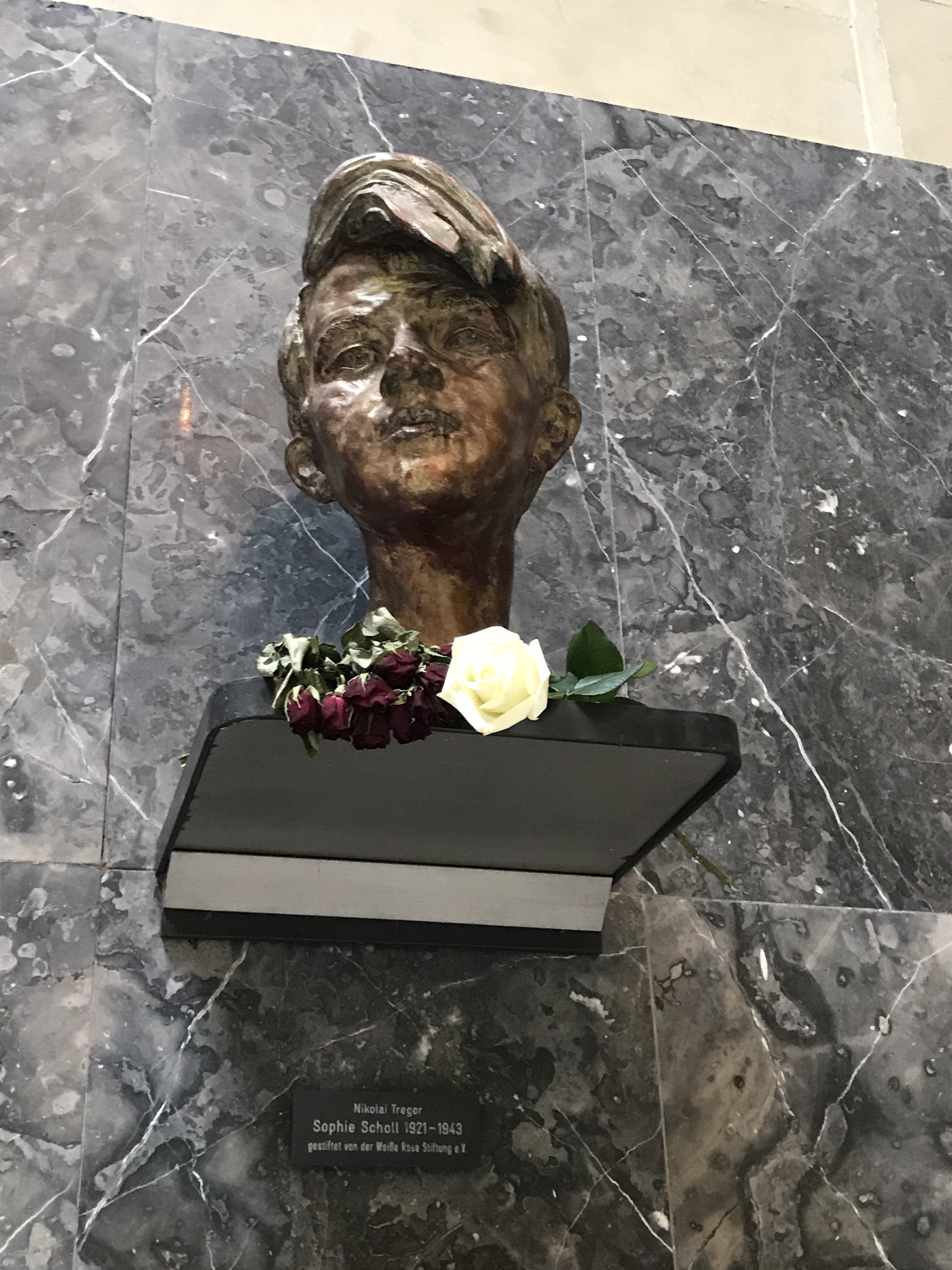
The woman was Sophie Scholl, a student at the University of Munich she was just 22 years old. Her story and the story of the resistance group that she was at the center of is remarkable for the moral clarity that she and her friends displayed in an era where most people were willing to look the other way, if not unreservedly served Hitler’s Third Reich.

She and those who like her resisited Hitler’s Third Reich at the height of its power are worthwhile examples for those who resisit President Trump here. Russia’s Putin, and so many other authoritarian leaders in Europe, Latin America, the Middle East, Africa and Asia. The precious truth is that Freedom must be defended from those who use patriotism as a prop, and racism as the raison d’etre of their political, social, and foreign policy of their regimes.


The story of Sophie and the White Rose is a remarkable story because stories like this are often buried by the propaganda machines of totalitarian regimes; but the shock of what these young people did was so great that the Nazi propaganda machine had to publicly confront it with the goal of instilling such fear that no one else’s would dare repeat it. What politicians, generals, and others could not do to shake the Nazi regime a handful of university students accomplished.

There are a number of monuments scattered around Munich to the White Rose movement, but the most remarkable is the monument in front of the university where they studied and where they distributed their leaflets.  Facsimiles of their publications and letters are part of the pavement, looking as if they have been dropped on the ground for someone to pick up.

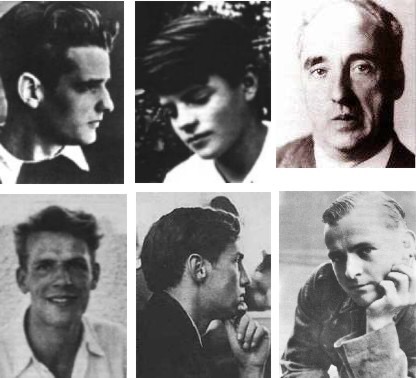
Scholl, as well as her friends were students, some who in the course of their time of study who had been drafted into the Wehrmacht as medics, serving on the Russian front before returning to the University. There were five of them, Sophie, Willi Graf, Alexander Schmorrel, Hans Scholl, and Christoph Probst, plus one of their professors, Professor Dr. Kurt Huber who began a resistance cell that focused on telling the truth about the crimes of the Nazi regime, and the lies of Hitler.

Telling the truth in a dictatorship is dangerous and although Sophie and her companions could have remained silent they had consciences that were guided by reason and human rights, as well as by their Christian faith, a faith which remained despite their aversion to the institutional church for its complicity with the Nazis. As she stood before Freisler and the Volksgericht she was recorded as saying:

“Somebody, after all, had to make a start. What we wrote and said is also believed by many others. They just don’t dare express themselves as we did.”

Too many people lacked the courage to speak as Sophie did in her day as all too many do today. It is far easier to take the path of least resistance. Laurence Rees in his history of Auschwitz wrote:

“…human behavior is fragile and unpredictable and often at the mercy of the situation. Every individual still, of course, has a choice as to how to behave, it’s just that for many people the situation is the key determinate in that choice.”

Sophie and her circle of friends in the White Rose chose how courageous people behave in such abominable conditions. They published a series of six leaflets which they printed themselves and distributed around the university, the city, and to like minded people in a number of other cities. They asked those who got them to make as many copies as they could and distribute them. They were in the process of drafting a seventh when Scholl was spotted distributing them at the university by a maintenance man who was a member of the Nazi Party. She and her friends were arrested on February 21st 1943 by the notorious Nazi People’s Court under the direction of Roland Freisler on the 22nd, and executed by beheading at Munich’s Stadelheim Prison on the 23rd.


The members of the White Rose were bold and defiant in the face of evil, of course those that have that kind of courage usually have short life expectancies in a totalitarian state, but they did not back down. Their pamphlets and graffiti criticizing Hitler garnered the attention of the Gestapo and when they were caught they were brutally tortured, but none backed down.

Their criticisms of Hitler and his Third Reich were hard hitting. Since all of the students had spent much of their childhood teenage years in Nazi organizations which were designed to make loyal little Nazis, their resistance came as a shock to many. All were children who could have easily due to their family background taken the easy road, but chose the more honorable and dangerous road.


Their pamphlets are striking, and each focused on a different part or aspect of the Nazi regime. In their first leaflet they wrote:

“Nothing is so unworthy of a civilized nation as allowing itself to be governed without opposition by an irresponsible clique that has yielded to base instinct.” They urged their readers “Therefore every individual, conscious of his responsibility as a member of Christian and Western civilization, must defend himself as best he can at this late hour, he must work against the scourges of mankind, against fascism and any similar system of totalitarianism.” And to “Offer passive resistance – resistance – wherever you may be, forestall the spread of this atheistic war machine before it is too late, before the last cities, like Cologne, have been reduced to rubble, and before the nation’s last young man has given his blood on some battlefield for the hubris of a sub-human. Do not forget that every people deserves the regime it is willing to endure!”

Such was their beginning, but they went on to attack the Nazi, leaders, the Nazi system, and especially the silence of their countrymen over the extermination of the Jews and Polish intellectuals. They asked in the second leaflet:

“Why do German people behave so apathetically in the face of all these abominable crimes, crimes so unworthy of the human race? Hardly anyone thinks about that. It is accepted as fact and put out of mind. The German people slumber on in their dull, stupid sleep and encourage these fascist criminals; they give them the opportunity to carry on their depredations; and of course they do so…. For through his apathetic behavior he gives these evil men the opportunity to act as they do; he tolerates this “government” which has taken upon itself such an infinitely great burden of guilt; indeed, he himself is to blame for the fact that it came about at all! Each man wants to be exonerated of a guilt of this kind, each one continues on his way with the most placid, the calmest conscience. But he cannot be exonerated; he is guilty, guilty, guilty!”

In each of the letters they asked their readers to offer some form of resistance to Hitler and the Nazi State but urged passive resistance, but in the third missive they went into more detail, including something that anyone who thinks that they are loyal to their country need to appreciate:

“The meaning and the goal of passive resistance is to topple National Socialism, and in this struggle we must not recoil from any course, any action, whatever its nature. At all points we must oppose National Socialism, wherever it is open to attack. We must soon bring this monster of a state to an end. A victory of fascist Germany in this war would have immeasurable, frightful consequences. The military victory over Bolshevism dare not become the primary concern of the Germans. The defeat of the Nazis must unconditionally be the first order of business… And now every convinced opponent of National Socialism must ask himself how he can fight against the present “state” in the most effective way, how he can strike it the most telling blows. Through passive resistance, without a doubt…”

Eventually their tracts became more biting, and in fourth the metaphysical linking Hitler to Satan and Anti-Christ.


They wrote:

“Every word that comes from Hitler’s mouth is a lie. When he says peace, he means war, and when he blasphemously uses the name of the Almighty, he means the power of evil, the fallen angel, Satan. His mouth is the foul-smelling maw of Hell, and his might is at bottom accursed…. I ask you, you as a Christian wrestling for the preservation of your greatest treasure, whether you hesitate, whether you incline toward intrigue, calculation, or procrastination in the hope that someone else will raise his arm in your defence? Has God not given you the strength, the will to fight? We must attack evil where it is strongest, and it is strongest in the power of Hitler.”

In the fifth leaflet they spoke of where the Nazi war effort would end and the responsibility of not only Hitler but the German people for it:

“It has become a mathematical certainty that Hitler is leading the German people into the abyss. Hitler cannot win the war; he can only prolong it. The guilt of Hitler and his minions goes beyond all measure. Retribution comes closer and closer. But what are the German people doing? They will not see and will not listen. Blindly they follow their seducers into ruin. Victory at any price! is inscribed on their banner. “I will fight to the last man,” says Hitler-but in the meantime the war has already been lost…. Do not believe that Germany’s welfare is linked to the victory of national Socialism for good or ill. A criminal regime cannot achieve a German victory. Separate yourselves in time from everything connected with National Socialism. In the aftermath a terrible but just judgment will be meted out to those who stayed in hiding, who were cowardly and hesitant.”

In the aftermath of the disaster at Stalingrad they published their sixth and last issue before being caught. In it they urged Germans to fight against the Nazi Party and regime, and confronted the way that since its inception Hitler and the Party corrupted the meaning of honor and freedom:

“Freedom and honor! For ten long years Hitler and his coadjutor have manhandled, squeezed, twisted, and debased these two splendid German words to the point of nausea, as only dilettantes can, casting the highest values of a nation before swine. They have sufficiently demonstrated in the ten years of destruction of all material and intellectual freedom, of all moral substance among the German people, what they understand by freedom and honor. The frightful bloodbath has opened the eyes of even the stupidest German – it is a slaughter which they arranged in the name of “freedom and honor of the German nation” throughout Europe, and which they daily start anew.”

Just over two weeks later they were caught and in Freisler’s People’s Court convicted and executed. During their trial, if it can be called that, Freisler and others expressed their shock that young Germans could commit treason. Sophie had no problem confronting her accusers:

Her last words before going to the guillotine were unapologetic: “How can we expect righteousness to prevail when there is hardly anyone willing to give himself up individually to a righteous cause? Such a fine, sunny day, and I have to go, but what does my death matter, if through us, thousands of people are awakened and stirred to action?” On the back of the order condemning her to death she wrote the word Freedom.


There are leaders in many nations today intent on destroying freedom and in many places the people and the country’d institutions fall in behind them, usually by painting pictures of threats so imminent that people willingly trade real freedom for a false security. It is a dangerous world and all of us must be alert to changes in society and question what comes out of the mouths of leaders, and even more so their true believer followers.

Sophie Scholl and her companions understood the risk, but they got their message heard at the highest level of government, and most were killed. But their example of courage and belief in freedom and human rights is still stronger that they mightiest despot, and unlike their mighty yet evil rulers, they are the ones that Germany remembers.

Last year I visited her grave in Munich’s Friedhof at Perlacher Forst, it is humble but gravesite, but it is obviously a place of remembrance and pilgrimage. When I go o Munich this year I will again make my pilgrimage to places where she and the White Rose used non-violent protest to speak truth about the Hitler regime when most of the population, knowing the truth did nothing to resist.

I think that there is a lesson for us as well, and I think that it is a lesson that many of our young people will understand that better than their elders, especially in the age of President Trump.  That my friends gives me hope for the future, young people like Sophie Scholl might be all that stands in the way of the destruction of our Republic.

Until tomorrow,

Peace,

Padre Steve+

4 Comments

Filed under authoritarian government, civil rights, crime, ethics, faith, film, History, laws and legislation, leadership, movies, nazi germany, News and current events, Political Commentary, racism, US Presidents, war crimes, White nationalism

Cabaret: the Perfect Film for Trump’s Changing America


Friends of Padre Steve’s World,

Last night I watched the 1972 musical film Cabaret. The film, based on the 1966 broadway musical could be a metaphor for the transformation of the United States under Trump.

The film and musical are set in 1931-32 Germany, the end of the Weimar Republic, the end of democracy, and the coming of the race based dictatorship of Adolf Hitler. Joel Gray, plays the very dark character of the Master of Ceremonies at the Kit Kat Club Cabaret, reprising the role he played in the original stage musical. Liza Minnelli plays the role of Sally Bowles, an American expat selling her soul as a cabaret singer in order to become a famous actress. She becomes a lover of Michael York who plays Brian Roberts, a PhD candidate from Cambridge working in Germany as part of his degree studies, as well as Helmut Griem who plays the wealthy conservative baron Maximilian von Heune. Eventually the relationship of the three dissolves under the clouds of homosexuality, bisexuality, dishonesty, lies, abortion, and Sally’s hedonistic lifestyle in which she sacrifices everything about herself to become a movie star.

Finally, Sally drives Brian away, and he returns to England, while she ends up alone chasing her dreams at the Kit Kat Club, even as the Weimar Republic dies and the Nazis come to power.

I guess the most frightening part of the movie as how the film shows how ordinary people went from opposing the Nazis to supporting them. The opening of the film shows a Nazi being thrown out of the club by a bouncer, who is then set upon and beaten to death by other Nazi SA thugs.

Gray, who plays the Master of Ceremonies, is a very dark character who bends with the political winds goes from mocking the Nazis to a willing stooge, Griem, who plays the conservative Baron, hopes that the Nazis and Communists will fight it out, and that the conservatives can then control the Nazis. In a subplot, Fritz Wepper, who plays Fritz Wendel, a Jew who has moved to Berlin and been passing himself off as a Protestant, falls in love with Natalia Landauer, played by Marisa Berensen, a wealthy  Jewish heiress, who does not know that he is a Jew. It is only when she tells him that their love cannot survive because she is Jewish and he isn’t, that he realizes the extent of the lie he has been living. He ends up admitting that he is Jewish and they get married just before the Nazis seize power. Since this is a fictional work, we can only presume that the Landauer money, extorted from them by the Nazis helped get them out of Germany, but with the specter of the Holocaust looming one cannot say for sure.

In one part of the film, Max takes Sally and Brian on a road trip. They end up stopping in a rural Biergarten where a young man begins what initial seems like a very innocent song, called Tomorrow Belongs to Me” which is taken up by almost everyone in the audience. While it was a song written by the Jewish writers of the play and film, John Kanzler and Fred Erb, and was never an actual Nazi song it has become a Neo-Nazi anthem.


The sun on the meadow is summery warm.
The stag in the forest runs free.
But gather together to greet the storm.
Tomorrow belongs to me.
The branch of the linden is leafy and
Green,
The Rhine gives its gold to the sea.
But somewhere a glory awaits unseen.
Tomorrow belongs to me.
Now Fatherland, Fatherland, show us the sign
Your children have waited to see
The morning will come
When the world is mine
Tomorrow belongs to me
Tomorrow belongs  to me
Tomorrow belongs to me

Meanwhile in Berlin the Kit Cat Club is adjusting to the rise of the Nazis. The Master of Ceremonies sings a song entitled If You Could See Her Through My Eyes in which he dances a waltz with what turns out to be a gorilla. The words and the song are haunting, as the audience, now more accepting of Nazi anti-Semitism laughs and cheers.

After returning to Berlin Sally and Brian are exposed to the pro-Nazi words and beliefs of their fellow boarding house residents. Brian argues against them but they have fully bought in to the propaganda put out by the Nazis.

I know what you’re thinking
You wonder why I chose her
Out of all the ladies in the world
That’s just a first impression
What good’s a first impression
If you knew her like I do,
It would change your point of view-
If you could see her
If you could see her thru my eyes,
Maybe they’d all understand…
Why don’t they leave us alone?
Ladies and Gentlemen, I ask you,
Is there a crime to fall in love?
Can one ever choose where our heats lead us?
All we as is ‘Ein bißchen Verständnis’, a little understanding!
Oh, I understand your objection,
I grant my problem’s not small;
But if you could see her thru my eyes,
She wouldn’t look Jewish at all!

After the break up with Brian, Sally return to the club and performs the song Cabaret. She has abandoned everything for the sake of her career. The song is a complete abandonment to the moment, and encourages the audience to ignore the reality of what is going on.

What good is sitting, alone in your room?
come hear the music play!
Life is a cabaret, old chum!
Come to the cabaret!
Put down the knitting, the book and the broom
It’s time for a holiday
Life is a cabaret, old chum!
Come to the cabaret!
Come taste the wine
Come hear the band
Come blow your horn
Start celebrating
Right this way your table´s waiting.
What good´s permitting some prophet of doom?
To wipe every smile away
Life is a cabaret , old chum!
So come to the cabaret!
I used to have this girlfriend known as Elsie
With whom I shared for sordid rooms in Chelsea
She wasn’t what you call a blushing flower
As a matter of fact she rented by the hour.
The day she died the neighbors
came to snick her
Well, that is what comes from
Too much pills and liquor.
But when I saw her laid out like a queen
She was the happiest corpse I´d ever seen
I think of Elsie till this very day
I remember how she´d turned to me and say,
What good is sitting all alone in your room?
Come hear the music play
Life is a cabaret, old chum!
Come to the cabaret!
And as for me
HA
And as for me
I made my mind up back in Chelsea
When I go………
I’m going like Elsie. 
Start by admitting
From cradle to tomb
It isn’t that long a stay
Life is a cabaret, old chum!
It´s only a cabaret, old chum!
And I love a cabaret!

But the words and visuals of then ending of the film are the most chilling. The Master of Ceremonies sings a song where the video shows the transformation of the audience. First the imagery shows no Nazis, then one, the a room full of Brownshirts as the MC signs:

Where are your troubles now?
Forgotten? I told you so!
We have no troubles here
Here, life is beautiful.
The girls are beautiful.
Even the orchestra is beautiful.

It reminds me of today, where in our entertainment culture we are encourage to ignore the reality that surrounds us. We are descending from a Republican form of representative democracy to an authoritarian dictatorship, and sadly most people would rather be bystanders waiting to see which way the wind will blow. Our media, entertainment, and yes even our insatiable need to fill our lives with the material wealth of the world, even if it means surrendering freedom.

Sophie Scholl, a young student at the University of Munich, and member of the White Rose resistance movement wrote:

“The real damage is done by those millions who want to ‘survive.’ The honest men who just want to be left in peace. Those who don’t want their little lives disturbed by anything bigger than themselves. Those with no sides and no causes. Those who won’t take measure of their own strength, for fear of antagonizing their own weakness. Those who don’t like to make waves—or enemies. Those for whom freedom, honour, truth, and principles are only literature. Those who live small, mate small, die small. It’s the reductionist approach to life: if you keep it small, you’ll keep it under control. If you don’t make any noise, the bogeyman won’t find you. But it’s all an illusion, because they die too, those people who roll up their spirits into tiny little balls so as to be safe. Safe?! From what? Life is always on the edge of death; narrow streets lead to the same place as wide avenues, and a little candle burns itself out just like a flaming torch does. I choose my own way to burn.”

I would rather be like Sophie than Sally, the Master of Ceremonies, or Max.

If you have never seen the film I encourage you to watch it, as we are in the midst of such a situation in our own country. History May not repeat itself, but it often rhymes.

So until tomorrow.

Peace,

Padre Steve+

1 Comment

Filed under civil rights, enteratinment, film, germany, History, movies, music, nazi germany, News and current events, Political Commentary, racism

“The Most Bold and Daring Act of the Age” Stephen Decatur, and the Defeat of the Barbary Pirates


“Our Country! In her intercourse with foreign nations may she always be in the right; but right or wrong, our country!” Stephen Decatur

Friends of Padre Steve’s World,

In 1803 the United States Navy was two years into its campaign against the Barbary Pirates who sailed from Algiers, Tunis, Tripoli and Morocco.  For years the United States like other nations had paid tribute to the rulers of these states for free passage of its ships and hefty ransoms to free the sailors that were enslaved following the capture of their ships.  By 1800 tens of millions of dollars had been paid and in that year the amount of tribute paid was 20% of the government’s total revenue.

In 1801 the Pasha of Tripoli Yusuf Karamanli demanded the payment of $225,000 tribute from the new President of the United States President Thomas Jefferson. In years past Jefferson had advised against payment of tribute believing that such payment only encouraged the Barbary States to continue their actions.  The anti-naval partisans and even his Republican allies had blocked his recommendations even though Secretary of State John Jay and President John Adams agreed with him. These partisans insisted that tribute be paid irregardless of the effect on European trade or the fate of American seamen because they believed that the Atlantic trade and involvement in the “Old World” detracted from the westward expansion by diverting money and energy away from the west.  When Jefferson refused the demand and put his beliefs into practice Karmanli declared war on the United States by cutting down the flag at the US Consulate in Tripoli.

Jefferson sent a small force to defend protect American ships and sailors and asked Congress to authorize him to do more as he did not believe that he had the Constitutional power to do more. Congress did not issue a declaration of war but authorized Jefferson to “employ such of the armed vessels of the United States as may be judged requisite… for protecting effectually the commerce and seamen thereof on the Atlantic Ocean, the Mediterranean and adjoining seas.”

Jefferson sent the best of the United States Navy to deal with the situation and US Navy ships soon began to take a toll on the pirate vessels.  The squadron was composed of ships that would become legend in the history of the Navy. Commanded by Commodore Richard Dale, Edward Preble, and later Commodore John Rogers, at various times the squadron included the USS Argus, Chesapeake, Constellation, Constitution, President, Congress, Enterprise, Intrepid, Essex, Philadelphia, John Adams and Syren.  The Constitution, Chesapeake, and Constellation, Congress and President were among the first six frigates authorized by Congress on March 27th 1794. Philadelphia a subscription Frigate paid for by citizens and merchants of Philadelphia, Essex a subscription Frigate pride for by the citizens of Salem and Essex County, Massachusetts, John Adams, a Subscription Frigate paid for by the citizens of Charleston, South Carolina, Argus a 20 gun Brig, Enterprise and Vixen 12 gun Schooners, Syren (later Siren) a 16 gun Brig, and Intrepid a captured Tripolitan Ketch, several smaller American built vessels, and about a dozen gunboats and mortar boats supplied by the Kingdom of Naples, which also provided the Americans with access to the ports of Messina, Palermo, and Syracuse, as well as supplies, and craftsmen to maintain the American Squadron.

Many of the officers who served in the Squadron, including William Bainbridge, Issac Hull, Charles Stewart, David Porter, would continue in service and make names for themselves in the war of 1812 and after.

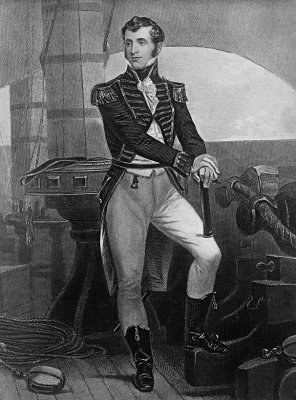
One of the young officers was the 24 year old Captain of the 12 Gun Schooner USS Enterprise Lieutenant Stephen Decatur the son of a Navy Captain who had entered the Naval service as a Midshipman in 1798 and who had risen rapidly through the ranks due to his abilities and leadership. He was among the few officers selected to remain in service following the end of the Quasi-War with France.  By the time that he took command of Enterprise Decatur had already served as the First Lieutenant of the Frigates USS Essex and USS New York.  After an altercation with British officer while wintering in Malta he was sent home to command the new Brig of War USS Argus. He was ordered to bring her to Europe where he handed over command to Lieutenant Isaac Hull who would achieve fame in the War of 1812 as Commanding Officer of the USS Constitution.  Decatur was given command of Enterprise on when he detached from the Argus.

On December 23rd 1803 while operating with the Constitution Decatur and the Enterprise captured the small Tripolian ketch Mastico which was sailing under Turkish colors.  The small ship was taken to Syracuse where Commodore Edward Preble condemned her as a prize of war, renamed her Intrepid and placed Decatur in command.

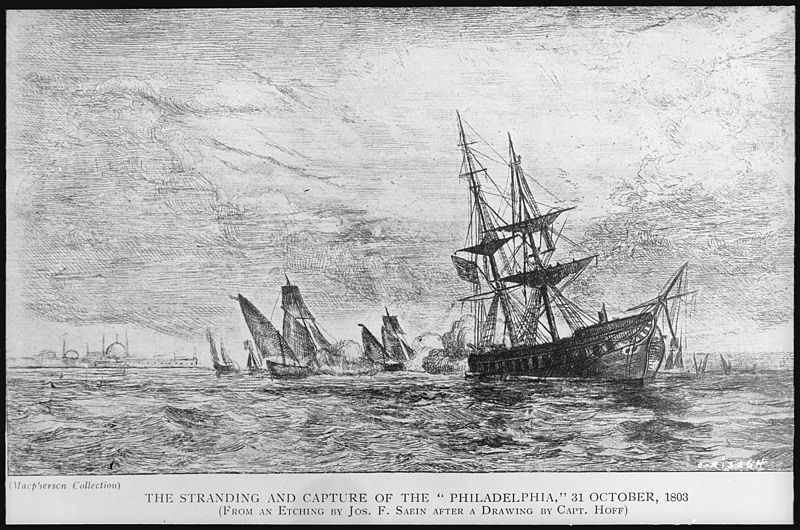
Normally such an event would be considered a demotion for an officer of Decatur’s caliber but events at Tripoli had forced Preble to make a bold strike at the heart of the enemy.  On October 31st 1803 the Frigate USS Philadelphia one of the most powerful ships in the squadron under the command of Captain William Bainbridge ran aground on an uncharted shoal and was captured.  Her crew was taken prisoner and the ship floated off by the Tripolians partially repaired and moored as a battery in the harbor until her foremast could be remounted having be cut away by Bainbridge in his  unsuccessful  attempt to float the ship off the shoal.

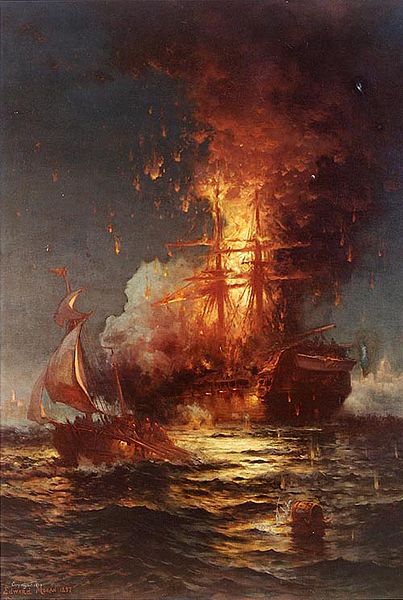
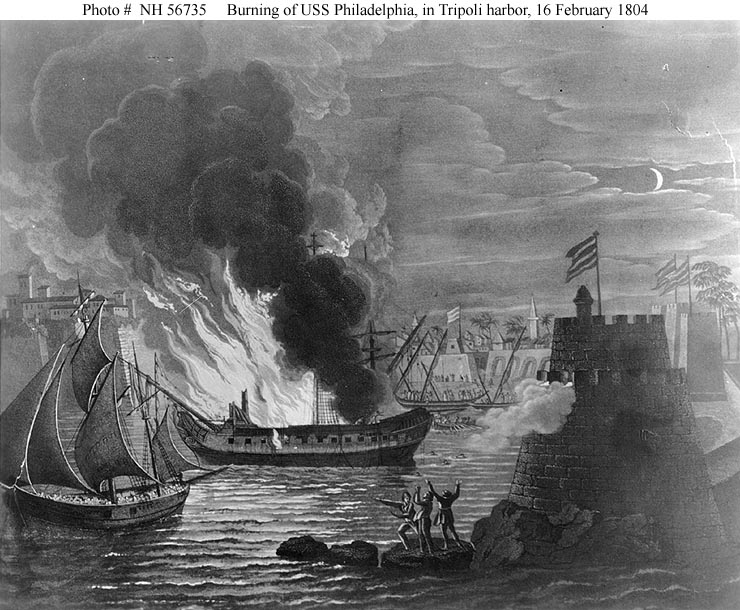
Burning the Philadelphia

The threat posed by such a powerful ship in the hands of the enemy was too great to ignore. Preble order Decatur to man the Intrepid with volunteers to destroy the Philadelphia at anchor.  Decatur took 80 men from the Enterprise and was joined by eight more volunteers  from USS Syren including Lieutenant Thomas McDonough who had recently served aboard Philadelphia and knew the ship well.

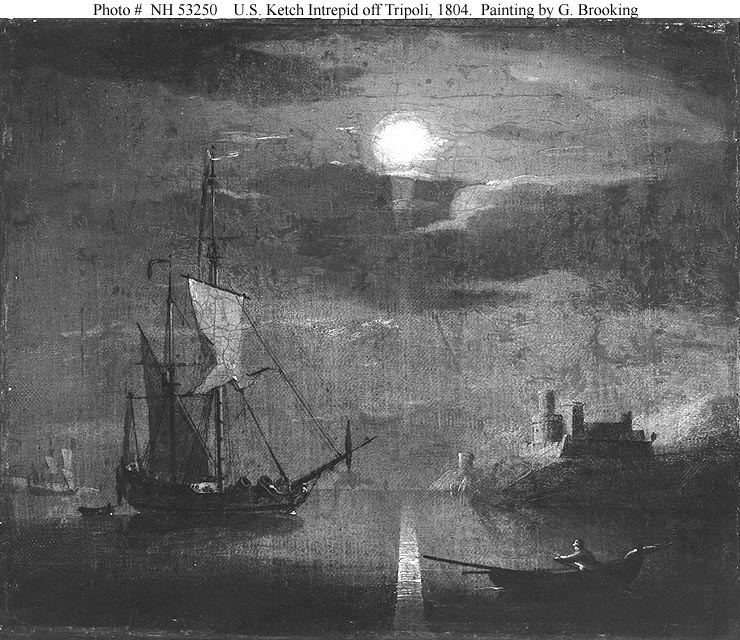
Under the cover of night of February 16th 1804 Decatur took the former Tripolian ship into the harbor beneath the dim light of the new moon.  Posing as a Tripolian ship he was able to slip past the guns of the forts overlooking the harbor using a Sicilian sailor who spoke Arabic to request permission. This was granted and Intrepid approached Philadelphia and when close enough ordered his crew to board the Frigate. After a brief skirmish with the small contingent of sailors aboard he took control of the vessel and set it ablaze. When he was sure that the fire could not be extinguished he ordered his men back aboard Intrepid and sailed out of the harbor under the fire of the shore batteries and gunboats.

Decatur sailed Intrepid back to Syracuse where he was greeted as a hero and became one of the Navy’s legends.  Pope Pius VII publicly proclaimed that “the United States, though in their infancy, had done more to humble the anti-Christian barbarians on the African coast, than all the European states had done for a long period of time.” Admiral Lord Horatio Nelson, one of the most heroic sailors that ever lived and no stranger to daring said that Decatur’s accomplishment was “the most bold and daring act of the Age.

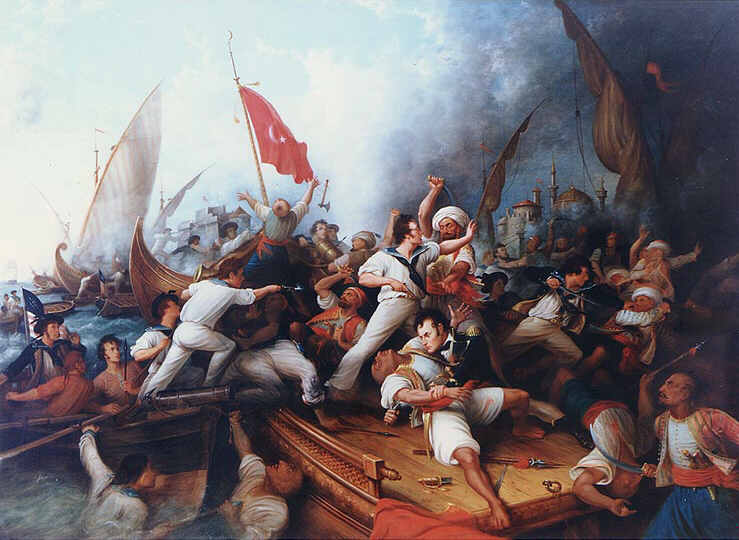
Decatur leading American Sailors in hand to hand combat against Barbary Pirates at Tripoli 1804 his younger brother Lieutenant James Decatur was killed aboard another gunboat in the action

Decatur would return to command the Enterprise and was given command of Constitution and was promoted to Captain bypassing the rank of Master Commander. He would prove himself again against the forces of Tripoli before departing for the United States. He distinguished himself  in the years to come against the Royal Navy in the War of 1812 where when in command of USS United States defeated and captured HMS Macedonian which would serve in the U.S. Navy and later in the Second Barbary War.

During that war, which began in 1815 Decatur’s squadron decisively defeated the Algerian fleet capturing the Frigate Mashouda and killing the highly successful and chivalrous commander of the Algerian raiding squadron Rais Hamidu.  The Pashas of Algiers, Tunis and Tripoli all made peace and reimbursed the Americans for the financial damage that they had done.  His victory ended the terror that the Barbary States had inflicted on Europeans for centuries and helped bring peace to the Mediterranean. Following that he became a Navy Commissioner in 1816 and moved to Washington, D.C.

Stephen Decatur more than any one man ended their reign of terror against the United States and the great European powers. The actions of Decatur, Preble, their officers, crews and ships in the Barbary Wars, and the War of 1812 established the United States as a credible nation, willing use its Navy to protect its citizens and commerce overseas, without becoming an occupying power. The latter would not occur for another eighty plus years during the Spanish American War, and continues to the present day.

Of course, that did not apply to our conquest of North America which involved countless small wars which exterminated vast numbers of American Indians, opened vast lands to the expansion of slavery, and the conquest of forty percent of Mexico. I am sure that Decatur, who so boldly proclaimed, My Country Right or Wrong, would not have approved of subjugating non-hostile weaker nations. He lived in a different time, when the United States was being threatened alternately by France, Britain, and the Barbary States at sea, and Britain and its American Indian allies as it expanded west.

Likewise, Decatur did not live a long life. He was killed in duel with Commodore James Barron on March 22nd 1820. Barron had never forgiven Decatur for voting for his conviction and removal from service after being humiliated when his ship, the Frigate Chesapeake, was caught unprepared for action, fired upon, and after twenty minutes surrendered, to HMS Leopard in 1807. Following her surrender several of her men were taken off as supposed deserters from the Royal Navy. Leopard’s commander then allowed Chesapeake to return to Norfolk where Barron was relieved of command and tried by a Naval Court which included John Rogers and Decatur.

Barron was convicted removed from the Navy for at least five years. Six years later he returned from a self imposed exile and petitioned for reinstatement. Decatur remained one of his fiercest opponents, and though reinstated was embittered toward Decatur. Their seconds arranged the duel to be conducted in such a way that one or both would die. During the negotiations between their seconds, Commodore William Bainbridge, and Captain Jesse Elliott, the two came close to reconciling but the seconds pushed for the duel. Decatur was mortally wounded and refused medical treatment, dying late that night. Barron, though horribly wounded, survived, eventually becoming commander of the Norfolk Naval Yard, becoming the senior Naval officer on active duty in 1839. He died in 1851 and is buried in the cemetery of Trinity Episcopal Church, in Portsmouth, VA.

The death of Decatur, a bonafide hero, at the hands of a fellow officer stunned Washington. President James Monroe, the members of the Supreme Court, most of Congress and 10,000 citizens attended his funeral. His pallbearers included four Commodores, and two other officers, followed by many other officers and other ranks. During the funeral, one sailor burst forth and cried out “He was the friend of the flag, the sailor’s friend; the navy has lost its mainmast.”

Decatur to help form the United States Navy, and among its early leaders, who included many valiant and brilliant men, he remains the foremost. While he achieved greatness, it was that night in Tripoli harbor where he was immortalized by the words of Lord Nelson as the man who led “the most bold and daring act of the age.” 

Until tomorrow,

Peace,

Padre Steve+

6 Comments

Filed under Foreign Policy, History, leadership, Military, US Navy

Look Who’s Back: A Film Far too Pertinent in Europe and the USA “At Their Core they are Just Like Me” The Trump and Hitler Cults

Friends of Padre Steve’s World,

A bit earlier we watched, and I re-watched the German film Look Who’s Back (Er ist Wieder Da) which is about Hitler rising from his bunker in 2014. It is a very dark comedy where the actors mingle with regular people, and the actor playing Hitler mingles with them, but no-one really believes that he is really Hitler, but many are willing to make public support of Hitler’s policies. Finally, the amateur filmmaker who discovered Hitler realizes that the man he thought was an actor is really Hitler, and the following conversation ensues:

Hitler: I was wondering when you would show up.

Sawatski: It’s you. You’re him.

Hitler: I never claimed to be anything else. History repeats itself. I guess it’s my fate to have to part with my dearest companions.

Sawatski: That way. Yes, history repeats itself. You’re fooling people with your propaganda.

Hitler: Oh, Sawatski. You don’t understand. In 1933, people were not fooled by propaganda. They elected a leader, one who openly disclosed his plans with great clarity. The Germans elected me.[At gunpoint, Hitler takes the elevator to the top of the building and walks out on the rooftop, standing close to the edge.]

Sawatski: You’re a monster.

Hitler: Am I? Then you have to condemn those who elected this monster. Were they all monsters? No. They were ordinary people, who chose to elect an extraordinary man, and entrust the fate of the country to him. What do you want to do, Sawatski? Ban elections?

Sawatski: No. But I’m going to stop you.

Hitler: Have you never asked yourself… why people follow me? Because at their core, they are just like me. They have the same values. And that’s why you won’t shoot.

[Sawatski shoots, and Hitler falls backward off the rooftop. Sawatski looks over the edge and sees no body.]

Hitler: You can’t get rid of me. I’m a part of you. A part of all of you. And look; it wasn’t all bad.

The film should be required viewing, not just in Germany but in Trump’s America.

Being an ideologue of any kind is easy, you adopt an ideology and then use it to interpret the world. That is why there are so many of them of so many different varieties: right wing, left wing, religious and so many more. In fact if you take a look at the most strident supporters of any ideology, politician, or religious leader you can see that they are little different from one another. But in terms of the ideologies they espouse the most enduring of them, and the only to have ever been the foundation of state power or those dealing with economics such as the Soviet Union; or race such as Nazi Germany or the American Southern Confederacy. Hannah Arendt wrote:

“For an ideology differs from a simple opinion in that it claims to possess either the key to history, or the solution for all the “riddles of the universe,” or the intimate knowledge of the hidden universal laws which are supposed to rule nature and man. Few ideologies have won enough prominence to survive the hard competitive struggle of persuasion, and only two have come out on top and essentially defeated all others: the ideology which interprets history as an economic struggle of classes, and the other that interprets history as a natural fight of races. The appeal of both to large masses was so strong that they were able to enlist state support and establish themselves as official national doctrines. But far beyond the boundaries within which race-thinking and class-thinking have developed into obligatory patterns of thought, free public opinion has adopted them to such an extent that not only intellectuals but great masses of people will no longer accept a presentation of past or present facts that is not in agreement with either of these views.” 

The fact is that there is a difference between people who lean a certain way politically or religiously, and the people Eric Hoffer called, the “true believers,” the people who chose a side and never wrestle with the hard choices of life. They simply declare all who oppose their ideology or theology to be unworthy of life. If one is honest one has to admit that all kinds of ideologues of various persuasions, right wing, left wing, religious, atheistic, or racist have committed crimes which are incomprehensible and abhorrent. History shows that this is truth, but then when a regime decides to censor the past, as the Trump Administration is currently doing, and many other regimes have done, all bets are off. Likewise, when a government decides to admit to what its predecessors have done, as has Germany has done with World War II and the Holocaust, there will always be people who wish for a fictional better time, and either deny the truth, or seek to bring back the horrors of the past.

I am a liberal and a progressive, but I often find left-wing ideologues to be as off putting as militant right wingers. I guess that is because despite everything I am a realist. I wake up every day to try to do the hard thing of deciding what is right and what to believe.

My favorite television character, Raymond Reddington, played by James Spader in The Blacklist once said “I know so many zealots, men and women, who chose a side, an ideology by which to interpret the world. But, to get up every single day and to do the hard work of deciding what to believe. What’s right, today? When to stand up or stand down. That’s courage.” The fact is, no matter how stridently they espouse their beliefs, ideologues are by definition not courageous, because courage takes critical thinking, something that ideologues of any persuasion are incapable of doing. I see examples of this every day, especially in my Twitter feed and on Facebook.

While I’m sure that many, if not most of these people are good and well meaning people, they seldom display any originality of thought or true character. A while back I had one left wing Twitter follower attack repeatedly me because to her I was supposedly a sellout. I have had right wing religious friends and followers on social media do the same, as well as making actual death threats.

While they attack me and each other from different ends of the political spectrum, the intellectual commonality they share is the fact that they are ideologues and zealots; and while they espouse different beliefs they are almost indistinguishable from each other in their inability to think critically and that wears me out, but I refuse to stand down.

I guess that is one of the things that bothers me the most about so much of what I see going on in the United States today. Too many ideologues, not enough critical thinkers. Too many people who value absolute consistently of thought without asking if what they preach is still true today, or if it might be tomorrow, and far too many more who are unwilling to by more than apathetic bystanders waiting to see which way the wind blows before deciding on a position.

Of course there are also the people who would be the victims of ideologues of any type, and the ideologues will be the perpetrators. At this time, after the Senate voted to acquit Trump, the President has mounted a campaign of revenge against his opponents. My money is on the Trump ideologues to take the first shot.

From the beginning of his campaign he never hid what he believed or who or what he is. In the process he has built a cult following around himself, taken over the Republican Party, used all media, but especially that of the Right Wing media to propagate his hateful ideology. He has bulldozed the Constitution, the law, and the institutional guardrails that protected our Republic for over two centuries; and must of his cult like supporters, just like Hitler’s won’t abandon him, but will become more violent in their actions toward his opponents. Likewise, he will use the organs of the State to implement his policies, as he is doing with the Border Patrol, INS, and every other part of the executive branch that his Cult controls. Against this I don’t think that left wing ideologues, who often are a mirror image of their right wing cousins have a chance; but men and women of conscience must make a stand.

One thing that I have learned over the past decade or so is that I have to ask what is right today, and make a choice of when to stand up, or to stand down. Sometimes, I don’t like those choices, but I make them. As Sophie Scholl said:

“The real damage is done by those millions who want to ‘survive.’ The honest men who just want to be left in peace. Those who don’t want their little lives disturbed by anything bigger than themselves. Those with no sides and no causes. Those who won’t take measure of their own strength, for fear of antagonizing their own weakness. Those who don’t like to make waves—or enemies. Those for whom freedom, honour, truth, and principles are only literature. Those who live small, mate small, die small. It’s the reductionist approach to life: if you keep it small, you’ll keep it under control. If you don’t make any noise, the bogeyman won’t find you. But it’s all an illusion, because they die too, those people who roll up their spirits into tiny little balls so as to be safe. Safe?! From what? Life is always on the edge of death; narrow streets lead to the same place as wide avenues, and a little candle burns itself out just like a flaming torch does. I choose my own way to burn.”

I guess that is why I like reading about the lives of complicated and often conflicted people; men like T.E. Lawrence, William Tecumseh Sherman, Henning Von Tresckow, Ludwig Beck, and the fictional Raymond Reddington so fascinating. I find much to admire and to criticize in all of them even as I empathize and understand each one of them. Interestingly, each of my heroes all have feet of clay. As Reddington said, “We become who we are. We can’t judge a book by its cover… But you can by its first few chapters, and most certainly by its last.” 

But in such a perilous time, how can we not see what Trump has openly proclaimed he would do when he became a presidential candidate, and since his election. However, we cannot blame it all on Trump. He was clear in what he would do as President, and as the fictional Hitler asked “Have you never asked yourself… why people follow me? Because at their core, they are just like me. They have the same values.” 

Have a great day, until tomorrow.

Peace,

Padre Steve+

4 Comments

Filed under ethics, film, germany, History, leadership, movies, nazi germany, News and current events, Political Commentary

Otherwise Good People Who Serve Evil Regimes: The Case of Friedrich Kritzinger and Trump’s Defense Team

Friends of Padre Steve’s World,

In the post impeachment era of President Trump I find myself asking hard questions about those in the Justice Department, the White House Counsel’s Office, lawyers hired to defend the President, as well as Senators and Congressmen trained in law who did all they could, successfully, I might add to ensure that the President was acquitted in his impeachment trial. Since I was a loyal Republican from 1976 to 2008, I grew up admiring or agreeing with these men much of my adult life, but that was before, I had my epiphany about where the GOP was going, and they sold their souls to Trump and became full-fledged members of the Trump Cult.

I still wonder how they got to this point, often arguing against the arguments they used in the impeachment trial of former President Bill Clinton, and the arguments used by Republicans to convince Richard Nixon that he should resign his office because they could not support him in an impeachment trial. Mind you, back in 1998 I wanted to see Bill Clinton impeached, convicted, and removed from office, but honestly that was more out of Party loyalty, and a personal conviction that lying under oath was a criminal offense, even if it involved, a reprehensible, but rather common action of powerful men. But, it did not involve collaboration with an enemy power to rig an election and compromise the electoral system of the United States and the integrity of the Presidential Office itself.

Since the GOP Senate acquitted the President, he has began a campaign of revenge to punish those who stood by their oaths and testified to the truth, or like GOP Senator Mitt Romney, the only Republican Senator who knowing the facts, voted to convict the President. The witness of men who at one time purported to be virtuous defenders of the law and Constitution in defending a lawbreaking President, defaming those who stood by their oath, and launching a campaign to punish those who testified against the President, including combat wounded military officers, while attempting to lighten the sentence of, or pardon convicted lawbreakers like Roger Stone, and convicted war criminals. One has to wonder what passes for justice for the President and his supporters.

Saint Augustine wrote: “Justice being taken away, then, what are kingdoms but great robberies.”

I saw that quote in relation both the servants of the Trump administration and Cult, as well as to Friedrich Kritzinger, a lawyer, and Prussian civil servant who served as State Secretary for the Reich Chancellery during the Third Reich and was a participant at the Wannsee conference. The authors of that article noted something that should serve as a reminder to us: “by working as a lawyer for a regime, which he had known from the start to be criminal, he made himself a stooge.” (Stefan Paul-Jacobs and Lore Kleiber in The Participants: the Men of the Wannsee Conference edited by Hans-Christian Jasch and Christoph Kreutzmüller, p.217)

Kritzinger was not what I would call an evil man. He was a traditional German conservative and Nationalist who agreed with many Nazi policies, albeit not to their extremes. But he also had strong moral and religious convictions that caused him to question and at times attempt to mitigate those policies. He was a member of the Confessing Church which condemned the Nazified faith of Reichsbishof Müller and the German Christian movement, but even many of them were receptive to the nationalism and anti-Communist stances of the Nazis. Otto Dibelius, the General Superintendent of the Confessional Lutherans was a hard line conservative and in 1933 at a service for the new Reichstag: “We have learned from Martin Luther that the Church cannot get in the way of State power when it does what it is called to do. Not even when [the state] becomes hard and ruthless…. When the state carries out its office against those who destroy the foundations of state order, above all against those who destroy honor with vituperative and cruel words that scorn faith and vilify death for the Fatherland, then [the state] is ruling in God’s name!” (Richard Seigman-Gall, the Holy Reich: Nazi Conceptions of Christianity 1933-1945 p.68)

Kritzinger himself did not join the Party until 1938 when he was recruited by Hans Lammers to fill a vacancy in the Reich Chancellery for which Party membership was required. Kritzinger was concerned. He only accepted the job and membership in the when assured that he did not have to be politically active and did not have to hire ardent Nazis for jobs in the Chancellery.

At Wannsee he was the only participant who demonstrated any sense of concern about the Final Solution of the Jewish Problem. After the conference he headed the only agency not to sign off on Reinhard Heydrich’s policies against the Jews. According to some he worked inside the system to try to mitigate the worst aspects of Hitler’s policy decisions. He felt shame for what the regime did. That being said “from 1933 on, Kritzinger held positions of responsibility and colluded in disgusting breeches of law and maintaining the illusion that the Nazi dictatorship was a constitutional state.”

The fact is that the Nazi regime believed that it was a functioning constitutional state and attempted to preserve the illusion of legality and the rule of law. Men like Kritzinger helped them to do just that. In his positions, first at the Ministry of Justice and then at the Reich Chancellery, “was held in high esteem… not as an ideological acolyte of the new leader but as an expert on law. Responsible for matters of state law, he was directly complicit in Nazi atrocities.” This included his legal justification for the Night of the Long Knives.

At the Reich Chancellery Kritzinger made sure that the administrative apparatuses the State functioned smoothly. “The facade of legality helped ensure that the Nazi regime and its crimes were accepted even by its detractors, and their participation in the system thereby facilitated.”

After Wannsee, when Kritzinger began to fully grasp what was happening in regard to the Jews he attempted to resign but his resignation was refused. His boss, Hans Lammers refused and rejected his dismissal with the remark that without Kritzinger things would run even worse. In fact, men like Kritzinger were often able to delay or hinder decisions by not passing along memos as they saw fit. Conversely they could speed decisions by ensure that information reached Hitler.

When questioned after the war Kritzinger stated:

My consultations with Hitler were of course tailored to his mentally. It goes without saying that it would have been insane to say that such and such a decision would adversely affect Jews. One had to phrase it differently, and say that it would trigger serious public unrest. Obviously we could not say anything to Hitler he did not want to hear. Especially when it came to those decisions.

I wonder how many people in the American government and in the upper echelons of the Trump administration justify and equivocate their participation in it just as Kritzinger and others like him did his under the Nazis.

Until tomorrow,

Peace,

Padre Steve+

Leave a comment

Filed under crime, ethics, faith, History, holocaust, laws and legislation, leadership, nazi germany, News and current events, Political Commentary

When the President Calls Military Officers Traitors: Trump, LTC Vindman, and the Testimony of Colonel Johannes Steinhoff

Friends of Padre Steve’s World,

Yesterday, the Commander in Chief, after removing Lieutenant Colonel Alexander Vindman from his post in the National Security Council, and having him escorted out of the White House, something designed to humiliate the combat wounded officer, made an announcement that Vindman should be prosecuted by the military for obeying his oath of office, also known as not giving absolute personal loyalty to the President. The action by the President is unprecedented in American history. It is the act of an man unleashed from the law, the the Constitution, and the institutional guardrails placed by the Founders to prevent an authoritarian regime from taking control of the country.

I have written a lot about the dehumanization of people and genocide, and some of the things that create a climate where such events take place, and how political and religious leaders stir the primal passions of otherwise good, decent and law abiding citizens. I have written about some of my favorite resistance figures in history. But that being said writing about the anti-Nazi resistors caused me to go back are re-read a book by World War II German Luftwaffe ace Johannes Steinhoff.

Steinhoff was unlike many of the German officers who wrote memoirs following the war, memoirs that historian Williamson Murray wrote “fell generally into two categories; generals writing in the genre of “if the fuhrer had only listened to me!” and fighter pilots or tank busters writing about their heroics against the productive flood from America or the primitively masses of the Soviet Union.”

Steinhoff’s book, The Final Hours: The Luftwaffe Plot Against Goering should be essential reading for any currently serving officer, diplomat, Federal law enforcement, intelligence, or Department of Justice official  as the Trump administration becomes more established and capricious.

steinhoff6

General Johannes Steinhof (above) as a Bundeswehr and NATO officer, showing his burns and before his crash (below)

steinhoff WW II

In his books, Steinhoff does something that you do not see authors do in most military or political memoirs, he actually does serious self reflection on his role in supporting an evil regime. In his introduction to his book The Final Hours the legendary fighter ace who was horribly disfigured when his Me-262 jet fighter crashed and burned two weeks prior to the end of the war wrote:

“In recalling these events, which had been long buried in my memory, it has not been my intention to make excuses. Our unconditional self-sacrifice in the service of the Third Reich is too well documented for that….

So it is because of what is happening today—with freedom threatened in virtually every respect by its own abuse—that I offer this contribution, in the form of an episode in which I was myself involved, to the history of the soldier in the twentieth century. Soldiers have always, in every century of their existence, been victims of the ruthless misuse of power; indeed, given the opportunity, they have joined in the power game themselves. But it fell to our own century to accomplish, with the aid of a whole technology of mass extermination, the most atrocious massacres in the history of mankind. This fact alone makes pacifism a philosophy worthy of respect, and I have a great deal of sympathy with those who profess it. 

The figure of the soldier in all his manifestations is thus symptomatic of the century now nearing its close, and it is to the history of that figure that I wish to contribute by describing what happened to me. I have tried to show what it is possible to do to men, how insidiously they can be manipulated by education, how they can be hoisted onto a pedestal as “heroes,” how they can be so corrupted as even to enjoy the experience—and how they can be dropped and denounced as mutineers when they discover that they have scruples. The complete lack of scruples that such treatment implies is peculiar to rulers who believe that the problems of their own and other peoples can be solved by imposing, through the use of military force, peace on their, the rulers’, terms—in our case a pax germanica, but the second Latin word is readily interchangeable.” from “The Final Hours: The Luftwaffe Plot Against Goring (Aviation Classics)” by Johannes Steinhoff

Since I am a historian and and a career military officer with service in the Iraq War, a war that was illegal and unjust by all measure I can understand Steinhof’s words. Because much of my undergraduate and graduate work focused on German history, particularly that of Imperial Germany after the unification, the Weimar Republic, and the Nazi Reich, I draw a lot of lessons from the period. I also understand how people in this country can fall for the same kind of vitriolic propaganda that the Germans of that era did. I can understand because for years I fell for the lies and propaganda being put out by the politicians, pundits and preachers of the American political right.

In fact I wrote about an incident that happened to me in my own chapel where a dedicated Trump supporter attempted to have me charged with Conduct Unbecoming an Officer and Contempt for the President.  He did this because I used biblical preaching backed by sound theology and history to condemn the President’s comparison of immigrants of darker skin colors as “animals” and an “infestation.” I compared those words with the way Hitler and other totalitarian leaders used such terminology to dehumanize their victims. As I mentioned I was completely cleared by the preliminary inquiry but it sends a chill through my spine.

10665323_10154041610267059_5277331492232210946_n

A picture of me (on left) in Iraq 2007 with my assistant and bodyguard RP1 Nelson Lebron

One of those lessons is that in times of crisis, that people, no matter what their race, culture, religious belief system, educational, or economic background are still human. Humanity is the one constant in all of history, our prejudices are often ingrained in us during childhood and reinforced by the words of politicians, pundits, and preachers. In times of stress, crisis, and societal change or upheaval even good people, moral people, people of great intellectual, scientific abilities can fall prey to demagogues who preach hate and blame others, usually racial, ethnic, or religious minorities, as well as civil libertarians who champion the rights of those minorities for the problems of the nation.

Shrewd politicians, preachers, and pundits do this well. They demonize the target group or population and then let the hatred of their disaffected followers flow. The leaders need that disaffected and angry base in order to rise to power; such was how Hitler, Stalin, and so many other despots gained power. They took advantage of a climate of fear, and found others to blame. For Hitler it was the Jews, Slavs, Socialists and Communists; while for Stalin it was various groups like the Ukrainians, or the Poles who were the devil to be feared and destroyed. Timothy Snyder in his book Bloodlands: Europe Between Hitler and Stalin wrote:

“Dead human beings provided retrospective arguments for the rectitude of policy. Hitler and Stalin thus shared a certain politics of tyranny: they brought about catastrophes, blamed the enemy of their choice, and then used the death of millions to make the case that their policies were necessary or desirable. Each of them had a transformative utopia, a group to be blamed when its realization proved impossible, and then a policy of mass murder that could be proclaimed as a kind of ersatz victory.”

But that being said, there are a lot of people who from childhood believe the lies about others without question. In good times such people continue on with life as normal, but in crisis those hatreds and prejudices come to the fore. Rudolf Höss, the notorious sociopath who commanded Auschwitz told American Army psychologist Gustave Gilbert about his reaction when ordered to turn the camp into an extermination center. He said that the order “fitted in with all that had been preached to me for years,” and “at the same time I didn’t think of it as propaganda, but as something one just had to believe.” 

Eugene Davidson in his book on the Nuremberg Trials wrote:

“Every society has in it at all times negative, criminal, sadistic, asocial forces. What holds them in check more than law and police is the consensus of the society – a general belief that despite everything wrong and stupid and muddleheaded in politics, the state is a going concern that will somehow make its way into the future.” (Davidson, The Trial of the Germans p.581)

But when things do not go well, when people do not feel that things will be okay, that the future will be better, and that they have a purpose they look for answers. However, they tend to find their answers in the rantings of demagogues, race baiters, conspiracy theorists, and others who they would tend to dismiss out of hand in good times. In Germany it was the loss of the First World War, the humiliation of Versailles and the economic chaos and social change of the Weimar period which allowed Hitler to gain an audience, then a following, then political power. The demagogues played to what was already in the hearts and minds of the disaffected masses, without that fertile soil, the rantings of Hitler and his propagandists would have never succeeded. Albert Speer wrote:

“As I see it today, Hitler and Goebbels were in fact molded by the mob itself, guided by its yearnings and its daydreams. Of course, Goebbels and Hitler knew how to penetrate through to the instincts of their audiences; but in the deeper sense they derived their whole existence from these audiences. Certainly the masses roared to the beat set by Hitler’s and Goebbels’ baton; yet they were not the true conductors. The mob determined the theme. To compensate for misery, insecurity, unemployment, and hopelessness, this anonymous assemblage wallowed for hours at a time in obsessions, savagery and license. The personal unhappiness caused by the breakdown of the economy was replaced by a frenzy that demanded victims. By lashing out at their opponents and vilifying the Jews, they gave expression and direction to fierce primal passions.”

In a sense a similar thing has happened in the United States which has experienced a series of wars beginning with Vietnam, the shock of the 9-11-2001 attacks, the economic crash of 2007 and 2008 which devastated the savings, home ownership, and investments of many Americans while at the same time benefiting the banking and brokerage houses whose government assisted policies brought about the crash. Of course there are other issues, many religious conservatives hate the progress made by the Women’s and Gay Rights movements, and their leaders play to their fears in apocalyptic terms. I could go on, but I am sure that my readers can identify other issues which demagogues and others use to spread fear and hate to further their goals. The fact is that without the the fertile soil that lays in the hearts of their most fervent followers they would never have a following.

In Weimar Germany hate mongers like Julius Streicher and propagandist Josef Goebbels stuck a chord with disenchanted people who felt that they had lost their country. They were fearful, angry, and desired a leader who would “make Germany great again.” Hitler and his Nazi media sycophants played to that fear, and took advantage of their anger at the existing order. Davidson wrote such people “exist everywhere and in a sick society they can flourish.” 

For decades the way has been prepared for true extremists to take advantage of the fears and doubts of people as modern American versions of Streicher and Goebbels have been at work for years. Rush Limbaugh was a modern pioneer of this in the United States, and he has been joined by so many who are even more extreme in their rantings that it is hard to name them all. Likewise, whole media corporations especially Fox News, websites, and political networks spread such fear every minute of the day, claiming that they, and they alone are real Americans. They actively support politicians who condemn, and sometimes even threaten people who oppose them, and all the while claim that “make America great again.”

When I was younger I devoured that propaganda, despite all of my learning I followed the rantings of men who I realize today are propagandists who promote the basest of lies, and hatred, often in the name of God. I was changed when I was at war, and when I returned home from Iraq in 2008 I realized through hard experience that I had been lied to, and that as a result that thousands of my brothers and sisters were dead, and tens of thousands shattered in body, mind, and spirit. Likewise I saw the massive destruction levied on Iraq and realized how terrible war really is. That was my epiphany, that is what it took to see how much I had been lied to, and it called me to question everything else that I had so willingly believed, things which had been fed to me by years of indoctrination in church, through the media, and by politicians who I believed were truly Christian. I can understand now how Martin Niemoller felt after the Nazi seizure of power when he said, “I hated the growing atheistic movement, which was fostered and promoted by the Social Democrats and the Communists. Their hostility toward the Church made me pin my hopes on Hitler for a while. I am paying for that mistake now; and not me alone, but thousands of other persons like me.”

There was a time that I hated people who espouse the views that I hold today, the views that I write about so often here on this site. I can remember how angry I would get as I listened to the propaganda being put out by Limbaugh, Hannity, the Fox News Channel and all of the others that I listened to every time that I had the chance. But when I changed after Iraq, I felt the sting of that hatred in very real ways. I remember the day I was called by my bishop in my former church, who told me that I had to leave because my views on women, gays, and Moslems were to use his words were now “too liberal.” After that, many men who I considered to be the best of friends turned their backs on me, some in the most bitter and vindictive of ways.

But I realize now that what they did was because I had in a sense left the cult, and had to be ostracized. I can understand that now, because when I was under the spell I too turned my back on people who had fallen out of favor, or people who had rejected the tenants of the church or the political movement, and those are things that I can never undo. But at the time it made sense, it fitted in with all I had been taught for decades, as Albert Speer wrote of Hitler, “One seldom recognizes the devil when he is putting his hand on your shoulder.”

What happened to Steinhoff’s generation is threatening to happen again, in our country, an authoritarian movement is threatening to destroy our democracy and republic. In it soldiers are esteemed, until they realize what is going on and speak out, but by then it is usually too late. I am understanding that fact more and more every day, and having had people troll this blog and call me a traitor and worse, I understand just a bit of what happened to Steinhoff and his fellow officers when they protested to the highest levels what was happening to Germany in early 1945.

In 1944 he and other fighter pilots were subjected to a political indoctrination session and realized that in the Nazi state loyalty and doctrinal purity to Naziism was more important than either combat service or competence. He wrote:

“Now, however, we realized to our horror that a group of officers had decided, after five years of war, to conduct a purge among the troops with the object of eliminating all those “whose past life and present conduct were not consonant with the National-Socialist type” and who did not “stand firm on National-Socialist principles.” We sat there petrified, but some of those present appeared hugely to enjoy the ensuing discussion of what they called “National-Socialist guidelines.” Perhaps, though, for many it was simply an attempt to escape into a less concrete area of discussion than the desperate military situation—and then there was the added satisfaction of being able to censure others. Fanaticism took the place of hopelessness, and phrases like “faith in the Führer,” “rootedness in National-Socialist ideology,” and “irreproachability of character” fell without hesitation from people’s lips. The Luftwaffe leadership, it was said, must be “combed” from top to bottom, and then someone even came out with the “National-Socialist soul…”

We will soon know how military professionals react to being labeled as traitors. President Trump and his followers have been demonizing the personnel of the nation’s intelligence, law enforcement, and diplomatic communities since before the election. The President lambasts critics of any station on his Twitter feed which results in them receiving death threats from his followers. I expect that when Secretary of Defense James Mattis speaks his mind and tells the truth that we will find out.

Personally I expect that when he does that Trump and his most strident supporters will label him as a traitor for doing so. Like a religious cult they have no capacity to tolerate dissent, loyalty to the man will supersede loyalty to the country or the Constitution. When that happens it will be interesting to see the throngs of people in the military and outside of it who make the choice to throw one of the most courageous, selfless, and intellectual soldiers ever produced by our nation under the bus.

Their’s will be a conscious decision. My opinion is that the Constitution and the country will always come first. I wanted to give the President the benefit of the doubt and prayed that he world do the right thing for the country. But I was wrong. I am concerned because of his past and current behavior that his only loyalty is to himself. General Ludwig Beck, who resigned rather than obey Hitler’s order to invade Czechoslovakia in 1938 and died in the anti-Hitler coup attempt in 1944 said:

“It is a lack of character and insight, when a soldier in high command sees his duty and mission only in the context of his military orders without realizing that the highest responsibility is to the people of his country.” 

With all the firings, resignations and shuffling done by the President at the Defense Department, I am less sure than ever of senior officers and civilian leaders in the Pentagon will due with the direct threat directed by the President at Lieutenant Colonel Vindman. Over the past three years I have have many doubts about many of our leaders: be they military, political, business, or religious, than I have ever had in my life and military career. It seems that there are many people who will sell their souls for their personal advancement, the advancement of their agenda, or an increase in their bottom line. It is after all human nature.

At Nuremberg, Hermann Goering was asked by Gustave Gilbert as to “why he and the others had been such abject “yes men,” Goering replied: “Please show me a ‘no man’ in Germany who is not six feet under the ground today.” Goering, who was exceptionally intelligent and talented subordinated himself to Hitler and while not completely correct in regards to the fate of all the “no men” completely understand the principle of unconditional personal loyalty to his leader, which makes the actions of men like Johannes Steinhoff much more remarkable.

But the question is: will we see true men and women of courage who will stand when it appears there is no chance of success? As Atticus Finch said in To Kill a Mockingbird: “Real courage is when you know you’re licked before you begin, but you begin anyway and see it through no matter what.” 

That will be what is demanded in the coming months and years.

Peace

Padre Steve+

9 Comments

Filed under civil rights, ethics, History, leadership, Military, nazi germany, News and current events, Political Commentary, us army, world war two in europe

“Mislead by a Blind Sense of Duty” Field Marshal Erich Von Manstein and His Epic Counterstroke of February 1943

Friends of Padre Steve’s World,

I’m pullings something out of my archives today. It’s actually a paper I wrote for one of my Masters Degree Classes back in 2009 that I decided to post on the site. Since then I have done much more study on the battle from other sources, many more critical of Manstein and revealing of the crimes committed by his troops on the Eastern Front.  I have been reading Paul Carrell’s Unternehem Barbarossa Im Bild (Operation Barbarossa in Pictures) in German I decided to repost it today.  I could probably do more with it but except for more biographical work on Von Manstein I don’t expect that I will. For me character matters more than battlefield brilliance.

The article deals with the crisis that the German armies faced following Stalingrad and how Field Marshal Erich von Manstein succeeded in talking Adolf Hitler out of certain defeat and inflicting a massive defeat on the now overconfident and over extended Soviet armies.

Von Manstein was a brilliant strategist, his bold plan to conquer France in 1940 was a masterpiece, and his conduct of combat operations on the Eastern Front until his relief in March of 1944 for withdrawing (and saving) his armies from Soviet destruction without Hitler’s approval. Von Manstein was a brilliant commander at the operational level of war, but he also gave his approval and support to war crimes committed by the SS Einsatzgruppen against the Jews and others in his area of operations. He believed that Bolshevism and the Jews were linked, thus in his codicil to Von Reichenau’s Severity Order in November 1941 stated:

“Jewish Bolshevik system must be wiped out once and for all and should never again be allowed to invade our European living space … It is the same Jewish class of beings who have done so much damage to our own Fatherland by virtue of their activities against the nation and civilisation, and who promote anti-German tendencies throughout the world, and who will be the harbingers of revenge. Their extermination is a dictate of our own survival.”

This article depicts Manstein at his zenith when even Hitler was forced to give in to his logic, but barely a year later Hitler relieved him of command as Manstein remained committed to a mobile defense surrendering space while attempting to maximize Soviet casualties.

He is a complex character, he defended German Jews in the Reichswehr yet went on to cooperate in the deaths of hundreds of thousands of Jews in Russia. There is a decent possibility that he had some Jewish ancestry, he opposed the Aryan Paragraph which banned Jews from serving in the German armed forces telling General Ludwig Beck that anyone who had volunteered to serve had already proved their worth. Part of this may have been to protect mixed race grand-nephews who were already serving in the Reichswehr and his concern that he might have Jewish blood. The SS launched an investigation regarding this, but never completed it. The results of what they found or did not find are unknown. It makes me wonder if I could make an extended trip to Germany and do some research on the topic because for all of his other anti-Semitic beliefs, he did not believe that the Germans had murdered the number of Jews that they did. Von Manstein’s criticisms of Hitler were restricted to the conduct of the war, not the political and moral aspects that formed the heart of Nazi policy and the Holocaust.

Though he knew that Hitler was leading Germany to destruction, he rebuffed his colleagues who attempted to kill Hitler and the overthrow the Nazi regime. Likewise, though he was tried and convicted of war crimes he was given an early release from prison at the behest of Winston Churchill, Konrad Adenauer and other notables. After his release he went on to advise the German government on the organization of the new Bundeswehr, and become something of a celebrity among military history students, and military officers, especially Britain and the United States.

Manstien’s  post war writings were highly critical of Hitler and for the most part he succeeded in rehabilitating himself, in large part with the help of  Western military historians and theorists of mobile warfare. The men looked at the military aspects of the war and built what amounted to a cult around him and German military operations, with scant regard to the murderous policies of the Nazis. When Manstein died in 1973 at the age of 85 he was the last surviving German Field Marshal and was buried with full military honors.

While it is true that Manstein was a brilliant commander and strategist, he aided and abetted one of the most criminal regimes in history. The German magazine Der Spiegel wrote of him: “He assisted in the march to catastrophe—misled by a blind sense of duty.”

My concern today is if American Generals will be misled by their blind sense of duty and assist in a march to catastrophe as President Donald Trump obliterates all legal, Constitutional, and institutional guardrails our Founders placed to prevent authoritarian rule.

Until tomorrow,

Peace,

Padre Steve+

Introduction

After Stalingrad the Soviets followed up on their success and attempted to entrap the rest of Army Group South. Field Marshall von Manstein attempted to save the Army Group and perhaps prevent the Soviets from collapsing the entire German front.
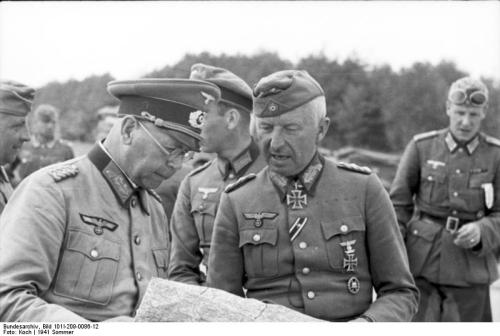
Bild 101I-209-0086-12Manstein (center) planning at the front

Chaos and Peril in the South

As 6th Army died at Stalingrad field Marshall von Manstein was faced with one of the most challenging situations faced by any commander in modern times.  He faced strategic and operational “problems of a magnitude and complexity seldom paralleled in history.”[i] Manstein had to deal with a complex military situation where he had minimal forces to counter the moves of a superior enemy force that was threatening to entrap all German forces in southern Russia. Additionally Manstein had to deal with the “Hitler’s obstinate opposition to a maneuver defense and a Red Army flushed with the victory of Stalingrad.”[ii]Facing him were the six Russian armies of the Voronezh and Southwestern Fronts led by Mobile Group Popov[iii]. These Armies had broken through the Hungarian and Italian armies “making a breach 200 miles wide between the Donetz and Voronezh, and were sweeping westward past Manstein’s flank.”[iv]
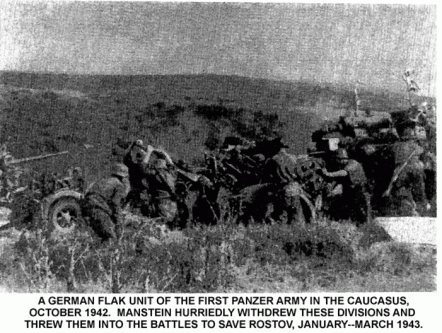
flak in caucasus

The most dangerous threat that Manstein faced was to Army Group A in the Caucasus. This Army Group “found itself in danger of being cut off, forcing an immediate withdraw.”[v] Disaster was averted by the desperate holding actions of Manstein’s meager forces, Army detachment’s Fretter-Pico and Hollidt, and winter conditions that made “offensive operations extraordinarily difficult, even for the hardiest Soviet troops.”[vi]

A smart withdraw executed by General von Kleist managed to extricate the Army group “just as the Stalingrad forces collapsed.”[vii] To parry the Soviet thrusts the Germans lacked forces to “establish a deeply echeloned defense” and “instead combined maneuver… with stubborn positional defense to give artificial depth to the battlefield.  In this way the Germans were able to break major Soviet attacks, preventing catastrophic breakthroughs….”[viii] The timely introduction of a battalion of Tiger tanks prevented the Russians from breaking through to Rostov and “cutting the rail and road lines on which First Panzer Army’s retreat depended.”[ix] Even so the escape of the Army Group was narrow. “In terms of time, space, force, and weather conditions it was an astonishing performance-for which Kleist was made a field-marshal.”[x] With the Russians only 70 kilometers from Rostov and his own forces 650 kilometers from that city Kleist executed a withdraw “which had appeared hardly possible to achieve.”[xi] The divisions extricated by Kleist would be instrumental in the coming weeks as Manstein moved to counter the Soviet offensive.
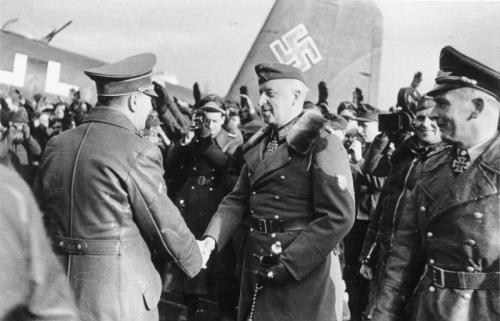
Ostfront, Adolf Hitler, Erich v. Manstein

Hitler and Manstein

Despite the successful withdraw the situation was still precarious in early February, Manstein had no effective contact with his left wing, the bulk of which was tied to Kharkov, The Russians had “virtually complete freedom of action across a fifty-mile stretch of the Donetz on either side of Izyum.”[xii] Manstein was hard pressed to “halt the raids of Mobile Group Popov and other exploiting Soviet tank corps in Operation Gallop.”[xiii] Manstein’s forces in the eastern sector had been divided by Russian penetrations, which threatened 1st Panzer Army’s western flank and blocked the Army Group’s main railway line.[xiv]

On 15 February “the SS Panzer Corps withdrew from Kharkov-in spite of orders from Hitler…that the city was to be held to the last.”[xv] SS General Paul Hausser, the corps commander realized that the order to hold Kharkov was impossible and requested permission to withdraw. This was was refused by General Lanz. Under pressure from encircling Russian forces outside and from partisans inside the city, Hausser disobeyed the order and extricated his troops,[xvi] thereby saving thousands of German soldiers and preserved the SS Panzer Corps as a fighting unit.[xvii] Lanz was relieved by Hitler for the loss of Kharkov and although Hausser would escape immediate censure, “Hitler did see it as a black mark against his name.”[xviii] With Kharkov now in Soviet hands the gap between Manstein’s army group and Field Marshal von Kluge’s Army Group Center increased to over 100 miles.[xix] It appeared that the entire German southern flank was disintegrating.  Manstein estimated the ratio of German to Soviet forces in his area at 1:8.[xx] He believed that the Soviets could advance and subsequently “block the approaches to the Crimea and the Dnieper crossing at Kherson” which would “result in the encirclement of the entire German southern wing.”[xxi] Popov’s Mobile Group crossed the Donets and reached Krasnoarmeiskaia by 12 February. Vatutin committed two additional fresh tank corps toward Zaporozhe, a critical transport node which was also the location of Manstein’s headquarters.[xxii]
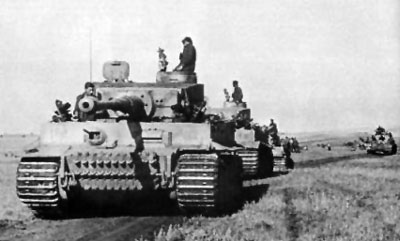
SS-Tiger-LSAH-01Tiger Tanks assigned to 1st SS Panzer Division

Hitler arrived to consult with Manstein on 17 February and remained for three days with Soviet forces perilously close.  Manstein only had some flak units and the Army Group Headquarters Company between him and Popov’s advanced elements. On Hitler’s last day “some T-34’s approached to within gun range of the airfield.”[xxiii]

The conference of Hitler with Manstein at Zaporozhe as well as a previous conference at the Wolfsschanze on 6 February was critical to the development of Manstein’s plan to restore the front. Manstein had now gotten both the 1st and 4th Panzer Armies across the Don, and “with this striking force, he felt confident of smashing the Russian offensive if he was given a free hand to withdraw from the line of the Donetz, evacuate Rostov and take up a much shorter front along the Mius river.”[xxiv] The conference on the 6th was one of the “rare moments in the war where Hitler authorized a strategic withdraw on a major scale.”[xxv] Yet as the Russians continued to advance Hitler became concerned and came to Zaporozhe.  At first Hitler would not concede to Manstein, as he wanted to assemble the SS Panzer Corps for an attack to recapture Kharkov.[xxvi]Manstein explained the need for a counter stroke and through much explanation was able to convince Hitler that the capture of Kharkov was not possible unless “we first removed the danger of the Army Group being cut off from its rear communications.”[xxvii]
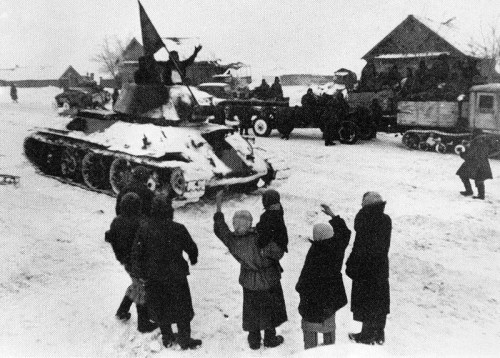
T34_Stalingrad-Offensive-px800Soviet formations advance

The Russian aim was now obvious[xxviii] and Manstein had correctly discerned their strategy.  Manstein knew that his Army Group had to hold the line on the Mius and then quickly defeat the enemy between 1st Panzer Army and Army Detachment Kempf[xxix] in “order to prevent its own isolation from the Dnieper crossings.”[xxx] The Soviets had outrun their logistics support and had suffered heavy losses of their own and had serious equipment shortages.[xxxi] Manstein explained to Hitler the opportunity offered as it was now the Russians who “were worn out” and far from their supply dumps as the Germans had been in November 1942.  Manstein “foresaw an opportunity to seize the operational initiative with a counter offensive of his own.  Manstein’s target was the Soviet armored spearheads, still careening southwestward between Kharkov and Stalino.”[xxxii] Manstein believed that when the Russian “spearhead lunged, as it must toward the crossings on the upper Dnieper,” then Hoth’s Army would be let loose again.  The three SS Panzer divisions could then “play their rightful role as avengers, and strike southeast to meet 4th Panzer Army, catching the Russian armour in a noose.”[xxxiii] Hitler agreed to Manstein’s plan and Manstein shifted 4th Panzer Army to assume control of the SS Panzer Corps, now reinforced by 3rd SS Panzergrenadier Division “Totenkopf.” Hitler reinforced Manstein and released 7 battle worn Panzer and motorized divisions for his attack.[xxxiv]

Soviet Miscalculation

It was now Stalin’s time to miscalculate. He and his subordinates “continued to believe that they were on the verge of a great victory. German defenses in southern Russia appeared to be crumbling and the Stavka sought to expand that victory to include Army Group Center.”[xxxv] To this end they diverted armies to the north and launched attacks in that direction.  However German defenses were stiff and the plan was “predicated on the assumption of continued offensive success further south.”[xxxvi] Reinforcements from Stalingrad failed to deploy and “Army Group Center’s defenses, prepared for the past year and a half proved formidable.”[xxxvii]

In the south Stalin saw the Dnieper and almost “heedlessly drove his armies towards what he thought would be the decisive victory on the banks of this huge Russian river,”[xxxviii] but, Soviet “ambitions exceeded their available resources and the skill of their commanders.”[xxxix] The SS Panzer Corps withdraw from Kharkov “further heightened the Soviet’s intoxication with victory”[xl] and confirmed their beliefs that the Germans were withdrawing.  Stalin believed that “it was inconceivable that Hitler’s Praetorian Guard would abandon Kharkov except as part of a general order to retreat.”[xli] He believed that the encirclement of Army Group South would lead to a chain reaction and quick way to victory over German forces in the east.  Believing that there was no way for the Germans to recover and establish a solid front on the Mius,[xlii] Stalin continued to drive his forces to attack, yet the Russian offensive in the south had reached what Clausewitz had called the “culminating point” and Stalin’s armies were now extremely vulnerable. “The weather, the devastated communications, and their own inexperience in maintaining the traffic density required to support a deep penetration on a narrow front had combined to force a dangerous dispersal of effort on the Russian advance which had broken down into four separate groups.”[xliii]

panzer ivfPanzers assembling to attack

The Soviet forces were now in a dangerous predicament being spread out across the entire south of Russia.  One group, composed of the 69th Army and 3rd Tank Army pushed against Army detachment Kempf west of Kharkov.  To the south the badly depleted 6th Army and 1st Guards Army were now “strung out down a long corridor they had opened between Izyum and Pavlograd,”[xliv] Mobile Group Popov was lagging further east near Krasnoarmeiskaia.   Additional units were isolated behind the front of Army Detachment Fretter-Pico and near Matveyev.  Soviet commanders believed that the Germans were in worse shape and that “the risks of dispersal were justified.”[xlv] They had not anticipated or made allowance for Manstein’s coolness under pressure and actions to preserve his armor while thinning his front “well past the accepted danger limit.”[xlvi]Likewise the Soviets did not know that the Germans had cracked the code used by the Southwest front and from 12 February on “were now privy to Popov’s and Vatutin’s thoughts,” now knowing precisely where the Russians would attack.[xlvii] Manstein had withstood temptation and Hitler’s pressure to use his reserves “for a direct defense of the Dnieper line.”[xlviii] As such he was prepared to launch a devastating counter-stroke against the dispersed and weakened Russian armies which were still advancing into the trap he planned for them. He had managed to “save his counteroffensive plan from Hitler’s shrill demands that the new reserves be thrown into battle piecemeal to prevent further territorial losses.”[xlix] The stage was now set for a two classic mobile operations.[l]

The Destruction of Mobile Group Popov, 6th Army and 1st Guards Army

Manstein launched his counter-stroke on 21 February against Popov’s Mobile Group using XL Panzer Corps under the command of General Henrici composed of the 7th and 11th Panzer Divisions and SS Motorized Division Viking. Popov’s Group was exposed. Popov had “succeed in cutting the railway from Dnepropetrovsk to Stalino and was itching to push further south to Mariupol on the Sea of Azov.”[li] The Soviets once again had failed to discern German intentions, believing that the Germans were retreating.[lii] Likewise the Soviet high command did not fully understand Popov’s situation. His force was weak in tanks and low on fuel and his Mobile Group was defeated in detail by the German Corps.  Popov’s immobilized tank and motorized rifle formations resisted desperately but were bypassed by the panzers.  The 330th Infantry Division mopped up the remnants of these formations.[liii] The key battles took place around the town of Krasnoarmeiskaia and the battle became a running battle between that town and the Donets River.[liv] Popov requested permission to retreat, but still believing the Germans to be retreating Vatutin gave a categorical “no.” The terrain in the area was “almost completely open”[lv] and “Popov’s proud Armoured Group was cut up like a cake.”[lvi] Popov extricated some of his units but “only after serious losses in manpower and equipment.”[lvii] Despite this it would not be until the 24th that Vatutin would order a halt to offensive operations.[lviii]

kharkovSS Panzers in Kharkov

As Popov sought to get his units out of the German scythe Manstein set his sights on 6th Army, 1st Guards Army and 25th Tank Corps which was approaching Zaporozhe.[lix] He assigned the task to Hoth’s 4th Panzer Army and its XLVIII Panzer Corps under General Knobelsdorf composed of the 6th and 17th Panzer Divisions and the SS Panzer Corps comprising SS Divisions LiebstandarteDas Reich and Totenkopf.[lx] Manstein gave Hoth a brief but explicit order: “The Soviet Sixth Army, now racing towards Dnepropetrovsk through the gap between First Panzer Army and Army Detachment Kempf, is to be eliminated.”[lxi]

The XLVIII Panzer Corps and SS Panzer Corps were unleashed against the exposed flank of the 6th Army and 1st Guards Army.   XLVIII Panzer Corps quickly “seized bridgeheads over the Samara River, and prepared to move north into the rear of the exhausted Soviet Sixth Army.”[lxii] The two Panzer Corps then made a coordinated concentric attack northwest which “came as a complete surprise to the Russians.”[lxiii] Das Reich thrust deep into the flank of 6th Army supported by Stukas from Richthofen’s 4th Air Fleet.  This attack dislodged one Soviet Rifle Corps and destroyed another allowing the division to capture Pavlograd while XLVIII Panzer Corps led by 17th Panzer Division pushed from the south linking up with the SS Corps. This cut off the Soviet 25th Tank Corps and threatened 6thArmy.[lxiv] What followed was a disaster for the Russians.

Despite the overwhelming evidence to the contrary Stavka and the Soviet Front commanders still believed that the Germans were retreating.  6th Army was ordered to continue its advance by the front commander who believed that the two German Panzer Corps were withdrawing.[lxv] In a few days the 17th Panzer Division “gained the Izyum-Protoponovka sector on the Donetz River, while the SS Panzer Corps took Losovaya and established contact with Army Detachment Kempf, which had joined the attack from the west.”[lxvi] XL Panzer Corps with the 3rd and 7thPanzer Divisions and 333rd Infantry Division joined in the attack on Popov’s remaining forces completing their destruction.[lxvii]

As Hoth and Hausser converged on Pavlograd, Das Reich and Totenkopf “swung left to the east and then wheeled back north again running parallel to the Russian divisions fleeing from Forty-eighth Panzer Corps. What ensured was a turkey shoot.”[lxviii]Fleeing Russian forces on the open steppe were visible and engaged at long range.[lxix] Leibstandarte helped by holding the left flank against Russian counter attacks from the units now isolated in the west,[lxx] and Totenkopf’s Grenadiers fanned out supported by Stukas to “kill or capture as many Russians as possible.”[lxxi]

By 1 March the Russian penetrations had been eliminated. Popov’s Mobile Group was smashed, 6th Army and 1st Guards Army badly mauled. 25th Tank Corps and three Rifle divisions had to be completely written off and numerous other corps and divisions took heavy casualties.  Two additional corps, encircled before the offensive began were eliminated by German forces.[lxxii] The Germans counted 23,000 Russian dead on the battlefield, and Manstein noted that “the booty included 615 tanks, 354 field pieces, 69 anti-aircraft guns and large numbers of machine guns and mortars.”[lxxiii] The Germans only took 9,000 prisoners as they were too weak, especially in infantry to seal off the encircled Soviet forces.[lxxiv] Yet the forces that escaped they were in no condition to “block the continued progress of the Panzers and SS.”[lxxv] Now there was a 100 mile gap in the Russian lines with nothing no troops to fill it and only “General Mud” could stop the Germans.[lxxvi] Manstein was not yet finished and the next phase of his operation against the Soviet formations west of Kharkov and that city were about to commence.

The Destruction of 3rd Tank Army

With the immediate threat to his Army Group eliminated and having regained the initiative, Manstein and Army Group South now “proceeded to deliver the stroke against the ‘Voronezh Front’– i.e. the forces located in the Kharkov area.”[lxxvii] But the Russians had not been idle. In order to attempt to assist 6thArmy 3rd Tank Army moved two tank corps and three Rifle divisions south and these ran into Manstein’s advancing panzers.[lxxviii] Manstein’ noted his objective now was “not the possession of Kharkov but the defeat-and if possible the destruction of the enemy units located there.”[lxxix] Between March 1st and 5th his forces advanced on Kharkov. Not knowing the Germans dispositions[lxxx]3rd Tank Army made the mistake of moving between the Leibstandarte’s defensive positions and the attacking divisions of the SS Panzer Corps. Hausser wheeled Totenkopf around and completed an encirclement of these units near Bereka on 3 March.[lxxxi] The Russians made futile attempts to break out but the SS Divisions tightened the noose around them and they were eliminated by the SS Panzer Corps which “engaged in concentric attacks during the three days of hard fighting.”[lxxxii] Even Regimental commanders like Heinz Harmel of Das Reich’s Der Fuhrer regiment became engaged in close combat with the Russians.[lxxxiii] The battle was fought in “snowstorms whose intensity caused the SS severe privations.”[lxxxiv] Totenkopf and Das Reich slammed the Russians “back against the Tiger tanks and assault guns of the Leibstandarte.”[lxxxv] The elimination of these units netted another 12,000 Russians killed,[lxxxvi] knocking “out the last remaining obstacle between the Germans and Kharkov.”[lxxxvii]

Return to Kharkov and Controversy

Manstein turned his attention to Kharkov, supported by Richthofen’s 4th Air Fleet which for the last time in Russia “provided undisputed air superiority for a major German mechanized operation.”[lxxxviii] He decided to “roll up the enemy from the flank and force him away from Kharkov in the process.”[lxxxix]He ordered a “pincer on the town, sending Grossdeutschland around to the north with a reinforced Kempf detachment and the combined force of Hoth and the SS to attack the town from the south and rear.”[xc] Manstein planned to make a wide envelopment to avoid embroiling his panzers in costly urban combat stating “that at all costs the Army Group wished to avoid Kharkov’s becoming a second Stalingrad in which our assault forces might become irretrievably committed.”[xci] To this end he sent Das Reich and Totenkopf which were approaching from the south to west of the city[xcii] while XLVIII Panzer Corps swung east toward the Donetz.[xciii] As Hoth’s forces came up from the south to envelope the city, Grossdeutschland and the XI and LI Corps fought the Russians to the north and west,[xciv] eventually moving up to Belgorod.  By 8 March lead elements of the SS Panzer Corps were on the outskirts of the city.

At this point there is some controversy as to German actions. As noted Manstein wished to avoid urban combat and desired to surround the city and force its surrender.  According to one writer Hoth ordered Hausser “to seal off the city from the west and north and to take any opportunity to seize it.”[xcv] Others including Glantz and House and Murray and Millett state that Hausser “ignored a direct order” and attacked into the city.[xcvi] Manstein does not explicitly say that there was a direct order but notes that the Army Group “had to intervene vigorously on more than one occasion to ensure that the corps did not launch a frontal attack on Kharkov.”[xcvii] Sydnor states that Hausser ignored a direct order by Hoth on the 11th by detailing a battalion of Totenkopf to assist Das Reich and Leibstandarte in retaking Kharkov by direct assault. The order entailed pulling Das Reich out of the city and taking it to the east.[xcviii] Lucas adds that this order came in the midst of hard fighting in the city and could not be carried out by the division.[xcix]Carell notes that on 9 March Hoth instructed Hausser that “opportunities to seize the city by a coup are to be utilized,”[c] and goes into detail regarding how Hoth’s 11 March order applied to Das Reich. It was to be pulled out of action and brought east, but division was heavily engaged and in the process of breaking through Soviet defenses “quicker in fact than if he had pulled “Das Reich” out of the operation and led it all the way round the city along those terrible muddy and time wasting roads.”[ci] In the end the SS took Kharkov, Manstein said that the city “fell without difficulty”[cii] while others note the difficulty of the action and the casualties suffered by the SS.  Kharkov’s capture; the defeat of Rokossovsky’s campaign against Orel and the beginning of the spring Rasutitsa ended the winter campaign and stabilized the front.

Analysis

The Russian winter offensive following Stalingrad had great potential.  Manstein said: “the successes attained on the Soviet side, the magnitude of which is incontestable.”[ciii] The greatest Soviet shortcomings were inexperience in conducting deep mobile operations and the inability of their logistics system to keep up with their advance.  Clark notes that this was their “first experience of an offensive war of movement on a large scale.[civ] Glantz and House are not alone in noting that the “Stavka continued to undertake operations that were beyond its resources.”[cv] Murray and Millett state that they “lacked the operational focus that had marked the Stalingrad offensive.”[cvi] Had they had the resources and ability to execute their plans they might have destroyed all German forces in the south.  They misread German intentions based on their own over-optimistic expectations opened their forces to Manstein’s devastating counter stroke.  Von Mellenthin, possibly showing some prejudice commented that the Russian soldier “when confronted by surprise and unforeseen situations he is an easy prey to panic.”[cvii]

The Germans snatched victory out of what appeared to be certain defeat aided by Russian mistakes and operational shortcomings.  Manstein refused to panic and conserved his forces for his counterattack.[cviii] Kleist brought his Army Group out of what might have been encirclement worse than Stalingrad.  Hitler for the most part gave Manstein operational freedom which he had not provided other commanders.  German Panzer forces conducted mobile operations against superior enemy armored forces and bested them.  Landsers held their own in at critical junctures, especially on the Mius and gave Manstein the opportunity to employ the panzers in the mobile defense.[cix] The Luftwaffe recovered its balance and the coordinated operations between it and German ground forces gave them an edge at a point where the Red Air Force was unable to support the Red Army.[cx] Above all the Germans still maintained the edge in both overall quality of generalship, especially that of Manstein and Kleist, but not to exclude Hoth, Hausser and lower level commanders.  Additionally the average German soldier still maintained an edge over his Soviet adversary in the confusion of mobile operations in open terrain.   Manstein and his forces gave Hitler breathing room on the eastern front.[cxi] As Clark notes: “few periods in World War II show a more complete and dramatic reversal of fortune than the fortnight in February and the first in March 1943…it repaired its front, shattered the hopes of the Allies, nipped the Russian spearhead. Above all it recovered its moral ascendancy.”[cxii]

Notes 


[i] Von Mellenthin, F.W. Panzer Battles: A Study of the Employment of Armor in the Second World War. Translated by H. Betzler, Ballantine Books, New York, NY, 1971. Originally Published University of Oklahoma Press, 1956. p245

[ii] Glantz, David M. and House, Jonathan. When Titans Clashed: How the Red Army Stopped Hitler. University Press of Kansas, Lawrence, KS. 1995. p.143

[iii] Ibid. Glantz. P.143. These units include 3rd Tank Army, 1st and 3rd Guards Armies and the 6th, 40th and 69th Armies.

[iv] Liddell-Hart. B.H. Strategy.  A Signet Book, the New American Library, New York, NY 1974, first published by Faber and Faber Ltd. London, 1954 and 1967. p.253

[v] Raus, Erhard. Panzer Operation: The Eastern Front Memoir of General Raus, 1941-1945. Compiled and Translated by Steven H Newton. Da Capo Press a member of the Perseus Book Group, Cambridge, MA 2003. p.185

[vi] Murray, Williamson and Millett, Allan R. A War to Be Won: Fighting the Second World War, The Belknap Press of Harvard University Press, Cambridge MA. 2000. pp.291-292

[vii] Liddell-Hart, B.H. History of the Second World War. G.P. Putnam’s Son’s, New York, NY. 1970  p.478

[viii] Wray, Timothy A. Standing Fast: German Defensive Doctrine on the Russian Front in World War II, Prewar to March 1943. U.S. Army Command and General Staff College, Fort Leavenworth, KS. 1986. p.161

[ix] Ibid. Murray and Millett. p.292

[x] Ibid. Liddell-Hart, Second World War. p.479

[xi] Liddell-Hart, B.H. The German Generals Talk. Quill Publishing, New York, NY. 1979. Copyright 1948 by B.H. Liddell-Hart. pp.211-212.

[xii] Clark, Alan. Barbarossa: The Russian-German Conflict, 1941-45.Perennial, an Imprint of Harper Collins Books, New York, NY 2002. Originally published by William Morrow, New York, NY 1965. pp.299-300

[xiii] Glantz, David M and House, Jonathan. The Battle of Kursk.  University Press of Kansas, Lawrence, KS. 1999. p.11

[xiv] Manstein, Erich von. Lost Victories. Translated by Anthony G. Powell, Zenith Press, an imprint of MBI Publishing Company, St Paul, MN. 2004. First Published as Verlorene Siege Athenaum-Verlag, Bonn, GE 1955, English edition Methuen & Company Ltd. 1958  p.417

[xv] Ibid. Clark. p.300

[xvi] Carell, Paul. Scorched Earth: The Russian German War 1943-1944. Translated by Ewald Osers, Ballantine Books, New York, NY 1971, published in arrangement with Little-Brown and Company. pp.196-199

[xvii] Lucas, James. Das Reich: The Military History of the 2nd SS Division.Cassell Military Paperbacks, London, UK, 1999. First published by Arms and Armour, 1991. p.91  Glantz and House criticize Hausser saying that the SS Panzer Corps Staff lacked the experience to perform its mission.  (Titans Clashed p.144) Most other commentators agree with the necessity of his withdraw.

[xviii] Messenger, Charles. Sepp Dietrich: Hitler’s Gladiator. Brassey’s Defence Publishers, London, 1988. p.113

[xix] Ibid. Clark. p.300

[xx] Ibid. Manstein. p.419

[xxi] Ibid. Manstein. pp.418-419

[xxii] Ibid. Glantz and House. When Titans Clashed. p.144

[xxiii] Ibid. Clark. p.300

[xxiv] Ibid. Von Mellenthin. p.251

[xxv] Ibid. Carell. p.191

[xxvi] Ibid. Manstein. p.424.

[xxvii] Ibid. Manstein. p.428

[xxviii] Ibid. Liddell-Hart. Second World War. p.481

[xxix] This had previously been Army Detachment Lanz, but Lanz had bee relieved over the loss of Kharkov.

[xxx] Ibid. Manstein. p.429

[xxxi] Ibid. Murray and Millet. p.292

[xxxii] Ibid. Wray. p.162

[xxxiii] Ibid. Clark. p.302.

[xxxiv] Ibid. Glantz and House. When Titans Clashed. p.145

[xxxv] Ibid. Glantz and House. When Titans Clashed . pp.144-145

[xxxvi] Ibid. Glantz and House. When Titans Clashed. p.146

[xxxvii] Ibid. Murray and Millett. p.293

[xxxviii] Ibid. Carell. p.191

[xxxix] Ibid. Murray and Millett. p.292

[xl] Ibid. Carell. p.199

[xli] Ibid. Carell. p.199

[xlii] Ibid. Carell. p.193

[xliii] Ibid. Clark. p.303

[xliv] Ibid. Clark. p.304

[xlv] Ibid. Clark. p.304

[xlvi] Ibid. Clark. p.304

[xlvii] Ibid. Carell. p.210

[xlviii] Ibid. Liddell-Hart. Strategy p.253

[xlix] Ibid. Wray. p.163

[l] Ibid. Glantz and House. When Titans Clashed. p.147. Note comments by Glantz and House in footnote 31 on relative strengths of forces involved, especially the weakness of German forces.

[li] Butler, Rupert. SS Wiking: The History of the Fifth SS Division 1941-45.Casemate, Havertown, PA. 2002. p.93

[lii] Ibid. Carell. p.211

[liii] Ibid. Carell. p.210

[liv] Ibid. Glantz and House. When Titans Clashed. p.147

[lv] Ibid. von Mellenthin. p.253

[lvi] Ibid. Carell. p.210

[lvii] Ibid. Murray and Millett. p.293

[lviii] Ibid. Carell. p.213

[lix] Ibid. Glantz and House. When Titans Clashed. p.147

[lx] There is difference in various accounts as to which units composed these Panzer Corps. Von Mellenthin adds 11th Panzer to the XLVIII Panzer Corps and some accounts do not list the Liebstandarte as part of the SS Panzer Corps.

[lxi] Ibid. Carell. p.211

[lxii] Sydnor, Charles W. Soldiers of Destruction: The SS Death’s Head Division 1933-1945. Princeton University Press, Princeton NJ. 1977. p.268

[lxiii] Ibid. Von Mellenthin. p.252

[lxiv] Ibid. Carell. p.212

[lxv] Ibid. Carell. p.212

[lxvi] Ibid. Von Mellenthin. p.252

[lxvii] Ibid. Carell. p.213

[lxviii] Ibid. Sydnor. pp.268-269

[lxix] Ibid. Von Mellenthin. p.253

[lxx] Meyer, Kurt. Grenadiers. Translated by Michael Mende and Robert J. Edwards. J.J. Fedorowicz Publishing Inc. Winnipeg, Manitoba. Canada. 2001. pp.180-181

[lxxi] Ibid. Sydnor. p.269

[lxxii] Ibid. Manstein. p.433

[lxxiii] Ibid. Manstein. p.433. Sydnor lists an addition 600 anti-tank guns and notes that the tanks were almost all T-34s. (Sydnor. p.269)

[lxxiv] Ibid. Glantz and House. When Titans Clashed. p.147

[lxxv] Ibid. Clark. p.306

[lxxvi] Ibid. Carell. p.216

[lxxvii] Ibid. Manstein. p.433

[lxxviii] Ibid. Glantz and House. When Titans Clashed. p.187

[lxxix] Ibid. Manstein. p.433

[lxxx] Ibid. Meyer. p.181

[lxxxi] Ibid. Carell. p.216

[lxxxii] Ibid. Meyer. pp.181-182

[lxxxiii] Ibid. Lucas. p.95

[lxxxiv] Ibid. Lucas. p.95

[lxxxv] Ibid. Sydnor. p.277

[lxxxvi] Ibid. Manstein. p.434

[lxxxvii] Ibid. Sydnor. p.277

[lxxxviii] Ibid. Glantz and House. Kursk. p.13

[lxxxix] Ibid. Manstein. p.435

[xc] Ibid. Clark. p.306

[xci] Ibid. Manstein. p.435

[xcii] Ibid. Sydnor. p.278

[xciii] Weingartner, James. J. Leibstandarte SS Adolf Hitler: A Military History, 1933-45. Battery Press, Nashville, TN.(no publication date listed)  p.75

[xciv] Ibid. Raus. pp.189-192

[xcv] Ibid. Messenger. p.114

[xcvi] See Glantz and House p.187 and Murray and Millett p.293

[xcvii] Ibid. Manstein. p.436

[xcviii] Ibid. Sydnor. p.278

[xcix] Ibid. Lucas. p.96

[c] Ibid. Carell. p.216

[ci] Ibid. Carell. p.219

[cii] Ibid. Manstein. p.436

[ciii] Ibid. Manstein. p.437

[civ] Ibid. Clark. p.303

[cv] Ibid. Glantz and House. p.143

[cvi] Ibid. Murray and Millett. p.292

[cvii] Ibid. Von Mellenthin. p.254

[cviii] A comment by Von Mellenthin commenting on Manstein’s coolness in the conduct of his operations compares him to Robert E. Lee. “To find another example of defensive strategy of this caliber we must go back to Lee’s campaign in Virginia in the summer of 1864. (Von Mellenthin. p.245)

[cix] For some additional comments along these lines see vn Mellenthin who notes four points in regard to the counter stroke: 1. High level commanders did not restrict the moves of armored formations, but gave them long range tasks. 2. Armored formations had no worries about their flanks because the High Command had a moderate infantry force available for counterattacks. 3. All commanders of armored formations, including corps, conducted operations not from the rear, but from the front. 4. The attack came as a surprise regarding the time and place. (Von Mellenthin p.254)

[cx] Ibid. Murray and Millett. p.293

[cxi] Despite his success Hitler was not happy with Manstein in regard to giving up ground for operational purposes and Manstein would lose much of the freedom that he enjoyed by March. Wray has a discussion of this.  See Wray. pp.162-163.  The Nazi hierarchy actively promoted the exploits of the SS Panzer Corps and its leaders, especially the commander of the Leibstandarte Sepp Dietrich. (see Weingartner pp. 76-77) The recognition of Hausser would be delayed, some speculate as a result of his disobedience in giving up Kharkov in February.

[cxii] Ibid. Clark. p.306

Bibliography

Butler, Rupert. SS Wiking: The History of the Fifth SS Division 1941-45.Casemate, Havertown, PA. 2002

Carell, Paul. Scorched Earth: The Russian German War 1943-1944. Translated by Ewald Osers, Ballantine Books, New York, NY 1971, published in arrangement with Little-Brown and Company

Clark, Alan. Barbarossa: The Russian-German Conflict, 1941-45. Perennial, an Imprint of Harper Collins Books, New York, NY 2002. Originally published by William Morrow, New York, NY 1965

Glantz, David M and House, Jonathan. The Battle of Kursk.  University Press of Kansas, Lawrence, KS. 1999

Glantz, David M. and House, Jonathan. When Titans Clashed: How the Red Army Stopped Hitler. University Press of Kansas, Lawrence, KS. 1995

Liddell-Hart, B.H. The German Generals Talk. Quill Publishing, New York, NY. 1979. Copyright 1948 by B.H. Liddell-Hart.

Liddell-Hart, B.H. History of the Second World War. G.P. Putnam’s Son’s, New York, NY.

Liddell-Hart. B.H. Strategy.  A Signet Book, the New American Library, New York, NY 1974, first published by Faber and Faber Ltd. London, 1954 and 1967

Lucas, James. Das Reich: The Military History of the 2nd SS Division. Cassell Military Paperbacks, London, UK, 1999. First published by Arms and Armour, 1991

Manstein, Erich von. Lost Victories. Translated by Anthony G. Powell, Zenith Press, an imprint of MBI Publishing Company, St Paul, MN. 2004. First Published as Verlorene Siege Athenaum-Verlag, Bonn, GE 1955, English edition Methuen & Company Ltd. 1958

Messenger, Charles. Sepp Dietrich: Hitler’s Gladiator. Brassey’s Defence Publishers, London, 1988

Meyer, Kurt. Grenadiers. Translated by Michael Mende and Robert J. Edwards. J.J. Fedorowicz Publishing Inc. Winnipeg, Manitoba. Canada. 2001

Raus, Erhard. Panzer Operation: The Eastern Front Memoir of General Raus, 1941-1945. Compiled and Translated by Steven H Newton. Da Capo Press a member of the Perseus Book Group, Cambridge, MA 2003

Sydnor, Charles W. Soldiers of Destruction: The SS Death’s Head Division 1933-1945. Princeton University Press, Princeton NJ. 1977

Von Mellenthin, F.W. Panzer Battles: A Study of the Employment of Armor in the Second World War. Translated by H. Betzler, Ballantine Books, New York, NY, 1971. Originally Published University of Oklahoma Press, 1956

Weingartner, James. J. Leibstandarte SS Adolf Hitler: A Military History, 1933-45. Battery Press, Nashville, TN.(no publication date listed)

Wray, Timothy A. Standing Fast: German Defensive Doctrine on the Russian Front in World War II, Prewar to March 1943. U.S. Army Command and General Staff College, Fort Leavenworth, KS. 1986

4 Comments

Filed under ethics, History, holocaust, leadership, Military, nazi germany, Political Commentary, world war two in europe

“I Was Sure That I Could Not Afford to Fail” Admiral Samuel Gravely and the Desegregation of the Navy

gravely

Friends of Padre Steve’s World,

Today I remember the service of Vice Admiral Samuel Gravely, a pioneer in the desegregation of the Navy and one of the first Black Naval Officers, not to mention the first to achieve Flag Rank. He was a man who, like Jackie Robinson in Baseball, knew how much was riding on his shoulders. For him failure did not reflect just on him, but on every Black man, and later woman who desired to become a Naval Officer.

Free Blacks had served in the Navy since the American Revolution and were not segregated as they later were in the Army. While none could become officers, they served in nearly every enlisted rating, alongside whites, until President Woodrow Wilson, ordered the Navy to only employ Blacks as mess stewards in 1915. Wilson, the first American President to come from a Southern State since the Civil war also greatly restricted opportunities for Blacks in the Civil Service and hosted a screening of D.W. Griffith’s monumental film commemorating White Supremacy, the Lost Cause, and the Noble South, Birth of a Nation. With the rollbacks in opportunities for Blacks in the Navy, their numbers in service dwindled, and then the Second World War broke out, and the debate regarding the integration of the military began anew, but nowhere was the resistance to Blacks serving, was in the Navy, despite the heroism of men like Dorie Miller who manned a machine gun on the USS West Virginia and attempted to save the life of his mortally wounded Captain, actions for which he was awarded the Navy Cross, which was after long delay upgraded to the Medal of Honor

Gravely wrote later:

“I was sure that I could not afford to fail. I thought that would affect other members of my race if I failed anywhere along the line. I was always conscious of that, particularly in midshipman school and any other schools I went to…I tried to set a record of perfect conduct ashore and at sea.” 

Things have changed much since 1942 when following the attack on Pearl Harbor a young black college student from Richmond Virginia enlisted in the Navy. Samuel Gravely Jr. was the son of a postal worker and Pullman porter while his mother worked as a domestic servant for white families in Richmond. His mother died unexpectedly when he was 15 in 1937 and he remained to help care for his siblings as his father continued to work. Balancing the care of his family with his education he enrolled in Virginia Union College, a Baptist school in Richmond.

gravely_young

Fireman Apprentice Samuel Gravely Jr

It is hard to imagine for most of us now to comprehend the world that the young Gravely grew up in. Segregation was the norm. Blacks in the south and many other locations faced personal as well as intrenched institutional racism. Violence against blacks was quite common and the Ku Klux Klan was strong.

The military was still segregated and a great gulf existed between white military personnel and blacks. Though the selective service law of 1940 called for the conscription of people regardless of race, creed or color the services enjoyed much latitude in determining how minorities could serve. The Secretary of the Navy at the time, Frank Knox resisted integration. Knox determined that African Americans would remain segregated and serve only as Mess Stewards to “prevent undermining and disruptive conditions in the Navy.” Knox told President Roosevelt in the presence of black leaders that “because men live in such intimacy aboard ship that we simply can’t enlist Negroes above the rank of messman.”

That sentiment to maintain the status quo of segregation was especially strong in both the Navy and the Marine Corps. The leaders of both services resisted attempts to broaden the ability for African Americans to serve and urged that blacks serve in the Army, not the Naval Service.  Marine Corps Commandant Major General Thomas Holcomb agreed with this stance. He commented:

“If we are defeated we must not close our eyes to the fact that once in they [Negroes] will be strengthened in their effort to force themselves into every activity we have. If they are not satisfied to be messmen, they will not be satisfied to go into the constriction or labor battalions. Don’t forget the colleges are turning out a large number of well educated Negroes. I don’t know how long we will be able to keep them out of the V-7 class. I think not very long.”

But President Franklin Roosevelt was not deterred and by April 1942 changes were announced to allow African Americans to serve in other capacities. Even so, the African Americans selected for ratings other than messman were to be segregated and commanded by White Officers and Petty Officers.

USS_PC-1264_officers_and_crew

images-18

The USS PC-1264 and its crew, Gravely is the lone black officer

Gravely enlisted in the Navy under these conditions. Serving as a Fireman Apprentice after receiving training as a Motor Machinist in San Diego, he worked in menial jobs. In 1943 Gravely was one of only three sailors in his unit to be selected for the V-12 officer training program. He was the only black to make the cut. He was commissioned as an Ensign on December 14th 1944 and assigned to train black recruits at Great Lakes despite the fact that the vast majority of his class went to sea. This was mainly due to the policy set forth by the General Board in 1942 that prescribed:

“(a) the white man will not accept the negro in a position of authority over him; (b) the white man considers that he is of a superior race and will not admit the negro as an equal; and (c) the white man refuses to admit the negro to intimate family relationships leading to marriage. These concepts may not be truly democratic, but it is doubtful if the most ardent lovers of democracy will dispute them, particularly in regard to inter-marriage.”

Despite this by 1945 the Navy was beginning to change. Gravely was chosen to serve on one of two ships assigned to the “experiment” of seeing how blacks in general ratings could serve at sea. The USS Mason (DE 539) and the USS PC-1264 were assigned black crews with majority white officers, except that Gravely was assigned to PC-1264. Though his commander was pleased with his service Gravely, who had been denied admittance to Officer Clubs and many other “white only” facilities resigned from the Navy in 1946. He believed that the inherent discrimination of the Navy left him no place for advancement. He returned to complete his bachelors degree at Virginia Union.

In 1949, following President Truman’s integration of the military Gravely was asked by the Navy to return to active duty. But the end of the old order was foreshadowed by a Navy pamphlet published in 1944 entitled The Guide to the Command of Negro Personnel. That publication included the statement that ”The Navy accepts no theories of racial differences in inborn ability, but expects that every man wearing its uniform be trained and used in accordance with his maximum individual capacity determined on the basis of individual performance.”

images-17

300px-USS_Taussig_(DD-746)_port_side_1965

cg29

Gravely’s commands (top to bottom) USS Theodore E Chandler, USS Taussig and USS Jouett

Gravely accepted the offer to return to active duty and never looked back. He worked hard for respect and used his natural talents, personality and size to command respect. He was a man who would blaze the way for other African Americans, and later women and most recently gays to go on to greater things. Gravely would go on to command three ships. He was the first African American Naval Officer to command a Navy warship, the USS Theodore E Chandler (DD 717), the first to command a Navy ship in combat, the USS Taussig (DD 746) and the first to command a major warship, the USS Jouett (CG 29). Promoted to flag rank he eventually became the first Black to command a Fleet when he took command of 3rd Fleet. He retired in 1980 and passed away in 2004.

h98996
Commander Gravely and his officers on USS Taussig

Gravely gave his parents and conditions of his upbringing much credit for his success. He believed that those conditions which forced him to “capitalize on his strong points, build his weak areas and sustain the positive self-esteem and self-worth that his parents instilled in him as a young child.”

He was a great leader. LCDR Desiree Linson who interviewed him for her Air Command and Staff College project noted that Gravely like many other great military leaders before him learned to manage the image that he presented, be a caretaker for his people, what we would now call a mentor. He said “[If I was CNO] my responsibility would be to make sure enlisted men and families were taken care of. I would do everything in my power to make sure.”

His pursuit of excellence, self confidence and mastery of professional skills empowered him in an institution where he was still an anomaly and where racism still existed. He believed in effective communication, especially verbal communication and in building teams and in being a good follower, listening, learning and proactively anticipating the needs of his superiors. Gravely was also a believer in personal morality and self discipline and preparedness. He said:

“I did everything I could think of to prepare myself. If the opportunity came, I would be prepared for it. [The question would not be] “Why didn’t you prepare for this opportunity.” I would be prepared for whatever opportunity that came. If it came, fine. If it did not, fine, but I would be prepared if it did come.”

USS_Gravely

The USS Gravely

Vice Admiral Gravely blazed a trail for those that followed him and set an example for all Naval Officers to follow. He did it under conditions that most of us could not imagine. I am proud to serve in the Navy that he helped to make.  His vision, service and memory are carried on in this navy and in the ship that bears his name, the USS Gravely DDG-107.

Until tomorrow,

Peace,

Padre Steve+

4 Comments

Filed under civil rights, History, laws and legislation, leadership, Military, Navy Ships, Political Commentary, racism, US Marine Corps, US Navy