Category Archives: holocaust

“Mislead by a Blind Sense of Duty” Field Marshal Erich Von Manstein and His Epic Counterstroke of February 1943

Friends of Padre Steve’s World,

I’m pullings something out of my archives today. It’s actually a paper I wrote for one of my Masters Degree Classes back in 2009 that I decided to post on the site. Since then I have done much more study on the battle from other sources, many more critical of Manstein and revealing of the crimes committed by his troops on the Eastern Front.  I have been reading Paul Carrell’s Unternehem Barbarossa Im Bild (Operation Barbarossa in Pictures) in German I decided to repost it today.  I could probably do more with it but except for more biographical work on Von Manstein I don’t expect that I will. For me character matters more than battlefield brilliance.

The article deals with the crisis that the German armies faced following Stalingrad and how Field Marshal Erich von Manstein succeeded in talking Adolf Hitler out of certain defeat and inflicting a massive defeat on the now overconfident and over extended Soviet armies.

Von Manstein was a brilliant strategist, his bold plan to conquer France in 1940 was a masterpiece, and his conduct of combat operations on the Eastern Front until his relief in March of 1944 for withdrawing (and saving) his armies from Soviet destruction without Hitler’s approval. Von Manstein was a brilliant commander at the operational level of war, but he also gave his approval and support to war crimes committed by the SS Einsatzgruppen against the Jews and others in his area of operations. He believed that Bolshevism and the Jews were linked, thus in his codicil to Von Reichenau’s Severity Order in November 1941 stated:

“Jewish Bolshevik system must be wiped out once and for all and should never again be allowed to invade our European living space … It is the same Jewish class of beings who have done so much damage to our own Fatherland by virtue of their activities against the nation and civilisation, and who promote anti-German tendencies throughout the world, and who will be the harbingers of revenge. Their extermination is a dictate of our own survival.”

This article depicts Manstein at his zenith when even Hitler was forced to give in to his logic, but barely a year later Hitler relieved him of command as Manstein remained committed to a mobile defense surrendering space while attempting to maximize Soviet casualties.

He is a complex character, he defended German Jews in the Reichswehr yet went on to cooperate in the deaths of hundreds of thousands of Jews in Russia. There is a decent possibility that he had some Jewish ancestry, he opposed the Aryan Paragraph which banned Jews from serving in the German armed forces telling General Ludwig Beck that anyone who had volunteered to serve had already proved their worth. Part of this may have been to protect mixed race grand-nephews who were already serving in the Reichswehr and his concern that he might have Jewish blood. The SS launched an investigation regarding this, but never completed it. The results of what they found or did not find are unknown. It makes me wonder if I could make an extended trip to Germany and do some research on the topic because for all of his other anti-Semitic beliefs, he did not believe that the Germans had murdered the number of Jews that they did. Von Manstein’s criticisms of Hitler were restricted to the conduct of the war, not the political and moral aspects that formed the heart of Nazi policy and the Holocaust.

Though he knew that Hitler was leading Germany to destruction, he rebuffed his colleagues who attempted to kill Hitler and the overthrow the Nazi regime. Likewise, though he was tried and convicted of war crimes he was given an early release from prison at the behest of Winston Churchill, Konrad Adenauer and other notables. After his release he went on to advise the German government on the organization of the new Bundeswehr, and become something of a celebrity among military history students, and military officers, especially Britain and the United States.

Manstien’s  post war writings were highly critical of Hitler and for the most part he succeeded in rehabilitating himself, in large part with the help of  Western military historians and theorists of mobile warfare. The men looked at the military aspects of the war and built what amounted to a cult around him and German military operations, with scant regard to the murderous policies of the Nazis. When Manstein died in 1973 at the age of 85 he was the last surviving German Field Marshal and was buried with full military honors.

While it is true that Manstein was a brilliant commander and strategist, he aided and abetted one of the most criminal regimes in history. The German magazine Der Spiegel wrote of him: “He assisted in the march to catastrophe—misled by a blind sense of duty.”

My concern today is if American Generals will be misled by their blind sense of duty and assist in a march to catastrophe as President Donald Trump obliterates all legal, Constitutional, and institutional guardrails our Founders placed to prevent authoritarian rule.

Until tomorrow,

Peace,

Padre Steve+

Introduction

After Stalingrad the Soviets followed up on their success and attempted to entrap the rest of Army Group South. Field Marshall von Manstein attempted to save the Army Group and perhaps prevent the Soviets from collapsing the entire German front.
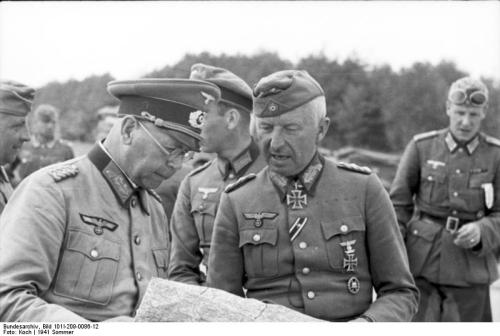
Bild 101I-209-0086-12Manstein (center) planning at the front

Chaos and Peril in the South

As 6th Army died at Stalingrad field Marshall von Manstein was faced with one of the most challenging situations faced by any commander in modern times.  He faced strategic and operational “problems of a magnitude and complexity seldom paralleled in history.”[i] Manstein had to deal with a complex military situation where he had minimal forces to counter the moves of a superior enemy force that was threatening to entrap all German forces in southern Russia. Additionally Manstein had to deal with the “Hitler’s obstinate opposition to a maneuver defense and a Red Army flushed with the victory of Stalingrad.”[ii]Facing him were the six Russian armies of the Voronezh and Southwestern Fronts led by Mobile Group Popov[iii]. These Armies had broken through the Hungarian and Italian armies “making a breach 200 miles wide between the Donetz and Voronezh, and were sweeping westward past Manstein’s flank.”[iv]
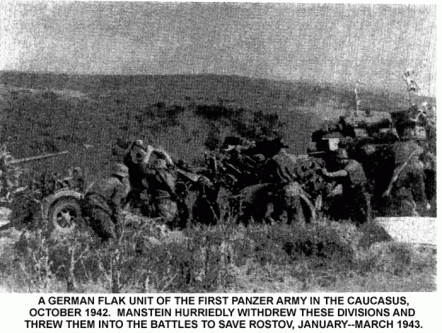
flak in caucasus

The most dangerous threat that Manstein faced was to Army Group A in the Caucasus. This Army Group “found itself in danger of being cut off, forcing an immediate withdraw.”[v] Disaster was averted by the desperate holding actions of Manstein’s meager forces, Army detachment’s Fretter-Pico and Hollidt, and winter conditions that made “offensive operations extraordinarily difficult, even for the hardiest Soviet troops.”[vi]

A smart withdraw executed by General von Kleist managed to extricate the Army group “just as the Stalingrad forces collapsed.”[vii] To parry the Soviet thrusts the Germans lacked forces to “establish a deeply echeloned defense” and “instead combined maneuver… with stubborn positional defense to give artificial depth to the battlefield.  In this way the Germans were able to break major Soviet attacks, preventing catastrophic breakthroughs….”[viii] The timely introduction of a battalion of Tiger tanks prevented the Russians from breaking through to Rostov and “cutting the rail and road lines on which First Panzer Army’s retreat depended.”[ix] Even so the escape of the Army Group was narrow. “In terms of time, space, force, and weather conditions it was an astonishing performance-for which Kleist was made a field-marshal.”[x] With the Russians only 70 kilometers from Rostov and his own forces 650 kilometers from that city Kleist executed a withdraw “which had appeared hardly possible to achieve.”[xi] The divisions extricated by Kleist would be instrumental in the coming weeks as Manstein moved to counter the Soviet offensive.
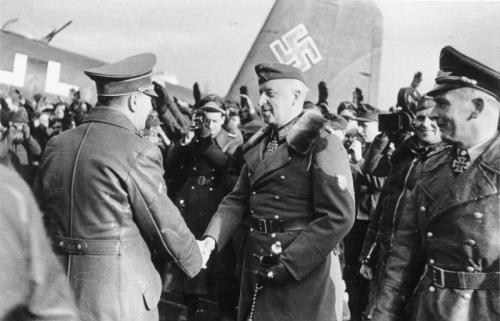
Ostfront, Adolf Hitler, Erich v. Manstein

Hitler and Manstein

Despite the successful withdraw the situation was still precarious in early February, Manstein had no effective contact with his left wing, the bulk of which was tied to Kharkov, The Russians had “virtually complete freedom of action across a fifty-mile stretch of the Donetz on either side of Izyum.”[xii] Manstein was hard pressed to “halt the raids of Mobile Group Popov and other exploiting Soviet tank corps in Operation Gallop.”[xiii] Manstein’s forces in the eastern sector had been divided by Russian penetrations, which threatened 1st Panzer Army’s western flank and blocked the Army Group’s main railway line.[xiv]

On 15 February “the SS Panzer Corps withdrew from Kharkov-in spite of orders from Hitler…that the city was to be held to the last.”[xv] SS General Paul Hausser, the corps commander realized that the order to hold Kharkov was impossible and requested permission to withdraw. This was was refused by General Lanz. Under pressure from encircling Russian forces outside and from partisans inside the city, Hausser disobeyed the order and extricated his troops,[xvi] thereby saving thousands of German soldiers and preserved the SS Panzer Corps as a fighting unit.[xvii] Lanz was relieved by Hitler for the loss of Kharkov and although Hausser would escape immediate censure, “Hitler did see it as a black mark against his name.”[xviii] With Kharkov now in Soviet hands the gap between Manstein’s army group and Field Marshal von Kluge’s Army Group Center increased to over 100 miles.[xix] It appeared that the entire German southern flank was disintegrating.  Manstein estimated the ratio of German to Soviet forces in his area at 1:8.[xx] He believed that the Soviets could advance and subsequently “block the approaches to the Crimea and the Dnieper crossing at Kherson” which would “result in the encirclement of the entire German southern wing.”[xxi] Popov’s Mobile Group crossed the Donets and reached Krasnoarmeiskaia by 12 February. Vatutin committed two additional fresh tank corps toward Zaporozhe, a critical transport node which was also the location of Manstein’s headquarters.[xxii]
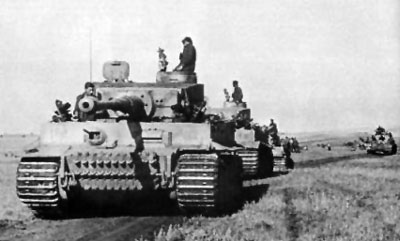
SS-Tiger-LSAH-01Tiger Tanks assigned to 1st SS Panzer Division

Hitler arrived to consult with Manstein on 17 February and remained for three days with Soviet forces perilously close.  Manstein only had some flak units and the Army Group Headquarters Company between him and Popov’s advanced elements. On Hitler’s last day “some T-34’s approached to within gun range of the airfield.”[xxiii]

The conference of Hitler with Manstein at Zaporozhe as well as a previous conference at the Wolfsschanze on 6 February was critical to the development of Manstein’s plan to restore the front. Manstein had now gotten both the 1st and 4th Panzer Armies across the Don, and “with this striking force, he felt confident of smashing the Russian offensive if he was given a free hand to withdraw from the line of the Donetz, evacuate Rostov and take up a much shorter front along the Mius river.”[xxiv] The conference on the 6th was one of the “rare moments in the war where Hitler authorized a strategic withdraw on a major scale.”[xxv] Yet as the Russians continued to advance Hitler became concerned and came to Zaporozhe.  At first Hitler would not concede to Manstein, as he wanted to assemble the SS Panzer Corps for an attack to recapture Kharkov.[xxvi]Manstein explained the need for a counter stroke and through much explanation was able to convince Hitler that the capture of Kharkov was not possible unless “we first removed the danger of the Army Group being cut off from its rear communications.”[xxvii]
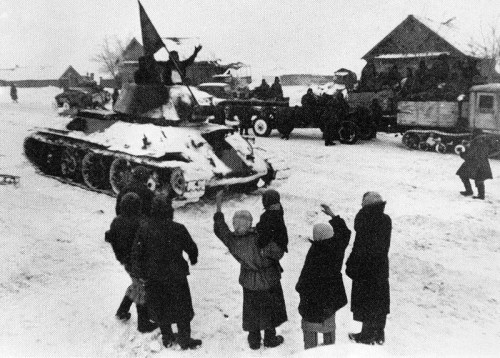
T34_Stalingrad-Offensive-px800Soviet formations advance

The Russian aim was now obvious[xxviii] and Manstein had correctly discerned their strategy.  Manstein knew that his Army Group had to hold the line on the Mius and then quickly defeat the enemy between 1st Panzer Army and Army Detachment Kempf[xxix] in “order to prevent its own isolation from the Dnieper crossings.”[xxx] The Soviets had outrun their logistics support and had suffered heavy losses of their own and had serious equipment shortages.[xxxi] Manstein explained to Hitler the opportunity offered as it was now the Russians who “were worn out” and far from their supply dumps as the Germans had been in November 1942.  Manstein “foresaw an opportunity to seize the operational initiative with a counter offensive of his own.  Manstein’s target was the Soviet armored spearheads, still careening southwestward between Kharkov and Stalino.”[xxxii] Manstein believed that when the Russian “spearhead lunged, as it must toward the crossings on the upper Dnieper,” then Hoth’s Army would be let loose again.  The three SS Panzer divisions could then “play their rightful role as avengers, and strike southeast to meet 4th Panzer Army, catching the Russian armour in a noose.”[xxxiii] Hitler agreed to Manstein’s plan and Manstein shifted 4th Panzer Army to assume control of the SS Panzer Corps, now reinforced by 3rd SS Panzergrenadier Division “Totenkopf.” Hitler reinforced Manstein and released 7 battle worn Panzer and motorized divisions for his attack.[xxxiv]

Soviet Miscalculation

It was now Stalin’s time to miscalculate. He and his subordinates “continued to believe that they were on the verge of a great victory. German defenses in southern Russia appeared to be crumbling and the Stavka sought to expand that victory to include Army Group Center.”[xxxv] To this end they diverted armies to the north and launched attacks in that direction.  However German defenses were stiff and the plan was “predicated on the assumption of continued offensive success further south.”[xxxvi] Reinforcements from Stalingrad failed to deploy and “Army Group Center’s defenses, prepared for the past year and a half proved formidable.”[xxxvii]

In the south Stalin saw the Dnieper and almost “heedlessly drove his armies towards what he thought would be the decisive victory on the banks of this huge Russian river,”[xxxviii] but, Soviet “ambitions exceeded their available resources and the skill of their commanders.”[xxxix] The SS Panzer Corps withdraw from Kharkov “further heightened the Soviet’s intoxication with victory”[xl] and confirmed their beliefs that the Germans were withdrawing.  Stalin believed that “it was inconceivable that Hitler’s Praetorian Guard would abandon Kharkov except as part of a general order to retreat.”[xli] He believed that the encirclement of Army Group South would lead to a chain reaction and quick way to victory over German forces in the east.  Believing that there was no way for the Germans to recover and establish a solid front on the Mius,[xlii] Stalin continued to drive his forces to attack, yet the Russian offensive in the south had reached what Clausewitz had called the “culminating point” and Stalin’s armies were now extremely vulnerable. “The weather, the devastated communications, and their own inexperience in maintaining the traffic density required to support a deep penetration on a narrow front had combined to force a dangerous dispersal of effort on the Russian advance which had broken down into four separate groups.”[xliii]

panzer ivfPanzers assembling to attack

The Soviet forces were now in a dangerous predicament being spread out across the entire south of Russia.  One group, composed of the 69th Army and 3rd Tank Army pushed against Army detachment Kempf west of Kharkov.  To the south the badly depleted 6th Army and 1st Guards Army were now “strung out down a long corridor they had opened between Izyum and Pavlograd,”[xliv] Mobile Group Popov was lagging further east near Krasnoarmeiskaia.   Additional units were isolated behind the front of Army Detachment Fretter-Pico and near Matveyev.  Soviet commanders believed that the Germans were in worse shape and that “the risks of dispersal were justified.”[xlv] They had not anticipated or made allowance for Manstein’s coolness under pressure and actions to preserve his armor while thinning his front “well past the accepted danger limit.”[xlvi]Likewise the Soviets did not know that the Germans had cracked the code used by the Southwest front and from 12 February on “were now privy to Popov’s and Vatutin’s thoughts,” now knowing precisely where the Russians would attack.[xlvii] Manstein had withstood temptation and Hitler’s pressure to use his reserves “for a direct defense of the Dnieper line.”[xlviii] As such he was prepared to launch a devastating counter-stroke against the dispersed and weakened Russian armies which were still advancing into the trap he planned for them. He had managed to “save his counteroffensive plan from Hitler’s shrill demands that the new reserves be thrown into battle piecemeal to prevent further territorial losses.”[xlix] The stage was now set for a two classic mobile operations.[l]

The Destruction of Mobile Group Popov, 6th Army and 1st Guards Army

Manstein launched his counter-stroke on 21 February against Popov’s Mobile Group using XL Panzer Corps under the command of General Henrici composed of the 7th and 11th Panzer Divisions and SS Motorized Division Viking. Popov’s Group was exposed. Popov had “succeed in cutting the railway from Dnepropetrovsk to Stalino and was itching to push further south to Mariupol on the Sea of Azov.”[li] The Soviets once again had failed to discern German intentions, believing that the Germans were retreating.[lii] Likewise the Soviet high command did not fully understand Popov’s situation. His force was weak in tanks and low on fuel and his Mobile Group was defeated in detail by the German Corps.  Popov’s immobilized tank and motorized rifle formations resisted desperately but were bypassed by the panzers.  The 330th Infantry Division mopped up the remnants of these formations.[liii] The key battles took place around the town of Krasnoarmeiskaia and the battle became a running battle between that town and the Donets River.[liv] Popov requested permission to retreat, but still believing the Germans to be retreating Vatutin gave a categorical “no.” The terrain in the area was “almost completely open”[lv] and “Popov’s proud Armoured Group was cut up like a cake.”[lvi] Popov extricated some of his units but “only after serious losses in manpower and equipment.”[lvii] Despite this it would not be until the 24th that Vatutin would order a halt to offensive operations.[lviii]

kharkovSS Panzers in Kharkov

As Popov sought to get his units out of the German scythe Manstein set his sights on 6th Army, 1st Guards Army and 25th Tank Corps which was approaching Zaporozhe.[lix] He assigned the task to Hoth’s 4th Panzer Army and its XLVIII Panzer Corps under General Knobelsdorf composed of the 6th and 17th Panzer Divisions and the SS Panzer Corps comprising SS Divisions LiebstandarteDas Reich and Totenkopf.[lx] Manstein gave Hoth a brief but explicit order: “The Soviet Sixth Army, now racing towards Dnepropetrovsk through the gap between First Panzer Army and Army Detachment Kempf, is to be eliminated.”[lxi]

The XLVIII Panzer Corps and SS Panzer Corps were unleashed against the exposed flank of the 6th Army and 1st Guards Army.   XLVIII Panzer Corps quickly “seized bridgeheads over the Samara River, and prepared to move north into the rear of the exhausted Soviet Sixth Army.”[lxii] The two Panzer Corps then made a coordinated concentric attack northwest which “came as a complete surprise to the Russians.”[lxiii] Das Reich thrust deep into the flank of 6th Army supported by Stukas from Richthofen’s 4th Air Fleet.  This attack dislodged one Soviet Rifle Corps and destroyed another allowing the division to capture Pavlograd while XLVIII Panzer Corps led by 17th Panzer Division pushed from the south linking up with the SS Corps. This cut off the Soviet 25th Tank Corps and threatened 6thArmy.[lxiv] What followed was a disaster for the Russians.

Despite the overwhelming evidence to the contrary Stavka and the Soviet Front commanders still believed that the Germans were retreating.  6th Army was ordered to continue its advance by the front commander who believed that the two German Panzer Corps were withdrawing.[lxv] In a few days the 17th Panzer Division “gained the Izyum-Protoponovka sector on the Donetz River, while the SS Panzer Corps took Losovaya and established contact with Army Detachment Kempf, which had joined the attack from the west.”[lxvi] XL Panzer Corps with the 3rd and 7thPanzer Divisions and 333rd Infantry Division joined in the attack on Popov’s remaining forces completing their destruction.[lxvii]

As Hoth and Hausser converged on Pavlograd, Das Reich and Totenkopf “swung left to the east and then wheeled back north again running parallel to the Russian divisions fleeing from Forty-eighth Panzer Corps. What ensured was a turkey shoot.”[lxviii]Fleeing Russian forces on the open steppe were visible and engaged at long range.[lxix] Leibstandarte helped by holding the left flank against Russian counter attacks from the units now isolated in the west,[lxx] and Totenkopf’s Grenadiers fanned out supported by Stukas to “kill or capture as many Russians as possible.”[lxxi]

By 1 March the Russian penetrations had been eliminated. Popov’s Mobile Group was smashed, 6th Army and 1st Guards Army badly mauled. 25th Tank Corps and three Rifle divisions had to be completely written off and numerous other corps and divisions took heavy casualties.  Two additional corps, encircled before the offensive began were eliminated by German forces.[lxxii] The Germans counted 23,000 Russian dead on the battlefield, and Manstein noted that “the booty included 615 tanks, 354 field pieces, 69 anti-aircraft guns and large numbers of machine guns and mortars.”[lxxiii] The Germans only took 9,000 prisoners as they were too weak, especially in infantry to seal off the encircled Soviet forces.[lxxiv] Yet the forces that escaped they were in no condition to “block the continued progress of the Panzers and SS.”[lxxv] Now there was a 100 mile gap in the Russian lines with nothing no troops to fill it and only “General Mud” could stop the Germans.[lxxvi] Manstein was not yet finished and the next phase of his operation against the Soviet formations west of Kharkov and that city were about to commence.

The Destruction of 3rd Tank Army

With the immediate threat to his Army Group eliminated and having regained the initiative, Manstein and Army Group South now “proceeded to deliver the stroke against the ‘Voronezh Front’– i.e. the forces located in the Kharkov area.”[lxxvii] But the Russians had not been idle. In order to attempt to assist 6thArmy 3rd Tank Army moved two tank corps and three Rifle divisions south and these ran into Manstein’s advancing panzers.[lxxviii] Manstein’ noted his objective now was “not the possession of Kharkov but the defeat-and if possible the destruction of the enemy units located there.”[lxxix] Between March 1st and 5th his forces advanced on Kharkov. Not knowing the Germans dispositions[lxxx]3rd Tank Army made the mistake of moving between the Leibstandarte’s defensive positions and the attacking divisions of the SS Panzer Corps. Hausser wheeled Totenkopf around and completed an encirclement of these units near Bereka on 3 March.[lxxxi] The Russians made futile attempts to break out but the SS Divisions tightened the noose around them and they were eliminated by the SS Panzer Corps which “engaged in concentric attacks during the three days of hard fighting.”[lxxxii] Even Regimental commanders like Heinz Harmel of Das Reich’s Der Fuhrer regiment became engaged in close combat with the Russians.[lxxxiii] The battle was fought in “snowstorms whose intensity caused the SS severe privations.”[lxxxiv] Totenkopf and Das Reich slammed the Russians “back against the Tiger tanks and assault guns of the Leibstandarte.”[lxxxv] The elimination of these units netted another 12,000 Russians killed,[lxxxvi] knocking “out the last remaining obstacle between the Germans and Kharkov.”[lxxxvii]

Return to Kharkov and Controversy

Manstein turned his attention to Kharkov, supported by Richthofen’s 4th Air Fleet which for the last time in Russia “provided undisputed air superiority for a major German mechanized operation.”[lxxxviii] He decided to “roll up the enemy from the flank and force him away from Kharkov in the process.”[lxxxix]He ordered a “pincer on the town, sending Grossdeutschland around to the north with a reinforced Kempf detachment and the combined force of Hoth and the SS to attack the town from the south and rear.”[xc] Manstein planned to make a wide envelopment to avoid embroiling his panzers in costly urban combat stating “that at all costs the Army Group wished to avoid Kharkov’s becoming a second Stalingrad in which our assault forces might become irretrievably committed.”[xci] To this end he sent Das Reich and Totenkopf which were approaching from the south to west of the city[xcii] while XLVIII Panzer Corps swung east toward the Donetz.[xciii] As Hoth’s forces came up from the south to envelope the city, Grossdeutschland and the XI and LI Corps fought the Russians to the north and west,[xciv] eventually moving up to Belgorod.  By 8 March lead elements of the SS Panzer Corps were on the outskirts of the city.

At this point there is some controversy as to German actions. As noted Manstein wished to avoid urban combat and desired to surround the city and force its surrender.  According to one writer Hoth ordered Hausser “to seal off the city from the west and north and to take any opportunity to seize it.”[xcv] Others including Glantz and House and Murray and Millett state that Hausser “ignored a direct order” and attacked into the city.[xcvi] Manstein does not explicitly say that there was a direct order but notes that the Army Group “had to intervene vigorously on more than one occasion to ensure that the corps did not launch a frontal attack on Kharkov.”[xcvii] Sydnor states that Hausser ignored a direct order by Hoth on the 11th by detailing a battalion of Totenkopf to assist Das Reich and Leibstandarte in retaking Kharkov by direct assault. The order entailed pulling Das Reich out of the city and taking it to the east.[xcviii] Lucas adds that this order came in the midst of hard fighting in the city and could not be carried out by the division.[xcix]Carell notes that on 9 March Hoth instructed Hausser that “opportunities to seize the city by a coup are to be utilized,”[c] and goes into detail regarding how Hoth’s 11 March order applied to Das Reich. It was to be pulled out of action and brought east, but division was heavily engaged and in the process of breaking through Soviet defenses “quicker in fact than if he had pulled “Das Reich” out of the operation and led it all the way round the city along those terrible muddy and time wasting roads.”[ci] In the end the SS took Kharkov, Manstein said that the city “fell without difficulty”[cii] while others note the difficulty of the action and the casualties suffered by the SS.  Kharkov’s capture; the defeat of Rokossovsky’s campaign against Orel and the beginning of the spring Rasutitsa ended the winter campaign and stabilized the front.

Analysis

The Russian winter offensive following Stalingrad had great potential.  Manstein said: “the successes attained on the Soviet side, the magnitude of which is incontestable.”[ciii] The greatest Soviet shortcomings were inexperience in conducting deep mobile operations and the inability of their logistics system to keep up with their advance.  Clark notes that this was their “first experience of an offensive war of movement on a large scale.[civ] Glantz and House are not alone in noting that the “Stavka continued to undertake operations that were beyond its resources.”[cv] Murray and Millett state that they “lacked the operational focus that had marked the Stalingrad offensive.”[cvi] Had they had the resources and ability to execute their plans they might have destroyed all German forces in the south.  They misread German intentions based on their own over-optimistic expectations opened their forces to Manstein’s devastating counter stroke.  Von Mellenthin, possibly showing some prejudice commented that the Russian soldier “when confronted by surprise and unforeseen situations he is an easy prey to panic.”[cvii]

The Germans snatched victory out of what appeared to be certain defeat aided by Russian mistakes and operational shortcomings.  Manstein refused to panic and conserved his forces for his counterattack.[cviii] Kleist brought his Army Group out of what might have been encirclement worse than Stalingrad.  Hitler for the most part gave Manstein operational freedom which he had not provided other commanders.  German Panzer forces conducted mobile operations against superior enemy armored forces and bested them.  Landsers held their own in at critical junctures, especially on the Mius and gave Manstein the opportunity to employ the panzers in the mobile defense.[cix] The Luftwaffe recovered its balance and the coordinated operations between it and German ground forces gave them an edge at a point where the Red Air Force was unable to support the Red Army.[cx] Above all the Germans still maintained the edge in both overall quality of generalship, especially that of Manstein and Kleist, but not to exclude Hoth, Hausser and lower level commanders.  Additionally the average German soldier still maintained an edge over his Soviet adversary in the confusion of mobile operations in open terrain.   Manstein and his forces gave Hitler breathing room on the eastern front.[cxi] As Clark notes: “few periods in World War II show a more complete and dramatic reversal of fortune than the fortnight in February and the first in March 1943…it repaired its front, shattered the hopes of the Allies, nipped the Russian spearhead. Above all it recovered its moral ascendancy.”[cxii]

Notes 


[i] Von Mellenthin, F.W. Panzer Battles: A Study of the Employment of Armor in the Second World War. Translated by H. Betzler, Ballantine Books, New York, NY, 1971. Originally Published University of Oklahoma Press, 1956. p245

[ii] Glantz, David M. and House, Jonathan. When Titans Clashed: How the Red Army Stopped Hitler. University Press of Kansas, Lawrence, KS. 1995. p.143

[iii] Ibid. Glantz. P.143. These units include 3rd Tank Army, 1st and 3rd Guards Armies and the 6th, 40th and 69th Armies.

[iv] Liddell-Hart. B.H. Strategy.  A Signet Book, the New American Library, New York, NY 1974, first published by Faber and Faber Ltd. London, 1954 and 1967. p.253

[v] Raus, Erhard. Panzer Operation: The Eastern Front Memoir of General Raus, 1941-1945. Compiled and Translated by Steven H Newton. Da Capo Press a member of the Perseus Book Group, Cambridge, MA 2003. p.185

[vi] Murray, Williamson and Millett, Allan R. A War to Be Won: Fighting the Second World War, The Belknap Press of Harvard University Press, Cambridge MA. 2000. pp.291-292

[vii] Liddell-Hart, B.H. History of the Second World War. G.P. Putnam’s Son’s, New York, NY. 1970  p.478

[viii] Wray, Timothy A. Standing Fast: German Defensive Doctrine on the Russian Front in World War II, Prewar to March 1943. U.S. Army Command and General Staff College, Fort Leavenworth, KS. 1986. p.161

[ix] Ibid. Murray and Millett. p.292

[x] Ibid. Liddell-Hart, Second World War. p.479

[xi] Liddell-Hart, B.H. The German Generals Talk. Quill Publishing, New York, NY. 1979. Copyright 1948 by B.H. Liddell-Hart. pp.211-212.

[xii] Clark, Alan. Barbarossa: The Russian-German Conflict, 1941-45.Perennial, an Imprint of Harper Collins Books, New York, NY 2002. Originally published by William Morrow, New York, NY 1965. pp.299-300

[xiii] Glantz, David M and House, Jonathan. The Battle of Kursk.  University Press of Kansas, Lawrence, KS. 1999. p.11

[xiv] Manstein, Erich von. Lost Victories. Translated by Anthony G. Powell, Zenith Press, an imprint of MBI Publishing Company, St Paul, MN. 2004. First Published as Verlorene Siege Athenaum-Verlag, Bonn, GE 1955, English edition Methuen & Company Ltd. 1958  p.417

[xv] Ibid. Clark. p.300

[xvi] Carell, Paul. Scorched Earth: The Russian German War 1943-1944. Translated by Ewald Osers, Ballantine Books, New York, NY 1971, published in arrangement with Little-Brown and Company. pp.196-199

[xvii] Lucas, James. Das Reich: The Military History of the 2nd SS Division.Cassell Military Paperbacks, London, UK, 1999. First published by Arms and Armour, 1991. p.91  Glantz and House criticize Hausser saying that the SS Panzer Corps Staff lacked the experience to perform its mission.  (Titans Clashed p.144) Most other commentators agree with the necessity of his withdraw.

[xviii] Messenger, Charles. Sepp Dietrich: Hitler’s Gladiator. Brassey’s Defence Publishers, London, 1988. p.113

[xix] Ibid. Clark. p.300

[xx] Ibid. Manstein. p.419

[xxi] Ibid. Manstein. pp.418-419

[xxii] Ibid. Glantz and House. When Titans Clashed. p.144

[xxiii] Ibid. Clark. p.300

[xxiv] Ibid. Von Mellenthin. p.251

[xxv] Ibid. Carell. p.191

[xxvi] Ibid. Manstein. p.424.

[xxvii] Ibid. Manstein. p.428

[xxviii] Ibid. Liddell-Hart. Second World War. p.481

[xxix] This had previously been Army Detachment Lanz, but Lanz had bee relieved over the loss of Kharkov.

[xxx] Ibid. Manstein. p.429

[xxxi] Ibid. Murray and Millet. p.292

[xxxii] Ibid. Wray. p.162

[xxxiii] Ibid. Clark. p.302.

[xxxiv] Ibid. Glantz and House. When Titans Clashed. p.145

[xxxv] Ibid. Glantz and House. When Titans Clashed . pp.144-145

[xxxvi] Ibid. Glantz and House. When Titans Clashed. p.146

[xxxvii] Ibid. Murray and Millett. p.293

[xxxviii] Ibid. Carell. p.191

[xxxix] Ibid. Murray and Millett. p.292

[xl] Ibid. Carell. p.199

[xli] Ibid. Carell. p.199

[xlii] Ibid. Carell. p.193

[xliii] Ibid. Clark. p.303

[xliv] Ibid. Clark. p.304

[xlv] Ibid. Clark. p.304

[xlvi] Ibid. Clark. p.304

[xlvii] Ibid. Carell. p.210

[xlviii] Ibid. Liddell-Hart. Strategy p.253

[xlix] Ibid. Wray. p.163

[l] Ibid. Glantz and House. When Titans Clashed. p.147. Note comments by Glantz and House in footnote 31 on relative strengths of forces involved, especially the weakness of German forces.

[li] Butler, Rupert. SS Wiking: The History of the Fifth SS Division 1941-45.Casemate, Havertown, PA. 2002. p.93

[lii] Ibid. Carell. p.211

[liii] Ibid. Carell. p.210

[liv] Ibid. Glantz and House. When Titans Clashed. p.147

[lv] Ibid. von Mellenthin. p.253

[lvi] Ibid. Carell. p.210

[lvii] Ibid. Murray and Millett. p.293

[lviii] Ibid. Carell. p.213

[lix] Ibid. Glantz and House. When Titans Clashed. p.147

[lx] There is difference in various accounts as to which units composed these Panzer Corps. Von Mellenthin adds 11th Panzer to the XLVIII Panzer Corps and some accounts do not list the Liebstandarte as part of the SS Panzer Corps.

[lxi] Ibid. Carell. p.211

[lxii] Sydnor, Charles W. Soldiers of Destruction: The SS Death’s Head Division 1933-1945. Princeton University Press, Princeton NJ. 1977. p.268

[lxiii] Ibid. Von Mellenthin. p.252

[lxiv] Ibid. Carell. p.212

[lxv] Ibid. Carell. p.212

[lxvi] Ibid. Von Mellenthin. p.252

[lxvii] Ibid. Carell. p.213

[lxviii] Ibid. Sydnor. pp.268-269

[lxix] Ibid. Von Mellenthin. p.253

[lxx] Meyer, Kurt. Grenadiers. Translated by Michael Mende and Robert J. Edwards. J.J. Fedorowicz Publishing Inc. Winnipeg, Manitoba. Canada. 2001. pp.180-181

[lxxi] Ibid. Sydnor. p.269

[lxxii] Ibid. Manstein. p.433

[lxxiii] Ibid. Manstein. p.433. Sydnor lists an addition 600 anti-tank guns and notes that the tanks were almost all T-34s. (Sydnor. p.269)

[lxxiv] Ibid. Glantz and House. When Titans Clashed. p.147

[lxxv] Ibid. Clark. p.306

[lxxvi] Ibid. Carell. p.216

[lxxvii] Ibid. Manstein. p.433

[lxxviii] Ibid. Glantz and House. When Titans Clashed. p.187

[lxxix] Ibid. Manstein. p.433

[lxxx] Ibid. Meyer. p.181

[lxxxi] Ibid. Carell. p.216

[lxxxii] Ibid. Meyer. pp.181-182

[lxxxiii] Ibid. Lucas. p.95

[lxxxiv] Ibid. Lucas. p.95

[lxxxv] Ibid. Sydnor. p.277

[lxxxvi] Ibid. Manstein. p.434

[lxxxvii] Ibid. Sydnor. p.277

[lxxxviii] Ibid. Glantz and House. Kursk. p.13

[lxxxix] Ibid. Manstein. p.435

[xc] Ibid. Clark. p.306

[xci] Ibid. Manstein. p.435

[xcii] Ibid. Sydnor. p.278

[xciii] Weingartner, James. J. Leibstandarte SS Adolf Hitler: A Military History, 1933-45. Battery Press, Nashville, TN.(no publication date listed)  p.75

[xciv] Ibid. Raus. pp.189-192

[xcv] Ibid. Messenger. p.114

[xcvi] See Glantz and House p.187 and Murray and Millett p.293

[xcvii] Ibid. Manstein. p.436

[xcviii] Ibid. Sydnor. p.278

[xcix] Ibid. Lucas. p.96

[c] Ibid. Carell. p.216

[ci] Ibid. Carell. p.219

[cii] Ibid. Manstein. p.436

[ciii] Ibid. Manstein. p.437

[civ] Ibid. Clark. p.303

[cv] Ibid. Glantz and House. p.143

[cvi] Ibid. Murray and Millett. p.292

[cvii] Ibid. Von Mellenthin. p.254

[cviii] A comment by Von Mellenthin commenting on Manstein’s coolness in the conduct of his operations compares him to Robert E. Lee. “To find another example of defensive strategy of this caliber we must go back to Lee’s campaign in Virginia in the summer of 1864. (Von Mellenthin. p.245)

[cix] For some additional comments along these lines see vn Mellenthin who notes four points in regard to the counter stroke: 1. High level commanders did not restrict the moves of armored formations, but gave them long range tasks. 2. Armored formations had no worries about their flanks because the High Command had a moderate infantry force available for counterattacks. 3. All commanders of armored formations, including corps, conducted operations not from the rear, but from the front. 4. The attack came as a surprise regarding the time and place. (Von Mellenthin p.254)

[cx] Ibid. Murray and Millett. p.293

[cxi] Despite his success Hitler was not happy with Manstein in regard to giving up ground for operational purposes and Manstein would lose much of the freedom that he enjoyed by March. Wray has a discussion of this.  See Wray. pp.162-163.  The Nazi hierarchy actively promoted the exploits of the SS Panzer Corps and its leaders, especially the commander of the Leibstandarte Sepp Dietrich. (see Weingartner pp. 76-77) The recognition of Hausser would be delayed, some speculate as a result of his disobedience in giving up Kharkov in February.

[cxii] Ibid. Clark. p.306

Bibliography

Butler, Rupert. SS Wiking: The History of the Fifth SS Division 1941-45.Casemate, Havertown, PA. 2002

Carell, Paul. Scorched Earth: The Russian German War 1943-1944. Translated by Ewald Osers, Ballantine Books, New York, NY 1971, published in arrangement with Little-Brown and Company

Clark, Alan. Barbarossa: The Russian-German Conflict, 1941-45. Perennial, an Imprint of Harper Collins Books, New York, NY 2002. Originally published by William Morrow, New York, NY 1965

Glantz, David M and House, Jonathan. The Battle of Kursk.  University Press of Kansas, Lawrence, KS. 1999

Glantz, David M. and House, Jonathan. When Titans Clashed: How the Red Army Stopped Hitler. University Press of Kansas, Lawrence, KS. 1995

Liddell-Hart, B.H. The German Generals Talk. Quill Publishing, New York, NY. 1979. Copyright 1948 by B.H. Liddell-Hart.

Liddell-Hart, B.H. History of the Second World War. G.P. Putnam’s Son’s, New York, NY.

Liddell-Hart. B.H. Strategy.  A Signet Book, the New American Library, New York, NY 1974, first published by Faber and Faber Ltd. London, 1954 and 1967

Lucas, James. Das Reich: The Military History of the 2nd SS Division. Cassell Military Paperbacks, London, UK, 1999. First published by Arms and Armour, 1991

Manstein, Erich von. Lost Victories. Translated by Anthony G. Powell, Zenith Press, an imprint of MBI Publishing Company, St Paul, MN. 2004. First Published as Verlorene Siege Athenaum-Verlag, Bonn, GE 1955, English edition Methuen & Company Ltd. 1958

Messenger, Charles. Sepp Dietrich: Hitler’s Gladiator. Brassey’s Defence Publishers, London, 1988

Meyer, Kurt. Grenadiers. Translated by Michael Mende and Robert J. Edwards. J.J. Fedorowicz Publishing Inc. Winnipeg, Manitoba. Canada. 2001

Raus, Erhard. Panzer Operation: The Eastern Front Memoir of General Raus, 1941-1945. Compiled and Translated by Steven H Newton. Da Capo Press a member of the Perseus Book Group, Cambridge, MA 2003

Sydnor, Charles W. Soldiers of Destruction: The SS Death’s Head Division 1933-1945. Princeton University Press, Princeton NJ. 1977

Von Mellenthin, F.W. Panzer Battles: A Study of the Employment of Armor in the Second World War. Translated by H. Betzler, Ballantine Books, New York, NY, 1971. Originally Published University of Oklahoma Press, 1956

Weingartner, James. J. Leibstandarte SS Adolf Hitler: A Military History, 1933-45. Battery Press, Nashville, TN.(no publication date listed)

Wray, Timothy A. Standing Fast: German Defensive Doctrine on the Russian Front in World War II, Prewar to March 1943. U.S. Army Command and General Staff College, Fort Leavenworth, KS. 1986
4 Comments

Filed under ethics, History, holocaust, leadership, Military, nazi germany, Political Commentary, world war two in europe

The Legacy and Warning of Field Marschal Von Paulus at Stalingrad: Even Honorable People Can Believe a Lie and Lead Men to Death

Friends of Padre Steve’s World,

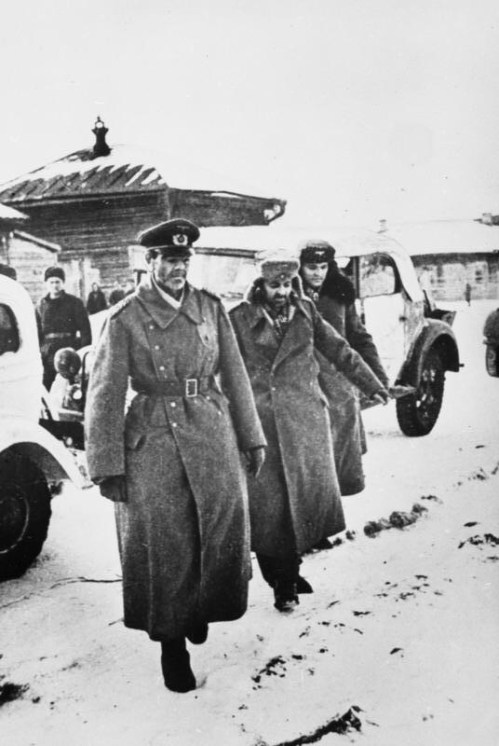
Seventy-seven years ago today the commander of the encircled German Sixth Army at Stalingrad, Field Marshal Friedrich Paulus left his command bunker and surrendered the the Red Army. In the ruins of Stalingrad lay most of the freezing, malnourished, soldiers of his once elite Army. Around 90,000 survivors of his army surrendered in the coming days to the Red Army. Of the Germans taken prisoners, only about 5,000 returned home. The Most were to die of their wounds, or of diseases, maltreatment, and starvation in Soviet Camps between 1943 and 1955 when the bulk of the survivors were released.

Friedrich Paulus was one of them, and his story is interesting, not simply because he was the Commander of the Sixth Army, but because he wasn’t the kind of man one would have expected to command an army of 13 divisions with a strength of nearly 285,000 men spearheading the great German Offensive of 1942.

Paulus was born in 1890, and joined the Imperial Army in 1910. During the First World War he served on the Western Front, finishing the war as a Captain. After the was the collapse of the Army and order during the German civil war he served as Adjutant of a government sponsored Freikorps Brigade. Following the Treaty of Versailles, Paulus was retained as one of the 4,000 officers in the new Reichsheer. He served as a staff officer and company commander, and briefly commanded a battalion. He would also serve on the staff which developed the new Panzer Forces for the Wehrmacht. Paulus was an apolitical professional soldier, he was not a Nazi but he, like many other military men considered Hitler:

“an excellent leader for the German people, a man who had contributed greatly to the development of the state. After watching him evolve the strategies that conquered Poland, France, and most of Europe, Paulus was awed by Hitler’s grasp of the technical aspects of warfare. He considered him a genius.”

Paulus was promoted to Colonel in 1938 and served as Chief of Staff to Heinz Guderian’s XVI Motorized Corps. But Guderian had reservations about Paulus’s lack of command experience, decisiveness, and toughness. Following his assignment with the motorized Corps, Paulus was promoted to the rank of Generalmajor (the equivalent of a U.S. Brigadier General) to serve as Chief of Staff to the 10th Army under the command of General Walter Reichenau during the invasion of Poland. He continued in that position when 10th Army was redesigned 6th Army for the Invasion Of France and the Low Countries.

After the Battle of France he was promoted to Generalleutnant and assigned as deputy Chief Staff, Operations, of the Oberkommando Des Heeres, the German General Staff. In this capacity he served as one of the principle planners of Operation Barbarossa.

His wife, Elena, a descendant of one of Romania’s Royal Houses was opposed to Hitler and the war. She told her husband that “he was far too good for the likes of men such as Keitel and the other “lackeys” who surrounded Hitler.” She protested the injustice of the war against Poland, but he, in the thrall of Hitler’s genius and simply followed orders. When he brought home maps and documents related to Barbarossa she again protested to him. When he ignored her she said:

“What will become of us all? Who will survive to the end?”

Since he believed in Hitler’s invincibility, Paulus ignored her concerns, and told her that the war would be over in six weeks. Elena’s words would prove prophetic.

But Elena’s concerns were well justified. In December 1941 the German Offensive ground to a halt at the gates of Moscow and a devastating Red Army counterattack created a crisis in the Wehrmacht which was completely unprepared for the Russian Winter. Only heroic resistance and improvisation by German units, and the still imperfect application of operational warfare by the Red Army, saved the German front. While battles from Leningrad to Crimea continued throughout the winter, the lines stabilized, and both sides began their plans for the coming year.

During the winter debacle Hitler sacked many commanders, which left many command vacancies. Reichenau, a committed National Socialist and fanatical fighter took over command of Army Group South from Field Marshal Gerd Von Rundstedt, who had been fired by Hitler. Reichenau, who had been Paulus’s patron had Paulus promoted to General der Panzertruppen and named as commander of 6th Army.

The two men were nothing alike and Paulus had never commanded more than a battalion, and that not in peacetime. However, six days later the athletic Reichenau suffered a heart attack, which was was followed by a head injury during a medical evacuation flight back to Germany. Reichenau, the fanatical Nazi died, and Paulus, revoked the infamous Commissar Order, as well as Reichenau’s most notorious orders, the Severity Order in the Sixth Army area of operations. That order stated:

“The most important objective of this campaign against the Jewish-Bolshevik system is the complete destruction of its sources of power and the extermination of the Asiatic influence in European civilization.… In this eastern theatre, the soldier is not only a man fighting in accordance with the rules of the art of war, but also the ruthless standard bearer of a national conception.… For this reason the soldier must learn fully to appreciate the necessity for the severe but just retribution that must be meted out to the subhuman species of Jewry.…”

Paulus demonstrated moral courage unusual for senior German officers, but he also forbade cooperation with the Einsatzgruppen death squads, which Reichenau had gone out of his way to support. This was unusual for any commander on the Eastern Front, especially a man like Paulus who believed in Hitler’s invincibility. Paulus did well in his first combat with the Red Army, when it attempted to disrupt the coming German offensive at Kharkov as Sixth Army encircled and captured over 200,000 Soviet troops.

The Sixth Army had a key role in the German summer offensive, Operation Blau. Paulus commanded it well but became involved in the battle for Stalingrad. The battle dragged on in the face of fanatical and skilled Soviet resistance. However, Hitler would not let Paulus break off the Battle, and promoted him to Colonel Genera in order to bolster his confidence. Likewise, in an interesting, but vital footnote to the campaign, which was unknown to Hitler and his commanders, Stalin knew of Operation Blau.

Stalin had learned to preserve his forces after the catastrophes of 1941 withdrew his forces and observing the German movements decided to turn Stalingrad into a fortress. He conducted a strategic withdraw to preserve his forces, allowing the majority of the German Army Group South to advance deep into the Caucasus in order to capture the oilfields of the region.

However, this movement divided the German armies, leaving the flanks of the Sixth Army protected by pathetically equipped Italian, Romanian, and Hungarian armies. None of these units could not match the manpower, mobility, or firepower of the Red Army, and none were prepared for the onslaught that was to be directed against them.

Stalin allowed the German Army Group South to continue to advance, and forced the Sixth Army to battle street by street, building by building, factory by factory to capture Stalingrad. Had the Germans followed their operational doctrine Stalingrad would have been bypassed and surrounded, but they didn’t, Hitler would not allow it. Because of this, Paulus allowed the Soviets to maintain their defense by not cutting the Red Army defenders in the city off from the Volga, even by not taking action to link up with the Fourth Panzer Army which under its commander Hermann Hoth had broken through the Soviet front south of the Stalingrad when the opportunity presented itself.

Even so, the Sixth Army had conquered most of the city when in lateNovember the Red Army launched Operation Uranus, which was designed to destroy the weakly held flanks and surround the Sixth Army by a deep envelopment operation, which had previously been the forte of the German Blitzkrieg. The operation totally surprised the Germans and in four days time the Sixth Army went from the spearhead of the German assault to an army cut off and surrounded by a Soviet Army Group. The Italian, Hungarian, and Romanian armies on its flanks were shattered.

Plans were made to relieve the Sixth Army but they depended on the Sixth Army attacking out to meet the relief forces of the Fourth Panzer Army. Hitler refused permission and Paulus obeyed, believing Hitler’s promise that Goering’s Luftwaffe would be able to keep his troops supplied. On New Year’s Day Hitler promoted Paulus to Colonel General. Paulus was now convinced that his Army was doomed but he grasped the broader strategic situation; as long as he could keep the Red Army invested in Stalingrad, it would keep them from encircling the much bigger portion of Army Group South, now under direction of Erich von Manstein from being cut off. According to one officer Paulus remarked:

“What would become of the war if our army in the Caucasus were also surrounded? That danger is real. But as long as we keep on fighting, the Red Army has to remain here. They need these forces for a big offensive against Army Group ‘A’ in the Caucasus and along the still-unstable front from Voronesh to the Black Sea. We must hold them here to the last so that the eastern front can be stabilized. Only if that happens is there a chance of the war going well for Germany.”

But the handwriting was on the wall. German Forces to the south were having to extricate themselves from an even bigger encirclement. The superb generalship of Field Marshal Erich Von Manstein prevented a complete disaster and inflicted a compelling defeat on the Red Army, but the Sixth Army was doomed. On January January 7th Paulus was offered generous surrender terms by General Konstantin Rokossovsky. Paulus asked permission to surrender which was denied by Hitler.

Again on January 22nd Paulus requested his Fuhrer:

… For submittal to the Führer and to commander in chief, Army Group Don.… The Russians are advancing on a six-kilometer frontage both sides of Voporonovo toward the east, [toward Stalingrad] in part with flying colors. There is no possibility to close the gap … All provisions are used up. Over twelve thousand unattended [wounded] men in the pocket. What orders am I to issue to the troops, who have no ammunition left? … Immediate decision is required, since symptoms of disintegration are noted in some places. However, the troops still have faith in their commanders.” Paulus

On January 25th the Red Army overran the last airfield in the Stalingrad pocket, now there was no escape.

To a Luftwaffe Officer who was sent by Berlin to encourage Paulus about new airlifts, Paulus said:

“Why on earth did the Luftwaffe ever promise to keep us supplied? Who is the man responsible for declaring that it was possible? Had someone told me it was not possible, I should not have held it against the Luftwaffe. I could have broken out. When I was strong enough to do so. Now it is too late.…”

Paulus radioed Hitler for permission to surrender, empathetically stating the conditions in the pocket. No food, no medicine, no ammunition, no fuel; only to be denied again.

On January 30th, the 10th anniversary of Hitler’s seizure of power the Troops in Stalingrad were treated to a radio broadcast from Berlin, not Hitler, but Goering. The words of the Reichsmarschal fell hollow on the ears of the doomed men:

“… What herculean labors our Führer has performed … out of this pulp, this human pulp … to forge a nation as hard as steel. The enemy is tough, but the German soldier has grown tougher.… We have taken away the Russians’ coal and iron, and without that they can no longer make armaments on a large scale.… Rising above all these gigantic battles like a mighty monument is Stalingrad.… One day this will be recognized as the greatest battle in our history, a battle of heroes.… We have a mighty epic of an incomparable struggle, the struggle of the Nibelungs. They, too, stood to the last.… My soldiers, thousands of years have passed, and thousands of years ago in a tiny pass in Greece stood a tremendously brave and bold man with three hundred soldiers, Leonidas with his three hundred Spartans.… Then the last man fell … and now only the inscription stands: ‘Wanderer, if you should come to Sparta, go tell the Spartans you found us lying here as the law bade us.’… Someday men will read: ‘If you come to Germany, go tell the Germans you saw us lying in Stalingrad, as the law bade us.…’”

The soldiers knew that they had been abandoned by Berlin. Yet, Paulus, ever loyal radioed:

January 30th:

On the tenth anniversary of your assumption of power, the Sixth Army hails its “Führer.” The swastika flag is still flying above Stalingrad. May our battle be an example to the present and coming generations, that they must never capitulate even in a hopeless situation, for then Germany will come out victorious.

Hail my Führer Paulus, Generaloberst

But it was a lie. Less than 24 hours later on January 31st with Red Army tanks and troops outside his command bunker, Paulus surrendered, just hours after Hitler promoted him to Field Marshal. The promotion was supposed to encourage Paulus to commit suicide as no German Field Marshal had ever surrendered his army.

Colonel Adam, an aide to Paulus recorded how Paulus received his promotion:

January 31, 1943 – 7.00 a.m. It was still dark but day was dawning almost imperceptibly. Paulus was asleep. It was some time before I could break out of the maze of thoughts and strange dreams that depressed me so greatly. But I don’t think I remained in this state for very long. I was going to get up quietly when someone knocked at the door. Paulus awoke and sat up. It was the HQ commander. He handed the colonel general a piece of paper and said: ‘Congratulations. The rank of field marshal has been conferred upon you. The dispatch came early this morning – it was the last one.’

‘One can’t help feeling it’s an invitation to suicide. However I’m not going to do them such a favour.’ said Paulus after reading the dispatch. Schmidt continued: ‘At the same time I have to inform you that the Russians are at the door.’ with these words he opened the door and a Soviet general and his interpreter entered the room. The general announced that we were his prisoners. I placed my revolver on the table.”

Paulus surrendered, and contrary to Hitler’s wishes did not commit suicide. In the next few days the other isolated pockets of German resistance surrendered as well. Roughly 95,000 Germans, Italians, and Romanians surrendered at Stalingrad. Fewer than 6,000 would return home after nearly a decade of imprisonment and forced labor.

In Hitler’s headquarters the scene was terrifying. Hitler ranted about the treason and cowardice of Paulus, and his lackeys in the military agreed. Paulus should have shot himself and the garrison formed a hedgehog and resisted to the last bullet.

Though he surrendered Paulus did not give support to the Soviets or the German resistance until he learned of the execution of his Friend Field Marshal Erich von Witzleben and others for their participation in the attempt to kill Hitler. When he learned of their deaths he joined the he joined the Communist-inspired Bund Deutsche Offiziere, an “anti-Fascist” group that broadcast appeals to the citizens of the Third Reich against the Hitler regime.

After the war he testified at the Nuremberg Trials admitting German conduct of the war in the east was criminal but refusing to label men like Wilhelm Keitel, and Afred Jodl as war criminals. He took up a position as the civilian chief for military history for the new East German Government. He died on February 1st 1957, of ALS, having never seen his wife since he left to take command of Sixth Army in January 1942, she died in 1949. His son Alexander was killed at Anzio in 1944. His other son, Ernst, survived the war and committed suicide in 1970.

Paulus’s fate is an object lesson for military personnel, civil servants, or police officials who themselves are apolitical, and that honorable can people become seduced and believe in cults of personality. In the end, many sacrifice their lives, reputations, and even their families.

Without mentioning any names, the Americans who worship at the cult of Trump should pay heed. like Paulus, their loyalty will be betrayed, and even as their leader abandons them.

Until tomorrow,

Peace,

Padre Steve+

10 Comments

Filed under ethics, faith, germany, History, holocaust, Military, nazi germany, News and current events, Political Commentary, world war two in europe

International Holocaust Remembrance Day 2020, the Liberation of Auschwitz at 75 Years: To Forget is to Kill Twice

Friends of Padre Steve’s World,

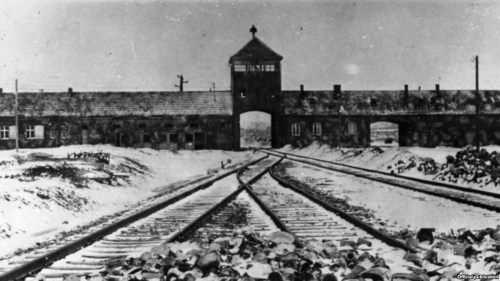
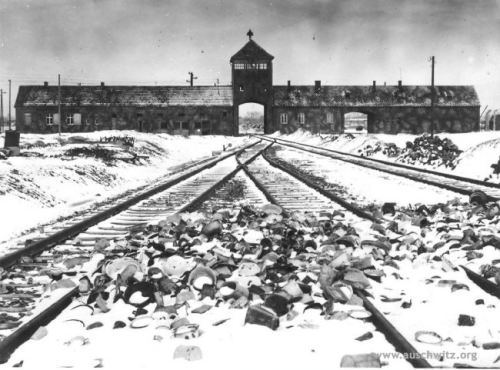
Seventy-five years ago today the Red Army’s 100th Division liberated the Auschwitz Concentration Camp. There were somewhere between 7000 and 9000 prisoners left in the camp. The crematoria had been destroyed as well as most of the gas chambers. The SS had evacuated by forced march to railhead miles away from the camp, in order to take them to other Concentration Camps deeper in Germany; Buchenwald, Bergen-Belsen, Ravensbruck, and others.

Auschwitz was liberated, the Nazis continued to exterminate Jews at other camps and conducted forced marches in freezing winter weather to keep them from being liberated, marches which were both deadly and inhuman. Actions that even Heinrich Himmler had forbidden. Many of these actions were the work of Adolf Eichmann.

Even Rudolf Höss the former Commandant of Auschwitz, who admitted to killing over one and a half-million Jews, was appalled by the senseless brutality of what he saw. Höss, the meticulous killer of millions, was shocked by the columns of emaciated and Jews, with no winter clothing or in many cases not even shoes that Eichmann marched from Budapest and other cities and camps to Austria and Czechoslovakia in late 1944 and 1945 to keep the Russians from liberating them, even against the orders of Himmler.

There have been many episodes of genocide in human history, but none were more pointedly directed at a single group of people based on race hatred than the Holocaust of the Jews. While it is true that the Nazis exterminates millions of people than the nearly six million Jews they dispatched during the Holocaust. This is important, as the late Christopher Hitchens noted:

“We should not at all allow ourselves to forget the millions of non-Jewish citizens of Belarus, Russia, Ukraine, and other Slav territories who were also massacred. But for me the salient fact remains that anti-Semitism was the regnant, essential, organizing principle of all the other National Socialist race theories. It is thus not to be thought of as just one prejudice among many.” 

Hitchens was right, without the primary Nazi hatred and determination to obliterate the Jews from the face of the earth, their other atrocities would never occurred. Today, that rabid anti-semitism is again raising its evil head in Eastern and Western Europe, the Middle East, and even in the United States.

It is impossible for an objective person to deny this fact. Hate crimes against Jews are blossoming around the world like toxic mushrooms. The new perpetrators are the descendants of the former perpetrators, Protestant, Catholic, and Orthodox Christians, Muslims, and secularists who embrace the same social Darwinism that motivated many of the Nazis.

Or course the non-Muslim opponents of the Jews today also despise dark skinned minorities, non-Christians, not to mention atheists and secularists; thus what Hitchens says is still as accurate as it was when he wrote those words.

So here we are, Holocaust Remembrance Day, 2020. The question is, will we allow it to happen again? The late Iris Chang, who documented the Rape Of Nanking noted: “to forget a holocaust is to kill twice.” Sadly, I believe that without a sea change in public opinion and knowledge about the Holocaust, genocide, and anti-semitism we will see it happen again.

But will we allow it to happen again? I would hope not, but I have to say that human nature and the course of events is leading me to believe that it will happen again, maybe even in our lifetime.

That may be difficult to accept, but it is reality. What is the alternative to telling the truth? Except to perpetuate a lie, except to take the side of the perpetrators, and those who would do the same today. That includes many of President Trump’s most loyal supporters, Evangelical Christians who while outwardly allying with Israel, only do so in that their interpretation of Biblical prophecy might be fulfilled. That interpretation is that Christians will be raptured from the earth, and during a seven year Great Tribulation the Anti-Christ will conquer his foes and that in the end over two-thirds of all Jews will be killed, while the survivors convert to follow Christ.

Honestly, I cannot deem such politicized and racist theology to be Christian, or respectful and considerate of the elder brother of the Christian faith, Judaism, without which Christianity wouldn’t exist. Let me repeat that. Without Judaism Christianity would not exist, and the treatment of the Jews by the Christian Church has been shameful for the majority of its existence. I say that as a Christian.

In the 1930s and 1940s the Nazis created the euphemism the Jewish Question in order to remove the aspect of humanity from their policy. It wasn’t about human beings, it was about people that they considered sub-human minority that they were able to demonize to expedite their elimination. Hitchens wrote:

“Die Judenfrage,’ it used to be called, even by Jews. ‘The Jewish Question.’ I find I quite like this interrogative formulation, since the question—as Gertrude Stein once famously if terminally put it—may be more absorbing than the answer. Of course one is flirting with calamity in phrasing things this way, as I learned in school when the Irish question was discussed by some masters as the Irish ‘problem.’ Again, the word ‘solution’ can be as neutral as the words ‘question’ or ‘problem,’ but once one has defined a people or a nation as such, the search for a resolution can become a yearning for the conclusive. Endlösung: the final solution.”

Thus, once one labels the Jews, or for that matter any other despised minority a question, or a problem, we place ourselves on the path to Trump administration and his followers have done that since 2015 regarding Mexicans and other Hispanics, Arabs, Haitians, Sub-Saharan Africans, and too many others.

That is why I cannot be silent. I have to proclaim the words of Ellie Wiesel:

“I swore never to be silent whenever and wherever human beings endure suffering and humiliation. We must take sides. Neutrality helps the oppressor, never the victim. Silence encourages the tormentor, never the tormented.”

Silence it not an option, and to again quote Wiesel: “For the dead and the living, we must bear witness.”

We must bear witness, for if we do not it will happen again. Humanity is the one constant in history, and there are no exceptions once one begins down the path to labeling the fate of races, nations, and peoples a question or a problem which they can resolve with a solution, the more comprehensive, total, or final, the better. There are certainly plenty of people, including Trump’s closest advisors who would make draconian laws in order to enable the government to commit genocide.

Yehuda Bauer wrote:

“The horror of the Holocaust is not that it deviated from human norms; the horror is that it didn’t. What happened may happen again, to others not necessarily Jews, perpetrated by others, not necessarily Germans. We are all possible victims, possible perpetrators, possible bystanders.”

In the wake of an number of situations that I have seen and have watched in morbid fascination be debated on my Facebook, and Twitter timelines, as well a potential Holocaust Denier who commented on my blog yesterday, I realize that with the prevailing attitudes being stoked by men like President Trump, his media supporters, and sadly, far too many Conservative Christians, that it will quite probably happen again.

I will fight it, butI have no doubt of the power, passion, and petulance of people consumed by race hatred under the guise of patriotism.

Until tomorrow,

Peace,

Padre Steve+

Leave a comment

Filed under ethics, faith, History, holocaust, laws and legislation, leadership, nazi germany, News and current events, Political Commentary, world war two in europe

Silence Buys You Nothing: The Boogeymen Will Eventually Come After You Too

Friends of Padre Steve’s World,

Last year on the I spoke on the last day of Passover at Norfolk’s Temple Israel on the topic of bearing witness to the Holocaust even as its last survivors pass away from their earthly journey. The late Christopher Hitchens wrote:

“Die Judenfrage,’ it used to be called, even by Jews. ‘The Jewish Question.’ I find I quite like this interrogative formulation, since the question—as Gertrude Stein once famously if terminally put it—may be more absorbing than the answer. Of course one is flirting with calamity in phrasing things this way, as I learned in school when the Irish question was discussed by some masters as the Irish ‘problem.’ Again, the word ‘solution’ can be as neutral as the words ‘question’ or ‘problem,’ but once one has defined a people or a nation as such, the search for a resolution can become a yearning for the conclusive. Endlösung: the final solution.”

President Trump repeatedly dehumanizes and threatens minority groups, immigrants, both legal and undocumented, LGBTQ people, religious minorities (including liberal Jewish) women, the disabled, and even professional military officers. The same with the leaders and members of the opposition Democratic Party, as well as the few former or current Republicans bold enough to oppose him. Right wing pundits, politicians, and preachers often do the same, and the bulk of the Republican Party, mostly made up of White Evangelical Christians say nothing or even echo his comments. Most of these people do not readily admit their prejudice, though some, including members of Congress openly support White Nationalist policies and groups.

Little or no condemnation is ever made by them against killings and mass murder, let us call it Domestic Terrorism. In return such groups are growing and being emboldened and the President and his compatriots spin lies as history. A couple of nights ago I wrote about a nationally known Jewish friend of mine being threatened by an alleged Christian, making very Anti-Semitic comments and using the language of the Nazis to describe him and other Jews, who do not

How does one prevent yet another genocide from happening? I don’t know, but I think that there is some wisdom in the answer a German University Colleague of Milton Mayer said when Mayer was questioning him about the subject.

In his book They Thought they Were Free Mayer wrote of his conversation with that professor:

“How is this to be avoided, among ordinary men, even highly educated ordinary men? Frankly, I do not know. I do not see, even now. Many, many times since it all happened I have pondered that pair of great maxims, Principiis obsta and Finem respice—‘Resist the beginnings’ and ‘Consider the end.’ But one must foresee the end in order to resist, or even see, the beginnings. One must foresee the end clearly and certainly and how is this to be done, by ordinary men or even by extraordinary men? Things might have. And everyone counts on that might.

“Your ‘little men,’ your Nazi friends, were not against National Socialism in principle. Men like me, who were, are the greater offenders, not because we knew better (that would be too much to say) but because we sensed better. Pastor Niemöller spoke for the thousands and thousands of men like me when he spoke (too modestly of himself) and said that, when the Nazis attacked the Communists, he was a little uneasy, but, after all, he was not a Communist, and so he did nothing; and then they attacked the Socialists, and he was a little uneasier, but, still, he was not a Socialist, and he did nothing; and then the schools, the press, the Jews, and so on, and he was always uneasier, but still he did nothing. And then they attacked the Church, and he was a Churchman, and he did something—but then it was too late.”

Like Mayer’s friend, must people are content to play it safe and hope that the boogeyman won’t come after them. But history shows that such thinking is a pipe dream. Trump’s Republican and Christian supporters need to realize that one day, they they will become the victims of his version of the Night of the Long Knives. Every authoritarian eventually goes after his supporters who are neither completely on board or have become inconvenient or unprofitable. Ask Hitler, Stalin, Mao, or any of the authoritarians of the past four millennia. Study history for lessons in the present to prevent it’s reputation in the future.

Sophie Scholl expressed this well:

“The real damage is done by those millions who want to ‘survive.’ The honest men who just want to be left in peace. Those who don’t want their little lives disturbed by anything bigger than themselves. Those with no sides and no causes. Those who won’t take measure of their own strength, for fear of antagonizing their own weakness. Those who don’t like to make waves—or enemies. Those for whom freedom, honour, truth, and principles are only literature. Those who live small, mate small, die small. It’s the reductionist approach to life: if you keep it small, you’ll keep it under control. If you don’t make any noise, the bogeyman won’t find you. But it’s all an illusion, because they die too, those people who roll up their spirits into tiny little balls so as to be safe. Safe?! From what? Life is always on the edge of death; narrow streets lead to the same place as wide avenues, and a little candle burns itself out just like a flaming torch does. I choose my own way to burn.”

So, two days before the 75th anniversary of the liberation of Auschwitz, I leave you with this, resist the beginning, remember the end, because in spite of your silence the bogeyman will eventually come after you too.

Until tomorrow,

Peace,

Padre Steve+

4 Comments

Filed under civil rights, ethics, faith, History, holocaust, laws and legislation, leadership, nazi germany, News and current events

Survival as What? Truth, Justice, and the Value of a Single Human Life in the Age of Trump

Friends of Padre Steve’s World,

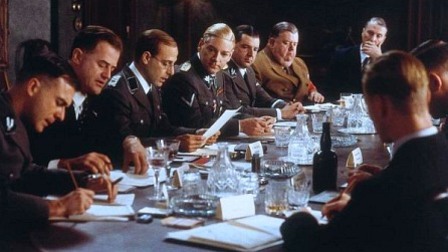
Yesterday I wrote about the rise in Anti-Semitism as reflected in an email sent to me by a Jewish friend and champion of religious liberty. With that rise rise in Anti-Semitism the film Judgment at Nuremberg, came to my mind today. So I am following that up that post with an, albeit, short post regarding one of the most riveting monologues in film from that film, which is a factionalized account of the Nuremberg Judge’s Trial.

 Since yesterday marked the beginning Holocaust Remembrances, which cumulated on the 27th with the actual Holocaust Remembrance Day, and the liberation of Auschwitz, it is appropriate to take the time to never forget. For while we may not want to admit it, as human beings we are all capable of the same inhumanity. Yesterday, one of the President’s aids was quoted as saying “I can’t wait until the revenge (for impeachment) begins” If that doesn’t make make you tremble, in combination with a threat from the President to GOP Senators who vote for witnesses and the introduction of documents and other evidence; one has to take it seriously. As a historian I cannot ignore the Night of the Long Knives when Hitler, Himmler, and Goering joined forces with the Army to exact vengeance on some of Hitler’s longest, and closest supporters in the Nazi Party, German conservative parties, and even Army generals.

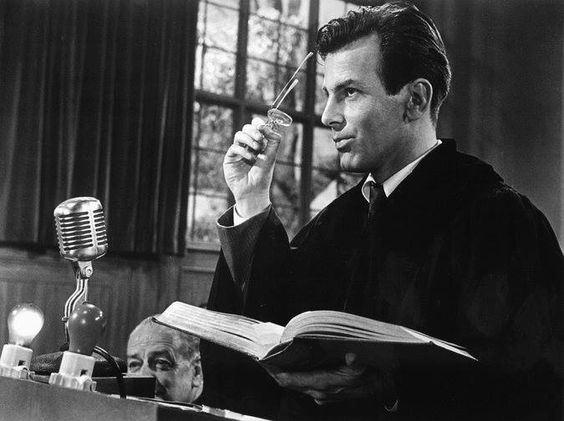
The segment of the film, in which Spencer Tracy plays the role of Chief Judge Dan Heywood gives his verdict is one of the most telling sequences in cinema regarding what it is to be an American. I always showed it in the first session of my military ethics class at the Staff College and since the majority of my students had never seen the film, and it usually left them in silence. So I am just going to leave it with you to watch, read, and contemplate. Who are we, and what do we stand for?

This is especially true when the President, politicians of the majority party in the legislature, pundits, and politically minded preachers make no bones that they have every intent of persecuting those who are of certain races, religions, or political beliefs that they abhor, often using the most scurrilous charges, and outright lies in order to demonize them, dehumanize them, and  open the door for normal, decent, and even brilliant people to justify government sponsored cruelty and injustice that defies the ideals of the Declaration of Independence, the Gettysburg Address, and the Constitution itself, even in the midst of an impeachment trial.

Please, watch the video and read the text. Ponder it in your heart, because it speaks to something that is not a historical aberration, not just a dramatic film, but something that affects the human condition and is present right here and right now in our own country.

“The trial conducted before this Tribunal began over eight months ago. The record of evidence is more than ten thousand pages long, and final arguments of counsel have been concluded.

Simple murders and atrocities do not constitute the gravamen of the charges in this indictment. Rather, the charge is that of conscious participation in a nationwide, government organized system of cruelty and injustice in violation of every moral and legal principle known to all civilized nations. The Tribunal has carefully studied the record and found therein abundant evidence to support beyond a reasonable doubt the charges against these defendants.

Herr Rolfe, in his very skillful defense, has asserted that there are others who must share the ultimate responsibility for what happened here in Germany. There is truth in this. The real complaining party at the bar in this courtroom is civilization. But the Tribunal does say that the men in the dock are responsible for their actions, men who sat in black robes in judgment on other men, men who took part in the enactment of laws and decrees, the purpose of which was the extermination of humans beings, men who in executive positions actively participated in the enforcement of these laws — illegal even under German law. The principle of criminal law in every civilized society has this in common: Any person who sways another to commit murder, any person who furnishes the lethal weapon for the purpose of the crime, any person who is an accessory to the crime — is guilty.

Herr Rolfe further asserts that the defendant, Janning, was an extraordinary jurist and acted in what he thought was the best interest of this country. There is truth in this also. Janning, to be sure, is a tragic figure. We believe he loathed the evil he did. But compassion for the present torture of his soul must not beget forgetfulness of the torture and the death of millions by the Government of which he was a part. Janning’s record and his fate illuminate the most shattering truth that has emerged from this trial: If he and all of the other defendants had been degraded perverts, if all of the leaders of the Third Reich had been sadistic monsters and maniacs, then these events would have no more moral significance than an earthquake, or any other natural catastrophe. But this trial has shown that under a national crisis, ordinary — even able and extraordinary — men can delude themselves into the commission of crimes so vast and heinous that they beggar the imagination. No one who has sat at through trial can ever forget them: men sterilized because of political belief; a mockery made of friendship and faith; the murder of children. How easily it can happen.

There are those in our own country too who today speak of the “protection of country” — of “survival.” A decision must be made in the life of every nation at the very moment when the grasp of the enemy is at its throat. Then, it seems that the only way to survive is to use the means of the enemy, to rest survival upon what is expedient — to look the other way.

Well, the answer to that is “survival as what?” A country isn’t a rock. It’s not an extension of one’s self. It’s what it stands for. It’s what it stands for when standing for something is the most difficult!

Before the people of the world, let it now be noted that here, in our decision, this is what we stand for: justice, truth, and the value of a single human being.”

Think about it, Justice, truth, and the value of a single human being.” 

This is something for every American; Republican, Democrat, Independent, Green, Libertarian, True Believer, or Atheist to think about. No one is safe when the President; be it Trump, or any future President of any party, as well as his or her officials threaten anyone they believe to be opponents regardless of political party, religion, or place in society.

I am concerned, but Judy and I got to see Three Dog Night in concert yesterday evening. I will have to write about that later.

Peace,

Padre Steve+

Leave a comment

Filed under civil rights, crime, culture, ethics, faith, film, History, holocaust, laws and legislation, nazi germany, News and current events, Political Commentary

It Will Happen Again: The Holocaust and Trump’s “Christian” Supporters


Friends of Padre Steve’s World,

Robert Heinlein wrote:

“Almost any sect, cult, or religion will legislate its creed into law if it acquires the political power to do so.”

Today I received a forwarded email from a well known Jewish friend who represents the religious rights of many, mostly Christians in the military. It was one of the most despicable Anti-Semitic, racist, and Nazi-like screeds that I have read in a long time. He gets hundreds like it daily. It used the language of Joseph Goebbels and other Nazis referring to his “Jewish looks,” other blatantly racist and religious comments that might appear in Julius Streicher’s Der Stürmer, nearly pornographic. Whoever wrote the email also included some very disturbing theocratic Christian views and referred to my friend as a Christ Killer and member of the Tribe, both terms used widely among the Nazis.

The historian Yehuda Bauer wrote:

“The horror of the Holocaust is not that it deviated from human norms; the horror is that it didn’t. What happened may happen again, to others not necessarily Jews, perpetrated by others, not necessarily Germans. We are all possible victims, possible perpetrators, possible bystanders.”

The sad thing is that many of the most active Anti-Semites are Christians, or people who label themselves as Christians, who often echo the words and Tweets of President Trump and many of his conservative Christian supporters. Such people people beat their chest and loudly proclaim their support for the State of Israel, but such support is only to usher in Armageddon, the annihilation of two thirds of living Jews, and the conversion of the survivors to Christianity. It is a theology of genocide. It is a theology that has allowed Christians since the time of Constantine to use the police power of the state and its military organizations to exterminate Jews, or any sect that opposes them to commit great acts of systematic murder in the name of Jesus.

It is no wonder to me that a man like my friend who actually stands for the principles of the Declaration of Independence, the Bill of Rights, and the actual beliefs of the Founders who did not create a “Christian nation,”  is targeted by such people.  The great Virginia Baptist, John Leland, who was in large part responsible for the Bill of Rights, and the religious liberty clause of the First Amendment wrote:

“Is conformity of sentiments in matters of religion essential to the happiness of civil government? Not at all. Government has no more to do with the religious opinions of men than it has with the principles of mathematics. Let every man speak freely without fear–maintain the principles that he believes–worship according to his own faith, either one God, three Gods, no God, or twenty Gods; and let government protect him in so doing, i.e., see that he meets with no personal abuse or loss of property for his religious opinions. Instead of discouraging him with proscriptions, fines, confiscation or death, let him be encouraged, as a free man, to bring forth his arguments and maintain his points with all boldness; then if his doctrine is false it will be confuted, and if it is true (though ever so novel) let others credit it. When every man has this liberty what can he wish for more? A liberal man asks for nothing more of government.”

My friend is constantly threatened by supposed Christians, who are no doubt more nationalist and members of the Trump Cult than they are Christians, as were the German Christians, the official Christianity of Naziism.

But the Nazis weren’t the only ones to have such visions of religious superiority aided by the police power of the state.

Gary North, one of the most eloquent expositors of the Christian Dominionist movement and a long time adviser to Ron and Rand Paul and other conservative Christian politicians wrote:

“The long-term goal of Christians in politics should be to gain exclusive control over the franchise. Those who refuse to submit publicly to the eternal sanctions of God by submitting to His Church’s public marks of the covenant–baptism and holy communion–must be denied citizenship, just as they were in ancient Israel.

That is not a criticism of the President, he is an opportunist who understands the insatiable needs of his supporters better than they do. The President really doesn’t believe a word of Christian doctrine, or exhibit one iota of Christian morality or ethics, as a businessman he just realizes an easy mark, a gullible customer, willing to believe whatever he says because he tickles their ears with what they want to hear. He is being what he is, while they are denying their faith and God, while at the same time aiding and abetting the persecution of American Jews.

It is late, I am tired, but believe me, the Anti-Semitism of the Holocaust was not an abnormality, but an ever present reality, even and maybe especially in the United States and Europe because we so easily forget and believe the lies of Holocaust deniers. Oh, I forget to mention, as Yehuda Bauer did. so well, that these people not only despise Jews, they are equal opportunity haters, willing to exterminate anyone who does not agree with them, including Christians. Please don’t blame the President for a more than a millennium of Anti-Semitism and alleged hatred and persecution of supposed heretics by Christians who wield the sword of the state in one hand and their particular versions of the Bible in the other. He’s just shrewd enough of a con-man to scam religious con-men.  If the stakes weren’t freedom and life itself I would think it amusing. But hopefully they will turn on each other before they can destroy the ever expanding idea of liberty that our flawed founders believed in.

So, until tomorrow, I wish you the best,

Peace,

Padre Steve+

6 Comments

Filed under christian life, civil rights, ethics, faith, History, holocaust, laws and legislation, nazi germany, News and current events, Political Commentary, spirituality, White nationalism

Wannsee at 78 Years: Monsters do Exist

conspiracy

Friends of Padre Steve’s World,

Last night I wrote about the Wannsee Conference yesterday. The references were more from films based on history than documents themselves. This is different, it uses the words of perpetrators, victims, and bystanders to deal with the conference at the Villa overlooking the lake in the south Berlin district of Wannsee.

Primo Levi wrote, “Monsters exist, but they are too few in number to be truly dangerous. More dangerous are the common men, the functionaries ready to believe and to act without asking questions.” 

Seventy-eight years ago today a group of 15 relatively common men of various German government, police, and party agencies sat around a table and discussed the implementation of what is called the Final Solution. The meeting was chaired by SS Lieutenant General Reinhard Heydrich, who had been charged with the task of solving Germany’s “Jewish Problem” shortly after the German invasion of the Soviet Union. Hermann Goering, the number two man in the Nazi Reich sent Heydrich the following message:

Berlin, July 31st 1941

To: Gruppenfuhrer Heydrich

Supplementing the task assigned to you by the decree of January 24th 1939, to solve the Jewish problem by means of evacuation and emigration in the best possible way by according to present conditions, I hereby charge you to carry out preparations as regards organizational, financial, and material matters for a total solution (Gesamtlosung) of the Jewish question in all the territories of Europe under German occupation.

Where the competency of other organizations touches on this matter, the organizations are to collaborate. 

I charge you further to submit to me as soon as possible a general plan of the administrative material and financial measures necessary for the carrying out the desired final solution (Endlosung) of the Jewish question.”

Goering

1200x-1

Heydrich

When Goering wrote Heydrich, the head of the Reichssiecherhiethauptampt (RSHA) or Reich Security Main Office, in July 1941 it seemed that Nazi victory in Europe was all but assured. Goering’s words were businesslike. Early measures taken by Heydrich to rid Germany and annexed Austria had been reasonably successful to rid those areas of their Jews through emigration and evacuation. These were not benign measures, people were forced to leave their homes, businesses, communities, and had most of their belongings taken from them in order to leave the Reich, and subjected to much violence and segregation.

However with the occupation of most of Europe following the Nazi military success and the looming occupation and subjugation of the Soviet Union the process of giving the Jews a chance to emigrate to lands outside Nazi control had come to an end. In fact the Nazis occupied the countries that may Jews had found refuge.

Less than six months after he received the directive from Goering, on January 20th 1942 Heydrich summoned representatives from various Reich agencies were called for what turned out to be a brief, two hour meeting which decided the fate of the Jews. The meeting was originally scheduled for early December 1941, but the combination of the Soviet counteroffensive at Moscow and the German declaration of war against the United States following the Japanese attack on Pearl Harbor, but was deflated for just over a month until the situation on the Eastern Front had been stabilized.

The meeting was held at an estate located in the southern suburbs of Berlin, called Wansee. Organized by Heydrich’s deputy Adolph Eichmann, involved Heydrich, Eichmann and 13 mid level representatives from various economic, governmental, justice and police entities.

At the conference Heydrich established his authority through Goering’s directive to overcome the bureaucratic and personal attempts of various attendees to take control of the Final Solution process. Despite objections from some attendees who favored sterilization and the use of Jews in the war armaments industries, Heydrich made it clear that the Final Solution would be a campaign of extermination. He was quite clear:

“Approximately 11 million Jews will be involved…in large single sex labor columns, Jews fit to work will work their way eastward constructing roads. Doubtless the large majority will be eliminated through natural causes. Any final remnant that survives will doubtlessly consist of the most resistant elements. They will have to be dealt with appropriately, because otherwise by natural selection, they would form the germ cell of a new Jewish revival.”

brama_birkenau-2

The Nazi leadership decided that its race war against the Jews needed to forge ahead. Within days of Wansee the orders went out and SS commanders at various concentration camps began devising more efficient means to exterminate Jews and other “sub-humans.” It was a matter of pride and efficiency for them. As Rudolph Hoess the Commandant of Auschwitz said at Nuremberg “the camp commandant at Treblinka told me that he had liquidated 80,000 in the course of one half year. He was principally concerned with liquidating all the Jews from the Warsaw Ghetto. He used monoxide gas, and I did not think that his methods were very efficient. So when I set up the extermination building at Auschwitz, I used Zyclon B….” Hoess estimated that some 2.5 million people were exterminated at Auschwitz at rates as high as 10,000 a day.

einsatzgruppen-nazi-death-squads-ww2-german-brutal-002_thumb

Einsatzgruppen in Action

Before the Conference took place, four Einsatzgruppen followed each of the German Army Groups and systematically began to massacre the Jews of every city and village which German soldiers captured. The Einsatzgruppen, Ordungspolizei battalions, Army Security Divisions and locally recruited units in fewer than six months, killed over a million and a half Soviet Jews, and the slaughter would continue unabated until the dying days of the Reich. One of the participants at the conference, the SS Major and commander of Einsatzkommando in Latvia, had been in charge of exterminating over 30,000 Jews, before the meeting was organized.

When the Nazis began their attack into the Soviet Union, Heinrich Himmler, Heydrich’s friend and superior told a gathering of senior SS leaders:

“I also want to mention a very difficult subject before you here, completely openly. It should be discussed among us, and yet, nevertheless, we will never speak about it in public…I am talking about the “Jewish evacuation” the extermination of the Jewish people.” 

It is One of the things that is easily said. “The Jewish people is being exterminated,” every Party member will tell you, “perfectly clear, it’s part of our plans, we’re eliminating the Jews, exterminating them, ha!, a small matter.” 

But then along they all come, all the decent upright Germans and each has his decent Jew. They all say: the others are all swine, but here is a first class Jew. And none of them has seen it, has endured it. Most of you will know what it means when 100 bodies lie together, or when there are 500 or 1000. And to have seen this through, and –with the exception of human weaknesses– to have remained decent, has made us hard and is a page of glory never mentioned and never to be mentioned….”

himmlervisit

Himmler and his entourage 

Whether the words are those of Goering, Heydrich, Hoess or Himmler, there is a certain businesslike banality to them. But these men, and many others like them orchestrated a campaign of genocide and race hatred unmatched in history. Yes, there have been other genocides, the Turks killing the Armenians during the First World War and the Hutu and Tutsi slaughter in Rwanda but neither they or the politically motivated campaigns of mass slaughter conducted by the Soviets, the Chinese Communists and the Khamer Rouge killing fields can match the systematized extermination campaign waged by the Nazis against the Jews.

The truly terrifying thing about the Nazi perpetrators of the Holocaust to me is that most of the men at Wannsee; as well as the men that commanded the Concentration camps and the Einsatzgruppen were very ordinary men who simply believed that they were doing their jobs.

They are all a very fascinating group of men to study. Very few could be described as psychopathic killers by nature. They were lawyers, doctors, career police officials, businessmen, and bureaucrats who carried out an extermination campaign that killed by their own numbers between 5.5 and 6 million Jews, not to mention others deemed to be subhuman including the handicapped, the mentally ill, homosexuals, and other non-Jewish minorities like the Gypsies not to mention the wide variety of those considered political enemies. But it was the Jews that bore the most tragic fate.

arbeitmachtfrei

It is something that we must never forget.When it comes to Wannsee, the men there had few qualms about what they were doing. Most of those who opposed Heydrich did so because he was centralizing the power of action against the Jews in his Reich Main Security Office (RSHA) and subordinating the the other Reich ministries to it. But by the end of the conference all of the participants had agreed to Heydrich’s terms. Some did what they could afterwards to use their Bureaucratic abilities to prevent some of the protocols from being fully implemented, while others did all they could to implement it.

After the war it meant the difference between life and death for the attendees, except Heydrich who was killed by Czech partisans a few months after the Wannsee Conference, SS Major Rudolph Lange, who died fighting the Red Army toward, the end of the war, Martin Luther Unter Staatssekretär of the Foreign ministry who died of a heart attack, in a concentration camp after opposing Foreign Minister Joachim von Ribbentrop in 1945; Roland Freisler who represented the Ministry of Justice who died in early 1945 during a bombing attack on Berlin while serving as the head of Hitler’s extrajudicial People’s Court, and Gauleiter and Staatssekretär Alfred Meyer who committed suicide near the Weser River in May 1945. A few of the rest received the death penalty, but most received relatively brief prison sentences, and some lived to old age. In the end, only one, Friedrich Kritzinger showed remorse for his and his country’s actions during Nazi rule.

One man of fifteen. I wonder if the same ratio applies to the officials of the governments of evil, repressive, authoritarian regimes. Possibly even the one emerging in the United States.

I will leave it at that.

Peace

Padre Steve+

2 Comments

Filed under ethics, film, History, holocaust, laws and legislation, leadership, nazi germany, Political Commentary

Wannsee: The Men, Their Mission, and the Implications Today

1200x-1

Reinhard Heydrich

Friends of Padre Steve’s World,

The great American philosopher, Eric Hoffer once wrote, “Hatred is the most accessible and comprehensive of all the unifying agents. Mass movements can rise and spread without belief in a god, but never without a belief in a devil.”

Hatred is an amazing emotion. In the final scene of the movie Conspiracy which is about the Wansee Conference, at which fifteen officials of the Nazi government met to coordinate what became the Holocaust, the “Final Solution” of what the Nazis called, “the Jewish problem.” The movie is troubling because the men in the room were well-educated, high to mid-level officials from a variety of agencies who were called together to ensure that their respective agencies worked together.

At beginning of the movie, Kenneth Branagh who plays SS Lieutenant General Reinhard Heydrich describes the “problem to be solved”

“To begin, we have a storage problem in Germany with these Jews…. The laws enacted at Nuremberg, and we should drink a toast to Dr. Stuckart for devising them….They established the fundamental legality for the creation of a Jew-free society, a Jew-free economy for the world to see. And we, indeed, have eliminated the Jew from our national life. Now, more than that, the Jew himself must be physically eradicated from our living space…

Then, in acquiring Poland, we acquired two and a half million more. By last July, we were met with a new situation, we would, in very short order, be acquiring some five million Jews as we conquered Russia. The dimensions of this problem have magnified astoundingly. Five million…

At that time, last July, confronting this new situation, Reichsmarshal Goering prepared a directive, you have a copy. The operative words, if you’ll permit me to read:

“I hereby charge you with making all preparations.in regard to organizational and financial matters for bringing about a complete solution of the Jewish question in the German sphere of influence in Europe.”

Now, for that, I read the cleansing of the entire continent of Europe.…in the second paragraph: “Wherever other governmental agencies

are involved these are to cooperate with you.” I hope. So on, so on… “as necessary for the accomplishment of the desired solution of the Jewish question.” This is our mandate, all of us.

Donald Trump has talked about expelling and deporting over 11 million Mexicans and other South or Central Americans from this country. True, many are here illegally, but at the same time most are working and paying taxes, doing the things that many Americans consider themselves too good to do. He has mentioned similar things in regard to Muslims, as well as banning any Muslim from coming to the country. He has talked about going along with the desire of the Christian Right to roll back the hard earned rights of Homosexuals, and he has no regard for African Americans and their rights, with the possible exception of Ben Carson, but I digress…

At the close of the meeting the decision to exterminate the Jews was agreed to by the assembled officials who pledged to work with each other, once they had been told of how the logistics of the operation would take place. Not all were happy, some were shocked, but all rolled over and agreed to cooperate with Heydrich.

At the end of the movie Heydrich is asked to share an allegorical story that one of the less enthusiastic conference participants, Reich Chancellery State Secretary, Dr. Wilhelm Kritzinger, told him about hatred of the Jews. Heydrich recalled the story to SS Major General Heinrich Müller and SS Lieutenant Colonel Adolf Eichmann.ueller and SS Lieutenant Colonel Adolf Eichmann:

“Yes, he told me a story about a man he’d known all his life, a boyhood friend. This man hated his father. Loved his mother fiercely. The mother was devoted to him……but the father beat him, demeaned him, disinherited him. Anyway, this boy grew to manhood and was still in his 30s when the mother died…this mother who had nurtured and protected him.She died. The man stood as they lowered her casket and tried to cry…but no tears came. The man’s father lived to old age, died when the son was in his 50s. At the father’s funeral, much to his son’s surprise…he could not control his tears. He was wailing, sobbing. He was apparently inconsolable. Lost, even. That was the story Kritzinger told me.

Eichmann said, “I don’t understand.”

Heydrich answered: “No? The man had been driven his whole life by hatred of his father. When the mother died, that was a loss. When the father died…when the hate had lost its object…then the man’s life was empty. Over.

Eichmann replied: “Interesting. That was Kritzinger’s warning. What? That we should not hate the Israelites?”

To which Heydrich said, “No, that it should not so fill our lives…that when they are gone, we have nothing left to live for. So says the story. I will not miss them”

I used to show the film as the final class in the ethics elective that I taught at the Joint Forces Staff College. After the film was over it never failed that at least one of the students would bring up pertinent comments about hate in our current political climate. Again I cannot go into details, but I can assure you that the conversation was always subdued and sobering. I think that all of us left better for it, for such men and women know that there is a Rubicon that cannot be crossed. In the troubling times that we live, that gives me some comfort.

The story is pertinent when one looks at what Donald Trump is doing right now. I really have to wonder how deep hatred such as his runs in this country, because unlike love, hatred is easy to conjure up. It is kind of like what you need to build a fire; fuel, oxygen and heat. To generate hatred on a massive scale all you need is a disaffected populace, a convenient target, and an agent to ignite the mixture.

Shrewd politicians, preachers, and pundits do this well. Donald Trump is showing himself to be a master of this. He, and others like him, and not just American politicians, pundits or preachers, mind you, demonize the target group or population and then let the hatred of their disaffected followers flow.

Leaders who are consumed with hate need a disaffected and angry base in order to rise to power; such was how Hitler, Stalin, and so many other despots gained power. They took advantage of a climate of fear, and found others to blame. For Hitler it was the Jews; while for Stalin it was various groups like the Ukrainians, or the Poles who were the devil to be feared and destroyed. For Trump it is Muslims, Mexicans, immigrants, liberals, and sometimes, even Jews.

Timothy Snyder in his book Bloodlands: Europe Between Hitler and Stalin wrote:

“Dead human beings provided retrospective arguments for the rectitude of policy. Hitler and Stalin thus shared a certain politics of tyranny: they brought about catastrophes, blamed the enemy of their choice, and then used the death of millions to make the case that their policies were necessary or desirable. Each of them had a transformative utopia, a group to be blamed when its realization proved impossible, and then a policy of mass murder that could be proclaimed as a kind of ersatz victory.”

Snyder is quite correct, demonizing a people and making them some kind of “other”, “they”, or “them”, is a wonderful way to blame a group of people for the ills of society. It is also a good way to deflect the blame for the corporate failures of societies and governments onto a convenient scapegoat; and to blame others for the personal failures and petty jealousies of the people doing the demonizing. It also allows people to abandon ethics and the simple notion of the Golden Rule an engage in genocide.

Mass movements and their leaders; of which Trump is such a leader, are masters of hatred and demonizing any opponents. The technique Trump is using is not at all new, it has been used from antiquity but has become much more dangerous in the modern era with the spread of instant communications technology. History shows us all too clearly how it has happened and how easily it can happen again. Witch hunts, slavery and Jim Crow, the extermination of the Native Americans which inspired Hitler in his campaign of genocide and the Holocaust; the Soviet gulags and ethnic cleansings, the Rape of Nanking, the Chinese Communist “Cultural Revolution” the Rwandan genocide, Srebrenica, the Turkish genocide of the Armenians, and the current crimes against humanity of the so called Islamic State. Sadly, the list can go on and on.

All of these events simply required the elements of a disaffected population, a devil or scapegoat to blame, and a leader or leaders to ignite the volatile mixture; fuel, oxygen and heat. Hoffer was quite correct that “Mass movements can rise and spread without belief in a god, but never without a belief in a devil.” The really successful leaders of such movements understand this. For Hitler it was the Jews and other untermenschen; for American Southerners after the Civil it was the Blacks and their white supporters. For the American “Know Nothings” of the 1840s and 1850s it was immigrants, especially Irish and Germans who were Catholic; for Stalin it was non-Russian ethnic minorities. For the leaders of the Islamic State, it is Jews, Shi’ite Moslems, less than “faithful” Sunnis, Christians and well for that matter anyone who does not line up one hundred percent with them on every issue. The examples are so plentiful to support this fact that it is almost overwhelming.

The problem is that when any society, or government begins to label or stigmatize a race, religion, ethnicity, sexual preference, or political ideology, and then in the process demonize those people to the point that they become less than human we have reached a tipping point. We reach the point where we are just one crisis away from all of those crimes against humanity that we believe that we are no longer capable of doing. But sadly, we human beings are not nearly as evolved as we think and I think that the tipping point in the United States may be far closer than we could ever imagine.

I really do not think that we are too far from some tipping point where the politicians, pundits and preachers; especially those of the political right and the media whores who are more concerned about market share than truth, decide that their “devils” must be exterminated. Of course when they will do they will claim a higher moral, religious, or racial, purpose; or perhaps use the language of Manifest Destiny, the Lost Cause, or the Stab in the Back or some other historical myth that suffices to justify their actions.

In response to Trump and those who stoke the same kind of fear and hatred, I wonder just how many men that there are like Heydrich, who would execute the orders of someone like Trump that there are in our country this very minute. I shudder to think of it, and when I do, I am reminded of the closing words of Spencer Tracy when he pronounces judgement on the Nazi judges in the film Judgment at Nuremberg:

But this trial has shown that under a national crisis, ordinary – even able and extraordinary – men can delude themselves into the commission of crimes so vast and heinous that they beggar the imagination. No one who has sat through the trial can ever forget them: men sterilized because of political belief; a mockery made of friendship and faith; the murder of children. How easily it can happen. There are those in our own country too who today speak of the “protection of country” – of ‘survival’. A decision must be made in the life of every nation at the very moment when the grasp of the enemy is at its throat. Then, it seems that the only way to survive is to use the means of the enemy, to rest survival upon what is expedient – to look the other way. Well, the answer to that is ‘survival as what’? A country isn’t a rock. It’s not an extension of one’s self. It’s what it stands for. It’s what it stands for when standing for something is the most difficult! Before the people of the world, let it now be noted that here, in our decision, this is what we stand for: justice, truth, and the value of a single human being.”

I do hope that we follow a saner and less horrifying path, despite the election and past three years of the Trump Administration. I cannot abandon hope, nor can I be one that turns his eyes away from actions that range from separating immigrant and refugee families and placing children in cages on our southern border; assassinating members of nations that we are not at war with, regardless of how bad they are, while pardoning members of our military who were judged to be war criminals under the Uniform Code of Military Justice. Of course that does not even mention how the President has undermined the institutions and laws of our country.

But I cannot lose hope or give up. In the words of Major General Henning von Tresckow, who died following multiple attempts to rid Germany of Hitler:

“We have to show the world that not all of us are like him. Otherwise, this will always be Hitler’s Germany.”

For me I am not comparing Trump to Hitler, but I believe he will be just as deadly to the United States as Hitler was to Germany. It all comes down to character, and as different as our President or the former Nazi Fuhrer are, neither had, or in the case of President Trump, have any character, nor did or do their enablers, and supporters; they are the perpetrators. Of course we know the victims, but then there are those  who decide to look the other way, the bystanders who prefer survival to freedom. As Yehuda Bauer wrote:

“Thou shalt not be a victim, thou shalt not be a perpetrator, but, above all, thou shalt not be a bystander.”

Until tomorrow,

Peace

Padre Steve+

5 Comments

Filed under germany, History, holocaust, nazi germany

The Horror of Evil is that it Does Not Deviate from Human Norms: the Eternal Precedent of the Holocaust

rolfe

Friends of Padre Steve’s World,

I read and write a lot about Weimar and Nazi Germany as well as the Holocaust. They were the focus of my undergraduate major working under Dr. Helmut Heussler who served as a translator and interrogator at Nuremberg while I was a student at California State University at Northridge and later in my Masters of Arts in Military History. I read the documents, the histories, the narratives, and the reports both in English and German. I study the perpetrators, the victims, and yes the bystanders as well and there is not enough time in one man’s life to read all of them, but I will try.

Likewise I visit the sites where things happened in Germany, and every time that I make a trip to those places I learn more and believe me it is not comfortable.  When I visited the Palace of Justice in Nuremberg a few years ago I saw a picture of Dr. Heussler doing his work. Back then he was very young and it would be a number of years before he finished college and went on to his doctorate. When I saw his picture I remembered just how important he was in opening my eyes to the dark side of humanity; even those people that are not truly evil; those like most of us who exist between the shades of gray between sainthood and the devil.

The histories, the documents, the narratives paint a dark picture of humanity and the fallibility of people. The portrait that they paint a disturbing picture of the true nature of what is in all of us. When I look at the pictures and see the films I can see that the lessons of that time have not been learned. Dr. Timothy Snyder wrote:

“The world is now changing, reviving fears that were familiar in Hitler’s time, and to which Hitler responded. The history of the Holocaust is not over. Its precedent is eternal, and its lessons have not yet been learned.”

In the age where men who admire tyrants and authoritarians like Trump, Putin, Farage, Erdrogan, Assad, and so many others it is important that we try to learn the lessons lest we fall into the same trap as our ancestors and become perpetrators, victims, or bystanders. I often find myself wondering what will be said we Americans of our time in say fifty years or so. I have a feeling that it will not be favorable or sympathetic.

Such a fascination with the thoughts of others years after I am likely to be dead may seem unusually circumspect. But my call as a priest and a historian doesn’t allow me not to care about the future, or ignore present realities. The fact is that totalitarian regimes and events like the Holocaust are all too common in human history, one of those is the connection of humanity with its past and future, and that humanity being the constant in our history. Yehuda Bauer wrote:

“The horror of the Holocaust is not that it deviated from human norms; the horror is that it didn’t. What happened may happen again, to others not necessarily Jews, perpetrated by others, not necessarily Germans. We are all possible victims, possible perpetrators, possible bystanders.”

The fact is that there are very few true saints and likewise very few truly evil people. Quite obviously Adolf Hitler and many of his associates fell in the latter category. The rest of us, and for that matter most of the people on all sides during from the Nazi seizure of power until the Gotterdammerung of the Third Reich in in the flames of Berlin in 1945 fell somewhere in the gray area between the truly evil and the saints and truthfully all of us given the right conditions are capable of becoming perpetrators, victims, or the worst, bystanders who turn their backs on evil because it doesn’t seem to affect us; but it does.

Admittedly this is a dark subject and as I always reminded my students “the one constant in history are fallible human beings.” 

During our recent blizzard and snow event my wife Judy was away, so one of the nights that I was alone I re-watched the film Judgment at Nuremberg. The film is profoundly disturbing not only because of the subjects that it deals with but also when we look at the great uncertainty time that we live and how similar it is to the world of the late 1920s and early 1930s. In one of the more disturbing scenes of the film, Maximillian Schell, who played Hans Rolfe, the defense counsel for Ernst Janning, played by Burt Lancaster gives a summation in the final defense of his client who has already admitted his guilt which is remarkable because he tells the truth about the guilt of everyone.

Rolfe’s summation of his defense following his client’s admission of guilt is damning. It is something that almost all of us do. It is how we look at the atrocities of genocide, war crimes, ethnic cleansing, the willful starvation of millions by criminal regimes; and then stand by saying little or nothing and doing nothing, sometimes even supporting the leaders or the regimes that commit these actions.

So please, no matter what your political point of view, take the time to watch clip or the whole film, and read the transcript of Schell’s speech below. It’s far easier than trying to do all the reading, study, and research that I have done.

“Your Honor, it is my duty to defend Ernst Janning, and yet Ernst Janning has said he is guilty. There’s no doubt, he feels his guilt. He made a great error in going along with the Nazi movement, hoping it would be good for his country. But, if he is to be found guilty, there are others who also went along, who also must be found guilty. Ernst Janning said, “We succeeded beyond our wildest dreams.” Why did we succeed, Your Honor? What about the rest of the world? Did it not know the intentions of the Third Reich? Did it not hear the words of Hitler’s broadcast all over the world? Did it not read his intentions in Mein Kampf, published in every corner of the world? Where’s the responsibility of the Soviet Union, who signed in 1939 the pact with Hitler, enabled him to make war? Are we not to find Russia guilty? Where’s the responsibility of the Vatican, who signed in 1933 the Concordat with Hitler, giving him his first tremendous prestige? Are we not to find the Vatican guilty? Where’s the responsibility of the world leader, Winston Churchill, who said in an open letter to the London Times in 1938 – 1938! Your Honor – “were England to suffer national disaster should pray to God to send a man of the strength of mind and will of an Adolf Hitler!” Are we not to find Winston Churchill guilty? Where is the responsibility of those American industrialists, who helped Hitler to rebuild his armaments and profited by that rebuilding? Are we not to find the American industrialists guilty? No, Your Honor. No! Germany alone is not guilty: The whole world is as responsible for Hitler’s Germany. It is an easy thing to condemn one man in the dock. It is easy to condemn the German people to speak of the basic flaw in the German character that allowed Hitler to rise to power and at the same time positively ignore the basic flaw of character that made the Russians sign pacts with him, Winston Churchill praise him, American industrialists profit by him! Ernst Janning said he is guilty. If he is, Ernst Janning’s guilt is the world’s guilt – no more and no less.”

Sadly, little has changed in the character of humanity. If we do or say nothing, if we support those who do such things, if we close our eyes and pretend that it is not our problem, then we too are the guilty party.  As Hannah Arendt wrote: “The sad truth is that most evil is done by people who never make up their minds to be good or evil.”

Sophie Scholl, a young university student who died at the hands of the Nazis for daring to distribute leaflets telling the truth about Hitler’s regime wrote:

“The real damage is done by those millions who want to ‘survive.’ The honest men who just want to be left in peace. Those who don’t want their little lives disturbed by anything bigger than themselves. Those with no sides and no causes. Those who won’t take measure of their own strength, for fear of antagonizing their own weakness. Those who don’t like to make waves—or enemies. Those for whom freedom, honour, truth, and principles are only literature. Those who live small, mate small, die small. It’s the reductionist approach to life: if you keep it small, you’ll keep it under control. If you don’t make any noise, the bogeyman won’t find you. But it’s all an illusion, because they die too, those people who roll up their spirits into tiny little balls so as to be safe. Safe?! From what? Life is always on the edge of death; narrow streets lead to the same place as wide avenues, and a little candle burns itself out just like a flaming torch does. I choose my own way to burn.”

Whether I live one day, or another fifty years, I do not want to be a person who wants to be remembered as one who “just wants to survive,” or “left in peace,” or as Arendt said one “who never makes up their mind to be good or evil.” Nor can I be one who just goes along with things as Janning did, carrying in Judgment at Nuremberg, or be one for whom freedom, honour, truth, and principles are only literature.” 

That is the only way I know how to live. Life has taught me that.

Peace

Padre Steve+

4 Comments

Filed under books, civil rights, ethics, faith, film, History, holocaust, life, nazi germany, philosophy, Political Commentary

“The laws of war are not a one-way street.” Benjamin Ferencz, Telford Taylor, and the Primacy of Law over Acts of War

Friends of Padre Steve’s World,

Last night I got a form of the crud going around, I did not sleep well, and woke up coughing, a bit of a sore throat, a terrible sinus headache and wondered if I was getting the Flu. So I called in to work, took some maximum strength Theraflu, went back to bed and didn’t wake up until almost 3:00 PM when a friend sent me a text. That stuff knocked me out for almost seven hours. My sinuses were clear, I was no longer coughing and the headache was gone. After I got up, had some coffee, soup, and Earl Grey Tea, and re-watched the biographical documentary of Benjamin Ferencz, who at the age of 27 served as the chief prosecutor at theNuremberg Einsatzgruppen Trials in 1947, on Netflix.

The title is Prosecuting Evil: the Extraordinary World Of Ben Ferencz. It is well worth the time to watch. Ferencz is now 98 years old and has been a driving force in the prosecution of war crimes. Probably more than any other American took to heart the message of Justice Robert Jackson:

If certain acts of violation of treaties are crimes, they are crimes whether the United States does them or whether Germany does them, and we are not prepared to lay down a rule of criminal conduct against others which we would not be willing to have invoked against us.”

Ferencz, took, and still takes that seriously. He fought long and hard for the establishment of the International Criminal Court and delivered the closing argument in its first prosecution of a war criminal, Thomas Lubanga Dyilo, for his use of child soldiers in the Democratic Republic Of the Congo, the Trial ended in 2006, with Dyilo’s conviction.

Ferencz was brought into the Nuremberg process because of his experience investigating Concentration Camps during and shortly after the war while still in the Army, by Colonel, Later General Telford Taylor, who was appointed to direct the 12 trials that followed the trial of the Major War Criminals. Ferencz discovered the evidence of the crimes of the Einsatzgruppen while doing investigations for Taylor, and he volunteered to take the lead in prosecuting the highest ranking of those killers. Taylor said:

“The laws of war do not apply only to the suspected criminals of vanquished nations. There is no moral or legal basis for immunizing victorious nations from scrutiny. The laws of war are not a one-way street.

Ferencz understood that, and ever since Nuremberg has been a consistent force in the conscience of the nation and international law. I had read about him many times, as well as the Einsatzgruppen Trials. As I watched the documentary about him, which included many interviews with him, I was amazed by how much he was like my history professor at California State University, Northridge, Dr. Helmut Haeussler in the pursuit of truth and justice, who served as an interpreter at Nuremberg and introduced me to victims of the Holocaust, people who survived Auschwitz.

Since that time, as a historian I have been devoted to telling the truth about the Holocaust and bearing witness, even as I confront Holocaust deniers, anti-semites, and Neo-Nazis.

Ferencz made history, and by his continued witness, and at the age of 98 still makes history and inspires men like me to want to make a difference after I retire from the Navy by bearing witness when all of the survivors are gone. Benjamin Ferencz never retired in his quest for justice. He noted:

“Nuremberg taught me that creating a world of tolerance and compassion would be a long and arduous task. And I also learned that if we did not devote ourselves to developing effective world law, the same cruel mentality that made the Holocaust possible might one day destroy the entire human race.”

I agree with him and no matter how long I live I will travel, research, write, and testify on behalf of the victims of the Holocaust and other genocides so that they won’t happen again.

Ferencz spoke out against the Invasion of Iraq in 2003, about American War Crimes in Vietnam, and in what we call The War on Terror. To be sure he labels those who attacked us in 2001 as War Criminals based on the Nuremberg statutes, but he has also been critical of the United States.

Ferencz said: “A true patriot will support his country when it is right but will have the courage to speak out when it’s wrong and try to set it right.”

I want to devote the remaining part of my life to making sure that the truth is told and such events of mass murder never happen again. I will do my best to live according to the ethos of Ben Ferencz as well as that of Robert Jackson.

Part of that requires being honest about current conflicts in which the United States finds itself in today. Which brings me to the assassination of the Iranian Revolutionary Guards Al Quds Force, General Qassem Suleimani, a man who is as much of a war criminal as has been seen in decades, within his own country and throughout the region by sponsoring terrorist organizations, sowing civil wars that have cost hundreds of thousands of lives and  disrupted millions of others.

I shed no tears for Suleimani, but the case the administration used to kill him goes against the international law that the United States helped establish at Nuremberg and which cumulated in the Rome Accords and the Establishment of the International Criminal Court which the United States, though a signatory, has yet to ratify.

Specifically, it is the claim of preemptive action, preemptive killing, preemptive war. It was one of the defenses of the Nazi War Criminals, as well as the Japanese War Criminals. The United States claimed that rationale to kill Suleimani, on the scantiest evidence, none of which was produced. That is an unwise strategy, for it invites such actions against Americans, especially military, and diplomatic personnel, as well as political leaders.

My argument does not let Iran off the hook; however, to paraphrase Ferencz, is that we have to move away from war, and move towards using established international law against men like Suleimani, and nations like Iran. Of course opponents of the United States could easily make the same argument against us. But to quote Taylor, “the laws of war are not a one way street.”

My purpose tonight is not to excuse or defend Suleimani or Iran, it is to to say that unless the United States stands for law and justice, other nations, or non-state actors can and will use the same rational in order to assassinate Americans. The President’s actions have not made the United States any safer, instead it has made us even more of a target. I don’t want American leaders, even President Trump, assassinated by agents of foreign powers, or even Americans seeking extra judicial justice. Such organizations or people may think that such action is justified, but without a basis in law they are not, they just continue the cycle of violence, war, and injustice.

Until tomorrow,

Peace,

Padre Steve+

4 Comments

Filed under crime, ethics, film, History, holocaust, laws and legislation, leadership, nazi germany, News and current events, Political Commentary