Category Archives: laws and legislation

Not Just Words but Actions: My Support for LGBTQ Civil Rights

Friends of Padre Steve’s World,

I am often asked why I write on the topics of civil rights and human rights and why I have over the past few years gone beyond writing but speaking and engaging in peace public protests for these rights. I guess it is because I have to. Writing is easy for me and apart from the occasional death threat from a Neo-Nazi or KKK sympathizer there is little risk. However, getting out in public and speaking or marching with others in support of their rights is not without risk.

As a historian I have always impressed by the struggle for equality and resistance against tyranny. It matters not to me if the cause is that of the African American fighting against slavery, Jim Crow, and continued discrimination; the Native American against whom genocide was committed in the name of a supposedly “Christian American” Manifest Destiny; the Jew targeted by Nazi Race hatred and genocide, or so many others who due to their race, religion, ethnicity, gender, sexual orientation, or political beliefs have been targeted for subordination or elimination by governments, or mass movements.

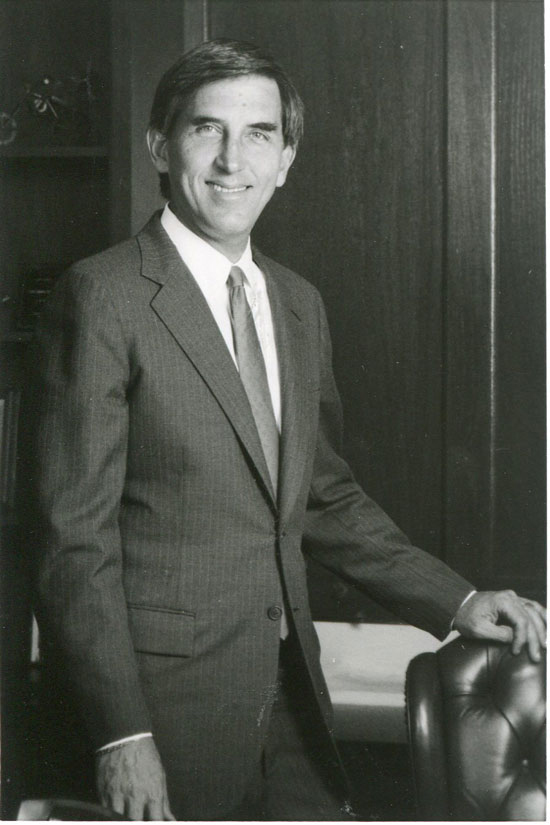
One man who inspired me is Charles Morgan Jr., a lawyer in Birmingham Alabama had the courage to confront the people and the culture that allowed the brutal bombing of the 16th Street Baptist Church in 1963 that killed four little girls attending Sunday school and wounded many more. Morgan noted: “It is not by great acts but by small failures that freedom dies. . . . Justice and liberty die quietly, because men first learn to ignore injustice and then no longer recognize it.” I have embraced his example to speak out publicly when I see the rights of my fellow citizens and other human beings trampled by those who only care about their power and privilege.

On this site I have frequently written about those subjects. Likewise, within the confines of still being a commissioned officer in the United States Navy I continue to support those discriminated and oppressed by people whose political, religious, or ideological beliefs support policies, measures, and ideas that go against the basic guarantees of the United States Constitution, as well as the bedrock ideal of the American experiment, the belief written in the Preamble of the Declaration of Independence that “all men are created equal and endowed by their creator with certain unalienable rights…” and reinforced by Abraham Lincoln in the Gettysburg address that this Republic was dedicated to the proposition that “all men are created equal.” 

I know that there are many times that people wonder why I continue to write about and even take an active role in promoting the liberties of people who because of their race, religion, gender, sexual orientation, or ethnicity are the targets of discrimination, legislative actions, threats, and violence. As such I write about these issues all the time, however, it wasn’t until a couple of years ago that I became an actual participant in rallies and marches on behalf of any persecuted group. In my case it was making a deliberate move to openly support my friends in the LGBTQ community.

My support of my LGBTQ friends has perplexed many people who predominantly knew me through church or military settings. The sight of a Christian Navy Chaplain and carer military officer supporting people who until 2012 were forbidden to even reveal under threat of criminal prosecution and discharge from the military that they were Gay, or condemned by the church to discrimination in this life and damnation in the next was anathema to many people who I counted as friends. Since I came out as a straight ally to my LGBTQ friends, many people who I believed were friends have long since written me off simply because my stand contradicted their religious beliefs. That bothers me by I have to move along. Likewise there are others who regardless of their beliefs have remained close friends and been supported even if they disagreed with me. That is a hallmark of true friendship. I honestly believe that if friendship is predicated on religion, political beliefs, or anything but on true care for one another it is not friendship.

It is interesting that almost all of my LGBTQ friends are people who I went to high school, college, attended church with, or served alongside in the military. In fact I didn’t know that most of them were Gay for years because the were closeted and that the act of coming out could cause them incredible harm. Over the years as I came to support them more and more have let me know that they were Gay, knowing that I would both protect their confidence and fully support them and they have come to trust me, and I cannot betray their trust by failing to support them in my words and in my deeds.

Knowing their stories and holding them sacred is important to me. I cannot imagine what it would be like to hold fast to the creeds of the church yet suffer the pain of excommunication because of my sexual orientation. I cannot imagine what it would be like to swear and oath to defend my country and go to war yet still be forced to be silent about the people that I love under the threat of punishment and discharge. I cannot imagine what it would be like to be evicted from my home or denied the opportunity to buy a house because I loved someone of my gender. I cannot imagine what it would be like to be able to be fired from a civilian simply because I was Gay. I don’t have to imagine what it would be like to have your best friends and your life partner forbidden to be with you on your deathbed, because as a hospital chaplain I have seen it happen even as the pastor of the man’s parents screamed at him to repent as he died with a ventilator in his throat.

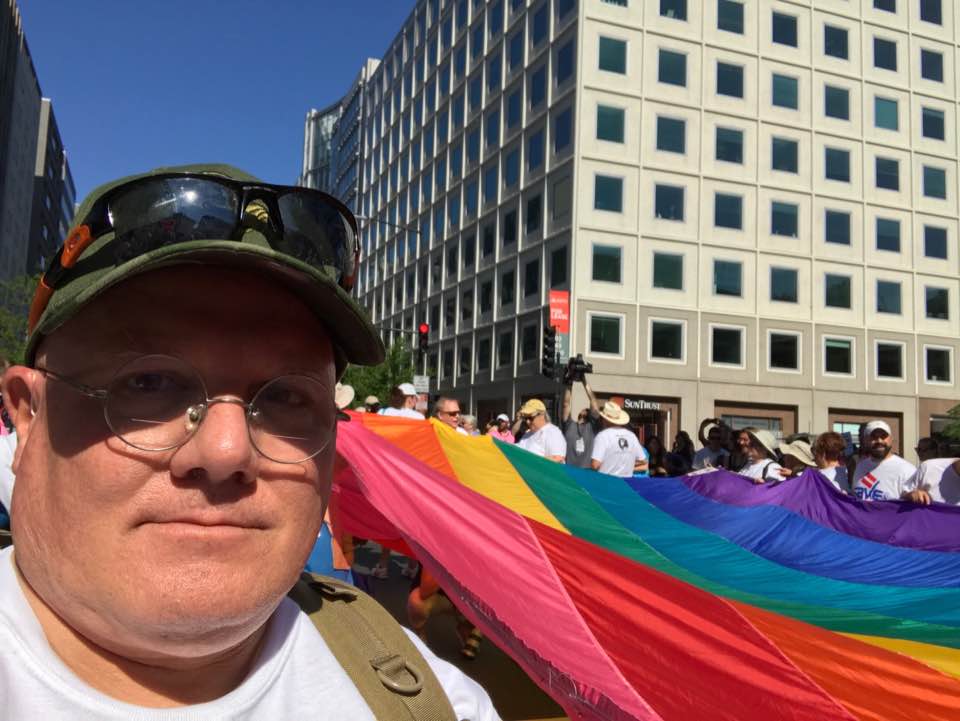
Sunday I participated in the Equality March in Washington D.C. I was with friends and I represented friends that could not be there. It was important. I have been to D.C. many times but I have never experienced it in such a way, I never dreamed that I would be in any civil rights march that went past so many places that symbolize who we are as Americans including the White House and in front of the Capital building. On the way back home yesterday Judy mention how proud she was that I marched. That meant a lot to me, she is an amazing woman who cares so deeply about others that it humbles me. As we talked I remarked that had I been an adult in the 1960s I would have very likely been marching in support of the civil rights of African Americans.

John F. Kennedy said “The rights of every man are diminished when the rights of one man are threatened.” This is something that I believe with my whole heart and now have decided to back my beliefs and words with action instead of sitting on the sidelines.

Yesterday I had friends who took part in the commemoration of the slaughter of 49 people, including an Army officer at the Pulse nightclub in Orlando. It was a crime directed at them because they were LGBTQ people and Pulse was a place that they felt safe. Sadly they were not the first to die violently because of their sexual orientation in this country, nor will they probably be the last. That is a reason that I have to speak out. If I don’t I would be complicit in the crimes committed against them by my silence. Dr. Martin Luther King Jr. said: “In the End, we will remember not the words of our enemies, but the silence of our friends.”

I will not be a silent friend ever again. This week was for my LGBTQ friends, but I will do so for others as well. I cannot be silent in the face of hatred, even that legislated against already marginalized and despised people by supposedly Christian majorities in various statehouses and Congress. I remember all too well the words of the German pastor Martin Niemoller who wrote:

First they came for the Socialists, and I did not speak out—
Because I was not a Socialist.

Then they came for the Trade Unionists, and I did not speak out—
Because I was not a Trade Unionist.

Then they came for the Jews, and I did not speak out—
Because I was not a Jew.

Then they came for me—and there was no one left to speak for me.

As such, I cannot be silent. To do so would betray all that I hold dear.

Until tomorrow.

Peace

Padre Steve+


1 Comment

Filed under civil rights, ethics, faith, laws and legislation, leadership, LGBT issues, News and current events

A March for the Civil Rights of LGBTQ People in the Nation’s Capital 


Friends of Padre Steve’s World,

Yesterday I posted an article that I think is one of the most important that I have ever written and the heart of it came from the sermon of Rabbi Roland Gittlesohn, a Navy Chaplain serving with the 5th Marine Division on Iwo Jima. It is one of the most remarkable sermons that I have ever heard or seen. It says far better than I think I ever have just how important the rights of every American citizen no-matter what their race, creed, ethnicity, religion, sex, gender, sexual orientation, or political beliefs have a right. It is the promise of the preamble of the Declaration of Independence that “all men are created equal, that they are endowed by their creator with certain unalienable Rights, that among these are Life, Liberty, and the pursuit of happiness…” That statement is the bedrock of the American ideal, an ideal that we as a people have often fallen far short of embracing too many times, but it is still the idea that was so revolutionary for its time that even Americans, especially slave owners condemned it. 


When one actually looks at those speeches and writings, by slave power proponents as well as others who legislated against liberty for anyone but White Protestant men, they are chilling. Sadly, the same philosophy of trampling the liberty of all but a few remains a part of our national fabric. We see that manifested daily by people, including politicians, preachers, and pundits in regard to people of color, Muslims, women, and of course the LGBTQ community. Alone of all minorities the LGBTQ community is often attacked by others who are also the victims of racial, ethnic, or religious discrimination, often because their religion informs them that Gays are deserving of damnation. Sadly those who do such things cannot see that LGBTQ civil rights are part of the same struggle that their ancestors pioneered and that they still face themselves. 


But the fact is, that if you are an American, that these rights have been paid for by the blood of Americans of every race, religion, and ethnicity, including Gays. Rabbi Gittlesohn said it so well at Iwo Jima. He spoke for the rights of every American at a time when many ministers, including his fellow Chaplains would never have the courage to do. He spoke for Protestant, Catholics, Jews, Blacks, Asian Americans, Mexican Americans, and Native Americans. He recognized that fighting for freedom and democracy” abroad does not automatically guarantee that those rights will be protected at home. He said: 

Any man among us the living who fails to understand that will thereby betray those who lie here dead. Whoever of us lifts his hand in hate against a brother, or thinks himself superior to those who happen to be in the minority, makes of this ceremony and of the bloody sacrifice it commemorates, an empty, hollow mockery. To this, them, as our solemn, sacred duty, do we the living now dedicate ourselves: to the right of Protestants, Catholics and Jews, of white men and Negroes alike, to enjoy the democracy for which all of them have here paid the price….

We shall not foolishly suppose, as did the last generation of America’s fighting men, that victory on the battlefield will automatically guarantee the triumph of democracy at home…. 

I am a Navy Chaplain, a career officer of almost 36 years of service. I am a Christian and I am a straight ally of my LGBTQ friends. I marched in the nation’s capital yesterday with and for my fellow citizens in support of full equality for my LGBTQ friends. I marched with Section 93 of the Key West Coast to Coast flag, the largest and most historic artifact of the modern LGBTQ rights movement. It is known by many victims of anti-LGBTQ violence and discrimination as The Sacred Cloth and it has symbolized the struggle for LGBTQ rights around the world. Today my friend Mark Ebenhoch will take it to Orlando to commemorate the victims killed in the massacre at the Pulse nightclub. It is a part of American history now, not just LGBTQ history. 

I have continued to read Rabbi Gittlesohn’s sermon over the weekend. Like him, I am determined not to let prejudices spawned by ill-informed minds not to stand in the way of equal rights for anyone. As Rabbi Gittlesohn and Abraham Lincoln noted, it is for all of us to labor for a new birth of freedom, one that encompasses every American as well as those people who come to the United States yearning to be free. If I cannot do that, if you cannot do that then we are a contemptible lot and do not deserve the liberties that far too many men and women have sacrificed their lives, reputations, and sacred honor to defend. 

This my friends is all about the liberties that so many others have done their best to defend. If someone wants to espouse the race based White Supremacy that has been a part of our nation since the beginning, that is their right: but history, liberty, and equality show that theirs is a misguided and immoral philosophy doomed for the ash heap of history. I cannot state that in any clearer terms. The rights and civil liberties of LGBTQ people need to be defended by everyone, even those that do not agree with their lifestyles or sexual preferences, especially those that will fight for their so called religious freedoms that they would deny to others simply because their faith or lifestyle is different. I believe that people who do this either have no concept of civil rights, the Declaration, or the Constitution, or that they fully understand them but willingly would trample them in order to secure their primacy. Either way it is not good.

I was pleased to march for civil rights with my LGBTQ friends yesterday. This really is the crux of them matter. If we believe in the American experiment it is either for all of us or none of us. Rabbi Gittlesohn understood that; the question today is will we? 

So until tomorrow I wish you the best.

Peace

Padre Steve+

2 Comments

Filed under civil rights, dachshunds, ethics, faith, History, laws and legislation, LGBT issues, News and current events

“Liberty for the few – Slavery in Every form for the Mass” Civil Liberties in the Trump Era

Friends of Padre Steve’s World,

Just a short thought for today. I am writing something that will help describe my book Mine Eyes Have Seen the Glory! Race, Religion, Ideology, and Politics in the Civil War Era for potential publishers or buyers and in doing so I am having to write a synopsis of the book, which to really make interesting I have to go back and re-look at the draft text.

As I did this a quote from George Fitzhugh slaveholder and leading pro-slavery apologist in the 1840s and 1850s jumped out at me because of how similar it is to what I see being advocated by various people and agencies within the Trump administration, as well as the words and legislative actions of GOP lawmakers at the state and Federal level; of course all backed up by the 24/7 right wing propaganda industry. Despite their protestations over the years of supporting the Constitution they actually find it an encumbrance to exerting full executive, legislative, and judicial tyranny. Their views are very close to Fitzhugh who wrote:

“We must combat the doctrines of natural liberty and human equality, and the social contract as taught by Locke and the American sages of 1776. Under the spell of Locke and the Enlightenment, Jefferson and other misguided patriots ruined the splendid political edifice they erected by espousing dangerous abstractions – the crazy notions of liberty and equality that they wrote into the Declaration of Independence and the Virginia Bill of Rights. No wonder the abolitionists loved to quote the Declaration of Independence! Its precepts are wholly at war with slavery and equally at war with all government, all subordination, all order. It is full if mendacity and error. Consider its verbose, newborn, false and unmeaning preamble…. There is, finally, no such thing as inalienable rights. Life and liberty are not inalienable…. Jefferson in sum, was the architect of ruin, the inaugurator of anarchy. As his Declaration of Independence Stands, it deserves the appropriate epithets which Major Lee somewhere applies to the thought of Mr. Jefferson, it is “exuberantly false, and absurdly fallacious.”

My friends, that is the message of President Trump and the Republican Party today. They are evidenced in almost every statement and tweet made by the President and were on full display as he discussed the Civil War. Equal rights and liberties for all are a existential threat to the champions of oligarchy and thus they must be suppressed even if it means destroying the foundations of liberty, and that begins by destroying our history.

Fitzhugh wrote:

“We conclude that about nineteen out of twenty individuals have “a natural and inalienable right” to be taken care of and protected, to have guardians, trustees, husbands or masters; in other words they have a natural and inalienable right to be slaves. The one in twenty are clearly born or educated in some way fitted for command and liberty.”

Sadly, there are all too many Trump supporters, especially Evangelical Christians who only care about their rights. They will have no hesitancy in ensuring that the rights of others are suppressed even as the oligarchy they support eliminates their rights under the Constitution as well. They are fools, and men like Fitzhugh realized this, as he wrote: “Liberty for the few – slavery in every form, for the mass.”

Such is not liberty, it is an Orwellian bastardization and twisting of the word and its meaning. Abraham Lincoln stated the matter well when he said “We all declare for liberty” but “in using the same word we do not all mean the same thing. With some the word liberty may mean for each man to do as he pleases with himself and the product of his labor; while with others the same word may mean for some men to do as they please with other men and the product of other men’s labor.” 

This is not about traditional differences between republican and Democrat or liberal and conservative, it is about the very foundations of liberty without which we will slide into authoritarianism, dictatorship and tyranny. So anyway, have a great day and until tomorrow,

Peace

Padre Steve+

3 Comments

Filed under civil rights, History, laws and legislation, News and current events, Political Commentary

Dancing with Despots: The Moral and Political Dangers of Trump’s Love of Authoritarianism

Friends  of Padre Steve’s World,

First it was Vladimir Putin of Russia, then Recip Erdogan the soon to be dictator of Turkey, last week Rodrigo Duterte, the murderous President of the Philippines, and just yesterday praise for Kim Jong Un of North Korea. Let us not go into the list of draconian despots, dictators from history that the President has expressed his fondness. His favorite President is Andrew Jackson who defied a Supreme Court ruling and executed the Trail of Tears.

Honestly, if the President’s admiration, praise, and fondness for authoritarian and anti-democratic rulers remained just his opinion with no consequences it wouldn’t be such a big deal. However, it is much bigger than his personal opinions, but the nature his office of President, his words, his tweets, his opinions, become the policy of the United States, and end up staining the honor of the nation.

These actions have consequences. The first is the loss of moral authority of the nations who encourage and help dictators. Second, the loss of that moral authority makes it difficult when the chips are down to gain domestic or international support once a nation’s leaders determine that aggressive dictatorships must be stopped.

What the President and his administration are doing is amoral and it is dragging the reputation of the United States into the sewer and it will have real world consequences, as well as dangerous ramifications for our own system of Constitutional government and representative democracy.

This is not new, during the 1930s many leaders of struggling democracies caught up in the Great Depression, including the United States offered up praise for the accomplishments of Mussolini, Stalin, and Hitler. By their encouragement, accommodation, and appeasement these leaders were complicit in some of the greatest crimes against humanity ever seen in the world. Some of these leaders, especially in France actively worked against their own democratic form of government in the hopes of overthrowing it and setting up a Fascist state. Once France was defeated by Germany the anti-democratic leaders of that country voted out the Republic and established a dictatorship at Vichy headed by Marshal Petain, the hero of the First World War.

Petain with Hitler

The Premier of France under Vichy, Pierre Laval, led the successful move to abolish the constitution of the Third Republic. He said: “Parliament must be dissolved. The Constitution must be reformed. It must align itself with the totalitarian states…” He told the Assembly: “We are going to destroy the totality of what was. We’re going to create something entirely different…. Henceforth there will be only one party, that of all the French.” He concluded “We are paying today for the fetish which chained us to democracy and led us to the worst excesses of capitalism, which all around us Europe was forging, without us, a new world.”

Another, Charles Spinasse, a Socialist who had come to believe in Fascism told the Assembly: “We must break from the past. It was full of illusions…. We believed in individual freedom, in the independence of man. It was but anticipation of the future which was beyond our grasp. We must have a new faith based on new values…. France abandoned itself. It must begin anew.”

One opponent rushed to Vichy to oppose the measures, Pierre-Etienne Flandin, told his colleagues: “Change the Constitution? But why? What need is there to change our institutions? The reproach is that we did not respect them.” However, Flandin too had no problem with giving the reigns of power to an authoritarian, Fascist regime that would cooperate with the Nazis, turn on its allies, and murder its own citizens. His words were absolutely correct, but he betrayed himself at the end.

Pierre Laval

In the end Laval won the day. He told the assembly: “Parliamentary democracy lost the war. It must give way to a new regime: audacious, authoritarian, social, and national.” In the end the vast majority of the delegates from across the political spectrum voted to end the Republic. Opponents who wished to continue to fight against Germany were condemned, jailed, and even killed. Leon Blum, a former Socialist leader who Laval despised wrote of Laval’s manner as the Republic was dissolved: “An unbelievable arrogance puffed up his small person. In a dry voice and with an irritated glance he flung out verdicts and orders… “I do… I say… I refuse… that’s the way it is…” President Trump has much the same attitude as he issues executive orders with abandon, even as others are struck down by the Courts.

Likewise when questioned about allowing opposition newspapers to publish, Laval told Blum in words that one can almost hear President Trump say if he were granted the right to restrict the freedom of the press: 

“When I decide, no newspaper will appear if it shows the slightest reticence about my policies. The press must follow me absolutely, without reserve—and I will not let myself be duped.”

But just as troubling on the domestic front is the President’s stated desire to crush the parts of our Constitutional system that inconvenience him, and with his malleable GOP majorities in the House and Senate he may eventually succeed in doing if not opposed by courageous Senators and Representatives, and the Courts. He has on a number of occasions threatened the independence of the judiciary, he has expressed a desire to amend the Constitution to limit freedom of the press, freedom of association, and freedom of speech. He has also urged Congress to end the Filibuster which is the last resort by which a minority party can prevent bare majority of Senators or Representatives of one party to impose its will on the entire nation, even if the majority of people in the nation voted against their party. As of now GOP Senate leaders have announced their opposition to such legislation realizing that they could once again be in the minority. However, for Trump that does not matter as he has no loyalty to the Republican Party; sadly, most Republicans do not seem to understand that fact, and I wonder how firm they will stand when push comes to shove. History shows us that all too often, even the opponents of authoritarianism can easily turn from defending their Constitutional liberties to supporting nationalist, racist, and authoritarian leaders.

That my friends should frighten any American who has not lost their belief in our system of government which for all of its inefficiencies guarantees more liberty than any other system in the world.  History shows that once those liberties are gone you do not get them back without the despot who has taken them away being defeated, often by military conquest.

The fact is that as Timothy Snyder wrote: “The European history of the twentieth century shows us that societies can break, democracies can fall, ethics can collapse, and ordinary men can find themselves standing over death pits with guns in their hands. It would serve us well today to understand why.”

Will our epitaph be like the words of French Senator Bovin-Champeaux who said: “Is it not without sadness that we shall bid adieu to the Constitution of 1875. It made France a free country…. It died less from its imperfections than from the fault of men charged with guarding it and making it work.”

Until tomorrow,

Peace

Padre Steve+


1 Comment

Filed under civil rights, ethics, History, holocaust, laws and legislation, News and current events, Political Commentary

The Politics of National Destruction 


Friends of Padre Steve’s World,
I’m on my way back home from Houston today, a very early flight so I wrote this last night in my hotel room. Yesterday I wrote about how many people since the beginnings of totalitarian mass movements in the 20th Century are easily led by demagogues and manipulated by propaganda, so much so that they will deny objective truth and facts to believe the lie, and defend the lies. 

We are at a dangerous point in history. Much of the western world is in the midst of a political crisis the likes have not been seen with the collapse of the old order after the First World War. It is a time made for demagogues, right and left wing ideologues, and others intent on overthrowing the existing order. President Trump’s advisor Steven Bannon is typical in his view. Far from being a traditional conservative, or populist, Brannon told Ronald Radosh in 2013 that he was a Leninist. Radish was shocked and asked him what he meant, to which Bannon replied: “Lenin,” he answered, “wanted to destroy the state, and that’s my goal too. I want to bring everything crashing down, and destroy all of today’s establishment.”  When Radosh questioned Bannon about the criticism of Tea Party tactics of government shutdown by conservative commentator Thomas Sowell in National Review Online, Bannon told Radosh, “National Review and The Weekly Standard are both left-wing magazines, and I want to destroy them also.” 

President Trump has announced his intentions to destroy what he calls “the administrative state” while at the same time increasing police powers at all levels of government by reducing judicial and administrative oversight of police agencies. If one looks at history this is very similar to policies used in Hitler’s Germany and Stalin’s Soviet Union, where in both cases police organizations became the most powerful agencies in their respective states. The result was that the state was able to use police power as an instrument of terror against their own citizens as well as in nations that they occupied. As Hannah Arendt wrote in her book The Origins of Totalitarianism: 

“To Stalin constant growth and development of police cadres were incomparably more important than the oil in Baku, the coal and ore in the Urals, the granaries in the Ukraine, or the potential treasures of Siberia—in short the development of Russia’s full power arsenal. The same mentality led Hitler to sacrifice all Germany to the cadres of the SS; he did not consider the war lost when German cities lay in rubble and industrial capacity was destroyed, but only when he learned that the SS troops were no longer reliable.” 

While Trump does not, at least yet, to enjoy the power of a State controlled by a single party with unlimited power to control the police and to fully limit the judiciary; his words and the actions of Attorney General Jeff Sessions to this point indicate that that is the end state that they desire. This is only possible by destroying the power of the institutions of the constitutional state, and then by co-opting the structure of the state to fulfill the will of their ideological ends. 

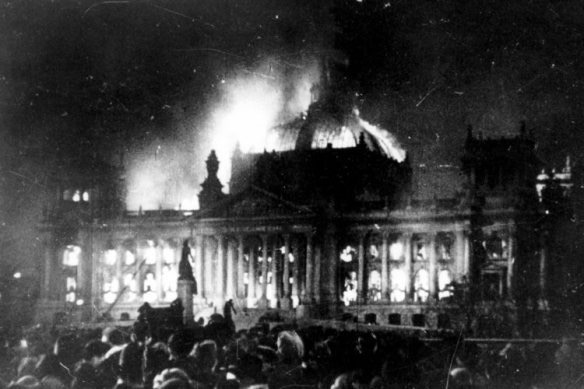
At present this is not yet fully possible, but the potential of a Reichstag Fire incident to use to take over the full powers of the state through emergency decrees cannot be discounted when the stated goal is to destroy the state. One cannot give short shrift to President Trump’s statements on the campaign trail, nor his unending stream of tweet storms when estimating what he is capable of doing if given the chance. For my friends who doubt Trump’s competence to govern, it is not about competence, but rather the ruthlessness that he would be willing to employ to achieve his ends. Those who simply excuse his more extreme statements, his deliberate untruths, as hyperbole and his lack of loyalty to trusted advisers, and his willingness to shred the leaders of the party when he leads them to legislative defeat as normal political actions are sadly mistaken. If there is a crisis, one actually committed by an external enemy, or a false flag incident, this President will use his power to take control. Our President has routinely praised the actions anti-democratic dictators As Timothy Snyder wrote: “For tyrants, the lesson of the Reichstag fire is that one moment of shock enables an eternity of submission. For us, the lesson is that our natural fear and grief must not enable the destruction of our institutions.”

For those people who I talked about yesterday who are willing to excuse the outright falsehoods of the President, this is not an issue. The fact is that for many of them they have been waiting for the chance to take vengeance on those who they perceive as their enemies, both real and imagined. That is why the Christian Right overwhelmingly supported Trump more than they have any previous Republican candidate for President. 

These are dangerous times. Our constitutional system is not nearly as resilient as we assume that it is in such a crisis. We cannot forget that shortly after Franklin Roosevelt became President that some on the political Right attempted to get retired Marine Corps General Smedley Butler to lead a coup against the President. Butler would have nothing of it and revealed their plot. But how many others would be willing to defend the institutions of a State that they wish to destroy? The Generals of the German Reichswehr rolled over to support Hitler to overthrow the hated Weimar Republic, just as conservative French politicians, industrialists, and military leaders were willing to allow Hitler to defeat France in 1940 in order to destroy the Third Republic. 

The words and actions of the President and his advisers concerning the American political system be discounted when estimating what they are capable of doing. Their apparent collusion with Putin’s a Russia before and after the campaign is being revealed more and more each day. If they did in fact collude with the Russians that is called treason. There is no other word for it, and no matter how wide and deep this is it seams to be of no importance to Trump’s followers, especially those of the supposedly Christian Right. They are willing to excuse it so long as it serves their political need for revenge against those they believe to be their political, ideological, and religious enemies. As Snyder wrote: 

“The European history of the twentieth century shows us that societies can break, democracies can fall, ethics can collapse, and ordinary men can find themselves standing over death pits with guns in their hands. It would serve us well today to understand why.” 

So until tomorrow,

Peace,

Padre Steve+ 

Leave a comment

Filed under ethics, History, laws and legislation, Loose thoughts and musings, nazi germany, News and current events, Political Commentary

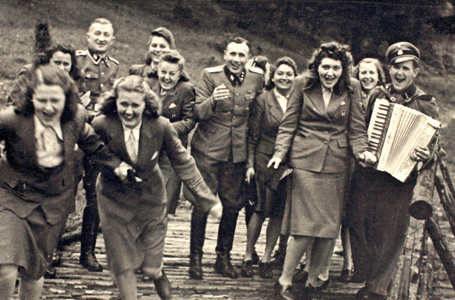
Fragile and Unpredictable: Auschwitz and Human Behavior in the Crisis

Auschwitz Staff at Play 

Friends of Padre Steve’s World,

In his book Auschwitz: A New History, Laurence Rees noted something that is important about how human beings act in crisis. After interviewing many of perpetrators, victims, and bystanders who were at Auschwitz and other parts of the Nazi death machine he wrote this:

“…human behavior is fragile and unpredictable and often at the mercy of the situation. Every individual still, of course, has a choice as to how to behave, it’s just that for many people the situation is the key determinate in that choice.”

I think that it is a comment worth reflection. One of the things that Rees explored was how people who in one situation can be the best of neighbors, the most conscientious and ethical of businessmen, the most dedicated civil servants can seemingly become something totally different when placed in situations that test who they are.

Selecting those to Die 

This is one of the scary things about human nature itself, while there were many people who were sadistic and enjoyed the evil that they did, there were many more who could not decide to be good or evil, instead they went with the flow and took the path of least resistance. Hannah Arendt wrote of Adolf Eichmann, who was the instrument of destruction for much the Jewish population of Europe:

“The trouble with Eichmann was precisely that so many were like him, and that the many were neither perverted nor sadistic, that they were, and still are, terribly and terrifyingly normal. From the viewpoint of our legal institutions and of our moral standards of judgment, this normality was much more terrifying than all the atrocities put together.” 

In times of great change, in times of crisis, in times of uncertainty demagogues manipulate people through fear, particularly fear of the other, both the other within their society, and those far away. When they do this they dehumanize people who seem different from us, be it in their race, color, religion, politics, gender, or sexual identity. When they succeed in doing this, it is the ordinary people who turn the other way, or collaborate in the persecution of the victims.

We are in a precarious situation and it would not take much for our nation to slide into a totalitarian dictatorship, and if the circumstance were right, if the crisis large enough, most people would probably surrender their freedom for the supposed security offered by a dictator. As Timothy Snyder wrote:

“The European history of the twentieth century shows us that societies can break, democracies can fall, ethics can collapse, and ordinary men can find themselves standing over death pits with guns in their hands. It would serve us well today to understand why.”

That is why we must not only understand history, but at the same time we must be determined to recognize how it informs us today, and how we can prevent such things from ever happening again.

That’s all for today,

Peace

Padre Steve+

3 Comments

Filed under ethics, History, holocaust, laws and legislation, nazi germany, Political Commentary

The Trumpcare Train Wreck: Incompetence + Hubris = Disaster

Friends of Padre Steve’s World,

Mark Twain once wrote, “Reader, suppose you were an idiot. And suppose you were a member of Congress. But I repeat myself.” That being said is amazing to watch a political party with a majority in the House and Senate, combined with their party’s President, drive the train of government over a cliff in pursuit of legislation that was at best ill-conceived and misbegotten, and at worst an abortion wrapped in a train wreck driven by haughty hubris, and guided by the unparalleled incompetence of the Trump administration and the House leadership. Despite warnings that he did not have the votes to get the bill through the House, the President pushed on, insisting on a vote that brought an end to the bill. It reminded me of Barbara Tuchman’s immortal words:

“Wooden-headedness, the source of self-deception, is a factor that plays a remarkably large role in government. It consists in assessing a situation in terms of preconceived fixed notions while ignoring or rejecting any contrary signs. It is acting according to wish while not allowing oneself to be deflected by the facts.”

I watched in morbid fascination this week as the House GOP led by Paul Ryan attempted to ram through this hopelessly flawed bill to repeal and replace Obamacare, only to pull it minutes before the vote. Ryan had to run to the White House to tell the President that they didn’t have the votes as Trump’s display of intra-party brinksmanship crashed and burned in the face of House realists who recognized that the bill would doom them with their constituents and Freedom Caucus extremists who could have cared less about theirs.

The bill would have caused as many as 26 million people to lose their insurance, not reduced the deficit by much, and raised the cost of insurance for those who still were able to have it. The effort exposed both the incompetence of the GOP as well as the lie that they actually care about the people that put them in power, with the worst effects of the bill being felt in the counties and states that most heavily voted for President Trump and the GOP majority. It exposed the basic immorality of this party which regards the acquisition of wealth for wealth’s sake as more important as people, or the best interest of the country, in the best tradition of Thomas Hobbes, and Paul Ryan’s inspiration, Ayn Rand.

I have never seen anything like it in my life, and never want to see anything like it again. It is a a disaster for the President equal to the failure of James Buchannan to pass the Lecompton Constitution which would of admitted Kansas as a Slave State, over the desire of much of the Democratic Party of 1857 and 1858. To see this happening even as more and more facts come out about the possibility of members of the Trump administration, and campaign team being paid and influenced by Vladimir Putin’s Russia made the week even more surreal.

Watching the reactions of the House leadership and the President afterward was even more fascinating, and disturbing. It looked to me that the President is willing to destroy Paul Ryan and the House leadership, while blaming the the Democrats for not helping. Likewise there were times that it looked like Ryan was trying to undercut Trump even as the Freedom Caucus tried to undermine both Trump and Ryan. Sadly, the GOP did nothing to bring any Democrats over to their side as to vote for Trumpcare would have been a poison pill.

What will happen next is still to be determined, but the first major attempt by Trump and the GOP Congressional majority to pass what was supposed to be their signature and defining legislation demonstrated that they are incapable of governing. Say what you want about the polices of Ronald Reagan or George W. Bush, one cannot accuse either of incompetence when it came to passing difficult legislation and even winning Democrats to their cause.

As a person who was a Republican from 1976 until 2008 are a disgrace to the party of Abraham Lincoln, Teddy Roosevelt, and Dwight Eisenhower. They are incompetent ideologues and demagogues who will destroy each other if they don’t succeed in destroying the country first, and I hope that we all can keep them from doing the latter.

Have a great weekend.

Peace

Padre Steve+

1 Comment

Filed under healthcare, History, laws and legislation, News and current events, political commentary

“I am not a tool of any President!” Will a Republican Emulate Stephen A. Douglas?

Stephen A. Douglas

Friends of Padre Steve’s World,

Barbara Tuchman wrote in her book The March of Folly: From Troy to Vietnam something that we are observing up close and personal as President Trump and his administration flounder in a sea of make believe, a cloud cuckoo land of alternative facts, alternative truth, and alternative history:

“Wooden-headedness, the source of self-deception, is a factor that plays a remarkably large role in government. It consists in assessing a situation in terms of preconceived fixed notions while ignoring or rejecting any contrary signs. It is acting according to wish while not allowing oneself to be deflected by the facts.”

To be true, the Trump administration is not the first in history, in fact not even in our own country to ignore facts when making decisions. However, it is remarkable in its ability not only to shun facts but to make up its own narrative that depends on denying reality while impugning the character, honesty, and decency of those who present facts and truth that is verifiable. To be sure, competence and prudence are not and probably will never be marks of President Trump, his closest advisors, or his enablers in Congress. My hope is that some Republican in either the House or Senate rises up to confront the ineptitude and folly being demonstrated on a daily basis.

President James Buchanan

In some ways the incompetence and refusal to deal with reality by the Trump administration reminds me of the administration of James Buchanan during the years before the American Civil War. Buchanan’s collusion with Chief Justice Roger Taney regarding the Dred Scott decision before his inauguration stained him from the beginning and poisoned his relationship with Congress by declaring that the Congress never had the right to limit slavery as it had in the Missouri Compromise. Buchanan’s presidency is considered by most historians to be the worst in American history, incompetent, arrogant, and ineffective.

Likewise, Buchanan’s attempt to jam the Lecompton Constitution through Congress as a reward to Southern Democrats blew up in his face. The Lecompton Constitution was a gerrymandered bill which ignored the will of the vast majority of Kansas’s settlers who were anti-slavery. The work of the pro-slavery element in Kansas was so onerous that it brought Republicans and Northern Democrats together for the first time as Southern Democrats threatened secession if Kansas was not admitted as a Slave State. Ignoring warnings that supporting a measure that would open the door to slavery in all the western territories would split his party, Buchanan pushed on. His intransigence on the matter brought Democratic Senator Stephen A. Douglas of Illinois to the fore in opposing it. Nicknamed “the Little Giant,” Douglas was the odds on favorite to be the Democratic nominee for the Presidency. Douglas was not against the institution of slavery, and he was a racist, but he had no tolerance for those who would upend carefully crafted compromises to expand it through the whole country. Thus he  took his case to the floor of the Senate and to the President himself.

The Confrontation between the Senator and the President was unparalleled. Douglas recalled, “The Lecompton constitution, I told Buchannan bluntly, was a blatant fraud on the people of Kansas and the process of democracy, I warned him not to recommend acceptance of it. With his head titled forward in that bizarre habit of his, he said that he intended to endorse the constitution and send it to Congress. “If you do,” I thundered, “I’ll denounce it the moment that it is read.” His face turned red with anger. “I’ll make Lecompton a party test,” he said. “I expect every democratic Senator to support it.” I will not, sir!

Angry and offended by the confrontation of Douglas, Buchanan cut the senator off and issued his own threat to Douglas and his political career saying, “I desire you to remember that no Democrat ever yet differed from an administration of his own choice without being crushed….Beware of the fate of Tallmadge and Rives,” two senators who had gone into political oblivion after crossing Andrew Jackson.” The redoubtable Senator from Illinois was undeterred by the President’s threat and fought back, “Douglas riposted: “Mr. President, I wish to remind you that General Jackson is dead, sir.”  It was an unprecedented action by a sitting Senator, to confront a President of one’s own party and threaten to oppose him in Congress was simply not done, but now Douglas was doing it, but doing so to his President’s face, and the consequences for him, his party, and the country would be immense.

Undeterred by facts, Buchanan and Southern Democrats fought for the bill’s passage. When Buchanan’s supporters pushed for Lecompton’s approval and the admission of Kansas as a Slave State, Douglas fired back, warning “You do,” I said, “and it will lead directly to civil war!” I warned the anti-Lecompton Democrats of the North that the President intended to put the knife to the throat of every man who dared to think for himself on this question and carry out principles in good faith. “God forbid,” I said “that I ever surrender my right to differ from a President of the United States for my own choice. I am not a tool of any President!”

Under Douglas the Northern Democrats joined with Republicans for the first time to defeat the admission of Kansas as a Slave State. Douglas recalled the battle:

“After the Christmas recess, the Administration unleashed its heavy horsemen: Davis, Slidell, Hunter, Toombs, and Hammond, all southerners. They damned me as a traitor and demanded that I be stripped of my chairmanship of the Committee on Territories and read out of the Democratic party. Let the fucking bastards threaten, proscribe, and do their worst, I told my followers; it would not cause any honest man to falter. If my course divided the Democratic party, it would not be my fault. We were engaged in a great struggle for principle, I said, and we would defy the Administration to the bitter end.”

Douglas and his supporters did just that, Buchanan and his supporters were outfought and outmaneuvered by Douglas’s Democrats and their Republican allies. The bill was sent back to Kansas where in a new election the people of Kansas voted solidly against the Lecompton Constitution. In the following Congressional elections the thoroughly discredited Democrats lost their majority, their party now hopelessly divided with Southerners determined to destroy Douglas at any cost, even if it meant losing the presidency, the conflict opened the door for the election of Abraham Lincoln in 1860.

I wonder if there will be a Republican in the Congress with the courage that Stephen A. Douglas displayed in confronting the incompetent and vindictive President Buchanan during the Lecompton Crisis. Will there be a Republican with enough courage to stop the insanity of the Trump administration even if it means in the short term to divide the party and doom their political future? Honestly I doubt it, but if Trump’s march of folly is to be stopped, someone in the Republican Senate or House will have to have the courage to stand up and defend the necessity of thinking for themselves, and doing what is right.

Have a great day.

Peace

Padre Steve+

1 Comment

Filed under History, laws and legislation, leadership, News and current events, Political Commentary

Justice Sacrificed for an Unjust Peace: The Transition to White Man’s Rule and Jim Crow

Friends of Padre Steve’s World,

This is another of my continued series of articles pulled from my various Civil War texts dealing with Emancipation and the early attempts to gain civil rights for African Americans. This section that I will cover for the next few days deals with the post-war period, a period marked by conflicting political and social desires for equality, justice, revenge, and the re-victimization of Blacks who had so recently been emancipated.

I hope that you find these helpful.

Peace

Padre Steve+

The Failure to Win the Peace: The Transition to “White Man’s Rule” and Jim Crow

The legislation enacted by Congress to declare African Americans free, the Thirteenth Amendment; to recognize them as citizens, the Fourteenth Amendment; and to give African American men the right to vote, the Fifteenth Amendment were revolutionary documents. However, after Reconstruction ended every state in the South, with the acquiescence of Northern businessmen and politicians worked to roll back those rights and this ensured that the “resurrected South would look a great deal like the Old South, a restored regime of white supremacy, patriarchy, and states’ rights. This political and cultural principles became holy tenants, dissent from which threatened redemption.” [1] The means used to regain this in included state legislation against blacks, violence committed by people associated with racist terrorist groups such as the Ku Klux Klan, and the actions of Federal Courts including the Supreme Court to regulate those rights out of existence.

Newly elected President Rutherford B. Hayes officially ended Reconstruction in 1877 and all Federal troops assigned to enforce it were withdrawn. Despite this, some people in the South attempted to fight for the rights of African Americans, including men like former Confederate Generals James Longstreet, William Mahone and Wade Hampton. Their motives varied and all of them were vilified by their political opponents and by the press. The attacks on Longstreet were particularly vicious and in the Myth of the Lost Cause he is painted as a man worse than Judas Iscariot.

Hampton is perhaps the most contradictory and curious of these men. Hampton was and remained an avowed White Supremacist who used his own money to finance, recruit and lead a regimental sized unit in the Civil War. He was elected as the first post-Reconstruction governor of South Carolina despite the generous help and assistance of the Red Shirts to rig the election by suppressing the black vote, actually campaigned against the black codes. During his term in office Hampton, to the chagrin of white South Carolinians even appointed African Americans to political offices in the state and maintained a regiment of African American state militia in Charleston against strident opposition.

While Hampton remained a white supremacist and used the Red Shirt militia to help in his election as Governor of South Carolina, he disappointed many of his white supremacist supporters. Hampton, despite his past, was also was committed to the upholding the law and “promoting the political rights to which freedmen were entitled to under law, and he consistently strove to protect those rights.” [2] This made Hampton anathema for many South Carolina politicians, including Benjamine Tillman who as governor during the 1890s dismantled policies that Hampton had introduced to allow blacks to political patronage appointments. Once he did that Tillman set out to deprive South Carolina’s blacks of almost every basic civil right, and in 1895 he led “a successful effort to rewrite the South Carolina constitution in such a way as to virtually disenfranchise every black resident of the state.” [3]

Tillman used his own notoriety and his violent past to be elected to the South Carolina legislature and the governorship and later to four terms in the U.S. Senate. During his campaigns he attack Reconstruction and recounted the Redemption of the South from Yankees and Niggers and warned his followers that they could not let up.  He was quite proud of his past and “openly detailed his participation in the violence at Hamburg in Edgefield County in July 1876 to suppress the black and white Republican vote in statewide elections. “The leading white men of Edgefield,” Tillman related, had decided to “seize the first opportunity that the Negroes might offer them to provoke a riot and teach the Negroes a lesson” by “having the whites demonstrate their superiority by killing as many of them as was justifiable.” [4]

The Battle of Liberty Place

Former Confederate General James Longstreet, who had become a Republican supported Reconstruction and appointed by President Grant to be the Surveyor of Customs at New Orleans. He was also appointed by the governor as the head of the state militia which was largely made of freed blacks. Longstreet’s old friend, West Point Classmate and former Confederate General Harvey Hill typified the outrage of many toward Lee’s “Old Warhorse” and wrote a newspaper column in which he said: “Our scalawag is the local leper of the community. Unlike the carpet bagger [a Northerner], [Longstreet] is a native, which is so much the worse.” [5] Longstreet was wounded while leading Louisiana militia in an unsuccessful fight against a force of nearly 8,400 White Leaguers who were attempting to seize state and federal buildings in New Orleans on September 14th 1873. Only the timely deployment of Federal troops by Grant prevented the takeover attempt. Called the Battle for Liberty Place, the success of the White Leagues energized other militant groups. Longstreet was vilified by many Southern politicians and in the press for his support of the Reconstruction government, and to confederate leaning historians in the coming century “the turncoat Longstreet appeared as the cause of every defeat.” [6]

But the site of the incident is still in the news. Renamed “Liberty Place” in 1882 it became a place of pilgrimage for white supremacists. In 1891 empowered by Jim Crow, the Democratic Party leaders of New Orleans erected a monument at the foot of Canal Street, the most prominent spot in the city, honoring the sixteen White League members who had died in the fight. James Loewen called it “the most overt monument to white supremacy in the United States.”  In 1932, with New Orleans even more segregated, an inscription was added to the monument. It said that the Battle was fought for the “overthrow of carpetbag government” and that afterward the Yankees “recognized white supremacy in the South and gave us our state.” Following the Voting Rights Act of 1964 used the centennial of the event to cement over the previous words and put a counter marker next to the monument which said “Although the “Battle of Liberty Place” and this monument are important parts of New Orleans history, the sentiments in favor of white supremacy expressed thereon are contrary to the philosophy and beliefs of present-day New Orleans.” The monument was removed in 1989 and installed in a less conspicuous place in 1993. In September of 2015 the “Vieux Carre Commission, which controls aesthetics in the historic French Quarter, voted 5-1 to remove the obelisk” and were supported by Mayor Mitch Landrieu. The decision still must be ratified by the City Council. [7]

Court Battles and Jim Crow

The Supreme Court, Congress, the Presidents as well as state governments systematically rolled back the rights of African Americans after Reconstruction ended. The Courts were the first to do this and once they had set the precedent were followed by the now Democrat controlled Congress and President Grover Cleveland. In 1883 “the Civil Rights Act of 1875, outlawing discrimination against Negroes using public facilities, was nullified by the Supreme Court, which said: “individual invasion of individual rights is not the subject-matter of the amendment.” The Fourteenth Amendment, it said, was aimed at state action only. No state shall…” [8] Associate Justice Joseph Bradley who had so eviscerated the Enforcement Act again played his hand in overturning a law that he despised on principle. He had written when Grant first signed the act in 1875 “to deprive white people of the right of choosing their own company would be to introduce another kind of slavery…. It can never be endured that the white shall be compelled to lodge and eat and sit with the Negro. The latter can have his freedom and all legal and essential privileges without that. The antipathy of race cannot be crushed and annihilated by legal enactment.” [9] In writing to overturn the Civil Rights Act of 1875 Bradley wrote that such laws were made African Americans a “special favorite of laws” and ignored the fact that in most of the country blacks were indeed not a favorite and were in fact still the subject of discrimination, segregation, political disenfranchisement, systematized violence, murder and lynching.

The actions of the court and alliances between Northern corporations and Southern landowners led to even more discrimination and disenfranchisement for blacks, “From the 1880s onward, the post-Reconstruction white governments grew unwilling to rely just on intimidation at the ballot box and themselves in power, and turned instead to systematic legal disenfranchisement” [10] which furthered the black codes into what we now call the era of Jim Crow.

For years after the Supreme Court’s Cruikshank decision blacks throughout the South attempted to vote despite intense opposition from Southern whites and armed bands of thugs. But with White Democrats now in charge of local government and “in control of the state and local vote-counting apparatus, resistance to black voting increasingly took the form of fraud as well as overt violence and intimidation. Men of color who cast Republican votes often found later that they had been counted for the party of white supremacy.” [11]

In 1896 the Supreme Court in the case of Plessy v. Ferguson upheld the black codes and Jim Crow laws. That ruling established the “separate but equal” doctrine and ushered in an era of de jure segregation in almost all arenas of life including education, transportation, entertainment and health care. The limited social equity and privileges enjoyed by blacks, not only in the South, but in the entire nation were erased by the stroke of the judicial pen. The justices ruled on the concept that the Constitution only guaranteed or protected a people’s political rights in the social arena that African-Americans could not interact with whites and assumed their racial inferiority.

Not all on the Court agreed with these rulings. One of them was Associate Justice John Harlan, who was a former slaveholder. Harlan dissented in the Court’s majority decision to overturn the Civil Rights Act of 1875 and also in Plessy v. Ferguson. In the case of the Civil Rights Act ruling Harlan insisted “our Constitution is color blind” [12] and wrote a strongly worded opinion:

“The destinies of two races, in this country are indissolubly linked together, and the interests of both require that the common government of all should not permit the seeds of race hate to be planted under the sanction of law. What can more certainly arouse race hate, what more certainly create and perpetuate a feeling of distrust between these races, than state enactments, which, in fact, proceed on the ground that colored citizens are so inferior and degraded that they cannot be allowed to sit in public coaches occupied by white citizens? That, as all will admit, is the real meaning of such legislation as was enacted in Louisiana.” [13]

As eloquent and as correct as Justice Harlan’s argument was, it was not sufficient to turn the tide of the new Court backed segregation laws. Harlan “was fighting a force greater than the logic of justice; the mood of the Court reflected a new coalition of northern industrialists and southern businessmen-planters.” [14] The “separate but equal” measures approved by the Court majority in Plessy v. Ferguson led to the widespread passage of Jim Crow laws, not only in the South but in other areas of the country. The Jim Crow era took nearly a century to reverse, and “only began to disappear with Brown v. Board of Education in 1954 and the Civil Rights and Voting Rights Acts of 1964 and 1965.” [15]

In order to get around the Fifteenth Amendment state governments in the South employed a strategy of subterfuges to suppress the African American vote. Along with the ever present threats of voter intimidation from armed White Supremacist groups, the states complicated the processes of voter registration and voting in order to make it nearly impossible for blacks to vote and into political oblivion. “Redeemer” governments in the post-Reconstruction South through the use of literary tests and poll taxes, the later which required people to pay in order to vote. The literacy and educational requirements mandated that “perspective registrants to “interpret” a section of the state constitution, and enacted standards which few blacks could fulfill, such as limiting registration to those whose grandfathers had voted.” Of course few blacks could meet the latter requirement as their grandfathers had been slaves and ineligible to vote. The laws were so devious that “when a journalist asked an Alabama lawmaker could pass his state’s understanding” test, the legislator replied, That would depend on entirely on which way he was going to vote.” [16]

These court decisions and legislation strengthened racism and discrimination against blacks, “effectively excluding blacks from public places, from the right to votes, from good public education, and so forth.” [17] The Plessy ruling was a watershed. Southern legislators, now unencumbered by Federal interference passed “state laws mandating racial segregation in every aspect of life, from schools to hospitals, waiting rooms to toilets, drinking fountains to cemeteries…segregation was part of a complex system of white domination, in which each component – disenfranchisement, unequal economic status, inferior education – reinforced the others.” [18] For decades future courts would cite Plessy and Cruikshank as well as other decisions as precedent in deny rights to blacks. It would not be until 1954 when the Supreme Court overturned Plessy and the “Separate but Equal” Jim Crow laws in Brown v. Board of Education. Brown was a watershed for it deemed that separate schools were “inherently unequal.” The reaction across the South, especially Mississippi was stunned shock, disbelief and anger. “A Mississippi judge bemoaned “black Monday” and across the South “Citizen’s Councils” sprung up to fight the ruling. [19]

Mississippi led the way in disenfranchising black voters through the use of voter qualifications that would eliminate most blacks from the rolls of voters. In 1895 the state legislature passed a measure that would “technically apply to everybody but actually eliminate the Negro without touching the white.” [20] The move was in open defiance of the Fifteenth Amendment and resulted in tens of thousands of black voters being dropped from the rolls, in most cases under 5% of black voters who had been eligible to vote in 1885 remained eligible in 1896. Mississippi was rewarded in 1898 when the Supreme Court in Williams v. Mississippi that “there was no reason to suppose that the state’s new voting qualification were aimed specifically at Negroes.” [21] “In 1900 blacks comprised 62 percent of Mississippi, the highest percentage in the nation. Yet the state had not one black elected official.”  [22]

Violence was used with great effect and between 1880 and 1968 approximately 3,500 people were murdered or lynched throughout the South. This had become a far easier task and far less dangerous for the perpetrators of violence against blacks as Supreme Court “interpreted black peoples other constitutional rights almost out of existence.” [23] Since the court had “limited the federal government’s role in punishing violations of Negro rights” this duty fell to the states, which seldom occurred, and when “those officials refused to act, blacks were left unprotected.”  [24]

The effects of these actions were shown in the number of African Americans in elected office. In 1869 there were two African American United States Senators and twenty black members of the House of Representatives. After Reconstruction ended these numbers dwindled and “the last black left Congress in 1901.” [25]

One of these was the case of United States v. Harris where the federal prosecutors had indicted “twenty members of a Tennessee lynch mob for violating section two of the enforcement Act, which outlawed conspiracies to deprive anyone of “equal protection of the laws.” However the Court struck down section 2 because the “lynching was not a federal matter, the Court said, because the mob consisted only of private individuals.” [26]

Many Southern states, especially Mississippi continued to tighten Jim Crow throughout the first half of the twentieth century. “In 1922 a new Jim Crow law kept up with the times by segregating taxis. In 1930 another new law prohibited “publishing, printing, or circulating any literature in favor of or urging inter-racial marriage or social equality.” [27] Not only were physical barriers being erected, but thought and free speech was now illegal if one supported equal rights.

The Battle for Civil Rights 

This remained the case until the 1960s when during the Freedom Rides when Mississippi again became a battleground in the Civil Rights movement. In 1961 James Meredith, a veteran of the U.S. Air Force, became the first black to ever be admitted to the University of Mississippi. His admission was fought by the university, Mississippi politicians including U.S. Senator James Eastland, Governor Ross Barnett, numerous congressmen and state representatives, and a populace that threatened violence and even war if the Federal government or courts order them to comply. Governor Barnett spoke for many when he made a statewide television address in September 1961 “We must either submit to the unlawful dictates of the federal government or stand up like men and tell them ‘NEVER!’” [28] He then called for the arrest of any federal officials who attempted to hold a state official for defying federal court orders. Backed by federal court orders to admit Meredith, and by the Brown v. Board of Education ruling, Attorney General Robert F. Kennedy called Barnett on September 24th.

“Governor,” Kennedy observed, “you a part of the United States.”

            “We have been a part of the United States, but I don’t know whether we are or not.”

            Are you getting out of the Union?”

            “It looks like we are being kicked around – like we don’t belong to it.”

            Back to specifics again, Kennedy ended the talk with a typical crisp wrap-up. “My job is to enforce the laws of the United States.” [29]

The resultant conflict nearly came to violence as thousands of Mississippians, whipped into an anti-black and anti-federal government frenzy by their elected leaders, radio, and television and newspaper commentators and supported by the KKK, the John Birch Society and other groups mobilized to fight the “invasion.” Eventually a deal was reached to admit Meredith on September 30th. As Meredith entered the campus he was protected by Federal Marshals and Border Patrol officers, as well as the State Police, which had just a few hours before been deployed to keep Meredith and the federals out. Despite this thousands of people ringed the campus, and the Confederate Battle Flag was raised over the Civil War memorial on campus. The rioters uttered death threats and assaulted anyone who supported Meredith. Members of the press, even southerners, faculty members and civilian supporters were beaten, bricks, stones and bottles thrown, tires of federal vehicles slashed. Finally the marshals themselves were attacked and eight injured, forcing them to deploy tear gas to protect themselves and the State police withdrew.

Eventually U.S. Army MPs and mobilized National Guard units were called up and battled Molotov cocktails which were being thrown by the anti-integration protests to relieve the beleaguered marshals and border patrolmen. The troops finally cleared the campus and ended the riot. During the riot 160 marshals were hurt, some 28 of who were wounded by bullets fired by the protestors. The next morning with Meredith admitted to the university a local clergyman saw the Confederate flag still flying and “with firm step, he strode out to the pole, loosened the halyard and lowered the Confederate flag.” [30]

The battle to integrate Ole’ Miss was over. Meredith graduated peacefully in August of 1963 and by then Mississippi abandoned its defiance of Federal authority, but many in the state still protested the admission as well as the later passage of the Civil Rights and Voting Rights Acts. Violence still occurred and even intensified at times as the Civil Rights movement, now led by Dr. Martin Luther King Junior made headway.

In South Carolina, which had fought integration in the courts outgoing Governor Ernest F. Hollings realized that the handwriting was on the wall, and South Carolina was different than Mississippi, its racism was the old aristocratic type, which gave more value to an orderly society. Hollings told the legislature:

“As we meet, South Carolina is running out of courts. If and when every legal remedy has been exhausted, the General Assembly must make clear South Carolina’s choice, a government of laws rather than a government of men. As determined as we are, we of today must realize the lesson of once hundred years ago, and move on for the good of South Carolina and our United States. This should be done with dignity. It must be done with law and order.” [31] When Clemson University admitted its first student later in the year, there was no violence.

More violence would occur in Mississippi and other states during the 1960s. During the Freedom Rides, students and educators came from around the nation to the state to help register blacks to vote in 1964. This brought generations of barely concealed hatred to the surface. Bruce Watson in his book Freedom Summer wrote:

“In Mississippi’s most remote hamlets, small “klaverns” of ruthless men met in secret to discuss the “nigger-communist invasion of Mississippi.” They stockpiled kerosene, shotguns, and dynamite, then singled out targets – niggers, Jews, “nigger-lovers.” One warm April night, their secret burst into flames. In some sixty counties, blazing crosses lit up courthouse lawns, town squares, and open fields. The Klan was rising again in Mississippi. Like “White Knights” as their splinter group was named, the Klan planned a holy war against the “dedicated agents of Satan…determined to destroy Christian civilization.” The Klan would take care of your business, a recruiting poster said. “Get you Bible out and PRAY! You will hear from us.” [32]

Eventual the violence of these people led to the killings of three of the organizers, Michael Schwerner, James Cheney and Andrew Goldman were killed by a group of Klansmen led by members of the Neshoba County Sheriff’s Department on June 21st 1964. The resultant search for their bodies and the subsequent investigation transfixed the nation and led to the passage of the Civil Rights and Voting Rights Acts of 1964 and 1965.

After he left office, Ulysses Grant gave an interviewer a sober assessment of Reconstruction’s failure. Grant concluded that at the end of the war what the South really needed was a benevolent dictatorship until it could be fully reintegrated into the Union. He told the interviewer:

“Military rule would have been just to all… the Negro who wanted freedom, the white man who wanted protection, the Northern man who wanted Union. As state after state showed a willingness to come into the Union, not on their terms but upon ours, I would have admitted them. The trouble about the military rule in the South was that our people did not like it. It was not in accordance with our institutions. I am clear now that it would have been better to suffrage, reconstruction, State governments, for ten year, and held the South in a territorial condition. But we made our scheme, and we must do what we must with it.” [33]

Grant was correct in his analysis. The policies enacted by the North in 1865 that were considered benevolent were seized upon as signs of weakness in the defeated South, and the harsh moves of the Radical Republicans to coerce the South back ended in failure. The leaders of the South knew that the Republican Party was a coalition and worked to push the fault lines of the Republicans until they broke, and they were successful. The Confederacy may have lost the war in a military and economic sense, but in the “ways that mattered most to white Southerners – socially, politically, and ideologically – the South itself did not.” [34] Grant died in 1885 hailed throughout the nation, but knowing that he was unable to secure the new birth of freedom, that he and his friend Abraham Lincoln and so many others had fought for in the Civil War.

The example of Reconstruction’s failure shows that in order to secure peace that military victory must be accompanied by the political will to ensure that the avowed goals of that victory are secured after the war in ensuring a just peace. In retrospect, a harsh peace and a long period of nation building may have benefited the nation more than botched reconstruction, but as Grant noted “our people did not like it.”

Southerners may have lost the shooting war, but they did not accept the peace and by successfully wearing down the will of the people of the North and exploiting the fissures in varying components of the Republican Party, they succeeded in winning the things most important to them in regard to race relations and White Supremacy.

After the war, White Southerners resorted to all means to reverse their military defeat through political, social, economic and judicial means and “justice was sacrificed for the unjust peace ushered in by “redemption” of the South, a peace marred by Jim Crow, poverty and lynching.” [35] Most Northern leaders, politicians, the media and the clergy failed to appreciate this until it was far too late, and hindered by President Johnson’s opposition failed to win the peace in the South when they had the best chance. They failed to appreciate that even after the shooting is often that “there is a need for further threats, and indeed action, because postwar disorder and even chaos will have to be address, and victorious allies are always likely to squabble over the spoils of victory” [36] as certain was the case in the divided Republican Party of the Reconstruction era. By the time Ulysses S. Grant was elected President many in the North were already tiring of Reconstruction and African Americans and when he resorted to harsh yet effective means of quelling violence and enforcing the laws many, even in his own Republican Party rebelled, ensuring the former Confederates of a political and social victory that took nearly another hundred years to end, if indeed it is truly ended.

Notes 

[1] Ibid. Goldfield American Aflame p.403

[2] Longacre, Edward G. Gentleman and Soldier: The Extraordinary Life of General Wade Hampton Rutledge Hill Press, Nashville TN 2003 p.265

[3] Ibid. Longacre Gentleman and Soldier p.274

[4] Goldfield, David Still Fighting the Civil War: The American South and Southern History, Updated Edition, Louisiana State University Press, Baton Rouge 2002 p.195

[5] Ibid. Wert General James Longstreet The Confederacy’s Most Controversial Soldier p.413

[6] Ibid. Goldfield America Aflame p.497

[7] Loewen, James The Monument to White Power that Still Stands in New Orleans retrieved from History News Network http://historynewsnetwork.org/blog/153667 12 September 2016

[8] Ibid. Zinn The Other Civil War p.57

[9] Ibid. Lane The day Freedom Died p.253

[10] Ibid. Guelzo Fateful Lightening p.526

[11] Ibid. Lane The day Freedom Died p.251

[12] Ibid. Zinn The Other Civil War p.58

[13] LaMorte, Michael W. School Law: Cases and Concepts 9th Edition 2008 Allyn and Bacon Inc. 2008 p.300

[14] Ibid. Zinn A People’s History of the United States pp.204-205

[15] Ibid. Huntington Who are We? p.54

[16] Ibid. Goldfield Still Fighting the Civil War: The American South and Southern History p.197

[17] Gonzalez, Justo L. The History of Christianity Volume 2: The Reformation to the Present Day Harper and Row Publishers San Francisco 1985 p.252

[18] Ibid. Foner Forever Free p.208

[19] Ibid. Watson Freedom Summer p.46

[20] Ibid. Lord The Past that Wouldn’t Die p.22

[21] Ibid. Lord The Past that Wouldn’t Die p.23

[22] Ibid. Watson Freedom Summer p.41

[23] Ibid. Lane The day Freedom Died p.253

[24] Ibid. Langguth After Lincoln p.338

[25] Ibid. Zinn A People’s History of the United States p.200

[26] Ibid. Lane The day Freedom Died p.253

[27] Ibid. Lord The Past that Wouldn’t Die p.25

[28] Ibid. Lord The Past that Wouldn’t Die p.139

[29] Ibid. Lord The Past that Wouldn’t Die p.159

[30] Ibid. Lord The Past that Wouldn’t Die p.231

[31] Bass, Jack and Nelson, Jack The Orangeburg Massacre Mercer University Press, Macon and Atlanta 1984, 1996 & 2002 pp.11-12

[32] Ibid. Watson Freedom Summer p.12

[33] Ibid. Lane The day Freedom Died p.254

[34] Ibid. Lane The day Freedom Died p.254

[35] Ibid. McPherson The War that Forged a Nation p. 191

[36] Ibid. Gray Fighting Talk p.14

1 Comment

Filed under civil rights, civil war, History, laws and legislation, leadership, Political Commentary

Northern Indifference, Southern Violence, and the Collapse of Reconstruction

this-is-a-white-mans-government

Friends of Padre Steve’s World,

This is another of my continued series of articles pulled from my various Civil War texts dealing with Emancipation and the early attempts to gain civil rights for African Americans. This section that I will cover for the next few days deals with the post-war period, a period marked by conflicting political and social desires for equality, justice, revenge, and the re-victimization of Blacks who had so recently been emancipated.

I hope that you find these helpful.

Peace

Padre Steve+

The Collapse of Northern Support for Reconstruction

It is all too easy to simply blame recalcitrant Southerners for the collapse of Reconstruction. However, it is impossible not to explore this without addressing responsibility of many leaders and citizens in the North for the failure of Reconstruction and the return of “White Man’s Rule” to the South. Like today, people faced with economic difficulties sought out scapegoats. When the country entered an economic depression in 1873 it was all too easy for Northern whites, many of who were willing to concede “freedom” to turn on blacks. Racism was still heavily entrenched in the North and for many, economic considerations trumped justice as the North tried to move away from Reconstruction and on to new conquests, including joining European powers in attempts to gain overseas colonies and territories.

As Southern extremists turned the Federal effort at Reconstruction into a violent quagmire that seemed to have no end, many Northerners increasingly turned against the effort and against Blacks themselves. Like so many victorious peoples they did not have the political or moral capacity to remain committed to a cause for which so many had sacrificed and they began to abandon the effort after two short years of congressionally mandated Radical Reconstruction.

Likewise, the men who had so nobly began the effort to enfranchise African Americans failed to understand the social and political reality of the South. To the average Southerner of the era “political equality automatically led to social equality, which in turn automatically led to race-mixing. It was inevitable and unthinkable. To a people brought up to believe that Negroes were genetically inferior – after all, that was why they were slaves – the mere hint of “mongrelization” was appalling.” [1] This was something that most Northerners, even those committed to the political equality of African Americans could not comprehend, and the ignorance of this fact would be a major reason for the collapse of Northern political and social support for Reconstruction.

thaddeus-stevens-3400gty

Congressman Thaddeus Stevens 

Congressman Thaddeus Stevens, one of the most effective leaders of the Radical Republicans died in 1868 in despair that the rights of blacks were being rolled back even as legislation was passed supporting them. A few weeks before his death Stevens told a friend “My life has been a failure…I see little hope for the republic.” [2] The old firebrand asked “to be buried in a segregated cemetery for African American paupers so that “I might illustrate in death the principles which I advocated through a long life, Equality of man before his creator.” [3] Others including Senator Ben Wade, were not returned to office while others including Edwin Stanton, Salmon Chase and Charles Summer all died during Grant’s administration.

While Grant attempted to smash the Ku Klux Klan by military means, both his administration and Congress were of little help. He faced increased opposition from economic conservative Republicans who had little interest in the rights of African Americans and who gave little support to those fighting for equal rights for blacks. The situation was further complicated by the “financial panic which hit the stock market in 1873 produced an economic downturn that soon worsened into a depression, which continued for the rest of the decade.” [4] The result was that Republicans lost their majorities in the House and in many states, even in the North.

It was clear that “1870 Radical Republicanism as a coherent political movement was rapidly disintegrating” [5] and during the early 1870s many of the antislavery activists had left the Republican party either to death or defection, many “no longer felt at home in a party that catered to big business and lacked the resolve to protect black rights.” [6]

In 1872, some former radical Republicans revolted against Grant and the corruption in the Republican Party. Calling themselves “Liberal Republicans” they supported the candidacy of Horace Greeley uniting with Democrats to call for an end to Reconstruction. For many this was not so much because they no longer supported the rights of African Americans, but because for them, like so many, “economic concerns now trumped race relations…. Henry Adams, who shared the views of his father, Charles Francis Adams, remarked that “the day is at hand when corporations far greater than [the] Erie [Railroad]…will ultimately succeed in directing the government itself.” [7] The numbers of Federal troops in the South continued to be reduced to the point where they could offer little or no support to state militia.

The combination of all of these factors, political, racial, economic, and judicial doomed Grant’s continued efforts at Reconstruction by executive means. Despite the hard fought battle to provide all the rights of citizenship and the vote to African Americans racism remained heavily entrenched in all regions of the country. In the North and the South the economic crisis of 1873 caused people to look for scapegoats, and blacks were easy targets. With economics easily trumping the cause of justice, “racism increasingly asserted its hold on northern thought and behavior.” [8] The Northern press and politicians, including former abolitionists increasingly took the side of Southerners, condemning Freedmen as lazy and slothful usurpers of white civilization.

Likewise the growing problem of labor unrest in the North brought about by the economic depression made “many white northerners more sympathetic to white southern complaints about Reconstruction. Racial and class prejudices reinforced one another, as increasing numbers of middle-class northerners identified what they considered the illegitimate demands of workers and farmers in their own society with the alleged misconduct of the former slaves in the South.” [9]

The depression hit Freedmen in the South with a vengeance and unable to pay their bills and mortgages many lost everything. This left them at the mercy of their former white masters who were able to force them into long term employment contacts which for practical purposes was a reversion to slavery, albeit under a different name. Those whites who were still working for Reconstruction in the South were increasingly marginalized, stigmatized and victimized by a systematized campaign of propaganda which labeled them Carpetbaggers and Scalawags who had gained power through the votes of blacks and who were profiting by looting Southern Whites. In the end Southern intransigence wore out the political will of Northerners to carry on, even that of strongest supporters of emancipation and equality.

black-voter-threatening

Violence now became a means to further politics in the South and carried out in broad daylight and “intended to demoralize black voters and fatally undermine the Republican Party…. They paraded at regular intervals through African American sections of small towns in the rural black majority areas, intimidating the residents and inciting racial confrontations.” [10] These armed bands were highly successful, if they were successful in provoking a racial incident they would then fan out throughout the area to find blacks in order to beat up and kill, hundreds of blacks were killed by them.

During the elections of 1876 the White Liners, Red Shirts, White League and others would be seen in threatening positions near Republican rallies and on Election Day swarmed the polls to keep blacks and Republicans out, even seizing ballot boxes either destroying them or counting the votes for Democrats. The strategy employed by the Democrats and their paramilitary supporters was to use “Lawless and utterly undemocratic means…to secure the desired outcome, which was to win a lawful, democratic election.” [11]

The pressure was too much for most Republicans in the South, and many who did not leave the South “crossed over to the Democratic fold; only a few stood by the helpless mass of Negroes….” [12] Of those in the North who did nothing to confront the resurgence of neo-Confederate mythology and who had worked against equal rights for African Americans during the Reconstruction era, “many embraced racism in the form of imperialism, Social Darwinism and eugenics.” [13]

The elected governor of Mississippi, Republican General Adelbert Ames, who was one of the most able and honest of all the Northerners to hold elected office in the South wrote in 1875 about the power of the paramilitary groups, “The “white liners” have gained their point – they have, by killing and wounding, so intimidated the poor Negroes that they can in all human probability prevail over them at the election. I shall try at once to get troops from the general government. Of course it will be a difficult thing to do.” [14] Ames requested Federal troops “to restore peace and supervise the coming elections” [15] but did not get them due to the subterfuge of Attorney General Edwards Pierrepont.

Grant told Pierrepont, a former Democrat who was critical of Grant’s insistence on the rights of African Americans that he must issue a proclamation for the use of Federal troops if Ames’s local forces could not keep order. He told Pierrepont “the proclamation must be issued; and if it is I shall instruct the commander of the forces to have no child’s play.” [16] Instead, Pierrepont altered Grant’s words and told Ames, “The whole public are tired out with these autumnal outbreaks in the South…and the great majority are now ready to condemn any interference on the part of the government….Preserve the peace by the forces in your own state….” [17] Ames, who had been a strong proponent of emancipation and black suffrage understood that he was being abandoned by Pierrepont and in order to prevent more bloodshed gave up the fight, negotiating a peace with the White League. Sadly, he like Grant realized that most of the country “had never been for Negro civil rights in the first place. Freedom, yes; but that didn’t mean all the privileges of citizenship.”  [18]  Ames’s deal with the Democrats and the White League resulted in blacks being forced from the polls and the Democrats returning to power in the state.  When Ames left the state, the discouraged veteran of so many battles including Gettysburg wrote, “A revolution has taken place – by force of arms – and a race disenfranchised – they are to be returned to a condition of serfdom – an era of second slavery.” [19]

The Day Freedom Died: The Colfax Massacre and Beyond

The violence against Southern blacks escalated in the wake of the passage of the Fourteenth and Fifteenth Amendments and with the increasing number of blacks being elected to office in some Southern states during the elections of 1872. In Louisiana a Federal court ruled in favor of Republican Reconstruction candidates following a Democrat campaign to interfere with the vote, which included attacks on polling sites and the theft of ballot boxes. As a result the Louisiana Democrats “established a shadow government and organized paramilitary unit known as the White League to intimidate and attack black and white Republicans.” [20]

blacks at colfax

Colfax Massacre

The White League in Louisiana was particularly brutal in its use of violence. he worst massacre committed by the White League occurred Easter Sunday 1873 when it massacred blacks in Colfax, Louisiana. Colfax was an isolated nondescript hamlet about three hundred fifty miles northwest of New Orleans. It sat on the grounds of a former plantation whose owner, William Calhoun, who worked with the former slaves who were now freedmen. The town itself “composed of only a few hundred white and black votes” [21] was located in the newly established Grant Parish. The “parish totaled about 4,500, of whom about 2,400 were Negroes living on the lowlands along the east bank of the Red.” [22] Between 1869 and 1873 the town and the parish were the scene of numerous violent incidents and following the 1872 elections, the whites of the parish were out for blood.

White leaders in Grant Parish “retaliated by unleashing a reign of terror in rural districts, forcing blacks to flee to Colfax for protection.” [23] The blacks of parish fled to the courthouse seeking protection from a violent white mob following the brutal murder of a black farmer and his family on the outskirts of town. The people of Colfax, protected by just a few armed black militiamen and citizens deputized by the sheriff took shelter in the courthouse knowing an attack by the White Supremacists was coming.  As the White League force assembled one of its leaders told his men what the day was about. He said, “Boys, this is a struggle for white supremacy….There are one hundred-sixty-five of us to go into Colfax this morning. God only knows who will come out. Those who do will probably be prosecuted for treason, and the punishment for treason is death.” [24] The attack by over 150 heavily armed men of the White League, most of whom were former Confederate soldiers, killed at least seventy-one and possibly as many as three-hundred blacks. Most of the victims were killed as they tried to surrender. The people, protected by just a few armed men were butchered or burned alive by the armed terrorist marauders. It was “the bloodiest peacetime massacre in nineteenth-century America.” [25]

The instigators of the attack claimed that they acted in self-defense. They claimed that “armed Negroes, stirred up by white Radical Republicans, seized the courthouse, throwing out the rightful officeholders: the white judge and sheriff” and they claimed that the blacks had openly proclaimed “their intention to kill all the white men, they boasted they would use white women to breed a new race.” [26] The claims were completely fabricated, after sending veteran former army officers who were serving in the Secret Service to investigate, the U.S. Attorney for Louisiana, J.R. Beckwith sent an urgent telegram to the Attorney General:

“The Democrats (White) of Grant Parish attempted to oust the incumbent parish officers by force and failed, the sheriff protecting the officers with a colored posse. Several days afterward recruits from other parishes, to the number of 300, came to the assistance of the assailants, when they demanded the surrender of the colored people. This was refused. An attack was made and the Negroes were driven into the courthouse. The courthouse was fired and the Negroes slaughtered as they left the burning building, after resistance ceased. Sixty-five Negroes terribly mutilated were found dead near the ruins of the courthouse. Thirty, known to have been taken prisoners, are said to have been shot after the surrender, and thrown into the river. Two of the assailants were wounded. The slaughter is greater than the riot of 1866 in this city. Will send report by mail.” [27]

Federal authorities arrested nine white men in the wake of the massacre and after two trials in which white majority juries were afraid to go against public opinion, three were “convicted of violating the Enforcement Act of 1871.” [28] None were convicted of murder despite the overwhelming evidence against them and even the lesser convictions enraged the White Supremacists in Louisiana who had employed the best lawyers possible and provided them and the defendants with unlimited financial backing. Assisted by the ruling of Supreme Court Associate Justice Joseph Bradley, who had a long history of neglecting Southern racism, white Democrats appealed the convictions to the Supreme Court.

The attack, and the court cases which followed, notably the judgment of the Supreme Court in United States v. Cruickshank which dealt with the appeal of the men responsible for the Colfax Massacre led to a “narrowing of Federal law enforcement authority” and were “milestones on the road to a “solid” Democratic South.” [29] The decision of the court in United States v. Cruikshank was particularly perverse in its interpretation of constitutional rights and protections. The court ruled in favor of the terrorists and declared that “the right of the black victims at Colfax to assemble hand not been guaranteed because they were neither petitioning Congress nor protesting a federal law. Assembling for any other cause was not protected.” [30] The Cruikshank decision amounted to a Supreme Court endorsement of violence against blacks, and made it “impossible for the federal government to prosecute crimes against blacks unless they were perpetrated by a state and unless it could prove a racial motive unequivocally.” [31] Northern politicians and newspapers, reeling under the effects of the stock market crash of 1873, which had denounced the massacre just a year before now ran from the story and from support of African Americans. A Republican office holder wrote, “The truth is, our people are tired out with this worn cry of ‘Southern outrages…. Hard times and heavy taxes make them wish the ‘nigger,’ the ‘everlasting nigger,’ were in hell or Africa.” [32] Racism and race hatred was not exclusively the parlance of the South.

In the wake of Justice Bradley’s reversal of the Colfax convictions whites in Grant Parish engaged in brutal reprisals against blacks, leading to many murders and lynching’s, crimes which law enforcement, even that favorable to the rights of African Americans were afraid to prosecute for fear of their own lives. Louisiana’s Republican Governor, William Pitt Kellogg wrote Attorney General Williams blaming the violence on Bradley’s ruling, which he wrote, “was regarded as establishing the principle that hereafter no white man could be punished for killing a negro, and as virtually wiping the Ku Klux laws of the statute books.” He added that with the Army leaving the state that his government and other Reconstruction governments would fall, “if Louisiana goes,” Kellogg wrote, “Mississippi will inevitably follow and, that end attained, all the results of the war so far as the colored people are concerned will be neutralized, all the reconstruction acts of Congress will be of no more value than so much waste paper and the colored people, though free in name, will be practically remitted back to servitude.” [33] Governor Kellogg could not have been more correct.

In the years that followed many of the men involved in the massacre and other murders before and after were hailed as heroes, some, including the leader of the attackers, Christopher Columbus Nash were again appointed to office in Colfax and Grant Parish and blacks were reminded every day of just what they had lost. On April 13th 1921 the men who committed the massacre were honored with a memorial in the Colfax cemetery honoring them as “Heroes… who fell in the Colfax Riot fighting for White Supremacy.” In 1951 the State of Louisiana Department of Commerce and Industry dedicated a marker outside the Courthouse which read: “On the site occurred the Colfax Riot in which three White men and 150 Negroes were slain, this event on April 13, 1873 marked the end of Carpetbag misrule in the South.” [34] That marker still stands, there is no marker commemorating the victims.

Other massacres followed across the South, aimed at both blacks and their white Republican allies. In Louisiana the White League had some 14,000 men under arms, in many cases drilling as military units led by former Confederate officers. A White League detachment southwest of Shreveport “forced six white Republicans to resign their office on pain of death – and then brutally murdered them after they had resigned.” [35] This became known as the Coushatta Massacre and it was a watershed because for the first time the White League targeted whites as well as African Americans. The violence, now protected by the courts ensured that neither would last long in the post-Reconstruction South and that the freedom of African Americans in those states would amount to a cruel illusion.

In 1875, President Ulysses S. Grant including comments about the Colfax massacre and the subsequent court decisions in his message to Congress. Grant was angry and wrote: “Fierce denunciations ring through the country about office-holding and election matters in Louisiana…while every one of the Colfax miscreants goes unwhipped of justice, and no way can be found in this boasted land of civilization and Christianity to punish the perpetrators of this bloody and monstrous crime.” [36] President Grant, the man who so wanted to help African Americans attain the full measure of freedom, was unable to do more as the Congress and Courts took sides with the Southern insurgents.

To be continued…

Notes

[1] Ibid. Lord The Past the Would Not Die p.11

[2] Ibid. Langguth, A.J. After Lincoln p.233

[3] Ibid. Guelzo Fateful Lightning p.504

[4] Ibid. Perman Illegitimacy and Insurgency in the Reconstructed South p.458

[5] Ibid. Foner Forever Free p.170

[6] Ibid. Egnal Clash of Extremes p.337

[7] Ibid. Egnal Clash of Extremes p.337

[8] Ibid. Foner Forever Free p.192

[9] Ibid. Foner Forever Free p.191

[10] Ibid. Perman Illegitimacy and Insurgency in the Reconstructed South pp.459-460

[11] Ibid. Perman Illegitimacy and Insurgency in the Reconstructed South p.461

[12] Ibid. Lord The Past the Would Not Die p.15

[13] Loewen, James W. and Sebesta, Edward H. Editors The  Confederate and Neo-Confederate Reader: The “Great Truth” about the “Lost Cause” University Press of Mississippi, Jackson 2010 Amazon Kindle edition location 5258 of 8647

[14] Ames, Adelbert Governor Adelbert Ames deplores Violence in Mississippi, September 1875 in The Civil War and Reconstruction Documents and Essays Third Edition edited by Michael Perman and Amy Murrell Taylor Wadsworth Cengage Learning Boston MA 2011 p.434

[15] Ibid. Lord The Past the Would Not Die p.17

[16] Ibid. Lane The Day Freedom Died p.243

[17] Ibid. McPherson The War that Forged a Nation p. 190

[18] Ibid. Lord The Past that Wouldn’t Die p.17

[19] Watson, Bruce Freedom Summer: The Savage Summer of 1964 that Made Mississippi Burn and Made America a Democracy Viking Press, the Penguin Group New York and London 2010 p.41

[20] Ibid. Foner Forever Free p.151

[21] Ibid. Langguth After Lincoln p.312

[22] Ibid. Lane The Day Freedom Died p.42

[23] Ibid. Goldfield America Aflame p.493

[24] Ibid. Lane The Day Freedom Died p.91

[25] Ibid. Goldfield America Aflame p.493

[26] Ibid. Lane The Day Freedom Died p.11

[27] Ibid. Lane The Day Freedom Died p.22

[28] Ibid. Goldfield America Aflame p.494

[29] Ibid. Lane The Day Freedom Died p.251

[30] Ibid. Langguth After Lincoln p.314

[31] Ibid. Goldfield American Aflame p.494

[32] Ibid. Lane The Day Freedom Died p.213

[33] Ibid. Lane The Day Freedom Died p.217

[34] Ibid. Lane The Day Freedom Died pp.261-262

[35] Ibid. McPherson The War that Forged a Nation p. 185

[36] Ibid. Lane The Day Freedom Died p.228

1 Comment

Filed under civil rights, civil war, History, laws and legislation, Political Commentary