Category Archives: leadership

All the Drowned Sailors: The Sacrifice Of the Yamato, at Okinawa and the Myth Of Trump’s #MAGA

Friends of Padre Steve’s World,

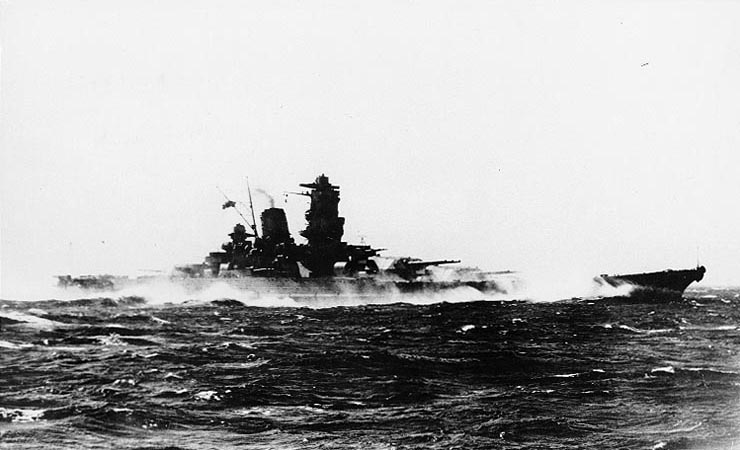
Those who have read my site since the beginning know that I have written much in terms of Naval History. One of the things that I am drawn to are the great ships that were sacrificed with the crews in futile attempts of salvage victory from defeat, or which were sacrificed in order to save others. Regardless of the circumstance I have a soft spot in my heart for sailors of any nation who pay with their lives when their ships are sunk. This is the story of the IJN Yamato who along with her sister ship, the Musashi were the largest battleships ever constructed.
As dawn broke on April 7th 1945 the great Super-Battleship Yamato, the pride of the Japanese Imperial Navy and nine escorts steamed toward Okinawa on a suicide mission. It was literally the end of empire and the end of a navy. What had begun on December 7th 1941 was now winding down as the Imperial Navy launched its last offensive operation against the United States Navy.

The Imperial Navy was already at the end of its tether. Following the disasters at the Battle of the Philippine Sea which decimated the carrier air arm of the Imperial Navy; the subsequent losses in the defense of Formosa which used up the majority of any remaining carrier aircraft and crews; and the Battle of Leyte Gulf which decimated the surface forces of the navy what remained was a pitiful remnant of a once dominant fleet.
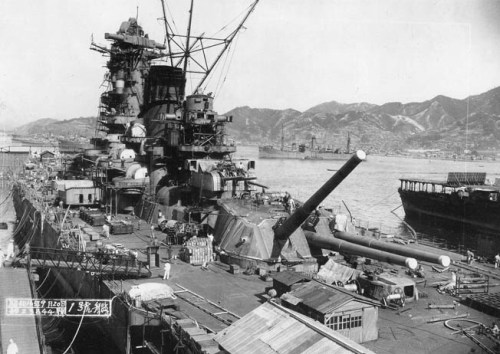
The great battleship Yamato and her sister ship Musashi were the largest warships ever built until the advent of the USS Enterprise CVN-65. Displacing over 72,000 tons 863 feet long and 127 feet in beam these ships mounted the heaviest artillery battery ever placed on a warship. Their nine 18.1” guns mounted in three triple turrets each weighing over 2500 tons weighed as much or more than the largest destroyers of the time. They could fire their massive shells 26 miles and even had the capability of firing a special anti-aircraft shell known as the Sanshiki or beehive round.the largest anti-aircraft shell ever developed.

Musashi was sunk during the Battle of the Sibuyan Sea at Leyte Gulf on October 24th 1944 after being hit by 19 aerial torpedoes and 17 bombs. Yamato engaged the American Escort Carriers and destroyers of Taffy-3 at the Battle off Samar the following day but was prevented by the audacity of the inferior American destroyers and timidity of the Japanese commander Vice Admiral Takeo Kurita from achieving any notable success.

The remains of the Imperial Navy were hampered by a lack of fuel, air power and training time. When the United States attacked Iwo Jima in February 1945, barely 700 miles from the home islands of Japan not a single Japanese surface ship sortied to challenge the American Navy.

However when the American attacked Okinawa on April 1st 1945 the Imperial Navy launched Operation Ten-Go. In spite of overwhelming American superiority in both naval air and surface forces the tiny task force was to fight its way to Okinawa, beach their ships and once the ships were destroyed the crews were to join Japanese Army forces on the island.

The doomed sortie was in part due to the insistence of the Imperial Army which derided the Imperial Navy for its failures at Philippine Sea and Leyte Gulf and pressure from Emperor Hirohito who asked “But what about the Navy? What are they doing to assist in defending Okinawa? Have we no more ships?” In response the Naval High command devised what amounted to a suicide mission for Yamato and her escorts. The plan was opposed by many in the Navy and leaders of the task force who saw it as a futile mission. Only the insistence of Admiral Kusaka who told the reticent commanders that the Emperor expected the Navy to make its best effort to defend Okinawa persuaded the Captains of the doomed force to accept the mission. Honor now matter more than lives.
At about 1600 on April 6th the ships of the task force weighed anchor and departed their anchorage at Tokuyama hoping to take advantage of approaching darkness to mask their departure. They were detected and shadowed by American submarines which provided real time information on the course and speed of the Japanese ships to the American leadership.

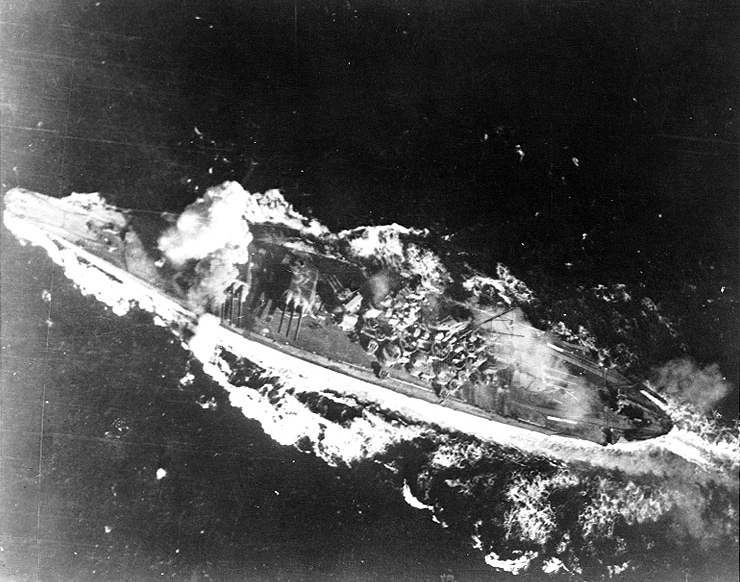
The next morning the task force was spotted by patrol planes and its position relayed to the American fleet commander, Admiral Raymond Spruance, the victor of Midway. Spruance ordered the six fast battleships, accompanied by two battlecruisers, seven cruisers and 21 destroyers engaged in shore bombardment to intercept the Japanese force. However, Admiral Marc Mitscher of Task Force 58, the fast carriers launched a massive air strike of over 400 aircraft against the Japanese.
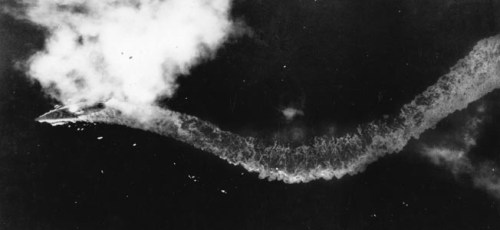
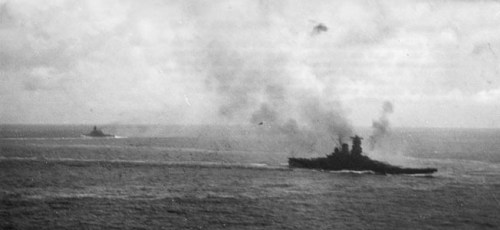
At 1232 the first wave of American aircraft began their attacks on the doomed Japanese force. As the succeeding waves of American aircraft attacked Yamato was hit by 15 bombs and at least 8 torpedoes, almost all of which struck her port side created an imminent risk of capsizing. The damage control teams’ counter flooded the starboard engine and boiler rooms which kept the ship from turning turtle, but which also further reduced her speed.

By 1405 the great ship was dead in the water with a heavy list, just minutes before her commander had ordered the crew to abandon ship. At 1420 Yamato capsized and began to sink and at 1423 she blew apart in a massive explosion that was reportedly heard and seen 120 miles away and created a mushroom cloud that reached 20,000 feet.

Captain Tameichi Hara of the light cruiser Yahagi which had already sank described the demise of the great ship in his book Japanese Destroyer Captain:

“We looked and saw Yamato, still moving. What a beautiful sight. Suddenly smoke belched from her waterline. We both groaned as white smoke billowed out until it covered the great battleship, giving her the appearance of a snow-capped Mount Fuji. Next came black smoke mingled with the white, forming to a huge cloud which climbed to 2000 meters. As it drifted away we looked to the surface of the sea again and there was nothing. Yamato had vanished. Tremendous detonations at 1423 of that seventh day of April signaled the end of this “unsinkable” symbol of the Imperial Navy.”

Only 280 men of the estimated 3000 crew members aboard Yamato were rescued by the surviving escorts. Of her escorts, the Yahagi and four destroyers were also sunk. The Americans lost a total of ten aircraft and 12 men. Never again would the surface forces of the Imperial Navy threaten U.S. forces or take any meaningful part in the war.

https://youtu.be/4ZcfU0cGAP0

The sacrifice of Yamato and her escorts was a futile was of lives and though many in Japan revere their sacrifice as noble it served no purpose. The loss of Yamato, named after the ancient Yamato province in a sense was symbolic of the demise of the Japanese Empire.

I cannot help but think of gallantry of the doomed crews of these ships, sacrificed for the “honor” of leaders that did not really value their sacrifice. Likewise, I regret the fact that Naval engineers, and maritime archeologists never got to examine this great ship while still afloat, or even to see how she would have faired as a target ship in the Bikini Atoll Nuclear tests.

I regret that so many sailors died in what was a senseless, and useless from an operation operation of any tactical, operational, or strategic point of view. Likewise I regret that a relatively intact Yamato was never fully examined by non-Japanese maritime engineers and ship designers to examine and learn lessons from. If Yamato had survived the war, been thoroughly examined and the. Been expended as a target ship at Bikini, which in light of the examples of the USS Nevada, USS New York, the DKM Prinz Eugen, and other ships might have assisted Naval engineers even today.

I am a career military man, and sailor. I am a humanist who abhors the indiscriminate and nonsensical sacrifice of lives for so called National Honor or pride. I am also a military and naval historical historian who believes that the preservation and study of such instruments of war save lives.

It is a commentary that is timeless. The useless sacrifice of over 2,800 human beings and the ultimate battleship ever built into, to do nothing more than commiserate over the lives that had not been so sacrificed, and the lessons that might prevent the loss of life in future conflicts.

I wonder if another Naval power, perhaps not the Japanese, but maybe the Americans, Russians, English, Indian, or Chinese aircraft carrier will be the latest to succumb to the myth of the great and allegedly indestructible capital ship.

It is a question worth asking as the United States Navy struggles to regain pure-eminence in the Pacific against the Chinese, in the Arctic against Chinese and the Russians, and against less than peer competitors in the Persian Gulf and the Mediterranean. When Yamato was sunk the Japanese were no longer under the illusion that they were the greatest sea power ever; if a United States Navy Aircraft were to be sunk in the North Atlantic, the Northeast Pacific, the Persian Gulf, or the Mediterranean it would be more than a military defeat, it would be a national catastrophe. Trust me, I have played the war games at the Joint Forces Staff College. I cannot go into detail about the war game scenarios, but the were favorable to the United States and its allies.

If any of our Nimitz class carriers were sunk along with the majority of their escorts it would be a crisis like we have not experienced since Pearl Harbor. Thus, Yamato, and her escorts serve as a lesson for all who believe in the myth of American Naval and Military superiority. In January of 1019, this year the Chinese boasted that they could not just sink one, but two Nimitz Class carriers in the South China Sea https://www.thesun.co.uk/news/8098177/chinese-admiral-south-china-sea-sink-us-aircraft-carriers/

That possibility has to be acknowledged, and even if one were sunk or seriously damaged it would be a disaster for United States Strategic interests; not Just in the South China Sea, but also Northeast Asia, the Persian Gulf, the Mediterranean, or the North Atlantic. The United States has not experienced such Naval disasters since 1941 and 1942 at the hands of the Japanese Imperial Navy, trust me; I have serve for almost 38 years in the Army and the Navy and I am a historian. If we to experience such losses it would be a strategic disaster that would collapse the confidence of an American public in the myth of American military superiority. There is no amount of #MAGA that can change that. The economy would collapse and the dream world that Americans have lived I would be destroyed. We would have to start again from scratch, like the Japanese in 1945 or the Chinese in 1274 and 1281, or more recently the defeat of the Russian Fleet, operation far from home at Tsushima in 1905 by Admiral Togo and his Japanese Fleet.

This my friends is history, and this is reality when a nation is led by a man with the stupidity of Czar Nicholas, the hubris of Kaiser Wilhelm II, and the racist, non-historical, and not strategically grounded ideology of Adolf Hitler, and their present day manifestations in President Donald Trump.

Until tomorrow

Peace

Padre Steve+
2 Comments

Filed under History, leadership, Military, nazi germany, News and current events, US Navy, White nationalism, World War II at Sea, world war two in the pacific

“Together, There is no Other Way” Lyndon Johnson at Gettysburg and a Challenge to Democrats Today

Friends of Padre Steve’s World,

I am about to finish Historian John Meacham’s inspiring history United States politics and the leadership of different Presidents, The Soul of America: The Battle for Our Better Angels. I have to say that in light of Meacham’s remarks at the Funeral of the late President George H.W. Bush, Meacham’s book has inspired me and encouraged me in the dark era of President Trump and his supporting cast of Angels of Darkness, men and women who, to paraphrase historian Timothy Snyder tell us we are the best while encouraging us to be our worst.

While reading Meacham’s book over the weekend I read about the Civil Rights crusade of President Lyndon Baines Johnson, who had he not gone into Vietnam would probably be considered one of the greatest President’s who ever lived. Johnson would have been considered by many to be an unlikely champion of Civil Rights, though he supported Franklin Roosevelt’s New Deal would not have been considered a pioneering Civil Rights advocate.

Those who read this blog know my attachment to Gettysburg, the Battle Of Gettysburg, and President Abraham Lincoln and his Gettysburg Address. Until I read Meacham’s book I had never known that as Vice President, Lyndon Johnson also spoke at Gettysburg. His words came on Memorial Day 1963, and in part they were an answer to Dr Martin Luther King Jr.’s “Letter from a Birmingham Jail.” It was an incredible and courageous speech. Johnson was a Southerner, a Democrat, and many Southern Democrats were fighting President Kennedy on Civil Rights issues. Kennedy was much too understanding and polite to hold their ball to the fire, but Johnson for all of his other flaws wasn’t and he used his Gettysburg speech to remind the nation of the unfinished legacy of Gettysburg and the still unfulfilled “new birth of freedom” that Lincoln so eloquently spoke in his few remarks at the dedication of the Gettysburg National Military Cemetery.

Johnson spoke these words:

On this hallowed ground, heroic deeds were performed and eloquent words were spoken a century ago. We, the living, have not forgotten–and the world will never forget–the deeds or the words of Gettysburg. We honor them now as we join on this Memorial Day of 1963 in a prayer for permanent peace of the world and fulfillment of our hopes for universal freedom and justice.

We are called to honor our own words of reverent prayer with resolution in the deeds we must perform to preserve peace and the hope of freedom. We keep a vigil of peace around the world. Until the world knows no aggressors, until the arms of tyranny have been laid down, until freedom has risen up in every land, we shall maintain our vigil to make sure our sons who died on foreign fields shall not have died in vain.

As we maintain the vigil of peace, we must remember that justice is a vigil, too–a vigil we must keep in our own streets and schools and among the lives of all our people–so that those who died here on their native soil shall not have died in vain.

One hundred years ago, the slave was freed. One hundred years later, the Negro remains in bondage to the color of his skin. The Negro today asks justice. We do not answer him–we do not answer those who lie beneath this soil–when we reply to the Negro by asking, “Patience.”

It is empty to plead that the solution to the dilemmas of the present rests on the hands of the clock. The solution is in our hands. Unless we are willing to yield up our destiny of greatness among the civilizations of history, Americans — white and Negro together–must be about the business of resolving the challenge which confronts us now.

Our nation found its soul in honor on these fields of Gettysburg one hundred years ago. We must not lose that soul in dishonor now on the fields of hate. To ask for patience from the Negro is to ask him to give more of what he has already given enough. But to fail to ask of him–and of all Americans–perseverance within the processes of a free and responsible society would be to fail to ask what the national interest requires of all its citizens.

The law cannot save those who deny it but neither can the law serve any who do not use it. The history of injustice and inequality is a history of disuse of the law. Law has not failed–and is not failing. We as a nation have failed ourselves by not trusting the law and by not using the law to gain sooner the ends of justice which law alone serves.

If the white over-estimates what he has done for the Negro without the law, the Negro may under-estimate what he is doing and can do for himself with the law. If it is empty to ask Negro or white for patience, it is not empty–it is merely honest–to ask perseverance. Men may build barricades–and others may hurl themselves against those barricades–but what would happen at the barricades would yield no answers. The answers will only be wrought by our perseverance together. It is deceit to promise more as it would be cowardice to demand less.

In this hour, it is not our respective races which are at stake–it is our nation. Let those who care for their country come forward, North and South, white and Negro, to lead the way through this moment of challenge and decision. The Negro says, “Now.” Others say, “Never.” The voice of responsible Americans — the voice of those who died here and the great man who spoke here–their voices say, “Together.” There is no other way.

Until justice is blind to color, until education is unaware of race, until opportunity is unconcerned with the color of men’s skins, emancipation will be a proclamation but not a fact. To the extent that the proclamation of emancipation is not fulfilled in fact, to that extent we shall have fallen short of assuring freedom to the free.

If Johnson was alive today in the age of Trump, and in the fighting form that enabled him to go against fellow Southerners to get the Civil Rights Act Of 1964 and the since emasculated Voting Rights Act Of 1965 passed by overwhelming bi-partisan majorities, and to pass other bills that benefited all Americans, he would not be silent. He would be adding his voice to those of Blacks, Latinos, Arab Americans, Asians, Women, LGBTQ people, and non-Christian Religious minorities whose constitutional rights are under threat by a President whose despises those rights, and a Party which was reborn when the segregationists Democrats Of Johnson’s time became Republicans in 1964 under the white supremacist campaign of Barry Goldwater and the 1968 Southern Strategy Of Richard Nixon. In those years the Democratic Party became the true successors of Lincoln, Grant and the early Republican Party Vision of freedom, while the Republicans under the direction of men like Goldwater, Nixon, Pat Buchanan, Roger Ailes, and a host of others including former Democrats and Dixiecrats like Strong Thurman became the Party of the Lost Cause, the Noble Confederacy, and Jim Crow. Under President Trump the pathetic rump of that once great party, predominantly made of Conservative Christians and a growing violent White Supremacist movement attempt to claim to be the Party of Lincoln and Theodore Roosevelt, but are the Party of Jefferson Davis and the later Dixiecrats.

If he were alive today Lyndon Johnson would be using his legislative expertise to push forward responsible but unpopular policies.

I can only ask, who among today’s Democrats will do that? I honestly don’t know, but I believe that such a man or woman much come forth to challenge Trump and his Cult for the Presidency in 2020. To quote Johnson:

“In this hour, it is not our respective races which are at stake–it is our nation. Let those who care for their country come forward, North and South, white and Negro, to lead the way through this moment of challenge and decision.

The Negro says, “Now.” Others say, “Never.” The voice of responsible Americans–the voice of those who died here and the great man who spoke here–their voices say, “Together.” There is no other way.”

Until tomorrow,

Peace,

Padre Steve+

Leave a comment

Filed under civil rights, civil war, Gettysburg, History, laws and legislation, leadership, LGBT issues, News and current events, Political Commentary, White nationalism

“In This Difficult Time for the United States, it’s Perhaps Well to Ask What kind of a Nation We Are…” Bobby Kennedy’s Words on the Assassination Of Dr. Martin Luther King Jr.

20130404-203529.jpg

Friends of Padre Steve’s World,

Fifty-one years ago yesterday a bullet killed Dr. Martin Luther King Jr. while he was in Memphis supporting Sanitation Workers who were being subjected to unsafe working conditions without the same rights, protections, pay, or benefits of white Sanitation workers. As always there were threats on King’s life and he knew that he was a target. The night before his assassination Dr. King spoke at Mason Temple the international headquarters of the Church of God in Christ, the largest historically Black denomination in the United States.

That speech is now known as the “I have been to the mountaintop” speech. Dr. King had flown into Memphis earlier in the day, on a flight delayed by a bomb threat. King like many Civil Rights leaders of his day lived under the constant threat of physical violence, intimidation and assassination. After the heady days of the great march in Washington and the I Have a Dream speech and the award of the Nobel Prize his positions on social and economic justice and his opposition to the Vietnam War had made him a pariah of sorts, even in the Black community. He had place himself in the gunsights of his opponents as he pressed on in spite of the opposition.

Life was precious to him, but he like many others understood that it could be cut short at any moment for simply speaking the truth about racial discrimination, prejudice and violence. King himself had been accosted at different times and spent time in jail for “breaking” laws that enforced and enabled institutions and individuals to discriminate against Blacks with no consequences whatsoever. He was called a radical, a Communist and anti-American by those that opposed any changes to the status quo. He knew that his life was always in danger.

In that speech Dr. King seemed to understand the threat but he was determined to go on and to do God’s will. Dr. King understood that the Christian faith required more than intellectual assent to a doctrine. He understood the words of the German martyr Dietrich Bonhoeffer: We are not to simply bandage the wounds of victims beneath the wheels of injustice, we are to drive a spoke into the wheel itself.”

At Mason Temple Dr King proclaimed:

“And then I got to Memphis. And some began to say the threats…or talk about the threats that were out… What would happen to me from some of our sick white brothers? Well I don’t know what will happen now. We’ve got some difficult days ahead. but it doesn’t matter with me now. Because I been to the mountaintop. And I don’t mind. Like anybody, I would like to live a long life. Longevity has its place. But I’m not concerned about that now. I just want to do God’s will. And He’s allowed me to go up to the mountain. And I’ve looked over.and I have seen the promised land. I may not get there with you. But I want you to know tonight, that we, as a people, will get to the promised land! And so I am happy, tonight. I’m not worried about anything. I am not fearing any man. Mine eyes have seen the glory of the coming of The Lord.”

It was April 4th 1968. The United States was divided by the Vietnam War and numerous social crises. President Lyndon Johnson had just done the unthinkable, he had announced that he was withdrawing from his reelection bid. In many places despite the integration of the Armed Forces, Baseball, the repeal of many Jim Crow laws and the passage of the 1964 Voter’s Rights Act African Americans still felt the sting of individual and institutional racial prejudice. In Vietnam the effects of the Tet Offensive still lingered even as American cities burned.

His speech at Mason Temple was almost prophetic in its message. The words of the thirty-nine year old Baptist Preacher from Atlanta echoed through the sanctuary of the church to the applause of those present even as a heavy spring thunderstorm rocked the city.

The following evening, King with a number of other Civil Rights leaders including Ralph Abernathy, Andrew Young, and Jessie Jackson were at the Lorraine Motel, where King often stayed. King was standing on the balcony outside of his room, Room 306 when at 6:01 PM he was cut down and mortally wounded by a single shot fired from a Remington 760 rifle. The bullet struck him in the right cheek, traveled down his spine and severed his jugular vein and several major arteries before it came to rest in his shoulder. He still had a heartbeat when the ambulance arrived and on his arrival at St Joseph’s Hospital. Efforts to revive him by opening his chest and attempting cardiac massage were unsuccessful and at 7:05 PM Dr King was pronounced dead.

20130404-221100.jpg

20130404-221225.jpg

Witnesses reported a man named James Earl Ray fleeing the area after the shooting. The Remington rifle and a pair of binoculars with Ray’s fingerprints were found at the scene. Ray was apprehended at London’s Heathrow Airport two months later. Ray was tried and convicted of Dr King’s murder. He was sentenced to 99 years in prison and died in 1998. During the trial Ray recanted his confession, implicated an unknown man named “Raul” who he had supposedly met in Montreal as being involved and said that “he personally did not kill” Dr King hinting at a conspiracy. Ray plead guilty to avoid the death penalty.

Other theories were postulated about the murder and Lloyd Jowers who owned a restaurant across from the Lorraine Motel claimed in a 1993 interview that the US Government and the Mafia were complicit in the killing, that Ray was a scapegoat and that Memphis Police Lieutenant Earl Clark was the shooter.

Jowers’ story is disputed but it was believed by King’s widow Coretta Scott King.  She filed a wrongful death lawsuit in which a jury found that Jowers and others including government agencies were guilty of the plot to kill Dr King on December 8th 1998. Though Jowers’ story was contradicted by much of his own testimony during the trial the results have caused a divide in who experts believe killed Dr King. As for the King family they reconciled with Ray before his death.

20130404-221809.jpg

Regardless of who killed Dr King the result was a shock to much of the nation and in many places riots broke out despite the pleadings of most Civil Rights leaders to continue in Dr King’s path of non-violence.

20130404-230118.jpg

Senator Robert F Kennedy, then running for the Democratic Party nomination for President learned of Dr King’s shooting just before flying to Indianapolis for a campaign rally. On his arrival he learned of Dr King’s death. Warned by police that he could be in danger he made an impromptu speech from the back of a flat bed truck. The speech was short, under 5 minutes but its message is applicable even today.

“Ladies and Gentlemen,

I’m only going to talk to you just for a minute or so this evening, because I have some — some very sad news for all of you — Could you lower those signs, please? — I have some very sad news for all of you, and, I think, sad news for all of our fellow citizens, and people who love peace all over the world; and that is that Martin Luther King was shot and was killed tonight in Memphis, Tennessee.

Martin Luther King dedicated his life to love and to justice between fellow human beings. He died in the cause of that effort. In this difficult day, in this difficult time for the United States, it’s perhaps well to ask what kind of a nation we are and what direction we want to move in. For those of you who are black — considering the evidence evidently is that there were white people who were responsible — you can be filled with bitterness, and with hatred, and a desire for revenge.

We can move in that direction as a country, in greater polarization — black people amongst blacks, and white amongst whites, filled with hatred toward one another. Or we can make an effort, as Martin Luther King did, to understand, and to comprehend, and replace that violence, that stain of bloodshed that has spread across our land, with an effort to understand, compassion, and love.

For those of you who are black and are tempted to fill with — be filled with hatred and mistrust of the injustice of such an act, against all white people, I would only say that I can also feel in my own heart the same kind of feeling. I had a member of my family killed, but he was killed by a white man.

But we have to make an effort in the United States. We have to make an effort to understand, to get beyond, or go beyond these rather difficult times.

My favorite poem, my — my favorite poet was Aeschylus. And he once wrote:

Even in our sleep, pain which cannot forget falls drop by drop upon the heart, until, in our own despair, against our will, comes wisdom through the awful grace of God.

What we need in the United States is not division; what we need in the United States is not hatred; what we need in the United States is not violence and lawlessness, but is love, and wisdom, and compassion toward one another, and a feeling of justice toward those who still suffer within our country, whether they be white or whether they be black.

So I ask you tonight to return home, to say a prayer for the family of Martin Luther King — yeah, it’s true — but more importantly to say a prayer for our own country, which all of us love — a prayer for understanding and that compassion of which I spoke.

We can do well in this country. We will have difficult times. We’ve had difficult times in the past, but we — and we will have difficult times in the future. It is not the end of violence; it is not the end of lawlessness; and it’s not the end of disorder.

But the vast majority of white people and the vast majority of black people in this country want to live together, want to improve the quality of our life, and want justice for all human beings that abide in our land.

And let’s dedicate ourselves to what the Greeks wrote so many years ago: to tame the savageness of man and make gentle the life of this world. Let us dedicate ourselves to that, and say a prayer for our country and for our people.

Thank you very much.”

Two months later Kennedy was shot and mortally wounded by Sirhan Sirhan after winning the California Primary.

The loss of Dr King and later Senator Kennedy was profound. So tonight take the time to remember and pray that we all will be able to go to the mountain and see the promised land where in a more perfect Union we will heal the wounds that so divide our country.

20130405-004046.jpg

Today the rights that Dr. King and so many others fought for dating back to the days of Frederick Douglass are being rolled back at the local, state and Federal level. The administration of President Trump and Republican led statehouses have been working overtime to silence dissent, discredit opposition, and through unjust laws and policies upend the civil rights not only of Blacks, but other people of color, immigrants, women, LGBTQ people, and Muslims. These are dark days when it comes to civil rights and freedom.

Dr. King noted the night before he was slain that “we’ve got some difficult days ahead” but as he told his staff in January 1968 “Hope is the final refusal to give up.” But we also must take seriously the words of Bobby Kennedy, it’s perhaps well to ask what kind of a nation we are and what direction we want to move in.

I think that we really need to ask and answer that question before all those things that Dr. King and Senator Kennedy fought for are taken away by leaders who do not respect the principles of the Declaration, the Constitution, or the institutions and laws they were elected or appointed to uphold.

Peace

Padre Stave+

3 Comments

Filed under civil rights, crime, faith, History, leadership, Loose thoughts and musings, News and current events, Political Commentary

“A Symbol of Renewed White Identity and Common Purpose” What Trump is to White Supremacists and Nationalists

Friends of Padre Steve’s World,

Yesterday in Christchurch New Zealand an Australian White Nationalist not only committed mass murder against Muslims at worship in Christchurch’s two mosques. Before he did so he released a 74 page manifesto on Twitter, and announced it on 8chan, a website devoted to White Supremacism, Racism, and war against Muslims, Jews, dark skinned immigrants, and people on the political left. When he made his attack he announced to his followers that it would be carried live on his Facebook page.

He killed 49 men, women and children in cold blood, and wounded many more, live-streaming the whole event. It was an event made for social media and it became viral before media outlets and YouTube attempted to scrub it from their servers, but be assured, it will keep popping up in other places because White Nationalists will publicize it, and ghoulish people will,watch it and share it. In a way the Eagles nailed it in their song Dirty Laundry:

We got the bubble-headed-bleach-blonde who
Comes on at five
She can tell you bout the plane crash with a gleam
In her eye
Its interesting when people die-
Give us dirty laundry

New Zealand doesn’t have many Muslims so he killed about one of every 500 living in the country. Since Muslims make up less than one percent of New Zealand’s population this is quite a blow to a small community, in many cases made up of people who fled repressive governments in Southeast Asia. It’s about the same percentage of the population made up by German Jews in 1932, just before Hitler came to power.

The murderer, a 28 year old Australian named Brenton Harrison Tarrant, possibly aided by others is a self-proclaimed White Nationalist who subscribes to the theories of “White Replacement” and “White Genocide” which are quite popular among White Nationalist groups around the world. During the White Nationalist Charlottesville marches, the White Nationalists chanted Jews will not replace us.”

The killer also made it clear that he is a white nationalist. The references to Hitler, Serbians convicted of war crimes for killing unarmed Bosnian Muslims, Anders Breivik, the Swedish killer who murdered 77 people, Dylan Roof, the killer of 9 people at an African American Church in Charleston, South Carolina.

Rabbi Jeffrey Myers, whose Tree Of Life Synagogue experienced such an attack last year noted: “To me it was as though I’m living the movie ‘Groudhog Day’ as a horror film all over again,”

Sadly, the Rabbi is right. These acts be they directed at Muslims, Jews, African Americans, and others won’t be going away. One of the reasons is that many of these cold blooded killers and their followers believe they have a world leader who tacitly gives them his support, even if they don’t agree with all his policies or feel that he is somewhat a fool. It is not whether Trump is an actual White Nationalist at heart, something that I believe that he is; but even if he is not, he now serves as a symbol and rallying point for White Nationalist and Neo-Nazis worldwide: as Tarrant, the New Zealand killer called Trump: A symbol of renewed White Identity and common purpose…”

Another thing that Tarrant said was that he hoped to promote civil war in the United States. This is troubling because quite a few Neo-Nazis and White Supremacists in the United States speak of the same thing.

In his manifesto and his comments during the shooting Tarrant referred to the New Zealand Muslims as “invaders” and shortly thereafter Trump used the same term to describe Central American refugees when he vetoed the bi-partisan Congressional legislation overturning his State Of Emergency. Such language is designed, especially when placed in the context of him referring to the refugees as criminals, murderers, and rapists; intentionally designed to whip up public anger and resentment toward them. It is the same language used by Hitler and the Nazis in referring to Jews. The same is true of various European leaders who refer to use the same language to describe immigrants and refugees from Africa, the Middle East, and Asia.

As for those who pay little regard to manifestos written by people like Tarrant because they often jump from topic to topic and include a lot of irony and “snark” are mistaken. Such writing and communication styles have been long a part of the Nazi and White Supremacist tradition. One only has to read Mein Kampf, Julius Streicher’s Der Stürmer, other Nazi tracts, as well as the speeches of Hitler and other leading Nazis. They are an encouraged method of delivering the Nazi/White Supremacist Message.

We have to fight against and expose the Neo-Nazis and White Supremacists, and if such people take up the message of President Trump in using physical violence against political opponents and the press, they may have to be met with force. To defend themselves, their offices, and their meetings against the Nazi Sturmabteilung or S.A. and Communist Roter Frontkämpferbund in the Weimar Republic in the 1920s, the Social Democrats had to form their own organization of former soldiers called the Reichsbanner. I would hate to see our country devolve into the street battles but if it happens then Democrats and other progressives may have to imitate the Reichsbanner, especially if the police refuse to police the violent right wing, as was often the case in Weimar Germany. Personally, I have more faith in our institutions, but one never knows what happens when democracy fails.

So anyway, the Christchurch Mosque Massacre should serve as a warning about the international spread of racist White Nationalism. When asked if he thought that White Nationalism was a major problem yesterday, President Trump said:

“I don’t really. I think it’s a small group of people that have very, very serious problems. It’s certainly a terrible thing.”

But, the President, who in 2017 said that there were “very fine people” among the White Supremacists and Neo-Nazis who cause chaos, carnage, and death in Charlottesville, the words sound hollow and disingenuous, when he demonizes whole groups of people and when he advocates violence in his Tweets and at his rallies.

Yale historian Timothy Snyder wrote:

“A nationalist will say that “it can’t happen here,” which is the first step toward disaster. A patriot says that it could happen here, but that we will stop it.”

That has to be our attitude. We have to stop it, with or without the support of the President.

Until next time,

Peace

Padre Steve+

7 Comments

Filed under crime, History, laws and legislation, leadership, nazi germany, News and current events, Political Commentary, terrorism, White nationalism

International Women’s Day 2019 and the Beginning Of the Women’s Rights Movement

youngecs

Elizabeth Cady Stanton

Friends of Padre Steve’s World,

Today is International Women’s Day and I have reached into my archives to publish the first part of a chapter of one of my Civil War books that deals with the beginnings of the Women’s Rights movement in the war and in the preceding decades. 

At this point in history one would like to say that women have achieved equality and are treated with the same respect that we would accord men in similar positions. But the fact is that we haven’t reached that point in the United States, and there is a significant minority with tremendous power, especially in state legislatures and courts, as well as in the Republican Party at the national level which are working hard to roll back the rights women have gained. Hell, we can’t even pass the Equal Rights Act, decades after its introduction, primary because religious conservatives allied with the Republican Party have bottled it up. 

Something eventually has to happen to pass this constitutional amendment as well as to ensure that women who have been sexually assaulted, raped, or discriminated against simply because of their gender receive equal and fair treatment under the law. We haven’t reached that point yet. So over the next couple of weeks I will intersperse the other parts of this story among my other writings. 

Until tomorrow,

Continue reading

Leave a comment

Filed under civil rights, civil war, ethics, faith, History, laws and legislation, leadership, News and current events, Political Commentary

Mahan, Halleck, and the Beginning of American Military Thought

Friends of Padre Steve’s World

Something a bit different. Again this is a part of one of the chapters of my Gettysburg and Civil War text, but this time dealing with two men who were the first American military theorists, Dennis Hart Mahan, the father of Alfred Thayer Mahan the great naval strategist and Henry Wager Hillock. Both men contributed to American military thought for over a century until they and their French-Swiss mentor Henri Jomini’s theories were overtaken by those of the Prussian Carl von Clausewitz. 

They both are interesting characters and both had an influence on American history today ion large part due to their influence on the education of most of the generals who conducted the Civil War, and in the case of Halleck in advising Abraham Lincoln during the war. 

I hope that you enjoy

Peace

Padre Steve+

West_Point

Background 

As we continue to examine the Civil War as the first modern war we have to see it as a time of great transition and change for military and political leaders. As such we have to look at the education, culture and experience of the men who fought the war, as well as the various advances in technology and how that technology changed tactics, which in turn influenced the operational and strategic choices that defined the characteristics of the Civil War and wars to come.

The leaders who organized the vast armies that fought during the war were influenced more than military factors. Social, political, economic, scientific and even religious factors influenced their conduct of the war. The officers that commanded the armies on both sides grew up during the Jacksonian opposition to professional militaries, and for that matter even somewhat trained militias. The Jacksonian period impacted how officers were appointed and advanced. Samuel Huntington wrote:

“West Point was the principal target of Jacksonian hostility, the criticism centering not on the curriculum and methods of the Academy but rather upon the manner of how cadets were appointed and the extent to which Academy graduates preempted junior officer positions in the Army. In Jacksonian eyes, not only was specialized skill unnecessary for a military officer, but every man had the right to pursue the vocation of his choice….Jackson himself had an undisguised antipathy for the Academy which symbolized such a different conception of officership from that which he himself embodied. During his administration disciple faltered at West Point, and eventually Sylvanus Thayer, the superintendent and molder of the West Point educational methods, resigned in disgust at the intrusion of the spoils system.” [1]

This is particularly important because of how many officers who served in the Civil War were products of the Jacksonian system and what followed over the next two decades. Under the Jackson administration many more officers were appointed directly from civilian sources than from West Point, often based on political connections. “In 1836 when four additional regiments of dragoons were formed, thirty officers were appointed from civilian life and four from West Point graduates.” [2]

While this in itself was a problem, it was made worse by a promotion system based on seniority, not merit. There was no retirement system so officers who did not return to the civilian world hung on to their careers until they quite literally died with their boots on. The turnover in the highest ranks was quite low, “as late as 1860, 20 of the 32 men at or above the rank of full colonel held commissions in the war of 1812.” [3] This held up the advancement of outstanding junior officers who merited promotion and created a system where “able officers spent decades in the lower ranks, and all officers who had normal or supernormal longevity were assured of reaching higher the higher ranks.” [4]

Robert E. Lee was typical of many officers who stayed in the Army. Despite his success Lee was constantly haunted by his lack of advancement. While he was still serving in Mexico having gained great laurels, including a brevet promotion to Lieutenant Colonel, the “intrigues, pettiness and politics…provoked Lee to question his career.” He wrote, “I wish I was out of the Army myself.” [5]

In 1860 on the brink of the war, Lee was “a fifty-three year-old man and felt he had little to show for it, and small hope for promotion.” [6] Lee’s discouragement was not unwarranted, for despite his exemplary service, there was little hope for promotion and to add to it, Lee knew that “of the Army’s thirty-seven generals from 1802 to 1861, not one was a West Pointer.” [7]

The careers of other exemplary officers including Winfield Scott Hancock, James Longstreet, and John Reynolds languished with long waits between promotions between the Mexican War and the Civil War. The long waits for promotion and the duty in often-desolate duty stations on the western frontier, coupled with family separations caused many officers to leave the Army. A good number of these men would volunteer for service in 1861 a go on to become prominent leaders in both the Union and Confederate armies. Among these officers were such notables as Thomas “Stonewall” Jackson, Ulysses S. Grant, William Tecumseh Sherman, Henry Halleck, George McClellan and Jubal Early.

The military education of these officers at West Point was based very technical and focused on engineering, civil, and topographic, disciplines that had a direct contribution to the expanding American nation. What little in the way of formal higher level military education West Point cadets received was focused the Napoleonic tactics and methods espoused by Henri Jomini as Clausewitz’s works had yet to make their way to America. Dennis Hart Mahan taught most military theory and tactics courses being taught at the academy in the formative years of so many of the men who would lead the armies that fought the American Civil War.

Many Americans looked on the French, who had been the allies of the United States in the American Revolution, favorably during the ante-bellum period. This was especially true of the fledgling United States Army, which had just fought a second war with Great Britain between 1812 and 1815, and “outstanding Academy graduates in the first half of the nineteenth century, such as Halleck and Mahan, were sent to France and Prussia to continue their education. Jomini was considered as the final word on the larger aspects of military operations, and American infantry, cavalry, and artillery tactics imitated those of the French Army.” [8]

Dennis_Hart_Mahan

Respected but Never Loved: Dennis Hart Mahan

Mahan, who graduated at the top of the West Point class of 1824 was recognized as having a brilliant mind very early in his career, as a third classman that “he was appointed an acting assistant professor of mathematics.” [9] Following his graduation the brilliant young officer was sent by the army to France, where he spent four years as a student and observer at the “School of Engineering and Artillery at Metz” [10] before returning to the academy where “he was appointed professor of military and civil engineering and of the science of war.” [11] It was a position that the young professor excelled as subjected “the cadets…to his unparalleled knowledge and acid disposition.” [12]

Mahan spent nearly fifty years of his life at West Point, including nearly forty years as a faculty member he could not imagine living life without it. Thus he became “morbid when the Academy’s Board of Visitors recommended his mandatory retirement from the West Point Faculty” and on September 16th 1871 the elderly Mahan “committed suicide by leaping into the paddlewheel of a Hudson River steamer.” [13]

While he was in France Mahan studied the prevailing orthodoxy of Henri Jomini who along with Clausewitz was the foremost interpreter of Napoleon and Napoleon’s former Chief of Staff Marshal Ney. When we look at Mahan’s body of work in his years at West Point, Jomini’s influence cannot be underestimated. Some have noted, and correctly so, that “Napoleon was the god of war and Jomini was his prophet” [14] and in America the prophet found a new voice in that of Dennis Hart Mahan.

Thus, if one wants to understand the underlying issues of military strategy and tactics employed by the leaders of the Civil War armies, the professional soldiers, as well as those who learned their trade on the battlefield of America, one has to understand Jomini and his American interpreter Mahan.

Unlike the Prussian Clausewitz, whose writings were still unknown in America, Jomini saw the conduct of war apart from its human element and controlled by certain scientific principles. The focus in principles versus the human element is one of the great weaknesses of traditional Jominian thought.

The basic elements of Jominian orthodoxy were that: “Strategy is the key to warfare; That all strategy is controlled by invariable scientific principles; and That these principles prescribe offensive action to mass forces against weaker enemy forces at some defensive point if strategy is to lead to victory.” [15] Like Clausewitz, Jomini interpreted “the Napoleonic era as the beginning of a new method of all out wars between nations, he recognized that future wars would be total wars in every sense of the word.” [16] In his thesis Jomini laid out a number of principles of war including elements that we know well today: operations on interior and exterior lines, bases of operations, and lines of operation. Jomini understood the importance of logistics in war, envisioned the future of amphibious operations and his thought would be taken to a new level by Alfred Thayer Mahan, the son of Dennis Hart Mahan in his book The Influence of Sea Power on History.

To be fair, Jomini foresaw the horrific nature of the coming wars, but he could not embrace them, nor the concepts that his Prussian counterpart Carl von Clausewitz regarding the base human elements that made up war. “Born in 1779, Jomini missed the fervor of the Revolutionary generation and the romantic world view that inspired its greatest theorist, Jacques Antoine Guibert. He came to intellectual maturity during a period of codification and quest for stability in all spheres of life, including the waging of war.” [17] Jomini expressed his revulsion for the revolutionary aspects of war, and his desire to return to the limited wars of the eighteenth century:

“I acknowledge that my prejudices are in favor of the good old times when the French and English guards courteously invited each other to fire first as at Fontenoy, preferring them to the frightful epoch when priests, women. And children throughout Spain plotted the murder of individual soldiers.” [18]

Jomini’s influence was great throughout Europe and was brought back to the United States by Mahan who principally “transmitted French interpretations of Napoleonic war” [19] especially the interpretation given to it by Henri Jomini. However, when Mahan returned from France he was somewhat dissatisfied with some of what he learned. This is because he understood that much of what he learned was impractical in the United States where a tiny professional army and the vast expenses of territory were nothing like European conditions in which Napoleon waged war and Jomini developed his doctrine of war.

It was Mahan’s belief that the prevailing military doctrine as espoused by Jomini:

“was acceptable for a professional army on the European model, organized and fighting under European conditions. But for the United States, which in case of war would have to depend upon a civilian army held together by a small professional nucleus, the French tactical system was unrealistic.” [20]

Mahan set about rectifying this immediately upon his return to West Point, and though he was now steeped in French thought, he was acutely sensitive to the American conditions that in his lectures and later writings had to find a home. As a result he modified Jominian orthodoxy by rejecting one of its central tenants-primary reliance on offensive assault tactics.” [21] Mahan wrote, “If the offensive is attempted against a strongly positioned enemy… it should be an offensive not of direct assault but of the indirect approach, of maneuver and deception. Victories should not be purchased by the sacrifice of one’s own army….To do the greatest damage to our enemy with the least exposure of ourselves,” said Mahan, “is a military axiom lost sight of only by ignorance to the true ends of victory.” [22]

However, Mahan had to contend with the aura of Napoleon, which affected the beliefs of many of his students and those who later served with him at West Point, including Robert E. Lee. “So strong was the attraction of Napoleon to nineteenth-century soldiers that American military experience, including the generalship of Washington, was almost ignored in military studies here.” [23] It was something that many American soldiers, Union and Confederate would pay with their lives as commanders steeped in Napoleon and Jomini threw them into attacks against well positioned and dug in opponents well supported by artillery. Lee’s assault on Cemetery Ridge on July 3rd1863 showed how little he had learned from Mahan regarding the futility of such attacks, and instead trusted in his own interpretation of Napoleon’s dictums of the offense.

Thus there was a tension in American military thought between the followers of Jomini and Mahan. The conservative Jominian interpretation of Napoleonic warfare predominated much of the officer corps of the Army, and within the army “Mahan’s decrees failed to win universal applause.” [24] However, much of this may have been due in part to the large number of officers accessed directly from civilian life into the army during the Jacksonian period. Despite this, it was Dennis Hart Mahan who more than any other man “taught the professional soldiers who became the generals of the Civil War most of what they knew through the systematic study of war.” [25]

When Mahan returned from France and took up his professorship he became what Samuel Huntington the “American Military Enlightenment” and he “expounded the gospel of professionalism to successive generations of cadets for forty years.” [26]Some historians have described Mahan by the “star professor” of the Military Academy during the ante-bellum era. [27] Mahan’s influence on the future leaders of the Union and Confederate armies went beyond the formal classroom setting. Mahan established the “Napoleon Club,” a military round table at West Point.[28] In addition to his writing and teaching, Mahan was one of the preeminent influences on the development of the army and army leadership during the ante-bellum period.

However, Mahan and those who followed him such as Henry Halleck, Emory Upton and John Bigelow who were the intellectual leaders of the army had to contend with an army culture which evidenced “a distain for overt intellectual activities by its officers for much of the nineteenth and twentieth centuries….Hard fighting, hard riding, and hard drinking elicited far more appreciation from an officer’s peers that the perusal of books.” [29]

Mahan dominated the academy in many ways. For the most part Mahan ran the academic board, an institution that ran the academy, and “no one was more influential than Mahan in the transition of officership from a craft into a profession.”[30] Mahan was a unique presence at West Point who all students had to face in their final year before they could graduate and become a commissioned officer. “His Engineering and Science of War course was the seedbed of strategy and tactics for scores of cadets who later became Civil War Generals.” [31] That being said most of what Mahan taught was the science of engineering related to war and he “went heavy on the military engineering and light on strategy” [32] relying primarily on Jomini’s work with his modifications for the latter.

The prickly professor was “respected by his students but never loved.” One student described him as “the most particular, crabbed, exacting man that I ever saw. He is a slim little skeleton of a man and is always nervous and cross.” [33] As a teacher Mahan was exceptional, but he was exceptionally demanding of his students. Those cadets who had survived the first three years at the academy were confronted by this “irritable, erudite, captious soldier-professional who had never seen combat” yet who was “America’s leading military mind.” [34]

Mahan was “aloof and relentlessly demanding, he detested sloppy thinking, sloppy posture, and a sloppy attitude toward duty…Mahan would demand that they not only learn engineering and tactics, but that every manner and habit that characterizes an officer gentlemanly deportment, strict integrity, devotion to duty, chivalric honor, and genuine loyalty be pounded into them. His aim was to “rear soldiers worthy of the Republic.” [35] Continue reading

1 Comment

Filed under civil war, History, leadership, Military, us army

The Reichstag Fire Decree and Trump’s Potential Actions

partridge if you can't be a dictator

Friends of Padre Steve’s World,

Yesterday I wrote about the Reichstag Fire and the resultant Order of the President of the Reich for the Protection of People and State or as it is more often known as the Reichstag Fire DecreeI wrote about how perilously close that I really believe that we are to a Reichstag Fire moment in our country today.

That has not changed. In fact the President declared a National Emergency over an imaginary crisis at the U.S. – Mexican border, an act that he said that he did not have to proclaim as he made the declaration.

On February 27th 1933 Adolf Hitler and his Nazi Party which was still a minority party in a coalition government of partners that wouldn’t have minded his failure, became recipients of of a political gift that allowed them to seize power under the very provisions of the Republic and Constitution that they despised. A Dutch Communist The very next day Hitler with the backing of President Paul von Hindenburg issued a decree under Article 48 of the Weimar Constitution which though directed at the German Communist Party, which was banned along with its publications, applied to every political party in Germany.

Barely three weeks later the Reichstag, now emptied of Communists deputies gave its approval to the Enabling Act which gave the central government. Their abdication Of their Constitutional role allowed Hitler to enact laws without the approval of the Reichstag, effectively ending any sort of parliamentary democracy and eviscerating the constitution. 

These acts gave the central government in Berlin to usurp State governments in States where non-Nazi parties held democratic majorities and to outlaw political opposition. The only party to oppose the Nazi moves toward dictatorship were the Social Democrats who voted against both laws. Their party was banned shortly after the Enabling Act was passed. Their leader in the Reichstag, Otto Weis proclaimed the last free words uttered in the Reichstag:

“No Enabling Law can give you the power to destroy ideas which are eternal and indestructible … You can take our lives and our freedom, but you cannot take our honour. We are defenseless but not honourless.” 

The other political parties in Germany, including the conservative parties and center parties who had allied themselves with Hitler voted to dissolve themselves by the end of July 1933. None of the conservative opposition wanted to face the wrath of Hitler or his newly established extrajudicial Concentration Camps which were not run by the Ministry of Justice, but the Nazi Party.

In Germany it was the burning of the Reichstag but in any crisis the same could happen here. I think this is very possible with President Trump and a compliant Republican Party which has surrendered any sense of responsibility, including the defense of things that it fought against for years in order to maintain power by supporting a man that just two years ago most mocked and opposed; so much like the non-Nazi German conservatives and Hitler. That was demonstrated today as Michael Cohen, the President’s former lawyer and “fixer” testified before Congress. His testimony was compelling, credible, and backed up by documentary evidence, including documents signed by the President signed after he took office. All the Republicans could do was attack the messenger, they never challenged a single fact.

Now let’s think about today and lets let our minds wander into possibilities that are much more likely than they would have been a few years ago. So let’s take a journey to a future where most of us would not want to go. I mean really, I don’t want these things to happen, if not for any other reasons than things than effect me.  I want to attend my 40th high school reunion on September 1st and a trip to Germany to the Oktoberfest and to visit our German friends later that month.  So some things are about me, I mean if were going to lose all of our freedoms I want to get a few bucket list items in, but I digress, let’s go back to the unimaginable.

Rather than standing up for truth, the Republicans, like the non-Nazi German Conservatives in 1933 are more concerned with holding power to fulfill their agenda than with the character of the man they are backing. Today Cohen warned them when they attacked him:

As Mr. Cohen told Republican lawmakers, “I did the same thing that you’re doing now. For 10 years. I protected Mr. Trump for 10 years.”

He then issued this warning to them: “The more people that follow Mr. Trump — as I did blindly — are going to suffer the same consequences that I’m suffering.” Mr. Cohen later explained the ethos of Trumpworld: “Everybody’s job at the Trump Organization is to protect Mr. Trump. Every day most of us knew we were coming and we were going to lie for him about something. That became the norm.”

This has now become the norm of the Republican Party, which if I need to remind you I served and believed from the time that I volunteered for Gerald Ford’s campaign before I could vote in 1976 until I left the party following my return from Iraq in 2008. I stopped defending the indefensible eleven years ago.

I would say close your eyes but then you wouldn’t be able to read unless you have some sort of software that turns my written words into spoken words, or unless you want me to start a podcast. If you want the latter make it worth it by doing something to get me a few extra bucks for more beer before everything goes to hell.

Let us imagine that following increased tensions in Venezuela that a real or alleged terrorist group claiming to support the Venezuelan dictator Maduro attacks the NY Subway and the Washington Metro subway systems with Sarin and phosgene nerve gas. Another alleged Venezuelan terrorist shoots down an American Airlines Airbus 330 with a SAM 7 as it attempted to land In Philadelphia. In the attacks, thousands of people die. In another attack a heavily armed terrorist group attacks the Mall of American with assault rifles, RPGs, and grenades. Between Miami and the Bahamas an explosion rocks a Disney Cruise Ship, killing many passengers and crew and leaving it disabled and requiring Coast Guard and U.S. Navy assistance to save the ship and bring her back to port.

While Federal, State and local law enforcement investigate at the points of attack, the FBI, CIA and NSA attempted to ascertain if and what foreign power or terrorist groups were behind the attacks. Venezuela was at the top of the list, but Iran, Hezbollah, North Korea, and even Russia were suspects, but it took time to find the culprits.

In the mean time the country went into a panic. Retribution was the watchword. Thousands of people were killed and injured in the attacks. Following them the subways, airports and maritime ports shut down. The economy went into shock. Prices soared and Wall Street crashed, dumping some 30% of its value in three days. Prices for imported goods skyrocketed, and all commercial air traffic was grounded leaving millions of people stranded. It didn’t matter that the President’s Fixer Michael Cohen had implicated the President in high crimes and misdemeanors, just a week before, emotion, hatred and the desire for revenge ruled the day. Trump understood that better than most.

In response the President invoked measures from National Security Presidential Directive NSPD 51/Homeland Security Presidential Directive HSPD-20 of 4 May 2007, while Congress by a wide margin grants him the authority to pursue the attackers both at home and abroad. Neither the President’s opponents in the GOP or most Democrats object, after all it was about national security and the nation had been attacked; people had died, and the economy was in a major crisis.

The President, whose poll numbers were cratering and was coming closer to being implicated in by the Muller investigation uses these new powers to shut down opposition to him, including the Muller investigation in the name of national security, the siren song of all tyrants.

Democrats in Congress finally realized that they have been outmaneuvered in the crisis but it was now too late. Their protests about the illegalities and questions needing to be answered go nowhere and they are labeled enemies of the state, as are responsible journalists who seek to uncover the truth. Those protesting the violations of the Constitution are jailed indefinitely without being charged in Federal and State facilities as well as for profit prisons.

But the Venezuelan connection to the terrorist attacks was disproven and even though the CIA and FBI put Russia at the center of the attacks, aided by North Korean agents the reports were initially disregarded by the administration.

As the investigation lead to the North Koreans, the President, who had spent two years trying to say that the North Koreans were not a threat and holding summits to North Korean dictator Kim Jun Un, rapidly turned on his heal and ordered attacks on North Korea, leading to a nuclear exchange and major land war on the Korean Peninsula.

While North Korea was obliterated, South Korea and Japan also took massive hits, as did the American bases on Okinawa, Guam, and Pearl Harbor, all of which are hit by North Korean nuclear missiles. Trump then declared Martial law is and ordered 2020 elections postponed indefinitely with the promise that once the crisis is over that they will be restored. Despite the disasters the President’s approval rating shot up from under 40% to nearly 65%. A Supreme Court Justice who went along with the emergency degrees would later say:

“There was a fever over the land. A fever of disgrace, of indignity, of hunger. We had a democracy, yes, but it was torn by elements within, and successfully attacked by enemies abroad. Above all, there was fear. Fear of today, fear of tomorrow, fear of our neighbors, and fear of ourselves. Only when you understand that – can you understand what Trump meant to us. Because he said to us: ‘Lift your heads! Make America Great Again! Be proud to be American! There are devils among us. Liberals, Jews, Muslims, Immigrants, Gays! Once these devils will be destroyed, your misery will be destroyed.” (*adapted from the speech of Ernst Janning in Judgment at Nuremberg) 

Thankfully none of this has not happened, but if Americans fail to appreciate the danger that lays ahead then all bets are off. Those who cooperate in moves to damage and undermine the American experiment in democracy and a constitutional republic with its safeguards and checks and balances will be show by their inaction and lack of resistance the truth of historian Dr. Timothy Snyder’s words: “The sad truth is that most evil is done by people who never make up their minds to be good or evil.”

However, during the Cohen hearings today most Congressional Republicans in showed that if push came to shove that they would toss aside the Constitution in order to defend a man they have sold their souls to.

Those that might doubt my concerns need only to look at the life and actions of President Trump, the cunning of Russia, North Korea, and the hyper-partisan nature and gullibility of much of the American electorate, and the response of the United States government and populace during past crises and threats to our national existence.

That cannot be allowed to happen. If it does, it will harm every American, no-matter what their political beliefs or affiliation is.

Until tomorrow,

Peace

Padre Steve+

Leave a comment

Filed under ethics, History, laws and legislation, leadership, national security, nazi germany, News and current events

Money, Power, and Authoritarian Leaders: 1933 and Today

Friends of Padre Steve’s World,

Lord Acton noted:

“Power tends to corrupt and absolute power corrupts absolutely. Great men are almost always bad men, even when they exercise influence and not authority; still more when you superadd the tendency of the certainty of corruption by authority.”

Less than a month after his appointment as Chancellor by President Hindenburg and before the Reichstag Fire, Adolf Hitler met with German industrialists at Hermann Goering’s Estate on February 20th 1933. The purpose of the meeting was to secure financial support for the Nazi Party in the upcoming Reichstag election, an election that would be the last in Hitler’s Germany.

The invitees were a “who’s who” of German industrialists and by the end of the day they had pledged over Two Million Reichsmarks to the Nazi cause.

It wasn’t hard for Hitler to win them over. They feared a Communist counter revolution against the Nazis and were still unsure of the economic plans of the Nazis. Hitler played to their fears as William Shier recorded in his book The Rise and Fall of the Third Reich:

Hitler began a long speech with a sop to the industrialists. “Private enterprise,” he said, “cannot be maintained in the age of democracy; it is conceivable only if the people have a sound idea of authority and personality… All the worldly goods we possess we owe to the struggle of the chosen… We must not forget that all the benefits of culture must be introduced more or less with an iron fist.” He promised the businessmen that he would “eliminate” the Marxists and restore the Wehrmacht (the latter was of special interest to such industries as Krupp, United Steel and I. G. Farben, which stood to gain the most from rearmament). “Now we stand before the last election,” Hitler concluded, and he promised his listeners that “regardless of the outcome, there will be no retreat.” If he did not win, he would stay in power “by other means… with other weapons.” Goering, talking more to the immediate point, stressed the necessity of “financial sacrifices” which “surely would be much easier for industry to bear if it realized that the election of March fifth will surely be the last one for the next ten years, probably even for the next hundred years.”

Money and power, the sacrifice of hard earned freedoms, the selling out of political openness, workers, and Jews were irrelevant in the end. What mattered was profit and the protection of it and their status by an authoritarian state in perpetuity. As such the German industrialists, championed by Hjalmar Schacht sold their souls and their nation to Hitler. They included the head of Krupp Industries, Gustav Krupp, the head of Opel, Fritz von Opel, and leaders of Siemens, IG Farben, Allianz, and numerous others. Hitler’s desire was to raise enough money to ensure a two-thirds majority in the Reichstag in order to pass his Enabling Act which would enable Hitler to rule by decree, in order to establish a dictatorship, by parliamentary means.

Between the meeting and the election the Reichstag had burned and the Reichstag Fire Decree been enacted. In the elections that followed the Nazis still not achieve a majority in the Reichstag, much less a two-thirds majority. Even so, with the surrender and acquiescence of every remaining party but the Socialists, the Nazis passed the Enabling Act. The leaders of the German economic and banking establishment, Nazi or not were pleased. In the coming months all opposition parties were liquidated or outlawed, independent labor unions as well, ironically the day after Hitler declared May 1st as a National Holiday to honor German Workers. But Hitler’s economic supporters included corporate and banking leaders from other countries, including Henry Ford of the United States.

The curious thing is that in many countries, including the United States, leaders of great corporations, the banking industry, builders, manufacturers are little different than their predecessors in Nazi Germany and so many other democracies that succumbed to dictatorship. Money needs power, and those that desire power need money.

Let’s take that as a warning for every politician who seeks the money of corporate lobbyists, and corporate leaders who seek political power, regardless of what ideology or party they represent, especially the religious, “patriotic,” or nationalist ones.

This is a lesson we all need to learn today. In 2016, some 6.5 Billion dollars was spent on Presidential and Congressional elections by all parties. I have not seen the estimates, but I would bet that over 10 billion dollars will be spent in the 2020 general elections. Regardless of the outcome, that cannot be a good thing.

Think about it, let it sink in.

Peace

Padre Steve+

2 Comments

Filed under economics and financial policy, ethics, History, laws and legislation, leadership, nazi germany, News and current events, Political Commentary

The Crossing Of an American Rubicon: The Trumped Up National Emergency

Friends of Padre Steve’s World,

It has finally happened. President Trump finally declared his National Emergency because Congress did not give in to him, and because when he had solid House and Senate majorities he couldn’t garner a deal that would pass because of his own intransigence and stupidity ensured the inability to make a deal.

So here we are with a National Emergency that is based on his lies, and his inability to compromise the slightest to get a deal. After failing time and time again he shut down the Government for over a month, endangering the economy and national security in the process, even as the Mueller investigation indicted more of his close associates who appear to have quite extensive dealings with Russian agents, collaborators, and government officials. So in my view he is getting desperate, and more dangerous bit the minute.

I honestly expected that the President would use the cover of a major terrorist attack or war as cover to make his power grab. Right now al, he has done is offer a befuddled series of lies and excuses wrapped in a worthless, and plainly unconstitutional piece of paper as has ever been signed by an American President. Winston Churchill said of Russian intentions:  “It is a riddle wrapped in a mystery inside an enigma; but perhaps there is a key. That key is Russian national interest.” For Trump one can say that his intentions are clear, selfish, and washed with an enema. The key is Trump’s personal interest.” The irony is that his interests are all backed by the Russians.

It is sickening to watch as the Acting Secretary Of Defense is attempting to find the money and manpower needed for Trump’s Wall from military construction, MILCON accounts which includes everything from training facilities to tarmacs, runways to railheads, shipyards to firing ranges, drydocks to aircraft hangers, and everything that make the bases which support the troops in the field operating. Military family housing, medical facilities, schools operated by DOD which service military kids, and base security designed to protect bases from of all things, actual terrorists. Then he’s going after the DOD part of our nation’s drug interdiction programs, which is ludicrous in light of his rational that the Trump Wall is to keep out illegal drugs.

I will not compare Trump to Hitler because that would be an insult to the genocidal criminal dictator that Hitler was, not because Hitler was a good human being or worthy of any praise, but because he was a far better politician than Trump could ever hope to be. Hitler took advance of his opponents missteps, be they the political opponents, those in his own party, and European governments. But unlike Hitler, Trump delivers unforced error after error and claims to be a brilliant leader even while he is being rolled by men like Kim Jun Un, Vlad Putin, and so many others.

His only salvation is that some 35% of the American electorate, including the vast bulk of Republican legislators, are what he calls the most loyal followers, who in his words would vote for him even if he shot someone in the middle of 5th Avenue. I guarantee that if he called on them to kill that thousands would heed the call to kill his opponents, just like his Stormtroopers would before his accession to power; and how his SS, acting in concert with the Army and Police would decapitate the leadership of the SA Stormtroopers, including some of his earliest friends and allies during the Night of the Long Knives. Like Hitler, Trump’s only loyalty is to himself, all others are fungible, even his family if need be.

Now is a dangerous time. Declarations of National Emergency give the President great powers above what Article II of the Constitution normally permit. Unlike any other point in our history we now have a President is prepared to use those powers for his political survival and personal gain, sadly his GOP majority in the Senate has all but surrendered their Article I powers to the imperial President.

I do not know what will happen next. The State Of California has already sued to block the effort, the Democrats in the House Of Representatives are planning legislative and possible legal moves against it. Likewise, Trump’s move has divided Republicans. So obviously this will not be enough to cement his power, it is a ploy to distract as the Mueller Eagle circles its prey.

An animal that acts purely on instinct is most dangerous when cornered. It has become apparent that Trump does not act or live within the confines of reason or legality. His business and personal life has always shown that he is a predator speaking his own engorgment, even at the expense of wives, business partners, contractors, customers, or employees. It is the world that he lives in. It is the world that he imbibed from his father Fred Trump.

So my friends, do not let your guard down. We are in completely untested waters for Americans. What will happen tomorrow we don’t know, and we would be fools to prognosticate about. Thus we have to look at history and how other human beings have behaved in similar situations.

Milton Mayer wrote in his book They Thought They Were Free about a German colleague during the 1950s that had lived through the Hitler years as an academic. The man tried to explain how changes were so gradual that people like him who should have known better did not take action, if they did at all until it was too late. The man asked Mayer:

“How is this to be avoided, among ordinary men, even highly educated ordinary men? Frankly, I do not know. I do not see, even now. Many, many times since it all happened I have pondered that pair of great maxims, Principiis obsta and Finem respice—‘Resist the beginnings’ and ‘Consider the end.’ But one must foresee the end in order to resist, or even see, the beginnings. One must foresee the end clearly and certainly and how is this to be done, by ordinary men or even by extraordinary men? Things might have. And everyone counts on that might.”

To forsee the end of the Trump gambit is not hard. We have the benefit of seeing tyrants of history, including Hitler, with today’s authoritarian leaders. Trump has already deployed Federal troops to the U.S. Mexican Border in what most people, including many Republicans viewed as a political stunt. In the aftermath of his declaration he again went to Twitter and attacked the media as enemy of the people” and demanded retribution against his opponents. How long will it be until one of his militarized and propaganda filled believers goes on the attack. One did last week in El Paso, but thankful they were not armed. What is to keep Right Wing Trump supporters who have concealed carry permits to walk into any place and kill someone they believe to be an enemy of the people? 

The fact is there is that there is nothing that will keep this from happening. This makes me glad that I served in Iraq and on Naval boarding teams in the Persian Gulf completely unarmed, and also in a certain way for the PTSD that I suffer, because one of the afflictions if it can be called that is being very hyper vigilant. I won’t be caught by surprise if I can help it, and even unarmed I know enough how to disrupt and confuse an attacker to at least equalize a situation. After having credible threats to my life in 2009 and 2010 from a neo-Nazi long before I became outspoken in my beliefs I always remain alert, sadly, even on base, because I do take notice of the rather violent political messages on the bumper stickers and window decals of many fellow sailors, marines, and soldiers, active and retired.

I don’t want to be considered a pessimist, but I do forsee the end, unless a sea change that I don’t think will happen occurs. I fully expect something else to happen that allows Trump to expand his powers, an event that even many opponents would find hard to oppose. A Reichstag Fire moment, maybe, but possibly worse.

So with all those happy thoughts in mind, have a good night.

Until tomorrow,

Peace,

Padre Steve+


3 Comments

Filed under civil rights, History, laws and legislation, leadership, Military, national security, nazi germany, News and current events, Political Commentary

Trump’s National Emergency and Blazing Saddles

Friends Of Padre Steve’s World,

Today President Trump declared a National Emergency, though in his own words “he didn’t need to do it, he just wanted to do it faster.”

A couple of days ago I wrote about the great and trailblazing Mel Brooks film, Blazing Saddles. 

It was a film way ahead of its time and two of its characters, Attorney General Headly Lamarr, played by Harvey Kormann, and Governor William  Lepetomaine, played by Brooks himself are a startling premonition of the current President, in their lust for power and incompetence, wrapped in ignorance and racism.

Of course the President’s decision impacts military readiness, infrastructure, and the service men and women who work and live on the bases that will now be deprived of billions of dollars of badly needed infrastructure repairs and improvements just to remain operational. But that doesn’t seem to matter to the President, nor does the Constitutional separation of powers that gives to Congress, and Congress alone the power of the purse. But I digress…

The fact is that the President is doing his damnedest to undermine the rule of law by finding some kind of precedent for something that amounts to an unprecedented federal land grab on the basis of an unprovable national emergency.

Now all the President needs is men to carry it out. Of course, there will be no want of volunteers.

So anyway, as this cracked up Operation gets underway, just remember, Trump won’t be the first nor the last to try find a way around the law and the Constitution to fulfill his agenda, but none will be as funny and to the point as Headly Lamarr and William Lepetomaine. Compared to them, Trump is a pathetically clueless, humorless, and soulless rank amature who believes that he is both witty and smart.

All that being said I cannot beleive that he won’t get away with it. The GOP Senate majority has shown no courage when Trump walks on their Party beliefs and Constitutional responsibilities, and the Courts at this point, God only knows. I hope to be wrong but I don’t expect them to exercise any judicial independence in support of the Constitution and the powers granted to them within it.

Until tomorrow,

Peace,

Padre Steve+

13 Comments

Filed under civil rights, film, History, laws and legislation, leadership, movies, News and current events
