Category Archives: leadership

Twilight of the Generals: The Deeper Implications of the Petraeus Scandal

“War with impersonal leadership la a brutal soul-destroying; business, provocative only of class animosity and bad workmanship. Our senior officers must get back to sharing danger and sacrifice with their men, however exalted their rank, just as sailors have to do. That used to be the British way, but, unfortunately, there was a grievous lapse from it in the last war.” Colonel C.S.O. Head, A Glance at Gallipoli 

It has been a strange week for the military. I will be writing some more on this over the next few days but in the wake of the scandals wracking the military.

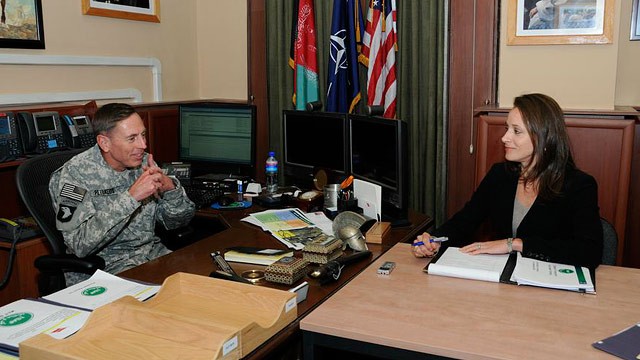
Some of these things have been brewing for some time.  But the revelations of an extramarital affair of retired Army General and now former CIA Director David Petreus, the revelation that Petraeus’ successor in Afghanistan Marine General John Allen sending allegedly flirtatious e-mails with the woman whose complaints of e-mail harassment triggered the investigation that exposed the Petraeus and his mistress-biographer Paula Broadwell.

General William “Kip” Ward, the former commander of US AFRICOM was demoted following an investigation that tied him to “unauthorized expenses” and “lavish travel” to the tune of 129,000 on an 11 day “business trip” that only three days were actual business.

Meanwhile in Fort Bragg North Carolina Army Brigadier General Jeffery Sinclair is going through the military version of a grand-jury investigation for sexual harassment and other such crimes against a number of his female staff officers. One alleges that Sinclair forced her to have oral sex and that he threatened to kill her or her family if she told anyone.

As a career officer myself, having spent the last 31 years in the Army, the Reserve Components of the Army and the Active Duty Navy I am disappointed but not surprised. I spent almost over half my career as a company grade officer or enlisted man and a fan of the late Colonel David Hackworth, who called he senior leaders of the military “perfumed princes.”

I think part of the problem is that many of us in the military have become more supporters of the preservation of the institution of the military than we are of the Constitution or the country. This is not surprising and in a sense I can understand this and probably at more than one point in my career been guilty of this. We are afraid of cuts to the military institution because it impacts us.

The roots of the problem go back to Vietnam but can probably be traced further back. The revolt of liberals and young people against the war, the military and the draft forced an end to the draft and the beginning of the All Volunteer force. This was a two edged sword. On the positive side it allowed the military to reform, reorganize and become the premier fighting force in the world. On the minus side of the equation was the fact that the military became a society within the society. We became insular and in many cases, including mine distrusted liberals and Democrats on any national security issue. Those old enough can trace that back to how either we, or our fathers were treated by liberals, Democrats and the media during the Vietnam war and its aftermath. Others, younger than me simply have bought the lie that liberals and Democrats are inherently anti-military. This has been particularly the case since the end of the Reagan administration and the George H.W. Bush led Gulf War victory over Iraq which cemented a narrative that the military was invincible.

Over the course of the next 20 years, the 8 years of Bill Clinton, the 8 years of George W. Bush and the first 4 years of Barak Obama the esteem for the military by the general population has continued to go up, even as that population is increasingly divorced from the need to serve in the military. The military at any given times in the past 20 years numbered less than 1% of the American population. This statistic is unlikely to go up in the near future with the reduction of the military to its pre-Iraq war strength and the increase in the population.

While the military has been engaged in a protracted war since the attacks of 9-11 and heavily involved in other wars or “operations other than war” since the Gulf War it has continued to shrink in relative terms to the US population. At the same time the military has become a lot more top-heavy in  numbers of General and Flag Officers since before the Second World War. The percentage of Generals and Flag officers added to the military since the beginning of the War on Terror has only increased, especially at the 3 and 4 star level.

There were in 2011 a total of 964 Generals and Admirals in the US military down slightly from 1017 at the end of the Cold War when there were more than 600,000 more personnel in the military. In the Second World War there were about 1.7 Generals or admirals per 10,000 personnel, the line today is about 6.8 per 10,000. See ( http://www.pogo.org/pogo-files/testimony/national-security/ns-wds-20110914.html )

Regardless of the administration in power the senior ranks of the military have increased not only in numbers but in influence in the government. Highly respected by the public and with probably more power than at any time in our history the senior leadership of the Armed Forces has become insular and isolated. The senior ranks of the military have become a culture within a culture within the culture. The ongoing revelations of the Petraeus affair and possible involvement of General Allen regarding two women, most notably Jill Kelley a socialite who has cultivated close relationships with military leaders assigned to CENTCOM in Tampa as well as the culture of the Washington Beltway shows the depth of that disconnect.

At any given time there are well under 10% of flag and general officers commanding troops in combat. The rest are assigned to stateside units and staffs of various combatant commands, staffs and the Pentagon. In my service the Navy in World War II there were about 130 ships for every Admiral, today there are almost as many admirals as ships. While the ranks of the military have shrunk the numbers of Generals and Admirals has risen and the culture surrounding them has become more opaque. Generals and Admirals have become celebrities and power players in society in their own right. In fact I would guess that only the Great German Imperial General Staff of the Kaiser Reich had such influence in society at large or political power.

That respect which these men and women have earned in the nation which is often earned due to the incredible sacrifice of ordinary Soldiers, Sailors, Marines and Airmen. Likewise many General and Flag officer have done time in combat zones as lower ranking commanders and staff officers and have spent many years deployed and away from their families in direct combat or in supporting roles.

In spite of this there is obviously something amiss in the senior ranks of the military. The record numbers of the relief for cause of many senior officers and commanders due to various infractions, many of a personal, ethical or sexual nature is cause for concern. The concern that I hear from young men and women serving in the military and read about almost every day is that there is a separate set of standards for senior ranks than junior ranks. I have been fortunate that commands that I have been a part over the past 15 years have sensitive to this and have worked hard to ensure that standards are enforced regardless of rank but that is not always the case. High profile stories of scandal, privilege on the part of some have tarnished the hard work of many stellar officers and NCOs and the great sacrifice of those killed, maimed or wounded in mind, body and spirit in our current war.

The indiscreet and sometimes criminal actions of General Petraeus, General Ward, General Sinclair and fairly substantial number of other commanders who have been relieved for cause is is something to be concerned about.

Major General J.F.C. Fuller who served in the Royal Tank Corps in the First World War wrote a small but timeless book called “Generalship: Its Diseases and Their Cure: A Study of the Personal Factors of Command” in 1932. Fuller was quite critical of a culture in the higher ranks which had led to unnecessary slaughter and suffering during the First World War. It is a book that is well worth the read in such a time as ours. As the scandal continued to develop this week I remembered it and decided to re-read it.

The problems that we face are not unique to us. Scandals that are rocking the US Military are not new, they have been faced by other militaries before. The issue today is that the modern media and communications age has made it nearly impossible for those involved in salacious behavior to have it covered up. The Petraeus scandal has unfolded in large part due to the electronic media which almost all of us are dependent on, even for routine communications that never would have seen the light of day had they not been recorded in the cyber records of Google, Facebook, Twitter, text messages, e-mail providers or other electronic communication systems. There might have been insinuations, innuendo and accusations but many would have never seen the light of day.

The indiscretions of these men actually opened a door for honest questions and examination of the health of the American civil-military institutions. The military institution and those that swear to support and defend the Constitution of the United States cannot become just another special interest group. Yes it is important to maintain national security and to take care of the troops when they return to civilian society. We cannot allow ourselves to become a state within a state or culture within a culture. The exaggerated numbers of General and Flag Officers compared to the overall numbers of personnel in the military can only be justified by the necessary bureaucratic and institutional power provided by the rank, not by mission or responsibility.

The power of the institution is dangerous when its leaders subtly shift the mission from the defense of the Constitution and the people to the defense and maintenance of the institution itself and their own power.

This is not simply about sex, improper relationships, assault or financial indiscretions of leaders, it points to broader and perhaps more dangerous threats to our system of government, but the unbridled temptation of power and influence that believes that comes with the unquestioned adulation of politicians, pundits and preachers, the Unholy Trinity. So even as the scandals rock the military it is not a bad thing. If we do not address them they will become millstones about our necks that will drag us under and expose the people and Constitution that we are sworn to defend to untold disaster.

Dwight D. Eisenhower reminded us so well about this danger in his farewell address in 1961:

“In the councils of government, we must guard against the acquisition of unwarranted influence, whether sought or unsought, by the military-industrial complex. The potential for the disastrous rise of misplaced power exists and will persist. We must never let the weight of this combination endanger our liberties or democratic processes.”

Peace

Padre Steve+
2 Comments

Filed under History, leadership, Military, national security

Ecumenical Jihadists and Hurricane Sandy: At Last Something that Christian, Moslem and Jewish Extremists can Agree On

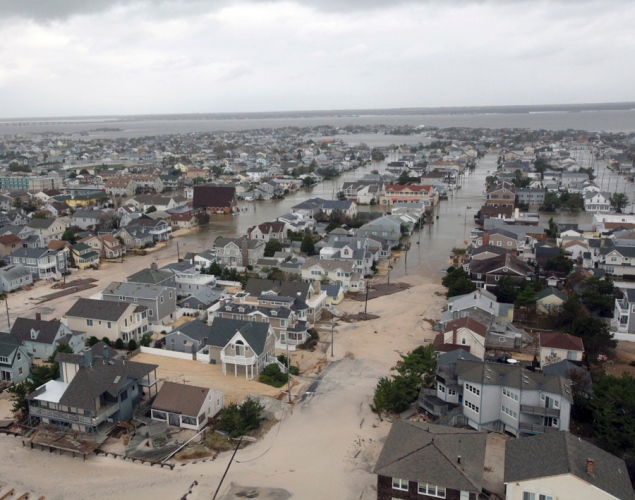
While much of New York, New Jersey and West Virginia struggle under the effects of the damage of Hurricane Sandy and millions of people are either homeless, without power or transportation there are those that know why this happened. Close to 60 million Americans have been affected as well as people in Jamaica and Cuba.

While men like President Obama and Governor Chris Christie, elected officials from opposite sides of our partisan chasm work together to coordinate the assistance needed for the millions of people now homeless or without power there are some people that know why this happened.   I don’t know about you but I was impressed by how well Governor Christie and President Obama laid aside the partisanship and worked together to fulfill their respective Oath’s of Office and responsibility to the people that they were elected to serve. That is how real leaders deal with crisis, be it natural or manmade disasters, economic crisis or something like war.

However there are people out there that do not agree. To them the current crisis has nothing to do with global warming or climate change. No it has nothing to do with the fact that like most major metropolitan regions worldwide New York and New Jersey are maritime areas, what we in the Navy like to call the littorals. Over 70% of the worlds population lives on the littorals. The major trade, banking and industrial cities of the world, those on which the world economy depends sit alongside the oceans of the world.

No, geography, economics, or climatology have no answers. After all scientists are stupid political hacks dependent on the government who don’t believe in God anyway. According to those that really know the facts, you know, people that say that God talks to them and reveals things to them that non-believers don’t understand the issue is secular America, gays and abortion. In fact there is a broad ecumenical agreement among religious fundamentalists, Christians, Moslems and Jews that is almost taking a perverse Schadenfreude, or joy in the sufferings of others going on whenever a natural disaster occurs.

Yes my friends there are Christian ministers in the United States, Ultra-Orthodox Jewish Rabbis and Moslem Imams and Mullahs are all chiming in, all citing their Scriptures and their dark understanding of a God who hates his creation. Just google “Hurricane Sandy  God’s judgement” or “Katrina and God’s Judgement” or whatever disaster you want to name with “God’s judgement” and see what pops up. You’ll be surprised at the perverse joy that some religious people take in the sufferings of those that they believe to be God’s enemies.

The sad thing is that many of the people suffering are Christians, Jews and Moslems, which kind of makes me wonder about the people writing the screeds that say that God judging these people. I wonder if the shoe was on the other foot what they would be saying.

It is really amazing to me to see the amount of Ecumenical Jihad that a natural disaster inspires among the faithful. One would think that such zealots wouldn’t be able to agree about anything but but they are surprisingly in agreement when it comes to death and destruction of the people that they deem to be heretics, unbelievers or infidels. At least a leading Saudi Cleric has condemned the Moslem extremists comments but I don’t see many big name Christian leaders condemning the nutty and hateful views of Christians. Maybe it is just that they are too busy doing partisan campaigning for political candidates in states that are not affected by the storm to be bothered with caring about people in states that won’t vote for their candidate anyway. But then maybe I’m wrong and just have become cynical.

I wish that was so. However there is a reason that many if not most mainline Evangelical leaders won’t criticize the nut cases. That is because in their hearts many agree with them and actually say similar things year round and have said them for years but are smart enough not to say it during the storm because it might cut down on donations to their ministries, their market share in Christian broadcasting or their political influence before an election that they have gone all in for one party. Likewise almost all of the leaders of these ministries are have their headquarters in places far from any real danger of natural disaster other than blizzards, thunderstorms and tornados or drought. I hate to say but having lived through all of those disasters plus major hurricanes, floods and earthquakes I can say that those a child’s play compared to events such as Hurricane Sandy, Katrina, the Japanese Tsunami or a massive earthquake.

I don’t know about you but I have a hard time with those that decide that somehow they know all that is in God’s heart and are quite willing to throw other people that don’t believe like them under the wheels of their God’s bus. Well, c’est la vie.

Please pray and act to help the people in need. There is plenty of work to do and needs to be met. I posted information last night on how to give to the Red Cross and Salvation Army relief efforts. Those links are provided here again:

http://www.redcross.org/support

http://www.salvationarmyusa.org/usn/www_usn_2.nsf

Peace

Padre Steve+

3 Comments

Filed under faith, leadership, natural disasters, Religion

Thoughts on Choosing a President and the Results of Not Getting it Right: Lieutenant General Harold Moore at West Point

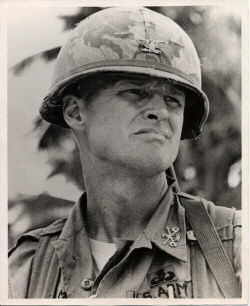
Lt.Gen. Harold (Hal) Moore is a legitimate American hero. Moore was commissioned as an infantry officer in the closing months of the Second World War, served in Korea and later in 1965 ed the 1st Battalion 7th Cavalry, 1st Cavalry Division into combat at the Battle of Ia Drang in Vietnam. In that battle, the first major engagement of US forces against North Vietnamese Army Regulars Moore’s outnumbered battalion held off elements of two NVA regiments. Moore’s book We Were Soldiers Once, and Young was adapted and released as the film We Were Soldiers where Moore was portrayed by Mel Gibson. His second book, We are Soldiers Still: A Journey back to the Battlefields of Vietnam are must reads for anyone who wants an honest assessment of going to war and the costs involved.

In 2005 Lt. Gen. Moore was invited to speak at West Point. It was during some of the worst times of the Iraq insurgency and Moore had been a critic of the war and Defense Secretary Donald Rumsfeld. He recounted the question and answer session in We are Soldiers Still:

“In a long question-and-answer session following my speech I was asked about Iraq and then Defense Secretary Rumsfeld. In this place-where cadets live by a code that says they never lie, cheat, steal, or quibble-I was bound to speak the truth as I knew it.

The war in Iraq, I said, is not worth the life of even one American soldier. As for Secretary Rumsfeld, I told them, I never thought I would live long enough to see someone chosen to preside over the Pentagon who made Vietnam-era Defense Secretary Robert McNamara look good by comparison. The cadets sat in stunned silence; their professors were astonished. Some of these cadets would be leading young soldiers in combat in a matter of a few months. They deserved a straight answer.

The expensive lessons learned in Vietnam have been forgotten and a new generation of young American soldiers and Marines are paying the price today, following the orders of civilian political leaders as they are sworn to do. The soldiers and those who lead them will never fail to do their duty. They never have in our history. This is their burden. But there is another duty, another burden, that rests squarely on the shoulders of the American people. They should, by their vote, always choose a commander in chief who is wise, well read in history, thoughtful, and slow-exceedingly slow-to draw the sword and send young men and women out to fight and die for their country. We should not choose for so powerful an office someone who merely looks good on a television screen, speaks and thinks in sixty-second sound bites, and is adept at raising money for a campaign.

If we can’t get that part right then there will never be an end to the insanity that is war and the unending suffering that follows in war’s wake-and we must get it right if we are to survive and prosper as free Americans in this land a million Americans gave their lives to protect and defend.” (Lt. Gen. Harold Moore at West Point Spring 2005) http://www.dailypaul.com/81039/inspiring-quote-from-lt-gen-harold-hal-moore-usa-ret

I make many comments about politics on this site. I am a critic of both parties and and their Presidential candidates. I find much to be desired in the leadership being displayed by many in political office and those running for office. However no matter which party a candidate belongs to I expect, like Lt. Gen. Moore that they are “wise, well read in history, thoughtful, and slow-exceedingly slow-to draw the sword and send young men and women out to fight and die for their country.”

I completely agree with Moore that We should not choose “someone who merely looks good on a television screen, speaks and thinks in sixty-second sound bites, and is adept at raising money for a campaign.”  

We should know better by now. We have experienced the tragedy of leaders who failed their soldiers and this nation in Vietnam, Somalia, Iraq and Afghanistan. However it is the responsibility of the American people to elect well qualified men and women to office. It is not to simply for people vote for their special interests and vote for those that can play the electoral game the best regardless of their actual qualifications or for that matter their wisdom.

I have served as an officer for 29 years in the Army and the Navy. I have served under five Presidents all of whom I found reason to agree with and disagree with on matters of policy. But they were the President and I was and still am not. It is possible that I will serve a sixth President before I retire from the military. Regardless of who that is or which party they represent I will be faithful to my oath and to the Constitution and be respectful of Office of the President and the man, or woman who holds it and I will pray for them. Likewise I pray that the men, or women that they chose as the civilian leaders of the military are both wise and morally courageous, unlike Robert McNamara or Donald Rumsfeld. The same is true for senior officers that set policy and lead troops in combat. We do not need what David Hackworth called the “perfumed princes” as leaders.

That being said I do pray that whoever is elected this November will be more than a good campaigner and be wise and thoughtful before committing the nation, and especially those that serve in the military to war. Our men and women serving in harms’ way deserve as much. Too many American Soldiers, Marines, Sailors and Airmen have died or come back horribly maimed from Vietnam, Iraq and Afghanistan for us not to expect as much from those that seek to lead the nation regardless of their political party.

Moore’s co-author, journalist Joe Galloway, a critic of both President Bush and President Obama wrote concerning Afghanistan in 2010:

“For God’s sake, don’t ratchet up slowly, buying time with the bodies of dead and wounded American soldiers, while you try to sell the wrong war in the wrong place against the wrong enemy to the American people.

For eight years, we’ve heard presidents and other politicians talk about setting conditions for a democratic central government in a country — really a bunch of tribes and clans — that’s never had such a thing in 2,000 years and seemingly doesn’t want one now.” http://www.mcclatchydc.com/2009/09/03/74876/commentary-afghanistan-isnt-worth.html#storylink=cpy   

We should listen more to men like Lt. Gen. Moore and Joe Galloway than to those that use the military for their political or economic gain spouting sound bite foreign policy to mask their ignorance.

Peace

Padre Steve+

4 Comments

Filed under History, iraq,afghanistan, leadership, News and current events, Political Commentary

Persistence: My Motto

Persistence by Calvin Coolidge

“Nothing in the world can take the place of Persistence. 

Talent will not;  Nothing is more common than unsuccessful men with talent. 

Genius will not;  Unrewarded genius is almost a proverb. 

Education will not; The world is full of educated derelicts. 

Persistence and determination alone are omnipotent. 

The slogan ‘Press On’ has solved  and always will solve the problems of the human race.”

If there is anything that I find is true about me it is that I am a persistent person. The motto on the family crest is the French word Esseyez, or in English, “try.” Somehow I can see the chieftain of the clan lining everyone up behind William Wallace, who by the way was executed on this day in 1300 inspiring his troops saying, “just try for once.” My parents used to say “quitters never win and winners never quit.”  I have been inspired by great naval Captains like John Paul Jones who when asked if he had surrendered replied “I have not yet begun to fight” and James Lawrence who when mortally wounded gave his crew the order “Don’t give up the ship.” I am inspired by the words of the legendary manager of the Baltimore Orioles Earl Weaver who said “It’s what you learn after you know it all that counts.”

I love this poem by Calvin Coolidge. In fact I have a small framed copy of it presented by my residency director at Parkland Memorial Hospital in 1994 on my desk today.

I have never been the smartest, fastest, strongest, talented or educated dog in the pack.    I just work hard and don’t quit. I love the journeyman that one finds in baseball. I admire the utility player who can play a lot of different positions, plug holes and fit in well on the team. The same for the pitchers pitchers that pitch in middle relief or are the 5th starter in the rotation. I like the guys that gut it out and hang around long after others have written them off.

I have been having to go through and recount the really significant parts of my life as I get ready for the EMDR and Biofeedback therapy for my PTSD. It has been really amazing to see a couple of threads that are prominent in the tapestry of my life and without which I would not be me. The things that keep coming up again and again are a dogged persistence to succeed and unwillingness to quit and profound dislike of bullies.

My Clinical Pastoral Education residency which followed a brutal seminary process was one of the most pivotal parts of my life. My CPE Supervisor was a man named Steve Ivy. CPE is one of the best training in that anyone working with people in churches, hospitals or the military can have. For me it helped me see areas that I was blind to in my life. It helped me become a better listener and more accepting of others. But even more it helped me, and still helps me integrate me theology and philosophy into life.  Dr Ivy made a comment that was one of the most instrumental in my life since I heard it. That is that I can write my future that I do not have to be condemned to perpetually repeating the past or being stuck in place or being a victim of circumstances or others. It was a revelation of a positive humanity and the grace of God.

But even before that I was a fighter. In seminary when everything that one could imagine to go wrong did and pastors, and people at ministries told me that I should reconsider my call or quit. In the fall of 1989 when everything had gone to complete shit in our lives, Judy was sick, we had lost our home, cars and were living in a horrible house in a horrible neighborhood of Fort Worth, I was working two jobs and was in the National Guard, was a full time student and it looked like my time in seminary was over and that I had failed I called a TV ministry prayer line. I told my story to the prayer partner who told me that I couldn’t be called to ministry because if I was “God would be blessing me.” Somehow that hit me wrong. I just couldn’t imagine Jesus telling anyone that, nor could I reconcile it with Scripture or Church History.

I got mad and kept working despite everything going to hell managed to hang in long enough for things to work out. I didn’t do it all myself because a lot of people came alongside when they saw that I was in this for the long haul and would not quit. I graduated from seminary in 1992 with a 3.5 or 3.7 GPA, I can’t remember which and am not looking at a transcript while working more than full time and being in the National Guard. I worked my ass off and between good people and the grace of God made it through.

That continued after seminary when I was a late addition to the residency program at Parkland, when I got my first hospital chaplain job and when I was rebuffed by a senior chaplain in the Army Chief of Chaplains to return to active duty as a very young Army Reserve Major in 1997. He told me that I wasn’t good enough to bring back.

But despite that things continued to work out. I was helped along the way by great people. I had opportunities that opened up which gave me great experience and provided for my family. This culminated when I was selected for active duty in the Navy and resigned my Army commission to go in the Navy Chaplain Corps at a lower rank in February 1999.

There have been hard times in the Navy especially after my return from Iraq. I went through an emotional and spiritual crisis that I never imagined was possible, but I  I didn’t quit. I am an average guy who worked hard and got a lot of help along the way. But had I quit at any point I wouldn’t be where I am now and there were plenty of opportunities when I was ready to give up but held on just long enough to make it through.

Calvin Coolidge was so right. I am not the most talented person that I know in my field. I am not a genius and though I have a good education there are plenty of other people that know a lot more than me. However, I am persistent. I gain inspiration every day when I look on my desk and read that poem. I am thankful for grace of God and the people that God put in my life and who helped me during the tough times. I hope that I can always be the kind of person that helps people through their tough times and inspires them to keep trying, to keep working and never to quit and then pass that along to others.

The past few weeks have been a blessing because I have had to look back at my life and remember what got me to this point. Some of the memories have been difficult to think about because they were so difficult but at the end of the day I can count myself blessed.

Have a great night and don’t give up your dreams and always stay in the fight.

Peace and Blessings!

Padre Steve+


2 Comments

Filed under christian life, faith, leadership, Pastoral Care, philosophy

The Pain of Bain Will Always be the Same

I don’t know why but I have been amazed to see the Romney campaign turn into a total train wreck this week.  I really didn’t expect it but to me it looks like the wheels seem to be coming off with the continuing and expanding revelations of Romney’s involvement with Bain Capital. Documents from Bain signed by Romney point to a real possibility that Romney is not telling the whole story about his activity as owner, CEO and sole stockholder of Bain. These include filings with the Securities and Exchange Commission interviews, statements and even the paperwork for his residency for his 2002 campaign for the office of Governor of Massachusetts all of which point to him being less than honest in how he represents that time. Likewise there are the issues of Swiss and Cayman Islands bank accounts and unwillingness to disclose more than last year’s tax records.

Thus it was hard not to shake my head in amazement when Romney went of five different networks to say that that he “left any responsibility whatsoever, any effort, any involvement whatsoever in the management of Bain Capital after February of 1999.”  What got me was not just the words, but his facial expressions and body language, it was not believable.

One can think what they want of President Obama. One can call him an Anti-American Atheist, Communist, Socialist, Liberation Theology loving, pork eating, beer drinking Moslem. One can oppose every one of his policies.  One can even believe that he is the son of a Vulcan explorer and an earth mother that was beamed from Kenya to Hawaii so he be President and through the UN bring about a treaty that would cause the earth to cede its independence to a United Federation of Planets in a future alternate universe and one can vote against him for a multitude of reasons but one cannot ignore that Romney has serious character issues that are red flags that his supporters should pay attention to before they come back to haunt them.  Simply put I think anyone who fought against the Romney nomination and now backs him simply because he is not Obama is in for trouble.

Now nobody should be surprised by how the script is playing out. In fact almost every opponent of Romney’s in the GOP primaries warned us of this. They ran the anti-Bain commercials, they talked about Romneycare they pointed out every chink in the armor of a Romney campaign and got carpet bombed by Romney for doing so. In fact some even called Romney a “liar.” The problem was that none of them had the money or organization or the support of Wall Street and the Multi-National corporations that Romney had and his PACS destroyed them. He took no prisoners.

Rick Perry was blasted out by Romney early but he made these comments:

“I happen to think that companies like Bain Capital could have come in and helped these companies if they truly were venture capitalists, but they’re not — they’re vulture capitalists.”

“While you were the governor of Massachusetts in that period of time, you were 47th in the nation in job creation. … You failed as the governor of Massachusetts.”

“If you are a victim of Bain Capital’s downsizing, it’s the ultimate insult for Mitt Romney to come to South Carolina to tell you he feels your pain. Because he caused it.”

“I have no doubt that Mitt Romney was worried about pink slips — whether he’d have enough of them to hand out.”

Rick Santorum, arguably the most populist of the Republican candidates and the only one that mounted a real challenge to Romney said that Romney was “the worst Republican in the country to put up against Barack Obama.” 

Santorum also said:

“If Mitt Romney’s an economic heavyweight, we’re in trouble, because he was 47th out of 50 in job creation in the state of Massachusetts when he was governor. He may have had some success at making money for himself and his partners at Bain Capital, and I give him a lot of credit for doing so, but that’s a very different thing than going out and creating an atmosphere for people to create — that create jobs.”

Newt Gingrich got off the Romneyvation early and got blasted but he tore some holes in Romney’s campaign:

“I just think he ought to be honest with the American people and try to win as the real Mitt Romney, not try to invent a poll-driven, consultant-guided version that goes around with talking points, and I think he ought to be candid. I don’t think he’s being candid and that will be a major issue. From here on out from the rest of this campaign, the country has to decide: Do you really want a Massachusetts moderate who won’t level with you to run against Barack Obama who, frankly, will just tear him apart? He will not survive against the Obama machine.”

“We are not going to beat Barack Obama with some guy who has Swiss bank accounts, Cayman Island accounts, owns shares of Goldman Sachs while it forecloses on Florida and is himself a stockholder in Fannie Mae and Freddie Mac while he tries to think the rest of us are too stupid to put the dots together and understand what this is all about.”

Michelle Bachmann said:

“He can’t beat Obama because his policy is the basis of Obamacare. The signature issue of Obama is Obamacare. You can’t have a candidate who has given the blueprint for Obamacare. It’s too identical. It’s not going to happen.” 

“He’s been very inconsistent on his positions. He’s been on both sides of the abortion issue, on both sides of the issue with same-sex marriage … he was for the TARP bill, the $700 billion bailout and the global warming initiatives.”

Former Utah Governor, Ambassador to China and fellow Mormon said of Romney:

“I think Romney will show leadership on the economy, but on the trust deficit, I don’t see a whole lot of leadership.”

And the only GOP candidate still in the hunt, Ron Paul ran this ad:

“Mitt Romney can’t fight against Obamacare because he supported the same mandates and government takeovers as governor of Massachusetts.  Romney can’t stand up against more bailouts because he supported them. He can’t lead the charge to shrink the government because he has grown it. Romney’s record is liberal and putting him up against Obama is a recipe for defeat.”

By the way did you notice that none of these people are Democrats? That should speak volumes.

One of two things are going to happen and please do not say that you were not warned. Either the wheels will continue to come off and Romney’s campaign will blow up leading to a defeat in November. That may also impact Congressional races because people may be so disgusted by their candidate that they don’t show up. They may not vote for Obama but they will not support Romney.

The other possibility is that hatred for Obama will cause people that cannot stand Romney to vote for him anyway and that he will win the election. Obama haters will rejoice until they realize that they voted in a man who still remembers what they said about him and only sees them as a means to the become President. They are simply votes to be bought and the bottom line is all that matters.  That is his history as a businessman and governor. He may not be a good politician but underneath that perfect head of hair he is a ruthless businessman, just asked those that ran against him in the GOP primaries this year.

When that happens those that opposed and denigrated Romney during the primaries should not expect for Romney to treat them well.  This is especially true for the Evangelicals who just a couple months ago were calling Romney a member of a religious cult.  Romney will govern based on what he wants, not what they want. Instead of four years of a lame duck Obama administration they will have either have Romney for eight years or end up with a different Democrat in the White House in 2016 and it will destroy the Republican Party.

Alan Keyes, who I never agree with made a comment that while I may not completely agree with probably needs to be heeded by religious conservatives whose hatred of Obama has driven them into Romney’s camp. If they believe like Keyes that Obama is evil then they need to look at what the results of their hatred of him may bring about:

 “As I tried to point out in 2008, the lesser of evils is still evil. No matter how such an election turns out, people content to choose between Satan and Beelzebub have made clear their willingness to let things go to hell. Moreover, the nature of their choice is so clear to them that they practically boast of the passionate hatred that impels them to it. With this practical boast they become the willing, proud accomplices of the very evil they profess to hate.”

People need to be careful what they ask for because they just might get it.

Peace

Padre Steve+

3 Comments

Filed under leadership, News and current events, Political Commentary

Gettysburg Day Two: The Engineer and the Professors on the Hill, Major General Gouverneur Warren and Colonels Strong Vincent and Joshua Chamberlain

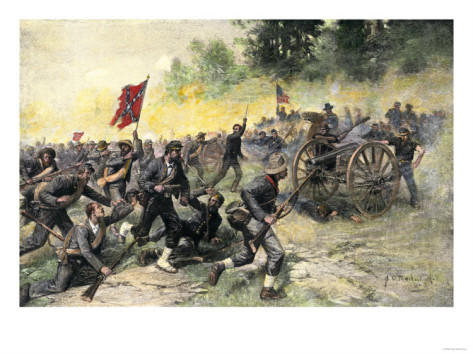
The Confederate Onslaught

“In great deeds, something abides. On great fields, something stays. Forms change and pass; bodies disappear; but spirits linger, to consecrate ground for the vision-place of souls… generations that know us not and that we know not of, heart-drawn to see where and by whom great things were suffered and done for them, shall come to this deathless field, to ponder and dream; and lo! the shadow of a mighty presence shall wrap them in its bosom, and the power of the vision pass into their souls.” ― Joshua Lawrence Chamberlain

The Federal Army at Gettysburg had a wide variety of officers. Many senior officers were graduates of West Point but in the expansion of the Army and the call of up militia from the various states other officers were appointed. Many had no prior military service and at times that lack of experience was tragic. However some of the time those volunteers were the men who by their service helped save the Union.

On July 2nd 1863 the situation at Gettysburg was precarious. Robert E Lee had ordered an attack to seize a hill at the far end of the Federal line, Little Round Top and turn the Union flank. General Meade had ordered III Corps under Major General Dan Sickles to extend it’s line to defend the southern section of his line on Cemetery Ridge. Unfortunately Sickles moved his Corps several hundred yards west forming a vulnerable salient at the Peach Orchard leaving the southern flank undefended.

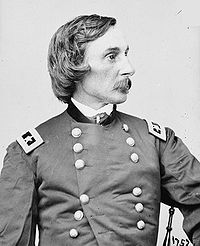
Major General Gouverneur Warren

When Meade saw the developing situation he sent his Chief Engineer, Major General Gouverneur Warren to take charge of the situation. When Warren arrived he found the hill undefended and he dispatched staff officers to get assistance from any units in the area. Major General George Sykes of V Corps responded sending a messenger to the commander of his 1st Division. The messenger encountered the commander of the division’s 3rd Brigade Colonel Strong Vincent who immediately took the initiative and ordered his four regiments up Little Round Top without waiting for permission.

Warren at Little Round Top

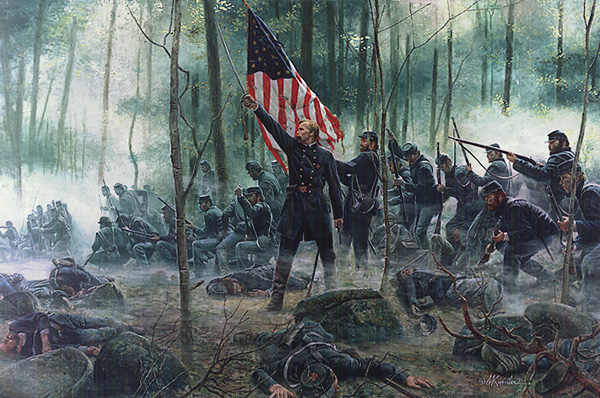
Vincent placed and his regiments arrived in a nick of time. He deployed his regiments, along the spur running to the south if the top of the hill. The 16th Michigan on the right with the 44th New York, 83rd Pennsylvania at his center and the 20th Maine under the Command of Colonel Joshua Chamberlain on the extreme left of the line. His order to Chamberlain was ordered to “hold at all costs.” Chamberlain led his regiment skillfully and when nearly out of ammunition led a charge down the slope of Little Round Top which ended the Confederate chances of gaining the hill and turning the flank of Meade’s Army.

Warren was a West Point graduate and had been a topographical engineer for most of his pre-war career and saw combat against the Sioux at the Battle of Ash Grove in 1855. When the war began Warren was a mathematics instructor at West Point. He helped raise a militia regiment in New York and was appointed to Lieutenant Colonel. As a regimental commander and later brigade commander he saw much combat and was wounded at the Battle of Gaines Mill during the Seven Days.  When the Army was reorganized in February 1863 he was named Chief Engineer of the Army of the Potomac by Major General Joseph Hooker. When Major General Meade relieved Hooker on June 28th he retained Warren.

The 26 year old Colonel Strong Vincent

Colonel Strong Vincent was a 26 year old Harvard graduate and lawyer from Erie Pennsylvania. He was appointed as a 1st Lieutenant and Adjutant of the Erie Regiment and married his wife Elizabeth the same day.  He wrote her before his death “If I fall, remember you have given your husband to the most righteous cause that ever widowed a woman.”  He was commissioned as a Lieutenant Colonel in the 83rd Pennsylvania September 14th 1861and assumed command of the regiment when the commander was killed during the Seven Days in June of 1862. He commanded the regiment at Fredericksburg in December 1862 and was promoted to command the 3rd Brigade when its commander was killed at Chancellorsville in May 1863.

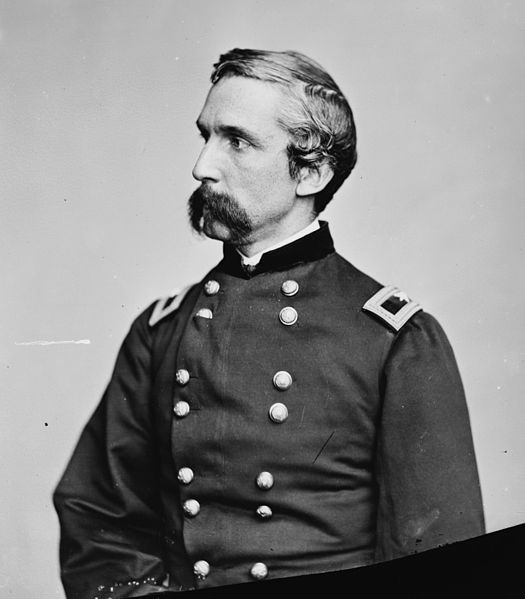
Major General Joshua Chamberlain

Colonel Joshua Chamberlain was a graduate of Bowdoin College and Bangor Theological Seminary, fluent in 9 languages other than English. He was Professor of Rhetoric at Bowdoin before seeking an appointment in a Maine Regiment without consulting either the college or his family. He was offered command of the 20th Maine but asked to be appointed as a Lieutenant Colonel which he was in August 1862. He fought at Fredericksburg and was named commander of the regiment when Colonel Ames, his commander was promoted following Chancellorsville.

“Don’t Give and Inch!”

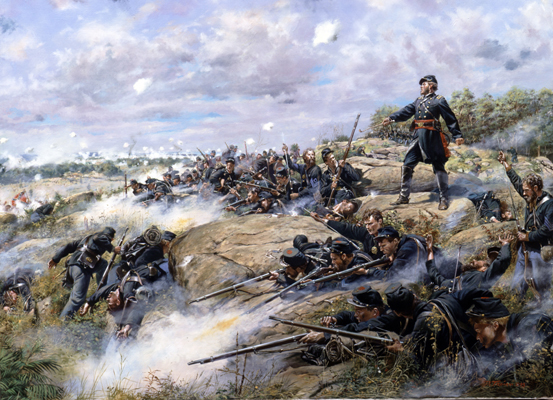
The battle of Little Round Top is one of the most famous of all Civil War battles and Chamberlain along with Vincent are immortalized in the film Gettysburg which is based on Michael Shaara’s Pulitzer Prize winning novel The Killer Angels. Vincent was mortally wounded while leading the defense of the hill standing on a large boulder with a riding crop ordering the men of the 16th Michigan who were beginning to waiver “don’t give an inch.” Two months later his wife gave birth to a baby girl. The baby would not live a year and was buried next to him

Warren would become a distinguished Corps commander until he ran afoul of the fiery General Phillip Sheridan in 1865. Sheridan relieved Warren of command of V Corps following the Battle of Five Forks where Sheridan believed that Warren’s Corps had moved too slowly in the attack. The relief was brutal and ruined his career.  Warren resigned his commission as a Major General after the war and returned to his permanent rank as a Major of Engineers. He served another 17 years doing engineering  duty being promoted to Lieutenant Colonel in 1879. He sought a Court of Inquiry to exonerate himself but this was refused until President Grant left office. The Court eventually exonerated him but he died before the results were published. Embittered he directed that he be buried in civilian clothes and without military honors.

Chamberlain was awarded the Medal of Honor for his valor at Little Round Top in 1893. He was gravely wounded during the siege of Petersburg in June of 1864 while commanding a brigade and promoted to Brigadier General. He returned to duty later in the year as commander of the 1st Brigade, 1st Division V Corps and was again wounded at Petersburg in a skirmish at Quaker Road and was promoted to Brevet Major General by Abraham Lincoln. Chamberlain received the surrender of Lee’s decimated Army if Northern Virginia. He would go on to serve as a four term Governor of Maine and remained active with the Grand Army of the Republic veteran’s organization, remained active as an educator and President of Bowdoin College and founded the Maine Institute for the Blind which is now known as the Iris Foundation. He died of his wartime wounds on February 24th 1914.

These three men acted with great courage and alacrity on the afternoon of July 2nd 1863. Warren for his immediate action to call for assistance when he discovered that the hill was undefended and the line exposed, Vincent for his swift taking of responsibility and getting his brigade up the hill before the Confederates could gain the summit and Chamberlain for his dogged refusal to yield against repeated assaults. Only one of the three, Warren was a professional soldier but as a topographic engineer he was an outsider and not fully appreciated by Grant or Sheridan who destroyed his career. The youthful Vincent died of his wounds days after the battle. He was recommended for promotion to Brigadier General by Meade but the promotion was never confirmed by the Senate and Chamberlain is still one of the revered commanders of the Civil War.

It is easy for those enamored with military history to forget the stories behind the men that fought the battles of war. It is easy to isolate and analyze a commander’s actions in battle and ignore the rest of their lives.  I think that this does a great disservice to the men themselves. I say this because everyone who serves in the military has their reasons, some more noble than others and likewise everyone who dons the uniform in time of war gives up something of themselves and sometimes even heroes are destroyed by the institutions that they serve.

Chamberlain wrote: “It is something great and greatening to cherish an ideal; to act in the light of truth that is far-away and far above; to set aside the near advantage, the momentary pleasure; the snatching of seeming good to self; and to act for remoter ends, for higher good, and for interests other than our own.”

Peace

Padre Steve+

1 Comment

Filed under civil war, History, leadership, Military

Gettysburg Day One Accident and Intent: How the Actions of Harry Heth and John Buford Helped Decide the Battle

On June 30th 1863 the Confederate Army of Northern Virginia under the Command of General Robert E Lee was deep in enemy territory. His mission was to draw the Federal Army of the Potomac now under the command of Major General George Gordon Meade into battle and destroy it.  His Army composed of three Corps, the First Corps under Lieutenant General James Longstreet, the Second under Lieutenant General Richard Ewell and the Third Corps under the command of Lieutenant General A.P. Hill.  Lieutenant General J.E.B. Stuart commanded his cavalry but was operating independently of Lee conducting a movement around the Army of the Potomac and unable to provide Lee information on the deployment or movement of the Union forces.

Lee’s army was spread out. Early’s Second Corps was spread out near the Susquehanna River near Harrisburg while his other two corps were concentrated in the area around Cashtown about 8 miles west of Gettysburg. On the 30th a brigade of Major General Harry Heth’s division of Hill’s Corps made a reconnaissance in the direction of Gettysburg. The brigade commander Brigadier General James Pettigrew observed Federal cavalry entering the town and chose not to engage reporting the matter to General Heth.

Major General Henry (Harry) Heth

Heth was a graduate of West Point who had served as an Infantry Officer in the United States Army until he resigned to enter the Confederate Army. He had commanded a company in battle against the Lakota Sioux in 1855 and wrote the first marksmanship manual for use in the U.S. Army. Unlike many of his fellow officers he had not taken part in the Mexican-American War.

Heth spent the early part of the war as Lee’s Quartermaster where he became one of Lee’s favorite officers and began a relationship where Lee looked after his career.  He then served as regimental commander in the actions in the Kanawha Valley of Western Virginia being assigned to Kirby Smith’s Department of Tennessee where he commanded a division but took part no no major actions. Lee brought him back to the Army of Northern Virginia in 1863 to command a brigade in Hill’s Division. He took commanded that brigade at Chancellorsville in which he made an ill advised unsupported attack against Union forces with heavy casualties. He was promted to command of the Division when Hill assumed command of Third Corps when it was created following the death of Lieutenant General Thomas “Stonewall” Jackson.

Lee had given his commanders orders not to provoke a major engagement until the Army was fully concentrated to meet Meade’s troops which had crossed the Potomac and was moving north. However neither Heth nor Hill believed that the troops that Pettigrew observed were a threat, believing them to be nothing more than local militia. Heth ordered half of his division to make a reconnaissance in force on the morning of July 1st. It was not what Lee wanted and Heth’s conduct of it and the resultant action led to the largest battle of the Civil War, the costliest battle.

Lee’s intent was clear. He desired to have a tired and weary Union force under a new commander under political pressure attack him on ground of his choosing. He hoped to defeat the Union forces piecemeal as they came into the battle. By initiating the action Heth caused Lee to have to improvise an attack contrary to his initial plan.  It was an accidental encounter which was compounded by Heth’s action to commit his entire division into battle in spite of his orders.

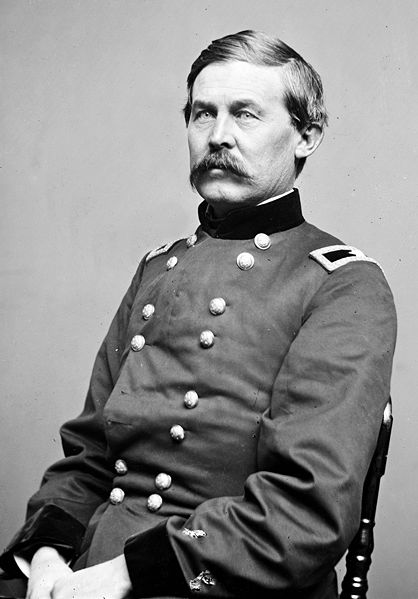
Brigadier General John Buford

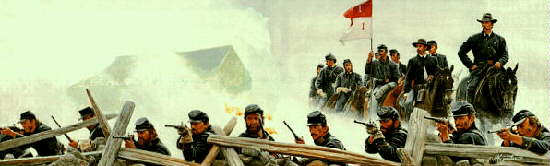
The Federal Cavalry was the First Cavalry Division under the Command of Brigadier General John Buford. Buford’s division arrived in Gettysburg ahead of the Army of the Potomac on the 30th. Buford and his brigade commanders immediately recognized the importance of the ground when they saw Pettigrew’s troops. Buford order his troops to deploy on the ridges west of Gettysburg, Herr Ridge, McPherson Ridge and Seminary Ridge. It was the perfect place for a delaying action against superior forces.

Buford was also a graduate of West Point and served as a Cavalry officer in the Army before the war. He was from Kentucky and though his father was a Democrat who had opposed Abraham Lincoln and had family that chose to fight for the Confederacy he remained loyal to his oath and remained in the Army. He served against the Sioux and on peacekeeping duty in the bitterly divided State if Kansas before serving in the Utah War in 1858. He was a modern soldier who recognized that the tactics of the Army had to change due to improvements in weapons and technology.  He was promoted to Brigadier General in 1862 and served in numerous engagements as a Cavalry Brigade commander before being given command of the 1st Cavalry Division after Chancellorsville.

The Delaying Action, July 1st 1863 Map by Hal Jespersen, http://www.posix.com/CW

Buford was a keen student of war and a commander who was able to control his forces. When Heth engaged his division he fought a masterful action which allowed the Infantry Corps of the Army of the Potomac to arrive on the field of battle. His action to select the ground upon which the battle was fought led to the Union victory because even though Federal forces were pushed back on the first day they were able to maintain control of the high ground east of the city with interior lines of communication which they fortified.

Lee decided that he had to force the battle and continue the attack despite the objections of General Longstreet and the fact that he did not fully know the numbers and disposition of the troops arrayed against him. It would be a fateful decision born of a ill conceived action of Heth and correspondingly excellent command decisions of Buford. I am sure that part of the reason for this was Heth’s lack of experience in the East against the Army of the Potomac and limited battle experience as a senior commander. Buford had spent the war in action against Lee’s Army. He knew the capabilities of his enemies and what had to be done to give his side a chance to win.

Like many battles success is often due to such factors.  Had Heth held up and had Lee followed Longstreet’s advice the battle and war might have turned out quite differently. Had Buford not seen the importance of the ground that he selected and deployed himself accordingly the rest of the Army may not have gotten to Gettysburg before Lee had gained the critical ground east and south of the town.

On such decisions battles are decided and wars won.  Heth’s relative inexperience and inability to control his command was a decisive factor in the battle while Buford’s experience and poise under pressure probably saved the Army of the Potomac from a decisive defeat.

Peace

Padre Steve+

3 Comments

Filed under civil war, History, leadership, Military

A Weekend of Old Navy Movies: Mister Roberts, The Caine Mutiny and In Harm’s Way

Well I have the duty pager for the hospital this weekend so I have been hanging out at the Island Hermitage with my dog Molly watching classic Navy movies.

Friday night I watched the classic film Mister Roberts. Yesterday I watched In Harm’s Way and The Caine Mutiny.

All three films are fictional and because of that I find them great for understanding the complexity of Navy life and leadership.  Mister Roberts and the Caine Mutiny the films deal with the complexities of life and leadership on small and rather insignificant ships while In Harm’s Way deals with more senior officers and their lives. All three deal with subjects that are uncomfortable because they still exist not just in the Navy but throughout the military. Thus all three offer insights into toxic leaders, poor morale, discipline, mental illness, alcoholism and subjects such as sexual assault and suicide.

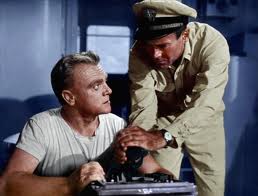
Mister Roberts stared Henry Fonda, James Cagney, Jack Lemmon and William Powell. It is set on the USS Reluctant a Light Cargo Ship in the backwaters of the Pacific in the closing months of the Second World War. Released in 1955 the film was based on the 1946 novel of the same name by Thomas Heggen.

http://www.tcm.com/mediaroom/video/323485/Mister-Roberts-Movie-Clip-Up-All-Night.html

Cagney plays a despotic former Merchant Marine Captain, LCDR Morton an officer of the type that the Navy did not want portrayed on film then, and still doesn’t today.  He is petty, self serving and rules as a tyrant in order to secure his promotion to Commander. His prize possession is a palm tree which was awarded to the ship for handling the most cargo which he believes will be his ticket to promotion. Lemon plays the ship’s Laundry and Morale Officer Ensign Frank Pulver who creatively finds ways of avoiding work. He is so successful that Captain Morton doesn’t know who he is despite having been on the ship 14 months. Pulver provides amusement and aggravation to Henry Fonda plays the ship’s Cargo Officer LTJG Doug Roberts. Roberts is liked by the crew and always in conflict with hs captain.  He is desperate to be transferred off the Reluctant and serve on a ship on the front lines. He fears that the war will pass him by and sends in letter after letter to get transferred to a fighting ship only to have Morton send them on without recommending approval.

Roberts is caught in the position of many young leaders where they are torn between their duty and their loyalty to their crew.  Eventually he  William Powell in his last film plays ship’s Medical Officer, the wise sage whose advice and counsel is invaluable to Roberts.  Eventually Roberts gets off the ship because the crew forges a request for transfer along with a forged recommendation from the Captain. When he leaves the ship the crew presents him with their “Medal” the “Order of the Palm.” He is transferred to a destroyer and is killed in action. His final letter to Ensign Pulver tells of his appreciation for the crew and comes along with a letter from a friend of Pulver’s on board the destroyer Roberts was transferred telling of Roberts being killed when the ship was hit by a kamikaze.

In the letter Roberts expresses that he finally understood the enemy faced by those in rear areas and all of those that cannot see why they matter or know their place in a war.  The challenge of leaders to understand “that the unseen enemy of this war is the boredom that eventually becomes a faith and, therefore, a terrible sort of suicide.”  He finally after having seen combat that those that he served with on the Reluctant “Right now I’m looking at something that’s hanging over my desk. A preposterous hunk of brass attached to the most bilious piece of ribbon I’ve ever seen. I’d rather have it than the Congressional Medal of Honor. It tells me what I’ll always be proudest of: That at a time in the world when courage counted most I lived among 62 brave men.” 

The Caine Mutiny adapted from the novel written by Herman Wouk deals with a another ship where leadership challenges abound. The Captain of the ship, LCDR Queeg played by Humphrey Bogart is plagued by doubt, fear and paranoia.  A Regular Navy Officer on with a wardroom of reservists he comes to the ship battered from two years in the Atlantic. He is also plagued by his Communications Officer, LT Tom Keefer played by Fred MacMurray who spends the time not writing a novel in spreading poison about his ship, the Navy and his commanding officers. Queeg begs for their support and understanding.

http://www.tcm.com/mediaroom/video/413561/Caine-Mutiny-The-Movie-Clip-Like-A-Family.html

However Keefer is so successful at undermining Queeg that in the midst of a typhoon the Executive Officer, LT Steve Maryk played by Van Johnson takes command and relieves Queeg on the bridge supported by the Officer of the deck Ensign Willie Keith.

http://www.youtube.com/watch?v=vtqf0CCVUek

Maryk is tried and acquitted at court marital but his defense attorney, LT Barney Greenwald played by Jose Ferrer has to destroy Queeg on the witness stand to do it.  During the trial Keefer is called as a witness for the prosecution lies on the stand to avoid incriminating himself while damaging the case of his friend Maryk. At the end Greenwald confronts Kiefer at a party and provides the leadership lesson for a wardroom which abandoned their sick captain long before the mutiny occurred.

http://www.youtube.com/watch?v=EKeISsYKROI

[Greenwald staggers into the Caine crew’s party, inebriated] 

Lt. Barney Greenwald: Well, well, well! The officers of the Caine in happy celebration! 

Lt. Steve Maryk: What are you, Barney, kind of tight? 

Lt. Barney Greenwald: Sure. I got a guilty conscience. I defended you, Steve, because I found the wrong man was on trial. 

[pours himself a glass of wine] 

Lt. Barney Greenwald: So, I torpedoed Queeg for you. I had to torpedo him. And I feel sick about it. 

[drinks wine] 

Lt. Steve Maryk: Okay, Barney, take it easy. 

Lt. Barney Greenwald: You know something… When I was studying law, and Mr. Keefer here was writing his stories, and you, Willie, were tearing up the playing fields of dear old Princeton, who was standing guard over this fat, dumb, happy country of ours, eh? Not us. Oh, no, we knew you couldn’t make any money in the service. So who did the dirty work for us? Queeg did! And a lot of other guys. Tough, sharp guys who didn’t crack up like Queeg. 

Ensign Willie Keith: But no matter what, Captain Queeg endangered the ship and the lives of the men. 

Lt. Barney Greenwald: He didn’t endanger anybody’s life, you did, all of you! You’re a fine bunch of officers. 

Lt. JG H. Paynter Jr.: You said yourself he cracked. 

Lt. Barney Greenwald: I’m glad you brought that up, Mr. Paynter, because that’s a very pretty point. You know, I left out one detail in the court martial. It wouldn’t have helped our case any. 

[to Maryk] 

Lt. Barney Greenwald: Tell me, Steve, after the Yellowstain business, Queeg came to you guys for help and you turned him down, didn’t you? 

Lt. Steve Maryk: [hesitant] Yes, we did. 

Lt. Barney Greenwald: [to Paynter] You didn’t approve of his conduct as an officer. He wasn’t worthy of your loyalty. So you turned on him. You ragged him. You made up songs about him. If you’d given Queeg the loyalty he needed, do you suppose the whole issue would have come up in the typhoon? 

[to Maryk] 

Lt. Barney Greenwald: You’re an honest man, Steve, I’m asking you. You think it would’ve been necessary for you to take over? 

Lt. Steve Maryk: [hesitant] It probably wouldn’t have been necessary. 

Lt. Barney Greenwald: [muttering slightly] Yeah. 

Ensign Willie Keith: If that’s true, then we were guilty. 

Lt. Barney Greenwald: Ah, you’re learning, Willie! You’re learning that you don’t work with a captain because you like the way he parts his hair. You work with him because he’s got the job or you’re no good! Well, the case is over. You’re all safe. It was like shooting fish in a barrel. 

[long pause; strides toward Keefer] 

Lt. Barney Greenwald: And now we come to the man who should’ve stood trial. The Caine’s favorite author. The Shakespeare whose testimony nearly sunk us all. Tell ’em, Keefer! 

Lieutenant Tom Keefer: [stiff and overcome with guilt] No, you go ahead. You’re telling it better. 

Lt. Barney Greenwald: You ought to read his testimony. He never even heard of Captain Queeg! 

Lt. Steve Maryk: Let’s forget it, Barney! 

Lt. Barney Greenwald: Queeg was sick, he couldn’t help himself. But you, you’re *real* healthy. Only you didn’t have one tenth the guts that he had. 

Lieutenant Tom Keefer: Except I never fooled myself, Mr. Greenwald. 

Lt. Barney Greenwald: I’m gonna drink a toast to you, Mr. Keefer. 

[pours wine in a glass] 

Lt. Barney Greenwald: From the beginning you hated the Navy. And then you thought up this whole idea. And you managed to keep your skirts nice, and starched, and clean, even in the court martial. Steve Maryk will always be remembered as a mutineer. But you, you’ll publish your novel, you’ll make a million bucks, you’ll marry a big movie star, and for the rest of your life you’ll live with your conscience, if you have any. Now here’s to the *real* author of “The Caine Mutiny.” Here’s to you, Mr. Keefer. 

[splashes wine in Keefer’s face] 

Lt. Barney Greenwald: If you wanna do anything about it, I’ll be outside. I’m a lot drunker than you are, so it’ll be a fair fight. 

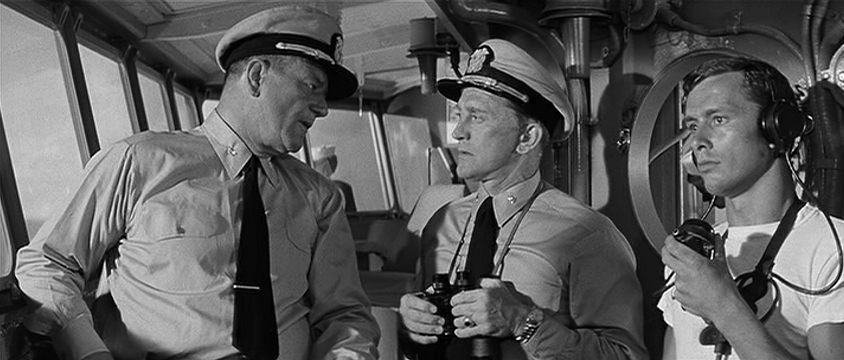
In Harm’s Way was filmed a decade after the Caine Mutiny and Mister Roberts. Starring John Wayne, Kirk Douglas, Henry Fonda, Patricia Neal, Burgess Meredith and Tom Tryon it was a epic that was panned by critics as having a shallow plot. It involved the intersecting lives of a number of officers during the war with John Wayne playing Rear Admiral “Rock” Torrey. Although the plot is relatively shallow the film brings up several very serious subjects that are faced by leaders even today.  The topics of alcoholism, sexual assault and suicide are touched upon through the character played by Kirk Douglas, Captain Paul Eddington.  Eddington is plagued by alcoholism and a failed marriage that ended when his wife was killed while with an Army Air Corps Officer on the morning of the Peal Harbor attack.  Sentenced to a backwater assignment he is called to be Torrey’s Chief of Staff.  In that position he ends up raping a nurse played by Jill Howarth that happens to be the fiancee of Torrey’s son. She then commits suicide. When Eddington discovers that she is dead he sets off on a suicide mission to find the Japanese fleet.

http://www.tcm.com/mediaroom/video/348030/In-Harm-s-Way-Movie-Clip-The-Navy-s-Never-Wrong.html

The questions raised in the film are not answered, there is no Barney Greenwald to point out the moral of the story.  John Wayne plays a flawed hero surrounded by characters of that are all in some way dealing with their own personal demons. However the questions are those that have been faced by military leaders for generations.  How does a leader deal with men and women in failing marriages? How does one deal with those that simply are advancing their own careers? How does a leader deal with key staff that are dealing with alcoholism? How does one prevent sexual assault in a combat area and prevent suicide?  The truth is that we still deal with all of these questions and none of us or any military in the world has solved any of them.  Perhaps Henry Fonda as Admiral Nimitz sums up the situation that we still face “Well, we all know the Navy’s never wrong. But in this case, it was a little weak on bein’ right.”

Taken as a whole the three films all are valuable for today’s naval leader as well as military leaders in general. The I do learn something new every time that I watch them and all challenge me to be a better leader.

Peace

Padre Steve+

3 Comments

Filed under film, leadership, Military, movies, US Navy, world war two in the pacific

Learn when you Can rather than when you Must

“Wise people learn when they can; fools learn when they must.”
Arthur Wellesley, First Duke of Wellington

I have slowed down writing for a few days to spend more time thinking, reflecting, reading and observing. I mentioned last night how I have been reading about the Napoleonic Wars in particular the naval campaigns which I find are still relevant even in our modern age. Technology, forms of government and even religious faith may evolve may the character of people and nations remains fairly constant.

There has been a lot going on in this country and around the world and the one thing that I notice is that few seem to be taking the time to observe and seem to be more interested in immediately framing the events of the day into their particular ideology. This tendency is not limited to any one segment the population and goes across ideological divides.  We live in a time of great political and social upheaval and drastic change and if we are to ride out the storm we must continue to learn and not be satisfied with the banal and insipid sound bites that the Unholy Trinity of pundits, politicians and preachers spew out as wisdom.  American philosopher Eric Hoffer quite rightly said that “In a time of drastic change it is the learners who inherit the future. The learned usually find themselves equipped to live in a world that no longer exists.”  

Learning comes from reading, observation and experience. Otto Von Bismarck, one of the most remarkable statesmen that ever lived said that “only a fool learns from his own mistakes, a wise man from the mistakes of others.”  

The great American humorist Will Rogers put the same thought into a bit more bluntly saying “There are three kinds of men. The one that learns by reading. The few who learn by observation. The rest of them have to pee on the electric fence for themselves.”

I for one would rather not be one of those that learn by the last named method.  Learning from my mistakes has never been enjoyable and has usually been quite painful.  While I know I will make mistakes and hope to learn from them when I do I would much rather learn from the mistakes of others. Let’s hope that our leaders decide to actually pay attention and learn instead of making us pay for their mistakes.

Peace

Padre Steve+
Leave a comment

Filed under History, leadership, philosophy, Political Commentary

Iowa Caucus: Media Feeding Frenzy Looking for the Un-Mormon Anti-Mitt

The votes are still being counted and with about 96% of the votes counted it will be a photo-finish between Mitt Romney and Rick Santorum with Ron Paul just a bit behind in third place. The race between Romney and Santorum  It is so close that at least one network is predicting that it may not be able to call the race until the last vote is counted.

Reporters, pundits and pollsters are trying to sort out what this means but the reality is that three quarters of Republicans in Iowa don’t want Mitt Romney as their nominee.  Romney has the money, organizations and old line GOP support to run the table if he wasn’t viewed as the member of a religious cult by half the GOP and as a out of touch rich Massachusetts flip-flopper without John Kerry’s medals.

The fact is that if you add the non-Ron Paul “Conservative Christians” Santorum, Gingrich, Perry and Bachmann together they come in at at about 53% of the total vote. This is important because Romney has to win in the South and Midwest where the conservative Evangelical and Catholic vote has to be won to win. That demographic favors whoever is the Un-Mormon Anti-Mitt.  Many of Romney’s “supporters” close to 40% have reservations about him.

What I really believe will happen is that the vote will be so close that Romney’s campaign will lose momentum no-matter how well he does in New Hampshire where as of today polls give him a commanding lead. The real test will be South Carolina where if Romney sputters despite the support of Governor Nikki Haley the race will go on for a long time.  I think that Romney probably will still win the nomination but he will be damaged goods.  Some Tea Party leaders say that they would never support Romney, influential Evangelical pastors saying that Romney is “not a Christian” while others call support for Romney an endorsement of the Church of Jesus Christ of Latter Day Saints, or the Mormons.

The scorched earth tactics of Romney’s Super PAC will not endear him to the supporters of some of his opponents. Newt Gingrich has called Romney a “liar” and as the campaign progresses the Romney campaign tactics will alienate more of the people that he needs to win in November. Romey’s PAC will turn its guns on Santorum and Gingrich will blast Romney in the next debate. It will get nasty.

The effect of Ron Paul and the Libertarian wing of the GOP cannot be underestimated, most Paul’s supporters would not support Romney.  Paul is well funded and will not go away and because many of the delegates won in the primaries are now awarded on a proportional basis if he hangs around he can collect enough of them to be the fly in Romney’s ointment at the GOP Convention.

I expect that Michelle Bachmann is not planning to end her campaign simply just yet but  her closing speech was as anti-Mitt as it was anti-Obama.  However her campaign is toast, even Sarah Palin has counted her out. Rick Perry is reassessing his campaign and going back to Texas.  But Newt Gingrich was not completely destroyed by Romney and will live to fight another day and will have an impact in the South where he will along with Santorum and Paul will bloody Romney significantly.  Gingrich’s closing speech tonight showed that he is going to go after Romney and pretty much leave Santorum alone.  Expect Bachmann and Perry to back Santorum if Gingrich falters.

Look to an unexpectedly long and interesting campaign for the GOP nomination. That is my take on Iowa.

Peace

Padre Steve+

Leave a comment

Filed under leadership, Political Commentary