Category Archives: Loose thoughts and musings

A Chaplain Conference and the Stomach Flu

Friends of Padre Steve’s World

I am in Houston for my denomination Chaplain, Pastoral Counselor and Mental Health Professional training conference. The conference has been really good, but exhausting because I am not used to spending eight-hours or more a day in presentations and case conferences. This we are focusing on various treatments for Post Traumatic Stress Disorder (PTSD), Traumatic Brain Injury (TBI) and Moral Injury.

But tonight I am wiped out. Evidently there is a stomach flu going around Houston as well as other parts of the country and I have got it.  At first I thought that it just might be something I ate, but after nine hours and a number of trips to the great white throne I decided to see if anything is going around, and yes it is. I have even been throwing up the stuff I am taking to calm down my stomach. So I will do my best to stay hydrated and get well.

So in the hopes that my stomach calms down and that can enjoy tomorrow  with you a good night.

Peace

Padre Steve+

2 Comments

Filed under Loose thoughts and musings

Wednesday Wanderings: Coming this Week


163017_10150113444907059_3944470_n

Well my friends,

It is this week, actually the middle of this week  and kind of a down day but not in a bad way. Currently I have our two Papillons , Minnie and Izzy having a war on the love seat next to me and I am watching some X-Files on DVD. I love that series, I have always loved agent Scully.

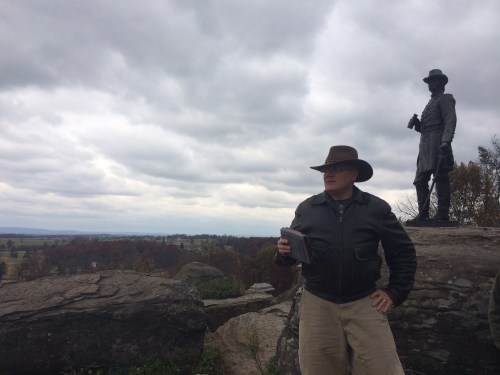
This week has been busy. We have a new class in at the Staff College and I am getting ready to take full charge of our Ethics elective dealing with ethics and war and the next iteration of the Gettysburg Staff Ride. Both of these efforts include a lot of research and writing. Tomorrow will be very busy as I have a couple of extra tasks dealing with a meeting for community service and a spouses orientation.

I am also getting ready for a trip to Houston to go to my church’s annual chaplain training symposium next week.

In the mean time baseball is back and I am happy. Hopefully until the last game of the World Series I will be wearing short pants and baseball jerseys and t-shirts whenever I am not in uniform. The other even more cool than baseball and short pants is the fact that I won my local Gordon Biersch Brewery College Hoops Bracket Challenge and came in tenth nationally. If I had just not believed the UNC would upset Wisconsin and Wisconsin would defeat Kentucky I might have won it all. However, I am content with my prize $200 of Biersch gift cards. Since it is the first time I have ever picked the winner of the NCAA tournament in bracket that I am happy. Thank you Duke Blue Devils who won it all. I had the gut feeling that you would.

But anyway I do digress…

I have a few things in the pipeline this week. I do hope that you liked the series about the Roman Centurion during Holy Week and we challenged by the articles about the Christian Right and the Unreconstructed Rebel, Jubal Early.

So in the next few days you will get an article about the surrender of Robert E. Lee and his army to Ulysses S. Grant at Appomattox which I will publish tomorrow. That really is an interesting story and something that I think all of us who are Americans, no matter what our political, ideological or religious leanings can learn from. It is a story about reconciliation evidenced in the lives of four men, Robert E. Lee, Ulysses Grant, Joshua Lawrence Chamberlain and Ely Parker.

I have an article on Confederate general Richard Ewell which should appear soon and a number of other articles related to the Civil War and Gettysburg, Expect something on baseball and of course on Jackie Robinson and Branch Rickey.

Anyway, there will be other articles as well depending on what is going on in the world or what strikes me as needing to be written about.

Have a great night,

Peace

Padre Steve+


1 Comment

Filed under Loose thoughts and musings

A Centurion’s Troubles: Empty Tombs & Politics

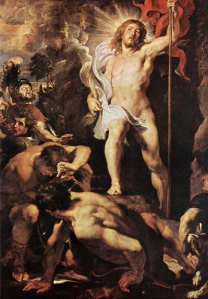
rubensresurrection1

Friends of Padre Steve’s World

Those who follow my writings know that I struggle with faith. Since my return from Iraq in 2008 I have found a certain kinship with soldiers who have been assigned the unthankful and trying tasks of dealing with occupation  duties or fighting insurgencies. 

In the case of the story of Easter it is all too common that writers, theologians and others focus on the story of Jesus and his disciples, or conversely, if they explore anyone else, they  focus on the Jewish religious leaders of of the time. 

After Iraq I had a harder time relating to Jesus and his followers, or the religious leaders of Jerusalem. That being said, coming home from Iraq, struggling to believe, I find a tremendous affinity with the officers of the Roman Legions serving in Judea and Samaria in the 1st Century A.D. 

This is the final chapter of a series that I have been writing about the Roman Centurion known as Longinus, who according to tradition, was at the cross when Jesus was crucified. I have tried to weave other characters from the Gospel narratives, including the Centurion whose “beloved servant” was healed by Jesus an account mentioned in both Matthew and Luke, where the Greek word for servant “Pais” is only found in these accounts and is different from the word commonly used in the New Testament “Doulos.” The difference leads to some interesting and potentially powerful understandings about the people that Jesus interacted during his earthly ministry.

The reason I am doing this is because I believe that many Christians cannot imagine what it must have felt like to be the Roman occupiers of Judea in a time where they were hated and deep divisions, religious, cultural and political complicated the lives of Roman officers like the Centurion known as Longinus.

I do hope that you enjoyed the series and that it and the Gospel narratives challenged you whether you are a Christian or not. I know from my time in Iraq serving with our advisors to the Iraqi forces that what the Roman officers dealt with was more difficult than any of us could imagine, unless you have been a soldier or officer of an occupying power, which I have been.

Peace and Happy Easter…

Padre Steve+

The pounding on his door awakened Longinus before he expected on this day after the Jewish Passover. He was hoping perhaps beyond hope that the worst was over and that in a few days he could take his soldiers back to the confines of Caesarea and away from the troubled city of Jerusalem. He was tired of this duty and longed for service with a real Legion with real Roman soldiers.

The pounding continued and the weary centurion wiped the sleep from his eyes, rolled out of his bed and went to the door of his quarters in Fortress Antonia. He opened the door to find his Optimo, or second in command Decius standing there, his fist ready to continue pounding, with a look of near panic on his face.

Startled, Longinus asked the young officer to come into his quarters and take a seat at his table. They like the other officers had seen events that they could barely explain over the past week, and some of those events had troubled Longinus in a manner in which he was not accustomed to, or prepared for.

Longinus took a wineskin and poured the contents into two cups. He asked Decius what was so urgent and frightening that he had to be at his quarters well before the duty day began. The young man took off his helmet to reveal a crop of blondish brown hair common to the Tyrol in the northern part of Italy.

The young officer took the cup of wine and downed it in one motion. Longinus, pureed and another as the young Tyrollean told an almost unbelievable story. Wiping his brow and taking a drink from the cup he explained that there was trouble at the tomb of the itinerant preacher named Jesus.

Longinus listened to his report:

The two guards from Longinus’s unit who had relieved the previous watch at the tomb had evidently fallen asleep. While they were asleep there had been a break in. The soldiers  claimed that they had been overcome when some kind of angelic being descended in front of them. They reported that  some of the women who had been at the execution site previously had been near the tomb. They said that when they awakened the body of this Jesus was no longer in the tomb.

The story seemed preposterous, but Longinus could not believe that his soldiers  had fallen asleep on duty, as such an act could be punished by a death sentence. Adding to the confusion was a report that two of the preacher’s “disciples” had reportedly entered the tomb and claimed that the body was gone as had some of the women that had been there at the crucifixion.

Longinus took a drink from his cup of wine and thought for a moment. He had to admit that the story was unbelievable, but yet in light of the strangeness of the man and the events surrounding his execution Longinus, was no longer surprised at anything. Longinus looked at his young executive officer and said:

“Optimo, there has to be a logical explanation for what happened, and we need to find the truth. I do not like to think that our soldiers were asleep on duty, and I don’t think that the High Priest would not attempt to use this against us. Please have the soldiers and the Sergeant of the Guard report to me.”

Longinus had Decius bring the two soldiers to him along with the Sergeant of the Guard to explain what had happened.

The two soldiers, one a Samaritan and the other a Greek had good reputations in the unit. Neither had given him cause for concern and the terrified expression on their faces as they explained what happened at the tomb gave Longinus reason to believe them. Yes, it was possible that they were lying but Longinus believed their story because in spite of his threats they stuck to it. He threatened them with death if they had fallen asleep and were lying. When that did not produce results he promised a light punishment if they only told the truth, but despite his efforts to get them to testify to something rational they stuck with this outrageous story.

Longinus was not much of a believer in miracles angels or any sort of magic hocus pocus purveyed by seers, magicians or fortune tellers. He did not believe in the state “gods” of Rome and likewise had little respect for the Jewish God, not so much because he understood the theology of the Jews, or even might believe in some sort of all-powerful being, but because he was disgusted by their use of their god for their political purposes.

All that being said Longinus was inclined to believe his solders. When his friend Flavius had told him about his servant being healed by the Jesus fellow he found it hard to accept. That being the case here he was believing this outlandish story. It was preposterous, but he could not accept the alternative. To disbelieve his men would mean that there was a serious breakdown of discipline by two outstanding soldiers. Longinus had some soldiers that he wouldn’t believe for an Athenian minute if they told him such a tale, but he believed these men. The terror on their face as they told the story led Longinus to believe that they had to be telling the truth as improbable as it was.

Longinus again thought of his words as the darkness enfolded the city and the earth quaked preacher hung dying on the cross on that evil hill just two days before. He dismissed the soldiers and as they left he prepared himself to tell the scheming governor they latest “good news.” If only Rome had let these people stew in their own mess. Longinus shook his head as he wondered about the wisdom of attempting to police such fouled up lands.

After he washed and put on his uniform, Longinus went to Pilate’s headquarters where he and the other Centurions, including his friend Flavius participated in a meeting with Pilate and his staff, the Jewish High Priest and his representatives and two of Herod’s people.

The meeting reminded Longinus  of a meeting of criminals. The High Priest and his representatives were livid at the report he delivered and demanded that Pilate take immediate action to solve their problem. Herod’s henchmen voiced their displeasure regarding the lapse of the Roman soldiers that allowed this to happen.

Longinus spoke up for his men and said that as improbable as the story was, that he believed his men. That only made the non-Romans angrier and they began not only calling for punishing the soldiers, but Longinus as well. Longinus  thought that they were engaging Pilate in yet another histrionic episode in order to force Pilate to do their bidding, if not today, in the future.

The High Priest and Herod’s men  insisted that Longinus’ soldiers had to have fallen asleep and or that they had conspired with the preacher’s followers to remove the body from the tomb. This angered Longinus to the point that he interrupted their ranting to defend his men’s honor. Pilate finally ordered Longinus and the High Priest to be silent. He asked the non-Romans to step outside while he conferred with Longinus and the other Centurions. The High Priest objected, but decided not to press the point and left the room.

Pilate explained his dilemma. He was afraid that if he sent the High Priest away by supporting his soldiers that there would be a revolt in the streets. He had seen the tumult on the streets by the supporters of the High Priest when he tried to release the “King of the Jews” and felt that this would be worse for security. He advised the Centurions that while he had no reason to doubt them or their men that he had to placate the High Priest and Herod in order to avoid chaos, chaos that could lose him his job if he wasn’t careful. Likewise he did not feel that he had the military manpower in the city to handle a full-fledged revolt and that he would have to call for reinforcements from the Legions based in Syria. Pilate was loath to do as this as it would get back to the Emperor, and the Emperor did not take kindly to governors who could not manage their provinces.

Longinus thought back to the day of the execution. Pilate had agreed to place a guard at the tomb at the urging of the High Council. Longinus had argued against placing any soldiers at the tomb as he felt that since the “King of the Jews” was the problem of the Jews and since man that he had called the so called  “son of God” was dead that Rome’s obligation was over. Let the Jews handle their own problems.

The whole thing reeked of politics and Longinus did not like it, But but on Friday he had been overruled by Pilate. Then Pilate explained that Roman soldiers needed to guard the tomb because the High Priest  insisted that Jesus’ followers would attempt to steal the body and then claim that he this Jesus had been raised from the dead. That insisted the High Priest would lead a revolt against the Jewish council and eventually Rome itself.
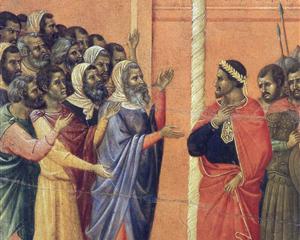
the-high-priests-before-pilate-1311.jpg!xlMedium

Another actor who added to the Judean witches’ cauldron was the Herod Antipas, the corpulent and corrupt “King” of Judea. If Longinus detested Pilate and the Jewish High Priest he hated Herod and all that he stood for even more. The presence of Herod made Longinus wonder why Roman lives and treasure were spent to solve the problems of this God-forsaken land; a land that Longinus believed would still be trouble two millennia from now if the world lasted that long.

Longinus believed that as long as Rome allowed the High Council and Herod to rule the region by proxy that the troubles would never end. He believed that it was only a matter of time before these people, mobilized by the passion of the Zealots would revolt as they had against the Seleucids nearly 200 years before. He knew if that happened that Rome would mobilize more the  enough legions to crush the revolt, and when they were done would not leave as much as a house standing. Longinus hated this occupation and all that it stood for, especially when he saw a good and innocent man like this Jesus fellow killed for no good reason other than the politics of it all. It sickened him.

When Pilate was done explaining his decision to Longinus and the other Centurions Pilate called the quite irate non-Romans back into the proceedings. He told the High Priest and Herod’s men that he would discipline the soldiers involved. He also explained that he would assist them in finding just what parties removed the body from the tomb. In the mean time he would suppress any stories coming from the soldiers about this supposed “resurrection” of this Jesus character from the dead.

The High Priest and Herod’s men agreed that this would suffice and thanked Pilate for his time and effort. Longinus and the other Centurions quietly seethed as this took place. When the non-Roman parties had left Pilate, knowing how his officers hated his decision called them to him. He told the officers that no action would be taken against the men and that he would not actively assist the Jews in trying to find the perpetrators of the event. He had in fact deceived the High Priest an Herod’s men.

Pilate then let the officers know that they and their units would remain in Jerusalem for another week to allow the multitude of pilgrims to leave the city. Once the Jewish festivities were over and the people had departed, they would return to Caesarea. Longinus thought about it and for a brief moment he admired Pilate’s duplicity. Pilate the consummate politician had again found a way to defuse the situation, deceive the local leaders and protect his soldiers, and as much as Longinus and the other Centurions despised the deal it was better than trying to deal with a full fledged rebellion with so few troops available in Jerusalem.

Longinus left with the others and met Decius and Flavius when he stepped into the court of the fortress. He was very unhappy with the deal that Pilate made with the High Priest and Herod even though he understood the reality of the politics behind it. Longinus felt that he had dishonored his soldiers and the unit for the sake of political expediency. He felt ashamed of the Empire for what Pilate had done in cooperating with these people from beginning to end during this affair. He would not forget.

centurioncross_1

When Longinus returned to his quarters he again looked at his blood stained lance and thought about the man who was put to such an ignominious death for such putrid reasons. Surely something had to be different about him and there had to be some purpose to this injustice. Longinus again mused quietly, “truly this was the Son of God…”

Whatever that meant…

Peace,

Padre Steve+

Leave a comment

Filed under Loose thoughts and musings

Coming This Week: A Roman’s View of the First Easter & More

IMG_1249

Friends of Padre Steve’s World,

This week I will be republishing a series of articles that I wrote about Longinus the Centurion. This is the man who according to tradition commanded the detail in charge of the crucifixion of Jesus. I plan on re-publishing each segment this week as part of Holy Week and I hope that you find them interesting. This story is basically historical fiction and I used my imagination about what it must have been like to be a Roman officer witnessing the drama of what we now call Holy Week.

I find a special affinity for soldiers that serve their country in a land far from home, among people that detest them as hated infidel occupiers of their country. I don’t think that anyone today can really understand the plight of the Roman officers assigned to the occupation of Judea and Samaria in the First Century until they have  done their time in Iraq or Afghanistan.

These peoples, though not Jewish have similar divisions,  contradictions and prejudices against foreigners as those that lived in First Century Palestine. I think that American, NATO or coalition troops that served in Iraq or Afghanistan, especially those who came to know the people in those countries understand the attitudes of Roman soldiers assigned to occupation duty throughout the Empire, especially in the volatile provinces of Judea and Samaria like Longinus.

I’ll post them over the coming week in addition to other articles that I have in process or which might pop up this week. Some of those include articles about men who served at Gettysburg, tomorrow one on Colonel Strong Vincent, a Union Volunteer who helped save Little Round Top on July 2nd 1863, and Monday, one on Lieutenant General Richard Ewell who commanded the Confederate Second Corps. Since Baseball Opening Day is fast approaching expect some baseball articles as well. I will probably be doing something on the current situation in Yemen, the various anti-Gay bills with the Orwellian title of “Religious Freedom Restoration” and the Germanwings crash this week as well. 

So stay turned and spread the word.

Peace

Padre Steve+

Leave a comment

Filed under Loose thoughts and musings

Granny, Me & a Tombstone Makes Three: Thoughts on Turning 55

625696_10151179483627059_1009630985_n

turn fifty-five today. That is 55, or as it is sometimes known as double nickels. Now I try not to look and I certainly don’t act my age. Despite this I am now officially eligible for my AARP card and discounts, I’ll probably get carded when I try to use them.

Since I think I am now what they call “middle-aged” this means that I should live to be about 110. I actually think that would be cool because I would certainly be around for the Civil War Bicentennial, hopefully still leading Staff Rides at Gettysburg for officers not yet born. 

It really is hard to believe how views on age and aging have changed over the years. When I was about seven years old my paternal grandmother, Verdie, who insisted on being called “Granny” informed me that she wasn’t going to be around much longer. At the time she was fifty-five. But back then people did act old, especially once they entered their forties. I remember one of my Algebra teachers from junior high school back in 1973-74. The man looked, dressed and acted like he was in his sixties. He wore a gray woolen suit, a white button down shirt, a nondescript thin black tie, black oxfords, and when he was outside, a gray fedora.

I thought he had he had passed away years ago and I was surprised as hell to see his obituary a year or two back. He was only about eighty, which would have meant that when he was my teacher he would have been in his early forties, and looking like he was sixty. But that wasn’t unusual back then, just watch some movies from the era and see what the 40-50 year olds looked and dressed like.

Well anyway, back to Granny. Granny was from Putnam County West Virginia and she left home at age eighteen because she did not like the repressive atmosphere and wanted to make a life for herself away from the farm. As the oldest daughter she was having to take responsibility for raising her younger siblings, and she could not abide such a life in the holler with no freedom or opportunity. Granny talked with an old Appalachian dialect that has almost died out. But she was very progressive for her day, raising two sons as a widowed single-mother.  She worked until she was forced to retire and then volunteered at the local hospital gift shop for another decade or so. She could talk baseball, but sadly she was a Dodgers’ fan and lived and died with he team. She travelled the country bus Greyhound bus until she was in her early eighties. She was a fascinating person.

She was active in her church and into her eighties she would take meals to ome-bound church members who she called “those poor old people.”  Of course most of them were younger than her. Now as far as cooking was concerned, her’s was infamous around the family and in the church, something that we all strove to avoid eating if possible. My wife Judy who probably spent the most time with her was subjected to her fare more than anyone. To this day she tells me, that me, my brother that the rest of my cousins and me owe her big for that, but I digress….

But the one thing about her was that no-matter when we would meet she would say that she “didn’t have long to live” or “wouldn’t be around much longer.”  To make sure that we understood that she purchased a plot a a cemetery which had just opened during the early 1970s and even had her headstone planted there. Occasionally if we were in town it would be among the graves that she would have us visit. She had this morbid obsession with death. Maybe it is because she was twice widowed and grew up in difficult times, World War One, the Spanish Flu pandemic, the Great Depression, and the Second World War. But for whatever reason she talked like she was old and soon to die, even as she travelled the country on Greyhound.

Then in 1995 I took my first post seminary  job as a contract emergency department chaplain in the city that she lived. It was fascinating to get to know her again as well as my maternal grandmother who was also still alive and living in the town. I worked nights and weekends so Judy got to know them better than anyone, she took them both shopping and to doctors appointments, all the while attempting to ensure that Granny did not feed her. Once I angered Granny when she told me that she wasn’t going to be around much longer and I asked if she was moving. She popped a cork and informed me that I knew what she was talking about. I replied, “Yes, I know you have been telling me this since I was a child and you are still alive.”  She didn’t talk to me for a week, but got over it.

My maternal grandmother, Christine died unexpectedly when I was deployed for the Bosnia mission in 1996 and between that and another active reserve tour I missed seeing Granny a lot until we returned in October of 1998.

One day, it was in November or December of that year, I got a panicked call from Granny. Evidently a salesman from the cemetery had called her and asked if she wanted to pay the opening and closing fee on her plot in advance. Evidently this brought the matter of her mortality to the fore, in a much more tangible way than she had imagined. She told me that she had a nephew who had connections to cemetery where her parents and some siblings were buried and wanted me to move her tombstone to it.

piovere

I told her that we would probably have to go to the cemetery office because one could not simply appear at the cemetery and start digging up tombstones without permission. I imagined being like Gene Wilder in Young Frankenstein when he went to dig up the corpse in which to implant Abby’s brain. Abby who? Abby someone… Abby, Abby Normal, that’s who I think it was… again I digress…

So I set up an appointment for her and me to make the arrangements. The people were nice, we filled out the necessary forms and two workmen dug up the stone and placed in the truck of my 1984 Volvo 240 GL.

We had to wait a week until her nephew could make time to meet us at the family cemetery and for two weeks I had to drive around town with Granny’s tombstone in my trunk. I just knew that someone was going to rear-end the car, pop the trunk and that I would have to answer some questions  rather pointed questions from the police. Questions that I might add, could prove distressing, as how many people drive around with tombstones in their trunk? I could hear the conversation:

Police officer: What is that? 

Me: A tombstone officer. 

Police officer: What kind of ghoul are you?

Me: How many kinds are there?

Thankfully however, no one hit me, I did not have to explain the tombstone in the trunk to the police and the next Saturday we drove up to her nephew’s house and then to the cemetery. Of course the weather was perfect for placing a tombstone, cold, cloudy, dreary and rainy; just like any horror movie. Not even birds were chirping. Her nephew and I emplaced the monument with great care. We ensured that it was in the correct plot and carefully measured and the appropriate distance to the neighboring graves of her parents, for even in death people need their space. As we worked, Granny supervised, much happier now that if she was going to die that she had a home so to speak. Once we had it set I grabbed a bottle of Windex, a rag and cleaned the mud off of the top of the monument. Granny was pleased, and I was glad to have the tombstone out of my trunk.

Two months later I transferred from the Army Reserve to the Navy and we moved away. Soon after the 9-11-2001 attacks we visited, Granny had reached the point that she was in a nursing home. I drove her around the town to places she used to visit and took her her for a hot dog at the local original Stewart’s Root Beer and hot dog stand. Since she couldn’t go to church she had Judy sing a couple of hymns for her before we went back to North Carolina. A couple of weeks later she passed away and we gathered for her funeral.

My dad and uncle were there as were many other relatives. The service was at the church where she had attended for decades and where I had been baptized as an infant. The cemetery was about thirty miles away a bit up I-64. Since there was a home football game for the local college, Marshall University, the funeral home employees ensured that we had the fasted motorcade I have ever been a part, we were chasing the hearse which was doing about eighty with the little purple funeral flags furiously flapping in the wind. After a quick graveside service it was done. I don’t think that anyone missed the opening kick off that day and I’m sure that Granny wouldn’t have minded. My dad and Judy both agreed in hindsight that old time sake and for safety reasons we should have hired a Greyhound bus for the funeral party with Granny’s coffin in the luggage compartment.

So anyway, from the time she was fifty-five until she was almost ninety, Granny never ceased to let me know that she didn’t have long to live. I hope as a minimum I live as long as she did and I do promise that you won’t be hearing me tell you that I haven’t long left, unless they are dragging me away to the funeral home as my fingers type out one last article.

Here’s to health and long life!

Peace

Padre Steve+

7 Comments

Filed under Just for fun, Loose thoughts and musings

I Guess I am Not a Christian


i think that I am a Christian. I have been baptized, made my profession of faith, been confirmed, married in the church and been ordained as a Deacon and Priest, but I guess to some that isn’t enough. Of course I am talking about the Christian Taliban of the Christian Right, people whose theological knowledge and expression is about as articulate as a hamster on steroids, and who think that only they have the keys to the kingdom of God. 

I have consumed a fair amount of excellent craft beer tonight but even so, my understanding of faith, the  Christian Faith and theology is better than idiots that I encounter. I had it happen again tonight and of course it was some ignorant fundamentalist from Texas who decided that I was not a Christian. 

Frankly I have had it. The ignorance of the supposedly Christian Right, which sadly I have to say I once considered myself to be a part,  has so poisoned discourse in this country that it is embarrassing. If such is the Christian Faith I would rather be be condemned to Hell than to be considered a Christian by their standards. 

As Pedro Cerano (Denis Haysburt) said in the movie Major League “fuck you Jobu, I do it without you.”

Of course I am not talking about Jesus, who I like very much, but who is no help with curveball, but rather the ignorant fundamentalist who sit as prosecuting attorney, jury and judge over those who they hate. Yes I said hate, because that is the only explanation for such behavior. If that means that I am not a Christian, then so be it. 

Pray for me a sinner.

Peace,

Padre Steve+ 

12 Comments

Filed under Loose thoughts and musings

The Bonds of Friendship & Tragedy of War

armistead

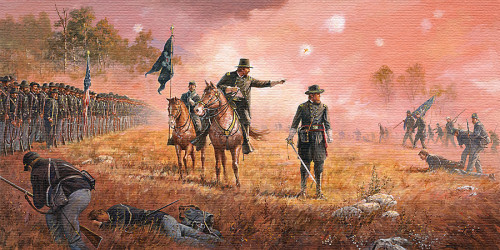
“Armistead at Gettysburg” by Keith Rocco

The bonds of friendship forged by soldiers are some of deepest and long lasting that are formed anywhere.  For American military professionals those bonds are formed in the small rather closed society that is the regular United States military.  They are formed in war and peace, and are marked by years of deployments, isolated duty and combat.  They are part of a culture that is often quite different than that of civilian society. That is the case now as it was in 1860.

When the Southern States seceded from the Union men who had spent much of their adult lives serving together discovered had to say goodbye and prepare to fight each other. Most did so with a heavy heart even though many had strong convictions about the rightness of their region’s cause. Those who left the army to serve the Confederate states were often torn by doubt and questions of where their loyalty lay. They wrestled with their oath of office and the costs of perhaps having to face their dearest friends on future battlefields.

They were different from the mass levies of civilian volunteers who rallied to the flags of the Union and Confederacy in 1861. The volunteers, most of whom did not have the deep and abiding friendships of the professionals were often motivated by ideological, sectional or religious hatred of the other and went to war with great aplomb.

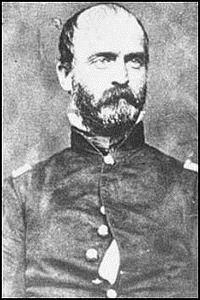
The American Civil War has many such tales. One of the most remembered is that of Union General Winfield Scott Hancock and Confederate General Lewis Armistead. It was key story line in Michael Shaara’s Pulitzer Prize winning novel The Killer Angels was immortalized in the movie Gettysburg which is based on Shaara’s novel.

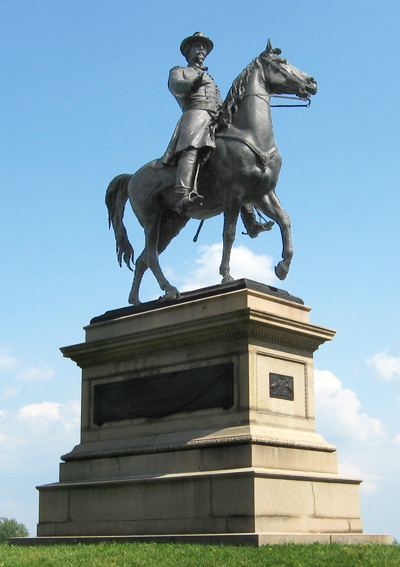
hancockMajor General Winfield Scott Hancock USA 

Hancock was from Pennsylvania. He was a career soldier and Infantry officer, a graduate of West Point Class of 1844. He served in Mexico and held numerous positions. In 1861 he was stationed in California as a Quartermaster under the command of Colonel (Brevet Brigadier General) Albert Sidney Johnston. One of his fellow officers was Captain Lewis Armistead, a twice widowed Virginian who also served as a commander of the New San Diego Garrison under Johnston’s command. Hancock and his wife Almira became fast friends with the widowed Virginian.

Armistead was a nephew of the officer who defended Fort McHenry from the British in the War of 1812. Armistead had academic and personal difficulties at West Point including an altercation with Jubal Early in which he broke a plate over Early’s head.  Between his academic difficulties and the fight with Early he resigned from the Academy. However, his father helped him obtain a commission as an Infantry officer in 1839. Armistead’s career from that point on was similar to many other officers of his day. He served with distinction in Mexico, the Great Plains, Kansas, Utah and California.

As the war clouds built and various southern states seceded from the Union numerous officers from the South were torn between their oath, their friendships and their deep loyalty to their home states and families. In the end most Southern officers resigned their commissions, many with mixed feelings and quite often sadness. A minority of southern born officers remained loyal to the Union. The most prominent of these men were General Winfield Scott and Major General George Thomas, the “Rock of Chickamauga.” Likewise Union Brigadier General John Buford’s family in Kentucky supported the Confederacy.

For those southern officers who remained loyal to the Union to was often at a great personal cost. Thomas’s action cost him his relationship with his immediate family who deemed him to be a traitor. He and others were pilloried and demonized in the basest ways by many in the South. Some Southerners who served the Union were executed when they were captured. George Pickett, who called for his fellow Virginian Thomas’ death ordered 22 North Carolinians who he captured fighting for the Union in Kinston North Carolina to be executed and he was not alone.

armistead2

Brigadier General Lewis Armistead CSA

However, for most it was different. As talk of secession and war heated up officers stationed on the frontier debated the issues and asked each other what they would do if war came. In California Armistead and other officers asked Hancock, who was a Democrat and not openly hostile to the South, advice on what he would do if war came. Hancock’s reply was simple. I shall not fight upon the principle of state-rights, but for the Union, whole and undivided” 

The parting came in 1861. When it was apparent that many officers would be resigning and heading home to join their state’s forces the Hancock’s hosted a going away party for their friends. Almira Hancock wrote of the party that “Hearts were filled with sadness over the surrendering of life-long ties.” Colonel Albert Sidney Johnston’s wife Eliza went to a piano and sang the popular Irish song Kathleen Mavourneen:

“Mavourneen, mavourneen, my sad tears are falling, To think that from Erin and thee I must part!

It may be for years, and it may be forever, Then why art thou silent, thou voice of my heart?…”

The parting was especially emotional for Armistead who had been a friend of the Hancock’s for 17 years. They had helped in following the death of both of his wives and children. He was tearful. He put his arm on his friend’s shoulder as he said: “Hancock, good-by; you can never know what this has cost me, and I hope God will strike me dead if I am ever induced to leave my native soil, should worse come to worse.”

Armistead led his brigade during the Peninsula campaign and battles around Richmond and his brigade was decimated in Lee’s failed assault on prepared Federal positions at Malvern Hill. Armistead did not endear himself to many of the volunteer officers who served in the Confederate ranks. One of his Colonels resigned over Armistead’s supposedly harsh treatment to which Armistead replied: “I have felt obliged to speak to him as one military man would to another and as I have passed nearly all my life in camps my manner may not be understood or appreciated by one who has been all his life a civilian.” Armistead’s words can easily be understood by military professionals whose lives have been shaped in a different manner than their civilian counterparts.

At Gettysburg Armistead spoke his fears to his comrades. One was Brigadier General Dick Garnett, another of Armistead and Hancock’s comrades from the California days on the night of July 2nd. The next afternoon Armistead and Garnett led their brigades of Pickett’s Division against Hancock’s II Corps which was defending Cemetery Ridge.

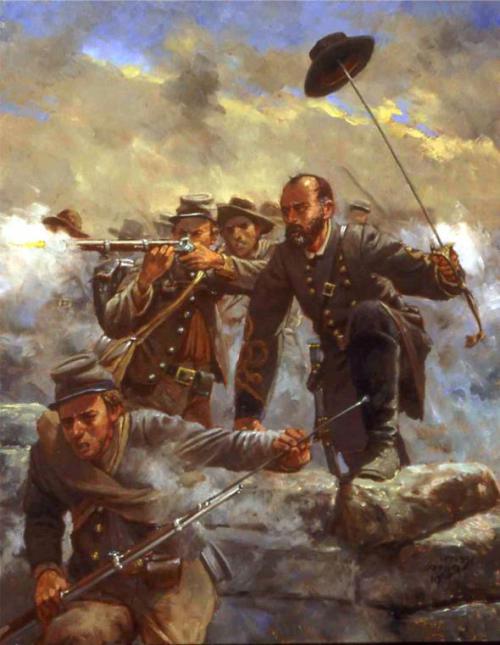
During the engagement Garnett was killed just before reaching the Union lines and Hancock gravely wounded. Armistead, lead the remnants of his decimated brigade to the Stone Wall, near the Copse of Trees. He rallied his troops fearing that some were faltering calling out: “Come on boys, give them the cold steel! Who will follow me?”

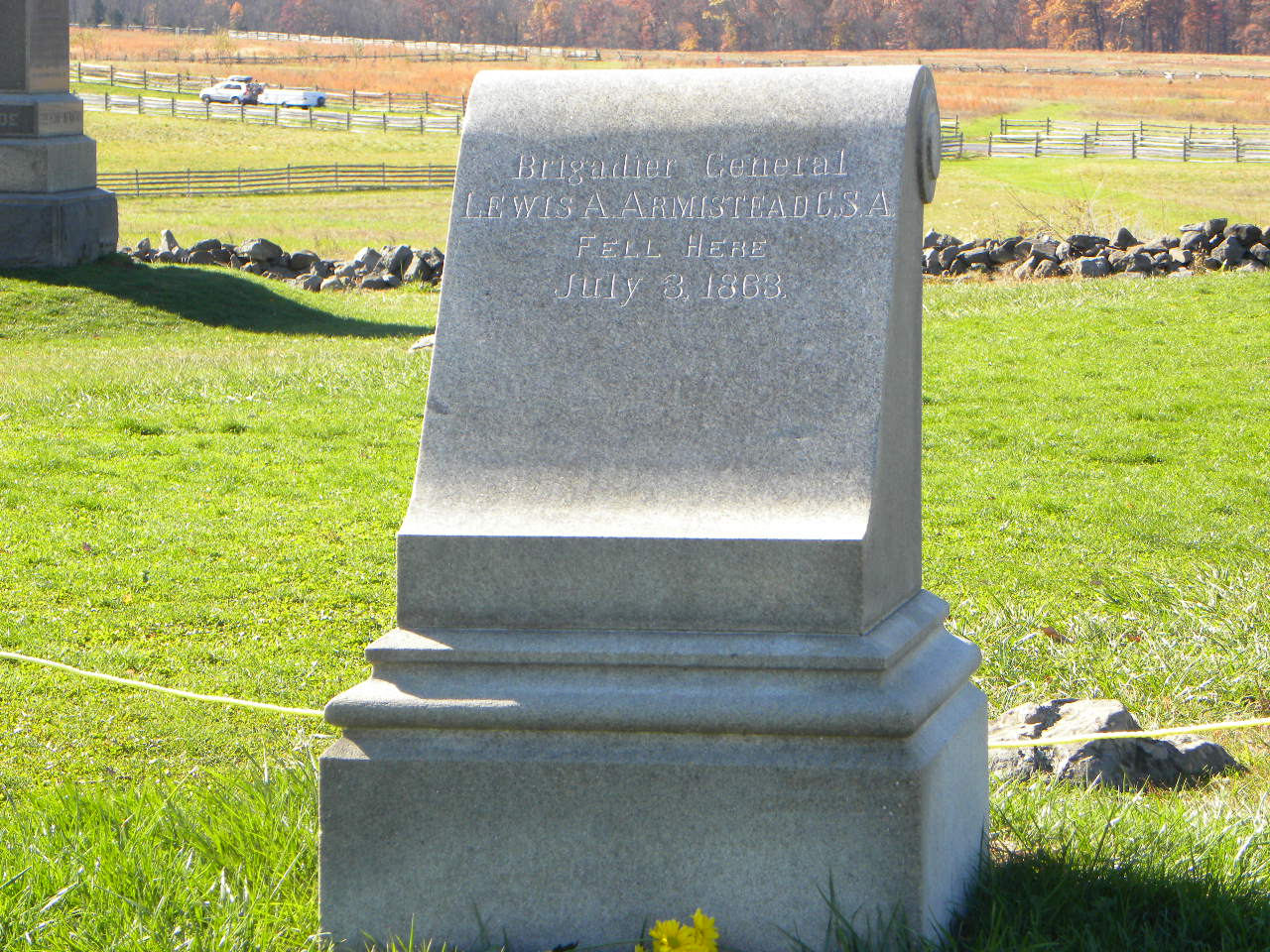
His troops breached the Union line and his black hat atop his sword led his troops forward. It was then that he met more Federal troops who unleashed a volley of musket fire that cut down many of the survivors. Armistead was wounded in the right arm and shoulder and fell near one of the Union artillery pieces, a point now known as “The High Water Mark” of the Confederacy.

As Armistead lay wounded he was approached by Major Bingham of Hancock’s staff. Bingham, a Mason noticed that Armistead was making a Masonic sign of distress. When Bingham told Armistead of Hancock’s injury Armistead was grieved and told Bingham to “Tell General Hancock for me that I have done him and you all an injury which I shall regret the longest day I live.”  The meaning of those words is debated, especially by Southerners who cherish the myth of the Lost Cause. However, based on Armistead’s conduct and behavior in the time before he left California, it is not unreasonable to assume that as he lay dying he truly regretted what he had done. He gave Bingham a wrapped Bible and Prayer book to give to Almira Hancock, inscribed were the words “Trust in God and fear nothing.” 

hancock minnesota forward

“Minnesota Forward” Hancock directing the Defense by Dale Gallon

Armistead died from infections caused by his wounds which were initially not thought to be life threatening. A Union surgeon described him as: “seriously wounded, completely exhausted, and seemingly broken-spirited.”

Hancock’s injuries were severe, but he recovered. He would go on to continued fame and be one of the most admired and respected leaders of the Army during and after the war. He was gracious as a victor and spoke out against reprisals committed against Southerners after the war.

DSCN8856

In 1880 Hancock was the Democratic nominee for President. He lost a close election to James Garfield, losing the popular vote by fewer than 40,000 votes. It was an era of great political corruption and Hancock was one of the few major public figures viewed favorably for his integrity. Even his political opponents respected him for his integrity and honesty. Former President Rutherford B Hayes said:

“if when we make up our estimate of a public man, conspicuous both as a soldier and in civil life, we are to think first and chiefly of his manhood, his integrity, his purity, his singleness of purpose, and his unselfish devotion to duty, we can truthfully say of Hancock that he was through and through pure gold.” 

A few years after his death Republican General Francis A Walker, lamenting the great corruption of the time said:

“Although I did not vote for General Hancock, I am strongly disposed to believe that one of the best things the nation has lost in recent years has been the example and the influence of that chivalric, stately, and splendid gentleman in the White House. Perhaps much which both parties now recognize as having been unfortunate and mischievous during the past thirteen years would have been avoided had General Hancock been elected.”

Hancock-4c_4500

The story of Hancock and Armistead is one that reminds us of the depth of friendships that many military professionals develop and cherish. It is also a story that reminds us of how hardened ideologues can divide a nation to the point of civil war. It is a story that should give pause to any political or spiritual leader that incites people to war against their neighbor and uses their ideology to slander, demean or even enslave and brutalize their political opponents.

The blood of the approximately 50,000 soldiers that were killed or wounded during the three days of the Battle of Gettysburg is ample reminder of the tragedy of war, especially war that forces the dearest of friends to fight and even kill one another.

Peace

Padre Steve+

Leave a comment

Filed under Loose thoughts and musings

Coming this Weekend


Friends of Padre Steve’s World

This weekend I am posting three articles on men who fought at Gettysburg. Over the past few months I have been going through my Gettysburg text and really working on the biographic portions because I really do believe that people matter. The people presented, James Longstreet and Joshua Chamberlain are complex characters. The Chamberlain piece goes into much more depth than the Longstreet one and is probably the beginning of a book. Another article is about friendship and the tragedy of war dealing with Winfield Scott Hancock, Richard Garnett and Lewis Armistead, longtime friends whose fates collided on Cemetery Ridge during Pckett’s Charge. 

I hope you enjoy them.

Have a great weekend. 

Peace

Padre Steve+

Leave a comment

Filed under Loose thoughts and musings

So Much to Write About and Too Wiped Out to Do It


Somehow I feel a bit like Danny the Donkey now. I am wiped out and I wouldn’t mind sitting around in my underwear drinking beer. sadly I am not a pretty sight in my tights whities, but then there are times when I think that I am ahead of my time. 

Today I had a day long series of tests to see how my brain is working at the Neuro-Psychology clinic at the local Naval Medical Center. If you ever have cause to go through such a series, please know, even if you don’t drink you will want to when complete them. Thankfully, this was the last battery of tests of this sort that I will need to do. On the 23rd I get my special sleep study  which in addition to checking for possible sleep apnea also studies all of my crazy dreams and night terrors. 

Last night I had a pretty bad night for sleep, lots of weird dreams and nightmares. I woke up exhausted and then went to my testing. So now I am even more wiped out. Thankfully tonight should be easy. Go home and spend time with Judy and the dogs. I think our new Papillon puppy, Izzy, is good for me. It looks like she is going to be daddy’s girl. I love playing with her and having her hang out with us. She is funny, smarter I think than any of our previous girls, and none of them were dumb dogs, very sweet, playful but totally laid back. It is like this little girl is an old soul. 

Like I said, there is a lot that I want to write about. One thing is the latest GOP outrage with their letter to Iran. As a career military officer and former Republican I could never imagine any group of American politicians doing something so stupid and ultimately undermining of of our country. Not only was a it a lame attempt to sabotage the discussions that we and our allies are involved with before any deal is finalized, in a sense they added to the legitimacy of the Iranian clerics. If the Democrats had written a letter like this to Saddam Hussein in 2002 they would have been rightfully condemned, but evidently Senator Tom Cotton and 46 others thought this was a good idea, simply because they hate all things Obama. Instead they seem to be pushing for new, unfunded wars against not only Iran, but Iran’s mortal enemy the Islamic State. Guess what, if they get there way, these new wars will end badly. But the people are less rational than the Iranian Mullahs, so what can we expect?

There is yet another shit storm brewing between the religious right and the Navy Chaplain Corps. I promise that as I sort through the facts I will give you the fairest and most comprehensive report you will see on it. But for now I will simply say that from what I am reading this appears to be another incident involving a chaplain who might have overstepped his bounds but who’s cause is now all over the conservative blogosphere. From what I read there appears to be much more to the story than what is being reported on the Daily Caller, World Net Daily, the Blaze, Fox News, tons of other Right Wing Christian “news” sites and blogs or the website of lawyers supporting the agrieved chaplain are saying. Give me some time and you will get as truthful report as you will see on this.

I do have a number of Gettysburg related articles in process. Expect one one the cavalry actions of July 3rd and one on the suprises that George Meade and Robert E Lee experienced on June 28th 1863 within the week. I have some other ideas floating around and have much more to do on my Gettysburg text, so there will be more. 

Finally there are a number of other subjects that I want to address, some dealing with history, some baseball, some military, and some current events and controversies. So my friends, please stay tuned and spread the word. 

Until tomorrow, 

Peace, love and beer,

Padre Steve+ 

Leave a comment

Filed under History, Loose thoughts and musings, News and current events, Religion

The Reward of Teaching


I love getting to do what I do as an Assistant Professor teaching Ethics and the Gettysburg Staff Ride. Through most of my career, be it as a Medical Service Corps officer and Chaplain in the Army, as well as a Navy Chaplain has been dealt with teaching ethics or history. However, until this assignment those duties have been things I took on in addition to my normal duties. 

I try to challenge my students, no matter what I teach to see issues in relationship to people; their character, intellect, strengths, weaknesses, beliefs, faith, ideology, and their relationships. In other words, their humanity. For it is our humanity that is the common thread in all of history. Technology changes, political models change, and humanity is constantly evolving, or sometimes devolving, but the one constant is people. 

Sadly all to often humanity is left out, we find a way to dehumanize almost everything, even how businesses, governments and even religious bodies refer to people as “human capital,” “resources” or in the case of some money grubbing churches “tithing units.” 

However, when I teach, I may teach about history, philosophy, or ethics, I still concentrate on people; who they and why they matter. That is at least for me is what matters. Events, inventions, theories, methods are all important, but if we leave out the actual part about the people they don’t connect. 

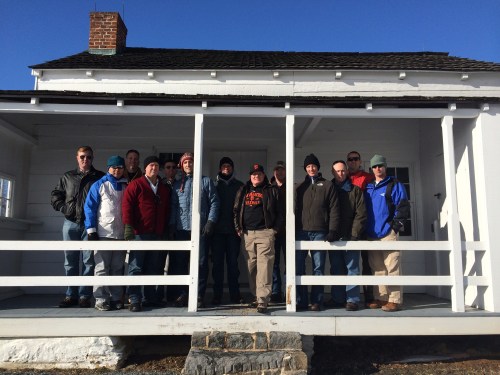
So in addition to the classroom, or touring historic sites, I focus on people, and then, especially on trips where I am out with my students for two or three days. On these trips we travel tighter, we eat and drink together and spend time discussing the events and people we are studying, but also share our life experiences and time together. So for me, teaching is also about my students, and to see their interst piqued, who then come back and later tell me that they went and explored the life of the people that we discussed. It is like them dis coving buried treasure. 

I think that is the joy and the reward of teaching, especially higher education, but I am sure any teacher, even those who teach primary and secondary education could do the same thing if they are creative, for it is the people who connect us, people matter.


Today we had to break off the last day of our Gettybsurg trip due to a winter storm that shifted south and made road conditions really bad. From DC to Richmond I lost count of the number of accidents. Thankfully it looks like things get a bit better south of Richmond. 

But anyway for now, and if you live in the path of this storm, stay safe.

Peace

Padre Steve+

1 Comment

Filed under History, Loose thoughts and musings, philosophy, Teaching and education