Category Archives: Military

A Previous Generation of Sailor Insults the Current Generation of Sailors

A Different Kind of Navy

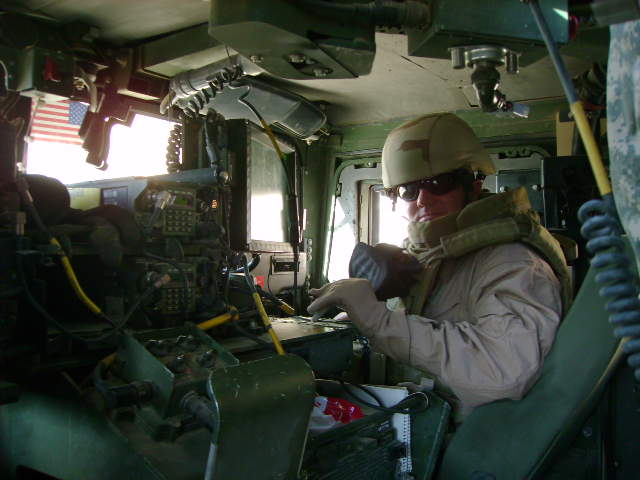
Today I received an e-mail forwarded by a retired Navy Chief and actually a dear friend of my family.  However the e-mail was so insulting to the present generation of sailors that I sent a very blunt response back to him and everyone in else by replying to all recipients.

As readers of this site know I constantly go out of my way to make sure that the sacrifices of the previous generations of military personnel are recognized, honored and not forgotten.  In fact I am not alone in this, many like me have been touched by these veterans of World War II, Korea, Vietnam, the Cold War, Desert Shield and Storm and the Balkans and honor their service in thought word and deed. In fact I and thousands like me are deeply appreciative of the service and sacrifice of those who have gone before us.  However with the exception of the Vietnam vets I don’t think that this honor and appreciation is shown much to the current generation.

We have been at war coming up on 9 years. This is nearly three times as long as the US involvement in World War II and will certainly go well beyond that.  Unlike that war where the whole nation was mobilized and millions of men and women served in all components of the armed forces all over the world in the current war only a tiny minority of the population has served. In fact if you look around the country we are a nation that doesn’t even act like we are at war unless it benefits someone’s political agenda.  While various individuals and organizations, especially professional sports take time to publicly acknowledge the service of the current generation for most people the war is something abstract that really doesn’t affect them or change how they live in any appreciable manner.

What is even more insulting is getting e-mail and hearing some of the older generation demean those who serve now, while saying “Support our Troops” they then spread horse manure like this:

Then – If you smoked, you had an ashtray on your desk.
Now – If you smoke, you get sent outside and treated like a leper, if you’re lucky.

Then – Mail took weeks to come to the ship.
Now – Every time you get near land, there’s a mob topside to see if their cell phones work.

Then – If you left the ship it was in Blues or Whites, even in home port.
Now – The only time you wear Blues or Whites is for ceremonies..

Then – You wore bell-bottoms everywhere on the ship.
Now – Bell-bottoms are gone and 14 year-old girls wear them everywhere.

Then – You wore a Dixie cup all day, with every uniform.
Now – It’s not required and you have a choice of different hats..

Then – If you said “damn,” people knew you were annoyed and avoided you.
Now – If you say “damn” you’d better be talking about a hydroelectric plant.

Then -The Ships Office Yeoman had a typewriter on his desk for doing daily reports.
Now – Everyone has a computer with Internet access and they wonder why no work is getting done.

Then – We painted pictures of pretty girls on airplanes to remind us of home.
Now – We put the real thing in the cockpit.

Then – Your girlfriend was at home, praying you would return alive.
Now – She is on the same ship, praying your condom worked.

Then – If you got drunk off duty, your buddies would take you back to the ship so you could sleep it off.
Now – If you get drunk off duty, they slap you in rehab and ruin your career.

Then – Canteens were made out of steel and you could heat coffee or hot chocolate in them.
Now – Canteens are made of plastic, you can’t heat them because they’ll melt, and anything inside always tastes like plastic.

Then – Our top officers were professional sailors first.  They commanded respect.
Now – Our top officers are politicians first.  They beg not to be given a wedgie.

Then – They collected enemy intelligence and analyzed it.
Now – They collect our pee and analyze it.

Then – If you didn’t act right, they’d put you on extra duty until you straightened up.
Now – If you don’t act right, they start a paper trail that follows you forever.

Then – Medals were awarded to heroes who saved lives at the risk of their own.
Now – Medals are awarded to people who show up for work most of the time.

Then – You slept in a barracks, like a soldier.
Now – You sleep in a dormitory, like a college kid.

Then – You ate in a Mess Hall or Galley.  It was free and you could have all the food you wanted.
Now – You eat in a Dining Facility.  Every slice of bread or pat of butter costs, and you can only have one.

Then – If you wanted to relax, you went to the Rec Center, played pool, smoked and drank beer.
Now – You go to the Community Center and can still play pool, maybe.

Then – If you wanted a quarter beer and conversation, you could go to the Chief’s or Officers’ Club.
Now – The beer will cost you three dollars and someone is watching to see how much you drink.

Then – The Exchange had bargains for sailors who didn’t make much money.
Now – You can get better merchandise and cheaper at Wal-Mart.

Then – If an Admiral wanted to make a presentation, he scribbled down some notes and a YN3 spent an hour preparing a bunch of charts.
Now – The Admiral has his entire staff spending days preparing a PowerPoint presentation.

Then – We called the enemy things like “Commie Bastards” and “Reds” because we didn’t like them.
Now – We call the enemy things like “Opposing Forces” and “Aggressors” or “Insurgents” so we won’t offend them.

Then – We declared victory when the enemy was dead and all his things were broken.
Now – We declare victory when the enemy says he is sorry and won’t do it again.

Then – A commander would put his butt on the line to protect his people.
Now – A commander will put his people on the line to protect his butt.

ALOHA!

“IN GOD WE TRUST”

Now there are some elements of truth in the e-mail there is also a lot of fiction and patent falsehoods which are cobbled together to insult and put down those who serve now.  Maybe this is done because a lot of the “greatest generation” never got into combat, maybe they resent the changes in society and culture, and maybe the only paradigm of war that they know is World War Two and the Cold War.  In fact if you look at history the Vietnam vets didn’t get the support or respect of the World War II generation.

I don’t want to sound like an ass or ungrateful but my generation has honored and respected those that have gone before us as “the greatest generation” while some who served in that war and during the 1950s and early 1960s run us down.  In fact I imagine that this was written by someone who did little but sit on their ass and complain when they were in the Navy and pretty sure that they didn’t serve in World War II, or see anything more than a hostile coast when they served.

Maybe I should re-write this in this manner, of course just like what was in the e-mail above it is filled with half-truths, it makes the point of what it feels like to have your service made light of by another generation.  Please know that I write this not to put down those who served before us but to show that such ad hominem attacks can go both directions, so let’s try it:

Then: Physical fitness meant if you got to fat you purchased a new uniform to waddle down a passage way.

Now: Physical Fitness standards are such that if you don’t stay in good physical condition and stay within weight standards that your career will be over.

Then: Physical abuse of sailors and hazing was acceptable and even encouraged.

Now: We don’t tolerate assault and battery.

Then: If you didn’t smoke you were forced to inhale the smoke of others in cramped and poorly ventilated spaces ensuring that you had an equal opportunity at sharing in the joys of lung cancer.

Now: If you don’t smoke you can breathe in peace and if you do smoke you still can just not whenever and wherever you want.

Then: Senior leaders both officer and enlisted who did criminal things were quietly removed and allowed to continue in service or retire as if nothing happened.

Now: Senior leaders, especially Commanding Officers and Command Master Chiefs are held to a higher standard and when relieved for cause it is public and the offense is not swept under the rug.

Then: Only a minority of sailors were married.

Now: The majority are married.

Then: Intelligence collection was pretty straight forward; you monitored Soviet communications and movements.

Now:  The bad guys use a multitude of means to communicate that were undreamed of in years past.

Then: Drug abuse was not a big problem in society at large and there was little need to test for them.

Now: The proliferation of drugs throughout society presents risks to our sailors, our security and mission that it is necessary to test for them.

Then: Women had little opportunity in the service and were regulated to support jobs.

Now: Women serve honorably in almost every Navy community at sea, in the air or ashore.

Then: Racial prejudice was pervasive and individual and institutional racism tolerated.

Now: For the most part racism is a thing of the past and sailors of all races have the opportunity not only to serve but to rise to the highest ranks.

Then: Being drunk on duty was okay if your Chief or Divo liked you and your buddies covered it up.

Now: Being drunk on duty is recognized for what it is, endangerment of your shipmates and the mission.

Then: Going on deployment meant being on a ship with regular deployment schedules and plenty for port calls and being on shore duty meant just that.

Now:  Sailors can be deployed at a moment’s notice from shore assignments and rotate from deployment to deployment to deployment with little time in between and up serving with boots on the ground where people are trying to kill you.

Then: Pay was low but since you weren’t married and lived on ship or the barracks you had plenty of disposable income.

Now: Pay is better but since you are married you have to support them and subject them to the uncertain life of being a sailor at war.

Then: Pay and benefits were so low that many in the civilian world believed that “only losers joined the military.”

Now: Pay and benefits are better so we get so of the best professionals in their fields.

Then: Medical care for life was a given and you never paid out of pocket for it for you or your family.

Now: Even with the most affordable health coverage sailors pay something out of pocket for their family’s medical care and sometimes their own.

Then: Navy housing was usually old, dilapidated and substandard and Navy families frequently lived in worse conditions than civilians lived in.

Now: Navy housing is being built to comparable standards of homes and apartments in the civilian community.

Then: There was no “Wal-Mart” or any other discount stores so the Exchange was your best option.

Now: Competition in the civilian world often makes the Exchange less attractive an option.

Then: The Navy was stingy with awards figuring that your paycheck was your award.

Now: Hard work deployed and non-deployed is better recognized and no sailors don’t get personal awards for showing up to work on time.

Then: War was different, we fought actual countries and professional militaries who played by the rules.

Now: War is fought against shadowy groups that use terrorism and other asymmetric means to fight and have no government to end the war and do not follow the rules of conventional warfare.

Then: Education was not encouraged.

Now: Education both military and civilian is encouraged to make better sailors.

Then: A sailor’s only interactions with Soldiers, Airmen or Marines were at bar fights.

Now: Now we serve alongside Soldiers, Marines and Airmen on small isolated outposts in dangerous combat zones.

Need I go on?

Now I am not saying any of this to demean or put down those who served before this generation. However I put it out here to show just how insulting the referenced e-mail was.  My gut reaction is that people who put out stuff like this didn’t do much in their own career and maybe were embarrassed by others of their generation who did. Perhaps the only way they can value their service is to put down others.  If so they are a pitiful and bitter bunch.  Now as I said up front there are plenty of veterans from past wars who honor us who serve today, however the vocal minority who put out crap like this need to be called on it.  If you see such e-mails please register your objection to them by replying to all and maybe, just maybe this will stop.  If you want past my “then and now” into your e-mail to throw it back at them.

Finally as always I thank all who served before us, men and women, especially the Korea and Vietnam vets who had their service ignored or put down by fellow vets as well as society in general. I do not want their service to be forgotten or dishonored and if anyone interprets this essay in that manner they have missed my point entirely.  But moreover I want to thank the new “greatest generation” who though small in number volunteer to serve knowing that they will see action likely in a ground combat zone serving alongside Soldiers, Marines and Airmen in places that would have been impossible for previous generations to imagine serving. It is us, we few, we happy few who fight together that hold the line, not the pundits, not the politicians and not those who sit back under the protection that we provide demean our service and criticize how we do that job.  Such people can kiss my ass, otherwise they can sign up, pick up a weapon, put on a pack or shut the hell up.

Peace

Padre Steve+
3 Comments

Filed under Military, philosophy

The Alaska Class Battle Cruisers: The Last of the Line

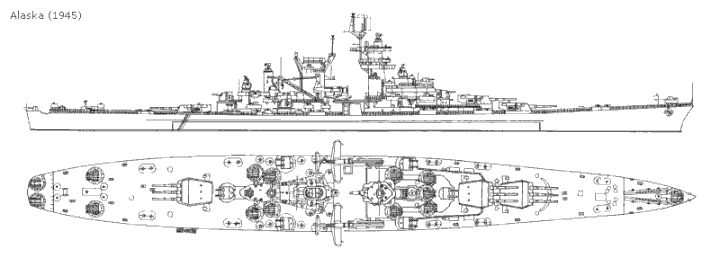
Line drawing of Alaska in 1945

The three ships of the Alaska Class though classed as “Large Cruisers” by the US Navy were actually the last Battle Cruisers designed, built and put into operation by any Navy.  Designed as a counter to the German Scharnhorst and Gneisenau which in 1939 and 1940 had created havoc in the Atlantic raiding convoys and sinking the Royal Navy Aircraft Carrier Courageous, the ships were 809 feet long and 91 feet wide, displaced 27,000 tons, mounted 9 12” guns mounted in three turrets and were capable of 33 knots.  The ships mounted a large anti-aircraft battery of 12 5” 38 Dual Purpose guns, 56 40mm cannon and 34 20mm light anti-aircraft guns.

The Scharnhorst: She and the Gneisenau were the threat that the Alaska’s were designed to counter

Alaska was laid down in December 1941 shortly after Pearl Harbor, launched 15 August 1943 and commissioned on 17 June 1944. Her sister ship, Guam was launched on 12 November 1943 and commissioned 17 September 1944.  The final ship of the class to be built the Hawaii was launched after the war in November 1945 with her construction halted when she was 84% complete in 1947. Three planned ships, the Philippines, Puerto Rico and Samoa were never laid down.

Aerial View of USS Alaska

While fast and large with more than adequate firepower the purpose that they created for no longer existed by the time that they were commissioned.  The German Scharnhorst had been sunk by a 12 ship British task force led by the HMS Duke of York on December 26th 1943 after mounting an attack on a Murmansk convoy at the Battle of North Cape.  Her sister Gneisenau had been heavily damaged in the “channel dash” and bombing in Kiel and while being refitted had the work discontinued after the sinking of the Scharnhorst.

The USS Guam in 1945

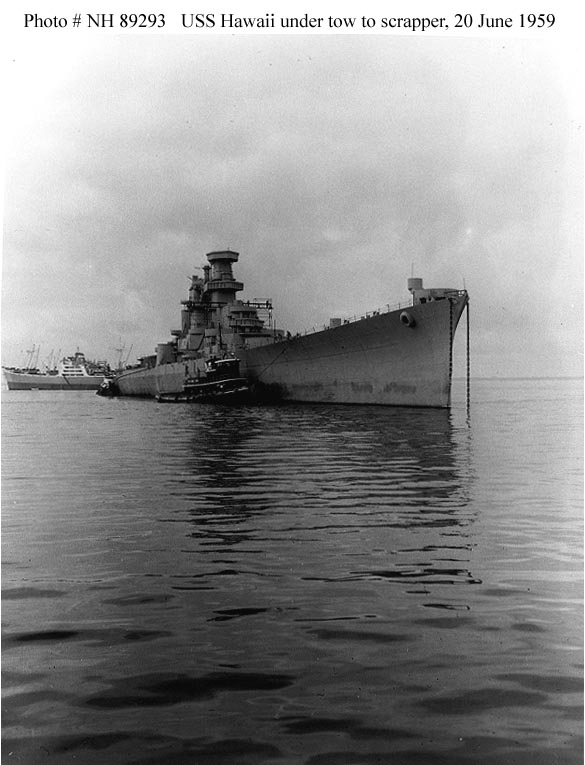
With their natural opponents no longer a factor in the war the Alaska and Guam were sent to the Pacific where they spent their time escorting fast carrier task forces, conducting naval gunfire support missions off Okinawa and conducting sweeps in Japanese waters as part of the initial blockade of Japan.  Following the war Alaska and Guam were active in Operation Magic Carpet the return of US servicemen from the Far East to the United States. Alaska and Guam decommissioned in February 1947 remaining in reserve until stricken from the Naval List and Alaska was scrapped in 1960 with Guam being scrapped in 1961 each having spent slightly over two years each in active service.   The fate of Hawaii would be debated including plans to complete her as the first guided missile cruiser (CG) and later Command Cruiser (CC).  Neither plan for Hawaii’s conversion and completion came to fruition and she was sold for scrap in 1959.

Incomplete and undervalued the Hawaii being towed to the breakers in 1959

The era of the Battle Cruiser which began with the launching of the HMS Invincible in 1907 and culminated in with launching of the HMS Hood ended with the Alaska Class. In a way it was an ignominious ending with practically unused ships being broken up when they would have been ideally suited for conversion to new missions.

In light of the need for a combination of substantial naval gunfire support on a platform large enough to support the latest air defense and, theater air defense and independent operations with substantial protection it seems to me that a new class of Battle Cruisers, in effect a new Alaska Class would be in order.  tried and true 8″, 12″ or 16″ guns Nuclear powered with the latest in Aegis missile defense systems and their own air group  they would be the most v versatile platform that the Navy has had in decades.

Peace

Steve+

26 Comments

Filed under History, Military, Navy Ships, world war two in europe, world war two in the pacific

Learning to Apply the Principles of Counterinsurgency Part One: Introduction to the Soviet-Afghan War

Soviets Enter Afghanistan

Note: This is the First Part of a Series which I will be writing on Afghanistan and Counterinsurgency strategy in that country. Part of this will be a review of various historical materials especially from Russian sources as well as analysis of the Afghan insurgency and its foreign supporters including Al Qaeda. I have written a number of other articles on the Afghan War and associated topics.  Links are provided at the end of this article.

Counterinsurgency is not just thinking man’s warfare—it is the graduate level of war. Special Forces Officer in Iraq, 2005

“Protracted conflicts favor insurgents, and no approach makes better use of that asymmetry than the protracted popular war. The Chinese Communists used this approach to conquer China after World War II. The North Vietnamese and Algerians adapted it to fit their respective situations. And some Al Qaeda leaders suggest it in their writings today. This approach is complex; few contemporary insurgent movements apply its full program, although many apply parts of it. It is, therefore, of more than just historical interest. Knowledge of it can be a powerful aid to understanding some insurgent movements.”[i]

Introduction

US Training Team Base

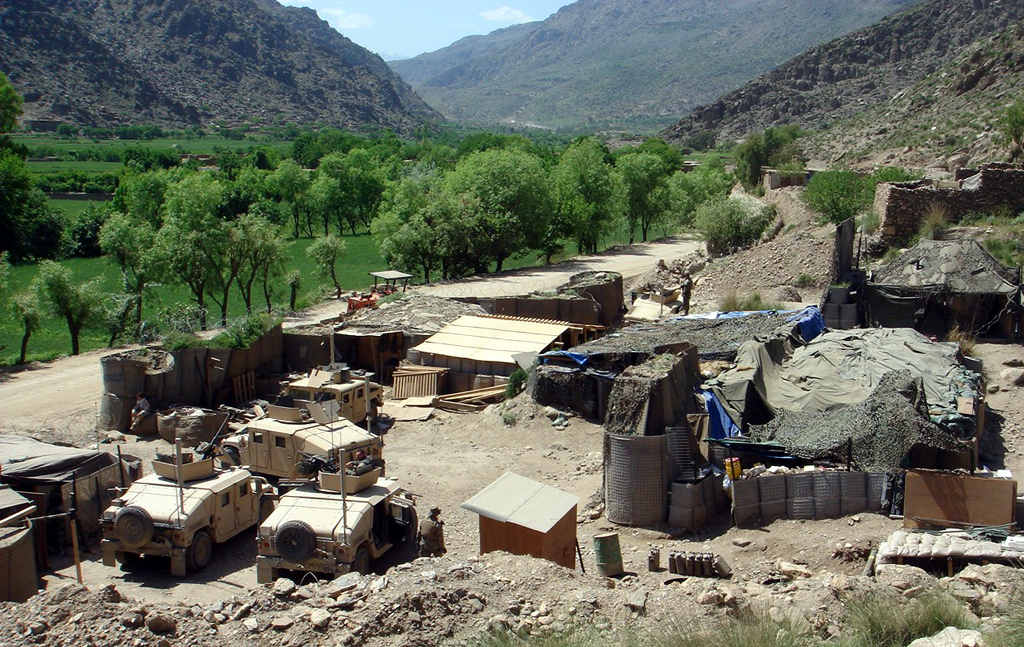
The United States has entered its 9th year of military involvement in Afghanistan following the October 2001 invasion that came as a response to the attacks on the World Trade Center and Pentagon of September 11th 2001.  In that time the United States, its NATO allies and the United Nations have endeavored to bring stability as well as a more democratic and accountable government to the country in the face of resistance from various political, religious and tribal groups with a diverse and sometimes conflicting agendas.  The foremost of these resistance groups was and is the Taliban which arose during the Soviet occupation of the country and eventually took power after winning a civil war against a number of other Mujahidin groups.   As the United States diverted force and focused its efforts on Iraq’s insurgency the Taliban using bases in remote areas along the Pakistani border and monetary and political support from Moslem groups with similar goals rehabilitated and reorganized its forces and began the process of regaining influence in Afghanistan.  By 2008 it was apparent that the situation had reached a crisis point.  The vast majority of Afghans as well as many in the international community came to view the Karzai government as corrupt, weak and unpopular.  The Taliban and other groups began to work more closely together despite differing agendas and the political and military situation deteriorated to the point that the incoming Obama administration appointed a new commander, General Stanley McChrystal to evaluate the situation and based on his recommendations and those of General David Petreus, Secretary of Defense Robert Gates and others announced a “surge” to try to regain the initiative in the country.  That troop buildup is currently underway. By the time it reaches its maximum the United States will have approximately 100, 000 troops in Afghanistan and the NATO and ISAF allies approximately another 38,000.  These are supporting and training the Afghan National Army and Police which number approximately 97,000 in the Army and another 98,000 in the National Police.  The Afghan forces have not proven to be reliable and have been infiltrated by Taliban and Al Qaeda members and the NATO and ISAF allies are often limited in the scope of their mission and have restrictive rules of engagement.  Thus the bulk of the fight rests on the United States and some allies with more robust rules of engagement such as Canada, Britain and France.  The lack of internal credibility of the Afghan Government, the weakness of its army and security forces coupled with the numerical weakness of US and ISAF forces has given the various indigenous insurgent groups, especially the Taliban to make a comeback that threatens the mission.  General McChrystal noted:

“The situation in Afghanistan is serious; neither success nor failure can be taken for granted. Although considerable effort and sacrifice have resulted in some progress, many indicators suggest the overall situation is deteriorating. We face not only a resilient and growing insurgency; there is also a crisis of confidence among Afghans—in both their government and the international community—that undermines our credibility and emboldens the insurgents. Further, a perception that our resolve is uncertain makes Afghans reluctant to align with us against the insurgents.”[ii]

Taliban Insurgents

The situation is such in Afghanistan that many Americans are struggling how the “good war” could go “bad.”  Many armchair strategists, many political and media figures and even some in the military fail to understand the nature of Counterinsurgency and its complexity as opposed to conventional warfare. In fact many of these assume that the simple application of combat force using conventional tactics is the cure for the situation, however history shows that such is not the case especially in Afghanistan.

This introduction to this study will focus on some commonalities of the Soviet and American experiences in Afghanistan.

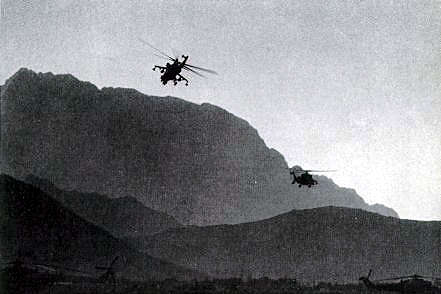
Soviet Mi-24s

The Soviets invaded Afghanistan in 1979 they used their 40th Army which initially was composed of “two motorized rifle divisions, an airborne division, an air assault brigade and separate motorized rifle regiments.”[iii] These forces totaled about 52,000 troops and were “considered sufficient to guarantee the viability of Afghanistan.”[iv] The 40th Army was a standard Cold War Soviet Combined Arms Army designed for high tempo conventional operations.  It was not designed for nor trained in counterinsurgency operations or what the Soviets and Russians class as “anti-guerilla operations.” It was poorly suited to mountain and dessert combat and at the beginning “not only had no practical skills in the conduct of counter-guerilla warfare, they also did not have a single well-developed theoretical manual, regulation or tactical guideline for fighting such a war.”[v]

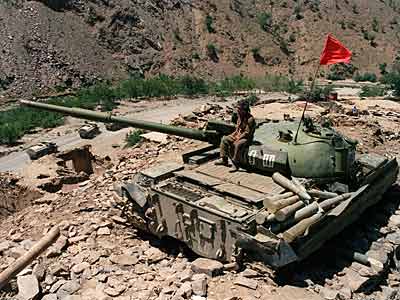
Soviet Tank Guarding Convoy

The Soviets did not expect to be involved in combat operations and the Afghan population reacted to their presence with resistance which spread across the country both against their own government which they viewed as a puppet of the Soviets but also against the Soviet Forces.  As time went on the Soviets attempted to use raids and large scale operations to attempt to bring Mujahidin forces to battle, however the insurgents were very skillful and the Soviets attempted to increase the training of their forces as well as their numbers.  By 1986 the numbers on the ground had increased to 108,000 personnel in four divisions, five separate brigades, four separate regiments and six separate battalions.[vi] In the nearly 10 years of operations over a half million Soviet soldiers and support personnel served in Afghanistan. Tours for enlisted personnel who were primarily conscripts served 12-18 months in country and officers 2 years.  Few returned for subsequent tours meaning that the 40th Army had few personnel very familiar with the country, its people and the challenges faced by Soviet forces.  According to official sources the 40th Army suffered 13,833 killed in action or died of wounds, 49,985 wounded and 311 missing in action a figured of 1 in 8 Soviet Soldiers being casualties.  14.3 percent of the casualties were officers.[vii] Of course the official figure is doubted many believing the number killed in action or died of wounds to be closer to 26,000.[viii]

Soviet Troops Preparing to Leave Afghanistan 1989

The Soviet Forces supported the Army of the Democratic Republic of Afghanistan which numbered at their peak on average between 120,000-150,000 soldiers.[ix] The Afghan forces, then as now were at the mercy of tribal, familial and communist party affiliations. Over 70 percent of the DRA was conscripted, desertions averaged 1,500 to 2,000 soldiers a month and units were usually optimistically 25-40 percent under their TO&E strength.[x] Limitations on training and leadership meant that typically DRA units could not conduct large scale missions without Soviet help. As such most of the fighting was done by Soviet formations.

Many of these problems have plagued the United States and ISAF throughout the first 8 years of the current Afghan War.  As General McChrystal has noted in his assessment “ISAF is a conventional force that is poorly configured for COIN, inexperienced in local languages and culture, and struggling with the challenges inherent to coalition warfare. These intrinsic disadvantages are exacerbated by our current culture and how we operate.”[xi]

End of part one to be continued…

Links:

Lessons on Coalition Warfare: The Dysfunctional Coalition German and the Axis Partners on the Eastern Front

The Afghan War 2009-2012: Lessons from Algeria 1954-1960 A Review of “A Savage War of Peace

Unequal Allies: Lessons from The German’s and Their Allies on the Eastern Front for Today

The Effects of Counter-Insurgency Operations on U.S. and French Forces in Vietnam and Algeria and Implications for Afghanistan

Brothers to the End…the Bond between those Who Serve Together in Unpopular Wars


[i] ______________ “The Army/Marine Corps Counterinsurgency Manual FM 3-24 MCWP 3-33.5,” HQ Department of the Army and HQ Marine Corps Combat Development Command, Washington DC 2006.  p. 1-6

[ii] MCChrystal, Stanley. “Commander’s Initial Assessment Commander International Security Assistance Force Afghanistan” dated 30 August 2009 p. 1-1

[iii] The Russian General Staff. The Soviet Afghan War: How a Superpower Fought and Lost” translated and edited by Lester A. Grau and Michael A. Gress, University Press of Kansas, Lawrence KS 2002 p.17.

[iv] Ibid. p.18

[v] Ibid. p.43

[vi] Ibid. p.28

[vii] Ibid. p.309

[viii] Ibid. p.xix

[ix] Ibid. p.48

[x] Ibid. pp.48-51

[xi] McChrystal. p.1-2

1 Comment

Filed under counterinsurency in afghanistan, History, iraq,afghanistan, Military

The American Civil War and the Origins of Modern Warfare

Hagerman, Edward. The American Civil War and the Origins of Modern Warfare. Midland Book Editions, Indiana University Press. Bloomington IN. 1992

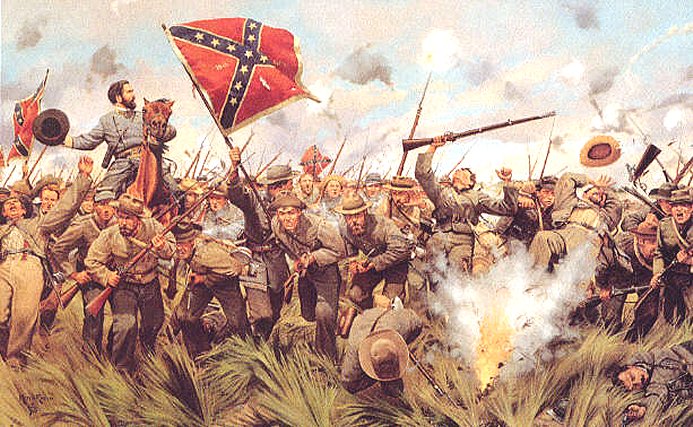
Pickett’s Charge Displayed the Futility of Napoleonic Tactics Against Modern Weaponry

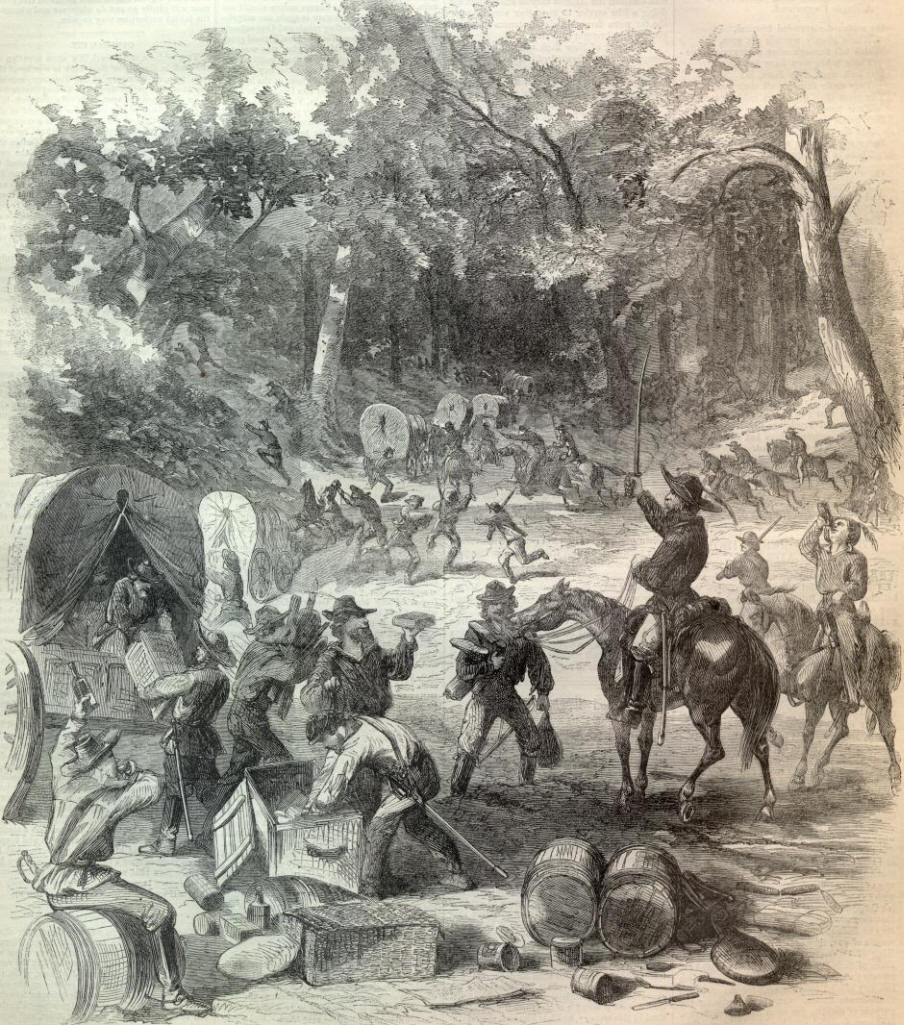
Edward Hagerman postulates in The American Civil War and the Origins of Modern Warfare that the American Civil War is the first modern war. He examines developments in tactics, logistics and the concept of total war and looks specifically how tactical and strategic thought impacted the war.  Specifically Hagerman examines how Henri Jomini’s interpretation of Napoleonic warfare and the theories of Dennis Hart Mahan and Henry Halleck which were the prevalent military thought in America were challenged by advances in weaponry and the vastness of the American continent.  He surveys how the Union and Confederate armies learned the value and application of field fortifications and the limitations of artillery in the offense.  Even more importantly Hagerman argues how logistics influenced campaigning on the American continent as opposed to earlier European wars. Likewise he examines how the 20th Century concept of total war found its first application in the campaigns of General Sherman and how Robert E. Lee’s use of defensive maneuver and fortifications in positional warfare heralded a new era in warfare.

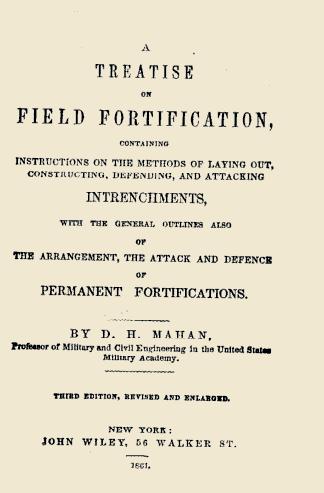
Dennis Hart Mahan’s Book: The First American Book on Military Theory

Hagerman examines how these factors influence and affected the Union and Confederate armies.  His initial focus is the tactical conundrum posed by the advances weaponry particularly the rifled musket to the Napoleonic tactics that both armies began the war. Napoleonic tactics were developed at a time when the maximum effective range of muskets was barely 100 meters and how despite the increase in range and accuracy that came with the rifled musket how tactical formations and tactics were slow to change.

Hagerman spends the first part of his book examining how the ante-bellum US Army leadership was influenced by the theories of Henri Jomini. He discusses the challenge to Jominian orthodoxy by Dennis Hart Mahan, who modified “the current orthodoxy by rejecting its central tenants-primarily offensive assault tactics.”[i] He examines the tension in American military thought between the conservative Jominian thinking which predominated much of the Army, noting that within the army “Mahan’s decrees failed to win universal applause.”[ii] However, Mahan influenced many future leaders of both the Union and Confederate armies in his “Napoleon Club” a military round table at West Point.[iii] Hagerman notes that Mahan’s greatest contributions were his development of the active defense and emphasis on victory through maneuver. Unlike Jomini, who thought maneuver as risky with the purpose of the “defeat of the enemy’s army,” Mahan emphasized “maneuver to occupy the enemy’s territory or strategic points.”[iv] In the book Hagerman wrestles with disjointed developments in infantry, artillery and cavalry tactics of the ante-bellum Army which and surmises that “Military thinking, and even more strategic organization, remained essentially within the Napoleonic tradition filtered through an eighteenth-century world view….” He asserts that “A broader vision was necessary to pose an alternative to the mechanistic program.”[v]

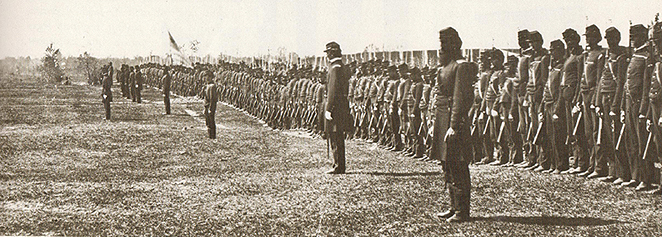
The 2nd Michigan Regiment: Most Civil War Units on both sides were State Regiments

Hagerman then discusses wartime developments in strategy, tactics and organization as they developed in both the Eastern and Western theaters.  He focuses on the themes of organization, logistics, communications, weaponry, field fortifications and maneuver. In each chapter he weaves these themes to show how they affected campaigns or were modified during the war based on experience.  He deals with leadership, but mostly in the context of how leaders responded to challenges posed in these arenas.  Of particular interest to him are the early efforts of successive commanders of the Army of the Potomac including McClellan, Burnside and Hooker to deal with these problems as well as the responses of Grant, Sherman and Rosecrans in the West to the same issues.

Hagerman’s discussion of army organization focuses on how each army developed sociologically as well as professionally prior to and during the war. He examines the ways that commanders educated at West Point initially dealt with large armies made up of militia units and volunteers and how these armies would be changed by the war.  He includes in the discussion i the institution of the draft in both the North and South.  His discussion of how McClellan successful fought the break-up of the Regular Army keeping it separate from the militia units organized by the States was important to development of the Army. He notes their importance and points out the problems of the militia units raised by the various states particularly in the early part of the war.

The Integration of Sea and Land Logistics Systems in the Civil War Revolutionized the Way that Modern War is Supplied

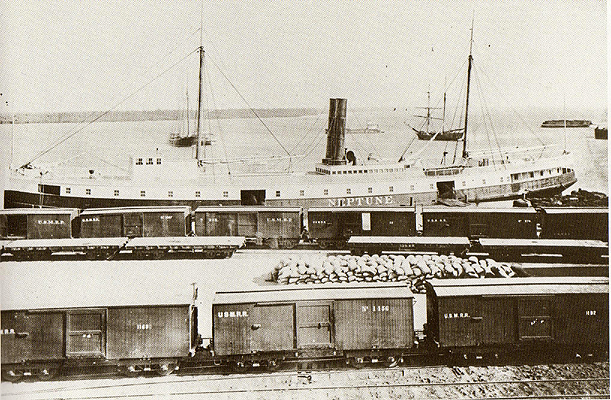
More significant to Hagerman’s narrative is his emphasis on logistics, and how each Army responded to the challenges of supplying their armies in the field.  Hagerman examines how the ante-bellum Army developed its logistic doctrine from the Napoleonic examples and how that doctrine had to be modified in light of the American reality of a less developed continent with far greater distances involved.

Hagerman’s discussion of logistics is quite detailed.  He examines topics such as the number of wagons per regiment and how army commanders, modified that number at various points during the war based on their situation. He discusses the development of the “flying column” as a response to the dependency on wagons and basic load of food and ammunition carried by each soldier in order to increase strategic maneuverability.  He details the forage requirements for people and animals in each theater of operations and how each army responded to requirement of living off the land for much of their forage requirements and their relative successes and failures in supplying their soldiers in this fashion.

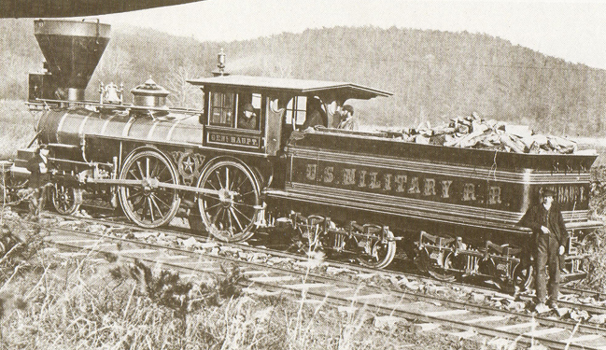
Railways Meant the Ability to Move Troops and Supplies Great Distances very Quickly

Hagenman discusses the use of railroads and the use of naval forces to both assist the ground forces and to move supplies and troops.  In each of these areas he provides a detailed examination of the effect of logistical considerations on each army.  He notes that of all the areas of development that the Army of the Potomac was successful at putting logistic theory into practice. By late 1863 the Army of the Potomac demonstrated “the close integration of operational planning and that of the general in chief and supply bureaus. In this one area, the development of a mature and modern staff was evident.”[vi]

Hagerman’s discussion of the development of communications in both armies focuses on the fact that the size of the armies and the distances involved on the battlefield made command and control difficult.  As such each army experimented with signals organizations that used tradition visual signals and couriers but began to rely on the telegraph for rapid communications.  He deals with the conflict in the North between the Signal Corps and the Military Telegraph Service.  He discusses the use of wire telegraph equipment and the new Beardslee wireless telegraphs by the Signal Corps and how the Army eventually favored the traditional wire bound networks operated by the Military Telegraph.  Though the Army rejected the Beardslee equipment some commanders requested it for their operations.[vii] As they became more dependent on such communications armies feared that their signals could be compromised through wire tapping and made efforts to encode transmissions.

Signal Corps Soldiers and Wire Communications

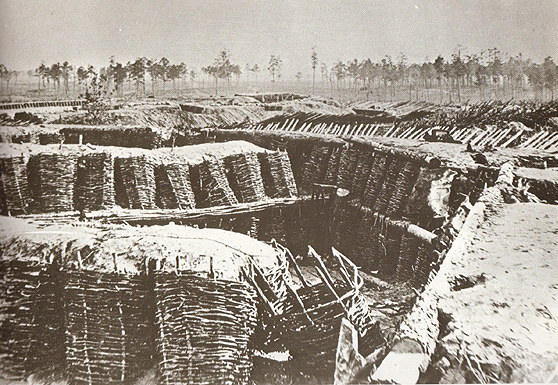
Hagerman’s discusses the evolution of the Union and Confederate armies use of field fortifications including their use in offensive campaigns.  He discusses their use by McClellan on the Peninsula in 1861 and Lee’s sporadic use of them[viii] until 1864 beginning in the Wilderness campaign and culminating in the defense and siege of Petersburg.  Hagerman’s thesis is that the developments in field works and firepower gave the advantage to the defense when armies made the frontal attacks which were at the heart of Jominian theory.  He notes how various commanders including Grant failed at Shiloh and Lee at Antietam failed to dig in, but how both the Union and Confederate armies learned to dig hasty field works as a matter of course.[ix]

Both sides also learned to use maneuver in combination with positional warfare to force the enemy to battle. Hagerman examines the campaigns in the West of Grant, Sherman and Rosecrans, particularly Stone’s River, the Vicksburg Campaign, and the campaign in middle Tennessee.[x] The last two chapters mention these issues in the context of the 1864-65 campaign around Richmond and Sherman’s campaigns in Georgia and the Carolinas.  Of particular note is how Sherman’s forces routinely entrenched on the offensive[xi] and how Confederate forces under Joseph Johnston employed entrenchments on the defensive. Hagerman notes how Confederate Cavalry “perhaps best displayed the growing intensity of trench warfare” noting General Joe Wheeler’s use of them at the close of the war.[xii]

Massive Siege Mortar outside Petersburg

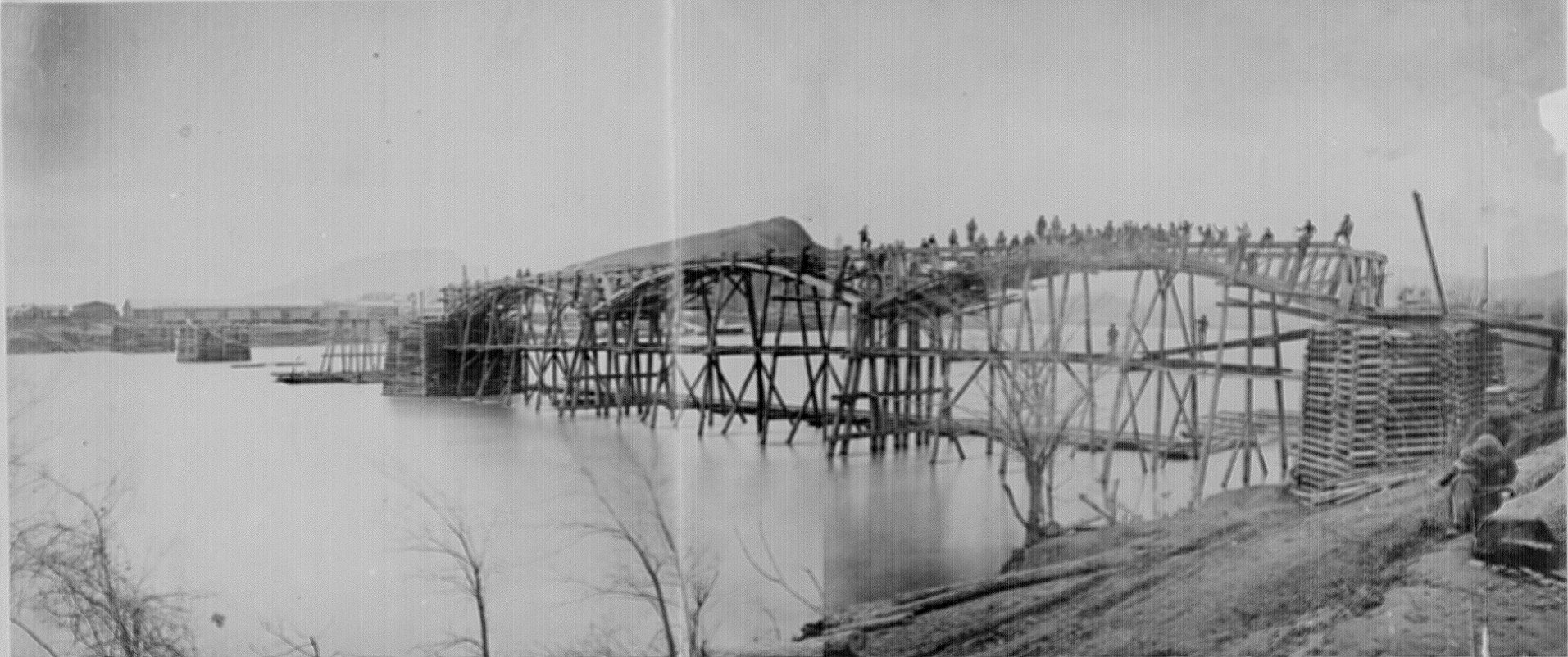
A sidebar to Hagerman’s discussion of fortification is his examination of the Corps of Engineers.  He discusses the development of Engineering or Pioneer units from nothing in 1861 to organized units by the middle of the war.  He examines the problems of the Engineering Corps in adjusting to the war. He notes its dispersion among the line and its civil duties as impediments to responding to the needs of war and both the hesitancy and resistance to creating engineering units by Congress, despite the pleas of McClellan and Lincoln.[xiii] He then looks at the institutional irony of the how newly organized engineer units had few West Point trained Corps of Engineers officers, but were primarily staffed and commanded by officers detailed from the line. The effect was a “decline in the antebellum definition of professionalism embodied in the Corps of Engineers.”[xiv]

Engineering Units were Built from Scratch and Accomplished Many Feats

Petersburg Fortifications a Harbinger of World War One

Hagerman’s last two chapters focus on the developments in the strategies of attrition and exhaustion in relation to positional and maneuver warfare.  He examines how this was by Grant in Virginia and Sherman in Georgia and the Carolinas.  He discusses the “ascendancy of positional warfare” which allowed Lee to hold out and force Grant into winter quarters at Petersburg.[xv] This demonstrated that “an army fighting on interior lines, even under nearly overwhelming conditions of deprivation and against vastly superior numbers, could sustain a prolonged existence by use of field fortification and defensive maneuver.”[xvi] Sherman’s campaign demonstrated how an army could exploit “diversion, dispersion, and surprise to successfully pursue a modern total-war strategy of exhaustion against the enemy’s resources, communications and will.”[xvii]

Sherman’s March to the Sea

Hagerman’s book is particularly strong in the discussion of tactical developments and logistics and how those were developed over the course of the war.  It is strong because it allows the serious student to trace the developments in each of the areas he examines to future wars fought by the US Army.  Russell Weigley picks up the effect of what Hagerman describes in his books The American Way of War discussing both Grant’s strategy of annihilation and its costs, and in Sherman’s campaign against Johnston and attack upon Southern resources.[xviii] His discussion of tactics reflects that of J.F.C. Fuller notes that “the tactics of this war were not discovered through reflection, but through trial and error.”[xix] The events described by Hagerman, especially the campaigns of Grant and Sherman influence modern strategy including that of the Marine Corps which discusses maneuver and attrition warfare continuum in MCDP 1 Warfighting.[xx] Hagerman’s work is best at helping tie the elements of war often ignored by other Civil War historians into a coherent whole that allows the reader to see the logical development of each of these elements in modern war.

Irregular Formations Such as Mosby’s Raiders Would Create Problems Behind Union Lines

Hagerman’s value to the literature is that he fills a void among many Civil War writers who often focus simply on the battles and campaigns and not arcane but important subjects such as transportation, logistics, communications and fortifications.  Hagerman makes an astute observation on how change comes to military organizations at the end of his discussion of the Corps of Engineers and the Army following the war.  He notes “that change in war requires time for digestion before lessons are converted-if they are converted-into theory and doctrine.” [xxi] In the light of the Pershing’s strategy in the First World War One, which revisited some of the worst mistakes of the Civil War one wonders if those lessons were ever fully digested by the Army. Such an observation can be made about our present war.  We need to ask if the lessons of previous insurgencies in conquered areas have been digested, even going back to the lessons of the Union Army operating in the hostile lands of the conquered Confederacy.[xxii] Likewise how an Army adjusts to developments in weaponry, technology and tactics are fair game when one analyzes past campaigns in relation to current wars.  Thus when we look at Hagerman it is important to use his work to understand the timeless aspects of military history, theory, doctrinal development, logistics, communications and experiential learning in war that are with us even today.


[i] Hagerman, Edward. The American Civil War and the Origins of Modern Warfare. Midland Book Editions, Indiana University Press. Bloomington IN. 1992. p.9

[ii] Ibid. p.13.

[iii] Hagerman also notes the contributions of Henry Halleck and his Elements of Military Art and Science published in 1846 (p.14) and his influence on many American Officers.  Weigley in his essay in Peter Paret’s Makers of Modern Strategy would disagree with Hagerman who notes that in Halleck’s own words that his work was a “compendium of contemporary ideas, with no attempt at originality.” (p.14) Weigley taking exception gives credit to Halleck for “his efforts to deal in his own book with particularly American military issues.” Paret, Peter editor. Makers of Modern Strategy: For Machiavelli to the Nuclear Age Princeton University Press, Princeton NJ 1986 p.416.

[iv] Ibid.

[v] Ibid. p.27.

[vi] Ibid. p.79.

[vii] Ibid. p.87.

[viii] The most notable use of them between the Peninsula campaign and the Wilderness was at Fredericksburg by Longstreet’s Corps. Many wonder why Lee failed to entrench at Antietam.

[ix] Fuller, J.F.C. Grant and Lee: A Study in Personality and Generalship, Indiana University Press, Bloomington IN 1957.  Fuller comments “Thus over a year of bitter fighting was necessary to open the eyes of both sides to the fact that the trench was a by product of the rifle bullet, and like so many by-products, as valuable as the product itself.” (p.269) He calls it “astonishing that Lee, an engineering officer, made no use of entrenchments at the battle of Antietam.” (pp.269-270)

[x] Ibid. pp. 198-219.

[xi] Ibid. p.295.  Hagerman comments how Sherman’s troops outside Atlanta began to entrench both the front and rear of their positions.

[xii] Ibid. p.297-298.

[xiii] Ibid. p.238.

[xiv] Ibid.

[xv] Ibid. p.272

[xvi] Ibid. p.274.

[xvii] Ibid. p.293.  B.H. Liddell-Hart in comparing the campaigns of Grant and Sherman makes an important note that Sherman’s strategy is more “suited to the psychology of a democracy…” and “ he who pays the piper calls the tune, and that strategists might be better paid in kind if they attuned their strategy, so far as rightly possible, to the popular ear.” Liddell-Hart, B.H. Strategy Faber and Faber Ltd, London 1954 and 1967, Signet Edition, The New American Library, New York 1974 p.132

[xviii] Weigley, Russell F. The American Way of War: A History of United States Military History and Policy University of Indiana Press, Bloomington IN, 1973. pp.145-146.

[xix] Ibid. Fuller. P.269  A similar comment might be made of most wars including the current Iraq war.

[xx] ___________. MCDP-1 Warfighting. United States Marine Corps, Washington D.C. 1997. pp. 36-39

[xxi] Ibid. Hagerman. P.239

[xxii] Ibid. Fuller. Fuller’s comments on the situation of the Northern Soldier are eerily similar to our current conflict in Iraq : “Consequently, minor tactics were definitely against the Northern soldier, because his major tactics demanded the offensive; for without the offensive the South could not be brought to heel.  It was the problem which had faced the French in LaVendee and in the Peninsula of Spain, which faced Napoleon in Russia, and the British in South Africa during the Boer War of 1899-1902. Not only was the Northern soldier, through force of circumstances, compelled to fight in the enemy’s country, but he was compelled to devastate it as well as conquer it, in order to protect himself against the bands of irregular troops which were here, there and everywhere.” pp.247-248

Bibliography

Fuller, J.F.C. Grant and Lee: A Study in Personality and Generalship, Indiana University Press, Bloomington IN 1957

Hagerman, Edward. The American Civil War and the Origins of Modern Warfare. Midland Book Editions, Indiana University Press. Bloomington IN. 1992

Liddell-Hart, B.H. Strategy Faber and Faber Ltd, London 1954 and 1967, Signet Edition, The New American Library, New York 1974

Paret, Peter editor. Makers of Modern Strategy: For Machiavelli to the Nuclear Age Princeton University Press, Princeton NJ 1986

Weigley, Russell F. The American Way of War: A History of United States Military History and Policy University of Indiana Press, Bloomington IN, 1973

___________. MCDP-1 Warfighting. United States Marine Corps, Washington D.C. 1997

1 Comment

Filed under History, Military

The Anomaly of Operation Desert Storm and Its Consequences Today

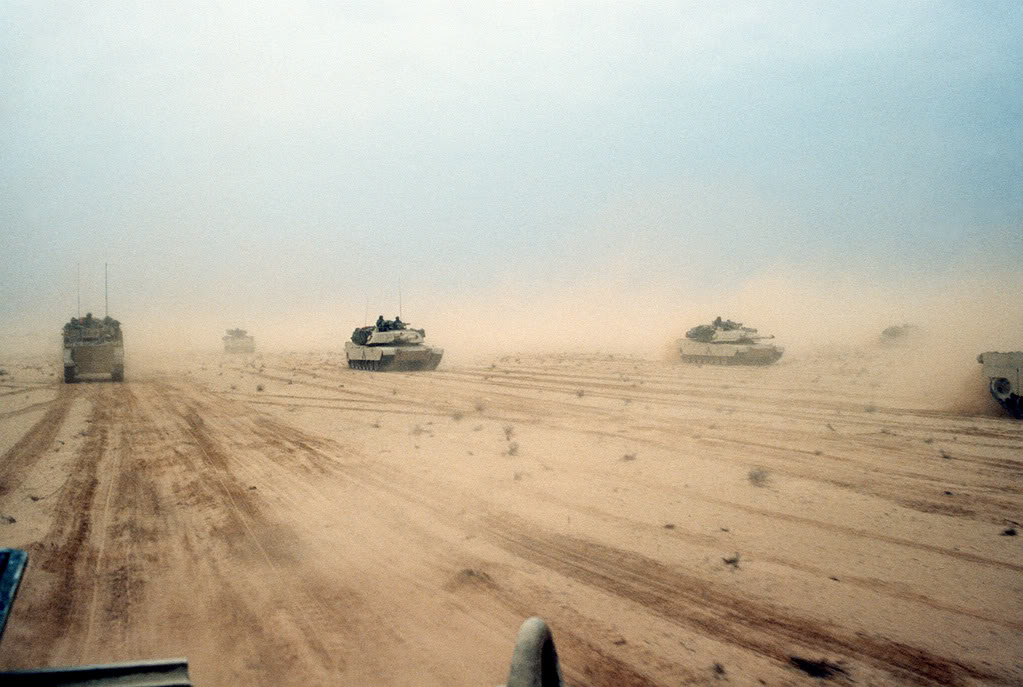
Armor Advancing During Operation Desert Storm

There are few occasions in history where an army is given exactly the scenario to which its organization, training and doctrine coalesce against an opponent that uses the template of organization and training that it has been designed to defeat.  Operation Desert Storm, the liberation of Kuwait by the United States and its coalition from Saddam Hussein’s Iraqi Army and Republican Guard was such a war. The operation was built up in the popular media to the extent that it created a false image of the cost of war and belief that wars can be won “one the cheap” because of superior technology and organization.  That belief was shattered during the Iraq insurgency which began in earnest following the occupation of Iraq following the defeat of Saddam in 2003 by a significantly smaller US force than was used to liberate Kuwait twelve years before.

Architects of Desert Storm

The superior performance of the Army in the Gulf War did not turn out to be the template of how future wars would be fought.  In the following years the US military has become embroiled in conflicts where opponents use inexpensive and often crude off the shelf technology to counter conventional US superiority in firepower and organization.

During the First Gulf War the Army was aided in that the doctrine that it developed to fight a war in Europe against the Warsaw Pact, the Airland Battle was “perhaps best suited to armored warfare in the open desert.”[i] Of course during Desert Storm this was exactly the setting that the Army would be called on to fight.  Unlike Vietnam where the Army attempted to fight an unconventional war with conventional tactics the Army had the chance to fight exactly the battle that it had trained for, against an enemy trained in the tactics and using the equipment of its former Soviet adversary.

The Army enjoyed the advantages of having “reached a high level of training and technological proficiency”[ii] against the Soviet threat. The fact that the Soviet Union and Warsaw Pact had melted down unexpectedly in 1989 and 1990 and removed any conventional threat in Europe which allowed the Army to concentrate massive amount of forces including the VII Corps from Germany to the Middle East was nothing short of incredible.  Additionally the Army had the advantages of superior weaponry and the fortuitous timing of the war before the effects of the post-Cold War drawdown were realized.

For the Army the “1980s were a golden age of military thought and debate,”[iii] and the Airland Battle concept “was greeted with enthusiasm throughout the Army.” Terms such as initiative, agility, synchronization and depth….soon became part of every officer’s vernacular.”[iv] Colonel Harry Summers who had written a critical history of the Vietnam War noted that FM 100-5, the Army’s primary manual of operations, was the “operational blueprint for Operation Desert Storm.”[v] That blueprint had a well trained and disciplined force schooled in the conduct of the Airland Battle concept enunciated in FM-100-5. David Halberstam noted that Operation Desert Storm was fought by a “professional army-a very professional army.”[vi] Seldom in the history of warfare was any army trained and equipped to fight the exact battle for which it found itself.

The Highway of Death

The foundation of doctrine, training, technology and organization laid in the 1980s was solid.  The Army was not only effective in the Gulf War, it was overwhelming.  This is not to say that the Army did not encounter problems.  It did, some which against a better trained and equipped force might have negatively impacts its operations. However the problems encountered did not keep it from dominating the battlefield.

The US rapidly deployed a blocking force of paratroops and Marines following the Iraqi invasion of Kuwait at the end of August.  While few in number they served as a deterrent that Saddam did not test. There was great concern that had Saddam pushed into Saudi Arabia when forces were small and lightly equipped that he might have succeeded in capturing the northeaster Saudi oil fields and production facilities.  The military leadership continually reinforced these forces first to a substantial defensive force and then with the addition of more forces a significant offensive force.  Thus when the decision was made to liberate Kuwait under the United Nations resolution the forces were there and ready.

When the war began advances in Joint warfare and C3 was evident in the effectiveness of the operations.[vii] Particular successes included the movement of VII and XVIII Airborne Corps into the desert to outflank the Iraqis in Kuwait[viii] and every actual engagement between Iraqi and American forces.  Of note was the performance of Major General Barry McCafferey’s 24th Mechanized Division,[ix] and the 2nd Armored Cavalry Regiment at 73 Easting against the Republican Guard’s Talwahkana Division.[x] Likewise the action of 2nd Brigade 1st Armored Division against the Guard’s Adnan Division at Madinah Ridge[xi] displayed the effectiveness and lethality of the Airland Battle and joint warfare concepts developed in the 1980s.

There were weaknesses and these included various aspects of command and control and fratricide[xii] brought about by the fast pace of operations and the fog of war. Likewise conflicts between General Schwartzkopf and some of his Army commanders, notably Generals Franks[xiii] and Yeosock hindered operations.  This occurred most notably in the failure to destroy the Republican Guard prior to the cessation of hostilities. This was partially was due to political considerations and faulty intelligence but was operational decision of Schwartzkopf to halt McCafferty’s  24th Mechanized Division before it could finish off Republican Guard units facing it or letting Franks complete his double encirclement of the Guard or encircle the key southern Iraqi city of  Basrah.[xiv]

The New Face of War Somalia

Iraq

Rwanda Genocide

Deadly Large Shaped Charge IED

Afghanistan: Brits in Action Against Taliban Fighters

Despite the successes of Operation Desert Storm the planners failed to anticipate the end state of what would happen when hostilities had ceased.  The conditions of the cessation of hostilities were the chief contention of many against the end to the ground war at the 100 hour point. Some argue that the early end of hostilities allowed the victory to be less than it could have been.  Some even today argue that the offensive should have gone forward with the goal of overthrowing Saddam, however despite its success the Army was not prepared for an occupation nor would have the coalition supporting the US have survived an invasion and occupation of Iraq.  The actual mistakes were not in the stopping of the war, but rather the faulty conditions of the cease fire which enabled Saddam to recover the internal control of Iraq and put down attempts to revolt especially around Basra in the Shia south.  Rick Atkinson in his book Crusade notes that there were “errors would be made in establishing conditions of the ceasefire…but stopping the war was no mistake.”[xv]

While the debate about Operation Desert Storm still persists nearly 20 years after the fact the more important lesson was not learned.  That lesson was that Operation Desert Storm was not the new face of war, but rather an anomaly.  It was a war that was the swan song of the Cold War where the doctrine, technology, organization and trained to and practiced were inflicted on a less well trained and equipped version of the force that they were designed to defeat, forces which were badly deployed and already isolated by airpower even prior to the ground war. Once the ground war started the Iraqi forces in Kuwait and southern Iraq had little chance against the massive US and coalition force arrayed against it short of preemptively using the chemical and biological weapons of which Iraq had an ample supply.  It did not employ these weapons for a number of reasons, but without them Iraqi forces exposed in the open desert with no air support and cut off from much of their supply by constant air attacks were easily defeated.

In the past 20 years the United States and the west have only once been able to reprise the type of war displayed during Operation Desert Storm.  That was in the initial 2003 invasion of Iraq.  While the forces deployed were successful in defeating the Iraqi military and overthrowing Saddam Hussein they were insufficient to secure the country especially after the decision to disestablish all Iraqi police and military forces which might have assisted US forces in securing the country.  Perhaps planners forgot that German military police, police and civil servants were employed by the western allies in the period immediately after the war even during the period of “de-Nazification.”

Instead of a litany of Desert Storm like scenarios US forces as well as those of NATO and UN allies have had to deal with terrorism, insurgencies, revolutionary wars, tribal wars of genocide and wars waged by religious extremists. Despite more than a decade in dealing with these types of war, many in the military and political establishment as well as the media and public opinion believed that Desert Storm was the model for future wars. As such after the brief period of euphoria which occurred after the initial phase of Operation Iraqi Freedom the grim reality of war has stared Americans and others in the west in the face.  While the military has performed well, it has had to adjust and learn lessons about war that it wanted to avoid during and after Vietnam.  Those were the lessons of counterinsurgency, unglamorous and unexciting they were the lessons buried after Vietnam which were ignored until it was nearly too late in Iraq and possibly now too late in Afghanistan.  Desert Storm was an anomaly and one does not base the future of war on the swan song of the last war.


[i] Atkinson, Rick. Crusade: The Untold Story of the Persian Gulf War, Houghton Mifflin Company, Boston and New York 1993. p.253

[ii] Gordon, Michael R. and Trainor, Bernard E. The Generals’ War, Back Bay Books, Little Brown and Company, Boston and New York 1995. p.467

[iii] Peters, Ralph. Fighting for the Future: Will America Triumph. Stackpole Books, Mechanicsburg , PA p.xi

[iv] Ibid. Atkinson.

[v] Summers Harry G. On Strategy II: A Critical Analysis of the Gulf War, Dell Publishing a Division of Bantam Doubleday Dell Publishing Group, New York NY 1992. p.159

[vi] Halberstam, David. War in a Time of Peace: Bush, Clinton and the Generals, A Touchstone Book published by Simon and Schuster, New York 2001. p.153.  Gordon and Trainor note that the “never in the history of the Republic has a more competent and more professional military been fielded.

[vii] See Summers pp. 243-245.  Summers is very complimentary of the advances in the Joint aspects of command and control that impacted the campaign.  He notes several points at the strategic and operational levels which are complimentary of individuals including comparing General Colin Powell to General George Marshall. Gordon and Trainor writing a few years later are more critical of the “jointness” of the Americans including valid criticism of the air campaign, fire support coordination, and differences in doctrine between Marines and Army and the way the VII Corps and XVIII Corps operated based on the way that they trained and organized. Pp.471-473

[viii] Atkinson pp.309-310.  Atkinson discusses the fact that American commanders involved had seldom maneuvered units of battalion or brigade size prior to this operation.

[ix] The 24th made a great advance to the Euphrates but as Atkinson notes that it had “encountered no enemy resistance at all.” p.406

[x] See Atkinson pp. 441-448

[xi] See Atkinson pp.466-467.  In a 40minute fight the M1A1s destroyed 60 T-72s and dozens of APCs at a cost of one American KIA.  Atkinson notes that this battle like the action at 73 Easting “was waged with tactical acumen and devastating firepower….”

[xii] Ibid Atkinson pp.315-316.  Atkinson notes that there were 28 incidents with 35 killed and 72 wounded.

[xiii] Ibid. pp.405-407.  Schwartzkopf felt that Franks was not aggressive enough and that VII Corps was “sluggish” and “ceding the initiative to the Republican Guard.”  Schwatzkopf even threatened Yeosock that he would fire Franks.

[xiv] Ibid. Atkinson p.476

[xv] Ibid. p.477

Bibliography

Atkinson, Rick. Crusade: The Untold Story of the Persian Gulf War, Houghton Mifflin Company, Boston and New York 1993

Gordon, Michael R. and Trainor, Bernard E. The Generals’ War, Back Bay Books, Little Brown and Company, Boston and New York 1995

Halberstam, David. War in a Time of Peace: Bush, Clinton and the Generals, A Touchstone Book published by Simon and Schuster, New York 2001

Ralph. Fighting for the Future: Will America Triumph. Stackpole Books, Mechanicsburg , PA

Summers Harry G. On Strategy II: A Critical Analysis of the Gulf War, Dell Publishing a Division of Bantam Doubleday Dell Publishing Group, New York NY 1992.

8 Comments

Filed under Foreign Policy, History, iraq,afghanistan, Military, national security

They Held the Line: The USS Yorktown CV-5, USS Enterprise CV-6 and USS Hornet CV-8, Part Two the Hornet

USS Hornet CV-8 Building at Newport News VA

This is part two of a three part series about the USS Yorktown Class Aircraft Carriers. Part one serves as an introduction as well as the story of the lead ship of the Class, the USS Yorktown CV-5.  Part One about the Yorktown is located here: https://padresteve.wordpress.com/2009/12/27/they-held-the-line-the-uss-yorktown-cv-5-uss-enterprise-cv-6-and-uss-hornet-cv-8-part-one/

Hornet as Completed off Hampton Roads shortly after Her Commissioning

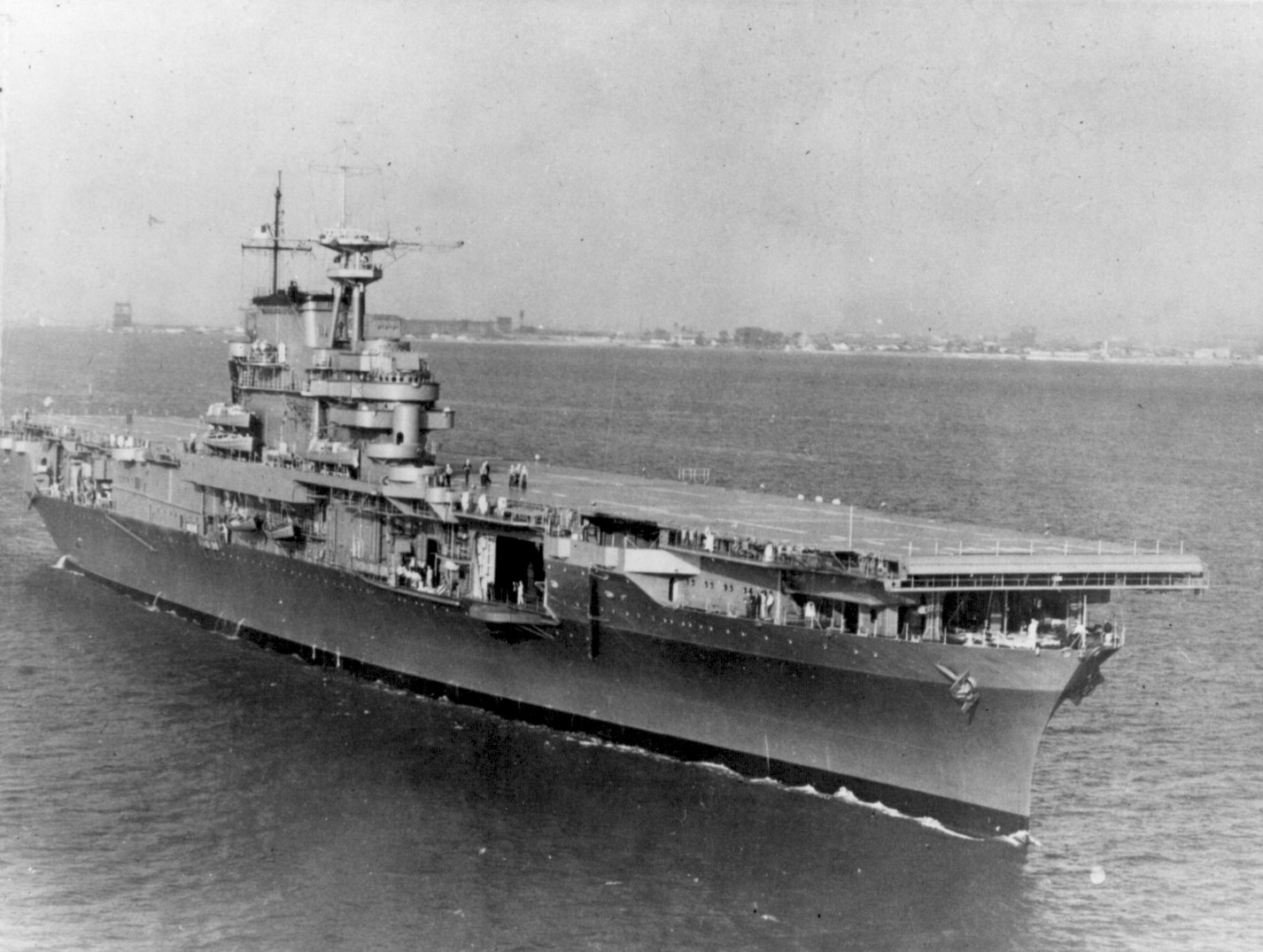
The USS Hornet CV-8 was the third ship of the Yorktown Class and is sometimes referred to as her own one ship Hornet Class.  Laid down on 25 September1939 under the Naval Expansion act of May 17th 1938, Hornet was part of the pre-war naval build up authorized by President and Congress.  The previous Yorktown design was used to speed construction.  Hornet was slightly modified from her sisters Yorktown and Enterprise being 15 feet longer, 5 feet wider in the beam and displacing about 1000 tons more than her near sisters.  Her anti-aircraft armament was also slightly improved.  As with her near sisters Hornet had good protection except that her underwater protection was weak.  However, as would be born out in combat Hornet like her sisters would prove to be extraordinarily tough.

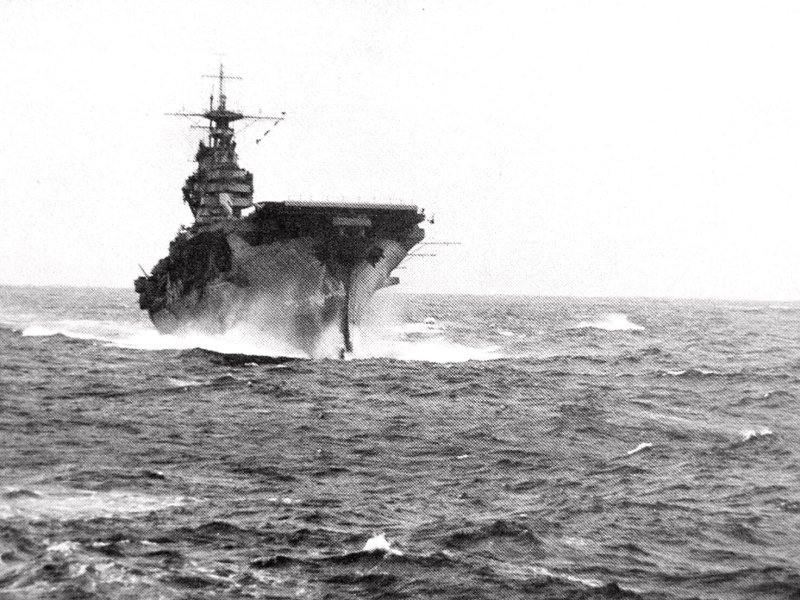
Hornet in Rough Seas Preparing to Launch the Doolittle Raid

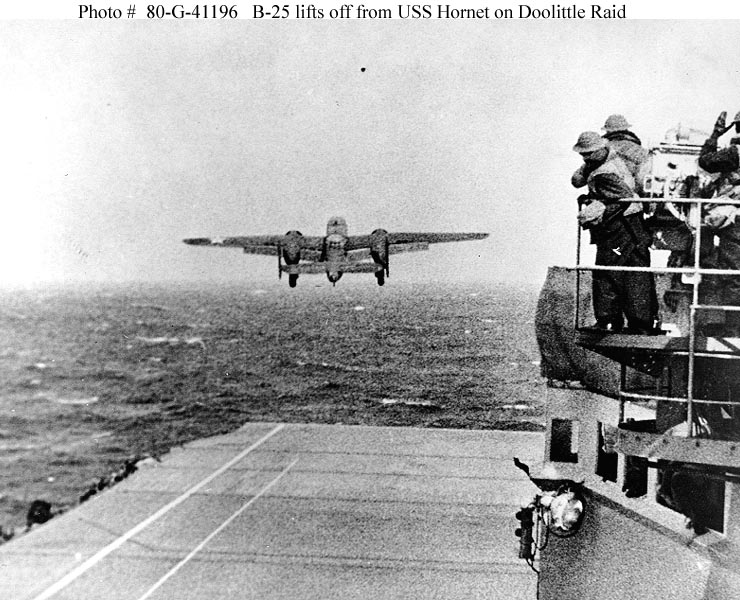
Hornet was launched on 14 December 1940 and commissioned 25 October 1941 with Naval Aviation pioneer Captain Marc A Mitscher Commanding. Hornet conducted her initial training and air group qualifications while operating out of Norfolk.  On February 2nd two Army Air Corps B-25 Medium Bombers were loaded aboard.  As Hornet put to sea the bombers were launched to the astonishment of the crew. Hornet departed Norfolk for the Pacific where she embarked 16 B-25s under the command of Colonel Jimmy Doolittle.  Hornet’s own air group was stowed in the hanger bay.  On April 2nd Hornet departed from San Francisco for a rendezvous with Admiral Halsey’s Task Force 16 and her sister ship Enterprise.  As the ship departed Mitscher informed the crew of their mission.  Hornet would launch Colonel Doolittle’s aircraft against the heart of the Imperial Japanese Empire, Tokyo.

Hornet Launching B-25

The plan was for the task force to sail to 400 miles from Japan and launch the bombers. Enterprise was to provide air cover for the task force while Hornet’s air group was inaccessible while the bombers remained aboard.  On the morning of 18 April the task force was spotted by a Japanese patrol boat.  The craft was quickly dispatched by the heavy cruiser USS Nashville but not before the craft had reported the presence of the task force.  Though the task force was still 600 some miles from Japan Halsey ordered that Doolittle’s aircraft be launched against Tokyo.  The attack while militarily insignificant came as a major surprise to the Japanese who anticipating a raid by naval aircraft believed that any attack could not take place until the following day.  Even more significantly the attack stunned the Japanese military establishment, especially the Navy. The attack would provoke Admiral Yamamoto to attack Midway in order to draw out the American carriers and destroy them.

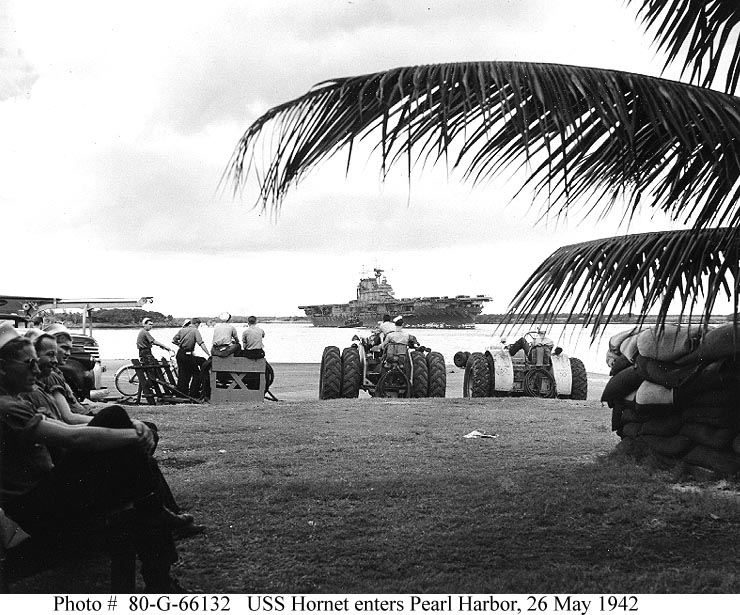
Hornet Arrives at Pearl Harbor Before Midway

Hornet along with Task Force 16 sailed back to Pearl Harbor arriving a week later and the mission would remain secret for over a year.  The task force steamed to assist the Yorktown and Lexington at the Battle of Coral Sea but that battle was over before they could arrive.  The task force returned to Pearl Harbor on the 26th of May and sail on the 28th for Midway.  Hornet’s air group was plagued with bad luck.  Torpedo Squadron 8, or Torpedo 8 commanded by LCDR John Waldron found and attacked the Japanese task force losing all aircraft and all pilots save one.  6 new TBF Avengers from her air group operating from Midway met with heavy losses in their attack against the Japanese.  Only one pilot from Torpedo 8 with Waldron’s group survived, Ensign George Gay.  Hornet’s dive bombers followed bad reports of the location of the Japanese carriers and took no part in the action.  Many would have to ditch in the ocean as they ran out of fuel.  Hornet’s air group would help sink the Japanese Heavy Cruiser Mikuma and heavily damaged Mogami on the 6th.  The Battle of Midway was one of the major turning points of the war.  The Japanese had lost six carriers which had attacked Pearl Harbor along with their aircraft and many of their highly trained pilots and flight crews. Coupled with their losses at Coral Sea the Japanese suffered losses that they could ill afford and could not easily replace.

Following Midway Hornet had new radar installed and trained out of Pearl Harbor until order to the Southwest Pacific to take part in the struggle for Guadalcanal.  By the time she arrived she was the only operational American carrier in the Pacific. Enterprise had suffered bomb damage at the Battle of Easter Solomons on August 24th; Saratoga was damaged by a submarine torpedo on August 31st and the Wasp was sunk by a submarine on September 15th.  In the space of 3 weeks the United States Navy had lost 3/4ths of its operational carriers in the waters off of Guadalcanal. Hornet now faced the Japanese alone, providing much of the badly needed air support for the Marines fighting ashore.

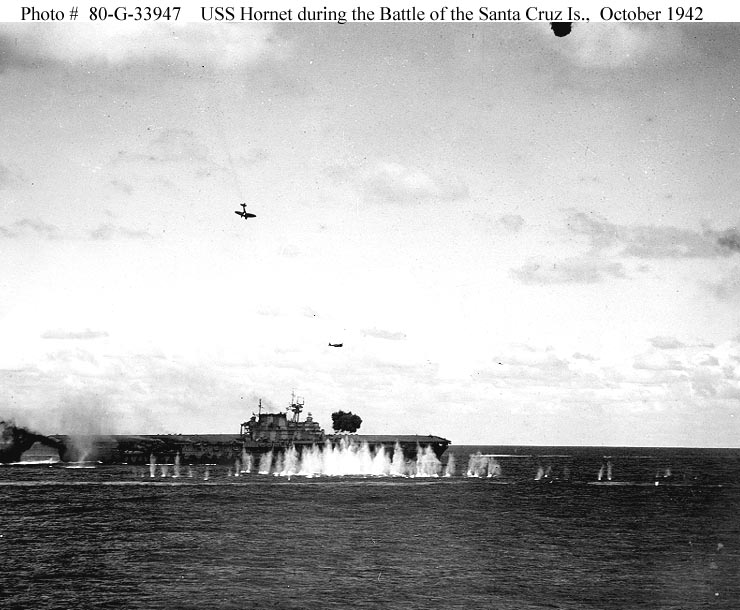
Hornet Under Attack: Note “Val” Dive Bomber about to crash ship

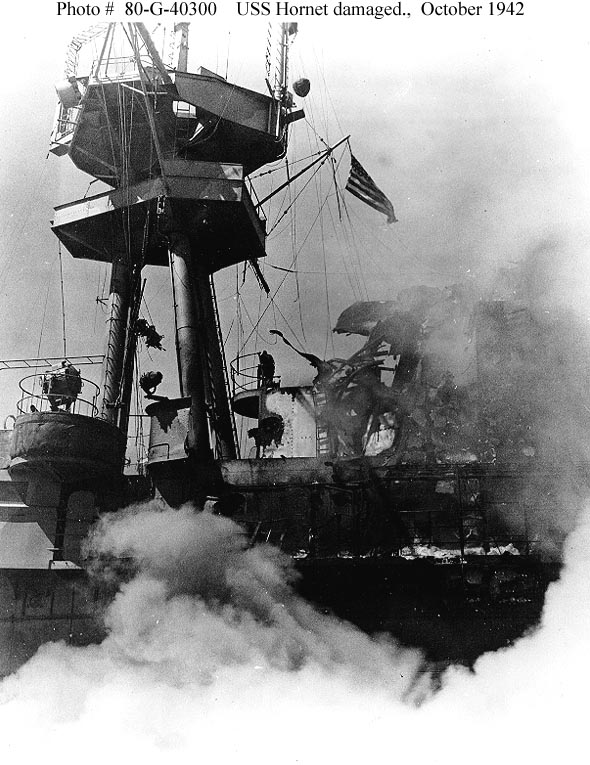
The Enterprise rejoined Hornet following hasty repairs off the New Hebrides Islands on October 24th.  On the 26th they joined battle with a Japanese task force of 4 carriers centered on the veterans Shokaku and Zuikaku. The Hornet’s aircraft attacked and seriously damaged Shokaku even as Japanese torpedo planes and dive bombers launched a well coordinated attack against Hornet. Hornet was hit by three bombs, two torpedoes and had two Vals dive into her with their bombs.  On fire and without power her damage control parties fought to regain control of the ship and extinguish the fires that blazed aboard her.

Hornet’s Damaged Island and Main Mast

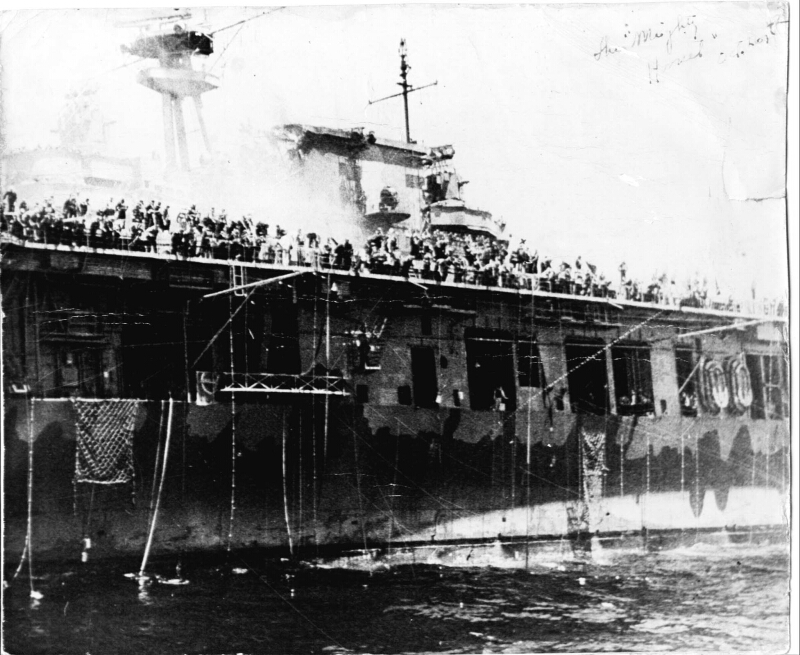
Assisted by the heavy cruiser Northampton which took her in tow her crew brought the fires under control and were close to restoring power when another Japanese strike group found her and put another torpedo into her.  With this hit Hornet’s list increase and she was abandoned even as she was hit by another bomb.  With Japanese ships in the area it was decided to scuttle the ship. Escorting destroyers hit her with 9 torpedoes and over 400 rounds of 5” shells.  As Hornet blazed in the night her escorts withdrew and Japanese forces after attempting to take her under tow put four of their 24” “Long Lance” torpedoes into the doomed ship at long last sinking her.

Hornet Being Abandoned by Her Crew

In her last fight Hornet’s aircraft along with those of Enterprise mauled the air groups of Shokaku and Zuikaku again inflicting irreplaceable losses among their experienced air crews.  In the battle Hornet was hit by 4 bombs, two aircraft, 16 torpedoes and over 400 rounds of 5” shells, more hits than were sustained by any other US carrier in a single action during the war.  She was stuck from the Navy list on 13 January 1943 and her gallant Torpedo 8 was awarded the Navy Presidential Unit Citation “for extraordinary heroism and distinguished service beyond the call of duty” in the Battle of Midway.  Her name was given to the Essex Class carrier CV-12. The new Hornet served throughout the war and served well into the Cold War.  She now rests as a Museum ship at Alameda California.

The USS Hornet Association website is here:  http://www.usshornetassn.com/

The Museum site is here: http://www.uss-hornet.org/

If you liked this article you might want to also read the following articles on this site:

The Battleships of Pearl Harbor

The Transitional Carriers: USS Ranger CV-4 and USS Wasp CV-7

The First Aircraft Carriers Part One: The First American Flattops- Langley, Lexington and Saratoga

The Treaty Cruisers: A Warship Review

5 Comments

Filed under History, Military, Navy Ships, world war two in the pacific

More Lies and Distortions from WorldNet Daily’s Bob Unruh

Note: It has been a good number of months since I have addressed the Lies of WorldNet Daily and it’s leadership Joe Farah and his designated hit man Bob Unruh. I stumbled across an article yesterday evening when my curser hit the Worldnet Daily link on my “favorites.” I seldom go there unless I think that they might be getting crazy, but this was accidental, or if I was a Calvinist possibly God’s will. Unfortunately late last night I saw an attack on a fellow officer by this influential “Conservative Christian” website.  The attack was gratuitous and directed at an officer currently serving in Afghanistan Major Brian Stuckert who as part of a military education course published a monograph which is in the public domain entitled “Strategic Implications of American Millennialism.” As I mentioned the last time that I wrote against something that Unruh and WND published that I would limit myself to military issues as I do in this article.  I try to ignore the folks at WND but feel in this case that that are again in the process of attempting to stir up opinion against an officer who has done nothing wrong but to disagree with their political-religious ideology. While the folks at WND and those like them have every right to their opinions an beliefs, which are defended by those of us in uniform, they are way out of line in this article and owe Major Stuckert an apology. Unfortunately the WND leadership doesn’t do this as is evidenced in their past treatment of the Commanding Officers of Gordon Klingenschmitt. These men have no honor and stoop to the basest means to attack those that disagree with their narrow point of view. Some will not like what I write. That is fair, I do not claim to be infallible not do I practice censoring those that disagree with me. But I will not let a fellow officer who is serving in a combat zone be the subject of an egregious attack by the folks at WND. If it were an attack by a “liberal” website I would feel the same way. The fact that it is a “conservative” website which claims to “support the troops” that attacks Major Stuckert and other military officers who disagree with their point of view only makes me angry.  Now to my response:

Just when you think it is safe to go in the water and just enjoy the Christmas season Joe Farah and the good folks at Worldnet Daily come out with another whopper to attempt to whip people up against those in the military with differing opinions than that of their own.  Written by noted propagandist Bob Unruh who helped spin the lies of former Navy Chaplain, defrocked Evangelical Episcopal Priest Gordon Klingenschmitt into a frenzy that had many Christians believe that the Navy was attempting to muzzle Klingenschmitt’s religious rights, the article takes aim at an monograph written by Army Major Brian Stuckert ( the link to Stuckert’s monograph is here: http://www.wnd.com/files/Millennial.pdf ) for the Advanced Military Studies program. Officers who attend courses such as this are often required to produce a research paper on a subject that deals with political, military and foreign policy topics to include how social, ideological or religious can impact military operations at the strategic and operational levels including effects on foreign policy and diplomacy.  The Worldnet Daily article is linked here:   http://www.wnd.com/index.php?fa=PAGE.view&pageId=119315

Unruh in his usual manner has manipulated the facts to make it appear that Stuckert and the Army is attempting to silence what Unruh calls “Evangelical beliefs.”  In fact the title of the article U.S. Army Major: Lose evangelical Christian beliefs” is a straw man intentional thrown out by Unruh to chum the waters so to speak.  Unruh takes a research paper which he does not agree with and demonizes the writer.  These papers are akin to any research paper done for a graduate level academic program. They reflect the opinion of the author and not the institution.  Like all papers of this type they have to be evidenced based, in other words the author has to have data to show that his hypothesis and conclusions actually are not simply whims but have impact in the world in which the writer serves and for the topic that he or she addresses.  One does not have to agree with them and in fact in the future other officers might actually write articles to refute what Stuckert says.  This is an academic program and as such differing points of view are sought.

Instead of just leaving this be both Unruh and undoubtedly Joe Farah is using this article to again whip up the faithful against any idea that might contradict their political-religious views.  Stuckert has criticized the foundational philosophy of the Worldnet Daily leadership that of Pre-millennial Dispensationalist theology which does have very real foreign policy implications for the United States.   As such Stuckert’s article is important because it draws attention to how Pre-Millennial Dispensationalist effects how many Americans view the world and international relations to include how such beliefs can influence policy making.  Stuckert’s premise is found in his abstract:

“Since the beginning of the Republic, various forms of millennial religious doctrines, of which dispensational pre-millennialism is the most recent, have shaped U.S. national security strategy. As the dominant form of millennialism in the U.S. evolves, it drives changes in U.S. security policy and subsequent commitment of the instruments of national power. Millennial ideas contribute to a common American understanding of international relations that guide our thinking irrespective of individual religious or political affiliation. Millennialism has great explanatory value, significant policy implications, and creates potential vulnerabilities that adversaries may exploit.”

This is a fair characterization of the effect of pre-millennial dispensational theology on American national thought.  Thus it is fair to examine its effect on current policy both foreign and domestic.

Instead of taking Stuckert’s observations and critiques for what they are Unruh and his co-conspirators turn this into a conspiracy of people in the Army and government against true Christians. In the usual manner Unruh quotes someone that he agrees with on the article: Unruh quotes John McTernan a writer on Biblical Prophecy who says that Stuckert’s article is “the most dangerous document to believers that I have ever read in my entire life” and “After reading this document, it is easy to see the next step would be to eliminate our Constitutional rights and herd us into concentration camps.”

I am sorry, this is beyond reason: “eliminate our Constitutional rights and herd us into concentration camps?  That is nothing more than propaganda. In fact it is delusional paranoia designed implicitly to scare people and move them further into WorldNet Daily’s orbit turning good people against honest and decent military officers.  Unruh did this with Klingenschmitt in grand fashion through character assassination of Captain Carr, Klingenschmitt’s Commanding Officer on USS Anzio and Captain Pyle, the Commanding Officer of Naval Station Norfolk.  This got so bad regarding Captain Pyle, a conservative evangelical Christian of the Assemblies of God denomination that he was ostracized by his own church and demonized by the Christians who were the closest to his theological views.  It was shameful; people still believe the lies about Klingenschmitt spewed by the WorldNet Daily crowd.  Now they attack an Army Major who is serving in combat in Afghanistan.  Such conduct is beyond crude and unseemly, it is dishonest, disingenuous and dishonorable.

Unruh, no stranger to such behavior ends his article with a totally unrelated reference to the terrorist who killed 13 and wounded many others at Fort Hood just a month ago.  Major Stuckert’s article was published in 2008 and has nothing to do with the actions of Major Hasan.  The implication is that Stuckert supports the traitorous terrorist Hasan. This is another disingenuous attempt to link someone who disagrees with them with terrorists or other extremists.  Such behavior by alleged “journalists” is simply dishonest and to use a term from American history is “Yellow Journalism.”

The conduct of WorldNet Daily and in particular Bob Unruh is shameful and shows none of the graces associated with true Christian faith. Lying and mischaracterizing what others say and demonizing them in apocalyptic terms is not Christian behavior. It is crass cynical propaganda and WorldNet Daily is one of the worst offenders around.  Unfortunately these people are vicious in their attacks.  The article talks of “losing evangelical beliefs” however many evangelicals either oppose or have out rightly condemned pre-Millennial Dispensationalist as heresy. Yet many pre-millennial dispensationalists, especially the type found at WorldNet Daily effectively write off all evangelicals who do not hold to one of their several Rapture theories: “All people who believe the Bible believe in a Rapture” Mark Hitchcock “What Jesus Says About Earth’s Final Days” (p. 96).  This is just one example of how this camp views other Christians. If you do not believe in the Rapture as they define it you do not believe the Bible. The deduction is that Christians believe the Bible, you disagree with the Rapture, and you don’t believe the Bible and are thus not a Christian.

Even Prominent Evangelicals such as A. W. Pink (1886-1952) have disagreed with the tenants of Dispensationalism:

“Dispensationalism is a device of the enemy, designed to rob the children of no small part of that bread which their heavenly Father has provided for their souls; a device wherein the wily serpent appears as an angel of light, feigning to “make the Bible a new book” by simplifying much in it which perplexes the spiritually unlearned. It is sad to see how widely successful the devil has been by means of this subtle innovation.”

Many conservative Christian churches and individuals do not hold this position; in fact to take the view of Unruh is to assume that Stuckert is attacking Evangelical Christianity.  Stuckert is not doing so, he is simply critiquing one of several competing Christian Eschatological theories and how its influence helps shape US foreign policy and the worldview of many Americans.  He asserts that such beliefs when not recognized by those that propagate them can leave the United States vulnerable to our enemies, nothing more, nothing less. In fact Stuckert is careful to differentiate the various factions in what is considered by some radical secularists to be a monolithic “Evangelical” movement.

“Millennialism, and especially dispensational pre-millennialism, derives in large part from extraordinary literalism of even the most figurative passages of the Bible. In America, literalism in biblical interpretation is most closely associated with fundamentalism. Theologically, it is best to begin a discussion of American millennialism with a brief review of fundamentalism as the term applies to the contemporary American religious tradition. Fundamentalism is a frequently misunderstood term in America. Although it has connections to each, fundamentalism is distinct from evangelicalism, the charismatic movement or conservative Christianity in general. Fundamentalism is also poorly understood when we attempt to define it as a personality style, a form of militancy, or a particular worldview.” (Stuckert pp. 6-7)

Stuckert is fair in this; to not admit that religious, ideological or philosophical views do not serve is “filters” as McTernan and Unruh seem loathe doing is simply wrong. To understand the prism of how religious, ideological and other beliefs can influence worldview and decision making is important. This is what Stuckert does as pre-millennial dispensationalism is one of the major shapers of American thought; not only for Fundamentalist Christians but anyone who follows the popular fictional writings of Tim LaHaye’s Left Behind series.

Stuckert continues his monograph by discussing the importance of how Christian Fundamentalists view the Bible and the influence of pre-millennial eschatology on American political thought and foreign policy.   Since the popularized version of this eschatology influences the way that many Americans view the world it is appropriate that the effects of it be analyzed by those who study foreign and domestic policy. In his summery and conclusions Stuckert makes an erudite observation that is lost on many people:

“Because religion in America directly impacts policy, military leaders and planners must learn to recognize the tenets and implications of American millennial thought. Millennialism has always been a feature of the American culture and has shaped not only the objectives of U.S. government policy, but also the way in which we interpret the words and actions of other actors on the international stage. Millennial ideas contribute to a common American understanding of international relations that guide our thinking regardless of individual religious or political affiliation. Millennialism has great explanatory value, significant policy implications, and creates potential vulnerabilities that adversaries may exploit. By gaining insight into and embracing intellectual honesty where our own prejudices and proclivities are concerned, we can greatly improve the quality and clarity of our decision-making.” (Stuckert pp. 58-59)

Unruh “cherry picks” what he wants from Stuckert’s monograph in order to paint Stuckert as some kind of anti-Christian officer.  The use of McTernan’s claims to buttress his article shows how biased that Unruh as since McTernan’s livelihood is based on writing books and speaking about Bible prophecy from a pre-millennial dispensational point of view.  He claims to be a “student of American history” but has no academic credentials save a BA from Virginia Commonwealth University in an unnamed field. He has no military experience, no education in military or political theory other than what he may have learned on his own “study” and is in no position to be a legitimate critic of Major Stuckert’s work.  McTernan claims that the “last third (of Stuckert’s work) is an interpretation of Bible belief on world events. “This report blames all the world evils on believers! World peace would break out if it were not for Bible believers in America.” In fact it says no such thing.  It is not a “report” as McTernan calls it, but simply the equivalent of a graduate level thesis. This is nothing but a hit piece on a fellow officer who disagrees with McTernan and the crowd at WorldNet Daily.  McTernan talks about an argument that he had with Colonel Stefan Banack of the School for Advanced Military Studies who McTernan attacks:

“The conversation was extremely heated between us, and he hid behind the freedom of speech to produce it. He refused to let me write an article to refute this attack on Bible believers. He refused to tell me what this study was used for and who within the military was sent copies. I believe that it represents an official military view of Bible believers as Col. Banack said there was no study or article refuting this one.”

The fact that these papers are in the public domain and on the center’s website makes no difference to McTernan. He attempts to paint this is a some kind of conspiracy against Evangelical Christians when in fact it is the equivalent of an academic thesis in a Masters Degree program.  The fact that he says that Colonel Banack “hid behind the freedom of speech to produce it” sends a chilling message. Freedom of speech for McTernan goes only for McTernan not for those who disagree with him. Likewise McTernan uses the refusal of Colonel Banack to allow him to “refute this attack on Bible believers” is a red-herring. The School’s academic publications are for students to publish not for people with no standing in the military to use the platform to propagate their beliefs.  Mr. McTernan to my knowledge is not a student at the Advanced Military Studies program and would not be using the forum for actual academic debate but to advance his own cause which he does on his own website without any restriction.

So once again WorldNet Daily drops a whopper on its readers and attacks the character beliefs and academic thought of a military officer. Their conduct in this is much more like the Taliban and the Iranian Ayatollah’s than anyone who claims to value the right to freedom of speech and religion as they do. Like the early Puritans who came to the New World for “religious freedom” the only religious freedom or freedom of speech that Unruh, Farah and other like them value is their own. Those who dissent from their narrow understanding of eschatology stand condemned as do those who ask legitimate questions about the policy implications of their belief system. If they were ever to be in a position to impose their beliefs in this country men like Major Stuckert and probably yours truly would be persecuted.

Although I am but a “pip-squeak” in comparison to the WorldNet Daily behemoth but I cannot let a fellow officer who is serving in harm’s way be the subject of a gratuitous attack by these people. May God keep Major Stuckert and those he serves with in harm’s way safe and may they accomplish the mission that they have been sent to do.  As far as WorldNet Daily goes…I hope that they continue to have the freedom to speak in the manner that they would deny to those who disagree with them, especially those who serve in the uniform of the United States of America in harm’s way.

Peace,

Padre Steve+
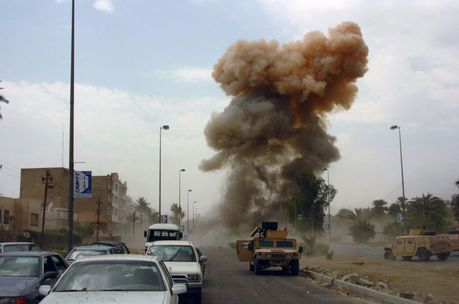
10 Comments

Filed under Foreign Policy, Lies of World Net Daily, Military, national security

Marshall, Eisenhower and Senior Military Leadership

Great military leaders are the products of the militaries in which they serve.  This begins in their early career and includes their education, training, assignments as well as the men that they serve under in their formative years.  They are shaped by the character, doctrine and organization of the military that they serve and are products of the times that they live and serve. Even the difference of a few years can make a major difference in the career path and development of a leader.  Such was the case with two of the great figures of the US Army in World War Two Generals of the Army George Marshall and Dwight David Eisenhower.

George Marshall

The careers of Marshall and Eisenhower prior to the Second World War were somewhat similar but also included major differences that would shape them for their roles in the war.  Marshall was commissioned 13 years prior to Eisenhower in 1902.  As a result he served his early years in a peacetime army marked by slow promotion.  Marshall was promoted to Captain in 1916 after serving 14 years as a Lieutenant despite attendance at the Army Staff College then called the Infantry and Cavalry School.  As an infantry officer he served in the Philippines for 2 years and served in various battalion and regimental level staff positions. Marshall’s career also included as assignments working with the National Guard and State militias.   His skills as a planner brought him to France as Assistant Chief of Staff for the 1st Infantry Division and later the American Expeditionary Force (AEF) under General Pershing.

While serving in these positions he was promoted rapidly to Major, Lieutenant Colonel and Colonel. In France he worked with the training, supply and operations of the American Forces as well as coordination with the French and British. His skills were invaluable and he played a major role in the rapid transition of the AEF from the St Michel salient to the Meuse-Argonne and though he reduced in rank when the war ended he was appointed aide-de-camp to Pershing in 1919.

During the 1920 Marshall served as Executive officer of the 15th Infantry Regiment in China and on his return to the United States he was assigned to the Army War College during which time his first wife died.  Following her death he would become Director of the Academic Department of the Infantry School.  His tenure at the War College was marked by his training numerous officers who would later become generals, including Eisenhower. He played a key role in the Preparation of the book “Infantry in Battle” which became a standard textbook for Army infantry officers.  He then served as senior instructor for the Illinois National Guard from 1933-1936 and was promoted to Brigadier General in 1936. After his promotion he worked to improve the Civilian Conservation Corps.  His organizational talents were recognized by President Franklin D Roosevelt and he was appointed Chief of Staff of the Army in 1939.  Marshall’s career is unique; he never served in command of anything more than a company. His positions above the company level were all in staff or instructor duty. In our current military an infantry officer or other combat arms officer who never commanded a maneuver unit at battalion, regiment or division level would never become a General and certainly never become Chief of Staff of the Army or Commandant of the Marine Corps.  Marshall was a brilliant organizer, leader, judge of men and visionary in understanding the necessity of coalitions and inter-dependence of nations in the modern world.  His organizational leadership skills, ability to pick the right officers for key positions and his political and diplomatic acumen made him one of the foremost military leaders in US Military history.

Dwight D Eisenhower

Eisenhower was commissioned in 1915 less than two years prior to the entry of the US into the First World War. Like Marshall was commissioned as an Infantry officer and his career progressed in normal fashion until the entry of the United States into the war.  Though Eisenhower never served in France, he was assigned to training troops and became one of the early leaders of the Armored Forces until they were disbanded after the war.  In the rapidly expanded wartime army Eisenhower was promoted from 2nd Lieutenant to Lieutenant Colonel in less time than Marshall spent as a 2nd Lieutenant.

During his tenure in the Tank Corps he served with George Patton, commanded a tank battalion and was executive officer of an armored brigade.  Following the disestablishment of the Tank Corps Eisenhower served as an infantry regiment executive officer in Panama.  In this position he was schooled by General Fox Conner in classic military theory.   It was fortunate for Eisenhower in that he was able to serve with and was able to gain seasoning and education under an excellent officer. Eisenhower returned to the United States and commanded an infantry battalion at Fort Benning and following this served on the faculty of the Infantry School under Marshall who would remember him at the beginning of World SWar Two.

His subsequent career was somewhat mundane. He served on the Battle Monument’s Commission under Pershing and then on the staff of the Assistant Secretary of War.  However both of these assignments put him in the eye of other important officers and officials.  Eisenhower was then transferred to the Philippines where he served as Chief of Staff to Douglas MacArthur from 1935-39. He returned to the US to serve concurrently as the regimental Executive Officer and a battalion commander in the 15th Infantry regiment and later Chief of Staff to the Commander of 3rd Army.  Through his excellent work in every assignment he gained the attention of Conner, Pershing and eventually Marshall. While at the Infantry school he helped prepare Pershing’s memoirs.  His experience with MacArthur in Washington and the Philippines helped prepare him for the myriad of difficult personalities with which he would deal with as Supreme Commander of Allied Forces in Europe. In 1941 he came to Washington to serve under Marshall at the WPA.

As far as who was the better officer, opinions vary; there are arguments to be made for both yet Eisenhower himself seemed to subordinate himself to Marshall.  Omar Bradley says of Marshall “if there ever was an indispensable man in time of national crisis, he was that man.” (A Soldier’s Story p.205) However both Marshall and Eisenhower were excellent officers and each played a vital role in the Allied victory.   However their careers were markedly different. In fact one could say that they were “apples and oranges.” Marshall served entirely as a staff officer and instructor after his service as a company officer.  Eisenhower served in numerous command positions as well as staff jobs. Their careers would intersect and had commonalities but each was shaped by their different experiences in the Army.

In World War Two Marshall seems to have fewer critics.  However this seems to more a result of Eisenhower’s exposed position in Europe where he was comparatively junior to many of the officers that that he would command.  He also had to deal with the competing interests of such strong personalities as Marshall, Patton, Roosevelt, Churchill, DeGaulle and Montgomery while fighting the Germans. This has lent him to criticism from both British and American officers as well as various historians.  But these observations are based on wartime experience and not their early careers.   Field Marshall Alan Brooke seems to have had more respect for Marshall and many in the British high command showed little respect toward Eisenhower.

“Better” in the military is in the eye of the beholder and often dependant on assignments as well as the superiors that one works for.  From a traditional point of view Eisenhower had the better career path with command at battalion and executive officer at regiment levels. However Marshall’s career provided him with a wider spectrum in dealing with senior staff, school, reserve component, government civilian agencies and Washington bureaucracy and politics that Eisenhower did not experience until Marshall tapped him in 1941 to work with the WPA. Their personalities were different and they dealt with subordinates in different manners, but both successfully managed their subordinates. Eisenhower was able to manage Patton and Montgomery while working in Churchill’s back yard, while others such as DeGaulle walking through his door.  Both men were uniquely suited to work with each other and in the positions that they found themselves during the war and one has a hard time imagining a better partnership in command.

The interesting thing to me is Marshall’s career.  In the current era he would never rise to the heights that he served.  Since the Second World War no officer who has not served command in major combat arms units at all levels has risen to be Chief of Staff of the Army, Air Force, Commandant of the Marine Corps or Chief of Naval Operations.  Nor has any risen to the Chairmanship of the Joint Chiefs of Staff or major Combatant Command such as EUCOM, CENTCOM or PACOM.  Of we look at Marshall and his impact one has to ask if “punching tickets”in the combat arms  is necessarily optimal  when it comes to managing the organization at the service level.  While it is proven that command is a great asset to senior command in combatant commands it may not be as necessary for the chief of a service.  One can ask if an officer who has served in staff and instructor positions, especially those where they have to deal with politicians, civilian agencies, as well as active and reserve component forces as well as an instructor and writer of doctrine could not serve as successfully in a position such as the Army Chief of Staff or the Commandant of the Marine Corps as an officer who has had the “well rounded career.”

In the light of George Marshall these are valid questions to ask. Might someone who has had the ability to step back and examine the personnel, logistics and training of a force as well as having experience with reserve component and civilian agencies could conceivably serve as effectively as an officer who has served rotating between command and staff positions.  In today’s world the staff oriented officer would also have experience dealing with industry and intelligence.  While I do not advocate such a change I think it would be wise to consider officers such as Marshall for these service level positions.

Following the war Marshall would become Secretary of State and help rebuild Europe while serving under Eisenhower how had become President of the United States.

Peace,

Padre Steve{

3 Comments

Filed under History, leadership, Military, national security, world war two in europe

“Revisionist” History and the Rape of Nanking 1937

Japanese Soldiers at Work in Nanking

The historical controversy regarding the “rape” of Nanking in 1937 by the Japanese Army is hotly debated.[1] The massacres occurred in the initial occupation of the city and the two months following in mid December 1937.  The initial reaction to the actions of the Japanese was reported by western journalists and even a German Nazi Party member by the name of John Rabe who assisted in protecting Chinese during the massacre and reported it on his return to Germany.The action shocked many in the west and helped cement the image of the Japanese being a brutal race in the west.

Massacre Victims at Nanking

The controversy’s visibility has been raised since the 1997 publication of Iris Chang’s The Rape of Nanking. However, with few exceptions the incident had received little attention by Western historians until Chang’s book was published. The reason for this was  that  China was a sideshow for for the United States and Britain throughout much of the war. When Chiang Kai Shek’s Nationalists were overthrown by the Communists in 1948 the incident disappeared from view in the United States.   The  United States government  reacted to the overthrow of Chaing by helping to rebuild Japan and rehabilitate the Japanese while opposing the Chinese Communists.  In fact it was only “after the Cold War was the Rape of Nanking Openly discussed.”[2]

Bodies of Children Killed by the Japanese at Nanking

Chang’s book was instrumental as it brought new attention to the actions of the Japanese Army in the slaughter of Prisoners of War and civilians following the occupation of the city.  Even as Chang’s work was published “revisionist” works began to appear in the 1980s which have either denied the atrocities, sought to minimize numbers killed by Japanese Forces or rationalized the them began to appear in Japan.  The revisionists were led by Masaaki Tanaka who had served as an aide to General Matsui Iwane the commander of Japanese forces at Nanking.  Tanaka denied the atrocities outright calling them “fabrications” casting doubt upon numbers in the trial as “propaganda.” He eventually joined in a lawsuit against the Japanese Ministry of Education to remove the words “aggression” and “Nanjing massacre” from textbooks, a lawsuit which was dismissed but was influential to other revisionists and Japanese nationalist politicians and publishers.[3]

Japanese Officer Preparing to Execute Man in Hospital

Most early accounts of the occupation and war crimes have used a number of 200,000 to 300,000 victims based upon the numbers provided during the War Crimes Trials of 1946.[4] Unlike the numbers of victims of the Nazi Holocaust the numbers are less accurate.  Authors who maintain the massacres such as Chang and others such as Japanese military historian Mashario Yamamoto who admits Japanese wrongdoing and excess but challenges the numbers use the same statistical sources to make their arguments.  Chang not only affirms the original numbers but extrapolates that even more may have been killed as a result of the disposal of bodies in the Yangtze River rather than in mass graves away from the city as well as the failure of survivors to report family member deaths to the Chinese authorities.[5] She also notes contemporary Chinese scholars who suggest even higher numbers.

Prince Asaka, Granduncle of Emperor Hirohito Commanded Troops at Nanking

Herbert Bix discusses Japanese knowledge of the atrocities in detail up and down the chain of command including Prince Asaka, granduncle of Emperor Hirohito who commanded troops in Nanking, the military and Foreign Office, and likely even Hirohito himself.[6]

German National and Nazi Party Member John Rabe Protected Chinese at Nanking and Reported His Experience to the German Government.  He is known as “The Good Man of Nanking”

The publication of German citizen and witness to the massacres John Rabe’s diaries in 2000, The Good Man of Nanking, provided an additional first hand account by a westerner who had the unique perspective of being from Japan’s ally Nazi Germany.  His accounts buttress the arguments of those like Chang who seek to inform the world about the size and scope of Japanese atrocities in Nanking.

A Field of Skulls at Nanking

Yamamoto who is a military historian by trade and is viewed as a “centrist” in the debate, places the massacres in the context of Japanese military operations beginning with the fall of Shanghai up to the capture of Nanking. Yamamoto criticizes those who deny the massacres but settles on a far lower number of deaths, questioning the numbers used at the War Crimes Trials. He blames some on the Chinese Army[7] and explains many others away in the context of operations to eliminate resistance by Chinese soldiers and police who had remained in the city in civilian clothes. He  claims that  “the Japanese military leadership decided to launch the campaign to hunt down Chinese soldiers in the suburban areas because a substantial number of Chinese soldiers were still hiding in such areas and posing a constant threat to the Japanese.”[8] David Barrett in his review of the Yamamoto’s work notes that Yamamoto believes that “there were numerous atrocities, but no massacre….”[9] Yoshihisa Tak Mastusaka notes that while a centrist Yamamoto’s work’s “emphasis on precedents in the history of warfare reflects an underlying apologist tone that informs much of the book.”[10] Revisionist work also criticizes the trials surrounding Nanking and other Japanese atrocities.  An example of such a work is Tim Maga’s Judgment at Tokyo: The Japanese War Crimes Trials which is critiqued by historian Richard Minear as “having a weak grasp of legal issues” and “factual errors too numerous to list.”[11] Such is a recurrent theme in revisionist scholarship, the attempt to mitigate or minimize the scale of the atrocities, to cast doubt upon sources and motivations of their proponents or sources, to use questionable sources themselves or to attribute them to out of control soldiers, the fog of war and minimize command knowledge as does Yamamoto. Politics is often a key motivating factor behind revisionist work.

Iris Chang Would Later Commit Suicide

Chang would never be the same after researching and writing the Rape of Nanking. Traumatized by what she had learned and burdened by the weight of what she had taken on she killed herself on November 9th 2004.

Iconic Photo of Japanese Acts in China: A Wounded Child at Shanghai Station

“Revisionist” history will almost certainly remain with us, so long as people study the past.  However one has to be careful in labeling a divergent view of a historical subject as necessarily revisionist.  There are occasions when new evidence arises and a “new” or “revisionist” work may actually disprove previous conclusions regarding historic events or persons.  This might occur when what we know about a subject comes from a single or limited number of sources who themselves were limited in what they had available for research and new evidence comes to light. At the same time where numerous sources from diverse points of view attest to the genuineness of an event, the revisionist’s theses should be themselves scrutinized based on evidence presented as well as their political, ideological or racial motivations.  While one does not want to silence voices of opposition to prevailing beliefs one has to be careful in examining their claims, especially when they arise in the context of political or ideological conflicts.


[1] Bix, Herbert P. Hirohito and the Making of Modern Japan, Harper Collins Publishers, New York, NY 2000. pp.333-334. Bix does a good job explaining the number of victims of the incident drawing on Chinese and Japanese sources.

[2] Kreuter, Gretchen. The Forgotten Holocaust in The Bulletin of Atomic Scientists, March-April 1998 p.66

[3] Fogel, Joshua A. The Nanjing Massacre in History and Historiography, University of California Press, Berkley CA 2000, pp.87-89

[4] Toland, John. The Rising Sun: The Rise and Fall of the Japanese Empire 1936-45. Random House, New York, NY 1970 pp. 50-51. Toland in his brief discussion of the massacres notes both the civilian casualty figures and figures for male citizens of military age who were slaughtered.  Toland also notes the large numbers of women raped by Japanese soldiers.

[5] Chang, Iris. The Rape of Nanking: The Forgotten Holocaust of World War II Penguin Books, New York, NY 1997 pp.102-103. Chang has been criticized by some historians in a number of ways including that she was not a historian, that she compares the atrocities to the Nazi Holocaust and her emotional attachment to the subject which may have been a contributing factor in her 2004 suicide.

[6] Bix. p.336

[7] Yamamoto, Masahiro. The Rape of Nanking: Anatomy of an Atrocity. Praeger Publishers an imprint of the Greenwood Group, Westport, CT 2000. http://site.ebrary.com/lib/apus/docDetail.action?docID=10018001&p00=nanking  p.83

[8] Ibid. p.92.

[9] Barrett, David P.  Review of The Rape of Nanking: Anatomy of an Atrocity by Masashiro Yamamoto Canadian Journal of History/Annales canadiennes d’Histoire XXXVIII, April/Avril 2003 p.170

[10] Mastusaka, Yoshihisa Tak.  Review of The Rape of Nanking: Anatomy of an Atrocity by Masashiro Yamamoto American Historical Review, April 2002 p.525

[11] Minear, Richard. Review of Judgment at Tokyo: The Japanese War Crimes Trials by Tim Mata  American Historical Review. April 2002 p.526

49 Comments

Filed under History, Military, world war two in the pacific

Padre Steve and the Army-Navy Game

I love irony and at one time took my shirts to the cleaners at the same time if irony is so rich why aren’t I a millionaire?

I grew up with the Army-Navy game.  As a Navy “brat” I have always had a deep affinity for Navy and can say that no matter who they play I am pretty much always for the Midshipmen. Now my affinity for Navy went against my dad who despite being a Navy Chief had grown up as an Army fan with little love for the Midshipmen.

Padre Steve Army 1983

The irony is something that I find fascinating, my dad the Army fan joins the Navy and serves a full career but never embraces the Midshipmen. His son, me, Padre Steve after being told by the Abbess that she will not marry him if he joins the Navy enlists in the Army goes through the Army ROTC program and becomes an Army officer spending a total of 17 ½ years in the Army, the Army National Guard and Army Reserve before resigning from the Army and entering the Navy in February 1999 taking a reduction for the rank of Major to Navy Lieutenant to do so. Of course my dad the Army fan was at loss that I joined the Army but rejoiced practically parading a picture of me in my Dress Whites around the neighborhood according to what I heard from my vantage point 3000 miles away.

So anyway the Navy brat turned Army Officer turned Navy Officer and Chaplain is still a Navy fan.  When I was in the Army I would wear a “Go Navy” button on the inside of whatever Army uniform, be it the BDU or the Class A uniform the week of the game.  If someone asked what I thought about the game or who I thought would win I would whip out the “Go Navy” button.

Now I do have one connection with an Army all-time great, Bill, “The Lonely End” Carpenter also known as Lieutenant General Carpenter who in Vietnam was nominated for the Congressional Medal of Honor.  I met the General the summer of my pre-commissioning camp and troop leadership training at Fort Lewis Washington.  I had had a pretty rough six weeks in the ROTC “Advanced Camp.”  Having been destroyed and built back up by Sergeant First Class, or Drill Sergeant Harry Ball.  Moving across the base I went to the 2nd Battalion, 1st Infantry of the 9th Infantry Division.  It was with the 2nd of the 1st that things got better and I came into my own.  I was assigned as a platoon leader during the unit’s ARTEP, Army Readiness Test and Evaluation Program, the mother of all training events in the life of an Army unit.  During our time on the defense I was inspecting the far end of our positions which happened to be the right flank of the company at dusk.  Now dusk at Fort Lewis in the summer comes pretty late and it was close to 2100, or 9:30 PM to civilians and those in the Air Force.  With dusk approaching I wanted to make sure that the flank was secure.  I walked out a bit further staying concealed as I checked things out a couple of hundred meters past our farthest position.  At his point I saw a tall man in uniform waiting down a trail that could be a high speed avenue of approach.  I took a position to surprise him and when he came in range I ordered him to drop his weapon and surrender, using some colorful euphemisms in the process.

The man didn’t stop and turned toward me and said: “Son, you can calm down, I’m Brigadier General Carpenter the Assistant Division Commander.”  I had never met a General before and certainly never spoken to one in that manner, but General Carpenter took it in stride.  As I popped smartly to attention and gave a snappy salute he introduced himself, asked my name and thanked me for my vigilance.  With that he allowed me to lead him of a tour of the platoon’s positions and pass him off to our adjoining platoon whose platoon leader took him on from there.  The company commander had a good laugh that evening as we met to plan our “withdraw under pressure” that would take place in the early morning hours.

So that is my connection with an Army legend and great man.  However the fact that I had met Army’s “Lonely End” did not convert me to the cause.  When I entered the Navy it was like coming home.  My Army friends were almost always incredulous that I could root against the Black Knights of the Hudson.

Padre Steve Navy

Today’s victory against Army was not the blowout that I thought it would be though it easily could have been.  However it paid an unexpected dividend in that it brought the UCLA Bruins to a Bowl Game.  I can’t remember the last time they have been to a bowl game and their record was not very good this year either…I wonder how any team that 6-6 record rates going to a bowl, but heck if the University of Florida and Notre Dame can go why not UCLA?

Now Navy plays Missouri in the Texas Bowl on December 31st.

Leave a comment

Filed under football, Military