Category Archives: Military

FEP and Shipshape…the Kinder and Gentler Fat Boy Program

Well friends according to the Navy I am officially fat.  I think I mentioned this fact a couple of weeks ago.  So being criminally short and stocky and a bit heavier than I normally am I have been enrolled in the Fitness Enhancement Program or FEP which includes both physical fitness and diet and nutritional awareness.  Until I can get below my weight limit or body fat percentage I am sentenced to have my physical fitness monitored and signed off on by others, have weekly weigh-ins and go to a mandatory fitness and nutritional education program called ship shape.

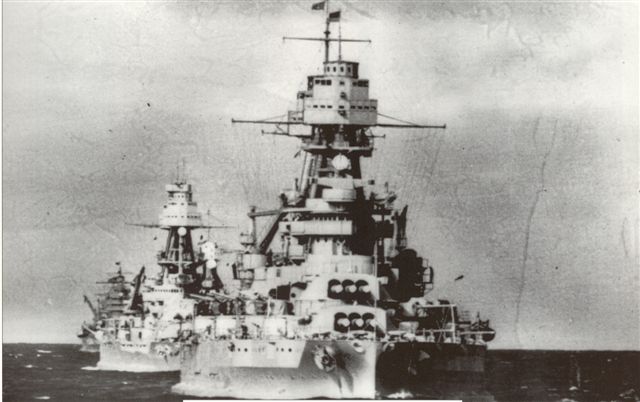
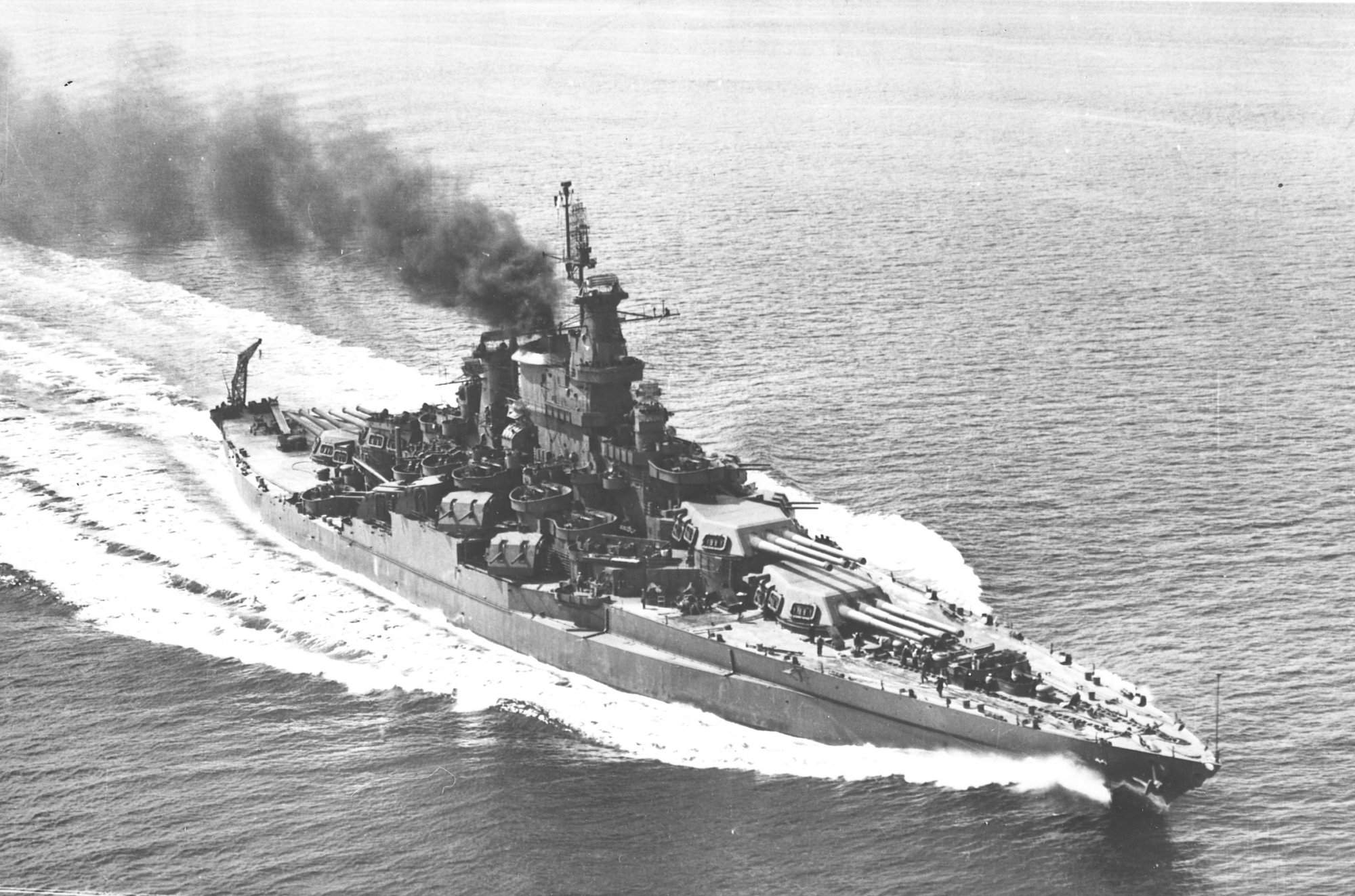
Now, before anyone thinks that I am whining it is my fault that I am in this situation.  When anyone gains 25 pounds in under six months, mainly due to stopping at Krispy Kreme Doughnuts and getting a dozen hot and fresh glazed on the way home from a ball game three or four times a week and devouring 3-6 of them washing them down with a beer.  You combine 1000 to 1500 calories at bedtime while working 60-75 hours a week and not doing any PT with PTSD and chronic insomnia and you, like me will get fat.  Such is not a recipe for success.  As a result I gained weight and could not take it off before the semi-annual weigh in.  The deceptive thing for me is that I have a barrel chest so the waist does not look as wide as someone my height with a wimpy little sunken chest.  I am kind of build like a pre-World War Two American Battleship.

This was the first time in 28 years in the military that I was officially on what back in the day was known as the “Fat Boy” program. I have always made weight and my scores on the Navy and the Marine Corps Physical Fitness tests have been very good, in fact damn good.  Until this fall I have consistently scored at the  Outstanding level for the Navy and Class One Marine PT.  After the debacle of the summer I was overweight and only scored an “Excellent Low” on my Navy PT test, which really wasn’t bad because I only did three workouts between April and November.  My “out of shape” is better than a lot of people who work their ass off to pass the PT test.  Just a couple of years ago I was running half-marathons. The fact that I blew it this time actually pisses me off and I don’t blame the Navy for it but myself.  I hate to lose and hate to fail anything.  It sucks like a Hoover.

Now I got myself into this mess and will get myself out of it before the next PT cycle.  However I have found that being on the program is somewhat like being a criminal.  Even though I did well on the PT test I have to make sure that my PT sessions are signed off on by certain people, like on a piece of paper that is turned in at the end of the week. In addition there is a weekly weigh-in and body fat measurement.  This week I both lost weight and body fat.  Good for me.  Not enough yet but by the time I am done with this Mickey Mouse program I am going to look like fricking Arnold.  My PT and diet and nutrition are back to what they were before Iraq.

Those on the program get to participate in other fun reindeer games.  First every month we get to do a mock PT test, complete with weigh-in and body fat measurement.  I did better than my last PT test and it was ironic that I did better than almost everyone and even finished second on the run portion of the test did 90 sit ups and was a bit low, only 42 push-ups when I normally do 70-80 of them.  Since I am a good 10-25 years older than most of the people on the program with me I think that is impressive.  However as a 49 and nearly 50 year old man I am treated like a child by the system.  I understand why this is the case because there are a good number of people who will try to skate by, but it isn’t any fun.  In  fact the fitness standards that I am held to now are actually higher than when I first entered the military as a 21 year old back in 1981.  This isn’t a game for old men but I am still in the game.

My diet is back on track, I am getting some really good and diverse PT including classes on bicycle spinning and body shaping led by a young woman who kicks ass, she drives hard and very demanding sessions and I like it.  I also am running again and feeling good with it.  My times and distance are not yet where I want them but they will get better, Lord willing and the creek don’t rise.

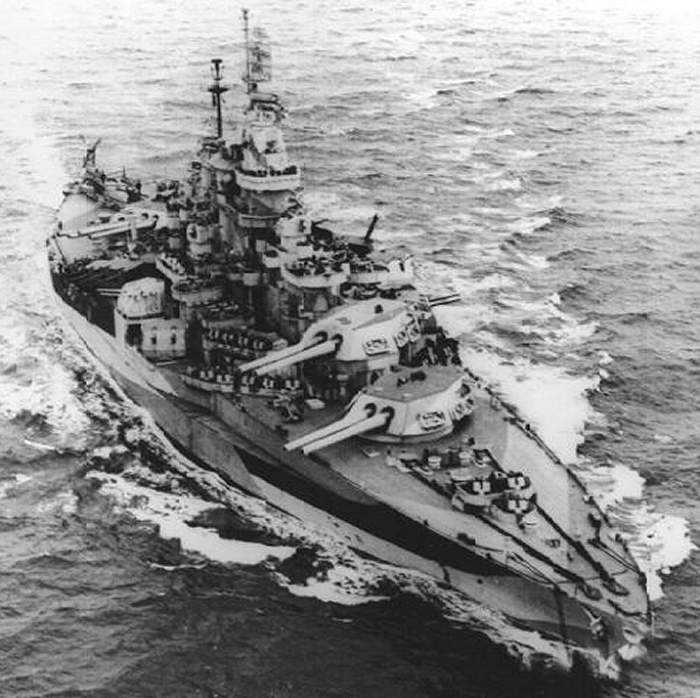
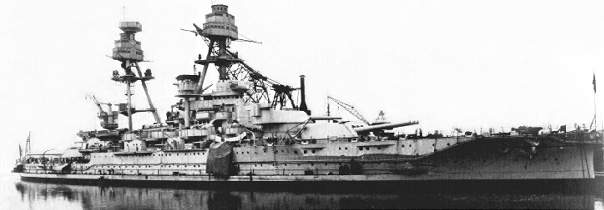
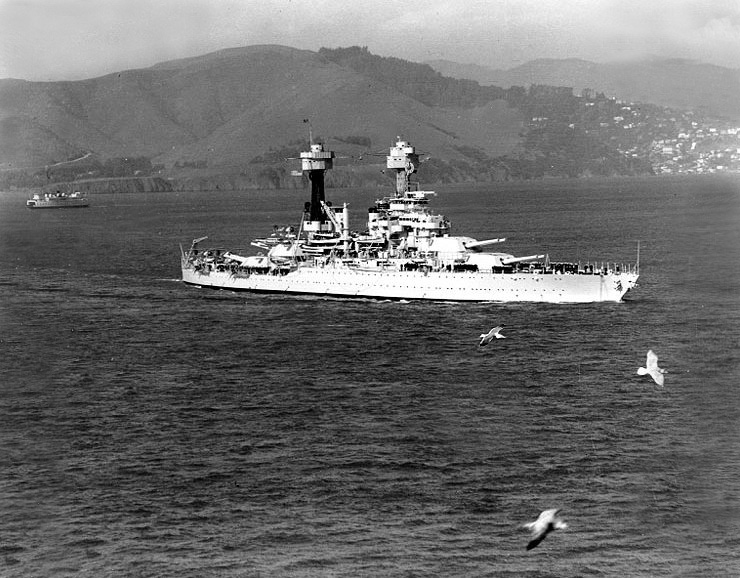
As if all of this is not bad enough if you are over the body fat you go into a mandatory 8 week, tow hour a week program called “shipshape.”  Now when one looks at ships and me one knows that I will never be a destroyer.  I am shipshape, but more like the USS West Virginia following her post-Pearl Harbor rebuild.  I am short, squat, a bit heavy, not as fast as I used to be, but still powerful and able to kick the ass of anyone that I would have to.

The USS West Virginia BB-48…Like Me was “Shipshape”

So, that is my rant.  I will kick this in the ass, lose the weight, lose the body fat and have myself up to the Outstanding level again in the next few months and hopefully well before the next PT/Weigh-in cycle.  I am back in the groove on this and hopefully will be able to help encourage and inspire my fellow sailors who are on the program either due to weight, body fat, or physical fitness test failure.

Anyway….I need to crash for the night so I can try to catch the early spinning class.

Peace,

Padre Steve+

9 Comments

Filed under Military

The Danger of Believing Historical Myths: Hitler, the Stab in the Back and the United States

The are many times in history where leaders of nations and peoples embrace myths about their history even when historical, biographical and archeological evidence points to an entirely different record.  Myths are powerful in the way that they inspire and motivate people. They can provide a cultural continuity as a people celebrates the key events and people that shaped their past, even if they are not entirely true.  At the same time myths can be dangerous when they cause leaders and people to make bad choices and actually become destructive. Such was the case in Germany following the First World War.

After the war the belief that the German Army was not defeated but was betrayed by the German people, especially those of the political left.  Like all myths there was an element of truth in the “stab in the back” myth, there were revolts against the Monarchy of Kaiser Wilhelm II and even mutiny on elements of the German High Seas Fleet and Army units stationed in Germany. However the crisis had been brought about by General Ludendorff who until the last month of the war refused to tell the truth about the gravity of Germany’s position to those in the German government.  So when everything came crashing down in late October and early November 1918 the debacle came as a surprise to most Germans.  The myth arose because the truth had not been told by Ludendorff who was arguably the most powerful figure in Germany from 1916-1918.  In the looming crisis which included Ludendorff’s collapse and relief, General Wilhelm Groener presented the facts to the Kaiser and insisted on his abdication.  The Republic that was proclaimed on the 9th of November was saddled with the defeat and endured revolution, civil war and threats from the extreme left and right.  When it signed the Treaty of Versailles it accepted the sole responsibility of Germany for the war and its damages. Ordered to dismantle its military, cede territory that had not been lost in battle and pay massive reparations the legend of the “stab in the back” gained widespread acceptance in Germany.

Hitler and Many in Germany Doubted the War making Potential of the United States

Hitler always believed that the defeat of Germany in the First World War was due to the efforts of internal enemies of the German Reich on the home front and not due to battlefield losses or the entry of the United States.  This was a fundamental belief for him and was expressed in his writings, speeches and actions.  The internal enemies of Germany for Hitler included the Jews, as well as the Socialists and Communists who he believed were at the heart of the collapse on the home front.  Gerhard Weinberg believes that the effect of this misguided belief on Hitler’s actions has “generally been ignored” by historians. (Germany, Hitler and World War II p. 196)

Hitler believed that those people and groups that perpetrated the “stab in the back” were “beguiled by the by the promises of President Wilson” (World in the Balance p.92) in his 14 Points.  Thus for him Americans were in part responsible for undermining the German home front, something that he would not allow to happen again.  In fact Hitler characterization of Wilson’s effect on the German people in speaking about South Tyrol.  It is representative of his belief about not only the loss of that region but the war: “South Tyrol was lost by those who, from within Germany, caused attrition at the front, and by the contamination of German thinking with the sham declarations of Woodrow Wilson.” (Hitler’s Second Book p.221)

While others will note Hitler’s lack of respect for the potential power of the United States, no other author that I am familiar with links Hitler’s actions and the reaction of the German political, military and diplomatic elites to the entry of the United States into the war to the underlying belief in the “stab in the back.”   Likewise Hitler had little regard for the military abilities or potential of the United States. Albert Speer notes that Hitler believed “the Americans had not played a very prominent role in the war of 1914-1918,” and that “they would certainly not withstand a great trial by fire, for their fighting qualities were low.” (Inside the Third Reich: Memoirs by Albert Speer p.121)

Hitler not only dismissed the capabilities of the Americans but also emphasized the distance that they were from Germany and saw no reason to fear the United States when “he anticipated major victories on the Eastern Front.” (Germany Hitler and World War II p.92)   Hitler’s attitude was reflected by the majority of the military high command and high Nazi officials. Ribbentrop believed that the Americans would be unable to wage war if it broke out “as they would never get their armies across the Atlantic.” (History of the German General Staff, Walter Goerlitz, p.408).  General Walter Warlimont notes the “ecstasy of rejoicing” found at Hitler’s headquarters after Pearl Harbor and the fact that the he and Jodl at OKW caught by surprise by Hitler’s declaration of war. (Inside Hitler’s Headquarters 1939-1945 pp.207-209) Kenneth Macksey notes Warlimont’s comments about Hitler’s beliefs; that Hitler “tended to dismiss American fighting qualities and industrial capability,” and that he “regarded anyone who tried to show him such information [about growing American strength] as defeatist.” (Why the Germans Lose at War, Kenneth Macksey, p.153.)

Others like Field Marshal Erwin Rommel record the disregard of senior Nazis toward American capabilities in weaponry.  Quoting Goering who when Rommel discussed 40mm anti-aircraft guns on aircraft that were devastating his armored forces Goering replied “That’s impossible. The Americans only know how to make razor blades.” (The Rommel Papers edited by B.H. Liddell-Hart p.295) Rommel was one of the few German commanders who recognized the folly of Hitler’s  declaration of war on the United States noting that “By declaring war on America, we had brought the entire American industrial potential into the service of Allied war production. We in Africa knew all about the quality of its achievements.” (The Rommel Papers p.296)

When one also takes into account the general disrespect of the German military for the fighting qualities of American soldiers though often with good reason (see Russell Weigley’s books Eisenhower’s Lieutenants and The American Way of War) one sees how the myth impacted German thought.  This is evidenced by the disparaging comments of the pre-war German military attaché to the United States; General Boeticher, on the American military, national character and capability. (See World in the Balance pp. 61-62)

The overall negative view held by many Germans in regard to the military and industrial power and potential of the United States reinforced other parts of the myth. Such false beliefs served to bolster belief in the stab-in-the back theory as certainly the Americans could not have played any important role in the German defeat save Wilson’s alleged demoralization of the German population.  This was true not only of Hitler, but by most of his retinue and the military, diplomatic and industrial leadership of the Reich. Hitler’s ultimate belief, shaped by the stab-in-the back and reinforced by his racial views which held the United States to be an inferior mongrel people. This led him to disregard the impact that the United States could have in the war and ultimately influenced his decision to declare war on the United States, a decision that would be a key factor in the ultimate defeat of Germany.

Myth can have positive value, but myth which becomes toxic can and often does lead to tragic consequences. All societies have some degree of myth in relationship to their history including the United States.  The myths are not all the same, various subgroups within the society create their own myth surrounding historic events.  It is the duty of historians, philosophers and others in the society to ensure that myth does not override reality to the point that it moves policy both domestic and foreign in a manner that is ultimately detrimental to the nation.  The lesson of history demonstrated by myths surrounding the German defeat and role of the United States in that defeat shows just how myth can drive a nation to irrational, evil and ultimately tragic actions not only for that nation and its people, but for the world.

Peace,

Padre Steve+

7 Comments

Filed under History, Military, philosophy

The Battleships of Pearl Harbor

Arizona Leading the Battle Line

“Yesterday, Dec. 7, 1941 – a date which will live in infamy – the United States of America was suddenly and deliberately attacked by naval and air forces of the Empire of Japan…. The attack yesterday on the Hawaiian Islands has caused severe damage to American naval and military forces. Very many American lives have been lost.” Except of President Franklin D Roosevelt’s Pearl Harbor Speech December 8th 1941

Today is the 68th anniversary of the Japanese attack on Pearl Harbor and as we were then we are at war.

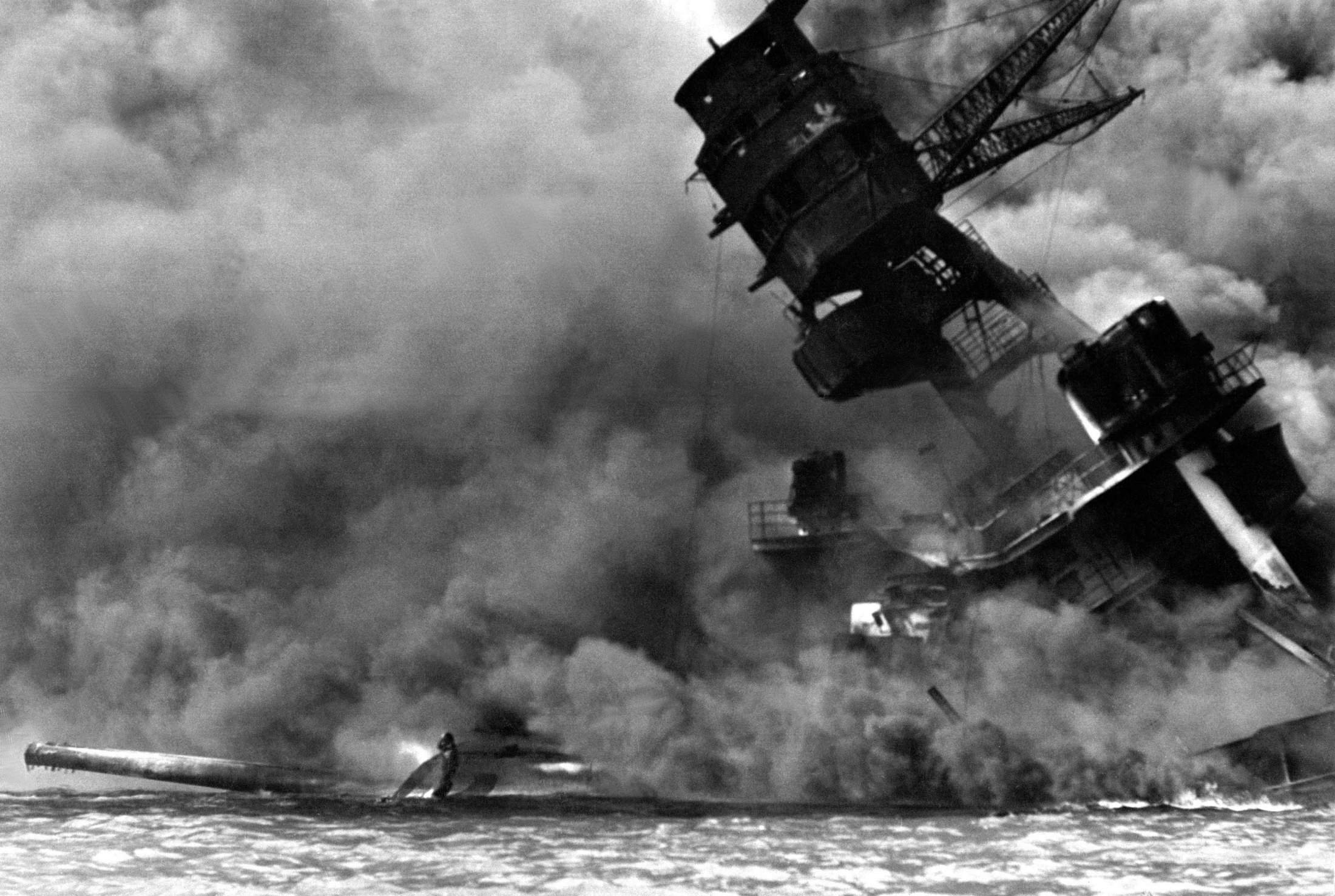
A Date that Will Live in Infamy: USS Arizona Burning

I remember reading Walter Lord’s “Day of Infamy” when I was a 7th grade student at Stockton Junior High School back in 1972.  At the time my dad was on his first deployment to Vietnam on the USS Hancock CVA-19.  As a Navy brat I was totally enthralled with all things Navy and there was little that could pull me out of the library.  Over the years I have always found the pre-World War Two battleships to be among the most interesting ships in US Navy history.  No they are not the sleek behemoths like the USS Wisconsin which I look at almost every day from Portsmouth Naval Medical Center as it lays moored across the Elizabeth River in Norfolk.  No these ships were the backbone of the Navy from the First World War until Pearl Harbor.  They were the US Navy answer to the great Dreadnaught race engaged in by the major Navies of the world in the years prior to, during and after World War One.

These ships were built over a period of 10 years and incorporated the advances in technology since the HMS Dreadnaught first came down the ways in 1906 to the experience gained in combat during the “Great War.”  While the United States Navy did not engage in battleship to battleship combat the ships built by the US Navy were the equal of many of the British and German ships of the era.

Oklahoma Before the War

The Battle Force of the Pacific Fleet in 1941 included 9 battleships of which 8 were at Pearl Harbor on the morning of December 7th.  In the event of war the US War Plans, called “Orange” called for the Pacific Fleet led by the Battle Force to cross the Pacific, fight a climactic Mahanian battle with the battleships of the Imperial Japanese Navy and after vanquishing the Japanese foe to relieve American Forces in the Philippines.  However this was not to be as by the end of December 7th all eight were out of action, with two, the Arizona and Oklahoma permanently lost to the Navy.

USS Oklahoma Being Raised from the Mud

These ships comprised 4 of the 6 classes of battleships in the US inventory at the outbreak of hostilities.  Each class was an improvement on the preceding class in speed, protection and firepower.  The last class of ships, the Maryland class composed of the Maryland, Colorado and West Virginia, was the pinnacle of US Battleship design until the North Carolina class was commissioned in 1941.  Since the Washington Naval Treaty limited navies to specific tonnage limits as well as the displacement of new classes of ships the United States like Britain and Japan was limited to the ships in the current inventory at the time of the treaty’s ratification.

USS Nevada Aground and Burning

The ships at Pearl Harbor included the two ships of the Nevada Class, the Nevada and Oklahoma. The Two ships of the Pennsylvania class, the Pennsylvania and her sister the Arizona, the two California class ships, the California and Tennessee and two of the three Maryland’s the Maryland and West Virginia.  The Colorado was undergoing a yard period at Bremerton and the three ships of the New Mexico class, New Mexico, Mississippi and Idaho had been transferred to the Atlantic before Pearl Harbor to bolster US strength in that area due to the German threat.  The three older ships of the New York and Wyoming Classes, the New York, Arkansas and Texas also were in the Atlantic. Two older battleships, the Utah and Wyoming had been stripped of their main armaments and armor belts and served as gunnery training ships for the fleet. The Utah was also at Pearl Harbor.

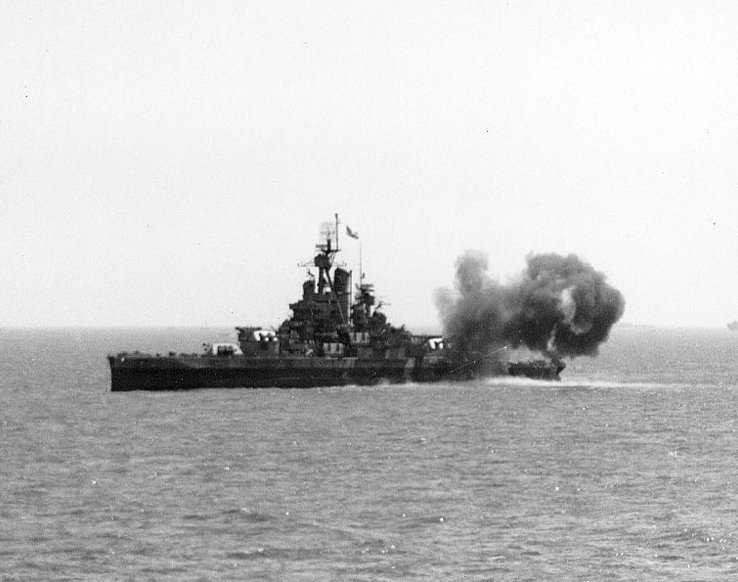
USS Nevada Firing on Utah Beach: D-Day

The ships that lay at anchor at 0755 that peaceful Sunday morning on “Battleship Row” and in the dry dock represented the naval power of a bygone era which was not recognized until two hours later. The age of the battleship had passed, but even the Japanese who launched the attack did not realize that the era had passed as they continued to build the massive super-battleships Yamato and Musashi mounting 9 18” guns and displacing 72,000 tons, near twice that of the battleships of the Pacific Fleet.

Arizona’s Main Battery

The Oklahoma and Nevada were the oldest ships in the Battle Force.  Launched in 1914 and commissioned in 1916 the Nevada and Oklahoma mounted ten 14” guns and displaced 27.500 tons and were capable of 20.5 knots. Serving in World War One alongside the British Home Fleet they were modernized in the late 1920s they were part of the US presence in both the Atlantic and Pacific in the inter-war years. Oklahoma would take part in the evacuation of American citizens from Spain in 1936 during the Spanish Civil War.  During the Pearl Harbor attack Oklahoma was struck by 5 aerial torpedoes capsized and sank at her mooring with the loss of 415 officers and crew. Recent analysis indicates that she may have been hit by at least on torpedo from a Japanese midget submarine. Her hulk would be raised but she would never again see service and sank on the way to the breakers in 1946.

USS Pennsylvania in Drydock with Wrecked USS Cassin and USS Downs

Nevada was the only Battleship to get underway during the attack.  As she attempted to escape the harbor she was heavily damaged and to prevent her sinking in the main channel she was beached off Hospital Point.  She would be raised and returned to service by the May 1943 assault on Attu.  She would then return to the Atlantic where she would take part in the Normandy landings off Utah Beach and the invasion of southern France in July 1944.  She then returned to the Pacific and took part in the operations against Iwo Jima and Okinawa where she again provided naval gunfire support.  Following the war she would be assigned as a target at the Bikini atoll atomic bomb tests, surviving these she would be sunk as a target on 31 July 1948.

USS Pennsylvania at Guam

The two ships of the Pennsylvania Class were improved from the Oklahoma’s.  Mounting twelve 14” guns and displacing 31,400 tons and capable of 21 knots they were commissioned in 1916 and also participated in operations in the Atlantic in the First World War.  Both being rebuilt and modernized in 1929-1931 they were mainstays of the fleet being present at Presidential reviews and making goodwill visits around the world.  Pennsylvania was the Pacific Fleet Flagship on December 7th 1941 and was in dry dock undergoing maintenance at the time of the attack. Struck by two bombs she received minor damage and would be in action in early 1942. She underwent minor refits and took part in many amphibious landings in the Pacific and was present at the Battle of Surigo Strait.  Heavily damaged by an aerial torpedo at Okinawa Pennsylvania would be repaired and following the war used as a target for the atomic bomb tests. She was sunk as a gunnery target in 1948.

USS Pennsylvania Passing Under Golden Gate Bridge Before the War

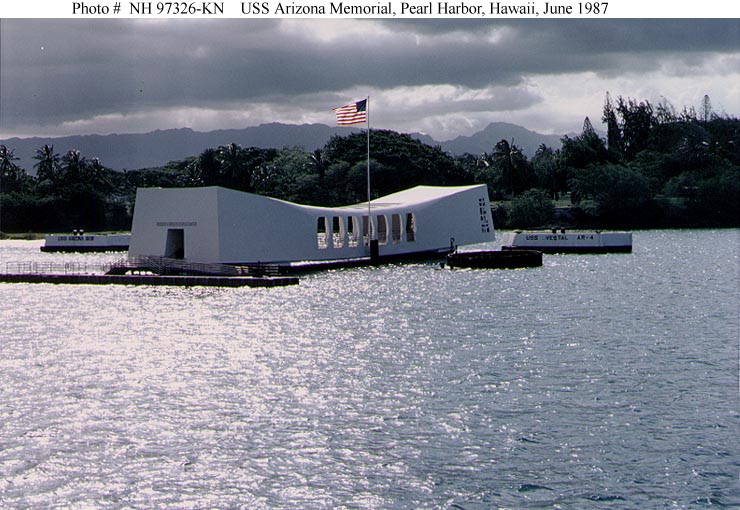
Arizona was destroyed during the attack.  Hit by 8 armor piercing bombs one of which penetrated her forward black powder magazine she was consumed in a cataclysmic explosion which killed 1103 of her 1400 member crew.  She was never officially decommissioned and the colors are raised and lowered every day over the Memorial which sits astride her broken hull.

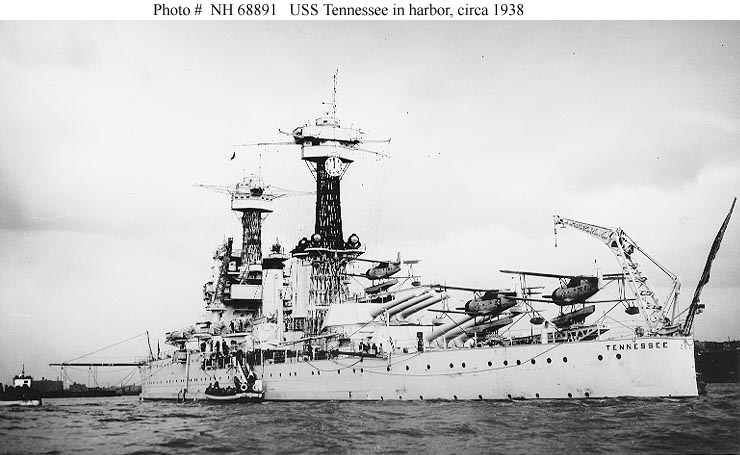
USS Tennessee 1938

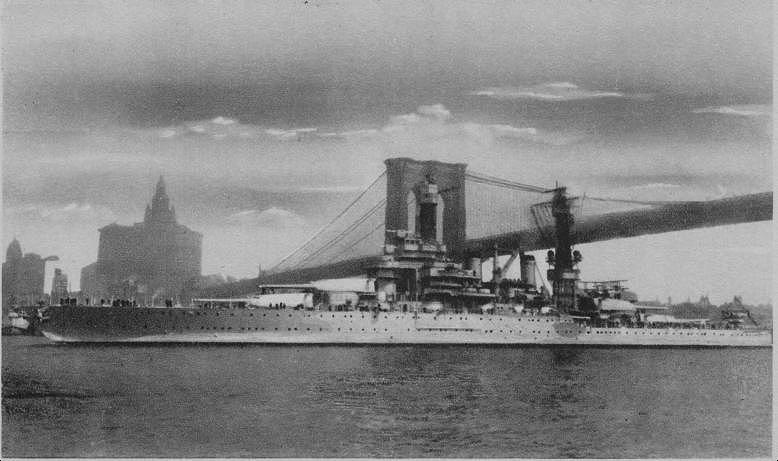
The Tennessee and California were the class following the New Mexico’s which were not present at Pearl Harbor.  These ships were laid down in 1917 and commissioned in 1920.  They mounted twelve 14” guns, displaced 32.300 tons and were capable of 21 knots.  Tennessee was damaged by two bombs and was shield from torpedo hits by West VirginiaCalifornia was hit by two torpedoes but had the bad luck to have all of her major watertight hatches unhinged in preparation for an inspection.

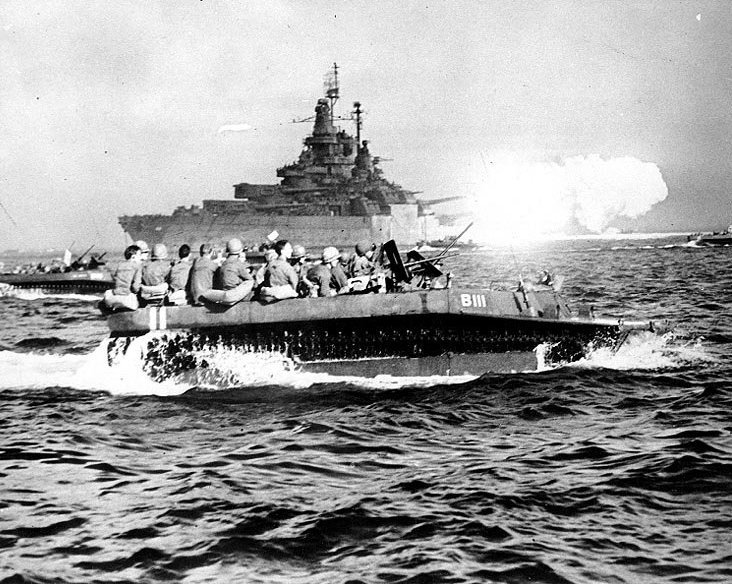
USS Tennessee at Okinawa

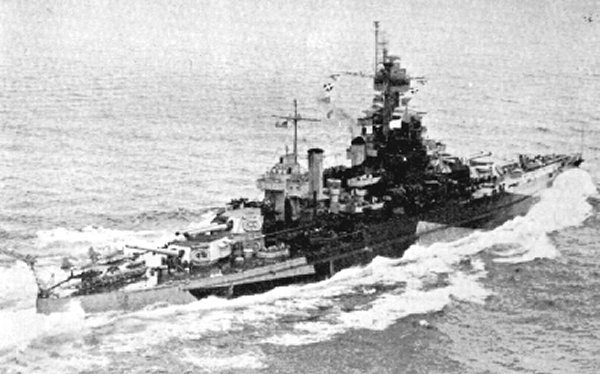
She sank at her moorings and would be refloated, rebuilt and along with Tennessee modernized with the latest in radar, fire control equipment and anti-aircraft armaments.  Both ships would be active in the Pacific campaign and be engaged at Surigo Strait where they inflicted heavy damage on the attacking Japanese squadron. Both would survive the war and be placed in reserve until 1959 when they were stricken from the Navy list and sold for scrap.

USS California Passing Under Brooklyn Bridge

The Maryland and West Virginia were near sisters of the Tennessee class.  They were the last battleships built by the United States before the Washington Naval Treaty.  Mounting eight 16” guns they had the largest main battery of any US ships until the North Carolina class.

USS Maryland 1944

The displaced 32,600 tons and could steam at 21 knots. Laid down in 1917 and commissioned in 1921 they would be modernized in the late 1920s they were the most modern of the “Super-Dreadnoughts” and included advances in protection and watertight integrity learned from British and German experience at Jutland.

USS California 1944

At Pearl Harbor Maryland  was moored inboard of Oklahoma was hit by 2 bombs.  She would be quickly repaired and returned to action.  She received minimal modernization during the war. She would participate in operations throughout the entirety of the Pacific Campaign mainly conducting Naval Gunfire Support to amphibious operations. 

USS West Virginia 1934

and in 1944


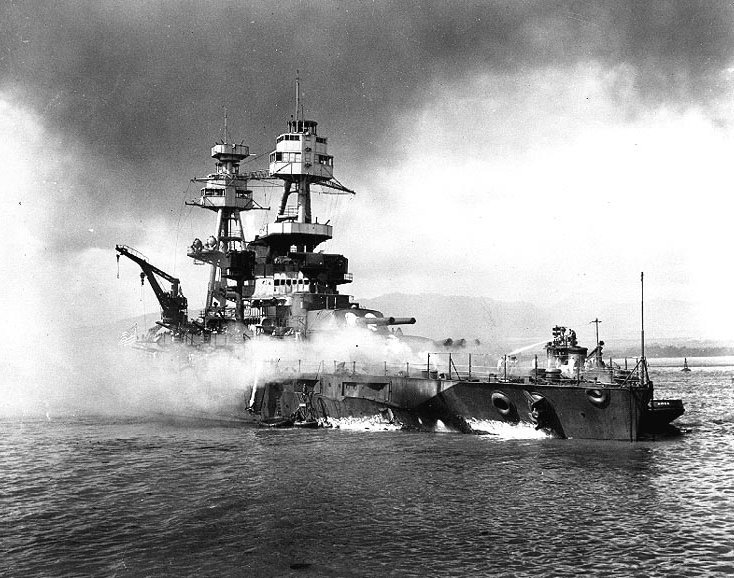
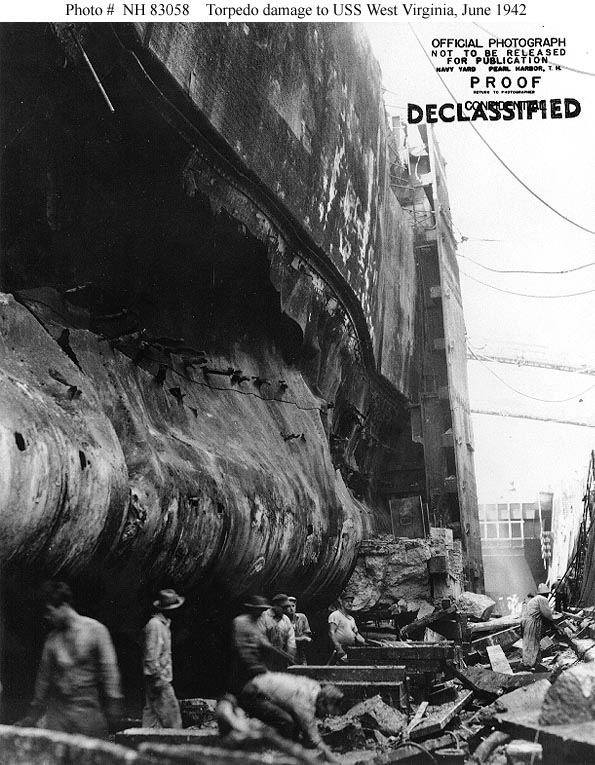
West Virginia suffered some of the worst damage in the attack. Hit by at least 5 torpedoes and two bombs she was saved from Oklahoma’s fate by the quick action of her damage control officer to counter flood so she would sink on an even keel.  She would be raised, refloated and taken back to the West Coast for an extensive modernization on the order of the Tennessee and California. 

Damage to West Virginia’s Hull

The last Pearl Harbor to re-enter service she made up for lost time as she lead the battle line at Surigo Strait firing 16 full salvos at the Japanese squadron helping sink the Japanese Battleship Yamashiro in the last battleship versus battleship action in history.  West Virginia, Maryland and their sister Colorado would survive the war and be placed in reserve until they were stricken from the Naval List and sold for scrap in 1959.

The battleships of Pearl Harbor are gone, save for the wreck of the Arizona and various relics such as masts, and ships bells located at various state capitals and Naval Stations.  Unfortunately no one had the forethought to preserve one of the survivors to remain at Pearl Harbor with the Arizona.  Likewise the sailors who manned these fine ships, who sailed in harm’s way are also passing away.  Every day their ranks grow thinner.  As December 7th  passes into history it is fitting to remember these men and the great ships that they manned.   If you know a Pearl Harbor survivor or a sailor who served on one of these ships take the time to thank them.

Peace,

Padre Steve+

USS Arizona Memorial

21 Comments

Filed under History, Military, Navy Ships, world war two in the pacific

The Paradox of Conflicting Doctrine: The US Campaign in France and Germany 1944-1945

The Paradox

The paradox of the American Army’s training in speed and mobility and the strategic tradition of U.S. Grant influenced the final campaign in Germany just as they had the campaign in France.  This is one of the Russell Weigley in Eisenhower’s Lieutenants asserts that the American strategic tradition of U.S. Grant emphasized direct confrontation and defeat of the enemy’s major forces.  He asserts the development of this tradition by officers assigned to the Leavenworth schools was influenced by the Civil War and World War One and the Army’s experience as a frontier constabulary force.  He develops this theory alongside his discussion of the formation of the highly mobile and less powerful forces that the Army would deploy in World War Two and how this paradoxical combination of doctrine and force determined by conflicting legacies “put the army at cross purposes with itself…as it began to prepare for European War.”[i]

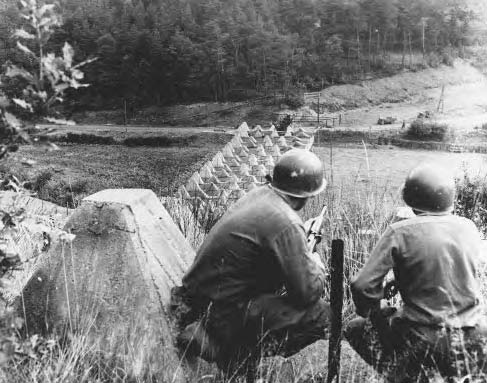
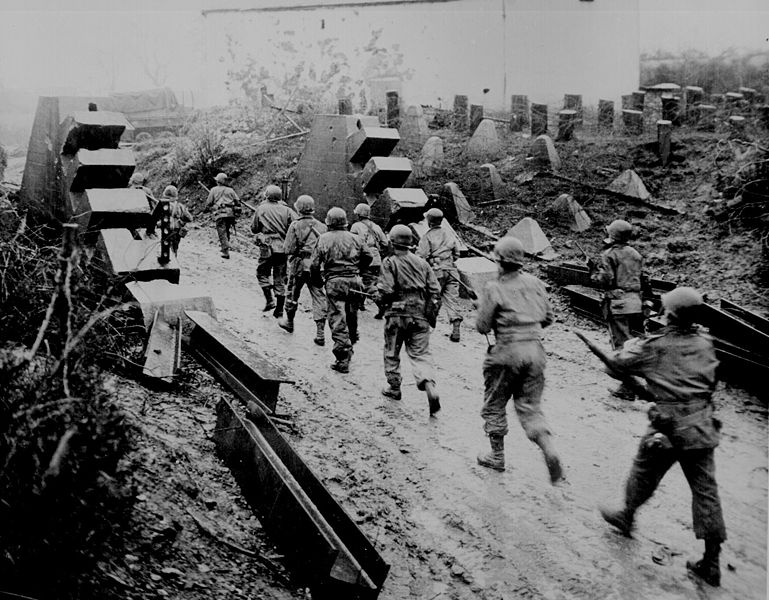
Crossing the Siegfried Line

The dogma of the Leavenworth School emphasized that “victory in large-scale war depends on a strategy of direct confrontation with the enemy’s main forces in order to destroy them.”[ii] This was not in itself different than the thought of contemporary European armies influenced by Clausewitz; but the Americans differed from the Europeans “in the extent to which they expected overwhelming power alone, without subtleties of maneuver, to achieve the objective.”[iii] The tradition developed from an emphasis on Ulysses S. Grant’s campaign in Virginia which understood that Grant had “defeated the armies of the Confederacy through head on assault by overwhelming strength to destroy them, so that in any future great war the United States would seek the destruction of the enemy armed forces by similar means.”[iv] It is perplexing that the Army failed to truly appreciate William Tecumseh Sherman’s use of strategic maneuver on the offense with the goal of destroying the enemy’s army. The fact that the Army failed to incorporate those lessons into its strategic thought, even as it built forces that were better suited to Sherman’s campaign is one of the contradictions of American military thought.[v]

Grant’s tradition was put into practice by Pershing in World War One to the extent that he could influence allied strategy, with mixed results.[vi] The reduction of the St Michel Salient and Meuse-Argonne offensive, though aided by German withdraws and achieved with high casualties, helped convince the Germans that the war was lost.[vii] “Only in late 1918 did the veteran American divisions show the same degree of tactical skill as their Allied and German counterparts, and the lessons came by bloody experience.”[viii] Pershing’s campaigns were bloody, but they came at a when maneuver had again become part of the war, and at the point where the Germans were beginning to collapse.  George Marshall warned about “generalizing about modern warfare from their 1918 experiences against a German army already stumbling into exhaustion.”[ix] Yet for “the American military, the First World War confirmed the doctrines of concentration and of fighting for complete victory, and out of the battlefields of Europe came the foundations of strategic faith….”[x] Weigley notes that: “In strategy, most American soldiers believed, the modern mass army left frontal assault as the only recourse.”[xi]

While Grant’s tradition remained a dominant feature of American strategic thought, the Army was becoming a mobile army whose divisions were to be “tough and lean.”[xii] General Leslie McNair reorganized the structure of the infantry division and later that of the armored divisions.  The heavy “square” infantry division of the First World War was reorganized with three infantry regiments and supporting elements and was characterized by its mobility than its sustained combat power.  McNair reorganized the armored divisions into lighter, though extremely flexible organizations built around the “Combat Command” and the tank was viewed as viewed as an instrument of exploitation, not a means to defeat enemy armor.  The result was an army formed “upon the principle of mobility and its lack of sustained combat power…did not serve it so well when it faced resolute and skillful enemies in strong defensive positions….”[xiii]

The new divisional structures were both mobile and flexible but in the context of the European campaign were wanting in sustained combat power.  Peter Mansoor comments that divisions “literally fought themselves out in constant operations.”[xiv] At the same time he takes issue with Weigley on the staying power of U.S. divisions commenting on the efficiency of the American individual replacement system.[xv] A U.S. Army study commented that in direct assaults against a emplaced enemy that “heavy casualties in such operations were more than the triangular division could sustain, with the result that the entire division was often rendered combat ineffective….”[xvi] McNair’s reorganization ignored General Chaffee’s 1941 admonition that armor must be organized into corps and employed in mass using not “hundreds but thousands of tanks…” calling the failure to train and organize “an adequate number of command echelons and corps troops to ensure proper employment and timely supply for these larger armored formations in active operation is indefensible.”[xvii]

To further complicate the American situation, the application of Grant’s tradition failed to take into account the principle of mass or concentration, which was vital to the success of a strategy of direct confrontation.  The theory demanded that the Americans have enough troops divisions to keep up pressure everywhere. Grant had such power at his disposal, Eisenhower did not.  The thought that “if the United States applied its superior power everywhere it must be able to rupture the defenses somewhere,”[xviii] was dominant.  But to be successful it required overwhelming superiority in numbers and firepower.  This strategy was in conflict with the Army that the Americans built to pursue the war, and in conflict with one of the more influential prewar American thesis on the subject, Infantry in Battle. This treatise stated:

“Generalship consists at being stronger at the decisive point-having three men there to attack one.  If we attempt to spread out so as to be strong everywhere, we shall end up being weak everywhere.  To have real main effort-and every attack and attack unit should have one- we must be prepared to risk extreme weakness elsewhere.”[xix]

It was an army designed for Sherman’s campaigns in Georgia and the Carolina’s, not Grant’s Virginia campaign. It was best suited to campaigns of strategic maneuver and concentration rather than frontal assaults along a broad front.  Its organization called for this and this fact was recognized before the war.[xx] Weigley notes that the “paradoxical commitment to a power drive strategy of head-on assault in an army shaped for mobility further contributed to the prolonging of the war by undermining the possible uses of mobility itself.”[xxi]

The theory of Grant, espoused by the Leavenworth school is fine there are sufficient forces to make it work. General McNair and Army planners initially planned for an Army of over 200 divisions.  Such an army would have been able to execute the strategy without the problems experienced by the Allies in 1944 and 1945.  Unfortunately the American Army was afflicted by the War Department’s decision in 1943 to limit the Army to 90 divisions.[xxii] The limitation on the number of divisions ensured that it would be “difficult or impossible once the battle of France was launched to rotate them out of line for rest or refitting.”[xxiii] This became a key consideration of allied planning by late 1944 because once the existing divisions were deployed to Europe or the Pacific there were no more to replace them.  Drastic measures were taken to increase the number of infantry troops by speeding up the movement of the last available divisions to Europe and by combing troops out of the COMMZ and from the Army Air Force.[xxiv] Training programs were put in place to train tank crews and junior officers.  Yet, these programs did not begin to put significant numbers of replacements into the line until March 1945.[xxv] Mansoor, a critic of Weigley, agrees with him on many points and notes that the “90 division gamble was a decision that cost the lives of numerous servicemen-primarily infantry replacements-in Europe in 1944 and 1945.”[xxvi] The decision to limit the number of divisions forced Eisenhower into a position where he frequently faced an equivalent number of German divisions to those that he could employ.  This would be the case in at the beginning of 1945 despite the steady erosion of the German forces arrayed before him.

Leadership, Strategy and Tactics and the Performance of the Army
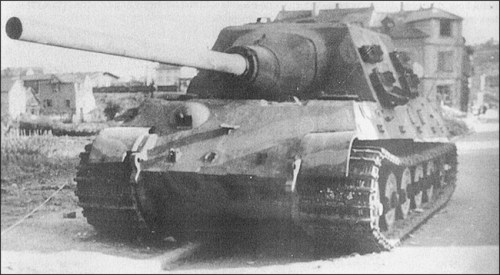
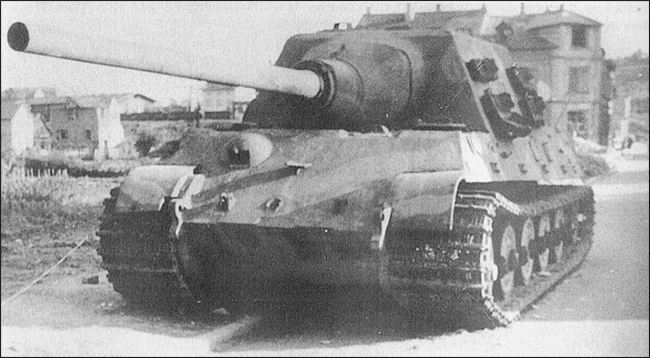
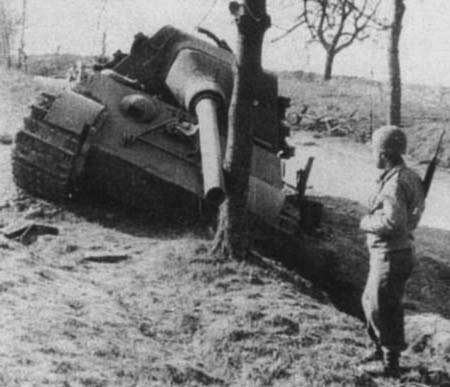
The Germans Employed the Jagdtiger in Small Numbers Against the American Onslaught

After the Bulge the Allies began their push to the Rhine.  Eisenhower “interpreted the Ardennes as confirming the necessity for his broad front strategy, particularly in closing up to the Rhine all the way to Switzerland.”[xxvii] Hastings notes that the Wehrmacht “retained psychological dominance on the battlefield,”[xxviii] and that “Allied commanders remained fearful about exposing their flanks in attack, even when the Germans no longer possessed the resources or mobility to intervene with conviction.”[xxix] In many places GIs and their British counterparts in Montgomery’s 21st Army Group failed to take the initiative and often the Allied commanders “expressed dismay about the lack of aggression shown by their troops.”[xxx] Gavin noted in his diary that: “With better troops, I see no reason why we could not run all over them…Our American army means well and tries hard, but….it is untrained and inefficient… certainly our infantry lacks courage and élan.”[xxxi] Despite this the Allied armies, in particular the Americans, made headway and in many places when well led performed admirably.

The Eifel

Following the reduction of the Bulge Eisenhower allowed Bradley to begin to break the West Wall in the Eifel. After the attack began Eisenhower stopped Bradley short of a breakthrough in order to shift weight of the offensive to Montgomery in the north ordering 12th Army Group to revert to the defensive.  Yet, Eisenhower allowed Bradley a “measure of freedom for limited attacks,”[xxxii] and Patton termed his “operations in the Eifel an “aggressive defense.””[xxxiii] The campaign was primary conducted against oddments of a number of Volksgrenadier divisions of 7th Army.

First Army was diverted on February 1st after making good progress in the Eifel to safeguard the right flank of 9th Army by capturing the Roer dams.  Hastings notes that a “more flexible and imaginative commander-or one unconstrained by the demands of inter-allied relations-would have allowed Hodges forces to keep going to the river and delayed Montgomery for the necessary few days.”[xxxiv] However Bradley felt that Eisenhower “had little choice but to accede to Montgomery’s demand.”[xxxv] Bradley allowed 3rd Army to continue “probing attacks,” and 3rd Army advanced across the Eifel breaking through the West Wall at Prüm and Bitburg.  For the first time the enemy showed “cracks in the admirable cohesion and discipline of the German army.”[xxxvi] Aggressive units of Patton’s 3rd Army were rewarded with dramatic advances. 4th Armored Division in “one bound covered 25 miles, taking 5,000 prisoners and killing several hundred Germans for the loss of 111 of its own men,”[xxxvii] and 10th Armored took Trier on 14 March.  Patton called the campaign “a long hard fought fight with many river crossings, much bad weather, and a great deal of luck.”[xxxviii] Despite this there were problems in some formations.  Hastings recounts how a platoon leader in a VII Corps unit told his commander during a crossing of the Sauer River that “These men have had it sir! They won’t budge for me or anybody else….”[xxxix]The G-3 of 6th Armored division noted that “some of our divisions are too sensitive to their flanks…the result of this is timidity…”[xl]

The Roer Dams, Grenade and Lumberjack

1st Army supported 9th Army by capturing the Roer river dams in preparation of Grenade.  The inexperienced 78th Division was able to secure the dams with help from the veteran 9th Division, though not before the Germans had destroyed the release valves to “flood the Roer valley for about two weeks.”[xli] This delayed the start of Grenade but the Americans finally captured a prize that had eluded them the previous fall.  The one truly notable aspect of this campaign was the continued erratic leadership of Hodges.  Gavin called it “impatient” and it nearly cost the Commanding General of 78th division his command.  Bradley’s aide, Major Hanson remarked that Hodges “was near exhaustion.”[xlii]

9th Army’s attack was conducted in concert with Operation Veritable of 2nd Canadian Army.  The plan was that the two armies would clear the area west of the Rhine destroying as much of the enemy as possible in preparation for the crossing of the river.  As such 9th Army remained under the operational control of Montgomery’s 21st Army Group.  9th Army crossed the Roer, hampered by the high waters and German resistance but captured Düren and München-Gladbach and closed up to the Rhine.  The “rapid build-up enabled Simpson to maintain intense pressure and on the last Day of February his armor broke away.”[xliii] 9th Army met up with the Canadians eliminated elements of the German Army that remained west of the river.  9th Army took over 30,000 prisoners and killed an estimated 6,000, but substantial numbers were evacuated by skillful German commanders.[xliv] The greatest disappointment was that Grenade failed to capture any bridges over the Rhine.   Montgomery turned down Simpson’s request to make a fast crossing of the Rhine at Urdingen, where there were few German troops.[xlv]

South of 9th Army the 1st and 3rd Armies launched Operation Lumberjack to attempt to envelope the German forces west of the Rhine in its sector in similar fashion to Grenade-Veritable. Facing weak German forces 1st Army made good progress capturing Cologne on March 5th.   3rd Army’s advance was exceptional.  Its plan to cut off the Germans on the west bank worked almost to perfection despite poor roads, snow and the opposition of the 2nd Panzer Division.[xlvi] General Gaffney’s 4th Armored division, drove 40 air miles, captured 5,000 prisoners killed another 700 Germans, capturing much equipment with the loss of only 29 men killed.[xlvii] Bradley called the division’s performance “the most insolent armored blitz of the Western war.”[xlviii] Patton’s armor covered “56 miles in three days to reach the Rhine near its confluence with the Moselle.”[xlix] For the first time “senior officers and headquarters fell into the American bag,”[l] including the command post of LXVI Corps and the commander of LIII Corps. In these operations the bold use of maneuver and concentration by Simpson, Hodges and especially Patton exploited the natural strengths of their formations to achieve their objectives.

Remagen
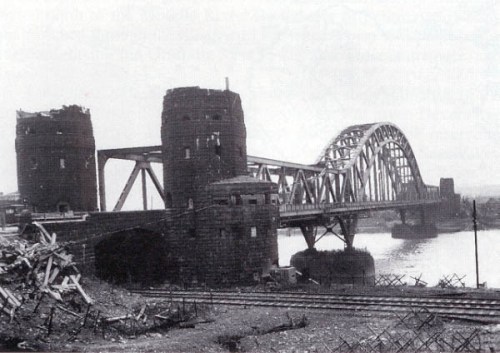
Remagen Bridge

1st Army’s swift advance and the chaos wreaked by Patton’s army led to the only instance in the campaign where the Allies captured a bridge over the Rhine intact.  The Ludendorff railway bridge at Remagen remained and on 7 March 9th Armored division detached a task force from CCB to take the bridge before it could be blown.   This force surprised the Germans and reached Remagen by 1300. General Hoge, hero of St. Vith, arrived quickly and ordered the capture the bridge as quickly as possible.[li] Hoge ignored orders to divert most of his troops to another crossing of the Ahr River and without orders “threw the rest of his armored infantry across the Rhine….”[lii] “In spite of the threat of the bridge being blown by the fleeing Germans, bold action by American infantry and engineers captured the bridge and established a bridgehead over the Rhine by 1630.  III Corps ordered 9th Armored division to “exploit the opportunity,”[liii] and “within 24 hours they had 8,000 men across.”[liv] Hodges exploited the opportunity and pushed the 9th, 78th and 99th divisions across the river where they continued to enlarge the bridgehead while fighting off fierce German counter-attacks.  By 24 March 1st Army had “three corps, six infantry divisions, and three armored divisions across the Rhine River.”[lv] The best German formations “arrived piecemeal and spent themselves in the same way, mustering only limited, scattered counterattacks instead of any major blow.”[lvi]

The Remagen crossing was not welcomed by all and restrictions were placed on 1st Army as it enlarged the bridgehead.  Carlo D’ Este saw Remagen as “typical of the lack of connection between SHAEF and its subordinate elements.”[lvii] “Pinky” Bull, the SHAEF G-3 was at Bradley’s headquarters when the Bradley was informed of the crossing.  Bull told Bradley that the Remagen crossing “just doesn’t fit in with the plan.”[lviii] Bradley recalled telling Bull: “What the hell do you want us to do,” I asked him, “pull back and blow it up?”[lix] During the next few days however “Bull’s unbending skepticism infected Eisenhower himself.”[lx] And by March 9th Bull informed Bradley that Eisenhower “did not want the Remagen bridgehead expanded beyond the ability of five divisions to defend it.”[lxi] The decision to favor Montgomery’s crossing of the Rhine by detaching divisions from 12th Army Group to support it caused consternation among Bradley and his commanders who feared that Montgomery would “use most of the divisions on the Western Front, British and American, for an attack on the Rhine plains…and the First and Third Armies be left out on a limb.”[lxii] Liddell-Hart noted that the order was “all the more resented because the U.S. Ninth Army…four days earlier, had been stopped by Montgomery from trying to cross the river immediately, as its commander, Simpson, desired and urged.”[lxiii]

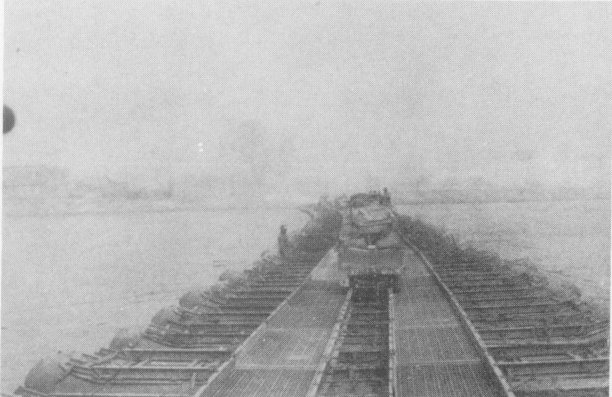
Patton’s 3rd Army Crossed the Rhine on the Fly at Oppenheim

Remagen’s aftermath showed Eisenhower’s continued commitment to the broad front, to closing up to the Rhine along its entire length, and his inordinate fear of German counter-stokes.  He remained “fearful that, as long as some German forces survived on the Western side of the Rhine, the potential existed for another potential unpleasant surprise, a counter-attack across an exposed American flank.”[lxiv] The facts belied the situation and Model, commander of Army Group B “had not only given up on trying to eliminate the American bridgehead at Remagen but had covertly begun ordering large elements of Army Group B to evacuate the Rhine and cross the river.”[lxv] This decision resulted “in a lost opportunity to have established a larger bridgehead across the Rhine.”[lxvi] It was another example of Eisenhower’s failure to exploit opportunity when it presented itself and of a desire more to not lose the war than to win it. Despite this “Remagen bridge was one of the great sagas of the war and an example of inspired leadership.”[lxvii] Wilmont called it “a brilliant coup,”[lxviii] a thought echoed by Liddell-Hart.[lxix] The German response to rush numerous units to contain the bridgehead made the Allies task when they crossed the Rhine at other points “much easier than they had anticipated.”[lxx]

Patton’s Saar-Palatinate Campaign

Patton’s 3rd Army attacked the Saar-Palatinate in concert with the 7th Army with the intent of assailing the West Wall from the rear and trapping the remnant of the German Seventh Army and the German First Army.  7th Army assaulted the West Wall while Patton’s army began its assault on 13 March with the XII and XX Corps attacking into scattered German resistance.  With the infantry making the breakthrough both corps unleashed their armored divisions in an exploitation role.  Patton’s attack was so successful that he was allowed to adjust his assault to carry it into 7th Army’s zone to encircle the collapsing German Army.  In an unusual command and control move Devers of the 6th Army Group gave Patch and Patton “the authority to communicate directly with each other, bypassing their different army group headquarters.”[lxxi] Large scale surrenders began to take place for the first time, including that of 3 Volksgrenadier divisions and the remnants of 2nd Panzer division.[lxxii]

US Soldier Standing Watch over Disabled Jagdtiger

Patton was urged on by Bradley, who warned him about “the danger of losing his divisions to Montgomery if he did not secure a Rhine crossing.”[lxxiii] Patton got his engineers and bridging equipment up quickly and Bradley ordered him to “take the Rhine on the run.”[lxxiv] On March 19th alone the Third Army overran more than 950 square miles of territory.”[lxxv] Third Army “cleaned up the west bank of the Rhine all the way south to Worms and Speyer; Third and Seventh Armies claimed well over 100,000 German prisoners in the victory.”[lxxvi] On the 22nd Third Army launched the 5th Infantry division across the Rhine at Nierstein and Oppenheim, surprising the Germans and beating Montgomery across the Rhine. Patton called Bradley: “Brad, for God’s sake tell the world we’re across…I want the world to know that Third Army made it before Monty.”[lxxvii] Weigley notes in this campaign “the American army’s sharpening instinct for the jugular,” and that it was a model “of not only how to gain ground of not only how to gain ground but to destroy enemy forces.”[lxxviii]

Plunder

9th Army and Allied Airborne forces participated in 21st Army Group’s grand set-piece crossing of the Rhine on 23 March.  The attack had been prepared for weeks by Montgomery and more resembled an amphibious operation than a river crossing. The attack employed 25 divisions supported by 3,000 guns with maximum air support and naval amphibious units.   Opposing the Army group were “five weak and exhausted German divisions”[lxxix] of 1st Parachute Army.  The assault cost 9th Army thirty casualties.  Montgomery also employed the American 17th and 6th British Airborne divisions in Operation Varsity which was the largest single day airborne operation of the war. Over 21,000 paratroops were dropped or air-landed in gliders into the face of heavy flak. Numerous troop transport planes and gliders were lost.  The operation was of doubtful utility, ground forces were already well on their way to the objective the paratroops were landed on and the operation had a heavy cost, 17th Airborne took “some 1500 casualties, including 159 killed.” And 6th Airborne lost another 1400.[lxxx]

The Ruhr Pocket and the Decision to Stop on the Elbe
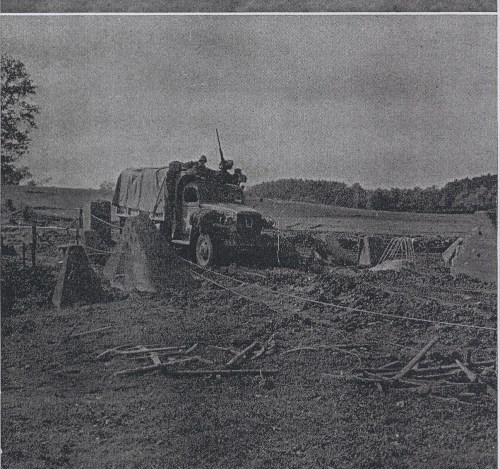

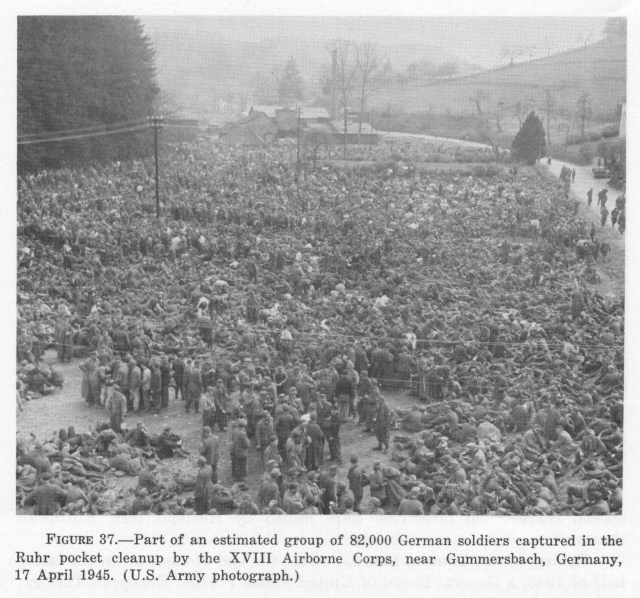
The last major operation in the West following the breakouts from the bridgeheads over the Rhine was the encirclement and reduction of the Ruhr pocket.  This operation involved the 9th Army and 1st Army. The 3rd Army continued its operations east and south toward Nurnberg.   Bradley, his blood stirred by the large numbers of prisoners taken in the Saar, Palatinate and Rhineland now became addicted by the completion of envelopments and he told his staff as “he shifted Hodges’ direction toward a meeting with Simpson encircling the Ruhr: “I’ve got bags on my mind.””[lxxxi] The Army Group completed the encirclement and reduced the pocket by April 18th. Two Army commanders, Von Zangen of 15th Army and Harpe of 5th Panzer Army as well as 25 other Generals and Admirals were caught in the American net.  Vaunted formations such as Panzer Lehr and 116th Panzer were among the 317,000 German prisoners taken by the Army Group. XVII Corps alone captured 160,000 prisoners.[lxxxii] Field Marshal Model, the commander of Army Group B took his own life on the 21st. The one setback during the battle was during the spirited advance of the 3rd Armored division to Paderborn a task force ran into a Kampfgrüppe of King Tigers manned by Waffen SS Panzer training students stopped them with heavy losses.[lxxxiii] To make matters worse the 3rd Armored Division Commanding General, Maurice Rose was killed when his jeep encountered Tigers and a jittery German Panzertroop shot him when he removed his pistol attempting to surrender.[lxxxiv]
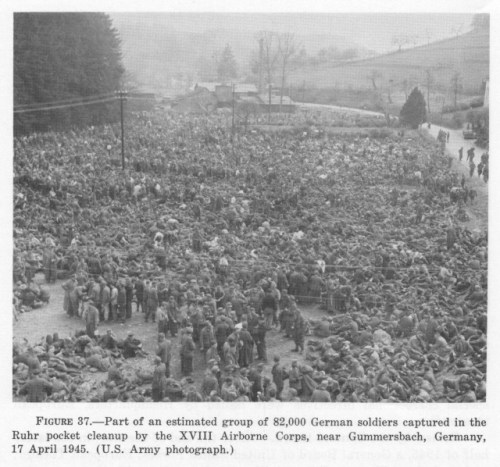
Despite the great number of prisoners taken and the elimination of the bulk of the Wehrmacht in the West the battle detracted from what had been hereto the overriding goal of the campaign, the capture of Berlin.[lxxxv] The reasons for this were twofold.  At the Army Group level Bradley was determined to engage as many of his troops as possible so they would not be sucked into any offensive commanded by Montgomery who continued to clamor for control of American troops to make the final drive for Berlin.   Eisenhower supported Bradley’s decision as he believed “that the Western Allies no longer had much chance of capturing “the main prize,” Berlin, anyway.”[lxxxvi] Weigley suggests that a better purpose for the troops that Bradley used to reduce the Ruhr pocket would have been to us them to aid 9th Army’s drive toward Berlin which was already closing on the Elbe.  With the reuniting of the 1st and 9th Armies Bradley was poised to begin his drive to Berlin with the largest field command in American history.[lxxxvii]

US Vehicles Driving Towards Kassel

The second reason was that Eisenhower had made a decision based on political and tactical considerations to shift the focus of the Allied effort from Berlin to Dresden and Leipzig yet not completely ruling out an advance toward Berlin.[lxxxviii] Attempts by 9th Army to drive toward Berlin were frustrated by unexpected German resistance to its bridgeheads over the Elbe. On the 15th of April Simpson flew to Bradley’s headquarters to propose an attack on Berlin.  Bradley called Eisenhower who on hearing Bradley’s estimate of 100,000 casualties to take the city elected not to continue the attack towards Berlin.[lxxxix] Eisenhower had now concluded “that the National Redoubt was now over more importance than Berlin,”[xc] and directed Patton and Devers to secure it.  Patton and Simpson were both incredulous at the decision and felt that it was “a terrible mistake.” Patton felt 9th Army could take Berlin in 48 hours.[xci] In a similar vein Patton’s move into Czechoslovakia was halted before Prague.

Overage German Recruits Captured by US Forces

Eisenhower’s decision was political and tactical and was supported by the U.S. Chiefs of Staff;[xcii] Berlin would be in the Soviet zone even if he took it.  Hastings sates the decision was “surely the correct one” noting that nothing could change the post-war settlement.[xciii] Murray and Millett agree.[xciv]Others such as J.F.C. Fuller felt that the political decisions had turned the fruits of victory “into the apples of Sodom, which turned to ashes as soon as they were plucked,”[xcv] leaving Eastern and Central Europe under the control of the Soviets.  D’ Este notes that no matter what was decided that Eisenhower’s “hands were already tied by the agreement of the Big Three agreement over the division of occupied Germany.”[xcvi] In the end there may have been a political advantage to taking Berlin before the Soviets, but as Hastings notes: “It is hard to see how this could have been prevented, given the Western Allies sluggish conduct of the war.”[xcvii] This was the fault of both the British and Americans and this was in fact as much a part of the final settlement in Europe as any decision made in the final weeks of the war.

In retrospect one can see the historical consequences of Eisenhower’s decision, but how much that decision was influenced by the way the American Army’s organization and conduct for war is seldom mentioned. Perhaps had Eisenhower had the 200 plus divisions envisioned by the Victory plan, or had he been bolder and abandoned the broad front strategy inherited from Grant, history might be different today.  There are always results.  One should not devise strategies for the conduct of war that do not match up with the forces that you plan to employ.  Organization, training and equipment must be designed for the type of war one intends to fight and are just as important as a grand strategy.   This was the lesson of the American involvement in the European campaign.  The American Army succeed in spite of the restraints that its leadership and saddled it with.  The final campaign in Germany showed that at least parts of it had learned the hard lessons of war and could conduct a highly successful campaign.

Handshake on the Elbe: US and  Red Army Troops Meeting


[i] Weigley, Russell  F. Eisenhower’s Lieutenants: The Campaign in France and Germany 1944-1945. Indiana University Press, Bloomington IN 1981. p.2.

[ii] Ibid.  p.728

[iii] Ibid. p.4.

[iv] Ibid.

[v] See Weigley’s article American Strategy, in Peter Paret’s Makers of Modern Strategy from Machiavelli to the Nuclear Age. Paret, Peter, editor.  Makers of Modern Strategy from Machiavelli to the Nuclear Age. Princeton University Press, Princeton, NJ 1986 pp.434-436.

[vi] See Keene, Jennifer D. Doughboys, the Great War, and the Remaking of America. The John’s Hopkins University Press. Baltimore,MD. 2001. pp.42-44.  Keene notes the results of the AEF’s training and Pershing’s organization and employment of the Army in WWI.  The similarities to the American experience in WWII are startling.  A comment of George Marshall after the war that: “Officers leading their men into battle, abandoned tactical maneuvering in favor of “steamroller operations” that forced men to keep going until exhaustion stopped them…” reminds one of the Huertgen Forrest.  Likewise a similar situation arose in regard to training.  Other comments are that the infantry was not well trained and that “many troops resisted advancing without artillery support….”

[vii] Herwig, Holger H. The First World War: Germany and Austria-Hungary 1914-1918. Arnold a Member of the Hodder Headline Group, London England 1998. p.424.

[viii] Millett, Allen R. and Maslowski, Peter. For the Common Defense: A Military History of the United States of America. The Free Press, New York 1984. p.349.

[ix] Ibid. Weigley. p.25

[x] Matloff, Maurice Allied Strategy in Europe in Makers of Modern Strategy from Machiavelli to the Nuclear Age. Paret, Peter, editor.  Makers of Modern Strategy from Machiavelli to the Nuclear Age. Princeton University Press, Princeton, NJ 1986 p.696.

[xi] Ibid. Weigley. p.5

[xii] Ibid. Weigley. p.23

[xiii] Ibid. p.728

[xiv] Mansoor, Peter R. The GI Offensive in Europe: The Triumph of American Infantry Divsions 1941-1945. University Press of Kansas, Lawrence KS. 1999 p.31.

[xv] Ibid. pp.253-254.  Mansoor is the only historian that I have ever seen defend this system.  Even Stephan Ambrose who generally leads the cheering section for the American Army in WWII condemned the system, which Mansoor admits in his account.

[xvi] Gabel, Christopher R. The Lorraine Campaign: An Overview September-December 1944. U.S. Army Command and Staff College, Ft. Leavenworth KS 1985.  pp.34-35.

[xvii] Chaffee, Adna R. Mechanization in the Army, Statement to Congress, April 1941. p.19.  Combined Arms Research Library, Digital Library http://cgsc.leavenworth.army.mil/carl/contentdm/home.htm

[xviii] Ibid. p.6.

[xix] _________Infantry in Battle 2nd Edition The Infantry Journal Incorporated, Washington DC 1939. p.68

[xx] See Chaffee and Infantry in Battle. Likewise this was echoed in S.L.A. Marshall’s book Armies on Wheels, William and Morrow Company, New York, NY 1941.

[xxi] Ibid. p.729.

[xxii] Ibid. p.14

[xxiii] Ibid.

[xxiv] Ibid. p.662-663. Initially, 21,000 troops were taken from the COMMZ and 10,000 were directed to be transferred from the AAF.  Additionally 2,253 black troops were formed into 37 platoons and distributed among the divisions of 12th and 6th Army Groups.

[xxv] Ibid. p.664.  The efforts were successful and by April there was a surplus of 50,000 infantry soldiers beyond reported shortages, despite the fact that no more American or British divisions were available for deployment to the continent.

[xxvi] Ibid. Mansoor,

[xxvii] Ibid. Weigley. p.578

[xxviii] Hastings, Max. Armageddon:  The Battle for Germany 1944-1945 Alfred A Knopf, New York NY 2004 p.340.

[xxix] Ibid.

[xxx] Ibid. Hastings. p.340

[xxxi] Ibid. p.341

[xxxii] Ibid. Weigley. p.583

[xxxiii] Bradley, Omar  N. A Soldier’s Story Henry Holt and Company, New York NY 1951. p.501

[xxxiv] Ibid. Hastings. p.348

[xxxv] Ibid. Bradley. p.497

[xxxvi] Ibid. p.589.

[xxxvii] Ibid. Hastings. p.348.

[xxxviii] Patton, George S. War as I Knew It Originally published by Houghton Mifflin Company NY 1947, Bantam Paperback Edition,  Bantam Books, New York, NY 1980 p.242

[xxxix] Ibid. Hastings. p.345

[xl] Ibid.

[xli] Ibid. Weigley. p.603

[xlii] Ibid. p.602

[xliii] Wilmont, Chester. The Struggle for Europe Harper and Brothers Publishers, New York, NY 1952 p.673

[xliv] Ibid. p.616

[xlv] Ibid. Hastings. p.365

[xlvi] Ibid. Weigley. p.621

[xlvii] Ibid.

[xlviii] Ibid. Bradley. p.509

[xlix] Ibid. Wilmont. p.674

[l] Ibid. Weigley. p.622.

[li] Ibid. 627

[lii] Ibid. Hastings. p.365

[liii] Ibid.

[liv] Murray, Williamson and Millett, Allan R. A War to Be Won: Fighting the Second World War The Belknap Press of Harvard University Press, Cambridge Massachusetts and London England, 2000 p.478

[lv] Ibid. Mansoor. P.244.

[lvi] Ibid. Weigley. p.632

[lvii] D’Este, Carlo. Eisenhower: A Soldier’s Life Owl Books, Henry Holt and Company, New York NY 2002. p.681

[lviii] Ibid. p.682

[lix] Ibid. Bradley. p.511

[lx] Ibid. Weigley. p.629.

[lxi] Ibid.

[lxii] Ibid. Wilmont. p.676

[lxiii] Liddell Hart, B.H. The History of the Second World War G.P. Putnam’s Sons, New York NY 1970. p.678.

[lxiv] Ibid. Hastings. p.366.

[lxv] Newton, Steven H. Hitler’s Commander: Field Marshal Walter Model, Hitler’s Favorite General. DeCapo Press, Cambridge MA 2005. p.351.

[lxvi] Ibid. D’Este. Eisenhower p.682

[lxvii] Ibid.  By this D’Este is obviously not referring to Bull and Eisenhower.

[lxviii] Ibid. Wilmont. p.677.

[lxix] Ibid. Liddell-Hart. p.677

[lxx] Warlimont, Walter. Inside Hitler’s Headquarters 1939-1945 translated by R.H. Barry. Presidio Press, San Francisco, CA 1964. p. 506.

[lxxi] Ibid. Weigly. p.635.

[lxxii] Ibid. p.638

[lxxiii] Ibid. Wilmont. p.678.

[lxxiv] Ibid.

[lxxv] D’Este, Carlo. Patton: A Genius for War. Harper Collins Publishers New York, 1995  p.711

[lxxvi] Ibid.  Murray and Millet. p.479.

[lxxvii] Ibid. D’Este Eisenhower p.683

[lxxviii] Ibid. Weigley. p.639

[lxxix] Ibid. Liddell-Hart. p.678.

[lxxx] Ibid. Hastings. p.369.

[lxxxi] Ibid. Weigley. p.673.

[lxxxii] Ibid. p.680

[lxxxiii] Ibid. Hastings. p.377.

[lxxxiv] Ibid. p.675.

[lxxxv] Ibid. Weigley. p.674.

[lxxxvi] Ibid. p.684.

[lxxxvii] Ibid.

[lxxxviii] Ibid. p.688.

[lxxxix] Ibid. pp.698-699.  Weigley believes that neither Eisenhower nor Bradley wanted to continue to Berlin; Bradley for the reason that Montgomery would steal the credit and Eisenhower because it was a “prestige objective” that would remain in the Soviet zone no matter who captured it.

[xc] Ibid. Wilmont. p.690.

[xci] Ibid. D’Este Patton. P.721

[xcii] Ryan, Cornelius. The Last Battle The Fawcett Popular Library, New York NY.1966.  p.240.

[xciii] Ibid. Hastings. p.425

[xciv] Ibid. Murray and Millett. P.480

[xcv] Fuller, J.F.C. The Conduct of War 1789-1961 DaCapo Press edition, San Francisco, CA 1992. p.296.

[xcvi] Ibid. D’Este. Eisenhower. P.694.

[xcvii] Ibid. Hastings. p.512.

Bibliography

Bradley, Omar  N. A Soldier’s Story Henry Holt and Company, New York NY 1951.

Chaffee, Adna R. Mechanization in the Army, Statement to Congress, April 1941.  Combined Arms Research Library, Digital Library http://cgsc.leavenworth.army.mil/carl/contentdm/home.htm

D’Este, Carlo. Eisenhower: A Soldier’s Life Owl Books, Henry Holt and Company, New York NY 2002.

D’Este,  Carlo. Patton: A Genius for War. Harper Collins Publishers New York, 1995

Fuller, J.F.C. The Conduct of War 1789-1961 DaCapo Press edition, San Francisco, CA 1992.

Gabel, Christopher R. The Lorraine Campaign: An Overview September-December 1944. U.S. Army Command and Staff College, Ft. Leavenworth KS 1985.

Hastings, Max. Armageddon:  The Battle for Germany 1944-1945 Alfred A Knopf, New York NY

Herwig, Holger H. The First World War: Germany and Austria-Hungary 1914-1918. Arnold a Member of the Hodder Headline Group, London England 1998

Keene, Jennifer D. Doughboys, the Great War, and the Remaking of America. The John’s Hopkins University Press. Baltimore, MD. 2001.

Liddell Hart, B.H. The History of the Second World War G.P. Putnam’s Sons, New York NY 1970

Mansoor, Peter R. The GI Offensive in Europe: The Triumph of American Infantry Divsions 1941-1945. University Press of Kansas, Lawrence KS. 1999

Millett, Allen R. and Maslowski, Peter. For the Common Defense: A Military History of the United States of America. The Free Press, New York 1984

Murray, Williamson and Millett, Allan R. A War to Be Won: Fighting the Second World War The Belknap Press of Harvard University Press, Cambridge Massachusetts and London England, 2000

Newton, Steven H. Hitler’s Commander: Field Marshal Walter Model, Hitler’s Favorite General. DeCapo Press, Cambridge MA 2005

Paret, Peter, editor.  Makers of Modern Strategy from Machiavelli to the Nuclear Age. Princeton University Press, Princeton, NJ 1986

Patton, George S. War as I Knew It Originally published by Houghton Mifflin Company NY 1947, Bantam Paperback Edition,  Bantam Books, New York, NY 1980

Ryan, Cornelius. The Last Battle The Fawcett Popular Library, New York NY.1966

Warlimont, Walter. Inside Hitler’s Headquarters 1939-1945 translated by R.H. Barry. Presidio Press, San Francisco, CA 1964

Weigley, Russell  F. Eisenhower’s Lieutenants: The Campaign in France and Germany 1944-1945. Indiana University Press, Bloomington IN 1981.

Wilmont, Chester. The Struggle for Europe Harper and Brothers Publishers, New York, NY 1952

_________Infantry in Battle 2nd Edition The Infantry Journal Incorporated, Washington DC 1939

2 Comments

Filed under History, Military, world war two in europe

The Afghan War 2009-2012: Lessons from Algeria 1954-1960 A Review of “A Savage War of Peace

“A Savage War of Peace.” By Alistair Horne. The New York Review of Books, 1977, 1987, 1996, 2006.  Maps. Photographs. Bibliography. Index. 608 pp.

Foreign Legion in Algeria

In light of the developing situation in Afghanistan and the plan to apply the counterinsurgency techniques of clear and hold, or “the oil slick” in that country it is wise to look at other instances of this type of warfare before criticizing those about to implement the strategy.  Of course when doing this the best place to look is history, especially where the strategy worked, at least until the DeGaulle government abandoned the nearly complete military success achieved by French forces in Algeria triggering a national crisis.

Alistair Horne’s “A Savage War of Peace” is a most needed addition for anyone seriously interested in studying the dynamics of insurgency and counterinsurgency warfare; especially political and military leaders of a western nation occupying a Moslem country.  Horne’s work is important and one of the few in English that cover this subject.  The two other books in English to cover the subject, albeit only on part of the campaign is Paul Aussaresses’ controversial memoir “The Battle of the Casbah” and Ted Morgan’s memoir “My Battle of Algiers” though useful suffer from the fact that they are limited in scope to the events the individuals experienced while serving as French Army officers in Algeria. In both the author’s personal biases are readily in evidence and by the fact that they were written many years after the events in question.  Since those books are heavily dependent on the author’s memories.
Paratroops of the First Colonial Paratroop Regiment in Algeria

Horne is not limited by these factors.  Horne is a historian who served as a British Army officer assigned to the MI5 in the Middle East and later as a foreign correspondent for the Daily Mail who has written a trilogy of excellent works on the Franco-German wars: The Fall of Paris: The Siege and the Commune 1870-1871, The Price of Glory: Verdun 1916 and To Lose a Battle: France 1940. As such his account is as close to being objective as any could be in the case of writing this particular history.

Horne approaches the subject from the perspective of the broader issues that France and the Fourth Republic were facing in 1954, economic, military and psychological recovery from the Second World War, the loss of colonies, defeat in Indochina culminating in the Dien Bien Phu debacle.  Such is important when examining a military campaign as the latter do not take place in isolation of other events in the life of a nation. When the history of the US campaigns in Iraq and Afghanistan are written they will have to take into account many other factors apart from the military operations.

Horne tackles the complex issues of the Algerian war in a multifaceted manner looking not only at the military issues, but the political and social issues faced by the French, the European Pied-Noir Algerians and the Algerian natives, both Berber and Arab alike.  Horne also looks at the conflict in the broader context of the Cold War, the emergence of the Non-Aligned nation movement and the rise of Arab nationalism, skillfully weaving the actions of these movements and key individuals such as Egypt’s Nasser, Khrushchev of the Soviet Union and the most influential, and President Jacques de Gaulle into the story of the Algerian conflict. Unlike other writers Horne had access to many of the individuals involved, including leaders from each rebel faction, the Pied-Noir and the French government and military.  Included in those he interviewed is Algerian President Boumedienne who had commanded rebels during the conflict and was instrumental in Algeria’s independence as well as Jacque Soustelle who had been Governor General from 1955 through 1956. These sources as well as numerous others help give his narrative a depth and subtlety lacking in the first hand English language memoirs and accounts.

Terrorism by FLN Militias and Sympathizers Caused Great Problems for the French

Horne begins his account with the story of the aborted revolt and massacre at Setif on May 8th, VE Day, 1945 and the attempt by the French government to reassert its control over Algeria. Of particular interest in this section is Horne’s analysis of the mistake of the Pied Noirs and the French government in not offering a settlement to the Algerian separatists under magnanimous terms due to the scale of the victory they had won following the Setif uprising and their security forces “decapitation” of the leadership of the various Algerian nationalist factions.  He compares the victory to that of the Israelis in the 1967 War and the political reaction of the Pied Noir to the Israelis, who instead of negotiating a settlement that could have long term effects advantageous to them from a position of strength determined to humiliate and subjugate their foe.[1] If the US military is able to reverse the situation in Afghanistan the United States and the Afghan government will need to be magnanimous to a defeated foe in order to prevent yet another repetition of another Al Qaida and Taliban resurgence.

French Paratroops Going House to House in Algiers

In examining the period before the actual outbreak of the war in 1954 Horne looks at the missed opportunities of the French to prevent it.  He also examines the development of the Algerian independence movement, especially the senior leaders of the movement; many of whom had served in the French Army during the Second World War with distinction. His portrayal of the conflicts within the independence movement, show that this was not a monolithic movement, but that each faction had its own goals which often were in conflict with other groups.  This is also the case in Afghanistan where a disparate number of ethnic, political, criminal, nationalist and terrorist groups who often are at war with each other.  Likewise, Horne’s treatment of the Pied Noir and certain parts of the French leadership examine how they too were divided at some points in regard to the ultimate plan for the relationship of Algeria to France.

Horne makes much of political mistakes and machinations of French leaders that culminated in the end of the Fourth Republic and subsequent impact on de Gaulle when he became president in June 1958.  Some mistakes that Horne explores are those committed in the immediate wake of Setif. He also examines mistakes during the revolt; such as not taking it seriously, to individuals in the National Assembly impeding the efforts of Soustelle to effect reforms and compromise between hard line factions in the Pied Noir and Moslem communities.[2] Likewise he notes how the draconian treatment of Algerian Moslems by the French Army in the early phases of the counter-insurgency effort, including the assignment of “collective responsibility” to punish communities for the actions of individuals helped alienate the populace and strengthen the insurgency.  Such was the case in the first part of the Iraq occupation and helped inspire that insurgency.  One member of Soustelle’s cabinet noted: “the cycle of repression getting ever tougher, and the rebellion ever stronger, will ruin all your efforts of pacification.”[3]

Besides political mistakes Horne examines issues in military tactics that seem to plague counterinsurgency efforts to the present time.  He describes the early application of heavy conventional forces in an attempt to defeat the insurgency.  Horne discusses unsuccessful efforts in 1954-1955 and how they not only did not destroy the insurgency but how the insurgency spread in response to the efforts.  The question: “Did ‘pacification’, for instance mean trying to regain the confidence of the inhabitants; or did it mean crushing the rebellion by whatever means available?”[4] This question is still asked today by soldiers fighting insurgencies and often the latter is counseled by those who still think along the lines of the conventional tactics of the Cold War and World War Two, which many conservative pundits are enamored with.  Horne also discusses the successful tactics of commando units used by General Challe to effectively combat the insurgency.[5]

Horne examines the attitudes of the French Army which in a sense fought the war for itself.  Armies that have fought many campaigns together often have a sense of comradeship that transcends even the loyalty that they have to their nation.  It is the understanding of a “Band of Brothers” and can be found throughout history.  When the histories of Iraq and Afghanistan are written they will certainly include the fact that many soldiers, Marines and Sailors engaged in actual combat operations fought for the men and women with whom they served more than for anything else.

The French Army felt little affinity for the Pied Noir who they often saw as only interested in their interest at the expense of the campaign.  Likewise the Army, felt little more than contempt for the French government which they felt had betrayed them. General Lorillot noted “They made fools of us in Indo-China…they screwed in Tunisia…We are being screwed in Morocco. But they will never screw us in Algeria. I swear to you. Let this be known in Paris.”[6] Instead attitudes of not losing, stopping the humiliations were animated by the feeling of anti-communism in French ranks, especially in the Elite Parachute, Foreign Legion, Commando and Colonials (Marines). The novel The Centurions and voiced the feelings of one Paratroop commander “We want to halt the decadence of the West and the march of Communism.”[7]

Horne provides a narrative analysis of the military campaigns within the Algerian War.  In particular he describes the successes of units designed to live among and better the lives of the Algerians and the SAS,[8] He describes the building of the border wall to keep weapons out of rebel hands.  He describes the “success” of units which specialized in torture,[9] which turned out to be helpful in the short run but which ultimately damaged the fabric of the Army.  Horne notes the effects of torture on soldiers who participated and how it negatively affected support of the war in France and internationally.[10] The use of torture in Algeria has parallels with Iraq. Horne notes: “one has to take into account all those factors…horror at the atrocities of the F.L.N., a determination not to lose yet another campaign, and the generally brutalizing effect of so cruel and protracted war.”[11]

The most powerful part of the narrative is the drama when French President de Gaulle was faced with the revolts of 1959. At this time the Pied Noir militias, dissatisfied with potential political settlements went to the barricades in Algiers and other major cities, assisted in some cases by Army units.  These forces again revolted against his attempts to mediate a settlement and were followed by the General’s revolt of April 1961 which nearly became a military coup in France itself.   President de Gaulle’s role in bringing these revolts to an end, without the collapse of the government or a civil war was miraculous.  Though his actions undercut the military success of the Army in Algeria which had virtually eliminated the insurgency his foresight in recognizing that France had a future not dependant on Algeria remaining French was exceptional.  The actions of de Gaulle should be studied by those who closely link their country’s future to holding a foreign country, even one that is considered an integral part of the mother country, as Algeria was to France.

Horne’s book is as timely as it was when first published, maybe more so with the current escalation in Afghanistan.  Along with works by David Galula “Pacification In Algeria 1956-1958, Bernard Fall “Street Without Joy” and “Hell in a Very Small Place,” Andrew Krepinevich’s  “The Army in Vietnam,” Brian McAllister Linn’s “The Philippine War: 1899-1902” and Ben Shepherd’s “War in the Wild East: The German Army and Soviet Partisans” Horne’s work is vital reading for military and political leaders fighting counter-insurgency operations.  Unfortunately many militaries are often enamored by high tech innovation are not often receptive to the decidedly human factors and strategies necessary to fight insurgencies until they experience frustration and failure attempting to use conventional forces and tactics to win a counter-insurgency campaign.  Effective intelligence, efforts to win the hearts and minds of the populace by protecting them, knowledge of public affairs and the effect of media on operations are all key elements of a proper counter-insurgency campaign are covered by Horne. Horne’s work reminds us that these conflicts are not won by the forces with the greatest firepower or most modern weapons. This is something that the United States and its NATO and other Allies in Afghanistan should never forget.


[1] Horne, Alistair. A Savage War f Peace: Algeria 1954-1962. The New York Review of Books, New York, NY 1977, 1987, 1996 2006. p.69

[2] Ibid. pp. 113-114

[3] Ibid. p.115  Some would later compare the attitudes of the French Army to those of the Nazis. In one point of his narrative Horne notes the attitude of an officer who saw nothing wrong with the tactics used by the Nazis in the Second World War.

[4] Ibid. p.112.  Another question noted is something that seems to be commonplace in the Iraq War ““Limited Repression” did not always make the clearest sense to a patrol of young soldiers caught in a vicious ambush.” When one reads Horne’s accounts one sometimes almost feels that he is writing about the current American experience in Iraq.

[5] Ibid. pp. 334-335

[6] Ibid. pp.175-176

[7] Ibid. p.176

[8] The SAS Section Administrative Specialise first set up by Soustelle.  These units had great success but also suffered heavy losses as their efforts were recognized as having a positive effect by the FLN and other Algerian rebel groups.

[9] Such as the 11th Shock Regiment

[10] See pp. 195-207.

[11] Ibid. p.198.

2 Comments

Filed under Foreign Policy, History, iraq,afghanistan, Military

Can Anybody Spare a DIME: A Short Primer on Early Axis Success and How the Allies Won the Second World War

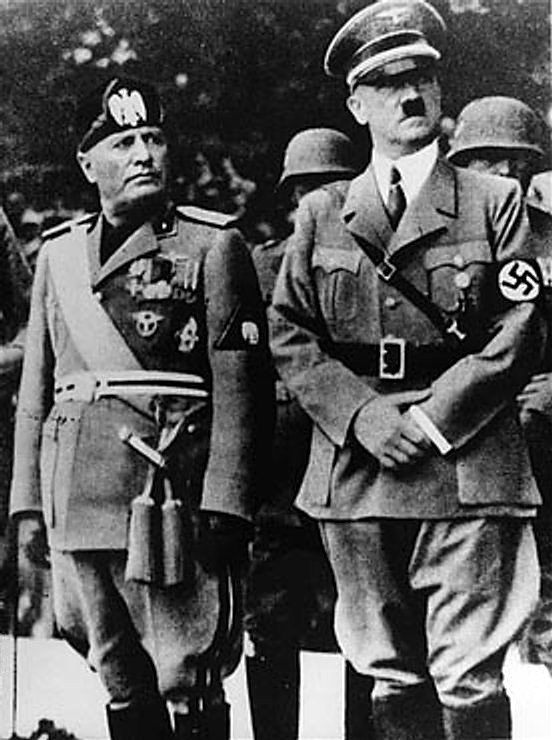
Hitler and Mussolini, the Axis Leaders Never Developed a Grand Strategy

All modern war is predicated on the full potential of a nation or alliance to fight a war.  This includes what is known in today’s parlance the DIME, or the Diplomatic, Intelligence, Military and Economic factors of national power. During the war the Axis powers almost exclusively fixated on the military dimension, especially at the operational and tactical level never coordinating a national or alliance grand strategy.  On the other hand the Allies were successful in doing so despite competing national interests of the British Empire, the Soviet Union and the United States.

Early German Success in France Changed the Face of Warfare

The Germans and Japanese were victorious in the early years of the World War Two due to their application of the most modern forms of warfare and ability to exploit weaknesses in their opponents.  For the Germans this entailed the use of the “Blitzkrieg” or lightening war which used the combined arms team of tanks, artillery, and mechanized infantry with close air support coordinated by commanders in mobile command posts who were able to adapt to tactical considerations on the ground and exploit enemy’s weaknesses.  This involved the classic forms of applied mass, speed and firepower to overwhelm enemy defenses at critical points and the encouragement of initiative by commanders, the Auftragstaktik. Led by men such as Heinz Guderian, Erich Von Manstein and Erwin Rommel to name but a few, the German commanders overcame allied opposition as well as the occasional hesitancy of their own senior leaders to defeat Allied forces throughout Europe.  The blitzkrieg involved risk, but the Germans for the most part, with key exceptions such as at Dunkirk during the French campaign took risks and exploited weaknesses in Allied political goals, military coordination and operational art. The Allies were hampered by weak political leadership, an aversion to risk, an outmoded strategy and poor coordination of a force which outnumbered the Germans and included more tanks than the Germans could field.  The German armaments were not necessarily superior to the Allies, but were better used for the most part.

German skill at the operational level was exemplified in Poland, France and the Low Countries, a daring Norwegian operation, which could be described as one of the first joint operations in military history, the Balkans and North Africa as well as the initial phases of Operation Barbarossa.  Each of these operations had flaws, the most glaring being at the strategic level and lack of a Grand Strategy.  The operations also exposed weaknesses in logistics and limits to what the mechanized and tactical air forces could do when stretched too far, North Africa and Russia as cases in point.  The Germans would always be outnumbered and fighting a multi-front war because of their limited naval capability, both in surface units and U-Boats, as well as the lack of a strategic air capability which kept them from eliminating Britain from the war.  Hitler’s desire for German domination in Europe excluded a true coalition effort to make allies with powers in Europe such as Vichy France which shared an aversion to the British especially after the attack of the British Navy on the French fleet in North Africa.  Likewise Germany’s alliance with Mussolini’s Italy was more of a strategic liability than a true partner. Hitler’s aversion to the Soviet State prevented any more than a brief cooperation with the USSR which was ended by the German invasion of the USSR. The Germans also failed in their war strategy by not going to a total war effort until 1943 after the ascension of Albert Speer as the Armaments Minister.  Thus German forces had to fight war “on the cheap” so to speak for the first part of the war, especially in North Africa and in Russia. In Russia the vast expanse of the front forced the Germans to thin out their forces to dangerous levels and whose pathetic road and rail network limited the already limited ability of the Wehrmacht to supply its forces as they advanced deep into Russia.

Admiral Yamamoto One of the Few Japanese Leaders to Understand what the Japanese Faced in Going to War with the United States

In the Pacific the Japanese used fast carrier task forces and naval air power coupled with superior surface warfare groups of fast battleships, cruisers and destroyers operating in conjunction with land based Army and Naval air units to isolate and destroy allied naval forces and outposts throughout the Pacific.   The Japanese exploited their superiority to conduct their own form of blitzkrieg.

Despite Inflicting Crushing Defeats on the Allies in late 1941 and early 1942 the Japanese period of Conquest would be Short Lived

At the same time the Japanese, even more so than the Germans lacked the ability to fight a long war; something that the best and most realistic of the Japanese strategists, Admiral Yamamoto understood and warned his government about before the attack on Pearl Harbor.  Likewise they like the Germans failed to develop a cohesive Grand Strategy in their war effort.  Competing priorities and inter-service rivalries between the Army and the Navy over resources, manufacturing priorities and war aims crippled Japanese efforts.  Despite this the Japanese used superior tactical application of forces, exploited Allied command and control weaknesses, numerical and qualitative superiority over dispersed and often obsolete Allied forces. The Allies in the opening phase of the war were often led by officers who had little respect for the Japanese and underestimated the Japanese skill at the tactical and operational level of warfare as well as the individual Japanese soldier and sailor, with tragic results.

USS Pope Being Blown out of the Water at the Battle of the Java Sea

The Japanese were constrained by limited resources and intense competition between the Army and Navy for those resources as well as a long term war in China which drew off the larger part of the Japanese Army and Army Air Forces.  The Japanese effort stalled after they lost much of their carrier fleet and experienced naval aviators at Coral Sea, Midway and the Guadalcanal Campaign.  The Americans, who assumed the mantle of the Pacific Theater after the initial Japanese success and weakness of British and Dutch forces in the Pacific and demands of the war in Europe began an aggressive defense and opened an offensive against the Japanese long before the Japanese believed that they would at Guadalcanal.

At the heart of the early German and Japanese success lay their superior application of the techniques and weapons of modern warfare on the land, sea and air against opponents who were initially ill-prepared to meet their onslaught.  They both had glaring weaknesses but their weaknesses in the early years of the war were masked by Allied ineptitude at all levels, tactical, operational and strategic.   Thus they were successful and at times wildly so, but in their success lay the seeds of their defeat.

Stalin, Roosevelt and Churchill overcame Significant Conflicts of Interest to Build a Grand Strategy

The defeat of the Axis powers was in large part a combination of superior Allied strategy at the “grand strategy” level and lack of a corresponding Axis Grand Strategy; as well as the Axis powers inherent weaknesses in natural resources, manpower and industrial capabilities to fight multi-front wars, coupled with poor transportation and logistics capabilities for distant operations.

The US Navy Breaking of the Japanese Naval and Diplomatic Codes as well as the Cracking of the German Ultra Code and Capture of the Enigma Machine Greatly Enhanced Allied Intelligence

The cracking of Japanese Naval and diplomatic codes and the capture of the German Enigma code machine and code books aided Allied strategic planning, none or the Axis intelligence services rose to the challenges of the war. The Allied victory and Axis defeat was in fact a combination of what is called the DIME, the Diplomatic Intelligence Military and Economic factors which caused the Axis defeat.  While it is in part due to Allied strategy, Axis deficiencies in each of these areas played a part in their ultimate defeat.

Massive US Industrial Capacity Drove the Allied War Effort

On the Grand Strategic level there was no comparison. The Allies, even factoring in often conflicting national goals were able to coordinate a strategy to first defeat Germany and then Japan.  The Americans, British and Russians began such cooperation even prior to the American entry into the war through the Lend Lease, followed by the British and American Combined Chiefs of Staff, which helped coordinate often disparate British and American strategies in Europe and Asia. Murray and Millett assert and I agree with the thesis that the British and Americans “came closest to designing a global strategy that accommodated their war aims.” (War to Be Won p.584) While close coordination with the Russians was illusory at best, the Western Allies were able to help keep the Russians in war the by helping to supply them (War to Be Won p.388), and on occasion launching operations which assisted the Russians, such as the invasion of Italy. The Italian invasion, though the pipe dream of Churchill to crack the “soft underbelly” of Europe was a key factor in the German decision to quit the Kursk offensive and redeploy Panzer Divisions, including SS formations to Italy and the West. This weakened the Germans in the face of the Russian counter offensive following Kursk which aided Russian success. The Axis powers knew no such coordinated strategic thinking.

Poor Italian Technology, Training and Organization Made them More of  a Burden to Germany than a Help

The Japanese, Germans and Italians ran separate wars based on their perceived national considerations at times which often ran contrary to the common needs of their coalition.  Italian actions in the Mediterranean caused a diversion in German efforts at key times, such as in Greece where the Germans had to save the Italians and delay the opening of Operation Barbarossa.  Italian incompetence forced the Germans to commit forces to North Africa, Greece, the Balkans and Italy upon its collapse which could have been used to great effect in Europe or Russia. The Japanese and Germans never coordinated their efforts to defeat either the western Allies or the Soviets.  The lack of a coherent Grand Strategy on the part of the Axis powers, especially in the early part of the war when Allied fortunes were at lowest ebb, was every bit as much a part of their ultimate defeat as was a coordinated or “superior” Allied strategy.

The lack of a coordinated Axis Grand Strategy was reflected in the way each fought its war, the Japanese were hindered by lack of natural resources, especially those most important in maintaining a war economy, fuels, metals, rubber and even foodstuffs for which they were dependant on foreign suppliers such as the United States.  They were also hindered by a war in China which consumed troops and supplies without a corresponding benefit.  (See Barnhart’s “Japan Prepares for Total War and Toland’s “Rising Sun.) Their inability to produce the machines of war in sufficient numbers to replace losses due to combat operations and their failure to keep up with advances in technology negated their initial success and superiority at sea and in the air.

US Naval Forces Would Dominate the Pacific

The Germans failed to mobilize their economy to a total war footing until after Stalingrad and the accession of Albert Speer to head Reich war production.   They also attempted to fight a multi-front war and were dependant on weak and unenthusiastic satellite states such as Romania and Hungary to hold what they deemed to be less important areas in order free up German units.  Likewise the Germans had not adequately prepared for the war at sea with sufficient surface, naval air or U-boat strength to win the battle of the Atlantic, nor had the Luftwaffe developed a strategic bombing capability with long range fighter escorts to win the Battle of Britain. German industrial efforts, even the great strides made after Speer took over war production were unable to keep pace with the massive production of the Americans and the Soviet Union.  The Red Army ground the Wehrmacht to dust on the Steppes of Russia, a key factor in that helped the American and British successfully invade Western Europe.

B-17s Over Europe

The preponderance of western Air, Naval, war production and natural resources enabled them to field Fleets, Armies and Air Forces which were unmatched in size or technical sophistication for their time in history.  The Japanese and the Germans had no way to win by 1944, short of developing and deploying Atomic weapons and delivery systems before the Americans and British did could defeat.  Murray and Millett note this in regard to Germany which had the Wehrmacht held out longer would have been the first target of the Atomic bombs. (War to Be Won p.483)

Atomic Bomb at Hiroshima, It could Have Been Berlin Instead

In summary the Axis powers were defeated by their own weaknesses in the diplomatic, intelligence, military and economic arenas as much as they were by superior Allied strategy.  This in no way negates the superior way in which the Allies marshaled their resources and coordinated a coherent Grand Strategy.  But even so the Allies by were running out of troops by the end of the European war.  Russian formations while still formidable were operating at greatly diminished strength by the end of the war and their losses “carried political and social consequences that were to burden the Soviet Union to its demise.” (War to Be Won p.483)  The British were bled dry and unable to keep up with losses suffered after Normandy. The Americans too suffered from a shortage of manpower, particularly in Army infantry forces, and had limited their Army to a mere 90 divisions of all types to fight a world war. They had diverted manpower to the Army Air Corps, Naval and Marine Corps leaving the Army chronically short infantry. The Americans were forced into emergency drafts of troops from the Air Corps and other ancillary formations and support units to fill out infantry formations during the winter of 1944-45.  (See Russell Weigley’s book Eisenhower’s Lieutenants.” and Max Hasting’s “Armageddon” for a good treatment of the manpower situation in 1944-45) This is one point were the Americans took a risk that almost backfired on them and could have cost them victory.

12 Comments

Filed under History, Military, world war two in europe, world war two in the pacific

The Impact of Technology on the Organization, Strategy and Tactics in the Second World War

Introduction

World War II saw some of most rapid technological advances impacting military forces in history. The advances in technology impacted the organization and tactics of major power military forces, especially those of the United States, Germany, the Soviet Union and Great Britain.  These advances combined to revolutionize the way wars were fought and military forces have been organized to the current day.

Heinz Guderian’s Theories of Mechanized and Combined Arms Warfare and His Organizational Genius Revolutionized  Land Warfare

The technical developments and their relationship to military organization and tactical applications began in the years following World War I as various writers began to analyze that war and formulate ways not to repeat the grist mill of trench warfare that dominated it.  The writers looked at tactical innovations, new technology and enunciated ways that technology and tactics could be combined with organizational changes to revolutionize the ways that wars were fought.  Chief among these writers were General Fuller and Captain B.H. Liddell Hart in Britain, Colonel Heinz Guderian and Erwin Rommel in Germany.  Airpower theories were dominated by the strategic bombing theories of Italy’s Guido Douhet and tactical air theories of American Marine General Roy Geiger as well as the pioneers of tactical air support in the Luftwaffe.   In the United States General George C. Marshall helped initiate doctrinal changes that would change the way that the U.S. Army would fight.

Among the common elements found in the works of these men was the necessity to apply technology to overcome the pitfalls that all of the armies which fought in the First World War found themselves.

The Mechanization of Ground Forces

Mass Speed and Firepower: The Germans Would Pioneer the New Style of Warfare

There were a number of major technological advances between the wars and during the war that helped change the nature of warfare.  One of the earliest was the mechanization of armies which began toward the end of the First World War and continued between the wars to varying degrees in each country.  All the major armies experimented with mechanized forces to one degree or another. In Britain these got the earliest start with some formations being 100% mechanized by the early 1930s.  France was more circumspect about mechanization only slowly converting forces as they were focused on a defensive strategy based on the Maginot Line.  Many in the German high command resisted Guderian and other innovators regarding the mechanization of the Wehrmacht as well as the development of the Panzerwaffe.

The Soviet Union Would Turn the Tables on the Germans using their own Tactics

The Soviet Union had a large number of mechanized and armored formations prior to the war though they were not proficient in their use and had not developed doctrine to match the forces that they controlled.  The Untied States also resisted efforts to mechanize its Army but seeing the results of the German Blitzkrieg quickly overcame years of resistance to become an Army that save for 2 Cavalry Divisions was 100% mechanized.  The development of Airborne formations added the possibility of vertical envelopment to ground operations. These developments impacted nearly every campaign in Europe and North Africa and to a much lesser degree the Pacific theater. German performance in the early Polish, French, North African and Balkan Campaigns as well as the initial foray into the Soviet Union were all successful due to the proficiency of their combined mechanized, Panzer and tactical air forces.  The Soviets would develop and become very effective at this type of warfare on a much large scale than the Germans could have imagined beginning with the Stalingrad counteroffensive and especially in the destruction  of the German Army Group Center in the summer of 1944.

Though Using Lighter Armored Forces the Americans Would become Proficient in the New Type of Warfare by the Summer of 1944

The Americans became proficient at mobile operations during the war, especially during the “dash across France” and the breakout in the Saar-Palatine campaign in 1945,  but many times uninventive commanders squandered the advantage and allowed themselves to be sucked into battles of attrition that their forces were not made for.

Communications

A key development that accompanied and accentuated the mechanization of ground forces were advances in tactical wireless communications which made it possible for commanders to keep up with fast moving formations and react in near real time to changing tactical situations.  The Germans were the first to become very proficient in this as they not only developed communications for ground forces but also for coordination between tactical air forces and ground forces.  This made the German Blitzkrieg the first example of modern air-ground combat cooperation.  The Americans, British and Soviets would follow suit but it was the German Wehrmacht and Luftwaffe that pioneered the communications revolution.  As the war went on communications capabilities increased and armies became more dependent on tactical and long range wireless communications.  The dependency of military forces on communications networks became a major factor in operational planning and the success of the Allies in breaking Japanese and German codes gave them an advantage in anticipating German or Japanese moves.

Armor, Firepower and Mobility: The Tank Comes into its Own

World War Two Saw Tanks become Deadly Instruments of Modern Warfare

Mechanization was a major factor in the war and the most decisive component of the mechanization of ground forces was the development of the tank as well as specialized formations which employed tanks in close cooperation with other arms, such as mechanized infantry and artillery.  The development of such forces really began with the British but the best example of this was the German Panzer Division.  The Panzer Division was a totally mechanized and integrated force of all arms which was employed in mass and capable like all German units to be task organized into Kampfgruppen to optimize tactical flexibility.  British Armored Divisions were tank heavy and infantry light which made them far less flexible organizations.  Soviet Armored forces were slow to develop but they became masters of large level operational maneuver using mechanized and tactical air forces to a deadly effect against the Wehrmacht.  The Americans delivered a light and flexible armored formation and became very proficient in combined arms warfare though the divisional structure often proved too light and not as resilient as German formations.  It was in this environment that the tank truly came into its own to dominate the battlefield in a way that many could not have imagined prior to the war. Firepower, protection and mobility advantages gained through technological advances increased the lethality and survivability of the tank and forced each side to develop better ways of neutralizing tanks through more powerful anti-tank guns, sabot rounds and shaped charges.

Tactical and Strategic Air developments

The Americans and the British Would Develop the Concept of Strategic Bombing against Germany

With the technical revolution came revolution in the skies both at the strategic and tactical levels.  Modern bombers with good navigational gear guided by radar and assisted by modern bombsites such as the Norden developed by the United States would wreak havoc on industrial and civilian centers. Advances in aircraft technology saw fast and more lethal aircraft being fielded by all powers as the war progressed and while Jet propulsion developed during the war would doom piston powered aircraft as first line assets.

The P-47 Thunderbolt Would Serve as both a Long Range Bomber Escort and as Seen Here as an Excellent Ground Attack Aircraft

Tactical air developments would be led by the Germans but as the war went on the Allies developed sophisticate tactical air forces that dominated battlefields when the weather permitted. The Germans pioneered the use of ballistic missiles as well as the cruise missile while the United States and Britain developed the Atomic Bomb.  Specialized types of tactics and organizations were developed for strategic, tactical and naval air forces. At the strategic level there were the dueling schools of precision versus area bombing while at the tactical level the developments were as much predicated on air-ground communications as they were the aircraft flown.  Specialized aircraft were developed or modified as tank-killers while fighter forces became more specialized to into interceptors, bomber escorts and night fighters.

The Obselecent Junkers JU-87 found New Life on the Eastern Front as a Tank Killer armed with 2 37mm FLAK cannon

The influence of air assets, especially at the tactical level would become more pronounced as the war went on.  Allied air superiority ensured that the landings in France and the breakout in Normandy succeeded and tactical air dominance by US Navy and Marine air forces in the Pacific aided ground operations as well as sea battles.

Amphibious Warfare developments

The US Navy and Marine Corps Would Perfect Amphibious Operations in the Pacific

Technology came to the fore in amphibious operations with the development of specialized landing craft, beach clearing equipment and naval gunfire support.  This effort was led by the United States with the most advanced force being the Marines.   The combined use of air, land, sea and naval air forces to include the use of Aircraft Carriers revolutionized how the campaign in the Pacific would be fought to a conclusion long before anyone thought that it could be.

General Naval Developments

At sea ship design advanced new and better classes of warships as technologic advances in radar, sonar, gunnery systems, torpedo and ant-aircraft technology made warships far more formidable than those built only years before the war.  This was nowhere more apparent than in submarine development especially that of Germany’s U-boat arm with the development of streamlined hulls and “schnorkel” technology.  The use of U-Boats and later American submarines in the Pacific into “Wolf Packs” increased the lethality of submarine forces to a near decisive state in the war.  Naval tactics were influenced by the use of air and surface search radar as well as sonar.

US Fast Carrier Task Forces Would Dominate the Pacific War and Naval Warfare to the Present Day

The development of the US Navy into the dominant Naval Power of the next 65 years was built upon the success of the Navy in the Second World War.  The largest and some of the bloodiest sea battles in history were fought in the Pacific with decisive results in that theater of operations.  Operationally the major Navies all were influenced to one degree or another by the theories of Alfred Thayer Mahan.

Summary and Conclusion

The course of World War Two was determined by the strategic and operational theories developed in the inter-war years. These were applied correctly by some powers and not by others.   The use technological advances and more effective organizational structure developed in the inter-war years and refined by the experience of war impacted the war on land, at sea and in the air in every theater of war.  The use of combined arms and joint operations revolutionized the manner in which wars would be fought.  If the technology, theory and force structure had not come together when it did the war might have been fought much as the First World War.  Instead warfare became faster and more lethal than ever and would lead to even more advances in the years to come.

3 Comments

Filed under History, Military, world war two in europe, world war two in the pacific

Wacht am Rhein: The Battle of the Bulge

The Decision 


            Adolf Hitler gathered with the Chiefs of Oberkommando des Wehrmacht on September 16th 1944 at his “Wolf’s Lair” headquarters in East Prussia.  The situation was critical; he had recently survived an assassination attempt by Army officers led by Colonel Klaus Von Staufenberg at his Wolf’s Lair headquarters in East Prussia.  When the assassination attempt took place the German situation in Normandy was critical. The Americans broke out of the Bocage at St. Lo and spread out across Brittany and the interior of France with Patton’s 3rd Army leading the way.  Even as his commanders in the West pleaded for permission to withdraw to the Seine Hitler forbade withdraw and ordered a counter attack at Mortain to try to close the gap in the German line and isolate American forces. When the German offensive failed the German front collapsed. 40,000 troops, hundreds of tanks and thousands of vehicles were eliminated when the Americans and Canadians closed the Falaise pocket. Despite this cadres of decimated divisions including SS Panzer, Army Panzer and elite Paratroops made their way out of Normandy.  With the Germans in full retreat the Allies advanced to the border of the Reich itself. On the Eastern Front as well disaster threatened when the Red Army launched an offensive which annihilated Army Group Center and advanced to the border of Poland before outrunning supply lines and stalling on the Vistula.

Tiger II Advancing in the Ardennes

            Since Normandy Hitler had wanted to counter attack but had neither the forces nor the opportunity to strike the Allied armies. As the Allied offensive ground to a halt due to combat losses, lack of supplies and stiffening German resistance Hitler maintained a close eye on the situation in the West.  He believed that despite their success that the Americans and British alliance was weak and that a decisive blow could cause one or both to drop out of the war. During a briefing an officer noted the events of the day on the Western Front including a minor counterattack by kampfgrüppen of the 2nd SS Panzer and the 2nd Panzer Divisions which had made minor gains in the Ardennes, Hitler rose from his seat ““Stop!” He exclaimed. “I have come to a momentous decision. I shall go over to the counterattack….Out of the Ardennes, with the objective Antwerp.””[i]

            Thus began the planning for the last great German offensive of WWII.  Hitler “believed that sufficient damage could be inflicted to fracture the Anglo-American alliance, buy time to strike anew against the Soviets, and allow his swelling arsenal of V-weapons to change the course of the war.”[ii]  It was a course of born of desperation, even admitted by Hitler in his briefings to assembled commanders in the week prior to the offensive, one officer noted his remarks: “Gentlemen, if our breakthrough via Liege to Antwerp is not successful, we will be approaching an end to the war which will be extremely bloody. Time is not working for us, but against us. This is really the last opportunity to turn the war in our favor.”[iii]

US Soldiers manhandling a 57mm Anti-Tank Gun into Position

            Despite shortages of men and equipment, continuous Allied assaults and over the objections of General Guderian who argued to reinforce the Eastern Front[iv], the OKW staff secretly developed detailed plans. The planning was so secretive that the “Commander in Chief West and the other senior commanders destined to carry out the attack were not informed.”[v] The plans were submitted to Hitler on October 9th [vi] and presented to Field Marshalls Von Rundstedt and Model at the End of October. General Hasso Von Manteuffel, commander of 5th Panzer Army commented that: “The plan for the Ardennes offensive…drawn up completely by O.K.W. and sent to us as a cut and dried “Führer order.”[vii]  Likewise Model and Von Rundstedt objected to the scope of the attack. Von Rundstedt stated: “I was staggered…It was obvious to me that the available forces were way too small for such an extremely ambitious plan. Model took the same view of it as I did….”[viii]  Model reportedly said to General Hans Krebs: “This plan hasn’t got a damned leg to stand on.”[ix] And “you can tell your Führer from me, that Model won’t have any part of it.”[x] Sepp Dietrich, the old SS fighter and commander of 6th Panzer Army expressed similar sentiments.[xi]  Despite the objections by so many senior commanders Hitler scorned Model’s attempt to float a less ambitious plan to reduce the Allied salient at Aachen. Likewise Von Rundstedt’s desire to remain of the defense and wait for the Allies to attack using the armored forces to launch against any breakthrough was rejected.[xii] Hitler’s mind was set and the preparations moved forward.  The plan was complete down to the timing of the artillery bombardment and axes of advance, and “endorsed in the Führer’s own handwriting “not to be altered.””[xiii] Such a plan flew in the face of the well established doctrine of the Auftragstaktik which gave commanders at all levels the freedom of action to develop the battle as the situation allowed and opportunities arose.

SS General Sepp Dietrich Commander of the 6th SS Panzer Army

          The Germans who the Allies presumed to be at the brink of collapse made a miraculous  recovery following their ghastly losses in Normandy. Kampfgrüppen and remnants of divisions bled the Americans White at the Huertgen Forrest and blunted the British attempt to leapfrog the Northern Rhine at Arnhem decimating the British First Airborne division and causing heavy casualties among other British and American units. The German 15th Army avoided disaster when the British failed to close their escape route from Walchern island allowing 60,000 troops and much equipment to escape.   The Germans re-formed and reorganized the front.  They pulled back many units of the 5th and 6th Panzer Armies for re-fitting and diverted nearly all tank, armored fighting vehicle and artillery production to the West at the expense of the Eastern Front.  The Germans called up 17 year olds and transferred young fit personnel from the Navy and Luftwaffe to the Army and Waffen SS.  Here they were trained by experienced NCOs and officers and brought into veteran units alongside hardened veterans who showed taught them the lessons of 5 years of war.[xiv]  However the rapid influx of new personnel meant that they could not be assimilated as quickly as needed and thus many were not as well trained as they might have been with more time.[xv] Many infantry and Parachute units had received inexperienced officers, taken from garrison duty to fill key positions a problem that would show up during the offensive.[xvi]

Panzer IV Ausf H of an SS Panzer Divsion in the Bulge

            The Germans were aided by the caution displayed by the Allies throughout the campaign in France which allowed the Germans to reconstitute formations around veteran headquarters staffs.[xvii]  The Germans built up the 5th and 6th Panzer Armies as the Schwerpunkt of the offensive giving them the lion’s share of reinforcements and pulling them out of the line during the fall battles along the Seigfried line and in the Alsace and Lorraine.  The plan was for the two Panzer armies and 7th Army to punch through the Ardennes, cross the Meuse, drive across Belgium, capture Antwerp and severe the link between the British and the Americans.

The spearhead of the assault was 6th Panzer Army Commanded by SS General Sepp Dietrich. It was composed of 1st and 2nd SS Panzer Corps and Army’s LXVII Corps.  The 6th SS Panzer Army included some of the best formations available to the German Army at this late stage of the war including the 1st  SS Panzer Division, the Leibstandarte Adolf Hitler, the 2nd  SS Panzer Division Das Reich, the 9th SS Panzer Division Hohenstaufen and the12th  SS Panzer Division Hitler Jügend. It’s ranks were filled out by the 3rd Parachute Division, the 501st SS Heavy Tank Battalion (attached to 1st SS), the 3rd Panzer Grenadier Division and the 12th, 246th, 272nd, 277th and 326th Volksgrenadier or Infantry divisions. The 6th Panzer Army would be the northern thrust of the offensive and its ultimate objective was Antwerp.  The 6th Panzer Army would be aided by a hastily organized parachute battalion under Colonel Von Der Heydte[xviii] and the 150th Panzer Brigade under SS Colonel Otto Skorzeny which included teams of American dialect speaking soldiers in American uniforms and equipment that were to spread confusion and panic in American rear areas.[xix]

Bradley, Eisenhower and Patton at Bastogne

       To the south was the 5th Panzer Army commanded by General Hasso Von Manteuffel.  The 5th Panzer Army was to advance alongside of the 6th Panzer Army with Brussels as its objective.  Composed of the XLVII and LVIII Panzer Corps and LXVI Corps the major subordinate commands included the best of the Army Panzer divisions including the 2nd Panzer, Panzer Lehr, 9th and the16th Panzer division. It also had the elite Führer Begleit Brigade composed of troops from Panzer Corps Grossdeutschland and commanded by Otto Remer who had help crush the coup against Hitler in July.  The 5th Panzer Army also included the 18th, 26th, 62nd, 560th and later the 167th Volksgrenadier divisions.

The south flank was guarded by 7th Army commanded by General Erich Brandenburger composed of LIII, LXXX and LXXXV Corps.  It included the Führer Grenadier Brigade and later the 15th Panzergrenadier division.  It was the weakest of the three armies but eventually included 6Volksgrenadier divisions of varying quality and strength[xx] and the veteran 5th Parachute division.[xxi]  However with only 4 divisions at the start of the offensive the 7th Army was the equivalent of a reinforced corps.

             While this force seemed formidable it had a number of weaknesses beginning with tank strength.  The 1st and 12th SS Panzer divisions were only at approximately half their established tank strengths and faced severe shortages in other vehicles.[xxii]  2nd SS and 9th SS of II SS Panzer Corps reported similar shortages.[xxiii]The shortage of other motorized vehicles, even in Panzer divisions was acute.  “Even the best equipped divisions had no more than 80 percent of the vehicles called for under their tables of equipment, and one Panzergrenadier division had sixty different types of motor vehicles, a logistician’s nightmare.[xxiv] Panzer Lehr was so short in armored half tracks that only one battalion of its Panzer Grenadiers could be transported in them while others had to use “trucks or bicycles.”[xxv]

Limitations on equipment as well as fuel were not the only challenges that the Germans faced. The US V Corps launched an attack on the Roer River Dams just before the offensive making it necessary for the Germans to divert 6th SS Panzer Army infantry divisions and Jagdpanzer units to be used by 6th SS Panzer Army.  One regiment of 3rd Parachute Division and over half of a second division could not take part in the initial 6th Panzer Army attack. Likewise some Jagdpanzer and Sturmgeschutzen units did not arrive until three days after the offensive began.[xxvi]

Allied Response: Before the Battle

            While the German commanders sought to implement Hitler’s plan Allied commanders looked only to completing the destruction of Germany not believing the Germans capable of any major operation.  The Allied commanders with the exception of Patton did not believe the Germans capable of any more than local counter attacks.  Patton’s 3rd Army G-2 Colonel Koch was the only intelligence officer to credit the Germans with the ability to attack.[xxvii]  Most allied commanders and intelligence officers discounted the German ability to recover from disastrous losses, something that they should have learned in Holland or learned from the Soviet experiences on the Eastern front.  Bradley noted in his memoirs hat “I had greatly underestimated the enemy’s offensive capabilities.”[xxviii]  Carlo D’Este noted that “there was another basic reason why the Allies were about to be caught with their pants down: “Everyone at SHAEF was thinking offensively, about what they could do to the enemy, and never about what the enemy might do to them.””[xxix]   This mindset was amazing due to the amount of intelligence from Ultra and reports from frontline units that major German forces were no longer in the line.[xxx] Additionally nearly all commentators note that American units in the Ardennes did not conduct aggressive patrols to keep the enemy off balance and obtain intelligence.[xxxi]  One describes the efforts of 106th Division as “lackadaisical” and notes that enemy before the offensive was not the Germans but the cold.[xxxii] Max Hastings noted that: “the Allies’ failure to anticipate Hitler’s assault was the most notorious intelligence disaster of the war.”[xxxiii]

The Allies also were in the midst of a manpower crisis. Eisenhower did not have enough divisions to establish a clear manpower advantage as “there were not enough Anglo-American divisions, or enough replacements for casualties in the existing divisions.”[xxxiv]  No more American Infantry divisions were available as the Army had been capped at 90 divisions and infantry replacements were in short supply.  This shortage meant that Eisenhower could not pull divisions out of line to rest and refit. He could only transfer divisions such as the 4th and 28th Infantry divisions to the relative quiet of the Ardennes. He had no ability to “create a strategic reserve unless he abandoned the broad front strategy.”[xxxv] The Germans knew of the allied weakness and believed that they could achieve local superiority even if they did not believe they could reach Antwerp. Model believed that “he was sure that he would reach the Meuse in strength before the Americans could move sufficient reserves to halt his armies or even head them off.”[xxxvi]

American Response: The Breakthrough

            The German assault began on December 16th. Some breakthroughs were made especially in the vicinity of the Losheim Gap and the Schnee Eifel by the southern elements of 6th Panzer Army and Manteuffel’s 5th Panzer Army. However the Germans could not break through around Monschau and Elsenborn Ridge held by the inexperienced but well trained 99th Infantry division and elements of the veteran 2nd “Indianhead” Division.  In the far south near Diekirch the 4th Infantry Division held stubbornly against the attacks of 7th Army’s Volksgrenadiers. The Germans achieved their greatest success at Losheim where SS Colonel Josef Peiper and his 1st SS Panzer Regiment had driven off the US 14th Cavalry Group and penetrated 6 miles into the American front.  5th Panzer Army made several breakthroughs and isolated two regiments of newly arrived 106th Infantry Division in the Schnee Eifel. Manteufel also pressed the 28th Division hard along the Clerf River, Skyline Ridge and Clairvaux.  Yet at ‘no point on that first day did the Germans gain all of their objectives.”[xxxvii]  The credit goes to US units that stubbornly held on, but also to the poor performance of many German infantry units.  German commanders were frustrated by their infantry’s failure even as the panzers broke through the American lines.  Manteuffel noted his infantry was “incapable of carrying out the attack with the necessary violence.”[xxxviii]

US Airborne Commanders James Gavin (R) and Matthew Ridgeway (L)

            The initial Allied command response to the attack by senior commanders varied.  Bradley believed it was a spoiling attack “to try and force a shift of Patton’s troops from the Saar offensive back to the Ardennes.”[xxxix] Courtney Hodges of 1st Army agreed with Bradley and refused to allow General Gerow, commander of V Corps to call off 2nd Infantry Division’s attack against the Roer dams on the 16th in order to face the German offensive.[xl]  Gerow was one of the first American commanders to recognize the scope of the German attack but Hodges, perhaps the least competent senior American commander in Europe failed to heed Gerow’s advice. Soon after making this decision Hodges “panicked” and evacuated his headquarters at Spa fearing that it would be overrun by the advancing Germans.[xli] Eisenhower when informed of the news realized that something major was occurring and ordered the 7th Armored Division from the 9th Army and 10th Armored Division from 3rd Army into the Ardennes. On the 17th he made other dispositions and released the 82nd and 101st Airborne Divisions from SHAEF reserve at Rheims to the Ardennes under the command of XVIII Airborne Corps.[xlii]  However during this short amount of time Mantueffel’s panzers had advanced 20 miles.

SS Panzer Troops of Kampfgruppe Knittel on the advance.  Photo has often been identified for decades in books and other publications as Waffen-SS Colonel Joachim Peiper the commanding officer of the 1st SS Panzer Regiment and Kampfgruppe Peiper. This has been refuted by recent study.  Peiper is pictured below.

            At the command level Eisenhower made a controversial, but correct decsion to divide the command of the Bulge placing on a temporary basis all forces in the northern sector under Montgomery and leaving those to the south under Bradley.  Montgomery according to one commentary initially “had been astonishingly tactful in handing his American subordinates.”[xliii] However he quickly made himself obnoxious to many American commanders.[xliv] Following the battle Montgomery made the situation worse by claiming to have saved the Americans and giving credit to British units which scarcely engaged during the battle.[xlv]  Eisenhower also ordered Patton to launch a counter-attack along the southern flank of the German advance.  However Patton was already working on such an eventuality and promised to be able to launch a counterattack with three divisions by the 22nd.[xlvi]  Bradley praised Patton highly in his memoirs noting: “Patton’s brilliant shift of 3rd Army from its bridgehead in the Saar to the snow-covered Ardennes front became one of the most astonishing feats of generalship of our campaign in the West.”[xlvii]

American Response: the Shoulder’s Hold

                The 99th Division’s position was precarious, its right flank was subject to being turned and it was suffering severely at the hands of 12 SS Panzer and several Volksgrenadier divisions.  Gerow reinforced the 99th with elements of the 2nd Infantry division even before he had the final authorization to end its attack.  The two divisions stubbornly held Elsenborn Ridge and the villages of Rockerath, Krinkelt and Büllingen. By the 20th the 9th and 1st Infantry divisions arrived to strengthen the defense and lengthen the line to prevent it from being rolled up by the Germans.  The stubborn resistance of the Americans and arrival of reinforcements meant line was proof “against anything Sepp Dietrich might hurl against it”[xlviii]  By the 23rd Dietrich and 6th SS Panzer Army conceded defeat at Elsenborn and “turned its offensive attentions to other sectors.”[xlix]  German commanders like General Priess the commander of 1st SS Panzer Corps believed that terrain and road network in this sector was unfavorable to the German offensive and had proposed moving the attack further south.[l]  The Panzers could not deploy properly and the German infantry was not up to the task of driving the Americans out of their positions before the reinforcements arrived.

In the south the 4th Infantry Division held the line though heavily pressed by Brandenburger’s 7th Army.  The division was reinforced by elements of both 9th and 10th Armored divisions on the 17th and generally held its line along the Sauer River around Echternach “largely because the left flank of the enemy assault lacked the power-and particularly the armor-of the thrust farther north.”[li]

Turning Point: The Destruction of Kampfgruppe Peiper

            While V Corps fought the 6th Panzer Army to a standstill, to the south 1st SS Panzer Division led by Kampfgrüppe Peiper split the seam between V Corps and VIII Corps. The Kampfgrüppe moved west leaving a brutal path of destruction in its wake, including massacres of American POWs and Belgian civilians.[lii]  However its advance was marked with difficulty. On the night of the 17th it failed to take Stavelot. After clearing the American defenders from the town after a hard fight on the 19th it failed to capture a major American fuel dump a few miles beyond the town.  When the Germans approached the American commander ordered his troops to pour 124,000 gallons down the road leading to the dump and set it on fire, depriving the Germans of badly needed fuel.[liii]  Combat Engineers from the 291st Engineer Battalion blew a key bridge across the Ambleve at Trois Ponts and another bridge across the Lienne Creek which left the Germans bottled up in the Ambleve River valley.  This bought time for the 30th Infantry Division to set up positions barring Peiper from the Meuse.  The 30th would be joined by Combat Command B of 3rd Armored Division and elements of 82nd Airborne. These units eventually forced Peiper to abandon his equipment and extricate some 800 troops by foot by the 23rd after a hard fight with the Americans who had barred his every effort to break through to the Meuse.

Turning Point: The Crossroads: St Vith & Bastogne

            The battle rapidly became focused on key roads and junctions, in particular St. Vith in the north and Bastogne in the south.  At St. Vith the 7th Armored Division under General Hasbrouck, who Chester Wilmont calls one of the “great men of the Ardennes”[liv] completed a fifty mile road march from Aachen to St. Vith.  On his arrival he deployed his combat commands around the town which was the key to the road network in the north and also to the only rail line running west through the Ardennes.[lv]  Hasbrouck gathered in Colonel Hoge’s Combat Command B of 9th Armored Division and the 424th Infantry Regiment of the 106th Division into his defensive scheme as well as the survivors of the 112th Infantry Regiment of the 28th Infantry Division which had escaped the German onslaught after holding as long as possible along the Clerf River and Skyline Drive.[lvi]  With these units Hasbrouck conducted “an eight-day stand that was as critical and courageous, as the defense of Bastogne.”[lvii]  After holding the Germans at St. Vith the units were withdrawn to another defensive position along the Salm and Ourthe Rivers and the village of Viesalm.  This was done at the behest of Montgomery and General Ridgeway of XVII Airborne Corps whose 82nd Airborne had moved into that area on the 19th.  The arrival of the 82nd greatly assisted Hasbrouck’s force holding St. Vith whose defenders had lost an estimated 5000 casualties.[lviii]

The stand at St. Vith confined the “confined the Sixth Panzer Army’s penetration to a chokingly narrow corridor.”[lix]  It also posed a problem for German command and control which because it was out of the 6th Panzer Army’s area of operations Dietrich was unable to lend his weight into the fight.  “Hitler himself had strictly prohibited deviations from the zonal boundaries”[lx] which left the fight for St. Vith in the hands of 5th Panzer Army who felt the impact of the stand as the Americans “also choked off one of the Fifth Panzer Army’s best routes to Bastogne, almost nullifying the significance of the captured road junction at Houffalize.”[lxi]

To the south of St. Vith lay Bastogne, another key road junction needed by 5th Panzer Army for its advance.  On the night of the18th Panzer Lehr division came within two miles of the town before being checked by resistance by units of the 10th Armored division, remnants of 28th Division and misdirection by “friendly” Belgian guides onto a muddy path that helped halt their advance.[lxii]  This gave the 101st Airborne just enough time to get to the town and prevent its capture. The siege of Bastogne and its defense by the 101st elements of 9th and 10th Armored Divisions and 28th Division became an epic stand against Manteuffel’s Panzers which had surged around the town.  Wilmont comments that “had the Germans won the race for Bastogne, Manteuffel’s armor would have had a clear run to Dinant and Namur on December 19th and 20th[lxiii] when there were only scattered American units between them and the Meuse. Manteuffel b bypassed Bastonge after the failure to capture it and masked it with 26th Volksgrenadier Division and a regiment of Panzer Lehr.  The remainder of Panzer Lehr and the 2nd Panzer Division moved to the west. [lxiv]  The garrison endured numerous attacks and on the 22nd one of the most celebrated incidents of the war took place when Brigadier General Anthony McAuliffe responded to a demand for the surrender of the town with the reply; “Nuts.”  The town would continue to hold until relieved by 3rd Army on the afternoon of December 26th.[lxv]

Allied Response: The Counterattack


            The Allied counterattack began with 3rd Army in the south on 21 December.  Patton’s initially proposed to attack toward the base of the Bulge in order to cut off the largest number of Germans possible.  Eisenhower dictated an attack further west with the goal of relieving Bastogne.  Eisenhower wanted to delay the attack to concentrate combat power while Patton wanted to attack sooner in order to ensure surprise. Patton got his way but attacked on a wide front.  The attack lost its impetus and bogged down into a slugging match with 7th Army’s infantry and paratroops along the southern flank. [lxvi]  Patton’s failure to concentrate his forc forces for the advance to the north diminished his combat power.[lxvii] While Patton attacked from the south the 1st Army dealt with the advanced spearhead of 2nd Panzer Division which had reached the town of Celles and ran out of gas just four miles from Dinant and the Meuse. The 84th Infantry Division stopped the 116th Panzer division from being able to effect a relief of the 2nd Panzer the US 2nd Armored Division and allied fighter bombers chopped up the virtually immobile 2nd Panzer division completing that task by the 26th.[lxviii]

To the north Montgomery launched a cautious counterattack which slowly and methodically took back lost ground but allowed many Germans to escape. While Montgomery moved south Patton faced heavy German resistance from elements of 5th Panzer Army, reinforced by 1st SS Panzer Corps and 7th Army.  The rupture in the American front was not repaired until 17 January when the American forces met at Houffalize.[lxix] Bradley took over for Montgomery and the Americans pushed the Germans slowly back across the Clerf River by the 23rd.  The advance was hampered by tough German resistance and terrible weather which forced much of the attack to be made by dismounted troops as the roads had completely frozen over.[lxx]

The Allied counter attack has been criticized for allowing too many Germans to escape what could have been a major encirclement.  Patton recognized the incompleteness of the victory in the Ardennes stating: ““We want to catch as many Germans as possible, but he is pulling out.” The “but” clause, the note of regret, the awareness of the imperfection of his victories typified Patton.””[lxxi]  Patton in his memoirs notes: “In making the attack we were wholly ignorant of what was ahead of us, but we were determined to strike through to Bastogne.”[lxxii] Max Hastings simply said: “the Allies were content with success.”[lxxiii]  Murray and Millett place blame on Bradley and Hodges for choosing “merely to drive the enemy out of the Ardennes rather than destroy him.”[lxxiv]

Analysis: Could Wacht Am Rhein Have Worked?

          Could Wacht am Rhein worked?  If much was different, yes.  If the German had been stronger in tanks and vehicles and had adequate stocks of fuel; if their infantry was better trained, and had the Americans not resisted so stubbornly it might have at least got to the Meuse.  Perhaps if the the bad weather held keeping Allied air forces away from the Germans, or had St. Vith and Bastogne been taken by the 18th or 19th, they might have reached the Meuse.  Had the Germans executed their plan and coordinated their assault better[lxxv] in the 6th Panzer Army sector and had the 7th Army enough strength to conduct offensive operations in depth and secure the left flank the attack might have succeeded.  Because the Americans held the shoulders and road junctions, Manteuffel’s 5th Panzer Army, the only force besides the regimental sized Kampfgrüppe Peiper to actually threaten the Meuse was forced to advance while attempting to take Bastogne and defeat 3rd Army’s counterattack. Whether they could have made Antwerp is another matter.  Nearly all German commanders felt the offensive could not take Antwerp but did believe that they could inflict a defeat on the Allies and destroy a significant amount of allied combat power.

The German offense was a desperate gamble.  Too few divisions, scant supplies of petrol, formations that had recently been rebuilt and not given enough time to train to the standard needed for offensive operations coupled with Hitler’s insistence on an unalterable plan kept them from success.  At the same time the Allies were weak in troops as Eisenhower had no strategic reserve save the two American Airborne Divisions.  All reinforcements to the threatened sector had to come from the flanks and by the middle of the battle the 9th Army was drawn down to two divisions. Russell Weigley notes the constraints imposed by the 90 division Army, and of the limited stocks of artillery ammunition.[lxxvi] If the Germans had more forces they might have inflicted a significant defeat on the Allies had they been able to reinforce their success in depth.  Despite this they still inflicted punishing losses on the Americans though suffering greatly themselves.  Hastings notes that the real beneficiaries of the Ardennes offensive were the Russians.[lxxvii]  It is unlikely that the offensive could have ever achieved Hitler’s goals of taking Antwerp and fracturing the British-American alliance.

A Note About other Parts of the Campaign in France

The Riviera and Rhone

            The campaign in south France was strategically wise although opposed by the British to the last minute because they felt it would take away from Overlord.[lxxviii] Though delayed the campaign was well executed by 7th Army, particularly Lt. General Lucian Truscott’s VI Corps of 3 American divisions. Truscott believed “destroying the enemy army was the goal”[lxxix] managed the battle well and skillfully maneuvered his small forces against Blaskowitz’s 19th Army inflicting heavy losses, though some German commanders noted the caution of American infantry in the attack.[lxxx]  Only Blaskowitz’s tactical skills and the weakness of the American force prevented the Germans from disaster. The seizure of Marseilles and Toulon provided the allies with sorely needed ports that were invaluable to sustain the campaign.[lxxxi]

The Lorraine Campaign

            Patton attacked in the Lorraine with the goal of crossing the Moselle and attempting to break into Germany. He doing so he ran into some of the strongest German forces on the front and bogged down in the poor terrain and mud of the region.[lxxxii]  Patton was delayed in making his assault due to his place “at the far end of the logistics queue.”[lxxxiii] German forces skillfully defended the ancient fortress of city Metz forcing the Americans into a protracted campaign to clear the area with the last strongpoint surrendering on 13 December.  Patton is criticized for his failure to concentrate his forces[lxxxiv] but American tactics were less to blame than the weather, German resistance and shortages of infantry.[lxxxv] In some cases American infantry units performed admirably, particularly 80th Division’s assault on the Falkenburg Stellung.[lxxxvi]Liddell Hart criticized the Allies for failing to attack through the then weakly defended Ardennes, commenting: “By taking what appeared to be the easier paths into Germany the Allies met greater difficulties.”[lxxxvii]

The Huertgen Forrest

            The Huertgen Forrest was the worst managed American fight Western European campaign. [lxxxviii] General Courtney Hodges leadership was poor.[lxxxix] In the Huertgen he fed division after division into a battle that made no strategic sense.  American infantry performed poorly and took extremely heavy casualties leaving four divisions shattered.[xc]  Poor American tactics demonstrated by attacking into a forest in poor weather without concentration negated all of Hodges’ advantages in tanks, artillery and airpower. The forest contained no significant German forces capable of threatening any American advance[xci] and its gain offered little advantage.[xcii] Hastings noted that the gains the only saving grace was that it made it easier for the northern shoulder of the Bulge to hold[xciii]   General Model and his subordinates expertly handled their handful of excellent but weary divisions in this battle using terrain, weather and prepared defensive positions to contest nearly every yard of the Forrest.[xciv]

Conclusions

            The lessons of the Bulge and the other campaigns on the German-French border are many and can be gleaned from Allied and German mistakes. On the Allied side the most glaring mistakes were assumptions prior to the German attack that the Germans were incapable of any serious offensive and ignoring the fact that the Germans had attacked through the Ardennes in 1940.  Likewise the self limitation of the American Army to 90 divisions for world-wide service meant that there were no more divisions in the pipeline and that worn out divisions would have to be reinforced with inexperienced troops while in the front line which ensured a lack of cohesiveness in many divisions, especially the infantry.  Allied intelligence failures as well as their reliance of forces much smaller than they should have had for such a campaign ensured that they would suffer heavy losses in the Bulge while poor planning and execution by Hodges wasted many good troops in a senseless battle.  The Germans were hamstrung by Hitler’s fantasy that the Western Allies could be forced out of the war or the Alliance split by a defeat in the Ardennes.  Likewise German forces, even those so quickly reconstituted were often short troops, tanks and vehicles.  German commanders were forced by Hitler’s rigid insistence on not altering the plan to not be as flexible as they might have been in earlier offensives to adjust according to the situation on the ground.


[i] Dupay, Trevor N.  Hitler’s Last Gamble: The Battle of the Bulge December 1944-January 1945Harper Collins Publishers, New York NY 1994 p.2.

[ii] Hastings, Max. Armageddon:  The Battle for Germany 1944-1945 Alfred A Knopf, New York NY 2004 p.197.

[iii] Reynolds, Michael. Sons of the Reich: II SS Panzer Corps; Normandy, Arnhem, Ardennes, and on the Eastern Front.  Casemate Publishing, Havertown PA 2002 p.186

[iv] Ibid. p.198

[v] Warlimont, Walter. Inside Hitler’s Headquarters 1939-1945 translated by R.H. Barry. Presidio Press, San Francisco, CA 1964. p. 480

[vi] Ibid.

[vii] Liddell Hart, B.H. The German Generals Talk. Originally published 1948, Quill Publishers Edition, New York 1979 p.274.

[viii] Liddell Hart, B.H. The History of the Second World War G.P. Putnam’s Sons, New York NY 1970. p.646.

[ix] MacDonald, Charles B. A Time for Trumpets: The Untold Story of the Battle of the Bulge William Morrow and Company, New York, NY 1985 p.35.

[x] [x] Newton, Steven H. Hitler’s Commander: Field Marshal Walter Model, Hitler’s Favorite General.DeCapo Press, Cambridge MA 2005. p.329

[xi] Ibid. Hastings p.198.  Hastings quotes Dietrich: “All Hitler wants me to do is cross a river, capture Brussels, then go on and take Antwerp. And all this at the worst time of year through the Ardennes when the snow is waist-deep and there isn’t enough room to deploy four tanks abreast let alone armored divisions. When it doesn’t get light until eight and it’s dark again by four and with re-formed divisions made up chiefly of kids and sick old men-and at Christmas.”

[xii] Ibid. Liddell-Hart The German Generals Talk p.276

[xiii] Wilmont, Chester. The Struggle for Europe Harper and Brothers Publishers, New York, NY 1952 p.576

[xiv] Ibid. p.557.

[xv] Ibid. Hastings. p.199. Hastings notes that Manteuffel said: “It was not that his soldiers now lacked determination of drive; what they lacked were weapons and equipment of every sort. Von Manteuffel also considered the German infantry ill trained.”

[xvi] Ibid. Dupay.p.47  Dupay notes that in 3rd Parachute Division that most of the regimental commanders had no combat experience.

[xvii] Weigley, Russell  F. Eisenhower’s Lieutenants: The Campaign in France and Germany 1944-1945. Indiana University Press, Bloomington IN 1981 p.432.  Weigley speaks of Allied caution and predictable strategy, caution in logistical planning which did not allow the Allies to provide the fuel needs for a rapid drive into Germany and caution of operational commanders.

[xviii] Liddell Hart discusses the issue of paratroops at length in discussions with Manteuffel and General Kurt Student. At the time of the operation there were very few jump trained paratroops available for the operation as most of the 6 organized Parachute Divisions were committed to battle as infantry during the 1944 battles in the East, Italy and in the West. German Generals Talk pp.282-285.  Although Liddell Hart makes note of the employment of these troops and talked with Model and student about why they were not used to seize bridges and other critical terrain featured ahead of the Panzers instead of the use as a blocking force, I have found no one who questioned why the Germans did not use small glider detachments for the same purpose.  The Germans had demonstrated with Skorzeny when they rescued Mussolini from his mountain prison that they still retained this capability.  The use of the SS Paratroop battalion which could have been assigned to Skorzeny as a glider borne force could have been decisive in capturing the key bridges and terrain ahead of 6th Panzer Army.

[xix] Skorzeny’s operation was Operation Greif designed to sow confusion in the Allied Ranks.  His brigade numbered about 3500 men and had a good number of captured US vehicles including some tanks and tank-destroyers on hand to confuse American units that they came in contact with.

[xx] Ibid. Hastings.  p. 199.  Hastings quotes the Adjutant of 18th Volksgrenadier Division who “felt confident of his unit’s officers, but not of the men “some were very inexperienced and paid the price.”  MacDonald notes that the division had many Navy and Air Force replacements but was at full strength. p.646.

[xxi] See MacDonland pp. 644-655 for a detailed commentary on the German Order of Battle.

[xxii] Reynolds, Michael. Men of Steel: 1st SS Panzer Corps;  The Ardennes and Eastern Front 1944-1945 Sarpendon Publishers, Rockville Center NY, 1999. pp.36-37.  Reynolds notes that the 1st SS Panzer Regiment only had 36 Panthers and 34 Mark IV Panzers to begin the operation (excluding the attached 501st SS Heavy Tank Battalion).  He also notes that many of the tank crew replacements had no more than 6 weeks of military training and some of the tank crews had never been in a tank.  Similar problems were found in all the Panzer Divisions.  Severe shortages of armored half tracks, reconnaissance vehicles and other vehicles meant that Panzer Grenadier and Motorized battalions lacked the lift needed and some went on foot or on bicycles.

[xxiii] Ibid. Reynolds. Sons of the Reich. P.183

[xxiv] Ibid. MacDonald. p.44.

[xxv] Ibid.

[xxvi] Ibid. Dupay pp. 27-28.

[xxvii] Ibid. MacDonald. p.52.  MacDonald notes that Koch warned that the Germans were not finished, that “his withdraw, though continuing has not been a rout or mass collapse.” He calls Koch a “lone voice” in the Allied intelligence world.

[xxviii] Bradley, Omar  N. A Soldier’s Story Henry Holt and Company, New York NY 1951. p.459.  Weigley makes some poignant calling Bradley’s comments  “contradictory” and states that: “his apologia is hardly a model of coherence. (p.461)

[xxix]  D’Este, Carlo. Eisenhower: A Soldier’s Life Owl Books, Henry Holt and Company, New York NY 2002. p.638

[xxx] Dupay and others talk about this in detail. See Dupay pp. 35-44.

[xxxi] Ibid. p.38.

[xxxii] Ibid. Hastings. p.201

[xxxiii] Ibid. Hastings. p.199

[xxxiv] Ibid. Weigley. p.464

[xxxv] Ibid.

[xxxvi] Ibid. Wilmont. P.581.

[xxxvii] Ibid. p.583

[xxxviii] Ibid. Hastings. p.223

[xxxix] Ibid. Weigley. P.457

[xl] Ibid. p.471

[xli] Ibid. Hastings. pp.205-206

[xlii] Ibid. Wilmont. pp.583-584

[xliii] Murray, Williamson and Millett, Allan R. A War to Be Won: Fighting the Second World War The Belknap Press of Harvard University Press, Cambridge Massachusetts and London England, 2000 p.470 The authors must base their conclusion on the fact that Montgomery who mentioned to Eisenhower that Hodges might have to be relieved, did not do so and by the next day told Eisenhower that the action was not needed.  A  few other American commanders in the north were favorable to Montgomery but this appears to be a minority view.

[xliv] Ibid. Weigley. pp.504-506.  Weigley and Wilmont both note the comment of a British Staff Officer the Montgomery “strode into Hodges HQ like Christ come to cleanse the temple.” (Wilmont p.592)

[xlv] Ibid. Hastings. pp.230-232.  Hastings is especially critical of Montgomery.  Weigley, equally critical notes regarding  the January 7th press conference, Montgomery’s “inability to be self critical at any point.” p.566.

[xlvi] Ibid. Weigley. p.500.

[xlvii] Ibid. Bradley. p.472  Other commentators differ in their view of Patton’s movement.  Wilmont notes that Patton had no “equal in the on the Allied side in the rapid deployment of troops. (p.589) Weigley urges readers that “it should be kept in appropriate perspective; it was not a unique stroke of genius.” And he compares it to Guderians disengagement with Panzer Group 4 and 90 degree change of direction and assault against the Kiev pocket in the 1941 Russian campaign (p.500)  Hastings notes that “Patton had shown himself skilled in driving his forces into action and gaining credit for their successes. But he proved less effective in managing a tough, tight battle on the southern flank.” (p.230)  Regardless of the perspective and criticism Patton’s movement was unequaled by any Allied commander in the war and had he not moved so quickly the 101st Airborne might not have held Bastogne. Admittedly his attack north was dispersed along a wide front but part of the blame for this must be assigned to Eisenhower who dictated the attack toward the west vice the base of the Bulge where Patton desired to make it.  A note I would make is that being a cavalryman Patton thought like one and when faced with the tight battles in close quarters was not at his best.  Similar comparisons could be made to J.E.B. Stuart at Chancellorsville when he had to take command of Jackson’s Corps.

[xlviii] Ibid. Weigley. p.475

[xlix] Ibid. p.474

[l] Ibid. Reynolds Men of Steel pp.51-52.

[li] Ibid. Weigley. p.470

[lii] The worst of these took place at the village of Malmedy where Battery B 285th Field Artillery Observation Battalion of 7th Armored Division was captured and about 150 soldiers were rounded up and machined gunned in a field with survivors killed with pistol shots in the head.

[liii] Ibid. Weigley. pp.478-479.

[liv] Ibid. Wilmont. p.584

[lv] Ibid. Weigley. p.487

[lvi] Ibid. Weigley. pp.486-487

[lvii] Ibid. Hastings. p.215. Hastings gives most of the credit to Brigadier General Bruce Clarke of CCB 7th Armored Division for the stand.

[lviii] Ibid. MacDonald. 481-487.  MacDonald notes that following the war that the commanders of the units involved “would be grateful to Field Marshal Montgomery for getting them out of what they saw as a deathtrap for their commands. (p.487)

[lix] Ibid. Weigley. p.487

[lx] Ibid.

[lxi] Ibid.

[lxii] Ibid. Hastings. p.217 Also  MacDonald. p.289 who talks of the confused situation east of Bastogne both for the Americans and Germans.

[lxiii] Ibid. Wilmont. p.598

[lxiv] Ibid. Liddel Hart. The German Generals Talk. p.288

[lxv] The defense of Bastogne would continue until after the 1st of January as Hitler renewed the attempts to secure the town in order to push on to the Meuse. Other German formations including units of 1st SS Panzer Corps shifted south from their original attack would make determined efforts to dislodge the stubborn American defenders.

[lxvi] Ibid. Weigley. pp.500-501.  Bradley gives Patton more credit than later commentators. Wilmont notes that the Germans though “amazed at the speed with which Patton had disengaged from the Saar and wheeled them northward…they received due warning of his movement by monitoring the radio net which controlled American traffic, and they were braced to meet his assault. (p.599).

[lxvii] Ibid. Weigely. Pp.520-521

[lxviii] Ibid.  pp.535-537

[lxix] Ibid. pp. 558-561

[lxx] Ibid. pp.563-564

[lxxi] Ibid. p.566.

[lxxii] Patton, George S. War as I Knew It  Originally published by Houghton Mifflin Company NY 1947, Bantam Paperback Edition,  Bantam Books, New York, NY 1980 p.364

[lxxiii] Ibid. Hastings. p.230

[lxxiv] Ibid. Murray and Millett p.471.

[lxxv] Hastings notes that “Tactically, the Ardennes was one of the worst-conducted German battles of the war, perhaps reflecting that none of the generals giving the orders saw any prospect of success. (p.236)

[lxxvi] Ibid. Weigley. pp.567-572

[lxxvii] Ibid. Hastings. p.236-237.  Hastings believes that the employment of the 5th and 6th Panzer Armies in the East “made the task of Zhukov and his colleagues much harder.”

[lxxviii] Ibid. Weigley. p.236. I find it interesting that neither Hastings nor Liddell Hart mention the Riviera and Rhone campaign.

[lxxix] Ibid. Weigley. p.236

[lxxx] Giziowski, Richard. The Enigma of General Blaskowitz  Hippocrene Books Inc. New York NY, 1997. p.328

[lxxxi] Ibid.  Weigley comments on how much the overall supply situation was aided by the operation and capture of the ports and notes that the pace of the Cobra breakout had created a crisis in supply and “without the southern French ports the crisis would have been insurmountable.” (p.237)

[lxxxii] Ibid. p.397.  Weigley notes: “The immobilizing mud and the enemy’s recalcitrant resistance had fragmented the battle into affairs of squads, platoons, companies and battalions….and Patton’s juniors more than he controlled the course of action, to the extent that control was possible.”

[lxxxiii] Ibid. p.384

[lxxxiv] Ibid. p.390 Weigley states: “The American disinclination to concentrate power was rarely more apparent.” comparing the frontages of 1st, 9th and 3rd Armies and notes that Patton attacked along his entire front.”

[lxxxv] Ibid. Weigley. pp.400-401.  Weigley spends a fair amount of time on American infantry shortages in 3rd Army.

[lxxxvi] Ibid. Weigly. P.400.  Weigley notes a German General Wellm attributed part of that victory to the “prowess of the American infantry.”

[lxxxvii] Ibid. Liddell Hart. The History of the Second World War p.560

[lxxxviii] Hastings and Weigley both note how many American division and regimental commanders were relieved of command for their failures in the Huertgen.

[lxxxix] Ibid. Hastings. p.179.  Hastings notes that “instead of recognizing the folly of attacking on terrain that suited the Germans so well, Courtney Hodges reinforced failure.”

[xc] Ibid. Weigley. p.420.  Weigley notes the high numbers of ballet and non battle casualties in the 4th, 8th, 9th and 28th Divisions as well as CCR of 5th Armored and 2nd Ranger Battalion.

[xci] Ibid. Hastings. p.275.  Hastings notes that defending 275th Division “were poor grade troops who-like the garrison of Aachen posed no plausible threat to the flanks of an American advance to the Roer.”

[xcii] Weigley compares the battle in its effect on the American army to Grants “destruction of the Confederate army in the Wilderness-Spotsylvania-Cold Harbor campaign expended many proud old Union army formations…” (p.438)

[xciii] Ibid. Hastings. p.215

[xciv] Ibid. Newton. p.324

7 Comments

Filed under History, Military, world war two in europe

A Christian Defense of the Rights of Moslems and Others in a Democracy (or Constitutional Republic)

Martin Niemöller was a war hero.  He had served on U-Boats during the First World War and commanded a U-Boat in 1918 sinking a number of ships.  After the war he resigned his commission in the Navy in opposition to the Weimar Republic and briefly was a commander in a local Freikorps unit. His book Vom U-Boot zur Kanzel (From U-boat to Pulpit) traced his journey from the Navy to the pastorate. He became a Pastor and as a Christian opposed what he believed to be the evils of Godless Communism and Socialism.  This placed him in the very conservative camp in the years of the Weimar Republic and he rose in the ranks of the United Evangelical Church of the Old Prussian Union.  Active in conservative politics, Niemöller initially support the appointment of Adolf Hitler as Chancellor.  However, he quickly soured on Hitler due to his insistence on the state taking precedence over the Church.  Niemöller was typical of many Germans of his era and harbored ant-Semitic sentiments that he only completely abandoned his anti-Semitic views until after he was imprisoned.  He would spend 8 years as a prisoner of the Nazis a period hat he said changed him including his views about Jews, Communists and Socialists.  Niemöller was one of the founding members of the Pfarrernotbund (Pastor’s Emergency Federation) and later the Confessing Church. He was tried and imprisoned in concentration camps due to his now outspoken criticism of the Hitler regime.

Herman Maas was another Evangelical Pastor.  Unlike Niemöller, Maas was a active participant in the ecumenical movement, built bridges to the Jewish community and defended the rights of Jews as German citizens.  He received a fair amount of criticism for his attendance of Reichspräsident Friedrich Ebert’s funeral.  Ebert was both a Socialist and avowed atheist.  Maas too was active in the Pfarrernotbund and the Confessing church, and unlike Niemöller maintained his opposition to anti-Semitism and the Nazi policies against the Jews. He would help draft the Barmen declaration.  He too would be imprisoned and survive the war.  Maas was the first non-Jewish German to be officially invited to the newly formed state of Israel in 1950. In July 1964 Yad Vashem recognized the Maas as one of the Righteous Among the Nations.

Dietrich Bonhoeffer a young Pastor and theologian would also step up to oppose the Nazis and offer support for the Jews.  He helped draft the Bethel Confession which among other things rejected “every attempt to establish a visible theocracy on earth by the church as a infraction in the order of secular authority. This makes the gospel into a law. The church cannot protect or sustain life on earth. This remains the office of secular authority.”  He also helped draft the Barmen declaration which opposed and condemned Nazi Christianity.  Bonhoeffer would eventually along with members of his family take an active role in the anti-Nazi resistance as a double agent for Admiral Canaris’ Abwehr.  For this he would be executed after his final sermon in the concentration camp at Flossenburg just a month prior to the end of the war.  Another opponent of the Nazis in the Confessing Church was Swiss-German theologian Karl Barth.  Barth went into exile as a Swiss citizen but remained active in the criticism of the Nazi regime.

Bishop Galen of Münster and Father and others including Father Rupert Meyer in Munich who opposed Hitler in the early 1920s would also oppose the Nazi policies toward the Church and the Jews.  They would also end up in concentrations camps with some dying at the hands of the Nazis.

All these men took risks to defend the Jews who were religious minority group that had been traditionally discriminated against in Germany.  They opposed the Nazi policies which were widely supported by much of the German populace making them unpopular in their own churches as among the traditionally conservative supporters of the Evangelical and Catholic Churches.  The Jews were not simply discriminated against as a racial or religious group but also identified with the political left, especially the Social Democrats, Independent Socialists, Communists and the Spartacists. Since the Independent Socialists, Communists and Spartacists were all involved in attempts to create a Soviet state during the early tumultuous years of Weimar and been involved in many acts of violence against traditional German institutions and the state, they were viewed by Hitler and others as part of the Bolshevik-Jewish threat to Germany.  Karl Liebnicht and Rosa Luxembourg were among the high profile leaders of this movement in Germany and both were Jewish.  The fact that many in the leadership of the Bolshevik movement in the Soviet Union were Jewish added fuel to the fire that the Nazis stoked in Germany.  Hitler and the Nazis played on the historic, but muted prejudice against German Jews who in many cases were more secular and German than religious and had assimilated well in Germany.  Hitler’s rhetoric as well as that of other Nazis and Nazi publications helped identify the Jews as part of the “Stab in the back” myth that was commonly used by the German right to explain the defeat in the First World War.  Thus they were painted as a political and social threat to Germany.

When Hitler took power persecution of the Jews began in earnest.  Jews were along with Communists, Trade Unions and Socialists enemies of the state.  They were banned from the military, civil service and other government employment, professional associations and forced to wear a gold Star of David on their clothing.  Their property was seized, many were abused by SA men acting as deputized auxiliary police and many times their businesses, Synagogues and homes were vandalized, burned or seized by the state.  Many would be forced to flee in order not to be sent to ghettos and concentration camps.  Even those leaving only escaped with the minimum of their possessions as the Nazi regime extorted anything of value from them as they left Germany.  This was all done because Hitler and those like him portrayed the Jews as not only an inferior race, but enemies of the state and the German people.

Today we face a similar movement in conservative circles in the United States.  This time it is not the Jews, but Moslems who are the targets of xenophobic rage by many influential members of the “conservative” media, including Rush Limbaugh, Sean Hannity and numerous others.  Their popularity in voicing support for “Christian morale values” such as being against abortion has ingratiated them with conservative Christians.  It is so bad that that many “conservative” Christians cannot differentiate between their vitriolic and un-Christian rage against Moslems, Democrats or anyone else portrayed by the big media talkers as the enemy that they have forgotten the Gospel and become simply an appendage to Republican or “conservative” politicians.  It is not uncommon to see Christians on the web or on the call in talk radio programs identify lock stock and barrel with Limbaugh and others identifying the crass materialism and social Darwinism of “pure” Capitalism and the anti-Christian policy of pre-emptive war.   That may seem harsh, but many of these people in the “Conservative Bible project” seek to re-translate the Bible into their own political, social and economic policies even seeking to change or minimize any Scripture that might be equated with the “Social Gospel.”  Unfortunately many Christians and others have jumped in on the anti-Moslem and anti-immigrant crusades launched by those on the far right.

These men and women have found new grist in the wake of the traitorous terrorism of the disaffected and possibly psychotic Major Nidal Malik Hasan at Fort Hood where he killed 13 and wound 30 Soldiers and military civilians.  Why Hasan was allowed to continue to serve after numerous reports of his Anti-American and pro-Jihadist is the question that needs to be investigated.  However the reaction of some is to treat all Muslims as suspect in a collective manner.  This is troubling.  I have posted just a few of the comments by various “conservatives” some who are Christians to demonstrate the point.

Bryan Fischer of the American Family Association is demanding that Moslems be removed from the military or other security related positions in government.  His position is that until we can prove which Moslems are not going to commit acts of terrorism that we should ban them from the military.  His comments are here:

“It it is time, I suggest, to stop the practice of allowing Muslims to serve in the U.S. military. The reason is simple: the more devout a Muslim is, the more of a threat he is to national security. Devout Muslims, who accept the teachings of the Prophet as divinely inspired, believe it is their duty to kill infidels. Yesterday’s massacre is living proof. And yesterday’s incident is not the first fragging incident involving a Muslim taking out his fellow U.S. soldiers. Of course, most U.S. Muslims don’t shoot up their fellow soldiers. Fine. As soon as Muslims give us a foolproof way to identify their jihadis from their moderates, we’ll go back to allowing them to serve. You tell us who the ones are that we have to worry about, prove you’re right, and Muslims can once again serve. Until that day comes, we simply cannot afford the risk. You invent a jihadi-detector that works every time it’s used, and we’ll welcome you back with open arms. This is not Islamophobia, it is Islamo-realism.”

Pat Robertson of the 700 Club and Regent University said:

“Islam is a violent–I was going to say religion–but it’s not a religion. It’s a political system. It’s a violent political system bent on the overthrow of governments of the world and world domination.”

“They talk about infidels and all this. But the truth is, that’s what the game is. You’re dealing with not a religion. You’re dealing with a political system. And I think you should treat it as such and treat it’s adherents as such. As we would members of the Communist party and members of some Fascist group.”

Dave Gaubatz, author of Muslim Mafia said:

Politicians, Muslims, and law enforcement are concerned about a ‘backlash’ against Muslims. Now is the time for a professional and legal backlash against the Muslim community and their leaders.” The post was redacted later by the website that it was on to change “backlash against the Muslim community” to “backlash against the Muslim Brotherhood.”  I guess the website realized that the use of the term community went a bit far.

Brigitte Gabriel of the American Congress for Truth told students at the Joint Forces Staff College  in response to the question “Should we resist Muslims who want to seek political office in this nation?”

“Absolutely. If a Muslim who has — who is — a practicing Muslim who believes the word of the Koran to be the word of Allah, who abides by Islam, who goes to mosque and prays every Friday, who prays five times a day — this practicing Muslim, who believes in the teachings of the Koran, cannot be a loyal citizen to the United States of America.”

Tell that to the Moslem Soldiers and Marines who have given their lives for this country and their fellow warriors in Iraq and Afghanistan.  Some of those include: U. S. Army Corporal Kareem Rashad Sultan Khan who was killed by a roadside bomb in Iraq, U.S. Army Specialist Rasheed Sahib who was accidently shot to death by a fellow soldier in Iraq, U.S. Army Major James Ahearn, killed by a bomb in Iraq, Army Captain Humayun Khan, who lured a suicide car bomb away from the men in his charge, saving their lives but giving up his own, Army Spc. Rasheed Sahib, an American Muslim from Guyana, Army Spc. Omead Razani, a son of Iranian immigrants or Marine Staff Sgt. Kendall Damon Waters-Bey, who was killed in a helicopter crash, and sadly many more.

Popular Talk Radio host and Fox News commentator Glenn Beck made this comment back in December 2006:

“I’m telling you, with God as my witness… human beings are not strong enough, unfortunately, to restrain themselves from putting up razor wire and putting you on one side of it. When things—when people become hungry, when people see that their way of life is on the edge of being over, they will put razor wire up and just based on the way you look or just based on your religion, they will round you up. Is that wrong? Oh my gosh, it is Nazi, World War II wrong, but society has proved it time and time again: It will happen.”

Timothy Rollins of the American Partisan suggests in the wake of the Fort Hood shootings:

“While the dust is still settling and everything starts getting sorted out with the usual deflections away from the truth that this administration is notorious for doing, there is no better time than now to improve the safety of our military, and this can best be done by enacting the Great Muslim Purge from our military and other national security apparatuses. These people need to be removed from every security post, even to be completely removed from all levels of government employment, be it federal, state, county, city or other municipality. This applies especially to universities. To keep them employed in these positions places our food, water, and other essential services at unacceptable risk.”

Of course there is Doug Giles an unabashed “Christian” columnist for Townhall.com using scripture to justify torture making this delightfully Christian comment in one of his columns about the practice of water boarding:  “Please note: If Christ wasn’t cool with irrigating irate Islamicists for facts, I must admit, I would still have to green light our boys getting data from enemy combatants 007 style. Stick a fire hose up their tailpipe and turn it on full blast. I don’t care. I’m not as holy as most of you super saints or as evolved as some of you progressive atheists purport to be. Security beats spirituality in this scenario, as far as I’m concerned.”

This is so similar to the Nurnberg Laws and the Aryan Paragraph issued by the Nazis that it is scary.  Likewise the threats to American Moslems of placing them “behind razor wire” as we did to American Japanese citizens in World War II are chilling.  I wonder how Christians would react if an atheist or someone on the political left suggested all conservative Christians or members of pro-Life groups be imprisoned for the actions of Christians or pro-Life movement members like Scott Roeder or Eric Rudolph who killed to stop abortion or Fred Phelps and his Westboro Baptist Church?

This new found militancy has swept up the “Christian right” and others since 9-11 and has reached proportions that I could never have imagined. After my tour in Iraq I realized that much of what these people were saying was not Christian at all and when taken to their logical conclusion would be a police state in which anyone who opposed them would be persecuted. In Iraq I met many good Moslems fighting on our side against jihadists and terrorists many of whom have great respect and appreciation of the Christian faith and are more tolerant to Christians than many Christians are to Moslems.  These men put their families at risk to side with us to try to free Iraq from Al Qaida terror.  Almost all had lost family and friends to extremists.

As for the suggestions or demands that all Moslems be investigated and removed from the military these people insist that such action is necessary in the name of “security” and “protecting the Constitution.” All Moslems, even those who are loyal American citizens as well as those from Iraq and other nations who fight and die alongside Americans are placed on the same level as the fanatics and terrorists.  I question the motivations of the leaders of the movement but believe that most of the Christian conservatives have been caught up in the anger and the emotion of the times versus being true believers in what these men say.  That being said, you don’t have to be a true believer to be a willing accomplice in actions that first are not Christian and second trample on the Constitutional rights of American citizens.

I could keep citing examples but if someone can show me where this is condoned in the Gospels I would like to know.  The fact is that Christians are to place God first and defend the rights of others, even non-believers.  This is found not only in Scripture but runs through the Christian tradition across the denominational spectrum unfortunately there are Americans such as Marine Reservist Jasen Bruce have gone “terrorist hunting” and misidentifying a Greek Orthodox Priest as a Jihadist attacking him because of he didn’t speak English. http://www.tampabay.com/news/publicsafety/crime/article1050707.ece Admittedly people like Bruce are idiots, but it doesn’t take much to push some people over the edge.

The fact that so many people are suggesting such actions against American Moslems is troubling on a number of levels especially when those doing so claim to be Christians.  First is that it is the Church, or member’s thereof adopting a non-Christian worldview and attempting to use the state to enact legislation and laws against minority groups that they oppose, in this case the Moslems.  The fact that we live in a secular state, something that many of our Nation’s founding Fathers intended it to be, especially in regard to religion being mandated by the state is a point lost on many of these people.  Many Christians have completely embraced the mythology of the United States being a “Christian Nation.” With some even regarding the Constitution as a God inspired document.  For a more detailed critique of the Christian Nation mythology see Jared Holloway’s article on his Saepe Nihil Cogitamus website: http://jzholloway.wordpress.com/2009/08/04/did-the-founding-fathers-usa-found-the-nation-as-a-christian-nation/

Thankfully there are some, including the daughters of one of the men killed by Major Hasan who said on CBS The Early Show Kerry Cahill said:

“You can’t blanket a whole group of people. There’s extremists in every religion, and there’s extremists all over the world…when this man was obviously ill, I think.” Her sister Keely Vanacker said, “The death of our father or any of these victims shouldn’t be an excuse or a reason to begin to hate an entire group of people.”

There are also leaders of the Religious Right who have taken a stand against such action, Reverend Rob Schenck, President of the National Clergy Council, comments in regard to the Moslem prayer vigil in Washington D.C. earlier this year:  “With over 1.5 billion Muslims in the world, it is important that Christians have an open dialogue with the Islamic community. The church must never be timid in reaching out to peoples and groups with differing beliefs and traditions. Too much is at stake for future generations not to begin this historic conversation. This is an opportunity that we cannot afford to miss.”

And the Reverend Patrick J. Mahoney, Director of the Christian Defense Coalition states:

“The heart of Christ is to reach out and build bridges to all peoples regardless of what their faith traditions or beliefs might be. Several years ago the Christian Defense Coalition began reaching out to the Muslim world which resulted in a prayer delegation going to Baghdad to pray for the nation of Iraq and Prime Minister Maliki. Since then we have had many conversations and discussions with Islamic leaders in Washington, D.C. and around the world. This news conference gives us another chance to dialogue and share with our Islamic neighbors. It also gives us the platform to celebrate the greatness of America where everyone is allowed to practice their faith tradition in the public square free from government interference of harassment. The prayer vigil on the lawn of the Capitol this Friday highlights that timeless truth. Since 9/11, the church should not run from Muslims in America but begin reaching out with God’s love.”

What the good people who suggesting these punitive actions against American Moslems do is dangerous, not just for Moslems and other minorities but for them.  American and English law is based on legal precedence.  Once something has been determined to be legal, or constitutional it is considered by the law to be settled law.  This is a point made by Chief Justice Roberts regarding Roe v. Wade at his confirmation hearings.  If Christians want to use the law against Moslems or for that matter any other minority be it religious or political they tread on very dangerous ground.  Not only do they make a mockery of the Gospel command to love our neighbors, care for the foreigners among us and to be a witness to non-Christians support policies or laws that if enacted could and very well would be used against them by their opponents.  Law is all about precedent and if such laws were enacted and upheld by the courts they would be settled law that could be used against anyone.   What these dear brothers and sisters fail to realize is that such laws can be turned against them if the state should ever decided based on the statements of actions of some that the Christian community is a threat to state security of the public welfare.  With the actions of some radical Christians who have committed murder and violence against political, social and religious opponents it would not be hard for the government to label whole churches as enemies of the state.  The law is a two edged sword and those who want to use it to have the state enforce their religious, social, ideological or political beliefs on others need to remember what comes around goes around.

The Confessing church understood this and many were imprisoned, exiled or killed for this belief.  The founding fathers of this country understood this too, that is why there is the Constitution protection of Religion in the First Amendment.  This was put in because Virginia Baptists who had been persecuted by Anglicans lobbied James Madison for the amendment in the Bill of Rights threatening to withdraw their support for his candidacy if he did not.  Niemöller would discover the depths of his earlier folly in prison telling one interviewer after the war:

“I find myself wondering about that too. I wonder about it as much as I regret it. Still, it is true that Hitler betrayed me. I had an audience with him, as a representative of the Protestant Church, shortly before he became Chancellor, in 1932. Hitler promised me on his word of honor, to protect the Church, and not to issue any anti-Church laws. He also agreed not to allow pogroms against the Jews, assuring me as follows: ‘There will be restrictions against the Jews, but there will be no ghettos, no pogroms, in Germany. I really believed given the widespread anti-Semitism in Germany, at that time—that Jews should avoid aspiring to Government positions or seats in the Reichstag. There were many Jews, especially among the Zionists, who took a similar stand. Hitler’s assurance satisfied me at the time. On the other hand, I hated the growing atheistic movement, which was fostered and promoted by the Social Democrats and the Communists. Their hostility toward the Church made me pin my hopes on Hitler for a while. I am paying for that mistake now; and not me alone, but thousands of other persons like me.”

It is easy for well meaning people Niemöller to be bought with promises of support by politicians and media types who speak the words they want to hear in difficult times.  So today I suggest the formation of an ecumenical Pastor’s Emergency League which will not be bought by the empty and godless promises of hate mongers on the right or the left.  Such a group of men and women spanning the breadth of the Christian tradition and others that see the danger of extremism of all types is becoming necessary.  Such a step is becoming necessary due to the militancy of the Christian right as well as the militancy of atheist groups who lobby against all public religious expression by any religion.  Such a League would respect the various creeds and statements of faith of each member’s denomination.  The movement o the right has set a dangerous course fraught with perils that they do not comprehend. Just allow those that they believe are oppressing or persecuting them now to be empowered with the precedent of laws discriminating against specific religious groups against the Christians that supported them in the first place.  It will be a bitter poison indeed when that happens to them later if American Moslems were to be targets by such laws.

We have entered a dangerous phase of American history.  These movements have the potential not only to oppress law-abiding and patriotic American Moslems and to crush the religious freedoms of all in this county. Suggesting that American citizens, including those who serve the county in the military or government of entire religious or ethnic groups be  targeted for punitive action on the basis of extremists and fanatics like Major Hasan sets a precedent that is chilling.

Niemöller would say it well in this poem:

First they came for the communists, and I did not speak out—because I was not a communist;
Then they came for the socialists, and I did not speak out—because I was not a socialist;
Then they came for the trade unionists, and I did not speak out—because I was not a trade unionist;
Then they came for the Jews, and I did not speak out—because I was not a Jew;
Then they came for me—and there was no one left to speak out for me.

Peace,

Padres Steve+

40 Comments

Filed under History, iraq,afghanistan, Military, philosophy, Religion

Veteran’s Day: Goodbye to 666 Lake of Fire Circle, a Golf Outing and Remembering the Veterans in my Life

veteransday2009

Today was Veteran’s Day. Amid the solemnity of the day I am still in California where I came this week to try to help my mom with my dad’s affairs and to also see my dad who is definitely in the end stages of Alzheimer’s disease.  This has been the hardest trip home in my life.  I knew I had to come, although the Abbess was against it fearing for my emotional health and perhaps she was right.  Tonight I sit in a hotel room self medicating and trying to regain some sense of sanity.

Me and last last picDad and Me back in May…He Still knew Me then

The past few days have been hell.  My dad does not know me anymore; he has almost no response to anything and stares straight ahead.  The hardest part is when I realized that he didn’t know me.  So I asked if he had seen my mother who I had taken to visit him the day before and my brother.  He said that he had seen them, and even seen my mom the morning I asked him the question.  However she had not been there that day.  So I asked if “Steve had visited yesterday.”  He got agitated and said “I don’t know any Steve yesterday.”  Today was much the same, I asked if he knew who Steve was, and he said “yes” and I asked if he had seen him and he said “no he hasn’t been here.”  This whole trip he has probably spoken under 50 words in 4 visits.  There is nothing left. For all practical purposes he is dead in a body that won’t die.  If that was not bad enough my mother has not skipped any opportunity to attack and pick at me until I broke.  I begged her to lay off, told her that I was not up to fighting with her and tried to keep my cool but she wouldn’t let up.   I cannot deal with constant conflict and a mother who calls me “a weak, politically correct pansy.”  I’m a combat veteran and went to war unarmed into hostile territory with little groups of Americans far away from the big battalions with all the heavy weapons and the women called me a “weak, politically correct pansy.  She has put me down, belittled my education, vocation and career and insulted my wife for the last time. When I told her that “everything in her life that was wrong was somebody else’s fault and not hers” she agreed.  I knew it was over at that point. This may sound un-Christian but I will not go see her again.   Tomorrow I will see my dad for what it is worth, see my brother and his family and then early Friday I will get the hell out of Dodge.  She had offered to pay for my trip out but I can’t prostitute myself for that kind of abuse.    The next time I come back it will be for my father’s funeral.  I love my brother and his family.  He and his wife are saints.  I couldn’t live that near my mother without ending up in a psychotic state, something that I came perilously close to this week.  God bless Jeff, Mel and their kids.

Me and Jeff at mickey groveWith my Brother back in May

I went golfing with my brother and nephews today.  For much of the day I couldn’t hit water if I fell out of the damned boat.  My mind was so gooned up and upset by the events of the week I couldn’t concentrate worth a shit.  Even my well hit shots were mainly slicing to the right and I embarked on a tree killing expedition.  I hit 7 trees solidly, took down a couple of decent sized branches, grazed three other trees and nailed an outhouse.  However it was really good to be out with Jeff, Darren and Nate.  Nate can really hit the ball for an 8 year old; he has the potential to be a really good golfer.  Darren doesn’t really care and is out to have fun.  He enjoyed my sarcasm as I commented on my shots and helped keep track of the number of trees that I hit and I told him that I would see how many I could try to kill before the day was out.  By the end of the round I was hitting the ball a lot better and it was going more often than not where I wanted it to go, but the first 7 holes were hell.  It makes me think of Robin Williams’ golf routine. http://www.youtube.com/watch?v=xDQd49rEF_0

As I mentioned today was Veteran’s day.  After I got my hotel I went to a local Applebee’s where I had a sirloin steak and potatoes and a couple beers on their Veterans’ day salute.  I sat at the bar with a couple about 10 years older than me; he had served on a Navy Minesweeper in Vietnam.  They were nice; I think that is why I like sitting at the bar when I go out to eat, there is a sense of community that you don’t find a lot of other places.

As it is Veteran’s day I think I will take some time to remember some of the Veterans in my life who have helped my through my life and career.  This is taken from a post that I did around Memorial Day.

I’ve been in the military for almost 28 years now.  I enlisted in the National Guard while in college and entered Army ROTC back in 1981.  Since then it has been to quote Jerry Garcia “a long strange trip.”  My dad served twenty years in the Navy.  He retired in 1974 as a Chief Petty Officer and did time surrounded in the South Vietnamese city of An Loc when it was surrounded by the North Vietnamese for 80 days in 1972.  He didn’t talk about it much when he came back; in fact he came back different from the war.  He probably suffered from PTSD.  All the markers were there but we had no idea about it back then, after all he was in the Navy not the Army.

breedlove-ness2LCDR Breedlove and Chief Ness

My second view of war came from the Veterans of Vietnam that I served with in the National Guard and the Army.  Some of these men served as teachers and mentors.  LCDR Jim Breedlove and Senior Chief John Ness at the Edison High School Naval Junior ROTC program were the first who helped me along. They have both passed away in the past year and a half.  I will never forget them.  A post dedicated to them is on this blog. Colonel Edgar Morrison was my first battalion commander.  He was the most highly decorated member of the California National Guard at that time and had served multiple tours in Vietnam.  He encouraged me as a young specialist and officer cadet and showed a tremendous amount of care for his soldiers.  Staff Sergeant’s Buff Rambo and Mickey Yarro taught me the ropes as a forward observer and shared many of their Vietnam experiences. Buff had been a Marine dog handler on the DMZ and Mickey a Forward Observer.  Sergeant First Class Harry Zilkan was my training NCO at the UCLA Army ROTC program.  He was a Special Forces Medic with 7th Group in Vietnam.  He still had part of a VC bayonet embedded in his foot.  He received my first salute as a newly commissioned Second Lieutenant as well as a Silver Dollar.  I understand that after the Army he became a fire fighter.  He had a massive heart attack on the scene of a fire and died a few years later from it.  Sergeant Major John Butler was our senior enlisted at UCLA.  He served with the 173rd Airborne in Vietnam.  Sergeant First Class Harry Ball was my drill sergeant at the ROTC pre-commissioning camp at Fort Lewis Washington in 1982.  He was also Special Forces and a Ranger and served multiple tours in Vietnam.  He was quite influential in my life, tearing me apart and then building me back up.  He was my version of Drill Sergeant Foley in An Officer and a Gentleman. Like Zack Mayo played by Richard Gere in the movie I can only say: Drill Sergeant “I will never forget you.”

As I progressed through my Army career I encountered others of this generation who also impacted my life. First among them was First Sergeant Jim Koenig who had been a Ranger in the Mekong Delta.  I was the First Sergeant that I would measure all others by.  Once during a ARTEP we were aggressed and all of a sudden he was back in the Delta. This man cared so much for his young soldiers in the 557th Medical Company.   He did so much for them and I’m sure that those who served with him can attest to this as well as me. Jim had a brick on his desk so that when he got pissed he could chew on it.   He was great.  He played guitar for the troops and had a song called Jane Fonda, Jane Fonda You Communist Slut. It was a classic.  He retired after he was selected to be a Command Sergeant Major because he valued his wife and family more than the promotion.  It hurt him to do this, but he put them first. Colonel Donald Johnson was the commander of the 68th Medical Group when I got to Germany in January 1984.  Colonel “J” as well all called him was one of the best leaders I have seen in 28 years in the military.  He knew everything about everything and his knowledge forced us all to learn and be better officers and NCOs.  On an inspection visit you could always find him dressed in coveralls and underneath a truck verifying the maintenance done on it.  He served a number of Vietnam tours.  He died a few years back of Multiple Myeloma and is buried at Arlington.  Chaplain (LTC) Rich Whaley who had served as a company commander in Vietnam on more than one occasion saved my young ass at the Army Chaplain School.  He remains a friend and is the Endorsing Agent for the Church of Jesus Christ of Latter Day Saints. As a Mormon he was one of the most “Christian” men that I have ever met.  I know some Christians who might have a hard time with that, but Rich demonstrated every trait of a Christian who loved God and his neighbor.

MVC-023SMe with Major General Frank Smoker USAF (Ret) and Colonel Tom Allmon 2005

When I was the Installation Chaplain at Fort Indiantown Gap PA I was blessed to have some great veterans in my Chapel Parish.  Major General Frank Smoker flew 25 missions as a B-17 pilot over Germany during the height of the air war in Europe. He brought his wonderful wife Kate back from England with him.  Henry Boyd who I buried was one of the 101st Airborne soldiers epitomized in Band of Brothers. He had a piece of shrapnel lodged next to his heart from the Battle of the Bulge until the day he died. Scotty Jenkes was an Air Force pilot in Vietnam flying close air support. Colonel Ray Hawthorne served several tours both in artillery units and as an adviser in 1972.  CWO4 Charlie Kosko flew helicopters in Vietnam.  All these men made a deep impact on me and several contributed to my career in very tangible ways.

051Ray and his Crew from The Vietnam Veterans of America at Harbor Park

My life more recently has been impacted by others.  My friends of the veterans of the Battle of Hue City including General Peter Pace, Barney Barnes,  Tony “Limey Cartilage ” Sergeant Major Thomas and so many others have become close over the years, especially after I did my time in Iraq. They and all the Vietnam vets, including the guys from the Vietnam Veterans of America like Ray and John who man the beer stand behind the plate at Harbor Park all mean a lot to me.  My friends at Marine Security Forces Colonel Mike Paulovich and Sergeant Major Kim Davis mean more than almost any people in the world.  We traveled the globe together visiting our Marines.  Both of these men are heroes to me as well as friends.

boarding teamUSS HUE CITY Boarding Team 2002

Finally there are my friends and brothers that I have served with at sea on USS HUE CITY during Operation Enduring Freedom and the advisers on the ground in Al Anbar mean more than anything to me. Perhaps the most important is my RP, RP2 Nelson Lebron who helped keep me safe and accompanied me all over the battlefield.  Nelson who has done Iraq 3 times, Afghanistan, Lebanon and the Balkans is a hero.  The men and women of Navy EOD who I served with from 2006-2008 have paid dearly in combating IEDs and other explosive devices used against us in Iraq and Afghanistan are heroes too.  There is no routine mission for EOD technicians.

307With 1st Brigade 1st Iraqi Division Advisers in East Ramadi January 2008

I give thanks for all them men that I mention in this post, especially my dad. God bless all of you guys. Please honor the Veterans that you know not only on Memorial Day or Veterans’ Day but every day.   Honor also those who gave their lives in the defense of liberty in all of the wars of our nation. They have earned it.

Today as I write many of my friends serve in harm’s way.  I hope that my recovery, spiritually, emotionally and physically goes well enough that I can go back with them.  For now I need to recover. My boss is right about that, if this week is any indication I’m in no shape to go back to a combat zone, bit Lord willing I will be so I can be with those I care for and serve alongside.

Peace,

Padre Steve+

Post Script: I do pray that no one takes offense at my words regarding my dealings with my mother. If someone thinks that I am wrong, or out of line they can contact me privately.  However, I have to protect me now.  I can’t help her or save her so I’m done.

12 Comments

Filed under alzheimer's disease, golf, iraq,afghanistan, Military, PTSD