Category Archives: Military

Going to War: Building Blocks for Success at TQ

Note: This is the latest chapter of my “Going to War” series which documents my deployment with RP2 Nelson Lebron to serve as the Religious Support Team for all advisors in Al Anbar Province.  Previous posts of this series are located in the “Tour in Iraq” link in the topics section on the left hand column of the website.  If you have friends or family who are serving in Iraq or Afghanistan and a little bit of an idea of what they might be experiencing or might have experienced feel free to read and share.  Peace and Blessings, Steve+

tq vew from airTQ: The Chow Hall is on the Right

It was about 0400 when I got to sleep after our flight to TQ.  About 0900 I woke up with the sun shining through the small holes in the metal shade over the window of my can.  I was still pretty groggy when I got up, went and got another shower just to try to wake up.  Even at 0900 it was close to 100 degrees and the sun beat down on me as I walked the 100-150 yards to the shower trailers in my PT gear.  After waking up and getting myself together I knocked on Nelson’s door and woke him up.  Nelson looked pretty beat as well and after this I walked over to the only non-military food outlet the “Green Beans Coffee” trailer and got me some coffee before I walked over to the Chapel.  The Green Bean is interesting; a couple of guys from California started with one store in Saudi Arabia and now is located around the world with U.S. Forces.  They have a program to buy a cup of Joe for a Joe.”  The company website is here: http://www.greenbeanscoffee.com/ now I have to admit I never got a free cup but it was good coffee.

I kind of surveyed the area.  My “can” was located not far from the chapel, the gym and MWR facilities.  A bit down the way a hundred and fifty yards or so was the Marine Corps exchange which though not bad was often like shopping in East Germany, long lines and limited quantities of merchandise.  If you needed something and waited to buy it there was a strong likelihood that the exchange would not have it on your next trip.  About 400 years past the exchange was the main chow hall which was pretty large and covered with a canopy designed to cause high explosive shells from rockets or mortars to burst before they could penetrate the roof of the actual facility.  The chow hall was staffed by contractors, mostly workers from the Indian subcontinent of Sri Lanka and like other areas inside the perimeter guarded by a contracted Ugandan security force.

I walked over to the Chapel and was met by RP1 who introduced me to Fr Jose Bautista Rojas, the Group Catholic Chaplain and the Apostle of TQ.  Jose and I instantly hit it off.  He is out of Los Angeles and really has a good way with people.  On his first tour and first deployment he was having a huge impact around the base.  His support and prayers would be greatly appreciated by me and by Judy in the coming months.  Not long afterward, Chaplain Pat McLaughlin came in after a meeting.  Pat was a fairly newly promoted Commander who was the 2nd Marine Logistics Group Chaplain and was on his second one year tour in Iraq.  He had previously served as the Chaplain at Camp David.  He immediately gave us his full support and put his staff to work helping us get settled and to link us up with all the support staff that we would need to conduct operations. Without this our tour would have never have had the success that we had.

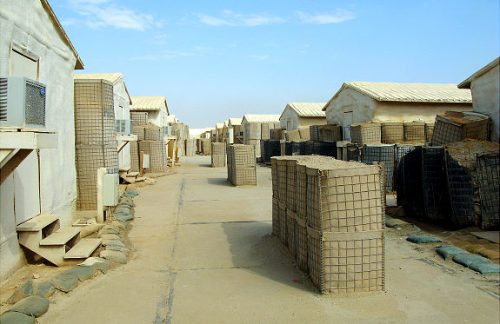
05_Flatbed_1 - NOVEMBERSouthwest Asia Huts or SWA Huts at TQ I stayed in one of these at the end of my tour

TQ was a major air and logistics hub perfectly suited to operate from to support advisers around the entirety of the province.  We had access to rotor and fixed wing aviation assets, excellent telephone and internet, secure and non-secure access, a place to call home and excellent support.  This is critical when you are operating independently and supporting multiple organizations.   Other Army Chaplain teams had gone into areas where they were given little or no support by the Army teams that they supported.  Unfortunately from a chaplain perspective the talk that I heard had more to do with the Army Chaplains than the units that they supported.  Part of the problem was that most of the Army teams were reservists with minimal training or preparation for a mission type that they were never taught about in chaplain School.   I know of a Navy Chaplain with Marine experience who had no significant problems when he was placed with an Army division level team in Mosel. There were probably a number of reasons for this, and to be charitable I will chalk it up to lack of experience, but lack of support was something that we never had to face.

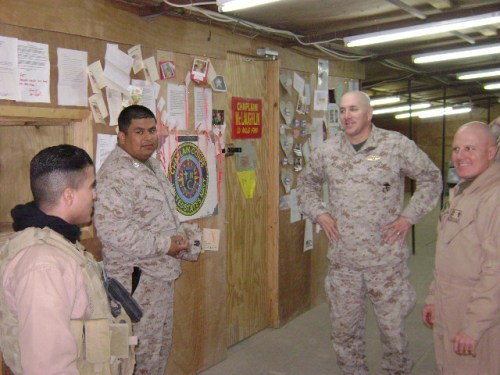
Lebron, Bautista, McLaughlin, Dundas 2A Great Team: Nelson, Jose, Pat and Me…Pat and Jose helped us tremendously

Within days we had our “operations center” set up in an office in the back of the Plywood Parish chapel. The office had a somewhat auspicious history having taken a hit by a rocket or mortar earlier in the year, a shot that had also made a mess of the drums and other musical instruments of the chapel praise team.  The chapel was kind of a ramshackle affair but had some interesting touches mostly donated by the military personnel to include doors which had been made with care and donated.  Part of getting it together was having phone and internet cables run to the office.  The communications people made this happen quickly and they also got our elderly computers set up and loaded with all that we would need to operate on the secure and non-secure side the house.  I think that we were one of the few ministry teams lower than Regiment or BCT level to have the communications suite that we had been provided.  Likewise the G-3 Air section at the MLG headquarters gave us tremendous support and quickly got us the ability to plan and submit our own air mission requests.

The information that Luke Fabiunke had provided me back at Fallujah now became a gold mine to begin operations.  It was an amazing amount of information, not all current but the situation with adviser teams was always fluid and subject to change based on operational considerations.  There were phone numbers, secure and no secure e-mail contacts for key leaders.  Once we had our communications up the communication began with teams across the province and our calendar was rapidly filled.  The only “glunk” that we had in this was with the senior adviser for one of the Military Training Teams in our local area.  Though his staff and subordinate unit team chiefs were happy for our arrival he for all intents and purposes froze us out of his area.  That did not keep me from continuing to build relationships with some of his people which paid dividends later.  I think that sometimes some chaplains are intimidated by people who rebuff their honest and well meaning efforts to provide support.  I don’t work that way and will constantly work whatever angle I need to in order to get the mission done.  In order not to burn bridges I usually use a slow and patient approach to continually work to build relationships with those in charge of the units that I serve.  It really is an indirect approach.  If I can’t get in one place I put it on the back burner without burning the bridge.  I then work with all the other teams that I can and get out among people.  As we did this “back doors” to ministry opened with teams where we had been locked out of before as they contacted us to get support.  So I did not give up on these local teams but reached out to the furthest reaches of the province with the teams of the 7th Iraqi Division and the 2nd Border Brigade with its Border units and Port of Entry teams.  The senior advisers of these units, Colonel Cottrell and Lieutenant Colonel Bien gave me absolute freedom to coordinate with their teams and opened doors that were never shut.

As we prepared for our mission the first few days were days of acclimatization to the base and to finally recover from the long road in.  One of the first things that we noticed was the pall cast over the mood of the camp by the crash of the Army CH-47 the day of our arrival.  The chapel was being rigged by the staff for the memorial service for the five Army aviators, all of who were significantly younger than me.  The Army was in charge of the service so except for the set up of the chapel and other miscellaneous administrative support.  It is a sobering thing to come into your base of operations and see the set up for five men who died in service of their country.  To look at their pictures and to read their biographies was humbling; one was on his last enlistment before retirement others at different points of their careers, all left behind families, friends and their fellow soldiers who did not know if the bird went  down to mechanical failure or hostile action.   This was in no small way lost on me as we would fly many missions with the men and women of this Army squadron.

Nelson and I worked hard that first day and thereafter to get set up for our first missions.  While I worked the big picture parts of the mission he took care of the little thinks that ensured our success.  Working with Pat, Jose and RP1 he became a key part of the team whenever we were not traveling.

That evening we went to dinner at the chow hall and took in some PT.  Following that I went back to my can where I continued to unpack and make the place somewhere that I could relax.  Though still exceptionally tired from the trip I had a difficult time getting to sleep between my own anxiety the din of UH-60 Army Medivac choppers coming in and out of the LZ for the Shock, Surgery and Trauma Platoon.  Not able to sleep I walked out of my can where I saw the sky light up to our north near Habbinyah with illumination rounds while outgoing artillery sent rounds somewhere into the night and small arms fire could be heard nearby.  A number of Marine and Navy officers gathered near me as we watched the display and talked among ourselves as we wondered what was going on.  Eventually I would get to sleep, but it was very late, that night I found the Office of Compline to be of great comfort, especially this collect.

“Be our light in the darkness, O Lord, and in your great mercy defend us from all perils and dangers of this night; for the love of your only Son, our Savior Jesus Christ.  Amen.”

2 Comments

Filed under iraq,afghanistan, Military, Tour in Iraq

Surviving Birthdays, My Closet of Anxieties, Rumors of Revolution and Coups and a Losing Streak Ended

anniverary 2009I didn’t mess up the Abbess’s Birthday this Year…Cheers!

I am terrible at doing birthdays…mine included.  Unfortunately this can be detrimental in my primary and many other relationships.  In particular I have made my fair share of messes when it comes to birthdays, especially those of Judy.  This began shortly after marriage and there have been a number of times that I regret, especially in choice of gifts.  A large part of this was due to selective hearing on my part in what she wanted and to what she would refer to as the “damage to the brain caused by the male hormone.”  The biggest of the goofs was when in seminary I got her the Bible that I wanted…not smart. I will not add to the fire of my self-immolation here by describing the others.  I can say that like a pitcher has hung one too many curveballs in the center of the plate to good hitters and seeing it go over the fence, the memories flash through my mind beginning in the middle of September until the birthday is successfully negotiated.  It is like making sure that I get the last out before I can rest.

This year went well.  In fact it has been like an extended celebration for her milestone birthday. We brought her college roommate here for 6 days, we had lunch with her friend Diane and dinner at Gordon Biersch together and breakfast today with her friend Pat and her father today.  Saturday evening we will make the close to the week by having a number of people over for dinner and cake.  Even the gifts that I chose were things that she wanted or actually liked.  The key to me successfully negotiating a birthday is to actually listen to what she wants.

We have had a couple of good days of leave and enjoyed our time together.  The cool thing is though she has reached this milestone, she neither looks nor acts her age.  Since I neither look nor act my age most of the time, though I am feeling it more, I think that we are a good match.

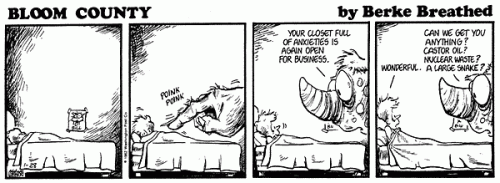
closet of anxietiesOpen for Business

At the same time the week has seen my “Closet of Anxieties” open up again.   Part is obviously  PTSD induced and part life induced.  My mom as always has managed to add stress to my life.  My dad continues to slowly circle getting worse in the nursing home.  My German friend wants me to come to Germany in early December but I am nervous about making the flight.   I was able to handle flying much better before Iraq.

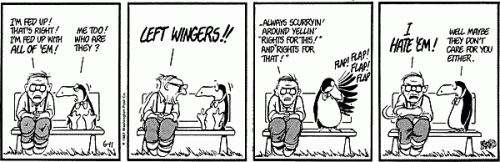
left wingers

Finally I am concerned about things going on in the country as some people on the political right are advocating a military coup or violent revolution to overthrow President Obama.  The scary thing as these are not people on the nutty fringe but people more in the mainstream of current conservative thought. What is even more alarming is that a lot of these folks are also prominent Evangelical Christians.  One should never forget that many German “conservative Christian values voters” supported Hitler because they so hated the left. Hitler, like many right wing politicians in this country played to their fear and hatred of the left for their political support.  I’m afraid of the same thing happening here.

A good article about this is found at blogger Polycarp’s site which is linked here: http://thechurchofjesuschrist.us/2009/09/phyllis-schlafly-endorses-bloody-revolution-columnist-plans-for-armed-coup/

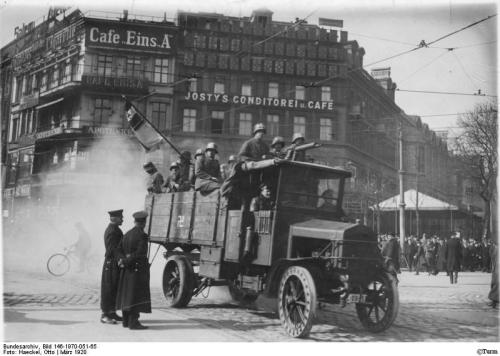
bundesarchiv_bild_146-1970-051-65_kapp-putsch_berlinThe Kapp Putsch

To me the political situation is looking more like the Weimar Republic every day and unlike the folks cited in the article I don’t see President Obama as a Nazi or Marxist.  I think that people are playing with fire in suggesting bloody revolutions or military coups.  If either happens there is no going back. They will have to coin a phrase “destroyed the Constitution in order to save it.”  What is scary for me to see a national columnist like John Perry writing in the mainstream conservative news online publication Newsmax.com , suggest a military coup when the military is engaged in two wars.  The military is perhaps the most trusted institution in the country and to look to it in time of war to overthrow the government in a partisan action is madness and even borders on treason.  Even if this Wolfgang Kapp wannabee was able to get some misdirected military leader to pull a Lüttwitz[i] and attempt to seize power.  Such an attempt would be futile and doomed to failure.  Such an attempt could never gain the support of the entire military and would be dependent on many younger soldiers, sailors, airmen and Marines who do not necessarily support the or are as radical as those pushing this on the political right.  The military is not a reactionary or monolithic institution despite the wishes of some on the right.  When one sees this kind of talk combined with street brawls at political town meetings and people carrying semi-automatic weapons at rallies where the President is speaking one sees a recipe for disaster that could destroy the country. If this continues  and at best poison the political and social atmosphere for decades to come.  I felt the same way when people on the left suggested a military coup against President Bush a couple of years ago.  We have a political process that has worked relatively well for 200 plus years.  Yes we are divided and having problems but nothing is insurmountable if we decide to work and play well with each other.  We have survived as a nation so long precisely because we have had the wisdom to step back from the brink, with the exception of the Civil War and we all know how well that turned out for everyone concerned.

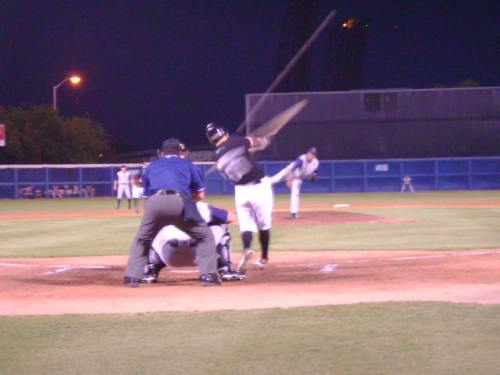
044Jeff Fiorentino in Norfolk

However tonight a final source of anxiety was lifted when the Orioles broke their 13 game losing streak against the Tampa Bay Rays tonight.  O’s lefty Chris Waters, who I have met a number of times in Norfolk got the win and Jeff Fiorentino came up big with a 2 out RBI single that provided what would be the winning run.  It was good news for both players, Waters needed the win just to regain confidence and hopefully get another look by the O’s and other teams.  Fiorentino is now being talked about as having a place on the 2010 Orioles.  He certainly has earned it.  With the win the Orioles go home to the confines of Camden Yards to finish the season against the Blue Jays.

Peace, Padre Steve+

Note: The last time I posted something about faith and politics I had a couple of really nasty and personal comments by those on the right all but calling me a non-Christian and Marxist traitor.  This should be fun.


[i] Wolfgang Kapp was a German politician who worked with disaffected radical elements of the Army to attempt to overthrow the Weimar Republic in 1922.  He gained the support of General von Lüttwitz who commanded the military district around Berlin and used a radicalized Freikorps, the Erhardt Brigade which was slated by the Army for demobilization to attempt to seize control of the government.  The attempt floundered but hindered future cooperation between the Army and the Majority Socialists where the Nazis began their rise to power.

Leave a comment

Filed under alzheimer's disease, Baseball, History, Loose thoughts and musings, Military, Political Commentary, PTSD, things I don't get

The Battle that Wasn’t Necessary: Kursk 1943

The Battle of Kursk was the climactic battle on the Eastern Front from which the Germans never recovered. It was a battle that should not have been fought, at least at the time that it was fought. It was high risk operation with minimal payoff should it succeed. A while back I posted an “alternative history” of this entitled “Operation DACHS.” I have also posted articles on events leading up to Kursk, one on Stalingrad and the other on Manstein’s counter-stroke.  In a sense this is a trilogy with an alternative scenario included.


The German Situation and Dilemma in April 1943

Battle_of_Kursk_(map)

The Germans faced a dilemma in April 1943.  Manstein’s brilliant counter-stroke had turned what could have been disaster into an opportunity to salvage prospects for the Eastern Front. The German action had “repaired its front, shattered the hopes of the Allies, and nipped the Russian spearhead.”[i] Unfortunately for the Germans the spring thaw meant that Manstein could not continue immediately and eliminate the Kursk bulge which had been formed by Rokossovky’s offensive and Manstein’s own counter-stroke.  With the Germans stalled by the weather Stavka cancelled “other significant planned offensives to dispatch reinforcements to the Kursk region.”[ii] Despite the weather Manstein pushed Kluge for an immediate attack on both sides of the bulge but was rebuffed by Kluge who “insisted that his troops needed to rest and refit.”[iii] This rebuff combined with the onset of the Russian mud meant that in “March 1943 the war on the ground came to an end….The front was immobilized.”[iv]

manstein with tanksManstein with Tiger I Tanks

Manstein’s offensive had “enabled the Germans to consolidate a firm position in the East, and build up strength afresh- not to its former level, but sufficient to provide a good prospect of holding the Russians at bay.”[v] As a result German armies in the south “held again nearly the same positions from which the Blau offensive had begun the previous spring.”[vi] Now the Kursk bulge some 250 Kilometers wide and 160 Kilometers deep[vii] protruded menacingly into the German lines and drew the attention of both sides, to the Germans it appeared to be designed for an encirclement battle.[viii] Thus it appeared that the Kursk bulge was the obvious place for the Germans to resume the offensive and maintain the initiative on the Eastern Front.

But was the Kursk necessary?  Was Operation ZITADELLE as obvious as it seemed to be to Hitler, Zeitzler and others?  The battle is the subject of many books and articles which often focus on tactical and operational details of the German offensive, particularly the battle on the southern side of the bulge and the clash of armor at Prokhorovka.  This essay will focus less on the battle and more on the strategic situation faced by the Germans in the spring of 1943. Key to this are the arguments for and against the operation, the operations timing and the option that the Germans had to conduct a mobile defense.   It is the strategic situation that must be looked at to determine whether Operation ZITADELLE was necessary at all. Manstein believed that had the offensive been launched early enough that it might have succeeded provided it “we launched it early enough we could hope to catch them in a state of unpreparedness.”[ix] Williamson Murray and Allan Millett agree with Manstein’s assessment but note that an early offensive was “riskier…but greater the prospect for a major success.”[x] Guderian on the other hand saw that nothing good could come of ZITADELLE and opposed it from the beginning.[xi] Glantz and House in their detailed study argue that “there is absolutely no basis for assuming that Citadel would have succeeded had it been launched in spring 1943.”[xii]

battle_kursk t 34The Soviets Reinforced and Fortified the Kursk Salient

The Germans faced a number of major problems in early 1943.  First, among them was manpower.  The armed forces had been mauled on the Eastern Front, “after continuous operations from June 1942 to March 1943, most German units were worn out.”[xiii] Many infantry divisions “were reduced to two thirds of their original strength, with declining mobility and anti-tank defenses.”[xiv] Had the Germans only faced the Russians this might have been overcome, however they not only faced a rejuvenated Red Army, but challenges brought about by multi-theater operations and their weak, ineffective and reluctant allies.  The Allied air offensive which though it “did not decisively effect German arms production it nevertheless prevented a great deal of work from being carried on and had profound moral effects which communicated themselves to all the fronts.”[xv] Likewise the U-Boat campaign had been effectively defeated by May 1943 allowing for increasing numbers of American troops and supplies to reach Europe, including significant Lend-Lease aide for the Soviet Union.  Manpower became a major issue for the the German Army and industry.  Both the military and industryhad difficulty in getting the required number of personnel to meet their personnel needs, in January 1943 the German High Command “demanded 800,000 men-but even the most ruthless call-up was able to produce only 400,000” who were lost to the civilian war economy.[xvi] Even the “belated industrial mobilization of Germany, fueled by slave labor and directed by the organizational genius of men like Speer and Guderian, could do little beyond patching together existing units.”[xvii]

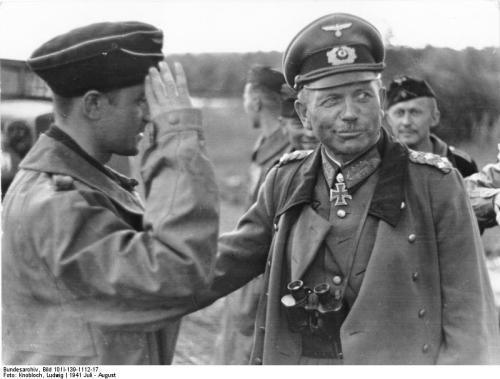
Bild 101I-139-1112-17General Heinz Guderian, Inspector of Panzer Troops was one of Few Senior German Officers to Oppose ZITADELLE from the Beginning

There were other challenges. The German and Italian armies in North Africa had surrendered, and about 330,000 Axis soldiers entered captivity.[xviii] Added to the heavy losses on the Eastern Front, the disasters in North Africa and Stalingrad had “effectively destroyed the Axis military alliance, such as it was.”[xix] Italy, Hungary and Romania all began to pull their forces out of the Eastern front after having them shattered by the Soviet Winter offensive.[xx] Italy, shaken by its losses in North Africa and the Russian front was wavering in its support for Germany; Mussolini’s government itself was on the verge of falling.  Likewise the Hungarian government sought contact with the Allies;[xxi] as did the Romanians.[xxii] Finland too was looking for a way out and limiting its participation in German offensive operations.[xxiii] As her allies looked for a way out, the British and Americans were about to open a new front in Southern Europe, while another had effectively been opened by partisans in Yugoslavia and Greece.[xxiv] The crisis in the south was great enough that OKW under General Jodl began to look at ways of shoring up those fronts in case Italy withdrew from the war including the use of units that would have to be withdrawn from the Eastern Front.[xxv] The Balkans drained German reserves such that the number of German divisions deployed there increased from 5 to 15 between July 1942 and July 1943.[xxvi] Additionally many units had to be created by the Replacement Army to build up the Western Front knowing that an Allied strike there would eventually take place, further depriving the Eastern Front of badly needed infantry replacements and divisions.

Benito_Mussolini_and_Adolf_HitlerHitler Felt Regaining the Initiative in the East was Critical to Keeping his Allies in the War

The German Options and Decision

The question for the Germans now was whether they “had any strategic options that would allow them to avoid defeat.”[xxvii] It is from this perspective that the necessity of Kursk must be examined. Most in the German High Command now realized that strategy in the east could no longer be “based on the illusion of conquering the vast Soviet Union.”[xxviii] As such the discussion turned to what direction the new strategy should take.  Political considerations came into play: Since the German allies were looking for ways to exit the war it was felt that “it was politically impossible for Germany to surrender the initiative on the Eastern Front.”[xxix] Realistically there were two options available: Wait and counterattack or launch a limited attack on the Kursk salient. The general impression among many German commanders in the East was that they had ended the last campaign “with a relative advantage over the Reds, an advantage that should be exploited as soon as the rasputitsa ended in April or early May.”[xxx] But the only strategy that looked feasible balancing the political and military goal of maintaining the initiative was what Manstein originally had in mind after Kharkov, to continue on, pinch out the Kursk bulge with the cooperation of Kluge’s Army Group Center.  As noted the opportunity to do so was lost with Kluge’s refusal and the onset of the spring thaw.  Yet this idea captured Zeitzler at OKH and Kluge at Army Group Center, though by April and May Manstein was more inclined toward “the ‘backhand’ stroke, which involved giving up the whole Donetz basin and staging a major Panzer offensive southeast from Kharkov.”[xxxi] However, this was too bold for Hitler who was “unwilling to give up the Donetz Basin with its industrial and mineral resources.”[xxxii]

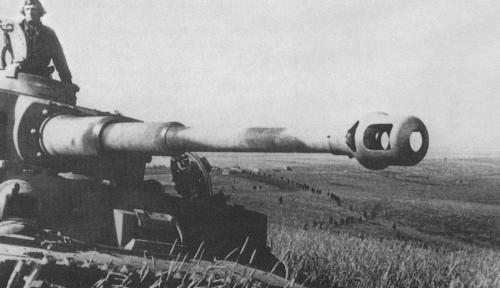
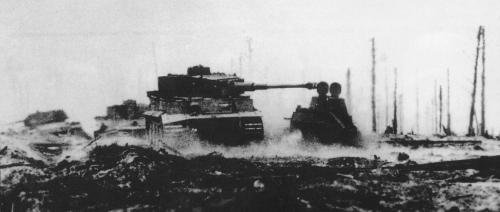
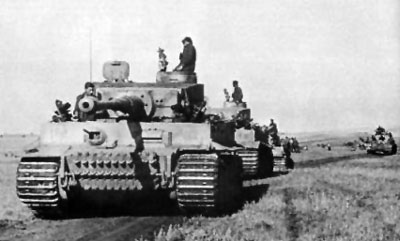
battle_kursk_tiger advancingThe New Tiger Tanks Were to Play a Critical Role in the Attack

Manstein felt that the “moment of opportunity had passed, but his counterpart at Army Group Center…Kluge, was enthusiastic about the proposal.”[xxxiii] Zeitzler believed that an “attack at Kursk would be less risky”[xxxiv] than Manstein’s “backhand” and pushed the plan to Hitler.  There were advantages to this strategy if it could be carried out successfully. The Germans would encircle and destroy Russian forces in the salient and “shorten their own defensive lines after such an encirclement.”[xxxv] Yet the plan was opposed by others. Jodl at OKW argued against ZITADELLE “because he believed that it was dangerous to empty the strategic reserve when so many new crises threatened to develop in the Mediterranean.”[xxxvi] Zeitzler countered that because of German weakness in the east that they could not “wait to be hit.”[xxxvii] Guderian did not believe that either Army Group could be ready to mount the offensive that Zeitzler envisioned and “declared that the attack was pointless…if we attacked according to the plan of the Chief of the General Staff, we were certain to suffer heavy tank casualties, which we would not be in position to replace in 1943.”[xxxviii] Guderian asked Hitler at a separate conference “why he wanted to attack at all in the East in 1943.” When Keitel expressed that the reasons were political, Guderian asked Hitler “How many people do you think even know where Kursk is? It’s a matter of profound indifference to the world whether we hold Kursk or not…”[xxxix] Guderian and Speer both pointed out technical problems in producing the Tigers and Panthers but were overruled.[xl] Hitler himself reportedly had misgivings about the attack at one point reportedly stating that “the thought of the Zitadelle operation ‘made [his] stomach turn over’”[xli] In spite of Jodl and Guderian’s warnings, his own misgivings and those of Manstein and Model in April and May, Hitler “allowed himself to be tempted once more into taking the offensive. The Kursk salient…lured him into mounting his great pincer operation known as Citadel.”[xlii] Glantz and House maintain that he could “see no alternative politically and agreed to the plan.”[xliii]

The Facts on the Ground

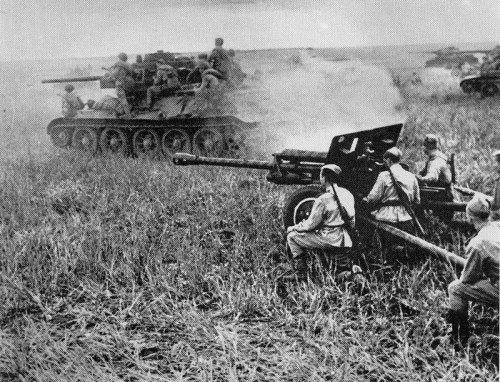
Kursk_T34_and_Fieldgun-px800Soviet Forces Expected the Attack and Were well Prepared to Meet it

Once the decision to attack was made the question that remained was the timing of the attack. Manstein had preferred an early attack in May, but the operation was postponed to mid-June and then to July due to the request of Model who believed that his forces were too weak and needed reinforcements.[xliv] The attack was to be one of several “limited offensives designed to consolidate the German defenses while inflicting sufficient damage on the Red Army to delay any Soviet offensive.”[xlv] But the delays insisted on by Model and agreed to by Hitler were a fatal error.  The Germans failed to “factor into their decision was the unpalatable reality that Soviet strength in the Kursk salient was growing much faster than the Wehrmacht could muster forces to attack it.”[xlvi] Not only were the Soviet forces growing they knew about the German plans and could deploy their forces to counter them and for their own offensive.[xlvii] Stalin’s generals were able to convince him not to launch an attack and instead wait on the Germans so they could attack as the Germans exhausted their strength.[xlviii] They knew of it since April and reinforced the flanks of the salient with guns and armor at a faster pace than the Germans opposite them.[xlix] At Kursk “improved intelligence collection and analysis permitted the Red Army to predict almost exactly the strategic focal point of a major German offensive.”[l] Into the bulge “Vatutin and Rokossovsky crammed seven armies.”[li] The Russians deployed in depth in heavy fortified zones and minefields along the very sectors of the bulge that the Germans intended to attack, successfully masking their preparations from the Germans. It was “a measure of Soviet self-confidence that the senior commanders were looking beyond the German attack, beyond its failure, to the first major Soviet summer offensive.”[lii] Had the Germans succeeded in pinching off the salient “they would have faced several additional defensive belts constructed to the east of the salient.”[liii]

Typically when one launches an offensive it is desirable to have numeric advantage over the defender, 3:1 is normally assumed to be sufficient. At Kursk the Germans were outnumbered by the Russians 2.3:1 in men and 1.6:1 in tanks[liv] yet somehow the offensive had now morphed from a spoiling attack into a strategic offensive, albeit with more limited objectives attacking one of the strongest points in the Russian line.  General Raus, commanding a corps in Army Detachment Kempf noted: “Considering Russian dispositions, defenses and terrain, German strength could be considered only minimally sufficient for the assigned mission.”[lv] The Chief of Staff of XLVIII Panzer Corps called Kursk “the strongest fortress in the world.”[lvi]

Danger Signs: Requests for Cancellation

keitel-jodl-hitlerGeneral Alfred Jodl at OKW Protested the Offensive Verbally and in Writing

As more delays occurred Manstein “came out in the open and protested that the operation was no longer feasible and must be abandoned, but it was too late.  The united stand of orthodox General Staff opinion, Keitel, Zeitzler, Kluge, had persuaded the Führer, whose mind, once made up, was never altered.”[lvii] Manstein felt that the idea had been to “attack the enemy before the enemy had replenished his forces and got over the reverses of the winter.”[lviii] He felt there was great danger to the Mius line and to the northern Orel bulge with each delay; and the felt the threat of an attack by the Allies in Western Europe.[lix] On 18 June Jodl and the OKW Operations Staff “recommended to Hitler that he abandon Operation Citadel in order to free strategic reserves for defense in both East and West.”[lx] Warlimont writes that Jodl “raised empathic objection to the premature commitment of the central reserves to the East; he pointed out both verbally and in writing that a local success was all that could be hoped from Operation Citadel and that it could have no strategic significance for the overall situation.”[lxi] Hitler again refused the request.  “The doubts of certain Chiefs of Staff of the attacking armies were disregarded, and in the case of Colonel von Schleinitz, answered with dismissal.”[lxii]

The Battle

battle_kursk tigersTigers Advancing

The attacking forces for ZITADELLE involved units of Army Group Center and Army Group South.  Spearheading the assault for Army Group Center was Model’s 9th Army.  2nd Army from the same Army Group took a defensive role in the center of the bulge while Army Group South’s 4th Panzer Army under Hoth and Army Detachment Kempf composed the Southern attack force.  Von Mellenthin noted that to muster the necessary divisions for the attacking armies “neighboring fronts were to be thinned out beyond the limits of prudence” and from a strategic point of view likened Citadel “to be a veritable ‘death ride.’”[lxiii] Manstein worried about stripping the Mius-Donetz salient which “had to hand over all their available forces.”[lxiv] The Germans sent 17 panzer divisions against Kursk including the elite 2nd Panzer, Grossdeutschland, Leibstandarte, Das Reich and Totenkopf. Hoth’s army was the “strongest force ever put under a single commander in the German Army.”[lxv] While the Germans assembled the Russians waited, and beginning on 1 July the “Red Army defenders were on constant alert, waiting in their bunkers for the first sign of attack.”[lxvi]

battle_kursk_0020Panzers on the Advance

ZITADELLE began on 4 July with a reconnaissance in force, the main blow scheduled for 0300 5 July. The Russians learned of the timing from a prisoner and quickly launched an artillery counter-preparation an hour prior to the German attack, disrupting it while air strikes were ordered against Luftwaffe airfields.[lxvii] Model’s 9th Army on the northern flank attacked the Russian “13th and 70th Armies on a frontage of 50 kilometers”[lxviii] with the focus being a 16 kilometer front where he concentrated 6 infantry divisions, a panzer division and all his Tiger and Ferdinand units.[lxix] He intended to break the Soviet defensive system “by constantly feeding in new units to grind down the defenses.”[lxx] The attack stalled by the 9July making minimal progress of “8 to 12 kilometers into the massive Soviet defenses.”[lxxi] A good deal of his problem was due to limited infantry strength which was  “far below established strength….moreover, the Ninth Army’s infantry- even the veterans- lacked experience in conducting set-piece attacks against prepared positions.”[lxxii] The Russians defined the battleground and forced Model into a battle determined by superior firepower on a constricted battlefield, “a game that the Wehrmacht could not win.”[lxxiii] This nullified any advantage the Germans might have had in mobility for their panzer divisions.  In savage battles to take the high ground at Ponyri station and Ol’khovatka Model’s assaults faltered.  9th Army sacrificed about 50,000 men and 400 tanks to the god of war.”[lxxiv] Model continued to attack until 12 July when the Russians launched their offensive against the Orel bulge forcing him to redeploy to counter the Russian advance.  The battle in the north became “a savage defensive battle in which considerable parts of the offensive wing of Ninth Army were involved.”[lxxv] Model’s defeat made Hoth’s task “much more challenging.”[lxxvi]

battle_kursk_t-34s and infantryT-34’s and Infantry

The Fourth Panzer Army and Army Detachment Kempf made better progress, nearly breaking through the Russian defenses after hard fighting. They penetrated “into the third Soviet defensive belt, a depth of 35 kilometers, but were stopped by Katukov’s 1st Tank Army.”[lxxvii] The critical point was reached on 11 and 12 July at Prokhorovka station when 5th Tank Army collided with 4th Panzer Army. “Over 1200 tanks from both sides were engaged in this struggle.”[lxxviii] It was the largest tank engagement of the war, over 700 tanks were destroyed and “German losses were too great to allow a decisive breakthrough.”[lxxix] Both sides took heavy casualties but the Germans could not replace theirs while the Russians still had formidable uncommitted reserves.  On 13 July the battle in the south drifted into a stalemate as XLVIII Panzer Corps and Hausser’s II SS Panzer Corps failed to break the Soviet line[lxxx] as the Russians “kept on throwing in fresh troops, and their reserves seemed inexhaustible.”[lxxxi] Manstein desired to continue the offensive as he believed that for his Army Group “the battle was now at its culminating point, that to break it off at this moment would be tantamount to throwing victory away.”[lxxxii] Although Manstein and Hoth felt that they could continue on and break the Russian line, they were now not in a position to do so. Model’s forces were in no shape to assist in the north and Manstein and Kluge were called to the Wolfsschanze by Hitler who, now preoccupied with the Allied invasion of Sicily necessitating withdraws of strong panzer forces from the east to face the threat in the west.[lxxxiii] Hitler rejected Manstein’s counsel to continue and ordered him to withdraw II SS Panzer Corps,[lxxxiv] effectively ending the ZITADELLE as the Russians launched their offensive on 17 July.

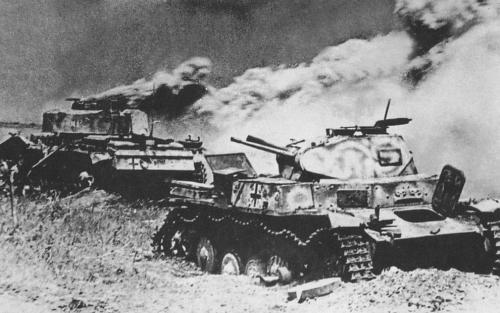
battle_kursk_destroyed panzersDestroyed Panzers

Analysis of the Decision: Zitadelle Was Not Obvious, Necessary nor Well Executed

To Hitler and the supporters of ZITADELLE the operation seemed obvious.  In the two previous years the Germans had dealt punishing blows against the Red Army and the belief of Zeitzler and others was that the Wehrmacht was still qualitatively superior to the Soviets and that even a limited offensive would succeed in its objectives.  But the conditions on the ground had changed and the Germans failed to take the change into account.  The German Army did not have the resources for an offensive of the scope of Barbarossa or Blau. However this lack of resources did not lessen the optimism of some for ZITADELLE; particularly Zeitzler and Kluge. From their perspective the offensive to pinch out the Kursk salient seemed likely to succeed.  Yet as Clark notes the offensive was defined by a “lack of imagination and adaptability….Where the old Blitzkrieg formula….was fed into the computer, with little regard for the changed conditions….” [lxxxv] Von Mellenthin comments that by attacking Kursk, the “German Army threw away all their advantages in mobile tactics, and met the Russians on ground of their own choosing.”[lxxxvi] Glantz and House attribute this to the fact that the Germans “clung to outmoded assumptions about their own superiority over their opponents” due to their previous success. They point out that the Red Army had systematically reviewed its performance after every failure,” so that “Soviet doctrine, organization, and expectations were closer to battlefield reality than were those of the senior German leadership.”[lxxxvii] The German intelligence services failed them[lxxxviii] as they failed to detect the large strategic sized force that the Soviets had concentrated in the spring of 1943.  This was a force that Glantz and House believe would have caused ZITADELLE to fail even had it occurred in May, particularly in regard to the comparatively weak German forces fielded by Manstein.[lxxxix]

An offensive with what appeared to be reasonable objectives that were believed to be within the capabilities of the Wehrmacht failed.  Hitler according to Carell “gambled away not only victory but all hope of a draw.”[xc] Manstein categorized the offensive as a “fiasco.”[xci] Guderian called it “a decisive defeat” that made it “problematical” whether the armored formations could be “rehabilitated in time to defend the Eastern Front.”[xcii] Warlimont who served at OKW commented: “Operation Citadel was more than a battle lost; it handed the Russians the initiative and we never recovered it again right up to the end of the war.”[xciii] Guderian’s biographer Kenneth Macksey wrote that “the failure at Kursk was due to the employment of a faulty plan which lacked the element of strategic as well as tactical surprise.”[xciv] Raus lists several factors for this.  However, his argument is summarized: “once we learned in May and June that this was the area in which the Russians were prepared to offer their stiffest resistance, we should have modified our plans.  Either we should have refrained from attacking at all, or the operation should have been carried out to strike the enemy not at his strongest, but at his weakest point.”[xcv]

Hitler felt that a decisive victory was needed for political and propaganda reasons, yet even a significant victory was unlikely to keep Italy in the war, even if it swayed the lesser allies to stay the course.  ZITADELLE was conducted too late to save the Italians, success in May might have given German supporters in Italy some leverage but the invasion of Sicily and the failure at Kursk emboldened Mussolini’s opponents. The Fascist Grand Council “voted to have Mussolini removed as prime minister” and King Vittorio Emmanuaele “dismissed Mussolini” who was then placed under arrest.[xcvi] Finland refused to take offensive action that might have cut the Murmansk railway[xcvii] and engaged the Americans in a round of “abortive negotiation”[xcviii] while the Hungarians and Romanians provided little assistance to the Germans, partially due to the German reluctance to assist in modernizing and rebuilding their armies.[xcix]

Of the German Generals involved it was only Guderian as Inspector of Armored Troops and Jodl at OKW who consistently opposed ZITADELLE, citing realistic assessments of strengths, risks and dangers in other theaters.  Manstein opposed it when he felt the opportunity had passed, though it was unlikely to succeed had it been launched in May as he desired.  Guderian and Jodl’s arguments proved correct in every respect. ZITADELLE engaged German the preponderance of German forces in a battle that had at best chances of local success. The offensive itself weakened and endangered the German position on all fronts.  In the end, despite the belief and decision of Hitler, Zeitzler Kluge and others in the High Command, Operation ZITADELLE was neither obvious nor necessary and played out with the disastrous results expected by those who opposed it.


[i] Clark, Allan. Barbarossa:  The Russian-German Conflict 1941-45. Perennial, an Imprint of Harper Collins Books, New York, NY 2002. Originally published by William Morrow, New York, NY 1965. p. 306

[ii] Glantz, David M and House, Jonathan. The Battle of Kursk.  University Press of Kansas, Lawrence, KS. 1999. p.14

[iii] Ibid. Glantz and House, Jonathan. The Battle of Kursk.  p.14

[iv] Carell, Paul. Scorched Earth: The Russian German War 1943-1944. Translated by Ewald Osers, Ballantine Books, New York, NY 1971, published in arrangement with Little-Brown and Company. p. 335

[v] Liddell-Hart, B.H. The German Generals Talk. Quill Publishing, New York, NY. 1979. Copyright 1948 by B.H. Liddell-Hart. p.212

[vi] Wray, Timothy A. Standing Fast: German Defensive Doctrine on the Russian Front in World War II, Prewar to March 1943. U.S. Army Command and General Staff College, Fort Leavenworth, KS. 1986. p.163

[vii] Glantz, David M. and House, Jonathan. When Titans Clashed: How the Red Army Stopped Hitler. University Press of Kansas, Lawrence, KS. 1995. p.157

[viii] Ibid. Glantz and House. When Titans Clashed. p.157

[ix] Manstein, Erich von. Lost Victories. Translated by Anthony G. Powell, Zenith Press, an imprint of MBI Publishing Company, St Paul, MN. 2004. First Published as Verlorene Siege Athenaum-Verlag, Bonn, GE 1955, English edition Methuen & Company Ltd. 1958  p.447

[x] Murray, Williamson and Millett, Allan R. A War to Be Won: Fighting the Second World War.  The Belknap Press of Harvard University, Cambridge, MA. 2000. p.295

[xi] Macksey, Kenneth. Guderian: Creator of the Blitzkrieg. Stein and Day Publishing, New York, NY 1975 p.206

[xii] Ibid. Glantz and House. The Battle of Kursk. p.261

[xiii] Ibid. Glantz and House. The Battle of Kursk. p.14

[xiv] Ibid. Glantz and House. Clash of Titans. p.174

[xv] Goerlitz, Walter. History of the German General Staff 1657-1945. Translated by Brian Battershaw. Westview Press. Boulder CO and London. 1985 Originally published as Der Deutsche Generalstab, Verlag der Fankfurter Hefte, Frankfurt am Main.  First U.S. publication in 1953 by Preager Publishers. p.441

[xvi] Ibid. Carell. p.336

[xvii] Ibid. Glantz and House. Clash of Titans. p.174

[xviii] Warlimont, Walter. Inside Hitler’s Headquarters 1939-45. Translated by R.H. Berry, Presido Press, Novato CA, 1964. p.312

[xix] DiNardo, Richard L. Germany and the Axis Powers: From Coalition to Collapse. University Press of Kansas, Lawrence, KS. 2005. p.174

[xx] Ibid. DiNardo. p.174. By the summer all Italians units had been withdrawn, all but two Hungarian divisions which were used in anti-partisan operations and nine Romanian divisions.

[xxi] Ibid. Goerlitz. p.441

[xxii] Ibid. Glantz and House. Kursk. p.21

[xxiii] Ibid. DiNardo. p.180

[xxiv] Ibid. Goerlitz. p.441

[xxv] Ibid. Warlimont. pp.317-318

[xxvi] Dunn, Walter S. Jr. Heroes or Traitors: The German Replacement Arm, the July Plot, and Adolf Hitler. Praeger Publishers, Westport CT and London, 2003. p.53

[xxvii] Ibid. Murray and Millett. p.294

[xxviii] Ibid. Carell. p.339

[xxix] Ibid. Glantz and House. Kursk. p.21

[xxx] Ibid. Glantz and House. Kursk. p.21

[xxxi] Ibid. Clark. p.322

[xxxii] Liddell-Hart, B.H. Strategy. A Signet Book, the New American Library, New York, NY. 1974, Originally Published by Faber and Faber Ltd., London. 1954 & 1967. p.280

[xxxiii] Ibid. Glantz and House. When Titans Clashed. p.157

[xxxiv] Ibid. Clark. p.322

[xxxv] Ibid. Glantz and House. p.157

[xxxvi] Ibid. Clark. p.323

[xxxvii] Ibid. Clark. p.323

[xxxviii] Guderian, Heinz. Panzer Leader. (abridged) Translated from the German by Constantine Fitzgibbon, Ballantine Books, New York 1957. pp.245-246

[xxxix] Ibid. Clark. p.325.

[xl] Ibid. Glantz and House. When Titans Clashed. p.157.

[xli] Ibid. Clark. p.325

[xlii] Ibid. Carell. p.341

[xliii] Ibid. Glantz and House. When Titans Clashed. p.158

[xliv]Newton, Steven H. Hitler’s Commander: Field Marshal Walter Model, Hitler’s Favorite General. DeCapo Press, Cambridge MA 2005. pp.218-219

[xlv] Ibid. Glantz and House. When Titans Clashed. p.21

[xlvi] Ibid. Newton. p.219

[xlvii] Ibid. Murray and Millett. p.295

[xlviii] Ibid. Glantz and House. When Titans Clashed. p.158

[xlix] Ibid. Clark. p.326

[l] Ibid. Glantz and House. Kursk. p.63

[li] Overy, Richard. Russia’s War: A History of the Soviet War Effort: 1941-1945. Penguin Books, New York NY and London, 1997. pp.200-201

[lii] Ibid. Glantz and House. When Titans Clashed. p.159

[liii] Ibid. Glantz and House. Kursk. p.64

[liv] Ibid. Glantz and House. Kursk. p.65 This reference contains a listing of each sector and the force ratios of men, tanks and guns in each sector.

[lv] Raus, Erhard. Panzer Operation: The Eastern Front Memoir of General Raus, 1941-1945. Compiled and Translated by Steven H Newton. Da Capo Press a member of the Perseus Book Group, Cambridge, MA 2003. p.197

[lvi] Weingartner, James. J. Leibstandarte SS Adolf Hitler: A Military History, 1933-45. Battery Press, Nashville, TN.(no publication date listed)  p.81

[lvii] Ibid. Clark. p.327

[lviii] Ibid. Manstein. p.447

[lix] Ibid. Manstein. pp.447-448

[lx] Ibid. Glantz and House. Kursk. p.55

[lxi] Ibid. Warlimont. p.334

[lxii] Ibid. Goerlitz. p.445

[lxiii] Von Mellenthin, F.W. Panzer Battles: A Study of the Employment of Armor in the Second World War. Translated by H. Betzler, Ballantine Books, New York, NY, 1971. Originally Published University of Oklahoma Press, 1956. p.262

[lxiv] Ibid. Manstein. p.448

[lxv] Ibid. Clark. p.328

[lxvi] Ibid. Glantz and House. Kursk. p.78

[lxvii] Ibid. Glantz and House. Kursk. pp.81-84

[lxviii] Ibid. Glantz and House. When Titans Clashed. p.166

[lxix] Ibid. Erickson. P.99

[lxx] Erickson, John. The Road to Berlin. Cassel Military Paperbacks, London, 2003. First Published by Weidenfeld and Nicholson, 1983. p.99

[lxxi] Ibid. Glantz and House. When Titans Clashed. p.166

[lxxii] Ibid. Newton. p.222

[lxxiii] Ibid. Newton. 234

[lxxiv] Ibid. Glantz and House. Kursk. p.121

[lxxv] Ibid. Carell. p.342

[lxxvi] Ibid. Glantz and House. Kursk. p.121

[lxxvii] Ibid. Glantz and House. When Titans Clashed. p.166

[lxxviii] Ibid. Glantz and House. When Titans Clashed. p.166

[lxxix] Ibid. Overy. p.209

[lxxx] Ibid. Glantz and House. Kursk. pp.215-217

[lxxxi] Ibid. Von Mellenthin. p.274

[lxxxii] Ibid. Manstein. p.449

[lxxxiii] Ibid. Glantz and House. Kursk. pp.217-218.

[lxxxiv] Ibid. Glantz and House. When Titans Clashed. p.167

[lxxxv] Ibid. Clark. pp.329-330

[lxxxvi] Ibid. Von Mellenthin. p.264

[lxxxvii] Ibid. Glantz and House. Kursk. p.269

[lxxxviii] Macksey, Kenneth. Why the Germans Lose at War. Greenhill Books 1996, Barnes and Noble, New York,  2006. p.227

[lxxxix] Ibid. Glantz and House. Kursk. p. 261

[xc] Ibid. Carell. p.342

[xci] Ibid. Manstein. p.449

[xcii] Ibid. Guderian. p.251

[xciii] Ibid. Warlimont. p.334

[xciv] Ibid. Macksey. Guderian p.206

[xcv] Ibid. Raus. p.211

[xcvi] Ibid. DiNardo. p.178

[xcvii] Ibid. DiNardo. p.181

[xcviii] Ibid. Erickson. p.91

[xcix] Ibid. DiNardo. pp.182-188

Bibliography

Carell, Paul. Scorched Earth: The Russian German War 1943-1944. Translated by Ewald Osers, Ballantine Books, New York, NY 1971, published in arrangement with Little-Brown and Company

Clark, Allan. Barbarossa:  The Russian-German Conflict 1941-45. Perennial, an Imprint of Harper Collins Books, New York, NY 2002. Originally published by William Morrow, New York, NY 1965

DiNardo, Richard L. Germany and the Axis Powers: From Coalition to Collapse. University Press of Kansas, Lawrence, KS. 2005

Dunn, Walter S. Jr. Heroes or Traitors: The German Replacement Arm, the July Plot, and Adolf Hitler. Praeger Publishers, Westport CT and London, 2003

Erickson, John. The Road to Berlin. Cassel Military Paperbacks, London, 2003. First Published by Weidenfeld and Nicholson, 1983

Glantz, David M and House, Jonathan. The Battle of Kursk.  University Press of Kansas, Lawrence, KS. 1999.

Glantz, David M. and House, Jonathan. When Titans Clashed: How the Red Army Stopped Hitler. University Press of Kansas, Lawrence, KS. 1995

Goerlitz, Walter. History of the German General Staff 1657-1945. Translated by Brian Battershaw. Westview Press. Boulder CO and London. 1985 Originally published as Der Deutsche Generalstab, Verlag der Fankfurter Hefte, Frankfurt am Main.  First U.S. publication in 1953 by Preager Publishers

Guderian, Heinz. Panzer Leader. (abridged) Translated from the German by Constantine Fitzgibbon, Ballantine Books, New York 1957

Liddell-Hart, B.H. Strategy. A Signet Book, the New American Library, New York, NY. 1974, Originally Published by Faber and Faber Ltd., London. 1954 & 1967

Liddell-Hart, B.H. The German Generals Talk. Quill Publishing, New York, NY. 1979. Copyright 1948 by B.H. Liddell-Hart.

Macksey, Kenneth. Guderian: Creator of the Blitzkrieg. Stein and Day Publishing, New York, NY 1975

Macksey, Kenneth. Why the Germans Lose at War. Greenhill Books 1996, Barnes and Noble, New York, 2006

Manstein, Erich von. Lost Victories. Translated by Anthony G. Powell, Zenith Press, an imprint of MBI Publishing Company, St Paul, MN. 2004. First Published as Verlorene Siege Athenaum-Verlag, Bonn, GE 1955, English edition Methuen & Company Ltd. 1958

Murray, Williamson and Millett, Allan R. A War to Be Won: Fighting the Second World War.  The Belknap Press of Harvard University, Cambridge, MA. 2000

Newton, Steven H. Hitler’s Commander: Field Marshal Walter Model, Hitler’s Favorite General. DeCapo Press, Cambridge MA 2005

Overy, Richard. Russia’s War: A History of the Soviet War Effort: 1941-1945. Penguin Books, New York NY and London, 1997

Raus, Erhard. Panzer Operation: The Eastern Front Memoir of General Raus, 1941-1945. Compiled and Translated by Steven H Newton. Da Capo Press a member of the Perseus Book Group, Cambridge, MA 2003

Von Mellenthin, F.W. Panzer Battles: A Study of the Employment of Armor in the Second World War. Translated by H. Betzler, Ballantine Books, New York, NY, 1971. Originally Published University of Oklahoma Press, 1956.

Warlimont, Walter. Inside Hitler’s Headquarters 1939-45. Translated by R.H. Berry, Presido Press, Novato CA, 1964

Weingartner, James. J. Leibstandarte SS Adolf Hitler: A Military History, 1933-45. Battery Press, Nashville, TN.(no publication date listed)

Wray, Timothy A. Standing Fast: German Defensive Doctrine on the Russian Front in World War II, Prewar to March 1943. U.S. Army Command and General Staff College, Fort Leavenworth, KS. 1986.

10 Comments

Filed under History, Military, world war two in europe

Manstein’s Counter-Stroke: Pulling Victory from Certain Defeat

Introduction

After Stalingrad the Soviets followed up on their success and attempted to entrap the rest of Army Group South. Field Marshall von Manstein attempted to save the Army Group and perhaps prevent the Soviets from collapsing the entire German front.

Bild 101I-209-0086-12Manstein planning at the front

Chaos and Peril in the South

As 6th Army died at Stalingrad field Marshall von Manstein was faced with one of the most challenging situations faced by any commander in modern times.  He faced strategic and operational “problems of a magnitude and complexity seldom paralleled in history.”[i] Manstein had to deal with a complex military situation where he had minimal forces to counter the moves of a superior enemy force that was threatening to entrap all German forces in southern Russia. Additionally Manstein had to deal with the “Hitler’s obstinate opposition to a maneuver defense and a Red Army flushed with the victory of Stalingrad.”[ii] Facing him were the six Russian armies of the Voronezh and Southwestern Front’s led by Mobile Group Popov[iii]. These Armies had broken through the Hungarian and Italian armies “making a breach 200 miles wide between the Donetz and Voronezh, and were sweeping westward past Manstein’s flank.”[iv]

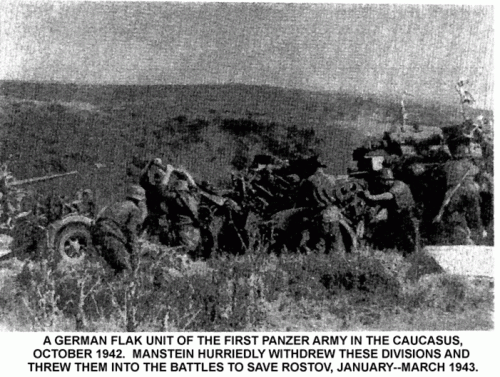
flak in caucasus

The most dangerous threat that Manstein faced was to Army Group A in the Caucasus. This Army Group “found itself in danger of being cut off, forcing an immediate withdraw.”[v] Disaster was averted by the desperate holding actions of Manstein’s meager forces, Army detachment’s Fretter-Pico and Hollidt, and winter conditions that made “offensive operations extraordinarily difficult, even for the hardiest Soviet troops.”[vi] A smart withdraw executed by General von Kleist managed to extricate the Army group “just as the Stalingrad forces collapsed.”[vii] To parry the Soviet thrusts the Germans lacked forces to “establish a deeply echeloned defense” and “instead combined maneuver… with stubborn positional defense to give artificial depth to the battlefield.  In this way the Germans were able to break major Soviet attacks, preventing catastrophic breakthroughs….”[viii] The timely introduction of a battalion of Tiger tanks prevented the Russians from breaking through to Rostov and “cutting the rail and road lines on which First Panzer Army’s retreat depended.”[ix] Even so the escape of the Army Group was narrow. “In terms of time, space, force, and weather conditions it was an astonishing performance-for which Kleist was made a field-marshal.”[x] With the Russians only 70 kilometers from Rostov and his own forces 650 kilometers from that city Kleist executed a withdraw “which had appeared hardly possible to achieve.”[xi] The divisions extricated by Kleist would be instrumental in the coming weeks as Manstein moved to counter the Soviet offensive.

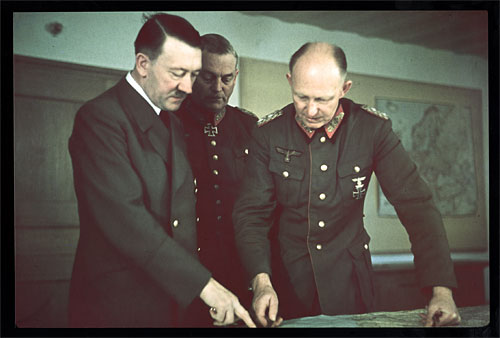
Hitler and Manstein

Despite the successful withdraw the situation was still precarious in early February, Manstein had no effective contact with his left wing, the bulk of which was tied to Kharkov, The Russians had “virtually complete freedom of action across a fifty-mile stretch of the Donetz on either side of Izyum.”[xii] Manstein was hard pressed to “halt the raids of Mobile Group Popov and other exploiting Soviet tank corps in Operation Gallop.”[xiii] Manstein’s forces in the eastern sector had been divided by Russian penetrations, which threatened 1st Panzer Army’s western flank and blocked the Army Group’s main railway line.[xiv] On 15 February “the SS Panzer Corps withdrew from Kharkov-in spite of orders from Hitler…that the city was to be held to the last.”[xv] SS General Paul Hausser, the corps commander realized that the order to hold Kharkov was impossible and requested permission to withdraw. This was was refused by General Lanz. Under pressure from encircling Russian forces outside and from partisans inside the city, Hausser disobeyed the order and extricated his troops,[xvi] thereby saving thousands of German soldiers and preserved the SS Panzer Corps as a fighting unit.[xvii] Lanz was relieved by Hitler for the loss of Kharkov and although Hausser would escape immediate censure, “Hitler did see it as a black mark against his name.”[xviii] With Kharkov in Soviet hands the gap between Manstein’s army group and Field Marshal von Kluge’s Army Group Center increased to over 100 miles.[xix] It appeared that the entire German southern flank was disintegrating.  Manstein estimated the ratio of German to Soviet forces in his area at 1:8.[xx] He believed that the Soviets could advance and subsequently “block the approaches to the Crimea and the Dnieper crossing at Kherson” which would “result in the encirclement of the entire German southern wing.”[xxi] Popov’s Mobile Group crossed the Donets and reached Krasnoarmeiskaia by 12 February. Vatutin committed two additional fresh tank corps toward Zaporozhe, a critical transport node which was also the location of Manstein’s headquarters.[xxii]

SS-Tiger-LSAH-01Tiger Tanks assigned to 1st SS Panzer Division

Hitler arrived to consult with Manstein on 17 February and remained for three days with Soviet forces perilously close.  Manstein only had some flak units and the Army Group Headquarters Company between him and Popov’s advanced elements. On Hitler’s last day “some T-34’s approached to within gun range of the airfield.”[xxiii]

The conference of Hitler with Manstein at Zaporozhe as well as a previous conference at the Wolfsschanze on 6 February was critical to the development of Manstein’s plan to restore the front. Manstein had now gotten both the 1st and 4th Panzer Armies across the Don, and “with this striking force, he felt confident of smashing the Russian offensive if he was given a free hand to withdraw from the line of the Donetz, evacuate Rostov and take up a much shorter front along the Mius river.”[xxiv] The conference on the 6th was one of the “rare moments in the war where Hitler authorized a strategic withdraw on a major scale.”[xxv] Yet as the Russians continued to advance Hitler became concerned and came to Zaporozhe.  At first Hitler would not concede to Manstein, as he wanted to assemble the SS Panzer Corps for an attack to recapture Kharkov.[xxvi] Manstein explained the need for a counter stroke and through much explanation was able to convince Hitler that the capture of Kharkov was not possible unless “we first removed the danger of the Army Group being cut off from its rear communications.”[xxvii]

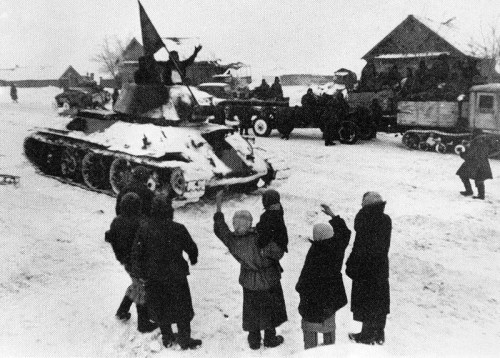
T34_Stalingrad-Offensive-px800Soviet formations advance

The Russian aim was now obvious[xxviii] and Manstein had correctly discerned their strategy.  Manstein knew that his Army Group had to hold the line on the Mius and then quickly defeat the enemy between 1st Panzer Army and Army Detachment Kempf[xxix] in “order to prevent its own isolation from the Dnieper crossings.”[xxx] The Soviets had outrun their logistics support and had suffered heavy losses of their own and had serious equipment shortages.[xxxi] Manstein explained to Hitler the opportunity offered as it was now the Russians who “were worn out” and far from their supply dumps as the Germans had been in November 1942.  Manstein “foresaw an opportunity to seize the operational initiative with a counter offensive of his own.  Manstein’s target was the Soviet armored spearheads, still careening southwestward between Kharkov and Stalino.”[xxxii] Manstein believed that when the Russian “spearhead lunged, as it must toward the crossings on the upper Dnieper,” then Hoth’s Army would be let loose again.  The three SS Panzer divisions could then “play their rightful role as avengers, and strike southeast to meet 4th Panzer Army, catching the Russian armour in a noose.”[xxxiii] Hitler agreed to Manstein’s plan and Manstein shifted 4th Panzer Army to assume control of the SS Panzer Corps, now reinforced by 3rd SS Panzergrenadier Division “Totenkopf.” Hitler reinforced Manstein and released 7 battle worn Panzer and motorized divisions for his attack.[xxxiv]

Soviet Miscalculation

It was now Stalin’s time to miscalculate. He and his subordinates “continued to believe that they were on the verge of a great victory. German defenses in southern Russia appeared to be crumbling and the Stavka sought to expand that victory to include Army Group Center.”[xxxv] To this end they diverted armies to the north and launched attacks in that direction.  However German defenses were stiff and the plan was “predicated on the assumption of continued offensive success further south.”[xxxvi] Reinforcements from Stalingrad failed to deploy and “Army Group Center’s defenses, prepared for the past year and a half proved formidable.”[xxxvii]

In the south Stalin saw the Dnieper and almost “heedlessly drove his armies towards what he thought would be the decisive victory on the banks of this huge Russian river,”[xxxviii] but, Soviet “ambitions exceeded their available resources and the skill of their commanders.”[xxxix] The SS Panzer Corps withdraw from Kharkov “further heightened the Soviet’s intoxication with victory”[xl] and confirmed their beliefs that the Germans were withdrawing.  Stalin believed that “it was inconceivable that Hitler’s Praetorian Guard would abandon Kharkov except as part of a general order to retreat.”[xli] He believed that the encirclement of Army Group South would lead to a chain reaction and quick way to victory over German forces in the east.  Believing that there was no way for the Germans to recover and establish a solid front on the Mius,[xlii] Stalin continued to drive his forces to attack, yet the Russian offensive in the south had reached what Clausewitz had called the “culminating point” and Stalin’s armies were now extremely vulnerable. “The weather, the devastated communications, and their own inexperience in maintaining the traffic density required to support a deep penetration on a narrow front had combined to force a dangerous dispersal of effort on the Russian advance which had broken down into four separate groups.”[xliii]

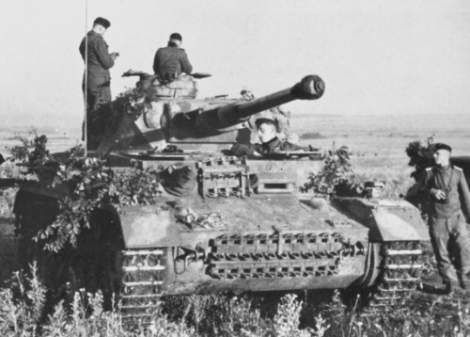
panzer ivfPanzers assembling to attack

The Soviet forces were now in a dangerous predicament being spread out across the entire south of Russia.  One group, composed of the 69th Army and 3rd Tank Army pushed against Army detachment Kempf west of Kharkov.  To the south the badly depleted 6th Army and 1st Guards Army were now “strung out down a long corridor they had opened between Izyum and Pavlograd,”[xliv] Mobile Group Popov was lagging further east near Krasnoarmeiskaia.   Additional units were isolated behind the front of Army Detachment Fretter-Pico and near Matveyev.  Soviet commanders believed that the Germans were in worse shape and that “the risks of dispersal were justified.”[xlv] They had not anticipated or made allowance for Manstein’s coolness under pressure and actions to preserve his armor while thinning his front “well past the accepted danger limit.”[xlvi] Likewise the Soviets did not know that the Germans had cracked the code used by the Southwest front and from 12 February on “were now privy to Popov’s and Vatutin’s thoughts,” now knowing precisely where the Russians would attack.[xlvii] Manstein had withstood temptation and Hitler’s pressure to use his reserves “for a direct defense of the Dnieper line.”[xlviii] As such he was prepared to launch a devastating counter-stroke against the dispersed and weakened Russian armies which were still advancing into the trap he planned for them. He had managed to “save his counteroffensive plan from Hitler’s shrill demands that the new reserves be thrown into battle piecemeal to prevent further territorial losses.”[xlix] The stage was now set for a two classic mobile operations.[l]

The Destruction of Mobile Group Popov, 6th Army and 1st Guards Army

Manstein launched his counter-stroke on 21 February against Popov’s Mobile Group using XL Panzer Corps under the command of General Henrici composed of the 7th and 11th Panzer Divisions and SS Motorized Division Viking. Popov’s Group was exposed. Popov had “succeed in cutting the railway from Dnepropetrovsk to Stalino and was itching to push further south to Mariupol on the Sea of Azov.”[li] The Soviets once again had failed to discern German intentions, believing that the Germans were retreating.[lii] Likewise the Soviet high command did not fully understand Popov’s situation. His force was weak in tanks and low on fuel and his Mobile Group was defeated in detail by the German Corps.  Popov’s immobilized tank and motorized rifle formations resisted desperately but were bypassed by the panzers.  The 330th Infantry Division mopped up the remnants of these formations.[liii] The key battles took place around the town of Krasnoarmeiskaia and the battle became a running battle between that town and the Donets River.[liv] Popov requested permission to retreat, but still believing the Germans to be retreating Vatutin gave a categorical “no.” The terrain in the area was “almost completely open”[lv] and “Popov’s proud Armoured Group was cut up like a cake.”[lvi] Popov extricated some of his units but “only after serious losses in manpower and equipment.”[lvii] Despite this it would not be until the 24th that Vatutin would order a halt to offensive operations.[lviii]

kharkovSS Panzers in Kharkov

As Popov sought to get his units out of the German scythe Manstein set his sights on 6th Army, 1st Guards Army and 25th Tank Corps which was approaching Zaporozhe.[lix] He assigned the task to Hoth’s 4th Panzer Army and its XLVIII Panzer Corps under General Knobelsdorf composed of the 6th and 17th Panzer Divisions and the SS Panzer Corps comprising SS Divisions Liebstandarte, Das Reich and Totenkopf.[lx] Manstein gave Hoth a brief but explicit order: “The Soviet Sixth Army, now racing towards Dnepropetrovsk through the gap between First Panzer Army and Army Detachment Kempf, is to be eliminated.”[lxi] The XLVIII Panzer Corps and SS Panzer Corps were unleashed against the exposed flank of the 6th Army and 1st Guards Army.   XLVIII Panzer Corps quickly “seized bridgeheads over the Samara River, and prepared to move north into the rear of the exhausted Soviet Sixth Army.”[lxii] The two Panzer Corps then made a coordinated concentric attack northwest which “came as a complete surprise to the Russians.”[lxiii] Das Reich thrust deep into the flank of 6th Army supported by Stukas from Richthofen’s 4th Air Fleet.  This attack dislodged one Soviet Rifle Corps and destroyed another allowing the division to capture Pavlograd while XLVIII Panzer Corps led by 17th Panzer Division pushed from the south linking up with the SS Corps. This cut off the Soviet 25th Tank Corps and threatened 6th Army.[lxiv] What followed was a disaster for the Russians.        Despite overwhelming evidence to the contrary the Stavka and Front commanders still believed that the Germans were retreating.  6th Army was ordered to continue its advance by the front commander who believed that the two German Panzer Corps were withdrawing.[lxv] In a few days the 17th Panzer Division “gained the Izyum-Protoponovka sector on the Donetz River, while the SS Panzer Corps took Losovaya and established contact with Army Detachment Kempf, which had joined the attack from the west.”[lxvi] XL Panzer Corps with the 3rd and 7th Panzer Divisions and 333rd Infantry Division joined in the attack on Popov’s remaining forces completing their destruction.[lxvii] As Hoth and Hausser converged on Pavlograd, Das Reich and Totenkopf “swung left to the east and then wheeled back north again running parallel to the Russian divisions fleeing from Forty-eighth Panzer Corps. What ensured was a turkey shoot.”[lxviii] Fleeing Russian forces on the open steppe were visible and engaged at long range.[lxix] Leibstandarte helped by holding the left flank against Russian counter attacks from the units now isolated in the west,[lxx] and Totenkopf’s grenadiers fanned out supported by Stukas to “kill or capture as many Russians as possible.”[lxxi] By 1 March the Russian penetrations had been eliminated. Popov’s Mobile Group was smashed, 6th Army and 1st Guards Army badly mauled. 25th Tank Corps and three Rifle divisions had to be completely written off and numerous other corps and divisions took heavy casualties.  Two additional corps, encircled before the offensive began were eliminated by German forces.[lxxii] The Germans counted 23,000 Russian dead on the battlefield, and Manstein noted that “the booty included 615 tanks, 354 field pieces, 69 anti-aircraft guns and large numbers of machine guns and mortars.”[lxxiii] The Germans only took 9,000 prisoners as they were too weak, especially in infantry to seal off the encircled Soviet forces.[lxxiv] Yet the forces that escaped they were in no condition to “block the continued progress of the Panzers and SS.”[lxxv] Now there was a 100 mile gap in the Russian lines with nothing no troops to fill it and only “General Mud” could stop the Germans.[lxxvi] Manstein was not yet finished and the next phase of his operation against the Soviet formations west of Kharkov and that city were about to commence.

The Destruction of 3rd Tank Army

With the immediate threat to his Army Group eliminated and having regained the initiative, Manstein and Army Group South now “proceeded to deliver the stroke against the ‘Voronezh Front’– i.e. the forces located in the Kharkov area.”[lxxvii] But the Russians had not been idle. In order to attempt to assist 6th Army 3rd Tank Army moved two tank corps and three Rifle divisions south and these ran into Manstein’s advancing panzers.[lxxviii] Manstein’ noted his objective now was “not the possession of Kharkov but the defeat-and if possible the destruction of the enemy units located there.”[lxxix] Between March 1st and 5th his forces advanced on Kharkov. Not knowing the Germans dispositions[lxxx] 3rd Tank Army made the mistake of moving between the Leibstandarte’s defensive positions and the attacking divisions of the SS Panzer Corps. Hausser wheeled Totenkopf around and completed an encirclement of these units near Bereka on 3 March.[lxxxi] The Russians made futile attempts to break out but the SS Divisions tightened the noose around them and they were eliminated by the SS Panzer Corps which “engaged in concentric attacks during the three days of hard fighting.”[lxxxii] Even Regimental commanders like Heinz Harmel of Das Reich’s Der Fuhrer regiment became engaged in close combat with the Russians.[lxxxiii] The battle was fought in “snowstorms whose intensity caused the SS severe privations.”[lxxxiv] Totenkopf and Das Reich slammed the Russians “back against the Tiger tanks and assault guns of the Leibstandarte.”[lxxxv] The elimination of these units netted another 12,000 Russians killed,[lxxxvi] knocking “out the last remaining obstacle between the Germans and Kharkov.”[lxxxvii]

Return to Kharkov and Controversy

Manstein turned his attention to Kharkov, supported by Richthofen’s 4th Air Fleet which for the last time in Russia “provided undisputed air superiority for a major German mechanized operation.”[lxxxviii] He decided to “roll up the enemy from the flank and force him away from Kharkov in the process.”[lxxxix] He ordered a “pincer on the town, sending Grossdeutschland around to the north with a reinforced Kempf detachment and the combined force of Hoth and the SS to attack the town from the south and rear.”[xc] Manstein planned to make a wide envelopment to avoid embroiling his panzers in costly urban combat stating “that at all costs the Army Group wished to avoid Kharkov’s becoming a second Stalingrad in which our assault forces might become irretrievably committed.”[xci] To this end he sent Das Reich and Totenkopf approaching from the south to west of the city[xcii] while XLVIII Panzer Corps swung east toward the Donetz.[xciii] As Hoth’s forces came up from the south to envelope the city, Grossdeutschland and the XI and LI Corps fought the Russians to the north and west,[xciv] eventually moving up to Belgorod.  By 8 March lead elements of the SS Panzer Corps were on the outskirts of the city.

At this point there is some controversy as to German actions. As noted Manstein wished to avoid urban combat and desired to surround the city and force its surrender.  According to one writer Hoth ordered Hausser “to seal off the city from the west and north and to take any opportunity to seize it.”[xcv] Others including Glantz and House and Murray and Millett state that Hausser “ignored a direct order” and attacked into the city.[xcvi] Manstein does not explicitly say that there was a direct order but notes that the Army Group “had to intervene vigorously on more than one occasion to ensure that the corps did not launch a frontal attack on Kharkov.”[xcvii] Sydnor states that Hausser ignored a direct order by Hoth on the 11th by detailing a battalion of Totenkopf to assist Das Reich and Leibstandarte in retaking Kharkov by direct assault. The order entailed pulling Das Reich out of the city and taking it to the east.[xcviii] Lucas adds that this order came in the midst of hard fighting in the city and could not be carried out by the division.[xcix]Carell notes that on 9 March Hoth instructed Hausser that “opportunities to seize the city by a coup are to be utilized,”[c] and goes into detail regarding how Hoth’s 11 March order applied to Das Reich. It was to be pulled out of action and brought east, but division was heavily engaged and in the process of breaking through Soviet defenses “quicker in fact than if he had pulled “Das Reich” out of the operation and led it all the way round the city along those terrible muddy and time wasting roads.”[ci] In the end the SS took Kharkov, Manstein said that the city “fell without difficulty”[cii] while others note the difficulty of the action and the casualties suffered by the SS.  Kharkov’s capture; the defeat of Rokossovsky’s campaign against Orel and the beginning of the spring Rasutitsa ended the winter campaign and stabilized the front.

Analysis

The Russian winter offensive following Stalingrad had great potential.  Manstein said: “the successes attained on the Soviet side, the magnitude of which is incontestable.”[ciii] The greatest Soviet shortcomings were inexperience in conducting deep mobile operations and the inability of their logistics system to keep up with their advance.  Clark notes that this was their “first experience of an offensive war of movement on a large scale.[civ] Glantz and House are not alone in noting that the “Stavka continued to undertake operations that were beyond its resources.”[cv] Murray and Millett state that they “lacked the operational focus that had marked the Stalingrad offensive.”[cvi] Had they had the resources and ability to execute their plans they might have destroyed all German forces in the south.  They misread German intentions based on their own over-optimistic expectations opened their forces to Manstein’s devastating counter stroke.  Von Mellenthin, possibly showing some prejudice commented that the Russian soldier “when confronted by surprise and unforeseen situations he is an easy prey to panic.”[cvii]

The Germans snatched victory out of what appeared to be certain defeat aided by Russian mistakes and operational shortcomings.  Manstein refused to panic and conserved his forces for his counterattack.[cviii] Kleist brought his Army Group out of what might have been encirclement worse than Stalingrad.  Hitler for the most part gave Manstein operational freedom which he had not provided other commanders.  German Panzer forces conducted mobile operations against superior enemy armored forces and bested them.  Landsers held their own in at critical junctures, especially on the Mius and gave Manstein the opportunity to employ the panzers in the mobile defense.[cix] The Luftwaffe recovered its balance and the coordinated operations between it and German ground forces gave them an edge at a point where the Red Air Force was unable to support the Red Army.[cx] Above all the Germans still maintained the edge in both overall quality of generalship, especially that of Manstein and Kleist, but not to exclude Hoth, Hausser and lower level commanders.  Additionally the average German soldier still maintained an edge over his Soviet adversary in the confusion of mobile operations in open terrain.   Manstein and his forces gave Hitler breathing room on the eastern front.[cxi] As Clark notes: “few periods in World War II show a more complete and dramatic reversal of fortune than the fortnight in February and the first in March 1943…it repaired its front, shattered the hopes of the Allies, nipped the Russian spearhead. Above all it recovered its moral ascendancy.”[cxii]


[i] Von Mellenthin, F.W. Panzer Battles: A Study of the Employment of Armor in the Second World War. Translated by H. Betzler, Ballantine Books, New York, NY, 1971. Originally Published University of Oklahoma Press, 1956. p245

[ii] Glantz, David M. and House, Jonathan. When Titans Clashed: How the Red Army Stopped Hitler. University Press of Kansas, Lawrence, KS. 1995. p.143

[iii] Ibid. Glantz. P.143. These units include 3rd Tank Army, 1st and 3rd Guards Armies and the 6th, 40th and 69th Armies.

[iv] Liddell-Hart. B.H. Strategy.  A Signet Book, the New American Library, New York, NY 1974, first published by Faber and Faber Ltd. London, 1954 and 1967. p.253

[v] Raus, Erhard. Panzer Operation: The Eastern Front Memoir of General Raus, 1941-1945. Compiled and Translated by Steven H Newton. Da Capo Press a member of the Perseus Book Group, Cambridge, MA 2003. p.185

[vi] Murray, Williamson and Millett, Allan R. A War to Be Won: Fighting the Second World War, The Belknap Press of Harvard University Press, Cambridge MA. 2000. pp.291-292

[vii] Liddell-Hart, B.H. History of the Second World War. G.P. Putnam’s Son’s, New York, NY. 1970  p.478

[viii] Wray, Timothy A. Standing Fast: German Defensive Doctrine on the Russian Front in World War II, Prewar to March 1943. U.S. Army Command and General Staff College, Fort Leavenworth, KS. 1986. p.161

[ix] Ibid. Murray and Millett. p.292

[x] Ibid. Liddell-Hart, Second World War. p.479

[xi] Liddell-Hart, B.H. The German Generals Talk. Quill Publishing, New York, NY. 1979. Copyright 1948 by B.H. Liddell-Hart. pp.211-212.

[xii] Clark, Alan. Barbarossa: The Russian-German Conflict, 1941-45. Perennial, an Imprint of Harper Collins Books, New York, NY 2002. Originally published by William Morrow, New York, NY 1965. pp.299-300

[xiii] Glantz, David M and House, Jonathan. The Battle of Kursk.  University Press of Kansas, Lawrence, KS. 1999. p.11

[xiv] Manstein, Erich von. Lost Victories. Translated by Anthony G. Powell, Zenith Press, an imprint of MBI Publishing Company, St Paul, MN. 2004. First Published as Verlorene Siege Athenaum-Verlag, Bonn, GE 1955, English edition Methuen & Company Ltd. 1958  p.417

[xv] Ibid. Clark. p.300

[xvi] Carell, Paul. Scorched Earth: The Russian German War 1943-1944. Translated by Ewald Osers, Ballantine Books, New York, NY 1971, published in arrangement with Little-Brown and Company. pp.196-199

[xvii] Lucas, James. Das Reich: The Military History of the 2nd SS Division. Cassell Military Paperbacks, London, UK, 1999. First published by Arms and Armour, 1991. p.91  Glantz and House criticize Hausser saying that the SS Panzer Corps Staff lacked the experience to perform its mission.  (Titans Clashed p.144) Most other commentators agree with the necessity of his withdraw.

[xviii] Messenger, Charles. Sepp Dietrich: Hitler’s Gladiator. Brassey’s Defence Publishers, London, 1988. p.113

[xix] Ibid. Clark. p.300

[xx] Ibid. Manstein. p.419

[xxi] Ibid. Manstein. pp.418-419

[xxii] Ibid. Glantz and House. When Titans Clashed. p.144

[xxiii] Ibid. Clark. p.300

[xxiv] Ibid. Von Mellenthin. p.251

[xxv] Ibid. Carell. p.191

[xxvi] Ibid. Manstein. p.424.

[xxvii] Ibid. Manstein. p.428

[xxviii] Ibid. Liddell-Hart. Second World War. p.481

[xxix] This had previously been Army Detachment Lanz, but Lanz had bee relieved over the loss of Kharkov.

[xxx] Ibid. Manstein. p.429

[xxxi] Ibid. Murray and Millet. p.292

[xxxii] Ibid. Wray. p.162

[xxxiii] Ibid. Clark. p.302.

[xxxiv] Ibid. Glantz and House. When Titans Clashed. p.145

[xxxv] Ibid. Glantz and House. When Titans Clashed . pp.144-145

[xxxvi] Ibid. Glantz and House. When Titans Clashed. p.146

[xxxvii] Ibid. Murray and Millett. p.293

[xxxviii] Ibid. Carell. p.191

[xxxix] Ibid. Murray and Millett. p.292

[xl] Ibid. Carell. p.199

[xli] Ibid. Carell. p.199

[xlii] Ibid. Carell. p.193

[xliii] Ibid. Clark. p.303

[xliv] Ibid. Clark. p.304

[xlv] Ibid. Clark. p.304

[xlvi] Ibid. Clark. p.304

[xlvii] Ibid. Carell. p.210

[xlviii] Ibid. Liddell-Hart. Strategy p.253

[xlix] Ibid. Wray. p.163

[l] Ibid. Glantz and House. When Titans Clashed. p.147. Note comments by Glantz and House in footnote 31 on relative strengths of forces involved, especially the weakness of German forces.

[li] Butler, Rupert. SS Wiking: The History of the Fifth SS Division 1941-45. Casemate, Havertown, PA. 2002. p.93

[lii] Ibid. Carell. p.211

[liii] Ibid. Carell. p.210

[liv] Ibid. Glantz and House. When Titans Clashed. p.147

[lv] Ibid. von Mellenthin. p.253

[lvi] Ibid. Carell. p.210

[lvii] Ibid. Murray and Millett. p.293

[lviii] Ibid. Carell. p.213

[lix] Ibid. Glantz and House. When Titans Clashed. p.147

[lx] There is difference in various accounts as to which units composed these Panzer Corps. Von Mellenthin adds 11th Panzer to the XLVIII Panzer Corps and some accounts do not list the Liebstandarte as part of the SS Panzer Corps.

[lxi] Ibid. Carell. p.211

[lxii] Sydnor, Charles W. Soldiers of Destruction: The SS Death’s Head Division 1933-1945. Princeton University Press, Princeton NJ. 1977. p.268

[lxiii] Ibid. Von Mellenthin. p.252

[lxiv] Ibid. Carell. p.212

[lxv] Ibid. Carell. p.212

[lxvi] Ibid. Von Mellenthin. p.252

[lxvii] Ibid. Carell. p.213

[lxviii] Ibid. Sydnor. pp.268-269

[lxix] Ibid. Von Mellenthin. p.253

[lxx] Meyer, Kurt. Grenadiers. Translated by Michael Mende and Robert J. Edwards. J.J. Fedorowicz Publishing Inc. Winnipeg, Manitoba. Canada. 2001. pp.180-181

[lxxi] Ibid. Sydnor. p.269

[lxxii] Ibid. Manstein. p.433

[lxxiii] Ibid. Manstein. p.433. Sydnor lists an addition 600 anti-tank guns and notes that the tanks were almost all T-34s. (Sydnor. p.269)

[lxxiv] Ibid. Glantz and House. When Titans Clashed. p.147

[lxxv] Ibid. Clark. p.306

[lxxvi] Ibid. Carell. p.216

[lxxvii] Ibid. Manstein. p.433

[lxxviii] Ibid. Glantz and House. When Titans Clashed. p.187

[lxxix] Ibid. Manstein. p.433

[lxxx] Ibid. Meyer. p.181

[lxxxi] Ibid. Carell. p.216

[lxxxii] Ibid. Meyer. pp.181-182

[lxxxiii] Ibid. Lucas. p.95

[lxxxiv] Ibid. Lucas. p.95

[lxxxv] Ibid. Sydnor. p.277

[lxxxvi] Ibid. Manstein. p.434

[lxxxvii] Ibid. Sydnor. p.277

[lxxxviii] Ibid. Glantz and House. Kursk. p.13

[lxxxix] Ibid. Manstein. p.435

[xc] Ibid. Clark. p.306

[xci] Ibid. Manstein. p.435

[xcii] Ibid. Sydnor. p.278

[xciii] Weingartner, James. J. Leibstandarte SS Adolf Hitler: A Military History, 1933-45. Battery Press, Nashville, TN.(no publication date listed)  p.75

[xciv] Ibid. Raus. pp.189-192

[xcv] Ibid. Messenger. p.114

[xcvi] See Glantz and House p.187 and Murray and Millett p.293

[xcvii] Ibid. Manstein. p.436

[xcviii] Ibid. Sydnor. p.278

[xcix] Ibid. Lucas. p.96

[c] Ibid. Carell. p.216

[ci] Ibid. Carell. p.219

[cii] Ibid. Manstein. p.436

[ciii] Ibid. Manstein. p.437

[civ] Ibid. Clark. p.303

[cv] Ibid. Glantz and House. p.143

[cvi] Ibid. Murray and Millett. p.292

[cvii] Ibid. Von Mellenthin. p.254

[cviii] A comment by Von Mellenthin commenting on Manstein’s coolness in the conduct of his operations compares him to Robert E. Lee. “To find another example of defensive strategy of this caliber we must go back to Lee’s campaign in Virginia in the summer of 1864. (Von Mellenthin. p.245)

[cix] For some additional comments along these lines see vn Mellenthin who notes four points in regard to the counter stroke: 1. High level commanders did not restrict the moves of armored formations, but gave them long range tasks. 2. Armored formations had no worries about their flanks because the High Command had a moderate infantry force available for counterattacks. 3. All commanders of armored formations, including corps, conducted operations not from the rear, but from the front. 4. The attack came as a surprise regarding the time and place. (Von Mellenthin p.254)

[cx] Ibid. Murray and Millett. p.293

[cxi] Despite his success Hitler was not happy with Manstein in regard to giving up ground for operational purposes and Manstein would lose much of the freedom that he enjoyed by March. Wray has a discussion of this.  See Wray. pp.162-163.  The Nazi hierarchy actively promoted the exploits of the SS Panzer Corps and its leaders, especially the commander of the Leibstandarte Sepp Dietrich. (see Weingartner pp. 76-77) The recognition of Hausser would be delayed, some speculate as a result of his disobedience in giving up Kharkov in February.

[cxii] Ibid. Clark. p.306

Bibliography

Butler, Rupert. SS Wiking: The History of the Fifth SS Division 1941-45. Casemate, Havertown, PA. 2002

Carell, Paul. Scorched Earth: The Russian German War 1943-1944. Translated by Ewald Osers, Ballantine Books, New York, NY 1971, published in arrangement with Little-Brown and Company

Clark, Alan. Barbarossa: The Russian-German Conflict, 1941-45. Perennial, an Imprint of Harper Collins Books, New York, NY 2002. Originally published by William Morrow, New York, NY 1965

Glantz, David M and House, Jonathan. The Battle of Kursk.  University Press of Kansas, Lawrence, KS. 1999

Glantz, David M. and House, Jonathan. When Titans Clashed: How the Red Army Stopped Hitler. University Press of Kansas, Lawrence, KS. 1995

Liddell-Hart, B.H. The German Generals Talk. Quill Publishing, New York, NY. 1979. Copyright 1948 by B.H. Liddell-Hart.

Liddell-Hart, B.H. History of the Second World War. G.P. Putnam’s Son’s, New York, NY.

Liddell-Hart. B.H. Strategy.  A Signet Book, the New American Library, New York, NY 1974, first published by Faber and Faber Ltd. London, 1954 and 1967

Lucas, James. Das Reich: The Military History of the 2nd SS Division. Cassell Military Paperbacks, London, UK, 1999. First published by Arms and Armour, 1991

Manstein, Erich von. Lost Victories. Translated by Anthony G. Powell, Zenith Press, an imprint of MBI Publishing Company, St Paul, MN. 2004. First Published as Verlorene Siege Athenaum-Verlag, Bonn, GE 1955, English edition Methuen & Company Ltd. 1958

Messenger, Charles. Sepp Dietrich: Hitler’s Gladiator. Brassey’s Defence Publishers, London, 1988

Meyer, Kurt. Grenadiers. Translated by Michael Mende and Robert J. Edwards. J.J. Fedorowicz Publishing Inc. Winnipeg, Manitoba. Canada. 2001

Raus, Erhard. Panzer Operation: The Eastern Front Memoir of General Raus, 1941-1945. Compiled and Translated by Steven H Newton. Da Capo Press a member of the Perseus Book Group, Cambridge, MA 2003

Sydnor, Charles W. Soldiers of Destruction: The SS Death’s Head Division 1933-1945. Princeton University Press, Princeton NJ. 1977

Von Mellenthin, F.W. Panzer Battles: A Study of the Employment of Armor in the Second World War. Translated by H. Betzler, Ballantine Books, New York, NY, 1971. Originally Published University of Oklahoma Press, 1956

Weingartner, James. J. Leibstandarte SS Adolf Hitler: A Military History, 1933-45. Battery Press, Nashville, TN.(no publication date listed)

Wray, Timothy A. Standing Fast: German Defensive Doctrine on the Russian Front in World War II, Prewar to March 1943. U.S. Army Command and General Staff College, Fort Leavenworth, KS. 1986

6 Comments

Filed under History, leadership, Military, world war two in europe

The Effects of Counter-Insurgency Operations on U.S. and French Forces in Vietnam and Algeria and Implications for Afghanistan

legion indo-china1st Foreign Legion Parachute Regiment in Indo-China

Introduction

The effects of the wars Indo-China, Algeria and Vietnam on the French and American military organizations internally and in relationship to their nations piqued my interest in 2005. The wars in Iraq and Afghanistan forced me to start asking the question of what short and long term effect that these wars might have on the U.S. military.  As such I wondered what historical precedent that there was for the question. My interest was furthered by my deployment with Marine and Army advisors to Iraqi Army and Security forces in 2007-2008.  My search led to the French experiences in Indo-China and Algeria and the American experience in Vietnam.

The counterinsurgency campaigns conducted by the French and American militaries in Vietnam and Algeria had deep and long lasting effects on them.  The effects included developments in organization and tactics, relationship of the military to the government and people, and sociological changes.  The effects were tumultuous and often corrosive.  The French Army in Algeria revolted against the government. The US Army, scarred by Vietnam went through a crisis of leadership and confidence which eventually resulted in end of the draft and formation the all volunteer military.

viet minh supplyPrimitive but Effective- Viet Minh Supply Column The French Could Never Stop them

There is a wealth of data regarding these wars. There are several types of materials. The accounts of soldiers, diplomats and reporters who experienced these events contained in memoirs and diaries. The best include David Hackworth’s About Face and Steel My Soldiers Hearts; and General Harold Moore’s We Were Soldiers Once… and Young. French works include Jules Roy’s The Battle of Dien Bein Phu and General Paul Aussaresses’ The Battle of the Casbah. There are innumerable popular accounts written by NCOs and junior officers.  These accounts may contain a wealth of information, but are limited by a number of factors. First, many only saw part of the overall picture and first-hand experience can skew objectivity. Those who have been through the trauma of war interpret war through their own experience.  Physical and psychological wounds can have a major impact on the interpretation of these writers as can their experience and political ideology. Finally few of these writers are trained historians. Despite this they can be a valuable resource for the historian.

Another source is official histories. Often these incorporate unit histories and individual narratives and analyze specific battles and the wider campaigns, but do little in regard to broader conditions that affected operations.  While a good source, many are not as critical of their institutions as they should be. Histories by trained historians and journalists provide another view. The most insightful of the journalist accounts include Bernard Fall’ Street Without Joy and The Siege of Dien Bien Phu: Hell in a Very Small Place. A limitation of all of these is that they are often heavily influenced by the political and societal events. This means that earlier accounts are more likely to be reactive and judgmental versus critical and balanced. Later accounts have the benefit of access to the opposing side and documents not available to earlier writers.  Alistair Horn in A Savage War of Peace provides one of the most informative and balanced accounts of the war in Algeria. Martin Winslow does the same regarding Dien Bien Phu in The Last Valley.

Dien Bien Phu 1Isolated and Besieged Dien Bien Phu

Another source is the writings of participants who critically examine their participation in the wars.  Many of these, French and American provide insights into the minds of leaders who are reflective and critically examine what happened to their military institutions in these wars. The best of these is French Colonel David Galula whose books Pacification in Algeria 1956-1958 and Counterinsurgency Warfare: Theory and Practice provide first-hand accounts of the subject combined with critical reflection. Galula’s works have been important to John Nagl, General David Petreus and others who helped write the U.S. Army and Marine Corps Counterinsurgency manual. Andrew Krepinevich in The Army and Vietnam provides a critical analysis of the U.S. Army in Vietnam.  Other sources, both online and print, such as RAND, provide excellent analysis of selected topics within the scope of this essay, especially COIN.

The ability to dispassionately and critically examine and evaluate these sources over a period of several years was and integrate them with my own experience has been a critical to me.  It has changed the way that I look at sources, and caused me to be much more aware of bias, the limitations of sources and the need to have a multiplicity of sources and points of view.

Effects of Insurgencies on the Armies that Fought Them

The conflicts in French Indo-China, Algeria and Vietnam had major effects on the French and American military institutions. These effects can be classified in a number of ways. First, the manner in which each military waged war, including tactics and weapons systems was changed.  The use of airpower, especially helicopters and use of Riverine forces provided an added dimension of battlefield mobility but did not bring victory. As John Shy and Thomas Collier noted regarding the French in Indo-China: “French mobility and firepower could take them almost anywhere in Vietnam, but they could not stay, and could show only wasted resources and time for their efforts.”[1] The use of intelligence and psychological warfare, including the use of torture became common practice in both the French and American armies.  The wars had an effect on the institutional culture of these armed services; neither completely embraced the idea of counterinsurgency and for the most part fought conventionally. Galula notes how the “legacy of conventional thinking” slowed the implementation of proper counterinsurgency tactics even after most commanders learned that “the population was the objective.”[2] Krepinevich notes that “any changes that might have come about through the service’s experience in Vietnam were effectively short-circuited by Army goals and policies.”[3] Finally the wars had a chilling effect on the relationship between the both militaries and the state, veterans from each nation often felt betrayed or disconnected from their country and people.

legion algeriaForeign Legion in Algeria

The French Army had the misfortune of fighting two major insurgencies back to back.  The French military was handicapped even before it went into these wars. The Army came out of World War II defeated by the Germans, divided by loyalties to Vichy or one of the Free French factions. They were humiliated by the Japanese in Indo-China, while in Algeria France’s crushing defeat was devastating.  “Muslim minds, particularly sensitive to prestige and baraka, the humiliation made a deep impression.”[4] French society was as divided as the Army; the economy in shambles, the government weak and divided.  The Viet-Minh had prepared well making use of time and training to get ready for war.  “Once full-scale hostilities broke out, the French, for budgetary and political reasons could not immediately make the large scale effort to contain the rebellion in the confines of small-scale warfare.”[5]

In both Indo-China and Algeria the French attempted to fight the budding insurgencies in a conventional manner.  This was particularly disastrous in Indo-China when on a number of occasions battalion and regimental combat team sized elements were annihilated by Viet-Minh regulars.  Between October 1st and 17th 1950 every French garrison along the Chinese border was over-run.  The French lost over 6000 troops and enough equipment to outfit “a whole additional Viet-Minh division.” It was their worst colonial defeat since Montcalm at Quebec.[6] In Algeria when the fight began in earnest France’s “ponderous ponderous N.A.T.O forces found themselves at an impossible disadvantage,”[7] unable to have any influence off the main roads.

VIETNAM DIEN BIEN PHUSurrender at Dien Bien Phu

In Vietnam the French did not absorb the lessons of fighting a well established insurgent force. French forces hoped to draw the Viet-Minh main forces into battles of attrition where their superior firepower could be brought to bear. Such was the case at Na San in December 1952 where the French established an “Air ground base” deep in Viet-Minh territory to draw Giap’s forces into open battle.  This worked, but just barely. Giap, short of artillery and not planning on a long battle frittered away his troops in mass charges.  However, the French, because of Na Son assumed they had found the key to victory. In their embrace of the “air ground base concept, French staff officers were following an intellectual tradition that had long been prone to seduction by elegant theories.”[8] The result was the disaster at Dien Bien Phu the following year.  The destruction of the elite Group-mobile 100 near Pleiku in 1954 was the coup de grace. In Indo-China the French made limited use of helicopters, used paratroops widely, and developed Riverine forces. One thing they were critically short of was significant tactical air support.[9]

The most inventive French creation was the GCMA/GMI forces composed of mountain tribesmen led by French NCOs and Junior Officers.  They were designed to provide “permanent guerilla groups rooted in remote areas” to harass and interdict Viet-Minh forces.[10] Trinquier noted that at the time of the Dien Bien Phu defeat that these forces had reached over 20,000 trained and equipped maquis in the Upper Region of Tonkin and Laos. These forces achieved their greatest success retaking Lao Cai and Lai Chau May 1954 as Dien Bien Phu fell.[11] Trinquier stated that “the sudden cessation of hostilities prevented us from exploiting our opportunities in depth.”[12] The GMI units and their French leaders were abandoned fighting on for years after the defeat. One account noted a French NCO two years after the defeat cursing an aircraft patrolling the border “for not dropping them ammunition so they could die like men.”[13] In the end the French left Indo-China and Giap remarked to Jules Roy in 1963 “If you were defeated, you were defeated by yourselves.”[14]

Algeria was different being part of Metropolitan France; there the French had support of European settlers, the pieds-noir. Many French soldiers had come directly from Indo-China. There French made better adaptations to local conditions, and realized that they had to win the population and isolate the insurgents from it and outside support. As Galula said, victory is the destruction of the insurgent’s political and military structures, plus “the permanent isolation from the population, not forced upon the population, but by and with the population.”[15] The lessons learned by the French in both Algerian and Indo-China were lost upon the Americans.

The United States military, especially the Army approached the Vietnam War with a conventional mindset, the “Army concept.” [16] It not only approached the war in this manner, but it trained and organized the South Vietnamese forces, ARVN into the American model. Americans re-organized ARVN into divisions “based upon the U.S. divisional force structure.”[17] ARVN was not structured appropriately for the threat that it faced.”[18] The results were as to be expected. Large numbers of troops poured in, American counterinsurgency was costly.  It was “almost a purely military approach”[19] which ignored political and social realities on the ground. Massive firepower was the means “utilized by the Army to achieve the desired end of the attrition strategy-the body count.”[20] In the end the American defeat was a “failure of understanding and imagination.”[21] The one shining moment was the Marine Corps experimentation with “Combined Action Program” platoons which lived in the villages with militia for long periods of time. This program produced great results “in eliminating local guerillas”[22] but was killed by the Army.

For both the French and Americans these wars tore the heart out of their armies. For the French the defeats inflicted a terrible toll.  In Indo-China many French career soldiers felt that the government’s “lack of interest in the fate of both thousands of missing French prisoners and loyal North Vietnamese…as dishonorable.”[23] Divisions arose between those who served and those who remained in France or Germany and created bitter enmity between soldiers.  France would endure a military coup which involved many who had fought in Vietnam and Algeria. Having militarily won that war, were turned into what Jean Lartenguy called ‘the Centurions” had been turned into liars.”[24] They were forced to abandon those who they had fought for and following the mutiny, tried, imprisoned, exiled or disgraced. Colonial troops who remained loyal to France were left without homes in their “independent” nations.  They saw Dien Bien Phu as the defining moment. “They responded with that terrible cry of pain which pretends to free a man from his sworn duty, and promises such chaos to come: ‘Nous sommes trahis!’-‘We are betrayed.’”[25]

Joint_operation_with_ARVN_112-1Joint US-ARVN Operation

The U.S. Army returned to a country deeply divided and Vietnam veterans remained ostracized until the 1980s.  As Harold Moore recounts “in our time battles were forgotten, our sacrifices were discounted, and both our sanity and suitability for life in polite American society were publically questioned.”[26] The Army endured a massive reorganization that resulted in the formation of the All-Volunteer force, which would redeem itself and emerge from the ashes in the Gulf War. The Americans would not learn the lessons of revolutionary warfare and counterinsurgency until forced to do so in Iraq in 2004-2007.

Conclusions and Possibilities

The effects of these wars on the French and American military establishments were long lasting and often tragic. The acceptance of torture as a means to an end sullied even the hardest French officers. Men like Galula and Marcel Bigeard refused to countenance it, while others like Paul Aussaresses never recanted.  Americans would repeat the tactic at Abu Ghraib rallying the Iraqis against them.

For the Americans, the debacle continued at home. Race riots tore at the force while drug addictions and criminal activities were rampant.  Incompetent leaders kept their jobs and highly successful leaders who became whistle blowers like Hackworth were scorned by the Army institution. It took years before either the French or American veterans again felt a part of their countries.  They ended up going to war, and when it was over; feeling abandoned, their deepest bonds were to their comrades who had fought by their side.

What are the lessons to be learned from these campaigns as well as from the various accounts?  Andrew Krepinevich prophetically noted that the failure to learn the lessons of Vietnam “represents a very dangerous mixture that in the end may see the Army again attempting to fight a conventional war against a very unconventional opponent.”[27] Obviously, there are lessons to be learned, especially in understanding the nature of revolutionary war as well as the culture and history of our opponents. The U.S. has made some improvement in this regard but there is still much to be learned, especially since after the war the Army was “erecting barriers to avoid fighting another Vietnam War.”[28] From these wars we learn that nations and incompetent governments who mismanage wars can alienate themselves from the soldiers that they send to fight, with serious consequences.  As far as historiography we learn that certain historical fallacies are evident when one reads the accounts critically and recognize the bias and limitations of the various sources.

In Iraq the U.S. adapted, albeit belatedly to the nature of the insurgency and took advantage of Al Qaeda Iraq (AQI) over-reach in the manner that they abused the Iraqi people.  The situation turned dramatically in September of 2007 when Al Qaeda killed the most prominent Sunni Sheik outside of Ramadi.  The Sheik had begun to work with Americans on security issues and his death turned much of the Sunni populace in Al Anbar and other provinces against AQI for the first time allying them with the Sh’ia dominated government.  Changing focus the U.S. Forces focused on safeguarding the population and building up the capabilities of Iraqi forces.  Within months because of the increased security and stability in Al Anbar the U.S. Marine trained and Iraqi led forces of the 1st Iraqi Division were able to be moved to Basra where they retook the city from insurgent forces and to Diyala where they helped the government gain the upper hand.  Success in Iraq did not come easy, American forces suffered their greatest losses since the Vietnam War in the cities, villages and countryside of Iraq.  The U.S. is now in the process of drawing down as the Iraqis take over their own security.  The process is not perfect as there still tension between Sunni and Sh’ia factions as well as Kurds and other minority ethnic groups.  However it is still going better than most experts predicted.

iraqi border troopThe Author and Advisors with Iraqi Border Troops near Syria

Afghanistan is another matter.  After early success in overthrowing the Taliban and isolating Al Qaeda the Americans and NATO pretty ran a status quo operation attempting to legitimize the Karzai government, eliminate the Opium poppy crops and establish government presence and security in outlying areas.  There was a problem in this; both the Taliban and Al Qaeda used border sanctuaries in Pakistan and financial support from worldwide Moslem groups to continue the fight.  As Al Qaeda and the Taliban built themselves up the Afghan government lost support. This loss of support was in large part due to rampant government corruption as well as to the perception of U.S. and NATO forces being occupiers and not liberators.  This perception of the U.S. and NATO forces was in large part because they had ignored the lessons of French Indo-China, Algeria, Vietnam and Iraq.  Isolated from the population the bulk of NATO forces performed in a reactionary manner and often used aircraft and artillery to respond to Taliban forces often killing non-combatants by mistake. Each time this happened, the Al Qaeda and Taliban leaders used the results to further bolster their image and portray the allies as the oppressors.  As the Taliban took back much of the country they also returned to oppressive means to subdue the population by fear and intimidation.

taliban insurgentsTaliban Insurgents

The new American commander, General Stanley McChrystal has asked for more forces in order to run a proper counter-insurgency campaign which focuses on the security of the population to isolate the Taliban and Al Qaeda.  Whether General McChrystal gets his forces and whether they are enough to turn the tide before all political and public support in the U.S. and NATO countries is lost is another matter.  Right now the situation is tenuous at best.  There are means to win this war despite the history of Afghanistan which suggests that this is not possible.  The key is he Afghan population, if they believe that the U.S. and NATO are n their side, that we respect them, their culture, religion and that Al Qaeda and the Taliban are the real oppressors the war can be won.  This requires patience, forethought and deliberate measures to secure the population, build up a government that they can trust and de-legitimatize Al Qaeda and the Taliban.  If that does not happen, the U.S. and NATO run the risk of repeating the story of the French in Indo-China.   Unlike AQI and Iraqi insurgents the Taliban are very capable of running military operations capable of defeating small to medium sized units in isolated locations.  They know the terrain, often have the support of the people, are highly mobile and not dependant on roads and can mass quickly at critical points.  Last year the Taliban launched a large scale assault on an American COP which came close to overrunning it.  They were repelled with heavy casualties but the incident demonstrated a capability that is growing.  What I would be concerned about is the total destruction of an isolated post or a convoy which could be used to demoralize western nations.  While I do not think that the Taliban could pull off the defeat of a major US or NATO base or force as the Viet-Minh did at Dien Bien Phu but the threat should not be minimized.

traiining team with afghan armyUSMC Training Team in Afghanistan

How we learn the lessons of past insurgencies and revolutionary wars is important in Afghanistan.  The stakes are higher than most would want to admit. A withdraw would be seen by militants outside of Afghanistan would be emboldened just as the Algerians were by the loss of the French in Indo-China. It would again provide Al Qaeda with a safe haven and secure base of operations.  The stakes are high.  Who knows what will happen?

Bibliography

Aussaresses, Paul, “The Battle of the Casbah: Counter-Terrorism and Torture,” translated by Robert L Miller.  Enigma Books, New York, 2005. Originally published in French under the title of “SERVICES SPECIAUX Algerie 1955-1957” Perrin 2001

Fall, Bernard B. “The Siege of Dien Bien Phu: Hell in a Very Small Place.” Da Capo Press, New York an unabridged reprint of the 1st Edition reprinted in arrangement with Harper and Row Publishers, New York. 1967

Fall, Bernard B. “Street Without Joy: The French Debacle in Indochina.” Stackpole Books, Mechanicsburg PA, 2005, originally published by Stackpole Publications 1961

Galula, David. “Counterinsurgency Warfare: Theory and Practice.” Praeger Security International, Westport CT 1964 and 2006

Galula, David. “Pacification in Algeria 1956-1958.” RAND Corporation, Santa Monica CA 2006. Originally published by RAND 1963

Hackworth, David H. and Sherman, Julie. “About Face: The Odyssey of an American Warrior,” a Touchstone Book published by Simon and Schuster, New York. 1989

Horn, Alistair. “A Savage War of Peace: Algeria 1954-1962,” a New York Review Book published by the New York Review of Books, New York, 1977, 1987, 1996, and 2006

Karnow, Stanley. “Vietnam, a History: The First Complete Account of Vietnam at War,” The Viking Press, New York, 1983

Krepinevich, Andrew F. “The Army and Vietnam,” The Johns Hopkins University Press, Baltimore and London, 1986

Millett, Allan R. and Maslowski, Peter. “For the Common Defense: A Military History of the United States of America.” The Free Press, a division of Macmillian, Inc. New York, 1984

Moore, Harold G and Galloway, Joseph L. “We were Soldiers Once…and Young: Ia Drang: The Battle that Changed Vietnam,” Harper Collins Publishers, New York NY 1992

Nagl, John A. “Learning to East Soup with a Knife: Counterinsurgency Lessons from Malaya and Vietnam,” University of Chicago Press, Chicago and London, 2005

Nolan, Keith William. “The Battle for Hue: Tet 1968,” Presidio Press, Novato CA, 1983

Pottier, Philippe (2005) Articles: GCMA/GMI: A French Experience in Counterinsurgency during the French Indochina War, Small Wars & Insurgencies,16:2,125 — 146 http://dx.doi.org/10.1080/09592310500079874

Roy, Jules. “The Battle of Dien Bien Phu” Carrol and Graf Publishers, New York 1984. Translated from the French by Robert Baldrick. English translation copyright 1965 by Harper and Row Publishers, New York.

Sheehan, Neil. “A Bright and Shining Lie: John Paul Vann and America in Vietnam,” Vintage Books, a division of Random House, New York, 1989

Shy, John and Collier, Thomas W. “Revolutionary War”in Makers of Modern Strategy from Machiavelli to the Nuclear Age,” Peter Paret editor. Princeton University Press, Princeton N.J. 1986

Simpson, Howard K. “Dien Bien Phu: The Epic Battle America Forgot,” Potomac Books Inc. Washington DC 2005, originally published by Brassey’s Inc. 1994

Spector, Ronald H. “After Tet: The Bloodiest Year in Vietnam,” Vintage Press, a division of Random House, New York, 1993

Trinquier, Roger. “Modern Warfare: A French View of Counterinsurgency,” translated from the French by Daniel Lee with an Introduction by Bernard B. Fall. Praeger Security International, Westport CT and London. 1964 and 2006. Originally published under the title “La Guerre Moderne” by Editions Table Ronde.

West, F.J. “The Village,” Pocket Books, a division of Simon and Schuster, New York. 1972.

Windrow, Martin. “The Last Valley: Dien Bien Phu and the French Defeat in Vietnam,” Da Capo Press, Novato, CA 2006, originally published by Weidenfeld and Nicholson, London 2004


[1] Shy, John and Collier, Thomas W. “Revolutionary War” in Makers of Modern Strategy from Machiavelli to the Nuclear Age,” Peter Paret editor. Princeton University Press, Princeton N.J. 1986  p.849

[2] Galula, David. Counterinsurgency in Algeria: 1956-1958. RAND Corporation, Santa Monica, CA. 2006. First published by RAND in 1963. p.244

[3] Krepinevich, Andrew F. “The Army and Vietnam,” The Johns Hopkins University Press, Baltimore and London, 1986 p.213

[4] Horn, Alistair. “A Savage War of Peace: Algeria 1954-1962,” a New York Review Book published by the New York Review of Books, New York, 1977, 1987, 1996, and 2006 p 41

[5] Fall, Bernard B. “Street Without Joy: The French Debacle in Indochina.” Stackpole Books, Mechanicsburg PA, 2005, originally published by Stackpole Publications 1961 p.27

[6] Ibid. p.33

[7] Horn. p.100.

[8] Windrow, Martin. “The Last Valley: Dien Bien Phu and the French Defeat in Vietnam,” Da Capo Press, Novato, CA 2006, originally published by Weidenfeld and Nicholson, London 2004 p.63

[9] Fall, Bernard B. “The Siege of Dien Bien Phu: Hell in a Very Small Place.” Da Capo Press, New York an unabridged reprint of the 1st Edition reprinted in arrangement with Harper and Row Publishers, New York. 1967 pp. 456-457  Fall discusses in depth the lack of French Air support and the antecedents that led to the shortage following World War II.

[10] Pottier, Philippe(2005)’Articles: GCMA/GMI: A French Experience in Counterinsurgency during the French Indochina War’, Small Wars & Insurgencies,16:2,125 — 146 http://dx.doi.org/10.1080/09592310500079874

[11] Simpson, Howard K. “Dien Bien Phu: The Epic Battle America Forgot,” Potomac Books Inc. Washington DC 2005, originally published by Brassey’s Inc. 1994 pp. 170-171

[12] Trinquier, Roger. “Modern Warfare: A French View of Counterinsurgency,” translated from the French by Daniel Lee with an Introduction by Bernard B. Fall. Praeger Security International, Westport CT and London. 1964 and 2006. Originally published under the title “La Guerre Moderne” by Editions Table Ronde. p.87

[13] Windrow. p.652.

[14] Roy, Jules. “The Battle of Dien Bien Phu” Carrol and Graf Publishers, New York 1984. Translated from the French by Robert Baldrick. English translation copyright 1965 by Harper and Row Publishers, New York. p.xxx

[15] Galula, David. “Counterinsurgency Warfare: Theory and Practice.” Praeger Security International, Westport CT 1964 and 2006 p. 54

[16] Krepinevich. p.213

[17] Ibid. p.24

[18] Nagl, John A. “Learning to East Soup with a Knife: Counterinsurgency Lessons from Malaya and Vietnam,” University of Chicago Press, Chicago and London, 2005 p.138

[19] Shy. p.856

[20] Krepinevich. p.202

[21] Spector, Ronald H. “After Tet: The Bloodiest Year in Vietnam,” Vintage Press, a division of Random House, New York, 1993 p.314

[22] Millett, Allan R. and Maslowski, Peter. “For the Common Defense: A Military History of the United States of America.” The Free Press, a division of Macmillian, Inc. New York, 1984 p.555

[23] Windrow. p.655

[24] Ibid. p.657

[25] Ibid.

[26] Moore, Harold G and Galloway, Joseph L. “We were Soldiers Once…and Young: Ia Drang: The Battle that Changed Vietnam,” Harper Collins Publishers, New York NY 1992  p. xx

[27] Krepinevich. p.275

[28] Ibid. p.274

1 Comment

Filed under History, iraq,afghanistan, Military, vietnam

Ein Volk Steht Auf: The German Volksturm, Ideology and late war Nazi Strategy

volksturm formationVolksturm Members

One of the more important but little understood parts of the German mobilization to defend the Reich, was the creation of the Volksturm. The Volksturm’s role in Nazi strategy and ideology is often misunderstood more than likely because on the Western Front the Volksturm was not much of a factor.  Of the major chroniclers of the war in Europe only Max Hastings in “Armageddon: The Battle for Germany, 1944-1945” [1] and John Erickson in “The Road to Berlin” [2] devote any attention to the subject.  Others, including B.H. Liddell-Hart’s History of the Second World War,” Chester Wilmont’s “The Struggle for Europe” and Russell Weigley’s “Eisenhower’s Lieutenants” devote no space whatsoever to the Volksturm. This is understandable. The Volksturm was far less effective than Nazi leaders would have hoped in fact militarily it was a failure because of the Nazi Party management of it.  Even German historian Walter Goerlitz’s “History of the German General Staff” devotes only one small passage to the Volksturm.[3] Other German Generals such as Generals Warlimont and Guderian and Field Marshal Kesselring mention the Volksturm but only Guderian goes into any detail about it.[4] Kesselring mentions its “propaganda value” and calls the Volksturm a “fiasco” [5] while limiting his other comments to specific uses of it.  In light of such limited analysis by leading historians David Yelton’s treatment in “Ein Volk Steht Auf”: The German Volksturm and Nazi Strategy, 1944-45 published in The Journal of Military History is highly important.

volksturm trainingVolksturm receiving training on Panzerfaust Anti-Tank Rocket

Yelton’s study is more than an analysis of military value and use of the Volksturm. The Volksturm was more than a military organization.  As a military organization it had many grave deficiencies as do all militias in a State where most able bodied men are already in the regular military components.  However, as an arm of the Nazi Party leadership’s defensive strategy to resist the allies, it played a key role.  It was a political militia designed for total war effort to defend the Germany against the advancing Allied armies in conjunction with the “miracle weapons” which were just beginning to be deployed.  Kesselring notes the propaganda value of the Volksturm, but to understand its place in Nazi strategic thinking, one has to look at the entirety of Nazi political, ideological and military thinking at this point in the war, something that Yelton does well.

Yelton makes an important point regarding Gerhard Weinberg’s assertion that most historians have neglected Germany’s late war strategy and that “Nazi Germany is viewed as having no real, coherent strategy” after 1943.[6] Yelton; like Weinberg shows how Nazi leaders believed in a reversal in the course of the war and how they “began implementing a broad and coherent strategy to this end.”[7] He discusses the influence of Nazi ideological preconceptions which impacted strategy[8] and notes the two primary purposes of the Volksturm were to stalemate the war by making the Allies fight for “every foot of German territory and maximize Allied casualties beyond which their morale…could tolerate”  and more importantly from the Nazi viewpoint to “fanaticize the civilian population ….”[9] From this point Yelton goes into a discussion of the beginnings of the Volksturm. He looks first to the mind of General Guderian[10] who advocated forming a militia to be activated when the Soviets threatened German soil. Guderian saw this in military terms. It was to be under Army Wehrkreis or Military District control on the Eastern Front and not civilian control.  It was the subsequent political machinations of Bormann, Himmler and others which expanded it to the entire nation, and placed it in the hands of Nazi Party Gauleiters who often were antagonistic to the Army.[11]

An important point is that the shift in control from the Wehrmacht Wehrkreis to Bormann’s Nazi Party control was related to the basic Nazi understanding of war, the understanding that the war was a “struggle for existence.”[12] Likewise it was a tenant of Nazi faith in racial ideology was since the the “Master Race” was being defeated by lesser races it had to be the result of “treason or sabotage in the officer corps.”[13] Thus many of the Reich’s political leaders believed that “the key to victory lay in generating a fanatical will to resist among all Germans both civilians and military.”[14] Of course this created more problems in terms of logistics and command and control for military commanders wherever the Volksturm was directed by the more paranoid of the Gauleiters.

The goal of the Volksturm was to maximize Allied casualties in the hope that one of the Allied nations would decide that the war was senseless and drop out.  The Nazis believed that this would take place while the new weapons, jet aircraft and new U-Boats wrested control of the air and sea from the Allies and the V weapons, rockets and missiles brought destruction to Britain.  A second goal was to strengthen the political will of the German population.   This goal included the political aspects of how the Party extended its influence over the military.  The Party gained control of the political indoctrination of recruits, the appointment of National Socialist Leadership Officers and increased roles for Gauleiters in preparing defenses at home and in the military chain of command.[15] Yelton’s study provides a detailed analysis of the psychological conditioning of the Volksturm instituted by Bormann including the use of propaganda and that all Volksturm training should “include some form of National Socialist “schooling.”[16] Bormann ensured that the Volksturm was made up of all components of the “racially superior” Nazi Volksgeimenschaft carefully excluding Jews, other “racially inferior” groups, as well as clergymen who might undermine the people with Christian ideas or were politically divisive or unreliable.[17] Yelton concludes by examining how the Nazi leadership attempted to raise the military value of the Volksturm by appointing Nazis who had military experience as officers. They believed that “the racial superiority of the German Volk would ultimately carry the day against their “inferior Jewish-Bolshevik-Slavic” enemies.[18]

volkssturm posterVolksturm Propaganda Poster

Yelton’s essay is important to the historian of the late war period to understand how Nazi ideology influenced the German war effort. Yelton does a commendable job in analyzing the Volksturm and its role in Nazi strategy in late 1944-45. He makes very good use of original sources as well as historic works and documents, including diaries and operations orders of Hitler, Himmler and others, correspondence between Bormann and Gauleiters.  His use of published and unpublished works dealing with the Volksturm and Nazi ideology, particularly letters and diaries serve as an important source of information about how the closely the Nazis linked ideology to the Volksturm..  Yelton’s conclusions that the Volksturm was a key component of what senior Nazis believed to be a coherent strategy to win the war are convincing.  Gerhard Weinberg also posits this view, and it gains credence when one studies other aspects of German racial war theories.

Yelton’s study shows that a more holistic approach to a military history needs to include political, ideological and other factors that lead to the formation of military strategy. In isolation the creation of the Volksturm makes little sense from a purely military point of view and most of the senior officers believed the Volksturm was a waste of manpower and weaponry.   However, if the Volksturm is viewed as part of Nazi political and racial theory it made perfect sense to Nazi leaders.

Thus, political ideologies are something to consider when one believes an opponent’s strategy is senseless or militarily suspect. Simply looking at the military side of the equation often leads to wrong answers about the nature of the conflict.  This has been the case more often than not in many ongoing conflicts today where religious and political ideology is at the center of the opponent’s resistance. It is understanding idea of the people’s war where the population is mobilized to fight the war even if militarily weak and is often related to defending one’s homeland such as the Taliban in Afghanistan or the Vietnamese who successfully opposed French, Japanese, American and Chinese efforts to subdue them.  Thus understanding helps the reader understand how a badly flawed organization can make perfect sense to the leaders employing it.   This is something that we in the Western World of the early 21st Century are not very good at doing and are currently failing at doing in Afghanistan.  The political or the political-religious ideology that drives people to fight for existence matters as much as the military understanding of the enemy’s strengths and weaknesses.  In World War Two Germany had lost most of the capacity to resist effective under the assault of the Allies and the people had become war weary.  Thus the Volksturm were doomed to fail.  However, had Germany been better organized to meet the Allied threat asymmetrically and not been so militarily defeated conventional sense, the effort of the Volksturm might have brought better results.


[1] Hastings, Max. Armageddon: The Battle for Germany 1944-1945. Alfred A. Knopf, New York, NY. 2004. Hastings’ discussion does not go into detail on the formation or organization of the Volksturm itself. He focuses more incidental aspects of training and employment as well as people’s feelings toward. He does make the connection between increasing Nazi fanaticism and the Volksturm. p.160

[2] Erickson, John. The Road to Berlin” Cassell Military Paperbacks, London, 1983.   Erickson’s best contribution is noting how Martin Bormann and the Party Gauleiters controlled the Volksturm and the turf war that Heinrich Himmler waged to ensure that his Waffen-SS formations would not be deprived of manpower by his erstwhile party comrades. p.399

[3] Goerlitz, Walter. History of the German General Staff,” translated by Brian Battershaw, Westview Press, Boulder and London, 1985. Originally published as Die Deutsche Generalstab Verlag der Frankfurter Hefte, Frankfur am Main, 1953. It is interesting to note that Goerlitz attributes the formation of the Volksturm to Himmler, p.483 something repudiated by General Heinz Guderian and Yelton in this reviewed essay.  At the same time it is understandable to see how Goerlitz reaches his conclusion in light of the fact that Himmler had some control as commander of the Replacement Army.

[4] Guderian, Heinz Panzer Leader translated by Constantine Fitzgibbon, Ballantine Books, New York, New York, 1957.  p. 288

[5] Kesselring, Albrecht. The Memoirs of Field-Marshal Kesselring. Greenhill Military Paperbacks, London, 1997. Originally published as Soldat bis zum letzen Tag Anthenum, Bonn, 1953 and translated by William Kimber, London 1953. p.73.  Kesselring’s comments here come in comparison to the British formation of a Home Guard in 1940. In general Kesselring found these types of units to be worthless and personnel, especially older soldiers brought back on duty with regular units.

[6] Yelton, David K. Ein Volk Steht Auf: The German Volksturm and Nazi Strategy 1944-1945 in The Journal of Military History, October 2000, 64, 4. Research Library p.1061.  Although he fits Weinberg’s thesis that the Germans believed that they could still win the war and developed a strategy to do so Weinberg does not mention the Volksturm in his book although it would be easy to extrapolate from his thesis Yelton’s assertion of the Volksturm being a part of that strategy.

[7] Ibid. p.1062.

[8] Ibid. This is important as the understanding of Nazi ideology in many decisions is downplayed by many purely “military” historians.”  However, Michael Geyer in his essay German Strategy, 1914-1945 in Makers of Modern Strategy from Machiavelli to the Nuclear Age, Peter Paret editor, Princeton University Press, 1986 p.582 talks about the rise of political-ideological strategy in Nazi Germany where Hitler “rejected the traditional analysis of military strengths of the opposing sides….” This could be part of the reason of why many military historians fail to distinguish a discernable strategy on the part of the Germans which the Volksturm was a key element. At the same time this ties in with other over arching aspects of the Nazi war effort going to early actions against the Poles and Russians.

[9] Ibid. Yelton. Pp.1063-1064.

[10] Ibid. Yelton. p.1068. The idea was actually that of Guderian’s Chief of Staff’s predecessor General Huesinger in 1943.

[11] Ibid. Yelton pp. 1065-1066. An interesting note to this discussion is Guderian’s comments that “the Party was less interested in the military qualifications than in the political fanaticism of the men that it appointed to fill the responsible posts.” Guderian, Heinz Panzer Leader translated by Constantine Fitzgibbon, Ballantine Books, New York, New York, 1957.  p. 288  Guderian’s comments are particularly relevant because he recognized that the political and ideological components of the organization outweighed the military.

[12] Ibid. Yelton p.1067  General Walter Warlimont notes that General Keitel countersigned the order forming the Volksturm with Bormann and that the order “charged the Party with the formation and leadership of this “last levy.” Warlimont, Walter. Inside Hitler’s Headquarters 1939-45 translated by R.H. Barry. Presidio Press, Novato CA. 1964. Originally published in Germany under the title Im Hauptquarier der Deutschen Wehrmacht 1939-1945 Bernard und Graefe Verlag. p.479  It is interesting to note that as such this was a political and ideological decision versus a purely military one.

[13] Ibid. Yelton p. 1068

[14] Ibid. Yelton p. 1069

[15] Ibid. Yelton. pp. 1071-1072. Guderian noted how the Gauleiters on the Eastern Front would go directly to Bormann when conflict arose with the Wehrmacht. Panzer Leader p. 289

[16] Ibid. Yelton. p. 1075

[17] Ibid. Yelton pp. 1077-1079

[18] Ibid. Yelton. p.1082

Leave a comment

Filed under History, Military, world war two in europe

Mortain to Market-Garden: A Study in How Armies Improvise in Rapidly Changing Situations

NOTE: I decided to post an old article from my file which has not been posted here before as I was too emotionally spent to work on anything requiring emotional input. This is a look at the campaign in Western Europe from late July to September 1944.  I wrote this a number of years ago for my Masters in Military History program. Peace, Steve+

September 17th is the 65th anniversary of the Allied attempt to liberate the Netherlands, secure a crossing across the Rhine and plunge into the heart of German industry and war making capacity the Ruhr basin. The plan is better known as Operation “Market-Garden” and was the first major use of Airborne Divisions in a strategic jump versus a tactical or operational mode.  What made this operation different was the distance that the Airborne would be dropped from the front lines and the number of obstacles that the ground troops would have to cross to get to them.  It was a high risk strategic plan to end the war early.  However this operation did not occur in a vacuum and was the product of operational and strategic decisions that the Allies made from the time of the Normandy breakout.  Each decision was made on the fly as the situation rapidly developed from a static slugfest in the hedgerows to the pursuit of a broken enemy.  As the Allies advanced across France decisions had to be made of how the advance would be made which became a major bone of contention between Eisenhower and his subordinates.  To understand how the Allies got to the point of launching Market-Garden one has to look back at the events leading up to it beginning with the Allied decisions made shortly after the breakout.  The actual campaign does not always correlate to popular myths nor does it allow for a uncritical analysis or generalization of the events which made up this part of the campaign in Western Europe.

Introduction

Bradley’s 12th Army Group breakout from Normandy opened a realm of possibilities for the Allies to defeat the German Army in detail and end the war.  The manner in which the Allies exploited their success and their failure to destroy the German Army in the west in the late summer of 1944 was a key factor in prolonging the war.  Both the Allies and the Germans faced challenges due to the change in the nature of the campaign. For nearly two months they had waged a nearly static war of attrition in the Norman hedgerows.  The breakout changed the dynamic of the campaign to one of maneuver.  In the post-breakout period the Allies had several opportunities to envelope large portions of the German Army in western France, Belgium and southern Holland.  The campaign became one of maneuver and a “commander’s battle” in which it was “the decisions of the generals that determined the manner in which events unfolded in August, their successes and failures which brought about the position that was achieved by September.”[1] Prior to the breakout success in the hedgerows was determined on “the ability of British, American and Canadian units to seize ground from their German opponents on the next ridge, the next hedge, beyond the next road.” [2] The change would expose the weaknesses in the quality of allied generalship and logistics management.  The Allies failure to recognize the ability of the Germans to recover from disaster conspired with key elements in the campaign to end the war by Christmas.[3]

A key decision reached early in the campaign was for Bradley’s XII Army Group to capture Brest and other Brittany ports.  This decision meant that when 3rd Army exploited the break out the preponderance of its forces went west, the opposite way that the battle was developing.  This deprived the Americans of forces and logistical assets that could have supported the envelopment of the major part of the German Army still engaged in Normandy. Russell Weigley lays the blame for this decision on Bradley.  The dash into Brittany did little to help the Allied logistical problems and diverted much needed troops away from the focal point of the action in Normandy.[4] Hastings criticizes Bradley’s lack of imagination in the initial stages of the breakout in adhering to the original OVERLORD exploitation plan[5] rather than adapting to the situation on the ground. Patton’s biographer Carlo D’Este seconds this opinion and it makes sense from an operational standpoint.[6] Why send significant forces to an area far away from the critical part of the battle for little practical gain?  In the end German forces held out, in some cases to the end of the war, denying the Americans the use of the ports either by just holding out or by demolishing the port facilities.

Mortain: German Counter Attack and the Short Envelopment

patton montgomery and bradleyPatton Bradley and Montgomery, Time Magazine Photo

The American exploitation of the breakout, notably by elements of Patton’s 3rd Army pushing east combined with the continued pressure of the British Army Group toward Falaise. The breakout forced forced the Germans into a strategic decision to attempt to restore the front in Normandy or withdraw to the Seine or further east as there was no “defensive position short of the permanent fortifications of the West Wall on Germany’s frontier offered so many defensive strengths as the Normandy line the Americans had just breached and turned.”[7]

With limited options Hitler determined that German forces again needed to ensnare the allies in the hedgerows.[8] There was disagreement between Hitler and Field Marshal von Kluge regarding the offensive while von Kluge opposed it.  Hitler believed that the American breakout gave the Germans a chance to cut off the American forces in Brittany and possibly more believing that “once the coast had been reached at Avranches a beginning should be made with rolling up the entire Allied position in Normandy!”[9]

panzer111Troops and Tanks of 12th SS Panzer Division in Normandy

The German attack named Operation Lüttich was led by XLVII Panzer Corps assisted by elements of 1st SS Panzer Division.  Despite warnings from ULTRA the panzers achieved tactical surprise on the front of the 30th US Division at Mortain on the night of 6-7 August when the Germans attacked without the customary preparatory artillery bombardment.[10] The Germans made initial progress against the 30th Division which had recently taken over positions at Mortain.  However the 2nd Battalion 120th Infantry “Old Hickory” Regiment held key ground which enabled them to call artillery fire and air strikes on German forces attempting to advance on Avranches.[11] The Americans quickly reinforced 30th Division with elements of 2nd Armored Division, 35th Infantry Division and the veteran 4th Infantry Division to hold the line against the weakened German Panzer divisions.  Bradley and other American commanders viewed Lüttich as “an opportunity, not a threat.”[12] Bradley was “not merely confident of withstanding them, but expected to destroy them.”[13] Bradley attempted to lure more Germans into the potential trap by radio transmissions hoping that the Germans to persist in their attacks around Mortain.[14]

American_armoured_forces_race_through_BallonAmerican Armor Advancing

The German plan included the use of a significant number of aircraft to support the attack.  However this did not happen and German troops were furious at the failure of the Luftwaffe to shield them from Allied air attacks which devastated the Panzers.  The 300 fighters promised by the commander of Luftwaffe forces were engaged by British and American fighters and savaged so badly that no Luftwaffe units made an appearance over Mortain.[15] Despite some local success the German ground forces were turned back by the Americans who did not even halt their eastward movement further imperiling the German forces in Normandy.

With the Germans ensnared at Mortain, the 3rd Army driving east and the Canadians advancing on towards Falaise, Bradley suggested a short envelopment in which over 100,000 German troops would be trapped between the Patton’s troops and the Canadians who had opened their TOTALIZE offensive from Caen to Falaise on August 8th.  This modified plans for a deep envelopment by XV Corps of 3rd Army to entrap the Germans against the Seine crossings with an operation that might promise “still surer results.”[16] Speaking to Secretary of the Treasury Henry Mongenthau Bradley said that “he told the Cabinet officer he had “an opportunity that comes to a commander not more than once in a century. We’re about to destroy and entire hostile army.”[17] However the short envelopment was predicated on the Germans continuing their advance, had they as Hastings notes “behaved rationally, recognized the threat of envelopment to their entire front and begun a full-scale retreat east, then Bradley could indeed been accused of losing his armies a great prize.”[18]

The decision to turn the better part of 3rd Army west into Brittany deprived Bradley of forces that could have better accomplished the mission of enveloping the German 7th Army.  General Wood of 4th Armored Division to his dying day “remained embittered over the lost opportunity”[19] lost when his division was turned back into Brittany rather than being allowed to move east toward the Seine.   Weigley points out an even deeper flaw regarding the Brittany decision that was that OVERLORD planners “had not thought anything resembling the Avranches breakout and pursuit without pause to the Seine likely…” Weigley critically stated that it is among the worst forms of generalship that takes counsel of its fears. Yet that was exactly the condition of OVERLORD logistical planning.”[20]

The Falaise Pocket

The Allies did have a chance to destroy the German 7th Army.  LXVII Panzer Corps and II SS Panzer Corps as well as the remnants of II Parachute Corps and other formations battered in Normandy were attempting to move east from Mortain following the failure to break through.  The remnants of I SS Panzer Corps led by 12 SS Panzer Division Hitlerjügend and various battle groups of other decimated divisions and Army units such as 21st Panzer Division offered determined resistance to the Canadians toward Falaise.  In the south only scattered Kampfgruppen of divisions shattered in Normandy opposed Patton’s forces at Avranches.  These German units, outnumbered and without air support were aided by a fortuitous decision of the commander of the 2nd French Armored Division to move a combat command along a road needed by the American 5th Armored Division.  The delay allowed the Germans to send a battalion into the town which could have “fallen easily a few hours before.”[21] At this point the Allies were bedeviled by several failures which prevented the short double envelopment from occurring and allowed the remnants of 7th Army to escape to fight again. The Germans suffered grievous losses in men, material, and especially armored fighting vehicles, artillery and motor transport but more often than not their units retained their cohesion and ability to operate.

Bild 101I-587-2253-15Fallschirmjaeger in France

The first failure belonged to the Canadians who failed to push the Germans out of Falaise despite overwhelming material and air superiority.  The Canadian attack Operation TOTALIZE was planned by the best of the Canadian generals, Simonds.  The operation began on a promising note but bogged down halfway to Falaise due to a quick counterattack by 12th SS Panzer kampfgruppen. The Canadians were not helped when a misguided bombing attack by “friendly” air units hit them rather than the Germans.  Likewise the inexperience of the Canadian 4th and Polish 1st Armored Divisions showed when they paused to eliminate strong points rather than bypassing them and advancing to disrupt the Germans.  As such they gave the Germans the opportunity to reform their lines.[22] The second failure was that of Montgomery who had refused to adjust army group boundaries with Americans which put more pressure on the Canadians to “renew their drive promptly and vigorously.”[23] Rather than pushing on General Crerar of Canadian 1st Army spent five days “doing what really battlewise generalship could do by regrouping and making diversionary attacks.”[24] It took Crerar over 48 hours to launch a determined attack to close the gap despite the weakness of German forces that opposed him despite the fact that even Montgomery personally called him urging him to “Close the gap between First Canadian Army and 3rd U.S. Army.”[25] General Kurt Meyer of 12th SS faulted the Canadian leadership with a failure to use imaginative planning, and noted that “none of the Canadian attacks showed the genius of a great commander.”[26] American units which Patton had cautiously advanced north of Argentan towards Falaise were recalled after Bradley was unable to convince Montgomery to alter the army-group boundary in light of the new circumstances.[27] Patton recounts that he believed that his units could have “easily entered Falaise and closed the gap” and that the “halt was a great mistake.”[28] Weigley blames Bradley as much for the halt order as much he does Montgomery for “discouraging whatever might have been done to rectify the blunder- even discouraging on August 13th a call from the Supreme Commander to Montgomery about the inter-allied boundary.”[29] Thus through a series of Allied mistakes particularly by senior commanders the first opportunity to envelop the Germans passed into history as a great yet incomplete victory.

Opportunities in South France

The invasion of South France Operations ANVIL and DRAGOON[30] had been debated by the Allies as early as April 1943.  The British resisted ANVIL from the beginning with Winston Churchill not yielding “his struggle until five days before the eventual D-Day of August 15th.”[31] American planners saw the need for the operation and had never given up on it despite its postponement due to a shortage of amphibious lift at the time of OVERLORD.  Following the invasion the perilous logistic situation created by the lack of operational major ports in Normandy and Brittany caused American planners to “believe that ANVIL was virtually imperative.”[32] Landings in the south offered significant advantages to the logistical needs of the Allies.  The major seaports and naval bases at Marseilles and Toulon were both closer to Germany than Cherbourg.  Both offered major modern port facilities and the south included rail nets that had not suffered significant damage from Allied air attacks. Likewise the presence of a major navigable river, the Rhone, made it possible to move supplies into the heart of France by water.  From a strategic point of view the move into southern France would “help Eisenhower form a front along the whole German border from the North Sea to Switzerland, to stretch the German army as perilously thin as possible for its defense of the Fatherland.”[33] ANVIL also offered the opportunity to bring more trained American divisions into the fight which could not otherwise come ashore in Normandy due to the port and supply problems.[34]

The Allies initially allotted three American divisions of 7th Army and VI Corps as well as units of the French Army based in the Mediterranean to the invasion.  Commanding VI Corps and its three veteran Divisions, the Regular Army 3rd Infantry Division, the “Rock of the Marne”, the 36th “Texas” Division and 45th “Thunderbird” Division of the National Guard was Lieutenant General Lucian Truscott.  Truscott was of the best American Corps commanders. Early in the war he had created the Rangers and had distinguished himself in Italy commanding 3rd Infantry Division.  He followed this by taking over to rescue the unhappy Anzio campaign from utter fiasco.[35] A hard driving officer and prewar friend of Patton Truscott was the ideal commander for the operation.[36]

Truscott’s forces were opposed by the weak and widely scattered German 19th Army of General Blaskowitz’s Army Group G.  The landings were highly successful and the Americans made rapid progress inflicting heavy casualties and capturing large numbers of Germans with relatively low American casualties.  However in Blaskowitz the Americans faced a skilled commander who managed to extricate the bulk of his forces and form a continuous front with the remnants of Army Group B by mid September.  Hitler had recognized the necessity of this link up but held Blaskowitz in low regard due to his resistance to Nazi policy while Military Governor of Poland in 1939, said to Field Marshall von Rundstedt of Blaskowitz: “If he contrives to do that (i.e. join up 19th Army rapidly with the main body) then I will make him a solemn apology for everything.”[37]

Truscott made the German army his objective. Truscott pushed his units hard but was hampered by his meager forces and his tendency to outrun his supplies.  German delaying actions hampered the American advance and prevented the Americans from utterly destroying the 19th Army.   Despite this the campaign in the south prevented the Allied logistical situation in France from becoming “insurmountable” in the fall of 1944 and “contributed directly and mightily to bringing the bulk of the American Army to grips with the German army in the West, to defeat and destroy it.”[38] Had Truscott had more forces and adequate supplies he may have achieved even more than he did. One can only imagine the “what if” scenarios that could have developed in the West with the application of more force to this option rather than feed the limited number of American divisions into the cauldron of the hedgerow country.

The Seine and Beyond

With the closing of the Falaise pocket too late to catch most of the German forces the next opportunity for the now postponed “long envelopment” was now staring the Allies in the face.  The Seine beckoned.  Could the Allies prevent the fleeing remnants of the 7th Army and Panzer Group West, soon to be renamed the 5th Panzer Army from escaping across the Seine?   Bradley’s belated decision to restart the drive to the Seine on 14 August was beset with the problem of the logistical sustainment.  The logistics problem was not limited to port facilities.  The Allies had moved well past the eastern edge of the Normandy lodgment area over two weeks before planners anticipated. Fuel to propel the Allied armies forward became a critical consideration. Despite this the Allied high command saw the opportunity to complete the destruction of the German forces fleeing Normandy and Montgomery “anticipated for weeks the possibility of the long envelopment at the Seine.”[39] Adjustments were made on the fly. The plan to pause at the Seine dictated by OVERLORD was discarded in favor of trying to cross it on the run.  XV Corps of 3rd Army had reached Mantes crossing into the British 21st Army Group zone.  Montgomery refused an American offer of trucks to assist the British and Canadians to Mantes to complete the envelopment from the west. However he gave permission for XV Corps to continue its advance into the British zone in the hopes of completing the encirclement of the estimated 75,000 German troops west of the Seine.[40]

Yet again the Allied hopes for the encirclement of German forces west of the Seine were dashed.  XIX Corps came up to assist XV Corps in its advance into the German rear on the 24th of August at Elbeuf.  However a scratch Kampfgrüppe made up of elements of eight panzer divisions made a stand that delayed the American forces five days.[41] The British and Canadian forces did not push hard.  The determined resistance of the panzer battle group and the failure of the British and Canadians to push harder enabled Army Group B to evacuate many of its troops, 25,000 vehicles and most of its higher headquarters across the Seine before the Canadians and XIX Corps linked up on 26 August.[42] [43] While the envelopment attempt ran its course the Americans pushed across the Seine. The Americans allowed the French 2nd Armored division to liberate Paris on August 25th and rapidly began to move east in pursuit of the German forces.

Despite horrendous losses in men and material including all but about 100 of the 2300 tanks and assault guns committed to Normandy[44] the German command rapidly organized the survivors into Kampfgrüppen.  These battle groups though hastily organized were well led and usually comprised of hardened veterans skilled in the active defense.  Field Marshall Model “Hitler’s Fireman” took command of Army Group B after Von Kluge committed suicide when returning to Germany after being implicated in the attempt on Hitler’s life.  Hitler gave the western front priority on tank replacements. Likewise reinforcements of newly formed Panzer Brigades flowed into France even as the Americans advanced east fighting not only the Germans but the gasoline shortage.[45] Patton’s army reached the Moselle but by September 2nd its tanks had run dry.  “Third Army received just 25,390 gallons, when its divisions needed at least 450,000 gallons to resume their advance.”[46] Patton continued by scavenging fuel wherever he could get it whether captured German stocks or by various creative means. Patton had his logistics officers divert fuel or send raiding parties into 1st Army’s depots. His agents bartered for fuel at port facilities and depots by offering captured souvenirs to those running those facilities in exchange for gas.[47]

The Allied shortage of gasoline, a product of both the lack of ports, damage to the French rail system and the unexpected rate of advance[48] ultimately forced Eisenhower to make the decision to halt Patton’s advance in favor of a push by Montgomery in the north. Now complicating Eisenhower’s situation the Germans Likewise the ability of the Germans to join Army Group B with Army Group G’s 1st and 19th Armies from Army Group G further assisted the German defense.  The German army’s self preservation in late August and early September became known to them as the “Miracle of the West.”[49] A successful envelopment of German forces took place at Mons just south of the Belgium border where 1st Army captured over 25,000 prisoners from units that had escaped from Normandy.[50] Throughout the campaign in France the Allies were beset by logistical problems and sometimes by bad generalship as they attempted to change the campaign plan on the fly.[51]

Antwerp and the Scheldt: Missed Opportunity

While Bradley and Patton’s American units sped across France “advancing faster and further than any Army in history,” Montgomery’s 21st Army Group crossed the Seine and began a drive that rivaled the Americans in speed.  XXX Corps under the recently appointed General Horrocks attacked out of the Seine bridgehead on 29 August.  After overcoming initial stiff resistance from the German Kampfgrüppen defending the area XXX Corps advanced with great speed capturing Brussels and Antwerp by 4 September.  Logistics also tied Montgomery’s hands just as it had Patton in the south.[52] He was forced to immobilize 8th Corps to supply XXX Corps which advanced north as 1st Canadian Army attempted to capture the channel ports.[53]

The quickness of the advance and erroneous decision making kept the XXX Corps attack from complete success.  This caused serious complications to further operations and which gave the Germans the break that they needed to stabilize the front.  General “Pip” Roberts commander of 11th Armored division which had just liberated Antwerp assumed that the British drive would turn east toward the Ruhr industrial area of Germany. In doing so he failed to capture the crossings over the Albert Canal.[54] Additionally he failed to advance the few miles needed to cut off the German 15th Army on the Scheldt thus missing the opportunity to trap an entire German Army against the sea.  Hastings lays the blame for this not entirely on the Division and Corps Commanders, Roberts and XXX Corps commander Horrocks, but on those responsible for the overall strategy, Eisenhower, Montgomery and Dempsey who should have realized this and especially that Montgomery “might have been expected to see for himself the pivotal importance of the Antwerp approaches.”[55] While the British rested in Antwerp the Germans blew the bridges over the Albert Canal. General Von Zangen of 15th Army took the opportunity to extricate his Army using any vessel available to cross the Scheldt. He occupied the strategic island of Walchern on the Antwerp approaches and placed his troops in position to assist in the defense of Holland and northern Germany.  Due to British inaction and his own creativity Von Zangen evacuated 65,000 troops, 225 guns, 750 vehicles and over 1000 horses across the waterway in 16 days to fight again.[56]

North of the Albert General Kurt Chill in the typical fashion of so many German commanders in a crisis situation took charge and halted the panicked retreat of German forces into Holland. Chill organized personnel from all branches of the German military into something resembling an Army.[57] Likewise Generals Bittrich of II SS Panzer Corps and Harmel of 10th SS Panzer Division salvaged “vehicles abandoned by other groups and weapons from deserted army depots” including 12 brand new howitzers on abandoned train.  The improvisation of the German commanders in these few days would be of decisive importance in the coming days.[58]

While the British paused to regroup in Belgium the Germans took the opportunity to form a new Army, the 1st Parachute Army under the Luftwaffe paratroop expert, General Kurt Student. 1st Parachute Army was hardly an army at all, barely the size of a fully manned allied division.  Made up of battle groups formed around remnants of the elite 6th Parachute regiment, assorted parachute training battalions, Flak units, a hodge-podge of Army Kampfgrüppen, General Chill’s units and divisions evacuated from the Scheldt, Student laid out a defensive line along the Albert Canal.[59] Student expected the British to attack when he was so terribly weak. He could not believe that he was not attacked when his line was most vulnerable to a determined assault that much of the German command believed would cause the front in Belgium to collapse.  The British Guards Armored division slowly advanced from the Albert to the Meuse-Escaut canal but the German defense had assured that any further advance to the north would be on a narrow front with a vulnerable left flank.[60] Von Rundstedt’s new Chief of staff at OB West Siegfried Westphal noted that “the situation was desperate. A major defeat anywhere along the front-which was so full of gaps that it did not deserve that name would lead to catastrophe if the enemy were to fully exploit the opportunities.”[61] Hastings and Weigley both note that the British failure to close the gap were of decisive importance to the coming campaign in Holland.[62]

Arnhem: The Failed Vertical Envelopment

MarketGarden11Marker Garden, the Largest Airborne Operation

The Allies still believed there was the chance to break into Germany in 1944.  Lacking the logistical base to sustain a wide front advance Eisenhower opted to make Montgomery the primary effort. Montgomery planned to utilize the 1st Allied Airborne Army in a bold and “in the context of Anglo-American generalship in France, refreshingly daring”[63] operation.[64] The concept of “vertical envelopment” had been advocated by General Marshall and General H.H. Arnold and throughout the campaign 18 airborne exploitation operations had been planned “each of them cancelled by the rapidity of the advance of the ground forces.”[65] Eisenhower made Montgomery the primary effort on September 10th and Montgomery “immediately detailed planning …for an idea he had already conceived to use the airborne reserve.”[66]

market_garden_day_1_3American Troops in Holland

The plan was Operation MARKET-GARDEN and to be successful Montgomery’s forces would have to cross 8 water obstacles including 3 major rivers.[67] He had to use one two lane highway bordered by soft Dutch podder, thick woods and drainage ditches that restricted armor and mechanized forces to the road itself.[68] The was for three Allied airborne divisions, the American 82nd and 101st, the British 1st Airborne and the Polish 1st Parachute Brigade to secure the bridges over the waterways between the front and Arnhem 65 miles north of the front.  The goal was to establish a bridgehead over the Rhine for the British Second Army to advance deep into the German heartland.  XXX Corps was to advance up this “corridor of death” and link up with each of the airborne divisions with the goal of breaking the German defense in the west.

MarketGarden06British Parachute Infantry in Arnhem

Nearly all the writers agree that had the offensive been launched 7-10 days earlier when the Germans were in complete disarray it might have succeeded in its objective of crossing the Rhine and getting into Germany.  Hastings and Weigley both believe that the axis of the offensive was wrong and that the attack should have been made further south using 21st Army Group and 1st Army to drive to the Rhine.[69] All believe that an attack by Patton’s 3rd Army would not have achieved significant strategic gain as he now faced the bulk of the Wehrmacht’s strength and that there was little of strategic value in the part of Germany he could attack.

The attack was made on 17 September.   The shortcomings of the plan became rapidly apparent.[70] German resistance in South Holland was much stronger than expected, the Son bridge was demolished by the Germans which created a major delay as bridging equipment had to be found and brought forward.  Due to the presence of battle groups from the 10th SS Panzer Division and other units dug in the city around the bridge the 82nd could not secure the Nijmegen Bridge until XXX Corps arrived.  The 1st Airborne was landed too far away from Arnhem Bridge to secure it in the face of the 9th and 10th SS Panzer Divisions of II SS Panzer Corps.  Due to a shortage of aircraft and refusal of the air transport command to make two drops on the first day the drops took 3 days to get all the airborne units into the fight.  The single road ensured that the spearhead of the XXX Corps advance was limited to a squadron of tanks and supporting infantry on a front two tanks wide.[71] The flanks were weakly held and German units salvaged from the Scheldt attacked the west and units from the Germany proper attacked the 82nd’s lodgment area.  Communications problems in the 1st Airborne Division prevented it from communicating with its own units as well as higher headquarters leaving everyone wondering what was happening.[72] The advance of XXX Corps was often both before Eindhoven and after Nijmegen lacking in urgency.[73] When all was said and done 1st Airborne Division was all but destroyed and had to be evacuated from its bridgehead and the operation ended in failure.[74] Numerous events contributed to the failure of the operation, many of which occurred before it was planned.  The German ability to make an army out of nothing coupled with planning which was based more on assumptions about what the Germans were incapable of doing rather than what was happening on the ground was a major fact. Likewise the British command discounted intelligence reports of Panzers in or near the drop the drop zones.  The plan itself left much to chance and was built around the assumption that the Germans lacked the ability to stop them, neglecting the restrictions in which the Allied forces would have to execute the plan. If things could go wrong they did, especially in the 1st Airborne area of operations. Critical equipment failed to arrive, communications broke down, 2 of 3 battalions detailed to seize the Arnhem Bridge were stopped by a mixed bag of German forces including Panzers, an SS training battalion and various Army units and only one battalion reached the bridge. The failure to plan for and establish a landing zone on the south side of the Rhine kept them from being able to take the bridge, which became a key factor in the German ability to move troops from Arnhem to Njimegen. General Urquart was trapped in a house by German units which posted themselves around it and the commander of 1st Airborne Brigade was wounded.  The Germans succeeded in over running the drop zones and without communications British Airborne could not let the air transport know that supplies were not getting to them.

Summary

This phase of the French campaign exhibited the best and the worst of Allied generalship. The reasons; generally inexperienced American leadership at this level of warfare and poor leadership by the more experienced British command.  The key failures were logistics management and the strategic focus following the breakout which changed the nature of the planned campaign. The Allies were running at the limit of their capacity, shortages of fuel and other supplies and heavy casualties incurred in Normandy weakened the Allied advance demonstrating von Clausewitz’s understanding of what happens when a offensive reaches its culminating point. The drive into Brittany, the failure at the Falaise gap, the failure to close the door at the Seine, the failure to trap the 15th Army at the Scheldt and its failure to cross the Albert Canal, as well as the Market-Garden fiasco can all be directly attributed to Allied leadership at high levels.  Likewise the extraordinary ability of German commanders to restore seemingly hopeless situations all demonstrated how Clausewitz’s understood “genius” in war.

The campaign from the Normandy to Arnhem was one of spotty performance by the Allies especially in terms of generalship and logistics planning and the ability to improvise.  The Germans suffered from Hitler’s interference, especially at Mortain where he insisted on counterattack versus withdraw. Likewise they suffered from a critical lack of air support.  However German commanders were masters of improvisation taking advantage of Allied errors and confusion to recover the situation time and time again.


[1] Hastings, Max. Overlord: D-Day and the Battle for Normandy Vintage Books, New York, 1984 p.280

[2] Ibid.

[3] Hastings, Max. Armageddon: The Battle for Germany 1944-1945 Alfred a Knopf, New York, 2004 p.37.  Hastings comments that “British planners threw away it had learned since 1939 about the speed of reaction of Hitler’s army, its brilliance at improvisation, its dogged skill in defense, its readiness always to punish allied mistakes.”

[4] Weigley, Russell F. Eisenhower’s Lieutenants: The Campaign of France and Germany, 1944-1945, Indiana University Press, Bloomington IN, 1981pp.184-186

[5] Ibid. Hastings. Overlord pp.282-283

[6] D’Este,  Carlo. Patton: A Genius for War. Harper Collins Publishers New York, 1995 pp.632-633

[7] Ibid.  p.195

[8] Ibid. Also

[9] Warlimont, Walter. Inside Hitler’s Headquarters 1939-45 Presidio Press, Novato CA 1964 pp.449-450.

[10] Ibid pp.195-196. Weigley notes that Montgomery and most other Allied commanders  had been optimistic in not anticipating the German counter attack despite the ULTRA warnings, while Bradley and Patton were cautious in making troop deployments.

[11] Michael Reynolds in Steel Inferno: The 1st SS Panzer Corps in Normandy notes that the Americans inflicted “astonishing casualties on the northern thrusts of 2nd SS Panzer and remained undefeated when the Germans withdrew 4 days later.”  Reynolds, Michael Steel Inferno: The 1st SS Panzer Corps in Normandy Dell Publishing, New York, 1997 p.264

[12] Ibid. Hastings Overlord p.283

[13] Ibid.

[14] Ibid. Weigley p.199.

[15] Carrell, Paul. Invasion! They’re Coming!” Trans. E. Osers, Originally published as Sie Kommen! Gerhard Stalling Verlag 1960, Bantam Books New York, 1964, 5th Printing June 1984. p. 249

[16] Ibid. Weigley p. 199

[17] Ibid. p.200

[18] Ibid. Hastings. Overlord. pp.282-283

[19] Ibid. D’Este. p.631

[20] Ibid. Weigley. p.286  He also points out that the Brittany diversion could have been “worse had it not been for Montgomery’s influence”  p.288

[21] Ibid. p. 202

[22] Ibid. p.204

[23] Ibid.

[24] Ibid.

[25] Reynolds, Michael Steel Inferno: 1st SS Panzer Corps in Normandy Dell Publishing New York, 1997. p.320.

[26] Meyer, Kurt Grenadiers trans. By  Michael Mende and Robert J.  Edwards, J.J. Fedorowicz Publishing, Inc. Winnipeg Manitoba, Canada 2001 p.290.

[27] Ibid. Hastings Overlord pp.288-289.

[28] Patton, George S. War As I Knew It Bantam Books NY  published 1980, originally published by Houghton Mifflin Company 1947. pp.101-102

[29] Ibid. Weigley p.209  Weigley quotes Major Hansen, Bradley’s aide in stating that the Falaise halt orde was “the only decision he has ever questioned.”

[30] DRAGOON was the airborne component of he south France operation.

[31] Ibid. p.218

[32] Ibid.

[33] Ibid.

[34] Ibid.

[35] Ibid. pp.222-224

[36] Patton and Truscott had a clash during the Sicilian campaign over Patton’s push for an amphibious operation accusing him of being “afraid to fight” and threatening to relieve him but then throwing his arm around him and offering him a drink. See D’Este pp.526-528  This incident was made famous in the movie “Patton.”

[37] Giziowski, Richard. The Enigma of General Blaskowitz. Hippocrene Books, New York 1997 p.338

[38] Ibid. Weigley

[39] Ibid. p.241

[40] Ibid.

[41] Ibid. p.243

[42] Ibid. p.246

[43] Hans Von Luck, the commanding a Kampfgrüppe of 21st Panzer Division describes how he and his troops camouflaged his “Schwimmwagen” with bushes to cross the Seine successfully disguising the vehicle to avoid persistant Allied air attacks. VonLuck, Hans Panzer Commander Dell Publishing New York 1989. p.209

[44] Ibid. Weigley. p.255

[45] Weigley, Hastings and D’Este all place a fair amount of blame for the logistical crisis on the commander of the COMMZ, General John C.H. Lee.

[46] Ibid. Hastings, Armageddon p.24

[47] Ibid D’Este pp.647-652

[48] Weigley notes that OVERLORD plans had not envision support American divisions for offensive operations across the Seine until D+120, yet by “D+90, sixteen United States divisions were already 200 kilometers beyond the Seine.” p.268.  Hastings and Weigley also note the waste in the American supply system noting that of “twenty-two million fuel jerrycans shipped to France since D-Day, half had vanished since September.” Hastings. Armageddon p.23.

[49] Ibid. Weigley

[50] Ibid. p.275-276

[51] Both Weigley and Hastings note the logistical problems of the British which not only included the problems that beset the Americans but problems of their own making including poor trucks of numerous makes rather than the standardized American trucks.  Hastings notes that for a time around Antwerp that “Montgomery’s armies were obliged for a time to commandeer thousands of horse-drawn wagons abandoned by the Wehrmacht, to make good its shortage of vehicles for the haulage of supplies.” Hastings. Armageddon p.23

[52] Weigley notes that Montgomery had a fiasco of British logistics in which some “1,400 British three-ton lorries, plus all the replacement engines for this model, had been discovered to have faulty pistons rendering them useless.” p.281.

[53] Ibid. Hastings. Armageddon. p.20

[54] Ryan in A BridgeToo Far quotes the XXX Corps Commander Horrocks who said in his memoirs “My excuse is that my eyes were entirely fixed on the Rhine and everything else seemed of subsidiary importance.” Ryan, Corrnelius. A Bridge Too Far Fawcett Popular Library by Arrangement with Simon and Schuster Publishing, New York, 1974  p.60

[55] Ibid.

[56] Ibid. Hastings p.20.  Weigley on p.293 gives a higher figure of 86,000 troops, 600 artillery pieces, 6,000 vehicles and 6,000 horses.

[57] Ibid. Ryan. p.49

[58] Reynolds, Michael Sons of the Reich Casemate, Havertown PA 2002 p.98

[59] A significant unit that was to plan a key role in the German defense against XXX Corps was Kampfgrüppe Walter formed around the 6th Parachute Regiment and other assorted units.  It is noted in almost every volume devoted to the campaign.

[60] Ibid. Weigley. p.294

[61] Ibid. Ryan. p.52

[62] See Hastings p.22 “The fumbled handling of Antwerp was among the principal causes of Allied failure to break into Germany in 1944.  It was not merely that the port was unavailable for the shipment of supplies; through two months that followed, a large part of Montgomery’s forces had to be employed upon a task that could have been accomplished in days if the necessary energy and “grip” been exercised at the beginning of September, when the enemy was incapable of resistance.”  and Weigley pp.293-294

[63] Ibid. Weigley p.288

[64] Hastings notes that since the Airborne Army had been created that “the apostles of the new art of envelopment from the sky were determined that it should be used.” Armageddon p.35

[65] Ibid. p.289

[66] Ibid.

[67] Ibid. Weigley. p.291

[68] Ibid. p.295

[69] Also see Ryan. p.81 Ryan notes that in the planning General Dempsey because of his doubts about the ability of 2nd Army suggested an attack “seizing the Rhine crossing at Wesel….” as “it would be better, he believed to advance in conjunction with the U.S. First Army northward toward Wesel.”

[70] All the commentators make reference too the misgivings voiced at the final planning conference. Hastings comments on Gavin who believed that “If I get through this one, I will be very lucky.”

[71] Ibid. Weigley. p.295

[72] Hastings comments “It was a scandal-for which in the Russian or German armies some signals officers would have been shot-that the communications of 1st Airborne Division remained almost non-existent from 17 September onwards. Armaggedon p.58

[73] Ibid. p.293

[74] Casualties in 1st Airborne were high, of “the original 10,005 man force only 2,163 troopers, along with 160 Poles and 75 Dorsets, came back across the Rhine. After nine days the division had approximately 1,200 dead and 6,642 missing, wounded or captured.” Ryan p.509.

Bibliography

Carrell, Paul. Invasion! They’re Coming!” Trans. E. Osers, Originally published as Sie Kommen! Gerhard Stalling Verlag 1960, Bantam Books New York, 1964, 5th Printing June 1984

D’Este,  Carlo. Patton: A Genius for War. Harper Collins Publishers New York, 1995

Giziowski, Richard. The Enigma of General Blaskowitz. Hippocrene Books, New York 1997

Hastings, Max. Armageddon: The Battle for Germany 1944-1945 Alfred a Knopf, New York, 2004

Hastings, Max. Overlord: D-Day and the Battle for Normandy Vintage Books, New York, 1984

Meyer, Kurt Grenadiers trans. By  Michael Mende and Robert J.  Edwards, J.J. Fedorowicz Publishing, Inc. Winnipeg Manitoba, Canada 2001

Patton, George S. War As I Knew It Bantam Books NY  published 1980, originally published by Houghton Mifflin Company 1947.

Reynolds, Michael Sons of the Reich Casemate, Havertown PA 2002

Reynolds, Michael Steel Inferno: 1st SS Panzer Corps in Normandy Dell Publishing New York, 1997

Ryan, Corrnelius. A Bridge Too Far Fawcett Popular Library by Arrangement with Simon and Schuster Publishing, New York, 1974

Von Luck, Hans Panzer Commander Dell Publishing New York 1989

Warlimont, Walter. Inside Hitler’s Headquarters 1939-45 Presidio Press, Novato CA 1964

Weigley, Russell F. Eisenhower’s Lieutenants: The Campaign of France and Germany, 1944-1945, Indiana University Press, Bloomington IN, 1981

6 Comments

Filed under History, Military, world war two in europe

Survival on the Home Front: Dealing with Other People’s Reactions to My PTSD

081

Being in Iraq  was in Many Ways Less Frightening than Being in the USA

I find it interesting and sometimes painful to see how institutions and some people within the institution will label those of us who have gone to war and came back as gooned up with PTSD.  The biggest tension and issue, and I admit it as my own is that we get stereotyped and sometimes viewed as “broken.”  I admit that I have issues, in fact a lot of frickin’ issues and I have a pretty good awareness of them.  I see Elmer the Shrink to help me through the rough spots but there are times when I bump across those that appear to use my condition as a weapon against me.  Whether it is intentional or not, it is not fun to deal with.  I’ve had it happen a few times since I have started getting help last year and every one of the people involved were people who have not been to combat to use a pejorative term from Vietnam they are REMFs .

I know several others who have experienced this mentality.  We all feel really vulnerable because all of us have opened up to people, or to use the Star Trek analogy to “drop our deflector shields.”  Pulling down shields makes you vulnerable, if you do it because you think you are in a safe area.  When you take “friendly fire” is really sucks. It is actually easier in theater.  If I was sent to Iraq or Afghanistan today I would be back in my element and probably suffer little from PTSD symptoms.  Sometimes I wonder if the Navy would be better off to ship me over again.  Admittedly with the health of my parents and a position at my medical center that is important for me to remain in for the time being, there is something that says at some point I need to go back, maybe not now but later.  See out there the PTSD defensive reactions fit.  There are bad guys and good guys, friend and foe and the body and brains’ reaction to real or perceived danger are natural.  I am wary of people until I figure out if they are friend or foe. When I make a mistake in my IFF it usually bodes ill for me.

When you come back out of that environment you find that even though you are “home” that you have changed and nothing is the same as it was before.  Your body and brain have divided the world into two camps, friend and foe or safe or unsafe or maybe even secure versus dangerous.  In my life I notice this with people as well as situations such as being on the road in our nutty Hampton Roads traffic which by the way even if you don’t have PTSD is quite the adventure I have become a very offensively minded defensive driver with faster reflexes and reaction time than I had before I went to Iraq.  I have to say that I am now a very aware person to perceived threats and actually that is not a bad thing of itself.  In Iraq I was probably operating at a 9 or 10 of ten on my perceptions of and reactions to real and perceived danger.  Since I have returned and gotten some therapy I probably operate at a 3.5 to 4 most of the time and depending on the situation move up higher sometimes being very aware of possible danger and hyper-vigilant .  Before I went to Iraq I probably operated at about a 1-2 on the scale of 10, pretty oblivious to danger and not too worried about it either.  Truthfully I am happy at an increased level of the 3.5-4 and maybe on occasion 5.  I don’t like getting up above 7-8 because it really makes a mess of my nerves and general requires that I take my docile pills.  Recently I’ve had a few of those days.  Trust me it is no fun to have a nervous tremor.  When that happens I feel like Gene Wilder’s character in Blazing Saddle’s Jim the Waco Kid response when Sherriff Bart (Cleavon Little) questions him:

Jim: Look at my hand.
[raises hand and holds it level]
Bart: Steady as a rock.
Jim: [raises his other hand, which is violently trembling] Yeah, but I shoot with this one.

Although I can occasionally find some morbid humor in what is going on with me I can’t say that it is any fun.

There is a perception by some, which I think is often systemic in parts of the military that people with PTSD are “broken.” Some in the system as well as others who have been granted the privilege of knowing your vulnerability consciously or unconsciously sometimes use it against you, I personally think it is intentional when this happens but I try to give the benefit of the doubt to the offender.  Like I said before this has happened to my on a number of occasions and in every instance I have felt attacked, devalued and re-traumatized and I don’t like that feeling and it takes me a while to get back through all the crap.  When it happens to me I get angry, defensive and now as opposed to my pre-Iraq life will shoot back.  I’ve stopped rolling over and letting people get away with this behavior and when I see it happen to others I get equally pissed.  Unfortunately I have a number of friends who have had similar experiences and as we share our stories we realize that some people or even the system in general will write you off as damaged goods.  What is the bad thing is that the worst comes from people who have not been in harm’s way.  Likewise, if they went to a combat zone never left one of the big FOBs and never had to deal with the danger of being outside the wire. Nor have they experienced what many medical personnel who remained on the big FOBs experienced in dealing with never ending trauma of dealing with the death, wounding and suffering of young Marines, Sailors, Soldiers and Airmen.  Another group are the men and women who perform the tasks of getting the fallen back home.  One of my Chaplain friends had this job in Kuwait and had to meet every aircraft with the bodies of the dead leaving theater performing memorials and conducting honors all the time caring for those who cared for the bodies of these Americans and came back in pretty bad shape.

What saddens me is that this still attitude of men and women dealing with PTSD being “broken” or as one called me a “shipwreck” happens even though we have been making the conscious effort since Vietnam to treat people traumatized by war.  The end result is that those who are traumatized are again and again re-traumatized by the system as well as individuals in it.  I have seen enough of this to make me throw up. Thankfully the Navy as a whole does better in this than the Army, Marines or Air Force but there is a lot to be done.   When I have a REMF screw with me or my friends it does get to me and I can say that I get angry and the person moves out of my “circle of trust.”

Likewise I get discouraged and when I see my countrymen from both of the major political parties, elected officials and regular party members tearing themselves and the country apart because of the hatred that they have for each other and each other’s positions on the issues that face our nation.   I came home at the beginning of the 2008 primary season and within a short time became quite disheartened by what I saw on both sides of the line.  There is no civility in the land and no peace at home for those of us coming home from war.  We come back and see our brothers and sisters, fellow Americans all saying and doing things doing things that can only in the long run further divide and destroy the nation.  I can understand the anger that the returning German soldiers and sailors of the First World War came home to in 1918-1919.  It seems that the only thing that we lack to be like Weimar Germany is for right and left wing militias begin fighting in the streets, killing each other and trying to take over power by force.  As it is these are fighting at political rallies and raising the invective to frightening levels.  In the case of one protest men brought semi-automatic assault weapons to protest outside of a venue the President was speaking at.  They said it was a Second Amendment rights protest but all that is needed is for one deranged individual to act on a homicidal urge to blow the whole damned place up.  I have seen the results of such folly in both the Middle East and the Balkans and I just don’t get it, it is frightening to me and the extremists on both sides of the political spectrum seem like they are doing their damnedest to destroy the country that I love so much and went to war to serve. Regardless of what extreme they are on I just say a pox on them all.

I have been asked a number of times why I would open myself up and show my vulnerability on this website.  It is certainly not for fun when I deal with this subject because I am really wound up in it.  When I write I often have to live the experience again. While many times this is emotionally draining it is something is something that I know that I have to do.  I know so many vets from the current wars and Vietnam who struggle with some of the very things that I do and often a lot more but do not have the ability to really share their stories.  The Marines who fought at Hue City are a group that I still have contact with as are people from my last base chapel job, the Vietnam Veterans of America men who man the beer stand at the Church of Baseball Harbor Park Parish, Wayne the Army Chaplain and decorated Vietnam infantry scout who dealt with his own PTSD and helped me in my discernment process to become a Chaplain.  Likewise I have this connection with my brothers and sisters who have served in Iraq and or Afghanistan.  In a sense what I want to do in my articles about PTSD as well as those about my tour in Iraq is to help people who have not been or not experienced this to get some understanding of what happened to me and to many others.  I don’t want guys to fall through the crack like in Vietnam and I think that educating the public is the best way of raising the issue and helping people care for us.  So I guess this is my “cause” and maybe even a crusade.  I hope and pray that those who love and care for our combat veterans who read this will take the time to learn, take the time to care and take the time to be with us as we walk through the often dark places that we walk.

Today was not a good day for me it was very painful but at least I was able in this post to use it to help explain what we who deal with our return from war go through.  I guess that the Deity Herself knew what she was doing today.  Pray for all of us who live in the surreal world of PTSD as we pray for you and our nation.  Pray for me a sinner.

not a happy camper

Peace,

Steve+

4 Comments

Filed under iraq,afghanistan, Military, PTSD

The Ideological War: How Hitler’s Racial Theories Influenced German Operations in Poland and Russia

Introduction

einsatzmapEinsatzgruppen Massacre sites (www.jewishvirtuallibrary.org)

The German war against the Soviet Union was the first truly race-based ideological war in history with the campaign against Poland its precursor.  Adolf Hitler’s racial theories and beliefs played a dominant role in Germany’s conduct of the war in the East in both the military campaign and occupation.  This has become clearer in recent years as historians have had the opportunity to examine Hitler’s writings, those of senior Nazi officials and military officers and documents which had been unavailable until the end of the Cold War.  Understanding the Nazi ideological basis and the underlying cultural prejudice against the Jews and eastern Europeans in general is foundational to understanding Hitler’s conduct of the war and why the destruction of the Jews figured so highly in his calculations.  One must also understand the military and police cultures and doctrines that enabled them to cooperate so closely in the conduct of the war.

The German war in the east would differ from any previous war.  Its underlying basis was ideological. Economic and geopolitical considerations were given importance in relationship to the understanding of the German “Master Race.”  Race and Lebensraum was the goal of the State that “concentrates all of its strength on marking out a way of life for our people through the allocation of Lebensraum for the next one hundred years…the goal corresponds equally to the highest national and ethnic requirements.[1] Hitler believed that Germany was “entitled to more land…because it was the “mother of life” not just some “little nigger nation or another.”” [2] The Germans planned to “clear” the vast majority of the Slavic population and the “settlement of millions of hectares of eastern Lebensraum with German colonists” complimented by a short term exploitation of the land to “secure the food balance of the German Grossraum.”[3] Joachim Fest notes that Hitler called it a “crime” to wage war only for the acquisition of raw materials. Only the issue of living space permitted resort to arms.”[4]

Previous wars emphasized conquest of territory and natural resources be they for empire or self sufficiency. The Thirty Years War had a heavy religious component but was more about increasing the power of emerging nation states led by men not necessarily loyal to their religious brethren.[5] The American and Russian Civil wars had some ideological basis and helped usher in the brutality of total war. Both had major effect in these nations’ development and both were bitterly contested with the winners imposing to various degrees political changes on their vanquished brothers they were civil wars.[6] While Adam Tooze sees the Holocaust as the first step of the “last great land grab in the long and bloody history of European colonialism…”[7] this argument does not take away from the basic premise that the war was at its heart ideological.

hitler4Adolf Hitler

The root of this war was in the mind of Adolf Hitler himself. His years in Vienna were foundational as he absorbed the ideas of Pan-German, anti-Semitic groups and newspapers like the Deutsches Volksblatt. [8] In Vienna he made the connection between the Jews and Marxism.[9] Joachim Fest notes that in Vienna Hitler became obsessed by the fear of the Slavs and Jews, hated the House of Hapsburg, the Social Democratic Party, and “envisioned the end of Germanism.”[10] His racial views were amplified after the war in turbulent Weimar Germany where he became a member of the NDSAP, rising rapidly within it, eventually taking over party leadership, reorganizing it so that it “became the instrument of Hitler’s policies.”[11] Following the unsuccessful Beer Hall Putsch of 1923 Hitler wrote Mein Kampf while imprisoned in the Landsberg prison in which he enunciated his views about the Jews, Slavs and Lebensraum. Hitler believed that Imperial Germany had been “hopelessly negligent” in regard to the Jews[12] and that the Jews in conjunction with the Catholic Center Party and Socialists worked together for “maximum damage to Germany.”[13] Likewise he saw the Jews as heading the “main ideological scourges of the nineteenth and twentieth century’s.”[14] It was the ideology of Hitler’s “obsessive anti-Semitism”[15] that drove Nazi Germany’s policy in regard to the Jews and against Jewish-Bolshevism.  By the 1920s Hitler had “combined his hatred of the Jews and of the supposedly Jewish dominated Soviet state with existing calls to conquer additional Lebensraum, or living space, in the east.”[16] Hitler wrote: “The fight against Jewish world Bolshevism requires a clear attitude toward Soviet Russia. You cannot drive out the Devil with Beelzebub.”[17] Richard Evans notes that Mein Kampf clearly enunciated that “Hitler considered racial conflict…the essence of history, and the Jews to be the sworn enemy of the German race ….” And that the “Jews were now linked indissolubly in Hitler’s mind with “Bolshevism” and “Marxism.”[18] When Hitler became the dictator of Germany “his ideology and strategy became the ends and means of German foreign policy.”[19] His aims were clear, Hitler remarked to Czech Foreign Minister Chvalkovsky on 21 January 1939: “We are going to destroy the Jews.”[20] It was clear that Hitler understood his own role in this effort noting to General Heinrici that “he was the first man since Charlemagne to hold unlimited power in his own hand. He did not hold this power in vain, he said, but would know how to use it in the struggle for Germany…”[21]
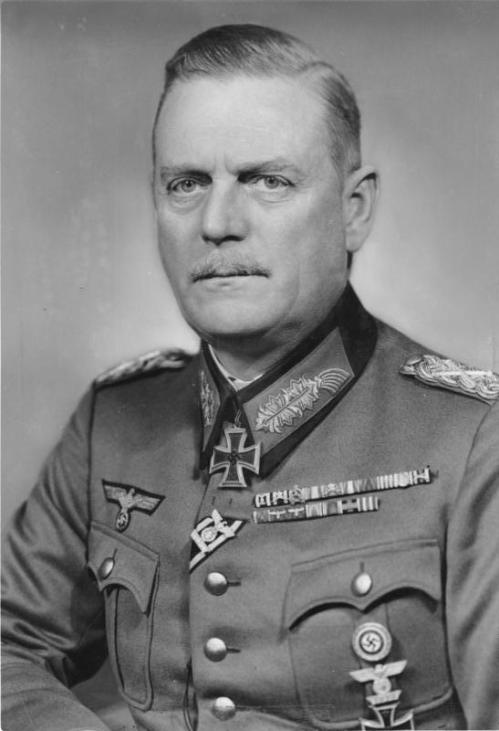
Bundesarchiv_Bild_183-H30220,_Wilhelm_KeitelWilhelm Keitel: “war was a fight for survival….dispense with outdated and traditional ideas about chivalry and the generally accepted rules of warfare…” Bundesarchiv Bild

This study will focus on the German policy of ideological-racial war in Poland and Russia. The German war against the Soviet Union and to a certain extent Poland was waged with an unforgiving ferocity against Hitler’s enemy, the Jewish-Bolshevik state and the Slavic Untermenschen. It was characterized by the rise of “political-ideological strategy”[22] in which “Barbarossa showed the fusion of technocracy and ideology in the context of competitive military planning.”[23] Hitler’s “ideological and grandiose objectives, expressed in racial and semi-mystical terms, made the war absolute.”[24] Field Marshal Keitel noted a speech in March 1941 where Hitler talked about the inevitability of conflict between “diametrically opposed ideologies” and that the “war was a fight for survival and that they dispense with their outdated and traditional ideas about chivalry and the generally accepted rules of warfare.”[25] General Halder, Chief of the OKH in his War Dairy for that meeting noted “Annihilating verdict on Bolshevism…the leaders must demand of themselves the sacrifice of understanding their scruples.”[26] Based on Lebensraum and race, the German approach to war would combine “racism and political ideology” for the purpose of the “conquest of new living space in the east and its ruthless Germanization.”[27] Hitler explained that the “struggle for the hegemony of the world will be decided in favor of Europe by the possession of the Russian space.”[28] Conquered territories would be “Reich protectorates…and that these areas were to be deprived of anything in the nature of a Slav intelligentsia.”[29] This goal was manifest in the “Criminal Order” issued by OKW which stated that the war was “more than mere armed conflict; it is a collision between two different ideologies…The Bolshevist-Jewish intelligentsia must be eliminated….”[30] Other displaced inhabitants of the conquered eastern lands would be killed or allowed to starve.[31] Part of this was due to economic considerations in the Reich, which gave Germans priority in distribution of food, even that from the conquered lands. Starvation was a population control measure that supplemented other forms of annihilation.[32] As Fest notes in Russia Hitler was “seeking nothing but “final solutions.””[33] Despite numerous post-war justifications by various Wehrmacht generals, the “Wehrmacht and army fell into line with Hitler because there was “a substantial measure of agreement of “ideological questions.””[34]
Waffen-SSposter01Waffen SS Volksdeutsch Recruiting Poster

Ideology was key to Hitler’s worldview and fundamental to understanding his actions in the war.[35] However twisted Hitler’s ideological formulations were his ideas found acceptance beyond the Nazi faithful to the Army and Police, who would execute the campaigns in Poland and Russia in conjunction with the Einsatzgrüppen and Nazi party organizations.  In these organizations he found allies with pre-existing cultural, political and doctrinal understandings which allowed them to be willing participants in Hitler’s grand scheme of eastern conquest.

Doctrinal and Ideological Foundations

While Hitler’s racial ideology was more extreme than many in the German military and police, these organizations had cultural beliefs and prejudices as well as doctrinal and ideological foundations which helped them become willing accomplices to Hitler.  These factors were often, consciously or unconsciously, excluded from early histories of World War II. The Allies relied on German officers to write these histories at the beginning of the Cold War, developing the “dual myth of German military brilliance and moral correctness.”[36] B.H. Liddell-Hart makes the astounding statement that “one of the surprising features of the Second World War was that German Army in the field on the whole observed the rules of war than it did in 1914-1918-at any rate in fighting its western opponents….”[37] While he might be excused by lack of knowledge of German army atrocities, not just the SS who he blamed the atrocities, it helps present a myth as truth.[38] The myths were helped by the trials of Manstein and Kesselring where “historical truth had to be sacrificed…to the demands of the Cold War.”[39] Kenneth Macksey confronts the myth that only the “Waffen SS committed barbaric and criminal acts” noting: “Not even the Knights of the Teutonic Order and their followers in the Middle Ages sank to the depths of the anti-Bolshevik Wehrmacht of 1941.”[40]

Germany had a long running history of anti-Semitism before Hitler.  German anti-Semitism often exhibited a “paranoid fear of the power of the Jews,”[41] and included a “fashionable or acceptable anti-Semitism”[42] which became more pronounced as the conditions of the Jews became better and Jews who had fled to Eastern Europe returned to Germany.[43] Sometimes this was tied to religious attitudes, but more often focused on the belief that the Jews “controlled certain aspects of life” and presented in “pseudo-scientific garb” along with the “myth of a secret Jewish plot for world domination which was simultaneously part of the internationalism of Freemasonry.”[44] Admiral Wilhelm Canaris provides an example as he “had grown up in the atmosphere of “moderate” anti-Semitism prevailing in the Ruhr middle class and in the Navy believed in the existence of a “Jewish problem”” and would “suggest during 1935-1936 that German Jews should be identified by a Star of David as special category citizens….”[45] Wehrmacht soldiers were “subject to daily doses of propaganda since the 1930s” and that with the “start of the Russian campaign propaganda concerning Jews became more and more aggressive.”[46] Some objected to Nazi actions against Jews. Von Manstein protested the “Aryan paragraph” in the Reichswehr on general principal.”[47] Yet some who planned and executed the most heinous crimes like Adolf Eichmann had “no fanatical anti-Semitism or indoctrination of any kind.”[48]
jews to blameAnti-Jewish Poster: He is guilty for the war

The military “looked to the regime to reshape society in every respect: political, ideological, economic and military…Propaganda would hammer home absolute nature of the struggle…”[49] Ideological training began in the Hitler Youth and Reichsarbeitsdienst and produced a soldier in which “Anti-Semitism, anti-communism, Lebensraum – these central tenants of Nazism were all inextricably linked with the Landser’s conception of duty, with his place and role in the vast machinery of war.”[50] Following the dismissal of General Fritsch in 1938, General Brauchitsch promised that “he would make every effort to bring the Army closer to the State and the State’s ideology.”[51] Alfred Novotny, a Austrian soldier in the Gross Deutschland division noted how training depicted the Russians as Untermenschen and how they were “subjected to official rantings about how the supposedly insidious, endless influence of the Jews in practically every aspect of the enemy’s endeavors…Jews were portrayed as rats, which were overrunning the world….”[52] This added to the already “harsh military discipline” which had a long tradition in Germany conditioning soldiers to violence and brutalization of their enemy. Similar programs existed in the Order Police which would play a large part in the eastern campaign, the “image of “treasonous” leftists and Jews helped shape the personal and political beliefs of many policemen throughout the interwar period.”[53] Even ordinary police training before the war in German speaking Europe was brutalizing.”[54] These troops were recipients of an ideological formation which “aimed at shaping the worldview of the police leading to the internalization of belief along National Socialist lines.”[55] Waffen SS soldiers, especially those of the Totenkopf division were subjected to even more systematic political indoctrination on the enemies of National Socialism, the Jews, freemasonry, Bolshevism and the churches.[56]

Along with cultural anti-Semitism and the Nazification of German thought in the 1930s, there were aspects of military doctrine which helped prepare the way for the eastern campaign. The most important were the Army’s anti-partisan and rear area security doctrine.  The history of security anti-partisan operations dated back to the Prussian Army’s Ettapen, which began in 1813 with the Landwehr’s role in security against looters and others.[57] These units supported and supplied offensive operations from the rear to the combat zone with a secondary mission of countering partisans and preventing disruptions in the rear area. The Ettapen would be reformed and regulated in 1872 following the Franco-Prussian War.[58] The German experience fighting guerrillas and partisans, the francs-tireurs in the Franco-Prussian War, “scarred the Army’s institutional mentality.”[59] Von Moltke was “shattered,” writing his brother that “war was now taking on an ever more hate-inspired character.”[60] He was “appalled by improvised armies, irregular elements, and appeals to popular passion, which he described as a “return to barbarism.”[61] He wrote: “Their gruesome work had to be answered by bloody coercion. Because of this our conduct of the war finally achieved a harshness that we deplored, but which we could not avoid.”[62] The brutal German response to the franc-tireurs found legal justification in Franz Lieber’s principles for classification of belligerents and non-belligerents, which determined that guerrillas were outlaws or bandits.[63] In response, the Germans systematically reorganized the Ettapen to include railroad and security troops, special military courts, military police, intelligence and non-military police, including the Landespolizei and the Grenzschutzpolizei.[64]
von trothaPre-Nazi Exterminator: General Lothar Von Trotha led the Genocide against the Herero in Namibia

The doctrinal response to partisans, or as they would become known in German writings as “bandits,” was that bandits should be encircled and destroyed. This was employed in the Southwest Africa German colonies.  The Germans, influenced by the experience in France, “displayed a ferocity surpassing even that of the racially brutalized campaigns of its imperialist peers.”[65] The campaign against the Herero tribes which resisted the occupation of Namibia from 1904-1912 utilized encirclement operations, racial cleansing and what would become known as Bandenkämpfung operations.[66] This was further developed in the First World War, especially in the east where General Fritz Gempp described the security problem as a “ruthless struggle” in which German pacification policy “was in reality the application of terror to galvanize the population into accepting German rule.”[67] Anti-partisan doctrine was codified in the Truppenführung of 1933 which stated that “area defense against partisan warfare is the mission of all units” and that the preferred method of combating partisan bands was that they be surrounded and destroyed.[68] General Erhard Rauss later described active and passive measures used to deal with partisans, focusing on the tactic of encirclement to destroy the enemy.[69]

Anti-partisan doctrine focused on the destruction of the partisans, was coupled a total war philosophy and provided fit well with Hitler’s radical ideology.  The “propensity for brutality in anti-guerrilla warfare was complimented by officers’ growing preoccupation, both during and after World War I, with the mastery and application of violence.”[70] Michael Geyer notes: “ideological mobilization for the creation of a new national and international order increasingly defined the parameters of technocratic planning.”[71] The acceptance of long used brutal tactics to destroy the enemy combined with Hitler’s radical racial animus against the Jews could only be expected to create a maelstrom in which all international legal and moral standards would be breached.

Beginnings in Poland

The Polish campaign was a precursor to the Russian campaign and was not totally race driven. It contained elements of Germany’s perception of the injustice of Versailles which gave Poland the Danzig corridor and Germany’s desire to reconnect East Prussia to the Reich, as well as the perceived necessity to remove a potential enemy from its rear as it faced France, yet it was a campaign steeped in Nazi racial ideology.  Poland resisted German efforts to ally itself with Germany in 1939, thus Hitler determined it “would be crushed first.”[72] Meeting with military leaders on 23 May 1939 Hitler “made it plain that the real issue was not Danzig, but securing of Germany’s Lebensraum….[73] On 22 August he enjoined the generals to “Close your hearts to pity! Act brutally! Eighty million people must obtain what is their right.”[74] Even so, most military leaders failed to appreciate what Hitler was calling on them to do; Manstein would note that “what Hitler had to say about an eventual war with Poland, could not, in my opinion, be interpreted as a policy of annihilation.”[75] Others such as Canaris was “utterly horrified” as he read his notes to his closest colleagues “His voice trembled as he read, Canaris was acutely aware that he had witnessed something monstrous.”[76] General Johannes Blaskowitz, commander of 8th Army who would be the military commander in Poland did not leave any notes about the meeting, but his biographer notes that he “may have naively attached a military meaning to these terms since he was busy with military matters and soon to begin operations.”[77] This was the interpretation of Manstein as well.[78] Keitel noted that the speech was “delivered in the finest sense of psychological timing and application,” molding “his words and phrases to suit his audience.”[79] In light of the mixed interpretations by military leaders, it is possible that many misinterpreted Hitler’s intent and did not fully appreciated his ideology as they went into Poland, carefully secluding themselves in the narrow confines of their military world. While such an explanation is plausible for some, it is also true that many others in light of subsequent actions were in full agreement with Hitler. One author notes that “no man who participated in the Führer Conferences….and there were present the highest ranking officers of the three services, could thereafter plead ignorance of the fact that Hitler had laid bare his every depth of infamy before them, and they had raised no voice in protest either then or later.”[80] In July, General Wagner, the Quartermaster General issued orders that “authorized German soldiers to take and execute hostages in the event of attacks by snipers or irregulars.”[81]

Regardless of the meaning ascribed to Hitler’s speech, Hitler had already laid plans to destroy the Jews in Poland and decimate the Polish intelligentsia and leadership.   Hitler gave Himmler the task of forming “Einsatzgrüppen to follow the German troops as they advanced into Poland and liquidate Poland’s upper class wherever it was to be found.”[82] While senior party leaders remained at Hitler’s side following the conference, Himmler worked to coordinate his troops, including the reinforced Totenkopf battalions and Einsatzgrüppen with the Army.[83]
einsatzgruppen troops with jewsEinsatzgruppen Troops gathering Ukrainian Jews for Execution Hessisches Hauptstaatsarchiv Wiesbaden

Himmler began planning in early May and the Army decided to “use SS and police units to augment their own forces for security tasks.”[84] Himmler established “five Einsatzgrüppen to accompany each of the numbered German armies at the start of the campaign.”[85] Placed under the aegis of Reinhard Heydrich the groups were broken down into smaller units of 100-150 men and allotted to army corps.  All senior posts were occupied by officers of the Sicherhietsdienst.[86] Two additional groups were formed shortly after the invasion.[87] Additionally 3 regiments of the SS Totenkopfverbande, under the direction of SS General Theodore Eicke were deployed in the rear areas of the advancing armies.[88] The purpose of these units was shielded from the Army in the planning stages,[89] although Heydrich worked with the Army to develop lists of up to 30,000 people to be arrested.[90] To eliminate the Polish elites without disturbing the Army, Himmler and Heydrich gave the Army “only the bare minimum of information.”[91] The deception was initially successful.  Blaskowitz’s 8th Army defined the mission of the Einsatzgrüppen in a traditional manner, noting their mission as “the suppression of all anti-Reich and anti-German elements in the rear of the “fighting troops, in particular, counter espionage arrests of politically unreliable persons, confiscation of weapons, safeguarding of important counter-espionage materials etc…”[92] General Wagner issued orders in July 1939 that “authorized German soldiers to take and execute hostages in the event of attacks by snipers or irregulars.” Despite the deception, there was no way to disguise the murder of Polish intelligentsia and Jews, and had the Army had the political acumen it could have considerably restricted the terror campaign.[93] .
himmlerHeinrich Himmler: Implementer of Hitler’s Ideas Authorizes formation of Einsatzgruppen

The campaign demonstrated Hitler’s intent. Heydrich talked about the “murdering the Polish ruling class” of the aristocracy, Catholic clergy, communists and Jews on 7 September.[94] The Army moved east with the Einsatzgruppen and Totenkopf Verbande, conducting arrests and executions in its wake.  The Army worried about Polish soldiers left behind in rear areas, and a paranoia developed as some generals believed that a “brutal guerilla campaign has broken out everywhere and we are ruthlessly stamping it out.”[95] Yet some actions against the Polish elites and the Jews drew Army reactions. The unit commanded by SS General Woyrsch “behaved with such unparalleled bestiality that it was throw out of the operational area” by General List of 14th Army.[96] Totenkopfverbande Brandenburg came to Army attention when its commander remarked that the “SSVT would not obey Army orders,” and the conclusion of the Army General was that “the SSVT commander was following orders from some non-military authority to terrorize the local Jews.”[97] These atrocities as well as those of other Waffen-SS units were hard to hide and brought reactions out of army commanders who sought to punish the offenders. Blaskowitz and others attempted to put a halt to SS actions against Poles and Jews,[98] but most officers turned a blind eye to the atrocities or outright condoned them.  It is believed that General Walter Model and others “not only knew what was occurring in Poland but actually took part in what Halder himself described in October as “this devilish plan.””[99] It appears that many who objected were not motivated so much by humanitarian, moral or legal considerations, but rather by the effect on good order and discipline.[100] Likewise it is clear that many officers, even if they did not participate in the actions probably approved of them.  Many biographies and histories of this period written by authors influenced by surviving German officers make no or little mention of the Army’s part in these actions. Himmler and Heydrich were sensitive to the perception of the Army and resented the fact that the Army believed them to be responsible for actions that they were carrying out under the direction and order of Hitler and that their troops were “undisciplined gangs of murderers.”[101] After the establishment of the Government General led by Hans Frank there was conflict between the Army under Blaskowitz, the SS, Police and the Nazi administration. Blaskowitz made an “elaborate report on the atrocities of the SS,”[102] expressing concern about his “extreme alarm about illegal executions, his worries about maintaining troop discipline under those circumstances, the failure of discussions with the SD and Gestapo and their assertions that they were only following SS Orders.”[103] While it is unclear if the memorandum made it to Hitler, it is clear that Hitler did know about the protest and Blaskowitz fell into disfavor and was reassigned after a period of continued conflict with the Nazi administration. Hitler’s reaction according to his adjutant was that the Army’s leaders used “Salvation Army” methods, and their ideas “childish.”[104] Likewise General Georg von Külcher was relieved of command for protesting SS and police atrocities.[105] SS Officers convicted by Army courts-martial were given amnesty by Hitler on “4 October 1939 who two weeks later removed SS units from the jurisdiction of military courts.”[106] While the army remained, it was not longer in charge and would assist the SS and Police in combat and further atrocities. One German officer, later a conspirator in the July 20th plot, remarked in November 1939 about the killings that he “was ashamed to be German! The minority are dragging our good through the mud by murdering, looting and torching houses will bring disaster on the whole German people if we do not stop it soon…”[107]
police battalionOrdungspolizei in Action: Street Cops Become Executioners

The Army was relieved of responsibility for policing Poland which fell on the Ordungspolizei battalions and Gendarmerie.  These units would wreak their own devastation on Poland in the coming months and years.[108] Poland would also be the first Nazi driven shift in population to exploit the newly won Lebensraum as Poles were driven into the newly formed Government General and ethnic Germans moved into previously Polish occupied territories. By 1941 over 1,200,000 Poles and 300,000 Jews had been expelled and 497,000 ethnic Germans brought into provinces lost in 1919.[109] Prior to the war about 3.3 million Jews lived in Poland. After the war 50-70,000 were found to have survived in Poland, the Polish Army and camps in Germany. A further 180,000 were repatriated from the Soviet Union.[110]

Russia

The Nazi war against Russia was the penultimate test of Hitler’s ideology. Planning began after 21 July, when Hitler made “his intentions plain” and “von Brauchitsch set his planners to work.”[111] Detailed preparations began in the winter of 1940-41 following the Luftwaffe’s failure against Britain and postponement of Operation Sea Lion.  Hitler intended to “crush Soviet Russia in a quick campaign which was to begin no later than March 15, 1941, and before the end of the war with England.”[112] Keitel noted the final decision came in “early December 1940” and from then he had “no doubt whatsoever that only some unforeseen circumstance could possibly alter his decision to attack.”[113] The plan focused on the destruction of “the Red Army rather than on any specific terrain or political objective,”[114] although these objectives would arise in later planning and in the campaign.  Hitler stated: “What matters is that Bolshevism must be exterminated. In case of necessity, we shall renew our advance whenever a new center of resistance is formed. Moscow as the center of doctrine must disappear from the earth’s center….”[115]

Besides preparations aimed at the destruction of the Red Army and overthrow of the Soviet State, the “war against the Soviet Union was more openly ideological from the start.”[116] Hitler set the stage on March 3rd 1941: “the forthcoming campaign is more than a mere armed conflict; it is a collision between two different ideologies…this war will not be ended merely by the defeat of the enemy armed forces” and that “the Jewish-Bolshevist intelligentsia must be eliminated….”[117] Hitler noted that “this is a task so difficult that it cannot be entrusted to the Army.”[118] Reichskommissars would be appointed in the conquered areas, but since normal civilian powers would be insufficient to eliminate the Bolshevists, that it “might be necessary “to establish organs of the Reichsführer SS alongside the army’s Secret Field Police, even in the operational areas….”[119] The “primary task was to liquidate “all Bolshevist leaders or commissars” if possible while still in the operations zones,”[120] yet the orders did not contain “a syllable that in practice every Jew would be handed over to the extermination machine.”[121] This was followed on 13 March by an agreement between the Army represented by General Wagner and the SS, which stated in part that “the Reichsführer SS has been given by the Führer special tasks within the operations zone of the Army…to settle the conflict between two opposing political systems.”[122] Likewise the agreement dictated that Himmler would “act independently and on his own responsibility” while ensuring that “military operations are not affected by measures necessary to carry out his task.”[123] A further instruction of 26 March issued by Wagner gave the Army’s agreement to the use of the Einsatzgrüppen in the operations zone, specifying coordination between them and army authorities in the operational zone and communications zones to the rear.  Cooperation was based on the “principals for co-operation between the State Secret Police and the Field Security organization of the Wehrmacht agreed with the Security branch of the War Ministry on 1 January 1937.”[124]

The most significant act for the Army in this was the Commissar Order, sometimes known as the “Criminal Order” which was used war as evidence at Nurnberg as against Keitel and the High Command of the Wehrmacht.  The order specified the killing of Soviet Political Commissars attached to the Red Army and as “they were not prisoners of war” and another order specified that “in the event that a German soldier committed against civilians or prisoners, disciplinary action was optional….”[125] The order noted regarding political commissars that “in this struggle consideration and respect for international law with regard to these elements is wrong.” [126] The “Guidelines for the Conduct of Troops in Russia” issued on May 19, 1941 called for “ruthless and vigorous measures against Bolshevist inciters, saboteurs [and] Jews.”[127]

Shortly before the order was issued, Hitler previewed it to the generals saying that the war in Russia “cannot be conducted in a knightly fashion” and that it would have to be waged with “unprecedented, unmerciful and unrelenting harshness…”[128] and that they would have to “dispense with all of their outdated and traditional ideas about chivalry and the generally accepted rules of warfare: the Bolsheviks had long since dispensed with them.”[129] He explained that his orders were beyond their comprehension stating “I cannot and will not change my orders and I insist that that they be carried out with unquestioning and unconditional obedience.”[130] Hitler’s speech was protested by some according to Von Brauchitsch,[131] who refused to protest to Hitler but issued an order “threatening dire penalties for excesses against civilians and prisoners of war” which he maintained at Nurnberg “was sufficient to nullify the Commissar Order.”[132] Yet Von Brauchitsch would tell commanders to “proceed with the necessary hardness.”[133] Warlimont noted that Von Bock, who would “later emerge as an opponent of the Commissar Order…makes no special comment on the meeting or the restricted conference that followed.” [134] Keitel said that he “stubbornly contested” the clause “relating to the authority of the SS-Reichsführer… in the rearward operational areas.”[135] Keitel blamed the Army High Command, but the order came out with his signature on behalf of Hitler, which was key evidence against him at Nurnberg. He stated that “there was never any possibility of justifying them in retrospect by circumstances obtaining in the Russian campaign.”[136] Some commanders refused to publish the orders and “insisted that the Wehrmacht never implemented such policies…” blaming them instead on the SS. One writer states “such protests were undoubtedly sincere, but in practice German soldiers were far from innocent. The senior professional officers were often out of touch with their subordinates.”[137] The orders were a “license to kill, although not a great departure from German military traditions….”[138] The effect was terrifying, for in a sense the Einsatzgruppen, “could commit ever crime known to God and man, so long as they were a mile or two away from the firing line.”[139] Security Divisions were “instructed to give material and logistical support to…units of the Einsatzgruppen.”[140] Even worse, army units in rear areas “could be called on to assist Himmler’s SS police leaders.”[141]
WW2 einsatz7Einsatzgruppe troops finishing off Jewish Women

The SS formed four Einsatzgruppen composed of SD, Waffen-SS and Police troops designated A-D with “A” being assigned to Army Group North, B to Army Group Center, C to Army Group South and “D” to 11th Army.  They were not standardized in manpower or equipment, the largest unit being A in the North at 990 personnel[142] and D with only 550.[143] These units had SS, SD or Police commanders. Additionally nine Ordnungspolizei battalions were initially assigned to the invasion forces.[144] The police contingent would grow over time so that by 1943, these units would be grouped under regiments and number about 180,000 men assisted by 301,000 auxiliaries.[145] These units would act in concert with 9 Army Security Divisions which handled rear area security.[146] Himmler initially did not reveal their intent and planned use to Einsatzgruppen commanders, only speaking of a “heavy task…to “secure and pacify” the Russian area using Sicherheitspolizei and SD methods.”[147] Understanding the effect of these operations, Himmler would state that “in many cases it is considerably easier to lead a company in battle than to command a company responsible to…carry out executions, to deport people…to be always consistent, always uncompromising-that is in many cases far, far harder.”[148]

Nazi actions are well documented; the Einsatzgruppen, Police, Army and locally recruited Schutzmannschaft battalions[149] ruthlessly exterminated Jews and others in the operational area. No sooner had an Einsatzgruppe unit entered a city, a “deadly stranglehold” would grip the “Jewish inhabitants claiming thousands and thousands of victims day by day and hour by hour.”[150] Non-Jewish Russians were encouraged to conduct programs which Heydrich noted “had to be encouraged.”[151] Einsatzgruppen D report 153 noted: “During period covered by this report 3,176 Jews, 85 Partisans, 12 looters, 122 Communist functionaries shot. Total 79,276.”[152] By the spring of 1942 Einsatzgruppe A had claimed “more than 270,000 victims, the overwhelming majority of whom were Jewish.”[153] The total killed for all groups then was 518,388 people, mostly Jews.[154] Germany’s Romanian ally acted against Jews in Odessa as well; “on 23 October 1941 19,000 Jews were shot near the harbor… probably 200,000 Jews perished either at Romanian hands or after being turned over by the Romanians to the Germans.”[155]
einsatzgruppen polen 2Many Anti-Jewish Massacres were Labeled “Anti-Partisan” Operations

Operations against Jews were often called anti-partisan operations.  Himmler referred to Einsatzgruppen as “anti-Partisan formations[156] while Wehrmacht Security divisions “murdered countless Soviet civilians and burned Russian settlements to the ground under the pretext of subduing partisan resistance.”[157] The attitude in 1941-1942 was that “’all Jews are partisans and all partisans are Jews.” From 1943, all armed resistance was “banditry” and all Jews irrespective of circumstances were treated as “bandits.””[158] The commander of the 221st Security Division endeavored to persuade his “subordinate units that the Jews were carriers of Bolshevik contamination and, therefore, the ultimate source of any sabotage or difficulty the division faced.”[159] The extermination of the Jews and partisan war were closely intertwined with the Reich’s economic policies designed to exploit the natural resources of the Russia. This included the “hunger plan” which German authorities seemed to imagine that “millionfold starvation could be induced by requisitioning off all available grain and “shutting off” the cities.”[160] Hitler told Halder that in 1941 that he “intended to level Moscow and Leningrad, to make them uninhabitable, so there would be no need to feed their populations during the winter.”[161] Economic officials held life and death power over villages. Those that met agricultural quotas were “likely to be spared annihilation and evacuation…the culmination of this process, during 1943, would be the widespread creation of “dead zones.””[162] All told the German killed nearly 1.5 million Russian Jews.[163] By 1942, 2 million Soviet POW’s were killed.  600,000 shot outright, 140,000 by the Einsatzkommandos.[164] All told 3.3 million Soviet POWs died in German captivity through starvation, disease and exposure,[165] are included in a total of over 10 million Red Army Combat deaths.[166] Bracher notes: “The reality and irreality of the National Socialism were given their most terrible expression in the extermination of the Jews.”[167]
arthur nebeThe Killer Becomes a Victim: Arthur Nebe’s experience commanding an Einsatzgruppe so traumatized him that he would be reassigned and then become active in the attempt to kill Hitler and lose his life

Himmler and others continued to use euphemistic language to describe their efforts talking in terms of “Jewish resettlement.”[168] Terms such as special actions, special treatment, execution activity, cleansing and resettlement were used in place of the word murder.[169] At the same time these operations led to problems in the ranks, one SS trooper observed: “deterioration in morale among his own men who had to be issued increasing rations of vodka to carry out their killing orders.”[170] Even commanders were affected, Nebe would say “I have looked after so many criminals and now I have become one myself.”[171] A fellow conspirator would describe him as a “shadow of his former self, nerves on edge and depressed.”[172] Erich Bach-Zelewski, who led the SS anti-partisan efforts would suffer a nervous breakdown which included “hallucinations connected to the shootings of Jews” which hospitalized him in 1942.[173] Himmler would state in October 1943 that “to have gone through” the elimination of the Jews had “and remained decent, that has made us tough. This is an unwritten, never to be written, glorious page in our history.”[174]

Conclusion

The German war against Poland and Russia was heavily dependent on the racist ideology of Adolf Hitler.  He was the true spirit behind the atrocities committed by his nation as one noted in Russia: “Here too the Führer is the moving spirit of a radical solution in both word and deed.”[175] He saw the partisan war as “the chance to stamp out everything that stands against us.”[176] Belief in Germany’s right to Lebensraum the superiority of the German Volk and necessity to settle the Jewish problem provided a fertile ground for Hitler’s plans.  German military doctrines, especially those of anti-partisan and total warfare abetted Hitler’s goals.

It is quite clear that many in the Wehrmacht were in agreement with Hitler’s ideology of racial-war. Prepared by cultural prejudice and long traditions of thought, the “Prussian and in later German military must be regarded as a significant part of the ideological background of the Second World War.”[177] General Reichenau’s orders to his troops are revealing: “The most important goal of the campaign against Jewish-Bolshevism is the complete destruction of its grip on power and the elimination of the Asian influence from our European cultural sphere.”[178] Von Rundstedt appeared to agree with Reichenau to “use the partisan threat as excuse for persecuting Jews, so long as the dirty work was largely left to SS Einsatzgruppen.”[179] The Army command…on the whole acquiesced in the extermination of the Jews, or at least closed its eyes to what was happening.”[180] Even if the Generals had been more forceful in their opposition, they would have been opposed by the highly Nazified youth that made up the bulk of their Army, especially junior officers. SS leaders fanatically executed Hitler’s policies aided by the civil administration. Genocide was to bring the Reich “long term economic gains and trading advantages” and was seen as a way of “financing the war debt without burdening the German taxpayer.”[181] Some individuals attempted to resist the most brutal aspects of the Nazi campaign against the Jews. Some like Wilhelm Kube, Reichskommissar for White Russia and a virulent anti-Semite was shocked at the murders of the Jews calling them “unworthy of the German cause and damaging to the German reputation” and would later attempt to spare Jews by employing them in war industries, would be “defeated by Himmler’s zealots.”[182] Army officers who objected like Blaskowitz and Külcher were relieved, or like Von Leeb, told by Hitler to “in so many words told to mind his own business.” Leeb stated: “the only thing to do is to hold oneself at a distance.”[183] Rommel knew of crimes through Blaskowitz but blamed the crimes “on Hitler’s subordinates, not Hitler himself.”[184]
einsatzgruppen trialPartial Justice: The Einsatzgruppen Trial

Hitler’s ideology permeated German military campaigns and administration of the areas conquered by his armies. No branch of the German military, police or civil administration in occupied Poland or Russia was exempt guiltless in the crimes committed by the Nazi regime. It is a chilling warning of the consequences awaiting any nation that allows it to become caught up in hate-filled political, racial or even religious ideologies which dehumanizes opponents and of the tragedy that awaits them and the world. In Germany the internal and external checks that govern the moral behavior of the nation and individuals failed. Caught up in the Nazi system, the Germans, especially the police and military abandoned the norms of international law, morality and decency, banally committing crimes which still reverberate today and which are seen in the ethnic cleansing actions in the former Yugoslavia and other nations.

Bibliography

Aly, Gotz and Heim, Susanne. Architects of Annihilation: Auschwitz and the Logic of Destruction Phoenix Paperbacks, London, 2003, originally published as Vordenker der Vernichtung, Hoffman und Campe, Germany 1991, English translation by Allan Blunden.  First published in Great Britain Weidenfeld & Nicholson, London, 2002

Arendt, Hannah, Eichmann in Jerusalem: A Report on the Banality of Evil. Revised and Enlarged Edition. Penguin Books, Harmondsworth, England and New York, NY 1965. Originally published by Viking Press, New York, NY 1963

Blood, Philip. Hitler’s Bandit Hunters: The SS and the Occupation of Europe. Potomoac Books Inc. Washington, DC 2008

Bracher, Karl Dietrich. The German Dictatorship: The Origins, Structure, and Effects of National Socialism. Translated by Jean Steinberg, Holt Rinehart and Winston, New York, NY 1979. Originally Published under the title Die Deutsche Diktatur: Entstehung, Struktur,Folgen des Nationalsocialismus. Verlag Kiepenheuer & Witsch. Koln and Berlin, 1969

Browning, Christopher R. Ordinary Men: Reserve Police Battalion 101 and the Final Solution in Poland. Harper Perennial Books, New York, New York 1993 reissued 1996.

Burleigh, Michael and Wippermann, Wolfgang. The Racial State: Germany 1933-1945 Cambridge University Press, New York NY and Cambridge UK 1991

Condell, Bruce and Zabecki, David T. Editors. On the German Art of War: Truppenführung , Lynn Rienner Publishers, Boulder CO and London 2001

Craig, Gordon A. The Politics of the Prussian Army 1640-1945. Oxford University Press, London and New York, 1955

Davidowicz, Lucy S. The War Against the Jews 1933-1945 Bantam Books, New York, NY 1986.

Di Nardo, Richard L. Germany and the Axis Powers: From Coalition to Collapse. University Press of Kansas, Lawrence, KS. 2005

Erickson, John. The Road to Berlin. Cassel Military Paperbacks, London, 2003. First Published by Weidenfeld and Nicholson, 1983

Evans, Richard J. The Coming of the Third Reich Penguin Books, New York 2004.  First published by Allen Lane 2003

Evans, Richard J. The Third Reich in Power 1933-1939. Penguin Press, New York, NY 2005

Ferguson, Niall. The War of the Worlds: Twentieth Century Conflict and the Descent of the West. The Penguin Press, New York, 2006

Fest, Joachim, Hitler. Translated by Richard and Clara Winston. Harcourt Brace Jovanovich Publishers, San Diego, New York, London, 1974.  German Edition by Verlag Ullstein 1973

Fraser, David. Knight’s Cross: A Life of Field Marshal Erwin Rommel Harper Perennial, New York 1995, first published by Harper Collins in Britain, 1993

Friedlander, Saul Nazi Germany and the Jews 1939-1945: The Years of Extermination. Harper Perennial, New York, NY 2007

Fritz, Stephen G. Frontsoldaten: The German Soldier in World War II.  The University Press of Kentucky, Lexington, KY 1995

Geyer, Michael. German Strategy 1914-1945 in Makers of Modern Strategy from Machiavelli to the Nuclear Age. Peter Paret, editor. Princeton University Press, Princeton NJ. 198

Giziowski, Richard. The Enigma of General Blaskowitz. Hppocrene Books, New York 1997

Glantz, David M. and House, Jonathan. When Titans Clashed: How the Red Army Stopped Hitler. University Press of Kansas, Lawrence, KS. 1995

Goerlitz, Walter. History of the German General Staff.” Translated by Brian Battershaw, Westview Press, Boulder and London, 1985. Originally published as Die Deutsche Generalstab Verlag der Frankfurter Hefte, Frankfurt am Main, 1953

Goerlitz, Walter. The Memiors of Field Marshal Wilhelm Keitel: Chief of the German High Command 1938-1945.  Translated by David Irving. Cooper Square Press 2000,  First English Edition 1966 William Kimber and Company Ltd.  German edition published by Musterschmnidt-Verlad, Gottigen 1961 .

Hitler, Adolf Mein Kampf translated by Ralph Manheim. Mariner Books, Houghton Mifflin Company, New York, NY 1999. Houghton Mifflin Company 1943, copyright renewed 1971. Originally published in Germany by Verlag Frz. Eher Nachf. GmbH 1925

Höhne, Heinze. Canaris: Hitler’s Master Spy. Traslated by J. Maxwell Brownjohn. Cooper Square Press,

New York 1999. Originally published by C. Bertelsmann Verlag Gmbh, Munich 1976, first English edition by Doubleday and Company 1979

Höhne, Heinze. The Order of the Death’s Head: The Story of Hitler’s SS. Translated by Richard Barry. Penguin Books, New York and London, 2000. First English edition published by Martin Secker and Warburg Ltd. London 1969. Originally published as Der Orden unter dem Totenkopf, Verlag Der Spiegel, Hamburg 1966.

Hughes, Daniel J. editor. Moltke on the Art of War: Selected Writings, translated by Harry Bell and Daniel J Hughes. Presidio Press, Novato CA 1993

Liddell-Hart, B.H. The German Generals Talk. Quill Publishing, New York, NY. 1979. Copyright 1948 by B.H. Liddell-Hart

Macksey, Kenneth. Why the Germans Lose at War: The Myth of German Military Superiority. Barnes and Noble Books, New York 2006, originally published by Greenhill Books, 1996

Manstein, Erich von. Forward by B.H. Liddle Hart, Introduction by Martin Blumenson. Lost victories: The War Memoirs of Hitler’s Most Brilliant General. Zenith Press, St Paul MN 2004. First Published 1955 as Verlorene Siege, English Translation 1958 by Methuen Company

Shirer, William L. The Rise and Fall of the Third Reich. A Touchstone Book published by Simon and Schuster, 1981, Copyright 1959 and 1960

Megargee, Geoffrey P. War of Annihilation: Combat and Genocide on the Eastern Front 1941.Bowman and Littlefield Publishers Inc. Lanham, Boulder, New York. 2007

Messinger, Charles, The Last Prussian: A Biography of Field Marshal Gerd Von Rundstedt 1875-1953 Brassey’s (UK) London England 1991

Newton, Steven H. Hitler’s Commander: Field Marshal Walter Model-Hitler’s Favorite General DaCapo Press a division of Perseus Books Group, Cambridge MA 2005

Novatny, Alfred. The Good Soldier. The Aberjona Press, Bedford, PA 2003

Padfield, Peter. Himmler. MJF Books, New York. 1990

Reitlinger, Gerald.  The SS: Alibi of a Nation. The Viking Press, New York, 1957. Republished by Da Capo Press, New York, NY.

Rhodes, Richard. Masters of Death: The SS Einsatzgruppen and the Invention of the Holocaust. Vintage Books a division of Random House, New York, NY 2002

Shepherd, Ben. War in the Wild East: The German Army and Soviet Partisans. Harvard University Press, Cambridge, MA 2004

Sofsky, Wolfgang. The Order of Terror: The Concentration Camp. Translated by William Templer. Princeton University Press. Princeton, NJ 1997. Originally published as Die Ordnung des Terros: Das Konzentrationslager. S. Fischer Verlag, GmbH, Frankfurt am Main, 1993

Speer, Albert. Inside the Third Reich. Collier Books, a Division of MacMillan Publishers, Inc. New York, NY 1970.

Strachan, Hew. European Armies and the Conduct of War. George, Allen and Unwin, London, UK 1983

Stein, George H. The Waffen SS 1939-1945: Hitler’s Elite Guard at War. Cornell University Press, Ithaca and London, 1966

Stern, Fritz. Gold and Iron: Bismarck, Bleichroder and Building of the German Empire. Vintage Books a division of Random House, New York 1979 First published by Alfred a Knopf 1977

Sydnor, Charles W. Soldiers of Destruction: The SS Death’s Head Division, 1933-1945. Princeton University Press, Princeton, NY 1977

Taylor, Fred, Editor and Translator. The Goebbels Diaries 1939-1941, Penguin Books Ltd, Harmondsworth UK and New York NY 1984.

Tooze, Adam. The Wages of Destruction Penguin Books, New York, NY, 2008. First Published by Allen Lane Books, Penguin Group, London UK, 2006

Trevor-Roper, H.R. Hitler’s Table Talk 1941-1944 with an introduction by Gerhard L Weinberg,  Translated by Norman Cameron and R.H. Stevens, Enigma Books, New York, NY 2000. Originally published in Great Britain by Weidenfeld & Nicholoson, London 1953.

Warlimont, Walter. Inside Hitler’s Headquarters 1939-45. Translated by R.H. Berry, Presido Press, Novato CA, 1964.

Weinberg, Gerhard L. Germany Hitler and World War II . Cambridge University Press, New York, NY 1995

Weinberg, Gerhard L. Ed. Hitler’s Second Book: The Unpublished Sequel to Mein Kampf by Adolph Hitler. Translated by Krista Smith, Enigma Books,  New York, NY 2006. Originally published as Hitlers zweites Buch, Gerhard Weinberg editor, 1961.

Weinberg, Gerhard L. Visions of Victory: The Hopes of Eight World War II Leasers. Cambridge University Press, New York, NY 2005

Westermann, Edward B. Hitler’s Police Battalions: Enforcing Racial War in the East. University Press of Kansas, Lawrence, KS. 2005

Wette, Wolfram. The Wehrmacht: History, Myth, Reality. Translated by Deborah Lucas Schneider. Harvard University Press, Cambridge, MA 2006. Originally published as Die Wehrmacht: Feindbilder, Vernichtungskreig, Legenden. S. Fischer Verlag, GmbH, Frankfurt am Main, 2002

Wheeler-Bennett, John. The Nemesis of Power: The German Army in Politics 1918-1945. St. Martin’s Press Inc. New York, NY 1954


[1] Weinberg, Gerhard L. Ed. Hitler’s Second Book: The Unpublished Sequel to Mein Kampf by Adolph Hitler. Translated by Krista Smith, Enigma Books, New York, NY 2006. Originally published as Hitlers zweites Buch, Gerhard Weinberg editor, 1961 p. 159

[2] Davidowicz, Lucy S. The War Against the Jews 1933-1945 Bantam Books, New York, NY 1986. p.91

[3] Tooze, Adam. The Wages of Destruction Penguin Books, New York, NY, 2008. First Published by Allen Lane Books, Penguin Group, London UK, 2006. p.463

[4] Fest, Joachim, Hitler. Translated by Richard and Clara Winston. Harcourt Brace Jovanovich Publishers, San Diego, New York, London, 1974.  German Edition by Verlag Ullstein 1973 pp. 607-608

[5] Note the actions of Cardinal Richelieu in France who worked to expand French power at the expense of other Catholic nations and the Vatican itself.

[6] In the United States the Reconstruction policies produced great resentment in the south with decidedly negative results for the newly freed slaves which lasted another 100 years, while in the Soviet Union great numbers of “opponents of Socialism” were killed, imprisoned or driven out of the county.

[7] Ibid. Tooze. The Wages of Destruction p.462

[8] Ibid. Davidowicz, The War Against the Jews pp.8-9

[9] Ibid. Davidowicz. The War Against the Jews p.12

[10] Ibid. Fest  Hitler. p.47

[11] Bracher, Karl Dietrich. The German Dictatorship: The Origins, Structure, and Effects of  National Socialism. Translated by Jean Steinberg, Holt Rinehart and Winston, New York, NY 1979. Originally Published under the title Die Deutsche Diktatur: Entstehung, Struktur,Folgen des Nationalsocialismus. Verlag Kiepenheuer & Witsch. Koln and Berlin, 1969 p.93

[12] Weinberg, Gerhard L. Germany Hitler and World War II . Cambridge University Press, New York, NY 1995 p.61

[13] Ibid. Weinberg, Hitler’s Second Book p.60

[14] Friedlander, Saul Nazi Germany and the Jews 1939-1945: The Years of Extermination. Harper Perennial, New York, NY 2007 p.xviii

[15] Ibid. Friedlander, The Years of Extermination p.xvii  Friedlander called this anti-Semitism “Redemptive anti-Semitism” in which “Hitler perceived his mission as a kind of crusade to redeem the world by eliminating the Jews.

[16] Megargee, Geoffrey P. War of Annihilation: Combat and Genocide on the Eastern Front 1941.Bowman and Littlefield Publishers Inc. Lanham, Boulder, New York. 2007 p.4

[17] Hitler, Adolf Mein Kampf translated by Ralph Manheim. Mariner Books, Houghton Mifflin Company, New York, NY 1999. Houghton Mifflin Company 1943, copyright renewed 1971. Originally published in Germany by Verlag Frz. Eher Nachf. GmbH 1925. p.662.

[18] Evans, Richard J. The Coming of the Third Reich Penguin Books, New York 2004.  First published by Allen Lane 2003 p.197

[19] Ibid. Davidowicz The War Against the Jews pp. 88-89

[20] Rhodes, Richard. Masters of Death: The SS Einsatzgruppen and the Invention of the Holocaust. Vintage Books a division of Random House, New York, NY 2002 p.37

[21] Speer, Albert. Inside the Third Reich. Collier Books, a Division of MacMillan Publishers, Inc. New York, NY 1970 p.166

[22] Geyer, Michael. German Strategy 1914-1945 in Makers of Modern Strategy from Machiavelli to the Nuclear Age. Peter Paret, editor. Princeton University Press, Princeton NJ. 1986. p.582

[23] Ibid. Geyer. German Strategy p.587

[24] Strachan, Hew. European Armies and the Conduct of War. George, Allen and Unwin, London, UK 1983 p.174

[25] Goerlitz, Walter. The Memoirs of Field Marshal Wilhelm Keitel: Chief of the German High Command 1938-1945.  Translated by David Irving. Cooper Square Press 2000,  First English Edition 1966 William Kimber and Company Ltd.  German edition published by Musterschmnidt-Verlad, Gottigen 1961 p. 135

[26] Ibid. Fest, Hitler.  p. 649

[27] Ibid. Megargee, War of Annihilation p.7

[28] Trevor-Roper, H.R. Hitler’s Table Talk 1941-1944 with an introduction by Gerhard L Weinberg,  Translated by Norman Cameron and R.H. Stevens, Enigma Books, New York, NY 2000. Originally published in Great Britain by Weidenfeld & Nicholoson, London 1953 p. 27 Goebbels notes a similar theme in his recollection of Hitler’s reasons for destroying Russia a power .  See Taylor, Fred, Editor and Translator. The Goebbels Diaries 1939-1941, Penguin Books Ltd, Harmondsworth UK and New York NY 1984 pp. 413-415.

[29] Goerlitz, Walter. History of the German General Staff.” Translated by Brian Battershaw, Westview Press, Boulder and London, 1985. Originally published as Die Deutsche Generalstab Verlag der Frankfurter Hefte, Frankfur am Main, 1953 p.390

[30] Warlimont, Walter. Inside Hitler’s Headquarters 1939-45. Translated by R.H. Berry, Presido Press, Novato CA, 1964 p. 150

[31] Weinberg, Gerhard L. Visions of Victory: The Hopes of Eight World War II Leasers. Cambridge University Press, New York, NY 2005. p. 24

[32] Aly, Gotz and Heim, Susanne. Architects of Annihilation :Auschwitz and the Logic of Destruction Phoenix Paperbacks, London, 2003, Originally published as  Vordenker der Vernichtung, Hoffman und Campe, Germany 1991, English translation by Allan Blunden.  First published in Great Britain Weidenfeld & Nicholson, London, 2002 pp. 245-246

[33] Ibid. Fest. Hitler p.649

[34] Wette, Wolfram. The Wehrmacht: History, Myth, Reality. Translated by Deborah Lucas Schneider. Harvard University Press, Cambridge, MA 2006. Originally published as Die Wehrmacht: Feindbilder, Vernichtungskreig, Legenden. S. Fischer Verlag, GmbH, Frankfurt am Main, 2002 p.93

[35] This understanding is different than many historians who as Friedlander notes advocate something like this: “The persecution and extermination of the Jews of Europe was but a secondary consequence of major German policies pursued toward entirely different goals.” Friedlander p.xvi

[36] Ibid. Megargee. War of Annihilation p.xii

[37] Liddell-Hart, B.H. The German Generals Talk. Quill Publishing, New York, NY. 1979. Copyright 1948 by B.H. Liddell-Hart p.22

[38] It has to be noted that Liddle-Hart published this work in 1948 and was limited in the materials available, his primary sources being German officers who he viewed with sympathy because he saw them as exponents of his theory of the indirect approach.

[39] Ibid. Wette. The Wehrmacht p.224

[40] Macksey, Kenneth. Why the Germans Lose at War: The Myth of German Military Superiority. Barnes and Noble Books, New York 2006, originally published by Greenhill Books, 1996. p.139

[41] Stern, Fritz. Gold and Iron: Bismarck, Bleichroder and Building of the German Empire. Vintage Books a division of Random House, New York 1979 First published by Alfred a Knopf 1977.  p.495

[42] Ibid. Stern. Gold and Iron p.494

[43] Ibid. Bracher. The German Dictatorship p.34

[44] Ibid. Bracher The German Dictatorship pp.34-35

[45] Höhne, Heinze. Canaris: Hitler’s Master Spy. Translated by J. Maxwell, Brownjohn. Cooper Square Press,

New York 1999. Originally published by C. Bertelsmann Verlag Gmbh, Munich 1976, first English edition by Doubleday and Company 1979 p. 216.  Canaris would later protest the Kristalnacht to Keitel (p.334) and become convinced of the crime of the Nazis against the Jews.

[46] Ibid. Witte. The Wehrmacht p.98

[47] Ibid Witte The Wehrmacht, p.73

[48] Arendt, Hannah, Eichmann in Jerusalem: A Report on the Banality of Evil. Revised and Enlarged Edition. Penguin Books, Harmondsworth, England and New York, NY 1965. Originally published by Viking Press, New York, NY 1963 p.26

[49] Ibid. Megargee. War of Annihilation p.6

[50] Fritz, Stephen G. Frontsoldaten: The German Soldier in World War II.  The University Press of Kentucky, Lexington, KY 1995 p.195

[51] Craig, Gordon A. The Politics of the Prussian Army 1640-1945. Oxford University Press, London and New York, 1955 p.495

[52] Novatny, Alfred. The Good Soldier. The Aberjona Press, Bedford, PA 2003 p.40

[53] Westermann, Edward B. Hitler’s Police Battalions: Enforcing Racial War in the East. University Press of Kansas, Lawrence, KS. 2005 p.64  Westermann also notes the preponderance of SA men who entered the Order Police in the 1930s, a factor which helped further the politicization of that organization.

[54] Ibid. Rhodes Masters of Death p.23

[55] Ibid. Westermann Hitler’s Police Battalions p.103

[56] Sydnor, Charles W. Soldiers of Destruction: The SS Death’s Head Division, 1933-1945. Princeton University Press, Princeton, NY 1977 p. 28

[57] Shepherd, Ben. War in the Wild East: The German Army and Soviet Partisans. Harvard University Press, Cambridge, MA 2004 p.41

[58] Blood, Philip. Hitler’s Bandit Hunters: The SS and the Occupation of Europe. Potomac Books Inc. Washington, DC 2008 p.11

[59] Ibid. Shepherd. War in the Wild East p.42

[60] Ibid. Goerlitz. History of the German General Staff p.93

[61] Rothenburg, Gunther. Moltke, Schieffen, and the Doctrine of Strategic Envelopment in Makers of Modern Strategy from Machiavelli to the Nuclear Age. Peter Paret, editor. Princeton University Press, Princeton NJ. 1986 p.305

[62] Hughes, Daniel J. editor. Moltke on the Art of War: Selected Writings, translated by Harry Bell and Daniel J Hughes. Presidio Press, Novato CA 1993. p.32

[63] Ibid. Blood Hitler’s Bandit Hunters p.6   Lieber was a Prussian emigrant to the US who taught law at Columbia University.

[64] Ibid. Blood Hitler’s Bandit Hunters pp.12-13

[65] Ibid. Shepherd Wild War in the East p.42

[66] Ibid. Blood. Hitler’s Bandit Hunters pp.16-19

[67] Ibid. Blood. Hitler’s Bandit Hunters p.22

[68] Condell, Bruce and Zabecki, David T. Editors. On the German Art of War: Truppenführung , Lynn Rienner Publishers, Boulder CO and London 2001. p.172

[69] Tsouras, Peter G. Editor, Fighting in Hell: The German Ordeal on the Eastern Front The Ballantine Publishing Group, New York, 1998. First published 1995 by Greenhill Books. Pp. 142-146.  It is interesting to note that Rauss does not describe any actual anti-partisan operation.

[70] Ibid. Shepherd. War in the Wild East p.45

[71] Ibid. Geyer. German Strategy p.584

[72] Ibid. Weinberg. Visions of Victory p.8

[73] Ibid. Goerlitz, History of the German General Staff p.346

[74] Höhne, Heinze. The Order of the Death’s Head: The Story of Hitler’s SS. Translated by Richard Barry. Penguin Books, New York and London, 2000. First English edition published by Martin Secker and Warburg Ltd. London 1969. Originally published as Der Orden unter dem Totenkopf, Verlag Der Spiegel, Hamburg 1966 p.259

[75] Manstein, Erich von. Forward by B.H. Liddle Hart, Introduction by Martin Blumenson. Lost victories: The War Memoirs of Hitler’s Most Brilliant General. Zenith Press, St Paul MN 2004. First Published 1955 as Verlorene Siege, English Translation 1958 by Methuen Company p.29

[76] Ibid. Hohne. Canaris p.347

[77] Giziowski, Richard. The Enigma of General Blaskowitz. Hppocrene Books, New York 1997 p.119

[78] Ibid. Manstein. Lost Victories p.29

[79] Ibid. Goerlitz. The Memoirs of Field Marshal Keitel p.87

[80] Wheeler-Bennett, John. The Nemesis of Power: The German Army in Politics 1918-1945. St. Martin’s Press Inc. New York, NY 1954 p.448

[81] Ibid. Megargee. War of Annihilation p.13

[82] Ibid. Höhne The Order of the Death’s Head p.297

[83] Padfield, Peter. Himmler. MJF Books, New York 1990 p.264

[84] Ibid. Megargee. War of Annihilation p.13

[85] Ibid. Westermann. Hitler’s Police Battalions p.127

[86] Ibid.  Höhne The Order of the Death’s Head p.297

[87] Ibid. Westermann. Hitler’s Police Battalions p.127

[88] Ibid. Sydnor Soldiers of Destruction p.37 These would become the nucleus of the Totenkopf Division

[89] Ibid. Giziowski Blaskowitz p.120

[90] Ibid. Witte. The Wehrmacht p.100

[91] Ibid. Höhne The Order of the Death’s Head pp. 297-298

[92] Ibid. Giziowski Blaskowitz p.120

[93] Ibid. Höhne The Order of the Death’s Head p.298

[94] Ibid. Witte. The Wehrmacht p.100

[95] Newton, Steven H. Hitler’s Commander: Field Marshal Walter Model-Hitler’s Favorite General Da Capo Press a division of Perseus Books Group, Cambridge MA 2005. p.74

[96] Ibid. Giziowski. The Enigma of General Blaskowitz pp.165-166

[97] Ibid. Sydnor, Soldiers of Destruction pp. 42-43 Note SSVT is the common abbreviation for the SS Totenkopf Verbande

[98] Ibid. Goerlitz. History of the German General Staff p.359

[99] Ibid. Newton. Hitler’s Commander p.78

[100] Ibid. Witte The Wehrmacht p.102

[101] Ibid. Höhne The Order of the Death’s Head p.298

[102] Ibid. Goerlitz. History of the German General Staff .p.359

[103] Ibid. Giziowski. The Enigma of General Blaskowitz p.173

[104] Ibid. Giziowski. The Enigma of General Blaskowitz p.173

[105] Ibid. Witte The Wehrmacht p.102

[106] Burleigh, Michael and Wippermann, Wolfgang. The Racial State: Germany 1933-1945 Cambridge University Press, New York NY and Cambridge UK 1991. p.100

[107] Ibid. Witte The Wehrmacht p.102

[108] For a good account of one of the Police Battalions see Ordinary Men: Reserve Police Battalion 101mand the Final Solution in Poland by Christopher Browning Harper Perennial Publishers, San Francisco CA 1992

[109] Reitlinger, Gerald.  The SS: Alibi of a Nation. The Viking Press, New York, 1957. Republished by Da Capo Press, New York, NY p.131

[110] Ibid. Davidowicz The War Against the Jews pp.395-397

[111] Ibid. Megargee. War of Annihilation p.24

[112] Ibid. Wheeler-Bennett The Nemesis of Power p.511

[113] Ibid. Goerlitz. The Memoirs of Field Marshal Wilhelm Keitel. P.132

[114] Glantz, David M. and House, Jonathan. When Titans Clashed: How the Red Army Stopped Hitler. University Press of Kansas, Lawrence, KS. 1995 p.31

[115] Trevor-Roper, H.R. Hitler’s Table Talk 1941-1944 with an introduction by Gerhard L Weinberg,  Translated by Norman Cameron and R.H. Stevens, Enigma Books, New York, NY 2000. Originally published in Great Britain by Weidenfeld & Nicholoson, London 1953 p.6

[116] Ibid. Megargee. War of Annihilation p.10 More openly ideological as compared to Poland.

[117] Ibid. Warlimont. Inside Hitler’s Headquarters p.150

[118] Ibid. Warlimont. Inside Hitler’s Headquarters p.151

[119] Ibid. Reitlinger, The SS p.175

[120] Ibid. Höhne The Order of the Death’s Head p. 354

[121] Ibid. Höhne The Order of the Death’s Head p. 354  Again another deception.

[122] Ibid. Warlimont. Inside Hitler’s Headquarters p.153

[123] Ibid. Warlimont. Inside Hitler’s Headquarters p.153

[124] Ibid. Warlimont. Inside Hitler’s Headquarters pp. 158-159

[125] Ibid. Glantz and House. When Titans Clashed p.56

[126] Ibid. Davidowicz. The War Against the Jews p.123

[127] Ferguson, Niall. The War of the Worlds: Twentieth Century Conflict and the Descent of the West. The Penguin Press, New York, 2006 p.442

[128] Ibid. Wheeler-Bennett. Nemesis of Power p.513

[129] Ibid. Goerlitz. The Memoirs of Field Marshal Keitel p.135

[130] Ibid. Wheeler-Bennett. Nemesis of Power p.513

[131] Ibid. Wheeler-Bennett Nemesis of Power p.513 and footnote. He cites the three Army Group commanders, Leeb, Rundstedt and Bock. However Von Rundstedt’s biographer notes that “no evidence exists as to what Von Rundstedt’s to this was at the time.” Messenger, Charles, The Last Prussian: A Biography of Field Marshal Gerd Von Rundstedt 1875-1953 Brassey’s (UK) London England 1991. p.134

[132] Ibid. Reitlinger, The SS p.176

[133] Ibid. Megargee. War of Annihilation p.33

[134] Ibid. Warlimont. Inside Hitler’s Headquarters p.162

[135] Ibid. Goerlitz. The Memoirs of Field Marshal Keitel p.136

[136] Ibid. Goerlitz. The Memoirs of Field Marshal Keitel pp.136-137

[137] Ibid. Glantz and House. When Titans Clashed p.56

[138] Ibid. Blood. Hitler’s Bandit Hunters p.52

[139] Ibid. Reitlinger The SS p. 177

[140] Ibid. Shepherd. War in the Wild East p.54

[141] Ibid. Reitlinger The SS p. 177

[142] Ibid. Rhodes Masters of Death pp.12-13

[143] Ibid. Westermann. Hitler’s Police Battalions p.167

[144] Ibid. Westermann. Hitler’s Police Battalions p.164

[145] Ibid. Blood Hitler’s Bandit Hunters p.141

[146] Ibid. Shepherd Wild War in the East p.48. Shepherd notes the deficiencies of these units in terms of organization, manpower and equipment which he calls “far short of the yardstick of military excellence with which the Wehrmacht is so widely associated.

[147] Ibid.  Höhne The Order of the Death’s Head p. 356 Only one of the Einsatzgruppen commanding officers was a volunteer, Arthur Nebe who was involved in the conspiracy to kill Hitler. It is believed by many that Nebe volunteered to earn the clasp to the Iron Cross to curry favor with Heydrich and that initially “Nebe certainly did not know that “employment in the east” was synonymous with the greatest mass murder in history.

[148] Ibid. Bracher. The German Dictatorship p.422

[149] Ibid. Blood Hitler’s Bandit Hunters p.55

[150] Ibid. Höhne The Order of the Death’s Head p. 360

[151] Ibid.  Friedlander The Years of Extermination p.207

[152] Ibid. Höhne The Order of the Death’s Head p. 360

[153] Ibid. Tooze The Wages of Destruction p.481

[154] Ibid. Ferguson. The War of the World p.446

[155] Di Nardo, Richard L. Germany and the Axis Powers: From Coalition to Collapse. University Press of Kansas, Lawrence, KS. 2005 p.133 The Hungarians would also engage in ant-Jewish operations. Only the Italian army would not conduct operations against the Jews.

[156] Ibid. Höhne The Order of the Death’s Head p. 369

[157] Ibid. Wette The Wehrmacht p.127

[158] Ibid. Blood. Hitler’s Bandit Hunters p.117

[159] Ibid. Shepherd. War in the Wild East pp.90-91

[160] Ibid. Tooze The Wages of Destruction p.481

[161] Ibid. Magargee. War of Annihilation p.64

[162] Ibid. Shepherd. War in the Wild East pp.127-128

[163] Ibid. Davidowicz The War Against the Jews from the table on page 403. This included 228,000 from the Baltic republics (90%) 245,000 from White Russia (65%) 900,000 from the Ukraine (60%) and 107,000 from Russia proper (11%)

[164] Ibid. Rhodes. Masters of Death p.241

[165] Ibid. Glantz and House When Titans Clashed p.57

[166] Ibid. Glantz and House. When Titans Clashed table on p.292

[167] Ibid. Bracher. The German Dictatorship p.431

[168] Ibid. Bracher. The German Dictatorship p.430

[169] Ibid. Höhne The Order of the Death’s Head p. 367

[170] Ibid. Rhodes. Masters of Death p.225

[171] Ibid. Rhodes Masters of Death p.225

[172] Ibid. Höhne The Order of the Death’s Head p. 363

[173] Ibid. Höhne The Order of the Death’s Head p. 363

[174] Ibid. Bracher. The German Dictatorship p.423

[175] Ibid. Bracher. The German Dictatorship p.430

[176] Ibid. Megargee War of Annihilation p.65

[177] Ibid. Wette. The Wehrmacht p.293

[178] Ibid. Wette. The Wehrmacht p.97

[179] Messenger, Charles. The Last Prussian A Biography of Field Marshal Gerd Von Rundstedt 1875-1953 Brassey’s London, 1991 p148

[180] Ibid. Bracher The German Dictatorship pp.430-431

[181] Ibid. Aly and Heim Architects of Annihilation p.242

[182] Ibid. Padfield Himmler pp.341-342

[183] Ibid. Megargee War of Annihilation p.97

[184] Fraser, David. Knight’s Cross: A Life of Field Marshal Erwin Rommel Harper Perennial, New York 1995, first published by Harper Collins in Britain, 1993. p.536

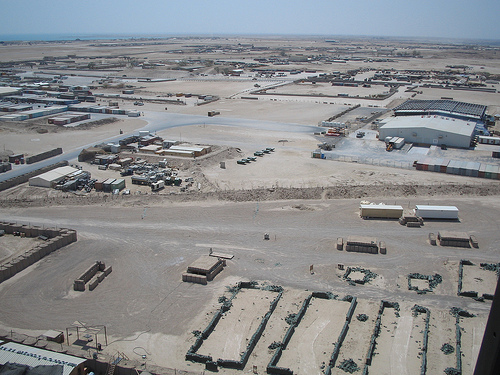
10 Comments

Filed under History, Military, world war two in europe

Going to War: Tripping into Ta Qaddum

helos at nightCH-53s and CH-47s

Our interlude in Fallujah over we waited in a tent outside the helicopter terminal operations building after RP1 Roland dropped us off.  Roland was good and helped hook us up with some of the Marines to get the Gator to put our ton of gear on to get it out to the helicopter.  I looked around and noted that both here and a Camp Victory most passengers had a significant amount less gear than us of course all had deployed with units and not as individuals thus the load that had to pack on their person was not exorbitant.  I thought of all we had been issued as individuals and the fact that I did not take everything that they wanted me to take and thought crap…what is wrong with this picture?  Of course whining about it does no good and if my lot was to suffer dragging all of this around then I would try to do so in good humor.  I pondered this and began to think of the movie Kelly’s Heroes and how the character played by Don Rickles Staff Sergeant “Crapgame.” I kind of chuckled as I thought of how he complained to “Kelly” played by Clint Eastwood and  Master Sergeant “Big Joe” played by Telly Savalis when after their vehicles were destroyed by American aircraft when saddled with a .30 caliber machine gun and its associated ammunition.

I looked in one tent which was full and eventually found another we a couple of open seats for us.  I sat my ass down on the wooden bench grounded the gear that I had with me, a back pack, and two briefcases now with 3 computers. My Mass kit was packed in my rucksack and all of my personal gear that could be placed on my flak vest was there including two knives…I was not allowed to pack a weapon but figured that these were simply to keep my fingernails clean and shave when I had nothing else to shave with.  Nelson of course was loaded for bear, dual armed he had an M-16A2 and a Beretta 9mm pistol and packed a significant amount of loaded clips of 5.56 and 9mm rounds in his ammo pouch. He sported two K-Bar fighting knives.  He also had his “game face on, the same look of determination that he sports when he fights.  Having an assistant who actually could kill someone to protect me was comforting.  There are some that I have met in both the Army and Navy that would have been as capable as Barney Fife if they were in a combat zone.  Of course Nelson and I knowing that we would be out in isolated areas with small teams of Americans had worked out a deal.  If were got into a bad situation he would toss me the 9 mil and we would defend ourselves and the people on our team figuring that since I was a chaplain that if I was captured that I would be used for propaganda purposes and executed on TV.  The plan was that if this happened that he would get credit for anything that I hit and no one would ever know that I did it.  I would not be like a few chaplains in the 2003 invasion of Iraq who carried and fought and then put it on their web sites, I figured that if this happened I would go to confession and ask for forgiveness rather than having to explain to Judy why I was dead.

The time passed slowly though it was only a couple of hours it felt like forever.  The tent was stuffy with a good number of people in it, Nelson found a corner and threw his gear down laid down comfortable.  I was a bit on the hyper-aroused side of life despite being tired so I got up and took a walk outside in moonlight.  The night air though still pretty warm felt better than that of the tent, as sweat dripped down my face I took a drink out of the liter bottle of water that I had pulled out of a cooler in the tent.  The airfield was busy, pairs of helicopters, 46’s, 53’s, and Army MH-60s and CH-47s landed and took off staying just long enough to disgorge their passengers and cargo and then pick up their next load before lifting off.  I watched in fascination as Marines and other passengers were led by ground crew staff to and from the aircraft, their shadowy figures blending into the illumination provided by the moon.  A couple of AH-1 attack choppers sat down for a few minutes and then took off.  I wondered if they would find targets or be called to respond to attacks on Marines or Soldiers in the area.  As I walked back to the tent I heard the boom of our artillery in the distance.

After a while they called for our flight.  We gathered up the gear that we had and Nelson got with the Marines to make sure that we were on the same flight as the “gator” was taking our gear to.  When we flew our “ticket” to get on a flight was the two letter code for our destination with the number of the flight such as 26 or 54 or whatever the mission or route number was.  In our case it was “TQ” and the number was either 54 or 56 which was from HMH 463 flying CH-53-Ds out of Al Asad.  Their flights were known as Kahuna followed by the number.  This was written on our left hand with a black marker.  As passengers we staged by our flight by young Marines with flashlights shaded by red cones.  We got in a line with about 30 other passengers, Marines, Sailors, Soldiers and civilians and moved out for the 53 which had just landed coming in from the east.  The companion bird was forward of ours.  The Gator move alongside of us and reached the helicopter just before we did.  Amid the din of the rotor blades and engines the Marine on the Gator got off and called out “Is the Chaplain that this gear belongs to here.”  I called out that I was and Nelson and I moved to the Gator and began the off load of four “super sized” suitcase shaped canvas sea bags and two flight bags. To get an idea how big our bags were you have to think of something about a third bigger than the biggest suitcases that you can buy only soft sided with no wheels.  No they did have straps that you could try to carry them with, but they were not the greatest.  Also note that we had a full deployment worth of gear in those bags and were expected to lug them across Iraq and you can see that this was a less than fun evolution and why I thought of Staff Sergeant Crapgame.  We dragged our gear aboard the aircraft moving toward the center of the bird placing it on the deck under the rotor blades where we took our places in jump seats and strapped ourselves in.  I felt something warm dripping on me and looked up, it was hydraulic fluid coming from the transmission of the bird which was located above me.  There is an old joke among those who fly in Marine Corps helicopters:  “How do you know when a Marine Helicopter is low on hydraulic fluid?  When it stops leaking.” I thought of the joke but this time it wasn’t funny.  I’ve never been a big fan of rotary wing flight and the fact that I was exhausted, sweaty and sitting in a cramped hot, leaky, dark and heavily loaded helicopter in a combat zone made the experience less than fun.

It was about 0200 when we lifted off into the night on what we understood to be a short flight to TQ.  Admittedly it was, if you only count the flight time from Fallujah to TQ itself.  As we flew in I could see the sprawling airbase below but we flew off to what looked like the other side of the airfield.  As we flew in I thought of the Army bird that had gone down earlier in the day.  I wondered what had caused it to crash and my pucker factor went up just a bit higher as I wiped more hydraulic fluid from my face.

When we landed we told to exit the bird without our gear.  We released ourselves from our seats and stumbled over our gear and that of the rest of the passengers that was in the middle of the deck.  We exited out the rear of the aircraft down the ramp into the rotor wash.  Turning left we moved off about 70 yards from the fifty-three and looked around.  A few crew members and ground crew personnel moved in and out of the bird.  At first I wondered if we had been moved off to refuel but there was no fuel in view.  We waited for about 25 minutes in the dark as Marines moved in and out of the fifty-three.  Finally a crew member came over to us, and motioned us to follow him back into the aircraft.  Once again we negotiated the gear and found our seats.  Once we were back in the fifty-three lifted off and flew a short distance across the airfield where were instructed to exit the bird with our gear.  For most of the passengers this was a fairly easy evolution, for us it was not so easy.  We had to take one bag at a time down the ramp and get each a decent distance from the bird before returning for the others.  We got our gear off the bird and found that the rest of the passengers were already being herded the 200-300 yard hike to the paved area near the terminal.  Nelson and I each packed one of the large bags on our back and began to pull the other bags behind us as another group of Marines walked out to the fifty-three.  Eventually about a third of the way to the terminal a Marine on the ground crew came and asked if we needed assistance.  I replied that it would be appreciated.  He instructed us to wait where we were and about three minutes later a forklift with a large plywood box on the forks.  The Marine who had asked if we needed help instructed us to place the gear in the box and proceed in the direction of the terminal with another member of the ground crew.  As the birds lifted off behind us we set off for the terminal area.  When we got there we had to wait again.  A Marine collected our ID cards and walked in the building telling us to remain where we were.

About this time, our gear on the ground again with us there with our helmets off and sweat pouring down our faces a female petty officer came up to us.  It was the 2nd Marline Logistics Group senior RP.  Nelson knew her from Afghanistan so our welcome was pleasant.  The RP had a Chevy SUV in front of the terminal.  The Marine came back with our ID cards, I grabbed a bottle of water and the three of us began to move the gear to the truck which was about 50 years away via the closed route through the terminal. After loading the gear she drove us about 10 minutes to the other side of the base where the billeting area was.  She got the truck as close as she could and once again we lugged the gear about 100 yards to our new homes which were called “cans.”  These are like a storage container with a window and linoleum floors.  Unlike some of the places I had been recently this also had a small wall unit air conditioner that worked.  It was now about 0315 and I stank to low hell.  I dug through my bags, found my shower gear and towel and got a shower.  Finally about 45 days after we detached from EOD with stops in Norfolk, Fort Jackson, Kuwait, Baghdad and Fallujah we could get to work.  On my return to my new home I did the office of Compline from the Book of Common Prayer, laid down on the bed and passed out.

Leave a comment

Filed under History, iraq,afghanistan, Military, Tour in Iraq