Category Archives: Military

“I Don’t Take Responsibility at All: Trump Tells the Unsettling Truth about Himself


Friends of Padre Steve’s World,

President Abraham Lincoln noted:

“In times like the present, men should utter nothing for which they would not willingly be responsible through time and eternity.”

I was able to watch both of President Trump’s speeches on Coronavirus 19 this week. Both were uninspiring to say the least, and he quite obviously understands nothing of being a leader, or even more so, the Commander in Chief.

However, in his Friday Afternoon the President, who is a man whose lies, evasions, of the truth, blame of others, and failure to stand on any principle,  finally spoke one truth. In the midst of other lies and evasions of responsibility, false claims about the availability testing kits, a website run by Google which has denied it would be running by the time the President said it would be, the availability of drive through testing, and the fawning praise of big business leaders, and members of the administration, he spoke the truth.

To NBC reporter Kristen Welker, who asked what responsibility he took for the delays and problems in rolling our the test kits. He replied:

“Yeah, no, I don’t take responsibility at all, because we were given a set of circumstances and we were given rules, regulations, and specifications from a different time. It wasn’t meant for this kind of an event with the kind of numbers that we’re talking about.”

In a follow up question asked  NPR reporter Yamiche Alcindor, who nailed him with a question of his responsibility for eliminating the CDC Pandemic Response team and removing a member of it from the National Security Council. Her question was direct and to the point:

“You said that you don’t take responsibility, but you did disband the White House pandemic office. The officials that worked in that office said the White House lost valuable time because that office was disbanded.”

The President, having been caught twice responded and passed the blame. It was hardly a Harry Truman “the buck stops here,” moment. Nor was it a humiliated John F Kennedy, after the failed Bay of Pigs invasion. He took sole responsibility for it, stating, “because I’m the responsible officer of the government…” time of honesty. Instead the President lashed back, attacking her, and blaming everyone but himself.

“I just think it’s a nasty question. When you say me, I didn’t do it. We have a group of people, I could ask, perhaps my administration.” Turning to Dr. Anthony Fauci, the director of the National Institute of Allergy and Infectious Disease, who has been the most consistently honest official during this crisis; “Perhaps I could ask Tony about that? Because I don’t know anything about that. Perhaps they do that to people,” he said to Alcindor, a former New York Times who left it for PBS. “You used to work at another newspaper. Things like that happen.”

The President often states how he is the Commander in Chief, and his sycophants claim is therefor above the law, however he has never taken responsibility for anything, unless he is claiming success for that of others. The list of his evasions of responsibility for anything, including the deaths of soldiers that he sent into battle, defies the final responsibility of a true commander, at any level. A commanding officer in our military is responsibility is responsible for everything his unit, base, or ship is assigned to do. If he or she fails, there is no evading responsibility by blaming it on others. Numerous commanders in every branch of the military are relieved of their commands, and sometimes face trial at Court Martial, regardless, most are never promoted again, and find that their careers are over. Sir Winston Churchill, a man of legendary success, and failure noted: “The price of greatness is responsibility.”  President Trump, who has a bust of Churchill in his office should heed those words.

Another British military officer, whose life is shrouded in mystery and controversy, Colonel Richard Meinertzhagen, did write truth in these words:

“A successful leader of men must have character, ability and be prepared to take unlimited responsibility. Responsibility can only be learned by taking responsibility; you cannot learn the piano without playing on one. Leadership is the practical application of character. It implies the ability to command and to make obedience proud and free.”

Admiral James Stockdale, who spent years in a North Vietnamese Prison, enduring constant torture, later noted:

“Leadership must be based on goodwill. Goodwill does not mean posturing and, least of all, pandering to the mob. It means obvious and wholehearted commitment to helping followers. We are tired of leaders we fear… What we need for leaders are men of heart who are so helpful that they, in effect, do away with the need of their jobs. But leaders like that are never out of a job, never out of followers.” 

President Trump has demonstrated none of this, except as Admiral Stockdale said, “posturing and… pandering to the mob,” and has shown his unwillingness to learn, unwillingness to listen to experts, and unwillingness to accept responsibility as President. That is a problem, especially in a time like this, General and later President Dwight Eisenhower said:

“The supreme quality for leadership is unquestionably integrity. Without it, no real success is possible, no matter whether it is on a section gang, a football field, in an army, or in an office.”

On Sunday afternoon the President opened an update on the COVID-19 pandemic stating the most obvious lie imaginable, that the virus “was completely under control,” only to be undercut by Anthony Fauci, who said that it would get much worse.

Trump is failing as President. His denial of the virus for months, his actions to delay any response, and his prior action in 2018 to disband a key component of our National Security Team, the CDC Pandemic Response Unit, created by President Barack Obama and his Administration was irresponsible and has made the situation worse, not better.

Our disease increase curve is similar to that of Italy. Within a few weeks we are going to see tens of thousands of infections and thousands of deaths. The measures taken by the administration were too little, too late. The current measures may help mitigate the effects, but COVID 19 is going to wreak havoc on our society, economy, and way of life.

If Trump was a real leader he would inspire us as Winston Churchill did the British in 1940, “I have nothing to offer but blood, toil, tears and sweat”. We have before us an ordeal of the most grievous kind. We have before us many, many long months of struggle and of suffering.” Or those of Franklin Roosevelt who said at the opening of his first inaugural address:

“So, first of all, let me assert my firm belief that the only thing we have to fear is fear itself—nameless, unreasoning, unjustified terror which paralyzes needed efforts to convert retreat into advance. In every dark hour of our national life a leadership of frankness and vigor has met with that understanding and support of the people themselves which is essential to victory. I am convinced that you will again give that support to leadership in these critical days.”

My friends, that is leadership, that is command, that is the mantle of supreme command that our President has never understood, before or after he became President.

I could write more, but I have been playing with this article for two days.

So, until tomorrow,

Peace,

Padre Steve+


9 Comments

Filed under Diseases Epidemics and Pandemics, economics and financial policy, ethics, healthcare, History, laws and legislation, leadership, Military, News and current events, Political Commentary

Predators and Workhorses: The U-Boat Type VIIc

U-96

Friends of Padre Steve’s World,

When it comes to World War II and the ships of the German Kriegsmarine many Naval history buffs focus on the mighty battleships Bismarck and Tirptiz, sometimes the other major surface warships, or the massive battleships that never left the drawing board. However, for me it is the U-Boats, the German submarine fleet, which came very close to winning the war for Germany.  So for the next few nights I am going to be posting about some of the types of German submarines, or Unterseebooten, U-Boats. 

The signature warship of the German Kreigsmarine of the Second World War has to be the U-Boat Type VIIC, the most numerous type of submarine ever produced by any Navy.  568 of these U-Boats would be commissioned between 1940 and 1945 as well as 91 of the Type VIIC/41.  The Type VIIC was developed from the prewar Type I and Type VIIA and VIIB classes.

Compared to contemporary American submarines of the Gato class they were smaller, mounted fewer torpedo tubes and had a shorter range. However the American boats were designed for the vast expanse of the Pacific while the German boats for the most part were operated in the smaller confines of the Atlantic and Mediterranean.

U-1023

They displaced a mere 769 tons on the surface and 871 tons submerged and were 67.1 meters (220.14 feet) long. The boats had a single pressure hull and the VIIC could dive to a maximum depth of 230 meters (754 feet) and had a crush depth of 250-295 meters (820-967 feet).  The VIIC/41 could dive to 250 meters or 820 feet and a crush depth of 275-325 meters (902-1066 feet).  This was deeper than any allied submarines of the period and a testament to their sound construction.

Admiral Dönitz greeting U-94 in 1941

The Type VIICs were armed with a C35 88 mm/L45 gun with 220 rounds for surface actions and various types and numbers of anti-aircraft guns. The standard configuration for torpedo tubes was 4 bow mounted tubes and 1 stern mounted tube although a small number only carried 2 forward and none aft. They carried a maximum of 14 torpedoes and could carry 26 TMA Mines which would be laid at approaches to various ports.

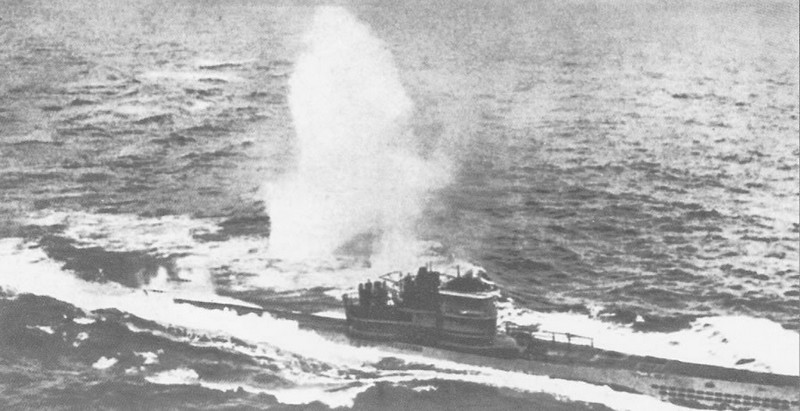
U-966 under air attack

The Type VIIC was powered by two supercharged Germaniawerft, 6 cylinder, 4-stroke M6V 40/46 diesel engines on the surface producing between 2,800 to 3,200 horsepower which gave the boats a 17.7 knot maximum speed on surface. For submerged operations the boats were powered by one of a number of different electric motors whose batteries were charged by the diesels. The electric motors produced 750 horsepower (560 kW) and could drive the boats a maximum of 7.6 knots. In 1944 many of the surviving boats were equipped with the schnorkel apparatus which allowed them to use their diesel engines underwater at shallow depths.  The had a range of 8190 miles at 10 knots surfaced which gave them a decent amount of operational flexibility for their Atlantic operations.

The last Type VII- U-995 (Type VIIC/41) German U-Boat Memorial Laboe Germany

During the war the German U-Boat force suffered grievous losses many of which were Type VIICs. The VIICs performed excellently in combat and many survived engagements that would have sunk less tough boats. The most famous of the Type VIICs of all variants is probably the U-96 which was featured in the epic submarine film Das Boot. A number had post war careers in several navies and the last active VIIC the U-573 which served in the Spanish Navy as the G-7 was decommissioned in 1970 and sold for scrap over the objections of those that wanted to purchase her as a memorial.  The only surviving Type VIIC is the U-995at Laboe Germany where she is a memorial to all the U-Boat Sailors of the Second World War.  Two full sized mock ups one for exterior scenes and one for interior scenes were constructed for Das Boot and the exterior mock up was also used in Raiders of the Lost Ark.

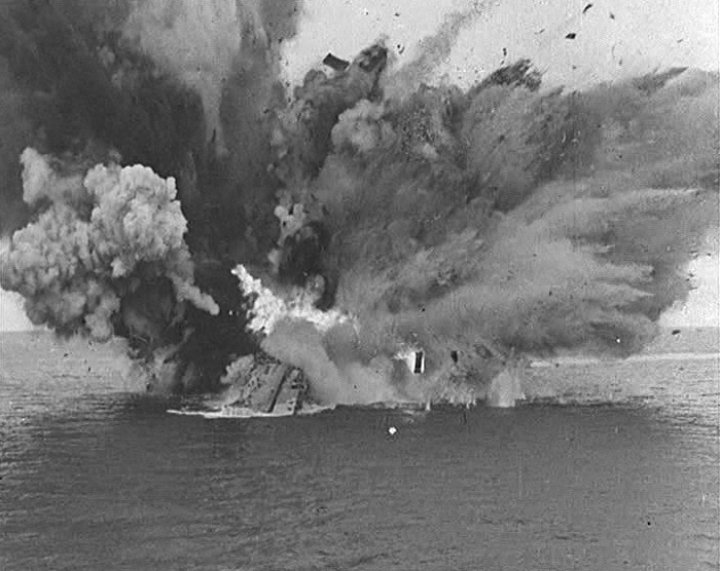
                                                 The Death of HMS Barham  
During the war U-Boats of all types sank nearly 3000 Allied ships including 175 warships among which were the carriers HMS Glorious, HMS Ark Royal and HMS Eagle and the Battleships HMS Barham and HMS Royal Oak. The Germans lost nearly 800 U-Boats of all types and over 28,000 U-Boat Sailors, about 75% of the force.

The films Das Boot and The Enemy Below are excellent reminders of the courage of the men that operated these submarines during the war. Though the Nazi Regime was evil the men of the U-Boat Service often displayed courage and ingenuity in the face of overwhelming odds and they nearly won the war for the Germans.

Peace,

Padre Steve+

1 Comment

Filed under germany, History, Military, Navy Ships, nazi germany, World War II at Sea

The Clash of the Ironclads: The Battle of Hampton Roads at 158 Years

800px-the_monitor_and_merrimac1

Friends of Padre Steve’s World

Yesterday and today mark the 157th  anniversary of an event which changed naval warfare forever, the Battle of Hampton Roads. It was a watershed event which ended the reign of the great wooden ships which plied the oceans of the world under massive fields of canvas sails. 

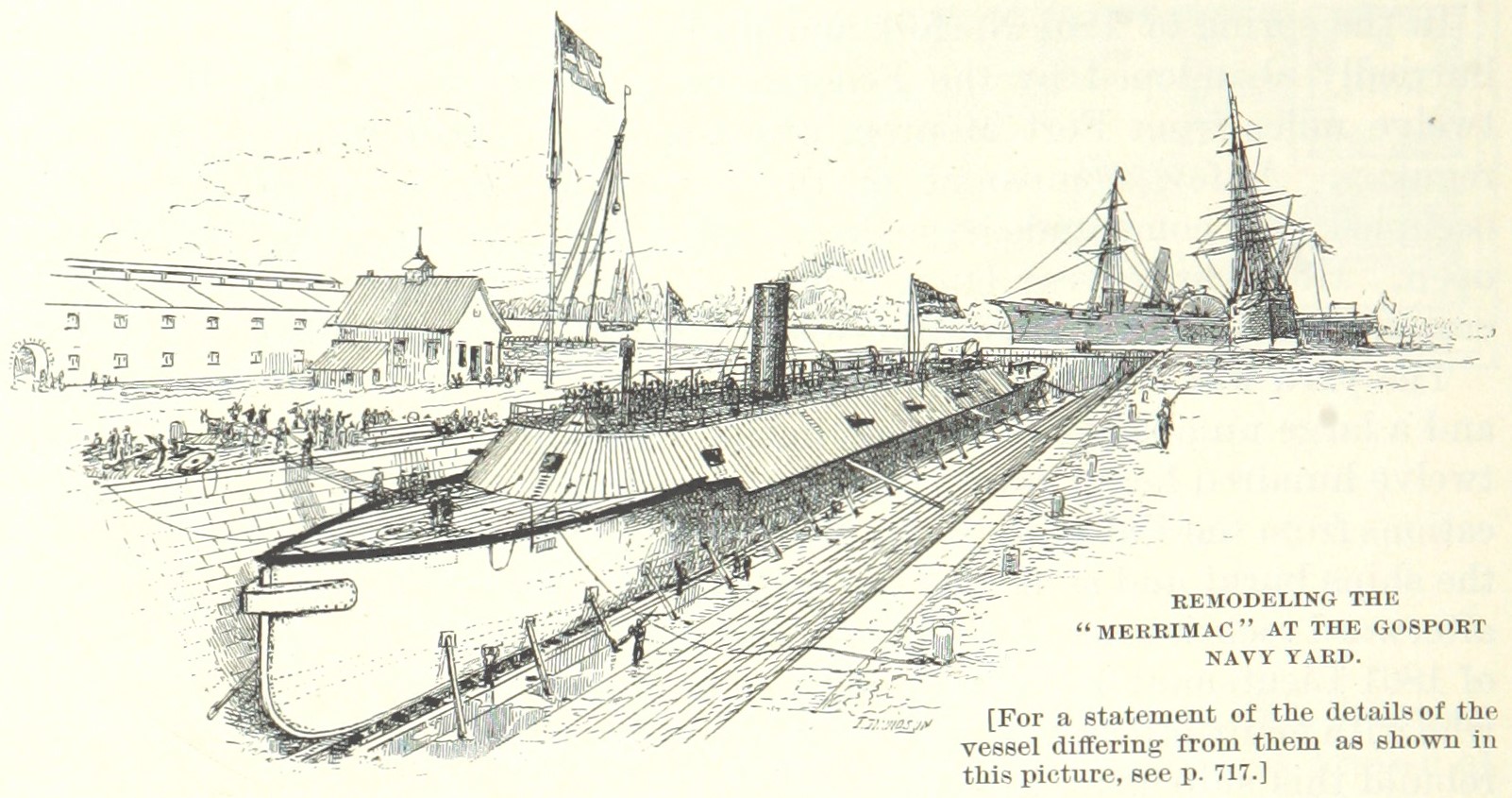
It took place about 10 miles from my current office, which is just a few hundred yards from Drydock Number One, at Naval Station Norfolk, in Portsmouth, Virginia, then called Gosport. It was here that the Confederate Navy, salvaged the wreck of the Steam Frigate USS Merrimac, razed her to the waterline, and constructed an ironclad casemate over her and recommissioned as the CSS Virginia. 

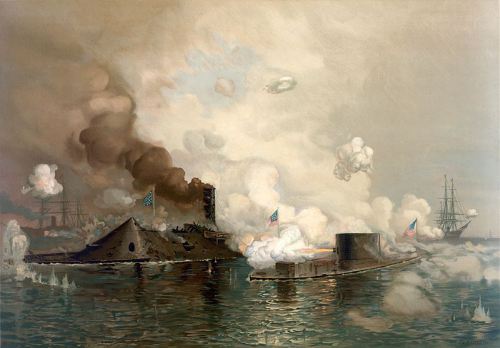
On March 9th 1862, two very strange looking ships joined in battle. This is the story of the Battle of Hanpton Roads and the USS Monitor and CSS Virginia. This is their story, and the story of the men who designed and commanded them. 

Peace

Padre Steve+ 

On the morning of March 8th 1862 the CSS Virginia steamed slowly from her base at at the former US Navy Shipyard, Gosport, in Portsmouth, Virginia into Hampton Roads at the mouth of the Chesapeake Bay. Her mission, break the Union blockade.

Awaiting her was a US Navy squadron of wooden warships including the steam Frigate USS Minnesota, the Sloop of War USS Cumberland and Frigate USS Congress and a number of smaller vessels. Together these ships mounted over 100 heavy guns, and were backed up by the shore batteries at Fort Monroe, on the Hampton side of Hampton Roads.

The Ships, Their Captains, and Designers 

The CSS Virginia was an armored ram built from the salvaged remains of the large steam frigate USS Merrimack, which had been burned at Gosport (Now Norfolk) Naval Shipyard when the Navy abandoned the shipyard to keep her from being captured by the Confederates after Virginia had seceded from the Union on April 20th 1861.  She was raised in May and the wreck was placed in what is now called Drydock Number One, at Norfolk Naval Shipyard, which is the oldest Drydock in the Western Hemisphere, a historic landmark, and still in use on May 30th 1861. Upon inspection it was determined that her hull below the waterline was intact and her engines serviceable. Since Merrimac was the largest ship, wrecked or intact, with serviceable steam engines and boilers; Confederate Secretary of the Navy Stephen Mallory decided that she would be converted into an ironclad.

Her design was that of Lieutenant John Mercer Brooke, a former U.S. Navy officer, and Naval Constructor John L. Porter, who had been a civilian employee of the Navy at Gosport. The design was an ironclad ram, with a massive casemate armored with four inches of Iron and 24 inches of Oak and Pine, which protected her battery of six 9” Dahlgren smoothbores, which were at the Naval Yard, and four 7” Brooke Rifled Guns, designed by LT Brooke and modeled on the design of the Parrot Rifled Gun, used by both sides during the American Civil War.

Her stem and stern nearly underwater, a V Shaped breakwater was mounted forward of the casemate, and an iron ram mounted below the waterline, a throwback in Naval design which had been abandoned since the Middle Ages when cannons became the weapon of choice. This was because the Confederates discover that the guns mounted on her might not be effective against Union ironclads which were being designed. Her design would be the prototype for almost all future Confederate Ironclads.

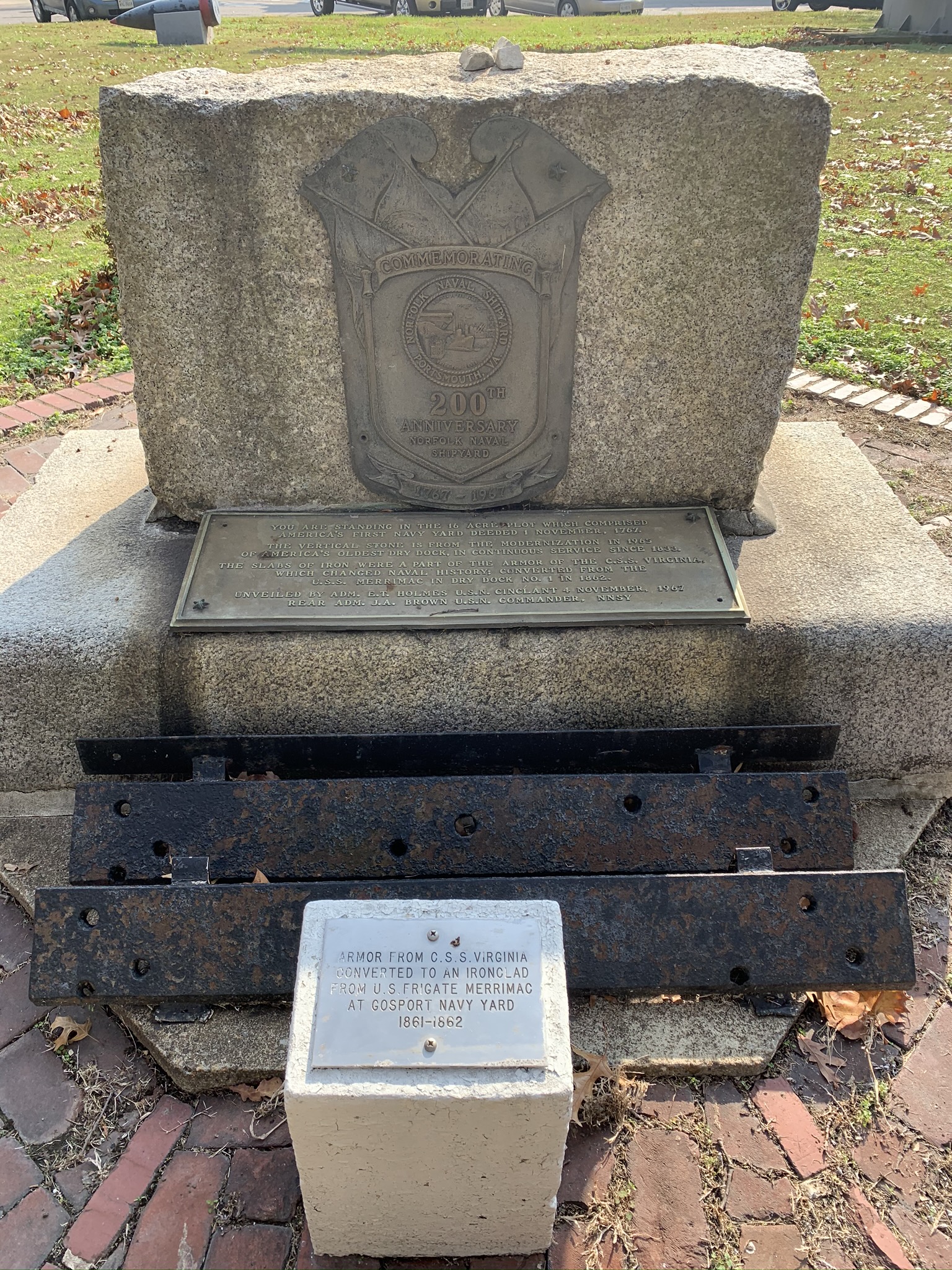
         Iron Plates from CSS Virginia at the Norfolk Naval Shipyard

However, she was plagued with unreliable engines which had been condemned by the US Navy, even before she was burn and sunk, were scheduled to be replaced during her refit at Gosport. As such, her design limited her to a coastal defense role, and her engines limited her to a speed of 5 to 6 knots. Her turning radius was over a mile and it took her 45 minutes to make a complete circle. Though lethal to wooden ships in enclosed waters, she was hardly a threat to Union maritime supremacy. In heavy seas she would have been a death trap to her crew.

Her Captain, Flag Officer Franklin Buchanan was a former U.S. Navy Captain originally from Maryland. In expectation that Maryland would secede from the Union, he resigned his commission on April 22nd 1861. When Maryland did not secede he attempted to withdraw his resignation but was rebuffed by Abraham Lincoln’s Secretary of the Navy, Gideon Welles. Thus  he left the Navy in May 1861 and joined the Confederate Navy in September 1861. He was appointed commander of the James River Squadron in February 1862 and selected CSS Virginia as his flagship. His Executive Officer was Lieutenant Catsby ap Jones. 

The USS Monitor

However, Virginia’s plans had been leaked to the US Navy by a Union sympathizer at Gosport, and taken to Washington, DC, by a freed slave named Mary Louvestre in February 1862. She met with Welles and sped the efforts of the Navy to complete and commission a number of ironclad ships of different types, but most importantly Welles pushed the Navy and builders to speed up the completion of the USS Monitor. 

Monitor was the brainchild of the Swedish Engineer John Ericsson, who had a troubled history with the US Navy. He invented the Screw Propeller for steamships, an idea rejected by the British Royal Navy, but then recruited by the ambitious American, Captain Robert F. Stockton to come to the United States. His propellers were first used on USS Princeton, for which he also designed a 12” breech loaded, rotating gun named Oregon. The gun which he designed was built in England and used hoop construction, also known as built up construction to pre-tension the breech. This method involved placing red-hot iron hoops around the breech-end of the weapon thereby allowing the gun to take a higher powder charge than previous cast iron weapons, which relied on using thicker iron to take an increased charge, making the weapon larger and heavier without increasing its strength.

However, Stockton moved to ensure that Ericsson was not acknowledged as the primary designer. Likewise, he decided that “his” ship should have two 12” guns, Ericsson’s and his own, which used the older technology and heavier iron, but without the tensile strength of Ericsson’s gun. Its huge size made it the more impressive looking weapon, but with the tendency common to such weapons, to burst.

However, Stockton’s gun was hastily built and had only a few test firings before demonstrating it before President John Tyler, his future wife Julia, former First Lady Dolly Madison and an assortment of cabinet officers, congressmen, and their families, numbering close to 400 on February 27th 1844. While coming back up the Potomac River, Stockton personally fired a shot in honor of George Washington at Mount Vernon. Stockton pulled the lanyard and the left side of the breech blew out, sending large fragments of cast iron, killing Secretary of the Navy Thomas Gilmer, Secretary of State Abel Upshur, Chief of the Navy Board of Construction and Repair, Captain Beverley Kennon. Senator Thomas Hart Benton, Captain Stockton, and another 14-18 crew members and visitors were wounded.

Stockton, who had a benefactor in President Tyler, blamed Ericsson who went on to many other accomplishments, but who refused any dealings with the Navy until Secretary of the Navy Gideon Welles convinced him to design an ironclad in 1861. Ericsson responded with yet another revolutionary design which was at first ridiculed by naval experts. Ericsson based the hull of the ship on that of shallow draft Swedish lumber barges, but constructed completely of iron and not equipped with sails. He armed the ship with a heavily armored turret mounting two powerful 11” Dahlgren guns, which rotated a full 360 degrees. The turret was designed to mount two 15” Dahlgren guns, but they were not yet available. Had those guns been ready, Monitor might have sunk the Virginia.

Monitor was completed in under 100 days as Ericsson had promised. She was laid down on October 25th 1861, launched on January 30th, and commissioned on February 25th 1862. Her Captain was Lieutenant John Worden. Worden had served in the Navy since 1834, and he would go on to many great accomplishments, finishing his career as a Rear Admiral, having commanded another monitor, USS Montauk, Superintendent of the Naval Academy, Commander of the Mediterranean Squadron, and President of the Naval Institute.

However, in February 1862 the relatively old lieutenant took Monitor to sea two days later, but the deployment was cut short by a steering failure, which resulted in the ship returning to New York for repairs. She sailed for Hampton Roads again on March 6th and she would arrive on the evening of March 8th, not long after Virginia had wreaked havoc on the Union ships at Hampton Roads. His Executive Officer was Lieutenant Samuel Dana Greene, son of the future Union General and hero of Culp’s Hill at the Battle of Gettysburg, George Sears Greene. 

The Battle


CSSVirginia1862.2.ws

During the ensuing fight of March 8th Virginia rammed and sank Cumberland which though fatally wounded disabled two of Virginia’s 9” in guns. Virginia destroyed Congress by gunfire which burned and blew up and appeared to be in position to destroy Minnesota the following day as that ship had run hard aground. The losses aboard Cumberland and Congress were severe and included the Captain of the Congress and Chaplain John L. Lenhart of Cumberland, the first US Navy Chaplain to die in battle. During the battle Virginia had several men wounded including her Captain, Franklin Buchanan who during the action went atop the casemate to fire a carbine at Union shore batteries. He was wounded by a bullet in the leg and though he survived he missed the next day’s action.

Cumberland_rammed_by_Merrimac

Due to the coming of darkness and a falling tide the acting commander of Virginia, Lieutenant Catsby Ap Roger Jones her executive officer took her in for the night. During the night Monitor, under the command of Lieutenant John Worden arrived and took up station to defend Minnesota.

603px-Battle_of_Hampton_Roads_Map

The next morning Virginia again ventured out and was intercepted by the Monitor. The ships fought for over three hours, with Monitor using her superior speed and maneuverability to great effect. During the battle Monitor suffered a hit on her small pilothouse near her bow blinding her Captain Worden.  Monitor’s executive officer, Lieutenant Dana Greene, took command. Neither side suffered much damage but the smokestack of Virginia was pierced in several places affecting her already poor engine performance.  Jones broke off the action and returned to Gosport for repairs while Monitor remained on station, still ready for battle.

Gideon Welles wrote after the battle: “the performance, power, and capabilities of the Monitor, must effect a radical change in naval warfare.”

USSMonitor1862.3.ws

It did. The battle showed the world the vulnerability of wooden warships against the new ironclads. Monitor in particular revolutionized naval warfare and warship construction. From that time on the truly modern ships were fully iron and later steel, with revolving turrets, and within twenty years without sails, even as a back up to their steam engines.

Her defining mark was the use of the armored gun turret which over the succeeding decades became the standard manner for large ships guns to be mounted. Turrets like the warships they were mounted upon grew in size and power reaching their apex during the Second World War, only to be superseded by the next revolution in Naval warfare, the Aircraft Carrier.

arizon-main-battery2

Both Virginia and Monitor reached less than glorious ends. Virginia had to be destroyed by her crew to prevent her capture just over two months after the battle on May 11th 1862. Monitor survived until January 31st 1862 when she sank during a heavy storm off Cape Hatteras North Carolina with the loss of 16 of her 62 man crew. The remains of two of those men, recovered during the salvage of Monitor’s engines, turret, guns and anchor were interred at Arlington National Cemetery on March 8th 2012. The relics from Monitor and some from Virginia are displayed at the Mariners Museum in Newport News (http://www.marinersmuseum.org )while one of Virginia’s anchors resides on the lawn of the Museum of the Confederacy in Richmond. Two of her iron plates are on display at Norfolk Naval Shipyard.

Those early ironclads and the brave men who served aboard them revolutionized naval warfare and their work should never be forgotten.

Peace

Padre Steve+

1 Comment

Filed under civil war, History, Military, Navy Ships, US Navy

“The Most Bold and Daring Act of the Age” Stephen Decatur, and the Defeat of the Barbary Pirates


“Our Country! In her intercourse with foreign nations may she always be in the right; but right or wrong, our country!” Stephen Decatur

Friends of Padre Steve’s World,

In 1803 the United States Navy was two years into its campaign against the Barbary Pirates who sailed from Algiers, Tunis, Tripoli and Morocco.  For years the United States like other nations had paid tribute to the rulers of these states for free passage of its ships and hefty ransoms to free the sailors that were enslaved following the capture of their ships.  By 1800 tens of millions of dollars had been paid and in that year the amount of tribute paid was 20% of the government’s total revenue.

In 1801 the Pasha of Tripoli Yusuf Karamanli demanded the payment of $225,000 tribute from the new President of the United States President Thomas Jefferson. In years past Jefferson had advised against payment of tribute believing that such payment only encouraged the Barbary States to continue their actions.  The anti-naval partisans and even his Republican allies had blocked his recommendations even though Secretary of State John Jay and President John Adams agreed with him. These partisans insisted that tribute be paid irregardless of the effect on European trade or the fate of American seamen because they believed that the Atlantic trade and involvement in the “Old World” detracted from the westward expansion by diverting money and energy away from the west.  When Jefferson refused the demand and put his beliefs into practice Karmanli declared war on the United States by cutting down the flag at the US Consulate in Tripoli.

Jefferson sent a small force to defend protect American ships and sailors and asked Congress to authorize him to do more as he did not believe that he had the Constitutional power to do more. Congress did not issue a declaration of war but authorized Jefferson to “employ such of the armed vessels of the United States as may be judged requisite… for protecting effectually the commerce and seamen thereof on the Atlantic Ocean, the Mediterranean and adjoining seas.”

Jefferson sent the best of the United States Navy to deal with the situation and US Navy ships soon began to take a toll on the pirate vessels.  The squadron was composed of ships that would become legend in the history of the Navy. Commanded by Commodore Richard Dale, Edward Preble, and later Commodore John Rogers, at various times the squadron included the USS Argus, Chesapeake, Constellation, Constitution, President, Congress, Enterprise, Intrepid, Essex, Philadelphia, John Adams and Syren.  The Constitution, Chesapeake, and Constellation, Congress and President were among the first six frigates authorized by Congress on March 27th 1794. Philadelphia a subscription Frigate paid for by citizens and merchants of Philadelphia, Essex a subscription Frigate pride for by the citizens of Salem and Essex County, Massachusetts, John Adams, a Subscription Frigate paid for by the citizens of Charleston, South Carolina, Argus a 20 gun Brig, Enterprise and Vixen 12 gun Schooners, Syren (later Siren) a 16 gun Brig, and Intrepid a captured Tripolitan Ketch, several smaller American built vessels, and about a dozen gunboats and mortar boats supplied by the Kingdom of Naples, which also provided the Americans with access to the ports of Messina, Palermo, and Syracuse, as well as supplies, and craftsmen to maintain the American Squadron.

Many of the officers who served in the Squadron, including William Bainbridge, Issac Hull, Charles Stewart, David Porter, would continue in service and make names for themselves in the war of 1812 and after.

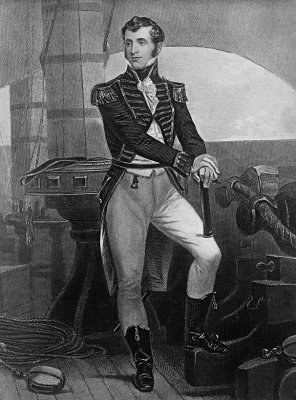
One of the young officers was the 24 year old Captain of the 12 Gun Schooner USS Enterprise Lieutenant Stephen Decatur the son of a Navy Captain who had entered the Naval service as a Midshipman in 1798 and who had risen rapidly through the ranks due to his abilities and leadership. He was among the few officers selected to remain in service following the end of the Quasi-War with France.  By the time that he took command of Enterprise Decatur had already served as the First Lieutenant of the Frigates USS Essex and USS New York.  After an altercation with British officer while wintering in Malta he was sent home to command the new Brig of War USS Argus. He was ordered to bring her to Europe where he handed over command to Lieutenant Isaac Hull who would achieve fame in the War of 1812 as Commanding Officer of the USS Constitution.  Decatur was given command of Enterprise on when he detached from the Argus.

On December 23rd 1803 while operating with the Constitution Decatur and the Enterprise captured the small Tripolian ketch Mastico which was sailing under Turkish colors.  The small ship was taken to Syracuse where Commodore Edward Preble condemned her as a prize of war, renamed her Intrepid and placed Decatur in command.

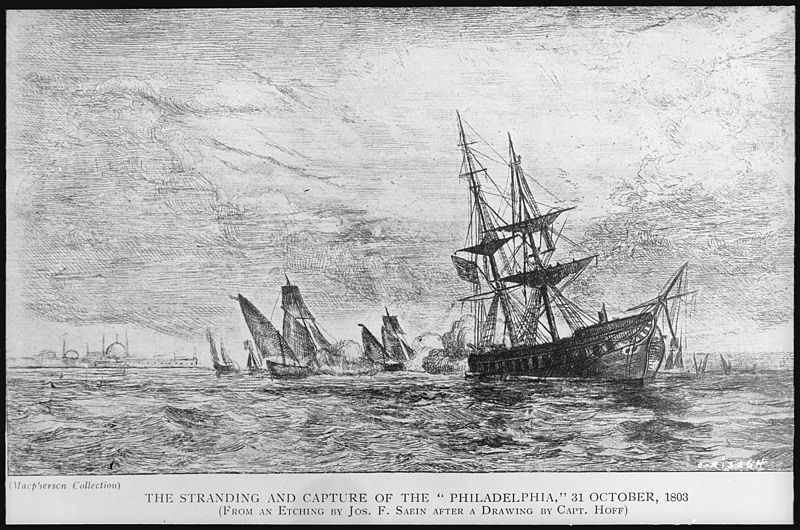
Normally such an event would be considered a demotion for an officer of Decatur’s caliber but events at Tripoli had forced Preble to make a bold strike at the heart of the enemy.  On October 31st 1803 the Frigate USS Philadelphia one of the most powerful ships in the squadron under the command of Captain William Bainbridge ran aground on an uncharted shoal and was captured.  Her crew was taken prisoner and the ship floated off by the Tripolians partially repaired and moored as a battery in the harbor until her foremast could be remounted having be cut away by Bainbridge in his  unsuccessful  attempt to float the ship off the shoal.

Burning the Philadelphia

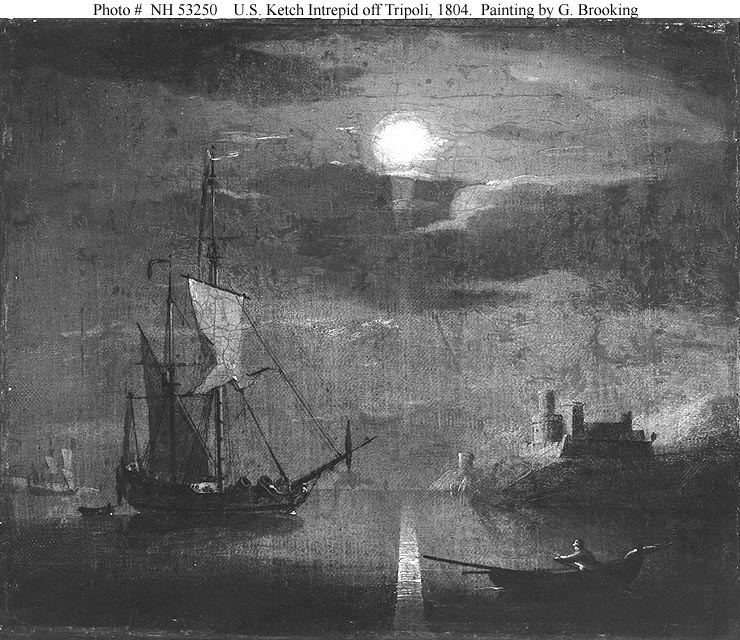
The threat posed by such a powerful ship in the hands of the enemy was too great to ignore. Preble order Decatur to man the Intrepid with volunteers to destroy the Philadelphia at anchor.  Decatur took 80 men from the Enterprise and was joined by eight more volunteers  from USS Syren including Lieutenant Thomas McDonough who had recently served aboard Philadelphia and knew the ship well.

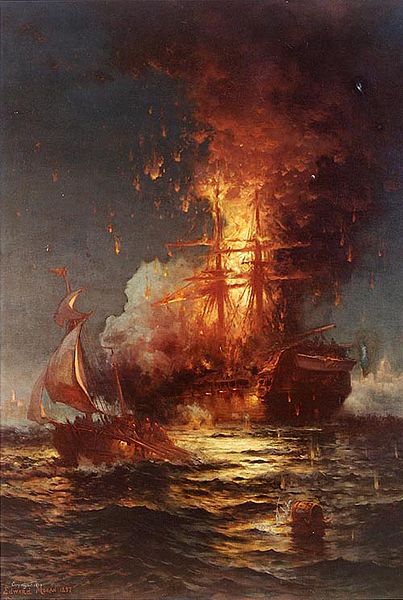
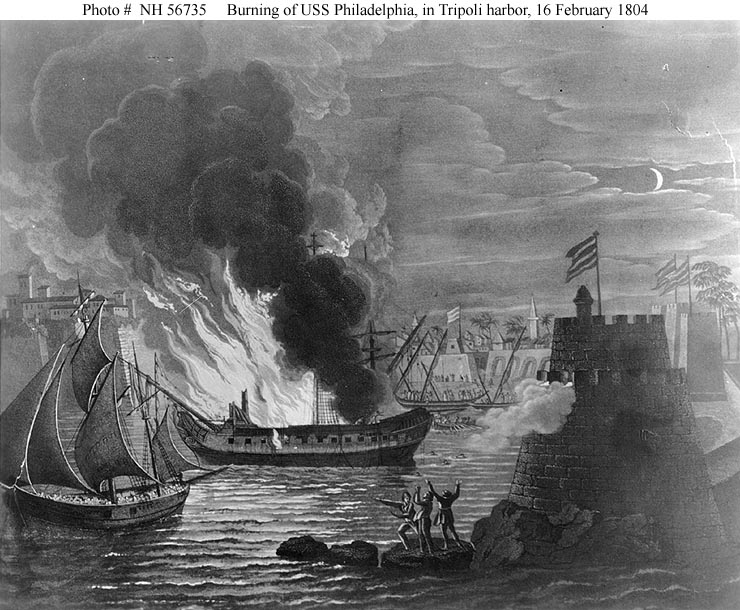
Under the cover of night of February 16th 1804 Decatur took the former Tripolian ship into the harbor beneath the dim light of the new moon.  Posing as a Tripolian ship he was able to slip past the guns of the forts overlooking the harbor using a Sicilian sailor who spoke Arabic to request permission. This was granted and Intrepid approached Philadelphia and when close enough ordered his crew to board the Frigate. After a brief skirmish with the small contingent of sailors aboard he took control of the vessel and set it ablaze. When he was sure that the fire could not be extinguished he ordered his men back aboard Intrepid and sailed out of the harbor under the fire of the shore batteries and gunboats.

Decatur sailed Intrepid back to Syracuse where he was greeted as a hero and became one of the Navy’s legends.  Pope Pius VII publicly proclaimed that “the United States, though in their infancy, had done more to humble the anti-Christian barbarians on the African coast, than all the European states had done for a long period of time.” Admiral Lord Horatio Nelson, one of the most heroic sailors that ever lived and no stranger to daring said that Decatur’s accomplishment was “the most bold and daring act of the Age.

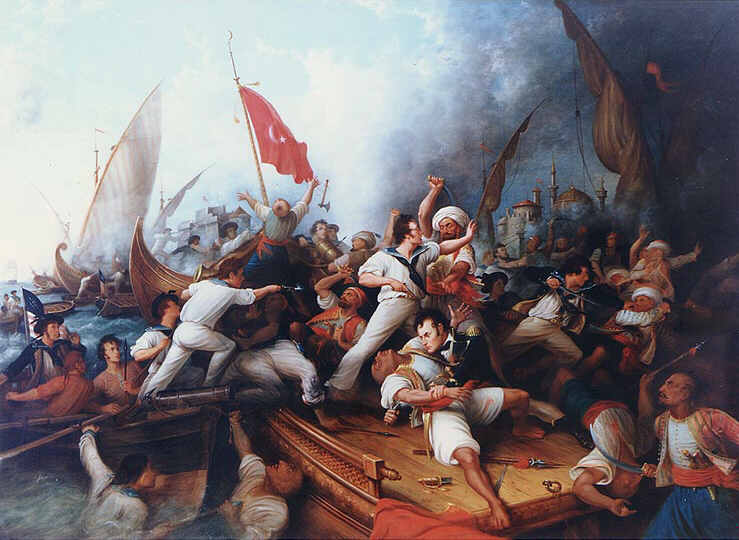
Decatur leading American Sailors in hand to hand combat against Barbary Pirates at Tripoli 1804 his younger brother Lieutenant James Decatur was killed aboard another gunboat in the action

Decatur would return to command the Enterprise and was given command of Constitution and was promoted to Captain bypassing the rank of Master Commander. He would prove himself again against the forces of Tripoli before departing for the United States. He distinguished himself  in the years to come against the Royal Navy in the War of 1812 where when in command of USS United States defeated and captured HMS Macedonian which would serve in the U.S. Navy and later in the Second Barbary War.

During that war, which began in 1815 Decatur’s squadron decisively defeated the Algerian fleet capturing the Frigate Mashouda and killing the highly successful and chivalrous commander of the Algerian raiding squadron Rais Hamidu.  The Pashas of Algiers, Tunis and Tripoli all made peace and reimbursed the Americans for the financial damage that they had done.  His victory ended the terror that the Barbary States had inflicted on Europeans for centuries and helped bring peace to the Mediterranean. Following that he became a Navy Commissioner in 1816 and moved to Washington, D.C.

Stephen Decatur more than any one man ended their reign of terror against the United States and the great European powers. The actions of Decatur, Preble, their officers, crews and ships in the Barbary Wars, and the War of 1812 established the United States as a credible nation, willing use its Navy to protect its citizens and commerce overseas, without becoming an occupying power. The latter would not occur for another eighty plus years during the Spanish American War, and continues to the present day.

Of course, that did not apply to our conquest of North America which involved countless small wars which exterminated vast numbers of American Indians, opened vast lands to the expansion of slavery, and the conquest of forty percent of Mexico. I am sure that Decatur, who so boldly proclaimed, My Country Right or Wrong, would not have approved of subjugating non-hostile weaker nations. He lived in a different time, when the United States was being threatened alternately by France, Britain, and the Barbary States at sea, and Britain and its American Indian allies as it expanded west.

Likewise, Decatur did not live a long life. He was killed in duel with Commodore James Barron on March 22nd 1820. Barron had never forgiven Decatur for voting for his conviction and removal from service after being humiliated when his ship, the Frigate Chesapeake, was caught unprepared for action, fired upon, and after twenty minutes surrendered, to HMS Leopard in 1807. Following her surrender several of her men were taken off as supposed deserters from the Royal Navy. Leopard’s commander then allowed Chesapeake to return to Norfolk where Barron was relieved of command and tried by a Naval Court which included John Rogers and Decatur.

Barron was convicted removed from the Navy for at least five years. Six years later he returned from a self imposed exile and petitioned for reinstatement. Decatur remained one of his fiercest opponents, and though reinstated was embittered toward Decatur. Their seconds arranged the duel to be conducted in such a way that one or both would die. During the negotiations between their seconds, Commodore William Bainbridge, and Captain Jesse Elliott, the two came close to reconciling but the seconds pushed for the duel. Decatur was mortally wounded and refused medical treatment, dying late that night. Barron, though horribly wounded, survived, eventually becoming commander of the Norfolk Naval Yard, becoming the senior Naval officer on active duty in 1839. He died in 1851 and is buried in the cemetery of Trinity Episcopal Church, in Portsmouth, VA.

The death of Decatur, a bonafide hero, at the hands of a fellow officer stunned Washington. President James Monroe, the members of the Supreme Court, most of Congress and 10,000 citizens attended his funeral. His pallbearers included four Commodores, and two other officers, followed by many other officers and other ranks. During the funeral, one sailor burst forth and cried out “He was the friend of the flag, the sailor’s friend; the navy has lost its mainmast.”

Decatur to help form the United States Navy, and among its early leaders, who included many valiant and brilliant men, he remains the foremost. While he achieved greatness, it was that night in Tripoli harbor where he was immortalized by the words of Lord Nelson as the man who led “the most bold and daring act of the age.” 

Until tomorrow,

Peace,

Padre Steve+

6 Comments

Filed under Foreign Policy, History, leadership, Military, US Navy

“How Hollow is the Sound of Victory without Someone to Share it with? Honor Gives Little Comfort to a Man Alone in his Home… and in his heart.” Thoughts on Valentine’s Day from a Klingon Perspective


Friends of Padre Steve’s World,

Well it is Valentine’s Day and I think that it completely appropriate to talk about love. Now I know that this particular day brings up a lot of good as well as bad memories. If someone is in the middle of a divorce, break up, or just simply is alone it can be a painful experience. On the other hand if you have discovered love, are in love, or even hopelessly infatuated by someone despite the reality that you might be rejected by them it can be a special, and maybe even an expensive day.

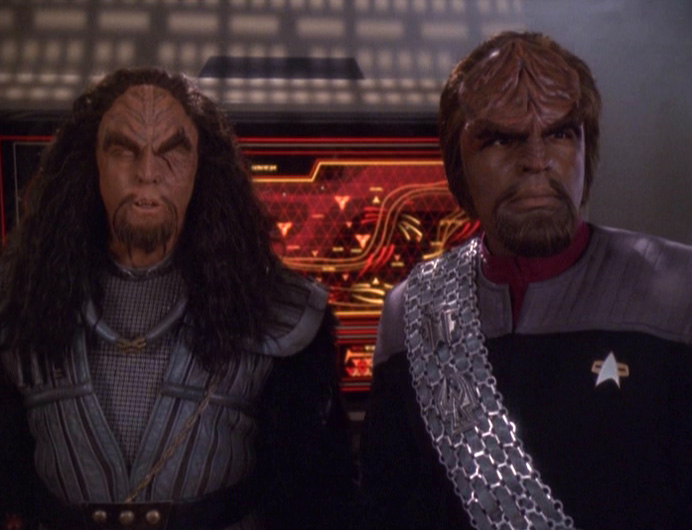
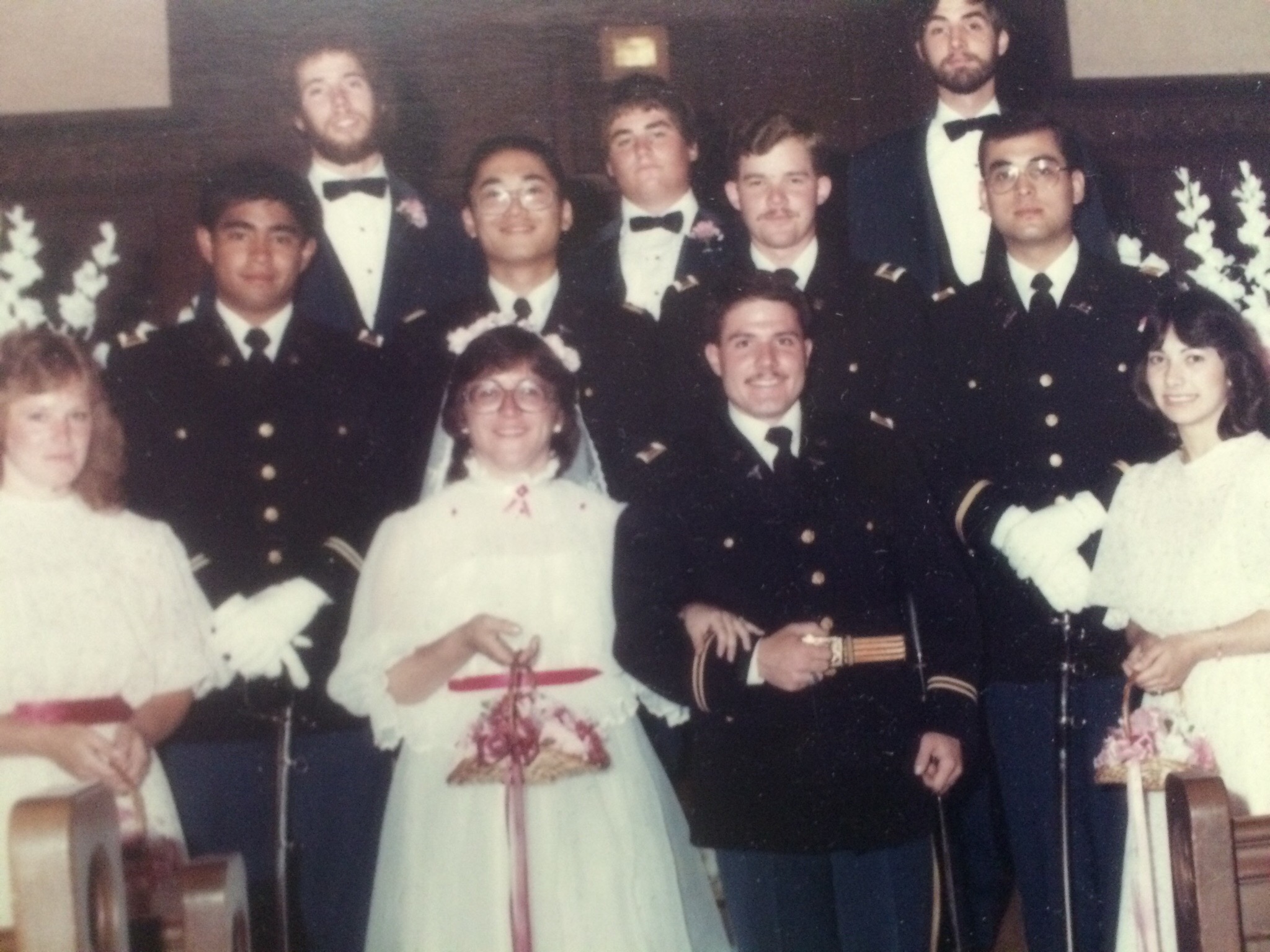
However, some of us get lucky and Cupid, the flying naked kid armed with a bow and arrow, shoots us in the ass one day and we discover that one true love. That happened to me in September of 1978 when I met Judy. I fell in love with her that night, but it took a while to develop. We are coming up on our 37th marriage anniversary this June, 6 days after my projected retirement ceremony, which is exactly 37 years after I was commissioned as an Army Second Lieutenant on June 19th 1983. My career in the military, in the Army and Navy has been difficult on her, especially after I came home from various deployments and combat deployments. Though I am now, and have been a chaplain since 1992, I have always been a warrior and soldier at heart, even when unarmed on combat deployments and getting shot at. Thus I find that I am very much attracted to the Klingons in Star Trek the Next Generation and Deep Space Nine, because it is in those series we discover just how complex Klingon culture, traditions, and religious beliefs are. Thankfully for me Judy shares my love of Star Trek, especially DS9. 

So I was thinking about what to do for her this Valentine’s Day as for much of my life I have been pretty lousy at giving her the attention and honor she is due, especially things like Valentine’s Day, birthdays and anniversaries. No doubt, though a faithful husband, I pretty much have been at the Mendoza Line when it comes to romance. Part of this is because of the fact that for close to half of our marriage I have been away from home, and came back pretty messed up from war.

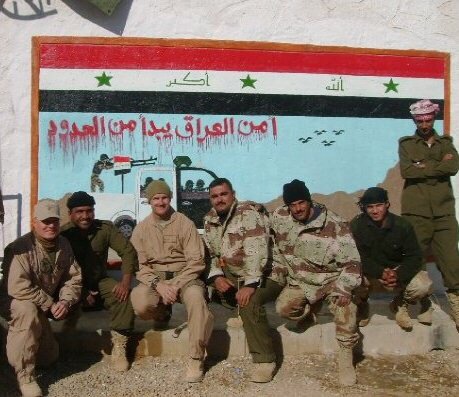
When I was going through my Clinical Pastoral Education Residency at Parkland Memorial Hospital in Dallas following Seminary, that my CPE Supervisor, Steve Ivy was able to connect my compartmentalization of my emotions with Lieutenant Worf, the Klingon Security Officer of the Enterprise in Star Trek the Next Generation played by Michael Dorn, who reprised the role in Star Trek Deep Space Nine. For me that was an eye opening experience. Though I was by that time an ordained minister, and two years later a Priest, I was always a warrior at heart, wanting, desiring, and volunteering time and time again for dangerous assignments. My first 17 1/2 years in the military were in the Army National Guard, active Duty Army, and Army Reserve, and even though I was mobilized to support Operation Joint Endeavor, the Bosnia Peace Enforcement mission, but in a purely support role. I was not until I entered the Navy, taking off my rank as a Major in the Army Reserve to return to active duty as a Navy Lieutenant in February 1999, and the attacks of 9/11/2001 that I got my chance for action at sea in 2002 in Operation Enduring Freedom and the UN Oil Embargo on Iraq in 2002, where I served as an “advisor” to a boarding team, numerous trips to Marine Security Forces in the Middle East from 2003 to 2006, and service in Iraq from 2007 to 2008 with the Advisors of the Iraq Assistance Group in Al Anbar Province, from the Syrian Border to Fallujah and about everywhere in between. It was an amazing combat tour, mostly outside the big bases, working with small teams of American advisors and Iraqi Army, Police, and Border forces. It was the best and most rewarding of tours of my career, but I came back changed. Since I have written about those experiences many times, I won’t go into details, but if I could have remained in Iraq supporting the advisors I would have stayed on indefinitely, and would have gone back given the chance. I left a lot of my soul in Iraq and I pray for the Iraqis, soldiers and civilians alike, who befriended me as the man they called the American Imam. But I digress…

But back to the Klingons, love, marriage, and Valentine’s Day. In one of the early Next Generation episodes Lieutenant Worf is asked by young Wesley Crusher what Klingon courtship is like. Worf replied:

I will sing Klingon love poems while she throws furniture. I duck a lot.

So today I posted a quote from DS9 on my Facebook timeline this morning while waiting at the Medical Center pharmacy. It was from an episode titled Looking for par’Mach in All the Wrong Places where the Ferengi Bartender, Quark ends up helping his Klingon ex-wife Grilka to deal with the financial situation of her House, which he helped her to gain following the death of her husband. Quark is forced to do battle with Grilka’s bodyguard who cannot abide a Ferengi being part of her house. The bodyguard issues a challenge which Quark could never match without help, which Worf and Jadzia Dax give him, but there is a technical glitch and to stall for time Quark issues a supposed Ferengi tradition, which he invented on the spot, The Right of Proclamation, a speech about his love for Grilka:

To this end my blade soars through the
aquarium of my soul seeking the
kelp of discontent which must be cut so that the
rocky bottom of love lies in waiting, with fertile
sand of the coming seed of Grilka’s
affection.
And yet, does this explain my need for her? No. It is like
oh, a giant cave of emptiness waiting for
the bats of love to hang by –

Judy responded by telling people that she would look at my medication list and look for side effects, and that people could direct message her. It was a perfect riposte.

But Quark’s words are those are the words of a Ferengi, not a Klingon, though Quark gave it his best. As Worf gets ready to marry Jadzia, she has to be approved by the matriarch of the House of Martok, and she makes Jadzia’s life hell.

But Martok encourages Worf, saying:

We are not accorded the luxury of choosing the women we fall in love with. Do you think Sirella is anything like the woman I thought that I’d marry? She is a prideful, arrogant, mercurial woman who shares my bed far too infrequently for my taste. And yet… I love her deeply. We Klingons often tout our prowess in battle, our desire for glory and honor above all else… but how hollow is the sound of victory without someone to share it with? Honor gives little comfort to a man alone in his home… and in his heart.” 

When Jadzia successfully passes the tests of Martok’s wife Sirella, the traditional Klingon wedding takes place in Quark’s bar on DS9. The traditional Klingon marriage includes the Klingon creation story, which is enacted by the bride and groom. It certainly is not a Christian understanding of creation, but it does encapsulate the depth of love between two people:

With fire and steel did the gods forge the Klingon heart. So fiercely did it beat, so loud was the sound, that the gods cried out, ‘On this day we have brought forth the strongest heart in all the heavens. None can stand before it without trembling at its strength.’ But then the Klingon heart weakened, its steady rhythm faltered and the gods said, ‘Why have you weakened so? We have made you the strongest in all of creation. And the heart said ‘I am alone.’ And the gods knew that they had erred. So they went back to their forge and brought forth another heart. But the second heart beat stronger than the first, and the first was jealous of its power. Fortunately, the second heart was tempered by wisdom. ‘ If we join together, no force can stop us.’ And when the two hearts began to beat together, they filled the heavens with a terrible sound. For the first time, the gods knew fear. They tried to flee, but it was too late. The Klingon hearts destroyed the gods who created them and turned the heavens to ashes. To this very day, no one can oppose the beating of two Klingon hearts… 
After either courting each other or being married for over forty years I think that Judy and I are a lot like Klingons. I am the proud, yet damaged warrior, she is the proud and faithful wife, and after all these years our hearts beat together.

This may not make a lot of sense to some readers, unless you are true Star Trek nerds, not that there is anything wrong with that.

The thing is that for all its commercialization, and despite the pain that often accompanies love, that Valentine’s Day is a celebration of love between two people, when their hearts beat together. One of my office mates lost his wife of 38 years two and a half years ago. If someone had not told me that he was a widower, it would be hard to guess it. When we talk about life, music, television, life, and family, he speaks of her in such a way that I know that his love for her did not die when she did. Their hearts still beat as one, and I love that, I wish I had actually met her. But, he has his son and other relatives in the local area and still lives a rich life, he is happy, and is still in love with her.

I hope and pray that everyone gets to experience that kind of undying love.

Until tomorrow,

Peace,

Padre Steve+


2 Comments

Filed under iraq, life, marriage and relationships, Military, PTSD, star trek, televsion, Tour in Iraq, us army, US Navy, War on Terrorism

When the President Calls Military Officers Traitors: Trump, LTC Vindman, and the Testimony of Colonel Johannes Steinhoff

Friends of Padre Steve’s World,

Yesterday, the Commander in Chief, after removing Lieutenant Colonel Alexander Vindman from his post in the National Security Council, and having him escorted out of the White House, something designed to humiliate the combat wounded officer, made an announcement that Vindman should be prosecuted by the military for obeying his oath of office, also known as not giving absolute personal loyalty to the President. The action by the President is unprecedented in American history. It is the act of an man unleashed from the law, the the Constitution, and the institutional guardrails placed by the Founders to prevent an authoritarian regime from taking control of the country.

I have written a lot about the dehumanization of people and genocide, and some of the things that create a climate where such events take place, and how political and religious leaders stir the primal passions of otherwise good, decent and law abiding citizens. I have written about some of my favorite resistance figures in history. But that being said writing about the anti-Nazi resistors caused me to go back are re-read a book by World War II German Luftwaffe ace Johannes Steinhoff.

Steinhoff was unlike many of the German officers who wrote memoirs following the war, memoirs that historian Williamson Murray wrote “fell generally into two categories; generals writing in the genre of “if the fuhrer had only listened to me!” and fighter pilots or tank busters writing about their heroics against the productive flood from America or the primitively masses of the Soviet Union.”

Steinhoff’s book, The Final Hours: The Luftwaffe Plot Against Goering should be essential reading for any currently serving officer, diplomat, Federal law enforcement, intelligence, or Department of Justice official  as the Trump administration becomes more established and capricious.

steinhoff6

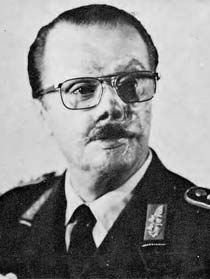
General Johannes Steinhof (above) as a Bundeswehr and NATO officer, showing his burns and before his crash (below)

steinhoff WW II

In his books, Steinhoff does something that you do not see authors do in most military or political memoirs, he actually does serious self reflection on his role in supporting an evil regime. In his introduction to his book The Final Hours the legendary fighter ace who was horribly disfigured when his Me-262 jet fighter crashed and burned two weeks prior to the end of the war wrote:

“In recalling these events, which had been long buried in my memory, it has not been my intention to make excuses. Our unconditional self-sacrifice in the service of the Third Reich is too well documented for that….

So it is because of what is happening today—with freedom threatened in virtually every respect by its own abuse—that I offer this contribution, in the form of an episode in which I was myself involved, to the history of the soldier in the twentieth century. Soldiers have always, in every century of their existence, been victims of the ruthless misuse of power; indeed, given the opportunity, they have joined in the power game themselves. But it fell to our own century to accomplish, with the aid of a whole technology of mass extermination, the most atrocious massacres in the history of mankind. This fact alone makes pacifism a philosophy worthy of respect, and I have a great deal of sympathy with those who profess it. 

The figure of the soldier in all his manifestations is thus symptomatic of the century now nearing its close, and it is to the history of that figure that I wish to contribute by describing what happened to me. I have tried to show what it is possible to do to men, how insidiously they can be manipulated by education, how they can be hoisted onto a pedestal as “heroes,” how they can be so corrupted as even to enjoy the experience—and how they can be dropped and denounced as mutineers when they discover that they have scruples. The complete lack of scruples that such treatment implies is peculiar to rulers who believe that the problems of their own and other peoples can be solved by imposing, through the use of military force, peace on their, the rulers’, terms—in our case a pax germanica, but the second Latin word is readily interchangeable.” from “The Final Hours: The Luftwaffe Plot Against Goring (Aviation Classics)” by Johannes Steinhoff

Since I am a historian and and a career military officer with service in the Iraq War, a war that was illegal and unjust by all measure I can understand Steinhof’s words. Because much of my undergraduate and graduate work focused on German history, particularly that of Imperial Germany after the unification, the Weimar Republic, and the Nazi Reich, I draw a lot of lessons from the period. I also understand how people in this country can fall for the same kind of vitriolic propaganda that the Germans of that era did. I can understand because for years I fell for the lies and propaganda being put out by the politicians, pundits and preachers of the American political right.

In fact I wrote about an incident that happened to me in my own chapel where a dedicated Trump supporter attempted to have me charged with Conduct Unbecoming an Officer and Contempt for the President.  He did this because I used biblical preaching backed by sound theology and history to condemn the President’s comparison of immigrants of darker skin colors as “animals” and an “infestation.” I compared those words with the way Hitler and other totalitarian leaders used such terminology to dehumanize their victims. As I mentioned I was completely cleared by the preliminary inquiry but it sends a chill through my spine.

10665323_10154041610267059_5277331492232210946_n

A picture of me (on left) in Iraq 2007 with my assistant and bodyguard RP1 Nelson Lebron

One of those lessons is that in times of crisis, that people, no matter what their race, culture, religious belief system, educational, or economic background are still human. Humanity is the one constant in all of history, our prejudices are often ingrained in us during childhood and reinforced by the words of politicians, pundits, and preachers. In times of stress, crisis, and societal change or upheaval even good people, moral people, people of great intellectual, scientific abilities can fall prey to demagogues who preach hate and blame others, usually racial, ethnic, or religious minorities, as well as civil libertarians who champion the rights of those minorities for the problems of the nation.

Shrewd politicians, preachers, and pundits do this well. They demonize the target group or population and then let the hatred of their disaffected followers flow. The leaders need that disaffected and angry base in order to rise to power; such was how Hitler, Stalin, and so many other despots gained power. They took advantage of a climate of fear, and found others to blame. For Hitler it was the Jews, Slavs, Socialists and Communists; while for Stalin it was various groups like the Ukrainians, or the Poles who were the devil to be feared and destroyed. Timothy Snyder in his book Bloodlands: Europe Between Hitler and Stalin wrote:

“Dead human beings provided retrospective arguments for the rectitude of policy. Hitler and Stalin thus shared a certain politics of tyranny: they brought about catastrophes, blamed the enemy of their choice, and then used the death of millions to make the case that their policies were necessary or desirable. Each of them had a transformative utopia, a group to be blamed when its realization proved impossible, and then a policy of mass murder that could be proclaimed as a kind of ersatz victory.”

But that being said, there are a lot of people who from childhood believe the lies about others without question. In good times such people continue on with life as normal, but in crisis those hatreds and prejudices come to the fore. Rudolf Höss, the notorious sociopath who commanded Auschwitz told American Army psychologist Gustave Gilbert about his reaction when ordered to turn the camp into an extermination center. He said that the order “fitted in with all that had been preached to me for years,” and “at the same time I didn’t think of it as propaganda, but as something one just had to believe.” 

Eugene Davidson in his book on the Nuremberg Trials wrote:

“Every society has in it at all times negative, criminal, sadistic, asocial forces. What holds them in check more than law and police is the consensus of the society – a general belief that despite everything wrong and stupid and muddleheaded in politics, the state is a going concern that will somehow make its way into the future.” (Davidson, The Trial of the Germans p.581)

But when things do not go well, when people do not feel that things will be okay, that the future will be better, and that they have a purpose they look for answers. However, they tend to find their answers in the rantings of demagogues, race baiters, conspiracy theorists, and others who they would tend to dismiss out of hand in good times. In Germany it was the loss of the First World War, the humiliation of Versailles and the economic chaos and social change of the Weimar period which allowed Hitler to gain an audience, then a following, then political power. The demagogues played to what was already in the hearts and minds of the disaffected masses, without that fertile soil, the rantings of Hitler and his propagandists would have never succeeded. Albert Speer wrote:

“As I see it today, Hitler and Goebbels were in fact molded by the mob itself, guided by its yearnings and its daydreams. Of course, Goebbels and Hitler knew how to penetrate through to the instincts of their audiences; but in the deeper sense they derived their whole existence from these audiences. Certainly the masses roared to the beat set by Hitler’s and Goebbels’ baton; yet they were not the true conductors. The mob determined the theme. To compensate for misery, insecurity, unemployment, and hopelessness, this anonymous assemblage wallowed for hours at a time in obsessions, savagery and license. The personal unhappiness caused by the breakdown of the economy was replaced by a frenzy that demanded victims. By lashing out at their opponents and vilifying the Jews, they gave expression and direction to fierce primal passions.”

In a sense a similar thing has happened in the United States which has experienced a series of wars beginning with Vietnam, the shock of the 9-11-2001 attacks, the economic crash of 2007 and 2008 which devastated the savings, home ownership, and investments of many Americans while at the same time benefiting the banking and brokerage houses whose government assisted policies brought about the crash. Of course there are other issues, many religious conservatives hate the progress made by the Women’s and Gay Rights movements, and their leaders play to their fears in apocalyptic terms. I could go on, but I am sure that my readers can identify other issues which demagogues and others use to spread fear and hate to further their goals. The fact is that without the the fertile soil that lays in the hearts of their most fervent followers they would never have a following.

In Weimar Germany hate mongers like Julius Streicher and propagandist Josef Goebbels stuck a chord with disenchanted people who felt that they had lost their country. They were fearful, angry, and desired a leader who would “make Germany great again.” Hitler and his Nazi media sycophants played to that fear, and took advantage of their anger at the existing order. Davidson wrote such people “exist everywhere and in a sick society they can flourish.” 

For decades the way has been prepared for true extremists to take advantage of the fears and doubts of people as modern American versions of Streicher and Goebbels have been at work for years. Rush Limbaugh was a modern pioneer of this in the United States, and he has been joined by so many who are even more extreme in their rantings that it is hard to name them all. Likewise, whole media corporations especially Fox News, websites, and political networks spread such fear every minute of the day, claiming that they, and they alone are real Americans. They actively support politicians who condemn, and sometimes even threaten people who oppose them, and all the while claim that “make America great again.”

When I was younger I devoured that propaganda, despite all of my learning I followed the rantings of men who I realize today are propagandists who promote the basest of lies, and hatred, often in the name of God. I was changed when I was at war, and when I returned home from Iraq in 2008 I realized through hard experience that I had been lied to, and that as a result that thousands of my brothers and sisters were dead, and tens of thousands shattered in body, mind, and spirit. Likewise I saw the massive destruction levied on Iraq and realized how terrible war really is. That was my epiphany, that is what it took to see how much I had been lied to, and it called me to question everything else that I had so willingly believed, things which had been fed to me by years of indoctrination in church, through the media, and by politicians who I believed were truly Christian. I can understand now how Martin Niemoller felt after the Nazi seizure of power when he said, “I hated the growing atheistic movement, which was fostered and promoted by the Social Democrats and the Communists. Their hostility toward the Church made me pin my hopes on Hitler for a while. I am paying for that mistake now; and not me alone, but thousands of other persons like me.”

There was a time that I hated people who espouse the views that I hold today, the views that I write about so often here on this site. I can remember how angry I would get as I listened to the propaganda being put out by Limbaugh, Hannity, the Fox News Channel and all of the others that I listened to every time that I had the chance. But when I changed after Iraq, I felt the sting of that hatred in very real ways. I remember the day I was called by my bishop in my former church, who told me that I had to leave because my views on women, gays, and Moslems were to use his words were now “too liberal.” After that, many men who I considered to be the best of friends turned their backs on me, some in the most bitter and vindictive of ways.

But I realize now that what they did was because I had in a sense left the cult, and had to be ostracized. I can understand that now, because when I was under the spell I too turned my back on people who had fallen out of favor, or people who had rejected the tenants of the church or the political movement, and those are things that I can never undo. But at the time it made sense, it fitted in with all I had been taught for decades, as Albert Speer wrote of Hitler, “One seldom recognizes the devil when he is putting his hand on your shoulder.”

What happened to Steinhoff’s generation is threatening to happen again, in our country, an authoritarian movement is threatening to destroy our democracy and republic. In it soldiers are esteemed, until they realize what is going on and speak out, but by then it is usually too late. I am understanding that fact more and more every day, and having had people troll this blog and call me a traitor and worse, I understand just a bit of what happened to Steinhoff and his fellow officers when they protested to the highest levels what was happening to Germany in early 1945.

In 1944 he and other fighter pilots were subjected to a political indoctrination session and realized that in the Nazi state loyalty and doctrinal purity to Naziism was more important than either combat service or competence. He wrote:

“Now, however, we realized to our horror that a group of officers had decided, after five years of war, to conduct a purge among the troops with the object of eliminating all those “whose past life and present conduct were not consonant with the National-Socialist type” and who did not “stand firm on National-Socialist principles.” We sat there petrified, but some of those present appeared hugely to enjoy the ensuing discussion of what they called “National-Socialist guidelines.” Perhaps, though, for many it was simply an attempt to escape into a less concrete area of discussion than the desperate military situation—and then there was the added satisfaction of being able to censure others. Fanaticism took the place of hopelessness, and phrases like “faith in the Führer,” “rootedness in National-Socialist ideology,” and “irreproachability of character” fell without hesitation from people’s lips. The Luftwaffe leadership, it was said, must be “combed” from top to bottom, and then someone even came out with the “National-Socialist soul…”

We will soon know how military professionals react to being labeled as traitors. President Trump and his followers have been demonizing the personnel of the nation’s intelligence, law enforcement, and diplomatic communities since before the election. The President lambasts critics of any station on his Twitter feed which results in them receiving death threats from his followers. I expect that when Secretary of Defense James Mattis speaks his mind and tells the truth that we will find out.

Personally I expect that when he does that Trump and his most strident supporters will label him as a traitor for doing so. Like a religious cult they have no capacity to tolerate dissent, loyalty to the man will supersede loyalty to the country or the Constitution. When that happens it will be interesting to see the throngs of people in the military and outside of it who make the choice to throw one of the most courageous, selfless, and intellectual soldiers ever produced by our nation under the bus.

Their’s will be a conscious decision. My opinion is that the Constitution and the country will always come first. I wanted to give the President the benefit of the doubt and prayed that he world do the right thing for the country. But I was wrong. I am concerned because of his past and current behavior that his only loyalty is to himself. General Ludwig Beck, who resigned rather than obey Hitler’s order to invade Czechoslovakia in 1938 and died in the anti-Hitler coup attempt in 1944 said:

“It is a lack of character and insight, when a soldier in high command sees his duty and mission only in the context of his military orders without realizing that the highest responsibility is to the people of his country.” 

With all the firings, resignations and shuffling done by the President at the Defense Department, I am less sure than ever of senior officers and civilian leaders in the Pentagon will due with the direct threat directed by the President at Lieutenant Colonel Vindman. Over the past three years I have have many doubts about many of our leaders: be they military, political, business, or religious, than I have ever had in my life and military career. It seems that there are many people who will sell their souls for their personal advancement, the advancement of their agenda, or an increase in their bottom line. It is after all human nature.

At Nuremberg, Hermann Goering was asked by Gustave Gilbert as to “why he and the others had been such abject “yes men,” Goering replied: “Please show me a ‘no man’ in Germany who is not six feet under the ground today.” Goering, who was exceptionally intelligent and talented subordinated himself to Hitler and while not completely correct in regards to the fate of all the “no men” completely understand the principle of unconditional personal loyalty to his leader, which makes the actions of men like Johannes Steinhoff much more remarkable.

But the question is: will we see true men and women of courage who will stand when it appears there is no chance of success? As Atticus Finch said in To Kill a Mockingbird: “Real courage is when you know you’re licked before you begin, but you begin anyway and see it through no matter what.” 

That will be what is demanded in the coming months and years.

Peace

Padre Steve+

9 Comments

Filed under civil rights, ethics, History, leadership, Military, nazi germany, News and current events, Political Commentary, us army, world war two in europe

“Mislead by a Blind Sense of Duty” Field Marshal Erich Von Manstein and His Epic Counterstroke of February 1943

Friends of Padre Steve’s World,

I’m pullings something out of my archives today. It’s actually a paper I wrote for one of my Masters Degree Classes back in 2009 that I decided to post on the site. Since then I have done much more study on the battle from other sources, many more critical of Manstein and revealing of the crimes committed by his troops on the Eastern Front.  I have been reading Paul Carrell’s Unternehem Barbarossa Im Bild (Operation Barbarossa in Pictures) in German I decided to repost it today.  I could probably do more with it but except for more biographical work on Von Manstein I don’t expect that I will. For me character matters more than battlefield brilliance.

The article deals with the crisis that the German armies faced following Stalingrad and how Field Marshal Erich von Manstein succeeded in talking Adolf Hitler out of certain defeat and inflicting a massive defeat on the now overconfident and over extended Soviet armies.

Von Manstein was a brilliant strategist, his bold plan to conquer France in 1940 was a masterpiece, and his conduct of combat operations on the Eastern Front until his relief in March of 1944 for withdrawing (and saving) his armies from Soviet destruction without Hitler’s approval. Von Manstein was a brilliant commander at the operational level of war, but he also gave his approval and support to war crimes committed by the SS Einsatzgruppen against the Jews and others in his area of operations. He believed that Bolshevism and the Jews were linked, thus in his codicil to Von Reichenau’s Severity Order in November 1941 stated:

“Jewish Bolshevik system must be wiped out once and for all and should never again be allowed to invade our European living space … It is the same Jewish class of beings who have done so much damage to our own Fatherland by virtue of their activities against the nation and civilisation, and who promote anti-German tendencies throughout the world, and who will be the harbingers of revenge. Their extermination is a dictate of our own survival.”

This article depicts Manstein at his zenith when even Hitler was forced to give in to his logic, but barely a year later Hitler relieved him of command as Manstein remained committed to a mobile defense surrendering space while attempting to maximize Soviet casualties.

He is a complex character, he defended German Jews in the Reichswehr yet went on to cooperate in the deaths of hundreds of thousands of Jews in Russia. There is a decent possibility that he had some Jewish ancestry, he opposed the Aryan Paragraph which banned Jews from serving in the German armed forces telling General Ludwig Beck that anyone who had volunteered to serve had already proved their worth. Part of this may have been to protect mixed race grand-nephews who were already serving in the Reichswehr and his concern that he might have Jewish blood. The SS launched an investigation regarding this, but never completed it. The results of what they found or did not find are unknown. It makes me wonder if I could make an extended trip to Germany and do some research on the topic because for all of his other anti-Semitic beliefs, he did not believe that the Germans had murdered the number of Jews that they did. Von Manstein’s criticisms of Hitler were restricted to the conduct of the war, not the political and moral aspects that formed the heart of Nazi policy and the Holocaust.

Though he knew that Hitler was leading Germany to destruction, he rebuffed his colleagues who attempted to kill Hitler and the overthrow the Nazi regime. Likewise, though he was tried and convicted of war crimes he was given an early release from prison at the behest of Winston Churchill, Konrad Adenauer and other notables. After his release he went on to advise the German government on the organization of the new Bundeswehr, and become something of a celebrity among military history students, and military officers, especially Britain and the United States.

Manstien’s  post war writings were highly critical of Hitler and for the most part he succeeded in rehabilitating himself, in large part with the help of  Western military historians and theorists of mobile warfare. The men looked at the military aspects of the war and built what amounted to a cult around him and German military operations, with scant regard to the murderous policies of the Nazis. When Manstein died in 1973 at the age of 85 he was the last surviving German Field Marshal and was buried with full military honors.

While it is true that Manstein was a brilliant commander and strategist, he aided and abetted one of the most criminal regimes in history. The German magazine Der Spiegel wrote of him: “He assisted in the march to catastrophe—misled by a blind sense of duty.”

My concern today is if American Generals will be misled by their blind sense of duty and assist in a march to catastrophe as President Donald Trump obliterates all legal, Constitutional, and institutional guardrails our Founders placed to prevent authoritarian rule.

Until tomorrow,

Peace,

Padre Steve+

Introduction

After Stalingrad the Soviets followed up on their success and attempted to entrap the rest of Army Group South. Field Marshall von Manstein attempted to save the Army Group and perhaps prevent the Soviets from collapsing the entire German front.
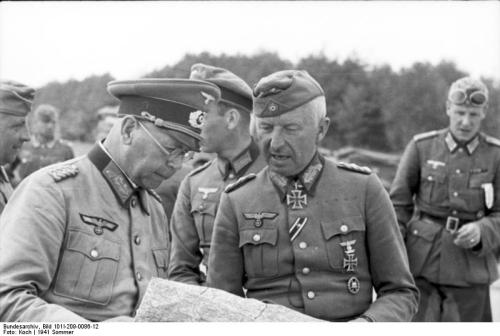
Bild 101I-209-0086-12Manstein (center) planning at the front

Chaos and Peril in the South

As 6th Army died at Stalingrad field Marshall von Manstein was faced with one of the most challenging situations faced by any commander in modern times.  He faced strategic and operational “problems of a magnitude and complexity seldom paralleled in history.”[i] Manstein had to deal with a complex military situation where he had minimal forces to counter the moves of a superior enemy force that was threatening to entrap all German forces in southern Russia. Additionally Manstein had to deal with the “Hitler’s obstinate opposition to a maneuver defense and a Red Army flushed with the victory of Stalingrad.”[ii]Facing him were the six Russian armies of the Voronezh and Southwestern Fronts led by Mobile Group Popov[iii]. These Armies had broken through the Hungarian and Italian armies “making a breach 200 miles wide between the Donetz and Voronezh, and were sweeping westward past Manstein’s flank.”[iv]
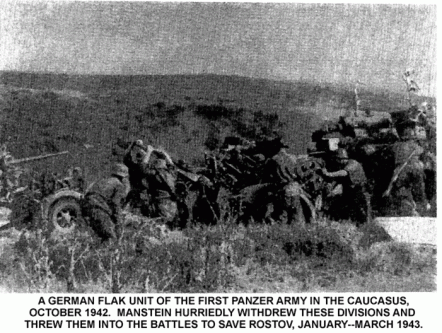
flak in caucasus

The most dangerous threat that Manstein faced was to Army Group A in the Caucasus. This Army Group “found itself in danger of being cut off, forcing an immediate withdraw.”[v] Disaster was averted by the desperate holding actions of Manstein’s meager forces, Army detachment’s Fretter-Pico and Hollidt, and winter conditions that made “offensive operations extraordinarily difficult, even for the hardiest Soviet troops.”[vi]

A smart withdraw executed by General von Kleist managed to extricate the Army group “just as the Stalingrad forces collapsed.”[vii] To parry the Soviet thrusts the Germans lacked forces to “establish a deeply echeloned defense” and “instead combined maneuver… with stubborn positional defense to give artificial depth to the battlefield.  In this way the Germans were able to break major Soviet attacks, preventing catastrophic breakthroughs….”[viii] The timely introduction of a battalion of Tiger tanks prevented the Russians from breaking through to Rostov and “cutting the rail and road lines on which First Panzer Army’s retreat depended.”[ix] Even so the escape of the Army Group was narrow. “In terms of time, space, force, and weather conditions it was an astonishing performance-for which Kleist was made a field-marshal.”[x] With the Russians only 70 kilometers from Rostov and his own forces 650 kilometers from that city Kleist executed a withdraw “which had appeared hardly possible to achieve.”[xi] The divisions extricated by Kleist would be instrumental in the coming weeks as Manstein moved to counter the Soviet offensive.
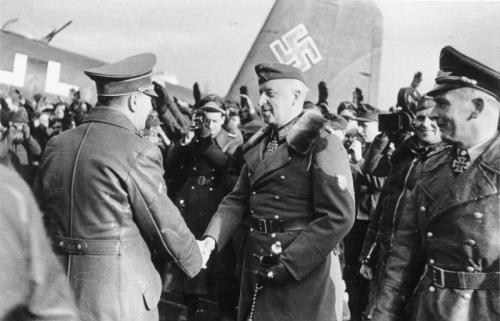
Ostfront, Adolf Hitler, Erich v. Manstein

Hitler and Manstein

Despite the successful withdraw the situation was still precarious in early February, Manstein had no effective contact with his left wing, the bulk of which was tied to Kharkov, The Russians had “virtually complete freedom of action across a fifty-mile stretch of the Donetz on either side of Izyum.”[xii] Manstein was hard pressed to “halt the raids of Mobile Group Popov and other exploiting Soviet tank corps in Operation Gallop.”[xiii] Manstein’s forces in the eastern sector had been divided by Russian penetrations, which threatened 1st Panzer Army’s western flank and blocked the Army Group’s main railway line.[xiv]

On 15 February “the SS Panzer Corps withdrew from Kharkov-in spite of orders from Hitler…that the city was to be held to the last.”[xv] SS General Paul Hausser, the corps commander realized that the order to hold Kharkov was impossible and requested permission to withdraw. This was was refused by General Lanz. Under pressure from encircling Russian forces outside and from partisans inside the city, Hausser disobeyed the order and extricated his troops,[xvi] thereby saving thousands of German soldiers and preserved the SS Panzer Corps as a fighting unit.[xvii] Lanz was relieved by Hitler for the loss of Kharkov and although Hausser would escape immediate censure, “Hitler did see it as a black mark against his name.”[xviii] With Kharkov now in Soviet hands the gap between Manstein’s army group and Field Marshal von Kluge’s Army Group Center increased to over 100 miles.[xix] It appeared that the entire German southern flank was disintegrating.  Manstein estimated the ratio of German to Soviet forces in his area at 1:8.[xx] He believed that the Soviets could advance and subsequently “block the approaches to the Crimea and the Dnieper crossing at Kherson” which would “result in the encirclement of the entire German southern wing.”[xxi] Popov’s Mobile Group crossed the Donets and reached Krasnoarmeiskaia by 12 February. Vatutin committed two additional fresh tank corps toward Zaporozhe, a critical transport node which was also the location of Manstein’s headquarters.[xxii]
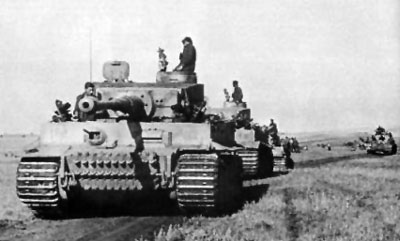
SS-Tiger-LSAH-01Tiger Tanks assigned to 1st SS Panzer Division

Hitler arrived to consult with Manstein on 17 February and remained for three days with Soviet forces perilously close.  Manstein only had some flak units and the Army Group Headquarters Company between him and Popov’s advanced elements. On Hitler’s last day “some T-34’s approached to within gun range of the airfield.”[xxiii]

The conference of Hitler with Manstein at Zaporozhe as well as a previous conference at the Wolfsschanze on 6 February was critical to the development of Manstein’s plan to restore the front. Manstein had now gotten both the 1st and 4th Panzer Armies across the Don, and “with this striking force, he felt confident of smashing the Russian offensive if he was given a free hand to withdraw from the line of the Donetz, evacuate Rostov and take up a much shorter front along the Mius river.”[xxiv] The conference on the 6th was one of the “rare moments in the war where Hitler authorized a strategic withdraw on a major scale.”[xxv] Yet as the Russians continued to advance Hitler became concerned and came to Zaporozhe.  At first Hitler would not concede to Manstein, as he wanted to assemble the SS Panzer Corps for an attack to recapture Kharkov.[xxvi]Manstein explained the need for a counter stroke and through much explanation was able to convince Hitler that the capture of Kharkov was not possible unless “we first removed the danger of the Army Group being cut off from its rear communications.”[xxvii]
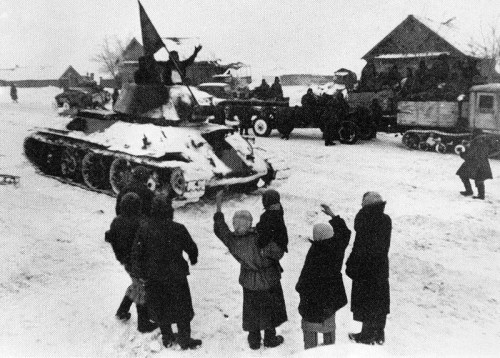
T34_Stalingrad-Offensive-px800Soviet formations advance

The Russian aim was now obvious[xxviii] and Manstein had correctly discerned their strategy.  Manstein knew that his Army Group had to hold the line on the Mius and then quickly defeat the enemy between 1st Panzer Army and Army Detachment Kempf[xxix] in “order to prevent its own isolation from the Dnieper crossings.”[xxx] The Soviets had outrun their logistics support and had suffered heavy losses of their own and had serious equipment shortages.[xxxi] Manstein explained to Hitler the opportunity offered as it was now the Russians who “were worn out” and far from their supply dumps as the Germans had been in November 1942.  Manstein “foresaw an opportunity to seize the operational initiative with a counter offensive of his own.  Manstein’s target was the Soviet armored spearheads, still careening southwestward between Kharkov and Stalino.”[xxxii] Manstein believed that when the Russian “spearhead lunged, as it must toward the crossings on the upper Dnieper,” then Hoth’s Army would be let loose again.  The three SS Panzer divisions could then “play their rightful role as avengers, and strike southeast to meet 4th Panzer Army, catching the Russian armour in a noose.”[xxxiii] Hitler agreed to Manstein’s plan and Manstein shifted 4th Panzer Army to assume control of the SS Panzer Corps, now reinforced by 3rd SS Panzergrenadier Division “Totenkopf.” Hitler reinforced Manstein and released 7 battle worn Panzer and motorized divisions for his attack.[xxxiv]

Soviet Miscalculation

It was now Stalin’s time to miscalculate. He and his subordinates “continued to believe that they were on the verge of a great victory. German defenses in southern Russia appeared to be crumbling and the Stavka sought to expand that victory to include Army Group Center.”[xxxv] To this end they diverted armies to the north and launched attacks in that direction.  However German defenses were stiff and the plan was “predicated on the assumption of continued offensive success further south.”[xxxvi] Reinforcements from Stalingrad failed to deploy and “Army Group Center’s defenses, prepared for the past year and a half proved formidable.”[xxxvii]

In the south Stalin saw the Dnieper and almost “heedlessly drove his armies towards what he thought would be the decisive victory on the banks of this huge Russian river,”[xxxviii] but, Soviet “ambitions exceeded their available resources and the skill of their commanders.”[xxxix] The SS Panzer Corps withdraw from Kharkov “further heightened the Soviet’s intoxication with victory”[xl] and confirmed their beliefs that the Germans were withdrawing.  Stalin believed that “it was inconceivable that Hitler’s Praetorian Guard would abandon Kharkov except as part of a general order to retreat.”[xli] He believed that the encirclement of Army Group South would lead to a chain reaction and quick way to victory over German forces in the east.  Believing that there was no way for the Germans to recover and establish a solid front on the Mius,[xlii] Stalin continued to drive his forces to attack, yet the Russian offensive in the south had reached what Clausewitz had called the “culminating point” and Stalin’s armies were now extremely vulnerable. “The weather, the devastated communications, and their own inexperience in maintaining the traffic density required to support a deep penetration on a narrow front had combined to force a dangerous dispersal of effort on the Russian advance which had broken down into four separate groups.”[xliii]

panzer ivfPanzers assembling to attack

The Soviet forces were now in a dangerous predicament being spread out across the entire south of Russia.  One group, composed of the 69th Army and 3rd Tank Army pushed against Army detachment Kempf west of Kharkov.  To the south the badly depleted 6th Army and 1st Guards Army were now “strung out down a long corridor they had opened between Izyum and Pavlograd,”[xliv] Mobile Group Popov was lagging further east near Krasnoarmeiskaia.   Additional units were isolated behind the front of Army Detachment Fretter-Pico and near Matveyev.  Soviet commanders believed that the Germans were in worse shape and that “the risks of dispersal were justified.”[xlv] They had not anticipated or made allowance for Manstein’s coolness under pressure and actions to preserve his armor while thinning his front “well past the accepted danger limit.”[xlvi]Likewise the Soviets did not know that the Germans had cracked the code used by the Southwest front and from 12 February on “were now privy to Popov’s and Vatutin’s thoughts,” now knowing precisely where the Russians would attack.[xlvii] Manstein had withstood temptation and Hitler’s pressure to use his reserves “for a direct defense of the Dnieper line.”[xlviii] As such he was prepared to launch a devastating counter-stroke against the dispersed and weakened Russian armies which were still advancing into the trap he planned for them. He had managed to “save his counteroffensive plan from Hitler’s shrill demands that the new reserves be thrown into battle piecemeal to prevent further territorial losses.”[xlix] The stage was now set for a two classic mobile operations.[l]

The Destruction of Mobile Group Popov, 6th Army and 1st Guards Army

Manstein launched his counter-stroke on 21 February against Popov’s Mobile Group using XL Panzer Corps under the command of General Henrici composed of the 7th and 11th Panzer Divisions and SS Motorized Division Viking. Popov’s Group was exposed. Popov had “succeed in cutting the railway from Dnepropetrovsk to Stalino and was itching to push further south to Mariupol on the Sea of Azov.”[li] The Soviets once again had failed to discern German intentions, believing that the Germans were retreating.[lii] Likewise the Soviet high command did not fully understand Popov’s situation. His force was weak in tanks and low on fuel and his Mobile Group was defeated in detail by the German Corps.  Popov’s immobilized tank and motorized rifle formations resisted desperately but were bypassed by the panzers.  The 330th Infantry Division mopped up the remnants of these formations.[liii] The key battles took place around the town of Krasnoarmeiskaia and the battle became a running battle between that town and the Donets River.[liv] Popov requested permission to retreat, but still believing the Germans to be retreating Vatutin gave a categorical “no.” The terrain in the area was “almost completely open”[lv] and “Popov’s proud Armoured Group was cut up like a cake.”[lvi] Popov extricated some of his units but “only after serious losses in manpower and equipment.”[lvii] Despite this it would not be until the 24th that Vatutin would order a halt to offensive operations.[lviii]

kharkovSS Panzers in Kharkov

As Popov sought to get his units out of the German scythe Manstein set his sights on 6th Army, 1st Guards Army and 25th Tank Corps which was approaching Zaporozhe.[lix] He assigned the task to Hoth’s 4th Panzer Army and its XLVIII Panzer Corps under General Knobelsdorf composed of the 6th and 17th Panzer Divisions and the SS Panzer Corps comprising SS Divisions LiebstandarteDas Reich and Totenkopf.[lx] Manstein gave Hoth a brief but explicit order: “The Soviet Sixth Army, now racing towards Dnepropetrovsk through the gap between First Panzer Army and Army Detachment Kempf, is to be eliminated.”[lxi]

The XLVIII Panzer Corps and SS Panzer Corps were unleashed against the exposed flank of the 6th Army and 1st Guards Army.   XLVIII Panzer Corps quickly “seized bridgeheads over the Samara River, and prepared to move north into the rear of the exhausted Soviet Sixth Army.”[lxii] The two Panzer Corps then made a coordinated concentric attack northwest which “came as a complete surprise to the Russians.”[lxiii] Das Reich thrust deep into the flank of 6th Army supported by Stukas from Richthofen’s 4th Air Fleet.  This attack dislodged one Soviet Rifle Corps and destroyed another allowing the division to capture Pavlograd while XLVIII Panzer Corps led by 17th Panzer Division pushed from the south linking up with the SS Corps. This cut off the Soviet 25th Tank Corps and threatened 6thArmy.[lxiv] What followed was a disaster for the Russians.

Despite the overwhelming evidence to the contrary Stavka and the Soviet Front commanders still believed that the Germans were retreating.  6th Army was ordered to continue its advance by the front commander who believed that the two German Panzer Corps were withdrawing.[lxv] In a few days the 17th Panzer Division “gained the Izyum-Protoponovka sector on the Donetz River, while the SS Panzer Corps took Losovaya and established contact with Army Detachment Kempf, which had joined the attack from the west.”[lxvi] XL Panzer Corps with the 3rd and 7thPanzer Divisions and 333rd Infantry Division joined in the attack on Popov’s remaining forces completing their destruction.[lxvii]

As Hoth and Hausser converged on Pavlograd, Das Reich and Totenkopf “swung left to the east and then wheeled back north again running parallel to the Russian divisions fleeing from Forty-eighth Panzer Corps. What ensured was a turkey shoot.”[lxviii]Fleeing Russian forces on the open steppe were visible and engaged at long range.[lxix] Leibstandarte helped by holding the left flank against Russian counter attacks from the units now isolated in the west,[lxx] and Totenkopf’s Grenadiers fanned out supported by Stukas to “kill or capture as many Russians as possible.”[lxxi]

By 1 March the Russian penetrations had been eliminated. Popov’s Mobile Group was smashed, 6th Army and 1st Guards Army badly mauled. 25th Tank Corps and three Rifle divisions had to be completely written off and numerous other corps and divisions took heavy casualties.  Two additional corps, encircled before the offensive began were eliminated by German forces.[lxxii] The Germans counted 23,000 Russian dead on the battlefield, and Manstein noted that “the booty included 615 tanks, 354 field pieces, 69 anti-aircraft guns and large numbers of machine guns and mortars.”[lxxiii] The Germans only took 9,000 prisoners as they were too weak, especially in infantry to seal off the encircled Soviet forces.[lxxiv] Yet the forces that escaped they were in no condition to “block the continued progress of the Panzers and SS.”[lxxv] Now there was a 100 mile gap in the Russian lines with nothing no troops to fill it and only “General Mud” could stop the Germans.[lxxvi] Manstein was not yet finished and the next phase of his operation against the Soviet formations west of Kharkov and that city were about to commence.

The Destruction of 3rd Tank Army

With the immediate threat to his Army Group eliminated and having regained the initiative, Manstein and Army Group South now “proceeded to deliver the stroke against the ‘Voronezh Front’– i.e. the forces located in the Kharkov area.”[lxxvii] But the Russians had not been idle. In order to attempt to assist 6thArmy 3rd Tank Army moved two tank corps and three Rifle divisions south and these ran into Manstein’s advancing panzers.[lxxviii] Manstein’ noted his objective now was “not the possession of Kharkov but the defeat-and if possible the destruction of the enemy units located there.”[lxxix] Between March 1st and 5th his forces advanced on Kharkov. Not knowing the Germans dispositions[lxxx]3rd Tank Army made the mistake of moving between the Leibstandarte’s defensive positions and the attacking divisions of the SS Panzer Corps. Hausser wheeled Totenkopf around and completed an encirclement of these units near Bereka on 3 March.[lxxxi] The Russians made futile attempts to break out but the SS Divisions tightened the noose around them and they were eliminated by the SS Panzer Corps which “engaged in concentric attacks during the three days of hard fighting.”[lxxxii] Even Regimental commanders like Heinz Harmel of Das Reich’s Der Fuhrer regiment became engaged in close combat with the Russians.[lxxxiii] The battle was fought in “snowstorms whose intensity caused the SS severe privations.”[lxxxiv] Totenkopf and Das Reich slammed the Russians “back against the Tiger tanks and assault guns of the Leibstandarte.”[lxxxv] The elimination of these units netted another 12,000 Russians killed,[lxxxvi] knocking “out the last remaining obstacle between the Germans and Kharkov.”[lxxxvii]

Return to Kharkov and Controversy

Manstein turned his attention to Kharkov, supported by Richthofen’s 4th Air Fleet which for the last time in Russia “provided undisputed air superiority for a major German mechanized operation.”[lxxxviii] He decided to “roll up the enemy from the flank and force him away from Kharkov in the process.”[lxxxix]He ordered a “pincer on the town, sending Grossdeutschland around to the north with a reinforced Kempf detachment and the combined force of Hoth and the SS to attack the town from the south and rear.”[xc] Manstein planned to make a wide envelopment to avoid embroiling his panzers in costly urban combat stating “that at all costs the Army Group wished to avoid Kharkov’s becoming a second Stalingrad in which our assault forces might become irretrievably committed.”[xci] To this end he sent Das Reich and Totenkopf which were approaching from the south to west of the city[xcii] while XLVIII Panzer Corps swung east toward the Donetz.[xciii] As Hoth’s forces came up from the south to envelope the city, Grossdeutschland and the XI and LI Corps fought the Russians to the north and west,[xciv] eventually moving up to Belgorod.  By 8 March lead elements of the SS Panzer Corps were on the outskirts of the city.

At this point there is some controversy as to German actions. As noted Manstein wished to avoid urban combat and desired to surround the city and force its surrender.  According to one writer Hoth ordered Hausser “to seal off the city from the west and north and to take any opportunity to seize it.”[xcv] Others including Glantz and House and Murray and Millett state that Hausser “ignored a direct order” and attacked into the city.[xcvi] Manstein does not explicitly say that there was a direct order but notes that the Army Group “had to intervene vigorously on more than one occasion to ensure that the corps did not launch a frontal attack on Kharkov.”[xcvii] Sydnor states that Hausser ignored a direct order by Hoth on the 11th by detailing a battalion of Totenkopf to assist Das Reich and Leibstandarte in retaking Kharkov by direct assault. The order entailed pulling Das Reich out of the city and taking it to the east.[xcviii] Lucas adds that this order came in the midst of hard fighting in the city and could not be carried out by the division.[xcix]Carell notes that on 9 March Hoth instructed Hausser that “opportunities to seize the city by a coup are to be utilized,”[c] and goes into detail regarding how Hoth’s 11 March order applied to Das Reich. It was to be pulled out of action and brought east, but division was heavily engaged and in the process of breaking through Soviet defenses “quicker in fact than if he had pulled “Das Reich” out of the operation and led it all the way round the city along those terrible muddy and time wasting roads.”[ci] In the end the SS took Kharkov, Manstein said that the city “fell without difficulty”[cii] while others note the difficulty of the action and the casualties suffered by the SS.  Kharkov’s capture; the defeat of Rokossovsky’s campaign against Orel and the beginning of the spring Rasutitsa ended the winter campaign and stabilized the front.

Analysis

The Russian winter offensive following Stalingrad had great potential.  Manstein said: “the successes attained on the Soviet side, the magnitude of which is incontestable.”[ciii] The greatest Soviet shortcomings were inexperience in conducting deep mobile operations and the inability of their logistics system to keep up with their advance.  Clark notes that this was their “first experience of an offensive war of movement on a large scale.[civ] Glantz and House are not alone in noting that the “Stavka continued to undertake operations that were beyond its resources.”[cv] Murray and Millett state that they “lacked the operational focus that had marked the Stalingrad offensive.”[cvi] Had they had the resources and ability to execute their plans they might have destroyed all German forces in the south.  They misread German intentions based on their own over-optimistic expectations opened their forces to Manstein’s devastating counter stroke.  Von Mellenthin, possibly showing some prejudice commented that the Russian soldier “when confronted by surprise and unforeseen situations he is an easy prey to panic.”[cvii]

The Germans snatched victory out of what appeared to be certain defeat aided by Russian mistakes and operational shortcomings.  Manstein refused to panic and conserved his forces for his counterattack.[cviii] Kleist brought his Army Group out of what might have been encirclement worse than Stalingrad.  Hitler for the most part gave Manstein operational freedom which he had not provided other commanders.  German Panzer forces conducted mobile operations against superior enemy armored forces and bested them.  Landsers held their own in at critical junctures, especially on the Mius and gave Manstein the opportunity to employ the panzers in the mobile defense.[cix] The Luftwaffe recovered its balance and the coordinated operations between it and German ground forces gave them an edge at a point where the Red Air Force was unable to support the Red Army.[cx] Above all the Germans still maintained the edge in both overall quality of generalship, especially that of Manstein and Kleist, but not to exclude Hoth, Hausser and lower level commanders.  Additionally the average German soldier still maintained an edge over his Soviet adversary in the confusion of mobile operations in open terrain.   Manstein and his forces gave Hitler breathing room on the eastern front.[cxi] As Clark notes: “few periods in World War II show a more complete and dramatic reversal of fortune than the fortnight in February and the first in March 1943…it repaired its front, shattered the hopes of the Allies, nipped the Russian spearhead. Above all it recovered its moral ascendancy.”[cxii]

Notes 


[i] Von Mellenthin, F.W. Panzer Battles: A Study of the Employment of Armor in the Second World War. Translated by H. Betzler, Ballantine Books, New York, NY, 1971. Originally Published University of Oklahoma Press, 1956. p245

[ii] Glantz, David M. and House, Jonathan. When Titans Clashed: How the Red Army Stopped Hitler. University Press of Kansas, Lawrence, KS. 1995. p.143

[iii] Ibid. Glantz. P.143. These units include 3rd Tank Army, 1st and 3rd Guards Armies and the 6th, 40th and 69th Armies.

[iv] Liddell-Hart. B.H. Strategy.  A Signet Book, the New American Library, New York, NY 1974, first published by Faber and Faber Ltd. London, 1954 and 1967. p.253

[v] Raus, Erhard. Panzer Operation: The Eastern Front Memoir of General Raus, 1941-1945. Compiled and Translated by Steven H Newton. Da Capo Press a member of the Perseus Book Group, Cambridge, MA 2003. p.185

[vi] Murray, Williamson and Millett, Allan R. A War to Be Won: Fighting the Second World War, The Belknap Press of Harvard University Press, Cambridge MA. 2000. pp.291-292

[vii] Liddell-Hart, B.H. History of the Second World War. G.P. Putnam’s Son’s, New York, NY. 1970  p.478

[viii] Wray, Timothy A. Standing Fast: German Defensive Doctrine on the Russian Front in World War II, Prewar to March 1943. U.S. Army Command and General Staff College, Fort Leavenworth, KS. 1986. p.161

[ix] Ibid. Murray and Millett. p.292

[x] Ibid. Liddell-Hart, Second World War. p.479

[xi] Liddell-Hart, B.H. The German Generals Talk. Quill Publishing, New York, NY. 1979. Copyright 1948 by B.H. Liddell-Hart. pp.211-212.

[xii] Clark, Alan. Barbarossa: The Russian-German Conflict, 1941-45.Perennial, an Imprint of Harper Collins Books, New York, NY 2002. Originally published by William Morrow, New York, NY 1965. pp.299-300

[xiii] Glantz, David M and House, Jonathan. The Battle of Kursk.  University Press of Kansas, Lawrence, KS. 1999. p.11

[xiv] Manstein, Erich von. Lost Victories. Translated by Anthony G. Powell, Zenith Press, an imprint of MBI Publishing Company, St Paul, MN. 2004. First Published as Verlorene Siege Athenaum-Verlag, Bonn, GE 1955, English edition Methuen & Company Ltd. 1958  p.417

[xv] Ibid. Clark. p.300

[xvi] Carell, Paul. Scorched Earth: The Russian German War 1943-1944. Translated by Ewald Osers, Ballantine Books, New York, NY 1971, published in arrangement with Little-Brown and Company. pp.196-199

[xvii] Lucas, James. Das Reich: The Military History of the 2nd SS Division.Cassell Military Paperbacks, London, UK, 1999. First published by Arms and Armour, 1991. p.91  Glantz and House criticize Hausser saying that the SS Panzer Corps Staff lacked the experience to perform its mission.  (Titans Clashed p.144) Most other commentators agree with the necessity of his withdraw.

[xviii] Messenger, Charles. Sepp Dietrich: Hitler’s Gladiator. Brassey’s Defence Publishers, London, 1988. p.113

[xix] Ibid. Clark. p.300

[xx] Ibid. Manstein. p.419

[xxi] Ibid. Manstein. pp.418-419

[xxii] Ibid. Glantz and House. When Titans Clashed. p.144

[xxiii] Ibid. Clark. p.300

[xxiv] Ibid. Von Mellenthin. p.251

[xxv] Ibid. Carell. p.191

[xxvi] Ibid. Manstein. p.424.

[xxvii] Ibid. Manstein. p.428

[xxviii] Ibid. Liddell-Hart. Second World War. p.481

[xxix] This had previously been Army Detachment Lanz, but Lanz had bee relieved over the loss of Kharkov.

[xxx] Ibid. Manstein. p.429

[xxxi] Ibid. Murray and Millet. p.292

[xxxii] Ibid. Wray. p.162

[xxxiii] Ibid. Clark. p.302.

[xxxiv] Ibid. Glantz and House. When Titans Clashed. p.145

[xxxv] Ibid. Glantz and House. When Titans Clashed . pp.144-145

[xxxvi] Ibid. Glantz and House. When Titans Clashed. p.146

[xxxvii] Ibid. Murray and Millett. p.293

[xxxviii] Ibid. Carell. p.191

[xxxix] Ibid. Murray and Millett. p.292

[xl] Ibid. Carell. p.199

[xli] Ibid. Carell. p.199

[xlii] Ibid. Carell. p.193

[xliii] Ibid. Clark. p.303

[xliv] Ibid. Clark. p.304

[xlv] Ibid. Clark. p.304

[xlvi] Ibid. Clark. p.304

[xlvii] Ibid. Carell. p.210

[xlviii] Ibid. Liddell-Hart. Strategy p.253

[xlix] Ibid. Wray. p.163

[l] Ibid. Glantz and House. When Titans Clashed. p.147. Note comments by Glantz and House in footnote 31 on relative strengths of forces involved, especially the weakness of German forces.

[li] Butler, Rupert. SS Wiking: The History of the Fifth SS Division 1941-45.Casemate, Havertown, PA. 2002. p.93

[lii] Ibid. Carell. p.211

[liii] Ibid. Carell. p.210

[liv] Ibid. Glantz and House. When Titans Clashed. p.147

[lv] Ibid. von Mellenthin. p.253

[lvi] Ibid. Carell. p.210

[lvii] Ibid. Murray and Millett. p.293

[lviii] Ibid. Carell. p.213

[lix] Ibid. Glantz and House. When Titans Clashed. p.147

[lx] There is difference in various accounts as to which units composed these Panzer Corps. Von Mellenthin adds 11th Panzer to the XLVIII Panzer Corps and some accounts do not list the Liebstandarte as part of the SS Panzer Corps.

[lxi] Ibid. Carell. p.211

[lxii] Sydnor, Charles W. Soldiers of Destruction: The SS Death’s Head Division 1933-1945. Princeton University Press, Princeton NJ. 1977. p.268

[lxiii] Ibid. Von Mellenthin. p.252

[lxiv] Ibid. Carell. p.212

[lxv] Ibid. Carell. p.212

[lxvi] Ibid. Von Mellenthin. p.252

[lxvii] Ibid. Carell. p.213

[lxviii] Ibid. Sydnor. pp.268-269

[lxix] Ibid. Von Mellenthin. p.253

[lxx] Meyer, Kurt. Grenadiers. Translated by Michael Mende and Robert J. Edwards. J.J. Fedorowicz Publishing Inc. Winnipeg, Manitoba. Canada. 2001. pp.180-181

[lxxi] Ibid. Sydnor. p.269

[lxxii] Ibid. Manstein. p.433

[lxxiii] Ibid. Manstein. p.433. Sydnor lists an addition 600 anti-tank guns and notes that the tanks were almost all T-34s. (Sydnor. p.269)

[lxxiv] Ibid. Glantz and House. When Titans Clashed. p.147

[lxxv] Ibid. Clark. p.306

[lxxvi] Ibid. Carell. p.216

[lxxvii] Ibid. Manstein. p.433

[lxxviii] Ibid. Glantz and House. When Titans Clashed. p.187

[lxxix] Ibid. Manstein. p.433

[lxxx] Ibid. Meyer. p.181

[lxxxi] Ibid. Carell. p.216

[lxxxii] Ibid. Meyer. pp.181-182

[lxxxiii] Ibid. Lucas. p.95

[lxxxiv] Ibid. Lucas. p.95

[lxxxv] Ibid. Sydnor. p.277

[lxxxvi] Ibid. Manstein. p.434

[lxxxvii] Ibid. Sydnor. p.277

[lxxxviii] Ibid. Glantz and House. Kursk. p.13

[lxxxix] Ibid. Manstein. p.435

[xc] Ibid. Clark. p.306

[xci] Ibid. Manstein. p.435

[xcii] Ibid. Sydnor. p.278

[xciii] Weingartner, James. J. Leibstandarte SS Adolf Hitler: A Military History, 1933-45. Battery Press, Nashville, TN.(no publication date listed)  p.75

[xciv] Ibid. Raus. pp.189-192

[xcv] Ibid. Messenger. p.114

[xcvi] See Glantz and House p.187 and Murray and Millett p.293

[xcvii] Ibid. Manstein. p.436

[xcviii] Ibid. Sydnor. p.278

[xcix] Ibid. Lucas. p.96

[c] Ibid. Carell. p.216

[ci] Ibid. Carell. p.219

[cii] Ibid. Manstein. p.436

[ciii] Ibid. Manstein. p.437

[civ] Ibid. Clark. p.303

[cv] Ibid. Glantz and House. p.143

[cvi] Ibid. Murray and Millett. p.292

[cvii] Ibid. Von Mellenthin. p.254

[cviii] A comment by Von Mellenthin commenting on Manstein’s coolness in the conduct of his operations compares him to Robert E. Lee. “To find another example of defensive strategy of this caliber we must go back to Lee’s campaign in Virginia in the summer of 1864. (Von Mellenthin. p.245)

[cix] For some additional comments along these lines see vn Mellenthin who notes four points in regard to the counter stroke: 1. High level commanders did not restrict the moves of armored formations, but gave them long range tasks. 2. Armored formations had no worries about their flanks because the High Command had a moderate infantry force available for counterattacks. 3. All commanders of armored formations, including corps, conducted operations not from the rear, but from the front. 4. The attack came as a surprise regarding the time and place. (Von Mellenthin p.254)

[cx] Ibid. Murray and Millett. p.293

[cxi] Despite his success Hitler was not happy with Manstein in regard to giving up ground for operational purposes and Manstein would lose much of the freedom that he enjoyed by March. Wray has a discussion of this.  See Wray. pp.162-163.  The Nazi hierarchy actively promoted the exploits of the SS Panzer Corps and its leaders, especially the commander of the Leibstandarte Sepp Dietrich. (see Weingartner pp. 76-77) The recognition of Hausser would be delayed, some speculate as a result of his disobedience in giving up Kharkov in February.

[cxii] Ibid. Clark. p.306

Bibliography

Butler, Rupert. SS Wiking: The History of the Fifth SS Division 1941-45.Casemate, Havertown, PA. 2002

Carell, Paul. Scorched Earth: The Russian German War 1943-1944. Translated by Ewald Osers, Ballantine Books, New York, NY 1971, published in arrangement with Little-Brown and Company

Clark, Alan. Barbarossa: The Russian-German Conflict, 1941-45. Perennial, an Imprint of Harper Collins Books, New York, NY 2002. Originally published by William Morrow, New York, NY 1965

Glantz, David M and House, Jonathan. The Battle of Kursk.  University Press of Kansas, Lawrence, KS. 1999

Glantz, David M. and House, Jonathan. When Titans Clashed: How the Red Army Stopped Hitler. University Press of Kansas, Lawrence, KS. 1995

Liddell-Hart, B.H. The German Generals Talk. Quill Publishing, New York, NY. 1979. Copyright 1948 by B.H. Liddell-Hart.

Liddell-Hart, B.H. History of the Second World War. G.P. Putnam’s Son’s, New York, NY.

Liddell-Hart. B.H. Strategy.  A Signet Book, the New American Library, New York, NY 1974, first published by Faber and Faber Ltd. London, 1954 and 1967

Lucas, James. Das Reich: The Military History of the 2nd SS Division. Cassell Military Paperbacks, London, UK, 1999. First published by Arms and Armour, 1991

Manstein, Erich von. Lost Victories. Translated by Anthony G. Powell, Zenith Press, an imprint of MBI Publishing Company, St Paul, MN. 2004. First Published as Verlorene Siege Athenaum-Verlag, Bonn, GE 1955, English edition Methuen & Company Ltd. 1958

Messenger, Charles. Sepp Dietrich: Hitler’s Gladiator. Brassey’s Defence Publishers, London, 1988

Meyer, Kurt. Grenadiers. Translated by Michael Mende and Robert J. Edwards. J.J. Fedorowicz Publishing Inc. Winnipeg, Manitoba. Canada. 2001

Raus, Erhard. Panzer Operation: The Eastern Front Memoir of General Raus, 1941-1945. Compiled and Translated by Steven H Newton. Da Capo Press a member of the Perseus Book Group, Cambridge, MA 2003

Sydnor, Charles W. Soldiers of Destruction: The SS Death’s Head Division 1933-1945. Princeton University Press, Princeton NJ. 1977

Von Mellenthin, F.W. Panzer Battles: A Study of the Employment of Armor in the Second World War. Translated by H. Betzler, Ballantine Books, New York, NY, 1971. Originally Published University of Oklahoma Press, 1956

Weingartner, James. J. Leibstandarte SS Adolf Hitler: A Military History, 1933-45. Battery Press, Nashville, TN.(no publication date listed)

Wray, Timothy A. Standing Fast: German Defensive Doctrine on the Russian Front in World War II, Prewar to March 1943. U.S. Army Command and General Staff College, Fort Leavenworth, KS. 1986

4 Comments

Filed under ethics, History, holocaust, leadership, Military, nazi germany, Political Commentary, world war two in europe

“I Was Sure That I Could Not Afford to Fail” Admiral Samuel Gravely and the Desegregation of the Navy

gravely

Friends of Padre Steve’s World,

Today I remember the service of Vice Admiral Samuel Gravely, a pioneer in the desegregation of the Navy and one of the first Black Naval Officers, not to mention the first to achieve Flag Rank. He was a man who, like Jackie Robinson in Baseball, knew how much was riding on his shoulders. For him failure did not reflect just on him, but on every Black man, and later woman who desired to become a Naval Officer.

Free Blacks had served in the Navy since the American Revolution and were not segregated as they later were in the Army. While none could become officers, they served in nearly every enlisted rating, alongside whites, until President Woodrow Wilson, ordered the Navy to only employ Blacks as mess stewards in 1915. Wilson, the first American President to come from a Southern State since the Civil war also greatly restricted opportunities for Blacks in the Civil Service and hosted a screening of D.W. Griffith’s monumental film commemorating White Supremacy, the Lost Cause, and the Noble South, Birth of a Nation. With the rollbacks in opportunities for Blacks in the Navy, their numbers in service dwindled, and then the Second World War broke out, and the debate regarding the integration of the military began anew, but nowhere was the resistance to Blacks serving, was in the Navy, despite the heroism of men like Dorie Miller who manned a machine gun on the USS West Virginia and attempted to save the life of his mortally wounded Captain, actions for which he was awarded the Navy Cross, which was after long delay upgraded to the Medal of Honor

Gravely wrote later:

“I was sure that I could not afford to fail. I thought that would affect other members of my race if I failed anywhere along the line. I was always conscious of that, particularly in midshipman school and any other schools I went to…I tried to set a record of perfect conduct ashore and at sea.” 

Things have changed much since 1942 when following the attack on Pearl Harbor a young black college student from Richmond Virginia enlisted in the Navy. Samuel Gravely Jr. was the son of a postal worker and Pullman porter while his mother worked as a domestic servant for white families in Richmond. His mother died unexpectedly when he was 15 in 1937 and he remained to help care for his siblings as his father continued to work. Balancing the care of his family with his education he enrolled in Virginia Union College, a Baptist school in Richmond.

gravely_young

Fireman Apprentice Samuel Gravely Jr

It is hard to imagine for most of us now to comprehend the world that the young Gravely grew up in. Segregation was the norm. Blacks in the south and many other locations faced personal as well as intrenched institutional racism. Violence against blacks was quite common and the Ku Klux Klan was strong.

The military was still segregated and a great gulf existed between white military personnel and blacks. Though the selective service law of 1940 called for the conscription of people regardless of race, creed or color the services enjoyed much latitude in determining how minorities could serve. The Secretary of the Navy at the time, Frank Knox resisted integration. Knox determined that African Americans would remain segregated and serve only as Mess Stewards to “prevent undermining and disruptive conditions in the Navy.” Knox told President Roosevelt in the presence of black leaders that “because men live in such intimacy aboard ship that we simply can’t enlist Negroes above the rank of messman.”

That sentiment to maintain the status quo of segregation was especially strong in both the Navy and the Marine Corps. The leaders of both services resisted attempts to broaden the ability for African Americans to serve and urged that blacks serve in the Army, not the Naval Service.  Marine Corps Commandant Major General Thomas Holcomb agreed with this stance. He commented:

“If we are defeated we must not close our eyes to the fact that once in they [Negroes] will be strengthened in their effort to force themselves into every activity we have. If they are not satisfied to be messmen, they will not be satisfied to go into the constriction or labor battalions. Don’t forget the colleges are turning out a large number of well educated Negroes. I don’t know how long we will be able to keep them out of the V-7 class. I think not very long.”

But President Franklin Roosevelt was not deterred and by April 1942 changes were announced to allow African Americans to serve in other capacities. Even so, the African Americans selected for ratings other than messman were to be segregated and commanded by White Officers and Petty Officers.

USS_PC-1264_officers_and_crew

images-18

The USS PC-1264 and its crew, Gravely is the lone black officer

Gravely enlisted in the Navy under these conditions. Serving as a Fireman Apprentice after receiving training as a Motor Machinist in San Diego, he worked in menial jobs. In 1943 Gravely was one of only three sailors in his unit to be selected for the V-12 officer training program. He was the only black to make the cut. He was commissioned as an Ensign on December 14th 1944 and assigned to train black recruits at Great Lakes despite the fact that the vast majority of his class went to sea. This was mainly due to the policy set forth by the General Board in 1942 that prescribed:

“(a) the white man will not accept the negro in a position of authority over him; (b) the white man considers that he is of a superior race and will not admit the negro as an equal; and (c) the white man refuses to admit the negro to intimate family relationships leading to marriage. These concepts may not be truly democratic, but it is doubtful if the most ardent lovers of democracy will dispute them, particularly in regard to inter-marriage.”

Despite this by 1945 the Navy was beginning to change. Gravely was chosen to serve on one of two ships assigned to the “experiment” of seeing how blacks in general ratings could serve at sea. The USS Mason (DE 539) and the USS PC-1264 were assigned black crews with majority white officers, except that Gravely was assigned to PC-1264. Though his commander was pleased with his service Gravely, who had been denied admittance to Officer Clubs and many other “white only” facilities resigned from the Navy in 1946. He believed that the inherent discrimination of the Navy left him no place for advancement. He returned to complete his bachelors degree at Virginia Union.

In 1949, following President Truman’s integration of the military Gravely was asked by the Navy to return to active duty. But the end of the old order was foreshadowed by a Navy pamphlet published in 1944 entitled The Guide to the Command of Negro Personnel. That publication included the statement that ”The Navy accepts no theories of racial differences in inborn ability, but expects that every man wearing its uniform be trained and used in accordance with his maximum individual capacity determined on the basis of individual performance.”

images-17

300px-USS_Taussig_(DD-746)_port_side_1965

cg29

Gravely’s commands (top to bottom) USS Theodore E Chandler, USS Taussig and USS Jouett

Gravely accepted the offer to return to active duty and never looked back. He worked hard for respect and used his natural talents, personality and size to command respect. He was a man who would blaze the way for other African Americans, and later women and most recently gays to go on to greater things. Gravely would go on to command three ships. He was the first African American Naval Officer to command a Navy warship, the USS Theodore E Chandler (DD 717), the first to command a Navy ship in combat, the USS Taussig (DD 746) and the first to command a major warship, the USS Jouett (CG 29). Promoted to flag rank he eventually became the first Black to command a Fleet when he took command of 3rd Fleet. He retired in 1980 and passed away in 2004.

h98996

Commander Gravely and his officers on USS Taussig

Gravely gave his parents and conditions of his upbringing much credit for his success. He believed that those conditions which forced him to “capitalize on his strong points, build his weak areas and sustain the positive self-esteem and self-worth that his parents instilled in him as a young child.”

He was a great leader. LCDR Desiree Linson who interviewed him for her Air Command and Staff College project noted that Gravely like many other great military leaders before him learned to manage the image that he presented, be a caretaker for his people, what we would now call a mentor. He said “[If I was CNO] my responsibility would be to make sure enlisted men and families were taken care of. I would do everything in my power to make sure.”

His pursuit of excellence, self confidence and mastery of professional skills empowered him in an institution where he was still an anomaly and where racism still existed. He believed in effective communication, especially verbal communication and in building teams and in being a good follower, listening, learning and proactively anticipating the needs of his superiors. Gravely was also a believer in personal morality and self discipline and preparedness. He said:

“I did everything I could think of to prepare myself. If the opportunity came, I would be prepared for it. [The question would not be] “Why didn’t you prepare for this opportunity.” I would be prepared for whatever opportunity that came. If it came, fine. If it did not, fine, but I would be prepared if it did come.”

USS_Gravely

The USS Gravely

Vice Admiral Gravely blazed a trail for those that followed him and set an example for all Naval Officers to follow. He did it under conditions that most of us could not imagine. I am proud to serve in the Navy that he helped to make.  His vision, service and memory are carried on in this navy and in the ship that bears his name, the USS Gravely DDG-107.

Until tomorrow,

Peace,

Padre Steve+

4 Comments

Filed under civil rights, History, laws and legislation, leadership, Military, Navy Ships, Political Commentary, racism, US Marine Corps, US Navy

Trump’s National Prayer Breakfast: Compromised Church and Echoes of the Third Reich

Friends of Padre Steve’s World,

A few months back I began to write about the Nuremberg Trials and the opening statement of the American Chief Prosecutor, Supreme Court Justice Robert Jackson. The first section was comprised his general remarks. The second dealt with the Nazi war against free organized labor. The third section presented here was the shortest part of his opening statement. It deals with the Nazi battle against the Churches.

I am coming back to that today because of the way President Trump hyper-personalized, politicized, an already often polarizing event to attack his opponents, mock their faith, and let the nation know, that you are not a true believer unless you blindly follow him. It included thinly veiled attacks on the faith of House Speaker Nancy Pelosi and Senator Mitt Romney, and his Press Secretary alluded that Trump would announce that people would “pay” for their disloyalty to Trump. The The President followed the prayer breakfast with a rambling speech in which he did that, and on Friday he fired men who had testified before the House Impeachment Committee. Ambassador to the European Union Gordon Sondland and LTC Alexander Vindeman of the National Security Council. Vindman, an active duty Army Officer accused of no crimes or wrongdoing was escorted out of the White House  like a criminal. It was a scene designed to humiliate him professionally, and threaten others, military members, or civil servants that anything that smacked of personal disloyalty would be punished. Trump’s Christian Conservative base was overjoyed. That is the price of betraying the leader.

The fascinating thing is that religious people and religious institutions are often the most unwavering in support of authoritarian regimes that often turn on them, because the Authoritarian can only allow one savior or God, and that would be him. Adolf Hitler was such a man; as were Saddam Hussein, Josef Stalin, the Salvadorian dictators, the Caesars, or any number of other men and women who wielded absolute power.

Though Trump has not completely crossed the line into a full blown authoritarian and dictator, he is acting more and more like one on a daily basis, and his strongest supporters are conservative Christians, especially evangelicals, regardless of what he does against the law, Constitution, and simple Christian beliefs. If he does retain power will turn on them the second any offer criticism of him. His acquittal by the Senate has only served to embolden him. Many Christian conservatives who supported Hitler found that they too would be on the receiving end of his revenge the second they stepped out of line. among them was Martin Niemoller who later wrote:

First they came for the socialists, and I did not speak out—because I was not a socialist.

Then they came for the trade unionists, and I did not speak out— because I was not a trade unionist.

Then they came for the Jews, and I did not speak out—because I was not a Jew.

Then they came for me—and there was no one left to speak for me.

At Nuremberg Justice Robert Jackson laid out his argument to show how Hitler’s initially favorable treatment of the churches was directed with the aim of suppressing or corrupting all competing institutions of power in the state that could potentially become centers of resistance. Likewise, Jackson built up his argument this to show how Hitler’s action were an attempt to remove any moderating influence that could stand against its plans for aggressive warfare and genocide.

The division of the German State Church into the Evangelical Church (Lutheran and Reformed) and Roman Catholicism was a Problem for the Nazis. They desired a coordination of religion under their rule. The Protestant and Catholic state churches of Germany were potential rivals for the soul of the citizenry of the Third Reich. They ran schools, universities, hospitals, benevolent organizations, published influential newspapers, and had their own political parties and labor organizations.

German Protestantism since the day of Martin Luther was linked to German nationalism and seen by the Nazis as the ideal vehicle to build upon. The Catholic Church which was predominant in Bavaria and was strong in the other states of southern and western Germany. It was not very strong in the north, especially Prussia where in the 1800s Otto Von Bismarck persecuted the Catholic Church through the Külturkampf. Like Bismarck, Hitler, though Catholic himself viewed the Church as less than fully committed to the Reich because of its allegiance to Rome, which Hitler and many other Nazis considered to be a foreign power.

Likewise, other Nazi leaders of Catholic background realized the power of the Church and its institutions, and even stood in awe of them. Heinrich Himmler would pattern his SS indoctrination upon the Jesuits. The former Catholics included Joseph Goebbels, Heinrich Himmler, and Himmler’s number two man, Reinhard Heydrich. Richard Evans wrote in his book The Third Reich in Power:

Himmler’s deputy, Reinhard Heydrich, reacted against a strict Catholic upbringing with a hatred of the Church that can only be called fanatical. In 1936, Heydrich classified the Jews and the Catholic Church, acting above all through political institutions such the Centre Party, as the two principal enemies of Nazism. As an international body, he argued, the Catholic Church was necessarily subversive of the racial and spiritual integrity of the German people. Moreover, the Catholics, unlike the Protestants, had been largely represented by a single political party, the Centre, whose voters, again unlike those of most other parties, had mostly remained loyal and resisted the appeal of Nazism during the elections of the early 1930s. Much of the blame for this could be laid in the Nazis’ view at the feet of the clergy, who had preached vehemently against the Nazi Party, in many cases ruled that Catholics could not join it, and strongly urged their congregations to continue voting for the Centre or its Bavarian equivalent, the Bavarian People’s Party. For many if not most leading Nazis, therefore, it was vitally important to reduce the Catholic Church in Germany as quickly as possible to total subservience to the regime. (Third Reich In Power pp. 234-235)

The average church member was not the physical target of their attacks, instead the Nazis worked at, and quite often were very successful at weaning away many of the faithful from anything more that perfunctory and traditional displays of religion. Even there the Nazis did their best to supplant holidays such as Christmas and Easter with Nazi themes and ideology.

The battle for the Party was to deprive the Churches of their social and political power, and for the most part they were successful in their campaign. They suppressed church political parties and newspapers, labor unions, youth organizations. The latter were dissolved and replaced by the Reich Labor Front, and the Hitler Youth. Church schools were eventually closed by 1939 and religious education in public vocational schools was reduced to very small amounts of time with the teaching becoming more in line with Nazi racial ideology and anti-semitism.

The Protestant Church mostly fell in line with a minority in opposition known as the Confessing Church. Even so the Protestant opposition for the most part limited its opposition to the Nazis to the infringements against the church, not the nationalism or Nazi war aims. Richard Evans wrote:

The co-ordination of the Protestant Church was driven forward, among other factors, by the appointment of the lawyer August Jäger as State Commissioner for the Evangelical Churches in Prussia. Jäger declared that Hitler was completing what Luther had begun. They were ‘working together for the salvation of the German race’. Jesus represented ‘a flaring-up of the Nordic species in the midst of a world tortured by symptoms of degeneracy’. In conformity with the ‘leadership principle’, Jäger dissolved all elected bodies in the Prussian Church and replaced many existing officials with German Christians. Meanwhile, Reich Bishop Ludwig Müller had taken over the administrative headquarters of the Evangelical Church with the aid of a band of stormtroopers. By September, pressure was growing within the Reich Church to dismiss all Jews from Church employment. Much of the pressure came from ordinary pastors. Prominent here were young pastors from lower-middle-class backgrounds or non-academic families, men for whom war service had often been a life-defining experience, and racially conscious pastors from areas near Germany’s eastern borders for whom Protestantism represented German culture against the Catholicism of the Poles or the Orthodox faith of the Russians. Such men desired a Church militant based on the aggressive propagation of the Gospel, a crusading Church whose members were soldiers for Jesus and the Fatherland, tough, hard and uncompromising. Muscular Christianity of this kind appealed particularly to young men who despised the feminization of religion through its involvement in charity, welfare and acts of compassion. The traditional Pietist emphasis on sin and repentance, which dwelt on images of Christ’s suffering and transfiguration, was anathema to such men. They demanded instead an image of Christ that would set a heroic example for German men in the world of the here and now. For them, Hitler took on the mantle of a national redeemer who would bring about the rechristianization of society along with its national reawakening. (Third Reich in Power pp. 224-225)

The Nazified and nationalistic German Protestants, led by these clergy paint a striking image very similar to conservative American Evangelical Christians who echo many of the same theological themes, and who have in many cases elevated President Donald Trump into a redeemer and nearly messianic figure.

Jackson continued his opening statement at Nuremberg dealing with this toward the middle of the day on November 21st 1945. These are his words:

The Nazi Party was always predominantly anti-Christian by ideology. But we who believe in freedom of conscience and of religion base no charge of criminality on anybody’s ideology. It is not because the Nazis themselves were irreligious or pagan, but because they persecuted others of the Christian faith that they became guilty of crime, and it is because the persecution was a step in the preparation for aggressive warfare that the offence becomes one of international consequence. To remove every moderating influence among the German people and to put its population on a total war footing, the conspirators devised and carried out a systematic and relentless repression of all Christian sects and churches.

We will ask you to convict the Nazis on their own evidence, Martin Bormann in June 1941 issued a secret decree on the relation of Christianity and National Socialism. The decree provided:

“For the first time in German history the Fuehrer consciously and completely has the leadership of the people in his own hand. With the Party, its components, and attached units, the Fuehrer has created for himself, and thereby for the German Reich leadership, an instrument which makes him independent of the church. All influences which might impair or damage the leadership of the people exercised by the Fuehrer with the help of the N.S.D.A.P. must be eliminated. More and more the people must be separated from the churches and their organs, the pastors. Of course, the churches must and will, seen from their viewpoint, defend themselves against this loss of power. But never again must an influence on leadership of the people be yielded to the churches. This influence must be broken completely and finally. Only the Reich government, and by its direction the Party, its components, and attached units, have a right to leadership of the people. Just as the deleterious influence of astrologers, seers, and other fakers are eliminated and suppressed by the State, so must the possibility of church influence also be totally removed. Not until this has happened does the State leadership have influence on the individual citizens. Not until then are the people and Reich secure in their existence for all the future” (D-75).

And how the Party had been securing the Reich from Christian influence will be proved by such items as this teletype from the Gestapo, Berlin, to the Gestapo Nuremburg, on 24th July, 1938. Let us hear from their own account of events in Rottenburg:

“The Party, on 23rd July, 1939, from 2100 carried out the third demonstration against Bishop Sproll. Participants, about 2,500-3,000, were brought in from outside by bus, etc. The Rottenburg populace again did not participate in the demonstration. This town took rather a hostile attitude to the demonstrations. The action got completely out of hand of the Party Member responsible for it. The demonstrators stormed the palace, beat in the gates and doors. About 150 to 200 people forced their way into the palace, searched the rooms, threw files out of the windows, and rummaged through the beds in the rooms of the palace. One bed was ignited. Before the fire got to the other objects or equipment in the rooms and the palace, the flaming bed was throw from the window and the fire extinguished. The Bishop was with Archbishop Groeber of Freiburg, and the ladies and gentlemen of his menage in the chapel at prayer. About 25 to 30 pressed into this chapel and molested those present. Bishop Groeber was taken for Bishop Sproll. He was grabbed by the robe and dragged back and forth, Finally the intruders realised that Bishop Groeber was not the one they were seeking. They could then be persuaded to leave the building. After the evacuation of the palace by the demonstrators I had an interview with Archbishop Groeber, who left Rottenburg in the night. Groeber wants to turn to the Fuehrer and Reich Minister of the Interior Dr. Frick anew. On the course of the action, the damage done, as well as the homage of the Rottenburg populace beginning today for the Bishop, I shall immediately hand in a full report, after I begin suppressing counter mass meetings. In case the Fuehrer has instructions to give in this matter, I request that these be transmitted most quickly.” (848-PS).

Alfred Rosenberg Nazi Ideologist and Reich Minister for Occupied Territories

Later, defendant Rosenberg wrote to Bormann reviewing the proposal of Herrl as Church minister to place the Protestant Church under State tutelage and proclaim Hitler its supreme head. Rosenberg was opposed, hinting that Naziism was to suppress the Christian Church completely after the war.

The persecution of all pacifist and dissenting sects, such as Jehovah’s Witnesses and the Pentecostal Association, was peculiarly relentless and cruel. The policy toward the Evangelical Churches, however, was to use their influence for the Nazi’s own purposes. In September, 1933, Muller was appointed the Fuehrer’s representative with power to deal with the “affairs of the Evangelical Church” in its relations to the State. Eventually, steps were taken to create a Reich Bishop vested with power to control this Church. A long conflict followed, Pastor Niemoller was sent to a concentration camp, and extended interference with the internal discipline and administration of the Churches occurred.

A most intense drive was directed against the Roman Catholic Church. After a strategic Concordat with the Holy See, signed in July, 1933, in Rome, which never was observed by the Nazi Party, a long and persistent persecution of the Catholic Church, its priesthood and its members, was carried out. Church Schools and educational institutions were suppressed or subjected to requirements of Nazi teaching inconsistent with the Christian faith. The property of the Church was confiscated and inspired vandalism directed against the Church property was left unpunished. Religious instruction was impeded and the exercise of religion made difficult. Priests and bishops were laid upon, riots were stimulated to harass them, and many were sent to concentration camps.

After occupation of foreign soil, these persecutions went on with greater vigour than ever. We will present to you from the files of the Vatican the earnest protests made by the Vatican to Ribbentrop summarising the persecutions to which the priesthood and the Church had been subjected in this Twentieth Century under the Nazi regime. Ribbentrop never answered them. He could not deny. He dared not justify.

I now come to “Crimes against the Jews.”

THE PRESIDENT: We shall now take our noon recess. (A recess was taken until 1400 hours.)

THE PRESIDENT: The Tribunal will adjourn for fifteen minutes at half past three and then continue until half past four.

MR. JUSTICE JACKSON: I was about to take up the “Crimes Committed Against the Jews.

This is a most dangerous time, after SOTU Vice President Pence said on Fox News that Speaker Pelosi: “ “I just have a strong feeling that she’s going to be the last Speaker of the House to sit in that chair for a long time.”

To me that sounds like the dissolution of the House, and maybe a lot more.

Until tomorrow,

Peace,

Padre Steve+

16 Comments

Filed under civil rights, ethics, faith, History, laws and legislation, leadership, Military, national security, nazi germany, News and current events, Political Commentary, Religion

“They’re right, it is a long way to Tipperary” Coming Home From Iraq 12 Years Later

Friends of Padre Steve’s World,

Today I am a bit tired and going to post something that basically is a rerun with a few edits. Twelve years ago today I stepped off a plane with the man who had been my body guard and assistant for the past seven months in Iraq. War had changed me more than I had every imagined that it would. Even though I was physically home I wasn’t home, the war remained with me, and in some ways it still does.

I have written about my struggles with what I sometimes describe as the “Demons of PTSD”. While I am doing much better now than even two years ago, in large part due to a change in duties when I was informed that the Navy had miscalculated my retirement date, moving it four months further out. I love my new billet and I am enjoying the ministry of caring for people without pretense, regardless of their faith, or if they don’t believe at all.

Now I still deal and suffer from PTSD, but, the fact that I am a historian has allowed me to find connections to other men who have suffered from their experience of war, came home changed, and struggled for their existence in the world that they came home to.

The words of men who I never met, have helped me to frame my experience even in the darkest times often in ways that my faith did not. One of the things that I struggled with the most and still do is sleep. When I was conducting my research on the Battle of Gettysburg I got to know through biographies and their own writings a good number of the men who fought that battle who are now remembered as heroes. One of these was Major General Gouveneur Warren who has shattered by his experiences during the war. He wrote to his wife after the war: “I wish I did not dream that much. They make me sometimes dread to go to sleep. Scenes from the war, are so constantly recalled, with bitter feelings I wish to never experience again. Lies, vanity, treachery, and carnage.”  By the way I see my sleep doctor next week.

About every year around this time I feel a sense of melancholy as I reflect on war and my return from Iraq. I didn’t get a chance to re-read it today, but a while back I read a number of George Santayana’s Soliloquies in England, in particular one entitled Tipperary, which he wrote in the time shortly after the First World War. The title is a reference to the song It’s a Long, Long Way, to Tipperary which was written by Henry James “Harry Williams and co-credited to his partner Jack Judge as a music hall song in 1912. It became very popular before the war, but became a world wide hit when George Curnock, a correspondent for the Daily Mail saw the Irish Connaught Rangers  Regiment singing it as they marched through the Belgian port of Boulogne on August 13th 1914 on their way to face the German Army. Curnock made his report several days later, and soon many units in the British Army adopted it. It became a worldwide hit when Irish Tenor John McCormack recorded it in November 1914.

Interestingly enough the song, like the German song Lili Marlene is that it is a call back to home, not a call to battle.

I think that the first time that I heard the song was when I saw It’s the Great Pumpkin Charlie Brown, where Snoopy as the World War One Flying Ace alternates between happiness and tears as Schroeder plays the song on his piano. In a number of later comic strips, Charles Schulz, had Snoopy refer to it a number of times, in one strip, exhausted by his march, a tired Snoopy lays down and notes: “They’re right, it is a long way to Tipperary.” I do understand that.

But, back to Santayana’s soliloquy, he comments on the wounded officers that he sees singing the song in a coffee house and he wonders if they understand how different the world is now. I love the song, the chorus is below.

It’s a long way to Tipperary
it’s a long was to go
It’s a long way to Tipperary
to the sweetest gal I know
farewell to Piccadilly
so long Leister Square
It’s a long way to Tipperary
but my heart lies there

Santayana wrote:

“It had been indeed a long, long way to Tipperary. But they had trudged on and had come round full circle; they were in Tipperary at last.

I wonder what they think Tipperary means for this is a mystical song. Probably they are willing to leave it vague, as they do their notions of honour or happiness or heaven. Their soldiering is over; they remember, with a strange proud grief, their comrades who died to make this day possible, hardly believing that it ever would come ; they are overjoyed, yet half ashamed, to be safe themselves ; they forget their wounds ; they see a green vista before them, a jolly, busy, sporting, loving life in the old familiar places. Everything will go on, they fancy, as if nothing had happened…

So long as the world goes round we shall see Tipperary only, as it were, out of the window of our troop-train. Your heart and mine may remain there, but it s a long, long way that the world has to go.” 

In the same work Santayana mused on the nature of humanity and war, making one of his most famous observation “only the dead have seen the end of war.”

In the United States we live in a world where war is an abstraction and the vast majority of people have no clue about it or its cost. When I hear the current American President make wild threats of war, and the cavalier attitude of his predominantly Evangelical Christian sycophants toward it, I realize that Santayana was right, only the dead have seen the end of war.

When I returned to the United States in 2008 it was incredibly hard to readjust to life in a country that knew not war. As a historian I was reminded of the words of Guy Sajer in his book The Forgotten Soldier. Sajer was a French Alsacian of German descent who spent nearly four years fighting as an ordinary infantry soldier on the Eastern Front. When he returned home he struggled and he wrote:

“In the train, rolling through the sunny French countryside, my head knocked against the wooden back of the seat. Other people, who seemed to belong to a different world, were laughing. I couldn’t laugh and couldn’t forget.”

A similar reflection was made by Erich Maria Remarque in All Quite on the Western Front:

“I imagined leave would be different from this. Indeed, it was different a year ago. It is I of course that have changed in the interval. There lies a gulf between that time and today. At that time I still knew nothing about the war, we had been only in quiet sectors. But now I see that I have been crushed without knowing it. I find I do not belong here any more, it is a foreign world.”

I have to admit that for the better part of the past dozen years, when I get out of my safe spaces I often feel the same way. I don’t like crowed places, confined area, and other places that I don’t feel safe in. When I am out I always am on alert, and while I don’t have quite the hyper-arousal and hyper-vigilance that I once lived with, I am much more aware of my surroundings and always plan an escape route from any public venue that I happen to find myself. Likewise, I still deal with terribly physical nightmares and night terrors, more than one a month.

As I read and re-read Santayana words I came back to his observation of the officers that he saw in the coffee house and I could see myself in them:

“I suddenly heard a once familiar strain, now long despised and out of favour, the old tune of Tipperary. In a coffee-house frequented at that hour some wounded officers from the hospital at Somerville were singing it, standing near the bar; they were breaking all rules, both of surgeons and of epicures, and were having champagne in the morning. And good reason they had for it. They were reprieved, they should never have to go back to the front, their friends such as were left could all come home alive. Instinctively the old grumbling, good-natured, sentimental song, which they used to sing when they first joined, came again into their minds.

It had been indeed a long, long way to Tipperary. But they had trudged on and had come round full circle; they were in Tipperary at last.” 

I too am now in my own Tipperary on this side of the Atlantic. In a sense I have been reprieved, although I observe things every day that take me back to Iraq. The news from that unfortunate country, the indifference of a government and President that talk much about the military, but in their actions often demean military personnel and have no problems with gutting the medical and mental health systems of the military and the Veterans Administration, but that is an article for another time. In fact I spent this evening writing this and watching anything but the State of the Union Address, I cannot bear the lies. When I see and hear them I remember the words of T. E. Lawrence, the legendary Lawrence of Arabia:

“You wonder what I am doing? Well, so do I, in truth. Days seem to dawn, suns to shine, evenings to follow, and then I sleep. What I have done, what I am doing, what I am going to do, puzzle and bewilder me. Have you ever been a leaf and fallen from your tree in autumn and been really puzzled about it? That’s the feeling.” 

But as Santayana noted  “it s a long, long way that the world has to go,” as do I, for it really is a long, long, way to Tipperary.

Until tomorrow,

Peace

Padre Steve+

2 Comments

Filed under Gettysburg, History, Military, Political Commentary, Tour in Iraq, world war one