Category Archives: Military

Innovations of Death: The Minié Ball, the Rifled Musket, and the Repeating Rifle

claude_etienne_minie

                                                                                  Claude Minié

Friends of Padre Steve’s World,

I have to admit that I am kind of a geek about militaria and weaponry but in order to understand the broad brush aspects of history one also has to know something about detailed facts. So anyway, here is a section or one of my yet to be published books. This section deals with the advances in weaponry that made the American Civil War and subsequent wars so much more deadly.

Peace

Padre Steve+
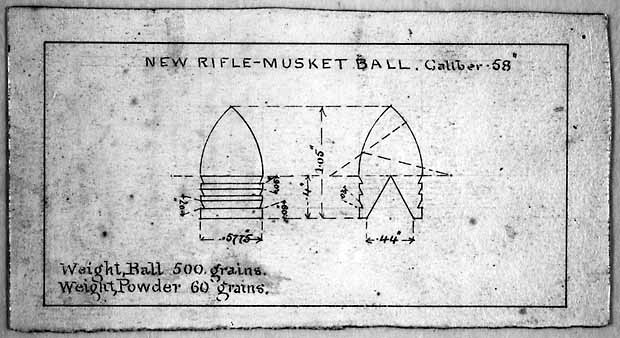
minnie-ball

                                                                             The Minié Ball 

While various individuals and manufacturers had been experimenting with rifles for some time the weapons were difficult to load as the rifled groves slowed down the loading process. The British pioneered the use of the rifle during the Napoleonic Wars and the War of 1812. The issue of the Baker rifle, a rifled flintlock which was accurate to about 300 yards was limited to specific Rifle Regiments which were considered elite units, as well as skirmishers in some other regiments. The soldiers assigned to the Rifle regiments wore a distinctive green uniform as opposed to the red wore by the rest of the British Army. When the United States Army formed its first Sharpshooter regiments in late 1861 under the command of Colonel Hiram Berdan. Like the British the men of the regiment as well as the 2nd Regiment of Sharpshooters wore a distinctive green uniform instead of the Union Blue.

In 1832 a captain Norton of the British Army “invented a cylindroconoidal bullet. When fired, its hollow base automatically expanded to engage the rifling of the barrel, thus giving the bullet a horizontal spin.” [1] But the bullet was unwieldy, so it and other bullets that were “large enough to “take” the rifling was difficult to ram down the barrel” and slowed down the rate of fire significantly, and since “rapid and reliable firing was essential in a battle, the rifle was not practical for the mass of the infantrymen.” [2]

In was not until 1848 when French Army Captain Claude Minié who “perfected a bullet small enough to be easily rammed down a rifled barrel, with a wooden plug in the base of the bullet to expand it upon firing to take the rifling.” [3]Unfortunately the bullets were expensive to produce and it was not until in 1850 an American armorer at Harpers Ferry, James Burton “simplified the design that had made Minié famous and developed a hollow based, .58-caliber lead projectile that could be cheaply mass-produced.” [4] Burton’s ammunition was very easy to load into weapons, and soldiers were able to drop the cartridge into the muzzle of their rifles as easily as they could musket balls down a smoothbore.

The tactics the officers were educated in were developed at a time when the maximum effective range of muskets was barely 100 yards. However, the Army did make some minor adjustments to its tactics to increase speed and mobility in the tactic movement of the infantry. Colonel William J. Hardee went on to become a Confederate General adapted changes first made by the French to the U.S. infantry manual. These changes “introduced double-quick time (165 steps per-minute) and the run and allowed changes to the order of march to be made in motion rather than after coming to a halt.” [5]

During Napoleon’s time assaulting an opponent with a large body of troops was a fairly easy proposition, one simply maneuvered out of the rage of the enemy’s artillery and muskets, thus “to bring a heavy mass of troops upon them was possible because of the limited destructiveness of smoothbore firearms. Their range was so restricted that defenders could count on getting off only one reasonably effective volley against advancing soldiers. By the time that volley was unloosed, the attackers would be so close to their objective that before the defenders could reload, the attacking troops would be upon them.” [6] One of Napoleon’s favorite tactics was for his troops to make well executed turning maneuvers aimed at the enemy’s flanks, but the increased range and lethality meant that even when such maneuvers were executed, they often produced only a short term advantage as the defenders would form a new front and continue the action.

Yet by 1860 the rifled muskets had an effective range of about 500 yards and sometimes, depending on the type of weapon even more, but in most cases during the Civil War infantry engagements were fought at considerable shorter ranges. Paddy Griffith notes that even in the modern era long range firing by infantry units is still rare, and that there is “a fallacy in the notion that longer range weapons automatically produce longer-range fire. The range of firing has much more to do with the range of visibility, the intentions of the firer and the general climate of the army.” [7] Drew Gilpin Faust wrote that Civil War battles still “remained essentially intimate; soldiers were often able to see each other’s faces and to know who they had killed.” [8] They knew their weapons could fire at longer range, and one Union soldier explained, “when men can kill one another at six hundred yards they would generally would prefer to do it at that distance.” [9] But for the average infantryman such occasions were the exception.

The advent of the breach loading and later the repeating rifle and carbine further increased the firepower available to individual soldiers. However, with the exception of the Prussian Army, armies in Europe as well as the United States Army were slow to adapt the breech loading rifles. In “1841 the U.S. Arsenal at Harpers Ferry, Virginia, had prepared the pattern weapons of the first general-issue rifled shoulder arm of the U.S. Army”[10]

The process of conversion to the new weapons was slow, conservatism reigned in the Army and the lack of suitable ammunition was a sticking point. However, the U.S. Army began its conversion “to the rifled musket in the 1840s but rejected both the repeating rifle and the breechloader for infantry because of mechanical problems.” [11] Even so there was a continued resistance by leaders in the army to arming infantry with the rifled muskets despite the already noted obsolescence of them during the Crimean War. In discussing the differences of rifles and smoothbore muskets during the Peninsular Campaign, Edward Porter Alexander wrote that “In the Mexican War fought with smooth bore, short range muskets, in fact, the character of the ground cut comparatively little figure. But with the rifles muskets & cannon of this war the affair was proven both at Malvern Hill, & at Gettysburg….” [12]

However, in 1855 the new Secretary of War, Jefferson Davis ordered the Army to convert to “the .58 caliber Springfield Rifled Musket. Along with the similar British Enfield rifle (caliber .577, which would take the same bullet as the Springfield), the Springfield became the main infantry arm of the Civil War.” [13] Even so the production of the new rifles was slow and at the beginning of the war only about 35,000 of all types were in Federal arsenals or in the hands of Federal troops.

The one failure of Union Chief of Ordnance Ripley was his “insistence in sticking by the muzzle loading rifle as the standard infantry arm, rather than introducing the breach-loading repeating rifle.” [14] Ripley believed that a “move to rapid fire repeating rifles would put too much stress on the federal arsenals’ ability to supply the repeaters in sufficient quantities for the Union armies.”[15] There is a measure of truth in this for troops armed with these weapons did have the tendency to waste significantly more ammunition than those armed with slow firing muzzle loaders, but had he done so the war may not have lasted nearly as long.

weapons

Had Ripley done this Union infantry would have enjoyed an immense superiority in sheer weight of firepower on the battlefield. The noted Confederate artilleryman and post-war analyst Porter Alexander believed that had the Federals adopter breech-loading weapons that the war would have been over very quickly, noting, “There is reason to believe that had the Federal infantry been armed from the first with even the breech-loaders available in 1861 the war would have been terminated within a year.” [16] Alexander’s observation is quite correct. As the war progressed and more Union troops were armed with breach loaders and repeaters Confederates found themselves unable to stand up to the vastly increased firepower of Union units armed with the newer weapons. A Union soldier assigned to the 100thIndiana of Sherman’s army in 1865:

“I think the Johnnys are getting rattled; they are afraid of our repeating rifles. They say that we are not fair, that we have guns that we load up on Sunday and shoot all the rest of the week. This I know, I feel a good deal confidence in myself with a 16 shooter in my hands, than I used to with a single shot rifle.” [17]

During the war both the Union and Confederate armies used a large number of shoulder-fired rifles and muskets of various manufactures and vintage. This was in large part because of a shortage of the standard M1861 Springfield Rifled Musket at the beginning of the war and initially standardization was a problem, and as a result many units went to war armed with various types of weapons which made supply, training, and coordinated fires difficult. At the beginning of the war, the Federal government had only about 437,000 muskets and rifles in its inventory, and only about 40,000 of these were rifled muskets, either older weapons converted from smoothbores or the newly manufactured Springfield rifles.

The disparity of types of weapons that might be found in a single regiment contributed to difficulties in supplying ammunition to them, and proved to be nightmarish for experienced quartermasters. This was especially the case when the amateur quartermasters of many regiments did not specify exactly what types of ammunition they required.

Likewise, in addition to the existing stocks of weapons available for use, the Federal government only had two armories capable of manufacturing arms, Harpers Ferry Virginia, which had to be abandoned in 1861 when Virginia seceded from the Union, and the other in Springfield Massachusetts, which had a capacity to manufacture between 3,000 and 4,000 rifles a month. Ordnance Chief Ripley solved that problem by contracting with U.S. and foreign manufacturers to make up for what government armories could not do. In the first year of the war he contracted for nearly 750,000 rifles from U.S. and foreign arms suppliers. During the war he expanded the capacity at Springfield so that it could produce over 300,000 weapons a year. Even so at Gettysburg sixty-five of the 242 Union infantry regiments, some 26%, were fully or partially armed with older substandard weapons, both smoothbores and antiquated rifles. In 1863 and 1864, the Confederate Army of the Tennessee over half of the army was armed with smoothbores or antiquated rifles. [18]

But the initial shortage of weapons caused problems for both sides. The Confederacy had to make the best use of what they had obtained in captured federal depots at the beginning of the war, which amounted to 140,000 smoothbores and another 35,000 rifled muskets.  Like the Federal Government, the Confederacy which had much less industrial capacity was forced to purchase many of its weapons from England expending badly needed capital to do so and requiring the weapons to be shipped through the Union blockade on blockade runners operating from England, the Bahamas, or other English Caribbean possessions. During the war the Confederates purchased approximately 300,000 rifled muskets and 30,000 smoothbores from Europe while producing just over 100,000 shoulder fired weapons of all types during the war. The Union through its economic superiority was able to acquire a million rifled muskets, 100,000 smoothbores from Europe in addition to the 1.75 million rifled muskets, 300,000 breechloaders, and 100, repeaters of its own wartime manufacture. [19]

In the end the disparity in quality and quantity of arms would doom the élan of the Confederate infantry in battle after battle. Porter Alexander wrote of the Confederate equipment situation:

“The old smooth-bore musket, calibre 69, made up the bulk of the Confederate armament at the beginning, some of the guns, even all through 1862, being old flint-locks. But every effort was made to replace them by rifled muskets captured in battle, brought through the blockade from Europe, or manufactured at a few small arsenals which we gradually fitted up. Not until after the battle of Gettysburg was the whole army in Virginia equipped with the rifled musket. In 1864 we captured some Spencer breech-loaders, but we could never use them for lack of proper cartridges.” [20]

The number of kinds of weapons that a given unit might be equipped was difficult for commanders and logisticians on both sides.  For example, Sherman’s division at the Battle of Shiloh “utilized six different kinds of shoulder arms, with each necessitating a different caliber of ammunition,” [21]which caused no end of logistical problems for Sherman’s troops as well as other units equipped with mixed weaponry.

Commonly Used Union and Confederate Rifles and Muskets

Type Designed Manufactured Weight Length Caliber Rate of Fire (Rounds per Minute) Feed System Effective Range Maximum Range
M1861 Springfield 1861 ~1,000,000

9 Lbs.

56 inches .58 2-4  Muzzle Loaded 100-400 yards 500-620 yards
M1863 Springfield 1863 700,000 9 Lbs. 56 inches .58 2-3 Muzzle Loaded 200-300 yards 800-1000 yards
Pattern 1853 Enfield (England) 1853 1,500,000 total 900,000 estimated used in Civil War 9.5 Lbs.  55 inches .58 3+  Muzzle Loaded  200-600 Yards 1250 yards
Lorenz Rifle (Austria) 1853  ~325,000 used in Civil War 8.82 Lbs. 37.5 inches .54 2 Muzzle Loaded 100-600 yards 900-1000 yards
M186 to M1842 Springfield Musket 1816-1842 ~1,000,000 10 Lbs. 58 inches .69 2-3 Muzzle Loaded 75-100 yards 200 yards
Sharps Rifle 1848 120,000+ 9.5 Lbs. 47 inches .52 8-9 Breech Loading 500 yards 1000 yards
Spencer Repeating Rifle 1860 200,000 10 Lbs. 47 Inches .52 14-20 Breech Loading 500 yards

1000 yards


While this increase in range, accuracy, and rate of fire were important, they were also mitigated by the fact that the smoke created by the black, non-smokeless gunpowder powder expended by all weapons during the Civil War often obscured the battlefield, and the stress of combat reduced the rate and accuracy of fire of the typical soldier. This was compounded by the fact that most soldiers received little in the way of real marksmanship training. Allen Guelzo notes that the “raw inexperience of Civil War officers, the poor training in firearms offered to the Civil War recruit, and the obstacles created by the American terrain generally cut down the effective range of Civil War combat to little more than eighty yards.” [22] That being said well-drilled regiments engaging enemy troops in the open on ground of their choosing could deliver devastating volley fire on their enemies.

But the real increase in lethality on the Civil War battlefield was the Minié ball “which could penetrate six inches of pine board at 500 yards.” [23] as such, the bullet was decidedly more lethal than the old smoothbore rounds, and most wounds “were inflicted by Minié balls fired from rifles: 94 percent of Union casualties were caused by bullets.” [24] The old musket balls were fired at a comparatively low velocity and when they hit a man they often pass through a human body nearly intact, unless there was a direct hit on a bone. Thus wounds were generally fairly simple to treat unless a major organ or blood vessel had been hit. But the Minié ball ushered in for those hit by it as well as the surgeons who had to treat their wounds:

“The very attributes that increased the bullet’s range also increased its destructive potential when it hit its target. Unlike the solid ball, which could pass through a body nearly intact, leaving an exit would not much larger than the entrance wound, the soft, hollow-based Minié ball flattened and deformed on impact, while creating a shock wave that emanated outward. The Minié ball didn’t just break bones, it shattered them. It didn’t just pierce organs, it shredded them. And if the ragged, tumbling bullet had enough force to cleave completely through the body, which it often did, it tore out an exit wound several times the size of the entrance wound.” [25]

When these bullets hit the arm and leg bones of soldiers the effects were often catastrophic and required immediate amputation of the limb by surgeons working in abysmal conditions. “The two minie bullets, for example, that struck John Bell Hood’s leg at Chickamauga destroyed 5 inches of his upper thigh bone. This left surgeons no choice but to amputate shattered limbs. Hood’s leg was removed only 4 and 1/2 inches away from his body. Hip amputations, like Hood’s, had mortality rates of around 83%.” [26]

This technological advance changed the balance and gave armies fighting on the defensive an edge. The advance in the range and killing power embodied in the rifled musket made it especially difficult for the armies that fought the Civil War to successfully execute frontal assaults on prepared defenders. The defensive power was so enhanced that even a “well executed turning maneuver was likely to produce only a decidedly temporary advantage in the Civil War.” [27] Well trained units could change their front against enemies assailing their flanks and turning them back as was demonstrated by Joshua Chamberlain’s 20thMaine at Little Round Top. Occasionally some assaulting troops would get in among the enemy’s lines, despite the enormous costs that they incurred during their attacks, but “the greater problem was how to stay there and exploit the advantage once the enemy’s line had been pierced. Almost invariably, by that time the attacker had lost so heavily, and his reserves were distant, that he could not hold on against a counterattack by the defending army’s nearby reserves.”[28]

Despite the increased range of the rifled muskets many infantry firefights were still fought at closer ranges, usually under 200 yards, not much more than the Napoleonic era. Much of this had to do with the training of the infantry as well as visibility on the battlefield which in North America was often obscured by heavy forested areas and thickets in which armies would battle each other at close range. Battles such as the Seven Days, Chancellorsville, and much of the Overland Campaign were fought in such terrain.

This was demonstrated time and time again throughout the course of the war as commanders attempted frontal assaults on such positions. “The only way to impose heavy enough casualties upon an enemy army to approximate that army’s destruction was to accept such heavy casualties oneself that no decisive advantage could accrue.” [29]Lee’s assault on Malvern Hill and his numerous frontal assaults on prepared positions at Gettysburg, Burnside’s ghastly assaults at Fredericksburg, Grant’s first attack at Vicksburg, and Grant’s ill-advised attack at Cold Harbor demonstrated the futility and ghastly cost of such tactics. The ability of infantry in the assault to “rise up and deliver a frontal attack became almost always futile against any reasonably steady defenders. Even well executed flank attacks tended to suffer such heavy casualties as experienced riflemen maneuvered to form new fronts against them that they lost the decisiveness they had enjoyed in the Napoleonic Wars.” [30] During the Wilderness Campaign battles were fought for hours on end at point blank range amid heavy woods and fortifications.

As important as the rifled muskets were, the real revolution in battlefield firepower was brought about by the repeating rifles and muskets which came into use during the war. The early examples were not reliable because the ammunition available was in a paper cartridge which sometimes caused gas and flames to escape form the breach, making the weapon dangerous to the user. But this was corrected with the introduction of brass cartridges and later weapons became deadly instrument. Because of its range as compared to the older smoothbores, the rifled musket “added a new spatial dimension to the battlefield,” [31] but the repeating rifles, which had a shorter range than the rifled muskets looked forward to the day of semi-automatic and automatic weapons. The repeaters could “pump out so many shots in such a short time that it offered a new perspective in tactical theory from that used by the old carefully aimed one-shot weapons,” and added “a new temporal dimension to the close range volley.” [32]

Despite the fact that leaders knew about the increased range and accuracy that came with the rifled musket, tactics in all arms were slow to change, and “on every occasion, a frontal assault delivered against an unshaken enemy led to failure.” [33]Even at Gettysburg Robert E. Lee would demonstrate that he had not fully appreciated the effects of the lethality of the rifled musket when he ordered Hood’s assault on Federal troops at Little Round Top on July 2nd and Pickett’s assault on the Union center on July 3rd1863. Lee should have learned during the bloody battles of 1862 and early 1863 which cost his army over 50,000 casualties.

I find it most interesting and tragic that this increase in firepower, among many other things, was not appreciated by the military leaders of the European powers who went to war in 1914. As a result millions of men died unnecessary deaths.

                                                                                   Notes 

[1] Ibid. Hagerman The American Civil War and the Origins of Modern Warfare p.15

[2] Ibid. McPherson. The Battle Cry of Freedom p.474

[3] Ibid. McPherson. The Battle Cry of Freedom p.474

[4] Leonard, Pat The Bullet that Changed History in The New York Times Disunion: 106 Articles from the New York Times Opinionator edited by Ted Widmer with Clay Risen and George Kalogerakis, Black Dog and Leventhal Publishers, New York 2013 p.372

[5] Ibid. Hagerman The American Civil War and the Origins of Modern Warfare p.20

[6] Ibid. Weigley A Great Civil War p.33

[7] Griffith, Paddy, Battle Tactics of the Civil War Yale University Press, New Haven and London 1989 p.148

[8] Ibid. Faust This Republic of Suffering: Death and the American Civil War p.41

[9] Ibid. Faust This Republic of Suffering: Death and the American Civil War p.41

[10] Ibid. Weigley A Great Civil War p.32

[11] Ibid. Hagerman The American Civil War and the Origins of Modern Warfare p.17

[12] Ibid. Alexander Fighting for the Confederacy: The Personal Recollections of General Edward Porter Alexander p.111

[13] Ibid. McPherson. The Battle Cry of Freedom p.474

[14] Ibid. Guelzo Fateful Lightning p.317

[15] Ibid. Guelzo Fateful Lightning p.251

[16] Alexander, Edward Porter Military Memoirs of a Confederate: A Critical Narrative 1907 republished 2013 by Pickle Partners Publishing, Amazon Kindle Edition location 1691 of 12969

[17] Davis, Burke. Sherman’s March Open Roads Integrated Media, New York, 2016, originally published by Vintage Press 1980 p.196

[18] Ibid. Griffith,  Battle Tactics of the Civil War  pp.76-77

[19] Ibid. Griffith, Battle Tactics of the Civil War p.80

[20] Ibid. Alexander Military Memoirs of a Confederate location 1683 of 12969

[21] Ibid. McDonough William Tecumseh Sherman: In the Service of My Country, A Life  p.2

[22] Ibid. Guelzo Fateful Lightening pp.255-256

[23] Ibid. Guelzo Fateful Lightening p.250

[24] Ibid. Faust This Republic of Suffering: Death and the American Civil War p.41

[25] Ibid. Leonard, Pat The Bullet that Changed History p.372

[26] Goellnitz, Jenny Civil War Battlefield Surgery The Ohio State University, Department of History retrieved from https://ehistory.osu.edu/exhibitions/cwsurgeon/cwsurgeon/amputations 22 December 2016

[27] Ibid. Weigley A Great Civil War: A Military and Political History 1861-1865 p.34

[28] Ibid. Weigley The American Way of War p.117

[29] Ibid. Weigley A Great Civil War: A Military and Political History 1861-1865 p.34

[30] Ibid. Weigley, American Strategy from Its Beginnings through the First World War In Makers of Modern Strategy, from Machiavelli to the Nuclear Age p.419

[31] Ibid. Griffith, Battle Tactics of the Civil War p.75

[32] Ibid. Griffith, Battle Tactics of the Civil War p.75

[33] Ibid. Fuller, The Conduct of War 1789-1961 p.104

2 Comments

Filed under civil war, ER's and Trauma, Gettysburg, History, Military, us army

Mia San Mia: Finding Myself Again after the Thrill is Gone

Friends of Padre Steve’s World,

Glenn Frey of the Eagles penned these immortal words which kind of sum up here I am with life as a Navy Chaplain:

Same dances in the same old shoes
Some habits that you just can’t lose
There’s no telling what a man might use
After the thrill is gone…

Now please be sure, I cannot stop being a Priest, nor can I refuse the chance to care for people in need of pastoral care, or the sacraments, and I will remain faithful to the Church. That being said, apart from caring for servicemen and women and their families, the thrill is gone as far as serving in the Chaplain Corps.

I think that I realized it back in 2014 while teaching at the Joint Forces Staff College. I realized that my real calling as a Priest was being a historian, teacher, and writer. It is not surprising, the most influential people in my life have included Priests and Pastors who do more as teachers and writers in fields outside of traditional theology or pastoral care. In fact I credit the late Andrew Greeley for helping to restore and reorient my faith after a terrible faith crisis following my tour in Iraq. His Bishop Blackie Ryan mysteries were they only things I read that in any sense communicated the mystery and magic of faith to me in a terribly dark time.

That being said I have always been a historian for as long as I can remember. I used to cut Geometry class in 10th grade to go to the library and read the books in the history reserved section that could not be checked out. I cut Geometry so often that the librarians thought I had a permanent pass to be there. Good thing my mother didn’t know. By the way, hi mom.

I probably should have retired when my assignment to the Staff College ended, but I thought that I could do another tour. If I had been used to my strengths it might have worked out, but I was put in charge of a large base chapel though my last base chapel experience was in the Army some twenty years before, in a far different religious, cultural, and political climate, where I had funding and command support to close down a regular army base, turn it over to the National Guard and find a way to creatively ensure that the base chapel remained open and the congregations continued after the transfer.

In the current Navy climate there is no money, funding, or support for anything on the base side of operations, far less chapel programs to make things work for servicemen and women and their families; active duty, Reserve, and retired. It’s a sad commentary, my facilities are falling apart, funding continues to be cut, and my staff is being decimated. If my base was being closed and turned over to the reserves I am sure that the chapel would go away and the 700 plus people who worship there would be cut loose.

Then there is the problem that I my opinion is that the Chaplain Corps is more invested in surviving than ministering. The institutional rot runs deep, and I think that unless there is a radical change that the Chaplain Corps has maybe 10 years left in it before the Navy decides to shitcan it. The Marines and Coast Guard will probably be the only thing that keeps the Navy Chaplain Corps going if it survives, but I digress. I know for me it is time to leave the institutional ministry of the Navy, the thrill quite frankly is gone.

But it’s not like that I didn’t know what I was getting into. I was warned about the Chaplain Corps even before I left active duty in the fall of 1988 to attend seminary. My Brigade Executive Officer told me: “Steve, you think the Army Medical Department is brutally political, and backstabbing, we can’t hold a candle to the Chaplain Corps.” Sadly, that witness has not only been born out in my career, but repeated by Chaplains and Line officers in both the Army and Navy since then. Despite the many selfless men and women who have served as military Chaplains, the institution itself has what Kierkegaard called, the sickness unto death, and most don’t realize it. I served in the Army and Navy Chaplain Corps fore 26 of my 37 plus years in the military, serving all because I believed in the First Amendment, sometimes more than God. But it is time for me to go.

Today, I interviewed for a part time history instructor position at a local college. I found out about the position by a stroke of luck. I was going through a required pre-retirement class and one of our exercises was to find a job listing and write a targeted resume for it. In a moment of inspiration I decided to follow the advice of our Department of Labor instructor to not only do an exercise, but to see if I could actually find a job doing it. A simple Google search provided an advertisement for a history instructor at a for profit local college. So I followed the instructions in the job description and made the phone call.

That was a month ago. Today, I did my interview and gave a demonstration lecture. It went well. There is still one more applicant, but he or she will have to be shit hot to take it from me. The comments about the interview and sample lecture about the causes and road to the First World War were as I had hoped: he’s an engaging and captivating speaker and great story teller.

I do hope and pray that I will get this job simply because I love history, as well as teaching it and writing about it. The fact is that I cannot do anything else. My former. Dean at the Joint Forces Staff College said that I was a “Historian masquerading as a Chaplain, not that there was anything wrong with that.” One of my subordinate Chaplains at my current base said to me: Sir, I need to start taking notes so I can try to get graduate credit for our talks.

But that is who and what I am. In the Latin words of a Bavarian motto taken up by the Bayern München soccer team. Mia San Mia, We are Who We Are, or for me, I am Who I Am.

After twenty-six plus years as an Army and Navy Chaplain, I realized that while I would always remain a Priest and a part of the church, that I couldn’t be a parish pastor or continue working in institutional ministry just because I had the education, the experience, and the need for steady employment post Navy, enough to make up the difference between my retirement, disability, and what I make on active duty. But even without that, I know that I need to stay engaged and to read, teach, and write; Mia San Mia.

I am who I am.

Peace,

Padre Steve+

7 Comments

Filed under books, christian life, ethics, faith, History, holocaust, iraq, iraq,afghanistan, leadership, Loose thoughts and musings, Military, ministry, News and current events, Political Commentary, Teaching and education

“Vice into Virtue, Slander into Truth… Sadism into Justice” The Miraculous Rationalizations Of Trump’s Christian Cult

Catch-22 (1970) Alan Arkin Mike Nichols 24

Friends of Padre Steve’s World,

The government is partially shut down, nearly an million government employees and contractors have either been furloughed or working without pay for almost three weeks. A large number of those are employees of the Department of Homeland Security, the Justice Department, the Transportation Department, and the Department Of the Interior. A huge number of them are law enforcement: FBI, Border Control Agents, Immigration and Customs Enforcement Agents, TSA, Federal Prison Guards, a host of other Federal Law Enforcement Officers, Court employees, and too many others to list. All have vital functions to making sure the country is safe and that the government is able to fulfill its responsibilities to its citizens and the nation, and this partial shutdown for the sake of a wall of folly endangers national security.

Sadly, neither the President nor his most faithful supporters, mostly Evangelical Christians and those in media who have long supported theocratic, authoritarian, fascist, and racist policies. Of the Christians most claim to be pro-life, which more accurately stated is anti-abortion, as most do not seem to care about any life once it has left the womb, especially if that life is darker skinned, or the progeny of poor people, or non-White Christians.

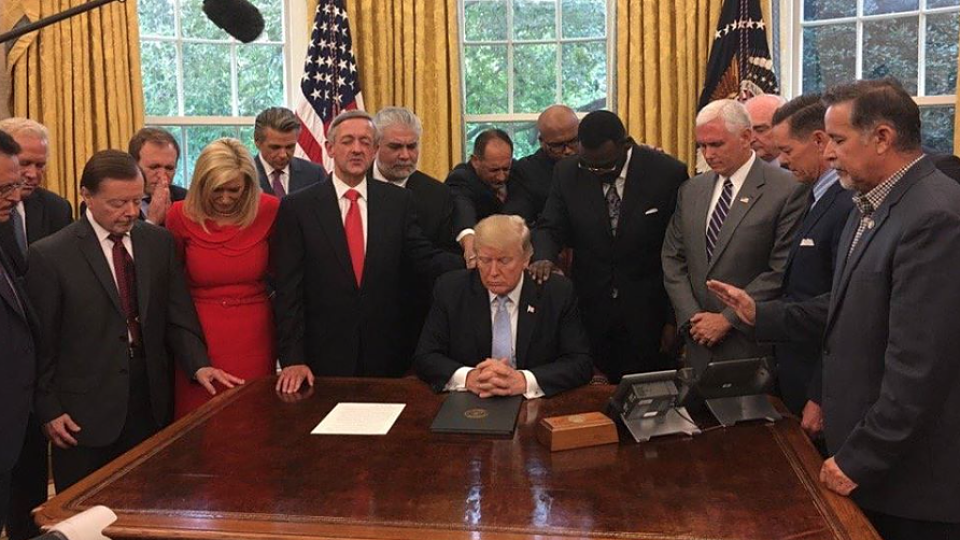
This, when I see and hear the political-religious leaders of the Christian Right like Jerry Falwell Jr., Robert Jeffress, Franklin Graham, and a host of other Evangelical and Conservative Christian leaders defend the indefensible actions of President Trump I am reminded of the words of Joseph Heller in his classic novel Catch 22, who wrote about the Chaplain:

“The chaplain had mastered, in a moment of divine intuition, the handy technique of protective rationalization, and he was exhilarated by his discovery. It was miraculous. It was almost no trick at all, he saw, to turn vice into virtue and slander into truth, impotence into abstinence, arrogance into humility, plunder into philanthropy, thievery into honor, blasphemy into wisdom, brutality into patriotism, and sadism into justice. Anybody could do it; it required no brains at all. It merely required no character.” 

As much as I doubt at times, I still remain a Christian. However, if I wasn’t already a Christian I couldn’t think of a single reason to follow the false God of men like Pat Robertson, Jerry Falwell Jr., Franklin Graham, Tony Perkins, or any of the host of big name Evangelical Christian preachers who excuse the behaviors of President Trump and his decadently despicable defenders, including people that I once thought that I knew and considered to be friends.

I used to think that most people like to believe that religion is a benign or positive influence in the world. As much as I want to believe the positive aspects I have to admit based on the historical and sociological evidence that this is not so, especially during unsettled times of great change. We live in such an era and when it comes to identity, God is the ultimate trump card.

If one wonders why the most fanatical individuals and groups on earth are tied to religions, whether it is the Islamic State and Al Qaeda, Boko Haram, Hezbollah, Orthodox Jews, radical Hindus and Buddhists as well as militant Christians. Of course all of these groups have different goals, but their thought and philosophy are quite similar.

Robert Heinlein wrote:

“Almost any sect, cult, or religion will legislate its creed into law if it acquires the political power to do so.”

Heinlein, the author of the classic Starship Troopers was absolutely correct. Just look at any place in any time where any religion, sect or cult has gained control of a government. They are not loving, they are not forgiving and they use the police power of the state to persecute any individual or group that is judged to be in error, or even worse has the gall to question their authority.

Since the Christian groups tend to thrive in the West, they only speak in terms of violence, most, with the exception of Russian Orthodox Christians, do not have a government to translation of those words into action. Many, especially conservative Catholics and some Evangelical and Charismatic Protestants seem for a long for the day when they can assume control of a theocratic government.

Samuel Huntington wrote in his book The Clash of Civilizations:

“People do not live by reason alone. They cannot calculate and act rationally in pursuit of their self-interest until they define their self. Interest politics presupposes identity. In times of rapid social change established identities dissolve, the self must be redefined, and new identities created. For people facing the need to determine Who am I? Where do I belong? Religion provides compelling answers….In this process people rediscover or create new historical identities. Whatever universalist goals they may have, religions give people identity by positing a basic distinction between believers and non-believers, between a superior in-group and a different and inferior out-group.”

Huntington was right, you see the true believers, those who follow their religion without question and believe that it is superior to all others also believe that their religion entitles them to be atop the food chain, others who don’t believe like them be damned, if not in this life, the next. That is the certitude of the true believer, especially the religious one. Secular or atheistic fanatics could care less about the next life, for this life is all that they have. But the religious “true believers” are not only interested in destroying someone in this life, but ensuring that in the next that they suffer for eternity, unless they believe in the annihilation of the soul after death, which really spoils the whole Dante’s Inferno perspective of the damned in the afterlife.

The great American philosopher, Eric Hoffer wrote:

“The impression somehow prevails that the true believer, particularly the religious individual, is a humble person. The truth is the surrendering and humbling of the self breed pride and arrogance. The true believer is apt to see himself as one of the chosen, the salt of the earth, the light of the world, a prince disguised in meekness, who is destined to inherit the earth and the kingdom of heaven too. He who is not of his faith is evil; he who will not listen will perish.”

That is why they, the religious true believers of any faith are capable of such great evil, and why such people can murder innocents in the most brutal manner simply because they do not believe correctly. In fact today when I see the words and actions of these supposed Conservative Christians.

Please do not get me wrong. I am a Christian, a priest, a historian and a theologian, but I also know just how insidious those who hold their religion over those of others can be. While I hold faith dear, I know that it can be abused for the claim of some to have God as their final authority is a sort of trump card with which they are able to justify the most obscene and evil acts against others.

Likewise I struggle with faith every day. If you have read this blog from the beginning you will see chronicle my struggles with faith and its practice, especially in life and politics.

I guess that is why I am even more frightened of religious true believers than non-religious true believers. While the non-religious true believer may sacrifice everything for the sake of power and control in this life, and may in fact commit the most heinous crimes against humanity, their hatred is bounded in space and time to this earth. The religious true believer is not content with that; their enemies must be damned and punished in this life, but for eternity, without hope of salvation.

When the true believers look at people like me, or Yossarian, I am sure they believe what Heller wrote:

“Morale was deteriorating and it was all Yossarian’s fault. The country was in peril; he was jeopardizing his traditional rights of freedom and independence by daring to exercise them.” 

I will be a Yossarian any day of the week rather than the Chaplain in Catch 22, who like Falwell, Jeffress, Graham, and so many other have “turned vice into virtue, slander into truth, impotence into abstinence, arrogance into humility, plunder into philanthropy, thievery into honor, blasphemy into wisdom, brutality into patriotism, and sadism into justice.”

Dietrich Bonhoeffer noted:

Christianity stands or falls with its revolutionary protest against violence, arbitrariness and pride of power and with its plea for the weak. Christians are doing too little to make these points clear rather than too much. Christendom adjusts itself far too easily to the worship of power. Christians should give more offense, shock the world far more, than they are doing now. Christian should take a stronger stand in favor of the weak rather than considering first the possible right of the strong.

As the President considers declaring a national emergency to build his wall, it would be good for all,of us to remember that tyranny does not arise in a vacuum. It requires accomplices who are willing to embody the Chaplain of Catch 22.

With that I wish you a good day.

Peace,

Padre Steve+

3 Comments

Filed under christian life, ethics, film, History, holocaust, Military, national security, News and current events, Political Commentary

Wings of Gold: U.S. Navy Carrier Aircraft 1941-1945

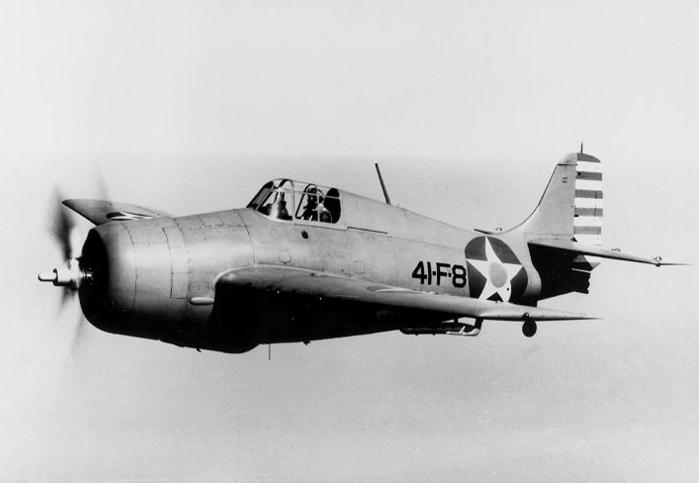
F4F-4 Wildcat of VF-41 in 1942

In 1941 with war raging in Europe and with the Japanese continuing their war in China and occupying French Indo-China the United States rushed to build up its Naval Air Arm and the Arm Air Corps.  New models of aircraft of all types were being rushed into production to replace aircraft already known to be obsolescent.  The Navy brought aircraft already accepted into full production even as it planned more advanced models.  The events in Europe and Asia demonstrated that new fighter designs were needed quickly.

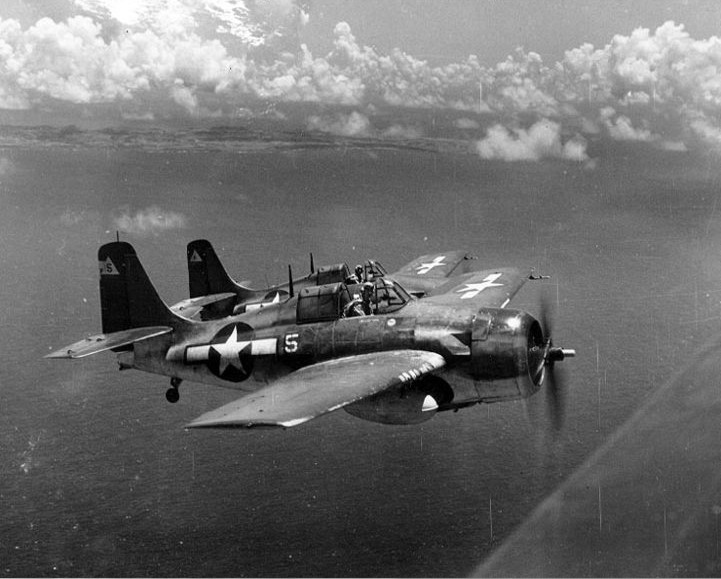
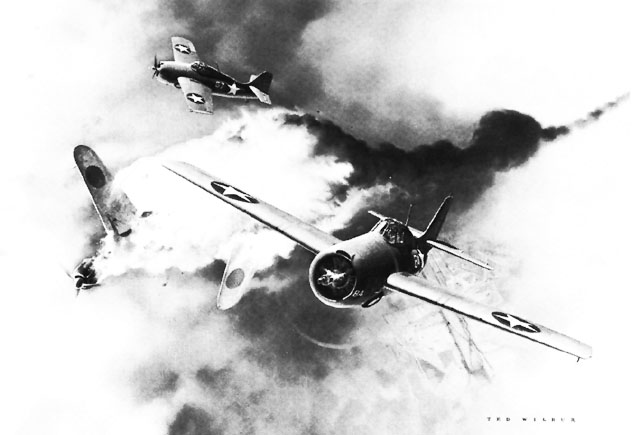
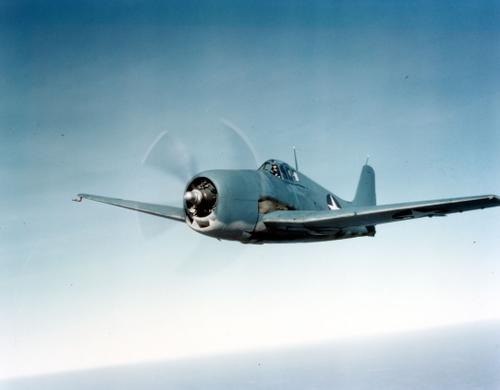
As 1940 dawned the standard fighter aircraft found on U.S. Navy carriers were the F2-A Brewster Buffalo, the Grumman F-3F biplane.  In February 1940 the Navy accepted its first F4F-3 Wildcat which in an earlier for had been rejected in favor of the Brewster Buffalo.  The new Grumman fighter was powered by a 1200 hp Pratt & Whitney R-1830-76 double row radial engine, mounted 4 .50 cal. Machine guns and was heavily armored.  It had a maximum speed of 331 mph range of 845 miles and ceiling of 39500 feet. This would serve it and its pilots well as they aircraft was incredibly tough, often amazing experienced Japanese pilots in their A6M2 Zeros in their ability to suffer heavy damage and remain in the air.  The plucky Wildcat would become the main line of defense in the Pacific against the advancing Japanese Imperial Navy in the months following Pearl Harbor.

The early F4F-3s were superseded by the F4F-4 model which incorporated folding wings, additional armor and an extra two machine guns.  This decreased its maximum speed to 320 mph, rate of climb and ceiling but nonetheless the aircraft gave a good account of itself in Navy and Marine Corps service.  F4F-3’s and F4F-4s served in the British Royal Navy where it was called the Martlet until the end of the war.  When Grumman closed out F4F production in 1943 to concentrate on its replacement the F6F Hellcat production was continued by General Motors and Eastern Aircraft as the FM1 and FM2 Wildcat. The FM1 was identical to the F4F-4 but armament was reduced to 4 machine guns and bomb racks for two 250 lb bombs or depth charges were added.  The FM2 was based on an updated version of the F4F and had a more powerful engine as well as a higher tail assembly to account for the increased torque of the engine.  These aircraft served aboard the tiny Escort Carriers and performed valiantly, especially in the Battle off Samar during the Battle of Leyte Gulf.  A total of 7860 Wildcats of all varieties were built.  They accounted for 1327 enemy aircraft shot down with the loss of only 191 Wildcats.

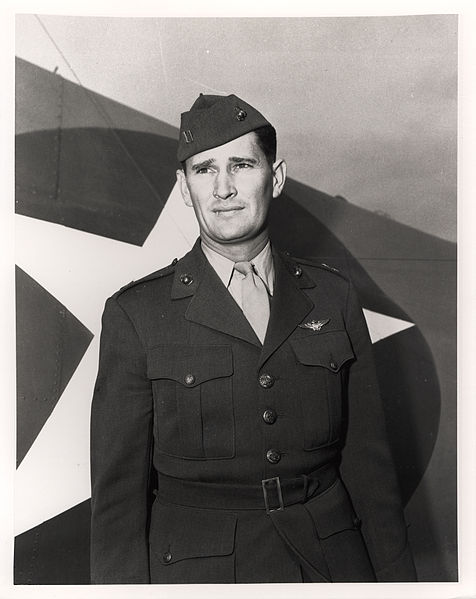
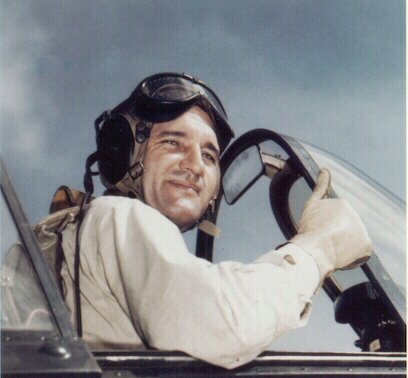
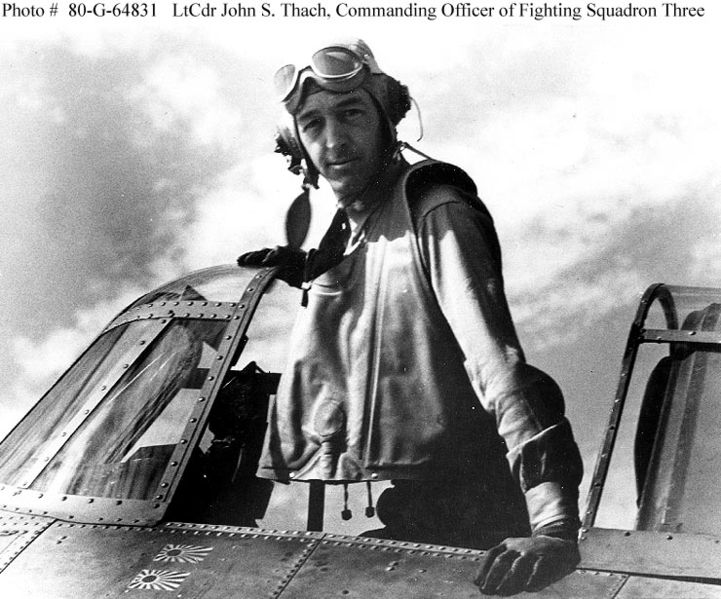
Aces Capt Joe Foss USMC and CAPT David McConnell USN both Medal of Honor Winners and CDR Jimmy Thatch (below)

The top aces who flew the Wildcat were all Marines, CAPT Joe Foss (26 victories) MAJ John Lucian Smith (19 victories) and MAJ Marion Carl (16 victories in the F4F and 2 in the F4U Corsair). Foss and Smith both won the Medal of Honor.  Foss would go on to become Governor of South Dakota and the first Commissioner of the American Football League in 1959. Smith retired as a Colonel in 1960 and Carl as a Major General.  Other distinguished F4F aces included LT Butch O’Hare, the first U.S. Navy ace and Medal of Honor winner and LCDR Jimmy Thatch who developed the highly successful “Thatch Weave” which enabled the U.S.pilots whose machines were slower and less maneuverable than the speedy and nimble Zeros to achieve good success against their Japanese foe.  Thatch retired as an Admiral in 1967.  O’Hare rose to become commander of the Enterprise Air Group and was killed in action in November 1943. Chicago’s O’Hare International Airport is named for this brave aviator.

F6F Hellcat

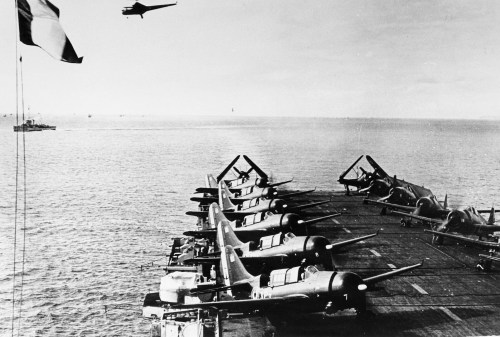
The Grumman F6F Hellcat took over front line fighter duties on the Fleet Carriers from the Wildcat in early 1943 and established itself as the dominant fighter in the Pacific Theater of Operations.  Although it had a resemblance to the F4F the F6F was a totally new design built on combat experience against the Japanese.  The aircraft was built around the powerful Pratt & Whitney R-2800 engine which produced 2000 hp.  The Hellcat mounted six .50 caliber machine guns and had a rate of climb of 3500 feet per minute and a 37300 ft operational ceiling.

Faster than the Zero and other Japanese fighters and piloted by more experienced pilots the Hellcats took a brutal toll of Japanese aircraft.  They accounted for more Japanese aircraft kills than any other with 5163 confirmed kills with a loss of 270 aircraft an overall 19:1 kill ratio. They were piloted by 305 Navy and Marine Corps aces including Meal of Honor winner Captain David McConnell the Navy’s Ace of Aces, and highest surviving United States ace of the war that scored all 34 of his victories in the Hellcat.  The greatest achievement of the Hellcats were when they swept the rebuilt Japanese Naval Air Arm from the skies in the Great Marianas Turkey Shoot. By November 1945 12275 Hellcats had been built with 1263 going to the British Royal Navy. After the war the Hellcat was replaced by the F8F Bearcat as the primary fighter and served in a night fighter and trainer role until the 1950s.  The French Navy used the Hellcat in to provide heroic close air support to beleaguered French Soldiers in Indochina.

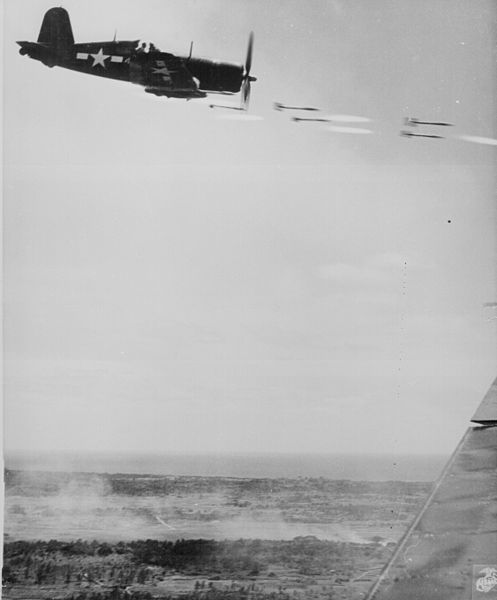
USMC F4U-4 Corsair providing close air support

Flying alongside the F6F was the Vaught F4U Corsair. The Corsair first flew in 1940 and the Navy was slow to adopt it due to difficulties in carrier operations and negative reviews of Navy pilots.  However Marine Corps aviators flying the Corsair had great success and legendary aviators like MAJ Gregory “Pappy” Boyington and VMF-214 the Black Sheep.  The Navy would adopt the aircraft later in the war as the Corsair’s carrier operation deficiencies were remedied, but its real success was a land based aircraft operated by the Marines.  Likewise the first squadrons to operate the aircraft successfully from carriers were the Marine Corps VMF-124 and VMF-213.

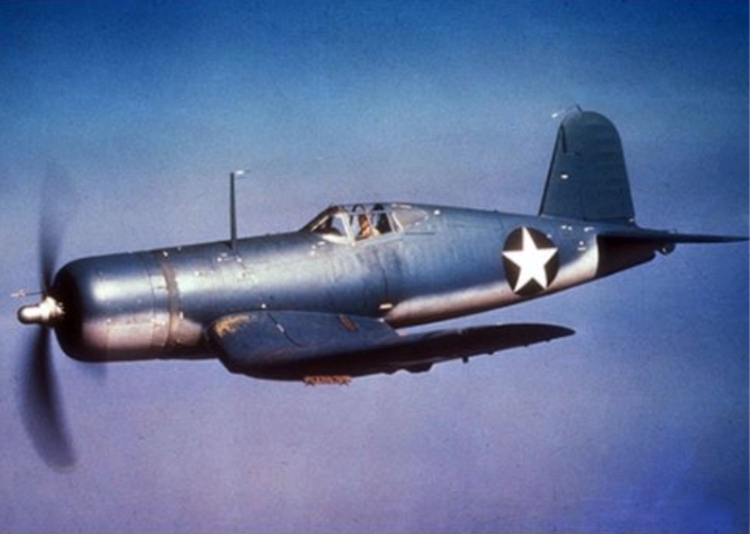
Early F4U-1

The Corsair mounted the same Pratt & Whitney R-2800 engine as the F6F but had a highly streamlined gull wing design as well as a turbo-charger which allowed it a top speed of 425 mph.  Later models such as the F4U-4 had a top speed of 445 mph. The F4F was armed with six .50 cal machine guns as well as rockets and a bomb load of 2000 pounds and the F4U-4 could carry 4000 pounds of ordnance.

Less than 10000 of the over 64000 combat sorties flown by F4Us were flown from carriers, the vast bulk of the sorties coming from land based Marine Corps squadrons.  The Corsair was often used as a fighter bomber where its capabilities to drop sizable amounts of ordinance including rockets, bombs and the nearly developed Napalm in a close air support role cemented the importance of Marine Air for future generations.  They were beloved by the Marine Corps and U.S. Army infantrymen in their brutal battles with the Japanese on many hellish island battlefields.  Corsairs accounted for 2140 confirmed kills during the war against a combat loss of 189 aircraft. The aircraft remained in production until 1952 with 12571 aircraft of all variants being built.  Many Japanese pilots considered the Corsair to be the best fighter of the war.

During the war many Corsairs served in the British Royal Navy and Royal New Zealand Air Force with good success, and after the war the French Navy had success with them in a close air support role in Indochina and Algeria.  Following the war the Corsair remained in service for many years in the U.S. Navy and Marine Corps as well as the French Navy and other smaller navies and air forces until the 1960s.

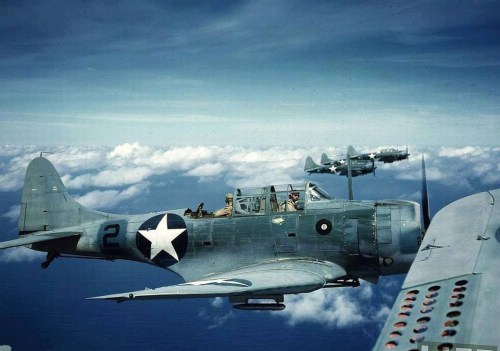
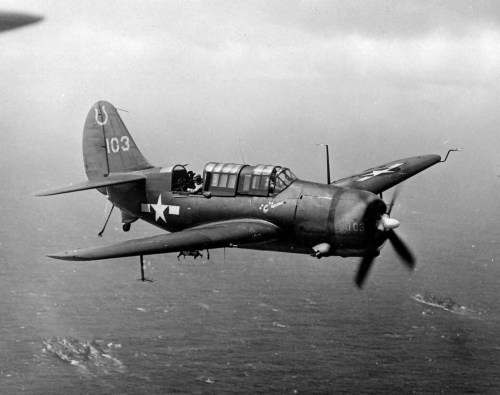
The Douglas SBD Dive Bomber was arguably the most effective Naval dive bomber of World War II, and possibly the best single engine dive bomber of all time. Other aircraft may have been faster or carried a larger bomb load, but the SBD, which served at a time when the U.S. Navy did not have air superiority and battled seasoned Japanese pilots and aircrews, achieved remarkable results,

The SBD was developed from the Northrop BT-2, after Douglas took over Northrop. The first model of the Dauntless, the SBD-1 began operations with the U.S. Marine Corps In 1940, the SBD-2 with the U.S. Navy in 1941. The SBD-3 which included more armor for the crew, and self sealing fuel tanks began entering service in late 1941.

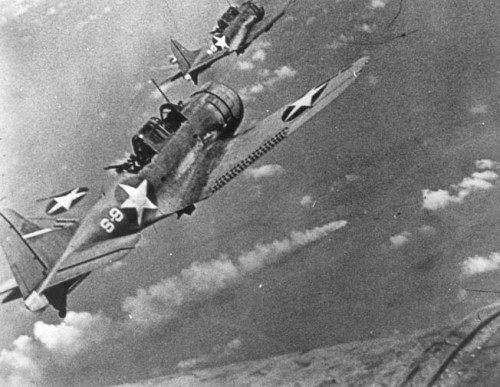
The SBD combined a heavy bomb load, excellent bombing optics, great defensive armament, rugged construction, excellent handling characteristics and maneuverability, and superb dive bombing capabilities. It became the workhorse of the U.S. Navy between 1941 and 1944, flying about 25% of all missions flown from Navy carriers during that time. SBDs sank or damaged six Japanese Aircraft carriers, one Japanese and one French battleship, 14 cruisers, 6 destroyers, and many other ships including transports and submarines. It was the Dauntless which turn the tide of the Pacific war when at Midway they sank the Japanese aircraft carriers Akagi, Kaga, Soryu, and Hiryu and the heavy cruiser Mikuma. The SBD also accounted for more enemy aircraft in aerial combat than were lost to enemy aircraft, an amazing accomplishment by any bomber of any type.

In late 1944 after the Battle Of the Philippine Sea the Dauntless was phased out of U.S. Navy squadrons by the SB2C Helldiver. Though the Helldiver was bigger, faster, and carried a higher bomb load, many pilots preferred the Dauntless due to its superior handling characteristics, especially at low speeds, essential to landing on a carrier. It is hard to believe that the United States would have prevailed in 1942 without the Dauntless.

It was used in combat by other allies, a variant, the A-24 Banshee was built for the U.S. Army Air Force. The French operates it from the carrier Arromanches in Indochina until 1949.

SBD Dauntless Dive Bomber above and at Midway below

TBF Avenger above and below

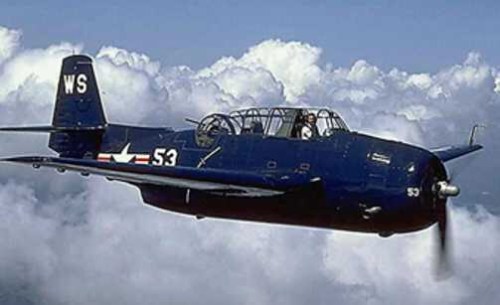
The TBF Avenger torpedo bomber was developed as a replacement for the TBD Devastator by in 1940 by Leroy Grumman of Grumman aircraft. Production began in 1941 and the first combat by the aircraft was at the Battle of Midway. During that battle, 6 aircraft from VT-6, based at Midway while the rest of the squadron flying TBD Devastators from the USS Hornet attacked the Japanese carrier strike force. All of the TBD were shot down, as well as 5 of the 6 TBFs.

Despite the inauspicious start the TBFs became one of the deadliest aircraft of the Second World War. They helped sink the largest Battleships ever constructed, the Japanese Musashi and Yamato, as well as many other warships and auxiliaries. They conducted bombing missions of land targets, and operated from Escort Carriers in Anti-Submarine Warfare operations and supporting invasions and shore operations. The Avenger was particularly effective in the ASW role and was credited with sinking about 30 German U-Boats and Japanese submarines during the war.

The TBF was the largest single engine aircraft of the war, only the P-47 Thunderbolt was anywhere close to its size. Despite this the TBF was able to operate from the smallest aircraft carriers. Powered by a 1900 HP Wright R-2600-20 Twin Cyclone 14 Cylinder radial engine it could cruise at over 30,000 feet at a top speed of 275 MPH while carrying 2,000 pounds of bombs or a Mark 13 Aerial Torpedo. They also carried racks for 5″ High Velocity Aircraft Rockets and depth charges.

After the war it served in a variety of roles in the U.S. Navy, Royal Navy, Canadian Navy, French Navy, and other militaries until the 1960s. In peacetime it was used for many years as a fire fighting aircraft in the United States and Canada.

LTjg. George H. W. Bush in the cockpit of his Avenger

The most famous man to pilot a TBF/TBM was LTjg George H. W. Bush, later the President of the United States whose aircraft was shot down over Chuchi Jima In 1944.

SB2C Helldiver above and in French Service below

The replacement for the Dauntless was the SB2C Curtiss Helldiver. The Helldiver was bigger and faster than the Dauntless but for its size it was underpowered, and had a shorter range that the beloved Dauntless. The Helldiver had very poor performance in flight, had unreliable electrical and hydraulic systems and frequently was poorly manufactured. The defects made it less than popular among the aircrews which had previously flown the Dauntless who came to call it the Beast. The problems would lead to a Congressional investigation headed by Senator Harry Truman. During the hearings Assistant Secretary of the Navy for Air, Artemis Gates said: “When we needed the SB2C Helldiver neither we nor it was ready.”

The British Royal Navy and Australian Air Force evaluated the Helldiver and rejected it for service, cancelling their orders for it.

Despite the many flaws of the aircraft the superbly trained pilots and air crews made the most of it, sinking hundreds of Japanese ships and watercraft. From late 1944 until the end of the war it established a good combat record, though it never had to fight against the well trained Japanese pilots that the Dauntless aircrews had to face.

However, the Navy, and most air forces were moving away from the dive bomber as an attack aircraft. The U. S. Navy found that its F6F Hellcats, and F4U Corsairs could carry as heavy as payload in rockets and bombs as the Helldiver though the ordnance decreased their range. But even so the fighters were far better able to defend themselves against enemy fighter aircraft.

The aircraft served in the U. S. Navy and Naval Reserve until 1950. It also served in Greece where it was used in counter-insurgency (COIN) missions during the Greek Civil War, and by the French Navy during the Indochina campaign, including providing closer air support to French troops at Dien Bien Phu. The Italian Air Force was the last to operate the Helldiver, retiring it in 1959.

With the advent of rockets the dive bomber was replaced by single seat fighters and attack aircraft. The Helldiver was the last purpose built dive bomber. In the U.S. the Hellcat, Corsair, the postwar F8F Bearcat, the P-51 Mustang, and the P-47 Thunderbolt took over ground attack missions. The A4D Skyraider was designed as a ground attack aircraft, and eventually jet powered fighter-bombers would enter service.

These amazing aircraft and the men that flew them established a tradition of excellence that the Naval Aviators of the U.S. Navy and Marine Corps continue today.

Peace

Padre Steve

Leave a comment

Filed under aircraft, History, Loose thoughts and musings, Military, US Navy, World War II at Sea, world war two in the pacific

Wings of Gold: U. S. Navy Carrier Aircraft 1935-1941

Curtiss BF2C Goshawks (US Navy Photo)

Friends Of Padre Steve’s World,

I have decided to occasionally write about aircraft again and I begin with an ancient article from deep in my vault about U. S. Navy Carrier Aircraft from the mid 1930s until 1941.

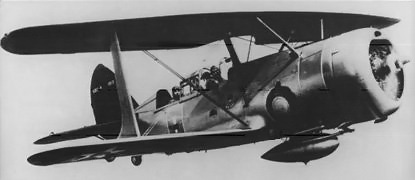
As the United States Navy built up its Carrier Force in the mid to late 1930s it continued to develop aircraft specifically designed to operate from aircraft carriers.  It continued its development of fighter, dive bomber and torpedo bomber aircraft.  In 1935 the Navy was operating the Grumman FF-1 biplane fighter which it had began using in 1933 and the Curtiss F11C and BF2C Goshawk. The Curtiss aircraft were built in fighter and bomber variants and while initial aircraft had an open cockpit and fixed landing gear later aircraft had an enclosed cockpit and retractable landing gear. They had top speed of 157 miles an hour and due to limited success and were retired from service by 1939.  The Goshawk was operated against the Japanese by Nationalist China and also served in a number of air forces including Thailand where they were used against the French and Japanese.

Grumman FF-1 (US Navy Photo)

The Grumman FF-1 was a two-seater that had a enclosed cockpit with retractable landing gear and a top speed of 201 miles an hour.  The FF-1 was faster than any naval aircraft of its era, a follow-on variant designated the SF-1 followed and 120 aircraft were built. Most of the operational aircraft served aboard the USS Lexington CV-2 in a fighter and scouting role. The FF-1 and SF-1 were withdrawn from first line service and placed with the reserve as well as being used in aviation training commands. The aircraft was manufactured under license by the Canadian Car and Foundry Company and served in the Canadian Air Force until 1942 as the Goblin and 40 of the Canadian aircraft were used by the Spanish Republican forces in the Spanish Civil War.

Grumman F2F-1 (US Navy Photo)

The FF-1/SF-1 was followed by the Grumman F2F a single-seat model with improved speed and maneuverability over is predecessors.  54 F2F’s were ordered in 1934 with the production models being delivered between April and August 1935.  The aircraft were armed with 2 .30 machine guns mounted above the cowl and had a top speed of 231 miles an hour and maximum range of 985 miles.  The aircraft would remain in service until they were replaced in 1939 with the Grumman F3F. However they remained in service as utility and training aircraft until retired from service toward the end of 1940.

Grumman F3F (US Navy Photo )

The Grumman F3F followed the F2F with 157 production models. It was more aerodynamic and had a more powerful engine that the F2F which enabled it to achieve a top speed of 264 miles an hour.  It was operated by seven Navy and Marine Corps Squadrons and entered service in 1936 and would serve aboard carriers until replaced in late 1941. It continued with 117 aircraft being stationed at naval air stations and used for training until 1943.

F2A Brewster Buffalo (U.S. Navy Photo)

The first monoplane fighter developed and placed in service by the Navy was the F2A Brewster Buffalo. The Buffalo served with Navy and Marine Corps squadrons and was purchased by Great Britain for service in the Royal Australian and Royal New Zealand Air Forces which received 202 Buffalos. They would also serve with the Royal Navy. The Royal Netherlands Air Force received 144 most of which served in the East Indies. The final nation to receive the Buffalo was Finland which received 44 aircraft.  Buffalo was underpowered and the addition of armor and added fuel capacity further diminished the speed and performance of the aircraft.  The Navy placed its Buffaloes in advanced training squadrons in early 1942 and one of the two Marine Corps squadrons (VMF-221) operated it at the Battle of Midway where they endured fearful losses at the hands of Japanese Zero fighters.

Brewster Buffalo 239s of the Finnish Air Force

Despite the lack of success in U. S. service the Buffalo performed in a heroic manner for the Finns destroying over 500 Soviet and German aircraft and producing 36 Buffalo Aces.  The highest scorer was Captain Hans W. Wind with 39 of His 75 victories flying a Buffalo.  British Commonwealth and Dutch aircraft did not fare as well during the campaign in the Dutch East Indies as the Finns, as the tropical climate degraded the aircraft considerably and they were flying against far better trained Japanese Navy pilots.

Martin T4M over Lexington or Saratoga (US Navy Photo)

The Navy also developed aircraft for bombing missions as well as that could launch aerial torpedoes. The first aircraft built were dual purpose in that they could be used in level bombing and torpedo missions. In 1935 the primary aircraft of this type was the Martin T4M which had entered service in 1928 and replaced the Douglas DT and Martin T4M aircraft.  The T4M was a biplane with a crew of three that had a maximum speed of 114 miles an hour (I have driven much fast than this on the German Autobahn but I digress) and it could carry a torpedo or bombs.  155 were purchased by the Navy and the Marine Corps between 1928 and 1931.  They were operated from the Lexington and Saratoga until 1938 as no replacement aircraft offered enough improvements for the Navy to purchase and were instrumental in the development and demonstration of the capabilities of naval air power.  They were finally replaced by the Douglas TBD Devastator.

TBD Devastator (US Navy Photo)

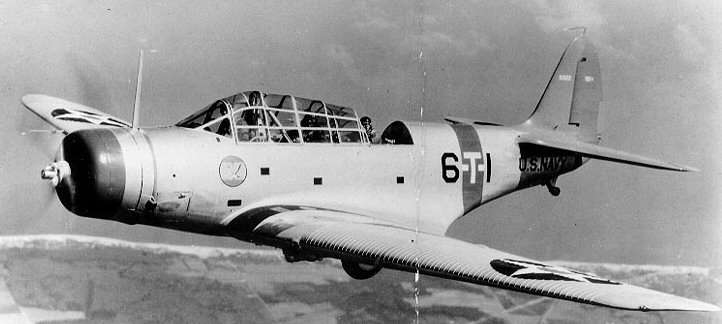
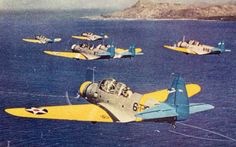
The TBD which first flew in 1935 entered service in 1937 and at the time was possibly the most modern naval aircraft in the world and was a revolutionary aircraft. It was the first monoplane widely used on carriers and was first all-metal naval aircraft.  It was the first naval aircraft with a totally enclosed cockpit, the first with hydraulic powered folding wings.  The TBD had crew of three and had a maximum speed of 206 miles an hour and carried a torpedo or up to 1500 pounds of bombs (3 x 500) or a 1000 pound bomb.  129 were built and served in all pre-war torpedo bombing squadrons based aboard the Lexington, Saratoga, Ranger, Yorktown, Enterpriseand Hornet with a limited number embarked aboard Wasp.  The Devastator saw extensive service prior to the war which pushed many airframes to the end of their useful service life and by 1940 only about 100 were operational. 

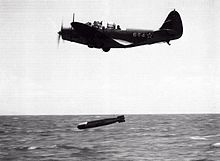
TBD from Torpedo 6 dropping Mk XIII during exercise October 1941

They were still in service in 1942 as their replacement the TBF Avenger was not ready for service.  They performed adequately against minor opposition at Coral Sea and in strikes against the Marshalls but the three squadrons which were embarked on the Yorktown (VT3), Enterprise (VT-6) and Hornet (VT-8) were annihilated at Midway. Of the 41 attacking aircraft, only 6 survived the uncoordinated attacks against the Japanese Carrier Strike Force.  They were too slow, had poor maneuverability, insufficient armor and defensive armament.  Only a few were able to launch their torpedoes as the Japanese Combat Air Patrol tore through them. Their sacrifice was not in vain as the Dive Bombers arrived facing no opposition and sank three of the four Japanese carriers getting the fourth later in the day. After Midway the remaining aircraft were withdrawn from active service in the Pacific. The Ranger’s VT-4 operated them until September 1942 and Wasp’s VT-7 operated them in the Atlantic until she was transferred to the Pacific in July 1942.  By 1944 all remaining aircraft had been scrapped.

Vought SBU Corsair

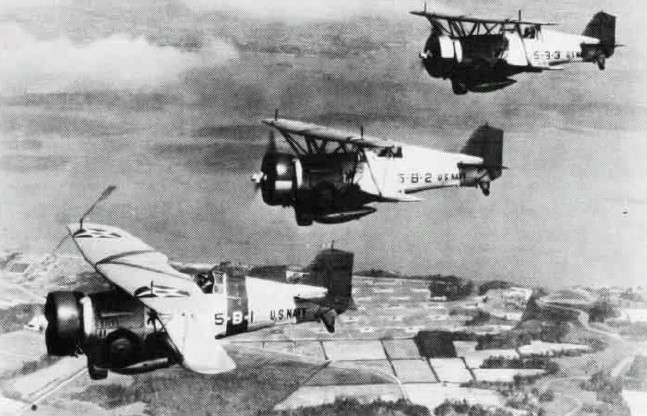
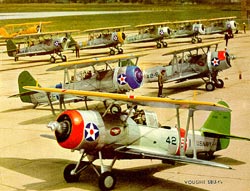
In the mid 1930s the Navy began to develop Scout and Dive Bombers for use in carrier scouting (VS) and bombing (VT) squadrons.  The first of these aircraft types were biplanes.  The Grumman SF-1 was used in a scouting and bombing role and was joined by the Vought SBU Corsair in 1935 and by 1937 both were being replaced by the Curtiss SBC Helldiver, a biplane with a 234 mile an hour maximum speed, retractable landing gear, enclosed cockpit which could carry a 1000 bomb.

Curtis SBC Helldiver

However the era of the biplane was drawing to a close and the Helldiver would be relegated to training squadrons based in Florida.  Although they had a brief service career they were instrumental in develop dive bombing tactics at which the U.S. Navy Pilots excelled. These tactics were copied by the German Luftwaffe operating the Junkers JU-87 Stuka and the Japanese with their Aichi 99 Val naval dive bomber.  50 aircraft were transferred to the French and served aboard the carrier Bearn but due to the French surrender in June of 1940 saw no action and spent the war rotting in Martinique.

Vought SB2U Vindicator flying ASW Patrol Of Atlantic Convoy, November 1941

The Helldiver’s were joined by the first monoplane dive bomber in U.S. service the Vought SBU2 Vindicator in 1937. The Vindicator was used by the Navy and the Marine Corps serving aboard the Lexington, Saratoga, Ranger and Wasp. They would remain in service until September 1942. The Marine aircraft equipped two squadrons VMSB 131 and VMSB-241, VMSB 241 suffered heavy casualties at Midway as the aircraft were underpowered and were limited to glide bombing missions.  After they were taken out of the operational squadrons the Vindicator served as a training aircraft until retired in 1945.   A French Naval Air Squadron was equipped with the Vindicator but they served ashore against the German invasion.  Most were lost to enemy action.  The Douglas SBD Dauntless was introduced in 1940 and 1941 but I will cover that aircraft in the World War II aircraft article that will follow this in a week or two.

These aircraft helped pave the way to aircraft that would be the mainstays of the Navy in the Second World War, aircraft with names such as Dauntless, Helldiver, Avenger, Hellcat and Corsair.  Naval aviation earned its “wings of gold” in these early years wings that continue to shine in the 21st Century.

Peace

Padre Steve+

2 Comments

Filed under aircraft, History, Loose thoughts and musings, Military, US Navy

2019: The Coming Disorder and a Spark that Cannot be Extinguished

Friends of Padre Steve’s World,

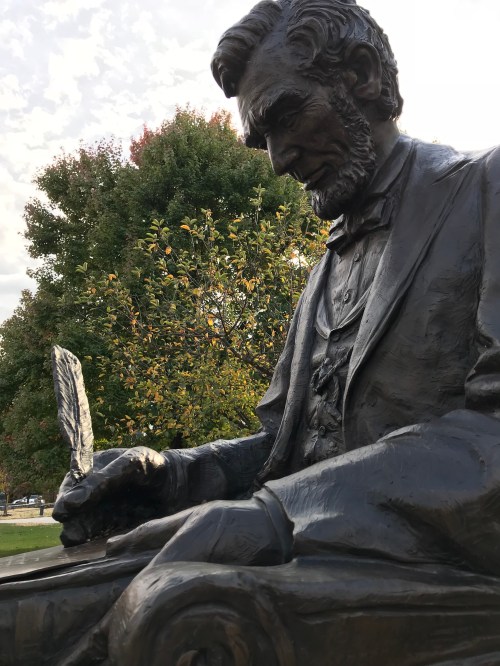
Abraham Lincoln noted:

“The best thing about the future is that it comes one day at a time.”

It is good to remember Lincoln’s words in times of turmoils. I do, and they bring me great motivation to work, believe, and fight for justice, truth, and the belief in a spark of goodness in humanity which enables me to believe the words of the Declaration of Independence:

“We hold these truths to be self-evident, that that all men are created equal, that they are endowed by their Creator with certain unalienable Rights, that among these are Life, Liberty and the pursuit of Happiness.”

The fact that those words come from a time of tumult, yet in a time where men were beginning to wrestle with and proclaim principles of the Enlightenment matters much to me, especially in times like we live today, where that principle is being attacked and undermined by the American President.

That being said, I believe that 2019 will be remembered in history as a time great turmoil, upheaval, and probably usher in a new epoch of war, economic, and ecological disaster. We may again be witnesses to genocide that leaders of governments fail to take the necessary actions to stop.

I don’t want to sound like a pessimist, but as a historian I to look at the world through how human beings, governments, and businesses behave in times of crisis. In fact, human beings are the singular constant in history and in crisis human beings don’t always live up to our ideals.

When major powers and international systems of order break down, or collapse for whatever reason, instability, disorder, and primordial hatreds based on nationalism, religion, and racism rise. A vacuum is created, filled by other powers, but not without some element of travail. Edmond Taylor wrote in his classic “The Fall of the Dynasties: The Collapse of the Order, 1905-1922:

“The collapse of the great supranational — or at least supraparochial — authorities and the dissolution of long-accepted Imperial bonds released upon Europe a fearsome flood of conflicting national ambitions, of inflamed minority particularisms, of historic (sometimes almost prehistoric) irredentisms, of irreconcilable social aspirations and of rival political fanaticisms.

The impending collapse of the old order today can be seen in a return to a more isolationist policy by the United States, rising populist, nationalist, and ethnocentric movements in Europe which are threatening the existence of the European Union. Those include Brexit, ethnic nationalism mixed with a bit of Fascism in Hungary, Italy, Poland, and great strains in France and Germany between right and left wing populist movements.

The common thread is the center which was the key to so much social progress, democracy, economic growth and stability, scientific advancement, and international security is giving way. There are many reasons for this, on the American side going back to the imperialist overreach of the George W. Bush administration, the inconsistent and detached method of the Obama administration towards the Middle East, especially Syria and Iraq, following that, and now the decidedly inconsistent, often irresponsible, and irreconcilable policies of isolationism and militarism.

A rejuvenated Russia is rushing to fill the void in the Middle East as well as working to destabilize its neighbors, Europe, and even the United States. The Chinese are attempting to make gains in other areas and to drive the United States out of Asia by using every element of national power: diplomacy, information, military might, and economics, while the United States following the Trump Administration’s withdraw from the Trans Pacific Partnership, and subsequent punishing tariffs that are hurting allies and Americans more than China the United States is now at a decided disadvantage in Asia.

I could go on, and could go into details on the causes of the current situation but they are many. What we are seeing now is the beginning of the collapse of an order that we have known most of our lives. While many people might be uneasy, most don’t view things in terms of history, in many cases because the events that led to the establishment of the current order are too distant and the witnesses to those times are few, and dying off. People today seldom study history, and even worse no longer know people, including family members who remember what happened to remind them of it.

That was quite similar to the situation in 1914. Europe had been at relative peace for a century. With the exception of the French Republic, most of Europe was still ruled by monarchies with rather limited democratic participation, if any. Barbara Tuchman wrote in her book The Proud Tower: A Portrait Of the World Before the War, 1890-1914:

“The proud tower built up through the great age of European civilization was an edifice of grandeur and passion, of riches and beauty and dark cellars. Its inhabitants lived, as compared to a later time, with more self-reliance, more confidence, more hope; greater magnificence, extravagance and elegance; more careless ease, more gaiety, more pleasure in each other’s company and conversation, more injustice and hypocrisy, more misery and want, more sentiment including false sentiment, less sufferance of mediocrity, more dignity in work, more delight in nature, more zest. The Old World had much that has since been lost, whatever may have been gained. Looking back on it from 1915, Emile Verhaeren, the Belgian Socialist poet, dedicated his pages, “With emotion, to the man I used to be.”

I believe that 2019 will the a year of multiple crises and the further erosion, if not collapse of the old order. What will come I do not know, but I expect that at the minimum it will be unsettling and disruptive, if not catastrophic. That doesn’t mean that I am a pessimist, it means that I study history. Provided that humanity does not find a way to destroy itself, we will recover. It may not be pretty and it certainly will not be the same as it was, but we will recover.

Walter Lord wrote about this his book on American in the early Twentieth Century The Good Years: 1900-1914. In the book he wrote about how things changed for Americans as Europe plunged into war. The effects of the war were soon felt in the United States though it would not enter the war until 1917. Lord wrote:

Economics were only part of the story. Almost overnight, Americans lost a happy, easygoing, confident way of looking at things. Gone was the bright lilt of “When You Wore a Tulip”; already it was the sadly nostalgic, “There’s a Long, Long Trail a-Winding,” or the grimly suggestive, “I Didn’t Raise My Boy to Be a Soldier.” A mounting crescendo of screaming headlines… atrocity stories… U-boat sinkings… charges and counter-charges shocked the nation, jarred its faith, left a residue of doubt and dismay.

Nothing seemed simple any more. Nothing was black and white. Nothing was “right” or “wrong,” the way Theodore Roosevelt used to describe things. And as the simple problems vanished, so did the simple solutions. Trust-busting, direct primaries, arbitration treaties and all the rest. They somehow lost their glamour as exciting panaceas, and nothing took their place. But the problems grew and grew —preparedness… taxes… war… Bolshevism… disillusionment… depression… Fascism… Moscow… fallout… space… more taxes.

So the old life slipped away, never to return again, and wise men sensed it almost at once. Men like Henry White, the immensely urbane diplomat who had served the country so well. “He instinctively felt,” according to his biographer Allan Nevins, “that his world —the world of constant travel, cosmopolitan intercourse, secure comfort and culture —would never be the same again.” The Philadelphia North American felt the same way, but in blunter words: “What does this mean but that our boasted civilization has broken down?”

Perhaps it was just as well. There was much that was wrong with this old way of living —its injustices, its naivete, its waste, its smug self-assurance. Men would come along to fix all that. New laws, controls, regulations, forms filled out in triplicate would keep anybody from getting too much or too little. And swarms of consultants, researchers, special assistants, and executive committees would make sure that great men always said and did the right thing.

There would be great gains. But after all the gains had been counted, it would turn out that something was also lost —a touch of optimism, confidence, exuberance, and hope. The spirit of an era can’t be blocked out and measured, but it is there nonetheless. And in these brief, buoyant years it was a spark that somehow gave extra promise to life. By the light of this spark, men and women saw themselves as heroes shaping the world, rather than victims struggling through it.

Actually, this was nothing unique. People had seen the spark before, would surely do so again. For it can never die as long as men breathe. But sometimes it burns low, leaving men uncertain in the shadows; other times it glows bright, catching the eye with breath-taking visions of the future.

The truth is, even in the midst of crises that the spark that enables people to believe, to hope, and to labor for a better future where the possibilities of peace, justice, freedom, and progress can be realized.

2019 will likely be a very difficult year, a year of change and turbulence, and truthfully it will probably be just the beginning; but unless finds a way to destroy itself, it will not be the end.

So, unless I get a hair up my ass to write something else before midnight, I wish you a Happy New Year, and all the best.

Peace,

Padre Steve+

1 Comment

Filed under ethics, faith, History, leadership, life, middle east, Military, national security, News and current events, Political Commentary, Religion

The Pinnacle Of Obsolescence: The Unbuilt Battle Cruisers Of the 1920s and the Supercarriers of the 2020s?

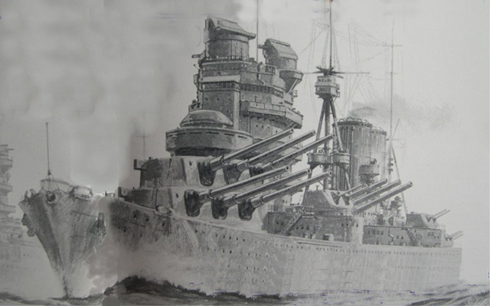
artist

Artists Depiction of G3 Battlecruiser 

Friends of Padre Steve’s World,

This weekend I will be reflecting on the old year and the coming new year, but tonight I decided to tweak and republish an article from about four years ago dealing with the battle cruisers being built by Great Britain, Japan, and the United States after the First World War. They represented the pinnacle of naval design for their era and would have been far superior to their adversaries had technology and war remained static. As Admiral Ernest King noted:

“Nothing remains static in war or military weapons, and it is consequently often dangerous to rely on courses suggested by apparent similarities in the past.”

As the First World War ended a new Naval Race was heating up. The United States had announced its intention during the war to build a navy second to none while Imperial Japan was making plans for a fleet that would give it superiority in the Western Pacific. The British, though still be far the largest naval power in the world were burdened by the massive costs of war and empire, but also seeking to maintain their naval dominance and to that end they were in the process of building a class of massive super-Dreadnought battleships, and Battle Cruisers.

The ships known as battle cruisers were first built by the British Royal Navy as a compliment to the all big gun Dreadnought battleships. The Battle Cruiser concept was for a ship of roughly the same size and firepower as a Battleship but sacrificing protection for greater speed, endurance and range.  and Japan joined in the Battle Cruiser race before and during the war. Unlike Britain the United States had concentrated on building battleships but following the war began to design and build its own class of massive battle cruisers.

800px-InvincibleBlowingUpJutland1916

HMS Invincible Blowing Up at Jutland 

During the war the weaknesses of the type were exposed during the Battle of Jutland where three British Battle Cruisers, the HMS InvincibleHMS Indefatigable and HMS Queen Mary blew up with the loss of most of their crews; of the 3311 officers and sailors on the ships only 26 survived. The HMS Lion was almost lost in a similar manner but the heroic actions of her crew saved her from her sisters fate. The British ships had glaring deficiencies in armor protection and the arrangement of their ammunition magazines and hoists which certainly contributed to their loss. Their German counterparts on the other hand proved much tougher and though all sustained heavy damage while engaging British Battleships and Battle Cruisers, only one the Lützow was lost. She absorbed over 30 hits from large caliber shells and only lost 128 crew members.

h60404
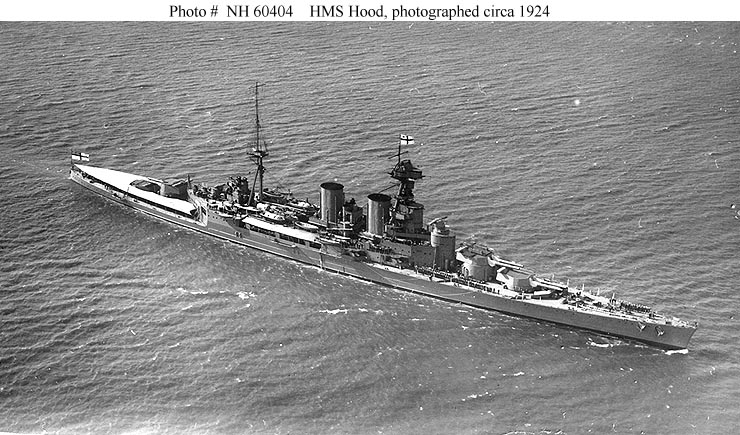
HMS Hood

As the war progressed other Battle Cruisers were built, the British launched the HMS Repulse and HMS Renown and completed the HMS Hood shortly after the war was over. The Japanese built the four ship Kongo class from a British design, the first of which, the Kongo was completed in a British yard. As the powers embarked on the next Naval Race planners and naval architects designed ships of massive firepower, better protection and higher range and speed. All would have been better classed as Fast Battleships.

The British designed and began construction on the G3 class in 1921, while the Japanese began work on the Amagi Class, and the United States the Lexington Class. However the construction and completion of these ships as Battle Cruisers was prevented by the Washington Naval Treaty.

invincible 490

The treaty, which was ratified in 1922 limited the United States and Great Britain to a maximum of 525,000 tons in their battle ship fleets and 125,000 tons in aircraft carriers.  The Japanese agreed to a limit of 315,000 tons and the French and Italians 175,000 tons each. Tonnage for battleships was limited to a maximum of 35,000 tons with a limitation on guns size to 16 inches.  Since the bulk of the ships planned or being built by the US and Japan exceeded those limits they would be effected more than the British whose post war shipbuilding program had not begun in earnest, in fact the G3 Class had just been approved for construction.

The G3 class would have comprised four ships and been similar to the N3 Class Battleships. They were very well balanced ships and would have mounted nine 16” guns in three turrets on a displacement of 49,200 tons and deep load of 54,774 tons. They had an all or nothing protection plan meaning that the armored belt was concentrated in vital areas around the armored citadel, conning tower, turrets and magazines and engineering spaces. Their armor belt would have ranged from 12-14 inches, deck armor from 3-8 inches, conning tower 8 inches, barbettes 11-14 inches, turrets 13-17 inches and bulkheads 10-12 inches. Their propulsion system of 20 small tube boilers powering 4 geared steam turbines connected to 4 propeller shafts would have produced 160,000 shp with a designed speed of 32 knots.
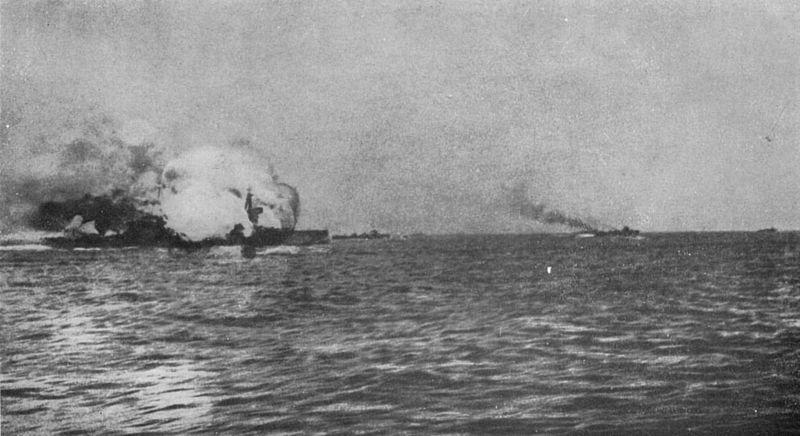
The four ships, none of which were named were ordered between October and November of 1921. Their construction was suspended on November 18th 1921 and they and the N3 Battleships were cancelled in February 1922 due to the limitations of the Washington Naval Treaty. Many concepts of their design were incorporated in the Nelson Class battleships which were a compromise design built to stay within the limits of the treaty.

rys-amagi

Amagi Class as Designed, Akagi as Completed (below) 

JapaneseAircraftCarrierAkagi3Deck_cropped

The four planned Japanese Amagi Class ships would have mounted ten 16” guns on a displacement of 47,000 tons at full load. Their propulsion system 19 Kampon boilers powering four Gihon turbines would have given them a maximum speed of 30 knots, They would have had less protection than the G3 ships being more of a traditional Battle Cruiser design. As a result of the Washington Naval Treaty the Japanese elected to convert two of the ships, the Amagi and Akagi to aircraft carriers. Amagi was destroyed on the ways during the great Tokyo earthquake and Akagi was completed as a carrier. The other two vessels were scrapped on the ways.

Lexington_battlecruiser_conversion_models

lexington-class-battle-cruisern11978

Lex4259BrassDraw

The United States Navy planned the six ship Lexington Class. These ships would have mounted eight 16” guns on a ship measuring 874 feet long and 105 feet in beam, displacing 43,254 tons at full load, or nearly the size of the Iowa Class battleships. They would have had a maximum speed of 33 knots being powered by 16 boilers which drove 4 GE electric turbines producing 180,000 shaft horse power. Theirs was a massive engineering plant and while the class did not have as heavy armor protection as either the G3 or Amagi classes, they were superior to them in speed as well as endurance. Upon ratification of the Washington Naval Treaty four of the six ships were cancelled and the remaining two, the Lexington and Saratoga competed as aircraft carriers.  Had any of the ships been completed as Battle Cruisers it is likely due to their speed that they would have operated primarily with the the carriers that the US Navy built during the 1930s.

g416531

One can only speculate what the navies of World War II would have looked like had the Washington and the subsequent London Naval Treaties not been ratified. One can also only imagine how the war at sea would have been different had the ships completed as carriers been completed as Battle Cruisers.

However that was not to be, of the planned 14 ships of these three classes only three were completed, all as aircraft carriers, ships that helped to forge the future of naval operations and warfare for nearly a century. Thus the uncompleted ships are an interesting footnote in naval history yet have their own mystique.

HMS Queen Elizabeth 

Yet nothing remains static. The massive aircraft carriers which have ruled the seas since the Second World War are not necessarily invincible and depending on how technology progresses could be heading into obsolescence, and end up serving in support roles or being paid off. Perhaps to meet some missions smaller and cheaper carriers will be developed, or existing platforms modified to carry more capable aircraft as the Japanese are doing with their Izumo Class “Helicopter Destroyers.” 

JMSDF “Helicopter Destroyer” Kaga 

Thus, one might wonder if the large new aircraft carriers currently being built by the United States, Britain, China, India, and other nations will also be displaced by advancing technology as were the battlecrusiers of the 1920s. It is a question that must be asked. There are certainly arguments for them, but what would the effect be on the United States Navy if one of the Nimitz Class carriers was sunk by the Chinese? My guess is that it would be the same kind of shock that hit the Royal Navy after Jutland, and the U.S. Navy after Pearl Harbor.

Until tomorrow,

Peace

Padre Steve+

11 Comments

Filed under History, Military, national security, Navy Ships, News and current events, US Navy

Yes Men and No Men: Hermann Goering and Johannes Steinhoff in the Age of Trump

Friends of Padre Steve’s World,

I am posting a slightly updated version on an article that I have published before because I think it is even more relevant following how President Trump has treated, Secretary of Defense James Mattis, Lieutenant General H. R. McMaster, and Mattis’s recommendation of Air Force General David Goldfein to be the next Chairman Of the Joint Chiefs of Staff. All are decorated combat commanders, had been under enemy fire, and all are scholars capable of self-reflection. All stand for a different type of military than that Trump admires, they are not yes men, nor Trump’s Generals. That is why Goldfein was rejected by Trump, why Mattis and McMaster both resigned, and were replaced by men that Trump sees as yes men, the same as with the replacement of Attorney General Jeff Sessions, FBI Director James Comey, and Ambassador to the United Nations Nikki Haley, by people thought to be loyal to the President, most of whom are totally unqualified for their office but whose personal loyalty to the President, not the Constitution, is unquestionable.

At Nuremberg, Hermann Goering was asked by Gustave Gilbert as to “why he and the others had been such abject “yes men,” Goering replied: “Please show me a ‘no man’ in Germany who is not six feet under the ground today.” Goering, who was exceptionally intelligent and talented subordinated himself to Hitler and while not completely correct in regards to the fate of all the “no men” did understand the principle of unconditional personal loyalty to his leader, which makes the actions of men like Johannes Steinhoff much more remarkable.

A few months back I did some research on the anti-Nazi resistors, which caused me to go back are re-read a book by World War II German Luftwaffe ace Johannes Steinhoff, which I believe should be requires reading for any military officer or public servant in the Trump era.

Steinhoff was unlike many of the German officers who wrote memoirs following the war, memoirs that historian Williamson Murray wrote “fell generally into two categories; generals writing in the genre of “if the fuhrer had only listened to me!” and fighter pilots or tank busters writing about their heroics against the productive flood from America or the primitively masses of the Soviet Union.”

Steinhoff’s book, The Final Hours: The Luftwaffe Plot Against Goering should be essential reading for any currently serving officer, diplomat, Federal law enforcement, intelligence, or Department of Justice official  as the Trump administration becomes more established and capricious.

steinhoff6

General Johannes Steinhof (above) as a Bundeswehr and NATO officer, showing his burns and before his crash (below)

steinhoff WW II

In his books, Steinhoff does something that you do not see authors do in most military or political memoirs, he actually does serious self reflection on his role in supporting an evil regime. In his introduction to his book The Final Hours the legendary fighter ace who was horribly disfigured when his Me-262 jet fighter crashed and burned two weeks prior to the end of the war wrote:

“In recalling these events, which had been long buried in my memory, it has not been my intention to make excuses. Our unconditional self-sacrifice in the service of the Third Reich is too well documented for that….

So it is because of what is happening today—with freedom threatened in virtually every respect by its own abuse—that I offer this contribution, in the form of an episode in which I was myself involved, to the history of the soldier in the twentieth century. Soldiers have always, in every century of their existence, been victims of the ruthless misuse of power; indeed, given the opportunity, they have joined in the power game themselves. But it fell to our own century to accomplish, with the aid of a whole technology of mass extermination, the most atrocious massacres in the history of mankind. This fact alone makes pacifism a philosophy worthy of respect, and I have a great deal of sympathy with those who profess it. 

The figure of the soldier in all his manifestations is thus symptomatic of the century now nearing its close, and it is to the history of that figure that I wish to contribute by describing what happened to me. I have tried to show what it is possible to do to men, how insidiously they can be manipulated by education, how they can be hoisted onto a pedestal as “heroes,” how they can be so corrupted as even to enjoy the experience—and how they can be dropped and denounced as mutineers when they discover that they have scruples. The complete lack of scruples that such treatment implies is peculiar to rulers who believe that the problems of their own and other peoples can be solved by imposing, through the use of military force, peace on their, the rulers’, terms—in our case a pax germanica, but the second Latin word is readily interchangeable.” from “The Final Hours: The Luftwaffe Plot Against Goring (Aviation Classics)” by Johannes Steinhoff

Since I am a historian and and a career military officer with service in the Iraq War, a war that was illegal and unjust by all measure I can understand Steinhof’s words. Because much of my undergraduate and graduate work focused on German history, particularly that of Imperial Germany after the unification, the Weimar Republic, and the Nazi Reich, I draw a lot of lessons from the period. I also understand how people in this country can fall for the same kind of vitriolic propaganda that the Germans of that era did. I can understand because for years I fell for the lies and propaganda being put out by the politicians, pundits and preachers of the American political right.

In fact I wrote about an incident that happened to me in my own chapel where a dedicated Trump supporter attempted to have me charged with Conduct Unbecoming an Officer and Contempt for the President.  He did this because I used biblical preaching backed by sound theology and history to condemn the President’s comparison of immigrants of darker skin colors as “animals” and an “infestation.” I compared those words with the way Hitler and other totalitarian leaders used such terminology to dehumanize their victims. As I mentioned I was completely cleared by the preliminary inquiry but it sends a chill through my spine.

10665323_10154041610267059_5277331492232210946_n

A picture of me (on left) in Iraq 2007 with my assistant and bodyguard RP1 Nelson Lebron

One of those lessons is that in times of crisis, that people, no matter what their race, culture, religious belief system, educational, or economic background are still human. Humanity is the one constant in all of history, our prejudices are often ingrained in us during childhood and reinforced by the words of politicians, pundits, and preachers. In times of stress, crisis, and societal change or upheaval even good people, moral people, people of great intellectual, scientific abilities can fall prey to demagogues who preach hate and blame others, usually racial, ethnic, or religious minorities, as well as civil libertarians who champion the rights of those minorities for the problems of the nation.

Shrewd politicians, preachers, and pundits do this well. They demonize the target group or population and then let the hatred of their disaffected followers flow. The leaders need that disaffected and angry base in order to rise to power; such was how Hitler, Stalin, and so many other despots gained power. They took advantage of a climate of fear, and found others to blame. For Hitler it was the Jews, Slavs, Socialists and Communists; while for Stalin it was various groups like the Ukrainians, or the Poles who were the devil to be feared and destroyed. Timothy Snyder in his book Bloodlands: Europe Between Hitler and Stalin wrote:

“Dead human beings provided retrospective arguments for the rectitude of policy. Hitler and Stalin thus shared a certain politics of tyranny: they brought about catastrophes, blamed the enemy of their choice, and then used the death of millions to make the case that their policies were necessary or desirable. Each of them had a transformative utopia, a group to be blamed when its realization proved impossible, and then a policy of mass murder that could be proclaimed as a kind of ersatz victory.”

But that being said, there are a lot of people who from childhood believe the lies about others without question. In good times such people continue on with life as normal, but in crisis those hatreds and prejudices come to the fore. Rudolf Höss, the notorious sociopath who commanded Auschwitz told American Army psychologist Gustave Gilbert about his reaction when ordered to turn the camp into an extermination center. He said that the order “fitted in with all that had been preached to me for years,” and “at the same time I didn’t think of it as propaganda, but as something one just had to believe.” 

Eugene Davidson in his book on the Nuremberg Trials wrote:

“Every society has in it at all times negative, criminal, sadistic, asocial forces. What holds them in check more than law and police is the consensus of the society – a general belief that despite everything wrong and stupid and muddleheaded in politics, the state is a going concern that will somehow make its way into the future.” (Davidson, The Trial of the Germans p.581)

But when things do not go well, when people do not feel that things will be okay, that the future will be better, and that they have a purpose they look for answers. However, they tend to find their answers in the rantings of demagogues, race baiters, conspiracy theorists, and others who they would tend to dismiss out of hand in good times. In Germany it was the loss of the First World War, the humiliation of Versailles and the economic chaos and social change of the Weimar period which allowed Hitler to gain an audience, then a following, then political power. The demagogues played to what was already in the hearts and minds of the disaffected masses, without that fertile soil, the rantings of Hitler and his propagandists would have never succeeded. Albert Speer wrote:

“As I see it today, Hitler and Goebbels were in fact molded by the mob itself, guided by its yearnings and its daydreams. Of course, Goebbels and Hitler knew how to penetrate through to the instincts of their audiences; but in the deeper sense they derived their whole existence from these audiences. Certainly the masses roared to the beat set by Hitler’s and Goebbels’ baton; yet they were not the true conductors. The mob determined the theme. To compensate for misery, insecurity, unemployment, and hopelessness, this anonymous assemblage wallowed for hours at a time in obsessions, savagery and license. The personal unhappiness caused by the breakdown of the economy was replaced by a frenzy that demanded victims. By lashing out at their opponents and vilifying the Jews, they gave expression and direction to fierce primal passions.”

In a sense a similar thing has happened in the United States which has experienced a series of wars beginning with Vietnam, the shock of the 9-11-2001 attacks, the economic crash of 2007 and 2008 which devastated the savings, home ownership, and investments of many Americans while at the same time benefiting the banking and brokerage houses whose government assisted policies brought about the crash. Of course there are other issues, many religious conservatives hate the progress made by the Women’s and Gay Rights movements, and their leaders play to their fears in apocalyptic terms. I could go on, but I am sure that my readers can identify other issues which demagogues and others use to spread fear and hate to further their goals. The fact is that without the the fertile soil that lays in the hearts of their most fervent followers they would never have a following.

In Weimar Germany hate mongers like Julius Streicher and propagandist Josef Goebbels stuck a chord with disenchanted people who felt that they had lost their country. They were fearful, angry, and desired a leader who would “make Germany great again.” Hitler and his Nazi media sycophants played to that fear, and took advantage of their anger at the existing order. Davidson wrote such people “exist everywhere and in a sick society they can flourish.” 

For decades the way has been prepared for true extremists to take advantage of the fears and doubts of people as modern American versions of Streicher and Goebbels have been at work for years. Rush Limbaugh was a modern pioneer of this in the United States, and he has been joined by so many who are even more extreme in their rantings that it is hard to name them all. Likewise, whole media corporations especially Fox News, websites, and political networks spread such fear every minute of the day, claiming that they, and they alone are real Americans. They actively support politicians who condemn, and sometimes even threaten people who oppose them, and all the while claim that “make America great again.”

When I was younger I devoured that propaganda, despite all of my learning I followed the rantings of men who I realize today are propagandists who promote the basest of lies, and hatred, often in the name of God. I was changed when I was at war, and when I returned home from Iraq in 2008 I realized through hard experience that I had been lied to, and that as a result that thousands of my brothers and sisters were dead, and tens of thousands shattered in body, mind, and spirit. Likewise I saw the massive destruction levied on Iraq and realized how terrible war really is. That was my epiphany, that is what it took to see how much I had been lied to, and it called me to question everything else that I had so willingly believed, things which had been fed to me by years of indoctrination in church, through the media, and by politicians who I believed were truly Christian. I can understand now how Martin Niemoller felt after the Nazi seizure of power when he said, “I hated the growing atheistic movement, which was fostered and promoted by the Social Democrats and the Communists. Their hostility toward the Church made me pin my hopes on Hitler for a while. I am paying for that mistake now; and not me alone, but thousands of other persons like me.”

There was a time that I hated people who espouse the views that I hold today, the views that I write about so often here on this site. I can remember how angry I would get as I listened to the propaganda being put out by Limbaugh, Hannity, the Fox News Channel and all of the others that I listened to every time that I had the chance. But when I changed after Iraq, I felt the sting of that hatred in very real ways. I remember the day I was called by my bishop in my former church, who told me that I had to leave because my views on women, gays, and Moslems were to use his words were now “too liberal.” After that, many men who I considered to be the best of friends turned their backs on me, some in the most bitter and vindictive of ways.

But I realize now that what they did was because I had in a sense left the cult, and had to be ostracized. I can understand that now, because when I was under the spell I too turned my back on people who had fallen out of favor, or people who had rejected the tenants of the church or the political movement, and those are things that I can never undo. But at the time it made sense, it fitted in with all I had been taught for decades, as Albert Speer wrote of Hitler, “One seldom recognizes the devil when he is putting his hand on your shoulder.”

What happened to Steinhoff’s generation is threatening to happen again, in our country, an authoritarian movement is threatening to destroy our democracy and republic. In it soldiers are esteemed, until they realize what is going on and speak out, but by then it is usually too late. I am understanding that fact more and more every day, and having had people troll this blog and call me a traitor and worse, I understand just a bit of what happened to Steinhoff and his fellow officers when they protested to the highest levels what was happening to Germany in early 1945.

In 1944 he and other fighter pilots were subjected to a political indoctrination session and realized that in the Nazi state loyalty and doctrinal purity to Naziism was more important than either combat service or competence. He wrote:

“Now, however, we realized to our horror that a group of officers had decided, after five years of war, to conduct a purge among the troops with the object of eliminating all those “whose past life and present conduct were not consonant with the National-Socialist type” and who did not “stand firm on National-Socialist principles.” We sat there petrified, but some of those present appeared hugely to enjoy the ensuing discussion of what they called “National-Socialist guidelines.” Perhaps, though, for many it was simply an attempt to escape into a less concrete area of discussion than the desperate military situation—and then there was the added satisfaction of being able to censure others. Fanaticism took the place of hopelessness, and phrases like “faith in the Führer,” “rootedness in National-Socialist ideology,” and “irreproachability of character” fell without hesitation from people’s lips. The Luftwaffe leadership, it was said, must be “combed” from top to bottom, and then someone even came out with the “National-Socialist soul…”

We will soon know how military professionals react to being labeled as traitors. President Trump and his followers have been demonizing the personnel of the nation’s intelligence, law enforcement, and diplomatic communities since before the election. The President lambasts critics of any station on his Twitter feed which results in them receiving death threats from his followers. I expect that when Secretary of Defense James Mattis speaks his mind and tells the truth that we will find out.

Personally I expect that when he does that Trump and his most strident supporters will label him as a traitor for doing so. Like a religious cult they have no capacity to tolerate dissent, loyalty to the man will supersede loyalty to the country or the Constitution. When that happens it will be interesting to see the throngs of people in the military and outside of it who make the choice to throw one of the most courageous, selfless, and intellectual soldiers ever produced by our nation under the bus.

Their’s will be a conscious decision. My opinion is that the Constitution and the country will always come first. I wanted to give the President the benefit of the doubt and prayed that he world do the right thing for the country. But I was wrong. I am concerned because of his past and current behavior that his only loyalty is to himself. General Ludwig Beck, who resigned rather than obey Hitler’s order to invade Czechoslovakia in 1938 and died in the anti-Hitler coup attempt in 1944 said:

“It is a lack of character and insight, when a soldier in high command sees his duty and mission only in the context of his military orders without realizing that the highest responsibility is to the people of his country.” 

I have no doubt that General Mattis understands that and will courageously speak his mind, even if he is condemned for doing so. Sadly I have many doubts about other leaders: be they military, political, business, or religious. There are many people who will sell their souls for their personal advancement, the advancement of their agenda, or an increase in their bottom line. It is after all human nature.

But the question is: will we see true men and women of courage who will stand when it appears there is no chance of success? As Atticus Finch said in To Kill a Mockingbird: “Real courage is when you know you’re licked before you begin, but you begin anyway and see it through no matter what.” 

That will be what is demanded in the coming months and years.

Peace

Padre Steve+

5 Comments

Filed under ethics, History, leadership, Military, nazi germany, News and current events, Political Commentary, world war two in europe

The Death Ride Of the Scharnhorst at North Cape

Friends of Padre Steve’s World,

Today was the Second Day of Christmas or as it is also known, the Feast of St. Stephen.

Christmastide is a joyous time for many, but in the course of history there have been times that military men have fought and died in hopeless battles far from their families. Thus it is often a time of sorrow, especially for those that die alone. Among those who died alone in the Arctic darkness of December 26th 1943 were the officers and crew of the German battlecruiser Scharnhorst.

Schlachtschiff

The Scharnhorst along with her sister ship Gneisenau were the product of the naval architects of Germany who in the early 1930s designed some of the most beautiful as well as deadly warships of the Second World War.  Following Germany’s rejection of the provisions of the Treaty of Versailles the Kreigsmarine enacted a building program to enlarge and modernize the German Navy which then was composed of obsolete pre-Dreadnaught battleships and a few modern light cruisers and destroyers.   The first major units constructed were actually begun by the predecessor to the Kreigsmarine, the Reichsmarine Of the Weimar Republic.  These were the Deutschland class Armored Ships, sometimes called “Pocket Battleships” and later reclassified as Heavy Cruisers. These ships were designed to replace the old pre-Dreadnaught battleships and incorporated electric welds to reduce displacement, diesel engines for extended cruise range to enable them to serve as commerce raiders and a battery of six 11” guns.  While an advance over anything in the German inventory they were outclassed by the British battle cruisers Hood, Renown and Repulse.

However, the first true capital ships built by the Kriegsmarine were the Scharnhorst and Gneisenau They were classed as battleships by the Germans, but in reality they were battle cruisers because of their light main battery of 11” guns as opposed to the 14”, 15” or 16” batteries of other nations battleships.  In fact, their main battery was Despite this in displacement and armor protection of the ships was comparable to other battleships of the era and their designed speed of 31.5 knots was superior to almost all other battleships of the era including the British King George V Class and the US Navy’s  North Carolina class.  Only the massive battlecruiser HMS Hood was their superior in speed and firepower.

As built Scharnhorst and Gneisenau displaced 31,000 toms, however at full combat load they both weighed in at nearly 38,000 tons and were 772 feet long.  They had an armor belt that was nearly 14 inches thick.  Armed with a main battery of nine 11” guns and a secondary armament of twelve 5.9 inch guns they also mounted a powerful for the time anti- aircraft battery of fourteen 4.1 inch guns, 16 37mm and 16 20mm anti-aircraft cannons.  Additionally they mounted six 21” torpedo tubes and carried three Arado 196 A3 scout planes.  The main battery was eventually to be replaced by six 15” guns but this never occurred; Gneisenau was taken in hand to mount the new weapons but the conversion was never completed due to Hitler’s anger after the failure of a German task force during the Battle of the Barents Sea in December 1942.

scharnhorst2

Scharnhorst firing at HMS Glorious 

Laid down on 15 June 1935 and launched 3 October 1936 Scharnhorst was commissioned 7 January 1939.  Her sister Gneisenau was laid down 6 May 1935, launched 8 December 1936 and commissioned 21 May 1938.  Upon the commencement of the Second World War the two sisters began a reign of destruction on British shipping. In November they sank the Armed Merchant Cruiser HMS Rawalpindi During Operation Weserübung the pair surprised sank the aircraft carrier HMS Glorious and her two escorting destroyers, the only time a Fleet carrier was caught and sunk by battleships during the war.   From January to March 1941 they conducted Operation Berlin against British merchant shipping in the North Atlantic sinking 22 ships before returning to base.

eeb893a0b92de4ae595de56fe0fd90ca

Scharnhorst and Gneisenau during Operation Cerebus

While in the port of Brest Gneisenau was bombed and torpedoed requiring extensive repairs.  Due to the exposed location of the port the German high command decided to return the ships to Germany along with the Heavy Cruiser Prinz Eugen.  The operation was called Operation Cerberus and it took place from 11-13 February 1942. The ships made a dash up the English Channel which was unsuccessfully contested by the British Royal Air Force and Royal Navy. However, both Scharnhorst and Gneisenau were damaged by mines and needed subsequent repairs.  While undergoing repairs in Kiel Gneisenau was further damaged by the Royal Air Force requiring repairs in or to steam to the port of Gotenhafen for repair and conversion.  Although some work was completed she was decommissioned and sunk as a blockship on 23 March 1945.  Following the war she was raised by the Poles and scrapped.

Scharnhorst was repaired following Operation Cerberes and in March 1943 was transferred to Norway where along with Tirpitz, Admiral Scheer, Lutzow (the former Deutschland), Admiral Hipper and Prinz Eugen she became part of a “fleet in being” poised to strike the Allied convoys bound for Russia.


Admiral_Bruce_Fraser_1943_IWM_A_16489

Admiral Bruce Fraser

The German surface ships were a potent force that if the circumstances allowed could devastate the Russia bound convoys and the Commander of the British Home Fleet, Admiral Bruce Fraser was determined to entrap and destroy any of these ships that threatened any convoy. As such in December 1943 Fraser formed a task group built around the HMS Duke of York to be ready to pounce on any German raider that threatened the convoys. His intent was to catch any of these ships, especially Scharnhorst and trap them between the convoys and their base, in conduction with a second task group centered around the cruisers HMS Belfast, HMS Norfolk, and HMS Sheffield, Known as Force One, and destroy the German battleship.

The key to British the British operation was Enigma the German code machine and cipher system which they had acquired from captured U-Boats, and which British code-breakers had mastered. The Germans decided to send Scharnhorst and five destroyers to locate and destroy convoy JW-55B which had been spotted by Luftwaffe reconnaissance aircraft. Because of Enigma, Fraser knew that Scharnhorst would attempt to intercept the convoy and put his plan to set the trap in motion.

Battle_of_North_Cape_26_December_1943_map

Scharnhorst and her escorts set sail on Christmas Day 1943 under the command of Rear Admiral Erich Bey to conduct Operation Ostfront. But Bey was new to command, he had been promoted to Konteradmiral on the day the force sailed, having taken the place of Admiral Oskar Kummetz who had left for Germany to take a long convalescent leave. Bey was an experienced commander, but all of his experience was on destroyers. He was a torpedo expert, but had never served aboard a battleship, or even a cruiser, and he was a a novice when it came to the large caliber guns aboard the Scharnhorst. His position was made worse by the fact that the task force staff had been thinned out by the Navy for few expected it to be sent in combat.

However, Grand Admiral Karl Dönitz, had decided that given the right conditions, specifically that an exposed convey without heavy support which could be engaged with a high degree of success could be attacked. This convoy was JW-55B, which had been spotted by a German weather observation aircraft on the 22nd Of December. However, the weather was so foul that no further spotting of it or any other British ships was made. There was no question that further air reconnaissance was possible, Berlin was satisfied that the convoy had no support, as German Historian Wolfgang Zank wrote that Berlin followed its motto: “Was nicht gemeldet wird, ist auch nicht da” or “What isn’t reported, isn’t there.” 

Bey wasn’t convinced while still transiting Alta Fjord, he radioed Berlin to inform the high command of how the weather would interfere with the operations of his five destroyers, after all he was a destroyerman and had commanded destroyers in such weather. He was attempting to get the mission called off, but Berlin insisted on the attack. Dönitz replied “I believe in your attacking spirit. Sieg Heil!” With no recourse, Bey put to sea.

However, his destroyers could not keep pace with Scharnhorst so Bey detached them and sailed alone to fight the enemy.

Since Fraser knew that the Germans were coming he had the convoy to temporarily reverse course. This action caused Bey to find nothing where he expected the convoy to be, but he did encounter and engage at long range Fraser’s cruisers including HMS Norfolk, HMS Sheffield both veterans of the the hunt for and sinking of the Bismarck and the HMS Belfast. Scharnhorst’s guns damaged the heavy cruiser Norfolk, but the radar directed fire of the British cruisers landed a hit which knocked out her search radar leaving the German ship virtually blind as the weather worsened and darkness set in.

Bey, thinking he had shaken his pursuers, set course for Alta Fjord at full speed, however, Belfast had maintained contact and Fraser with Duke of York closed the distance and at 1617 her radar picked up the German at a range of 45,500 yards. By 1632 she was 29,700 yards away. Scharnhorst was oblivious to the danger, and at 1648 Belfast illuminated the German ship and Duke of York opened fire at just under 12,000 yards scoring hits which disabled Scharnhorst’s forward turrets and destroyed her airplane hanger. Bey changed course and increased speed, briefly opening the range and momentarily giving the Germans hope, but that was not to be.

At 1820 Duke of York struck a devastating blow on the German ship. A 14” shell pierced the armored belt and exploded in Scharnhorst’s number one boiler room reducing her speed to just 10 knots. Quick repairs were made enabling the ship to steam at 22 knots, but now she was vulnerable to torpedo attacks by the British destroyers.

When he did not find the convoy in the expected location Bey detached his destroyers to expand the search area, leaving Scharnhorst alone to face the enemy.

Rear Admiral Erich Bey

At about 0900 on December 26th 1943 the cruisers of Force One discovered Scharnhorst and the  Battle of North Cape was on. Though little damage was suffered in the first engagement, the radar of Scharnhorst was knocked out, leaving her not only without air support or escort, but blind.

HMS Duke of York firing her main battery

Scharnhorst attempted to flee, but Fraser’s Duke of York  and her four escorting destroyers destroyers intercepted her. Without radar in the blinding snow squalls Scharnhorst was surprise by their appearance. Duke of York’s first radar direct salvos knocked out her forward main battery but the German ship appeared to be making a getaway when a shell from Duke of York hit her number one boiler room and reduced her speed to barely ten knots. Although the German engineers and damage control teams made some repairs and were able to bring her speed back up to 22 knots, the British ships rapidly made up the distance enabling the British destroyers to launch torpedo attacks.

Knowing the ship was doomed Admiral Bey dispatched a message to the high command of the Kriegsmarine: “We will fight on until the last shell is fired.” 

While Scharnhorst attempted to fight off her attackers and escape she was struck by torpedoes from several destroyers as being punished at distance of under 10,000 yards by Duke of York’s 14″ shells, as well as the 6″ shells of HMS Belfast and HMS Jamaica. Savaged by at least 13 hits by Duke of York’s 14” shells and numerous torpedo hits, incapable of further resistance, the German ship capsized and sank, her massive screws still turning at 1945 hours with the loss of all but 36 of her 1968 man crew. Admiral Bey was not among the survivors, though he was spotted in the water

As she sank bow first survivors attempted to abaneon ship. Günter Sträter, who survived amd was rescued noted:

“In the water now the sailors were looking to get the rafts”,… those  who found a place on the rafts sang both verses of the song: ‘On a sailor’s grave, there are no roses blooming.’ I did not hear cries for help. It all happened exactly and without panic. “

Survivors were rescued by the British destroyers HMS wreck was discovered on October 3rd 2000 some 70 miles north of North Cape Norway. Of the ships engaged, only HMS Belfast survives, as a museum ship in the Thames River in London.

Scharnhorst_survivors_A_021202

Survivors of Scharnhorst 

Admiral Fraser praised the gallantry of the German ship to his officers later that night saying: “Gentlemen, the battle against Scharnhorst has ended in victory for us. I hope that if any of you are ever called upon to lead a ship into action against an opponent many times superior, you will command your ship as gallantly as Scharnhorst was commanded today”

After the battle Grand Admiral Erich Raeder who had authorized the sortie was relieved as commander in chief of the navy and was replaced by Grand Admiral Karl Donitz who commanded the U-Boat forces. Hitler was furious and ended most surface naval operations.

800px-Scharnhorst-WHV-April-2011

Memorial to Scharnhorst and her crew at Kiel and the HMS Belfast

I have written many times about the tragedy of war, on land and at sea. Having served in combat zones on land and having been shot at by the enemy, as well as having served at sea on a cruiser I have a sense of what these men must have gone through on that final day of their lives. Though I am a realist and know that such tragedies will likely occur again, in fact I expect them and predict that the United States Navy will see its share of nautical disasters when it faces well equipped and trained opponents.

All that being said, I really do pray for the day that war will be no more and that those who serve in harm’s way will never have to do so again.

Peace

Padre Steve+

10 Comments

Filed under History, Military, Navy Ships, nazi germany, World War II at Sea

Christmas NUTS! Anthony McAuliffe and the 101st Airborne at Bastogne

anthony_mcauliffe1

Brigadier General Anthony McAuliffe

Friends of Padre Steve’s World,

On December 16th 1944 the German Army launched an assault in the Ardennes Forrest completely surprising the thinly spread American VIII Corps.  The German 6th Panzer Army, 5th Panzer Army and 7th Army attacked and forced the surrender of 2 regiments of 106th Infantry Division, mauled the 28th Division in the center of the American line while battering other U.S. forces.  To the north the 2nd and 99th Infantry Divisions were tenaciously defending Elsenborn Ridge while to the south the thinly spread 4th Infantry and 9th Armored Divisions resisted the 7th Army advance. As elements of the two German Panzer armies advanced west Eisenhower dispatched his only reserves the 82nd and 101st Airborne Divisions to meet the threat. The 82nd moved to the town of St Vith to aid the 7th Armored Division while the 101st was dispatched to hold the key road center of Bastogne.

By the 22nd of December the besieged American defenders of Bastogne were causing Hasso Von Manteuffel’s 5th Panzer Army headaches. Manteuffel’s leading Panzer units of the 2nd Panzer Division and Panzer Lehr had been thwarted from taking Bastogne by a Combat Command of 10th Armored Division and lead elements of the 101st Airborne Division. After failing to take the town the Germans invested it with the 26thVolksgrenadier Division, and a regiment of Panzer Lehr while the  2ndPanzer and the bulk of Panzer Lehr continued their westward advance.

Cut off from any other American forces the 101st and a collection of stray units including CCB 10th Armored Division and remnants of CCR 9th Armored Division, three 155mm artillery battalions including the African American 969th Field Artillery Battalion held out. By the 21st of December they were completely surrounded by strong German Forces with no relief in sight.

The Commander of the American garrison was Brigadier General Anthony McAuliffe. McAuliffe was the acting commander of the 101st and normally was the commander of the Division Artillery. Major General Matthew Ridgeway and many key commanders and staff were away from the division when it was hastily deployed to the Bulge to combat the German offensive.  McAuliffe now commanded a division which was surrounded, and that was short of ammunition, food, and cold weather gear.

luettwitz

General Der Panzertrüppen Heinrich Freiherr von Lüttwitz

The German forces surrounding the city were commanded by the veteran General Der Panzertrüppen Heinrich Freiherr von Lüttwitz, commander of XLVII Panzer Corps.  Lüttwitz believed that resistance to his forces was futile sent the following message under a flag of truce to McAuliffe

To the U.S.A. Commander of the encircled town of Bastogne.

The fortune of war is changing. This time the U.S.A. forces in and near Bastogne have been encircled by strong German armored units. More German armored units have crossed the river Our near Ortheuville, have taken Marche and reached St. Hubert by passing through Hompre-Sibret-Tillet. Libramont is in German hands.

There is only one possibility to save the encircled U.S.A. troops from total annihilation: that is the honorable surrender of the encircled town. In order to think it over a term of two hours will be granted beginning with the presentation of this note.

If this proposal should be rejected one German Artillery Corps and six heavy A. A. Battalions are ready to annihilate the U.S.A. troops in and near Bastogne. The order for firing will be given immediately after this two hours term.

All the serious civilian losses caused by this artillery fire would not correspond with the well-known American humanity.

The German Commander

McAuliffe’s response has become one of the immortal responses to a surrender demand in military history. According to staff members present when he received Lüttwitz’s note he simple said “nuts.” One of his staff officers suggested that he use “nuts” as his official reply to Lüttwitz and the following reply was typed:

To the German Commander

NUTS!

The American Commander

The reply was delivered by the commander of the 327th Glider Infantry Regiment Lieutenant Colonel Joseph Harper and his S-3 Major Alvin Jones. When Harper delivered the message he told the German delegation that in “plain English” it meant “Go to hell.” The scene has been immortalized on film in the movie The Battle of the Bulge

Likewise it is also depicted in the mini-series Band of Brothers. 

And in the 1949 film Battleground 

dsc00072a

The garrison held out until it was relieved on December 26th by the 4th Armored Division of General George Patton’s 3rd Army.  Despite that the situation remained tenuous and the town was the scene of much hard fighting over the next two weeks.

1901879_10153009725477994_814138470181390794_n

McAuliffe’s Christmas Message to his Soldiers

McAuliffe went on to command the 103rd Infantry Division by the end of the war.  He returned to Europe as Commander of 7th Army in 1953 and U.S. Army Europe in 1955. He retired in 1956 with the rank of General.  He died in 1975 at the age of 77. His adversary Von Lüttwitz died at the age of 72 in 1969.

As we remain engaged in the current war it is always worth our time to remember the heroism, courage and faith of those that served before us.

Peace

Padre Steve+

Post Script: To read more about the Battle of the Bulge on this site go to Wacht am Rhein: The Battle of the Bulge

5 Comments

Filed under film, History, leadership, Military, nazi germany, us army, world war two in europe