Category Archives: national security

Waiting for the National Emergency

Friends of Padre Steve’s World,

I am musing about President Trump’s treat to declare a National Emergency if Congress does not bend the knee and surrender it’s Constitutional powers under Article One of the Constitution by not appropriating funding for the construction of his border wall, the one that he promised that Mexico would pay for on many occasions.

Honestly, I have always believed that Trump will declare a National Emergency to consolidate dictatorial powers. However, I did not believe that he would use such a poorly concocted plan to do so. I realize that his contempt for the Constitution, our system of government, the Congress, the Courts and all of our institutions runs deep in him, but if he attempts an end run around Congress by doing this I am positive that the Court challenges will doom it, were emergency powers restricted to finding a way to build his Wall, however, a state of emergency proclamation gives the President nearly dictatorial powers should he or maybe in the future, she decide to use them. Congress needs to reign those powers in, but that won’t happen anytime soon.

Declaring a state of emergency simply to bypass Congress for a pet project will create a Constitutional crisis, and if you can imagine it, throw the country into chaos.

It is not enough that the government shutdown has been going on three weeks. It is not if that the global and the United States economy is not showing signs of weakness.

It is not as if foreign powers, real enemies such as Russia are continuing to attack our institutions at home and interests abroad.

It is not as if authoritarian regimes are taking over power in former democracies, with President Trump’s full approval.

Likewise, it’s not as if that the administration is not in chaos, that the resignation of the last remaining adults in the room, and the indictments, or coming indictments of Trump allies by the investigation of Robert Muller, and the coming hearings in the House Of Representatives will not cut the President’s feet out from under him.

He will be fully revealed for what he is and always has been, and what his most faithful supporters have excused and ignored.

The President is habitual liar, a narcissistic sociopath with delusions of Godhood, and a two bit owner of a family business who has destroyed every business he has led, bamboozled and defrauded and every investor or contractor who put their faith in him, and betrayed every one of his wives. Though he avoided military service, he has derided and mocked honorable military men, men who fought in combat, put their lives on the line, and even were wounded or taken prisoners. To Trump, men like James Mattis, John McCain, Stanley McChrystal, William McRaven, John Allen, John Kelly, H. R. McMaster, John Kerry, and so many others were failures, and he, who dodged the draft, bragged that avoiding sexually transmitted diseases was his personal Vietnam.

So I await his declaration and I hope that the Republicans in the Senate will finally grow a set of testicles and remember that their oath is to the Constitution, not the President. I hope that the courts will stop it, and I hope that military leaders will put their feet down and not obey an unconstitutional and unethical order.

Again, let me reiterate that I have always believed that Trump will try to use a state of emergency, his Reichstag Fire moment, to secure his hands or on power, but I thought he would use a war, a major terrorist attack, financial collapse, or natural disaster to do it. In those kinds of events he would probably have the support of the majority of Americans and Congress, but for this ham fisted attempt to bypass Congress and defy the Constitutional separation of powers should be his undoing if he actually tries it.

Regardless of if he does it or not, it is important for every man and woman who has sworn an oath to support and defend the Constitution of the United States against all enemies, foreign and domestic also applies to defending it against a rogue President who defies the Constitution and collides with foreign powers against his own country. Until Trump such was unthinkable, no President, even the most callous or criminal has ever sank to the moral, legal, and ethical depths of this President.

So, I wait to see what happens. As I do I remember and reflect upon the words of German General Ludwig Beck:

It is a lack of character and insight, when a soldier in high command sees his duty and mission only in the context of his military orders without realizing that the highest responsibility is to the people of his country.”

Until tomorrow,

Peace,

Padre Steve+

11 Comments

Filed under ethics, Foreign Policy, History, laws and legislation, leadership, national security, News and current events, Political Commentary

“Vice into Virtue, Slander into Truth… Sadism into Justice” The Miraculous Rationalizations Of Trump’s Christian Cult

Catch-22 (1970) Alan Arkin Mike Nichols 24

Friends of Padre Steve’s World,

The government is partially shut down, nearly an million government employees and contractors have either been furloughed or working without pay for almost three weeks. A large number of those are employees of the Department of Homeland Security, the Justice Department, the Transportation Department, and the Department Of the Interior. A huge number of them are law enforcement: FBI, Border Control Agents, Immigration and Customs Enforcement Agents, TSA, Federal Prison Guards, a host of other Federal Law Enforcement Officers, Court employees, and too many others to list. All have vital functions to making sure the country is safe and that the government is able to fulfill its responsibilities to its citizens and the nation, and this partial shutdown for the sake of a wall of folly endangers national security.

Sadly, neither the President nor his most faithful supporters, mostly Evangelical Christians and those in media who have long supported theocratic, authoritarian, fascist, and racist policies. Of the Christians most claim to be pro-life, which more accurately stated is anti-abortion, as most do not seem to care about any life once it has left the womb, especially if that life is darker skinned, or the progeny of poor people, or non-White Christians.

This, when I see and hear the political-religious leaders of the Christian Right like Jerry Falwell Jr., Robert Jeffress, Franklin Graham, and a host of other Evangelical and Conservative Christian leaders defend the indefensible actions of President Trump I am reminded of the words of Joseph Heller in his classic novel Catch 22, who wrote about the Chaplain:

“The chaplain had mastered, in a moment of divine intuition, the handy technique of protective rationalization, and he was exhilarated by his discovery. It was miraculous. It was almost no trick at all, he saw, to turn vice into virtue and slander into truth, impotence into abstinence, arrogance into humility, plunder into philanthropy, thievery into honor, blasphemy into wisdom, brutality into patriotism, and sadism into justice. Anybody could do it; it required no brains at all. It merely required no character.” 

As much as I doubt at times, I still remain a Christian. However, if I wasn’t already a Christian I couldn’t think of a single reason to follow the false God of men like Pat Robertson, Jerry Falwell Jr., Franklin Graham, Tony Perkins, or any of the host of big name Evangelical Christian preachers who excuse the behaviors of President Trump and his decadently despicable defenders, including people that I once thought that I knew and considered to be friends.

I used to think that most people like to believe that religion is a benign or positive influence in the world. As much as I want to believe the positive aspects I have to admit based on the historical and sociological evidence that this is not so, especially during unsettled times of great change. We live in such an era and when it comes to identity, God is the ultimate trump card.

If one wonders why the most fanatical individuals and groups on earth are tied to religions, whether it is the Islamic State and Al Qaeda, Boko Haram, Hezbollah, Orthodox Jews, radical Hindus and Buddhists as well as militant Christians. Of course all of these groups have different goals, but their thought and philosophy are quite similar.

Robert Heinlein wrote:

“Almost any sect, cult, or religion will legislate its creed into law if it acquires the political power to do so.”

Heinlein, the author of the classic Starship Troopers was absolutely correct. Just look at any place in any time where any religion, sect or cult has gained control of a government. They are not loving, they are not forgiving and they use the police power of the state to persecute any individual or group that is judged to be in error, or even worse has the gall to question their authority.

Since the Christian groups tend to thrive in the West, they only speak in terms of violence, most, with the exception of Russian Orthodox Christians, do not have a government to translation of those words into action. Many, especially conservative Catholics and some Evangelical and Charismatic Protestants seem for a long for the day when they can assume control of a theocratic government.

Samuel Huntington wrote in his book The Clash of Civilizations:

“People do not live by reason alone. They cannot calculate and act rationally in pursuit of their self-interest until they define their self. Interest politics presupposes identity. In times of rapid social change established identities dissolve, the self must be redefined, and new identities created. For people facing the need to determine Who am I? Where do I belong? Religion provides compelling answers….In this process people rediscover or create new historical identities. Whatever universalist goals they may have, religions give people identity by positing a basic distinction between believers and non-believers, between a superior in-group and a different and inferior out-group.”

Huntington was right, you see the true believers, those who follow their religion without question and believe that it is superior to all others also believe that their religion entitles them to be atop the food chain, others who don’t believe like them be damned, if not in this life, the next. That is the certitude of the true believer, especially the religious one. Secular or atheistic fanatics could care less about the next life, for this life is all that they have. But the religious “true believers” are not only interested in destroying someone in this life, but ensuring that in the next that they suffer for eternity, unless they believe in the annihilation of the soul after death, which really spoils the whole Dante’s Inferno perspective of the damned in the afterlife.

The great American philosopher, Eric Hoffer wrote:

“The impression somehow prevails that the true believer, particularly the religious individual, is a humble person. The truth is the surrendering and humbling of the self breed pride and arrogance. The true believer is apt to see himself as one of the chosen, the salt of the earth, the light of the world, a prince disguised in meekness, who is destined to inherit the earth and the kingdom of heaven too. He who is not of his faith is evil; he who will not listen will perish.”

That is why they, the religious true believers of any faith are capable of such great evil, and why such people can murder innocents in the most brutal manner simply because they do not believe correctly. In fact today when I see the words and actions of these supposed Conservative Christians.

Please do not get me wrong. I am a Christian, a priest, a historian and a theologian, but I also know just how insidious those who hold their religion over those of others can be. While I hold faith dear, I know that it can be abused for the claim of some to have God as their final authority is a sort of trump card with which they are able to justify the most obscene and evil acts against others.

Likewise I struggle with faith every day. If you have read this blog from the beginning you will see chronicle my struggles with faith and its practice, especially in life and politics.

I guess that is why I am even more frightened of religious true believers than non-religious true believers. While the non-religious true believer may sacrifice everything for the sake of power and control in this life, and may in fact commit the most heinous crimes against humanity, their hatred is bounded in space and time to this earth. The religious true believer is not content with that; their enemies must be damned and punished in this life, but for eternity, without hope of salvation.

When the true believers look at people like me, or Yossarian, I am sure they believe what Heller wrote:

“Morale was deteriorating and it was all Yossarian’s fault. The country was in peril; he was jeopardizing his traditional rights of freedom and independence by daring to exercise them.” 

I will be a Yossarian any day of the week rather than the Chaplain in Catch 22, who like Falwell, Jeffress, Graham, and so many other have “turned vice into virtue, slander into truth, impotence into abstinence, arrogance into humility, plunder into philanthropy, thievery into honor, blasphemy into wisdom, brutality into patriotism, and sadism into justice.”

Dietrich Bonhoeffer noted:

Christianity stands or falls with its revolutionary protest against violence, arbitrariness and pride of power and with its plea for the weak. Christians are doing too little to make these points clear rather than too much. Christendom adjusts itself far too easily to the worship of power. Christians should give more offense, shock the world far more, than they are doing now. Christian should take a stronger stand in favor of the weak rather than considering first the possible right of the strong.

As the President considers declaring a national emergency to build his wall, it would be good for all,of us to remember that tyranny does not arise in a vacuum. It requires accomplices who are willing to embody the Chaplain of Catch 22.

With that I wish you a good day.

Peace,

Padre Steve+

3 Comments

Filed under christian life, ethics, film, History, holocaust, Military, national security, News and current events, Political Commentary

2019: The Coming Disorder and a Spark that Cannot be Extinguished

Friends of Padre Steve’s World,

Abraham Lincoln noted:

“The best thing about the future is that it comes one day at a time.”

It is good to remember Lincoln’s words in times of turmoils. I do, and they bring me great motivation to work, believe, and fight for justice, truth, and the belief in a spark of goodness in humanity which enables me to believe the words of the Declaration of Independence:

“We hold these truths to be self-evident, that that all men are created equal, that they are endowed by their Creator with certain unalienable Rights, that among these are Life, Liberty and the pursuit of Happiness.”

The fact that those words come from a time of tumult, yet in a time where men were beginning to wrestle with and proclaim principles of the Enlightenment matters much to me, especially in times like we live today, where that principle is being attacked and undermined by the American President.

That being said, I believe that 2019 will be remembered in history as a time great turmoil, upheaval, and probably usher in a new epoch of war, economic, and ecological disaster. We may again be witnesses to genocide that leaders of governments fail to take the necessary actions to stop.

I don’t want to sound like a pessimist, but as a historian I to look at the world through how human beings, governments, and businesses behave in times of crisis. In fact, human beings are the singular constant in history and in crisis human beings don’t always live up to our ideals.

When major powers and international systems of order break down, or collapse for whatever reason, instability, disorder, and primordial hatreds based on nationalism, religion, and racism rise. A vacuum is created, filled by other powers, but not without some element of travail. Edmond Taylor wrote in his classic “The Fall of the Dynasties: The Collapse of the Order, 1905-1922:

“The collapse of the great supranational — or at least supraparochial — authorities and the dissolution of long-accepted Imperial bonds released upon Europe a fearsome flood of conflicting national ambitions, of inflamed minority particularisms, of historic (sometimes almost prehistoric) irredentisms, of irreconcilable social aspirations and of rival political fanaticisms.

The impending collapse of the old order today can be seen in a return to a more isolationist policy by the United States, rising populist, nationalist, and ethnocentric movements in Europe which are threatening the existence of the European Union. Those include Brexit, ethnic nationalism mixed with a bit of Fascism in Hungary, Italy, Poland, and great strains in France and Germany between right and left wing populist movements.

The common thread is the center which was the key to so much social progress, democracy, economic growth and stability, scientific advancement, and international security is giving way. There are many reasons for this, on the American side going back to the imperialist overreach of the George W. Bush administration, the inconsistent and detached method of the Obama administration towards the Middle East, especially Syria and Iraq, following that, and now the decidedly inconsistent, often irresponsible, and irreconcilable policies of isolationism and militarism.

A rejuvenated Russia is rushing to fill the void in the Middle East as well as working to destabilize its neighbors, Europe, and even the United States. The Chinese are attempting to make gains in other areas and to drive the United States out of Asia by using every element of national power: diplomacy, information, military might, and economics, while the United States following the Trump Administration’s withdraw from the Trans Pacific Partnership, and subsequent punishing tariffs that are hurting allies and Americans more than China the United States is now at a decided disadvantage in Asia.

I could go on, and could go into details on the causes of the current situation but they are many. What we are seeing now is the beginning of the collapse of an order that we have known most of our lives. While many people might be uneasy, most don’t view things in terms of history, in many cases because the events that led to the establishment of the current order are too distant and the witnesses to those times are few, and dying off. People today seldom study history, and even worse no longer know people, including family members who remember what happened to remind them of it.

That was quite similar to the situation in 1914. Europe had been at relative peace for a century. With the exception of the French Republic, most of Europe was still ruled by monarchies with rather limited democratic participation, if any. Barbara Tuchman wrote in her book The Proud Tower: A Portrait Of the World Before the War, 1890-1914:

“The proud tower built up through the great age of European civilization was an edifice of grandeur and passion, of riches and beauty and dark cellars. Its inhabitants lived, as compared to a later time, with more self-reliance, more confidence, more hope; greater magnificence, extravagance and elegance; more careless ease, more gaiety, more pleasure in each other’s company and conversation, more injustice and hypocrisy, more misery and want, more sentiment including false sentiment, less sufferance of mediocrity, more dignity in work, more delight in nature, more zest. The Old World had much that has since been lost, whatever may have been gained. Looking back on it from 1915, Emile Verhaeren, the Belgian Socialist poet, dedicated his pages, “With emotion, to the man I used to be.”

I believe that 2019 will the a year of multiple crises and the further erosion, if not collapse of the old order. What will come I do not know, but I expect that at the minimum it will be unsettling and disruptive, if not catastrophic. That doesn’t mean that I am a pessimist, it means that I study history. Provided that humanity does not find a way to destroy itself, we will recover. It may not be pretty and it certainly will not be the same as it was, but we will recover.

Walter Lord wrote about this his book on American in the early Twentieth Century The Good Years: 1900-1914. In the book he wrote about how things changed for Americans as Europe plunged into war. The effects of the war were soon felt in the United States though it would not enter the war until 1917. Lord wrote:

Economics were only part of the story. Almost overnight, Americans lost a happy, easygoing, confident way of looking at things. Gone was the bright lilt of “When You Wore a Tulip”; already it was the sadly nostalgic, “There’s a Long, Long Trail a-Winding,” or the grimly suggestive, “I Didn’t Raise My Boy to Be a Soldier.” A mounting crescendo of screaming headlines… atrocity stories… U-boat sinkings… charges and counter-charges shocked the nation, jarred its faith, left a residue of doubt and dismay.

Nothing seemed simple any more. Nothing was black and white. Nothing was “right” or “wrong,” the way Theodore Roosevelt used to describe things. And as the simple problems vanished, so did the simple solutions. Trust-busting, direct primaries, arbitration treaties and all the rest. They somehow lost their glamour as exciting panaceas, and nothing took their place. But the problems grew and grew —preparedness… taxes… war… Bolshevism… disillusionment… depression… Fascism… Moscow… fallout… space… more taxes.

So the old life slipped away, never to return again, and wise men sensed it almost at once. Men like Henry White, the immensely urbane diplomat who had served the country so well. “He instinctively felt,” according to his biographer Allan Nevins, “that his world —the world of constant travel, cosmopolitan intercourse, secure comfort and culture —would never be the same again.” The Philadelphia North American felt the same way, but in blunter words: “What does this mean but that our boasted civilization has broken down?”

Perhaps it was just as well. There was much that was wrong with this old way of living —its injustices, its naivete, its waste, its smug self-assurance. Men would come along to fix all that. New laws, controls, regulations, forms filled out in triplicate would keep anybody from getting too much or too little. And swarms of consultants, researchers, special assistants, and executive committees would make sure that great men always said and did the right thing.

There would be great gains. But after all the gains had been counted, it would turn out that something was also lost —a touch of optimism, confidence, exuberance, and hope. The spirit of an era can’t be blocked out and measured, but it is there nonetheless. And in these brief, buoyant years it was a spark that somehow gave extra promise to life. By the light of this spark, men and women saw themselves as heroes shaping the world, rather than victims struggling through it.

Actually, this was nothing unique. People had seen the spark before, would surely do so again. For it can never die as long as men breathe. But sometimes it burns low, leaving men uncertain in the shadows; other times it glows bright, catching the eye with breath-taking visions of the future.

The truth is, even in the midst of crises that the spark that enables people to believe, to hope, and to labor for a better future where the possibilities of peace, justice, freedom, and progress can be realized.

2019 will likely be a very difficult year, a year of change and turbulence, and truthfully it will probably be just the beginning; but unless finds a way to destroy itself, it will not be the end.

So, unless I get a hair up my ass to write something else before midnight, I wish you a Happy New Year, and all the best.

Peace,

Padre Steve+

1 Comment

Filed under ethics, faith, History, leadership, life, middle east, Military, national security, News and current events, Political Commentary, Religion

The Pinnacle Of Obsolescence: The Unbuilt Battle Cruisers Of the 1920s and the Supercarriers of the 2020s?

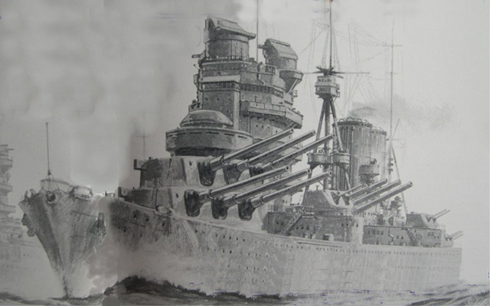
artist

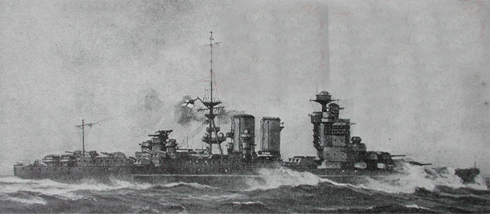
Artists Depiction of G3 Battlecruiser 

Friends of Padre Steve’s World,

This weekend I will be reflecting on the old year and the coming new year, but tonight I decided to tweak and republish an article from about four years ago dealing with the battle cruisers being built by Great Britain, Japan, and the United States after the First World War. They represented the pinnacle of naval design for their era and would have been far superior to their adversaries had technology and war remained static. As Admiral Ernest King noted:

“Nothing remains static in war or military weapons, and it is consequently often dangerous to rely on courses suggested by apparent similarities in the past.”

As the First World War ended a new Naval Race was heating up. The United States had announced its intention during the war to build a navy second to none while Imperial Japan was making plans for a fleet that would give it superiority in the Western Pacific. The British, though still be far the largest naval power in the world were burdened by the massive costs of war and empire, but also seeking to maintain their naval dominance and to that end they were in the process of building a class of massive super-Dreadnought battleships, and Battle Cruisers.

The ships known as battle cruisers were first built by the British Royal Navy as a compliment to the all big gun Dreadnought battleships. The Battle Cruiser concept was for a ship of roughly the same size and firepower as a Battleship but sacrificing protection for greater speed, endurance and range.  and Japan joined in the Battle Cruiser race before and during the war. Unlike Britain the United States had concentrated on building battleships but following the war began to design and build its own class of massive battle cruisers.

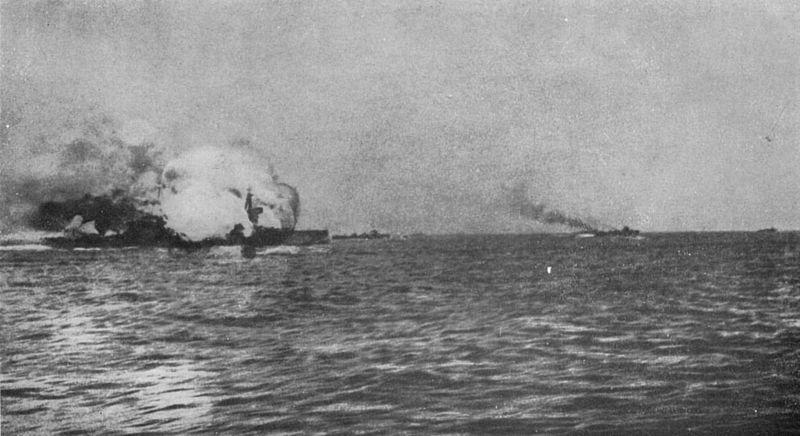
800px-InvincibleBlowingUpJutland1916

HMS Invincible Blowing Up at Jutland 

During the war the weaknesses of the type were exposed during the Battle of Jutland where three British Battle Cruisers, the HMS InvincibleHMS Indefatigable and HMS Queen Mary blew up with the loss of most of their crews; of the 3311 officers and sailors on the ships only 26 survived. The HMS Lion was almost lost in a similar manner but the heroic actions of her crew saved her from her sisters fate. The British ships had glaring deficiencies in armor protection and the arrangement of their ammunition magazines and hoists which certainly contributed to their loss. Their German counterparts on the other hand proved much tougher and though all sustained heavy damage while engaging British Battleships and Battle Cruisers, only one the Lützow was lost. She absorbed over 30 hits from large caliber shells and only lost 128 crew members.

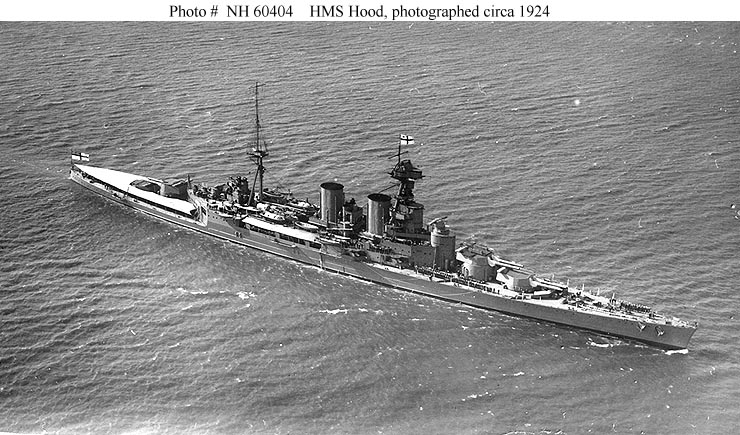
h60404

HMS Hood

As the war progressed other Battle Cruisers were built, the British launched the HMS Repulse and HMS Renown and completed the HMS Hood shortly after the war was over. The Japanese built the four ship Kongo class from a British design, the first of which, the Kongo was completed in a British yard. As the powers embarked on the next Naval Race planners and naval architects designed ships of massive firepower, better protection and higher range and speed. All would have been better classed as Fast Battleships.

The British designed and began construction on the G3 class in 1921, while the Japanese began work on the Amagi Class, and the United States the Lexington Class. However the construction and completion of these ships as Battle Cruisers was prevented by the Washington Naval Treaty.

invincible 490

The treaty, which was ratified in 1922 limited the United States and Great Britain to a maximum of 525,000 tons in their battle ship fleets and 125,000 tons in aircraft carriers.  The Japanese agreed to a limit of 315,000 tons and the French and Italians 175,000 tons each. Tonnage for battleships was limited to a maximum of 35,000 tons with a limitation on guns size to 16 inches.  Since the bulk of the ships planned or being built by the US and Japan exceeded those limits they would be effected more than the British whose post war shipbuilding program had not begun in earnest, in fact the G3 Class had just been approved for construction.

The G3 class would have comprised four ships and been similar to the N3 Class Battleships. They were very well balanced ships and would have mounted nine 16” guns in three turrets on a displacement of 49,200 tons and deep load of 54,774 tons. They had an all or nothing protection plan meaning that the armored belt was concentrated in vital areas around the armored citadel, conning tower, turrets and magazines and engineering spaces. Their armor belt would have ranged from 12-14 inches, deck armor from 3-8 inches, conning tower 8 inches, barbettes 11-14 inches, turrets 13-17 inches and bulkheads 10-12 inches. Their propulsion system of 20 small tube boilers powering 4 geared steam turbines connected to 4 propeller shafts would have produced 160,000 shp with a designed speed of 32 knots.

The four ships, none of which were named were ordered between October and November of 1921. Their construction was suspended on November 18th 1921 and they and the N3 Battleships were cancelled in February 1922 due to the limitations of the Washington Naval Treaty. Many concepts of their design were incorporated in the Nelson Class battleships which were a compromise design built to stay within the limits of the treaty.

rys-amagi

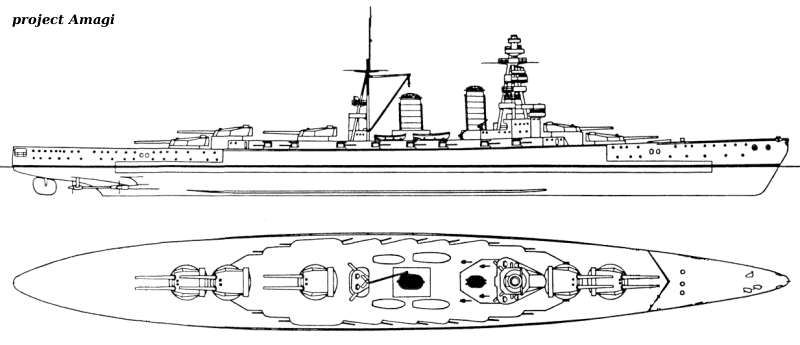
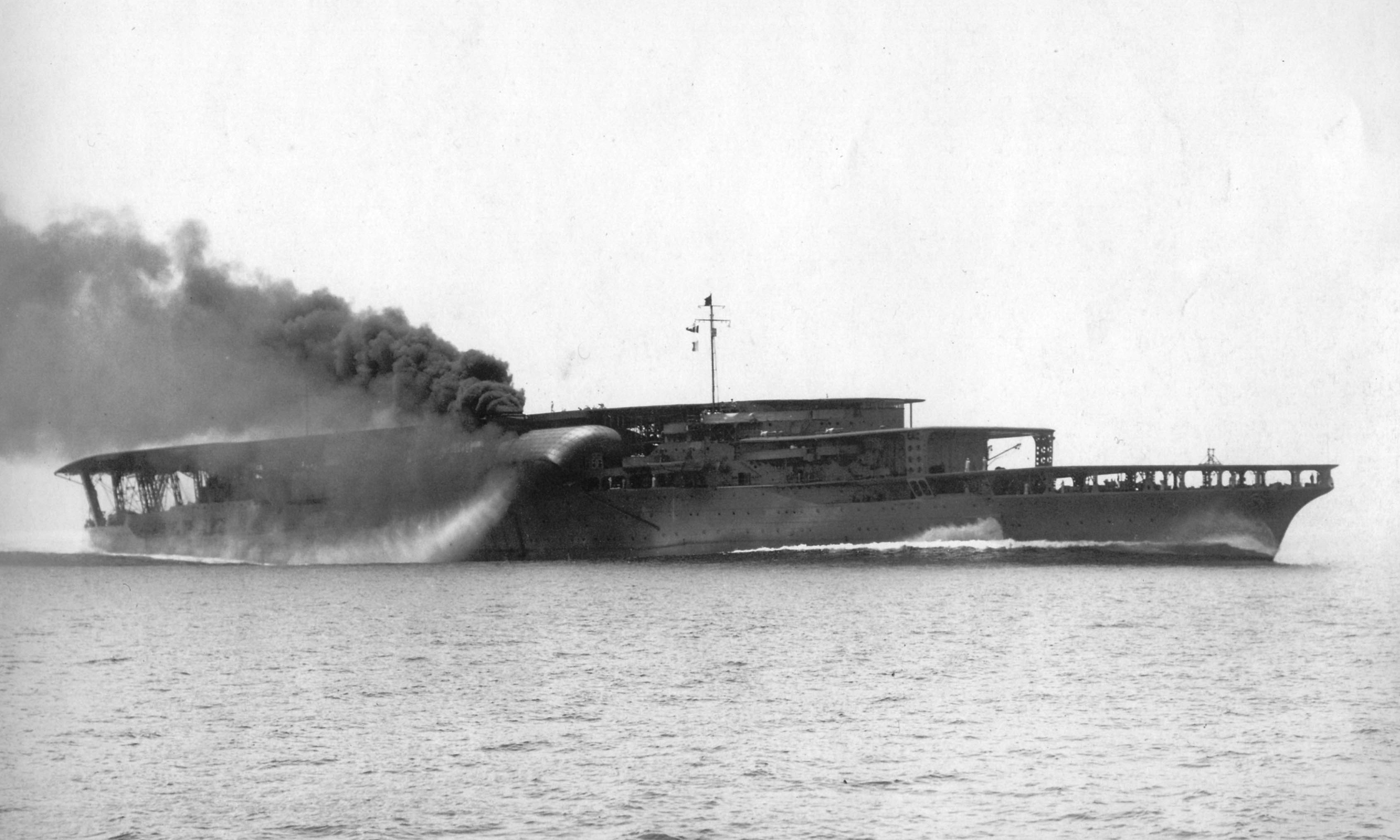
Amagi Class as Designed, Akagi as Completed (below) 

JapaneseAircraftCarrierAkagi3Deck_cropped

The four planned Japanese Amagi Class ships would have mounted ten 16” guns on a displacement of 47,000 tons at full load. Their propulsion system 19 Kampon boilers powering four Gihon turbines would have given them a maximum speed of 30 knots, They would have had less protection than the G3 ships being more of a traditional Battle Cruiser design. As a result of the Washington Naval Treaty the Japanese elected to convert two of the ships, the Amagi and Akagi to aircraft carriers. Amagi was destroyed on the ways during the great Tokyo earthquake and Akagi was completed as a carrier. The other two vessels were scrapped on the ways.

Lexington_battlecruiser_conversion_models

lexington-class-battle-cruisern11978

Lex4259BrassDraw

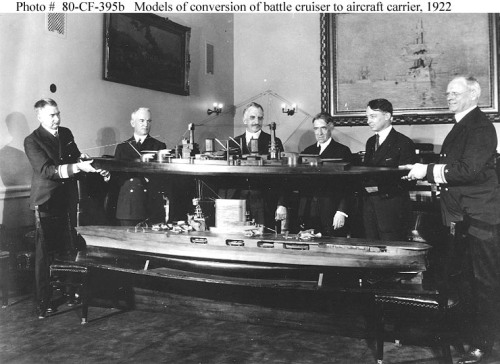
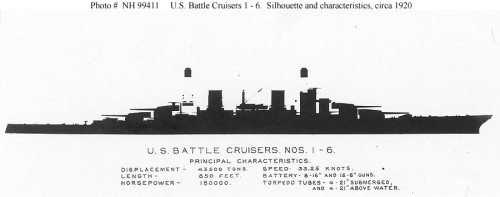
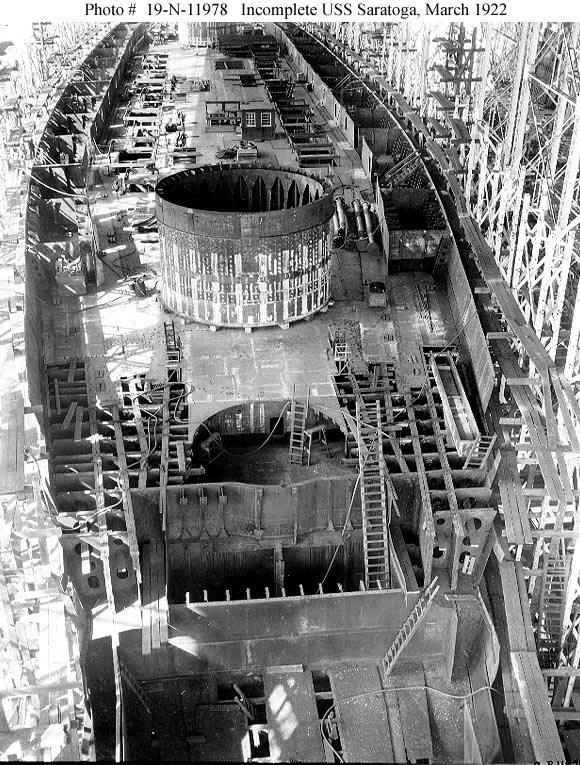
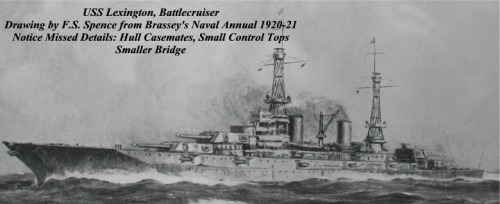
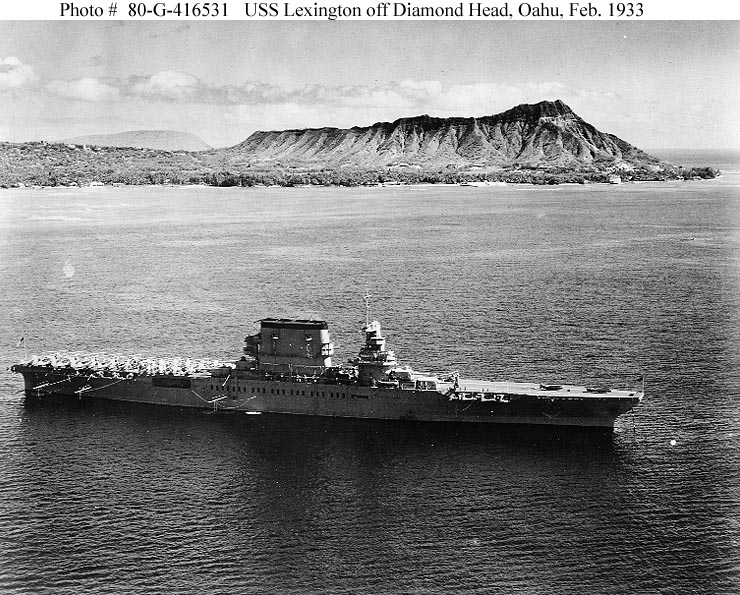
The United States Navy planned the six ship Lexington Class. These ships would have mounted eight 16” guns on a ship measuring 874 feet long and 105 feet in beam, displacing 43,254 tons at full load, or nearly the size of the Iowa Class battleships. They would have had a maximum speed of 33 knots being powered by 16 boilers which drove 4 GE electric turbines producing 180,000 shaft horse power. Theirs was a massive engineering plant and while the class did not have as heavy armor protection as either the G3 or Amagi classes, they were superior to them in speed as well as endurance. Upon ratification of the Washington Naval Treaty four of the six ships were cancelled and the remaining two, the Lexington and Saratoga competed as aircraft carriers.  Had any of the ships been completed as Battle Cruisers it is likely due to their speed that they would have operated primarily with the the carriers that the US Navy built during the 1930s.

g416531

One can only speculate what the navies of World War II would have looked like had the Washington and the subsequent London Naval Treaties not been ratified. One can also only imagine how the war at sea would have been different had the ships completed as carriers been completed as Battle Cruisers.

However that was not to be, of the planned 14 ships of these three classes only three were completed, all as aircraft carriers, ships that helped to forge the future of naval operations and warfare for nearly a century. Thus the uncompleted ships are an interesting footnote in naval history yet have their own mystique.

HMS Queen Elizabeth 

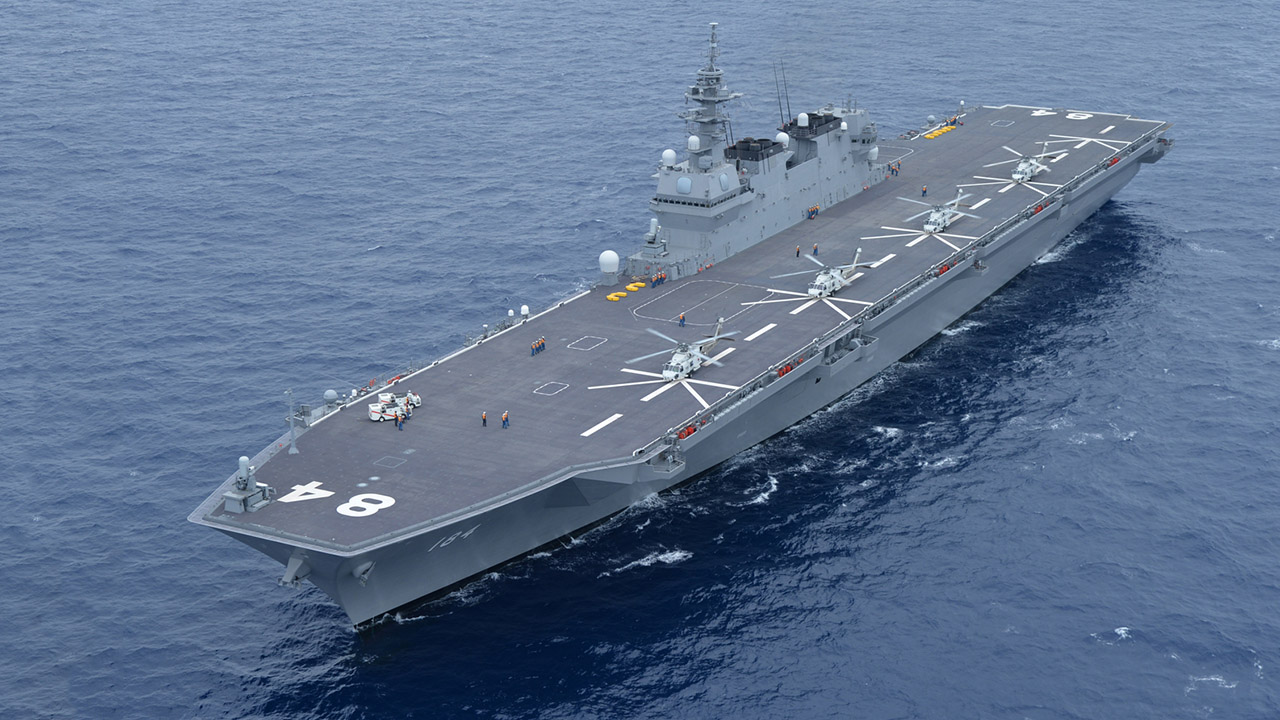
Yet nothing remains static. The massive aircraft carriers which have ruled the seas since the Second World War are not necessarily invincible and depending on how technology progresses could be heading into obsolescence, and end up serving in support roles or being paid off. Perhaps to meet some missions smaller and cheaper carriers will be developed, or existing platforms modified to carry more capable aircraft as the Japanese are doing with their Izumo Class “Helicopter Destroyers.” 

JMSDF “Helicopter Destroyer” Kaga 

Thus, one might wonder if the large new aircraft carriers currently being built by the United States, Britain, China, India, and other nations will also be displaced by advancing technology as were the battlecrusiers of the 1920s. It is a question that must be asked. There are certainly arguments for them, but what would the effect be on the United States Navy if one of the Nimitz Class carriers was sunk by the Chinese? My guess is that it would be the same kind of shock that hit the Royal Navy after Jutland, and the U.S. Navy after Pearl Harbor.

Until tomorrow,

Peace

Padre Steve+

11 Comments

Filed under History, Military, national security, Navy Ships, News and current events, US Navy

A Watershed Moment, and a Time to Be Afraid: Jim Mattis Resigns in Protest

Friends of Padre Steve’s World,

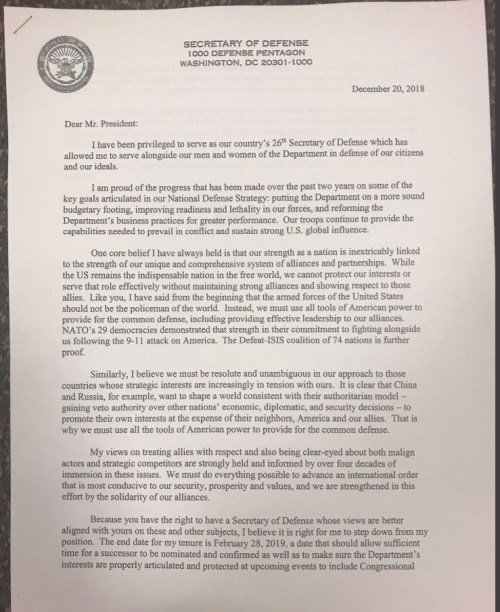
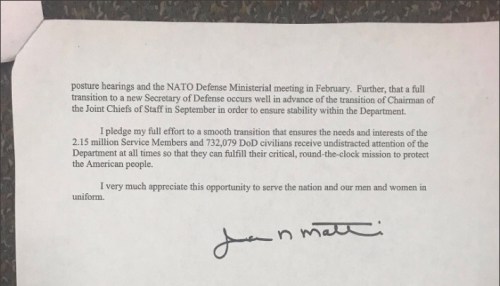
Secretary of Defense James Mattis resigned his position in protest at the manner in which President Trump is endangering the security of the United States. His resignation letter speaks for itself but it echoes many things that I have written regarding the Trump military and foreign policy since his election campaign. The final straw for Mattis was Trump’s unilateral decision against the advice of Mattis, the Department Of Defense, the State Department, and the National Security Council to withdraw all U.S. Troops from Syria falsely claiming that ISIS had been defeated.

Secretary Mattis’s letter is show below.

It was a watershed moment in American History. Honestly, I never expected Mattis to survive this long in the Trump Swamp. Everything about him stands in complete opposition to everything that Donald Trump embodies. The disgraced convicted felon Michael Flynn much more represents for which Trump stands.

Mattis was and remains a Marine who exemplified the Marine motto Semper Fidelis, and of living the creed of Duty, Honor, Country. Many times during his time in office he resisted the worst impulses and decisions made by the President. He knew that his duty and oath were to the Constitution of the United States and not the President. I think that he has become a tragic figure, he accepted the position thinking that he could serve the country better by taking it rather than not.

In the end Mattis could not abide the constant attacks on what he believed were the foundations of American national security and he resigned in protest. In a way he reminds me of Colonel General Ludwig Beck, Chief of Staff of the German Army, who resigned in protest over Hitler’s planned invasion of Czechoslovakia in 1938. Beck, who died in the attempt to kill Hitler on July 20th, 1944 said:

It is a lack of character and insight, when a soldier in high command sees his duty and mission only in the context of his military orders without realizing that the highest responsibility is to the people of his country.”

Working with former Secretary of State Rex Tillerson, and former National Security Advisor H.R. McMaster he had allies within the administration who could help check the President’s worst instincts. But Tillerson and McMaster were forced out and replaced by men who Trump believes that are more personally loyal to him, leaving Mattis isolated in the administration. Mattis was not able to get his recommendation for the next Chairman of the Joint Chiefs of Staff, Air Force Chief of Staff General David Goldfein approved by Trump. Mattis took this as a personal affront because the Secretary of Defense usually gets his recommendation for the position approved by the President. I wonder if Trump rejected Goldfein because in addition to being a decorated combat veteran who was actually shot down over Serbia in 1999, is also Jewish. Honestly, I don’t think that Trump could stomach having a Jewish war hero as his Chief military advisor. Maybe someone should ask that question, but I digress…

Mattis’s resignation, combined with Trump’s declaration of victory over ISIS and withdraw announcement sent a chill throughout Washington and around the world. Even influential Republican leaders who have carried Trump’s water are seeing the approaching danger of Trump unrestrained. The only question is if they will have the courage to choose principle over personal profit and power. Sadly, to this point they have not backed their words with action. Perhaps with the wheels coming off this presidency they will, but I think they are more afraid of his cult like followers than they are of him, so we will have to see.

Trump promises that he will nominate a replacement for Mattis soon. Make no mistake, whoever Trump chooses will be pliant and nothing more than his lackey. The replacement will be someone in the tradition of Field Marshal Wilhelm Keitel, who was absolutely committed to Adolf Hitler and who not only went along with, but signed criminal orders that obliged the German military to commit war crimes, at home and abroad. Supreme Court Justice Robert Jackson who served as the Chief American Prosecutor at Nuremberg said about Keitel:

“Keitel, the weak and willing tool, delivered the armed forces, the instrument of aggression, over to the party and directed them in executing its felonious designs.”

I am not sure who would want the job, but I am sure that he will be an modern embodiment of Keitel, and I will be glad that I will be retired within a few months of his confirmation. A year ago I thought that Senator Tom Cotton would gladly take it, but since he was one of the leading critics of the Syria withdraw, that he saw as a surrender to Russia I am not so sure. I don’t think that he’s that stupid. Instead, I think that Trump may pick a retired General or Admiral from his partisans for the job, there are plenty of them out there who would take it, I could be wrong, but we’ll have to see.

Regardless of who takes over for Mattis is the fact that with Mattis out of the way, Trump’s worst instincts will win policy debates and he may even lose John Bolton. Today the danger to our country and to to world has increased exponentially. To quote General Colin Powell’s words in his waning days as Secretary of State, “I sleep like a baby … every two hours I wake up screaming.”

I think that may be the case for many of us in the coming days, weeks, and months. Since I already do that due to my PTSD and combat based nightmares and night terrors this will be nothing new. If that hasn’t been the case for you, welcome to my world.

Peace,

Padre Steve+

6 Comments

Filed under ethics, Foreign Policy, History, leadership, Military, national security, nazi germany, News and current events, Political Commentary

“It is the Duty of Troops to Use All Means… Even Against Women and Children…” Robert Jackson’s Closing Arguments at Nuremberg, Part Two

Friends of Padre Steve’s World,

Tonight I am continuing on with my series on Supreme Court Justice Robert Jackson’s closing arguments while serving as the Chief American Prosecutor at the Major War Crimes Trials at Nuremberg. These crimes are not without relevance today, thus it is important for us to revisit them, for as I noted yesterday, quoting Yehuda Bauer, the Holocaust did not deviate from human norms.

For me it is a difficult subject, for I served in and supported a war that by any standard of legal and moral judgement would have met the criteria that we prosecuted the Nazis for I. 1945. I should have known better because I had studied the Nazi crimes and had been the student of a professor who served as an interrogator and interpreter during the Nuremberg War Crimes Trials. But in the moment of hysteria after the attacks of September 11th 2001 and my belief in the integrity of Secretary of State Colin Powell I allowed my good sense to be persuaded that an act of aggressive war that resulted in war crimes, and might even include crimes against humanity was perfectly legal.

I went to Iraq in 2007 and 2008. I worked with advisors to Iraqi Army, Border Troops, Police, Port of Entry, and Provincial Reconstruction Teams In Al Anbar Province. I came back from Iraq a very different man. I saw the lies. I came to love and appreciate the Iraqis and what they had suffered under both Saddam Hussein and our invasion and occupation. I can still see the maimed bodies, the destroyed cities and hamlets, the crippled children, as well as the wounded Marines in my mind. I pray and hope that the Iraqis that I served alongside did not become victims of ISIS after I left the country.

I am haunted by it to this day, and I no longer trust the supposedly good intentions of the American government, and in the age of Donald Trump fear for our nation and the world. This weekend the American Border Patrol fired CS gas, a riot control agent that is banned for use in combat across the international border into Mexico at unarmed Central American refugees, many of whom were women and children. The reason was that they “felt endangered” because some in the sea of refugees threw rocks across the border at the border control officers who were dressed in body armor and Kevlar helmets with face masks.

While this was not war, there is a principle and law of war that American law enforcement officers frequently violate, the principle of proportionality. I’m sorry, but firing CA gas at unarmed refugees on the opposite side of the border for throwing rocks is not proportional. They had not breached the border and were also facing Mexican Federal Police. I have to wonder what is next. President Trump says that he has authorized U. S. Military personnel to use deadly force against rock throwers, and his Chief of Staff, retired Marine Corps General John Kelly issued a “cabinet order” something never heard of before, allowing U. S. Military personnel to engage refugees believed to be endangering Border Control agents, in what appears to be a direct violation of Posse Comitatus.

But I digress. When I read these accounts my mind is taken back to the subject of war crimes, and based on my expertise and study of the crimes of the Nazis, not to mention the Japanese in the Second World War, I automatically default to those settings.

So, I will stop with my words and go back to those of Robert Jackson at Nuremberg.

Until tomorrow,

Peace,

Padre Steve+

Immediately after the seizure of power the Nazis went to work to implement these aggressive intentions by preparing for war. They first enlisted German industrialists in a secret rearmament programme. Twenty days after the seizure of power Schacht was host to Hitler, Goering and some twenty leading industrialists. Among them were Krupp von Bohlen of the great Krupp armament works and representatives of I. G. Farben and other Ruhr heavy industries. Hitler and Goering explained their programme to the industrialists, who became so enthusiastic that they set about to raise three million Reichsmarks to strengthen and confirm the Nazi Party in power. Two months later Krupp was working to bring a reorganised association of German industry into agreement with the political aims of the Nazi Government. Krupp later boasted of the success in keeping the German war industries secretly alive and in readiness despite the disarmament clauses of the Versailles Treaty, and recalled the industrialists’ enthusiastic acceptance of “the great intentions of the Fuehrer in the rearmament period of 1933-1939”.

Some two months after Schacht had sponsored his first meeting to gain the support of the industrialists, the Nazis moved to harness industrial labour to their aggressive plans. In April, 1933, Hitler ordered Dr. Ley “to take over the trade unions”, numbering some 6 million members. By Party directive Ley seized the unions, their property and their funds. Union leaders, taken into “protective custody” by the SS and SA, were put into concentration camps. The free labour unions were then replaced by a Nazi organization known as the German Labour Front, with Dr. Ley at its head. It was expanded until it controlled over 23 million members. Collective bargaining was eliminated, the voice of labour could no longer be heard as to working conditions, and the labour contract was prescribed by “trustees of labour” appointed by Hitler. The war purpose of this labour programme was clearly acknowledged by Robert Ley five days after war broke out, when he declared in a speech that:

“We National Socialists have monopolised all resources and all our energies during the past seven years so as to be able to be equipped for the supreme effort of battle.”

The Nazis also proceeded at once to adapt the Government to the needs of war. In April, 1933, the Cabinet formed a Defence Council, the working committee of which met frequently thereafter. In the meeting of 22nd May, 1933, at which defendant Keitel presided, the members were instructed that:

“No document must be lost since otherwise the enemy propaganda would make use of it. Matters communicated orally cannot be proven; they can be denied by us in Geneva.”

In February, 1934 -and, your Honours, dates in this connection are important -with defendant Jodl present, the Council planned a mobilization calendar and mobilization order for some 240,000 industrial plants. Again it was agreed that nothing should be in writing so that “the military purpose may not be traceable”.

On 21st May, 1935, the top secret Reich Defence Law was enacted. Defendant Schacht was appointed Plenipotentiary General for War Economy with the task of secretly preparing all economic forces for war and, in the event of mobilization, of financing the war.

Schacht’s secret efforts were supplemented

in October, 1936, by the appointment of defendant Goering as Commissioner of the Four-Year Plan, with the duty of putting the entire economy in a state of readiness for war within four years.

A secret programme for the accumulation of the raw materials and foreign credits necessary for extensive rearmament was also set on foot immediately upon seizure of power. In September of 1934, the Minister of Economics was already complaining that:

“The task of stock-piling is being hampered by the lack of foreign currency; the need for secrecy and camouflage also is a retarding influence.”

Foreign currency controls were at once established. Financing was delegated to the wizard Schacht, who conjured up the MEFO bill to serve the dual objectives of tapping the short-term money market for rearmament purposes while concealing the amount of these expenditures.

The spirit of the whole Nazi administration was summed up by Goering at a meeting of the Council of Ministers, which included Schacht, on 27th May, 1936, when he said: “All measures are to be considered from the standpoint of an assured waging of war.” The General Staff, of course, also had to be enlisted in the war plan. Most of the generals, attracted by the prospect of rebuilding their armies, became willing accomplices. The Minister of War von Blomberg and the Chief of Staff General von Fritsch, however, were not cordial to the increasingly belligerent policy of the Hitler regime, and by vicious and obscene plotting they were discredited and removed in January, 1938. Thereupon, Hitler assumed for himself supreme command of the armed forces and the positions of von Blomberg and of von Fritsch were filled by others who became, as Blomberg said of Keitel, “a willing tool in Hitler’s hands for every one of his decisions”. The generals did not confine their participation to merely military matters. They participated in all major diplomatic and political manoeuvres, such as the Obersalzberg meeting where Hitler, flanked by Keitel and other top generals, issued his virtual ultimatum to Schuschnigg.

As early as 5th November, 1937, the plan to attack had begun to take definiteness as to time and victim. In a meeting which included the defendants Raeder, Goering and von Neurath, Hitler stated the cynical objective:

“The question for Germany is where the greatest possible conquest could be made at the lowest possible cost.”

He discussed various plans for the invasion of Austria and Czechoslovakia, indicating clearly that he was thinking of these territories not as ends in themselves, but as means for further conquest. He pointed out that considerable military and political assistance could be afforded by possession of these lands, and discussed the possibility of constituting from them new armies up to a strength of about 12 divisions. The aim he stated boldly and baldly as the acquisition of additional living-space in Europe, and recognized that “The German question can be solved only by way of force.” Six months later, emboldened by the bloodless Austrian conquest, Hitler, in a secret directive to Keitel, stated his “unalterable decision to smash Czechoslovakia by military action in the near future”.

On the same day, Jodl noted in his diary that the Fuehrer had stated his final decision to destroy Czechoslovakia soon and had initiated military preparations all along the line. By April the plan had been perfected to attack Czechoslovakia “with lightning swift action as the result of an ‘incident'”.

All along the line preparations became more definite for a war of expansion, on the assumption that it would result in a world-wide conflict. In September, 1938, Admiral Carls officially commented on a “Draft Study of Naval Warfare against England”:

“There is full agreement with the main theme of the study.

1. If, according to the Fuehrer’s decision, Germany is to acquire a position as a world power, she needs not only sufficient colonial possessions but also secure naval communications and secure access to the ocean.

2. Both requirements can only be fulfilled in opposition to Anglo-French interests and will limit their positions as world powers. It is unlikely that they can be achieved by peaceful means. The decision to make Germany a world power therefore forces upon us the necessity of making the corresponding preparations for war.

3. War against England means at the same time war against the Empire, against France, probably against Russia as well, and a large number of countries overseas; in fact, against one-third to one-half of the whole world.

It can only be justified and have a chance of success if it is prepared economically as well as politically and militarily and waged with the aim of conquering for Germany an outlet to the ocean.”

This Tribunal knows what categorical assurances were given to an alarmed world after the Anschluss, after Munich, after the occupation of Bohemia and Moravia, that German ambitions were realised and that Hitler had “no further territorial demands to make in Europe.” The record of this trial shows that those promises were calculated deceptions and that those high in the bloody brotherhood of Nazidom knew it.

As early as 15th April, 1938, Goering pointed out to Mussolini and Ciano that the possession of those territories would make possible an attack on Poland. Ribbentrop’s Ministry wrote on 26th August, 1938:

“After the liquidation of the Czechoslovakian question, it will be generally assumed that Poland will be next in turn.”

Hitler, after the Polish invasion, boasted that it was the Austrian and Czechoslovakian triumphs by which “the basis for the action against Poland was laid”. Goering suited the act to the purpose and gave immediate instructions to exploit, for the further strengthening of the German war potential, first the Sudetenland, and then the whole Protectorate.

By May of 1939 the Nazi preparations had ripened to the point that Hitler confided to the defendants Goering, Raeder, Keitel, and others, his readiness “to attack Poland at the first suitable opportunity”, even though he recognized that “further successes cannot be attained without the shedding of blood”. The larcenous motives behind this decision he made plain in words that echoed the covetous theme of Mein Kampf:

“Circumstances must be adapted to aims. This is impossible without invasion of foreign States or attacks upon foreign property. Living-space in proportion to the magnitude of the State is the basis of all power -further successes cannot be attained without expanding our living-space in the East ….”

While a credulous world slumbered, snugly blanketed with perfidious assurances of peaceful intentions, the Nazis prepared not as before for a war but now for the war. The defendants Goering, Keitel, Raeder, Frick and Funk, with others, met as the Reich Defence Council in June of 1939. The minutes, authenticated by Goering, are revealing evidence of the way in which each step of Nazi planning dovetailed with every other. These five key defendants, three months before the first panzer unit had knifed into Poland, were laying plans for “employment of the population in wartime”, and had gone so far as to classify industry for priority in labour supply after “five million servicemen had been called up”. They decided upon measures to avoid “confusion when mobilization takes place”, and declared a purpose “to gain and maintain the lead in the decisive initial weeks of war”. They then planned to use in production prisoners of war, criminal prisoners, and concentration camp inmates. They then decided on “compulsory work for women in war time”. They had already passed on applications from 1,172,000 specialist workmen for classification as indispensable, and had approved 727,000 of them. They boasted that orders to workers to report for duty “are ready and tied up in bundles at the labour offices”. And they resolved to increase the industrial manpower supply by bringing into Germany “hundreds of thousands of workers” from the Protectorate to be “housed together in hutments”.

It is the minutes of this significant conclave of many key defendants which disclose how the plan to start the war was coupled with the plan to wage the war through the use of illegal sources of labour to maintain production. Hitler, in announcing his plan to attack Poland, had already foreshadowed the slave labour programme as one of its corollaries when he cryptically pointed out to the defendants Goering, Raeder, Keitel, and others that the Polish population “will be available as a source of labour”. This was part of the plan made good by Frank, who as Governor-General notified Goering, that he would supply “at least one million male and female agricultural and industrial workers to the Reich”, and by Sauckel, whose impressments throughout occupied territory aggregated numbers equal to the total population of some of the smaller nations of Europe.

Here also comes to the surface the link between war labour and concentration camps, a manpower source that was increasingly used and with increasing cruelty. An agreement between Himmler and the Minister of Justice, Thierack, in 1942 provided for “the delivery of anti-social elements from the execution of their sentence to the Reichsfuehrer SS to be worked to death”. An SS directive provided that bedridden prisoners be drafted for work to be performed in bed. The Gestapo ordered 46,000 Jews arrested to increase the “recruitment of manpower into the concentration camps”. One hundred thousand Jews were brought from Hungary to augment the camps’ manpower. On the initiative of the defendant Donitz concentration camp labour was used in the construction of submarines. Concentration camps were thus geared into war production on the one hand, and into the administration of justice and the political aims of the Nazis on the other. The use of prisoner-of-war labour, as then planned in that meeting, also grew with German needs. At a time when every German soldier was needed at the front and forces were not available at home, Russian prisoners of war were forced to man anti-aircraft guns against Allied planes. Field-Marshal Milch reflected the Nazi merriment at this flagrant violation of International Law, saying: “… This is an amusing thing, that the Russians must work the guns.”

The orders for the treatment of Soviet prisoners of war were so ruthless that Admiral Canaris, pointing out that they would “result in arbitrary mistreatments and killing”, protested to the OKW against them as breaches of International Law. The reply of Keitel was unambiguous. He said:

“The objections arise from the military conception of chivalrous warfare! This is the destruction of an ideology! Therefore I approve and back the measures”.

The Geneva Convention would have been thrown overboard openly, except that Jodl objected because he wanted the benefits of Allied observance of it while it was not being allowed to hamper the Germans in any way.

Field Marshal Wilhelm Keitel

Other crimes in the conduct of warfare were planned with equal thoroughness as a means of ensuring victory of German arms: In October, 1938, almost a year before the start of the war, the large-scale violation of the established rules of warfare was contemplated as a policy, and the Supreme Command circulated a most secret list of devious explanations to be given by the Propaganda Minister in such cases. Even before this time commanders of the armed forces were instructed to employ any methods of warfare so long as they facilitated victory. During the progress of the war the orders increased in savagery. A typical Keitel order, demanding the use of the “most brutal means”, provided that .

“… It is the duty of the troops to use all means without restriction, even against women and children, so long as they ensure success.”

The German naval forces were no more immune from the infection than the land forces. Raeder ordered violations of the accepted rules of warfare wherever necessary to gain strategic successes. Donitz urged his submarine crews not to rescue survivors of torpedoed enemy ships, in order to cripple merchant shipping of the Allied Nations by decimating their crews.

Thus, the WAR CRIMES against Allied forces and the CRIMES AGAINST HUMANITY committed in occupied territories are incontestably part of the programme for making the war because, in the German calculations, they were indispensable to its hope of success.

Similarly, the whole group of pre-war crimes, including the persecutions within Germany, fall into place around the plan for aggressive war like stones in a finely wrought mosaic. Nowhere is the whole catalogue of crimes of Nazi oppression and terrorism within Germany so well integrated with the crime of war as in that strange mixture of wind and wisdom which makes up the testimony of Hermann Goering. In describing the aims of the Nazi programme before the seizure of power, Goering stated that the first question was to achieve and establish a different political structure for Germany, which would enable Germany to object against the Dictate (of Versailles), and to make not only a protest, but an objection of such a nature that it would actually be considered.

With these purposes, Goering, admitted that the plan was made to overthrow the Weimar Republic, to seize power, and to carry out the Nazi programme by whatever means were necessary, whether legal or illegal.

From Goering’s cross-examination we learn how necessarily the whole programme of crime followed. Because they considered a strong State necessary to get rid of the Versailles Treaty, they adopted the Fuehrerprinzip. Having seized power, the Nazis thought it necessary to protect it by abolishing parliamentary government, and suppressing all organized opposition from political parties. This was reflected in the philosophy of Goering that the opera was more important than the Reichstag. Even the “opposition of each individual was not tolerated unless it was a matter of unimportance”. To insure the suppression of opposition a secret police force was necessary. In order to eliminate incorrigible opponents, it was necessary to establish concentration camps and to resort to the device of protective custody. Protective custody, Goering, testified, meant that:

“People were arrested arid taken into protective custody who had not yet committed any crime but who could be expected to do so if they remained free.”

The same war purpose was dominant in the persecution of the Jews. In the beginning, fanaticism and political opportunism played a principal part, for anti-Semitism and its allied scapegoat, mythology, were the vehicle on which the Nazis rode to power. It was for this reason that the filthy Streicher and the blasphemous Rosenberg were welcomed at Party rallies and made leaders and officials of the State or Party. But the Nazis soon regarded the Jews as foremost amongst the opposition to the police State with which they schemed to put forward their plans of military aggression. Fear of their pacifism and their opposition to strident nationalism was given as the reason that the Jews had to be driven from the political and economic life of Germany. Accordingly, they were transported like cattle to the concentration camps, where they were utilised as a source of forced labour for war purposes.

At a meeting held on 12th November, 1938, two days after the violent anti-Jewish pogroms instigated by Goebbels and carried out by the Party Leadership Corps and the SA, the programme for the elimination of Jews from the German economy was mapped out by Goering, Funk, Heydrich, Goebbels, and the other top Nazis. The measures adopted included confinement of the Jews in ghettoes, cutting off their food supply, “aryanizing” their shops, and restricting their freedom of movement. Here another purpose behind the Jewish persecutions crept in, for it was the wholesale confiscation of their property which helped to finance German rearmament. Although Schacht’s plan to use foreign money to ransom the entire race within Germany was not adopted, the Jews were stripped to the point where Goering was able to advise the Reich Defence Council that the critical situation of the Reich exchequer, due to rearmament, had been relieved “through the billion Reichsmark fine imposed on Jewry, and through profits accrued to the Reich in the aryanization of Jewish enterprises”.

A glance over the dock will show that, despite quarrels among themselves, each defendant played a part which fitted in with every other, and that all advanced the Common Plan. It contradicts experience that men of such diverse backgrounds and talents should so forward each other’s aims by coincidence. The large and varied role of Goering was half militarist and half gangster. He stuck his pudgy finger in every pie. He used his SA bullies to help bring the gang into power. In order to entrench that power he contrived to have the Reichstag burned, established the Gestapo, and created the concentration camps. He was equally adept at massacring opponents and at framing scandals to get rid of stubborn generals. He built up the Luftwaffe and hurled it at his defenceless neighbours. He was among the foremost in harrying Jews out of the land. By mobilising the total economic resources of Germany he made possible the waging of the war which he had taken a large part in planning. He was, next to Hitler, the man who tied the activities of all the defendants together in a common effort.

The parts played by the other, defendants, although less comprehensive and less spectacular than that of the Reichsmarschall, were nevertheless integral and necessary contributions to the joint undertaking, without any one of which the success of the common enterprise would have been in jeopardy. There are many specific deeds of which these men have been proven guilty. No purpose would be served -nor indeed is time available -to review all the crimes which the evidence has charged against their names. Nevertheless, in viewing the conspiracy as a whole and as an operating mechanism, it may be well to recall briefly the outstanding services which each of the men in the dock rendered to the common cause.

To be continued…

Leave a comment

Filed under ethics, History, holocaust, national security, nazi germany, News and current events, Political Commentary, war crimes, world war two in europe

Nazi Crimes in the Conduct of War: Robert Jackson’s Opening Speech at Nuremberg, Part Five: Jackson’s Indictment of Us

Friends of Padre Steve’s World,

This is the the last section of my five part post dealing with the opening statement of American Chief Prosecutor, and Supreme Court Justice Robert Jackson at the major Nuremberg War Crimes Trial. The first four segments of this series dealt with Jackson’s introduction, his dissection of the Nazi wars against free Labor Unions and the Churches; Hitler and his henchmen’s most heinous crimes, the genocide against the Jews, and finally the Nazi’s criminal conduct of war.

During the meetings to set the boundaries and rules of the international tribunal Jackson noted something that many American leaders have ignored for decades:

“If certain acts of violation of treaties are crimes, they are crimes whether the United States does them or whether Germany does them, and we are not prepared to lay down a rule of criminal conduct against others which we would not be willing to have invoked against us.”

Jackson believed that the International Tribunal would serve as a model for future tribunals, unfortunately the Cold War shelved those plans. They were revived after the war crimes and crimes against humanity in the former Yugoslavia and Rwanda. In 2002 the International Criminal Court was established under the authority of the Rome Statute. One hundred twenty three nations are signatories to the pact. Unfortunately, neither the United States, or Russia have refused to ratify the treaty.

Among the men most responsible or the refusal of the United States to ratify the statute and is current National Security Advisor, John Bolton. He was also deeply involved in the propaganda and false intelligence that lead to the Iraq War. In his first address after becoming National Security Advisor he launched a fierce criticism of the Court. Unfortunately, the Court, lacking the cooperation of the United States, Russia, Israel, and a number of influential middle eastern and African nations refuse to recognize the treaty or the Court.

Robert Jackson would have considered Bolton no better than Nazi Foreign Minister Joachim von Ribbentrop. If Bolton and others had been in the dock at Nuremberg for crimes committed during the invasion of Iraq, they would have gone to the gallows.

The refusal of the United States to ratify the Rome Statute and recognize the authority of the ICC is a stain upon our honor and an affront to the civilization and an international community built on law that Jackson and his team of prosecutors hoped to build.

I am not a person who thinks that institutions alone can prevent war or war crimes, human nature being what it is. Nor do I blindly put my faith in treaties. I agree with British military historian B. H. Liddell-Hart who wrote: We must face the fact that international relations are governed by interests and not by moral principles.

Like Liddell-Hart, I understand that nations are often incredibly bent on their presumed interests. I recognize that the leaders of nations will attempt to evade responsibility for criminal acts committed by their military, polices forces, and intelligence services. I also know that nations often mythologize to the point of lying about their history, and enshrining war criminals and others who abetted genocide as national heroes. Name a country where this is not true, okay, maybe Andorra or Lichtenstein, but almost every nation with any real regional or world political, military, or economic power has done this at some point in their history, but I digress…

Jackson’s words in this final part of his address should gave every American with a scintilla of ethics and conscience pause. If they don’t then we are truly lost.

Here again are Jackson’s words.

Peace,

Padre Steve+

Even the most warlike of peoples have recognised in the name of humanity some limitations on the savagery of warfare. Rules to that end have been embodied in international conventions to which Germany became a party. This code had prescribed certain restraints as to the treatment of belligerents. The enemy was entitled to surrender and to receive quarter and good treatment as a prisoner of war. We will show by German documents that these rights were denied, that prisoners of war were given brutal treatment and often murdered. This was particularly true in the case of captured airmen, often my countrymen.

It was ordered that captured English and American airmen should no longer be granted the status of prisoners of war. They were to be treated as criminals and the Army was ordered to refrain from protecting them against lynching by the populace (R-118). The Nazi Government, through its police and propaganda agencies, took pains to incite the civilian population to attack and kill airmen who crash-landed. The order, given by the Reichsfuehrer S.S., Himmler, on 10th August, 1943, directed that:

“It is not the task of the police to interfere in clashes between German and English and American fliers who have bailed out.”

This order was transmitted on the same day by S.S. Obersturmbannfuehrer Brandof, Himmler’s Personal Staff to all Senior Executive S.S. and Police Officers, with these directions:

“I am sending you the enclosed order with the request that the Chief of the Regular Police and of the Security Police be informed. They are to make this instruction known to their subordinate officers verbally.” (R-110)

Similarly, we will show Hitler’s top secret order, dated 18th October, 1942, that Commandos, regardless of condition, were “to be slaughtered to the last man” after capture. (498-PS) We will show the circulation of secret orders, one of which was signed by Hess, to be passed orally to civilians, that enemy fliers or parachutists were to be arrested or liquidated. (062-PS). By such means were murders incited and directed.

This Nazi campaign of ruthless treatment of enemy forces assumed its greatest proportions in the fight against Russia. Eventually all prisoners of war were taken out of control of the Army and put in the hands of Himmler and the S.S. (058-PS.) In the East, the German fury spent itself. Russian prisoners of war were ordered to be branded. They were starved. I shall quote passages from a letter written 28th February, 1942, by defendant Rosenberg to defendant Keitel:

“The fate of the Soviet prisoners of war in Germany is, on the contrary, a tragedy of the greatest extent. Of 3,600,000 prisoners of war, only several hundred thousand are still able to work fully. A large part of them has starved, or died, because of the hazards of the weather. Thousands also died from spotted fever.

The camp commanders have forbidden the civilian population to put food at the disposal of the prisoners, and they have rather let them starve to death.

In many cases, when prisoners of war could no longer keep up on the march because of hunger and exhaustion, they were shot before the eyes of the horrified population, and the corpses were left.

In numerous camps, no shelter for the prisoners of war was provided at all. They lay under the open sky during rain or snow. Even tools were not made available to dig holes or caves.

Finally, the shooting of prisoners of war must be mentioned; for instance, in various camps, all the ‘Asiatics’ were shot.” (081-PS.)

Civilised usage and conventions, to which Germany was a party, had prescribed certain immunities for civilian populations unfortunate enough to dwell in lands overrun by hostile armies. The German occupation forces, controlled or commanded by men on trial before you, committed a long series of outrages against the inhabitants of occupied territory that would be incredible except for captured orders and captured reports which show the fidelity with which those orders were executed.

We deal here with a phase of common criminality designed by the conspirators as part of the Common Plan. We can appreciate why these crimes against their European enemies were not of a casual character but were planned and disciplined crimes when we get at the reason for them. Hitler told his officers on 22nd August, 1939, that “The main objective in Poland is the destruction of the enemy and not the reaching of a certain geographical line.” (1014-PS.) Those words were quoted. The project of deporting promising youth from occupied territories was approved by Rosenberg on the theory that “a desired weakening of the biological force of the conquered people is being achieved.” (03I-PS) To Germanise or to destroy was the programme. Himmler announced, “Either we win over any good blood that we can use for ourselves and give it a place in our people, or, gentlemen -you may call this cruel, but nature is cruel -we destroy this blood.” As to “racially good types” Himmler further advised, “Therefore, I think that it is our duty to take their children with us, to remove them from their environment, if necessary, by robbing or stealing them.” (L-90.) He urged deportation of Slavic children to deprive potential enemies of future soldiers.

The Nazi purpose was to leave Germany’s neighbours so weakened that even if she should eventually lose the war, she would still be the most powerful nation in Europe. Against this background, we must view the plan for ruthless warfare, which means a plan for the commission of War Crimes and Crimes against Humanity.

Hostages in large numbers were demanded and killed. Mass punishments were inflicted, so savage that whole communities were extinguished. Rosenberg was advised of the annihilation of three unidentified villages in Slovakia. In May of 1943, another village of about 40 farms and 220 inhabitants was ordered to be wiped out. The entire population was ordered to be shot, the cattle and property impounded, and the order required that “the village will be destroyed totally by fire.” A secret report from Rosenberg’s Reich Ministry of Eastern territory, where he was responsible reveals that:

“Food rations allowed to the Russian population are so low that they fail to secure their existence and provide only for minimum subsistence of limited duration. The population does not know if they will still live. They are faced with death by starvation.

The roads are clogged by hundreds of thousands of people, sometimes as many as one million according to the estimate of experts, who wander around in search of nourishment.

Sauckel’s action has caused great unrest among the civilians. Russian girls were deloused by men, nude photos in forced positions were taken, women doctors were locked into freight cars for the pleasure of the transport commanders, women in night shirts were fettered and forced through the Russian towns to the railroad station, etc. All this material has been sent to the OKH.”

Perhaps the deportation to slave-labour was the most horrible and extensive slaving operation in history. On few other subjects is our evidence so abundant and so damaging. In a speech made on 25th January, 1944, the defendant Frank, Governor-General of Poland, boasted: “I have sent 1,200,000 Polish workers into the Reich.” The defendant Sauckel reported that “out of the five million foreign workers who arrived in Germany, not even 200,000 came voluntarily.” This fact was reported to the Fuehrer and to the defendants Speer, Goering, and Keitel. (R-124) Children of 10 to 14 years were impressed into service by telegraphic order of Rosenberg’s Ministry for the Occupied Eastern Territories:

“The Command is further charged with the transferring of worthwhile Russian youth between 10-14 years of age, to the Reich. The authority is not affected by the changes connected with the evacuation and transportation to the reception camps of Bialystok, Krajewo, and Olitei, The Fuehrer wishes that this activity be increased even more. (200-PS.)

When enough labour was not forthcoming, prisoners of war were forced into war work in flagrant violation of international conventions. (016-PS.) Slave labour came from France, Belgium, Holland, Italy, and the East. Methods of recruitment were violent. (R-124, 018-PS, 204-PS,) The treatment of these slave labourers was stated in general terms, not difficult to translate into concrete deprivations, in a letter to the defendant Rosenberg from the defendant Sauckel, which stated:

“All prisoners of war, from the territories of the West as well as of the East, actually in Germany, must be completely incorporated into the German armament and munition industries. Their production must be brought to the highest possible level.”

The complete employment of prisoners of war as well as the use of a gigantic number of new civilian workers, men and women, has become an undisputable necessity for the solution of the mobilisation of labour programme in this war.

All the men must be fed, sheltered and treated in such a way as to exploit them to the highest possible extent at the lowest conceivable degrees of expenditure..”( 016-PS.)

In pursuance of the Nazi plan permanently to reduce the living standards of their neighbours and to weaken them physically and economically, a long series of crimes were committed. There was extensive destruction, serving no military purpose, of the property of civilians. Dikes were thrown open in Holland almost at the close of the war, not to achieve military ends but to destroy the resources, and retard the economy, of the thrifty Netherlanders.

There was carefully planned economic siphoning off of the assets of occupied countries. An example of the planning is shown by a report on France dated 7th December, 1942, made by the Economic Research Department of the Reichsbank. The question arose whether French occupation costs should be increased from 15 million Reichsmarks per day to 25 million Reichsmarks per day. The Reichsbank analysed French economy to determine whether it could bear the burden. It pointed out that the armistice had burdened France to that date to the extent of 18 1/ 4 billion Reichsmarks, equalling 370 billion Francs. It pointed out that the burden of these payments within two and a half years equalled the aggregate French national income in the year 1940, and that the amount of payments handed over to Germany in the first six months of 1942 corresponded to the estimate for the total French revenue for that whole year. The report concluded, “In any case, the conclusion is inescapable that relatively heavier tributes have been imposed on France since the armistice in June, 1940, than upon Germany after the First World War. In this connection, it must be noted that the economic powers of France never equalled those of the German Reich, and that the vanquished France could not draw on foreign economic and financial resources in the same degree as Germany after the First World War.”

The defendant Funk was the Reich Minister of Economics and President of the Reichsbank; the defendant Ribbentrop was Foreign Minister; the defendant Goering was Plenipotentiary of the Four-Year Plan; all of them participated in the exchange of views of which this captured document is a part (2149-PS) Notwithstanding this analysis by the Reichsbank, they proceeded to increase the imposition on France from 15 million Reichsmarks to daily to 25 million per day.

It is small wonder that the bottom had been knocked out of French economy. The plan and purpose of the thing appears in a letter from General Stupnagel, head of the German Armistice Commission, to the defendant Jodl as early as 14th September, 1940, when he wrote: “The slogan ‘Systematic weakening of France’ has already been surpassed by far in reality.”

Not only was there a purpose to debilitate and demoralise the economy of Germany’s neighbours for the purpose of destroying their competitive position, but there was looting and pilfering on an unprecedented scale. We need not be hypocritical about this business Of looting. I recognise that no army moves through occupied territory without some pilfering as it goes. Usually the amount of pilfering increases as discipline wanes. If the evidence in this case showed no looting except of that sort, I certainly would ask no conviction of these defendants for it.

But we will show you that looting was not due to the lack of discipline or to the ordinary weaknesses of human nature. The German organised plundering, planned it, disciplined it, and made it official just as he organised everything else, and then he compiled the most meticulous records to show that he had done the best job of looting that was possible under the circumstances. And we have those records.

The defendant Rosenberg was put in charge of a systematic plundering of the objet d’art of Europe by direct order of Hitler dated 29th January 1940. (136-PS) On the 16th April, 1943, Rosenberg reported that up to the 7th April, ninety-two railway cars with 2,775 cases containing objets d’art had been sent to Germany; and that fifty-three pieces of art had been shipped to Hitler direct and 594 to the defendant Goering. (015-PS) The report mentioned something like 20,000 pieces of seized art and the main locations where they were stored.

Moreover, this looting was glorified by Rosenberg. Here we have thirty-nine leather-bound tabulated volumes of his inventory, which in due time we will offer in evidence. One cannot but admire the artistry of this Rosenberg report. The Nazi taste was cosmopolitan. Of the 9,455 articles inventories, there were included 5,255 paintings, 297 sculptures, 1,372 pieces of antique furniture, 307 textiles, and 2,224 small objects of art. Rosenberg observed that there were approximately 10,000 more objects still to be inventoried. (015-PS.) Rosenberg himself estimated that the values involved would come close to a billion dollars. (090-PS.)

I shall not go into further details of the War Crimes and Crimes against Humanity committed by the Nazi gangster ring whose leaders are before you. It is not the purpose in my part of this case to deal with the individual crimes. I am dealing with the Common Plan or design for crime and will not dwell on individual offences. My task is to show the scale on which those crimes occurred, and to show that these are the men who were in the responsible positions and who conceived the plan and design which renders them answerable, regardless of the fact that the plan was actually executed by others.

At length, this reckless and lawless course outraged the world. It recovered from the demoralisation of surprise attack, assembled its forces and stopped these men in their tracks. Once success deserted their banners, one by one the Nazi satellites fell away. Sawdust Caesar collapsed. Resistance forces in every occupied country arose to harry the invader. Even at home, Germans saw that Germany was being led to ruin by those mad men, and the attempt on 20th July, 1944, to assassinate Hitler, an attempt fostered by men of highest station, was a desperate effort by internal forces in Germany to stop short of ruin. Quarrels broke out among the failing conspirators, and the decline of the Nazi power was more swift than its ascendancy. German armed forces surrendered, its government disintegrated, its leaders committed suicide by the dozen, and by the fortunes of war these defendants fell into our hands. Although they are not, by any means, all the guilty ones, they are survivors among the most responsible. Their names appear over and over again in the documents and their faces grace the photographic evidence. We have here the surviving top politicians, militarists, financiers, diplomats, administrators, and propagandists, of the Nazi movement. Who was responsible for these crimes if they were not?

The end of the war and capture of these prisoners presented the victorious Allies with the question whether there is any legal responsibility on high-ranking men for acts which I have described. Must such wrongs either be ignored or redressed in hot blood? Is there no standard in the law for a deliberate and reasoned judgement on such conduct?

The Charter of this Tribunal evidences a faith that the law is not only to govern the conduct of little men, but that even rulers are, as Lord Chief Justice Coke it to King James, “under God and the law.” The United States believed that the law has long afforded standards by which a juridical hearing could be conducted to make sure that we punish only the right men and for the right reasons. Following the instructions of the late President Roosevelt and the decision of the Yalta Conference, President Truman directed representatives of the United States to formulate a proposed International Agreement, which was submitted during the San Francisco Conference to the Foreign Ministers of the United Kingdom, the Soviet Union, and the Provisional Government of France. With many modifications, that proposal has become the Charter of this tribunal.

But the Agreement which sets up the standards by which these prisoners are to be judged does not express the views of the signatory nations alone. Other nations with diverse but highly respected systems of jurisprudence also have signified adherence to it. These are Belgium, The Netherlands, Denmark, Norway, Czechoslovakia, Luxembourg, Poland, Greece, Yugoslavia, Ethiopia, Australia, Haiti, Honduras, Panama, New Zealand, Venezuela and India. You judge, therefore, under an organic act which represents the wisdom, the sense of justice, and the will of twenty-one governments, representing an overwhelming majority of all civilised people.

The Charter by which this Tribunal has its being, embodies certain legal concepts which are inseparable from its jurisdiction and which must govern its decision. These, as I have said, also are conditions attached to the grant of any hearing to defendants. The validity of the provisions of the Charter is conclusive upon us all, whether we have accepted the duty of judging or of prosecuting under it, as well as upon the defendants, who can point to no other law which gives them a right to be heard at all. My able and experienced colleagues believe, as do I, that it will contribute to the expedition and clarity of this trial if I expound briefly the application of the legal philosophy of the Charter to the facts I have recited.

While this declaration of the law by the Charter is final, it may be contended that the prisoners on trial are entitled to have it applied to their conduct only most charitably if at all. It may be said that this is new law, not authoritatively declared at the time they did the acts it condemns, and that this declaration of the law has taken them by surprise.

I cannot, of course, deny that these men are surprised that this is the law; they really are surprised that there is any such thing as law. These defendants did not rely on any law at all. Their programme ignored and defied all law. That this is so will appear from many acts and statements, of which I cite but a few. In the Fuehrer’s speech to all military commanders on 23rd November, 1939, he reminded them that at the moment Germany had a pact with Russia, but declared “Agreements are to be kept only as long as they serve a certain purpose.” Later in the same speech he announced “A violation of the neutrality of Holland and Belgium will be of no importance.” (789-PS.) A Top Secret document, entitled ” Warfare as a Problem of Organisation,” dispatched by the Chief of the High Command to all Commanders on 19th April, 1938, declared that “the normal rules of war toward neutrals must be considered to apply on the basis whether operation of these rules will create greater advantages or disadvantages for the belligerents. (L-211.) And from the files of the German Navy Staff, we have a “Memorandum on Intensified Naval War,” dated 15th October, 1939, which begins by stating a desire to comply with International Law. “However,” it continues, “if decisive successes are expected from any measure considered as a war necessity, it must be carried through even if it is not in agreement with International Law.” (L-184) International Law, Natural Law, German Law, any law at all was to these men simply a propaganda device to be invoked when it helped and to be ignored when it would condemn what they wanted to do. That men may be protected in relying upon the law at the time they act is the reason we find laws of retrospective operation unjust. But these men cannot bring themselves within the reason of the rule which in some systems of jurisprudence prohibits ex post facto laws. They cannot show that they ever relied upon International Law in any state or paid it the slightest regard.

The Third Count of the Indictment is based on the definition of War Crimes contained in the Charter. I have outlined to you the systematic course of conduct toward civilian populations and combat forces which violates international conventions to which Germany was a party. Of the criminal nature of these acts at least, the defendants had, as we shall show, knowledge. Accordingly, they took pains to conceal their violations. It will appear that the defendants Keitel and Jodl were informed by official legal advisers that the orders to brand Russian prisoners of war, to shackle British prisoners of war, and to execute Commando prisoners were clear violations of International Law. Nevertheless, these orders were put into effect. The same is true of orders issued for the assassination of General Giraud and General Weygand, which failed to be executed only because of a ruse on the part of Admiral Canaris, who was himself later executed for his part in the plot to take Hitler’s life on 20th July, 1944.

The Fourth Count of the Indictment is based on Crimes against Humanity. Chief among these are mass killings of countless human beings in cold blood. Does it take these men by surprise that murder is treated as a crime?

The First and Second Counts of the Indictment add to these crimes the crime of plotting and waging wars of aggression and wars in violation of nine treaties to which Germany was a party. There was a time, in fact, I think, the time of the first World War, when it could not have been said that war inciting or war making was a crime in law, however reprehensible in morals.

Of course, it was, under the law of all civilised peoples, a crime for one man with his bare knuckles to assault another. How did it come about that multiplying this crime by a million, and adding fire-arms to bare knuckles, made it a legally innocent act? The doctrine was that one could not be regarded as criminal for committing the usual violent acts in the conduct of legitimate warfare. The age of imperialistic expansion during the eighteenth and nineteenth centuries added the foul doctrine, contrary to the teachings of early Christian and International Law scholars such as Grotius, that all wars are to be regarded as legitimate wars. The sum of these two doctrines was to give war-making a complete immunity from accountability to law.

This was intolerable for an age that called itself civilised. Plain people, with their earthy common sense, revolted at such fictions and legalisms so contrary to ethical principles and demanded checks on war immunities. Statesmen and international lawyers at first cautiously responded by adopting rules of warfare designed to make the conduct of war more civilised. The effort was to set legal limits to the violence that could be done to civilian populations and to combatants as well.

The common sense of men after the First World War demanded, however, that the law’s condemnation of war reach deeper, and that the law condemn not merely uncivilised ways of waging war, but also the waging in any way of uncivilised wars -wars of aggression. The world’s statesmen again, went only as far as they were forced to go. Their efforts were timid and cautious and often less explicit than we might have hoped. But the 1920′ s did outlaw aggressive war.

The re-establishment of the principle that there are unjust wars and that unjust wars are illegal is traceable in many steps. One of the most significant is the Briand-Kellogg Pact of 1928, by which Germany, Italy and Japan, in common with practically all nations of the world, renounced war as an instrument national policy, bound themselves to seek the settlement of disputes only by pacific means, and condemned recourse to war for the solution of international controversies. This pact altered the legal status of a war of aggression. As Mr. Stimson, the United States Secretary of State put it in 1932, such a war “is no longer to be the source and subject of rights. It is no longer to be the principle around which the duties, the conduct, and the rights of nations revolve. It is an illegal thing… By that very act, we have made obsolete many legal precedents and have given the legal profession the task of re-examining many of its codes and treaties.”

The Geneva Protocol of 1924 for the Pacific Settlement of International Disputes, signed by the representatives of forty-eight governments, declared that “a war of aggression constitutes an international crime.” The Eighth Assembly of the League of Nations in 1927, on unanimous resolution of the representatives forty-eight member nations, including Germany, declared that a war of aggression constitutes an international crime. At the Sixth Pan-American Conference of 1928, the twenty-one American Republics unanimously adopted a resolution stating that “war of aggression constitutes an international crime against the human species.”

A failure of these Nazis to heed, or to understand the force and meaning of this evolution in the legal thought of the world, is not a defence or a mitigation. If anything, it aggravates their offence and makes it the more mandatory that the law they have flouted be vindicated by juridical application to their lawless conduct. Indeed, by their own law -had they heeded any law -these principle were binding on these defendants. Article 4 of the Weimar Constitution provided that ” The generally accepted rules of International Law are to be considered as binding integral parts of the law of the German Reich.” (2050-PS.) Can there be any that the outlawry of aggressive war was one of the “generally accepted rules of International Law” in 1939?

Any resort to war -to any kind of a war -is a resort to means that are inherently criminal. War inevitably is a course of killings, assaults, deprivations of liberty, and destruction of property. An honestly defensive war is, of course, legal and saves those lawfully conducting it from criminality. But inherently criminal acts cannot be defended by showing that those who committed them were engaged of in a war, when war itself is illegal. The very minimum legal consequence of the treaties making aggressive wars illegal is to strip those who incite or wage them of every defence the law ever gave, and to leave war-makers subject to judgement by the usually accepted principles of the law of crimes.

But if it be thought that the Charter, whose declarations concededly bind us all, does contain new Law I still do not shrink from demanding its strict application by this Tribunal. The rule of law in the world, flouted by the lawlessness incited by these defendants, had to be restored at the cost to my country of over a million casualties, not to mention those of other nations. I cannot subscribe to the perverted reasoning that society may advance and strengthen the rule of law by the expenditure of morally innocent lives, but that progress in the law may never be made at the price of morally guilty lives.

It is true, of course, that we have no judicial precedent for the Charter. But International Law is more than a scholarly collection of abstract and immutable principles. It is an outgrowth of treaties and agreements between nations and of accepted customs. Yet every custom has its origin in some single act, and every agreement has to be initiated by the action of some State. Unless we are prepared to abandon every principle of growth for International Law, we cannot deny that our own day has the right to institute customs and to conclude agreements that will themselves become sources of a newer and strengthened International Law. International Law is not capable of development by the normal processes of legislation, for there is no continuing international legislative authority. Innovations and revisions in International Law are brought about by the action of governments such as those I have cited, designed to meet a change in circumstances, It grows, as did the Common Law, through decisions reached from time to time in adapting settled principles new situations. The fact is that when the law evolves by the case method, as did the Common Law and as International Law must do if they are to advance at all, it advances at the expense of those who wrongly guessed the law and learned too late their error. The law, as far as International Law can be decreed, had been clearly pronounced when these acts took place. Hence we are not disturbed by the lack of judicial precedent for the inquiry it is proposed to conduct.

The events I have earlier recited clearly fall within the standards of crimes, set out in the Charter, whose perpetrators this Tribunal is convened to judge and to punish fittingly. The standards for War Crimes and Crimes against Humanity are too familiar to need comment. There are, however, certain novel problems in applying other precepts of the Charter which I should call to your attention.

A basic provision of the Charter is that to plan, prepare, initiate, or wage a war of aggression, or a war in violation of international treaties, agreements, and assurances, or to conspire or participate in a common plan to do so, is a crime.

It is perhaps a weakness in this Charter that it fails itself to define a war of aggression. Abstractly, the subject is full of difficult and all kinds of troublesome hypothetical cases can be conjured up. It is a subject which, if the defence should be permitted to go afield beyond the very narrow charge ion the Indictment, would prolong the trial and involve the Tribunal in insoluble political issues. But so far as the question can property be involved in this case, the issue is one of no novelty and is one on which legal opinion has well crystallised.

One of the most authoritative sources of International Law on this subject is the Convention for the Definition of Aggression signed at London on 3rd July, 1933, by Roumania, Estonia, Latvia, Poland, Turkey, the Soviet Union, Persia and Afghanistan. The subject has also been considered by international committees and by commentators whose views are entitled to the greatest respect. It had been little discussed prior to the First World War but has received much attention as International Law has evolved its outlawry of aggressive war. In the light of these materials of International Law, and so far as relevant to the evidence in this case, I suggest that an “aggressor ” is generally held to be that state which is the first to commit any of the following actions:

(1) Declaration of war upon another State;

(2) Invasion by its armed forces, with or without a declaration of war, of the territory of another State;

(3) Attack by its land, naval, or air forces, with or without a declaration of war, on the territory, vessels or aircraft of another State; and

(4) Provision of support to armed bands formed in the territory of another State, or refusal, notwithstanding the request of the invaded State, to take in its own territory, all the measures in its power to deprive those bands of all assistance or protection.

And I further suggest that it is the general view that no political, military, economic or other considerations shall serve as an excuse or justification for such actions but exercise of the right of legitimate self-defence -that is to say, resistance to an act of aggression, or action to assist a State which has been subjected to aggression, shall not constitute a war of aggression.

It is upon such an understanding of the law that our evidence of a conspiracy to provoke and wage an aggressive war is prepared and presented. By this test each of the series of wars begun by these Nazi leaders was unambiguously aggressive.

It is important to the duration and scope of this trial that we bear in mind the difference between our charge that this war was one of aggression and a position that Germany had no grievances. We are not inquiring into the conditions which contributed to causing this war. They are for history to unravel. It is no part of our task to vindicate the European status quo as of 1933, or as of any other date. The United States does not desire to enter into discussion of the complicated pre-war currents of European politics, and it hopes this trial will not be protracted by their consideration. The remote causations avowed are too insincere and inconsistent, too complicated and doctrinaire to be the subject of profitable inquiry in this trial. A familiar example is to be found in the “Lebensraum” slogan, which summarised the contention that Germany needed more living space as a justification for expansion. At the same time that the Nazis were demanding more space for the German people, they were demanding more German people to occupy space. Every known means to increase the birth rate, legitimate and illegitimate, was utilised. “Lebensraum” represented a vicious circle of demand-from neighbours more space, and from Germans more progeny. We need not investigate the verity of doctrines which led to constantly expanding circles of aggression. It is the plot and the act of aggression which we charge to be crimes.

Our position is that whatever grievances a nation may have, however objectionable it finds the status quo, aggressive warfare is not a legal means for settling those grievances or for altering those conditions. It may be that the Germany of the 1920′ s and 1930′ s faced desperate problems, problems that would have warranted the boldest measures short of war. All other methods -persuasion, propaganda, economic competition, diplomacy-were open to an aggrieved country, but aggressive warfare was outlawed. These defendants did make aggressive war, a war in violation of treaties. They did attack and invade their neighbours in order to effectuate a foreign policy which they knew could not be accomplished by measures short of war. And that is as far as we accuse or propose to inquire.

The Charter also recognises individual responsibility on the part of those who commit acts defined as crimes, or who incite others to do so, or who join a common plan with other persons, groups or organisations to bring about their commission.

The principle of individual responsibility for piracy and brigandage, which have long been recognised as crimes punishable under International Law, is old and well established. That is what illegal warfare is. This principle of personal liability is a necessary as well as a logical one if International Law is to render real help to the maintenance of peace. An International Law which operates only on States can be enforced only by war because the most practicable method of coercing a State is warfare. Those familiar with American history know that one of the compelling reasons for adoption of our Constitution was that the laws of the Confederation, which operated only on constituent States, were found in-effective to maintain order among them. The only answer to recalcitrance was impotence or war. Only sanctions which reach individuals can peacefully and effectively be enforced. Hence, the principle of the criminality of aggressive is implemented by the Charter with the principle of personal responsibility.

Of course, the idea that a State, any more than a corporation, commits crimes, is a fiction. Crimes always are committed only by persons. While it is quite proper to employ the fiction of responsibility of a State or corporation for the purpose of imposing a collective liability, it is quite intolerable to let such a legalism become the basis of personal immunity.

The Charter recognises that one who has committed criminal acts may not take refuge in superior orders nor in the doctrine that his crimes were acts of States. These twin principles, working together, have heretofore resulted in immunity for practically everyone concerned in the really great crimes against peace and mankind. Those in lower ranks were protected against liability by the orders of their superiors. The superiors were protected because their orders were called acts of State. Under the Charter, no defence based on either of these doctrines can be entertained. Modern civilisation puts unlimited weapons of destruction in the hands of men. It cannot tolerate so vast an area of legal irresponsibility.

Even the German Military Code provides that:

“If the execution of a military order in the course of duty violates the criminal law, then the superior officer giving the order will bear the sole responsibility therefor. However, the obeying subordinate will share the punishment of the participant: (1) if he has exceeded the order given to him, or (2) if it was within his knowledge that the order of his superior officer concerned an act by which it was intended to commit a civil or military crime or transgression.” (Reichsgesetzblatt, 1926, No. 37, P. 278, Art. 47)

Of course, we do not argue that the circumstances under which one commits an act should be disregarded in judging its legal effect. A conscripted private on a firing squad cannot expect to hold an inquest on the validity of the execution. The Charter implies common sense limits to liability, just as it places common sense limits upon immunity. But none of these men before you acted in minor parts. Each of them was entrusted with broad discretion and exercised great power. Their responsibility is correspondingly great and may not be shifted to that fictional being, “the State,” which cannot be produced for trial, cannot testify, and cannot be sentenced.

The Charter also recognises a vicarious liability, which responsibility is recognised by most modern systems of law, for acts committed by others in carrying out a common plan or conspiracy to which the defendant has become a party. I need not discuss the familiar principles of such liability. Every day in the courts of countries associated in this prosecution, men are convicted for acts that they did not personally commit, but for which they were held responsible of membership in illegal combinations or plans or conspiracies.

Accused before this Tribunal as criminal organisations, are certain political police organisations which the evidence will show to have been instruments of cohesion in planning and executing the crimes I have detailed. Perhaps the worst of the movement were the Leadership Corps of the N.S.D.A.P., the Schutz-stappeln or “S.S.,” and the Sturmabteilung or “S.A.,” and the subsidiary formations which these include. These were the Nazi Party leadership, espionage, and policing groups. They were the real government, above and outside of any law. Also accused as organisations are the Reich Cabinet and the Secret Police, or Gestapo, which were fixtures of the Government but animated solely by the Party.

Except for a late period when some compulsory recruiting was done in the S.S. membership in all these militarised organisations was voluntary. The police organisations were recruited from ardent partisans who enlisted blindly to do the dirty work the leaders planned. The Reich Cabinet was the governmental facade for Nazi Party Government and in its members legal as well as actual responsibility was vested for the programme. Collectively they were responsiblefor the programme in general, individually they were especially reponsible for segments of it. The finding which we will ask you to make, that these are criminal organisations, will subject members to punishment to be hereafter determined by appropriate tribunals, unless some personal defence -such as becoming a member under threat to person or to family, or inducement by false respresentation, or the like be established. Every member will have a chance to be heard in the subsequent forum on his personal relation to the organisation, but your finding in this trial will conclusively establuish the criminal character of the organisation as a whole.

We have also accused as criminal organisations the High Command and the General Staff of the German Armed Forces. We recognise that to plan warfare is the business of professional soldiers in all countries. But it is one thing to plan strategic moves in the event of war coming, and it is another thing to plot and intrigue to bring on that war. We will prove the leaders of the German General Staff and of the High Command to have been guilty of just that. Military men are not before you because they served their country. They are here because they mastered it, and along with others, drove it to war. They are not here because they lost the war, but because they started it. Politicians may have thought of them as soldiers, but soldiers know they were politicians. We ask that the General Staff and the High Command, as defined in the Indictment, be condemned as a criminal group whose existence and tradition constitute a standing menace to the peace of the world.

These individual defendants did not stand alone in crime and will not stand alone in punishment. Your verdict of “guilty” against these organisations will render prima facie, as nearly as we can learn, thousands upon thousands of members now in custody of the United States and of other Armies. To apply the sanctions of the law for the programme in general, individually they were especially reponsible for segments of it. The finding which we will ask you to make, that these are criminal organizations, will subject members to punishment to be hereafter determined by appropriate tribunals, unless some personal defence -such as becoming a member under threat to person or to family, or inducement by false respresentation, or the like be established. Every member will have a chance to be heard in the subsequent forum on his personal relation to the organisation, but your finding in this trial will conclusively establuish the criminal character of the organisation as a whole.

We have also accused as criminal organisations the High Command and the General Staff of the German Armed Forces. We recognise that to plan warfare is the business of professional soldiers in all countries. But it is one thing to plan strategic moves in the event of war coming, and it is another thing to plot and intrigue to bring on that war. We will prove the leaders of the German General Staff and of the High Command to have been guilty of just that. Military men are not before you because they served their country. They are here because they mastered it, and along with others, drove it to war. They are not here because they lost the war, but because they started it. Politicians may have thought of them as soldiers, but soldiers know they were politicians. We ask that the General Staff and the High Command, as defined in the Indictment, be condemned as a criminal group whose existence and tradition constitute a standing menace to the peace of the world.

These individual defendants did not stand alone in crime and will not stand alone in punishment. Your verdict of “guilty” against these organisations will render prima facie, as nearly as we can learn, thousands upon thousands of members now in custody of the United States and of other Armies.

To apply the sanctions of the law to those whose conduct is found criminal by the standards I have outlined, is the responsibility committed to this Tribunal. It is the first court ever to undertake the difficult task of overcoming the confusion of many tongues the conflicting concepts of just procedure among divers systems of law, so as to reach a common judgement. The tasks of all of us are such as to make heavy demands on patience and good will. Although the need for prompt action has admittedly resulted in imperfect work on the part of the prosecution, our great nations bring you their hurriedly assembled contributions of evidence. What remains undiscovered we can only guess. We could, with testimony, prolong the recitals of crime for years -but to what avail? We shall rest the case when we have offered what seems convincing and adequate proof of the crimes charged without unnecessary cumulation of evidence. We doubt very much whether it will be seriously denied that the crimes I have outlined took place. The effort will undoubtedly be to mitigate or escape personal responsibility.

Among the nations which unite in accusing these defendants, the United States is perhaps in a position to be the most dispassionate, for having sustained the least injury, it is perhaps the least animated by vengeance. Our American cities have not been bombed by day and by night, by humans, and by robots. It is not our temples that have been laid in ruins. Our countrymen have not had their homes destroyed over their heads. The menace of Nazi aggression, except to those in actual service, has seemed less personal and immediate to us than to European peoples. But while the United States is not first in rancour, it is not second in determination that the forces of law and order be made equal to the task of dealing with such international lawlessness as I have recited here.

Twice in my lifetime, the United States has sent its Young manhood across the Atlantic, drained its resources, and burdened itself with debt to help defeat Germany. But the real hope and faith that has sustained the American people in these great efforts was that victory for ourselves and our Allies would lay the basis for an ordered international relationship in Europe and would end the centuries of strife on this embattled continent.

Twice we have held back in the early stages of European conflict in the belief that it might be confined to a purely European affair. In the United States, we have tried to build an economy without armament, a system of government without militarism, and a society where men are not regimented for war. This purpose, we know, now, can never be realised if the world periodically is to be embroiled in war. The United States cannot, generation after generation, throw its youth or its resources on to the battlefields of Europe to redress the lack of balance between Germany’s strength and that of her enemies, and to keep the battles from our shores.

The American dream of a peace and plenty economy, as well as the hopes of other nations, can never be fulfilled if these nations are involved in a war every generation, so vast and devastating as to crush the generation that fights and but burden the generation that follows. Experience has shown that wars are no longer local. All modem wars become world wars eventually. And none of the big nations at least can stay out. If we cannot stay out of wars, our only hope is to prevent wars.

I am too well aware of the weaknesses of juridical action alone to contend that in itself your decision under this Charter can prevent future wars. Judicial action always comes after the event. Wars are started only on the theory and in the confidence that they can be won. Personal punishment, to be suffered only in the event the war is lost, will probably not be a sufficient deterrent to prevent a war where the warmers feel the chances of defeat to be negligible.

But the ultimate step in avoiding periodic wars, which are inevitable in systems of international lawlessness, is to make statesmen responsible to law. And let me make clear that while this law is first applied against German aggressors, the law includes, and if it is to serve a useful purpose it must condemn, aggression by any other nations, including those who sit here in judgement. We are able to do away with domestic tyranny and violence and aggression by those in power against the rights of their own people when we make all men answerable to the law. This trial represents mankind’s desperate effort to apply the discipline of law who have used, their powers of state to attack the foundations of the world’s peace, and to commit aggression against The rights of their neighbors.

The usefulness of this effort to do justice is not to be measured by considering the law or your judgment in isolation. This trial is a part of the great effort to make peace more secure. One step in this is direction is the United Nations organization, which may take joint political action to prevent war if possible, and joint military action to insure that any nation which starts a war will lose it. This Charter and this trial, implementing the Kellogg-Briand Pact, constitute another step in the same direction – juridical action of a kind to ensure that those who start a war will pay for it personally.

While the defendants and the prosecutors stand before you as individuals, it is not the triumph of either group alone that is committed to your judgement. Above all personalities there are anonymous and impersonal forces whose conflict makes up much of human history. It is yours to throw the strength of the law behind either the one or the other of these forces for at least another generation. What are the forces that are contending before you?

No charity can disguise the fact that the forces which these defendants represent, the forces that would advantage and delight in their acquittal, are the darkest and most sinister forces in society-dictatorship and oppression, malevolence and passion, militarism and lawlessness. By their fruits we best know them. Their acts have bathed the world in blood and set civilisation back a century. They have subjected their European neighbours to every outrage and torture, every spoliation and deprivation that insolence, cruelty, and greed could inflict. They have brought the German people to the lowest pitch of wretchedness, from which they can entertain no hope of early deliverance. They have stirred hatreds and incited domestic violence on every continent. There are the things that stand in the dock shoulder to shoulder with these prisoners.

The real complaining party at your bar is Civilisation. In all our countries it is still a struggling and imperfect thing. It does not plead that the United States, or any other country, has been blameless of the conditions which made the German people easy victims to the blandishments and intimidations of the Nazi conspirators.

But it points to the dreadful sequence of aggression and crimes I have recited, it points to the weariness of flesh, the exhaustion of resources, and the destruction of all that was beautiful or useful in so much of the world, and to greater potentialities for destruction in the days to come. It is not necessary among the ruins of this ancient and beautiful city with untold members of its civilian inhabitants still buried in its rubble, to argue the proposition that to start or wage an aggressive war has the moral qualities of the worst of crimes. The refuge of the defendants can be only their hope that International Law will lag so far behind the moral sense of mankind that conduct which is crime in the moral sense must be regarded as innocent in law.

Civilisation asks whether law is so laggard as to be utterly helpless to deal with crimes of this magnitude by criminals of this order of importance. It does not expect that you can make war impossible. It does expect that your juridical action will put the forces of International Law, its prospects, its prohibitions and, most of all, its sanctions, on the side of peace, so that men and women of good will, in all countries, may have “leave to live by no man’s leave, underneath the law.”

Leave a comment

Filed under ethics, History, holocaust, laws and legislation, Military, national security, nazi germany, News and current events, Political Commentary, world war two in europe

The Armistice Day Centenary: A Day of Conscience

Friends of Padre Steve’s World,

Forty years after the guns went silent in on November 11th 1918, General Omar Bradley, spoke these words on the eve of Armistice Day, 1948:

Tomorrow is our day of conscience. For although it is a monument to victory, it is also a symbol of failure. Just as it honors the dead, so must it humble the living. Armistice Day is a constant reminder that we won a war and lost a peace…”

It was supposed to be the “War to end all war,” or so thought President Woodrow Wilson and other American idealists. However, the war to end all war birthed a series of wars which far exceeded the losses of the First World War as ideological wars, exponentially more powerful weapons, and systematized mass murder and genocide birthed new horrors.

Winston Churchill wrote:

“The Great War differed from all ancient wars in the immense power of the combatants and their fearful agencies of destruction, and from all modern wars in the utter ruthlessness with which it was fought. … Europe and large parts of Asia and Africa became one vast battlefield on which after years of struggle not armies but nations broke and ran. When all was over, Torture and Cannibalism were the only two expedients that the civilized, scientific, Christian States had been able to deny themselves: and they were of doubtful utility.”

In the First World War there were over 22 million military casualties including over 8 million dead of which over 126,000 were Americans. Close to 20 million civilians also were casualties of the war.

President Woodrow Wilson established what we know now as Veteran’s Day as Armistice Day in November 1919, a year after the guns went silent.

Wilson wrote:

To us in America, the reflections of Armistice Day will be filled with solemn pride in the heroism of those who died in the country’s service and with gratitude for the victory, both because of the thing from which it has freed us and because of the opportunity it has given America to show her sympathy with peace and justice in the councils of the nations…

That initial proclamation was followed 45 years later by one of President Dwight D. Eisenhower. Eisenhower signed into law what we now know as Veteran’s Day in 1954.

In a sense I wish we had two holidays, one for Veterans from all wars in general and this one which we should never forget. It seems that in combining them we have lost some of the sacredness of the original. As Kurt Vonnegut wrote: “I don’t want to throw away any sacred things.” 

Because of that, I will remember all who served tomorrow as we observe Veterans Day, but I will not forget Armistice Day.

It is important not to forget the horrors and results of the First World War because both it and the Second World War, have faded from memory. Most people today cannot fathom killing on such a large scale, the overthrow of powerful nations and dynasties, the creation of new nations built from diverse, and often rival ethnic and religious groups such as Czechoslovakia and Yugoslavia, or the re-establishment of ancient nations such as Poland.

Yet to those of us who have gone to war and studied past wars the end result is not so distant. It is a part of our lives even today. Edmond Taylor accurately noted in his book, The Fall of the Dynasties: The Collapse of the Old Order, 1905-1922:

“The First World War killed fewer victims than the Second World War, destroyed fewer buildings, and uprooted millions instead of tens of millions – but in many ways it left even deeper scars both on the mind and on the map of Europe. The old world never recovered from the shock.”

The cost in human lives alone is incomprehensible. In the short time that United States forces went into action in late 1917 on the western front and the armistice, 126,000 Americans were killed, 234,000 wounded, and 4,500 missing; 8.2% of the force of 4,355,000 the nation mobilized for war. More Americans were killed in the First World War than Korea, Vietnam, the Gulf War, Iraq, and Afghanistan combined.

But American losses were small in comparison with the European nations who had for over four years bled themselves dry.  If one wonders why Europeans seem to have so little desire for involvement in war, one only needs to see how the concentrated killing of the First World War decimated the best and brightest of that generation. Out of the nearly 8.5 million Frenchmen mobilized lost 1,357,000 killed, 4,266,000 wounded and 537,000 missing, 6,160,000 casualties or 73.3% of its forces. The Russians also lost over 73% of 12 million, Romania 71% of 750,000, Germany 65% of 11 million, Serbia 47% of 707,000, tiny Montenegro 40% of 50,000, Italy 39.9% of 5.6 million, Great Britain 36% of almost 9 million, the Ottoman Empire 34% of 8.5 million. But the dual monarchy of Austria-Hungary which began the war in response to the assassination of Archduke Franz Ferdinand lost 90% of the 7.8 million men that it sent to war.

The human costs were horrifying. In all over over 65 million men served under arms in the war. Over 8.5 million were killed, over 21 million wounded, 7.75 million missing or prisoners or almost 37.5 million military casualties alone. That total would be roughly equivalent to every citizen of the 30 largest American cities being killed, wounded or missing.

Much of Europe was devastated and in the following months and years, mass numbers of refugees the dissolution of previously stable empires were displaced. A Civil War in Russia killed many more people and led to the establishment of the Soviet Union. Germany too was torn apart by civil war that left it bitterly divided and planted the seeds of Hitler’s Nazi regime. Border conflicts between new states with deep seated ethnic hatreds broke out. A flu pandemic spread around the world killing millions more. Economic disasters culminating in the Great Depression and social instability led to the rise of totalitarian regimes which spawned another, even more costly World War and a 40 year Cold War. The bitter results of the First World War are still felt today as conflicts in the Middle East in part fueled by the decisions of Britain and France at the end of the war rage on.

T. E. Lawrence, Lawrence of Arabia, who gained fame during the Arab revolt looked at the results of the war with a great deal of melancholy. He wrote:

“We were fond together because of the sweep of open places, the taste of wide winds, the sunlight, and the hopes in which we worked. The morning freshness of the world-to-be intoxicated us. We were wrought up with ideas inexpressible and vaporous, but to be fought for. We lived many lives in those whirling campaigns, never sparing ourselves: yet when we achieved and the new world dawned, the old men came out again and took our victory to remake in the likeness of the former world they knew. Youth could win, but had not learned to keep, and was pitiably weak against age. We stammered that we had worked for a new heaven and a new earth, and they thanked us kindly and made their peace.”

The his epic war poem, In Flanders Fields, Canadian Lieutenant Colonel John McCrea symbolized the cost of that war and the feelings of the warriors who endured its hell.

In Flanders fields the poppies blow
Between the crosses, row on row,
That mark our place; and in the sky
The larks, still bravely singing, fly
Scarce heard amid the guns below.

We are the Dead. Short days ago
We lived, felt dawn, saw sunset glow,
Loved and were loved, and now we lie
In Flanders fields.

Take up our quarrel with the foe:
To you from failing hands we throw
The torch; be yours to hold it high.
If ye break faith with us who die
We shall not sleep, though poppies grow
In Flanders fields.

Yes there are always consequences to actions. This weekend as we remember what we Americans now call Veteran’s Day, and the British refer to as Remembrance Day let us blood shed by so on the battlefields of Verdun, Gallipoli, Caporetto, Passchendaele, the Marne, the Argonne, Tannenberg, the Somme, Galicia, the Balkans, Flanders Fields, at sea and in the air.

President John F. Kennedy said: “As we express our gratitude, we must never forget that the highest appreciation is not to utter words, but to live by them.”

Kennedy was right, that our appreciation is not just to utter words, but to live by them. Sadly, the current American President has no understanding of such nuances. He continued thump his chest and spit in the face of allies while, courting nations hostile to the very ideals of the United States. Likewise, the President, a man who never served in the military, and spent the Vietnam War avoiding service and dodging the draft while later comparing avoiding sexuality transmitted diseases to combat again dishonored the men who spilt their blood in the First World War. Donald Trump does not understand anything about history, war, courage, or honor. Sadly, he is all too representative of a generation that neither knows or cares about those things. He and others like him will be the ones that lead the world into another disaster.

“Strong prejudices in an ill-formed mind are hazardous to government, and when combined with a position of power even more so.”

I write in the hope of peace and an end to war.

Peace,

Padre Steve

4 Comments

Filed under History, Military, national security, Political Commentary, world war one

Criminal Orders: Trump Suggests that Soldiers Shoot Rock Throwers on the Border

Friends of Padre Steve’s World,

Today I heard President Trump say that he had ordered the military said that he has told the military to respond to any rock throwing by members of the migrant caravan as if it was an armed attack. “They want to throw rocks at our military, our military fights back. I told them to consider it a rifle.” This was after he said that he would deploy 15,000 soldiers to the U.S. Mexican border to repel the non-existent threat of an imaginary invasion.

While I believe that his words are a political stunt to solidify his Christian, White Nationalist base in the final days of the mis-term elections, such an order would be illegal under any circumstances. It would be a criminal order which if followed would make the military members who planned or executed it complicit in crimes against humanity. If the order was transmitted through the Secretary of Defense to the commands involved it would make the Secretary as guilty as Field Marshal Wilhelm Keitel who on Hitler’s direction issued what is now known as the Criminal Order or the Barbarossa Decree. In part it stated:

The exercise of martial law serves primarily to maintain military discipline.

The wide extent of operational space in the East, the form of combat that this offers, and the peculiarity of the enemy, present tasks to the courts martial…that, with their limited personnel, they can only solve, if military law restricts itself for the time being to its central task.

That is only possible if the troops themselves defend themselves against every threat from the enemy civilian population without mercy….

I . Treatment of criminal acts by enemy civilians

1. Criminal acts of enemy civilians are withdrawn until further notice from the jurisdiction of courts-martial and summary courts.

2. Guerrillas are to be dispatched without mercy by the troops either in combat or while trying to escape.

3. Furthermore, all other attacks by enemy civilians against the Wehrmacht, its members and retinue are to be repelled on the spot by the most extreme measures up to the destruction of the attacker.

4. Where measures of this kind were missed or were initially not possible, the suspicious elements are to be immediately brought before an officer. He will decide whether they are to be shot.

Collective drastic action will be taken immediately against communities from which treacherous or insidious attacks against the Wehrmacht are launched, on the orders of an officer with at least the rank of battalion commander upwards, if the circumstances do not permit a speedy apprehension of individual culprits.

If Trump’s spoken word is transmitted by the Secretary of Defense to the Commander of U.S. NORTHCOM is would be an illegal order. It would place officers in the position of having to disobey and risk their careers, and depending on the whim of the President maybe their lives, or to obey. I think that most senior officers would refuse to obey such an order. However, I am not so sure about all of our mid-grade and junior officers or NCOs, many of whom fully subscribe to much of Right Wing propaganda being spewed by the President and his submissive servants in Congress, and the unofficial propaganda ministry of Fox News. I am sure that there is a modern day Lieutenant William Calley our there somewhere who would interpret the President’s words as a license to kill.

I do not think that Secretary of Defense James Mattis, or any of the Joint Chiefs of Staff would consent to such an order, but I don’t know if others below them would fight it.

General Ludwig Beck who resigned his position as the commander of the German Army in 1938 over Hitler’s planned invasion of Czechoslovakia and died in the failed attempt to kill Hitler and overthrow the Nazi regime said:

“Final decisions about the nation’s existence are at stake here; history will incriminate these leaders with bloodguilt if they do not act according to their specialist and political knowledge and conscience. Their soldierly obedience reaches its limit when their knowledge, their conscience, and their responsibility for it carrying out an order.”

We are now in uncharted waters. I believe that if Trump actually issues such an order that there will be many resignations of key DOD military leaders and civilian officials, however, that will leave the military in the hands of loyal and compliant followers or opportunistic careerists.

That is a frightening possibility. The only thing now is to see what the senior military leadership does if the President actually issues this order. Will they do what the Republican majority in Congress has done and bowed their knee to Trump, or will they take their oath to the Constitution and the American people seriously. As Beck noted:

“It is a lack of character and insight, when a soldier in high command sees his duty and mission only in the context of his military orders without realizing that the highest responsibility is to the people of his country.”

Historian Timothy Snyder wrote:

“The European history of the twentieth century shows us that societies can break, democracies can fall, ethics can collapse, and ordinary men can find themselves standing over death pits with guns in their hands. It would serve us well today to understand why.”

At one time I would have believed that the post-Vietnam military might follow such orders, but I am not so sure right now.

Until tomorrow,

Peace,

Padre Steve+

1 Comment

Filed under History, holocaust, leadership, Military, national security, nazi germany, News and current events, Political Commentary

“I Never Knew it Would Come to That” the Eternal Excuse of Participants and Bystanders

Jewish Men being Rounded Up in Baden with Citizens looking on  

Friends of Padre Steve’s World,

Holocaust historian Yehuda Bauer wrote: “Thou shalt not be a victim, thou shalt not be a perpetrator, but, above all, thou shalt not be a bystander.”  These words from his book Perpetrators, Victims, Bystanders: The Jewish Catastrophe 1933-1945 serve as a warning to members of a society where various minority groups are being labeled as enemies of the state and often less than human.

Over the past week we have watched as a rabid Trump supported sent pipe bombs to a dozen men and women who the President has personally attacked in speeches, interviews, or on his Twitter account. We have watched as a White man gun down two Black senior citizens in a Louisville, Kentucky Kroger store after failing to gain access into a Black Baptist Church. We have watched as a hate filled anti-Semite kill eleven Jews, mostly senior citizens in the Tree of Life Synagogue in Pittsburgh, we watch as the President turns a caravan of Honduran refugees, mostly women and children, nearly 1,000 miles from the US border into a terrorist caravan full of MS-13 and ISIS killers.

The President blamed the intended victims for the actions of a very real terrorist who happened to be one of his most stalwart supporters. He ignored the racially motivated murder of Black senior citizens. He made jokes about having a “bad hair day” within hours of the massacre at Tree of Life on his way to a political rally where he again excoriated the press and his political opponents blaming them for the violent acts of his supporters or men who have fully bought in to the President’s racial conspiracy theories.

Many people wonder how this can happen, but it happens all too easily. All that is needed is a population that has been conditioned by propaganda, based on historical myth, untruth, a prevailing climate of fear, and in which the threat of crisis, real or imagined, can delude even good, able, and even extraordinary people to commit crimes that if they were not real, would be incomprehensible to the mind.

In such times decisions have to be made, difficult decisions, the decision to stand for what is right, even if the country’s leaders, and their most vocal followers threaten violence and the use of government force against those who dissent.

Primo Levi, an Italian Jew who survived Auschwitz wrote, “Monsters exist, but they are too few in number to be truly dangerous. More dangerous are the common men, the functionaries ready to believe and to act without asking questions.” 

The excuse of just following orders has been shown to be no excuse. Men and women who follow such orders under a thin veneer of technical legality will be condemned by history. The men of the Wehrmacht who gave logistic, communication, and security support to the Einsatzgruppen that were committing genocide in the Soviet Union were as guilty as the trigger pullers.

Genocide begins when those who know better turn their backs on crimes committed against a few. The last lines of the classic film Judgement at Nuremberg are illuminating when it comes to understanding men and women who do just that. In the film, Burt Lancaster playin the convicted Nazi judge Janning asks Judge Heywood played by Spencer Tracy to visit him. In that closing scene Janning implored Heywood to understand that he never believed that things would go so far.

Ernst Janning: “Judge Haywood… the reason I asked you to come: Those people, those millions of people… I never knew it would come to that. You must believe it, You must believe it!”

Judge Dan Haywood: “Herr Janning, it “came to that” the first time you sentenced a man to death you knew to be innocent.”

Being a perpetrator is one thing, but being a bystander is worse. As Hannah Arendt noted: “The sad truth is that most evil is done by people who never make up their minds to be good or evil. 

Until Tomorrow,

Peace

Padre Steve+

Leave a comment

Filed under civil rights, History, holocaust, laws and legislation, Loose thoughts and musings, national security, News and current events, Political Commentary