
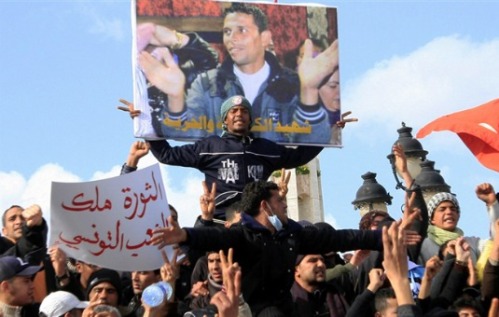
Tunisian Demonstrators
It began in such an innocuous manner. A Tunisian street vendor named Tarek al-Tayeb Mohamed Bouazizi set fire to himself due to what he viewed as harassment and humiliation by a local government official who confiscated his goods when he could not afford to pay bribes to the police. He died a few weeks later. That act set in motion widespread protests that led to the overthrow of long time Tunisian dictator Zine El Abidine Ben Ali ten days later.
The events in Tunisia sparked revolts throughout the Arab World, including the largest and most influential of the Arab States, Egypt and Syria. The situation in Egypt ended in the overthrow of President Hosni Mubarak and free elections where Islamists gained a majority in Parliament and the election of Moslem Brotherhood leader Mohamed Mursi as President. The situation in Syria led to minor reforms before the government of Bashir Al Asad began a series of repressive and violent crackdowns against protestors. This led to a armed revolt that has only continued to gain ground and achieve a modicum of international recognition.
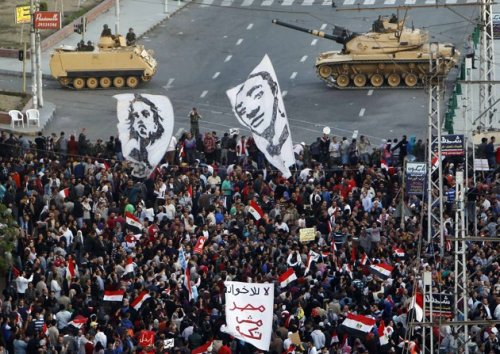
Egyptian Demonstrators calling for the Ouster of President Mursi
It appears that Egyptian President Mursi and the Islamic Brotherhood may have bit off a bit more than they could chew when they hurriedly wrote a new draft constitution that maximized their power and limited freedoms of non-Islamists including Coptic Christians, Democrats and secularists. Mursi compounded his mistake by issuing an edict that gave him practically unlimited power. The backlash from the Egyptian judiciary, journalists and opposition parties has been dramatic. Protests on the order of the original demonstrations against the Mubarak regime have engulfed Egypt, Mursi has annulled his decree that granted him those powers and the opposition is calling for his overthrow. The Egyptian military has again become a player in the unfolding drama.
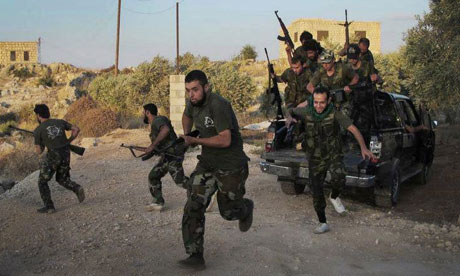
Free Syrian Army Soldiers in Action
In Syria the opposition is nearing complete control of many areas of the country and Bashir Al Asad’s regime is believed by many to be on its last legs, only the endgame remains to be played out. Some believe that Syria’s regime may be willing to use chemical weapons, particularly Sarin nerve gas agents against the opposition. The leaders of Western nations, especially the United States have announced that the use of such weapons would be unacceptable.
There are continued demonstrations, protests and political actions ongoing in several countries including US Allies Jordan, Kuwait and Bahrain.
Throughout the Arab World the Arab Spring has had marked repercussions. The long term dictators of Yemen and Libya were both overthrow, with Yemen’s case Ali Abdullah Saleh was able to negotiate his exit from power, while in Libya the regime of Muammar Ghadaffi was overthrown in a bloody manner following a protracted civil war. Ghadaffi himself was brutally murdered following his capture.
The Arab has also has had effects on the foreign policy of nations, particularly the United States, Russia and the European Union and others around the world who have stood to gain by maintaining the status quo in the region, playing off the interests of their Arab “friends” for their own benefit. The fact is that most countries or alliances with military, economic and political, diplomatic and intelligence interests are still trying to make sense of the new Middle East and how it will impact their interests.
The problem is that most people outside the region have little understanding of it or how different the culture, history and social considerations of each part of the Arab world is different than others. We like to take about the “Arab Street” or the “Moslem world” but the fact is that neither the Arab Street or the Moslem world is monolithic and what is the case in one country is not necessarily true in other countries.
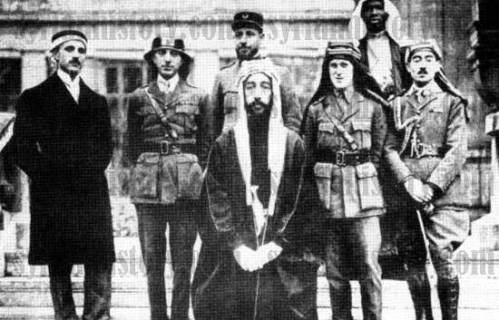
T.E. Lawrence with members of Arab delegation at Versailles
What we know as countries in many cases are nothing more than disparate Arab peoples of different, Tribal affiliations, cultural traditions, history as well as Islamic and Christian factions. There is no generic Arab country or people and in many Arab countries there is internal conflict based on tribal, ethnic or religious lines. This was something that T.E. Lawrence noted in his works and something that we in our desire to shape events to our liking, need to remember.
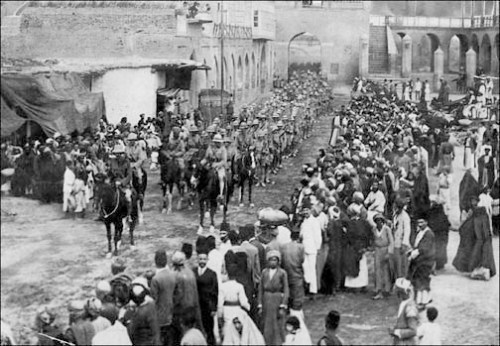
British Troops Enter Baghdad in 1920
During and after the First World War, European powers, particularly the English and French, but also the Italians used their military, economic and diplomatic power to divide the Arab World, recently free of Ottoman-Turk domination through the Sykes-Picot agreement, agreements made at Versailles and San Remo. In doing so they prevented a natural development of Arab freedom and helped poison relations between the Arabs and the West for generations and in the case of Saudi Arabia led to the domination of the Wahhabi house of Saud.
The Arab world is a mosaic of different peoples, cultures, traditions and histories. As the Arab Spring continues to unfold it is very important that we, who are not Arabs understand the various tensions at play and make vague assumptions about them or what the Arab Spring portends in Egypt or elsewhere.
Yes, we have important interests in the region. However as chaotic as it may seem the Arab Spring is a natural outgrowth of a region and its peoples finding themselves after centuries of foreign domination, be it that of the Roman, the Byzantine, the Turk, the Persian, or various countries of Europe and even the United States. It is important that it play out with as little foreign interference as possible. The lesson from history is that the last century of Western domination, imperialism and interference in Arab affairs have not helped and that these events will have to play themselves out, and that may take at least a generation.
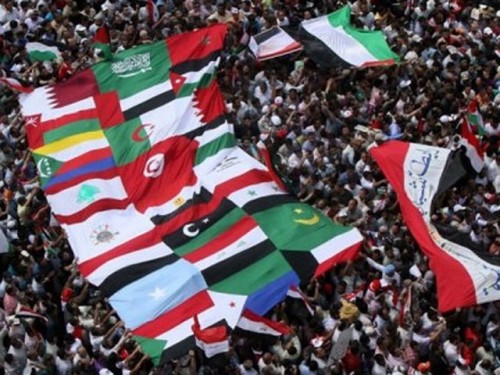
Whether we like it or not, what is happening now, despite the violence, strife and chaos is a necessary part of their story. How can we not understand? How many centuries of ethnic, cultural, religious and political war and strife have the nations of Europe and America endured to come to some semblance of working peacefully together?
The Arab Spring will be with us for a while because Arabs, regardless of their nationality, tribe or religious sect must determine their fate.
Peace
Padre Steve+















 The Inglorius Padre Steve's World
Remembering the Aftermath of the 2012 Election: A Time for Christian Self Reflection
The Religious Right on Wednesday Morning
I wrote on a number of occasions before the election that my hope was the no matter who won this election that somehow we would be able as Americans to come together for the benefit of the country.
What really amazes me in the aftermath is the the fact that people that are not religious, especially those that do not identify themselves as members of the Christian Right, regardless of their who they supported for the Presidency are far more civil and reflective than religious people. Especially conservative Christians.
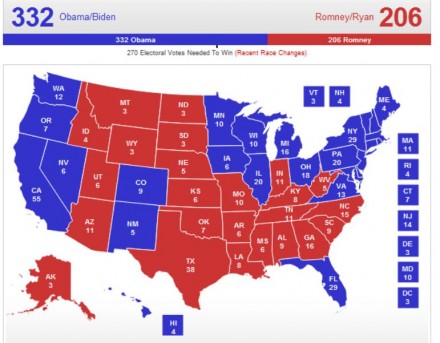
Actually what amazes me is not that right wing religious leaders have reacted in this manner. I expected it. But I was amazed in just how right that I was right in knowing that they would react in the way that they did to the defeat of Mitt Romney. A man that before he was nominated by the GOP was despised by most of the religious right. Mitt was a Mormon, a religious cult member and even worse than that a Massachusetts moderate. But he won the nomination in spite of their often strident opposition.
So now leaders of the religious right are apoplectic at have committed their entire credibility to support a candidate that lost an election that was not possible to lose. So instead of looking at themselves, their actions, words and attitudes that were a part of the defeat of their candidate in an election that most figured was impossible for a Republican to lose the point fingers of blame elsewhere.
It was the candidate’s fault…
It was Chris Christie’s fault…
It was Hurricane Sandy’s fault… but then if it was Sandy’s fault, and hurricanes are “acts of God” doesn’t it mean that Obama’s re-election and Mitt’s defeat was God’s will?
It was Obama suppressing the vote, except that the only people working to suppress the vote were Republican operatives, elected officials and strategists…
But to tell the truth it is their own fault. They forced Governor Romney to have to adopt their most extreme social positions to get their support, positions that he had never stridently held and in fact as a governor did not endorse. They helped put people on the ballot who simply were to be kind are best described “stupid, hateful and ignorant” of theology, history, government and economics, not to mention medicine, science, philosophy, sociology, economics and any other academic discipline.
So when I watched the men who helped send the Republican party to its doom in the 2012 election, men like James Robison, Pat Robertson, Mike Huckabee, Bryan Fischer, Gary Bauer, Buster Wilson, Tony Perkins, Eric Rush, Franklin Graham, Glenn Beck and a host of others point fingers of blame everywhere besides themselves I was not surprised. The fact that these men, and some women as well cannot see that their heavily publicized and funded positions helped destroy their candidate and party, but also have harmed the church for at least the next generation was not surprising.
The fact that rather than work with those that do not agree with them they would rather have the world judged by their version of God is telling. They are like the Taliban, except they do not get to wear the loose fitting comfortable clothes but are stuck with Armani suits and power ties.
So when I woke up on Wednesday morning after the election and over the next couple of days shut my trap and listened, I realized that the leaders of the religious right have no capability to think critically or have any sense of personal self reflection. They cannot even imagine that they might actually be at fault for their sorry predicament. They would have been great in the Bunker with Hitler, who when confronted with facts that said they they were losing the war and that it was their fault, blamed others and sought scapegoats. They could not believe that they lost and even in losing could not own up to their part.
It was embarrassing to watch because at one time I would have been one of them. It as embarrassing because as I looked and listened to the reactions of “conservative” religious leaders I realized that they were convinced of their own rightness as were those that opposed Jesus.
I had someone ask me if I was “happy” about the election. Their comments were quite sarcastic and bitter. Actually while I am somewhat pleased about the outcome, I am not happy about it because I live in the reality that no-matter which candidate “won” the election” that they need the support of all of us if we as a country and people to navigate the great challenges ahead and I don’t know if it will happen.
What concerns me as a Christian is that the better examples of attempting to find ways to bring the country together and get through the certainly difficult days ahead where people who were not Evangelicals or other religious conservatives.
The lack of understanding of “Christian” leaders about their own responsibility in this fiasco is had to understand unless you understand that most of them sold their souls for political and temporal power long ago. For years I followed their utterances and recited them verbatim. But that was before I went to Iraq and found out that they had been lying for years and I had chosen to ignore the evidence.
Hopefully responsible Christians and Christian leaders will take some time to reflect on their own responsibility for this mess rather than to continue to double down on the dumb-down that has discredited them.
But then I still believe that God still cares about everyone and that God cannot and will not be held hostage by any religious leader, denomination or community. Somehow the fact that the early church grew and thrived in a hedonistic, materialistic and hostile world shows me that this is certainly true. They had no power, had no wealth and were persecuted in ways that we as 21st Century Americans or Western Europeans will never comprehend.
Peace
Padre Steve+
Share this:
6 Comments
Filed under News and current events, Political Commentary, Religion
Tagged as 2012 elections, adolf hitler, bryan fischer, buster wilson, franklin graham, gary bauer, glenn beck, james robison, mitt romney, pat robertson, post election comments, president barak obama, religious right, self reflection, tony perkins