Category Archives: News and current events

Wacht am Rhein: The Battle of the Bulge at 75, Still So Much to be Learned

battle-bulge

Friend’s of Padre Steve’s World,

Today marks the 75th anniversary of the beginning of the German offensive known as Wacht am Rhein, but better known as the Ardennes Offensive or it’s popular name The Battle of the Bulge. The battle was for all intents and purposes a suicide mission for the remnants of the German Wehrmacht, Waffen SS, and Luftwaffe Paratroop divisions.

The offensive was the brainchild of Adolf Hitler, who over the objections of many military leaders, who wanted to conserve their last remaining Panzer and infantry reserves for holding back the final Soviet attack in the East, while preserving just enough strength to hold the West Wall defenses, while preserving fuel reserves to counter Allied incursions into the heart of the Reich. It was an all or nothing gamble by the German dictator, who had succeeded in many of his military gambles earlier in the war. However, now desperately trying to change the course of the war, he threw his best forces into a battle with almost no chance of success; but such is how despots in dire situations react. They become even more desperate to win.

Such could happen today with the United States. After 18 years of war our forces, though considered the strongest in the world are functionally broken. The numbers of Army combat brigades, Air Force and Navy Air Wings, and Navy ships and battle groups unable to deploy remains staggering, and forces remain stretched to meet peacetime missions and deployments, even while still engaged in parts to the Middle East and Central Asia. There is also the real possibility of war on the Korean Peninsula, the South China Sea, the Middle East, the Persian Gulf with Iran, or on the Eastern areas of NATO. None of these need necessarily happen, but could through mistakes caused by wrong intelligence, misguided policy, or unstable authoritarian leaders looking to shore up support at home by engaging in war. Any such war will not necessarily lead to the end of the United States, as Hitler’s did the Third Reich’s, but any would make the wars of the past 18 years look like child’s play. The human and material casualties will dwarf those wars and the very real threat of physical and cyber terrorism could destroy the economy and give whoever remains in charge the opportunity to create a police state and dictatorship.

Since President Trump has for the most part torn down the Constitutional and institutional guardrails against such an action, whether by him or any subsequent President, nothing can be regarded as impossible. As Trump feels the pressure of impeachment or the possible loss of office in the 2020 elections, his behavior may become more erratic, and either intentionally or unintentionally bring about an American Götterdämmerung.

So until tomorrow, and maybe some more from Sophie Scholl and the White Rose, I wish you a good night.

Peace,

Padre Steve+

Hitler’s Decision 
 

Adolf Hitler gathered with the Chiefs of Oberkommando des Wehrmachton September 16th 1944 at his “Wolf’s Lair” headquarters in East Prussia.  The situation was critical; he had recently survived an assassination attempt by Army officers led by Colonel Klaus Von Staufenberg at his Wolf’s Lair headquarters in East Prussia.  When the assassination attempt took place the German situation in Normandy was critical.

The Americans broke out of the Normandy Bocage at St. Lo and spread out across Brittany and the interior of France with Patton’s 3rd Army leading the way.  Even as his commanders in the West pleaded for permission to withdraw to the Seine Hitler forbade withdraw and ordered a counter attack at Mortain to try to close the gap in the German line and isolate American forces. When the German offensive failed the German front collapsed. 40,000 troops, hundreds of tanks and thousands of vehicles were eliminated when the Americans and Canadians closed the Falaise pocket.

Despite this cadres of decimated divisions including SS Panzer, Army Panzer and elite Paratroops made their way out of Normandy.  With the Germans in full retreat the Allies advanced to the border of the Reich itself. On the Eastern Front as well disaster threatened when the Red Army launched an Operation Bagration which annihilated the German Army Group Center, wiping out over 300,000 German troops. The Red Army advanced to the border of Poland before outrunning supply lines and stalling on the Vistula River just shy of Warsaw.

Tiger II Advancing in the Ardennes

Since Normandy Hitler had wanted to counter attack but had neither the forces nor the opportunity to strike the Allied armies. As the Allied offensive ground to a halt due to combat losses, lack of supplies and stiffening German resistance Hitler maintained a close eye on the situation in the West.  He believed that despite their success that the Americans and British alliance was weak and that a decisive blow could cause one or both to drop out of the war. During a briefing an officer noted the events of the day on the Western Front including a minor counterattack by kampfgrüppen of the 2nd SS Panzer and the 2nd Panzer Divisions which had made minor gains in the Ardennes, Hitler rose from his seat ““Stop!” He exclaimed. “I have come to a momentous decision. I shall go over to the counterattack….Out of the Ardennes, with the objective Antwerp.””[i]

 Thus began the planning for the last great German offensive of WWII.  Hitler “believed that sufficient damage could be inflicted to fracture the Anglo-American alliance, buy time to strike anew against the Soviets, and allow his swelling arsenal of V-weapons to change the course of the war.”[ii]  It was a course of born of desperation, even admitted by Hitler in his briefings to assembled commanders in the week prior to the offensive, one officer noted his remarks: “Gentlemen, if our breakthrough via Liege to Antwerp is not successful, we will be approaching an end to the war which will be extremely bloody. Time is not working for us, but against us. This is really the last opportunity to turn the war in our favor.”[iii]

US Soldiers manhandling a 57mm Anti-Tank Gun into Position

Despite shortages of men and equipment, continuous Allied assaults and over the objections of General Guderian who argued to reinforce the Eastern Front[iv], the OKW staff secretly developed detailed plans. The planning was so secretive that the “Commander in Chief West and the other senior commanders destined to carry out the attack were not informed.”[v] The plans were submitted to Hitler on October 9th [vi] and presented to Field Marshalls Von Rundstedt and Model at the End of October. General Hasso Von Manteuffel, commander of 5th Panzer Army commented that: “The plan for the Ardennes offensive…drawn up completely by O.K.W. and sent to us as a cut and dried “Führer order.”[vii]  Likewise Model and Von Rundstedt objected to the scope of the attack. Von Rundstedt stated: “I was staggered…It was obvious to me that the available forces were way too small for such an extremely ambitious plan. Model took the same view of it as I did….”[viii]  Model, who is sometime referred to as “Hitler’s Field Marshall”, reportedly said to General Hans Krebs: “This plan hasn’t got a damned leg to stand on.”[ix] And “you can tell your Führer from me, that Model won’t have any part of it.”[x] Sepp Dietrich, the old SS fighter and commander of 6th Panzer Army expressed similar sentiments.[xi]  Despite the objections by so many senior commanders Hitler scorned Model’s attempt to float a less ambitious plan to reduce the Allied salient at Aachen. Likewise Von Rundstedt’s desire to remain of the defense and wait for the Allies to attack using the armored forces to launch against any breakthrough was rejected.[xii] Hitler’s mind was set and the preparations moved forward.  The plan was complete down to the timing of the artillery bombardment and axes of advance, and “endorsed in the Führer’s own handwriting “not to be altered.””[xiii] Such a plan flew in the face of the well established doctrine of the Auftragstaktik which gave commanders at all levels the freedom of action to develop the battle as the situation allowed and opportunities arose.
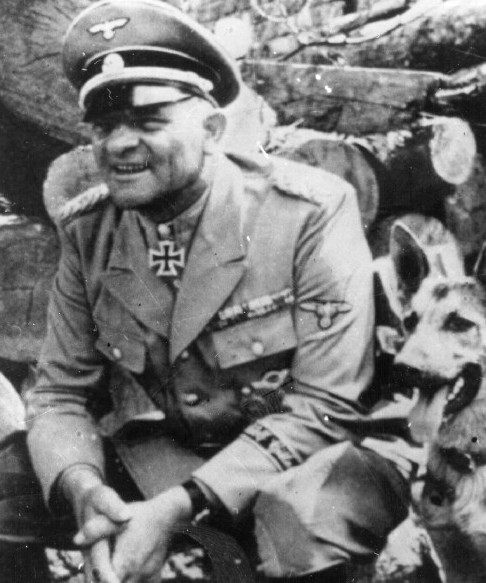
SS General Sepp Dietrich Commander of the 6th SS Panzer Army

The Allies also made mistakes in calculating German capabilities because of their success after Normandy. The Germans who the Allies presumed to be at the brink of collapse made a miraculous  recovery following their ghastly losses in Normandy. Kampfgrüppen and remnants of divisions bled the Americans at the Huertgen Forrest and blunted the British attempt to leapfrog the Northern Rhine at Arnhem decimated the British First Airborne division and causing heavy casualties among other British and American units during Operation Market Garden.

The German 15th Army avoided disaster when the British failed to close their escape route from Walchern island allowing 60,000 troops and much equipment to escape.  The Germans we’re able reform, reorganize, and stabilize the front by October. They pulled back many units of the 5th and 6th Panzer Armies for re-fitting and diverted nearly all tank, armored fighting vehicle and artillery production to the West at the expense of the Eastern Front.

The Germans called up 17 year olds and transferred young fit personnel from the Navy and Luftwaffe to the Army and Waffen SS.  Here they were trained by experienced NCOs and officers and brought into veteran units alongside hardened veterans who showed taught them the lessons of 5 years of war.[xiv]  However the rapid influx of new personnel meant that they could not be assimilated as quickly as needed and thus many were not as well trained as they might have been with more time.[xv] Many infantry and Parachute units had received inexperienced officers, taken from garrison duty, simply because so many experienced officers were dead, to fill key positions a problem that would show up frequently during the offensive.[xvi]

Panzer IV Ausf H of an SS Panzer Divsion in the Bulge

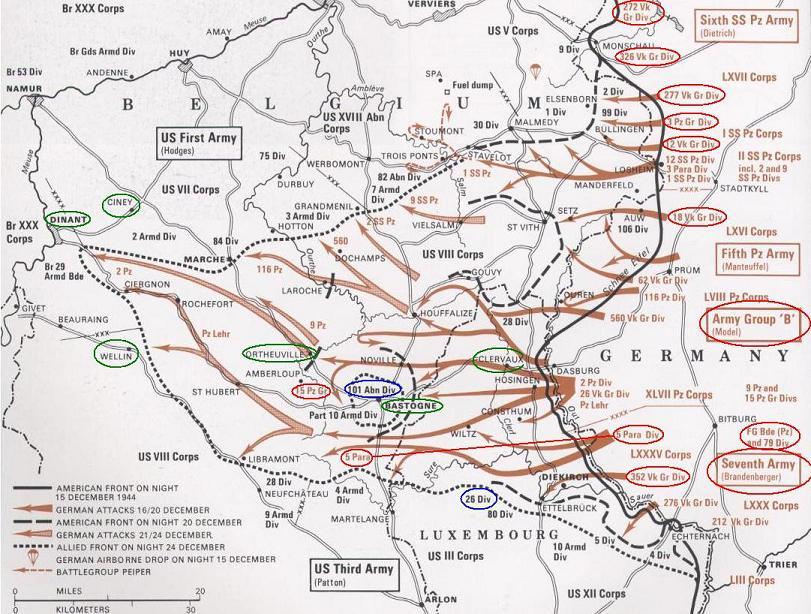
 The Germans were aided by the caution displayed by the Allies throughout the campaign in France which allowed the Germans to reconstitute formations around veteran headquarters staffs.[xvii]  The Germans built up the 5th and 6thPanzer Armies as the Schwerpunkt of the offensive giving them the lion’s share of reinforcements and pulling them out of the line during the fall battles along the Seigfried line and in the Alsace and Lorraine.  The plan was for the two Panzer armies and 7th Army to punch through the Ardennes, cross the Meuse, drive across Belgium, capture Antwerp and severe the link between the British and the Americans.

The spearhead of the assault was 6th Panzer Army Commanded by SS General Sepp Dietrich. It was composed of 1st and 2nd SS Panzer Corps and Army’s LXVII Corps.  The 6th SS Panzer Army included some of the best formations available to the German Army at this late stage of the war including the 1st  SS Panzer Division, the Leibstandarte Adolf Hitler, the 2nd  SS Panzer Division Das Reich, the 9th SS Panzer Division Hohenstaufen and the12th  SS Panzer Division Hitler Jügend. It’s ranks were filled out by the 3rd Parachute Division, the 501st SS Heavy Tank Battalion (attached to 1st SS), the 3rd Panzer Grenadier Division and the 12th, 246th, 272nd, 277th and 326th Volksgrenadier or Infantry divisions. The 6th Panzer Army would be the northern thrust of the offensive and its ultimate objective was Antwerp.  The 6th Panzer Army would be aided by a hastily organized parachute battalion under Colonel Von Der Heydte[xviii] and the 150th Panzer Brigade under SS Colonel Otto Skorzeny which included teams of American dialect speaking soldiers in American uniforms and equipment that were to spread confusion and panic in American rear areas.[xix]

Bradley, Eisenhower and Patton at Bastogne

 To the south was the 5th Panzer Army commanded by General Hasso Von Manteuffel.  The 5th Panzer Army was to advance alongside of the 6th Panzer Army with Brussels as its objective.  Composed of the XLVII and LVIII Panzer Corps and LXVI Corps the major subordinate commands included the best of the Army Panzer divisions including the 2nd Panzer, Panzer Lehr, 9th and the16thPanzer division. It also had the elite Führer Begleit Brigade composed of troops from Panzer Corps Grossdeutschland and commanded by Otto Remer who had help crush the coup against Hitler in July.  The 5th Panzer Army also included the 18th, 26th, 62nd, 560th and later the 167th Volksgrenadier divisions.

The south flank was guarded by 7th Army commanded by General Erich Brandenburger composed of LIII, LXXX and LXXXV Corps.  It included the Führer Grenadier Brigade and later the 15th Panzergrenadier division.  It was the weakest of the three armies but eventually included 6Volksgrenadierdivisions of varying quality and strength[xx] and the veteran 5th Parachute division.[xxi]  However with only 4 divisions at the start of the offensive the 7th Army was the equivalent of a reinforced corps.

While this force seemed formidable it had a number of weaknesses beginning with tank strength.  The 1st and 12th SS Panzer divisions were only at approximately half their established tank strengths and faced severe shortages in other vehicles.[xxii]  2nd SS and 9th SS of II SS Panzer Corps reported similar shortages.[xxiii]The shortage of other motorized vehicles, even in Panzer divisions was acute.  “Even the best equipped divisions had no more than 80 percent of the vehicles called for under their tables of equipment, and one Panzergrenadier division had sixty different types of motor vehicles, a logistician’s nightmare”.[xxiv] Panzer Lehr was so short in armored half tracks that only one battalion of its Panzer Grenadiers could be transported in them while others had to use “trucks or bicycles.”[xxv]

Limitations on equipment as well as fuel were not the only challenges that the Germans faced. The US V Corps launched an attack on the Roer River Dams just before the offensive making it necessary for the Germans to divert some of the  6th SS Panzer Army’s infantry divisions and Jagdpanzer units to be used by 6th SS Panzer Army away from the offensive.  One regiment of 3rd Parachute Division and over half of a second division could not take part in the initial 6th Panzer Army attack. Likewise some Jagdpanzer and Sturmgeschutzen units did not arrive until three days after the offensive began.[xxvi]

Allied Response: Before the Battle

While the German commanders sought to implement Hitler’s plan Allied commanders looked only to completing the destruction of Germany not believing the Germans capable of any major operation.  The Allied commanders with the exception of Patton did not believe the Germans capable of any more than local counter attacks.  Patton’s 3rd Army G-2 Colonel Koch was the only intelligence officer to credit the Germans with the ability to attack.[xxvii]  Most allied commanders and intelligence officers discounted the German ability to recover from disastrous losses, something that they should have learned in Holland or learned from the Soviet experiences on the Eastern front.  Bradley noted in his memoirs “I had greatly underestimated the enemy’s offensive capabilities.”[xxviii]  Carlo D’Este noted that “there was another basic reason why the Allies were about to be caught with their pants down: “Everyone at SHAEF was thinking offensively, about what they could do to the enemy, and never about what the enemy might do to them.””[xxix]   This mindset was amazing due to the amount of intelligence from Ultra and reports from frontline units that major German forces were no longer in the line.[xxx] Additionally nearly all commentators note that American units in the Ardennes did not conduct aggressive patrols to keep the enemy off balance and obtain intelligence.[xxxi]  One describes the efforts of 106th Division as “lackadaisical” and notes that enemy before the offensive was not the Germans but the cold.[xxxii] Max Hastings noted that: “the Allies’ failure to anticipate Hitler’s assault was the most notorious intelligence disaster of the war.”[xxxiii]

The Allies also were in the midst of a manpower crisis. Eisenhower did not have enough divisions to establish a clear manpower advantage as “there were not enough Anglo-American divisions, or enough replacements for casualties in the existing divisions.”[xxxiv]  No more American Infantry divisions were available as the Army had been capped at 90 divisions and infantry replacements were in short supply.  This shortage meant that Eisenhower could not pull divisions out of line to rest and refit. He could only transfer divisions such as the 4th and 28thInfantry divisions to the relative quiet of the Ardennes. He had no ability to “create a strategic reserve unless he abandoned the broad front strategy.”[xxxv]The Germans knew of the allied weakness and believed that they could achieve local superiority even if they did not believe they could reach Antwerp. Model believed that “he was sure that he would reach the Meuse in strength before the Americans could move sufficient reserves to halt his armies or even head them off.”[xxxvi]

The German Breakthrough and American Response
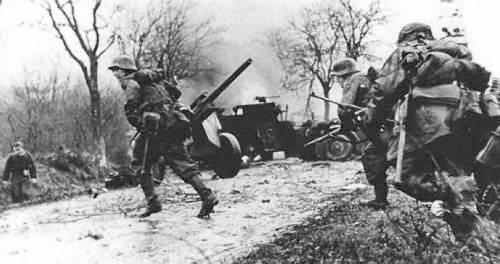
German-Troops-at-the-Battle-of-the-Bulge

The German assault began on December 16th. Some breakthroughs were made especially in the vicinity of the Losheim Gap and the Schnee Eifel by the southern elements of 6th Panzer Army and Manteuffel’s 5th Panzer Army. However the Germans could not break through around Monschau and Elsenborn Ridge held by the inexperienced but well trained 99th Infantry division and elements of the veteran 2nd “Indianhead” Division.  In the far south near Diekirch the 4th Infantry Division held stubbornly against the attacks of 7thArmy’s Volksgrenadiers. The Germans achieved their greatest success at Losheim where SS Colonel Josef Peiper and his 1st SS Panzer Regiment had driven off the US 14th Cavalry Group and penetrated 6 miles into the American front.  5th Panzer Army made several breakthroughs and isolated two regiments of newly arrived 106th Infantry Division in the Schnee Eifel. Manteufel also pressed the 28th Division hard along the Clerf River, Skyline Ridge and Clairvaux.

Yet at ‘no point on that first day did the Germans gain all of their objectives.”[xxxvii]  The credit goes to US units that stubbornly held on, but also to the poor performance of many German infantry units.  German commanders were frustrated by their infantry’s failure even as the panzers broke through the American lines.  Manteuffel noted his infantry was “incapable of carrying out the attack with the necessary violence.”[xxxviii]

US Airborne Commanders James Gavin (R) and Matthew Ridgeway (L)

 The initial Allied command response to the attack by senior commanders varied.  Bradley believed it was a spoiling attack “to try and force a shift of Patton’s troops from the Saar offensive back to the Ardennes.”[xxxix] Courtney Hodges of 1st Army agreed with Bradley and refused to allow General Gerow, commander of V Corps to call off 2nd Infantry Division’s attack against the Roer dams on the 16th in order to face the German offensive.[xl]  Gerow was one of the first American commanders to recognize the scope of the German attack but Hodges, perhaps the least competent senior American commander in Europe failed to heed Gerow’s advice. Soon after making this decision Hodges “panicked” and evacuated his headquarters at Spa fearing that it would be overrun by the advancing Germans.[xli] Eisenhower when informed of the news realized that something major was occurring and ordered the 7th Armored Division from the 9th Army and 10th Armored Division from 3rd Army into the Ardennes. On the 17th he made other dispositions and released the 82nd and 101stAirborne Divisions from SHAEF reserve at Rheims to the Ardennes under the command of XVIII Airborne Corps.[xlii]  However during this short amount of time Mantueffel’s panzers had advanced 20 miles.
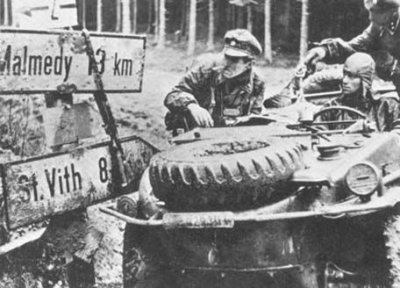
SS Panzer Troops of Kampfgruppe Knittel on the advance.  Photo has often been identified for decades in books and other publications as Waffen-SS Colonel Joachim Peiper the commanding officer of the 1st SS Panzer Regiment and Kampfgruppe Peiper. This has been refuted by recent study.  Peiper is pictured below.

At the command level Eisenhower made a controversial, but correct decsion to divide the command of the Bulge placing on a temporary basis all forces in the northern sector under Montgomery and leaving those to the south under Bradley.  Montgomery according to one commentary initially “had been astonishingly tactful in handing his American subordinates.”[xliii] However he quickly made himself obnoxious to many American commanders.[xliv]Following the battle Montgomery made the situation worse by claiming to have saved the Americans and giving credit to British units which scarcely engaged during the battle.[xlv]  Eisenhower also ordered Patton to launch a counter-attack along the southern flank of the German advance.  However Patton was already working on such an eventuality and promised to be able to launch a counterattack with three divisions by the 22nd.[xlvi]  Bradley praised Patton highly in his memoirs noting: “Patton’s brilliant shift of 3rd Army from its bridgehead in the Saar to the snow-covered Ardennes front became one of the most astonishing feats of generalship of our campaign in the West.”[xlvii]

The Americans Hold the Shoulders 

  688px-Bulge_stvithroad_1945jan24_375

The 99th Division’s position was precarious, its right flank was subject to being turned and it was suffering severely at the hands of 12 SS Panzer and several Volksgrenadier divisions.  Gerow reinforced the 99th with elements of the 2nd Infantry division even before he had the final authorization to end its attack.  The two divisions stubbornly held Elsenborn Ridge and the villages of Rockerath, Krinkelt and Büllingen. By the 20th the 9th and 1st Infantry divisions arrived to strengthen the defense and lengthen the line to prevent it from being rolled up by the Germans.  The stubborn resistance of the Americans and arrival of reinforcements meant line was proof “against anything Sepp Dietrich might hurl against it”[xlviii]  By the 23rd Dietrich and 6th SS Panzer Army conceded defeat at Elsenborn and “turned its offensive attentions to other sectors.”[xlix]  German commanders like General Priess the commander of 1st SS Panzer Corps believed that terrain and road network in this sector was unfavorable to the German offensive and had proposed moving the attack further south.[l]  The Panzers could not deploy properly and the German infantry was not up to the task of driving the Americans out of their positions before the reinforcements arrived.

In the south the 4th Infantry Division held the line though heavily pressed by Brandenburger’s 7th Army.  The division was reinforced by elements of both 9thand 10th Armored divisions on the 17th and generally held its line along the Sauer River around Echternach “largely because the left flank of the enemy assault lacked the power-and particularly the armor-of the thrust farther north.”[li]

Turning Point: The Destruction of Kampfgruppe Peiper

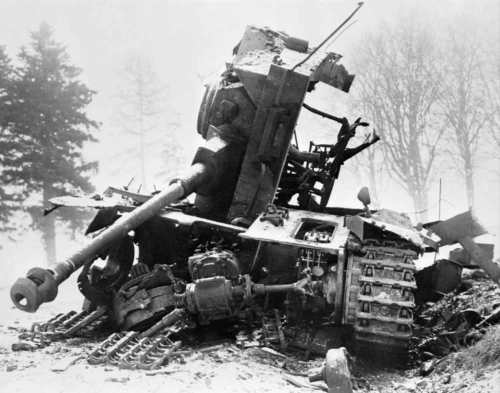
While V Corps fought the 6th Panzer Army to a standstill, to the south 1stSS Panzer Division led by Kampfgrüppe Peiper split the seam between V Corps and VIII Corps. The Kampfgrüppe moved west leaving a brutal path of destruction in its wake, including massacres of American POWs and Belgian civilians.[lii]  However its advance was marked with difficulty. On the night of the 17th it failed to take Stavelot. After clearing the American defenders from the town after a hard fight on the 19th it failed to capture a major American fuel dump a few miles beyond the town.  When the Germans approached the American commander ordered his troops to pour 124,000 gallons down the road leading to the dump and set it on fire, depriving the Germans of badly needed fuel.[liii]  Combat Engineers from the 291st Engineer Battalion blew a key bridge across the Ambleve at Trois Ponts and another bridge across the Lienne Creek which left the Germans bottled up in the Ambleve River valley.  This bought time for the 30th Infantry Division to set up positions barring Peiper from the Meuse.  The 30th would be joined by Combat Command B of 3rd Armored Division and elements of 82nd Airborne. These units eventually forced Peiper to abandon his equipment and extricate some 800 troops by foot by the 23rd after a hard fight with the Americans who had barred his every effort to break through to the Meuse.

Turning Point: The Crossroads: St Vith & Bastogne
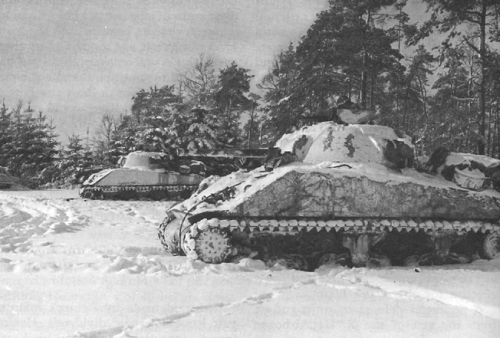
American_7th_Armored_Division_Shermans_taking_up_positions_outside_St._Vith,_1944

The battle rapidly became focused on key roads and junctions, in particular St. Vith in the north and Bastogne in the south.  At St. Vith the 7thArmored Division under General Hasbrouck, who Chester Wilmont calls one of the “great men of the Ardennes”[liv] completed a fifty mile road march from Aachen to St. Vith.  On his arrival he deployed his combat commands around the town which was the key to the road network in the north and also to the only rail line running west through the Ardennes.[lv]  Hasbrouck gathered in Colonel Hoge’s Combat Command B of 9th Armored Division and the 424th Infantry Regiment of the 106th Division into his defensive scheme as well as the survivors of the 112th Infantry Regiment of the 28th Infantry Division which had escaped the German onslaught after holding as long as possible along the Clerf River and Skyline Drive.[lvi]  With these units Hasbrouck conducted “an eight-day stand that was as critical and courageous, as the defense of Bastogne.”[lvii]  After holding the Germans at St. Vith the units were withdrawn to another defensive position along the Salm and Ourthe Rivers and the village of Viesalm.  This was done at the behest of Montgomery and General Ridgeway of XVII Airborne Corps whose 82nd Airborne had moved into that area on the 19th.  The arrival of the 82nd greatly assisted Hasbrouck’s force holding St. Vith whose defenders had lost an estimated 5000 casualties.[lviii]

The stand at St. Vith confined the “confined the Sixth Panzer Army’s penetration to a chokingly narrow corridor.”[lix]  It also posed a problem for German command and control which because it was out of the 6th Panzer Army’s area of operations Dietrich was unable to lend his weight into the fight.  “Hitler himself had strictly prohibited deviations from the zonal boundaries”[lx] which left the fight for St. Vith in the hands of 5th Panzer Army who felt the impact of the stand as the Americans “also choked off one of the Fifth Panzer Army’s best routes to Bastogne, almost nullifying the significance of the captured road junction at Houffalize.”[lxi] 
EA-48892

To the south of St. Vith lay Bastogne, another key road junction needed by 5thPanzer Army for its advance.  On the night of the18th Panzer Lehr division came within two miles of the town before being checked by resistance by units of the 10th Armored division, remnants of 28th Division and misdirection by “friendly” Belgian guides onto a muddy path that helped halt their advance.[lxii]  This gave the 101st Airborne just enough time to get to the town and prevent its capture. The siege of Bastogne and its defense by the 101st elements of 9th and 10thArmored Divisions and 28th Division became an epic stand against Manteuffel’s Panzers which had surged around the town.  Wilmont comments that “had the Germans won the race for Bastogne, Manteuffel’s armor would have had a clear run to Dinant and Namur on December 19th and 20th” [lxiii] when there were only scattered American units between them and the Meuse. Manteuffel b bypassed Bastonge after the failure to capture it and masked it with 26thVolksgrenadier Division and a regiment of Panzer Lehr.  The remainder of Panzer Lehr and the 2nd Panzer Division moved to the west. [lxiv]  The garrison endured numerous attacks and on the 22nd one of the most celebrated incidents of the war took place when Brigadier General Anthony McAuliffe responded to a demand for the surrender of the town with the reply; “Nuts.”  The town would continue to hold until relieved by 3rd Army on the afternoon of December 26th.[lxv]

The American Counterattack


The Allied counterattack began with 3rd Army in the south on 21 December.  Patton’s initially proposed to attack toward the base of the Bulge in order to cut off the largest number of Germans possible.  Eisenhower dictated an attack further west with the goal of relieving Bastogne.  Eisenhower wanted to delay the attack to concentrate combat power while Patton wanted to attack sooner in order to ensure surprise. Patton got his way but attacked on a wide front.  The attack lost its impetus and bogged down into a slugging match with 7th Army’s infantry and paratroops along the southern flank. [lxvi]  Patton’s failure to concentrate his forc forces for the advance to the north diminished his combat power.[lxvii] While Patton attacked from the south the 1st Army dealt with the advanced spearhead of 2nd Panzer Division which had reached the town of Celles and ran out of gas just four miles from Dinant and the Meuse. The 84thInfantry Division stopped the 116th Panzer division from being able to effect a relief of the 2nd Panzer the US 2nd Armored Division and allied fighter bombers chopped up the virtually immobile 2nd Panzer division completing that task by the 26th.[lxviii]  

41d233ae6d2744c2cbab2d76cf798341

To the north Montgomery launched a cautious counterattack which slowly and methodically took back lost ground but allowed many Germans to escape. While Montgomery moved south Patton faced heavy German resistance from elements of 5th Panzer Army, reinforced by 1st SS Panzer Corps and 7th Army.  The rupture in the American front was not repaired until 17 January when the American forces met at Houffalize.[lxix] Bradley took over for Montgomery and the Americans pushed the Germans slowly back across the Clerf River by the 23rd.  The advance was hampered by tough German resistance and terrible weather which forced much of the attack to be made by dismounted troops as the roads had completely frozen over.[lxx]

The Allied counter attack has been criticized for allowing too many Germans to escape what could have been a major encirclement.  Patton recognized the incompleteness of the victory in the Ardennes stating: ““We want to catch as many Germans as possible, but he is pulling out.” The “but” clause, the note of regret, the awareness of the imperfection of his victories typified Patton.””[lxxi]  Patton in his memoirs noted: “In making the attack we were wholly ignorant of what was ahead of us, but we were determined to strike through to Bastogne.”[lxxii] Max Hastings simply said: “the Allies were content with success.”[lxxiii]  Murray and Millett place blame on Bradley and Hodges for choosing “merely to drive the enemy out of the Ardennes rather than destroy him.”[lxxiv]

Analysis: Could Wacht Am Rhein Have Worked?

Could Wacht am Rhein worked?  If much was different, yes. Success of the operation depended more on ifs that the Germans could not control, than events they had the power to influence. If the German had been stronger in tanks and vehicles and had adequate stocks of fuel; if their infantry was better trained, and had the Americans not resisted so stubbornly it might have at least got to the Meuse.  Perhaps if the the bad weather held keeping Allied air forces away from the Germans, or had St. Vith and Bastogne been taken by the 18th or 19th, they might have reached the Meuse. Likewise, had the Germans executed their plan and coordinated their assault better[lxxv] in the 6thPanzer Army sector, and had the 7th Army enough strength to conduct offensive operations in depth and secure the left flank the attack might have succeeded. But only revisionists and fiction writers could construct such success.

Because the Americans held the shoulders and road junctions, Manteuffel’s 5thPanzer Army, the only force besides the regimental sized Kampfgrüppe Peiper to actually threaten the Meuse was forced to advance while attempting to take Bastogne and defeat 3rd Army’s counterattack. Whether they could have made Antwerp is another matter.  Nearly all German commanders felt the offensive could not take Antwerp but did believe that they could inflict a defeat on the Allies and destroy a significant amount of allied combat power.

The German offense was a desperate gamble.  Too few divisions, scant supplies of petrol and ammunition, formations that had recently been rebuilt and not given enough time to train to the standard needed for offensive operations coupled with Hitler’s insistence on an unalterable plan kept them from success. It was a part of Hitler’s Cloud Cukoo Land.

At the same time the Allies were so weak in troops and overstretched because of their losses during the Normandy Campaign, Market Garden, and the Huertgen Forrest, Eisenhower had no strategic reserve save the two American Airborne Divisions.  All reinforcements to the threatened sector had to come from the flanks and by the middle of the battle the 9th Army was drawn down to two divisions.

Russell Weigley noted how the constraints imposed by the 90 division Army, and of the limited stocks of artillery ammunition hurt the allies.[lxxvi] If the Germans had more forces they might have inflicted a significant defeat on the Allies had they been able to reinforce their success in depth. Despite this they still inflicted punishing losses on the Americans though suffering greatly themselves.  Hastings noted that the real beneficiaries of the Ardennes offensive were the Russians.[lxxvii]  In the end the conclusion had to be that German success was unlikely and that the offensive could have never achieved Hitler’s goals of taking Antwerp and fracturing the British-American alliance.

A Postscript About other Parts of the Campaign in France

The Riviera and Rhone

The campaign in south France was strategically wise although opposed by the British to the last minute because they felt it would take away from Overlord.[lxxviii] Though delayed the campaign was well executed by 7th Army, particularly Lt. General Lucian Truscott’s VI Corps of 3 American divisions. Truscott believed “destroying the enemy army was the goal”[lxxix] managed the battle well and skillfully maneuvered his small forces against Blaskowitz’s 19thArmy inflicting heavy losses, though some German commanders noted the caution of American infantry in the attack.[lxxx]  Only Blaskowitz’s tactical skills and the weakness of the American force prevented the Germans from disaster. The seizure of Marseilles and Toulon provided the allies with sorely needed ports that were invaluable to sustain the campaign.[lxxxi]

The Lorraine Campaign

Patton attacked in the Lorraine with the goal of crossing the Moselle river and attempting to break into Germany. He doing so he ran into some of the strongest German forces on the front and his troops became bogged down in the poor terrain and mud of the region.[lxxxii]  Patton was convinced that he was delayed in making his assault due to his place “at the far end of the logistics queue.” during Market Garden. [lxxxiii] Despite Patton’s efforts, German forces skillfully defended the ancient fortress of city Metz forcing the Americans into a protracted campaign to clear the area with the last strongpoint surrendering on 13 December.  Patton is criticized for his failure to concentrate his forces[lxxxiv] but American tactics were less to blame than the weather, German resistance and shortages of infantry.[lxxxv] In some cases American infantry units performed admirably, particularly 80th Division’s assault on the Falkenburg Stellung.[lxxxvi]Liddell Hart criticized the Allies for failing to attack through the then weakly defended Ardennes, commenting: “By taking what appeared to be the easier paths into Germany the Allies met greater difficulties.”[lxxxvii]

The Huertgen Forrest

The Huertgen Forrest was the worst managed American fight Western European campaign. [lxxxviii] General Courtney Hodges leadership was poor.[lxxxix] In the Huertgen he fed division after division into a battle that made no strategic sense.  American infantry performed poorly and took extremely heavy casualties leaving four divisions shattered.[xc]  Poor American tactics demonstrated by attacking into a forest in poor weather without concentration negated all of Hodges’ advantages in tanks, artillery and airpower. The forest contained no significant German forces capable of threatening any American advance[xci] and its gain offered little advantage.[xcii] Hastings noted that the gains the only saving grace was that it made it easier for the northern shoulder of the Bulge to hold[xciii]  General Model and his subordinates expertly handled their handful of excellent but weary divisions in this battle using terrain, weather and prepared defensive positions to contest nearly every yard of the Forrest.[xciv]

Conclusions

The lessons of the Bulge and the other campaigns on the German-French border are many and can be gleaned from Allied and German mistakes. On the Allied side the most glaring mistakes were assumptions prior to the German attack that the Germans were incapable of any serious offensive and ignoring the fact that the Germans had attacked through the Ardennes in 1940.  Likewise the self limitation of the American Army to 90 divisions for world-wide service meant that there were no more divisions in the pipeline and that worn out divisions would have to be reinforced with inexperienced troops while in the front line which ensured a lack of cohesiveness in many divisions, especially the infantry.  Allied intelligence failures as well as their reliance of forces much smaller than they should have had for such a campaign ensured that they would suffer heavy losses in the Bulge while poor planning and execution by Hodges wasted many good troops in a senseless battle.  The Germans were hamstrung by Hitler’s fantasy that the Western Allies could be forced out of the war or the Alliance split by a defeat in the Ardennes.  Likewise German forces, even those so quickly reconstituted were often short troops, tanks and vehicles.  German commanders were forced by Hitler’s rigid insistence on not altering the plan to not be as flexible as they might have been in earlier offensives to adjust according to the situation on the ground.

None of these attitudes is exclusive to the Allied and German commanders during the campaign in France and the Battle of the Bulge. They are common throughout history and have been repeated in Vietnam, Iraq, and Afghanistan by the United States military. It would be easy for Americans to believe that in future conflicts we will be victorious when despite our massive military budgets many if not most of our combat forces could not be deployed to a conflict at short notice and those in theater could be overwhelmed by enemies who exploit our weaknesses rather than directly engage our strengths.

Notes


[i] Dupay, Trevor N.  Hitler’s Last Gamble: The Battle of the Bulge December 1944-January 1945Harper Collins Publishers, New York NY 1994 p.2.

[ii] Hastings, Max. Armageddon:  The Battle for Germany 1944-1945 Alfred A Knopf, New York NY 2004 p.197.

[iii] Reynolds, Michael. Sons of the Reich: II SS Panzer Corps; Normandy, Arnhem, Ardennes, and on the Eastern Front.  Casemate Publishing, Havertown PA 2002 p.186

[iv] Ibid. p.198

[v] Warlimont, Walter. Inside Hitler’s Headquarters 1939-1945 translated by R.H. Barry. Presidio Press, San Francisco, CA 1964. p. 480

[vi] Ibid.

[vii] Liddell Hart, B.H. The German Generals Talk. Originally published 1948, Quill Publishers Edition, New York 1979 p.274.

[viii] Liddell Hart, B.H. The History of the Second World War G.P. Putnam’s Sons, New York NY 1970. p.646.

[ix] MacDonald, Charles B. A Time for Trumpets: The Untold Story of the Battle of the Bulge William Morrow and Company, New York, NY 1985 p.35.

[x] [x] Newton, Steven H. Hitler’s Commander: Field Marshal Walter Model, Hitler’s Favorite General.DeCapo Press, Cambridge MA 2005. p.329

[xi] Ibid. Hastings p.198.  Hastings quotes Dietrich: “All Hitler wants me to do is cross a river, capture Brussels, then go on and take Antwerp. And all this at the worst time of year through the Ardennes when the snow is waist-deep and there isn’t enough room to deploy four tanks abreast let alone armored divisions. When it doesn’t get light until eight and it’s dark again by four and with re-formed divisions made up chiefly of kids and sick old men-and at Christmas.”

[xii] Ibid. Liddell-Hart The German Generals Talk p.276

[xiii] Wilmont, Chester. The Struggle for Europe Harper and Brothers Publishers, New York, NY 1952 p.576

[xiv] Ibid. p.557.

[xv] Ibid. Hastings. p.199. Hastings notes that Manteuffel said: “It was not that his soldiers now lacked determination of drive; what they lacked were weapons and equipment of every sort. Von Manteuffel also considered the German infantry ill trained.”

[xvi] Ibid. Dupay.p.47  Dupay notes that in 3rd Parachute Division that most of the regimental commanders had no combat experience.

[xvii] Weigley, Russell  F. Eisenhower’s Lieutenants: The Campaign in France and Germany 1944-1945. Indiana University Press, Bloomington IN 1981 p.432.  Weigley speaks of Allied caution and predictable strategy, caution in logistical planning which did not allow the Allies to provide the fuel needs for a rapid drive into Germany and caution of operational commanders.

[xviii] Liddell Hart discusses the issue of paratroops at length in discussions with Manteuffel and General Kurt Student. At the time of the operation there were very few jump trained paratroops available for the operation as most of the 6 organized Parachute Divisions were committed to battle as infantry during the 1944 battles in the East, Italy and in the West. German Generals Talk pp.282-285.  Although Liddell Hart makes note of the employment of these troops and talked with Model and student about why they were not used to seize bridges and other critical terrain featured ahead of the Panzers instead of the use as a blocking force, I have found no one who questioned why the Germans did not use small glider detachments for the same purpose.  The Germans had demonstrated with Skorzeny when they rescued Mussolini from his mountain prison that they still retained this capability.  The use of the SS Paratroop battalion which could have been assigned to Skorzeny as a glider borne force could have been decisive in capturing the key bridges and terrain ahead of 6thPanzer Army.

[xix] Skorzeny’s operation was Operation Greif designed to sow confusion in the Allied Ranks.  His brigade numbered about 3500 men and had a good number of captured US vehicles including some tanks and tank-destroyers on hand to confuse American units that they came in contact with.

[xx] Ibid. Hastings.  p. 199.  Hastings quotes the Adjutant of 18th Volksgrenadier Division who “felt confident of his unit’s officers, but not of the men “some were very inexperienced and paid the price.”  MacDonald notes that the division had many Navy and Air Force replacements but was at full strength. p.646.

[xxi] See MacDonland pp. 644-655 for a detailed commentary on the German Order of Battle.

[xxii] Reynolds, Michael. Men of Steel: 1st SS Panzer Corps;  The Ardennes and Eastern Front 1944-1945 Sarpendon Publishers, Rockville Center NY, 1999. pp.36-37.  Reynolds notes that the 1st SS Panzer Regiment only had 36 Panthers and 34 Mark IV Panzers to begin the operation (excluding the attached 501st SS Heavy Tank Battalion).  He also notes that many of the tank crew replacements had no more than 6 weeks of military training and some of the tank crews had never been in a tank.  Similar problems were found in all the Panzer Divisions.  Severe shortages of armored half tracks, reconnaissance vehicles and other vehicles meant that Panzer Grenadier and Motorized battalions lacked the lift needed and some went on foot or on bicycles.

[xxiii] Ibid. Reynolds. Sons of the Reich. P.183

[xxiv] Ibid. MacDonald. p.44.

[xxv] Ibid.

[xxvi] Ibid. Dupay pp. 27-28.

[xxvii] Ibid. MacDonald. p.52.  MacDonald notes that Koch warned that the Germans were not finished, that “his withdraw, though continuing has not been a rout or mass collapse.” He calls Koch a “lone voice” in the Allied intelligence world.

[xxviii] Bradley, Omar  N. A Soldier’s Story Henry Holt and Company, New York NY 1951. p.459.  Weigley makes some poignant calling Bradley’s comments  “contradictory” and states that: “his apologia is hardly a model of coherence. (p.461)

[xxix]  D’Este, Carlo. Eisenhower: A Soldier’s Life Owl Books, Henry Holt and Company, New York NY 2002. p.638

[xxx] Dupay and others talk about this in detail. See Dupay pp. 35-44.

[xxxi] Ibid. p.38.

[xxxii] Ibid. Hastings. p.201

[xxxiii] Ibid. Hastings. p.199

[xxxiv] Ibid. Weigley. p.464

[xxxv] Ibid.

[xxxvi] Ibid. Wilmont. P.581.

[xxxvii] Ibid. p.583

[xxxviii] Ibid. Hastings. p.223

[xxxix] Ibid. Weigley. P.457

[xl] Ibid. p.471

[xli] Ibid. Hastings. pp.205-206

[xlii] Ibid. Wilmont. pp.583-584

[xliii] Murray, Williamson and Millett, Allan R. A War to Be Won: Fighting the Second World War The Belknap Press of Harvard University Press, Cambridge Massachusetts and London England, 2000 p.470 The authors must base their conclusion on the fact that Montgomery who mentioned to Eisenhower that Hodges might have to be relieved, did not do so and by the next day told Eisenhower that the action was not needed.  A  few other American commanders in the north were favorable to Montgomery but this appears to be a minority view.

[xliv] Ibid. Weigley. pp.504-506.  Weigley and Wilmont both note the comment of a British Staff Officer the Montgomery “strode into Hodges HQ like Christ come to cleanse the temple.” (Wilmont p.592)

[xlv] Ibid. Hastings. pp.230-232.  Hastings is especially critical of Montgomery.  Weigley, equally critical notes regarding  the January 7th press conference, Montgomery’s “inability to be self critical at any point.” p.566.

[xlvi] Ibid. Weigley. p.500.

[xlvii] Ibid. Bradley. p.472  Other commentators differ in their view of Patton’s movement.  Wilmont notes that Patton had no “equal in the on the Allied side in the rapid deployment of troops. (p.589) Weigley urges readers that “it should be kept in appropriate perspective; it was not a unique stroke of genius.” And he compares it to Guderians disengagement with Panzer Group 4 and 90 degree change of direction and assault against the Kiev pocket in the 1941 Russian campaign (p.500)  Hastings notes that “Patton had shown himself skilled in driving his forces into action and gaining credit for their successes. But he proved less effective in managing a tough, tight battle on the southern flank.” (p.230)  Regardless of the perspective and criticism Patton’s movement was unequaled by any Allied commander in the war and had he not moved so quickly the 101st Airborne might not have held Bastogne. Admittedly his attack north was dispersed along a wide front but part of the blame for this must be assigned to Eisenhower who dictated the attack toward the west vice the base of the Bulge where Patton desired to make it.  A note I would make is that being a cavalryman Patton thought like one and when faced with the tight battles in close quarters was not at his best.  Similar comparisons could be made to J.E.B. Stuart at Chancellorsville when he had to take command of Jackson’s Corps.

[xlviii] Ibid. Weigley. p.475

[xlix] Ibid. p.474

[l] Ibid. Reynolds Men of Steel pp.51-52.

[li] Ibid. Weigley. p.470

[lii] The worst of these took place at the village of Malmedy where Battery B 285th Field Artillery Observation Battalion of 7th Armored Division was captured and about 150 soldiers were rounded up and machined gunned in a field with survivors killed with pistol shots in the head.

[liii] Ibid. Weigley. pp.478-479.

[liv] Ibid. Wilmont. p.584

[lv] Ibid. Weigley. p.487

[lvi] Ibid. Weigley. pp.486-487

[lvii] Ibid. Hastings. p.215. Hastings gives most of the credit to Brigadier General Bruce Clarke of CCB 7th Armored Division for the stand.

[lviii] Ibid. MacDonald. 481-487.  MacDonald notes that following the war that the commanders of the units involved “would be grateful to Field Marshal Montgomery for getting them out of what they saw as a deathtrap for their commands. (p.487)

[lix] Ibid. Weigley. p.487

[lx] Ibid.

[lxi] Ibid.

[lxii] Ibid. Hastings. p.217 Also  MacDonald. p.289 who talks of the confused situation east of Bastogne both for the Americans and Germans.

[lxiii] Ibid. Wilmont. p.598

[lxiv] Ibid. Liddel Hart. The German Generals Talk. p.288

[lxv] The defense of Bastogne would continue until after the 1st of January as Hitler renewed the attempts to secure the town in order to push on to the Meuse. Other German formations including units of 1st SS Panzer Corps shifted south from their original attack would make determined efforts to dislodge the stubborn American defenders.

[lxvi] Ibid. Weigley. pp.500-501.  Bradley gives Patton more credit than later commentators. Wilmont notes that the Germans though “amazed at the speed with which Patton had disengaged from the Saar and wheeled them northward…they received due warning of his movement by monitoring the radio net which controlled American traffic, and they were braced to meet his assault. (p.599).

[lxvii] Ibid. Weigely. Pp.520-521

[lxviii] Ibid.  pp.535-537

[lxix] Ibid. pp. 558-561

[lxx] Ibid. pp.563-564

[lxxi] Ibid. p.566.

[lxxii] Patton, George S. War as I Knew It  Originally published by Houghton Mifflin Company NY 1947, Bantam Paperback Edition,  Bantam Books, New York, NY 1980 p.364

[lxxiii] Ibid. Hastings. p.230

[lxxiv] Ibid. Murray and Millett p.471.

[lxxv] Hastings notes that “Tactically, the Ardennes was one of the worst-conducted German battles of the war, perhaps reflecting that none of the generals giving the orders saw any prospect of success. (p.236)

[lxxvi] Ibid. Weigley. pp.567-572

[lxxvii] Ibid. Hastings. p.236-237.  Hastings believes that the employment of the 5th and 6th Panzer Armies in the East “made the task of Zhukov and his colleagues much harder.”

[lxxviii] Ibid. Weigley. p.236. I find it interesting that neither Hastings nor Liddell Hart mention the Riviera and Rhone campaign.

[lxxix] Ibid. Weigley. p.236

[lxxx] Giziowski, Richard. The Enigma of General Blaskowitz  Hippocrene Books Inc. New York NY, 1997. p.328

[lxxxi] Ibid.  Weigley comments on how much the overall supply situation was aided by the operation and capture of the ports and notes that the pace of the Cobra breakout had created a crisis in supply and “without the southern French ports the crisis would have been insurmountable.” (p.237)

[lxxxii] Ibid. p.397.  Weigley notes: “The immobilizing mud and the enemy’s recalcitrant resistance had fragmented the battle into affairs of squads, platoons, companies and battalions….and Patton’s juniors more than he controlled the course of action, to the extent that control was possible.”

[lxxxiii] Ibid. p.384

[lxxxiv] Ibid. p.390 Weigley states: “The American disinclination to concentrate power was rarely more apparent.” comparing the frontages of 1st, 9th and 3rdArmies and notes that Patton attacked along his entire front.”

[lxxxv] Ibid. Weigley. pp.400-401.  Weigley spends a fair amount of time on American infantry shortages in 3rd Army.

[lxxxvi] Ibid. Weigly. P.400.  Weigley notes a German General Wellm attributed part of that victory to the “prowess of the American infantry.”

[lxxxvii] Ibid. Liddell Hart. The History of the Second World War p.560

[lxxxviii] Hastings and Weigley both note how many American division and regimental commanders were relieved of command for their failures in the Huertgen.

[lxxxix] Ibid. Hastings. p.179.  Hastings notes that “instead of recognizing the folly of attacking on terrain that suited the Germans so well, Courtney Hodges reinforced failure.”

[xc] Ibid. Weigley. p.420.  Weigley notes the high numbers of ballet and non battle casualties in the 4th, 8th, 9th and 28th Divisions as well as CCR of 5thArmored and 2nd Ranger Battalion.

[xci] Ibid. Hastings. p.275.  Hastings notes that defending 275th Division “were poor grade troops who-like the garrison of Aachen posed no plausible threat to the flanks of an American advance to the Roer.”

[xcii] Weigley compares the battle in its effect on the American army to Grants “destruction of the Confederate army in the Wilderness-Spotsylvania-Cold Harbor campaign expended many proud old Union army formations…” (p.438)

[xciii] Ibid. Hastings. p.215

[xciv] Ibid. Newton. p.324

2 Comments

Filed under afghanistan, Foreign Policy, germany, History, iraq, iraq,afghanistan, leadership, Military, national security, nazi germany, News and current events, us army, world war two in europe

“It is unbelievable, to what extent one must betray a people in order to rule it.” The Second Letter of the White Rose Resistance

Friends of Padre Steve’s World,

Last night I posted about the first letter of Sophie Scholl and the White Rose Resistance movement. Tonight the second. It is also from the Holocaust Education Archives Research Team.  Their website is  http://www.holocaustresearchproject.org/toc.html 

I highly recommend it.

Let me make one thing clear, we in the United States have not reached the point that the Third Reich that Sophie Scholl and the White Rose wrote about. It is my belief that it would not take much to get us to that point, the fact that the President, his administration, and the GOP Senate are allowing the separation of children from their families, incarcerating refugees and separating them from their families, deporting them to authoritarian regimes; pardoning war criminals, aiding enemies while damning allies; attacking political opponents and the press, and calling the enemies of the state; rolling back civil rights of American citizens, while in supposedly in protecting Jews, he opens the door to them being considered something different than American citizens and opens the Pandora’s Box of who is, and who is not a Jew. The list could go on. Like Hitler and other authoritarian leaders, he has built a cult of personality around himself. There is no logical debate with his cult like followers.

I have found that true with people I know in real life as well as on social media and from some comments on this website. Well before Trump came about I had been threatened so specifically by a White Supremacist that I had to report it to the FBI, after which his threats, and his social media entries disappears. That was almost a decade ago.

The Trump cult was already waiting for him then, though they had no ide then that they would swear their lives to him, only someone like him. Trump just happened to fit the bill, and even his 2016 primary opponents have surrendered to him, lock, stock and barrel; even the ones who said he was not qualified and would be a threat to the United States, like Senators Lindsey Graham and Ted Cruz.

Considering the letter itself, it revealed the ghastliness of the Nazi War Crimes against the Jews, and the Poles, though the numbers of those exterminated by the Nazis were far less than we know now. But such is the case when the media is state controlled and one’s only real information is provided by personal friends and witnesses to the crimes.

So my comments end here for now, and now I ask you to read, consider, and share the letter or people far more acquainted to living in a tyrannical and authoritarian state than me, Sophie Scholl and the White Rose movement.

Peace,

Padre Steve+

The Second Leaflet

It is impossible to engage in intellectual discourse with National Socialist Philosophy, for if there were such an entity, one would have to try by means of analysis and discussion either to prove its validity or to combat it. In actuality, however, we face a totally different situation. At it’s very inception this movement depended on the deception and betrayal of one’s fellow man; even at that time it was inwardly corrupt and could support itself only by constant lies.

After all, Hitler states in an early edition of “his” book (a book written in the worst German I have ever read, in spite of the fact that it has been elevated to the position of the Bible in this nation of poets and thinkers): “It is unbelievable, to what extent one must betray a people in order to rule it.” If at the start this cancerous growth in the nation was not particularly noticeable, it was only because there were still enough forces at work that operated for the good, so that it was kept under control.

As it grew larger, however, and finally in an ultimate spurt of growth attained ruling power, the tumor broke open, as it were, and infected the whole body. The greater part of its former opponents went into hiding. The German intellectuals fled to their cellars, there, like plants struggling in the dark, away from light and sun, gradually to choke to death. Now the end is at hand. Now it is our task to find one another again, to spread information from person to person, to keep a steady purpose, and to allow ourselves no rest until the last man is persuaded of the urgent need of his struggle against this system. When thus a wave of unrest goes through the land, when “it is in the air,” when many join the cause, then in a great final effort this system can be shaken off. After all, an end in terror is preferable to terror without end.

We are not in a position to draw up a final judgment about the meaning of our history. But if this catastrophe can be used to further the public welfare, it will be only by virtue of the fact that we are cleansed by suffering; that we yearn for the light in the midst of deepest night, summon our strength, and finally help in shaking off the yoke which weighs on our world.

We do not want to discuss here the question of the Jews, nor do we want in this leaflet to compose a defense or apology. No, only by way of example do we want to site the fact that since the conquest of Poland three hundred thousand Jews have been murdered in this country in the most bestial way. Here we see the most frightful crime against human dignity, a crime that is unparalleled in the whole of history. For Jews, too, are human beings – no matter what position we take with respect to the Jewish question – and a crime of this dimension has been perpetrated against human beings. Someone may say that the Jews deserve their fate. This assertion would be a monstrous impertinence; but let us assume that someone said this – what position has he then taken toward the fact that the entire Polish aristocratic youth is being annihilated? (May God grant that this program has not yet fully achieved its aim as yet!) All male offspring of the houses of the nobility between the ages of fifteen and twenty were transported to concentration camps in Germany and sentenced to forced labor, and all the girls of this age group were sent to Norway, into the bordellos of the SS!
Why tell you these things, since you are fully aware of them – or if not of these, then of other equally grave crimes committed by this frightful sub-humanity? Because here we touch on a problem which involves us deeply and forces us all to take thought. Why do German people behave so apathetically in the face of all these abominable crimes, crimes so unworthy of the human race? Hardly anyone thinks about that. It is accepted as fact and put out of mind. The German people slumber on in their dull, stupid sleep and encourage these fascist criminals; they give them the opportunity to carry on their depredations; and of course they do so. Is this a sign that the Germans are brutalized in their simplest human feelings, that no chord within them cries out at the sight of such deeds, that they have sunk into a fatal consciencelessness from which they will never, never awake? It seems to be so, and will certainly be so, if the German does not at last start up out of his stupor, if he does not protest wherever and whenever he can against this clique of criminal, if he shows no sympathy for these hundreds of thousands of victims. He must evidence not only sympathy; no, much more: a sense of complicity in guilt.

For through his apathetic behavior he gives these evil men the opportunity to act as they do; he tolerates this “government” which has taken upon itself such an infinitely great burden of guilt; indeed, he himself is to blame for the fact that it came about at all! Each man wants to be exonerated of a guilt of this kind, each one continues on his way with the most placid, the calmest conscience. But he cannot be exonerated; he is guilty, guilty, guilty! It is not too late, however, to do away with this most reprehensible of all miscarriages of government, so as to avoid being burdened with even greater guilt. Now, when in recent years our eyes have been opened, when we know exactly who our adversary is, it is high time to root out this brown horde. Up until the outbreak of the war the larger part of the German people was blinded; the Nazis did not show themselves in their true aspect.

But now, now that we have recognized them for what they are, it must be the sole and first duty, the holiest duty of every German to destroy these beasts. If the people are barely aware that the government exists, they are happy. When the government is felt to be oppressive they are broken. Good fortune, alas! builds itself upon misery. Good fortune, alas! is the mask of misery. What will come of this? We cannot foresee the end. Order is upset and turns to disorder, good becomes evil. The people are confused. Is it not so, day in, day out, from the beginning.

The wise man is therefore angular, though he does not injure others; he has sharp corners, though he does not harm; he is upright but not gruff. He is clearminded, but he does not try to be brilliant.
Lao-Tzu.

Whoever undertakes to rule the kingdom and to shape it according to his whim – I foresee that he will fail to reach his goal. That is all. The kingdom is a living being. It cannot be constructed, in truth! He who tries to manipulate it will spoil it, he who tries to put it under his power will lose it.

Therefore: Some creatures go out in front, others follow, some have warm breath, others cold, some are strong, some weak, some attain abundance, others succumb.

The wise man will accordingly forswear excess, he will avoid arrogance and not overreach. Lao-Tzu.

Please make as many copies as possible of this leaflet and distribute them.


1 Comment

Filed under ethics, faith, germany, History, holocaust, leadership, nazi germany, News and current events, Political Commentary, racism, Religion, war crimes, world war two in europe

Nothing is so unworthy of a civilized nation as allowing itself to be governed without opposition… The First Pamphlet of Sophie Scholl and the White Rose in the Age of Trump


Friends of Padre Steve’s World,

The leader of the German White Rose Movement, Sophie Scholl opened the first of their published pamphlets attacking the evils of the Nazi State and failure of the German people to recognize that evil, and instead ended up being corrupted and following the Nazi State. Their resistance was brave, some would say foolhardy, but in an age of perpetrators, bystanders who looked the other way, and their victims.

In an age where democracy and Constitutional Republics such are under attack from authoritarian leaders and populist, often racist movements in the country and the world, Sophie Scholl and her colleagues in the White Rose stood for truth in the face of lies. It is something that all of us, particularly those who have sold their souls to the Trump Cult need to learn, especially men like Senator Lindsey Graham who has already in direct contravention to the oath that he will have to swear at an Impeachment trial, that he will not be fair judge, in fact when he takes that oath he will be lying, perjuring himself before voting to acquit Trump. Such is the corruption we are dealing with, Barry Goldwater must be spinning in his grave.

Now as far as comparing 2019 America to the Third Reich, there is a way to go. We are not there yet, but it would not take much to get us there. We lock up children in cages at the border, separate them from the families, deport their families to countries that will take them, mostly authoritarian regimes. We have a President who pardons convicted war criminals, and who subordinates American policy to the despots ruling Russia, North Korea, Saudi Arabia, and Turkey, while at the same time undermining our alliances with the most important diplomatic, military, and economic allies that we have. He breaks the Constitution, particularly the emoluments clause on a weekly basis, seeking to gain profits for his business and family at the expense of the taxpayer. All of this is a perversion of the American ideal and in contravention of laws, treaties, and the Constitution that he swore to uphold. Yet his cult defends him at every turn and his opponents are divided. But I digress….

I was going to start with just a paragraph from that first letter of the White Rose, but instead I will post that first letter in its entirety. There is a website where I retrieved this translation of the letter, it is a great place for Holocaust studies, as well as studies of some of the resistance movements the Holocaust Education Archive Research Team  the website is at http://www.holocaustresearchproject.org/

I highly recommend it. While I have a book that contains the English and German translations of these pamphlets, the work in typing each into a blog post was not a good use of time. So I want to thank these scholars for their work and willingness to place it on online.

So here is the first pamphlet of the White Rose.
Peace,

Padre Steve+

The First Leaflet

Nothing is so unworthy of a civilized nation as allowing itself to be governed without opposition by an irresponsible clique that has yielded to base instinct. It is certain that today every honest German is ashamed of his government. Who among us has any conception of the dimensions of shame that will befall us and our children when one day the veil has fallen from our eyes and the most horrible of crimes – crimes that infinitely outdistance every human measure – reach the light of day.

If the German people are already so corrupted and spiritually crushed that they do not raise a hand, frivolously trusting in a questionable faith in lawful order of history; if they surrender man’s highest principle, that which raises him above all other God’s creatures, his free will; if they abandon the will to take decisive action and turn the wheel of history and thus subject it to their own rational decision; if they are so devoid of all individuality, have alrady gone so far along the road toward turning into a spiritless and cowardly mass – then, yes, they deserve their downfall. Goethe speaks of the Germans as a tragic people, like the Jews and the Greeks, but today it would appear rather that they are a spineless, will-less herd of hangers-on, who now – the marrow sucked out of their bones, robbed of their center of stability – are waiting to be hounded to their destruction.

So it seems – but it is not so. Rather, by means of gradual, treacherous, systematic abuse, the system has put every man into a spiritual prison. Only now, finding himself lying in fetters, has he become aware of his fate. Only a few recognized the threat of ruin, and the reward for their heroic warning was death. We will have more to say about the fate of these persons. If everyone waits until the other man makes a start, the messengers of avenging Nemesis will come steadily closer; then even the last victim will have been cast senselessly into the maw of the insatiable demon. Therefore every individual, conscious of his responsibility as a member of Christian and Western civilization, must defend himself as best he can at this late hour, he must work against the scourges of mankind, against fascism and any similar system of totalitarianism.

Offer passive resistance – resistance – wherever you may be, forestall the spread of this atheistic war machine before it is too late, before the last cities, like Cologne, have been reduced to rubble, and before the nation’s last young man has given his blood on some battlefield for the hubris of a sub-human. Do not forget that every people deserves the regime it is willing to endure!

From Freidrich Schiller’s The Lawgiving of Lycurgus and Solon:

Viewed in relation to its purposes, the law code of Lycurgus is a masterpiece of political science and knowledge of human nature. He desired a powerful, unassailable start, firmly established on its own principles. Political effectiveness and permanence were the goal toward which he strove, and he attained this goal to the full extent possible under possible under the circumstances.

But if one compares the purpose Lycurgus had in view with the purposes of mankind, then a deep abhorrence takes the place of the approbation which we felt at first glance. Anything may be sacrificed to the good of the state except that end for which the State serves as a means. The state is never an end in itself; it is important only as a condition under which the purpose of mankind can be attained, and this purpose is none other than the development of all man’s power, his progress and improvement.

If a state prevents the development of the capacities which reside in man, if it interferes with the progress of the human spirit, then it is reprehensible and injurious, no matter how excellently devised, how perfect in its own way. Its very permanence in that case amounts more to a reproach than to a basis for fame; it be comes a prolonged evil, and the longer it endures, the more harmful it is….

At the price of all moral feeling a political system was set up, and the resources of the state were mobilized to that end. In Sparta there was no conjugal love, no mother love, no filial devotion, no friendship; all men were citizens only, and all virtue was civic virtue.
A law of the state made it the duty of Spartans to be inhumane to their slaves; in these unhappy victims of war humanity itself was insulted and mistreated. In the Spartan code of law the dangerous principle was promulgated that men are to be looked upon as means and not as ends – and the foundation of natural law and of morality were destroyed by that law….

What an admirable sight is afforded, by contrast, by the rough soldier Gaius Marcius in his camp before Rome, when he renounced vengeance and victory because he could not endure to see a mother’s tears!…

The state [of Lycurgus] could endure only under the one condition: that the spirit of the people remained quiescent. Hence it could be maintained only if it failed to achieve the highest, the sole purpose of a state.

From Goethe’s The Awakening of Epimenides, Act II, Scene 4
SPIRITS:
Though he who has boldly risen from the abyss
Through an iron will and cunning
May conquer half the world,
Yet to the abyss he must return.
Already a terrible fear has seized him;
In vain he will resist!
And all who still stand with him
Must perish in his fall.
HOPE:
Now I find my good men
Are gathered in the night,
To wait in silence, not to sleep.
And the glorious word of liberty
They whisper and murmur,
Till in unaccustomed strangeness,
On the steps of our temple
Once again in delight they cry:
Freedom! Freedom!

5 Comments

Filed under christian life, crime, ethics, faith, Foreign Policy, germany, History, holocaust, nazi germany, News and current events, Political Commentary, racism, war crimes

“So the Old Life Slipped Away Never to Return Again.. .” The Coming Disorder of 2020


Friends of Padre Steve’s World,

It is not even Christmas and I am beginning to write about the coming year. This was provoked in part by a discussion I had with a dear friend, who also happens to be an Evangelical Christian Trump Cultist. I attempted to talk of basic middle of the road stuff and be honest about history, especially because I was a Republican for 32 years, until I returned from Iraq in 2008 and realized that we had been lied into a war that would have fit three of the four charges leveled against the Nazi War Criminals at Nuremberg.

But there was no convincing my friend of anything, even when attempting to bridge the divide using facts. To him Trump is the greatest President ever, and Obama, the worst. Of course I live in one of the “reddest” areas of Virginia and while I have quite a few liberal or progressive friends here, quite a few of the people who are also long time friends have transformed themselves from traditional conservatives who could be reasoned with to part of the Trump Cult. Such was the case with this person, every response he gave came straight from a Trump tweet, or something off of Fox News, or Rush Limbaugh. But I digress, my friend is not a bad person, he has

Abraham Lincoln noted:

“The best thing about the future is that it comes one day at a time.”

It is good to remember Lincoln’s words in times of turmoil. I do, and they bring me great motivation to work, believe, and fight for justice, truth, and the belief in a spark of goodness in humanity which enables me to believe the words of the Declaration of Independence:

“We hold these truths to be self-evident, that that all men are created equal, that they are endowed by their Creator with certain unalienable Rights, that among these are Life, Liberty and the pursuit of Happiness.”

The fact that those words come from a time of tumult, yet in a time where men were beginning to wrestle with and proclaim principles of the Enlightenment matters much to me, especially in times like we live today, where that principle is being attacked and undermined by the American President.

That being said, I believe that 2019 will be remembered in history as a time great turmoil, upheaval, and probably usher in a new epoch of war, economic, and ecological disaster. We are ending the year with the impeachment proceedings against President Trump, and threats of violence and civil war from his supporters if he is removed from office or loses the 2020 election.

I don’t want to sound like a pessimist, but as a historian I to look at the world through how human beings, governments, and businesses behave in times of crisis. In fact, human beings are the singular constant in history and in crisis human beings don’t always live up to our ideals.

When major powers and international systems of order break down, or collapse for whatever reason, instability, disorder, and primordial hatreds based on nationalism, religion, and racism rise. A vacuum is created, filled by other powers, but not without some element of travail. Edmond Taylor wrote in his classic “The Fall of the Dynasties: The Collapse of the Order, 1905-1922:

“The collapse of the great supranational — or at least supraparochial — authorities and the dissolution of long-accepted Imperial bonds released upon Europe a fearsome flood of conflicting national ambitions, of inflamed minority particularisms, of historic (sometimes almost prehistoric) irredentisms, of irreconcilable social aspirations and of rival political fanaticisms.

The impending collapse of the old order today can be seen in a return to a more isolationist policy by the United States, rising populist, nationalist, and ethnocentric movements in Europe which are threatening the existence of the European Union. Those include Brexit, ethnic nationalism mixed with a bit of Fascism in Hungary, Italy, Poland, and great strains in France and Germany between right and left wing populist movements, but no one has found a way to deal with these Right Wing  populist movements.

The common thread is the center which was the key to so much social progress, democracy, economic growth and stability, scientific advancement, and international security is giving way. In fact it has pretty much disappeared, There are many reasons for this, on the American side going back to the imperialist overreach of the George W. Bush administration, the inconsistent and detached method of the Obama administration towards the Middle East, especially Syria and Iraq, following that, the overtly populist, authoritarian, and isolationist policies of the Trump presidency, and his decidedly inconsistent, often irresponsible, and irreconcilable policies of isolationism on one hand, and militarism on the other.

Now a rejuvenated Russia is rushing to fill the void in the Middle East as well as working to destabilize its neighbors, Europe, and even the United States. The Chinese are attempting to make gains in other areas and to drive the United States out of Asia by using every element of national power: diplomacy, information, military might, and economics, while the United States following the Trump Administration’s withdraw from the Trans Pacific Partnership, and subsequent punishing tariffs that are hurting allies and Americans more than China the United States is now at a decided disadvantage in Asia.

I could go on, and could go into details on the causes of the current situation but they are many. What we are seeing now is the beginning of the collapse of an order that we have known most of our lives. While many people might be uneasy, most don’t view things in terms of history, in many cases because the events that led to the establishment of the current order are too distant and the witnesses to those times are few, and dying off. People today seldom study history, and even worse no longer know people, including family members who remember what happened to remind them of it.

That was quite similar to the situation in 1914. Europe had been at relative peace for a century. With the exception of the French Republic, most of Europe was still ruled by monarchies with rather limited democratic participation, if any. Barbara Tuchman wrote in her book The Proud Tower: A Portrait Of the World Before the War, 1890-1914:

“The proud tower built up through the great age of European civilization was an edifice of grandeur and passion, of riches and beauty and dark cellars. Its inhabitants lived, as compared to a later time, with more self-reliance, more confidence, more hope; greater magnificence, extravagance and elegance; more careless ease, more gaiety, more pleasure in each other’s company and conversation, more injustice and hypocrisy, more misery and want, more sentiment including false sentiment, less sufferance of mediocrity, more dignity in work, more delight in nature, more zest. The Old World had much that has since been lost, whatever may have been gained. Looking back on it from 1915, Emile Verhaeren, the Belgian Socialist poet, dedicated his pages, “With emotion, to the man I used to be.”

I believe that 2020 will the a year of multiple crises and the further erosion, if not collapse of the old order, regardless of what happens with impeachment. What will come I do not know, but I expect that at the minimum it will be unsettling and disruptive, if not catastrophic. That doesn’t mean that I am a pessimist, it means that I study history. Provided that humanity does not find a way to destroy itself, we will recover. It may not be pretty and it certainly will not be the same as it was, but we will recover.

Walter Lord wrote about this his book on American in the early Twentieth Century The Good Years: 1900-1914. In the book he wrote about how things changed for Americans as Europe plunged into war. The effects of the war were soon felt in the United States though it would not enter the war until 1917. Lord wrote:

Economics were only part of the story. Almost overnight, Americans lost a happy, easygoing, confident way of looking at things. Gone was the bright lilt of “When You Wore a Tulip”; already it was the sadly nostalgic, “There’s a Long, Long Trail a-Winding,” or the grimly suggestive, “I Didn’t Raise My Boy to Be a Soldier.” A mounting crescendo of screaming headlines… atrocity stories… U-boat sinkings… charges and counter-charges shocked the nation, jarred its faith, left a residue of doubt and dismay.

Nothing seemed simple any more. Nothing was black and white. Nothing was “right” or “wrong,” the way Theodore Roosevelt used to describe things. And as the simple problems vanished, so did the simple solutions. Trust-busting, direct primaries, arbitration treaties and all the rest. They somehow lost their glamour as exciting panaceas, and nothing took their place. But the problems grew and grew —preparedness… taxes… war… Bolshevism… disillusionment… depression… Fascism… Moscow… fallout… space… more taxes.

So the old life slipped away, never to return again, and wise men sensed it almost at once. Men like Henry White, the immensely urbane diplomat who had served the country so well. “He instinctively felt,” according to his biographer Allan Nevins, “that his world —the world of constant travel, cosmopolitan intercourse, secure comfort and culture —would never be the same again.” The Philadelphia North American felt the same way, but in blunter words: “What does this mean but that our boasted civilization has broken down?”

Perhaps it was just as well. There was much that was wrong with this old way of living —its injustices, its naivete, its waste, its smug self-assurance. Men would come along to fix all that. New laws, controls, regulations, forms filled out in triplicate would keep anybody from getting too much or too little. And swarms of consultants, researchers, special assistants, and executive committees would make sure that great men always said and did the right thing.

There would be great gains. But after all the gains had been counted, it would turn out that something was also lost —a touch of optimism, confidence, exuberance, and hope. The spirit of an era can’t be blocked out and measured, but it is there nonetheless. And in these brief, buoyant years it was a spark that somehow gave extra promise to life. By the light of this spark, men and women saw themselves as heroes shaping the world, rather than victims struggling through it.

Actually, this was nothing unique. People had seen the spark before, would surely do so again. For it can never die as long as men breathe. But sometimes it burns low, leaving men uncertain in the shadows; other times it glows bright, catching the eye with breath-taking visions of the future.

The truth is, even in the midst of crises that the spark that enables people to believe, to hope, and to labor for a better future where the possibilities of peace, justice, freedom, and progress can be realized.

2019 was a very difficult year, a year of change and turbulence, and truthfully it will probably be just the beginning; but unless we find a way to destroy ourselves before the end of the year, it will not be the end, and 2020 may be one of the most important, yet tumultuous years in human history, and I cannot say if it will end well, for the United States, or the world.

Peace,

Padre Steve+

4 Comments

Filed under ethics, faith, History, laws and legislation, leadership, News and current events, Political Commentary

“Too late. You Are Compromised Beyond Repair” A Warning to Americans From Milton Mayer’s “They Thought They Were Free: The Germans 1933-1945”

they thought they were free

Friends of Padre Steve’s World,

In light of the direction the Trump Administration, the GOP Senate, and the Trump Cult loyalists are moving as a result of the probability of impeachment and how to protect Trump from removal, either by a quitting him in the Senate, working to re-elect him, and threatening those who oppose him; I am re-posting an article about one of the most important books that was published in the years following the Second World War. That book is Milton Mayer’s They Thought They Were Free. 

One of the most powerful books I have ever read was Milton Mayer’s “They Thought They Were Free: The Germans 1933-1945.” Mayer was a visiting professor at the University of Frankfurt in the 1950s and lived in a small Hessian town near the city. The book is about the relationships that he built with ten ordinary citizens in the town and how they lived under Nazism and how most saw little wrong with it in the end.

The book is well worth the read and very timely when one compares the attitudes of the men who became Mayer’s friends and many people in the United States today. The last few chapters of the book are a reflection of the author’s opinions of the future of Germany at the time of his writing and he was mistaken on how the Germans would eventually become a society that embraced democracy and rejected authoritarianism (at the time he felt that it was very possible that democracy would fail in Germany,) they do not take away anything from the heart of the book and its message about how people adjust to authoritarian rule.

One chapter in particular struck me, it was a conversion that Mayer had with a colleague at the University who also reflected what it was like to live in the Third Reich and how in doing so he compromised himself and lost the opportunity to resist when resistance might have changed the course of events as Germany proceeded down the road to dictatorship and destruction. The chapter is particularly painful to read as the man understood that he should have known better but didn’t recognize the warning signs of the gradual nature of how life was changing with each new law or dictate from the Fuhrer.

In reading the chapter I see parallels in American society today. There are the Trump loyalists, many of who openly call for restrictions of liberty and crushing opposition to the President’s policies using extra-constitutional means including violence. I watched a video of interviews with Trump supporters at his Harrisburg, Pennsylvania rally last night. A number discussed resorting to violence, killing opponents, and civil war if Trump is removed from office or is defeated in the 2020 election. Sadly, it is not a stand alone video, there are others much like it, as well as blog posts, Twitter and Facebook posts, and other social media platforms.

Many are quite extreme while others, persuaded by years of right-wing talk radio, politically charged sermons by their pastors, and the daily dose of Fox News believe everything said by the President even when confronted by facts. Then there are Trump’s opponents, but many of the opponents are divided and cannot get along with each other. Some of these opponents actually helped Trump into office by circulating the Russian anti-Clinton conspiracy theories and falsehoods throughout the campaign. Each of these groups probably composes about 25-30% of the electorate each. The remaining segment are the people who simply go with the flow because life is too busy and crisis laden to get too deeply enmeshed in the political debate, and many have become so cynical that they see no difference in either side and are much more concerned about making it paycheck to paycheck even as the economy booms.

So I invite you to read this and draw your own conclusions. Have a great day.

Peace

Padre Steve+

Chapter 13: But Then It Was Too Late

“What no one seemed to notice,” said a colleague of mine, a philologist, “was the ever widening gap, after 1933, between the government and the people. Just think how very wide this gap was to begin with, here in Germany. And it became always wider. You know, it doesn’t make people close to their government to be told that this is a people’s government, a true democracy, or to be enrolled in civilian defense, or even to vote. All this has little, really nothing, to do with knowing one is governing.

“What happened here was the gradual habituation of the people, little by little, to being governed by surprise; to receiving decisions deliberated in secret; to believing that the situation was so complicated that the government had to act on information which the people could not understand, or so dangerous that, even if the people could not understand it, it could not be released because of national security. And their sense of identification with Hitler, their trust in him, made it easier to widen this gap and reassured those who would otherwise have worried about it.

“This separation of government from people, this widening of the gap, took place so gradually and so insensibly, each step disguised (perhaps not even intentionally) as a temporary emergency measure or associated with true patriotic allegiance or with real social purposes. And all the crises and reforms (real reforms, too) so occupied the people that they did not see the slow motion underneath, of the whole process of government growing remoter and remoter.

“You will understand me when I say that my Middle High German was my life. It was all I cared about. I was a scholar, a specialist. Then, suddenly, I was plunged into all the new activity, as the university was drawn into the new situation; meetings, conferences, interviews, ceremonies, and, above all, papers to be filled out, reports, bibliographies, lists, questionnaires. And on top of that were the demands in the community, the things in which one had to, was ‘expected to’ participate that had not been there or had not been important before. It was all rigmarole, of course, but it consumed all one’s energies, coming on top of the work one really wanted to do. You can see how easy it was, then, not to think about fundamental things. One had no time.”

“Those,” I said, “are the words of my friend the baker. ‘One had no time to think. There was so much going on.’”

“Your friend the baker was right,” said my colleague. “The dictatorship, and the whole process of its coming into being, was above all diverting. It provided an excuse not to think for people who did not want to think anyway. I do not speak of your ‘little men,’ your baker and so on; I speak of my colleagues and myself, learned men, mind you. Most of us did not want to think about fundamental things and never had. There was no need to. Nazism gave us some dreadful, fundamental things to think about—we were decent people—and kept us so busy with continuous changes and ‘crises’ and so fascinated, yes, fascinated, by the machinations of the ‘national enemies,’ without and within, that we had no time to think about these dreadful things that were growing, little by little, all around us. Unconsciously, I suppose, we were grateful. Who wants to think?

“To live in this process is absolutely not to be able to notice it—please try to believe me—unless one has a much greater degree of political awareness, acuity, than most of us had ever had occasion to develop. Each step was so small, so inconsequential, so well explained or, on occasion, ‘regretted,’ that, unless one were detached from the whole process from the beginning, unless one understood what the whole thing was in principle, what all these ‘little measures’ that no ‘patriotic German’ could resent must some day lead to, one no more saw it developing from day to day than a farmer in his field sees the corn growing. One day it is over his head.

“How is this to be avoided, among ordinary men, even highly educated ordinary men? Frankly, I do not know. I do not see, even now. Many, many times since it all happened I have pondered that pair of great maxims, Principiis obsta and Finem respice—‘Resist the beginnings’ and ‘Consider the end.’ But one must foresee the end in order to resist, or even see, the beginnings. One must foresee the end clearly and certainly and how is this to be done, by ordinary men or even by extraordinary men? Things might have. And everyone counts on that might.

“Your ‘little men,’ your Nazi friends, were not against National Socialism in principle. Men like me, who were, are the greater offenders, not because we knew better (that would be too much to say) but because we sensed better. Pastor Niemöller spoke for the thousands and thousands of men like me when he spoke (too modestly of himself) and said that, when the Nazis attacked the Communists, he was a little uneasy, but, after all, he was not a Communist, and so he did nothing; and then they attacked the Socialists, and he was a little uneasier, but, still, he was not a Socialist, and he did nothing; and then the schools, the press, the Jews, and so on, and he was always uneasier, but still he did nothing. And then they attacked the Church, and he was a Churchman, and he did something—but then it was too late.”

“Yes,” I said.

“You see,” my colleague went on, “one doesn’t see exactly where or how to move. Believe me, this is true. Each act, each occasion, is worse than the last, but only a little worse. You wait for the next and the next. You wait for one great shocking occasion, thinking that others, when such a shock comes, will join with you in resisting somehow. You don’t want to act, or even talk, alone; you don’t want to ‘go out of your way to make trouble.’ Why not?—Well, you are not in the habit of doing it. And it is not just fear, fear of standing alone, that restrains you; it is also genuine uncertainty.

“Uncertainty is a very important factor, and, instead of decreasing as time goes on, it grows. Outside, in the streets, in the general community, ‘everyone’ is happy. One hears no protest, and certainly sees none. You know, in France or Italy there would be slogans against the government painted on walls and fences; in Germany, outside the great cities, perhaps, there is not even this. In the university community, in your own community, you speak privately to your colleagues, some of whom certainly feel as you do; but what do they say? They say, ‘It’s not so bad’ or ‘You’re seeing things’ or ‘You’re an alarmist.’

“And you are an alarmist. You are saying that this must lead to this, and you can’t prove it. These are the beginnings, yes; but how do you know for sure when you don’t know the end, and how do you know, or even surmise, the end? On the one hand, your enemies, the law, the regime, the Party, intimidate you. On the other, your colleagues pooh-pooh you as pessimistic or even neurotic. You are left with your close friends, who are, naturally, people who have always thought as you have.

“But your friends are fewer now. Some have drifted off somewhere or submerged themselves in their work. You no longer see as many as you did at meetings or gatherings. Informal groups become smaller; attendance drops off in little organizations, and the organizations themselves wither. Now, in small gatherings of your oldest friends, you feel that you are talking to yourselves, that you are isolated from the reality of things. This weakens your confidence still further and serves as a further deterrent to—to what? It is clearer all the time that, if you are going to do anything, you must make an occasion to do it, and then you are obviously a troublemaker. So you wait, and you wait.

“But the one great shocking occasion, when tens or hundreds or thousands will join with you, never comes. That’s the difficulty. If the last and worst act of the whole regime had come immediately after the first and smallest, thousands, yes, millions would have been sufficiently shocked—if, let us say, the gassing of the Jews in ’43 had come immediately after the ‘German Firm’ stickers on the windows of non-Jewish shops in ’33. But of course this isn’t the way it happens. In between come all the hundreds of little steps, some of them imperceptible, each of them preparing you not to be shocked by the next. Step C is not so much worse than Step B, and, if you did not make a stand at Step B, why should you at Step C? And so on to Step D.

“And one day, too late, your principles, if you were ever sensible of them, all rush in upon you. The burden of self-deception has grown too heavy, and some minor incident, in my case my little boy, hardly more than a baby, saying ‘Jewish swine,’ collapses it all at once, and you see that everything, everything, has changed and changed completely under your nose. The world you live in—your nation, your people—is not the world you were born in at all. The forms are all there, all untouched, all reassuring, the houses, the shops, the jobs, the mealtimes, the visits, the concerts, the cinema, the holidays. But the spirit, which you never noticed because you made the lifelong mistake of identifying it with the forms, is changed. Now you live in a world of hate and fear, and the people who hate and fear do not even know it themselves; when everyone is transformed, no one is transformed. Now you live in a system which rules without responsibility even to God. The system itself could not have intended this in the beginning, but in order to sustain itself it was compelled to go all the way.

“You have gone almost all the way yourself. Life is a continuing process, a flow, not a succession of acts and events at all. It has flowed to a new level, carrying you with it, without any effort on your part. On this new level you live, you have been living more comfortably every day, with new morals, new principles. You have accepted things you would not have accepted five years ago, a year ago, things that your father, even in Germany, could not have imagined.

“Suddenly it all comes down, all at once. You see what you are, what you have done, or, more accurately, what you haven’t done (for that was all that was required of most of us: that we do nothing). You remember those early meetings of your department in the university when, if one had stood, others would have stood, perhaps, but no one stood. A small matter, a matter of hiring this man or that, and you hired this one rather than that. You remember everything now, and your heart breaks. Too late. You are compromised beyond repair.

“What then? You must then shoot yourself. A few did. Or ‘adjust’ your principles. Many tried, and some, I suppose, succeeded; not I, however. Or learn to live the rest of your life with your shame. This last is the nearest there is, under the circumstances, to heroism: shame. Many Germans became this poor kind of hero, many more, I think, than the world knows or cares to know.”

I said nothing. I thought of nothing to say.

“I can tell you,” my colleague went on, “of a man in Leipzig, a judge. He was not a Nazi, except nominally, but he certainly wasn’t an anti-Nazi. He was just—a judge. In ’42 or ’43, early ’43, I think it was, a Jew was tried before him in a case involving, but only incidentally, relations with an ‘Aryan’ woman. This was ‘race injury,’ something the Party was especially anxious to punish. In the case at bar, however, the judge had the power to convict the man of a ‘nonracial’ offense and send him to an ordinary prison for a very long term, thus saving him from Party ‘processing’ which would have meant concentration camp or, more probably, deportation and death. But the man was innocent of the ‘nonracial’ charge, in the judge’s opinion, and so, as an honorable judge, he acquitted him. Of course, the Party seized the Jew as soon as he left the courtroom.”

“And the judge?”

“Yes, the judge. He could not get the case off his conscience—a case, mind you, in which he had acquitted an innocent man. He thought that he should have convicted him and saved him from the Party, but how could he have convicted an innocent man? The thing preyed on him more and more, and he had to talk about it, first to his family, then to his friends, and then to acquaintances. (That’s how I heard about it.) After the ’44 Putsch they arrested him. After that, I don’t know.”

I said nothing.

“Once the war began,” my colleague continued, “resistance, protest, criticism, complaint, all carried with them a multiplied likelihood of the greatest punishment. Mere lack of enthusiasm, or failure to show it in public, was ‘defeatism.’ You assumed that there were lists of those who would be ‘dealt with’ later, after the victory. Goebbels was very clever here, too. He continually promised a ‘victory orgy’ to ‘take care of’ those who thought that their ‘treasonable attitude’ had escaped notice. And he meant it; that was not just propaganda. And that was enough to put an end to all uncertainty.

“Once the war began, the government could do anything ‘necessary’ to win it; so it was with the ‘final solution of the Jewish problem,’ which the Nazis always talked about but never dared undertake, not even the Nazis, until war and its ‘necessities’ gave them the knowledge that they could get away with it. The people abroad who thought that war against Hitler would help the Jews were wrong. And the people in Germany who, once the war had begun, still thought of complaining, protesting, resisting, were betting on Germany’s losing the war. It was a long bet. Not many made it.”

Copyright notice: Excerpt from pages 166-73 of They Thought They Were Free: The Germans, 1933-45 by Milton Mayer, published by the University of Chicago Press. ©1955, 1966 by the University of Chicago. All rights reserved. This text may be used and shared in accordance with the fair-use provisions of U.S. copyright law, and it may be archived and redistributed in electronic form, provided that this entire notice, including copyright information, is carried and provided that the University of Chicago Press is notified and no fee is charged for access. Archiving, redistribution, or republication of this text on other terms, in any medium, requires the consent of the University of Chicago Press. (Footnotes and other references included in the book may have been removed from this online version of the text.)

3 Comments

Filed under books, civil rights, ethics, faith, History, holocaust, nazi germany, News and current events, Political Commentary, world war two in europe

“An Exercise in Exceptions” Faith in the Evil Age of Trump

Friends of Padre Steve’s World,

The English Mathematician and founder of Process Philosophy, Alfred North Whitehead wrote:

Religion carries two sorts of people in two entirely opposite directions: the mild and gentle people it carries towards mercy and justice; the persecuting people it carries into fiendish sadistic cruelty…” 

I find much truth in Whitehead’s words. Those who follow my writings know how much I struggle with faith and doubt on a daily basis. I believe, but as the man told Jesus when he asked Jesus to heal his child “I believe, help my unbelief.” I no longer believe in the “absolute truths” that I once believed.

Of course to some this makes me a heretic or worse. That being said, as a Christian, I have faith in a God I cannot see or prove. I have faith in a God who Scripture and Tradition clothes himself in human weakness and allows himself to be killed based on the trumped up charges of corrupt and fearful religious leaders aided by fearful politicians. For me this is part of being a theologian of the Cross in a post-Auschwitz world.

Jürgen Moltmann, a German theologian who wrote the book The Crucified God answered a question about believing in God after Auschwitz:

“A shattering expression of the theologia crucis which is suggested in the rabbinic theology of God’s humiliation of himself is to be found in Night, a book written by E. Wiesel, a survivor of Auschwitz:

The SS hanged two Jewish men and a youth in front of the whole camp. The men died quickly, but the death throes of the youth lasted for half an hour. ‘Where is God? Where is he?’ someone asked behind me. As the youth still hung in torment for a long time, I heard the man call again, ‘Where is God now?’ And I heard a voice in myself answer: ‘Where is he? He is here. He is hanging there on the gallows…’

Any other answer would be blasphemy. There cannot be any other Christian answer to the question of this torment. To speak here of a God who could not suffer would make God a demon. To speak here of an absolute God would make God an annihilating nothingness. To speak here of an indifferent God would condemn men to indifference.

(Jurgen Moltmann, The Crucified God, p 273-274)

In answer to the question “How can we believe in God after Auschwitz he responded:

“In whom can we believe after Auschwitz if not God?

Likewise, Rabbi Emil Fackenheim noted:

If we abandoned our faith in God after Auschwitz, we would give Hitler a posthumous victory.

And as long as we know that the ‘Sh’ma Yisrael’ and the ‘Our Father’ prayers were prayed in Auschwitz, we must not give up our faith in God.”

Thus, while I believe, I have a problem with Christians or members of other religions try to use the police power of state to enforce their beliefs on others. In this belief I am much like the great Virginia Baptist leader, John Leland who was a driving force behind the First Amendment and the Bill of Rights who wrote:

“Is conformity of sentiments in matters of religion essential to the happiness of civil government? Not at all. Government has no more to do with the religious opinions of men than it has with the principles of mathematics. Let every man speak freely without fear–maintain the principles that he believes–worship according to his own faith, either one God, three Gods, no God, or twenty Gods; and let government protect him in so doing, i.e., see that he meets with no personal abuse or loss of property for his religious opinions. Instead of discouraging him with proscriptions, fines, confiscation or death, let him be encouraged, as a free man, to bring forth his arguments and maintain his points with all boldness; then if his doctrine is false it will be confuted, and if it is true (though ever so novel) let others credit it. When every man has this liberty what can he wish for more? A liberal man asks for nothing more of government.”

When it comes to God, I believe, but my doubts are all too real. Frankly I cringe when I hear religious people speaking with absolute certitude about things that they ultimately cannot prove, and that includes the concept of justice, which cannot always be measured in absolutes.

Captain Jean Luc Picard (Patrick Stewart) noted in the Star Trek the Next Generation episode Justice: 

“I don’t know how to communicate this, or even if it is possible. But the question of justice has concerned me greatly of late. And I say to any creature who may be listening, there can be no justice so long as laws are absolute. Even life itself is an exercise in exceptions.”

I have found and learned to accept that life as we know it “is an exercise in exceptions.”  We all make them, and the Bible and the history of the church is full of them. So I have a hard time with people who claim an absolute certitude in beliefs that wish to impose on others.

True believers frequently wrap themselves in the certitude of their faith. They espouse doctrines that are unprovable and then build complex doctrinal systems to prove them, systems that then which must be defended, sometimes to the death. Eric Hoffer wrote:

A doctrine insulates the devout not only against the realities around them but also against their own selves. The fanatical believer is not conscious of his envy, malice, pettiness and dishonesty. There is a wall of words between his consciousness and his real self.”

Henri Nouwen, the Priest who wrote the classic book on pastoral care, The Wounded Healer, and many other works wrote:

Theological formation is the gradual and often painful discovery of God’s incomprehensibility. You can be competent in many things, but you cannot be competent in God.” 

No one can be competent in God, I certainly am not. I am sure that even well meaning people who claim to be are hopelessly deluded, and those that those that use their alleged competence in God to prop up evil are far worse, they are evil men masquerading as good.

Those men and women that speak of absolutes and want to use the Bible or any other religious text as some sort of rule book that they alone can interpret need to ask themselves this question, “When has justice ever been as simple as a rulebook?” The Bible is not a rule book, but a story of imperfect people trying to understand and live an experience with a being that they, like us, can only imagine and often misunderstand.

Sadly too many people, Christians, Moslems, Jews, Hindus, and others apply their own misconceptions and prejudices to their scriptures and use them as a weapon of temporal and divine judgement on all who they oppose. However, as history, life and even our scriptures testify, that none of us can absolutely claim to know the absolutes of God. As Captain Picard noted “life itself is an exercise in exceptions.” 

It takes true wisdom to know when and how to make these exceptions, wisdom based on reason, grace and mercy. Justice, is to apply the law in fairness and equity, knowing that even our best attempts can be misguided. If instead of reason we appeal to emotion, hatred, prejudice or vengeance and clothe them in the language of righteousness, what we call justice can be more evil than any evil it is supposed to correct, no matter what our motivation.

But we see it all too often, religious people and others misusing faith or ideology to condemn those they do not understand or with whom they disagree. It is happening again.

When such people gain power, especially when the do so supporting a leader who is they tend to expand that power into the realm of theocratic absolutism and despotism. As Captain Jean Luc Picard noted in the Start Trek Next Generation episode The Drumhead: 

“We think we’ve come so far. Torture of heretics, burning of witches it’s all ancient history. Then – before you can blink an eye – suddenly it threatens to start all over again.”

It is happening, all around the world, and it could easily happen here. The unwavering support of Evangelical, Charismatic/Pentecostal, and other conservative Christians for Trump, people who believe that anyone who opposes Trump is an enemy of God demonstrates that.  Our founders realized how easily it could happen, and they warned us about it; but they are dead, and neither Trump or his followers give a damn about them or the Constitution that they crafted.

How can it not be. This is nothing new. In discussions with aides concerned about the more onerous provisions of the Patriot Act renewal, President George W. Bush became aggravated and shouted: “Stop throwing the Constitution in my face,… It’s just a goddamned piece of paper!”

Personally I, believe that Bush uttered those words in a time of stress and anger. Could he have been reacting emotionally to resistance from his staff? I think that is a real possibility that is the case. On the other hand, it could have been what he really thought of the Constitution, especially in light of the fact that of many of his staff, cabinet, and advisors had all been convicted of crimes during the Reagan administration. Many would influence Bush’s decision to attack Iraq in 2003. But I digress.

Many followers of the current President are far more dangerous than Trump, because they will outlast him by a generation, or more, always waiting for the chance to grab power by any means possible. A prime example is the heretical and money grubbing Paula White, who is now the President’s “spiritual advisor.” Likewise they are true believers in authoritarian, theocratic government, and are no better than the Taliban, the Iranian Ayatollahs, or the Saudi Mullahs.

Trump is a problem, and he needs to be impeached and convicted, or voted out of office, I personally believe him to be malfeasant and evil, but some of his action and behaviors could be related to some form of dementia, that has only made his narcissist tendencies worse.

But his supporters should know better, especially the ones who claim to be Observant Christians, or Jews. How anyone who supposedly studies the Jewish and Christian scriptures and traditions, yet supports and defends Trump is beyond me. It is more about faith than politics for me, though mine do often intersect. Being “pro-life” means much more than being “anti-abortion.” Being “pro-Christian morality” means more than being “anti-gay.” Being pro-Religious Freedom means more than being more than supporting policies that only benefit Christians, and I am a Christian. Some may take exception to that, Conservative Christians especially, but those of other religious as well as non-believers as well. However, it has been my experience that Atheists and Agnostics, as well as others that do not subscribe to my faith hold the Constitution in higher regard than most of the Christians that I know, or for than matter Muslims who have grown up as citizens in this country, and serve in our Armed Forces.

Peace,

Padre Steve+

1 Comment

Filed under christian life, ethics, faith, film, History, laws and legislation, leadership, national security, News and current events, Political Commentary, terrorism, war crimes

“You Went Along With it All…” A Warning to Those Who Claim “Gott Mit Uns” in Terms of Nationalism and Criminal Wars

Friends of Padre Steve’s World,

One of the more sobering war movies that I have ever watched is the film Stalingrad. Released in 1993 it is the story of four soldiers of a platoon of soldiers of the 336th Pioneer Battalion. The Pioneers were the equivalent of American Combat Engineers. It is a sobering film to watch. In a way it is much like the film Platoon. Director Joseph Vilsmaier made the battle and the human suffering come alive with realism. There is no happy ending and there are few if any heroes. The men see, protest, are punished, and then are ordered to participate in war crimes.

The battle of Stalingrad was one of the turning points of the Second World War, over a million Russian, German, Romanian, and Italian Soldiers died in the battle. Of the 260,000 soldiers of the German Sixth Army which led the attack in Stalingrad and then were surrounded by the Soviet counter-offensive, very few survived. Some escaped because they were evacuated by transport planes, but most perished. Of the approximately 91,000 German soldiers that surrendered only about 6,000 returned home.

I’ll write about that battle again around Christmas and on the anniversary of its surrender at the end of January, but there are two sequences of dialogue that stood out to me. The first is at the beginning of the battle where a German Chaplain exhorts the soldier to fight against the “Godless Bolsheviks” because the Germans believed in God and the officially Atheistic Soviet Union and its people did not. In his exhortation the Chaplain calls attentional the belt buckles worn by every soldier in the Wehrmacht, which were embossed with the words Gott mit Uns, or God is with us.

In light of President Trump first pardoning and then appearing with convicted war criminals at a campaign dinner, I have a hard time believing that God can be with a nation which with each passing day becomes less and less free, and where the Church by and large has fallen in line with a lawless and Godless President, a man who sincerely believes that as President he is above the law and that his words trump the law, even the laws of God.

Likewise, in the reports released today, American Administrations, not just Trump’s, but the Bush and Obama administrations as well as the Defense Department have been lying about the Afghanistan campaign for years; claiming success while the reality on the ground was far different. If we had a public that actually cared about the truth, as well as the troops, this scandal would burn as bright as the release of the Pentagon Papers during Vietnam.

I am a a military Chaplain. I have been one since 1992, and the older I get the more distrustful I am of men who place a veneer of region over the most ungodly and unjust wars. For me that was frightening because I do know from experience that the temptation to do such things when in uniform is all too great, but how can anyone exhort people to acts of criminality in the name of God? I know that it is done far too often and I hate to admit I personally know, or know of American military chaplains who would say the same thing as the German Chaplain depicted in the film. Back in the Cold War while serving as an officer before I became a Chaplain I used to talk about the Godless Communists.

The second question is also difficult. I have been in the military for about thirty-seven plus years. Truthfully I am a dinosaur. I am the second most senior and the oldest sailor on my base. I have served during the Cold War as a company commander, was mobilized as a chaplain to support the Bosnia operation in 1996, I have served in the Korean DMZ, at sea during Operation Enduring Freedom and Southern Watch, and with American advisors to the Iraqi Army, Police, and Border troops in Al Anbar Province. I have seen too much of war but even though I could retire from the military today I still believe that I am called to serve and care for the men and women who will go into harm’s way.

That being said those who have read my writings on this site for years know just how anti-war I have become and why this dialogue hits so hard. Some of the members of the platoon are accused of cowardice and sent to a penal company in order to redeem themselves. The commander of the unit, a Captain who hold the Knight’s Cross of the Iron Cross is confronted by one of the men.

Otto: You know we don’t stand a chance. Why not surrender?

Captain Hermann Musk: You know what would happen if we do.

Otto: Do we deserve any better?

Captain Hermann Musk: Otto, I’m not a Nazi.

Otto: No, you’re worse. Lousy officers. You went along with it all, even though you knew who was in charge.

That is something that bothers me even today. I wonder about the men who go along with wars which cannot be classified as anything other than war crimes based on the precedents set by Americans at Nuremberg, and I am not without my own guilt. In 2003 I had my own misgivings about the invasion of Iraq, but I wholeheartedly supported it and volunteered to go there.

I was all too much like the German Captain. I went along with it despite my doubts. As a voter I could have cast my vote for John Kerry in 2004, but I didn’t. Instead I supported a President who launched a war of aggression that by every definition fits the charges leveled against the leaders of the Nazi state at Nuremberg. When I was in Iraq I saw things that changed me and I have written in much detail about them on this site, but I supported that initial invasion.

Now as a nation we are in a place where a man who openly advocates breaking the Geneva and Hague Conventions, supports the use of torture, and who both beats the drums of war, to the extent of appointing one of the most strident proponents of the invasion of Iraq as his National Security Advisor, before firing him a year later.

Likewise, the President holds the professional military, and State Department in contempt appears to be angling for war in the Middle East against Iran even as he excuses the criminal actions of Saudi Arabia in Yemen and against American residents, as was demonstrated in his wholehearted defense of Saudis after one of their officers killed three American military personnel at Pensacola Naval Air Station on Friday.

I have no doubt that unless something changes that a terrible war is coming and that our President will be a catalyst for it. But for the next eight and a half months before I retire, I will remain in the military to care for the sailors, soldiers, marines, and airmen who will have to go to war and perhaps fight and die.

The thought haunts me and makes it hard for me to sleep at night and I do my best to speak up and be truthful in fulfillment of my priestly vows and my oath of office. Today, unlike my younger years; one thing for me is true: I will never tell any military member that God is with us in the sense that all too many Christian nationalists have done in the past.

I don’t actually think that I ever said the words “God is with us” in regards to advocating war in my career as a Chaplain, but I am sure that my words, and public prayers could have been interpreted in that way when I was younger, especially in the traumatic days after September 11th, 2001.

Likewise, I did go along with the war in Iraq even though I understood what it meant! and what the men and women who engineered it wanted when they took us to war. Sadly, I trusted my leaders too much, especially when Secretary of State Colin Powell spoke before the United Nations to prove the case against Iraq just before the invasion.

Supreme Justice Robert Jackson, who served as the Chief American Prosecutor at Nuremberg stated in the London Agreement:

“If certain acts of violation of treaties are crimes, they are crimes whether the United States does them or whether Germany does them, and we are not prepared to lay down a rule of criminal conduct against others which we would not be willing to have invoked against us.”

Now we live in a world where nationalism, ethnic, racial, and religious hatred are rising, and our own President seems to be abandoning the democratic and pluralistic ideas of or founders, while praising and tacitly supporting authoritarian and Fascist rulers around the world. Honestly, I dread what may befall us if he remains in power, or if someone worse follows him, backed of course by those who believe that God is with them. They of course are the true believers and as Eric Hoffer wrote:

“The impression somehow prevails that the true believer, particularly the religious individual, is a humble person. The truth is the surrendering and humbling of the self bred pride and arrogance. The true believer is apt to see himself as one of the chosen, the salt of the earth, the light of the world, a prince disguised in meekness, who is destined to inherit the earth and the kingdom of heaven too. He who is not of his faith is evil; he who will not listen will perish.”

Most of the German troops at Stalingrad marched into that battle believing a similar creed. I would dare say that many, if not most of the Trump followers, inside and outside the military believe the same. A recent poll conducted of the military indicated that the military is divided in terms of Trump. Younger white and more junior officers, as well as enlisted personnel support Trump, while Well educated and experienced senior officers, women, and minorities Of both officer and enlisted ranks do not. That is not a good situation, years of right wing propaganda have had a huge effect on many in the military. It took my experience in Iraq to cure me of nearly two decades of exposure to it.

The question today, is will we do the same. I cannot. I have to echo the words of German General Henning von Tresckow, one of the men who died in the conspiracy to kill Hitler wrote a number of observations of his time that are quite applicable to our own:

“I cannot understand how people can still call themselves Christians and not be furious adversaries of Hitler’s regime.” And “We have to show the world that not all of us are like him. Otherwise, this will always be Hitler’s Germany.”

Personally, I cannot abide this being forever regarded as Trump’s America. So until tomorrow,

Peace

Padre Steve+

4 Comments

Filed under christian life, ethics, faith, film, germany, History, Military, national security, nazi germany, News and current events, Political Commentary, Religion, war crimes, War on Terrorism, world war two in europe

Taking Increased Devotion on the Anniversary of the Day of Infamy: A Personal Reflection

uss-arizona-memorial-pearl-harbor

Friends of Padre Steve’s World,

I never will forget the day that I took a Navy launch from Naval Station Pearl Harbor to the USS Arizona Memorial. It was Easter Sunday, March 26th 1978, the day before my 18th birthday and I was in Pearl Harbor as part of a Naval Junior ROTC Cadet Cruise. Cadets from my school sailed aboard the USS Frederick LST-1184 from San Diego to Pearl, and remained there for a week until returning to San Diego aboard the USS Gray FF-1054.

I honestly don’t know how many young people ever have had that kind of adventure, but for me I know that those three weeks were profoundly important in who I am today, but the one that constantly reverberates in me is the visit to the Arizona Memorial. Back then there was no visitor center on Ford Island, nor was the USS Missouri moored where the USS Oklahoma was that fateful Sunday. The day was sunny with partly cloudy skies, the sunlight reflected on the placid waters of Pearl Harbor. As the launch, manned by Sailor’s in Dress Whites neared Ford Island the bridge like white memorial loomed ahead, the rusty barbette of the battleship’s “C” turret rose slightly out of the water aft of the memorial, and the mooring quay with the USS Arizona inscribed upon it glinted in the bright morning sunlight. To our rear cruisers and destroyers lined the piers of the Naval Station.

uss-airzona-shrine-wall

Alighting from the launch I went aboard the memorial at the entry room and walked across the bridge and the assembly room before entering the shrine. As I walked slowly across the bridge I peered into the water below thinking about all the men still entombed in the wreck. Pausing in the shrine I read the names of the 1,177 men killed aboard Arizona that Sunday morning, one of those was the ship’s chaplain, Captain Thomas Kirkpatrick. It was a pivotal moment for me. I had begun to feel a call to the ministry but in that moment I was sure that I wanted to serve as a Navy Chaplain. I remember finding a post card that I had sent my grandparents from the USS Gray when we returned to San Diego, my words were “Dear Ma Maw and Pa Paw, I think I am supposed to be a Navy Chaplain.” I laughed when I saw it because I was then serving as a Chaplain in the Army Reserve. Sadly, when my grandmother died in November 1996 I was deployed, and that simple postcard, my link with that part of my past was discarded by family members who did not think enough to read it, or if they did didn’t give enough of a damn about me to save it. I should have taken it when I had the chance, but sometimes I am too sentimental.

chaplain-thomas-kirkpatrick

It took me a while to get there, my long strange trip included a 17 ½ year detour in the U.S. Army before I became a Navy Chaplain in February 1999.

Abraham Lincoln spoke of the ground that was hallowed at Gettysburg in his Gettysburg Address. The wreck of the Arizona is also hallowed. Despite our best efforts we cannot consecrate it more than the men who served aboard her that day seventy-five years ago, but we can as Lincoln said so well be dedicated here to the unfinished work which they who fought here have thus far so nobly advanced. It is rather for us to be here dedicated to the great task remaining before us — that from these honored dead we take increased devotion to that cause for which they gave the last full measure of devotion — that we here highly resolve that these dead shall not have died in vain — that this nation, under God, shall have a new birth of freedom — and that government of the people, by the people, for the people, shall not perish from the earth.”

For me that means to continue to serve as a Chaplain in the Navy, never forgetting that the duty of a Chaplain is with his or her Sailors, Marines, Soldiers, and Airmen, especially when they go in harm’s way.

Of course my service will come to an end on the 1st of August 2020. I will retire on my statutory retirement date. However, I will continue to write and serve people in whatever way I can. I will retire with no personal regrets, but regret the condition of the country today under President Trump, that is why I will continue “take increased devotion… that this nation, under God shall have a new birth of freedom – and that government of the people, by the people, for the people, shall not perish from the earth.”  Though I will be retired my service will not end.

Peace

Padre Steve+

Leave a comment

Filed under History, Loose thoughts and musings, Military, national security, Navy Ships, News and current events, Political Commentary, US Navy, world war two in the pacific

“Defenseless under the night Our world in stupor lies…” The Day Before Pearl Harbor and Today

h97398

Friends of Padre Steve’s World,

The late historian Walter Lord wrote in his book Day of Infamy: “A nation brought up on peace was going to war and didn’t know how.”

For most Americans and Western Europeans this is time of peace. Well, at least the illusion of peace. It doesn’t matter that the Soviets by another name have been conducting acts of war against the institutions of western democratic states, and waged a war against Ukraine to capture Crimea. It doesn’t that Tens thousands of American, NATO and European Union troops operating in a number of mandates are in harm’s way. In some places like Afghanistan they are at war, in others attempting to keep the peace. Around the world regional conflicts, civil wars, insurgencies  and revolutions threaten not only regional peace but the world peace and economy. Traditional national rivalries and ethnic and religious tensions especially in Asia and the broader Middle East have great potential to escalate into wars that should they actually break will involve the US, NATO and the EU, if not militarily economically and diplomatically. Add to all of this, tat the American President seems intent on helping authoritarian regimes around the world and working to establish one in the United States. But for most Americans, so long as their economic needs appear to be safe, or the President backs their revanchist social and religions policies and inflicts them on other Americans, all is well. To those who believe that everything is okay I say Bullshit, as a historian and a theologian.

But, since we live in a dream world an illusory world of peace, the words of  W.H. Auden come to mind. In his  poem September 1st 1939 he wrote:

Defenseless under the night
Our world in stupor lies…

On December 6th 1941 the world was already at war and the United States was edging into the war. The blood of Americans has already been shed but for the vast majority of Americans the events in Europe and Asia were far away and not our problem.  Even in 1941 isolationists and American Fascists, such as the German Bund, the KKK, and the Silvershirts tried to tip the American Public into supporting the totalitarian regimes of Germany, Japan, and Italy.

Though President Roosevelt had began the expansion of the military there were those in Congress seeking to demobilize troops and fought all attempts at to intervene against the Nazis, the Italian Fascists, and the Japanese warmongers.

maltese-falcon-by-content-artofmanlinessdotcomw499h371

Most people went about their business on December 6th, that last furtive day of peace without a second thought. People went about doing their Christmas shopping, going to movies like The Maltese Falcon staring Humphrey Bogart or the new short Tom and Jerry cartoon, The Night Before Christmas.

Tom And Jerry

Others went to football games. UCLA and USC had played their annual rivalry game to a 7-7 tie, Texas crushed Oregon in Austin by a score of 71-7 while Texas A&M defeated Washington State in the Evergreen Bowl in Tacoma by a score of 7-0.

0-3

In Europe a Soviet counter-offensive was hammering a freezing and exhausted German Wehrmacht at the gates of Moscow. U-Boats were taking a distressing toll of ships bound for Britain including neutral US merchant ships and warships, including the USS Reuben James, and USS Kearney. American Airmen were flying as the volunteer Flying Tigers for the Nationalist Chinese against the Japanese invaders. Other Americans volunteers to fight alongside the British Royal Air Force as volunteers in the 71st, 131st, and 133rd Eagle Squadrons against the German Luftwaffe. After war was declared these squadrons became part of the U.S. Army Air Corps. 

decwarp1

War was everywhere but Most Americans lived under the illusion of peace. When the messages came out of Pearl Harbor the next morning it was already early afternoon on the East Coast. The Japanese Ambassador was intentionally delayed by his government in delivering the Japanese declaration of war. When the attack occurred many people across the country going about their Sunday business, going to church, relaxing or listening to the radio. Thus when war came, despite all the precursors and warnings, most Americans were taken by surprise. A sailor at Pearl Harbor was heard to remark I didn’t even know they were mad at us.” 

When the attack happened it took the nation by surprise. Walter Lord wrote in his classic account of the Pearl Harbor attack Day of Infamy: “A nation brought up on peace was going to war and didn’t know how.”

By the end of the day over 2400 Americans were dead and over 1200 more wounded. The battleships of the Pacific Fleet were shattered. 4 sunk, one grounded and 3 more damaged. 10 other ships were sunk or damaged in the attack. 188 aircraft were destroyed and 159 damaged.

cn3992

The next day President Franklin D. Roosevelt called the nation to action requesting that Congress declare war on Japan. It was a speech that galvanized the American public. http://www.youtube.com/watch?v=ufoUtoQLGQY

Mr. Vice President, and Mr. Speaker, and Members of the Senate and House of Representatives:

Yesterday, December 7, 1941 — a date which will live in infamy — the United States of America was suddenly and deliberately attacked by naval and air forces of the Empire of Japan.

The United States was at peace with that Nation and, at the solicitation of Japan, was still in conversation with its Government and its Emperor looking toward the maintenance of peace in the Pacific. Indeed, one hour after Japanese air squadrons had commenced bombing in the American Island of Oahu, the Japanese Ambassador to the United States and his colleague delivered to our Secretary of State a formal reply to a recent American message. And while this reply stated that it seemed useless to continue the existing diplomatic negotiations, it contained no threat or hint of war or of armed attack.

It will be recorded that the distance of Hawaii from Japan makes it obvious that the attack was deliberately planned many days or even weeks ago. During the intervening time the Japanese Government has deliberately sought to deceive the United States by false statements and expressions of hope for continued peace.

The attack yesterday on the Hawaiian Islands has caused severe damage to American naval and military forces. I regret to tell you that very many American lives have been lost. In addition American ships have been reported torpedoed on the high seas between San Francisco and Honolulu.

Yesterday the Japanese Government also launched an attack against Malaya.
Last night Japanese forces attacked Hong Kong.
Last night Japanese forces attacked Guam.
Last night Japanese forces attacked the Philippine Islands.
Last night the Japanese attacked Wake Island. And this morning the Japanese attacked Midway Island.

Japan has, therefore, undertaken a surprise offensive extending throughout the Pacific area. The facts of yesterday and today speak for themselves. The people of the United States have already formed their opinions and well understand the implications to the very life and safety of our Nation.

As Commander in Chief of the Army and Navy I have directed that all measures be taken for our defense.

But always will our whole Nation remember the character of the onslaught against us.

No matter how long it may take us to overcome this premeditated invasion, the American people in their righteous might will win through to absolute victory. I believe that I interpret the will of the Congress and of the people when I assert that we will not only defend ourselves to the uttermost but will make it very certain that this form of treachery shall never again endanger us.

Hostilities exist. There is no blinking at the fact that our people, our territory, and our interests are in grave danger.

With confidence in our armed forces- with the unbounding determination of our people- we will gain the inevitable triumph- so help us God.

I ask that the Congress declare that since the unprovoked and dastardly attack by Japan on Sunday, December 7, 1941, a state of war has existed between the United States and the Japanese Empire.

171-0417042317-pearlharbor_paper

The day after the attack, Japanese Ambassador Oshima visited German Foreign Minister Von Ribbentrop to pressure Germany into joining the war. But Von Ribbentrop attempted to keep Germany out of the war fearing that adding the United States to The List of Germany’s opponents would doom them to defeat. He was overruled by Hitler, whose personal loathing of Roosevelt, disrespect for the American military, overestimation of Japan’s military and industrial power, and belief that Japan would quickly defeat Britain and the United States in the Pacific.

On December 11th, Germany and Italy declared war against the United States, while Germany’s erstwhile ally Japan, refused to declare war on the Soviet Union to relieve the pressure on Germany. Japan and the Soviets maintained their non-aggression pact until after the Americans dropped the Atomic Bomb on Hiroshima. Then and only then did the Soviets join the war against Japan.

Today tens of thousands of US and NATO troops are deployed in Afghanistan. Some of them are dying that people that most of us do not care about in the least might have a chance at peace and a better life. Eleanor Roosevelt reflected:

“Lest I keep my complacent way I must remember somewhere out there a person died for me today. As long as there must be war, I ask and I must answer was I worth dying for?”

Wars, revolutions and other tensions in other parts of the world threaten on every side, but most Americans and Europeans live in the illusion of peace.  A very few professi0onals are given the task of preparing for and fighting wars that our politicians, business leaders, Armageddon seeking preachers and the talking heads of the media sow the seeds. As such many have no idea of the human, material and spiritual cost of war and when it comes again in all of its awful splendor few will be prepared.

We do not know what tomorrow will bring and unfortunately for the vast bulk of Americans and Western Europeans the comments of W. H. Auden are as applicable today as they were on December 7th 1941: Defenseless under the night, Our world in stupor lies…

Personally, I cannot imagine Donald Trump, the current American President tak the stand that Franklin Delano Roosevelt did. against Germany, Japan, and Italy, nor could I imagine his supporters abandon him even if it meant the loss of every American ideal, law, and institution. that is difficult for a member of the Trump cult to stomach, but not so difficult if one believes the ideals of the Declaration of Independence, the Constitution, or the Gettysburg Address.

So until tomorrow,

Peace,

Padre Steve+

3 Comments

Filed under Foreign Policy, History, imperial japan, leadership, Military, national security, Navy Ships, News and current events, Political Commentary, US Army Air Corps, US Navy, World War II at Sea, world war two in europe, world war two in the pacific

Pearl Harbor and the Advent of the Aircraft Carrier, But Can the Carrier Remain Supreme?

h50931

Friends of Padre Steve’s World,

On the morning of December 7th 1941 8 of the 9 Battleships assigned to the US Pacific Fleet were in Pearl Harbor. Seven, the USS California, USS Maryland, USS Oklahoma, USS Tennessee, USS West Virginia, USS Arizona and USS Nevada were moored on Battleship Row. The USS Pennsylvania was in the massive dry dock which she shared with the destroyers USS Cassin and USS Downes. The USS Colorado, a sister ship of Maryland and West Virginia was at the Puget Sound Naval Yard being overhauled.

pearlharbor_wide-6febcbc3473e02a65f9b7b9e151905b7300c328f-s6-c30

USS West Virginia sinking at left and USS Tennessee burning at Pearl Harbor

At the time both the United States Navy and the Japanese Imperial Navy still viewed the Battleships as the heart of the fleet and the essence of naval power. Aircraft Carriers were still viewed as an adjunct and support to the traditional battle line.

Japanese-carriersJapanese Aircraft preparing to launch at Pearl Harbor

Thus as the Japanese Carrier Strike Group, the Kido Butai under the command of Vice Admiral Chūichi Nagumo approached Pearl Harbor and intelligence reports came in indicating that the carriers were not present the Japanese were not overly concerned. The lack of concern was in a sense ironic because the force they assigned to destroy the Battleships of the Pacific Fleet was the carrier strike group, not their battle line. The Kido Butai was the largest carrier strike group assembled until late 1943 when the U.S. Pacific Fleet fielded a larger carrier strike group, something no other country has done since.

Kido-Butai-in-the-North-Pacific

The Kido Butai enroute to Pearl Harbor

Comprised of six carriers, the Akagi, Kaga, Hiryu, Soryu, Shokaku and Zuikaku the force embarked over 300 first line aircraft. The aviators of the air groups aboard the carriers had been training for months to attack Pearl Harbor. Their aircraft had been specially outfitted with Type 91 Model 2 aerial torpedoes designed to run in the shallow waters of Pearl Harbor and Type 99 Model 5 armor piecing bombs modified from battleship shells. These weapons would be employed with a devastating effect on the morning of December 7th 1941.

The three carriers assigned to the Pacific Fleet, the USS Saratoga, USS Lexington and USS Enterprise had been dispatched on missions that took them away from Pearl Harbor that fateful Sunday.

USS_Lexington

USS Lexington

The Lexington and Task Force 12 had departed Pearl Harbor on December 5th to ferry 18 SB2U Vindicator Dive Bombers of VSMB-231 to Midway Island. These aircraft would ultimately take part in the Battle of Midway and the sinking of the Japanese Cruiser Mikuma. Saratoga was entering San Diego to embark her air group, and Enterprise which had left Pearl Harbor on November 28th to deliver VMF-211 to Wake Island was due to return to Pearl Harbor on the 7th of December. As such none of these ships were in Pearl Harbor at the time of the attack. Their absence helped save the United States and Allied cause in the Pacific.

USS_Saratoga_CV-3_underway_1942

USS Saratoga

The United States had other carriers but all were assigned to the Atlantic Fleet due to the belief that Nazi Germany was a greater threat than Japan. The USS Yorktown was at Norfolk in between deployments in support of the Neutrality Patrol. USS Ranger was returning to Norfolk from a Neutrality patrol, USS Wasp was at Grassy Bay Bermuda and the newly commissioned USS Hornet was training out of Norfolk. The USS Long Island, the first Escort carrier was undergoing operational tests and training out of Norfolk.

cv-6-01USS Enterprise at Midway

Had any of the three carriers assigned to the Pacific Fleet been in Pearl Harbor on the morning of the Japanese attack the results would have been even more disastrous for the United States. Instead these carriers began operations against the Japanese almost immediately. Carriers based on the East Coast including Hornet, Yorktown and Wasp were transferred to the Pacific. In the perilous months following the Pearl Harbor attack the US carriers took the fight to the Japanese conducting raids against Japanese held islands. In April 1942 the Enterprise and Hornet, the latter with 16 B-25 Mitchell bombers under the command of Colonel Jimmy Doolittle struck Tokyo.

gallery_30225_28868_12824874244ae0d6734af3b

USS Hornet launching the Doolittle Raiders

The result of that attack resulted in a severe embarrassment and loss of face to the Imperial Navy. the strategic and psychological implications were such that Admiral Isoruku Yamamoto decided to attack Midway Island to force the US fleet and its carriers into a decisive battle. Although the Japanese had lost a good number of aircrew from Shokaku and Zuikaku at the Battle of Coral Sea, while sinking Lexington Yamamoto remained committed to the decisive battle.

That battle was decisive, but not in the way Yamamoto had planned. Akagi, Kaga, Hiryu and Soryu were sunk by aircraft operating from Enterprise, Yorktown and Hornet. Yorktown was lost in the battle bat it was a decisive defeat for the Japanese. From that point, though they still were superior to the U.S. Navy in numbers of Carriers and surface warships, and still maintained a massive number of islands which they had fortified and built airbases on in defiance of treaties they agreed to at the end of the First World War,

Attack_of_the_Akagi

Sinking the Akagi at Midway

In the succeeding months in the vicious battles around the Solomon Islands the remaining US carriers proved decisive. Although Wasp and Hornet were sunk in those battles and both Saratoga and Enterprise were often heavily damaged, they held the line. The carriers that the Japanese missed proved decisive in turning the tide and winning the war.

22_bb48

Raised from the mud of Pearl Harbor the USS West Virginia in Tokyo Bay

Though Yamamoto did not realize it, the attack on Pearl Harbor signaled the end of the supremacy of the Battleship and the ascendency of the Aircraft Carrier. By 1943 Battleships were regulated to escorting the fast carrier task forces or conducting shore bombardments. The ultimate irony was that the last battleship engagement in history was won by the survivors of the attack on Pearl Harbor. Raised from the mud the West Virginia, Tennessee, California, Maryland and Pennsylvania joined by the USS Mississippi rained destruction on two Japanese task forces attempting to penetrate Leyte Gulf and destroy the US invasion force transports at the Battle of Surigao Strait.

It was a fascinating turn of events. The Japanese dispatched the cream of their carrier air forces to destroy the U.S. Pacific Fleet at Pearl. Harbor, and though they crippled the battleships they failed to destroy the American aircraft carriers, at Pearl Harbor, Coral Sea, Midway, or the Guadalcanal campaign. In the following years the Enterprise and Saratoga, bolstered by the carriers of the Essex Class, and the Light Fleet Carriers of the Independence Class, and helped by the addition of dozens of Escort Carriers, which relieved them of the mundane tasks of convoy escort and amphibious landing support, wreaked havoc on the Imperial Japanese Navy from late 1943 on. The Battles of the Philippine Sea, Leyte Gulf, the raid on Formosa, and the strikes on the Japanese homeland proved the superiority of the carrier force the Japanese missed at Pearl Harbor and failed to destroy in subsequent engagements.

Today, nearly eight decades later there is a question of the relevance of aircraft carriers, even though the United States, Great Britain, China, Russia, India, and other nations continue their development. I have to admit, that with the development of other weapons platforms and technologies, that I do not know the ultimate fate of the aircraft carrier. However, like the Ships of the Line that dominated late 17th, 18th, and early 19th centuries., the Ironclads that dominated the late 19th Century, and the Dreadnaughts that dominated until Pearl Harbor.

Pearl Harbor was 78 years ago. Since then carrier and submarine eclipsed the power of the the battleship. We cannot assume that the era of the aircraft carrier will continue without end. The Japanese discounted the power of the aircraft carrier and submarine, assuming that battleships supported by carriers and submarines would maintain control of the Oceans. They were wrong. Regardless of what weapons system we presume will dominate the future, we also must admit the very real possibility that we could be wrong. Technologies that we have not ever began to imagine, except possibly in the realm of science fiction may change everything we believed possible.

i am neither the prophet nor the son of the prophet, thus my opinion is only that: I believe that the carrier will remain the centerpiece of Naval power and strategy for the next decade, and possibly another, but as a military and Naval historian I cannot predict that they remain so longer than that. Thus the United States Navy, and for that matter all navies begin looking toward and planning for technologies that are either in their infancy or not yet imagined. To ignore that fact would be to ignore history. We do that to our detriment.

Until tomorrow,

Peace,

Padre Steve+

5 Comments

Filed under History, imperial japan, Military, national security, Navy Ships, News and current events, US Navy, World War II at Sea, world war two in the pacific