Category Archives: racism

The Holocaust Can Happen Again “Because it Deviated Not from Human Norms”

Friends of Padre Steve’s World,

The crimes of Adolf Hitler’s Nazi regime may seem like the happened a long time ago in a galaxy far, far away, we would all like to believe that. However, they are only as far away as the next time. That is why we must continue to show them in their awful reality. Yehuda Bauer, a historian of the Holocaust whose family escaped from Czechoslovakia the day it was annexed by the Third Reich wrote:

“The horror of the Holocaust is not that it deviated from human norms; the horror is that it didn’t. What happened may happen again, to others not necessarily Jews, perpetrated by others, not necessarily Germans. We are all possible victims, possible perpetrators, possible bystanders.”

This is an eternal truth. The Red Chinese in Tibet, the Cambodian Killing Fields, the Serbians massacring Bosnians under the noses of Dutch Peacekeepers in Srebrenica, the Tutsis of Rwanda butchered by their Hutu neighbors shortly after Easter, as well as the crimes of the Islamic State against Kurds, opposition Sunnis, Shia, Yazidis, and Christians in Iraq and Syria.

Besides genocide we can add the crime of aggressive war against weaker neighbors or nations committed Russia in Georgia and the Ukraine, and the United States against Iraq. Then there is the assault on minority groups within various nations, the rejection of refugees, and rise in anti-Semitism across Russia, Europe, and the United States have all produced myriads of victims, perpetrators, and bystanders.

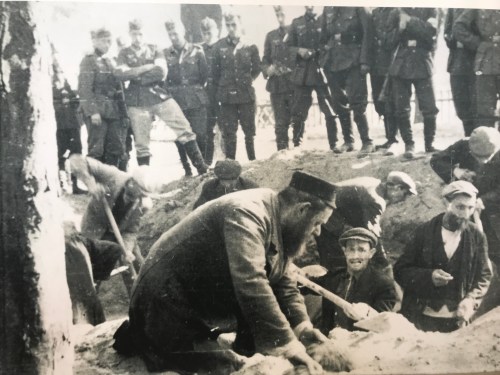
The crimes committed by the Nazis against their own citizens and the nations that they victimized are not completely unique to them. While the Nazi Genocide committed against the Jews is unique, what motivated them is far more common than we would want to admit. The Holocaust and the Nazi war for Lebensraum is not an aberration from the norms of human nature, it is the norm. That is why continuing to expose those crimes, the men and women behind them, and those who stood by, doing nothing while their neighbors were being marched away, or stood by as other men marched men, women, and children to massive pits and shot them one by one, up close and personal, by the tens of thousands.

I would like with all my heart to consign the crimes of the Nazis to the depths of history, but I cannot. It is beginning to happen again before our very eyes, the American President is pardoning convicted war criminals, rescinding American participation in international treaties, agreements, and organizations, as well as conducting anti-immigration operations, in violation of our own and international law that Jackson would have classed as crimes against humanity. That is why I, a man born thirteen and a half years after the major Nuremberg War Crimes ended with ten of the defendants hanging from the gallows continue to write about it. If we are not careful, it can and will happen again.

Over the past week I have been writing about the Nuremberg Trials and the American Chief Prosecutor, Supreme Court Justice Robert Jackson. Last night I wrote about the introduction of his closing arguments before the Tribunal which followed his opening address by nine months. I now continue with Justice Jackson’s closing arguments against the Nazi war criminals sitting in the dock of Nuremberg’s Palace of Justice.

So until tomorrow, I leave you with Jackson’s words. By the way, have a Happy Thanksgiving.

Peace,

Padre Steve+

THE CRIMES OF THE NAZI REGIME

The strength of the case against these defendants under the conspiracy count, which it is the duty of the United States to argue, lies in its simplicity. It involves but three ultimate inquiries: First, have the acts defined by the Charter as crimes been committed; second, were they committed pursuant to a common plan or conspiracy; third, are these defendants among those who are criminally responsible? The charge requires examination of a criminal policy, not of a multitude of isolated, unplanned, or disputed crimes. The substantive crimes upon which we rely, either as goals of a common plan or as means for its accomplishment, are admitted. The pillars which uphold the conspiracy charge may be found in five groups of overt acts, whose character and magnitude are important considerations in appraising the proof of conspiracy.

1. THE SEIZURE OF POWER AND SUBJUGATION OF GERMANY TO A POLICE STATE The Nazi Party seized control of the German State in 1933. “Seizure of power” is a characterisation used by defendants and defence witnesses, and so apt that it has passed into both history and everyday speech. The Nazi junta in the early days lived in constant fear of overthrow. Goering, in 1934, pointed out that its enemies were legion, and said:

“Therefore, the concentration camps have been created, where we have first confined thousands of Communists and Social Democrat functionaries.”

In 1933 Goering forecast the whole programme of purposeful cruelty and oppression when he publicly announced:

“Whoever in the future raises a hand against a representative of the National Socialist movement or of the State must know that he will lose his life in a very short while.”

New political crimes were created to this end. It was made a treason, punishable with death, to organize or support a political party other than the Nazi Party. Circulating a false or exaggerated statement, or one which would harm the State or even the Party, was made a crime. Laws were enacted of such ambiguity that they could be used to punish almost any innocent act. It was, for example, made a crime to provoke “any act contrary to the public welfare”.

The doctrine of punishment by analogy was introduced to enable conviction for acts which no statute forbade. Minister of Justice Guertner explained that National Socialism considered every violation of the goals of life which the community set up for itself to be a wrong per se, and that the acts could be punished even though it was not contrary to existing “formal law”.

The Gestapo and the SD were instrumentalities of an espionage system which penetrated public and private life. Goering controlled a personal wiretapping unit. All privacy of communication was abolished. Party Blockleiter appointed over every 50 householders spied continuously on all within their ken.

Upon the strength of this spying individuals were dragged off to “protective custody” and to concentration camps without legal proceedings of any kind1and without statement of any reason therefore. The partisan political police were exempted from effective legal responsibility for their acts.

With all administrative offices in Nazi control and with the Reichstag reduced to impotence, the judiciary remained the last obstacle to this reign of terror. But its independence was soon overcome and it was reorganised to dispense a venal justice. Judges were ousted for political or racial reasons and were spied upon and put under pressure to join the Nazi Party. After the Supreme Court had acquitted three of the four men whom the Nazis accused of setting the Reichstag on fire, its jurisdiction over treason cases was transferred to a newly established “People’s Court” consisting of two judges and five Party officials. The German film of this “People’s Court” in operation, which the showed in this chamber, revealed its presiding judge pouring partisan abuse on speechless defendants. Special courts were created to try political crimes, only Party members were appointed judges, and “Judges’ letters” instructed the puppet judges as to the “general lines” they must follow.

The result was the removal of all peaceable means either to resist or to change the Government. Having sneaked through the portals of power, the Nazis slammed the gate in the face of all others who might also aspire to enter. Since the law was what the Nazis said it was, every form of opposition was rooted out and every dissenting voice throttled. Germany was in the clutch of a police State, which used the fear of the concentration camp as a means to enforce non-resistance. The Party was the State, the State was the Party, and terror by day and death by night were the policy of both.

2. THE PREPARATION AND WAGING OF WARS OF AGGRESSION From the moment the Nazis seized power, they set about with feverish but stealthy efforts, in defiance of the Versailles Treaty, to arm for war. In 1933 they found no air force. By 1939 they had 21 squadrons, consisting of 240 echelons or about 2,400 first-line planes, together with trainers and transports.

In 1933 they found an army of 3 infantry [sic] (actually 7) and 3 cavalry divisions. By 1939 they had raised and equipped an army of 51 divisions, 4 of which were fully motorized and 4 of which were panzer divisions. In 1933 they found a navy of one cruiser and six light cruisers. By 1939 they had built a navy of 4 battleships, 1 aircraft carrier, 6 cruisers, 22 destroyers, and 54 submarines. They had also built up in that period an armament industry as efficient as that of any country in the world.

These new weapons were put to use, commencing in September, 1939, in a series of undeclared wars against nations with which Germany had arbitration and non-aggression treaties, and in violation of repeated assurances.

On 1st September, 1939, this rearmed Germany attacked Poland. The following April witnessed the invasion and occupation of Denmark and Norway, and May saw the overrunning of Belgium, the Netherlands, and Luxembourg. Another spring saw Yugoslavia and Greece under attack, and in June, 1941, came the invasion of Soviet Russia. Then Japan, which Germany had embraced as a partner, struck without warning at Pearl Harbour in December, 1941, and four days later Germany declared war on the United States.

We need not trouble ourselves about the many abstract difficulties that can be conjured up about what constitutes aggression in doubtful cases. I shall show you, in discussing the conspiracy, that by any test ever put forward by any responsible authority, by all the canons of plain common sense, these were unlawful wars of aggression in breach of treaties and in violation of assurances.

3. WARFARE IN DISREGARD OF INTERNATIONAL LAW

It is unnecessary to labour this point on the facts. Goering asserts that the Rules of Land Warfare were obsolete, that no nation could fight a total war within their limits. He testified that the Nazis would have denounced the Conventions to which Germany was a party, but that General Jodl wanted captured German soldiers to continue to benefit from their observance by the Allies.

It was, however, against the Soviet people and Soviet prisoners that Teutonic fury knew no bounds, in spite of a warning by Admiral Canaris that the treatment was in violation of International Law. We need not, therefore, for the purposes of the conspiracy count, recite the revolting details of starving, beating, murdering, freezing, and mass extermination admittedly used against the Eastern soldiery. Also, we may take as established or admitted that the lawless conduct such as shooting British and American airmen, mistreatment of Western prisoners of war, forcing French prisoners of war into German war work, and other deliberate violations of the Hague and Geneva Conventions, did occur, and in obedience to highest levels of authority.

4. ENSLAVEMENT AND PLUNDER OF POPULATIONS IN OCCUPIED COUNTRIES

The defendant Sauckel, Plenipotentiary General for the Utilization of Labour, is authority for the statement that “out of five million foreign workers who arrived in Germany, not even 200,000 came voluntarily”. It was officially reported to defendant Rosenberg that in his territory “recruiting methods were used which probably have their origin in the blackest period of the slave trade”. Sauckel himself reported that male and female agents went hunting for men, got them drunk, and “shanghaied” them to Germany. These captives were shipped in trains without heat, food, or sanitary facilities. The dead were thrown out at stations, and the newborn were thrown out the windows of moving trains.

Sauckel ordered that “all the men must be fed, sheltered and treated in such a way as to exploit them to the highest possible extent at the lowest conceivable degree of expenditure”. About two million of these were employed directly in the manufacture of armaments and munitions. The director of the Krupp locomotive factory in Essen complained to the company that Russian forced labourers were so underfed that they were too weakened to do their work, and the Krupp doctor confirmed their pitiable condition. Soviet workers were put in camps under Gestapo guards, who were allowed to punish disobedience by confinement in a concentration camp or by hanging on the spot.

Populations of occupied countries were otherwise exploited and oppressed unmercifully. Terrorism was the order of the day. Civilians were arrested without charges, committed without counsel, executed without hearing. Villages were destroyed, the male inhabitants shot or sent to concentration camps, the women sent to forced labour, and the children scattered abroad. The extent of the slaughter in Poland alone was indicated by Frank, who reported:

” If I wanted to have a poster put up for every seven Poles who were shot, the forests of Poland would not suffice for producing the paper for such posters.”

Those who will enslave men cannot be expected to refrain from plundering them. Boastful reports show how thoroughly and scientifically the resources of occupied lands were sucked into the German war economy, inflicting shortage, hunger, and inflation upon the inhabitants. Besides this grand plan to aid the German war effort there were the sordid activities of the Rosenberg “Einsatzstab”, which pillaged art treasures for Goering and his fellow-bandits. It is hard to say whether the spectacle of Germany’s No. 2 leader urging his people to give up every comfort and strain every sinew on essential war work while he rushed around confiscating art by the trainload should be cast as tragedy or comedy. In either case it was a crime.

International Law at all times before and during this war spoke with precision and authority respecting the protection due to civilians of an occupied country, and the slave trade and plunder of occupied countries was at all times flagrantly unlawful.

5. PERSECUTION AND EXTERMINATION OF JEWS AND CHRISTIANS

The Nazi movement will be of evil memory in history because of its persecution of the Jews, the most far-flung and terrible racial persecution of all time. Although the Nazi Party neither invented nor monopolised anti-Semitism, its leaders from the very beginning embraced it, incited it, and exploited it. They used it as “the psychological spark that ignites the mob”. After seizure of power, it became an official State policy. The persecution began in a series of discriminatory laws eliminating the Jews from the civil service, the professions, and economic life. As it became more intense it included segregation of Jews in ghettoes, and exile. Riots were organized by Party leaders to loot Jewish business places and to burn synagogues. Jewish property was confiscated and a collective fine of a billion marks was imposed upon German Jewry. The programme progressed in fury and irresponsibility to the “final solution”. This consisted of sending all Jews who were fit to work to concentration camps as slave labourers, and all who were not fit, which included children under 12 and people over 50, as well as any others judged unfit by an SS doctor, to concentration camps for extermination.

Adolf Eichmann, the sinister figure who had charge of the extermination programme, has estimated that the anti-Jewish activities resulted in the killing of six million Jews. Of these, four million were killed in extermination institutions, and two million were killed by Einsatzgruppen, mobile units of the Security Police and SD which pursued Jews in the ghettoes and in their homes and slaughtered them in gas wagons, by mass shooting in anti-tank ditches and by every device which Nazi ingenuity could conceive.

So thorough and uncompromising was this programme that the Jews of Europe as a race no longer exist, thus fulfilling the diabolic “prophecy” of Adolf Hitler at the beginning of the war. Of course, any such programme must reckon with the opposition of the Christian Church. This was recognized from the very beginning. Defendant Bormann wrote all Gauleiter in 1941 that “National Socialism and Christian concepts are irreconcilable”, and that the people must be separated from the Churches, and the influence of the Churches totally removed. Defendant Rosenberg even wrote dreary treatises advocating a new and weird. Nazi religion.

The Gestapo appointed “Church specialists” who were instructed that the ultimate aim was “destruction of the confessional Churches”. The record is full of specific instances of the persecution of clergymen, the confiscation of Church property, interference with religious publications, disruption, of religious education, and suppression of religious organizations.

The chief instrument for persecution and extermination was the concentration camp, sired by the defendant Goering and nurtured under the overall authority of defendants Frick and Kaltenbrunner.

The horrors of these iniquitous places have been vividly disclosed by documents and testified to by witnesses. The Tribunal must be satiated with ghastly verbal and pictorial portrayals. From your records it is clear that the concentration camps were the first and worst weapon of Nazi oppression used by the National Socialist State, and that they were the primary means utilised for the persecution of the Christian Church and the extermination of the Jewish race. This has been admitted to you by some of the defendants from the witness stand. In the words of defendant Frank:

“A thousand years will pass and this guilt of Germany will still not be erased.”

These, then, were the five great substantive crimes of the Nazi regime. Their commission, which cannot be denied, stands admitted. The defendant Keitel, who is in a position to know the facts, has given the Tribunal what seems to be a fair summation of the case on the facts:

“The defendant has declared that ‘he admits the contents of the general Indictment to be proved from the objective and factual point of view’ (that is to say, not every individual case) ‘and this in consideration of the law of procedure governing the trial. It would be senseless, despite the possibility of refuting several documents or individual facts, to attempt to shake the Indictment as a whole.’” I pass now to the inquiry as to whether these groups of criminal acts were integrated in a common plan or conspiracy.

THE COMMON PLAN OR CONSPIRACY

The prosecution submits that these five categories of premeditated crimes were not separate and independent phenomena but that all were committed pursuant to a common plan or conspiracy.

The defence admits that these classes of crimes were committed, but denies that they are connected one with another as parts of a single programme. The central crime in this pattern of crimes, the king-pin which holds them all together, is the plot for aggressive wars. The chief reason for international cognizance of these crimes lies in this fact. Have we established the plan or conspiracy to make aggressive war?

Certain admitted or clearly proven facts help to answer that question. First is the fact that such war of aggression did take place. Second, it is admitted that from the moment the Nazis came to power, every one of them and every one of the defendants worked like beavers to prepare for some war. The question therefore comes to this: Were they preparing for the war which did occur, or were they preparing for some war which never happened?

It is probably true that in their early days none of them had in mind what month of what year war would begin, the exact dispute which would precipitate it, or whether its first impact would be Austria, Czechoslovakia, or Poland. But I submit that the defendants either knew or were chargeable with knowledge that the war for which they were making ready would be a war of German aggression. This is partly because there was no real expectation that any power or combination of powers would attack Germany. But it is chiefly because the inherent nature of the German plans was such that they were certain sooner or later to meet resistance and that they could then be accomplished only by aggression.

The plans of Adolf Hitler for aggression were just as secret as Mein Kampf, of which over six million copies were published in Germany. He not only openly advocated overthrowing the Treaty of Versailles, but made demands which went far beyond a mere rectification of its alleged injustices. He avowed an intention to attack neighbouring States and seize their lands, which he said would have to be won with “the power of a triumphant sword”. Here, for every German to hearken to, were the “ancestral voices prophesying war”.

Goering has testified in this courtroom that at his first meeting with Hitler, long before the seizure of power:

“I noted that Hitler had a definite view of the impotency of protest and, as a second point, that he was of the opinion that Germany should be freed of the Peace of Versailles. ‘We did not say we shall have to have a war and defeat our enemies’; this was the aim and the methods had to be adapted to the political situation.”

When asked if this goal were to be accomplished by war if necessary, Goering did not deny that eventuality but evaded a direct answer by saying, “We did not debate about that at all at that time.” He went on to say that the aim to overthrow the Treaty of Versailles was open and notorious and that, I quote again, “Every German in my opinion was for its modification, and there was no doubt that this was a strong inducement for joining the party.”

Thus, there can be no possible excuse for any person who aided Hitler to get absolute power over the German people, or who took a part in his regime, to fail to know the nature of the demands he would make on Germany’s neighbours.

To be continued….

4 Comments

Filed under civil rights, crime, ethics, Foreign Policy, germany, History, holocaust, laws and legislation, Military, national security, nazi germany, News and current events, Political Commentary, racism, war crimes, world war two in europe

Robert Jackson’s Indictment of the Nazis, Trump, and Us: Jackson’s Opening Statement at Nuremberg in Light of Trump’s Pardon of Convicted War Criminals

Friends of Padre Steve’s World,

This is the the last section of my five part post dealing with the opening statement of American Chief Prosecutor, and Supreme Court Justice Robert Jackson at the major Nuremberg War Crimes Trial. The first four segments of this series dealt with Jackson’s introduction, his dissection of the Nazi wars against free Labor Unions and the Churches; Hitler and his henchmen’s most heinous crimes, the genocide against the Jews, and finally the Nazi’s criminal conduct of war.

During the meetings to set the boundaries and rules of the international tribunal Jackson noted something that many American leaders have ignored for decades:

“If certain acts of violation of treaties are crimes, they are crimes whether the United States does them or whether Germany does them, and we are not prepared to lay down a rule of criminal conduct against others which we would not be willing to have invoked against us.”

Jackson believed that the International Tribunal would serve as a model for future tribunals, unfortunately the Cold War shelved those plans. They were revived after the war crimes and crimes against humanity in the former Yugoslavia and Rwanda. In 2002 the International Criminal Court was established under the authority of the Rome Statute. One hundred twenty three nations are signatories to the pact. Unfortunately, neither the United States, or Russia have refused to ratify the treaty.

Among the men most responsible or the refusal of the United States to ratify the statute and is current National Security Advisor, John Bolton. He was also deeply involved in the propaganda and false intelligence that lead to the Iraq War. In his first address after becoming National Security Advisor he launched a fierce criticism of the Court. Unfortunately, the Court, lacking the cooperation of the United States, Russia, Israel, and a number of influential middle eastern and African nations refuse to recognize the treaty or the Court.

Robert Jackson would have considered Bolton no better than Nazi Foreign Minister Joachim von Ribbentrop. If Bolton and others had been in the dock at Nuremberg for crimes committed during the invasion of Iraq, they would have gone to the gallows.

The refusal of the United States to ratify the Rome Statute and recognize the authority of the ICC is a stain upon our honor and an affront to the civilization and an international community built on law that Jackson and his team of prosecutors hoped to build.

However, in the years since the United States refused to ratify the Rome Statute, things have gone downhill. Bolton of all people resisted the the insane action of a President bent on authoritarian rule and dictatorship. He was fired for his actions and now that President is undermining the good order and discipline of the military by pardoning convicted war criminals despite the opposition of the services and the firing the Secretary of the Navy for refusing one of his demands concerning a SEAL who was one of those war criminals.

The United States under President Trump has not not only followed past Republican administrations and Congresses in failing to ratify the Rome Statute, and the previously mentioned invasion of Iraq as well as countless military operations where innocent civilians died in attempts to kill alleged terrorists, often at weddings. Now the President is pardoning men convicted as war criminals by the U.S. Military, and then ordered the Secretary of Defense too to fire the Secretary of the Navy. In his letter of resignation the Secretary of the Navy Richard Spencer wrote:

As Secretary of the Navy. one the most important responsibilities 1 have to our people is to maintain good order and discipline throughout the ranks. I regard this as deadly serious business. The lives of our Sailors, Marines and civilian teammates quite literally depend on the professional execution of our many missions, and they also depend on the ongoing faith and support of the people we serve and the allies we serve alongside.

The rule of law is what sets us apart from our adversaries. Good order and discipline is what has enabled our victory against foreign tyranny time and again, from Captain Lawrence’s famous order ‘Don’t Give up the Ship,’ to the discipline and determination that propelled our flag to the highest point on Iwo Jima. The Constitution, and the Uniform Code of Military Justice, are the shields that set us apart and the beacons that protect us all. Through my Title Ten Authority, I have strived to ensure our proceedings are fair, transparent and consistent, from the newest recruit to the Flag and General Officer level.

Unfortunately it has become apparent that in this respect. I no longer share the same understanding with the Commander in Chief who appointed me in regards to the key principle of good order and discipline. I cannot in good conscience obey an order that I believe violates the sacred oath I took in the presence of my family, my flag and my faith to support and defend the Constitution of the United States.

The now former Secretary of the Navy sacrificed his office to tell the truth about the nature of President Trump and his administration. It is malignant and the malignancy is spreading to every institution of government designed to protect the Constitution and the principles of the Declaration of Independence.

I am not a person who thinks that institutions alone can prevent war or war crimes, human nature being what it is. Nor do I blindly put my faith in treaties. I agree with British military historian B. H. Liddell-Hart who wrote: We must face the fact that international relations are governed by interests and not by moral principles.

Like Liddell-Hart, I understand that nations are often incredibly bent on their presumed interests. I recognize that the leaders of nations will attempt to evade responsibility for criminal acts committed by their military, polices forces, and intelligence services. I also know that nations often mythologize to the point of lying about their history, and enshrining war criminals and others who abetted genocide as national heroes. Name a country where this is not true, okay, maybe Andorra or Lichtenstein, but almost every nation with any real regional or world political, military, or economic power has done this at some point in their history, but I digress, for now we are doing it ourselves. This is an indictment not just of Donald Trump, but of our nation, whether we be perpetrators, victims, or bystanders.

Jackson’s words in this final part of his address should gave every American with a scintilla of ethics and conscience pause, especially after last weekend. If they don’t then we are truly lost.

Here again are Jackson’s words.

Even the most warlike of peoples have recognised in the name of humanity some limitations on the savagery of warfare. Rules to that end have been embodied in international conventions to which Germany became a party. This code had prescribed certain restraints as to the treatment of belligerents. The enemy was entitled to surrender and to receive quarter and good treatment as a prisoner of war. We will show by German documents that these rights were denied, that prisoners of war were given brutal treatment and often murdered. This was particularly true in the case of captured airmen, often my countrymen.

It was ordered that captured English and American airmen should no longer be granted the status of prisoners of war. They were to be treated as criminals and the Army was ordered to refrain from protecting them against lynching by the populace (R-118). The Nazi Government, through its police and propaganda agencies, took pains to incite the civilian population to attack and kill airmen who crash-landed. The order, given by the Reichsfuehrer S.S., Himmler, on 10th August, 1943, directed that:

“It is not the task of the police to interfere in clashes between German and English and American fliers who have bailed out.”

This order was transmitted on the same day by S.S. Obersturmbannfuehrer Brandof, Himmler’s Personal Staff to all Senior Executive S.S. and Police Officers, with these directions:

“I am sending you the enclosed order with the request that the Chief of the Regular Police and of the Security Police be informed. They are to make this instruction known to their subordinate officers verbally.” (R-110)

Similarly, we will show Hitler’s top secret order, dated 18th October, 1942, that Commandos, regardless of condition, were “to be slaughtered to the last man” after capture. (498-PS) We will show the circulation of secret orders, one of which was signed by Hess, to be passed orally to civilians, that enemy fliers or parachutists were to be arrested or liquidated. (062-PS). By such means were murders incited and directed.

This Nazi campaign of ruthless treatment of enemy forces assumed its greatest proportions in the fight against Russia. Eventually all prisoners of war were taken out of control of the Army and put in the hands of Himmler and the S.S. (058-PS.) In the East, the German fury spent itself. Russian prisoners of war were ordered to be branded. They were starved. I shall quote passages from a letter written 28th February, 1942, by defendant Rosenberg to defendant Keitel:

“The fate of the Soviet prisoners of war in Germany is, on the contrary, a tragedy of the greatest extent. Of 3,600,000 prisoners of war, only several hundred thousand are still able to work fully. A large part of them has starved, or died, because of the hazards of the weather. Thousands also died from spotted fever.

The camp commanders have forbidden the civilian population to put food at the disposal of the prisoners, and they have rather let them starve to death.

In many cases, when prisoners of war could no longer keep up on the march because of hunger and exhaustion, they were shot before the eyes of the horrified population, and the corpses were left.

In numerous camps, no shelter for the prisoners of war was provided at all. They lay under the open sky during rain or snow. Even tools were not made available to dig holes or caves.

Finally, the shooting of prisoners of war must be mentioned; for instance, in various camps, all the ‘Asiatics’ were shot.” (081-PS.)

Civilised usage and conventions, to which Germany was a party, had prescribed certain immunities for civilian populations unfortunate enough to dwell in lands overrun by hostile armies. The German occupation forces, controlled or commanded by men on trial before you, committed a long series of outrages against the inhabitants of occupied territory that would be incredible except for captured orders and captured reports which show the fidelity with which those orders were executed.

We deal here with a phase of common criminality designed by the conspirators as part of the Common Plan. We can appreciate why these crimes against their European enemies were not of a casual character but were planned and disciplined crimes when we get at the reason for them. Hitler told his officers on 22nd August, 1939, that “The main objective in Poland is the destruction of the enemy and not the reaching of a certain geographical line.” (1014-PS.) Those words were quoted. The project of deporting promising youth from occupied territories was approved by Rosenberg on the theory that “a desired weakening of the biological force of the conquered people is being achieved.” (03I-PS) To Germanise or to destroy was the programme. Himmler announced, “Either we win over any good blood that we can use for ourselves and give it a place in our people, or, gentlemen -you may call this cruel, but nature is cruel -we destroy this blood.” As to “racially good types” Himmler further advised, “Therefore, I think that it is our duty to take their children with us, to remove them from their environment, if necessary, by robbing or stealing them.” (L-90.) He urged deportation of Slavic children to deprive potential enemies of future soldiers.

The Nazi purpose was to leave Germany’s neighbours so weakened that even if she should eventually lose the war, she would still be the most powerful nation in Europe. Against this background, we must view the plan for ruthless warfare, which means a plan for the commission of War Crimes and Crimes against Humanity.

Hostages in large numbers were demanded and killed. Mass punishments were inflicted, so savage that whole communities were extinguished. Rosenberg was advised of the annihilation of three unidentified villages in Slovakia. In May of 1943, another village of about 40 farms and 220 inhabitants was ordered to be wiped out. The entire population was ordered to be shot, the cattle and property impounded, and the order required that “the village will be destroyed totally by fire.” A secret report from Rosenberg’s Reich Ministry of Eastern territory, where he was responsible reveals that:

“Food rations allowed to the Russian population are so low that they fail to secure their existence and provide only for minimum subsistence of limited duration. The population does not know if they will still live. They are faced with death by starvation.

The roads are clogged by hundreds of thousands of people, sometimes as many as one million according to the estimate of experts, who wander around in search of nourishment.

Sauckel’s action has caused great unrest among the civilians. Russian girls were deloused by men, nude photos in forced positions were taken, women doctors were locked into freight cars for the pleasure of the transport commanders, women in night shirts were fettered and forced through the Russian towns to the railroad station, etc. All this material has been sent to the OKH.”

Perhaps the deportation to slave-labour was the most horrible and extensive slaving operation in history. On few other subjects is our evidence so abundant and so damaging. In a speech made on 25th January, 1944, the defendant Frank, Governor-General of Poland, boasted: “I have sent 1,200,000 Polish workers into the Reich.” The defendant Sauckel reported that “out of the five million foreign workers who arrived in Germany, not even 200,000 came voluntarily.” This fact was reported to the Fuehrer and to the defendants Speer, Goering, and Keitel. (R-124) Children of 10 to 14 years were impressed into service by telegraphic order of Rosenberg’s Ministry for the Occupied Eastern Territories:

“The Command is further charged with the transferring of worthwhile Russian youth between 10-14 years of age, to the Reich. The authority is not affected by the changes connected with the evacuation and transportation to the reception camps of Bialystok, Krajewo, and Olitei, The Fuehrer wishes that this activity be increased even more. (200-PS.)

When enough labour was not forthcoming, prisoners of war were forced into war work in flagrant violation of international conventions. (016-PS.) Slave labour came from France, Belgium, Holland, Italy, and the East. Methods of recruitment were violent. (R-124, 018-PS, 204-PS,) The treatment of these slave labourers was stated in general terms, not difficult to translate into concrete deprivations, in a letter to the defendant Rosenberg from the defendant Sauckel, which stated:

“All prisoners of war, from the territories of the West as well as of the East, actually in Germany, must be completely incorporated into the German armament and munition industries. Their production must be brought to the highest possible level.”

The complete employment of prisoners of war as well as the use of a gigantic number of new civilian workers, men and women, has become an undisputable necessity for the solution of the mobilisation of labour programme in this war.

All the men must be fed, sheltered and treated in such a way as to exploit them to the highest possible extent at the lowest conceivable degrees of expenditure..”( 016-PS.)

In pursuance of the Nazi plan permanently to reduce the living standards of their neighbours and to weaken them physically and economically, a long series of crimes were committed. There was extensive destruction, serving no military purpose, of the property of civilians. Dikes were thrown open in Holland almost at the close of the war, not to achieve military ends but to destroy the resources, and retard the economy, of the thrifty Netherlanders.

There was carefully planned economic siphoning off of the assets of occupied countries. An example of the planning is shown by a report on France dated 7th December, 1942, made by the Economic Research Department of the Reichsbank. The question arose whether French occupation costs should be increased from 15 million Reichsmarks per day to 25 million Reichsmarks per day. The Reichsbank analysed French economy to determine whether it could bear the burden. It pointed out that the armistice had burdened France to that date to the extent of 18 1/ 4 billion Reichsmarks, equalling 370 billion Francs. It pointed out that the burden of these payments within two and a half years equalled the aggregate French national income in the year 1940, and that the amount of payments handed over to Germany in the first six months of 1942 corresponded to the estimate for the total French revenue for that whole year. The report concluded, “In any case, the conclusion is inescapable that relatively heavier tributes have been imposed on France since the armistice in June, 1940, than upon Germany after the First World War. In this connection, it must be noted that the economic powers of France never equalled those of the German Reich, and that the vanquished France could not draw on foreign economic and financial resources in the same degree as Germany after the First World War.”

The defendant Funk was the Reich Minister of Economics and President of the Reichsbank; the defendant Ribbentrop was Foreign Minister; the defendant Goering was Plenipotentiary of the Four-Year Plan; all of them participated in the exchange of views of which this captured document is a part (2149-PS) Notwithstanding this analysis by the Reichsbank, they proceeded to increase the imposition on France from 15 million Reichsmarks to daily to 25 million per day.

It is small wonder that the bottom had been knocked out of French economy. The plan and purpose of the thing appears in a letter from General Stupnagel, head of the German Armistice Commission, to the defendant Jodl as early as 14th September, 1940, when he wrote: “The slogan ‘Systematic weakening of France’ has already been surpassed by far in reality.”

Not only was there a purpose to debilitate and demoralise the economy of Germany’s neighbours for the purpose of destroying their competitive position, but there was looting and pilfering on an unprecedented scale. We need not be hypocritical about this business Of looting. I recognise that no army moves through occupied territory without some pilfering as it goes. Usually the amount of pilfering increases as discipline wanes. If the evidence in this case showed no looting except of that sort, I certainly would ask no conviction of these defendants for it.

But we will show you that looting was not due to the lack of discipline or to the ordinary weaknesses of human nature. The German organised plundering, planned it, disciplined it, and made it official just as he organised everything else, and then he compiled the most meticulous records to show that he had done the best job of looting that was possible under the circumstances. And we have those records.

The defendant Rosenberg was put in charge of a systematic plundering of the objet d’art of Europe by direct order of Hitler dated 29th January 1940. (136-PS) On the 16th April, 1943, Rosenberg reported that up to the 7th April, ninety-two railway cars with 2,775 cases containing objets d’art had been sent to Germany; and that fifty-three pieces of art had been shipped to Hitler direct and 594 to the defendant Goering. (015-PS) The report mentioned something like 20,000 pieces of seized art and the main locations where they were stored.

Moreover, this looting was glorified by Rosenberg. Here we have thirty-nine leather-bound tabulated volumes of his inventory, which in due time we will offer in evidence. One cannot but admire the artistry of this Rosenberg report. The Nazi taste was cosmopolitan. Of the 9,455 articles inventories, there were included 5,255 paintings, 297 sculptures, 1,372 pieces of antique furniture, 307 textiles, and 2,224 small objects of art. Rosenberg observed that there were approximately 10,000 more objects still to be inventoried. (015-PS.) Rosenberg himself estimated that the values involved would come close to a billion dollars. (090-PS.)

I shall not go into further details of the War Crimes and Crimes against Humanity committed by the Nazi gangster ring whose leaders are before you. It is not the purpose in my part of this case to deal with the individual crimes. I am dealing with the Common Plan or design for crime and will not dwell on individual offences. My task is to show the scale on which those crimes occurred, and to show that these are the men who were in the responsible positions and who conceived the plan and design which renders them answerable, regardless of the fact that the plan was actually executed by others.

At length, this reckless and lawless course outraged the world. It recovered from the demoralisation of surprise attack, assembled its forces and stopped these men in their tracks. Once success deserted their banners, one by one the Nazi satellites fell away. Sawdust Caesar collapsed. Resistance forces in every occupied country arose to harry the invader. Even at home, Germans saw that Germany was being led to ruin by those mad men, and the attempt on 20th July, 1944, to assassinate Hitler, an attempt fostered by men of highest station, was a desperate effort by internal forces in Germany to stop short of ruin. Quarrels broke out among the failing conspirators, and the decline of the Nazi power was more swift than its ascendancy. German armed forces surrendered, its government disintegrated, its leaders committed suicide by the dozen, and by the fortunes of war these defendants fell into our hands. Although they are not, by any means, all the guilty ones, they are survivors among the most responsible. Their names appear over and over again in the documents and their faces grace the photographic evidence. We have here the surviving top politicians, militarists, financiers, diplomats, administrators, and propagandists, of the Nazi movement. Who was responsible for these crimes if they were not?

The end of the war and capture of these prisoners presented the victorious Allies with the question whether there is any legal responsibility on high-ranking men for acts which I have described. Must such wrongs either be ignored or redressed in hot blood? Is there no standard in the law for a deliberate and reasoned judgement on such conduct?

The Charter of this Tribunal evidences a faith that the law is not only to govern the conduct of little men, but that even rulers are, as Lord Chief Justice Coke it to King James, “under God and the law.” The United States believed that the law has long afforded standards by which a juridical hearing could be conducted to make sure that we punish only the right men and for the right reasons. Following the instructions of the late President Roosevelt and the decision of the Yalta Conference, President Truman directed representatives of the United States to formulate a proposed International Agreement, which was submitted during the San Francisco Conference to the Foreign Ministers of the United Kingdom, the Soviet Union, and the Provisional Government of France. With many modifications, that proposal has become the Charter of this tribunal.

But the Agreement which sets up the standards by which these prisoners are to be judged does not express the views of the signatory nations alone. Other nations with diverse but highly respected systems of jurisprudence also have signified adherence to it. These are Belgium, The Netherlands, Denmark, Norway, Czechoslovakia, Luxembourg, Poland, Greece, Yugoslavia, Ethiopia, Australia, Haiti, Honduras, Panama, New Zealand, Venezuela and India. You judge, therefore, under an organic act which represents the wisdom, the sense of justice, and the will of twenty-one governments, representing an overwhelming majority of all civilised people.

The Charter by which this Tribunal has its being, embodies certain legal concepts which are inseparable from its jurisdiction and which must govern its decision. These, as I have said, also are conditions attached to the grant of any hearing to defendants. The validity of the provisions of the Charter is conclusive upon us all, whether we have accepted the duty of judging or of prosecuting under it, as well as upon the defendants, who can point to no other law which gives them a right to be heard at all. My able and experienced colleagues believe, as do I, that it will contribute to the expedition and clarity of this trial if I expound briefly the application of the legal philosophy of the Charter to the facts I have recited.

While this declaration of the law by the Charter is final, it may be contended that the prisoners on trial are entitled to have it applied to their conduct only most charitably if at all. It may be said that this is new law, not authoritatively declared at the time they did the acts it condemns, and that this declaration of the law has taken them by surprise.

I cannot, of course, deny that these men are surprised that this is the law; they really are surprised that there is any such thing as law. These defendants did not rely on any law at all. Their programme ignored and defied all law. That this is so will appear from many acts and statements, of which I cite but a few. In the Fuehrer’s speech to all military commanders on 23rd November, 1939, he reminded them that at the moment Germany had a pact with Russia, but declared “Agreements are to be kept only as long as they serve a certain purpose.” Later in the same speech he announced “A violation of the neutrality of Holland and Belgium will be of no importance.” (789-PS.) A Top Secret document, entitled ” Warfare as a Problem of Organisation,” dispatched by the Chief of the High Command to all Commanders on 19th April, 1938, declared that “the normal rules of war toward neutrals must be considered to apply on the basis whether operation of these rules will create greater advantages or disadvantages for the belligerents. (L-211.) And from the files of the German Navy Staff, we have a “Memorandum on Intensified Naval War,” dated 15th October, 1939, which begins by stating a desire to comply with International Law. “However,” it continues, “if decisive successes are expected from any measure considered as a war necessity, it must be carried through even if it is not in agreement with International Law.” (L-184) International Law, Natural Law, German Law, any law at all was to these men simply a propaganda device to be invoked when it helped and to be ignored when it would condemn what they wanted to do. That men may be protected in relying upon the law at the time they act is the reason we find laws of retrospective operation unjust. But these men cannot bring themselves within the reason of the rule which in some systems of jurisprudence prohibits ex post facto laws. They cannot show that they ever relied upon International Law in any state or paid it the slightest regard.

The Third Count of the Indictment is based on the definition of War Crimes contained in the Charter. I have outlined to you the systematic course of conduct toward civilian populations and combat forces which violates international conventions to which Germany was a party. Of the criminal nature of these acts at least, the defendants had, as we shall show, knowledge. Accordingly, they took pains to conceal their violations. It will appear that the defendants Keitel and Jodl were informed by official legal advisers that the orders to brand Russian prisoners of war, to shackle British prisoners of war, and to execute Commando prisoners were clear violations of International Law. Nevertheless, these orders were put into effect. The same is true of orders issued for the assassination of General Giraud and General Weygand, which failed to be executed only because of a ruse on the part of Admiral Canaris, who was himself later executed for his part in the plot to take Hitler’s life on 20th July, 1944.

The Fourth Count of the Indictment is based on Crimes against Humanity. Chief among these are mass killings of countless human beings in cold blood. Does it take these men by surprise that murder is treated as a crime?

The First and Second Counts of the Indictment add to these crimes the crime of plotting and waging wars of aggression and wars in violation of nine treaties to which Germany was a party. There was a time, in fact, I think, the time of the first World War, when it could not have been said that war inciting or war making was a crime in law, however reprehensible in morals.

Of course, it was, under the law of all civilised peoples, a crime for one man with his bare knuckles to assault another. How did it come about that multiplying this crime by a million, and adding fire-arms to bare knuckles, made it a legally innocent act? The doctrine was that one could not be regarded as criminal for committing the usual violent acts in the conduct of legitimate warfare. The age of imperialistic expansion during the eighteenth and nineteenth centuries added the foul doctrine, contrary to the teachings of early Christian and International Law scholars such as Grotius, that all wars are to be regarded as legitimate wars. The sum of these two doctrines was to give war-making a complete immunity from accountability to law.

This was intolerable for an age that called itself civilised. Plain people, with their earthy common sense, revolted at such fictions and legalisms so contrary to ethical principles and demanded checks on war immunities. Statesmen and international lawyers at first cautiously responded by adopting rules of warfare designed to make the conduct of war more civilised. The effort was to set legal limits to the violence that could be done to civilian populations and to combatants as well.

The common sense of men after the First World War demanded, however, that the law’s condemnation of war reach deeper, and that the law condemn not merely uncivilised ways of waging war, but also the waging in any way of uncivilised wars -wars of aggression. The world’s statesmen again, went only as far as they were forced to go. Their efforts were timid and cautious and often less explicit than we might have hoped. But the 1920′ s did outlaw aggressive war.

The re-establishment of the principle that there are unjust wars and that unjust wars are illegal is traceable in many steps. One of the most significant is the Briand-Kellogg Pact of 1928, by which Germany, Italy and Japan, in common with practically all nations of the world, renounced war as an instrument national policy, bound themselves to seek the settlement of disputes only by pacific means, and condemned recourse to war for the solution of international controversies. This pact altered the legal status of a war of aggression. As Mr. Stimson, the United States Secretary of State put it in 1932, such a war “is no longer to be the source and subject of rights. It is no longer to be the principle around which the duties, the conduct, and the rights of nations revolve. It is an illegal thing… By that very act, we have made obsolete many legal precedents and have given the legal profession the task of re-examining many of its codes and treaties.”

The Geneva Protocol of 1924 for the Pacific Settlement of International Disputes, signed by the representatives of forty-eight governments, declared that “a war of aggression constitutes an international crime.” The Eighth Assembly of the League of Nations in 1927, on unanimous resolution of the representatives forty-eight member nations, including Germany, declared that a war of aggression constitutes an international crime. At the Sixth Pan-American Conference of 1928, the twenty-one American Republics unanimously adopted a resolution stating that “war of aggression constitutes an international crime against the human species.”

A failure of these Nazis to heed, or to understand the force and meaning of this evolution in the legal thought of the world, is not a defence or a mitigation. If anything, it aggravates their offence and makes it the more mandatory that the law they have flouted be vindicated by juridical application to their lawless conduct. Indeed, by their own law -had they heeded any law -these principle were binding on these defendants. Article 4 of the Weimar Constitution provided that ” The generally accepted rules of International Law are to be considered as binding integral parts of the law of the German Reich.” (2050-PS.) Can there be any that the outlawry of aggressive war was one of the “generally accepted rules of International Law” in 1939?

Any resort to war -to any kind of a war -is a resort to means that are inherently criminal. War inevitably is a course of killings, assaults, deprivations of liberty, and destruction of property. An honestly defensive war is, of course, legal and saves those lawfully conducting it from criminality. But inherently criminal acts cannot be defended by showing that those who committed them were engaged of in a war, when war itself is illegal. The very minimum legal consequence of the treaties making aggressive wars illegal is to strip those who incite or wage them of every defence the law ever gave, and to leave war-makers subject to judgement by the usually accepted principles of the law of crimes.

But if it be thought that the Charter, whose declarations concededly bind us all, does contain new Law I still do not shrink from demanding its strict application by this Tribunal. The rule of law in the world, flouted by the lawlessness incited by these defendants, had to be restored at the cost to my country of over a million casualties, not to mention those of other nations. I cannot subscribe to the perverted reasoning that society may advance and strengthen the rule of law by the expenditure of morally innocent lives, but that progress in the law may never be made at the price of morally guilty lives.

It is true, of course, that we have no judicial precedent for the Charter. But International Law is more than a scholarly collection of abstract and immutable principles. It is an outgrowth of treaties and agreements between nations and of accepted customs. Yet every custom has its origin in some single act, and every agreement has to be initiated by the action of some State. Unless we are prepared to abandon every principle of growth for International Law, we cannot deny that our own day has the right to institute customs and to conclude agreements that will themselves become sources of a newer and strengthened International Law. International Law is not capable of development by the normal processes of legislation, for there is no continuing international legislative authority. Innovations and revisions in International Law are brought about by the action of governments such as those I have cited, designed to meet a change in circumstances, It grows, as did the Common Law, through decisions reached from time to time in adapting settled principles new situations. The fact is that when the law evolves by the case method, as did the Common Law and as International Law must do if they are to advance at all, it advances at the expense of those who wrongly guessed the law and learned too late their error. The law, as far as International Law can be decreed, had been clearly pronounced when these acts took place. Hence we are not disturbed by the lack of judicial precedent for the inquiry it is proposed to conduct.

The events I have earlier recited clearly fall within the standards of crimes, set out in the Charter, whose perpetrators this Tribunal is convened to judge and to punish fittingly. The standards for War Crimes and Crimes against Humanity are too familiar to need comment. There are, however, certain novel problems in applying other precepts of the Charter which I should call to your attention.

A basic provision of the Charter is that to plan, prepare, initiate, or wage a war of aggression, or a war in violation of international treaties, agreements, and assurances, or to conspire or participate in a common plan to do so, is a crime.

It is perhaps a weakness in this Charter that it fails itself to define a war of aggression. Abstractly, the subject is full of difficult and all kinds of troublesome hypothetical cases can be conjured up. It is a subject which, if the defence should be permitted to go afield beyond the very narrow charge ion the Indictment, would prolong the trial and involve the Tribunal in insoluble political issues. But so far as the question can property be involved in this case, the issue is one of no novelty and is one on which legal opinion has well crystallised.

One of the most authoritative sources of International Law on this subject is the Convention for the Definition of Aggression signed at London on 3rd July, 1933, by Roumania, Estonia, Latvia, Poland, Turkey, the Soviet Union, Persia and Afghanistan. The subject has also been considered by international committees and by commentators whose views are entitled to the greatest respect. It had been little discussed prior to the First World War but has received much attention as International Law has evolved its outlawry of aggressive war. In the light of these materials of International Law, and so far as relevant to the evidence in this case, I suggest that an “aggressor ” is generally held to be that state which is the first to commit any of the following actions:

(1) Declaration of war upon another State;

(2) Invasion by its armed forces, with or without a declaration of war, of the territory of another State;

(3) Attack by its land, naval, or air forces, with or without a declaration of war, on the territory, vessels or aircraft of another State; and

(4) Provision of support to armed bands formed in the territory of another State, or refusal, notwithstanding the request of the invaded State, to take in its own territory, all the measures in its power to deprive those bands of all assistance or protection.

And I further suggest that it is the general view that no political, military, economic or other considerations shall serve as an excuse or justification for such actions but exercise of the right of legitimate self-defence -that is to say, resistance to an act of aggression, or action to assist a State which has been subjected to aggression, shall not constitute a war of aggression.

It is upon such an understanding of the law that our evidence of a conspiracy to provoke and wage an aggressive war is prepared and presented. By this test each of the series of wars begun by these Nazi leaders was unambiguously aggressive.

It is important to the duration and scope of this trial that we bear in mind the difference between our charge that this war was one of aggression and a position that Germany had no grievances. We are not inquiring into the conditions which contributed to causing this war. They are for history to unravel. It is no part of our task to vindicate the European status quo as of 1933, or as of any other date. The United States does not desire to enter into discussion of the complicated pre-war currents of European politics, and it hopes this trial will not be protracted by their consideration. The remote causations avowed are too insincere and inconsistent, too complicated and doctrinaire to be the subject of profitable inquiry in this trial. A familiar example is to be found in the “Lebensraum” slogan, which summarised the contention that Germany needed more living space as a justification for expansion. At the same time that the Nazis were demanding more space for the German people, they were demanding more German people to occupy space. Every known means to increase the birth rate, legitimate and illegitimate, was utilised. “Lebensraum” represented a vicious circle of demand-from neighbours more space, and from Germans more progeny. We need not investigate the verity of doctrines which led to constantly expanding circles of aggression. It is the plot and the act of aggression which we charge to be crimes.

Our position is that whatever grievances a nation may have, however objectionable it finds the status quo, aggressive warfare is not a legal means for settling those grievances or for altering those conditions. It may be that the Germany of the 1920′ s and 1930′ s faced desperate problems, problems that would have warranted the boldest measures short of war. All other methods -persuasion, propaganda, economic competition, diplomacy-were open to an aggrieved country, but aggressive warfare was outlawed. These defendants did make aggressive war, a war in violation of treaties. They did attack and invade their neighbours in order to effectuate a foreign policy which they knew could not be accomplished by measures short of war. And that is as far as we accuse or propose to inquire.

The Charter also recognises individual responsibility on the part of those who commit acts defined as crimes, or who incite others to do so, or who join a common plan with other persons, groups or organisations to bring about their commission.

The principle of individual responsibility for piracy and brigandage, which have long been recognised as crimes punishable under International Law, is old and well established. That is what illegal warfare is. This principle of personal liability is a necessary as well as a logical one if International Law is to render real help to the maintenance of peace. An International Law which operates only on States can be enforced only by war because the most practicable method of coercing a State is warfare. Those familiar with American history know that one of the compelling reasons for adoption of our Constitution was that the laws of the Confederation, which operated only on constituent States, were found in-effective to maintain order among them. The only answer to recalcitrance was impotence or war. Only sanctions which reach individuals can peacefully and effectively be enforced. Hence, the principle of the criminality of aggressive is implemented by the Charter with the principle of personal responsibility.

Of course, the idea that a State, any more than a corporation, commits crimes, is a fiction. Crimes always are committed only by persons. While it is quite proper to employ the fiction of responsibility of a State or corporation for the purpose of imposing a collective liability, it is quite intolerable to let such a legalism become the basis of personal immunity.

The Charter recognises that one who has committed criminal acts may not take refuge in superior orders nor in the doctrine that his crimes were acts of States. These twin principles, working together, have heretofore resulted in immunity for practically everyone concerned in the really great crimes against peace and mankind. Those in lower ranks were protected against liability by the orders of their superiors. The superiors were protected because their orders were called acts of State. Under the Charter, no defence based on either of these doctrines can be entertained. Modern civilisation puts unlimited weapons of destruction in the hands of men. It cannot tolerate so vast an area of legal irresponsibility.

Even the German Military Code provides that:

“If the execution of a military order in the course of duty violates the criminal law, then the superior officer giving the order will bear the sole responsibility therefor. However, the obeying subordinate will share the punishment of the participant: (1) if he has exceeded the order given to him, or (2) if it was within his knowledge that the order of his superior officer concerned an act by which it was intended to commit a civil or military crime or transgression.” (Reichsgesetzblatt, 1926, No. 37, P. 278, Art. 47)

Of course, we do not argue that the circumstances under which one commits an act should be disregarded in judging its legal effect. A conscripted private on a firing squad cannot expect to hold an inquest on the validity of the execution. The Charter implies common sense limits to liability, just as it places common sense limits upon immunity. But none of these men before you acted in minor parts. Each of them was entrusted with broad discretion and exercised great power. Their responsibility is correspondingly great and may not be shifted to that fictional being, “the State,” which cannot be produced for trial, cannot testify, and cannot be sentenced.

The Charter also recognises a vicarious liability, which responsibility is recognised by most modern systems of law, for acts committed by others in carrying out a common plan or conspiracy to which the defendant has become a party. I need not discuss the familiar principles of such liability. Every day in the courts of countries associated in this prosecution, men are convicted for acts that they did not personally commit, but for which they were held responsible of membership in illegal combinations or plans or conspiracies.

Accused before this Tribunal as criminal organisations, are certain political police organisations which the evidence will show to have been instruments of cohesion in planning and executing the crimes I have detailed. Perhaps the worst of the movement were the Leadership Corps of the N.S.D.A.P., the Schutz-stappeln or “S.S.,” and the Sturmabteilung or “S.A.,” and the subsidiary formations which these include. These were the Nazi Party leadership, espionage, and policing groups. They were the real government, above and outside of any law. Also accused as organisations are the Reich Cabinet and the Secret Police, or Gestapo, which were fixtures of the Government but animated solely by the Party.

Except for a late period when some compulsory recruiting was done in the S.S. membership in all these militarised organisations was voluntary. The police organisations were recruited from ardent partisans who enlisted blindly to do the dirty work the leaders planned. The Reich Cabinet was the governmental facade for Nazi Party Government and in its members legal as well as actual responsibility was vested for the programme. Collectively they were responsiblefor the programme in general, individually they were especially reponsible for segments of it. The finding which we will ask you to make, that these are criminal organisations, will subject members to punishment to be hereafter determined by appropriate tribunals, unless some personal defence -such as becoming a member under threat to person or to family, or inducement by false respresentation, or the like be established. Every member will have a chance to be heard in the subsequent forum on his personal relation to the organisation, but your finding in this trial will conclusively establuish the criminal character of the organisation as a whole.

We have also accused as criminal organisations the High Command and the General Staff of the German Armed Forces. We recognise that to plan warfare is the business of professional soldiers in all countries. But it is one thing to plan strategic moves in the event of war coming, and it is another thing to plot and intrigue to bring on that war. We will prove the leaders of the German General Staff and of the High Command to have been guilty of just that. Military men are not before you because they served their country. They are here because they mastered it, and along with others, drove it to war. They are not here because they lost the war, but because they started it. Politicians may have thought of them as soldiers, but soldiers know they were politicians. We ask that the General Staff and the High Command, as defined in the Indictment, be condemned as a criminal group whose existence and tradition constitute a standing menace to the peace of the world.

These individual defendants did not stand alone in crime and will not stand alone in punishment. Your verdict of “guilty” against these organisations will render prima facie, as nearly as we can learn, thousands upon thousands of members now in custody of the United States and of other Armies. To apply the sanctions of the law for the programme in general, individually they were especially reponsible for segments of it. The finding which we will ask you to make, that these are criminal organizations, will subject members to punishment to be hereafter determined by appropriate tribunals, unless some personal defence -such as becoming a member under threat to person or to family, or inducement by false respresentation, or the like be established. Every member will have a chance to be heard in the subsequent forum on his personal relation to the organisation, but your finding in this trial will conclusively establuish the criminal character of the organisation as a whole.

We have also accused as criminal organisations the High Command and the General Staff of the German Armed Forces. We recognise that to plan warfare is the business of professional soldiers in all countries. But it is one thing to plan strategic moves in the event of war coming, and it is another thing to plot and intrigue to bring on that war. We will prove the leaders of the German General Staff and of the High Command to have been guilty of just that. Military men are not before you because they served their country. They are here because they mastered it, and along with others, drove it to war. They are not here because they lost the war, but because they started it. Politicians may have thought of them as soldiers, but soldiers know they were politicians. We ask that the General Staff and the High Command, as defined in the Indictment, be condemned as a criminal group whose existence and tradition constitute a standing menace to the peace of the world.

These individual defendants did not stand alone in crime and will not stand alone in punishment. Your verdict of “guilty” against these organisations will render prima facie, as nearly as we can learn, thousands upon thousands of members now in custody of the United States and of other Armies.

To apply the sanctions of the law to those whose conduct is found criminal by the standards I have outlined, is the responsibility committed to this Tribunal. It is the first court ever to undertake the difficult task of overcoming the confusion of many tongues the conflicting concepts of just procedure among divers systems of law, so as to reach a common judgement. The tasks of all of us are such as to make heavy demands on patience and good will. Although the need for prompt action has admittedly resulted in imperfect work on the part of the prosecution, our great nations bring you their hurriedly assembled contributions of evidence. What remains undiscovered we can only guess. We could, with testimony, prolong the recitals of crime for years -but to what avail? We shall rest the case when we have offered what seems convincing and adequate proof of the crimes charged without unnecessary cumulation of evidence. We doubt very much whether it will be seriously denied that the crimes I have outlined took place. The effort will undoubtedly be to mitigate or escape personal responsibility.

Among the nations which unite in accusing these defendants, the United States is perhaps in a position to be the most dispassionate, for having sustained the least injury, it is perhaps the least animated by vengeance. Our American cities have not been bombed by day and by night, by humans, and by robots. It is not our temples that have been laid in ruins. Our countrymen have not had their homes destroyed over their heads. The menace of Nazi aggression, except to those in actual service, has seemed less personal and immediate to us than to European peoples. But while the United States is not first in rancour, it is not second in determination that the forces of law and order be made equal to the task of dealing with such international lawlessness as I have recited here.

Twice in my lifetime, the United States has sent its Young manhood across the Atlantic, drained its resources, and burdened itself with debt to help defeat Germany. But the real hope and faith that has sustained the American people in these great efforts was that victory for ourselves and our Allies would lay the basis for an ordered international relationship in Europe and would end the centuries of strife on this embattled continent.

Twice we have held back in the early stages of European conflict in the belief that it might be confined to a purely European affair. In the United States, we have tried to build an economy without armament, a system of government without militarism, and a society where men are not regimented for war. This purpose, we know, now, can never be realised if the world periodically is to be embroiled in war. The United States cannot, generation after generation, throw its youth or its resources on to the battlefields of Europe to redress the lack of balance between Germany’s strength and that of her enemies, and to keep the battles from our shores.

The American dream of a peace and plenty economy, as well as the hopes of other nations, can never be fulfilled if these nations are involved in a war every generation, so vast and devastating as to crush the generation that fights and but burden the generation that follows. Experience has shown that wars are no longer local. All modem wars become world wars eventually. And none of the big nations at least can stay out. If we cannot stay out of wars, our only hope is to prevent wars.

I am too well aware of the weaknesses of juridical action alone to contend that in itself your decision under this Charter can prevent future wars. Judicial action always comes after the event. Wars are started only on the theory and in the confidence that they can be won. Personal punishment, to be suffered only in the event the war is lost, will probably not be a sufficient deterrent to prevent a war where the warmers feel the chances of defeat to be negligible.

But the ultimate step in avoiding periodic wars, which are inevitable in systems of international lawlessness, is to make statesmen responsible to law. And let me make clear that while this law is first applied against German aggressors, the law includes, and if it is to serve a useful purpose it must condemn, aggression by any other nations, including those who sit here in judgement. We are able to do away with domestic tyranny and violence and aggression by those in power against the rights of their own people when we make all men answerable to the law. This trial represents mankind’s desperate effort to apply the discipline of law who have used, their powers of state to attack the foundations of the world’s peace, and to commit aggression against The rights of their neighbors.

The usefulness of this effort to do justice is not to be measured by considering the law or your judgment in isolation. This trial is a part of the great effort to make peace more secure. One step in this is direction is the United Nations organization, which may take joint political action to prevent war if possible, and joint military action to insure that any nation which starts a war will lose it. This Charter and this trial, implementing the Kellogg-Briand Pact, constitute another step in the same direction – juridical action of a kind to ensure that those who start a war will pay for it personally.

While the defendants and the prosecutors stand before you as individuals, it is not the triumph of either group alone that is committed to your judgement. Above all personalities there are anonymous and impersonal forces whose conflict makes up much of human history. It is yours to throw the strength of the law behind either the one or the other of these forces for at least another generation. What are the forces that are contending before you?

No charity can disguise the fact that the forces which these defendants represent, the forces that would advantage and delight in their acquittal, are the darkest and most sinister forces in society-dictatorship and oppression, malevolence and passion, militarism and lawlessness. By their fruits we best know them. Their acts have bathed the world in blood and set civilisation back a century. They have subjected their European neighbours to every outrage and torture, every spoliation and deprivation that insolence, cruelty, and greed could inflict. They have brought the German people to the lowest pitch of wretchedness, from which they can entertain no hope of early deliverance. They have stirred hatreds and incited domestic violence on every continent. There are the things that stand in the dock shoulder to shoulder with these prisoners.

The real complaining party at your bar is Civilisation. In all our countries it is still a struggling and imperfect thing. It does not plead that the United States, or any other country, has been blameless of the conditions which made the German people easy victims to the blandishments and intimidations of the Nazi conspirators.

But it points to the dreadful sequence of aggression and crimes I have recited, it points to the weariness of flesh, the exhaustion of resources, and the destruction of all that was beautiful or useful in so much of the world, and to greater potentialities for destruction in the days to come. It is not necessary among the ruins of this ancient and beautiful city with untold members of its civilian inhabitants still buried in its rubble, to argue the proposition that to start or wage an aggressive war has the moral qualities of the worst of crimes. The refuge of the defendants can be only their hope that International Law will lag so far behind the moral sense of mankind that conduct which is crime in the moral sense must be regarded as innocent in law.

Civilisation asks whether law is so laggard as to be utterly helpless to deal with crimes of this magnitude by criminals of this order of importance. It does not expect that you can make war impossible. It does expect that your juridical action will put the forces of International Law, its prospects, its prohibitions and, most of all, its sanctions, on the side of peace, so that men and women of good will, in all countries, may have “leave to live by no man’s leave, underneath the law.

Until tomorrow,

Peace,

Padre Steve+

Leave a comment

Filed under crime, ethics, History, holocaust, laws and legislation, Military, nazi germany, racism, war crimes

Compromising Possible Opponents: The Nazi Alliance With, and Later War Against the Churches, a Lesson for Today

Friends of Padre Steve’s World,

Earlier in the week I began to write about the Nuremberg Trials and the opening statement of the American Chief Prosecutor, Supreme Court Justice Robert Jackson. The first section was comprised his general remarks. The second dealt with the Nazi war against free organized labor. The third section presented here was the shortest part of his opening statement. It deals with the Nazi battle against the Churches.

The fascinating thing is that religious people and religious institutions are often the most unwavering in support of authoritarian regimes that often turn on them, because the Authoritarian can only allow one savior or God, and that would be him. Adolf Hitler was such a man. Saddam Hussein, Josef Stalin, the Salvadorian dictators, the Caesars, or any number of other men and women who wielded absolute power. Though Trump has not completely crossed the line into a full blown authoritarian and dictator, he is acting more and more like one on a daily basis, and his strongest supporters are conservative Christians, especially evangelicals, regardless of what he does against the law, Constitution, and simple Christian beliefs. If he does retain power will turn on them the second any offer criticism of him.

At Nuremberg Jackson laid out his argument to show how Hitler’s initially favorable treatment of the churches was directed with the aim of suppressing or corrupting all competing institutions of power in the state that could potentially become centers of resistance. Likewise, Jackson built up his argument this to show how Hitler’s action were an attempt to remove any moderating influence that could stand against its plans for aggressive warfare and genocide.

The division of the German State Church into the Evangelical Church (Lutheran and Reformed) and Roman Catholicism was a Problem for the Nazis. They desired a coordination of religion under their rule. The Protestant and Catholic state churches of Germany were potential rivals for the soul of the citizenry of the Third Reich. They ran schools, universities, hospitals, benevolent organizations, published influential newspapers, and had their own political parties and labor organizations.

German Protestantism since the day of Martin Luther was linked to German nationalism and seen by the Nazis as the ideal vehicle to build upon. The Catholic Church which was predominant in Bavaria and was strong in the other states of southern and western Germany. It was not very strong in the north, especially Prussia where in the 1800s Otto Von Bismarck persecuted the Catholic Church through the Külturkampf. Like Bismarck, Hitler, though Catholic himself viewed the Church as less than fully committed to the Reich because of its allegiance to Rome, which Hitler and many other Nazis considered to be a foreign power.

Likewise, other Nazi leaders of Catholic background realized the power of the Church and its institutions, and even stood in awe of them. Heinrich Himmler would pattern his SS indoctrination upon the Jesuits. The former Catholics included Joseph Goebbels, Heinrich Himmler, and Himmler’s number two man, Reinhard Heydrich. Richard Evans wrote in his book The Third Reich in Power:

Himmler’s deputy, Reinhard Heydrich, reacted against a strict Catholic upbringing with a hatred of the Church that can only be called fanatical. In 1936, Heydrich classified the Jews and the Catholic Church, acting above all through political institutions such the Centre Party, as the two principal enemies of Nazism. As an international body, he argued, the Catholic Church was necessarily subversive of the racial and spiritual integrity of the German people. Moreover, the Catholics, unlike the Protestants, had been largely represented by a single political party, the Centre, whose voters, again unlike those of most other parties, had mostly remained loyal and resisted the appeal of Nazism during the elections of the early 1930s. Much of the blame for this could be laid in the Nazis’ view at the feet of the clergy, who had preached vehemently against the Nazi Party, in many cases ruled that Catholics could not join it, and strongly urged their congregations to continue voting for the Centre or its Bavarian equivalent, the Bavarian People’s Party. For many if not most leading Nazis, therefore, it was vitally important to reduce the Catholic Church in Germany as quickly as possible to total subservience to the regime. (Third Reich In Power pp. 234-235)

The average church member was not the physical target of their attacks, instead the Nazis worked at, and quite often were very successful at weaning away many of the faithful from anything more that perfunctory and traditional displays of religion. Even there the Nazis did their best to supplant holidays such as Christmas and Easter with Nazi themes and ideology.

The battle for the Party was to deprive the Churches of their social and political power, and for the most part they were successful in their campaign. They suppressed church political parties and newspapers, labor unions, youth organizations. The latter were dissolved and replaced by the Reich Labor Front, and the Hitler Youth. Church schools were eventually closed by 1939 and religious education in public vocational schools was reduced to very small amounts of time with the teaching becoming more in line with Nazi racial ideology and anti-semitism.

The Protestant Church mostly fell in line with a minority in opposition known as the Confessing Church. Even so the Protestant opposition for the most part limited its opposition to the Nazis to the infringements against the church, not the nationalism or Nazi war aims. Richard Evans wrote:

The co-ordination of the Protestant Church was driven forward, among other factors, by the appointment of the lawyer August Jäger as State Commissioner for the Evangelical Churches in Prussia. Jäger declared that Hitler was completing what Luther had begun. They were ‘working together for the salvation of the German race’. Jesus represented ‘a flaring-up of the Nordic species in the midst of a world tortured by symptoms of degeneracy’. In conformity with the ‘leadership principle’, Jäger dissolved all elected bodies in the Prussian Church and replaced many existing officials with German Christians. Meanwhile, Reich Bishop Ludwig Müller had taken over the administrative headquarters of the Evangelical Church with the aid of a band of stormtroopers. By September, pressure was growing within the Reich Church to dismiss all Jews from Church employment. Much of the pressure came from ordinary pastors. Prominent here were young pastors from lower-middle-class backgrounds or non-academic families, men for whom war service had often been a life-defining experience, and racially conscious pastors from areas near Germany’s eastern borders for whom Protestantism represented German culture against the Catholicism of the Poles or the Orthodox faith of the Russians. Such men desired a Church militant based on the aggressive propagation of the Gospel, a crusading Church whose members were soldiers for Jesus and the Fatherland, tough, hard and uncompromising. Muscular Christianity of this kind appealed particularly to young men who despised the feminization of religion through its involvement in charity, welfare and acts of compassion. The traditional Pietist emphasis on sin and repentance, which dwelt on images of Christ’s suffering and transfiguration, was anathema to such men. They demanded instead an image of Christ that would set a heroic example for German men in the world of the here and now. For them, Hitler took on the mantle of a national redeemer who would bring about the rechristianization of society along with its national reawakening. (Third Reich in Power pp. 224-225)

The Nazified and nationalistic German Protestants, led by these clergy paint a striking image very similar to conservative American Evangelical Christians who echo many of the same theological themes, and who have in many cases elevated President Donald Trump into a redeemer and nearly messianic figure.

Jackson continued his opening statement at Nuremberg dealing with this toward the middle of the day on November 21st 1945. These are his words:

The Nazi Party was always predominantly anti-Christian by ideology. But we who believe in freedom of conscience and of religion base no charge of criminality on anybody’s ideology. It is not because the Nazis themselves were irreligious or pagan, but because they persecuted others of the Christian faith that they became guilty of crime, and it is because the persecution was a step in the preparation for aggressive warfare that the offence becomes one of international consequence. To remove every moderating influence among the German people and to put its population on a total war footing, the conspirators devised and carried out a systematic and relentless repression of all Christian sects and churches.

We will ask you to convict the Nazis on their own evidence, Martin Bormann in June 1941 issued a secret decree on the relation of Christianity and National Socialism. The decree provided:

“For the first time in German history the Fuehrer consciously and completely has the leadership of the people in his own hand. With the Party, its components, and attached units, the Fuehrer has created for himself, and thereby for the German Reich leadership, an instrument which makes him independent of the church. All influences which might impair or damage the leadership of the people exercised by the Fuehrer with the help of the N.S.D.A.P. must be eliminated. More and more the people must be separated from the churches and their organs, the pastors. Of course, the churches must and will, seen from their viewpoint, defend themselves against this loss of power. But never again must an influence on leadership of the people be yielded to the churches. This influence must be broken completely and finally. Only the Reich government, and by its direction the Party, its components, and attached units, have a right to leadership of the people. Just as the deleterious influence of astrologers, seers, and other fakers are eliminated and suppressed by the State, so must the possibility of church influence also be totally removed. Not until this has happened does the State leadership have influence on the individual citizens. Not until then are the people and Reich secure in their existence for all the future” (D-75).

And how the Party had been securing the Reich from Christian influence will be proved by such items as this teletype from the Gestapo, Berlin, to the Gestapo Nuremburg, on 24th July, 1938. Let us hear from their own account of events in Rottenburg:

“The Party, on 23rd July, 1939, from 2100 carried out the third demonstration against Bishop Sproll. Participants, about 2,500-3,000, were brought in from outside by bus, etc. The Rottenburg populace again did not participate in the demonstration. This town took rather a hostile attitude to the demonstrations. The action got completely out of hand of the Party Member responsible for it. The demonstrators stormed the palace, beat in the gates and doors. About 150 to 200 people forced their way into the palace, searched the rooms, threw files out of the windows, and rummaged through the beds in the rooms of the palace. One bed was ignited. Before the fire got to the other objects or equipment in the rooms and the palace, the flaming bed was throw from the window and the fire extinguished. The Bishop was with Archbishop Groeber of Freiburg, and the ladies and gentlemen of his menage in the chapel at prayer. About 25 to 30 pressed into this chapel and molested those present. Bishop Groeber was taken for Bishop Sproll. He was grabbed by the robe and dragged back and forth, Finally the intruders realised that Bishop Groeber was not the one they were seeking. They could then be persuaded to leave the building. After the evacuation of the palace by the demonstrators I had an interview with Archbishop Groeber, who left Rottenburg in the night. Groeber wants to turn to the Fuehrer and Reich Minister of the Interior Dr. Frick anew. On the course of the action, the damage done, as well as the homage of the Rottenburg populace beginning today for the Bishop, I shall immediately hand in a full report, after I begin suppressing counter mass meetings. In case the Fuehrer has instructions to give in this matter, I request that these be transmitted most quickly.” (848-PS).

Alfred Rosenberg Nazi Ideologist and Reich Minister for Occupied Territories

Later, defendant Rosenberg wrote to Bormann reviewing the proposal of Herrl as Church minister to place the Protestant Church under State tutelage and proclaim Hitler its supreme head. Rosenberg was opposed, hinting that Naziism was to suppress the Christian Church completely after the war.

The persecution of all pacifist and dissenting sects, such as Jehovah’s Witnesses and the Pentecostal Association, was peculiarly relentless and cruel. The policy toward the Evangelical Churches, however, was to use their influence for the Nazi’s own purposes. In September, 1933, Muller was appointed the Fuehrer’s representative with power to deal with the “affairs of the Evangelical Church” in its relations to the State. Eventually, steps were taken to create a Reich Bishop vested with power to control this Church. A long conflict followed, Pastor Niemoller was sent to a concentration camp, and extended interference with the internal discipline and administration of the Churches occurred.

A most intense drive was directed against the Roman Catholic Church. After a strategic Concordat with the Holy See, signed in July, 1933, in Rome, which never was observed by the Nazi Party, a long and persistent persecution of the Catholic Church, its priesthood and its members, was carried out. Church Schools and educational institutions were suppressed or subjected to requirements of Nazi teaching inconsistent with the Christian faith. The property of the Church was confiscated and inspired vandalism directed against the Church property was left unpunished. Religious instruction was impeded and the exercise of religion made difficult. Priests and bishops were laid upon, riots were stimulated to harass them, and many were sent to concentration camps.

After occupation of foreign soil, these persecutions went on with greater vigour than ever. We will present to you from the files of the Vatican the earnest protests made by the Vatican to Ribbentrop summarising the persecutions to which the priesthood and the Church had been subjected in this Twentieth Century under the Nazi regime. Ribbentrop never answered them. He could not deny. He dared not justify.

I now come to “Crimes against the Jews.”

THE PRESIDENT: We shall now take our noon recess. (A recess was taken until 1400 hours.)

THE PRESIDENT: The Tribunal will adjourn for fifteen minutes at half past three and then continue until half past four.

MR. JUSTICE JACKSON: I was about to take up the “Crimes Committed Against the Jews.

Until tomorrow,

Peace,

Padre Steve+
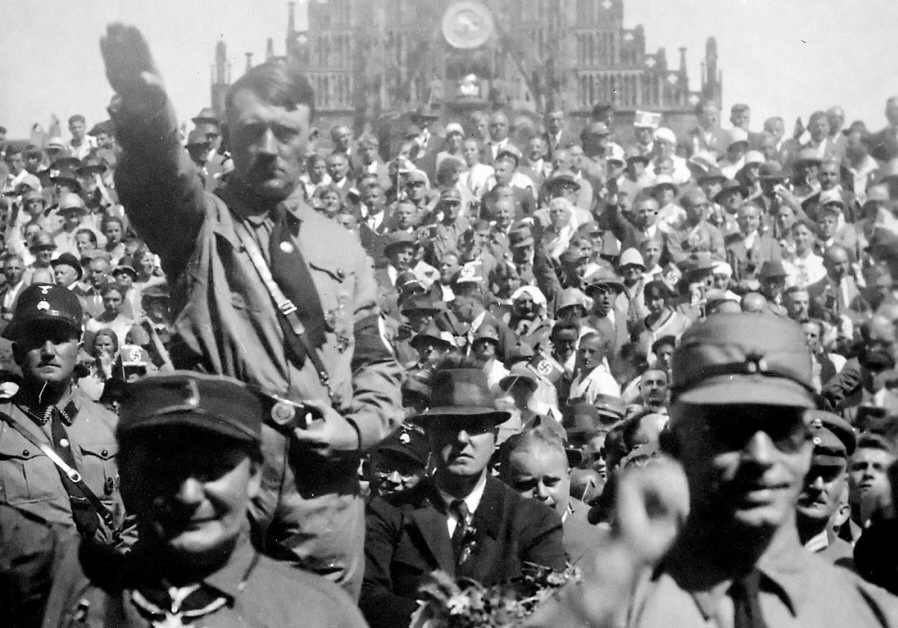
14 Comments

Filed under faith, germany, History, holocaust, ministry, nazi germany, News and current events, Political Commentary, racism, Religion, war crimes, White nationalism, world war two in europe

History, Biography, and Organizing my Library at Home


Friends of Padre Steve’s World,

Today has been a very difficult day where I worked in the house, the storage space, and. helped Judy and some of her friends break down their wares at the end of a craft show. This evening I did some more work organizing books in my library here at home. This week while doing my transfer I also caught up with some reading since my orders didn’t actually show up until late Wednesday. I read Mark Rosen’s “The Wannsee Conference and the Final Solution: a Reconsideration”; “The Participants: the Men of the Wannsee Conference” edited by Hans Christian Jasch and Christopher Kreutzmuller; finished reading “Our Declaration: a Reading of the Declaration of Independence in Defense of Equality” by Danielle Allen; and began reading Stefan Kühls “The Nazi Connection: Eugenics, American Racism, and German National Socialism.” While browsing my books I pulled out “Hidden Horrors: Japanese War Crimes in World War II” by Yuki Tanaka.

In like of what I have been doing I am reposting an edited and expanded version of an older article emphasizing the connection between history and biography. This is something I try to do when I write. Tomorrow, I start my check-in process after having signed in to my new command, before they send me to Norfolk Naval Shipyard in Portsmouth.

So until tomorrow, 

Peace,

Padre Steve+

English historian and military theorist Colin Gray noted that “people matter most” when we deal with history, policy, or politics, but especially in the matter of war.

I think one of the sad things about history is that many authors, especially in military history, but other areas as well, seem to treat the participants as bit players in a series of events, rather than a prism from which to understand and view history.

I cannot tell you how many times I have had students, and even colleagues tell me that history is dry, boring and uninteresting to them. I will not condemn them, for certainly if it is that is case, it is not their fault, but rather those who write and teach history. If all history is, is arbitrary dates, lists of disconnected events and names of people, without any context to their lives, why should they care about it?

When I first began to study history I was much more concerned about events than people. However, over the past couple of years I have began to develop what I call my philosophy of history. That has come about through my study of the events leading to the American Civil War and in particular my study of the Battle of Gettysburg, but also in other historical events such as the Arab Revolt of 1917,  the French adventures in Indochina and Algeria, and the Holocaust.

In doing all of my research I have read a large number of books, articles and primary sources on these subjects and my personal library appears to be growing at an exponential rate. I have noticed that much of what I have read deals very little with the people involved, unless I am reading a biography, and even some of the biographies seem to be event heavy, and person light and sometimes it seems that the subjects of the biography are often one dimensional, and almost caricatures of who they really were. Some of the alleged biographies that I read would be better described as hagiography, to make the subjects appear saintlike, the type of writing used by religious writers to make saints a lot less human. There are others who go to the opposite extreme and do all they can to demonize their subject. In either case the method is less than honest, but for many people, profit and propaganda value mean more than truth. Of course either type of writing appeals to the masses who do not care about nuance, or for that matter truth.

But such is not history. Neither are “histories” which are designed to support a particular ideology, be it political, religious, or economic. Such works are not history, but propaganda. When I see people, in this country forbidding the teaching of history because it is not patriotic enough I want to scream. It is like I am watching the propagandists of Stalin’s Soviet Union, Hitler’s Third Reich, or any of many other nations that used ideology or religion to supress history that didn’t meet their definition of “patriotic.” But then I digress…

My gut feeling says that such artificial divisions between history and biography do a disservice to the reader. I take a tremendous pleasure in writing, and I like to try to communicate and interpret facts, which is indeed the vocation of the historian, in a manner that makes them interesting. What I am finding is that when telling the stories of events we must also tell the stories of the people who make these events.

Without such a connection there is little to interest most readers. People tend to be interested in people because there is a connection. The human being is still the human being, no matter what age, country, culture, religion that they belong to. I learned a lot of this from reading the works of Barbara Tuchman who in her writings about events, never forgot importance of people, and refused to turn them in to one dimensional caricatures.

In my writing now I attempt to bring the prism of the biography into the events that I write about.

I had a fellow faculty member note that he liked what I wrote about Gettysburg because it was more than just the events, it was the personal connection he felt to the people.

People matter because they have so many layers. I guess one of the things that makes my writing approach a bit different is that while I am a historian, I am also trained in philosophy, pastoral care and psychology, all of which deal with existential matters.In the next few days you will be seeing some of my Gettysburg work, and hopefully as you read it you will notice that I attempt to find that nuance in the various men, on both sides of the conflict, who are part of the story.

I found that the complexities and contradictions of the subjects of history, the people help me understand the events more than anything. I think my epiphanies came in reading about the lives, as well at writings of men like T.E. Lawrence and Gouvereur Warren whose triumphs, struggles, weaknesses and injuries mirror my own. In learning about these men as people, in the context of what they accomplished helps me to understand their history and the era that they lived far more than simply recounting how they influenced a battle.

Likewise, I find that the lives, beliefs, motivations, relationships, and experiences of people to be paramount to understanding events. People are complex, multi-layers and often contradictory. All of my heroes all have feet of clay, which in a sense makes their stories even richer, and the events that they helped bring about more fascinating, because then I gain a holistic perspective and develop an empathy for them. Even good and honorable people who find themselves due to race, religion, or nationality fighting for an evil cause, or evil people fighting for a good cause. Both are troubling, I think that good and honorable men who submit themselves to criminal and evil causes are more troubling.

We are seeing much of that today in regard to various members of the Trump Administration. When I was reading the article on Friedrich Kritzinger, the State Secretary for the Reich Chancellery, a conservative Prussian Civil Servant who served under the Kaiser, the Weimar Republic and Nazi Germany. In his position he made sure that the bureaucracy of the Reich ran efficiently, and also wrote legal justifications for the absorption of the rump of Czechoslovakia, and western Poland into the Reich. He also took part in the Wannsee Conference, for which he was the only participant to express remorse. Stefan Paul-Jacobs and Lore Kleiber, wrote about him in The Participants:

“Justice being taken away, then, what are kingdoms but great robberies?” (St. Augustine). This might not be a quote from Kritzinger, but it serves as a reminder that, by working as a lawyer for a regime, which he has known from the start to be criminal, he made himself a stooge.” (The Participants p.217”) 

The story of Kritzinger, is very pertinent for anyone trapped by ideological or religious constraints, or commitment to a leader that they know is corrupt, acting criminally, or undermining the law and Constitution. That may confuse or even offend you, but it is a part of the human condition. That my friends is history.

Barbara Tuchman noted “that if the historian needs to submit himself to his or her material instead of trying to impose himself on his material, then the material will ultimately speak to him and supply the answers.”

This is very important, because when we do this we discover the answers to the why questions, especially the why questions that are so very uncomfortable, are necessary if we want to discover truth.

I know that I can find connections in the strengths as well as their weaknesses of people that I admire. Thus when I see ordinary people taking part in events, for good or for evil,I can say that given the same set of circumstances that that could be me. Context matters, nuance matters, people matter. If we do not understand that, history becomes nothing more than a set of manipulated facts, devoid of context that can be used to buttress the most evil intentions.

I do plan on developing these thoughts over the coming weeks and months, but for now it will suffice to say that when I write about history, that people matter. That is why I write.

6 Comments

Filed under books and literature, civil war, History, life, Military, philosophy, racism

The Tree of Life Continues to Weep: thoughts a Year After Anti-Semitic Killing in Pittsburgh

Friends of Padre Steve’s World,

I repost this article with a heavy heart. It has been just over a year since the White Nationalist massacre of Jewish worshippers at Pittsburgh’s Tree of Life Synagogue. The saddest part is that seems to be forgotten by most Americans, even as anti-Semitic incidents and violence continue to rise in the United States and Europe.

In his book Auschwitz: A New History, Laurence Rees noted something that is important about how human beings act in crisis. After interviewing many of perpetrators, victims, and bystanders who were at Auschwitz and other parts of the Nazi death machine he wrote this:

“…human behavior is fragile and unpredictable and often at the mercy of the situation. Every individual still, of course, has a choice as to how to behave, it’s just that for many people the situation is the key determinate in that choice.”

Just over a year ago, on the Shabbat, the Tree of Life Synagogue in Pittsburgh, Pennsylvania was attacked by Rob Bowers, an open and unashamed White Supremacist determined to kill as many Jews as he could. Armed with an AR-15 style assault rifle and two or three semi-automatic pistols he entered the synagogue and opened fire screaming “All Jews must die!”

This is not an isolated incident, although it appears with eleven people killed, the worst single attack on American Jews in our history. While the United States is probably the least anti-Semitic country in the Jewish diaspora, there has always been an undercurrent of anti-Semitism in the United States. Historically this has been mostly relegated to White Supremacist organizations like the Ku Klux Klan, the America First movement of the 1930s, and other White Nationalist, or Neo-Nazi groups. The Right Wing, White Nationalist anti-Semitism almost always flows from the deep well of racism. In the various expressions of this ideology, Jews are not White, they are Middle Eastern, and thus foreign. Likewise, to the Right Wing the Jews are conflated with Communism and thus in league with America’s Cold War enemies.

Likewise, there are people on the fringes of the American Left who espouse anti-Semitic beliefs, often in reaction to the policies and actions of Israel. Regardless of where it comes from, anti-Semitic threats, actions, and violence are an expression of evil, just as much as are other forms of racism.

The historical background is important. Recognizing it enables us to put the dramatic rise in documented anti-Semitic attacks or incidents over the past three years https://www.adl.org/resources/reports/2017-audit-of-anti-semitic-incidents in their appropriate context.

The fact is that the rise is significant and coupled with the more open and in your face actions of leading White Supremacists, and their political connections within the Republican Party, and among highly placed officials and advisers to President Trump. GOP Congressman Steve King of Iowa frequently makes common cause with White Nationalists, and he is not alone. When in the President claimed that there “were fine people on both sides” in response to the violence precipitated by White Nationalist, KKK, and neo-Nazis which claimed the lives of a counter protester in Charlottesville, it was a tacit blessing of their movement, and despite the later attempts of the President to walk back the remarks, the damage was done.

Now the terrorist attack was committed by a man who embraced the apocalyptic fear mongering of the President regarding Central American immigrants, did not vote for or approve of the President. Bowers does not believe that the President is a Nationalist and believes that White Supremacists that support him are being foolish.

Bowers, who has posted that “the Jews are the children of Satan…” was particularly incensed by the Hebrew Immigrant Aid Society. The HIAS was founded in 1881 to help the Jewish victims of Russian pogroms find safety. They are the oldest such agency in the United States and now support refugees of every race, color, and creed. Bowers was most angered by its support for Central American refugees. In his rage at refugees Bowers is similar to many of the President’s supporters, except that the rage is directed at Jews who support refugees. He could have targeted any number of Christian or secular organizations that support refugees but he targeted Jews. Over the past few months he has made online threats to HIAS for its sponsorship of a National Refugee Shabbat in which participating congregations dedicated a worship service to the plight of refugees. Just before the attack Bowers posted:

“HIAS likes to bring invaders in that kill our people. I can’t sit by and watch my people get slaughtered. Screw your optics, I’m going in,”

Bowers’s rational for killing Jews is very much like the German Nazis in regard to German and European Jews. They believed that they were the victims of the Jews, that the Jews were trying to destroy their race, and since they believed that the Jews were a sub-human infestation, had to be exterminated. Just three days ago Bowers posted:

“Daily Reminder: Diversity means chasing down the last white person.”

Bowers was a frequent poster on the Gab social media site which has become a haven for men like him, as an alternative to Twitter or Facebook, however, anti-Semitic posts on Twitter have risen at an alarming rate. About 40% of the anti-Semitic posts on Twitter include the #MAGA and #KAG hashtags of Trump supporters.

Bowers’s violent act was not an isolated incident, but part of a larger pattern of violent racism and racist political extremism. It took place at the end of a week of race and political based violence. First, a rabid Trump supporter, conspiracy theory follower, and anti-Semite was arrested for mailing 13 bombs to political figures, former government officials, and media figures. All of the people targeted had been openly attacked by the President on Twitter or in various speeches. One of his former employers noted that the man said that he wished “to go back to the Hitler days” and that if it was in his power he would “eradicate the Jews” along with lesbians, black people and Hispanic people.

Then there was the was the incident in Louisville, Kentucky where a White man attempted to attack a predominantly Black church, and failing that went to a Kroger supermarket and shot two Black customers in the back, killing them. When confronted by an armed civilian in the parking lot the man said “whites don’t kill whites.” There was no other motive for the killing except the man’s expressed White Supremacism and racism.

These domestic terrorists are all individually responsible for the crimes that they committed and the lives that they have snuffed our. That being said, how they got to the place in their minds where such actions are justified is not hard to explain. They are very similar to others throughout history who have embraced race hatred, including anti-Semitism as a way of life. But, without a belief that violent acts are permissible due to the existential threats promoted by the President, his GOP political allies, the hosts of Right Wing pundits who have poisoned the airwaves and internet for three decades, and the political preachers who justify race and religious based Nationalism, the perpetrators would likely never act.

Just before the attack, President Trump publicly described himself as a Nationalist for the first time. In 2016 Timothy Snyder wrote of President Trump and the contrast between a Nationalist and a Patriot:

“The president is a nationalist, which is not at all the same thing as a patriot. A nationalist encourages us to be our worst, and then tells us that we are the best. A nationalist, “although endlessly brooding on power, victory, defeat, revenge,” wrote Orwell, tends to be “uninterested in what happens in the real world.” Nationalism is relativist, since the only truth is the resentment we feel when we contemplate others. As the novelist Danilo Kiš put it, nationalism “has no universal values, aesthetic or ethical.” A patriot, by contrast, wants the nation to live up to its ideals, which means asking us to be our best selves. A patriot must be concerned with the real world, which is the only place where his country can be loved and sustained. A patriot has universal values, standards by which he judges his nation, always wishing it well—and wishing that it would do better.

The President has stoked the flames or racism, nationalism, and even anti-Semitism sine the day he announced his candidacy. The GOP establishment, even those men and women who before Trump’s nomination opposed and condemned all that he stood for have embraced him, very much as the German conservatives did with Hitler between 1932 and 1936, only much faster.

It is not that Trump is Hitler, at best he is a sorry pretender, not that he isn’t dangerous in his own right. Rather, it is the fact that his former GOP opponents have sold their souls for some kind of political or economic gain to him despite their obvious contempt for him and all that he stood. It is that the reality that the de facto state run media of Fox News sets his agenda on a daily basis. It is the fact that the scions of Evangelicalism who would never have supported a man like him have not only embraced Trump, but have invented supposedly Biblical reasons to support him. It is the fact that millions of people now embrace conspiracy theories because Trump repeats and amplifies them. It is the fact that this maelstrom of madness has opened the floodgates to the violence we have seen over the past week and it was not unbelievable or unsurprising. It was all too predictable. I have been saying so for years.

Timothy Snyder wrote:

“The European history of the twentieth century shows us that societies can break, democracies can fall, ethics can collapse, and ordinary men can find themselves standing over death pits with guns in their hands. It would serve us well today to understand why.”We have to understand why or this not be the end. It will continue and it will get worse, regardless of what happens in the mid-term elections unless people stop being bystanders and confront the evil that is before us. The President will not, and neither will the compliant GOP majorities in Congress.

The fact that these men have been emboldened to use race based terrorism and murder, to openly espouse and act on anti-Semitism, and other forms of racism as was the case in Louisville and there is no push back in the Right Wing media while much of the mainstream media continues to give the enablers of such violent people equal time by inviting them to panel discussions where the truth is allowed to be obfuscated in the name of fairness and equal time.

So it will happen again and again. No amount of security can stop it. Unlike the terrorist who attacked on September 11th 2001, these terrorists are born and bred Americans. Two of the three would have attracted any attention, and the one who did was so over the top and open about his beliefs that he was considered to be a loon. They all had a choice as how to behave, and like the murderers of Auschwitz they allowed their situation to determine their choices.

Be assured, these acts will continue to happen. Anti-Semitism didn’t die in the Bunker with Hitler. It has found a comfortable home in the United States and what happened this week at the Tree of Life Synagogue shows us that societies can break, democracies can fall, and ethics can collapse.

Until tomorrow,

Peace,

Padre Steve+

Leave a comment

Filed under ethics, History, nazi germany, News and current events, racism, Religion

A Senseless and Fanatical Sacrifice: Kamikazes Enter the War at Leyte Gulf


886896

                  USS St Lo exploding after being hit by a Kamikaze

Friends of Padre Steve’s World,

Again I am taking some time off from current events as fast as they are moving, and I am posting edited articles about Battle of Leyte Gulf. The battle was the largest naval battle every fought and harborslessons that redound to our day. This article deals with the first use of Kamikaze aircraft whose pilots would attempt to dive into Allied warships, committing suicide rather than attempting to bomb a ship and return home.

In an age where suicide bombers and attackers do such things it is important to remember that this is not new. The Kamikaze pilots for the most part brainwashed by the Samurai ideology which had been drilled into them since they were children. One who survived because of engine failure and did not get a second chance told the BBC:

“Common sense says you only have one life,” he says, “so why would you want to give it away? Why would you be happy to do that? But at that time everyone I knew, they all wanted to volunteer. We needed to be warriors to stop the invasion from coming. Our minds were set. We had no doubt about it.”

While most Kamikaze pilots hated that ideology, some did not. Regardless, such a mentality is true of many fanatical idealists and terrorists even today. Such men and women span the religious and ideological spectrum. That is the truth, and it is profoundly depressing. Human nature being what it is means that there will be many more like them, the terrorists of September 11th 2001 were little different than the Kamikazes, but instead of the Bushido creed of the Samurai, it was a fanatical belief in Jihad.

Peace

Padre Steve+

In 1944 one of the leading Japanese Naval aviators, Admiral Takijirō Ōnishi wrote:

“In my opinion, there is only one way of assuring that our meager strength will be effective to a maximum degree. That is to organize suicide attack units composed of A6M Zero fighters armed with 250-kilogram bombs, with each plane to crash-dive into an enemy carrier…” 

kamikaze

It was a tactic born of desperation but one that fit in well with the philosophy of Bushido. After the Battle of the Philippine Sea, the “Marianas Turkey Shoot” in June 1944 and the slaughter of land based Japanese Naval and Army air forces based in Formosa in September of that year Japanese leaders began to look to a tactics born of desperation but which fit their Bushido based ethos of sacrifice.

Lt_Yukio_Seki_in_flightgear

                                                        Lt. Yukio Seki

Suicide attacks were nothing new to the Japanese, but until October 1944 they were tactics decided on by individuals who saw no alternative to the choice. In October 1944 that calculus changed, instead of individuals or isolated units which had no hope of victory conducting suicide attacks, commanders decided to employ suicide attackers as a matter of course.

When the American forces invaded the Philippines Admiral Takijirō Ōnishi was commander of the First Air Fleet based in the Northern Philippines. He was not a fan of Kamikaze tactics and viewed them as heresy. However after the slaughter of the reconstituted Naval Air Force at the Battle of the Philippine Sea he reluctantly changed his mind. I say reluctantly based on his previous views and because after he committed ritual suicide following the Japanese surrender he apologized to the estimated 4000 pilots that he sent to their death and their families.

Admiral_Takijiro_Onishi

                                                Admiral Ōnishi

But in October 1944 with Japan reeling from defeats in the Pacific and its supply route for oil and other raw materials threatened desperation was the order of the day.

The 201st Navy Flying Corps based out of Clark Field near Manila was the major land based Japanese Naval Air Force unit in the Philippines. Among its pilots was a young Naval Officer and Aviator named Lt. Yukio Seki. Seki was a graduate of the Japanese Naval Academy at Eta Jima and was recently married. He was not an ideologue or believer in suicide attacks. When questioned by a reporter before his squadron launched the first Kamikaze attacks he remarked to Masashi Onoda, a War Correspondent :“Japan’s future is bleak if it is forced to kill one of its best pilots. I am not going on this mission for the Emperor or for the Empire… I am going because I was ordered to!”

On October 25th 1944 Seki led his group of 5 A6M2-5 Zero fighters, each carrying a 550 pound bomb took off and attacked the Escort Carriers of Rear Admiral Clifton Sprague’s “Taffy-3.” The five pilots all died in their attacks but two damaged the USS Kalinin Bay and USS Kitkun Bay while two aircraft, one believed to be Seki’s hit the USS St Lo causing mortal damage which sank that ship in less than half an hour with the loss of over 140 sailors.

1st_Kamikaze_Mission_19441025-1

The attacks of Seki’s small squadron were a harbinger of what was to come. Over the next 10 months over 4000 Japanese pilots would die in Kamikaze attacks against US Navy and Allied Naval units. Numbers of ships destroyed or damaged by Kamikazes are debated by some historians believe that 70 US and Allied ships were sunk or damaged beyond repair and close to 300 more damaged. 2525 Imperial Japanese Navy pilots and 1387 Imperial Army pilots died in Kamikaze attacks killing almost 5000 sailors and wounding over 5000 more.

Seki_photo_ma1944-10-20

Another pilot, who did not swallow the propaganda was Lieutenant Ryoji Uehara. He wrote his mother before his final mission:

“Tomorrow, one who believes in democracy will leave this world, he may look lonely but his heart is filled with satisfaction. Fascist Italy and Nazi Germany have been defeated. Authoritarianism is like building a house with broken stones.”

Admiral Ōnishi who made the decision to make Kamikazes a part of Japan’s offensive strategy in 1944 appeared to regret that decision. In his suicide note he urged young Japanese to rebuild the country and seek peace with all people and offered his death a penance for the nearly 4000 pilots he sent to their deaths. Accordingly when he committed ritual suicide (seppuku) he did so alone, with a second to finish the job and died over 15 hours after disemboweling himself.

kamikaze-pilots

                                                     A Final Toast

The Kamikaze campaign did not alter the course of the war, but it did introduce a new dimension of terror and misguided sacrifice. Despite the propaganda of the ideologues who urge men and women to undertake suicide missions, there is no honor for those that do so. I do pray that one day war will be no more and that even though I expect war to remain part of our world until longer after my death  that nations, peoples or revolutionary groups will no longer send their best and brightest to certain death.

1 Comment

Filed under culture, ethics, faith, History, Military, Political Commentary, racism, Religion, suicide, World War II at Sea, world war two in the pacific

Conflicted War Criminals: They do not Deserve Monuments


Colonel General Erich Hoepner 
Friends of Padre Steve’s World,

Monuments to soldiers who served their country faithfully and honorably are not a bad thing. At the same time one has to look at the context of their service and if they serve in the high command or in other government postings their service needs to be carefully examined to see if the deserve to be memorialized.

In the United States we have frequently memorialized men whose actions as military and political leaders, while commendable in some aspects leaves much to be desired in terms of long standing memorials.

A couple of years ago I had a friend whose family survived the Holocaust ask me where removing memorials to men like Robert E. Lee ends. I replied that it was all about context and the totality of life. We mythologize Robert E. Lee in a manner that his crimes and his flaws are intentionally hidden, though they are many. Since then I have written about Lee, and his crimes against the slaves that his family owned, and his meaningless sacrifice of thousands of Confederate Solders and the destruction of much of the South because he did not have the personal courage to tell Jefferson Davis and the Confederate Congress that the war lost in late 1863 or early 1864. He was the most respected man in the Confederacy and his words word have created an uproar that the Confederacy could not have survived. Instead he is remembered for the myth of his nobility with statues throughout the South and even the former Union States.

I then talked about German General Erich Hoepner who though he had been a part of plots to overthrow Hitler before the war and took part in the plot to overthrow Hitler in 1944 and was executed after a sham trial. The pictures and films of Hoepner being shamed and degraded by the Nazi Chief inquisitor, Judge Roland Freisler, give an impression that General Hoepner was a victim of the Nazi regime.

To some extent Hoepner was a victim of the regime, but while in command of Panzer Group Four during the invasion of the Soviet Union his actions place him in the pantheon of Nazi War Criminals. He fully cooperated with some the most criminal aspects of the Nazi regimes actions. He was a willing accomplice to crimes that stagger the imagination.

In his initial message to his troops Hoepner stated:

The war against Russia is an important chapter in the German nation’s struggle for existence. It is the old battle of the Germanic against the Slavic people, of the defence of European culture against Muscovite-Asiatic inundation and of the repulse of Jewish Bolshevism. The objective of this battle must be the demolition of present-day Russia and must therefore be conducted with unprecedented severity. Every military action must be guided in planning and execution by an iron resolution to exterminate the enemy remorselessly and totally. In particular, no adherents of the contemporary Russian Bolshevik system are to be spared.

Hoepner issued a number of other orders directing how Jews should be treated and the commander of Einsatzgruppe A, SS Brigadier General Walter Stahlecker whose units killed nearly 250,000 Jews between July and December 1941 praised the cooperation of the Wehrmacht and in particular of Hoepner with his execution squads. Stahlecker described the cooperation of the Wehrmacht with his men as “generally very good”, and “in certain cases, as for example, with Panzer Group 4 under the command of General Hoepner, extremely close, one might say even warm.” The fact is that the Einsatzgruppen could not have ran up such massive numbers of deaths without the cooperation of the German Army leaders in Russia.

That leaves us with the question of how does one remember such a military leader? Hoepner demonstrated bravery as a young officer in the First World War, and was prepared to help overthrow Hitler before the war and lost his life in the attempt to kill Hitler on July 20th 1944. But he enabled and participated in war crimes so vast and heinous that they beggar the imagination.

In 1956 a Berlin school was named after Hoepner for his role in the anti-Hitler plot, but in 2008, after his actions in relationship to the Nazi war crimes became public, the school was renamed. Because he perished in the attempt on Hitler’s life, Hoepner was included in the myth of the noble Wehrmacht. But that was a myth, the Wehrmacht was so complicit in the Nazi crimes that it cannot be exculpated from them. It’s leaders for the most part agreed with Nazi racial policies and had no hesitation in cooperating with the SS. Yes, there were exceptions, but they were and forever will remain exceptions, the myth be damned.

So in relation to the American controversy regarding monuments to Confederate leaders, or for that matter to leaders who planned, conducted, or supported our own genocide of Native Americans, the unlawful subjection and conquest of Mexico, the exploitation of territories and peoples gained following the Spanish-American War, those who conducted medical experiments not much different than the Nazi doctors on minorities and the handicapped, and so many other examples which would take too long to list for the purpose of this article: what are we to do?

As I have written before, this is a matter of context and honesty. Honestly I think this is something that we need to address, just as the Germans have since the end of the Second World War. We have to be brutally honest in our assessment of the men and women who we chose to memorialize. If we aren’t we simply bless their crimes and allow their veneration to inspire new generations of racial motivated criminals.

That is where we have to go if we have the moral courage to do so. However, I don’t think that will happen in the next few years, or even in my lifetime, but I can hope and I can act in my own way to bring attention to to them, and hopefully do what I can to keep people of our present time from heading down the same evil path.

So until tomorrow,

Peace

Padre Steve+

Leave a comment

Filed under civil war, ethics, faith, History, holocaust, leadership, Loose thoughts and musings, Military, nazi germany, News and current events, Political Commentary, racism, war crimes, White nationalism, world war two in europe

John Brown: Fanatical Idealist and “Warrior for God”

John_brown.JPG

                                                        John Brown

Friends of Padre Steve’s World,

October 16th is the anniversary of John Brown’s attempted seizure of the Federal Armory at Harpers Ferry. He was executed after trial on December 2nd 1859. Brown was  a man who had a righteous cause, but surrendered the moral high ground because of his fanaticism. Justice Robert Jackson wrote:“[I]n our country are evangelists and zealots of many different political, economic and religious persuasions whose fanatical conviction is that all thought is divinely classified into two kinds — that which is their own and that which is false and dangerous.” John Brown was a fanatic who in his desire to achieve his goal was not above committing murder as he did in Kansas, and insurrection as he did at Harper’s Ferry. There are many people in this country who harbor similar beliefs. John Brown serves as a warning to all of us. Violent means in service of a honorable or righteous cause often make things far worse.

This article is part of my draft book Mine Eyes have Seen the Glory: Race, Religion, Ideology and Politics in the Civil War Era. 

Peace

Padre Steve+

In the North there too existed an element of religious fanaticism. While “the restraining hand of churches, political parties and familial concerns bounded other antislavery warriors,” [1] and while most abolitionists tried to remain in the mainstream and work through legislation and moral persuasion to halt the expansion of slavery with the ultimate goal of emancipation; there were fanatical abolitionists that were willing to attempt to ignite the spark which would cause the powder keg of raw hatred and emotion to explode.

Most prominent among these men was John Brown. Brown was a “Connecticut-born abolitionist…a man with the selfless benevolence of the evangelicals wrought into a fiery determination to crush slavery.” [2] His father was an early abolitionist who helped later found Oberlin College. In his early years Brown “formulated a certitude about divine intervention against sinners, starring himself as God’s warrior against slaveholders.” [3] As early as 1834 John Brown was “an ardent sympathizer the Negroes,” desiring to raise a black child in his own home and to “offering guidance to a colony of Negroes on the farm of the wealthy abolitionist Gerrit Smith at North Elba New York.” [4]Brown regarded moderate free Staters with distain and though he was a fanatical Christian he never joined any church, and “obeyed only his conception of God’s unbounded command.” [5]

Brown “ridiculed Republican’s mainstream tactics. He disparaged even Yankee extremists for deploying too non-violent a strategy.” [6] After a series of failed business ventures the militant Brown went to Kansas and set about to change the equation through the use of terror. After the sack of Lawrence, Brown and a company of his marauders set upon and slaughtered the family of a pro-slavery settler at Pottawatomie Creek. [7] Brown and his son’s entered the house of one family, “dragged three men outside, shot the father through the head, and hacked and mutilated his two sons with broadswords.”[8] Two years later Brown went to Missouri where he “murdered a slaveholder, seized eleven slaves, and led the new freedmen 1100 miles to Canadian sanctuary.” [9]

The example of John Brown provides us with a good example to understand religious extremism, especially when it becomes violent. The counterinsurgency field manual notes in words that are certainly as applicable to Brown as they are to current religiously motivated terrorists, that “Religious extremist insurgents….frequently hold an all-encompassing worldview; they are ideologically rigid and uncompromising….  believing themselves to be ideologically pure, violent religious extremists brand those they consider insufficiently orthodox as enemies.”[10] 

Brown was certainly “a religious zealot…but was nevertheless every much the product of his time and place….” [11] Brown was a veteran of the violent battles in Kansas where he had earned the reputation as “the apostle of the sword of Gideon” as he and his men battled pro-slavery settlers. Brown was possessed by a zealous belief that God had appointed him as God’s warrior against slaveholders. He despised the peaceful abolitionists and demanded action. “Brave, unshaken by doubt, willing to shed blood unflinchingly and to die for his cause if necessary, Brown was the perfect man to light the tinder of civil war in America, which was what he intended to do.” [12]

Brown attempted to gain financing from wealthy abolitionists for a new expedition to seize the Federal arsenal at Harper’s Ferry Virginia, and most would have nothing to do with his scheme. When they “touted their pacific antislavery societies, Brown responded that “your methods are perfectly futile; you would not release five slaves in a century; peaceful emancipation is impossible.” [13] After hearing William Lloyd Garrison and other abolitionist leaders plead for peaceful abolition he remarked: “We’ve reached a point,” I said, “where nothing but war can get rid of slavery in this guilty nation. It’s better that a whole generation of men, women, and children should pass away by a violent death than that slavery should continue to exist.” I meant that literally, every word of it.” [14]

Following that meeting, as well as a meeting with Frederick Douglass who rejected Brown’s planned violent action, Brown went about collecting recruits for his cause and set out to seize 10,000 muskets at the Federal armory in Harper’s Ferry, Virginia in order to ignite a slave revolt. Brown and twenty-one followers, sixteen whites and five blacks moved on the arsenal. As they went, Brown:

“believed that we would probably fail at the Ferry, would probably die. But I believed that all we had to do was make the attempt, and Jehovah would do the rest: the Heavens would turn black, the thunder would rend the sky, and a mighty storm would uproot this guilty land, washing its sins away with blood. With God’s help, I, John Brown, would effect a mighty conquest even though it was like the last victory of Samson.” [15] 

After initial success in capturing the armory, Brown’s plan was frustrated and Brown captured by a force of U.S. Marines, led by Colonel Robert E. Lee and Lieutenant J.E.B. Stuart. Brown was tried and hanged, but his raid “effectively severed the country into two opposing parts, making it clear to moderates there who were searching for compromise, that northerner’s tolerance for slavery was wearing thin.” [16]

It now did not matter that Brown was captured, tried, convicted and executed for his raid on Harper’s Ferry. Brown to be sure was “a half-pathetic, half-mad failure, his raid a crazy, senseless exploit to which only his quiet eloquence during trial and execution lent dignity” [17] but his act was the watershed from which the two sides would not be able to recover; the population on both sides having gone too far down the road to disunion to turn back.

Brown had tremendous support among the New England elites, the “names of Howe, Parker, Emerson and Thoreau among his supporters.” [18] To abolitionists he had become a martyr “but to Frederick Douglass and the negroes of Chatham, Ontario, nearly every one of whom had learned something from personal experience on how to gain freedom, Brown was a man of words trying to be a man of deeds, and they would not follow him. They understood him, as Thoreau and Emerson and Parker never did.” [19]

But to Southerners Brown was the symbol of an existential threat to their way of life. In the North there was a nearly religious wave of sympathy for Brown, and the “spectacle of devout Yankee women actually praying for John Brown, not as a sinner but as saint, of respectable thinkers like Thoreau and Emerson and Longfellow glorifying his martyrdom in Biblical language” [20] horrified Southerners, and drove pro-Union Southern moderates into the secession camp. The Richmond Enquirer wrote in its editorial, “The Harper’s Ferry invasion has advanced the cause of Disunion, more than any other event that has happened since the foundation of the Government; it has rallied to that standard men who formerly looked on it with horror; it has revived, with ten fold strength the desire of a Southern Confederacy…” [21]

The day that Brown went to his hanging he wrote his final missive. This was written once more in apocalyptic language, but also in which he portrayed himself as a Christ figure going to his cross on the behalf of a guilty people, but a people whom his blood would not atone:

“It’s now December second – the day of my hanging, the day the gallows become my cross. I’m approaching those gallows while sitting on my coffin in the bed of a military wagon. O dear God, my eyes see the glory in every step of the divine journey that brought me here, to stand on that platform, in that field, before all those soldiers of Virginia. Thank you, Father, for allowing an old man like me such might and soul satisfying rewards. I am ready to join thee now in Paradise…

They can put the halter around my neck, pull the hood over my head. Hanging me won’t save them from God’s wrath! I warned the entire country: I, John Brown, am now quite certain that the crimes of this guilty land will never be purged away, but with blood.” [22]

Brown’s composure and dignity during trial impressed Governor Henry Wise of Virginia who signed Brown’s death warrant as well as that of fire-eater Edmund Ruffin. In his diary Ruffin “praised Brown’s “animal courage” and “complete fearlessness & insensibility to danger and death.” [23]

UBrown’s death was marked with signs of mourning throughout the North, for Brown was now a martyr. Henry David Thoreau “pronounced Brown “a crucified hero,” [24] while through the North, Brown’s death was treated as a martyr’s death. Even abolitionists like William Lloyd Garrison who had condemned violence in the quest of emancipation praised Brown’s actions, while throughout the North:

“Church bells tolled, black bunting was hung out, minute guns were fired, prayer meetings assembled, and memorial resolutions adopted. In the weeks following, the emotional outpouring continued: lithographs of Brown circulated in vast numbers, subscriptions were organized for the support of his family, immense memorial meetings took place in New York, Boston and Philadelphia…” [25]

Future Confederate General Lafayette McLaws spoke for many Southerners in the army when he wrote: His diary entry for February 27th 1860 noted:

“Debates in congress show no mitigation of sec. feeling…. I think it would be better not to be so fanatical on any subject, the extreme pro-slavery man is as bad as that type as that type of anti-slavery, John Brown. I do not consider slavery an evil by any means, but I certainly do not think it the greatest blessing.” [26]

But in the South there was a different understanding of Brown’s assault on Harper’s Ferry. Despite official denunciations of Brown by Abraham Lincoln and other Republican leaders, the message proclaimed by Southern newspapermen, ministers and politicians was that the North could not be trusted.  Brown’s raid, and the reaction of Northerners to it “was seized upon as argument-clinching proof that the North was only awaiting its opportunity to destroy the South by force….” [27]

Of course that was not the feeling in much of the North, but Brown’s actions and words were seized upon by the Southern versions of Brown to make Civil War inevitable once the political balance changed, and they neither controlled the Presidency, House, or Senate.

                                                          Notes 

[1] Ibid. Freehling The Road to Disunion Volume II p.207

[2] Ibid. Guelzo Fateful Lightning p.81

[3] Ibid. Freehling The Road to Disunion Volume II p.207

[4] Ibid. Potter The Impending Crisis p.211

[5] Ibid. Freehling The Road to Disunion Volume II p.207

[6] Ibid. Freehling The Road to Disunion Volume II p.206

[7] Ibid. Potter The Impending Crisis pp.211-212

[8] Ibid. Goldfield America Aflame p.118

[9] Ibid. Freehling The Road to Disunion Volume II p.208

[10] Ibid. U.S. Army/ Marine Counterinsurgency Field Manual p.27

[11] Ibid. Levine Half Slave and Half Free p.197

[12] Ibid. Korda, Clouds of Glory p.xviii

[13] Ibid. Freehling The Road to Disunion Volume II p.208

[14] Ibid. Oates The Approaching Fury p.203

[15] Ibid. Oates The Approaching Fury p.284

[16] Ibid. Korda Clouds of Glory p.xxxix

[17] Ibid. Catton Two Roads to Sumter p.18

[18] Ibid. Potter The Impending Crisis p.381

[19] Ibid. Potter The Impending Crisis p.375

[20] Ibid. Catton Two Roads to Sumter p.187

[21] ___________ The Harper’s Ferry Invasion as Party Capital The Richmond Enquirer, 23 October 1859 in The Civil War and Reconstruction: A Documentary Collection edited by William E. Gienapp, W.W. Norton and Company, New York and London 2001 p.54

[22] Ibid. Oates The Approaching Fury p.290

[23] Ibid. Thomas The Confederate Nation p.3

[24] Ibid. McPherson The Battle Cry of Freedom p.210

[25] Ibid. Potter The Impending Crisis p.378

[26] Oefinger, John C. Editor A Soldier’s General: The Civil War Letters of Major General Lafayette McLaws University of North Carolina Press, Charlotte and London 2002 p.18

[27] Ibid. Guelzo Fateful Lightning p.119

3 Comments

Filed under civil rights, civil war, ethics, faith, History, leadership, Political Commentary, racism, Religion

Flossenbürg Concentration Camp: State Sanctioned Punishment for Profit

Friends of Padre Steve’s World,

We are on the tail end of of trip to Germany, now visiting friends near the Rhein River in a town not far from Karlsruhe. Tomorrow is Judy’s Birthday and on the way here we visited four towns within a fifteen mile radius of each other where other members of her mothers family emigrated first to the Black Sea regain of Russia, and then to the United States In 1870. The interesting thing is that it took nearly half a century for her family to begin to assimilate into America. They lived in German villages and spoke German. Her mother, born over 50 years after the family came to the United States first learned English in the public school. I preface this article, which has nothing to do with anything above, to remember how many of our European ancestors maintained their language, culture, and took decades before they assimilated into our country, and not to be so hard on darker skinned immigrants from other parts of the world who are just beginning the process that so many of our European ancestors endured. 

The article below was written about a year ago and deals with how a authoritarian and racist police state turned its system of punishment into an opportunity for profit at the expense of human lives. 

So until tomorrow,

Peace,

Padre Steve+

Last year, on our way from Munich to Berlin we stopped to visit the memorial at the site of the former Flossenbürg Concentration Camp. For most people it is best known as the site where Dietrich Bonhoeffer, Admiral Wilhelm Canaris, General Hans Oster and others implicated in the 20th of July plot to assassinate Hitler. However, the evil committed there was far greater than the execution of these outstanding men.

In May of 1938 the SS-Wirtschafts- und Verwaltungshauptamt or the SS Main Economic and Administrative Office constructed a labor camp for German political and other prisoners at the town of Flossenbürg near the Czech border in northern Bavaria. Directed by SS Gruppenführer Oswald Pohl, a former German Navy officer and paymaster. Already a dedicated Nazi, Pohl gave up his Navy career in 1933 to take a commission in the SS at the behest of Heinrich Himmler who desired to use Pohl’s military administrative experience to set up a more professional and efficient administrative branch.

Pohl was the man for the job, and over time his influence grew. He was appointed to head the Hauptamt Haushalt und Bauten or the Main Office for Budget and Construction, and over time his responsibility continued to grow. German historian Heinz Höhne who wrote of Pohl:

Four potent departments placed Pohl’s hand firmly on the levers of power in the SS empire: he was in charge of the entire administration and supply of the Waffen-SS; he controlled the 20 concentration camps and 165 labor camps; he directed all SS and Police building projects; he was in charge of all SS economic enterprises.

But in 1938 Pohl was just beginning his rise in the SS. He realized that the Concentration Camps could be used for economic reasons as well as the punishment of the Reich’s enemies. Himmler appointed Pohl to oversee the economic and business operations of the camps. In March of 1938 they began at Mauthausen in Austria by partnering with the SS operated German Earth and Stoneworks Corporation (DEST) excavate Granite using Slave labor. In May they did the same at Flossenbürg.

Pohl’s understanding of labor was thoroughly Nazi, he wrote:

“SS industries [Unternehmen] have the task…to organize a more businesslike (more productive) execution of punishment and adjust it to the overall development of the Reich.”

Flossenbürg’s prisoners initially worked in the granite quarry above the town. They, like other slave laborers were exploited and even the more pragmatic views of Pohl’s office in terms of exploitation were based on the policies of extermination. As time went on Pohl developed a formula to base the economic profits of each prisoner. This was based on the “rental” of each prisoner to industry, minus food and clothing, the profits from anything left by them when they died, minus the expense of the cremation, based on an expected lifespan of nine months as a slave laborer. Pohl expected a profit of about 1,630 Reichsmarks per inmate employed as a slave laborer.

Flossenbürg was one of the second generation camps designed to be more than a place of extrajudicial punishment for enemies of the Nazi regime. It was designed for economic exploitation and extermination through work. While the initial inmates were Germans it would become a place where people from eighteen nations were worked to death.

Like Mauthausen, Flossenbürg supplied laborers to DEST which ran the quarry. The quarry is still in operation, though most of the work is done by machines run by very few actual well paid workers. The machines can be heard from the grounds of the former camp.

The camp grew and so did the numbers of prisoners, especially from countries conquered by the Nazis. Germans who made up the majority of the prisoners from its opening until late 1940 were eclipsed by Poles, Russians, and Hungarians. By the end of the war the camp had housed about 100,000 prisoners, of which about 30,000 died or were executed there.

As the number of deaths rose the process to dispose of the remains of the victims required that a crematorium be constructed. It was built in a valley at the base of the camp and ashes were disposed of near it in what is known as The Valley of Death. Those killed not only included those inmates who were worked to death, died of starvation or disease, but also the Polish and Soviet prisoners of war killed on the orders of the regime.

In 1943 the Messerschmitt facility in Regensburg moved parts production for the Bf-109 fighter plane to Flossenbürg. Camp inmates became part of the workforce producing those parts as well as other munitions for the German armaments industry.

The camp was liberated by the American 90th Infantry Division on April 23rd 1945.

The camp memorial is off the beaten track for most people. Visitors must make a special point to visit it. Unlike Buchenwald, Dachau, or Bergen-Belsen it is quite isolated from places that most people would go. Even so there are a significant number of Germans, and other Europeans, especially young people, who go to the camp to learn. In addition to the museum there is an education program with seminar rooms, guest speakers, and speak alike programs. A number of buildings have been preserved including the Camp Administration building, the Detention building where the special prisoners were housed, the laundry and camp kitchen which house the museum and special exhibits, the crematorium, two guard towers, and the SS Officer Club, or Casino. The last houses the education center as well as a small cafe for visitors.

In The Valley of Death near the crematorium there is what is called the Pyramid of Ashes, the Square of the Nations, and a cemetery. Above them are a chapel dedicated to the victims and a Jewish memorial.

For me I think that the most powerful images I will remember are The Valley of Death and the courtyard outside of the Detention barracks where Bonhoeffer, Oster, and Canaris were executed. The SS Camp doctor wrote the only account of the death of these men:

“On the morning of that day between five and six o’clock the prisoners, among them Admiral Canaris, General Oster, General Thomas and Reichgerichtsrat Sack were taken from their cells, and the verdicts of the court martial read out to them. Through the half-open door in one room of the huts I saw Pastor Bonhoeffer, before taking off his prison garb, kneeling on the floor praying fervently to his God. I was most deeply moved by the way this lovable man prayed, so devout and so certain that God heard his prayer. At the place of execution, he again said a short prayer and then climbed the steps to the gallows, brave and composed. His death ensued after a few seconds. In the almost fifty years that I worked as a doctor, I have hardly ever seen a man die so entirely submissive to the will of God.”

That being said, while Bonhoeffer, Oster, and Canaris resonate with me I cannot ignore the fate of the 30,000 other men and women who died at Flossenbürg. They were victims of the Nazi policies on race and men like Pohl who extracted the last bit of profit they could make off of the lives and labor of their prisoners before they killed them.

Unfortunately with humanity being what it is and the desire to seek profit and power over the good of people what happened at Flossenbürg could happen again. There are men like Oswald Pohl today who would not hesitate to try to make a profit off of so called enemies of the state.

That is why we always have to remember what happened there and fight to ensure that it can never happen again.

Leave a comment

Filed under economics and financial policy, History, holocaust, nazi germany, Political Commentary, racism

Sophie Scholl and the White Rose: Resistance is Not Futile

Friends of Padre Steve’s World,

I have written about Sophie Scholl and the White Rose resistance against Hitler before, in fact I again wrote about her last night, and as I watch what is going on in the United States I cannot get her off my mind. The 22 year old German university student who dared to speak out, to tell the truth, despite having no power of her own, just a belief in freedom and that one had to resist the Hitler regime.

I spent time in September on my last visit to Munich to visit a number of the places where Sophie Scholl, her brother Hans, and other members of the resistance worked to write and distribute six pamphlets exposing the crimes of the Nazi regime. I also visited her grave. We are here again, until tomorrow when we travel north to visit old friends in Hessen. While there I will make a second trip to the Hadamar T4 Euthanasia facility, but I digress…

Yesterday, I visited the Sophie Scholl-White Rose Museum at the University Of Munich, where she and her friends were students. While distributing the sixth pamphlet, Sophie and Hans were caught when a maintenance man at Munich University spotted them and reported them to the Gestapo. To stand in the place where she threw the last copies of that letter into the atrium of the University entrance was humbling. I wonder if I could have done it. Write such materials, certainly, distribute them, for sure, but to take the chance that someone might see me as I did it, I don’t know.

I find that the the German language film Sophie Scholl: The Final Days is a powerful portrayal of her last days. Whenever I watch the film I find that it is an intensely emotional experience. It was shot on location in places that I have walked, so it resonates in real time as I watch the freedoms that the United States was founded on being attacked in real time right now. I wonder how long it will be until the Constitution is turned upon its head and the law and the courts are turned into accomplices of terror.

I think the scenes in the film that were the most powerful to me were those that depicted the interrogation of Sophie by the Gestapo investigator Robert Mohr. He was a Nazi, but he is was also a professional police office and investigator, devoted to the law, a law which though the words had not been changed since before Hitler’s assumption of power, had been commandeered by the Nazis to prescribe loyalty to the Hitler regime above all. The real Robert Mohr survived the war and lived until 1977. Was Mohr Evil? I doubt it. He was simply doing his job as the law dictated without asking questions. Believe me, there are many Americans in law enforcement and the military who would do no differently.

By the end of the film I was in tears, especially in the scene just before her execution her parents are allowed to visit her, and her father tells her that he is proud of her. Try as I might I couldn’t see my mother doing that for me, my late father yes, but my mother no, at least until recently.

When in 2009 I visited them shortly after my father had been placed in a nursing home and I was in a state of emotional and spiteful collapse after my return from Iraq, I objected to her agreement with the Fox News pundits our their portrayal of the war and she called me a coward. I had spent seven months in Al Anbar Province with American advisors and our Iraqi allies, being exposed to constant danger and being shot at on several occasions. She would have been a perfect and obedient servant of the Third Reich. As a career officer returned broken from War I would have probably shared the fate of men like Claus Schenk von Stauffenberg and the other anti-Hitler plotters of the July 20th bomb plot. That night I left her house for a hotel, and though I have visited her and been to the house since then, I have always stayed in a hotel when visiting home. I haven’t been back since October 2014 and that is probably a good thing.

In their trial Hans Scholl, though berated by the President of the People’s Court, Judge Roland Freisler told him: I have served on the Eastern Front, as have many others here, but you haven’t. That is my feeling toward those who combat veterans who object to nationalist propaganda being disguised and patriotism by people who have never spent a day in uniform much less who have never put on a uniform, or even fewer who have served in harms way.

Honestly, in our current day I fear for freedom in this land, and I must always do my best to speak the truth. That might mean making waves or enemies, Lord knows how many supposed friends have condemned my political and religious beliefs because they do not reflect the the ideology of the supposedly Evangelical Christian America First followers of our current President, not to mention those who decide that they cannot speak up simply because they do not want to make waves in order to survive though they know in their hearts that their actions betray their faith and life.

Sophie wrote:

“The real damage is done by those millions who want to ‘survive.’ The honest men who just want to be left in peace. Those who don’t want their little lives disturbed by anything bigger than themselves. Those with no sides and no causes. Those who won’t take measure of their own strength, for fear of antagonizing their own weakness. Those who don’t like to make waves—or enemies. Those for whom freedom, honour, truth, and principles are only literature. Those who live small, mate small, die small. It’s the reductionist approach to life: if you keep it small, you’ll keep it under control. If you don’t make any noise, the bogeyman won’t find you. But it’s all an illusion, because they die too, those people who roll up their spirits into tiny little balls so as to be safe. Safe?! From what? Life is always on the edge of death; narrow streets lead to the same place as wide avenues, and a little candle burns itself out just like a flaming torch does. I choose my own way to burn.”

Though Sophie, Hans, and a number of their friends were executed and others imprisoned, their message got out. Smuggled out of Germany the sixth pamphlet was reprinted in the millions and dropped by the Royal Air Force and American Army Air Force over Germany. That leaflet said:

For us there is but one slogan: fight against the party! Get out of the party organisation, which are used to keep our mouths sealed and hold us in political bondage! Get out of the lecture rooms of the SS corporals and sergeants and the party bootlickers! We want genuine learning and real freedom of opinion. No threat can terrorise us, not even the shutting down of the institutions of higher learning. This is the struggle of each and every one of us for our future, our freedom, and our honour under a regime conscious of its moral responsibility…

Fellow Fighters in the Resistance!

Shaken and broken, our people behold the loss of the men of Stalingrad. Three hundred and thirty thousand German men have been senselessly and irresponsibly driven to death and destruction by the inspired strategy of our World War I Private First Class. Fuhrer, we thank you!

The German people are in ferment. Will we continue to entrust the fate of our armies to a dilettante? Do we want to sacrifice the rest of German youth to the base ambitions of a Party clique? No, never! The day of reckoning has come – the reckoning of German youth with the most abominable tyrant our people have ever been forced to endure. In the name of German youth we demand restitution by Adolf Hitler’s state of our personal freedom, the most precious treasure we have, out of which he has swindled us in the most miserable way.

We grew up in a state in which all free expression of opinion is unscrupulously suppressed. The Hitler Youth, the SA, the SS have tried to drug us, to revolutionise us, to regiment us in the most promising young years of our lives. “Philosophical training” is the name given to the despicable method by which our budding intellectual development is muffled in a fog of empty phrases. A system of selection of leaders at once unimaginably devilish and narrow-minded trains up its future party bigwigs in the “Castles of the Knightly Order” to become Godless, impudent, and conscienceless exploiters and executioners – blind, stupid hangers-on of the Fuhrer. We “Intellectual Workers” are the ones who should put obstacles in the path of this caste of overlords. Soldiers at the front are regimented like schoolboys by student leaders and trainees for the post of Gauleiter, and the lewd jokes of the Gauleiters insult the honour of the women students. German women students at the university in Munich have given a dignified reply to the besmirching of their honour, and German students have defended the women in the universities and have stood firm…. That is a beginning of the struggle for our free self-determination – without which intellectual and spiritual values cannot be created. We thank the brave comrades, both men and women, who have set us brilliant examples.

For us there is but one slogan: fight against the party! Get out of the party organisation, which are used to keep our mouths sealed and hold us in political bondage! Get out of the lecture rooms of the SS corporals and sergeants and the party bootlickers! We want genuine learning and real freedom of opinion. No threat can terrorise us, not even the shutting down of the institutions of higher learning. This is the struggle of each and every one of us for our future, our freedom, and our honour under a regime conscious of its moral responsibility.

Freedom and honour! For ten long years Hitler and his coadjutor have manhandled, squeezed, twisted, and debased these two splendid German words to the point of nausea, as only dilettantes can, casting the highest values of a nation before swine. They have sufficiently demonstrated in the ten years of destruction of all material and intellectual freedom, of all moral substance among the German people, what they understand by freedom and honour. The frightful bloodbath has opened the eyes of even the stupidest German – it is a slaughter which they arranged in the name of “freedom and honour of the German nation” throughout Europe, and which they daily start anew. The name of Germany is dishonoured for all time if German youth does not finally rise, take revenge, and atone, smash its tormentors, and set up a new Europe of the spirit. Students! The German people look to us. As in 1813 the people expected us to shake off the Napoleonic yoke, so in 1943 they look to us to break the National Socialist terror through the power of the spirit. Beresina and Stalingrad are burning in the East. The dead of Stalingrad implore us to take action. “Up, up, my people, let smoke and flame be our sign!”

Our people stand ready to rebel against the Nationals Socialist enslavement of Europe in a fervent new breakthrough of freedom and honour.

Honestly, I do not know how many Americans today regardless of their political party who would if faced with the possibly imprisonment and death of speaking out against the anti-American, illegal, and unconstitutional actions of the Trump Administration, or for that matter any administration. Sophie said “Somebody, after all, had to make a start. What we wrote and said is also believed by many others. They just don’t dare express themselves as we did.”

Freedom matters, as does truth. There is no excuse for the Christian to stay silent in the face of evil. As Dietrich Bonhoeffer noted, “Silence in the face of evil is itself evil: God will not hold us guiltless. Not to speak is to speak.”

Never forget that resistance is never futile. If anyone thinks this is simply a political screed against President Trump, it is not. It goes to the heart of my faith as a Christian, something that I believe speaking about is still protected under the First Amendment.

So until tomorrow,

Peace,

Padre Steve+

1 Comment

Filed under ethics, faith, History, holocaust, laws and legislation, leadership, nazi germany, News and current events, Political Commentary, racism, White nationalism