Tag Archives: barbara tuchman

A New Year Resolution: Read, Read, and When You Can’t Read Anymore, Read Some More

Friends of Padre Steve’s World,

Welcome to 2019. I know, we’re all still a bit hung over from last night, but welcome to the New Year. Admittedly it doesn’t yet feel a lot different than 2018, but I really expect that 2019 will mark an epochal change in our history. Since I wrote about that yesterday I won’t go back for more.

That being said there is one resolution that I think that all people, the great and the small, should do, and that is not to cry boo who, but read like our lives depended on it, which in a sense they do. By reading, I don’t mean just the news, commentary, or opinion sections of print or online news services, but get real books, especially works of history, biography, philosophy, and the classics.

Barbara Tuchman wrote:

“Books are the carriers of civilization. Without books, history is silent, literature dumb, science crippled, thought and speculation at a standstill. Without books, the development of civilization would have been impossible. They are engines of change (as the poet said), windows on the world and lighthouses erected in the sea of time. They are companions, teachers, magicians, bankers of the treasures of the mind. Books are humanity in print.”

Likewise, the French philosopher Voltaire hit the nail on the head when he said:

“Despite the enormous quantity of books, how few people read! And if one reads profitably, one would realize how much stupid stuff the vulgar herd is content to swallow every day.”

That my friends is fact. If you want to be able to better distinguish fact from fake, read.

Last year I committed to read more, even as I stayed current on the news, analysis of it, and commentary, even as I continued to write. My office at work is crammed with books, as is much of our home. I think that we follow well the advice of Dr. Seuss who wrote:

“Fill your house with stacks of books, in all the crannies and all the nooks.”

So I read, and I read, until my eyes they turned red. I read with those eyes that had turned red, in bed and even in the head.

I read as I eat, and eat as I read, because somewhere in my soul I have this great need, which I ever did cede I would be a great deal poorer indeed.

The pages they turned and as my eyes burned I knew I could never be through so long as my fingers don’t turn blue. I read and read with voices sounding through my head I, but I will not stress even though I digress…

But really, I read a lot last year and will continue to do so in the coming year. I cannot remember who said it, but someone that oI respect recently said that we should all read at least thirty books a year. That comes out to a bit over half a book a week.

I write about reading rainbow quite frequently, so today after a little extra inspiration last night I decided to look back at what I actually read this year. Here is the list which includes printed books and those that I read on my Amazon Kindle reader in no particular order:

The War that Ended Peace by Margaret McMillan

Castles of Steel: Britain, Germany and the Winning of the Great War at Sea by Robert Massie

Das Reich: The March of the 2nd SS Panzer Division through France, June 1944 by Max Hastings

The Nightmare Years: 1930-1940 by William Shirer.

Silent Night: The Story Of the World War One Christmas Truce by Stanley Weintraub

The Guns Of August by Barbara Tuchman

The Proud Tower: A Portrait Of Europe Before the War, 1890-1914 by Barbara Tuchman

1913: The Year Before the Storm by Florian Illies

The Path to Genocide: Essays on Launching the Final Solution by Christopher Browning

The Nazis: A Warning from History by Laurence Rees

The Holocaust: A New History by Laurence Rees

Denying the Holocaust: The Growing Assault on Truth and Memory by Deborah Lipstadt

Stalingrad by Anthony Beevor

The Fall of Berlin 1945 by Anthony Beevor

Hitler by Joachim Fest

Where Ghosts Walked: Munich’s Road to the Third Reich by David Clay Large

The Trial Of the Germans by Eugene Davidson

Vietnam’s Forgotten Army: Heroism and Betrayal in the ARVN by Andrew Wiest

The Anatomy Of the Nuremberg Trials by Telford Taylor

Incredible Victory by Walter Lord

Telling Lies about Hitler: History, the Holocaust, and the Trial Of David Irving by Richard Evans

The Eichmann Trial by Deborah Lipstadt

A Bright and Shining Lie: John Paul Vann and America in Vietnam by Neil Sheehan

Street Without Joy: The French Debacle in Vietnam by Bernard Fall

After Tet: the Bloodiest Year in Vietnam by Ronald Spector

Waterloo: The Story Of Four Days, Three Armies, and Three Battles by Bernard Cornwell

Grant by Ron Chernow

Lies My Teacher Told Me by James Loewen

Landscape Turned Red by Stephen W. Sears

Ill Fares the Land by Tony Judt

On Tyranny by Timothy Snyder

Ordinary Men: Reserve Police Battalion 101 and the Final Solution in Poland by Christopher Browning

Hitler’s Thirty Days to Power by Henry Ashby Turner

The Night of the Long Knives by Max Gallo

The Nazi and the Psychiatrist: Hermann Goering, Dr. Douglas M. Kelly, and a Fatal Meeting of Minds at the End of WWII by Jack El- Hai

Hitler’s Generals on Trial: The Last War Crimes Tribunal at Nuremberg by Valerie Hebert

Buchenwald : ostracism and violence 1937 to 1945 : guide to the permanent exhibition at the Buchenwald Memorial edited by Volkhard Knigge in collaboration with Michael Löffelsender, Rikola-Gunnar Lüttgenau and Harry Stein on behalf of the Buchenwald and Mittelbau-Dora Memorials Foundation ; translation: Judith Rosenthal

The Participants: The Men Of the Wannsee Conference by Hans-Christian Jasch

The Good Years: 1900 to the First World War by Walter Lord

Munich Playground by Ernest Pope

The Fall of the Dynasties: 1905-1922 by Edmond Taylor

Pearl Harbor Christmas: A World at War, December 1941 by Stanley Weintraub

Eichmann Before Jerusalem: The Unexamined Life Of a Mass Murderer by Bettina Stangeth

Enemy of the People: The Untold Story Of the Journalists Who Opposed Hitler by Terrance Petty

Hunting Eichmann: How a Band Of Survivors and a Young Spy Agency Tracked Down the Most Notorious Nazi by Neal Bascomb

The Eichmann Kommandos by Justice Michael Musmanno

The Road to Unfreedom: Russia, Europe, America by Timothy Snyder

Perpetrators: The World Of the Holocaust Killers by Gunther Lewy

Thinking the Twentieth Century by Tony Judt with Timothy Snyder

The Butcher Of Poland: Hitler’s Lawyer, Hans Frank by Garry O’Connor

Third Reich in History and Memory by Richard Evans

The First Salute: a View Of the American Revolution by Barbara Tuchman

Fear: Trump in the White House by Bob Woodward

Dereliction Of Duty: Lyndon Johnson, Robert McNamara, the Joint Chiefs of Staff and the Lies that Led to Vietnam by H. R. McMaster

Dispatches by Michael Herr

The Last Battle by Cornelius Ryan

Everything Trump Touches Dies by Rick Wilson

The Best and the Brightest by David Halberstadt

The Final Hours: The Luftwaffe Plot Against Goering by Johannes Steinhoff

Bring the War Home: The White Power Movement and Paramilitary America by Kathleen Belew

The Somme by Peter Hart

July 1914: Countdown to War by Sean McMeekin

Hitler Ascent: 1889-1939 by Volker Ulrich

What Have We Done: the Moral Injuries of Americas Longest Wars by David Wood

QB VII by Leon Uris

Russian Roulette by Michael Isikopf and Davis Corn, Operation Eichmann: The Inside Story Of History’s Most Notorious Manhunt Told by its Chief Investigator by Zivi Aharoni and Wilhelm Dietl

The Road not Taken: Edward Lansdale and the American Tragedy in Vietnam by Max Boot

Hue 1968 by Mark Bowden

Why Don’t We Learn From History by B. H. Liddell-Hart

Lincoln’s Lieutenants: The High Command Of the Army Potomac by Stephen Sears

The Collapse of the Third Republic: an Inquiry Into the Fall of France 1940 by William Shirer

The Wehrmacht: History, Myth, Reality by Wolfram Wette

War of Annihilation: Combat and Genocide on the Eastern Front, 1941 by Geoffrey Megargee

Sherman’s March by Burke Davis

Antietam by Bruce Catton

The Culture Of Defeat: on National Trauma, Mourning, and Recovery by Wolfgang Shivelsbusch

The Nanking Massacre: History Of China, Japan, and the Events Surrounding the Nanking Massacre by Mukuro Mori

The Miracle Of Dunkirk by Walter Lord

Note that very few books that I read this year deal with current events. I have always been that way. For the most part books on current events tend not to have stood the test of time.

I also read quite a few of the transcripts of the Nuremberg Trial, and still have many more to go. It kind of do those in between, and since each volume is the size of a book, they should count as books, but I don’t count them as books, although maybe I should.

Not counting the Nuremberg transcripts I read about 78 books this year, that’s about a book and a half a week, and I am not a speed reader. Yet it is not only about quantity, it is about content. Likewise, if one is to read one must understand and learn the lessons of the the past and the men and women have already learned and passed down. As Will Rogers notes:

“There are three kinds of men. The ones that learn by readin’. The few who learn by observation. The rest of them have to pee on the electric fence for themselves.”

Reading is the key to not falling for what the vulgar hoard is both eager and content to devour. That includes the average 15 lies, falsifications, and distortions of truth that the American President tweets or speaks every day. So I close with the words of Dr. Seuss:

“The more that you read, the more things you will know. The more that you learn, the more places you’ll go.”

Until tomorrow,

Peace,

Padre Steve+

2 Comments

Filed under books and literature, History, Loose thoughts and musings, philosophy

2019: The Coming Disorder and a Spark that Cannot be Extinguished

Friends of Padre Steve’s World,

Abraham Lincoln noted:

“The best thing about the future is that it comes one day at a time.”

It is good to remember Lincoln’s words in times of turmoils. I do, and they bring me great motivation to work, believe, and fight for justice, truth, and the belief in a spark of goodness in humanity which enables me to believe the words of the Declaration of Independence:

“We hold these truths to be self-evident, that that all men are created equal, that they are endowed by their Creator with certain unalienable Rights, that among these are Life, Liberty and the pursuit of Happiness.”

The fact that those words come from a time of tumult, yet in a time where men were beginning to wrestle with and proclaim principles of the Enlightenment matters much to me, especially in times like we live today, where that principle is being attacked and undermined by the American President.

That being said, I believe that 2019 will be remembered in history as a time great turmoil, upheaval, and probably usher in a new epoch of war, economic, and ecological disaster. We may again be witnesses to genocide that leaders of governments fail to take the necessary actions to stop.

I don’t want to sound like a pessimist, but as a historian I to look at the world through how human beings, governments, and businesses behave in times of crisis. In fact, human beings are the singular constant in history and in crisis human beings don’t always live up to our ideals.

When major powers and international systems of order break down, or collapse for whatever reason, instability, disorder, and primordial hatreds based on nationalism, religion, and racism rise. A vacuum is created, filled by other powers, but not without some element of travail. Edmond Taylor wrote in his classic “The Fall of the Dynasties: The Collapse of the Order, 1905-1922:

“The collapse of the great supranational — or at least supraparochial — authorities and the dissolution of long-accepted Imperial bonds released upon Europe a fearsome flood of conflicting national ambitions, of inflamed minority particularisms, of historic (sometimes almost prehistoric) irredentisms, of irreconcilable social aspirations and of rival political fanaticisms.

The impending collapse of the old order today can be seen in a return to a more isolationist policy by the United States, rising populist, nationalist, and ethnocentric movements in Europe which are threatening the existence of the European Union. Those include Brexit, ethnic nationalism mixed with a bit of Fascism in Hungary, Italy, Poland, and great strains in France and Germany between right and left wing populist movements.

The common thread is the center which was the key to so much social progress, democracy, economic growth and stability, scientific advancement, and international security is giving way. There are many reasons for this, on the American side going back to the imperialist overreach of the George W. Bush administration, the inconsistent and detached method of the Obama administration towards the Middle East, especially Syria and Iraq, following that, and now the decidedly inconsistent, often irresponsible, and irreconcilable policies of isolationism and militarism.

A rejuvenated Russia is rushing to fill the void in the Middle East as well as working to destabilize its neighbors, Europe, and even the United States. The Chinese are attempting to make gains in other areas and to drive the United States out of Asia by using every element of national power: diplomacy, information, military might, and economics, while the United States following the Trump Administration’s withdraw from the Trans Pacific Partnership, and subsequent punishing tariffs that are hurting allies and Americans more than China the United States is now at a decided disadvantage in Asia.

I could go on, and could go into details on the causes of the current situation but they are many. What we are seeing now is the beginning of the collapse of an order that we have known most of our lives. While many people might be uneasy, most don’t view things in terms of history, in many cases because the events that led to the establishment of the current order are too distant and the witnesses to those times are few, and dying off. People today seldom study history, and even worse no longer know people, including family members who remember what happened to remind them of it.

That was quite similar to the situation in 1914. Europe had been at relative peace for a century. With the exception of the French Republic, most of Europe was still ruled by monarchies with rather limited democratic participation, if any. Barbara Tuchman wrote in her book The Proud Tower: A Portrait Of the World Before the War, 1890-1914:

“The proud tower built up through the great age of European civilization was an edifice of grandeur and passion, of riches and beauty and dark cellars. Its inhabitants lived, as compared to a later time, with more self-reliance, more confidence, more hope; greater magnificence, extravagance and elegance; more careless ease, more gaiety, more pleasure in each other’s company and conversation, more injustice and hypocrisy, more misery and want, more sentiment including false sentiment, less sufferance of mediocrity, more dignity in work, more delight in nature, more zest. The Old World had much that has since been lost, whatever may have been gained. Looking back on it from 1915, Emile Verhaeren, the Belgian Socialist poet, dedicated his pages, “With emotion, to the man I used to be.”

I believe that 2019 will the a year of multiple crises and the further erosion, if not collapse of the old order. What will come I do not know, but I expect that at the minimum it will be unsettling and disruptive, if not catastrophic. That doesn’t mean that I am a pessimist, it means that I study history. Provided that humanity does not find a way to destroy itself, we will recover. It may not be pretty and it certainly will not be the same as it was, but we will recover.

Walter Lord wrote about this his book on American in the early Twentieth Century The Good Years: 1900-1914. In the book he wrote about how things changed for Americans as Europe plunged into war. The effects of the war were soon felt in the United States though it would not enter the war until 1917. Lord wrote:

Economics were only part of the story. Almost overnight, Americans lost a happy, easygoing, confident way of looking at things. Gone was the bright lilt of “When You Wore a Tulip”; already it was the sadly nostalgic, “There’s a Long, Long Trail a-Winding,” or the grimly suggestive, “I Didn’t Raise My Boy to Be a Soldier.” A mounting crescendo of screaming headlines… atrocity stories… U-boat sinkings… charges and counter-charges shocked the nation, jarred its faith, left a residue of doubt and dismay.

Nothing seemed simple any more. Nothing was black and white. Nothing was “right” or “wrong,” the way Theodore Roosevelt used to describe things. And as the simple problems vanished, so did the simple solutions. Trust-busting, direct primaries, arbitration treaties and all the rest. They somehow lost their glamour as exciting panaceas, and nothing took their place. But the problems grew and grew —preparedness… taxes… war… Bolshevism… disillusionment… depression… Fascism… Moscow… fallout… space… more taxes.

So the old life slipped away, never to return again, and wise men sensed it almost at once. Men like Henry White, the immensely urbane diplomat who had served the country so well. “He instinctively felt,” according to his biographer Allan Nevins, “that his world —the world of constant travel, cosmopolitan intercourse, secure comfort and culture —would never be the same again.” The Philadelphia North American felt the same way, but in blunter words: “What does this mean but that our boasted civilization has broken down?”

Perhaps it was just as well. There was much that was wrong with this old way of living —its injustices, its naivete, its waste, its smug self-assurance. Men would come along to fix all that. New laws, controls, regulations, forms filled out in triplicate would keep anybody from getting too much or too little. And swarms of consultants, researchers, special assistants, and executive committees would make sure that great men always said and did the right thing.

There would be great gains. But after all the gains had been counted, it would turn out that something was also lost —a touch of optimism, confidence, exuberance, and hope. The spirit of an era can’t be blocked out and measured, but it is there nonetheless. And in these brief, buoyant years it was a spark that somehow gave extra promise to life. By the light of this spark, men and women saw themselves as heroes shaping the world, rather than victims struggling through it.

Actually, this was nothing unique. People had seen the spark before, would surely do so again. For it can never die as long as men breathe. But sometimes it burns low, leaving men uncertain in the shadows; other times it glows bright, catching the eye with breath-taking visions of the future.

The truth is, even in the midst of crises that the spark that enables people to believe, to hope, and to labor for a better future where the possibilities of peace, justice, freedom, and progress can be realized.

2019 will likely be a very difficult year, a year of change and turbulence, and truthfully it will probably be just the beginning; but unless finds a way to destroy itself, it will not be the end.

So, unless I get a hair up my ass to write something else before midnight, I wish you a Happy New Year, and all the best.

Peace,

Padre Steve+

1 Comment

Filed under ethics, faith, History, leadership, life, middle east, Military, national security, News and current events, Political Commentary, Religion

“All Stop” Pausing to Remember the End of An Age

Friends of Padre Steve’s World,

In the midst of a very busy “day off” due to the National Day of Mourning in honor of the late President George H. W. Bush, I stopped everything to watch his funeral. On a ship the command “All Stop” involves taking all engines off line by disengaging the engines from the propeller shafts, where they are neither driving the ship forward or in reverse. For landlubbers it is like one puts a car with a manual transmission in neutral or park. The engines may continue to run, but the ship is not being driven forward or reverse.

For a bit over two hours I did that today. I stopped. I didn’t look at email, didn’t answer telephone calls or texts, and didn’t check Facebook or Twitter, instead I stopped to watch, listen, and reflect during the funeral for President Bush. I had other things that I could have done, but as a historian I knew that it was the end of an age.

State funerals are something special in the United States, unlike our mother country we are a republic, and democracy. While Great Britain is a Constitutional Monarchy, it is still a monarchy. State funerals in the United States serve to remind us of our heritage even in times when many people either pay lip service to it, or actually despise it, longing for some form of autocracy. The funeral of President Bush served as a reminder of that better and more noble heritage, what Abraham Lincoln referred to as the better angels of our nature.

Earlier in the morning I had taken Judy to her first physical therapy appointment in two weeks since she tore a Quadricep muscle while doing at home physical therapy after her first knee replacement surgery. She is making great progress but the pain is still pretty bad and she has a hard time getting comfortable in bed, something that makes sleep difficult. After that we went out to breakfast before coming home.

As a Priest, Chaplain, military officer, and historian I thought that it was important. President Bush had been out of office for around 26 years and only had served one term as President, however, those four years were among the most critical in the history of the modern world. The collapse of the Soviet Union and the Warsaw Pact, the reunification of Germany as a Westen oriented member of NATO and the European Union, and the liberation of Kuwait and defeat of Iraq by a disparate coalition of 29 very different nations under the authority of the United Nations all within a period of barely two years time were remarkable, and something that we will probably never see again in our lifetimes.

Whether one agreed or disagreed with individual policies enacted by him or his administration; and I did have my share of disagreements one had to admit the basic decency, humility, and respect for political opponents that enabled him to build relationships and keep friendships.

Today’s funeral dealt with history and what it is to be an American: friendship, family, faith, a dedication to the ideals written in the Declaration of Independence, spoken of by Abraham Lincoln at Gettysburg, which referred to that ideal and pledged to build a more perfect Union, as well as a belief in an ideal of service to something greater than ourselves.

Historian John Meecham, former Canadian Prime Minister Brian Mulroney, former Senator Alan Simpson, and his son, former President George W. Bush, speaking as a son and not a President, were a portrait and a biography of a man who loved life, loved his family, loved his country and who had the courage to defy Party hardliners if it benefited the county, and who could take the time to care about children afflicted with the Leukemia that killed his daughter Robin at the tender age of three.

His was the story of a man who defied affluence and privilege to serve his country by volunteering to serve as soon as he could after the nation went to war, and who at the tender age of 18 became the youngest Naval Aviator in our history. Shot down over Chuchi Jima, he mourned the loss of his flight crew and was always aware of the human cost of war. He did not commit the lives of young Americans, allies, or coalition partners without reflecting on the loss of his flight crew. When he committed the nation to war in 1991 he did so only under the mandate of the United Nations and with a coalition that would be unimaginable today. I could never see our current President doing what George H. W. Bush did to keep the world from plunging into an abyss of disorder and irresponsibility.

This isn’t to say that he didn’t make mistakes, couldn’t go for the jugular as a politician, or who didn’t change his positions on various issues out of political expediency; but he always remained a fundamentally decent man who had great empathy for others.

His funeral was attended by more heads of state, former heads of state, or royalty since that of John F. Kennedy. As I watched the hearse which bore his body from the funeral in which the current President and four other Presidents gathered along with so many heads of state or former leaders gathered I was reminded of the words of historian Barbara Tuchman speaking about then funeral of British King Edward VII:

“So gorgeous was the spectacle on the May morning of 1910 when nine kings rode in the funeral of Edward VII of England that the crowd, waiting in hushed and black-clad awe, could not keep back gasps of admiration. In scarlet and blue and green and purple, three by three the sovereigns rode through the palace gates, with plumed helmets, gold braid, crimson sashes, and jeweled orders flashing in the sun. After them came five heirs apparent, forty more imperial or royal highnesses, seven queens – four dowager and three regnant – and a scattering of special ambassadors from uncrowned countries. Together they represented seventy nations in the greatest assemblage of royalty and rank ever gathered in one place and, of its kind, the last. The muffled tongue of Big Ben tolled nine by the clock as the cortege left the palace, but on history’s clock it was sunset, and the sun of the old world was setting in a dying blaze of splendor never to be seen again.”

Until tomorrow,

Peace,

Padre Steve+

2 Comments

Filed under faith, History, iraq, leadership, Military, News and current events, Political Commentary

I Will Live a Thousand Times Before I Die: Reading as a Way of Life

Friends of Padre Steve’s World,

George R.R. Martin wrote in his book A Dance With Dragons:  “A reader lives a thousand lives before he dies, said Jojen. The man who never reads lives only one.”

I constantly read and because I try to imagine what I am reading so that in a way I live it. I have been to places that have never traveled to before and on entering them I know exactly where everything is and what happened there. I remember leading a group from my Army chapel in Wurzburg Germany to Wittenberg, where Martin Luther began the Protestant Reformation. As I led the group through the town a couple of people asked me how many times I had been there. I told them, “physically, never until today, but I have been here a thousand times before because of books. I saw Wittenberg in my minds eye before I ever saw the city.” They were surprised and both said that it seemed like I had been there many times.

I have had the same thing happen other places that I have visited, and again, it is because I read, and as I read, I imagine and occasionally dream.

I have a huge number of my books in my office most dealing with the history, especially the American Civil War and Reconstruction, the World Wars, and the insurgencies and counter-insurgency wars of the past seventy or so years. I have a lot of biographies, books on American history, military theory, sociology, philosophy, psychology related to war and PTSD, and a few theological works, though most of my theology books are at home because I don’t have room for them in the office.

Coupled with mementos of my military career, other militaria, artwork, and baseball memorabilia the sight and smell can be both overwhelming and comforting at the same time. I hear that a lot from my visitors, including those who come in for counseling, consolation, or just to know someone cares. They tell my visitors volumes about me without them ever asking a question or me telling them, and occasionally someone will ask to borrow a book, and most of the time I will lend them the book, or if I have multiple copies even give it to them.

In a sense my books are kind of a window to my soul, the topics, and even how I have them organized, and they are not for decoration. Many times while I am reflecting on a topic, a conversation, or something that I read in the news I peruse my books and pull one or more out to help me better understand it, or relate it to history. sometimes when in conversation something will come up and I can pull out a book. One of my Chaplains said that he should “apply for graduate credit” for what he learns in our often off the cuff talks. But, for me that is because I read so much and absorb it.

Likewise my memorabilia is there to remind me of all the people in my past who I have served with. I don’t have all my medals, honors, and diplomas up for everyone to see, instead I have pictures and collages, many signed by people who made a difference in my life. When I see the signatures and often all too kind words on them I am humbled, and in some cases a tear will come to my eye, but I digress…

I always try to read a decent amount everyday. I in the past couple of weeks I have finished reading a number of very good books dealing with different historical dramas. Since my trip to Germany at the end of September I have read, or re-read a number of books. One that I read for the first time was Where Ghosts Walked: Munich’s Road to the Third Reich by David Clay Large. I read it while during the week that we spent in Munich and it was very a very enlightening look at a complex and often contradictory city that has seen a number of cultural and political shifts since the Eighteenth Century, including its place as the spiritual home of the Nazi movement.

I re-read British military historian, Max Hastings book Das Reich: The March of the 2nd SS Panzer Division Through France, June 1944. It focuses on the leadership, and culture of the Waffen SS Division, and on the war crimes committed by its units and personnel it moved from Southern France to Normandy during the week following the Allied invasion of France. The book deals with especially the extermination of the population of the town of Oradour Sur Glane. For those who mythologize the Waffen-SS as an elite military formation, it should be required reading.

Also on my reading list in Germany and after were Anthony Beevor’s The Fall,of Berlin 1945. I read it in order to refresh my memorial on the Battle of Berlin, and the locations that we would visit while in the city. I finally decided to read Robert Massie’s Castle’s of Steel: Britain, Germany, and the Winning of the Great War at Sea, which I have had on my bookshelf for years, and re-read Cornelius Ryan’s The Last Battle, also about the Battle for Berlin. I first read that book as a teenager.

One of the most troubling books that I read while in Germany was Believe and Destroy: Intellectuals in the SS War Machine, by Christian Ingrao. Believe and Destroy is particularly troubling because it shows that racism, anti-Semitism, and the planning and execution of genocide is not just the work of poorly educated thugs.

I read Barbara Tuchman’s The First Salute: A View of the American Revolution; and The Butcher of Poland: Hitler’s Lawyer Hans Frank, by Garry O’Connor. To change things up I read Bob Woodward’s Fear: Trump in the White House, Rick Wilson’s Everything Trump Touches Dies, and the late Tony Judt’s I’ll Fares the Land.

I love complex characters, people who may be heroes and at the same time scoundrels. I like the contradictions and the feet of clay of people, because I am filled with my own, and truthfully saints are pretty boring. Unfortunately I haven’t read any biographies of late, although most of my reading deals a lot with biography as the characters weave their way through history.

Since we just observed the Centenary of the end of World Aar One, I have started re-reading Edmond Taylor’s The Fall of the Dynasties: The Collapse of the Old Order, 1905-1922 and Richard Watt’s The Kings Depart: The Tragedy of Germany: Versailles and the German Revolution. Both of these are very important reads which should help us to reflect reflect on what is happening in our world today. There are many similarities and reading them causes me to wonder if world leaders will allow hubris, arrogance, greed, and pride to drag the world into another catastrophic war. Sadly President Trump, doesn’t read, and doesn’t learn from history. Unfortunately, his ignorance is very much a reflection of our twenty-first century media culture.

But to me, books are important, far more important than anything that is shouted at me on television. Historian Timothy Snyder wrote in his little but profound book, On Tyranny:

“Staring at screens is perhaps unavoidable, but the two-dimensional world makes little sense unless we can draw upon a mental armory that we have developed somewhere else. When we repeat the same words and phrases that appear in the daily media, we accept the absence of a larger framework. To have such a framework requires more concepts, and having more concepts requires reading. So get the screens out of your room and surround yourself with books. The characters in Orwell’s and Bradbury’s books could not do this—but we still can.”

Barbara Tuchman wrote:

“Books are the carriers of civilization. Without books, history is silent, literature dumb, science crippled, thought and speculation at a standstill. Without books, the development of civilization would have been impossible. They are engines of change (as the poet said), windows on the world and lighthouses erected in the sea of time. They are companions, teachers, magicians, bankers of the treasures of the mind. Books are humanity in print.”

But anyway, I am late getting this out. So have a great day and a better tomorrow.

Peace

Padre Steve+

3 Comments

Filed under books, books and literature, History, Loose thoughts and musings, philosophy, Political Commentary, Teaching and education

The War that did not End All War: Recommended Reading in Light of the Centennial of the End of the Great War

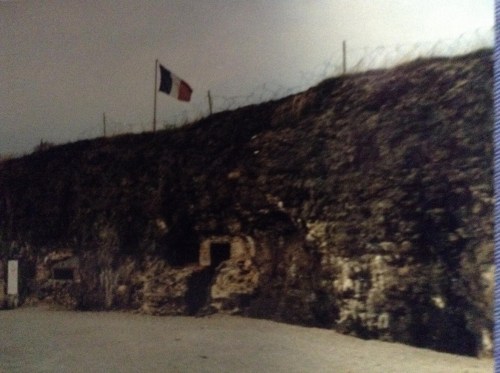
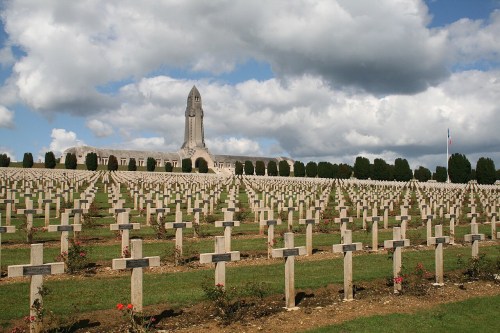
Fort Vaux, Verdun France, 1984

Friends of Padre Steve’s World,

Many Americans are infatuated with the Second World War. I think this is because it is closer to us and how it has been recorded in history and film. I think much of this is due to the resurgence of popular works such as Tom Brokaw’s The Greatest Generation, Stephen Ambrose’s Band of Brothers and the associated classic mini-series, and Steven Spielberg’s cinema classic Saving Private Ryan. Of course there were many other books and films one World War Two that came out even during the war that made it an iconic event in the lives of Americans born in the 1940s, 1950s, and 1960s. In fact I have many of the books and videos in my library.

But as pervasive as is the literary and filmography of the Second War War remains, the fact is that the First World War is much more important in a continuing historical sense than the Second World War. Edmond Taylor, the author of the classic account The Fall of the Dynasties: 1905-1922 wrote:

“The First World War killed fewer victims than the Second World War, destroyed fewer buildings, and uprooted millions instead of tens of millions – but in many ways it left even deeper scars both on the mind and on the map of Europe. The old world never recovered from the shock.”

First World War is far too often overlooked in our time, yet it was the most important war in the effects that still resonate today. One cannot look at the Middle East, Africa, the Balkans, or Eastern Europe without recognizing that fact. A similar case can be made in Asia where Japan became a regional power capable of challenging the great powers in the Pacific by its participation on the side of the Allies in that war. The same is true of the United States, although in the aftermath of the war it retreated into a narcissistic isolationism that took Japan’s attack on Pearl Harbor to break.

But I digress. The purpose I have tonight it to recommend some books and films that I think are helpful in understanding just how important the First World War remains to us today.

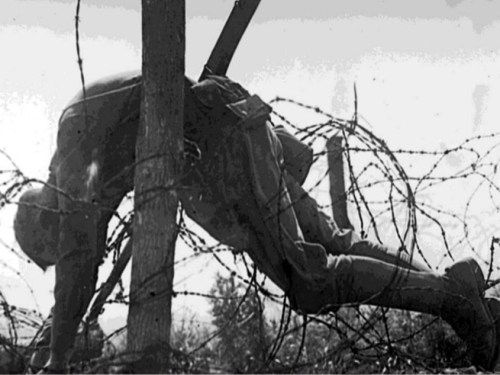
I made my first visit to a World War One battlefield when I went to Verdun in 1984. I was a young Army Second Lieutenant, preparing myself for time time that the Red Army would attack across the Fulda Gap. The walk around the battlefield was one of the most sobering events of my life. It was hard to imagine that a minimum of 700,000 German and French soldiers were killed or wounded on this relatively small parcel of ground over a period of nine months in 1916. The fact that many parts of the battlefield are off limits to visitors due to the vast amount of unexploded ordnance and persistent chemical agents, in this gas Mustard Gas also made an impression on me. But what affected me most was unearthing a bone fragment as I shuffled my feet near Fort Vaux and turning it over to a docent. I am sure that it was added to the Ossuary which contains the skeletal remains of over 130,000 French and German soldiers. It is hard to forget.

Barbara Tuchman wrote:

“Books are the carriers of civilization. Without books, history is silent, literature dumb, science crippled, thought and speculation at a standstill. Without books, the development of civilization would have been impossible. They are engines of change (as the poet said), windows on the world and lighthouses erected in the sea of time. They are companions, teachers, magicians, bankers of the treasures of the mind. Books are humanity in print.”

The literature that came out of the First World War by participants or observers, either as memoirs, works of fiction, or poems is impressive. Likewise the volumes chronicled by soldiers which influenced later military strategic, operational, and tactical developments between the World Wars remains with us today. In fact the military works still remain the basis for much of the current understanding of combined arms, counterinsurgency, and mission command doctrine.

More importantly, and perhaps less appreciated by policy makers and strategists are the personal works of soldiers that fought the in the great battles along the western front during the war. For the most part, the soldiers who served on the Western Front, the Balkans, Italy, and the Eastern Front are part of an amorphous and anonymous mass of people who simply became numbers during the Great War, thus the individual works of men like John McRea, Sigfried Sassoon, Erich Maria Remarque, Winfried Owen, Ernst Junger, Erwin Rommel, and even Adolf Hitler, are incredibly important in understanding the war, the ideology, and the disappointment of the men who served in the trenches. This applies regardless of the particular writer’s experience or political ideology.

The fact is that very few men who served on the ground in Europe reached the distinction of individual recognition is remarkable. More often those who achieved fame as relatively low ranking individuals were the Knights of the Air, the aviators who in individual combat above the trenches were immortalized by friend and foe alike. These men were represented as an almost mythological portrait of chivalry in a war where millions of men died anonymously, riddled by machine gun fire, artillery, and poison gas in mud saturated ground, trenches, and no man’s land. There are war cemeteries in France and Belgium where the majority of those interred are unknowns. On the Eastern Front, even those cemeteries and memorials are sparse, swallowed by war, shifting borders, and massive forced population migrations between 1918 and 1948.

For different reasons the books and poems written by the otherwise anonymous soldiers in Europe are important if we are to understand the world that we have inherited and must live in today. The same is true of men like T. E. Lawrence who served in the Middle East, or his East African counterpart, the German Paul von Lettow-Vorbeck. Both of them made their names by conducting inventive campaigns using indigenous irregular soldiers to tie down and defeat far stronger opponents.

Histories and biographies written about the period by later historians using the documents and words of the adversaries, as well as solid hermeneutics and historiography are also quite important. So are the analysis of economists, sociologists, psychologists, philosophers, and even theologians as to the effects of the war on us today, but I digress.

Tonight I will list a number of books, poems, and films that I think are important in interpreting the Great War, especially, in trying to understand just how the men who directed and fought that war set the stage for today.

Lawrence’s “Seven Pillars of Wisdom” as well as many of his post-war letters, articles, and opinion pieces help us understand the current Middle East through the lens of a brilliant but deeply troubled man. Remarque, Sassoon, McRea, Junger, Owen, and Hitler help us to understand the ideology, motivations, fears, and hopes of men on different sides and even very different ideological and political points of view. Now I would not recommend Hitler’s poorly written, turgid, almost unreadable, and hate filled book to anyone but a scholar of the period or biographer the the Nazi dictator.

Later historians Barbara Tuchman, Holger Herweg, Edmond Taylor, Richard Watt, and Robert Massie help us understand that bigger picture of international politics, intrigue, and strategy. Lest to be trusted, are the memoirs of high ranking men of any side who helped to write, and re-write the history of the war and its aftermath in order to bolster their own historical credibility. The same is true of the men who urged on war in 1914 and retreated from that in 1918 as if they had never heard of the war.

As for the books that came out of the war I would have to recommend Lawrence’s classic Seven Pillars of Wisdom, as well as articles, and letters, written by him available online at T. E. Lawrence Studies . Likewise, Remarque’s All Quiet on the Western Front is a classic account of a combat soldier with a distinct anti-war message. Junger’s Storm of Steel is also an account of a combat soldier who came out of the war but with a message completely different than Remarque’s. The poetry of the British Soldiers McRea, Sasson, and Owen is moving and goes to the heart of the war experience in a way that prose, no matter how well written cannot do.

Of the later histories I think that Taylor’s The Fall of the Dynasties, The Collapse of the Old Order, 1905-1922, Tuchman’s The Proud Tower: A Portrait of the World Before the War, 1890-1914 and The Guns of August, Christopher Clark’s The Sleepwalkers: How Europe Went to War In 1914, and Margaret McMillen’s The War that Ended Peace: The Road to 1914, are essential to understanding the events and conditions leading up to the war.

Herweg’s World War One and Massie’s Castles of Steel: Britain, Germany, and the Winning of the Great War at Sea are both good accounts of the war. Catastrophe 1914: Europe Goes to War by Max Hastings, and Home Before the Leaves Fall: A New History of the German Invasion of 1914, by Ian Senior, and Tannenberg: Clash of Empires by Dennis Showalter are excellent recent histories of the opening months of the war which are a good compliment to Tuchman’s The Guns of August.

Books about battles and campaign outside of the opening months and general histories of the war I have to admit that I have not read many. Most of the ones I have read deal with the ordeal and crisis of the French Army in 1916 and 1917. Alistair Horne’s The Price of Glory: Verdun 1916, Richard Watt’s Dare Call it Treason, and David Murphy’s The Breaking Point of the French Army: The Neville Offensive of 1917 document the valor, sacrifice, and near collapse of the French Army.

A book that is focuses on the American military in the war and how it helped change American society is Jennifer Keene’s Doughboys: The Great War and the Making of American Society.

A book that I found interesting was Correlli Barnett’s The Sword-bearers: Supreme Command in the First World War. The book provides short biographies of the lives and influences of German Field Marshal Von Moltke, British Admiral Jellicoe, French General Petain, and German General Ludendorff. It is a good study in command. Another biography that I recommend is

As for the war at sea, I recommend Edwin Hoyt’s The Last Cruise of the Emden, R. K. Lochner’s The Last Gentleman of War: The Raider Exploits of the Cruiser Emden, Geoffrey Bennett’s Coronel and the Falklands, Holger Herweg’s Luxury Fleet: The Imperial German Navy, 1888 – 1918 in addition to Massie’s Castle’s of Steel, of which the latter is probably the best resource for the naval aspects of the war.

A couple of books that deal with the often overlooked campaign in East Africa are Lettow Von Vorbeck’s My Reminiscences of East Africa, and Königsberg: A German East Africa Raider by Kevin Patience shed light on this obscure but important campaign.

Erwin Rommel’s Infanterie Greift An (Infantry Attacks) is quite possibly the best book on tactics and operational methods published by a participant. Likewise, the the British historians and theoreticians B. H. Liddell-Hart and J. F. C. Fuller, and German Panzer theorist and Commander Heinz Guderian, who also served on the front produced a number of volumes which influenced later strategic and operational advancements which are still in evidence today.

Watt’s The Kings Depart: The Tragedy of Germany: Versailles and the German Revolution is a necessity if one is to understand the rise of the Nazi State. Likewise, a good resource of the deliberations leading to the Treat of Versailles is Margaret McMillen’s 1919: Six Months that Changed the World. Related to this is the very interesting account of the scuttling of the interred German High Seas Fleet at Scapa Flow in the aftermath of Versailles, The Grand Scuttle: The Sinking of the German Fleet at Scapa Flow In 1919 by Dan Van der Vat.

One work of fiction that I can recommend is The General by C. S. Forester.

I am sure that there are many other volumes that others could recommend, but these are mine.

In an age where there are many parallels to the years leading up to the Great War, it is important not to forget just how catastrophic such a war can be.

So until tomorrow,

Peace,

Padre Steve+

1 Comment

Filed under books, books and literature, History, leadership, middle east, Military, News and current events, world war one

The Armistice Day Centenary: A Day of Conscience

Friends of Padre Steve’s World,

Forty years after the guns went silent in on November 11th 1918, General Omar Bradley, spoke these words on the eve of Armistice Day, 1948:

Tomorrow is our day of conscience. For although it is a monument to victory, it is also a symbol of failure. Just as it honors the dead, so must it humble the living. Armistice Day is a constant reminder that we won a war and lost a peace…”

It was supposed to be the “War to end all war,” or so thought President Woodrow Wilson and other American idealists. However, the war to end all war birthed a series of wars which far exceeded the losses of the First World War as ideological wars, exponentially more powerful weapons, and systematized mass murder and genocide birthed new horrors.

Winston Churchill wrote:

“The Great War differed from all ancient wars in the immense power of the combatants and their fearful agencies of destruction, and from all modern wars in the utter ruthlessness with which it was fought. … Europe and large parts of Asia and Africa became one vast battlefield on which after years of struggle not armies but nations broke and ran. When all was over, Torture and Cannibalism were the only two expedients that the civilized, scientific, Christian States had been able to deny themselves: and they were of doubtful utility.”

In the First World War there were over 22 million military casualties including over 8 million dead of which over 126,000 were Americans. Close to 20 million civilians also were casualties of the war.

President Woodrow Wilson established what we know now as Veteran’s Day as Armistice Day in November 1919, a year after the guns went silent.

Wilson wrote:

To us in America, the reflections of Armistice Day will be filled with solemn pride in the heroism of those who died in the country’s service and with gratitude for the victory, both because of the thing from which it has freed us and because of the opportunity it has given America to show her sympathy with peace and justice in the councils of the nations…

That initial proclamation was followed 45 years later by one of President Dwight D. Eisenhower. Eisenhower signed into law what we now know as Veteran’s Day in 1954.

In a sense I wish we had two holidays, one for Veterans from all wars in general and this one which we should never forget. It seems that in combining them we have lost some of the sacredness of the original. As Kurt Vonnegut wrote: “I don’t want to throw away any sacred things.” 

Because of that, I will remember all who served tomorrow as we observe Veterans Day, but I will not forget Armistice Day.

It is important not to forget the horrors and results of the First World War because both it and the Second World War, have faded from memory. Most people today cannot fathom killing on such a large scale, the overthrow of powerful nations and dynasties, the creation of new nations built from diverse, and often rival ethnic and religious groups such as Czechoslovakia and Yugoslavia, or the re-establishment of ancient nations such as Poland.

Yet to those of us who have gone to war and studied past wars the end result is not so distant. It is a part of our lives even today. Edmond Taylor accurately noted in his book, The Fall of the Dynasties: The Collapse of the Old Order, 1905-1922:

“The First World War killed fewer victims than the Second World War, destroyed fewer buildings, and uprooted millions instead of tens of millions – but in many ways it left even deeper scars both on the mind and on the map of Europe. The old world never recovered from the shock.”

The cost in human lives alone is incomprehensible. In the short time that United States forces went into action in late 1917 on the western front and the armistice, 126,000 Americans were killed, 234,000 wounded, and 4,500 missing; 8.2% of the force of 4,355,000 the nation mobilized for war. More Americans were killed in the First World War than Korea, Vietnam, the Gulf War, Iraq, and Afghanistan combined.

But American losses were small in comparison with the European nations who had for over four years bled themselves dry.  If one wonders why Europeans seem to have so little desire for involvement in war, one only needs to see how the concentrated killing of the First World War decimated the best and brightest of that generation. Out of the nearly 8.5 million Frenchmen mobilized lost 1,357,000 killed, 4,266,000 wounded and 537,000 missing, 6,160,000 casualties or 73.3% of its forces. The Russians also lost over 73% of 12 million, Romania 71% of 750,000, Germany 65% of 11 million, Serbia 47% of 707,000, tiny Montenegro 40% of 50,000, Italy 39.9% of 5.6 million, Great Britain 36% of almost 9 million, the Ottoman Empire 34% of 8.5 million. But the dual monarchy of Austria-Hungary which began the war in response to the assassination of Archduke Franz Ferdinand lost 90% of the 7.8 million men that it sent to war.

The human costs were horrifying. In all over over 65 million men served under arms in the war. Over 8.5 million were killed, over 21 million wounded, 7.75 million missing or prisoners or almost 37.5 million military casualties alone. That total would be roughly equivalent to every citizen of the 30 largest American cities being killed, wounded or missing.

Much of Europe was devastated and in the following months and years, mass numbers of refugees the dissolution of previously stable empires were displaced. A Civil War in Russia killed many more people and led to the establishment of the Soviet Union. Germany too was torn apart by civil war that left it bitterly divided and planted the seeds of Hitler’s Nazi regime. Border conflicts between new states with deep seated ethnic hatreds broke out. A flu pandemic spread around the world killing millions more. Economic disasters culminating in the Great Depression and social instability led to the rise of totalitarian regimes which spawned another, even more costly World War and a 40 year Cold War. The bitter results of the First World War are still felt today as conflicts in the Middle East in part fueled by the decisions of Britain and France at the end of the war rage on.

T. E. Lawrence, Lawrence of Arabia, who gained fame during the Arab revolt looked at the results of the war with a great deal of melancholy. He wrote:

“We were fond together because of the sweep of open places, the taste of wide winds, the sunlight, and the hopes in which we worked. The morning freshness of the world-to-be intoxicated us. We were wrought up with ideas inexpressible and vaporous, but to be fought for. We lived many lives in those whirling campaigns, never sparing ourselves: yet when we achieved and the new world dawned, the old men came out again and took our victory to remake in the likeness of the former world they knew. Youth could win, but had not learned to keep, and was pitiably weak against age. We stammered that we had worked for a new heaven and a new earth, and they thanked us kindly and made their peace.”

The his epic war poem, In Flanders Fields, Canadian Lieutenant Colonel John McCrea symbolized the cost of that war and the feelings of the warriors who endured its hell.

In Flanders fields the poppies blow
Between the crosses, row on row,
That mark our place; and in the sky
The larks, still bravely singing, fly
Scarce heard amid the guns below.

We are the Dead. Short days ago
We lived, felt dawn, saw sunset glow,
Loved and were loved, and now we lie
In Flanders fields.

Take up our quarrel with the foe:
To you from failing hands we throw
The torch; be yours to hold it high.
If ye break faith with us who die
We shall not sleep, though poppies grow
In Flanders fields.

Yes there are always consequences to actions. This weekend as we remember what we Americans now call Veteran’s Day, and the British refer to as Remembrance Day let us blood shed by so on the battlefields of Verdun, Gallipoli, Caporetto, Passchendaele, the Marne, the Argonne, Tannenberg, the Somme, Galicia, the Balkans, Flanders Fields, at sea and in the air.

President John F. Kennedy said: “As we express our gratitude, we must never forget that the highest appreciation is not to utter words, but to live by them.”

Kennedy was right, that our appreciation is not just to utter words, but to live by them. Sadly, the current American President has no understanding of such nuances. He continued thump his chest and spit in the face of allies while, courting nations hostile to the very ideals of the United States. Likewise, the President, a man who never served in the military, and spent the Vietnam War avoiding service and dodging the draft while later comparing avoiding sexuality transmitted diseases to combat again dishonored the men who spilt their blood in the First World War. Donald Trump does not understand anything about history, war, courage, or honor. Sadly, he is all too representative of a generation that neither knows or cares about those things. He and others like him will be the ones that lead the world into another disaster.

“Strong prejudices in an ill-formed mind are hazardous to government, and when combined with a position of power even more so.”

I write in the hope of peace and an end to war.

Peace,

Padre Steve

4 Comments

Filed under History, Military, national security, Political Commentary, world war one

People Matter Most: History, Biography, and Truth

Friends of Padre Steve’s World,

Today has been a very difficult day that I cannot write about here at this time. Eventually I will write about it, but tonight I will re-post an older article about how I try to write history.

Until tomorrow,

Peace,

Padre Steve+

English historian and military theorist Colin Gray noted that “people matter most” when we deal with history, policy, or politics, but especially in the matter of war.

I think one of the sad things about history is that many authors, especially in military history, but other areas as well, seem to treat the participants as bit players in a series of events, rather than a prism from which to understand and view history.

I cannot tell you how many times I have had students, and even colleagues tell me that history is dry, boring and uninteresting to them. I will not condemn them, for certainly if it is that is case, it is not their fault, but rather those who write and teach history. If all history is, is arbitrary dates, lists of disconnected events and names of people, without any context to their lives, why should they care about it?

When I first began to study history I was much more concerned about events than people. However, over the past couple of years I have began to develop what I call my philosophy of history. That has come about through my study of the events leading to the American Civil War and in particular my study of the Battle of Gettysburg, but also in other historical events such as the Arab Revolt of 1917, and the French adventures in Indochina and Algeria.

In doing all of my research I have read a large number of books, articles and primary sources on these subjects and my personal library appears to be growing at an exponential rate. I have noticed that much of what I have read deals very little with the people involved, unless I am reading a biography, and even some of the biographies seem to be event heavy, and person light and sometimes it seems that the subjects of the biography are often one dimensional, and almost caricatures of who they really were. Some of the alleged biographies that I read would be better described as hagiography, to make the subjects appear saintlike, the type of writing used by religious writers to make saints a lot less human. There are others who go to the opposite extreme and do all they can to demonize their subject. In either case the method is less than honest, but for many people, profit and propaganda value mean more than truth. Of course either type of writing appeals to the masses who do not care about nuance, or for that matter truth.

But such is not history. Neither are “histories” which are designed to support a particular ideology, be it political, religious, or economic. Such works are not history, but propaganda. When I see people, in this country forbidding the teaching of history because it is not patriotic enough I want to scream. It is like I am watching the propagandists of Stalin’s Soviet Union, Hitler’s Third Reich, or any of many other nations that used ideology or religion to supress history that didn’t meet their definition of “patriotic.” But then I digress…

My gut feeling says that such artificial divisions between history and biography do a disservice to the reader. I take a tremendous pleasure in writing, and I like to try to communicate and interpret facts, which is indeed the vocation of the historian, in a manner that makes them interesting. What I am finding is that when telling the stories of events we must also tell the stories of the people who make these events.

Without such a connection there is little to interest most readers. People tend to be interested in people because there is a connection. The human being is still the human being, no matter what age, country, culture, religion that they belong to. I learned a lot of this from reading the works of Barbara Tuchman who in her writings about events, never forgot importance of people, and refused to turn them in to one dimensional caricatures.

In my writing now I attempt to bring the prism of the biography into the events that I write about.

I had a fellow faculty member note that he liked what I wrote about Gettysburg because it was more than just the events, it was the personal connection he felt to the people.

People matter because they have so many layers. I guess one of the things that makes my writing approach a bit different is that while I am a historian, I am also trained in philosophy, pastoral care and psychology, all of which deal with existential matters.In the next few days you will be seeing some of my Gettysburg work, and hopefully as you read it you will notice that I attempt to find that nuance in the various men, on both sides of the conflict, who are part of the story.

I found that the complexities and contradictions of the subjects of history, the people help me understand the events more than anything. I think my epiphanies came in reading about the lives, as well at writings of men like T.E. Lawrence and Gouvereur Warren whose triumphs, struggles, weaknesses and injuries mirror my own. In learning about these men as people, in the context of what they accomplished helps me to understand their history and the era that they lived far more than simply recounting how they influenced a battle.

Likewise, I find that the lives, beliefs, motivations, relationships, and experiences of people to be paramount to understanding events. People are complex, multi-layers and often contradictory. All of my heroes all have feet of clay, which in a sense makes their stories even richer, and the events that they helped bring about more fascinating, because then I gain a holistic perspective and develop an empathy for them. Even good and honorable people who find themselves due to race, religion, or nationality fighting for an evil cause, or evil people fighting for a good cause. If you are trapped by ideological or religious certitude that may confuse or even offend you, but it is a part of the human condition. That my friends is history.

Barbara Tuchman noted “that if the historian needs to submit himself to his or her material instead of trying to impose himself on his material, then the material will ultimately speak to him and supply the answers.”

This is very important, because when we do this we discover the answers to the why questions, especially the why questions that are so very uncomfortable, are necessary if we want to discover truth.

I know that I can find connections in the strengths as well as their weaknesses of people that I admire. Thus when I see ordinary people taking part in events, for good or for evil,I can say that given the same set of circumstances that that could be me. Context matters, nuance matters, people matter. If we do not understand that, history becomes nothing more than a set of manipulated facts, devoid of context that can be used to buttress the most evil intentions.

I do plan on developing these thoughts over the coming weeks and months, but for now it will suffice to say that when I write about history, that people matter. That is why I write.

2 Comments

Filed under History, philosophy

“On History’s Clock it was Sunset” a Reflection on the Funeral of Senator John McCain

Friends of Padre Steve’s World,

Senator John McCain’s memorial service in the Capitol, his funeral at rites at Washington’s National Cathedral, and his burial at the United States Naval Academy in Annapolis marked the end of an age that he symbolized. McCain had an outsized influence around the world for a United States Senator. As Senators go it is hard to find one with his moral, and political influence around the world. I think that maybe we would have to go back to Senator Henry “Scoop” Jackson to find one with his influence abroad.

Likewise, one has to go back far longer to find a Senator who could oppose a malignant President of his own political party as did McCain oppose Donald Trump. Barry Goldwater facing off with Richard Nixon in 1974 is one, but I think the most similar comparison with with Senator Stephen Douglas who stood up to James Buchanan in 1857 and 1858.

Though McCain was a flawed man, something that he readily acknowledged, he was an honorable man. Like Abraham Lincoln, McCain believed that the soul of America, its found in the principles of the Declaration of Independence. This was a document that both men based their lives in understanding the full meaning: those principles were not just limited to white male property owners as was the case in 1776, but extended beyond that, to every American, and for that matter every human being.

We hold these truths to be self evident, that all men are created equal, that they are endowed by their Creator with certain unalienable Rights, that among these are Life, Liberty and the pursuit of Happiness.–That to secure these rights, Governments are instituted among Men, deriving their just powers from the consent of the governed…

McCain understood that in terms of human rights, the environment, civil rights, and a respect for the underlying philosophical, religious, and legal principles that are the foundation of free societies everywhere. But now, in the United States and around the world those foundational principles are under attack from power hungry autocrats. Sadly they are led by the man whose name was unmentioned at his funeral but whose malignant presence was felt overwhelming by many who were there or who watched it, President Donald Trump.

Some attendees and others recorded that they momentarily felt that perhaps what has been lost will be recovered. But within hours most realized that this was not just a funeral for John McCain, it was a funeral for what America was and will likely never be again regardless of how the Trump presidency ends. The malevolent forces that he has unleashed were already there in the United States and in many other countries, but they were held in check until a leader unbound by the principles of the Declaration, without respect for law, without appreciation for the unwritten codes of morality, political, and civil behavior that are essential for the maintenance of a republic like ours became President.

In a sense the election of Donald Trump opened wide the gates of Hell, to the worst aspects of human behavior. If Donald Trump was to choke on a chicken wing while raving at a cable news host while tweeting and die, the damage would not only be done, but it would continue until those who would “support him even if he killed someone on 5th Avenue” are defeated at the polls, driven from power, and shamed into a sense of normalcy as were the Germans after Hitler’s Thousand Year Reich was overthrown. America will survive, we may even return to our founding principles, but it will not be without much pain, much sacrifice, and the loss of many things that we currently hold dear.

Thus when I read a column today that mentioned that McCain’s funeral was also a funeral for what we have lost I began to think about the opening chapter of Barbara Tuchman’s classic work The Guns of August. In that chapter Tuchman recounted the funeral of Britain’s King Edward VII in 1910, four years before the beginning of the First World War. She wrote:

SO GORGEOUS WAS THE SPECTACLE on the May morning of 1910 when nine kings rode in the funeral of Edward VII of England that the crowd waiting in hushed and black-clad awe, could not keep back gasps of admiration. In scarlet and blue and green and purple, three by three the sovereigns rode through the palace gates, with plumed helmets, gold braid, crimson sashes, and jeweled orders flashing in the sun. After them came five heirs apparent, forty more imperial or royal highnesses, seven queens—four dowager and three regnant—and a scattering of special ambassadors from uncrowned countries. Together they represented seventy nations in the greatest assemblage of royalty and rank ever gathered in one place and of its kind the last. The muffled tongue of Big Ben tolled nine by the clock as the cortege left the palace, but on history’s clock it was sunset, and the sun of the old world was setting.

At the end of the chapter Tuchman wrote:

Along Whitehall, the Mall, Piccadilly, and the Park to Paddington Station, where the body was to go by train to Windsor for burial, the long procession moved. The Royal Horse Guards’ band played the “Dead March” from Saul. People felt a finality in the slow tread of the marchers and in the solemn music. Lord Esher wrote in his diary after the funeral: “There never was such a break-up. All the old buoys which have marked the channel of our lives seem to have been swept away.”

Until tomorrow,

Peace,

Padre Steve+

1 Comment

Filed under culture, ethics, faith, History, leadership, News and current events, Political Commentary

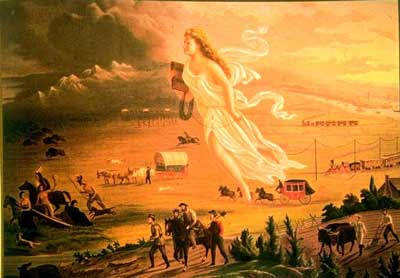
The Lingering Presence of Manifest Destiny in Trump’s America First Message

Manife4

Manifest Destiny

Friends of Padre Steve’s World,

This is a part of my yet to be published book, Mine Eyes Have Seen the Glory: Race, Religion, and Ideology in the Civil War Era.  I have posted it before, but as I watch what is going on in the world and President Trump’s militantly isolationist America First foreign policy which often uses the words and images of Manifest Destiny and American Exceptionalism I thought it might be good to post it again.

That past was mythologized in American history and popularized often on film and in print. Since the President admits that does little reading and engages in less critical thought it is obvious that most of what he knows of American history comes from the mythologized past.  This includes the concept of Manifest Destiny and American Exceptionalism. These concepts are the result of a racially and religiously based glorification of imperialistic conquest that resulted in the extermination or enslavement of millions of people in North America, as well as in the Philippines, Mexico, Central America and the Caribbean.

When you have a President of such limited historical knowledge who represents a party controlled by hyper-political religionists who are convinced that God is with them it portends trouble. As true Conservative icon Barry Goldwater once noted:

“Mark my word, if and when these preachers get control of the [Republican] party, and they’re sure trying to do so, it’s going to be a terrible damn problem. Frankly, these people frighten me. Politics and governing demand compromise. But these Christians believe they are acting in the name of God, so they can’t and won’t compromise. I know, I’ve tried to deal with them.” (November, 1994, in John Dean, Conservatives Without Conscience.)

While the President himself shows little evidence of actually believing in any God but himself he certainly does relish the accolades of these political creatures who call themselves Christian preachers. Goldwater in his later years exhibited a certain insight into the dangers of the movement that has taken over the GOP.

Until tomorrow,

Peace,

Padre Steve+

Manifest Destiny and American Exceptionalism

The foreign policy of the United States nearly always reflects to one degree or another a quasi-religious belief in the continued importance of the United States in spreading democracy around the world.

The United States was an anomaly among western nations in the early 1800s. During that time the percentage of people in Europe who were active churchgoers was shrinking and the number of skeptics rising as the industrial revolution, and advances in science, and the philosophies and theology of classic Liberalism permeated the elites of the continent. But in the United States, the situation was different. The Second Great Awakening helped shape and define the purpose of the nation, and by the “mid-nineteenth century, from North to South, was arguably Christendom’s most churchgoing nation, bristling with exceptionalist faith and millennial conviction.” [1] This was especially true of American Protestantism were “church attendance rose by a factor of ten over the period 1800 to 1860, comfortably outstripping population growth. Twice as many Protestants went to church at the end of this period as the beginning.” [2]

This exceptionalist faith kindled a belief in the nation’s Manifest Destiny in large part was an outgrowth of the Second Great Awakening which was particularly influential among the vast numbers of people moving into the new western territories. As people moved west, Evangelical religion came with them, often in the form of vast revival and camp meetings which would last weeks and which would be attended by tens of thousands. The first of these was at Cane Ridge Kentucky in 1801, organized by a Presbyterian others, including Baptists and Methodists joined in the preaching, and soon the revivals became a fixture of frontier life and particularly aided the growth of the Methodist and Baptists who were willing to “present the message as simply as possible, and to use preachers with little or no education,” [3] and which soon became the largest denominations in the United States. These meetings appealed to common people and emphasized emotion rather than reason. Even so the revivals “not only became the defining mark of American religion but also played a central role in the nation’s developing identity, independence, and democratic principles.” [4]

The West came to be viewed as a place where America might be reborn and “where Americans could start over again and the nation fulfill its destiny as a democratic, Protestant beacon to inspire peoples and nations. By conquering a continent with their people and ideals, Americans would conquer the world.” [5] The westward expansion satiated the need for territorial conquest and the missionary zeal to transform the country and the world in the image of Evangelical Christianity.

The man who coined the term “Manifest Destiny,” New York journalist John O’Sullivan a noted that “Manifest Destiny had ordained America to “establish on the earth the moral dignity and salvation of man,” to disseminate its principles, both religious and secular abroad,” [6] and New York Journalist Horace Greely issued the advice, “Go West, young man” which they did go, by the millions between 1800 and 1860.

But the movement also had a dark side. Americans poured westward first into the heartland of the Deep South and the Old Northwest, then across the Mississippi, fanning westward along the great rivers that formed the tributaries of the new territories. As they did so, the “population of the region west of the Appalachians grew nearly three times as fast as the original thirteen states” and “during that era a new state entered the Union on the average of three years.” [7]

The combination of nationalism fueled by Evangelical religion was combined with the idea from revolutionary times that America was a “model republic” that could redeem the people of the world from tyranny,” [8] as well an ascendant rational nationalism based on the superiority of the White Race. This, along with the belief that Catholicism was a threat to liberty was used as reason to conquer Mexico as well as to drive Native Americans from their ancestral homes. “By 1850 the white man’s diseases and wars had reduced the Indian population north of the Rio Grande to half of the estimated million who had lived there two centuries earlier. In the United States all but a few thousand Indians had been pushed west of the Mississippi.” [9] The radical racism used pseudo-scientific writings to “find biological evidence of white supremacy, “radical nationalism” cast Mexicans as an unassimilable “mixed “race “with considerable Indian and some black blood.” The War with Mexico “would not redeem them, but would hasten the day when they, like American Indians, would fade away.” [10]

Manifest Destiny and American Foreign Policy

Just as the deeply Evangelical Christian religious emphasis of Manifest Destiny helped shape American domestic policy during the movement west, it provided similar motivation and justification for America’s entry onto the world stage as a colonial power and world economic power. It undergirded United States foreign policy as the nation went from being a continental power to being an international power; claiming as Hawaii, and various former Spanish possessions in 1890s, and which would be seen again in the moralizing of Woodrow Wilson in the years leading up to America’s entry into World War One.

The belief in Manifest Destiny can still be seen in the pronouncements of American politicians, pundits, and preachers who believe that that this message is to be spread around the world. Manifest Destiny is an essential element of the idea of American Exceptionalism which often has been the justification for much recent American foreign policy, including the Freedom Agenda of former President George W. Bush. Bush referenced this during his 2003 State of the Union Address, “that freedom is the right of every person and the future of every nation. The liberty we prize is not America’s gift to the world, it is God’s gift to humanity.” [11] Bush frequently used language in his speeches in which biblical allusions were prominent in justifying the morality of his policy, and by doing this “Bush made himself a bridge between politics and religion for a large portion of his electorate, cementing their fidelity.” [12]

Throughout the Bush presidency the idea that God was directing him even meant that his faith undergirded the policy of the United States and led to a mismatch of policy ends and the means to accomplish them. Former Israeli Ambassador to the U.S. and historian Michael Oren wrote:

“Not inadvertently did Bush describe the struggle against Islamic terror as a “crusade to rid the world of evildoers.” Along with this religious zeal, however, the president espoused the secular fervor of the neoconservatives…who preached the Middle East’s redemption through democracy. The merging of the sacred and the civic missions in Bush’s mind placed him firmly in the Wilsonian tradition. But the same faith that deflected Wilson from entering hostilities in the Middle East spurred Bush in favor of war.” [13]

Policy makers and military leaders must realize that if they want to understand how culture and religious ideology drive others to conquer, subjugate and terrorize in the name of God, they first have to understand how our ancestors did the same thing. It is only when they do that that they can understand that this behavior and use of ideology for such ends is much more universal and easier to understand.

One can see the influence of Manifest Destiny abroad in a number of contexts. Many American Christians became missionaries to foreign lands, establishing churches, colleges, schools, and hospitals in their zeal to spread the Gospel. As missionaries spread across the globe, American policy makers ensured their protection through the presence of the United States Navy, and missionaries frequently called upon the United States Government for help and the naval strength of the United States during the period provided added fuel to their zeal. In 1842, Dabney Carr, the new American ambassador to the Ottoman Empire“declared his intention to protect the missionaries “to the full extent of [his] power,” if necessary “by calling on the whole of the American squadron in the Mediterranean to Beyrout.” [14] Such episodes would be repeated in the Middle East, Asia, the Pacific, and Central America over and over again until the 1920s.

The White Man’s Burden, Imperialism, Business, and Faith: Manifest Destiny and the Annexation of the Philippines

If one wants to see how the use of this compulsion to conquer in the name of God in American by a national leader one needs to go no farther than to examine the process whereby President McKinley, himself a veteran of the Civil War, decided to annex the Philippine in 1898 following the defeat of the Spanish. That war against the Filipinos that the United States had helped liberate from Spanish rule saw some of the most bloodthirsty tactics ever employed by the U.S. Army to fight the Filipino insurgents. The Filipino’s who had aided the United States in the war against Spain were now being subjugated by the American military for merely seeking an independence that they believed was their right. While the insurgency was suppressed in a violent manner and American rule was established, some Americans came to see the suppression of the Filipino’s as a stain on our national honor which of which Mark Twain wrote: “There must be two Americas: one that sets the captive free, and one that takes a once-captive’s new freedom away from him, and picks a quarrel with him with nothing to found it on; then kills him to get his land. . .” [15]

William McKinley was a cautious man, and after the United States had defeated the Spanish naval squadron at Manila Bay and wrestled with what to do with the Philippines. McKinley was a doubtless sincere believer, and according to his words, he sought counsel from God about whether he should make the decision to annex the Philippines or not. For him this was not a mere exercise, but a manifestation of his deep rooted faith which was based on Manifest Destiny. Troubled, he sought guidance, and he told a group of ministers who were vesting the White House:

“Before you go I would like to say a word about the Philippine business…. The truth is I didn’t want the Philippines, and when they came to us as a gift from the gods, I did not know what to do with them…. I sought counsel from all sides – Democrat as well as Republican – but got little help…. I walked the floor of the White House night after night until midnight; and I am not ashamed to tell you, gentlemen, that I went down on my knees and prayed Almighty God for guidance more than one night. And late one night it came to me this way – I don’t know how it was but it came….” [16]

He then went on to discuss what he supposedly heard from God, but reflected more of a calculated decision to annex the archipelago. He discussed what he believed would be an occupation of just a few islands and Manila, ruled out returning them to Spain as that would be “dishonorable,” ruled out turning them over to France or Germany because “that would be bad for business,”or allowing Filipino self-rule, as “they were unfit for self-government.”[17] The last was a reflection of the deep-rooted opinion of many Americans that the dark skinned Filipinos were “niggers.”

Barbara Tuchman described McKinley’s comments to the ministers:

“He went down on his knees, according to his own account, and “prayed to Almighty God for light and guidance.” He was accordingly guided to conclude “that there was nothing left to do for us but to take them all, and to educate the Filipinos. And uplift and civilize and Christianize them, by God’s grace to do the very best we could by them, as our fellowmen for whom Christ died.” [18]

But the result, regardless of whether McKinley heard the voice of God, or took the advice of advisers with imperialist, business, or religious views, he made the choice to annex the Philippines, believing it to be the only rational course of action, and something that he could not avoid. In a sense McKinley, of who Barbara Tuchman wrote “was a man made to be managed,” and who was considered spineless by Speaker of the House Thomas Reed who said “McKinley has no more backbone than a chocolate éclair.” [19] It appears that McKinley was more convinced by the arguments of those who desired to annex the Philippines for military reasons, a business community which saw the islands as a gateway to the markets of Asia, and by Protestant clergy, who saw “a possible enlargement of missionary opportunities.”[20] He rejected a proposal by Carl Schurz who urged McKinley to “turn over the Philippines as a mandate to a small power, such as Belgium or Holland, so the United States could remain “the great neutral power in the world.” [21]The combination of men who desired the United States to become an imperialist and naval power, business, and religion turned out to be more than McKinley could resist, as “the taste of empire was on the lips of politicians and business interests throughout the country. Racism, paternalism, and the talk of money mingled with the talk of destiny.” [22] Though there was much resistance to the annexation in congress and in the electorate, much of which was led by William Jennings Bryant, but which crumbled when Bryant with his eyes on the Presidency embraced imperialism.

The sense of righteousness and destiny was encouraged by magazine publisher S.S. McClure, who published a poem by Rudyard Kipling addressed to Americans debating the issue entitled The White Man’s Burden:

Take up the White Man’s burden–
Send forth the best ye breed–
Go bind your sons to exile
To serve your captives’ need;
To wait in heavy harness,
On fluttered folk and wild–
Your new-caught, sullen peoples,
Half-devil and half-child…

Take up the White Man’s burden–
The savage wars of peace–
Fill full the mouth of Famine
And bid the sickness cease…

Take up the White Man’s burden–
Ye dare not stoop to less–
Nor call too loud on Freedom
To 
cloke your weariness;
By all ye cry or whisper,
By all ye leave or do,
The silent, sullen peoples
Shall weigh your gods and you…
 [23]

McKinley’s decision and the passage of the peace treaty with Spain to acquire the Philippines sparked an insurrection led by Filipino revolutionary Emilio Aguinaldo who had been leading resistance to Spanish rule on the island of Luzon for several years prior to the American defeat of Spanish naval forces at the Battle of Manila Bay, and the subsequent occupation of Manila. The following war lasted nearly three years and was marked by numerous atrocities committed by American forces against often defenseless civilians and it would help to change the nature of the country. After American troops captured Manila, Walter Hines Page, the editor of the Atlantic Monthly believed that Americans would face greater challenges and difficulties in the coming years than they had known in previous years. He wrote:

“A change in our national policy may change our very character… and we are now playing with the great forces that may shape the future of the world – almost before we know it…. Before we knew the meaning of foreign possessions in a world ever growing more jealous, we have found ourselves the captors of islands in both great oceans; and from our home staying policy of yesterday we are brought face to face with world-wide forces in Asia as well as Europe, which seem to be working, by the opening of the Orient, for one of the greatest challenges in human history…. And to nobody has the change come more unexpectedly than ourselves. Has it come without our knowing the meaning of it?” [24]

Within the span of a few months, America had gone from a nation of shopkeepers to an imperial power, and most people did not realize the consequences of that shift. Manifest destiny and American Exceptionalism had triumphed and with it a new day dawned, where subsequent generations of leaders would invoke America’s mission to spread freedom and democracy around the world, as President George W. Bush said, “that freedom is the right of every person and the future of every nation. The liberty we prize is not America’s gift to the world, it is God’s gift to humanity.”

Notes

[1] Ibid. Phillips American Theocracy: The Peril and Politics of Radical Religion, Oil and Borrowed Money in the 21st Century p.143

[2] McGrath, Alister Christianity’s Dangerous Idea: The Protestant Revolution A History from the Sixteenth Century to the Twenty-First Harper Collins Publishers, New York 2007 p.164

[3] Gonzalez, Justo L. The History of Christianity Volume 2: The Reformation to the Present Day Harper and Row Publishers San Francisco 1985 p.246

[4] Ibid. McGrath Christianity’s Dangerous Idea: The Protestant Revolution A History from the Sixteenth Century to the Twenty-First p.164

[5] Goldfield, David America Aflame: How the Civil War Created a Nation Bloomsbury Press, New York, London New Delhi and Sidney 2011 p.5

[6] Ibid. Oren Power, Faith and Fantasy: America and the Middle East 1776 to the Present p130

[7] McPherson, James. The Battle Cry of Freedom: The Civil War Era Oxford University Press, Oxford and New York 1988 p.42

[8] Varon, Elizabeth R. Disunion! The Coming of the American Civil War 1789-1858 University of North Carolina Press, Chapel Hill NC 2008 p.183

[9] Ibid. McPherson The Battle Cry of Freedom: The Civil War Era p,45

[10] Ibid. Varon. Disunion! The Coming of the American Civil War 1789-1858p.183

[11] Bush, George W. State of the Union Address Washington D.C. January 28th2003 retrieved from Presidential Rhetoric.com http://www.presidentialrhetoric.com/speeches/01.28.03.html 10 June 2015

[12] Ibid. Phillips American Theocracy: The Peril and Politics of Radical Religion, Oil and Borrowed Money in the 21st Century p.252

[13] Oren, Michael Power, Faith and Fantasy: America and the Middle East 1776 to the Present W.W. Norton and Company, New York and London 2007 p.584

[14] Ibid. Oren Power, Faith and Fantasy: America and the Middle East 1776 to the Present p130

[15] Twain, Mark To the Person Sitting in Darkness February 1901 Retrieved from The World of 1898: The Spanish American War The Library of Congress http://www.loc.gov/rr/hispanic/1898/twain.html 12 December 2014

[16] Zinn, Howard A People’s History of the United States Harper Perennial, New York 1999 pp.312-313

[17] Ibid. Zinn A People’s History of the United States p.313

[18] Ibid. Tuchman Practicing History p.289

[19] Tuchman, Barbara The Proud Tower: A Portrait of the World Before the War, 1890-1914 Random House Trade Paperbacks Edition, New York 2008 originally published 1966 by McMillan Company. Amazon Kindle edition location 2807 of 10746

[20] Hofstadter, Richard The Paranoid Style in American Politics Vintage Books a Division of Random House, New York 1952 and 2008 p167

[21] Ibid. Tuchman The Proud Tower: A Portrait of the World Before the War, 1890-1914 location 3098 of 10746

[22] Ibid. Zinn A People’s History of the United States p.313

[23] Kipling, Rudyard “The White Man’s Burden: The United States and the Philippine Islands” 1899 retrieved from https://public.wsu.edu/~brians/world_civ/worldcivreader/world_civ_reader_2/kipling.html 6 August 2016

[24] Ibid. Hofstadter The Paranoid Style in American Politics pp.183-184

1 Comment

Filed under Foreign Policy, History, leadership, News and current events, Political Commentary, Religion

The Past is a Foreign Country: they do Things Differently There”

Friends of Padre Steve’s World,

British novelist L.P. Hartley wrote, “The past is a foreign country: they do things differently there…”

That is true. When we look at or study history it is often hard for us in our time to comprehend how others committed or allowed acts that we find reprehensibly criminal and evil. Since my primary areas of expertise include the American Civil War, including the ante-bellum period and Reconstruction, as Germany from about 1848 through 1945, including Weimar and the Nazi era, I find that I am confronted with these questions almost daily.

One of the hard things for any of us, even historians who want to present a relatively objective view of events, is to try to avoid the assumption that the people who made those decisions operated under our world-view; to assume that they should have known what we know now. But that is not the case.

The historian Richard Evans wrote in his book The Coming of the Third Reich:

“People make their own history, as Karl Marx once memorably observed, but not under conditions of their own choosing. These conditions included not only the historical context in which they lived, but also the way in which they thought, the assumptions they acted upon, and the principles and beliefs that informed their behavior.”

Yet the fact is that these contexts don’t make their history correct. Quite a few people, especially those who subordinate history to ideology and thus pretend to have a key to understanding history. Hannah Arendt noted:

“Caution in handling generally accepted opinions that claim to explain whole trends of history is especially important for the historian of modern times, because the last century has produced an abundance of ideologies that pretend to be keys to history but are actually nothing but desperate efforts to escape responsibility.” 

Such is also our contemporary problem, and future historians and lay-people alike will ask the same questions about us, just as we ask them about those who went before us.

Dr. Timothy Snyder discusses how mythologized history leads to dangerous understandings of politics, which posit theories of inevitability or eternity. According to Snyder inevitability assumes “a sense that the future is just more of the present, that the laws of progress are known, that there are no alternatives, and therefore nothing really to be done.” Such was the view of many Americans and Western Europeans when Communism fell.

Snyder wrote:

“Whereas inevitability promises a better future for everyone, eternity places one nation at the centre of a cyclical story of victimhood. Time is no longer a line into the future, but a circle that endlessly returns the same threats from the past. Within inevitability, no one is responsible because we all know that the details will sort themselves out for the better; within eternity, no one is responsible because we all know that the enemy is coming no matter what we do. Eternity politicians spread the conviction that government cannot aid society as a whole, but can only guard against threats. Progress gives way to doom.”

That is what makes the past so different, and it is why that when I read, study, and write that I try to understand the world-view of those that I study. I try to discover what made them who they were; to see the good and the bad, and attempt to be as fair as possible without falling into the trap of writing history as either inevitable or eternal. I try to emulate Barbara Tuchman who noted:

“What his imagination is to the poet, facts are to the historian. His exercise of judgment comes in their selection, his art in their arrangement.”

Even so I exercise a fair amount of caution when researching and writing about the past, because it truly is a different country.

Until tomorrow,

Peace

Padre Steve+

1 Comment

Filed under History, philosophy, Political Commentary