Tag Archives: battle of gettysburg

The Never Ending Struggle Against Racism and Its Terrible Effects

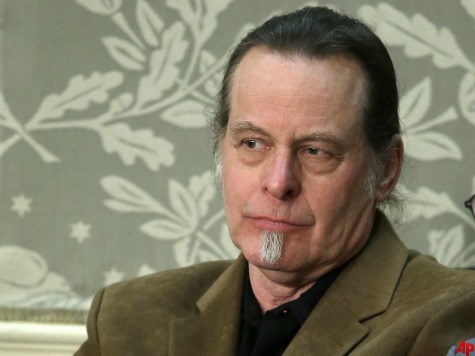
ted-nugent-sotu-ap

On the 149th Anniversary of Pickett’s Charge at the Battle of Gettysburg washed up rocker and right wing political activist Ted Nugent wrote in the Washington Times: “I’m beginning to wonder if it would have been best had the South won the Civil War.”  I found his remark appalling and disgraceful but I have come to expect such comments from him and and others who voice similar sentiments. If Nugent’s rant was a one time slip of the tongue there might be some grace, but even last week he called President Obama a “subhuman mongrel” a term so load with Ku Klux Klan, Jim Crow and Nazi imagery it defies imagination to hear it used today. When I hear such words spoken towards anyone I can only believe that the man that utters them is an unrepentant racist bent on the reestablishment of White Supremacy.

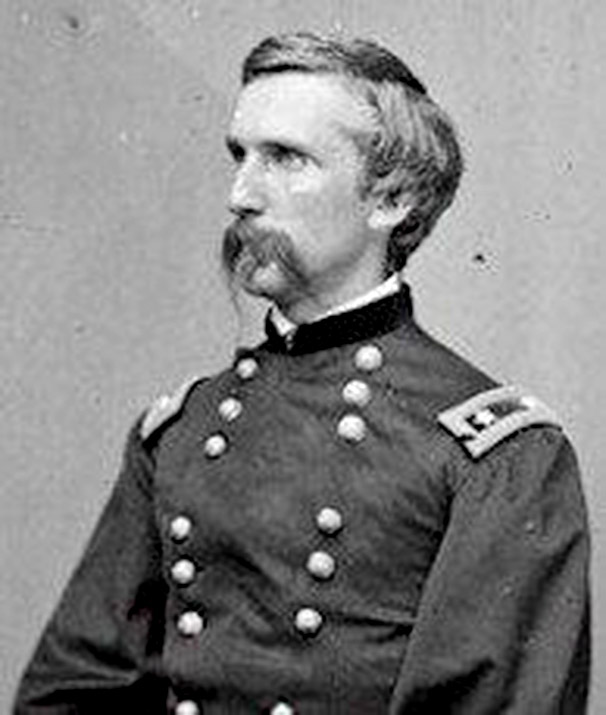
When I hear such sentiments, I think of men like Joshua Chamberlain. Chamberlain was a college professor who served in the Union Army and won fame and the Medal of Honor for the defense of Little Round Top at Gettysburg. There is a quote from the film Gods and Generals which I think about when I hear anyone suggesting that it would have been better for the Confederacy to have won the war:

“Now, somewhere out there is the Confederate army. They claim they are fighting for their independence, for their freedom. Now, I can not question their integrity. I believe they are wrong but I can not question it. But I do question a system that defends its own freedom while it denies it to an entire race of men. I will admit it, Tom. War is a scourge, but so is slavery. It is the systematic coercion of one group of men over another. It has been around since the book of Genesis. It exists in every corner of the world, but that is no excuse for us to tolerate it here when we find it right in front of our very eyes in our own country. As God as my witness, there is no one I hold in my heart dearer than you. But if your life, or mine, is part of the price to end this curse and free the Negro, then let God’s work be done.”

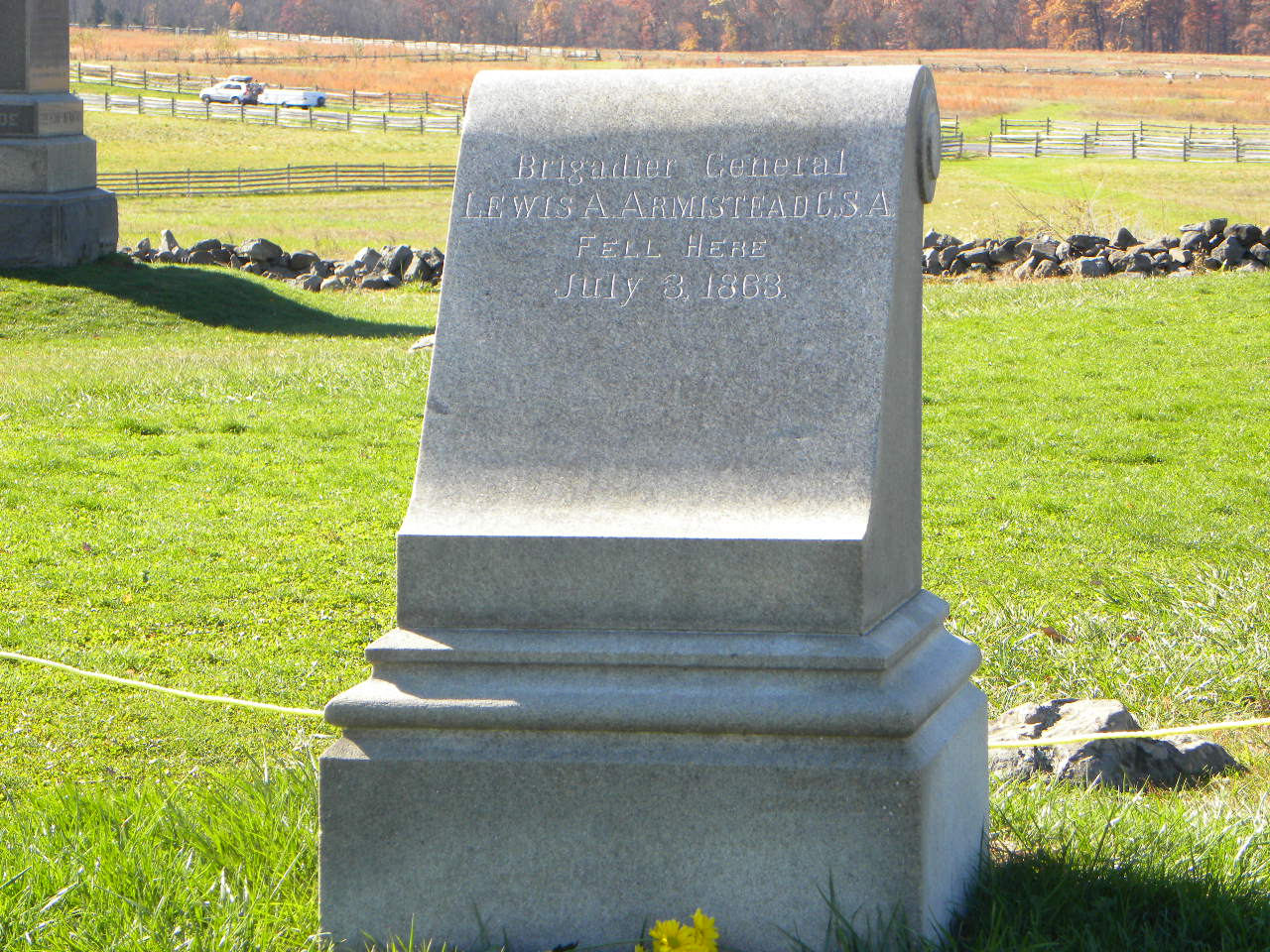
There is a spot near the Copse of Trees along Cemetery Ridge which is referred to as the “High Water Mark of the Confederacy.” It is close to where Confederate Brigadier General Lewis Armistead fell mortally wounded as the decimated remains of his command were overwhelmed by Union forces shortly after they breached the Union line. It is a place immortalized in history, literature and film. It is the place that marked the beginning of the end for the great evil of slavery in America.

My ancestors lived in Cabell County which in 1861 was part of Virginia. They were slave holders along the Mud River, a tributary of the Ohio River just to the north of what is now Huntington West Virginia. When war came to the country the family patriarch James Dundas joined the 8th Virginia Cavalry Regiment in which he served the bulk of the war as a Lieutenant.  When the war ended he refused to sign the loyalty oath to the Union. As a penalty his lands, which are now some of the most valuable in that part of West Virginia were confiscated and sold by the Federal Government. James Dundas was a true believer in the romantic and confused myth of the “Lost Cause.”

Because he served I am eligible for membership in the Sons of the Confederacy. But that is something that I will not do. While some join that organization to honor their ancestors, others that take that devotion to places that I cannot go.  As much as I admire the valor and personal integrity of many military men who served the Confederacy I cannot for a moment think that their “cause” was just.

It has been said that the North won the war but that the South won the history.  I think this is true. Many people reduce the reasons for the war to the South protecting its rights.  Sometimes the argument for the South is “states rights” or “economic freedom.” Those that make these arguments frequently romanticize the valor shown by Confederate soldiers on the battlefield. But sadly they often ignore or obscure the racism and evil of the Southern economic system.
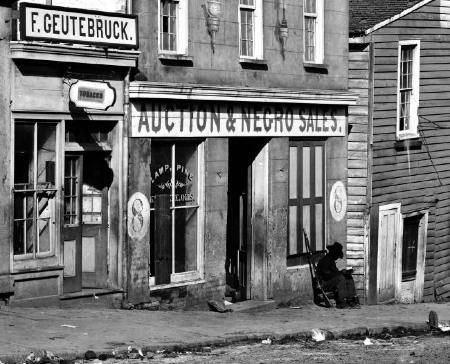
full_1361408284slave.market

The “rights” and the “economic freedom” espoused by those that led the secession and that are lamented by those like Nugent were categorically evil. Those rights and freedoms were built upon the rotten edifice of slavery. The South fought to maintain their rights to enslave and exploit Blacks to maintain an archaic economy based on agriculture, particularly the export of King Cotton. Thus I have no desire to become part of an organization enshrines the myth of the “Lost Cause” no matter what my family connections.

Some attempt to place the blame on the North, to turn the Northern States into economic predators’ intent on suppressing the economic rights of Southerners. These arguments serve to show the bankruptcy of the idea itself. The fact that the “economic and political freedom” of Southerners was founded on the enslavement of a whole race of people matters not because to such people the “cause” is greater.

The fact was that the longer the Southern economy relied on agriculture supported slavery it deprived itself of the means of economic progress. The same progress that propelled the North to prosperity. Because it cast its lot with King Cotton and slavery the South lagged in all industrial areas to include transportation infrastructure. Most non-slave owning whites lived at the poverty line. They were disrespected by the wealthy Plantation owners only enjoyed some elevated social status because the slaves ranked beneath them in the sociological and economic hierarchy.

To support its slave economy the South depended on cheap imports from England, which then was still considered an enemy of the United States. When tariffs to protect newly establish American industries were enacted in 1828 South Carolina attempted to nullify the Federal law and even raised troops and threatened to revolt in 1832.

The Southern economic system was immoral and antiquated. It enslaved blacks and it impoverished most rural Southerners.  The only exception to this were those that owned the land and the slaves, and small numbers of entrepreneurs. It was a hateful, backward and loathsome system which even Southern churches attempted to justify from Scripture.  Southern Baptists, Methodists and Presbyterians all broke away from their parent denominations in the 1840s over the issue of slavery.

So many died and so much of the South was destroyed in the defense of  the “cause” that one has to wonder just why Southern political and religious were willing to defend such an inadequate and evil economic system. Perhaps it was an innate sense of racial superiority that ran deep in the South, perhaps it was a misplaced sense of political pride and honor. Regardless of the reason, the war that they brought about devastated their homeland. The radicals that ran “Reconstruction” after the assassination of Abraham Lincoln ensured that Southerners suffered terrible degradation and impeded any real efforts to promote reconciliation between the races and between the regions.  Their misguided and often brutal rule ensured that Southern blacks would have even more obstacles raised against them by the now very angry and revengeful whites.  It would take another 80-100 years to end segregation and secure voting rights for blacks.

I was raised on the West Coast but have lived in the South much of my adult life due to military assignments. I served in National Guard units that trace their lineage to Confederate regiments in Texas and Virginia. Despite my Confederate connections both familial and by service I can find little of the romance and idealism that some find in the Confederacy and the “Lost Cause.” I see the Civil War for what it was, a tragedy of the highest order brought about by the need of some to enslave others to maintain their economic system.

BWeqwULCEAA72jU.jpg-large

Today there are many that use the flags of the Confederacy outside of their historic context. They are most often used as a symbol of continued racial hatred or of defiance to the Federal Government by White Supremacist or anti-government organizations.  Many that use them openly advocate for the overthrow of the Federal Government.  The calls for such “revolt” can be found all over the country even in the halls of Congress much as they were in the 1830s, 40s and 50s.

Some of this is based on libertarian economic philosophy which labels the government as the enemy of business. Some is religious opposition to some social policies, while some is based in xenophobic racial hatred, not just of Blacks, but also Latin Americans, Asians and Middle Eastern immigrants. The divisions in the country are probably as great as or greater than they were in the 1850s as the country lurched inexorably to Civil War.

I often see the symbols of the Confederacy, particularly the Battle Flag displayed in manners that can only be seen as symbols of defiance.  Somehow I find the display of that flag outside of its historic context revolting.

For such people the Federal Government is the enemy. I know that our system of government has its flaws. Likewise I cannot agree more about the corruption of many in political office, regardless of their political allegiance or ideology.

Today quite a few people on the political right call for revolt or secession. Some moderate politicians have attempted to compromise with such radicals, but those efforts only make things worse. Radicals are never satisfied and view compromise as weakness. Thus Thomas Jefferson said of the Missouri Compromise of 1824: “but this momentous question, like a fire bell in the night, awakened and filled me with terror. I considered it at once as the knell of the Union. It is hushed indeed for the moment, but this is a reprieve only, not a final sentence. A geographical line, coinciding with a marked principle, moral and political, once conceived and held up to the angry passions of men, will never be obliterated; and every new irritation will mark it deeper and deeper.”

We have allowed the issues of our time to become a fire of unbridled angry passion. We have allowed those with almost no historical understanding and who promote myth stake claims and promote ideas that are destructive to our union. Unfortunately I do not think that we have reached the high water mark of this movement. I fear like Jefferson that the hatred and division will only grow worse as some prepare for conflict.

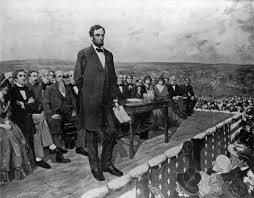
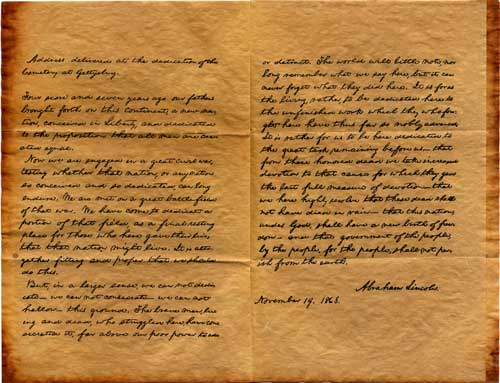
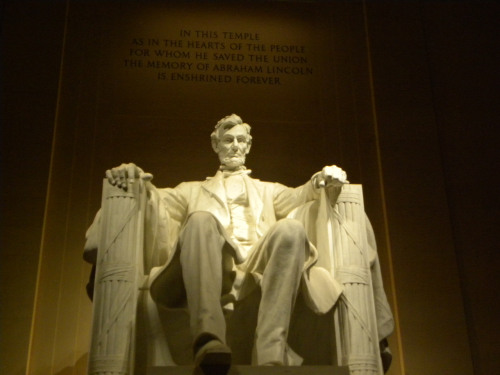
A few months after the Battle of Gettysburg Abraham Lincoln made a few remarks at Gettysburg war cemetery.  Lincoln is reviled by men like Nugent and others that romanticize the Lost Cause. He is often demonized by many “conservative” politicians and pundits today, but his remarks are still remarkably pertinent:

“Four score and seven years ago our fathers brought forth on this continent, a new nation, conceived in Liberty, and dedicated to the proposition that all men are created equal.

Now we are engaged in a great civil war, testing whether that nation, or any nation so conceived and so dedicated, can long endure. We are met on a great battlefield of that war. We have come to dedicate a portion of that field, as a final resting place for those who here gave their lives that that nation might live. It is altogether fitting and proper that we should do this. But, in a larger sense, we cannot dedicate—we cannot consecrate—we cannot hallow—this ground. The brave men, living and dead, who struggled here, have consecrated it, far above our poor power to add or detract. The world will little note, nor long remember what we say here, but it can never forget what they did here. It is for us the living, rather, to be dedicated here to the unfinished work which they who fought here have thus far so nobly advanced. It is rather for us to be here dedicated to the great task remaining before us—that from these honored dead we take increased devotion to that cause for which they gave the last full measure of devotion—that we here highly resolve that these dead shall not have died in vain—that this nation, under God, shall have a new birth of freedom— and that government of the people, by the people, for the people, shall not perish from the earth.”

Today with so many radicals doing all that they can to plunge us into yet another civil war we should remember Lincoln’s words. We need to rededicate ourselves to this Union.  Tony Blair the former Prime Minster of Great Britain remarked in 2011:

“It may be strange for a former British Prime Minister to offer thoughts on America when the country will be celebrating its independence from Britain. But the circumstances of independence are part of what makes America the great and proud nation it is today. And what gives nobility to the American character.

That nobility isn’t about being nicer, better or more successful than anyone else. It is a feeling about the country. It is a devotion to the American ideal that at a certain point transcends class, race, religion or upbringing. That ideal is about values, freedom, the rule of law, democracy. It is also about the way you achieve: on merit, by your own efforts and hard work.

But it is most of all that in striving for and protecting that ideal, you as an individual take second place to the interests of the nation as a whole. This is what makes the country determined to overcome its challenges. It is what makes its soldiers give their lives in sacrifice. It is what brings every variety of American, from the lowest to the highest, to their feet when “The Star-Spangled Banner” is played.

Of course the ideal is not always met – that is obvious. But it is always striven for.

The next years will test the American character. The world is changing. New powers are emerging. But America should have confidence. This changing world does not diminish the need for that American ideal. It only reaffirms it.”

I think that the Prime Minister got it right and that Ted Nugent and those like him or defend his hateful ideology are ignorant racist fools. But hatred, ignorance and the belief in myth are often quite powerful in the hands of those who desire to maintain their power at any cost. History proves this, thus we must always confront them and not back down until we truly know that “new birth of freedom.”

Peace

Padre Steve+
Leave a comment

Filed under civil rights, civil war, News and current events, Political Commentary

The Gettysburg Campaign: Lee Decides to Go on the Offensive

993scr_3a12918e0189d2e

I am preparing to lead a Staff Ride of our students to Gettysburg in early March. As part of my preparation I am doing a lot of study to refresh myself on both the campaign and the battle, not only as an operational study, but at the strategic level. This short essay deals with Lee’s decision to invade the North following his victory at Chancellorsville. I will follow it up with other articles the next talking about the Northern strategy at both the strategic and operational levels.

In early May 1863 General Robert E. Lee, commanding the Army of Northern Virginia realized that the Confederacy was in desperate straits. Despite numerous victories against heavy odds, Lee knew that time was running out. Though he had beaten the Army of the Potomac under General Joseph Hooker at Chancellorsville, he had not destroyed it and that Army, along with a smaller force commanded by General Dix in Hampton Roads still threatened Richmond.

The strategic situation was bad, even if many Confederate politicians realized it or cared in the post Chancellorsville euphoria. In the west the strategic river city of Vicksburg Mississippi was threatened by the Army of Union General Ulysses S Grant, and Naval forces under the command of Admiral David Farragut. If Vicksburg fell the Union would control the entire Mississippi and cut the Confederacy in two. Union forces also maintained a strong presence in the areas of the Virginia Tidewater and the coastal areas of the Carolinas, while in Tennessee a Union Army was stalemated, but still threatening Chattanooga, the gateway to the Deep South. The blockade of the United States Navy had crippled the already tenuous economy of the Confederacy.

Some Confederate leaders realized the danger presented by Grant in the West. Secretary of War James Seddon recognized the danger in the Winter of 1862-1863 both suggested to Lee that he detach significant units to relieve the pressure in the west and blunt Grant’s advance. Lee would have nothing of it, he argued that the war would be won in the East. It was his view that if Virginia was lost, so was the Confederacy, and was concerned that whatever units left behind should he dispatch troops from his Army west, would be unable to defend Richmond.

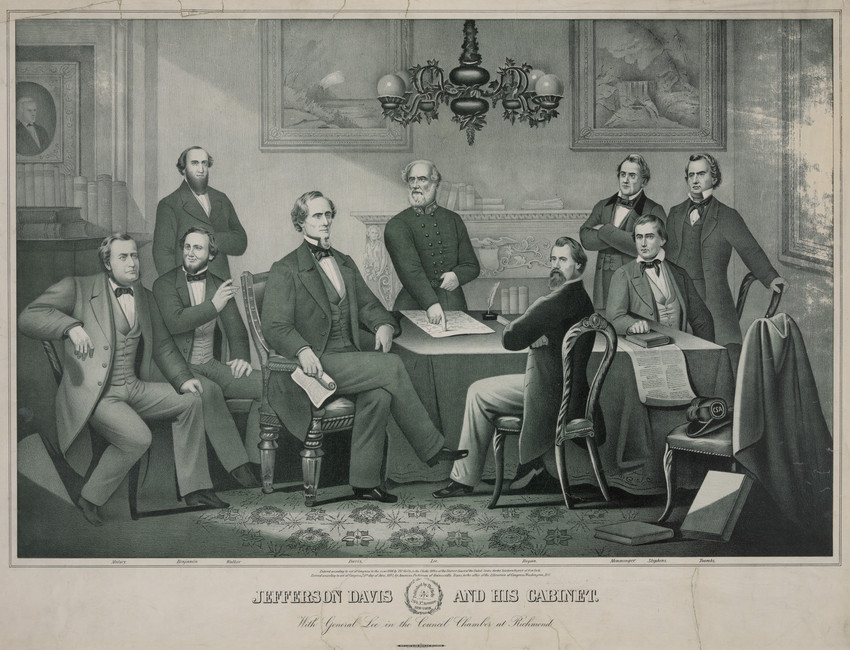
On May 14th Lee travelled by train to Richmond to meet with President Jefferson Davis and War Secretary James Seddon. At the meeting Lee argued for an offensive campaign in the east, to take the war to Pennsylvania. Lee had two goals three major goals, two which were directly related to the immediate military situation and one which went to the broader strategic situation. Unfortunately no notes from that conference are known to survive.

Lee had long believed that an offensive into the North was necessary, even before Chancellorsville. Lee did not believe that reinforcing the Confederate Armies in the West would provide any real relief, instead he believed that his Army, flush with victory needed to be reinforced and allowed to advance into Pennsylvania. Lee’s Chief of Staff Colonel Charles Marshall crafted a series of courses of action designed to present the invasion option as the only feasible alternative. Although both Seddon and Davis had reservations about the plan they agreed to it, unfortunately for all of them they never really settled the important goals of the campaign.

Lee believed that his offensive would relieve Grant’s pressure on Pemberton’s Army at Vicksburg. Likewise Lee believed that if he was successful in battle and defeated the Army of the Potomac in Pennsylvania that it could give the peace party in the North to bring pressure on the Lincoln Administration to end the war.  He also believed that if he could spend a summer campaign season in the North, living off of Union foodstuffs and shipping booty back to the Confederacy that it would give farmers in Northern Virginia a season to harvest crops unimpeded by major military operations.

However, the meeting evidently did not have all the results that Lee desired. Davis refused Lee reinforcements from the coastal Carolinas, and insisted on units being left to cover Richmond in case General Dix advanced on Richmond from Hampton Roads. Much of this was due to political pressure as well as the personal animus that existed between General D. H. Hill in the Carolinas towards Lee.

Likewise Lee’s decision revealed an unresolved issue in Confederate Grand Strategy. Many in the Confederacy realized that the only hope for success was to fight a defensive campaign that made Union victory so expensive that eventually Lincoln’s government would fall or be forced to negotiate.

However, Lee was convinced that ultimate victory could only be achieved by decisively defeating and destroying Federal military might. His letters are full of references to crush, defeat or destroy Union forces opposing him. His strategy of the offensive was demonstrated on numerous occasions in 1862 and early 1863, however it was unfeasible and counterproductive to Southern strategy. His offensive operations cost his Army dearly in the one commodity that the South could not replace, nor keep pace with its Northern adversary, his men.

When Lee fought defensive actions on ground of his choosing, like a Fredericksburg he was not only successful but husbanded his strength. However, when he went on the offensive in almost every case he lost between 15 and 22 percent of his strength, and the percentage of soldiers that he lost was always more than his Federal counterparts, even when his army inflicted greater aggregate casualties on his opponents. Lee recognized this as was evident in his correspondence but it did not deter his strategy of the offensive until after his defeat at Gettysburg.

The course of action was decided upon, but one has to ask if Lee’s decision was wise decision at a strategic point level, not simply the operational or tactical level where many Civil War students are comfortable. General Longstreet’s artillery commander, Colonel Porter Alexander described the appropriate strategy of the South well, he wrote:

“When the South entered upon war with a power so immensely her superior in men & money, & all the wealth of modern resources in machinery and the transportation appliances by land & sea, she could entertain but one single hope of final success. That was, that the desperation of her resistance would finally exact from her adversary such a price in blood & treasure as to exhaust the enthusiasm of its population for the objects of the war. We could not hope to conquer her. Our one chance was to wear her out.”  (Edward Porter Alexander, Fighting for the Confederacy: The Personal Recollections of General Edward Porter Alexander, ed. Gary W. Gallagher, University of North Carolina Press, Chapel Hill NC, 1989 p.415 

What Alexander describes is the same type of strategy successfully employed by Washington and his more able officers during the American Revolution, Wellington’s campaign on the Iberian Peninsula against Napoleon’s armies, and that of General Giap against the French and Americans in Vietnam. It was not a strategy that completely avoided offensive actions, but saved them for the right moment when victory could be obtained.

It is my belief that Lee erred in invading the North for the simple fact that the risks far outweighed the possible benefits. It was a long shot and Lee was a gambler, audacious possibly to a fault. His decision to go North also exhibited a certain amount of hubris as he did not believe that his army could be beaten, even when it was outnumbered.  Likewise he took the offensive in spite of the fact that many of his commanders were untested at the levels of command that they exercised. He had lost his right arm, General Stonewall Jackson, who died following being wounded at Gettysburg.

He knew from his previous battles the heavy casualties that even a victory over the Army of the Potomac would entail deep in Northern territory and the effect that a costly victory would have on his operations, but he still took the risk. That was short sighted and diametrically opposed to the strategy that the South needed to pursue in order to gain its independence. Of course some will disagree, but I am comfortable in my assertion that it was a mistake that greatly affected the Confederacy’s only real means of securing its independence, the breaking of the will of the Union by making victory so costly that it would not be worth the cost.

Peace

Padre Steve+

Leave a comment

Filed under civil war, History, leadership, Military

Preparing for Gettysburg after the Snow and Amid the Flood

DSCN8783

Well, today has been spent catching up at work after several days off due to the snowstorm which paralyzed the Hampton Roads area last week. Unfortunately for us the storm was the least of the issues as our hot water heater blew out Friday night while we were asleep, leaving our downstairs area flooded. Thankfully tomorrow the people from SERVEPRO will begin to dewater the house and clean up the ungodly mess and stench. The construction company will come in tomorrow too to assess the damage and plan for what will have to be repaired or rebuilt, but I think that I’ve already told you this.

So back to what is going on. Today was a busy day catching up, getting ready for the Staff Ride to Gettysburg that I will be leading in early March, coordinating the assistance of our students and staff who will be volunteering to help at the Norfolk Emergency Shelter on Friday Night and Saturday morning. I have also been talking with my teaching team for our Ethics course.

So today has been busy and tomorrow will be all about trying to begin our damage recovery at our house.

In the mean time I will still be getting ready for the Gettysburg trip. It is an honer to be taking this duty from a man who has been doing it for 20 years, Dr Vardell Nesmith. Thankfully he will still be in the area and come the Spring or Summer may be able to lend his most considerable expertise to the trip as a Professor Emeritus.

Today was our first meeting for the trip which was more administrative in nature. We will have two more meetings before the actual trip, those will be to introduce the participating students to the Gettysburg Campaign and the opening events which began the campaign.

I am going to be spending a lot of time preparing for this and it is quite likely that some of my work will show up here. The obvious intent is to tie in lessons from this campaign to our curriculum of Joint Planning and Campaigning for our students who either serve in or are going to serve in Joint Staff or Command positions.  So my intent will to be to tie the lessons of the Gettysburg campaign to national military strategy, operational level planning and leadership at the operational level.

Of course that will entail things that I like and understand well. The issue in planning this event are more to the emphasis of what I will teach, what I will emphasize and the detail in which I will go in each class, and for the actual Staff Ride at Gettysburg. I will need to talk about weapons and tactics, that is for sure and actually the easiest part.

Of course I need to explain well how each side understood this campaign in relation to its own war aims, and how their respective planning and preparation, as well as the politics, the economic, diplomatic and informational factors that influenced the decisions of the leaders of both the Union and Confederacy during the summer campaign of 1863. The real focus I think needs to be on leadership, relationships and the decision making process, because I believe in all my heart that those are the things that win battles and wars.

Tonight I am musing of what emphasis to give each subject and in the background I have the movie Gods and Generals on.

Well I shall sign off for now. I do have a number of articles bouncing around my head and I must continue to muse… I must, I must.

Peace

Padre Steve+

Leave a comment

Filed under civil war, Loose thoughts and musings

A New Birth of Freedom: The Gettysburg Address at 150

mkholrt

I am always humbled when I travel to Gettysburg as I did just two weeks ago. It is hard to believe in that now peaceful pastoral setting that over 157,000 Americans, almost 82,000 Union and 75,000 Confederate met in a three day battle. In those three days over 28,000 Confederates and 23,000 Union soldiers were killed, wounded, missing or captured. It was the greatest number of casualties inflicted in one battle on American soil in history.

The places that the battle was fought have become legendary, for they are “hallowed ground” as President Abraham Lincoln so eloquently put it. The places, McPherson’s and Herr’s Ridge, Seminary Ridge, the Railroad Cut, Barlow’s Knoll, Cemetery Hill, Culp’s Hill, The Wheat Field, Devil’s Den, the Peach Orchard, Little Round Top, Cemetery Ridge, the Apse of Trees, the Angle and the High Water Mark are in a sense holy, or hallowed, consecrated by those who struggled there, those who lived and those who gave the last full measure of devotion to their country.

gal9vfvf1

I think about those men of both sides, fully convinced of the rightness of their cause who fought valiantly in the struggle. That being said when I go there though my family predominantly fought for the Confederacy my heart is drawn to those men who remained loyal to the Union and those who answered the call of Abraham Lincoln to serve in a cause greater than their own interests, the great and the small alike.

DSCN8774

Lincoln was a masterful orator who managed to rally the Union and bring hundreds of thousands of men volunteer before Gettysburg. They came for an ideal an ideal which Lincoln’s oratory was probably the most effective at articulating in a way that men would volunteer to suffer hardship, fight and die to bring about. It was well put in the movie Gettysburg where Colonel Joshua Chamberlain said:

“This is a different kind of army. If you look at history you’ll see men fight for pay, or women, or some other kind of loot. They fight for land, or because a king makes them, or just because they like killing. But we’re here for something new. This has not happened much, in the history of the world: We are an army out to set other men free. America should be free ground, all of it, from here to the Pacific Ocean. No man has to bow, no man born to royalty. Here we judge you by what you do, not by who your father was. Here you can be something. Here is the place to build a home. But it’s not the land. There’s always more land. It’s the idea that we all have value, you and me. What we’re fighting for, in the end… we’re fighting for each other…”

images-61

On November 19th 1863 Lincoln delivered a “few words” at Gettysburg which were in all practical aspects a benediction at the dedication of the battlefield cemetery. Lincoln was the second speaker at the ceremony following former Pennsylvania Congressman Edward Everett who spoke for more than two hours, a typical speech from the period. The 270 words of Lincoln’s address are perhaps the most important of any speech or document in American history save the Declaration of Independence and the Constitution of the United States.

The speech was so powerful that Everett wrote Lincoln the next day:

“Permit me also to express my great admiration of the thoughts expressed by you, with such eloquent simplicity & appropriateness, at the consecration of the Cemetery. I should be glad, if I could flatter myself that I came as near to the central idea of the occasion, in two hours, as you did in two minutes.”

The speech is short, but it’s eloquence is unmatched. Lincoln wrapped ideas, concepts and ideals that men have written volumes about into a speech so powerful that many have memorized it.

18640903.nashcartoon

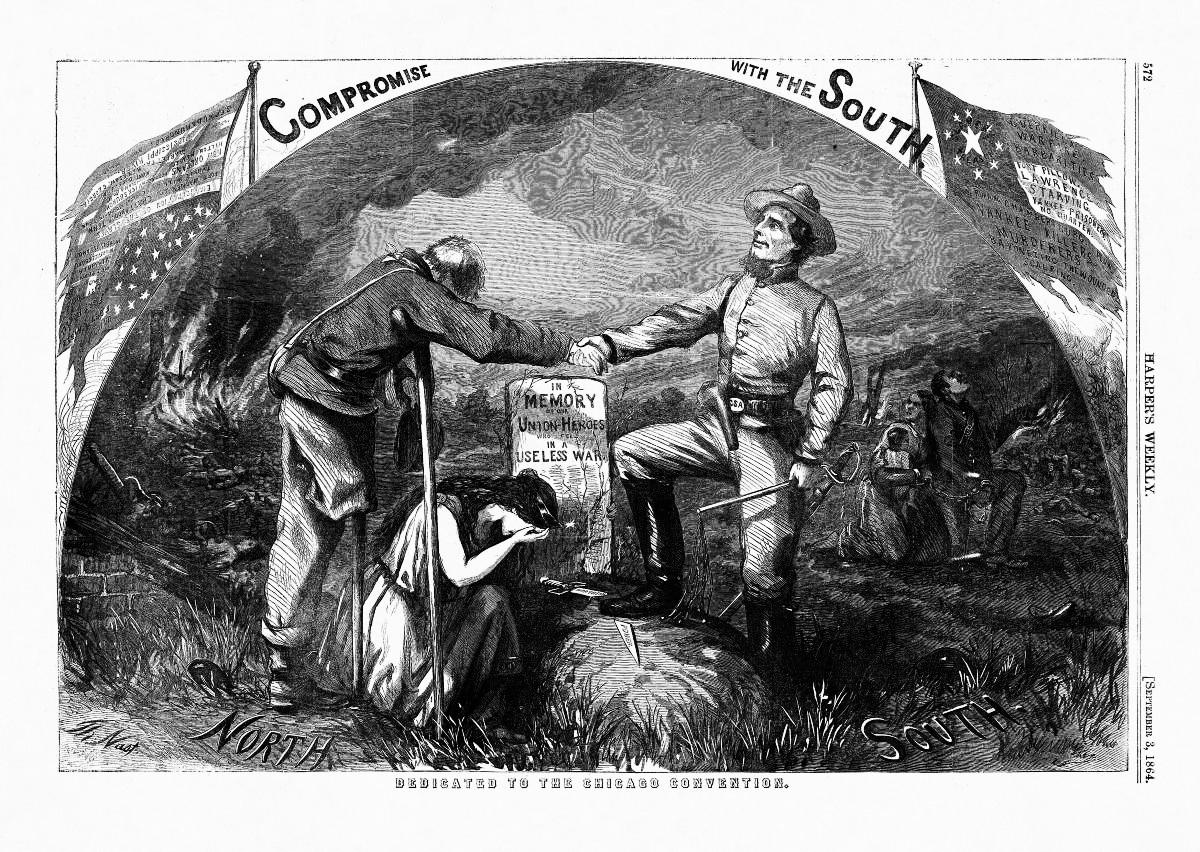
But few realize the context that it must be placed. Though the Union had defeated Lee’s Army at Gettysburg and Grant had taken Vicksburg to cut the Confederacy in half the North was groining war weary. There were those in the North, the Copperheads who were willing even after Gettysburg and Vicksburg to end the war on terms favorable to the Confederacy, even granting Confederate independence and the continuation of slavery. Likewise Lincoln was sick when he delivered the address having what was mostly likely a mild form of Smallpox when he gave the address. Thus the tenor, simplicity and depth are even more remarkable. It is a speech given in the manner of Winston Churchill’s “Blood sweat toil and tears” address to Parliament upon being appoint Prime Minister in 1940.

cropped-dscn88191.jpg

In a time where many are wearied by the foibles and follies of our politicians, even wondering about our form of government can survive Lincoln’s words matter. Dr Allen Guelzo, Professor of Civil War Studies at Gettysburg College wrote in the New York Times today:

“The genius of the address thus lay not in its language or in its brevity (virtues though these were), but in the new birth it gave to those who had become discouraged and wearied by democracy’s follies, and in the reminder that democracy’s survival rested ultimately in the hands of citizens who saw something in democracy worth dying for. We could use that reminder again today.”

Dr Guelzo is quite correct. Many people in this country and around the world are having grave doubts about our democracy. I wonder myself, but I am an optimist. I do believe that we will recover because for the life of me I see no nation anywhere else with our resiliency and ability to overcome the stupidity of politicians, pundits and preachers.

The amazing thing was that in spite of everything the Union survived. Lincoln was a big part of that but it was the men who left lives of comfort and security like Joshua Chamberlain and so many others who brought about that victory. Throughout the war, even to the end Southern political leaders failed to understand that Union men would fight and die for an ideal, something greater than themselves, the preservation of the Union and the freedom of an enslaved race. For those that volunteered it was not about personal gain, loot or land,it was about something greater. It was about freedom.

GAFac1

Now I for one do not think that we are currently living up to the ideals enunciated by Lincoln that day at Gettysburg. I can understand the cynicism disillusionment of Americans as well as those who have for over 200 years looked to us and our system as a “city set on a hill.” That being said, when I read these words and walk that hallowed  ground I am again a believer that we can realize the ideal.

Four score and seven years ago our fathers brought forth on this continent, a new nation, conceived in Liberty, and dedicated to the proposition that all men are created equal.

Now we are engaged in a great civil war, testing whether that nation, or any nation so conceived and so dedicated, can long endure. We are met on a great battle-field of that war. We have come to dedicate a portion of that field, as a final resting place for those who here gave their lives that that nation might live. It is altogether fitting and proper that we should do this.

But, in a larger sense, we can not dedicate — we can not consecrate — we can not hallow — this ground. The brave men, living and dead, who struggled here, have consecrated it, far above our poor power to add or detract. The world will little note, nor long remember what we say here, but it can never forget what they did here. It is for us the living, rather, to be dedicated here to the unfinished work which they who fought here have thus far so nobly advanced. It is rather for us to be here dedicated to the great task remaining before us — that from these honored dead we take increased devotion to that cause for which they gave the last full measure of devotion — that we here highly resolve that these dead shall not have died in vain — that this nation, under God, shall have a new birth of freedom — and that government of the people, by the people, for the people, shall not perish from the earth.

dscn0061

In the hope that we again realize those ideals and help bring about “a new birth of freedom,” I wish you a good night.

Peace

Padre Steve+

Leave a comment

Filed under civil war, History, leadership, Political Commentary

Images of Gettysburg

DSCN8811

“In great deeds something abides. On great fields something stays. Forms change and pass; bodies disappear, but spirits linger, to consecrate ground for the vision-place of souls. And reverent men and women from afar, and generations that know us not and that we know not of, heart-drawn to see where and by whom great things were suffered and done for them, shall come to this deathless field to ponder and dream; And lo! the shadow of a mighty presence shall wrap them in its bosom, and the power of the vision pass into their souls.” Joshua Chamberlain speaking at the dedication of the Monument to the 20th Maine October 3, 1889, Gettysburg, PA


I took a class trip this weekend to Gettysburg. The trip was what we in the military term as a Staff Ride which is an event that takes the participants to a battle site to see first hand, discuss and analyze the battle. The value of such events is that it takes them from simple book learning to getting a chance to walk the same ground, put “eyes on target” and actually get a feel for what it was like for those that fought the battle. 

Gettysburg is one of the more remarkable battles in American history if for nothing else its size and what was at stake. In June of 1863 the Army of Northern Virginia commanded by General Robert E. Lee invaded the North.  Lee’s Army crossed the Potomac River into Maryland and then deep into Pennsylvania pursued by the Federal Army of the Potomac initially commanded by Major General Joe Hooker and then by Major General George Meade.

The armies met in what can be best described in a meeting engagement at the town of Gettysburg. Neither army had planned to fight there but through a series of events both armies entered into a fight that in combination with the defeat of the Confederate Army at Vicksburg Mississippi doomed the Confederacy and ensured that the Union would survive.

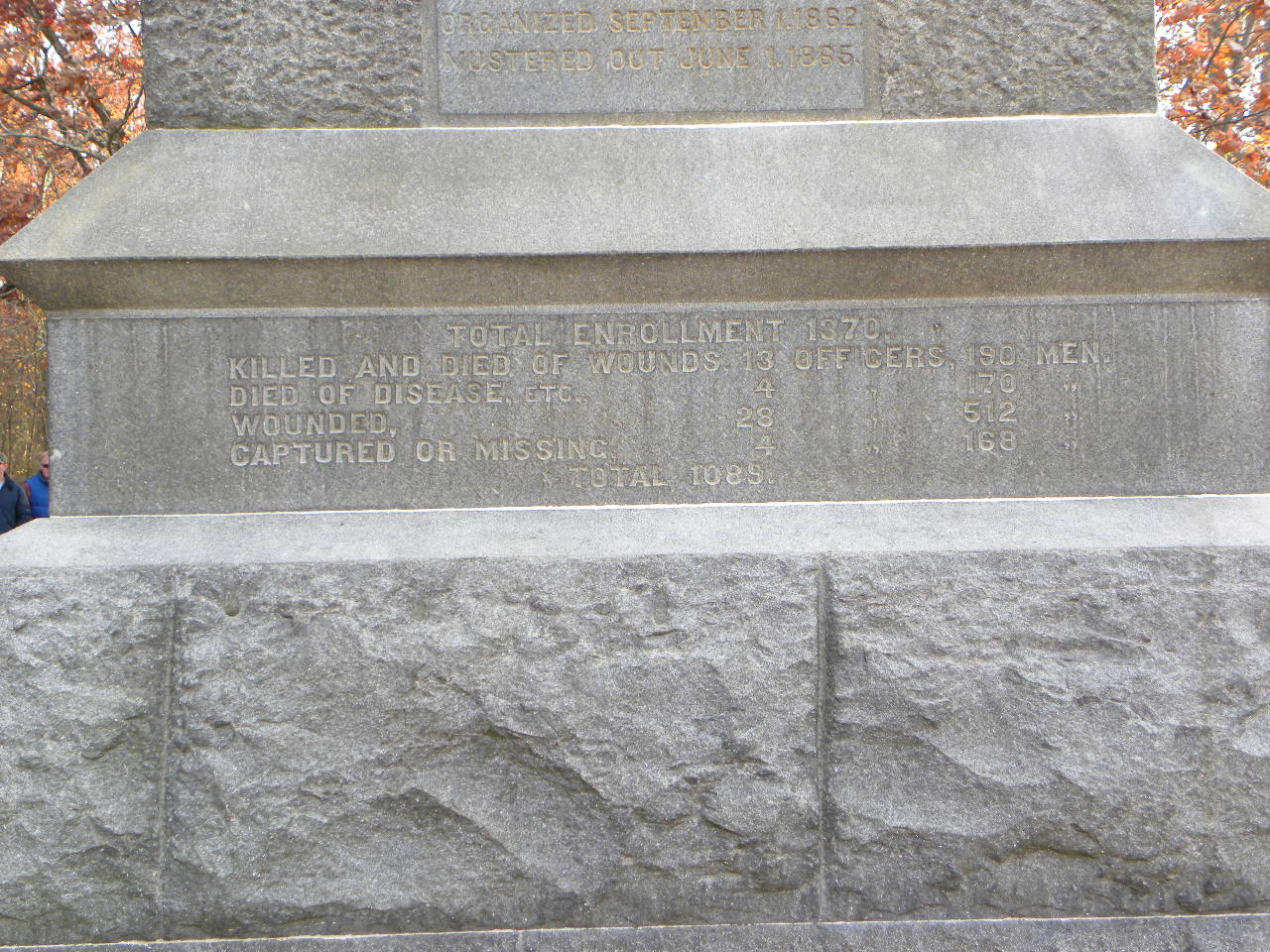
Gettysburg is marked by many monuments to units that fought at the battle as well as individuals. The National Park Service does a wonderful job there and is constantly working within the constraints of space, time and the encroachment of more people in the area to restore the battlefield to conditions of the time.

As for the monuments themselves most were placed by States, towns and Veteran’s groups over the last 150 years. Placed with love and admiration by the soldiers of both sides and those who knew them.

Here are some photos that I took of the battlefield this weekend.

DSCN8774

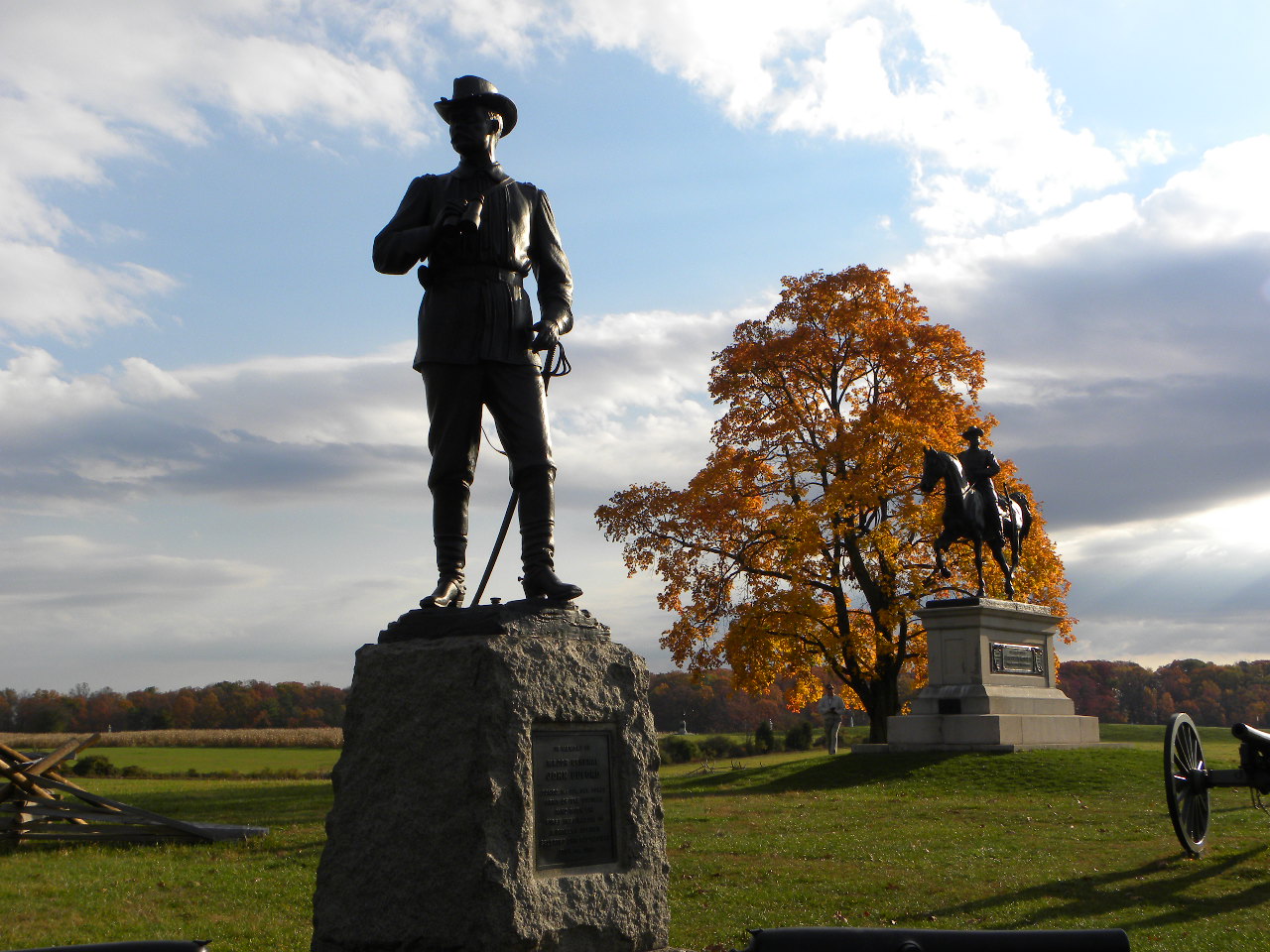
Monuments to General’s Burford and Reynolds on McPherson’s Ridge

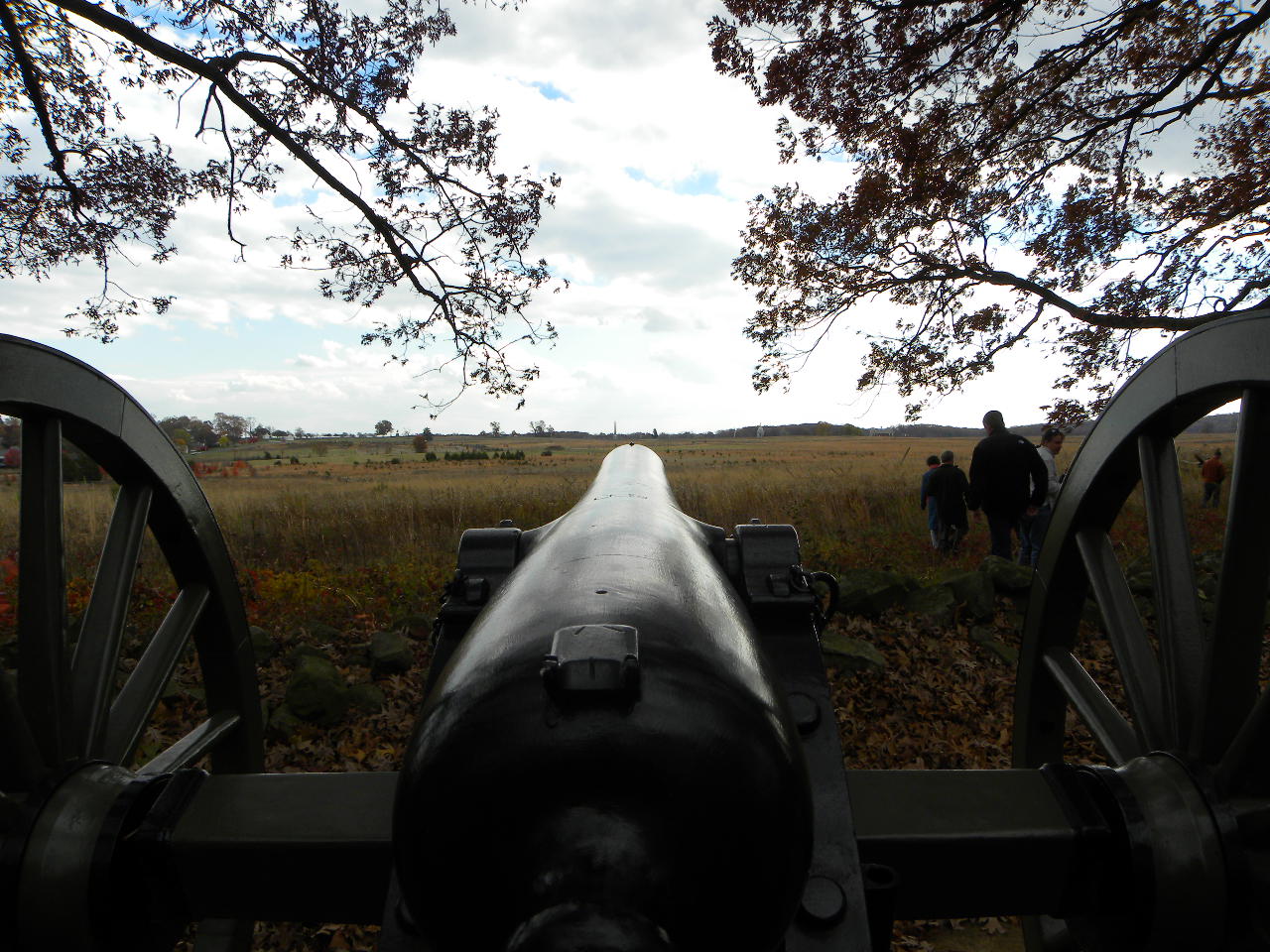
DSCN8783Confederate canon on Seminary Ridge racing Federal lines

DSCN8792Monument to Colonel Ellis and 124th New York at Devil’s Den

DSCN8799Monument to 148th Pennsylvania at the Wheat Field

DSCN8806

Gouverneur Warren Monument Little Round Top

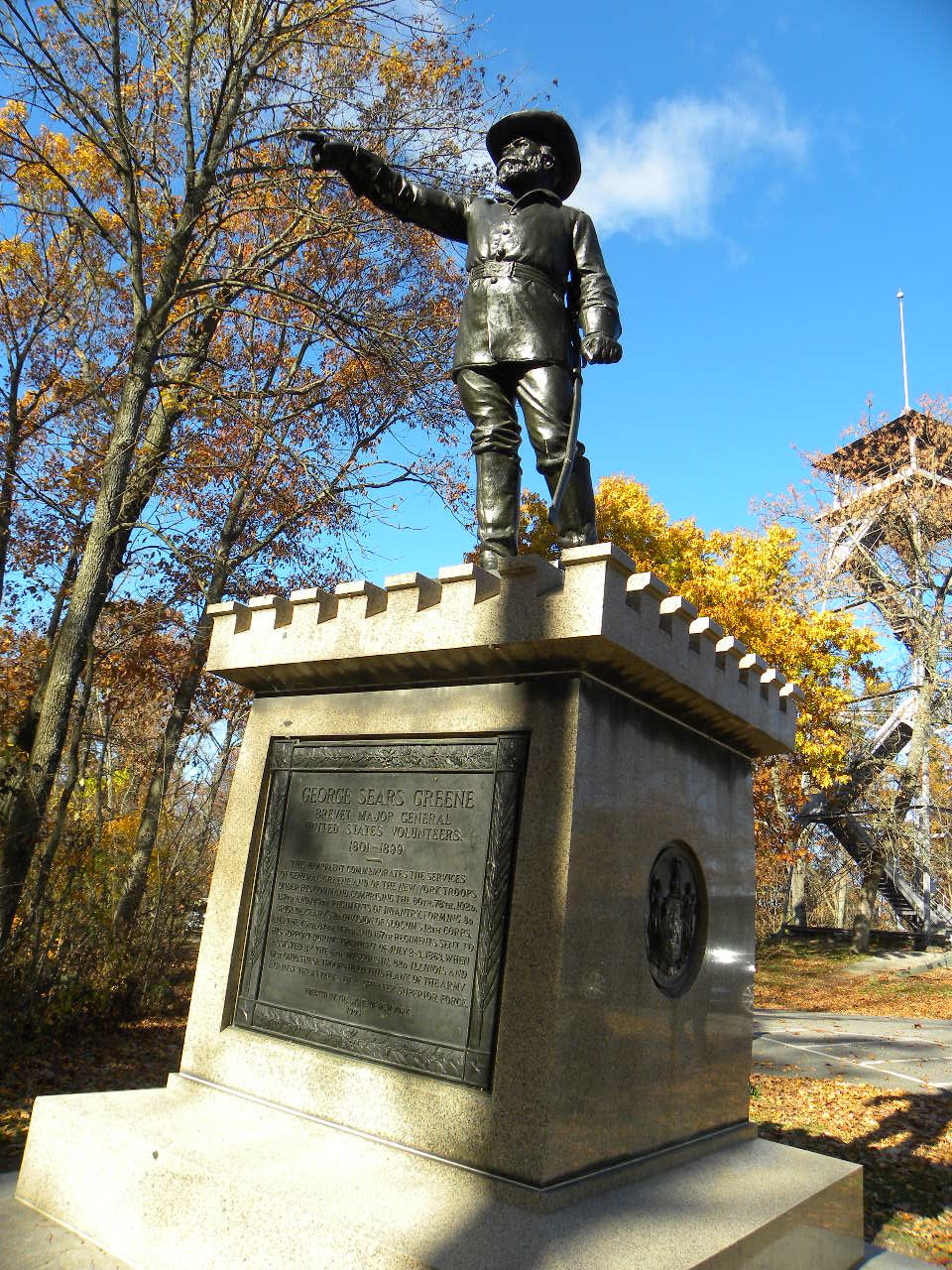
DSCN8818Brigadier General George Greene Monument Culp’s Hill

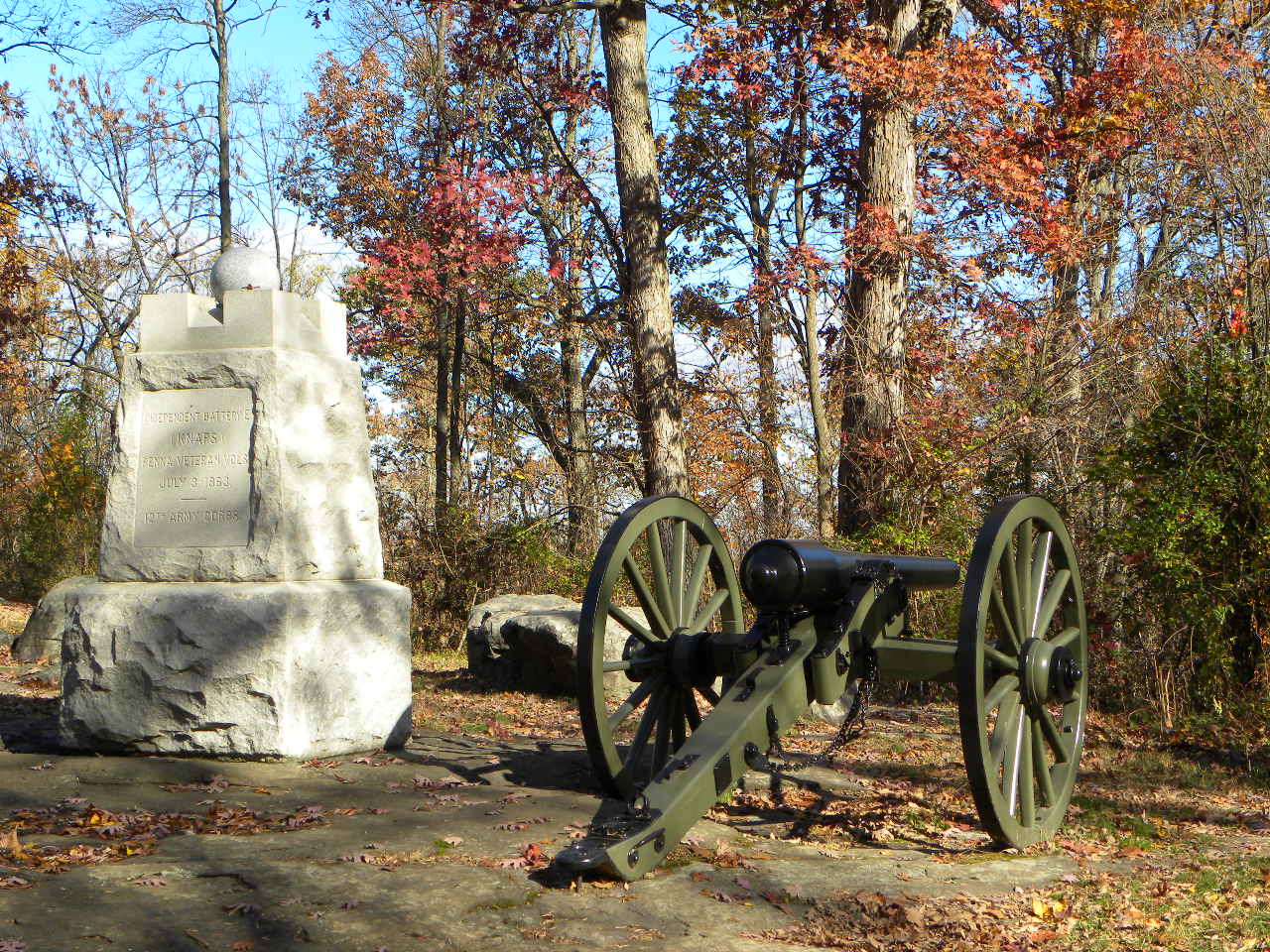
DSCN8819Pennsylvania Independent Artillery Battery E Monument at Culp’s Hill

DSCN8826Monument to 1st Minnesota at Cemetery Ridge

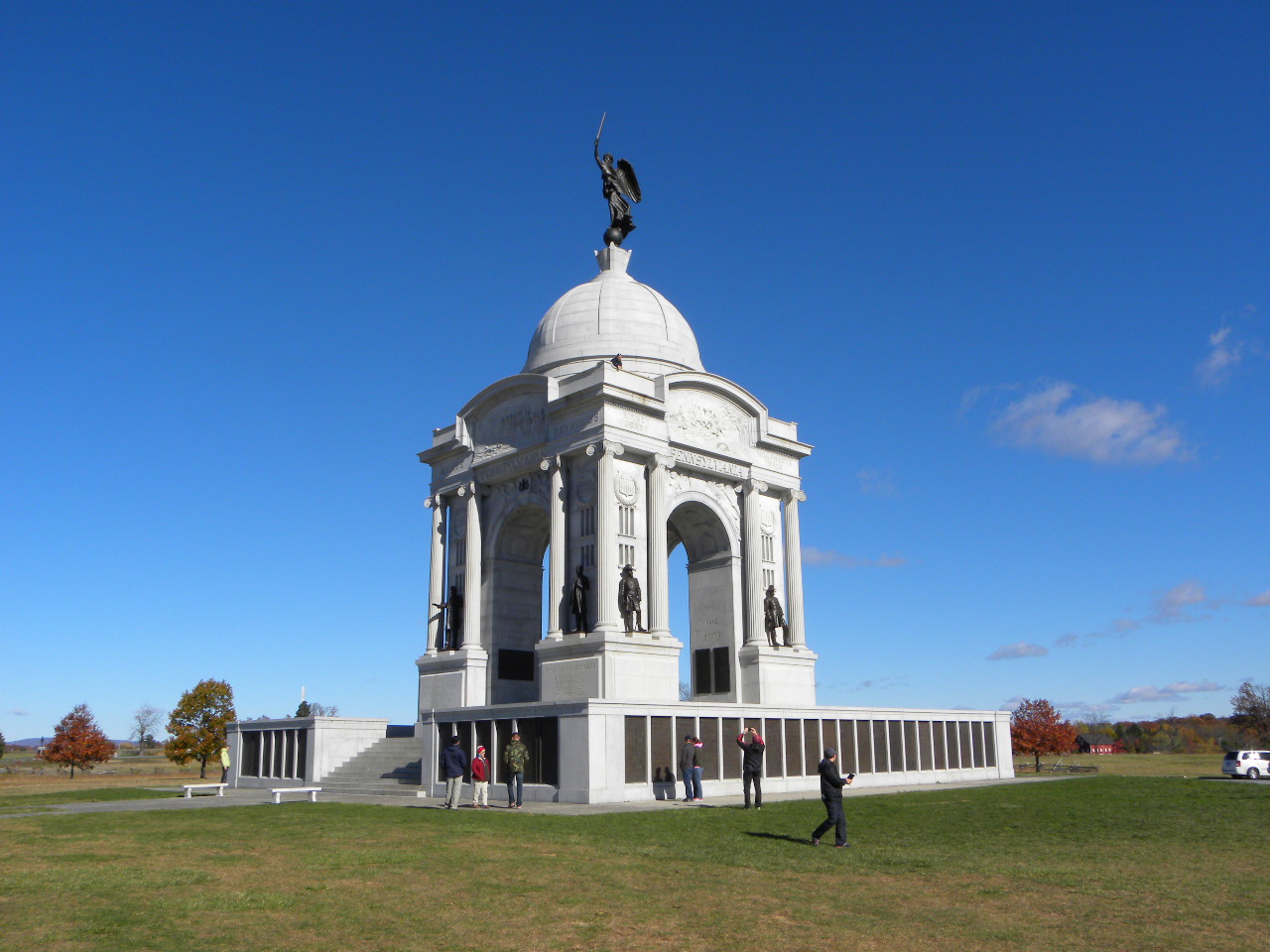
DSCN8828Pennsylvania Monument Cemetery Ridge

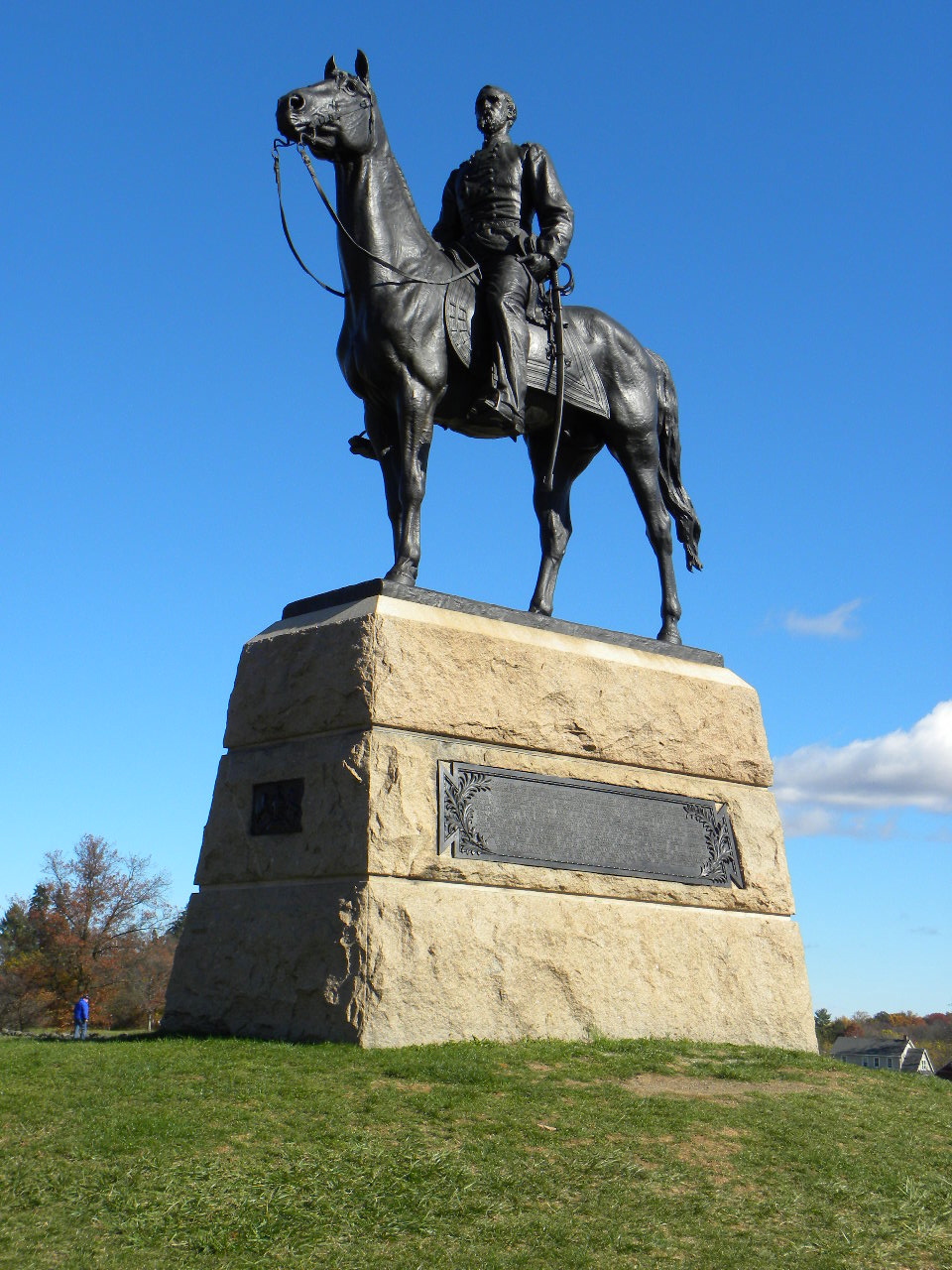
DSCN8831DSCN8832Two views of Monument to General George Meade

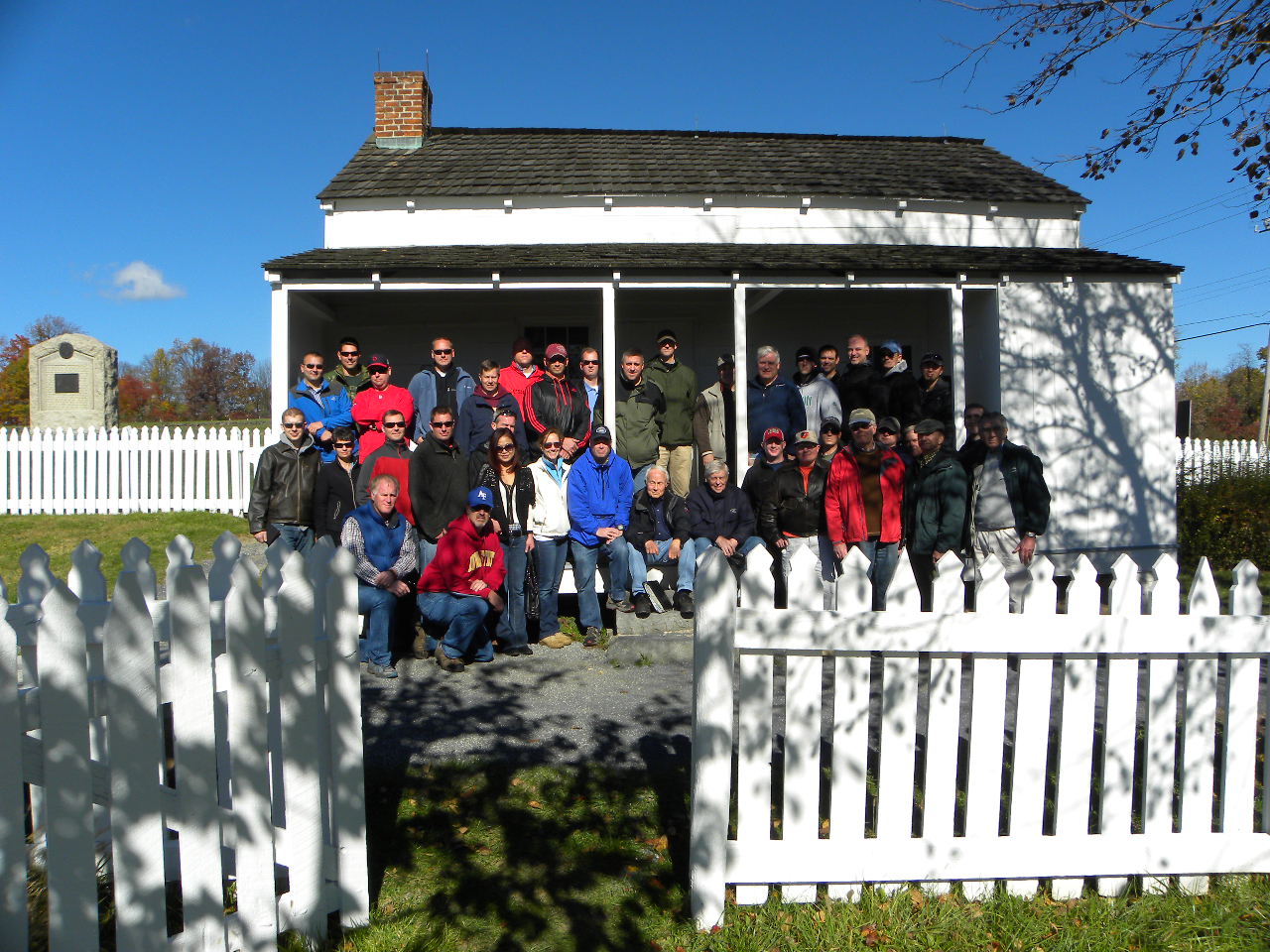
DSCN8834My Class and group at General Meade’s Headquarters east of Cemetery Ridge

DSCN8842Monument to Pennsylvania Cavalry Cemetery Ridge

DSCN8843Virginia Monument on Seminary Ridge near start point for Pickett’s Charge

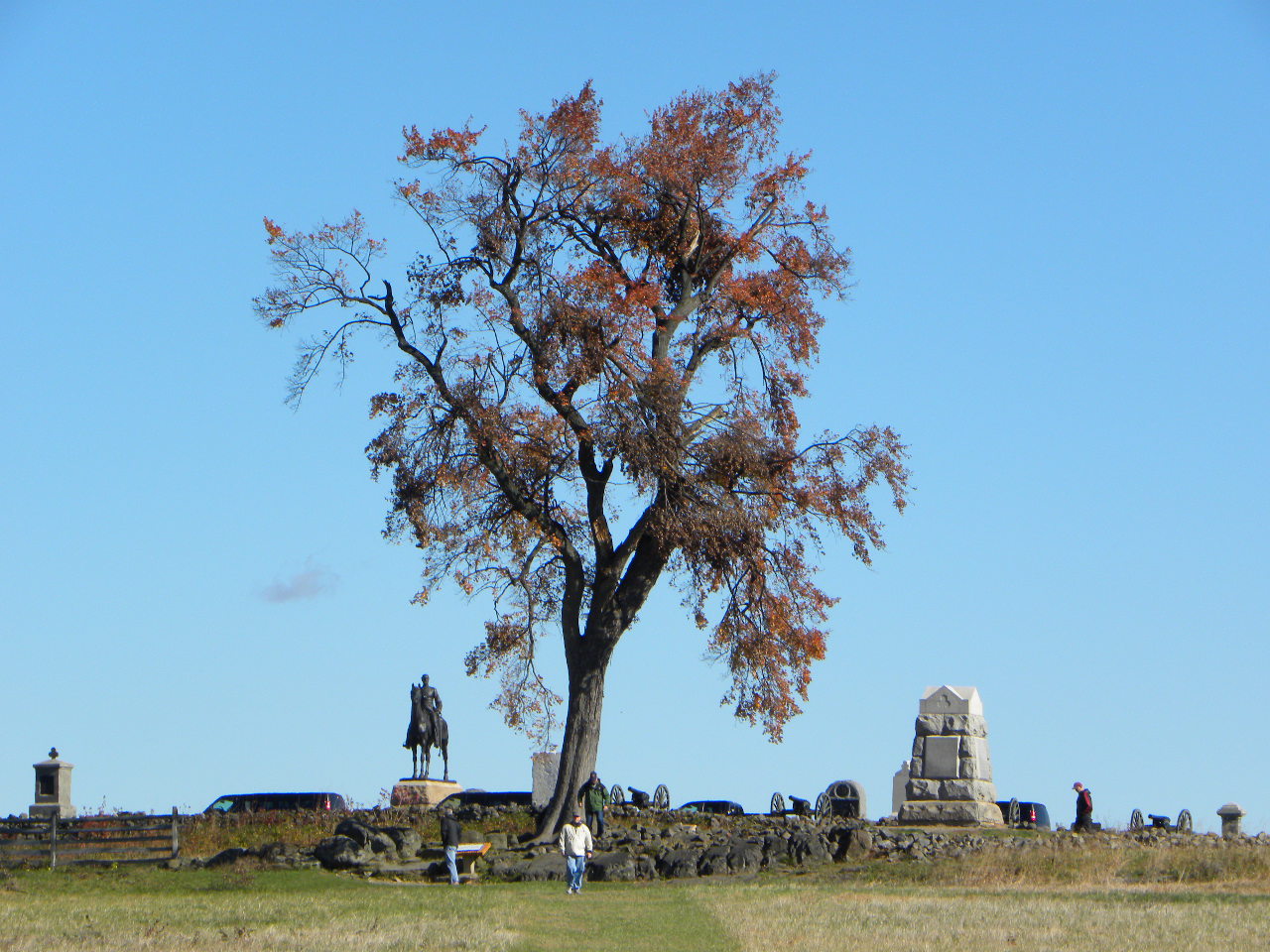
DSCN8830The Copse of Trees, target of Pickett’s Charge

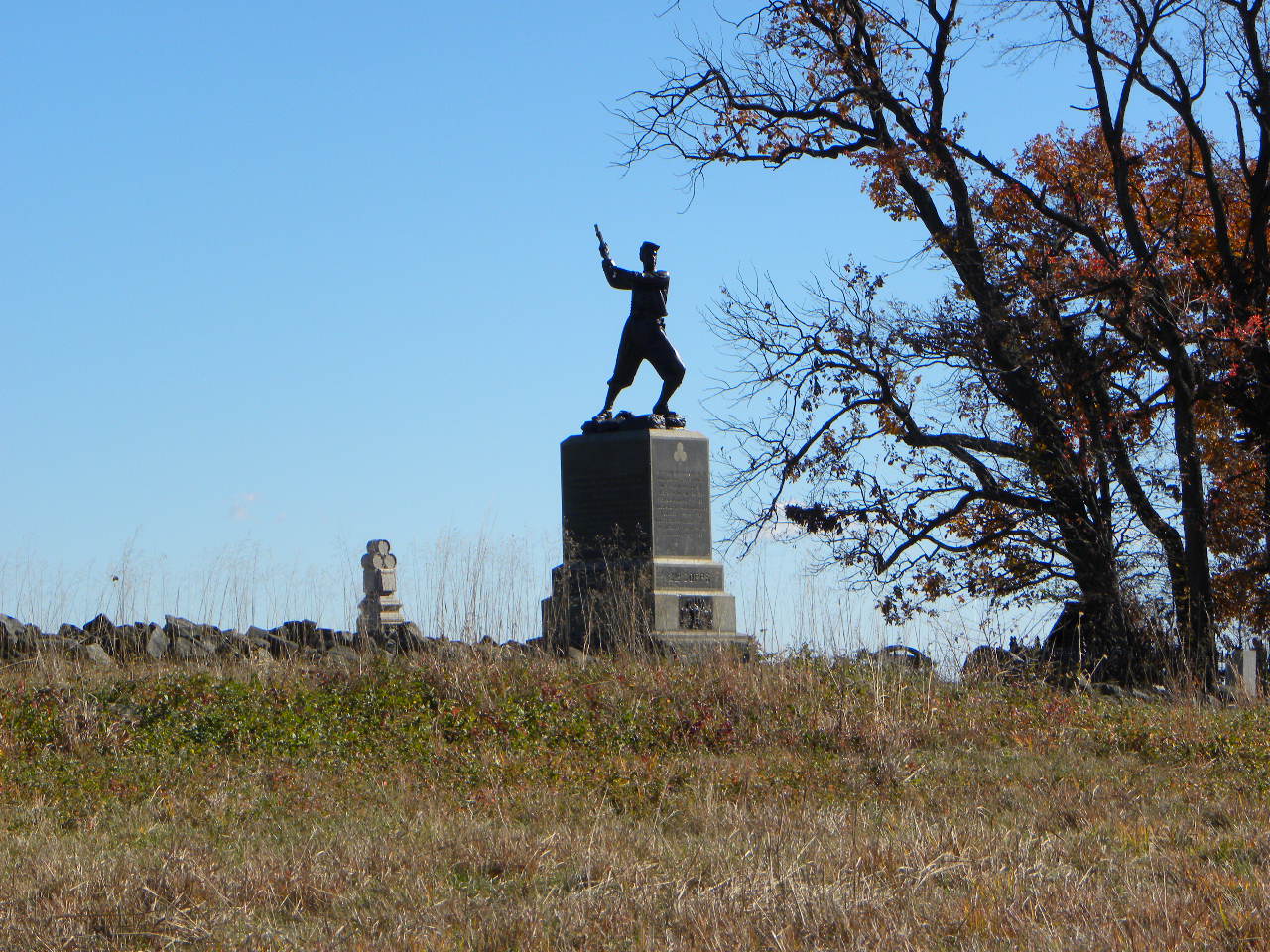
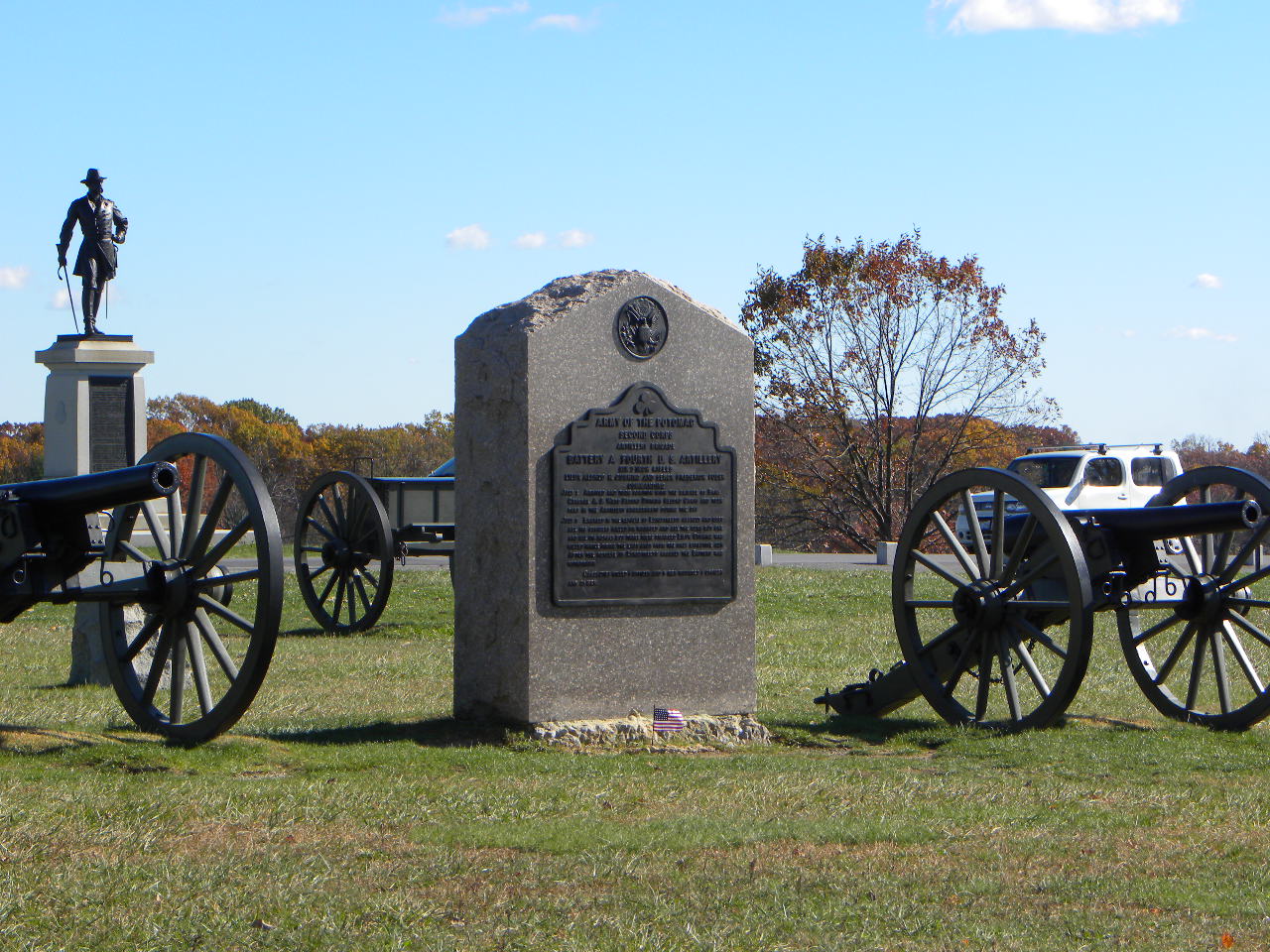
DSCN8854Monument to a Federal Infantry Regiment near the Copse of Trees on Cemetery Ridge

DSCN8856Monument to General Lewis Armistead CSA at the High Water Mark of the Confederacy

DSCN8851DSCN8855Monuments at the Angle on Cemetery Ridge

In a few short weeks our nation will commemorate the 150th anniversary of President Lincoln’s Gettysburg Address. His words, brief yet eloquent sum up the meaning and symbolism in the monuments that mark this hallowed ground.

Four score and seven years ago our fathers brought forth on this continent, a new nation, conceived in Liberty, and dedicated to the proposition that all men are created equal.

Now we are engaged in a great civil war, testing whether that nation, or any nation so conceived and so dedicated, can long endure. We are met on a great battle-field of that war. We have come to dedicate a portion of that field, as a final resting place for those who here gave their lives that that nation might live. It is altogether fitting and proper that we should do this.

But, in a larger sense, we can not dedicate — we can not consecrate — we can not hallow — this ground. The brave men, living and dead, who struggled here, have consecrated it, far above our poor power to add or detract. The world will little note, nor long remember what we say here, but it can never forget what they did here. It is for us the living, rather, to be dedicated here to the unfinished work which they who fought here have thus far so nobly advanced. It is rather for us to be here dedicated to the great task remaining before us — that from these honored dead we take increased devotion to that cause for which they gave the last full measure of devotion — that we here highly resolve that these dead shall not have died in vain — that this nation, under God, shall have a new birth of freedom — and that government of the people, by the people, for the people, shall not perish from the earth.

That is why these reminders of the past matter so much today.

Peace

Padre Steve+


Leave a comment

Filed under civil war, History

A Trip to Gettysburg

mkholrt

“In great deeds, something abides. On great fields something stays. Forms change and pass; bodies disappear, but spirits linger, to consecrate the ground for the vision-place of souls. And reverent men and women from afar, and generations that know us not and that we know not of, heart-drawn to see where and by whom great things were suffered and done for them….” Joshua Lawrence Chamberlain 

I am in Gettysburg this weekend as part of a Staff Ride with members of my Joint Forces Staff College course. I have been to Gettysburg many times but each time I go my appreciation for what occurred there 150 years ago grows. As I muse about the battle, as well as the entire war my thoughts are often drawn to the words of Joshua Lawrence Chamberlain, Colonel of the 20th Maine at Little Round Top.

In a few weeks the nation will mark the 150th anniversary of President Abraham Lincoln’s Gettysburg Address and I am staying not far from where Lincoln delivered the speech.

On Saturday and Sunday we will tour the battlefield and discuss the battle. I will be taking a good number of photos and probably do some writing about what I see and my thoughts on the events of the battle over the next few days.

However even though I will be thinking about the battle, I will also be thinking of the sacrifice made there to preserve the Union and defeat a rebellion that at its heart was based on maintaining a social and economic system that enslaved a race of people and treated them as less than human. If course the defenders of that revolt point to it being about “states rights” but those rights were fundamentally about preserving and expanding the practice of slavery and subjugating the black race in order to maintain the economic and political power of slave owners and traders.

images-61

Until then I will leave you with the immortal words of President Lincoln.

Four score and seven years ago our fathers brought forth on this continent, a new nation, conceived in Liberty, and dedicated to the proposition that all men are created equal.

Now we are engaged in a great civil war, testing whether that nation, or any nation so conceived and so dedicated, can long endure. We are met on a great battle-field of that war. We have come to dedicate a portion of that field, as a final resting place for those who here gave their lives that that nation might live. It is altogether fitting and proper that we should do this.

But, in a larger sense, we can not dedicate — we can not consecrate — we can not hallow — this ground. The brave men, living and dead, who struggled here, have consecrated it, far above our poor power to add or detract. The world will little note, nor long remember what we say here, but it can never forget what they did here. It is for us the living, rather, to be dedicated here to the unfinished work which they who fought here have thus far so nobly advanced. It is rather for us to be here dedicated to the great task remaining before us — that from these honored dead we take increased devotion to that cause for which they gave the last full measure of devotion — that we here highly resolve that these dead shall not have died in vain — that this nation, under God, shall have a new birth of freedom — and that government of the people, by the people, for the people, shall not perish from the earth.

Peace

Padre Steve+

Leave a comment

Filed under civil war, History

Living the Nightmares: PTSD and Iraq Six Years Later

481801_10151367001287059_1003164983_n-1.jpg

“Only happy people have nightmares, from overeating. For those who live a nightmare reality, sleep is a black hole, lost in time, like death.”  Guy Sajer, The Forgotten Soldier

Last week I woke up screaming thanks to some nightmare brought to me in high definition by PTSD. It woke Judy and both of the dogs up and well, it wasn’t exactly pleasant. Unfortunately this happens more often than I would like it to. When I was stationed away from home in North Carolina it was only Molly my faithfully dog who was disturbed by this, now I wake up Judy and our younger Papillon Minnie, or Minnie Scule as is her full name.

This afternoon I read a story of a Marine veteran who lost his battle with PTSD, taking his own life. I see a lot of these stories and each one makes me wonder what s going on and gives me pause when I think just how bad I was doing not too long ago.

It is hard for me to believe that nearly six years after I returned from Iraq that I still have a lot of trouble sleeping, though less trouble than a couple of years ago and that my nightmares associated with war still return with more regularity than I would like. Likewise it is hard for me to believe how much my life is impacted by this. I still experience a fair amount of hyper-vigilance, crowds of people are difficult and the craziness of traffic on the local freeways causes me a fair amount of distress.

n671902058_1153829_4642

Despite that I am doing a lot better than I was even a year or so ago when I was still struggling a lot more than I am now and let’s say 4 years ago when there were times I wondered why I was still alive. Of course the time from 2008-2010 was probably the worst time of my life when it seemed that everything that I had believed in had melted away. I didn’t know if God existed, I felt abandoned by my former Church and even by many peers. The only thing that kept me going was a deep sense of call and vocation as a Priest and Chaplain, even though I was for all practical purposes an agnostic who was praying that maybe God still might exist.

Those who have been with me on this blog over the years know how central that struggle has been. I have written about it many times.

Though I am doing much better than I was I still have my times of doubt, times of fear and times of absolute panic. I do what I can to manage but once in a while something will trigger a response. The biggest problem still is sleep and vivid dreams and nightmares. Once I finish the course I am in I am going to get back into therapy a couple of times a month. Thankfully my new job after I complete the school will be more academic with a small chapel where I serve the Students of the Joint Forces Staff College.

Physically I am doing much better, in terms of overall health and physical fitness. I am playing softball again and my PT regimen is much better. Spiritually I can say that being active in having a Chapel where I celebrate Eucharist in a small setting has been good for me. Having to preach again from the lectionary readings is a good thing. Likewise getting a break from five years of hospital ministry, dealing with death, suffering and psychological issues is good. After Iraq I threw myself into the most difficult areas of hospital ministry, the critical care Intensive Care Units hoping that such work would help bring me out of my own issues. Unfortunately, it made it more difficult.

Being at home again is good. I just wish that my nightmares would not cause distress to the rest of my little family. However, it is nice when after they look at me like I am nuts one or both dogs come to me and help calm me down.

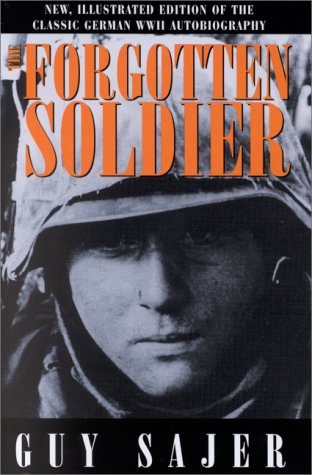
I quoted Guy Sajer, the author of the classic book The Forgotten Soldier. If anyone wants to understand something about what war does to a person and see PTSD in non-clinical terms I think it is possibly the best book to read.

Forgotten_Soldier

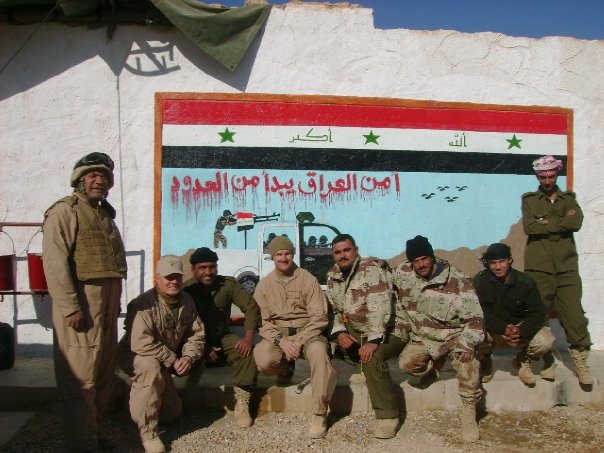
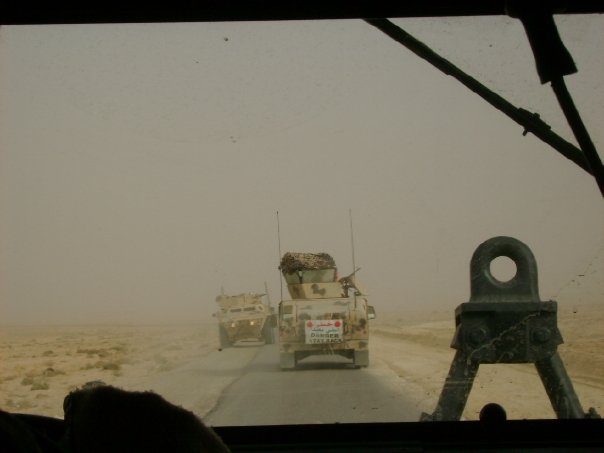
Since I have gone to war and experienced fear on a daily basis out in the hinterlands of Al Anbar Province with small groups of American Marines and Soldiers and Iraqi troops I understand a bit of what Sajer writes. My war was different, out with advisors on small Iraqi basis, traveling in dangerous areas far from any big American units, occasionally being shot at and seeing the devastation of war in that unfortunate country,  though my experience of war pales in comparison with what Sager describes.

That being said I do understand in ways that I never did before. Sajer makes a comment which I think is incredibly appropriate for those that read of war without having ever experienced it. too often is the case in the United States and Western Europe where very few ever put on a uniform and even fewer experience war. Sager wrote:

“Too many people learn about war with no inconvenience to themselves. They read about Verdun or Stalingrad without comprehension, sitting in a comfortable armchair, with their feet beside the fire, preparing to go about their business the next day, as usual.

One should really read such accounts under compulsion, in discomfort, considering oneself fortunate not to be describing the events in a letter home, writing from a hole in the mud. One should read about war in the worst circumstances, when everything is going badly, remembering that the torments of peace are trivial, and not worth any white hairs. Nothing is really serious in the tranquility of peace; only an idiot could be really disturbed by a question of salary. 

One should read about war standing up, late at night, when one is tired, as I am writing about it now, at dawn, while my asthma attack wears off. And even now, in my sleepless exhaustion, how gentle and easy peace seems!”

This weekend I will visit the Gettysburg Battlefield as part of a staff ride. I have been there a good number of times but not since I returned from Iraq. Thus in a sense it will take on new meaning, especially when I walk those hallowed fields of battle where so many died and so many more were maimed in our own terrible Civil War.

295_26911892058_4301_n

That being said I wonder if the solution to my nightmares is to go back to Iraq someday like so many WWII, Korea and Vietnam veterans have done to the places that they served. That has to remain in the future, but hopefully I will get the chance and maybe by then Iraq will at last be at peace.

Tonight I will attempt to sleep and hopefully what dreams I have, though they be high definition will at least not be nightmares that disturb Judy or the dogs.

Peace

Padre Steve+

2 Comments

Filed under civil war, faith, Military, ministry, Pastoral Care, PTSD

Gettysburg at 150: The Accounting in Lives and Difficult Moral Questions

gettysburg-devils-den

“Why do men fight who were born to be brothers?”James Longstreet

“It is well that war is so terrible. We should grow too fond of it.” Robert E Lee

As the sun set on the evening of July 3rd 1863 the battered Army of Northern Virginia and the battered but victorious Army of the Potomac tended their wounds, buried their dead and prepared for what might happen next.

Following the disastrous attack aimed at the Union center, what is commonly called “Pickett’s Charge” Lee and his surviving commanders prepared for an expected Union counter attack. However, George Meade, the commander of the Army of the Potomac who had correctly anticipated Lee’s assault decided not to gamble on a counter attack, though it was tempting. He knew too well the tenacity and skill of the Confederate commanders and soldiers on the defense and did not want to risk a setback that might give Lee another chance.

Savages_Station_field_hospital-600x374

The dead and wounded littered the battlefield. Field hospitals, little more than butcher shops where arms and legs were amputated by overworked surgeons and attendants while those with abdominal wounds that could not be easily repaired were made as comfortable as possible. Triage was simple. If a casualty was thought to have a reasonable chance at survival he was treated, if not they were set aside in little groups and allowed to die as peacefully as possible. Chaplains made their way around, Protestant’s ensuring that their soldiers “knew Jesus” and Catholics administering the Last Rites.

dead-civil-war-soldiers

One Confederate soldier describe the scene west of the town on July 4th:

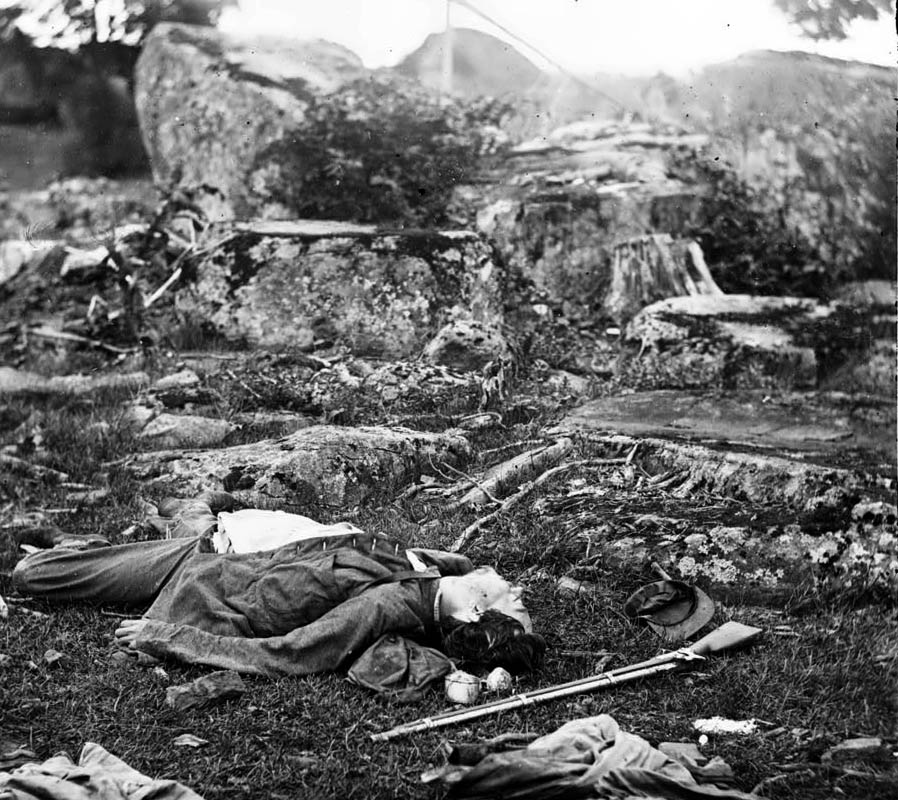
“The sights and smells that assailed us were simply indescribable-corpses swollen to twice their size, asunder with the pressure of gases and vapors…The odors were nauseating, and so deadly that in a short time we all sickened and were lying with our mouths close to the ground, most of us vomiting profusely.” 

Among the killed and wounded were the great and the small. John Reynolds who died on day one, Winfield Scott Hancock, the valiant commander of the Union II Corps wounded during Pickett’s Charge, Mad Dan Sickles, who had nearly brought disaster on the Federal lines by advancing to the Peach Orchard on July 2nd had a leg amputated.

The Confederates suffered grievous losses. Divisional commanders like Dorsey Pender were mortally wounded. John Bell Hood was severely wounded, Isaac Trimble was wounded and captured while Harry Heth was wounded. Numerous Generals were killed or wounded and among regimental commanders the toll was fearful. In Picket’s division alone all three brigade commanders, Kemper, Armistead and Garnett were killed or wounded while 26 of 40 Field Grade officers were casualties. 46% (78 of 171) of the regiments of the Army of Northern Virginia suffered casualties at the command level. The Confederate casualties, especially among the best leaders were irreplaceable and Lee’s Army never recovered from the loss of seasoned leaders who were already in short supply.

One witness, Frank Haskell looked in at a field hospital in the Union II Corps area and wrote:

“The Surgeons with coats off and sleeves rolled up…are about thier work,… “and their faces and clothes are spattered with blood; and though they look weary and tired, their work goes systematically and steadily on- how much and how long they have worked, the piles of legs, arms, feet, hands, fingers…partially tell.” (Gettysburg by Stephen W Sears, Mariner Books, Houghton Mifflin Company Boston, New York 2004 p.466)

All told between 46,000 and 51,000 Americans were killed or wounded during the three days of Gettysburg. Busey and Martin’s Regimental Strengths and Losses at Gettysburg lists the following casualty figures, other accounts list higher numbers. One also has to remember that many of the missing were killed but simply never found or if their bodies were found identified:

killed           wounded         missing         total

Union                    3,155          14,531             5,369           23,055

Confederate         4,708          12,693             5,830            23,231

Total                     7,863           27,224            11,199          46,286

To provide a reference in 8 years of war in Iraq the United States suffered fewer casualties than during the three days of Gettysburg. It was the bloodiest single battle in American history.

At the end of the war, Joshua Chamberlain, the hero of Little Round Top who was well acquainted with the carnage of war asked the most difficult questions:

“…men made in the image of God, marred by the hand of man, and must we say in the name of God? And where is the reckoning for such things? And who is answerable? One might almost shrink from the sound of his own voice, which had launched into the palpitating air words of order–do we call t?–fraught with such ruin. Was it God’s command that we heard, or His forgiveness that we must forever implore?”

May we pray for peace that such an event never take place again.

Peace

Padre Steve+

Leave a comment

Filed under civil war, History, Military

Gettysburg at 150: The Soul of a Hero Joshua Chamberlain

chamberlain

I want to take a brief moment tonight to think about the heart, soul and morality of a soldier, scholar and theologian, Colonel, later Major General Joshua Lawrence Chamberlain, the hero of Little Round Top and certainly a man whose actions as commanding officer of the 20th Maine Regiment at Gettysburg helped preserve the Union.

After the war Chamberlain spoke of the battle often. One of his most famous quotes is a testament to his humanity and integrity.

In great deeds, something abides. On great fields, something stays. Forms change and pass; bodies disappear; but spirits linger, to consecrate ground for the vision-place of souls… generations that know us not and that we know not of, heart-drawn to see where and by whom great things were suffered and done for them, shall come to this deathless field, to ponder and dream; and lo! the shadow of a mighty presence shall wrap them in its bosom, and the power of the vision pass into their souls.”

Chamberlain was a graduate of Bowdoin College and Bangor Theological Seminary, fluent in 9 languages other than English. He was Professor of Rhetoric at Bowdoin before seeking an appointment in a Maine Regiment without consulting either the college or his family. He was offered command of the 20th Maine but asked to be appointed as a Lieutenant Colonel which he was in August 1862. He fought at Fredericksburg and was named commander of the regiment when Colonel Ames, his commander was promoted following Chancellorsville.

Chamberlain was awarded the Medal of Honor for his valor at Little Round Top in 1893. He was gravely wounded during the siege of Petersburg in June of 1864 while commanding a brigade and promoted to Brigadier General. He returned to duty later in the year as commander of the 1st Brigade, 1st Division V Corps and was again wounded at Petersburg in a skirmish at Quaker Road and was promoted to Brevet Major General by Abraham Lincoln. Chamberlain received the surrender of Lee’s decimated Army if Northern Virginia. He would go on to serve as a four term Governor of Maine and remained active with the Grand Army of the Republic veteran’s organization, remained active as an educator and President of Bowdoin College and founded the Maine Institute for the Blind which is now known as the Iris Foundation. He died of his wartime wounds on February 24th 1914.

LRT

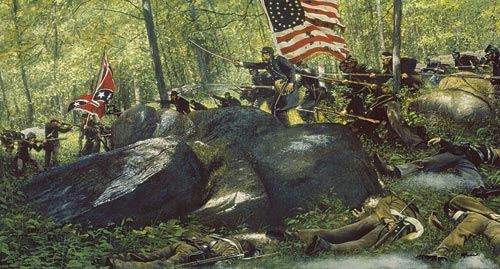
As the 20th Maine, tired from fighting off numerous assaults by attacking Confederates and now out of ammunition saw another wave of Confederates come up the slopes of Little Round Top Chamberlain ordered his men to fix bayonets and execute a right wheel. The move caught the advancing Rebels who were sensing victory by complete surprise. Chamberlain wrote in his official report of the battle:

“The enemy seemed to have gathered all their energies for their final assault. We had gotten our thin line into as good a shape as possible, when a strong force emerged from the scrub wood in the valley, as well as I could judge, in two lines in echelon by the right, and, opening a heavy fire, the first line came on as if they meant to sweep everything before them. We opened on them as well as we could with our scanty ammunition snatched from the field.

It did not seem possible to withstand another shock like this now coming on. Our loss had been severe. One-half of my left wing had fallen, and a third of my regiment lay just behind us, dead or badly wounded. At this moment my anxietv was increased by a great rbar of musketry in my rear, on the farther or northerly slope of Little Round Top, apparently on the flank of the regular brigade, which was in support or Hazlett’s battery on the crest behind us. The bullets from this attack struck into my left rear, and I feared that the enemy might have nearly surrounded the Little Round Top, and only a desperate chance was left for us. My ammunition was soon exhausted. My men were firing their last shot and getting ready to “club” their muskets.

It was imperative to strike before we were struck by this overwhelming force in a hand-to-hand fight, which we could not probably have withstood or survived. At that crises, I ordered the bayonet. The word was enough. It ran like fire along the line, from man to man, and rose into a shout, with which they sprang forward on the enemy, now not 30 yards away. The effect was surprising; many of the enemy’s first line threw down their arms and surrendered. An officer fired his pistol at my head with one hand, while he handed me his sword with the other. Holding fast by our right, and swinging forward our left, we made an extended “right wheel,” before which the enemy’s second line broke and fell back, fighting from tree to tree, many being captured, until we had swept the valley and cleared the front of nearly our entire brigade.”

The successful defense of Little Round Top by Chamberlain’s gallant 20th Maine as well as the other regiment’s of Colonel Strong Vincent’s brigade saved the Army of the Potomac from being enveloped by the Confederate right wing and defeated in detail. Such a defeat very probably would have given the peace party in the North the leverage that they needed to change the political calculus and end the war, giving the Confederacy independence and destroying the Union.

Though he was a valiant soldier Chamberlain was thoughtful and never lost his sense of honor, integrity or Christian morality in the war. Perhaps it was his education or upbringing. Perhaps it was ideals that were so much a part of his psyche that no matter where he served, or how great the sacrifice and suffering that he still kept his essential humanity. Even in victory he maintained a magnanimous spirit towards former enemies when they surrendered.

As the war drew to a close and Chamberlain continued to lead troops in mortal combat in the campaign at Petersburg and Appomattox Chamberlain saw much that caused to to ask hard questions. With friends lying dead and dying around following the Battle at the Quaker Road on March 30th 1865 Chamberlain pondered:

“But we had with us, to keep and care for, more than five hundred bruised bodies of men–men made in the image of God, marred by the hand of man, and must we say in the name of God? And where is the reckoning for such things? And who is answerable? One might almost shrink from the sound of his own voice, which had launched into the palpitating air words of order–do we call t?–fraught with such ruin. Was it God’s command that we heard, or His forgiveness that we must forever implore?”

I think that we have a lot to learn from Joshua Chamberlain. His question at the Quaker Road is one that anyone leading nations, or military units into the valley of the shadow of death need to ask, especially when the war or conflict is waged “in the name of God” whoever’s God it might be.  All too often evil done in the name of the Almighty is blessed by the Trinity of Evil, the Preacher, Pundits and Politicians who use being on the side of God to justify the basest evil and inhuman deeds. But then maybe it is only the rare man like Chamberlain who can see through the darkness and still discern the “divine spark” in a man.

gl-pr-105

As Chamberlain received the surrender of the units of the Army of Northern Virginia he paid the bedraggled but still proud Confederates the honor of a salute. One Rebel General said to him “You astonish us by your honorable and generous conduct. I fear we should not have done the same by you had the case been reversed.” Another commented “I went into that cause and I meant it. We had our choice of weapons and of ground, and we have lost. Now” pointing at the Stars and Stripes “that is my flag, and I will prove myself as worthy as any of you ” (Soul of the Lion: A Biography of General Joshua L. Chamberlain. by Willard M Wallace, Thomas Nelson and Sons, New York 1960. Reprinted 1991 by Stan Clark Military Books, Gettysburg PA. p.190) 

May we all learn to find that divine spark before it is too late.

Peace

Padre Steve+

1 Comment

Filed under civil war, faith, History, Military, philosophy

Gettysburg at 150 Day One: “For God’s Sake Forward!” John Reynolds at Herr’s or McPherson’s Ridge July 1st 1863

z_maritato_ironbrigadeforward

Iron Brigade Forward! Battle of Gettysburg, PA – July 1, 1863 by Mark Maritato

“…by his promptitude and gallantry he had determined the decisive field of the war, and he opened brilliantly a battle which required three days of hard fighting to close with a victory.” Major General Harry Hunt, Chief of Artillery, Army of the Potomac on the actions of Major General John F Reynolds at Gettysburg

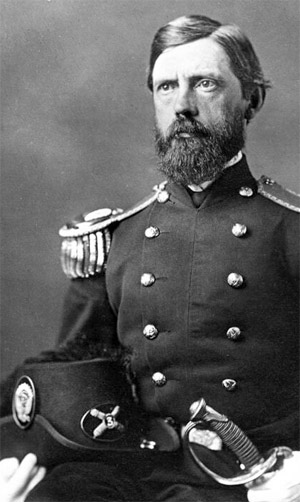
Major General John Reynolds was on his home soil. A native of Lancaster Pennsylvania  Reynolds was the senior Corps commander in the Army of the Potomac. Considered by his peers and superiors to be the best commander in the Army he had been given command of a wing of the Army, his own I Corps, Oliver Howard’s XI Corps and John Sedgewick’s III Corps. He also had John Buford’s 1st Cavalry Division under his command.

Early in June Abraham Lincoln had offered command of the Army of the Potomac to Reynolds, however Reynolds’ set a condition which Lincoln in the political climate of the time could not grant, that he would be free from the political interference which had beset previous Army commanders. Both Reynolds’ request and Lincoln’s response are understandable. Lincoln respected Reynolds and when Major General Joseph Hooker was relieved of command of the Army by Lincoln Major General George Meade, commander of V Corps another Pennsylvanian took his place with Reynolds keeping his position.

As the Army of the Potomac reacted to the advance of Robert E  Lee’s Confederate Army of Northern Virginia Hooker pursued and Meade continued the pursuit into Pennsylvania once he took command.

Reynolds’ wing of three Infantry corps and Buford’s Cavalry division acted as the advance elements of the Army. Late in the afternoon of June 30th Buford’s troops observed Johnston Pettigrew’s brigade of Harry Heth’s division near Gettysburg. Pettigrew on detecting Buford’s cavalry refused to engage and Buford made the choice to take the good high ground west of Gettysburg and hold it in order to give Reynolds followed by the rest of the Army time to arrive.

WaudSketch

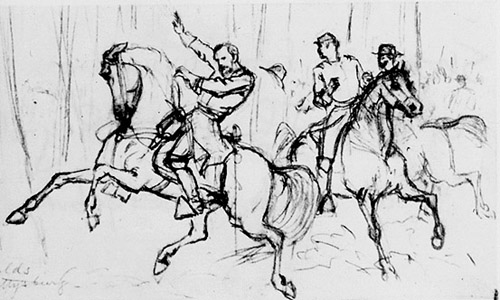
The Death of Reynolds (Waud)

Reynolds sent messages late in the evening to both Reynolds and the Union Calvary Corps commander, Major General Alfred Pleasanton describing the situation. Reynolds’ units were south of Emmitsburg moving north and on the morning of the 1st of July he brought his troops up as Buford and his cavalry troopers engaged Heth’s division in a delaying action in order to give Reynolds’ units time to get to the good high ground around Gettysburg.

Reynolds rode ahead and briefly met Buford at the Lutheran Seminary where Buford ensured Reynolds that his troopers could hold. With that Reynolds ordered his leading corps, the lead division under the command of Abner Doubleday to advance to the action at the double-quick. He then sent a message to Meade through a staff officer stating “Tell the General that we will hold the heights to the south of the town, and that I will barricade the streets of the town if necessary.”

As his units arrived into an already raging battle Reynolds directed them to key areas of the battlefield. As he directed the “Iron Brigade” into position in Herr’s (McPherson’s) Woods Reynolds exhorted the men forward.“Forward! men, forward! for God’s sake, and drive those fellows out of the woods!” As he said these words he was struck by a bullet in the head and died instantly.

In the immediate confusion following Reynolds’ death the I and XI Corps confusion reigned. It seemed that the Union corps now fighting two Confederate Corps, Hill’s 3rd Corps which they had been fighting since the morning and Ewell’s 2nd Corps which arrived in a flanking position to their north during the afternoon might be routed. The Federal troops, I Corps now under the command of Doubleday and XI under Major General Oliver Howard withdrew through Gettysburg to Cemetery Hill where they were rallied by Reynolds’ old friend Major General Winfield Scott Hancock of II Corps.

Hill’s troops entered the town but did not attempt to take the hill while Ewell passed on an opportunity to take nearby Culp’s Hill which would have dislodged the Federal right flank.

The first day ended with the Army of the Potomac holding the high ground in an easily defensible position on interior lines. Lee’s Army was spread out and the defense mounted by Buford and Reynolds had disrupted Hill’s Corps, causing significant casualties.

Buford is to be given much of the credit for choosing the ground of the battle and fighting a stellar delaying action against superior forces. But had Reynolds not brought his units up in the expeditious manner in which he did and then all of Buford’s efforts might have been in vain. The two men, bound by their professionalism and commitment to duty and their oath helped save the Union on that first day of July 1863.

reynolds

Charles Veil who served as a staff officer under Reynolds wrote the following epitaph stating that Reynolds “was a man who knew not fear or danger was, in a word (he was) one of our very best Generals. Wherever the fight raged the fiercest, there the General was sure to be found, his undaunted courage always inspired men with energy & courage.” 

Peace

Padre Steve+
Leave a comment

Filed under civil war, History, leadership, Military