Tag Archives: civil war

The Memorial Day Order

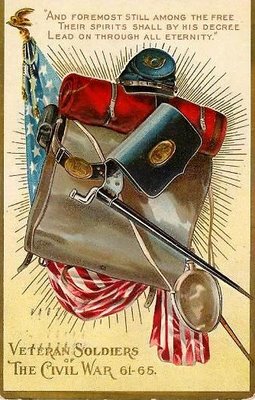
memorial-day-traditions_1399868491

“It is rather for us to be here dedicated to the great task remaining before us — that from these honored dead we take increased devotion to that cause for which they gave the last full measure of devotion — that we here highly resolve that these dead shall not have died in vain — that this nation, under God, shall have a new birth of freedom — and that government of the people, by the people, for the people, shall not perish from the earth.” Abraham Lincoln the Gettysburg Address 

As we contemplate the importance of Memorial Day and remember the men and women who gave their lives for this country it is important to remember why we do this. Memorial Day grew out of local observances following the Civil War, a war that claimed the lives of over 620,000 American Soldiers from the Union and the Confederacy. New demographic studies by historians estimate the losses at closer to 750,000. Hundreds of thousands of other people had they lives shattered by the war, killed, wounded, maimed, crippled, shattered in mind and spirit, the country in many places devastated by war’s destruction. Using the 620,000 number that would have meant that 2.5% of the population of the country died in the war. People needed to make sense of the losses.

To put this in perspective, if the same number of Americans were to die today in a way the total would be over seven million people. Seven million my friends. War reached into every home in some way, and sadly or perhaps thankfully we have no concept of such losses today.

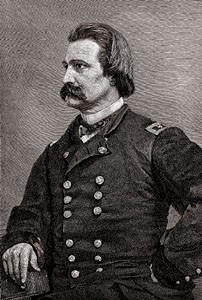
logan_engraving

In 1868, Major General John Logan who had been an excellent corps commander during the war was serving as the Commander of the nation’s first true Veterans organization, the Grand Army of the Republic which gave those veterans a place of refuge in a country that was leaving them behind and forgetting their sacrifice in the name of westward expansion and a growing economy. Let’s face it, money has almost always been more important to Americans than the troops who sacrificed their lives for the nation, but I digress…

Anyway General Logan issued this order on May 5th 1868:

HEADQUARTERS GRAND ARMY OF THE REPUBLIC, General Orders No.11, WASHINGTON, D.C., May 5, 1868

I. The 30th day of May, 1868, is designated for the purpose of strewing with flowers or otherwise decorating the graves of comrades who died in defense of their country during the late rebellion, and whose bodies now lie in almost every city, village, and hamlet church-yard in the land. In this observance no form of ceremony is prescribed, but posts and comrades will in their own way arrange such fitting services and testimonials of respect as circumstances may permit.

We are organized, comrades, as our regulations tell us, for the purpose among other things, “of preserving and strengthening those kind and fraternal feelings which have bound together the soldiers, sailors, and marines who united to suppress the late rebellion.” What can aid more to assure this result than cherishing tenderly the memory of our heroic dead, who made their breasts a barricade between our country and its foes? Their soldier lives were the reveille of freedom to a race in chains, and their deaths the tattoo of rebellious tyranny in arms. We should guard their graves with sacred vigilance. All that the consecrated wealth and taste of the nation can add to their adornment and security is but a fitting tribute to the memory of her slain defenders. Let no wanton foot tread rudely on such hallowed grounds. Let pleasant paths invite the coming and going of reverent visitors and fond mourners. Let no vandalism of avarice or neglect, no ravages of time testify to the present or to the coming generations that we have forgotten as a people the cost of a free and undivided republic.

If our eyes grow dull, other hands slack, and other hearts cold in the solemn trust, ours shall keep it well as long as the light and warmth of life remain to us.

Let us, then, at the time appointed gather around their sacred remains and garland the passionless mounds above them with the choicest flowers of spring-time; let us raise above them the dear old flag they saved from dishonor; let us in this solemn presence renew our pledges to aid and assist those whom they have left among us a sacred charge upon a nation’s gratitude, the soldier’s and sailor’s widow and orphan.

II. It is the purpose of the Commander-in-Chief to inaugurate this observance with the hope that it will be kept up from year to year, while a survivor of the war remains to honor the memory of his departed comrades. He earnestly desires the public press to lend its friendly aid in bringing to the notice of comrades in all parts of the country in time for simultaneous compliance therewith.

III. Department commanders will use efforts to make this order effective.

By order of

JOHN A. LOGAN,
Commander-in-Chief

N.P. CHIPMAN,
Adjutant General

Official:
WM. T. COLLINS, A.A.G.

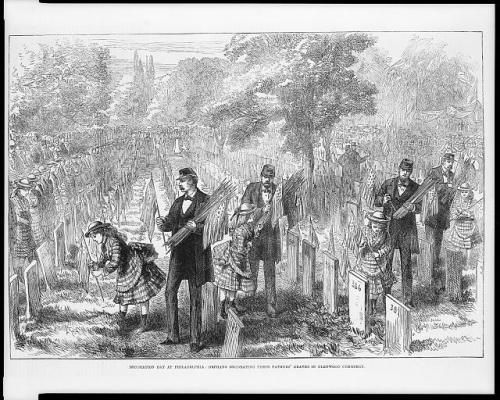
decoration-day1

General Logan’s order is remarkable in its frankness and the understanding of the war in the immediate context of its conclusion. In 1868 the day would be observed at 183 cemeteries in 27 States and the following year over 300 cemeteries. Michigan was the first state to make the day a holiday and by 1890 all states in the North had made it so. In the South there were similar observances but the meaning attributed to the events and the sacrifices of the Soldiers of both sides was interpreted quite differently. In the North the Veterans overwhelmingly saw themselves as the saviors of the Union and the liberators of the Slaves. In South it was about the sacrifices of Confederate soldiers in what became known as the “Lost Cause.” But in both regions and all states, the surviving Soldiers, family members and communities honored their dead.

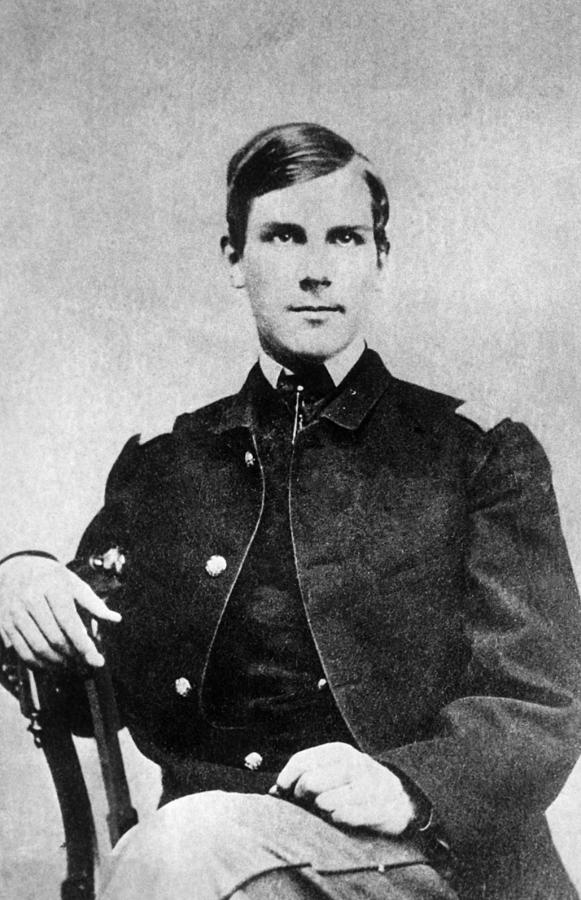
1-oliver-wendell-holmes-jr-1841-1935-everett

In 1884 Oliver Wendell Holmes Jr. and Frederick Douglass both spoke about the meaning of the sacrifice made by so many.

Holmes, a veteran of the war who had been wounded at Antietam ended his Decoration Day 1884 speech:

“But grief is not the end of all…Our dead brothers still live for us, and bid us think of life, not death, — of life to which in their youth they lent the passion and glory of the spring. As I listen, the great chorus of life and joy begins again, and amid the awful orchestra of seen and unseen powers and destinies of good and evil our trumpets sound once more a note of daring, hope, and will.”

Douglass.JPG

Douglass, the former slave and abolitionist who lobbied Lincoln for emancipation and to give Blacks the chance to serve their country had two of his sons serve in the war spoke these wars:

“Dark and sad will be the hour to this nation when it forgets to pay grateful homage to its greatest benefactors. The offering we bring to-day is due alike to the patriot soldiers dead and their noble comrades who still live; for, whether living or dead, whether in time or eternity, the loyal soldiers who imperiled all for country and freedom are one and inseparable.”

It is important for the country not to forget those who served and the cost of those who have given the last full measure of devotion to duty and those who still carry the scars of war on their bodies and in their minds and spirits. I am one of the latter and I have known too many of the former.  Maybe that is why am so distrustful of those who advocate for war but have no skin in the game.

An Alsatian-German Soldier named Guy Sager wrote in his book The Forgotten Soldier: 

“Too many people learn about war with no inconvenience to themselves. They read about Verdun or Stalingrad without comprehension, sitting in a comfortable armchair, with their feet beside the fire, preparing to go about their business the next day, as usual…One should read about war standing up, late at night, when one is tired, as I am writing about it now, at dawn, while my asthma attack wears off. And even now, in my sleepless exhaustion, how gentle and easy peace seems!”

I agree with him and pray that those who direct the course of this nation will take the words of General Logan, Oliver Wendell Holmes Jr., Frederick Douglass and Guy Sager to heart before they embark on war, and when they remember those that have served.

May we never forget.

Peace

Padre Steve+


6 Comments

Filed under civil war, Gettysburg, History, iraq,afghanistan, Military, Political Commentary

Armed Forces Day 2015: The Breach of Trust

2015AFDPoster

“What is the cost of war? what is the bill?…“This bill renders a horrible accounting. Newly placed gravestones. Mangled bodies. Shattered minds. Broken hearts and homes. Economic instability. Depression and all of its attendant miseries. Back -breaking taxation for generations and generations. For a great many years as a soldier I had a suspicion that war was a racket; not only until I retired to civilian life did I fully realize it….” Major General Smedley Butler USMC

Today is Armed Forces Day and unfortunately most of the country will not notice unless they are attending a Baseball game where it is being observed or some special event on a base, national cemetery, monument or VFW hall. Armed Forces Day was established in 1948 by President Harry Truman after the founding of the Department of Defense.  It was established to honor and remember those currently serving, not the discharged or the retired veteran, they are remembered on Veterans Day, the former Armistice Day, nor the fallen who are commemorated on Memorial Day which we will do next weekend. 

Unlike Veterans Day or Memorial Day there is no national holiday for Armed Forces Day. I find this ironic for a nation which claims to support the troops that the men and women who we honor are honored on a day that unless they are deployed in harm’s way or have duty, is regular day off like any Saturday. Personally I think the day should be celebrated by giving the active duty force a real day off and if they are deployed given some kind of down time as operational needs allow, and maybe even given them a ration of beer. We did this for the Marine Corps birthday in Iraq, so why not on Armed Forces Day? But I digress…

Back when Armed Forces Day was established there was still a draft which meant that in theory everyone had skin in the game and that our leaders were far more hesitant to commit the nation to war. 

Back in 1952 the New York Times editors wrote:

“It is our most earnest hope that those who are in positions of peril, that those who have made exceptional sacrifices, yes, and those who are afflicted with plain drudgery and boredom, may somehow know that we hold them in exceptional esteem. Perhaps if we are a little more conscious of our debt of honored affection they may be a little more aware of how much we think of them.”

But sadly today in all honesty were think very little of them. Today of course there will be a fair number of local celebrations to honor members of the Armed Forces across the country, but for the most part they will be small and not well publicized. Most of the people I attendance will not even be there for the troops. They will be there for the event and their hearts will be warmed by the tributes paid to the troops. As a career officer and son of a Vietnam veteran Navy Chief I appreciate those events and at least some of the good hearted the people that put them together. Being a veteran of Operation Iraqi Freedom and Operation Enduring Freedom, especially those that have taken the time to honor Iraq and Afghanistan veterans like me who have returned from war totally fucked up. But again I digress, badda bing, badda boom, badda bomb…

Bu here is what really s upsetting to me, good number of these patriot, flag waving, war porn satiating, yet somehow inspiring ceremonies to honor the troops are not even coming for the heart of the people putting them on. I steady they are coming out of the Pentegon budget and being paid for by the taxpayers. These events are nothing more than faux patriotism and little more than propaganda that exploits the troops. They are being done as a recruiting tool with the Department of Defense which is paying hundreds of millions of dollars to the tax exempt National Football League and its teams to put on shows that give all the appearances of honoring the troops but are really nothing more than propaganda and recruiting commercials. Likewise for all which for all the money we the taxpayers spend on them actually net few recruits if any as a huge number of our current troops are the sons and daughters of men and women who have also served this country. They, like I do, do this for something greater than partisan politics  greater than money, greater than anything that can easily be repaid, the love of this country and the principles found in the Declaration of Independence, that all men are created equal. However, that is fodder for another article. 

But honestly I am so offended by this faux  patriotism shown by the NFL and God knows who else that it causes me a great deal of anger. I say this because throughout our nation’s history our political leaders, business leaders and the populace as a whole have despised the military, and those who in the absence of a draft chose to serve. That despicable attitude was well recounted in Herman Wouk’s monumental novel, which became a classic film The Caine Mutiny. In the film a defense attorney for those accused of mutiny, Barney Greenwald played to perfection by Jose Ferrer told the acquitted mutineers of the Caine’s wardroom:

“You know something…when I was studying law, and Mr Keefer here was writing his stories, and you, Willie, were tearing up the playing fields of dear old Princeton,method was standing guard over this fat dumb happy country of ours, eh? Not us. Oh no, we knew you couldn’t make any money in the service. So who did the dirty work for us? Queeg did! And a lot of other guys. Tough, sharp guys who didn’t crack up like Queeg.” 

For those who are now getting pissed off at me, let us look at facts. At any given time less than 1% of Americans are serving in all components of the military. For over 13 years we have been at war in Afghanistan and Iraq as well as other locations that we don’t like to talk about too much. However this has not been the effort of a nation at war, it is the war of a tiny percentage of the population, a segment that everyone is far too willing to exploit. 

As a nation we are disconnected from the military and the wars that the military fights. The fact is that most Americans do not have a personal or vested interest in these wars, they have been insulated by political leaders of both parties from them. There is no draft, and no taxes were raised to fund the wars and the military is now worn out.

We have been at war for nearly 14 years and truthfully there is no end in sight. In that time every single Soldier, Sailor, Marine and Airman volunteered for duty or reenlisted during this time period. Motives may have varied from individual to individual, but unlike the World Wars, Korea and Vietnam every single one volunteered to serve in time of war. I think that this makes the current generation of veterans quite unique in our modern history, but not so different than the professionals who served before and after the Civil War,and  those who served before and after the First World War. The situation after the Second Wolrd War and the Cold War required a large standing military and large reserve force. This required the draft, which though hated by many  leavened the professional force with civilians who got a taste of military and when they left did not forget they meaning of their service and the sacrifices made by the professionals. We do not have that anymore. We are no longer are no longer a military composed of citizen soldiers. We who serve,  even in our reserve components are  a Warrior caste, set apart from the society that we serve.

There is a tragic disconnection between the military and civilian society in the United States. This is the result of deliberate public policy since the end of the Vietnam War supported by both political parties. For almost 40 years we have relied on an all volunteer force. It is that relatively small and socially isolated military which is sent to fight wars while the bulk of the population is uninvolved and corporations, lobbyists and think tanks get rich.

Andrew Bacevich wrote in his new book Breach of Trust: How Americans failed their Soldiers and their Country:

“Rather than offering an antidote to problems, the military system centered on the all-volunteer force bred and exacerbated them. It underwrote recklessness in the formulation of policy and thereby resulted in needless, costly, and ill-managed wars. At home, the perpetuation of this system violated simple standards of fairness and undermined authentic democratic practice. The way a nation wages war—the role allotted to the people in defending the country and the purposes for which it fights—testifies to the actual character of its political system. Designed to serve as an instrument of global interventionism (or imperial policing), America’s professional army has proven to be astonishingly durable, if also astonishingly expensive. Yet when dispatched to Iraq and Afghanistan, it has proven incapable of winning. With victory beyond reach, the ostensible imperatives of U.S. security have consigned the nation’s warrior elite to something akin to perpetual war.”

Bacevich, a retired Army Colonel and Vietnam veteran who lost a son in Iraq is dead on, as is Rachel Maddow who wrote in her outstanding book Drift: The Unmooring of American Military Power:

“The reason the founders chafed at the idea of an American standing army and vested the power of war making in the cumbersome legislature was not to disadvantage us against future enemies, but to disincline us toward war as a general matter… With citizen-soldiers, with the certainty of a vigorous political debate over the use of a military subject to politicians’ control, the idea was for us to feel it- uncomfortably- every second we were at war. But after a generation or two of shedding the deliberate political encumbrances to war that they left us… war making has become almost an autonomous function of the American state. It never stops.” 

The lobbyists, pundits, politicians, preachers and war profiteers that promote war don’t care about the troops. When they say they do they are lying out their asses. This is because no matter who is in office or who controls congress these people and corporations will promote policies that keep them employed and their businesses enriched. Marine Major General and Medal of Honor winner Smedley Butler was quite right when he said:

“War is a racket. It always has been. It is possibly the oldest, easily the most, surely the most vicious. It is the only one international in scope. It is the only one in which the profits are reckoned in dollars and the losses in lives. A racket is best described, I believe, as something that is not what it seems to the majority of the people. Only a small ‘inside’ group knows what it is about. It is conducted for the benefit of the very few, at the expense of the very many. Out of war a few people make huge fortunes.”

I think that the reason that our current wars have gone on so long is the that misguided policies have brought about a chronic disconnection in our society between those that serve in the military. But how can there not be when in the weeks after 9-11 people like President Bush and others either directly or in a manner of speaking told people to “go shopping” * as we went to war in Afghanistan? When I returned from Iraq I returned to a nation that was not at war whose leaders used the war to buttress their respective political bases.

The results are terrible. Suicide rates are continuing to rise among veterans who have returned to find that neither the VA nor the civilian mental health care sector is prepared to care for them. Even worse the members of the GOP controlled Congress are working their asses off to screw the troops. Ohio GOP Congressman, Tea Party favorite,  supposedly deeply committed Christian and even worse a Colonel in the Ohio Army National Guard has attempted and is attempting again to attach an Ammendment to the 2016 Nation Defense Authorization Act which would keep the Defense Department from enformice rules which would protect young troops from the predatory payday lenders who line the avenues leading to every major military base in the country. My opinion, this man is a traitor to the country even though he wears the uniform and has deployed and led soldiers in in Iraq and other locations during this war. He is selling out the the young troops to protect the payday lending industry with which has had a nearly incestuous relationship since he day that was elected to Congress. 

But Congressman Stivers is not alone, Congressmen and women of both parties sell out the troops to prop up banks, insurance companies and Wall Street. Those military health benefits not directly provided in military medical centers are run through an organization called Tricare. Tricare, which is managed by the insurance companies who bid on competitive contracts is a for profit industry. These insurance companies routinely deny services to the families of military members, pay so little or are so mind numbingly  incompetent that many medical providers refuse to deal with them, leaving the troops their families stuck in the middle. That my friends is fact. Now the GOP led by the Koch brothers is attempting to privatize Veterans Admisistration Heath care. Now in all honesty, the chronically underfunded and bureaucratically bound VA. That being said my friends privatization will only make things worse for veterans who will now have to deal with private for profit insurance companies and Heath care systems that see them and their wounds and infirmaries as a way to make a buck off of taxpayer and to screw the veteran. 

But let’s not stop there. Politicians and their backers from the financial sectors have been working overtime since the Adminstration of George W. Bush to roll back retirement benefits which they call  “entitlements” which are supposedly destroying the financial health and well being of the nation. Never mind the fact that these same  politicians have spent trillions of dollars bailing out the corporations which have almost single handed lay destroyed this nation’s economy time after time since the 1970s, and who support corporations who are based in this country but have sold the nation out and work against the interests of Americans. 

But never mind, I digress, for as we all know it is the troops who are the leches who are bankrupting the country. 

But this isn’t new my friends it began during the Reagan Administration which changed the retirement system from the flat 50% of one’s final active duty pay that one would retire with at 20 years of service or high multiples up to 75% at 30 years to an average of the last three, or the highest three years of pay that one earned while on active duty.  In effect the Reagan Adminstration robbed military retest of hundreds of thousand of dollars of hard earned benefits. But again the beloved Saint Ronald loved the troops, after all he said so. 

Likewise, did you know that some GOP legislators want to cut the disability payments to military members who have been wounded or injured during their service?  You probably didn’t and you won’t find that fact out on Fox News or CNN. This is not to be confused with the retirement benefits that they are looking to cut.  This my friends is the debt of honor  that this nation owes to the men and women who have given everything and now are broken in body, mind and spirit. But then those who promote such policies, even those who have worn the uniform like Congressman Stivers have no honor. Like those that sold out the Union veterans after the Civil War and the Doughboys after World War One they are much more indebted to their political benefactors than they are to te troops no matter what they say. 

Now I do believe 

Armed Forces Day should be better celebrated and I am grateful to the people that do things every day to thank and support military personnel. These wonderful people that do this come from across the political spectrum. Some are veterans and others non-veterans. But they care for and appreciate the men and women that serve in and fight the wars that no-one else can be bothered to fight.

481801_10151367001287059_1003164983_n

Of course the politicians, pundits, preachers and the defense contractors, banks and lobbyists will find a way to profit. They will do so no matter how many more troops are killed, wounded or injured and how badly it affects military personnel or their families and will push to abandon those who fought as they do after every war. After all, to quote Smedley Butler, “war is a racket.”  So fuck them all, and if there is a just God and there is a Hell, I hope that they end up there, especially the preachers who tomorrow will invite the troops to their churches to supposedly honor them even as they support the politicians whose policies damn the very troops that they honor tomorrow. 

Peace

Padre Steve+

President Bush’s actually words were “Now, the American people have got to go about their business. We cannot let the terrorists achieve the objective of frightening our nation to the point where we don’t — where we don’t conduct business, where people don’t shop…” http://georgewbush-whitehouse.archives.gov/news/releases/2001/10/20011011-7.html

Leave a comment

Filed under History, iraq,afghanistan, Military

Pious and Conflicted: General Dorsey Pender

pender

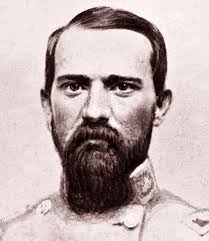
Major General Dorsey Pender C.S.A.

Friends of Padre Steve’s World

I am continuing to periodically intersperse and publish short articles about various commanders at Gettysburg on the site. These all are drawn from my student text and may become a book in their own right.  The reason is I am going to do this is because I have found that readers are often more drawn to the lives of people than they are events. As I have noted before that people matter, even deeply flawed people, and we can learn from them.

Today’s article is about Major General Dorsey Pender who commanded A.P. Hill’s old “Light Division” in Hill’s Third Corps at Gettysburg. Pender is interesting, young an pious, but often conflicted in his faith. His questions are similar to those asked by those who want to believe but struggle with believing. His relationship with his wife, a very strong believer was often marred by differences in belief. I hope you enjoy.

Peace

Padre Steve+

Dorsey Pender was a “pious, serious North Carolinian” [1] born in Edgecomb County in 1834 who received “his early education in the common schools of the county” [2] before he was appointed to West Point. He graduated with the class of 1854, a class that included Custis Lee, Oliver O. Howard, J.E.B. Stewart, S.D. Lee, John Pegram, and Stephen Weed. He graduated nineteenth of the forty-six cadets in that class.

He married his wife Fanny in 1859. She was the sister of one of his academy classmates Samuel Shepperd who died a year after graduating from the academy. She accompanied Dorsey to the Pacific Northwest where he was serving at the outbreak of the war. They had been married two years when he volunteered to serve the Confederacy, he was just twenty-seven and she just nineteen and already a mother expecting a second child when he went to war. Like many young couples separated by war theirs was often plagued by misunderstandings and highly emotional, something that is evidenced in their correspondence.

Pender is often described as devout in terms of his religious beliefs but his devoutness was in large part due to the spiritual conflict that he was going through. Pender was a tremendously proud man but felt the need for some kind of salvation and while he “sincerely tried to be a good Christian” but could not understand why good works did not earn salvation.” [3] The young general sought the counsel of a chaplain, but this did not ease his mind. Eventually he was baptized and confirmed in the Episcopal Church, but even this brought conflict with his wife who was not able to be with him. Despite these attempts he still doubted and months later still “considered himself a “perjured” sinner, having made vows that he could not keep.” [4] This type of religious experience, that of men who question their faith was not unique to Pender and is not unusual today.

Prior to the war he served on the frontier and in California with the artillery and dragoons. During the secession crisis he “offered his services to the Confederacy even before most of the states, including his own, had seceded.” [5] He was appointed to command the 6th North Carolina where he “earned the everlasting respect and admiration” of his men. [6] After the Battle of Seven Pines he was made an acting Brigadier General and given command of Johnston Pettigrew’s brigade. [7]

As he gained more experience Pender became a favorite of Robert E. Lee who admired him for his competence as well as forthrightness. “At Harper’s Ferry and Shepherdstown Pender had shown himself qualified to handle more than one brigade.” [8] Pender was “only seven years out of West Point” [9] in May of 1863 when he was promoted to Major General and given command of his division. He was only twenty-nine years old, and the “youngest of that rank in the army.” [10] The young general was deeply loyal to Powell Hill and a partisan of the Light Division which he now commanded. Though he was young he had risen “on first rate ability, steadfast ambition and a headlong personal leadership in battle which gave a driving force to his brigade” [11] which he considered “the best brigade of the best division” [12] in the army.

Lee praised him as “a most gallant officer” and was deeply sensitive about keeping Pender with the troops that found him so inspiring, noting “I fear the effect upon men of passing him over in favour of another not so identified with them.” [13] Pender was an “intelligent, reflective man, deeply religious and guided by a strong sense of duty.” [14]

When the army marched north into Pennsylvania had to write to “relieve the concern of his young wife that the Lord will not bless the Southern cause if the Confederacy does more than defend its own territory.” [15] Fanny was not convinced by her husband’s attempts to justify as she believed that such an endeavor “was unjust and illegitimate, and tempted God.” [16]

Pender’s four veteran brigades were commanded by three experienced officers and one new to brigade command. However, the young general would not get to lead them into action for long as he was mortally wounded by a shell fragment before the division was to go into action on July 2nd at Gettysburg. Though surgeons believed he would recover he succumbed to his wound during the Confederate withdraw from Gettysburg. “In his dying moments, he asked that Fanny be told that he had no fear of dying.” [17] He continued and said “I can confidently resign my soul to God, trusting in the atonement of our Lord Jesus Christ. My only regret is to leave her and our children.” [18]Evidently, he finally found a measure of peace in the faith that had eluded him in life. Fanny never remarried and became an independent women serving as the head of a school and as Postmistress of Tarboro North Carolina where she died in 1922 at the age of eighty-eight.

Notes

[1] Ibid. Guelzo, Gettysburg: The Last Invasion p.23

[2] Ibid. Warner Generals in Gray p.233

[3] Rable, George C. God’s Almost Chosen People’s: A Religious History of the Civil War The University of North Carolina Press, Chapel Hill 2010 p.244

[4] Ibid. Rable God’s Almost Chosen Peoples p.244

[5] ibid. Tagg The Generals of Gettysburg p.325

[6] Ibid. Glatthaar General Lee’s Army from Victory to Collapse p.196

[7] Ibid. Freeman Lee’s Lieutenants p.146

[8] Ibid. Freeman Lee’s Lieutenants p.387

[9] Ibid. Dowdy. Lee and His Men at Gettysburg p.85

[10] Ibid. Sears Gettysburg p.47

[11] Ibid. Dowdy. Lee and His Men at Gettysburg p.85

[12] Ibid. Freeman Lee’s Lieutenants p.45

[13] Ibid. Sears Gettysburg p.47

[14] Ibid. Dowdy. Lee and His Men at Gettysburg p.85

[15] Ibid. Freeman Lee’s Lieutenants p.45

[16] Ibid. Guelzo. Gettysburg: The Last Invasion p.66

[17] Ibid. Wilson and Clair They Also Served p.113

[18] Ibid. Dowdy Lee and His Men at Gettysburg p.226

1 Comment

Filed under christian life, civil war, faith, Gettysburg, History, Military

Remembering: Lincoln’s 2nd Inaugural Address

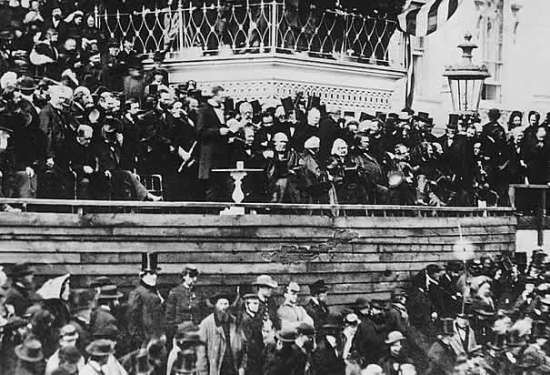
abraham-lincoln-secondinauguration3

Today is President’s Day and instead of doing much I am simply going to post one of the most poignant and meaningful speeches ever given by a President,  Abraham Lincoln’s Second Inaugural Address.

The address was delivered on March 4th 1865 just over a month before Robert E. Lee’s Army surrendered at Appomattox, and just 41 days before Lincoln died at the hands of John Wilkes Booth. A man who the League of the South, a radical group bent on returning the whole country to their neo-Confederate ways plans to honor on April 14th for “executing” Lincoln who they call a criminal tyrant.

Lincoln’s words need to be remembered for what they are, a remarkable statement of reality as well as hope for the future. When he spoke them the war was all but over, but much blood was still being spilt on battlefields across the South. By the time the war, which began in 1861 was over, more than 600,000 Americans would be dead. It was the bloodiest conflict in American History.

To really understand what Lincoln was speaking of one has to remember that just nine years before the Supreme Court had seemed to demolish any hope at all for Blacks in the United States, and not just the enslaved Blacks of the South, in it’s notorious Dred Scott decision. Roger Taney, the Chief Justice writing for the majority, most of whom were Southerners said about Blacks when denying them any form of Constitutional Rights:

“Can a negro, whose ancestors were imported into this country, sold as slaves, become a member of the political community formed and brought into existence by the Constitution of the United States, and as such become entitled to all the rights, and privileges, and immunities, guaranteed by that instrument to the citizen?…It is absolutely certain that the African race were not included under the name of citizens of a state…and that they were not included, and were not intended to be included, under the word “citizens” in the Constitution, and therefore claim none of the rights and privileges which that instrument provides for and secures to citizens of the United States. On the contrary, they were at that time considered as a subordinate and inferior class of beings, who had been subjugated by the dominant race, and, whether emancipated or not, yet remain subject to their authority, and had no rights or privileges but those who held the power and the Government might choose to grant them”

Before that there was the equally noxious Compromise of 1850 which included the Fugitive Slave Act which gave any Southerner claiming his human “property” not only the rights but a legal mechanism to hunt them down in the North and penalize anyone hindering them with weighty fines and jail terms.

One has to look at the words of Confederate Vice President Alexander Stephens in his Cornerstone Speech to understand the truth of what Lincoln spoke on that day in March 1865. Stephens, just four years before had declared in the starkest terms what the war was about and what the Confederacy’s foundation was:

Our new government is founded upon exactly the opposite idea; its foundations are laid, its corner- stone rests upon the great truth, that the negro is not equal to the white man; that slavery — subordination to the superior race — is his natural and normal condition. [Applause.] This, our new government, is the first, in the history of the world, based upon this great physical, philosophical, and moral truth.”

It took four years of bloody war, the first total war waged on American soil to end slavery, sadly within just a few years the Jim Crow laws had regulated Southern Blacks to a status not much better than their previous estate, and again became victims of often state sanctioned violence, discrimination, prejudice and death through lynching.

Southern leaders like Stephens and Jefferson Davis denied that slavery was the cause of the war and the foundation of the Confederacy in their revisionist histories after the war was over. They did so even though the litany of their letters, speeches and laws they supported, damned their words as the bold faced lies that they were. In the mean time many in the South sought to reclaim their pre-war glory in the myth of the Lost Cause which permeated much of the United States in the decades after the war, being glorified by Hollywood in Birth of a Nation, Gone with the Wind, and Walt Disney’s Song of the South. The unconscionable racism and white supremacy promoted by these masterpieces of cinema helped perpetuate racism across the country.

In the North, blacks faced discrimination and prejudice as well. another Supreme Court decision (Plessy v. Ferguson 1896) had legalized segregation and discrimination against Blacks in the form of “Separate but Equal” across the entire United States, something that would remain until a later Supreme Court would overturn Plessy in Brown v. Board of Education in 1954.

Despite all the reverses and the continued fight against the rights of Blacks, as well as women, other minorities and Gays, the struggle continues.

In August 1863, Lincoln was asked to speak at a gathering wrote in support of stronger war efforts and enlistments. Lincoln could not attend and wrote James Conkling a letter to be read on his behalf. That letter addressed those who disagreed with Lincoln on emancipation while still be claiming to be for the Union. Lincoln ended that letter with this:

“Peace does not appear so distant as it did. I hope it will come soon, and come to stay; and so come as to be worth the keeping in all future time. It will then have to be proved that among freemen that there can be no successful appeal from the ballot to to bullet, and that they who take such appeal are sure to lose their case and pay the cost. And there will be some black men who can remember that with silent tongue, and with clenched teeth, and steady eye, and well-poised bayonet, that they will have helped mankind on to this great consummation, while I fear there will be some white ones unable to forget that with malignant heart and deceitful speech they strove to hinder it….” 

Lincoln, unlike many even in the North recognized the heroic nature of African Americans fighting for their rights and how their struggle was beneficial for every American.

Lincoln died too soon, his death was a tragedy for the nation, but today, on President’s Day let us remember the words of the Lincoln’s Second Inaugural Address and the truth that they express. Lincoln’s concluding sentences which began with “With malice toward none, with charity for all…” should be at the heart of our dealings with all people so that we, as Lincoln said so eloquently “may achieve and cherish a just and lasting peace among ourselves and with all nations.”

It is a speech that always encourages me to fight for freedom and truth, even when that truth is less than popular and often uncomfortable. Lincoln’s words still inspire me, because he spoke the truth that many even today do not want to hear:

At this second appearing to take the oath of the Presidential office there is less occasion for an extended address than there was at the first. Then a statement somewhat in detail of a course to be pursued seemed fitting and proper. Now, at the expiration of four years, during which public declarations have been constantly called forth on every point and phase of the great contest which still absorbs the attention and engrosses the energies of the nation, little that is new could be presented. The progress of our arms, upon which all else chiefly depends, is as well known to the public as to myself, and it is, I trust, reasonably satisfactory and encouraging to all. With high hope for the future, no prediction in regard to it is ventured.

On the occasion corresponding to this four years ago all thoughts were anxiously directed to an impending civil war. All dreaded it, all sought to avert it. While the inaugural address was being delivered from this place, devoted altogether to saving the Union without war, insurgent agents were in the city seeking to destroy it without war–seeking to dissolve the Union and divide effects by negotiation. Both parties deprecated war, but one of them would make war rather than let the nation survive, and the other would accept war rather than let it perish, and the war came.

One-eighth of the whole population were colored slaves, not distributed generally over the Union, but localized in the southern part of it. These slaves constituted a peculiar and powerful interest. All knew that this interest was somehow the cause of the war. To strengthen, perpetuate, and extend this interest was the object for which the insurgents would rend the Union even by war, while the Government claimed no right to do more than to restrict the territorial enlargement of it. Neither party expected for the war the magnitude or the duration which it has already attained. Neither anticipated that the cause of the conflict might cease with or even before the conflict itself should cease. Each looked for an easier triumph, and a result less fundamental and astounding. Both read the same Bible and pray to the same God, and each invokes His aid against the other. It may seem strange that any men should dare to ask a just God’s assistance in wringing their bread from the sweat of other men’s faces, but let us judge not, that we be not judged. The prayers of both could not be answered. That of neither has been answered fully. The Almighty has His own purposes. “Woe unto the world because of offenses; for it must needs be that offenses come, but woe to that man by whom the offense cometh.” If we shall suppose that American slavery is one of those offenses which, in the providence of God, must needs come, but which, having continued through His appointed time, He now wills to remove, and that He gives to both North and South this terrible war as the woe due to those by whom the offense came, shall we discern therein any departure from those divine attributes which the believers in a living God always ascribe to Him? Fondly do we hope, fervently do we pray, that this mighty scourge of war may speedily pass away. Yet, if God wills that it continue until all the wealth piled by the bondsman’s two hundred and fifty years of unrequited toil shall be sunk, and until every drop of blood drawn with the lash shall be paid by another drawn with the sword, as was said three thousand years ago, so still it must be said “the judgments of the Lord are true and righteous altogether.”

With malice toward none, with charity for all, with firmness in the right as God gives us to see the right, let us strive on to finish the work we are in, to bind up the nation’s wounds, to care for him who shall have borne the battle and for his widow and his orphan, to do all which may achieve and cherish a just and lasting peace among ourselves and with all nations.

Peace

Padre Steve+

1 Comment

Filed under civil war, History, leadership, Political Commentary

Padre Steve’s Year in Review

10570298_10152872503382059_5058681841617456899_n

Well it has been a year, well almost a year unless your are like in Australia when you read this.

As Charles Dickens’ wrote, “it was the best of times” and depending who you are or where you live it could have been one, the other or both. For me it has been one of those, not that there is anything wrong with that.

But really, look at the past year, personally it has been a mixed bag for me, in the end the plusses outweigh the minuses but what can I say? Great job, back with my wife, complete PTSD meltdown, being nearly suicidal for a while, but in the end a trip to Oktoberfest, the Orioles win the AL East, the Giants win the World Series and I’m doing better. On the other hand a whole lot of people are not doing better in a lot of places in the world. I’ve written about some of the events of the year as they affected me. Not all of them would be major, but hey, this was my year. If I had a song that described the year it would be Barry Manilow’s Trying to get the Feeling Again”

On January 6th I lost a man who had shown compassion and empathy for me, Captain Tom Sitsch, US Navy retired. Captain Sitsch was a true hero who worked his way up throughout the ranks in the Navy Explosive Ordinance Demolition community, made many combat deployments and suffered untreated PTSD and TBI. He took his own life. It was a sobering time for me, as he was one of the few people who showed much compassion for me when I was falling apart in the summer of 2008. He asked me “where does a chaplain go for help?” The best I can remember was that I told him not to other chaplains or clergy. I had no idea what he was going through and after he left the Navy under a cloud in 2009 I lost contact with him. His death brought me back into contact with men I had served with and who had served with him. I wrote about that a number of times as it was such a shattering event. I wish I had known and could have been there for him. The first article I wrote about that was on January 7th and can be found here: Rest In Peace Captain Tom Sitsch USN

February was a month of reflection on the sixth anniversary of my return from Iraq, the Winter Olympics in Sochi Russia and a time of intense preparation for my first journey to Gettysburg leading the Gettysburg Staff Ride for the Joint Forces Staff College. It also was a month where we began to see the tip of the iceberg of the attempt of some Christians in Kansas to enshrine  religious intolerance in law, that article A Matter of Degree: The Taliban, Kansas, Jim Crow and Nuremberg really pissed some people off.

goering3

I wrote a reflection about the long strange trip back from Iraq in this article The Long Strange Trip: Six Years After Returning from Iraq

In March Russia pulled off its occupation of Ukraine and Malaysian Airlines flight 370 disappeared from the face of the earth. I also led my first trip to Gettysburg and really began to sink my teeth into writing about the battle as well as many other components of the American Civil War, including the politics, ideology, economic and religious aspects of the war. But for the most enduring mystery was the disappearance of MH-370. I ended up writing a “conspiracy theory” about it, which because it hasn’t been proven wrong could possibly be right, if not maybe the basis of a great terrorism novel. That article is here  My Malaysian Airlines Flight MH-370 Conspiracy Theory

April was the beginning of baseball season, the end of Lent, Holy Week and more work on a lot of history. I wrote about civil rights, Jackie Robinson, and a whole series on a Roman Centurion in Jerusalem during the first Holy Week. I also took on former half-term Governor of Alaska Sarah Palin in this article  War Crimes are Us: I Want No Part of Sarah Palin’s Torture Loving Christianity But it was an interesting time because I was asked to do an interview about my struggle with PTSD for the Washington Times. The article about that is here Not the Cover of the Rolling Stone but the Front Page: Padre Steve Featured in Washington Times article on PTSD

In May I took another group of students to Gettysburg and did a lot more writing about that subject as well as the subject of Memorial Day. But an event occurred that caused me to reflect on the way Christians often use the power of religion in attempts to silence or shame others who are in pain. That came after I had an experience trying to get help in the Navy Mental Health system and because of how I was treated began to implode all over again. That article is here: Frightened by Christians. I also did a fair amount of reflecting on the sacrifice of others in articles about Memorial Day, including this one “The Offering We Bring…” Remembering the First Memorial Day

isis3-840x550

In June my struggle continued and was intensified by the collapse of Iraqi forces as ISIL swept into Iraq, overrunning many of the places I had served in Al Anbar province. Looking back at all that I wrote about other subjects that month I am amazed. I wrote about the assassination of Franz Ferdinand which triggered the events leading to the outbreak of World War I in this article A Wrong Turn, a Holy Cause and Two Bullets: The Assassination of Archduke Franz Ferdinand But here is the first article that I wrote about the collapse of the Iraqi forces and reflected on all the history that we should have paid attention to in 2003 The Results of Ignoring History: The Implosion of Iraq as well as my own reflection of my time there and hope for better Inshallah Iraq (إن شاء الله) Maybe Someday things will be Better

In July I did a lot more work on Gettysburg as I got ready to take another group there in August. I reflected on Iraq, PTSD, the Declaration of Independence and in my work on Gettysburg and Civil War issues I wrote this article about some of the similarities that I see in some Tea Party ideology and that of the ante-bellum South, the Confederacy and Jim Crow. That article is here Parallels between Tea Party Ideology and the Ante-Bellum South I took another stab at the situation in Iraq in this article Iraq, ISIS and Al Qaeda: Sowing the Wind…  and this about the moral responsibility of a nation at war to those that it sends to fight its wars  “You Broke it, You Bought It” The Responsibility of a Nation at War and Broken and Unlikely to Get Better: Military Mental Health Care

In August I led another trip to Gettysburg, and I reflected on a number of subjects, but as I was struggling so much after my collapse in May I decided to write a number of new articles about PTSD, Suicide and the military mental health care system. Here are two of them No Shutting Up Until it is Fixed: Veteran and Military Mental Health Care and  Moral Injury: Betrayal, Isolation, Suicidality, & Meaninglessness; the War after the War But I also ventured into the initial police reaction in Ferguson Missouri in the article The Misuse of Force: Shock and Awe Backfires in Ferguson But one of my favorite articles to write was this one on the Gettysburg Address, something that I always find important to reflect upon Reembracing the New Birth of Freedom

IMG_0491

In September I made pilgrimage to Oktoberfest. However I ventured into the discussion of the new, old kind of war that we are facing again, that of religious ideology and war without mercy. That article is here Wars Without Mercy: The New Old Way of War and The Islamic State and the New, Old Nature of War

In October, of course I continued to write about Gettysburg and the Civil War, baseball and the World Series, and was inducted into my High School’s Hall of Fame, which was a great honor. But I decided to tackle some of the religious ideologues who are actively engaged in the political process and did an article about Senator Ted Cruz’s father Rafael Cruz. That is here: Rafael Cruz and the Dangerous Heresy of the Self-Annointed

In November I made my final trip for the last academic year to Gettysburg and had the honor of meeting a real hero, retired Army Colonel Walter Marm, who won the Medal of Honor for his actions at the Battle of Ia Drang, a battle made famous by the movie We Were Soldiers that reflection is here: Return from Gettysburg: Table Talk and Meeting a Hero

December was another big month, the Senate Report on the CIA torture program was released much to the chagrin of the program’s most ardent supporters including a host of “Christian” leaders. I decided to take them on in this article Conservative Christians and Torture: Wedded at the Hip

Those are just some of the highlights. I wrote about so many other things as well, and I invite you to browse the site. Like I said, all things considered I am surprised I have been so productive this year. So anyway, thank you so much for reading what I put out, for sharing it and for your wonderful comments and encouragement. So I’ll wish you well and if I don’t get anything else done later today I wish you all a happy and blessed New Year.

Peace

Padre Steve+


2 Comments

Filed under History, Loose thoughts and musings, PTSD

Return from Gettysburg: Table Talk and Meeting a Hero

IMG_0463.JPG

I am on the way back from Gettysburg following our Staff Ride. As always it was a very interesting trip and as much as I get to expound on what I know, I also get to learn. As the late Hall of Fame Manager of the Baltimore Orioles, Earl Weaver so eloquently put it: “It’s what you learn after you know it all that counts.”

I love going up, not just for the teaching opportunity, but to spend time with the students, and sometimes their family members over lunch, dinner or drinks at the various watering holes. These occasions of table talk are probably some of the most important parts of learning and relationships. They are something that have become an anomaly in our modern higher education process, which driven by the need for profit, or by austerity in public or military educational systems, or fear of legal liability, have all too often sacrificed this all too important manner of learning.

I remember reading Martin Luther’s Table Talk, which is a collection of writings by his student’s gathered around the table as they ate and drank. They show Luther at his best and worst, expounding on some of his less systematized ideas, as well as his ability to expound on subjects outside of the lecture hall or the theological debate, sometimes while certainly under the influence of good German beer.

This type of learning was common at one time, but now is a dying art. One of the things that it does for me is that my student’s questions, comments, experiences and ideas also spur my thinking and cause me to do more research, discover more and learn more. I then attempt to assimilate what I have learned and then develop those thoughts into things that I am either writing or teaching.

For me this is about a commitment to the truth, as I quoted from Star Trek the Next Generation on Friday, that my first duty, is to the truth, and as one of my students mention to me last night can be painful, especially when long cherished myths, are crushed by the weight of facts. For him it was the ugly truth of the Lost Cause and especially in the role of religion in the South to justify slavery, secession and following the war segregation, discrimination and sometimes even lynching. For him, as it was for me, so many years ago at Southwestern Baptist Theological Seminary, this was difficult. But if truth matters at all, we cannot ignore it as so many do and cling to myth, as Captain Picard said ” be it scientific, historic or personal truth.” 

I was fortunate that my professors at Southwestern, especially my professors of Church History, Systematic Theology and Philosophy of religion challenged me and laid waste to the myths that I believed that I am who I am today.

I think I am going to start doing table talk sessions for any interested students during our next term.

I also had a unique honor on this trip. One of my students brought his dad, a retired Army Colonel and Vietnam veteran. He was a very interesting man and was engaged in the lessons of the trip, even since his son had provided him a copy of my text, asking when I would get it published. He didn’t try to draw attention to himself, we had some nice conversation over dinner and drinks with the rest of the students, and at the end of the Staff Ride, which is at the Solder’s Cemetery he walked up and thanked me. He the said “let me give you my coin.”

For us in the military a being presented a commander’s coin or unit coin is an honor. I have a lot of them, including one from former Chairman of the Joint Chiefs of Staff, General Peter Pace, who I met at the Battle of Hue City Memorial weekend when I was the chaplain of the ship that carries the name and legacy of Hue City.

When I looked at the coin it was inscribed “Colonel Walter Marm, Vietnam, 14 November 1965.” In the center a depiction of the Medal of Honor. The front, Congressional Medal of Honor Society, United States of America. Colonel Marm was a platoon leader then, a young lieutenant, in Company A, 1st Battalion, 7th Cavalry at the Battle of the Ia Drang. You might recognize it, the battle was chronicled in the book We Were Soldiers Once…and Young” and film We Were Soldiers

If you want to read about his heroism you can google him or go to this site, which is just one of many where you can read about this American hero.

http://www.medalofhonorspeakout.org/bio/walter-marm

Interestingly enough President Obama will award the Medal of Honor posthumously on November 6th to Lieutenant Alonzo Cushing who died defending the Angle on day three at Gettysburg.

So this indeed was a special trip, a reminder to me of the lost art of table talk in education, as well as the heroes who do not draw attention to themselves. Yes my friends, it is what you learn after you know it all that counts.

Peace

Padre Steve+

1 Comment

Filed under civil war, History, Military, vietnam

The U.S. Civil War: Beginning of Modern Warfare Part One

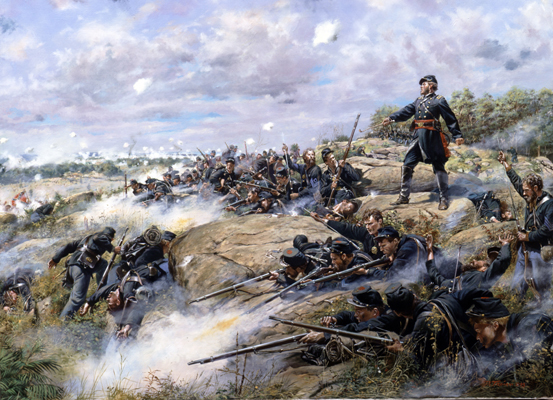
culp's hill

Note: This is the first part of a major revision to my article on the American Civil War being the first modern war. Part two will follow tomorrow. This is actually the beginning of the first chapter of my Gettysburg text, much of which has been appearing in various forms on this site for the past year, much of this deals with the connection between policy and strategy and the relationship of political leaders to the military.

The American Civil War was the first modern war. It was a watershed time which introduced changes in tactics, logistics, communications and the concept of total war to the world. Though it did not change the essential nature of war, which Clausewitz says is “is an act of violence to compel our opponent to fulfil our will” [1] it expanded the parameters of it and re-introduced the concept of “total war” to the world and “because its aim was all embracing, the war was to be absolute in character.”[2] In a sense it was a true revolution in military affairs.

While the essential nature of war remains constant, wars and the manner in which they are fought have changed in their character throughout history, and this distinction matters not only for military professionals, but also policy makers. The changing character of war was something that military leaders as well as policy makers struggled with during the American Civil War much as today’s military leaders and policy makers seek to understand the character of warfare today. British military theorist Colin Gray writes “Since the character of every war is unique in the details of its contexts (political, social-cultural, economic, technological, military strategic, geographical, and historical), the policymaker most probably will struggle of the warfare that is unleashed.” [3] That was not just an issue for Abraham Lincoln and Jefferson Davis, both of whom struggled with the nature of the war which had been unleashed, but it is one for our present political leaders, who as civilian politicians are “likely to be challenged by a deficient grasp of both the nature of war as well as its contemporary context-specific character.” [4]

In addition to being the first modern war, or maybe I should say, the first war of the Industrial Age, the Civil War became a “total war.” It was the product of both the massive number of technological advances which both preceded and occurred during it, in which the philosophical nature of the Industrial Revolution came to the fore. Likewise, the enmity of the two sides for one another which had been fostered by a half century of relentless and violent propaganda which ushered from the mouths of politicians, the press and even from the pulpit, even to the point of outright armed conflict and murder in “Bleeding Kansas” during the 1850s.

As a total war it became a war that was as close to Clausewitz’s understanding of absolute war in its in character waged on the American continent, and it prefigured the great ideological wars of the twentieth century, as J.F.C. Fuller noted “for the first time in modern history the aim of war became not only the destruction of the enemy’s armed forces, but also of their foundations- his entire political, social and economic order.” [5] It was the first war where at least some of the commanders, especially Ulysses S. Grant and William Tecumseh Sherman were men of the Industrial Age, in their thought and in the way that they waged war, in strategy, tactics even more importantly, psychologically. Fuller wrote:

“Spiritually and morally they belonged to the age of the Industrial Revolution. Their guiding principle was that of the machine which was fashioning them, namely, efficiency. And as efficiency is governed by a single end- that every means is justified- no moral or spiritual conceptions of traditional behavior must stand in its way.” [6]

Both men realized in early 1864 that “the South was indeed a nation in arms and that the common European practice of having standing armies engaged each other in set-piece battles to determine the outcome of a war was not enough to win this struggle.” [7] Though neither man was a student of Clausewitz, their method of waging war was in agreement with the Prussian who wrote that “the fighting forces must be destroyed; that is, they must be put in such a position that they can no longer carry on the fight” but also that “the animosity and the reciprocal effects of hostile elements, cannot be considered to have ended so long as the enemy’s will has not been broken.” [8] Sherman told the mayor of Atlanta after ordering the civilian population expelled that “we are not only fighting hostile armies, but a hostile people, and must make the old and young, the rich and poor, feel the hard hand of war.” [9] Sherman not only “carried on war against the enemy’s resources more extensively and systematically than anyone else had done, but he developed also a deliberate strategy of terror directed against the enemy’s minds.” [10]

Abraham Lincoln came to embrace eternal nature of war as well as the change in the character of the war over time. Lincoln had gone to war for the preservation of the Union, something that for him was almost spiritual in nature, as is evidenced by the language he used in both of his inaugural addresses and the Gettysburg Address. Instead of a war to re-unite the Union with the Emancipation Proclamation the war became a war for the liberation of enslaved African Americans, After January 1st 1863 when the Emancipation Proclamation went into effect, Lincoln “told an official of the Interior Department, “the character of the war will be changed. It will be one of subjugation…The [old] South is to be destroyed and replaced by new propositions and ideas.” [11]

Of course, the revolution in military affairs took time and it was the political and military leaders of the North who better adapted themselves and their nation to the kind of war that was being fought. “Lincoln’s remarkable abilities gave him a wide edge over Davis as a war leader, while in Grant and Sherman the North acquired commanders with a concept of total war and the determination to make it succeed.” [12]

At the beginning of the war the leaders and populace of both sides still held a romantic idea of war. The belief that the war would be over in a few months and that would be settled by a few decisive battles was held by most, including many military officers on both sides, there were some naysayers like the venerable General Winfield Scott, but they were mocked by both politicians and the press.

The Civil War became an archetype of the wars of the twentieth century, and the twenty-first century. It became a war where a clash between peoples and ideologies which extended beyond the province of purely military action as “it was preceded by years of violent propaganda, which long before the war had obliterated all sense of moderation, and awakened in the contending parties the primitive spirit of tribal fanaticism.” [13]

The conduct of the American Civil War added new dimensions to war, increased its lethality and for the first time since the 30 Years’ War saw opponents intentionally target the property, homes and businesses of civilian populations as part of their military campaign. The Civil War was a precursor to the wars that followed, especially the First World War which it prefigured in so many ways. [14]

However, like all wars many of its lessons were forgotten by military professionals in the United States as well as in Europe. Thus 50 years later during World War One, British, French, German, Austrian and Russian wasted vast amounts of manpower and destroyed the flower of a generation because they did not heed the lessons of the Civil War. Fuller noted:

“Had the nations of Europe studied the lessons of the Civil War and taken them to heart they could not in 1914-1918 have perpetuated the enormous tactical blunders of which that war bears record.” [15]

The lessons of the war are still relevant today. Despite vast advances in weaponry, technology and the distances with which force can be applied by opponents, war remains an act of violence to compel an enemy to fulfill our will. War according to Clausewitz is “more than a chameleon that slightly adapts its characteristics to the given case.” [16] but it is always characterized by the violence of its elements, the province of chance and its subordination to the political objective and as such forces political and military leaders as well as policy makers to wrestle with “the practical challenge of somehow mastering the challenge of strategy in an actual historical context.” [17]

The study of the Civil War can be helpful to the joint planner and commander because it so wonderfully shows the interplay of Clausewitz’s “paradoxical trinity- composed of primordial violence, hatred, and enmity, which are to be regarded as a blind natural force; of the play of chance and the element of subordination, as an instrument of policy, which makes it subject to reason alone.” [18] during an era of great technological and philosophical change. The importance of this cannot be underestimated, for in this era of change, like in every era, some leaders and commanders were either resistant to, or failed to understand the changes being forced upon them in their conduct of war by the industrialization of war and its attendant technology; while others, like Sherman, Grant and Sheridan not only understood them, but embraced them and applied them with skill and vigor in ways that stunned the people of the South.

Over time the Union developed what we would now refer to as a “whole of government approach” to the war. This included not only the military instrument but the use of every imaginable means of national power, from the diplomatic, the economic and the informational aspects of the Union in the effort to subdue the Confederacy. The understanding and use of the “whole of government approach” to war and conflict is still a cornerstone of United States military policy in “unified action, to achieve leverage across different domains that will ensure conditions favorable to the U.S. and its allies will endure.” [19] The working staff of the War Department headed by Edwin Stanton and Major General Montgomery Meigs developed rapidly. It effectively coordinated with railroads, weapons manufactures and suppliers of clothing, food and other necessities to supply the army and navy so well that “Union forces never seriously lacked the materials necessary to win the war.” [20] Stanton and Meigs were “aided by the entrepreneurial talent of northern businessmen” which allowed “the Union developed a superior managerial talent to mobilize and organize the North’s greater resources for victory in the modern industrialized conflict that the Civil War became.” [21]

The understanding of this eternal nature and ever changing character of war to leaders of nations as well as military commanders and planners has been very important throughout history. It can be seen in the ways that Jefferson Davis and Abraham Lincoln conducted their relationships with their military commanders, including during the Gettysburg campaign and we are reminded by Colin Gray notes that political leaders and policy makers who are in charge of policy often ignorant of the nature and character of war, and this fact “directs attention to the difficulties of translating political judgment into effective warmaking.” [22] Military leaders should be the people to advise and instruct policy makers in aligning their policy to what is actually feasible based on the ends ways and means, as well as the strengths and limitations of the military to carry out policy decisions and history reminds us “that policymakers committed strongly to their political desires are not easily deflected by military advice of a kind that they do not want to hear.” [23]

While there was much support for the Confederacy in the aristocracies of Europe, the effectiveness of the Union military in winning the key battles that allowed Lincoln to make his Emancipation Proclamation ensured that Europe would not recognize the Confederacy, . Charles F. Adams, the United States minister to Britain successfully defused the crisis of the Trent affair, which could have led to British recognition of the Confederacy and intervention in the war. Adams’ efforts were so successful that they “left Anglo-American relations in better shape than before the crisis.” [24]

Related to this understanding of warfare one has to also look at the importance of diplomacy, especially in picking the right diplomat for a critical post is a part of a whole of government approach to war and warfare. This was very important in the early stages of the Civil War as there was much support for the Confederacy in the aristocracies of Europe. The effectiveness of the diplomacy was increased by the Union military efforts. The Union suffered many failures at the outset of the war by the time of the Gettysburg campaign they did enough to prevent English or French intervention on the side of the Confederacy, which was also aided by tensions in Europe regarding the Schleswig-Holstein problem between Prussia and Austria as well as unrest in Poland, and the British in particular were loath to risk intervening in a conflict that might be “a disturbance in the precarious balance of power which might be the signal for a general conflagration, they recalled Voltaire’s comment that a torch lighted in 1756 in the forests of the new world had promptly wrapped the old world in flames.” [25] Thus, European leaders and diplomats were very hesitant to allow Southern legations to convince them to intervene.

Though the Confederates won many battles it was the Union military whose success Island Number Ten, Fort Donaldson and Shiloh in the West, and the bloody repulses of Confederate armies at Perryville and Antietam; as well as the joint operations conducted by the Union Navy and Army confederacy through the blockade and capture of key ports such as New Orleans early in the war that allowed Lincoln to make his Emancipation Proclamation. These military successes enabled Lord Palmerston to reject a French proposal for France, England and Russia to propose to the warring parties, a “North-South armistice, accompanied by a six month lifting of the blockade. The result, if they had agreed- as they had been in no uncertain terms warned by Seward in private conversations with British representatives overseas- would have been a complete diplomatic rupture, if not an outright declaration of war.” [26]

The issuance of that proclamation ensured that Europe would not recognize the Confederacy because even pro-Southern English political leaders could not appear to even give the appearance of supporting slavery, especially as both England and France had abolished slavery decades before, while Russia had only recently emancipated its serfs and “was pro-Union from the start….” [27] Popular sentiment in those countries, outside of the ruling class and business elites, was heavily in favor of emancipation, especially among the working classes. The leaders of the workingmen of Manchester England, a major textile producer, who which had been among the “hardest hit by the cotton famine, sent him [Lincoln] an address approved at a meeting on New Year’s Eve, announcing their support of the North in its efforts to “strike off the fetters of the slave.” [28]

There were issues related to the blockade but Charles F. Adams, the United States minister to Britain successfully defused the crisis of the Trent affair, which could have led to British recognition of the Confederacy and intervention in the war in a manner that “left Anglo-American relations in better shape than before the crisis.” [29]

The Union blockade was a key factor in the diplomatic efforts. As I have noted there were many in both Britain and France who sympathized with the South and hoped for Southern victory that were not impressed by Southern moves to subject them to an embargo of Southern cotton until they received recognition. While many Englishmen were offended by Seward’s bluster, many “resented even more the Confederacy’s attempt at economic blackmail.” [30]

The British especially were keen on not going to war for the sake of the South, there was far too much at stake for them, something that the Southern leaders and representatives did not fully comprehend. Prime Minister Viscount Palmerston and Foreign Minister Lord Russell were concerned about the economic impact of the loss of Southern cotton but also “recognized that any action against the blockade could lead to a conflict with the United States more harmful to England’s interests than the temporary loss of Southern cotton.” [31] Palmerston well remembered the war of 1812 when he served as Minister of War, and the disastrous results for the British Merchant Marine, and he realized that “England could not only afford the risk of a loss in a sideline war; she could not even afford to win one.” [32]

[1] Clausewitz, Carl von. On War Indexed edition, edited and translated by Michael Howard and Peter Paret, Princeton University Press, Princeton NJ 1976 p.75

[2] Fuller, J.F.C. The Conduct of War 1789-1961 Da Capo Press, New York 1992. Originally published by Rutgers University Press, New Brunswick N.J p.99

[3] Gray, Colin S. Fighting Talk: Forty Maxims on War, Peace, and Strategy Potomac Book, Dulles VA 2009 p.36

[4] Ibid. Gray Fighting Talk p.36

[5] Fuller, J.F.C. A Military History of the Modern World, Volume Three: From the Seven Days Battle, 1862, to the Battle of Leyte Gulf, 1944 Minerva Press 1956 p.88

[6] Ibid. Fuller A Military History of the Modern World, Volume Three p.88

[7] Flood, Charles Bracelen, Grant and Sherman: The Friendship that Won the War, Harper Perennial, New York 2005 p.238

[8] Ibid. Clausewitz p.90

[9] McPherson, James. The Battle Cry of Freedom: The Civil War Era Oxford University Press, Oxford and New York 1988 p.809

[10] Weigley, Russell F. The American Way of War: A History of United States Military History and Policy University of Indiana Press, Bloomington IN, 1973 p.149

[11] Ibid. McPherson The Battle Cry of Freedom p.558

[12] Ibid. McPherson The Battle Cry of Freedom p.857

[13] Ibid. Fuller The Conduct of War 1789-1961 p.99

[14] Fuller has an excellent synopsis of this in his book A Military History of the Modern World, Volume Three (p.89). He wrote: The war fought by Grant and Lee, Sherman and Johnston, and others closely resembled the First of the World Wars. No other war, not even the Russo-Japanese War of 1904-1905, offers so exact a parallel. It was a war of rifle bullets and trenches, of slashings, abattis, and even of wire entanglements- an obstacle the Confederates called “a devilish contrivance which none but a Yankee could devise” because at Drewry’s Bluff they had been trapped in them and slaughtered like partridges.” It was a war of astonishing in its modernity, with wooden wire-bound mortars hand and winged grenades, rockets, and many forms of booby traps. Magazine rifles and Requa’s machine gune were introduced and balloons were used by both sides although the confederates did not think much of them. Explosive bullets are mentioned and also a flame projector, and in June, 1864, General Pendleton asked the chief ordnance officer at Richmond whether he could supply him with “stink-shells” which would give off “offensive gases” and cause “suffocating effect.” The answer he got was “stink-shells, none on hand; don’t keep them; will make them if ordered.” Nor did modernity end there; armoured ships, armoured trains, land mines and torpedoes were used. A submarine was built by Horace H. Hundley at Mobile….”

[15] Ibid. Fuller A Military History of the Modern World, Volume Three p.89

[16] Ibid. Clausewitz p.89

[17] Ibid. Gray Fighting Talk p.38

[18] Ibid. Clausewitz p.89

[19] ________ JCWS Student Text 1 3rd Edition, 14 June 2013 p.2-4

[20] Guelzo Allen C. Fateful Lightening: A New History of the Civil War Era and Reconstruction Oxford University Press, Oxford and New York 2012

[21] Ibid. McPherson. The Battle Cry of Freedom p.857

[22] Ibid. Gray Fighting Talk p.38

[23] Ibid. Gray Fighting Talk p.38

[24] Ibid. McPherson. The Battle Cry of Freedom p.391

[25] Foote, Shelby, The Civil War, A Narrative. Volume Two Fredericksburg to Meridian Random House, New York 1963 p.154

[26] Ibid. Foote , The Civil War, A Narrative. Volume Two p.153

[27] Ibid. Foote , The Civil War, A Narrative. Volume Two p.153

[28] Ibid. Foote , The Civil War, A Narrative. Volume Two p.155

[29] Ibid. McPherson. The Battle Cry of Freedom p.391

[30] Ibid. McPherson. The Battle Cry of Freedom p.384

[31] Ibid. McPherson. The Battle Cry of Freedom p.384

[32] Ibid. Foote , The Civil War, A Narrative. Volume Two p.154

Leave a comment

Filed under civil war, Foreign Policy, History, Military, national security

Remembering Why We Keep Memorial Day

memorial-day1-300x225

“even if those who come after us are to forget all that we hold dear, and the future is to teach and kindle its children in ways as yet unrevealed, it is enough for us that this day is dear and sacred…”

Nearly 20 years after the Civil War, Oliver Wendell Holmes Jr. then serving as Chief Justice of the Massachusetts Supreme Court spoke on Memorial Day 1884 in Keene New Hampshire at a gathering of veterans. He recalled an incident not long before where he had heard a young man ask “why people still kept up Memorial Day. The question was one that he pondered before his speech and that he attempted to find an answer, not to his fellow veterans who certainly understood their shared memories of war “but an answer which should command the assent of those who do not share our memories.”

I think that having an answer for the question is as timely now as when Holmes first pondered it. Though his war was twenty years past and had torn the nation apart, there were still many men on both sides who had served in that terrible time and but even so many people were not only forgetting the war and the sacrifices made by so many but intent on becoming rich. Something that he would directly state in a Memorial Day address to the graduating class of Harvard University in 1895:

1-oliver-wendell-holmes-jr-1841-1935-everett

Oliver Wendell Holmes Jr in the Civil War

“The society for which many philanthropists, labor reformers, and men of fashion unite in longing is one in which they may be comfortable and may shine without much trouble or any danger. The unfortunately growing hatred of the poor for the rich seems to me to rest on the belief that money is the main thing (a belief in which the poor have been encouraged by the rich), more than on any other grievance. Most of my hearers would rather that their daughters or their sisters should marry a son of one of the great rich families than a regular army officer, were he as beautiful, brave, and gifted as Sir William Napier. I have heard the question asked whether our war was worth fighting, after all. There are many, poor and rich, who think that love of country is an old wife’s tale, to be replaced by interest in a labor union, or, under the name of cosmopolitanism, by a rootless self-seeking search for a place where the most enjoyment may be had at the least cost.”

However his message to his fellow veterans, mostly men from his own former regiment, the 20th Massachusetts was quite personal and something that they could find meaning in. Holmes understood war, he had seen much action and had been wounded at Ball’s Bluff, Antietam and Chancellorsville. He talked of the shared experience of war, something that those who have fought in our nation’s wars, as well as combat veteran soldiers in other countries can understand far more than people that have only known peace, even while their countrymen are at war.

dscn0044

Holmes remembrances of the war and the comrades that he and those present had served with, those living and those dead is powerful. Many of us who have served in the wars that began on September 11th 2001 have lost friends in either Iraq or Afghanistan, and many more who are wounded or maimed in body, mind and spirit. Many survivors of wounds today would have died in previous wars.

Likewise his descriptions of the memories of war, triggered by “accidents” are real to those that have experienced war and combat.

“Accidents may call up the events of the war. You see a battery of guns go by at a trot, and for a moment you are back at White Oak Swamp, or Antietam, or on the Jerusalem Road. You hear a few shots fired in the distance, and for an instant your heart stops as you say to yourself, The skirmishers are at it, and listen for the long roll of fire from the main line. You meet an old comrade after many years of absence; he recalls the moment that you were nearly surrounded by the enemy, and again there comes up to you that swift and cunning thinking on which once hung life and freedom–Shall I stand the best chance if I try the pistol or the sabre on that man who means to stop me? Will he get his carbine free before I reach him, or can I kill him first?These and the thousand other events we have known are called up, I say, by accident, and, apart from accident, they lie forgotten.”

dscn0064

We all have our memories of our wars, those of us who remain, be we veterans of Iraq or Afghanistan, Somalia, Desert Storm, Lebanon, Vietnam, Korea or World War II. It is hard to believe that so few remain from World War II and Korea, and that even the Vietnam veterans are aging rapidly, most now in their 60s or 70s. In as much as the wars of the past decade have been fought by a tiny minority of American citizens fewer and fewer will understand the bond that we share through our memories of the living and the dead. We have been set apart by our experiences, even though the wars that we have fought differ in many ways.

As such we should whenever possible take the time to meet and remember. That might be as groups of friends, unit associations or perhaps local chapters of Veterans organizations. We do this to remember but also to remind ourselves that we cannot live in the past alone, for the present likewise calls us to action, even after our service is complete.

Army+Marine+Casualties+Afghanistan+War+Return+dSZmlJbciN5l

Holmes put it well: “When we meet thus, when we do honor to the dead in terms that must sometimes embrace the living, we do not deceive ourselves. We attribute no special merit to a man for having served when all were serving. We know that, if the armies of our war did anything worth remembering, the credit belongs not mainly to the individuals who did it, but to average human nature. We also know very well that we cannot live in associations with the past alone, and we admit that, if we would be worthy of the past, we must find new fields for action or thought, and make for ourselves new careers.”

We remember the past, we remember our fallen and we remember the families who have lost loved ones in these wars as well as those whose lives have been changed and maybe even torn apart by the changes that war has wrought in their loved ones who returned different from war. In our service we have been set apart and as such as Holmes so well states we have the duty to “bear the report to those who will come after us.” His words carry forth to us today, we few we happy few as Shakespeare so eloquently wrote.

“nevertheless, the generation that carried on the war has been set apart by its experience. Through our great good fortune, in our youth our hearts were touched with fire. It was given to us to learn at the outset that life is a profound and passionate thing. While we are permitted to scorn nothing but indifference, and do not pretend to undervalue the worldly rewards of ambition, we have seen with our own eyes, beyond and above the gold fields, the snowy heights of honor, and it is for us to bear the report to those who come after us.” 

n671902058_1896194_6303

I will remember my time in Iraq and those that I served alongside. I will also remember friends who served in other units who did not return as well as those Marines, Sailors and Soldiers that I see every day in our Naval Hospital suffering from the physical, psychological and spiritual wounds of war.

This weekend I will remember and on Monday, that sacred day that we set aside to remember the fallen I take some time at noon to join in that time of remembrance and pray that maybe someday war will be no more.

That is why I think that we should remember Memorial Day even if others forget.

Peace

Padre Steve+

5 Comments

Filed under civil war, History, iraq,afghanistan, Military, shipmates and veterans, vietnam

The Bloodiest Day: The Battle of Antietam 17 September 1863

“Of all the days on all the fields where American soldiers have fought, the most terrible by almost any measure was September 17, 1862. The battle waged on that date, close by Antietam Creek at Sharpsburg in western Maryland, took a human toll never exceeded on any other single day in the nation’s history. So intense and sustained was the violence, a man recalled, that for a moment in his mind’s eye the very landscape around him turned red.” Stephen W Sears

“I have heard of ‘the dead lying in heaps’, but never saw it till this battle. Whole ranks fell together.” Captain Emory Upton, 2nd U.S. Artillery, at Antietam

“We were in the very maelstrom of the battle. Men were falling every moment. The horrible noise was incessant and almost deafening. Except that my mind was absorbed in my duties, I do not know how I could have endured the strain.” Lt. Frederick L. Hitchcock, 132nd Pennsylvania, at Bloody Lane, Sept. 17, 1862

To the west of Frederick Maryland a small town named Sharpsburg sits on the west side of a creek. Named Antietam the creek’s headwaters are in Franklin County Pennsylvania and it meanders south where just to the south of Sharpsburg it empties into the Potomac River.

It is a peaceful place, rolling hills and agricultural country with some well preserved stone arch bridges, including one just outside of Sharpsburg. It is hard to believe that 150 years ago the town and the creek were the scene of the bloodiest single day of battle in American history.

On that indian summer day of 1862 the Confederate Army of Northern Virginia, General Robert E Lee, commanding made a stand against the much larger Union Army of the Potomac, Major General George B. McClellan, commanding.

Lee had invaded Maryland following a string of successes in Northern Virginia during that summer of 1862, defeating McClellan outside of Richmond in the Seven Days, and in a campaign of maneuver bested a newly formed Army, the Union Army of Virginia commanded by Major General John Pope defeating it at the Second Battle of Bull Run between 28-30 August 1862. With Northern Virginia’s crops and livestock depleted and his opponents in crisis Lee moved his army north into Maryland. The decision was driven partly by the need to provision his army, but also had the hope of drawing Maryland away from the Union mistakenly believing that public sentiment in that state was pro-Confederate. If the people of Maryland rose up to support Lee it would be disastrous to the Union and endanger the capital itself. A final consideration was the hope that a Confederate victory on Northern soil would bring about the foreign recognition and possibly the intervention of Great Britain on the side of the Confederacy.

The Lost Order

Lee crossed the Potomac on September 3rd and sent his Second Corps west with some elements seizing the Union armory in Harper’s Ferry, others to secure the Baltimore and Ohio Railroad at Martinsburg the rest of the Army was in the area of Frederick. He was pursued by the very cautious McClellan at the head of the Army of the Potomac.

On September 9th Lee issued General Order 191, the infamous “lost order” which a copy of which was found by Union soldiers wrapped around three cigars at a campground recently occupied by Lee’s rear guard element, the division of D.H. Hill on September 13th. The order detailed the disposition of Lee’s army and McClellan seized the opportunity. On the 14th the Army of the Potomac attacked part of Lee’s army at the Battle of South Mountain. The Union won that battle forcing the outnumbered Confederate forces to withdraw, though the delay allowed Lee to concentrate more of his army at Sharpsburg on the 15th.

Although he outnumbered Lee McClellan believed the reports of the Pinkerton Detective Agency which provided intelligence to the army. Those estimates which credited Lee with more than 100,000 troops. He delayed his attack until he had drawn up his full army on the on the 17th.

When he did attack on the 17th his attacks were uncoordinated and though he came close to decisive breakthrough Lee’s army desperately clung to its positions. The action began to the north of the town in the morning and both sides showed incredible ferocity at the Cornfield, where in the space of about three hours nearly 8000 soldiers were killed or wounded. The fighting shifted to the center of the line opposite the town by mid-day. Amid the destructive storm of artillery the armies fought around the Dunker Church and a sunken lane now known as “Bloody Lane.” In the confines of that 800 yard stretch of road over 5000 soldiers were killed or wounded in the course of about four hours. The Union forces broke the Confederate line but reinforcements were not sent and when the the division commander, Major General Israel Richardson was mortally wounded the attack lost its verve and the Confederates under Lieutenant General James Longstreet were able to restore the line.

The south remained quiet as McClellan ordered Major General Ambrose Burnside’s IX Corps to hold off on attacking. Burnside did not receive his orders to attack until 1000. He finally attacked across the south bridge, now known as Burnside’s Bridge in the afternoon. It was another tough fight and Burnside, after several attempts move to the south to flank Confederate forces in the late afternoon with the intention of cutting Lee from off his only escape route.  The Confederates were in a desperate condition. It was at this point, about 3 PM when the division of Major General A.P. Hill arrived and immediately counterattacked breaking up Burnside’s attack. Burnside requested reinforcements from McClellan who refused saying that he had none available. This was not the case, McClellan had two full corps of infantry uncommitted to the battle but still believing that he was outnumbered and that Lee was attempting to trap him.

The actioned ended by 530 PM with both sides rested and reorganized for action the next day. Lee prepared to defend but no Union attack was offered on the 18th. An informal truce was observed to allow the evacuation of the wounded and Lee began his withdraw across the Potomac into Virginia that night. Despite being goaded by Lincoln to pursue McClellan did not and the Union lost the opportunity to destroy Lee’s army n Union territory.

Casualty estimates vary but according to Stephen W Sears in his book Landscape Turned Red that the Army of the Potomac lost 2108 dead, 9540 wounded and 753 missing. He states the best estimate of Confederate casualties are 1546 dead, 7752 wounded and 1018 missing. Most of the missing were likely killed and buried in mass graves or discovered and buried by civilians after the battle. In the space of 12 hours 22719 Americans were killed or wounded. It was the bloodiest single day in American military history.

Though the battle was inconclusive in that Lee’s army survived but had to break off its offensive it had more influence than expected. President Lincoln issued the Emancipation Proclamation on September 22nd and though it did not take effect until January 1st 1863 it marked a turning point in the war.

McClellan failed to take up the offensive in the next tow months and Lincoln relieved him of command giving the Army of the Potomac to Burnside who goaded by Lincoln took the army into battle at Fredericksburg where it met with defeat.

I have been to the battlefield a number of times, once as part of a “staff ride” with the Marine battalion that I was assigned in May of 2000. Each time I go I take the time to ponder the great losses endured by both armies and the individual courage of the soldiers involved. Some of the units that I served with in the Army National Guard in Texas and Virginia trace their lineage and honors to regiments that fought at Antietam and I have felt a connection to the battle because of that. It is hard to imagine the amount of death and carnage taking place in such a placid location in such a short amount of time.

It is something to ponder when some Americans openly suggest another civil war if their party does not win the election.

Peace

Padre Steve+

1 Comment

Filed under civil war, History, Military

Gettysburg Day Two: The Engineer and the Professors on the Hill, Major General Gouverneur Warren and Colonels Strong Vincent and Joshua Chamberlain

The Confederate Onslaught

“In great deeds, something abides. On great fields, something stays. Forms change and pass; bodies disappear; but spirits linger, to consecrate ground for the vision-place of souls… generations that know us not and that we know not of, heart-drawn to see where and by whom great things were suffered and done for them, shall come to this deathless field, to ponder and dream; and lo! the shadow of a mighty presence shall wrap them in its bosom, and the power of the vision pass into their souls.” ― Joshua Lawrence Chamberlain

The Federal Army at Gettysburg had a wide variety of officers. Many senior officers were graduates of West Point but in the expansion of the Army and the call of up militia from the various states other officers were appointed. Many had no prior military service and at times that lack of experience was tragic. However some of the time those volunteers were the men who by their service helped save the Union.

On July 2nd 1863 the situation at Gettysburg was precarious. Robert E Lee had ordered an attack to seize a hill at the far end of the Federal line, Little Round Top and turn the Union flank. General Meade had ordered III Corps under Major General Dan Sickles to extend it’s line to defend the southern section of his line on Cemetery Ridge. Unfortunately Sickles moved his Corps several hundred yards west forming a vulnerable salient at the Peach Orchard leaving the southern flank undefended.

Major General Gouverneur Warren

When Meade saw the developing situation he sent his Chief Engineer, Major General Gouverneur Warren to take charge of the situation. When Warren arrived he found the hill undefended and he dispatched staff officers to get assistance from any units in the area. Major General George Sykes of V Corps responded sending a messenger to the commander of his 1st Division. The messenger encountered the commander of the division’s 3rd Brigade Colonel Strong Vincent who immediately took the initiative and ordered his four regiments up Little Round Top without waiting for permission.

Warren at Little Round Top

Vincent placed and his regiments arrived in a nick of time. He deployed his regiments, along the spur running to the south if the top of the hill. The 16th Michigan on the right with the 44th New York, 83rd Pennsylvania at his center and the 20th Maine under the Command of Colonel Joshua Chamberlain on the extreme left of the line. His order to Chamberlain was ordered to “hold at all costs.” Chamberlain led his regiment skillfully and when nearly out of ammunition led a charge down the slope of Little Round Top which ended the Confederate chances of gaining the hill and turning the flank of Meade’s Army.

Warren was a West Point graduate and had been a topographical engineer for most of his pre-war career and saw combat against the Sioux at the Battle of Ash Grove in 1855. When the war began Warren was a mathematics instructor at West Point. He helped raise a militia regiment in New York and was appointed to Lieutenant Colonel. As a regimental commander and later brigade commander he saw much combat and was wounded at the Battle of Gaines Mill during the Seven Days.  When the Army was reorganized in February 1863 he was named Chief Engineer of the Army of the Potomac by Major General Joseph Hooker. When Major General Meade relieved Hooker on June 28th he retained Warren.

The 26 year old Colonel Strong Vincent

Colonel Strong Vincent was a 26 year old Harvard graduate and lawyer from Erie Pennsylvania. He was appointed as a 1st Lieutenant and Adjutant of the Erie Regiment and married his wife Elizabeth the same day.  He wrote her before his death “If I fall, remember you have given your husband to the most righteous cause that ever widowed a woman.”  He was commissioned as a Lieutenant Colonel in the 83rd Pennsylvania September 14th 1861and assumed command of the regiment when the commander was killed during the Seven Days in June of 1862. He commanded the regiment at Fredericksburg in December 1862 and was promoted to command the 3rd Brigade when its commander was killed at Chancellorsville in May 1863.

Major General Joshua Chamberlain

Colonel Joshua Chamberlain was a graduate of Bowdoin College and Bangor Theological Seminary, fluent in 9 languages other than English. He was Professor of Rhetoric at Bowdoin before seeking an appointment in a Maine Regiment without consulting either the college or his family. He was offered command of the 20th Maine but asked to be appointed as a Lieutenant Colonel which he was in August 1862. He fought at Fredericksburg and was named commander of the regiment when Colonel Ames, his commander was promoted following Chancellorsville.

“Don’t Give and Inch!”

The battle of Little Round Top is one of the most famous of all Civil War battles and Chamberlain along with Vincent are immortalized in the film Gettysburg which is based on Michael Shaara’s Pulitzer Prize winning novel The Killer Angels. Vincent was mortally wounded while leading the defense of the hill standing on a large boulder with a riding crop ordering the men of the 16th Michigan who were beginning to waiver “don’t give an inch.” Two months later his wife gave birth to a baby girl. The baby would not live a year and was buried next to him

Warren would become a distinguished Corps commander until he ran afoul of the fiery General Phillip Sheridan in 1865. Sheridan relieved Warren of command of V Corps following the Battle of Five Forks where Sheridan believed that Warren’s Corps had moved too slowly in the attack. The relief was brutal and ruined his career.  Warren resigned his commission as a Major General after the war and returned to his permanent rank as a Major of Engineers. He served another 17 years doing engineering  duty being promoted to Lieutenant Colonel in 1879. He sought a Court of Inquiry to exonerate himself but this was refused until President Grant left office. The Court eventually exonerated him but he died before the results were published. Embittered he directed that he be buried in civilian clothes and without military honors.

Chamberlain was awarded the Medal of Honor for his valor at Little Round Top in 1893. He was gravely wounded during the siege of Petersburg in June of 1864 while commanding a brigade and promoted to Brigadier General. He returned to duty later in the year as commander of the 1st Brigade, 1st Division V Corps and was again wounded at Petersburg in a skirmish at Quaker Road and was promoted to Brevet Major General by Abraham Lincoln. Chamberlain received the surrender of Lee’s decimated Army if Northern Virginia. He would go on to serve as a four term Governor of Maine and remained active with the Grand Army of the Republic veteran’s organization, remained active as an educator and President of Bowdoin College and founded the Maine Institute for the Blind which is now known as the Iris Foundation. He died of his wartime wounds on February 24th 1914.

These three men acted with great courage and alacrity on the afternoon of July 2nd 1863. Warren for his immediate action to call for assistance when he discovered that the hill was undefended and the line exposed, Vincent for his swift taking of responsibility and getting his brigade up the hill before the Confederates could gain the summit and Chamberlain for his dogged refusal to yield against repeated assaults. Only one of the three, Warren was a professional soldier but as a topographic engineer he was an outsider and not fully appreciated by Grant or Sheridan who destroyed his career. The youthful Vincent died of his wounds days after the battle. He was recommended for promotion to Brigadier General by Meade but the promotion was never confirmed by the Senate and Chamberlain is still one of the revered commanders of the Civil War.

It is easy for those enamored with military history to forget the stories behind the men that fought the battles of war. It is easy to isolate and analyze a commander’s actions in battle and ignore the rest of their lives.  I think that this does a great disservice to the men themselves. I say this because everyone who serves in the military has their reasons, some more noble than others and likewise everyone who dons the uniform in time of war gives up something of themselves and sometimes even heroes are destroyed by the institutions that they serve.

Chamberlain wrote: “It is something great and greatening to cherish an ideal; to act in the light of truth that is far-away and far above; to set aside the near advantage, the momentary pleasure; the snatching of seeming good to self; and to act for remoter ends, for higher good, and for interests other than our own.”

Peace

Padre Steve+

1 Comment

Filed under civil war, History, leadership, Military