
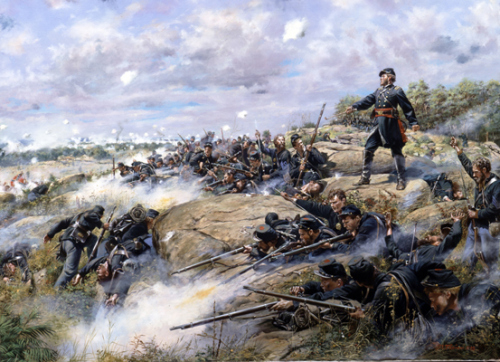
Colonel Strong Vincent directing the Defense of Little Round Top
Friends of Padre Steve’s World,
This is an excerpt from one of the chapters of my Gettysburg text. It deals with two men, volunteer “Citizen Soldiers” whose actions that day were instrumental in the Union victory at Gettysburg. But their story, despite being one of great courage and exceptional leadership is a story of tragedy and sacrifice, which in the case of Chamberlain went long after the battle. Their struggles also affected their families, leaving one wife a widow, and the other marriage one that was tumultuous and very similar to those of many combat veterans who return from war forever changed.
Peace
Padre Steve+
July 2nd 1863 was to be a pivotal day in the history of the United States, a day of valor, courage and carnage. A day where nearly 20,000 Americans were killed, wounded or missing. It was a day where the fate of the Union and the Confederacy were in the balance. On the afternoon of that day, two volunteers rose to the challenge.
Yes, there were many more heroes on Little Round Top that day, but these two men, along with Gouverneur Warren were instrumental in securing the Union victory. They were unlikely heroes, neither was a professional soldier, but both took to soldiering and leading soldiers as if it were second nature. They were men who along with others “who stepped out of themselves for a moment and turned a corner at some inexpressibly right instant.” 1
Colonel Strong Vincent was a 26 year old Harvard graduate and lawyer from Erie Pennsylvania. He was born in Waterford and attended school in Erie. Growing up he worked in his father’s iron foundry, where the work helped make him a man of great physical strength. He studied at Trinity College in Hartford Connecticut and transferred to Harvard from which he graduated in 1859. However, he was not an outstanding student and “earned admonishments on his record for missing chapel and smoking in Harvard Yard.” 2
When war came and the call went out for volunteers, Vincent enlisted in a 30 Day regiment, the Wayne Guards as a private and then was appointed as a 1st Lieutenant and Adjutant of the regiment because of his academic and administrative acumen. He married his wife Elizabeth the same day. Vincent like many young northerners believed in the cause of the Union undivided, and he wrote his wife shortly after after the regiment went to war on the Peninsula:
“Surely the right will prevail. If I live we will rejoice in our country’s success. If I fall, remember you have given your husband to the most righteous cause that ever widowed a woman.” 3
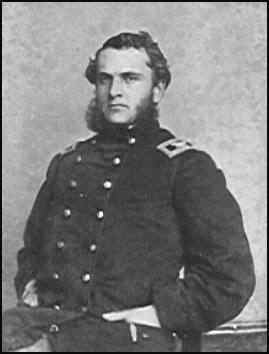
Colonel Strong Vincent
When the Wayne Guards were disbanded at the end of their enlistment, Vincent helped to raise the 83rd Pennsylvania and was commissioned as a Lieutenant Colonel in it on September 14th 1861. The young officer learned his trade well and was considered a “strict disciplinarian and master of drill.” 4 That being said one enlisted man remarked that “no officer in the army was more thoughtful and considerate of the health and comfort of his men.” 5 He assumed command of the regiment when the commander was killed during the Seven Days in June of 1862 where he learned lessons that he would help impart to his fellow officers as well as subordinates, including Chamberlain. At Fredericksburg any doubters about the young officer’s courage and leadership ability were converted where they observed his poise “with sword in hand” he “stood erect in full view of the enemy’s artillery, and though the shot fell fast on all sides, he never wavered or once changed his position.” 6
By the time of the Battle of Gettysburg, the 26 year old Vincent was the youngest brigade commander in the army. He was noted for his intelligence, leadership, military acumen and maturity. One friend wrote “As a general thing his companions were older than himself;….Among his associates were men of the highest rank. He could adapt himself to all,- could talk with the politician on questions of history, with a general officer on military evolutions, or with a sporting man on the relative merits of horses,-and all respected his opinion.” 7
His promotion was well earned, following a bout with a combination of Malaria and Typhoid, the “Chickahominy Fever” which almost killed him, Vincent took command of the regiment after its commander was killed at Gaines Mill. He commanded the regiment at Fredericksburg and was promoted to command the 3rd Brigade after the Battle of Chancellorsville following the resignation of its commander, Colonel T.W.B. Stockton on May 18th 1863.
Vincent was offered the chance to serve as the Judge Advocate General of the Army of the Potomac by Joseph Hooker in the spring of 1863 after spending three months on court-martial duty. But Vincent refused the offer in so that he might remain in the fight commanding troops. 8 He told his friends “I enlisted to fight.” 9
Vincent, like Chamberlain who admired him greatly had “become a kind of model of the citizen soldier.” 10 As a result of his experience in battle and the tenacity of the Confederate army he became an advocate of the tactics that William Tecumseh Sherman would later employ during his march to the sea in 1864. He wrote his wife before Chancellorsville:
“We must fight them more vindictively, or we shall be foiled at every step. We must desolate the country as we pass through it, and not leave a trace of a doubtful friend or foe behind us; make them believe that we are in earnest, terribly in earnest; that to break this band in twain is monstrous and impossible; that the life of every man, yea, of every weak woman or child in the entire South, is of no value whatever compared with the integrity of the Union.” 11
Unlike most other brigade commanders, Vincent was still a Colonel, and he, like many others would in his place hoping for a General’s star. He remarked that his move to save Sickles’ command “will either bring me my stars, or finish my career as a soldier.” 12 On July first, Vincent, a native Pennsylvanian came to Hanover and learning that battle had been joined, ordered “the pipes and drums of the 83rd Pennsylvania to play his brigade through the town and ordered the regiments to uncover their flags again….” 13 As the brigade marched through the town Vincent “reverently bared his head” and announced to his adjutant, “What death more glorious can any man desire than to die on the soil of old Pennsylvania fighting for that flag?” 14
Vincent was known for his personal courage and a soldier of the 83rd Pennsylvania observed “Vincent had a particular penchant for being in the lead….Whenever or wherever his brigade might be in a position to get ahead…, he was sure to be ahead.” 15 That courage and acumen to be in the right place at the right time was in evidence when he led his brigade into battle on July second.
On July 2nd Barnes’ division of V Corps, which Vincent’s brigade was a part was being deployed to the threat posed by the Confederate attack of McLaws’ division on the Peach Orchard and the Wheat Field to reinforce Sickles’ III Corps. While that division marched toward the Peach Orchard, Vincent’s 3rd Brigade was the trail unit. When Gouverneur Warren’s aide, Lieutenant Randall Mackenzie 16 came toward the unit in search of Barnes he came across Vincent and his brigade near the George Weikert house on Cemetery Ridge awaiting further orders. 17
Vincent intercepted him and demanded what his orders were. Upon being told that Sykes’ orders to Barnes were to “send one of his brigades to occupy that hill yonder,” 18 Vincent, defied normal protocol assuming that Barnes was drunk 19 and told Mackenzie “I will take responsibility of taking my brigade there.” 20 Vincent immediately went into action and ordered Colonel James Rice of the 44th New York “to bring the brigade to the hill as quickly as possible,” and then turned on his horse and galloped off toward Little Round Top.” 21
It was a fortunate thing for the Union that he did. His quick action to get his brigade, clear orders to his subordinate commanders and skilled analysis of the ground were a decisive factor in the Union forces holding Little Round Top. After ordering Colonel Rice to lead the brigade up to the hill, he and his aide went forward to scout positions accompanied by the brigade standards. Rice brought the brigade forward at the double quick “across the field to the road leading up the north shoulder of the hill” with Chamberlain’s 20th Maine in the lead. 22
Vincent and his orderly made a reconnaissance of the south and east slope of the hill which adjoined a small valley and a rocky outcrop called Devil’s Den, which was occupied by the 124th New York and which was the end of Sickles’ line. Near the summit of the southern aspect of the hill, they came under Confederate artillery fire and told his aid “They are firing at the flag, go behind the rocks with it.” 23
Vincent dismounted, leaving is sword secured on his horse, carrying only his riding crop. He continued and “with the skill and precision of a professional had reconnoitered and decided how to best place his slim brigade of 1350 muskets.” 24 He chose a position along a spur of the hill, which now bears his name, running from the northwest to the southeast to place his regiments where they could intercept the Confederate troops of Hood’s division which he could see advancing toward the hill.
What Vincent saw when he arrived was a scene of disaster. Confederate troops had overwhelmed the 124th New York and were moving on Little Round Top, “Devil’s Den was a smoking crater,” and the ravine which separated Devil’s Den from Little Round Top “was a whirling maelstrom.” 25 Seeing the threat Vincent began to deploy his brigade but also sent at messenger back to Barnes telling him “Go tell General Barnes to send reinforcements at once, the enemy are coming against us with an overwhelming force” 26
The 16th Michigan, the smallest regiment with barely 150 soldiers in line 27 was placed on the right of the brigade. As it moved forward, its adjutant, Rufus W. Jacklin’s horse was hit by a canon ball which decapitated that unfortunate animal and left it “a mass of quivering flesh.” 28 The Confederate artillery fell among the advancing Union troops and splintered trees, causing some concern among the soldiers. The 20th Maine’s Chaplain, Luther French, saw the “beheading of Jacklin’s horse and and ran to Captain Atherton W. Clark, commanding the 20th’s Company E, babbling about what he had seen. Clark interrupted French abruptly and shouted: “For Christ sake Chaplain, if you have any business attend to it.” 29
That section of the line was located on massive boulders that placed it high above the valley below, making it nearly impregnable to frontal attack. On the summit Vincent deployed the 83rd Pennsylvania and 44th New York to their left at the request of Rice who told him “In every battle that we have engaged the Eighty-third and Forty-fourth have fought side by side. I wish that it might be so today.” 30 The story is probably apocryphal but the regiments remained side by side with the 16th Michigan on the right and the 20th Maine on the left. The two regiments were deployed below the crest among the large number of boulders; the 83rd was about two-thirds of the way down the way down the slope where it joined the right of the 44th, whose line angled back up the slope to the southeast. A historian of the 83rd Pennsylvania noted that “Each rock”… “was a fortress behind which the soldier[s] instantly took shelter.” 31 The soldiers were determined to do their duty as they now were fighting on home ground.
Vincent deployed the 20th Maine on his extreme left of his line, and in fact the extreme end of the Union line. Vincent knew that if this flank was turned and Chamberlain overrun that it would imperil the entire Union position. Vincent came up to Chamberlain who remembered that Vincent said “in an awed, faraway voice. “I place you here….This is the left of the Union line. You understand. You are to hold this ground at all costs.” 32 Chamberlain acknowledged his understanding of the order and since the regiment lacked field grade officers, Chamberlain “assigned Captain Atherton Clark of company E to command the right wing, and acting Major Ellis Spear the left.” 33
While Colonel Joshua Chamberlain’s story is much more well known than his brigade commander, Strong Vincent, he was another one of the citizen soldiers whose performance and leadership on Little Round Top saved the Union line that hot July evening. Chamberlain was a graduate of Bowdoin College and Bangor Theological Seminary. Fluent in nine languages other than English he remained at Bowdoin as Professor of Rhetoric before seeking an appointment in a newly raised Maine Regiment without consulting either the college or his wife Fannie. He actually deceived the college by requesting a “scholarly sabbatical when in fact he had applied to the governor of Maine in the new 20th Maine Infantry in the late summer of 1862.” 34
The letter that Chamberlain wrote to Governor Israel Washburn details Chamberlain’s desire to serve:
“For seven years past I have been Professor in Bowdoin College. I have always been interested in military matters, and what I do not know in that line I know how to learn.
Having been lately elected to a new department here, I am expecting to have leave, at the approaching Commencement, to spend a year or more in Europe, in the service of the College. I am entirely unwilling, however, to accept this offer, if my Country needs my service or example here.
Your Excellency presides over the Educational as well as the military affairs of our State, and, I am well aware, appreciates the importance of sustaining our Institutions of Learning. You will therefore be able to decide where my influence is most needed.
But, I fear, this war, so costly of blood and treasure, will not cease until the men of the North are willing to leave good positions, and sacrifice the dearest personal interests, to rescue our Country from Desolation, and defend the National Existence against treachery at home and jeopardy abroad. This war must be ended, with a swift and strong hand; and every man ought to come forward and ask to be placed at his proper post.
Nearly a hundred of those who have been my pupils, are now officers in our army; but there are many more all over our State, who, I believe, would respond with enthusiasm, if summoned by me, and who would bring forward men enough to fill up a Regiment at once. I can not free myself from my obligations here until the first week in August, but I do not want to be the last in the field, if it can possibly be helped.” 35
Chamberlain’s pre-war experiences gave no indication that he would emerge as a military hero. His father had named him after Captain James Lawrence, the commanding officer of the frigate USS Chesapeake in the War of 1812 who uttered the famous words “Don’t give up the ship” as he lay mortally wounded. His mother added the name Joshua as his first name in the town’s books. His father hoped that the young Chamberlain who pursue a military career, his mother wished that he pursue the ministry. He did become a minister but had no desire to become a pastor, and instead took up his academic career at Bowdoin and his tumultuous marriage to his wife Fannie, a musician and the child of a minister. “During most of his life, Chamberlain struggled with bouts of deep depression and melancholy. But not during the war years. It was as if the war and soldiering had made a new man out of him.” 36
Chamberlain was offered command of the 20th Maine but asked the governor that be appointed as a Lieutenant Colonel, which he was in August 1862. He fought with the regiment at Fredericksburg and was named commander of the when Colonel Adelbert Ames, his commander was promoted to brigade command in Oliver Howard’s XI Corps following the debacle at Chancellorsville.
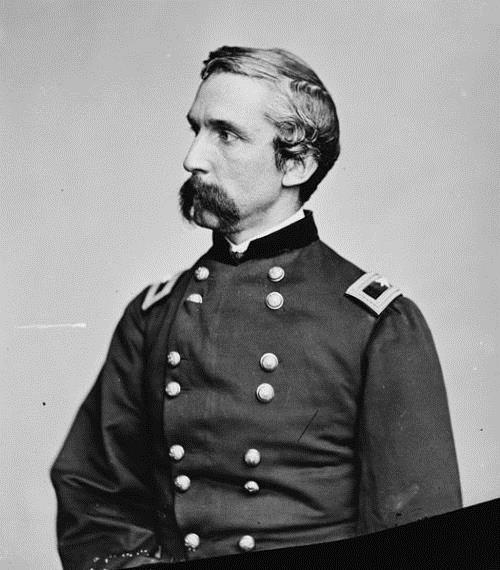
Colonel Joshua Lawrence Chamberlain (while serving as a Brigadier General)
Like Vincent, Chamberlain was also a quick student and rapidly adapted to being a soldier, officer and commander of troops in combat. On the march up to Gettysburg Chamberlain was ordered to take a number of veterans of the 2nd Maine, who had signed three year, rather than two year enlistment contracts and were angry at remaining in the army when the regiment was mustered out. The soldiers were bitter but Chamberlain treated them graciously and “almost all of them agreed to take up their muskets again the the service of the 20th Maine.” 37
On receiving his orders Chamberlain deployed his small regiment halfway down the southern slope facing the small valley between Little Round Top and Big Round Top. By the time he arrived at Gettysburg had become “a great infantry officer, and among his valuable qualities was where an attack would come….” 38
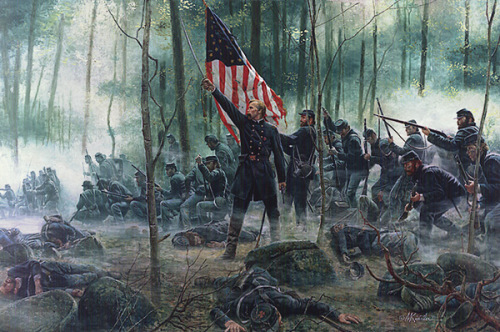
Since Chamberlain’s account is so important I will forgo a discussion of his tactics and instead quote the sections of his after action report that explains his actions. Chamberlain wrote:
“On reaching the field at about 4 p.m. July 2d, Col. Vincent commanding the Brigade, placing me on the left of the Brigade and consequently on the extreme left of our entire line of battle, instructed me that the enemy were expected shortly to make a desperate attempt to turn our left flank, and that the position assigned to me must be held at every hazard.
I established my line on the crest of a small spur of a rocky and wooded hill, and sent out at once a company of skirmishers on my left to guard against surprise on that unprotected flank.
These dispositions were scarcely made when the attack commenced, and the right of the Regt. found itself at once hotly engaged. Almost at the same moment, from a high rock which gave me a full view of the enemy, I perceived a heavy force in rear of their principal line, moving rapidly but stealthily toward our left, with the intention, as I judged, of gaining our rear unperceived. Without betraying our peril to any but one or two officers, I had the right wing move by the left flank, taking intervals of a pace or two, according to the shelter afforded by rocks or trees, extending so as to cover the whole front then engaged; and at the same time moved the left wing to the left and rear, making a large angle at the color, which was now brought to the front where our left had first rested.
This hazardous maneuvre was so admirably executed by my men that our fire was not materially slackened in front, and the enemy gained no advantage there, while the left wing in the meantime had formed a solid and steady line in a direction to meet the expected assault. We were not a moment too soon; for the enemy having gained their desired point of attack came to a front, and rushed forward with an impetuosity which showed their sanguine expectations.
Their astonishment however was evident, when emerging from their cover, they met instead of an unsuspecting flank, a firm and ready front. A strong fire opened at once from both sides, and with great effect, the enemy still advancing until they came within ten pacesof our line, where our steady and telling volleys brought them to a stand. From that moment began a struggle fierce and bloody beyond any that I have witnessed, and which lasted in all its fury, a full hour. The two lines met, and broke and mingled in the shock. At times I saw around me more of the enemy than of my own men. The edge of conflict swayed to and fro -now one and now the other party holding the contested ground. Three times our line was forced back, but only to rally and repulse the enemy. As often as the enemy’s line was broken and routed, a new line was unmasked, which advanced with fresh vigor. Our “sixty rounds” were rapidly reduced; I sent several messengers to the rear for ammunition, and also for reinforcements. In the mean time we seized the opportunity of a momentary lull to gather ammunition and more serviceable arms, from the dead and dying on the field. With these we met the enemy’s last and fiercest assault. Their own rifles and their own bullets were turned against them. In the midst of this struggle, our ammunition utterly failed. The enemy were close upon us with a fresh line, pouring on us a terrible fire. Half the left wing already lay on the field. Although I had brought two companies from the right to its support, it was now scarcely more than a skirmish line. The heroic energy of my officers could avail no more. Our gallant line withered and shrunk before the fire it could not repel. It was too evident that we could maintain the defensive no longer. As a last desperate resort, I ordered a charge. The word “fix bayonets” flew from man to man. The click of the steel seemed to give new zeal to all. The men dashed forward with a shout. The two wings came into one line again, and extending to the left, and at the same time wheeling to the right, the whole Regiment described nearly a half circle, the left passing over the space of half a mile, while the right kept within the support of the 83d Penna. thus leaving no chance of escape to the enemy except to climb the steep side of the mountain or to pass by the whole front of the 83d Penna. The enemy’s first line scarcely tried to run-they stood amazed, threw down their loaded arms and surrendered in whole companies. Those in their rear had more time and gave us more trouble. My skirmishing company threw itself upon the enemy’s flank behind a stone wall, and their effective fire added to the enemy’s confusion. In this charge we captured three hundred and sixty eight prisoners, many of them officers, and took three hundred stand of arms. The prisoners were from four different regiments, and admitted that they had attacked with a Brigade.” 39
Colonel William Oates of the 15th Alabama gave Chamberlain and his regiment the credit for stopping his attack. Oates wrote: “There have never been harder fighters than the Twentieth Maine and their gallant Colonel. His skill and persistency and the great bravery of his men saved Little Round Top and the Army of the Potomac from defeat.” 40
As with any firsthand account, aspects of Chamberlain’s accounts are contested by others at the scene. Oates notes that he ordered the retreat and that there were not as many prisoners taken, one of Chamberlain’s company commanders disputes the account of the order of the bayonet charge however the fact is that Chamberlain who was outnumbered nearly two to one by the, 4th 15th and 47th Alabama regiments “offset this superiority with strength of position, iron determination and better tactics.” 41 Also a factor was the fatigue of the Confederates, these regiments and their parent unit, Law’s brigade of Hood’s division had conducted a grueling 28 mile march to get to the battlefield and were exhausted and dehydrated by the time that they arrived, something that their commander, Colonel Oates believed “contributed largely to our failure at Little Round Top.” 42
Vincent was mortally wounded while leading the defense of the hill. As the men of Robertson’s Texas brigade rushed the hill and threatened to crack “the stout 16th Michigan defense….” 43 Vincent rushed to bolster the defenders. He was standing on a large boulder with a riding crop as the men of the 16th Michigan were beginning to waiver. Fully exposed to enemy fire he attempted to drive the retreating men back into the fight. Brandishing the riding which he cried out “Don’t yield an inch now men or all is lost,” 44 and moments later was struck by a “minie ball which passed through his left groin and lodged in his left thigh. He fell to the ground and as he was being carried from the field, “This is the fourth or fifth time they have shot at me…and they have hit me at last.” 45 He was taken to a field hospital where he suffered for five days and died on July 7th. Meade recommended Vincent for posthumous promotion to Brigadier General, but the request was lost. Ten weeks after his death his wife gave birth to a baby girl. The baby would not live a year and was buried next to him.
Colonel Rice who led the 44th New York up the hill and took command of the brigade on Vincent’s death memorialized his fallen commander in his general order to the brigade on July 12th:
“The colonel commanding hereby announces to the brigade the death of Brig. Gen. Strong Vincent. He died near Gettysburg, Pa., July 7, 1863, from the effects of a wound received on the 2d instant, and within sight of that field which his bravery had so greatly assisted to win. A day hallowed with all the glory of success is thus sombered by the sorrow of our loss. Wreaths of victory give way to chaplets of mourning, hearts exultant to feelings of grief. A soldier, a scholar, a friend, has fallen. For his country, struggling for its life, he willingly gave his own. Grateful for his services, the State which proudly claims him as her own will give him an honored grave and a costly monument, but he ever will remain buried in our hearts, and our love for his memory will outlast the stone which shall bear the inscription of his bravery, his virtues, and his patriotism.
While we deplore his death, and remember with sorrow our loss, let us emulate the example of his fidelity and patriotism, feeling that e lives but in vain who lives not for his God and his country.
After the battle, as the army looked to replace the casualties in the ranks of senior leadership and “when Colonel Rice, in charge of 3rd Brigade after Vincent fell, was promoted to brigadier general and given another command” the new division commander Major General Charles Griffin, “insisted on having Chamberlain, for the 3rd Brigade.” 46 Chamberlain survived the war to great acclaim being wounded three times, being promoted to Major General and awarded the Medal of Honor. He received the surrender of the Army of Northern Virginia at Appomattox on April 9th 1865 and ordered his men to present arms in honor of their defeated foe as those haggard soldiers passed his division. After the war like most citizen soldiers, he returned to civilian life, serving as a four term Governor of Maine and President of Bowdoin College. He became a champion of national reconciliation admired by friend and former foe alike.
Chamberlain’s accolades were certainly earned but others on that hill have been all too often overlooked by most people. This list includes Gouverneur Warren who was humiliated by Phillip Sheridan at Five Forks, Strong Vincent who died on the Hill and Paddy O’Rorke, the commander of the 140th New York of Weed’s Brigade on Vincent’s right who was mortally wounded that day. Despite this, after the end war, Joshua Chamberlain, the hero of Little Round Top who was well acquainted with the carnage of war suffered immensely. His wounds never fully healed and he was forced to wear what would be considered an early form of a catheter and bag. Chamberlain struggled to climb out of “an emotional abyss” in the years after the war. Part was caused by his wounds which included wounds to his sexual organs, shattering his sexuality and caused his marriage to deteriorate.
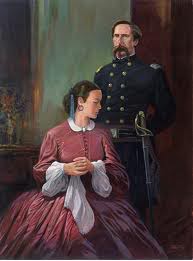
Joshua and Fannie Chamberlain (Dale Gallon Painting)
He wrote to Fannie in 1867 about the “widening gulf between them, one created at least in part by his physical limitations: “There is not much left in me to love. I feel that all too well.” 47 Chamberlain’s inability to readjust to civilian life following the war and Fanny’s inability to understand what he had gone through during it, caused great troubles in their marriage. By 1868 the issues were so deep that Fannie was accusing Joshua of domestic abuse a charge which he contested even offering her a divorce which were very similar to what many combat veterans and their families experience today. After he received news of the allegations Chamberlain wrote to her:
“If it is true (as Mr. Johnson seems to think there is a chance of its being) that you are preparing for an action against me, you need not give yourself all this trouble. I should think we had skill enough to adjust the terms of a separation without the wretchedness to all our family which these low people to whom it would seem that you confide your grievances + plans will certainly bring about.
You never take my advice, I am aware.
But if you do not stop this at once it will end in hell.” 48
The marriage endured a separation which lasted until 1871 when they reconciled, and it did survive, for nearly forty more years. Fannie died in 1905 and Chamberlain , who despite all of their conflicts loved her, wrote after her death:
“You in my soul I see, faithful watcher, by my cot-side long days and nights together, through the delirium of mortal anguish – steadfast, calm, and sweet as eternal love. We pass now quickly from each other’s sight, but I know full well that where beyond these passing scenes you shall be, there will be heaven!”
Chamberlain died on February 24th 1914 of complications from complications of the ghastly wound that he received at Petersburg in 1864. Sadly, their marriage is typical of many relationships where a spouse returns home from war, something that we need to remember when we encounter those changed by war and the struggles of their families.
Notes
1 Guelzo, Allen C. Gettysburg: The Last Invasion Vintage Books a Division of Random House, New York 2013 p.462
2 LaFantasie, Glenn W. Twilight at Little Round Top: July 2, 1863 The Tide Turns at Gettysburg Vintage Books, a Division of Random House, New York 2005 p.105
3 ________. Erie County Historical Society http://www.eriecountyhistory.org/wp-content/uploads/2008/10/strongvincent.pdf retrieved 9 June 2014
4 Golay, Michael. To Gettysburg and Beyond: The Parallel Lives of Joshua Lawrence Chamberlain and Edward Porter Alexander Crown Publishers Inc. New York 1994 p.129
5 Nevins, James H. and Styple, William B. What death More Glorious: A Biography of General Strong Vincent Belle Grove Publishing Company, Kearney NJ 1997 p.29
6 Ibid Guelzo, Gettysburg: The Last Invasion p.262
7 Ibid. Nevins, James H. and Styple, William B. What death More Glorious p.548 Leonardi, Ron Strong Vincent at Gettysburg Barringer-Erie Times News retrieved June 9th 2014 from http://history.goerie.com/2013/06/30/strong-vincent-at-gettysburg/
9 Ibid. Nevins, James H. and Styple, William B. What death More Glorious p.55
10 Wallace, Willard. The Soul of the Lion: A Biography of Joshua L. Chamberlain Stan Clark Military Books, Gettysburg PA 1960 p.91
11 Ibid. Nevins, James H. and Styple, William B. What death More Glorious p.57
12 Ibid. Guelzo, Gettysburg: The Last Invasion p.264
13 Pfanz, Harry F. Gettysburg: The Second Day. University of North Carolina Press, Chapel Hill 1987 p.51
14 Ibid. Guelzo Gettysburg: The Last Invasion Vintage p.159
15 Tredeau, Noah Andre. Gettysburg: A Testing of Courage, Harper Collins Publishers, New York 2002 p.305
16 Some such as Guelzo believe this may have been Captain William Jay of Sykes staff.
17 Ibid. Tredeau, Gettysburg: A Testing of Courage p.327
18 Ibid. Guelzo Gettysburg: The Last Invasion Vintage p.262 19 Ibid. Guelzo Gettysburg: The Last Invasion Vintage p.262
20 Ibid. Tredeau, Gettysburg: A Testing of Courage p.32721 Ibid. LeFantasie Twilight at Little Round Top p.108
22 Coddington, Edwin B. The Gettysburg Campaign: A Study in Command, A Touchstone Book, Simon and Schuster New York, 1968 p.389
23 Ibid. LaFantasie Twilight at Little Round Top p.109
24 Ibid. Coddington The Gettysburg Campaign p.390
25 Ibid. Guelzo Gettysburg: The Last Invasion Vintage p.270
26 Ibid. Nevins, James H. and Styple, William B. What death More Glorious p.75
27 Sears, Stephen W. Gettysburg. Houghton Mifflin Co. Boston and New York 2003 p.292
28 Ibid. LaFantasie Twilight at Little Round Top p.109
29 Ibid. LaFantasie Twilight at Little Round Top p.109
30 Ibid. Pfanz, Gettysburg: The Second Day. p.213
31 Ibid. LaFantasie Twilight at Little Round Top p.111
32 Ibid. Golay To Gettysburg and Beyond p.157
33 Ibid. LaFantasie Twilight at Little Round Top p.111
34 Ibid. LaFantasie Twilight at Little Round Top pp.44-45
35 Chamberlain, Joshua Lawrence Letter From Joshua L. Chamberlain to Governor [Israel] Washburn, Brunswick, July 14, 1862 retrieved from Bowdoin College, Joshua Lawrence Chamberlain Documents http://learn.bowdoin.edu/joshua-lawrence-chamberlain/documents/1862-07-14.html 8 November 2014
36 Ibid. LaFantasie Twilight at Little Round Top p.45
37 Ibid. LaFantasie Twilight at Little Round Top p.45
38 Ibid. Wallace The Soul of the Lion p.94
39 Chamberlain, Joshua Lawrence. Official Narrative of Joshua Chamberlain of July 6th 1863, Maine Military Historical Society, Inc., Augusta, Maine, copyright 1989 U.S. Army Combat Studies Institute Reprint, retrieved from http://usacac.army.mil/cac2/cgsc/carl/download/csipubs/chamberlain.pdf June 15th 2014
40 Oates, Willam C. and Haskell, Frank A. Gettysburg Bantam Books edition, New York 1992, originally published in 1905 p.98
41 Ibid. Coddington The Gettysburg Campaign: A Study in Command p.393
42 Ibid. Oates and Haskell Gettysburg p.87
43 Ibid. Wallace The Soul of the Lion p.95
44 Ibid. Guelzo Gettysburg: The Last Invasion Vintage p.272
45 Ibid. Tredeau, Gettysburg: A Testing of Courage p.361
46 Ibid. Wallace The Soul of the Lion p.115
47 Longacre, Edward Joshua Chamberlain: The Soldier and the Man Combined Publishing Conshohocken PA 1999 p.259
48 Chamberlain, Joshua L. Letter Joshua L. Chamberlain to “Dear Fanny” [Fanny Chamberlain], Augusta, November 20, 1868 retrieved from Bowdoin College, Joshua Lawrence Chamberlain Documents http://learn.bowdoin.edu/joshua-lawrence-chamberlain/documents/1868-11-20.html 8 November 2014


 The Inglorius Padre Steve's World