Tag Archives: History

The First Duty is to Truth: Midweek Musings

IMG_1915
“The truth is rarely pure and never simple.” Oscar Wilde 

Friends of Padre Steve’s World, I have been busily working this past week oThe n a major revision to a chapter of my Gettysburg text about Colonel Strong Vincent and Joshua Lawrence Chamberlain. Part of that appeared here last week. However, as I continued to do more research I realized that what I wrote was not nearly enough, not in terms of words, but in terms of truth. There is much more to the story, especially concerning the relationship of Joshua Chamberlain and his wife Fannie.

There are times when one seeks truth that the timeless truths of the subject matter have to be taken to heart. Truth does matter to me, even when it is uncomfortable, not just for others but for me as well. As I have written before, that in this I am reminded of a quote from Star Trek the Next Generation. It is from an episode called “The First Duty.” In it the seasoned Captain Jean Luc Picard confronts his young protege Wesley Crusher after a disastrous accident that leaves a Star Fleet Academy cadet dead. Picard tells the young Crusher that “the first duty of every Starfleet officer is to the truth, whether it’s scientific truth, historical truth or personnel truth…

Truth is difficult, especially when one builds their belief on myths, be they of their own or others making. For me the study of the Battle of Gettysburg for my work has become a quest for truth. Not so much about the truth of specific incidents on the battlefield but of the great truths that go beyond the battlefield, the enduring truths about human nature, about relationships and about war and peace. In a sense the story of the battle of Gettysburg and those men who fought on it, has become a palette from which I am drawing truths about the human condition as well as my own terribly flawed condition, and in the process busting myths, my own included.

Barbara Tuchman once wrote: “The reality of a question is inevitably more complicated than we would like to suppose.” That is truth, it is truth with battles, politics, and in fact all of life, but many would rather rest content in myth. Thus as Rene Descartes wrote: “If you would be a real seeker after truth, it is necessary that at least once in your life you doubt, as far as possible, all things.”

I doubt a lot. I question a lot more and sometimes that leads to facing things that are uncomfortable. Thus, I will be putting up the redone version of that last article in the next day or two, as well as others where my study is leading me to deeper truths.

My big task now is editing and reorganizing the nearly 450 pages of text that I have written into the past year into a form that I can market to a publisher. I do have a couple of final chapters to write from scratch but hopefully by early spring I will ready to have it complete enough to submit for publication.

In the mean time I will continue to write about other subjects, including some military, some political, some social and some about current events, music, and life in general. There are couple of articles I want to write about some naval battles that have fascinated me for decades as well as more on the inhumanity of the Holocaust, the past and current struggles for civil rights in America and many other subjects.

That being said, you as my readers will get my new insights on Gettysburg, both new and revised articles which reflect that search for truth. I do hope that you find them as something more than simply accounts of the battle, but on the deeper truths of the nature and character of humanity, the nature and character of the conflict that we call war, with all its attendant maladies, but more importantly as a mirror for ourselves. My study of Joshua Chamberlain has resulted in having to face uncomfortable but strangely liberating truths about me and the way I live my life.

This is part of my journey, a journey into truth that goes beyond the mere reporting of facts, facts which often are as subject to interpretation, disputation and change as more “facts” are discovered. The truth is that we have to be able to accept new discoveries once they are determined to be true, or at least at the point that they can be posited as reasonable and worthy of acceptance, no matter how badly they challenge our deep held beliefs, even those about ourselves.  Sadly the lies we believe and persist in telling, and the myths that we believe without question, are much more dangerous than  any new truth that offends us.

I have to agree with Marcus Aurelius who wrote:

“If someone is able to show me that what I think or do is not right, I will happily change, for I seek the truth, by which no one was ever truly harmed. It is the person who continues in his self-deception and ignorance who is harmed.”

Those truths can be scientific, they can be historical or literary, and quite often the truth can also be quite personal.

As John F Kennedy said at Yale in 1962: “The great enemy of truth is very often not the lie–deliberate, contrived and dishonest–but the myth–persistent, persuasive and unrealistic. Too often we hold fast to the cliches of our forebears. We subject all facts to a prefabricated set of interpretations. We enjoy the comfort of opinion without the discomfort of thought.” 

So until tomorrow,

Peace

Padre Steve+


Leave a comment

Filed under faith, History, Loose thoughts and musings, philosophy

Friday Morning Myth Busting before a Trip to Gettysburg

IMG_1915

Dear Friends of Padre Steve’s World,

Today I head up with my class to Gettysburg for our Staff Ride. Of course this comes on the heals of the San Francisco amazing game seven victory in the 2014 World Series, and if you read this site you understand that I was up until the wee hours of the morning because I was much too excited to sleep. This is actually, despite the lack of sleep a blessing because most of the time that I don’t sleep it is because of anxiety, nightmares, flashbacks and night terrors that torment me. As Gouverneur Warren, one of the heroes of Gettysburg wrote after the war:

“I wish I did not dream that much. They make me sometimes dread to go to sleep. Scenes from the war, are so constantly recalled, with bitter feelings I wish to never experience again. Lies, vanity, treachery, and carnage.”

But last night was different, to was hard to get to sleep because of the excitement of one of the best World Series games in history. That being said I am tired. I revised my chapter on the ideological nature of the American Civil War, and I should have another chapter revision on the Confederate decision to allow Robert E. Lee to invade Pennsylvania in the late spring of 1863 done by the time that I leave tomorrow. But those chapters, which are around 80 pages long are now too big to post in one fell swoop here.

However, in my readings I encountered a quote by historian Drew Faust Gilpin, as well as another that was part of a Methodist tract from 1860 that both seem absolutely timely today. I included both in the chapter, but I am going to post it here as well, because in the religious-historical myth that has become the staple that frauds like David Barton, Glenn Beck and their political and media allies flood the the airways and internet with, it is timely. Gilpin wrote:

“Sacred and secular history, like religion and politics, had become all but indistinguishable…The analogy between the Confederacy and the chosen Hebrew nation was invoked so often as to be transformed into a figure of everyday speech. Like the United States before it, the Confederacy became a redeemer nation, the new Israel.”

The Methodist tract noted:

“Confederate independence, explained a Methodist tract quoting Puritan John Winthrop, was intended to enable the South, “like a city set on a hill’ [to] fulfill her God given mission to exalt in civilization and Christianity the nations of the earth.”

Personally I cannot imagine anymore hatful projections of the Christian faith, but then I was reminded by the Fox News Channel resident Shrink, Dr Keith Ablow, that the United States needs to be conducting it’s own Jihad, its own wars of conquest to impose the American way on the rest of the world. Of course the blowhard shrink Ablow who has no skin in the game doesn’t seem to mind putting the sons and daughters of the nation in harm’s way, to die in unjust, unrighteous, illegal, immoral and certainly un-Christian wars to satiate his bloodlust. Ablow revels in diagnosing the pathologies and motivations of people that he has never met, not a very professional way of doing business as a shrink, but just watching Ablow’s rants on television and reading what he puts out on the internet I wonder if he is a sociopath, a man without empathy, a man who does not seam to be motivated by the desire to help people, nor by the upholding the Hippocratic oath, to do no harm.

I find it fascinating to read what General and later President Ulysses S Grant said about such ideas:

“As the United States is the freest of all nations, so, too, its people sympathize with all people struggling for liberty and self-government; but while so sympathizing it is due to our honor that we should abstain from enforcing our views upon unwilling nations and from taking an interested part, without invitation, in the quarrels between different nations or between governments and their subjects. Our course should always be in conformity with strict justice and law, international and local.”

But that my friends is why history matters, and why you should take your time to study it, including the uncomfortable things that destroy the myths perpetuated by the Lost Causers of the modern “Conservative Christian” revisionists and their allies who sell their crap as truth to people who want to believe it because they have been conditioned by thirty years and more of propaganda, that the myth is true.

Clothed in  the garb of faith and patriotism these lies, and the political, military and economic consequences  that they have spawned over the past thirteen years, have cost more American lives and treasure, as well as destroyed our stature in the world than any series of events in our history. heretical These filthy and polluted ideas helped destroy what could have been a renaissance in international relations because their proponents painted everything in terms of black and white and you either are for us or against us. Yes let me say it, President George Bush’s, uninspired,misguided and down right ignorant  religious world views have taken us to the abyss.

This my friends is why history matters. Sometimes it may seem dry and dusty, and no you cannot get rich as a real historian, while the fake ones like Barton, Beck and Bill O’Reilly are able to make a lot of money because they appear to what people want to hear by lying, by so linking their religion with their politics and their distorted view of history that the reality of history is ground to dust under the heals of their designer jackboots.

So, tomorrow, or is it already today now, I head up to Gettysburg where the brave men of the Army of the Potomac, whose veterans, like those of other Union armies engaged in the struggle for freedom helped give our nation a “new birth of freedom.” 

I think that how the Army of Tennessee, a Union army in the West described the war is at the heart of the issue.

“The Society of the Army of the Tennessee described the war as a struggle “that involved the life of the Nation, the preservation of the Union, the triumph of liberty and the death of slavery.” They had fought every battle…from the firing on the Union flag Fort Sumter to the surrender of Lee at Appomattox…in the cause of human liberty,” burying “treason and slavery in the Potter’s Field of nations” and “making all our citizens equal before the law, from the gulf to the lakes, and from ocean to ocean.”

It is amazing what the study of history and going to the places that it was made can do in someone’s heart. For me, the study of the Battle of Gettysburg and the American Civil War, and not just the military aspects of it has motivated me to be more forceful and speak up against the lies of those like Barton, Beck, O’Reilly, Ablow and the hosts of pundits, preachers and politicians who spread their lies as truth.

But then for me, truth matters. In this I am reminded of a quote from Star Trek the Next Generation. It is from an episode called “The First Duty.” In it the seasoned Captain Jean Luc Picard confronts his young protege Wesley Crusher after a disastrous accident that leaves a Star Fleet Academy cadet dead. Picard tells the young Crusher that “the first duty of every Starfleet officer is to the truth, whether it’s scientific truth, historical truth or personnel truth…

To me, as a miscreant priest, and career officer that quote strikes home. I have a duty to the truth, believe it or not it does matter to me, and sometimes that means that I have to be a myth buster and call out the professional liars who posit themselves as historians, political scientists or experts on military strategy, when none of them have either the education or the experience to be experts in anything but being able to lie for fun and profit.

You see when I go to Gettysburg, and I stand where so many men died do make others free I become ever more inspired to confront the liars.

But now I am preaching and I try not to do that. I do need to attempt to get some sleep, so have a nice night.

Peace

Padre Steve+


Leave a comment

Filed under civil rights, civil war, History, Military, News and current events, Political Commentary, star trek

A Thank you to All of My Readers and Welcome to My World

163017_10150113444907059_3944470_n

I want to welcome all of the new subscribers to the site and do hope that you tell your friends. As you probably figured out I write about a lot of subjects, some of which may be of great interest to you and others not so much. Don’t worry I’m not offended if you don’t like or read everything that I write. In a way this site is like a buffet and you can chose what you like and what you don’t. By the way, just a fair warning since I am getting ready to lead my students to Gettysburg at the end of the month you are going to get a bunch of Civil War and Gettysburg articles over the next few weeks as I update my text for the class.

As a Priest, a historian and career military officer, who suffers from PTSD, chronic insomnia, a major crisis in faith with continued doubts about God and a bunch of other stuff from my time in Iraq I sometimes use what I write to work through my own stuff as well as offer support to others who might be walking down a similar path.  I am a pretty flawed person, but I am okay with that as it keeps me humble and allows me to be a bit more gracious to most people. Like I said, I’m pretty flawed so I can’t say more gracious to everyone. Some people drive me absolutely crazy and to keep my sanity I pretty much try to shut them out.  There are times that like the legendary Don Quixote I joust at windmills as well

church relics

I happen to love baseball and I am a big fan of the Baltimore Orioles and San Francisco Giants and I keep season tickets with the Norfolk Tides who are the Orioles Triple-A farm team. Baseball is probably as important to my faith, after all I like Jesus very much, but he no help with curveball, and baseball is probably as important to my spirituality, mental health and resiliency as anything but my wife Judy who you can follow at the Abbey Normal Abbess,  my dogs Molly and Minnie and my friends at the Gordon Biersch Brewery Restaurant in Virginia Beach. I love music, especially classic rock, pop, R&B, country-rock and soul from the late 1960s, 1970s and 1980s.

I find meaning in a lot of things, faith, history, baseball, music, literature, the lives of complicated and often contradictory people, as well as nature. History, military theory, foreign policy and the relationships of nations and peoples are a passion for me. So I write a lot about them, as I do some social, religious, and political issues.

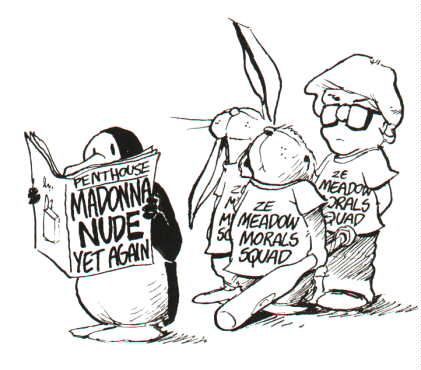
Politically I am more progressive than I ever was before, and I definitely fall on the liberal-progressive side of the tracks on almost every issue. Though I am a career military officer, since I have seen it, I view war as an evil; a last resort and I am a critic of the chicken-hawks who can’t get enough of war even though they have no skin in the game. I spent most of my life as a pretty conservative Republican until I came back changed from my time in Iraq. That being said I don’t hold politics against anyone and I have close friends who we may disagree with in terms of politics, religion, social issues or if they happen to be Yankee’s or Dodgers fans; but we still are friends, we get along and enrich each others lives. That is important to me because relationships matter and unfortunately our society is so divided right now that a lot of people seem incapable of seeing past their own views to keep friends.

orange-BloomCounty-morals

I am a Christian but even so I struggle with faith. When I returned from Iraq I went through a faith crisis that left me pretty much as an agnostic for about two years. I try to be honest about my struggle with faith and as transparent as I can in dealing with my own issues, the stigma associated with PTSD, depression and other mental health issues.

So anyway welcome to the new folks, thank you to the faithful and I hope that you have a great night.

Peace

Padre Steve+


Leave a comment

Filed under Loose thoughts and musings

Oktoberfest Live Blog: Munich Musings; History and Bier

IMG_2051.JPG

I have spent a total of about four years of my life in Germany. I enjoy the country and the people and I love traveling here because for me it is relaxing. When I have a car I enjoy driving on the Autobahn, and I find the mass transportation more than effective and convenient but a great way to travel.

As a historian who for many years specialized in the study of the latter years of the Kaiser Reich, the German revolution and civil war, the Weimar Republic and the Nazi period visiting here always intellectually stimulating. Munich is a very interesting and sometimes contradictory city, rich in culture, music, art, literature and scientific-technological achievements. Likewise it has always been a more cosmopolitan center of a very conservative state, especially religiously conservative as Bavaria is the heart of Catholic Germany. Thus there has always been a tension in the city, between the local more religious conservatives and business leaders and the more secular and progressive inhabitants, and the immigrants from Eastern Europe, especially more traditional and conservative Orthodox Jews.

This tension continues today with the large numbers of foreigners that live and work in the city. Many are Turkish guest workers and their descendants that have been in Germany almost half a century. But many are new immigrants from the Middle East and Africa, some who have embraced German life in a secular state, but many who have not and stand out in the crowd. In particular I think of the number of Moslems who retain their traditional dress and ways, which in many ways is reminiscent of the Eastern European Orthodox Jews, who likewise stood out as they attempted to maintain their cultural and religious identity.

Munich is the capital city of Bavarian, or as it is known here, Bayern. It was ruled for centuries by the Wittelsbach dynasty, which included “Mad King Louis” who built the amazing Neuschwanstein and Linderhof castles. That dynasty, with the rest of the German royalty was overthrown at the end of the a First World War. It was replaced for about three months by what was known as the Bavarian Soviet led by Kurt Eisner, an “independent socialist.” Eisner could not hold power and resigned in February 1919 and on the way to his resignation he was assassinated by a right wing extremist who held the views of the racist Thule Society. Eisner was replaced by a Majority Socialist leader who could not form a government and then by an Independent Socialist and Communist government. This government was both inept and brutal, it took hostages from the elite of the city as well as conservative reactionaries and had them executed. This brought a response from Berlin which sent a force of 30,000 Weimar Government employed Freikorps troops, including many Bavarians from rural areas, under the command of Ritter Von Epp to crush the Munich Soviet. After hard fighting against the Communist troops Epp’s men crushed the opposition and executed hundreds of the Communists and Independent Socialist fighter and leaders.

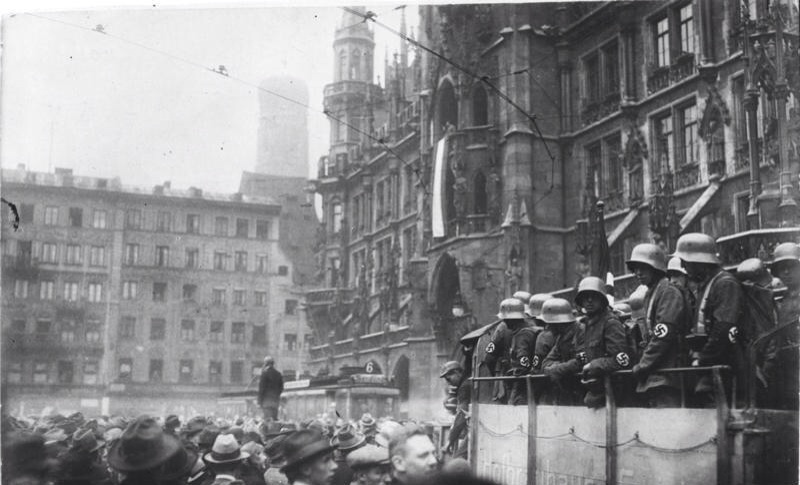
The city was still rife with revolutionary and reactionary elements and in 1919 a new political party was established. This party became the National Socialist Workers Party of Germany, or the NSDAP. Adolf Hitler joined the party and quickly became its head. He along with General Erich Ludendorff led a coup, or “putsch” against the government on the 8th and 9th of November 1923. The putsch originated at the NDSAP headquarters and Hitler led about 2000 armed members of the party to the Burgerbrau Keller beer hall where the Gustav Von Kahr, who had been appointed with dictatorial powers due to the unrest, was making a speech.

IMG_0483.JPG

Hitler took Kahr and other members of the government hostage and declared a revolution and enjoined those present to “join in this grave eleventh hour for our German Fatherland.” While many present were turned by his speech, the revolt did not gain momentum and in desperation Hitler ordered a march to overthrow the government. At Odeonsplatz at the bridge over the Isar River near the Feldherrenhalle his group of nearly 2000 followers including future Nazi Leaders Hermann Goering and Rudolf Hess were confronted by about 100 Bavarian police, and defeated. Hitler was arrested and tried, spent nine months in prison during which he wrote Mein Kampf. The Burgerbraukeller and the Feldherrenhalle became Nazi shrines which after Hitler’s takeover became places where Hitler would return yearly to mark his failed putsch.

All of these events took place in a small area of the Munich city center. Sadly most people who come to Munich are aware of the events that occurred here, and many fail to realize how easily a city know for so many cultural and scientific achievements can become the locus of evil for a man like Adolf Hitler.

While I love Munich my love is tempered by how many events which still affect us today occurred here just eight to ninety years ago. To use a German expression, that amount of in the sense of history is merely an “augenblick” or “blink of an eye”. It is hard to believe that so much has happen here, and just how few people understand just how easily such events can happen again.

When I look at my own country I see parallels between the more extreme elements of the Tea Party movement, White Supremacists and others with some of those that followed Hitler to the Burgerbraukeller. The hatred that they express towards liberals, racial minorities, immigrants and Moslems is so similar to the words of those precursors to the Nazi party rule in Germany that it is frightening. Comforting myths are substituted for history. Race, ideology and xenophobic nationalism, often clothed in the language of tradition “Christian” beliefs are used to demonize those who are different. Sadly too I see some of my fellow progressives inflamed with such a hatred of conservatives that they can not see the dangers inherent in such polarization. As a historian, I find the parallels disturbing.

But despite that we are here to have fun, and that I am. After all, I choose to believe in the power of acceptance, tolerance and inclusiveness. Those are found in the words that are imprinted on the modern German Army belt buckles and in the German National anthem “eingekeit, recut und freiheit” or “unity, Justice and freedom.” Those words are also implicit in our own Declaration of Independence which states that “all men are created equal. Thus for me, not believe that good can overcome evil is central to who I am.

IMG_2059.JPG

And from Munich, I am your friend,

Peace

Padre Steve

Leave a comment

Filed under History, philosophy, Political Commentary

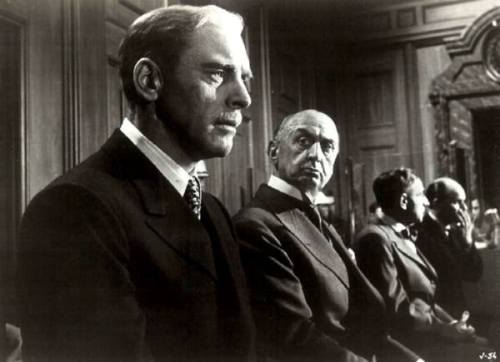
Military Ethics, Legality and Morality: The Damage Being Caused by the Emphasis on STEM to the Detriment of the Humanities in Military Officer Programs

photo-jugement-a-nuremberg-judgment-at-nuremberg-1961-1

“We have been silent witnesses of evil deeds: we have been drenched by many storms; we have learnt the arts of equivocation and pretense; experience has made us suspicious of others and kept us from being truthful and open; intolerable conflicts have worn us down and even made us cynical. Are we still of any use?” Dietrich Bonhoeffer 

I have lost count of the number of scandals regarding the ethical failures of American military leaders. Today at lunch I was talking with a gentleman in charge of the military outreach for a local university where I am considering beginning a Ph.D. program in Organizational Leadership.

There are many reasons given for the these ethical failures, everything from the disintegration or the nuclear family, to the lack of religious upbringing, to the supposedly liberal educational system. However, while I think some of these issues may have some impact, I am not convinced that they are the root cause of the ethics crisis that seems to be plaguing the military.

As we discussed aspects of the program the subject got to the subject of military leaders being fired for ethical, legal and moral lapses. This is something that I am giving much though since I am now teaching ethics at a senior level military staff college. What I am noticing is that many officers struggle with basic concepts regarding history, philosophy, ethics, political science, religion, the arts and literature and other subjects that because I immerse myself in them just assume that any military professional should know.

But that is not the case. For the last thirty to forty years the commissioning programs of our services have given preference to those in the STEM, Science, Technology, Engineering and Mathematics fields. In fact the probability is that the liberal arts or social science major will not be admitted to service academy or ROTC program, even a non-scholarship program unless they are in a STEM major. This is especially true of my own service, the Navy and the Air Force but is not absent from the Army and the Marine Corps.

This is not new. In 1981 I joined Army ROTC because the Navy told me that even to be a non-scholarship student in the program I would have to change my major from history to a STEM major.

This is not simply a military issue, but it is a systemic issue in higher American education programs, programs which due to the demands of the business and technology sectors have gutted liberal arts programs and the social sciences. All of this has been done in the name of making sure that people are “prepared for jobs” and that education is related directly to employability and again jobs. That is why in large part for profit schools have proliferated offering programs focused on narrow job fields in technical majors. This has impacted higher education in public and private universities which at one time had thriving liberal arts, humanities and social science programs as well as the military where the emphasis on STEM has created havoc in terms of ethics.

Dietrich Bonhoeffer wrote:

“The ‘polymath’ had already died out by the close of the eighteenth century, and in the following century intensive education replaced extensive, so that by the end of it the specialist had evolved. The consequence is that today everyone is a mere technician, even the artist…”

Education is now viewed by most as a pathway to a better job, not a quest for understanding, knowledge or even personal improvement. That attitude is enmeshed in our culture and has been for decades. It even shows up in seminaries where programs are not focused in the classics and timeless subjects in theology, history, philosophy, ethics, languages and hermeneutics but instead methods of “growing” a church or running a program. When I was in seminary, a large conservative evangelical seminary many students complained about having to take classes that had nothing to do with running their church. Many of my fellow students despised Church History, Ethics, Philosophy of Religion, and even Systematic Theology and then complained that the courses that were oriented to running a church would be out of date in a few years.

The common theme whether this be in the for profit schools, the public and private universities, the military and seminaries is that we have trained two generations of people to be good technicians and technocrats. Men and women very skilled at getting at job done but that lack the basic ethical and moral grounding that those in previous generations received as part of their education, in the home, in their religious institutions and in the educational system.

The problem is that when you strip away a solid grounding in the arts, liberal arts and social sciences you breed people who may be very good at getting a job done. However they are people who lack the knowledge passed on by people who have shaped civilization for millennia.  They are ignorant of Hammurabi, Moses, Plato, Cicero, Aristotle, Marcus Aurelius, Thomas Aquinas, the great philosophers and thinkers from the East and the West, those who brought about the Reformation, the Renaissance and the Enlightenment and even the Scientific and Industrial Revolutions, Universal Suffrage, Emancipation and Civil Rights.

Their technical education divorces them from those that developed the legal, ethical and moral codes of our culture. They lack the cohesive understanding of social responsibility and connection that have held western civilization together. Those have been replaced by ethics that are dominated by pragmatism or utilitarianism, even in seminaries where classes on ethics or moral theology are often relegated to elective status. How else can we explain the wholesale disintegration of moral and ethical codes of behavior across the vocational spectrum be it business, government, the military or religious institutions?

The question for many people, and maybe most people in our society, including the military is not what is moral or ethical but what is “legal,” and what are the loopholes in the law that allow one to escape the consequences of their immoral, illegal or unethical behavior.

We have raised at least two, maybe three generations of technicians and technocrats, and that trend shows no sign of abating. In North Carolina last year the Republican Governor proposed eliminating tuition assistance from any program not directly related to “jobs.” By that he meant eliminating such assistance from non-STEM programs.

What this does, and I think we are seeing this today is produces people who are good at doing jobs, but have a difficult time in critical thinking or looking at the logical consequences of their ideas and actions.

Many cannot see the moral or ethical dimensions of life and even turn religion to an exercise designed to benefit them in a tangible material way. Thus there is a proliferation of churches that preach some kind of “prosperity Gospel” and those that pervert religion and use it to suppress the freedoms of others by force of law.

But let me return to the military implications of my thesis. What I have observed in my career of over 30 years of military service is a culture that has developed in an ethical vacuum. We have sought to inculcate a service culture based on Army, Navy, Air Force or Marine Corps “values” such as “honor, courage and commitment.” However, for many maybe even most those are mere words. They are shibboleths akin to religious creeds recited by people for whom they are irrelevant because they are not job related.

Now this is not an attack on those in the military, for those in the military simply reflect the culture that they come from. This includes the family, religious, social and educational systems of our society. In fact I actually believe that for the most part people in the military do a better job with values, ethics and morality than many in the civilian society. That being said there is something seriously wrong in what we are doing. If there wasn’t there would not be so many egregious lapses that call the moral fitness of senior military leadership into question.

This is especially important because the trust of the nation is invested in these men and women. The responsibilities that they have regarding the lives of people, the security of the nation and the maintenance, security and use of powerful weapons, including nuclear weapons and information technology that can be used to pry into the private lives of unknowing citizens all dictate that the ethical and moral standards of the military have to be above those found in the private sector.

Unfortunately there is no immediate “fix” for the problem because it it so systemically rooted in our society. However something will have to be done, the Chairman of the Joint Chiefs of Staff and Secretary of Defense have directed the military redouble its emphasis on teaching ethics at every level. However it is my opinion that we will have to go far beyond the recitation of creeds and repetition of words about “values” that have little relevance to people educated and brought up to simply do a job. This will be a difficult task, especially in military organizations being reduced in number while still engaged in war and increasing other operations around the world.

As to the broader societal issues, those run deep, but one thing in my mind is certain, there has to be a renewed emphasis on the humanities, liberal arts and social sciences to include the classics of western and world literature, art, philosophy, history and thought. We cannot reduce education to technical elements that require little in the way of critical thought, or for that matter provide people with “education” that does not force them to deal with the dark areas of life that are uncomfortable and the gray areas that fill our universe.

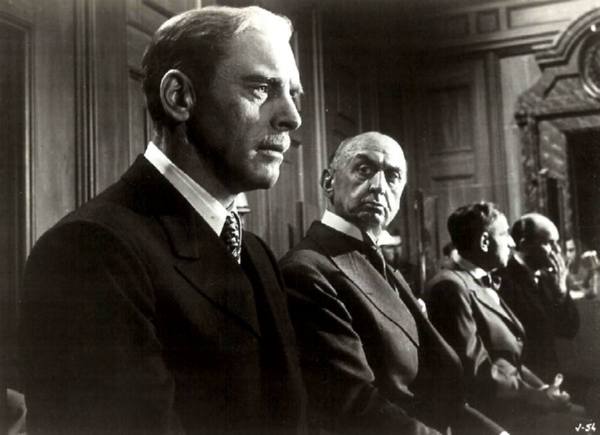
In the Second World War many of the best and brightest of young German intellectuals joined the SS and its sister organizations, organizing and executing the extermination of the Jews and others in Germany and occupied lands. Most of these men did not give their actions a second thought. They were doing their jobs, most of the time in a very dispassionate matter. They carried out orders because they were “legal.” Ethics and morality were no concern simply because they were sworn to obey orders.

The task to change this cannot be that of the military and its leadership alone. If we fail to change our education systems, our home life and even our religious life we will unleash the greatest generation of amoral technocrats who have ever walked the face of the earth. They will be men and women who will have no problem committing the greatest crimes, simply because they are “legal” and because they have only been taught to do their job.

Peace

Padre Steve+

5 Comments

Filed under ethics, leadership, Military, News and current events, philosophy

Happy New Year: Welcome to 1984, 30 Years Late; But Our Thoughts are Free

bloom-county-big-brother-is-watching-you-2

Thoughts are free, who can guess them?
They fly by like nocturnal shadows.
No man can know them, no hunter can shoot them
with powder and lead: Thoughts are free! 

Die Gedanken Sind Frei (The Thoughts are Free) 

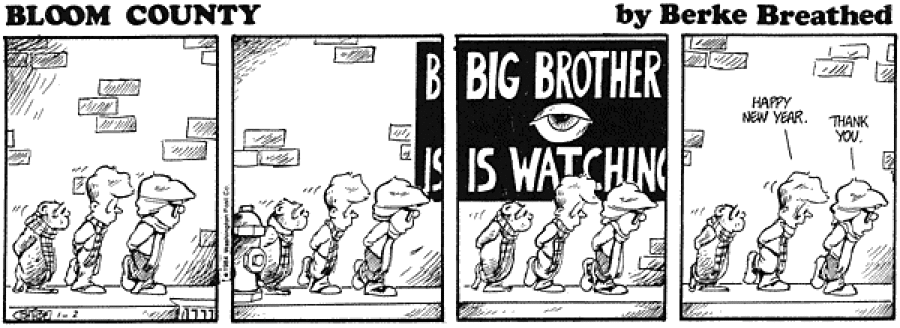
Welcome to 1984.

Okay, I know it’s 2014 but bear with me, I figured that the first post of the New Year should be about the reality that has been with us for years but most people didn’t recognize until 2013. The NSA revelations though shocking to many shouldn’t have been because almost every countries intelligence services are attempting to do similar things. Likewise the private sector both aids and abets the government intelligence and security services and do similar things themselves to their customers.

Technology is a great thing and we love it. We depend on it. Smart phones, internet, text messaging, blogs, electronic banking, finance and commerce, e-books, and even gaming technology has revolutionized the way that we live.

Technology itself is neutral, it can be used for good or evil and every point on the morality spectrum in between. Thus it can be used for good, for convenience and holds much promise for most people, even as a minority uses it to commit acts of terrorism as well as all sorts of criminal activity against otherwise honest and law abiding people.

The tension that exists between the good and evil uses of technology, especially after the attacks of September 11th 2001 has prompted different reactions from both civil libertarians and people trusted with security of nations, businesses and infrastructure networks.

The fact is I can understand and argue for a strong civil libertarian response as well as the security response. Honesty I wrestle with the tension between civil liberty, including the right to privacy and the need for security. I want both but the reality is that the world has changed since I grew up.  It is not that people, governments and businesses didn’t seek to impinge on personal freedom or privacy and that others did not seek to kill or disrupt the lives of others in times past. The difference is the vast advances in technology which enable all of them to have ever more influence over our lives.

Technology has made possible what George Orwell only imagined when he wrote 1984. Governments, business, the banking industry, private security firms, internet service providers and search engines, as well as criminals gather information for good and for bad purposes. For our security we use Passwords and Pins which others seek to crack, while those delicious Cookies that are planted on our computers when we visit different websites contribute to our convenience while enabling others to collect incredibly detailed information about us.

It really is amazing and unfortunately I don’t have any answers because I am a realist. I am not a fan of the National Security State, nor am I a fan of the way business and other organizations collect information. That being said I also know that there are those in the world who desire to use the technology that we are so dependent on to kill or harm people or disrupt society.

Back in the day when terrorism was simply a matter of relatively small bombs, assassinations, hijackings, kidnappings and postal or wire fraud it was a nuisance. It was bad if you were in the path of it but for most people it was not a real threat. I lived with it in the 1980s in Germany with the Red Army Faction, the Baader-Meinhoff gang  and Libyan agents blowing up American and West German facilities and kidnapping and killing soldiers. We lived with it, daily searches of our vehicles at the front gate and extra guard duties, my wife and I almost were at the Frankfurt PX when it was bombed in 1985.

But with the advent of technology even small and seemingly insignificant groups have unprecedented power to kill and destroy. The attacks on the Twin  Towers, the Tokyo subway system, the Madrid commuter trains, London transit system, the Moscow Subway system and theaters, hotels, restaurants and train stations in Mumbai India and the recent attacks on the Russian city of Volgagrad show our vulnerability to groups that use technology, old and new.  Likewise the ability of criminal organizations or individual criminals to use technology to gain access to massive amounts of financial data as was demonstrated in the breaking of Target’s retail system demonstrates our vulnerability.

We want absolute freedom, privacy and security. However absolutes are no longer possible. Absolute freedom has never been possible, though we like to imagine it, yet absolute security can only be achieved by sacrificing all freedom. Now days security usually trumps freedom especially when the potential losses in lives, property and treasure are so great.

My inclination is toward civil liberties and privacy but such in the modern world may be on way to extinction and not all because of technology. Yes the technological part is big, and as a realist I do not think as long as the capabilities that technology provides us exist and advance that we can go back to a point that they cannot be used against individual liberty, life or property. Again, they technology itself is neutral, but how it is used makes all the difference.

The more worrisome issue for me is the way that the freedom of thought is being extinguished not in the name of security or freedom but for efficiency. Various parties including government, political, religious, scientific and business interests all seek to control thought for their own purposes.

Thus even history is twisted, as Orwell wrote: “He who controls the past controls the future. He who controls the present controls the past.” It used to be that conservatives complained about liberals doing revisionist history, but as a historian I find what I see coming out of some conservative circles much more frightening as history is twisted for the most gross political, religious and social ends. We allow half witted poorly educated loudmouths like Rush Limbaugh, Sean Hannity and Glenn Beck to think for us, promote fake history and conspiracy theories while giving credence to fake historians like David Barton. If there is a danger to any real freedom of thought it is because we as a people have allowed ourselves to taken in by such charlatans. Likewise the corporate state uses academics and intellectuals to prop itself up but once it has them it refuses to let them function independently.

Chris Hedges wrote of the corporate state:

“It is one of the great ironies of corporate control that the corporate state needs the abilities of intellectuals to maintain power, yet outside of this role it refuses to permit intellectuals to think or function independently.”

While Ray Bradbury wrote in Fahrenheit 451:

“Cram them full of non-combustible data, chock them so damned full of ‘facts’ they feel stuffed, but absolutely ‘brilliant’ with information. Then they’ll feel they’re thinking, they’ll get a sense of motion without moving. And they’ll be happy, because facts of that sort don’t change. Don’t give them any slippery stuff like philosophy or sociology to tie things up with. That way lies melancholy.”

I believe that in such an age that freedom of thought is the most important thing, even more than freedom of speech. Soren Kierkegaard wrote: “People demand freedom of speech as a compensation for the freedom of thought which they seldom use.”

In college I learned the words of the old German song Die Gedanken Sind Frei (The Thoughts are Free). It is an ancient song that during the days of Metternich was popular among student fraternities in Austria and the various German states. After the 1848 revolutions it was banned by many governments in their crackdown against democratic movements. It was a song close to many of the anti-Nazi resistance groups including the White Rose movement led in part by Sophie Scholl. In light of the terrifying possibilities of repression that exist with the technology of today and what will certainly come into being in the coming years it is important to realize that our liberty must always come from within. The third verse of the song goes like this:

And if I am thrown into the darkest dungeon,
all these are futile works,
because my thoughts tear all gates
and walls apart: Thoughts are free!

Bertram Russell wrote of the freedom of thought:

“Men fear thought as they fear nothing else on earth — more than ruin, more even than death. Thought is subversive and revolutionary, destructive and terrible, thought is merciless to privilege, established institutions, and comfortable habits; thought is anarchic and lawless, indifferent to authority, careless of the well-tried wisdom of the ages. Thought looks into the pit of hell and is not afraid … Thought is great and swift and free, the light of the world, and the chief glory of man.”

It took some time but 1984 is finally really here. That is the new reality, but do not lose hope so long as your thoughts remain free.

Happy New Year!

Peace

Padre Steve+

1 Comment

Filed under History, News and current events, philosophy

All In or Stay the Hell Out: Syria, the United States NATO and the Middle East, the Guns of August All Over Again

hi-syria-gas-rtx12sc9

The Balkans aren’t worth the life of a single Pomeranian grenadier.”  Otto Von Bismarck

The terrible civil war in Syria appears to be reaching its crescendo as someone, probably the Assad Regime or its allies, or possibly the Syrian rebels are using Chemical weapons to kill non-combatants and rebel combatants. The evidence that the weapons have been used is apparently convincing enough for the UN to send in inspectors and for the US Secretary of State John Kerry to state that it is certain that they have been used.

Now NATO allies as well as representatives of Jordan and the Gulf States are meeting to decide what to do in response. Since most experts believe that the Assad regime is culpable for these attacks the belief is that the United Sates, NATO and the Arab Allies could be preparing for some kind of attack Syria. The Russians, long time supporters of Syria are pushing back against this and the Syrians are promising that any attack will result in a war that envelopes the region.

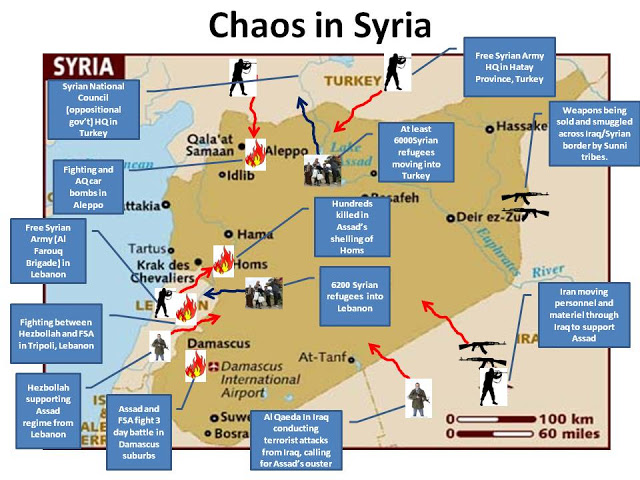
Chaos-in-Syria

What is happening in Syria is a tragedy and must be stopped. War crimes have certainly been committed by all sides in Syria and the direct involvement of Hezbollah and Iran on the side of the Assad regime and Al Qaeda affiliates on the side of the rebels complicate any response. However, that being said the question must be asked “just whose responsibility is to stop it?”

Some say the United States and NATO, others the Arab League while others the various factions of Syrians themselves.

My heart cries out for intervention in Syria if for nothing else but on humanitarian grounds. But the fact is intervention in Syria has to be much more thought out and organized than intervention that we have conducted since the fall of the Berlin Wall. It will not be a cake walk and quite likely will lead to consequences far worse than the average citizen or boneheaded Congressman has never given a cogent thought.

Syria is an incredibly complicated country. It is multi-ethnic and multi-religion. Arabs, Kurds, Druze and others live in patchwork communities and regions even as various sects of Sunni, Shia, Sufi and Salafist Moslems vie for power while the divided Christian minority , Catholics, Orthodox, Anglicans and others hope to live and remain in their own country.

As far as others in the Region besides Iran and Hezbollah, various Sunni and Shia Iraqi insurgents have crossed over into Syria, while Israel teeters on the bring of being drawn in to the conflagration.

No matter what happens there will be no winners in what is happening in Syria. There is a high probability that the Syrian civil war will overflow the borders of that unfortunate country and drag the region and possibly major world powers into the war. If that happens there are no winners, only losers. The biggest question is who will be the biggest loser?

That being said even tonight there are reports of military movements in the region even as NATO and Arab coalition partners gather to discuss a response. I am resigned to the fact that the Syrian Civil war will overflow Syria’s borders and draw in the powers of many countries. Just who I am not exactly sure at this time. In the US there is a marked tepid feeling among voters about getting involved. That may be a good thing. It may temper our response and make us deliberate the consequences of military action or inaction.

Bertrand Russell once said that “War does not determine who is right – only who is left.” I wonder if anyone in any of the nations currently involved or possibly that might be engaged in the war actually things about what Russell said.

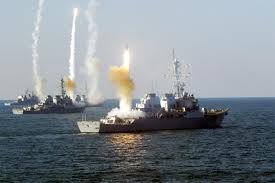
The fact is that what is going on in Syria is the proverbial “Tar Baby.” There is no clean easy solution to the situation. Lobbing in a few hundred cruise missiles and launching airstrikes in support of the rebels is unlikely to have a profound strategic affect. Instead, unless NATO and its allies are willing to risk an actual ground war after the missile and air strikes then the fact of the matter is that those strikes will have little long term effect. If a ground invasion happens it will be bloody and not the cake walk that so many in Western Governments, media and populations that rely on a very small number of military professionals to fight their wars think it will be.

If by some chance the United States and its allies get drawn into the Syrian Civil War than all of them had better think of what the consequences of that involvement will be, for the region, the world and our own countries. The fact is that a major war in Syria will drag the rest of the region into it. This is not 2003 Iraq or 2011 Libya. The fact is that Syria is heavily splintered into various regional, ethnic and religious groups, most who have lived among each other for millennia and most of whom hate each other.

I cannot speak for other governments around the region and the world, allied to the United States or not. However I do know that our Constitution has in it the formula of who should committed the country to war and that, despite our recent history is not the President by his executive authority Commander in Chief but by Congress after due deliberation and a vote to declare war.

My thoughts are that if we in the United States are serious about this, that we believe that Syria and Assad need to be taken down then fine. Let us call Congress back to Washington now and have them debate the issue. If they vote for war then they need to do two things, the first is that Congress needs to be called away from its vacation and get to work debating the issue. If the President backed by a declaration of war from Congress and a repeal of the sequester that is gutting the country and the military.

If they cannot do this then let’s stop the bullshit and tell the work that the situation in Syria is terrible but the consequences of going to war without either an end in mind or analysis of the costs involved is criminal. Bismarck said it well in regard to the Balkans and his comments should be taken to heart by the United States and its allies.

The situation in Syria cries out for action, but that action must be action that helps the people of Syria, the region and the world and is not just an action to salve our collective consciousness and say that we did something. Simply throwing some cruise missiles at Syria accomplishes nothing unless there is a plan of what we intend to see happen. William Tecumseh Sherman said: “It is only those who have neither fired a shot nor heard the shrieks and groans of the wounded who cry aloud for blood, more vengeance, more desolation. War is hell.”

My thoughts on this are to make going to war difficult. If the President and his cabinet determines that they believe in consultations with our allies that war is the last and best of the worst case options, the Congress needs to cut short its vacation. Republican and Democrat leaders need to gather and a decision has to be made. If we go to war it can no longer be done under the very loose and terribly vague rules of the War Powers Act because any attack on Syria will certainly escalate beyond a short term military strike done “on the cheap.”

There is no cheap or easy to Syria. If military action is the only way to solve the problem then Congress must convene, make a formal declaration of war and also repeal sequestration. A war in Syria will be costly in blood and treasure and will likely pull in many other countries. The human costs in the region, not just Syria will be beyond imagination while the costs to the world economy will be severe and quite possibly push the world into another recession or possibly depression.

The military power alone of the United States has been used far too many times as our governments under successive Republican and Democrat leadership have opted not to use the full measure of our diplomatic, intelligence, military and economic power to solve problems. Instead we fall back to the easiest and most ready means to satiate our need for a quick solution to complex problems, the military option. Military power alone, especially if it is incapable of ending the conflict and bringing a just peace is not an answer in Syria.

Syria03_GQ_07Dec12_getty_b_642x390

The fact is that we Americans do not know the world nor do we understand it. Americans have become simple and lazy when it comes to dealing with complex issues. We deal in sound bites and tweets, the more fiery the better even as we stick our heads in the sand as to what is happening in the world. Ask how many people are more interested in the beginning of the College and Pro-Football seasons in the next couple of weeks versus those interested in really important issues of war and peace and you will get your answer on our priorities as Americans. We have no sense of history and are quite ignorant of the world around us and the political, cultural, religious, philosophical, ideological and economic factors that make up our world so our first response is almost always the sword.

If the President and Congress feel that it is absolutely necessary to go to war over the atrocities being committed in Syria let them make that decision, but only after considerable debate, consultations with allies, the United Nations and the Arab League followed by a vote on an actual declaration of war, the repeal of sequestration and a major stimulus to prevent the economy from tanking when the cost of oil goes through the roof and cripples the world economy.

Winston Churchill cautioned leaders “Never, never, never believe any war will be smooth and easy, or that anyone who embarks on the strange voyage can measure the tides and hurricanes he will encounter. The statesman who yields to war fever must realize that once the signal is given, he is no longer the master of policy but the slave of unforeseeable and uncontrollable events.” 

images-56

To paraphrase Bismarck, Syria is not worth the life of one American or Allied Soldier unless our governments are willing to do it right. All in or stay the hell out and don’t go in without counting the real and the potential costs.

Peace

Padre Steve+

2 Comments

Filed under middle east, Military, national security, Political Commentary

Europe on the Edge: France and Greece Point to Dangerous Times Ahead

New French President Francois Hollande

The people of France and Greece have repudiated the European Union’s austerity mandate and Europe stands on the edge of chaos.  Maybe not immediate chaos but chaos that will engulf the continent as country after country elects for its own history, culture, tradition and economic freedom.

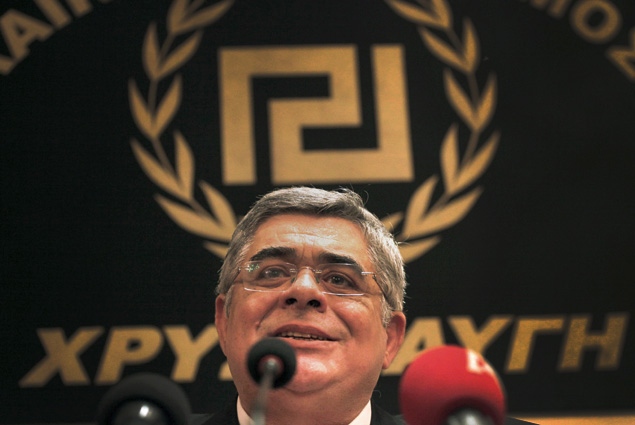
This is nothing new. In fact the situation in Europe resembles the period of the early 1930s as the Great Depression brought about the rise of political extremist on the Right and Left in very new and fragile democracies, as well as more established democracies.  Parallels can be found in many European nations. In France the election of Francois Hollande of the Socialist Party over Nicolas Sarkozy sent a shiver through the EU. Combined with the implosion of the conservative and liberal coalition in Greece in and results of other European elections the reality is that the European Union could be on the verge of breaking up. The Greek situation is especially foreboding as any coalition government will have to deal with the election of both hard line Communists and Neo-Nazis to parliament.

Greek Neo-Nazis

Now how it breaks up is not pre-determined, however it is obvious that the most strident voices in many European countries are people and parties that in good times are relegated to the political fringe. However social crisis driven by long term economic problems, especially high unemployment and reductions in support to those displaced by the economy are things that have historically brought about revolutions and dictatorships.

The European Union: Can it Survive?

Despite the Socialist win in France the trajectory of Europe is toward anti-democratic, ultra-nationalist and Xenophobic regimes.  Such will bode ill for the world economy as well as peace and the treatment of ethnic and religious minorities. Europe’s long term record on these issues is dreadful and the ghosts of that record seem to rise up almost every time that you think it is safe to go out in the water.

Germany under Chancellor Merkel and her allies in Brussels are attempting to hold together a creation that can only hold together when times are good and money easy.  When the hard times come, nations as well as individuals return to their basest and most primal concerns, not any utopian ideal.

The Hitler apologist and radical conservative pundit Pat Buchanan seems to think that this is a good thing in his latest column. He seems to revel in the potential collapse of the European Union. But then for a man that defend’s Hitler’s invasion of Poland in 1939 and blames everybody but Hitler for the war this is not surprising.  While he may diagnose some of the problems inherent in the EU he also forgets that the EU held as its model the United States, the creation of a United States of Europe.

Nazi Election Poster

While I have always thought that the rush to admit nations to the EU in the 1990s and early 2000s was ill-conceived the threat posed by its break up is worse. This is simply because history shows us time and time again that such break ups are fraught with danger.

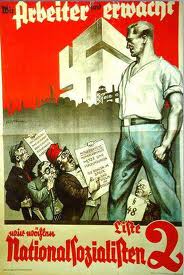
Likewise the same forces are at work in the United States. Long term economic difficulties are leading people to embrace extremes that in good times they would never consider.  We are not all that different from the Europeans in this. Looking back to the period before the Nazi takeover of Germany one observer told historian William Sheridan Allen that “Most of those that joined the Nazis did so because they wanted a radical answer to the economic problem. Then too, people wanted a hard, sharp, clear leadership- they were disgusted with the eternal political strife of parliamentary party politics.” (The Nazi Seizure of Power: The Experience of a Single German Town 1922-1945 Revised Edition, Franklin Watts Publishers, New York, London 1965, 1984 p.86)

These are dangerous times. It is not time to look to extremists of any stripe that promise simple and radical solutions to the solve the crisis. To do such is to make a deal with the devil.

Peace

Padre Steve+

1 Comment

Filed under History, News and current events, Political Commentary

The Heresy of Thinking and Reason in an Age of Fanaticism

Note: I felt the need to republish this article in light of so many of the controversies that have been in the news lately, especially because some of the visceral reactions that I see from so many people about them. I just hope that people take the time to try to get as much of each story and controversy possible, examine them in the light of history and reason before jumping to unsubstantiated conclusions. The fact is that many of us do precisely this and that is in large part due to how terribly divided we are. However, that being said there is seldom any issue that is totally clear, most actually are quite opaque and clouded in the fog of many shades of gray, and what history teaches us is that we need to be careful before jumping to conclusions.

Peace

Padre Steve+

“Unreason and anti-intellectualism abominate thought. Thinking implies disagreement; and disagreement implies nonconformity; and nonconformity implies heresy; and heresy implies disloyalty. So, obviously, thinking must be stopped. But shouting is not a substitute for thinking and reason is not the subversion but the salvation of freedom.” Adlai Stevenson – A Call to Greatness (1954)

I had a Church History professor in seminary who was known for his attention to detail and his expectation that his students would master the subject.  His method was quite simple. A fellow student asked him during review for a mid-term exam “what do we need to study for the test?”  His answer was simple “everything.” The student restated his question “what do we really need to know?”  My professor paused and made a comment that did not make the student very happy.  He said something that I paraphrase here “it is the details that enable you to see the big picture, without the details you know nothing.”

A good number of my fellow students did not appreciate the fact that he was deadly serious.  It was not simply the ability to remember names and dates and events but to be able to connect them and see what was really important.  Many did not take him seriously and when the test came many failed it.  In fact some continued to fail every exam because they could not reconcile that details were important. The attitude of a good number of my classmates was that history, philosophy or even systematic theology were not important especially if they involved study of people or ideas that they did not agree with.

Unfortunately we now live in an age of anti-intellectualism and anti-historicism. Instead of trying to figure out what is really important and studying the details of the great questions of our day we have become lazy. We simply fall back on the dogmas presented by the Unholy Trinity of Pundits, Politicians and Preachers that cater to our ideology for reassurance.  And they are quite good at co. If you listen to talk radio or are a devoted fan of any particular cable news pundit you can see this on display daily and even more so by our political leaders and those seeking political power. What is presented by the Unholy Trinity is at best half-truth sprinkled with deadly venom of hatred to make the half-truth an absolute truth.  In such a world facts are only important if the “true believer” can use them buttress his ideological bias even if he has to take the completely out of context to in order to do so.  It is so much easier to call an opponent a Communist or Nazi, Fascist or Imperialist, Unbeliever or Heretic and connect them to the evil we want to demonize them as than it is to actually,  engage in a truthful debate and to see things in their historical context. Likewise when we use such labels against those that disagree with us we dehumanize our opponents thereby justifying any evil that we use to silence them.

It seems that we presume that if we repeat what we believe enough, even if it is unsound or erroneous that it will become truth.  As individuals, governments, institutions and businesses we settle for the easy answers that agree with our presuppositions and dismiss opposing views as heresy.  We allow people of little learning but great charm and salesmanship ability sell us myth in place of fact and this happens across the political, social, economic and theological spectrum.

The past few days I have been talking about the study of history as well as ways of learning.  The little things do matter, and the study of history, philosophy, theology, the sciences, economics in fact anything of any importance is based on understanding details, and things like precedent and context.  It is not enough to string together a series of quotations or citations if they are taken out of context, altered or intentionally misused to fit our ideology or doctrine.

This may comfort the true believer in whatever cause and even make them feel superior to those that disagree but such thinking. But it blind them to reality and not conscious of their own envy, malice, pettiness and dishonesty. The “wall of words” that flow so easily from the mouths and pens of the members of the Unholy Trinity that the faithful are unable to separate them from reality, truth from fiction, opinion from fact.  This “wall of words” serves as their protection against any thought, fact, presumption or doctrine that contradicts them.  John F Kennedy said “Too often we enjoy the comfort of opinion without the discomfort of thought.” 

In such times it is important to take the time to learn from history, not just generalities that mix fact and myth but the little details that make up history and for that matter the sciences, philosophy, sociology, political thought and theology.  As a society we have ceased to do this and until we take the time to return to such study, dialogue and put aside our blinders we will be doomed to remain as we are no matter what political party is in power or ideology dominates the airwaves and cyber space.

There is a prayer that neatly sums up what I desire for me and for our society:

From the cowardice that dares not face new truth
From the laziness that is contented with half truth
From the arrogance that thinks it knows all truth,
Good Lord, deliver me.

Peace

Padre Steve+

2 Comments

Filed under philosophy, Political Commentary, Religion

Learn when you Can rather than when you Must

“Wise people learn when they can; fools learn when they must.”
Arthur Wellesley, First Duke of Wellington

I have slowed down writing for a few days to spend more time thinking, reflecting, reading and observing. I mentioned last night how I have been reading about the Napoleonic Wars in particular the naval campaigns which I find are still relevant even in our modern age. Technology, forms of government and even religious faith may evolve may the character of people and nations remains fairly constant.

There has been a lot going on in this country and around the world and the one thing that I notice is that few seem to be taking the time to observe and seem to be more interested in immediately framing the events of the day into their particular ideology. This tendency is not limited to any one segment the population and goes across ideological divides.  We live in a time of great political and social upheaval and drastic change and if we are to ride out the storm we must continue to learn and not be satisfied with the banal and insipid sound bites that the Unholy Trinity of pundits, politicians and preachers spew out as wisdom.  American philosopher Eric Hoffer quite rightly said that “In a time of drastic change it is the learners who inherit the future. The learned usually find themselves equipped to live in a world that no longer exists.”  

Learning comes from reading, observation and experience. Otto Von Bismarck, one of the most remarkable statesmen that ever lived said that “only a fool learns from his own mistakes, a wise man from the mistakes of others.”  

The great American humorist Will Rogers put the same thought into a bit more bluntly saying “There are three kinds of men. The one that learns by reading. The few who learn by observation. The rest of them have to pee on the electric fence for themselves.”

I for one would rather not be one of those that learn by the last named method.  Learning from my mistakes has never been enjoyable and has usually been quite painful.  While I know I will make mistakes and hope to learn from them when I do I would much rather learn from the mistakes of others. Let’s hope that our leaders decide to actually pay attention and learn instead of making us pay for their mistakes.

Peace

Padre Steve+

Leave a comment

Filed under History, leadership, philosophy, Political Commentary