Tag Archives: james longstreet

The Gettysburg Campaign: Lee Decides to Go on the Offensive

993scr_3a12918e0189d2e

I am preparing to lead a Staff Ride of our students to Gettysburg in early March. As part of my preparation I am doing a lot of study to refresh myself on both the campaign and the battle, not only as an operational study, but at the strategic level. This short essay deals with Lee’s decision to invade the North following his victory at Chancellorsville. I will follow it up with other articles the next talking about the Northern strategy at both the strategic and operational levels.

In early May 1863 General Robert E. Lee, commanding the Army of Northern Virginia realized that the Confederacy was in desperate straits. Despite numerous victories against heavy odds, Lee knew that time was running out. Though he had beaten the Army of the Potomac under General Joseph Hooker at Chancellorsville, he had not destroyed it and that Army, along with a smaller force commanded by General Dix in Hampton Roads still threatened Richmond.

The strategic situation was bad, even if many Confederate politicians realized it or cared in the post Chancellorsville euphoria. In the west the strategic river city of Vicksburg Mississippi was threatened by the Army of Union General Ulysses S Grant, and Naval forces under the command of Admiral David Farragut. If Vicksburg fell the Union would control the entire Mississippi and cut the Confederacy in two. Union forces also maintained a strong presence in the areas of the Virginia Tidewater and the coastal areas of the Carolinas, while in Tennessee a Union Army was stalemated, but still threatening Chattanooga, the gateway to the Deep South. The blockade of the United States Navy had crippled the already tenuous economy of the Confederacy.

Some Confederate leaders realized the danger presented by Grant in the West. Secretary of War James Seddon recognized the danger in the Winter of 1862-1863 both suggested to Lee that he detach significant units to relieve the pressure in the west and blunt Grant’s advance. Lee would have nothing of it, he argued that the war would be won in the East. It was his view that if Virginia was lost, so was the Confederacy, and was concerned that whatever units left behind should he dispatch troops from his Army west, would be unable to defend Richmond.

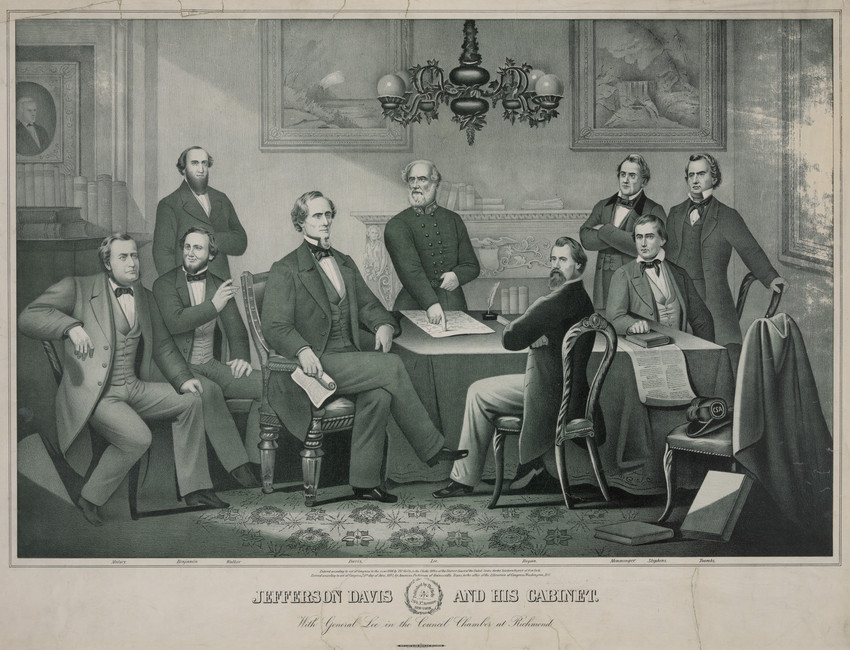
On May 14th Lee travelled by train to Richmond to meet with President Jefferson Davis and War Secretary James Seddon. At the meeting Lee argued for an offensive campaign in the east, to take the war to Pennsylvania. Lee had two goals three major goals, two which were directly related to the immediate military situation and one which went to the broader strategic situation. Unfortunately no notes from that conference are known to survive.

Lee had long believed that an offensive into the North was necessary, even before Chancellorsville. Lee did not believe that reinforcing the Confederate Armies in the West would provide any real relief, instead he believed that his Army, flush with victory needed to be reinforced and allowed to advance into Pennsylvania. Lee’s Chief of Staff Colonel Charles Marshall crafted a series of courses of action designed to present the invasion option as the only feasible alternative. Although both Seddon and Davis had reservations about the plan they agreed to it, unfortunately for all of them they never really settled the important goals of the campaign.

Lee believed that his offensive would relieve Grant’s pressure on Pemberton’s Army at Vicksburg. Likewise Lee believed that if he was successful in battle and defeated the Army of the Potomac in Pennsylvania that it could give the peace party in the North to bring pressure on the Lincoln Administration to end the war.  He also believed that if he could spend a summer campaign season in the North, living off of Union foodstuffs and shipping booty back to the Confederacy that it would give farmers in Northern Virginia a season to harvest crops unimpeded by major military operations.

However, the meeting evidently did not have all the results that Lee desired. Davis refused Lee reinforcements from the coastal Carolinas, and insisted on units being left to cover Richmond in case General Dix advanced on Richmond from Hampton Roads. Much of this was due to political pressure as well as the personal animus that existed between General D. H. Hill in the Carolinas towards Lee.

Likewise Lee’s decision revealed an unresolved issue in Confederate Grand Strategy. Many in the Confederacy realized that the only hope for success was to fight a defensive campaign that made Union victory so expensive that eventually Lincoln’s government would fall or be forced to negotiate.

However, Lee was convinced that ultimate victory could only be achieved by decisively defeating and destroying Federal military might. His letters are full of references to crush, defeat or destroy Union forces opposing him. His strategy of the offensive was demonstrated on numerous occasions in 1862 and early 1863, however it was unfeasible and counterproductive to Southern strategy. His offensive operations cost his Army dearly in the one commodity that the South could not replace, nor keep pace with its Northern adversary, his men.

When Lee fought defensive actions on ground of his choosing, like a Fredericksburg he was not only successful but husbanded his strength. However, when he went on the offensive in almost every case he lost between 15 and 22 percent of his strength, and the percentage of soldiers that he lost was always more than his Federal counterparts, even when his army inflicted greater aggregate casualties on his opponents. Lee recognized this as was evident in his correspondence but it did not deter his strategy of the offensive until after his defeat at Gettysburg.

The course of action was decided upon, but one has to ask if Lee’s decision was wise decision at a strategic point level, not simply the operational or tactical level where many Civil War students are comfortable. General Longstreet’s artillery commander, Colonel Porter Alexander described the appropriate strategy of the South well, he wrote:

“When the South entered upon war with a power so immensely her superior in men & money, & all the wealth of modern resources in machinery and the transportation appliances by land & sea, she could entertain but one single hope of final success. That was, that the desperation of her resistance would finally exact from her adversary such a price in blood & treasure as to exhaust the enthusiasm of its population for the objects of the war. We could not hope to conquer her. Our one chance was to wear her out.”  (Edward Porter Alexander, Fighting for the Confederacy: The Personal Recollections of General Edward Porter Alexander, ed. Gary W. Gallagher, University of North Carolina Press, Chapel Hill NC, 1989 p.415 

What Alexander describes is the same type of strategy successfully employed by Washington and his more able officers during the American Revolution, Wellington’s campaign on the Iberian Peninsula against Napoleon’s armies, and that of General Giap against the French and Americans in Vietnam. It was not a strategy that completely avoided offensive actions, but saved them for the right moment when victory could be obtained.

It is my belief that Lee erred in invading the North for the simple fact that the risks far outweighed the possible benefits. It was a long shot and Lee was a gambler, audacious possibly to a fault. His decision to go North also exhibited a certain amount of hubris as he did not believe that his army could be beaten, even when it was outnumbered.  Likewise he took the offensive in spite of the fact that many of his commanders were untested at the levels of command that they exercised. He had lost his right arm, General Stonewall Jackson, who died following being wounded at Gettysburg.

He knew from his previous battles the heavy casualties that even a victory over the Army of the Potomac would entail deep in Northern territory and the effect that a costly victory would have on his operations, but he still took the risk. That was short sighted and diametrically opposed to the strategy that the South needed to pursue in order to gain its independence. Of course some will disagree, but I am comfortable in my assertion that it was a mistake that greatly affected the Confederacy’s only real means of securing its independence, the breaking of the will of the Union by making victory so costly that it would not be worth the cost.

Peace

Padre Steve+
Leave a comment

Filed under civil war, History, leadership, Military

Gettysburg at 150: The Accounting in Lives and Difficult Moral Questions

gettysburg-devils-den

“Why do men fight who were born to be brothers?”James Longstreet

“It is well that war is so terrible. We should grow too fond of it.” Robert E Lee

As the sun set on the evening of July 3rd 1863 the battered Army of Northern Virginia and the battered but victorious Army of the Potomac tended their wounds, buried their dead and prepared for what might happen next.

Following the disastrous attack aimed at the Union center, what is commonly called “Pickett’s Charge” Lee and his surviving commanders prepared for an expected Union counter attack. However, George Meade, the commander of the Army of the Potomac who had correctly anticipated Lee’s assault decided not to gamble on a counter attack, though it was tempting. He knew too well the tenacity and skill of the Confederate commanders and soldiers on the defense and did not want to risk a setback that might give Lee another chance.

Savages_Station_field_hospital-600x374

The dead and wounded littered the battlefield. Field hospitals, little more than butcher shops where arms and legs were amputated by overworked surgeons and attendants while those with abdominal wounds that could not be easily repaired were made as comfortable as possible. Triage was simple. If a casualty was thought to have a reasonable chance at survival he was treated, if not they were set aside in little groups and allowed to die as peacefully as possible. Chaplains made their way around, Protestant’s ensuring that their soldiers “knew Jesus” and Catholics administering the Last Rites.

dead-civil-war-soldiers

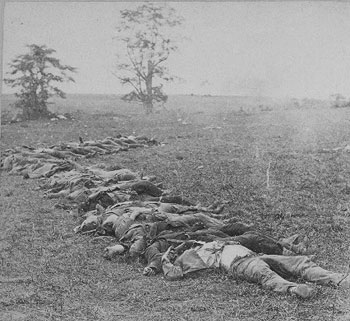
One Confederate soldier describe the scene west of the town on July 4th:

“The sights and smells that assailed us were simply indescribable-corpses swollen to twice their size, asunder with the pressure of gases and vapors…The odors were nauseating, and so deadly that in a short time we all sickened and were lying with our mouths close to the ground, most of us vomiting profusely.” 

Among the killed and wounded were the great and the small. John Reynolds who died on day one, Winfield Scott Hancock, the valiant commander of the Union II Corps wounded during Pickett’s Charge, Mad Dan Sickles, who had nearly brought disaster on the Federal lines by advancing to the Peach Orchard on July 2nd had a leg amputated.

The Confederates suffered grievous losses. Divisional commanders like Dorsey Pender were mortally wounded. John Bell Hood was severely wounded, Isaac Trimble was wounded and captured while Harry Heth was wounded. Numerous Generals were killed or wounded and among regimental commanders the toll was fearful. In Picket’s division alone all three brigade commanders, Kemper, Armistead and Garnett were killed or wounded while 26 of 40 Field Grade officers were casualties. 46% (78 of 171) of the regiments of the Army of Northern Virginia suffered casualties at the command level. The Confederate casualties, especially among the best leaders were irreplaceable and Lee’s Army never recovered from the loss of seasoned leaders who were already in short supply.

One witness, Frank Haskell looked in at a field hospital in the Union II Corps area and wrote:

“The Surgeons with coats off and sleeves rolled up…are about thier work,… “and their faces and clothes are spattered with blood; and though they look weary and tired, their work goes systematically and steadily on- how much and how long they have worked, the piles of legs, arms, feet, hands, fingers…partially tell.” (Gettysburg by Stephen W Sears, Mariner Books, Houghton Mifflin Company Boston, New York 2004 p.466)

All told between 46,000 and 51,000 Americans were killed or wounded during the three days of Gettysburg. Busey and Martin’s Regimental Strengths and Losses at Gettysburg lists the following casualty figures, other accounts list higher numbers. One also has to remember that many of the missing were killed but simply never found or if their bodies were found identified:

killed           wounded         missing         total

Union                    3,155          14,531             5,369           23,055

Confederate         4,708          12,693             5,830            23,231

Total                     7,863           27,224            11,199          46,286

To provide a reference in 8 years of war in Iraq the United States suffered fewer casualties than during the three days of Gettysburg. It was the bloodiest single battle in American history.

At the end of the war, Joshua Chamberlain, the hero of Little Round Top who was well acquainted with the carnage of war asked the most difficult questions:

“…men made in the image of God, marred by the hand of man, and must we say in the name of God? And where is the reckoning for such things? And who is answerable? One might almost shrink from the sound of his own voice, which had launched into the palpitating air words of order–do we call t?–fraught with such ruin. Was it God’s command that we heard, or His forgiveness that we must forever implore?”

May we pray for peace that such an event never take place again.

Peace

Padre Steve+

Leave a comment

Filed under civil war, History, Military

Gettysburg at 150 Day One: Lee Blunders into Battle

800px-First_day_at_gettysburg

Pender’s Brigade on Day One

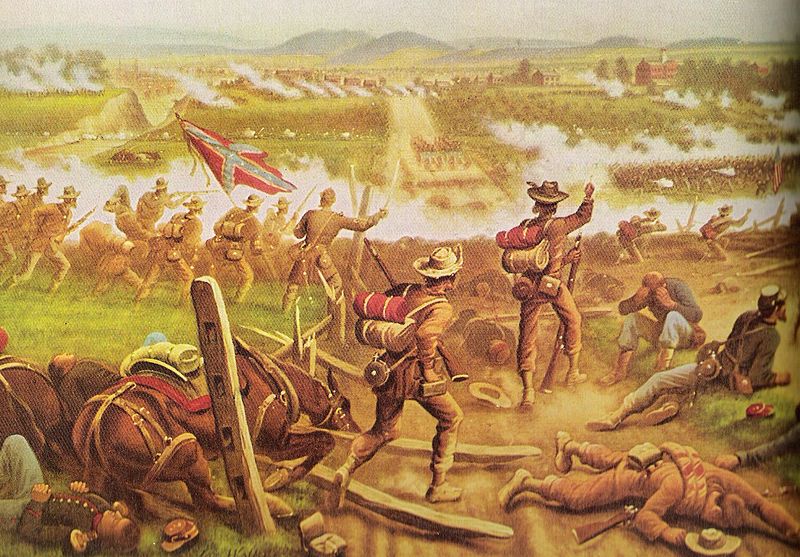
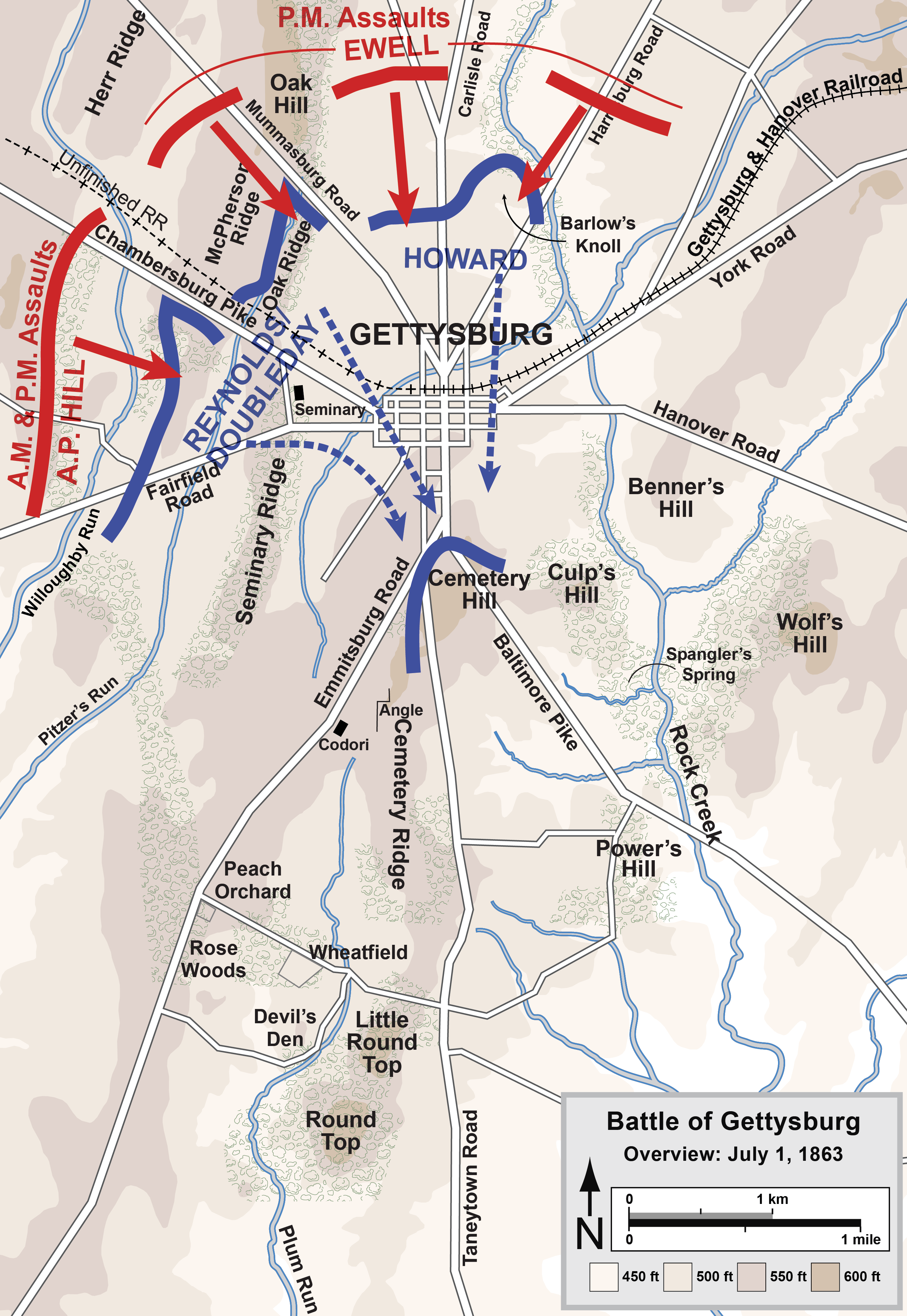
The Army of Northern Virginia commanded by Robert E Lee was now deep in Union territory and nearly blind to the location of the Federal Army of the Potomac. On the 30th advanced units of Dick Ewell’s Second Corps had gone nearly as far as Harrisburg while most of the Army was on the road around Chambersburg and Cashtown. Lee’s Cavalry Division under the command of J.E.B. Stuart was far away engaging Union Cavalry around Hanover and not in position to report on Union troop movements. General A.P. Hill sent Johnston Pettigrew’s Brigade of Harry Heth’s Division to Gettysburg on the 30th but Pettigrew observing the Federal cavalry of Buford’s 1st Cavalry Division take up positions on Seminary Ridge declined to engage and reported the Federal concentration to Hill.

As reports from the spy Harrison came to Lee and Longstreet Lee began to concentrate the Army around Cashtown. However the morning of July Hill ordered Harry Heth’s division to move on Gettysburg without the benefit of cavalry support or reconnaissance believing that the troops reported by Pettigrew could be nothing more than local militia. His leading brigades under Brigadier General James Archer and Joseph Davis took heavy casualties and soon Heth became embroiled in a fight with Buford’s cavalry and lead elements of the Federal 1st Corps under the command of Major General John Reynolds.

Gettysburg_Battle_Map_Day1

Gettysburg Day One (Map by Hal Jespersen, http://www.posix.com/Com)

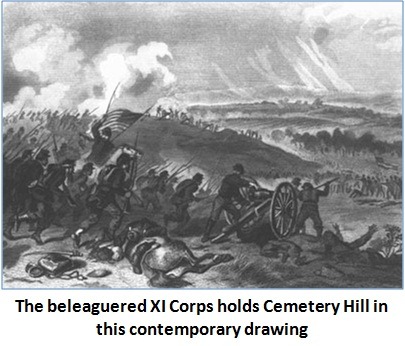
Lee was surprised by the engagement and though he chastised Heth for getting involved committed his army to the attack. Reynolds was killed early in the engagement but the fight was bitter, the Iron Brigade exacted a fearful toll on Archer and Davis’s brigades. The attack by Hill’s 3rd Corps was helped immensely when elements of Ewell’s 2nd Corps arrived on the right flank of the Federal XI Corps, forcing the Federal troops to withdraw through Gettysburg and up to Cemetery Ridge. Ewell’s arrival was fortuitous because it tilted the balance to Lee, but the advantage was short lived.

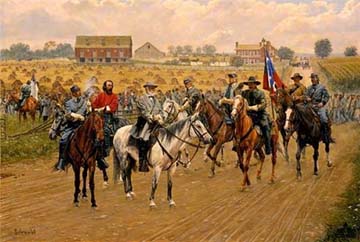
z_schmehl_leedeliberates

Lee Deliberates Heth’s Advance – Gettysburg by Bradley Schmehl

 Ewell failed to press the attack on Cemetery Ridge or Culp’s Hill while Federal forces were still disorganized, despite the repeated entreaties of Major General Isaac Trimble who was with him. The delay would be fatal to Lee’s intentions as Lee decided to give battle at Gettysburg, ignoring General Longstreet’s plea to disengage take up a favorable position between Gettysburg and Washington DC and force the Army of the Potomac to attack.

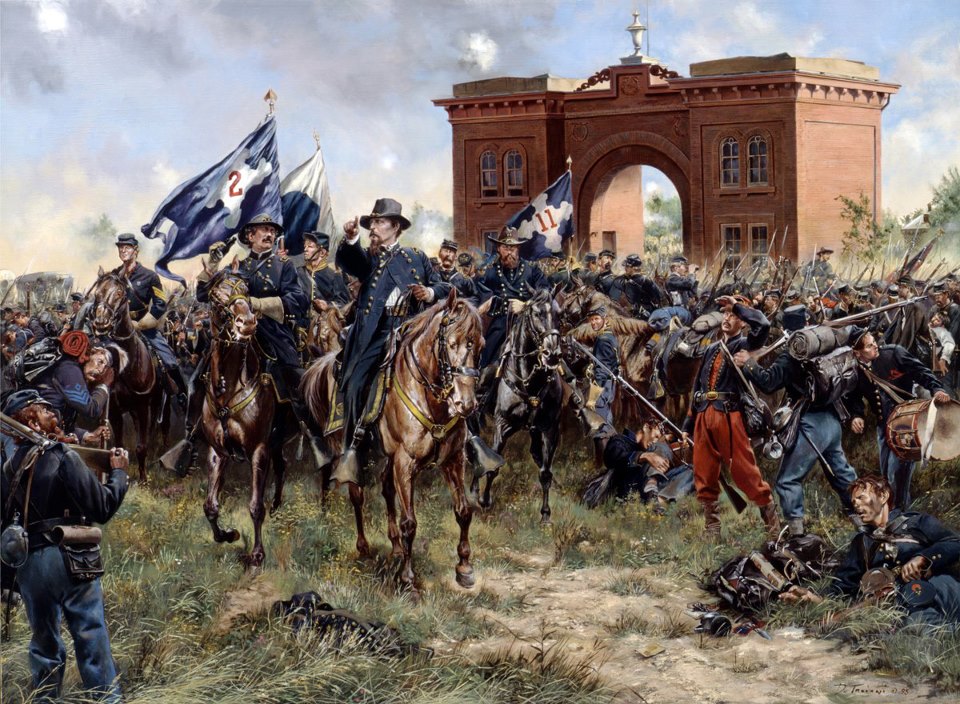
doncemeteryhilljuly1_zps512a40fa

Don Troiani’s Painting of Hancock taking Command on Cemetery Hill on Day One

The Army of Northern Virginia came very close to sweeping Federal forces from the field on July 1st in spite of Lee’s lack of planning and clear commanders intent. That much is clear. His orders to Ewell, to take the high ground “if practicable” we interpreted by Ewell in a manner that he determined not to be practicable, so the advanced Federal corps under the command of Major General Winfield Scott Hancock were able to regroup, dig in and be reinforced by the rest of the Army.

Whether Lee intended to engage the Army of the Potomac at Gettysburg so early in a campaign where his multiple and contradictory strategic aims and lack of clear commander’s intent to his subordinate commanders created confusion is debated. Much of the controversy comes from Lee’s own correspondence which indicates that he might have not fully understood his own intentions. Some correspondence indicates that Lee desired to avoid a general engagement as long as possible while other accounts indicate that he wanted an early and decisive engagement. The controversy was stoked after the war by Lee’s supporters, particular his aides Taylor and Marshal, and Longstreet’s supporters.

Isaac Trimble, traveling with Lee at the beginning of the invasion of Pennsylvania recored that Lee told him:

“We have again outmaneuvered the enemy, who even now does not know where we are or what our designs are. Our whole army will be in Pennsylvania day after tomorrow, leaving the enemy far behind and obliged to follow by forced marches. I hope with these advantages to accomplish some single result and to end the war, if Providence favors us.” (Glenn Tucker, High Tide at Gettysburg (Indianapolis: The Bobbs-Merrill Co.: 1958), p. 24.)

The vagueness of Lee’s instructions to his commanders, many of whom were occupying command positions under him for the first time and were unfamiliar with his command style led to confusion. Where Stonewall Jackson might have understood Lee’s intent, even where Lee issued vague or contradictory orders, many others including Hill and Ewell did not. Lee did not change his command style to accommodate his new commanders and that lack of flexibility on Lee’s part proved fatal to his aims in the campaign.

xi-corps-holds-cemetery-hill

The vagueness of Lee’s intent was demonstrated throughout the campaign and was made worse by the fog of war. Day one ended with a significant tactical victory for Lee’s army but without a decisive result which would be compounded into a strategic defeat by Lee’s subsequent decisions on the 2nd and 3rd of July.

Until tomorrow,

Peace

Padre Steve+

Leave a comment

Filed under civil war, History, Military

The Bloodiest Day: The Battle of Antietam 17 September 1863

“Of all the days on all the fields where American soldiers have fought, the most terrible by almost any measure was September 17, 1862. The battle waged on that date, close by Antietam Creek at Sharpsburg in western Maryland, took a human toll never exceeded on any other single day in the nation’s history. So intense and sustained was the violence, a man recalled, that for a moment in his mind’s eye the very landscape around him turned red.” Stephen W Sears

“I have heard of ‘the dead lying in heaps’, but never saw it till this battle. Whole ranks fell together.” Captain Emory Upton, 2nd U.S. Artillery, at Antietam

“We were in the very maelstrom of the battle. Men were falling every moment. The horrible noise was incessant and almost deafening. Except that my mind was absorbed in my duties, I do not know how I could have endured the strain.” Lt. Frederick L. Hitchcock, 132nd Pennsylvania, at Bloody Lane, Sept. 17, 1862

To the west of Frederick Maryland a small town named Sharpsburg sits on the west side of a creek. Named Antietam the creek’s headwaters are in Franklin County Pennsylvania and it meanders south where just to the south of Sharpsburg it empties into the Potomac River.

It is a peaceful place, rolling hills and agricultural country with some well preserved stone arch bridges, including one just outside of Sharpsburg. It is hard to believe that 150 years ago the town and the creek were the scene of the bloodiest single day of battle in American history.

On that indian summer day of 1862 the Confederate Army of Northern Virginia, General Robert E Lee, commanding made a stand against the much larger Union Army of the Potomac, Major General George B. McClellan, commanding.

Lee had invaded Maryland following a string of successes in Northern Virginia during that summer of 1862, defeating McClellan outside of Richmond in the Seven Days, and in a campaign of maneuver bested a newly formed Army, the Union Army of Virginia commanded by Major General John Pope defeating it at the Second Battle of Bull Run between 28-30 August 1862. With Northern Virginia’s crops and livestock depleted and his opponents in crisis Lee moved his army north into Maryland. The decision was driven partly by the need to provision his army, but also had the hope of drawing Maryland away from the Union mistakenly believing that public sentiment in that state was pro-Confederate. If the people of Maryland rose up to support Lee it would be disastrous to the Union and endanger the capital itself. A final consideration was the hope that a Confederate victory on Northern soil would bring about the foreign recognition and possibly the intervention of Great Britain on the side of the Confederacy.

The Lost Order

Lee crossed the Potomac on September 3rd and sent his Second Corps west with some elements seizing the Union armory in Harper’s Ferry, others to secure the Baltimore and Ohio Railroad at Martinsburg the rest of the Army was in the area of Frederick. He was pursued by the very cautious McClellan at the head of the Army of the Potomac.

On September 9th Lee issued General Order 191, the infamous “lost order” which a copy of which was found by Union soldiers wrapped around three cigars at a campground recently occupied by Lee’s rear guard element, the division of D.H. Hill on September 13th. The order detailed the disposition of Lee’s army and McClellan seized the opportunity. On the 14th the Army of the Potomac attacked part of Lee’s army at the Battle of South Mountain. The Union won that battle forcing the outnumbered Confederate forces to withdraw, though the delay allowed Lee to concentrate more of his army at Sharpsburg on the 15th.

Although he outnumbered Lee McClellan believed the reports of the Pinkerton Detective Agency which provided intelligence to the army. Those estimates which credited Lee with more than 100,000 troops. He delayed his attack until he had drawn up his full army on the on the 17th.

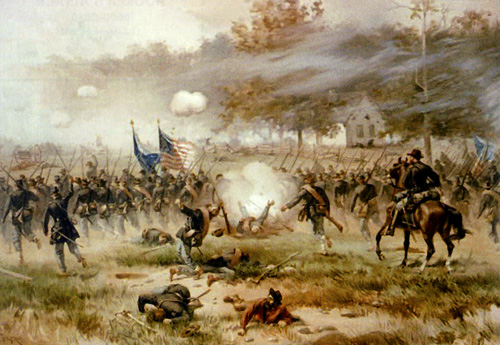
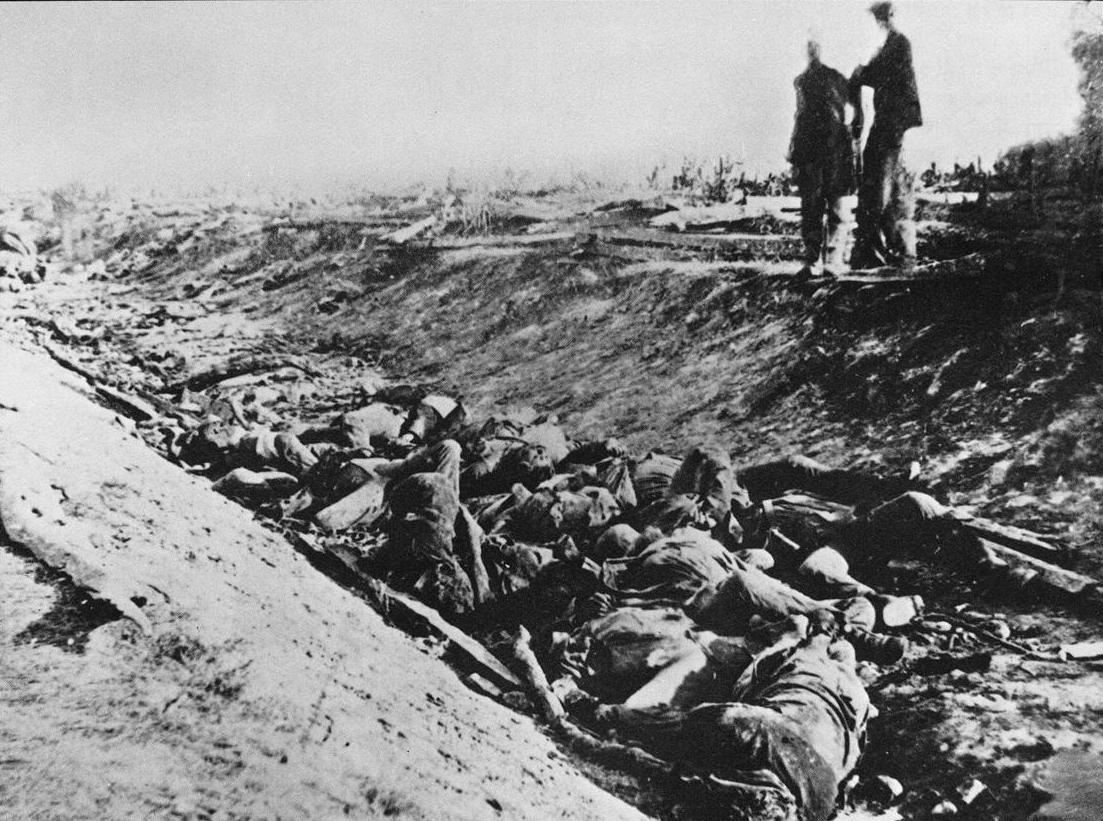
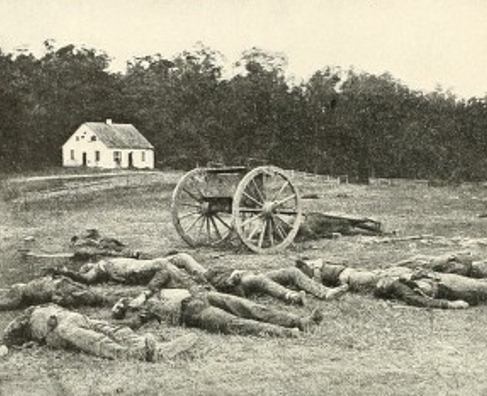
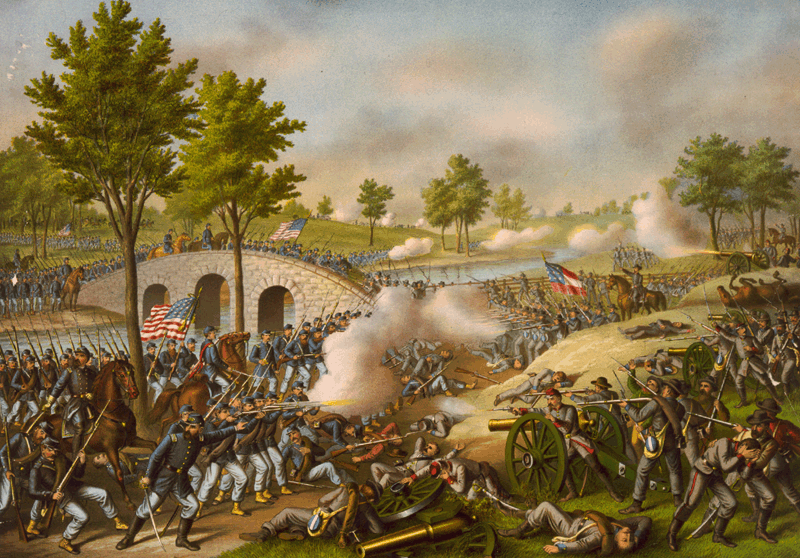
When he did attack on the 17th his attacks were uncoordinated and though he came close to decisive breakthrough Lee’s army desperately clung to its positions. The action began to the north of the town in the morning and both sides showed incredible ferocity at the Cornfield, where in the space of about three hours nearly 8000 soldiers were killed or wounded. The fighting shifted to the center of the line opposite the town by mid-day. Amid the destructive storm of artillery the armies fought around the Dunker Church and a sunken lane now known as “Bloody Lane.” In the confines of that 800 yard stretch of road over 5000 soldiers were killed or wounded in the course of about four hours. The Union forces broke the Confederate line but reinforcements were not sent and when the the division commander, Major General Israel Richardson was mortally wounded the attack lost its verve and the Confederates under Lieutenant General James Longstreet were able to restore the line.

The south remained quiet as McClellan ordered Major General Ambrose Burnside’s IX Corps to hold off on attacking. Burnside did not receive his orders to attack until 1000. He finally attacked across the south bridge, now known as Burnside’s Bridge in the afternoon. It was another tough fight and Burnside, after several attempts move to the south to flank Confederate forces in the late afternoon with the intention of cutting Lee from off his only escape route.  The Confederates were in a desperate condition. It was at this point, about 3 PM when the division of Major General A.P. Hill arrived and immediately counterattacked breaking up Burnside’s attack. Burnside requested reinforcements from McClellan who refused saying that he had none available. This was not the case, McClellan had two full corps of infantry uncommitted to the battle but still believing that he was outnumbered and that Lee was attempting to trap him.

The actioned ended by 530 PM with both sides rested and reorganized for action the next day. Lee prepared to defend but no Union attack was offered on the 18th. An informal truce was observed to allow the evacuation of the wounded and Lee began his withdraw across the Potomac into Virginia that night. Despite being goaded by Lincoln to pursue McClellan did not and the Union lost the opportunity to destroy Lee’s army n Union territory.

Casualty estimates vary but according to Stephen W Sears in his book Landscape Turned Red that the Army of the Potomac lost 2108 dead, 9540 wounded and 753 missing. He states the best estimate of Confederate casualties are 1546 dead, 7752 wounded and 1018 missing. Most of the missing were likely killed and buried in mass graves or discovered and buried by civilians after the battle. In the space of 12 hours 22719 Americans were killed or wounded. It was the bloodiest single day in American military history.

Though the battle was inconclusive in that Lee’s army survived but had to break off its offensive it had more influence than expected. President Lincoln issued the Emancipation Proclamation on September 22nd and though it did not take effect until January 1st 1863 it marked a turning point in the war.

McClellan failed to take up the offensive in the next tow months and Lincoln relieved him of command giving the Army of the Potomac to Burnside who goaded by Lincoln took the army into battle at Fredericksburg where it met with defeat.

I have been to the battlefield a number of times, once as part of a “staff ride” with the Marine battalion that I was assigned in May of 2000. Each time I go I take the time to ponder the great losses endured by both armies and the individual courage of the soldiers involved. Some of the units that I served with in the Army National Guard in Texas and Virginia trace their lineage and honors to regiments that fought at Antietam and I have felt a connection to the battle because of that. It is hard to imagine the amount of death and carnage taking place in such a placid location in such a short amount of time.

It is something to ponder when some Americans openly suggest another civil war if their party does not win the election.

Peace

Padre Steve+

1 Comment

Filed under civil war, History, Military

Gettysburg Day One Accident and Intent: How the Actions of Harry Heth and John Buford Helped Decide the Battle

On June 30th 1863 the Confederate Army of Northern Virginia under the Command of General Robert E Lee was deep in enemy territory. His mission was to draw the Federal Army of the Potomac now under the command of Major General George Gordon Meade into battle and destroy it.  His Army composed of three Corps, the First Corps under Lieutenant General James Longstreet, the Second under Lieutenant General Richard Ewell and the Third Corps under the command of Lieutenant General A.P. Hill.  Lieutenant General J.E.B. Stuart commanded his cavalry but was operating independently of Lee conducting a movement around the Army of the Potomac and unable to provide Lee information on the deployment or movement of the Union forces.

Lee’s army was spread out. Early’s Second Corps was spread out near the Susquehanna River near Harrisburg while his other two corps were concentrated in the area around Cashtown about 8 miles west of Gettysburg. On the 30th a brigade of Major General Harry Heth’s division of Hill’s Corps made a reconnaissance in the direction of Gettysburg. The brigade commander Brigadier General James Pettigrew observed Federal cavalry entering the town and chose not to engage reporting the matter to General Heth.

Major General Henry (Harry) Heth

Heth was a graduate of West Point who had served as an Infantry Officer in the United States Army until he resigned to enter the Confederate Army. He had commanded a company in battle against the Lakota Sioux in 1855 and wrote the first marksmanship manual for use in the U.S. Army. Unlike many of his fellow officers he had not taken part in the Mexican-American War.

Heth spent the early part of the war as Lee’s Quartermaster where he became one of Lee’s favorite officers and began a relationship where Lee looked after his career.  He then served as regimental commander in the actions in the Kanawha Valley of Western Virginia being assigned to Kirby Smith’s Department of Tennessee where he commanded a division but took part no no major actions. Lee brought him back to the Army of Northern Virginia in 1863 to command a brigade in Hill’s Division. He took commanded that brigade at Chancellorsville in which he made an ill advised unsupported attack against Union forces with heavy casualties. He was promted to command of the Division when Hill assumed command of Third Corps when it was created following the death of Lieutenant General Thomas “Stonewall” Jackson.

Lee had given his commanders orders not to provoke a major engagement until the Army was fully concentrated to meet Meade’s troops which had crossed the Potomac and was moving north. However neither Heth nor Hill believed that the troops that Pettigrew observed were a threat, believing them to be nothing more than local militia. Heth ordered half of his division to make a reconnaissance in force on the morning of July 1st. It was not what Lee wanted and Heth’s conduct of it and the resultant action led to the largest battle of the Civil War, the costliest battle.

Lee’s intent was clear. He desired to have a tired and weary Union force under a new commander under political pressure attack him on ground of his choosing. He hoped to defeat the Union forces piecemeal as they came into the battle. By initiating the action Heth caused Lee to have to improvise an attack contrary to his initial plan.  It was an accidental encounter which was compounded by Heth’s action to commit his entire division into battle in spite of his orders.

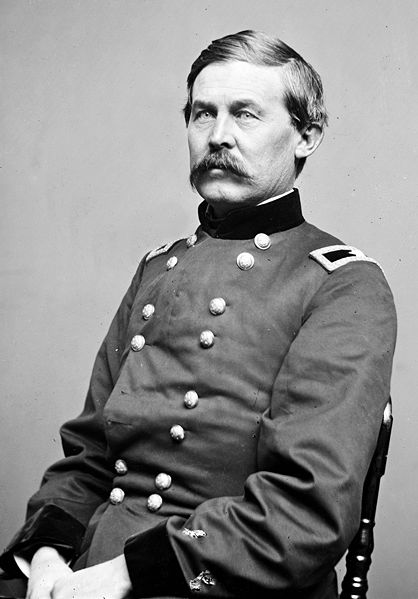
Brigadier General John Buford

The Federal Cavalry was the First Cavalry Division under the Command of Brigadier General John Buford. Buford’s division arrived in Gettysburg ahead of the Army of the Potomac on the 30th. Buford and his brigade commanders immediately recognized the importance of the ground when they saw Pettigrew’s troops. Buford order his troops to deploy on the ridges west of Gettysburg, Herr Ridge, McPherson Ridge and Seminary Ridge. It was the perfect place for a delaying action against superior forces.

Buford was also a graduate of West Point and served as a Cavalry officer in the Army before the war. He was from Kentucky and though his father was a Democrat who had opposed Abraham Lincoln and had family that chose to fight for the Confederacy he remained loyal to his oath and remained in the Army. He served against the Sioux and on peacekeeping duty in the bitterly divided State if Kansas before serving in the Utah War in 1858. He was a modern soldier who recognized that the tactics of the Army had to change due to improvements in weapons and technology.  He was promoted to Brigadier General in 1862 and served in numerous engagements as a Cavalry Brigade commander before being given command of the 1st Cavalry Division after Chancellorsville.

The Delaying Action, July 1st 1863 Map by Hal Jespersen, http://www.posix.com/CW

Buford was a keen student of war and a commander who was able to control his forces. When Heth engaged his division he fought a masterful action which allowed the Infantry Corps of the Army of the Potomac to arrive on the field of battle. His action to select the ground upon which the battle was fought led to the Union victory because even though Federal forces were pushed back on the first day they were able to maintain control of the high ground east of the city with interior lines of communication which they fortified.

Lee decided that he had to force the battle and continue the attack despite the objections of General Longstreet and the fact that he did not fully know the numbers and disposition of the troops arrayed against him. It would be a fateful decision born of a ill conceived action of Heth and correspondingly excellent command decisions of Buford. I am sure that part of the reason for this was Heth’s lack of experience in the East against the Army of the Potomac and limited battle experience as a senior commander. Buford had spent the war in action against Lee’s Army. He knew the capabilities of his enemies and what had to be done to give his side a chance to win.

Like many battles success is often due to such factors.  Had Heth held up and had Lee followed Longstreet’s advice the battle and war might have turned out quite differently. Had Buford not seen the importance of the ground that he selected and deployed himself accordingly the rest of the Army may not have gotten to Gettysburg before Lee had gained the critical ground east and south of the town.

On such decisions battles are decided and wars won.  Heth’s relative inexperience and inability to control his command was a decisive factor in the battle while Buford’s experience and poise under pressure probably saved the Army of the Potomac from a decisive defeat.

Peace

Padre Steve+
3 Comments

Filed under civil war, History, leadership, Military

We won’t let this Happen again….Until the Next Time

“I am disgusted and worn out with the system that seems to prevail.” Brigadier General John Buford 

The news is abuzz tonight about the bi-partisan deal that has been agreed to by the President, the Speaker of the House and Majority Leader of the Senate.  The details will come out but certainly there will be those unhappy with the deal.  I don’t know what is in it and the devil is always in the details.

I am a realist and the details seldom bode well. Like John Buford a career Officer during the Civil War I have become disgusted and worn out watching the men and women that we have elected to public office work so hard to fracture this country that I hold so dear.

Tomorrow I expect that the deal will pass in the House and Senate unless the hard core right and left work together to embarrass their respective leaders. Since neither side had enough votes to do this on their own despite weeks of impassioned and often bitter argument with neither side listening to the other it has come down to this moment.  Personally in light of all that has transpired between the current Congress and the Obama administration even if this is passed Monday on Tuesday the death struggle will resume. Of course the deal may not pass and like Confederate General Robert E. Lee perhaps questioning his own rejection of  Union we might someday say  “the war… was an unnecessary condition of affairs, and might have been avoided if forebearance and wisdom had been practiced on both sides.”  

That struggle has already begun as some Tea Party leader declared Congressman Allen West and three other Tea Party Supported House Members as “Tea Party defectors” for supporting Speaker of the House John Boehner’s plan over the weekend.  On July 27th Tea Party Nation leader Judson Phillips urged Boehner “to go” and be replaced by a “Tea Party Speaker of the House” while The Party Patriot co-founder Jenny Beth Martin suggested a similar thing.  Many Liberals are equally critical of the President and Majority Leader Harry Reid with a growing number stating that they believe that President Obama has betrayed their ideals one Democrat Congressman calling the deal a “sugar coated Satan sandwich.”

The battle lines are still drawn and the language except for the utilitarian language that compromise was necessary to stave off a default has not changed an iota.  The language of compromise does not sit well with the most vocal members of the Tea Party faction nor those on the hard Left.  Many Tea Party leaders and members continue to argue that their leadership to push the government into default to achieve their goals.

The default may not happen now but the crisis is not past.  No it will be with us for a long time with more division, more bitterness and more fuel being poured onto the flames of hatred that have consumed us.  Much like the various crises and compromises on the road to the Civil War nothing substantial has changed.  In fact William Gross the head of PIMCO one of the major global investment groups said that a downgrade was “inevitable” and that “Congress has basically proven itself to be dysfunctional and this will carry on for months even if the crisis is basically resolved in the next few days.”

We have crossed the Rubicon and unless an external and existential threat to our nation forces our leaders to work together I seriously doubt that this will end well.  The President failed to lead when he had a super-majority and his allies in Congress squandered the chance that they were given in 2008.  The Republicans after taking the House in 2010 are doing the same.  Neither side will admit to their behavior. Both will with good reason to point the finger of blame at their opponents while ignoring their own contributions to this sordid state of affairs.

I can see it as if has already happened. The Unholy Trinity of politicians, pundits and preachers will step up their rhetoric inciting their followers to adopt even more uncompromising positions.  The already fearful enmity will deepen and the center will disappear. Emotion in the form of hatred will drive the arguments that neither side will listen to even as the United Statesand the world economy worsens and the wars continue.  Young Americans will give their lives in Iraq and Afghanistan even as their political leaders on both sides of the aisle seek ways to reduce the force and even the pay and benefits that they have earned after 10 years of unending war that the rest of the nation while seemingly grateful does not understand nor share. “We few, we happy few…” William Shakespeare quotes Henry V before the Battle of Agincourt.

Tonight I have been watching the movie Gettysburg which I think is a fitting reminder of what happens when the Unholy Trinity finally achieves their goal of destroying the very fabric of the nation and pits brother against brother.  Hopefully cooler heads will prevail and somehow, some way we will get through this before we long for the day that makes what we are experiencing now look good.

Like General James Longstreet I wonder “Why do men fight who were born to be brothers?”

Peace

Padre Steve+
2 Comments

Filed under History, Political Commentary