Tag Archives: jefferson davis

When Political Parties Implode, Pt 4: The Secession Crisis

Friends of Padre Steve’s World

Over the past six months or so I have alluded to events in the Republican Party that make it appear that it is about to implode. I am a historian, and there is precedent in American history for the collapse of a national political party. This happened before in the 1854 collapse of the Whig Party, the 1912 division in the republican Party, but more importantly during the 1858 through 1860 collapse of the Democratic Party. Now I am not a person to say that history repeats itself. there are similarities and trends, but nothing is ever exactly the same as to why different parties collapse.  

While the issues of each day may be different there are common threads of humanity, hubris and hatred that unite to destroy political parties. I think that this is happening now in the Republican Party, and that it is possible that something similar may occur with the Democratic Party in the coming years. So it is important to look at history whenever possible to see how different political leaders responded in times of intense ideological, economic, social, national, and sectional division.

I decided to add an afterward to the three part series on the disaster that the Democratic Party made for itself and the country between 1858 and 1860. The third part deals with the after effects of results of the democratic Party split in the election of 1860. This deals with the secession crisis that enveloped the nation as former Southern Democrats led their states into rebellion against the Union and Northern Democrats joined the anti-secession party in the North.

This is a section of one of the chapters of my Civil War and Gettysburg text and I hope that you will find it interesting and thought provoking.

Peace,

Padre Steve+
disunion_carolina-blog427

After the election Lincoln tried to reassure the South that he would remain true to his campaign promise not to interfere with slavery where it already existed, but he also refused to give in to threats of secession. Despite his belief that anything that he said would be twisted into the exact opposite by Southerners, Lincoln released a statement through Senator Lyman Trumbull in Springfield saying:

“The states will be left in complete control of their affairs and property within their respective limits as they have under any administration. I regard it as extremely fortunate for the peace of the whole country, that this point, upon which the Republicans have been for so long, as so presently misrepresented, is now brought to a practical test, and placed beyond the possibility of doubt. Disunionists per se, are now in hot haste to get out of the Union, precisely because they perceive they cannot, much longer, maintain apprehension among the southern people that in their homes, and firesides, and lives, are to be endangered by the action of the Federal Government.” [1]

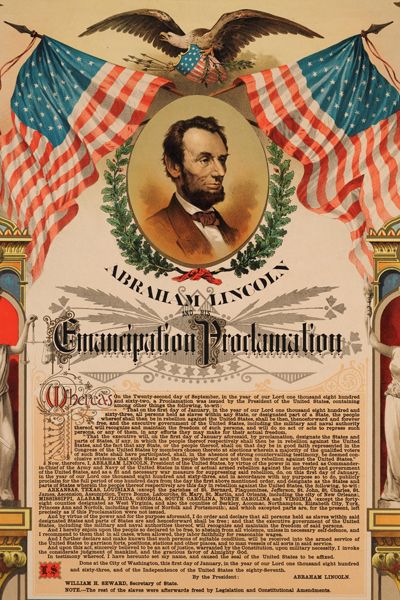
On his way to Washington D.C. the President Elect stopped in New York and gave a speech “promising that he would “never of his own volition “consent to the destruction of this Union,” he qualified this promise with “unless it were that to be that thing for which the Union itself was made.” [2] Two days later Lincoln speaking Independence Hall in Philadelphia Lincoln further detailed what he meant in New York, going back to the premise of the Declaration of Independence in which “he asserted that he “never had a feeling politically that did not spring from the sentiments embodied in the Declaration…. I was not the mere matter of separation of the colonies from the mother land; but rather something in that Declaration” that provided “hope for the world for all future time. It was that which gave promise that in due time the weights should be lifted from the shoulders of all men, and that all should have an equal chance.” [3] It was a thought that he would continue to refine in the Emancipation Proclamation Gettysburg Address, the Thirteenth Amendment and in his Second Inaugural Address.

Stephen A. Douglas tried to reassure the Southern leaders as well even as argued against secession. He reminded Southerners how he had fought against Lincoln and the platform of the Republican Party and stated “that the mere election of any man to the Presidency does not furnish just cause for dissolving the Union.” [4] Addressing Southern concerns in a pragmatic way, the Little Giant tried to diffuse Southern fears by reminding them that the answer to their fears lay in the checks and balances laid out in the Constitution and in the ballot box. Douglas’s next words redound to the present day:

“It is apprehended that the policy of Mr. Lincoln and the principles of his party endanger the peace of the slaveholding states. Is that apprehension founded? No, it is not. Mr. Lincoln and his party lack the power, even if they had the disposition, to disturb or impair the rights and institutions of the South. They certainly cannot harm the South under existing laws. Will they have the power to repeal or change these laws, or to enact others? It is well known that they will be a minority in both houses of Congress, with the Supreme Court against them. Hence no bill can pass either house of Congress impairing or disturbing these rights or institutions of the southern people in any manner whatever, unless a portion of southern senators and representatives absent themselves so as to give an abolition majority in consequence of their actions.

In short, the President will be utterly powerless to do evil…. Four years shall soon pass, when the ballot box will furnish a peaceful, legal, and constitutional remedy for the evils and grievances with which the country might be afflicted.” [5]

An attempt in Congress led by President James Buchanan and Senator John J. Crittenden of Kentucky to bring about a constitutional compromise to mollify both sides was considered. A committee of thirteen senators was convened to entertain various compromise propositions, however, most of the suggested compromises were heavily weighted toward Southern interests, though it promised to restore the prohibition of slavery north of the line drawn in the Missouri Compromise.

lincolnearly

Abraham Lincoln

A frustrated Lincoln wrote, “I’ll tell you now what bothered me: the compromises measures introduced in Congress required the Republicans to make all the concessions.” [6] Lincoln warned Crittenden that such proposals would not be acceptable: “Entertain no proposition for a compromise in regard to the extension of slavery…. The instant you do they have us under again…. The tug has to come & better now than later.” [7]

Lincoln had seen how for four decades Southerners had pushed for compromises that only benefited them and the extension of slavery, even at the expense of Northern states rights and he was not about to let it happen again. The President Elect wrote:

“The Crittenden plan, I feared, would put the country back on the high road to a slave empire. Whether it was the revival of the Missouri Compromise line or a popular sovereignty, it was all the same. “Let neither be done,” I warned Republicans in Washington, “and immediately filibustering and extending slavery recommences. Within a year, we shall have to take Cuba as a condition on which the South will stay in the Union. Next it will be Mexico, then Central American. On the territorial question, I am inflexible. On that point hold firm as a chain of steel…” [8]

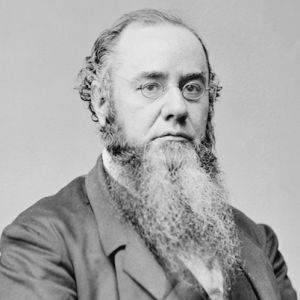
In the South the efforts of staunch Southern Unionists like Alexander Stephens to discourage secession were dismissed as the movement toward secession became a passion filled revolutionary movement, which acted as a cathartic movement for many Southerners. Like Douglas, Stephens had the greatest faith in the checks and balances provided in the Constitution and he pleaded with his fellow Georgians at the state capital of Milledgeville noting that the checks and balances “would render Lincoln “powerless to do any great mischief,” and he warned that “the dissolution of the Union would endanger this “Eden of the world,” that “instead of becoming gods, we shall become demons, and no distant day commence cutting one another’s throats…” [9] While his speech received favorable coverage in the North and even in London, it was met with little enthusiasm at home.

Influential Southern preachers joined in the push for secession and warned of what they saw as the dire consequences of Lincoln’s election. The Baptist clergyman James Furman expressed the outrage and paranoia of many in the South by warning after Lincoln’s election “If you are tame enough to submit, Abolition preachers will be at hand to consummate the marriage of your daughters to black husbands.” [10] Likewise entire southern denominations began to endorse secession, southern Methodists raised “alarms about a Union dominated by abolitionists as they called on the Lord for deliverance from the northern “Egypt.” The division of Israel and Judah (not to mention the nation’s already fractured churches0 became typologies for the American crisis. Just as southern Methodists had once “seceded from a corrupt church,” a Mississippi politician declared, “We must secede from a corrupt nation.” To drive the point home, Georgia Methodists ministers endorsed disunion by an overwhelming 87-9 vote.” [11]

Despite Lincoln and Douglas’s efforts during and after the election to strike a conciliatory tone, it did not take long before Southern states began to secede from the Union. In light of the profoundly sectional nature of Lincoln’s victory “emboldened many Southern politicians and journalists to insist that they would not be bound by the result.” [12] In his final speech before the Senate, Senator Robert Toombs of Georgia lambasted the “black Republicans” and abolitionists, “We want no negro equality, no negro citizenship, we want no negro race to degrade our own; and as one man [we] would meet you upon the border with the sword in one hand and the torch in the other.” [13] Other Senators, many who would become prominent leaders of the Confederacy made their speeches, some, like that of Jefferson Davis tinged with regret while others like Senator Stephen Mallory, and the future Secretary of the Navy for the Confederacy delivered a fiery broadside against his Northern colleagues, “You cannot conquer us. Imbue your hands in our blood and the rains of a century will not wipe away from them stain, while the coming generation will weep for your wickedness and folly.” [14] As these men finished the left the chambers of Congress where many had served for years many left with tears, while some marked their exit with angry words.

220px-Alexander_Stephens

Alexander Stephens

Stephens, still a Unionist at heart lamented the election even as he prepared to leave the Senate before becoming the vice president of the Confederacy, warned that “revolutions are much easier started than controlled, and the men who begin them [often] …themselves become the victims.” [15] Even so the senator noted “If the policy of Mr. Lincoln and his Republican associates be carried out…no man in Georgia will be more willing or ready than myself to defend our rights, interest, and honor at every hazard and to the last extremity.” [16] But as he resigned his office Stephens replied to a friend’s question, “why must we have civil war?”

“Because there are not virtue and patriotism and sense enough left in the country to avoid it. Mark me, when I repeat that in less than twelve months we shall be in the midst of a bloody war. What will become of us then God only knows.” [17]

But Stephens’ warning fell on deaf ears as passionate secessionist commissioners went throughout the South spreading their message of fear. “Thus fanned, mob spirit ran close enough to the surface to intimidate many moderates – the very temperament that inclines men toward moderation is apt to respond timidly when threatened or abused – and to push others closer to the extremist position.” [18] Such was the case with Southern moderates and Unionists as men like Stephens were swept up in the tumult as their states seceded from the Union. Senator Judah P. Benjamin of Louisiana wrote, “The prudent and conservative men South… were not able to stem the wild torrent of passion which is carrying everything before it…. It is a revolution…of the most intense character…and it can no more be checked by human effort, for the time, than a prairie fire by a gardener’s watering pot.” [19]

disunion_dec20_secession3-blog427

The Palmetto State of South Carolina was the first state to secede. Its senior senator, James Chesnut launched a fusillade against the North in a speech before the state legislature in which he argued that the South could not wait for another election: He thundered:

“Because of the Yankee puritans’ invasive mentality, incendiary documents would flood our region, Southern Republicans would fill our offices. Enemies would control our mails. The resulting upheaval would make “Lincoln’s election…a decree for emancipation. Slavery cannot survive the four years of an administration whose overwhelming influences” will be “brought to bear against it.” To submit now is to guarantee that before 1865, we must “slay the Negro, or ourselves be slain.” [20]

William Tecumseh Sherman was serving as the President the Louisiana State Seminary of Learning and Military Academy, what is now Louisiana State University. Like many men in the ante-bellum era, Sherman had thought little about the slavery issue, though he was very concerned with the preservation of the Union. He thought secession made no sense, especially for the people of the South. When Sherman read the news of South Carolina’s secession it “cut to the depths of his nationalistic soul.” The future general wept, and told his friend David Boyd “Boyd, you people of the South don’t know what you are doing! You think you can tear to pieces this great union without war…. “The North can make a steam-engine, locomotive, or railway car; hardly a yard of cloth or shoes can you make. You are rushing into war with one of the most powerful, ingeniously mechanical and determined people on earth…. You are bound to fail. Only in spirit and determination are you prepared for war.” [21] Sherman, the man who later proclaimed that “War is Hell” proved to be a remarkably accurate seer regarding the fate of the Confederacy.

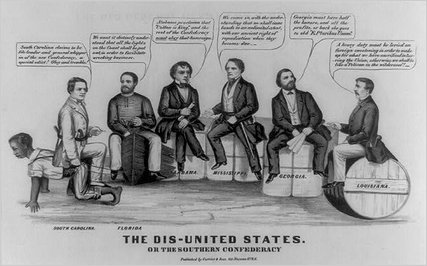
South Carolina was followed by Mississippi, Florida, Alabama, Georgia, Louisiana and Texas. “A belt of seven states from South Carolina to Texas, embracing nearly one-sixth of the country’s population and nearly one-fifth of the national domain, had proclaimed independence and severed its ties with the Union.” [22] Many of the declarations of causes for secession made it quite clear and explicit that slavery, and fear that the institution was threatened by Northern abolitionists was the root cause. The declaration of South Carolina is typical of these and is instructive of the basic root cause of the war:

“all the States north of that line have united in the election of a man to the high office of President of the United States, whose opinions and purposes are hostile to slavery. He is to be entrusted with the administration of the common Government, because he has declared that that “Government cannot endure permanently half slave, half free,” and that the public mind must rest in the belief that slavery is in the course of ultimate extinction.” [23]

Throughout the war slavery loomed large, even though in the beginning of the abolition controversies of the 1830s many northerners “were content to tolerate slavery’s indefinite survival in the South so long as it did not impinge on their own rights and aspirations at home.” [24] Such attitudes were still common in the North during the late 1850s, especially among Democrats.

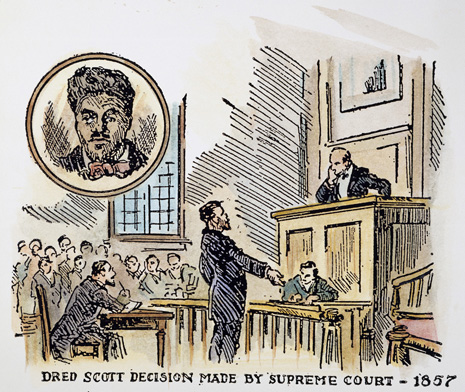
But it was the continued actions and multiple transgressions of slavery supporters that energized northerners as never before. Their use of the courts to advance their rights and the cause of slavery, by the compromises that had extended slavery to the territories; their use of the courts especially the Dred Scott to allow slaveholders to recover their human property, even in Free States provoked no end of indignation throughout the North, even for those sympathetic to Southern concerns. Those actions demonstrated to Northerners:

“just how fundamental and intractable the differences with Southern political leaders were. Thus educated, most northern voters had decided by 1860 that only an explicitly anti-slavery party could protect their interests.” [25]

The fiery abolitionist and profoundly religious editor of The Liberator, William Lloyd Garrison, used biblical imagery in a rather astute analysis of the behavior of Southern leaders after the election of 1860. He wrote of the Southern response to Lincoln’s election:

“Never had the truth of the ancient proverb “Whom the gods intend to destroy, they first make mad” been more signally illustrated than in the condition of southern slaveholders following Lincoln’s election. They were insane from their fears, their guilty forebodings, their lust for power and rule, hatred of free institutions, their merited consciousness of merited judgments; so that they may be properly classed as the inmates of a lunatic asylum. Their dread of Mr. Lincoln, of his Administration, of the Republican Party, demonstrated their insanity. In vain did Mr. Lincoln tell them, “I do not stand pledged to the abolition of slavery where it already exists.” They raved just as fiercely as though he were another John Brown, armed for southern invasion and universal emancipation! In vain did the Republican party present one point of antagonism to slavery – to wit, no more territorial expansion. In vain did that party exhibit the utmost caution not to give offense to any other direction – and make itself hoarse in uttering professions of loyalty to the Constitution and the Union. The South protested that its designs were infernal, and for them was “sleep no more!” Were these not the signs of a demented people?” [26]

But both sides were blind to their actions and with few exceptions, most leaders, especially in the South badly miscalculated the effects of the election of 1860. The leaders in the North did not realize that the election of Lincoln would mean the secession of one or more Southern states, and Southerners “were not able to see that secession would finally mean war” [27] despite the warnings of Alexander Stephens to the contrary. In fact throughout the South it was believed that there would be no war because “they believed that the Yankees were cowards and would not fight”… “Senator James Chesnut of South Carolina offered to drink all the blood shed as a consequence of secession. It became a common saying in the South during the secession winter that “a lady’s thimble will hold all the blood that will be shed.” [28]

Following their secession the five slave states of the lower South: “appointed commissioners to the other slave states, and instructed them to spread the secessionist message across the entire region. These commissioners often explained in detail why their states were exiting the Union, and they did everything in their power to persuade laggard slave states to join the secessionist cause. From December 1860 to April 1861 they carried the gospel of disunion to the far corners of the South.” [29]

The editors of the Philadelphia Press accused the Southern secessionists of being enemies of democracy and wrote:

“should the Cotton States go out in a body, we shall witness the beginning of an experiment to establish, on this continent, a great slaveholding monarchy. With few exceptions, the leaders of the Disunion cabal are men of the most aristocratic pretensions – men who…easily adopt the habits and titles of the European nobility. South Carolina, which is the head of Secession, is almost a monarchy herself. Her representatives in both branches of Congress, for years past, have acted upon the idea that the people of the free states are servile, and Mr. Hammond, the most candid and straightforward of the set, denounced the laboring white masses of the free States as the mudsills of society …” [30]

The mood of the South in the fall of 1860 was “fearful, uncertain, impatient and volatile, eager to adopt the course that best offered hope of deliverance – which was ideally suited for the immediacy and urgency of the radical secessionists.” [31] Using the political machinery of the Democratic Party in the South which they now possessed, the proponents of secession were far better organized than Southern Unionists who had a difficult time putting up a united front in the face of the radicals.

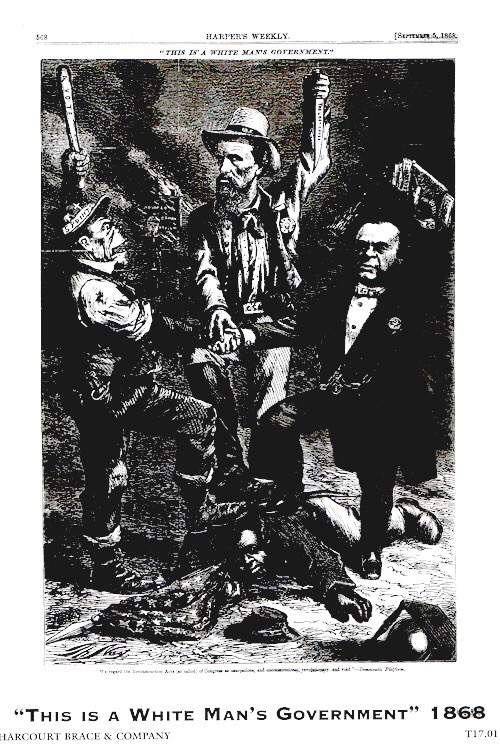
Slavery and the superiority of the white race over blacks were at the heart of the message brought by these commissioners to the legislatures of the yet undecided states. Former Congressman John McQueen of South Carolina wrote to secessionists in Virginia “We, of South Carolina, hope to greet you in a Southern Confederacy, where white men shall rule our destinies, and from which we may transmit our posterity the rights, privileges and honor left us by our ancestors.” [32] In Texas McQueen told the Texas Convention: “Lincoln was elected by a sectional vote, whose platform was that of the Black Republican part and whose policy was to be the abolition of slavery upon this continent and the elevation of our own slaves to an equality with ourselves and our children.” [33] These Southern secessionists were realists, they knew that the election of 1860 was a watershed in terms of the history of slavery in the United States, emancipation was coming, it might take a decade, it might take twenty-five or even fifty years, but they knew that it was coming, and for them secession was the only logical action left that was “consistent with their ideology.” [34] Many of these men now viewed it as an issue of now or never.

In his First Inaugural Address Lincoln cut to the heart of the division in the country: “One section of our country believes slavery is right and ought to be extended, while the other believes it is wrong and ought not to be extended. This is the only substantial dispute.” [35] Of course he was right, and his Southern opponents agreed. Jefferson Davis wrote: “The great northern party, thus organized, succeeded in electing to the office of the Presidency a man who openly proclaimed his hatred of slavery, who declared that the government could not endure “half slave and half free.” [36]

As the war began, white Southerners of all types and classes rallied to the call of war against the hated Yankee. The common people, the poor yeomen farmers were often the most stalwart defenders of the South. With the Orwellian slogan “Freedom is not possible without slavery” ringing in their ears, they went to war against the Yankees alongside their slave-owning neighbors to “perpetuate and diffuse the very liberty for which Washington bled, and which the heroes of the Revolution achieved.” [37]

Alexander Stephens, the longtime friend of Lincoln who had been a devout Unionist, who had supported Stephen Douglas until the bitter end, and who had strenuously opposed secession in the months leading to the election of 1860 was now the Vice President of the Confederacy. He had been elected Vice President the same day as Jefferson Davis was elected President by the new Confederate Congress and now went through the South speaking about the nature of the new government. Stephens explained the foundations of the Southern state in his Cornerstone Speech of March 21st 1861, the speech echoed what many Southerners had believed for years regarding slavery and the status of Blacks, namely that Blacks were a lesser order of humanity:

Our new government is founded upon exactly the opposite idea; its foundations are laid, its corner- stone rests upon the great truth, that the negro is not equal to the white man; that slavery — subordination to the superior race — is his natural and normal condition. [Applause.] This, our new government, is the first, in the history of the world, based upon this great physical, philosophical, and moral truth.” [38]

Jefferson Davis had issued instructions to cabinet members to downplay slavery as an issue and was infuriated. The new President of the Confederacy wrote: “That speech infuriated me, Oh, what Stephens had said was true, perfectly true, but could anything hurt us more abroad than such impolitic remarks? It was the beginning of a fatal falling out between me and that rebellious and vindictive dwarf, who was hell-bent on forming his own policies and disputing mine with niggardly deviousness.” [39]

The Orwellian definition of slavery as being necessary to liberty and the Confederate leader’s proclamations that they were comparable to the founding fathers was condemned throughout the North. The editors of the New York Evening Post wrote:

“The founders fought to “establish the rights of man… an principles of universal liberty.” The South was rebelling “not in the interest of general humanity, but of a domestic despotism…. Their motto is not liberty, but slavery.” Thomas Jefferson’s Declaration of Independence spoke for “Natural Rights against Established Institutions,” added the New York Tribune, while “Mr. Jeff. Davis’s caricature thereof is made in the interest of an unjust, outgrown, decaying institution against the apprehended encroachments of human rights.” It was, in short, not a revolution for liberty but a counterrevolution “reversing the wheels of progress…. to hurl everything backward into deepest darkness… despotism and oppression.” [40]

Secession3

Virginia’s Ordinance of Secession

Secession commissioners from the first seven Confederate States fanned out to the undecided Slave states to spread the message of secession. One of these men was Henry Benning of Georgia. Benning spoke to the secession convention of Virginia, a state that the new Confederacy deemed all-important to its cause and which it had to have on its side in the coming confrontation with the Union. There the Georgia Supreme Court Justice used the time-honored method of racial fear mongering to sway the men of the Virginia House of Delegates, he thundered:

“If things are allowed to go on as they are, it is certain that slavery is be abolished except in Georgia and the other cotton States, and…ultimately in these States also,” Benning insisted. “By the time the North shall have attained the power, the black race will be a large majority, and we will have black governors, black legislatures, black juries, black everything.” [41]

Not letting up the fiery Georgian told the Virginians that the North would invade the South to end slavery and of the outcome of such an invasion:

“We will be overpowered and our men compelled to wander like vagabonds all over the earth,” he told his audience, “and for our women, the horrors of their state cannot contemplate in imagination.” This then, was “the fate that Abolition will bring upon the white race….We will be exterminated.” [42]

Virginia’s Governor, John Letcher was “a longtime foe of secession and had wanted to bring slavery to an end in Virginia, but once elected to the governorship he adroitly put all that behind him, and rather like [Robert E.] Lee, he went to work with considerable efficiency for two causes in which he did not believe.” [43] One Unionist delegate to the convention wrote of the proceedings, “The scenes witnessed within the wall of that room…have no parallel in the annals of ancient or modern times. On the morning of the 17th, Mr. Wise rose from his seat and drawing a large Virginia horse-pistol from his bosom laid it before him and proceeded to harangue the body in the most violent and denunciatory manner. He concluded by taking his watch from his pocket and, with glaring eyes and bated breath, declared that events were now transpiring which caused a hush to come over his soul.” [44] Those events were a planned seizure of Federal facilities including the arsenal at Harpers Ferry and the Naval Yard at Norfolk. But not all in Virginia were convinced. The strongly Unionist western counties of the state, where few people owned slaves and those who did held very few, voted heavily against secession. The counties withstood the initial shock of secession and would “in a wholly extra-legal way, abetted by Washington – perform its own act of secession, breaking away from Virginia and clinging to the Union as a bob-tailed but finally acceptable new state.” [45]

Former President John Tyler added his voice to the secession cause in Virginia and “personally drafted a document placing the state’s military force under Jefferson Davis’s direct command.” Shortly thereafter he was “elected to the Confederate Congress – becoming the only former President to win office in a foreign country.” [46] However, before he could take office, the former President, now an intractable enemy of the country that he once led, died in Richmond. Shortly thereafter his portrait was removed from its place of honor in the capital.

Tennessee was another state where secession was problematic. Eastern Tennessee was strongly Unionist and the counties “held a convention, denounced the governor and legislature for making the alliance with the Confederacy, and sent a memorial asking that the eastern counties be allowed to form a new state.” [47] The legislature and governor refused this but the area would prove a problem for Jefferson Davis as well as Lincoln who would have liked to help the Tennessee Unionists, but had no military way to do so.

The highly divided border states of Kentucky and Missouri remained in the Union, but became highly partisan battlegrounds between secessionists and Unionists in which insurgents used terrorist methods against their fellow citizens throughout the war. Kentucky’s pro-secession Governor, Beriah Magoffin called the legislature into convention to decide secession “but the legislature, by a vote of 54 to 36 in the lower house, refused to call one and adjourned on February 11 without taking any decisive action.” [48] Losing that vote, he issued a declaration of neutrality which caused both Lincoln and Jefferson Davis to move with caution in the state. Lincoln understood the strategic importance of Kentucky and said “I think to lose Kentucky is nearly the same as to lose the whole game….Kentucky gone, we cannot hold Missouri, nor, as I think, Maryland. These all against us, and the job on our hands is too large for us. We may as well consent to separation at once, including the surrender of this capital.” [49] Lincoln’s use of caution, diplomacy, and when needed the force of the law, courts, and the military paid strategic military and economic dividends for the North as the Ohio River remained under Union control.

Maryland too remained in the Union as Governor Thomas H. Hicks, with the help of federal troops resisted a call in the legislature for a secession vote, even so as Union volunteers marched to Washington in response to Lincoln’s calls for troops some regiments were attacked in Baltimore. The 6th Massachusetts Volunteer Infantry was set upon as a “crowd of southern sympathizers threw bricks and stones and fired into their ranks as they changed trains. They returned the fire, killing twelve citizens and wounding many more, then packed their four dead on ice for shipment north, and came on to Washington, bearing their seventeen wounded on stretchers.” [50]

To Lincoln, the issue of secession as well as territory was “never just about politics. To him it spoke about the nation, even if primarily as a symbol. In his mind the nation must be about freedom, never slavery.” [51] For him the Union was sacred and could not be dissolved for any reason, especially the cause of slavery. In contrast to the secessionists who proclaimed that the states had formed the Federal Government and had the right to dissolve the Union, Lincoln, using the reasoning and arguments of Daniel Webster asserted in his inaugural address that the Union actually predated the Constitution:

“Descending from these general principles, we find the propositions that, in legal contemplation, the Union is perpetual, confirmed by the history of the Union itself. The Union is much older than the Constitution. It was formed, in fact, by the Articles of Association in 1774. It was matured and continued by the Declaration of Independence in 1776. It was further matured, and the faith of all the then thirteen States expressly plighted and engaged that it should be perpetual, by the Articles of Confederation in 1778. And final, in 1787, one of the declared objects for ordaining and establishing the Constitution, was “to form a more perfect Union.” [52]

In early April 1861, a few days before the first shot was fired at Fort Sumter, a New York Times editorial made a proposition that unveiled the reality of the situation now confronting the divided nation, and which so many had for so long refused to face: “If two sections can no longer live together, they can no longer live apart in quiet until it is determined which is master. No two civilizations ever did, or can, come into contact as the North and South threaten to do, without a trial of strength, in which the weaker goes to the wall…. We must remain master of the occasion and the dominant power on this continent.” [53]

Thus, the American ideological war was born; it had taken decades to reach the point of no return. It had taken years of frustration, and attempts at compromise by politicians who attempted to dodge the moral issues inherent in slavery. Time could not heal the wounds caused by slavery as long as “one section of the country regarded it as a blessing, the other as a curse.” [54] Frederick Douglass observed: “Whatever was done or attempted with a view to the support and secularity of slavery on served to fuel the fire, and heated the furnace of [anti-slavery] agitation to a higher degree than had any before attained.” [55]

Notes

[1] Ibid. Oates The Approaching Fury pp.355-356

[2] Ibid. Goodwin Team of Rivals p. 310

[3] Ibid. Goodwin Team of Rivals p. 310

[4] Ibid. Oates The Approaching Fury p.338

[5] Ibid. Oates The Approaching Fury pp.338-339

[6] Ibid. Oates The Approaching Fury p.355

[7] Ibid. Guelzo Fateful Lightening p.134

[8] Ibid. Oates The Approaching Fury pp.354-355

[9] Ibid. Goldfield America Aflame p.184

[10] Ibid. McPherson Drawn With Sword p.50 These words are little different than the words of many conservative Evangelical Christian pastors, pundits and politicians today in relation to the legalization of Gay marriage.

[11] Ibid. Rable God’s Almost Chosen Peoples pp.38-39

[12] Ibid. Holzer Lincoln and the Power of the Press p.256

[13] Ibid. Goodheart 1861 p.77

[14] Ibid. Goodheart 1861 p.77

[15] Ibid. McPherson The Battle Cry of Freedom p.238

[16] Cooper, William J. We Have the War Upon Us: The Onset of the Civil War November 1860-April 1861 Alfred a Knopf, New York 2012 p.75

[17] Ibid. Catton The Coming Fury pp.46-47

[18] Ibid. Catton Two Roads to Sumter pp.250-251

[19] Ibid. McPherson The Battle Cry of Freedom p.237

[20] Ibid. Freehling The Road to Disunion Volume II p.398

[21] O’Connell Robert L. Fierce Patriot: The Tangled Lives of William Tecumseh Sherman Random House, New York 2013 p65

[22] Ibid. Catton Two Roads to Sumter p.248

[23] __________ Declaration of the Immediate Causes Which Induce and Justify the Secession of South Carolina from the Federal Union. Retrieved from The Avalon Project, Yale School of Law http://avalon.law.yale.edu/19th_century/csa_scarsec.asp 24 March 2014

[24] Ibid. Levine Half Slave and Half Free p.251

[25] Ibid. Levine Half Slave and Half Free p.253

[26] Ibid. Oates The Approaching Fury p.342

[27] Ibid. Catton The Coming Fury p.122

[28] Ibid. McPherson The Battle Cry of Freedom p.238

[29] Ibid. Dew Apostles of Disunion p.18

[30] Ibid. Stampp The Causes of the Civil War p.189

[31] Ibid. Catton Two Roads to Sumter p.250

[32] Ibid. Dew Apostles of Disunion p.48

[33] Ibid. Dew Apostles of Disunion p.48

[34] Ibid. Foner Free Soil, Free Labor, Free Men p.145

[35] Lincoln, Abraham First Inaugural Address March 4th 1861 retrieved from www.bartleby.com/124/pres31.html 24 March 2014

[36] Ibid. Oates The Approaching Fury p.429

[37] Ibid. McPherson Drawn With Sword pp.50-51

[38] Cleveland, Henry Alexander H. Stevens, in Public and Private: With Letters and Speeches, before, during and since the War, Philadelphia 1886 pp.717-729 retrieved from http://civilwarcauses.org/corner.htm 24 March 2014

[39] Ibid. Oates The Approaching Fury p.382

[40] Ibid. McPherson The Battle Cry of Freedom p.244

[41] Ibid. Dew Apostles of Disunion p.66

[42] Ibid. Dew Apostles of Disunion p.67

[43] Ibid. Korda Clouds of Glory p.232

[44] Osborne, Charles C. Jubal: The Life and Times of General Jubal A. Earl, CSA Algonquin Books of Chapel Hill, Chapel Hill NC 1992 p.49

[45] Ibid. Catton The Coming Fury p.365

[46] Goodheart, Adam The Ashen Ruin in The New York Times: Disunion, 106 Articles from the New York Times Opinionator: Modern Historians Revisit and Reconsider the Civil War from Lincoln’s Election to the Emancipation Proclamation Edited by Ted Widmer, Black Dog and Leventhal Publishers, New York 2013 p.71

[47] Ibid. Catton The Coming Fury p.365

[48] Ibid. Potter The Impending Crisis p.510

[49] Foote, Shelby, The Civil War, A Narrative. Volume One: Fort Sumter to Perryville Random House, New York 1963 1958 p.53

[50] Ibid. Foote The Civil War, A Narrative. Volume One p.53

[51] Ibid. Cooper We Have the War Upon Us p.80

[52] Ibid. Wills Lincoln at Gettysburg p.130-131

[53] Ibid. Foote The Civil War, A Narrative. Volume One p.43

[54] Ibid. Catton Two Roads to Sumter p.143

[55] Ibid. Levine Half Slave and Half Free p.253
3 Comments

Filed under civil war, History, Political Commentary

Logistics, Transportation & Communication in the Civil War

Friends of Padre Steve’s World

Today something a bit wonkish, another section of my Civil War and Gettysburg Staff Ride text. Nothing controversial, but an interesting look at how all of these mundane and often forgotten components of war advanced during the Civil War and how both sides adapted to these developments.

Peace

Padre Steve+

meigs

General Montgomery Meigs: Logistician Extraordinaire

With the advances in weaponry, technology turned the adoption of field fortifications and the tactical defense; even during offensive operations changed the way that the armies conducted the war; other advances were occurring. These took place in logistics, transportation, signals and communications.

In a country as vast as the United States logistics was a major concern of both armies. The ante-bellum Army developed its logistic doctrine from Napoleonic examples. That doctrine had to be modified in light of the American reality of a less developed continent with far greater distances involved in the movement of troops. “While the North’s logistical mobilization expanded, the South’s peaked in early 1863 and then declined. Fundamental interlocking problems beset logistics. The Confederacy had few preexisting industries to expand and lacked sufficient raw materials upon which to build an industrial base.” [1]

The Confederacy “did not have the material resources to fight a mass industrial war” [2] and the actions of its leaders from Jefferson Davis down did not help their cause. “The South needed a careful weighing of assets and liabilities, the setting of strict priorities, and centralized direction in order to use its resources efficiently. But Confederate leaders allowed events to control planning, resulting in uncoordinated, tardy, and incompetent centralization of the logistical effort.” [3]

The issue was not limited to industry but also agriculture, which in a region as rich as the Confederacy should not have been a problem. However, it was a major issue that became ever more serious throughout the war, not only for the Confederate armies in the field but also for the population as a whole. While the South managed to maintain effective armies until the end of 1864, it “failed to preserve the population’s well-being.” [4] This would prove to be a major problem.

By the spring of 1863 five major cities experienced bread riots, the most serious being in Richmond. Here, women, many of whose husbands were in the army “could no longer defer starvation. Living without men meant living without livelihood for many women. On the morning of April 2, 1863, a group of working class women met at a Baptist church in Richmond. Unable to feed their families they resolved to march to the governor’s mansion to seek redress.” [5] The governor was unable to satisfy their demands and the women, armed with guns and knives proceeded to wreak havoc, and over the “next several hours, all semblance of order disappeared in Richmond’s commercial district as the enraged women broke down doors and windows, seized bread and meat, and then went on to loot jewelry, clothing, hats, “and whatever they wanted.” [6]

Army troops and militia arrived on the scene and it appeared that Confederate soldiers might soon open fire on upon Confederate women. Jefferson Davis, who heard about the situation went to the commercial district and personally gave an ultimatum to the rioters ordering them to disperse or have the troops and militia open fire. [7] He turned “glanced at the soldiers behind him and turned to the women. “We do not desire to injure anyone, but this lawlessness must stop. I will give you five minutes to disburse, otherwise you will be fired upon.” [8] Soon the crowd disbursed and order was restored, but the damage was done. Other bread riots occurred in Southern cities until the fall of 1863. Many Southerners blamed merchants in general and the press labeled most businesses as speculators and extortionists. However as a result of the great privations at home and the need for a scapegoat, the specter of anti-Semitism rose in the Confederacy. Many, including some influential newspapers and government officials “focused on the Jews as the worst “extortioners” [9] blaming them for many if not most of the Confederacy’s economic woes.

civil-war-city-point-dock

Even as their families went without food many soldiers in the armies of the Confederacy likewise faced hunger and privation. In the fall of 1863 some soldiers of the Army of Tennessee were ordered into line to be reviewed by Jefferson Davis. One soldier, Private Sam Watkins wrote: “When he passed by us with his great retinue of staff officers …cheers greeted them, with the words “Send us something to eat, Massa Jeff! Give us something to eat, Massa Jeff! I’m hungry! I’m hungry!” [10]

During the war, both armies learned to adapt their logistical support services to the reality of war. However, the South, for a number of reasons had difficultly this. Poor infrastructure and the lack of standardized rail systems were significant factors. But even more importantly inability of the government in Richmond, various states governments as well as the private sector to work together helped doom the Confederacy. The South did not lack for food. It was a rich agricultural region, but its ability to provide sustenance for its people and its armies was hindered due to its woeful infrastructure and various self-inflicted political and economic reasons. Several major issues affected the South’s ability to feed its people and its armies.

Among these were “the deficiencies of the Confederate rail system” which deteriorated throughout the war and was made worse by the lack of cooperation of Confederate railroad owners. The South “did not have a railroad network that tied its scant industrial base together or readily permitted long distance movements.” [11] This would hamper Confederate attempts to move and supply its armies as well as sustain its economy throughout the war. The Confederacy never nationalized its railroads, and “no centralized planning or organization developed, and field commanders, supply agencies, and civilian shippers competed for use of Southern rolling stock.” [12]

civil-war-locomotive

Southern policy towards the use of its railroads was muddled at best and the demands of the war and by 1863, “the excessive wear of wartime rail movement was chewing up southern rail lines[13] which resulted in the “South barely keeping a few lines operating by cannibalizing less important lines and could not replace its rolling stock.” [14] The combination of the lack of a strong industrial base to produce the iron to make replacement rails and the similar lack of producing facilities to manufacture locomotives and rolling stock, combined with the “unsure policies of the Confederate government and military” [15] ran the already feeble Southern railway system into the ground.

The Confederacy also faced a basic unwillingness of many producers of food, textiles and other necessities to cooperate with the Confederate government, which often could not even find ways for its own agencies to cooperate with each other. “The government gave no overall direction to the supply bureaus, which often bid against each other for materials and labor.” [16] This was a pervasive problem, and not helped by the efforts of some parts of the Confederate government to nationalize various parts of their economy in direct competition with the private sector. This contrasted starkly with the Union whose “quartermaster and commissary heads contracted out their needs for weapons, horses and clothes by bid on the open market, rather than by appropriating existing industries for government use.” [17]

The Confederate policies meant that many citizens and businesses found ways to not submit to government edicts. There was a basic “unwillingness of farmers to sell goods and produce at government rates” [18] and the greed of hoarders and war profiteers who through “hoarding, black marketing and simple withdraw from the market[19] crippled Southern war efforts and by “1862 much of the Confederate economy had become unmanageable.” [20] When Davis attempted to use the religious faith of the people to bolster more and “called for a day of fasting and prayer in March 1863, one man wrote that the president asked for “fasting in the midst of famine.” [21]

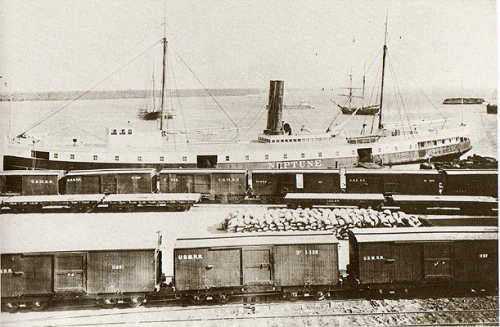
Where possible each side used railroads and maritime forces to move troops and supplies. The Confederacy, as has been noted was lacking in both, and was at a severe disadvantage. The Union however enjoyed a great advantage in modern rail networks, as well as ocean and river based maritime power. By late 1863 the Army of the Potomac, as well as forces in the West demonstrated “the close integration of operational planning and that of the general in chief and supply bureaus. In this one area, the development of a mature and modern staff was evident.” [22]

Once the armies were away from railheads or the ports from where they drew supplies both armies, like their Napoleonic cousins relied on wagons to transport essential food, supplies and ammunition when on campaign. In both armies commanders and their logisticians experimented with the number of wagons per regiment and how army commanders, modified that number at various points during the war based on their situation.

At the beginning of the war the Napoleonic standards by which both armies based the number of wagons, 12 wagons per 1000 men to support the troops on campaign were found to be insufficient as it “placed too much emphasis on foraging for American conditions” [23] and throughout the war standards for what the armies needed would be debated and commanders in different theaters of the war often set their own standards based on their needs and the availability of wagons and livestock to draw them.

As the war went on the Federal army experimented with the use of the “flying column” as a response to the dependency on wagons in order to increase their mobility. The flying column was an idea drawn from the French by Major General Montgomery Meigs, the Union Quartermaster General. The idea was simple; in order to reduce dependency on wagons the army itself would be reorganized at the lowest level, the infantry squad.

“The soldier in a flying column carried eight days’ compressed rations, including desiccated vegetables on his back. He carried a blanket but no overcoat. The men were divided into squads of eight, one of whom was to carry a covered cooking kettle, another a large mess tin, another an axe, another a pick, and one a shovel. One man in each company carried the hospital knapsack. Each man carried his share of a shelter tent. The cavalry were pickets and grain for their horses.” [24]

After Gettysburg and the unsuccessful pursuit of Lee’s army, Halleck and Rufus Ingalls, the Army of the Potomac’s chief quartermaster made provision and set standards “to convert the army into a flying column that would be self-sufficient for eight- and twelve- day periods away from the base of supply.” [25] In contrast, the Confederacy lacked the wagons and livestock to support the field operations of the army on campaign. Wagons, especially those suited for military operations were in short supply and any time the opportunity presented, confederate commanders ensured the capture of Union wagons. This turned out to be a major problem during the Gettysburg campaign, when Stuart during his ride around the Army of the Potomac “succumbed to temptation of capturing a beautifully equipped and heavily laden Union supply train near Rockville, Maryland, at the cost of exhausting his cavalry and wasting precious time.” [26] In most cases Stuart’s action would have been commendable, and he certainly felt that such should have been the case here as well, but the cost to his operations and Lee’s need for his cavalry were such that it was a mistake of disastrous consequences.

The basic load of food and ammunition carried by each soldier in order to increase strategic maneuverability was adjusted to meet the operational need. Both armies, but more often the Confederate army frequently had to live off the land. The success and failure of forage operations and the requirements for people and animals in each theater of operations had a large impact on each army. By early 1863 the Army of Northern Virginia was “greatly deficient in all areas of supply….there were extreme shortages of footwear, clothing, draft animals, and wagons.” [27] When the Army of Northern Virginia advanced into Pennsylvania they found it to be “a land of plenty” while “quartermaster and commissary details, acting under official instructions, filled wagons and supplies with foodstuffs.” [28]

While the Federal army never lacked in provisions or supplies, the Confederate armies were almost always in short supply. Even adequate food supplies needed to maintain an adequate caloric intake on the march were almost impossible to achieve. Food supplies were so limited that they were barely adequate, especially when the army was encamped. In fact, one of the reasons that Lee based his invasion of Pennsylvania was to alleviate his desperate supply situation. One regimental commander in Pickett’s division recalled that Lee told him “the movement was a necessity; that our provisions and supplies of every kind were nearly exhausted in Virginia, and we had to go into Pennsylvania for supplies.” [29]

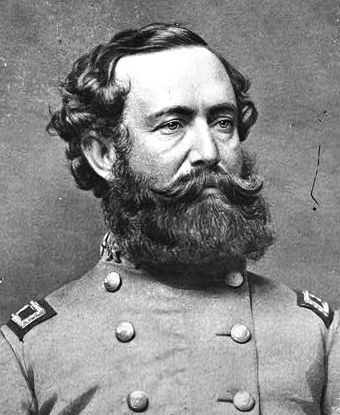
As Federal forces moved into the South they encountered a new problem, the areas that the conquered and their essential supply bases, railheads and railroads had to protected from Confederate partisans, irregulars, raiders and other insurgents. Railroads were especially important to the Federal logistics chain as they provided “new strategic and operational abilities” to civil war armies, but they were an “extremely delicate sources of dependence when they ran through hostile territory.” [30] As such they had to be protected, as did the sprawling supply bases on which the Federal armies in the South depended. This resulted in an ever increasing logistics tail in proportion to the fighting forces spearheading the Federal advance. The three Union armies commanded by William Tecumseh Sherman that carried “the brunt of the Union effort against Joe Johnston and Atlanta, for example, showed 352,265 men on their muster rolls, but took only about 100,000 directly into the campaign.” [31] The rest were engaged in protecting the vital logistics tail.

Communications and Signals

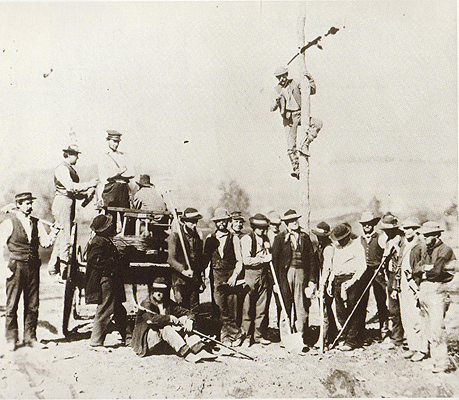
The size of the armies and the distances involved on the battlefield made command and control difficult.  As such, communications became more important and each army experimented with new signals organizations that used both old and new communication technologies. At the beginning of the war both sides made extensive use of visual signals and couriers, but rapidly began to rely on the telegraph for rapid communications.

03-Beardslee-telegraph-US-Army-photo

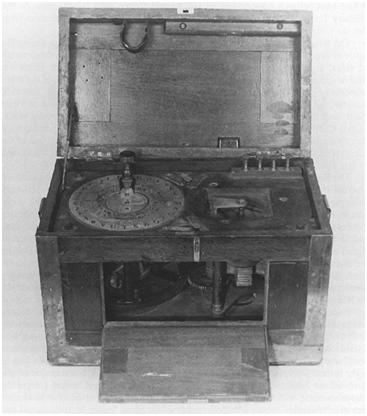
The organizational tension was particularly evident in the rivalry between the U.S. Army Signal Corps and the Military Telegraph Service.  The Signal Corps focused on wireless communications. It preferred the Beardslee wireless telegraphs, however, they were plagued by the limitations of such early wireless technology. The Union Army command favored the traditional wire bound networks operated by the Military Telegraph due to better reliability and security and eventually the Military Telegraph Service and its Morse trained operators were given “jurisdiction for all field telegraph” services at the urging of President Lincoln in November 1863. [32] Though the Army rejected the Beardslee equipment some commanders requested it for their operations.[33] As each Army became more dependent on the telegraph, each feared that their signals could be compromised through wiretapping and made efforts to encode their transmissions.

While the various forms of telegraphic communication were important in keeping higher headquarters in contact with armies in the field, battlefield communication could be difficult. Commanders on both sides relied on messengers to relay orders to subordinate commanders as well as pass information to senior commanders. On the battlefield this took time, and since the messengers were subject to the same dangers as ordinary soldiers messages might not reach the intended commanders. It took approximately an hour for a message to travel from an army commander to a corps commander, 30 minutes from a corps commander to a division commander, 20 from division to brigade, 15 from brigade to regiment and 5 minutes from regiment to company. [34]

Written orders generally provided better clarity if detailed enough but if they were passed orally, as was Lee’s preferred method they could easily be miscommunicated by messengers, or misunderstood or even ignored by commanders. This was a major source of Lee’s consternation during the Gettysburg campaign. A major problem for Lee during the campaign was that his orders, be they written or oral were frequently vague and discretionary, something that we will discuss in detail later, but Lieutenant General Richard Ewell spoke for many Confederate subordinate commanders on the evening of June 30th when he asked his division commanders in frustration “Why can’t a commanding General have someone on his staff who can write an intelligent order?” [35]

The Union Signal Corps also pioneered the use and development with a “modern system of semaphores with a telegraphic alphabet…” as well as “a cipher disk…that allowed the Union Signal Corps to change the code hourly if need be.” [36] The one disadvantage to this form of visual communication was that it could be limited due to weather conditions or the smoke of battle. While semaphore was used with a good deal of success by the Union, and Meade would make good use of it at Gettysburg, it was not used by the Confederate army.

civil-war-us-signal-corps

Likewise Meade “set a precedent in command procedures” during the Gettysburg campaign, where “for perhaps the first time in military history the commanding general of a large army was kept in communication during active operations with his corps and division commanders.” Likewise Meade “set a precedent in command procedures when he brought signal officers to the conference table for consultation on the plan of battle” [37] and for the first time Signal Corps officers were assigned directly to each corps, when Meade ordered that two Signal Corps officers be “detached for service with each corps.” [38]

The troops of the Union Signal Corps were also a vital link in the transmission of military intelligence gathered by Colonel George Sharpe’s Bureau of Military Information, whose network of scouts during the Gettysburg campaign were “supported by Signal Corps detachments which could establish chains of flag stations from Harpers Ferry to “South Mountain, Monterrey, Greencastle…up to Parnell’s Knob, in the Cumberland Valley.” [39] This link helped provide Meade with much better intelligence regarding the movement of Lee’s army throughout the campaign.

Regardless of the means of transmitting orders, the fact was that at Gettysburg the element of friction entered the communication process. Wireless communications suffered from encryption problems, semaphore could not always be read due to the reduced visibility caused by the smoke covered battlefield. Commanders who took the time to issue written orders found that those could be delayed or lost due to battlefield conditions that impacted a messenger’s ability to deliver them, or misunderstood by their recipients. Likewise, verbal orders sent by messenger were frequently garbled and misunderstood, or depending on the situation, understood in the manner that best fit the situation of the recipient.

The developments in tactics, maneuver, defense and logistics and how those were developed over the course of the war brought about a form of warfare that remained dominant of decades. In studying the campaigns, developments and tensions between the competing theories of Jomini and Mahan in the Civil War, a student can begin to recognize them in future wars fought by the US Army including World War Two.

Russell Weigley picks up this theme in his books The American Way of War and Eisenhower’s Lieutenants. Weigley discusses Lee’s use of Napoleonic strategy and Grant’s corresponding strategy of annihilation as well as Sherman’s campaign against Johnston, as well as Sheridan’s devastation of the Shenandoah Valley to impose its aims on the Confederacy. [40] These lessons influenced American strategic doctrine well into the next century, and were employed by leaders in the First and Second World Wars, as well as much less effectively in Korea and Vietnam. Weigley concluded: “Because it worked so well, achieving total submission, American soldiers thereafter tended to generalize the United States strategy of the Civil War into the appropriate strategy for all major, full scale wars.” [41]

Notes

[1] Ibid. Millet and Maslowski For the Common Defense p.216

[2] Ibid. Thomas, The Confederate Nation p.135

[3] Ibid. Millet and Maslowski For the Common Defense pp.216-217

[4] Ibid. Millet and Maslowski For the Common Defense p.218

[5] Ibid. Goldfield America Aflame pp.296-297

[6] Ibid. Guelzo Fateful Lightening p.326

[7] Ibid. McPherson. The Battle Cry of Freedom p.617-618

[8] Ibid. Goldfield America Aflame p.297

[9] Ibid. McPherson. The Battle Cry of Freedom p.441

[10] Ibid. Robertson Soldiers Blue and Gray p.72

[11] Ibid. Millet and Maslowski For the Common Defense p.156

[12] Ibid. Thomas, The Confederate Nation p.211

[13] Ibid. Guelzo Fateful Lightening p.319

[14] Ibid. Millet and Maslowski For the Common Defense p.216

[15] Ibid. Guelzo Fateful Lightening p.323

[16] Ibid. Millet and Maslowski For the Common Defense p.217

[17] Ibid. Guelzo Fateful Lightening p.322

[18] Ibid. Guelzo Fateful Lightening p.320

[19] Ibid. Guelzo Fateful Lightening p.322

[20] Ibid. McPherson. The Battle Cry of Freedom p.442

[21] Ibid. Millet and Maslowski For the Common Defense p.219

[22] Ibid. Hagerman The American Civil War and the Origins of Modern Warfare p.79

[23] Ibid. Hagerman The American Civil War and the Origins of Modern Warfare p.44

[24] Ibid. Hagerman The American Civil War and the Origins of Modern Warfare p.71

[25] Ibid. Hagerman The American Civil War and the Origins of Modern Warfare p.76

[26] Coddington, Edwin B. The Gettysburg Campaign: A Study in Command, A Touchstone Book, Simon and Schuster New York, 1968 p.198

[27] Ibid. Hagerman The American Civil War and the Origins of Modern Warfare p.126

[28] Wert, Jeffry D. A Glorious Army: Robert E. Lee’s Triumph 1862-1863 Simon and Schuster, New York and London 2011 p.229

[29] Ibid. West A Glorious Army p.230

[30] Ibid. Weigley A Great Civil War p.322

[31] Ibid. Weigley A Great Civil War p.322

[32] Ibid. Hagerman The American Civil War and the Origins of Modern Warfare p.87

[33] Ibid. Hagerman The American Civil War and the Origins of Modern Warfare p.87

[34] Cole, Phillip M. Command and Communication Friction in the Gettysburg Campaign Colecraft Industries, Ortanna PA 2006 p.80

[35] Trudeau, Noah Andre. Gettysburg: A Testing of Courage, Harper Collins Publishers, New York 2002 p.140

[36] Ibid. Hagerman The American Civil War and the Origins of Modern Warfare pp.43-44

[37] Ibid. Hagerman The American Civil War and the Origins of Modern Warfare p.87

[38] Ibid. Guelzo Gettysburg: The Last Invasion p.123

[39] Ibid. Guelzo Gettysburg: The Last Invasion p.42

[40] Ibid. Weigley The American Way of War pp.145-146

[41] Weigley, Russell F. Eisenhower’s Lieutenants: The Campaign in France and Germany 1944-1945. Indiana University Press, Bloomington IN 1981 p.3

2 Comments

Filed under civil war, Gettysburg, History, Military

Shades of Confederate Gray

fig25

Major General Patrick Cleburne C.S.A. 

“When the prophet, a complacent fat man,
Arrived at the mountain-top
He cried: “Woe to my knowledge!
I intended to see good white lands
And bad black lands—
But the scene is gray.”

Stephen Crane

Friends of Padre Steve’s World,

If you read my work you know how much I condemn the cause of the Confederacy and the institution of slavery. I also make no bones about the continued use of the symbols of the Confederacy by some who do not use them simply to honor the memory of dead soldiers but rather to further inflame political and racial divides. As a descendant of slave owners and Confederate officers I do understand the tension. THe family patriarch on my paternal side was an unreconstructed Rebel. He was a slave owner who served as a Lieutenant in the Confederate cavalry during the war and refused to sign the loyalty oath to the United States. For this he lost his lands and plantation. There are some who sincerely desire to honor their ancestors, and I think that is honorable, but to stand by an indefensible cause as my ancestors did is another matter to me.

I agree with historian George Santayana who wrote “Loyalty to our ancestors does not include loyalty to their mistakes.” I think we have to be able to deal with that, and I do not only mean for the descendants of slave owners and Confederates. Certainly the descendants of those in the North who cooperated with, enabled and profited from slavery, and then the entire movement to reenslaved freed blacks by other means after the war have nothing to be proud of in this regard. I readily admit that many political, industrial and religious leaders in the North were little better than many Southern leaders (see my articles Accomplices to Tyranny: The North & Reconstruction and Corporate Slavery & the Black Codes ). Both of these articles highlight how Northerners, especially politicians from both political parties and industrialists who took in those injustices committed against blacks. The same people on both sides of the Mason-Dixon Line dis similar things to poor whites who they referred to as “White Trash” as well as Native Americans, women later other immigrants like the Chinese. As we get closer to Labor Day I am going to spend some time on how American workers of all races were treated during that time, but not today.

IMG_1879

Instead I want to talk about shades of gray. As my regular readers know I believe that people are the most important part of history, and that people are seldom fully good or fully evil. In fact most people, saints and sinners alike live lives of some shade of gray. Thus I believe that good people can sometimes support evil causes and otherwise evil people can end up on the right side of history by supporting a good cause. We have other people that we treat as icons who had dark places in their lives, and did things that were not honorable; history is full of them. The problem is that we like to look at people as totally good or totally evil, it’s easier that way.

That is the case when we look at men who fought for the Confederacy and the Union during the Civil War, and since I have spent a lot of time hammering the cause that Confederate soldiers fought to defend, even those who opposed secession and slavery; it is only right that I spend some time talking about the shades of Confederate Gray. To do this we have to be able to put aside the notion that every Confederate was a racist or White Supremacist.

Hill.28135413_std

Lieutenant General A.P. Hill

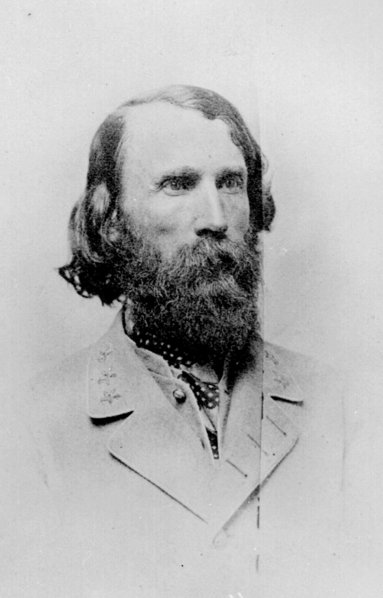
Those who fought for the Confederacy spanned the spectrum of belief and often fought for reasons other than slavery and some of their stories are tragic. Lieutenant General A.P. Hill opposed slavery before the war and opposed secession but because his state and his family seceded he went south. In 1850 he was on leave from the army and learned of a lynching in his home town of Lynchburg, he wrote “Shame, shame upon you all, good citizens…Virginia must crawl unless you vindicate good order or discipline and hang every son of a bitch connected with this outrage.” Hill was incredibly brave and led his troops honorably throughout the war. Sadly he died in action just days before the end of the war at Petersburg and his widow took no part in any commemorations of the Lost Cause after the war.

Brigadier General Lewis Armistead who led Pickett’s troops to the High Water mark at the Battle of Gettysburg is another tragic figure. He was a widower who lived a life of much sorrow and loneliness and the army was his life; his best friends were in the army. His very best friend, Winfield Scott Hancock and his wife Almira remained with the Union, their parting in California at the beginning of the war is heartrending, and it was Hancock’s troops who inflicted the mortal wound on him.

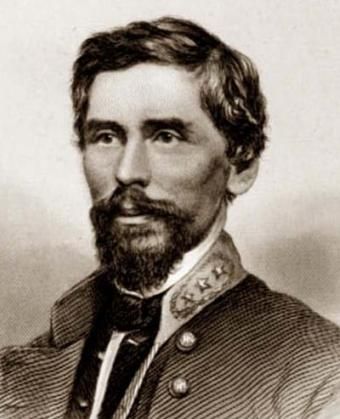
Major General Patrick Cleburne, called the “Stonewall Jackson of the West” is another. He was an Irish immigrant to Arkansas. He had no slaves, opposed the institution and fought because the people he lived among were his friends. He was the first Confederate to broach the subject of emancipating the slaves, and for this he was ostracized, and not promoted to Lieutenant General and command of a Corps. He died in action at the Battle of Franklin in 1864.

There are others, Lieutenant General James Longstreet who was probably the best corps commander on either side during the war, quickly reconciled, became a Republican and served in various capacities in government after the war. For this, as well as needing a scapegoat for the loss at Gettysburg Longstreet was treated as a modern Judas Iscariot by many in the South, especially among the proponents of the Lost Cause. Major General William “Little Billy” Mahone was another like Longstreet who joined the Republican Party and suffered a fair amount of criticism for his stance.

Another more interesting personality was Colonel John S. Mosby, the legendary “Gray Ghost” of Virginia whose “Raiders” caused Union forces much difficulty throughout the war. Mosby is interesting, he did not support slavery, was not a proponent of secession but felt that it was his duty to fight for his state. This was not unusual because in that era most people in all parts of the country, felt much more loyalty to their own state, or even city or county than they did to the national government. He and his troops served honorably and after the war too he supported reconciliation, he became a Republican and a friend and supporter of Ulysses Grant. He was not ashamed of his service and stated after the war, “I am not ashamed of having fought on the side of slavery—a soldier fights for his country—right or wrong—he is not responsible for the political merits of the course he fights in” and that “The South was my country. But he also condemned those in the South who denied that slavery was the cause of the war. All this made him anathema and he had to live the rest of his life outside the south or serving in various overseas diplomatic postings.

There were other shades of gray among Confederates, some like Lieutenant General Jubal Early who was not a slave owner and vehemently opposed secession in the Virginia legislature until the state seceded. When it did he joined the Confederate forces and became one of the fiercest supporters of Confederate independence who ever lived. In fact Early, though pardoned by President Andrew Johnson, never reconciled with the United States and became the leading proponent of the history of the Lost Cause. Early’s Corps Commander Lieutenant General Richard Ewell was more circumspect, he owned and admitted the mistakes he made during the war as a commander, and he fully reconciled to the United States. Before he died Ewell “insisted that nothing disrespectful to the United States Government be inscribed upon his tomb.”

Hampton_inline

Lieutenant General Wade Hampton

Lieutenant General Wade Hampton of South Carolina was one of the richest men in the South if not the country when war came. He supported secession, owned hundreds of slaves, but for a slave owner he was relatively decent in the way he treated his slaves. He fought through the war and returned home to nothing. He became involved in politics, remained very much a White Supremacist, but that being said built bridges to African American political and religious leaders when he ran for governor, even as the terrorist bands of the Red Shirts did all they could to ensure that blacks were harassed, disenfranchised and even killed to keep them from voting. To the surprise of the militants Hampton adopted a moderate course, kept blacks in his cabinet and in state offices, kept a regiment of African American militia in Charleston and opposed the black codes and Jim Crow. For this he was run out office. When he died his last words were “God bless my people, black and white.”

One the other hand there were men like Lieutenant General Nathan Bedford Forrest who helped found the Ku Klux Klan, and even led some of the early violence against blacks, and purchased black prisoners for use on his plantation after the war. However, he evolved on the issue, and left the Klan in 1869 and in 1875 two years before his death began to promote racial harmony. He spoke about that to a group of African Americans, where he received a bouquet of flowers from a black women he was condemned throughout the South. An article in the Charlotte Observer noted “We have infinitely more respect for Longstreet, who fraternizes with negro men on public occasions, with the pay for the treason to his race in his pocket, than with Forrest and Pillow, who equalize with the negro women, with only ‘futures’ in payment.”

There were many Confederate Soldiers who fought and died because they did believe in White Supremacy and hated the North, that too is a fact, and many of those who lived carried on that hate until they died.

birth_of_a_nation-3

There were others who never reconciled and who rewrote history to minimize the importance of slavery and White Supremacy to the Confederate cause, these included Jefferson Davis, his Vice President Alexander Stephens, and Brigadier General Henry Benning of Georgia. All had spearheaded the drive for secession, spoken and wrote forcefully for not only preserving but expanding slavery Stephens said quite clearly in 1861 what the Confederacy was founded upon in his Cornerstone Speech “Our new Government is founded upon exactly the opposite idea; its foundations are laid, its cornerstone rests, upon the great truth that the negro is not equal to the white man; that slavery, subordination to the superior race, is his natural and normal condition.” However, after the war all of them sought to distance themselves from this and change the narrative to Constitutional, economic and political reasons.

KKK-Nast

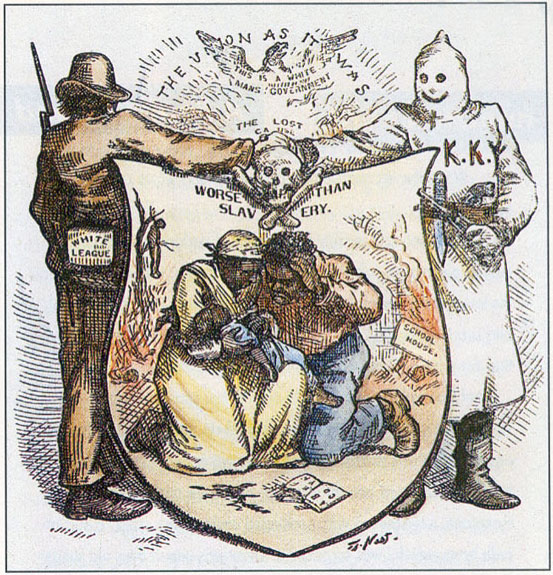
There were also many Confederate soldiers for whom the war never ended and they did continue it by other means, either as members of any of the various terrorist groups such as the Klan, the Red Shirts, the White League, the White Liners, or any of the related groups who terrorized and killed blacks and their white supporters, be they Northern “Carpetbaggers” or Southern “Scalawags.”

I could go on longer or in more detail on any of these men and probably could write a book about any of them, but I wanted to show that even when a cause is wrong, that we cannot condemn people as groups, and we also have to take into account people’s evolution on issues. The evolution of Wade Hampton and Nathan Bedford Forrest was far different than that of Jubal Early and others who supported the Lost Cause. I wish my family patriarch had been more like Mosby, Hampton, Hill, Ewell, Cleburne, or even Forrest rather than Jubal Early and others who never reconciled and in some cases continued to use violence to oppress others. 

Shades of gray. In history you can’t live with them and you can’t live without them.

Peace

Padre Steve+

3 Comments

Filed under civil rights, civil war, ethics, History, leadership, Political Commentary

The Sanitized History of the Lost Cause

Friends of Padre Steve’s World,

I am out tilting at windmills again and this one needs to be tilted at…

confederate-flag-picture

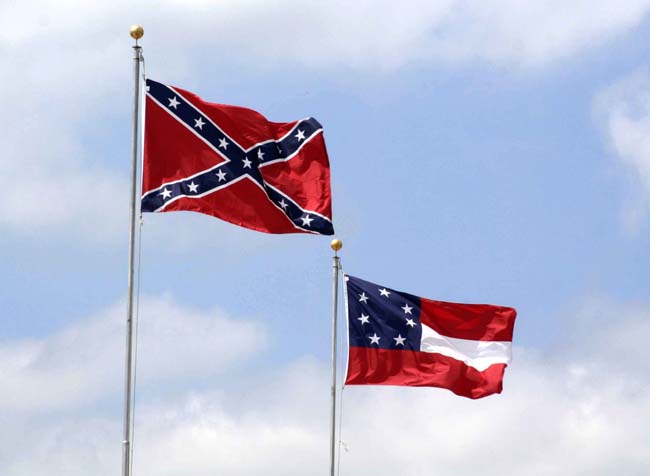
It seems that the organization known as the Sons of Confederate Veterans is not happy with the fact that the most prominent symbol of the Confederacy is coming down. This has been very apparent at the group’s convention in Richmond this week. Their anger is not only directed at the removal of the Confederate flag from the South Carolina State House, but at Supreme Court siding with Texas not to issue license plates with the Confederate flag on them, the decision of Virginia to eliminate the sons of Confederate Veteran plate which displays the battle flag, and moves to change the name of U.S. Highway One, known as the Jefferson Davis Highway to something other than that of the President of the Confederacy.

Frank Earnest, the former commander of the SCV’s Virginia division displayed the ignorance of years of sanitized history by telling the Richmond Times Dispatch that the removal of the flag and stripping highways of the names of Confederate leaders “It’s cultural genocide, everything about a four-year period where Virginia and other Southern states fought for their rights, we’re gonna eradicate any of that. That is something that’s done in dictatorial countries, not in the United States of America.”

For Earnest and those who think like him the war, and the sacrifice can be separated from the root cause of the war, which was White Supremacy and the expansion of slavery as well as the violence actions committed by the thousands of former Confederate soldiers who spearheaded the formation of terrorist groups such as the Ku Klux Klan, the White Leagues, the White Liners and the Red Shirts. Sadly, to millions of school children brought up in the South from the end of the war and in some cases even today, these issues are ignored. It is sanitized history which denies that slavery was the major cause of the war, it denies the systematic racism of those who founded the Confederacy, it denies the fight of White Supremacists throughout the South for the century following the war and beyond used systematic violence to terrorize, kill, disenfranchise and impoverish African Americans throughout the South. In fact the new Texas history books do exactly that.

While it is not as systematized as it was there are still thousands across the South and even the rest of the country who believe that telling the truth about history is cultural genocide and this my friends needs to be confronted every day and every time that men like Earnest make these bold faced lies about history. Jefferson Davis does not deserve a highway named after him, nor does Henry Benning, the pro-slavery, pro-secession firebrand who worked to persuade other states to secede does not deserve Fort Benning George to be named after him. Perhaps it should be renamed for Confederate Lieutenant General James Longstreet, another Georgian who after Appomattox recanted his Confederate views, swore his loyalty to the Federal government, tried to stem violence against blacks during Reconstruct and who is treated like Judas Iscariot by the Sons of Confederate Veterans and other proponents of the Lost Cause.

My God, I am going to be writing more on this subject, but will pause for now.

Have a wonderful and thoughtful night,

Peace

Padre Steve+

5 Comments

Filed under civil rights, civil war, leadership, Political Commentary

Racism and the Lost Cause

Friends of Padre Steve’s World

During the anniversary of the Battle of Gettysburg I tend to focus on that battle, and the actions of the men who fought it. I anticipate that I will add another article tomorrow from my Civil War and Gettysburg text dealing with a part of that battle, but today because it is so pertinent even 150 years after the war, I will revisit the myth of the Lost Cause and its influence on American history and race relations after the war was over. 

Sadly, the desire of Northern corporations, Southern landowners and those who sought reunion over justice, the rights of African Americans were not only subjugated to those interests but blacks were again degraded and their efforts to achieve their own freedom cast aside as politicians, landowners, academics, businessmen, preachers and even veterans organizations raced to forget what the war was about. 

This post is also part of my Gettysburg text and I do hope that it will cause us all to think about how history and justice can be obscured in the interest of covering over crimes for political, economic and social goals. 

Peace

Padre Steve+

Lost-Cause

Though Edmund Ruffin and his dreams of an independent republic built on slavery and white supremacy was dead, in the coming years, the Southern states would again find themselves under the governance of former secessionists who were unabashed white supremacists. The institution of slavery did not endure “but southerners’ racial beliefs and habits did…. The white ex-Confederate South proved much more successful in guarding this sacred realm” [1] during Reconstruction and after than they did during the war. Former secessionist firebrands who had boldly proclaimed slavery to be the deciding issue during the war changed their story. Instead of slavery being the primary cause of Southern secession and the war, it was “trivialized as the cause of the war in favor of such things as tariff disputes, control of investment banking and the means of wealth, cultural differences, and the conflict between industrial and agricultural societies.” [2]

Alexander Stephens who had authored the infamous Cornerstone Speech in 1861 that “that the negro is not equal to the white man; that slavery — subordination to the superior race — is his natural and normal condition” argued after the war that the war was not about slavery at all. Instead, the former Senator and Confederate Vice President changed his tune and argued that the war:

“had its origins in opposing principles….It was a strife between the principles of Federation, on the one side, and Centralism, or Consolidation on the other.” He concluded “that the American Civil War “represented a struggle between “the friends of Constitutional liberty” and “the Demon of Centralism, Absolutism, [and] Despotism!” [3]

Jefferson Davis, who had masterfully crafted “moderate” language, which radicals in the South used to their advantage regarding the expansion and protection of the rights of slave owners in the late 1850s to mollify Northern Democrats, and who wrote in October 1860 that: “The recent declarations of the Black Republican part…must suffice to convince many who have formerly doubted the purpose to attack the institution of slavery in the states. The undying opposition to slavery in the United States means war upon it where it is, not where it is not” [4] was not above changing his longstanding insistence that the slavery was the heart of the Confederacy’s claim to existence and the reason for secession.

birth_of_a_nation-3

After the war a revisionist Davis wrote:

“The Southern States and Southern people have been sedulously represented as “propagandists” of slavery, and the Northern as the champions of universal freedom…” and “the attentive reader…will already found enough evidence to discern the falsehood of these representations, and to perceive that, to whatever extent the question of slavery may have served as an occasion, it was far from being the cause for the conflict.” [5]

Instead of being about slavery the Confederate cause was mythologized by those promoting the false history of the “Lost Cause” a term coined by William Pollard in 1866, which “touching almost every aspect of the struggle, originated in Southern rationalizations of the war.” [6] By 1877 many southerners were taking as much pride in the “Lost Cause” as Northerners took in Appomattox.[7] Alan Nolen notes: “Leaders of such a catastrophe must account for themselves. Justification is necessary. Those who followed their leaders into the catastrophe required similar rationalization.” [8]

The Lost Cause was elevated by some to the level of a religion. In September 1906, Lawrence Griffith, speaking to a meeting of the United Confederate Veterans, stated that when the Confederates returned home to their devastated lands, “there was born in the South a new religion.” [9] The mentality of the Lost Cause took on “the proportions of a heroic legend, a Southern Götterdämmerung with Robert E. Lee as a latter day Siegfried.” [10]

This new religion that Griffith referenced in his speech was replete with the signs, symbols and ritual of religion:

“this worship of the Immortal Confederacy, had its foundation in myth of the Lost Cause. Conceived in the ashes of a defeated and broken Dixie, this powerful, pervasive idea claimed the devotion of countless Confederates and their counterparts. When it reached fruition in the 1880s its votaries not only pledged their allegiance to the Lost Cause, but they also elevated it above the realm of common patriotic impulse, making it perform a clearly religious function….The Stars and Bars, “Dixie,” and the army’s gray jacket became religious emblems, symbolic of a holy cause and of the sacrifices made on its behalf. Confederate heroes also functioned as sacred symbols: Lee and Davis emerged as Christ figures, the common soldier attained sainthood, and Southern women became Marys who guarded the tomb of the Confederacy and heralded its resurrection.” [11]

Jefferson Davis became an incarnational figure for the adherents of this new religion. A Christ figure who Confederates believed “was the sacrifice selected-by the North or by Providence- as the price for Southern atonement. Pastors theologized about his “passion” and described Davis as a “vicarious victim”…who stood mute as Northerners “laid on him the falsely alleged iniquities of us all.” [12] It was a theme that would be repeated by others in the coming decades, instead of a traitor to his nation; Davis became a figure like Jesus Christ, condemned though innocent.

In 1923 a song about Jefferson Davis repeated this theme:

Jefferson Davis! Still we honor thee! Our Lamb victorious, who for us endur’d a cross of martyrdom, a crown of thorns, soul’s Gethsemane, a nation’s hate, A dungeon’s gloom! Another God in chains.” [13]

The myth also painted another picture, that of slavery being a benevolent institution which has carried forth into our own time. The contention of Southern politicians, teachers, preachers and journalists, before, during and after the war was that slaves liked their status; they echoed the words of slave owner Hiram Tibbetts to his brother in 1842 “If only the abolitionists could see how happy our people are…..The idea of unhappiness would never enter the mind of any one witnessing their enjoyments” [14] as well as the words of Jefferson Davis who in response to the Lincoln’s Emancipation Proclamation called the slaves “peaceful and contented laborers.” [15]

gone_with_the_wind_b

The romantic images of the Lost Cause were conveyed to the American public by numerous writers and Hollywood producers including Thomas Dixon Jr. whose play and novel The Clansman became D.W. Griffith’s The Birth of a Nation; a groundbreaking part of American cinematography which was released in 1915. Margaret Mitchell, who penned the epic Pulitzer Prize winning novel Gone With the Wind, which in its 1939 film form won ten academy awards immortalized the good old days of the old South with images of faithful slaves, a theme which found its way into Walt Disney’s famed 1946 animated Song of the South. Through such films and books the myth of the Lost Cause became part of the national heritage with many people in states outside of the South and even some foreigners coming to believe the myth.

The Lost Cause helped buttress the myths that both comforted and inspired many Southerners following the war. “It defended the old order, including slavery (on the grounds of white supremacy), and in Pollard’s case even predicted that the superior virtues of cause it to rise ineluctably from the ashes of its unworthy defeat.” [16] The myth effectively helped pave the way to nearly a hundred more years of second class citizenship for now free blacks who were often deprived of the vote and forced into “separate but equal” public and private facilities, schools and recreational activities. The Ku Klux Klan and other violent organizations harassed, intimidated, persecuted and used violence against blacks.

When Reconstruction ended Southerners elected officials who turned a blind eye to the activities of the Klan and instituted state laws which denied most civil rights to African Americans, “From the 1880s onward, the post-Reconstruction white governments grew unwilling to rely just on intimidation at the ballot box and themselves in power, and turned instead to systematic legal disenfranchisement.” [17] Lynching was common and even churches were not safe. It would not be until the Civil Rights movement of the 1950s and 1960s that blacks would finally begin to gain the same rights enjoyed by whites in most of the South.

Despite this, many Union veterans to their dying day fought the Lost Causers. Members of the Grand Army of the Republic, the first truly national veteran’s organization, and the first to admit African American soldiers as equals, the predecessor of modern veteran’s groups, continued their fight to keep the public fixed on the reason for war, as well as point out the profound difference between what they believed that they fought for, and what their Confederate opponents fought for during the war.

“The Society of the Army of the Tennessee described the war as a struggle “that involved the life of the Nation, the preservation of the Union, the triumph of liberty and the death of slavery.” They had fought every battle…from the firing on the Union flag Fort Sumter to the surrender of Lee at Appomattox…in the cause of human liberty,” burying “treason and slavery in the Potter’s Field of nations” and “making all our citizens equal before the law, from the gulf to the lakes, and from ocean to ocean.” [18]

At what amounted to the last great Blue and Gray reunion at Gettysburg was held in 1937. The surviving members of the United Confederate Veterans extended an invitation to the GAR to join them there. The members of the GAR’s 71st Encampment from Madison Wisconsin, which included survivors of the immortal Iron Brigade who sacrificed so much of themselves at McPherson’s Ridge on July 1st 1863 adamantly, opposed a display of the Confederate Battle flag. “No Rebel colors,” they shouted. “What sort of compromise is that for Union soldiers but hell and damnation.” [19]

Ruffin outlived Lincoln who was killed by the assassin John Wilkes Booth on April 14th, 1864. However the difference between the two men was marked. In his Second Inaugural Address Lincoln spoke in a complete different manner than did Ruffin. He concluded that address with these thoughts:

“With malice toward none, with charity for all, with firmness in the right as God gives us to see the right, let us strive on to finish the work we are in, to bind up the nation’s wounds, to care for him who shall have borne the battle and for his widow and his orphan, to do all which may achieve and cherish a just and lasting peace among ourselves and with all nations.” [20]

Why this Matters Today

The_Storming_of_Ft_Wagner-lithograph_by_Kurz_and_Allison_1890a

The American Civil War provides a complex drama that political leaders, diplomats and military leaders would be wise to study, and not simply the military aspects and battles. Though the issues may be different in nations where the United States decides to intervene to prevent humanitarian disasters, to prevent local civil wars from becoming regional conflagrations, or to provide stability after a civil war, the conflict provides poignant example after poignant example. If we fail to remember them we will lose who we are as a nation. Sadly, all too often that is what we do.

Ken Burns wrote:

“after the South’s surrender at Appomattox we conspired to cloak the Civil War in bloodless, gallant myth, obscuring its causes and its great ennobling outcome – the survival of the Union and the freeing of four million Americans and their descendants from bondage. We struggled to rewrite our history to emphasize the gallantry of the wars’ top-down heroes, while ignoring the equally important bottom-up stories of privates and slaves. We changed the irredeemable, as the historian Davis Blight argues, into positive, inspiring stories.” [21]

The Union was preserved. Reconciliation was achieved to some degree, albeit in an imperfect manner. The continuance of legal racism and discrimination through the imposition of Jim Crow laws which discriminated against blacks and promoted segregation, poll-taxes and rigged tests to keep blacks from voting stained honor of the nation. The lack of repentance on the part of many of those who shamelessly promoted the Lost Cause and their current defenders continues to this day. Allen Guelzo wrote in the American Interest about the importance of both reconciliation and repentance to Frederick Douglass after the war:

“Douglass wanted the South not only to admit that it had lost, but also that it had deserved to lose. “The South has a past not to be contemplated with pleasure, but with a shudder”, he wrote in 1870. More than a decade later, Douglass was still not satisfied: “Whatever else I may forget, I shall never forget the difference between those who fought to save the Republic and those who fought to destroy it.” [22]

Likewise, that imperfect but reunited Union was all that stood in the way of Nazi Germany in the dark days of early 1942. Had the American republic fragmented during the war, had the South won, as so many kings and dictators of the day either openly or secretly desired, there would have been nothing to stand in the way of Hitler and his legions. Neither there would there be anyone to stand in the way of the modern despots, terrorists and dictatorships such as the Islamic State today.

Religion does matter to peoples, tribes and nations. It is still an important part of both foreign and domestic policy, even if a civilian policy maker or military strategist or operational planner does not believe in God and the effect of it cannot be minimized. Michael Oren notes “the impact of religion in shaping American attitudes and policies toward the Middle East” [23]in his book Power, Faith and Fantasy: America and the Middle East 1776 to the Present. The conflict between largely secular Roman Catholics, Orthodox Christians and Moslems in the Balkans is a glaring example of how people who are basically non-religious will rally around faith as a means of unity against rivals of a different faith, even those who are their long time neighbors.

Likewise, the attempt of former President Bush as well as President Obama to portray the response against Al Qaida and later the invasion of Iraq as “a war against terrorism – not as a war against Arabs, nor, more generally, against Muslims…” [24] has fallen on deaf ears in much of the Moslem world. Many Moslems, see the war as being waged against them and their religion. Many, even moderates have deeply ingrained beliefs similar to the late Osama Bin Laden, or the current leaders of the Al Qaida or the Islamic State for whom “this is a religious war, a war for Islam against infidels, and therefore, inevitably; against the United States, the greatest power of the world of the infidels.” [25]

In our culture of secularization we forget the primal importance of religion to others. Part of what we do not realize is that for people with Fundamentalist religious beliefs, no-matter what religion they belong to that religion is bedrock in times of tumult. When times are tough it is far easier for people to fall back on the more simple and fundamental aspects of their religious beliefs. For Americans this usually plays out in the individual drama of struggle, faith, sin and redemption and salvation. However, even in the United States religion can be, as we have seen from this brief look at the importance of religious faith and ideology in the ante-bellum United States, the Civil War and the aftermath of the war and Reconstruction, be translated into a catalyst and buttress for mass movements and holy war.

confederate-flag-picture

The controversies and conflicts brought on by the ideological, social and religious divides in the Ante-Bellum United States provide current leaders with historical examples. Our Civil War was heavily influenced by religion and the ideologies of the partisans in the North and in the South who were driven by religious motives, be those of the evangelical abolitionists or the proslavery evangelicals. If one is honest, one can see much of the same language, ideology and religious motivation at play in our twenty-first century United States. The issue for the vast majority of Americans, excluding certain neo-Confederate and White Supremacist groups, is no longer slavery; however the religious arguments on both sides of the slavery debate find resonance in our current political debates.

Likewise, for military, foreign policy officials and policy makers the subject of the role of religion can be quite informative. Similar issues are just as present in many the current conflicts in the Middle East, Africa and Eastern Europe which are driven by the religious motives of various sects. The biggest of these conflicts, the divide between Sunni and Shia Moslems, is a conflict that threatens to engulf the region and spread further. In it religion is coupled with the quest for geopolitical and economic power. This conflict in all of its complexity and brutality is a reminder that religion is quite often the ideological foundation of conflict.

These examples, drawn from our own American experience can be instructive to all involved in policy making. These examples show the necessity for policy makers to understand just how intertwined the political, ideological, economic, social and religious seeds of conflict are, and how they cannot be disconnected from each other without severe repercussions.

Samuel Huntington wrote:

“People do not live by reason alone. They cannot calculate and act rationally in pursuit of their self-interest until they define their self. Interest politics presupposes identity. In times of rapid social change established identities dissolve, the self must be redefined, and new identities created. For people facing the need to determine Who am I? Where do I belong? Religion provides compelling answers….In this process people rediscover or create new historical identities. Whatever universalist goals they may have, religions give people identity by positing a basic distinction between believers and non-believers, between a superior in-group and a different and inferior out-group.” [26]

By taking the time to look at our own history as well as our popular mythology; planners, commanders and policy makers can learn lessons if they take the time to learn, will help them understand similar factors in places American troops and their allies might be called to serve, or that we might rather avoid.

Notes 

[1] Ibid. Daly When Slavery Was Called Freedom pp.148-149

[2] Gallagher, Gary W. and Nolan Alan T. editors The Myth of the Lost Cause and Civil War History Indiana University Press, Bloomington and Indianapolis 2000 p.15

[3] Ibid. Dew Apostles of Disunion p.16

[4] Ibid. Catton The Coming Fury p.104

[5] Davis, Jefferson The Rise and Fall of the Confederate Government Volume One of Two, A public Domain Book, Amazon Kindle edition pp.76-77

[6] Ibid. Gallagher and Nolan The Myth of the Lost Cause and Civil War History p.12

[7] Millet Allen R and Maslowski, Peter. For the Common Defense: A Military History of the United States of America The Free Press, a division of McMillan Publishers, New York 1984 p.230

[8] Ibid. Gallagher and Nolan The Myth of the Lost Cause and Civil War History p.12

[9] Hunter, Lloyd The Immortal Confederacy: Another Look at the Lost Cause Religion in Gallagher and Nolan The Myth of the Lost Cause and Civil War p.185

[10] Ibid. McPherson The Battle Cry of Freedom p.854

[11] Ibid. Hunter The Immortal Confederacy Religion in Gallagher and Nolan The Myth of the Lost Cause and Civil War p.186

[12] Ibid. Hunter The Immortal Confederacy Religion in Gallagher and Nolan The Myth of the Lost Cause and Civil War p.198

[13] Ibid. Hunter The Immortal Confederacy Religion in Gallagher and Nolan The Myth of the Lost Cause and Civil War p.198

[14] Ibid. Levine Half Slave and Half Free p.106

[15] Ibid. Gallagher and Nolan The Myth of the Lost Cause and Civil War History p.16

[16] Ibid. Guelzo Fateful Lightening p.525

[17] Ibid. Guelzo Fateful Lightening p.526

[18] Ibid. Guelzo Fateful Lightening p.532

[19] Ibid. Guelzo Fateful Lightening p.532

[20] Ibid. Lincoln Second Inaugural Address

[21] Ibid. Burns A Conflict’s Acoustic Shadows p.102

[22] Guelzo, Allen C. A War Lost and Found in The American Interest September 1st 2011 retrieved 30 October 2014 from http://www.the-american-interest.com/articles/2011/09/01/a-war-lost-and-found/

[23] Oren, Michael Power, Faith and Fantasy: America and the Middle East 1776 to the Present W.W. Norton and Company, New York and London 2007 p.13

[24] Lewis, Bernard The Crisis of Islam: Holy War and Unholy Terror Random House, New York 2003 p.xv

[25] Ibid. Lewis The Crisis of Islam p.xv

[26] Ibid. Huntington The Clash of Civilizations p.97

3 Comments

Filed under civil war, film, Gettysburg, History, Political Commentary

Patrick Cleburne & Failed Confederate Emancipation

Friends of Padre Steve’s World

In light of some of the historical revisionism of parts of the Confederate heritage movement which claim that many blacks fought for the Confederacy. The fact is that this is not true. Though there are account of a few slaves who fought with their masters, the fact is that the Confederacy impressed the labor of slaves to do unarmed non-combat jobs such as cooks, teamsters and laborers while remaining slaves with no promise of freedom.  

This article deals with the reality that until the very end most leaders of the Confederacy fought against emancipation and did not want African Americans, slave or free to fight their battle. One non-slave owning Irish immigrant who rose to become a Confederate General disagreed and urged emancipation and equality for blacks who would fight for the Confederacy. His arguments were rejected and he was killed in action well before any other Confederate even considered emancipation.

The story of Cleburne demonstrates the lie that the leaders of the Confederacy desired nothing else than continued slavery for African Americans. It also demonstrates that there were individual Confederate leaders who saw the future and were pushed aside when they spoke up. Their political power in comparison to the aristocracy of the slave owners, traders and white supremacists was insignificant, and their heretical ideas doomed to failure.

This is another section of my Civil War and Gettysburg Staff Ride Text. I hope that you enjoy. 

Have a nice and thoughtful night.

Peace

Padre Steve+

CleburnePatrick

General Patrick Cleburne 

In the South, politicians and many senior Confederate Officers fought against any allowance for blacks to serve, for they knew if they allowed this, that slavery itself must be swept away. Despite this, a few such as General Patrick Cleburne, an Irish immigrant and a division commander in the Army of Tennessee demonstrated the capacity for forward thinking in terms of race: Cleburne advocated that blacks serve as soldiers should be emancipated.

Cleburne, known as “the Stonewall Jackson of the West” was a bold fighter who put together a comprehensive plan. He noted that the Confederacy was losing the war because it did not have soldiers, the supplies or resources; and most significantly that “slavery, from being one of our chief sources of strength at the beginning of the war, has now become in a military point of view, one of our chief sources of weakness.” [1] Cleburne recommended that “we immediately commence training a large reserve of the most courageous of our slaves, and further that we guarantee freedom within a reasonable time to every slave in the South who shall remain to the confederacy in this war.” [2]

Cleburne’s realism came through in his appeal:

“Ever since the agitation of the subject of slavery commenced the negro has been dreaming of freedom and his vivid imagination has surrounded the condition with so many gratifications that it has become the paradise of his hopes.” It was also shrewd politically: “The measure we propose,” he added, “will strike dead all John Brown fanaticism, and will compel the enemy to draw off altogether or in the eyes of the world to swallow the Declaration of Independence without the sauce and disguise of philanthropy.” [3]

The Irishman’s “logic was military, the goal more men in uniform, but the political vision was radical indeed.” [4] He was asking more from his fellow Southerners than they could risk. He was “asking them to surrender the cornerstone of white racism to preserve their nation” [5] and he presented it in stark terms that few could stomach “As between the loss of independence and the loss of slavery, we can assume that every patriot will freely give up the latter- give up the Negro slave rather than be a slave himself.” [6] Cleburne’s words were those of a heretic, he noted “When we make soldiers of them we must make free men of them beyond all question…and thus enlist their sympathies also.” [7]

In January 1864 General W.H.T Walker obtained a copy of Cleburne’s proposal and sent it to Davis. Walker opposed it and expressed his outrage over it. Cleburne’s proposal went from being a military matter to a political matter and Davis intervened to quash the proposal. “Convinced that the “propagation of such opinions” would cause “discouragements, distraction, and dissension” in the army, Jefferson Davis ordered the Generals to stop discussing the matter…The only consequence of Cleburne’s action seemed to be the denial of promotion to this ablest of the army’s division commanders, who was killed ten months later at the Battle of Franklin.” [8] In fact Cleburne was “passed over for command of an army corps and promotion to lieutenant general” three times in the next eight months, and in “each care less distinguished, less controversial men received the honors.” [9] All copies of Cleburne’s proposal were destroyed by the order of Davis.

Cleburne was not the only military man to advocate the formation of Negro units or even emancipation. Robert E. Lee was one of the chief proponents of this. Lee said after the war that he had told Davis “often and early in the war that the slaves should be emancipated, that it was the only way to remove a weakness at home and to get sympathy abroad, and divide our enemies, but Davis would not hear of it.” [10]

Ten months later Davis raised the issue of arming slaves, as he now believed that military necessity left him little choice. On November 7th 1864 he made his views known to the Confederate Congress, and they were a radical departure from the hitherto political orthodoxy of slavery. In light of the manpower needs of the South as well as the inability to achieve foreign recognition Davis asked their “consideration…of a radical modification in the theory of law” of slavery…” and he noted that the Confederacy “might have to hold out “his emancipation …as a reward for faithful service.” [11]

This drew the opposition of previously faithful supporters. Davis was now opposed by some of his closest political allies including Howell Cobb who warned “The day that you make soldiers of them is the beginning of the end of the revolution. If slaves will make good soldiers our whole theory of slavery is wrong.” [12] Lee wrote to a member of Virginia’s legislature “we must decide whether slavery shall be extinguished by our enemies and the slaves used against us, or use them ourselves at the risk of the effects which may be produced on our social institutions…” and he pointed out that “any act for the enrolling of slaves as soldiers must contain a “well digested plan of gradual and general emancipation”: the slaves could not be expected to fight well if their service was not rewarded with freedom.” [13]

The debate began in earnest in the fall of 1864 and revealed a sharp divide in the Confederacy between those who supported the measure and those against it. Cabinet members such as Judah Benjamin and a few governors “generally supported arming the slaves.” [14] The Southern proponents of limited emancipation were opposed by the powerful governors of Georgia and North Carolina, Joe Brown and Zebulon Vance, and by the President pro-tem of the Confederate Senate R.M.T. Hunter, who forcibly opposed the measure. Led by Governor “Extra Billy” Smith, Virginia’s General Assembly finally approved a law in 1865 “to permit the arming of slaves but included no provision for emancipation, either before or after military service.” [15]

Finally in March of 1865 the Confederate Congress passed by one vote a watered down measure to allow for the recruitment of slaves. It stipulated that “the recruits must all be volunteers” [16] and those who volunteered must also have “the approbation of his master by a written instrument conferring, as far as he may, the rights of a freed man.” [17] While this in itself was a radical proposition for a nation which had went to war to maintain slavery, the fact was that the slave’s service and freedom were granted not by the government, but by his owner, and even at this stage of the war, few owners were willing to part with their property. It was understood by many that giving freedom to a few was a means of saving the “particular institution.” The Richmond Sentinel noted during the November debate: “If the emancipation of a part is the means of saving the rest, this partial emancipation is eminently a pro-slavery measure.” [18] Thus the law made “no mention of emancipation as a reward of military service” [19] and in deference to “state’s rights, the bill did not mandate freedom for slave soldiers.” [20]

But diehards opposed even the watered down measure. Robert Kean, who headed the Bureau of War and should have understood the stark reality of the Confederacy’s strategic situation, note in his diary, that the law:

“was passed by a panic in the Congress and the Virginia Legislature, under all the pressure the President indirectly, and General Lee directly, could bring to bear. My own judgment of the whole thing is that it is a colossal blunder, a dislocation of the foundations of society from which no practical results will be reaped by us.” [21]

It was Lee’s prestige alone that allowed the measure to pass, but even that caused some to question Lee’s patriotism. The Richmond Examiner dared to express a doubt whether Lee was “a ‘good Southerner’: that is, whether he is thoroughly satisfied of the justice and beneficence of negro slavery.” [22] Robert Toombs of Georgia stated that “the worst calamity that could befall us would be to gain our independence by the valor of our slaves” [23] and a Mississippi congressman stated, “Victory itself would be robbed of its glory if shared with slaves.” [24] On March 23rd 1865 the War Office issued General Order Number 14, which authorized the call up and recruitment of slaves to the Confederate cause and on March 25th two companies were formed for drill in Richmond’s Capitol Square and as they did so to the sounds of fifes and drums, “Small boys jeered and threw rocks” [25] at them. None of those few volunteers would see action as within a week the Confederate government had fled Richmond.

But some would see that history was moving, and attitudes were beginning to change. It took time, and the process is still ongoing. As imperfect as emancipation was and though discrimination and racism remained, African Americans had reached “levels that none had ever dreamed possible before the war.” [26] In April 1865 as Jefferson Davis and his government fled Richmond, with Davis proclaiming, “again and again we shall return, until the baffled and exhausted enemy shall abandon in despair his endless and impossible task of making slaves of a people resolved to be free.” [27]

The irony in Davis’s empty vow was stunning. Within a week Lee had surrendered and in a month Davis himself would be in a Federal prison. The Federal troops who led the army into Richmond came from General Godfrey Weitzel’s Twenty-fifth Corps, of Ord’s Army of the James. The Every black regiment in the Army of the James was consolidated in Weitzel’s Corps, along with Ferrero’s former division that had suffered so badly at the Battle of the Crater. “Two years earlier in New Orleans, Weitzel had protested that he did not believe in colored troops and did not want to command them, and now he sat at the gates of Richmond in command of many thousands of them, and when the citadel fell he would lead them in and share with them the glory of occupying the Rebel capital.” [28] Among Weitzel’s units were regiments of black “cavalrymen and infantrymen. Many were former slaves; their presence showed their resolve to be free.” [29]

Notes

[1] Ibid. Thomas, The Confederate Nation p.262

[2] Ibid. Thomas, The Confederate Nation p.262

[3] Winik, Jay April 1865: The Month that Saved America Perennial an Imprint of Harper Collins Publishers New York 2002 p.53

[4] Ibid. McCurry Confederate Reckoning p.327

[5] Ibid. Guelzo Fateful Lightening p. 370

[6] Ibid. Thomas, The Confederate Nation p.262

[7] Ibid. McCurry Confederate Reckoning p.327

[8] Ibid. McPherson. The Battle Cry of Freedom p.833

[9] Ibid. Thomas, The Confederate Nation p.262

[10] Ibid. Gallagher The Confederate War p.47

[11] Ibid. McCurry Confederate Reckoning p.335

[12] Ibid. Guelzo Fateful Lightening p. 370

[13] Korda, Michael. Clouds of Glory: The Life and Legend of Robert E. Lee Harper Collins Publishers, New York 2014 p.643

[14] Ibid. Thomas, The Confederate Nation p.293

[15] Ibid. Foote. The Civil War, A Narrative. Volume Three pp.754-755

[16] Ibid. Foote. The Civil War, A Narrative. Volume Three p. 755

[17] Ibid. Thomas, The Confederate Nation p.296

[18] Ibid. McPherson. The Battle Cry of Freedom p.836

[19] Ibid. Foote. The Civil War, A Narrative Volume Three p.755

[20] Ibid. McPherson. The Battle Cry of Freedom p.837

[21] Ibid. Foote. The Civil War, A Narrative Volume Three p.860

[22] Ibid. McPherson. The Battle Cry of Freedom p.837

[23] Ibid. Foote. The Civil War, A Narrative Volume Three p.860

[24] Ibid. McPherson. The Battle Cry of Freedom p.835

[25] Ibid. Foote. The Civil War, A Narrative Volume Three p.860

[26] Ibid. Guelzo Fateful Lightening p. 386

[27] Levine, Bruce Half Slave and Half Free: The Roots of the Civil War Revised Edition, Hill and Wang, a division of Farrar, Strauss and Giroux, New York 1992 and 1995 p.241

[28] Catton, Bruce Grant Takes Command Little, Brown and Company Boston, Toronto and London 1968 p.411

[29] Ibid. Levine Half Slave and Half Free pp.241-242

3 Comments

Filed under civil war, History, leadership, Military, Political Commentary

God’s Not Quite Chosen People: The Confederate Union of Church and State

Friends of Padre Steve’s World

Unlike many areas of study, history never goes out of date. While I do not think that history necessarily repeats itself, I do believe that essentially humans never real change. Yes we sometimes do get better, but we often instead of rising to our best, we repeat the errors of those who have gone before us. 

This is especially true in he arenas of politics and religion, especially when societies decide to merge the two. I have written about this good number of times citing contemporary and historical examples, but today I am pulling out yet another section of the chapter of my Civil War and Gettysburg Staff Ride text dealing with how the Southern Confederacy for all practical purposes merged church and state during the Civil War. Now it did not become a full fledged theocracy, but I have no doubt that it would have had the Confederacy succeeded in its quest to become independent. The philosophical and religious thought that undergirded so much of what the Confederacy stood for almost demanded this.

And so today when we look at the fracturing of religion along political and ideological lines political resurgence of the Christian Right in the Republican Party we see many of the themes of the Confederacy being recast and broadcast as what it is to be authentically American and even more dangerously, that only Christians can be real Americans. That it what almost all the current field of Republican candidates cow-tow to the most extreme leaders and spokesmen of the Christian Right, some of whom are openly neo-Confederate in their beliefs and have ties to neo-Confederate and White Supremacist organizations.  

Since those supposedly Christian leaders seek to use their influence to force their religion on others, this subject remains very important. 

Have a great day.

Peace

Padre Steve+

lee-jackson-in-prayer

Perhaps more than anything, the denominational splits helped prepare the Southern people as well as clergy for secession and war. They set precedent by which Southerners left established national organizations. When secession came, “the majority of young Protestant preachers were already primed by their respective church traditions to regard the possibilities of political separation from the United States without undue anxiety.” [1]

One of the most powerful ideological tools since the days of the ancients has been the linkage of religion to the state. While religion has always been a driving force in American life since the days of the Puritans in the Massachusetts Bay Colony, especially in the belief about the destiny of the nation as God’s “Chosen People,” it was in the South where the old Puritan beliefs took firm root in culture, society, politics and the ideology which justified slavery and became indelibly linked to Southern nationalism. “Confederate independence, explained a Methodist tract quoting Puritan John Winthrop, was intended to enable the South, “like a city set on a hill’ [to] fulfill her God given mission to exalt in civilization and Christianity the nations of the earth.” [2]

Religion and the churches “supplied the overarching framework for southern nationalism. As Confederates cast themselves as God’s chosen people.” [3] the defense of slavery was a major part of their mission. A group of 154 clergymen calling themselves “The Clergy of the South” “warned the world’s Christians that the North was perpetuating a plot of “interference with the plans of Divine Providence.” [4] A Tennessee pastor bluntly stated in 1861 that “In all contests between nations God espouses the cause of the Righteous and makes it his own….The institution of slavery according to the Bible is right. Therefore in the contest between the North and the South, He will espouse the cause of the South and make it his own.” [5]

The effect of such discourse on leaders as well as individuals was to unify the struggle as something that linked the nation to God, and God’s purposes to the nation identifying both as being the instruments of God’s Will and Divine Providence:

“Sacred and secular history, like religion and politics, had become all but indistinguishable… The analogy between the Confederacy and the chosen Hebrew nation was invoked so often as to be transformed into a figure of everyday speech. Like the United States before it, the Confederacy became a redeemer nation, the new Israel.” [6]

This theology also motivated men like the convinced hard line Calvinist-Presbyterian, General Stonewall Jackson on the battlefield. Jackson’s brutal, Old Testament understanding of the war caused him to murmur: “No quarter to the violators of our homes and firesides,” and when someone deplored the necessity of destroying so many brave men, he exclaimed: “No, shoot them all, I do not wish them to be brave.” [7]

In effect: “Slavery became in secular and religious discourse, the central component of the mission God had designed for the South….The Confederates were fighting a just war not only because they were, in the traditional framework of just war theory, defending themselves against invasion, they were struggling to carry out God’s designs for a heathen race.” [8]

From “the beginning of the war southern churches of all sorts with few exceptions promoted the cause militant” [9] and supported war efforts. The early military victories of Robert E. Lee’s Army of Northern Virginia and the victories of Stonewall Jackson in the Shenandoah Valley   were celebrated as “providential validations of the cause that could not fail…” Texas Methodist minister William Seat wrote: “Never surely since the Wars of God’s ancient people has there been such a remarkable and uniform success against tremendous odds. The explanation is found in the fact that the Lord goes forth to fight against the coercion by foes of his particular people. Thus it has been and thus it will be to the end of the War.” [10]

This brought about a intertwining of church and state authority, a veritable understanding of theocracy as “The need for the southern people to acknowledge God’s authority was bound up with a legitimation of the authority of clerical and civil rulers. Christian humility became identified with social and political deference to both God and Jefferson Davis.” [11]

Jefferson Davis and other leaders helped bolster this belief:

“In his repeated calls for God’s aid and in his declaration of national days of fasting, humiliation, and prayer on nine occasions throughout the war, Jefferson Davis similarly acknowledged the need for a larger scope of legitimization. Nationhood had to be tied to higher ends. The South, it seemed, could not just be politically independent; it wanted to believe it was divinely chosen.” [12]

Davis’s actions likewise bolstered his support and the support for the war among the clergy. A clergyman urged his congregation that the people of the South needed to relearn “the virtue of reverence- and the lesson of respecting, obeying, and honoring authority, for authority’s sake.” [13]

Confederate clergymen not only were spokesmen and supporters of slavery, secession and independence, but many also shed their clerical robes and put on Confederate Gray as soldiers, officers and even generals fighting for the Confederacy. Bishop Leonidas Polk, the Episcopal Bishop of Louisiana, who had been a classmate of Jefferson Davis at West Point was commissioned as a Major General and appointed to command the troops in the Mississippi Valley. Polk did not resign his ecclesiastical office, and “Northerners expressed horror at such sacrilege, but Southerners were delighted with this transfer from the Army of the Lord.” [14] Lee’s chief of Artillery Brigadier General Nelson Pendleton was also an academy graduate and an Episcopal Priest. By its donations of “everything from pew cushions to brass bells, Southern churches gave direct material aid to the cause. Among all the institutions in Southern life, perhaps the church most faithfully served the Confederate Army and nation.” [15] Southern ministers “not only proclaimed the glory of their role in creating the war but also but also went off to battle with the military in an attempt to add to their glory.” [16]

Sadly, the denominational rifts persisted until well into the twentieth century. The Presbyterians and Methodists both eventually reunited but the Baptists did not, and eventually “regional isolation, war bitterness, and differing emphasis in theology created chasms by the end of the century which leaders of an earlier generation could not have contemplated.” [17] The Southern Baptist Convention is now the largest Protestant denomination in the United States and many of its preachers are active in often divisive conservative social and political causes. The denomination that it split from, the American Baptist Convention, though much smaller remains a diverse collection of conservative and progressive local churches. Some of these are still in the forefront of the modern civil rights movement, including voting rights, women’s rights and LGBT issues, all of which find some degree of opposition in the Southern Baptist Convention.

But the religious dimensions were far bigger than denominational disagreements about slavery; religion became one of the bedrocks of Confederate nationalism. The Great Seal of the Confederacy had as its motto the Latin words Deo Vindice which can be translated “With God as our Champion” or “Under God [Our] Vindicator.” The issue was bigger than independence itself; it was intensely theological. Secession “became an act of purification, a separation from the pollutions of decaying northern society, that “monstrous mass of moral disease,” as the Mobile Evening News so vividly described it.” [18]

The arguments found their way into the textbooks used in schools throughout the Confederacy. “The First Reader, For Southern Schools assured its young pupils that “God wills that some men should be slaves, and some masters.” For older children, Mrs. Miranda Moore’s best-selling Geographic Reader included a detailed proslavery history of the United States that explained how northerners had gone “mad” on the subject of abolitionism.” [19] The seeds of future ideological battles were being planted in the hearts of white southern children by radically religious ideologues, just as they are today in the Madrassas of the Middle East.

While the various theological and ideological debates played out and fueled the fires of passion that brought about the war, they also provided great motivation to their advocates. This was true especially to Confederates during the war, that their cause was righteous. While this fueled the passion of the true believers, other very real world decisions and events in terms of politics, law and lawlessness, further inflamed passions.

Notes

[1] Brinsfield, John W. et. al. Editor, Faith in the Fight: Civil War Chaplains Stackpole Books, Mechanicsburg PA 2003 p.67

[2] Ibid. Faust The Creation of Confederate Nationalism p.27

[3] Ibid. Gallagher The Confederate War pp.66-67

[4] Ibid. Daly When Slavery Was Called Freedom p.145

[5] Ibid. Daly When Slavery Was Called Freedom p.138

[6] Ibid. Faust The Creation of Confederate Nationalism p.29

[7] Fuller, J.F.C. Grant and Lee: A Study in Personality and Generalship, Indiana University Press, Bloomington IN 1957

[8] Ibid. Faust, The Creation of Confederate Nationalism: Ideology and Identity in the Civil War South p.60

[9] Ibid. Thomas The Confederate Nation 1861-1865 pp.245-246

[10] Ibid. Daly When Slavery Was Called Freedom pp.145 and 147

[11] Ibid. Faust The Creation of Confederate Nationalism p.26

[12] Ibid. Faust The Creation of Confederate Nationalism p.33

[13] Ibid. Faust The Creation of Confederate Nationalism p.32

[14] Foote, Shelby, The Civil War, A Narrative. Volume One: Fort Sumter to Perryville Random House, New York 1963 1958 p.87

[15] Ibid. Thomas The Confederate Nation p.246

[16] Ibid. Daly When Slavery Was Called Freedom p.142

[17] Ibid. McBeth The Baptist Heritage pp.392-393

[18] Ibid. Faust The Creation of Confederate Nationalism p.30

[19] Ibid. Faust The Creation of Confederate Nationalism p.62


9 Comments

Filed under civil rights, civil war, faith, History, Political Commentary

Dred Scott & Obergfell v. Hodges

ROGER B. TANEY (1777-1864).  Roger Taney, Chief Justice of the U.S. Supreme Court, handing down his decision on the Dred Scott case, 1857. American illustration.

ROGER B. TANEY (1777-1864).
Roger Taney, Chief Justice of the U.S. Supreme Court, handing down his decision on the Dred Scott case, 1857. American illustration.

Friends of Padre Steve’s World

Court decisions on Civil Rights matter and sometime soon we will get the Supreme Court decision on the Case of Obergfell v. Hodges, the case that will determine if Marriage Equity will become the law of the land or not. Such cases are important. As I mentioned yesterday freedom for all matters and I completely agree with he words of Abraham Lincoln in regard to liberty that the words of the Declaration of Independence that “all men are created equal” is a universal standard. That it is the “the standard maxim of free society …constantly spreading and deepening its influence,” ultimately applicable “to peoples of all colors everywhere.” This should be true for all, people including the LGBTQ community. 

Supporters of same-sex marriages gather outside the US Supreme Court waiting for its decision on April 28, 2014 in Washington, DC. The US Supreme Court is hearing arguments on whether gay couples have a constitutional right to wed -- a potentially historic decision that could see same-sex marriage recognized nationwide.  AFP PHOTO / MLADEN ANTONOV        (Photo credit should read MLADEN ANTONOV/AFP/Getty Images)

Supporters of same-sex marriages gather outside the US Supreme Court waiting for its decision on April 28, 2014 in Washington, DC. The US Supreme Court is hearing arguments on whether gay couples have a constitutional right to wed — a potentially historic decision that could see same-sex marriage recognized nationwide. AFP PHOTO / MLADEN ANTONOV (Photo credit should read MLADEN ANTONOV/AFP/Getty Images)

Since it matters so much I am posting a section from my Civil War and Gettysburg Staff Ride text on the Dred Scott decision. If you read it you will find just how chilling and similar the arguments of the Chief Justice of the Supreme Court Roger Taney are to those who oppose Marriage Equity and other rights being extended to Gay people. 

Peace

Padre Steve+

As the 1850s wore on, the divisions over slavery became deeper and voices of moderation retreated. The trigger for the worsening of the division was the political battle regarding the expansion of slavery; even the status of free blacks in the north who were previously slaves, over whom their owners asserted their ownership. Southerners considered the network to help fugitive slaves escape to non-slave states, called the Underground Railroad “an affront to the slaveholders pride” and “anyone who helped a man or woman escape bondage was simply a thief” who had robbed them of their property and livelihood, as an “adult field hand could cost as much as $2000, the equivalent of a substantial house.” [1]

In 1856 the Supreme Court, dominated by southern Democrats ruled in favor of southern views in the Dred Scott decision, one pillar of which gave slavery the right to expand by denying to Congress the power to prohibit slavery in Federal territories. Taney’s ruling in the case insisted that “Neither the Declaration of Independence nor the Constitution had been intended to apply to blacks he said. Blacks were “so far inferior that they had no rights which the white man was bound to respect.” Taney did not stop with this but he declared the Missouri Compromise itself unconstitutional for “Congress had exceeded its authority when it forbade slavery in the territories by such legislation as the Missouri Compromise, for slaves were private property protected by the Constitution.” [2]

The decision was momentous, but the judicial fiat of Taney and his court majority was a disaster for the American people. It solved nothing and further divided the nation:

“In the South, for instance, it encouraged southern rights advocates to believe that their utmost demands were legitimatized by constitutional sanction and, therefore, to stiffen their insistence upon their “rights.” In the North, on the other hand, it strengthened a conviction that an aggressive slavocracy was conspiring to impose slavery upon the nation, and that any effort to reach an accommodation with such aggressors was futile. While strengthening the extremists, it cut the ground from under the moderates.” [3]

The decision in the case is frightening when one looks upon its tenor and implications. The majority opinion which was written by Chief Justice Roger Taney was chilling, not only in its views of race, but the fact that blacks were perpetually property without the rights of citizens. Taney wrote:

“Can a negro, whose ancestors were imported into this country, sold as slaves, become a member of the political community formed and brought into existence by the Constitution of the United States, and as such become entitled to all the rights, and privileges, and immunities, guaranteed by that instrument to the citizen?…It is absolutely certain that the African race were not included under the name of citizens of a state…and that they were not included, and were not intended to be included, under the word “citizens” in the Constitution, and therefore claim none of the rights and privileges which that instrument provides for and secures to citizens of the United States. On the contrary, they were at that time considered as a subordinate and inferior class of beings, who had been subjugated by the dominant race, and, whether emancipated or not, yet remain subject to their authority, and had no rights or privileges but those who held the power and the Government might choose to grant them” [4]

The effect of the ruling on individuals and the states was far reaching. “No territorial government in any federally administered territory had the authority to alter the status of a white citizen’s property, much less to take that property out of a citizen’s hands, without due process of law or as punishment for some crime.” [5] Free slaves were no longer safe, even in Free States, from the possibility of being returned to slavery, because they were considered property. The tens of thousands of free blacks in the South were effectively stripped of citizenship, and became vulnerable to either expulsion or re-enslavement, something that the legislatures in Virginia, North Carolina and Missouri debated in 1858. Likewise the decision cast doubt on the free status of every African American regardless of residence.” [6]

But the decision had been influenced by President-Elect James Buchanan’s secret intervention in the Supreme Court deliberations two weeks before his inauguration. Buchanan hoped by working with the Justices that he would save the Union from breaking apart by appeasing slave owners and catering to their agenda. “The president-elect wanted to know not only when, but if the Court would save the new administration and the Union from the issue of slavery in the territories. Would the judges thankfully declare the explosive subject out of bounds, for everyone who exerted federal power? The shattering question need never bother President Buchanan.” [7] In his inaugural address he attempted to camouflage his intervention and “declared that the Court’s decision, whatever it turned out to be, would settle the slavery issue forever.” [8]

But Buchanan was mistaken. The case made the situation even more volatile as it impaired “the power of Congress- a power which had remained intact to this time- to occupy the middle ground.” [9] Taney’s decision held that Congress “never had the right to limit slavery’s expansion, and that the Missouri Compromise had been null and void on the day of its formulation.” [10]

The Court’s decision “that a free negro was not a citizen and the decision that Congress could not exclude slavery from the territories were intensely repugnant to many people in the free states” [11] and it ignited a firestorm in the north where Republicans now led by Abraham Lincoln, decried the decision and southerners basked in their judicial victory. Southerners were exultant, the Richmond Enquirer wrote that the Court had destroyed “the foundation of the theory upon which their warfare has been waged against the institutions of the South.” [12] Northerners now quite rightly feared that an activist court would rule to deny their states the right to forbid slavery. As early as 1854 Lincoln posed the idea that the Declaration of Independence was the standard maxim of free society …constantly spreading and deepening its influence,” ultimately applicable “to peoples of all colors everywhere.” [13]

After the Dred Scott decision Lincoln warned that the Declaration was being cheapened and diluted, he remained insistent on this point, he noted:

“Our Declaration of Independence was held sacred by all, and thought to include all” Lincoln declared, “but now, to aid in making the bondage of the Negro universal and eternal, it is assaulted, and sneered at, and construed, and hawked at, and torn, till, its framers could ride from their graves, they could not recognize it at all.” [14]

Lincoln attacked the decision noting that Taney “insists at great length that negroes were no part of the people who made, or for whom made, the declaration of Independence or the Constitution.” But as Doris Kearns Goodwin notes “in at least five states, black voters action on the ratification of the Constitution and were among the “We the People” by whom the Constitution was ordained and established.” Lincoln acknowledged that the founders “did not declare all men equal in all respects. They did not mean to say that all were equal in color, size, intellect, moral developments, or social capacity.” But they dis declare all men “equal in ‘certain inalienable rights, among which are life, liberty, and the pursuit of happiness.’…They meant simply to declare the right, so the enforcement of it might follow as circumstances permit.” [15]

Not only that, Lincoln asked the logical question regarding Taney’s judicial activism. Lincoln and other Republican leaders “noted that all slavery needed was one more Dred Scott decision that a state could not bar slavery and the objective of Slave Power to nationalize slavery would be accomplished.” [16] How long would it be, asked Abraham Lincoln, before the Court took the next logical step and ruled explicitly that the:

“Constitution of the United States does not permit a state to exclude slavery from its limits?” How far off was the day when “we shall lie down pleasantly thinking that the people of Missouri are on the verge of making their State free; and shall awake to the reality, instead, that the Supreme Court has made Illinois a slave State?” [17]

Lincoln discussed the ramification of the ruling for blacks, both slave and free:

“to aid in making the bondage of the Negro universal and eternal….All the powers of the earth seem rapidly combining against him. Mammon is after him; ambition follows, and philosophy follows, and the theology of the day is fast joining the cry. They have him in his prison house;…One after another they have closed the heavy doors upon him…and they stand musing as to what invention, in all the dominions of mind and matter, can be produced the impossibility of his escape more complete than it is.” [18]

Frederick Douglass noted that “Judge Taney can do many things…but he cannot…change the essential nature of things – making evil good, and good, evil.” [19]

Lincoln was not wrong in his assessment of the potential effects of the Dred Scott decision on Free States. State courts in free-states made decisions on the basis of Dred Scott that bode ill for blacks and cheered slave owners. In newly admitted California the state supreme court ominously “upheld a slaveowner’s right to retain his property contrary to the state’s constitution.” [20]

A similar decision by a New York Court was being used by slave-states to bring that issue to the Taney Court following Dred Scott. “In 1852 a New York judge upheld the freedom of eight slaves who had left their Virginia owner while in New York City on their way to Texas.” [21] The Dred Scott decision brought that case, Lemon v. The People back to the fore and “Virginia decided to take the case to the highest New York court (which upheld the law in 1860) and would have undoubtedly appealed it to Taney’s Supreme Court had not secession intervened.” [22] Even non-Republican parties such as the democrats could see the writing on the wall. The national publication of the Democratic Party, the Washington Union “announced that the clear implication of the Dred Scott decision was that all state laws prohibiting a citizen from another state, either permanently or temporarily, were unconstitutional.” [23]

Notes

[1] Goodheart, Adam. Moses’ Last Exodus in The New York Times: Disunion, 106 Articles from the New York Times Opinionator: Modern Historians Revisit and Reconsider the Civil War from Lincoln’s Election to the Emancipation Proclamation Edited by Ted Widmer, Black Dog and Leventhal Publishers, New York 2013 p.15

[2] Ibid. Goodwin Team of Rivals p. 189

[3] Ibid. Potter The Impending Crisis p.291

[4] Guelzo Allen C. Fateful Lightening: A New History of the Civil War Era and Reconstruction Oxford University Press, Oxford and New York 2012 p.91

[5] Ibid. Guelzo Fateful Lightening pp.91-92

[6] Ibid. Goldfield America Aflame p.142

[7] Freehling, William. The Road to Disunion Volume II: Secessionists Triumphant 1854-1861 Oxford University Press, Oxford and New York 2007 p.115

[8] Ibid. Freehling, The Road to Disunion Volume II: Secessionists Triumphant 1854-1861 p.109

[9] Ibid. Potter The Impending Crisis p.291

[10] Ibid. Levine Half Slave and Half Free p.210

[11] Ibid. Potter The Impending Crisis p.279

[12] Ibid. Goodwin Team of Rivals p. 190

[13] Ibid. Catton Two Roads to Sumter p.139

[14] Ibid. Guelzo Fateful Lightening p.93

[15] Ibid. Goodwin Team of Rivals p. 190

[16] Gienapp, William The Republican Party and Slave Power in The Civil War and Reconstruction Documents and Essays Third Edition edited by Michael Perman and Amy Murrell Taylor Wadsworth Cengage Learning Boston MA 2011 p.81

[17] Ibid. Levine Half Slave and Half Free p.211

[18] Ibid. Catton Two Roads to Sumter p.139

[19] Ibid. Goodwin Team of Rivals p. 190

[20] Ibid. Gienapp The Republican Party and Slave Power p.81

[21] Ibid. McPherson The Battle Cry of Freedom p.181

[22] Ibid. McPherson The Battle Cry of Freedom p.181

[23] Ibid. Gienapp The Republican Party and Slave Power p.82

1 Comment

Filed under civil rights, History, laws and legislation, LGBT issues, News and current events

Fiery Trials: Emancipation & Equality Today

c91f46b3ce5943b9e213e3cd306c6348_f3094

Friends of Padre Steve’s World

Just a coupled of thoughts on this Sunday night. Like yesterday I have been spending a lot of time on my Civil War-Gettysburg Staff Ride text. I have been working on re-writing the chapter on ideology and religion as they related to the causes of the war, its conduct and its aftermath. One thing that caught my attention was something that I think is profoundly important today.

In December of 1862 as he spoke to Congress prior to the the signing of the Emancipation Proclamation Lincoln spoke these profound words:

“Fellow citizens, we cannot escape history….This fiery trial through which we pass, will light us down, in honor or dishonor, to the latest generation….In giving freedom to the slave, we assure freedom to the free – honorable alike in what we give, and what we preserve.”

His words in giving freedom to the slave, we assure freedom to the free are part of an understanding of freedom, especially Lincoln’s radical understanding that the Declaration of Independence actually meant what it said that “all men are created equal.” For Lincoln this meant African Americans, inlacing those that labored as slaves. Lincoln understood the Declaration in its most broad understanding, he saw it as a universal liberty. As early as 1854 Lincoln posed the idea that the Declaration of Independence was the standard maxim of free society …constantly spreading and deepening its influence,” ultimately applicable “to peoples of all colors everywhere.”

Today there are a lot of people, especially the loudly political preachers, pundits and politicians of the Christian right and their allies who are committed to rolling back the rights of blacks, but also of women, and to prevent Gays, Lesbians and others of the LGBTQ community from having any rights commensurate with their status as citizens. In many states we have seen the protections of the Voter’s Rights Act being eroded as state legislatures enact laws to restrict voting rights and make it more difficult for people to exercise their right to vote. State legislatures are enacting laws that allow people to discriminate against others based on “a sincerely held religious belief” and while those laws are targeted against Gays they are in many cases written so broadly that they will protect just about any form of discrimination based on religion, even by public officials in the conduct of their duties as happened in  North Carolina last week. 

That is why what Lincoln said as he was preparing to sign the Emancipation Proclamation matters today. When we give freedom to people, we protect the freedom of everyone, but that my friends is not how many people in the so-called Christian Right see it. For them it is their freedom to discriminate in God’s name, because they like the anointed lords of the Southern Aristocracy believe that it is God’s will for them to do this. Sounding like a Southern planter, preacher or politician of the 1850s the founder of the movement known and Christian Dominionism R.J. Rushdooney wrote: “One faith, one law and one standard of justice did not mean democracy. The heresy of democracy has since then worked havoc in church and state . . . Christianity and democracy are inevitably enemies.”

British Evangelical-Anglican theologian Alister McGrath notes how “the arguments used by the pro-slavery lobby represent a fascinating illustration and condemnation of how the Bible may be used to support a notion by reading the text within a rigid interpretive framework that forces predetermined conclusions to the text.”

That my friends are what we are dealing with today. There is a party of Christians who have tremendous political power who are using it for the most nefarious of purposes, using the law and the police power of the state to deny rights to others while preserving their own while claiming to be the victims of persecution, just as did Southern slaveholders in the 1830s to 1861.

So, that is all for the night. I expect to put out something related to this topic again tomorrow, perhaps a full section of the chapter on religion and ideology from my text.

Peace

Padre Steve+

Leave a comment

Filed under civil rights, civil war, faith, History, laws and legislation, LGBT issues, News and current events, Political Commentary

Lincoln and the Importance of Civilian Leadership

Friends of Padre Steve’s World

I am posting another section of the first chapter of my Gettysburg text tonight. It is about the importance of civilian leadership in regard to the military and the importance of not just relying on military power to win wars. The American Civil War gives us a good example of civilian leaders who grasped both of these elements of leadership and national power. Of course the article is just a part of a text that goes into a lot more depth on both subjects., but it is a part of the introductory chapter. 

I expect that I will be writing about the three latest attacks on the LGBT community by the governors of Texas, Michigan and the legislature of North Carolina which occurred today in the next couple of days. I am doing some more work on my Gettysburg test and the chapter dealing with religion, ideology and politics which dovetail nicely with these events, I just have to put everything together, and I would rather do it right than to do a half-assed job. 

Have a great evening,

Peace

Padre Steve+

lincoln-selfstanding

Abraham Lincoln

Over time the Union developed what we would now refer to as a “whole of government approach” to the war. This included not only the military instrument but the use of every imaginable means of national power, from the diplomatic, the economic and the informational aspects of the Union in the effort to subdue the Confederacy. The understanding and use of the “whole of government approach” to war and conflict is still a cornerstone of United States military policy in “unified action, to achieve leverage across different domains that will ensure conditions favorable to the U.S. and its allies will endure.” [1]

Over the United States Government and that of the Confederacy sat two men whose backgrounds were widely different, Abraham Lincoln and Jefferson Davis. Lincoln had no real military experience, training or background. Davis, seemed to be a man fully ready based on his background as a West Point graduate, Army officer and Secretary of War to be a wartime commander in chief. However, it was Lincoln who learned how to be an effective wartime leader, while Davis, despite his background floundered in that capacity. James McPherson notes that:

“In all five functions as commander in chief – policy, national strategy, military strategy, operations, and tactics – Lincoln’s conception and performance were dynamic rather than static. He oversaw the evolution of the war from one of limited ends with limited means to be a full-scale effort that destroyed the old Union and built a new and better one on its ashes.” [2]

Not only was Lincoln’s evolution in military affairs remarkable, but he had a far better grasp of people than his prickly Confederate counterpart. “Lincoln was more eloquent than Davis in expressing war aims, more successful in communicating with people, more skillful as a political leader in keeping factions together for the war effort, better able to work with his critics to achieve a common goal. Lincoln was flexible, pragmatic, with a sense of humor to smooth relationships and help him survive the stress of his job.” [3] On the other hand Davis was none of these. He had a hard time getting along with people, as was evidenced by the rate that he went through secretaries of war, five in four years and his bad relations with two of his premier generals, Joseph Johnston and P.T.G. Beauregard. Quarrelsome and disputatious, “Davis seemed to prefer winning an argument to winning the war; Lincoln was happy to lose an argument if it would help win the war.” [4] The example of Davis is ample evidence that just because someone has military experience does not mean that they are able to assume the duties of commander-in-chief.

MTE4MDAzNDEwOTA2OTQwOTQy

Edwin Stanton

One of the key aspects of a successful whole of government approach to war, crisis and national emergency is effective civilian leadership at the cabinet level, especially the Secretary of State and the Secretary of Defense. In 1861 the later was split between Secretary of War, who headed the War Department and the Secretary of the Navy who headed the Department of the Navy. When he was elected Lincoln chose Simon Cameron as Secretary of War and Gideon Welles as Secretary of the Navy. Welles’s solid leadership of the Navy was never in question was both efficient and competent in managing the affairs of the rapidly expanding Navy.

However, Lincoln’s first Secretary of War, Simon Cameron was incompetent. Under Cameron the War Department lacked direction and within months was engulfed in controversy and charges of corruption and inefficiency. Though he was a skillful politician who “maintained his power base in Pennsylvania through the skillful use of patronage to reward loyalists and punish opponents” [5] Cameron was incompetent corrupt, and he was not equal to the task of managing the rapidly expanding war effort. Congress began to investigate and a number of Cameron’s political allies were found to have made great profits off of war contracts, which public funds had been wasted and the men who had volunteered to serve endangered. Lincoln and Secretary of State William Seward “agreed that Cameron should be removed and that Edwin Stanton – the diligent lawyer who had served as Seward’s window into the late Buchannan administration – would be a good successor.” [6]

Stanton and Lincoln’s relationship went back to an incident where the former, a very powerful and successful lawyer had humiliated Lincoln in Cincinnati before the Reaper lawsuit of 1855 where after a change of venue Stanton got Lincoln kicked off the case. It was an incident that Lincoln found humiliating, and that he vowed never to again return to Cincinnati. That being said, Lincoln had a keen appreciation for Stanton’s abilities. During the final days of the Buchannan administration it was Stanton as attorney general provided the intelligence that “had helped root out traitors and keep Washington safe from capture.” [7] Lincoln removed Cameron and as consolation sent him off to serve as Ambassador to Russia in St. Petersburg rather than humiliating Cameron, who still had a loyal base in Pennsylvania. Cameron’s reputation remained intact until the “House Committee on Contracts published its 1,100-page report in February 1862, detailing the extensive corruption in the War department that led to the purchasing of malfunctioning weapons, diseased horses, and rotten food.” [8] The act humiliated Cameron, and Lincoln took the unusual step of writing a long public letter to Congress to somewhat protect Cameron’s reputation by declaring that he and the entire cabinet “were at least equally responsible with [Cameron] for whatever error, wrong, or fault was committed.” [9] This was the first of many times where Lincoln chose to share the blame rather than further humiliate disgraced members of his administration, and it was a characteristic that

Cameron’s replacement as Secretary of War, Edwin Stanton was an entirely different type of man than Cameron. He was hard driving and ruthless in his pursuit of policies that would win the war. Stanton “drove himself as his staff of undersecretaries with maniacal fury and animation, auditing army contracts, reviewing and digesting military data for Lincoln’s use, intimidating army contractors, barking orders, and banging on his stand-up writing desk to make his point.” [10] Stanton’s brusque and brutally honest nature offended many people, but “he brought efficiency and integrity to the business of war contracts.” [11]

Likewise Stanton forced Union generals to adhere to administration policies, sacking those who were incompetent or recalcitrant and making a key change to the high command by replacing George McClellan as General-in-Chief with Major General Henry Wager Halleck. He also redefined the duties of the office making Halleck an advisor to the administration and liaison with the armies in the field. Halleck was perfectly suited to this position as “there was a need, in a civilian-run republic, fore a reliable and competent organizer who could serve as that kind of liaison  between the civilian leadership at the War Department and the military at the front.” [12] When Lincoln and Stanton brought in Ulysses Grant to serve as General-in Chief in March 1864, Halleck remained in Washington where he continued his staff and liaison work allowing Grant to command the armies in the field.

Stanton tolerated no inefficiency and immediately went to work to clear out corrupt officials and deny office seekers whose only claim to office was the patronage of elected officials or even their families. He denied one such man who came with the recommendation of Mary Todd Lincoln and then paid her a visit. Stanton “told her that “in the midst of a great war for national existence,” his “first duty is to the people,” and his next duty is to protect your husband’s honor, and your own. If he appointed unqualified men simply to return favors, it would “strike as the very root of all confidence.” [13] Mrs. Lincoln agreed and never asked Stanton for such favors again.

MeigsMontgomery

Major General Montgomery Meigs 

The working staff of the Stanton and Halleck’s War Department developed rapidly. Major General Montgomery Meigs served as Quartermaster General and effectively coordinated with railroads, weapons manufacturers and suppliers of clothing, food and other necessities to supply the army and navy so well that Union forces never lacked for what they needed to win the war. Like Stanton, Meigs was incorruptible and unlike Cameron, “a congressional audit could not find so much as one penny unaccounted for in any major contract authorized by Meigs.” [14]

Stanton and Meigs were “aided by the entrepreneurial talent of northern businessmen” which allowed that “the Union developed a superior managerial talent to mobilize and organize the North’s greater resources for victory in the modern industrialized conflict that the Civil War became.” [15] The other two major players in the War department were Commissary General Joseph P. Taylor and Chief of Ordnance James Wolfe Ripley. Neither man had the same talent as Meigs, but both turned into excellent administrators who ensured that Union forces always had ample supplies of provisions, weapons and ammunition.

The Confederacy never achieved anything like this, with the exception of his Chief of Ordnance, Josiah Gorgas the men in charge of ensuring that the Confederate armies had adequate supplies of food, clothing and equipment were inept, incompetent and utterly incapable of running a way.

The understanding of this eternal nature and ever changing character of war to leaders of nations as well as military commanders and planners has been very important throughout history. It can be seen in the ways that Jefferson Davis and Abraham Lincoln conducted the war. Lincoln, though he did not have the previous military experience of Davis, was the better learner and leader who came to understand the nature of modern war, including its logistic, political and diplomatic, and social-cultural contexts.

jeffdavis

Jefferson Davis

The contrast between Lincoln and Davis “directs attention to the difficulties of translating political judgment into effective warmaking.” [16] As such military leaders, understanding their relationship with the civil government should be the people to advise and instruct policy makers in aligning their policies to what is actually feasible based on the ends ways and means, as well as the strengths and limitations of the military to carry out policy decisions. History reminds us “that policymakers committed strongly to their political desires are not easily deflected by military advice of a kind that they do not want to hear.” [17] Too many times in history military leaders for many reasons have failed to raise their voice and to speak unpleasant truths regarding what is possible and what is not, often with catastrophic results for their nations. Likewise political leaders bent upon their own goals, even those goals that are at odds with their nation’s interests can ensure that their nation ends up on the ash heap up history.

Notes

[1] ________ JCWS Student Text 1 3rd Edition, 14 June 2013 p.2-4

[2] McPherson, James M. Tried by War: Abraham Lincoln as Commander in Chief Penguin Books, New York and London 2008 p.267

[3] McPherson, James M. American Victory, American Defeat in Why the Confederacy Lost edited by Gabor S. Boritt Oxford University Press, Oxford and New York 1992 p.37

[4] Ibid. McPherson American Victory, American Defeat p.37

[5] Goodwin, Doris Kearns Team of Rivals: The Political Genius of Abraham Lincoln Simon and Schuster, New York 2005 p.403

[6] Stahr, Walter Seward: Lincoln’s Indispensable Man Simon and Schuster, New York 2012 p.325

[7] Ibid. Goodwin Team of Rivals p.410

[8] Ibid. Goodwin Team of Rivals p.413

[9] Ibid. Goodwin Team of Rivals p.413

[10] Guelzo Allen C. Fateful Lightening: A New History of the Civil War Era and Reconstruction Oxford University Press, Oxford and New York 2012 p.312

[11] Ibid. McPherson Tried by War p.69

[12] Ibid. Guelzo Fateful Lighteningp.315

[13] Ibid. Goodwin Team of Rivals p.414

[14] Ibid. Guelzo Fateful Lighteningp.315

[15] Ibid. McPherson. The Battle Cry of Freedom p.857

[16] Ibid. Gray Fighting Talk p.38

[17] Ibid. Gray Fighting Talk p.38

Leave a comment

Filed under civil war, History, leadership